Three-dimensional visualization technology gives geologists
a virtual tour through the rock, deep underground, and allows
them to “see” potential reservoirs. This technology was employed
at the Tahiti Field and at the Tengiz and Karachaganak fields
in Kazakhstan.
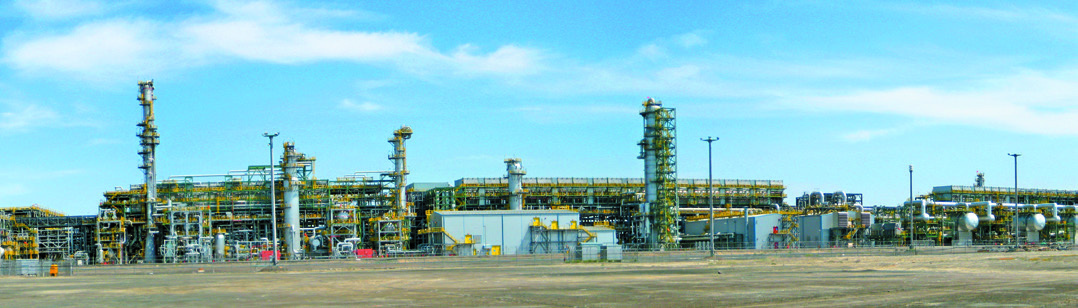
The company used its expertise in reservoir management
to complete a major expansion project that nearly doubled
production capacity from the giant Tengiz Field in Kazakhstan.
The project – called the Sour Gas Injection/Second Generation
Plant – took five years and $7 billion to complete.
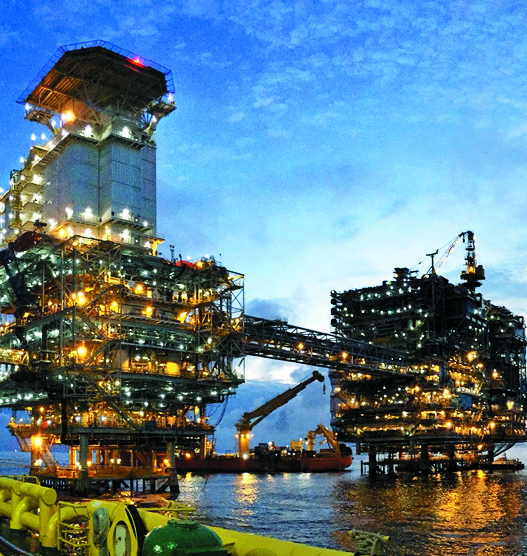
The Tengiz expansion and the ramp-up of the deepwater Agbami
Field offshore Nigeria were two projects that added significant
production volumes in 2009. Discovered in 1998, the Agbami
Field is a subsea development with wells tied back to a floating
production, storage and offloading vessel.
focusing on long-term upstream growth
The development of a substantial queue of major capital projects
was central to Chevron’s focus on long-term growth and creating
significant shareholder value for decades to come. This trend
continued with the startup of four major capital projects in 2012:
the deepwater Usan Field and Agbami 2 offshore Nigeria and
Caesar/Tonga and Tahiti 2 in the U.S. Gulf of Mexico. Consistent
with the company’s record of previous technological firsts,
Tahiti 2 set several individual records for increasing deepwater
production through the use of water injection, an effective
method of enhancing reservoir pressure to reach additional oil.
In pursuit of its long-term focus, Chevron continued to advance its
two world-class liquefied natural gas (LNG) projects in Western
Australia, Gorgon and Wheatstone. The Gorgon Project achieved
key construction milestones and delivered first gas in April 2016.
Gorgon’s progress continued, with the first delivery of gas at
Train 3 in March 2017. And by 2019, Chevron Australia completed
the Carbon Dioxide (CO2) Injection Project, which involved the
design, construction and operation of facilities to inject CO2 into
a deep reservoir more than two kilometers beneath Barrow Island.
By permanently trapping the CO2, Chevron expects to reduce
greenhouse gas (GHG) emissions from the Gorgon Project by
approximately 40%, or more than 100 million tonnes over the
life of the injection project.
Meanwhile, the achievement of several commercial milestones
helped lead to the startup of the Wheatstone Project in October
2017. “First LNG production is a significant milestone and is a credit
to our partners, contractors and the many thousands of people
who collaborated to deliver this legacy asset,” said then Chairman
and CEO John Watson.
The large queue of discoveries in Australia’s Carnarvon Basin
contributes to the resources available to sustain Chevron’s LNG
projects in the region.
Across the globe, Chevron continued progress on the company’s
development projects to deliver future production growth. In
2015, Chevron achieved first production at the Lianzi Project in the
Angola–Republic of the Congo Joint Development Area, the Moho
Bilondo Phase 1b Project in Republic of the Congo and the Agbami
3 Project in Nigeria.
In 2016, Chevron ramped up production at the Jack/St. Malo
Project in the U.S. Gulf of Mexico. Jack and St. Malo are two of the
largest oil and gas fields ever discovered in the deepwater gulf,
with reservoirs more than 26,000 feet (7,925 meters) deep, under
7,000 feet (2,134 meters) of water. With a capacity of 177,000 barrels
of oil equivalent per day, the Jack/St. Malo floating production unit
is the largest operation that Chevron has in the Gulf of Mexico.
Chevron’s development of oil and natural gas from shale and
tight rock formations intensified when the company entered the
Marcellus Shale through its acquisition of Atlas Energy in 2011.
By 2017, the company was also developing tight oil or liquids-rich
gas shales in the Permian Basin of the Southwestern United States,
the Vaca Muerta Shale in Argentina and the Duvernay Shale in
Canada. Production from our shale and tight rock activity in the
chevron history
15