Failure and Success
SCHOLARSHIP ESSAY • SYSTEMS ENGINEERING
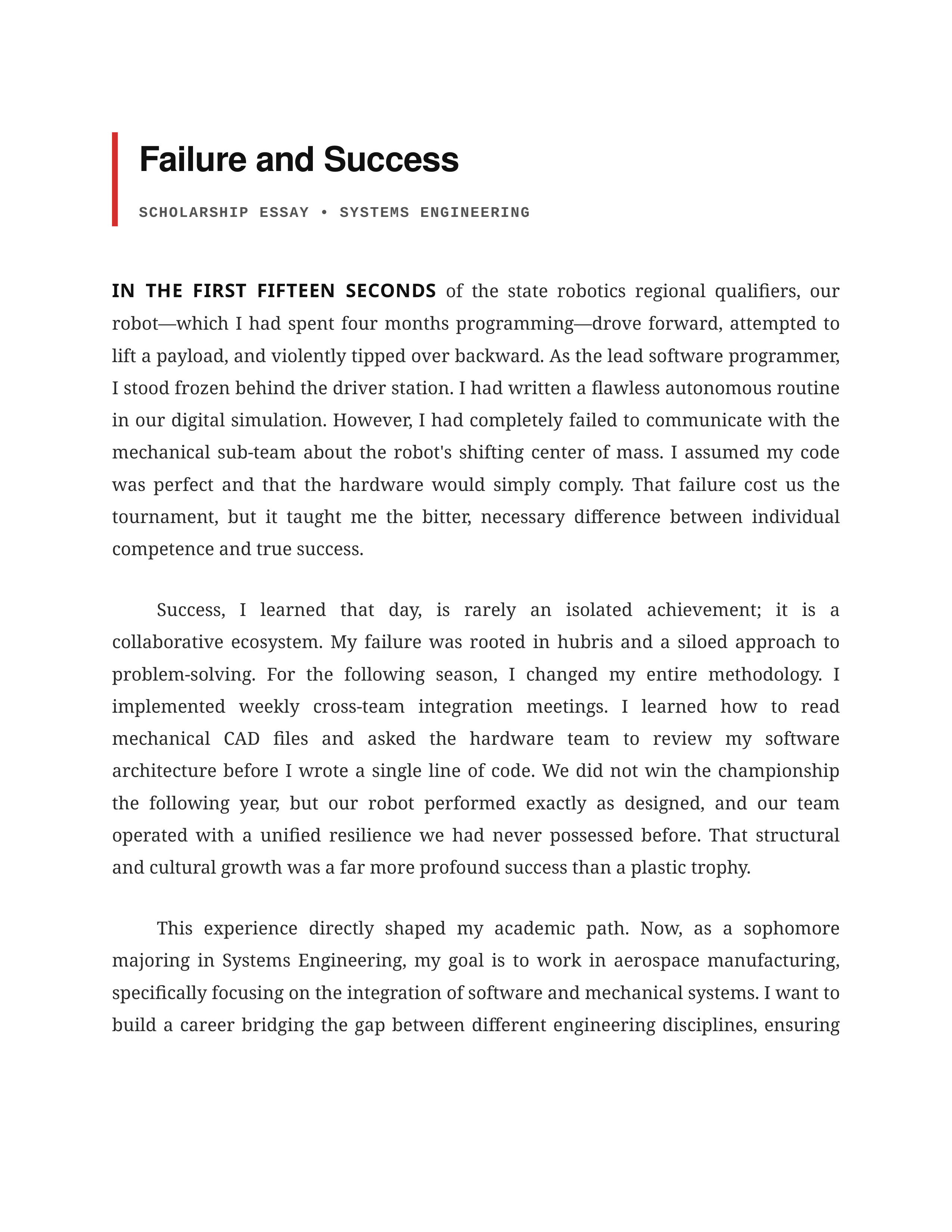
IN THE FIRST FIFTEEN SECONDS
of the state robotics regional qualifiers, our
robot—which I had spent four months programming—drove forward, attempted to
lift a payload, and violently tipped over backward. As the lead software programmer,
I stood frozen behind the driver station. I had written a flawless autonomous routine
in our digital simulation. However, I had completely failed to communicate with the
mechanical sub-team about the robot's shifting center of mass. I assumed my code
was perfect and that the hardware would simply comply. That failure cost us the
tournament, but it taught me the bitter, necessary difference between individual
competence and true success.
Success, I learned that day, is rarely an isolated achievement; it is a
collaborative ecosystem. My failure was rooted in hubris and a siloed approach to
problem-solving. For the following season, I changed my entire methodology. I
implemented weekly cross-team integration meetings. I learned how to read
mechanical CAD files and asked the hardware team to review my software
architecture before I wrote a single line of code. We did not win the championship
the following year, but our robot performed exactly as designed, and our team
operated with a unified resilience we had never possessed before. That structural
and cultural growth was a far more profound success than a plastic trophy.
This experience directly shaped my academic path. Now, as a sophomore
majoring in Systems Engineering, my goal is to work in aerospace manufacturing,
specifically focusing on the integration of software and mechanical systems. I want to
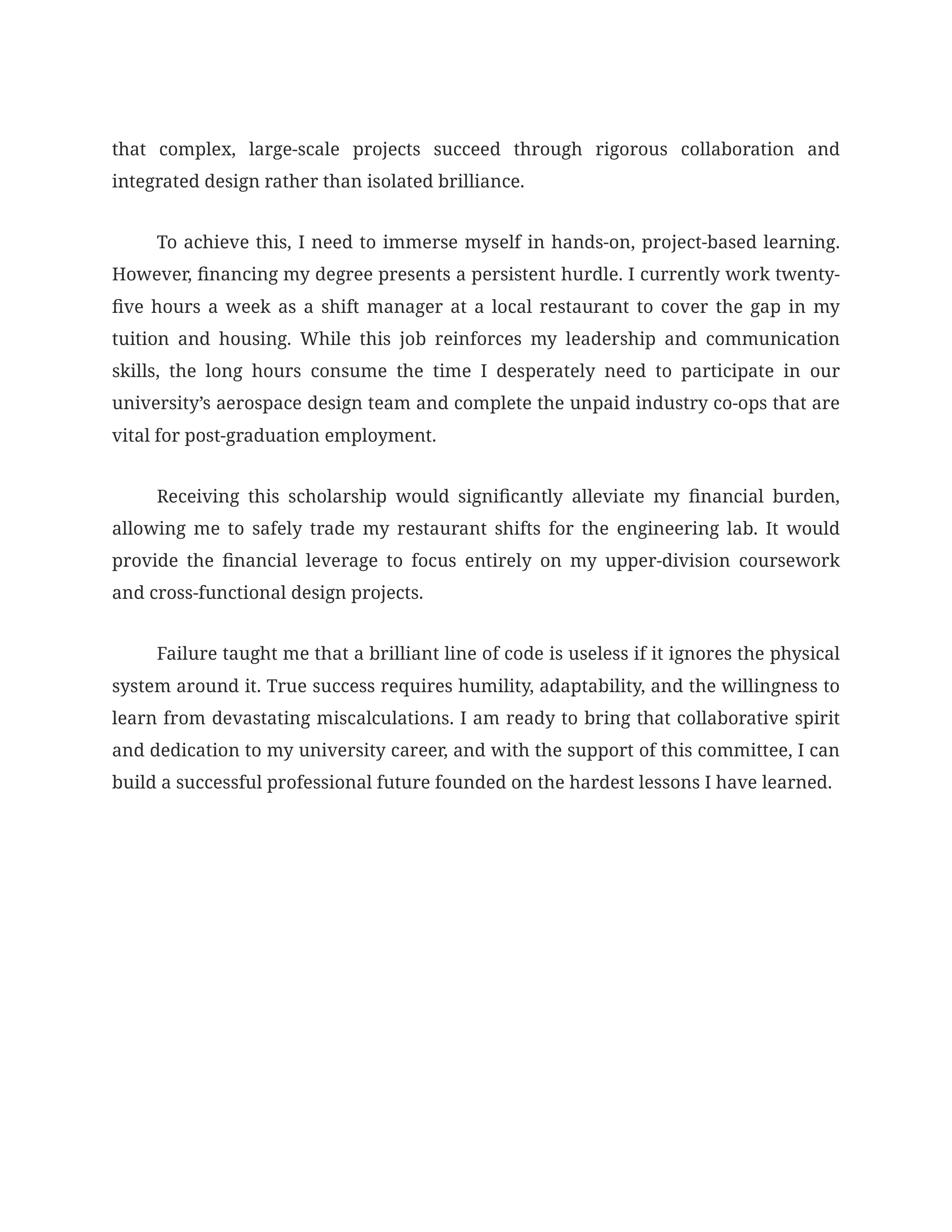
build a career bridging the gap between different engineering disciplines, ensuring