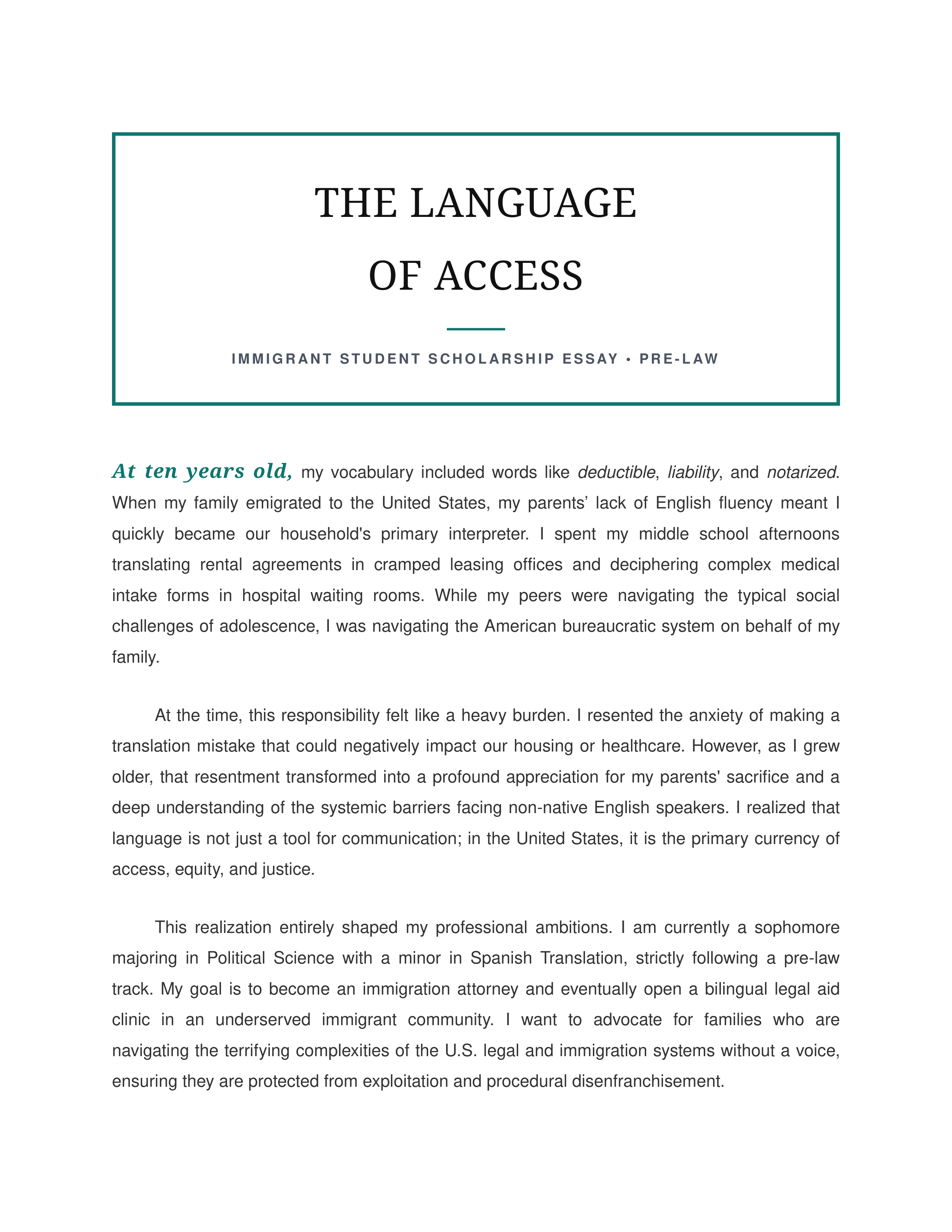
At ten years old,
my vocabulary included words like
deductible
,
liability
, and
notarized
.
When my family emigrated to the United States, my parents’ lack of English fluency meant I
quickly became our household's primary interpreter. I spent my middle school afternoons
translating rental agreements in cramped leasing offices and deciphering complex medical
intake forms in hospital waiting rooms. While my peers were navigating the typical social
challenges of adolescence, I was navigating the American bureaucratic system on behalf of my
family.
At the time, this responsibility felt like a heavy burden. I resented the anxiety of making a
translation mistake that could negatively impact our housing or healthcare. However, as I grew
older, that resentment transformed into a profound appreciation for my parents' sacrifice and a
deep understanding of the systemic barriers facing non-native English speakers. I realized that
language is not just a tool for communication; in the United States, it is the primary currency of
access, equity, and justice.
This realization entirely shaped my professional ambitions. I am currently a sophomore
majoring in Political Science with a minor in Spanish Translation, strictly following a pre-law
track. My goal is to become an immigration attorney and eventually open a bilingual legal aid
clinic in an underserved immigrant community. I want to advocate for families who are
navigating the terrifying complexities of the U.S. legal and immigration systems without a voice,
ensuring they are protected from exploitation and procedural disenfranchisement.
THE LANGUAGE
OF ACCESS
I M M I G R A N T S T U D E N T S C H O L A R S H I P E S SAY • PR E - L AW