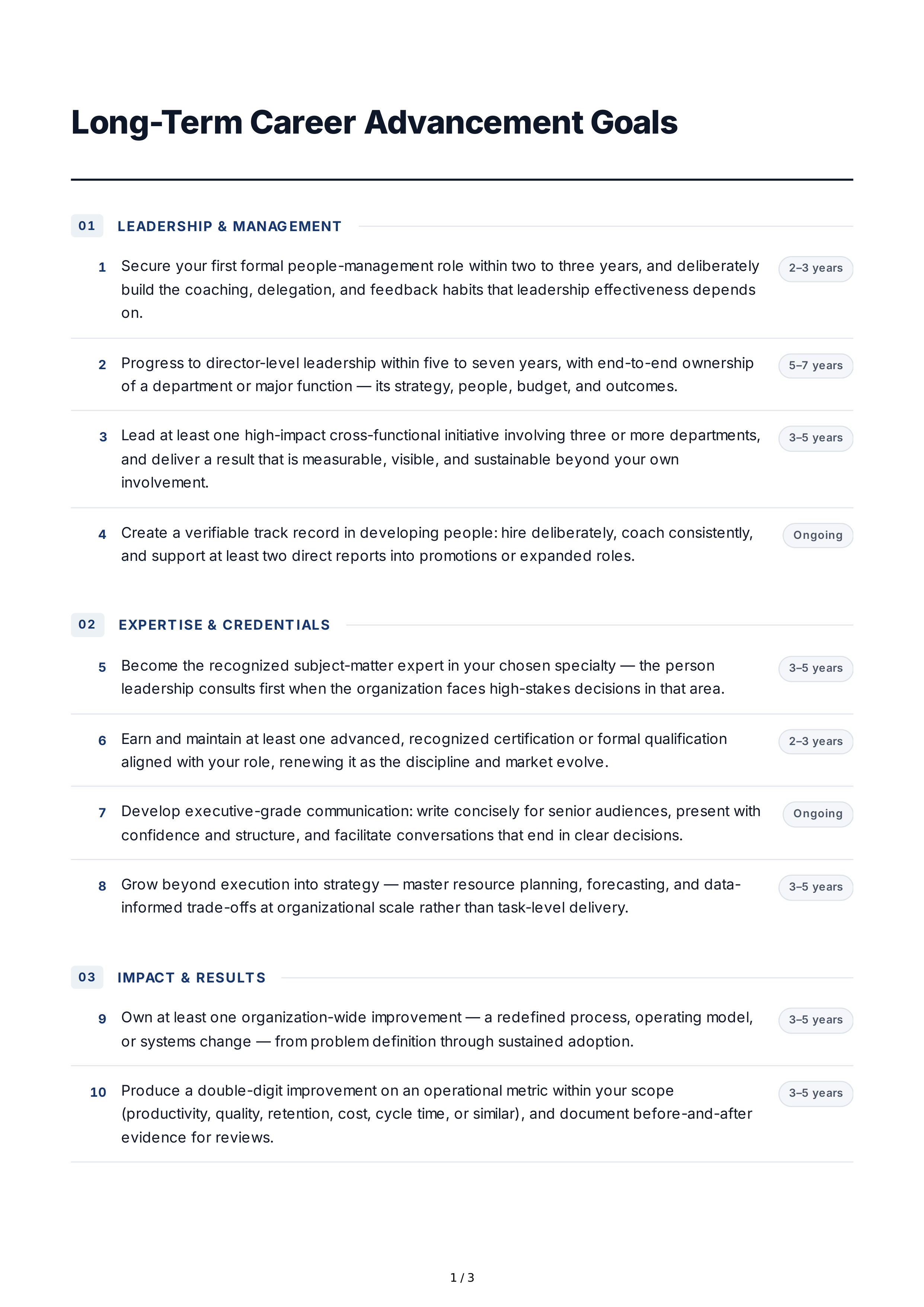
Long
-
Term
Career
Advancement
Goals
01
LEADERSHIP
&
MANAG EMENT
1
Secure
your
first
formal
people
-
management
role
within
two
to
three
years
,
and
deliberately
build
the
coaching
,
delegation
,
and
feedback
habits
that
leadership
effectiveness
depends
on
.
2–3
years
2
Progress
to
director
-
level
leadership
within
five
to
seven
years
,
with
end
-
to
-
end
ownership
of
a
department
or
major
function
—
its
strategy
,
people
,
budget
,
and
outcomes
.
5–7
years
3
Lead
at
least
one
high
-
impact
cross
-
functional
initiative
involving
three
or
more
departments
,
and
deliver
a
result
that
is
measurable
,
visible
,
and
sustainable
beyond
your
own
involvement
.
3–5
years
4
Create
a
verifiable
track
record
in
developing
people
:
hire
deliberately
,
coach
consistently
,
and
support
at
least
two
direct
reports
into
promotions
or
expanded
roles
.
Ongoing
02
EXPERT ISE
&
CREDENT IALS
5
Become
the
recognized
subject
-
matter
expert
in
your
chosen
specialty
—
the
person
leadership
consults
first
when
the
organization
faces
high
-
stakes
decisions
in
that
area
.
3–5
years
6
Earn
and
maintain
at
least
one
advanced
,
recognized
certification
or
formal
qualification
aligned
with
your
role
,
renewing
it
as
the
discipline
and
market
evolve
.
2–3
years
7
Develop
executive
-
grade
communication
:
write
concisely
for
senior
audiences
,
present
with
confidence
and
structure
,
and
facilitate
conversations
that
end
in
clear
decisions
.
Ongoing
8
Grow
beyond
execution
into
strategy
—
master
resource
planning
,
forecasting
,
and
data
-
informed
trade
-
offs
at
organizational
scale
rather
than
task
-
level
delivery
.
3–5
years
03
IMPACT
&
RESULT S
9
Own
at
least
one
organization
-
wide
improvement
—
a
redefined
process
,
operating
model
,
or
systems
change
—
from
problem
definition
through
sustained
adoption
.
3–5
years
10
Produce
a
double
-
digit
improvement
on
an
operational
metric
within
your
scope
(
productivity
,
quality
,
retention
,
cost
,
cycle
time
,
or
similar
),
and
document
before
-
and
-
after
evidence
for
reviews
.
3–5
years
1 / 3
11
Build
knowledge
infrastructure
that
outlasts
you
—
establish
a
training
curriculum
,
playbook
,
or
documentation
standard
that
teams
beyond
your
own
rely
on
daily
.
3–7
years
04
VISIBILIT Y
&
INFLUENCE
12
Establish
a
public
voice
in
your
professional
community
by
speaking
at
two
or
more
industry
conferences
,
panels
,
or
widely
attended
webinars
on
topics
you
genuinely
know
well
.
3–5
years
13
Publish
consistently
—
at
least
four
substantive
articles
,
posts
,
or
case
studies
per
year
—
sharing
applied
insight
and
lessons
learned
rather
than
surface
-
level
commentary
.
Ongoing
14
Take
on
an
institutional
role
in
your
field
—
serving
on
an
industry
association
committee
,
advisory
board
,
standards
working
group
,
or
equivalent
body
.
5–10
years
15
Cultivate
a
network
of
50+
senior
professionals
inside
and
adjacent
to
your
industry
,
built
through
genuine
mutual
support
,
trusted
advice
,
and
consistent
follow
-
through
.
Ongoing
05
POSIT ION
&
COMPENSAT ION
16
Take
on
formal
financial
ownership
—
a
P
&
L
,
product
budget
,
or
large
program
budget
—
and
demonstrate
disciplined
allocation
tied
to
measurable
results
.
5–7
years
17
Expand
the
range
of
decisions
you
are
sought
out
for
:
shift
from
functional
expert
to
strategic
leader
whose
input
shapes
organizational
priorities
beyond
a
single
department
.
3–5
years
18
Reach
the
total
-
compensation
band
of
your
target
leadership
level
,
supported
by
documented
impact
,
market
benchmarks
,
and
regular
career
conversations
with
your
manager
.
5–7
years
06
SUSTAINABLE
G ROWT H
19
Protect
dedicated
learning
time
each
week
—
roughly
one
to
two
hours
—
and
apply
it
to
structured
development
:
advanced
courses
,
certifications
,
books
,
or
real
projects
that
stretch
you
.
Ongoing
20
Institute
a
quarterly
career
review
:
assess
progress
on
every
adopted
goal
,
identify
what
changed
,
and
take
at
least
one
concrete
corrective
action
coming
out
of
each
session
.
Ongoing
21
Sustain
performance
without
sacrificing
wellbeing
—
refine
delegation
,
boundaries
,
and
energy
management
so
that
increasing
scope
does
not
come
at
the
cost
of
health
or
judgment
.
Ongoing
2 / 3
How
to
use
this
list
Long
-
term
goals
only
create
direction
once
they
are
converted
into
near
-
term
commitments
.
Use
this
simple
process
when
working
with
the
list
above
.
1
Select
your
anchors
.
Choose
three
to
five
goals
that
fit
your
current
role
,
industry
,
and
personal
definition
of
success
.
Treat
the
rest
as
a
refresh
pool
for
future
planning
cycles
.
2
Make
each
goal
specific
.
For
every
goal
you
adopt
,
add
a
target
date
,
a
measurable
outcome
,
and
the
first
small
action
you
will
take
within
the
next
thirty
days
.
3
Review
quarterly
.
Revisit
your
goals
every
quarter
,
adjust
them
as
your
role
and
market
evolve
,
and
update
the
full
plan
at
least
once
a
year
.
Long
-
Term
Career
Advancement
Goals
Career
Development
Plan
·
Personal
Copy
3 / 3