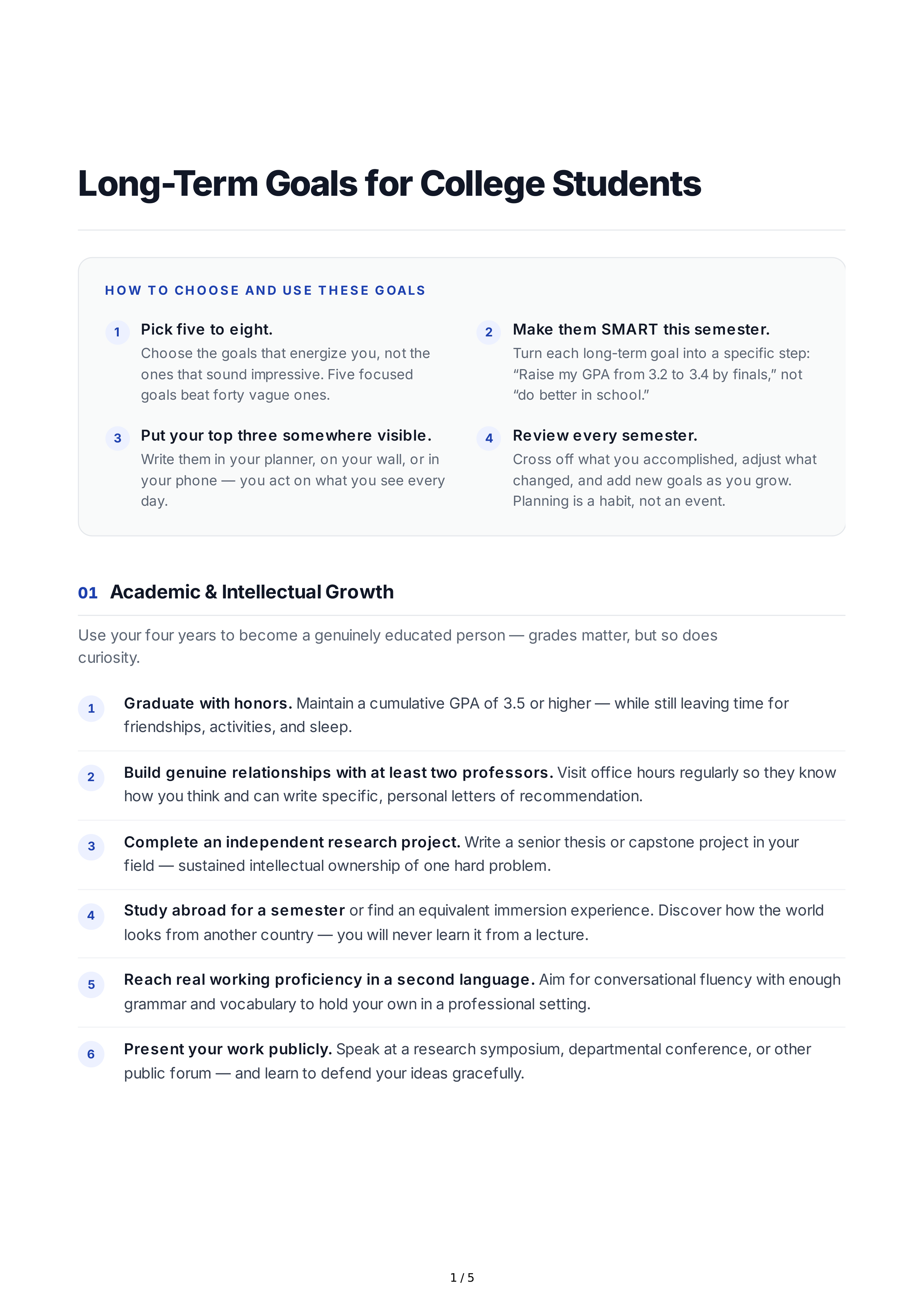
Long
-
Term
Goals
for
College
Students
H O W
T O
CH O O S E
AN D
US E
T H E S E
G OALS
1
Pick
five
to
eight
.
Choose
the
goals
that
energize
you
,
not
the
ones
that
sound
impressive
.
Five
focused
goals
beat
forty
vague
ones
.
2
Make
them
SMART
this
semester
.
Turn
each
long
-
term
goal
into
a
specific
step
:
“
Raise
my
GPA
from
3.2
to
3.4
by
finals
,”
not
“
do
better
in
school
.”
3
Put
your
top
three
somewhere
visible
.
Write
them
in
your
planner
,
on
your
wall
,
or
in
your
phone
—
you
act
on
what
you
see
every
day
.
4
Review
every
semester
.
Cross
off
what
you
accomplished
,
adjust
what
changed
,
and
add
new
goals
as
you
grow
.
Planning
is
a
habit
,
not
an
event
.
01
Academic
&
Intellectual
Growth
Use
your
four
years
to
become
a
genuinely
educated
person
—
grades
matter
,
but
so
does
curiosity
.
1
Graduate
with
honors
.
Maintain
a
cumulative
GPA
of
3.5
or
higher
—
while
still
leaving
time
for
friendships
,
activities
,
and
sleep
.
2
Build
genuine
relationships
with
at
least
two
professors
.
Visit
office
hours
regularly
so
they
know
how
you
think
and
can
write
specific
,
personal
letters
of
recommendation
.
3
Complete
an
independent
research
project
.
Write
a
senior
thesis
or
capstone
project
in
your
field
—
sustained
intellectual
ownership
of
one
hard
problem
.
4
Study
abroad
for
a
semester
or
find
an
equivalent
immersion
experience
.
Discover
how
the
world
looks
from
another
country
—
you
will
never
learn
it
from
a
lecture
.
5
Reach
real
working
proficiency
in
a
second
language
.
Aim
for
conversational
fluency
with
enough
grammar
and
vocabulary
to
hold
your
own
in
a
professional
setting
.
6
Present
your
work
publicly
.
Speak
at
a
research
symposium
,
departmental
conference
,
or
other
public
forum
—
and
learn
to
defend
your
ideas
gracefully
.
1 / 5
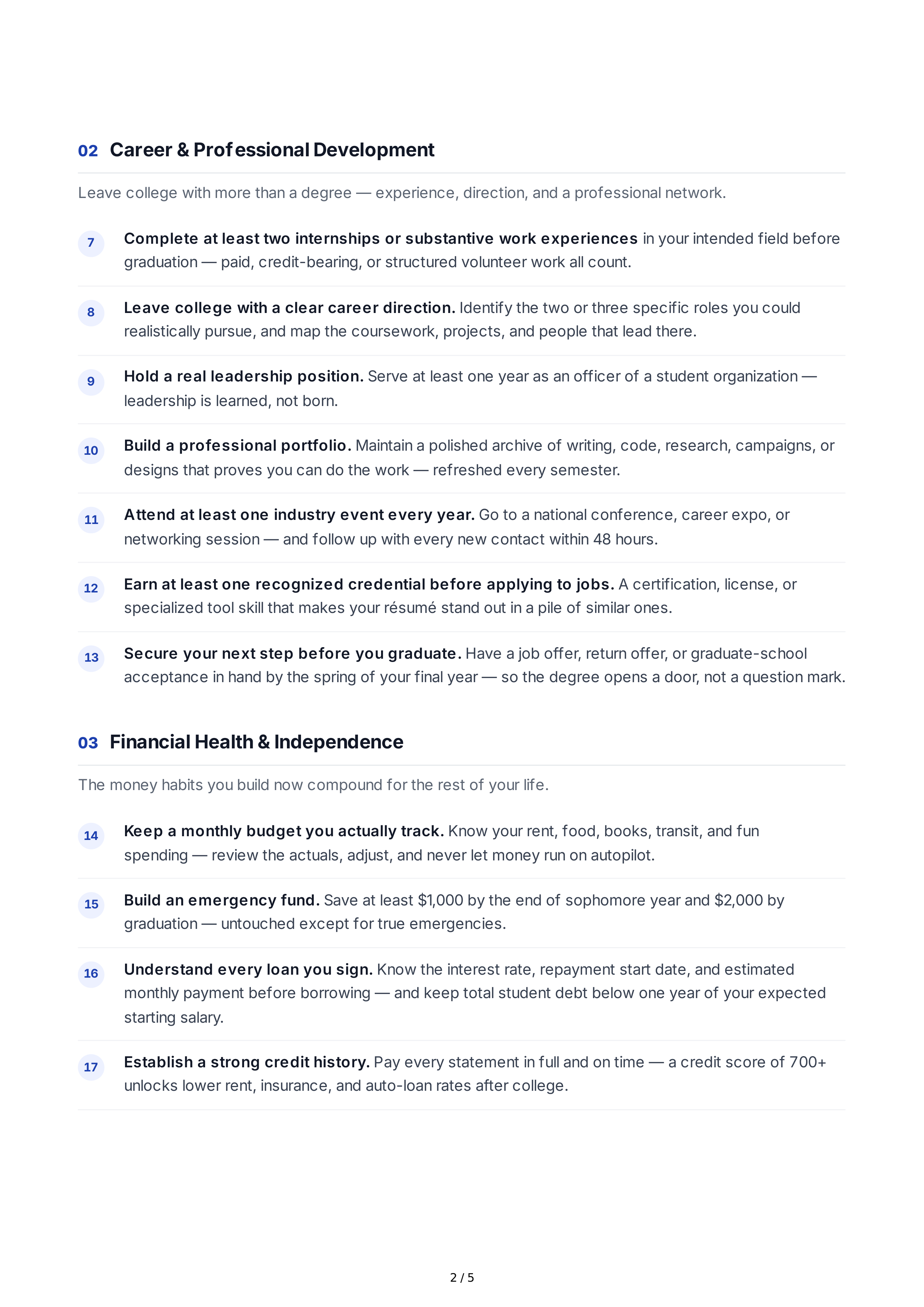
02
Career
&
Professional
Development
Leave
college
with
more
than
a
degree
—
experience
,
direction
,
and
a
professional
network
.
7
Complete
at
least
two
internships
or
substantive
work
experiences
in
your
intended
field
before
graduation
—
paid
,
credit
-
bearing
,
or
structured
volunteer
work
all
count
.
8
Leave
college
with
a
clear
career
direction
.
Identify
the
two
or
three
specific
roles
you
could
realistically
pursue
,
and
map
the
coursework
,
projects
,
and
people
that
lead
there
.
9
Hold
a
real
leadership
position
.
Serve
at
least
one
year
as
an
officer
of
a
student
organization
—
leadership
is
learned
,
not
born
.
10
Build
a
professional
portfolio
.
Maintain
a
polished
archive
of
writing
,
code
,
research
,
campaigns
,
or
designs
that
proves
you
can
do
the
work
—
refreshed
every
semester
.
11
Attend
at
least
one
industry
event
every
year
.
Go
to
a
national
conference
,
career
expo
,
or
networking
session
—
and
follow
up
with
every
new
contact
within
48
hours
.
12
Earn
at
least
one
recognized
credential
before
applying
to
jobs
.
A
certification
,
license
,
or
specialized
tool
skill
that
makes
your
résumé
stand
out
in
a
pile
of
similar
ones
.
13
Secure
your
next
step
before
you
graduate
.
Have
a
job
offer
,
return
offer
,
or
graduate
-
school
acceptance
in
hand
by
the
spring
of
your
final
year
—
so
the
degree
opens
a
door
,
not
a
question
mark
.
03
Financial
Health
&
Independence
The
money
habits
you
build
now
compound
for
the
rest
of
your
life
.
14
Keep
a
monthly
budget
you
actually
track
.
Know
your
rent
,
food
,
books
,
transit
,
and
fun
spending
—
review
the
actuals
,
adjust
,
and
never
let
money
run
on
autopilot
.
15
Build
an
emergency
fund
.
Save
at
least
$
1,000
by
the
end
of
sophomore
year
and
$
2,000
by
graduation
—
untouched
except
for
true
emergencies
.
16
Understand
every
loan
you
sign
.
Know
the
interest
rate
,
repayment
start
date
,
and
estimated
monthly
payment
before
borrowing
—
and
keep
total
student
debt
below
one
year
of
your
expected
starting
salary
.
17
Establish
a
strong
credit
history
.
Pay
every
statement
in
full
and
on
time
—
a
credit
score
of
700+
unlocks
lower
rent
,
insurance
,
and
auto
-
loan
rates
after
college
.
2 / 5
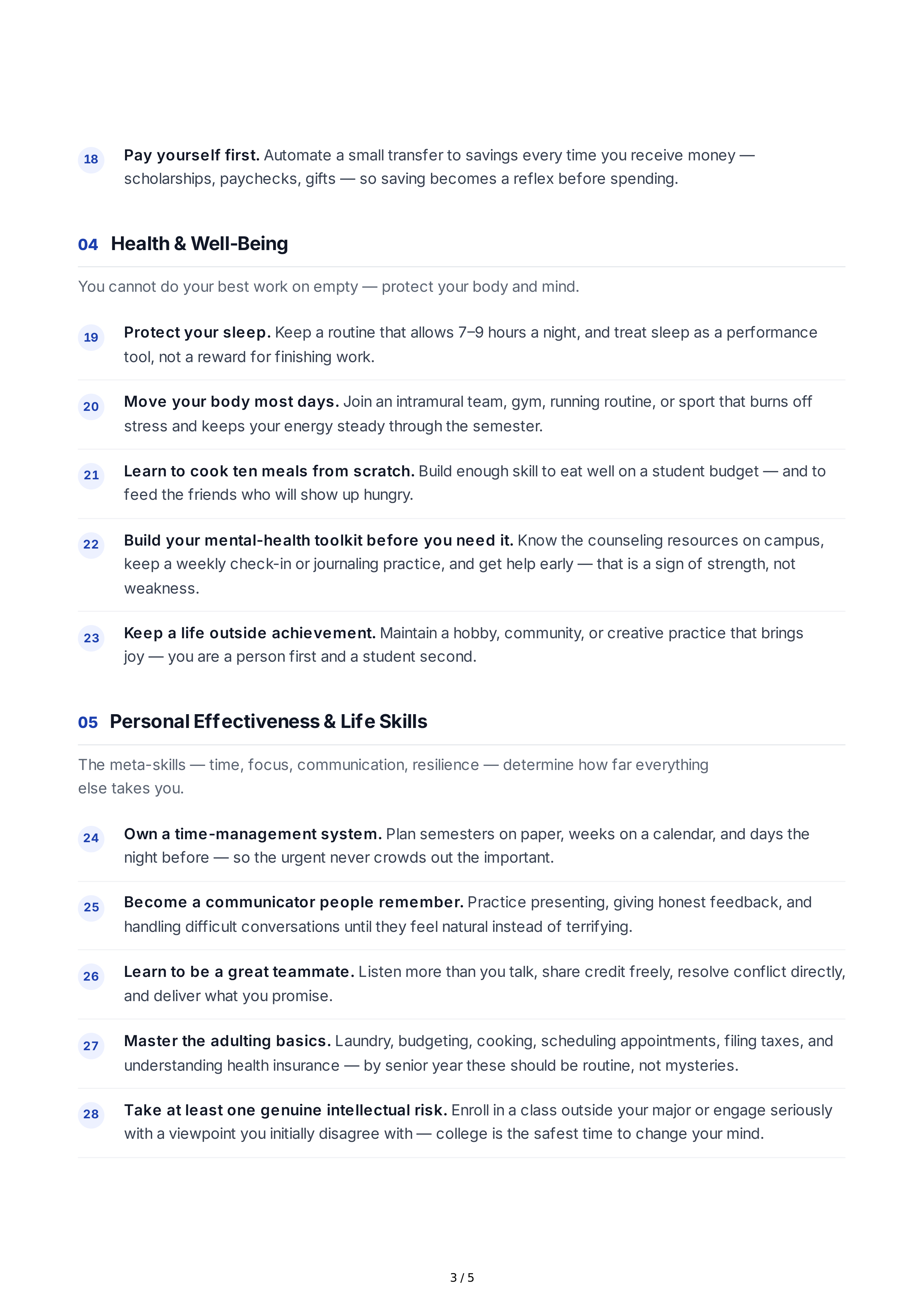
18
Pay
yourself
first
.
Automate
a
small
transfer
to
savings
every
time
you
receive
money
—
scholarships
,
paychecks
,
gifts
—
so
saving
becomes
a
reflex
before
spending
.
04
Health
&
Well
-
Being
You
cannot
do
your
best
work
on
empty
—
protect
your
body
and
mind
.
19
Protect
your
sleep
.
Keep
a
routine
that
allows
7–9
hours
a
night
,
and
treat
sleep
as
a
performance
tool
,
not
a
reward
for
finishing
work
.
20
Move
your
body
most
days
.
Join
an
intramural
team
,
gym
,
running
routine
,
or
sport
that
burns
off
stress
and
keeps
your
energy
steady
through
the
semester
.
21
Learn
to
cook
ten
meals
from
scratch
.
Build
enough
skill
to
eat
well
on
a
student
budget
—
and
to
feed
the
friends
who
will
show
up
hungry
.
22
Build
your
mental
-
health
toolkit
before
you
need
it
.
Know
the
counseling
resources
on
campus
,
keep
a
weekly
check
-
in
or
journaling
practice
,
and
get
help
early
—
that
is
a
sign
of
strength
,
not
weakness
.
23
Keep
a
life
outside
achievement
.
Maintain
a
hobby
,
community
,
or
creative
practice
that
brings
joy
—
you
are
a
person
first
and
a
student
second
.
05
Personal
Effectiveness
&
Life
Skills
The
meta
-
skills
—
time
,
focus
,
communication
,
resilience
—
determine
how
far
everything
else
takes
you
.
24
Own
a
time
-
management
system
.
Plan
semesters
on
paper
,
weeks
on
a
calendar
,
and
days
the
night
before
—
so
the
urgent
never
crowds
out
the
important
.
25
Become
a
communicator
people
remember
.
Practice
presenting
,
giving
honest
feedback
,
and
handling
difficult
conversations
until
they
feel
natural
instead
of
terrifying
.
26
Learn
to
be
a
great
teammate
.
Listen
more
than
you
talk
,
share
credit
freely
,
resolve
conflict
directly
,
and
deliver
what
you
promise
.
27
Master
the
adulting
basics
.
Laundry
,
budgeting
,
cooking
,
scheduling
appointments
,
filing
taxes
,
and
understanding
health
insurance
—
by
senior
year
these
should
be
routine
,
not
mysteries
.
28
Take
at
least
one
genuine
intellectual
risk
.
Enroll
in
a
class
outside
your
major
or
engage
seriously
with
a
viewpoint
you
initially
disagree
with
—
college
is
the
safest
time
to
change
your
mind
.
3 / 5
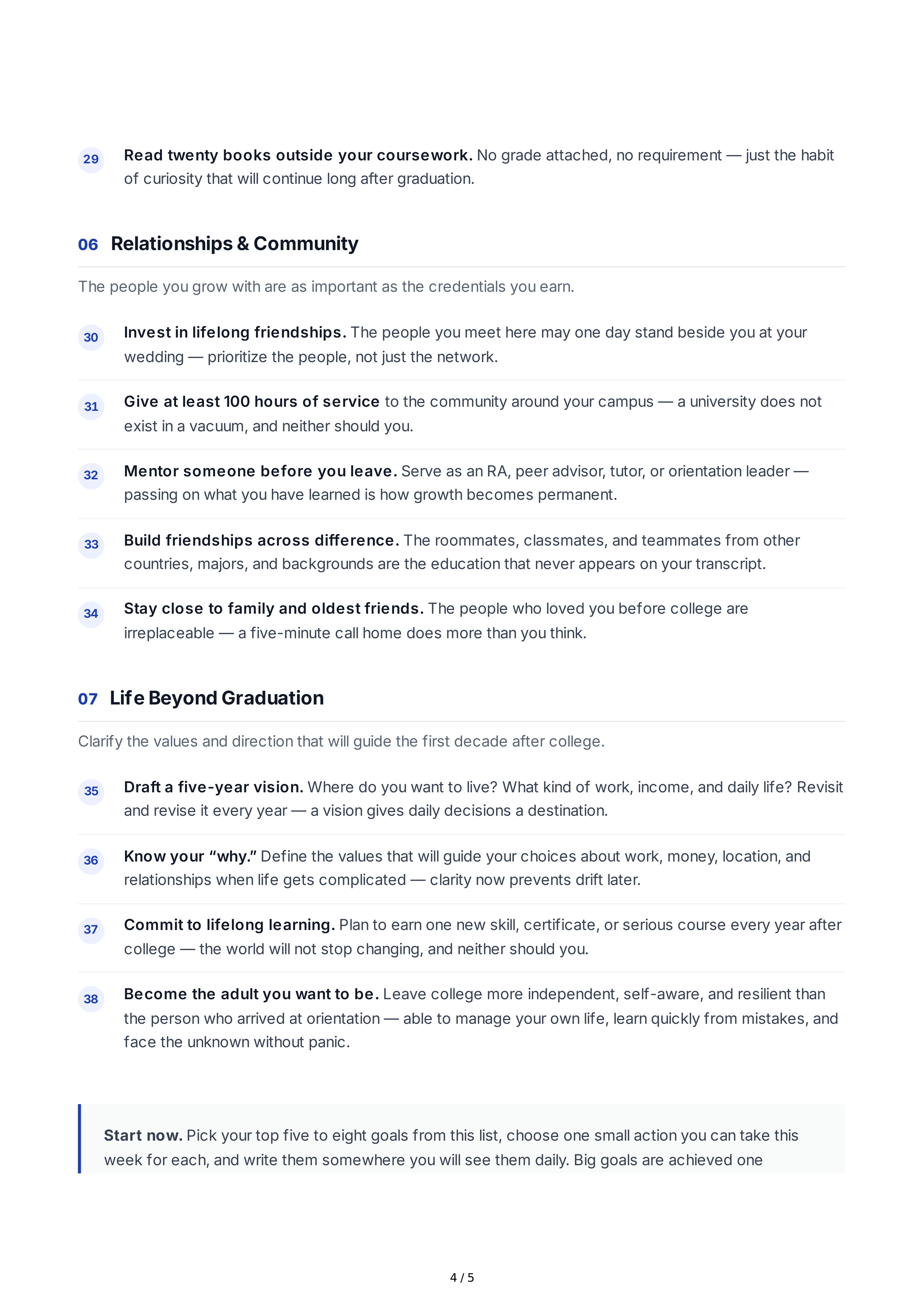
29
Read
twenty
books
outside
your
coursework
.
No
grade
attached
,
no
requirement
—
just
the
habit
of
curiosity
that
will
continue
long
after
graduation
.
06
Relationships
&
Community
The
people
you
grow
with
are
as
important
as
the
credentials
you
earn
.
30
Invest
in
lifelong
friendships
.
The
people
you
meet
here
may
one
day
stand
beside
you
at
your
wedding
—
prioritize
the
people
,
not
just
the
network
.
31
Give
at
least
100
hours
of
service
to
the
community
around
your
campus
—
a
university
does
not
exist
in
a
vacuum
,
and
neither
should
you
.
32
Mentor
someone
before
you
leave
.
Serve
as
an
RA
,
peer
advisor
,
tutor
,
or
orientation
leader
—
passing
on
what
you
have
learned
is
how
growth
becomes
permanent
.
33
Build
friendships
across
difference
.
The
roommates
,
classmates
,
and
teammates
from
other
countries
,
majors
,
and
backgrounds
are
the
education
that
never
appears
on
your
transcript
.
34
Stay
close
to
family
and
oldest
friends
.
The
people
who
loved
you
before
college
are
irreplaceable
—
a
five
-
minute
call
home
does
more
than
you
think
.
07
Life
Beyond
Graduation
Clarify
the
values
and
direction
that
will
guide
the
first
decade
after
college
.
35
Draft
a
five
-
year
vision
.
Where
do
you
want
to
live
?
What
kind
of
work
,
income
,
and
daily
life
?
Revisit
and
revise
it
every
year
—
a
vision
gives
daily
decisions
a
destination
.
36
Know
your
“
why
.”
Define
the
values
that
will
guide
your
choices
about
work
,
money
,
location
,
and
relationships
when
life
gets
complicated
—
clarity
now
prevents
drift
later
.
37
Commit
to
lifelong
learning
.
Plan
to
earn
one
new
skill
,
certificate
,
or
serious
course
every
year
after
college
—
the
world
will
not
stop
changing
,
and
neither
should
you
.
38
Become
the
adult
you
want
to
be
.
Leave
college
more
independent
,
self
-
aware
,
and
resilient
than
the
person
who
arrived
at
orientation
—
able
to
manage
your
own
life
,
learn
quickly
from
mistakes
,
and
face
the
unknown
without
panic
.
Start
now
.
Pick
your
top
five
to
eight
goals
from
this
list
,
choose
one
small
action
you
can
take
this
week
for
each
,
and
write
them
somewhere
you
will
see
them
daily
.
Big
goals
are
achieved
one
4 / 5

semester
—
and
one
Tuesday
—
at
a
time
.
5 / 5