Long
-
Term
Goals
for
Graduate
Students
AR E A
0 1
Research
&
Scholarship
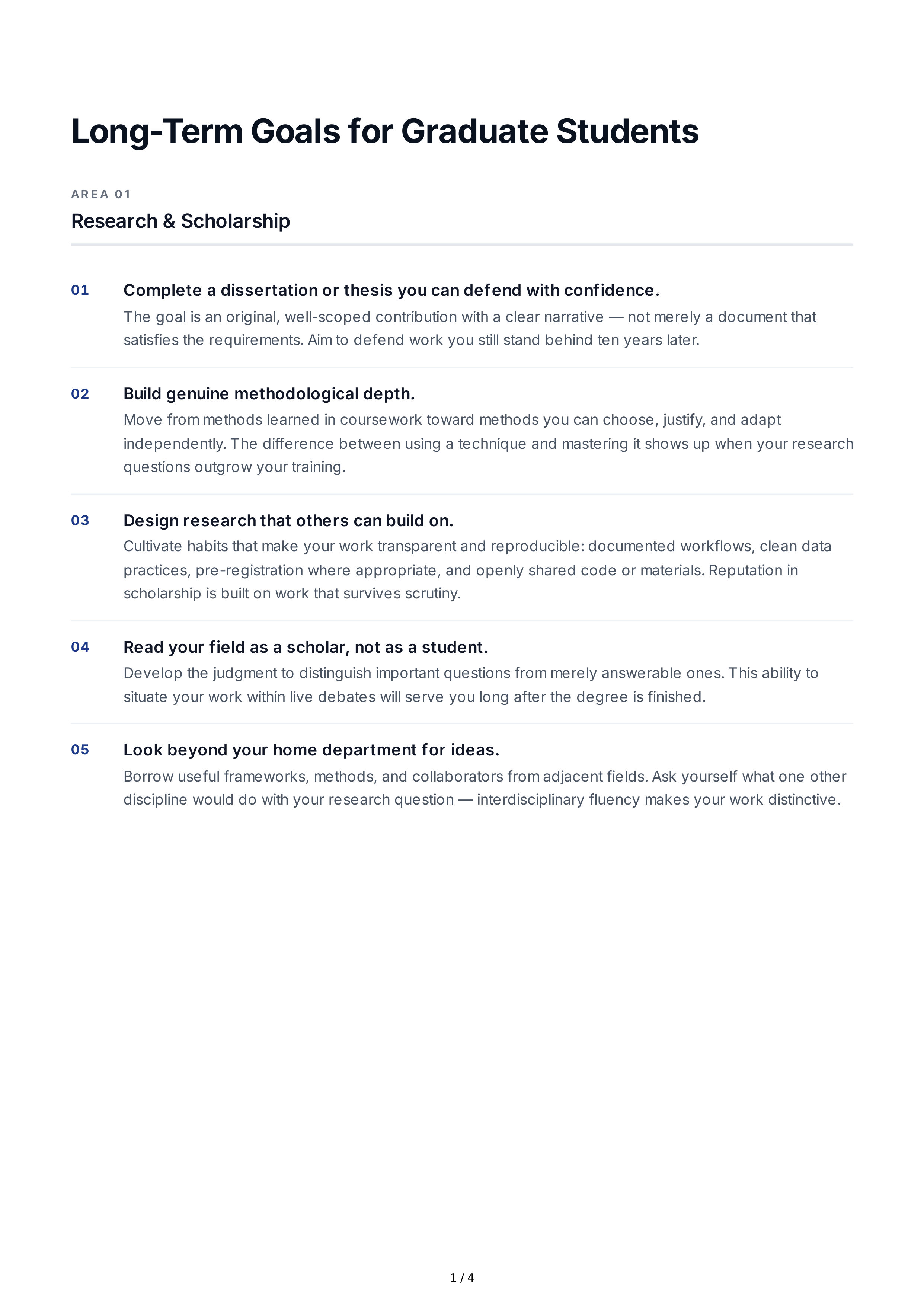
01
Complete
a
dissertation
or
thesis
you
can
defend
with
confidence
.
The
goal
is
an
original
,
well
-
scoped
contribution
with
a
clear
narrative
—
not
merely
a
document
that
satisfies
the
requirements
.
Aim
to
defend
work
you
still
stand
behind
ten
years
later
.
02
Build
genuine
methodological
depth
.
Move
from
methods
learned
in
coursework
toward
methods
you
can
choose
,
justify
,
and
adapt
independently
.
The
difference
between
using
a
technique
and
mastering
it
shows
up
when
your
research
questions
outgrow
your
training
.
03
Design
research
that
others
can
build
on
.
Cultivate
habits
that
make
your
work
transparent
and
reproducible
:
documented
workflows
,
clean
data
practices
,
pre
-
registration
where
appropriate
,
and
openly
shared
code
or
materials
.
Reputation
in
scholarship
is
built
on
work
that
survives
scrutiny
.
04
Read
your
field
as
a
scholar
,
not
as
a
student
.
Develop
the
judgment
to
distinguish
important
questions
from
merely
answerable
ones
.
This
ability
to
situate
your
work
within
live
debates
will
serve
you
long
after
the
degree
is
finished
.
05
Look
beyond
your
home
department
for
ideas
.
Borrow
useful
frameworks
,
methods
,
and
collaborators
from
adjacent
fields
.
Ask
yourself
what
one
other
discipline
would
do
with
your
research
question
—
interdisciplinary
fluency
makes
your
work
distinctive
.
1 / 4
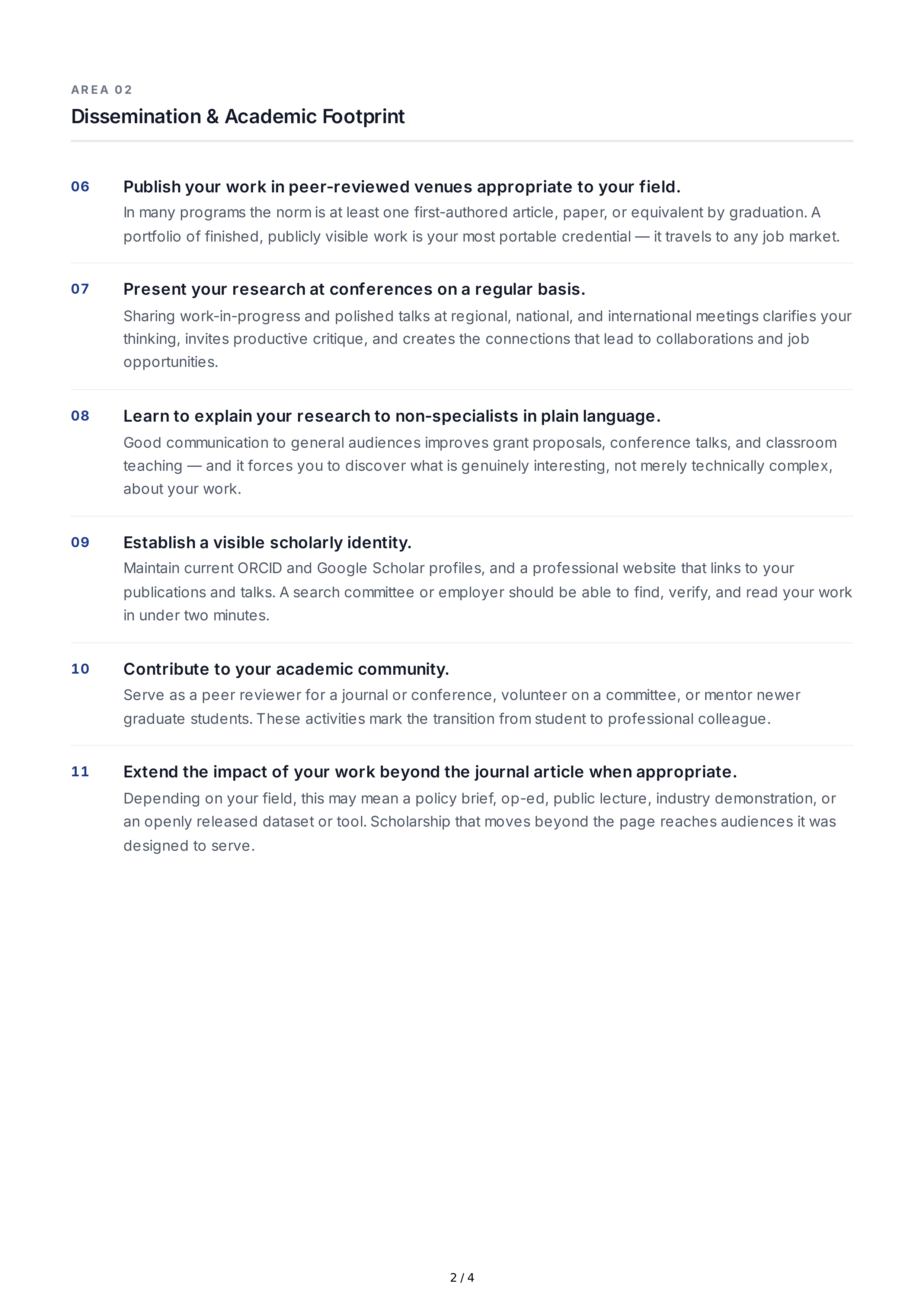
AR E A
0 2
Dissemination
&
Academic
Footprint
06
Publish
your
work
in
peer
-
reviewed
venues
appropriate
to
your
field
.
In
many
programs
the
norm
is
at
least
one
first
-
authored
article
,
paper
,
or
equivalent
by
graduation
.
A
portfolio
of
finished
,
publicly
visible
work
is
your
most
portable
credential
—
it
travels
to
any
job
market
.
07
Present
your
research
at
conferences
on
a
regular
basis
.
Sharing
work
-
in
-
progress
and
polished
talks
at
regional
,
national
,
and
international
meetings
clarifies
your
thinking
,
invites
productive
critique
,
and
creates
the
connections
that
lead
to
collaborations
and
job
opportunities
.
08
Learn
to
explain
your
research
to
non
-
specialists
in
plain
language
.
Good
communication
to
general
audiences
improves
grant
proposals
,
conference
talks
,
and
classroom
teaching
—
and
it
forces
you
to
discover
what
is
genuinely
interesting
,
not
merely
technically
complex
,
about
your
work
.
09
Establish
a
visible
scholarly
identity
.
Maintain
current
ORCID
and
Google
Scholar
profiles
,
and
a
professional
website
that
links
to
your
publications
and
talks
.
A
search
committee
or
employer
should
be
able
to
find
,
verify
,
and
read
your
work
in
under
two
minutes
.
10
Contribute
to
your
academic
community
.
Serve
as
a
peer
reviewer
for
a
journal
or
conference
,
volunteer
on
a
committee
,
or
mentor
newer
graduate
students
.
These
activities
mark
the
transition
from
student
to
professional
colleague
.
11
Extend
the
impact
of
your
work
beyond
the
journal
article
when
appropriate
.
Depending
on
your
field
,
this
may
mean
a
policy
brief
,
op
-
ed
,
public
lecture
,
industry
demonstration
,
or
an
openly
released
dataset
or
tool
.
Scholarship
that
moves
beyond
the
page
reaches
audiences
it
was
designed
to
serve
.
2 / 4
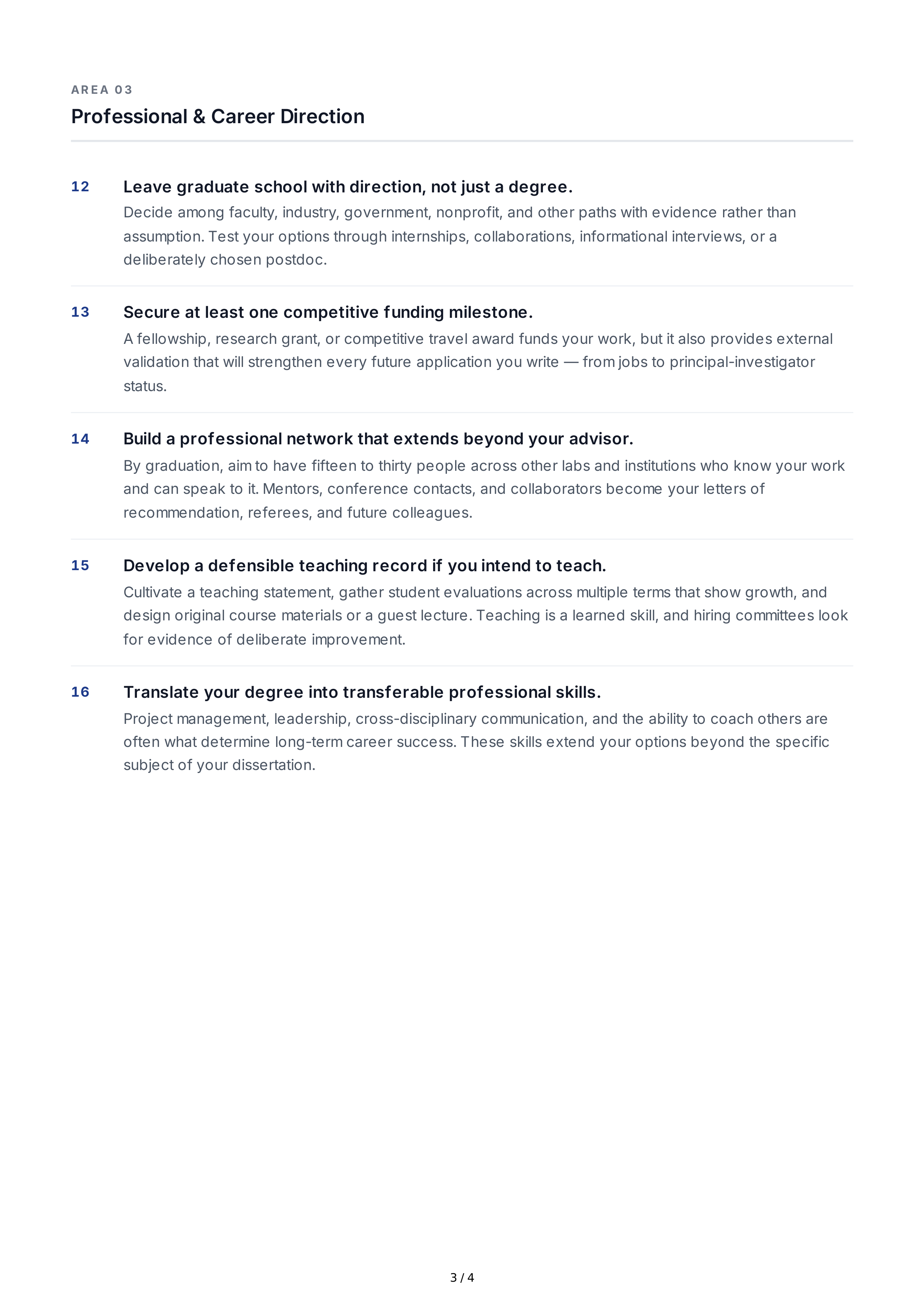
AR E A
0 3
Professional
&
Career
Direction
12
Leave
graduate
school
with
direction
,
not
just
a
degree
.
Decide
among
faculty
,
industry
,
government
,
nonprofit
,
and
other
paths
with
evidence
rather
than
assumption
.
Test
your
options
through
internships
,
collaborations
,
informational
interviews
,
or
a
deliberately
chosen
postdoc
.
13
Secure
at
least
one
competitive
funding
milestone
.
A
fellowship
,
research
grant
,
or
competitive
travel
award
funds
your
work
,
but
it
also
provides
external
validation
that
will
strengthen
every
future
application
you
write
—
from
jobs
to
principal
-
investigator
status
.
14
Build
a
professional
network
that
extends
beyond
your
advisor
.
By
graduation
,
aim
to
have
fifteen
to
thirty
people
across
other
labs
and
institutions
who
know
your
work
and
can
speak
to
it
.
Mentors
,
conference
contacts
,
and
collaborators
become
your
letters
of
recommendation
,
referees
,
and
future
colleagues
.
15
Develop
a
defensible
teaching
record
if
you
intend
to
teach
.
Cultivate
a
teaching
statement
,
gather
student
evaluations
across
multiple
terms
that
show
growth
,
and
design
original
course
materials
or
a
guest
lecture
.
Teaching
is
a
learned
skill
,
and
hiring
committees
look
for
evidence
of
deliberate
improvement
.
16
Translate
your
degree
into
transferable
professional
skills
.
Project
management
,
leadership
,
cross
-
disciplinary
communication
,
and
the
ability
to
coach
others
are
often
what
determine
long
-
term
career
success
.
These
skills
extend
your
options
beyond
the
specific
subject
of
your
dissertation
.
3 / 4
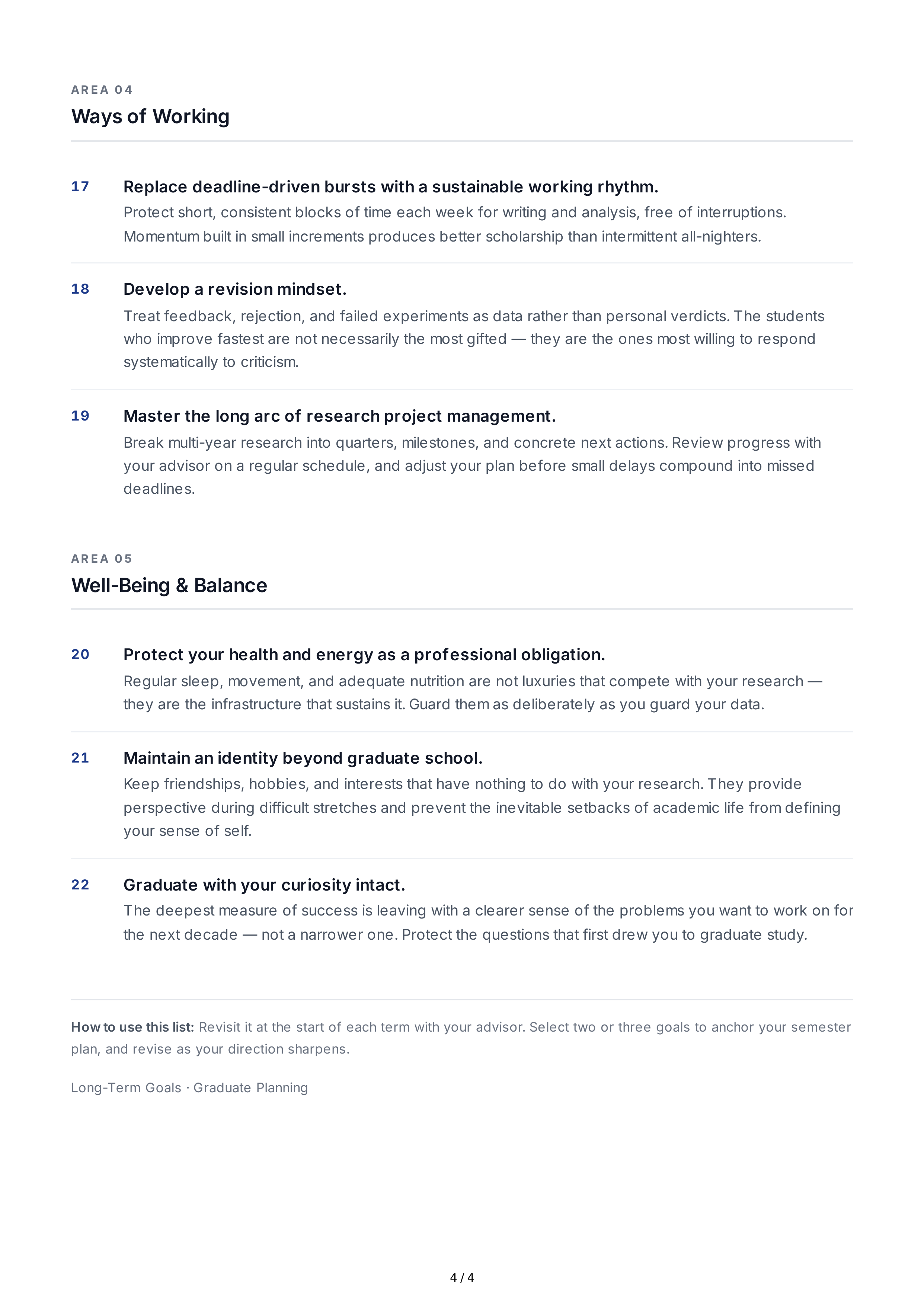
AR E A
0 4
Ways
of
Working
17
Replace
deadline
-
driven
bursts
with
a
sustainable
working
rhythm
.
Protect
short
,
consistent
blocks
of
time
each
week
for
writing
and
analysis
,
free
of
interruptions
.
Momentum
built
in
small
increments
produces
better
scholarship
than
intermittent
all
-
nighters
.
18
Develop
a
revision
mindset
.
Treat
feedback
,
rejection
,
and
failed
experiments
as
data
rather
than
personal
verdicts
.
The
students
who
improve
fastest
are
not
necessarily
the
most
gifted
—
they
are
the
ones
most
willing
to
respond
systematically
to
criticism
.
19
Master
the
long
arc
of
research
project
management
.
Break
multi
-
year
research
into
quarters
,
milestones
,
and
concrete
next
actions
.
Review
progress
with
your
advisor
on
a
regular
schedule
,
and
adjust
your
plan
before
small
delays
compound
into
missed
deadlines
.
AR E A
0 5
Well
-
Being
&
Balance
20
Protect
your
health
and
energy
as
a
professional
obligation
.
Regular
sleep
,
movement
,
and
adequate
nutrition
are
not
luxuries
that
compete
with
your
research
—
they
are
the
infrastructure
that
sustains
it
.
Guard
them
as
deliberately
as
you
guard
your
data
.
21
Maintain
an
identity
beyond
graduate
school
.
Keep
friendships
,
hobbies
,
and
interests
that
have
nothing
to
do
with
your
research
.
They
provide
perspective
during
difficult
stretches
and
prevent
the
inevitable
setbacks
of
academic
life
from
defining
your
sense
of
self
.
22
Graduate
with
your
curiosity
intact
.
The
deepest
measure
of
success
is
leaving
with
a
clearer
sense
of
the
problems
you
want
to
work
on
for
the
next
decade
—
not
a
narrower
one
.
Protect
the
questions
that
first
drew
you
to
graduate
study
.
How
to
use
this
list
:
Revisit
it
at
the
start
of
each
term
with
your
advisor
.
Select
two
or
three
goals
to
anchor
your
semester
plan
,
and
revise
as
your
direction
sharpens
.
Long
-
Term
Goals
·
Graduate
Planning
4 / 4