Long
-
Term
Leadership
Development
Goals
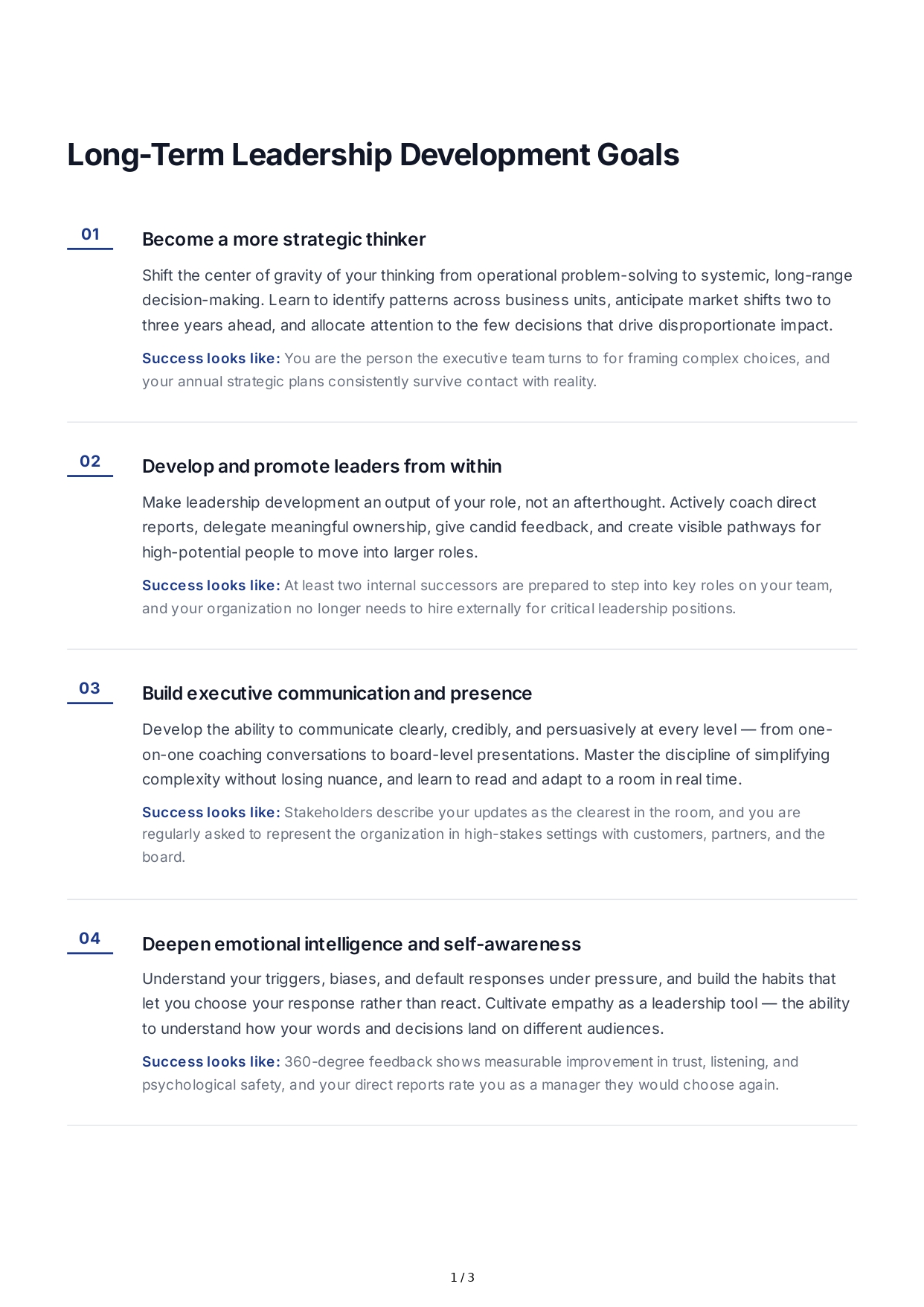
Become
a
more
strategic
thinker
Shift
the
center
of
gravity
of
your
thinking
from
operational
problem
-
solving
to
systemic
,
long
-
range
decision
-
making
.
Learn
to
identify
patterns
across
business
units
,
anticipate
market
shifts
two
to
three
years
ahead
,
and
allocate
attention
to
the
few
decisions
that
drive
disproportionate
impact
.
Success
looks
like
:
You
are
the
person
the
executive
team
turns
to
for
framing
complex
choices
,
and
your
annual
strategic
plans
consistently
survive
contact
with
reality
.
01
Develop
and
promote
leaders
from
within
Make
leadership
development
an
output
of
your
role
,
not
an
afterthought
.
Actively
coach
direct
reports
,
delegate
meaningful
ownership
,
give
candid
feedback
,
and
create
visible
pathways
for
high
-
potential
people
to
move
into
larger
roles
.
Success
looks
like
:
At
least
two
internal
successors
are
prepared
to
step
into
key
roles
on
your
team
,
and
your
organization
no
longer
needs
to
hire
externally
for
critical
leadership
positions
.
02
Build
executive
communication
and
presence
Develop
the
ability
to
communicate
clearly
,
credibly
,
and
persuasively
at
every
level
—
from
one
-
on
-
one
coaching
conversations
to
board
-
level
presentations
.
Master
the
discipline
of
simplifying
complexity
without
losing
nuance
,
and
learn
to
read
and
adapt
to
a
room
in
real
time
.
Success
looks
like
:
Stakeholders
describe
your
updates
as
the
clearest
in
the
room
,
and
you
are
regularly
asked
to
represent
the
organization
in
high
-
stakes
settings
with
customers
,
partners
,
and
the
board
.
03
Deepen
emotional
intelligence
and
self
-
awareness
Understand
your
triggers
,
biases
,
and
default
responses
under
pressure
,
and
build
the
habits
that
let
you
choose
your
response
rather
than
react
.
Cultivate
empathy
as
a
leadership
tool
—
the
ability
to
understand
how
your
words
and
decisions
land
on
different
audiences
.
Success
looks
like
:
360-
degree
feedback
shows
measurable
improvement
in
trust
,
listening
,
and
psychological
safety
,
and
your
direct
reports
rate
you
as
a
manager
they
would
choose
again
.
04
1 / 3
Lead
significant
organizational
change
Build
a
proven
ability
to
take
an
organization
through
transformation
—
restructuring
,
new
operating
models
,
technology
adoption
,
or
culture
change
.
Learn
to
create
urgency
,
build
coalitions
,
communicate
a
compelling
narrative
,
and
sustain
momentum
through
the
difficult
middle
of
a
change
effort
.
Success
looks
like
:
You
have
led
at
least
one
major
transformation
from
vision
to
sustained
results
,
with
measurable
adoption
and
improved
team
morale
documented
along
the
way
.
05
Take
ownership
of
a
full
P
&
L
and
business
unit
Expand
beyond
functional
expertise
into
commercial
and
financial
leadership
.
Develop
fluency
in
revenue
drivers
,
margin
structure
,
cash
flow
,
and
capital
allocation
,
and
learn
to
make
trade
-
offs
that
balance
short
-
term
results
with
long
-
term
health
.
Success
looks
like
:
You
operate
with
genuine
ownership
of
a
business
unit
,
and
you
can
explain
every
material
line
of
your
P
&
L
and
the
three
biggest
levers
for
improving
it
.
06
Cultivate
a
culture
of
innovation
and
psychological
safety
Create
an
environment
where
people
surface
problems
early
,
challenge
assumptions
respectfully
,
and
experiment
without
fear
of
blame
.
Learn
to
reward
learning
—
not
just
success
—
and
to
respond
to
failure
in
ways
that
increase
candor
on
the
team
.
Success
looks
like
:
A
measurable
increase
in
ideas
generated
,
experiments
run
,
and
issues
escalated
early
—
with
team
engagement
scores
remaining
stable
or
improving
.
07
Build
a
broad
cross
-
functional
and
global
perspective
Break
out
of
the
silo
of
your
current
function
or
geography
.
Seek
exposure
to
new
markets
,
customers
,
and
disciplines
so
that
your
decisions
reflect
a
genuinely
enterprise
-
level
—
and
increasingly
global
—
point
of
view
.
Success
looks
like
:
You
have
led
or
contributed
to
at
least
one
meaningful
cross
-
functional
or
cross
-
border
initiative
,
and
peers
from
other
functions
seek
your
input
on
their
strategy
.
08
Establish
a
visible
personal
leadership
brand
Become
known
outside
your
immediate
team
for
a
specific
point
of
view
—
a
signature
idea
,
approach
,
or
area
of
expertise
that
makes
you
a
magnet
for
interesting
opportunities
,
talent
,
and
partnerships
.
Success
looks
like
:
You
speak
or
write
regularly
on
your
chosen
topic
,
are
invited
to
industry
or
internal
forums
,
and
people
approach
you
because
of
the
ideas
you
are
known
for
.
09
2 / 3
How
to
use
this
list
:
Few
leaders
can
pursue
twelve
goals
at
once
.
Select
two
to
three
that
address
your
biggest
gaps
or
your
next
career
transition
,
define
specific
milestones
for
each
,
and
revisit
your
choices
every
six
months
—
the
goals
you
outgrow
are
evidence
that
you
are
progressing
.
Develop
board
-
level
governance
and
advisory
capability
Prepare
for
the
next
tier
of
leadership
by
learning
how
senior
governing
bodies
actually
operate
—
how
they
oversee
risk
,
strategy
,
and
executive
performance
,
and
where
the
line
falls
between
governance
and
management
.
Success
looks
like
:
You
serve
on
a
board
or
formal
advisory
committee
(
internal
or
external
),
and
you
contribute
substantively
—
not
just
nominally
—
to
its
agenda
.
10
Master
difficult
conversations
and
conflict
resolution
Move
from
avoiding
or
escalating
conflict
to
resolving
it
productively
and
early
.
Learn
to
separate
the
person
from
the
problem
,
address
performance
issues
directly
without
damaging
relationships
,
and
mediate
disputes
between
peers
and
teams
with
fairness
and
firmness
.
Success
looks
like
:
Issues
on
your
team
surface
earlier
,
are
resolved
at
the
lowest
possible
level
,
and
your
people
report
that
difficult
feedback
is
delivered
honestly
and
received
without
fear
.
11
Sustain
your
own
resilience
and
capacity
for
growth
Treat
your
own
energy
,
focus
,
and
learning
as
strategic
assets
.
Build
the
routines
—
rest
,
reflection
,
fitness
,
and
deliberate
input
—
that
let
you
operate
at
your
best
under
sustained
pressure
rather
than
in
short
,
unsustainable
bursts
.
Success
looks
like
:
You
maintain
consistent
performance
and
judgment
through
high
-
stress
periods
,
protect
time
for
reflection
and
learning
each
week
,
and
model
healthy
boundaries
for
your
team
.
12
3 / 3