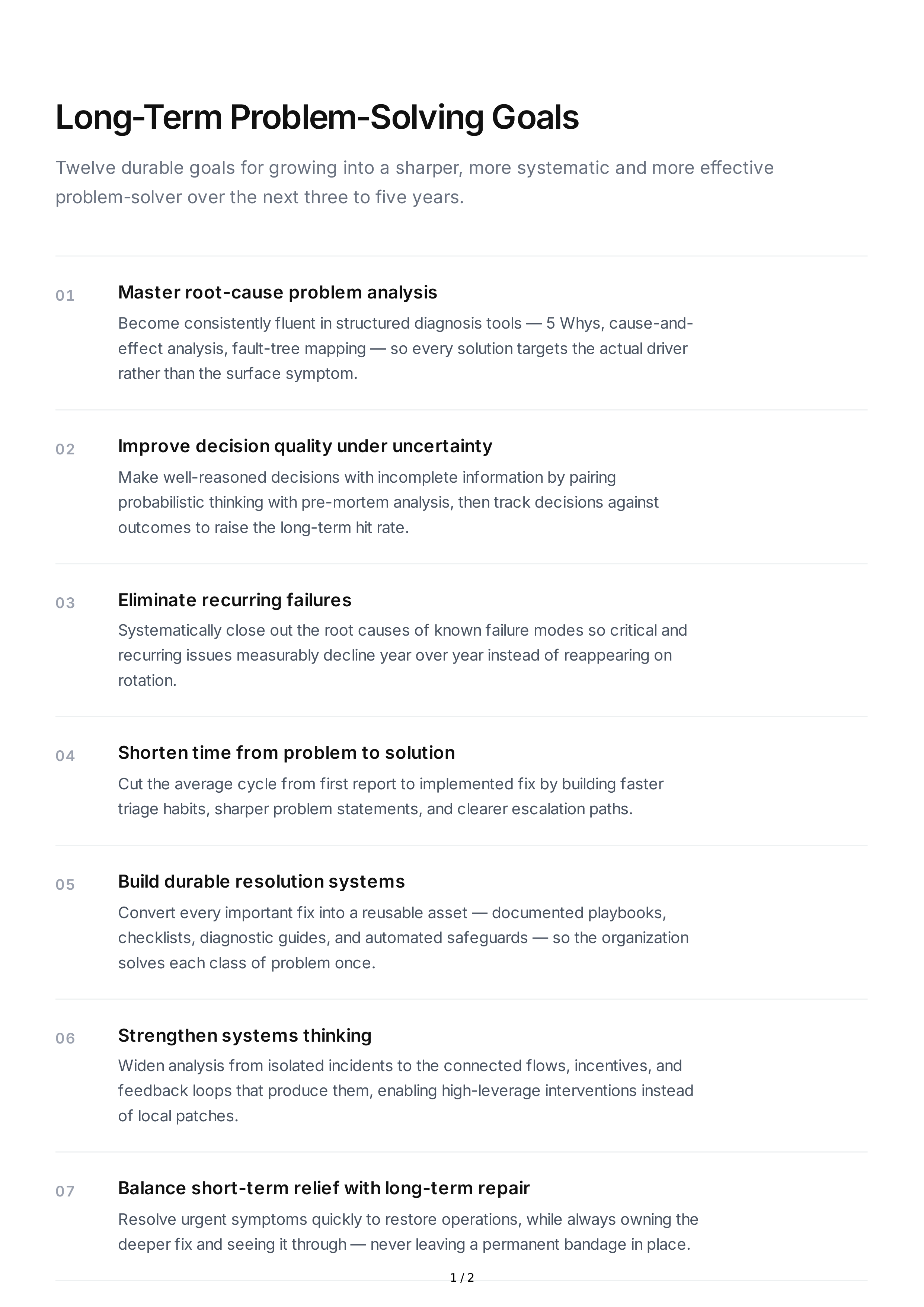
Long
-
Term
Problem
-
Solving
Goals
Twelve
durable
goals
for
growing
into
a
sharper
,
more
systematic
and
more
effective
problem
-
solver
over
the
next
three
to
five
years
.
01
Master
root
-
cause
problem
analysis
Become
consistently
fluent
in
structured
diagnosis
tools
— 5
Whys
,
cause
-
and
-
effect
analysis
,
fault
-
tree
mapping
—
so
every
solution
targets
the
actual
driver
rather
than
the
surface
symptom
.
02
Improve
decision
quality
under
uncertainty
Make
well
-
reasoned
decisions
with
incomplete
information
by
pairing
probabilistic
thinking
with
pre
-
mortem
analysis
,
then
track
decisions
against
outcomes
to
raise
the
long
-
term
hit
rate
.
03
Eliminate
recurring
failures
Systematically
close
out
the
root
causes
of
known
failure
modes
so
critical
and
recurring
issues
measurably
decline
year
over
year
instead
of
reappearing
on
rotation
.
04
Shorten
time
from
problem
to
solution
Cut
the
average
cycle
from
first
report
to
implemented
fix
by
building
faster
triage
habits
,
sharper
problem
statements
,
and
clearer
escalation
paths
.
05
Build
durable
resolution
systems
Convert
every
important
fix
into
a
reusable
asset
—
documented
playbooks
,
checklists
,
diagnostic
guides
,
and
automated
safeguards
—
so
the
organization
solves
each
class
of
problem
once
.
06
Strengthen
systems
thinking
Widen
analysis
from
isolated
incidents
to
the
connected
flows
,
incentives
,
and
feedback
loops
that
produce
them
,
enabling
high
-
leverage
interventions
instead
of
local
patches
.
07
Balance
short
-
term
relief
with
long
-
term
repair
Resolve
urgent
symptoms
quickly
to
restore
operations
,
while
always
owning
the
deeper
fix
and
seeing
it
through
—
never
leaving
a
permanent
bandage
in
place
.
1 / 2
08
Lead
effective
cross
-
functional
problem
-
solving
Facilitate
diverse
teams
on
complex
issues
so
that
conflict
becomes
productive
debate
,
assumptions
are
tested
,
and
solutions
win
commitment
across
every
stakeholder
group
.
09
Become
consistently
evidence
-
based
Ground
recommendations
in
measured
data
and
verified
facts
,
clearly
separating
what
is
known
from
what
is
assumed
,
while
keeping
qualitative
signal
in
the
analysis
.
10
Anticipate
problems
before
they
arrive
Shift
a
meaningful
share
of
effort
from
reactive
firefighting
to
foresight
—
scanning
for
weak
signals
,
stress
-
testing
plans
,
and
designing
resilience
in
ahead
of
need
.
11
Develop
problem
-
solvers
in
others
Coach
and
mentor
colleagues
toward
independent
,
structured
problem
-
solving
so
capability
grows
across
the
team
rather
than
concentrating
in
any
one
person
.
12
Reflect
,
document
,
and
improve
own
practice
Keep
a
personal
problem
-
solving
log
,
review
completed
work
quarterly
,
and
refine
personal
methods
continuously
—
turning
each
hard
-
won
lesson
into
a
permanent
upgrade
.
2 / 2