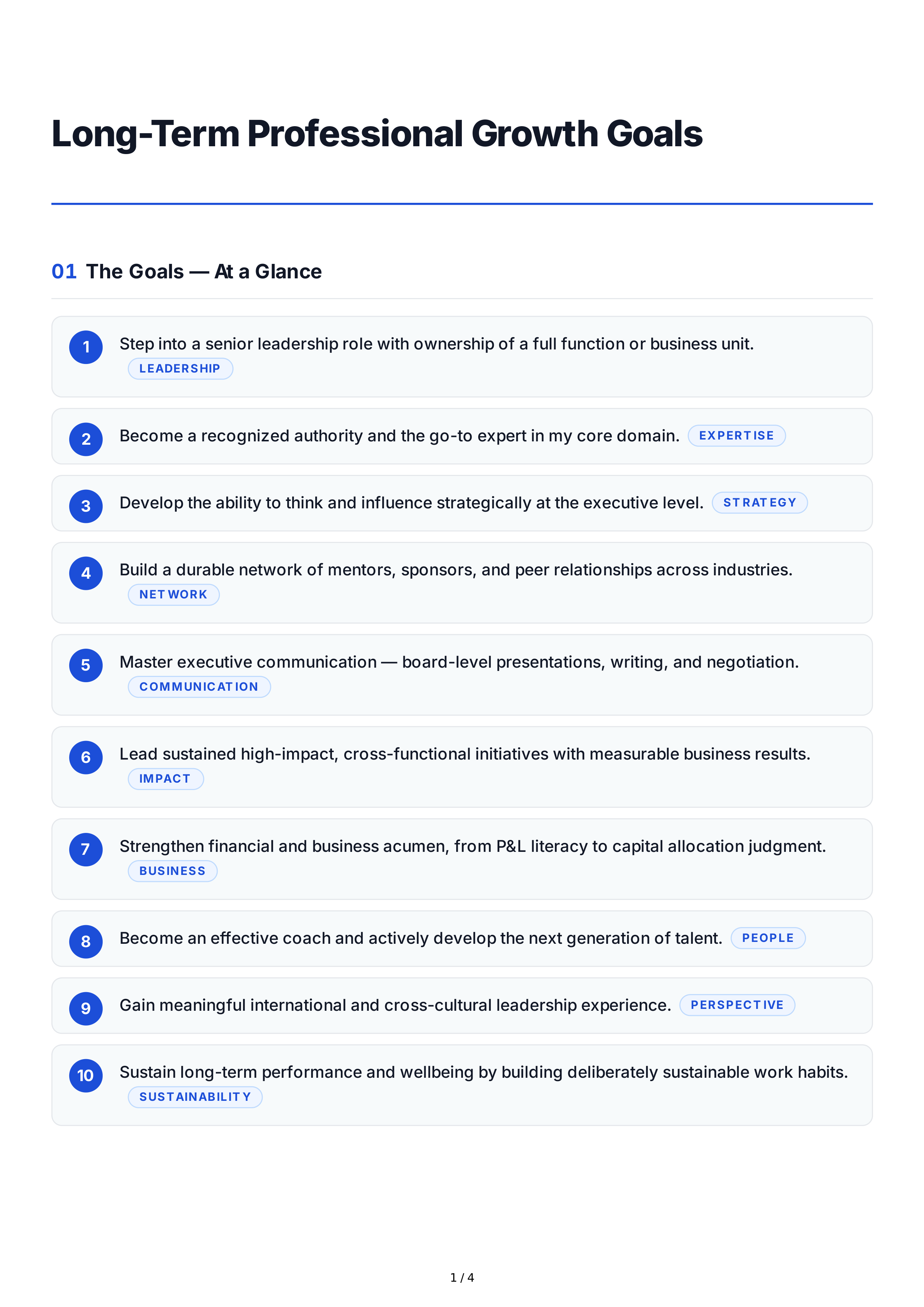
Long
-
Term
Professional
Growth
Goals
01
The
Goals
—
At
a
Glance
Step
into
a
senior
leadership
role
with
ownership
of
a
full
function
or
business
unit
.
LEADERSHIP
1
Become
a
recognized
authority
and
the
go
-
to
expert
in
my
core
domain
.
EXPERT ISE
2
Develop
the
ability
to
think
and
influence
strategically
at
the
executive
level
.
ST RAT EGY
3
Build
a
durable
network
of
mentors
,
sponsors
,
and
peer
relationships
across
industries
.
NET WORK
4
Master
executive
communication
—
board
-
level
presentations
,
writing
,
and
negotiation
.
COMMUNICAT ION
5
Lead
sustained
high
-
impact
,
cross
-
functional
initiatives
with
measurable
business
results
.
IMPACT
6
Strengthen
financial
and
business
acumen
,
from
P
&
L
literacy
to
capital
allocation
judgment
.
BUSINESS
7
Become
an
effective
coach
and
actively
develop
the
next
generation
of
talent
.
PEOPLE
8
Gain
meaningful
international
and
cross
-
cultural
leadership
experience
.
PERSPECT IVE
9
Sustain
long
-
term
performance
and
wellbeing
by
building
deliberately
sustainable
work
habits
.
SUSTAINABILIT Y
10
1 / 4
02
Goal
Definitions
,
Rationale
&
Success
Criteria
1.
Step
into
a
senior
leadership
role
Why
it
matters
:
Moving
from
personal
execution
to
leading
teams
and
owning
organizational
outcomes
multiplies
my
impact
beyond
what
any
individual
contributor
can
deliver
alone
.
WHAT
SUCCESS
LOOKS
LIKE
2.
Become
a
recognized
authority
in
my
core
domain
Why
it
matters
:
Depth
of
expertise
earns
credibility
,
creates
leverage
,
and
ensures
I
am
consulted
on
the
most
important
problems
rather
than
assigned
routine
work
.
WHAT
SUCCESS
LOOKS
LIKE
3.
Think
and
influence
strategically
at
the
executive
level
Why
it
matters
:
Long
-
term
career
growth
requires
shifting
from
execution
-
oriented
thinking
to
anticipating
trends
,
connecting
dots
across
functions
,
and
influencing
decisions
above
my
reporting
level
.
WHAT
SUCCESS
LOOKS
LIKE
Leading
a
team
of
3–5
people
within
2
years
and
a
department
of
15+
within
5
years
.
Owning
a
budget
or
P
&
L
line
and
being
accountable
for
a
business
unit
'
s
results
.
Reporting
directly
to
a
C
-
level
executive
and
participating
in
operating
reviews
.
Being
the
first
person
colleagues
and
leadership
turn
to
in
my
specialty
area
.
Representing
the
organization
at
industry
events
,
panels
,
or
client
engagements
.
Earning
advanced
certifications
or
completing
formal
postgraduate
training
in
my
field
.
Publishing
or
speaking
publicly
on
my
domain
at
least
twice
a
year
.
Contributing
meaningfully
to
the
annual
strategy
and
operating
planning
process
.
Leading
at
least
one
strategic
initiative
that
shapes
the
organization
'
s
direction
.
Receiving
feedback
from
senior
leaders
that
my
recommendations
changed
their
decisions
.
2 / 4
4.
Build
a
durable
network
of
mentors
,
sponsors
,
and
peers
Why
it
matters
:
Opportunity
is
distributed
through
relationships
.
A
strong
network
provides
honest
feedback
,
advocacy
for
promotions
,
and
access
to
roles
and
industries
I
cannot
see
from
inside
my
own
function
.
WHAT
SUCCESS
LOOKS
LIKE
5.
Master
executive
communication
Why
it
matters
:
Leadership
presence
is
built
on
the
ability
to
distill
complexity
,
persuade
diverse
audiences
,
and
represent
ideas
credibly
in
rooms
where
decisions
are
actually
made
.
WHAT
SUCCESS
LOOKS
LIKE
6.
Lead
sustained
,
high
-
impact
cross
-
functional
initiatives
Why
it
matters
:
The
most
valuable
leaders
are
those
who
can
mobilize
people
outside
their
reporting
line
and
deliver
outcomes
that
move
real
business
metrics
.
WHAT
SUCCESS
LOOKS
LIKE
7.
Strengthen
financial
and
business
acumen
Why
it
matters
:
Credible
leaders
understand
how
their
work
drives
value
:
where
money
comes
from
,
how
it
is
allocated
,
and
whether
an
initiative
is
worth
its
cost
.
WHAT
SUCCESS
LOOKS
LIKE
Maintaining
5+
trusted
mentor
and
sponsor
relationships
across
different
industries
.
Actively
participating
in
two
professional
communities
or
industry
associations
.
Being
able
to
pick
up
the
phone
and
reach
a
senior
contact
in
any
major
sector
.
Presenting
confidently
to
the
board
and
C
-
suite
with
minimal
preparation
time
.
Writing
clear
,
influential
documents
—
proposals
,
memos
,
and
strategy
narratives
.
Negotiating
successfully
on
behalf
of
my
team
,
function
,
or
organization
.
Initiating
and
delivering
at
least
one
major
cross
-
functional
project
per
year
.
Quantifying
the
impact
of
each
initiative
in
revenue
,
cost
,
or
efficiency
terms
.
Being
actively
requested
by
other
departments
to
lead
their
most
important
programs
.
Reading
and
interpreting
the
full
P
&
L
,
balance
sheet
,
and
cash
flow
statement
with
confidence
.
Owning
a
budget
line
and
managing
it
with
discipline
and
transparency
.
Completing
formal
training
in
corporate
finance
,
unit
economics
,
or
capital
allocation
.
3 / 4
8.
Become
an
effective
coach
and
developer
of
future
leaders
Why
it
matters
:
Senior
roles
are
given
to
people
who
can
scale
themselves
through
others
.
A
reputation
for
building
talent
is
one
of
the
strongest
predictors
of
promotion
into
leadership
.
WHAT
SUCCESS
LOOKS
LIKE
9.
Gain
international
and
cross
-
cultural
leadership
experience
Why
it
matters
:
Markets
,
teams
,
and
supply
chains
are
global
.
Leading
across
geographies
and
cultures
expands
judgment
,
adaptability
,
and
the
range
of
roles
available
at
the
most
senior
levels
.
WHAT
SUCCESS
LOOKS
LIKE
10.
Sustain
performance
without
sacrificing
long
-
term
wellbeing
Why
it
matters
:
Careers
are
marathons
,
not
sprints
.
The
habits
I
build
now
determine
whether
I
reach
senior
leadership
with
energy
,
judgment
,
and
health
intact
—
or
burned
out
on
the
way
.
WHAT
SUCCESS
LOOKS
LIKE
03
How
to
Use
This
List
Suggestion
:
Review
these
goals
quarterly
.
Select
one
primary
goal
to
focus
on
each
quarter
and
translate
it
into
2–3
concrete
actions
with
a
deadline
.
At
the
end
of
each
year
,
reflect
on
progress
against
the
success
criteria
,
adjust
the
priorities
,
and
set
new
milestones
for
the
year
ahead
.
Long
-
term
growth
is
the
compound
effect
of
small
,
deliberate
improvements
sustained
over
time
.
Formally
mentoring
2–3
junior
colleagues
at
any
given
time
.
Seeing
at
least
one
mentee
promoted
or
advanced
because
of
my
sponsorship
.
Running
onboarding
,
training
,
or
development
programs
for
my
team
or
function
.
Leading
or
contributing
to
a
project
involving
stakeholders
in
at
least
two
regions
.
Completing
an
international
assignment
or
extended
secondment
when
the
opportunity
arises
.
Building
a
track
record
of
managing
distributed
,
multicultural
teams
effectively
.
Maintaining
consistent
boundaries
between
work
and
personal
time
.
Investing
in
health
:
sleep
,
exercise
,
and
regular
disconnection
from
work
.
Continuing
to
learn
and
stay
curious
so
the
work
remains
energizing
rather
than
depleting
.
4 / 4