Long
-
Term
Graduation
Goals
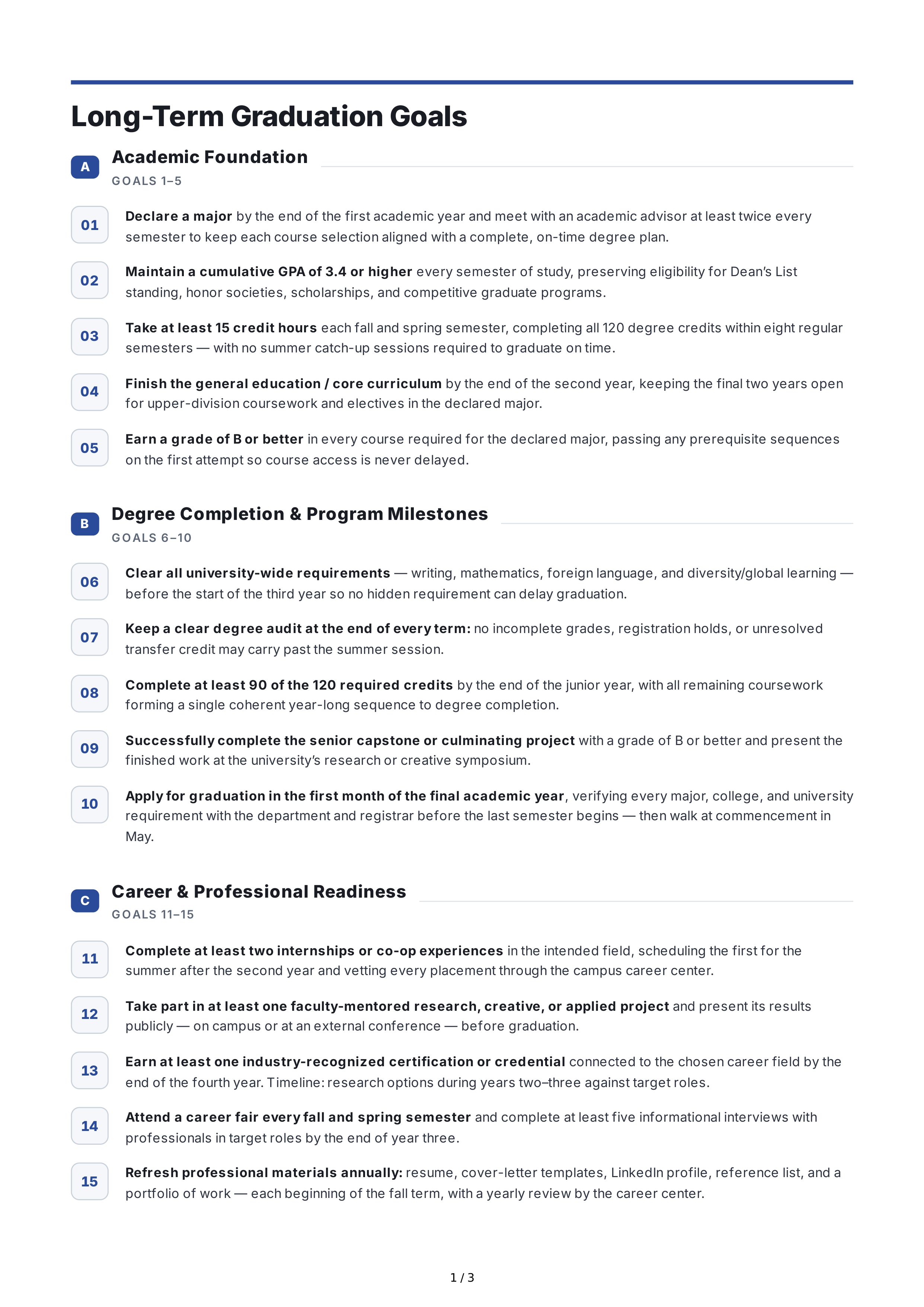
A
Academic
Foundation
GOALS
1–5
01
Declare
a
major
by
the
end
of
the
first
academic
year
and
meet
with
an
academic
advisor
at
least
twice
every
semester
to
keep
each
course
selection
aligned
with
a
complete
,
on
-
time
degree
plan
.
02
Maintain
a
cumulative
GPA
of
3.4
or
higher
every
semester
of
study
,
preserving
eligibility
for
Dean
’
s
List
standing
,
honor
societies
,
scholarships
,
and
competitive
graduate
programs
.
03
Take
at
least
15
credit
hours
each
fall
and
spring
semester
,
completing
all
120
degree
credits
within
eight
regular
semesters
—
with
no
summer
catch
-
up
sessions
required
to
graduate
on
time
.
04
Finish
the
general
education
/
core
curriculum
by
the
end
of
the
second
year
,
keeping
the
final
two
years
open
for
upper
-
division
coursework
and
electives
in
the
declared
major
.
05
Earn
a
grade
of
B
or
better
in
every
course
required
for
the
declared
major
,
passing
any
prerequisite
sequences
on
the
first
attempt
so
course
access
is
never
delayed
.
B
Degree
Completion
&
Program
Milestones
GOALS
6 –10
06
Clear
all
university
-
wide
requirements
—
writing
,
mathematics
,
foreign
language
,
and
diversity
/
global
learning
—
before
the
start
of
the
third
year
so
no
hidden
requirement
can
delay
graduation
.
07
Keep
a
clear
degree
audit
at
the
end
of
every
term
:
no
incomplete
grades
,
registration
holds
,
or
unresolved
transfer
credit
may
carry
past
the
summer
session
.
08
Complete
at
least
90
of
the
120
required
credits
by
the
end
of
the
junior
year
,
with
all
remaining
coursework
forming
a
single
coherent
year
-
long
sequence
to
degree
completion
.
09
Successfully
complete
the
senior
capstone
or
culminating
project
with
a
grade
of
B
or
better
and
present
the
finished
work
at
the
university
’
s
research
or
creative
symposium
.
10
Apply
for
graduation
in
the
first
month
of
the
final
academic
year
,
verifying
every
major
,
college
,
and
university
requirement
with
the
department
and
registrar
before
the
last
semester
begins
—
then
walk
at
commencement
in
May
.
C
Career
&
Professional
Readiness
GOALS
11–15
11
Complete
at
least
two
internships
or
co
-
op
experiences
in
the
intended
field
,
scheduling
the
first
for
the
summer
after
the
second
year
and
vetting
every
placement
through
the
campus
career
center
.
12
Take
part
in
at
least
one
faculty
-
mentored
research
,
creative
,
or
applied
project
and
present
its
results
publicly
—
on
campus
or
at
an
external
conference
—
before
graduation
.
13
Earn
at
least
one
industry
-
recognized
certification
or
credential
connected
to
the
chosen
career
field
by
the
end
of
the
fourth
year
.
Timeline
:
research
options
during
years
two
–
three
against
target
roles
.
14
Attend
a
career
fair
every
fall
and
spring
semester
and
complete
at
least
five
informational
interviews
with
professionals
in
target
roles
by
the
end
of
year
three
.
15
Refresh
professional
materials
annually
:
resume
,
cover
-
letter
templates
,
LinkedIn
profile
,
reference
list
,
and
a
portfolio
of
work
—
each
beginning
of
the
fall
term
,
with
a
yearly
review
by
the
career
center
.
1 / 3
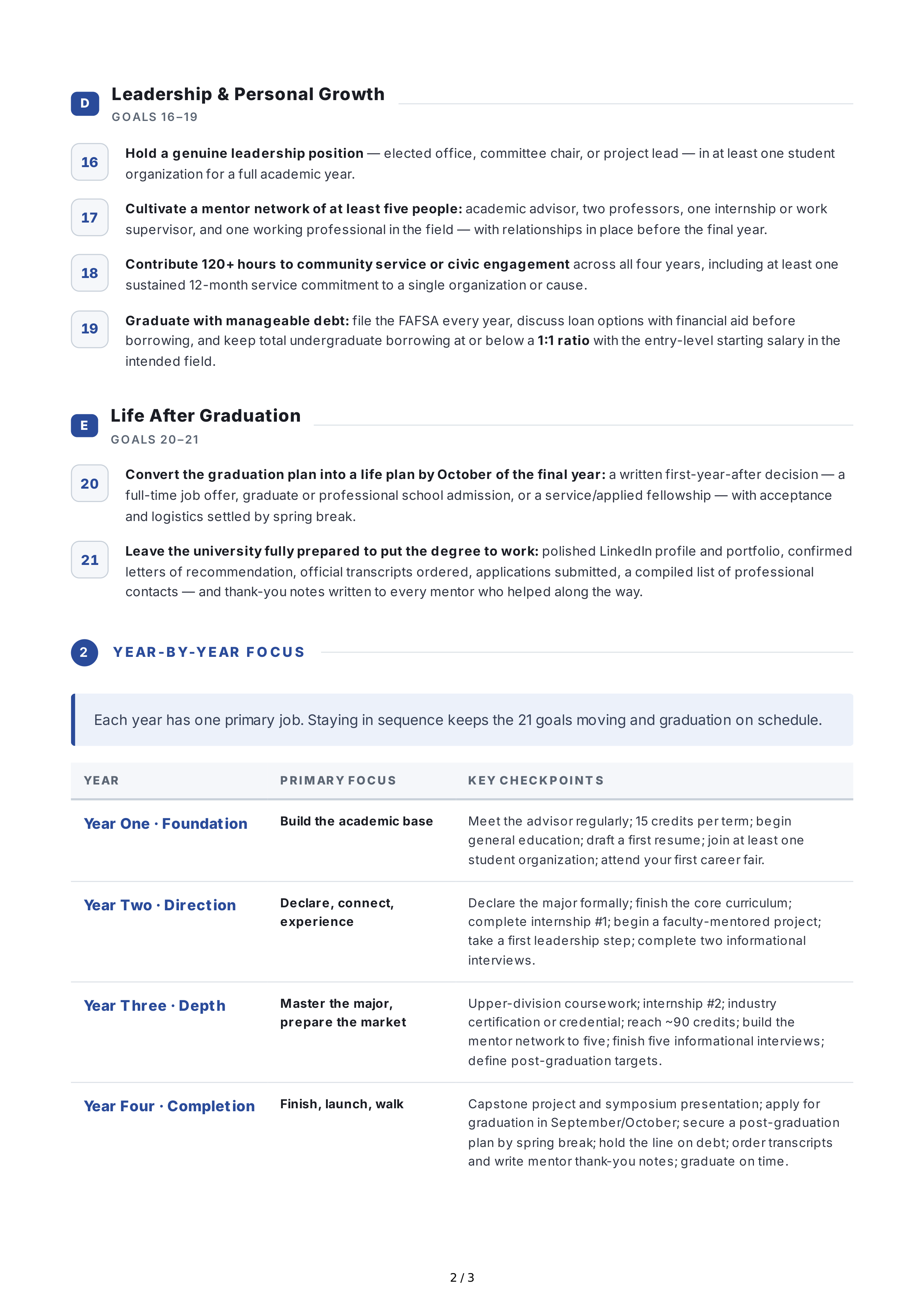
D
Leadership
&
Personal
Growth
GOALS
16 –19
16
Hold
a
genuine
leadership
position
—
elected
office
,
committee
chair
,
or
project
lead
—
in
at
least
one
student
organization
for
a
full
academic
year
.
17
Cultivate
a
mentor
network
of
at
least
five
people
:
academic
advisor
,
two
professors
,
one
internship
or
work
supervisor
,
and
one
working
professional
in
the
field
—
with
relationships
in
place
before
the
final
year
.
18
Contribute
120+
hours
to
community
service
or
civic
engagement
across
all
four
years
,
including
at
least
one
sustained
12-
month
service
commitment
to
a
single
organization
or
cause
.
19
Graduate
with
manageable
debt
:
file
the
FAFSA
every
year
,
discuss
loan
options
with
financial
aid
before
borrowing
,
and
keep
total
undergraduate
borrowing
at
or
below
a
1:1
ratio
with
the
entry
-
level
starting
salary
in
the
intended
field
.
E
Life
After
Graduation
GOALS
20–21
20
Convert
the
graduation
plan
into
a
life
plan
by
October
of
the
final
year
:
a
written
first
-
year
-
after
decision
—
a
full
-
time
job
offer
,
graduate
or
professional
school
admission
,
or
a
service
/
applied
fellowship
—
with
acceptance
and
logistics
settled
by
spring
break
.
21
Leave
the
university
fully
prepared
to
put
the
degree
to
work
:
polished
LinkedIn
profile
and
portfolio
,
confirmed
letters
of
recommendation
,
official
transcripts
ordered
,
applications
submitted
,
a
compiled
list
of
professional
contacts
—
and
thank
-
you
notes
written
to
every
mentor
who
helped
along
the
way
.
2
Y EAR
-
B Y
-
Y EAR
F O C U S
Each
year
has
one
primary
job
.
Staying
in
sequence
keeps
the
21
goals
moving
and
graduation
on
schedule
.
YEAR
P R I MAR Y
FOC U S
K EY
C H EC K P OI NT S
Year
One
·
Foundation
Build
the
academic
base
Meet
the
advisor
regularly
; 15
credits
per
term
;
begin
general
education
;
draft
a
first
resume
;
join
at
least
one
student
organization
;
attend
your
first
career
fair
.
Year
Two
·
Direction
Declare
,
connect
,
experience
Declare
the
major
formally
;
finish
the
core
curriculum
;
complete
internship
#1;
begin
a
faculty
-
mentored
project
;
take
a
first
leadership
step
;
complete
two
informational
interviews
.
Year
Three
·
Depth
Master
the
major
,
prepare
the
market
Upper
-
division
coursework
;
internship
#2;
industry
certification
or
credential
;
reach
~90
credits
;
build
the
mentor
network
to
five
;
finish
five
informational
interviews
;
define
post
-
graduation
targets
.
Year
Four
·
Completion
Finish
,
launch
,
walk
Capstone
project
and
symposium
presentation
;
apply
for
graduation
in
September
/
October
;
secure
a
post
-
graduation
plan
by
spring
break
;
hold
the
line
on
debt
;
order
transcripts
and
write
mentor
thank
-
you
notes
;
graduate
on
time
.
2 / 3
3
S T AY I NG
O N
T R AC K
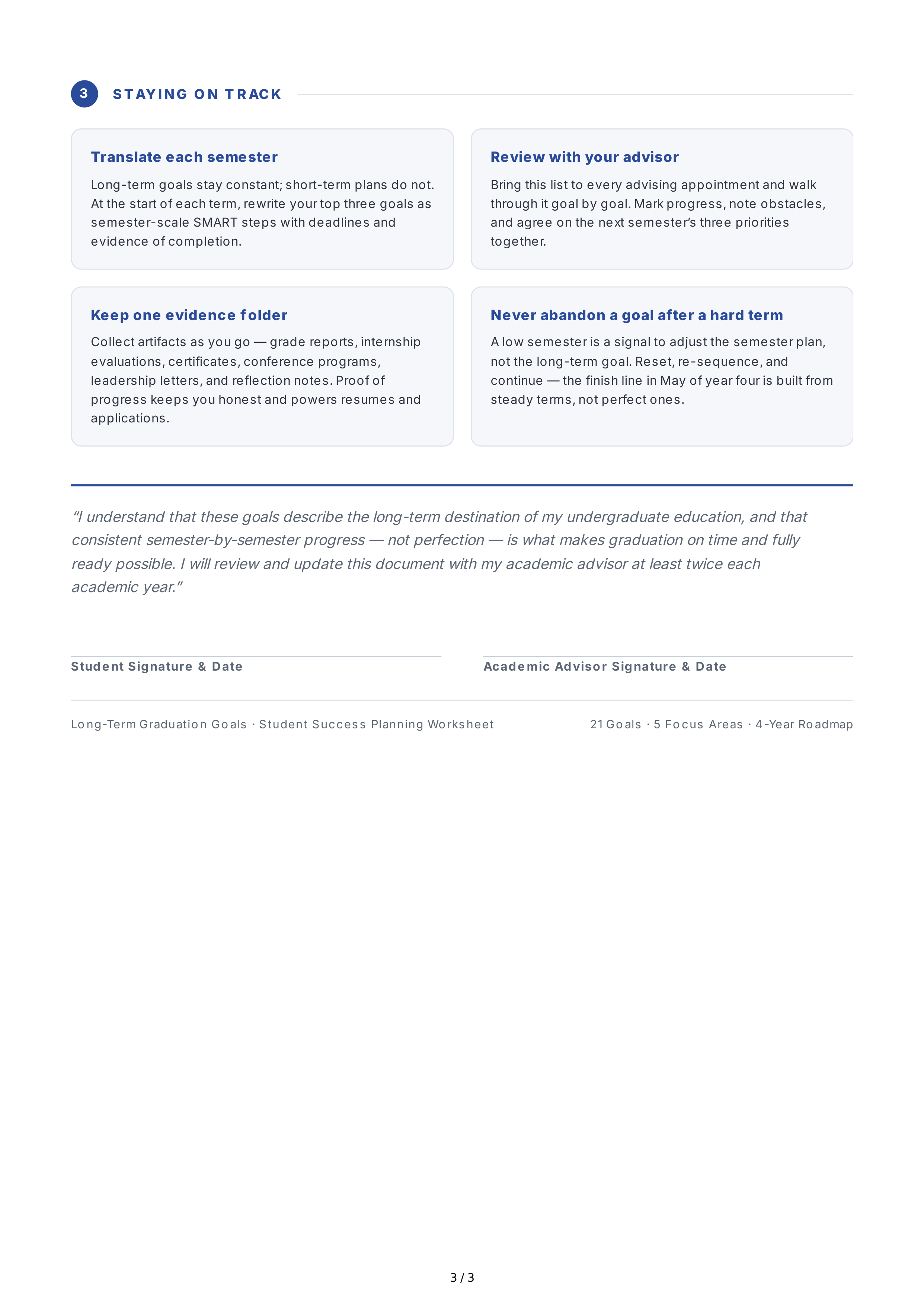
Translate
each
semester
Long
-
term
goals
stay
constant
;
short
-
term
plans
do
not
.
At
the
start
of
each
term
,
rewrite
your
top
three
goals
as
semester
-
scale
SMART
steps
with
deadlines
and
evidence
of
completion
.
Review
with
your
advisor
Bring
this
list
to
every
advising
appointment
and
walk
through
it
goal
by
goal
.
Mark
progress
,
note
obstacles
,
and
agree
on
the
next
semester
’
s
three
priorities
together
.
Keep
one
evidence
folder
Collect
artifacts
as
you
go
—
grade
reports
,
internship
evaluations
,
certificates
,
conference
programs
,
leadership
letters
,
and
reflection
notes
.
Proof
of
progress
keeps
you
honest
and
powers
resumes
and
applications
.
Never
abandon
a
goal
after
a
hard
term
A
low
semester
is
a
signal
to
adjust
the
semester
plan
,
not
the
long
-
term
goal
.
Reset
,
re
-
sequence
,
and
continue
—
the
finish
line
in
May
of
year
four
is
built
from
steady
terms
,
not
perfect
ones
.
“
I
understand
that
these
goals
describe
the
long
-
term
destination
of
my
undergraduate
education
,
and
that
consistent
semester
-
by
-
semester
progress
—
not
perfection
—
is
what
makes
graduation
on
time
and
fully
ready
possible
.
I
will
review
and
update
this
document
with
my
academic
advisor
at
least
twice
each
academic
year
.”
Stude nt
Signature
&
Date
Acade mic
Advisor
Signature
&
Date
Lo ng
-
Term
Graduatio n
Go als
·
Student
Success
Planning
Wo rksheet
21
Go als
· 5
Fo cus
Areas
· 4-
Year
Ro admap
3 / 3