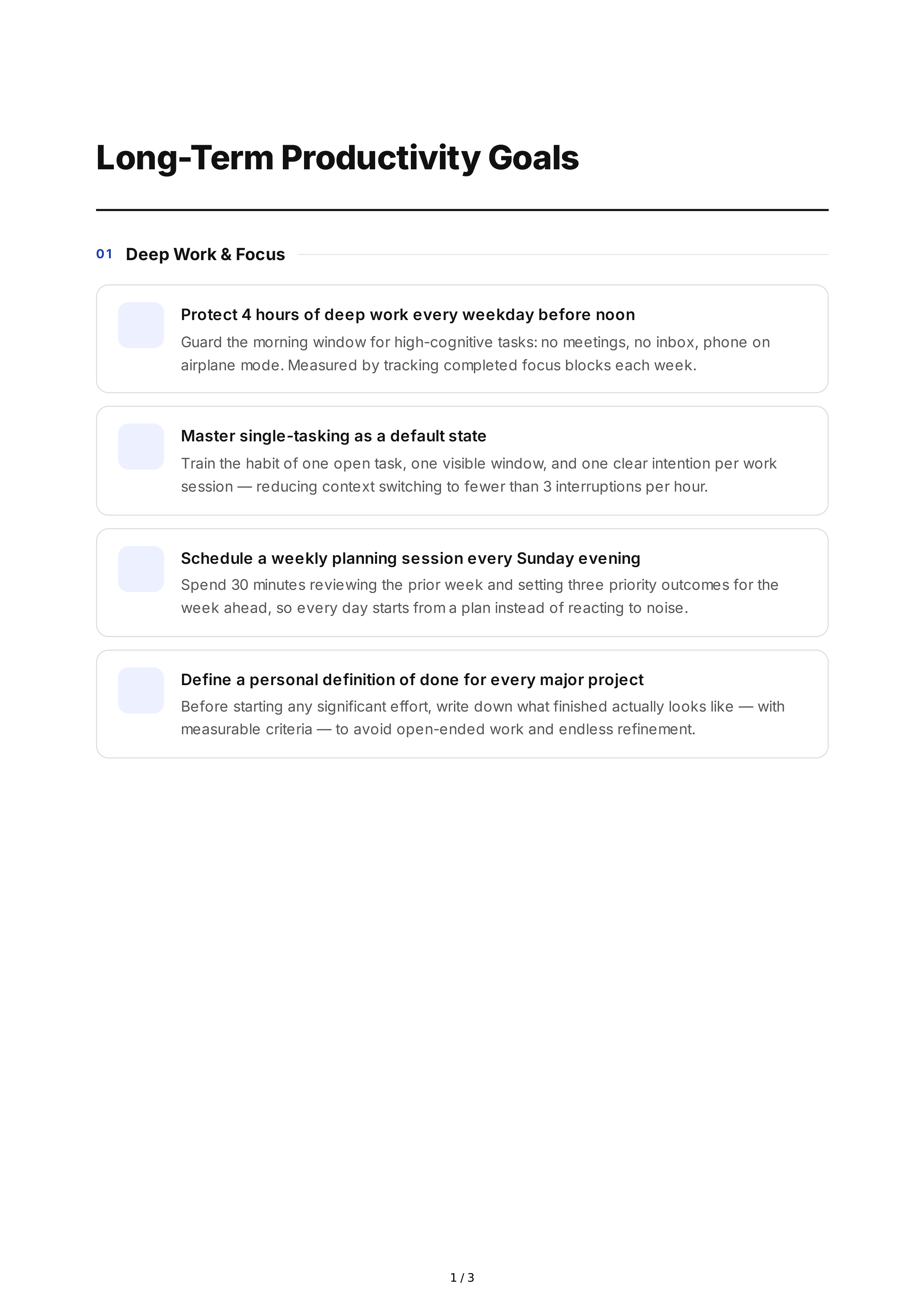
Long
-
Term
Productivity
Goals
01
Deep
Work
&
Focus
Protect
4
hours
of
deep
work
every
weekday
before
noon
Guard
the
morning
window
for
high
-
cognitive
tasks
:
no
meetings
,
no
inbox
,
phone
on
airplane
mode
.
Measured
by
tracking
completed
focus
blocks
each
week
.
Master
single
-
tasking
as
a
default
state
Train
the
habit
of
one
open
task
,
one
visible
window
,
and
one
clear
intention
per
work
session
—
reducing
context
switching
to
fewer
than
3
interruptions
per
hour
.
Schedule
a
weekly
planning
session
every
Sunday
evening
Spend
30
minutes
reviewing
the
prior
week
and
setting
three
priority
outcomes
for
the
week
ahead
,
so
every
day
starts
from
a
plan
instead
of
reacting
to
noise
.
Define
a
personal
definition
of
done
for
every
major
project
Before
starting
any
significant
effort
,
write
down
what
finished
actually
looks
like
—
with
measurable
criteria
—
to
avoid
open
-
ended
work
and
endless
refinement
.
1 / 3
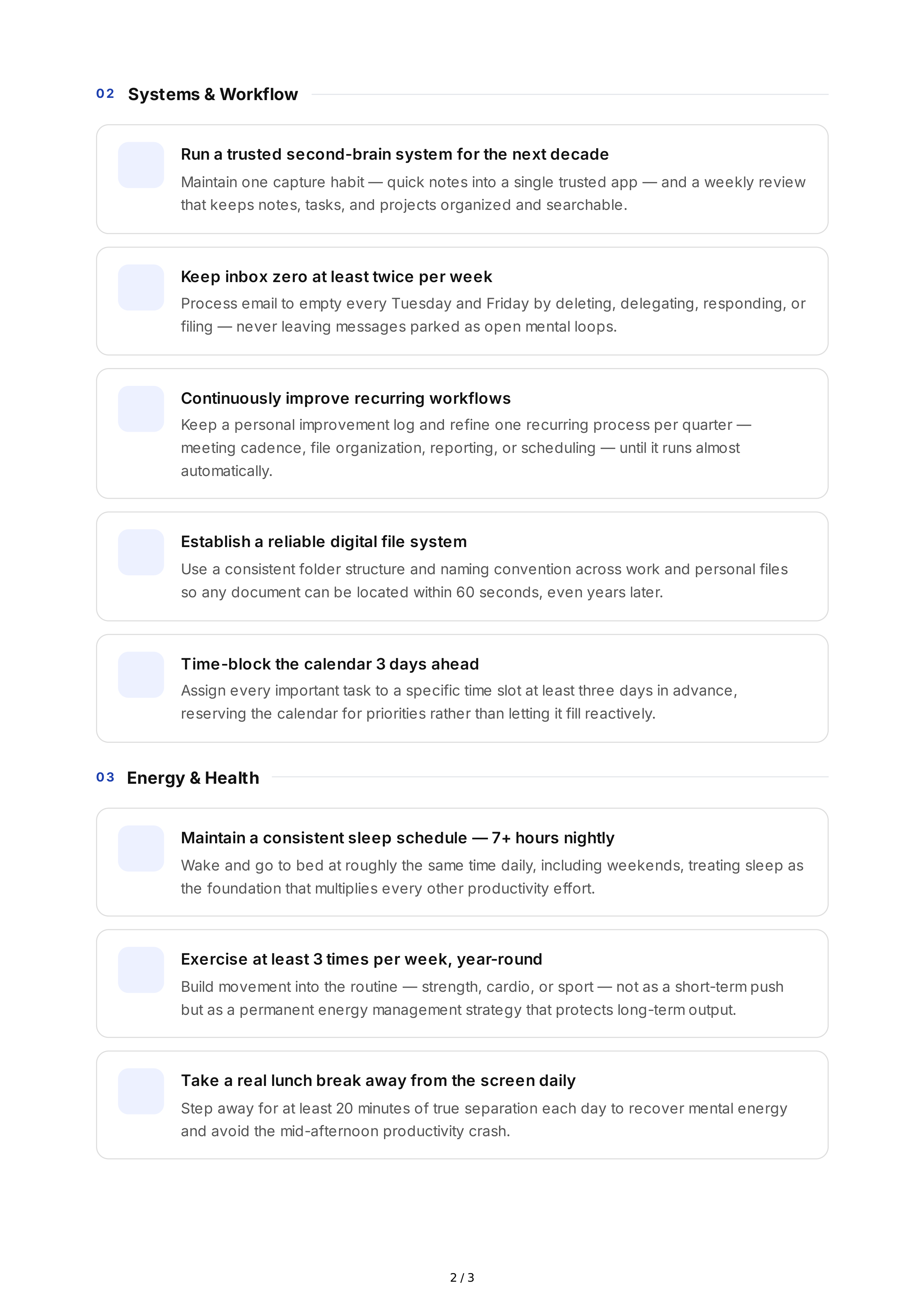
02
Systems
&
Workflow
Run
a
trusted
second
-
brain
system
for
the
next
decade
Maintain
one
capture
habit
—
quick
notes
into
a
single
trusted
app
—
and
a
weekly
review
that
keeps
notes
,
tasks
,
and
projects
organized
and
searchable
.
Keep
inbox
zero
at
least
twice
per
week
Process
email
to
empty
every
Tuesday
and
Friday
by
deleting
,
delegating
,
responding
,
or
filing
—
never
leaving
messages
parked
as
open
mental
loops
.
Continuously
improve
recurring
workflows
Keep
a
personal
improvement
log
and
refine
one
recurring
process
per
quarter
—
meeting
cadence
,
file
organization
,
reporting
,
or
scheduling
—
until
it
runs
almost
automatically
.
Establish
a
reliable
digital
file
system
Use
a
consistent
folder
structure
and
naming
convention
across
work
and
personal
files
so
any
document
can
be
located
within
60
seconds
,
even
years
later
.
Time
-
block
the
calendar
3
days
ahead
Assign
every
important
task
to
a
specific
time
slot
at
least
three
days
in
advance
,
reserving
the
calendar
for
priorities
rather
than
letting
it
fill
reactively
.
03
Energy
&
Health
Maintain
a
consistent
sleep
schedule
— 7+
hours
nightly
Wake
and
go
to
bed
at
roughly
the
same
time
daily
,
including
weekends
,
treating
sleep
as
the
foundation
that
multiplies
every
other
productivity
effort
.
Exercise
at
least
3
times
per
week
,
year
-
round
Build
movement
into
the
routine
—
strength
,
cardio
,
or
sport
—
not
as
a
short
-
term
push
but
as
a
permanent
energy
management
strategy
that
protects
long
-
term
output
.
Take
a
real
lunch
break
away
from
the
screen
daily
Step
away
for
at
least
20
minutes
of
true
separation
each
day
to
recover
mental
energy
and
avoid
the
mid
-
afternoon
productivity
crash
.
2 / 3
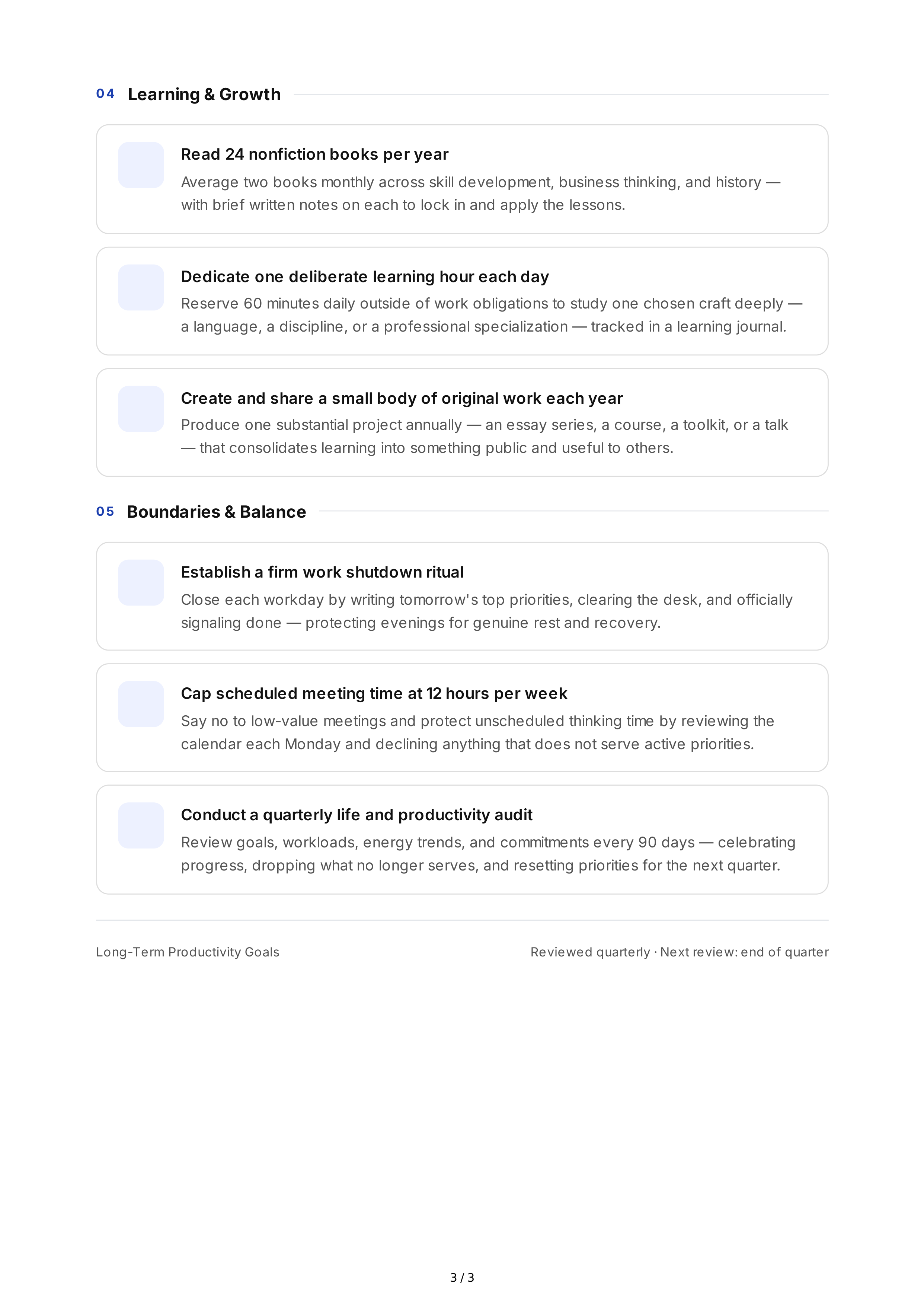
04
Learning
&
Growth
Read
24
nonfiction
books
per
year
Average
two
books
monthly
across
skill
development
,
business
thinking
,
and
history
—
with
brief
written
notes
on
each
to
lock
in
and
apply
the
lessons
.
Dedicate
one
deliberate
learning
hour
each
day
Reserve
60
minutes
daily
outside
of
work
obligations
to
study
one
chosen
craft
deeply
—
a
language
,
a
discipline
,
or
a
professional
specialization
—
tracked
in
a
learning
journal
.
Create
and
share
a
small
body
of
original
work
each
year
Produce
one
substantial
project
annually
—
an
essay
series
,
a
course
,
a
toolkit
,
or
a
talk
—
that
consolidates
learning
into
something
public
and
useful
to
others
.
05
Boundaries
&
Balance
Establish
a
firm
work
shutdown
ritual
Close
each
workday
by
writing
tomorrow
'
s
top
priorities
,
clearing
the
desk
,
and
officially
signaling
done
—
protecting
evenings
for
genuine
rest
and
recovery
.
Cap
scheduled
meeting
time
at
12
hours
per
week
Say
no
to
low
-
value
meetings
and
protect
unscheduled
thinking
time
by
reviewing
the
calendar
each
Monday
and
declining
anything
that
does
not
serve
active
priorities
.
Conduct
a
quarterly
life
and
productivity
audit
Review
goals
,
workloads
,
energy
trends
,
and
commitments
every
90
days
—
celebrating
progress
,
dropping
what
no
longer
serves
,
and
resetting
priorities
for
the
next
quarter
.
Long
-
Term
Productivity
Goals
Reviewed
quarterly
·
Next
review
:
end
of
quarter
3 / 3