Long
-
Term
Wealth
-
Building
Goals
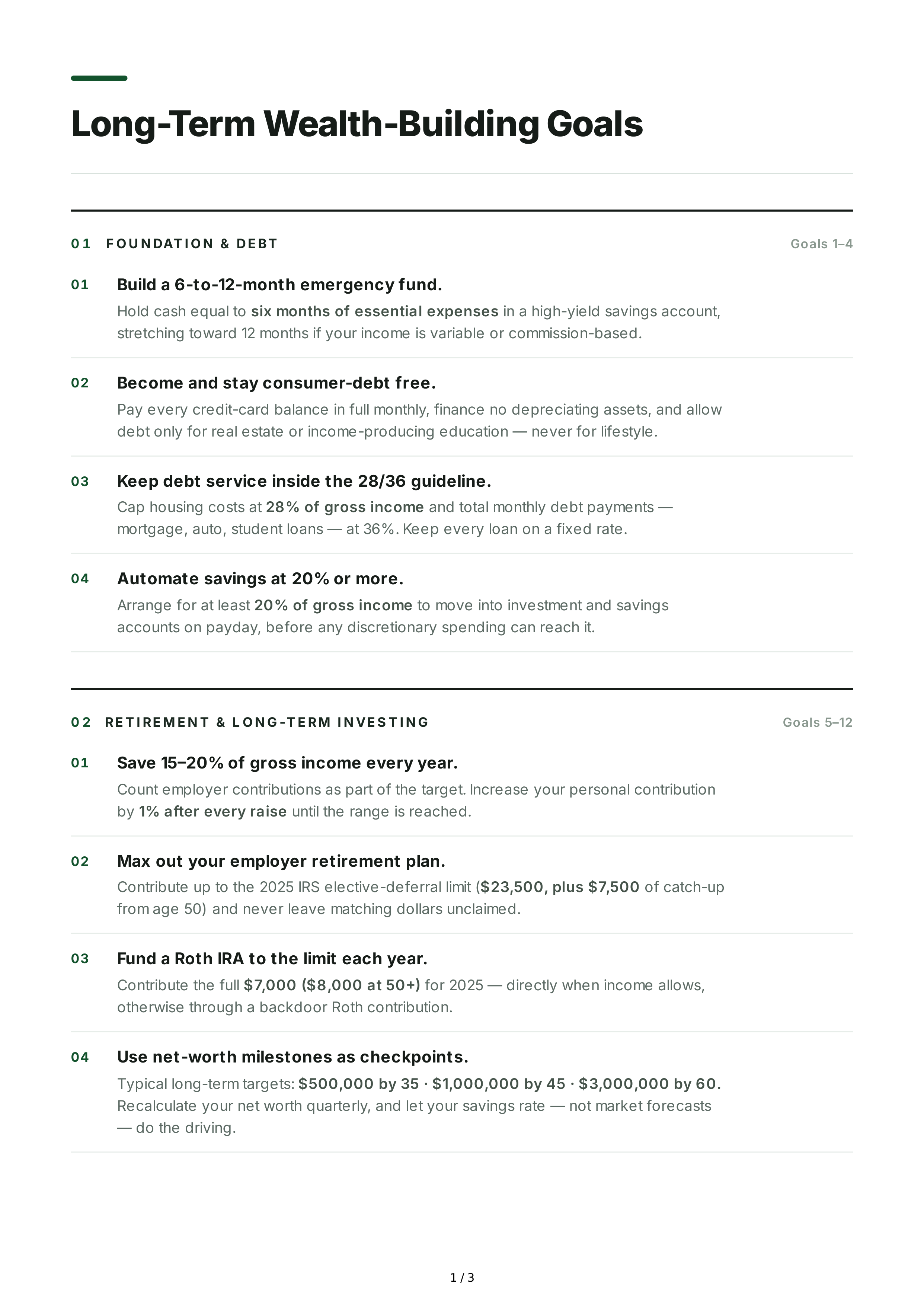
0 1
F O U N DAT I O N
&
DE BT
Goals
1–4
0 2
RE T I RE M E N T
&
L O N G
-
T E RM
I N VE S T I N G
Goals
5–12
Build
a
6-
to
-12-
month
emergency
fund
.
Hold
cash
equal
to
six
months
of
essential
expenses
in
a
high
-
yield
savings
account
,
stretching
toward
12
months
if
your
income
is
variable
or
commission
-
based
.
01
Become
and
stay
consumer
-
debt
free
.
Pay
every
credit
-
card
balance
in
full
monthly
,
finance
no
depreciating
assets
,
and
allow
debt
only
for
real
estate
or
income
-
producing
education
—
never
for
lifestyle
.
02
Keep
debt
service
inside
the
28/36
guideline
.
Cap
housing
costs
at
28%
of
gross
income
and
total
monthly
debt
payments
—
mortgage
,
auto
,
student
loans
—
at
36%.
Keep
every
loan
on
a
fixed
rate
.
03
Automate
savings
at
20%
or
more
.
Arrange
for
at
least
20%
of
gross
income
to
move
into
investment
and
savings
accounts
on
payday
,
before
any
discretionary
spending
can
reach
it
.
04
Save
15–20%
of
gross
income
every
year
.
Count
employer
contributions
as
part
of
the
target
.
Increase
your
personal
contribution
by
1%
after
every
raise
until
the
range
is
reached
.
01
Max
out
your
employer
retirement
plan
.
Contribute
up
to
the
2025
IRS
elective
-
deferral
limit
(
$
23,500,
plus
$
7,500
of
catch
-
up
from
age
50)
and
never
leave
matching
dollars
unclaimed
.
02
Fund
a
Roth
IRA
to
the
limit
each
year
.
Contribute
the
full
$
7,000 (
$
8,000
at
50+)
for
2025 —
directly
when
income
allows
,
otherwise
through
a
backdoor
Roth
contribution
.
03
Use
net
-
worth
milestones
as
checkpoints
.
Typical
long
-
term
targets
:
$
500,000
by
35 ·
$
1,000,000
by
45 ·
$
3,000,000
by
60.
Recalculate
your
net
worth
quarterly
,
and
let
your
savings
rate
—
not
market
forecasts
—
do
the
driving
.
04
1 / 3
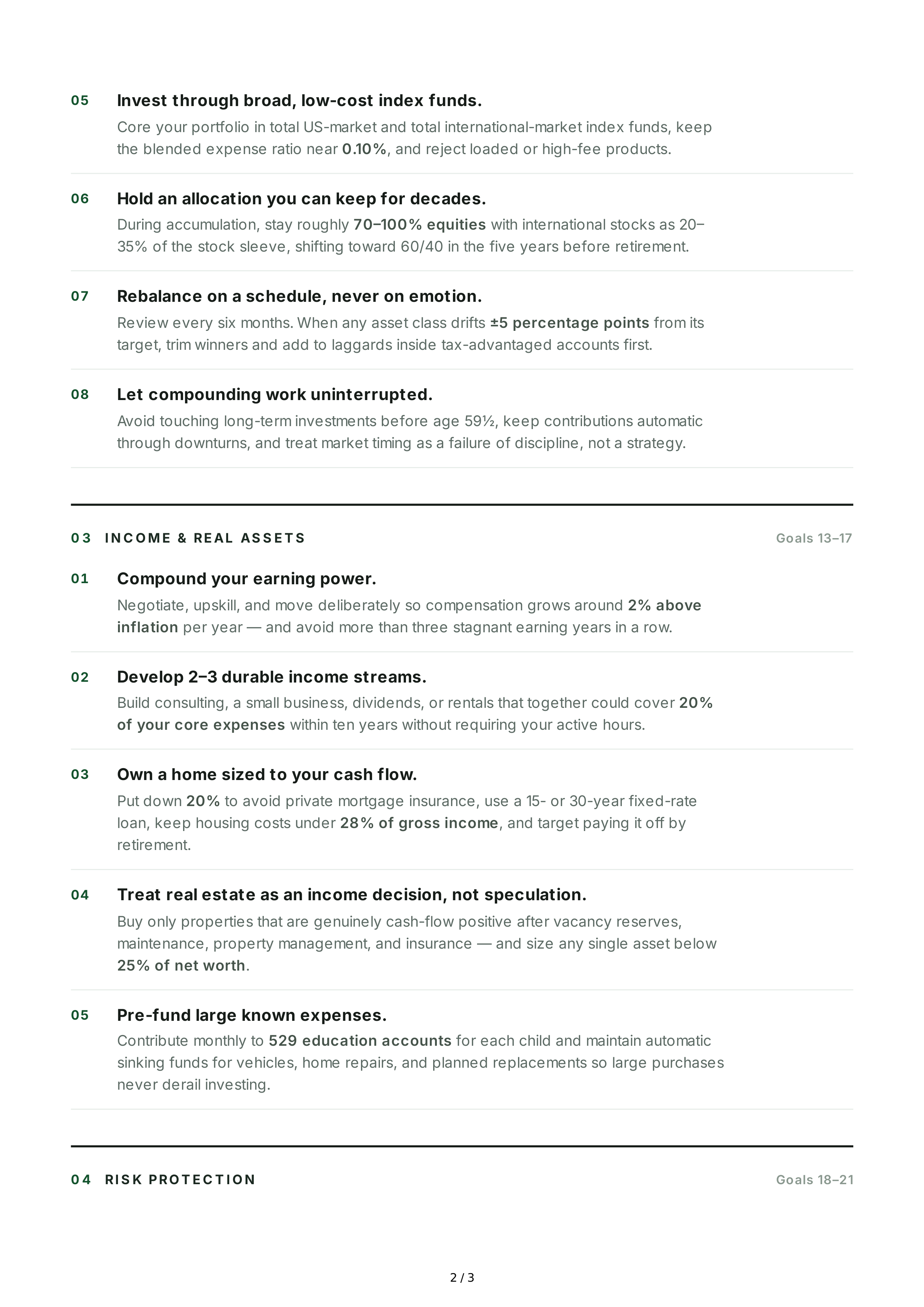
0 3
I N C O M E
&
RE AL
AS S E T S
Goals
13–17
0 4
RI S K
PRO T E C T I O N
Goals
18–21
Invest
through
broad
,
low
-
cost
index
funds
.
Core
your
portfolio
in
total
US
-
market
and
total
international
-
market
index
funds
,
keep
the
blended
expense
ratio
near
0.10%
,
and
reject
loaded
or
high
-
fee
products
.
05
Hold
an
allocation
you
can
keep
for
decades
.
During
accumulation
,
stay
roughly
70–100%
equities
with
international
stocks
as
20–
35%
of
the
stock
sleeve
,
shifting
toward
60/40
in
the
five
years
before
retirement
.
06
Rebalance
on
a
schedule
,
never
on
emotion
.
Review
every
six
months
.
When
any
asset
class
drifts
±5
percentage
points
from
its
target
,
trim
winners
and
add
to
laggards
inside
tax
-
advantaged
accounts
first
.
07
Let
compounding
work
uninterrupted
.
Avoid
touching
long
-
term
investments
before
age
59½,
keep
contributions
automatic
through
downturns
,
and
treat
market
timing
as
a
failure
of
discipline
,
not
a
strategy
.
08
Compound
your
earning
power
.
Negotiate
,
upskill
,
and
move
deliberately
so
compensation
grows
around
2%
above
inflation
per
year
—
and
avoid
more
than
three
stagnant
earning
years
in
a
row
.
01
Develop
2–3
durable
income
streams
.
Build
consulting
,
a
small
business
,
dividends
,
or
rentals
that
together
could
cover
20%
of
your
core
expenses
within
ten
years
without
requiring
your
active
hours
.
02
Own
a
home
sized
to
your
cash
flow
.
Put
down
20%
to
avoid
private
mortgage
insurance
,
use
a
15-
or
30-
year
fixed
-
rate
loan
,
keep
housing
costs
under
28%
of
gross
income
,
and
target
paying
it
off
by
retirement
.
03
Treat
real
estate
as
an
income
decision
,
not
speculation
.
Buy
only
properties
that
are
genuinely
cash
-
flow
positive
after
vacancy
reserves
,
maintenance
,
property
management
,
and
insurance
—
and
size
any
single
asset
below
25%
of
net
worth
.
04
Pre
-
fund
large
known
expenses
.
Contribute
monthly
to
529
education
accounts
for
each
child
and
maintain
automatic
sinking
funds
for
vehicles
,
home
repairs
,
and
planned
replacements
so
large
purchases
never
derail
investing
.
05
2 / 3
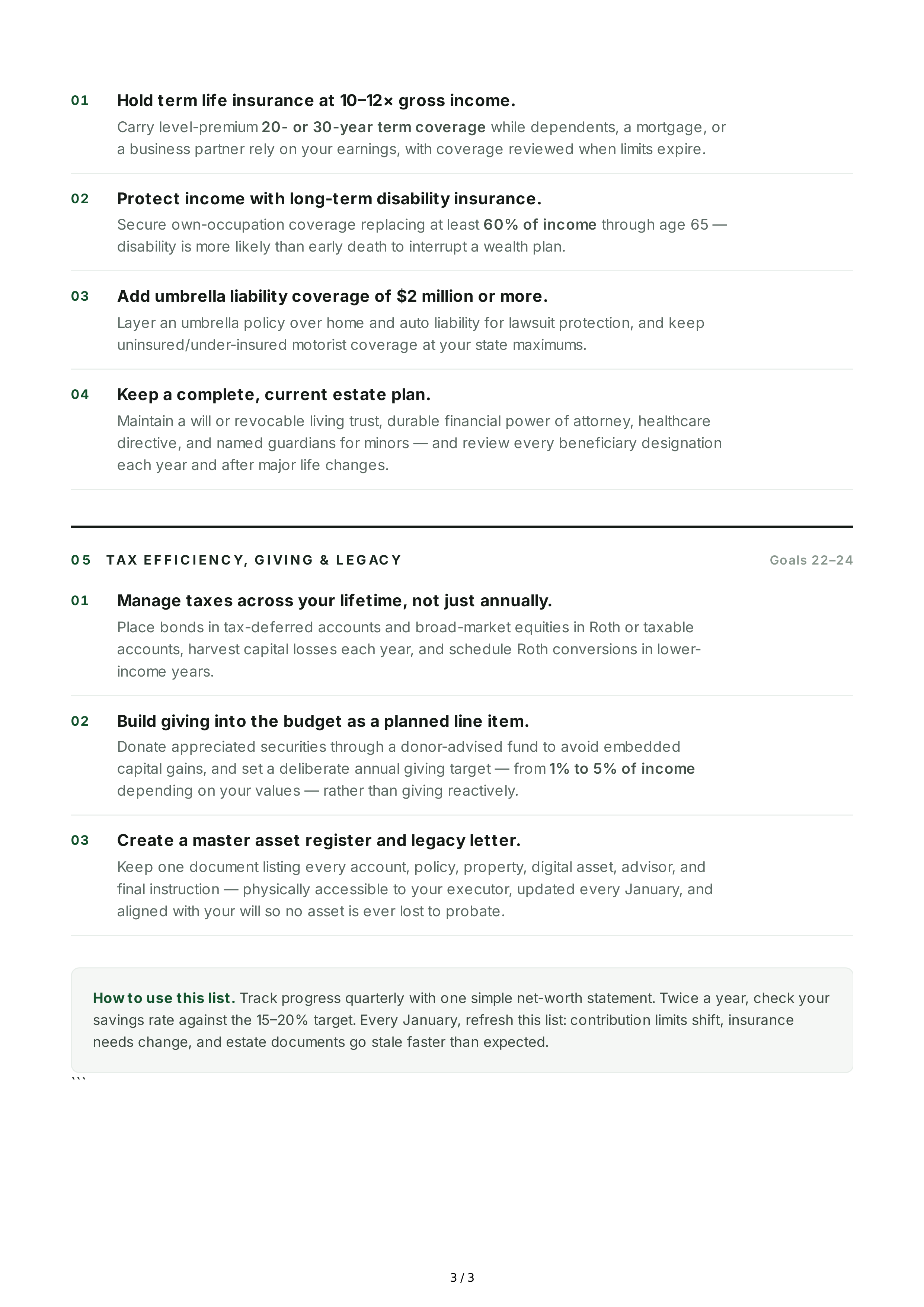
0 5
TAX
E F F I C I E N C Y
,
G I VI N G
&
L E G AC Y
Goals
22–24
How
to
use
this
list
.
Track
progress
quarterly
with
one
simple
net
-
worth
statement
.
Twice
a
year
,
check
your
savings
rate
against
the
15–20%
target
.
Every
January
,
refresh
this
list
:
contribution
limits
shift
,
insurance
needs
change
,
and
estate
documents
go
stale
faster
than
expected
.
```
Hold
term
life
insurance
at
10–12×
gross
income
.
Carry
level
-
premium
20-
or
30-
year
term
coverage
while
dependents
,
a
mortgage
,
or
a
business
partner
rely
on
your
earnings
,
with
coverage
reviewed
when
limits
expire
.
01
Protect
income
with
long
-
term
disability
insurance
.
Secure
own
-
occupation
coverage
replacing
at
least
60%
of
income
through
age
65 —
disability
is
more
likely
than
early
death
to
interrupt
a
wealth
plan
.
02
Add
umbrella
liability
coverage
of
$
2
million
or
more
.
Layer
an
umbrella
policy
over
home
and
auto
liability
for
lawsuit
protection
,
and
keep
uninsured
/
under
-
insured
motorist
coverage
at
your
state
maximums
.
03
Keep
a
complete
,
current
estate
plan
.
Maintain
a
will
or
revocable
living
trust
,
durable
financial
power
of
attorney
,
healthcare
directive
,
and
named
guardians
for
minors
—
and
review
every
beneficiary
designation
each
year
and
after
major
life
changes
.
04
Manage
taxes
across
your
lifetime
,
not
just
annually
.
Place
bonds
in
tax
-
deferred
accounts
and
broad
-
market
equities
in
Roth
or
taxable
accounts
,
harvest
capital
losses
each
year
,
and
schedule
Roth
conversions
in
lower
-
income
years
.
01
Build
giving
into
the
budget
as
a
planned
line
item
.
Donate
appreciated
securities
through
a
donor
-
advised
fund
to
avoid
embedded
capital
gains
,
and
set
a
deliberate
annual
giving
target
—
from
1%
to
5%
of
income
depending
on
your
values
—
rather
than
giving
reactively
.
02
Create
a
master
asset
register
and
legacy
letter
.
Keep
one
document
listing
every
account
,
policy
,
property
,
digital
asset
,
advisor
,
and
final
instruction
—
physically
accessible
to
your
executor
,
updated
every
January
,
and
aligned
with
your
will
so
no
asset
is
ever
lost
to
probate
.
03
3 / 3