Long
-
Term
Decision
-
Making
Goals
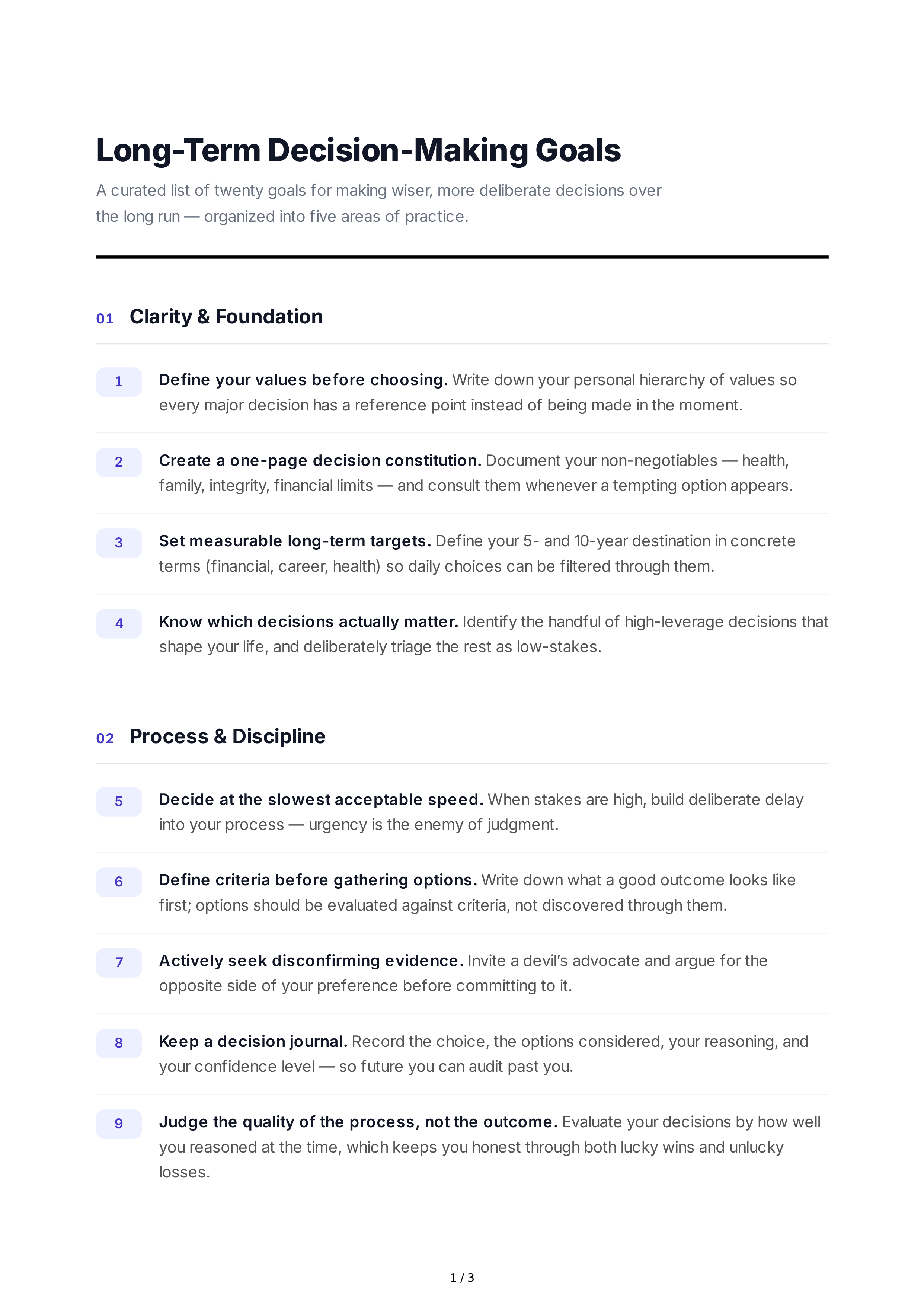
A
curated
list
of
twenty
goals
for
making
wiser
,
more
deliberate
decisions
over
the
long
run
—
organized
into
five
areas
of
practice
.
01
Clarity
&
Foundation
1
Define
your
values
before
choosing
.
Write
down
your
personal
hierarchy
of
values
so
every
major
decision
has
a
reference
point
instead
of
being
made
in
the
moment
.
2
Create
a
one
-
page
decision
constitution
.
Document
your
non
-
negotiables
—
health
,
family
,
integrity
,
financial
limits
—
and
consult
them
whenever
a
tempting
option
appears
.
3
Set
measurable
long
-
term
targets
.
Define
your
5-
and
10-
year
destination
in
concrete
terms
(
financial
,
career
,
health
)
so
daily
choices
can
be
filtered
through
them
.
4
Know
which
decisions
actually
matter
.
Identify
the
handful
of
high
-
leverage
decisions
that
shape
your
life
,
and
deliberately
triage
the
rest
as
low
-
stakes
.
02
Process
&
Discipline
5
Decide
at
the
slowest
acceptable
speed
.
When
stakes
are
high
,
build
deliberate
delay
into
your
process
—
urgency
is
the
enemy
of
judgment
.
6
Define
criteria
before
gathering
options
.
Write
down
what
a
good
outcome
looks
like
first
;
options
should
be
evaluated
against
criteria
,
not
discovered
through
them
.
7
Actively
seek
disconfirming
evidence
.
Invite
a
devil
’
s
advocate
and
argue
for
the
opposite
side
of
your
preference
before
committing
to
it
.
8
Keep
a
decision
journal
.
Record
the
choice
,
the
options
considered
,
your
reasoning
,
and
your
confidence
level
—
so
future
you
can
audit
past
you
.
9
Judge
the
quality
of
the
process
,
not
the
outcome
.
Evaluate
your
decisions
by
how
well
you
reasoned
at
the
time
,
which
keeps
you
honest
through
both
lucky
wins
and
unlucky
losses
.
1 / 3
03
Long
-
Term
Orientation
10
Apply
a
ten
-
year
test
to
major
choices
.
Ask
, “
Will
this
still
matter
a
decade
from
now
?” —
decisions
that
survive
the
test
earn
your
full
attention
.
11
Trace
second
-
and
third
-
order
consequences
.
Look
beyond
the
immediate
effect
of
an
action
to
what
it
enables
one
and
two
steps
later
before
deciding
.
12
Invert
the
problem
—
plan
to
fail
on
purpose
.
Identify
what
would
guarantee
failure
or
regret
in
five
years
,
then
refuse
to
take
those
paths
.
13
Pre
-
commit
before
temptation
arrives
.
Set
spending
limits
,
time
budgets
,
and
behavioral
rules
in
advance
,
when
your
judgment
is
still
clear
.
14
Price
opportunity
costs
explicitly
.
State
what
you
are
giving
up
—
in
time
and
money
—
for
each
significant
commitment
,
and
compare
alternatives
in
the
same
units
.
04
Learning
&
Calibration
15
Calibrate
your
confidence
over
years
,
not
days
.
Revisit
recorded
predictions
on
a
fixed
schedule
to
learn
how
often
your
“90%
sure
”
judgments
are
actually
right
.
16
Conduct
quarterly
decision
reviews
.
Block
one
hour
every
quarter
to
audit
recent
decisions
,
note
what
you
missed
,
and
adjust
your
framework
.
17
Treat
wrong
calls
as
data
,
not
failures
.
Classify
each
mistake
as
a
faulty
process
,
faulty
information
,
or
plain
bad
luck
—
then
update
only
on
the
first
two
.
18
Steal
patterns
from
adjacent
domains
.
Study
how
skilled
investors
,
doctors
,
and
engineers
handle
uncertainty
,
then
translate
their
heuristics
into
your
own
context
.
19
Separate
reversible
from
irreversible
decisions
.
Move
fast
on
reversible
ones
and
slow
on
irreversible
ones
—
and
keep
a
running
list
of
which
is
which
.
2 / 3
05
Commitment
&
Optionality
20
Define
kill
criteria
before
you
start
.
Write
down
the
conditions
under
which
you
will
walk
away
from
any
long
-
term
commitment
,
and
honor
them
without
negotiation
.
21
Never
escalate
on
sunk
costs
.
Decide
based
on
future
value
alone
;
the
time
,
money
,
and
effort
already
spent
should
have
zero
weight
in
the
calculation
.
22
Protect
slack
to
preserve
optionality
.
Keep
a
buffer
of
uncommitted
time
and
money
so
you
retain
the
freedom
to
change
course
when
a
better
option
appears
.
23
Raise
the
bar
for
what
you
accept
.
Introduce
a
default
“
no
”
for
choices
below
a
clear
threshold
,
reserving
decision
energy
and
life
space
for
the
excellent
.
24
Schedule
a
yearly
strategic
reset
.
Once
a
year
,
step
back
from
operations
to
re
-
examine
goals
,
frameworks
,
and
commitments
from
scratch
—
the
meta
-
decision
that
keeps
every
other
goal
on
course
.
3 / 3