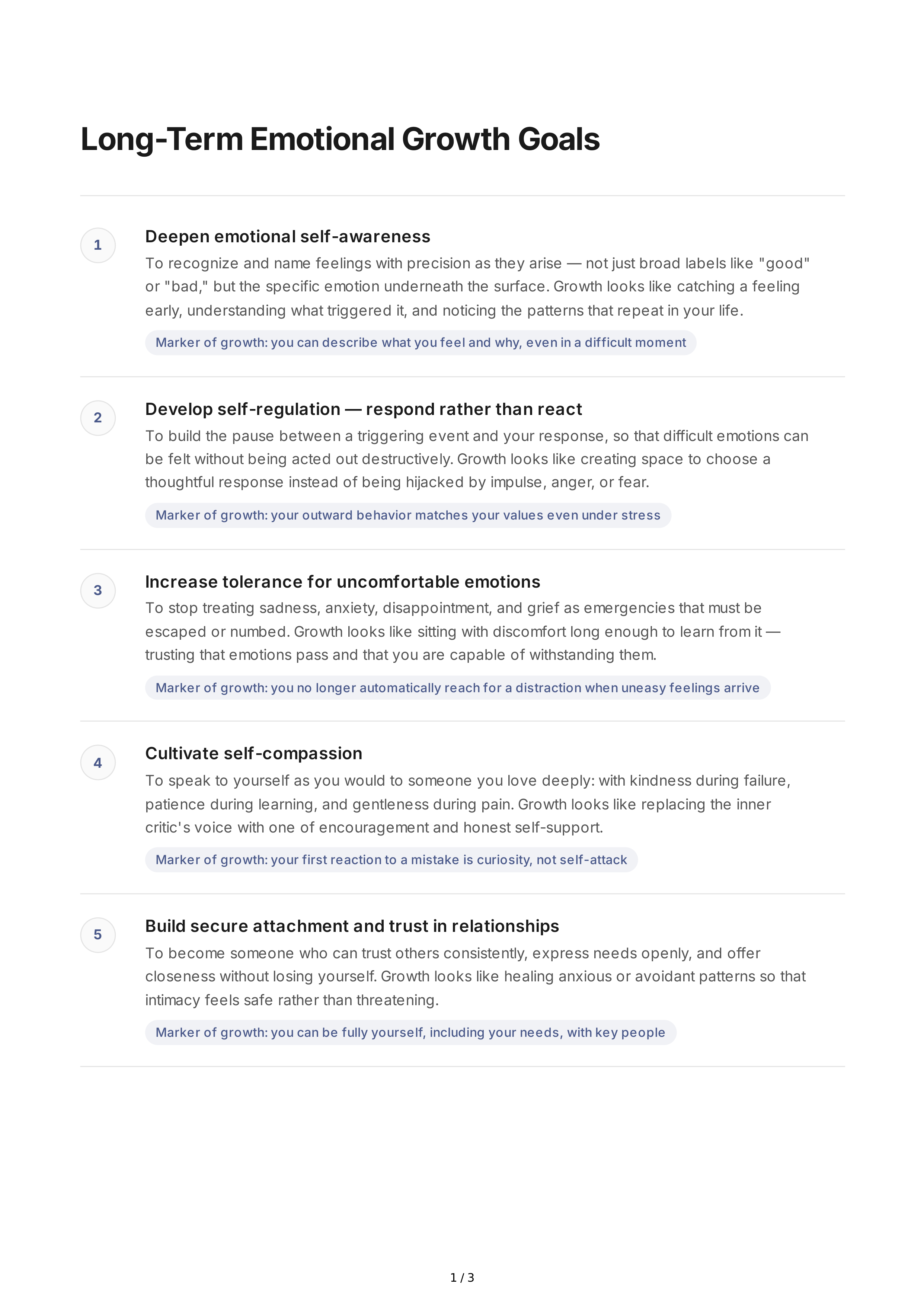
Long
-
Term
Emotional
Growth
Goals
1
Deepen
emotional
self
-
awareness
To
recognize
and
name
feelings
with
precision
as
they
arise
—
not
just
broad
labels
like
"
good
"
or
"
bad
,"
but
the
specific
emotion
underneath
the
surface
.
Growth
looks
like
catching
a
feeling
early
,
understanding
what
triggered
it
,
and
noticing
the
patterns
that
repeat
in
your
life
.
Marker
of
growth
:
you
can
describe
what
you
feel
and
why
,
even
in
a
difficult
moment
2
Develop
self
-
regulation
—
respond
rather
than
react
To
build
the
pause
between
a
triggering
event
and
your
response
,
so
that
difficult
emotions
can
be
felt
without
being
acted
out
destructively
.
Growth
looks
like
creating
space
to
choose
a
thoughtful
response
instead
of
being
hijacked
by
impulse
,
anger
,
or
fear
.
Marker
of
growth
:
your
outward
behavior
matches
your
values
even
under
stress
3
Increase
tolerance
for
uncomfortable
emotions
To
stop
treating
sadness
,
anxiety
,
disappointment
,
and
grief
as
emergencies
that
must
be
escaped
or
numbed
.
Growth
looks
like
sitting
with
discomfort
long
enough
to
learn
from
it
—
trusting
that
emotions
pass
and
that
you
are
capable
of
withstanding
them
.
Marker
of
growth
:
you
no
longer
automatically
reach
for
a
distraction
when
uneasy
feelings
arrive
4
Cultivate
self
-
compassion
To
speak
to
yourself
as
you
would
to
someone
you
love
deeply
:
with
kindness
during
failure
,
patience
during
learning
,
and
gentleness
during
pain
.
Growth
looks
like
replacing
the
inner
critic
'
s
voice
with
one
of
encouragement
and
honest
self
-
support
.
Marker
of
growth
:
your
first
reaction
to
a
mistake
is
curiosity
,
not
self
-
attack
5
Build
secure
attachment
and
trust
in
relationships
To
become
someone
who
can
trust
others
consistently
,
express
needs
openly
,
and
offer
closeness
without
losing
yourself
.
Growth
looks
like
healing
anxious
or
avoidant
patterns
so
that
intimacy
feels
safe
rather
than
threatening
.
Marker
of
growth
:
you
can
be
fully
yourself
,
including
your
needs
,
with
key
people
1 / 3
6
Learn
to
set
and
hold
healthy
boundaries
To
communicate
clearly
what
is
acceptable
to
you
and
honor
the
boundaries
of
others
—
without
guilt
,
aggression
,
or
over
-
explaining
.
Growth
looks
like
saying
no
when
needed
,
protecting
your
energy
,
and
accepting
that
others
may
be
disappointed
.
Marker
of
growth
:
you
consistently
protect
your
wellbeing
while
keeping
relationships
intact
7
Practice
radical
acceptance
of
what
cannot
be
changed
To
release
the
exhausting
fight
against
reality
—
the
past
,
other
people
'
s
choices
,
loss
,
and
uncertainty
.
Growth
looks
like
acknowledging
what
is
painful
,
grieving
it
when
needed
,
and
turning
energy
toward
what
is
within
your
control
.
Marker
of
growth
:
you
stop
asking
"
why
me
"
and
start
asking
"
what
now
"
8
Move
from
independence
to
healthy
interdependence
To
allow
support
in
—
asking
for
help
before
crisis
,
receiving
care
without
defensiveness
,
and
offering
it
freely
in
return
.
Growth
looks
like
recognizing
that
dependence
and
independence
both
have
limits
,
and
that
connection
is
a
strength
,
not
a
weakness
.
Marker
of
growth
:
you
name
your
needs
out
loud
before
they
become
consequences
9
Deepen
the
capacity
for
forgiveness
—
of
others
and
yourself
To
carry
less
resentment
by
processing
harm
rather
than
suppressing
it
,
and
to
release
your
own
mistakes
after
genuine
learning
.
Growth
looks
like
forgiveness
as
a
deliberate
act
of
freedom
—
not
reconciliation
where
trust
has
been
broken
,
but
peace
where
bitterness
once
lived
.
Marker
of
growth
:
the
past
holds
less
power
over
your
present
mood
and
choices
10
Allow
and
tolerate
joy
and
positive
emotion
For
many
people
,
feeling
happiness
is
harder
than
feeling
pain
—
joy
can
feel
risky
,
undeserved
,
or
fragile
.
Growth
looks
like
staying
present
in
good
moments
,
letting
praise
land
,
and
allowing
yourself
to
be
fully
alive
and
content
without
waiting
for
something
to
go
wrong
.
Marker
of
growth
:
you
can
enjoy
success
and
closeness
without
self
-
sabotaging
11
Grow
comfort
with
vulnerability
To
share
your
inner
world
—
fears
,
doubts
,
mistakes
,
and
genuine
feelings
—
with
safe
people
,
even
when
it
feels
exposing
.
Growth
looks
like
understanding
that
vulnerability
is
not
weakness
but
the
foundation
of
deep
trust
,
and
being
selective
yet
honest
about
when
to
open
up
.
Marker
of
growth
:
hidden
feelings
no
longer
silently
drive
your
decisions
2 / 3
12
Align
everyday
actions
with
core
values
To
live
with
integrity
by
clarifying
what
matters
most
—
honesty
,
connection
,
contribution
,
courage
—
and
letting
those
values
guide
daily
choices
rather
than
fear
,
habit
,
or
approval
-
seeking
.
Growth
looks
like
a
smaller
gap
between
who
you
say
you
are
and
how
you
actually
live
.
Marker
of
growth
:
your
calendar
,
attention
,
and
energy
reflect
your
stated
priorities
13
Strengthen
emotional
repair
skills
To
take
responsibility
after
conflict
—
offering
sincere
repair
,
receiving
it
from
others
,
and
reconnecting
with
warmth
rather
than
building
walls
.
Growth
looks
like
knowing
that
ruptures
in
relationships
are
inevitable
and
that
return
is
possible
.
Marker
of
growth
:
disagreements
end
in
deeper
understanding
,
not
distance
14
Release
people
-
pleasing
and
approval
-
dependence
To
make
choices
from
internal
clarity
rather
than
a
need
to
be
liked
,
and
to
tolerate
the
discomfort
of
disappointing
some
people
.
Growth
looks
like
self
-
worth
that
no
longer
rises
and
falls
with
others
'
reactions
to
you
.
Marker
of
growth
:
you
can
disagree
with
someone
you
care
about
and
stay
grounded
15
Turn
life
experiences
into
meaning
To
reflect
on
successes
,
failures
,
losses
,
and
transitions
—
extracting
lessons
and
bringing
them
into
who
you
are
becoming
.
Growth
looks
like
making
sense
of
your
story
so
that
painful
chapters
inform
wisdom
rather
than
define
your
identity
.
Marker
of
growth
:
you
can
look
back
with
gratitude
for
how
challenges
shaped
you
3 / 3