Long
-
Term
Knowledge
Development
Goals
01
The
Goals
at
a
Glance
THE
FULL
LIST
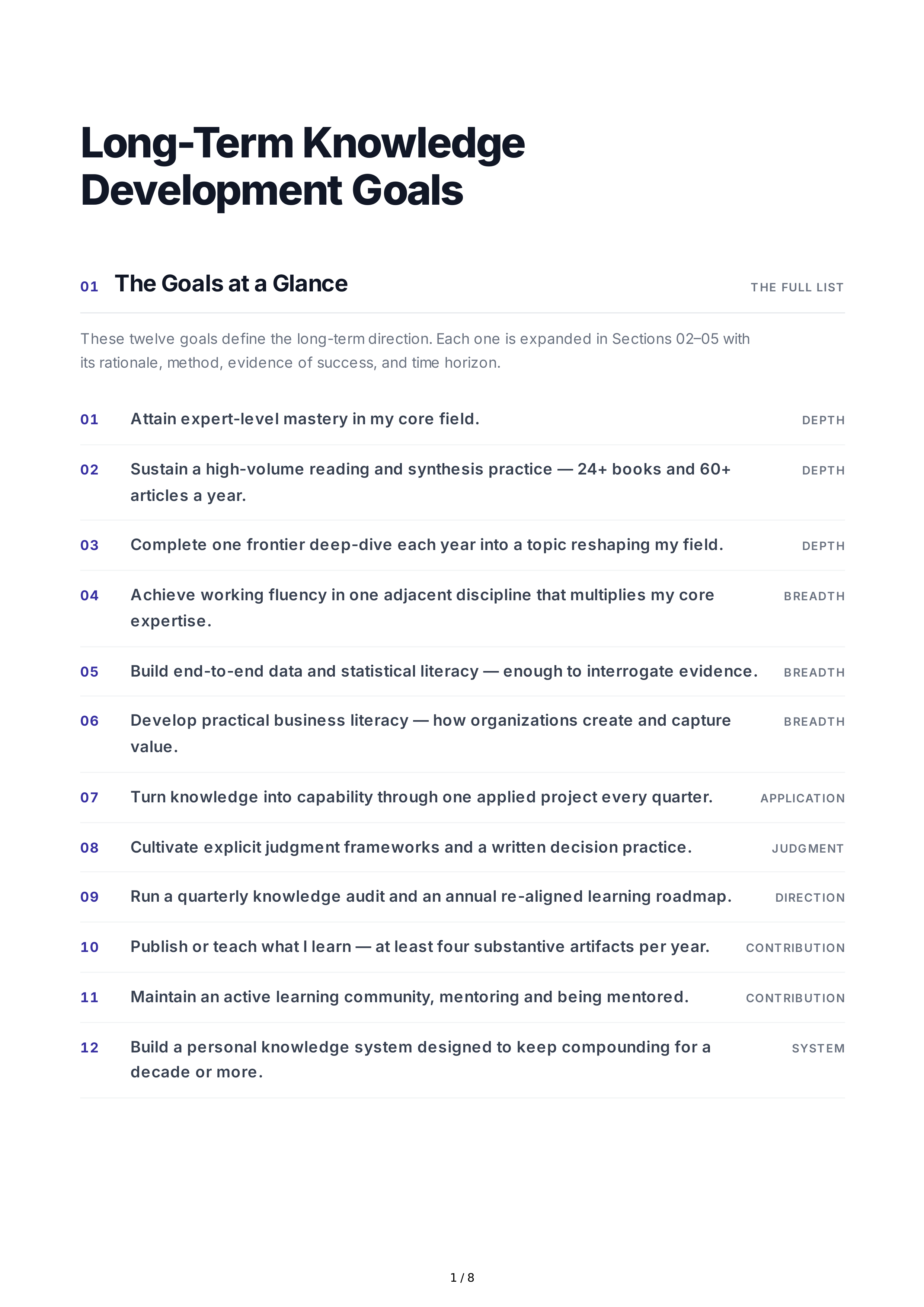
These
twelve
goals
define
the
long
-
term
direction
.
Each
one
is
expanded
in
Sections
02–05
with
its
rationale
,
method
,
evidence
of
success
,
and
time
horizon
.
01
Attain
expert
-
level
mastery
in
my
core
field
.
DEPTH
02
Sustain
a
high
-
volume
reading
and
synthesis
practice
— 24+
books
and
60+
articles
a
year
.
DEPTH
03
Complete
one
frontier
deep
-
dive
each
year
into
a
topic
reshaping
my
field
.
DEPTH
04
Achieve
working
fluency
in
one
adjacent
discipline
that
multiplies
my
core
expertise
.
BREADTH
05
Build
end
-
to
-
end
data
and
statistical
literacy
—
enough
to
interrogate
evidence
.
BREADTH
06
Develop
practical
business
literacy
—
how
organizations
create
and
capture
value
.
BREADTH
07
Turn
knowledge
into
capability
through
one
applied
project
every
quarter
.
APPLICATION
08
Cultivate
explicit
judgment
frameworks
and
a
written
decision
practice
.
JUDGMENT
09
Run
a
quarterly
knowledge
audit
and
an
annual
re
-
aligned
learning
roadmap
.
DIRECTION
10
Publish
or
teach
what
I
learn
—
at
least
four
substantive
artifacts
per
year
.
CONTRIBUTION
11
Maintain
an
active
learning
community
,
mentoring
and
being
mentored
.
CONTRIBUTION
12
Build
a
personal
knowledge
system
designed
to
keep
compounding
for
a
decade
or
more
.
SYSTEM
1 / 8
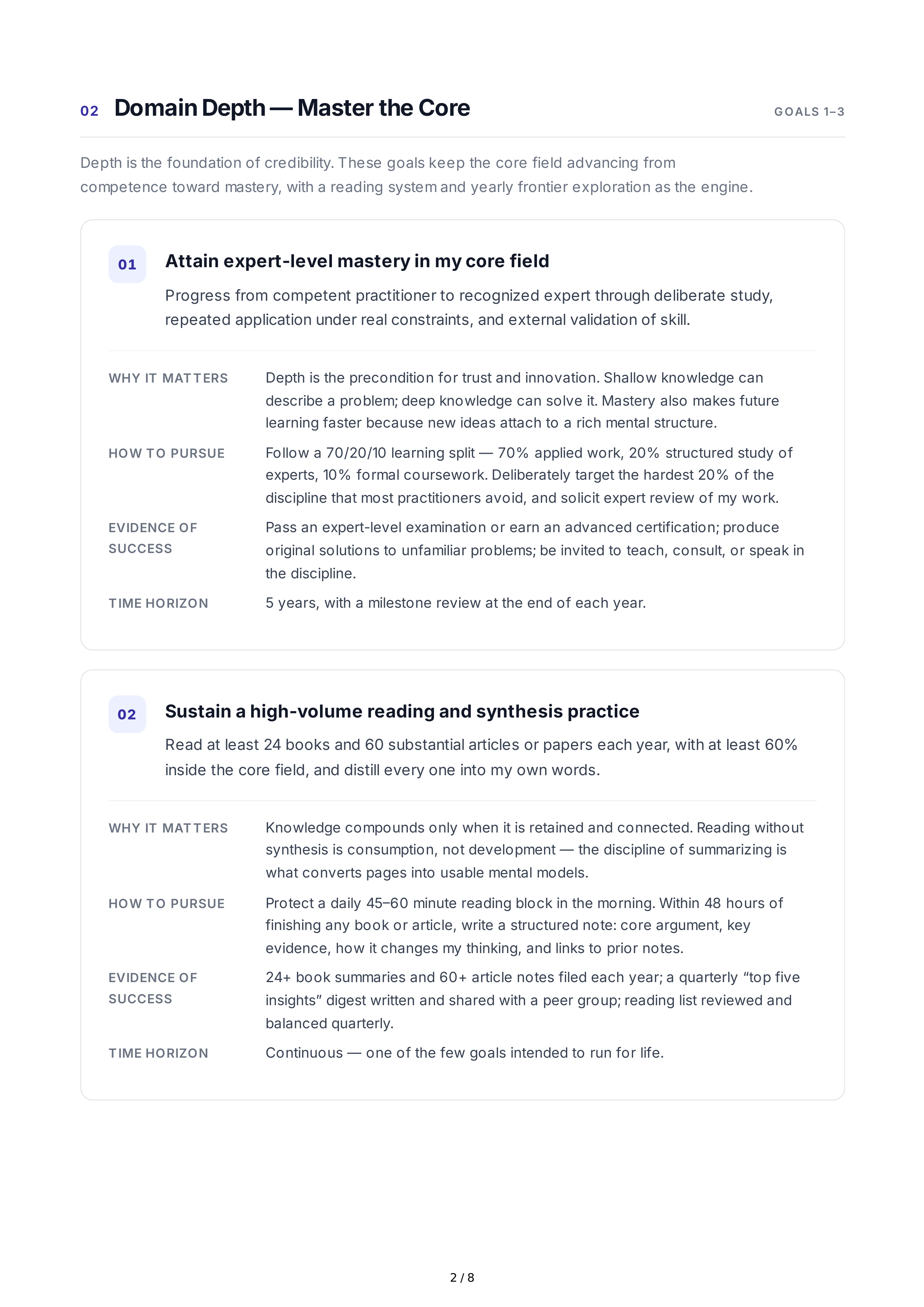
02
Domain
Depth
—
Master
the
Core
GOALS
1–3
Depth
is
the
foundation
of
credibility
.
These
goals
keep
the
core
field
advancing
from
competence
toward
mastery
,
with
a
reading
system
and
yearly
frontier
exploration
as
the
engine
.
01
Attain
expert
-
level
mastery
in
my
core
field
Progress
from
competent
practitioner
to
recognized
expert
through
deliberate
study
,
repeated
application
under
real
constraints
,
and
external
validation
of
skill
.
WHY
IT
MATTERS
Depth
is
the
precondition
for
trust
and
innovation
.
Shallow
knowledge
can
describe
a
problem
;
deep
knowledge
can
solve
it
.
Mastery
also
makes
future
learning
faster
because
new
ideas
attach
to
a
rich
mental
structure
.
HOW
TO
PURSUE
Follow
a
70/20/10
learning
split
— 70%
applied
work
, 20%
structured
study
of
experts
, 10%
formal
coursework
.
Deliberately
target
the
hardest
20%
of
the
discipline
that
most
practitioners
avoid
,
and
solicit
expert
review
of
my
work
.
EVIDENCE
OF
SUCCESS
Pass
an
expert
-
level
examination
or
earn
an
advanced
certification
;
produce
original
solutions
to
unfamiliar
problems
;
be
invited
to
teach
,
consult
,
or
speak
in
the
discipline
.
TIME
HORIZON
5
years
,
with
a
milestone
review
at
the
end
of
each
year
.
02
Sustain
a
high
-
volume
reading
and
synthesis
practice
Read
at
least
24
books
and
60
substantial
articles
or
papers
each
year
,
with
at
least
60%
inside
the
core
field
,
and
distill
every
one
into
my
own
words
.
WHY
IT
MATTERS
Knowledge
compounds
only
when
it
is
retained
and
connected
.
Reading
without
synthesis
is
consumption
,
not
development
—
the
discipline
of
summarizing
is
what
converts
pages
into
usable
mental
models
.
HOW
TO
PURSUE
Protect
a
daily
45–60
minute
reading
block
in
the
morning
.
Within
48
hours
of
finishing
any
book
or
article
,
write
a
structured
note
:
core
argument
,
key
evidence
,
how
it
changes
my
thinking
,
and
links
to
prior
notes
.
EVIDENCE
OF
SUCCESS
24+
book
summaries
and
60+
article
notes
filed
each
year
;
a
quarterly
“
top
five
insights
”
digest
written
and
shared
with
a
peer
group
;
reading
list
reviewed
and
balanced
quarterly
.
TIME
HORIZON
Continuous
—
one
of
the
few
goals
intended
to
run
for
life
.
2 / 8
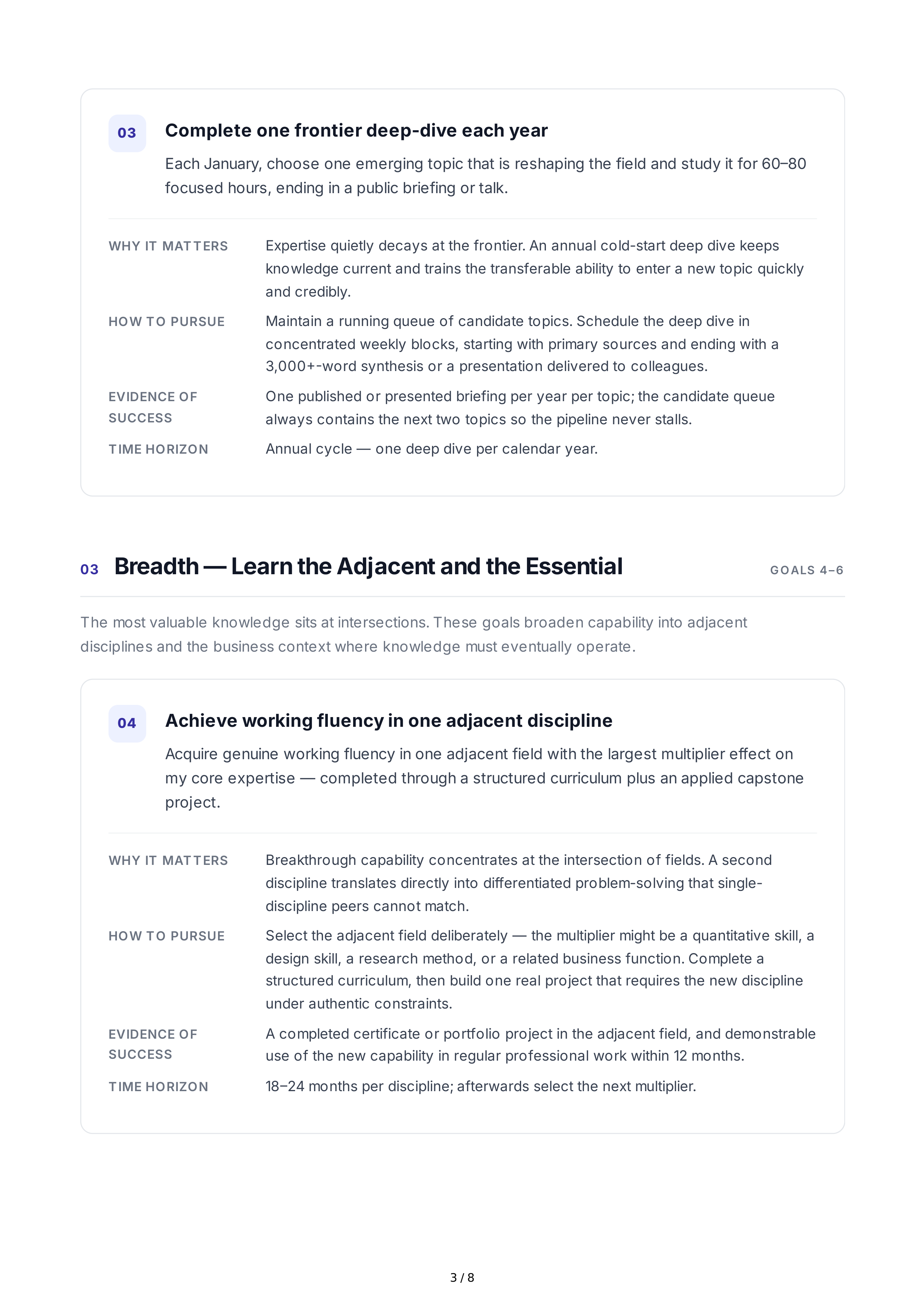
03
Complete
one
frontier
deep
-
dive
each
year
Each
January
,
choose
one
emerging
topic
that
is
reshaping
the
field
and
study
it
for
60–80
focused
hours
,
ending
in
a
public
briefing
or
talk
.
WHY
IT
MATTERS
Expertise
quietly
decays
at
the
frontier
.
An
annual
cold
-
start
deep
dive
keeps
knowledge
current
and
trains
the
transferable
ability
to
enter
a
new
topic
quickly
and
credibly
.
HOW
TO
PURSUE
Maintain
a
running
queue
of
candidate
topics
.
Schedule
the
deep
dive
in
concentrated
weekly
blocks
,
starting
with
primary
sources
and
ending
with
a
3,000+-
word
synthesis
or
a
presentation
delivered
to
colleagues
.
EVIDENCE
OF
SUCCESS
One
published
or
presented
briefing
per
year
per
topic
;
the
candidate
queue
always
contains
the
next
two
topics
so
the
pipeline
never
stalls
.
TIME
HORIZON
Annual
cycle
—
one
deep
dive
per
calendar
year
.
03
Breadth
—
Learn
the
Adjacent
and
the
Essential
GOALS
4–6
The
most
valuable
knowledge
sits
at
intersections
.
These
goals
broaden
capability
into
adjacent
disciplines
and
the
business
context
where
knowledge
must
eventually
operate
.
04
Achieve
working
fluency
in
one
adjacent
discipline
Acquire
genuine
working
fluency
in
one
adjacent
field
with
the
largest
multiplier
effect
on
my
core
expertise
—
completed
through
a
structured
curriculum
plus
an
applied
capstone
project
.
WHY
IT
MATTERS
Breakthrough
capability
concentrates
at
the
intersection
of
fields
.
A
second
discipline
translates
directly
into
differentiated
problem
-
solving
that
single
-
discipline
peers
cannot
match
.
HOW
TO
PURSUE
Select
the
adjacent
field
deliberately
—
the
multiplier
might
be
a
quantitative
skill
,
a
design
skill
,
a
research
method
,
or
a
related
business
function
.
Complete
a
structured
curriculum
,
then
build
one
real
project
that
requires
the
new
discipline
under
authentic
constraints
.
EVIDENCE
OF
SUCCESS
A
completed
certificate
or
portfolio
project
in
the
adjacent
field
,
and
demonstrable
use
of
the
new
capability
in
regular
professional
work
within
12
months
.
TIME
HORIZON
18–24
months
per
discipline
;
afterwards
select
the
next
multiplier
.
3 / 8
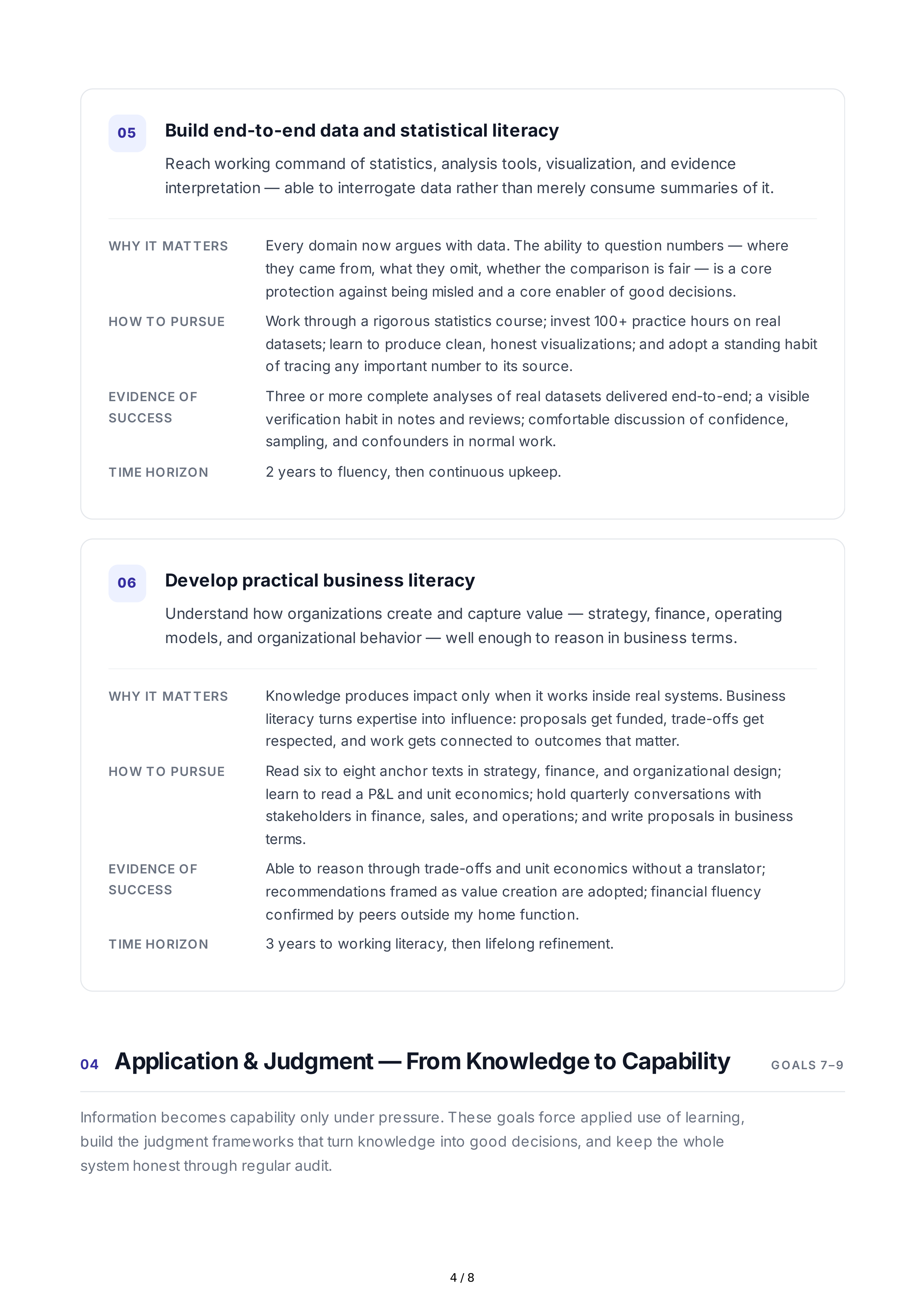
05
Build
end
-
to
-
end
data
and
statistical
literacy
Reach
working
command
of
statistics
,
analysis
tools
,
visualization
,
and
evidence
interpretation
—
able
to
interrogate
data
rather
than
merely
consume
summaries
of
it
.
WHY
IT
MATTERS
Every
domain
now
argues
with
data
.
The
ability
to
question
numbers
—
where
they
came
from
,
what
they
omit
,
whether
the
comparison
is
fair
—
is
a
core
protection
against
being
misled
and
a
core
enabler
of
good
decisions
.
HOW
TO
PURSUE
Work
through
a
rigorous
statistics
course
;
invest
100+
practice
hours
on
real
datasets
;
learn
to
produce
clean
,
honest
visualizations
;
and
adopt
a
standing
habit
of
tracing
any
important
number
to
its
source
.
EVIDENCE
OF
SUCCESS
Three
or
more
complete
analyses
of
real
datasets
delivered
end
-
to
-
end
;
a
visible
verification
habit
in
notes
and
reviews
;
comfortable
discussion
of
confidence
,
sampling
,
and
confounders
in
normal
work
.
TIME
HORIZON
2
years
to
fluency
,
then
continuous
upkeep
.
06
Develop
practical
business
literacy
Understand
how
organizations
create
and
capture
value
—
strategy
,
finance
,
operating
models
,
and
organizational
behavior
—
well
enough
to
reason
in
business
terms
.
WHY
IT
MATTERS
Knowledge
produces
impact
only
when
it
works
inside
real
systems
.
Business
literacy
turns
expertise
into
influence
:
proposals
get
funded
,
trade
-
offs
get
respected
,
and
work
gets
connected
to
outcomes
that
matter
.
HOW
TO
PURSUE
Read
six
to
eight
anchor
texts
in
strategy
,
finance
,
and
organizational
design
;
learn
to
read
a
P
&
L
and
unit
economics
;
hold
quarterly
conversations
with
stakeholders
in
finance
,
sales
,
and
operations
;
and
write
proposals
in
business
terms
.
EVIDENCE
OF
SUCCESS
Able
to
reason
through
trade
-
offs
and
unit
economics
without
a
translator
;
recommendations
framed
as
value
creation
are
adopted
;
financial
fluency
confirmed
by
peers
outside
my
home
function
.
TIME
HORIZON
3
years
to
working
literacy
,
then
lifelong
refinement
.
04
Application
&
Judgment
—
From
Knowledge
to
Capability
GOALS
7–9
Information
becomes
capability
only
under
pressure
.
These
goals
force
applied
use
of
learning
,
build
the
judgment
frameworks
that
turn
knowledge
into
good
decisions
,
and
keep
the
whole
system
honest
through
regular
audit
.
4 / 8
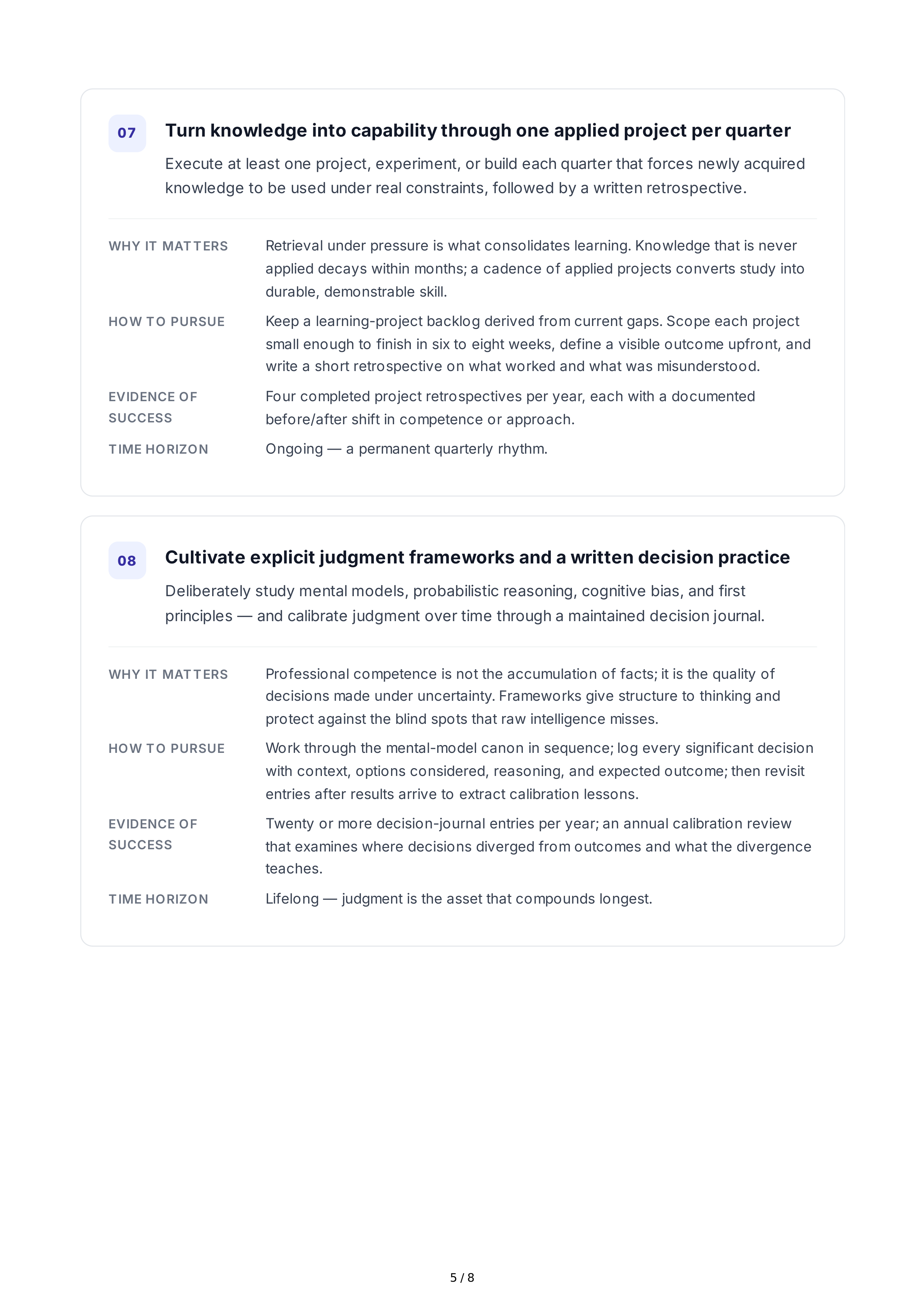
07
Turn
knowledge
into
capability
through
one
applied
project
per
quarter
Execute
at
least
one
project
,
experiment
,
or
build
each
quarter
that
forces
newly
acquired
knowledge
to
be
used
under
real
constraints
,
followed
by
a
written
retrospective
.
WHY
IT
MATTERS
Retrieval
under
pressure
is
what
consolidates
learning
.
Knowledge
that
is
never
applied
decays
within
months
;
a
cadence
of
applied
projects
converts
study
into
durable
,
demonstrable
skill
.
HOW
TO
PURSUE
Keep
a
learning
-
project
backlog
derived
from
current
gaps
.
Scope
each
project
small
enough
to
finish
in
six
to
eight
weeks
,
define
a
visible
outcome
upfront
,
and
write
a
short
retrospective
on
what
worked
and
what
was
misunderstood
.
EVIDENCE
OF
SUCCESS
Four
completed
project
retrospectives
per
year
,
each
with
a
documented
before
/
after
shift
in
competence
or
approach
.
TIME
HORIZON
Ongoing
—
a
permanent
quarterly
rhythm
.
08
Cultivate
explicit
judgment
frameworks
and
a
written
decision
practice
Deliberately
study
mental
models
,
probabilistic
reasoning
,
cognitive
bias
,
and
first
principles
—
and
calibrate
judgment
over
time
through
a
maintained
decision
journal
.
WHY
IT
MATTERS
Professional
competence
is
not
the
accumulation
of
facts
;
it
is
the
quality
of
decisions
made
under
uncertainty
.
Frameworks
give
structure
to
thinking
and
protect
against
the
blind
spots
that
raw
intelligence
misses
.
HOW
TO
PURSUE
Work
through
the
mental
-
model
canon
in
sequence
;
log
every
significant
decision
with
context
,
options
considered
,
reasoning
,
and
expected
outcome
;
then
revisit
entries
after
results
arrive
to
extract
calibration
lessons
.
EVIDENCE
OF
SUCCESS
Twenty
or
more
decision
-
journal
entries
per
year
;
an
annual
calibration
review
that
examines
where
decisions
diverged
from
outcomes
and
what
the
divergence
teaches
.
TIME
HORIZON
Lifelong
—
judgment
is
the
asset
that
compounds
longest
.
5 / 8
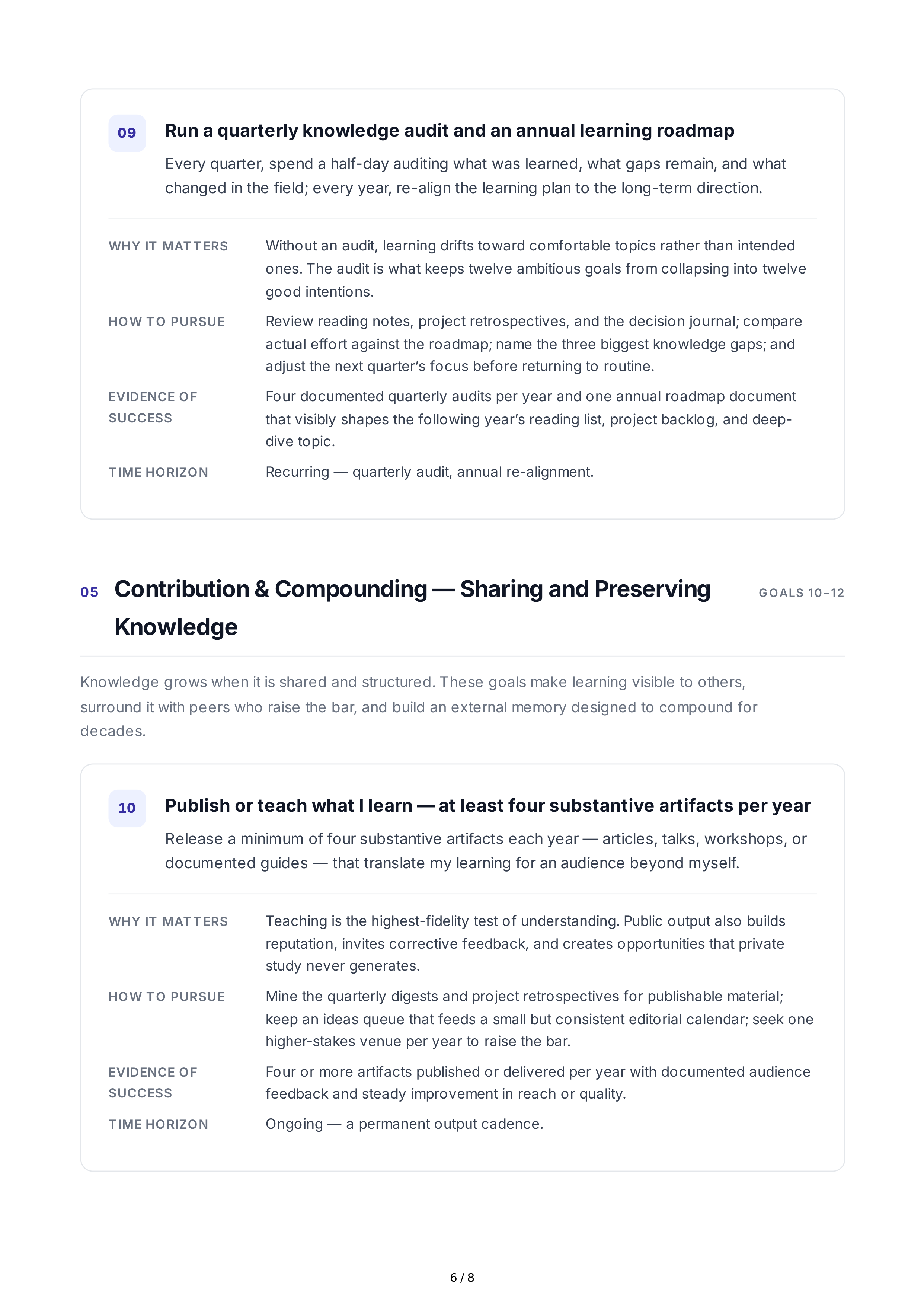
09
Run
a
quarterly
knowledge
audit
and
an
annual
learning
roadmap
Every
quarter
,
spend
a
half
-
day
auditing
what
was
learned
,
what
gaps
remain
,
and
what
changed
in
the
field
;
every
year
,
re
-
align
the
learning
plan
to
the
long
-
term
direction
.
WHY
IT
MATTERS
Without
an
audit
,
learning
drifts
toward
comfortable
topics
rather
than
intended
ones
.
The
audit
is
what
keeps
twelve
ambitious
goals
from
collapsing
into
twelve
good
intentions
.
HOW
TO
PURSUE
Review
reading
notes
,
project
retrospectives
,
and
the
decision
journal
;
compare
actual
effort
against
the
roadmap
;
name
the
three
biggest
knowledge
gaps
;
and
adjust
the
next
quarter
’
s
focus
before
returning
to
routine
.
EVIDENCE
OF
SUCCESS
Four
documented
quarterly
audits
per
year
and
one
annual
roadmap
document
that
visibly
shapes
the
following
year
’
s
reading
list
,
project
backlog
,
and
deep
-
dive
topic
.
TIME
HORIZON
Recurring
—
quarterly
audit
,
annual
re
-
alignment
.
05
Contribution
&
Compounding
—
Sharing
and
Preserving
Knowledge
GOALS
10–12
Knowledge
grows
when
it
is
shared
and
structured
.
These
goals
make
learning
visible
to
others
,
surround
it
with
peers
who
raise
the
bar
,
and
build
an
external
memory
designed
to
compound
for
decades
.
10
Publish
or
teach
what
I
learn
—
at
least
four
substantive
artifacts
per
year
Release
a
minimum
of
four
substantive
artifacts
each
year
—
articles
,
talks
,
workshops
,
or
documented
guides
—
that
translate
my
learning
for
an
audience
beyond
myself
.
WHY
IT
MATTERS
Teaching
is
the
highest
-
fidelity
test
of
understanding
.
Public
output
also
builds
reputation
,
invites
corrective
feedback
,
and
creates
opportunities
that
private
study
never
generates
.
HOW
TO
PURSUE
Mine
the
quarterly
digests
and
project
retrospectives
for
publishable
material
;
keep
an
ideas
queue
that
feeds
a
small
but
consistent
editorial
calendar
;
seek
one
higher
-
stakes
venue
per
year
to
raise
the
bar
.
EVIDENCE
OF
SUCCESS
Four
or
more
artifacts
published
or
delivered
per
year
with
documented
audience
feedback
and
steady
improvement
in
reach
or
quality
.
TIME
HORIZON
Ongoing
—
a
permanent
output
cadence
.
6 / 8
11
Maintain
an
active
learning
community
Participate
in
one
serious
learning
community
—
study
group
,
mastermind
,
or
community
of
practice
—
where
I
both
mentor
and
am
mentored
at
a
sustained
cadence
.
WHY
IT
MATTERS
Knowledge
is
social
.
Peers
provide
accountability
,
challenge
comfortable
assumptions
,
and
expose
gaps
that
solitary
study
cannot
detect
.
Explaining
to
others
and
being
questioned
are
both
high
-
retrieval
activities
.
HOW
TO
PURSUE
Choose
one
community
aligned
with
the
learning
direction
rather
than
several
diluted
ones
;
arrive
with
prepared
contributions
;
take
on
documented
roles
in
both
directions
—
teaching
juniors
and
being
challenged
by
seniors
.
EVIDENCE
OF
SUCCESS
Sustained
participation
at
twenty
or
more
sessions
per
year
,
with
visible
contributions
in
both
mentoring
directions
.
TIME
HORIZON
Ongoing
—
the
specific
community
may
change
,
the
practice
does
not
.
12
Build
a
personal
knowledge
system
that
compounds
over
a
decade
Maintain
an
evolving
personal
knowledge
management
system
—
linked
notes
,
progressive
summarization
,
and
periodic
review
—
architected
to
stay
useful
for
ten
years
or
more
.
WHY
IT
MATTERS
The
value
of
a
knowledge
base
is
in
the
connections
between
ideas
,
not
the
volume
of
files
.
A
compounding
system
turns
years
of
reading
into
a
reusable
asset
and
makes
future
learning
dramatically
faster
.
HOW
TO
PURSUE
Standardize
capture
,
use
linked
atomic
notes
,
progressively
summarize
sources
over
time
,
and
schedule
periodic
reviews
so
old
material
resurfaces
at
useful
moments
.
Treat
the
system
itself
as
something
to
revise
and
improve
.
EVIDENCE
OF
SUCCESS
Four
hundred
or
more
linked
permanent
notes
;
retrieval
of
any
relevant
insight
within
minutes
;
an
annual
synthesis
that
demonstrates
insight
accumulating
across
years
rather
than
being
re
-
learned
from
scratch
.
TIME
HORIZON
Lifelong
—
designed
for
a
decade
-
plus
of
continuous
compounding
.
7 / 8
O PERAT ING
PRINCIPL ES
01
Depth
first
,
breadth
second
.
Expand
sideways
only
where
the
new
knowledge
multiplies
the
core
;
every
hour
of
breadth
must
make
the
core
stronger
,
not
just
wider
.
02
Measure
output
,
not
input
.
Progress
is
counted
in
projects
completed
,
artifacts
published
,
notes
synthesized
,
and
decisions
improved
—
not
in
hours
spent
or
books
finished
.
03
Review
or
drift
.
Quarterly
audits
and
an
annual
roadmap
exist
to
keep
effort
pointed
at
the
twelve
goals
above
.
A
plan
that
is
never
reviewed
is
a
wish
.
04
Compound
,
don
’
t
collect
.
Prioritize
retention
,
connection
,
and
reuse
of
knowledge
over
raw
accumulation
.
The
goal
is
a
body
of
work
and
judgment
,
not
a
library
.
Long
-
Term
Knowledge
Development
Goals
·
Version
1.0
Review
cadence
:
quarterly
audit
·
annual
re
-
alignment
8 / 8