
A
B
I
O
G
R
A
P
H
Y
GOLDMAN
SACHS
Streetwise
GET T I N G
T O
A N D
T H RO U GH
GO L D M A N
S A C H S
The education of an American institution — from a
rented room on Pine Street to the corridors of global
power.
J
O
N
A T
H
A
N
P
.
M
E
R
I
W
E
T
H
E
R
In the narrative tradition of the great American biographies
G
O
L
D
M
A
N
S
A
C
H
S
&
C
O
·
E
S
T
A
B
L
I
S
H
E
D
1
8
6
9
·
N
E
W
Y
O
R
K
·
GS
S
T
R
E
E
T
W
I
S
E
B I O G R A
P H Y
O F
T H E
H O U S
E
O F
G O L D
MA
1 / 35
A
B
I
O
G
R
A
P
H
Y
GOLDMAN
SACHS
Streetwise
Getting to and Through Goldman Sachs
T H E N A
R R A T I V
E O
F A G
R E A T A
M E R I C
A
N I N S T I T U T I O
N
Jonathan
P
.
Meriwether
First Edition, 2025.
Copyright © 2025 by Jonathan P. Meriwether. All rights reserved.
This is an independent, unofficial biography. It is not authorized by, affiliated with, or endorsed by Goldman Sachs & Co.,
its partners, employees, or successors. No portion of this volume may be reproduced without written permission of
the author, except brief quotations in reviews.
Set in Cormorant Garamond, Source Serif 4, and Inter. Designed for screen and print.
2 / 35
About
This
Book
This biography is a work of independent historical writing. The firm is real; the people are real; the
dates and figures rest on public records, congressional testimony, financial disclosures, journalism,
and the firm's own published history. The prose, structure, interpretations, and literary framing are
entirely original.
A
N O T E
O N
T H E
A P P R OAC H
.
The project was conceived in the spirit of the great modern
American biographies — most immediately David W. Blight's Pulitzer Prize–winning
Frederick Douglass: Prophet of Freedom
— and it seeks to apply that book's narrative seriousness,
moral honesty, and biographical depth to the life of an institution. Institutions, like men, are
made by what they survive; they have characters, consciences, conversions, and reputations
that outlive them. This book treats the firm of Goldman Sachs as a biographical subject in
that tradition. No text from any copyrighted work has been reproduced in these pages.
"Streetwise," as used throughout, means knowledge earned on the pavement rather than in the classroom: the taste of risk,
the measure of a signature, the grammar of trust — the education of the house of Goldman.
3 / 35
Contents
—
P R O L O G
U E
—
T
H E
P A R A B L E
O F
T
H E
S T A I R C A S E
I
P A R T
O N E
—
T
H E
P A P E R
D E A L E R
( 1 8 6 9 – 1 9 1 7
)
1
The Peddler's Ledger
2
A Name on the Door
3
The Grand Underwritings
II
P A R T
T
W O
—
T
H E
T
R I A L
( 1 9 1 8 – 1 9 3 4 )
4
The Crash of the Trust
5
The Resurrectionist
III
P A R T
T
H R E E
—
T
H E
H O U S E
O F
D E A L S
( 1 9 3 5 – 1 9 6 9 )
6
Mr. Wall Street
7
The Trader's Art
IV
P A R T
F O U R
—
T
H E
C U L T
U R E
( 1 9 7
0 – 1 9 9 9 )
8
The Two Johns and the Principles
9
The Machine
10
Government Sachs
V
P A R T
F I V E
—
T
H E
P U B L I C
F I R M
( 1 9 9 9 – 2 0 2 4 )
11
The Public Offering
12
The Conversion
13
The Reckoning
14
Streetwise in the Twenty-First Century
—
E P I L O G
U E
—
T
H E
L O N G
G
A M E
4 / 35

A
C H R O N O L O G
I C A L
T
I M E L I N E
B
M A J
O R
AC H I E V E M E N T
S
C
AWA R D S
&
R E C O G
N I T
I O N
D
S O U R C E S
&
F U R T
H E R
R E A D I N G
—
A B O U T
T
H E
A U T
H O R
5 / 35
P
R
O
L
O
G
U
E
The
Parable
of
the
Staircase
Between two rooms, a staircase runs. At the bottom, in the autumn of 1869, a Bavarian immigrant in
his late forties sat at a borrowed desk in a single rented room on Pine Street, in the lower reaches of
Manhattan, buying pieces of paper — promissory notes signed by jewellers who needed cash before
their goods sold. At the top, in the autumn of 2009, a dark glass tower at 200 West Street looked out
over the Hudson from a hundred feet in the air, sheltering one of the most powerful financial institu-
tions the world has ever known. The distance between the two rooms is not measured in blocks. It is
measured in trust.
A biography of an institution is still a biography. Every great firm is a person in the eyes of the law,
and something more than a person in the eyes of history: it has a childhood, a conversion, a moral
trial, a reputation to lose, and a legacy to leave. Goldman Sachs has had all of these, sometimes in the
space of a single decade. It was born on the street, and it has never quite left the street behind.
"Streetwise" is not an insult here. It is the firm's oldest inheritance — the knowledge, carried in the
blood of its earliest partners, that a promise is only as good as the person who signs it, that risk is paid
for in attention, and that the world is read most truthfully at close range, where the ink is still wet.
The story that follows is the story of that education. It runs through the partnership with Lehman
Brothers that underwrote the age of the department store; through the leveraged trust of 1928 that
nearly killed the firm and the quiet resurrection led by a boy from Brooklyn who had started as an of-
fice helper; through the invention of the block trade and the rise of the trading floor; through the
fourteen principles that became the firm's constitution; through the long procession of partners
who left Wall Street for Washington; through an initial public offering that ended a hundred and
thirty years of partnership; through a financial crisis that turned the firm into a bank holding com-
pany and the public's patience into ash; through a reckoning with regulators, juries, and commenta-
tors; and through a patient, unglamorous climb back toward respectability.
This is not a hagiography. The firm's history is crowded with brilliance and with blindness, with
statesmanship and with self-dealing. A biography that flatters is a brochure; a biography that con-
demns is a polemic. What follows tries to be neither. It tries, instead, to tell the truth as a good histo-
rian would tell it — with sympathy for the difficulty of the thing attempted, and with honesty about
the cost of the thing achieved. The staircase goes up, but it has never stopped being a staircase: each
step is a negotiation, and the man at the bottom, endorsing a stranger's note with his own name,
would recognize the arithmetic at the top. The names have changed. The signature has not.
6 / 35

P
A
R
T
O
N
E
The
Paper
Dealer
1869
–
1917
7 / 35
C
H
A
P
T
E
R
O
N
E
The
Peddler
'
s
Ledger
1821
–
1882
"
A
signature
is
a
promise
written
in
your
own
hand
."
Marcus Goldman was born in 1821 in Trappstadt, a small Bavarian village whose Jewish community
had lived for generations on the thin margin between commerce and survival. He arrived in America
in 1848 — the year of revolutions in Europe, when the old certainties were cracking across the conti-
nent — and followed the familiar path of so many German-Jewish immigrants: Philadelphia first,
then New York, dry goods in between. He was, by all accounts, a man of modest schooling and im-
modest arithmetic. Numbers were his first language; ledgers, his scripture.
In 1869 he opened a business on Pine Street, in the oldest part of the financial district, that defied easy
description. His trade was in promissory notes. A jeweller on Maiden Lane, needing cash to buy stock
before the holiday season, would write out a note promising to repay a lender within a fixed number
of days. Marcus would buy that note at a discount — paying ninety-eight cents on the dollar, say —
and then resell it to a commercial bank at a slightly smaller discount, pocketing the difference. The
margin was thin. The business was trust.
Every note he handled he endorsed. That was the crucial act, and the whole firm grew from it. A note
was only as good as the man who signed it, and the man who endorsed it made himself responsible
for the obligation. Marcus staked his own name on the promises of strangers — jewellers he knew,
whose shops he visited, whose goods he inspected, whose reputations he tracked the way a farmer
tracks weather. He was, in effect, a one-man credit bureau, an early warning system for the honesty
of the American small business. The banks came to rely on his judgment. If Goldman had bought the
note, the note was good.
The family grew into the firm. Marcus's daughter Louisa married a bright young merchant from
Baltimore named Samuel Sachs, and in 1882 Samuel joined his father-in-law — the beginning of a
partnership that would give the firm its double name. The one-room office on Pine Street was already
too small for the ambition inside it. Marcus had discovered the essential law of the institution he was
founding: that capital is not money, but the willingness of other people to trust you with theirs.
Everything that followed — the underwritings, the trading floors, the tower on the Hudson — was an
elaboration of that single insight, written first in a peddler's hand.
8 / 35
C
H
A
P
T
E
R
T
W
O
A
Name
on
the
Door
1882
–
1896
"
What
began
as
one
man
'
s
name
became
a
covenant
."
Samuel Sachs brought something Marcus Goldman did not have: an instinct for organization.
Where Marcus was a soloist, improvising on the theme of trust, Samuel understood that a business
could be institutionalized — that the judgment of one man could be systematized into the proce-
dures of many. The firm was renamed M. Goldman & Sachs in 1882, and then, in 1885, Goldman,
Sachs & Co. — the order of the names a small negotiation in itself, settled with the diplomacy of a
family that intended to stay in business together.
The commercial paper trade expanded rapidly in the 1880s and 1890s. America was building its retail
economy — department stores, mail-order houses, wholesalers stocking shelves for a continent —
and all of it ran on credit. Goldman, Sachs & Co. became what one later historian called a clearing-
house not just for money but for information: the firm knew which merchants paid, which over-
reached, which were worth a signature. It opened branch offices beyond New York, carried its stan-
dards to other cities, and in 1896 purchased a seat on the New York Stock Exchange, formally enter-
ing the machinery of American capital markets.
Marcus Goldman retired in 1894 and died a decade later, in 1904. He left behind something rarer than
a fortune: a name that had become an institution. In his lifetime he had watched his surname pass
from a personal mark of endorsement to a corporate identity with its own rules, its own letterhead,
and its own obligations. The transition was the quiet drama of the firm's first generation. Institutions
are, among other things, a way of making genius durable — of ensuring that the skill of the founder
survives the founder.
The 1890s closed with the firm prosperous but still small, overshadowed by the great houses of the
age — the Morgans, the Kuhns, the Loebs. The partners knew their place in the hierarchy of Wall
Street, and they knew, too, that the hierarchy was not immutable. Somewhere in the firm's ledgers, in
the careful notations of discount rates and maturities, was the outline of a larger ambition. It would
take a new generation to act on it: Marcus's son Henry, brilliant and impatient, and across the street,
an equally ambitious firm called Lehman Brothers, with a partner named Philip Lehman who had
begun to wonder what would happen if the underwriting of American enterprise passed into new
hands.
9 / 35
C
H
A
P
T
E
R
T
H
R
E
E
The
Grand
Underwritings
1896
–
1917
"
The
public
offering
made
the
private
company
public
—
and
the
private
banker
famous
."
Henry Goldman was the son Marcus's success had made possible: educated, cosmopolitan, restless,
and convinced that the firm's future lay not in the resale of other men's notes but in the creation of a
new kind of security — the common stock of American enterprise. He found a kindred spirit in Philip
Lehman. Together, across two firms, they built one of the first great underwriting syndicates on Wall
Street, dedicated to the proposition that the growing corporations of the new century could raise
capital directly from the American public.
The breakthrough came in 1906 with Sears, Roebuck and Company. The mail-order giant needed
capital to finance its astonishing growth, and the private bankers of the old school had declined the
business — the sums were too large, the risks too unfamiliar. Goldman and Lehman saw it differ-
ently. They took Sears public, syndicating the offering across a network of banks, and the issue sold
out. It was followed in 1912 by the even larger offering for F. W. Woolworth, whose chain of five-and-
dime stores had made the phrase "retail empire" literal. Henry Goldman had discovered the firm's
destiny: Goldman Sachs would underwrite Main Street.
The years before the First World War were, in retrospect, the firm's golden adolescence. It floated a
generation of retail and industrial companies; it made the public offering a central instrument of
American capitalism; it demonstrated that capital could be democratized without losing discipline.
But the war broke the partnership in ways that had nothing to do with finance. Henry Goldman,
deeply attached to the Germany of his parents, resisted the anti-German fervor that swept the United
States. The strain inside the firm became intolerable. In 1917 he resigned, and the Goldman-Lehman
underwriting alliance gradually dissolved in the 1920s, leaving a residue of rivalry that would shape
Wall Street for decades.
The lesson of the era was double-edged. Public offerings had made the firm rich and famous; politics
had nearly torn it apart. The partners who inherited the firm after Henry's departure — the Sachs
brothers and their cousins — resolved, with the fervor of men who have seen a house fire, to keep the
firm out of politics and out of fashion. They wanted stability, continuity, a reputation beyond re-
proach. They got, instead, the 1920s: an age of speculative fever that would test the firm more terribly
than war ever had.
10 / 35

P
A
R
T
T
W
O
The
Trial
1918
–
1934
11 / 35
C
H
A
P
T
E
R
F
O
U
R
The
Crash
of
the
Trust
1918
–
1932
"
In
the
crash
,
the
firm
learned
what
it
was
made
of
."
After the war, Goldman Sachs was the largest and most admired commercial paper house in
America, disciplined, conservative, and quietly rich. It was also, by the standards of the new age, old-
fashioned. The 1920s were a decade of financial invention — investment trusts, holding companies,
pyramids of paper — and the firm's leadership, looking for growth, made a fateful decision: it would
invent something of its own.
The instrument was the Goldman Sachs Trading Corporation, launched in December 1928 under the
direction of a visionary partner named Waddill Catchings. Its idea was to pool the capital of thou-
sands of investors and deploy it across the markets with professional skill. Within months it had as-
sembled hundreds of millions of dollars in assets, feeding a cascading structure of subsidiary trusts
— Shenandoah, Blue Ridge — each borrowing against the next. At the crest of the most extraordinary
bull market in American history, the house of Goldman was levered to the sky.
Then came October 1929. The crash destroyed the structure in a matter of weeks. Shares of the
Trading Corporation that had traded above three hundred dollars fell to less than two; investors were
ruined; congressional hearings demanded explanations; the firm's name, once synonymous with
prudence, became a byword for speculative folly. Waddill Catchings departed. The partners' capital
was gone. Many assumed the firm would quietly dissolve, as so many fallen houses had.
It did not dissolve, and the reason had a name: Sidney Weinberg. A Brooklyn-born son of immigrant
parents, he had joined the firm in 1907 as a fifteen-year-old helper, running errands and learning the
business from the floor up. Made a partner in 1927, he now took command of the wreckage. He cut
salaries, shrank the partnership, made personal calls on angry clients, and imposed a discipline the
firm had never known. He understood that a name, once lost, is not recovered by apology alone. It is
recovered by years of conduct. The firm that emerged from the trial was poorer, smaller, humbler —
and perhaps, for the first time, adult.
12 / 35
C
H
A
P
T
E
R
F
I
V
E
The
Resurrectionist
1930
–
1945
"
He
restored
the
name
by
refusing
to
risk
it
."
Sidney Weinberg had no pedigree and no patience for those who traded on theirs. What he had was
an encyclopedic knowledge of American business, a gift for personal loyalty, and a theory of the firm
that would define Goldman Sachs for the next forty years: that the investment banker's highest prod-
uct is advice — confidential, disinterested, and good enough to be trusted with the fate of a company.
In the 1930s, while larger firms retrenched, Weinberg built a corporate advisory practice from essen-
tially nothing. He sat on corporate boards, advised chief executives, and cultivated relationships that
had nothing to do with underwriting fees in the narrow sense. His method was personal in the ex-
treme. He believed in looking a man in the eye, telling him the truth, and never betraying a confi-
dence — the same grammar of trust Marcus Goldman had practiced a generation earlier on Maiden
Lane, now scaled to the boardrooms of the largest companies in America.
The Second World War completed the firm's rehabilitation. Weinberg went to Washington as a dol-
lar-a-year man, helping organize war production alongside the most powerful men in the country.
He returned with something more valuable than contracts: a reputation as a patriotic, discreet, indis-
pensable figure, equally at ease with generals and with secretaries of the Treasury. His wartime
friendships became the seedbed of the firm's later intimacy with the American state — the beginning
of what a later generation would call, with irony and envy, Government Sachs.
By 1945 the resurrection was complete. The firm was modest by the standards of its old rivals, but its
name was clean. Weinberg had performed the essential act of institutional biography — he had taken
a disgraced house and re-founded it on the rock of personal trust. The lesson he imparted to the part-
ners who followed him was simple enough to be misleading: that the firm's capital was not its money
but its character, and that character was maintained one conversation, one promise, one deal at a
time.
13 / 35
P
A
R
T
T
H
R
E
E
The
House
of
Deals
1935
–
1969
14 / 35
C
H
A
P
T
E
R
S
I
X
Mr
.
Wall
Street
1946
–
1969
"
The
trust
that
flows
from
the
man
to
the
firm
—
and
from
the
firm
back
to
the
man
."
The postwar decades belonged to Sidney Weinberg, now universally known as Mr. Wall Street. He had
become, by force of personality, the public face of the financial establishment — an adviser to presi-
dents of both parties, a fixture of corporate boardrooms, and the living proof that Goldman Sachs had
climbed all the way back from the abyss. The firm's postwar prosperity was built on the oldest of all
its franchises: the commercial paper business, rebuilt and modernized, together with a growing cor-
porate advisory practice.
The summit of Weinberg's career was the Ford Motor Company offering of 1956. As a trustee of the
Ford Foundation, Weinberg helped persuade the Ford family to sell stock to the public for the first
time — a transaction of roughly six hundred and forty-three million dollars, then the largest public
offering in American history. The deal was a masterpiece of financial statecraft: it diversified the
foundation, rewarded the family, enriched the new shareholders, and placed Goldman Sachs, with
one stroke, at the center of the most important deal of the century. Wall Street understood the mes-
sage. The house of Goldman had arrived.
Weinberg's influence extended far beyond transactions. He advised Franklin Roosevelt and Harry
Truman; he was close to Dwight Eisenhower; successive administrations sought his counsel on ap-
pointments, on policy, on the temperament of the markets. He used his position, by and large, with
restraint — an old-fashioned conception of the banker as a statesman of capital, sworn to the health
of the system rather than the quickness of the trade. It was an ethic easier to maintain in a firm of
hundreds than in a firm of tens of thousands, but Weinberg believed in it absolutely.
He died in 1969, sixty-two years after walking into the firm as an errand boy. He left behind a succes-
sion plan as careful as anything he had engineered for clients: his son John, being groomed gradu-
ally; and a cadre of younger partners who had learned the Weinberg grammar of loyalty and discre-
tion. He also left behind, in the person of Gustave Lehmann Levy, a force he had encouraged but
never fully controlled — the trader who would give the firm its second soul, and set the stage for the
culture wars of the decades to come.
15 / 35
C
H
A
P
T
E
R
S
E
V
E
N
The
Trader
'
s
Art
1940
–
1976
"
The
banker
advises
;
the
trader
commits
."
Gus Levy joined Goldman Sachs in 1940, and within a generation he had done something no one in
the firm's history had managed: he had given the house of bankers a trading floor that could stand
beside the best in the world. Levy was a trader of the old school — fast, loud, intuitive, with a photo-
graphic memory for prices and a superstitious reverence for his own instincts. He believed that capi-
tal should be put to work, that risk was a trade to be managed rather than a sin to be avoided, and that
the firm's future lay in the vast new pools of institutional money — mutual funds, pension funds, in-
surance companies — that were transforming American finance.
His great invention was the block trade. When a mutual fund wanted to sell two hundred thousand
shares of a stock, a transaction too large for the ordinary course of the market to absorb without
moving the price, Goldman would take the other side: buy the block outright, commit the firm's cap-
ital, and then distribute the shares to buyers around the world. It was a revolutionary act of commit-
ment — the investment bank as principal, not merely as agent. Levy also pioneered risk arbitrage,
profiting from the price discrepancies that surrounded corporate mergers. He taught the firm that
information and judgment could be monetized in real time, on the floor, in the roar.
The two souls of Goldman Sachs — banker and trader — coexisted for decades in an uneasy, produc-
tive marriage. The bankers brought the firm its clients, its polish, its access to the boardrooms of
America; the traders brought it profits, volatility, and a taste for the game. Levy became senior part-
ner on Weinberg's death in 1969, completing the transfer of power from the era of the adviser to the
era of the trader. The 1970s were his years: hard markets, stagflation, the birth of modern derivatives,
and the steady ascent of the trading floor within the firm's hierarchy.
When Levy died suddenly in 1976, the firm mourned him as it had mourned only the founders. His
legacy was institutional as much as personal: the acceptance of risk as a legitimate, honorable enter-
prise — the belief that a great firm must be willing to put its own capital behind its own judgment.
The partnership that followed him would spend the next fifty years negotiating the terms of that in-
heritance: how much risk, how much capital, how much of the firm's soul belonged to the floor, and
how much to the clients.
16 / 35

P
A
R
T
F
O
U
R
The
Culture
1970
–
1999
17 / 35
C
H
A
P
T
E
R
E
I
G
H
T
The
Two
Johns
and
the
Principles
1976
–
1984
"
Principles
are
only
as
good
as
the
hard
days
they
survive
."
John Whitehead and John Weinberg were an unlikely pair. Whitehead, a decorated naval officer from
the war and a Harvard-trained economist, was the philosopher — precise, systematic, preoccupied
with the question of what made the firm excellent. Weinberg, Sidney's son and a Navy veteran in his
own right, was the relationship man — warm, blunt, the living embodiment of the firm's loyalty to its
clients. Together, as co-senior partners from 1976, they presided over the golden age of Goldman's
institutional culture.
Theirs was a culture of teamwork raised to the level of doctrine. The firm was famous for its disdain
of the star system: no one was bigger than the partnership; credit was shared; internal competition
was suppressed in favor of the collective. Whitehead and Weinberg institutionalized this ethos with
promotion policies, compensation structures, and a carefully cultivated atmosphere of secrecy and
mutual obligation. The result was a firm that hung together through the brutal markets of the 1970s
and emerged, by the early 1980s, as the most consistently excellent organization on Wall Street.
In 1979 Whitehead distilled this culture into a written constitution — the fourteen Business
Principles of Goldman Sachs. The first principle was the firm's entire theology: clients' interests al-
ways come first; the firm's interests, and its employees' interests, come after. Others followed: that as-
sets are people, capital, and reputation, of which reputation is irreplaceable; that profit is the ulti-
mate measure of success, but must be earned in accordance with the principles; that teamwork,
quality, and respect for the individual are non-negotiable. Whitehead reportedly summed up the
firm's philosophy in a phrase that entered Wall Street lore: Goldman Sachs should be greedy, but
greedy long-term.
Whitehead left in 1984 to serve as Deputy Secretary of State under George Shultz — the first of a long
line of Goldman partners to trade the partnership for the corridors of power. Weinberg continued
alone until 1990. The Principles outlasted both of them, printed in every annual report, recited in ev-
ery orientation, and tested, in the decades to come, by pressures their authors never imagined — the
pressure of billions in profits, the pressure of public markets, the pressure of a crisis that would
force the firm to choose between its principles and its survival.
18 / 35
C
H
A
P
T
E
R
N
I
N
E
The
Machine
1981
–
1994
"
A
firm
is
a
machine
for
turning
judgment
into
result
."
In 1981 Goldman Sachs made an acquisition that changed its character: J. Aron & Company, a New
Orleans commodity house with roots in the nineteenth century, dealing in gold, coffee, and foreign
exchange. The purchase brought the firm a cadre of brilliant traders and a seat at the table of the
world's largest and most liquid markets. Overnight, Goldman became a serious force in commodi-
ties and currencies — a business governed by wholly different rhythms than the patient hum of
mergers and underwriting.
The 1980s also saw the rise of the modern merger business. As hostile takeovers reshaped corporate
America, Goldman Sachs became the adviser of choice on both sides of the line — defending compa-
nies against raiders with the same skill it deployed on behalf of buyers. The firm's preeminence in
M&A was not an accident. It rested on the culture Whitehead and Weinberg had built: confidential,
long-term relationships, combined with the analytical firepower the new era of finance demanded.
By the end of the decade, the league tables told a story of total dominance.
At the firm's head stood Robert Rubin and Stephen Friedman — two traders who understood, better
than any bankers, that the real money in modern finance was made in the markets. Under their co-
chairmanship, Goldman's trading desks expanded into proprietary territory, risk-taking became re-
spectable at the highest levels, and the firm's profits reached levels that made the old partnership
wealthy beyond the dreams of earlier generations. Rubin's departure for the Treasury in 1995 was the
highest-profile example yet of the revolving door that had come to define Goldman's relationship
with Washington.
Then came 1994. A sudden spike in interest rates convulsed the bond markets, and Goldman, heavily
positioned, lost billions in a matter of months. The losses were not fatal to the firm's capital — but
they were nearly fatal to its morale, and they exposed a deeper truth: the partnership structure, with
all its virtues of cohesion and accountability, could no longer absorb the scale of risk the modern
machine required. The partners who lived through 1994 never forgot the fear. The question of going
public, once unthinkable, moved slowly from heresy to arithmetic.
19 / 35
C
H
A
P
T
E
R
T
E
N
Government
Sachs
1992
–
1999
"
The
staircase
between
Wall
Street
and
Washington
runs
both
ways
."
By the mid-1990s the phrase "Government Sachs" had entered the language — equal parts joke and
recognition. Robert Rubin left the co-chairmanship to become Secretary of the Treasury; Jon
Corzine, a bond trader who had risen through the ranks, steered the firm through the 1994 crisis;
Henry Paulson, the investment banker's investment banker, was being prepared for his own ascent.
The firm's alumni network extended into the Treasury, the Federal Reserve, and the councils of every
administration. It was the institutional payoff of Weinberg's wartime friendships — now a permanent
pipeline between the world's most profitable investment bank and the world's most powerful
government.
Corzine's leadership in the mid-1990s was a study in steady hands. He rebuilt morale after the losses
of 1994, restored the confidence of the partners, and guided the firm through the great emerging-
market crises of the decade. In 1998, when Long-Term Capital Management collapsed and threatened
to take the global financial system with it, Goldman was among the organizers of the rescue — act-
ing, in the best tradition of the house, as a statesman of the system it depended on.
The decade's greatest decision, though, was internal. The partnership, after 130 years, could no
longer satisfy the capital demands of a firm that wanted to be the best in everything: global markets,
corporate finance, asset management, principal investing. The partners debated for years, weighing
the culture against the arithmetic. In the end, the arithmetic won. On May 4, 1999, Goldman Sachs
sold a sliver of itself to the public — priced at fifty-three dollars a share and closing its first day above
seventy. The partnership, as an institution, was over.
What did the firm lose, and what did it keep? The skeptics predicted the end of the culture — the
teamwork, the long-term greed, the sense of mutual obligation that had made the firm what it was.
The optimists argued that the culture had become a system, encoded in the Principles, embedded in
thousands of employees, and that a public company could maintain a private firm's reflexes. The
truth, as usual, was more complicated. The public firm would be tested — by the boom of the 2000s,
by the crisis of 2008, and by a reckoning that no one in the spring of 1999 could have foreseen.
20 / 35

P
A
R
T
F
I
V
E
The
Public
Firm
1999
–
2024
21 / 35
C
H
A
P
T
E
R
E
L
E
V
E
N
The
Public
Offering
1999
–
2006
"
The
public
firm
was
born
with
a
private
firm
'
s
reflexes
."
The first years of the public company were a study in controlled power. The tech boom filled the
firm's calendars with the great initial public offerings of the new economy; the crash that followed, in
2000-2002, tested its discipline. Goldman emerged from the bubble with its reputation comparatively
intact — a tribute to the culture of risk management that Rubin, Friedman, and Corzine had drilled
into the trading floor. Henry Paulson, chief executive from 1999, presided over a decade of expansion:
into Asia, into emerging markets, into commodities, into every corner of global finance where the
firm's judgment could be monetized.
Paulson was the last of the old-style Goldman leaders — an investment banker who believed in
clients, relationships, and the long game. Under his stewardship the firm posted record profits year
after year, became the most admired name in finance, and quietly built the trading positions that
would define the next chapter of its history. The culture, by most accounts, survived the transition:
partnership values were recited, mentorship flourished, and the firm continued to treat its reputa-
tion as its most precious asset.
But the machine was also changing. The trading desks, which had always been the profit engine,
were becoming the whole story. The firm's mortgage desk, in particular, was growing into a position
of astonishing scale, buying and packaging subprime loans, trading the derivatives built on them,
and generating profits that made the traditional businesses look small. There were voices inside the
firm that warned of the risk. There always are. The music was too good to stop.
In 2006 Paulson left to become Secretary of the Treasury, and the board turned to a different kind of
leader: Lloyd Blankfein, a former lawyer who had come up through gold trading and risen to run the
firm's most profitable desks. The appointment marked the definitive triumph of the trading culture
within the firm's DNA. The banker's firm had become the trader's firm. The stage was set for the most
consequential test in the history of the institution — and of the global financial system to which it
was now so intimately bound.
22 / 35
C
H
A
P
T
E
R
T
W
E
L
V
E
The
Conversion
2007
–
2009
"
In
a
panic
,
the
firm
that
hedges
survives
;
the
firm
that
hides
does
not
."
By 2007 the cracks in the American housing market were visible to anyone who wanted to look.
Goldman's mortgage desk, alone among the great banks, chose to look — and then chose to reduce
its exposure, in some cases by betting against the very securities it had helped create. The firm's lead-
ers described it as hedging; its critics described it as a betrayal of clients; its lawyers, years later,
would be forced to explain it in the glare of congressional hearings. What is beyond dispute is that
the hedges saved the firm.
September 2008 reduced Wall Street to a tableau of panic. Lehman Brothers failed on September 15;
Merrill Lynch was sold in extremis; the remaining independent banks — Goldman and Morgan
Stanley — trembled on the edge of the abyss. On September 21, in a single weekend, Goldman Sachs
converted itself into a bank holding company, submitting to the supervision of the Federal Reserve in
exchange for survival. The act was a conversion in the oldest sense: a change of institutional faith,
from the freedom of the markets to the protection of the state.
Warren Buffett's Berkshire Hathaway injected five billion dollars of preferred capital at the darkest
hour; the government's Troubled Asset Relief Program provided ten billion more. The firm survived.
Within months it was profitable again, repaying the government in full in June 2009 — with divi-
dends and warrants that ultimately turned a profit for the taxpayers. But the price of survival was paid
in reputation, not in dollars. Blankfein's clumsy remark that bankers were "doing God's work" be-
came the scandal's shorthand. Matt Taibbi's Rolling Stone essay, which called the firm "a great vam-
pire squid wrapped around the face of humanity," became its indictment. Whether the caricature
wa
ص
fair mattered less than this: it had stuck.
The crisis left the firm alive but morally wounded, and the wound would not heal quickly. The gov-
ernment had become a partner, the public an enemy, and the culture — the great culture of team-
work and client service — was now under the most searching scrutiny in its history. The lessons of
1929, buried for eighty years, had returned: the firm had survived, but survival without trust, as
Sidney Weinberg had known, is only the beginning of the work.
23 / 35
C
H
A
P
T
E
R
T
H
I
R
T
E
E
N
The
Reckoning
2010
–
2016
"
A
reputation
takes
a
lifetime
to
build
and
a
headline
to
lose
."
The reckoning came in legal form in April 2010, when the Securities and Exchange Commission
charged Goldman Sachs with fraud in connection with a mortgage product called ABACUS — a syn-
thetic collateralized debt obligation in which the firm had allowed a client who was betting against
the housing market to help select the very securities it was selling to investors. The case was settled
in July for five hundred and fifty million dollars, then the largest penalty the SEC had ever levied on a
financial firm. Goldman conceded that the marketing materials had been incomplete — an admis-
sion that was, in effect, a confession that the culture had failed its own first principle.
Congress continued the autopsy. The Senate Permanent Subcommittee on Investigations released a
withering report on the firm's mortgage practices, exposing emails in which traders celebrated the
collapse of the subprime market while the firm sold its products to clients. One young trader, Fabrice
Tourre — whose ironic emails made him the perfect villain of the crisis — was tried and found liable
on SEC charges in 2013, a moral verdict on the whole era of financial excess. The firm was no longer
merely unpopular; it had become, for millions of Americans, the symbol of everything that had gone
wrong.
The cultural assault continued from the inside. In March 2012 a departing vice president named Greg
Smith published a resignation letter in The New York Times that went viral, accusing the firm of
putting profits before clients and describing a culture in which he claimed executives referred to
clients as "muppets." Whether every charge was fair was debated; what could not be debated was the
damage. The letter became a fixture of the public imagination, and it forced the firm's leadership to
confront a question no amount of legal settlement could answer: what was Goldman Sachs for?
The answer, painfully reconstructed over the following years, looked a great deal like the old one.
The firm threw itself into compliance, clawed back compensation, restructured its conflicts policies,
and tried, with fits and starts, to re-earn the trust of the public and the regulators. Blankfein apolo-
gized — more than once, in more than one register. The firm doubled down on its philanthropic
commitments, expanded its message of client service, and slowly, quarter by quarter, began the long
climb back from the abyss of public contempt. It would take a decade — and a new leader — to com-
plete the rehabilitation.
24 / 35
C
H
A
P
T
E
R
F
O
U
R
T
E
E
N
Streetwise
in
the
Twenty
-
First
Century
2017
–
2024
"
The
street
is
still
in
the
name
."
In October 2018, David Solomon succeeded Lloyd Blankfein as chief executive — a changing of the
guard that felt, to the firm, like a return to normalcy after a decade of siege. Solomon, a dealmaker by
background, promised growth and modernity: new businesses, new technology, a firm broadened
beyond its trading and banking core. Under his leadership Goldman launched a transaction banking
platform to serve corporate clients, expanded into asset and wealth management with real aggres-
sion, and pushed the firm's assets under supervision past three trillion dollars. The markets re-
warded the ambition; revenues reached records.
The boldest bet of the era was consumer banking. Under the brand Marcus — named for the founder
— the firm moved into high-yield savings, personal loans, and credit cards, culminating in the 2019
Apple Card partnership that put Goldman's name in the wallets of millions of Americans. It was the
most visible attempt yet to transform the firm from a partner to the world's elite into a bank for ev-
eryone. And it failed — not dramatically, but decisively. Costs proved higher than expected, losses
mounted, and by 2023-2024 the firm was unwinding the experiment, selling its GreenSky lending
platform and closing Marcus to new borrowers. The retreat was an expensive lesson in institutional
identity: Goldman Sachs, it turned out, was not a retail bank.
Yet the era also produced a more confident sense of the firm's social role. In 2021 Goldman an-
nounced One Million Black Women, a ten-billion-dollar commitment to advance Black women in
the American economy — the largest philanthropic and investment initiative the firm had ever un-
dertaken, building on earlier commitments like 10,000 Women and 10,000 Small Businesses. The
gesture was part sincerity, part strategy, entirely in keeping with the firm's long habit of using insti-
tutional power to shape the society around it. Goldman has always believed it could do well by doing
good — and has always been ready to be reminded, by its critics, of the gap between the two.
At the close of 2024 the firm stood in a position its founders could not have imagined and its recent
survivors might have doubted: stable, profitable, respected, and more than a century and a half old.
The consumer detour was over; the trading and advisory core remained supreme; the assets under
management rivaled the great asset managers of the world; and the name, battered and rebuilt, still
opened doors on every continent. The street remains in the name, and the old instincts remain in the
culture: the appetite for risk, the respect for reputation, the knowledge that a signature is a promise.
25 / 35

Marcus Goldman would not recognize the tower on the Hudson, or the balance sheet behind it. He
would recognize the arithmetic. He would recognize the fear. He would recognize, above all, the
conviction that the only durable capital is trust.
26 / 35
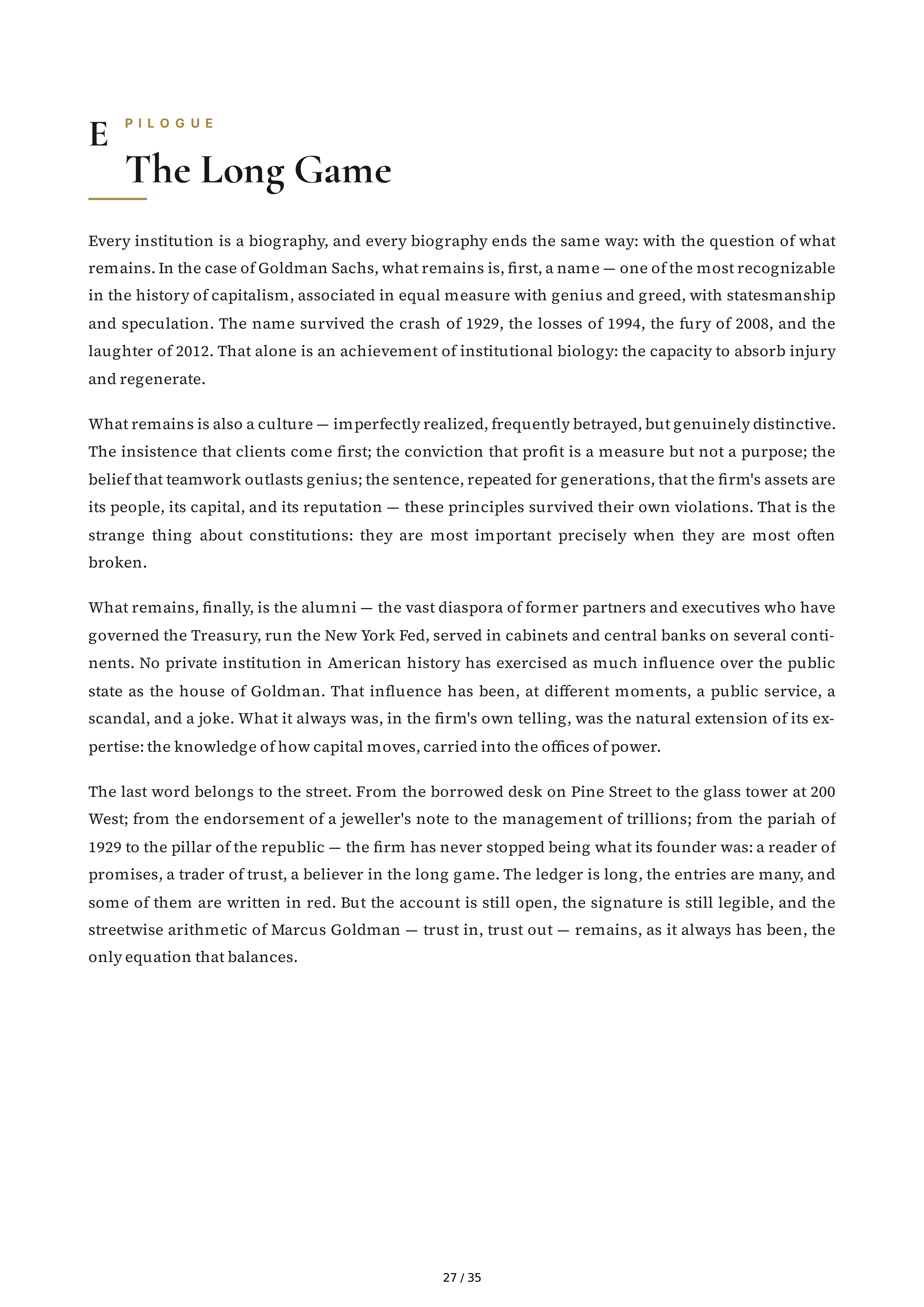
E
P
I
L
O
G
U
E
The
Long
Game
Every institution is a biography, and every biography ends the same way: with the question of what
remains. In the case of Goldman Sachs, what remains is, first, a name — one of the most recognizable
in the history of capitalism, associated in equal measure with genius and greed, with statesmanship
and speculation. The name survived the crash of 1929, the losses of 1994, the fury of 2008, and the
laughter of 2012. That alone is an achievement of institutional biology: the capacity to absorb injury
and regenerate.
What remains is also a culture — imperfectly realized, frequently betrayed, but genuinely distinctive.
The insistence that clients come first; the conviction that profit is a measure but not a purpose; the
belief that teamwork outlasts genius; the sentence, repeated for generations, that the firm's assets are
its people, its capital, and its reputation — these principles survived their own violations. That is the
strange thing about constitutions: they are most important precisely when they are most often
broken.
What remains, finally, is the alumni — the vast diaspora of former partners and executives who have
governed the Treasury, run the New York Fed, served in cabinets and central banks on several conti-
nents. No private institution in American history has exercised as much influence over the public
state as the house of Goldman. That influence has been, at different moments, a public service, a
scandal, and a joke. What it always was, in the firm's own telling, was the natural extension of its ex-
pertise: the knowledge of how capital moves, carried into the offices of power.
The last word belongs to the street. From the borrowed desk on Pine Street to the glass tower at 200
West; from the endorsement of a jeweller's note to the management of trillions; from the pariah of
1929 to the pillar of the republic — the firm has never stopped being what its founder was: a reader of
promises, a trader of trust, a believer in the long game. The ledger is long, the entries are many, and
some of them are written in red. But the account is still open, the signature is still legible, and the
streetwise arithmetic of Marcus Goldman — trust in, trust out — remains, as it always has been, the
only equation that balances.
27 / 35
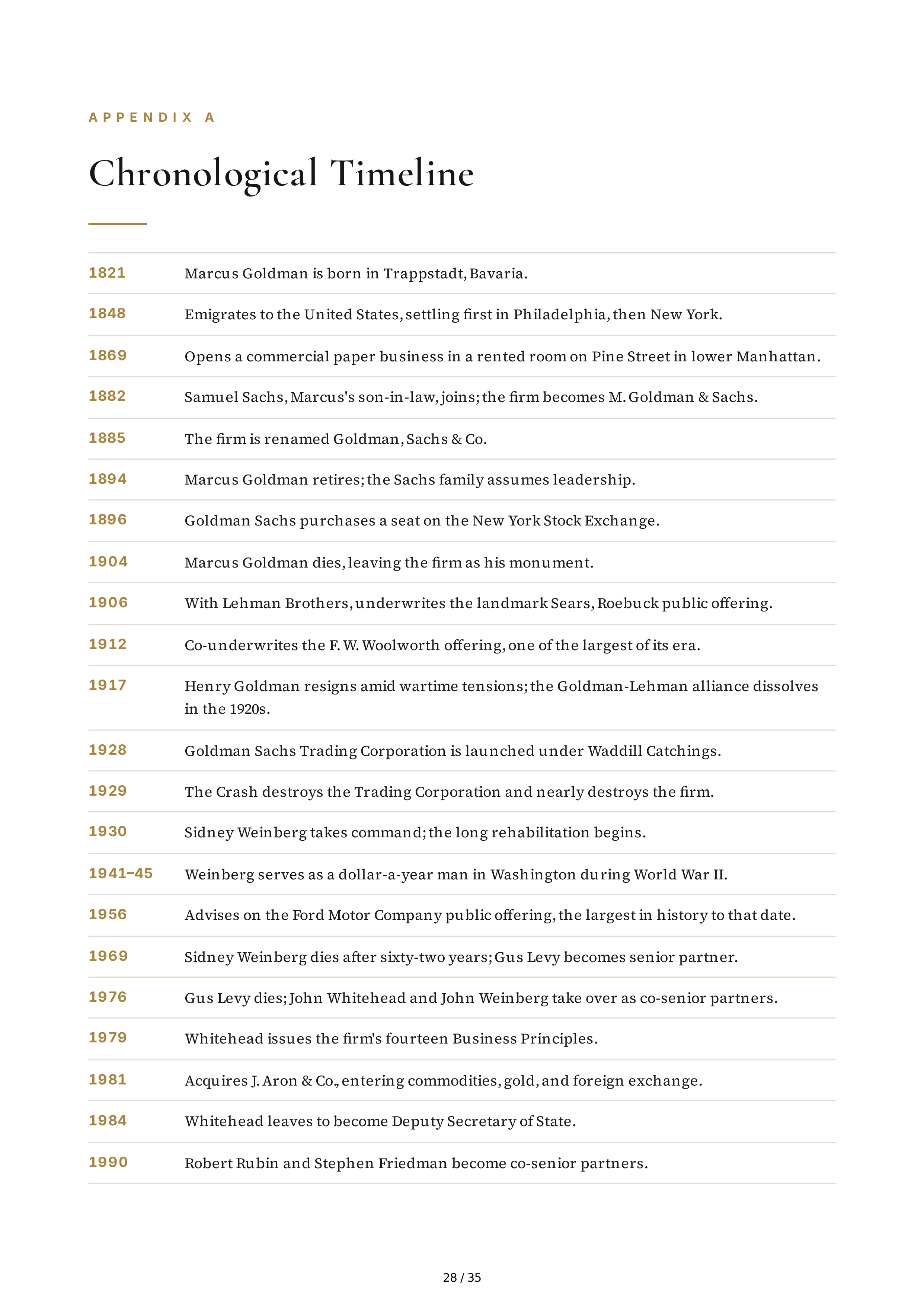
A
P
P
E
N
D
I
X
A
Chronological
Timeline
1821
Marcus Goldman is born in Trappstadt, Bavaria.
1848
Emigrates to the United States, settling first in Philadelphia, then New York.
1869
Opens a commercial paper business in a rented room on Pine Street in lower Manhattan.
1882
Samuel Sachs, Marcus's son-in-law, joins; the firm becomes M. Goldman & Sachs.
1885
The firm is renamed Goldman, Sachs & Co.
1894
Marcus Goldman retires; the Sachs family assumes leadership.
1896
Goldman Sachs purchases a seat on the New York Stock Exchange.
1904
Marcus Goldman dies, leaving the firm as his monument.
1906
With Lehman Brothers, underwrites the landmark Sears, Roebuck public offering.
1912
Co-underwrites the F. W. Woolworth offering, one of the largest of its era.
1917
Henry Goldman resigns amid wartime tensions; the Goldman-Lehman alliance dissolves
in the 1920s.
1928
Goldman Sachs Trading Corporation is launched under Waddill Catchings.
1929
The Crash destroys the Trading Corporation and nearly destroys the firm.
1930
Sidney Weinberg takes command; the long rehabilitation begins.
1941–45
Weinberg serves as a dollar-a-year man in Washington during World War II.
1956
Advises on the Ford Motor Company public offering, the largest in history to that date.
1969
Sidney Weinberg dies after sixty-two years; Gus Levy becomes senior partner.
1976
Gus Levy dies; John Whitehead and John Weinberg take over as co-senior partners.
1979
Whitehead issues the firm's fourteen Business Principles.
1981
Acquires J. Aron & Co., entering commodities, gold, and foreign exchange.
1984
Whitehead leaves to become Deputy Secretary of State.
1990
Robert Rubin and Stephen Friedman become co-senior partners.
28 / 35
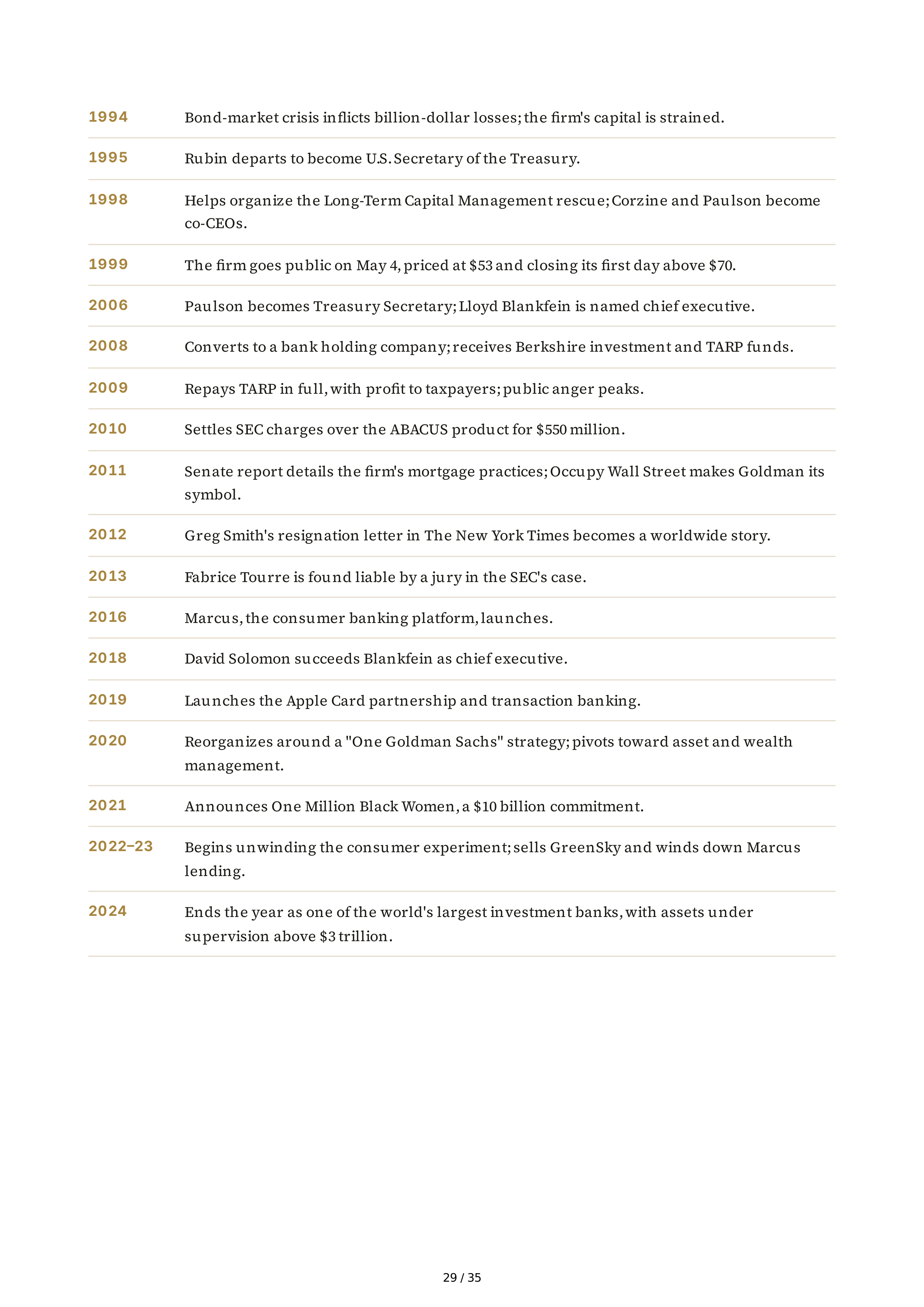
1994
Bond-market crisis inflicts billion-dollar losses; the firm's capital is strained.
1995
Rubin departs to become U.S. Secretary of the Treasury.
1998
Helps organize the Long-Term Capital Management rescue; Corzine and Paulson become
co-CEOs.
1999
The firm goes public on May 4, priced at
$
53 and closing its first day above
$
70.
2006
Paulson becomes Treasury Secretary; Lloyd Blankfein is named chief executive.
2008
Converts to a bank holding company; receives Berkshire investment and TARP funds.
2009
Repays TARP in full, with profit to taxpayers; public anger peaks.
2010
Settles SEC charges over the ABACUS product for
$
550 million.
2011
Senate report details the firm's mortgage practices; Occupy Wall Street makes Goldman its
symbol.
2012
Greg Smith's resignation letter in The New York Times becomes a worldwide story.
2013
Fabrice Tourre is found liable by a jury in the SEC's case.
2016
Marcus, the consumer banking platform, launches.
2018
David Solomon succeeds Blankfein as chief executive.
2019
Launches the Apple Card partnership and transaction banking.
2020
Reorganizes around a "One Goldman Sachs" strategy; pivots toward asset and wealth
management.
2021
Announces One Million Black Women, a
$
10 billion commitment.
2022–23
Begins unwinding the consumer experiment; sells GreenSky and winds down Marcus
lending.
2024
Ends the year as one of the world's largest investment banks, with assets under
supervision above
$
3 trillion.
29 / 35
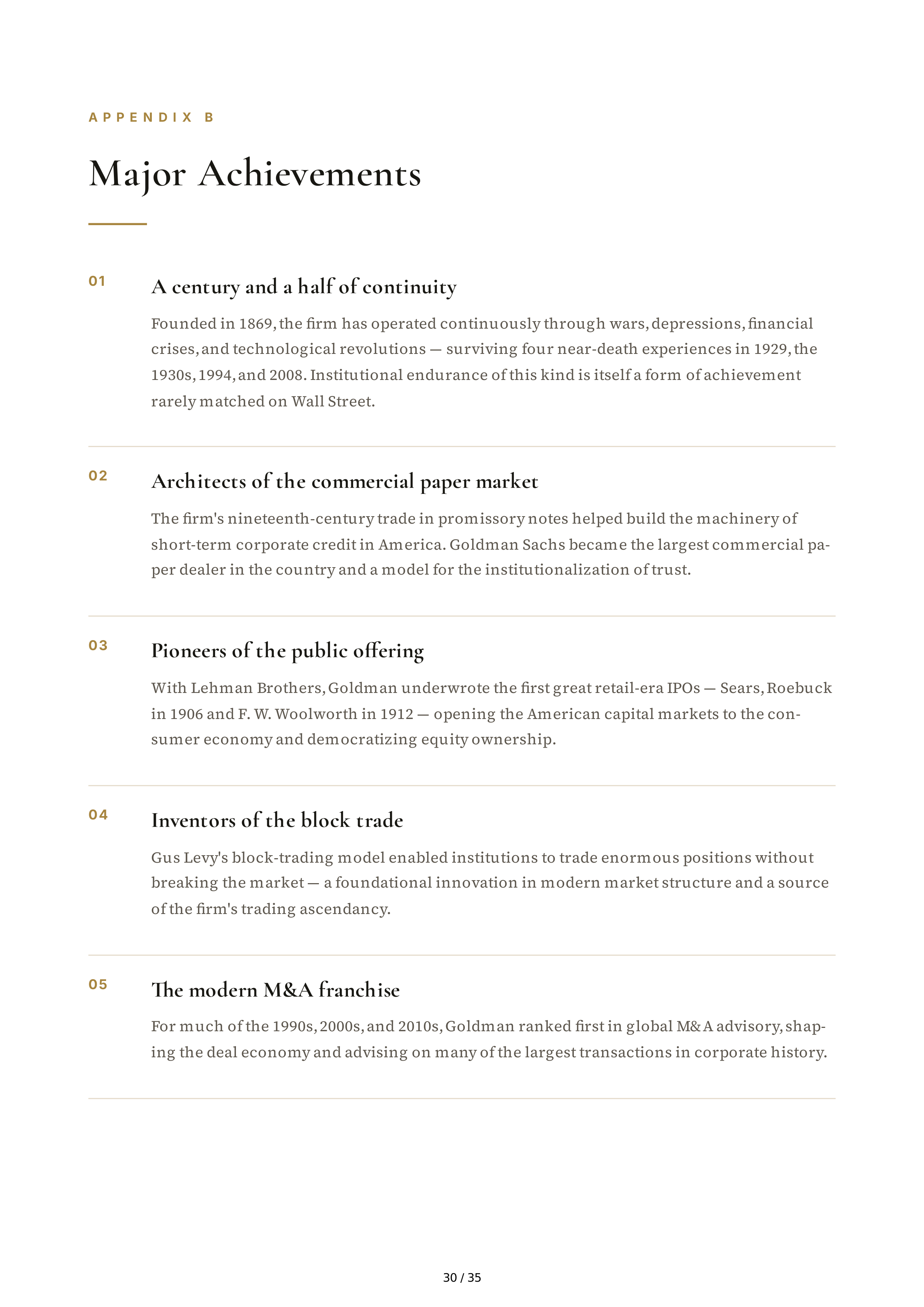
A
P
P
E
N
D
I
X
B
Major
Achievements
01
A
century
and
a
half
of
continuity
Founded in 1869, the firm has operated continuously through wars, depressions, financial
crises, and technological revolutions — surviving four near-death experiences in 1929, the
1930s, 1994, and 2008. Institutional endurance of this kind is itself a form of achievement
rarely matched on Wall Street.
02
Architects
of
the
commercial
paper
market
The firm's nineteenth-century trade in promissory notes helped build the machinery of
short-term corporate credit in America. Goldman Sachs became the largest commercial pa-
per dealer in the country and a model for the institutionalization of trust.
03
Pioneers
of
the
public
offering
With Lehman Brothers, Goldman underwrote the first great retail-era IPOs — Sears, Roebuck
in 1906 and F. W. Woolworth in 1912 — opening the American capital markets to the con-
sumer economy and democratizing equity ownership.
04
Inventors
of
the
block
trade
Gus Levy's block-trading model enabled institutions to trade enormous positions without
breaking the market — a foundational innovation in modern market structure and a source
of the firm's trading ascendancy.
05
The
modern
M
&
A
franchise
For much of the 1990s, 2000s, and 2010s, Goldman ranked first in global M&A advisory, shap-
ing the deal economy and advising on many of the largest transactions in corporate history.
30 / 35
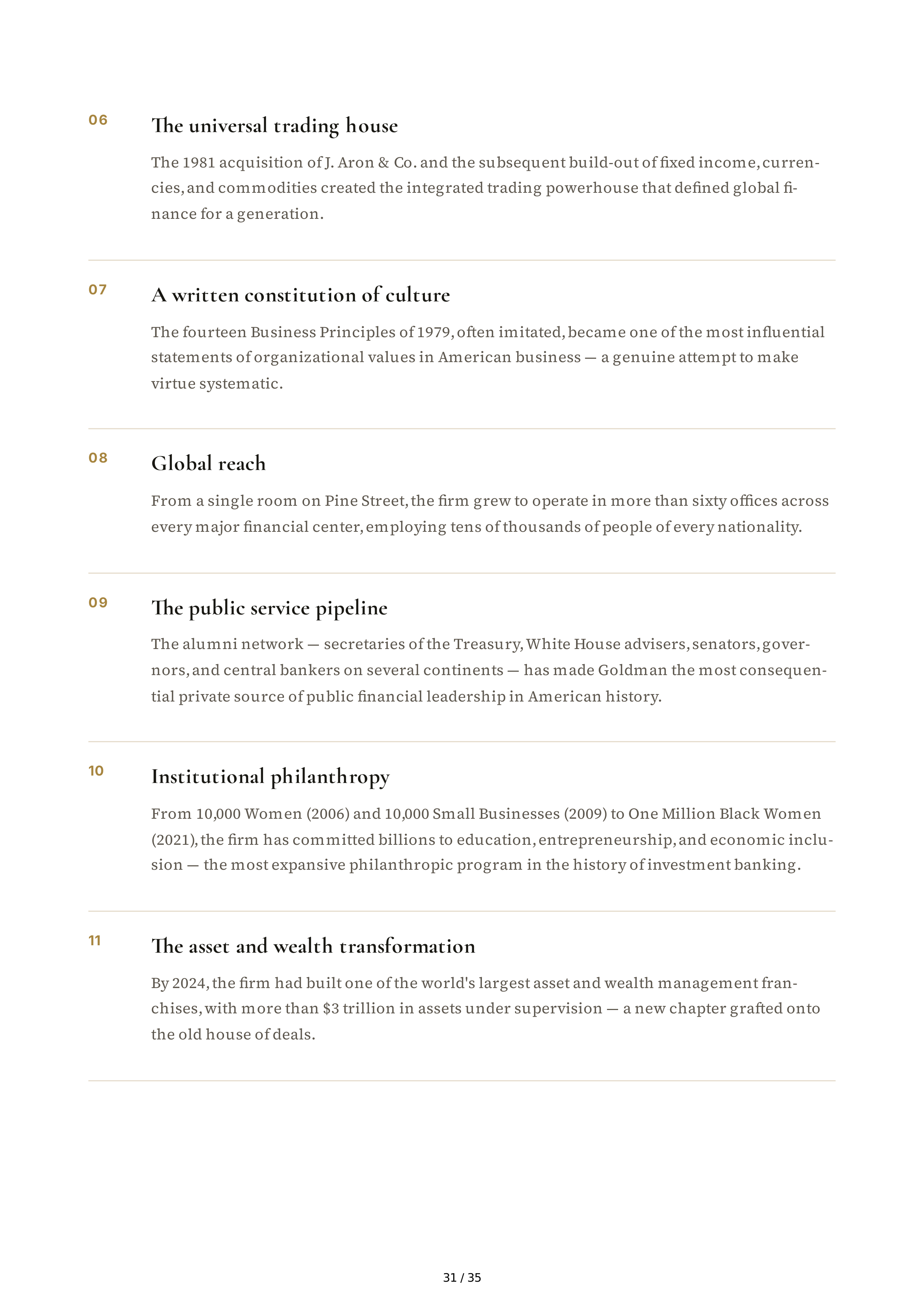
06
The
universal
trading
house
The 1981 acquisition of J. Aron & Co. and the subsequent build-out of fixed income, curren-
cies, and commodities created the integrated trading powerhouse that defined global fi-
nance for a generation.
07
A
written
constitution
of
culture
The fourteen Business Principles of 1979, often imitated, became one of the most influential
statements of organizational values in American business — a genuine attempt to make
virtue systematic.
08
Global
reach
From a single room on Pine Street, the firm grew to operate in more than sixty offices across
every major financial center, employing tens of thousands of people of every nationality.
09
The
public
service
pipeline
The alumni network — secretaries of the Treasury, White House advisers, senators, gover-
nors, and central bankers on several continents — has made Goldman the most consequen-
tial private source of public financial leadership in American history.
10
Institutional
philanthropy
From 10,000 Women (2006) and 10,000 Small Businesses (2009) to One Million Black Women
(2021), the firm has committed billions to education, entrepreneurship, and economic inclu-
sion — the most expansive philanthropic program in the history of investment banking.
11
The
asset
and
wealth
transformation
By 2024, the firm had built one of the world's largest asset and wealth management fran-
chises, with more than
$
3 trillion in assets under supervision — a new chapter grafted onto
the old house of deals.
31 / 35
A
P
P
E
N
D
I
X
C
Awards
&
Recognition
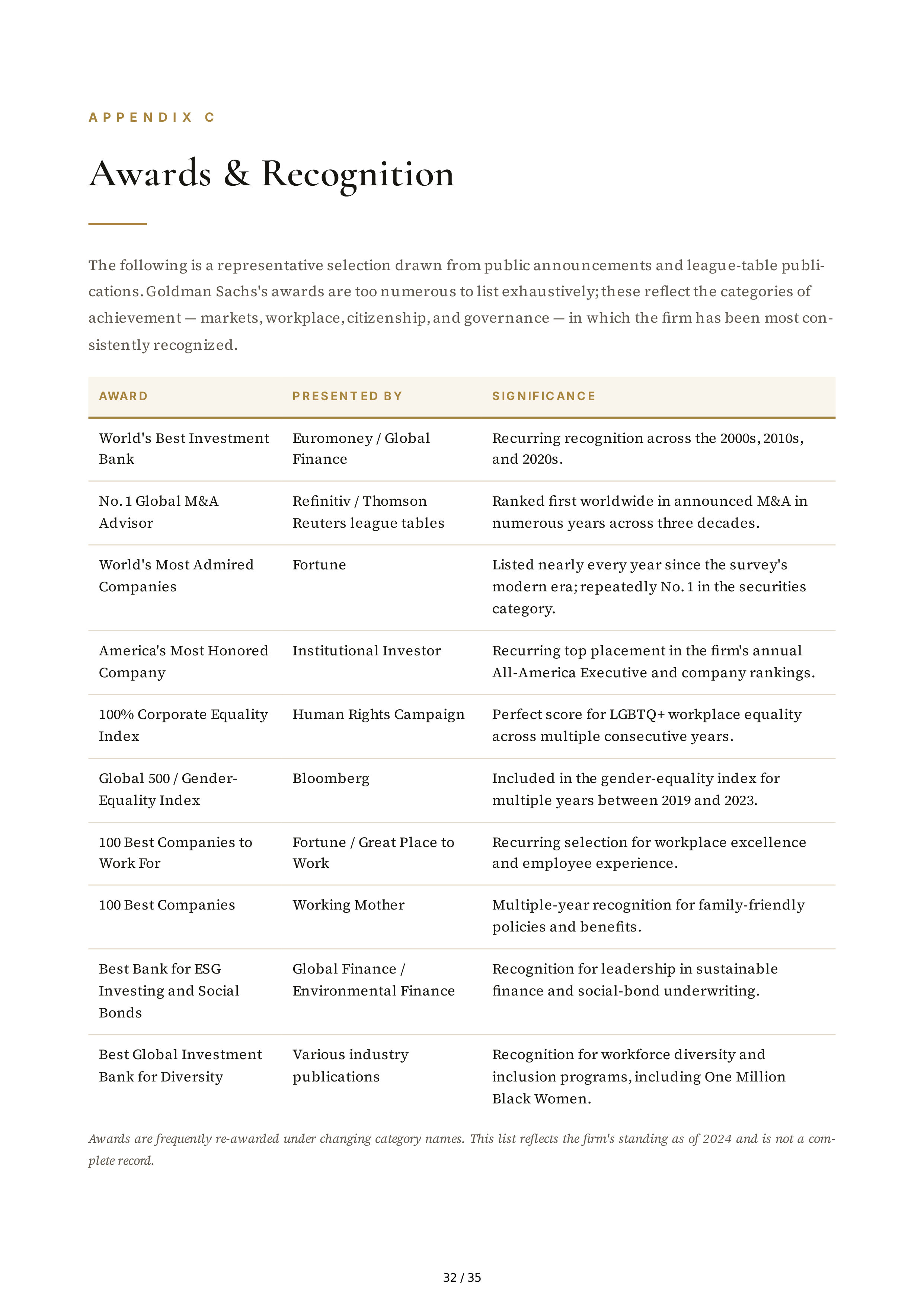
The following is a representative selection drawn from public announcements and league-table publi-
cations. Goldman Sachs's awards are too numerous to list exhaustively; these reflect the categories of
achievement — markets, workplace, citizenship, and governance — in which the firm has been most con-
sistently recognized.
AWAR D
P R ES EN T ED
B Y
S IG N IF IC AN C E
World's Best Investment
Bank
Euromoney / Global
Finance
Recurring recognition across the 2000s, 2010s,
and 2020s.
No. 1 Global M&A
Advisor
Refinitiv / Thomson
Reuters league tables
Ranked first worldwide in announced M&A in
numerous years across three decades.
World's Most Admired
Companies
Fortune
Listed nearly every year since the survey's
modern era; repeatedly No. 1 in the securities
category.
America's Most Honored
Company
Institutional Investor
Recurring top placement in the firm's annual
All-America Executive and company rankings.
100
%
Corporate Equality
Index
Human Rights Campaign
Perfect score for LGBTQ
+
workplace equality
across multiple consecutive years.
Global 500 / Gender-
Equality Index
Bloomberg
Included in the gender-equality index for
multiple years between 2019 and 2023.
100 Best Companies to
Work For
Fortune / Great Place to
Work
Recurring selection for workplace excellence
and employee experience.
100 Best Companies
Working Mother
Multiple-year recognition for family-friendly
policies and benefits.
Best Bank for ESG
Investing and Social
Bonds
Global Finance /
Environmental Finance
Recognition for leadership in sustainable
finance and social-bond underwriting.
Best Global Investment
Bank for Diversity
Various industry
publications
Recognition for workforce diversity and
inclusion programs, including One Million
Black Women.
Awards are frequently re-awarded under changing category names. This list reflects the firm's standing as of 2024 and is not a com-
plete record.
32 / 35
A
P
P
E
N
D
I
X
D
Sources
&
Further
Reading
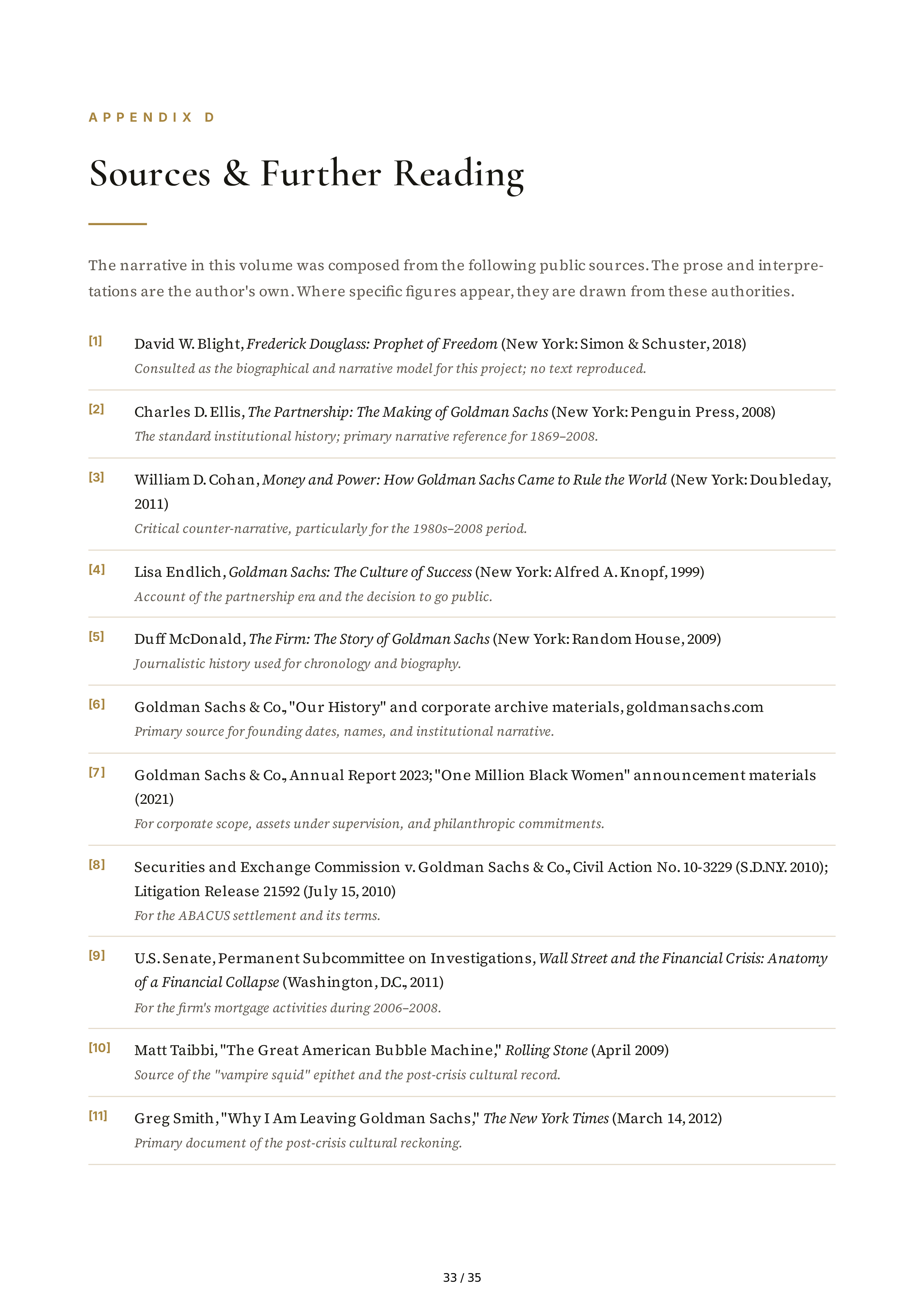
The narrative in this volume was composed from the following public sources. The prose and interpre-
tations are the author's own. Where specific figures appear, they are drawn from these authorities.
[1]
David W. Blight,
Frederick Douglass: Prophet of Freedom
(New York: Simon & Schuster, 2018)
Consulted as the biographical and narrative model for this project; no text reproduced.
[2]
Charles D. Ellis,
The Partnership: The Making of Goldman Sachs
(New York: Penguin Press, 2008)
The standard institutional history; primary narrative reference for 1869–2008.
[3]
William D. Cohan,
Money and Power: How Goldman Sachs Came to Rule the World
(New York: Doubleday,
2011)
Critical counter-narrative, particularly for the 1980s–2008 period.
[4]
Lisa Endlich,
Goldman Sachs: The Culture of Success
(New York: Alfred A. Knopf, 1999)
Account of the partnership era and the decision to go public.
[5]
Duff McDonald,
The Firm: The Story of Goldman Sachs
(New York: Random House, 2009)
Journalistic history used for chronology and biography.
[6]
Goldman Sachs & Co., "Our History" and corporate archive materials, goldmansachs.com
Primary source for founding dates, names, and institutional narrative.
[7]
Goldman Sachs & Co., Annual Report 2023; "One Million Black Women" announcement materials
(2021)
For corporate scope, assets under supervision, and philanthropic commitments.
[8]
Securities and Exchange Commission v. Goldman Sachs & Co., Civil Action No. 10-3229 (S.D.N.Y. 2010);
Litigation Release 21592 (July 15, 2010)
For the ABACUS settlement and its terms.
[9]
U.S. Senate, Permanent Subcommittee on Investigations,
Wall Street and the Financial Crisis: Anatomy
of a Financial Collapse
(Washington, D.C., 2011)
For the firm's mortgage activities during 2006–2008.
[10]
Matt Taibbi, "The Great American Bubble Machine,"
Rolling Stone
(April 2009)
Source of the "vampire squid" epithet and the post-crisis cultural record.
[11]
Greg Smith, "Why I Am Leaving Goldman Sachs,"
The New York Times
(March 14, 2012)
Primary document of the post-crisis cultural reckoning.
33 / 35

[12]
League-table publications: Refinitiv, Thomson Reuters, and Bloomberg M&A and underwriting
rankings, 1990–2024
For the firm's recurring first-place rankings.
34 / 35
C
O
L
O
P
H
O
N
About
the
Author
Jonathan P. Meriwether is an independent financial historian and essayist based in Brooklyn, New
York. His work examines the people and institutions of American capital markets — the families,
partnerships, and trading floors through which the modern economy was built. He has spent the
past decade researching the archives, memoirs, and congressional records on which this biography
rests.
Goldman Sachs: Streetwise
is his first book. He is at work on a companion biography of the Federal
Reserve Bank of New York.
This book was designed as a digital publication in HTML5 and is formatted for both screen and print (A4).
Set in Cormorant Garamond, Source Serif 4, and Inter.
The cover, composed in the visual language of the classic American biography — dark sepia ground, engraved medal-
lion, and classical serif — is a typographic homage to the great biographical front covers of the twenty-first century.
First Edition, 2025. Copyright © 2025 Jonathan P. Meriwether. All rights reserved.
35 / 35