A
C H A P T
E R
O
N E
The Talkative Boy from Scarsdale
1 9 6 1 – 1 9 8 3
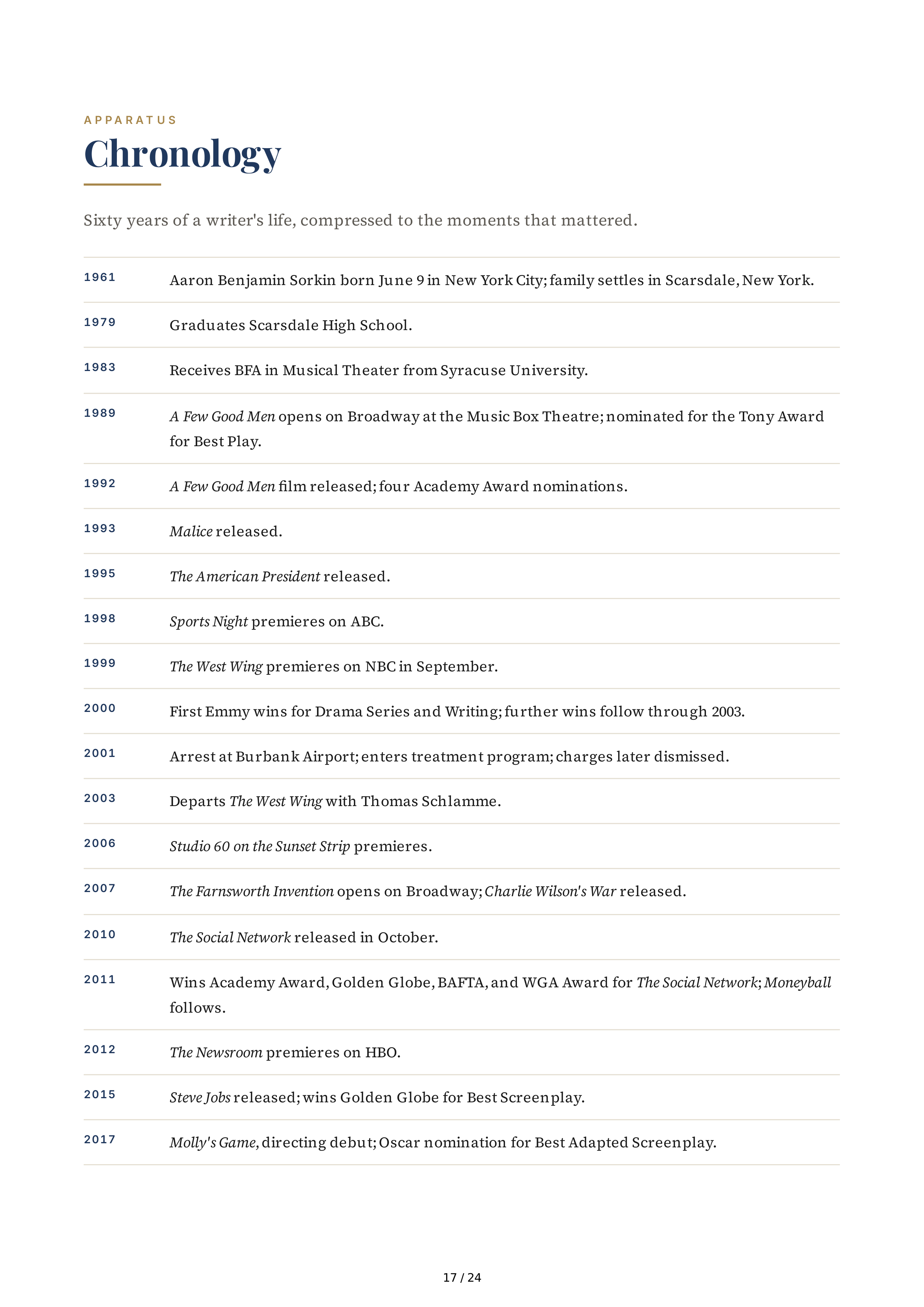
aron Benjamin Sorkin was born on June 9, 1961, in New York City, and grew up in Scarsdale,
a prosperous commuter village in Westchester County just north of the city. His father,
Benjamin, was a lawyer; his mother, Natalie, was a teacher. In the telling Sorkin has offered over
the years, the household was Jewish, secular, literate, and intensely verbal — a place where din-
ner-table argument was a form of family entertainment, and where a quick remark could win
the night. He was a talkative child in a family that rewarded talk.
His older sister, Deborah, would become a lawyer and, in time, the accidental source of the story
that made his name. As children the two were close; Deborah was the one who went out into the
world first, and Aaron listened to her stories the way other children listened to the radio. That
habit — gathering the raw material of drama from the lives of people in demanding professions
— would become the engine of his entire career.
The theater arrived during adolescence. At Scarsdale High School he was cast in plays, and he
discovered that the stage was the one place where his talkativeness was not a behavior to be
managed but a talent to be deployed. He chose to study musical theater and enrolled at Syracuse
University in upstate New York, graduating in 1983 with a Bachelor of Fine Arts in musical the-
ater. The training seemed, on its face, an odd preparation for a career in political drama, but it
equipped him with tools he would use every day for the rest of his working life: timing, rhythm,
the physics of an entrance, and the knowledge that a scene is a song with the tune removed.
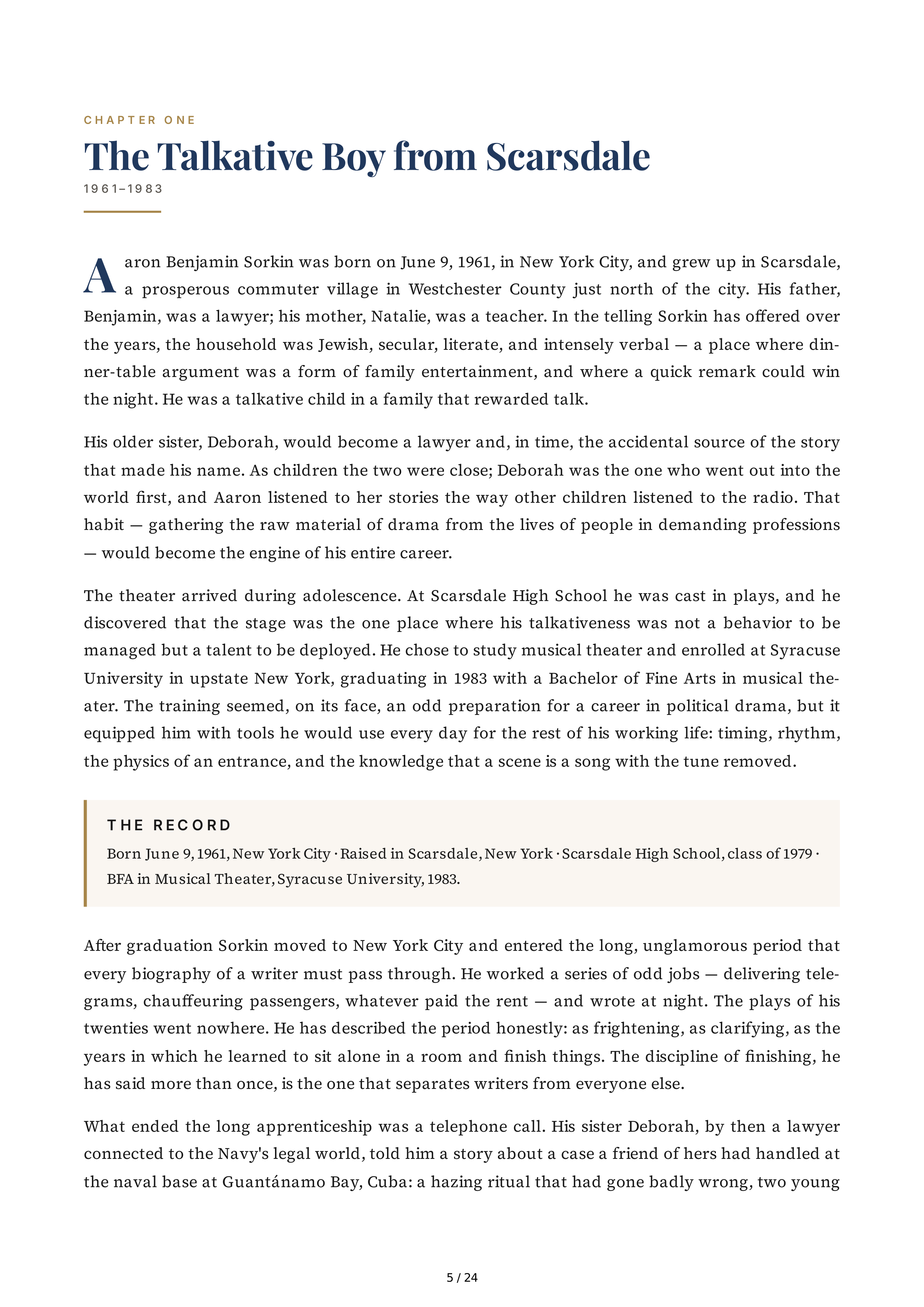
T H E
R E C O R D
Born June 9, 1961, New York City · Raised in Scarsdale, New York · Scarsdale High School, class of 1979 ·
BFA in Musical Theater, Syracuse University, 1983.
After graduation Sorkin moved to New York City and entered the long, unglamorous period that
every biography of a writer must pass through. He worked a series of odd jobs — delivering tele-
grams, chauffeuring passengers, whatever paid the rent — and wrote at night. The plays of his
twenties went nowhere. He has described the period honestly: as frightening, as clarifying, as the
years in which he learned to sit alone in a room and finish things. The discipline of finishing, he
has said more than once, is the one that separates writers from everyone else.
What ended the long apprenticeship was a telephone call. His sister Deborah, by then a lawyer
connected to the Navy's legal world, told him a story about a case a friend of hers had handled at
the naval base at Guantánamo Bay, Cuba: a hazing ritual that had gone badly wrong, two young
5 / 24