
C O LU M BI A
U N I VE RS I T Y
I N
T H E
C I T Y
O F
N E W
YO RK
Departmen t
of
Fren ch
an d
Roman ce
Ph ilology
·
Readin g
Compan ion
Series
R E A D I N G
C O M P A N I O N
·
N U M B E R
T
H R E E
Melanie Klein
A Biography
JULIA KRISTEVA
Translated
from
the
French
by
Ross
Guberman
First
published
in
English
by
Columbia
University
Press
·
European
Perspectives
:
A
Series
in
Social
Thought
and
Cultural
Criticism
·
Lawrence
D
.
Kritzman
,
General
Editor
· 2001
This
reading
companion
retells
Kristeva
'
s
biography
of
the
founder
of
object
relations
,
supplies
the
historical
and
conceptual
apparatus
required
for
a
first
encounter
,
and
maps
the
argument
of
the
second
volume
of
Female
Genius
:
Life
,
Madness
,
Words
.
NE W
Y O RK
· 2 0 2 6
1 / 18
ED IT O R
'
S
N O T E
T O
T HE
READER
This
companion
presents
Julia
Kristeva
'
s
biography
of
Melanie
Klein
—
the
second
volume
of
Female
Genius
:
Life
,
Madness
,
Words
(
Paris
:
Éditions
Fayard
, 2000) —
in
the
form
of
a
reading
edition
prepared
for
students
at
Columbia
University
.
The
English
text
of
the
original
translation
,
by
Ross
Guberman
(
Columbia
University
Press
, 2001),
remains
the
authoritative
source
.
The
present
volume
retells
the
narrative
,
summarizes
the
interpretive
argument
,
and
supplies
the
historical
apparatus
—
chronology
,
glossary
,
bibliography
—
that
a
first
encounter
with
Klein
requires
.
The
presentation
of
Kristeva
'
s
argument
follows
the
Guberman
translation
closely
in
terminology
.
It
is
a
work
of
summary
and
commentary
,
not
a
reproduction
of
the
copyrighted
text
;
instructors
may
wish
to
place
it
on
electronic
reserve
alongside
the
printed
edition
.
A B S T R A C T
Melanie Klein (1882–1960) extended psychoanalysis to the play of small children and located the
origin of all mental life in the first year of the mother–infant relation. This biography follows her
from Vienna to Budapest, from Berlin to London, and through the theoretical revolutions of her
maturity: the play technique, the early superego, the depressive and paranoid-schizoid positions,
projective identification, and the doctrine of envy. The second part of the volume turns to Julia
Kristeva, who, in the second book of the trilogy Female Genius: Life, Madness, Words, reads Klein
as a melancholic genius whose theory was autobiography transformed into concept. A chronology,
a glossary of the principal concepts, and a selected bibliography accompany the text.
M E LA N I E
K LE I N
—
A
BI OG R A P H Y
PAGE
2
2 / 18
C O N T EN T S
Editor
'
s
Note
and
Abstract
2
Contents
3
1 ·
Introduction
4
2 ·
Chronology
of
the
Life
5
3 ·
A
Life
6
3.1
Vienna
, 1882–1910
6
3.2
Budapest
, 1910–1921
7
3.3
Berlin
, 1921–1926
8
3.4
London
, 1926–1960
9
4 ·
The
Work
11
4.1
The
Play
Technique
12
4.2
The
Positions
12
4.3
Projective
Identification
13
4.4
Envy
and
the
Death
Drive
13
5 ·
Kristeva
'
s
Klein
14
5.1
Female
Genius
14
5.2
The
Melancholic
14
5.3
The
Maternal
Semiotic
15
5.4
The
Heretic
15
5.5
The
Third
Party
16
6 ·
Afterword
:
Klein
after
Klein
16
Selected
Bibliography
17
M E LA N I E
K LE I N
—
A
BI OG R A P H Y
PAGE
3
3 / 18
1 ·
IN T R O D U C T IO N
Melanie Klein rarely appears in the history of psychoanalysis as a serene figure. She appears instead
as a battlefield: a woman who analyzed her own children, who quarreled with her daughter in the
corridors of the British Psychoanalytical Society, who split the London analytic world in two, and
who — in her seventies, ill and isolated — produced the darkest and most enduring book of her
career, Envy and Gratitude (1957).
The turbulence was not incidental to her work. Klein made turbulence — early anxiety, hate,
envy, and the drama of loss — the very substance of psychic life. Where Freud had located the
origins of neurosis in the oedipal complex of the third to fifth year, Klein pushed the inquiry
earlier and deeper: into the first year, into the relation to the breast, into the preverbal
phantasies of splitting and projection that she believed lay beneath all later symbolization.
The universe she described is not a calm one. It is a world in which the infant is at war with
its own destructiveness, and in which every love is shadowed by the envy that corrodes it.
This was also, in her view, the only world there is. The task of analysis was not to deny it but
to transform it — to pass from the paranoid-schizoid position, in which objects are torn into
good and bad, to the depressive position, in which the whole object can be loved, mourned,
and repaired.
Julia Kristeva, who devoted the second volume of her trilogy
Female Genius
to Klein, presents
her subject as the greatest innovator in the history of analysis after Freud. The claim is
deliberate. Kristeva is not an orthodox Kleinian; her own theoretical heritage runs through
the French Freud, through Lacan and the avant-garde of
Tel Quel
, and her concepts of the
semiotic chora and the abjection were framed against the paternal symbolism of Lacanian
theory. Yet in Klein she found a thinker who, in a different register, had made the same
discovery: that the roots of all meaning and all speech lie in the maternal body, and that loss
is the condition of representation. Klein, in Kristeva's portrait, is the analyst of the foreign
country of the maternal — the one who, by her own melancholic history, was able to hear in
the play of children the earliest music of the human.
M E LA N I E
K LE I N
—
A
BI OG R A P H Y
PAGE
4
4 / 18
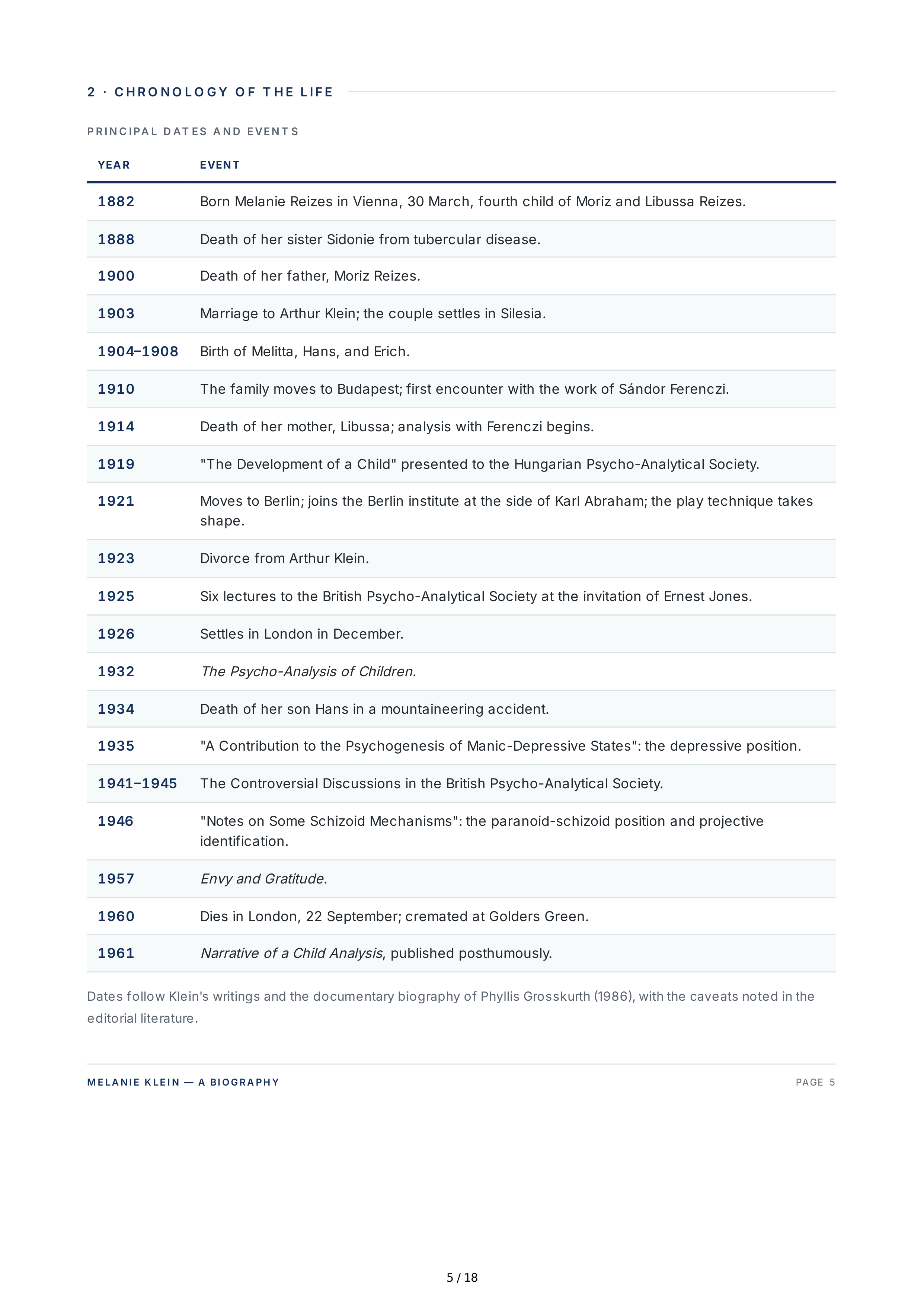
2 ·
C H R O N O L O G Y
O F
T H E
L IF E
P R I N C I PA L
D AT ES
A N D
EVEN T S
YEA R
EVENT
1882
Born
Melanie
Reizes
in
Vienna
, 30
March
,
fourth
child
of
Moriz
and
Libussa
Reizes
.
1888
Death
of
her
sister
Sidonie
from
tubercular
disease
.
1900
Death
of
her
father
,
Moriz
Reizes
.
1903
Marriage
to
Arthur
Klein
;
the
couple
settles
in
Silesia
.
1904–1908
Birth
of
Melitta
,
Hans
,
and
Erich
.
1910
The
family
moves
to
Budapest
;
first
encounter
with
the
work
of
Sándor
Ferenczi
.
1914
Death
of
her
mother
,
Libussa
;
analysis
with
Ferenczi
begins
.
1919
"
The
Development
of
a
Child
"
presented
to
the
Hungarian
Psycho
-
Analytical
Society
.
1921
Moves
to
Berlin
;
joins
the
Berlin
institute
at
the
side
of
Karl
Abraham
;
the
play
technique
takes
shape
.
1923
Divorce
from
Arthur
Klein
.
1925
Six
lectures
to
the
British
Psycho
-
Analytical
Society
at
the
invitation
of
Ernest
Jones
.
1926
Settles
in
London
in
December
.
1932
The
Psycho
-
Analysis
of
Children
.
1934
Death
of
her
son
Hans
in
a
mountaineering
accident
.
1935
"
A
Contribution
to
the
Psychogenesis
of
Manic
-
Depressive
States
":
the
depressive
position
.
1941–1945
The
Controversial
Discussions
in
the
British
Psycho
-
Analytical
Society
.
1946
"
Notes
on
Some
Schizoid
Mechanisms
":
the
paranoid
-
schizoid
position
and
projective
identification
.
1957
Envy
and
Gratitude
.
1960
Dies
in
London
, 22
September
;
cremated
at
Golders
Green
.
1961
Narrative
of
a
Child
Analysis
,
published
posthumously
.
Dates
follow
Klein
'
s
writings
and
the
documentary
biography
of
Phyllis
Grosskurth
(1986),
with
the
caveats
noted
in
the
editorial
literature
.
M E LA N I E
K LE I N
—
A
BI OG R A P H Y
PAGE
5
5 / 18
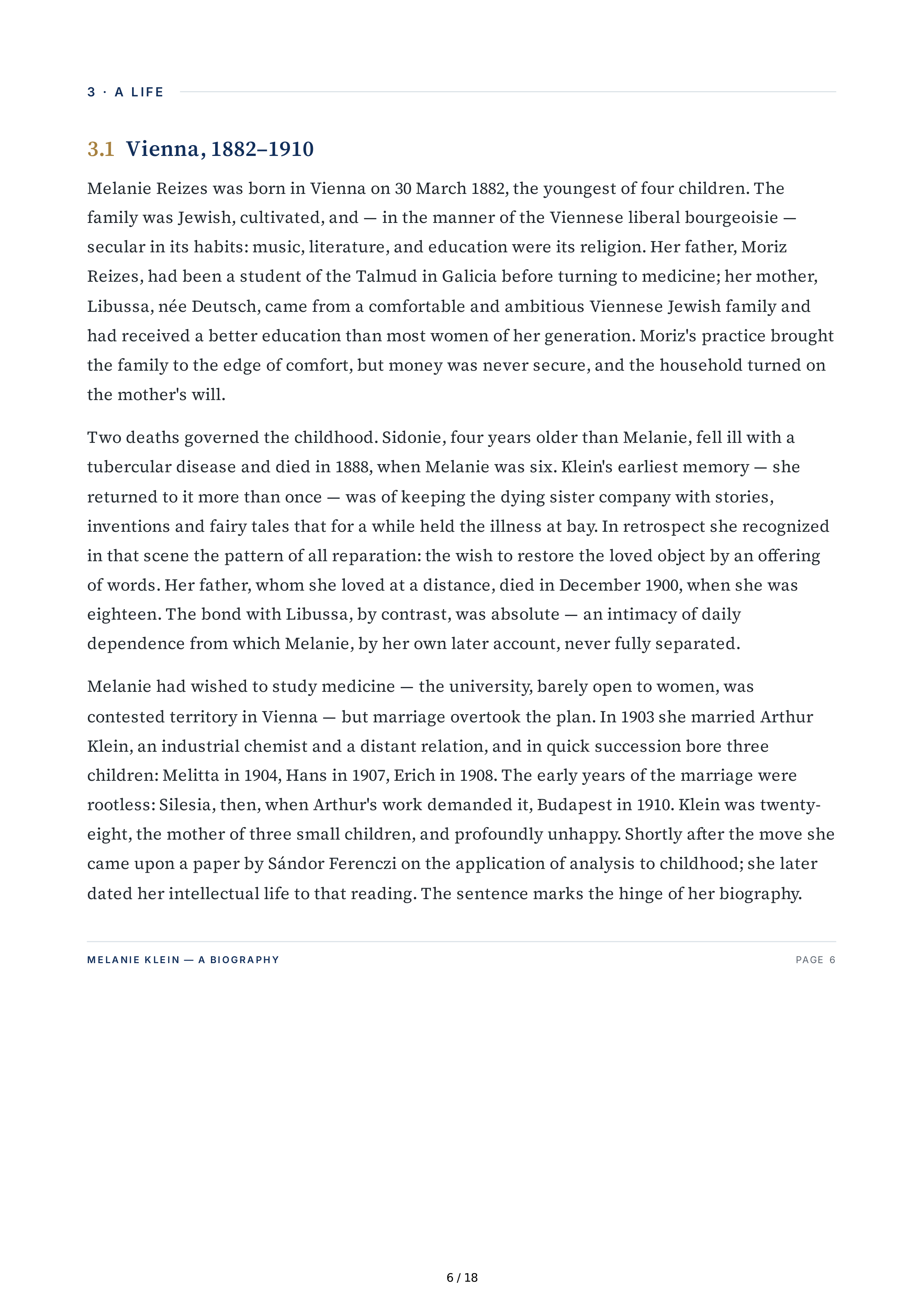
3 ·
A
L IF E
3.1
Vienna, 1882–1910
Melanie Reizes was born in Vienna on 30 March 1882, the youngest of four children. The
family was Jewish, cultivated, and — in the manner of the Viennese liberal bourgeoisie —
secular in its habits: music, literature, and education were its religion. Her father, Moriz
Reizes, had been a student of the Talmud in Galicia before turning to medicine; her mother,
Libussa, née Deutsch, came from a comfortable and ambitious Viennese Jewish family and
had received a better education than most women of her generation. Moriz's practice brought
the family to the edge of comfort, but money was never secure, and the household turned on
the mother's will.
Two deaths governed the childhood. Sidonie, four years older than Melanie, fell ill with a
tubercular disease and died in 1888, when Melanie was six. Klein's earliest memory — she
returned to it more than once — was of keeping the dying sister company with stories,
inventions and fairy tales that for a while held the illness at bay. In retrospect she recognized
in that scene the pattern of all reparation: the wish to restore the loved object by an offering
of words. Her father, whom she loved at a distance, died in December 1900, when she was
eighteen. The bond with Libussa, by contrast, was absolute — an intimacy of daily
dependence from which Melanie, by her own later account, never fully separated.
Melanie had wished to study medicine — the university, barely open to women, was
contested territory in Vienna — but marriage overtook the plan. In 1903 she married Arthur
Klein, an industrial chemist and a distant relation, and in quick succession bore three
children: Melitta in 1904, Hans in 1907, Erich in 1908. The early years of the marriage were
rootless: Silesia, then, when Arthur's work demanded it, Budapest in 1910. Klein was twenty-
eight, the mother of three small children, and profoundly unhappy. Shortly after the move she
came upon a paper by Sándor Ferenczi on the application of analysis to childhood; she later
dated her intellectual life to that reading. The sentence marks the hinge of her biography.
M E LA N I E
K LE I N
—
A
BI OG R A P H Y
PAGE
6
6 / 18
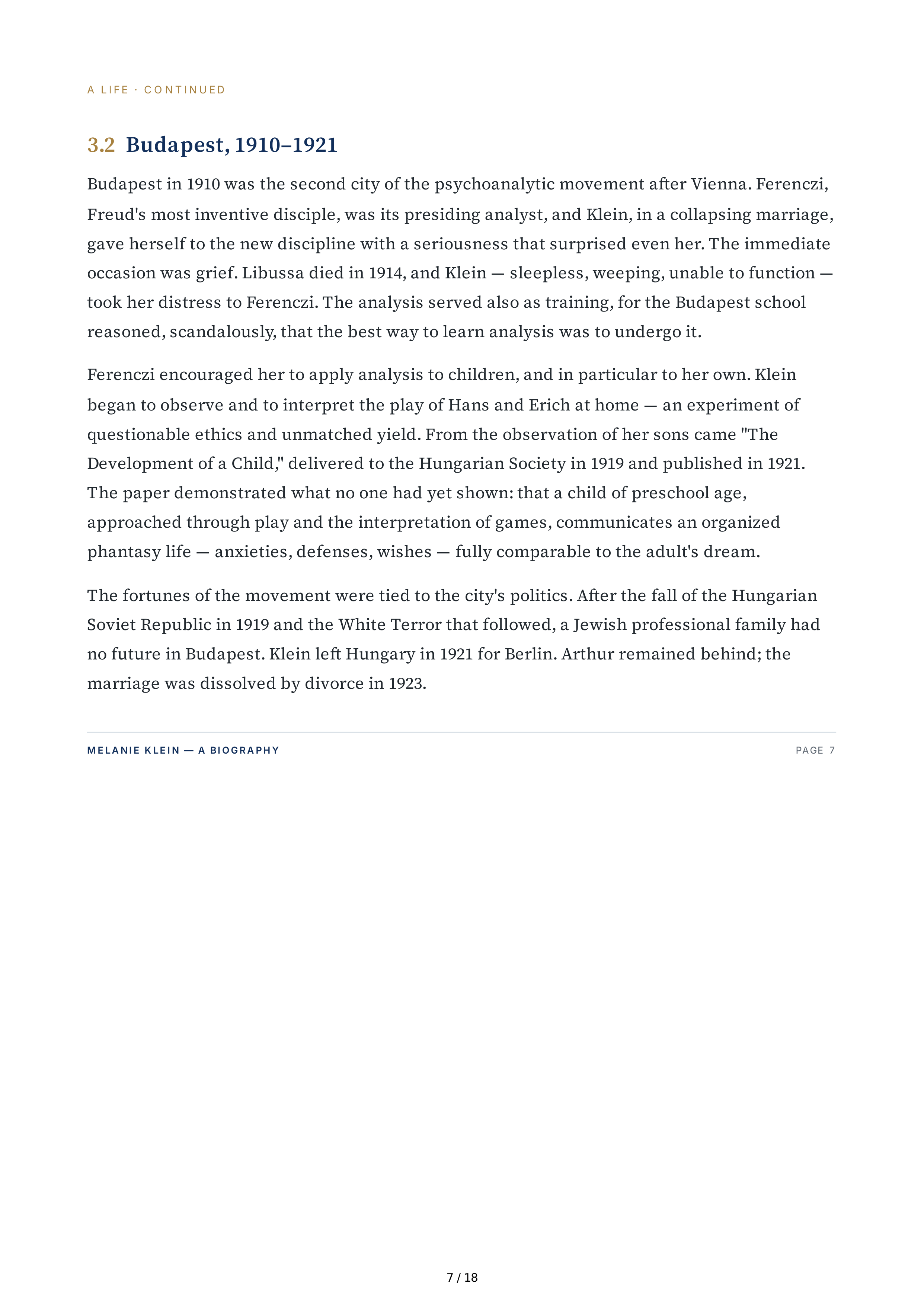
A
L I F E
·
C O N T I N U E D
3.2
Budapest, 1910–1921
Budapest in 1910 was the second city of the psychoanalytic movement after Vienna. Ferenczi,
Freud's most inventive disciple, was its presiding analyst, and Klein, in a collapsing marriage,
gave herself to the new discipline with a seriousness that surprised even her. The immediate
occasion was grief. Libussa died in 1914, and Klein — sleepless, weeping, unable to function —
took her distress to Ferenczi. The analysis served also as training, for the Budapest school
reasoned, scandalously, that the best way to learn analysis was to undergo it.
Ferenczi encouraged her to apply analysis to children, and in particular to her own. Klein
began to observe and to interpret the play of Hans and Erich at home — an experiment of
questionable ethics and unmatched yield. From the observation of her sons came "The
Development of a Child," delivered to the Hungarian Society in 1919 and published in 1921.
The paper demonstrated what no one had yet shown: that a child of preschool age,
approached through play and the interpretation of games, communicates an organized
phantasy life — anxieties, defenses, wishes — fully comparable to the adult's dream.
The fortunes of the movement were tied to the city's politics. After the fall of the Hungarian
Soviet Republic in 1919 and the White Terror that followed, a Jewish professional family had
no future in Budapest. Klein left Hungary in 1921 for Berlin. Arthur remained behind; the
marriage was dissolved by divorce in 1923.
M E LA N I E
K LE I N
—
A
BI OG R A P H Y
PAGE
7
7 / 18
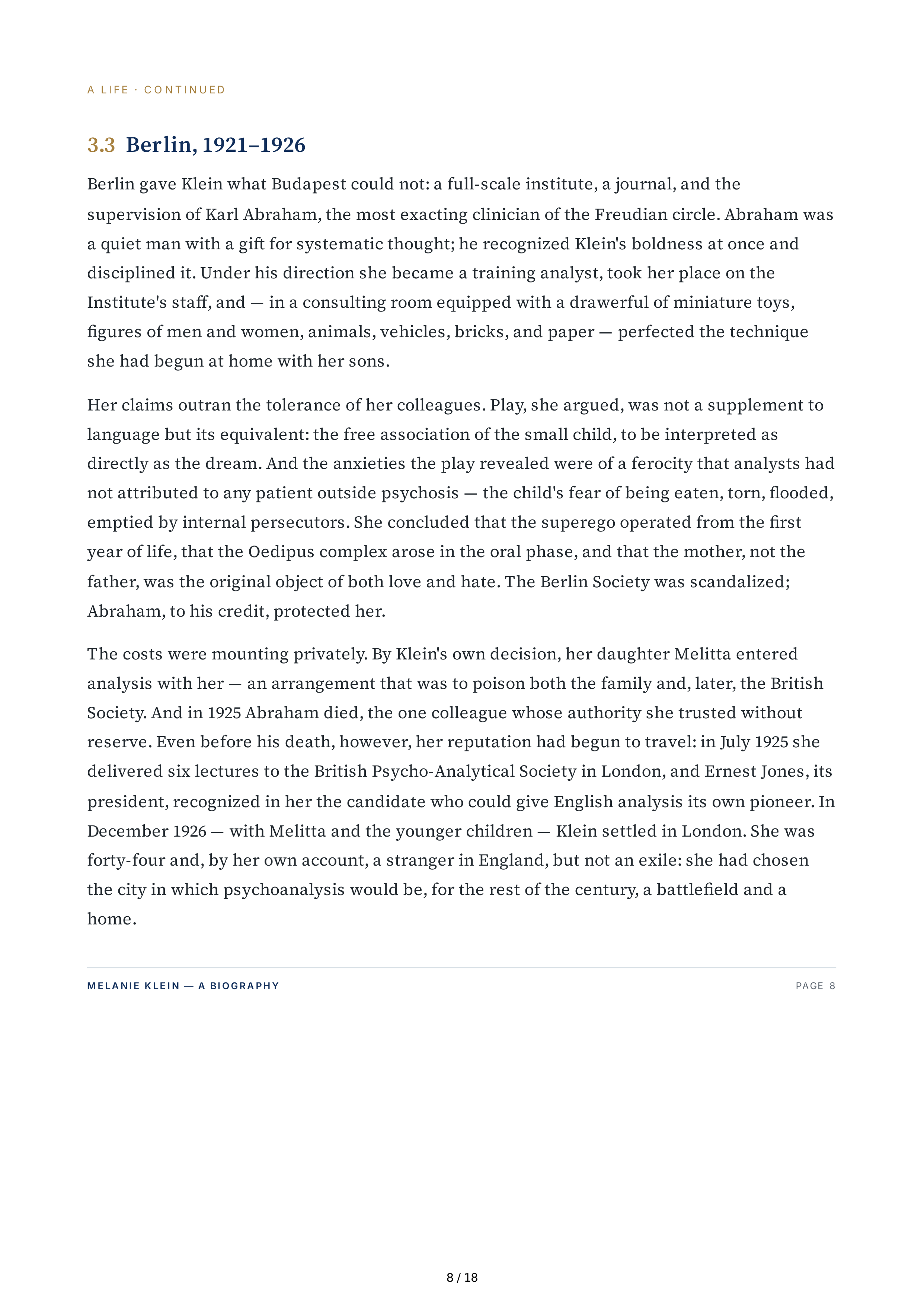
A
L I F E
·
C O N T I N U E D
3.3
Berlin, 1921–1926
Berlin gave Klein what Budapest could not: a full-scale institute, a journal, and the
supervision of Karl Abraham, the most exacting clinician of the Freudian circle. Abraham was
a quiet man with a gift for systematic thought; he recognized Klein's boldness at once and
disciplined it. Under his direction she became a training analyst, took her place on the
Institute's staff, and — in a consulting room equipped with a drawerful of miniature toys,
figures of men and women, animals, vehicles, bricks, and paper — perfected the technique
she had begun at home with her sons.
Her claims outran the tolerance of her colleagues. Play, she argued, was not a supplement to
language but its equivalent: the free association of the small child, to be interpreted as
directly as the dream. And the anxieties the play revealed were of a ferocity that analysts had
not attributed to any patient outside psychosis — the child's fear of being eaten, torn, flooded,
emptied by internal persecutors. She concluded that the superego operated from the first
year of life, that the Oedipus complex arose in the oral phase, and that the mother, not the
father, was the original object of both love and hate. The Berlin Society was scandalized;
Abraham, to his credit, protected her.
The costs were mounting privately. By Klein's own decision, her daughter Melitta entered
analysis with her — an arrangement that was to poison both the family and, later, the British
Society. And in 1925 Abraham died, the one colleague whose authority she trusted without
reserve. Even before his death, however, her reputation had begun to travel: in July 1925 she
delivered six lectures to the British Psycho-Analytical Society in London, and Ernest Jones, its
president, recognized in her the candidate who could give English analysis its own pioneer. In
December 1926 — with Melitta and the younger children — Klein settled in London. She was
forty-four and, by her own account, a stranger in England, but not an exile: she had chosen
the city in which psychoanalysis would be, for the rest of the century, a battlefield and a
home.
M E LA N I E
K LE I N
—
A
BI OG R A P H Y
PAGE
8
8 / 18
A
L I F E
·
C O N T I N U E D
3.4
London, 1926–1960
London in the late 1920s was hospitable to heterodox ideas in analysis. Ernest Jones had built
the British Psycho-Analytical Society in the English tradition of accommodation; Freud's
orthodoxy was respected but not policed. Klein began at once to analyze children in a series
of supervised cases and to train the practitioners who would become the English school. Her
method, by now fully formed, treated children as analysands in their own right — not as
miniature adults to be educated. In 1932 she gathered her indications into her first book,
The
Psycho-Analysis of Children
: the authoritative statement of the play technique and of the early
superego.
The years 1934–1935 brought a catastrophe and a masterpiece. In April 1934, Hans, her elder
son, a young man of twenty-seven, died in a mountaineering accident in the Alps. Klein was
devastated; the grief, she told her friends, was the worst of her life. One year later she
published "A Contribution to the Psychogenesis of Manic-Depressive States," in which, for the
first time, the whole of her theory turned from the child's fear of persecution to the child's
experience of loss: the depressive position, the mourning of the loved object, and the
reparative impulses — art, love, work — by which the psyche restores what it fears it has
destroyed. Few theories have been so plainly paid for.
Her daughter had by then become her rival. Melitta, analyzed by her mother in adolescence,
trained as a physician in London and joined the Society in the 1930s; henceforth, with the
Scottish analyst Edward Glover, she made the demolition of her mother's theories the chief
business of her analytic career. To the Society's debates Melitta brought intimate knowledge;
to the profession, a repeating wound. The conflict, conducted in public sessions, was the
price of Klein's successes: she had, in effect, married the institution and lost the daughter.
M E LA N I E
K LE I N
—
A
BI OG R A P H Y
PAGE
9
9 / 18
A
L I F E
·
C O N T I N U E D
The Second World War completed her isolation and gave her the institutional crown. Anna
Freud, who had developed her own, more pedagogical child analysis in Vienna, arrived in
London in 1938; the British Society thus harbored two rival queens. Between 1941 and 1945 the
Society conducted the Controversial Discussions — a series of formal scientific meetings,
equivalent in the profession to a state trial — in which the Kleinian and Freudian positions
were set out, debated, and transcribed. The truce that emerged created three training groups
within a single Society — Kleinian, Anna Freudian, and Independent — and secured for each
its own candidates. Klein had saved a school. She had also, by the strict discipline of her
followers, assured that the school would survive her; the cost was the enmity of her daughter,
who saw in the movement her mother's way of living on.
The last decade was dark and prolific. Her theoretical energies turned to the earliest psychic
mechanisms: "Notes on Some Schizoid Mechanisms" (1946) described the splitting of the
object and the phantasy of projective identification; the paper became the charter of the
postwar Kleinian school — Bion, Segal, Rosenfeld — which carried her thought into psychosis
and into groups. In 1957 she published
Envy and Gratitude
, a short, severe treatise on the
death drive as it appears in the earliest relation to the breast. Many of her most loyal
followers found it too bleak; her longtime collaborator Paula Heimann broke with her
publicly. Klein, ill and much alone, continued to write until the end. She died at her home in
London on 22 September 1960, of cancer; her final work,
Narrative of a Child Analysis
, appeared
posthumously in 1961.
It is characteristic of Klein that her theory and her fate were the same text. She lost a sister, a
father, a mother, a husband, a son, and a daughter — and she built from these losses a
doctrine in which loss is the very engine of the mind: the object must be recognized as lost
before it can be held. Nothing in her career was accidental; almost everything in it was paid
for. Kristeva's biography — the subject of the second half of this companion — is the attempt
to read that equivalence to the end.
M E LA N I E
K LE I N
—
A
BI OG R A P H Y
PAGE
1 0
10 / 18
4 ·
T H E
WO R K
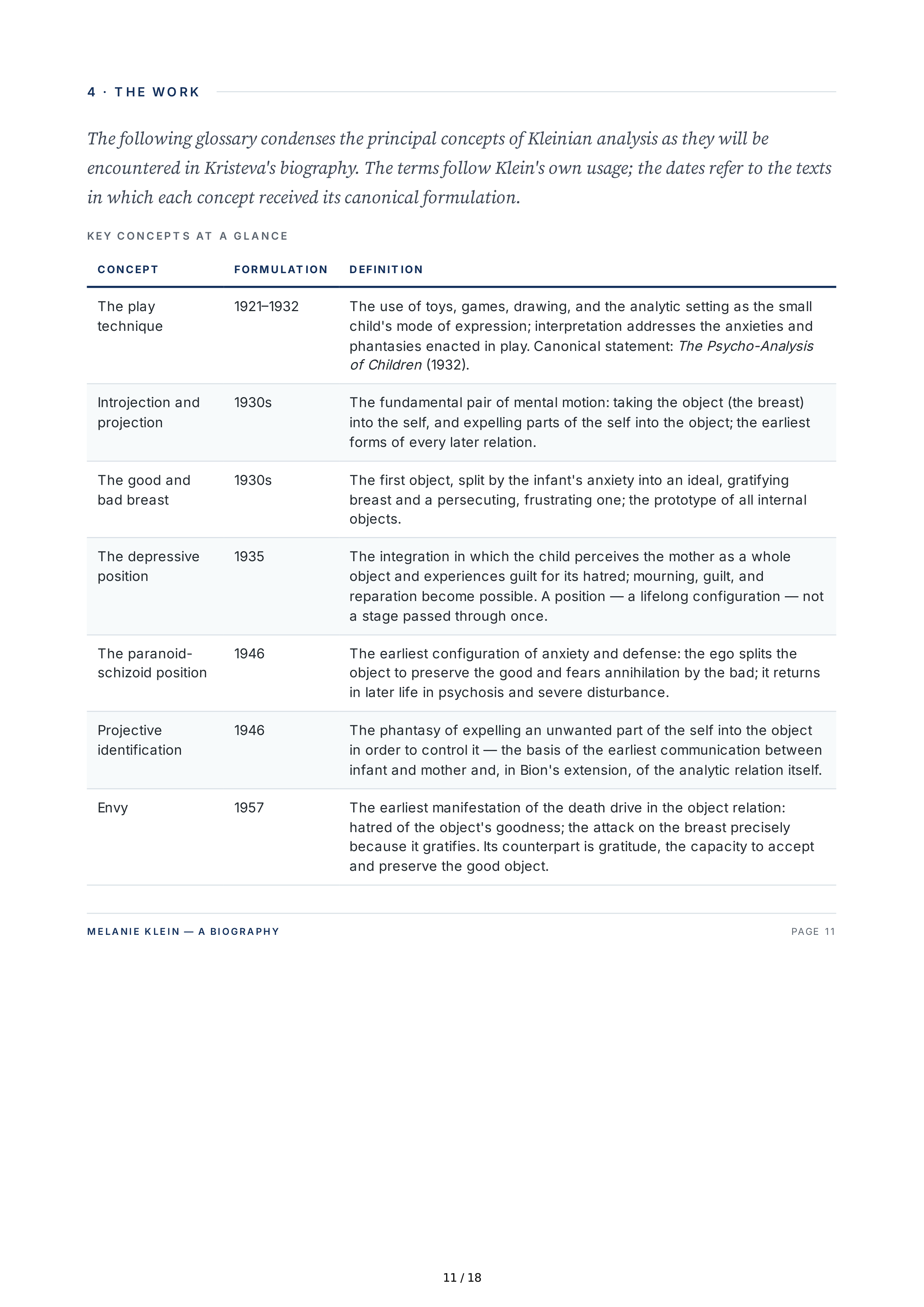
The following glossary condenses the principal concepts of Kleinian analysis as they will be
encountered in Kristeva's biography. The terms follow Klein's own usage; the dates refer to the texts
in which each concept received its canonical formulation.
KEY
C O N C EP T S
AT
A
G L A N C E
C ONC EP T
FORM U LAT ION
D EFINIT ION
The
play
technique
1921–1932
The
use
of
toys
,
games
,
drawing
,
and
the
analytic
setting
as
the
small
child
'
s
mode
of
expression
;
interpretation
addresses
the
anxieties
and
phantasies
enacted
in
play
.
Canonical
statement
:
The
Psycho
-
Analysis
of
Children
(1932).
Introjection
and
projection
1930
s
The
fundamental
pair
of
mental
motion
:
taking
the
object
(
the
breast
)
into
the
self
,
and
expelling
parts
of
the
self
into
the
object
;
the
earliest
forms
of
every
later
relation
.
The
good
and
bad
breast
1930
s
The
first
object
,
split
by
the
infant
'
s
anxiety
into
an
ideal
,
gratifying
breast
and
a
persecuting
,
frustrating
one
;
the
prototype
of
all
internal
objects
.
The
depressive
position
1935
The
integration
in
which
the
child
perceives
the
mother
as
a
whole
object
and
experiences
guilt
for
its
hatred
;
mourning
,
guilt
,
and
reparation
become
possible
.
A
position
—
a
lifelong
configuration
—
not
a
stage
passed
through
once
.
The
paranoid
-
schizoid
position
1946
The
earliest
configuration
of
anxiety
and
defense
:
the
ego
splits
the
object
to
preserve
the
good
and
fears
annihilation
by
the
bad
;
it
returns
in
later
life
in
psychosis
and
severe
disturbance
.
Projective
identification
1946
The
phantasy
of
expelling
an
unwanted
part
of
the
self
into
the
object
in
order
to
control
it
—
the
basis
of
the
earliest
communication
between
infant
and
mother
and
,
in
Bion
'
s
extension
,
of
the
analytic
relation
itself
.
Envy
1957
The
earliest
manifestation
of
the
death
drive
in
the
object
relation
:
hatred
of
the
object
'
s
goodness
;
the
attack
on
the
breast
precisely
because
it
gratifies
.
Its
counterpart
is
gratitude
,
the
capacity
to
accept
and
preserve
the
good
object
.
M E LA N I E
K LE I N
—
A
BI OG R A P H Y
PAGE
1 1
11 / 18
T H E
W O R K
·
C O N T I N U E D
4.1
The Play Technique
Klein's first discovery was methodological: the child's play is the child's language. Small toys,
water, pencil and paper, furniture arranged and rearranged — these are the child's free
associations, structured by the same anxieties, defenses, and unconscious wishes that
structure the adult's dream. The analyst does not explain the toys; the analyst interprets —
that is, says to the child what the play is expressing, in the conviction that a correct
interpretation reaches the anxiety itself and diminishes it.
From the method flowed the first radical conclusion: anxiety is the beginning of mental life.
The child's play is compulsive not because children are energetic but because their early
objects are terrifying; the manipulation of toy figures is at the same time a manipulation of
the internal objects — the images of the parents carried in the psyche — and a way of
mastering them. The corollary was that children can be analyzed directly: no need to await
the oedipal settling at seven years; the inner world is legible, and modifiable, from the
earliest months.
4.2
The Positions
Klein's second great departure was conceptual. Freud had described development as a
sequence of stages — oral, anal, phallic — governed by the vicissitudes of the libido. Klein
replaced the sequence with the position: a configuration of anxiety, defense, and object
relationship that returns throughout life. The paranoid-schizoid position, dominant in the
first months, is the siege state: the immature ego, under pressure of the death drive, splits
the object into the ideal good breast and the persecuting bad breast, and fears its own
annihilation. The passage to the depressive position, from the middle of the first year, is the
first integration: the mother is perceived as a whole person, both good and bad, loved and
hated; the child fears that its hatred has destroyed her, feels guilt, and begins to repair.
Everything that Kleinians value in culture followed from the depressive position: the capacity
to mourn, the creation of symbols, the sublimations of art and religion, the sense of oneself
as an agent who has injured and can restore. And everything melancholy — in Kristeva's
reading, everything melancholic — begins with its failure. The positions are not stages to be
passed; they are climates to which the psyche returns, and the adult retains the whole
weather of the first year.
M E LA N I E
K LE I N
—
A
BI OG R A P H Y
PAGE
1 2
12 / 18
T H E
W O R K
·
C O N T I N U E D
4.3
Projective Identification
Projective identification, introduced in "Notes on Some Schizoid Mechanisms" (1946), is Klein's
most influential and most misread concept. In its original sense it is a phantasy of the self:
the infant, overwhelmed by destructive impulses, imagines that it has expelled them,
together with a piece of itself, into the mother. What was unbearable is no longer inside; the
object is possessed by it; the infant controls the object from within. But Klein herself already
saw the communicative face of the mechanism, and her followers made it explicit: the
mother receives the infant's terror, contains it, and, ideally, gives it back transformed. Wilfred
Bion generalized the idea into the theory of the container and the contained — the model of
all thinking. Thinking begins when a mind, the mother's or the analyst's, metabolizes an
unbearable experience for another mind. The concept turned object relations from a static
map into a dynamic field, and it remains the Kleinian concept most productive outside
analysis: in developmental psychology, in group theory, and in literary accounts of the
reader's engagement with the text.
4.4
Envy and the Death Drive
Klein's last work,
Envy and Gratitude
(1957), is the most rigorous and the most somber of her
books. Freud had posited a death drive and left it as a speculative horizon. Klein gave it a
clinical address: envy, she argued, is the earliest manifestation of the death drive in the
object relation — an attack on the breast not because it frustrates but because it gratifies, a
hatred of goodness as such. The envious child, the envious patient, the envious culture
cannot keep the object, because keeping it would mean acknowledging that it is better than
the self. Gratitude, the capacity to accept and preserve the good object, is the countervailing
grace. The book was received with resistance even by admirers; its bleakness is real. But it is
the point at which Klein's own melancholy becomes a theory of the whole human condition —
and the fulcrum of Kristeva's reading.
M E LA N I E
K LE I N
—
A
BI OG R A P H Y
PAGE
1 3
13 / 18
5 ·
K R IS T EVA
'
S
K L EIN
5.1
Female Genius
Julia Kristeva (b. 1941, Sliven, Bulgaria) came to Paris in 1965, joined the avant-garde of the
Tel
Quel
group, and trained as an analyst. Her work —
Revolution in Poetic Language
(1974),
Tales of
Love
(1983),
Black Sun
(1987) — has made her the most influential theorist of what she calls the
semiotic: the preverbal, rhythmic, maternal dimension of language that underlies and
unsettles all symbolic order. In the trilogy
Female Genius: Life, Madness, Words
(1999–2002) she
asked a single question: what distinguishes the creative life of a woman? Her three subjects
answer with three genders of genius — Hannah Arendt, genius of action; Melanie Klein,
genius of the psyche's lowest depths; Colette, genius of the word and the body. The method is
neither biography nor hagiography: it is an attempt to hear, in a woman's life, the singular
rhythm by which suffering becomes work.
5.2
The Melancholic
Klein, for Kristeva, is the thinker of melancholy — not incidentally, not merely in her private
history, but at the core of her doctrine. Kristeva enumerates the losses that constituted
Klein's inner world: the sister Sidonie, dead in 1888, for whom the six-year-old told stories; the
mother Libussa, whose death in 1914 precipitated the analysis with Ferenczi; the father
Moriz; the husband Arthur; the son Hans, dead in the Alps at twenty-seven; and, most
unbearable, the daughter Melitta, estranged and hostile. From this ledger Klein built a
psychology in which loss is constitutive of the mind itself: the depressive position is precisely
the experience of the object lost and mourned, and every symbol, every love, every
reparative act is a retrieval of the object from death.
Kristeva does not pathologize her subject. On the contrary: the specificity of Klein's genius, in
this reading, is that she did not defend against grief by flight into theory, but let the theory be
cut from the grief. Klein's clinical prose is famously dry — no sensuality, no literary play, no
seduction of the reader, and Kristeva reads the dryness not as a defect of style but as the
rigor of the analyst who refuses to charm. She presents Klein as the analyst who took the
death drive into the clinic — who made the speculative horizon of Freud's late philosophy an
instrument for listening to a child's games. The melancholic genius is the one for whom the
object is always already lost and for whom, therefore, the work of reparation never ceases.
M E LA N I E
K LE I N
—
A
BI OG R A P H Y
PAGE
1 4
14 / 18
K R I S T E VA
'
S
K L E I N
·
C O N T I N U E D
5.3
The Maternal Semiotic
Klein's discovery, in Kristeva's sharpest formulation, is that the mother is the first object —
not merely the first love, but the first object of thought. The breast is the prototype of every
object: the good object to be held, the bad object to be expelled, the lost object to be mourned
and refound. And because the first relation is a relation to a body rather than to a person, the
whole of mental life is, at its root, a relation to the maternal body — of which the mother as a
whole person is the later, integrated version. Here Kristeva recognizes her own project. Her
concept of the semiotic chora, from
Revolution in Poetic Language
, names precisely this
preverbal, maternal ordering of drives and rhythms out of which the symbolic order of
language is cut, and into which it constantly relapses: in poetry, in music, in love, in
psychosis. Klein's internal objects are the clinical shadow of the chora; the breast Klein
describes is the chora under the name of an object.
There is, however, a difference, and Kristeva measures it carefully. The chora is a disposition
of the speaking being; Klein's topography is mute. Klein's mother is a body of good and bad
part-objects before she is a person; what never appears in Klein, for Kristeva, is the mother
as a source of address — the one who calls the child into speech. Klein's universe is dyadic:
two bodies, one breast, one phantasy. The semiotic requires the third — the paternal function,
the symbolic order — to be cut into language. The whole of Kristeva's reading is organized
around this double gesture: gratitude for the discovery of the maternal abyss, and insistence
on the necessity of a third party to structure and deliver it.
5.4
The Heretic
What fascinates Kristeva most, one senses, is Klein's insubordination. Klein disobeyed every
rule of the institution that housed her: she analyzed children below the canonical age; she
analyzed her own children; she took the mother, not the father, as the center of psychic life;
she confronted Freud's daughter in public debate and refused the compromise that would
have saved her comfort; she treated the death drive, Freud's dark postulate, as a fact of
clinical observation. Kristeva — a Bulgarian stranger in French letters, a woman in the
Lacanian citadel, a heretic of the Left — writes with evident recognition. In her vocabulary,
the woman who makes a creative destiny out of the maternal has the shape of a heretic, and
she has coined a word for the ethics such a woman practices: herethics. Klein is its clinical
instance — an ethic founded not on the Father's law but on the abject's transformation into
meaning.
M E LA N I E
K LE I N
—
A
BI OG R A P H Y
PAGE
1 5
15 / 18
K R I S T E VA
'
S
K L E I N
·
C O N T I N U E D
5.5
The Third Party
The critique, if it can be called that, is precise. Klein's later years gave an increasing place to
the father — but to a father of abstraction, the father of individual prehistory who functions
in the infant's phantasy as a symbolic guarantee of the mother's otherness. What Klein never
supplied, and what Kristeva's own theory insists upon, is a full account of the third: the
symbolic order, the paternal metaphor, the relation of speech itself. The depressive position,
in Kristeva's reading, is not the terminus of psychic life but its threshold. The child must not
only repair the object but also leave it — transfer the object into the order of signs, love, and
thought. This is why Klein's own discourse, so austere, so present, never gives the impression
of a woman at home in language. The work of mourning is also the work of metaphor; the
object recovered is an object transformed.
At bottom, Kristeva reads Klein as a limit and a gift. A limit, because the dyadic world is a
world without speech; a gift, because no one had described the world before speech with
such truth. The analytic cure, as Kristeva conceives it, is the passage from the world Klein
named to the world of the symbolic — from the breast to the word. In her account of the
transference, the analyst must be able to be the mother-container, the Kleinian analyst, and
also the one who speaks the interpretation, the Freudian and Lacanian analyst. The
difference between melancholy and mourning, for Kristeva, is the whole difference: the first
repeats the loss, the second transforms it into meaning.
6 ·
A F T ER WO R D
:
K L EIN
A F T ER
K L EIN
The history of analysis after 1960 is largely the history of Klein's concepts traveling beyond
her school. Wilfred Bion generalized projective identification into the theory of container and
contained — the model of thinking itself; Hanna Segal made the depressive position the basis
of an aesthetics; Donald Winnicott, while refusing the label, absorbed her early object
relations into his developmental account of the good enough mother. In Buenos Aires,
Enrique Pichon-Rivière and the generation of the Argentine Psychoanalytic Association made
the city the most Kleinian in the world. In the contemporary clinic, mother–infant
observation and the developmental laboratories have confirmed, under a different
vocabulary, her fundamental insight: the first year is the scene of everything.
In the English-speaking academy, the transmission of Klein has largely passed through the
text to which this companion is devoted. Columbia University Press, which had published the
English translations of Kristeva's
Revolution in Poetic Language
and
Black Sun
, issued the
second volume of
Female Genius
in Ross Guberman's translation in 2001, in the series
European Perspectives edited by Lawrence D. Kritzman. It is fitting that a reading companion
16 / 18

prepared in New York should end where the printed volume begins: with the biography of the
woman who taught analysis to hear, beneath all speech, the earliest music of the mother.
M E LA N I E
K LE I N
—
A
BI OG R A P H Y
PAGE
1 6
17 / 18
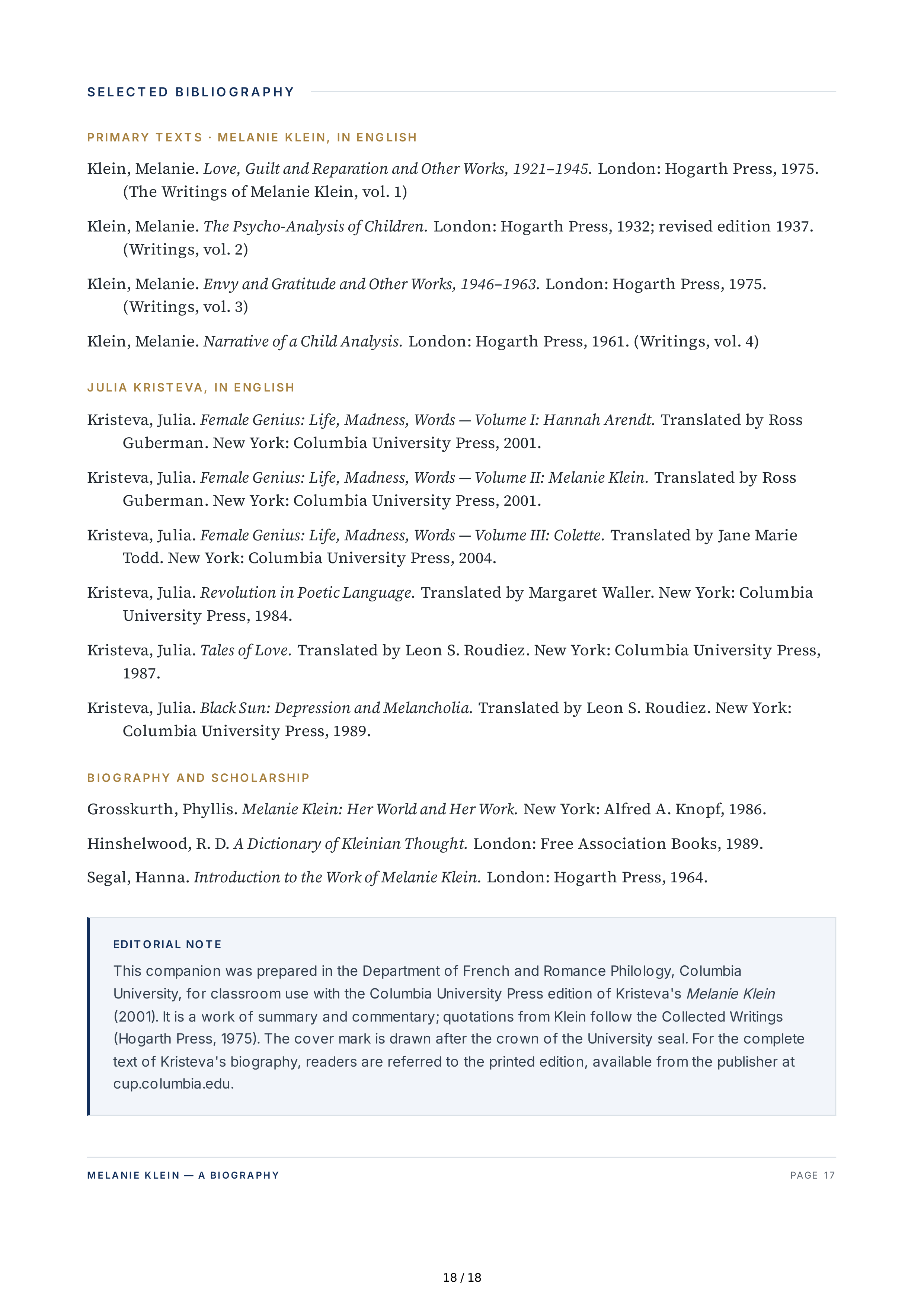
S EL EC T ED
B IB L IO G R A P H Y
PRIMARY
T E XT S
·
ME LANIE
K LE IN
,
IN
E NG LISH
Klein, Melanie.
Love, Guilt and Reparation and Other Works, 1921–1945.
London: Hogarth Press, 1975.
(The Writings of Melanie Klein, vol. 1)
Klein, Melanie.
The Psycho-Analysis of Children.
London: Hogarth Press, 1932; revised edition 1937.
(Writings, vol. 2)
Klein, Melanie.
Envy and Gratitude and Other Works, 1946–1963.
London: Hogarth Press, 1975.
(Writings, vol. 3)
Klein, Melanie.
Narrative of a Child Analysis.
London: Hogarth Press, 1961. (Writings, vol. 4)
J ULIA
K RIST E VA
,
IN
E NG LISH
Kristeva, Julia.
Female Genius: Life, Madness, Words — Volume I: Hannah Arendt.
Translated by Ross
Guberman. New York: Columbia University Press, 2001.
Kristeva, Julia.
Female Genius: Life, Madness, Words — Volume II: Melanie Klein.
Translated by Ross
Guberman. New York: Columbia University Press, 2001.
Kristeva, Julia.
Female Genius: Life, Madness, Words — Volume III: Colette.
Translated by Jane Marie
Todd. New York: Columbia University Press, 2004.
Kristeva, Julia.
Revolution in Poetic Language.
Translated by Margaret Waller. New York: Columbia
University Press, 1984.
Kristeva, Julia.
Tales of Love.
Translated by Leon S. Roudiez. New York: Columbia University Press,
1987.
Kristeva, Julia.
Black Sun: Depression and Melancholia.
Translated by Leon S. Roudiez. New York:
Columbia University Press, 1989.
B IO G RAPHY
AND
SCHO LARSHIP
Grosskurth, Phyllis.
Melanie Klein: Her World and Her Work.
New York: Alfred A. Knopf, 1986.
Hinshelwood, R. D.
A Dictionary of Kleinian Thought.
London: Free Association Books, 1989.
Segal, Hanna.
Introduction to the Work of Melanie Klein.
London: Hogarth Press, 1964.
EDIT O RIAL
NO T E
This
companion
was
prepared
in
the
Department
of
French
and
Romance
Philology
,
Columbia
University
,
for
classroom
use
with
the
Columbia
University
Press
edition
of
Kristeva
'
s
Melanie
Klein
(2001).
It
is
a
work
of
summary
and
commentary
;
quotations
from
Klein
follow
the
Collected
Writings
(
Hogarth
Press
, 1975).
The
cover
mark
is
drawn
after
the
crown
of
the
University
seal
.
For
the
complete
text
of
Kristeva
'
s
biography
,
readers
are
referred
to
the
printed
edition
,
available
from
the
publisher
at
cup
.
columbia
.
edu
.
M E LA N I E
K LE I N
—
A
BI OG R A P H Y
PAGE
1 7
18 / 18