
A
N
O
R
I
G
I
N
A
L
B
I
O
G
R
A
P
H
Y
STANFORD
UNIVERSITY
YOUNG
KING
The Making of Martin Luther King Jr.
A
B
I
O
G
R
A
P
H
Y
·
C
O
M
P
L
E
T
E
&
U
N
A
B
R
I
D
G
E
D
1 / 29
S T A
N F O
R D
U N I V
E
R S I T
Y
Y
O
U N G
K
I N G
THE
MAKING
OF
MARTIN
LUTHER
KING
JR
.
A Biography
W I T
H
A
F O R E W O R D
O N
Y O U T
H
,
F O R M AT
I O N
,
A N D
T
H E
G AT
H E R I N G
S T
O R M
FIR S T
ED IT IO N
·
M M XXVI
2 / 29
A
N O T
E
T
O
T
H E
R
E A D E R
This volume is an independent, original biography of Martin Luther King Jr., written from public
records, published archival collections, and the scholarly record. It is not an official publication of
the estate of Martin Luther King Jr., of the King Center, or of Stanford University.
The title honors a landmark of historical research: the Martin Luther King, Jr. Papers Project,
established at Stanford University in 1985 under the editorship of historian Clayborne Carson. The
great documentary editions produced by that project — beginning with the volumes devoted to
King’s student years — opened the inner life of the young man before the world knew his name. The
present biography builds on that opening.
Quotations from King’s speeches and writings are brief, are drawn from the historical record, and are
included for their documentary value; all narrative prose is original to this book.
3 / 29

For the young in every generation
who ask the questions this book asks —
what is worth believing, whom will I serve,
and what does the dream require of me?
4 / 29
C
O N T
E N T
S
01
Introduction
—
Why
the
Young
King
Matters
P A R T
O N E
·
F O R M AT
I O N
01
A
House
on
Auburn
Avenue
, 1929–1944
02
Morehouse
and
the
Making
of
a
Minister
, 1944–1948
03
Crozer
,
Boston
,
and
Coretta
, 1948–1954
P A R T
T
W O
·
T
H E
P U B L I C
Y E A R S
01
Montgomery
, 1955:
The
Bus
Boycott
02
The
Philosophy
of
Nonviolence
, 1957–1962
03
Birmingham
and
the
Letter
, 1963
04
The
March
on
Washington
, 1963
05
Nobel
,
Selma
,
and
the
Voting
Rights
Act
, 1964–1965
06
The
Harder
Questions
:
Chicago
,
Vietnam
,
and
Poverty
, 1966–1968
07
Memphis
and
the
Mountaintop
, 1968
P A R T
T
H R E E
·
A F T
E R WA R D
01
Legacy
:
A
Day
,
a
Memorial
,
a
Continuing
March
A P P E N D I X E S
01
Appendix
A
—
Chronological
Timeline
02
Appendix
B
—
Major
Achievements
03
Appendix
C
—
Awards
and
Honors
04
Appendix
D
—
Selected
Works
05
Sources
and
Further
Reading
5 / 29
E
I
N
T
R
O
D
U
C
T
I
O
N
Why
the
Young
King
Matters
Beginnings in Atlanta · Formation before fame
very public life has a private beginning, and the story of Martin Luther King Jr. is usually told as a
story of marches and platforms — Montgomery, Birmingham, Washington, Memphis. Those
moments deserve their place in history, and they will have it in the pages that follow. But the man
who stood on those platforms was assembled long before the cameras arrived. He was shaped on
Auburn Avenue, in a neighborhood famous for its optimism, in a church his grandfather had built and
his father had inherited, and in libraries where a student wrestled with questions that most young men
his age never thought to ask.
This biography is called
The Making of Martin Luther King Jr.
, and its central conviction is simple: the
movement made the leader, and the leader was made before the movement began. The title also carries
a deliberate nod to a landmark scholarly effort — the Martin Luther King, Jr. Papers Project, founded at
Stanford University in 1985 and led for decades by the historian Clayborne Carson. The Stanford editors
gathered thousands of King’s letters, sermons, essays, and student papers, and devoted their earliest
published volumes to the figure they called the “young King”: the Morehouse sophomore, the Crozer
seminarian, the Boston doctoral candidate. Those volumes changed the way historians understood
King, because they revealed how much of his later genius was, in fact, preparation.
The chapters that follow move through the life in order. The first half of the book lingers on formation
— family, faith, schooling, marriage, and the intellectual pilgrimages that turned a gifted young
minister into a movement theorist as much as a movement speaker. The second half follows the public
career: the Montgomery bus boycott that made him famous; the Southern Christian Leadership
Conference he helped to found; the hard campaigns in Birmingham and Selma; the Nobel Peace Prize;
the widening of his agenda to poverty and war; and the final stand among striking sanitation workers
in Memphis.
A set of appendixes gathers the record of that life in compact form — a full chronology, a roster of
achievements, a list of honors, and a guide to his published writings — so that the book may serve
equally as biography and as reference.
One caution belongs at the outset. Martin Luther King Jr. has become, in the years since 1968, a familiar
statue: a phrase quoted on a holiday, a face on a street sign, a paragraph in a history textbook. The aim
of this book is to restore motion to that statue. Here is a young man asking hard questions, changing
his mind, doubting, growing, and being changed by the very people he set out to lead. Some of the
material in the chapters that follow — his early doubts, his missteps, his private struggles — is less
familiar than the speeches. It is included because the making of a leader is rarely neat, and because the
historical record is more honest, and more useful, when it is complete.
6 / 29
M
C
H
A
P
T
E
R
O
N
E
·
P
A
R
T
O
N
E
A
House
on
Auburn
Avenue
Atlanta, Georgia · 1929–1944
artin Luther King Jr. was born on January 15, 1929, in a solid two-story house at 501 Auburn
Avenue in Atlanta — the second child and first son of the Reverend Michael King and his wife,
Alberta Williams King. He was named after his father at birth. It was only in 1934, after the elder
King returned from a trip to Europe that had taken him to the memorial sites of the Protestant
Reformation, that the family’s names were changed, father and son alike, to honor the sixteenth-
century reformer Martin Luther.
Auburn Avenue was not simply where the Kings lived; it was a world. By the 1920s the street had grown
into the commercial and spiritual heart of Black Atlanta — so prosperous and so self-contained that
residents called it “Sweet Auburn.” Black-owned banks, insurance companies, newspapers, and funeral
homes lined the avenue, and Ebenezer Baptist Church, pastored for a generation by King’s maternal
grandfather, the Reverend A. D. Williams, anchored the street spiritually. The boy who grew up there
learned early that Black life was not defined by the limits white Atlanta imposed on it.
The limits existed, of course. They were everywhere: the separate schools, the locked lunch counters
downtown, the streetcars on which a black child could ride but was expected to surrender his seat. King
later said he could not remember a time when the fact of segregation was not present to him. Once,
walking with his father to a downtown shoe store, he watched the clerk refuse to serve them at the
whites-only counter, and he remembered his father’s response — not submission, but a firm hand on
his son’s shoulder and the two of them marching out of the store into the street. It was an early lesson in
a family tradition of standing rather than shrinking.
The household that raised him was strict, loving, and musical. Alberta Williams King had studied at
Spelman College and Hampton Institute, directed the Ebenezer choir, and taught her children hymns
almost before they could read. Martin’s sister Christine and younger brother A. D. completed a
childhood that was by most measures secure. The senior King — known to all as “Daddy King” — was a
formidable presence: an exacting preacher, a strict parent, and a man who did not allow the word
“can’t” in his house.
The shadow fell in 1941, when Martin’s grandmother, Jennie Celeste Williams, died of a heart attack. She
had been, in the boy’s memory, the most deeply loved figure of his childhood, and the grief unhinged
him. At the family’s account, the twelve-year-old threw himself from a second-story window of the
house in the aftermath of her death, and on another occasion tried again to end his life. Both attempts
were understood afterward as a child’s desperate effort to escape a loss too large to hold. King would
speak of the incident with surprising candor in later years, as evidence of both his fragility and his
capacity to recover — a memory he carried even to the steps of the Lincoln Memorial.
7 / 29

By the time he was fifteen, King had skipped two grades, a habit he would explain with the modesty of a
man who knew he was quick but not omniscient. He graduated from Booker T. Washington High
School in 1944 without a formal diploma ceremony and, in the fall of that year, entered Morehouse
College — the all-male Atlanta institution that counted his father, his grandfather, and his maternal
great-grandfather among its graduates. He arrived uncertain what he believed, but certain that the
world required something of him. He was fifteen years old.
8 / 29
M
C
H
A
P
T
E
R
T
W O
·
P
A
R
T
O
N
E
Morehouse
and
the
Making
of
a
Minister
Atlanta, Georgia · 1944–1948
orehouse College in the 1940s was a demanding, self-conscious institution with a motto that its
students were made to repeat:
et facta est lux
— and there was light. Under President Benjamin E.
Mays, a Baptist minister and a scholar of formidable learning, Morehouse set out to produce not
merely graduates but leaders. Mays preached in chapel sermons that students remembered for the rest
of their lives, and he took it for granted that faith and scholarship belonged together — that a Black
man’s mind was a weapon against racism, and that no education was complete that stopped at the
borders of the intellect.
King arrived intent, at first, on medicine or law. His father hoped for the ministry, but the son resisted.
Through his first years at Morehouse he drifted through courses in sociology and literature, reading
widely and doubting steadily. The religion he had inherited felt like a garment that did not quite fit: he
later described his adolescent self as a skeptic, skirting the edge of agnosticism, unimpressed by the
emotionalism of revival meetings and unpersuaded that the pulpit was a place where an educated man
could do serious work.
The change came gradually, and King described it as a quiet surrender rather than a dramatic
conversion. In his junior year he concluded that the church offered the best avenue for service of the
kind he had come to believe mattered most — the lifting of people, the healing of the race, the making
of justice. He would later put it plainly: it was in his senior year at Morehouse that religion became
intellectually respectable for him, and the ministry became the natural expression of a life devoted to
social change.
He was ordained in February 1948 at Ebenezer Baptist Church, where his father presided and where his
grandfather had once declared from the pulpit that no Negro could be a Christian without being a
militant. A few months later he graduated from Morehouse with a bachelor’s degree in sociology,
delivered the class oration, and left Atlanta with his sights set on Crozer Theological Seminary, a
predominantly white seminary in Chester, Pennsylvania, where he had been offered a scholarship.
He was nineteen years old, and the making was only beginning. But the essential shape of the man was
already visible: the discipline of the Morehouse sermon tradition, the social urgency of Mays’s chapel,
the conviction that the gospel had something to do with the street, and the quiet intellectual
restlessness that would never quite leave him.
9 / 29
C
C
H
A
P
T
E
R
T
H
R
E
E
·
P
A
R
T
O
N
E
Crozer
,
Boston
,
and
Coretta
Chester, Pennsylvania · Boston, Massachusetts · 1948–1954
rozer Theological Seminary was a small, liberal institution, and King was one of only a handful of
Black students on its campus. He arrived in the autumn of 1948 with fourteen dollars in his
pocket and a determination to prove that a Black man could excel in a white institution. He did.
He was elected student body president, won the school’s most prestigious speaking prize, and
graduated in 1951 as valedictorian of his class.
More important than the honors was the encounter with ideas. At Crozer, King read Henry David
Thoreau’s essay on civil disobedience, which planted a seed he would water for the rest of his life. He
read the social gospel of Walter Rauschenbusch, which insisted that sin had social dimensions and that
the church belonged at the side of the poor. And he was introduced — through lectures, and through
Howard Thurman’s 1949 book
Jesus and the Disinherited
— to the philosophy and practice of Mahatma
Gandhi. Thurman had traveled to India and met Gandhi in 1936, and his book asked a question that
would define King’s career: what did the gospel have to say to people who were poor, and black, and
disenfranchised?
From Crozer, King moved north to Boston University’s Graduate School of Theology, drawn by the
school’s tradition of Personalism — the conviction that reality is finally personal, and that every human
being is therefore of infinite worth. Under Edgar S. Brightman and L. Harold DeWolf he immersed
himself in systematic theology, writing his doctoral dissertation on the concepts of God in the thought
of Paul Tillich and Henry Nelson Wieman. The doctorate was awarded in 1955, and with it came the title
that the young minister would carry for the rest of his days: the Reverend Doctor Martin Luther King Jr.
Boston was also where he met Coretta Scott. She was a singer and a serious student of music at the New
England Conservatory, a young woman from Marion, Alabama, who had come north determined to
make a life in the arts. King pursued her with an intensity that she found almost comic — he proposed
within weeks of their first meeting, and she told him she would think about it. They were married on
June 18, 1953, on the lawn of her family’s home in Marion, her father officiating and her mother at the
piano.
Coretta would become far more than a minister’s wife. She was politically aware, intellectually
engaged, and quietly radical in her own commitments; she had already decided before her marriage
that she wanted a marriage of equals, and she would spend the next fifteen years building that
partnership in public view. Her later role as the keeper of her husband’s memory — establishing the
King Center, securing the federal holiday, and protecting his papers — makes her one of the most
consequential figures in the story of the movement.
10 / 29

Meanwhile, in Montgomery, Alabama, the pulpit committee of Dexter Avenue Baptist Church had been
seeking a new minister. Dexter was an educated, politically alert congregation, and its leaders wanted a
young preacher with strong academic credentials. King, at twenty-five, with a new doctorate and a new
wife, accepted the call. He began his ministry at Dexter in the autumn of 1954, standing in a pulpit on a
hill one block from the Alabama State Capitol — in a city whose buses, within fourteen months, would
make him famous.
11 / 29
O
C
H
A
P
T
E
R
F
O
U
R
·
P
A
R
T
T
W O
Montgomery
, 1955:
The
Bus
Boycott
Montgomery, Alabama · December 1955 – December 1956
n the evening of Thursday, December 1, 1955, Rosa Parks — a forty-two-year-old seamstress, a
trained civil rights organizer, and the secretary of the Montgomery branch of the NAACP —
refused to give up her seat on a segregated city bus to a white passenger. She was arrested. That
night, a small circle of Black women activists and ministers began telephoning one another with a
plan: a one-day boycott of the buses, timed to coincide with Parks’s trial on the following Monday.
They needed a spokesman. The leaders of Montgomery’s Black community chose the young minister of
Dexter Avenue — partly because he was new to the city and unentangled in its factional rivalries, partly
because his formal education recommended him. King accepted with hesitation, and the decision
changed the course of his life.
On Monday, December 5, the Black community of Montgomery stayed off the buses. That afternoon, at
the Holt Street Baptist Church, an overflow crowd heard King deliver his first great movement speech —
a sermon woven from Scripture and the sharp insistence that the struggle would not end until justice
was done. That evening, the assembled leadership formed the Montgomery Improvement Association
and elected King its president. The one-day protest became a stand.
For 381 days the buses rolled nearly empty through the streets of Montgomery while the Black
community organized carpools, walked miles to work, and absorbed relentless harassment. King was
arrested on a trumped-up traffic charge. On January 30, 1956, his home was bombed while Coretta and
their infant daughter Yolanda were inside; both were unhurt. Standing on the porch in the cold among
a crowd of hundreds who had gathered, armed and angry, King told them to put away their weapons, to
go home, and to trust in the way of nonviolence.
The federal courts finally settled what the city would not. On November 13, 1956, the Supreme Court
affirmed a lower court ruling that racial segregation on Montgomery’s buses violated the Fourteenth
Amendment. On December 20, a little more than a year after Rosa Parks’s arrest, the buses of
Montgomery carried Black passengers once more — and King, at twenty-seven, rode in the front seat of
the first integrated bus, his friend Ralph Abernathy beside him.
“We discovered that we could stick together for a common cause.”
The boycott was more than a legal victory; it was a revelation. An entire community had been
disciplined, nonviolent, and immovable for more than a year, and it had won. The young minister who
had inherited the movement by accident had emerged from it as a leader of national stature — and, in
his own mind, as a disciple of a philosophy he had only begun to understand.
12 / 29
M
C
H
A
P
T
E
R
F
I
V
E
·
P
A
R
T
T
W O
The
Philosophy
of
Nonviolence
The SCLC · India · Sit-ins and Freedom Rides · 1957–1962
ontgomery made King famous, and the question that followed was what to do with the fame. In
January 1957, he joined with other southern ministers — including Ralph Abernathy, Fred
Shuttlesworth, and C. K. Steele — to found the Southern Christian Leadership Conference (SCLC),
a coalition of churches and community organizations committed to what the members called the
social gospel and to disciplined nonviolent action. King was elected its president, and the SCLC would
remain the vehicle of his public life for the rest of his career.
In 1958 he published
Stride Toward Freedom
, his account of the Montgomery boycott — the first of several
books in which he would both make history and interpret it. The book sold steadily, and while signing
copies in a Harlem department store in September 1958, King was stabbed by a woman who had
approached with a letter opener. The blade grazed his aorta; surgeons at Harlem Hospital removed it,
and King, who understood how close he had come to death, sent word to the nation that he bore the
woman no ill will.
In 1959 he accepted an invitation to India, spending a month studying Gandhi’s legacy with Indian
leaders and emerging with his own understanding deepened. Gandhi’s method — satyagraha, or truth-
force — was, King concluded, applicable to the American struggle, provided it was rooted in the
Christian love he called
agape
: an unconditional goodwill toward the opponent that refused to
humiliate or eliminate him. This fusion of Jesus and Gandhi, of Sermon on the Mount and Salt March,
was King’s distinctive intellectual contribution, and he would spend the rest of his life testing it in the
streets.
The movement the SCLC hoped to coordinate emerged independently of it. On February 1, 1960, four
students at North Carolina A&T College sat down at a whites-only lunch counter in Greensboro and
refused to leave. Within weeks the sit-in movement had spread across the South, and the Student
Nonviolent Coordinating Committee (SNCC) was born to organize the students’ courage. King
supported the students, was arrested beside them in Atlanta in October 1960 on a trumped-up charge of
violating probation, and was released after an intervention that brought a sympathetic word from
presidential candidate John F. Kennedy — a phone call to Coretta King that helped deliver the Black vote
in November’s razor-thin election.
Victory, however, was not automatic. The 1961 Freedom Rides, organized to test court-ordered
integration of interstate buses, met fire and clubs in Anniston and Birmingham. And in 1962, the SCLC’s
campaign in Albany, Georgia, ended in defeat — the city’s police chief jailing demonstrators by the
hundreds with cool efficiency and refusing to provide the spectacle of violence the movement needed
to rouse the nation. King left Albany with a hard lesson: a campaign must be built around a goal that
13 / 29

produces visible conflict, or the drama of conscience never reaches the wider world. Birmingham
would be the test of that lesson.
14 / 29
B
C
H
A
P
T
E
R
S
I
X
·
P
A
R
T
T
W O
Birmingham
and
the
Letter
Birmingham, Alabama · April–May 1963
irmingham, in the spring of 1963, was the most thoroughly segregated city in the United States —
a place its own Black residents called “Bombingham,” for the frequency with which homes and
churches were dynamited. There, in April, the SCLC and the Alabama Christian Movement for
Human Rights launched a campaign with a code name:
Project C
, for confrontation. The goals were
specific and achievable — desegregation of downtown stores, fair hiring practices, and the creation of a
biracial committee — and the method was daily nonviolent demonstration designed to fill the city’s
jails.
On April 12, Good Friday, King was arrested and placed in solitary confinement. The city’s hope was that
he would simply disappear for a few days. Instead, on scraps of paper smuggled out by his attorneys,
King composed the most important document of the civil rights movement in his own hand: the
Letter
from Birmingham Jail
.
“Injustice anywhere is a threat to justice everywhere.”
The letter was addressed to eight white Alabama clergymen who had published a statement urging the
movement to slow down and wait. King answered them as a brother in ministry: not with resentment
but with theology. Wait is almost never, he argued; justice too long delayed is justice denied. An unjust
law is no law at all, and a man who breaks an unjust law openly, lovingly, and in the willing acceptance
of the penalty demonstrates the highest respect for law. The letter elevated the campaign from a local
dispute to a moral argument for the ages.
The climax came in May. When adult volunteers grew scarce, the movement turned to the young —
more than a thousand Black schoolchildren marched from the Sixteenth Street Baptist Church into the
arms of police Chief Bull Connor’s men, who answered with fire hoses powerful enough to strip bark
from trees and police dogs held on short leashes. Television cameras captured it all, and the images of
children thrown against walls by jets of water shifted the conscience of the country as no speech had
done.
Within weeks, Birmingham’s white leadership agreed to desegregate downtown counters and hiring.
The victory had consequences beyond the city. On June 11, President Kennedy addressed the nation,
declaring civil rights a moral issue and proposing a comprehensive federal bill. That same night,
Medgar Evers, the field secretary of the NAACP in Mississippi, was assassinated outside his home in
Jackson. The movement was winning — at a cost measured in blood.
15 / 29
T
C
H
A
P
T
E
R
S
E
V
E
N
·
P
A
R
T
T
W O
The
March
on
Washington
Washington, D.C. · August 28, 1963
he March on Washington for Jobs and Freedom, held on August 28, 1963, brought roughly a
quarter of a million people to the National Mall — at the time the largest public demonstration in
American history. They came by bus and train from every region of the country, Black and white
together, ministers and union members, students and grandmothers, and they assembled before the
Lincoln Memorial in a mood that was less a rally than a pilgrimage.
The day belonged to many speakers, but it belonged, in the end, to one. King was the final orator on the
program, and for most of his prepared remarks he delivered what his advisors had written — a careful
address on the promissory note of American democracy that had been returned marked “insufficient
funds.” It was strong and it was finished, and the crowd was satisfied.
What happened next was not in the text. The gospel singer Mahalia Jackson, standing near the platform,
called out to him: “Tell them about the dream, Martin.” King paused, stepped away from the
manuscript, and began to preach.
“I have a dream that my four little children will one day live in a nation where they will
not be judged by the color of their skin but by the content of their character.”
For the next sixteen minutes he described that dream in language that fused the Hebrew prophets, the
American founding, and the spirituals of the enslaved. He dreamed that the sons of former slaves and
the sons of former slave owners would sit down together at the table of brotherhood. He dreamed that
the rough places would be made plain and the crooked places straight. He dreamed that one day, on the
red hills of Georgia, the sons of former slaves would join the sons of former slave owners. And in the
final cadence, borrowing the words of a patriotic anthem, he declared that the day would come when
all of God’s children — Black and white, Jew and Gentile, Protestant and Catholic — would join hands
and sing:
Free at last, free at last, thank God Almighty, we are free at last.
Time
magazine named King its Man of the Year for 1963. President Kennedy invited him to the White
House. The moral authority the march established did not by itself pass a single law, but it created the
atmosphere in which law became possible. Less than a year later, the Civil Rights Act of 1964 —
outlawing segregation in public accommodations and discrimination in employment — was signed
into law with King standing in the crowd behind the president.
16 / 29
O
C
H
A
P
T
E
R
E
I
G
H
T
·
P
A
R
T
T
W O
Nobel
,
Selma
,
and
the
Voting
Rights
Act
1964–1965
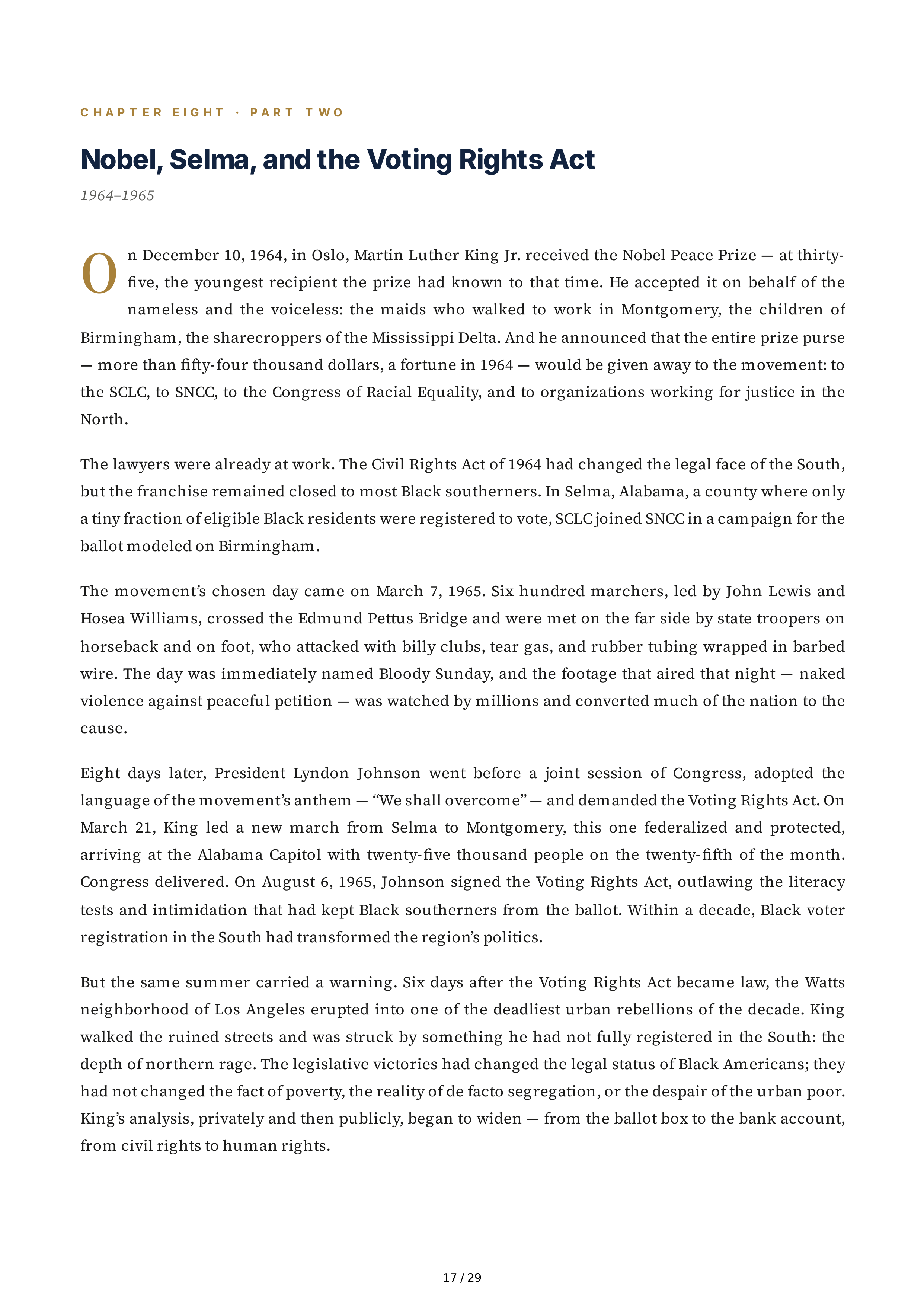
n December 10, 1964, in Oslo, Martin Luther King Jr. received the Nobel Peace Prize — at thirty-
five, the youngest recipient the prize had known to that time. He accepted it on behalf of the
nameless and the voiceless: the maids who walked to work in Montgomery, the children of
Birmingham, the sharecroppers of the Mississippi Delta. And he announced that the entire prize purse
— more than fifty-four thousand dollars, a fortune in 1964 — would be given away to the movement: to
the SCLC, to SNCC, to the Congress of Racial Equality, and to organizations working for justice in the
North.
The lawyers were already at work. The Civil Rights Act of 1964 had changed the legal face of the South,
but the franchise remained closed to most Black southerners. In Selma, Alabama, a county where only
a tiny fraction of eligible Black residents were registered to vote, SCLC joined SNCC in a campaign for the
ballot modeled on Birmingham.
The movement’s chosen day came on March 7, 1965. Six hundred marchers, led by John Lewis and
Hosea Williams, crossed the Edmund Pettus Bridge and were met on the far side by state troopers on
horseback and on foot, who attacked with billy clubs, tear gas, and rubber tubing wrapped in barbed
wire. The day was immediately named Bloody Sunday, and the footage that aired that night — naked
violence against peaceful petition — was watched by millions and converted much of the nation to the
cause.
Eight days later, President Lyndon Johnson went before a joint session of Congress, adopted the
language of the movement’s anthem — “We shall overcome” — and demanded the Voting Rights Act. On
March 21, King led a new march from Selma to Montgomery, this one federalized and protected,
arriving at the Alabama Capitol with twenty-five thousand people on the twenty-fifth of the month.
Congress delivered. On August 6, 1965, Johnson signed the Voting Rights Act, outlawing the literacy
tests and intimidation that had kept Black southerners from the ballot. Within a decade, Black voter
registration in the South had transformed the region’s politics.
But the same summer carried a warning. Six days after the Voting Rights Act became law, the Watts
neighborhood of Los Angeles erupted into one of the deadliest urban rebellions of the decade. King
walked the ruined streets and was struck by something he had not fully registered in the South: the
depth of northern rage. The legislative victories had changed the legal status of Black Americans; they
had not changed the fact of poverty, the reality of de facto segregation, or the despair of the urban poor.
King’s analysis, privately and then publicly, began to widen — from the ballot box to the bank account,
from civil rights to human rights.
17 / 29
I
C
H
A
P
T
E
R
N
I
N
E
·
P
A
R
T
T
W O
The
Harder
Questions
:
Chicago
,
Vietnam
,
and
Poverty
1966–1968
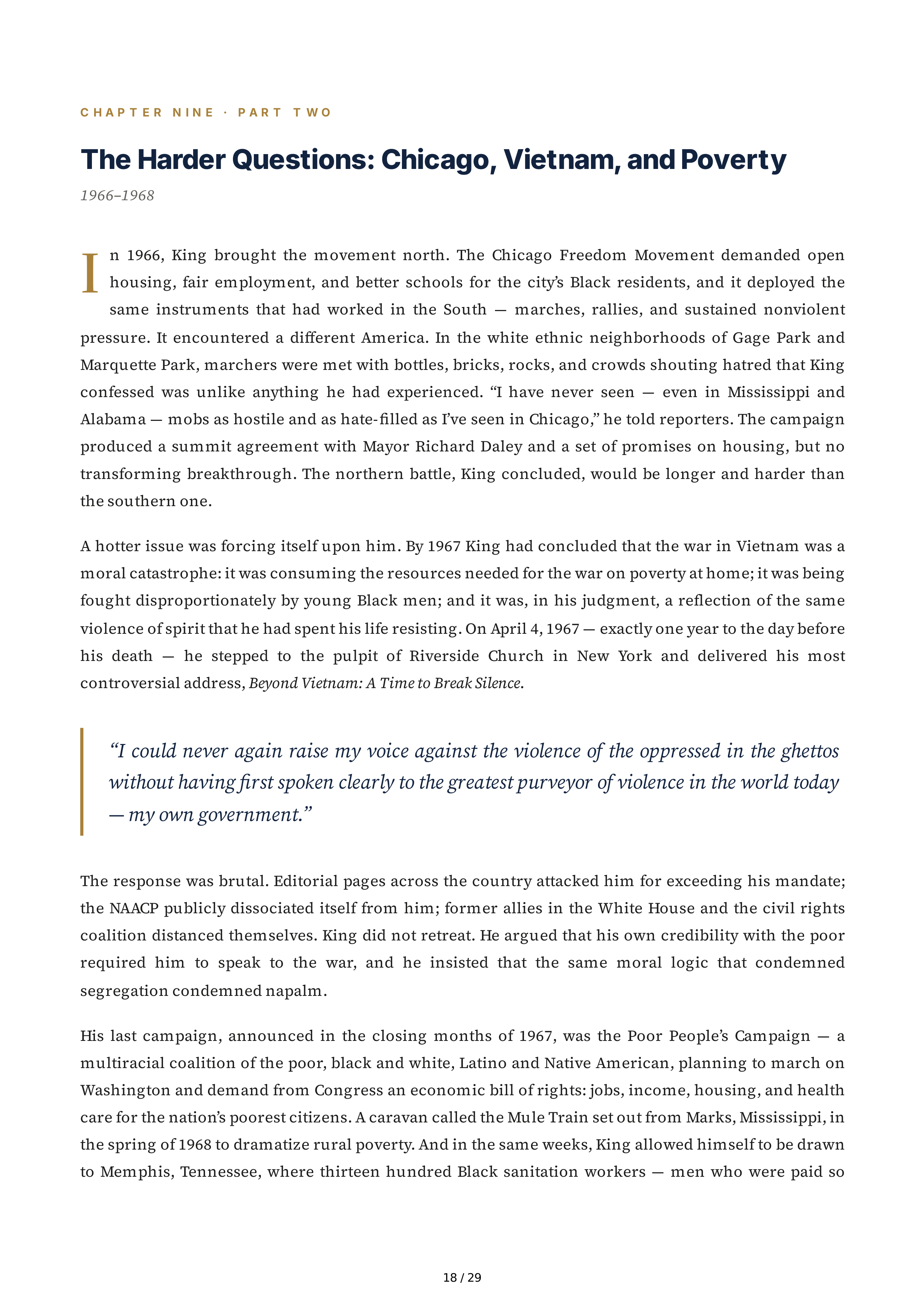
n 1966, King brought the movement north. The Chicago Freedom Movement demanded open
housing, fair employment, and better schools for the city’s Black residents, and it deployed the
same instruments that had worked in the South — marches, rallies, and sustained nonviolent
pressure. It encountered a different America. In the white ethnic neighborhoods of Gage Park and
Marquette Park, marchers were met with bottles, bricks, rocks, and crowds shouting hatred that King
confessed was unlike anything he had experienced. “I have never seen — even in Mississippi and
Alabama — mobs as hostile and as hate-filled as I’ve seen in Chicago,” he told reporters. The campaign
produced a summit agreement with Mayor Richard Daley and a set of promises on housing, but no
transforming breakthrough. The northern battle, King concluded, would be longer and harder than
the southern one.
A hotter issue was forcing itself upon him. By 1967 King had concluded that the war in Vietnam was a
moral catastrophe: it was consuming the resources needed for the war on poverty at home; it was being
fought disproportionately by young Black men; and it was, in his judgment, a reflection of the same
violence of spirit that he had spent his life resisting. On April 4, 1967 — exactly one year to the day before
his death — he stepped to the pulpit of Riverside Church in New York and delivered his most
controversial address,
Beyond Vietnam: A Time to Break Silence
.
“I could never again raise my voice against the violence of the oppressed in the ghettos
without having first spoken clearly to the greatest purveyor of violence in the world today
— my own government.”
The response was brutal. Editorial pages across the country attacked him for exceeding his mandate;
the NAACP publicly dissociated itself from him; former allies in the White House and the civil rights
coalition distanced themselves. King did not retreat. He argued that his own credibility with the poor
required him to speak to the war, and he insisted that the same moral logic that condemned
segregation condemned napalm.
His last campaign, announced in the closing months of 1967, was the Poor People’s Campaign — a
multiracial coalition of the poor, black and white, Latino and Native American, planning to march on
Washington and demand from Congress an economic bill of rights: jobs, income, housing, and health
care for the nation’s poorest citizens. A caravan called the Mule Train set out from Marks, Mississippi, in
the spring of 1968 to dramatize rural poverty. And in the same weeks, King allowed himself to be drawn
to Memphis, Tennessee, where thirteen hundred Black sanitation workers — men who were paid so
18 / 29

little that they had to rely on public assistance, and who had been ignored after two of their own were
crushed to death in a malfunctioning truck — had struck for recognition and a union.
19 / 29
O
C
H
A
P
T
E
R
T
E
N
·
P
A
R
T
T
W O
Memphis
and
the
Mountaintop
Memphis, Tennessee · April 3–4, 1968
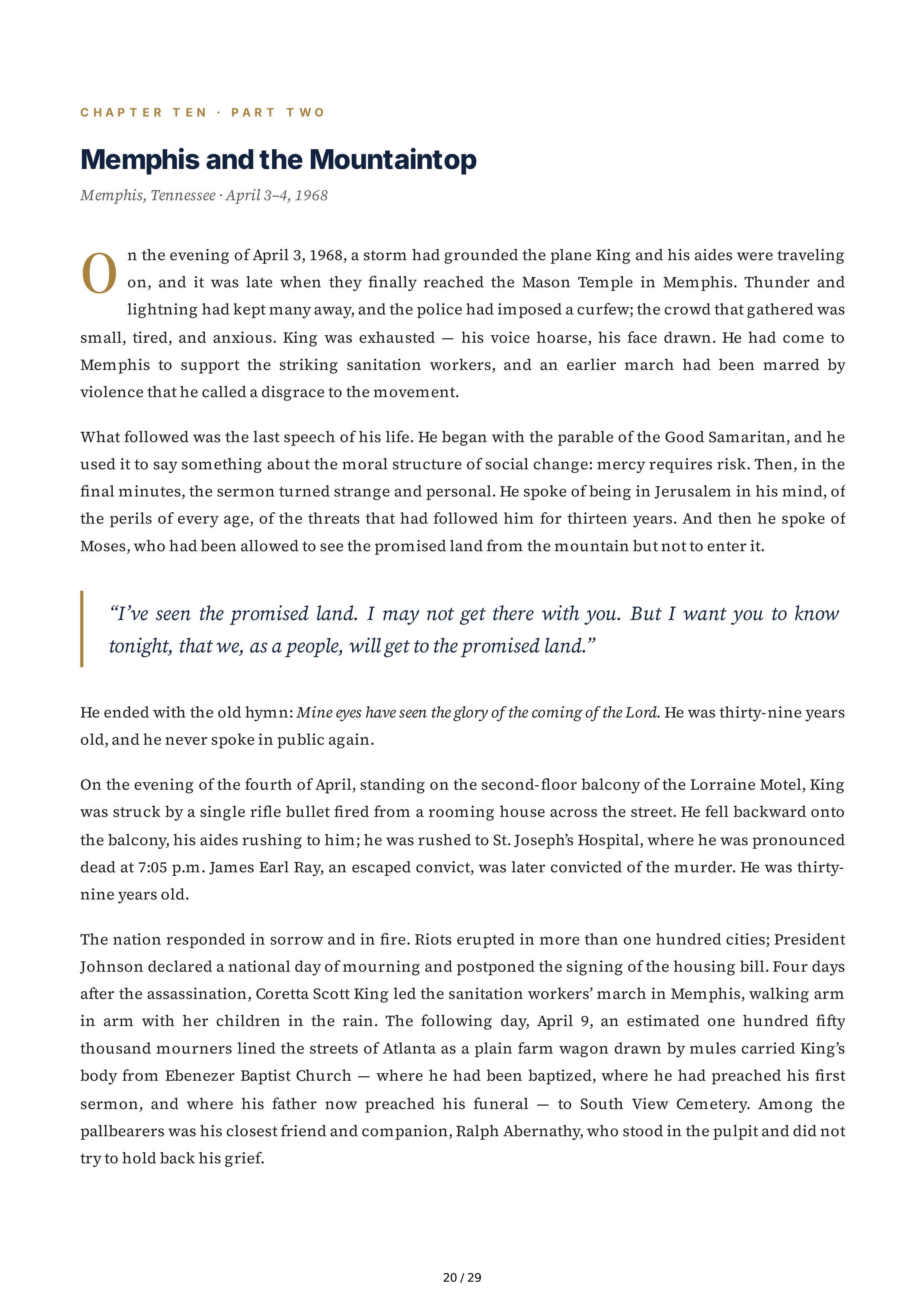
n the evening of April 3, 1968, a storm had grounded the plane King and his aides were traveling
on, and it was late when they finally reached the Mason Temple in Memphis. Thunder and
lightning had kept many away, and the police had imposed a curfew; the crowd that gathered was
small, tired, and anxious. King was exhausted — his voice hoarse, his face drawn. He had come to
Memphis to support the striking sanitation workers, and an earlier march had been marred by
violence that he called a disgrace to the movement.
What followed was the last speech of his life. He began with the parable of the Good Samaritan, and he
used it to say something about the moral structure of social change: mercy requires risk. Then, in the
final minutes, the sermon turned strange and personal. He spoke of being in Jerusalem in his mind, of
the perils of every age, of the threats that had followed him for thirteen years. And then he spoke of
Moses, who had been allowed to see the promised land from the mountain but not to enter it.
“I’ve seen the promised land. I may not get there with you. But I want you to know
tonight, that we, as a people, will get to the promised land.”
He ended with the old hymn:
Mine eyes have seen the glory of the coming of the Lord.
He was thirty-nine years
old, and he never spoke in public again.
On the evening of the fourth of April, standing on the second-floor balcony of the Lorraine Motel, King
was struck by a single rifle bullet fired from a rooming house across the street. He fell backward onto
the balcony, his aides rushing to him; he was rushed to St. Joseph’s Hospital, where he was pronounced
dead at 7:05 p.m. James Earl Ray, an escaped convict, was later convicted of the murder. He was thirty-
nine years old.
The nation responded in sorrow and in fire. Riots erupted in more than one hundred cities; President
Johnson declared a national day of mourning and postponed the signing of the housing bill. Four days
after the assassination, Coretta Scott King led the sanitation workers’ march in Memphis, walking arm
in arm with her children in the rain. The following day, April 9, an estimated one hundred fifty
thousand mourners lined the streets of Atlanta as a plain farm wagon drawn by mules carried King’s
body from Ebenezer Baptist Church — where he had been baptized, where he had preached his first
sermon, and where his father now preached his funeral — to South View Cemetery. Among the
pallbearers was his closest friend and companion, Ralph Abernathy, who stood in the pulpit and did not
try to hold back his grief.
20 / 29

Coretta Scott King and the four children — Yolanda, Martin Luther III, Dexter, and Bernice — received
the condolences of the world. But Coretta, in the weeks that followed, made the grief a continuation of
the struggle: she announced that the Poor People’s Campaign would go forward, and she committed
the rest of her life to the unfinished work her husband had left behind.
21 / 29
T
C
H
A
P
T
E
R
E
L
E
V
E
N
·
P
A
R
T
T
H
R
E
E
Legacy
:
A
Day
,
a
Memorial
,
a
Continuing
March
1968 – the present
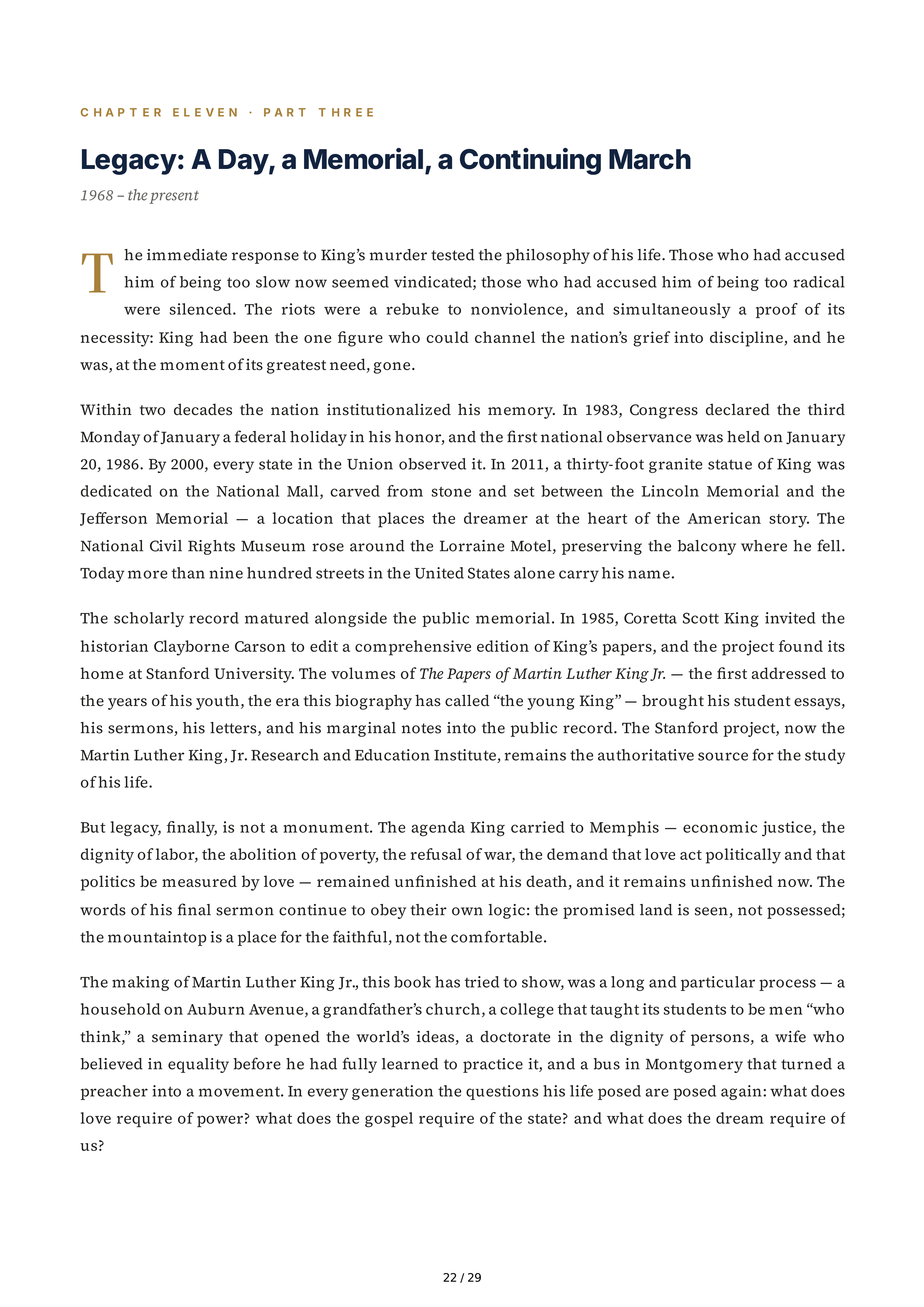
he immediate response to King’s murder tested the philosophy of his life. Those who had accused
him of being too slow now seemed vindicated; those who had accused him of being too radical
were silenced. The riots were a rebuke to nonviolence, and simultaneously a proof of its
necessity: King had been the one figure who could channel the nation’s grief into discipline, and he
was, at the moment of its greatest need, gone.
Within two decades the nation institutionalized his memory. In 1983, Congress declared the third
Monday of January a federal holiday in his honor, and the first national observance was held on January
20, 1986. By 2000, every state in the Union observed it. In 2011, a thirty-foot granite statue of King was
dedicated on the National Mall, carved from stone and set between the Lincoln Memorial and the
Jefferson Memorial — a location that places the dreamer at the heart of the American story. The
National Civil Rights Museum rose around the Lorraine Motel, preserving the balcony where he fell.
Today more than nine hundred streets in the United States alone carry his name.
The scholarly record matured alongside the public memorial. In 1985, Coretta Scott King invited the
historian Clayborne Carson to edit a comprehensive edition of King’s papers, and the project found its
home at Stanford University. The volumes of
The Papers of Martin Luther King Jr.
— the first addressed to
the years of his youth, the era this biography has called “the young King” — brought his student essays,
his sermons, his letters, and his marginal notes into the public record. The Stanford project, now the
Martin Luther King, Jr. Research and Education Institute, remains the authoritative source for the study
of his life.
But legacy, finally, is not a monument. The agenda King carried to Memphis — economic justice, the
dignity of labor, the abolition of poverty, the refusal of war, the demand that love act politically and that
politics be measured by love — remained unfinished at his death, and it remains unfinished now. The
words of his final sermon continue to obey their own logic: the promised land is seen, not possessed;
the mountaintop is a place for the faithful, not the comfortable.
The making of Martin Luther King Jr., this book has tried to show, was a long and particular process — a
household on Auburn Avenue, a grandfather’s church, a college that taught its students to be men “who
think,” a seminary that opened the world’s ideas, a doctorate in the dignity of persons, a wife who
believed in equality before he had fully learned to practice it, and a bus in Montgomery that turned a
preacher into a movement. In every generation the questions his life posed are posed again: what does
love require of power? what does the gospel require of the state? and what does the dream require of
us?
22 / 29
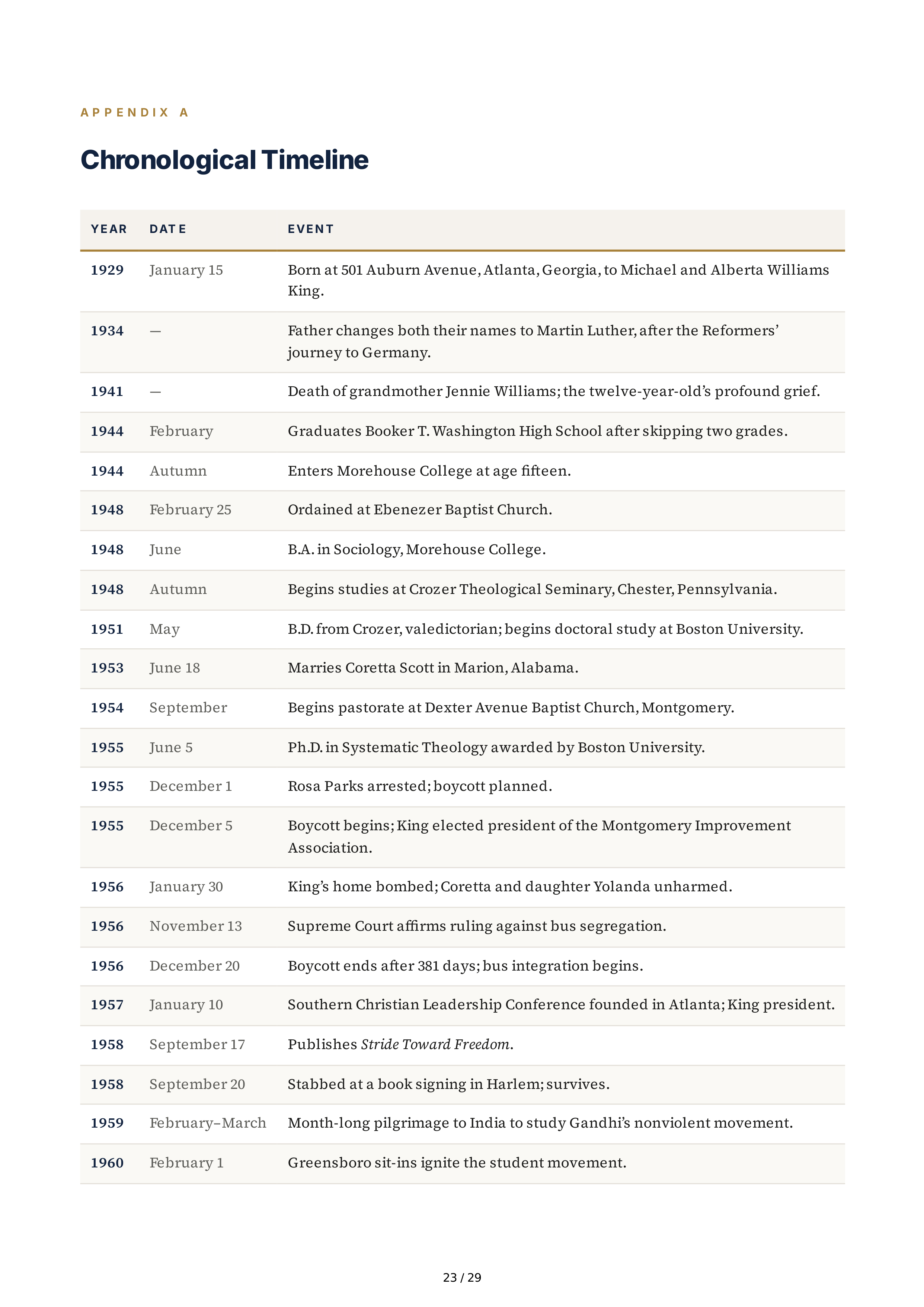
A
P
P
E
N
D
I
X
A
Chronological
Timeline
YEAR
DAT E
EVEN T
1929
January 15
Born at 501 Auburn Avenue, Atlanta, Georgia, to Michael and Alberta Williams
King.
1934
—
Father changes both their names to Martin Luther, after the Reformers’
journey to Germany.
1941
—
Death of grandmother Jennie Williams; the twelve-year-old’s profound grief.
1944
February
Graduates Booker T. Washington High School after skipping two grades.
1944
Autumn
Enters Morehouse College at age fifteen.
1948
February 25
Ordained at Ebenezer Baptist Church.
1948
June
B.A. in Sociology, Morehouse College.
1948
Autumn
Begins studies at Crozer Theological Seminary, Chester, Pennsylvania.
1951
May
B.D. from Crozer, valedictorian; begins doctoral study at Boston University.
1953
June 18
Marries Coretta Scott in Marion, Alabama.
1954
September
Begins pastorate at Dexter Avenue Baptist Church, Montgomery.
1955
June 5
Ph.D. in Systematic Theology awarded by Boston University.
1955
December 1
Rosa Parks arrested; boycott planned.
1955
December 5
Boycott begins; King elected president of the Montgomery Improvement
Association.
1956
January 30
King’s home bombed; Coretta and daughter Yolanda unharmed.
1956
November 13
Supreme Court affirms ruling against bus segregation.
1956
December 20
Boycott ends after 381 days; bus integration begins.
1957
January 10
Southern Christian Leadership Conference founded in Atlanta; King president.
1958
September 17
Publishes
Stride Toward Freedom
.
1958
September 20
Stabbed at a book signing in Harlem; survives.
1959
February–March
Month-long pilgrimage to India to study Gandhi’s nonviolent movement.
1960
February 1
Greensboro sit-ins ignite the student movement.
23 / 29
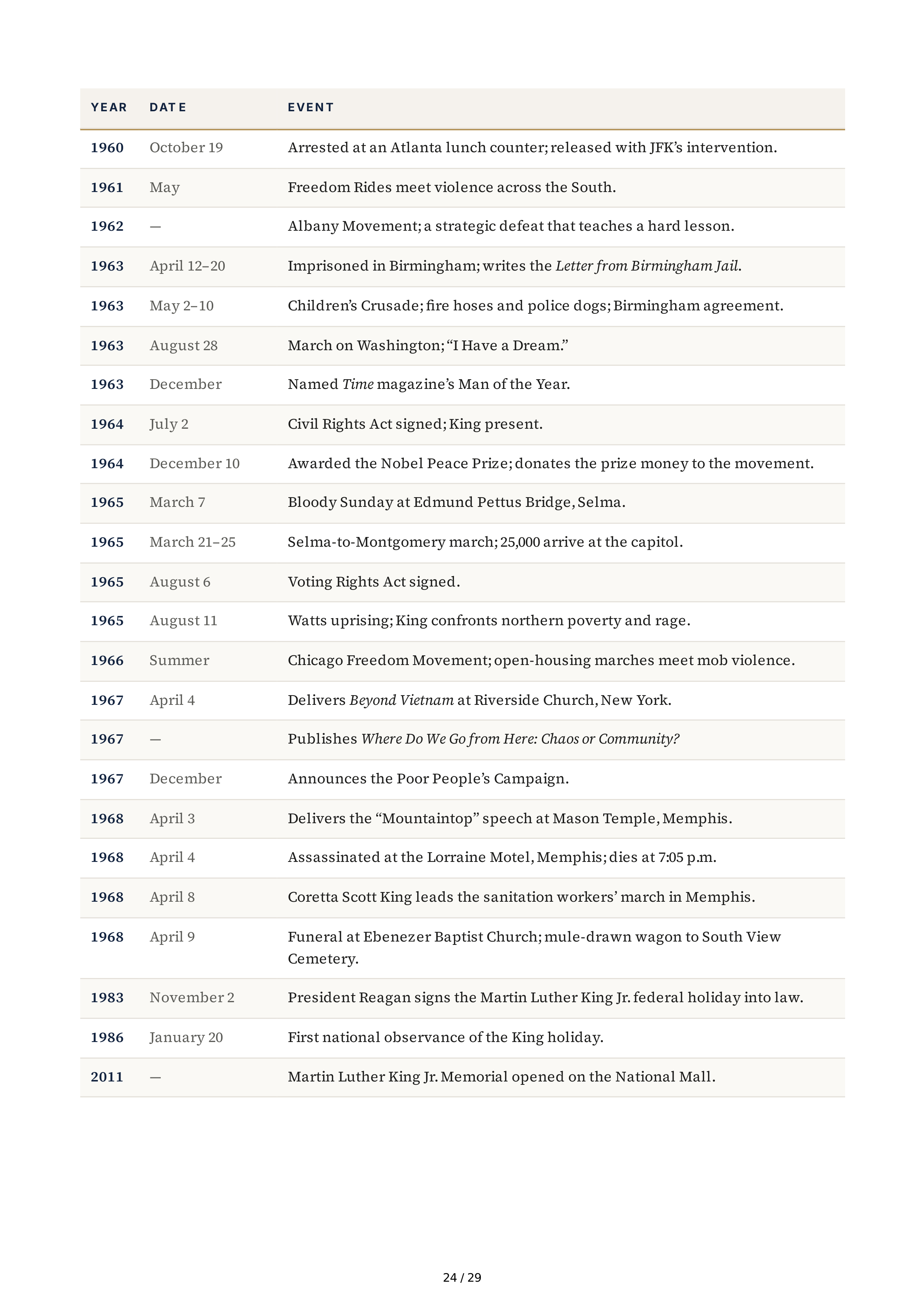
YEAR
DAT E
EVEN T
1960
October 19
Arrested at an Atlanta lunch counter; released with JFK’s intervention.
1961
May
Freedom Rides meet violence across the South.
1962
—
Albany Movement; a strategic defeat that teaches a hard lesson.
1963
April 12–20
Imprisoned in Birmingham; writes the
Letter from Birmingham Jail
.
1963
May 2–10
Children’s Crusade; fire hoses and police dogs; Birmingham agreement.
1963
August 28
March on Washington; “I Have a Dream.”
1963
December
Named
Time
magazine’s Man of the Year.
1964
July 2
Civil Rights Act signed; King present.
1964
December 10
Awarded the Nobel Peace Prize; donates the prize money to the movement.
1965
March 7
Bloody Sunday at Edmund Pettus Bridge, Selma.
1965
March 21–25
Selma-to-Montgomery march; 25,000 arrive at the capitol.
1965
August 6
Voting Rights Act signed.
1965
August 11
Watts uprising; King confronts northern poverty and rage.
1966
Summer
Chicago Freedom Movement; open-housing marches meet mob violence.
1967
April 4
Delivers
Beyond Vietnam
at Riverside Church, New York.
1967
—
Publishes
Where Do We Go from Here: Chaos or Community?
1967
December
Announces the Poor People’s Campaign.
1968
April 3
Delivers the “Mountaintop” speech at Mason Temple, Memphis.
1968
April 4
Assassinated at the Lorraine Motel, Memphis; dies at 7:05 p.m.
1968
April 8
Coretta Scott King leads the sanitation workers’ march in Memphis.
1968
April 9
Funeral at Ebenezer Baptist Church; mule-drawn wagon to South View
Cemetery.
1983
November 2
President Reagan signs the Martin Luther King Jr. federal holiday into law.
1986
January 20
First national observance of the King holiday.
2011
—
Martin Luther King Jr. Memorial opened on the National Mall.
24 / 29
A
P
P
E
N
D
I
X
B
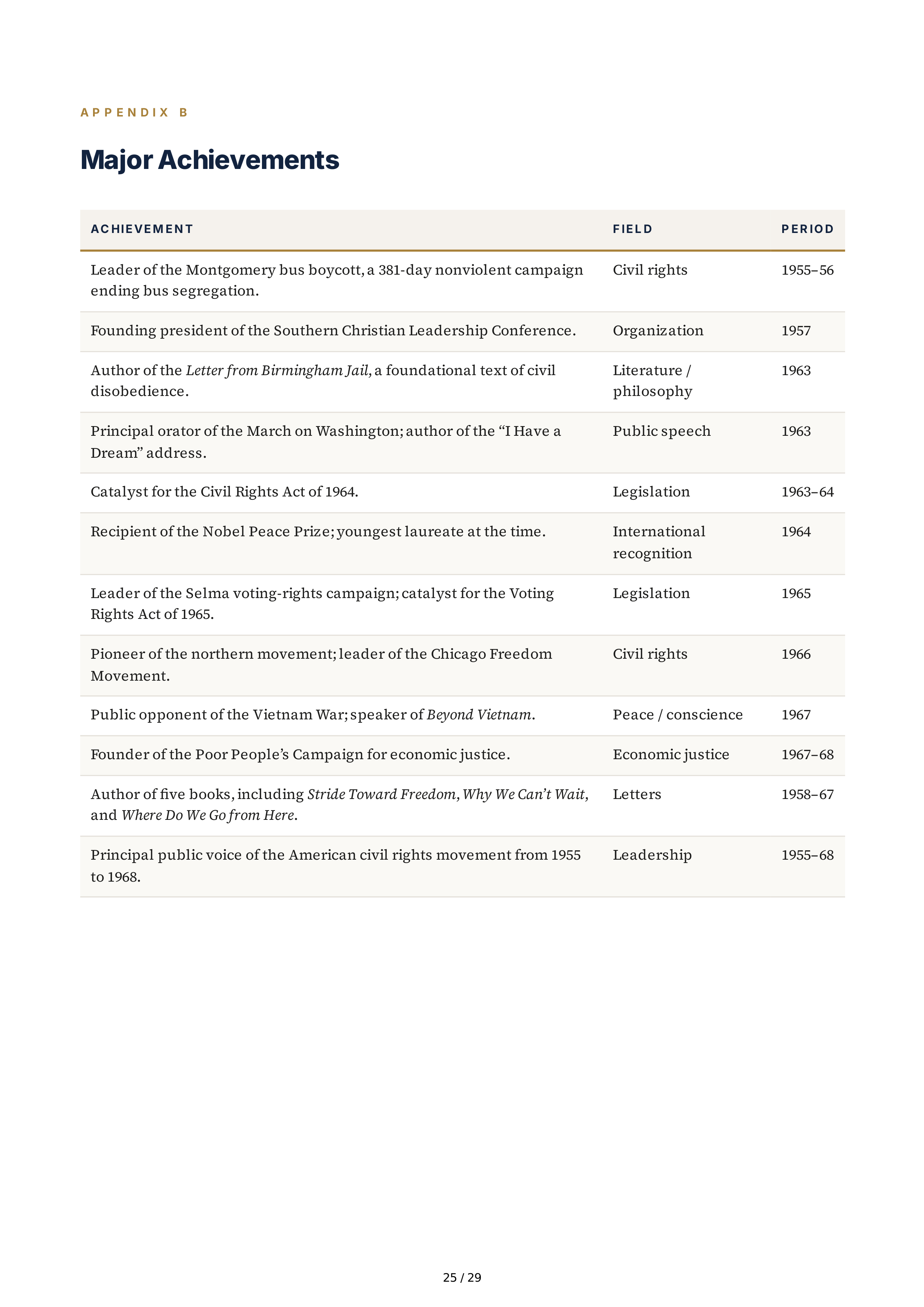
Major
Achievements
AC HIEVEM EN T
F IEL D
P ER IO D
Leader of the Montgomery bus boycott, a 381-day nonviolent campaign
ending bus segregation.
Civil rights
1955–56
Founding president of the Southern Christian Leadership Conference.
Organization
1957
Author of the
Letter from Birmingham Jail
, a foundational text of civil
disobedience.
Literature /
philosophy
1963
Principal orator of the March on Washington; author of the “I Have a
Dream” address.
Public speech
1963
Catalyst for the Civil Rights Act of 1964.
Legislation
1963–64
Recipient of the Nobel Peace Prize; youngest laureate at the time.
International
recognition
1964
Leader of the Selma voting-rights campaign; catalyst for the Voting
Rights Act of 1965.
Legislation
1965
Pioneer of the northern movement; leader of the Chicago Freedom
Movement.
Civil rights
1966
Public opponent of the Vietnam War; speaker of
Beyond Vietnam
.
Peace / conscience
1967
Founder of the Poor People’s Campaign for economic justice.
Economic justice
1967–68
Author of five books, including
Stride Toward Freedom
,
Why We Can’t Wait
,
and
Where Do We Go from Here
.
Letters
1958–67
Principal public voice of the American civil rights movement from 1955
to 1968.
Leadership
1955–68
25 / 29
A
P
P
E
N
D
I
X
C
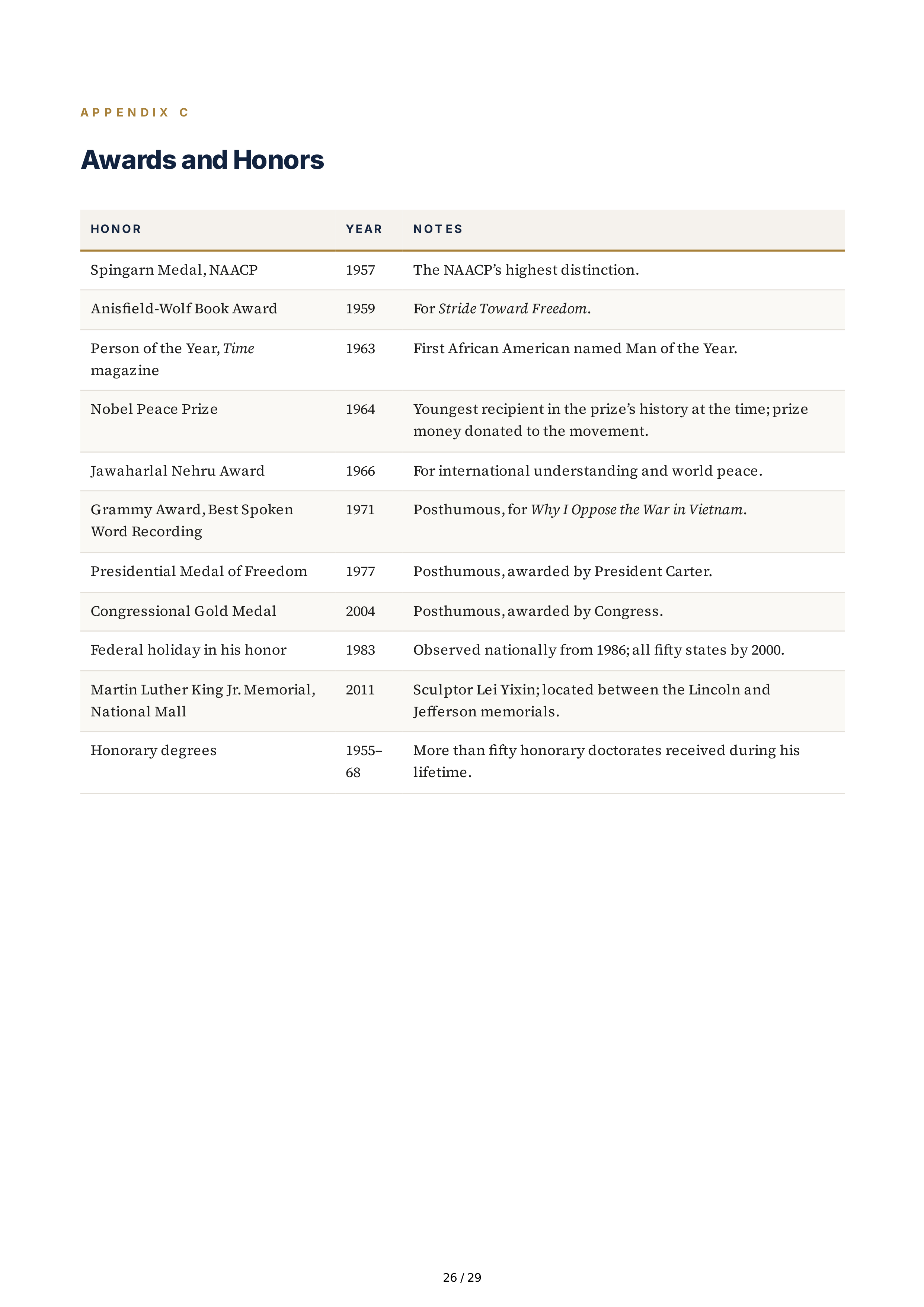
Awards
and
Honors
HO N O R
YEAR
N O T ES
Spingarn Medal, NAACP
1957
The NAACP’s highest distinction.
Anisfield-Wolf Book Award
1959
For
Stride Toward Freedom
.
Person of the Year,
Time
magazine
1963
First African American named Man of the Year.
Nobel Peace Prize
1964
Youngest recipient in the prize’s history at the time; prize
money donated to the movement.
Jawaharlal Nehru Award
1966
For international understanding and world peace.
Grammy Award, Best Spoken
Word Recording
1971
Posthumous, for
Why I Oppose the War in Vietnam
.
Presidential Medal of Freedom
1977
Posthumous, awarded by President Carter.
Congressional Gold Medal
2004
Posthumous, awarded by Congress.
Federal holiday in his honor
1983
Observed nationally from 1986; all fifty states by 2000.
Martin Luther King Jr. Memorial,
National Mall
2011
Sculptor Lei Yixin; located between the Lincoln and
Jefferson memorials.
Honorary degrees
1955–
68
More than fifty honorary doctorates received during his
lifetime.
26 / 29
A
P
P
E
N
D
I
X
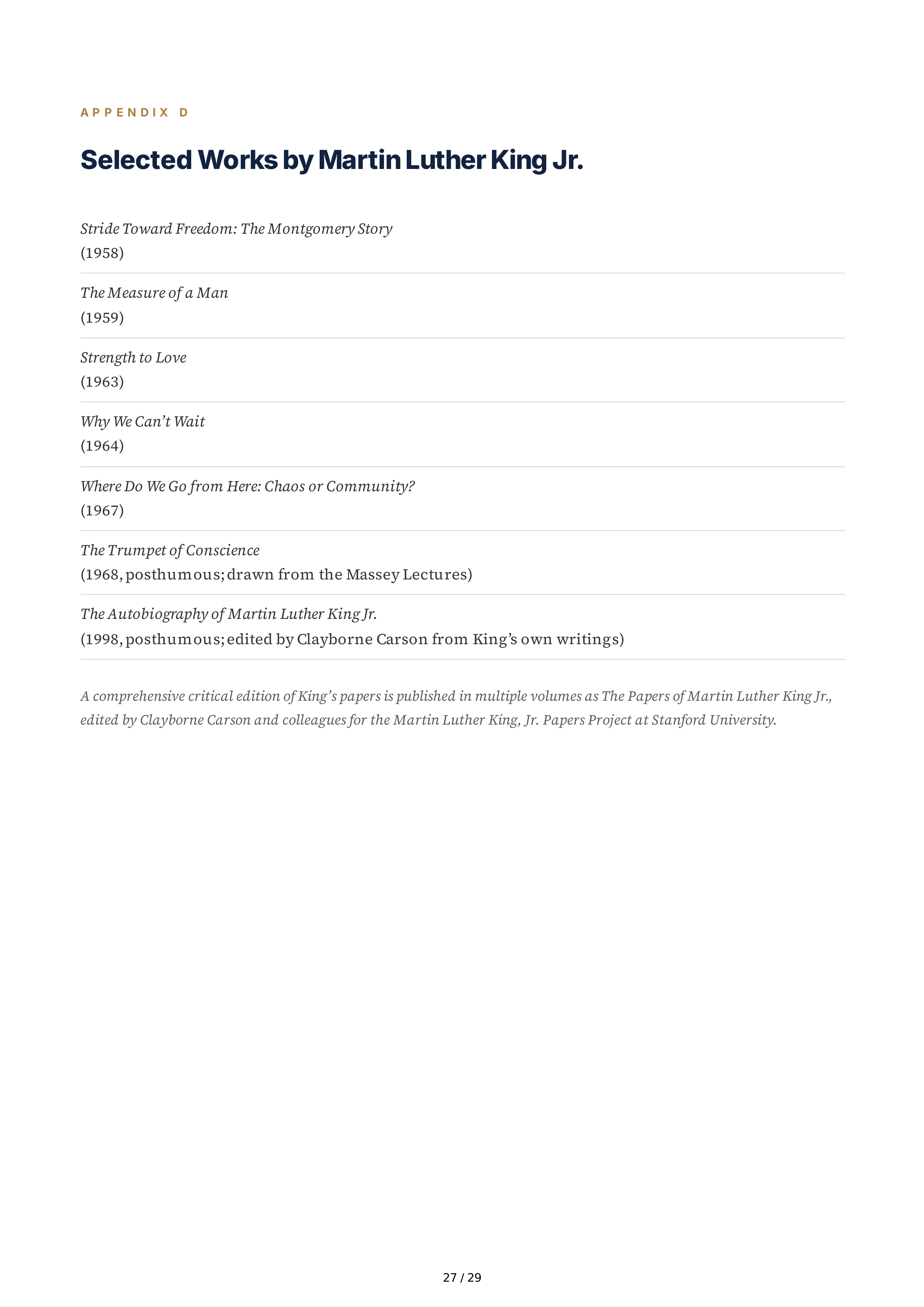
D
Selected
Works
by
Martin
Luther
King
Jr
.
Stride Toward Freedom: The Montgomery Story
(1958)
The Measure of a Man
(1959)
Strength to Love
(1963)
Why We Can’t Wait
(1964)
Where Do We Go from Here: Chaos or Community?
(1967)
The Trumpet of Conscience
(1968, posthumous; drawn from the Massey Lectures)
The Autobiography of Martin Luther King Jr.
(1998, posthumous; edited by Clayborne Carson from King’s own writings)
A comprehensive critical edition of King’s papers is published in multiple volumes as The Papers of Martin Luther King Jr.,
edited by Clayborne Carson and colleagues for the Martin Luther King, Jr. Papers Project at Stanford University.
27 / 29
S
O
U
R
C
E
S
Sources
and
Further
Reading
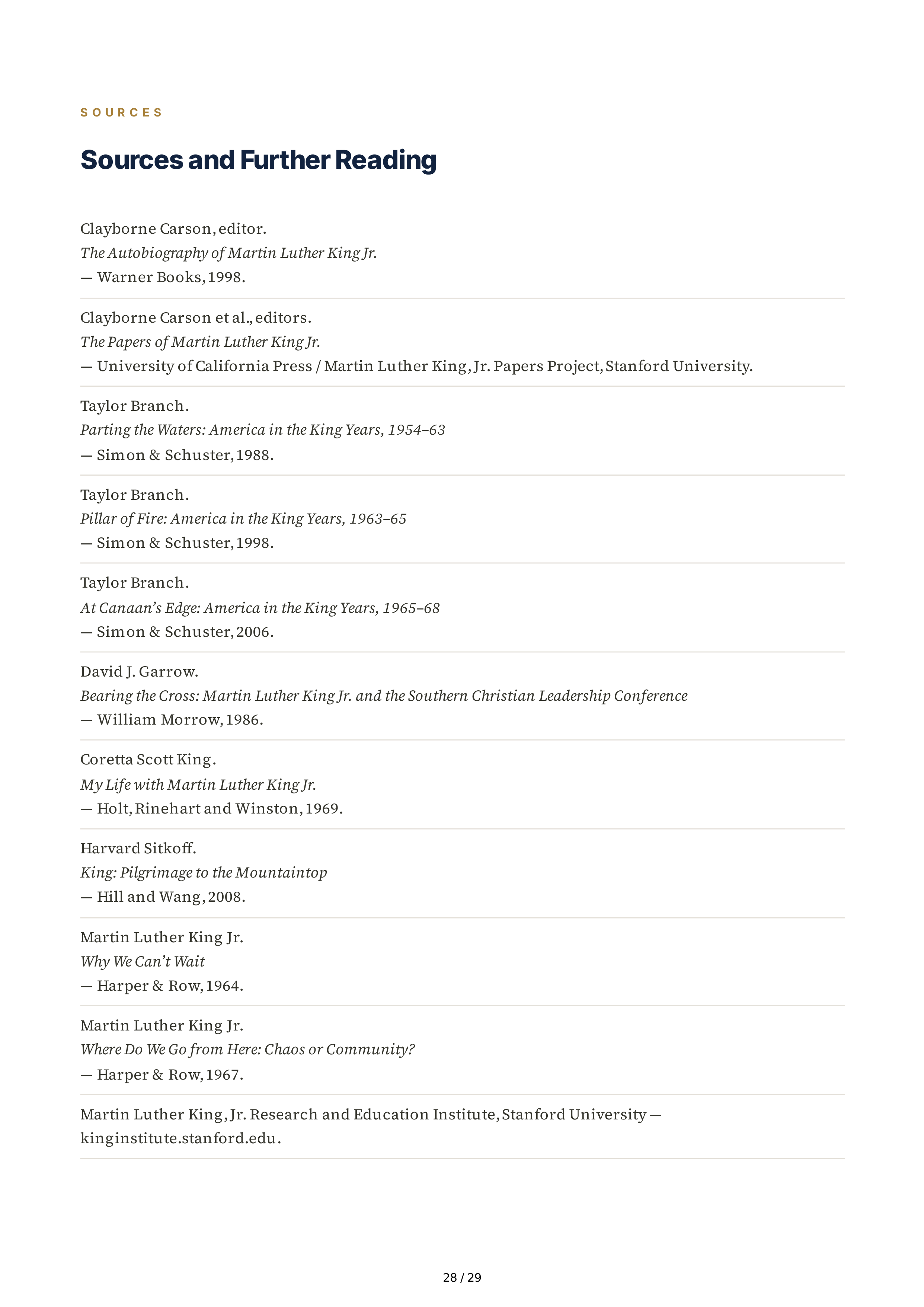
Clayborne Carson, editor.
The Autobiography of Martin Luther King Jr.
— Warner Books, 1998.
Clayborne Carson et al., editors.
The Papers of Martin Luther King Jr.
— University of California Press / Martin Luther King, Jr. Papers Project, Stanford University.
Taylor Branch.
Parting the Waters: America in the King Years, 1954–63
— Simon & Schuster, 1988.
Taylor Branch.
Pillar of Fire: America in the King Years, 1963–65
— Simon & Schuster, 1998.
Taylor Branch.
At Canaan’s Edge: America in the King Years, 1965–68
— Simon & Schuster, 2006.
David J. Garrow.
Bearing the Cross: Martin Luther King Jr. and the Southern Christian Leadership Conference
— William Morrow, 1986.
Coretta Scott King.
My Life with Martin Luther King Jr.
— Holt, Rinehart and Winston, 1969.
Harvard Sitkoff.
King: Pilgrimage to the Mountaintop
— Hill and Wang, 2008.
Martin Luther King Jr.
Why We Can’t Wait
— Harper & Row, 1964.
Martin Luther King Jr.
Where Do We Go from Here: Chaos or Community?
— Harper & Row, 1967.
Martin Luther King, Jr. Research and Education Institute, Stanford University —
kinginstitute.stanford.edu.
28 / 29

This biography is an independent work of historical synthesis, written from public records and the published scholarship
listed above. It is not affiliated with, or endorsed by, the estate of Martin Luther King Jr., the King Center, or Stanford
University.
❦
Stanford
University
Young
King
·
T he
Making
of
Martin
Luther
King
Jr
.
An
Original
Biography
·
First
Edition
29 / 29