C
F
H A P
T
E R
I I I
From Local Beat to the White House
1983–1994
or a young reporter at The New York Times in the 1980s, the metropolitan desk was the proving
ground, and Dowd's assigned beat — the District government, with its mix of graft, theatrics,
and broken promises — was a demanding one. She covered mayors, councilmembers, and the
strange half-state of a city that was both the nation's capital and a local jurisdiction trying to govern
itself. The beat had little national glamour and considerable local drama; it was, in effect, an
education in how power actually works at close range.
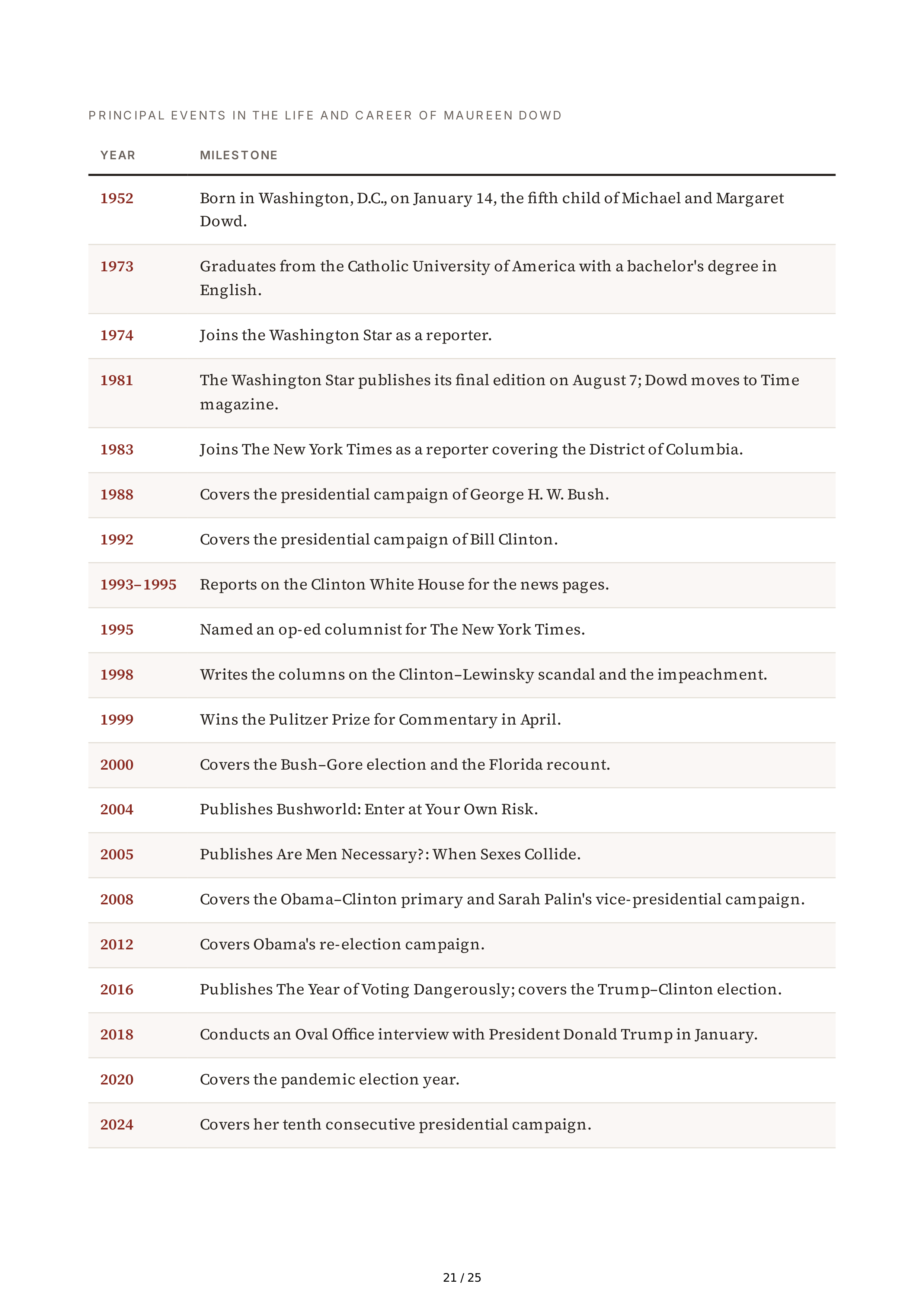
By the late 1980s, Dowd had moved into national politics, and in 1988 she was assigned to cover the
presidential campaign of Vice President George H. W. Bush. The assignment was a revelation on both
sides. For Dowd, the campaign plane was a floating laboratory of American political theater: the
choreographed rallies, the exhausted press corps, the candidate's carefully guarded family. Her
dispatches began to stand out — less for their policy detail than for their precise, slightly amused
observation of the human machinery of a campaign.
It was during this period that Dowd developed the approach that would make her famous: the
political feature written as a short story. She paid attention to what candidates wore, how they spoke
to their children, and what their aides said when they thought no reporter was listening.
Traditionalists on the political beat grumbled that she was writing about style rather than substance.
Her defenders, then and later, argued that in politics, style is substance — that the way a candidate
behaves on a rope line tells voters more than a white paper.
She covered the 1992 campaign that brought Bill Clinton to the White House, and then reported on
Clinton's first years from the White House beat. Clinton was a subject made for her sensibility: a
brilliant, undisciplined baby boomer who could summon policy detail and emotional vulnerability
in the same sentence. The stories Dowd wrote about the Clinton White House, before and after she
became a columnist, were read closely by the administration — and rarely enjoyed.
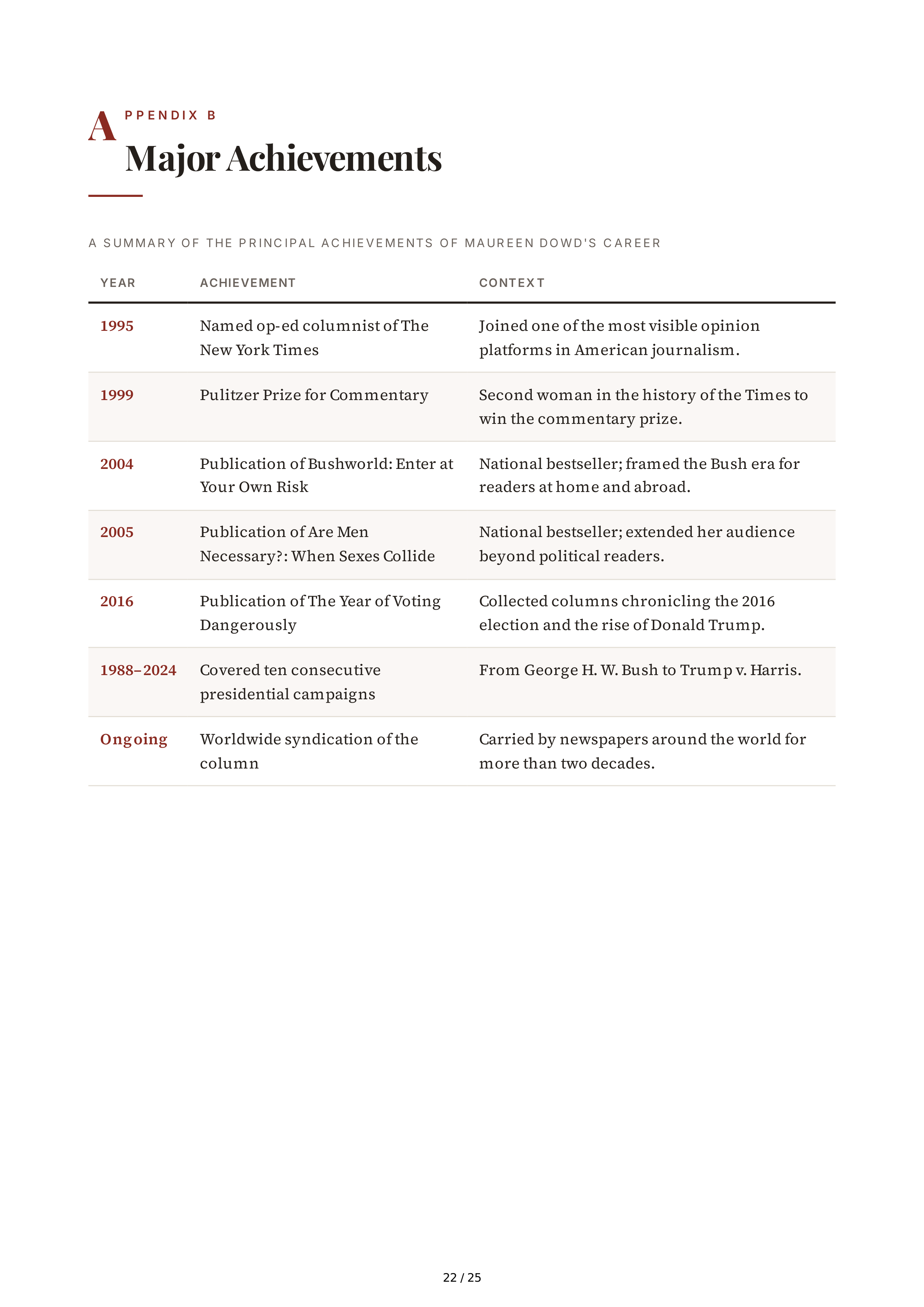
In 1995, the paper announced a change. Dowd was moving from the news pages to the editorial page
as an op-ed columnist, joining a rotation that included some of the most famous names in American
journalism. She was forty-three years old, and she had been at the Times for twelve years. The
column she began writing would run, with only interruptions, for the next three decades.
9 / 25