
Sony Pictures Classics Presents
THE FOG OF WAR
A film by Errol Morris
Running time: 106 minutes
“I know what many of you are thinking. You’re thinking, ‘This man is duplicitous.
You’re thinking that he has held things close to his chest. You’re thinking that he did not
respond fully to the desires and wishes of the American people.
And I want to tell you 'you're wrong’.”
Robert S. McNamara in
The Fog of War
EAST COAST:
WEST COAST:
EXHIBITOR CONTACTS:
INT’L HOUSE OF PUBLICITY
BLOCK-KORENBROT
SONY PICTURES CLASSICS
JEFF HILL
MICHAEL ROACH
CARMELO PIRRONE
KITTY BOWE HEARTY
8271 MELROSE AVENUE
550 MADISON AVENUE
853 SEVENTH AVENUE #3C
SUITE 200
8
TH
FLOOR
NEW YORK NY 10019
LOS ANGELES CA 90046
NEW YORK NY 10022
PHONE: (212) 265-4373
PHONE (323) 655-0593
PHONE (212) 833-8833
FAX: (212) 247-2948
FAX: (323) 655-7302
FAX (212) 833-8844
VISIT THE SONY PICTURES CLASSICS INTERNET SITE AT:
http:/www.sonyclassics.com
Director's Statement
The Fog of War
is a 20th century fable, a story of an American dreamer who rose from
humble origins to the heights of political power. Robert S. McNamara was both witness
to and participant in many of the crucial events of the 20th century: the crippling
Depression of the 1930s; the industrialization of the war years; the development of a
different kind of warfare based on air power and the creation of a new American
meritocracy. He was also an idealist who saw his dreams and ideals challenged by the role
he played in history.
Although strictly speaking, neither a work of biography nor a work of history,
The Fog of
War
has produced important, new biographical and historical material.
First, although there have been several book-length biographies of Robert S. McNamara
and many books in which he is a principal figure, none have discussed the pivotal
relationship between McNamara and General Curtis LeMay, the infamous U.S. General,
and their involvement in the firebombing of 67 Japanese cities in 1945.
World War II is thought of as a just war. It is believed that the Allies fought on the side
of good, and that what they did in their wartime effort was justified by that fact. What
few people know is that before the United States dropped the two atomic bombs on
Hiroshima and Nagasaki, LeMay’s B-29 bombers had already killed nearly 1 million
Japanese civilians, including 100,000 in Tokyo on the night of March 10th, 1945.
McNamara raises deep moral questions about his role and, by implication, the entire
Allied role in winning the war against Japan by any means necessary. He asks, “In order
to win a war, is a nation justified in killing 100,000 civilians in one night?” “Would it be
moral to not burn to death 100,000 Japanese civilians, but instead to lose hundreds of
thousands of American lives in an invasion of Japan?”
Second, for many people who are familiar with the Cuban missile crisis from the movie
Thirteen Days
,
The Fog of War
tells a very different story. Here is a story not about how
John or Bobby Kennedy saved the world, but a story of blind luck and the limits of
rational judgment. A story of a world out of control, where a nuclear holocaust was
averted by an obscure state department official who had the temerity to speak up to the
President and to urge him to empathize with his adversary.
Third,
The Fog of War
is the first historical investigation to make extensive use of taped
telephone conversations from the Oval Office of the White House between Johnson and
McNamara. Much of what has been written about Robert S. McNamara rehashes a
familiar story—that of a computer-like man, a technocrat, a hawk who, through his
arrogance, blundered into Vietnam. However, the presidential recordings - the weight of
the historical evidence itself - do not bear this out. Instead, a far more complex portrait of
the man emerges—one who tried to serve two very different presidents: John F. Kennedy
and Lyndon B. Johnson.
We hear McNamara explaining to Kennedy the need to set a timetable for removing
advisors from Vietnam; we hear Johnson (after Kennedy’s death) admonishing
McNamara for his unwarranted optimism in giving such advice; we hear McNamara
urging Johnson to put the breaks on the bombing of North Vietnam; but, in the end we
hear McNamara endorsing the President’s wish to continue the war.
Errol Morris
A DISCUSSION WITH ERROL MORRIS
You're old enough to remember McNamara and Vietnam.
As I have told McNamara, I demonstrated against the war as an undergraduate at the
University of Wisconsin and as a graduate student at Princeton. Although these
demonstrations were after he had left office, they were very much protests against the
war in Vietnam.
Where did the idea of doing a movie about McNamara come from?
I started to think about making the movie in 1995 following the publication of his book
In
Retrospect
. I found the book endlessly fascinating. But for me it raised more questions
than it answered. At the same time, reading the book was an unusual experience because
many of the reviews seemed to be about a book that was different from the one that I was
reading.
How so?
The book has been described as a “mea culpa” and as a “confession,” but I found it
different and far stranger than that. It's not so much an apology as an attempt to
understand how he and many others blundered into a disastrous war. There's no question
that McNamara now feels that the war was wrong. But I wanted to know his
own
feelings. There's a big difference between saying "A policy is wrong" and saying "It's
wrong, I caused it, and I'm sorry." Those distinctions--these questions of individual
responsibility--lie at the heart of the movie. At first, I thought McNamara’s failure to
apologize was a weakness of the book; now I think that it is one of its strengths. It is
much more difficult to analyze the causes of error than apologize for it.
Are you saying that he isn’t responsible for what he did?
No. In fact I ask him the question: "To what extent did you feel you were the author of
policy? Or to what extent were your policies the product of historical forces outside of
your control?" It's a central question. McNamara answers that he tried to serve the
President. This answer could be seen as just an evasion, but, nevertheless, it’s true.
At the end of the movie McNamara talks about counterfactuals, questions of whether
history could have taken a different course. Historians do not like these kinds of
questions but McNamara clearly believes that history would have been very, very
different if President Kennedy had lived.
Was it difficult to get him to agree to do this?
In fact it took very little convincing. I started talking to him in the spring of 2001 right
after his book
Wilson's Ghost
was published. I honestly think when I called him that he
thought I was part of the book tour. He loves coming to Cambridge. He loves going to
Harvard and seeing the places where he used to live... But two days before the interview
he called saying that although he had agreed to come up, it really didn't make much sense.
He didn't really know why he had agreed to come. It was a bad idea. He went on and on
but after going through a fairly extensive list of reasons as to why he shouldn't do the
interview, he said, "But I said I would do it, so I will." And he did.
Were you planning to make a full length film from the start?
I had in my mind that I was going to make a feature film, but I was worried about the
interviews. It’s not like I was talking to someone who has never been interviewed before.
It's the exact opposite. He's someone who has literally been interviewed by thousands of
journalists. He is not a person who is unsavvy or naïve in any way. And I was worried
that he was going to give me the same interview that he's given everybody else.
So this is a man who is comfortable in front of a camera
?
He was the only person who has ever objected to the Interrotron. He's so used to doing
interviews in a different way. He came in to the studio and saw this contraption and said,
"What is this?" I told him it was my interviewing device, and he said, "Whatever it is, I
don't like it." But then he sat down and never complained after that.
Was he intimidating?
I made an incredible effort to prepare. I don't believe in having a formal list of
questions. But I was very much prepared in the sense of having read all three of his
recent books and thought about them carefully. And I know he liked the fact that I had
done that.
So he didn't give you the same old answers.
The whole remark about LeMay and war criminals was made within the first 20 minutes
of the first interview. That past Sunday,
The New York Times
had published an article
about Bob Kerrey which implicated him in possible war crimes in Vietnam. I believe that
story was very much on McNamara's mind. We were talking about Kerrey when he
launched into the discussion about LeMay and the firebombing of Tokyo.
Did you have a certain expectation of what he might be like?
I'm always open-minded when I go into an interview. And I'm usually apprehensive in
some way. I have no idea about what’s going to happen. I have no idea what I'm going to
hear, and I'm not altogether clear about what I'm going to ask. I really do believe that good
interviews can’t be controlled. They
emerge
. There are all of these intangibles and it's
important to let things happen.
Were you nervous?
I was aware of his reputation for brilliance, and I wanted to show him respect on some
very basic level. Is he really as bright as they say he is? Maybe it comes back to my
suspicions about government in general. We've certainly been disabused of the notion
that our Presidents have to be on the ball. Yet when I heard the tapes of the recordings
that Kennedy made of discussions about the Cuban Missile Crisis, I felt that I was
listening to a very smart, dedicated and accomplished group of people arguing the issues.
What happened after the first set of interviews?
We asked him to come back. But I needed to show him some edited material, which we
didn't get around to doing for a while. Finally I put together a 40 minute segment which I
called
The Fog of War
and sent it to him.
Was it just him talking or did you use some archival footage?
There was a little bit of archival material, some of which is used in the final version of the
film…particularly the material from Japan. And we put in some Philip Glass music.
Why Philip Glass?
Well, no one
does
“existential dread” as well as Philip Glass. And this is a movie filled
with existential dread.
So McNamara agreed to come back?
He liked what we had done, so yes, he came back. We filmed another set of interviews
and I asked him about Vietnam and more questions about the firebombing. I had the list
of the Japanese cities and the companion cities in the U.S. That was set up by us. One
of the most striking moments in the film is when he goes through that list of 67 cities.
That and when he asks the question about what makes someone a war criminal.
Hearing McNamara raise all of these ethical issues and questions about a war which most
of us see as morally unambiguous is very, very powerful. What I like about
The Fog of
War
is that it has proved possible to make a movie about events – events that are
removed from us by 40, 50, 60 years but which are very much about
today
. Many of the
issues that McNamara is talking about in the movie are relevant to what's going on right
now, and there's this surreal sense that nothing has changed. I suppose it’s the sense that
we have learned nothing from the past, which makes the 11
th
lesson in the movie even
more powerful and ironic.
The eleventh lesson being…
That you can't change human nature, that this is the way we are….confused, bellicose,
and sometimes crazy. Essentially, we may all be fucked.
Yes, but that's not necessarily much consolation. Vietnam and Robert McNamara
are hot button words to a lot of people….
At the heart of
The Fog of War
is this belief in human fallibility. It's one of the things
that McNamara says at the very beginning of the movie. People make mistakes. People
make the same mistake sometimes 2, 3, 4, 5 times. To me, the idea of people doing things
because they're confused or guided by false beliefs makes the world a scary place.
Because then instead of being agents of the devil they become one of us--just addled and
confused individuals trying to make their way in the world. The Gulf of Tonkin story is
a very rich one. Not just as straight history but metaphorically as well. We pretty much
know now that the second attack (on the US naval vessels) never happened, and that the
first attack (which did happen) was provoked by us, maybe intentionally, maybe not.
But I don't believe that we just manufactured that second event. I think that there were
people who were confused and who genuinely believed that there was enough evidence to
justify the conclusion that the attack had occurred.
Where did the Gulf of Tonkin footage come from?
From a series of reenactments staged within a week and a half of the actual incidents. The
footage of those reenactments are in the National Archives.
Didn't that strike you as kind of strange?
History is replete with stories of reenacted footage. When the Russians liberated
Auschwitz in January 1945 there were no cameras present, so they returned with cameras
and re-liberated Auschwitz several days later. Clearly, they wished to record it.
I asked McNamara about the reenactments but he didn’t remember having asked to have
them made or having ever seen them. I suppose you could say cynically that the Defense
Department reenacted the Gulf of Tonkin incidents to trick the public, to convince the
public that they really happened. But I believe it is more likely that they reenacted them
to convince themselves. Historical events are reenacted so that people can think about
them more clearly. It's a way of exploring the world, a way of understanding what it
means.
What about the archival footage and historical materials that you use in the film?
We made enormous efforts to avoid using the same material that's been seen in thousands
of other films. There is a lot of new material from the firebombing as well as the story of
McNamara's early involvement with the war and his advising President Kennedy to pull
all of the advisors out of Vietnam. A lot of the reenactments of the Gulf of Tonkin are
shots that came from the National Archives. The B-29 footage is from a film called "The
Last Bomb." Kennedy recorded Security Council and Executive Committee meetings,
LBJ selectively recorded his phone conversations from the Oval Office.
In some ways this movies leaves more questions unanswered than answered.
There is the question of whether we are doomed to this kind of behavior: war, killing
people. Let’s face facts. Our DNA is the same DNA that we had in the jungle 50,000
years ago. But our destructive capacity has changed markedly. In the last 50 years it has
become possible to talk about destroying the world.
I often think that if my movies have been any good, it's because there are unresolved
questions, questions that an audience can keep thinking about. In The Fog of War it is the
question: Are we doomed to repeat the mistakes of the past? I think about McNamara's
first memory, which was Armistice Day 1918. I think about McNamara's strong
ideological connection to Woodrow Wilson's belief that the first World War was a war to
end all wars. I think about how wrong Wilson was. And I think about the very phrase "a
war to end all wars". Isn’t it an oxymoron? War doesn't end war. It leaves unresolved
conflicts that only serve to heighten already existing unresolved conflicts. War doesn’t
end war. War leads to war.
Robert S. McNamara Biography
Born in San Francisco on June 9, 1916, Mr. McNamara was two years old on November
11, 1918 when the world celebrated Armistice Day. Robert McNamara later said of the
celebration, “[America] was celebrating not only that victory, but the belief of many
Americans and particularly of President Wilson, our President at the time, that we and
our allies had won a war to end all wars. They were wrong, of course.” McNamara was a
strong, competitive student and as an undergraduate at the University of California at
Berkley from 1933-1937 declared a major in Economics in response to the economic
devastation he lived during the Great Depression. In 1939 he received an MBA degree
from Harvard, and in 1940 he returned to Harvard to become an instructor and later
Assistant Professor of Business Administration. In 1942, he was one of the inaugural
members of the newly created Statistical Control division of the U.S. Air Force. The
research the Statistical Control Officers compiled was used in war planning and to
measure achievement. In 1943 he was commissioned a captain in the air force and served
in the UK, India, China, and the Pacific. On December 7,1945, Japan bombed Pearl
Harbor, and months later the U.S. retaliated by firebombing Japan. McNamara was
awarded the Legion of Merit and promoted to lieutenant colonel before going on inactive
duty in April 1946.
Upon his discharge from the air force, McNamara joined the Ford Motor Company. He
was elected as a director of the company in 1957, and president of the company in 1960.
At the request of President-elect John F. Kennedy, McNamara left his Ford Motor post
to serve as Secretary of Defense of the United States, a position he held from 1961 until
1968.
In April 1961, shortly after McNamara began his tenure as Defense Secretary, a band of
U.S.-trained Cuban exiles invaded Cuba in what later became known as the Bay of Pigs
Invasion. McNamara and others in Kennedy’s cabinet gave their approval of this invasion.
Less than a year later, on October 16
th
, 1962, the U.S. determined that the Soviet Union had
secretly smuggled nuclear missiles into Cuba. On the recommendation of Robert
McNamara, the U.S. initiated a naval blockade of Cuba and made preparations for air
strikes and an invasion of Cuba. On October 28
th
, Soviet Premier Nikita Khrushchev
publicly announced that he would remove Soviet missiles from Cuba, ending the standoff.
Robert McNamara learned from Fidel Castro in 1989 that nuclear warheads for the missiles
were already in Cuba at the time of the crisis, and had the U.S. invaded, the nuclear missiles
would have been used against both the U.S. invading force and mainland United States.
The last five years of McNamara’s term as Secretary of Defense were defined by
the Vietnam War. The U.S. was becoming increasingly embroiled in conflict in
Vietnam. In October 1963, President Kennedy announced a plan to withdraw U.S troops
from Vietnam by 1965. The next month President Kennedy was killed. In August 1964
North Vietnamese patrol boats allegedly attacked two U.S. destroyers on August 2
nd
and
August 4
th
in the Tonkin Gulf. Under the leadership of President Lyndon Johnson, the
U.S. retaliated with 64 bombing missions. The next month, Congress passed the Gulf of
Tonkin resolution which authorized military action in Vietnam. By 1966, though the
U.S. was losing the war in Vietnam, more troops were sent to Vietnam. McNamara left
the Presidents Cabinet in 1968. In 1995, he met with retired Vietnamese General Vo
Nguyen Giap who confirmed the suspicion of many U.S. citizens that the attack that led
to the war on Vietnam never occurred.
McNamara became president of the World Bank Group of Institutions in April of 1968,.
Since his retirement in 1981, McNamara has served on a number of boards of directors for
both corporations and non-profit associations. He writes and speaks on many topics
including population and development, world hunger, the environment, East-West
relations, nuclear arms, and his vision of our nation in the 21st century.
McNamara is the recipient of numerous honorary degrees from colleges and universities in
the U.S. and abroad, and has received many awards, including the Presidential Medal of
Freedom (with Distinction), the Albert Einstein Peace Price, the Franklin D. Roosevelt
Freedom from Want Medal, and the Dag Hammarskjold Honorary Medal. He is author of
The Essence of Security; One Hundred Countries, Two Billion People
;
Out of the Cold
;
In
Retrospect: The Tragedy and Lessons of Vietnam
; and
Wilson’s Ghost
.
Robert S. McNamara
(A brief timeline of his life and significant historical events)
1916
Born in San Francisco, California
1922
Enters first grade
1933
Enrolls at University of California at Berkeley.
1937
Graduate studies at Harvard Business School
1940
Marries Margaret McKinstry Craig in Alameda, California
1941
Joins Harvard Business School faculty
First child born
Japanese bomb Pearl Harbor
Congress declares war on Japan
1942
Becomes one of the founding faculty members of the U.S. Air Corps
Statistical Control School.
1943-45
Lieutenant Colonel in the U.S. Air Force during World War II. Stationed
with 8
th
Air Force in London, England; 20
th
Air Force in India, China and
the Marianas.
Mar 1945 Firebombing of Tokyo, Japan.
Aug. 1945
U.S. drops Atomic bombs on Hiroshima and Nagasaki, Japan. World War
II ends.
Jan 1946
Starts work at Ford Motor Company, Detroit.
1956
Senator John F. Kennedy declares, “Vietnam represents the cornerstone of
the free world in Southeast Asia. We cannot abandon it.”
Nov 1960
Assumes presidency of Ford Motor Company
Dec 1960 Joins Kennedy Administration as Secretary of Defense, the youngest man
ever to hold the position.
Jan 1961
Outgoing President Eisenhower tells Kennedy and his future cabinet that
the loss of South Vietnam to the communists would mean the loss of all of
Southeast Asia.
Jan 1961
John F. Kennedy sworn in as 35th President of the United States
April 1961
Bay of Pigs invasion
Oct 1962
Cuban Missile Crisis
Oct 1963
President Kennedy announces plans to withdraw U.S. Troops from
Vietnam by the end of 1965.
Nov 1963
Ngo Dinh Diem, president of South Vietnam, murdered following a
military coup.
JFK assassinated
Lyndon B. Johnson becomes 36
th
president
Aug 1964
North Vietnamese patrol boats allegedly attack two U.S. destroyers on
August 2
nd
and August 4
th
in the Tonkin Gulf. U.S. retaliates with 64
bombing missions.
Sept 1964
Tonkin Gulf Resolution passes Congress authorizing military action in
Southeast Asia.
March 1965
U.S. begins systematic bombing of North Vietnam, “Rolling Thunder.”
July 1965
U.S. decides to send 175,000 combat troops to South Vietnam by end of
the year.
Nov 1965
General William Westmoreland (U.S. Commander in South Vietnam) calls
for 200,000 more troops in 1966. McNamara calls this “a shattering
blow.”
Nov 1967
Pentagon announces that McNamara will leave to become President of The
World Bank.
Dec 1967
U.S. Force level in South Vietnam totals 485,000
Jan 1968
Tet Offensive—The North Vietnamese launch a major offensive
throughout all of South Vietnam.
Feb 1968
Leaves cabinet; receives Presidential Medal of Freedom from LBJ.
March 1968
LBJ announces U.S. plans to limit bombing in North Vietnam in order to
begin peace negotiations.
1968-1981
President of the World Bank
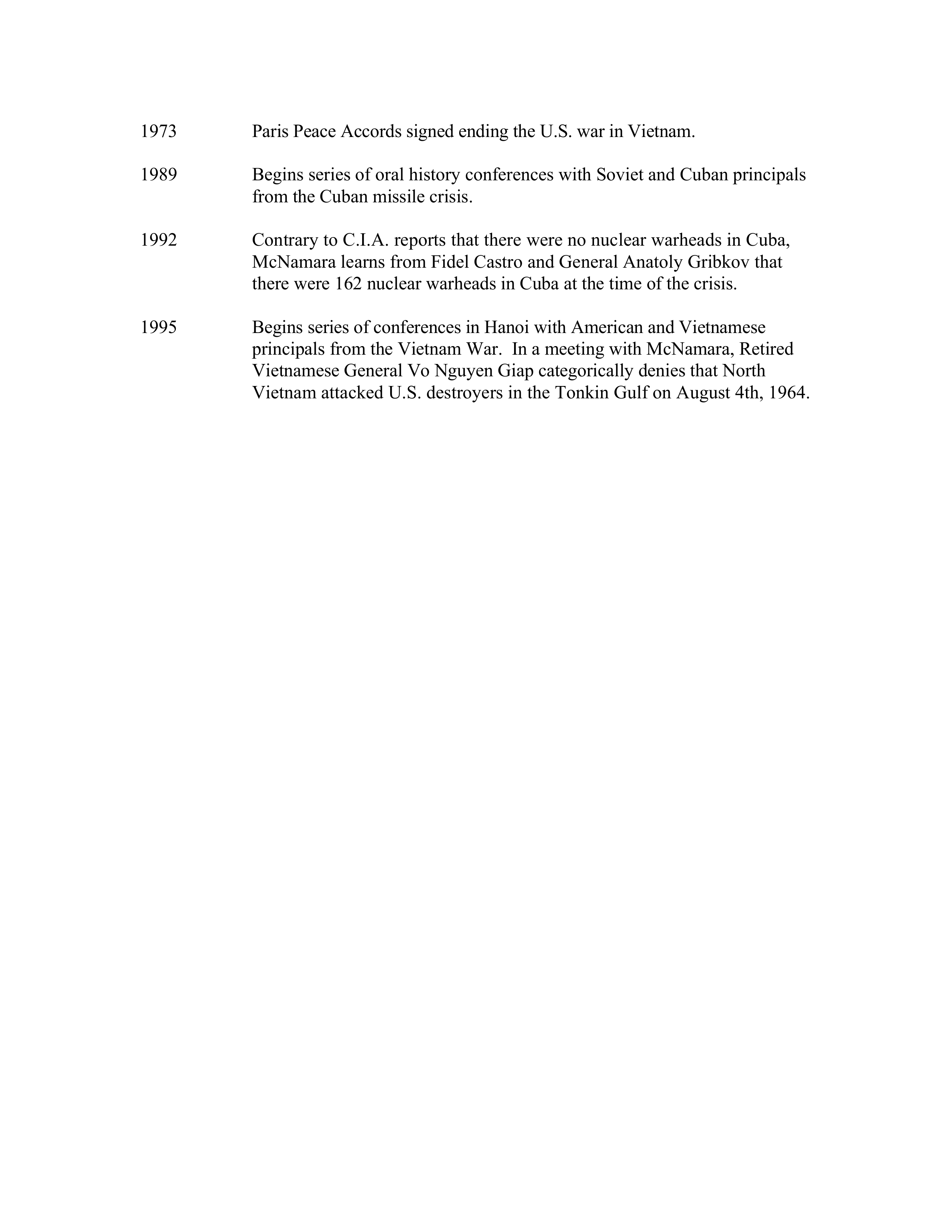
1973
Paris Peace Accords signed ending the U.S. war in Vietnam.
1989
Begins series of oral history conferences with Soviet and Cuban principals
from the Cuban missile crisis.
1992
Contrary to C.I.A. reports that there were no nuclear warheads in Cuba,
McNamara learns from Fidel Castro and General Anatoly Gribkov that
there were 162 nuclear warheads in Cuba at the time of the crisis.
1995
Begins series of conferences in Hanoi with American and Vietnamese
principals from the Vietnam War. In a meeting with McNamara, Retired
Vietnamese General Vo Nguyen Giap categorically denies that North
Vietnam attacked U.S. destroyers in the Tonkin Gulf on August 4th, 1964.
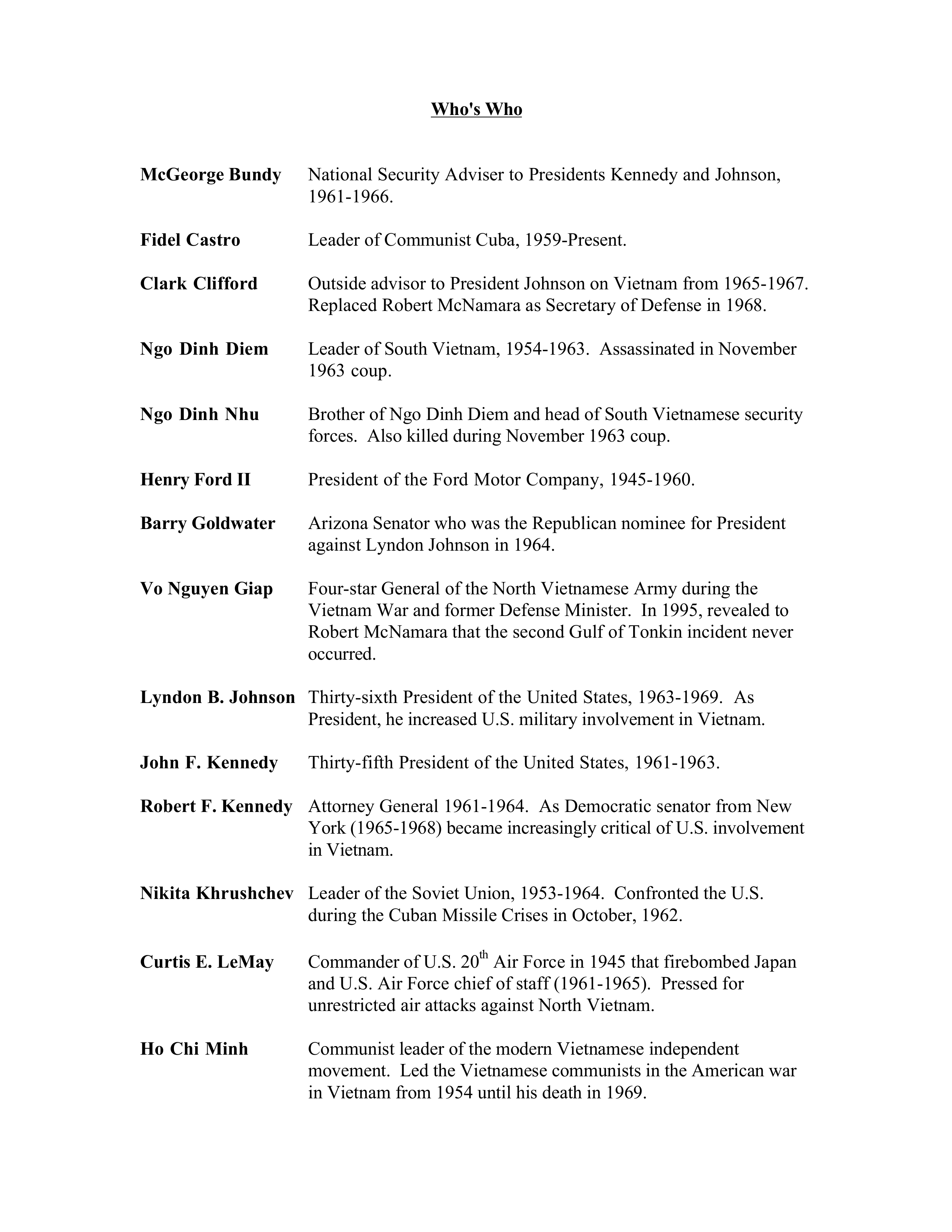
Who's Who
McGeorge Bundy
National Security Adviser to Presidents Kennedy and Johnson,
1961-1966.
Fidel Castro
Leader of Communist Cuba, 1959-Present.
Clark Clifford
Outside advisor to President Johnson on Vietnam from 1965-1967.
Replaced Robert McNamara as Secretary of Defense in 1968.
Ngo Dinh Diem
Leader of South Vietnam, 1954-1963. Assassinated in November
1963 coup.
Ngo Dinh Nhu
Brother of Ngo Dinh Diem and head of South Vietnamese security
forces. Also killed during November 1963 coup.
Henry Ford II
President of the Ford Motor Company, 1945-1960.
Barry Goldwater
Arizona Senator who was the Republican nominee for President
against Lyndon Johnson in 1964.
Vo Nguyen Giap
Four-star General of the North Vietnamese Army during the
Vietnam War and former Defense Minister. In 1995, revealed to
Robert McNamara that the second Gulf of Tonkin incident never
occurred.
Lyndon B. Johnson
Thirty-sixth President of the United States, 1963-1969. As
President, he increased U.S. military involvement in Vietnam.
John F. Kennedy
Thirty-fifth President of the United States, 1961-1963.
Robert F. Kennedy
Attorney General 1961-1964. As Democratic senator from New
York (1965-1968) became increasingly critical of U.S. involvement
in Vietnam.
Nikita Khrushchev
Leader of the Soviet Union, 1953-1964. Confronted the U.S.
during the Cuban Missile Crises in October, 1962.
Curtis E. LeMay
Commander of U.S. 20
th
Air Force in 1945 that firebombed Japan
and U.S. Air Force chief of staff (1961-1965). Pressed for
unrestricted air attacks against North Vietnam.
Ho Chi Minh
Communist leader of the modern Vietnamese independent
movement. Led the Vietnamese communists in the American war
in Vietnam from 1954 until his death in 1969.
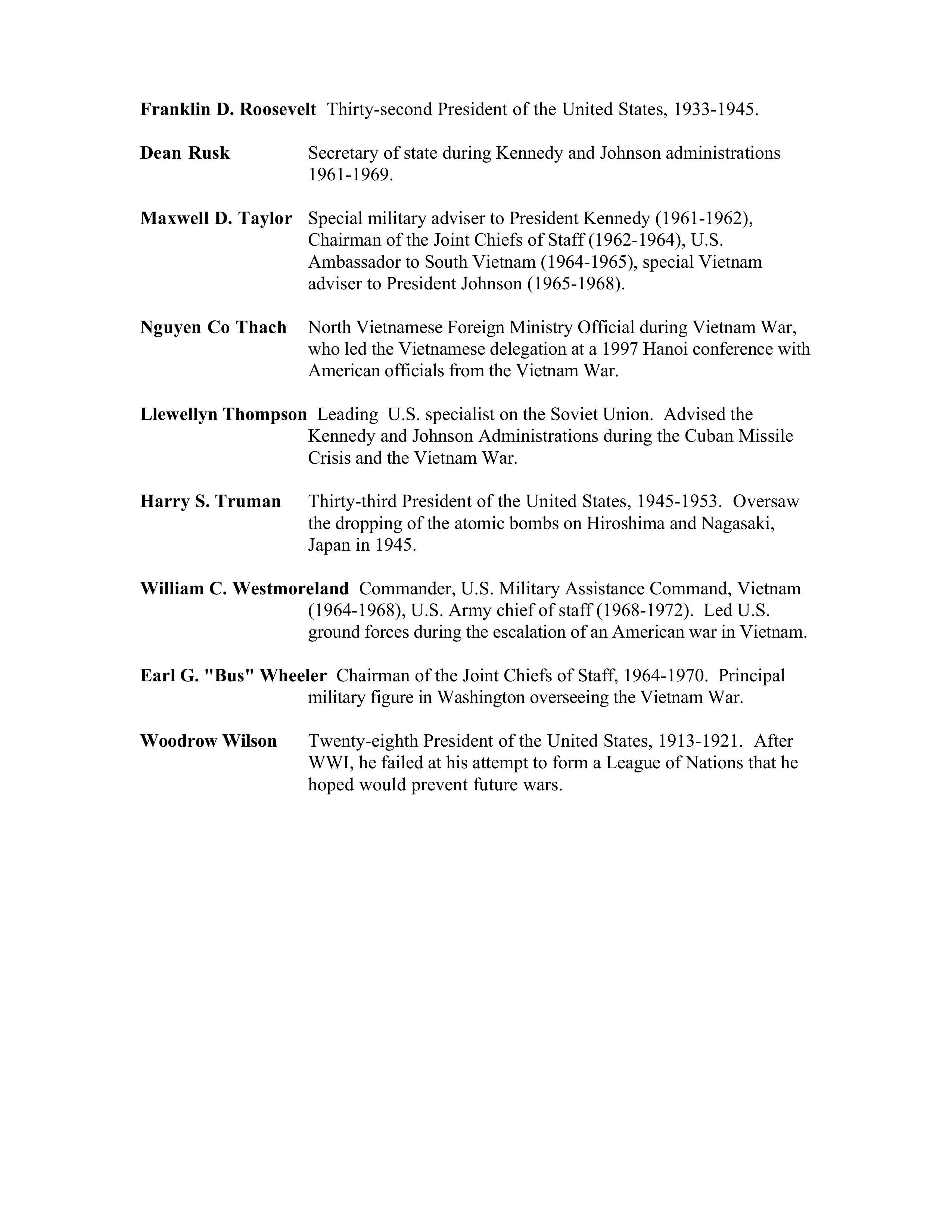
Franklin D. Roosevelt
Thirty-second President of the United States, 1933-1945.
Dean Rusk
Secretary of state during Kennedy and Johnson administrations
1961-1969.
Maxwell D. Taylor
Special military adviser to President Kennedy (1961-1962),
Chairman of the Joint Chiefs of Staff (1962-1964), U.S.
Ambassador to South Vietnam (1964-1965), special Vietnam
adviser to President Johnson (1965-1968).
Nguyen Co Thach
North Vietnamese Foreign Ministry Official during Vietnam War,
who led the Vietnamese delegation at a 1997 Hanoi conference with
American officials from the Vietnam War.
Llewellyn Thompson
Leading U.S. specialist on the Soviet Union. Advised the
Kennedy and Johnson Administrations during the Cuban Missile
Crisis and the Vietnam War.
Harry S. Truman
Thirty-third President of the United States, 1945-1953. Oversaw
the dropping of the atomic bombs on Hiroshima and Nagasaki,
Japan in 1945.
William C. Westmoreland
Commander, U.S. Military Assistance Command, Vietnam
(1964-1968), U.S. Army chief of staff (1968-1972). Led U.S.
ground forces during the escalation of an American war in Vietnam.
Earl G. "Bus" Wheeler
Chairman of the Joint Chiefs of Staff, 1964-1970. Principal
military figure in Washington overseeing the Vietnam War.
Woodrow Wilson
Twenty-eighth President of the United States, 1913-1921. After
WWI, he failed at his attempt to form a League of Nations that he
hoped would prevent future wars.
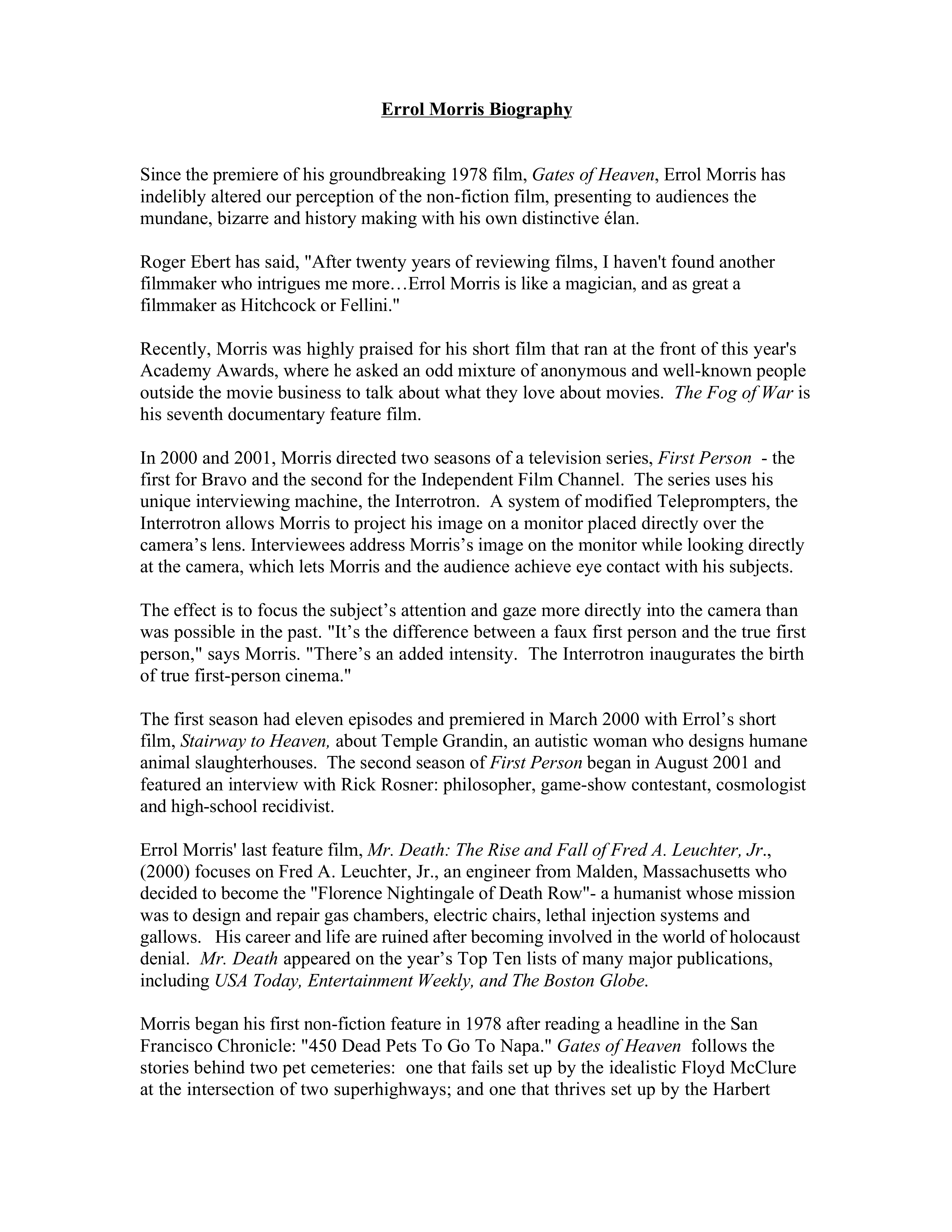
Errol Morris Biography
Since the premiere of his groundbreaking 1978 film,
Gates of Heaven
, Errol Morris has
indelibly altered our perception of the non-fiction film, presenting to audiences the
mundane, bizarre and history making with his own distinctive élan.
Roger Ebert has said, "After twenty years of reviewing films, I haven't found another
filmmaker who intrigues me more…Errol Morris is like a magician, and as great a
filmmaker as Hitchcock or Fellini."
Recently, Morris was highly praised for his short film that ran at the front of this year's
Academy Awards, where he asked an odd mixture of anonymous and well-known people
outside the movie business to talk about what they love about movies.
The Fog of War
is
his seventh documentary feature film.
In 2000 and 2001, Morris directed two seasons of a television series,
First Person
- the
first for Bravo and the second for the Independent Film Channel. The series uses his
unique interviewing machine, the Interrotron. A system of modified Teleprompters, the
Interrotron allows Morris to project his image on a monitor placed directly over the
camera’s lens. Interviewees address Morris’s image on the monitor while looking directly
at the camera, which lets Morris and the audience achieve eye contact with his subjects.
The effect is to focus the subject’s attention and gaze more directly into the camera than
was possible in the past. "It’s the difference between a faux first person and the true first
person," says Morris. "There’s an added intensity. The Interrotron inaugurates the birth
of true first-person cinema."
The first season had eleven episodes and premiered in March 2000 with Errol’s short
film,
Stairway to Heaven,
about Temple Grandin, an autistic woman who designs humane
animal slaughterhouses. The second season of
First Person
began in August 2001 and
featured an interview with Rick Rosner: philosopher, game-show contestant, cosmologist
and high-school recidivist.
Errol Morris' last feature film,
Mr. Death: The Rise and Fall of Fred A. Leuchter, Jr
.,
(2000) focuses on Fred A. Leuchter, Jr., an engineer from Malden, Massachusetts who
decided to become the "Florence Nightingale of Death Row"- a humanist whose mission
was to design and repair gas chambers, electric chairs, lethal injection systems and
gallows. His career and life are ruined after becoming involved in the world of holocaust
denial.
Mr. Death
appeared on the year’s Top Ten lists of many major publications,
including
USA Today, Entertainment Weekly, and The Boston Globe
.
Morris began his first non-fiction feature in 1978 after reading a headline in the San
Francisco Chronicle: "450 Dead Pets To Go To Napa."
Gates of Heaven
follows the
stories behind two pet cemeteries: one that fails set up by the idealistic Floyd McClure
at the intersection of two superhighways; and one that thrives set up by the Harbert
family, who apply the latest marketing concepts to the pet cemetery profession.
Gates of
Heaven
was described by Roger Ebert as "one of the ten best films of all time."
Morris's second effort, about the inhabitants of a Florida small town who lop off their
limbs for insurance money ("They literally became a fraction of themselves to become
whole financially," Morris has commented.), had to be retooled when his subjects
threatened to murder him. Forced to come up with a new concept, Morris created
Vernon,
Florida
(1981), about the eccentric residents of a southern swamp town. David Ansen,
writing in
Newsweek
, called it "the work of a true original."
Morris completed his most controversial film,
The Thin Blue Line,
in 1988. Billed as "the
first movie mystery to actually solve a murder," the film is credited with overturning the
conviction of Randall Dale Adams for the murder of Dallas police officer Robert Wood, a
crime for which Adams was to be executed.
The Thin Blue Line
was voted the best film of
1988 in a
Washington Post
survey of over one hundred film critics.
Premiere
, in a survey
of films of the 1980’s, described it as one of the most important and influential movies of
the decade.
In 1992, Morris finished a film about the life and work of Stephen Hawking, the physicist
who is often compared to Einstein despite having spent most of his life confined to a
wheelchair with a computer as his only means of communication.
A Brief History of Time
won both the Filmmaker's Award and the Grand Jury Prize at the Sundance Film Festival.
Morris' interviews for the film have been incorporated into a book, “A Reader's
Companion,” published by Bantam Books. The film appeared on many Top Ten lists for
1992, including
Time, The Los Angeles Times
and
The San Francisco Chronicle
.
Errol Morris created one of the most highly regarded films of 1997, the critically
acclaimed
Fast, Cheap, and Out of Control
which linked the fascinating, yet seemingly
unrelated stories of a lion tamer; an expert on the African mole-rat; a topiary gardener
who carves giant animals out of hedges; and an MIT scientist who designs robots. The
film won the Best Documentary Film Award from the National Board of Review,
National Society of Film Critics and Independent Spirit Award. It was also included in
the 2000 Biennial at the Whitney Museum.
Morris has made numerous television commercials, including campaigns for Apple,
Citibank, Cisco Systems, Intel, American Express and Nike. In 2001, He won an Emmy
for directing the commercial "Photobooth" for PBS.
Morris has received five fellowships from the National Endowment for the Arts, a
Guggenheim Fellowship and a MacArthur Fellowship. He is a graduate of the University
of Wisconsin-Madison and was a graduate student at Princeton University and the
University of California-Berkeley.
In 1999, Morris' work received a full retrospective at the Museum of Modern Art in New
York; in 2001, he received a special tribute at the Sundance Film Festival.
Morris lives in Cambridge, Massachusetts with his wife, Julia Sheehan, an art historian, and
their son, Hamilton.
Errol Morris Filmography
Feature Films:
The Fog of War (2003)
Mr. Death: The Rise and Fall of Fred A. Leuchter, Jr. (1999)
Fast, Cheap & Out of Control (1997)
A Brief History of Time (1991)
A Thin Blue Line (1988)
Vernon, Florida (1981)
Gates of Heaven (1978)
Short Films:
Stairway to Heaven (1998)
Television:
First Person (2000-2001)
Introduction to the Glossary of Terms
It has been almost forty years since Robert S. McNamara left his position as Secretary of
Defense under President Lyndon B. Johnson, but he continues to be one of the most
controversial figures in recent U.S. history. As someone who came of age during the Cold
War, McNamara was committed to the defense of the west from Communism. This
influenced his decisions regarding the Cuban Missile Crisis, the Bay of Pigs and most
importantly, U.S. involvement in Viet Nam. It was his memorandum on the inefficiency of
the bombing operations in Japan during World War II, that contributed to General Curtis
LeMay’s decision to begin a firebombing campaign that killed more than 1 million
Japanese citizens during the first half of 1945. McNamara was the Statistical Control
Officer for the 20
th
Air Force, the bomber command responsible for the dropping of the
atomic bombs on Japan. Despite his early advice to President John F. Kennedy that the
U.S. should make plans to pull out of Vietnam, McNamara was part of an administration
that initiated the military coup that assassinated South Vietnamese President Ngo Dinh
Diem leading to increased political instability in South Vietnam which in turn increased the
amount of U.S. military involvement there. He approved the use of Agent Orange, and
supported Rolling Thunder, the campaign of aerial bombardment that the U. S. Air Force
initiated against North Vietnam in March of 1965. Despite the fact that between 1965 and
1968, the Air Force dropped over 1.5 million tons of bombs on North Vietnam
, the North
Vietnamese refused to stop supporting the insurgency in South Vietnam.
The scars from Vietnam still divide this country, and if anything have been brought into new
relief with the recent activities of the Bush Administration in Iraq. To this day, despite a
widespread belief that while a member of the Johnson administration McNamara turned
against the war in Vietnam, he still refuses to address this question. 58,000 American
soldiers and 8 million Vietnamese died before the Paris peace accords were signed in 1973,
marking an end to the U.S. war in Vietnam.
Glossary of Terms
Agent Orange:
A variety of herbicide that U.S. forces used in Vietnam to kill plants and
defoliate trees that provided cover for the enemy. The use of Agent Orange was
recommended by Robert McNamara and the Joint Chiefs and approved by President
Kennedy in 1961. Between 1961 and 1971, C-123 planes sprayed more than 19 million
gallons of Agent Orange and other herbicides in South Vietnam. After the Vietnam War, it
was determined that toxins in Agent Orange had caused cancer and birth defects in
thousands of civilians and military personnel exposed to it.
For Further Reading: Operation Ranch Hand: The Air Force and Herbicides in Southeast
Asia, 1961-1971
by William A. Buckingham, Jr.
Armistice Day
: The worldwide celebration that occurred on November 11
th
, 1918 to
mark the end of World War I, the most devastating war in human history to that
point. President Woodrow Wilson and many Americans believed the by winning
World War I, they had fought the war to end all wars. Only two years old at the
time, Robert McNamara remembers attending the Armistice Day celebration in San
Francisco.
For Further Reading: Breaking the Heart of the World
by John Milton Cooper
Atomic Bombs
: From 1939 to 1945, more than $2 billion was spent on the secret
enterprise to build an atomic bomb known as the “Manhattan Project.” On August 6
th
,
1945, a Uranium bomb nicknamed “Little Boy” was dropped on Hiroshima, Japan,
instantly killing 80,000 people. Three days later on August 9
th
, a Plutonium bomb
nicknamed “Fat Man” was dropped on Nagasaki, Japan, instantly killing 58,000 people.
For Further Reading: The Making of the Atomic Bomb
by Richard Rhodes.
B-29 Superfortress
: In the fall of 1943, Robert McNamara was sent from the 8
th
Air
Force in London to Salina, Kansas to help with construction delays on the first B-29s. The
U.S. Air Force’s heavy, long-range bomber that went into service in the fall of 1944 was the
most complex machine ever constructed. Capable of flying at over 30,000 feet with a range
of 6,000 miles, the B-29 was used for the devastating firebombing of Japan as well as for
dropping the two atomic bombs on Japans in 1945coming into service - the 58
th
bomb
wing.
For Further Reading: Superfortress: The B-29 and American Air Power
by Curtis E.
LeMay and Bill Yenne.
http://www.nasm.si.edu/research/arch/archives.html
Bay of Pigs
: The invasion of communist Cuba in April 1961 by a band of U.S. trained
Cuban exiles. The exiles were intended to infiltrate Cuba and incite an uprising that would
overthrow Fidel Castro. All of President Kennedy’s civilian and military advisors - with the
exception of Congressman Richard Fulbright - gave their approval for the invasion.
However, without U.S. aerial support - which was denied by President John Kennedy - the
mission was a complete disaster both militarily and politically for the Kennedy
administration.
For Further Reading: Politics of Illusion: The Bay of Pigs Invasion Reexamined
by James
Blight and Peter Kornbluh.
http://www.gwu.edu/~nsarchiv/
Cuban missile crisis
: The closest the United States and Soviet Union ever came to nuclear
war. On October 16
th
, 1962, the U.S. determined that the Soviet Union had secretly
smuggled nuclear missiles into Cuba. On the recommendation of Robert McNamara, the
U.S. initiated a naval blockade of Cuba and made preparations for air strikes and an
invasion of Cuba. On October 28
th
, Soviet Premier Nikita Khrushchev publicly announced
that he would remove Soviet missiles from Cuba, ending the standoff. Robert McNamara
learned from Fidel Castro in 1989 that nuclear warheads for the missiles were already in
Cuba at the time of the crisis, and had the U.S. invaded, the nuclear missiles would have
been used against both the U.S. invading force and mainland United States.
For Further Reading: The Cuban Missile Crisis, 1962
edited by Laurence Chang and Peter
Kornbluh.
http://www.gwu.edu/~nsarchiv/
Curtis LeMay
: Born in Columbus, Ohio in 1906. LeMay joined the U.S. Army Air
Corps in 1928 and by 1942 had been given command of the 305 bombardment group of the
8
th
Air Force in London. As commander of one of the first bomb groups to bomb
Germany, LeMay received recognition for his training innovations and development of new
bombing techniques. In 1944 he left Europe for China to take command of the 20
th
Bomber Command, which began striking targets in Japan. In January 1945, he replaced
Haywood Hansell as commander of the 21
st
Bomber Command, a newer and larger
command of B-29 bombers that was stationed on the Marianas Islands. From there,
LeMay planned and conducted a devastating bombing campaign of Japan. In March of
1945, he devised a tactic low-level, nighttime incendiary bombing that eventually would
destroy 67 Japanese cities and kill nearly one million civilians. LeMay’s command was
further responsible for the dropping of the two atomic bombs on Hiroshima and Nagasaki
in August 1945. In 1948, LeMay took command of the Strategic Air Command, the
nation’s strategic nuclear defense command. In 1961, President Kennedy named him Chief
of Staff of the Air Force, where he repeatedly clashed with Secretary McNamara on
strategy, weapons, and budgets. He retired as Chief of Staff in 1965, and in 1968 ran for
Vice-President with Governor George Wallace on the American Independent Party Ticket.
They lost and LeMay again returned to private life.
For Further Reading: Iron Eagle: The Turbulent Life of General Curtis LeMay
by
Thomas M. Coffey.
Domino Theory
: The concept that if one country becomes Communist, its neighboring
nations will mostly likely follow. The theory was first expressed by President Dwight
Eisenhower in 1954 and was used by subsequent U.S. administrations to justify the war in
Vietnam. Many historians, as well as Robert McNamara, now believe that had the U.S. not
intervened in South Vietnam, all of Asia would not have fallen under communist control and
the security of the West would not have been affected.
For Further Reading
:
A Grand Delusion: America’s Descent into Vietnam
by Robert
Mann.
http://www.eisenhower.utexas.edu/
Diem Assassination
: On November 1
st
, 1963, South Vietnamese President Ngo Dinh
Diem and his brother were assassinated in a military coup initiated and supported by the
Kennedy Administration. After the coup, South Vietnam never again had a stable
government until the end of the Vietnam War. This instability led to an increased U.S.
military involvement to buttress the subsequent South Vietnam governments, which had little
success in suppressing the North Vietnamese insurgents without U.S. assistance.
For Further Reading: Death of a Generation: How the Assassination of Diem and JFK
Prolonged the Vietnam War
by Howard Jones.
Firebombing of Japan
: For the first three years of World War II, The U.S. Air Force,
conducted high-altitude, daylight, precision bombing of Nazi Germany and Japan. Due to
the presence of high winds and cloud cover over Japan, the Air Force began a devastating
campaign of nighttime, low-level firebombing of Japan on the night of March 10
th
, 1945 in
Tokyo. In that single night, 334 B-29 bombers burned to death nearly 100,000 civilians in
Tokyo. In the ensuing five months, the U.S. would firebomb 66 additional Japanese cities,
killing nearly a million Japanese civilians, injuring over 1.3 million, and causing nearly one
quarter of the Japanese urban population to evacuate their homes. Robert McNamara was
the Statistical Control Officer for the 20
th
Air Force, which was the bomber command
responsible for both the firebombing and the dropping of the atomic bombs on Japan. It
was his memorandum on the inefficiency of the bombing operations that contributed to
General Curtis LeMay’s decision to begin a firebombing campaign.
For Further Reading: The Rise of American Air Power: The Creation of Armageddon
by
Michael S. Sherry.
Great Depression
: The calamitous, worldwide economic collapse of the 1930s that at its
height saw 25% of the country’s work force (13 million people) unemployed. Beginning
with the 1929 stock market collapse, the Great Depression did not end in the United States
until the nation’s entry into World War II in 1942. As an undergraduate at Berkeley from
1933 to 1937, Robert McNamara and many other students became economic majors in
response to the economic devastation of the Great Depression.
For Further Reading: The Great Depression: America 1929-1941
by Robert McElvaine.
http://www.fdrlibrary.marist.edu/
Gulf of Tonkin Incidents
: On August 2, 1964, the American destroyer
Maddox
was
attacked by North Vietnamese patrol boats. On August 4th, the destroyers
Maddox
and
Turner Joy
reported that they were being attacked by North Vietnamese patrol boats. By
the end of the day, President Lyndon Johnson had ordered the first U.S. air strikes of North
Vietnam in retaliation. And on August 7
th
, Congress passed The Tonkin Gulf Resolution,
which gave the President authority to take the nation to war. Almost immediately after the
attack on August 4
th
, evidence arose that the attack may not have taken place. In a 1995
meeting with retired Vietnamese General Vo Nguyen Giap, Robert McNamara was told
definitively that the attack on August 4
th
never occurred.
For Further Reading: Tonkin Gulf and the Escalation of the Vietnam War
by Edwin
Moise.
http://www.history.navy.mil/
Ho Chi Minh
: The founder and President of the Democratic Republic of Vietnam (also
known as North Vietnam). He was born in 1890 and joined the French Communist Party
in 1920, and later formed the Indochinese Communist Party in the early 1930s. In 1941, he
founded an alliance known as the Vietminh to fight the French occupation of Vietnam.
After the defeat of France at the battle of Dien Bien Phu, the Geneva Accords of 1954
divided Vietnam into North and South at the 17
th
Parallel. Ho Chi Minh was determined to
unify Vietnam under communist control. After years of supporting insurgency in South
Vietnam, Ho Chi Minh ordered regular units of the Democratic Republic of Vietnam into
South Vietnam in 1964. The United States responded by beginning its Rolling Thunder
bombing campaign against North Vietnam in March 1965 and by the summer of 1965 had
greatly increased its troop deployment. The first major battle between U.S. and DRV forces
occurred at the battle of Ia Drang in November 1965. Ho Chi Minh continued his fight for
Vietnamese unification against South Vietnam and the United States until his death in 1969.
Vietnam was finally unified in 1975 and the capitol of South Vietnam, Saigon, was renamed
Ho Chi Minh City.
For Further Reading: Ho Chi Minh: A Life
by William Duiker
JFK Assassination
: President John F. Kennedy was assassinated in Dallas, Texas on
November 22
nd
, 1963. Vice-President Lyndon B. Johnson succeeded him as the 36
th
President of the United States. After the assassination, Kennedy’s plan for removing all
U.S. military advisors from Vietnam was scuttled by Lyndon Johnson, who reaffirmed the
U.S.’s commitment to South Vietnam in a National Security Memorandum only four days
after he took office.
For Further Reading
:
An Unfinished Life: John F. Kennedy, 1917-1963
by Robert Dallek.
http://www.cs.umb.edu/jfklibrary/
JFK Presidential Recordings
: In the summer of 1962, President John F. Kennedy
installed a clandestine taping machine in the Cabinet Room of the White House to record
meetings. Before his death, Kennedy recorded approximately 250 hours of meetings as
well as 12 hours of telephone conversations.
The most memorable recordings take place
during the Cuban missile crisis in October 1962. These recordings provide intimate details
into how the U.S. government works during moments of crisis.
For Further Reading: The Presidential Recordings of John F. Kennedy, Volumes 1-3, The
Great Crises
edited by Philip Zelikow and Ernest May.
http://www.cs.umb.edu/jfklibrary/
LBJ Telephone Conversations
: Between November 22, 1963 and January 1969,
President Lyndon Johnson covertly recorded telephone conversations from the Oval Office
and his Texas ranch. The first of the recordings were released to the public in 1993 in
conjunction with the JFK Assassination Records Collection Act. The last three years of the
recordings have yet to be released.
For Further Reading: Taking Charge: The Johnson White House Tapes, 1963-1964
and
Reaching for Glory: Lyndon Johnson’s Secret White House Tapes, 1964-1965
edited
by
Michael Beschloss.
http://www.lbjlib.utexas.edu/
March on the Pentagon
: On October 21, 1967, 50,000 people convened on the Mall in
Washington D.C. in the largest demonstration against the Vietnam War to that point.
20,000 from that group marched on the Pentagon in an attempt to shut down Pentagon
operations. Robert McNamara was responsible for coordinating the defense of the
Pentagon and prevented the demonstrators from entering the Pentagon.
For Further Reading: Armies of the Night: History as a Novel, the Novel as History
by
Norman Mailer.
Marianas
Islands
: A South Pacific island chain that U.S. forces captured from the
Japanese in the summer of 1944 during World War II. The 20
th
Air Force used the islands
of Guam, Saipan, and Tinian to conduct its aerial bombing campaign of Japan.
Napalm
: The highly flammable, jellied gasoline substance that was created by the Harvard
chemist, Louis Fieser, in 1942. Napalm was used by the U.S. Air Force to firebomb 67
Japanese cities during the spring and summer of1945. It was later used during the Korean
and Vietnam Wars.
For Further Reading: Blankets of Fire: U.S. Bombers over Japan during World War II
by
Kenneth Werrell.
Norman Morrison
: A Quaker who burned himself to death outside of Robert
McNamara’s office at the Pentagon on November 2
nd
, 1965 in protest of the war in
Vietnam.
For Further Reading: Living and the Dead: Robert McNamara and Five Lives of a Lost
War
by Paul Hendrickson.
Rolling Thunder
: The sustained campaign of aerial bombardment that the United States
Air Force initiated against North Vietnam in March of 1965. Between 1965 and 1968, the
Air Force dropped over 1.5 million tons of bombs on North Vietnam in connection with
Rolling Thunder. The hope of McNamara and members of the Johnson administration was
to make it clear to Ho Chi Minh and the North Vietnamese leadership that they should cease
support of the Vietcong insurgents in South Vietnam and come to a settlement instead of
facing continued aerial devastation.
However, despite the tremendous damage and
casualties inflicted by the Rolling Thunder bombing program, the North Vietnamese
refused to stop supporting the insurgency in South Vietnam.
For Further Reading: American Tragedy: Kennedy, Johnson, and the Origins of the
Vietnam War
by David Kaiser.
http://www.vietnam.ttu.edu/
Secretary of Defense
: The position of Secretary of Defense was created after World
War II in 1947 in an attempt to bring the military branches under civilian control. Robert
McNamara became the 8
th
Secretary of Defense of the United States on January 20
th
,
1961. He would serve under both Presidents Kennedy and Johnson before leaving office
on February 29
th
, 1968.
For Further Reading: Decisions of Robert S. McNamara: A Study of the Role of the
Secretary of Defense
by James Roherty.
http://www.defenselink.mil/
Statistical Control
: A division of the U.S. Air Force that came into existence in 1942.
Statistical Control Officers were trained at Harvard Business School and then assigned to
every Air Force command where worked to apply standardized procedures to statistical
reporting and analysis. They served to organize the movement of men, planes, and materiel,
as well as provide statistical analysis of bombing missions. This data was used by Air
Force commanders of as an essential factor in planning and the quantitative measure of
achievement. Robert McNamara was one the original faculty members of the Statistical
Control School at Harvard, and then served as a Statistical Control Officer for the 8
th
Air
Force in London and then the 20
th
Air Force in India, China, and the Marianas.
Vietcong
: The colloquial term for the North Vietnamese-sponsored, communist insurgents
who were fighting the South Vietnamese government. The Vietcong were formally known
as the National Liberation Front.
1960 Presidential Election
: Senator John F. Kennedy defeated Vice-President Richard
Nixon to become the 35
th
President of the United States. Although Kennedy won the
electoral vote 303 to 219, he only received 118,000 more votes than Nixon in the popular
vote.
1964 Presidential Election
: President Johnson was opposed by the ultra-conservative,
Republican Senator Barry Goldwater. Johnson easily won reelection as Senator
Goldwater’s public support for the use of nuclear weapons in Vietnam helped President
Johnson win 65% of the popular vote, the largest Presidential victory in American history.
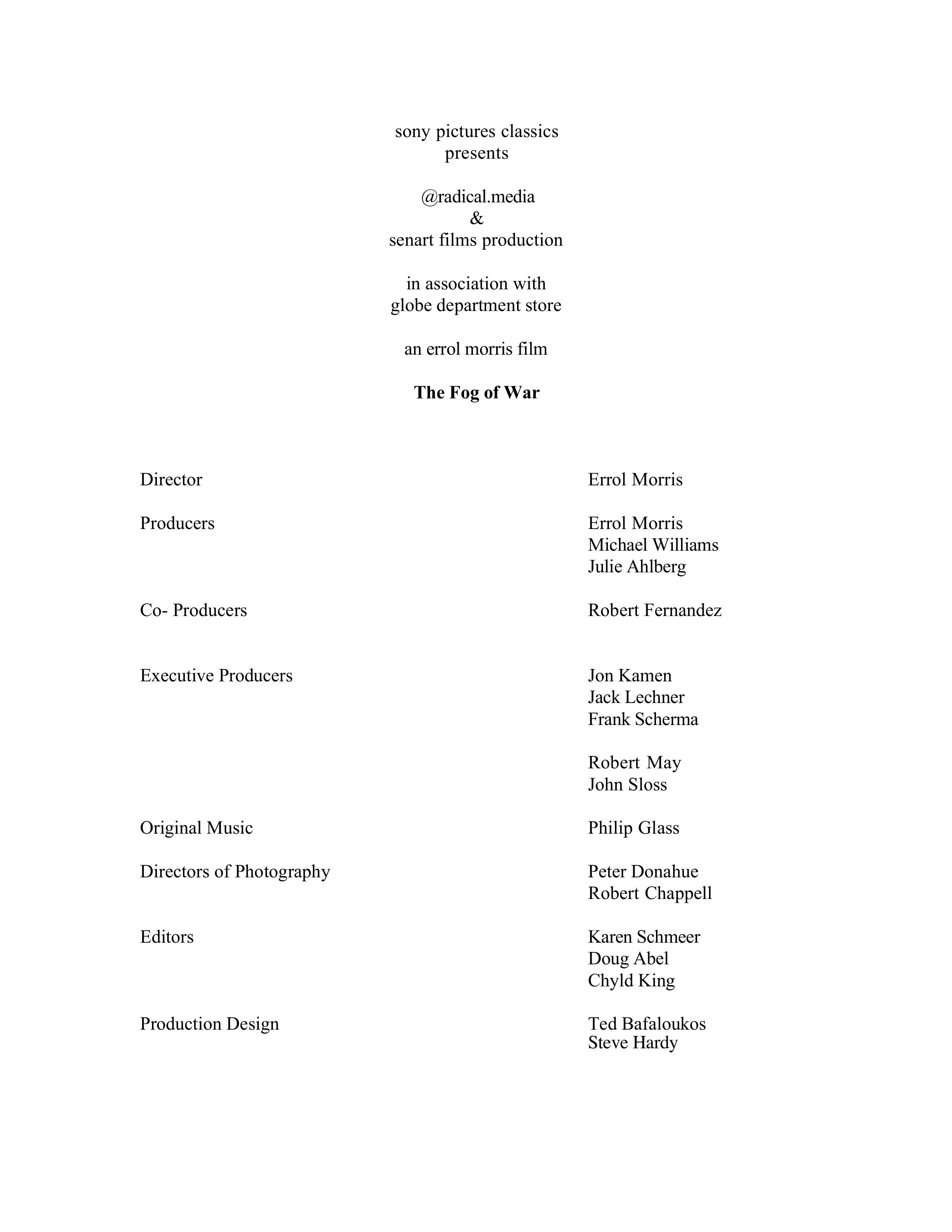
sony pictures classics
presents
@radical.media
&
senart films production
in association with
globe department store
an errol morris film
The Fog of War
Director
Errol Morris
Producers
Errol Morris
Michael Williams
Julie Ahlberg
Co- Producers
Robert Fernandez
Executive Producers
Jon Kamen
Jack Lechner
Frank Scherma
Robert May
John Sloss
Original Music
Philip Glass
Directors of Photography
Peter Donahue
Robert Chappell
Editors
Karen Schmeer
Doug Abel
Chyld King
Production Design
Ted Bafaloukos
Steve Hardy
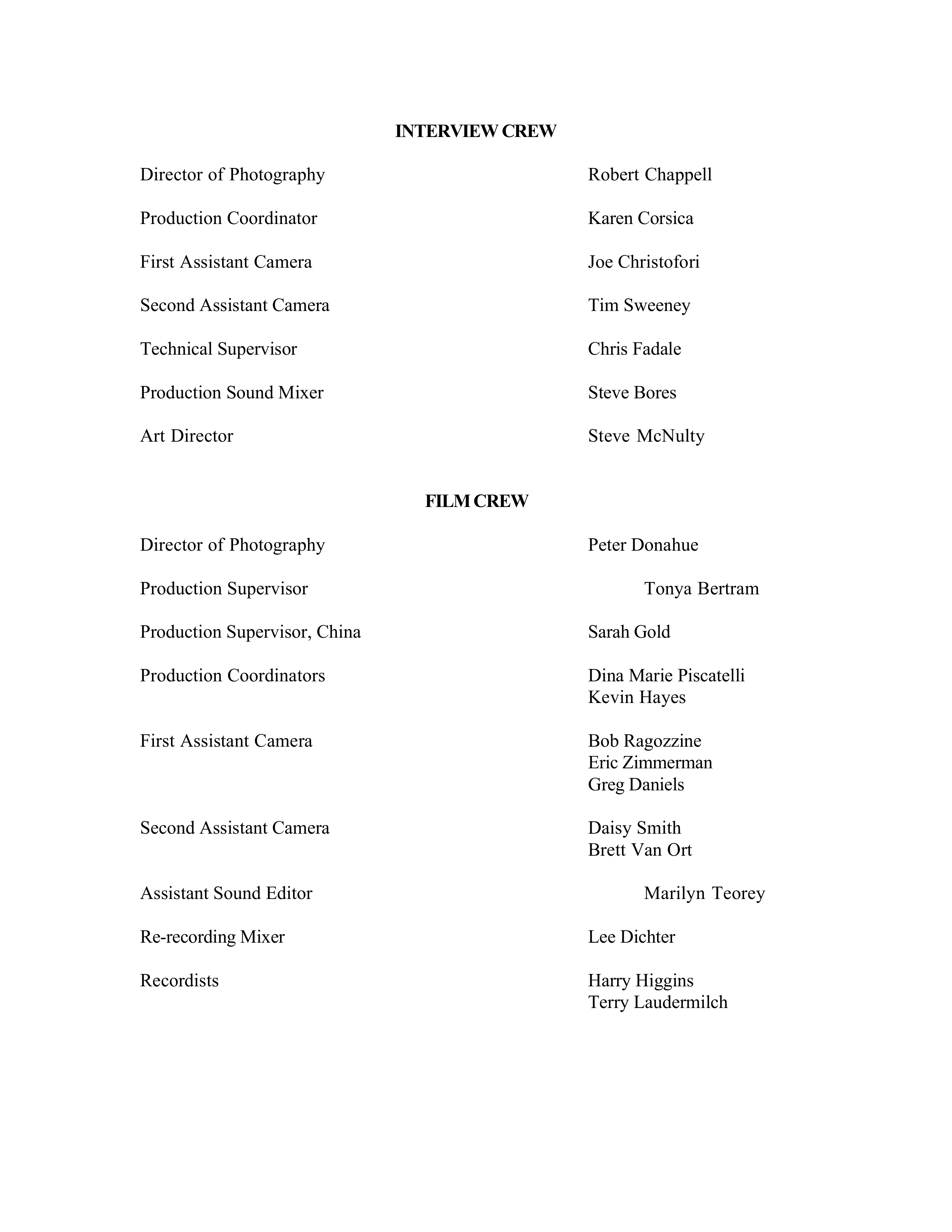
INTERVIEW CREW
Director of Photography
Robert Chappell
Production Coordinator
Karen Corsica
First Assistant Camera
Joe Christofori
Second Assistant Camera
Tim Sweeney
Technical Supervisor
Chris Fadale
Production Sound Mixer
Steve Bores
Art Director
Steve McNulty
FILM CREW
Director of Photography
Peter Donahue
Production Supervisor
Tonya Bertram
Production Supervisor, China
Sarah Gold
Production Coordinators
Dina Marie Piscatelli
Kevin Hayes
First Assistant Camera
Bob Ragozzine
Eric Zimmerman
Greg Daniels
Second Assistant Camera
Daisy Smith
Brett Van Ort
Assistant Sound Editor
Marilyn Teorey
Re-recording Mixer
Lee Dichter
Recordists
Harry Higgins
Terry Laudermilch
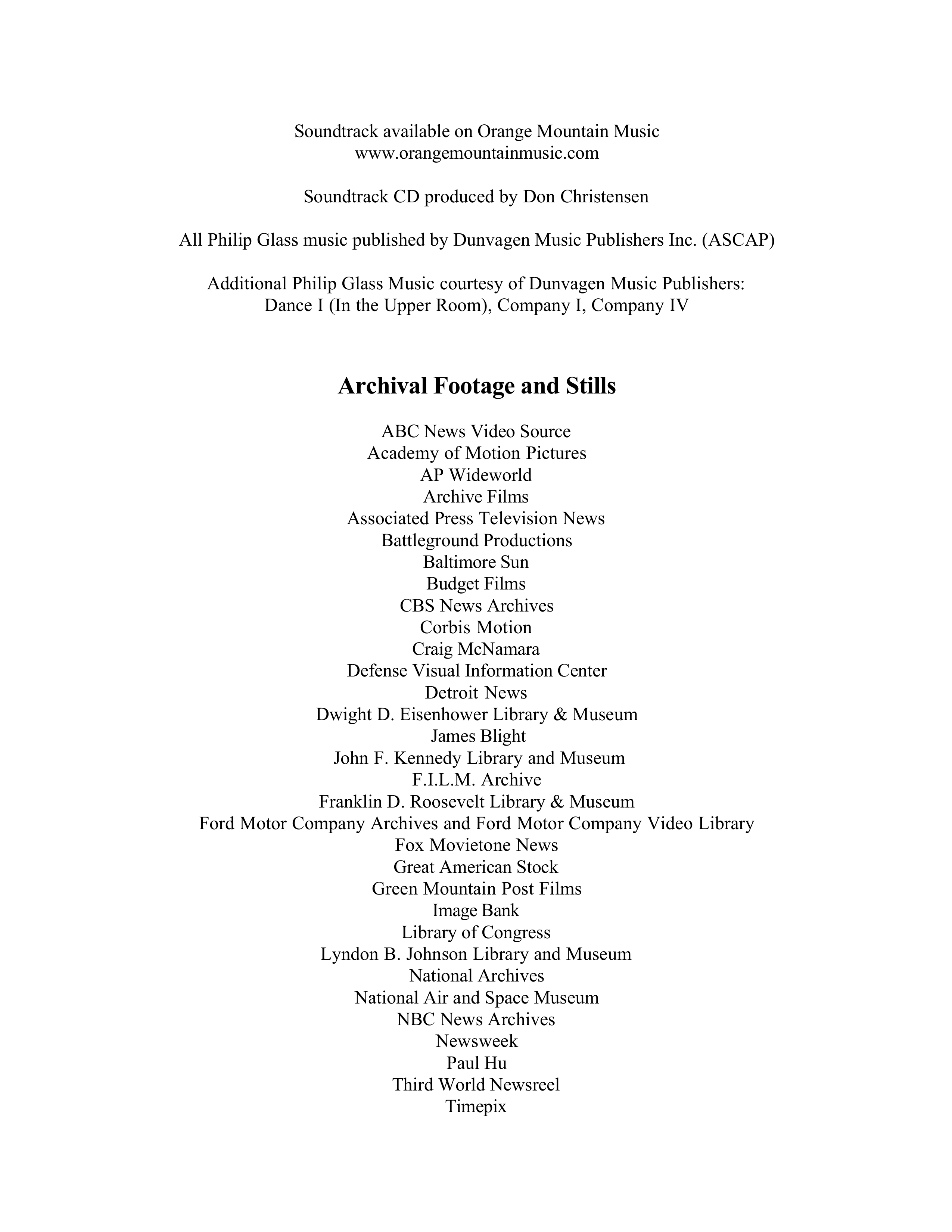
Soundtrack available on Orange Mountain Music
www.orangemountainmusic.com
Soundtrack CD produced by Don Christensen
All Philip Glass music published by Dunvagen Music Publishers Inc. (ASCAP)
Additional Philip Glass Music courtesy of Dunvagen Music Publishers:
Dance I (In the Upper Room), Company I, Company IV
Archival Footage and Stills
ABC News Video Source
Academy of Motion Pictures
AP Wideworld
Archive Films
Associated Press Television News
Battleground Productions
Baltimore Sun
Budget Films
CBS News Archives
Corbis Motion
Craig McNamara
Defense Visual Information Center
Detroit News
Dwight D. Eisenhower Library & Museum
James Blight
John F. Kennedy Library and Museum
F.I.L.M. Archive
Franklin D. Roosevelt Library & Museum
Ford Motor Company Archives and Ford Motor Company Video Library
Fox Movietone News
Great American Stock
Green Mountain Post Films
Image Bank
Library of Congress
Lyndon B. Johnson Library and Museum
National Archives
National Air and Space Museum
NBC News Archives
Newsweek
Paul Hu
Third World Newsreel
Timepix
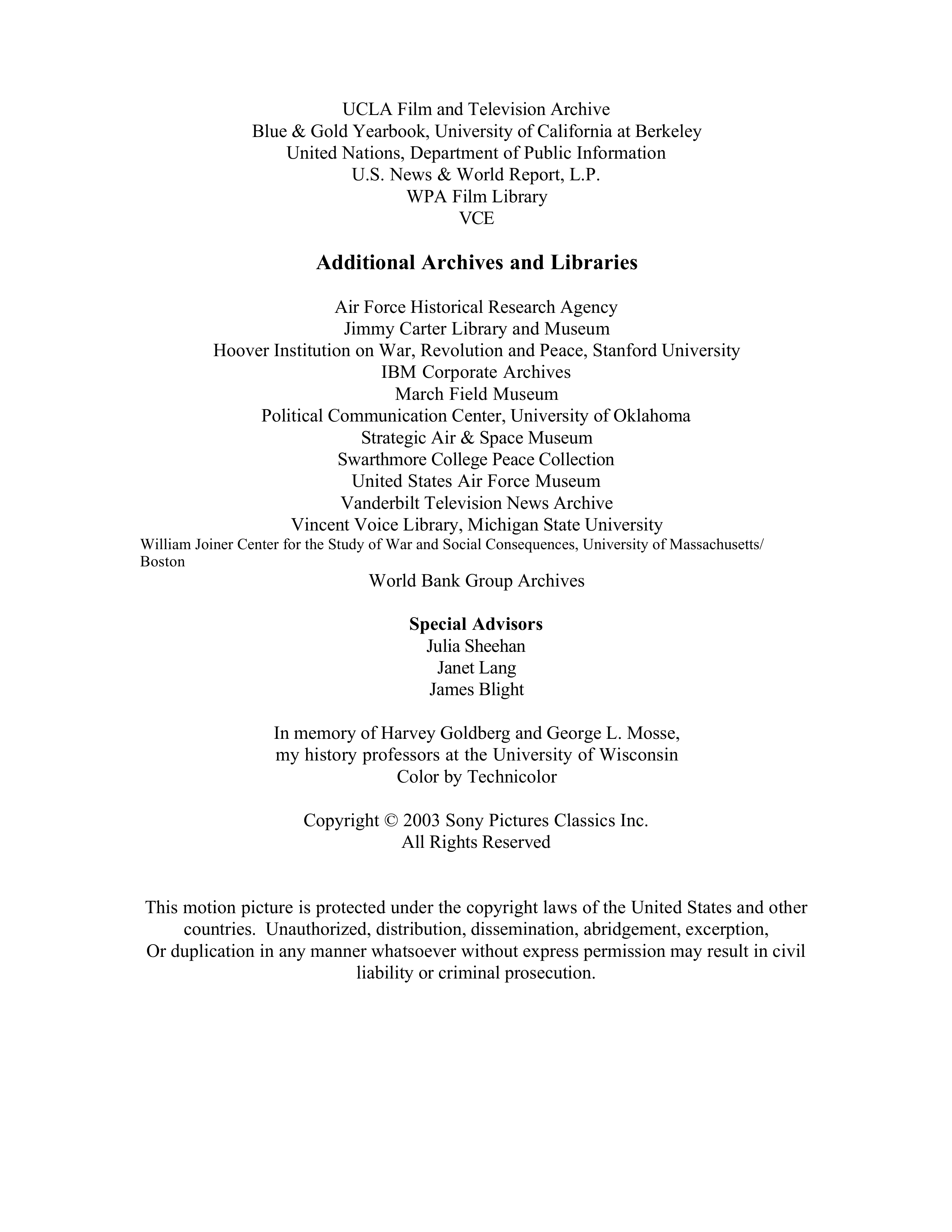
UCLA Film and Television Archive
Blue & Gold Yearbook, University of California at Berkeley
United Nations, Department of Public Information
U.S. News & World Report, L.P.
WPA Film Library
VCE
Additional Archives and Libraries
Air Force Historical Research Agency
Jimmy Carter Library and Museum
Hoover Institution on War, Revolution and Peace, Stanford University
IBM Corporate Archives
March Field Museum
Political Communication Center, University of Oklahoma
Strategic Air & Space Museum
Swarthmore College Peace Collection
United States Air Force Museum
Vanderbilt Television News Archive
Vincent Voice Library, Michigan State University
William Joiner Center for the Study of War and Social Consequences, University of Massachusetts/
Boston
World Bank Group Archives
Special Advisors
Julia Sheehan
Janet Lang
James Blight
In memory of Harvey Goldberg and George L. Mosse,
my history professors at the University of Wisconsin
Color by Technicolor
Copyright © 2003 Sony Pictures Classics Inc.
All Rights Reserved
This motion picture is protected under the copyright laws of the United States and other
countries. Unauthorized, distribution, dissemination, abridgement, excerption,
Or duplication in any manner whatsoever without express permission may result in civil
liability or criminal prosecution.