
STEPHEN GREENBLATT
Dark
Renaissance
The Dangerous
Times and
Fatal Genius of
Shakespeare’s
Greatest Rival,
Christopher
Marlowe
‘Sparkling, addictive reading’
MAGGIE O’FARRELL
Copyrighted Material

DARK RENAISSANCE
Copyrighted Material

Copyrighted Material
Also by
Stephen Greenblatt
Second Chances: Shakespeare and Freud
(with Adam Phillips)
Tyrant: Shakespeare on Politics
T e Rise and Fall of Adam and Eve: T e Story that Created Us
T e Swerve: How the World Became Modern
Shakespeare’s Freedom
Will in the World: How Shakespeare Became Shakespeare
Hamlet in Purgatory
Practicing New Historicism
(with Catherine Gallagher)
Marvelous Possessions: T e Wonder of the New World
Learning to Curse: Essays in Early Modern Culture
Shakespearean Negotiations: T e Circulation of Social Energy in
Renaissance England
Renaissance Self- Fashioning: From More to Shakespeare
Sir Walter Ralegh: T e Renaissance Man and His Roles
T ree Modern Satirists: Waugh, Orwell, and Huxley
Edited by
Stephen Greenblatt
Shakespeare’s Montaigne: T e Florio Translation of Essays
(with Peter G. Platt)
Religio Medici and Urne- Buriall
(with Ramie Targoff )
Cultural Mobility: A Manifesto
T e Norton Anthology of English Literature
(general editor)
T e Norton Shakespeare
(general editor)
New World Encounters
Redrawing the Boundaries: T e Transformation of English
and American Literary Studies
(with Giles Gunn)
Representing the English Renaissance
Allegory and Representation
Copyrighted Material
Copyrighted Material
DARK
RENAISSANCE
THE D ANGEROUS TI MES
AND FATAL GENI US OF
SH AKESPE ARE’S GRE ATEST RIVAL,
CHRI STOPHER M ARLOWE
STEPHEN GREENBLATT
THE BODLEY HEAD
LONDON
BH
Copyrighted Material
1 3 5 7 9 10 8 6 4 2
The Bodley Head, an imprint of Vintage, is part of the
Penguin Random House group of companies
Vintage, Penguin Random House UK, One Embassy Gardens,
8 Viaduct Gardens, London SW11 7BW
penguin.co.uk/vintage
global.penguinrandomhouse.com
First published in Great Britain by The Bodley Head in 2025
First published in the United States of America by W.W. Norton & Company in 2025
Copyright © Stephen Greenblatt 2025
The moral right of the author has been asserted
The author and publisher gratefully acknowledge the permission granted
to reproduce the copyright material in this book. Every effort has been made
to trace copyright holders and to obtain their permission. The publisher apologises
for any errors or omissions and, if notified of any corrections, will make
suitable acknowledgment in future reprints or editions of this book.
Book design by Marysarah Quinn
No part of this book may be used or reproduced in any manner for the purpose
of training artificial intelligence technologies or systems. In accordance with
Article 4(3) of the DSM Directive 2019/790, Penguin Random House
expressly reserves this work from the text and data mining exception.
Printed and bound in Great Britain by Clays Ltd, Elcograf S.p.A.
The authorised representative in the EEA is Penguin Random House Ireland,
Morrison Chambers, 32 Nassau Street, Dublin D02 YH68
A CIP catalogue record for this book is available from the British Library
HB ISBN 9781847927132
TPB ISBN 9781847927149
Penguin Random House is committed to a sustainable future
for our business, our readers and our planet. This book is made
from Forest Stewardship Council® certified paper.
Copyrighted Material

To Horst Bredekamp
Copyrighted Material

Copyrighted Material
Contents
1.
A World Apart .....................................................1
2.
Handwriting on the Wall ...................................8
3.
Th e Great Separation ....................................... 22
4.
Th e Master’s Books ........................................... 38
5.
Bright College Years ..........................................53
6.
Gold Buttons ......................................................76
7.
Recruitment ....................................................... 88
8.
In the Liberties ................................................ 113
9.
Th e Conquest of London ............................... 127
10.
Secret Sharers ...................................................141
11.
Hog Lane .......................................................... 158
12.
Th e Counterfeiters .......................................... 170
13.
Strange Company ............................................176
14.
Dangerous Acquaintances ............................. 193
15.
Wizardry ..........................................................208
16.
Th e Faustian Bargain .....................................226
17.
Neptune’s Smile .............................................. 253
18.
Into the Light ...................................................268
Acknowledgments •
287
Notes •
291
Index •
319
Copyrighted Material

Copyrighted Material

DARK RENAISSANCE
Copyrighted Material
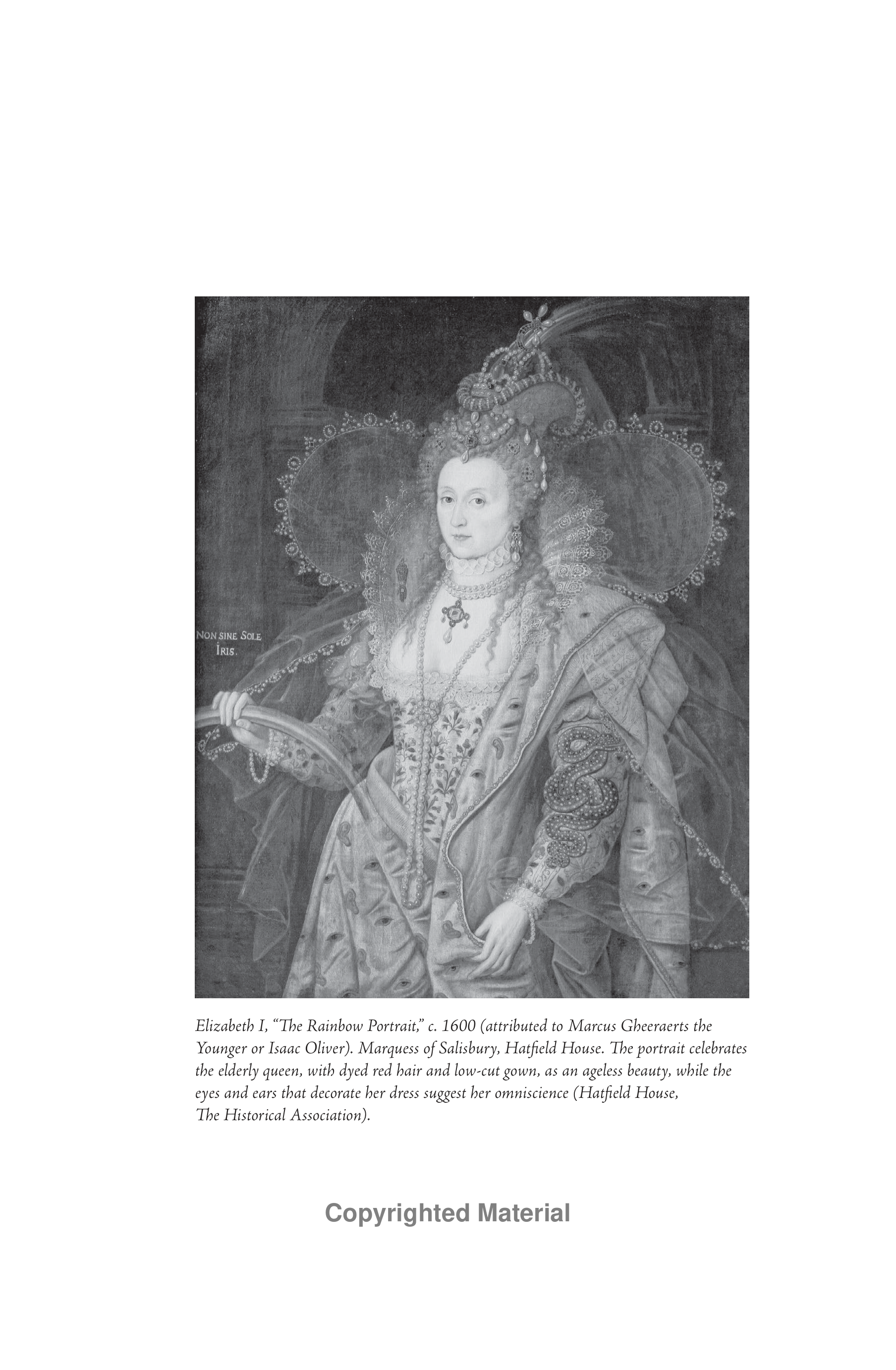
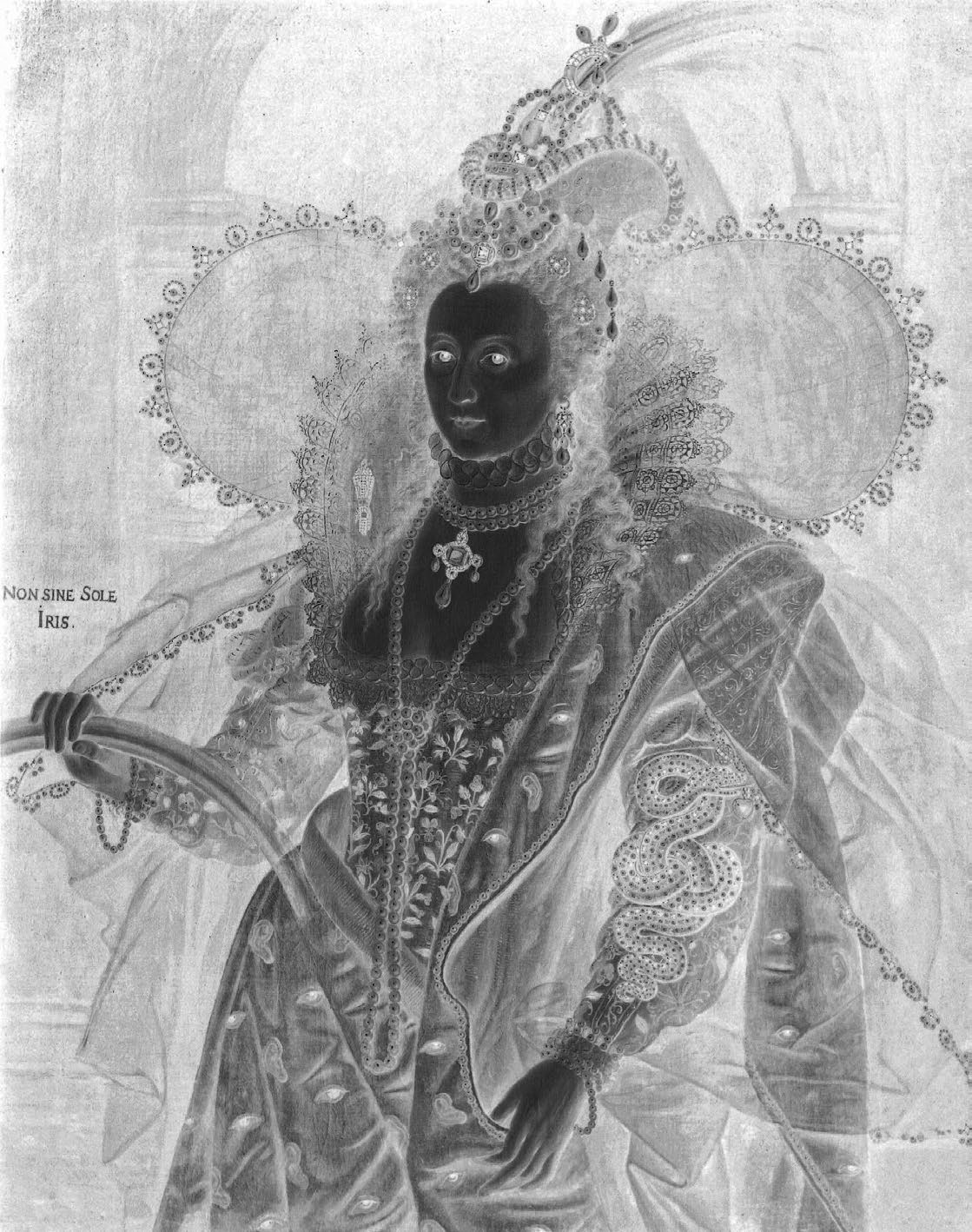
Elizabeth I, “T e Rainbow Portrait,” c. 1600 (attributed to Marcus Gheeraerts the
Younger or Isaac Oliver). Marquess of Salisbury, Hatfi eld House. T e portrait celebrates
the elderly queen, with dyed red hair and low-cut gown, as an ageless beauty, while the
eyes and ears that decorate her dress suggest her omniscience (Hatfi eld House,
T e Historical Association).
Copyrighted Material
C H A P T E R 1
A World Apart
T
o a sophisticated Italian who traveled to England in the
late sixteenth century, the island might not have appeared, as it
had to the ancient Roman poet Virgil, “wholly separated from
all the world.” But it would certainly have seemed bleak. To be sure, in
London the visitor would have seen many signs of wealth and power:
the sprawling royal residence of Whitehall; grand dwellings along the
Th ames for the leading aristocrats and their entourages; the magnifi cent
abbey at Westminster housing the royal tombs; in the busy commercial
center paved streets, some of them graced with beautiful fountains; a
brooding fortress, said to have been built by Julius Caesar and used in
the sixteenth century as a prison, a mint, an armory, and the site of a
royal menagerie. But there was much else that would have given a foreign
visitor pause.
Th e weather was a trial. England, along with much of northern
Europe, found itself in the midst of what is now termed the Little Ice
Age, with bitter cold winters and fi erce storms that destroyed crops and
caused periodic famine. Th e roads were terrible, and after dark they were
the haunts of robbers. In London the most popular entertainments were
animal fi ghts. Large crowds paid to see a horse with a monkey on its back
attacked by fi erce dogs. Th e poor beleaguered horse would gallop and
Copyrighted Material
dark renaissance
2 •
kick; the monkey would scream; the audience would roar. When the
exhausted horse collapsed and was killed, it would be time to bring out the
bears and bulls, tie them to stakes, unleash the dogs, and repeat the fun.
“Th is sport,” remarked a visitor from the Continent, “is
not
very pleasant
to watch.” In the churches psalms were sung and Mass was celebrated not
in the time- honored Latin but in plain English. Th e Reformation had left
other, more tangible marks as well. “It is a pitiful sight,” wrote an Italian
merchant who kept a journal of his visit to London in 1562, “to see the
beautiful marble statues of saints and other decorations there, broken
and ruined because of their heresy.” In the streets, foreigners were advised
to keep a low profi le, since the crowds could be suspicious or hostile.
Even hospitable encounters could cause considerable baffl ement. If
you were invited to dinner, you had to brace yourself. “It is almost impos-
sible to believe,” remarked the merchant, “that they could eat so much
meat.” To wash it down, the English “make a drink from barley and the
seeds of hops which they call beer, healthy but sickening to taste.” Com-
pared to Italian women, English women seemed unnervingly free: they
could go out of the house by themselves, unaccompanied by their men-
folk; bustle about in the markets and serve in shops; even go by them-
selves to public entertainments. “Th ey kiss each other a lot,” observed
the merchant of the men and women he was observing; “If a stranger
enters a house and does not fi rst of all kiss the mistress on the lips, they
think him badly brought up.” And yet at the same time women deemed
to be scolds could be literally muzzled by a horrible device called a brank,
and anyone suspected of sexual immorality could be publicly whipped
and shamed.
It was disorienting. Th e mansions along the Strand and the handsome
Royal Exchange in the city center gave way almost at once to a vast war-
ren of tenements and hovels. Half- timbered buildings with dormers and
gables extended out over the streets, blocking the light and forming mal-
odorous tunnels for the carriages and pack animals and pedestrians to
pass through. Th e narrow lanes were fi lled with excrement and off al. On
London Bridge, alongside shops for luxury goods, the severed heads of
convicted traitors were stuck up on spikes for passersby to contemplate.
Copyrighted Material
A World Apart
• 3
On the gallows near Tyburn there were public mutilations and hangings
almost every day.
Th e people spoke a language largely unknown to the rest of the civi-
lized world. Virtually nothing written in English had aroused suffi cient
interest to merit translation into one of the dominant continental lan-
guages or into Latin, the shared language of learning. Early in the century
an Englishman, Th omas More, had published a brilliant short work in
Latin,
Utopia
, that quickly earned him Europe- wide acclaim, but More
had been beheaded by the merciless king Henry VIII. Two gifted poets
in Henry’s court, Th omas Wyatt and Henry Howard, Earl of Surrey, had
some success importing and adapting Italian and French poetic models—
Wyatt introduced the sonnet form into English— but they too were both
snuff ed out. Accused of treason, Surrey was executed in the Tower at the
age of thirty, and Wyatt, who had been imprisoned on suspicion of having
had an aff air with Henry’s second wife, Anne Boleyn, died at thirty- nine
in the wake of a second imprisonment. Th eir deaths seemed to have had a
chilling eff ect on cultural life.
In sixteenth- century Italy the major universities were all sites of
extraordinary achievements: the founding of the fi rst botanical gardens
for the scientifi c study of plants; epochal advances in anatomy and embry-
ology; the positing of germ theory and the creation of epidemiology; a
revolution in physics and astronomy. Th e two English universities by
comparison were scientifi c backwaters. Learned scholars lectured on the
ancients Aristotle, Ptolemy, and Galen, but new frontiers of inquiry were
kept shut, and the attention of teachers and their students was focused
elsewhere. Both Oxford and Cambridge were riven by bitter confl icts, as
the ascendant Protestant authorities tried to eradicate any residual loy-
alty to Roman Catholicism and as more radical Protestants complained
that the Reformation in England had not gone nearly far enough.
Th e religious confl icts had been going on for more than a half- century,
ever since Henry VIII’s break with Rome, and in their murderous tangles
they caught up the lives and fates of virtually everyone in the kingdom.
Offi cially at least, the ruler’s religion was the religion of the entire country;
no other faiths were tolerated, neither Judaism nor Islam, of course, but
Copyrighted Material
dark renaissance
4 •
also not any version of Christianity other than the ruler’s own. In mak-
ing himself the Supreme Head of the Church in England, Henry’s inter-
ests lay principally in getting his hands on a divorce and on the wealth of
the monasteries. Th e six- year reign of his son Edward VI, who came to
the throne at the age of ten, inaugurated a sharper turn in doctrine and
church organization toward Protestantism. Th en, after Edward’s death
from tuberculosis and after an abortive nine- day reign by his seventeen-
year- old Protestant cousin Lady Jane Grey that ended in her execution,
his sister Mary returned the country to the Roman Catholic Church. Five
tumultuous years later Mary died, and with the accession of her younger
sister Elizabeth, England once again offi cially became Protestant. Each
of these changes of regime was accompanied by dark waves of conspira-
cies, suspicions, arrests, and executions, all on top of the ordinary punish-
ments meted out in a brutally punitive society.
It is diffi cult to take in how nightmarish the situation was, for we have
little or nothing comparable in our world. Perhaps the fate of a German
family that experienced, in fewer than sixty years, the Weimar Republic,
National Socialism, the Communist government of East Germany, the
fall of the Iron Curtain and German reunifi cation conjures up something
of its unbearable stress and danger. A window into daily life in Tudor
England is provided by a rare diary that survives from the mid- sixteenth
century. Th e diary was kept by a merchant, Henry Machyn, who lived in
London and took it upon himself to record events around him. On April
21, 1556, to open the pages at random, he wrote that two men, Master
Frogmorton and Master Woodall, were taken from the Tower to a court-
room to be tried on charges of “conspiracy against the queen and other
matters.”
On April 24 he noted that six men were “carried to Smithfi eld
to be burned”— Smithfi eld was a preferred site for executing heretics—
along with other men “carried into the country to be burned.” Later that
same afternoon he observed three men put into the pillory in Cheapside,
near London Bridge, one for perjury and the other two for subornation
of perjury. On April 28 Frogmorton and Woodall, Machyn noted, were
hanged, drawn, and quartered, and their heads stuck on pikes on London
Bridge. Th e next week he recorded more men hauled off to the Tower
Copyrighted Material
A World Apart
• 5
on charges of treason, more heretics (“one a painter, the other a cloth-
worker”) burned, and more malefactors put in the pillory, this time with
their ears nailed to the wood. So, interspersed with notations about the
outbreak of plague, the diary goes on, page after page, all more or less the
same whether the regime was Catholic or Protestant, though of course
the faith of those accused of treason or heresy would have been reversed.
In such circumstances, in order to keep one’s head on, it made sense to
keep one’s head down.
Henry VIII had separated his realm, already geographically isolated,
from the old faith that united most of the rest of Europe, and in 1580 his
heretic daughter, nearing fi fty years old, sat on the throne unmarried and
without an heir. Elizabeth I was not the monster that her father was, but
the torturers and the executioners were kept extremely busy. To someone
from the Continent, the queen must have looked exotic or perhaps sim-
ply outlandish. Her face painted white tinged with pink, her hair dyed
bright red, and her teeth turning black, she was periodically paraded, like
a weird religious icon covered with precious jewels, before her adoring
people. At court richly clad favorites and even sober senior advisers had
to address her on their knees and to couch their appeals in the language
of romantic love, as if she were an alluring young maiden being wooed by
smitten suitors.
Even in her sixties the queen was still at it. Upon being ushered into the
Privy Chamber, the French ambassador André Hurault, Sieur de Maisse,
was unnerved to fi nd Elizabeth “strangely attired” in what seemed to him
a dress of gauze. “She kept the front of her dress open,” he wrote in his
diary, “and one could see the whole of her bosom, and passing low, and
often she would open the front of this robe with her hands as if she was
too hot.” Th e following week she received him again, this time in a black
taff eta gown similarly slit in front. “She has a trick of putting both hands
on her gown and opening it,” the startled ambassador noted, “insomuch
that all her belly can be seen.”
Th e queen’s gambit was quite deliberate; her interlocutors, thrown
off - balance, felt they were entering into an unsettling, fantastical world.
Her father’s court had boasted the presence of the great German painter
Copyrighted Material
dark renaissance
6 •
Hans Holbein the Younger; Elizabeth would not tolerate any artist so
committed to the nuanced depiction of reality. Instead, she patronized as
her offi cial painter a goldsmith by training whom she ordered never to use
shadows in any portraits of her. She was to remain untouched by time.
It was as if a thick, hardened, protective coating, akin to the heavy white
lead- based makeup applied to smallpox-scarred faces, had been spread
over all of English cultural life. By 1580, though Elizabeth had been on
the throne for more than twenty years, her reign had largely managed to
produce among her own subjects only artistic mediocrities. Native English
culture seemed as backward in poetry as it was in painting, sculpture, and
the life of the mind. An Italian visitor— justifi ably proud of Botticelli,
Leonardo da Vinci, Michelangelo, Raphael, and others— would have been
puzzled to see the miniaturist Nicholas Hilliard trotted out as the leading
English painter. What then (if he could read English) would he have made
of the leaden versifi ers Barnabe Googe, Nicholas Grimald, and Th omas
Tusser? Where, he might have asked, were the equivalents in England to
Ariosto, Tasso, or Vittoria Colonna? Th e answer would have been that
they did not exist, and there seemed little prospect that they ever would.
An alert observer in search of signs of cultural life in this wasteland
might have noticed— alongside the bearbaiting pits and other venues for
blood sports— a novel round structure that had been erected only a few
years earlier in the rough area east of the city called Shoreditch. Called
simply Th e Th eatre, it was the fi rst freestanding playhouse that had been
built in England since ancient Roman times, and it was successful enough
to have led to the construction of a second playhouse, Th e Curtain, a few
hundred yards away. But to a visitor accustomed to such sophisticated
entertainments of the Italian courts as Ariosto’s comedy
Cassaria
or Tas-
so’s pastoral romance
Aminta
, nothing that went on within the walls of
these wooden theaters would have seemed worth the risk of exposure
to pickpockets or worse. Th e plays were incredibly crude, and besides,
the playhouses had been built in the suburbs because the authorities had
expelled the playing companies from the city center in order to reduce the
spread of deadly bubonic plague.
Th en, not instantly but with startling rapidity, it all changed. Th e
Copyrighted Material
A World Apart
• 7
coating that had hardened over the realm’s culture cracked. If four hun-
dred years later we look back on this period as an astonishing time, it is
because of what burst forth in the decades after 1580: a constellation of
brilliant poets, the greatest dramatists in the English language, extraor-
dinary advances in navigation, astronomy, and mathematics, the fi rst
attempts to establish English colonies in the New World, and in intellec-
tual life, the speculative and experimental daring that led Francis Bacon
to declare that “knowledge itself is power.” Th ere is no single explanation
for an explosion of creative energy of this magnitude, yet one remarkable
fi gure embodies the ferocious energy and daring that brought England,
belatedly, into the creative cultural turmoil that had been transforming
the Continent for more than a century.
Christopher Marlowe was an unlikely person to have played a major
role in breaking open the rigid carapace that had constricted the English
creative spirit. Born to a poor provincial cobbler, he was murdered at the
age of twenty- nine. In those brief, tumultuous years he was a remarkably
productive writer— no fewer than seven plays, along with extraordinary
poems— but nothing bearing his name was published during his lifetime.
No letters, diaries, or drafts in his hand are known to have survived; nor
are there any surviving letters addressed to him. He wrote in a society
in which the notions of freedom of thought, freedom of expression, and
freedom of religion were unknown. Much of what we know about his life
and opinions comes from the reports of spies and informants or from tes-
timony extracted by torture. But Marlowe serves as the thread that leads
us through a labyrinth of corridors, many of them dimly lit, dangerous,
and shrouded with secrets, and fi nally into the light. In the course of his
restless, doomed, brief life, in his spirit and his stupendous achievements,
Marlowe awakened the genius of the English Renaissance.
Copyrighted Material
C H A P T E R 2
Handwriting on the Wall
I
t had been a particularly miserable English spring. Th e rains
refused to let up. Th e euphoria that had buoyed up the country fi ve
years earlier, with the defeat of the Spanish Armada, had long since
evaporated; many believed that a new invasion was imminent. Th e sixty-
year- old unmarried queen Elizabeth had no heir and steadfastly refused
to settle the issue of succession. Th ere were rumors that terrorist cells—
fanatics determined to reestablish Roman Catholicism as the faith of
England— would attempt to assassinate her. At the same time radical
Protestant agitators were issuing vehement broadsides against the estab-
lished church. As if this weren’t enough, unemployment in London was
high, the bad weather portended rising prices and possible food shortages,
and landlords were demanding higher rents.
To make this season of discontent still worse, the dread bubonic
plague, briefl y in remission, had returned with a vengeance. Th e disease
was terrifyingly contagious. Victims would awaken with fever and chills.
A feeling of extreme weakness or exhaustion would give way to diarrhea,
vomiting, bleeding from the mouth, nose, or rectum, and telltale buboes,
or swollen lymph nodes, in the groin or armpit. Death, often in great
agony, would almost inevitably follow.
Innumerable preventive measures were proposed, most of which were
useless— or, in the case of the killing of dogs and cats, worse than useless,
Copyrighted Material
Handwriting on the Wall
• 9
since as we now understand, the disease was spread by rat- borne fl eas. In
the absence of predators, rats proliferated. Th e smoke of dried rosemary,
frankincense, or bay leaves burning in a chafi ng dish was thought to help
clear the air of infection, and if those ingredients were not readily avail-
able, physicians recommended burning old shoes. In the streets people
walked about sniffi ng oranges stuff ed with cloves. Pressed fi rmly enough
against the nose, perhaps these functioned as a kind of mask.
Civic offi cials, realizing that crowds heightened contagion, took steps
to institute what we now call social distancing. Collecting data from par-
ish registers, they carefully tracked plague- related deaths. When those
deaths surpassed thirty per week, they initiated protective measures. In
January 1593, they shut the playhouses and banned public spectacles, col-
lective entertainments, and sporting events. Worship services were the
only exceptions, since it was assumed that God would not visit the plague
on anyone who was in church praying.
One entirely predictable outcome of the rising tension that affl icted
everyone was a search for scapegoats. Th ere were few or no Jews around
to blame; the entire Jewish population of England had been expelled in
1290, in the fi rst mass ethnic cleansing in Europe. In the absence of the
traditional objects of religious hatred, Catholics were the obvious choice—
after all, the state routinely hunted down and killed English priests,
trained in overseas seminaries, who had returned to England in order to
conduct clandestine masses. Th e established church also directed anger
at Puritans who, agitating for what they saw as a “purer” faith, mocked
the bishops and condemned as pagan such popular observances as Christ-
mas and Maypoles. On April 6, 1593, two Cambridge- educated radical
ministers were taken from Newgate prison to the gallows at Tyburn and
hanged “for devising and circulating seditious books.”
But the majority of ordinary Londoners did not seem drawn to inter-
denominational bloodbaths. Many Protestants had a residual loyalty to
the old faith, and in most conforming families, there would have been at
least one aunt or brother or cousin who was secretly an ardent Catho-
lic. So too, almost certainly, other family members would have felt that
the Protestant Reformation had not gone nearly far enough in England.
Copyrighted Material
dark renaissance
10 •
Th e populace in general was more amused than alarmed by the irreverent
attacks on the establishment from Puritan separatists that circulated ille-
gally under the pseudonym Martin Marprelate; they did not hold these
religious activists responsible for economic hardship or social misery.
Th e most common target of antipathy was London’s small commu-
nity of resident aliens— “strangers.” Th ey were for the most part Protes-
tant refugees, some from France in the wake of the Wars of Religion and
the St. Bartholomew’s Day Massacre, and others from what is now Bel-
gium and the Netherlands after the Spanish army invaded and set up the
Inquisition. Th e refugees were in general peaceful and hardworking peo-
ple who dutifully paid the special tax imposed on foreigners and largely
kept to themselves. Forbidden to compete in retail trade, they prospered
in enterprises like brewing, engraving, and cloth weaving. But though
they amounted to only a tiny percentage of the city’s population of almost
two hundred thousand, they were repeatedly charged with taking away
the jobs of native- born Englishmen.
In the unhappy spring of 1593, an anonymous fl yer circulated, angrily
demanding that the foreigners all be expelled; members of Parliament
made speeches about their alleged threat to the economy; drunken louts
in taverns muttered about taking action. On May 5 Londoners awoke
to see a particularly menacing placard nailed to the wall of the so- called
Dutch Church, the church where the Protestant refugees from Roman
Catholic persecution prayed.
For almost fi fty years this church had been assigned by royal char-
ter to London’s community of “Germans and other strangers.” But the
fi fty- three- line poem on the placard, addressed to the “strangers that do
inhabit in this land,” was a litany of accusations. “Your Machiavellian
merchant spoils the state.” “Your usury doth leave us all for dead . . . And
like the Jews, you eat us up as bread.” “Cutthroat- like in selling you undo
us all.”
You have caused our
rents to rise. Your cheap, gawdy goods drive ours
out of the market. You live far better here than you did back where you came
from. Our soldiers are sent abroad to fi ght in your wars. You have forced us
out onto the streets. You will make us all starve and die
. As the complaints
reached a crescendo, they turned into a chilling warning:
Copyrighted Material
Handwriting on the Wall
• 11
Since words nor threats nor any other thing
Can make you to avoid this certain ill,
We’ll cut your throats, in your temples praying.
Not Paris’ massacre so much blood did spill
As we will do just vengeance on you all.
Our swords are whetted, the placard ended; therefore, “Fly, fl y, and never
return.” It was signed “Tamburlaine.”
Th e Elizabethan state did not take such threats lightly. Apart from
whatever sympathy the queen and her advisers may have felt for the plight
of Protestant refugees from the Continent, they hated any popular dis-
order. In 1570, when collective discontent in Norwich, about one hun-
dred miles northeast of London, led to a planned uprising to force the
expulsion of the foreign weavers, the agitation’s ringleaders were quickly
identifi ed and apprehended. Th ey were then made examples of, in the way
the authorities most favored to impress on the crowd the consequence of
disobedience: they were hanged, cut down while still alive, castrated, dis-
emboweled, and sliced in quarters.
Confronted in 1593 with comparable agitation, the authorities acted
quickly. On May 10, the City of London off ered a reward of one hundred
crowns— roughly fi ve times the average Elizabethan workman’s annual
income— for the identity of the person who wrote the words on the
Dutch Church wall. At their weekly meeting, the Privy Council issued
instructions to their offi cers “to make search and apprehend every per-
son” who might be suspected of having written the libelous placard. Th e
offi cers were authorized to “search in any of the chambers, studies, chests,
or other like places for all manner of writings or papers that may give you
light for the discovery of the libelers.” And upon fi nding likely suspects,
the order continued, if “they shall refuse to confess the truth, you shall by
authority hereof put them to the torture in Bridewell, and by the extrem-
ity thereof . . . draw them to discover their knowledge concerning the said
libels.” Th e order was issued on May 11 and was set in motion immedi-
ately. Th e very next day there was an ominous hammering on the door of
the writer Th omas Kyd.
Copyrighted Material
dark renaissance
12 •
Th e offi cers who barged into Kyd’s rooms were not ordinary constables,
the kind in buff - colored jerkins that might seize you for not paying your
debts or for disturbing the peace. From their insignia, Kyd would have
grasped at once that the business, whatever it turned out to be, was alto-
gether more menacing. Th ese were agents of the Privy Council, the queen’s
closest advisers, and they were clearly looking for someone or something.
It is possible that the fi rst questions that they asked had to do with the
whereabouts of Christoper Marlowe, for the name on the placard, Tam-
burlaine, was the hero of Marlowe’s spectacularly successful two- part
play, and its playwright had earned a dangerous reputation for blasphemy
and provocation. But though, as poor, struggling young writers, they had
once known each other reasonably well, Kyd might have had no idea.
Over the past years Marlowe had begun to move in exalted social circles,
to which Kyd had no access. As the offi cers could see for themselves, he
was merely a humble scribbler, trying to eke out a living by writing plays
and by translating contemporary works from French and Latin.
Kyd was arrested in his workspace. On his table, therefore, there
would have been quills for pens, a knife to sharpen them, inkpots, note-
books, manuscripts, correspondence, and possibly a small number of
bound and unbound books. (Books were relatively expensive, and Kyd,
in his early thirties, was not a wealthy man.) Th e offi cers began imme-
diately to gather up the papers on the table, and they proceeded uncer-
emoniously to rifl e through the cabinets, open the chests, and sweep up
every piece of paper they could fi nd. Attempting to show that he had
nothing to hide, Kyd, his ink- stained hands no doubt trembling, oblig-
ingly brought them even more. Th en and there they set about to read
what they had seized.
Kyd was not one of those writers whose manuscripts were indecipher-
able. He had excellent penmanship and with good reason. He was the
son of a scrivener, a professional scribe paid to draw up and copy offi cial
documents. To judge from the surviving specimens of his own handwrit-
ing, he had mastered his father’s craft and probably practiced it himself
during slack times. Th e profession was a reasonably remunerative one—
Kyd’s father had saved enough money to send him to London’s celebrated
Copyrighted Material
Handwriting on the Wall
• 13
Merchant Taylor’s School, located near Cannon Street in the commercial
heart of the city— but copying was regarded as a mechanical trade and
lacked social prestige. Scriveners were mockingly called
noverints
, after
the Latin phrase (“Be it known to all present”) with which most of their
painstakingly inscribed legal documents would begin.
Real gentlemen were not expected to have good penmanship, to write
“fair,” as it was called; on the contrary, even if they had learned how to do
so, they may have deliberately aff ected a certain casual untidiness. “I once
did hold it,” Prince Hamlet tells his friend Horatio,
A baseness to write fair, and labored much
How to forget that learning, but, sir, now
It did me yeoman’s service. (5.2.34– 37)
Th e yeoman’s service in question was the prince’s ability to forge the com-
mission that sent his school chums Rosencrantz and Guildenstern to
their deaths.
Kyd had no comparable status- consciousness to induce him to hide
his manual skills. Th ough he went to a fi ne secondary school, he lacked
the ambition, or more likely the money, to follow in the path of many of
his more privileged classmates and go on to Oxford or Cambridge. Had
he done so, he could upon graduation have proudly styled himself a gen-
tleman. Instead, after learning his father’s trade, he took steps that any
person anxious about rank and reputation would have regarded as rash:
he embarked on the precarious path of writing for the professional stage.
An odor of shame hung over London’s burgeoning entertainment
industry. Religious moralists called the newly built playhouses satanic
dens of iniquity; clergymen warned that God reserved a place in hell for
those seduced by their sinister charms; civic authorities complained that
they were public nuisances, promoting idleness, spreading disease, and
causing traffi c problems. Unpatronized actors were legally classifi ed as
vagabonds, liable to be branded and whipped out of town. At least in the
early years, writers for the commercial stage rarely broadcast their names;
most plays, when they were published at all, appeared anonymously.
Copyrighted Material
dark renaissance
14 •
Notwithstanding all the disapproving voices, the public fl ocked to the
theaters by the thousands.
Repertory companies, in fi erce competition with one another, had an
insatiable appetite for new material, and they were willing to pay for it.
Th e renumeration was suffi cient to attract not only socially marginal peo-
ple like Kyd but also university graduates, at least those who had failed to
go on to more respectable careers or had chosen to walk on the wild side.
Th e latter, even when they brazenly fl aunted a bohemian lifestyle, shored
up their shaky social standing by touting their own higher education and
mocking anyone who lacked it. In 1589 the Cambridge- educated play-
wright Th omas Nashe, in a letter addressed “To the Gentlemen Students
of Both Universities,” ridiculed upstarts who “leave the trade of
Noverint”
and busy themselves “with the endeavors of art.” If on a frosty morning you
encountered one of these ignoramuses, “he will aff ord you whole Ham-
lets, I should say handfuls of Tragical speeches.” In case Nashe’s readers
failed to identity the specifi c target of his mockery, he dropped another
hint. Th ese scribblers, he wrote, “imitate the Kid in Aesop” who, allured
by the wily fox’s tricks, tried “to leap into a new occupation.” Th e foolish
kid— Kyd— would get just what he deserved. He would be eaten alive.
Why was Nashe so annoyed? Perhaps because the scrivener’s son had
written a commercially successful tragedy about the Danish prince. Kyd’s
classmate at the Merchant Taylor’s School, Th omas Lodge, also went out
of his way to make fun of the white- faced “ghost which cried so miserably
at the Th eatre, like an oyster- wife, ‘Hamlet, revenge!’ ” (Book hunters for
centuries have avidly searched for this precursor of Shakespeare’s great
tragedy but thus far without any luck.) And much to the annoyance of
his better- born and university- educated rivals, Kyd had scored an even
greater success with another lurid revenge play,
T e Spanish Tragedy.
Kyd had always been very careful. He wasn’t one of those reckless
souls who loved to live on the edge: the heavy- drinking Robert Greene,
whose mistress was the sister of a notorious London criminal; the sharp-
tongued Nashe, who was imprisoned for one of his scurrilous pamphlets;
the restless Lodge, who shipped out on a voyage to Brazil and the Strait
of Magellan; and above all Christopher Marlowe, who said out loud what
Copyrighted Material
Handwriting on the Wall
• 15
no one who wanted to live a long life would venture even to whisper. Th e
scrivener’s son showed no such signs of wildness. He was content to stay
in the shadows and go about his work. Among the very few contemporary
references to him, one simply called him “industrious Kyd.”
But there was more to Kyd than met the eye.
T e Spanish Tragedy
aroused popular excitement by its sly implication that since the wellborn
and privileged are beyond the reach of the law, the less privileged can
obtain justice only by taking matters into their own hands. Kyd con-
trived to convey this radical message safely by locating his tragedy in
Spain, England’s principal national enemy. Th e hero, Hieronimo, is an
upright judge whose son is treacherously murdered by two men who are
so well- connected that there is no hope for the crime to be punished. In
the play’s mad climax, the father enlists his son’s grieving lover to help
him kill the two aristocratic murderers before the eyes of the whole royal
court. When the deed is done and he is asked to reveal his confederates,
he refuses to speak. “Fetch forth the tortures,” orders the king; “Traitor
as thou art, I’ll make thee tell.” “Never,” Hieronimo replies and then pro-
ceeds to bite off his tongue. Th e tongue, spat out onstage, must have made
the audience scream.
Th e box offi ce receipts for this piece of blood- soaked entertainment
were spectacular and remained so for decades. Th ough the play’s author
would not have directly profi ted from the success— the theatrical entre-
preneur who had bought the script and owned the rights would reap the
benefi t— his triumph made him well- known and aroused the jealousy of
his fellow playwrights.
In 1593, when the offi cers of the Privy Council
arrested him,
Kyd was at the top of his game.
His arrest must have taken him by surprise, for Kyd was by no means
the most obvious suspect for the offi cers who were looking for the author
of the incendiary verses. Th e placard’s mentions of Machiavelli, of the
Jews, and of the Paris massacre would immediately have conjured up
someone else: the author of two popular, indeed notorious plays,
T e Jew
of Malta
and
T e Massacre at Paris.
Before the plague forced the clos-
ing of the theaters, these plays had been seen by thousands of London-
ers
.
And as was well- known, they were written not by Kyd but by Kyd’s
Copyrighted Material
dark renaissance
16 •
famous contemporary Christopher Marlowe. As if the heavy hints were
not enough, the placard’s signature, Tamburlaine, seemed to give the
game away.
Th e offi cers could have immediately suspected Marlowe, but they
might not have known where to fi nd him. Th ey could have gone to the
neighborhood of the Rose Th eater, where
Tamburlaine
and other of his
plays had been performed, and made inquiries among those— actors,
bookkeepers, producers, and the like— who had a professional relation-
ship with playwrights. Marlowe’s actual whereabouts may not have been
forthcoming— in fact, as surviving records show, he was not in London
at the time— but someone could have mentioned that a few years earlier
he had shared rooms with Kyd. Hence the unwelcome visit Kyd received.
• • •
The search failed to turn up any evidence linking Kyd or anyone
else to the Dutch Church libel. But the offi cers did not come away empty-
handed. Somewhere in the pile of “waste and idle papers” that Kyd had
handed over to them was a three- page document in which they spotted
what they termed “vile heretical conceits denying the deity of Jesus Christ.”
It was as if they had come to investigate burglary and found evidence of
something far worse.
Th ough the document was written in a fi ne professional hand, such as
that of a trained scrivener, Kyd denied any knowledge of it and had many
samples to show that in fact his handwriting was diff erent. But heresy
in Elizabethan England was a serious charge, one that carried a death
sentence, and ultimately it did not matter whose handwriting it was. Th e
offi cers arrested Kyd in order to have him explain the presence of the
off ending pages in his rooms.
Th e heretical text argued that there was a fundamental contradic-
tion between the Bible’s affi rmation that God is “Everlasting, Invisible,
Immutable, Incomprehensible, Immortal” and the claim that Jesus, who
was certainly visible, comprehensible, and mortal, was God. Jesus may
have been an inspired moral teacher, the greatest who ever lived, but he
Copyrighted Material
Handwriting on the Wall
• 17
was a human being, not the incarnate deity. Th is argument, the famil-
iar starting point for what would become Unitarianism, was regarded as
tantamount to atheism. England in the sixteenth century had repeatedly
changed its offi cial religious orthodoxy— veering queasily from Catholic
to Protestant to Catholic again and back to Protestant— but the changes
never produced a genial spirit of tolerance. On the contrary, each reli-
gious regime furiously attacked its perceived enemies, sharpening axes
and building terrible pyres in the name of the God of Love. And all the
warring parties joined together to persecute anyone who had the temer-
ity to question Jesus’s divinity. Th ough the doubt must have arisen
frequently— it springs naturally from the Gospels’ moving depiction of
Jesus’s humanity— it was far too dangerous to express openly, let alone to
be written down in documents of the kind found in Kyd’s rooms.
Elizabethan plays often featured scenes in which a character, secure,
comfortable, and confi dent, suddenly fi nds himself in a terrifying situa-
tion, without friends and without hope. Kyd had written just such a scene
in
T e Spanish Tragedy
, and now in real life he found himself in the midst
of one. He was hauled off to Bridewell prison to be interrogated. Th e
Elizabethans were technologically backward, by our standards, but they
had developed a sophisticated array of techniques for causing pain. Simu-
lated drowning (still favored by the CIA) was much in use, as was hanging
prisoners in manacles with their feet not quite touching the ground. Even
more feared were the demonic machines: thumbscrews, the rack, which
slowly dislocated the limbs, and the scavenger’s daughter, which bent the
body in upon itself until it formed a circle of agony.
One or more of these methods was likely to have been Kyd’s fate, for
in a letter written a few weeks later he complained of the “pains and unde-
served tortures” that had been infl icted on him. Th e ordeal caused mental
as well as physical injuries. Th e next year he referred to his “affl ictions of
the mind,” his “bitter times,” and his “privy broken passions.”
How much Kyd knew about the document that had caused him to be
arrested is not clear. A copy of it, made at the time of the arrest, would
sit unread in the state archives until a scholar in the twentieth century
found it and identifi ed its source. It turns out to have been an excerpt
Copyrighted Material
dark renaissance
18 •
from a perfectly orthodox book published with the government’s permis-
sion in 1549, more than forty years before the arrest. Th e book was
T e
Fall of the Late Arrian
by an English schoolmaster and academic named
John Proctor. It had been written not to promote the heretical argu-
ments that alarmed the arresting offi cers but to refute them. Even the
most restrained Renaissance works of theology routinely excerpted or
provided long summaries of the positions they intended to demolish. Th e
incriminating document in Kyd’s room was simply a handwritten copy of
several of the printed pages.
Had Kyd explained the origin of the pages, he would still have had
some further explaining to do: Why were those passages copied out? And
where was the rest of the book, with its defense of orthodoxy? But the
accused man could at least have begun by pointing out that the source
was impeccably legitimate, and that fact would have been duly noted on
the transcript. Th ere is no such note, so it is possible that Kyd was com-
pletely in the dark.
Kyd was living the nightmare he had staged in
T e Spanish Trag-
edy
. Refusing to reveal his accomplices, his hero Hieronimo bites off his
tongue and stabs himself to death. Stretched on the rack, the poor play-
wright could hardly have been expected to follow his own script. To get
the pain to stop, he claimed that the heretical pages belonged to his for-
mer roommate, who must have left them behind when he moved out.
Who was this roommate? Christopher Marlowe.
On May 30, 1593, less than a month after the placard was nailed to
the wall of Dutch Church and only weeks after Kyd’s arrest and torture,
Christopher Marlowe was killed. He was twenty- nine years old. An offi -
cial inquest was conducted and ruled that death came about as a result of
an argument over the bill (“ye reckoning”) for supper. No charges were
brought against the killer.
Th e surviving records do not indicate what Kyd told the interrogators
about Marlowe on those fateful days in the middle of May, but it was
enough to win his release from Bridewell. We can be certain that they
demanded more than just a name. Th e clearest indication of what he dis-
closed or at least hinted at during his detention comes in two desperate
Copyrighted Material
Handwriting on the Wall
• 19
letters that he sent in June, a few weeks after Marlowe’s death. Th e let-
ters were addressed to Sir John Puckering, Lord Keeper of the Great
Seal. Puckering was one of the principal fi gures on the Privy Council
that had initiated the whole investigation into the placard on the Dutch
Church wall.
Kyd had not been formally charged with a crime. Released from cus-
tody, he must have stumbled back to the room where he had been arrested.
But he was facing ruin. Like almost all writers in the period, he depended
on the approval and the fi nancial support of a powerful patron. In Kyd’s
case, the patron was Ferdinando Stanley, Lord Strange, who supported
an important theater company. Th e discovery in the playwright’s posses-
sion of a document questioning Jesus’s divinity had led him to be sus-
pected of heresy, he wrote to Puckering, and now his patron— the man
he simply calls his “Lord”— refused to have anything further to do with
him unless he could exonerate himself. Kyd does not refer to this patron
by name; he assumed, no doubt correctly, that Puckering already knew to
whom he was referring.
In his anguished attempt to regain his patron’s favor, Kyd struggled
to distance himself from the person he had accused of atheism. “My fi rst
acquaintance with this Marlowe,” he wrote to Puckering, “rose upon his
bearing name to serve my Lord, although his Lordship never knew his
service but in writing for his players.” Th e two young playwrights then
came to know each other, Kyd claims, because they were both working for
the same patron’s repertory company— hence “our writing in one cham-
ber two years since.” Th ey were roommates, but Kyd managed to make it
sound like they found themselves sitting by chance at adjacent desks in a
writing studio.
Kyd knew at this point that he had to be extremely careful. Th e author-
ities’ suspicions had been aroused by what they had stumbled across in his
rooms, but if Kyd linked Lord Strange to heresy, it would lead to further
investigations and would, whatever the outcome, destroy any chance of
recovering his patron’s favor. Did Kyd’s excuse— that he and “this Mar-
lowe” knew each other only because they were both writing for the same
patron— implicate the patron in Marlowe’s alleged wickedness? Not at
Copyrighted Material
dark renaissance
20 •
all, Kyd claimed, for the patron, his Lordship, did not have any personal
acquaintance with Marlowe and did not know his “conditions,” as the let-
ter termed them, that is, the opinions that revealed Marlowe to be an
atheist. “Never could my Lord endure his name or sight,” Kyd wrote,
“when he had heard of his conditions.” Th ese conditions, he added pru-
dently, would not have squared with “the form of divine prayer used duly
in his Lordship’s house.”
Even if this excuse were accepted, where did it leave Kyd? If he were
as innocent as he claimed, how was it possible that he “should love or be
familiar friend with one so irreligious”? Here Kyd’s writhings, accompa-
nied by a fl urry of Latin maxims, become ever more like those of Dickens’s
Uriah Heep. Neither “for person, qualities, nor honesty,” he declares, was
Marlowe ever worthy of friendship. Besides, Kyd adds of his erstwhile
roommate, “he was intemperate and of a cruel heart.”
Ask people who knew them both, Kyd pleaded with Puckering, to
verify that he, innocent Kyd, had nothing to do with Marlowe’s wicked-
ness. In exchange for favorable treatment and a good word to his patron,
he hinted that he might have further information to impart: “If I knew
any whom I could justly accuse of that damnable off ense to the awful
majesty of God or of that other mutinous sedition toward the state, I
would as willingly reveal them as I would request your Lordship’s better
thoughts of me that have never off ended you.”
Puckering was a tough, wealthy, well- connected lawyer with consider-
able experience in cases of sedition, conspiracy, and treason. He had been
heavily involved in the complex maneuvers that led to the execution of
Mary, Queen of Scots. He had interrogated men and sent them to their
deaths. He demanded details about Marlowe’s opinions and about his
associates. Kyd knew that if he gave too many details, he would implicate
himself as a willing sharer in those opinions. It would not do for anyone
to think that the two were actually intimate or that Kyd had sat by will-
ingly while Marlowe expounded criminal ideas. But having fi ngered Mar-
lowe, he felt he had to give his interrogator more.
In a second letter sent the same month to Puckering, Kyd wrote that
he knew only a few of Marlowe’s “monstrous opinions.” But even in casual
Copyrighted Material
Handwriting on the Wall
• 21
talk it was Marlowe’s custom, he said, to jest at the divine scriptures, to
mock prayers, and to confute the sayings of the prophets and other holy
men. He would “suddenly take occasion to slip out” his wicked notions,
Kyd wrote, so that even the most pious person could not escape hearing
him disparage Saint Paul as a confi dence man or ridicule the parable of
the prodigal son or argue that supposed miracles might as well have been
done by ordinary mortals. Th e most startling of Marlowe’s alleged opin-
ions was one that Kyd could bring himself to pen only “with reverence
and trembling.” Marlowe, he reported, had said that “St. John [was] our
Savior Christ’s Alexis.”
Th e literary allusion is now lost to most of us, but any educated person
in the Renaissance would have understood it immediately. In a celebrated
poem by Virgil, read in Latin by all students in the period, a shepherd
falls madly in love with a beautiful boy. “Th e shepherd Corydon,” the
poem begins, “burned for the handsome Alexis.” To claim that John was
the Savior’s Alexis and that he loved him “with an extraordinary love” was
to claim that Jesus was a sodomite.
If Kyd was duly rewarded for his report on Marlowe by being restored,
on Puckering’s recommendation, to the good graces of his patron, it
would not have been for very long. By the end of the next year, poor, bro-
ken thirty- fi ve- year- old Th omas Kyd was dead.
Copyrighted Material
C H A P T E R 3
Th e Great Separation
A
ccording to Kyd, Marlowe’s signature quality— apart
from atheism— was suddenness. He would “so suddenly” slip out
his wicked opinions that no one could stop him; his “rashness”
enabled him to get away with what otherwise would have been severely
reprehended; his attempts at “sudden privy [i.e., stealthy] injuries to men”
succeeded because they were so quick and unanticipated. Th e character-
ization obviously serves as an excuse: how else could Kyd explain why he
ever associated with such a terrible person? Marlowe’s viciousness must
have burst out and taken poor, innocent bystanders by surprise. But it was
not only a defensive strategy. Th ere really was something unanticipated,
unforeseen, and sudden about Marlowe.
Centuries later, the philosopher Friedrich Nietzsche, refl ecting on his
own experience, would write, “the young soul is devastated, torn loose,
torn out— it itself does not know what is happening. An urge, a pressure
governs it, mastering the soul like a command: the will and wish awaken
to go away, anywhere, at any cost: a violent, dangerous curiosity for an
undiscovered world fl ames up and thickens to all the senses.” Nietzsche
called this a “great separation,” and something similar lay at the heart of
Christopher Marlowe’s young life. It drew Marlowe away from his family,
his peers, his social class, his religion— the whole inherited set of accom-
modations to the world that makes life bearable to most people most of
Copyrighted Material