
A C
A D E
M
I
C
S
C
H
O
L A R
S
H I S T O
R I C A L
B I O
G R A P H Y
S E R I E S
·
V O
L
.
I V
Frederick Douglass
Prophet of Freedom
An original biography of the abolitionist orator, journalist, and
statesman · 1818–1895
Inspired
by
the
Pulitzer
Prize
–
winning
scholarship
of
David
W
.
Blight
.
An
independent
work
,
newly
written
from
public
sources
.
F I R
S
T
E D
I T
I O N
·
M
M
X X V I
F R E DE R I CK
DOU GL AS S
·
P R OP H E T
OF
F R E E DOM
— 0
1 / 28
Frederick Douglass · Prophet of Freedom
A C A D E M I C
S C HO LA R S
P R E S S
·
A N
O R I G I NA L
B I O G R A P HY
·
F I R S T
E D I T I O N
E D I T O R I AL
N O T E
Few figures in American history have spoken across the centuries with the force of
Frederick Douglass. Born into slavery in 1818 on Maryland’s Eastern Shore, he
escaped at the age of twenty, taught himself to read and write against the explicit
prohibition of law and custom, and became one of the most eloquent and most
photographed Americans of his generation. He did not merely witness the great
drama of emancipation and Reconstruction; he helped to write it — in deeds, in
politics, and in prose that still burns on the page.
This volume is an original biography, prepared by Academic Scholars Press in the
tradition of modern historical scholarship. Its title acknowledges the magnificent
study
Frederick Douglass: Prophet of Freedom
by David W. Blight, whose Pulitzer Prize–
winning biography renewed the nation’s attention to Douglass’s life. That work is a
landmark of American letters. The present volume is not an abridgment of it and
reproduces none of its text. The chapters that follow are newly written from public
sources: Douglass’s three autobiographies, his published speeches and editorials, and
the well-documented record of his public career.
Douglass’s own words, published more than a century ago, belong to the public
domain; where his language is quoted it is brief, attributed, and used to illustrate the
voice of the man himself. All interpretive prose is the original composition of this
press.
The volume is arranged in four movements. Part One follows Douglass from the
cabins of Tuckahoe to freedom in New Bedford. Part Two traces his rise as the
leading voice of Black abolitionism. Part Three carries him through the Civil War
and Reconstruction. Part Four recounts his later career as a federal officeholder,
diplomat, and public moralist. A chronological timeline, a summary of
achievements, a record of honors, and an assessment of his legacy close the volume.
F R E DE R I CK
DOU GL AS S
·
P R OP H E T
OF
F R E E DOM
— 0
2 / 28
C O N T E N T S
F R O
N T
M AT T E R
—
Editorial Note
PA R T
O
N E
·
B O
N D A G E
I
.
The Child of Tuckahoe, 1818–1826
II
.
The Making of a Mind, 1826–1836
III
.
The Flight, 1838
PA R T
T W O
·
T H E
A B O
L I T I O
N I S T
IV
.
The Lecturer, 1841–1845
V
.
The North Star, 1847–1855
VI
.
From Words to War, 1856–1860
PA R T
T H R E E
·
WA R
A N D
R E C O
N S T R U C T I O
N
VII
.
The War, 1861–1865
VIII
.
Reconstruction, 1865–1877
PA R T
F O
U R
·
T H E
S TAT E S M A N
IX
.
Cedar Hill, 1877–1889
X
.
The Last Campaign, 1889–1895
B A C K
M AT T E R
—
Chronological Timeline
—
Major Achievements
—
Awards, Honors & Distinctions
—
Legacy
—
Selected Bibliography
F R E DE R I CK
DOU GL AS S
·
P R OP H E T
OF
F R E E DOM
— 0
3 / 28
F
P A
R
T
O
N
E
·
B
O
N
D
A
G
E
I. The Child of Tuckahoe
1818–1826
“I have no accurate knowledge of my age.”
—
Frederick
Douglass
,
Narrative
of
the
Life
(1845)
rederick Augustus Washington Bailey was born in bondage in February 1818, in Talbot
County, on the Eastern Shore of Maryland. The precise day went unrecorded; Douglass
himself, unable to consult any register of births, adopted the fourteenth of February as a private
answer to a public question. His mother, Harriet Bailey, was an enslaved woman of unusual
intelligence, and he would know her only briefly; mother and son were separated while he was
still an infant, and she died when he was about seven years old. His father, he later reflected, was
whispered to be his white master — an identity that could never be proven and would be greeted
with silence by everyone who might have known.
He was raised in his earliest years by his maternal grandmother, Betsey Bailey, in the isolated
cabins of the Tuckahoe district — a log dwelling without floorboards, cold in winter, ringed by old
trees. Even as a small child he was sent to the great plantation of Colonel Edward Lloyd at Wye
House, where he first learned the full distance between the master’s table and the slave quarters.
The hunger of winter months, the separation from his mother, the sight of enslaved men and
women marched to punishment at dawn — these were the first lessons of a lifetime’s education in
what slavery actually was.
At about the age of eight, Douglass was sent to Baltimore to live in the household of Hugh and
Sophia Auld. The move, which he would later call an act of providence, placed him at the center of
a bustling port city and, by an accident of household duty, in the orbit of a woman who would
unwittingly hand him the key to his own liberation. Sophia Auld, kind-hearted and new to the
management of enslaved people, began teaching him the alphabet. Her husband, discovering the
lessons, forbade them with an argument that shaped Douglass’s destiny: teach a slave to read,
Hugh Auld insisted, and there would be no keeping him — literacy would spoil a good worker and
unfit him for bondage.
The vehemence of the warning — and the anxiety underneath it — convinced the boy that reading
truly was the road to freedom. What followed was the long, deliberate project of his self-making:
reading lessons traded for bread on the streets of Baltimore, the secret study of a worn spelling
book, and, above all, the discovery of
The Columbian Orator
, a school anthology of speeches and
dialogues that opened to him the power of language as a lever against tyranny. He learned the
alphabet at the feet of a kind woman; he learned its uses against the whole weight of a slaveholding
empire.
F R E DE R I CK
DOU GL AS S
·
P R OP H E T
OF
F R E E DOM
— 0
4 / 28
B
P A
R
T
O
N
E
·
B
O
N
D
A
G
E
II. The Making of a Mind
1826–1836
“I now understood what had been to me a most perplexing difficulty — to wit, the white man’s power to
enslave the black man.”
—
Frederick
Douglass
,
Narrative
of
the
Life
(1845)
altimore in the 1820s was a city of ships. Its harbor bristled with masts, its shipyards rang
with the mallets of the caulkers, and its free Black population — large, organized, and
articulate — formed a living argument against everything the slaveholders of the Eastern Shore
believed. For the boy who arrived in Hugh Auld’s household in 1826, the city was an education in
what freedom might look like.
The education began, paradoxically, as a prohibition. Sophia Auld’s kindness was extinguished by
her husband’s command, and she became, in Douglass’s later account, as rigid in opposing his
learning as she had once been generous in advancing it. But the damage was done. The boy had
learned that his bondage was maintained by argument — and that the argument was weak. On the
streets he turned hunger into tuition, trading pieces of bread to poor white boys in exchange for
reading lessons, and he taught himself to write by copying letters from ship timbers in the yard
and from cast-off copybooks in the house.
The decisive discovery of these years was
The Columbian Orator
, a popular schoolbook of great
speeches and dialogues. In its pages Douglass found a dialogue in which a master, persuaded by
the reason and eloquence of his enslaved servant, grants him freedom — and a celebrated speech
by the Irish statesman Richard Brinsley Sheridan on Catholic emancipation. The effect was
revolutionary. Here was eloquence enlisted against injustice, language as a lever against power.
The moral Douglass drew from the dialogue, he wrote, was the power of truth over the conscience
of even a slaveholder.
The years that followed tested everything reading had taught him. After the death of Captain Aaron
Anthony and an interlude in the hands of Thomas Auld at St. Michael’s, Douglass was hired out in
1834 to Edward Covey, a farmer on the Eastern Shore with a reputation as a “nigger-breaker.” The
year with Covey was the nadir of his life. He was worked to the edge of endurance, flogged weekly,
and reduced, by his own testimony, to a condition of spiritual collapse in which he came to envy
the oxen their contented ignorance — broken, he said, in body, soul, and spirit.
Then came the summer of 1834, and the fight in the stable. When Covey attempted to whip him,
Douglass, at last, resisted. The two men wrestled for hours; Covey — who had never been bested by
an enslaved man — at length gave up the contest and never afterward laid hands on him. Douglass
called the fight the turning point in his career as a slave: it rekindled in him the expiring embers of
F R E DE R I CK
DOU GL AS S
·
P R OP H E T
OF
F R E E DOM
— 0
5 / 28

freedom and restored his conviction that his body, though enslaved, could not be mastered. After a
year of relative ease with the more humane William Freeland, where Douglass organized a secret
Sabbath school for his fellow slaves, he conceived a bolder plan. In the spring of 1836, with five
companions, he plotted an escape by canoe up the Chesapeake Bay. The plot was betrayed; the
conspirators were arrested and jailed in Easton. By the intervention of Thomas Auld, who had a
stake in keeping his property near, Douglass was returned to Baltimore and apprenticed to the
ship-caulking trade. He entered the yard a slave; he would leave it, two years later, a free man.
F R E DE R I CK
DOU GL AS S
·
P R OP H E T
OF
F R E E DOM
— 0
6 / 28
T
P A
R
T
O
N
E
·
B
O
N
D
A
G
E
III. The Flight
1838
“I prayed for freedom for twenty years, but received no answer until I prayed with my legs.”
—
Attributed
to
Frederick
Douglass
he caulker’s trade made Douglass a privileged sort of slave. He had wages, movement, and a
measure of independence in Baltimore — yet the city itself made his bondage more
intolerable than the plantation had ever done. Every ship that left the harbor carried cargo to free
ports; every free Black man who walked the streets was a walking contradiction of his condition.
He was twenty years old, literate, skilled, and determined.
He had fallen in love with Anna Murray, a free Black woman of Baltimore who worked as a
domestic, had saved money, and was willing to stake everything on his flight. Their plan was
simple and desperately dangerous. On the morning of September 3, 1838, Douglass — wearing a
sailor’s red shirt, a knotted scarf at his collar, and the borrowed protection papers of a free Black
seaman in his pocket — boarded a train bound for Philadelphia. He gave Anna no farewell, only the
understanding that she would follow. The journey was a gauntlet of inspections, each one a hinge
on which his life might turn: a quick-witted reply to a conductor’s questioning, a lucky
resemblance to the description on the papers, and the discipline of sitting still while every instinct
screamed to run.
He arrived in New York with a few coins, a pounding heart, and no friend in the vast city but the
knowledge that abolitionists were somewhere in its streets. The first days were the most desolate of
his life. He refused to confide in anyone, afraid that well-meaning inquiries would betray him; he
slept in alleys and ate scraps, and later confessed that he had seen nothing around him but
uncertainty, and beneath him always the pit of slavery. At last a sympathetic sailor led him to the
office of David Ruggles, the Black abolitionist printer, who took him in, sheltered him under a false
name, and arranged his marriage to Anna Murray, who arrived from Baltimore within the week.
On September 15, 1838, in New York City, Frederick — then calling himself Johnson — was married
to Anna.
The name Johnson lasted only as far as New Bedford, Massachusetts, where the couple settled
among a thriving community of free Black workers and Quaker abolitionists. A New Bedford man,
Nathan Johnson, suggested the name Douglass, drawn from a character in Sir Walter Scott’s
The
Lady of the Lake
. Frederick Douglass he became, and Frederick Douglass he would remain. In New
Bedford he worked again in the shipyards, built a life with Anna, joined the African Methodist
Episcopal Zion church, and read
The Liberator
of William Lloyd Garrison with the attention of a
man who had found his cause. The thought of recapture never left him; the Fugitive Slave Act of
F R E DE R I CK
DOU GL AS S
·
P R OP H E T
OF
F R E E DOM
— 0
7 / 28

1793 hung over every free state, and his master could, at any moment, pursue and reclaim him.
The most celebrated fugitive in America was about to step, of his own volition, onto a public
platform.
F R E DE R I CK
DOU GL AS S
·
P R OP H E T
OF
F R E E DOM
— 0
8 / 28
I
P A
R
T
T
W O
·
T
H
E
A
B
O
L
I
T
I
O
N
I
S
T
IV. The Lecturer
1841–1845
“It is easier to build strong children than to repair broken men.”
—
Attributed
to
Frederick
Douglass
n August 1841, an anti-slavery convention was held on the island of Nantucket. Douglass had
gone — as he liked to say — to hear, not to speak. He sat in the crowd while white abolitionists
made the case against slavery in words that seemed, beside the reality he had lived, strangely
abstract. A Quaker named William C. Coffin, who had heard a fragment of Douglass’s story and
sensed the power in it, urged him to rise and tell what he had seen. The young fugitive stood,
frightened, uncertain of his grammar, and began to speak.
What followed became a founding legend of American abolitionism. Here was the living refutation
of the slaveholder’s creed: a man who had been property for twenty years, standing on a platform
and testifying with such plain power that the convention was stunned. William Lloyd Garrison, the
movement’s commanding figure, took the platform after him and asked the audience whether
they had been listening to a man or a thing. The hall erupted. Before the night was out, Douglass
had been hired as an agent of the Massachusetts Anti-Slavery Society — lecturer, organizer, and
living evidence of slavery’s crime.
For the next four years Douglass traveled the lecture circuit of the Northeast and the Midwest. He
spoke from town squares and church pulpits; he was mobbed in Indiana and jeered in
Pennsylvania; he learned the demanding craft of public persuasion. The Garrisonians, suspicious
of style, urged him simply to give the facts — to narrate, not argue. Douglass understood the
instruction and resented it; he was being treated, he said later, more as a thing to be exhibited than
a man to be heard. He began to argue. He began to dissect the Constitution, to mock the
colonizationists, to push beyond the narrow band of testimony the movement allowed. The arc of
his career would be the slow, deliberate acquisition of his own voice.
The decision to write was forced upon him. Every appearance risked the slave-catchers, and he
needed a wider pulpit than any hall could provide: a book. In May 1845, the
Narrative of the Life of
Frederick Douglass, an American Slave, Written by Himself
appeared from the Boston press. It was short,
unsparing, and utterly persuasive — the first great American memoir of slavery written and
published by its subject. It sold thousands of copies in its first year and was quickly translated into
French and Dutch. It also named names — Baltimore, Talbot County, the Aulds — and made his
recapture a practical certainty if he remained in the United States.
F R E DE R I CK
DOU GL AS S
·
P R OP H E T
OF
F R E E DOM
— 0
9 / 28

In August 1845, Douglass sailed for the British Isles. He spent nearly two years in Ireland, Scotland,
and England, speaking to enormous audiences, meeting reformers, and experiencing for the first
time a society in which he could walk, speak, and sit where he chose. The Irish famine was at its
height; he saw suffering that set even slavery’s horrors in a wider frame, and he said so plainly. In
December 1846, British friends — the Quaker sisters Anna and Ellen Richardson — concluded the
purchase of his freedom, paying
£
150 to Hugh Auld; the legal manumission was recorded shortly
afterward in New York. The slave became, in the papery language of the law, a man. Douglass
returned to America in 1847, free in law, famous in fact, and already at odds with the narrow
platform on which his abolitionist patrons wished him to stand.
F R E DE R I CK
DOU GL AS S
·
P R OP H E T
OF
F R E E DOM
— 0
10 / 28
D
P A
R
T
T
W O
·
T
H
E
A
B
O
L
I
T
I
O
N
I
S
T
V. The North Star
1847–1855
“What, to the American slave, is your Fourth of July?”
— “
What
to
the
Slave
Is
the
Fourth
of
July
?” (
Rochester
,
July
5, 1852)
ouglass returned to the United States in the spring of 1847 with a plan his Garrisonian
mentors opposed: he would found his own newspaper. To the Garrisonians, a Black editor
was a vanity; to Douglass, it was the difference between being interpreted and being heard. In
December 1847, the first issue of
The North Star
appeared in Rochester, New York, bearing its
celebrated motto: “Right is of no sex — Truth is of no color.”
Rochester — a booming, reform-minded canal city on the border of free territory and Canada —
became his home for a quarter century. The Douglass house on South Avenue became a way-
station on the Underground Railroad; fugitives crossed Lake Ontario to freedom, and Douglass’s
office, presses, and courage stood behind them all.
The paper made him an independent force in American politics, and independence brought
rupture. The Garrisonian creed held that the Constitution was a pro-slavery compact and that it
was a sin to vote under it. Douglass, reading the document through new eyes, came to a different
conclusion in the crucible of 1850, when Congress passed the Fugitive Slave Act as part of the
Compromise of 1850, compelling every citizen, North and South, to assist in the return of
runaways. The Act nationalized the slave-catcher’s trade and radicalized the North as no argument
had done. Douglass — who had once agreed that the Constitution was a covenant with death and an
agreement with hell — now contended that the document, properly read, could be marshaled
against slavery. In 1851 he broke with Garrison, merged
The North Star
with Gerrit Smith’s
Liberty
Party Paper
, and launched
Frederick Douglass’ Paper
on a new, political-abolitionist course. The split
cost him friendships and money; it also made him the intellectual leader of Black America.
In 1848 he had attended the first women’s rights convention at Seneca Falls, New York, and spoken
in favor of woman suffrage when the resolution hung in the balance; he would support the cause
for the rest of his life, even when it cost him allies. In 1852, invited by the Rochester Ladies’ Anti-
Slavery Society to speak on the Fourth of July, he delivered what became the most famous
American oration before the Civil War. With savage irony he addressed an audience invited to
celebrate a freedom the enslaved did not possess, and he pressed the question that still echoes
across the centuries: “What, to the American slave, is your Fourth of July?” The speech was
denounced in some quarters and reprinted from coast to coast; it remains the gold standard of
American protest oratory.
F R E DE R I CK
DOU GL AS S
·
P R OP H E T
OF
F R E E DOM
— 0
11 / 28

In 1855 he published his second autobiography,
My Bondage and My Freedom
— a richer, angrier
book than the
Narrative
, in which the brilliant editor and politician is unmistakably present. By the
mid-1850s Douglass was the most widely known Black man in the world, the editor of a national
journal, the foremost orator of his race, and a figure no honest account of the American republic
could omit.
F R E DE R I CK
DOU GL AS S
·
P R OP H E T
OF
F R E E DOM
— 0
12 / 28
T
P A
R
T
T
W O
·
T
H
E
A
B
O
L
I
T
I
O
N
I
S
T
VI. From Words to War
1856–1860
“If there is no struggle, there is no progress.”
— “
West
India
Emancipation
” (
Canandaigua
,
August
1857)
he late 1850s were a hard school for every American who hated slavery. In 1856 the territory
of Kansas bled as pro-slavery and free-state settlers fought for its future. In the Senate, the
abolitionist Charles Sumner was beaten nearly to death at his desk by a South Carolina
congressman. In 1857 the Supreme Court, in
Dred Scott v. Sandford
, ruled that no Black American,
free or enslaved, could be a citizen of the United States, and that Congress had no power to exclude
slavery from the territories. For Douglass the decision was a confirmation of everything he had
said about the reach of the slave power into the very architecture of the government; he called it
the triumph of proslavery doctrine in the robes of the Court, and insisted that its logic, carried to
its end, would make slavery national and freedom sectional.
Douglass watched the rise of the Illinois lawyer Abraham Lincoln with wariness and hope. He
shadowed the great debates of 1858 between Lincoln and Stephen A. Douglas, answering the “Little
Giant’s” arguments against Black citizenship in the columns of his paper, while his own name —
shared in part with Douglas — placed him at the center of the nation’s most conspicuous political
rivalry. But the decisive relationship of these years was with John Brown.
Brown had first sought Douglass out in 1848, in Springfield, Massachusetts, and again in 1858
stayed in his Rochester home, unfolding a plan for a guerrilla war against slavery from a
mountain stronghold in Virginia. Douglass refused. He loved Brown, respected his sincerity, and
considered his plan suicidal. In August 1859, at a quarry near Chambersburg, Pennsylvania, Brown
revealed the actual design: an armed seizure of the federal arsenal at Harpers Ferry as the spark of
a slave insurrection. Douglass argued against it with all his force, warned that Brown was walking
into a trap, and declined to join. The raid failed, and Brown was hanged. But in failure he shook the
nation to its foundations, and Douglass, sought by the authorities in the hysteria that followed, fled
to Canada and then to England, returning in the spring of 1860.
The election of 1860 brought Lincoln to the White House on a platform of containing slavery’s
expansion; the secession of the Southern states brought the crisis to war. Douglass, from his
return, urged the North to understand what it was fighting: not a dispute over tariffs or
constitutional forms, but the question of whether the republic could survive half slave and half
free. He pressed — insistently, from every platform — for emancipation as a war measure. The war,
he argued, would be won not by the generals alone but by the principle for which the nation was
willing to fight; if slavery were spared, the Union would be worse than lost.
F R E DE R I CK
DOU GL AS S
·
P R OP H E T
OF
F R E E DOM
— 0
13 / 28
A
P A
R
T
T
H
R
E E
·
W A
R
A
N
D
R
E C
O
N
S
T
R
U
C
T
I
O
N
VII. The War
1861–1865
“Who would be free themselves must strike the blow.”
— “
Men
of
Color
,
To
Arms
!” (
March
1863)
t first, the war went badly for the Union and worse for Douglass’s hopes. Lincoln, seeking to
hold the border states and the Democratic North, insisted that the war was about the Union,
not slavery. Douglass thundered against the myopia of a war that refused to strike at its own cause.
He rejoiced when Congress passed the Confiscation Acts, welcomed the preliminary Emancipation
Proclamation of September 1862, and on the night of January 1, 1863, stood among the crowd at
Tremont Temple in Boston, waiting for the wire that would confirm the Proclamation’s signing.
When the word came, he declared the day a turning point in the moral history of the republic.
The Proclamation made possible the task that now consumed him: the enlistment of Black
soldiers. “Men of Color, To Arms!” he wrote in March 1863, in language that became a recruiting
anthem — “Who would be free themselves must strike the blow.” His sons Lewis and Charles
enlisted in the Fifty-fourth and Fifty-fifth Massachusetts regiments; Lewis, as sergeant-major of
the Fifty-fourth, fought in the assault on Fort Wagner in July 1863, the regiment that proved at the
cost of a third of its men the Black soldier’s right to bear arms. Douglass recruited ceaselessly,
protested the injustice of paying Black soldiers less than white ones, and carried the case
personally to the president.
He met Abraham Lincoln in the White House on August 10, 1863 — a meeting that astonished him
with its warmth. Lincoln, who knew his visitor’s reputation, received the Black editor as an equal,
listened to his complaints about unequal pay and the treatment of Colored soldiers, and promised
to act. In the dark summer of 1864, when Lincoln’s reelection seemed doubtful and Union morale
had collapsed, Lincoln summoned Douglass again and asked his help in organizing a plan to carry
emancipation behind Confederate lines — and to move masses of enslaved people out of the South
should the war end in a peace that betrayed them. Douglass accepted, and the two men parted with
an understanding that transcended politics.
On March 4, 1865, Douglass stood in the crowd at Lincoln’s second inauguration, listening to the
address that would become Lincoln’s most enduring testament. He called it a sacred effort. At the
White House reception that evening, Lincoln caught sight of him and called him forward — “Here
comes my friend Douglass” — and asked what he had thought of the speech. Weeks later Lincoln
was murdered. Douglass mourned him as the greatest American of the age, and at the dedication
F R E DE R I CK
DOU GL AS S
·
P R OP H E T
OF
F R E E DOM
— 0
14 / 28

of the Freedmen’s Monument in Washington in 1876 delivered a memorial oration that balanced
love and truth: Lincoln, he said, had been preeminently the white man’s president, yet had been
the first to welcome Black Americans to the White House as fellow citizens.
F R E DE R I CK
DOU GL AS S
·
P R OP H E T
OF
F R E E DOM
— 0
15 / 28
T
P A
R
T
T
H
R
E E
·
W A
R
A
N
D
R
E C
O
N
S
T
R
U
C
T
I
O
N
VIII. Reconstruction
1865–1877
“Slavery is not abolished until the Black man has the ballot.”
—
Attributed
to
Frederick
Douglass
, 1865
he war ended; the question of what freedom meant began. Douglass understood, better than
almost any public man of his generation, that emancipation was not the end but the
beginning of a second and equally difficult battle. The Black Codes enacted across the South in
1865–66 reduced the freed people to a condition of coerced labor and near-peonage. Douglass
threw himself into the fight for the Reconstruction Amendments — the Thirteenth, which
abolished slavery; the Fourteenth, which defined citizenship and promised equal protection; and
the Fifteenth, which prohibited denial of the vote on account of race. When the Fifteenth
Amendment was proposed without woman suffrage, he broke publicly with Elizabeth Cady
Stanton and Susan B. Anthony, his old allies in the women’s rights cause. The break was painful,
and Douglass made no secret of its cost: the hour, he insisted, was the Negro’s hour, and the ballot,
however imperfect the bargain, was the indispensable shield of the freed people.
He supported the Grant administration’s reconstruction policy, a position that estranged him from
Charles Sumner on the question of Santo Domingo. In 1870 he took up the editorship of
The New
National Era
in Washington, a weekly devoted to the political education of the freedmen. In 1872 he
was nominated for Vice President of the United States on the short-lived Equal Rights ticket — the
first Black American placed on a national ticket — and in the same year his Rochester home
burned to the ground; the fire was widely regarded as arson, and the loss of his files, books, and
family papers was irreplaceable. He moved to Washington. In 1874 he accepted the presidency of
the Freedman’s Savings and Trust Company, a bank for the freed people that was already failing; he
took the post hoping his prestige could save the institution. The bank failed anyway, and Douglass,
who had urged the depositors to keep faith, drew the bitter lesson that institutions must be judged
by their books, not their hopes.
The end of Reconstruction came in 1877, when the disputed election of 1876 was settled by the
withdrawal of federal troops from the South. On the eve of that bargain, President Hayes appointed
Douglass Marshal of the District of Columbia — the first African American to hold that federal
office. The appointment was a personal honor and a political symbol; it could not disguise what the
retreat of the army meant. Douglass’s warnings in these years were constant and prescient: the
freed people needed land, education, the ballot, and the physical protection of the law. Without
those, he said, the South would forge new chains to replace the old ones.
F R E DE R I CK
DOU GL AS S
·
P R OP H E T
OF
F R E E DOM
— 0
16 / 28
W
P A
R
T
F O
U
R
·
T
H
E
S
T
A T
E S
M
A
N
IX. Cedar Hill
1877–1889
“It is not light that we need, but fire.”
—
Attributed
to
Frederick
Douglass
ashington in the years of Hayes, Garfield, Arthur, and Cleveland was a Southern city with a
Northern conscience, and Douglass occupied a strange eminence at its center. As Marshal
of the District of Columbia he presided over a city whose Black churches, schools, and newspapers
made it the political capital of Black America. As Recorder of Deeds from 1881 he held an office that
kept him in the flow of the city’s life and gave him time for the two labors that now consumed him:
writing and agitation.
In the late 1870s he purchased Cedar Hill, a handsome brick house crowning the heights of
Anacostia with a view of the Capitol dome he had fought to make meaningful. It was the first real
home he had ever owned — the cabin of Tuckahoe replaced at last by a mansion with a library, a
study, and a long prospect over the city. In 1881 he published
Life and Times of Frederick Douglass
, his
third autobiography, carrying the story from bondage through the war and into the bitter morning
of Reconstruction; he revised and expanded it in 1892.
His private life in these years was shadowed by grief. Anna Murray Douglass, his wife of forty-four
years, died in August 1882. Douglass, who had married her when they were both young workers on
the edge of freedom, mourned her without reserve. In January 1884, to the scandal of nearly
everyone, he married Helen Pitts, a white woman who had served as his secretary — a graduate of
Mount Holyoke, the daughter of abolitionists, and twenty years his junior. The marriage was
denounced in the press, North and South. Douglass answered with the dry, devastating logic that
was his trademark: his first wife had been the color of his mother, his second the color of his
father. The couple sailed for Europe in 1886 and spent a triumphant year abroad, received as
dignitaries in cities where he had once been a fugitive’s curiosity.
The public Douglass of these years was tireless and often lonely. He lectured for education, for the
ballot, for the rights of women, and against the rising tide of racial violence. At Storer College in
Harpers Ferry in 1881 he delivered one of his great addresses, naming the education of the freed
people the first and most pressing duty of the republic. His theme, repeated across America, was
the one he had preached since 1845: the forms of freedom are worthless without the substance of
justice. By the end of the decade he had become a figure of mythic proportions — the most famous
Black man alive, and a living rebuke to the racial doctrines being woven, even as he spoke, into the
legal fabric of the New South.
F R E DE R I CK
DOU GL AS S
·
P R OP H E T
OF
F R E E DOM
— 0
17 / 28
I
P A
R
T
F O
U
R
·
T
H
E
S
T
A T
E S
M
A
N
X. The Last Campaign
1889–1895
“The soul that is within me no man can degrade.”
—
Attributed
to
Frederick
Douglass
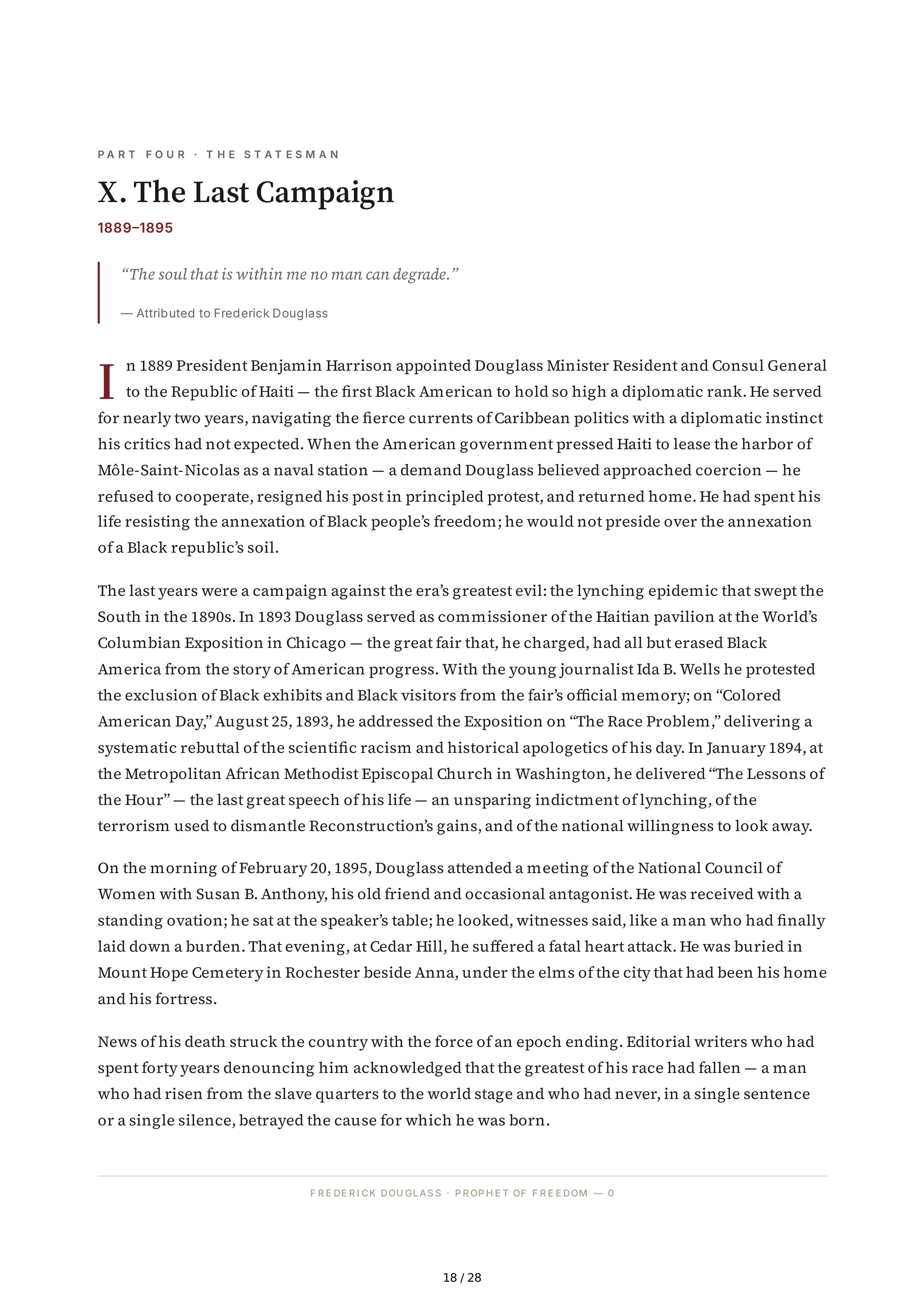
n 1889 President Benjamin Harrison appointed Douglass Minister Resident and Consul General
to the Republic of Haiti — the first Black American to hold so high a diplomatic rank. He served
for nearly two years, navigating the fierce currents of Caribbean politics with a diplomatic instinct
his critics had not expected. When the American government pressed Haiti to lease the harbor of
Môle-Saint-Nicolas as a naval station — a demand Douglass believed approached coercion — he
refused to cooperate, resigned his post in principled protest, and returned home. He had spent his
life resisting the annexation of Black people’s freedom; he would not preside over the annexation
of a Black republic’s soil.
The last years were a campaign against the era’s greatest evil: the lynching epidemic that swept the
South in the 1890s. In 1893 Douglass served as commissioner of the Haitian pavilion at the World’s
Columbian Exposition in Chicago — the great fair that, he charged, had all but erased Black
America from the story of American progress. With the young journalist Ida B. Wells he protested
the exclusion of Black exhibits and Black visitors from the fair’s official memory; on “Colored
American Day,” August 25, 1893, he addressed the Exposition on “The Race Problem,” delivering a
systematic rebuttal of the scientific racism and historical apologetics of his day. In January 1894, at
the Metropolitan African Methodist Episcopal Church in Washington, he delivered “The Lessons of
the Hour” — the last great speech of his life — an unsparing indictment of lynching, of the
terrorism used to dismantle Reconstruction’s gains, and of the national willingness to look away.
On the morning of February 20, 1895, Douglass attended a meeting of the National Council of
Women with Susan B. Anthony, his old friend and occasional antagonist. He was received with a
standing ovation; he sat at the speaker’s table; he looked, witnesses said, like a man who had finally
laid down a burden. That evening, at Cedar Hill, he suffered a fatal heart attack. He was buried in
Mount Hope Cemetery in Rochester beside Anna, under the elms of the city that had been his home
and his fortress.
News of his death struck the country with the force of an epoch ending. Editorial writers who had
spent forty years denouncing him acknowledged that the greatest of his race had fallen — a man
who had risen from the slave quarters to the world stage and who had never, in a single sentence
or a single silence, betrayed the cause for which he was born.
F R E DE R I CK
DOU GL AS S
·
P R OP H E T
OF
F R E E DOM
— 0
18 / 28
B
A
C
K
M
A T
T
E R
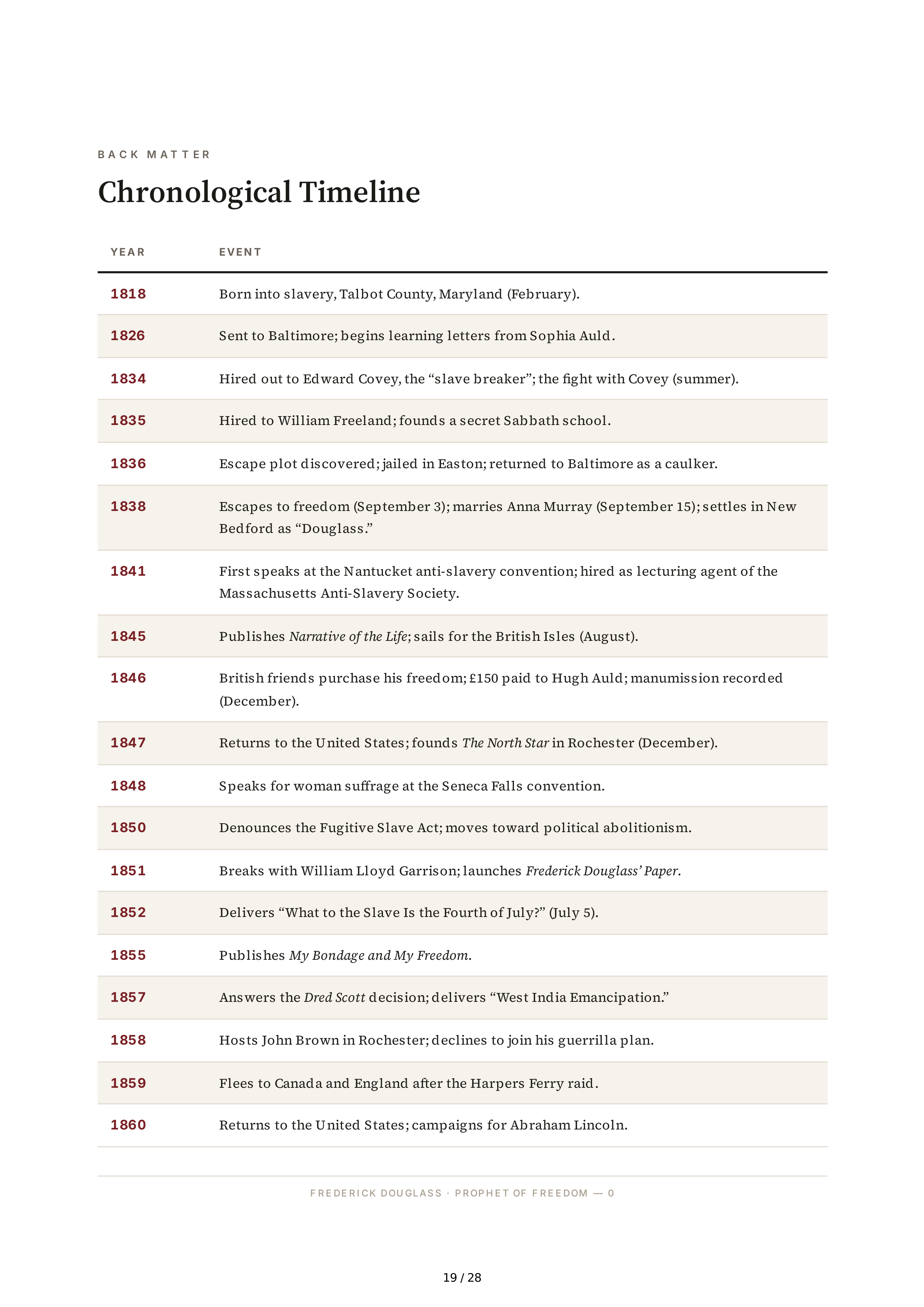
Chronological Timeline
YE A R
E VE N T
1818
Born into slavery, Talbot County, Maryland (February).
1826
Sent to Baltimore; begins learning letters from Sophia Auld.
1834
Hired out to Edward Covey, the “slave breaker”; the fight with Covey (summer).
1835
Hired to William Freeland; founds a secret Sabbath school.
1836
Escape plot discovered; jailed in Easton; returned to Baltimore as a caulker.
1838
Escapes to freedom (September 3); marries Anna Murray (September 15); settles in New
Bedford as “Douglass.”
1841
First speaks at the Nantucket anti-slavery convention; hired as lecturing agent of the
Massachusetts Anti-Slavery Society.
1845
Publishes
Narrative of the Life
; sails for the British Isles (August).
1846
British friends purchase his freedom;
£
150 paid to Hugh Auld; manumission recorded
(December).
1847
Returns to the United States; founds
The North Star
in Rochester (December).
1848
Speaks for woman suffrage at the Seneca Falls convention.
1850
Denounces the Fugitive Slave Act; moves toward political abolitionism.
1851
Breaks with William Lloyd Garrison; launches
Frederick Douglass’ Paper
.
1852
Delivers “What to the Slave Is the Fourth of July?” (July 5).
1855
Publishes
My Bondage and My Freedom
.
1857
Answers the
Dred Scott
decision; delivers “West India Emancipation.”
1858
Hosts John Brown in Rochester; declines to join his guerrilla plan.
1859
Flees to Canada and England after the Harpers Ferry raid.
1860
Returns to the United States; campaigns for Abraham Lincoln.
F R E DE R I CK
DOU GL AS S
·
P R OP H E T
OF
F R E E DOM
— 0
19 / 28
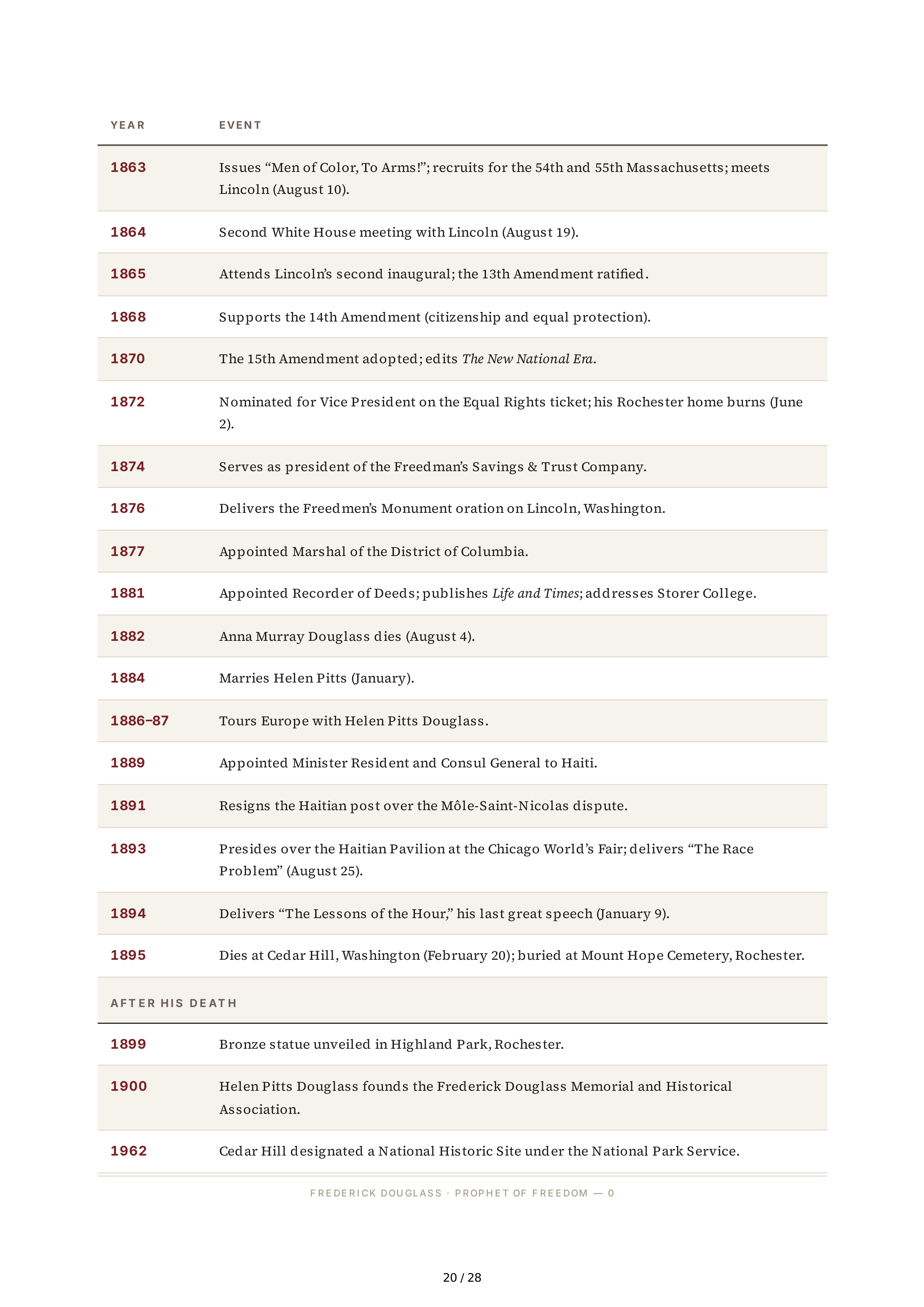
YE A R
E VE N T
1863
Issues “Men of Color, To Arms!”; recruits for the 54th and 55th Massachusetts; meets
Lincoln (August 10).
1864
Second White House meeting with Lincoln (August 19).
1865
Attends Lincoln’s second inaugural; the 13th Amendment ratified.
1868
Supports the 14th Amendment (citizenship and equal protection).
1870
The 15th Amendment adopted; edits
The New National Era
.
1872
Nominated for Vice President on the Equal Rights ticket; his Rochester home burns (June
2).
1874
Serves as president of the Freedman’s Savings & Trust Company.
1876
Delivers the Freedmen’s Monument oration on Lincoln, Washington.
1877
Appointed Marshal of the District of Columbia.
1881
Appointed Recorder of Deeds; publishes
Life and Times
; addresses Storer College.
1882
Anna Murray Douglass dies (August 4).
1884
Marries Helen Pitts (January).
1886–87
Tours Europe with Helen Pitts Douglass.
1889
Appointed Minister Resident and Consul General to Haiti.
1891
Resigns the Haitian post over the Môle-Saint-Nicolas dispute.
1893
Presides over the Haitian Pavilion at the Chicago World’s Fair; delivers “The Race
Problem” (August 25).
1894
Delivers “The Lessons of the Hour,” his last great speech (January 9).
1895
Dies at Cedar Hill, Washington (February 20); buried at Mount Hope Cemetery, Rochester.
A FT E R
H I S
D E AT H
1899
Bronze statue unveiled in Highland Park, Rochester.
1900
Helen Pitts Douglass founds the Frederick Douglass Memorial and Historical
Association.
1962
Cedar Hill designated a National Historic Site under the National Park Service.
F R E DE R I CK
DOU GL AS S
·
P R OP H E T
OF
F R E E DOM
— 0
20 / 28

YE A R
E VE N T
1967
U.S. Postal Service issues the first postage stamp honoring Douglass.
2013
Bronze statue installed in Emancipation Hall, United States Capitol.
F R E DE R I CK
DOU GL AS S
·
P R OP H E T
OF
F R E E DOM
— 0
21 / 28
B
A
C
K
M
A T
T
E R
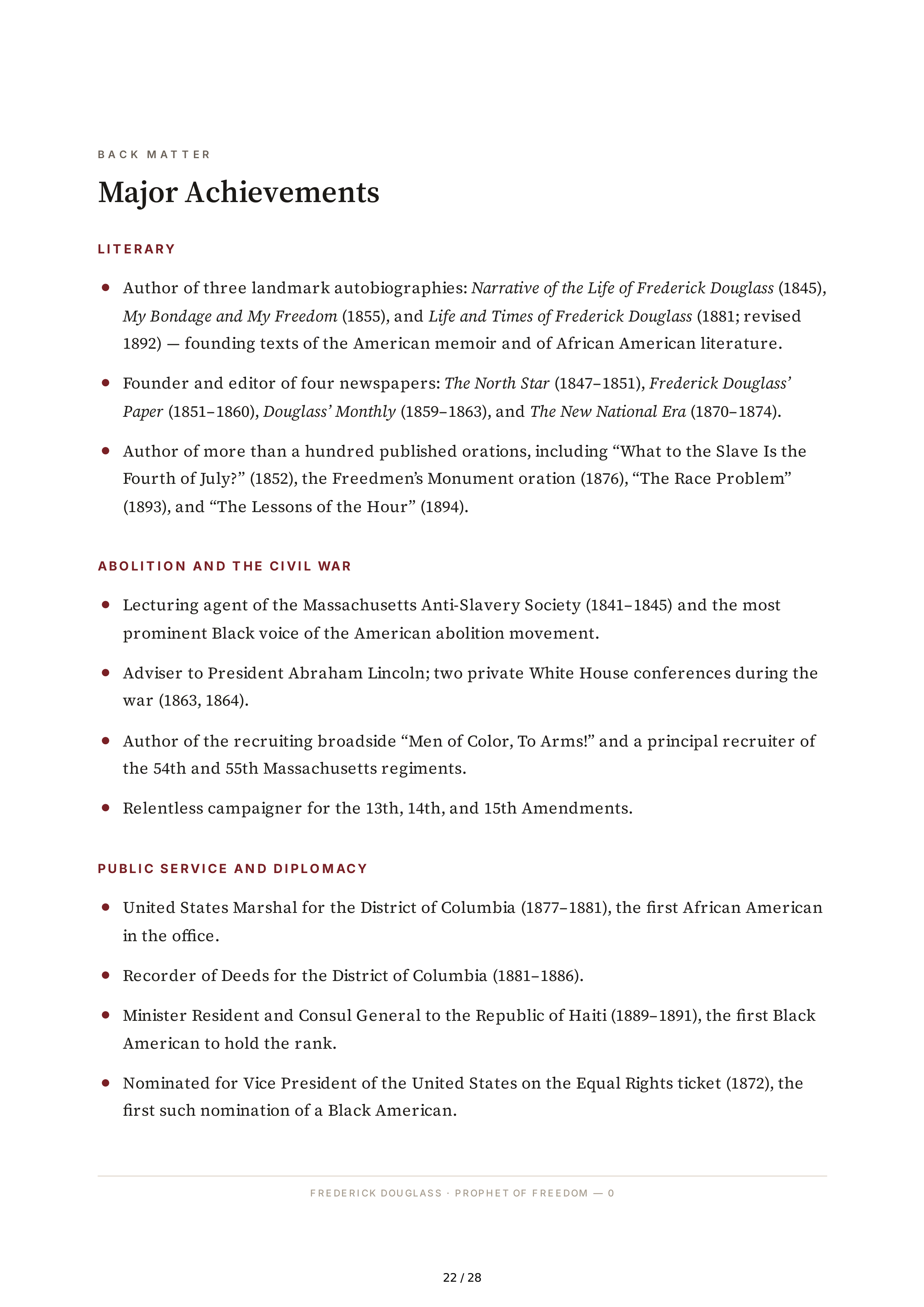
Major Achievements
L I T E R AR Y
ABO L I T I O N
AN D
T HE
C I VI L
WAR
P U BL I C
S E R VI C E
AN D
D I P L O M AC Y
Author of three landmark autobiographies:
Narrative of the Life of Frederick Douglass
(1845),
My Bondage and My Freedom
(1855), and
Life and Times of Frederick Douglass
(1881; revised
1892) — founding texts of the American memoir and of African American literature.
Founder and editor of four newspapers:
The North Star
(1847–1851),
Frederick Douglass’
Paper
(1851–1860),
Douglass’ Monthly
(1859–1863), and
The New National Era
(1870–1874).
Author of more than a hundred published orations, including “What to the Slave Is the
Fourth of July?” (1852), the Freedmen’s Monument oration (1876), “The Race Problem”
(1893), and “The Lessons of the Hour” (1894).
Lecturing agent of the Massachusetts Anti-Slavery Society (1841–1845) and the most
prominent Black voice of the American abolition movement.
Adviser to President Abraham Lincoln; two private White House conferences during the
war (1863, 1864).
Author of the recruiting broadside “Men of Color, To Arms!” and a principal recruiter of
the 54th and 55th Massachusetts regiments.
Relentless campaigner for the 13th, 14th, and 15th Amendments.
United States Marshal for the District of Columbia (1877–1881), the first African American
in the office.
Recorder of Deeds for the District of Columbia (1881–1886).
Minister Resident and Consul General to the Republic of Haiti (1889–1891), the first Black
American to hold the rank.
Nominated for Vice President of the United States on the Equal Rights ticket (1872), the
first such nomination of a Black American.
F R E DE R I CK
DOU GL AS S
·
P R OP H E T
OF
F R E E DOM
— 0
22 / 28

WO M E N
’
S
R I G HT S
AN D
E D U C AT I O N
Participant in the Seneca Falls convention (1848) and lifelong advocate of woman
suffrage; his final public appearance was a women’s rights meeting on the day of his
death.
Trustee of Storer College and lifelong champion of public education for the freed
people.
F R E DE R I CK
DOU GL AS S
·
P R OP H E T
OF
F R E E DOM
— 0
23 / 28
B
A
C
K
M
A T
T
E R
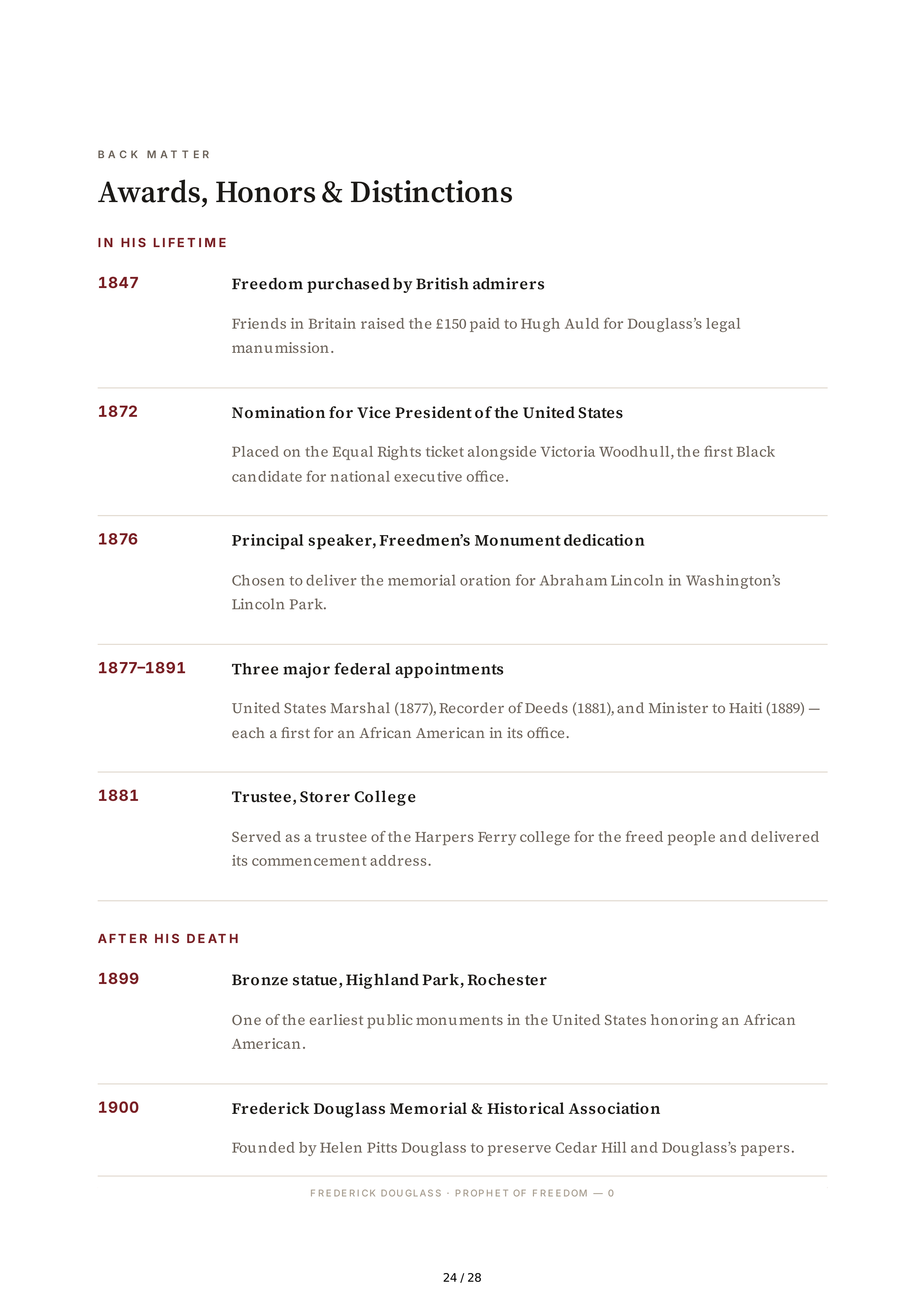
Awards, Honors & Distinctions
I N
HI S
L I FE T I M E
1847
Freedom purchased by British admirers
Friends in Britain raised the
£
150 paid to Hugh Auld for Douglass’s legal
manumission.
1872
Nomination for Vice President of the United States
Placed on the Equal Rights ticket alongside Victoria Woodhull, the first Black
candidate for national executive office.
1876
Principal speaker, Freedmen’s Monument dedication
Chosen to deliver the memorial oration for Abraham Lincoln in Washington’s
Lincoln Park.
1877–1891
Three major federal appointments
United States Marshal (1877), Recorder of Deeds (1881), and Minister to Haiti (1889) —
each a first for an African American in its office.
1881
Trustee, Storer College
Served as a trustee of the Harpers Ferry college for the freed people and delivered
its commencement address.
AFT E R
HI S
D E AT H
1899
Bronze statue, Highland Park, Rochester
One of the earliest public monuments in the United States honoring an African
American.
1900
Frederick Douglass Memorial & Historical Association
Founded by Helen Pitts Douglass to preserve Cedar Hill and Douglass’s papers.
F R E DE R I CK
DOU GL AS S
·
P R OP H E T
OF
F R E E DOM
— 0
24 / 28
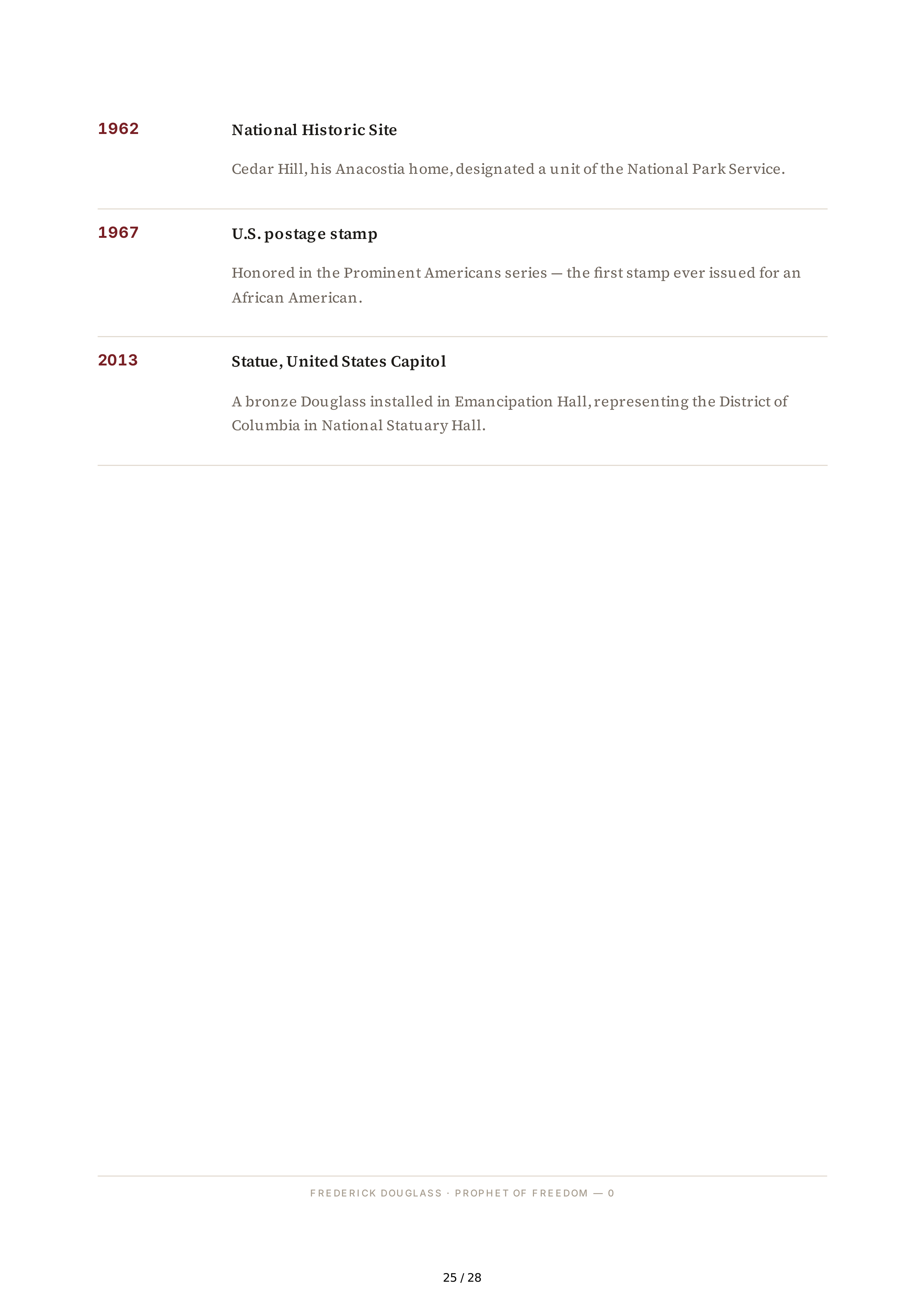
1962
National Historic Site
Cedar Hill, his Anacostia home, designated a unit of the National Park Service.
1967
U.S. postage stamp
Honored in the Prominent Americans series — the first stamp ever issued for an
African American.
2013
Statue, United States Capitol
A bronze Douglass installed in Emancipation Hall, representing the District of
Columbia in National Statuary Hall.
F R E DE R I CK
DOU GL AS S
·
P R OP H E T
OF
F R E E DOM
— 0
25 / 28
D
B
A
C
K
M
A T
T
E R
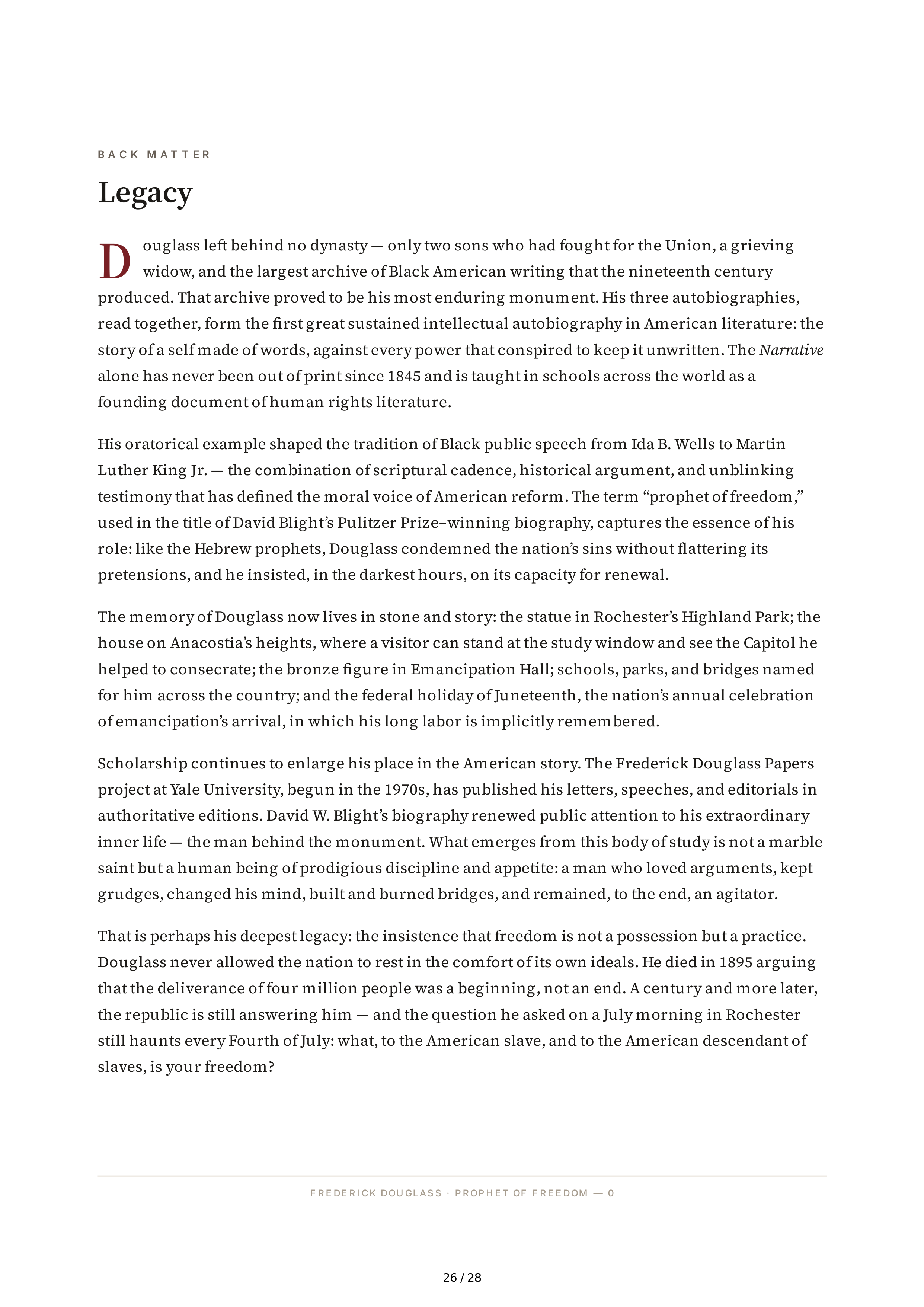
Legacy
ouglass left behind no dynasty — only two sons who had fought for the Union, a grieving
widow, and the largest archive of Black American writing that the nineteenth century
produced. That archive proved to be his most enduring monument. His three autobiographies,
read together, form the first great sustained intellectual autobiography in American literature: the
story of a self made of words, against every power that conspired to keep it unwritten. The
Narrative
alone has never been out of print since 1845 and is taught in schools across the world as a
founding document of human rights literature.
His oratorical example shaped the tradition of Black public speech from Ida B. Wells to Martin
Luther King Jr. — the combination of scriptural cadence, historical argument, and unblinking
testimony that has defined the moral voice of American reform. The term “prophet of freedom,”
used in the title of David Blight’s Pulitzer Prize–winning biography, captures the essence of his
role: like the Hebrew prophets, Douglass condemned the nation’s sins without flattering its
pretensions, and he insisted, in the darkest hours, on its capacity for renewal.
The memory of Douglass now lives in stone and story: the statue in Rochester’s Highland Park; the
house on Anacostia’s heights, where a visitor can stand at the study window and see the Capitol he
helped to consecrate; the bronze figure in Emancipation Hall; schools, parks, and bridges named
for him across the country; and the federal holiday of Juneteenth, the nation’s annual celebration
of emancipation’s arrival, in which his long labor is implicitly remembered.
Scholarship continues to enlarge his place in the American story. The Frederick Douglass Papers
project at Yale University, begun in the 1970s, has published his letters, speeches, and editorials in
authoritative editions. David W. Blight’s biography renewed public attention to his extraordinary
inner life — the man behind the monument. What emerges from this body of study is not a marble
saint but a human being of prodigious discipline and appetite: a man who loved arguments, kept
grudges, changed his mind, built and burned bridges, and remained, to the end, an agitator.
That is perhaps his deepest legacy: the insistence that freedom is not a possession but a practice.
Douglass never allowed the nation to rest in the comfort of its own ideals. He died in 1895 arguing
that the deliverance of four million people was a beginning, not an end. A century and more later,
the republic is still answering him — and the question he asked on a July morning in Rochester
still haunts every Fourth of July: what, to the American slave, and to the American descendant of
slaves, is your freedom?
F R E DE R I CK
DOU GL AS S
·
P R OP H E T
OF
F R E E DOM
— 0
26 / 28
B
A
C
K
M
A T
T
E R
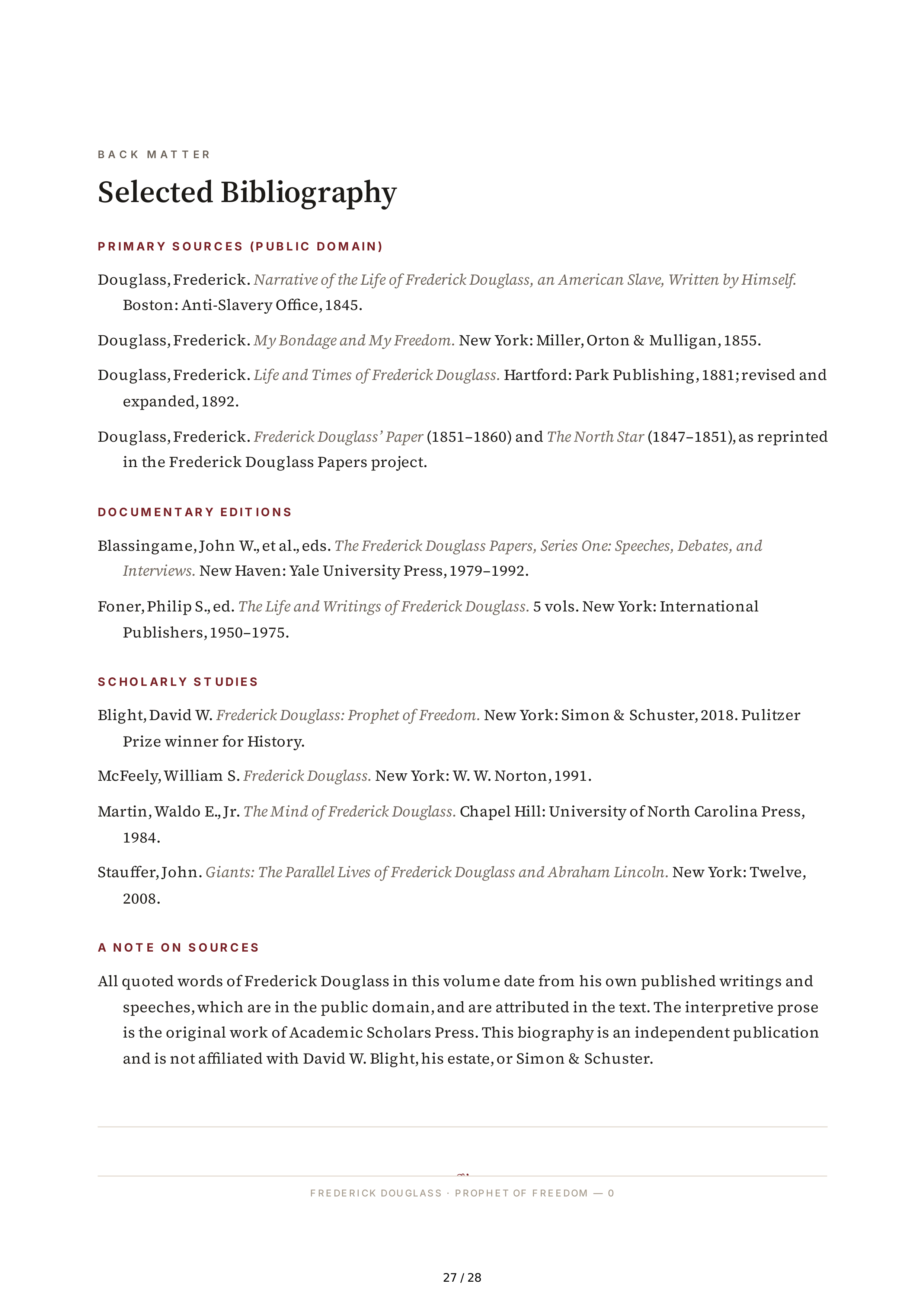
Selected Bibliography
P R I M AR Y
S O U R C E S
(
P U B L I C
D O M AI N
)
Douglass, Frederick.
Narrative of the Life of Frederick Douglass, an American Slave, Written by Himself.
Boston: Anti-Slavery Office, 1845.
Douglass, Frederick.
My Bondage and My Freedom.
New York: Miller, Orton & Mulligan, 1855.
Douglass, Frederick.
Life and Times of Frederick Douglass.
Hartford: Park Publishing, 1881; revised and
expanded, 1892.
Douglass, Frederick.
Frederick Douglass’ Paper
(1851–1860) and
The North Star
(1847–1851), as reprinted
in the Frederick Douglass Papers project.
D O C U M E N T AR Y
E D I T
I O N S
Blassingame, John W., et al., eds.
The Frederick Douglass Papers, Series One: Speeches, Debates, and
Interviews.
New Haven: Yale University Press, 1979–1992.
Foner, Philip S., ed.
The Life and Writings of Frederick Douglass.
5 vols. New York: International
Publishers, 1950–1975.
S C HO L AR LY
S T
U D I E S
Blight, David W.
Frederick Douglass: Prophet of Freedom.
New York: Simon & Schuster, 2018. Pulitzer
Prize winner for History.
McFeely, William S.
Frederick Douglass.
New York: W. W. Norton, 1991.
Martin, Waldo E., Jr.
The Mind of Frederick Douglass.
Chapel Hill: University of North Carolina Press,
1984.
Stauffer, John.
Giants: The Parallel Lives of Frederick Douglass and Abraham Lincoln.
New York: Twelve,
2008.
A
N O T
E
O N
S O U R C E S
All quoted words of Frederick Douglass in this volume date from his own published writings and
speeches, which are in the public domain, and are attributed in the text. The interpretive prose
is the original work of Academic Scholars Press. This biography is an independent publication
and is not affiliated with David W. Blight, his estate, or Simon & Schuster.
❦
F R E DE R I CK
DOU GL AS S
·
P R OP H E T
OF
F R E E DOM
— 0
27 / 28

Frederick
Douglass
:
Prophet
of
Freedom
·
An
Original
Biography
Set
in
Source
Serif
4
and
Inter
.
Prepared
as
a
print
-
ready
digital
edition
by
Academic
Scholars
Press
.
This
document
is
designed
for
A
4
and
Letter
PDF
export
and
prints
cleanly
from
any
modern
browser
. © 2026
Academic
Scholars
Press
.
All
rights
reserved
.
Brief
quotations
from
the
public
-
domain
writings
of
Frederick
Douglass
are
used
with
attribution
for
scholarly
illustration
;
all
other
text
is
original
.
The
facts
of
Douglass
’
s
life
are
matters
of
public
record
.
F R E DE R I CK
DOU GL AS S
·
P R OP H E T
OF
F R E E DOM
— 0
28 / 28