
T H E
B I O G R A P H I C A L
L I B R A R Y
·
F I R S
T
E D I T I O N
D
E
B
O
R
A H
L
I
P
S
T
A D
T
History on Trial
My Day in Court with a Holocaust Denier — The Life, the Trial, and
the Legacy of a Historian Who Refused to Be Silenced
A
C OM P LET E
B IOG R AP H Y
·
S IX T EEN
C H AP T ER S
·
C H R ONOLOG IC AL
T IM ELINE
·
AC H IEVEM ENT S
·
AWAR D S
·
LEG AC Y
P R E PA R E D
F R O M
T H E
P U B L I C
R E C O R D
·
M M X X V I
1 / 34
F R O N T I S P I E C E
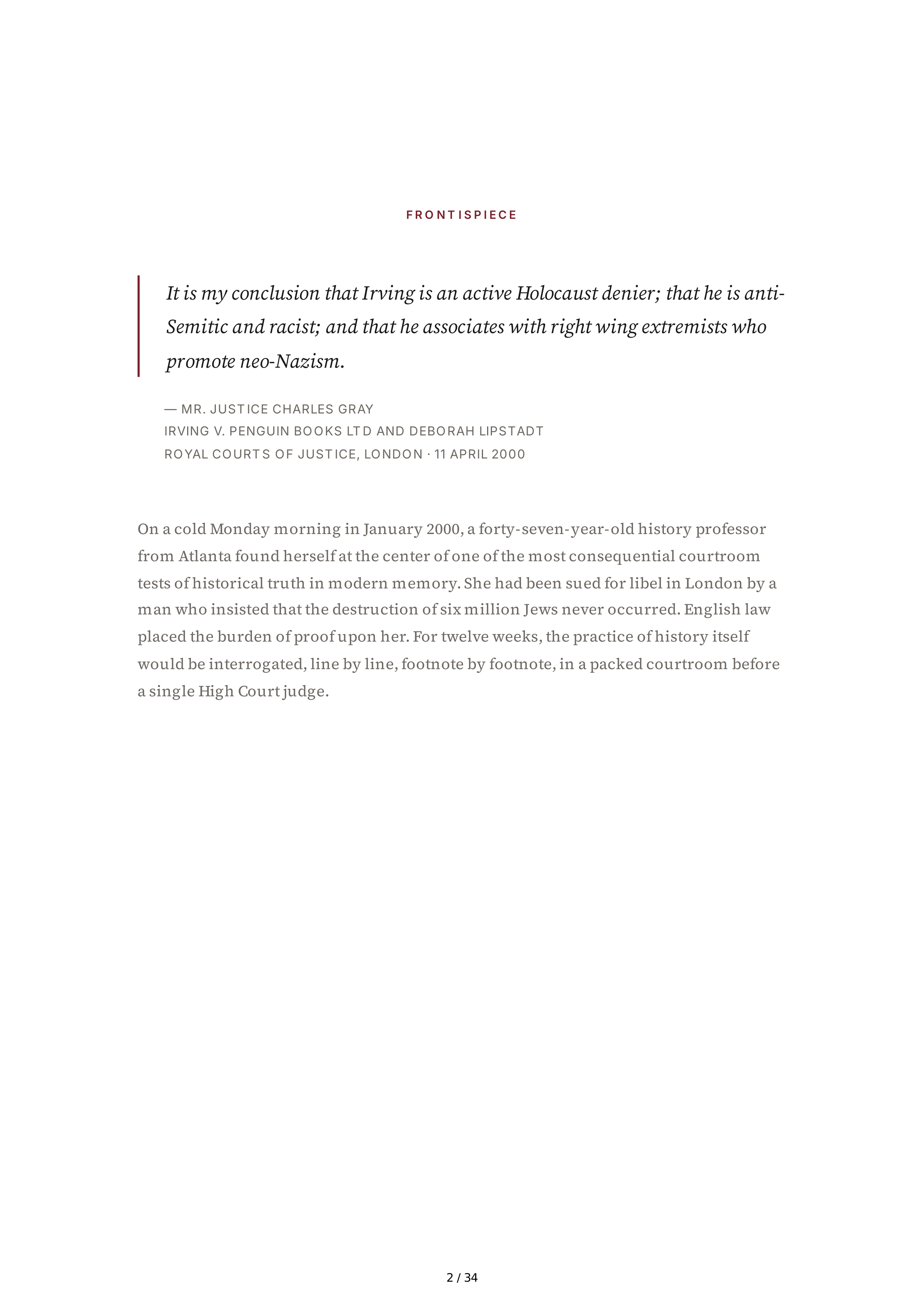
It is my conclusion that Irving is an active Holocaust denier; that he is anti-
Semitic and racist; and that he associates with right wing extremists who
promote neo-Nazism.
—
MR
.
JUST ICE
CHARLES
GRAY
IRVING
V
.
PENGUIN
BOOKS
LT D
AND
DEBORAH
LIPSTADT
ROYAL
COURT S
OF
JUST ICE
,
LONDON
· 11
APRIL
2000
On a cold Monday morning in January 2000, a forty-seven-year-old history professor
from Atlanta found herself at the center of one of the most consequential courtroom
tests of historical truth in modern memory. She had been sued for libel in London by a
man who insisted that the destruction of six million Jews never occurred. English law
placed the burden of proof upon her. For twelve weeks, the practice of history itself
would be interrogated, line by line, footnote by footnote, in a packed courtroom before
a single High Court judge.
2 / 34
C O N T
E N T
S
PAR T
O N E
·
T H E
H IS T O R IAN
1
A Brooklyn Beginning
2
The Making of a Historian
3
Confronting the Deniers
4
Denying the Holocaust, 1993
PAR T
T W O
·
T H E
T R IAL
5
The Writ from London
6
The Burden of Proof
7
The Historians' Brief
8
The Courtroom Opens
9
Irving on Method
10
The Architecture of Murder
11
Lipstadt on the Stand
12
Judgment Day
PAR T
T H R E E
·
AF T E R M AT H
&
L E G AC Y
13
History on Trial, 2005
14
Denial, 2016
15
The Scholar's Long Game
16
Legacy
B AC K
M AT T E R
A
Chronological Timeline
B
Major Achievements
C
Awards & Honors
D
Published Works
E
Legacy & Influence
3 / 34

F
A Note on Sources
4 / 34
PA R T
O N E
The Historian
Before the writ, before the courtroom, before the world knew her name, there was a girl in postwar
New York who grew up in the long silence of a catastrophe too large to speak of — and a young
scholar who refused to let that silence stand.
I
5 / 34
D
C
H A P
T
E R
O N E
A Brooklyn Beginning
eborah Esther Lipstadt was born in New York City on March 18, 1947, less than two years after the
end of the Second World War. Her parents, Erwin and Miriam Lipstadt, were the children of
Eastern European Jewish immigrants, and their household was observant, hardworking, and thor-
oughly American — a domestic world shaped by the accents, foods, and loyalties of the old country
even as the family pushed firmly toward the promises of the new. Her father went into business for
himself; her mother, born Miriam Peiman, kept the home and raised the children. Like so many
Jewish families of their generation, they carried within them a grief that was rarely articulated and
never far from the surface.
The war had ended, but it had not ended for them. Members of the extended family in Poland and
Russia had been murdered in the Holocaust, and the knowledge of those deaths was felt in the
Lipstadt home as a silence rather than a story. This was characteristic of postwar American Jewry,
which had not yet discovered a vocabulary for what had happened to Europe's Jews. Children were
protected from the details. The dead were not so much commemorated as absorbed into the texture
of ordinary life — a canceled name, an unvisited grave, a wedding photograph with empty spaces.
Years later, Lipstadt would describe growing up in a world where the Holocaust was both everywhere
and nowhere: a constant presence that nobody spoke about directly.
She came of age in the 1950s and 1960s, in a country that was only beginning to understand the enor-
mity of what had been lost. The suburb and the city, the synagogue and the public school, the radio
and then the television — all of it told her that she was an American first and a Jew in a way that was
comfortable, undemanding, and vague. But the silence at home did its own teaching. It instilled in
her an early, almost tactile sense that something terrible had happened to her people, that the world
had permitted it, and that the details mattered more than the comfort of forgetting. The question of
what had happened — and the deeper question of what it meant to be a Jew in a world that had al-
lowed it — formed the background hum of her childhood.
She was bright, curious, and combative in ways that would later serve her well. At school she argued;
in the synagogue she asked questions; at the dinner table she pressed her parents about the Europe
they had left behind. The answers were fragmentary, evasive, sometimes tearful. The fragments
lodged themselves in her memory. They would remain there — unexamined for years, then suddenly
central — when she finally understood that the story of the murder of Europe's Jews could be denied,
and that someone had to stand against the denial.
6 / 34
L
C
H A P
T
E R
T
W O
The Making of a Historian
ipstadt's education took her from the streets of New York to the intellectually fermenting cam-
puses of the late 1960s and 1970s. She earned her bachelor's degree in history from the City
College of New York in 1969, at a moment when the American university was convulsed by the civil
rights movement, the war in Vietnam, and the first stirrings of a new Jewish assertiveness born of the
Six-Day War. City College, free and democratic in its admissions, was an extraordinary laboratory for
a young woman who wanted to understand how societies remember and forget. There she discov-
ered that history was not a collection of dates but a contested form of knowledge — something that
had to be argued, sourced, and defended against those who would distort it.
She went on to Brandeis University, the Jewish-sponsored institution in Massachusetts founded in
1948, where she completed a master's degree in 1972 and a doctorate in 1976. Brandeis was, in
Lipstadt's own intellectual formation, a revelation: a place where the proposition that Jewish learn-
ing and rigorous scholarship belonged together was taken as a matter of course. Her doctoral work
focused on twentieth-century American Jewish history, and it gave her a subtle grasp of how
American Jews had absorbed — or failed to absorb — the enormity of the destruction. She studied the
arguments, the institutions, the organizations, the newspapers, the silences. She learned to read a
community through its archives.
In the late 1970s she joined the faculty of the University of Washington in Seattle, where she spent
more than a decade teaching modern Jewish history and, increasingly, the history of the Holocaust.
The classroom became her vocation. She was one of a generation of scholars who built the field of
Holocaust studies from the ground up — designing courses where none had existed, gathering syl-
labi, training students to read survivor testimony with care and to weigh documentary evidence with
rigor. In Seattle she encountered survivors in the community, people who had rebuilt their lives in
the Pacific Northwest and who trusted her with their stories.
Teaching the Holocaust, she discovered, was not like teaching other subjects. Students arrived with
almost no knowledge and enormous feeling. They asked questions that were moral as much as his-
torical. And a small number of them had begun to arrive with a different kind of question entirely —
one she had never expected: What if it never happened? The question was not naive. It was manufac-
tured, organized, and funded. By the early 1980s, Lipstadt had begun to notice the machinery behind
it.
7 / 34
T
C
H A P
T
E R
T
H R E E
Confronting the Deniers
he encounter began with campus newspapers. Throughout the 1980s, advertisements paid for
by the Committee for Open Debate on the Holocaust began appearing in college papers across
the United States, inviting students to "judge for themselves" whether the Holocaust had occurred.
The ads were slick, earnest, and deeply dishonest — dressed in the language of free inquiry while
smuggling in the claim that six million murders were an open question. To Lipstadt, who had spent
her professional life teaching the documentary record, the ads were not an intellectual puzzle; they
were an insult to every survivor she knew and a symptom of something dangerous.
She began to study denial seriously, reading the works of its leading figures: the French professor
Robert Faurisson, the American Arthur Butz, the German-born revisionists who had built a small in-
ternational publishing network. She traced the contours of the movement — its newsletters, its con-
ferences, its careful avoidance of the word "denial," its preference for "revisionism," as though deny-
ing a genocide were the same discipline as correcting an historical footnote. She came to understand
that denial was not a crude lie but a system: a set of techniques designed to create the appearance of
scholarship while systematically dismantling the evidentiary basis of the Holocaust. The Leuchter
Report of 1988, a self-published pamphlet by an American whose credentials were minimal, claim-
ing that the gas chambers at Auschwitz could not have functioned, was treated by deniers as a scien-
tific breakthrough. It was nothing of the sort — but it showed how willing deniers were to seize any
document, however fraudulent, that served their purpose.
She also noticed something unsettling: the mainstream press too often treated denial as a legitimate
position in a scholarly debate. Journalists, anxious to appear balanced, would interview historians
and deniers side by side, as though the existence of the gas chambers were a matter of opinion. This,
Lipstadt concluded, was precisely how denial had survived and spread — not by winning arguments,
but by manufacturing the appearance of a genuine controversy. The remedy was not to debate de-
niers but to expose them.
In the late 1980s she began writing what would become her landmark study. She immersed herself in
the deniers' own texts, reading them as a pathologist reads a disease. The book, she decided, would
not simply refute denial — it would anatomize it: its history, its leading figures, its techniques, its po-
litical functions. And it would name names. Among the names would be an English writer of popular
military history named David Irving, who by the late 1980s was telling audiences that he had come to
doubt the Holocaust and was becoming, as he put it, a denier himself. Lipstadt's decision to include
him would alter the course of her life.
8 / 34
D
C
H A P
T
E R
F O U R
Denying the Holocaust, 1993
enying the Holocaust: The Growing Assault on Truth and Memory was published by the Free
Press in 1993. It was the first major scholarly study of Holocaust denial as a movement, and it ar-
rived with the force of a reckoning. Lipstadt argued that denial was not a fringe phenomenon but a
form of antisemitism that had learned to wear the clothing of scholarship. Deniers, she showed, did
not merely assert that the Holocaust never happened; they constructed an entire parallel universe of
pseudo-evidence — fabricated documents, mistranslated German sources, distorted statistics, and
above all a studied refusal to engage with the mountain of documentation that established the mur-
der of six million Jews. The movement's apparent sophistication was its camouflage.
The book was organized around a dual conviction. The first was that legitimate historical revision —
the correction of errors, the rethinking of interpretations — was the very lifeblood of the discipline;
historians revise constantly, and they should. The second was that Holocaust denial was not revision
at all but erasure: a politically motivated campaign to strip the Jewish people of the memory of their
destruction. Revisionists revise; deniers erase. The distinction was not semantic. It was the difference
between scholarship and an assault on truth. Lipstadt insisted on the phrase "Holocaust denial" over
the deniers' preferred "revisionism," and she devoted considerable attention to the movement's tech-
nique of leveraging liberal values — free speech, open debate, fair-mindedness — against the very
record those values were supposed to protect.
The book profiled the movement's leading figures and traced its evolution from the immediate post-
war years, when deniers operated in obscurity, to the Internet age, when their ideas could circulate
through campus newspapers, shortwave radio, and the first crude databases. She treated the deniers'
arguments seriously enough to dismantle them: the claims about the gas chambers, the
Einsatzgruppen, the death marches, the statistical sleight of hand that produced absurdly low mor-
tality figures. She documented their habit of citing one another as authorities, creating the illusion
of a scholarly literature where in truth there was only a closed circular system of self-citation.
The book was widely and enthusiastically reviewed. Scholars praised its courage and its rigor; sur-
vivors wrote to thank her. But one passage in particular caught the attention of its subject. Lipstadt
described David Irving as one of the most dangerous spokespersons for Holocaust denial — a falsifier
of history who manipulated documents to serve an antisemitic worldview. Irving, who had built a lu-
crative career as a controversialist, responded in the only way available to him under English law. In
1996, he issued a libel writ against Lipstadt and her publisher, Penguin Books, whose British edition
had carried the offending words. Under English defamation law, the burden of proof would fall on
the defendant. The historian who had spent her life insisting that the evidence must speak was about
to be asked, in a court of law, to prove it.
9 / 34
PA R T
T W O
The Trial
From January to April 2000, in the Royal Courts of Justice on the Strand, the most closely examined
archive in the history of Holocaust denial was built in open court — page by page, witness by witness,
judgment by judgment.
II
10 / 34
D
C
H A P
T
E R
F I V E
The Writ from London
avid Irving was, in 1996, a famous man in Britain — famous in the way that a brilliant, abrasive,
self-made contrarian can be. Born in 1938, he had built a career writing best-selling popular
histories of the Second World War, with a gift for archival discovery and a talent for provocation. His
1977 book Hitler's War had argued, against the weight of evidence, that Hitler bore no responsibility
for the extermination of the Jews — that the Führer had not known, or had not ordered, the mass
murder carried out in his name. The thesis delighted neo-Nazis and outraged historians, but it sold
books. Over the following decade and a half, Irving drifted steadily toward the far right, speaking to
audiences of Holocaust deniers and antisemites across Europe, insisting that he was not a denier
even as he told audiences that the evidence for the gas chambers did not exist.
By the time Denying the Holocaust appeared, Irving was not merely a man with unusual opinions; he
had made Holocaust denial a central feature of his public identity. He had shared platforms with
Faurisson and other leading deniers. He had told an audience that he was becoming a Holocaust de-
nier himself. He had argued that Anne Frank's diary was a forgery, that the gas chambers were an in-
vention, that the six million figure was a fraud. Lipstadt's book, which described him in unsparing
terms, was the first major work by an established scholar to treat his career as a case study in the cor-
ruption of historical method. Irving, sensing both insult and opportunity, chose the courts.
English defamation law in the 1990s was among the most claimant-friendly in the world. The
claimant did not have to prove that the words were false; they were presumed to be false. The burden
fell on the defendant to prove that everything she had published was substantially true. Irving did not
have to demonstrate that his reputation was ruined — in English law, defamatory words of this kind
were presumed to damage a person's standing. He could choose the forum, and he chose London,
where Lipstadt and Penguin would have to mount a defense that would cost millions.
The writ named Lipstadt and Penguin Books as defendants. The words at issue were those in which
she had called Irving a Holocaust denier and a falsifier of history — words that, if she could not prove
them true, would see her publicly branded a libeler, her book withdrawn, and damages awarded to
the man she had accused of distorting the historical record. She could have settled. Penguin, which
had insured against the risk, could have pressured her to apologize. She refused. To settle, she be-
lieved, would be to concede that the accusations against Irving could not be defended — that
Holocaust denial was, after all, a matter of opinion. She would fight, and she would make the fight
about the historical record itself.
11 / 34
T
C
H A P
T
E R
S
I X
The Burden of Proof
he strategy the defense adopted was both simple and audacious: it would embrace the burden of
proof and turn the trial into a seminar on historical methodology. The words Lipstadt had writ-
ten about Irving were not careless insults; they were conclusions reached after years of studying his
work. The defense would invite the court — and, through the court, the public — to examine Irving's
books, his speeches, his diaries, his methods, and his sources, and to judge for itself whether he had,
as she wrote, deliberately falsified the historical record.
The legal engineering was formidable. A libel action turns on "meaning": the judge must first decide
what the defendant's words would convey to a reasonable reader. Justice Charles Gray, the trial judge,
ruled that the words meant that Irving was an active Holocaust denier who had knowingly and per-
sistently misrepresented the evidence — a serious charge that would require the defense to prove
that this characterization was substantially true. The team would therefore have to demonstrate, to
the standard of a civil court, that Irving was a falsifier of documents, a manipulator of quotations, a
systematic abuser of the historian's craft. This was not a claim that could be established by assertion.
It could only be established by the evidence itself.
Lipstadt's solicitor was Anthony Julius of Mishcon de Reya — a lawyer of fierce intellect who had
made his name in earlier high-profile matters and who shared Lipstadt's conviction that the case was
about more than one man's reputation. Her leading counsel was Richard Rampton, a barrister of leg-
endary precision and dry wit, who would spend months mastering the details of twentieth-century
German history. The team was completed by a small army of researchers and by a group of academic
historians who would serve as expert witnesses. Each of them was asked to do something unusual:
not merely to offer an opinion, but to subject a living author's entire oeuvre to the kind of forensic
examination normally reserved for the most contested sources in the historical canon.
There was never any doubt about the risk. The defense costs would run into the millions of pounds,
borne largely by Penguin's insurers. English civil trials are decided on the balance of probabilities,
and a single significant error in the defense's case could — in the ruthless arithmetic of libel law —
expose gaps that Irving would exploit. Lipstadt knew that her book, and her own credibility, would be
examined with the kind of hostility usually reserved for a hostile witness. She was, in a sense, putting
her scholarship on trial. But she was also doing something larger. By insisting that the trial be about
the integrity of the historical method, she was asking the court to settle a question that had become
the center of her intellectual life: whether a scholar could lie, and whether lying about the murder of
six million people was protected as opinion or condemned as fraud.
12 / 34
T
C
H A P
T
E R
S
E V E N
The Historians' Brief
he defense's most important witness would not be Lipstadt herself. It would be Richard J. Evans,
then Professor of Modern History at Cambridge University, a scholar of German history whose
reputation for exactitude was legendary. Evans assembled a team of graduate researchers — includ-
ing the young historians Thomas Skelton-Robinson and Nikolaus Wachsmann — and together they
did what no one had ever done before: they read every significant work by David Irving, traced every
notable claim to its source, and subjected his footnotes to the same scrutiny that a scholar would
bring to a doctoral dissertation. The result was a report of hundreds of pages that became the corner-
stone of the defense.
What Evans and his team found was not mere error. Every historian makes mistakes; the discipline
exists to correct them. What they found was a pattern — a systematic alignment between Irving's con-
clusions and his manipulation of the evidence. Quotations were truncated to change their meaning.
German documents were mistranslated in ways that served his argument. Documents that contra-
dicted his claims were omitted, sometimes for decades at a time. Sources that he himself had previ-
ously vouched for would be abandoned, without explanation, the moment they inconveniently be-
gan to support the standard account. The effect was consistent across his entire body of work: a ver-
sion of history in which the Holocaust diminished, the Nazis' crimes softened, and Hitler's responsi-
bility evaporated.
The witnesses were chosen to close every avenue of escape. Van Pelt, a young architectural historian
at the University of Toronto, was arguably the world's leading scholar on the physical remains of
Auschwitz-Birkenau; he would testify about the gas chambers. Christopher Browning, the eminent
American historian of the Final Solution, would testify about the mass shooting operations of the
Einsatzgruppen and the German police battalions. Peter Longerich, then of the University of
London, would place the evolution of Nazi extermination policy in its documentary context. Hajo
Funke would document Irving's speeches to neo-Nazi audiences in Germany. Jan van der Dussen, an
expert on the forged Hitler Diaries, would testify about Irving's early and energetic endorsement of
those forgeries — a case study in the catastrophic failure of his historical judgment.
For months, the defense prepared as though for a war. Transcripts were gathered, documents trans-
lated, chronologies built. Irving, who had initially instructed solicitors, eventually dismissed them
and chose to represent himself — a decision that turned the proceedings into a kind of duel: a lone,
combative author against a phalanx of the world's most careful historians, with Justice Gray as the
referee. The stage was set for a trial that would run for thirty-two court days, that would draw jour-
nalists from around the world, and that would test, in public and under oath, whether Holocaust de-
nial could survive contact with the historical record.
13 / 34
T
C
H A P
T
E R
E I G H T
The Courtroom Opens
he Royal Courts of Justice are a Victorian monument to the majesty of English law — vaulted
hallways, marble corridors, the hushed ritual of a legal culture that takes itself very seriously.
Courtroom 73 was small and wood-paneled, with a public gallery that would be full every day of the
trial. On January 11, 2000, Deborah Lipstadt walked in, took her seat behind her lawyers, and steeled
herself for a process she had been dreading and preparing for in equal measure for more than three
years.
Richard Rampton opened the defense case. His opening statement, delivered in his trademark un-
hurried, exact voice, took the better part of two days. He did not shout; he did not gesture; he built his
case the way a mason builds a wall. The words at issue, he said, were true. Irving was a Holocaust de-
nier. Irving had falsified the historical record. And the defense would prove it — not with rhetoric,
but with documents. From the first minutes, it was clear that this would not be a trial about whether
the Holocaust happened; it would be a trial about whether one man had dedicated his career to deny-
ing it.
Irving's own case had been thin. He insisted that he was a legitimate historian, that his reputation
had been destroyed by the accusation of denial, and that the word "denier" was a smear. But he made
the courtroom a theater of his own making — questioning witnesses at interminable length, invok-
ing conspiracy theories about the International Jewish community, and engaging in the same
rhetorical tactics that had characterized his public career. The judge, patient and precise, allowed
him remarkable latitude, perhaps sensing that the best way to expose the emptiness of his method
was to let it speak for itself.
For Lipstadt, the ordeal was psychological as much as legal. She was not permitted to discuss the trial
publicly; the contempt rules of English law forbade it. She sat in court day after day, watching her
own scholarship be interrogated, watching Irving perform for the gallery, watching the historians
who had become her allies defend the craft she had devoted her life to. She filled notebooks. She
studied Rampton's technique. She disciplined herself to trust the process — to believe that the evi-
dence would speak with a force that no courtroom theatrics could match. The trial, she later wrote,
became a kind of education in the most literal sense: she was learning, from the inside, how fragile
and how resilient the truth can be.
14 / 34
T
C
H A P
T
E R
N I N E
Irving on Method
he heart of the defense case was Richard Evans's testimony, which occupied a week and a half of
the court's time and constituted, in effect, a graduate seminar on the discipline of history con-
ducted in a courtroom. Evans walked the judge through Irving's books, his manuscripts, his diary
entries, and his letters — and demonstrated, document by document, that his errors were not the
random mistakes of a careless writer but the deliberate distortions of an ideologue. The pattern was
so consistent that it ceased to be plausible as coincidence.
There was, for example, the question of the Führer order. Irving repeatedly argued that the Holocaust
could not have happened because no written order from Hitler to exterminate the Jews had ever been
found. Evans demonstrated that this was a classic case of moving the goalposts: historians do not re-
quire a written order to establish that a policy existed, and Irving himself had never demanded such
documentation for any other Nazi crime. The standard was applied only to the Holocaust — and only
to the parts of the Holocaust whose reality he wished to deny.
There were the mistranslations. Evans's team found German documents in which Irving had altered
the meaning of key phrases to serve his thesis — a process here, a transport there, a massacre that be-
came a resettlement. There were the omissions: documents that contradicted his account, sitting
unread in archives he had visited, simply not cited. There was the famous case of the Goebbels di-
aries. Irving had spent years citing a partial version of the diaries as proof that Goebbels knew noth-
ing of the extermination. When the full diaries were finally published, they showed the opposite —
Goebbels recording, in detail, Hitler's knowledge of and support for the killing. Rather than revise
his thesis, Irving attacked the new source.
The most devastating witness for this line of attack was Irving himself. Asked by Rampton to explain
why he had, in his 1991 book, quoted a document that directly contradicted a claim he had made in
an earlier edition, Irving could only bluster. Evans, under cross-examination, offered the judge a
simple observation: a historian may be wrong, but a historian who is wrong in exactly the direction
of his ideology, in case after case, without ever correcting himself, has crossed the line from error to
falsification. The word Lipstadt had used was "falsifier." By the end of Evans's testimony, it had ac-
quired the weight of a legal finding.
15 / 34
I
C
H A P
T
E R
T
E N
The Architecture of Murder
f Evans established that Irving had falsified the record, Robert Jan van Pelt established that the
physical record itself — the bricks, the mortar, the chimneys of Auschwitz-Birkenau — was unas-
sailable. Van Pelt, an architectural historian who had spent years studying the camp's built environ-
ment, was the last major witness for the defense, and his testimony became one of the trial's most
dramatic episodes. He took the judge on a virtual tour of the crematoria, explaining their design,
their ventilation systems, their drainage, the blue staining caused by hydrogen cyanide that still
marks the masonry of the gas chambers. The buildings, he showed, were engineered for mass
killing — their "morgues" were placed below ground and fitted with pillars for the introduction of
Zyklon B, their chimneys designed to handle the incineration of thousands of bodies, their air-raid
shelters equipped with nothing that would make them survivable as shelters.
Irving cross-examined van Pelt for days. He produced photographs, asked about the Leuchter Report,
demanded that van Pelt concede that the crematoria were not gas chambers but air-raid shelters or
morgues. Van Pelt, a precise and patient scholar, dismantled each claim with the same tools a foren-
sic architect would use. On the Leuchter Report — the pamphlet that deniers treated as their scien-
tific foundation — van Pelt pointed out that Leuchter had no training as a chemist or engineer, had
visited the site for a matter of hours, and had never examined the relevant documents. The court was
being asked to choose between a mass of documentation, physical evidence, and witness testimony,
on the one hand, and a pamphlet by a man with no credentials, on the other.
The other expert witnesses reinforced the architecture of the defense. Christopher Browning testified
about the documentary record of the mass shootings carried out by the Einsatzgruppen and the
German police battalions — thousands of pages of contemporaneous reports, orders, and statistics,
none of them forged. Peter Longerich traced the radicalization of Nazi policy from persecution to ex-
pulsion to total extermination, showing that the "Final Solution" was not an improvisation but a
carefully managed process. Hajo Funke documented Irving's speeches to far-right audiences, in
which he mocked the Holocaust and urged his listeners to resist the "Jews who control the media."
Jan van der Dussen examined Irving's enthusiastic endorsement of the forged Hitler Diaries in 1983
— an episode in which Irving had vouched for the authenticity of documents that a trained historian
would have recognized as fraudulent within hours.
The cumulative effect was overwhelming. By the time the defense closed its case, the trial had gener-
ated an evidentiary record of extraordinary depth. The question put to the court was not whether the
Holocaust had happened — the court had never doubted it — but whether a man could be called a
"falsifier of history" for a career spent denying it. The evidence, in the end, spoke with a clarity that
would be impossible to escape.
16 / 34
I
C
H A P
T
E R
E L E V E N
Lipstadt on the Stand
n the final phase of the defense case, Deborah Lipstadt herself took the witness stand. For several
days she gave evidence, and then for several more she was cross-examined by the man she had
accused — a confrontation more surreal than anything she had imagined when she wrote Denying
the Holocaust. She had studied his work, but she had never expected to sit across from him in a
courtroom, answering his questions under oath.
Irving's cross-examination was relentless. He asked her about her family, her education, her meth-
ods, her contacts with Jewish organizations, her failure to respond to his invitations to debate. He
pressed her on individual passages in her book, demanding that she produce evidence for claims
she had made years earlier. He tried to trap her into admissions — that she had never met him, that
she had not interviewed him, that she had relied on the work of others. Lipstadt answered each ques-
tion with the same patience and precision that characterized her scholarship. She conceded what
was true and refused what was not. When asked whether she had personally researched every claim,
she acknowledged the collaborative nature of scholarship — and reminded the court that the written
record she had relied upon was itself the basis of the historical discipline.
At times the exchange exposed the divide between them. Irving insisted that he was a "revisionist"
correcting the errors of orthodox historiography; Lipstadt replied that revisionists revise, while de-
niers erase. He demanded to know why she would not call him a "liar"; she said that the word "falsi-
fier" — deliberate, systematic distortion — was the more precise and more damning description. She
explained, with evident feeling, that the debate was not about whether historians could be wrong —
of course they could — but about the difference between honest error and the deliberate manufac-
ture of a false past. It was not the Holocaust that was on trial, she said; it was the integrity of those who
would deny it.
The toll was enormous. Lipstadt had spent years preparing, had read her own book until the words
blurred, had suppressed her instinct to speak publicly while the case was pending. She was sustained
by her legal team, by the support of colleagues and students, and by the knowledge that the survivors
who had trusted her with their stories were watching. She understood that a loss would be a catastro-
phe not merely for her personally but for the broader project of historical memory — that a court-
room victory for Irving would have been used for decades as proof that the Holocaust was, after all,
"contested." She refused to think in those terms. She thought instead about the evidence, and about
the responsibility of the witness to tell the truth. In her final days on the stand, she gave the court a
lesson in what it means to be a historian: to testify, to document, to refuse to surrender the past to
those who would erase it.
17 / 34
O
C
H A P
T
E R
T
W E L V E
Judgment Day
n April 11, 2000, after weeks of deliberation, Mr. Justice Charles Gray handed down his judgment
in Court 73. The courtroom was packed; the press benches were full; Irving sat alone at the
claimant's table. Gray, in a judgment that ran to 333 paragraphs and more than a hundred pages, had
taken on the burden of evaluating not merely the law but the historical record itself. He read the es-
sential conclusions aloud, his voice level and unhurried, as the world waited.
The judgment was a total vindication of Lipstadt. The judge found that the words in her book were
"substantially true." He found that Irving had, by his persistent and deliberate distortion of the evi-
dence, forfeited his claim to be regarded as an objective historian. And he delivered, in the most
quoted passage of the judgment, his conclusion: that Irving was "an active Holocaust denier," that he
was "anti-Semitic and racist," and that he associated with right-wing extremists who promoted neo-
Nazism. The words Lipstadt had written — the words that Irving had sued her over — were found to be
not merely defensible but accurate in nearly every particular.
The reaction was immediate and global. Lipstadt emerged from the courthouse to a crowd of cam-
eras and reporters; the verdict was front-page news on every continent. Irving, defiant to the end, an-
nounced that he would appeal. The Court of Appeal rejected that attempt later that year, and Irving,
unable to meet the enormous costs of the action, would ultimately be declared bankrupt. The trial —
which had cost millions, consumed years of Lipstadt's life, and placed the study of the Holocaust at
the center of a courtroom drama — had ended with the cleanest possible result: the veracity of the
historical record affirmed under oath, by a judge of the High Court of England and Wales, after the
most thorough examination of Holocaust denial ever conducted.
For Lipstadt, the judgment was more than a personal vindication. It was an answer to the question
that had haunted her since the campus advertisements of the 1980s: whether denial could be met,
not with silence or with outrage, but with the weight of evidence. The courtroom, with its rules of
proof and its demand for accuracy, had become an unlikely ally of the historian. The judgment
would be studied for decades — by lawyers, by scholars, by the deniers themselves, who would never
be able to say again that their claims had not been tested. History, in the most literal sense, had been
on trial. And history had won.
18 / 34
PA R T
T H R E E
Aftermath & Legacy
The verdict ended the trial; it did not end the fight. In the quarter-century since, Lipstadt has turned
the courtroom's lesson into a body of work — books, essays, and teaching that carry the trial's central
insight into the digital age.
III
19 / 34
W
C
H A P
T
E R
T
H I R T
E E N
History on Trial, 2005
ithin weeks of the verdict, publishers were asking Lipstadt for her account of the trial. She was
not sure she wanted to write it. The trial had consumed her, and the last thing she wanted was
to relive it on the page. But she came to see that the story was not hers alone to tell. The trial had been
a unique event in the history of both law and historical scholarship — a moment when the machin-
ery of the courts had been used, in effect, to test the evidentiary foundations of Holocaust history. She
owed it to the historical record to explain what had happened and what it meant.
The book that emerged, History on Trial: My Day in Court with a Holocaust Denier, was published in
2005 by HarperCollins. It is part memoir, part legal diary, part meditation on the relationship between
truth and evidence. Lipstadt writes with the same combination of rigor and accessibility that charac-
terizes her scholarship. She takes the reader inside the courtroom, inside the deliberations of the de-
fense team, inside her own anxieties and convictions. She explains the strange structures of English
libel law with the clarity of a gifted teacher. And she reflects, with deep seriousness, on what it means
to live in a world where the past can be denied — and what it takes to defend it.
The book's deeper argument concerns the relationship between history and justice. Lipstadt is con-
vinced that the trial's outcome was not a fluke of legal procedure but a consequence of the historical
method itself. The same discipline that produces a monograph — the painstaking accumulation of
evidence, the testing of sources, the willingness to revise in the face of facts — is also, she insists, a
moral practice. The trial demonstrated that a community of scholars, operating with honesty and pa-
tience, can produce a record that is strong enough to withstand the most determined assault. It also
demonstrated the limits of the courtroom: a verdict settles a legal dispute, but it cannot force anyone
to believe. The work of memory must continue.
History on Trial was widely praised — by lawyers for its lucidity, by historians for its honesty, by gen-
eral readers for the drama of its narrative. It became an essential companion to the judgment itself, a
human-scale account of a landmark legal and historical event. And it prepared the ground for what
came next: the adaptation of the trial into a major motion picture that would introduce Lipstadt's
story to a global audience.
20 / 34
T
C
H A P
T
E R
F O U R T
E E N
Denial, 2016
he film Denial, released in September 2016, brought the trial to millions of moviegoers around
the world. Directed by Mick Jackson from a screenplay by David Hare, it starred Rachel Weisz as
Lipstadt, Tom Wilkinson as Richard Rampton, and Timothy Spall as David Irving. Hare, one of
Britain's most distinguished dramatists, had long been fascinated by the trial; his script compressed
the twelve weeks of evidence into a tight and dramatically potent two hours. The film is not a docu-
mentary. It rearranges events, invents conversations, and collapses sequences — as any good drama-
tization must.
Yet the film's fidelity to the central truth of the case is striking. It captures the peculiarity of the situa-
tion: an English courtroom, an Australian-American historian, a self-represented defendant who
used the occasion for performance. It dramatizes the defense's strategy — the decision, modeled on
the real trial, to focus the case on the integrity of the historical method rather than on rhetorical
flourishes. And it gives Weisz a role that she plays with restrained intensity: the scholar forced to
trust a process she cannot control, who must sit silently as her own work is dissected.
Lipstadt served as a consultant to the production, and she has spoken warmly of the experience — of
watching Weisz prepare, of the film's careful attention to the courtroom's atmosphere, of the strange
sensation of seeing her own life rendered onscreen. She was explicit, too, about the film's liberties:
the "summit" of historians that never happened, the invented scenes of negotiation, the compression
of time. She accepted these alterations as the price of reaching an audience far larger than any book
or lecture could reach. The film's release brought renewed attention both to the trial and to her 2005
memoir, which was reissued to meet the demand.
Denial was a critical and commercial success. Reviewers praised its refusal to turn the trial into a
shouting match, its insistence on the quiet weight of documentary evidence, and its closing re-
minder that the fight against denial is never finished. For a new generation, the film answered a
question that had not even occurred to them: Was there a time when the murder of six million Jews
was "disputed"? And it introduced them to a woman who, when confronted with that fact, chose to
fight — not with rage, but with the tools of her trade.
21 / 34
T
C
H A P
T
E R
F I F T
E E N
The Scholar's Long Game
he trial made Lipstadt famous; it did not distract her from the work that had made her a scholar.
At Emory University, where she has held the Dorot Professorship of Modern Jewish History and
Holocaust Studies since 1993, she continued to teach, to mentor doctoral students, and to shape the
field she had helped to create. She served on the United States Holocaust Memorial Council, to which
she had been appointed by President Bill Clinton in 1995, and later on the United States delegation to
the International Holocaust Remembrance Alliance, where she worked to translate the lessons of the
trial into international educational standards.
Her scholarship continued to evolve. In 2011 she published The Eichmann Trial, a reconsideration of
the 1961 Jerusalem trial of Adolf Eichmann for the Schocken/Nextbook Jewish Encounters series.
The book was a quiet revolution in the study of the trial, arguing that the spectacle of Eichmann in
the glass booth — long criticized by Hannah Arendt and others as a politicized show trial — had in
fact transformed the way the world and the Jewish people understood the Holocaust. The trial's chief
innovation, Lipstadt argued, was not procedural but cultural: the decision to place survivors on the
witness stand and to let their testimony become the central record of the catastrophe. She did not
flinch from the trial's tensions, but she insisted on its enormous and underappreciated achievement.
In 2019, she published Antisemitism: Here and Now, an urgent and accessible examination of the
resurgence of Jew-hatred on the left, the right, and in the spaces between. The book was structured
as a series of letters between Lipstadt and two Jewish students, one on an American college campus
and one beginning a career in law. Through their exchanges, she dissected the rhetorical devices of
modern antisemitism — conspiracy theories, the inversion of victimhood, the weaponization of the
term "Zionist" — and argued that the distinction between criticism of Israel and antisemitism, while
real, had been systematically blurred by those who wished to launder hatred as politics. The book
was an immediate sensation, winning a National Jewish Book Award and establishing Lipstadt as one
of the world's most important voices on the subject.
She has testified before Congress, written for the nation's leading newspapers, appeared on countless
programs, and answered, with patience, the endless questions of journalists who wanted to know
one thing: how does someone find the courage to stand against a lie? Her answer, characteristically,
has been unsentimental. It was not courage, she has said; it was a duty. The historians who docu-
mented the Holocaust, the survivors who testified, the archivists who preserved the records — they
had done the hard work long before she was born. Her job was simply to use the tools they had given
her. The fight against denial, she insists, is not a battle of personalities. It is a discipline.
22 / 34
D
C
H A P
T
E R
S
I X
T
E E N
Legacy
eborah Lipstadt's legacy is double: a body of scholarly work and a legal precedent that changed
how the world understands Holocaust denial. The judgment of April 11, 2000 — the "Irving deci-
sion," as it is now known — is studied in law schools and history departments alike. It is cited in legis-
lation, in educational policy, and in the international standards developed by the International
Holocaust Remembrance Alliance. And it stands as a permanent refutation of the claim, repeated by
deniers for decades, that their views had never been tested in a court of law.
The trial also reshaped the practice of engaged scholarship. Lipstadt demonstrated that a historian
could contend with denial without granting it legitimacy — by refusing to debate its premises, by in-
sisting on the evidentiary record, and by treating denial not as an intellectual position but as a form
of assault. This approach, developed under the pressure of litigation, has become the model for con-
fronting denial in classrooms, in the media, and in public life. Scholars who have succeeded her in
the field of denial studies — a subfield she effectively created with Denying the Holocaust — have built
directly on her methods.
her legacy is also institutional and human. At Emory, she trained and inspired generations of histori-
ans who now teach at universities across the United States and Europe. The courses she built, the syl-
labi she wrote, the students she pushed to archival rigor — these constitute an infrastructure of
memory that will outlast any single courtroom victory. And her public career — the congressional
testimonies, the op-eds, the appearances, the film — has made her one of the most recognizable his-
torians of her generation, a figure who embodies the proposition that the scholar's place is not only
in the archive but in the arena.
In the digital age, her warnings have only grown more urgent. Holocaust denial, once confined to
newsletters and campus ads, now circulates algorithmically through social media platforms, wear-
ing the same respectable mask it wore in the 1980s. Lipstadt has responded with the same instru-
ments she has always trusted: documentation, education, and the patient exposure of falsehood. She
has argued that the answer to bad history is not censorship but better history; that the defense of
truth is not a courtroom event but a permanent commitment. The final lesson of her career is the
simplest and the hardest: the past belongs to no one, but it is preserved by those who refuse to let it be
erased. History on trial, she proved, can survive the prosecution.
23 / 34
A P P E N D
I X
A
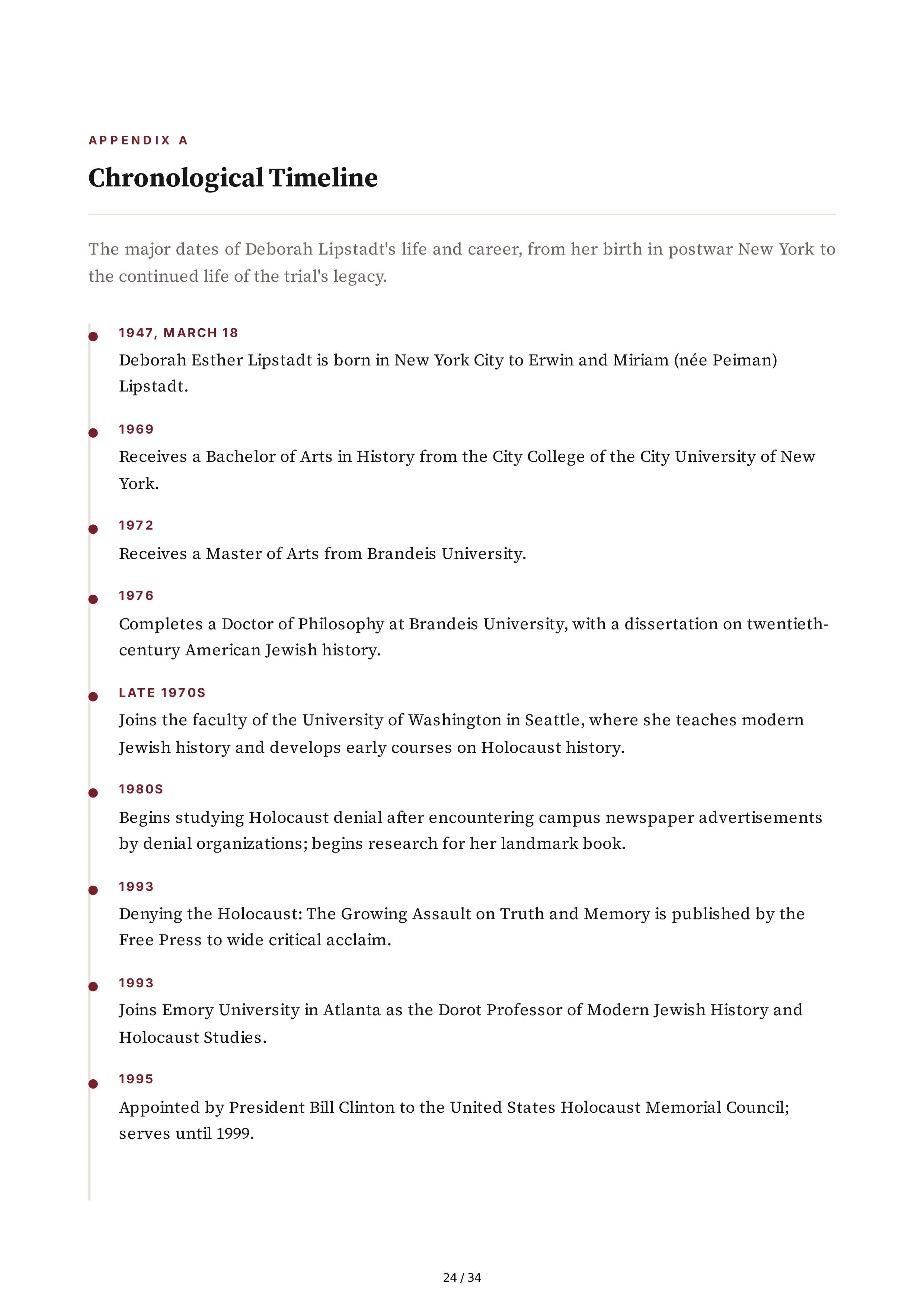
Chronological Timeline
The major dates of Deborah Lipstadt's life and career, from her birth in postwar New York to
the continued life of the trial's legacy.
1 947,
M ARCH
1 8
Deborah Esther Lipstadt is born in New York City to Erwin and Miriam (née Peiman)
Lipstadt.
1 969
Receives a Bachelor of Arts in History from the City College of the City University of New
York.
1 97 2
Receives a Master of Arts from Brandeis University.
1 97 6
Completes a Doctor of Philosophy at Brandeis University, with a dissertation on twentieth-
century American Jewish history.
LAT E
1 97 0
S
Joins the faculty of the University of Washington in Seattle, where she teaches modern
Jewish history and develops early courses on Holocaust history.
1 980
S
Begins studying Holocaust denial after encountering campus newspaper advertisements
by denial organizations; begins research for her landmark book.
1 993
Denying the Holocaust: The Growing Assault on Truth and Memory is published by the
Free Press to wide critical acclaim.
1 993
Joins Emory University in Atlanta as the Dorot Professor of Modern Jewish History and
Holocaust Studies.
1 995
Appointed by President Bill Clinton to the United States Holocaust Memorial Council;
serves until 1999.
24 / 34
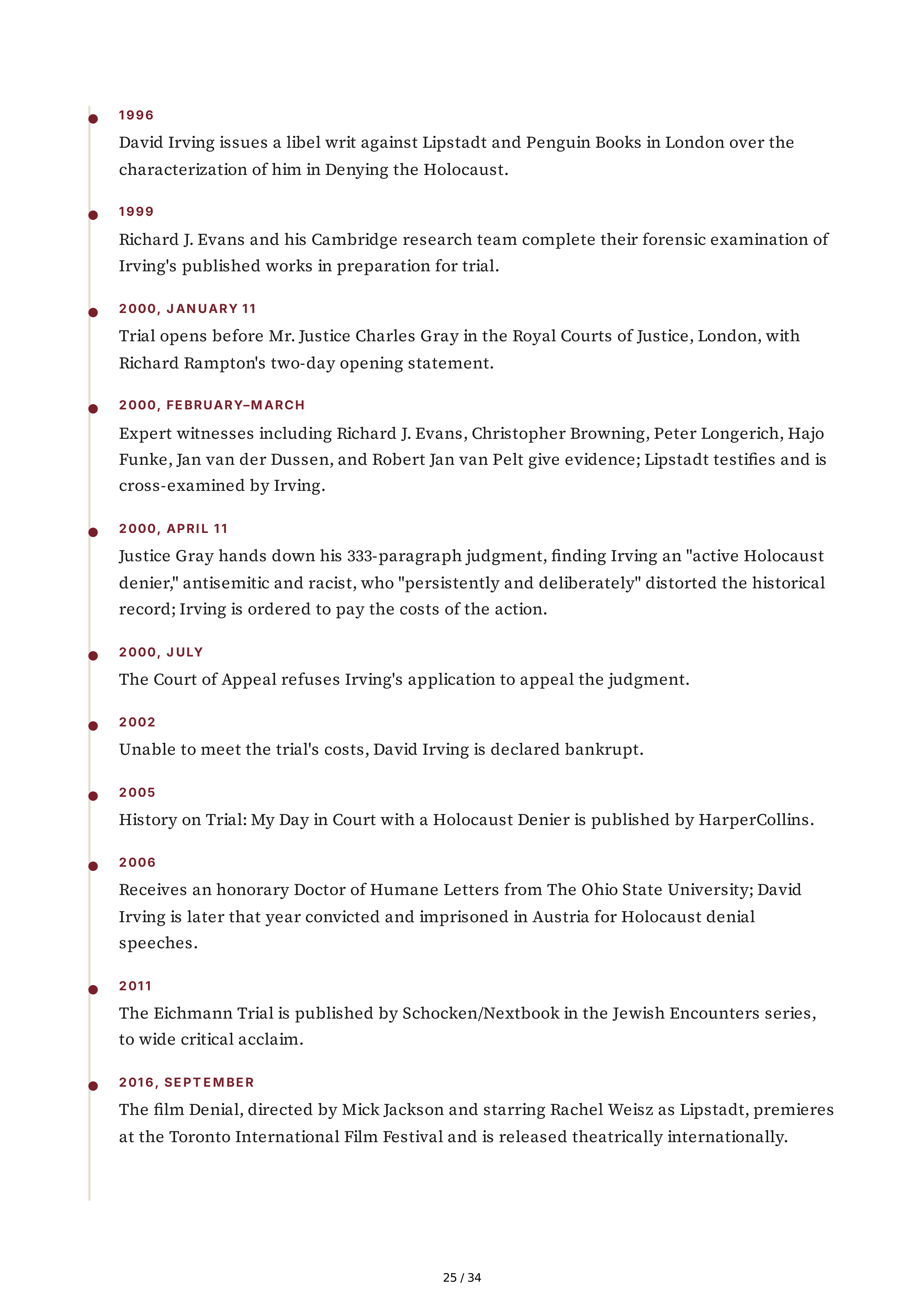
1 996
David Irving issues a libel writ against Lipstadt and Penguin Books in London over the
characterization of him in Denying the Holocaust.
1 999
Richard J. Evans and his Cambridge research team complete their forensic examination of
Irving's published works in preparation for trial.
2000,
J AN UARY
1 1
Trial opens before Mr. Justice Charles Gray in the Royal Courts of Justice, London, with
Richard Rampton's two-day opening statement.
2000,
FE BRUARY
–
M ARCH
Expert witnesses including Richard J. Evans, Christopher Browning, Peter Longerich, Hajo
Funke, Jan van der Dussen, and Robert Jan van Pelt give evidence; Lipstadt testifies and is
cross-examined by Irving.
2000,
APRIL
1 1
Justice Gray hands down his 333-paragraph judgment, finding Irving an "active Holocaust
denier," antisemitic and racist, who "persistently and deliberately" distorted the historical
record; Irving is ordered to pay the costs of the action.
2000,
J ULY
The Court of Appeal refuses Irving's application to appeal the judgment.
2002
Unable to meet the trial's costs, David Irving is declared bankrupt.
2005
History on Trial: My Day in Court with a Holocaust Denier is published by HarperCollins.
2006
Receives an honorary Doctor of Humane Letters from The Ohio State University; David
Irving is later that year convicted and imprisoned in Austria for Holocaust denial
speeches.
201 1
The Eichmann Trial is published by Schocken/Nextbook in the Jewish Encounters series,
to wide critical acclaim.
201 6,
SE PT E M BE R
The film Denial, directed by Mick Jackson and starring Rachel Weisz as Lipstadt, premieres
at the Toronto International Film Festival and is released theatrically internationally.
25 / 34
201 9
Antisemitism: Here and Now is published by Schocken; it receives a National Jewish Book
Award.
2023
Elected an Honorary Fellow of the Royal Historical Society in recognition of her
contributions to historical scholarship.
201 0
S
–2020
S
Serves on the United States delegation to the International Holocaust Remembrance
Alliance; continues to write, teach, and speak publicly on Holocaust memory, denial, and
antisemitism.
2026
This biography is compiled from the public record as a first-edition commemorative
volume.
26 / 34
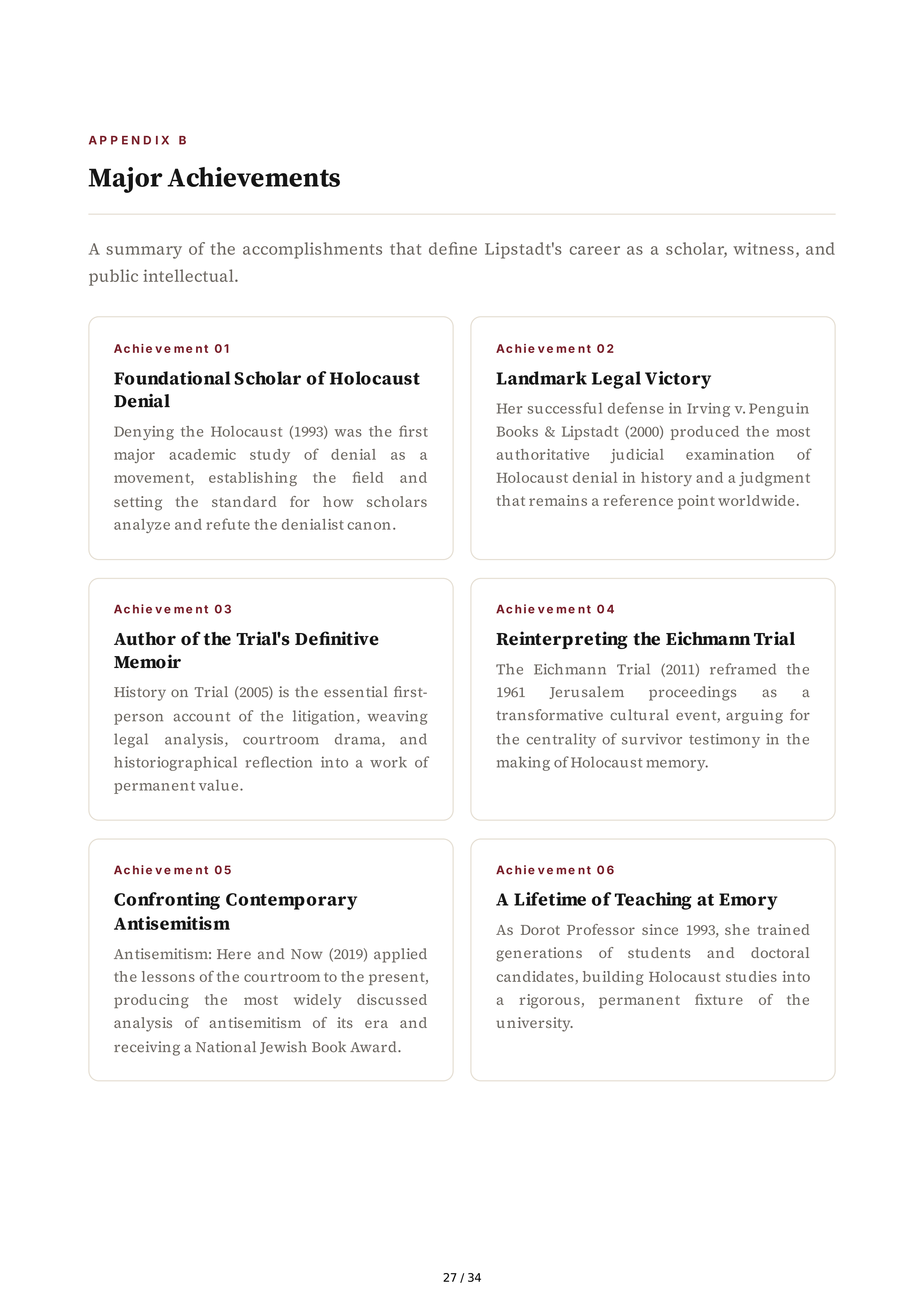
A P P E N D
I X
B
Major Achievements
A summary of the accomplishments that define Lipstadt's career as a scholar, witness, and
public intellectual.
Ac hie ve me nt
0 1
Foundational Scholar of Holocaust
Denial
Denying the Holocaust (1993) was the first
major academic study of denial as a
movement, establishing the field and
setting the standard for how scholars
analyze and refute the denialist canon.
Ac hie ve me nt
0 2
Landmark Legal Victory
Her successful defense in Irving v. Penguin
Books & Lipstadt (2000) produced the most
authoritative
judicial
examination
of
Holocaust denial in history and a judgment
that remains a reference point worldwide.
Ac hie ve me nt
0 3
Author of the Trial's Definitive
Memoir
History on Trial (2005) is the essential first-
person account of the litigation, weaving
legal analysis, courtroom drama, and
historiographical reflection into a work of
permanent value.
Ac hie ve me nt
0 4
Reinterpreting the Eichmann Trial
The Eichmann Trial (2011) reframed the
1961
Jerusalem
proceedings
as
a
transformative cultural event, arguing for
the centrality of survivor testimony in the
making of Holocaust memory.
Ac hie ve me nt
0 5
Confronting Contemporary
Antisemitism
Antisemitism: Here and Now (2019) applied
the lessons of the courtroom to the present,
producing the most widely discussed
analysis of antisemitism of its era and
receiving a National Jewish Book Award.
Ac hie ve me nt
0 6
A Lifetime of Teaching at Emory
As Dorot Professor since 1993, she trained
generations
of
students
and
doctoral
candidates, building Holocaust studies into
a rigorous, permanent fixture of the
university.
27 / 34

Ac hie ve me nt
0 7
National and International Service
Appointed by President Clinton to the
United States Holocaust Memorial Council
(1995–1999), she later served on the U.S.
delegation to the International Holocaust
Remembrance Alliance, shaping public
policy on memory and education.
Ac hie ve me nt
0 8
Bridging Scholarship and the
Public
Through
congressional
testimony,
journalism, documentary work, and the
feature film Denial (2016), she has become
one of the most effective public historians
of her generation, speaking to audiences
far beyond the academy.
28 / 34
A P P E N D
I X
C
Awards & Honors
A selected record of the distinctions conferred on Lipstadt in recognition of her scholarship
and public service.
2006
Honorary Doctor of Humane Letters
The Ohio State University, in recognition of her contributions to historical scholarship.
2019
National Jewish Book Award
For Antisemitism: Here and Now, judged the year's outstanding contribution to Jewish literary
and intellectual life.
2023
Honorary Fellow, Royal Historical Society
Elected in recognition of distinguished service to the historical discipline.
Various
years
Honorary Doctorates
Recognition from Brandeis University and Hebrew Union College–Jewish Institute of
Religion, among other institutions, honoring her scholarly and public achievements.
Ongoing
University and Civic Honors
Named lectureships, civic awards, and scholarly distinctions at Emory University and
beyond, reflecting her standing as a public intellectual.
29 / 34
A P P E N D
I X
D
Published Works
The principal books authored by Deborah Lipstadt, with notes on their subjects and
significance.
Denying the Holocaust: The Growing Assault on Truth and Memory
NEW
YO RK
·
FREE
PRESS
· 1993
The foundational study of Holocaust denial as a movement: its history, its leading figures, its
techniques, and its political functions. The book that gave rise to the libel action.
History on Trial: My Day in Court with a Holocaust Denier
NEW
YO RK
·
HARPERCO LLINS
· 2005
Lipstadt's acclaimed memoir of the Irving litigation — part legal drama, part historiographical
meditation on the relationship between truth, evidence, and memory.
The Eichmann Trial
NEW
YO RK
·
SCHO CKEN
/
NEXT BO O K
· 2011
A reconsideration of the 1961 Jerusalem trial, arguing for its transformative role in the making of
Holocaust memory and the primacy of survivor testimony.
Antisemitism: Here and Now
NEW
YO RK
·
SCHO CKEN
· 2019
A National Jewish Book Award–winning exchange of letters on the resurgence of antisemitism,
dissecting its rhetorical forms across the political spectrum.
30 / 34

Essays, Chapters, and Public Writing
1980
S
T O
PRESENT
Lipstadt has contributed scholarly articles and chapters to numerous academic volumes and has
written widely for major newspapers and journals on Holocaust memory, denial, antisemitism, and
the ethics of historical practice.
31 / 34
A P P E N D
I X
E
Legacy & Influence
The enduring marks of Lipstadt's work on law, scholarship, education, and public memory.
Deborah Lipstadt's influence is visible in three distinct arenas. The first is the courtroom. The
judgment of April 11, 2000, has been cited in legal scholarship, in international educational
policy, and in successive efforts to define and combat Holocaust denial as a form of
antisemitism. It established, at the level of a binding judicial decision, that the systematic
murder of Europe's Jews is not an open question — a legal fact of enormous practical
importance in an era of resurgent antisemitism.
The second arena is the discipline of history. Lipstadt created the subfield of denial studies
and defined its methods: close reading, archival rigor, a refusal to debate the deniers on their
own terrain, and an insistence on the distinction between revision and erasure. Since
Denying the Holocaust appeared, scholars have examined denial in the United States,
Germany, France, Britain, the Arab world, and the digital sphere, all building on her
foundational questions. Her conviction that scholars must engage the public, and that public
engagement demands the same standards as the monograph, has reshaped how a generation
of historians understands their profession.
The third arena is memory itself. Through her books, her testimony, her senate appearances,
her teaching, and the film that bore her story to the world, Lipstadt has become a living proof
of the proposition that individual courage — backed by evidence, sustained by community,
and disciplined by method — can hold the line against organized falsehood. Survivors who
knew her, students who studied with her, and millions who have only seen her onscreen have
found in her example a model of how to confront denial without despair and how to defend
truth without fanaticism.
Her legacy is thus double and inseparable: a body of scholarship and a standard of conduct.
In an age when the past has become a battleground, her career stands as the definitive
demonstration that the historian's tools — documentation, patience, and the willingness to
testify — remain the most powerful weapons against those who would rewrite the record.
History on Trial is, in the end, an account of what it means to take the past seriously enough
to defend it. Few scholars have defended it so well.
32 / 34
A P P E N D
I X
F
A Note on Sources
This biography is an original synthesis prepared from the public record. Readers who wish to
explore the subject further may consult the following sources, all of which inform the account
presented here.
J UDG MENT
Irving v. Penguin Books Limited and Deborah Lipstadt, [2000] EWHC QB 115 (QB),
High Court of Justice, Queen's Bench Division, judgment of Mr. Justice Charles Gray,
delivered 11 April 2000. The complete text is published by the British and Irish Legal
Information Institute (BAILII).
MEMO IR
Deborah E. Lipstadt, History on Trial: My Day in Court with a Holocaust Denier (New
York: HarperCollins, 2005).
SCHO LARSHIP
Deborah E. Lipstadt, Denying the Holocaust: The Growing Assault on Truth and
Memory (New York: Free Press, 1993); The Eichmann Trial (New York: Schocken/Nextbook,
2011); Antisemitism: Here and Now (New York: Schocken, 2019).
INST IT UT IO NAL
Deborah E. Lipstadt, Dorot Professor of Modern Jewish History and Holocaust
Studies, Emory University — institutional biography and public lectures, emory.edu.
REPO RT ING
Contemporaneous coverage of the trial and its aftermath in The New York Times,
The Guardian, BBC News, and the Jewish Telegraphic Agency, January–April 2000 and later
retrospective coverage.
FILM
Denial, directed by Mick Jackson, written by David Hare, produced by Shoebox Films
and BBC Films (Bleecker Street, 2016).
EDIT O RIAL
NO T E
All quotations from the judgment above are brief excerpts from the public
record, reproduced for scholarly purposes. The author of this biography has exercised
independent editorial judgment throughout; any errors of fact are the author's own.
33 / 34

D EB O R AH
LIP S TAD T
·
H IS TO R Y
O N
TR IAL
A
C R ITIC AL
B IO G R AP H Y
F R O M
TH E
P U B LIC
R EC O R D
S ET
IN
S O U R C E
S ER IF
4 &
IN TER
·
A
4
P R IN T
-
R EAD Y
ED ITIO N
F IR S T
ED ITIO N
·
MMX X VI
34 / 34