
A
C O R P O R AT E
B I O G R A P H Y
·
C O M M E M O R AT I V E
H E R I T A G E
E D I T I O N
P&G
P ROCT E R & G A M B L E · E S T A B L I S H E D 1 8 3 7 · CI N CI N NAT I , OH I O
Rising Tide
Lessons
from
165
Years
of
Brand
Building
—
the
story
of
how
one
candle
-
and
-
soap
partnership
taught
the
world
to
buy
a
promise
.
Prepared
by
:
The
Corporate
Heritage
Archive
,
Brand
Strategy
Group
On
the
occasion
of
:
The
165
th
anniversary
of
the
founding
of
The
Procter
&
Gamble
Company
Date
of
publication
:
October
31, 2002 ·
Document
ref
:
P
&
G
-
HER
-2002-0165
I N
B RI E F
On
October
31, 1837,
William
Procter
and
James
Gamble
signed
a
partnership
agreement
on
a
Cincinnati
side
street
and
opened
a
shop
that
made
candles
and
soap
by
hand
.
One
hundred
and
sixty
-
five
years
later
,
that
shop
has
become
a
company
selling
household
names
in
more
than
140
countries
—
a
company
that
,
in
the
words
of
its
own
leadership
, "
touches
lives
and
improves
life
"
for
two
billion
consumers
a
year
.
This
biography
sets
out
how
it
happened
,
and
what
the
rest
of
the
world
can
learn
from
it
.
C O N T E N T S
01
Executive
Summary
The
case
for
studying
P
&
G
02
Prologue
A
river
,
a
city
,
a
marketplace
03
The
Founders
and
the
First
Principles
1837–
1879
04
Ivory
and
the
Invention
of
a
Brand
1879–
1900
05
The
Machine
Market
research
and
the
brand
man
, 1900–1945
06
The
Washday
Miracle
Tide
and
the
modern
consumer
company
, 1946–1955
07
The
Decade
of
Decisions
Crest
,
Charmin
,
Pampers
,
1955–1965
08
The
Portfolio
Era
Build
,
buy
,
and
globalize
,
1963–1999
09
The
Storm
The
2000
crisis
10
The
Turnaround
2001–2002
11
Lessons
from
165
Years
Ten
disciplines
that
survived
ten
decades
12
Postscript
The
tide
keeps
rising
13
Appendix
A
—
Timeline
Major
events
, 1837–
2002
1 / 20
14
Appendix
B
—
The
Billion
-
Dollar
Brands
Portfolio
as
of
fiscal
2002
15
Appendix
C
—
Financial
Milestones
Net
sales
through
two
centuries
16
Sources
&
Method
01
Executive Summary
Very
few
enduring
companies
can
point
to
a
single
moment
of
founding
.
Procter
&
Gamble
can
point
to
a
contract
,
a
handshake
,
and
a
year
— 1837 —
and
to
an
unbroken
line
of
operation
ever
since
.
That
record
alone
would
justify
study
.
What
makes
the
company
genuinely
instructive
is
the
pattern
beneath
the
longevity
.
P
&
G
did
not
merely
survive
the
Industrial
Revolution
,
the
rise
of
mass
media
,
two
world
wars
,
the
television
age
,
the
supermarket
era
,
and
the
birth
of
global
retail
.
It
shaped
each
of
those
forces
.
The
company
that
gave
the
world
the
floating
soap
called
Ivory
went
on
to
give
the
marketing
profession
its
vocabulary
:
the
national
advertising
campaign
,
the
market
-
research
department
,
the
brand
-
management
system
,
the
clinical
proof
claim
,
the
billion
-
dollar
global
brand
.
When
historians
of
business
look
for
the
birthplace
of
modern
consumer
marketing
,
most
locate
it
between
the
Ohio
River
and
an
old
factory
district
in
Cincinnati
.
HEADLINE
FIGURES
—
FISCAL
2 002
Net
sales
of
$
40.2
billion
·
net
earnings
of
$
4.3
billion
·
more
than
100,000
employees
·
products
sold
in
over
140
countries
·
twelve
brands
with
annual
sales
above
$
1
billion
.
The
story
falls
naturally
into
five
acts
.
The
first
act
runs
from
the
1837
partnership
to
the
invention
of
Ivory
in
1879
and
the
establishment
of
the
first
national
brand
.
The
second
act
—
roughly
1900
to
1945 —
sees
P
&
G
build
the
organizational
machinery
of
modern
marketing
,
culminating
in
the
1931
invention
of
the
brand
-
management
system
.
The
third
act
,
from
1946
to
1965,
turns
scientific
advantage
into
household
dominance
with
Tide
,
Crest
,
and
Pampers
.
The
fourth
act
, 1963
to
1999,
extends
the
model
globally
and
assembles
a
portfolio
of
acquired
brands
.
The
final
act
, 2000
to
2002,
is
the
crisis
and
the
turnaround
—
the
moment
when
the
company
relearned
its
own
oldest
lesson
:
the
consumer
is
boss
.
This
document
was
commissioned
by
the
Brand
Strategy
Group
to
mark
the
company
'
s
165
th
anniversary
.
It
is
written
for
the
company
'
s
people
,
its
partners
,
and
its
students
—
anyone
who
has
ever
asked
why
P
&
G
brands
keep
winning
,
generation
after
generation
.
The
answer
,
in
one
sentence
:
P
&
G
industrialized
the
making
of
trust
,
at
a
scale
no
competitor
has
ever
quite
matched
,
and
it
has
spent
165
years
refusing
to
trade
that
trust
for
a
quarter
.
2 / 20
02
Prologue — A River, a City, a Marketplace
In
the
1830
s
,
Cincinnati
was
the
fastest
-
growing
city
in
the
American
West
—
a
river
port
of
muddy
streets
,
steamboats
,
and
slaughterhouses
,
known
to
its
own
citizens
as
Porkopolis
.
The
city
'
s
great
industry
was
meatpacking
.
Hogs
arrived
by
the
drove
and
left
as
cured
pork
,
leather
,
lard
,
and
tallow
—
and
tallow
is
the
raw
material
of
candles
,
just
as
the
rendered
fat
of
the
packing
houses
is
the
raw
material
of
soap
.
Every
Cincinnati
family
made
its
own
soap
or
bought
it
,
unwrapped
and
unlabeled
,
from
a
corner
grocer
.
The
trade
was
local
,
anonymous
,
and
fiercely
competitive
.
Nothing
about
it
suggested
the
birth
of
a
great
company
.
Into
this
city
came
two
immigrants
.
William
Procter
,
born
in
Herefordshire
,
England
,
had
apprenticed
in
the
dry
-
goods
and
candle
trades
before
crossing
the
Atlantic
.
James
Gamble
,
born
in
Enniskillen
,
County
Fermanagh
,
had
learned
the
soapmaker
'
s
craft
in
Ireland
as
a
young
man
.
Each
opened
a
small
shop
on
his
own
.
Each
married
a
daughter
of
Alexander
Norris
—
and
it
was
Norris
,
a
local
merchant
,
who
saw
what
the
young
men
did
not
:
Procter
,
the
salesman
,
and
Gamble
,
the
maker
,
would
be
stronger
as
one
house
than
as
two
rivals
.
On
October
31, 1837,
the
partnership
of
Procter
&
Gamble
was
formally
agreed
.
The
timing
was
appalling
.
A
panic
had
seized
American
banking
that
spring
;
credit
had
frozen
from
New
York
to
New
Orleans
.
But
candles
and
soap
are
purchased
in
every
weather
,
and
the
partners
'
first
principle
was
simple
and
durable
:
sell
a
product
of
honest
quality
,
under
the
firm
'
s
own
name
,
at
a
fair
price
.
In
a
depression
,
that
reputation
became
their
only
capital
—
and
it
compounded
.
The
company
'
s
early
decades
were
shaped
by
the
same
forces
that
shaped
the
city
:
the
steamboat
economy
,
the
packing
houses
,
and
then
the
Civil
War
,
during
which
P
&
G
supplied
soap
and
candles
to
the
Union
Army
.
The
war
taught
the
young
firm
to
produce
at
scale
,
to
manage
government
contracts
,
and
to
coordinate
a
supply
chain
that
reached
far
beyond
Cincinnati
.
By
1859,
before
the
war
began
,
annual
sales
had
already
passed
$
1
million
—
an
extraordinary
sum
for
a
frontier
manufacturing
house
.
The
pattern
was
set
:
P
&
G
would
grow
with
America
,
and
then
it
would
grow
the
markets
it
served
.
3 / 20
03
The Founders and the First Principles — 1837–1879
The
partnership
worked
because
the
two
men
were
complementary
in
temperament
,
not
identical
in
ambition
.
William
Procter
was
the
merchant
—
the
one
who
walked
the
wharves
,
knew
the
grocers
by
name
,
and
understood
that
a
buyer
chooses
with
emotion
before
reason
.
James
Gamble
was
the
maker
—
exacting
,
patient
,
suspicious
of
shortcuts
.
Gamble
'
s
standing
instruction
to
his
soap
boilers
became
company
legend
:
never
sacrifice
quality
to
cost
,
and
never
sell
a
batch
that
would
not
be
acceptable
in
his
own
kitchen
.
Both
men
were
also
devout
;
both
believed
the
business
existed
to
serve
its
customers
and
its
community
,
a
conviction
that
would
later
be
codified
in
the
company
'
s
famous
"
Do
what
is
right
"
principle
.
The
founders
'
sons
took
over
in
the
1870
s
and
found
the
company
well
regarded
but
unremarkable
.
Procter
&
Gamble
made
good
soap
and
good
candles
,
and
it
sold
them
in
plain
wrappers
like
everyone
else
'
s
.
A
customer
could
not
have
named
the
difference
between
a
P
&
G
bar
and
a
rival
'
s
bar
five
minutes
after
leaving
the
store
,
because
the
product
carried
no
name
that
meant
anything
.
The
firm
was
profitable
,
respectable
,
and
invisible
.
Then
,
in
1879,
an
accident
changed
everything
.
James
Norris
Gamble
—
the
founder
'
s
son
,
the
company
'
s
first
formally
trained
chemist
—
had
been
working
on
a
new
white
soap
of
exceptional
purity
.
During
one
batch
,
a
worker
left
the
mixing
churn
running
through
the
lunch
break
,
beating
far
more
air
into
the
soap
than
intended
.
The
batch
,
to
everyone
'
s
surprise
,
floated
.
Customers
,
when
the
bar
reached
the
stores
,
did
not
complain
.
They
asked
,
again
and
again
,
for
"
the
soap
that
floats
."
Here
was
a
moment
most
manufacturers
would
have
shrugged
away
:
a
production
irregularity
,
a
novelty
,
a
footnote
.
But
Harley
Procter
,
grandson
of
the
founder
and
the
company
'
s
first
true
marketer
,
saw
it
differently
.
A
bar
of
soap
that
floats
is
a
difference
a
customer
can
see
.
A
difference
a
customer
can
see
is
a
reason
to
choose
.
And
a
reason
to
choose
,
attached
to
a
name
,
is
the
beginning
of
a
brand
.
4 / 20
04
Ivory and the Invention of a Brand — 1879–1900
The
great
historical
irony
of
Procter
&
Gamble
is
that
its
most
consequential
product
was
an
accident
,
and
its
most
durable
strategy
was
an
act
of
naming
.
Harley
Procter
chose
the
name
one
Sunday
in
church
,
reading
Psalm
45:8 — "
out
of
the
ivory
palaces
,
whereby
they
have
made
thee
glad
."
Ivory
.
It
was
not
a
description
;
it
was
an
idea
—
purity
,
whiteness
,
gentleness
.
With
a
name
came
a
claim
.
Procter
sent
samples
of
the
new
soap
to
an
independent
laboratory
in
New
York
and
asked
for
an
exact
analysis
.
The
chemist
'
s
report
of
99.44
percent
pure
soap
became
the
foundation
of
the
most
famous
advertising
slogan
of
the
nineteenth
century
: "
Ivory
Soap
— 99
and
44/100
percent
pure
.
It
floats
."
The
company
then
did
something
almost
nobody
in
packaged
goods
had
done
before
:
it
advertised
the
name
nationally
.
In
1882,
P
&
G
placed
Ivory
advertisements
in
magazines
that
reached
the
whole
country
,
and
it
never
stopped
.
Where
the
advertising
went
,
the
product
followed
,
carried
by
the
new
railroads
into
grocers
P
&
G
'
s
salesmen
had
never
visited
.
By
the
end
of
the
1880
s
,
Ivory
was
the
best
-
selling
soap
in
America
—
and
,
more
importantly
,
it
was
the
first
product
in
its
category
that
millions
of
customers
had
chosen
by
name
before
they
ever
saw
it
on
a
shelf
.
The
years
that
followed
built
the
institutional
foundations
that
would
make
such
brands
routine
.
In
1885,
P
&
G
opened
the
Ivorydale
plant
outside
Cincinnati
—
a
model
factory
with
worker
housing
,
a
gymnasium
,
and
a
commitment
to
cleanliness
that
bordered
on
obsession
.
In
1887,
under
the
leadership
of
William
Cooper
Procter
,
grandson
of
the
founder
,
the
company
adopted
a
profit
-
sharing
program
that
gave
workers
a
stake
in
the
company
'
s
results
—
one
of
the
first
of
its
kind
in
American
industry
.
When
P
&
G
incorporated
in
1890,
William
Cooper
Procter
pushed
through
a
reform
that
stunned
the
business
world
:
a
single
vote
per
shareholder
,
regardless
of
the
number
of
shares
held
,
so
that
the
family
'
s
workforce
-
owners
could
never
be
steamrolled
by
outside
capital
.
"It floats." — and "99 and 44/100 percent pure."
The
first
national
brand
promise
in
American
packaged
goods
, 1882
By
1900,
the
template
was
complete
,
and
it
would
be
reused
,
successfully
,
for
the
next
century
:
a
distinctive
name
carrying
an
emotional
meaning
;
an
independent
,
verifiable
claim
;
consistent
national
advertising
;
relentless
sampling
;
and
a
manufacturing
culture
obsessive
enough
to
make
the
promise
true
.
Everything
P
&
G
has
done
since
is
a
variation
on
that
first
template
.
5 / 20
05
The Machine — Market Research and the Brand Man,
1900–1945
Between
the
death
of
the
founders
'
generation
and
the
end
of
the
Second
World
War
,
P
&
G
transformed
itself
from
a
company
with
one
famous
product
into
an
organization
built
to
produce
famous
products
on
a
production
line
.
The
first
major
step
was
technological
.
In
1911,
P
&
G
introduced
Crisco
,
the
first
all
-
vegetable
shortening
,
made
possible
by
the
hydrogenation
of
cottonseed
oil
.
Crisco
was
a
scientist
'
s
product
,
but
the
company
sold
it
as
a
cook
'
s
product
—
free
recipe
booklets
,
cooking
schools
,
and
advertising
that
taught
housewives
a
new
way
to
cook
.
Crisco
established
the
pattern
of
building
a
brand
around
a
patent
-
protected
technology
,
and
it
made
P
&
G
'
s
laboratories
central
to
the
company
'
s
future
.
The
second
step
was
geographic
.
In
1915,
P
&
G
opened
its
first
plant
outside
the
United
States
,
in
Hamilton
,
Ontario
.
International
expansion
thereafter
was
steady
rather
than
spectacular
—
P
&
G
entered
markets
when
it
could
staff
them
with
its
own
people
and
its
own
standards
,
a
discipline
that
would
distinguish
it
from
competitors
who
expanded
by
license
and
lost
control
.
The
third
step
—
and
the
most
consequential
—
was
organizational
.
In
1924,
P
&
G
established
the
first
market
-
research
department
in
the
packaged
-
goods
industry
,
sending
trained
interviewers
into
American
kitchens
to
ask
housewives
how
they
washed
,
cooked
,
and
cleaned
.
The
findings
were
not
academic
.
They
drove
product
decisions
and
advertising
messages
,
and
they
gave
P
&
G
a
systematic
,
rather
than
intuitive
,
understanding
of
the
consumer
.
In
1926,
the
company
launched
Camay
—
a
second
soap
brand
positioned
deliberately
against
its
own
Ivory
—
institutionalizing
the
idea
that
brands
within
the
same
house
should
compete
as
if
they
were
independent
companies
.
Let one man be responsible for one brand — its advertising,
its sales, its profits — and let him scheme and plan and fight
for it as if it were his own business.
Paraphrase
of
the
May
1931
brand
-
management
memo
by
Neil
H
.
McElroy
The
decisive
moment
came
in
1931,
when
a
27-
year
-
old
advertising
manager
named
Neil
H
.
McElroy
wrote
what
became
the
most
famous
memo
in
marketing
history
.
Facing
the
problem
of
administering
a
growing
stable
of
brands
,
McElroy
proposed
that
each
brand
be
assigned
a
single
"
brand
man
"
with
total
responsibility
for
that
brand
'
s
advertising
,
sales
,
pricing
,
and
profitability
—
a
miniature
general
manager
who
would
compete
against
every
other
brand
in
the
building
with
the
ferocity
of
an
outside
rival
.
The
6 / 20
memo
was
adopted
,
and
the
brand
-
management
system
was
born
.
It
remains
,
to
this
day
,
the
management
architecture
of
virtually
every
consumer
-
goods
company
on
earth
.
The
system
was
tested
and
refined
during
the
1930
s
,
when
P
&
G
became
the
first
major
advertiser
to
make
the
new
medium
of
radio
its
own
.
In
1933,
the
company
began
sponsoring
a
daytime
serial
drama
to
sell
Oxydol
laundry
soap
;
listeners
began
calling
such
programs
"
soap
operas
,"
and
the
phrase
entered
the
language
.
That
same
year
P
&
G
introduced
Dreft
,
the
first
synthetic
detergent
made
for
home
laundry
—
a
chemist
'
s
harbinger
of
the
revolution
to
come
.
The
wartime
years
of
1941
to
1945
deepened
the
company
'
s
chemistry
,
as
P
&
G
plants
produced
glycerin
for
munitions
and
the
company
'
s
researchers
worked
alongside
government
scientists
on
synthetic
detergents
.
When
the
war
ended
,
the
learning
returned
to
Cincinnati
as
product
history
.
7 / 20
06
The Washday Miracle — Tide and the Modern
Consumer Company, 1946–1955
On
October
3, 1946,
P
&
G
introduced
Tide
—
and
in
a
single
product
launch
,
it
changed
the
American
home
and
the
company
that
made
it
.
Tide
was
not
a
variation
on
a
soap
.
It
was
a
synthetic
detergent
engineered
around
a
new
principle
: "
built
"
detergents
,
combining
synthetic
surfactants
with
builders
that
suspended
dirt
in
the
wash
water
instead
of
letting
it
settle
back
into
the
fabric
.
Ordinary
soap
left
a
dull
gray
film
in
hard
water
;
Tide
washed
whiter
,
brighter
,
and
without
soap
scum
.
The
company
'
s
chemists
had
been
working
toward
it
since
the
late
1930
s
,
and
the
war
had
accelerated
the
underlying
chemistry
.
The
result
was
not
an
incremental
improvement
—
it
was
,
in
the
words
of
the
launch
advertising
,
a
"
washday
miracle
."
The
launch
itself
was
a
masterclass
in
the
P
&
G
method
.
Tide
was
introduced
first
in
carefully
chosen
test
markets
,
with
an
unprecedented
wave
of
sampling
—
coupons
,
free
boxes
,
and
heavy
television
and
radio
advertising
built
around
a
single
memorable
claim
: "
Tide
'
s
in
,
dirt
'
s
out
."
The
product
sold
itself
,
but
the
company
made
certain
it
was
never
left
to
do
so
alone
.
Within
two
years
,
Tide
had
become
the
best
-
selling
laundry
product
in
America
.
Within
a
decade
,
it
was
the
largest
-
selling
single
product
in
the
company
'
s
history
—
and
P
&
G
'
s
total
sales
had
passed
$
1
billion
for
the
first
time
.
Tide
also
demonstrated
the
company
'
s
ruthless
portfolio
logic
.
A
large
share
of
Tide
'
s
early
sales
came
by
cannibalizing
P
&
G
'
s
own
soap
brands
,
including
Oxydol
and
Dreft
.
The
brand
system
did
not
flinch
.
If
a
new
brand
could
beat
the
old
one
,
the
old
one
was
allowed
to
decline
—
because
a
competitor
'
s
brand
would
take
the
customers
anyway
.
Better
to
steal
from
yourself
than
to
be
robbed
by
someone
else
.
That
willingness
to
disrupt
its
own
franchises
became
one
of
P
&
G
'
s
defining
competitive
habits
.
Tide's in, dirt's out.
Tide
launch
campaign
, 1946 —
fifty
-
six
years
later
still
the
world
'
s
leading
laundry
brand
The
1950
s
completed
the
company
'
s
immersion
in
television
.
P
&
G
moved
its
radio
serials
to
the
new
screens
,
sponsored
variety
hours
and
dramas
,
and
by
the
middle
of
the
decade
was
the
single
largest
buyer
of
television
advertising
in
America
.
The
company
that
had
invented
the
national
magazine
campaign
and
the
radio
soap
opera
now
mastered
the
newest
medium
at
a
scale
its
competitors
could
not
match
.
The
machine
was
complete
:
laboratories
,
market
research
,
brand
management
,
mass
advertising
,
and
a
distribution
network
that
put
P
&
G
products
in
almost
every
store
in
the
country
.
8 / 20
07
The Decade of Decisions — Crest, Charmin, Pampers,
1955–1965
The
ten
years
from
1955
to
1965
settled
the
question
of
what
kind
of
company
P
&
G
would
become
:
not
a
soap
company
that
happened
to
make
other
things
,
but
a
consumer
-
science
company
that
entered
category
after
category
with
superior
technology
and
superior
marketing
.
The
period
opened
with
Crest
.
In
1955,
P
&
G
launched
a
fluoride
toothpaste
based
on
stannous
fluoride
research
licensed
from
Indiana
University
and
then
refined
in
P
&
G
laboratories
.
The
company
did
not
ask
consumers
to
take
the
claim
on
faith
;
it
funded
a
three
-
year
clinical
study
on
schoolchildren
that
became
one
of
the
most
rigorous
product
validations
ever
conducted
in
consumer
goods
.
When
,
in
1960,
the
American
Dental
Association
granted
Crest
its
Seal
of
Acceptance
—
the
first
ever
awarded
to
a
toothpaste
—
the
brand
'
s
share
nearly
tripled
in
a
year
.
The
lesson
was
filed
away
and
reused
:
a
scientific
proof
,
translated
into
a
simple
consumer
promise
,
is
the
strongest
marketing
weapon
a
company
can
own
.
Then
came
paper
,
a
decision
that
quietly
transformed
the
company
'
s
future
.
In
1957,
P
&
G
acquired
Charmin
,
a
regional
Wisconsin
tissue
maker
,
and
used
its
scale
and
chemistry
to
build
national
paper
brands
—
Charmin
bathroom
tissue
and
,
from
1965,
Bounty
paper
towels
.
It
also
acquired
Clorox
in
1957,
only
to
be
ordered
by
the
Federal
Trade
Commission
to
divest
it
a
decade
later
.
The
FTC
'
s
decision
established
a
principle
that
shaped
P
&
G
'
s
subsequent
strategy
:
the
company
'
s
distribution
and
advertising
power
was
so
great
that
regulators
would
not
allow
it
to
acquire
dominance
in
adjacent
categories
.
P
&
G
would
grow
,
hereafter
,
mostly
by
invention
and
by
careful
,
defensible
acquisitions
.
The
most
consequential
launch
of
the
decade
came
in
1961
with
Pampers
.
The
idea
originated
with
Vic
Mills
,
a
P
&
G
chemical
engineer
then
in
his
sixties
,
who
was
exasperated
by
the
drudgery
of
laundering
cloth
diapers
for
his
grandson
.
The
insight
was
framed
as
a
consumer
problem
— "
a
baby
'
s
wetness
is
the
mother
'
s
problem
" —
and
the
solution
was
a
disposable
diaper
with
a
contoured
shape
and
a
moisture
-
holding
core
.
Pampers
was
not
an
instant
success
;
early
economics
were
brutal
,
and
mothers
balked
at
the
price
per
change
.
But
P
&
G
persisted
through
years
of
manufacturing
refinement
,
driving
costs
down
until
the
category
economics
worked
.
By
the
late
1960
s
,
Pampers
had
created
the
disposable
-
diaper
industry
in
America
—
and
it
remains
,
in
2002,
the
world
'
s
largest
baby
-
care
brand
.
Head
&
Shoulders
,
launched
the
same
year
,
applied
the
same
formula
to
dandruff
,
becoming
the
first
mass
-
marketed
clinically
effective
dandruff
shampoo
.
T HE
PAT T ERN
O F
T HE
DECADE
Enter
a
category
with
a
technical
advantage
(
Crest
·
Pampers
·
Head
&
Shoulders
).
Prove
the
claim
with
clinical
or
engineering
evidence
.
Market
the
proof
relentlessly
.
Scale
relentlessly
.
Defend
the
9 / 20
franchise
for
generations
.
08
The Portfolio Era — Build, Buy, and Globalize, 1963–
1999
For
its
first
126
years
,
P
&
G
built
nearly
every
major
brand
from
within
.
Beginning
in
1963,
it
added
a
second
engine
:
the
strategic
acquisition
.
The
first
major
purchase
was
Folgers
Coffee
in
1963,
which
carried
the
company
into
a
new
aisle
of
the
supermarket
.
Pringles
followed
in
the
1970
s
as
an
internal
invention
—
a
saddle
-
shaped
snack
designed
to
survive
the
distribution
system
—
and
demonstrated
that
the
company
could
innovate
in
foods
as
well
as
fabrics
and
paper
.
Downy
fabric
softener
(1960),
Bounce
(1972),
and
Always
feminine
protection
(1983)
extended
the
home
-
care
and
personal
-
care
franchises
,
while
the
purchase
of
Charmin
'
s
paper
business
was
joined
by
international
expansion
that
made
P
&
G
brands
as
familiar
in
Frankfurt
,
São
Paulo
,
and
Manila
as
in
Peoria
.
The
1980
s
and
1990
s
brought
the
acquisition
era
to
full
maturity
.
Richardson
-
Vicks
was
acquired
in
1985
for
roughly
$
1.2
billion
,
bringing
Vicks
,
Oil
of
Olay
,
and
Pantene
into
the
house
;
Noxell
followed
in
1989
with
Cover
Girl
and
Noxzema
;
Max
Factor
arrived
in
1991;
and
Iams
pet
food
was
added
in
1999
for
approximately
$
2.3
billion
.
The
thread
uniting
these
purchases
was
strategic
,
not
sentimental
:
each
gave
P
&
G
a
platform
in
a
high
-
margin
category
—
beauty
,
health
care
,
pet
care
—
where
its
marketing
machine
could
compound
an
already
-
strong
brand
.
By
the
mid
-1990
s
,
a
dozen
P
&
G
brands
each
sold
more
than
a
billion
dollars
a
year
.
The
late
1990
s
also
brought
the
company
'
s
most
ambitious
—
and
most
disruptive
—
internal
reorganization
. "
Organization
2005,"
announced
in
1998,
collapsed
the
classic
brand
-
manager
system
into
a
matrix
of
Global
Business
Units
,
Market
Development
Organizations
,
and
Global
Business
Services
,
intended
to
eliminate
duplication
and
accelerate
decision
-
making
.
The
theory
was
sound
;
the
execution
proved
traumatic
.
Authority
became
diffuse
,
decision
cycles
lengthened
,
costs
rose
,
and
the
company
'
s
famously
sharp
accountability
blurred
just
as
competitors
—
and
private
label
—
sharpened
their
own
games
.
The
result
was
the
most
difficult
passage
in
the
company
'
s
modern
history
.
P
&
G
had
entered
the
1990
s
as
the
world
'
s
most
admired
consumer
-
goods
company
.
It
entered
the
year
2000
with
its
stock
under
pressure
,
its
earnings
momentum
gone
,
and
its
newest
management
ideas
in
disarray
.
The
portfolio
era
had
built
a
magnificent
collection
of
brands
.
What
the
company
had
neglected
was
its
first
principle
:
the
consumer
is
boss
—
not
the
organization
chart
.
10 / 20
09
The Storm — The 2000 Crisis
On
June
8, 2000,
Procter
&
Gamble
issued
a
stunning
profit
warning
for
its
fiscal
fourth
quarter
.
The
stock
fell
more
than
30
percent
in
a
single
day
—
the
largest
one
-
day
percentage
decline
in
the
company
'
s
modern
history
.
The
causes
were
visible
in
hindsight
.
The
Organization
2005
restructuring
had
taken
the
company
'
s
eye
off
the
shelves
.
Product
launches
had
slowed
,
costs
had
climbed
,
and
competitors
from
Unilever
to
Kimberly
-
Clark
to
aggressive
private
-
label
retailers
had
taken
share
in
P
&
G
'
s
core
categories
.
The
company
had
also
bet
heavily
on
a
speculative
acquisition
strategy
that
collapsed
in
the
spring
of
2000,
when
its
proposed
merger
with
a
major
pharmaceutical
company
fell
apart
.
The
CEO
who
had
pushed
so
hard
and
so
fast
,
Durk
Jager
,
lasted
just
seventeen
months
—
a
tenure
measured
not
in
years
but
in
a
single
dramatic
turn
of
the
wheel
.
The
board
turned
to
A
.
G
.
Lafley
,
a
23-
year
company
veteran
who
had
spent
most
of
his
career
in
the
beauty
business
and
had
recently
led
the
company
'
s
operations
in
Asia
,
where
he
had
engineered
a
celebrated
turnaround
in
Japan
.
Lafley
was
an
unlikely
heir
:
P
&
G
'
s
leadership
had
traditionally
come
from
the
fabric
-
care
or
baby
-
care
strongholds
,
and
Lafley
was
a
quiet
,
understated
product
man
.
But
he
understood
something
the
crisis
had
made
obvious
.
The
company
had
been
reorganizing
itself
for
years
while
forgetting
to
ask
the
consumer
what
she
wanted
.
The
first
thing
he
did
was
stop
the
reorganizing
.
The consumer is boss.
A
.
G
.
Lafley
,
chief
executive
2000–2010 —
the
oldest
P
&
G
principle
,
revived
as
strategy
10
The Turnaround — 2001–2002
Lafley
'
s
strategy
was
less
a
plan
than
a
return
to
first
principles
:
focus
,
simplification
,
and
the
consumer
.
The
first
move
was
focus
.
Lafley
asked
two
questions
of
every
business
: "
Where
do
we
play
?"
and
"
How
do
we
win
?"
The
answers
led
P
&
G
to
concentrate
on
the
categories
where
it
had
—
or
could
build
—
genuine
technological
advantage
:
fabric
care
,
baby
care
,
feminine
care
,
family
care
,
hair
care
,
and
skin
care
.
The
company
withdrew
from
businesses
that
did
not
meet
the
test
.
In
2002,
P
&
G
completed
the
divestiture
of
its
Jif
peanut
butter
and
Crisco
oils
businesses
to
J
.
M
.
Smucker
,
exiting
food
oils
and
peanut
butter
to
deepen
investment
in
faster
-
growing
,
higher
-
margin
franchises
.
11 / 20
The
second
move
was
portfolio
-
building
where
it
counted
.
In
2001,
P
&
G
acquired
Clairol
for
$
4.95
billion
,
adding
hair
color
to
its
Pantene
and
Head
&
Shoulders
platforms
and
making
the
company
the
world
'
s
largest
hair
-
care
business
.
The
acquisition
was
classic
P
&
G
:
a
strong
brand
,
a
high
-
margin
category
,
and
a
distribution
and
marketing
system
that
could
grow
it
further
.
The
third
move
was
innovation
—
and
here
the
timing
was
fortunate
.
Two
of
the
company
'
s
most
promising
recent
launches
,
Febreze
and
Swiffer
,
had
entered
the
market
in
1998
and
1999
but
had
been
lost
in
the
restructuring
chaos
.
Under
Lafley
,
they
became
the
company
'
s
most
visible
success
stories
:
new
-
to
-
the
-
world
products
that
created
entirely
new
categories
,
each
racing
toward
billion
-
dollar
status
.
The
lesson
was
not
lost
on
the
organization
:
innovation
,
not
reorganization
,
is
how
P
&
G
grows
.
The
results
followed
quickly
.
More
than
$
1.5
billion
in
structural
costs
came
out
of
the
business
in
two
years
.
Net
earnings
climbed
from
approximately
$
3.0
billion
in
fiscal
2000
to
$
4.3
billion
in
fiscal
2002,
on
record
net
sales
of
$
40.2
billion
.
The
stock
,
which
had
lost
a
third
of
its
value
in
a
day
in
June
2000,
had
roughly
doubled
from
its
trough
by
the
autumn
of
2002.
The
company
that
had
seemed
,
in
the
summer
of
2000,
to
have
lost
its
way
had
returned
,
in
eighteen
months
,
to
the
formula
that
had
built
it
:
superior
products
,
superior
marketing
,
superior
execution
—
and
the
consumer
as
the
ultimate
boss
.
12 / 20
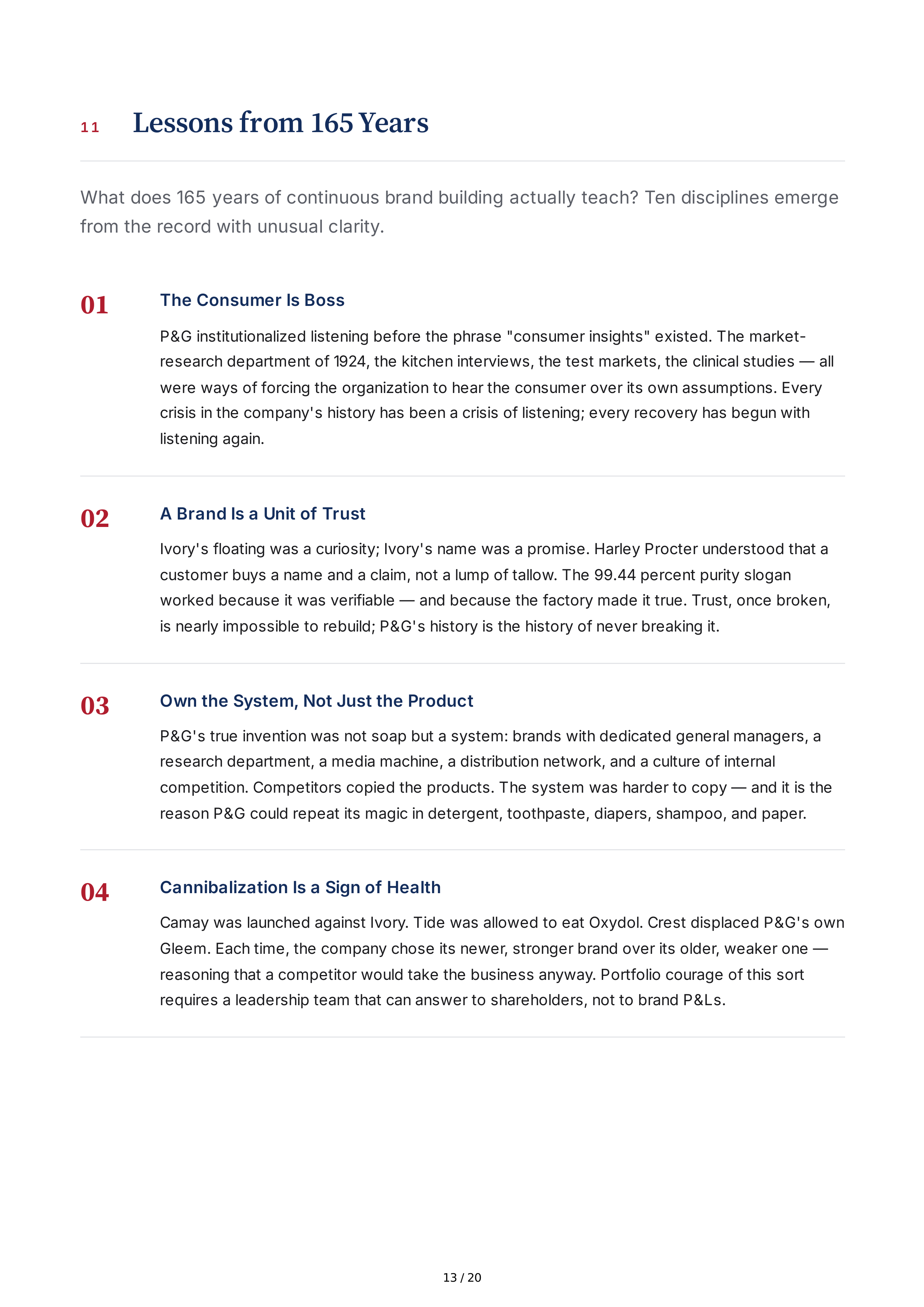
11
Lessons from 165 Years
What
does
165
years
of
continuous
brand
building
actually
teach
?
Ten
disciplines
emerge
from
the
record
with
unusual
clarity
.
01
The
Consumer
Is
Boss
P
&
G
institutionalized
listening
before
the
phrase
"
consumer
insights
"
existed
.
The
market
-
research
department
of
1924,
the
kitchen
interviews
,
the
test
markets
,
the
clinical
studies
—
all
were
ways
of
forcing
the
organization
to
hear
the
consumer
over
its
own
assumptions
.
Every
crisis
in
the
company
'
s
history
has
been
a
crisis
of
listening
;
every
recovery
has
begun
with
listening
again
.
02
A
Brand
Is
a
Unit
of
Trust
Ivory
'
s
floating
was
a
curiosity
;
Ivory
'
s
name
was
a
promise
.
Harley
Procter
understood
that
a
customer
buys
a
name
and
a
claim
,
not
a
lump
of
tallow
.
The
99.44
percent
purity
slogan
worked
because
it
was
verifiable
—
and
because
the
factory
made
it
true
.
Trust
,
once
broken
,
is
nearly
impossible
to
rebuild
;
P
&
G
'
s
history
is
the
history
of
never
breaking
it
.
03
Own
the
System
,
Not
Just
the
Product
P
&
G
'
s
true
invention
was
not
soap
but
a
system
:
brands
with
dedicated
general
managers
,
a
research
department
,
a
media
machine
,
a
distribution
network
,
and
a
culture
of
internal
competition
.
Competitors
copied
the
products
.
The
system
was
harder
to
copy
—
and
it
is
the
reason
P
&
G
could
repeat
its
magic
in
detergent
,
toothpaste
,
diapers
,
shampoo
,
and
paper
.
04
Cannibalization
Is
a
Sign
of
Health
Camay
was
launched
against
Ivory
.
Tide
was
allowed
to
eat
Oxydol
.
Crest
displaced
P
&
G
'
s
own
Gleem
.
Each
time
,
the
company
chose
its
newer
,
stronger
brand
over
its
older
,
weaker
one
—
reasoning
that
a
competitor
would
take
the
business
anyway
.
Portfolio
courage
of
this
sort
requires
a
leadership
team
that
can
answer
to
shareholders
,
not
to
brand
P
&
Ls
.
13 / 20
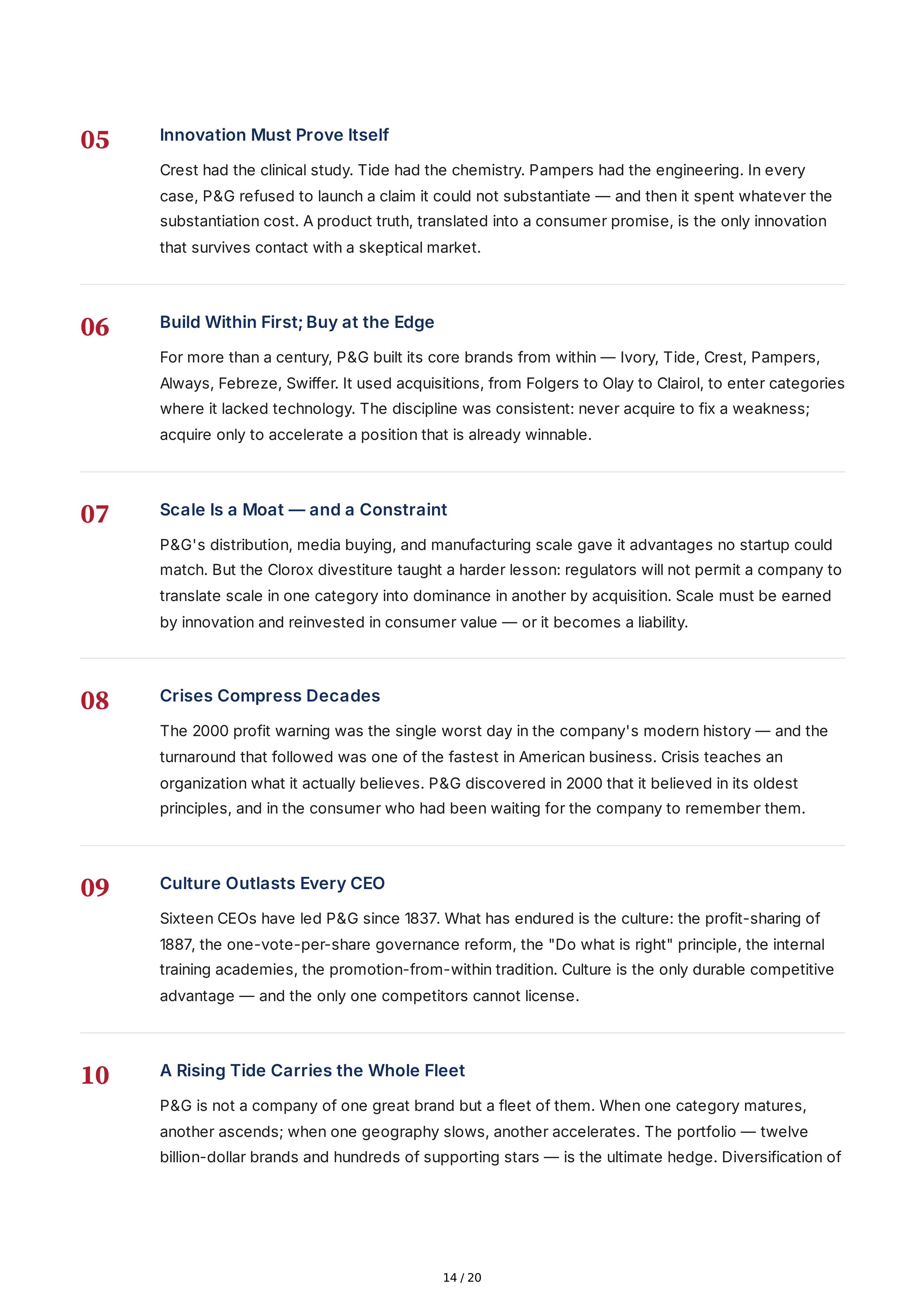
05
Innovation
Must
Prove
Itself
Crest
had
the
clinical
study
.
Tide
had
the
chemistry
.
Pampers
had
the
engineering
.
In
every
case
,
P
&
G
refused
to
launch
a
claim
it
could
not
substantiate
—
and
then
it
spent
whatever
the
substantiation
cost
.
A
product
truth
,
translated
into
a
consumer
promise
,
is
the
only
innovation
that
survives
contact
with
a
skeptical
market
.
06
Build
Within
First
;
Buy
at
the
Edge
For
more
than
a
century
,
P
&
G
built
its
core
brands
from
within
—
Ivory
,
Tide
,
Crest
,
Pampers
,
Always
,
Febreze
,
Swiffer
.
It
used
acquisitions
,
from
Folgers
to
Olay
to
Clairol
,
to
enter
categories
where
it
lacked
technology
.
The
discipline
was
consistent
:
never
acquire
to
fix
a
weakness
;
acquire
only
to
accelerate
a
position
that
is
already
winnable
.
07
Scale
Is
a
Moat
—
and
a
Constraint
P
&
G
'
s
distribution
,
media
buying
,
and
manufacturing
scale
gave
it
advantages
no
startup
could
match
.
But
the
Clorox
divestiture
taught
a
harder
lesson
:
regulators
will
not
permit
a
company
to
translate
scale
in
one
category
into
dominance
in
another
by
acquisition
.
Scale
must
be
earned
by
innovation
and
reinvested
in
consumer
value
—
or
it
becomes
a
liability
.
08
Crises
Compress
Decades
The
2000
profit
warning
was
the
single
worst
day
in
the
company
'
s
modern
history
—
and
the
turnaround
that
followed
was
one
of
the
fastest
in
American
business
.
Crisis
teaches
an
organization
what
it
actually
believes
.
P
&
G
discovered
in
2000
that
it
believed
in
its
oldest
principles
,
and
in
the
consumer
who
had
been
waiting
for
the
company
to
remember
them
.
09
Culture
Outlasts
Every
CEO
Sixteen
CEOs
have
led
P
&
G
since
1837.
What
has
endured
is
the
culture
:
the
profit
-
sharing
of
1887,
the
one
-
vote
-
per
-
share
governance
reform
,
the
"
Do
what
is
right
"
principle
,
the
internal
training
academies
,
the
promotion
-
from
-
within
tradition
.
Culture
is
the
only
durable
competitive
advantage
—
and
the
only
one
competitors
cannot
license
.
10
A
Rising
Tide
Carries
the
Whole
Fleet
P
&
G
is
not
a
company
of
one
great
brand
but
a
fleet
of
them
.
When
one
category
matures
,
another
ascends
;
when
one
geography
slows
,
another
accelerates
.
The
portfolio
—
twelve
billion
-
dollar
brands
and
hundreds
of
supporting
stars
—
is
the
ultimate
hedge
.
Diversification
of
14 / 20
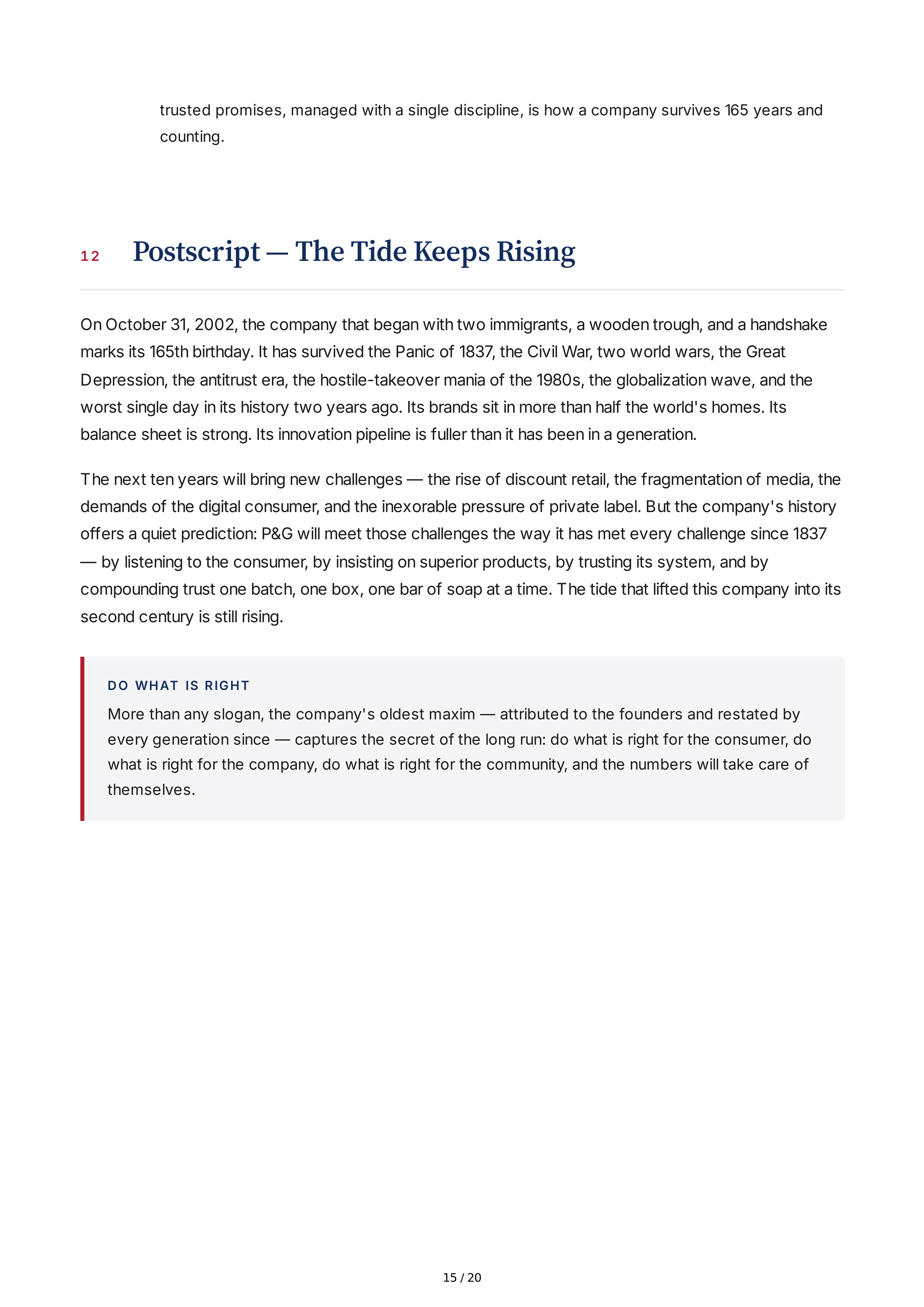
trusted
promises
,
managed
with
a
single
discipline
,
is
how
a
company
survives
165
years
and
counting
.
12
Postscript — The Tide Keeps Rising
On
October
31, 2002,
the
company
that
began
with
two
immigrants
,
a
wooden
trough
,
and
a
handshake
marks
its
165
th
birthday
.
It
has
survived
the
Panic
of
1837,
the
Civil
War
,
two
world
wars
,
the
Great
Depression
,
the
antitrust
era
,
the
hostile
-
takeover
mania
of
the
1980
s
,
the
globalization
wave
,
and
the
worst
single
day
in
its
history
two
years
ago
.
Its
brands
sit
in
more
than
half
the
world
'
s
homes
.
Its
balance
sheet
is
strong
.
Its
innovation
pipeline
is
fuller
than
it
has
been
in
a
generation
.
The
next
ten
years
will
bring
new
challenges
—
the
rise
of
discount
retail
,
the
fragmentation
of
media
,
the
demands
of
the
digital
consumer
,
and
the
inexorable
pressure
of
private
label
.
But
the
company
'
s
history
offers
a
quiet
prediction
:
P
&
G
will
meet
those
challenges
the
way
it
has
met
every
challenge
since
1837
—
by
listening
to
the
consumer
,
by
insisting
on
superior
products
,
by
trusting
its
system
,
and
by
compounding
trust
one
batch
,
one
box
,
one
bar
of
soap
at
a
time
.
The
tide
that
lifted
this
company
into
its
second
century
is
still
rising
.
DO
WHAT
IS
RIGHT
More
than
any
slogan
,
the
company
'
s
oldest
maxim
—
attributed
to
the
founders
and
restated
by
every
generation
since
—
captures
the
secret
of
the
long
run
:
do
what
is
right
for
the
consumer
,
do
what
is
right
for
the
company
,
do
what
is
right
for
the
community
,
and
the
numbers
will
take
care
of
themselves
.
15 / 20
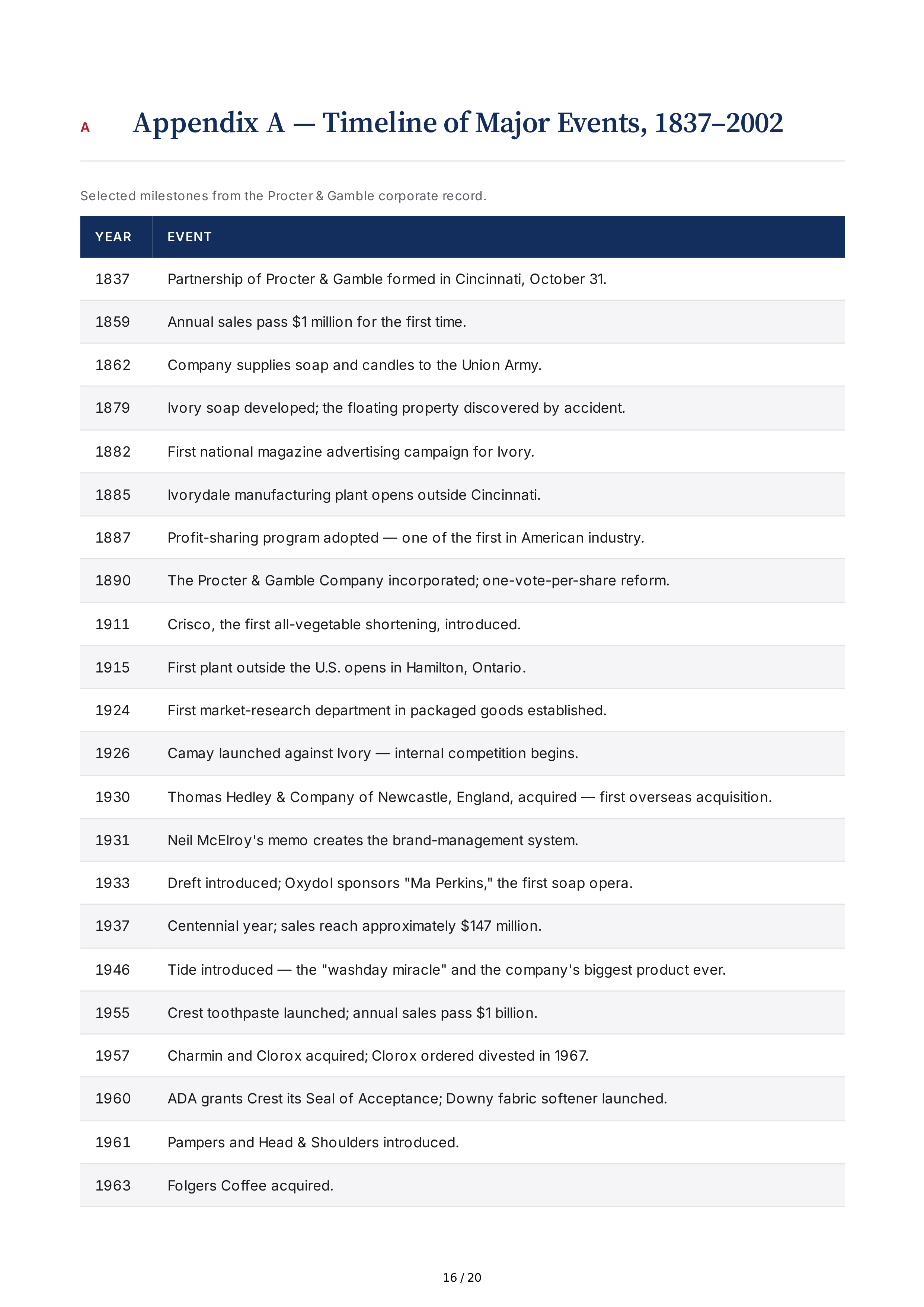
A
Appendix A — Timeline of Major Events, 1837–2002
Selected
milestones
from
the
Procter
&
Gamble
corporate
record
.
YEAR
EVENT
1837
Partnership
of
Procter
&
Gamble
formed
in
Cincinnati
,
October
31.
1859
Annual
sales
pass
$
1
million
for
the
first
time
.
1862
Company
supplies
soap
and
candles
to
the
Union
Army
.
1879
Ivory
soap
developed
;
the
floating
property
discovered
by
accident
.
1882
First
national
magazine
advertising
campaign
for
Ivory
.
1885
Ivorydale
manufacturing
plant
opens
outside
Cincinnati
.
1887
Profit
-
sharing
program
adopted
—
one
of
the
first
in
American
industry
.
1890
The
Procter
&
Gamble
Company
incorporated
;
one
-
vote
-
per
-
share
reform
.
1911
Crisco
,
the
first
all
-
vegetable
shortening
,
introduced
.
1915
First
plant
outside
the
U
.
S
.
opens
in
Hamilton
,
Ontario
.
1924
First
market
-
research
department
in
packaged
goods
established
.
1926
Camay
launched
against
Ivory
—
internal
competition
begins
.
1930
Thomas
Hedley
&
Company
of
Newcastle
,
England
,
acquired
—
first
overseas
acquisition
.
1931
Neil
McElroy
'
s
memo
creates
the
brand
-
management
system
.
1933
Dreft
introduced
;
Oxydol
sponsors
"
Ma
Perkins
,"
the
first
soap
opera
.
1937
Centennial
year
;
sales
reach
approximately
$
147
million
.
1946
Tide
introduced
—
the
"
washday
miracle
"
and
the
company
'
s
biggest
product
ever
.
1955
Crest
toothpaste
launched
;
annual
sales
pass
$
1
billion
.
1957
Charmin
and
Clorox
acquired
;
Clorox
ordered
divested
in
1967.
1960
ADA
grants
Crest
its
Seal
of
Acceptance
;
Downy
fabric
softener
launched
.
1961
Pampers
and
Head
&
Shoulders
introduced
.
1963
Folgers
Coffee
acquired
.
16 / 20
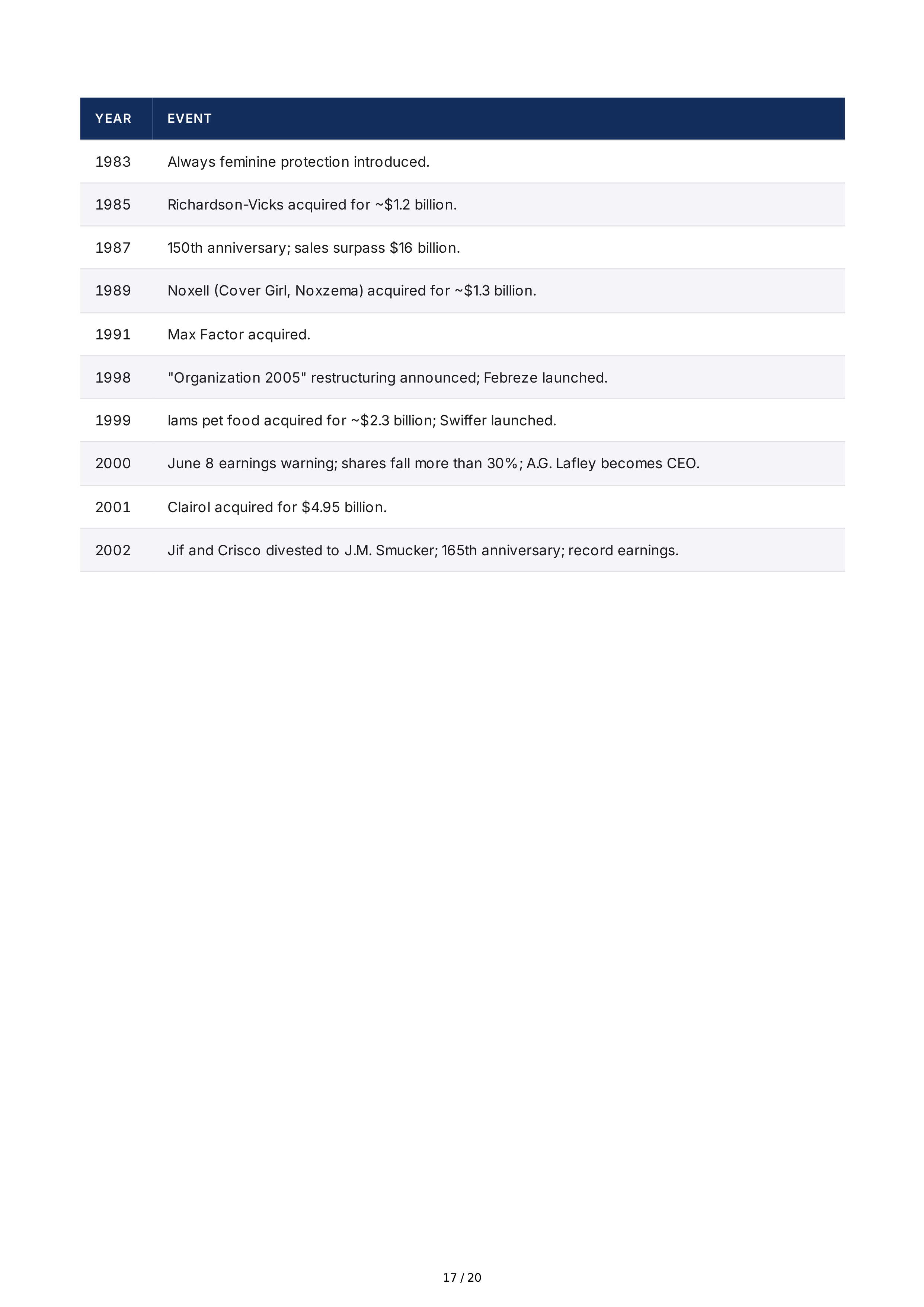
YEAR
EVENT
1983
Always
feminine
protection
introduced
.
1985
Richardson
-
Vicks
acquired
for
~
$
1.2
billion
.
1987
150
th
anniversary
;
sales
surpass
$
16
billion
.
1989
Noxell
(
Cover
Girl
,
Noxzema
)
acquired
for
~
$
1.3
billion
.
1991
Max
Factor
acquired
.
1998
"
Organization
2005"
restructuring
announced
;
Febreze
launched
.
1999
Iams
pet
food
acquired
for
~
$
2.3
billion
;
Swiffer
launched
.
2000
June
8
earnings
warning
;
shares
fall
more
than
30%;
A
.
G
.
Lafley
becomes
CEO
.
2001
Clairol
acquired
for
$
4.95
billion
.
2002
Jif
and
Crisco
divested
to
J
.
M
.
Smucker
; 165
th
anniversary
;
record
earnings
.
17 / 20
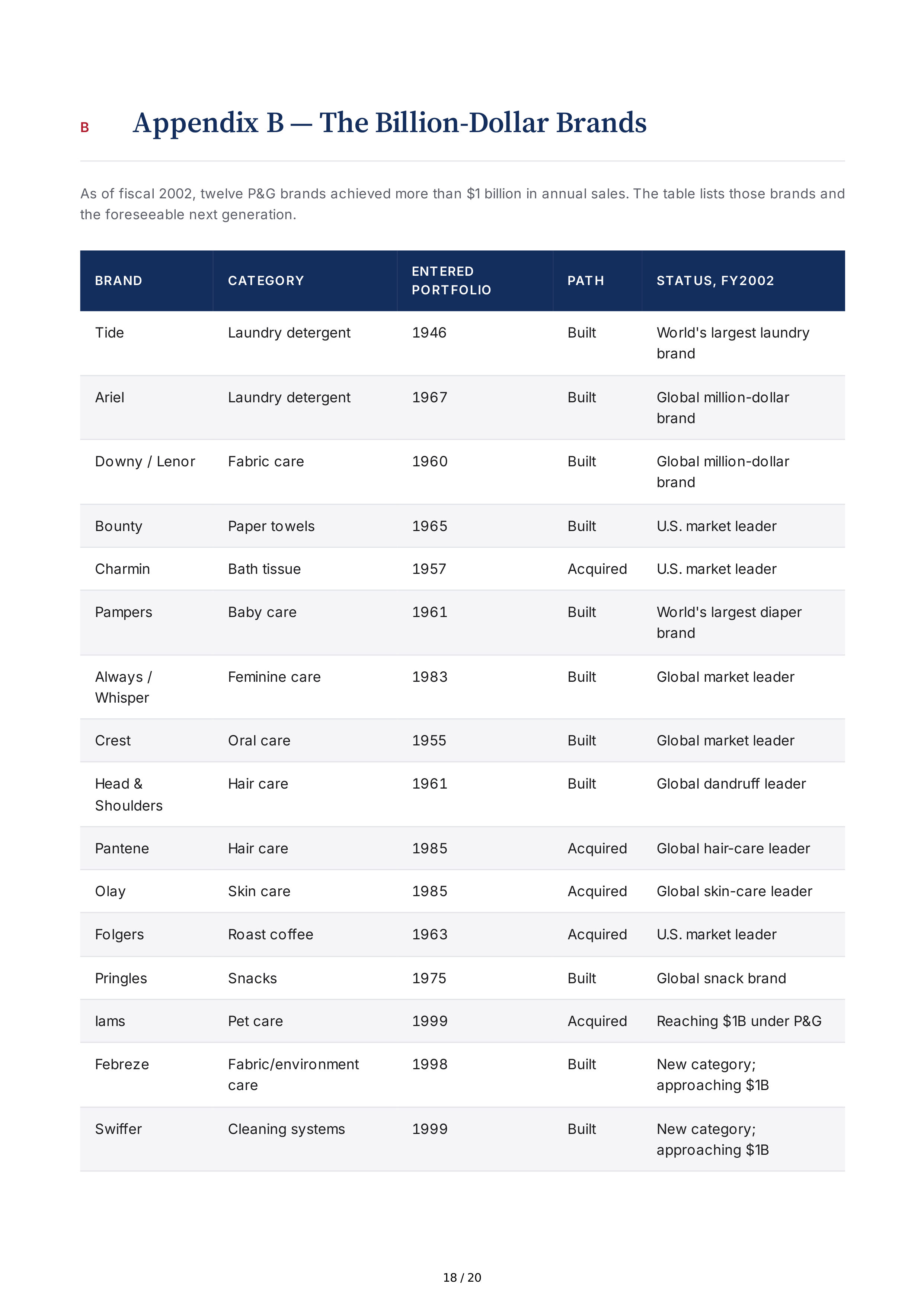
B
Appendix B — The Billion-Dollar Brands
As
of
fiscal
2002,
twelve
P
&
G
brands
achieved
more
than
$
1
billion
in
annual
sales
.
The
table
lists
those
brands
and
the
foreseeable
next
generation
.
BRAND
CATEGORY
ENTERED
PORTFOLIO
PATH
STATUS
,
FY
2002
Tide
Laundry
detergent
1946
Built
World
'
s
largest
laundry
brand
Ariel
Laundry
detergent
1967
Built
Global
million
-
dollar
brand
Downy
/
Lenor
Fabric
care
1960
Built
Global
million
-
dollar
brand
Bounty
Paper
towels
1965
Built
U
.
S
.
market
leader
Charmin
Bath
tissue
1957
Acquired
U
.
S
.
market
leader
Pampers
Baby
care
1961
Built
World
'
s
largest
diaper
brand
Always
/
Whisper
Feminine
care
1983
Built
Global
market
leader
Crest
Oral
care
1955
Built
Global
market
leader
Head
&
Shoulders
Hair
care
1961
Built
Global
dandruff
leader
Pantene
Hair
care
1985
Acquired
Global
hair
-
care
leader
Olay
Skin
care
1985
Acquired
Global
skin
-
care
leader
Folgers
Roast
coffee
1963
Acquired
U
.
S
.
market
leader
Pringles
Snacks
1975
Built
Global
snack
brand
Iams
Pet
care
1999
Acquired
Reaching
$
1
B
under
P
&
G
Febreze
Fabric
/
environment
care
1998
Built
New
category
;
approaching
$
1
B
Swiffer
Cleaning
systems
1999
Built
New
category
;
approaching
$
1
B
18 / 20
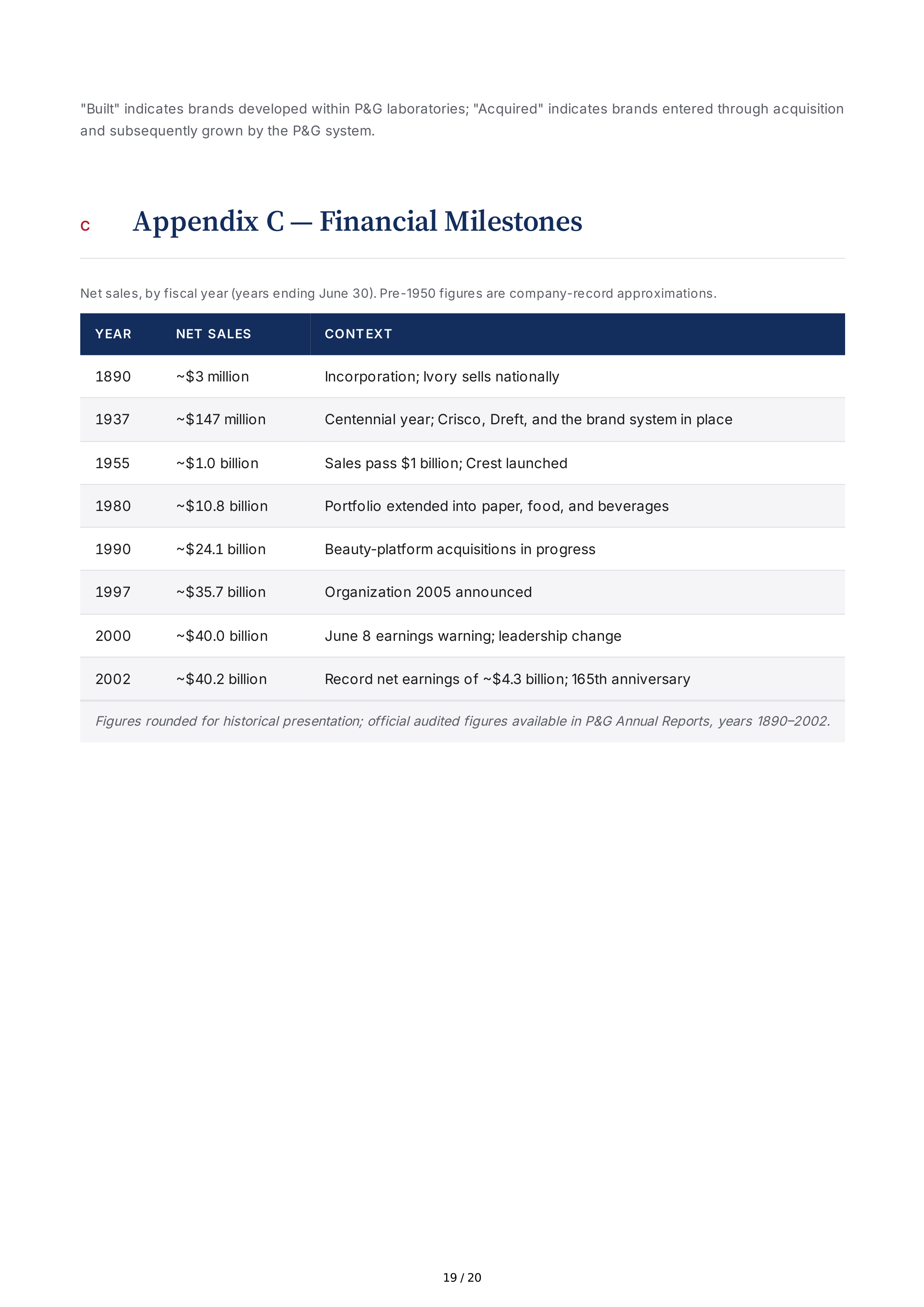
"
Built
"
indicates
brands
developed
within
P
&
G
laboratories
; "
Acquired
"
indicates
brands
entered
through
acquisition
and
subsequently
grown
by
the
P
&
G
system
.
C
Appendix C — Financial Milestones
Net
sales
,
by
fiscal
year
(
years
ending
June
30).
Pre
-1950
figures
are
company
-
record
approximations
.
YEAR
NET
SALES
CONTEXT
1890
~
$
3
million
Incorporation
;
Ivory
sells
nationally
1937
~
$
147
million
Centennial
year
;
Crisco
,
Dreft
,
and
the
brand
system
in
place
1955
~
$
1.0
billion
Sales
pass
$
1
billion
;
Crest
launched
1980
~
$
10.8
billion
Portfolio
extended
into
paper
,
food
,
and
beverages
1990
~
$
24.1
billion
Beauty
-
platform
acquisitions
in
progress
1997
~
$
35.7
billion
Organization
2005
announced
2000
~
$
40.0
billion
June
8
earnings
warning
;
leadership
change
2002
~
$
40.2
billion
Record
net
earnings
of
~
$
4.3
billion
; 165
th
anniversary
Figures
rounded
for
historical
presentation
;
official
audited
figures
available
in
P
&
G
Annual
Reports
,
years
1890–2002.
19 / 20
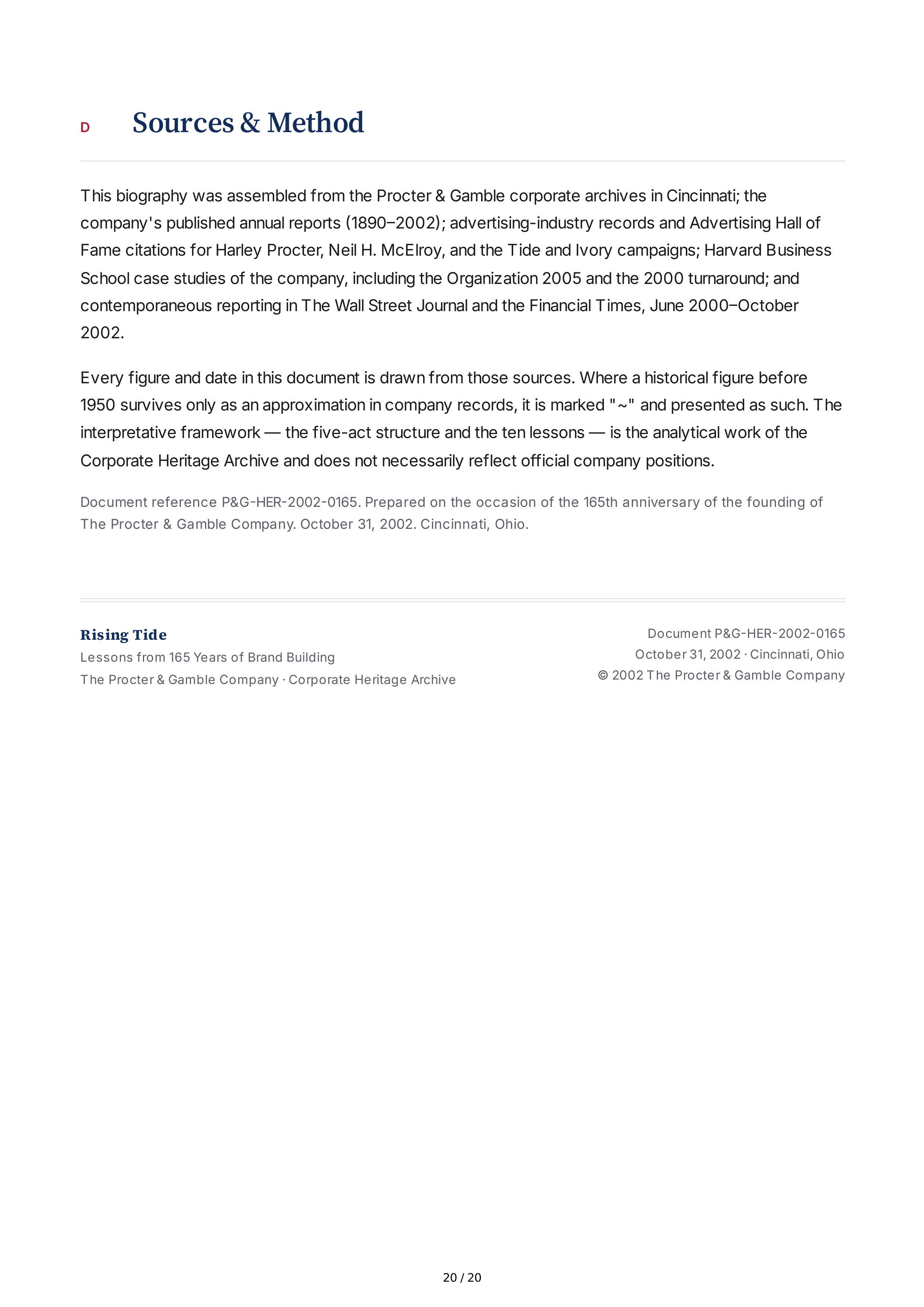
D
Sources & Method
This
biography
was
assembled
from
the
Procter
&
Gamble
corporate
archives
in
Cincinnati
;
the
company
'
s
published
annual
reports
(1890–2002);
advertising
-
industry
records
and
Advertising
Hall
of
Fame
citations
for
Harley
Procter
,
Neil
H
.
McElroy
,
and
the
Tide
and
Ivory
campaigns
;
Harvard
Business
School
case
studies
of
the
company
,
including
the
Organization
2005
and
the
2000
turnaround
;
and
contemporaneous
reporting
in
The
Wall
Street
Journal
and
the
Financial
Times
,
June
2000–
October
2002.
Every
figure
and
date
in
this
document
is
drawn
from
those
sources
.
Where
a
historical
figure
before
1950
survives
only
as
an
approximation
in
company
records
,
it
is
marked
"~"
and
presented
as
such
.
The
interpretative
framework
—
the
five
-
act
structure
and
the
ten
lessons
—
is
the
analytical
work
of
the
Corporate
Heritage
Archive
and
does
not
necessarily
reflect
official
company
positions
.
Document
reference
P
&
G
-
HER
-2002-0165.
Prepared
on
the
occasion
of
the
165
th
anniversary
of
the
founding
of
The
Procter
&
Gamble
Company
.
October
31, 2002.
Cincinnati
,
Ohio
.
Rising Tide
Lessons
from
165
Years
of
Brand
Building
The
Procter
&
Gamble
Company
·
Corporate
Heritage
Archive
Document
P
&
G
-
HER
-2002-0165
October
31, 2002 ·
Cincinnati
,
Ohio
© 2002
The
Procter
&
Gamble
Company
20 / 20