The
Steward
'
s
Way
— 4
T
F
O
R
E
W
O
R
D
A Biography of the Ordinary Extraordinary
he lives of great men and women have long been the lenses through which we exam-
ine the ages that produced them. Plutarch understood this when he paired the war-
riors and lawmakers of Greece with those of Rome; Samuel Johnson understood it
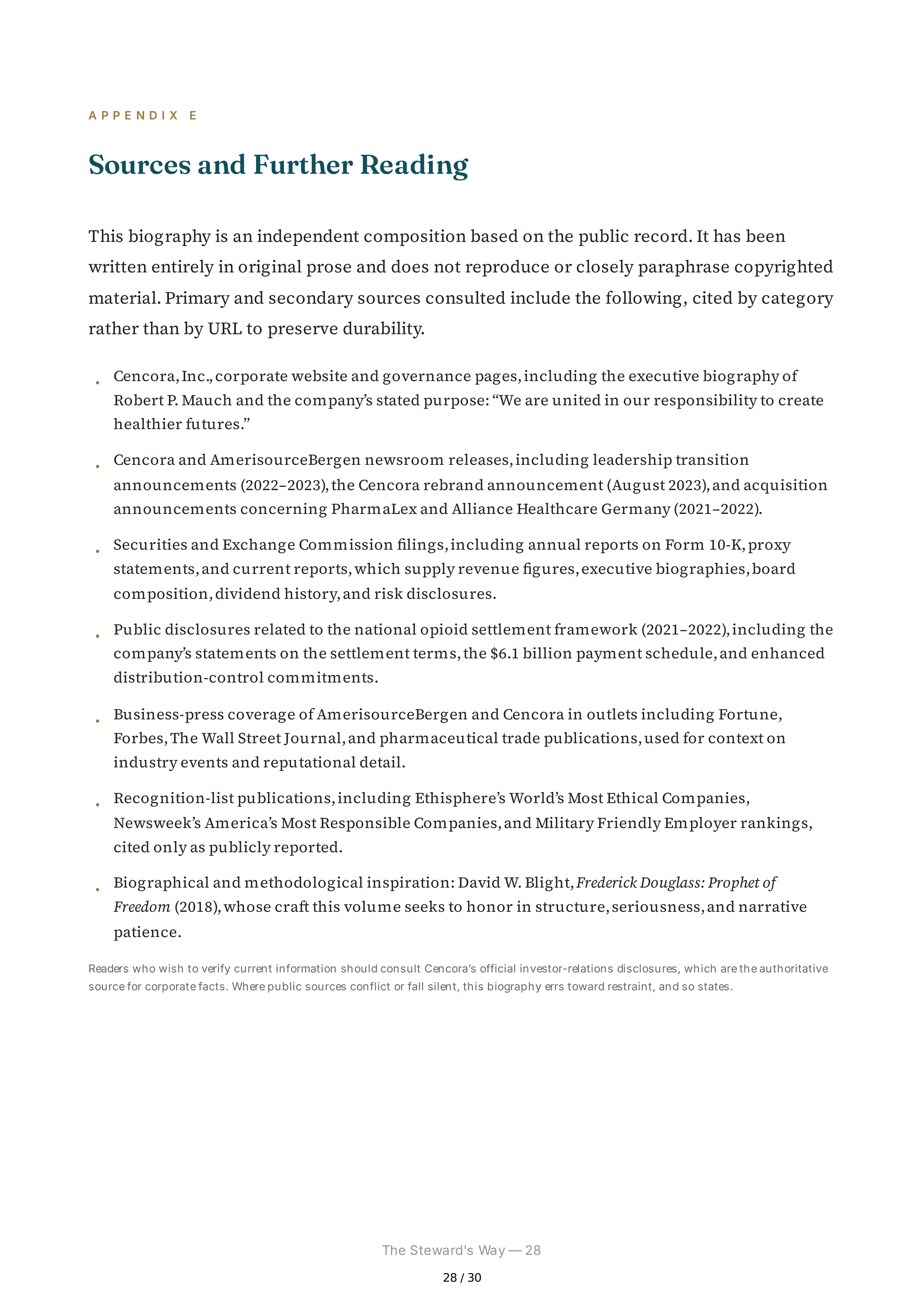
when he resolved to write the lives of the poets. In our own century, David W. Blight demon-
strated the form’s enduring power in
Frederick Douglass: Prophet of Freedom
, a biography that
became a work of history not because its subject was merely famous, but because its sub-
ject was consequential—a man whose personal journey carried the moral tensions of his
era. This book attempts something humbler in scale, yet similar in intention. It takes as its
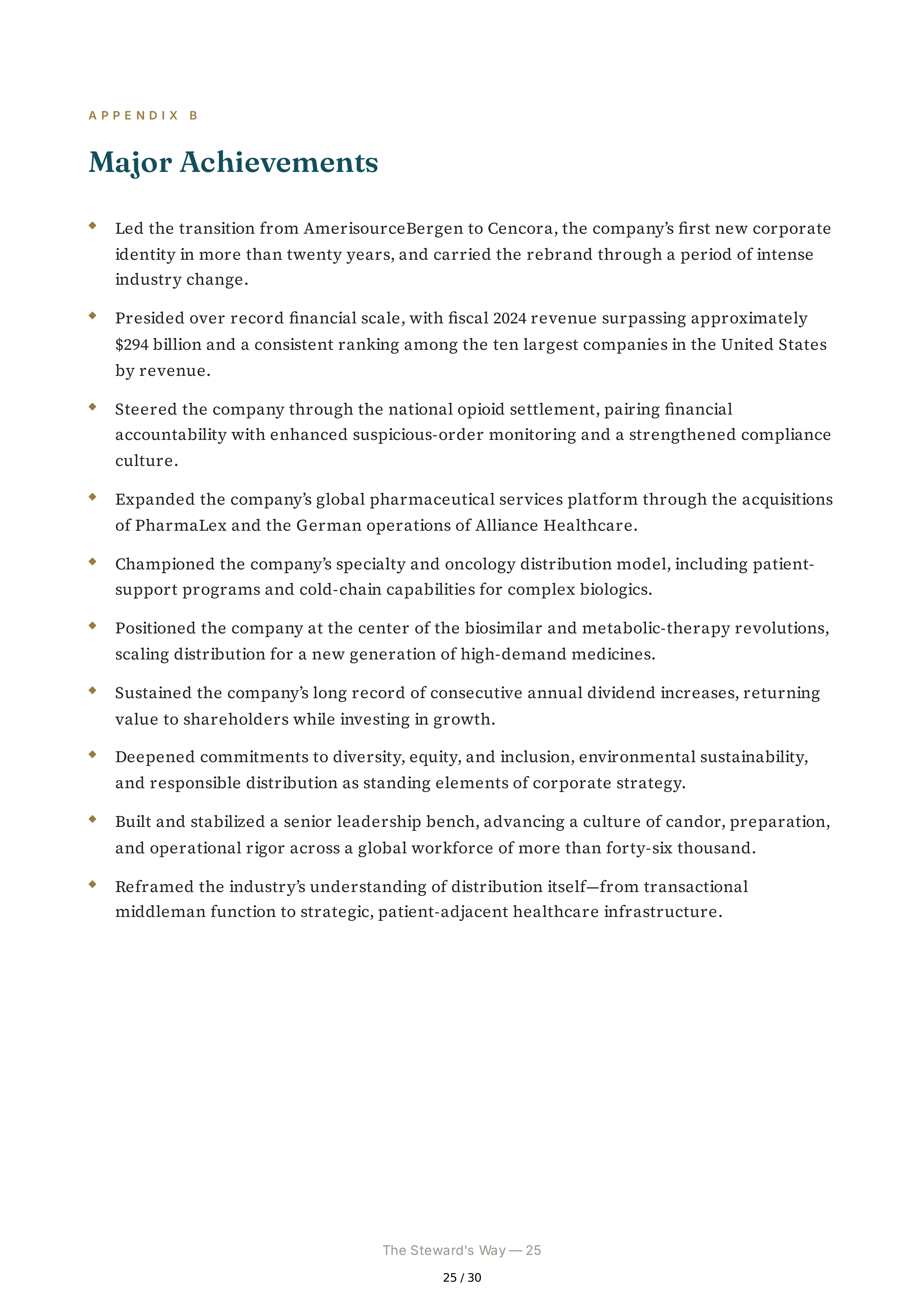
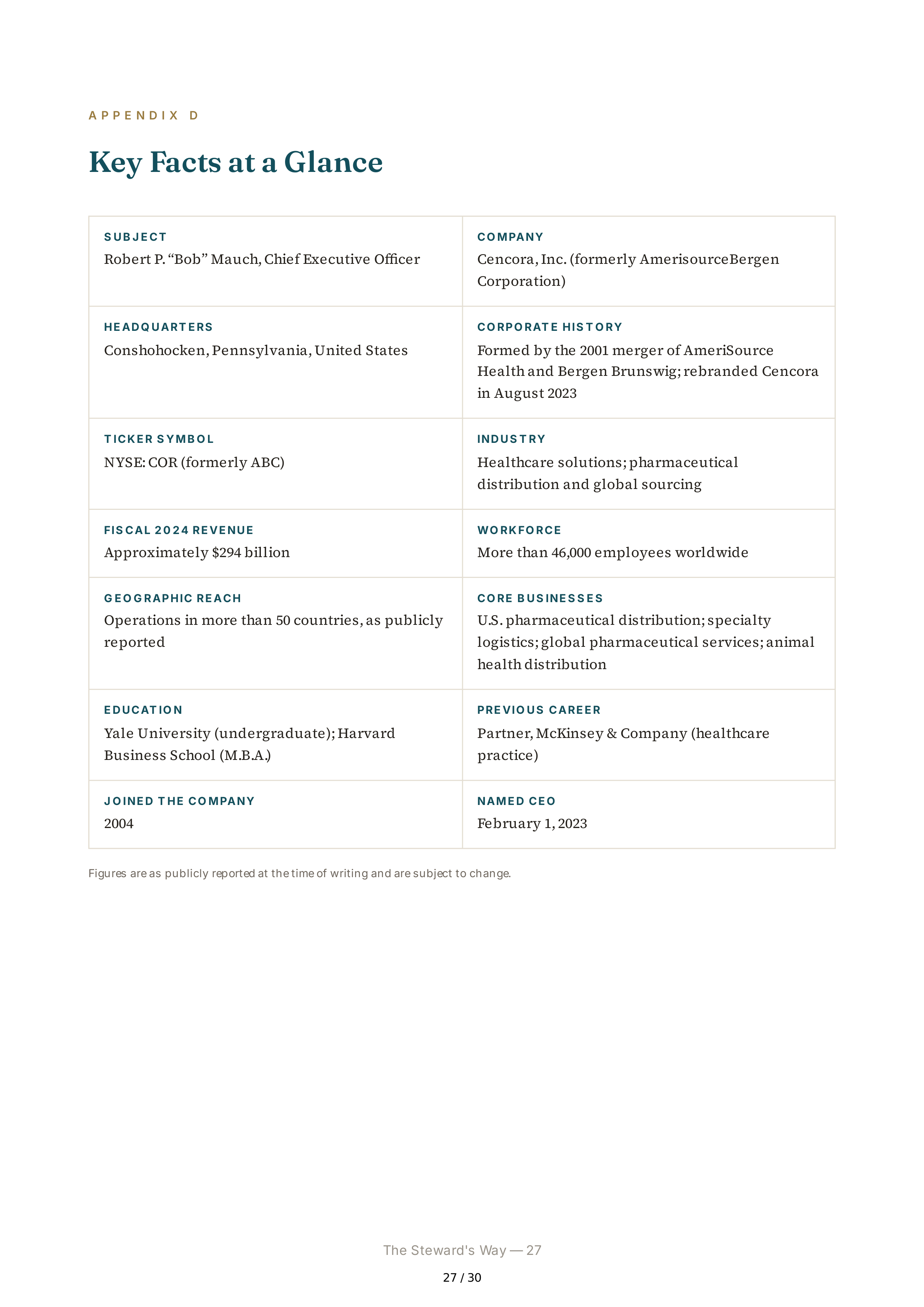
subject a living executive, Robert P. Mauch—known to colleagues as Bob—and asks what his
life reveals about the age of American healthcare.
This is, let it be said plainly, an unusual choice of subject. Distribution is the least glam-
orous machinery of medicine. Its warehouses do not appear in advertisements. Its trucks do
not carry its name. And yet there is no hospital, no pharmacy, no infusion clinic, no exami-
nation room that does not depend upon it. When the pharmaceutical supply chain works,
no one notices. When it fails, the news is immediate. Bob Mauch has spent more than two
decades building, defending, and extending that quiet apparatus—first as a consultant, then
as a strategist, then as an operator, and finally as the chief executive of Cencora, one of the
largest companies in the United States by revenue.
The biographical record for a figure like Mauch is, by the nature of the species, uneven. He
is not a man who has courted the public; his statements are measured, his interviews few,
his personal life resolutely private. This book does not pretend to possess what the subject
has chosen not to share. Instead, it assembles the public record—corporate disclosures,
regulatory filings, and the reporting of reputable business press—and reads that record
with the care a biographer brings to private letters. Where the evidence is thin, this book
says so plainly rather than inventing. Where the evidence is rich, it lingers.
The result is a portrait of stewardship in the truest sense: a study of a man who understands
that the most honorable form of power is the kind that makes itself invisible—infrastruc-
ture, reliability, duty. In an era that equates leadership with volume, Mauch offers a counter-
thesis: leadership as competence, character, and the patient accumulation of trust.
4 / 30