
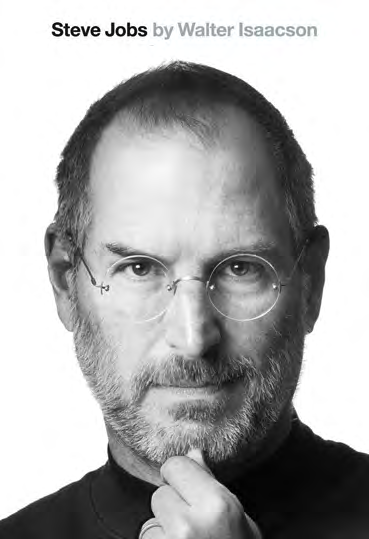
Steve Jobs
by Walter Isaacson
FROM THE AUTHOR OF THE BESTSELLING
BIOGRAPHIES OF BENJAMIN FRANKLIN AND
ALBERT EINSTEIN, THIS IS THE EXCLUSIVE
BIOGRAPHY OF STEVE JOBS.
Based on more than forty interviews with Jobs
conducted over two years—as well as interviews with
more than a hundred family members, friends,
adversaries, competitors, and colleagues—Walter
Isaacson has written a riveting story of the roller-coaster
life and searingly intense personality of a creative
entrepreneur whose passion for perfection and
ferocious drive revolutionized six industries: personal
computers, animated movies, music, phones, tablet
computing, and digital publishing.
At a time when America is seeking ways to sustain
its innovative edge, Jobs stands as the ultimate icon of
inventiveness and applied imagination. He knew that
the best way to create value in the twenty-first century
was to connect creativity with technology. He built a
company where leaps of the imagination were
combined with remarkable feats of engineering.
Although Jobs cooperated with this book, he
asked for no control over what was written nor even the
right to read it before it was published. He put nothing
offlimits. He encouraged the people he knew to speak
honestly. And Jobs speaks candidly, sometimes brutally
so, about the people he worked with and competed
against. His friends, foes, and colleagues provide an
unvarnished view of the passions, perfectionism,
obsessions, artistry, devilry, and compulsion for control
that shaped his approach to business and the
innovative products that resulted.
Driven by demons, Jobs could drive those around
him to fury and despair. But his personality and
products were interrelated, just as Apple’s hardware
and software tended to be, as if part of an integrated
system. His tale is instructive and cautionary, filled with
lessons about innovation, character, leadership, and
values.
Walter Isaacson
, the CEO of the Aspen Institute,
has been the chairman of CNN and the managing
editor of
Time
magazine. He is the author of
Einstein:
His Life and Universe
,
Benjamin Franklin: An American
Life
, and
Kissinger: A Biography
, and is the coauthor,
with Evan Thomas, of
The Wise Men: Six Friends and
the World They Made
. He and his wife live in
Washington, D.C.
MEET THE AUTHORS, WATCH VIDEOS AND
MORE AT
SimonandSchuster.com
• THE SOURCE FOR READING GROUPS •
JACKET PHOTOGRAPHS: FRONT BY ALBERT
WATSON;
BACK BY NORMAN SEEFF
COPYRIGHT © 2011 SIMON & SCHUSTER
Thank you for purchasing this Simon &
Schuster eBook.
Sign up for our newsletter and receive special
offers, access to bonus content, and info on the latest
new releases and other great eBooks from Simon &
Schuster.
or visit us online to sign up at
eBookNews.SimonandSchuster.com
ALSO BY WALTER ISAACSON
American Sketches
Einstein: His Life and Universe
A Benjamin Franklin Reader
Benjamin Franklin: An American Life
Kissinger: A Biography
The Wise Men: Six Friends and the World They
Made
(with Evan Thomas)
Pro and Con
Simon & Schuster
1230 Avenue of the Americas
New York, NY 10020
www.SimonandSchuster.com
Copyright © 2011 by Walter Isaacson
All rights reserved, including the right to reproduce
this book
or portions thereof in any form whatsoever.
For information address Simon & Schuster Subsidiary
Rights Department,
1230 Avenue of the Americas, New York, NY 10020.
First Simon & Schuster hardcover edition
November 2011
SIMON & SCHUSTER and colophon are
registered trademarks
of Simon & Schuster, Inc.
Illustration credits appear here.
The Simon & Schuster Speakers Bureau can bring
authors to your live event.
For more information or to book an event contact the
Simon & Schuster Speakers Bureau at 1-866-248-3049
or visit our website at
www.simonspeakers.com.
Designed by Joy O’Meara
Manufactured in the United States of America
1 3 5 7 9 10 8 6 4 2
Library of Congress Cataloging-in-Publication
Data is available.
ISBN 978-1-4516-4853-9
ISBN 978-1-4516-4855-3 (ebook)
The people who are crazy enough
to think they can change
the world are the ones who do.
—Apple’s “Think Different” commercial, 1997
CONTENTS
Characters
Introduction:
How This Book Came to Be
CHAPTER ONE
Childhood:
Abandoned and Chosen
CHAPTER TWO
Odd Couple:
The Two Steves
CHAPTER THREE
The Dropout:
Turn On, Tune In . . .
CHAPTER FOUR
Atari and India:
Zen and the Art of Game Design
CHAPTER FIVE
The Apple I:
Turn On, Boot Up, Jack In . . .
CHAPTER SIX
The Apple II:
Dawn of a New Age
CHAPTER SEVEN
Chrisann and Lisa:
He Who Is Abandoned . . .
CHAPTER EIGHT
Xerox and Lisa:
Graphical User Interfaces
CHAPTER NINE
Going Public:
A Man of Wealth and Fame
CHAPTER TEN
The Mac Is Born:
You Say You Want a Revolution
CHAPTER ELEVEN
The Reality Distortion Field:
Playing by His Own Set of
Rules
CHAPTER TWELVE
The Design:
Real Artists Simplify
CHAPTER THIRTEEN
Building the Mac:
The Journey Is the Reward
CHAPTER FOURTEEN
Enter Sculley:
The Pepsi Challenge
CHAPTER FIFTEEN
The Launch:
A Dent in the Universe
CHAPTER SIXTEEN
Gates and Jobs:
When Orbits Intersect
CHAPTER SEVENTEEN
Icarus:
What Goes Up . . .
CHAPTER EIGHTEEN
NeXT:
Prometheus Unbound
CHAPTER NINETEEN
Pixar:
Technology Meets Art
CHAPTER TWENTY
A Regular Guy:
Love Is Just a Four-Letter Word
CHAPTER TWENTY-ONE
Family Man:
At Home with the Jobs Clan
CHAPTER TWENTY-TWO
Toy Story:
Buzz and Woody to the Rescue
CHAPTER TWENTY-THREE
The Second Coming:
What Rough Beast, Its Hour Come Round at Last . . .
CHAPTER TWENTY-FOUR
The Restoration:
The Loser Now Will Be Later to Win
CHAPTER TWENTY-FIVE
Think Different:
Jobs as iCEO
CHAPTER TWENTY-SIX
Design Principles:
The Studio of Jobs and Ive
CHAPTER TWENTY-SEVEN
The iMac:
Hello (Again)
CHAPTER TWENTY-EIGHT
CEO:
Still Crazy after All These Years
CHAPTER TWENTY-NINE
Apple Stores:
Genius Bars and Siena Sandstone
CHAPTER THIRTY
The Digital Hub:
From iTunes to the iPod
CHAPTER THIRTY-ONE
The iTunes Store:
I’m the Pied Piper
CHAPTER THIRTY-TWO
Music Man:
The Sound Track of His Life
CHAPTER THIRTY-THREE
Pixar’s Friends:
. . . and Foes
CHAPTER THIRTY-FOUR
Twenty-first-century Macs:
Setting Apple Apart
CHAPTER THIRTY-FIVE
Round One:
Memento Mori
CHAPTER THIRTY-SIX
The iPhone:
Three Revolutionary Products in One
CHAPTER THIRTY-SEVEN
Round Two:
The Cancer Recurs
CHAPTER THIRTY-EIGHT
The iPad:
Into the Post-PC Era
CHAPTER THIRTY-NINE
New Battles:
And Echoes of Old Ones
CHAPTER FORTY
To Infinity:
The Cloud, the Spaceship, and Beyond
CHAPTER FORTY-ONE
Round Three:
The Twilight Struggle
CHAPTER FORTY-TWO
Legacy:
The Brightest Heaven of Invention
Acknowledgments
Sources
Notes
Index
CHARACTERS
AL ALCORN
. Chief engineer at Atari, who
designed Pong and hired Jobs.
GIL AMELIO
. Became CEO of Apple in 1996,
bought NeXT, bringing Jobs back.
BILL ATKINSON
. Early Apple employee,
developed graphics for the Macintosh.
CHRISANN BRENNAN
. Jobs’s girlfriend at
Homestead High, mother of his daughter Lisa.
LISA BRENNAN-JOBS
. Daughter of Jobs and
Chrisann Brennan, born in 1978; became a writer in
New York City.
NOLAN BUSHNELL
. Founder of Atari and
entrepreneurial role model for Jobs.
BILL CAMPBELL
. Apple marketing chief during
Jobs’s first stint at Apple and board member and
confidant after Jobs’s return in 1997.
EDWIN CATMULL
. A cofounder of Pixar and later
a Disney executive.
KOBUN CHINO
. A Soōtoō Zen master in
California who became Jobs’s spiritual teacher.
LEE CLOW
. Advertising wizard who created
Apple’s “1984” ad and worked with Jobs for three
decades.
DEBORAH “DEBI” COLEMAN
. Early Mac team
manager who took over Apple manufacturing.
TIM COOK
. Steady, calm, chief operating officer
hired by Jobs in 1998; replaced Jobs as Apple CEO in
August 2011.
EDDY CUE
. Chief of Internet services at Apple,
Jobs’s wingman in dealing with content companies.
ANDREA “ANDY” CUNNINGHAM
. Publicist at
Regis McKenna’s firm who handled Apple in the early
Macintosh years.
MICHAEL EISNER
. Hard-driving Disney CEO who
made the Pixar deal, then clashed with Jobs.
LARRY ELLISON
. CEO of Oracle and personal
friend of Jobs.
TONY FADELL
. Punky engineer brought to Apple
in 2001 to develop the iPod.
SCOTT FORSTALL
. Chief of Apple’s mobile
device software.
ROBERT FRIEDLAND
. Reed student, proprietor
of an apple farm commune, and spiritual seeker who
influenced Jobs, then went on to run a mining company.
JEAN-LOUIS GASSÉE
. Apple’s manager in
France, took over the Macintosh division when Jobs
was ousted in 1985.
BILL GATES
. The other computer wunderkind
born in 1955.
ANDY HERTZFELD
. Playful, friendly software
engineer and Jobs’s pal on the original Mac team.
JOANNA HOFFMAN
. Original Mac team member
with the spirit to stand up to Jobs.
ELIZABETH HOLMES
. Daniel Kottke’s girlfriend at
Reed and early Apple employee.
ROD HOLT
. Chain-smoking Marxist hired by Jobs
in 1976 to be the electrical engineer on the Apple II.
ROBERT IGER
. Succeeded Eisner as Disney
CEO in 2005.
JONATHAN “JONY” IVE
. Chief designer at
Apple, became Jobs’s partner and confidant.
ABDULFATTAH “JOHN” JANDALI
. Syrian-born
graduate student in Wisconsin who became biological
father of Jobs and Mona Simpson, later a food and
beverage manager at the Boomtown casino near Reno.
CLARA HAGOPIAN JOBS
. Daughter of Armenian
immigrants, married Paul Jobs in 1946; they adopted
Steve soon after his birth in 1955.
ERIN JOBS
. Middle child of Laurene Powell and
Steve Jobs.
EVE JOBS
. Youngest child of Laurene and Steve.
PATTY JOBS
. Adopted by Paul and Clara Jobs
two years after they adopted Steve.
PAUL REINHOLD JOBS
. Wisconsin-born Coast
Guard seaman who, with his wife, Clara, adopted Steve
in 1955.
REED JOBS
. Oldest child of Steve Jobs and
Laurene Powell.
RON JOHNSON
. Hired by Jobs in 2000 to
develop Apple’s stores.
JEFFREY KATZENBERG
. Head of Disney
Studios, clashed with Eisner and resigned in 1994 to
cofound DreamWorks SKG.
DANIEL KOTTKE
. Jobs’s closest friend at Reed,
fellow pilgrim to India, early Apple employee.
JOHN LASSETER
. Cofounder and creative force
at Pixar.
DAN’L LEWIN
. Marketing exec with Jobs at Apple
and then NeXT.
MIKE MARKKULA
. First big Apple investor and
chairman, a father figure to Jobs.
REGIS MCKENNA
. Publicity whiz who guided
Jobs early on and remained a trusted advisor.
MIKE MURRAY
. Early Macintosh marketing
director.
PAUL OTELLINI
. CEO of Intel who helped switch
the Macintosh to Intel chips but did not get the iPhone
business.
LAURENE POWELL
. Savvy and good-humored
Penn graduate, went to Goldman Sachs and then
Stanford Business School, married Steve Jobs in 1991.
GEORGE RILEY
. Jobs’s Memphis-born friend and
lawyer.
ARTHUR ROCK
. Legendary tech investor, early
Apple board member, Jobs’s father figure.
JONATHAN “RUBY” RUBINSTEIN
. Worked with
Jobs at NeXT, became chief hardware engineer at
Apple in 1997.
MIKE SCOTT
. Brought in by Markkula to be
Apple’s president in 1977 to try to manage Jobs.
JOHN SCULLEY
. Pepsi executive recruited by
Jobs in 1983 to be Apple’s CEO, clashed with and
ousted Jobs in 1985.
JOANNE SCHIEBLE JANDALI SIMPSON
.
Wisconsin-born biological mother of Steve Jobs, whom
she put up for adoption, and Mona Simpson, whom she
raised.
MONA SIMPSON
. Biological full sister of Jobs;
they discovered their relationship in 1986 and became
close. She wrote novels loosely based on her mother
Joanne (
Anywhere but Here
), Jobs and his daughter
Lisa (
A Regular Guy
), and her father Abdulfattah
Jandali (
The Lost Father
).
ALVY RAY SMITH
. A cofounder of Pixar who
clashed with Jobs.
BURRELL SMITH
. Brilliant, troubled programmer
on the original Mac team, afflicted with schizophrenia in
the 1990s.
AVADIS “AVIE” TEVANIAN
. Worked with Jobs
and Rubinstein at NeXT, became chief software
engineer at Apple in 1997.
JAMES VINCENT
. A music-loving Brit, the
younger partner with Lee Clow and Duncan Milner at
the ad agency Apple hired.
RON WAYNE
. Met Jobs at Atari, became first
partner with Jobs and Wozniak at fledgling Apple, but
unwisely decided to forgo his equity stake.
STEPHEN WOZNIAK
. The star electronics geek at
Homestead High; Jobs figured out how to package and
market his amazing circuit boards and became his
partner in founding Apple.
INTRODUCTION
How This Book Came to Be
In the early summer of 2004, I got a phone call
from Steve Jobs. He had been scattershot friendly to me
over the years, with occasional bursts of intensity,
especially when he was launching a new product that
he wanted on the cover of
Time
or featured on CNN,
places where I’d worked. But now that I was no longer
at either of those places, I hadn’t heard from him much.
We talked a bit about the Aspen Institute, which I had
recently joined, and I invited him to speak at our
summer campus in Colorado. He’d be happy to come,
he said, but not to be onstage. He wanted instead to
take a walk so that we could talk.
That seemed a bit odd. I didn’t yet know that taking
a long walk was his preferred way to have a serious
conversation. It turned out that he wanted me to write a
biography of him. I had recently published one on
Benjamin Franklin and was writing one about Albert
Einstein, and my initial reaction was to wonder, half
jokingly, whether he saw himself as the natural
successor in that sequence. Because I assumed that he
was still in the middle of an oscillating career that had
many more ups and downs left, I demurred. Not now, I
said. Maybe in a decade or two, when you retire.
I had known him since 1984, when he came to
Manhattan to have lunch with
Time
’s editors and extol
his new Macintosh. He was petulant even then,
attacking a
Time
correspondent for having wounded
him with a story that was too revealing. But talking to
him afterward, I found myself rather captivated, as so
Steve Jobs by Walter Isaacson
1
many others have been over the years, by his engaging
intensity. We stayed in touch, even after he was ousted
from Apple. When he had something to pitch, such as a
NeXT computer or Pixar movie, the beam of his charm
would suddenly refocus on me, and he would take me
to a sushi restaurant in Lower Manhattan to tell me that
whatever he was touting was the best thing he had ever
produced. I liked him.
When he was restored to the throne at Apple, we
put him on the cover of
Time
, and soon thereafter he
began offering me his ideas for a series we were doing
on the most influential people of the century. He had
launched his “Think Different” campaign, featuring
iconic photos of some of the same people we were
considering, and he found the endeavor of assessing
historic influence fascinating.
After I had deflected his suggestion that I write a
biography of him, I heard from him every now and then.
At one point I emailed to ask if it was true, as my
daughter had told me, that the Apple logo was an
homage to Alan Turing, the British computer pioneer
who broke the German wartime codes and then
committed suicide by biting into a cyanide-laced apple.
He replied that he wished he had thought of that, but
hadn’t. That started an exchange about the early history
of Apple, and I found myself gathering string on the
subject, just in case I ever decided to do such a book.
When my Einstein biography came out, he came to a
book event in Palo Alto and pulled me aside to suggest,
again, that he would make a good subject.
His persistence baffled me. He was known to
guard his privacy, and I had no reason to believe he’d
ever read any of my books. Maybe someday, I
continued to say. But in 2009 his wife, Laurene Powell,
said bluntly, “If you’re ever going to do a book on Steve,
you’d better do it now.” He had just taken a second
Steve Jobs by Walter Isaacson
2
medical leave. I confessed to her that when he had first
raised the idea, I hadn’t known he was sick. Almost
nobody knew, she said. He had called me right before
he was going to be operated on for cancer, and he was
still keeping it a secret, she explained.
I decided then to write this book. Jobs surprised
me by readily acknowledging that he would have no
control over it or even the right to see it in advance. “It’s
your book,” he said. “I won’t even read it.” But later that
fall he seemed to have second thoughts about
cooperating and, though I didn’t know it, was hit by
another round of cancer complications. He stopped
returning my calls, and I put the project aside for a
while.
Then, unexpectedly, he phoned me late on the
afternoon of New Year’s Eve 2009. He was at home in
Palo Alto with only his sister, the writer Mona Simpson.
His wife and their three children had taken a quick trip
to go skiing, but he was not healthy enough to join
them. He was in a reflective mood, and we talked for
more than an hour. He began by recalling that he had
wanted to build a frequency counter when he was
twelve, and he was able to look up Bill Hewlett, the
founder of HP, in the phone book and call him to get
parts. Jobs said that the past twelve years of his life,
since his return to Apple, had been his most productive
in terms of creating new products. But his more
important goal, he said, was to do what Hewlett and his
friend David Packard had done, which was create a
company that was so imbued with innovative creativity
that it would outlive them.
“I always thought of myself as a humanities person
as a kid, but I liked electronics,” he said. “Then I read
something that one of my heroes, Edwin Land of
Polaroid, said about the importance of people who
could stand at the intersection of humanities and
Steve Jobs by Walter Isaacson
3
sciences, and I decided that’s what I wanted to do.” It
was as if he were suggesting themes for his biography
(and in this instance, at least, the theme turned out to be
valid). The creativity that can occur when a feel for both
the humanities and the sciences combine in one strong
personality was the topic that most interested me in my
biographies of Franklin and Einstein, and I believe that
it will be a key to creating innovative economies in the
twenty-first century.
I asked Jobs why he wanted me to be the one to
write his biography. “I think you’re good at getting
people to talk,” he replied. That was an unexpected
answer. I knew that I would have to interview scores of
people he had fired, abused, abandoned, or otherwise
infuriated, and I feared he would not be comfortable
with my getting them to talk. And indeed he did turn out
to be skittish when word trickled back to him of people
that I was interviewing. But after a couple of months, he
began encouraging people to talk to me, even foes and
former girlfriends. Nor did he try to put anything off-
limits. “I’ve done a lot of things I’m not proud of, such as
getting my girlfriend pregnant when I was twenty-three
and the way I handled that,” he said. “But I don’t have
any skeletons in my closet that can’t be allowed out.”
He didn’t seek any control over what I wrote, or even
ask to read it in advance. His only involvement came
when my publisher was choosing the cover art. When
he saw an early version of a proposed cover treatment,
he disliked it so much that he asked to have input in
designing a new version. I was both amused and
willing, so I readily assented.
I ended up having more than forty interviews and
conversations with him. Some were formal ones in his
Palo Alto living room, others were done during long
walks and drives or by telephone. During my two years
of visits, he became increasingly intimate and
Steve Jobs by Walter Isaacson
4
revealing, though at times I witnessed what his veteran
colleagues at Apple used to call his “reality distortion
field.” Sometimes it was the inadvertent misfiring of
memory cells that happens to us all; at other times he
was spinning his own version of reality both to me and
to himself. To check and flesh out his story, I
interviewed more than a hundred friends, relatives,
competitors, adversaries, and colleagues.
His wife also did not request any restrictions or
control, nor did she ask to see in advance what I would
publish. In fact she strongly encouraged me to be
honest about his failings as well as his strengths. She is
one of the smartest and most grounded people I have
ever met. “There are parts of his life and personality that
are extremely messy, and that’s the truth,” she told me
early on. “You shouldn’t whitewash it. He’s good at
spin, but he also has a remarkable story, and I’d like to
see that it’s all told truthfully.”
I leave it to the reader to assess whether I have
succeeded in this mission. I’m sure there are players in
this drama who will remember some of the events
differently or think that I sometimes got trapped in
Jobs’s distortion field. As happened when I wrote a
book about Henry Kissinger, which in some ways was
good preparation for this project, I found that people
had such strong positive and negative emotions about
Jobs that the Rashomon effect was often evident. But
I’ve done the best I can to balance conflicting accounts
fairly and be transparent about the sources I used.
This is a book about the roller-coaster life and
searingly intense personality of a creative entrepreneur
whose passion for perfection and ferocious drive
revolutionized six industries: personal computers,
animated movies, music, phones, tablet computing, and
digital publishing. You might even add a seventh, retail
stores, which Jobs did not quite revolutionize but did
Steve Jobs by Walter Isaacson
5
reimagine. In addition, he opened the way for a new
market for digital content based on apps rather than just
websites. Along the way he produced not only
transforming products but also, on his second try, a
lasting company, endowed with his DNA, that is filled
with creative designers and daredevil engineers who
could carry forward his vision. In August 2011, right
before he stepped down as CEO, the enterprise he
started in his parents’ garage became the world’s most
valuable company.
This is also, I hope, a book about innovation. At a
time when the United States is seeking ways to sustain
its innovative edge, and when societies around the
world are trying to build creative digital-age economies,
Jobs stands as the ultimate icon of inventiveness,
imagination, and sustained innovation. He knew that
the best way to create value in the twenty-first century
was to connect creativity with technology, so he built a
company where leaps of the imagination were
combined with remarkable feats of engineering. He and
his colleagues at Apple were able to think differently:
They developed not merely modest product advances
based on focus groups, but whole new devices and
services that consumers did not yet know they needed.
He was not a model boss or human being, tidily
packaged for emulation. Driven by demons, he could
drive those around him to fury and despair. But his
personality and passions and products were all
interrelated, just as Apple’s hardware and software
tended to be, as if part of an integrated system. His tale
is thus both instructive and cautionary, filled with
lessons about innovation, character, leadership, and
values.
Shakespeare’s
Henry V
—the story of a willful and
immature prince who becomes a passionate but
sensitive, callous but sentimental, inspiring but flawed
Steve Jobs by Walter Isaacson
6
king—begins with the exhortation “O for a Muse of fire,
that would ascend / The brightest heaven of invention.”
For Steve Jobs, the ascent to the brightest heaven of
invention begins with a tale of two sets of parents, and
of growing up in a valley that was just learning how to
turn silicon into gold.
Steve Jobs by Walter Isaacson
7
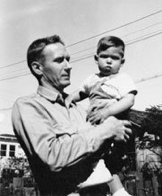

STEVE JOBS
Paul Jobs with Steve, 1956
The Los Altos house with the garage where Apple
was born
Steve Jobs by Walter Isaacson
8
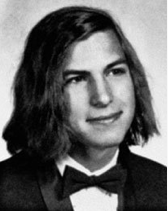
In the Homestead High yearbook, 1972
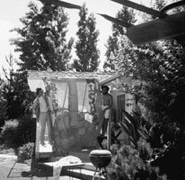
With the “SWAB JOB” school prank sign
Steve Jobs by Walter Isaacson
9
Steve Jobs by Walter Isaacson
10
CHAPTER ONE
Steve Jobs by Walter Isaacson
11
CHILDHOOD
Abandoned and Chosen
The Adoption
When Paul Jobs was mustered out of the Coast
Guard after World War II, he made a wager with his
crewmates. They had arrived in San Francisco, where
their ship was decommissioned, and Paul bet that he
would find himself a wife within two weeks. He was a
taut, tattooed engine mechanic, six feet tall, with a
passing resemblance to James Dean. But it wasn’t his
looks that got him a date with Clara Hagopian, a sweet-
humored daughter of Armenian immigrants. It was the
fact that he and his friends had a car, unlike the group
she had originally planned to go out with that evening.
Ten days later, in March 1946, Paul got engaged to
Clara and won his wager. It would turn out to be a
happy marriage, one that lasted until death parted them
more than forty years later.
Paul Reinhold Jobs had been raised on a dairy
farm in Germantown, Wisconsin. Even though his father
was an alcoholic and sometimes abusive, Paul ended
up with a gentle and calm disposition under his leathery
exterior. After dropping out of high school, he wandered
through the Midwest picking up work as a mechanic
until, at age nineteen, he joined the Coast Guard, even
though he didn’t know how to swim. He was deployed
on the USS
General M. C. Meigs
and spent much of the
war ferrying troops to Italy for General Patton. His talent
as a machinist and fireman earned him
commendations, but he occasionally found himself in
minor trouble and never rose above the rank of
seaman.
Clara was born in New Jersey, where her parents
Steve Jobs by Walter Isaacson
12
had landed after fleeing the Turks in Armenia, and they
moved to the Mission District of San Francisco when
she was a child. She had a secret that she rarely
mentioned to anyone: She had been married before,
but her husband had been killed in the war. So when
she met Paul Jobs on that first date, she was primed to
start a new life.
Like many who lived through the war, they had
experienced enough excitement that, when it was over,
they desired simply to settle down, raise a family, and
lead a less eventful life. They had little money, so they
moved to Wisconsin and lived with Paul’s parents for a
few years, then headed for Indiana, where he got a job
as a machinist for International Harvester. His passion
was tinkering with old cars, and he made money in his
spare time buying, restoring, and selling them.
Eventually he quit his day job to become a full-time
used car salesman.
Clara, however, loved San Francisco, and in 1952
she convinced her husband to move back there. They
got an apartment in the Sunset District facing the
Pacific, just south of Golden Gate Park, and he took a
job working for a finance company as a “repo man,”
picking the locks of cars whose owners hadn’t paid their
loans and repossessing them. He also bought,
repaired, and sold some of the cars, making a decent
enough living in the process.
There was, however, something missing in their
lives. They wanted children, but Clara had suffered an
ectopic pregnancy, in which the fertilized egg was
implanted in a fallopian tube rather than the uterus, and
she had been unable to have any. So by 1955, after
nine years of marriage, they were looking to adopt a
child.
Like Paul Jobs, Joanne Schieble was from a rural
Wisconsin family of German heritage. Her father, Arthur
Steve Jobs by Walter Isaacson
13
Schieble, had immigrated to the outskirts of Green Bay,
where he and his wife owned a mink farm and dabbled
successfully in various other businesses, including real
estate and photoengraving. He was very strict,
especially regarding his daughter’s relationships, and
he had strongly disapproved of her first love, an artist
who was not a Catholic. Thus it was no surprise that he
threatened to cut Joanne off completely when, as a
graduate student at the University of Wisconsin, she fell
in love with Abdulfattah “John” Jandali, a Muslim
teaching assistant from Syria.
Jandali was the youngest of nine children in a
prominent Syrian family. His father owned oil refineries
and multiple other businesses, with large holdings in
Damascus and Homs, and at one point pretty much
controlled the price of wheat in the region. His mother,
he later said, was a “traditional Muslim woman” who
was a “conservative, obedient housewife.” Like the
Schieble family, the Jandalis put a premium on
education. Abdulfattah was sent to a Jesuit boarding
school, even though he was Muslim, and he got an
undergraduate degree at the American University in
Beirut before entering the University of Wisconsin to
pursue a doctoral degree in political science.
In the summer of 1954, Joanne went with
Abdulfattah to Syria. They spent two months in Homs,
where she learned from his family to cook Syrian
dishes. When they returned to Wisconsin she
discovered that she was pregnant. They were both
twenty-three, but they decided not to get married. Her
father was dying at the time, and he had threatened to
disown her if she wed Abdulfattah. Nor was abortion an
easy option in a small Catholic community. So in early
1955, Joanne traveled to San Francisco, where she
was taken into the care of a kindly doctor who sheltered
unwed mothers, delivered their babies, and quietly
Steve Jobs by Walter Isaacson
14
arranged closed adoptions.
Joanne had one requirement: Her child must be
adopted by college graduates. So the doctor arranged
for the baby to be placed with a lawyer and his wife. But
when a boy was born—on February 24, 1955—the
designated couple decided that they wanted a girl and
backed out. Thus it was that the boy became the son
not of a lawyer but of a high school dropout with a
passion for mechanics and his salt-of-the-earth wife
who was working as a bookkeeper. Paul and Clara
named their new baby Steven Paul Jobs.
When Joanne found out that her baby had been
placed with a couple who had not even graduated from
high school, she refused to sign the adoption papers.
The standoff lasted weeks, even after the baby had
settled into the Jobs household. Eventually Joanne
relented, with the stipulation that the couple promise—
indeed sign a pledge—to fund a savings account to pay
for the boy’s college education.
There was another reason that Joanne was balky
about signing the adoption papers. Her father was
about to die, and she planned to marry Jandali soon
after. She held out hope, she would later tell family
members, sometimes tearing up at the memory, that
once they were married, she could get their baby boy
back.
Arthur Schieble died in August 1955, after the
adoption was finalized. Just after Christmas that year,
Joanne and Abdulfattah were married in St. Philip the
Apostle Catholic Church in Green Bay. He got his PhD
in international politics the next year, and then they had
another child, a girl named Mona. After she and Jandali
divorced in 1962, Joanne embarked on a dreamy and
peripatetic life that her daughter, who grew up to
become the acclaimed novelist Mona Simpson, would
capture in her book
Anywhere but Here
. Because
Steve Jobs by Walter Isaacson
15
Steve’s adoption had been closed, it would be twenty
years before they would all find each other.
Steve Jobs knew from an early age that he was
adopted. “My parents were very open with me about
that,” he recalled. He had a vivid memory of sitting on
the lawn of his house, when he was six or seven years
old, telling the girl who lived across the street. “So does
that mean your real parents didn’t want you?” the girl
asked. “Lightning bolts went off in my head,” according
to Jobs. “I remember running into the house, crying.
And my parents said, ‘No, you have to understand.’
They were very serious and looked me straight in the
eye. They said, ‘We specifically picked you out.’ Both of
my parents said that and repeated it slowly for me. And
they put an emphasis on every word in that sentence.”
Abandoned. Chosen. Special. Those concepts
became part of who Jobs was and how he regarded
himself. His closest friends think that the knowledge that
he was given up at birth left some scars. “I think his
desire for complete control of whatever he makes
derives directly from his personality and the fact that he
was abandoned at birth,” said one longtime colleague,
Del Yocam. “He wants to control his environment, and
he sees the product as an extension of himself.” Greg
Calhoun, who became close to Jobs right after college,
saw another effect. “Steve talked to me a lot about
being abandoned and the pain that caused,” he said. “It
made him independent. He followed the beat of a
different drummer, and that came from being in a
different world than he was born into.”
Later in life, when he was the same age his
biological father had been when he abandoned him,
Jobs would father and abandon a child of his own. (He
eventually took responsibility for her.) Chrisann
Brennan, the mother of that child, said that being put up
for adoption left Jobs “full of broken glass,” and it helps
Steve Jobs by Walter Isaacson
16
to explain some of his behavior. “He who is abandoned
is an abandoner,” she said. Andy Hertzfeld, who
worked with Jobs at Apple in the early 1980s, is among
the few who remained close to both Brennan and Jobs.
“The key question about Steve is why he can’t control
himself at times from being so reflexively cruel and
harmful to some people,” he said. “That goes back to
being abandoned at birth. The real underlying problem
was the theme of abandonment in Steve’s life.”
Jobs dismissed this. “There’s some notion that
because I was abandoned, I worked very hard so I
could do well and make my parents wish they had me
back, or some such nonsense, but that’s ridiculous,” he
insisted. “Knowing I was adopted may have made me
feel more independent, but I have never felt
abandoned. I’ve always felt special. My parents made
me feel special.” He would later bristle whenever
anyone referred to Paul and Clara Jobs as his
“adoptive” parents or implied that they were not his
“real” parents. “They were my parents 1,000%,” he said.
When speaking about his biological parents, on the
other hand, he was curt: “They were my sperm and egg
bank. That’s not harsh, it’s just the way it was, a sperm
bank thing, nothing more.”
Silicon Valley
The childhood that Paul and Clara Jobs created
for their new son was, in many ways, a stereotype of the
late 1950s. When Steve was two they adopted a girl
they named Patty, and three years later they moved to a
tract house in the suburbs. The finance company where
Paul worked as a repo man, CIT, had transferred him
down to its Palo Alto office, but he could not afford to
live there, so they landed in a subdivision in Mountain
View, a less expensive town just to the south.
There Paul tried to pass along his love of
mechanics and cars. “Steve, this is your workbench
Steve Jobs by Walter Isaacson
17
now,” he said as he marked off a section of the table in
their garage. Jobs remembered being impressed by his
father’s focus on craftsmanship. “I thought my dad’s
sense of design was pretty good,” he said, “because he
knew how to build anything. If we needed a cabinet, he
would build it. When he built our fence, he gave me a
hammer so I could work with him.”
Fifty years later the fence still surrounds the back
and side yards of the house in Mountain View. As Jobs
showed it off to me, he caressed the stockade panels
and recalled a lesson that his father implanted deeply
in him. It was important, his father said, to craft the
backs of cabinets and fences properly, even though
they were hidden. “He loved doing things right. He even
cared about the look of the parts you couldn’t see.”
His father continued to refurbish and resell used
cars, and he festooned the garage with pictures of his
favorites. He would point out the detailing of the design
to his son: the lines, the vents, the chrome, the trim of
the seats. After work each day, he would change into
his dungarees and retreat to the garage, often with
Steve tagging along. “I figured I could get him nailed
down with a little mechanical ability, but he really wasn’t
interested in getting his hands dirty,” Paul later recalled.
“He never really cared too much about mechanical
things.”
“I wasn’t that into fixing cars,” Jobs admitted. “But I
was eager to hang out with my dad.” Even as he was
growing more aware that he had been adopted, he was
becoming more attached to his father. One day when
he was about eight, he discovered a photograph of his
father from his time in the Coast Guard. “He’s in the
engine room, and he’s got his shirt off and looks like
James Dean. It was one of those
Oh wow
moments for
a kid.
Wow, oooh
, my parents were actually once very
young and really good-looking.”
Steve Jobs by Walter Isaacson
18
Through cars, his father gave Steve his first
exposure to electronics. “My dad did not have a deep
understanding of electronics, but he’d encountered it a
lot in automobiles and other things he would fix. He
showed me the rudiments of electronics, and I got very
interested in that.” Even more interesting were the trips
to scavenge for parts. “Every weekend, there’d be a
junkyard trip. We’d be looking for a generator, a
carburetor, all sorts of components.” He remembered
watching his father negotiate at the counter. “He was a
good bargainer, because he knew better than the guys
at the counter what the parts should cost.” This helped
fulfill the pledge his parents made when he was
adopted. “My college fund came from my dad paying
$50 for a Ford Falcon or some other beat-up car that
didn’t run, working on it for a few weeks, and selling it
for $250—and not telling the IRS.”
The Jobses’ house and the others in their
neighborhood were built by the real estate developer
Joseph Eichler, whose company spawned more than
eleven thousand homes in various California
subdivisions between 1950 and 1974. Inspired by
Frank Lloyd Wright’s vision of simple modern homes for
the American “everyman,” Eichler built inexpensive
houses that featured floor-to-ceiling glass walls, open
floor plans, exposed post-and-beam construction,
concrete slab floors, and lots of sliding glass doors.
“Eichler did a great thing,” Jobs said on one of our
walks around the neighborhood. “His houses were
smart and cheap and good. They brought clean design
and simple taste to lower-income people. They had
awesome little features, like radiant heating in the
floors. You put carpet on them, and we had nice toasty
floors when we were kids.”
Jobs said that his appreciation for Eichler homes
instilled in him a passion for making nicely designed
Steve Jobs by Walter Isaacson
19
products for the mass market. “I love it when you can
bring really great design and simple capability to
something that doesn’t cost much,” he said as he
pointed out the clean elegance of the houses. “It was
the original vision for Apple. That’s what we tried to do
with the first Mac. That’s what we did with the iPod.”
Across the street from the Jobs family lived a man
who had become successful as a real estate agent. “He
wasn’t that bright,” Jobs recalled, “but he seemed to be
making a fortune. So my dad thought, ‘I can do that.’ He
worked so hard, I remember. He took these night
classes, passed the license test, and got into real
estate. Then the bottom fell out of the market.” As a
result, the family found itself financially strapped for a
year or so while Steve was in elementary school. His
mother took a job as a bookkeeper for Varian
Associates, a company that made scientific instruments,
and they took out a second mortgage. One day his
fourth-grade teacher asked him, “What is it you don’t
understand about the universe?” Jobs replied, “I don’t
understand why all of a sudden my dad is so broke.” He
was proud that his father never adopted a servile
attitude or slick style that may have made him a better
salesman. “You had to suck up to people to sell real
estate, and he wasn’t good at that and it wasn’t in his
nature. I admired him for that.” Paul Jobs went back to
being a mechanic.
His father was calm and gentle, traits that his son
later praised more than emulated. He was also
resolute. Jobs described one example:
Nearby was an engineer who was working at
Westinghouse. He was a single guy, beatnik type. He
had a girlfriend. She would babysit me sometimes. Both
my parents worked, so I would come here right after
school for a couple of hours. He would get drunk and hit
her a couple of times. She came over one night, scared
Steve Jobs by Walter Isaacson
20
out of her wits, and he came over drunk, and my dad
stood him down—saying “She’s here, but you’re not
coming in.” He stood right there. We like to think
everything was idyllic in the 1950s, but this guy was
one of those engineers who had messed-up lives.
What made the neighborhood different from the
thousands of other spindly-tree subdivisions across
America was that even the ne’er-do-wells tended to be
engineers. “When we moved here, there were apricot
and plum orchards on all of these corners,” Jobs
recalled. “But it was beginning to boom because of
military investment.” He soaked up the history of the
valley and developed a yearning to play his own role.
Edwin Land of Polaroid later told him about being
asked by Eisenhower to help build the U-2 spy plane
cameras to see how real the Soviet threat was. The film
was dropped in canisters and returned to the NASA
Ames Research Center in Sunnyvale, not far from
where Jobs lived. “The first computer terminal I ever
saw was when my dad brought me to the Ames Center,”
he said. “I fell totally in love with it.”
Other defense contractors sprouted nearby during
the 1950s. The Lockheed Missiles and Space Division,
which built submarine-launched ballistic missiles, was
founded in 1956 next to the NASA Center; by the time
Jobs moved to the area four years later, it employed
twenty thousand people. A few hundred yards away,
Westinghouse built facilities that produced tubes and
electrical transformers for the missile systems. “You had
all these military companies on the cutting edge,” he
recalled. “It was mysterious and high-tech and made
living here very exciting.”
In the wake of the defense industries there arose a
booming economy based on technology. Its roots
stretched back to 1938, when David Packard and his
new wife moved into a house in Palo Alto that had a
Steve Jobs by Walter Isaacson
21
shed where his friend Bill Hewlett was soon ensconced.
The house had a garage—an appendage that would
prove both useful and iconic in the valley—in which
they tinkered around until they had their first product, an
audio oscillator. By the 1950s, Hewlett-Packard was a
fast-growing company making technical instruments.
Fortunately there was a place nearby for
entrepreneurs who had outgrown their garages. In a
move that would help transform the area into the cradle
of the tech revolution, Stanford University’s dean of
engineering, Frederick Terman, created a seven-
hundred-acre industrial park on university land for
private companies that could commercialize the ideas
of his students. Its first tenant was Varian Associates,
where Clara Jobs worked. “Terman came up with this
great idea that did more than anything to cause the tech
industry to grow up here,” Jobs said. By the time Jobs
was ten, HP had nine thousand employees and was the
blue-chip company where every engineer seeking
financial stability wanted to work.
The most important technology for the region’s
growth was, of course, the semiconductor. William
Shockley, who had been one of the inventors of the
transistor at Bell Labs in New Jersey, moved out to
Mountain View and, in 1956, started a company to build
transistors using silicon rather than the more expensive
germanium that was then commonly used. But
Shockley became increasingly erratic and abandoned
his silicon transistor project, which led eight of his
engineers—most notably Robert Noyce and Gordon
Moore—to break away to form Fairchild Semiconductor.
That company grew to twelve thousand employees, but
it fragmented in 1968, when Noyce lost a power
struggle to become CEO. He took Gordon Moore and
founded a company that they called Integrated
Electronics Corporation, which they soon smartly
Steve Jobs by Walter Isaacson
22
abbreviated to Intel. Their third employee was Andrew
Grove, who later would grow the company by shifting its
focus from memory chips to microprocessors. Within a
few years there would be more than fifty companies in
the area making semiconductors.
The exponential growth of this industry was
correlated with the phenomenon famously discovered
by Moore, who in 1965 drew a graph of the speed of
integrated circuits, based on the number of transistors
that could be placed on a chip, and showed that it
doubled about every two years, a trajectory that could
be expected to continue. This was reaffirmed in 1971,
when Intel was able to etch a complete central
processing unit onto one chip, the Intel 4004, which
was dubbed a “microprocessor.” Moore’s Law has held
generally true to this day, and its reliable projection of
performance to price allowed two generations of young
entrepreneurs, including Steve Jobs and Bill Gates, to
create cost projections for their forward-leaning
products.
The chip industry gave the region a new name
when Don Hoefler, a columnist for the weekly trade
paper
Electronic News
, began a series in January 1971
entitled “Silicon Valley USA.” The forty-mile Santa Clara
Valley, which stretches from South San Francisco
through Palo Alto to San Jose, has as its commercial
backbone El Camino Real, the royal road that once
connected California’s twenty-one mission churches
and is now a bustling avenue that connects companies
and startups accounting for a third of the venture capital
investment in the United States each year. “Growing up,
I got inspired by the history of the place,” Jobs said.
“That made me want to be a part of it.”
Like most kids, he became infused with the
passions of the grown-ups around him. “Most of the
dads in the neighborhood did really neat stuff, like
Steve Jobs by Walter Isaacson
23
photovoltaics and batteries and radar,” Jobs recalled. “I
grew up in awe of that stuff and asking people about it.”
The most important of these neighbors, Larry Lang,
lived seven doors away. “He was my model of what an
HP engineer was supposed to be: a big ham radio
operator, hard-core electronics guy,” Jobs recalled. “He
would bring me stuff to play with.” As we walked up to
Lang’s old house, Jobs pointed to the driveway. “He
took a carbon microphone and a battery and a speaker,
and he put it on this driveway. He had me talk into the
carbon mike and it amplified out of the speaker.” Jobs
had been taught by his father that microphones always
required an electronic amplifier. “So I raced home, and I
told my dad that he was wrong.”
“No, it needs an amplifier,” his father assured him.
When Steve protested otherwise, his father said he was
crazy. “It can’t work without an amplifier. There’s some
trick.”
“I kept saying no to my dad, telling him he had to
see it, and finally he actually walked down with me and
saw it. And he said, ‘Well I’ll be a bat out of hell.’”
Jobs recalled the incident vividly because it was
his first realization that his father did not know
everything. Then a more disconcerting discovery began
to dawn on him: He was smarter than his parents. He
had always admired his father’s competence and
savvy. “He was not an educated man, but I had always
thought he was pretty damn smart. He didn’t read much,
but he could do a lot. Almost everything mechanical, he
could figure it out.” Yet the carbon microphone incident,
Jobs said, began a jarring process of realizing that he
was in fact more clever and quick than his parents. “It
was a very big moment that’s burned into my mind.
When I realized that I was smarter than my parents, I felt
tremendous shame for having thought that. I will never
forget that moment.” This discovery, he later told friends,
Steve Jobs by Walter Isaacson
24
along with the fact that he was adopted, made him feel
apart—detached and separate—from both his family
and the world.
Another layer of awareness occurred soon after.
Not only did he discover that he was brighter than his
parents, but he discovered that they knew this. Paul and
Clara Jobs were loving parents, and they were willing
to adapt their lives to suit a son who was very smart—
and also willful. They would go to great lengths to
accommodate him. And soon Steve discovered this fact
as well. “Both my parents got me. They felt a lot of
responsibility once they sensed that I was special. They
found ways to keep feeding me stuff and putting me in
better schools. They were willing to defer to my needs.”
So he grew up not only with a sense of having
once been abandoned, but also with a sense that he
was special. In his own mind, that was more important
in the formation of his personality.
School
Even before Jobs started elementary school, his
mother had taught him how to read. This, however, led
to some problems once he got to school. “I was kind of
bored for the first few years, so I occupied myself by
getting into trouble.” It also soon became clear that
Jobs, by both nature and nurture, was not disposed to
accept authority. “I encountered authority of a different
kind than I had ever encountered before, and I did not
like it. And they really almost got me. They came close
to really beating any curiosity out of me.”
His school, Monta Loma Elementary, was a series
of low-slung 1950s buildings four blocks from his
house. He countered his boredom by playing pranks. “I
had a good friend named Rick Ferrentino, and we’d get
into all sorts of trouble,” he recalled. “Like we made little
posters announcing ‘Bring Your Pet to School Day.’ It
was crazy, with dogs chasing cats all over, and the
Steve Jobs by Walter Isaacson
25
teachers were beside themselves.” Another time they
convinced some kids to tell them the combination
numbers for their bike locks. “Then we went outside and
switched all of the locks, and nobody could get their
bikes. It took them until late that night to straighten
things out.” When he was in third grade, the pranks
became a bit more dangerous. “One time we set off an
explosive under the chair of our teacher, Mrs. Thurman.
We gave her a nervous twitch.”
Not surprisingly, he was sent home two or three
times before he finished third grade. By then, however,
his father had begun to treat him as special, and in his
calm but firm manner he made it clear that he expected
the school to do the same. “Look, it’s not his fault,” Paul
Jobs told the teachers, his son recalled. “If you can’t
keep him interested, it’s your fault.” His parents never
punished him for his transgressions at school. “My
father’s father was an alcoholic and whipped him with a
belt, but I’m not sure if I ever got spanked.” Both of his
parents, he added, “knew the school was at fault for
trying to make me memorize stupid stuff rather than
stimulating me.” He was already starting to show the
admixture of sensitivity and insensitivity, bristliness and
detachment, that would mark him for the rest of his life.
When it came time for him to go into fourth grade,
the school decided it was best to put Jobs and
Ferrentino into separate classes. The teacher for the
advanced class was a spunky woman named Imogene
Hill, known as “Teddy,” and she became, Jobs said,
“one of the saints of my life.” After watching him for a
couple of weeks, she figured that the best way to
handle him was to bribe him. “After school one day, she
gave me this workbook with math problems in it, and
she said, ‘I want you to take it home and do this.’ And I
thought, ‘Are you nuts?’ And then she pulled out one of
these giant lollipops that seemed as big as the world.
Steve Jobs by Walter Isaacson
26
And she said, ‘When you’re done with it, if you get it
mostly right, I will give you this and five dollars.’ And I
handed it back within two days.” After a few months, he
no longer required the bribes. “I just wanted to learn
and to please her.”
She reciprocated by getting him a hobby kit for
grinding a lens and making a camera. “I learned more
from her than any other teacher, and if it hadn’t been for
her I’m sure I would have gone to jail.” It reinforced,
once again, the idea that he was special. “In my class, it
was just me she cared about. She saw something in
me.”
It was not merely intelligence that she saw. Years
later she liked to show off a picture of that year’s class
on Hawaii Day. Jobs had shown up without the
suggested Hawaiian shirt, but in the picture he is front
and center wearing one. He had, literally, been able to
talk the shirt off another kid’s back.
Near the end of fourth grade, Mrs. Hill had Jobs
tested. “I scored at the high school sophomore level,”
he recalled. Now that it was clear, not only to himself
and his parents but also to his teachers, that he was
intellectually special, the school made the remarkable
proposal that he skip two grades and go right into
seventh; it would be the easiest way to keep him
challenged and stimulated. His parents decided, more
sensibly, to have him skip only one grade.
The transition was wrenching. He was a socially
awkward loner who found himself with kids a year
older. Worse yet, the sixth grade was in a different
school, Crittenden Middle. It was only eight blocks from
Monta Loma Elementary, but in many ways it was a
world apart, located in a neighborhood filled with ethnic
gangs. “Fights were a daily occurrence; as were
shakedowns in bathrooms,” wrote the Silicon Valley
journalist Michael S. Malone. “Knives were regularly
Steve Jobs by Walter Isaacson
27
brought to school as a show of macho.” Around the time
that Jobs arrived, a group of students were jailed for a
gang rape, and the bus of a neighboring school was
destroyed after its team beat Crittenden’s in a wrestling
match.
Jobs was often bullied, and in the middle of
seventh grade he gave his parents an ultimatum. “I
insisted they put me in a different school,” he recalled.
Financially this was a tough demand. His parents were
barely making ends meet, but by this point there was
little doubt that they would eventually bend to his will.
“When they resisted, I told them I would just quit going
to school if I had to go back to Crittenden. So they
researched where the best schools were and scraped
together every dime and bought a house for $21,000 in
a nicer district.”
The move was only three miles to the south, to a
former apricot orchard in Los Altos that had been turned
into a subdivision of cookie-cutter tract homes. Their
house, at 2066 Crist Drive, was one story with three
bedrooms and an all-important attached garage with a
roll-down door facing the street. There Paul Jobs could
tinker with cars and his son with electronics.
Its other significant attribute was that it was just
over the line inside what was then the Cupertino-
Sunnyvale School District, one of the safest and best in
the valley. “When I moved here, these corners were still
orchards,” Jobs pointed out as we walked in front of his
old house. “The guy who lived right there taught me
how to be a good organic gardener and to compost. He
grew everything to perfection. I never had better food in
my life. That’s when I began to appreciate organic fruits
and vegetables.”
Even though they were not fervent about their
faith, Jobs’s parents wanted him to have a religious
upbringing, so they took him to the Lutheran church
Steve Jobs by Walter Isaacson
28
most Sundays. That came to an end when he was
thirteen. In July 1968
Life
magazine published a
shocking cover showing a pair of starving children in
Biafra. Jobs took it to Sunday school and confronted the
church’s pastor. “If I raise my finger, will God know
which one I’m going to raise even before I do it?”
The pastor answered, “Yes, God knows
everything.”
Jobs then pulled out the
Life
cover and asked,
“Well, does God know about this and what’s going to
happen to those children?”
“Steve, I know you don’t understand, but yes, God
knows about that.”
Jobs announced that he didn’t want to have
anything to do with worshipping such a God, and he
never went back to church. He did, however, spend
years studying and trying to practice the tenets of Zen
Buddhism. Reflecting years later on his spiritual
feelings, he said that religion was at its best when it
emphasized spiritual experiences rather than received
dogma. “The juice goes out of Christianity when it
becomes too based on faith rather than on living like
Jesus or seeing the world as Jesus saw it,” he told me.
“I think different religions are different doors to the same
house. Sometimes I think the house exists, and
sometimes I don’t. It’s the great mystery.”
Paul Jobs was then working at Spectra-Physics, a
company in nearby Santa Clara that made lasers for
electronics and medical products. As a machinist, he
crafted the prototypes of products that the engineers
were devising. His son was fascinated by the need for
perfection. “Lasers require precision alignment,” Jobs
said. “The really sophisticated ones, for airborne
applications or medical, had very precise features. They
would tell my dad something like, ‘This is what we want,
and we want it out of one piece of metal so that the
Steve Jobs by Walter Isaacson
29
coefficients of expansion are all the same.’ And he had
to figure out how to do it.” Most pieces had to be made
from scratch, which meant that Paul had to create
custom tools and dies. His son was impressed, but he
rarely went to the machine shop. “It would have been
fun if he had gotten to teach me how to use a mill and
lathe. But unfortunately I never went, because I was
more interested in electronics.”
One summer Paul took Steve to Wisconsin to visit
the family’s dairy farm. Rural life did not appeal to
Steve, but one image stuck with him. He saw a calf
being born, and he was amazed when the tiny animal
struggled up within minutes and began to walk. “It was
not something she had learned, but it was instead
hardwired into her,” he recalled. “A human baby
couldn’t do that. I found it remarkable, even though no
one else did.” He put it in hardware-software terms: “It
was as if something in the animal’s body and in its brain
had been engineered to work together instantly rather
than being learned.”
In ninth grade Jobs went to Homestead High,
which had a sprawling campus of two-story cinderblock
buildings painted pink that served two thousand
students. “It was designed by a famous prison
architect,” Jobs recalled. “They wanted to make it
indestructible.” He had developed a love of walking,
and he walked the fifteen blocks to school by himself
each day.
He had few friends his own age, but he got to
know some seniors who were immersed in the
counterculture of the late 1960s. It was a time when the
geek and hippie worlds were beginning to show some
overlap. “My friends were the really smart kids,” he said.
“I was interested in math and science and electronics.
They were too, and also into LSD and the whole
counterculture trip.”
Steve Jobs by Walter Isaacson
30
His pranks by then typically involved electronics.
At one point he wired his house with speakers. But
since speakers can also be used as microphones, he
built a control room in his closet, where he could listen
in on what was happening in other rooms. One night,
when he had his headphones on and was listening in
on his parents’ bedroom, his father caught him and
angrily demanded that he dismantle the system. He
spent many evenings visiting the garage of Larry Lang,
the engineer who lived down the street from his old
house. Lang eventually gave Jobs the carbon
microphone that had fascinated him, and he turned him
on to Heathkits, those assemble-it-yourself kits for
making ham radios and other electronic gear that were
beloved by the soldering set back then. “Heathkits
came with all the boards and parts color-coded, but the
manual also explained the theory of how it operated,”
Jobs recalled. “It made you realize you could build and
understand anything. Once you built a couple of radios,
you’d see a TV in the catalogue and say, ‘I can build
that as well,’ even if you didn’t. I was very lucky,
because when I was a kid both my dad and the
Heathkits made me believe I could build anything.”
Lang also got him into the Hewlett-Packard
Explorers Club, a group of fifteen or so students who
met in the company cafeteria on Tuesday nights. “They
would get an engineer from one of the labs to come and
talk about what he was working on,” Jobs recalled. “My
dad would drive me there. I was in heaven. HP was a
pioneer of light-emitting diodes. So we talked about
what to do with them.” Because his father now worked
for a laser company, that topic particularly interested
him. One night he cornered one of HP’s laser engineers
after a talk and got a tour of the holography lab. But the
most lasting impression came from seeing the small
computers the company was developing. “I saw my first
Steve Jobs by Walter Isaacson
31
desktop computer there. It was called the 9100A, and it
was a glorified calculator but also really the first desktop
computer. It was huge, maybe forty pounds, but it was a
beauty of a thing. I fell in love with it.”
The kids in the Explorers Club were encouraged
to do projects, and Jobs decided to build a frequency
counter, which measures the number of pulses per
second in an electronic signal. He needed some parts
that HP made, so he picked up the phone and called
the CEO. “Back then, people didn’t have unlisted
numbers. So I looked up Bill Hewlett in Palo Alto and
called him at home. And he answered and chatted with
me for twenty minutes. He got me the parts, but he also
got me a job in the plant where they made frequency
counters.” Jobs worked there the summer after his
freshman year at Homestead High. “My dad would drive
me in the morning and pick me up in the evening.”
His work mainly consisted of “just putting nuts and
bolts on things” on an assembly line. There was some
resentment among his fellow line workers toward the
pushy kid who had talked his way in by calling the CEO.
“I remember telling one of the supervisors, ‘I love this
stuff, I love this stuff,’ and then I asked him what he liked
to do best. And he said, ‘To fuck, to fuck.’” Jobs had an
easier time ingratiating himself with the engineers who
worked one floor above. “They served doughnuts and
coffee every morning at ten. So I’d go upstairs and hang
out with them.”
Jobs liked to work. He also had a newspaper route
—his father would drive him when it was raining—and
during his sophomore year spent weekends and the
summer as a stock clerk at a cavernous electronics
store, Haltek. It was to electronics what his father’s
junkyards were to auto parts: a scavenger’s paradise
sprawling over an entire city block with new, used,
salvaged, and surplus components crammed onto
Steve Jobs by Walter Isaacson
32
warrens of shelves, dumped unsorted into bins, and
piled in an outdoor yard. “Out in the back, near the bay,
they had a fenced-in area with things like Polaris
submarine interiors that had been ripped and sold for
salvage,” he recalled. “All the controls and buttons were
right there. The colors were military greens and grays,
but they had these switches and bulb covers of amber
and red. There were these big old lever switches that,
when you flipped them, it was awesome, like you were
blowing up Chicago.”
At the wooden counters up front, laden with thick
catalogues in tattered binders, people would haggle for
switches, resistors, capacitors, and sometimes the latest
memory chips. His father used to do that for auto parts,
and he succeeded because he knew the value of each
better than the clerks. Jobs followed suit. He developed
a knowledge of electronic parts that was honed by his
love of negotiating and turning a profit. He would go to
electronic flea markets, such as the San Jose swap
meet, haggle for a used circuit board that contained
some valuable chips or components, and then sell
those to his manager at Haltek.
Jobs was able to get his first car, with his father’s
help, when he was fifteen. It was a two-tone Nash
Metropolitan that his father had fitted out with an MG
engine. Jobs didn’t really like it, but he did not want to
tell his father that, or miss out on the chance to have his
own car. “In retrospect, a Nash Metropolitan might seem
like the most wickedly cool car,” he later said. “But at the
time it was the most uncool car in the world. Still, it was
a car, so that was great.” Within a year he had saved up
enough from his various jobs that he could trade up to a
red Fiat 850 coupe with an Abarth engine. “My dad
helped me buy and inspect it. The satisfaction of getting
paid and saving up for something, that was very
exciting.”
Steve Jobs by Walter Isaacson
33
That same summer, between his sophomore and
junior years at Homestead, Jobs began smoking
marijuana. “I got stoned for the first time that summer. I
was fifteen, and then began using pot regularly.” At one
point his father found some dope in his son’s Fiat.
“What’s this?” he asked. Jobs coolly replied, “That’s
marijuana.” It was one of the few times in his life that he
faced his father’s anger. “That was the only real fight I
ever got in with my dad,” he said. But his father again
bent to his will. “He wanted me to promise that I’d never
use pot again, but I wouldn’t promise.” In fact by his
senior year he was also dabbling in LSD and hash as
well as exploring the mind-bending effects of sleep
deprivation. “I was starting to get stoned a bit more. We
would also drop acid occasionally, usually in fields or in
cars.”
He also flowered intellectually during his last two
years in high school and found himself at the
intersection, as he had begun to see it, of those who
were geekily immersed in electronics and those who
were into literature and creative endeavors. “I started to
listen to music a whole lot, and I started to read more
outside of just science and technology—Shakespeare,
Plato. I loved
King Lear
.” His other favorites included
Moby-Dick
and the poems of Dylan Thomas. I asked
him why he related to King Lear and Captain Ahab, two
of the most willful and driven characters in literature, but
he didn’t respond to the connection I was making, so I
let it drop. “When I was a senior I had this phenomenal
AP English class. The teacher was this guy who looked
like Ernest Hemingway. He took a bunch of us
snowshoeing in Yosemite.”
One course that Jobs took would become part of
Silicon Valley lore: the electronics class taught by John
McCollum, a former Navy pilot who had a showman’s
flair for exciting his students with such tricks as firing up
Steve Jobs by Walter Isaacson
34
a Tesla coil. His little stockroom, to which he would lend
the key to pet students, was crammed with transistors
and other components he had scored.
McCollum’s classroom was in a shed-like building
on the edge of the campus, next to the parking lot. “This
is where it was,” Jobs recalled as he peered in the
window, “and here, next door, is where the auto shop
class used to be.” The juxtaposition highlighted the shift
from the interests of his father’s generation. “Mr.
McCollum felt that electronics class was the new auto
shop.”
McCollum believed in military discipline and
respect for authority. Jobs didn’t. His aversion to
authority was something he no longer tried to hide, and
he affected an attitude that combined wiry and weird
intensity with aloof rebelliousness. McCollum later said,
“He was usually off in a corner doing something on his
own and really didn’t want to have much of anything to
do with either me or the rest of the class.” He never
trusted Jobs with a key to the stockroom. One day Jobs
needed a part that was not available, so he made a
collect call to the manufacturer, Burroughs in Detroit,
and said he was designing a new product and wanted
to test out the part. It arrived by air freight a few days
later. When McCollum asked how he had gotten it, Jobs
described—with defiant pride—the collect call and the
tale he had told. “I was furious,” McCollum said. “That
was not the way I wanted my students to behave.”
Jobs’s response was, “I don’t have the money for the
phone call. They’ve got plenty of money.”
Jobs took McCollum’s class for only one year,
rather than the three that it was offered. For one of his
projects, he made a device with a photocell that would
switch on a circuit when exposed to light, something
any high school science student could have done. He
was far more interested in playing with lasers,
Steve Jobs by Walter Isaacson
35
something he learned from his father. With a few
friends, he created light shows for parties by bouncing
lasers off mirrors that were attached to the speakers of
his stereo system.
Steve Jobs by Walter Isaacson
36
CHAPTER TWO
Steve Jobs by Walter Isaacson
37
ODD COUPLE
The Two Steves
Woz
While a student in McCollum’s class, Jobs became
friends with a graduate who was the teacher’s all-time
favorite and a school legend for his wizardry in the
class. Stephen Wozniak, whose younger brother had
been on a swim team with Jobs, was almost five years
older than Jobs and far more knowledgeable about
electronics. But emotionally and socially he was still a
high school geek.
Like Jobs, Wozniak learned a lot at his father’s
knee. But their lessons were different. Paul Jobs was a
high school dropout who, when fixing up cars, knew
how to turn a tidy profit by striking the right deal on
parts. Francis Wozniak, known as Jerry, was a brilliant
engineering graduate from Cal Tech, where he had
quarterbacked the football team, who became a rocket
scientist at Lockheed. He exalted engineering and
looked down on those in business, marketing, and
sales. “I remember him telling me that engineering was
the highest level of importance you could reach in the
world,” Steve Wozniak later recalled. “It takes society to
a new level.”
One of Steve Wozniak’s first memories was going
to his father’s workplace on a weekend and being
shown electronic parts, with his dad “putting them on a
table with me so I got to play with them.” He watched
with fascination as his father tried to get a waveform line
on a video screen to stay flat so he could show that one
of his circuit designs was working properly. “I could see
that whatever my dad was doing, it was important and
Steve Jobs by Walter Isaacson
38
good.” Woz, as he was known even then, would ask
about the resistors and transistors lying around the
house, and his father would pull out a blackboard to
illustrate what they did. “He would explain what a
resistor was by going all the way back to atoms and
electrons. He explained how resistors worked when I
was in second grade, not by equations but by having
me picture it.”
Woz’s father taught him something else that
became ingrained in his childlike, socially awkward
personality: Never lie. “My dad believed in honesty.
Extreme honesty. That’s the biggest thing he taught me.
I never lie, even to this day.” (The only partial exception
was in the service of a good practical joke.) In addition,
he imbued his son with an aversion to extreme
ambition, which set Woz apart from Jobs. At an Apple
product launch event in 2010, forty years after they met,
Woz reflected on their differences. “My father told me,
‘You always want to be in the middle,’” he said. “I didn’t
want to be up with the high-level people like Steve. My
dad was an engineer, and that’s what I wanted to be. I
was way too shy ever to be a business leader like
Steve.”
By fourth grade Wozniak became, as he put it, one
of the “electronics kids.” He had an easier time making
eye contact with a transistor than with a girl, and he
developed the chunky and stooped look of a guy who
spends most of his time hunched over circuit boards. At
the same age when Jobs was puzzling over a carbon
microphone that his dad couldn’t explain, Wozniak was
using transistors to build an intercom system featuring
amplifiers, relays, lights, and buzzers that connected
the kids’ bedrooms of six houses in the neighborhood.
And at an age when Jobs was building Heathkits,
Wozniak was assembling a transmitter and receiver
from Hallicrafters, the most sophisticated radios
Steve Jobs by Walter Isaacson
39
available.
Woz spent a lot of time at home reading his
father’s electronics journals, and he became enthralled
by stories about new computers, such as the powerful
ENIAC. Because Boolean algebra came naturally to
him, he marveled at how simple, rather than complex,
the computers were. In eighth grade he built a
calculator that included one hundred transistors, two
hundred diodes, and two hundred resistors on ten
circuit boards. It won top prize in a local contest run by
the Air Force, even though the competitors included
students through twelfth grade.
Woz became more of a loner when the boys his
age began going out with girls and partying, endeavors
that he found far more complex than designing circuits.
“Where before I was popular and riding bikes and
everything, suddenly I was socially shut out,” he
recalled. “It seemed like nobody spoke to me for the
longest time.” He found an outlet by playing juvenile
pranks. In twelfth grade he built an electronic
metronome—one of those tick-tick-tick devices that
keep time in music class—and realized it sounded like
a bomb. So he took the labels off some big batteries,
taped them together, and put it in a school locker; he
rigged it to start ticking faster when the locker opened.
Later that day he got called to the principal’s office. He
thought it was because he had won, yet again, the
school’s top math prize. Instead he was confronted by
the police. The principal had been summoned when the
device was found, bravely ran onto the football field
clutching it to his chest, and pulled the wires off. Woz
tried and failed to suppress his laughter. He actually got
sent to the juvenile detention center, where he spent
the night. It was a memorable experience. He taught the
other prisoners how to disconnect the wires leading to
the ceiling fans and connect them to the bars so people
Steve Jobs by Walter Isaacson
40
got shocked when touching them.
Getting shocked was a badge of honor for Woz.
He prided himself on being a hardware engineer, which
meant that random shocks were routine. He once
devised a roulette game where four people put their
thumbs in a slot; when the ball landed, one would get
shocked. “Hardware guys will play this game, but
software guys are too chicken,” he noted.
During his senior year he got a part-time job at
Sylvania and had the chance to work on a computer for
the first time. He learned FORTRAN from a book and
read the manuals for most of the systems of the day,
starting with the Digital Equipment PDP-8. Then he
studied the specs for the latest microchips and tried to
redesign the computers using these newer parts. The
challenge he set himself was to replicate the design
using the fewest components possible. Each night he
would try to improve his drawing from the night before.
By the end of his senior year, he had become a master.
“I was now designing computers with half the number of
chips the actual company had in their own design, but
only on paper.” He never told his friends. After all, most
seventeen-year-olds were getting their kicks in other
ways.
On Thanksgiving weekend of his senior year,
Wozniak visited the University of Colorado. It was
closed for the holiday, but he found an engineering
student who took him on a tour of the labs. He begged
his father to let him go there, even though the out-of-
state tuition was more than the family could easily
afford. They struck a deal: He would be allowed to go
for one year, but then he would transfer to De Anza
Community College back home. After arriving at
Colorado in the fall of 1969, he spent so much time
playing pranks (such as producing reams of printouts
saying “Fuck Nixon”) that he failed a couple of his
Steve Jobs by Walter Isaacson
41
courses and was put on probation. In addition, he
created a program to calculate Fibonacci numbers that
burned up so much computer time the university
threatened to bill him for the cost. So he readily lived up
to his bargain with his parents and transferred to De
Anza.
After a pleasant year at De Anza, Wozniak took
time off to make some money. He found work at a
company that made computers for the California Motor
Vehicle Department, and a coworker made him a
wonderful offer: He would provide some spare chips so
Wozniak could make one of the computers he had been
sketching on paper. Wozniak decided to use as few
chips as possible, both as a personal challenge and
because he did not want to take advantage of his
colleague’s largesse.
Much of the work was done in the garage of a
friend just around the corner, Bill Fernandez, who was
still at Homestead High. To lubricate their efforts, they
drank large amounts of Cragmont cream soda, riding
their bikes to the Sunnyvale Safeway to return the
bottles, collect the deposits, and buy more. “That’s how
we started referring to it as the Cream Soda Computer,”
Wozniak recalled. It was basically a calculator capable
of multiplying numbers entered by a set of switches and
displaying the results in binary code with little lights.
When it was finished, Fernandez told Wozniak
there was someone at Homestead High he should
meet. “His name is Steve. He likes to do pranks like you
do, and he’s also into building electronics like you are.”
It may have been the most significant meeting in a
Silicon Valley garage since Hewlett went into Packard’s
thirty-two years earlier. “Steve and I just sat on the
sidewalk in front of Bill’s house for the longest time, just
sharing stories—mostly about pranks we’d pulled, and
also what kind of electronic designs we’d done,”
Steve Jobs by Walter Isaacson
42
Wozniak recalled. “We had so much in common.
Typically, it was really hard for me to explain to people
what kind of design stuff I worked on, but Steve got it
right away. And I liked him. He was kind of skinny and
wiry and full of energy.” Jobs was also impressed. “Woz
was the first person I’d met who knew more electronics
than I did,” he once said, stretching his own expertise. “I
liked him right away. I was a little more mature than my
years, and he was a little less mature than his, so it
evened out. Woz was very bright, but emotionally he
was my age.”
In addition to their interest in computers, they
shared a passion for music. “It was an incredible time
for music,” Jobs recalled. “It was like living at a time
when Beethoven and Mozart were alive. Really. People
will look back on it that way. And Woz and I were deeply
into it.” In particular, Wozniak turned Jobs on to the
glories of Bob Dylan. “We tracked down this guy in
Santa Cruz who put out this newsletter on Dylan,” Jobs
said. “Dylan taped all of his concerts, and some of the
people around him were not scrupulous, because soon
there were tapes all around. Bootlegs of everything.
And this guy had them all.”
Hunting down Dylan tapes soon became a joint
venture. “The two of us would go tramping through San
Jose and Berkeley and ask about Dylan bootlegs and
collect them,” said Wozniak. “We’d buy brochures of
Dylan lyrics and stay up late interpreting them. Dylan’s
words struck chords of creative thinking.” Added Jobs, “I
had more than a hundred hours, including every
concert on the ’65 and ’66 tour,” the one where Dylan
went electric. Both of them bought high-end TEAC reel-
to-reel tape decks. “I would use mine at a low speed to
record many concerts on one tape,” said Wozniak. Jobs
matched his obsession: “Instead of big speakers I
bought a pair of awesome headphones and would just
Steve Jobs by Walter Isaacson
43
lie in my bed and listen to that stuff for hours.”
Jobs had formed a club at Homestead High to put
on music-and-light shows and also play pranks. (They
once glued a gold-painted toilet seat onto a flower
planter.) It was called the Buck Fry Club, a play on the
name of the principal. Even though they had already
graduated, Wozniak and his friend Allen Baum joined
forces with Jobs, at the end of his junior year, to
produce a farewell gesture for the departing seniors.
Showing off the Homestead campus four decades later,
Jobs paused at the scene of the escapade and pointed.
“See that balcony? That’s where we did the banner
prank that sealed our friendship.” On a big bedsheet
Baum had tie-dyed with the school’s green and white
colors, they painted a huge hand flipping the middle-
finger salute. Baum’s nice Jewish mother helped them
draw it and showed them how to do the shading and
shadows to make it look more real. “I know what that is,”
she snickered. They devised a system of ropes and
pulleys so that it could be dramatically lowered as the
graduating class marched past the balcony, and they
signed it “SWAB JOB,” the initials of Wozniak and Baum
combined with part of Jobs’s name. The prank became
part of school lore—and got Jobs suspended one more
time.
Another prank involved a pocket device Wozniak
built that could emit TV signals. He would take it to a
room where a group of people were watching TV, such
as in a dorm, and secretly press the button so that the
screen would get fuzzy with static. When someone got
up and whacked the set, Wozniak would let go of the
button and the picture would clear up. Once he had the
unsuspecting viewers hopping up and down at his will,
he would make things harder. He would keep the
picture fuzzy until someone touched the antenna.
Eventually he would make people think they had to
Steve Jobs by Walter Isaacson
44
hold the antenna while standing on one foot or touching
the top of the set. Years later, at a keynote presentation
where he was having his own trouble getting a video to
work, Jobs broke from his script and recounted the fun
they had with the device. “Woz would have it in his
pocket and we’d go into a dorm . . . where a bunch of
folks would be, like, watching
Star Trek
, and he’d screw
up the TV, and someone would go up to fix it, and just
as they had the foot off the ground he would turn it back
on, and as they put their foot back on the ground he’d
screw it up again.” Contorting himself into a pretzel
onstage, Jobs concluded to great laughter, “And within
five minutes he would have someone like this.”
The Blue Box
The ultimate combination of pranks and
electronics—and the escapade that helped to create
Apple—was launched one Sunday afternoon when
Wozniak read an article in
Esquire
that his mother had
left for him on the kitchen table. It was September 1971,
and he was about to drive off the next day to Berkeley,
his third college. The story, Ron Rosenbaum’s “Secrets
of the Little Blue Box,” described how hackers and
phone phreakers had found ways to make long-
distance calls for free by replicating the tones that
routed signals on the AT&T network. “Halfway through
the article, I had to call my best friend, Steve Jobs, and
read parts of this long article to him,” Wozniak recalled.
He knew that Jobs, then beginning his senior year, was
one of the few people who would share his excitement.
A hero of the piece was John Draper, a hacker
known as Captain Crunch because he had discovered
that the sound emitted by the toy whistle that came with
the breakfast cereal was the same 2600 Hertz tone
used by the phone network’s call-routing switches. It
could fool the system into allowing a long-distance call
to go through without extra charges. The article
Steve Jobs by Walter Isaacson
45
revealed that other tones that served to route calls
could be found in an issue of the
Bell System Technical
Journal
, which AT&T immediately began asking
libraries to pull from their shelves.
As soon as Jobs got the call from Wozniak that
Sunday afternoon, he knew they would have to get their
hands on the technical journal right away. “Woz picked
me up a few minutes later, and we went to the library at
SLAC [the Stanford Linear Accelerator Center] to see if
we could find it,” Jobs recounted. It was Sunday and the
library was closed, but they knew how to get in through
a door that was rarely locked. “I remember that we were
furiously digging through the stacks, and it was Woz
who finally found the journal with all the frequencies. It
was like, holy shit, and we opened it and there it was.
We kept saying to ourselves, ‘It’s real. Holy shit, it’s
real.’ It was all laid out—the tones, the frequencies.”
Wozniak went to Sunnyvale Electronics before it
closed that evening and bought the parts to make an
analog tone generator. Jobs had built a frequency
counter when he was part of the HP Explorers Club,
and they used it to calibrate the desired tones. With a
dial, they could replicate and tape-record the sounds
specified in the article. By midnight they were ready to
test it. Unfortunately the oscillators they used were not
quite stable enough to replicate the right chirps to fool
the phone company. “We could see the instability using
Steve’s frequency counter,” recalled Wozniak, “and we
just couldn’t make it work. I had to leave for Berkeley
the next morning, so we decided I would work on
building a digital version once I got there.”
No one had ever created a digital version of a
Blue Box, but Woz was made for the challenge. Using
diodes and transistors from Radio Shack, and with the
help of a music student in his dorm who had perfect
pitch, he got it built before Thanksgiving. “I have never
Steve Jobs by Walter Isaacson
46
designed a circuit I was prouder of,” he said. “I still think
it was incredible.”
One night Wozniak drove down from Berkeley to
Jobs’s house to try it. They attempted to call Wozniak’s
uncle in Los Angeles, but they got a wrong number. It
didn’t matter; their device had worked. “Hi! We’re calling
you for free! We’re calling you for free!” Wozniak
shouted. The person on the other end was confused
and annoyed. Jobs chimed in, “We’re calling from
California! From California! With a Blue Box.” This
probably baffled the man even more, since he was also
in California.
At first the Blue Box was used for fun and pranks.
The most daring of these was when they called the
Vatican and Wozniak pretended to be Henry Kissinger
wanting to speak to the pope. “Ve are at de summit
meeting in Moscow, and ve need to talk to de pope,”
Woz intoned. He was told that it was 5:30 a.m. and the
pope was sleeping. When he called back, he got a
bishop who was supposed to serve as the translator.
But they never actually got the pope on the line. “They
realized that Woz wasn’t Henry Kissinger,” Jobs
recalled. “We were at a public phone booth.”
It was then that they reached an important
milestone, one that would establish a pattern in their
partnerships: Jobs came up with the idea that the Blue
Box could be more than merely a hobby; they could
build and sell them. “I got together the rest of the
components, like the casing and power supply and
keypads, and figured out how we could price it,” Jobs
said, foreshadowing roles he would play when they
founded Apple. The finished product was about the size
of two decks of playing cards. The parts cost about $40,
and Jobs decided they should sell it for $150.
Following the lead of other phone phreaks such as
Captain Crunch, they gave themselves handles.
Steve Jobs by Walter Isaacson
47
Wozniak became “Berkeley Blue,” Jobs was “Oaf
Tobark.” They took the device to college dorms and
gave demonstrations by attaching it to a phone and
speaker. While the potential customers watched, they
would call the Ritz in London or a dial-a-joke service in
Australia. “We made a hundred or so Blue Boxes and
sold almost all of them,” Jobs recalled.
The fun and profits came to an end at a Sunnyvale
pizza parlor. Jobs and Wozniak were about to drive to
Berkeley with a Blue Box they had just finished making.
Jobs needed money and was eager to sell, so he
pitched the device to some guys at the next table. They
were interested, so Jobs went to a phone booth and
demonstrated it with a call to Chicago. The prospects
said they had to go to their car for money. “So we walk
over to the car, Woz and me, and I’ve got the Blue Box
in my hand, and the guy gets in, reaches under the
seat, and he pulls out a gun,” Jobs recounted. He had
never been that close to a gun, and he was terrified. “So
he’s pointing the gun right at my stomach, and he says,
‘Hand it over, brother.’ My mind raced. There was the
car door here, and I thought maybe I could slam it on
his legs and we could run, but there was this high
probability that he would shoot me. So I slowly handed
it to him, very carefully.” It was a weird sort of robbery.
The guy who took the Blue Box actually gave Jobs a
phone number and said he would try to pay for it if it
worked. When Jobs later called the number, the guy
said he couldn’t figure out how to use it. So Jobs, in his
felicitous way, convinced the guy to meet him and
Wozniak at a public place. But they ended up deciding
not to have another encounter with the gunman, even
on the off chance they could get their $150.
The partnership paved the way for what would be
a bigger adventure together. “If it hadn’t been for the
Blue Boxes, there wouldn’t have been an Apple,” Jobs
Steve Jobs by Walter Isaacson
48
later reflected. “I’m 100% sure of that. Woz and I
learned how to work together, and we gained the
confidence that we could solve technical problems and
actually put something into production.” They had
created a device with a little circuit board that could
control billions of dollars’ worth of infrastructure. “You
cannot believe how much confidence that gave us.”
Woz came to the same conclusion: “It was probably a
bad idea selling them, but it gave us a taste of what we
could do with my engineering skills and his vision.” The
Blue Box adventure established a template for a
partnership that would soon be born. Wozniak would be
the gentle wizard coming up with a neat invention that
he would have been happy just to give away, and Jobs
would figure out how to make it user-friendly, put it
together in a package, market it, and make a few bucks.
Steve Jobs by Walter Isaacson
49
CHAPTER THREE
Steve Jobs by Walter Isaacson
50
THE DROPOUT
Turn On, Tune In . . .
Chrisann Brennan
Toward the end of his senior year at Homestead,
in the spring of 1972, Jobs started going out with a girl
named Chrisann Brennan, who was about his age but
still a junior. With her light brown hair, green eyes, high
cheekbones, and fragile aura, she was very attractive.
She was also enduring the breakup of her parents’
marriage, which made her vulnerable. “We worked
together on an animated movie, then started going out,
and she became my first real girlfriend,” Jobs recalled.
As Brennan later said, “Steve was kind of crazy. That’s
why I was attracted to him.”
Jobs’s craziness was of the cultivated sort. He had
begun his lifelong experiments with compulsive diets,
eating only fruits and vegetables, so he was as lean
and tight as a whippet. He learned to stare at people
without blinking, and he perfected long silences
punctuated by staccato bursts of fast talking. This odd
mix of intensity and aloofness, combined with his
shoulder-length hair and scraggly beard, gave him the
aura of a crazed shaman. He oscillated between
charismatic and creepy. “He shuffled around and
looked half-mad,” recalled Brennan. “He had a lot of
angst. It was like a big darkness around him.”
Jobs had begun to drop acid by then, and he
turned Brennan on to it as well, in a wheat field just
outside Sunnyvale. “It was great,” he recalled. “I had
been listening to a lot of Bach. All of a sudden the
wheat field was playing Bach. It was the most wonderful
feeling of my life up to that point. I felt like the conductor
of this symphony with Bach coming through the wheat.”
Steve Jobs by Walter Isaacson
51
That summer of 1972, after his graduation, he and
Brennan moved to a cabin in the hills above Los Altos.
“I’m going to go live in a cabin with Chrisann,” he
announced to his parents one day. His father was
furious. “No you’re not,” he said. “Over my dead body.”
They had recently fought about marijuana, and once
again the younger Jobs was willful. He just said good-
bye and walked out.
Brennan spent a lot of her time that summer
painting; she was talented, and she did a picture of a
clown for Jobs that he kept on the wall. Jobs wrote
poetry and played guitar. He could be brutally cold and
rude to her at times, but he was also entrancing and
able to impose his will. “He was an enlightened being
who was cruel,” she recalled. “That’s a strange
combination.”
Midway through the summer, Jobs was almost
killed when his red Fiat caught fire. He was driving on
Skyline Boulevard in the Santa Cruz Mountains with a
high school friend, Tim Brown, who looked back, saw
flames coming from the engine, and casually said to
Jobs, “Pull over, your car is on fire.” Jobs did. His father,
despite their arguments, drove out to the hills to tow the
Fiat home.
In order to find a way to make money for a new
car, Jobs got Wozniak to drive him to De Anza College
to look on the help-wanted bulletin board. They
discovered that the Westgate Shopping Center in San
Jose was seeking college students who could dress up
in costumes and amuse the kids. So for $3 an hour,
Jobs, Wozniak, and Brennan donned heavy full-body
costumes and headgear to play Alice in Wonderland,
the Mad Hatter, and the White Rabbit. Wozniak, in his
earnest and sweet way, found it fun. “I said, ‘I want to do
it, it’s my chance, because I love children.’ I think Steve
looked at it as a lousy job, but I looked at it as a fun
Steve Jobs by Walter Isaacson
52
adventure.” Jobs did indeed find it a pain. “It was hot,
the costumes were heavy, and after a while I felt like I
wanted to smack some of the kids.” Patience was never
one of his virtues.
Reed College
Seventeen years earlier, Jobs’s parents had made
a pledge when they adopted him: He would go to
college. So they had worked hard and saved dutifully
for his college fund, which was modest but adequate by
the time he graduated. But Jobs, becoming ever more
willful, did not make it easy. At first he toyed with not
going to college at all. “I think I might have headed to
New York if I didn’t go to college,” he recalled, musing
on how different his world—and perhaps all of ours—
might have been if he had chosen that path. When his
parents pushed him to go to college, he responded in a
passive-aggressive way. He did not consider state
schools, such as Berkeley, where Woz then was,
despite the fact that they were more affordable. Nor did
he look at Stanford, just up the road and likely to offer a
scholarship. “The kids who went to Stanford, they
already knew what they wanted to do,” he said. “They
weren’t really artistic. I wanted something that was more
artistic and interesting.”
Instead he insisted on applying only to Reed
College, a private liberal arts school in Portland,
Oregon, that was one of the most expensive in the
nation. He was visiting Woz at Berkeley when his father
called to say an acceptance letter had arrived from
Reed, and he tried to talk Steve out of going there. So
did his mother. It was far more than they could afford,
they said. But their son responded with an ultimatum: If
he couldn’t go to Reed, he wouldn’t go anywhere. They
relented, as usual.
Reed had only one thousand students, half the
number at Homestead High. It was known for its free-
Steve Jobs by Walter Isaacson
53
spirited hippie lifestyle, which combined somewhat
uneasily with its rigorous academic standards and core
curriculum. Five years earlier Timothy Leary, the guru of
psychedelic enlightenment, had sat cross-legged at the
Reed College commons while on his League for
Spiritual Discovery (LSD) college tour, during which he
exhorted his listeners, “Like every great religion of the
past we seek to find the divinity within. . . . These
ancient goals we define in the metaphor of the present
—turn on, tune in, drop out.” Many of Reed’s students
took all three of those injunctions seriously; the dropout
rate during the 1970s was more than one-third.
When it came time for Jobs to matriculate in the fall
of 1972, his parents drove him up to Portland, but in
another small act of rebellion he refused to let them
come on campus. In fact he refrained from even saying
good-bye or thanks. He recounted the moment later
with uncharacteristic regret:
It’s one of the things in life I really feel ashamed
about. I was not very sensitive, and I hurt their feelings. I
shouldn’t have. They had done so much to make sure I
could go there, but I just didn’t want them around. I
didn’t want anyone to know I had parents. I wanted to
be like an orphan who had bummed around the country
on trains and just arrived out of nowhere, with no roots,
no connections, no background.
In late 1972, there was a fundamental shift
happening in American campus life. The nation’s
involvement in the Vietnam War, and the draft that
accompanied it, was winding down. Political activism at
colleges receded and in many late-night dorm
conversations was replaced by an interest in pathways
to personal fulfillment. Jobs found himself deeply
influenced by a variety of books on spirituality and
enlightenment, most notably
Be Here Now,
a guide to
meditation and the wonders of psychedelic drugs by
Steve Jobs by Walter Isaacson
54
Baba Ram Dass, born Richard Alpert. “It was profound,”
Jobs said. “It transformed me and many of my friends.”
The closest of those friends was another wispy-
bearded freshman named Daniel Kottke, who met Jobs
a week after they arrived at Reed and shared his
interest in Zen, Dylan, and acid. Kottke, from a wealthy
New York suburb, was smart but low-octane, with a
sweet flower-child demeanor made even mellower by
his interest in Buddhism. That spiritual quest had
caused him to eschew material possessions, but he
was nonetheless impressed by Jobs’s tape deck.
“Steve had a TEAC reel-to-reel and massive quantities
of Dylan bootlegs,” Kottke recalled. “He was both really
cool and high-tech.”
Jobs started spending much of his time with Kottke
and his girlfriend, Elizabeth Holmes, even after he
insulted her at their first meeting by grilling her about
how much money it would take to get her to have sex
with another man. They hitchhiked to the coast together,
engaged in the typical dorm raps about the meaning of
life, attended the love festivals at the local Hare Krishna
temple, and went to the Zen center for free vegetarian
meals. “It was a lot of fun,” said Kottke, “but also
philosophical, and we took Zen very seriously.”
Jobs began sharing with Kottke other books,
including
Zen Mind, Beginner’s Mind
by Shunryu
Suzuki,
Autobiography of a Yogi
by Paramahansa
Yogananda, and
Cutting Through Spiritual Materialism
by Chögyam Trungpa. They created a meditation room
in the attic crawl space above Elizabeth Holmes’s room
and fixed it up with Indian prints, a dhurrie rug, candles,
incense, and meditation cushions. “There was a hatch
in the ceiling leading to an attic which had a huge
amount of space,” Jobs said. “We took psychedelic
drugs there sometimes, but mainly we just meditated.”
Jobs’s engagement with Eastern spirituality, and
Steve Jobs by Walter Isaacson
55
especially Zen Buddhism, was not just some passing
fancy or youthful dabbling. He embraced it with his
typical intensity, and it became deeply ingrained in his
personality. “Steve is very much Zen,” said Kottke. “It
was a deep influence. You see it in his whole approach
of stark, minimalist aesthetics, intense focus.” Jobs also
became deeply influenced by the emphasis that
Buddhism places on intuition. “I began to realize that an
intuitive understanding and consciousness was more
significant than abstract thinking and intellectual logical
analysis,” he later said. His intensity, however, made it
difficult for him to achieve inner peace; his Zen
awareness was not accompanied by an excess of calm,
peace of mind, or interpersonal mellowness.
He and Kottke enjoyed playing a nineteenth-
century German variant of chess called Kriegspiel, in
which the players sit back-to-back; each has his own
board and pieces and cannot see those of his
opponent. A moderator informs them if a move they
want to make is legal or illegal, and they have to try to
figure out where their opponent’s pieces are. “The
wildest game I played with them was during a lashing
rainstorm sitting by the fireside,” recalled Holmes, who
served as moderator. “They were tripping on acid. They
were moving so fast I could barely keep up with them.”
Another book that deeply influenced Jobs during
his freshman year was
Diet for a Small Planet
by
Frances Moore Lappé, which extolled the personal and
planetary benefits of vegetarianism. “That’s when I
swore off meat pretty much for good,” he recalled. But
the book also reinforced his tendency to embrace
extreme diets, which included purges, fasts, or eating
only one or two foods, such as carrots or apples, for
weeks on end.
Jobs and Kottke became serious vegetarians
during their freshman year. “Steve got into it even more
Steve Jobs by Walter Isaacson
56
than I did,” said Kottke. “He was living off Roman Meal
cereal.” They would go shopping at a farmers’ co-op,
where Jobs would buy a box of cereal, which would last
a week, and other bulk health food. “He would buy flats
of dates and almonds and lots of carrots, and he got a
Champion juicer and we’d make carrot juice and carrot
salads. There is a story about Steve turning orange
from eating so many carrots, and there is some truth to
that.” Friends remember him having, at times, a sunset-
like orange hue.
Jobs’s dietary habits became even more
obsessive when he read
Mucusless Diet Healing
System
by Arnold Ehret, an early twentieth-century
German-born nutrition fanatic. He believed in eating
nothing but fruits and starchless vegetables, which he
said prevented the body from forming harmful mucus,
and he advocated cleansing the body regularly through
prolonged fasts. That meant the end of even Roman
Meal cereal—or any bread, grains, or milk. Jobs began
warning friends of the mucus dangers lurking in their
bagels. “I got into it in my typical nutso way,” he said. At
one point he and Kottke went for an entire week eating
only apples, and then Jobs began to try even purer
fasts. He started with two-day fasts, and eventually tried
to stretch them to a week or more, breaking them
carefully with large amounts of water and leafy
vegetables. “After a week you start to feel fantastic,” he
said. “You get a ton of vitality from not having to digest
all this food. I was in great shape. I felt I could get up
and walk to San Francisco anytime I wanted.”
Vegetarianism and Zen Buddhism, meditation and
spirituality, acid and rock—Jobs rolled together, in an
amped-up way, the multiple impulses that were
hallmarks of the enlightenment-seeking campus
subculture of the era. And even though he barely
indulged it at Reed, there was still an undercurrent of
Steve Jobs by Walter Isaacson
57
electronic geekiness in his soul that would someday
combine surprisingly well with the rest of the mix.
Robert Friedland
In order to raise some cash one day, Jobs decided
to sell his IBM Selectric typewriter. He walked into the
room of the student who had offered to buy it only to
discover that he was having sex with his girlfriend. Jobs
started to leave, but the student invited him to take a
seat and wait while they finished. “I thought, ‘This is
kind of far out,’” Jobs later recalled. And thus began his
relationship with Robert Friedland, one of the few
people in Jobs’s life who were able to mesmerize him.
He adopted some of Friedland’s charismatic traits and
for a few years treated him almost like a guru—until he
began to see him as a charlatan.
Friedland was four years older than Jobs, but still
an undergraduate. The son of an Auschwitz survivor
who became a prosperous Chicago architect, he had
originally gone to Bowdoin, a liberal arts college in
Maine. But while a sophomore, he was arrested for
possession of 24,000 tablets of LSD worth $125,000.
The local newspaper pictured him with shoulder-length
wavy blond hair smiling at the photographers as he was
led away. He was sentenced to two years at a federal
prison in Virginia, from which he was paroled in 1972.
That fall he headed off to Reed, where he immediately
ran for student body president, saying that he needed to
clear his name from the “miscarriage of justice” he had
suffered. He won.
Friedland had heard Baba Ram Dass, the author
of
Be Here Now
, give a speech in Boston, and like Jobs
and Kottke had gotten deeply into Eastern spirituality.
During the summer of 1973, he traveled to India to meet
Ram Dass’s Hindu guru, Neem Karoli Baba, famously
known to his many followers as Maharaj-ji. When he
returned that fall, Friedland had taken a spiritual name
Steve Jobs by Walter Isaacson
58
and walked around in sandals and flowing Indian
robes. He had a room off campus, above a garage, and
Jobs would go there many afternoons to seek him out.
He was entranced by the apparent intensity of
Friedland’s conviction that a state of enlightenment truly
existed and could be attained. “He turned me on to a
different level of consciousness,” Jobs said.
Friedland found Jobs fascinating as well. “He was
always walking around barefoot,” he later told a
reporter. “The thing that struck me was his intensity.
Whatever he was interested in he would generally carry
to an irrational extreme.” Jobs had honed his trick of
using stares and silences to master other people. “One
of his numbers was to stare at the person he was
talking to. He would stare into their fucking eyeballs,
ask some question, and would want a response without
the other person averting their eyes.”
According to Kottke, some of Jobs’s personality
traits—including a few that lasted throughout his career
—were borrowed from Friedland. “Friedland taught
Steve the reality distortion field,” said Kottke. “He was
charismatic and a bit of a con man and could bend
situations to his very strong will. He was mercurial, sure
of himself, a little dictatorial. Steve admired that, and he
became more like that after spending time with Robert.”
Jobs also absorbed how Friedland made himself
the center of attention. “Robert was very much an
outgoing, charismatic guy, a real salesman,” Kottke
recalled. “When I first met Steve he was shy and self-
effacing, a very private guy. I think Robert taught him a
lot about selling, about coming out of his shell, of
opening up and taking charge of a situation.” Friedland
projected a high-wattage aura. “He would walk into a
room and you would instantly notice him. Steve was the
absolute opposite when he came to Reed. After he
spent time with Robert, some of it started to rub off.”
Steve Jobs by Walter Isaacson
59
On Sunday evenings Jobs and Friedland would
go to the Hare Krishna temple on the western edge of
Portland, often with Kottke and Holmes in tow. They
would dance and sing songs at the top of their lungs.
“We would work ourselves into an ecstatic frenzy,”
Holmes recalled. “Robert would go insane and dance
like crazy. Steve was more subdued, as if he was
embarrassed to let loose.” Then they would be treated
to paper plates piled high with vegetarian food.
Friedland had stewardship of a 220-acre apple
farm, about forty miles southwest of Portland, that was
owned by an eccentric millionaire uncle from
Switzerland named Marcel Müller. After Friedland
became involved with Eastern spirituality, he turned it
into a commune called the All One Farm, and Jobs
would spend weekends there with Kottke, Holmes, and
like-minded seekers of enlightenment. The farm had a
main house, a large barn, and a garden shed, where
Kottke and Holmes slept. Jobs took on the task of
pruning the Gravenstein apple trees. “Steve ran the
apple orchard,” said Friedland. “We were in the organic
cider business. Steve’s job was to lead a crew of freaks
to prune the orchard and whip it back into shape.”
Monks and disciples from the Hare Krishna temple
would come and prepare vegetarian feasts redolent of
cumin, coriander, and turmeric. “Steve would be
starving when he arrived, and he would stuff himself,”
Holmes recalled. “Then he would go and purge. For
years I thought he was bulimic. It was very upsetting,
because we had gone to all that trouble of creating
these feasts, and he couldn’t hold it down.”
Jobs was also beginning to have a little trouble
stomaching Friedland’s cult leader style. “Perhaps he
saw a little bit too much of Robert in himself,” said
Kottke. Although the commune was supposed to be a
refuge from materialism, Friedland began operating it
Steve Jobs by Walter Isaacson
60
more as a business; his followers were told to chop and
sell firewood, make apple presses and wood stoves,
and engage in other commercial endeavors for which
they were not paid. One night Jobs slept under the table
in the kitchen and was amused to notice that people
kept coming in and stealing each other’s food from the
refrigerator. Communal economics were not for him. “It
started to get very materialistic,” Jobs recalled.
“Everybody got the idea they were working very hard for
Robert’s farm, and one by one they started to leave. I
got pretty sick of it.”
Many years later, after Friedland had become a
billionaire copper and gold mining executive—working
out of Vancouver, Singapore, and Mongolia—I met him
for drinks in New York. That evening I emailed Jobs and
mentioned my encounter. He telephoned me from
California within an hour and warned me against
listening to Friedland. He said that when Friedland was
in trouble because of environmental abuses committed
by some of his mines, he had tried to contact Jobs to
intervene with Bill Clinton, but Jobs had not responded.
“Robert always portrayed himself as a spiritual person,
but he crossed the line from being charismatic to being
a con man,” Jobs said. “It was a strange thing to have
one of the spiritual people in your young life turn out to
be, symbolically and in reality, a gold miner.”
. . . Drop Out
Jobs quickly became bored with college. He liked
being at Reed, just not taking the required classes. In
fact he was surprised when he found out that, for all of
its hippie aura, there were strict course requirements.
When Wozniak came to visit, Jobs waved his schedule
at him and complained, “They are making me take all
these courses.” Woz replied, “Yes, that’s what they do in
college.” Jobs refused to go to the classes he was
assigned and instead went to the ones he wanted, such
Steve Jobs by Walter Isaacson
61
as a dance class where he could enjoy both the
creativity and the chance to meet girls. “I would never
have refused to take the courses you were supposed to,
that’s a difference in our personality,” Wozniak
marveled.
Jobs also began to feel guilty, he later said, about
spending so much of his parents’ money on an
education that did not seem worthwhile. “All of my
working-class parents’ savings were being spent on my
college tuition,” he recounted in a famous
commencement address at Stanford. “I had no idea
what I wanted to do with my life and no idea how
college was going to help me figure it out. And here I
was spending all of the money my parents had saved
their entire life. So I decided to drop out and trust that it
would all work out okay.”
He didn’t actually want to leave Reed; he just
wanted to quit paying tuition and taking classes that
didn’t interest him. Remarkably, Reed tolerated that.
“He had a very inquiring mind that was enormously
attractive,” said the dean of students, Jack Dudman. “He
refused to accept automatically received truths, and he
wanted to examine everything himself.” Dudman
allowed Jobs to audit classes and stay with friends in
the dorms even after he stopped paying tuition.
“The minute I dropped out I could stop taking the
required classes that didn’t interest me, and begin
dropping in on the ones that looked interesting,” he
said. Among them was a calligraphy class that
appealed to him after he saw posters on campus that
were beautifully drawn. “I learned about serif and sans
serif typefaces, about varying the amount of space
between different letter combinations, about what
makes great typography great. It was beautiful,
historical, artistically subtle in a way that science can’t
capture, and I found it fascinating.”
Steve Jobs by Walter Isaacson
62
It was yet another example of Jobs consciously
positioning himself at the intersection of the arts and
technology. In all of his products, technology would be
married to great design, elegance, human touches, and
even romance. He would be in the fore of pushing
friendly graphical user interfaces. The calligraphy
course would become iconic in that regard. “If I had
never dropped in on that single course in college, the
Mac would have never had multiple typefaces or
proportionally spaced fonts. And since Windows just
copied the Mac, it’s likely that no personal computer
would have them.”
In the meantime Jobs eked out a bohemian
existence on the fringes of Reed. He went barefoot
most of the time, wearing sandals when it snowed.
Elizabeth Holmes made meals for him, trying to keep up
with his obsessive diets. He returned soda bottles for
spare change, continued his treks to the free Sunday
dinners at the Hare Krishna temple, and wore a down
jacket in the heatless garage apartment he rented for
$20 a month. When he needed money, he found work
at the psychology department lab maintaining the
electronic equipment that was used for animal behavior
experiments. Occasionally Chrisann Brennan would
come to visit. Their relationship sputtered along
erratically. But mostly he tended to the stirrings of his
own soul and personal quest for enlightenment.
“I came of age at a magical time,” he reflected
later. “Our consciousness was raised by Zen, and also
by LSD.” Even later in life he would credit psychedelic
drugs for making him more enlightened. “Taking LSD
was a profound experience, one of the most important
things in my life. LSD shows you that there’s another
side to the coin, and you can’t remember it when it
wears off, but you know it. It reinforced my sense of
what was important—creating great things instead of
Steve Jobs by Walter Isaacson
63
making money, putting things back into the stream of
history and of human consciousness as much as I
could.”
Steve Jobs by Walter Isaacson
64
CHAPTER FOUR
Steve Jobs by Walter Isaacson
65
ATARI AND INDIA
Zen and the Art of Game Design
Atari
In February 1974, after eighteen months of
hanging around Reed, Jobs decided to move back to
his parents’ home in Los Altos and look for a job. It was
not a difficult search. At peak times during the 1970s,
the classified section of the
San Jose Mercury
carried
up to sixty pages of technology help-wanted ads. One
of those caught Jobs’s eye. “Have fun, make money,” it
said. That day Jobs walked into the lobby of the video
game manufacturer Atari and told the personnel
director, who was startled by his unkempt hair and
attire, that he wouldn’t leave until they gave him a job.
Atari’s founder was a burly entrepreneur named
Nolan Bushnell, who was a charismatic visionary with a
nice touch of showmanship in him—in other words,
another role model waiting to be emulated. After he
became famous, he liked driving around in a Rolls,
smoking dope, and holding staff meetings in a hot tub.
As Friedland had done and as Jobs would learn to do,
he was able to turn charm into a cunning force, to cajole
and intimidate and distort reality with the power of his
personality. His chief engineer was Al Alcorn, beefy and
jovial and a bit more grounded, the house grown-up
trying to implement the vision and curb the enthusiasms
of Bushnell. Their big hit thus far was a video game
called Pong, in which two players tried to volley a blip
on a screen with two movable lines that acted as
paddles. (If you’re under thirty, ask your parents.)
When Jobs arrived in the Atari lobby wearing
sandals and demanding a job, Alcorn was the one who
was summoned. “I was told, ‘We’ve got a hippie kid in
Steve Jobs by Walter Isaacson
66
the lobby. He says he’s not going to leave until we hire
him. Should we call the cops or let him in?’ I said bring
him on in!”
Jobs thus became one of the first fifty employees
at Atari, working as a technician for $5 an hour. “In
retrospect, it was weird to hire a dropout from Reed,”
Alcorn recalled. “But I saw something in him. He was
very intelligent, enthusiastic, excited about tech.” Alcorn
assigned him to work with a straitlaced engineer named
Don Lang. The next day Lang complained, “This guy’s
a goddamn hippie with b.o. Why did you do this to me?
And he’s impossible to deal with.” Jobs clung to the
belief that his fruit-heavy vegetarian diet would prevent
not just mucus but also body odor, even if he didn’t use
deodorant or shower regularly. It was a flawed theory.
Lang and others wanted to let Jobs go, but
Bushnell worked out a solution. “The smell and
behavior wasn’t an issue with me,” he said. “Steve was
prickly, but I kind of liked him. So I asked him to go on
the night shift. It was a way to save him.” Jobs would
come in after Lang and others had left and work
through most of the night. Even thus isolated, he
became known for his brashness. On those occasions
when he happened to interact with others, he was
prone to informing them that they were “dumb shits.” In
retrospect, he stands by that judgment. “The only
reason I shone was that everyone else was so bad,”
Jobs recalled.
Despite his arrogance (or perhaps because of it)
he was able to charm Atari’s boss. “He was more
philosophical than the other people I worked with,”
Bushnell recalled. “We used to discuss free will versus
determinism. I tended to believe that things were much
more determined, that we were programmed. If we had
perfect information, we could predict people’s actions.
Steve felt the opposite.” That outlook accorded with his
Steve Jobs by Walter Isaacson
67
faith in the power of the will to bend reality.
Jobs helped improve some of the games by
pushing the chips to produce fun designs, and
Bushnell’s inspiring willingness to play by his own rules
rubbed off on him. In addition, he intuitively appreciated
the simplicity of Atari’s games. They came with no
manual and needed to be uncomplicated enough that a
stoned freshman could figure them out. The only
instructions for Atari’s
Star Trek
game were “1. Insert
quarter. 2. Avoid Klingons.”
Not all of his coworkers shunned Jobs. He
became friends with Ron Wayne, a draftsman at Atari,
who had earlier started a company that built slot
machines. It subsequently failed, but Jobs became
fascinated with the idea that it was possible to start your
own company. “Ron was an amazing guy,” said Jobs.
“He started companies. I had never met anybody like
that.” He proposed to Wayne that they go into business
together; Jobs said he could borrow $50,000, and they
could design and market a slot machine. But Wayne
had already been burned in business, so he declined. “I
said that was the quickest way to lose $50,000,” Wayne
recalled, “but I admired the fact that he had a burning
drive to start his own business.”
One weekend Jobs was visiting Wayne at his
apartment, engaging as they often did in philosophical
discussions, when Wayne said that there was
something he needed to tell him. “Yeah, I think I know
what it is,” Jobs replied. “I think you like men.” Wayne
said yes. “It was my first encounter with someone who I
knew was gay,” Jobs recalled. “He planted the right
perspective of it for me.” Jobs grilled him: “When you
see a beautiful woman, what do you feel?” Wayne
replied, “It’s like when you look at a beautiful horse. You
can appreciate it, but you don’t want to sleep with it.
You appreciate beauty for what it is.” Wayne said that it
Steve Jobs by Walter Isaacson
68
is a testament to Jobs that he felt like revealing this to
him. “Nobody at Atari knew, and I could count on my
toes and fingers the number of people I told in my
whole life. But I guess it just felt right to tell him, that he
would understand, and it didn’t have any effect on our
relationship.”
India
One reason Jobs was eager to make some money
in early 1974 was that Robert Friedland, who had gone
to India the summer before, was urging him to take his
own spiritual journey there. Friedland had studied in
India with Neem Karoli Baba (Maharaj-ji), who had
been the guru to much of the sixties hippie movement.
Jobs decided he should do the same, and he recruited
Daniel Kottke to go with him. Jobs was not motivated by
mere adventure. “For me it was a serious search,” he
said. “I’d been turned on to the idea of enlightenment
and trying to figure out who I was and how I fit into
things.” Kottke adds that Jobs’s quest seemed driven
partly by not knowing his birth parents. “There was a
hole in him, and he was trying to fill it.”
When Jobs told the folks at Atari that he was
quitting to go search for a guru in India, the jovial Alcorn
was amused. “He comes in and stares at me and
declares, ‘I’m going to find my guru,’ and I say, ‘No shit,
that’s super. Write me!’ And he says he wants me to
help pay, and I tell him, ‘Bullshit!’” Then Alcorn had an
idea. Atari was making kits and shipping them to
Munich, where they were built into finished machines
and distributed by a wholesaler in Turin. But there was
a problem: Because the games were designed for the
American rate of sixty frames per second, there were
frustrating interference problems in Europe, where the
rate was fifty frames per second. Alcorn sketched out a
fix with Jobs and then offered to pay for him to go to
Europe to implement it. “It’s got to be cheaper to get to
Steve Jobs by Walter Isaacson
69
India from there,” he said. Jobs agreed. So Alcorn sent
him on his way with the exhortation, “Say hi to your guru
for me.”
Jobs spent a few days in Munich, where he solved
the interference problem, but in the process he
flummoxed the dark-suited German managers. They
complained to Alcorn that he dressed and smelled like
a bum and behaved rudely. “I said, ‘Did he solve the
problem?’ And they said, ‘Yeah.’ I said, ‘If you got any
more problems, you just call me, I got more guys just
like him!’ They said, ‘No, no we’ll take care of it next
time.’” For his part, Jobs was upset that the Germans
kept trying to feed him meat and potatoes. “They don’t
even have a word for vegetarian,” he complained
(incorrectly) in a phone call to Alcorn.
He had a better time when he took the train to see
the distributor in Turin, where the Italian pastas and his
host’s camaraderie were more simpatico. “I had a
wonderful couple of weeks in Turin, which is this
charged-up industrial town,” he recalled. “The
distributor took me every night to dinner at this place
where there were only eight tables and no menu. You’d
just tell them what you wanted, and they made it. One of
the tables was on reserve for the chairman of Fiat. It
was really super.” He next went to Lugano, Switzerland,
where he stayed with Friedland’s uncle, and from there
took a flight to India.
When he got off the plane in New Delhi, he felt
waves of heat rising from the tarmac, even though it
was only April. He had been given the name of a hotel,
but it was full, so he went to one his taxi driver insisted
was good. “I’m sure he was getting some baksheesh,
because he took me to this complete dive.” Jobs asked
the owner whether the water was filtered and foolishly
believed the answer. “I got dysentery pretty fast. I was
sick, really sick, a really high fever. I dropped from 160
Steve Jobs by Walter Isaacson
70
pounds to 120 in about a week.”
Once he got healthy enough to move, he decided
that he needed to get out of Delhi. So he headed to the
town of Haridwar, in western India near the source of
the Ganges, which was having a festival known as the
Kumbh Mela. More than ten million people poured into
a town that usually contained fewer than 100,000
residents. “There were holy men all around. Tents with
this teacher and that teacher. There were people riding
elephants, you name it. I was there for a few days, but I
decided that I needed to get out of there too.”
He went by train and bus to a village near Nainital
in the foothills of the Himalayas. That was where Neem
Karoli Baba lived, or had lived. By the time Jobs got
there, he was no longer alive, at least in the same
incarnation. Jobs rented a room with a mattress on the
floor from a family who helped him recuperate by
feeding him vegetarian meals. “There was a copy there
of
Autobiography of a Yogi
in English that a previous
traveler had left, and I read it several times because
there was not a lot to do, and I walked around from
village to village and recovered from my dysentery.”
Among those who were part of the community there
was Larry Brilliant, an epidemiologist who was working
to eradicate smallpox and who later ran Google’s
philanthropic arm and the Skoll Foundation. He
became Jobs’s lifelong friend.
At one point Jobs was told of a young Hindu holy
man who was holding a gathering of his followers at the
Himalayan estate of a wealthy businessman. “It was a
chance to meet a spiritual being and hang out with his
followers, but it was also a chance to have a good meal.
I could smell the food as we got near, and I was very
hungry.” As Jobs was eating, the holy man—who was
not much older than Jobs—picked him out of the crowd,
pointed at him, and began laughing maniacally. “He
Steve Jobs by Walter Isaacson
71
came running over and grabbed me and made a
tooting sound and said, ‘You are just like a baby,’”
recalled Jobs. “I was not relishing this attention.” Taking
Jobs by the hand, he led him out of the worshipful
crowd and walked him up to a hill, where there was a
well and a small pond. “We sit down and he pulls out
this straight razor. I’m thinking he’s a nutcase and begin
to worry. Then he pulls out a bar of soap—I had long
hair at the time—and he lathered up my hair and
shaved my head. He told me that he was saving my
health.”
Daniel Kottke arrived in India at the beginning of
the summer, and Jobs went back to New Delhi to meet
him. They wandered, mainly by bus, rather aimlessly.
By this point Jobs was no longer trying to find a guru
who could impart wisdom, but instead was seeking
enlightenment through ascetic experience, deprivation,
and simplicity. He was not able to achieve inner calm.
Kottke remembers him getting into a furious shouting
match with a Hindu woman in a village marketplace
who, Jobs alleged, had been watering down the milk
she was selling them.
Yet Jobs could also be generous. When they got
to the town of Manali, Kottke’s sleeping bag was stolen
with his traveler’s checks in it. “Steve covered my food
expenses and bus ticket back to Delhi,” Kottke recalled.
He also gave Kottke the rest of his own money, $100, to
tide him over.
During his seven months in India, he had written to
his parents only sporadically, getting mail at the
American Express office in New Delhi when he passed
through, and so they were somewhat surprised when
they got a call from the Oakland airport asking them to
pick him up. They immediately drove up from Los Altos.
“My head had been shaved, I was wearing Indian
cotton robes, and my skin had turned a deep, chocolate
Steve Jobs by Walter Isaacson
72
brown-red from the sun,” he recalled. “So I’m sitting
there and my parents walked past me about five times
and finally my mother came up and said ‘Steve?’ and I
said ‘Hi!’”
They took him back home, where he continued
trying to find himself. It was a pursuit with many paths
toward enlightenment. In the mornings and evenings he
would meditate and study Zen, and in between he
would drop in to audit physics or engineering courses
at Stanford.
The Search
Jobs’s interest in Eastern spirituality, Hinduism,
Zen Buddhism, and the search for enlightenment was
not merely the passing phase of a nineteen-year-old.
Throughout his life he would seek to follow many of the
basic precepts of Eastern religions, such as the
emphasis on experiential
prajñā,
wisdom or cognitive
understanding that is intuitively experienced through
concentration of the mind. Years later, sitting in his Palo
Alto garden, he reflected on the lasting influence of his
trip to India:
Coming back to America was, for me, much more
of a cultural shock than going to India. The people in
the Indian countryside don’t use their intellect like we
do, they use their intuition instead, and their intuition is
far more developed than in the rest of the world.
Intuition is a very powerful thing, more powerful than
intellect, in my opinion. That’s had a big impact on my
work.
Western rational thought is not an innate human
characteristic; it is learned and is the great achievement
of Western civilization. In the villages of India, they
never learned it. They learned something else, which is
in some ways just as valuable but in other ways is not.
That’s the power of intuition and experiential wisdom.
Coming back after seven months in Indian
Steve Jobs by Walter Isaacson
73
villages, I saw the craziness of the Western world as
well as its capacity for rational thought. If you just sit and
observe, you will see how restless your mind is. If you
try to calm it, it only makes it worse, but over time it does
calm, and when it does, there’s room to hear more
subtle things—that’s when your intuition starts to
blossom and you start to see things more clearly and be
in the present more. Your mind just slows down, and
you see a tremendous expanse in the moment. You see
so much more than you could see before. It’s a
discipline; you have to practice it.
Zen has been a deep influence in my life ever
since. At one point I was thinking about going to Japan
and trying to get into the Eihei-ji monastery, but my
spiritual advisor urged me to stay here. He said there is
nothing over there that isn’t here, and he was correct. I
learned the truth of the Zen saying that if you are willing
to travel around the world to meet a teacher, one will
appear next door.
Jobs did in fact find a teacher right in his own
neighborhood. Shunryu Suzuki, who wrote
Zen Mind,
Beginner’s Mind
and ran the San Francisco Zen Center,
used to come to Los Altos every Wednesday evening to
lecture and meditate with a small group of followers.
After a while he asked his assistant, Kobun Chino
Otogawa, to open a full-time center there. Jobs became
a faithful follower, along with his occasional girlfriend,
Chrisann Brennan, and Daniel Kottke and Elizabeth
Holmes. He also began to go by himself on retreats to
the Tassajara Zen Center, a monastery near Carmel
where Kobun also taught.
Kottke found Kobun amusing. “His English was
atrocious,” he recalled. “He would speak in a kind of
haiku, with poetic, suggestive phrases. We would sit
and listen to him, and half the time we had no idea what
he was going on about. I took the whole thing as a kind
Steve Jobs by Walter Isaacson
74
of lighthearted interlude.” Holmes was more into the
scene. “We would go to Kobun’s meditations, sit on zafu
cushions, and he would sit on a dais,” she said. “We
learned how to tune out distractions. It was a magical
thing. One evening we were meditating with Kobun
when it was raining, and he taught us how to use
ambient sounds to bring us back to focus on our
meditation.”
As for Jobs, his devotion was intense. “He became
really serious and self-important and just generally
unbearable,” according to Kottke. He began meeting
with Kobun almost daily, and every few months they
went on retreats together to meditate. “I ended up
spending as much time as I could with him,” Jobs
recalled. “He had a wife who was a nurse at Stanford
and two kids. She worked the night shift, so I would go
over and hang out with him in the evenings. She would
get home about midnight and shoo me away.” They
sometimes discussed whether Jobs should devote
himself fully to spiritual pursuits, but Kobun counseled
otherwise. He assured Jobs that he could keep in touch
with his spiritual side while working in a business. The
relationship turned out to be lasting and deep;
seventeen years later Kobun would perform Jobs’s
wedding ceremony.
Jobs’s compulsive search for self-awareness also
led him to undergo primal scream therapy, which had
recently been developed and popularized by a Los
Angeles psychotherapist named Arthur Janov. It was
based on the Freudian theory that psychological
problems are caused by the repressed pains of
childhood; Janov argued that they could be resolved by
re-suffering these primal moments while fully
expressing the pain—sometimes in screams. To Jobs,
this seemed preferable to talk therapy because it
involved intuitive feeling and emotional action rather
Steve Jobs by Walter Isaacson
75
than just rational analyzing. “This was not something to
think about,” he later said. “This was something to do: to
close your eyes, hold your breath, jump in, and come
out the other end more insightful.”
A group of Janov’s adherents ran a program
called the Oregon Feeling Center in an old hotel in
Eugene that was managed by Jobs’s Reed College
guru Robert Friedland, whose All One Farm commune
was nearby. In late 1974, Jobs signed up for a twelve-
week course of therapy there costing $1,000. “Steve
and I were both into personal growth, so I wanted to go
with him,” Kottke recounted, “but I couldn’t afford it.”
Jobs confided to close friends that he was driven
by the pain he was feeling about being put up for
adoption and not knowing about his birth parents.
“Steve had a very profound desire to know his physical
parents so he could better know himself,” Friedland
later said. He had learned from Paul and Clara Jobs
that his birth parents had both been graduate students
at a university and that his father might be Syrian. He
had even thought about hiring a private investigator, but
he decided not to do so for the time being. “I didn’t want
to hurt my parents,” he recalled, referring to Paul and
Clara.
“He was struggling with the fact that he had been
adopted,” according to Elizabeth Holmes. “He felt that it
was an issue that he needed to get hold of emotionally.”
Jobs admitted as much to her. “This is something that is
bothering me, and I need to focus on it,” he said. He
was even more open with Greg Calhoun. “He was
doing a lot of soul-searching about being adopted, and
he talked about it with me a lot,” Calhoun recalled. “The
primal scream and the mucusless diets, he was trying to
cleanse himself and get deeper into his frustration
about his birth. He told me he was deeply angry about
the fact that he had been given up.”
Steve Jobs by Walter Isaacson
76
John Lennon had undergone the same primal
scream therapy in 1970, and in December of that year
he released the song “Mother” with the Plastic Ono
Band. It dealt with Lennon’s own feelings about a father
who had abandoned him and a mother who had been
killed when he was a teenager. The refrain includes the
haunting chant “Mama don’t go, Daddy come home.”
Jobs used to play the song often.
Jobs later said that Janov’s teachings did not
prove very useful. “He offered a ready-made, buttoned-
down answer which turned out to be far too
oversimplistic. It became obvious that it was not going
to yield any great insight.” But Holmes contended that it
made him more confident: “After he did it, he was in a
different place. He had a very abrasive personality, but
there was a peace about him for a while. His
confidence improved and his feelings of inadequacy
were reduced.”
Jobs came to believe that he could impart that
feeling of confidence to others and thus push them to
do things they hadn’t thought possible. Holmes had
broken up with Kottke and joined a religious cult in San
Francisco that expected her to sever ties with all past
friends. But Jobs rejected that injunction. He arrived at
the cult house in his Ford Ranchero one day and
announced that he was driving up to Friedland’s apple
farm and she was to come. Even more brazenly, he
said she would have to drive part of the way, even
though she didn’t know how to use the stick shift. “Once
we got on the open road, he made me get behind the
wheel, and he shifted the car until we got up to 55 miles
per hour,” she recalled. “Then he puts on a tape of
Dylan’s
Blood on the Tracks
, lays his head in my lap,
and goes to sleep. He had the attitude that he could do
anything, and therefore so can you. He put his life in my
hands. So that made me do something I didn’t think I
Steve Jobs by Walter Isaacson
77
could do.”
It was the brighter side of what would become
known as his reality distortion field. “If you trust him, you
can do things,” Holmes said. “If he’s decided that
something should happen, then he’s just going to make
it happen.”
Breakout
One day in early 1975 Al Alcorn was sitting in his
office at Atari when Ron Wayne burst in. “Hey, Stevie is
back!” he shouted.
“Wow, bring him on in,” Alcorn replied.
Jobs shuffled in barefoot, wearing a saffron robe
and carrying a copy of
Be Here Now
, which he handed
to Alcorn and insisted he read. “Can I have my job
back?” he asked.
“He looked like a Hare Krishna guy, but it was
great to see him,” Alcorn recalled. “So I said, sure!”
Once again, for the sake of harmony, Jobs worked
mostly at night. Wozniak, who was living in an
apartment nearby and working at HP, would come by
after dinner to hang out and play the video games. He
had become addicted to Pong at a Sunnyvale bowling
alley, and he was able to build a version that he hooked
up to his home TV set.
One day in the late summer of 1975, Nolan
Bushnell, defying the prevailing wisdom that paddle
games were over, decided to develop a single-player
version of Pong; instead of competing against an
opponent, the player would volley the ball into a wall
that lost a brick whenever it was hit. He called Jobs into
his office, sketched it out on his little blackboard, and
asked him to design it. There would be a bonus,
Bushnell told him, for every chip fewer than fifty that he
used. Bushnell knew that Jobs was not a great
engineer, but he assumed, correctly, that he would
recruit Wozniak, who was always hanging around. “I
Steve Jobs by Walter Isaacson
78
looked at it as a two-for-one thing,” Bushnell recalled.
“Woz was a better engineer.”
Wozniak was thrilled when Jobs asked him to help
and proposed splitting the fee. “This was the most
wonderful offer in my life, to actually design a game that
people would use,” he recalled. Jobs said it had to be
done in four days and with the fewest chips possible.
What he hid from Wozniak was that the deadline was
one that Jobs had imposed, because he needed to get
to the All One Farm to help prepare for the apple
harvest. He also didn’t mention that there was a bonus
tied to keeping down the number of chips.
“A game like this might take most engineers a few
months,” Wozniak recalled. “I thought that there was no
way I could do it, but Steve made me sure that I could.”
So he stayed up four nights in a row and did it. During
the day at HP, Wozniak would sketch out his design on
paper. Then, after a fast-food meal, he would go right to
Atari and stay all night. As Wozniak churned out the
design, Jobs sat on a bench to his left implementing it
by wire-wrapping the chips onto a breadboard. “While
Steve was breadboarding, I spent time playing my
favorite game ever, which was the auto racing game
Gran Trak 10,” Wozniak said.
Astonishingly, they were able to get the job done
in four days, and Wozniak used only forty-five chips.
Recollections differ, but by most accounts Jobs simply
gave Wozniak half of the base fee and not the bonus
Bushnell paid for saving five chips. It would be another
ten years before Wozniak discovered (by being shown
the tale in a book on the history of Atari titled
Zap
) that
Jobs had been paid this bonus. “I think that Steve
needed the money, and he just didn’t tell me the truth,”
Wozniak later said. When he talks about it now, there
are long pauses, and he admits that it causes him pain.
“I wish he had just been honest. If he had told me he
Steve Jobs by Walter Isaacson
79
needed the money, he should have known I would
have just given it to him. He was a friend. You help your
friends.” To Wozniak, it showed a fundamental
difference in their characters. “Ethics always mattered to
me, and I still don’t understand why he would’ve gotten
paid one thing and told me he’d gotten paid another,”
he said. “But, you know, people are different.”
When Jobs learned this story was published, he
called Wozniak to deny it. “He told me that he didn’t
remember doing it, and that if he did something like that
he would remember it, so he probably didn’t do it,”
Wozniak recalled. When I asked Jobs directly, he
became unusually quiet and hesitant. “I don’t know
where that allegation comes from,” he said. “I gave him
half the money I ever got. That’s how I’ve always been
with Woz. I mean, Woz stopped working in 1978. He
never did one ounce of work after 1978. And yet he got
exactly the same shares of Apple stock that I did.”
Is it possible that memories are muddled and that
Jobs did not, in fact, shortchange Wozniak? “There’s a
chance that my memory is all wrong and messed up,”
Wozniak told me, but after a pause he reconsidered.
“But no. I remember the details of this one, the $350
check.” He confirmed his memory with Nolan Bushnell
and Al Alcorn. “I remember talking about the bonus
money to Woz, and he was upset,” Bushnell said. “I said
yes, there was a bonus for each chip they saved, and
he just shook his head and then clucked his tongue.”
Whatever the truth, Wozniak later insisted that it
was not worth rehashing. Jobs is a complex person, he
said, and being manipulative is just the darker facet of
the traits that make him successful. Wozniak would
never have been that way, but as he points out, he also
could never have built Apple. “I would rather let it pass,”
he said when I pressed the point. “It’s not something I
want to judge Steve by.”
Steve Jobs by Walter Isaacson
80
The Atari experience helped shape Jobs’s
approach to business and design. He appreciated the
user-friendliness of Atari’s insert-quarter-avoid-
Klingons games. “That simplicity rubbed off on him and
made him a very focused product person,” said Ron
Wayne. Jobs also absorbed some of Bushnell’s take-
no-prisoners attitude. “Nolan wouldn’t take no for an
answer,” according to Alcorn, “and this was Steve’s first
impression of how things got done. Nolan was never
abusive, like Steve sometimes is. But he had the same
driven attitude. It made me cringe, but dammit, it got
things done. In that way Nolan was a mentor for Jobs.”
Bushnell agreed. “There is something indefinable
in an entrepreneur, and I saw that in Steve,” he said.
“He was interested not just in engineering, but also the
business aspects. I taught him that if you act like you
can do something, then it will work. I told him, ‘Pretend
to be completely in control and people will assume that
you are.’”
Steve Jobs by Walter Isaacson
81
CHAPTER FIVE
Steve Jobs by Walter Isaacson
82
THE APPLE I
Turn On, Boot Up, Jack In . . .
Machines of Loving Grace
In San Francisco and the Santa Clara Valley
during the late 1960s, various cultural currents flowed
together. There was the technology revolution that
began with the growth of military contractors and soon
included electronics firms, microchip makers, video
game designers, and computer companies. There was
a hacker subculture—filled with wireheads, phreakers,
cyberpunks, hobbyists, and just plain geeks—that
included engineers who didn’t conform to the HP mold
and their kids who weren’t attuned to the wavelengths
of the subdivisions. There were quasi-academic groups
doing studies on the effects of LSD; participants
included Doug Engelbart of the Augmentation
Research Center in Palo Alto, who later helped develop
the computer mouse and graphical user interfaces, and
Ken Kesey, who celebrated the drug with music-and-
light shows featuring a house band that became the
Grateful Dead. There was the hippie movement, born
out of the Bay Area’s beat generation, and the
rebellious political activists, born out of the Free Speech
Movement at Berkeley. Overlaid on it all were various
self-fulfillment movements pursuing paths to personal
enlightenment: Zen and Hinduism, meditation and
yoga, primal scream and sensory deprivation, Esalen
and est.
This fusion of flower power and processor power,
enlightenment and technology, was embodied by Steve
Jobs as he meditated in the mornings, audited physics
classes at Stanford, worked nights at Atari, and
Steve Jobs by Walter Isaacson
83
dreamed of starting his own business. “There was just
something going on here,” he said, looking back at the
time and place. “The best music came from here—the
Grateful Dead, Jefferson Airplane, Joan Baez, Janis
Joplin—and so did the integrated circuit, and things like
the
Whole Earth Catalog
.”
Initially the technologists and the hippies did not
interface well. Many in the counterculture saw
computers as ominous and Orwellian, the province of
the Pentagon and the power structure. In
The Myth of
the Machine
, the historian Lewis Mumford warned that
computers were sucking away our freedom and
destroying “life-enhancing values.” An injunction on
punch cards of the period—“Do not fold, spindle or
mutilate”—became an ironic phrase of the antiwar Left.
But by the early 1970s a shift was under way.
“Computing went from being dismissed as a tool of
bureaucratic control to being embraced as a symbol of
individual expression and liberation,” John Markoff
wrote in his study of the counterculture’s convergence
with the computer industry,
What the Dormouse Said
. It
was an ethos lyrically expressed in Richard Brautigan’s
1967 poem, “All Watched Over by Machines of Loving
Grace,” and the cyberdelic fusion was certified when
Timothy Leary declared that personal computers had
become the new LSD and years later revised his
famous mantra to proclaim, “Turn on, boot up, jack in.”
The musician Bono, who later became a friend of Jobs,
often discussed with him why those immersed in the
rock-drugs-rebel counterculture of the Bay Area ended
up helping to create the personal computer industry.
“The people who invented the twenty-first century were
pot-smoking, sandal-wearing hippies from the West
Coast like Steve, because they saw differently,” he said.
“The hierarchical systems of the East Coast, England,
Germany, and Japan do not encourage this different
Steve Jobs by Walter Isaacson
84
thinking. The sixties produced an anarchic mind-set that
is great for imagining a world not yet in existence.”
One person who encouraged the denizens of the
counterculture to make common cause with the hackers
was Stewart Brand. A puckish visionary who generated
fun and ideas over many decades, Brand was a
participant in one of the early sixties LSD studies in
Palo Alto. He joined with his fellow subject Ken Kesey
to produce the acid-celebrating Trips Festival,
appeared in the opening scene of Tom Wolfe’s
The
Electric Kool-Aid Acid Test
, and worked with Doug
Engelbart to create a seminal sound-and-light
presentation of new technologies called the Mother of
All Demos. “Most of our generation scorned computers
as the embodiment of centralized control,” Brand later
noted. “But a tiny contingent—later called hackers—
embraced computers and set about transforming them
into tools of liberation. That turned out to be the true
royal road to the future.”
Brand ran the Whole Earth Truck Store, which
began as a roving truck that sold useful tools and
educational materials, and in 1968 he decided to
extend its reach with the
Whole Earth Catalog
. On its
first cover was the famous picture of Earth taken from
space; its subtitle was “Access to Tools.” The underlying
philosophy was that technology could be our friend.
Brand wrote on the first page of the first edition, “A
realm of intimate, personal power is developing—
power of the individual to conduct his own education,
find his own inspiration, shape his own environment,
and share his adventure with whoever is interested.
Tools that aid this process are sought and promoted by
the
Whole Earth Catalog
.” Buckminster Fuller followed
with a poem that began: “I see God in the instruments
and mechanisms that work reliably.”
Jobs became a
Whole Earth
fan. He was
Steve Jobs by Walter Isaacson
85
particularly taken by the final issue, which came out in
1971, when he was still in high school, and he brought
it with him to college and then to the All One Farm. “On
the back cover of their final issue” Jobs recalled, “was a
photograph of an early morning country road, the kind
you might find yourself hitchhiking on if you were so
adventurous. Beneath it were the words: ‘Stay Hungry.
Stay Foolish.’” Brand sees Jobs as one of the purest
embodiments of the cultural mix that the catalog sought
to celebrate. “Steve is right at the nexus of the
counterculture and technology,” he said. “He got the
notion of tools for human use.”
Brand’s catalog was published with the help of the
Portola Institute, a foundation dedicated to the fledgling
field of computer education. The foundation also helped
launch the People’s Computer Company, which was
not a company at all but a newsletter and organization
with the motto “Computer power to the people.” There
were occasional Wednesday-night potluck dinners, and
two of the regulars, Gordon French and Fred Moore,
decided to create a more formal club where news about
personal electronics could be shared.
They were energized by the arrival of the January
1975 issue of
Popular Mechanics
, which had on its
cover the first personal computer kit, the Altair. The
Altair wasn’t much—just a $495 pile of parts that had to
be soldered to a board that would then do little—but for
hobbyists and hackers it heralded the dawn of a new
era. Bill Gates and Paul Allen read the magazine and
started working on a version of BASIC, an easy-to-use
programming language, for the Altair. It also caught the
attention of Jobs and Wozniak. And when an Altair kit
arrived at the People’s Computer Company, it became
the centerpiece for the first meeting of the club that
French and Moore had decided to launch.
The Homebrew Computer Club
Steve Jobs by Walter Isaacson
86
The group became known as the Homebrew
Computer Club, and it encapsulated the
Whole Earth
fusion between the counterculture and technology. It
would become to the personal computer era something
akin to what the Turk’s Head coffeehouse was to the
age of Dr. Johnson, a place where ideas were
exchanged and disseminated. Moore wrote the flyer for
the first meeting, held on March 5, 1975, in French’s
Menlo Park garage: “Are you building your own
computer? Terminal, TV, typewriter?” it asked. “If so,
you might like to come to a gathering of people with
like-minded interests.”
Allen Baum spotted the flyer on the HP bulletin
board and called Wozniak, who agreed to go with him.
“That night turned out to be one of the most important
nights of my life,” Wozniak recalled. About thirty other
people showed up, spilling out of French’s open garage
door, and they took turns describing their interests.
Wozniak, who later admitted to being extremely
nervous, said he liked “video games, pay movies for
hotels, scientific calculator design, and TV terminal
design,” according to the minutes prepared by Moore.
There was a demonstration of the new Altair, but more
important to Wozniak was seeing the specification
sheet for a microprocessor.
As he thought about the microprocessor—a chip
that had an entire central processing unit on it—he had
an insight. He had been designing a terminal, with a
keyboard and monitor, that would connect to a distant
minicomputer. Using a microprocessor, he could put
some of the capacity of the minicomputer inside the
terminal itself, so it could become a small stand-alone
computer on a desktop. It was an enduring idea:
keyboard, screen, and computer all in one integrated
personal package. “This whole vision of a personal
computer just popped into my head,” he said. “That
Steve Jobs by Walter Isaacson
87
night, I started to sketch out on paper what would later
become known as the Apple I.”
At first he planned to use the same microprocessor
that was in the Altair, an Intel 8080. But each of those
“cost almost more than my monthly rent,” so he looked
for an alternative. He found one in the Motorola 6800,
which a friend at HP was able to get for $40 apiece.
Then he discovered a chip made by MOS Technologies
that was electronically the same but cost only $20. It
would make his machine affordable, but it would carry a
long-term cost. Intel’s chips ended up becoming the
industry standard, which would haunt Apple when its
computers were incompatible with it.
After work each day, Wozniak would go home for a
TV dinner and then return to HP to moonlight on his
computer. He spread out the parts in his cubicle, figured
out their placement, and soldered them onto his
motherboard. Then he began writing the software that
would get the microprocessor to display images on the
screen. Because he could not afford to pay for computer
time, he wrote the code by hand. After a couple of
months he was ready to test it. “I typed a few keys on
the keyboard and I was shocked! The letters were
displayed on the screen.” It was Sunday, June 29,
1975, a milestone for the personal computer. “It was the
first time in history,” Wozniak later said, “anyone had
typed a character on a keyboard and seen it show up
on their own computer’s screen right in front of them.”
Jobs was impressed. He peppered Wozniak with
questions: Could the computer ever be networked?
Was it possible to add a disk for memory storage? He
also began to help Woz get components. Particularly
important were the dynamic random-access memory
chips. Jobs made a few calls and was able to score
some from Intel for free. “Steve is just that sort of
person,” said Wozniak. “I mean, he knew how to talk to
Steve Jobs by Walter Isaacson
88
a sales representative. I could never have done that. I’m
too shy.”
Jobs began to accompany Wozniak to Homebrew
meetings, carrying the TV monitor and helping to set
things up. The meetings now attracted more than one
hundred enthusiasts and had been moved to the
auditorium of the Stanford Linear Accelerator Center.
Presiding with a pointer and a free-form manner was
Lee Felsenstein, another embodiment of the merger
between the world of computing and the counterculture.
He was an engineering school dropout, a participant in
the Free Speech Movement, and an antiwar activist. He
had written for the alternative newspaper
Berkeley Barb
and then gone back to being a computer engineer.
Woz was usually too shy to talk in the meetings,
but people would gather around his machine afterward,
and he would proudly show off his progress. Moore had
tried to instill in the Homebrew an ethos of swapping
and sharing rather than commerce. “The theme of the
club,” Woz said, “was ‘Give to help others.’” It was an
expression of the hacker ethic that information should
be free and all authority mistrusted. “I designed the
Apple I because I wanted to give it away for free to other
people,” said Wozniak.
This was not an outlook that Bill Gates embraced.
After he and Paul Allen had completed their BASIC
interpreter for the Altair, Gates was appalled that
members of the Homebrew were making copies of it
and sharing it without paying him. So he wrote what
would become a famous letter to the club: “As the
majority of hobbyists must be aware, most of you steal
your software. Is this fair? . . . One thing you do is
prevent good software from being written. Who can
afford to do professional work for nothing? . . . I would
appreciate letters from anyone who wants to pay up.”
Steve Jobs, similarly, did not embrace the notion
Steve Jobs by Walter Isaacson
89
that Wozniak’s creations, be it a Blue Box or a
computer, wanted to be free. So he convinced Wozniak
to stop giving away copies of his schematics. Most
people didn’t have time to build it themselves anyway,
Jobs argued. “Why don’t we build and sell printed
circuit boards to them?” It was an example of their
symbiosis. “Every time I’d design something great,
Steve would find a way to make money for us,” said
Wozniak. Wozniak admitted that he would have never
thought of doing that on his own. “It never crossed my
mind to sell computers. It was Steve who said, ‘Let’s
hold them in the air and sell a few.’”
Jobs worked out a plan to pay a guy he knew at
Atari to draw the circuit boards and then print up fifty or
so. That would cost about $1,000, plus the fee to the
designer. They could sell them for $40 apiece and
perhaps clear a profit of $700. Wozniak was dubious
that they could sell them all. “I didn’t see how we would
make our money back,” he recalled. He was already in
trouble with his landlord for bouncing checks and now
had to pay each month in cash.
Jobs knew how to appeal to Wozniak. He didn’t
argue that they were sure to make money, but instead
that they would have a fun adventure. “Even if we lose
our money, we’ll have a company,” said Jobs as they
were driving in his Volkswagen bus. “For once in our
lives, we’ll have a company.” This was enticing to
Wozniak, even more than any prospect of getting rich.
He recalled, “I was excited to think about us like that. To
be two best friends starting a company. Wow. I knew
right then that I’d do it. How could I not?”
In order to raise the money they needed, Wozniak
sold his HP 65 calculator for $500, though the buyer
ended up stiffing him for half of that. For his part, Jobs
sold his Volkswagen bus for $1,500. But the person
who bought it came to find him two weeks later and said
Steve Jobs by Walter Isaacson
90
the engine had broken down, and Jobs agreed to pay
for half of the repairs. Despite these little setbacks, they
now had, with their own small savings thrown in, about
$1,300 in working capital, the design for a product, and
a plan. They would start their own computer company.
Apple Is Born
Now that they had decided to start a business,
they needed a name. Jobs had gone for another visit to
the All One Farm, where he had been pruning the
Gravenstein apple trees, and Wozniak picked him up at
the airport. On the ride down to Los Altos, they bandied
around options. They considered some typical tech
words, such as Matrix, and some neologisms, such as
Executek, and some straightforward boring names, like
Personal Computers Inc. The deadline for deciding was
the next day, when Jobs wanted to start filing the
papers. Finally Jobs proposed Apple Computer. “I was
on one of my fruitarian diets,” he explained. “I had just
come back from the apple farm. It sounded fun, spirited,
and not intimidating. Apple took the edge off the word
‘computer.’ Plus, it would get us ahead of Atari in the
phone book.” He told Wozniak that if a better name did
not hit them by the next afternoon, they would just stick
with Apple. And they did.
Apple. It was a smart choice. The word instantly
signaled friendliness and simplicity. It managed to be
both slightly off-beat and as normal as a slice of pie.
There was a whiff of counterculture, back-to-nature
earthiness to it, yet nothing could be more American.
And the two words together—Apple Computer—
provided an amusing disjuncture. “It doesn’t quite make
sense,” said Mike Markkula, who soon thereafter
became the first chairman of the new company. “So it
forces your brain to dwell on it. Apple and computers,
that doesn’t go together! So it helped us grow brand
awareness.”
Steve Jobs by Walter Isaacson
91
Wozniak was not yet ready to commit full-time. He
was an HP company man at heart, or so he thought,
and he wanted to keep his day job there. Jobs realized
he needed an ally to help corral Wozniak and
adjudicate if there was a disagreement. So he enlisted
his friend Ron Wayne, the middle-aged engineer at
Atari who had once started a slot machine company.
Wayne knew that it would not be easy to make
Wozniak quit HP, nor was it necessary right away.
Instead the key was to convince him that his computer
designs would be owned by the Apple partnership.
“Woz had a parental attitude toward the circuits he
developed, and he wanted to be able to use them in
other applications or let HP use them,” Wayne said.
“Jobs and I realized that these circuits would be the
core of Apple. We spent two hours in a roundtable
discussion at my apartment, and I was able to get Woz
to accept this.” His argument was that a great engineer
would be remembered only if he teamed with a great
marketer, and this required him to commit his designs to
the partnership. Jobs was so impressed and grateful
that he offered Wayne a 10% stake in the new
partnership, turning him into a tie-breaker if Jobs and
Wozniak disagreed over an issue.
“They were very different, but they made a
powerful team,” said Wayne. Jobs at times seemed to
be driven by demons, while Woz seemed a naïf who
was toyed with by angels. Jobs had a bravado that
helped him get things done, occasionally by
manipulating people. He could be charismatic, even
mesmerizing, but also cold and brutal. Wozniak, in
contrast, was shy and socially awkward, which made
him seem childishly sweet. “Woz is very bright in some
areas, but he’s almost like a savant, since he was so
stunted when it came to dealing with people he didn’t
know,” said Jobs. “We were a good pair.” It helped that
Steve Jobs by Walter Isaacson
92
Jobs was awed by Wozniak’s engineering wizardry,
and Wozniak was awed by Jobs’s business drive. “I
never wanted to deal with people and step on toes, but
Steve could call up people he didn’t know and make
them do things,” Wozniak recalled. “He could be rough
on people he didn’t think were smart, but he never
treated me rudely, even in later years when maybe I
couldn’t answer a question as well as he wanted.”
Even after Wozniak became convinced that his
new computer design should become the property of
the Apple partnership, he felt that he had to offer it first
to HP, since he was working there. “I believed it was my
duty to tell HP about what I had designed while working
for them. That was the right thing and the ethical thing.”
So he demonstrated it to his managers in the spring of
1976. The senior executive at the meeting was
impressed, and seemed torn, but he finally said it was
not something that HP could develop. It was a hobbyist
product, at least for now, and didn’t fit into the
company’s high-quality market segments. “I was
disappointed,” Wozniak recalled, “but now I was free to
enter into the Apple partnership.”
On April 1, 1976, Jobs and Wozniak went to
Wayne’s apartment in Mountain View to draw up the
partnership agreement. Wayne said he had some
experience “writing in legalese,” so he composed the
three-page document himself. His “legalese” got the
better of him. Paragraphs began with various flourishes:
“Be it noted herewith . . . Be it further noted herewith . . .
Now the refore [
sic
], in consideration of the respective
assignments of interests . . .” But the division of shares
and profits was clear—45%-45%-10%—and it was
stipulated that any expenditures of more than $100
would require agreement of at least two of the partners.
Also, the responsibilities were spelled out. “Wozniak
shall assume both general and major responsibility for
Steve Jobs by Walter Isaacson
93
the conduct of Electrical Engineering; Jobs shall
assume general responsibility for Electrical
Engineering and Marketing, and Wayne shall assume
major responsibility for Mechanical Engineering and
Documentation.” Jobs signed in lowercase script,
Wozniak in careful cursive, and Wayne in an illegible
squiggle.
Wayne then got cold feet. As Jobs started planning
to borrow and spend more money, he recalled the
failure of his own company. He didn’t want to go
through that again. Jobs and Wozniak had no personal
assets, but Wayne (who worried about a global
financial Armageddon) kept gold coins hidden in his
mattress. Because they had structured Apple as a
simple partnership rather than a corporation, the
partners would be personally liable for the debts, and
Wayne was afraid potential creditors would go after
him. So he returned to the Santa Clara County office
just eleven days later with a “statement of withdrawal”
and an amendment to the partnership agreement. “By
virtue of a re-assessment of understandings by and
between all parties,” it began, “Wayne shall hereinafter
cease to function in the status of ‘Partner.’” It noted that
in payment for his 10% of the company, he received
$800, and shortly afterward $1,500 more.
Had he stayed on and kept his 10% stake, at the
end of 2010 it would have been worth approximately
$2.6 billion. Instead he was then living alone in a small
home in Pahrump, Nevada, where he played the penny
slot machines and lived off his social security check. He
later claimed he had no regrets. “I made the best
decision for me at the time. Both of them were real
whirlwinds, and I knew my stomach and it wasn’t ready
for such a ride.”
Jobs and Wozniak took the stage together for a
presentation to the Homebrew Computer Club shortly
Steve Jobs by Walter Isaacson
94
after they signed Apple into existence. Wozniak held up
one of their newly produced circuit boards and
described the microprocessor, the eight kilobytes of
memory, and the version of BASIC he had written. He
also emphasized what he called the main thing: “a
human-typable keyboard instead of a stupid, cryptic
front panel with a bunch of lights and switches.” Then it
was Jobs’s turn. He pointed out that the Apple, unlike
the Altair, had all the essential components built in.
Then he challenged them with a question: How much
would people be willing to pay for such a wonderful
machine? He was trying to get them to see the amazing
value of the Apple. It was a rhetorical flourish he would
use at product presentations over the ensuing decades.
The audience was not very impressed. The Apple
had a cut-rate microprocessor, not the Intel 8080. But
one important person stayed behind to hear more. His
name was Paul Terrell, and in 1975 he had opened a
computer store, which he dubbed the Byte Shop, on
Camino Real in Menlo Park. Now, a year later, he had
three stores and visions of building a national chain.
Jobs was thrilled to give him a private demo. “Take a
look at this,” he said. “You’re going to like what you
see.” Terrell was impressed enough to hand Jobs and
Woz his card. “Keep in touch,” he said.
“I’m keeping in touch,” Jobs announced the next
day when he walked barefoot into the Byte Shop. He
made the sale. Terrell agreed to order fifty computers.
But there was a condition: He didn’t want just $50
printed circuit boards, for which customers would then
have to buy all the chips and do the assembly. That
might appeal to a few hard-core hobbyists, but not to
most customers. Instead he wanted the boards to be
fully assembled. For that he was willing to pay about
$500 apiece, cash on delivery.
Jobs immediately called Wozniak at HP. “Are you
Steve Jobs by Walter Isaacson
95
sitting down?” he asked. Wozniak said he wasn’t. Jobs
nevertheless proceeded to give him the news. “I was
shocked, just completely shocked,” Wozniak recalled. “I
will never forget that moment.”
To fill the order, they needed about $15,000 worth
of parts. Allen Baum, the third prankster from
Homestead High, and his father agreed to loan them
$5,000. Jobs tried to borrow more from a bank in Los
Altos, but the manager looked at him and, not
surprisingly, declined. He went to Haltek Supply and
offered an equity stake in Apple in return for the parts,
but the owner decided they were “a couple of young,
scruffy-looking guys,” and declined. Alcorn at Atari
would sell them chips only if they paid cash up front.
Finally, Jobs was able to convince the manager of
Cramer Electronics to call Paul Terrell to confirm that he
had really committed to a $25,000 order. Terrell was at
a conference when he heard over a loudspeaker that
he had an emergency call (Jobs had been persistent).
The Cramer manager told him that two scruffy kids had
just walked in waving an order from the Byte Shop. Was
it real? Terrell confirmed that it was, and the store
agreed to front Jobs the parts on thirty-day credit.
Garage Band
The Jobs house in Los Altos became the
assembly point for the fifty Apple I boards that had to be
delivered to the Byte Shop within thirty days, when the
payment for the parts would come due. All available
hands were enlisted: Jobs and Wozniak, plus Daniel
Kottke, his ex-girlfriend Elizabeth Holmes (who had
broken away from the cult she’d joined), and Jobs’s
pregnant sister, Patty. Her vacated bedroom as well as
the kitchen table and garage were commandeered as
work space. Holmes, who had taken jewelry classes,
was given the task of soldering chips. “Most I did well,
but I got flux on a few of them,” she recalled. This didn’t
Steve Jobs by Walter Isaacson
96
please Jobs. “We don’t have a chip to spare,” he railed,
correctly. He shifted her to bookkeeping and paperwork
at the kitchen table, and he did the soldering himself.
When they completed a board, they would hand it off to
Wozniak. “I would plug each assembled board into the
TV and keyboard to test it to see if it worked,” he said. “If
it did, I put it in a box. If it didn’t, I’d figure what pin
hadn’t gotten into the socket right.”
Paul Jobs suspended his sideline of repairing old
cars so that the Apple team could have the whole
garage. He put in a long old workbench, hung a
schematic of the computer on the new plasterboard wall
he built, and set up rows of labeled drawers for the
components. He also built a burn box bathed in heat
lamps so the computer boards could be tested by
running overnight at high temperatures. When there
was the occasional eruption of temper, an occurrence
not uncommon around his son, Paul would impart some
of his calm. “What’s the matter?” he would say. “You got
a feather up your ass?” In return he occasionally asked
to borrow back the TV set so he could watch the end of
a football game. During some of these breaks, Jobs and
Kottke would go outside and play guitar on the lawn.
Clara Jobs didn’t mind losing most of her house to
piles of parts and houseguests, but she was frustrated
by her son’s increasingly quirky diets. “She would roll
her eyes at his latest eating obsessions,” recalled
Holmes. “She just wanted him to be healthy, and he
would be making weird pronouncements like, ‘I’m a
fruitarian and I will only eat leaves picked by virgins in
the moonlight.’”
After a dozen assembled boards had been
approved by Wozniak, Jobs drove them over to the Byte
Shop. Terrell was a bit taken aback. There was no
power supply, case, monitor, or keyboard. He had
expected something more finished. But Jobs stared him
Steve Jobs by Walter Isaacson
97
down, and he agreed to take delivery and pay.
After thirty days Apple was on the verge of being
profitable. “We were able to build the boards more
cheaply than we thought, because I got a good deal on
parts,” Jobs recalled. “So the fifty we sold to the Byte
Shop almost paid for all the material we needed to
make a hundred boards.” Now they could make a real
profit by selling the remaining fifty to their friends and
Homebrew compatriots.
Elizabeth Holmes officially became the part-time
bookkeeper at $4 an hour, driving down from San
Francisco once a week and figuring out how to port
Jobs’s checkbook into a ledger. In order to make Apple
seem like a real company, Jobs hired an answering
service, which would relay messages to his mother.
Ron Wayne drew a logo, using the ornate line-drawing
style of Victorian illustrated fiction, that featured Newton
sitting under a tree framed by a quote from Wordsworth:
“A mind forever voyaging through strange seas of
thought, alone.” It was a rather odd motto, one that fit
Wayne’s self-image more than Apple Computer.
Perhaps a better Wordsworth line would have been the
poet’s description of those involved in the start of the
French Revolution: “Bliss was it in that dawn to be
alive / But to be young was very heaven!” As Wozniak
later exulted, “We were participating in the biggest
revolution that had ever happened, I thought. I was so
happy to be a part of it.”
Woz had already begun thinking about the next
version of the machine, so they started calling their
current model the Apple I. Jobs and Woz would drive up
and down Camino Real trying to get the electronics
stores to sell it. In addition to the fifty sold by the Byte
Shop and almost fifty sold to friends, they were building
another hundred for retail outlets. Not surprisingly, they
had contradictory impulses: Wozniak wanted to sell
Steve Jobs by Walter Isaacson
98
them for about what it cost to build them, but Jobs
wanted to make a serious profit. Jobs prevailed. He
picked a retail price that was about three times what it
cost to build the boards and a 33% markup over the
$500 wholesale price that Terrell and other stores paid.
The result was $666.66. “I was always into repeating
digits,” Wozniak said. “The phone number for my dial-a-
joke service was 255-6666.” Neither of them knew that
in the Book of Revelation 666 symbolized the “number
of the beast,” but they soon were faced with complaints,
especially after 666 was featured in that year’s hit
movie,
The Omen
. (In 2010 one of the original Apple I
computers was sold at auction by Christie’s for
$213,000.)
The first feature story on the new machine
appeared in the July 1976 issue of
Interface
, a now-
defunct hobbyist magazine. Jobs and friends were still
making them by hand in his house, but the article
referred to him as the director of marketing and “a
former private consultant to Atari.” It made Apple sound
like a real company. “Steve communicates with many of
the computer clubs to keep his finger on the heartbeat
of this young industry,” the article reported, and it
quoted him explaining, “If we can rap about their needs,
feelings and motivations, we can respond appropriately
by giving them what they want.”
By this time they had other competitors, in addition
to the Altair, most notably the IMSAI 8080 and
Processor Technology Corporation’s SOL-20. The latter
was designed by Lee Felsenstein and Gordon French
of the Homebrew Computer Club. They all had the
chance to go on display during Labor Day weekend of
1976, at the first annual Personal Computer Festival,
held in a tired hotel on the decaying boardwalk of
Atlantic City, New Jersey. Jobs and Wozniak took a
TWA flight to Philadelphia, cradling one cigar box with
Steve Jobs by Walter Isaacson
99
the Apple I and another with the prototype for the
successor that Woz was working on. Sitting in the row
behind them was Felsenstein, who looked at the Apple I
and pronounced it “thoroughly unimpressive.” Wozniak
was unnerved by the conversation in the row behind
him. “We could hear them talking in advanced business
talk,” he recalled, “using businesslike acronyms we’d
never heard before.”
Wozniak spent most of his time in their hotel room,
tweaking his new prototype. He was too shy to stand at
the card table that Apple had been assigned near the
back of the exhibition hall. Daniel Kottke had taken the
train down from Manhattan, where he was now
attending Columbia, and he manned the table while
Jobs walked the floor to inspect the competition. What
he saw did not impress him. Wozniak, he felt reassured,
was the best circuit engineer, and the Apple I (and
surely its successor) could beat the competition in terms
of functionality. However, the SOL-20 was better
looking. It had a sleek metal case, a keyboard, a power
supply, and cables. It looked as if it had been produced
by grown-ups. The Apple I, on the other hand,
appeared as scruffy as its creators.
Steve Jobs by Walter Isaacson
100
CHAPTER SIX
Steve Jobs by Walter Isaacson
101
THE APPLE II
Dawn of a New Age
An Integrated Package
As Jobs walked the floor of the Personal Computer
Festival, he came to the realization that Paul Terrell of
the Byte Shop had been right: Personal computers
should come in a complete package. The next Apple,
he decided, needed to have a great case and a built-in
keyboard, and be integrated end to end, from the power
supply to the software. “My vision was to create the first
fully packaged computer,” he recalled. “We were no
longer aiming for the handful of hobbyists who liked to
assemble their own computers, who knew how to buy
transformers and keyboards. For every one of them
there were a thousand people who would want the
machine to be ready to run.”
In their hotel room on that Labor Day weekend of
1976, Wozniak tinkered with the prototype of the new
machine, to be named the Apple II, that Jobs hoped
would take them to this next level. They brought the
prototype out only once, late at night, to test it on the
color projection television in one of the conference
rooms. Wozniak had come up with an ingenious way to
goose the machine’s chips into creating color, and he
wanted to see if it would work on the type of television
that uses a projector to display on a movie-like screen.
“I figured a projector might have a different color
circuitry that would choke on my color method,” he
recalled. “So I hooked up the Apple II to this projector
and it worked perfectly.” As he typed on his keyboard,
colorful lines and swirls burst on the screen across the
Steve Jobs by Walter Isaacson
102
room. The only outsider who saw this first Apple II was
the hotel’s technician. He said he had looked at all the
machines, and this was the one he would be buying.
To produce the fully packaged Apple II would
require significant capital, so they considered selling
the rights to a larger company. Jobs went to Al Alcorn
and asked for the chance to pitch it to Atari’s
management. He set up a meeting with the company’s
president, Joe Keenan, who was a lot more
conservative than Alcorn and Bushnell. “Steve goes in
to pitch him, but Joe couldn’t stand him,” Alcorn
recalled. “He didn’t appreciate Steve’s hygiene.” Jobs
was barefoot, and at one point put his feet up on a desk.
“Not only are we not going to buy this thing,” Keenan
shouted, “but get your feet off my desk!” Alcorn recalled
thinking, “Oh, well. There goes that possibility.”
In September Chuck Peddle of the Commodore
computer company came by the Jobs house to get a
demo. “We’d opened Steve’s garage to the sunlight,
and he came in wearing a suit and a cowboy hat,”
Wozniak recalled. Peddle loved the Apple II, and he
arranged a presentation for his top brass a few weeks
later at Commodore headquarters. “You might want to
buy us for a few hundred thousand dollars,” Jobs said
when they got there. Wozniak was stunned by this
“ridiculous” suggestion, but Jobs persisted. The
Commodore honchos called a few days later to say
they had decided it would be cheaper to build their own
machine. Jobs was not upset. He had checked out
Commodore and decided that its leadership was
“sleazy.” Wozniak did not rue the lost money, but his
engineering sensibilities were offended when the
company came out with the Commodore PET nine
months later. “It kind of sickened me. They made a real
crappy product by doing it so quick. They could have
had Apple.”
Steve Jobs by Walter Isaacson
103
The Commodore flirtation brought to the surface a
potential conflict between Jobs and Wozniak: Were they
truly equal in what they contributed to Apple and what
they should get out of it? Jerry Wozniak, who exalted
the value of engineers over mere entrepreneurs and
marketers, thought most of the money should be going
to his son. He confronted Jobs personally when he
came by the Wozniak house. “You don’t deserve shit,”
he told Jobs. “You haven’t produced anything.” Jobs
began to cry, which was not unusual. He had never
been, and would never be, adept at containing his
emotions. He told Steve Wozniak that he was willing to
call off the partnership. “If we’re not fifty-fifty,” he said to
his friend, “you can have the whole thing.” Wozniak,
however, understood better than his father the
symbiosis they had. If it had not been for Jobs, he might
still be handing out schematics of his boards for free at
the back of Homebrew meetings. It was Jobs who had
turned his ingenious designs into a budding business,
just as he had with the Blue Box. He agreed they
should remain partners.
It was a smart call. To make the Apple II successful
required more than just Wozniak’s awesome circuit
design. It would need to be packaged into a fully
integrated consumer product, and that was Jobs’s role.
He began by asking their erstwhile partner Ron
Wayne to design a case. “I assumed they had no
money, so I did one that didn’t require any tooling and
could be fabricated in a standard metal shop,” he said.
His design called for a Plexiglas cover attached by
metal straps and a rolltop door that slid down over the
keyboard.
Jobs didn’t like it. He wanted a simple and elegant
design, which he hoped would set Apple apart from the
other machines, with their clunky gray metal cases.
While haunting the appliance aisles at Macy’s, he was
Steve Jobs by Walter Isaacson
104
struck by the Cuisinart food processors and decided
that he wanted a sleek case made of light molded
plastic. At a Homebrew meeting, he offered a local
consultant, Jerry Manock, $1,500 to produce such a
design. Manock, dubious about Jobs’s appearance,
asked for the money up front. Jobs refused, but Manock
took the job anyway. Within weeks he had produced a
simple foam-molded plastic case that was uncluttered
and exuded friendliness. Jobs was thrilled.
Next came the power supply. Digital geeks like
Wozniak paid little attention to something so analog
and mundane, but Jobs decided it was a key
component. In particular he wanted—as he would his
entire career—to provide power in a way that avoided
the need for a fan. Fans inside computers were not Zen-
like; they distracted. He dropped by Atari to consult with
Alcorn, who knew old-fashioned electrical engineering.
“Al turned me on to this brilliant guy named Rod Holt,
who was a chain-smoking Marxist who had been
through many marriages and was an expert on
everything,” Jobs recalled. Like Manock and others
meeting Jobs for the first time, Holt took a look at him
and was skeptical. “I’m expensive,” Holt said. Jobs
sensed he was worth it and said that cost was no
problem. “He just conned me into working,” said Holt,
who ended up joining Apple full-time.
Instead of a conventional linear power supply, Holt
built one like those used in oscilloscopes. It switched
the power on and off not sixty times per second, but
thousands of times; this allowed it to store the power for
far less time, and thus throw off less heat. “That
switching power supply was as revolutionary as the
Apple II logic board was,” Jobs later said. “Rod doesn’t
get a lot of credit for this in the history books, but he
should. Every computer now uses switching power
supplies, and they all rip off Rod’s design.” For all of
Steve Jobs by Walter Isaacson
105
Wozniak’s brilliance, this was not something he could
have done. “I only knew vaguely what a switching
power supply was,” Woz admitted.
Jobs’s father had once taught him that a drive for
perfection meant caring about the craftsmanship even
of the parts unseen. Jobs applied that to the layout of
the circuit board inside the Apple II. He rejected the
initial design because the lines were not straight
enough.
This passion for perfection led him to indulge his
instinct to control. Most hackers and hobbyists liked to
customize, modify, and jack various things into their
computers. To Jobs, this was a threat to a seamless
end-to-end user experience. Wozniak, a hacker at
heart, disagreed. He wanted to include eight slots on
the Apple II for users to insert whatever smaller circuit
boards and peripherals they might want. Jobs insisted
there be only two, for a printer and a modem. “Usually
I’m really easy to get along with, but this time I told him,
‘If that’s what you want, go get yourself another
computer,’” Wozniak recalled. “I knew that people like
me would eventually come up with things to add to any
computer.” Wozniak won the argument that time, but he
could sense his power waning. “I was in a position to do
that then. I wouldn’t always be.”
Mike Markkula
All of this required money. “The tooling of this
plastic case was going to cost, like, $100,000,” Jobs
said. “Just to get this whole thing into production was
going to be, like, $200,000.” He went back to Nolan
Bushnell, this time to get him to put in some money and
take a minority equity stake. “He asked me if I would put
$50,000 in and he would give me a third of the
company,” said Bushnell. “I was so smart, I said no. It’s
kind of fun to think about that, when I’m not crying.”
Bushnell suggested that Jobs try Don Valentine, a
Steve Jobs by Walter Isaacson
106
straight-shooting former marketing manager at National
Semiconductor who had founded Sequoia Capital, a
pioneering venture capital firm. Valentine arrived at the
Jobses’ garage in a Mercedes wearing a blue suit,
button-down shirt, and rep tie. His first impression was
that Jobs looked and smelled odd. “Steve was trying to
be the embodiment of the counterculture. He had a
wispy beard, was very thin, and looked like Ho Chi
Minh.”
Valentine, however, did not become a preeminent
Silicon Valley investor by relying on surface
appearances. What bothered him more was that Jobs
knew nothing about marketing and seemed content to
peddle his product to individual stores one by one. “If
you want me to finance you,” Valentine told him, “you
need to have one person as a partner who understands
marketing and distribution and can write a business
plan.” Jobs tended to be either bristly or solicitous when
older people offered him advice. With Valentine he was
the latter. “Send me three suggestions,” he replied.
Valentine did, Jobs met them, and he clicked with one
of them, a man named Mike Markkula, who would end
up playing a critical role at Apple for the next two
decades.
Markkula was only thirty-three, but he had already
retired after working at Fairchild and then Intel, where
he made millions on his stock options when the chip
maker went public. He was a cautious and shrewd man,
with the precise moves of someone who had been a
gymnast in high school, and he excelled at figuring out
pricing strategies, distribution networks, marketing, and
finance. Despite being slightly reserved, he had a
flashy side when it came to enjoying his newly minted
wealth. He built himself a house in Lake Tahoe and
later an outsize mansion in the hills of Woodside. When
he showed up for his first meeting at Jobs’s garage, he
Steve Jobs by Walter Isaacson
107
was driving not a dark Mercedes like Valentine, but a
highly polished gold Corvette convertible. “When I
arrived at the garage, Woz was at the workbench and
immediately began showing off the Apple II,” Markkula
recalled. “I looked past the fact that both guys needed a
haircut and was amazed by what I saw on that
workbench. You can always get a haircut.”
Jobs immediately liked Markkula. “He was short
and he had been passed over for the top marketing job
at Intel, which I suspect made him want to prove
himself.” He also struck Jobs as decent and fair. “You
could tell that if he could screw you, he wouldn’t. He
had a real moral sense to him.” Wozniak was equally
impressed. “I thought he was the nicest person ever,”
he recalled. “Better still, he actually liked what we had!”
Markkula proposed to Jobs that they write a
business plan together. “If it comes out well, I’ll invest,”
Markkula said, “and if not, you’ve got a few weeks of my
time for free.” Jobs began going to Markkula’s house in
the evenings, kicking around projections and talking
through the night. “We made a lot of assumptions, such
as about how many houses would have a personal
computer, and there were nights we were up until 4
a.m.,” Jobs recalled. Markkula ended up writing most of
the plan. “Steve would say, ‘I will bring you this section
next time,’ but he usually didn’t deliver on time, so I
ended up doing it.”
Markkula’s plan envisioned ways of getting
beyond the hobbyist market. “He talked about
introducing the computer to regular people in regular
homes, doing things like keeping track of your favorite
recipes or balancing your checkbook,” Wozniak
recalled. Markkula made a wild prediction: “We’re going
to be a Fortune 500 company in two years,” he said.
“This is the start of an industry. It happens once in a
decade.” It would take Apple seven years to break into
Steve Jobs by Walter Isaacson
108
the Fortune 500, but the spirit of Markkula’s prediction
turned out to be true.
Markkula offered to guarantee a line of credit of up
to $250,000 in return for being made a one-third equity
participant. Apple would incorporate, and he along with
Jobs and Wozniak would each own 26% of the stock.
The rest would be reserved to attract future investors.
The three met in the cabana by Markkula’s swimming
pool and sealed the deal. “I thought it was unlikely that
Mike would ever see that $250,000 again, and I was
impressed that he was willing to risk it,” Jobs recalled.
Now it was necessary to convince Wozniak to
come on board full-time. “Why can’t I keep doing this on
the side and just have HP as my secure job for life?” he
asked. Markkula said that wouldn’t work, and he gave
Wozniak a deadline of a few days to decide. “I felt very
insecure in starting a company where I would be
expected to push people around and control what they
did,” Wozniak recalled. “I’d decided long ago that I
would never become someone authoritative.” So he
went to Markkula’s cabana and announced that he was
not leaving HP.
Markkula shrugged and said okay. But Jobs got
very upset. He cajoled Wozniak; he got friends to try to
convince him; he cried, yelled, and threw a couple of
fits. He even went to Wozniak’s parents’ house, burst
into tears, and asked Jerry for help. By this point
Wozniak’s father had realized there was real money to
be made by capitalizing on the Apple II, and he joined
forces on Jobs’s behalf. “I started getting phone calls at
work and home from my dad, my mom, my brother, and
various friends,” Wozniak recalled. “Every one of them
told me I’d made the wrong decision.” None of that
worked. Then Allen Baum, their Buck Fry Club mate at
Homestead High, called. “You really ought to go ahead
and do it,” he said. He argued that if he joined Apple
Steve Jobs by Walter Isaacson
109
full-time, he would not have to go into management or
give up being an engineer. “That was exactly what I
needed to hear,” Wozniak later said. “I could stay at the
bottom of the organization chart, as an engineer.” He
called Jobs and declared that he was now ready to
come on board.
On January 3, 1977, the new corporation, the
Apple Computer Co., was officially created, and it
bought out the old partnership that had been formed by
Jobs and Wozniak nine months earlier. Few people
noticed. That month the Homebrew surveyed its
members and found that, of the 181 who owned
personal computers, only six owned an Apple. Jobs
was convinced, however, that the Apple II would
change that.
Markkula would become a father figure to Jobs.
Like Jobs’s adoptive father, he would indulge Jobs’s
strong will, and like his biological father, he would end
up abandoning him. “Markkula was as much a father-
son relationship as Steve ever had,” said the venture
capitalist Arthur Rock. He began to teach Jobs about
marketing and sales. “Mike really took me under his
wing,” Jobs recalled. “His values were much aligned
with mine. He emphasized that you should never start a
company with the goal of getting rich. Your goal should
be making something you believe in and making a
company that will last.”
Markkula wrote his principles in a one-page paper
titled “The Apple Marketing Philosophy” that stressed
three points. The first was
empathy
, an intimate
connection with the feelings of the customer: “We will
truly understand their needs better than any other
company.” The second was
focus
: “In order to do a
good job of those things that we decide to do, we must
eliminate all of the unimportant opportunities.” The third
and equally important principle, awkwardly named, was
Steve Jobs by Walter Isaacson
110
impute
. It emphasized that people form an opinion
about a company or product based on the signals that it
conveys. “People
DO
judge a book by its cover,” he
wrote. “We may have the best product, the highest
quality, the most useful software etc.; if we present them
in a slipshod manner, they will be perceived as
slipshod; if we present them in a creative, professional
manner, we will
impute
the desired qualities.”
For the rest of his career, Jobs would understand
the needs and desires of customers better than any
other business leader, he would focus on a handful of
core products, and he would care, sometimes
obsessively, about marketing and image and even the
details of packaging. “When you open the box of an
iPhone or iPad, we want that tactile experience to set
the tone for how you perceive the product,” he said.
“Mike taught me that.”
Regis McKenna
The first step in this process was convincing the
Valley’s premier publicist, Regis McKenna, to take on
Apple as a client. McKenna was from a large working-
class Pittsburgh family, and bred into his bones was a
steeliness that he cloaked with charm. A college
dropout, he had worked for Fairchild and National
Semiconductor before starting his own PR and
advertising firm. His two specialties were doling out
exclusive interviews with his clients to journalists he
had cultivated and coming up with memorable ad
campaigns that created brand awareness for products
such as microchips. One of these was a series of
colorful magazine ads for Intel that featured racing cars
and poker chips rather than the usual dull performance
charts. These caught Jobs’s eye. He called Intel and
asked who created them. “Regis McKenna,” he was
told. “I asked them what Regis McKenna was,” Jobs
recalled, “and they told me he was a person.” When
Steve Jobs by Walter Isaacson
111
Jobs phoned, he couldn’t get through to McKenna.
Instead he was transferred to Frank Burge, an account
executive, who tried to put him off. Jobs called back
almost every day.
Burge finally agreed to drive out to the Jobs
garage. “Holy Christ, this guy is going to be something
else,” he recalled thinking. “What’s the least amount of
time I can spend with this clown without being rude.”
Then, when he was confronted with the unwashed and
shaggy Jobs, two things hit him: “First, he was an
incredibly smart young man. Second, I didn’t
understand a fiftieth of what he was talking about.”
So Jobs and Wozniak were invited to have a
meeting with, as his impish business cards read, “Regis
McKenna, himself.” This time it was the normally shy
Wozniak who became prickly. McKenna glanced at an
article Wozniak was writing about Apple and suggested
that it was too technical and needed to be livened up. “I
don’t want any PR man touching my copy,” Wozniak
snapped. McKenna suggested it was time for them to
leave his office. “But Steve called me back right away
and said he wanted to meet again,” McKenna recalled.
“This time he came without Woz, and we hit it off.”
McKenna had his team get to work on brochures
for the Apple II. The first thing they did was to replace
Ron Wayne’s ornate Victorian woodcut-style logo,
which ran counter to McKenna’s colorful and playful
advertising style. So an art director, Rob Janoff, was
assigned to create a new one. “Don’t make it cute,”
Jobs ordered. Janoff came up with a simple apple
shape in two versions, one whole and the other with a
bite taken out of it. The first looked too much like a
cherry, so Jobs chose the one with a bite. He also
picked a version that was striped in six colors, with
psychedelic hues sandwiched between whole-earth
green and sky blue, even though that made printing the
Steve Jobs by Walter Isaacson
112
logo significantly more expensive. Atop the brochure
McKenna put a maxim, often attributed to Leonardo da
Vinci, that would become the defining precept of Jobs’s
design philosophy: “Simplicity is the ultimate
sophistication.”
The First Launch Event
The introduction of the Apple II was scheduled to
coincide with the first West Coast Computer Faire, to be
held in April 1977 in San Francisco, organized by a
Homebrew stalwart, Jim Warren. Jobs signed Apple up
for a booth as soon as he got the information packet. He
wanted to secure a location right at the front of the hall
as a dramatic way to launch the Apple II, and so he
shocked Wozniak by paying $5,000 in advance. “Steve
decided that this was our big launch,” said Wozniak.
“We would show the world we had a great machine and
a great company.”
It was an application of Markkula’s admonition that
it was important to “impute” your greatness by making a
memorable impression on people, especially when
launching a new product. That was reflected in the care
that Jobs took with Apple’s display area. Other
exhibitors had card tables and poster board signs.
Apple had a counter draped in black velvet and a large
pane of backlit Plexiglas with Janoff’s new logo. They
put on display the only three Apple IIs that had been
finished, but empty boxes were piled up to give the
impression that there were many more on hand.
Jobs was furious that the computer cases had
arrived with tiny blemishes on them, so he had his
handful of employees sand and polish them. The
imputing even extended to gussying up Jobs and
Wozniak. Markkula sent them to a San Francisco tailor
for three-piece suits, which looked faintly ridiculous on
them, like tuxes on teenagers. “Markkula explained how
we would all have to dress up nicely, how we should
Steve Jobs by Walter Isaacson
113
appear and look, how we should act,” Wozniak
recalled.
It was worth the effort. The Apple II looked solid yet
friendly in its sleek beige case, unlike the intimidating
metal-clad machines and naked boards on the other
tables. Apple got three hundred orders at the show, and
Jobs met a Japanese textile maker, Mizushima Satoshi,
who became Apple’s first dealer in Japan.
The fancy clothes and Markkula’s injunctions
could not, however, stop the irrepressible Wozniak from
playing some practical jokes. One program that he
displayed tried to guess people’s nationality from their
last name and then produced the relevant ethnic jokes.
He also created and distributed a hoax brochure for a
new computer called the “Zaltair,” with all sorts of fake
ad-copy superlatives like “Imagine a car with five
wheels.” Jobs briefly fell for the joke and even took
pride that the Apple II stacked up well against the Zaltair
in the comparison chart. He didn’t realize who had
pulled the prank until eight years later, when Woz gave
him a framed copy of the brochure as a birthday gift.
Mike Scott
Apple was now a real company, with a dozen
employees, a line of credit, and the daily pressures that
can come from customers and suppliers. It had even
moved out of the Jobses’ garage, finally, into a rented
office on Stevens Creek Boulevard in Cupertino, about
a mile from where Jobs and Wozniak went to high
school.
Jobs did not wear his growing responsibilities
gracefully. He had always been temperamental and
bratty. At Atari his behavior had caused him to be
banished to the night shift, but at Apple that was not
possible. “He became increasingly tyrannical and sharp
in his criticism,” according to Markkula. “He would tell
people, ‘That design looks like shit.’” He was
Steve Jobs by Walter Isaacson
114
particularly rough on Wozniak’s young programmers,
Randy Wigginton and Chris Espinosa. “Steve would
come in, take a quick look at what I had done, and tell
me it was shit without having any idea what it was or
why I had done it,” said Wigginton, who was just out of
high school.
There was also the issue of his hygiene. He was
still convinced, against all evidence, that his vegan
diets meant that he didn’t need to use a deodorant or
take regular showers. “We would have to literally put
him out the door and tell him to go take a shower,” said
Markkula. “At meetings we had to look at his dirty feet.”
Sometimes, to relieve stress, he would soak his feet in
the toilet, a practice that was not as soothing for his
colleagues.
Markkula was averse to confrontation, so he
decided to bring in a president, Mike Scott, to keep a
tighter rein on Jobs. Markkula and Scott had joined
Fairchild on the same day in 1967, had adjoining
offices, and shared the same birthday, which they
celebrated together each year. At their birthday lunch in
February 1977, when Scott was turning thirty-two,
Markkula invited him to become Apple’s new president.
On paper he looked like a great choice. He was
running a manufacturing line for National
Semiconductor, and he had the advantage of being a
manager who fully understood engineering. In person,
however, he had some quirks. He was overweight,
afflicted with tics and health problems, and so tightly
wound that he wandered the halls with clenched fists.
He also could be argumentative. In dealing with Jobs,
that could be good or bad.
Wozniak quickly embraced the idea of hiring Scott.
Like Markkula, he hated dealing with the conflicts that
Jobs engendered. Jobs, not surprisingly, had more
conflicted emotions. “I was only twenty-two, and I knew I
Steve Jobs by Walter Isaacson
115
wasn’t ready to run a real company,” he said. “But
Apple was my baby, and I didn’t want to give it up.”
Relinquishing any control was agonizing to him. He
wrestled with the issue over long lunches at Bob’s Big
Boy hamburgers (Woz’s favorite place) and at the Good
Earth restaurant (Jobs’s). He finally acquiesced,
reluctantly.
Mike Scott, called “Scotty” to distinguish him from
Mike Markkula, had one primary duty: managing Jobs.
This was usually accomplished by Jobs’s preferred
mode of meeting, which was taking a walk together. “My
very first walk was to tell him to bathe more often,” Scott
recalled. “He said that in exchange I had to read his
fruitarian diet book and consider it as a way to lose
weight.” Scott never adopted the diet or lost much
weight, and Jobs made only minor modifications to his
hygiene. “Steve was adamant that he bathed once a
week, and that was adequate as long as he was eating
a fruitarian diet.”
Jobs’s desire for control and disdain for authority
was destined to be a problem with the man who was
brought in to be his regent, especially when Jobs
discovered that Scott was one of the only people he
had yet encountered who would not bend to his will.
“The question between Steve and me was who could
be most stubborn, and I was pretty good at that,” Scott
said. “He needed to be sat on, and he sure didn’t like
that.” Jobs later said, “I never yelled at anyone more
than I yelled at Scotty.”
An early showdown came over employee badge
numbers. Scott assigned #1 to Wozniak and #2 to Jobs.
Not surprisingly, Jobs demanded to be #1. “I wouldn’t
let him have it, because that would stoke his ego even
more,” said Scott. Jobs threw a tantrum, even cried.
Finally, he proposed a solution. He would have badge
#0. Scott relented, at least for the purpose of the badge,
Steve Jobs by Walter Isaacson
116
but the Bank of America required a positive integer for
its payroll system and Jobs’s remained #2.
There was a more fundamental disagreement that
went beyond personal petulance. Jay Elliot, who was
hired by Jobs after a chance meeting in a restaurant,
noted Jobs’s salient trait: “His obsession is a passion
for the product, a passion for product perfection.” Mike
Scott, on the other hand, never let a passion for the
perfect take precedence over pragmatism. The design
of the Apple II case was one of many examples. The
Pantone company, which Apple used to specify colors
for its plastic, had more than two thousand shades of
beige. “None of them were good enough for Steve,”
Scott marveled. “He wanted to create a different shade,
and I had to stop him.” When the time came to tweak the
design of the case, Jobs spent days agonizing over just
how rounded the corners should be. “I didn’t care how
rounded they were,” said Scott, “I just wanted it
decided.” Another dispute was over engineering
benches. Scott wanted a standard gray; Jobs insisted
on special-order benches that were pure white. All of
this finally led to a showdown in front of Markkula about
whether Jobs or Scott had the power to sign purchase
orders; Markkula sided with Scott. Jobs also insisted
that Apple be different in how it treated customers. He
wanted a one-year warranty to come with the Apple II.
This flabbergasted Scott; the usual warranty was ninety
days. Again Jobs dissolved into tears during one of
their arguments over the issue. They walked around the
parking lot to calm down, and Scott decided to relent on
this one.
Wozniak began to rankle at Jobs’s style. “Steve
was too tough on people. I wanted our company to feel
like a family where we all had fun and shared whatever
we made.” Jobs, for his part, felt that Wozniak simply
would not grow up. “He was very childlike. He did a
Steve Jobs by Walter Isaacson
117
great version of BASIC, but then never could buckle
down and write the floating-point BASIC we needed, so
we ended up later having to make a deal with Microsoft.
He was just too unfocused.”
But for the time being the personality clashes were
manageable, mainly because the company was doing
so well. Ben Rosen, the analyst whose newsletters
shaped the opinions of the tech world, became an
enthusiastic proselytizer for the Apple II. An
independent developer came up with the first
spreadsheet and personal finance program for
personal computers, VisiCalc, and for a while it was
available only on the Apple II, turning the computer into
something that businesses and families could justify
buying. The company began attracting influential new
investors. The pioneering venture capitalist Arthur Rock
had initially been unimpressed when Markkula sent
Jobs to see him. “He looked as if he had just come back
from seeing that guru he had in India,” Rock recalled,
“and he kind of smelled that way too.” But after Rock
scoped out the Apple II, he made an investment and
joined the board.
The Apple II would be marketed, in various
models, for the next sixteen years, with close to six
million sold. More than any other machine, it launched
the personal computer industry. Wozniak deserves the
historic credit for the design of its awe-inspiring circuit
board and related operating software, which was one of
the era’s great feats of solo invention. But Jobs was the
one who integrated Wozniak’s boards into a friendly
package, from the power supply to the sleek case. He
also created the company that sprang up around
Wozniak’s machines. As Regis McKenna later said,
“Woz designed a great machine, but it would be sitting
in hobby shops today were it not for Steve Jobs.”
Nevertheless most people considered the Apple II to be
Steve Jobs by Walter Isaacson
118
Wozniak’s creation. That would spur Jobs to pursue the
next great advance, one that he could call his own.
Steve Jobs by Walter Isaacson
119
CHAPTER SEVEN
Steve Jobs by Walter Isaacson
120
CHRISANN AND LISA
He Who Is Abandoned . . .
Ever since they had lived together in a cabin
during the summer after he graduated from high school,
Chrisann Brennan had woven in and out of Jobs’s life.
When he returned from India in 1974, they spent time
together at Robert Friedland’s farm. “Steve invited me
up there, and we were just young and easy and free,”
she recalled. “There was an energy there that went to
my heart.”
When they moved back to Los Altos, their
relationship drifted into being, for the most part, merely
friendly. He lived at home and worked at Atari; she had
a small apartment and spent a lot of time at Kobun
Chino’s Zen center. By early 1975 she had begun a
relationship with a mutual friend, Greg Calhoun. “She
was with Greg, but went back to Steve occasionally,”
according to Elizabeth Holmes. “That was pretty much
the way it was with all of us. We were sort of shifting
back and forth; it was the seventies, after all.”
Calhoun had been at Reed with Jobs, Friedland,
Kottke, and Holmes. Like the others, he became deeply
involved with Eastern spirituality, dropped out of Reed,
and found his way to Friedland’s farm. There he moved
into an eight-by twenty-foot chicken coop that he
converted into a little house by raising it onto
cinderblocks and building a sleeping loft inside. In the
spring of 1975 Brennan moved in with him, and the next
year they decided to make their own pilgrimage to
India. Jobs advised Calhoun not to take Brennan with
him, saying that she would interfere with his spiritual
quest, but they went together anyway. “I was just so
impressed by what happened to Steve on his trip to
Steve Jobs by Walter Isaacson
121
India that I wanted to go there,” she said.
Theirs was a serious trip, beginning in March 1976
and lasting almost a year. At one point they ran out of
money, so Calhoun hitchhiked to Iran to teach English
in Tehran. Brennan stayed in India, and when
Calhoun’s teaching stint was over they hitchhiked to
meet each other in the middle, in Afghanistan. The
world was a very different place back then.
After a while their relationship frayed, and they
returned from India separately. By the summer of 1977
Brennan had moved back to Los Altos, where she lived
for a while in a tent on the grounds of Kobun Chino’s
Zen center. By this time Jobs had moved out of his
parents’ house and was renting a $600 per month
suburban ranch house in Cupertino with Daniel Kottke.
It was an odd scene of free-spirited hippie types living
in a tract house they dubbed Rancho Suburbia. “It was
a four-bedroom house, and we occasionally rented one
of the bedrooms out to all sorts of crazy people,
including a stripper for a while,” recalled Jobs. Kottke
couldn’t quite figure out why Jobs had not just gotten
his own house, which he could have afforded by then. “I
think he just wanted to have a roommate,” Kottke
speculated.
Even though her relationship with Jobs was
sporadic, Brennan soon moved in as well. This made
for a set of living arrangements worthy of a French
farce. The house had two big bedrooms and two tiny
ones. Jobs, not surprisingly, commandeered the largest
of them, and Brennan (who was not really living with
him) moved into the other big bedroom. “The two
middle rooms were like for babies, and I didn’t want
either of them, so I moved into the living room and slept
on a foam pad,” said Kottke. They turned one of the
small rooms into space for meditating and dropping
acid, like the attic space they had used at Reed. It was
Steve Jobs by Walter Isaacson
122
filled with foam packing material from Apple boxes.
“Neighborhood kids used to come over and we would
toss them in it and it was great fun,” said Kottke, “but
then Chrisann brought home some cats who peed in
the foam, and then we had to get rid of it.”
Living in the house at times rekindled the physical
relationship between Brennan and Jobs, and within a
few months she was pregnant. “Steve and I were in and
out of a relationship for five years before I got pregnant,”
she said. “We didn’t know how to be together and we
didn’t know how to be apart.” When Greg Calhoun
hitchhiked from Colorado to visit them on Thanksgiving
1977, Brennan told him the news: “Steve and I got back
together, and now I’m pregnant, but now we are on
again and off again, and I don’t know what to do.”
Calhoun noticed that Jobs was disconnected from
the whole situation. He even tried to convince Calhoun
to stay with them and come to work at Apple. “Steve
was just not dealing with Chrisann or the pregnancy,”
he recalled. “He could be very engaged with you in one
moment, but then very disengaged. There was a side to
him that was frighteningly cold.”
When Jobs did not want to deal with a distraction,
he sometimes just ignored it, as if he could will it out of
existence. At times he was able to distort reality not just
for others but even for himself. In the case of Brennan’s
pregnancy, he simply shut it out of his mind. When
confronted, he would deny that he knew he was the
father, even though he admitted that he had been
sleeping with her. “I wasn’t sure it was my kid, because I
was pretty sure I wasn’t the only one she was sleeping
with,” he told me later. “She and I were not really even
going out when she got pregnant. She just had a room
in our house.” Brennan had no doubt that Jobs was the
father. She had not been involved with Greg or any
other men at the time.
Steve Jobs by Walter Isaacson
123
Was he lying to himself, or did he not know that he
was the father? “I just think he couldn’t access that part
of his brain or the idea of being responsible,” Kottke
said. Elizabeth Holmes agreed: “He considered the
option of parenthood and considered the option of not
being a parent, and he decided to believe the latter. He
had other plans for his life.”
There was no discussion of marriage. “I knew that
she was not the person I wanted to marry, and we
would never be happy, and it wouldn’t last long,” Jobs
later said. “I was all in favor of her getting an abortion,
but she didn’t know what to do. She thought about it
repeatedly and decided not to, or I don’t know that she
ever really decided—I think time just decided for her.”
Brennan told me that it was her choice to have the
baby: “He said he was fine with an abortion but never
pushed for it.” Interestingly, given his own background,
he was adamantly against one option. “He strongly
discouraged me putting the child up for adoption,” she
said.
There was a disturbing irony. Jobs and Brennan
were both twenty-three, the same age that Joanne
Schieble and Abdulfattah Jandali had been when they
had Jobs. He had not yet tracked down his biological
parents, but his adoptive parents had told him some of
their tale. “I didn’t know then about this coincidence of
our ages, so it didn’t affect my discussions with
Chrisann,” he later said. He dismissed the notion that
he was somehow following his biological father’s
pattern of getting his girlfriend pregnant when he was
twenty-three, but he did admit that the ironic resonance
gave him pause. “When I did find out that he was
twenty-three when he got Joanne pregnant with me, I
thought, whoa!”
The relationship between Jobs and Brennan
quickly deteriorated. “Chrisann would get into this kind
Steve Jobs by Walter Isaacson
124
of victim mode, when she would say that Steve and I
were ganging up on her,” Kottke recalled. “Steve would
just laugh and not take her seriously.” Brennan was not,
as even she later admitted, very emotionally stable. She
began breaking plates, throwing things, trashing the
house, and writing obscene words in charcoal on the
wall. She said that Jobs kept provoking her with his
callousness: “He was an enlightened being who was
cruel.” Kottke was caught in the middle. “Daniel didn’t
have that DNA of ruthlessness, so he was a bit flipped
by Steve’s behavior,” according to Brennan. “He would
go from ‘Steve’s not treating you right’ to laughing at me
with Steve.”
Robert Friedland came to her rescue. “He heard
that I was pregnant, and he said to come on up to the
farm to have the baby,” she recalled. “So I did.”
Elizabeth Holmes and other friends were still living
there, and they found an Oregon midwife to help with
the delivery. On May 17, 1978, Brennan gave birth to a
baby girl. Three days later Jobs flew up to be with them
and help name the new baby. The practice on the
commune was to give children Eastern spiritual names,
but Jobs insisted that she had been born in America
and ought to have a name that fit. Brennan agreed.
They named her Lisa Nicole Brennan, not giving her
the last name Jobs. And then he left to go back to work
at Apple. “He didn’t want to have anything to do with her
or with me,” said Brennan.
She and Lisa moved to a tiny, dilapidated house in
back of a home in Menlo Park. They lived on welfare
because Brennan did not feel up to suing for child
support. Finally, the County of San Mateo sued Jobs to
try to prove paternity and get him to take financial
responsibility. At first Jobs was determined to fight the
case. His lawyers wanted Kottke to testify that he had
never seen them in bed together, and they tried to line
Steve Jobs by Walter Isaacson
125
up evidence that Brennan had been sleeping with other
men. “At one point I yelled at Steve on the phone, ‘You
know that is not true,’” Brennan recalled. “He was going
to drag me through court with a little baby and try to
prove I was a whore and that anyone could have been
the father of that baby.”
A year after Lisa was born, Jobs agreed to take a
paternity test. Brennan’s family was surprised, but Jobs
knew that Apple would soon be going public and he
decided it was best to get the issue resolved. DNA tests
were new, and the one that Jobs took was done at
UCLA. “I had read about DNA testing, and I was happy
to do it to get things settled,” he said. The results were
pretty dispositive. “Probability of paternity . . . is
94.41%,” the report read. The California courts ordered
Jobs to start paying $385 a month in child support, sign
an agreement admitting paternity, and reimburse the
county $5,856 in back welfare payments. He was given
visitation rights but for a long time didn’t exercise them.
Even then Jobs continued at times to warp the
reality around him. “He finally told us on the board,”
Arthur Rock recalled, “but he kept insisting that there
was a large probability that he wasn’t the father. He was
delusional.” He told a reporter for
Time
, Michael Moritz,
that when you analyzed the statistics, it was clear that
“28% of the male population in the United States could
be the father.” It was not only a false claim but an odd
one. Worse yet, when Chrisann Brennan later heard
what he said, she mistakenly thought that Jobs was
hyperbolically claiming that she might have slept with
28% of the men in the United States. “He was trying to
paint me as a slut or a whore,” she recalled. “He spun
the whore image onto me in order to not take
responsibility.”
Years later Jobs was remorseful for the way he
behaved, one of the few times in his life he admitted as
Steve Jobs by Walter Isaacson
126
much:
I wish I had handled it differently. I could not see
myself as a father then, so I didn’t face up to it. But when
the test results showed she was my daughter, it’s not
true that I doubted it. I agreed to support her until she
was eighteen and give some money to Chrisann as
well. I found a house in Palo Alto and fixed it up and let
them live there rent-free. Her mother found her great
schools which I paid for. I tried to do the right thing. But
if I could do it over, I would do a better job.
Once the case was resolved, Jobs began to move
on with his life—maturing in some respects, though not
all. He put aside drugs, eased away from being a strict
vegan, and cut back the time he spent on Zen retreats.
He began getting stylish haircuts and buying suits and
shirts from the upscale San Francisco haberdashery
Wilkes Bashford. And he settled into a serious
relationship with one of Regis McKenna’s employees, a
beautiful Polynesian-Polish woman named Barbara
Jasinski.
There was still, to be sure, a childlike rebellious
streak in him. He, Jasinski, and Kottke liked to go
skinny-dipping in Felt Lake on the edge of Interstate
280 near Stanford, and he bought a 1966 BMW R60/2
motorcycle that he adorned with orange tassels on the
handlebars. He could also still be bratty. He belittled
waitresses and frequently returned food with the
proclamation that it was “garbage.” At the company’s
first Halloween party, in 1979, he dressed in robes as
Jesus Christ, an act of semi-ironic self-awareness that
he considered funny but that caused a lot of eye rolling.
Even his initial stirrings of domesticity had some quirks.
He bought a proper house in the Los Gatos hills, which
he adorned with a Maxfield Parrish painting, a Braun
coffeemaker, and Henckels knives. But because he was
so obsessive when it came to selecting furnishings, it
Steve Jobs by Walter Isaacson
127
remained mostly barren, lacking beds or chairs or
couches. Instead his bedroom had a mattress in the
center, framed pictures of Einstein and Maharaj-ji on
the walls, and an Apple II on the floor.
Steve Jobs by Walter Isaacson
128
CHAPTER EIGHT
Steve Jobs by Walter Isaacson
129
XEROX AND LISA
Graphical User Interfaces
A New Baby
The Apple II took the company from Jobs’s garage
to the pinnacle of a new industry. Its sales rose
dramatically, from 2,500 units in 1977 to 210,000 in
1981. But Jobs was restless. The Apple II could not
remain successful forever, and he knew that, no matter
how much he had done to package it, from power cord
to case, it would always be seen as Wozniak’s
masterpiece. He needed his own machine. More than
that, he wanted a product that would, in his words,
make a dent in the universe.
At first he hoped that the Apple III would play that
role. It would have more memory, the screen would
display eighty characters across rather than forty, and it
would handle uppercase and lowercase letters.
Indulging his passion for industrial design, Jobs
decreed the size and shape of the external case, and
he refused to let anyone alter it, even as committees of
engineers added more components to the circuit
boards. The result was piggybacked boards with poor
connectors that frequently failed. When the Apple III
began shipping in May 1980, it flopped. Randy
Wigginton, one of the engineers, summed it up: “The
Apple III was kind of like a baby conceived during a
group orgy, and later everybody had this bad
headache, and there’s this bastard child, and everyone
says, ‘It’s not mine.’”
By then Jobs had distanced himself from the Apple
III and was thrashing about for ways to produce
something more radically different. At first he flirted with
the idea of touchscreens, but he found himself
Steve Jobs by Walter Isaacson
130
frustrated. At one demonstration of the technology, he
arrived late, fidgeted awhile, then abruptly cut off the
engineers in the middle of their presentation with a
brusque “Thank you.” They were confused. “Would you
like us to leave?” one asked. Jobs said yes, then
berated his colleagues for wasting his time.
Then he and Apple hired two engineers from
Hewlett-Packard to conceive a totally new computer.
The name Jobs chose for it would have caused even
the most jaded psychiatrist to do a double take: the
Lisa. Other computers had been named after daughters
of their designers, but Lisa was a daughter Jobs had
abandoned and had not yet fully admitted was his.
“Maybe he was doing it out of guilt,” said Andrea
Cunningham, who worked at Regis McKenna on public
relations for the project. “We had to come up with an
acronym so that we could claim it was not named after
Lisa the child.” The one they reverse-engineered was
“local integrated systems architecture,” and despite
being meaningless it became the official explanation for
the name. Among the engineers it was referred to as
“Lisa: invented stupid acronym.” Years later, when I
asked about the name, Jobs admitted simply,
“Obviously it was named for my daughter.”
The Lisa was conceived as a $2,000 machine
based on a sixteen-bit microprocessor, rather than the
eight-bit one used in the Apple II. Without the wizardry
of Wozniak, who was still working quietly on the Apple
II, the engineers began producing a straightforward
computer with a conventional text display, unable to
push the powerful microprocessor to do much exciting
stuff. Jobs began to grow impatient with how boring it
was turning out to be.
There was, however, one programmer who was
infusing the project with some life: Bill Atkinson. He was
a doctoral student in neuroscience who had
Steve Jobs by Walter Isaacson
131
experimented with his fair share of acid. When he was
asked to come work for Apple, he declined. But then
Apple sent him a nonrefundable plane ticket, and he
decided to use it and let Jobs try to persuade him. “We
are inventing the future,” Jobs told him at the end of a
three-hour pitch. “Think about surfing on the front edge
of a wave. It’s really exhilarating. Now think about dog-
paddling at the tail end of that wave. It wouldn’t be
anywhere near as much fun. Come down here and
make a dent in the universe.” Atkinson did.
With his shaggy hair and droopy moustache that
did not hide the animation in his face, Atkinson had
some of Woz’s ingenuity along with Jobs’s passion for
awesome products. His first job was to develop a
program to track a stock portfolio by auto-dialing the
Dow Jones service, getting quotes, then hanging up. “I
had to create it fast because there was a magazine ad
for the Apple II showing a hubby at the kitchen table
looking at an Apple screen filled with graphs of stock
prices, and his wife is beaming at him—but there wasn’t
such a program, so I had to create one.” Next he
created for the Apple II a version of Pascal, a high-level
programming language. Jobs had resisted, thinking that
BASIC was all the Apple II needed, but he told Atkinson,
“Since you’re so passionate about it, I’ll give you six
days to prove me wrong.” He did, and Jobs respected
him ever after.
By the fall of 1979 Apple was breeding three
ponies to be potential successors to the Apple II
workhorse. There was the ill-fated Apple III. There was
the Lisa project, which was beginning to disappoint
Jobs. And somewhere off Jobs’s radar screen, at least
for the moment, there was a small skunkworks project
for a low-cost machine that was being developed by a
colorful employee named Jef Raskin, a former
professor who had taught Bill Atkinson. Raskin’s goal
Steve Jobs by Walter Isaacson
132
was to make an inexpensive “computer for the masses”
that would be like an appliance—a self-contained unit
with computer, keyboard, monitor, and software all
together—and have a graphical interface. He tried to
turn his colleagues at Apple on to a cutting-edge
research center, right in Palo Alto, that was pioneering
such ideas.
Xerox PARC
The Xerox Corporation’s Palo Alto Research
Center, known as Xerox PARC, had been established
in 1970 to create a spawning ground for digital ideas. It
was safely located, for better and for worse, three
thousand miles from the commercial pressures of Xerox
corporate headquarters in Connecticut. Among its
visionaries was the scientist Alan Kay, who had two
great maxims that Jobs embraced: “The best way to
predict the future is to invent it” and “People who are
serious about software should make their own
hardware.” Kay pushed the vision of a small personal
computer, dubbed the “Dynabook,” that would be easy
enough for children to use. So Xerox PARC’s engineers
began to develop user-friendly graphics that could
replace all of the command lines and DOS prompts that
made computer screens intimidating. The metaphor
they came up with was that of a desktop. The screen
could have many documents and folders on it, and you
could use a mouse to point and click on the one you
wanted to use.
This graphical user interface—or GUI, pronounced
“gooey”—was facilitated by another concept pioneered
at Xerox PARC: bitmapping. Until then, most computers
were character-based. You would type a character on a
keyboard, and the computer would generate that
character on the screen, usually in glowing greenish
phosphor against a dark background. Since there were
a limited number of letters, numerals, and symbols, it
Steve Jobs by Walter Isaacson
133
didn’t take a whole lot of computer code or processing
power to accomplish this. In a bitmap system, on the
other hand, each and every pixel on the screen is
controlled by bits in the computer’s memory. To render
something on the screen, such as a letter, the computer
has to tell each pixel to be light or dark or, in the case of
color displays, what color to be. This uses a lot of
computing power, but it permits gorgeous graphics,
fonts, and gee-whiz screen displays.
Bitmapping and graphical interfaces became
features of Xerox PARC’s prototype computers, such as
the Alto, and its object-oriented programming language,
Smalltalk. Jef Raskin decided that these features were
the future of computing. So he began urging Jobs and
other Apple colleagues to go check out Xerox PARC.
Raskin had one problem: Jobs regarded him as
an insufferable theorist or, to use Jobs’s own more
precise terminology, “a shithead who sucks.” So Raskin
enlisted his friend Atkinson, who fell on the other side of
Jobs’s shithead/genius division of the world, to
convince Jobs to take an interest in what was
happening at Xerox PARC. What Raskin didn’t know
was that Jobs was working on a more complex deal.
Xerox’s venture capital division wanted to be part of the
second round of Apple financing during the summer of
1979. Jobs made an offer: “I will let you invest a million
dollars in Apple if you will open the kimono at PARC.”
Xerox accepted. It agreed to show Apple its new
technology and in return got to buy 100,000 shares at
about $10 each.
By the time Apple went public a year later, Xerox’s
$1 million worth of shares were worth $17.6 million. But
Apple got the better end of the bargain. Jobs and his
colleagues went to see Xerox PARC’s technology in
December 1979 and, when Jobs realized he hadn’t
been shown enough, got an even fuller demonstration
Steve Jobs by Walter Isaacson
134
a few days later. Larry Tesler was one of the Xerox
scientists called upon to do the briefings, and he was
thrilled to show off the work that his bosses back east
had never seemed to appreciate. But the other briefer,
Adele Goldberg, was appalled that her company
seemed willing to give away its crown jewels. “It was
incredibly stupid, completely nuts, and I fought to
prevent giving Jobs much of anything,” she recalled.
Goldberg got her way at the first briefing. Jobs,
Raskin, and the Lisa team leader John Couch were
ushered into the main lobby, where a Xerox Alto had
been set up. “It was a very controlled show of a few
applications, primarily a word-processing one,”
Goldberg said. Jobs wasn’t satisfied, and he called
Xerox headquarters demanding more.
So he was invited back a few days later, and this
time he brought a larger team that included Bill
Atkinson and Bruce Horn, an Apple programmer who
had worked at Xerox PARC. They both knew what to
look for. “When I arrived at work, there was a lot of
commotion, and I was told that Jobs and a bunch of his
programmers were in the conference room,” said
Goldberg. One of her engineers was trying to keep
them entertained with more displays of the word-
processing program. But Jobs was growing impatient.
“Let’s stop this bullshit!” he kept shouting. So the Xerox
folks huddled privately and decided to open the kimono
a bit more, but only slowly. They agreed that Tesler
could show off Smalltalk, the programming language,
but he would demonstrate only what was known as the
“unclassified” version. “It will dazzle [Jobs] and he’ll
never know he didn’t get the confidential disclosure,”
the head of the team told Goldberg.
They were wrong. Atkinson and others had read
some of the papers published by Xerox PARC, so they
knew they were not getting a full description. Jobs
Steve Jobs by Walter Isaacson
135
phoned the head of the Xerox venture capital division to
complain; a call immediately came back from corporate
headquarters in Connecticut decreeing that Jobs and
his group should be shown everything. Goldberg
stormed out in a rage.
When Tesler finally showed them what was truly
under the hood, the Apple folks were astonished.
Atkinson stared at the screen, examining each pixel so
closely that Tesler could feel the breath on his neck.
Jobs bounced around and waved his arms excitedly.
“He was hopping around so much I don’t know how he
actually saw most of the demo, but he did, because he
kept asking questions,” Tesler recalled. “He was the
exclamation point for every step I showed.” Jobs kept
saying that he couldn’t believe that Xerox had not
commercialized the technology. “You’re sitting on a
gold mine,” he shouted. “I can’t believe Xerox is not
taking advantage of this.”
The Smalltalk demonstration showed three
amazing features. One was how computers could be
networked; the second was how object-oriented
programming worked. But Jobs and his team paid little
attention to these attributes because they were so
amazed by the third feature, the graphical interface that
was made possible by a bitmapped screen. “It was like
a veil being lifted from my eyes,” Jobs recalled. “I could
see what the future of computing was destined to be.”
When the Xerox PARC meeting ended after more
than two hours, Jobs drove Bill Atkinson back to the
Apple office in Cupertino. He was speeding, and so
were his mind and mouth. “This is it!” he shouted,
emphasizing each word. “We’ve got to do it!” It was the
breakthrough he had been looking for: bringing
computers to the people, with the cheerful but
affordable design of an Eichler home and the ease of
use of a sleek kitchen appliance.
Steve Jobs by Walter Isaacson
136
“How long would this take to implement?” he
asked.
“I’m not sure,” Atkinson replied. “Maybe six
months.” It was a wildly optimistic assessment, but also
a motivating one.
“Great Artists Steal”
The Apple raid on Xerox PARC is sometimes
described as one of the biggest heists in the chronicles
of industry. Jobs occasionally endorsed this view, with
pride. As he once said, “Picasso had a saying—‘good
artists copy, great artists steal’—and we have always
been shameless about stealing great ideas.”
Another assessment, also sometimes endorsed by
Jobs, is that what transpired was less a heist by Apple
than a fumble by Xerox. “They were copier-heads who
had no clue about what a computer could do,” he said
of Xerox’s management. “They just grabbed defeat from
the greatest victory in the computer industry. Xerox
could have owned the entire computer industry.”
Both assessments contain a lot of truth, but there is
more to it than that. There falls a shadow, as T. S. Eliot
noted, between the conception and the creation. In the
annals of innovation, new ideas are only part of the
equation. Execution is just as important.
Jobs and his engineers significantly improved the
graphical interface ideas they saw at Xerox PARC, and
then were able to implement them in ways that Xerox
never could accomplish. For example, the Xerox mouse
had three buttons, was complicated, cost $300 apiece,
and didn’t roll around smoothly; a few days after his
second Xerox PARC visit, Jobs went to a local industrial
design firm, IDEO, and told one of its founders, Dean
Hovey, that he wanted a simple single-button model
that cost $15, “and I want to be able to use it on Formica
and my blue jeans.” Hovey complied.
The improvements were in not just the details but
Steve Jobs by Walter Isaacson
137
the entire concept. The mouse at Xerox PARC could not
be used to drag a window around the screen. Apple’s
engineers devised an interface so you could not only
drag windows and files around, you could even drop
them into folders. The Xerox system required you to
select a command in order to do anything, ranging from
resizing a window to changing the extension that
located a file. The Apple system transformed the
desktop metaphor into virtual reality by allowing you to
directly touch, manipulate, drag, and relocate things.
And Apple’s engineers worked in tandem with its
designers—with Jobs spurring them on daily—to
improve the desktop concept by adding delightful icons
and menus that pulled down from a bar atop each
window and the capability to open files and folders with
a double click.
It’s not as if Xerox executives ignored what their
scientists had created at PARC. In fact they did try to
capitalize on it, and in the process they showed why
good execution is as important as good ideas. In 1981,
well before the Apple Lisa or Macintosh, they
introduced the Xerox Star, a machine that featured their
graphical user interface, mouse, bitmapped display,
windows, and desktop metaphor. But it was clunky (it
could take minutes to save a large file), costly ($16,595
at retail stores), and aimed mainly at the networked
office market. It flopped; only thirty thousand were ever
sold.
Jobs and his team went to a Xerox dealer to look
at the Star as soon as it was released. But he deemed it
so worthless that he told his colleagues they couldn’t
spend the money to buy one. “We were very relieved,”
he recalled. “We knew they hadn’t done it right, and that
we could—at a fraction of the price.” A few weeks later
he called Bob Belleville, one of the hardware designers
on the Xerox Star team. “Everything you’ve ever done in
Steve Jobs by Walter Isaacson
138
your life is shit,” Jobs said, “so why don’t you come work
for me?” Belleville did, and so did Larry Tesler.
In his excitement, Jobs began to take over the
daily management of the Lisa project, which was being
run by John Couch, the former HP engineer. Ignoring
Couch, he dealt directly with Atkinson and Tesler to
insert his own ideas, especially on Lisa’s graphical
interface design. “He would call me at all hours, 2 a.m.
or 5 a.m.,” said Tesler. “I loved it. But it upset my bosses
at the Lisa division.” Jobs was told to stop making out-
of-channel calls. He held himself back for a while, but
not for long.
One important showdown occurred when Atkinson
decided that the screen should have a white
background rather than a dark one. This would allow an
attribute that both Atkinson and Jobs wanted:
WYSIWYG, pronounced “wiz-ee-wig,” an acronym for
“What you see is what you get.” What you saw on the
screen was what you’d get when you printed it out. “The
hardware team screamed bloody murder,” Atkinson
recalled. “They said it would force us to use a phosphor
that was a lot less persistent and would flicker more.”
So Atkinson enlisted Jobs, who came down on his side.
The hardware folks grumbled, but then went off and
figured it out. “Steve wasn’t much of an engineer
himself, but he was very good at assessing people’s
answers. He could tell whether the engineers were
defensive or unsure of themselves.”
One of Atkinson’s amazing feats (which we are so
accustomed to nowadays that we rarely marvel at it)
was to allow the windows on a screen to overlap so that
the “top” one clipped into the ones “below” it. Atkinson
made it possible to move these windows around, just
like shuffling papers on a desk, with those below
becoming visible or hidden as you moved the top ones.
Of course, on a computer screen there are no layers of
Steve Jobs by Walter Isaacson
139
pixels underneath the pixels that you see, so there are
no windows actually lurking underneath the ones that
appear to be on top. To create the illusion of
overlapping windows requires complex coding that
involves what are called “regions.” Atkinson pushed
himself to make this trick work because he thought he
had seen this capability during his visit to Xerox PARC.
In fact the folks at PARC had never accomplished it,
and they later told him they were amazed that he had
done so. “I got a feeling for the empowering aspect of
naïveté,” Atkinson said. “Because I didn’t know it
couldn’t be done, I was enabled to do it.” He was
working so hard that one morning, in a daze, he drove
his Corvette into a parked truck and nearly killed
himself. Jobs immediately drove to the hospital to see
him. “We were pretty worried about you,” he said when
Atkinson regained consciousness. Atkinson gave him a
pained smile and replied, “Don’t worry, I still remember
regions.”
Jobs also had a passion for smooth scrolling.
Documents should not lurch line by line as you scroll
through them, but instead should flow. “He was
adamant that everything on the interface had a good
feeling to the user,” Atkinson said. They also wanted a
mouse that could easily move the cursor in any
direction, not just up-down/left-right. This required using
a ball rather than the usual two wheels. One of the
engineers told Atkinson that there was no way to build
such a mouse commercially. After Atkinson complained
to Jobs over dinner, he arrived at the office the next day
to discover that Jobs had fired the engineer. When his
replacement met Atkinson, his first words were, “I can
build the mouse.”
Atkinson and Jobs became best friends for a
while, eating together at the Good Earth most nights.
But John Couch and the other professional engineers
Steve Jobs by Walter Isaacson
140
on his Lisa team, many of them buttoned-down HP
types, resented Jobs’s meddling and were infuriated by
his frequent insults. There was also a clash of visions.
Jobs wanted to build a VolksLisa, a simple and
inexpensive product for the masses. “There was a tug-
of-war between people like me, who wanted a lean
machine, and those from HP, like Couch, who were
aiming for the corporate market,” Jobs recalled.
Both Mike Scott and Mike Markkula were intent on
bringing some order to Apple and became increasingly
concerned about Jobs’s disruptive behavior. So in
September 1980, they secretly plotted a reorganization.
Couch was made the undisputed manager of the Lisa
division. Jobs lost control of the computer he had
named after his daughter. He was also stripped of his
role as vice president for research and development.
He was made non-executive chairman of the board.
This position allowed him to remain Apple’s public face,
but it meant that he had no operating control. That hurt.
“I was upset and felt abandoned by Markkula,” he said.
“He and Scotty felt I wasn’t up to running the Lisa
division. I brooded about it a lot.”
Steve Jobs by Walter Isaacson
141
CHAPTER NINE
Steve Jobs by Walter Isaacson
142
GOING PUBLIC
A Man of Wealth and Fame
Options
When Mike Markkula joined Jobs and Wozniak to
turn their fledgling partnership into the Apple Computer
Co. in January 1977, they valued it at $5,309. Less than
four years later they decided it was time to take it public.
It would become the most oversubscribed initial public
offering since that of Ford Motors in 1956. By the end of
December 1980, Apple would be valued at $1.79
billion. Yes,
billion
. In the process it would make three
hundred people millionaires.
Daniel Kottke was not one of them. He had been
Jobs’s soul mate in college, in India, at the All One
Farm, and in the rental house they shared during the
Chrisann Brennan crisis. He joined Apple when it was
headquartered in Jobs’s garage, and he still worked
there as an hourly employee. But he was not at a high
enough level to be cut in on the stock options that were
awarded before the IPO. “I totally trusted Steve, and I
assumed he would take care of me like I’d taken care of
him, so I didn’t push,” said Kottke. The official reason he
wasn’t given stock options was that he was an hourly
technician, not a salaried engineer, which was the
cutoff level for options. Even so, he could have
justifiably been given “founder’s stock,” but Jobs
decided not to. “Steve is the opposite of loyal,”
according to Andy Hertz-feld, an early Apple engineer
who has nevertheless remained friends with him. “He’s
anti-loyal. He has to abandon the people he is close to.”
Kottke decided to press his case with Jobs by
hovering outside his office and catching him to make a
Steve Jobs by Walter Isaacson
143
plea. But at each encounter, Jobs brushed him off.
“What was really so difficult for me is that Steve never
told me I wasn’t eligible,” recalled Kottke. “He owed me
that as a friend. When I would ask him about stock, he
would tell me I had to talk to my manager.” Finally,
almost six months after the IPO, Kottke worked up the
courage to march into Jobs’s office and try to hash out
the issue. But when he got in to see him, Jobs was so
cold that Kottke froze. “I just got choked up and began
to cry and just couldn’t talk to him,” Kottke recalled. “Our
friendship was all gone. It was so sad.”
Rod Holt, the engineer who had built the power
supply, was getting a lot of options, and he tried to turn
Jobs around. “We have to do something for your buddy
Daniel,” he said, and he suggested they each give him
some of their own options. “Whatever you give him, I
will match it,” said Holt. Replied Jobs, “Okay. I will give
him zero.”
Wozniak, not surprisingly, had the opposite
attitude. Before the shares went public, he decided to
sell, at a very low price, two thousand of his options to
forty different midlevel employees. Most of his
beneficiaries made enough to buy a home. Wozniak
bought a dream home for himself and his new wife, but
she soon divorced him and kept the house. He also
later gave shares outright to employees he felt had
been shortchanged, including Kottke, Fernandez,
Wigginton, and Espinosa. Everyone loved Wozniak, all
the more so after his generosity, but many also agreed
with Jobs that he was “awfully naïve and childlike.” A
few months later a United Way poster showing a
destitute man went up on a company bulletin board.
Someone scrawled on it “Woz in 1990.”
Jobs was not naïve. He had made sure his deal
with Chrisann Brennan was signed before the IPO
occurred.
Steve Jobs by Walter Isaacson
144
Jobs was the public face of the IPO, and he helped
choose the two investment banks handling it: the
traditional Wall Street firm Morgan Stanley and the
untraditional boutique firm Hambrecht & Quist in San
Francisco. “Steve was very irreverent toward the guys
from Morgan Stanley, which was a pretty uptight firm in
those days,” recalled Bill Hambrecht. Morgan Stanley
planned to price the offering at $18, even though it was
obvious the shares would quickly shoot up. “Tell me
what happens to this stock that we priced at eighteen?”
Jobs asked the bankers. “Don’t you sell it to your good
customers? If so, how can you charge me a 7%
commission?” Hambrecht recognized that there was a
basic unfairness in the system, and he later went on to
formulate the idea of a reverse auction to price shares
before an IPO.
Apple went public the morning of December 12,
1980. By then the bankers had priced the stock at $22 a
share. It went to $29 the first day. Jobs had come into
the Hambrecht & Quist office just in time to watch the
opening trades. At age twenty-five, he was now worth
$256 million.
Baby You’re a Rich Man
Before and after he was rich, and indeed
throughout a life that included being both broke and a
billionaire, Steve Jobs’s attitude toward wealth was
complex. He was an antimaterialistic hippie who
capitalized on the inventions of a friend who wanted to
give them away for free, and he was a Zen devotee who
made a pilgrimage to India and then decided that his
calling was to create a business. And yet somehow
these attitudes seemed to weave together rather than
conflict.
He had a great love for some material objects,
especially those that were finely designed and crafted,
such as Porsche and Mercedes cars, Henckels knives
Steve Jobs by Walter Isaacson
145
and Braun appliances, BMW motorcycles and Ansel
Adams prints, Bösendorfer pianos and Bang & Olufsen
audio equipment. Yet the houses he lived in, no matter
how rich he became, tended not to be ostentatious and
were furnished so simply they would have put a Shaker
to shame. Neither then nor later would he travel with an
entourage, keep a personal staff, or even have security
protection. He bought a nice car, but always drove
himself. When Markkula asked Jobs to join him in
buying a Lear jet, he declined (though he eventually
would demand of Apple a Gulfstream to use). Like his
father, he could be flinty when bargaining with
suppliers, but he didn’t allow a craving for profits to take
precedence over his passion for building great
products.
Thirty years after Apple went public, he reflected
on what it was like to come into money suddenly:
I never worried about money. I grew up in a
middle-class family, so I never thought I would starve.
And I learned at Atari that I could be an okay engineer,
so I always knew I could get by. I was voluntarily poor
when I was in college and India, and I lived a pretty
simple life even when I was working. So I went from
fairly poor, which was wonderful, because I didn’t have
to worry about money, to being incredibly rich, when I
also didn’t have to worry about money.
I watched people at Apple who made a lot of
money and felt they had to live differently. Some of them
bought a Rolls-Royce and various houses, each with a
house manager and then someone to manage the
house managers. Their wives got plastic surgery and
turned into these bizarre people. This was not how I
wanted to live. It’s crazy. I made a promise to myself that
I’m not going to let this money ruin my life.
He was not particularly philanthropic. He briefly
set up a foundation, but he discovered that it was
Steve Jobs by Walter Isaacson
146
annoying to have to deal with the person he had hired
to run it, who kept talking about “venture” philanthropy
and how to “leverage” giving. Jobs became
contemptuous of people who made a display of
philanthropy or thinking they could reinvent it. Earlier he
had quietly sent in a $5,000 check to help launch Larry
Brilliant’s Seva Foundation to fight diseases of poverty,
and he even agreed to join the board. But when Brilliant
brought some board members, including Wavy Gravy
and Jerry Garcia, to Apple right after its IPO to solicit a
donation, Jobs was not forthcoming. He instead worked
on finding ways that a donated Apple II and a VisiCalc
program could make it easier for the foundation to do a
survey it was planning on blindness in Nepal.
His biggest personal gift was to his parents, Paul
and Clara Jobs, to whom he gave about $750,000
worth of stock. They sold some to pay off the mortgage
on their Los Altos home, and their son came over for the
little celebration. “It was the first time in their lives they
didn’t have a mortgage,” Jobs recalled. “They had a
handful of their friends over for the party, and it was
really nice.” Still, they didn’t consider buying a nicer
house. “They weren’t interested in that,” Jobs said.
“They had a life they were happy with.” Their only
splurge was to take a Princess cruise each year. The
one through the Panama Canal “was the big one for my
dad,” according to Jobs, because it reminded him of
when his Coast Guard ship went through on its way to
San Francisco to be decommissioned.
With Apple’s success came fame for its poster boy.
Inc.
became the first magazine to put him on its cover, in
October 1981. “This man has changed business
forever,” it proclaimed. It showed Jobs with a neatly
trimmed beard and well-styled long hair, wearing blue
jeans and a dress shirt with a blazer that was a little too
satiny. He was leaning on an Apple II and looking
Steve Jobs by Walter Isaacson
147
directly into the camera with the mesmerizing stare he
had picked up from Robert Friedland. “When Steve
Jobs speaks, it is with the gee-whiz enthusiasm of
someone who sees the future and is making sure it
works,” the magazine reported.
Time
followed in February 1982 with a package on
young entrepreneurs. The cover was a painting of Jobs,
again with his hypnotic stare. Jobs, said the main story,
“practically singlehanded created the personal
computer industry.” The accompanying profile, written
by Michael Moritz, noted, “At 26, Jobs heads a company
that six years ago was located in a bedroom and
garage of his parents’ house, but this year it is expected
to have sales of $600 million. . . . As an executive, Jobs
has sometimes been petulant and harsh on
subordinates. Admits he: ‘I’ve got to learn to keep my
feelings private.’”
Despite his new fame and fortune, he still fancied
himself a child of the counterculture. On a visit to a
Stanford class, he took off his Wilkes Bashford blazer
and his shoes, perched on top of a table, and crossed
his legs into a lotus position. The students asked
questions, such as when Apple’s stock price would rise,
which Jobs brushed off. Instead he spoke of his passion
for future products, such as someday making a
computer as small as a book. When the business
questions tapered off, Jobs turned the tables on the
well-groomed students. “How many of you are virgins?”
he asked. There were nervous giggles. “How many of
you have taken LSD?” More nervous laughter, and only
one or two hands went up. Later Jobs would complain
about the new generation of kids, who seemed to him
more materialistic and careerist than his own. “When I
went to school, it was right after the sixties and before
this general wave of practical purposefulness had set
in,” he said. “Now students aren’t even thinking in
Steve Jobs by Walter Isaacson
148
idealistic terms, or at least nowhere near as much.” His
generation, he said, was different. “The idealistic wind
of the sixties is still at our backs, though, and most of the
people I know who are my age have that ingrained in
them forever.”
Steve Jobs by Walter Isaacson
149
CHAPTER TEN
Steve Jobs by Walter Isaacson
150
THE MAC IS BORN
You Say You Want a Revolution
Jef Raskin’s Baby
Jef Raskin was the type of character who could
enthrall Steve Jobs—or annoy him. As it turned out, he
did both. A philosophical guy who could be both playful
and ponderous, Raskin had studied computer science,
taught music and visual arts, conducted a chamber
opera company, and organized guerrilla theater. His
1967 doctoral thesis at U.C. San Diego argued that
computers should have graphical rather than text-
based interfaces. When he got fed up with teaching, he
rented a hot air balloon, flew over the chancellor’s
house, and shouted down his decision to quit.
When Jobs was looking for someone to write a
manual for the Apple II in 1976, he called Raskin, who
had his own little consulting firm. Raskin went to the
garage, saw Wozniak beavering away at a workbench,
and was convinced by Jobs to write the manual for $50.
Eventually he became the manager of Apple’s
publications department. One of Raskin’s dreams was
to build an inexpensive computer for the masses, and in
1979 he convinced Mike Markkula to put him in charge
of a small development project code-named “Annie” to
do just that. Since Raskin thought it was sexist to name
computers after women, he redubbed the project in
honor of his favorite type of apple, the McIntosh. But he
changed the spelling in order not to conflict with the
name of the audio equipment maker McIntosh
Laboratory. The proposed computer became known as
the Macintosh.
Raskin envisioned a machine that would sell for
Steve Jobs by Walter Isaacson
151
$1,000 and be a simple appliance, with screen and
keyboard and computer all in one unit. To keep the cost
down, he proposed a tiny five-inch screen and a very
cheap (and underpowered) microprocessor, the
Motorola 6809. Raskin fancied himself a philosopher,
and he wrote his thoughts in an ever-expanding
notebook that he called “The Book of Macintosh.” He
also issued occasional manifestos. One of these was
called “Computers by the Millions,” and it began with an
aspiration: “If personal computers are to be truly
personal, it will have to be as likely as not that a family,
picked at random, will own one.”
Throughout 1979 and early 1980 the Macintosh
project led a tenuous existence. Every few months it
would almost get killed off, but each time Raskin
managed to cajole Markkula into granting clemency. It
had a research team of only four engineers located in
the original Apple office space next to the Good Earth
restaurant, a few blocks from the company’s new main
building. The work space was filled with enough toys
and radio-controlled model airplanes (Raskin’s
passion) to make it look like a day care center for
geeks. Every now and then work would cease for a
loosely organized game of Nerf ball tag. Andy Hertzfeld
recalled, “This inspired everyone to surround their work
area with barricades made out of cardboard, to provide
cover during the game, making part of the office look
like a cardboard maze.”
The star of the team was a blond, cherubic, and
psychologically intense self-taught young engineer
named Burrell Smith, who worshipped the code work of
Wozniak and tried to pull off similar dazzling feats.
Atkinson discovered Smith working in Apple’s service
department and, amazed at his ability to improvise
fixes, recommended him to Raskin. Smith would later
succumb to schizophrenia, but in the early 1980s he
Steve Jobs by Walter Isaacson
152
was able to channel his manic intensity into weeklong
binges of engineering brilliance.
Jobs was enthralled by Raskin’s vision, but not by
his willingness to make compromises to keep down the
cost. At one point in the fall of 1979 Jobs told him
instead to focus on building what he repeatedly called
an “insanely great” product. “Don’t worry about price,
just specify the computer’s abilities,” Jobs told him.
Raskin responded with a sarcastic memo. It spelled out
everything you would want in the proposed computer: a
high-resolution color display, a printer that worked
without a ribbon and could produce graphics in color at
a page per second, unlimited access to the ARPA net,
and the capability to recognize speech and synthesize
music, “even simulate Caruso singing with the Mormon
tabernacle choir, with variable reverberation.” The
memo concluded, “Starting with the abilities desired is
nonsense. We must start both with a price goal, and a
set of abilities, and keep an eye on today’s and the
immediate future’s technology.” In other words, Raskin
had little patience for Jobs’s belief that you could distort
reality if you had enough passion for your product.
Thus they were destined to clash, especially after
Jobs was ejected from the Lisa project in September
1980 and began casting around for someplace else to
make his mark. It was inevitable that his gaze would fall
on the Macintosh project. Raskin’s manifestos about an
inexpensive machine for the masses, with a simple
graphic interface and clean design, stirred his soul. And
it was also inevitable that once Jobs set his sights on
the Macintosh project, Raskin’s days were numbered.
“Steve started acting on what he thought we should do,
Jef started brooding, and it instantly was clear what the
outcome would be,” recalled Joanna Hoffman, a
member of the Mac team.
The first conflict was over Raskin’s devotion to the
Steve Jobs by Walter Isaacson
153
underpowered Motorola 6809 microprocessor. Once
again it was a clash between Raskin’s desire to keep
the Mac’s price under $1,000 and Jobs’s determination
to build an insanely great machine. So Jobs began
pushing for the Mac to switch to the more powerful
Motorola 68000, which is what the Lisa was using. Just
before Christmas 1980, he challenged Burrell Smith,
without telling Raskin, to make a redesigned prototype
that used the more powerful chip. As his hero Wozniak
would have done, Smith threw himself into the task
around the clock, working nonstop for three weeks and
employing all sorts of breathtaking programming leaps.
When he succeeded, Jobs was able to force the switch
to the Motorola 68000, and Raskin had to brood and
recalculate the cost of the Mac.
There was something larger at stake. The cheaper
microprocessor that Raskin wanted would not have
been able to accommodate all of the gee-whiz graphics
—windows, menus, mouse, and so on—that the team
had seen on the Xerox PARC visits. Raskin had
convinced everyone to go to Xerox PARC, and he liked
the idea of a bitmapped display and windows, but he
was not as charmed by all the cute graphics and icons,
and he absolutely detested the idea of using a point-
and-click mouse rather than the keyboard. “Some of the
people on the project became enamored of the quest to
do everything with the mouse,” he later groused.
“Another example is the absurd application of icons. An
icon is a symbol equally incomprehensible in all human
languages. There’s a reason why humans invented
phonetic languages.”
Raskin’s former student Bill Atkinson sided with
Jobs. They both wanted a powerful processor that could
support whizzier graphics and the use of a mouse.
“Steve had to take the project away from Jef,” Atkinson
said. “Jef was pretty firm and stubborn, and Steve was
Steve Jobs by Walter Isaacson
154
right to take it over. The world got a better result.”
The disagreements were more than just
philosophical; they became clashes of personality. “I
think that he likes people to jump when he says jump,”
Raskin once said. “I felt that he was untrustworthy, and
that he does not take kindly to being found wanting. He
doesn’t seem to like people who see him without a
halo.” Jobs was equally dismissive of Raskin. “Jef was
really pompous,” he said. “He didn’t know much about
interfaces. So I decided to nab some of his people who
were really good, like Atkinson, bring in some of my
own, take the thing over and build a less expensive
Lisa, not some piece of junk.”
Some on the team found Jobs impossible to work
with. “Jobs seems to introduce tension, politics, and
hassles rather than enjoying a buffer from those
distractions,” one engineer wrote in a memo to Raskin
in December 1980. “I thoroughly enjoy talking with him,
and I admire his ideas, practical perspective, and
energy. But I just don’t feel that he provides the trusting,
supportive, relaxed environment that I need.”
But many others realized that despite his
temperamental failings, Jobs had the charisma and
corporate clout that would lead them to “make a dent in
the universe.” Jobs told the staff that Raskin was just a
dreamer, whereas he was a doer and would get the
Mac done in a year. It was clear he wanted vindication
for having been ousted from the Lisa group, and he was
energized by competition. He publicly bet John Couch
$5,000 that the Mac would ship before the Lisa. “We
can make a computer that’s cheaper and better than the
Lisa, and get it out first,” he told the team.
Jobs asserted his control of the group by
canceling a brown-bag lunch seminar that Raskin was
scheduled to give to the whole company in February
1981. Raskin happened to go by the room anyway and
Steve Jobs by Walter Isaacson
155
discovered that there were a hundred people there
waiting to hear him; Jobs had not bothered to notify
anyone else about his cancellation order. So Raskin
went ahead and gave a talk.
That incident led Raskin to write a blistering memo
to Mike Scott, who once again found himself in the
difficult position of being a president trying to manage a
company’s temperamental cofounder and major
stockholder. It was titled “Working for/with Steve Jobs,”
and in it Raskin asserted:
He is a dreadful manager. . . . I have always liked
Steve, but I have found it impossible to work for him. . . .
Jobs regularly misses appointments. This is so well-
known as to be almost a running joke. . . . He acts
without thinking and with bad judgment. . . . He does not
give credit where due. . . . Very often, when told of a
new idea, he will immediately attack it and say that it is
worthless or even stupid, and tell you that it was a
waste of time to work on it. This alone is bad
management, but if the idea is a good one he will soon
be telling people about it as though it was his own.
That afternoon Scott called in Jobs and Raskin for
a showdown in front of Markkula. Jobs started crying.
He and Raskin agreed on only one thing: Neither could
work for the other one. On the Lisa project, Scott had
sided with Couch. This time he decided it was best to let
Jobs win. After all, the Mac was a minor development
project housed in a distant building that could keep
Jobs occupied away from the main campus. Raskin
was told to take a leave of absence. “They wanted to
humor me and give me something to do, which was
fine,” Jobs recalled. “It was like going back to the
garage for me. I had my own ragtag team and I was in
control.”
Raskin’s ouster may not have seemed fair, but it
ended up being good for the Macintosh. Raskin wanted
Steve Jobs by Walter Isaacson
156
an appliance with little memory, an anemic processor, a
cassette tape, no mouse, and minimal graphics. Unlike
Jobs, he might have been able to keep the price down
to close to $1,000, and that may have helped Apple win
market share. But he could not have pulled off what
Jobs did, which was to create and market a machine
that would transform personal computing. In fact we can
see where the road not taken led. Raskin was hired by
Canon to build the machine he wanted. “It was the
Canon Cat, and it was a total flop,” Atkinson said.
“Nobody wanted it. When Steve turned the Mac into a
compact version of the Lisa, it made it into a computing
platform instead of a consumer electronic device.”
1
Texaco Towers
A few days after Raskin left, Jobs appeared at the
cubicle of Andy Hertzfeld, a young engineer on the
Apple II team, who had a cherubic face and impish
demeanor similar to his pal Burrell Smith’s. Hertzfeld
recalled that most of his colleagues were afraid of Jobs
“because of his spontaneous temper tantrums and his
proclivity to tell everyone exactly what he thought,
which often wasn’t very favorable.” But Hertzfeld was
excited by him. “Are you any good?” Jobs asked the
moment he walked in. “We only want really good
people working on the Mac, and I’m not sure you’re
good enough.” Hertzfeld knew how to answer. “I told
him that yes, I thought that I was pretty good.”
Jobs left, and Hertzfeld went back to his work.
Later that afternoon he looked up to see Jobs peering
over the wall of his cubicle. “I’ve got good news for you,”
he said. “You’re working on the Mac team now. Come
with me.”
Hertzfeld replied that he needed a couple more
days to finish the Apple II product he was in the middle
of. “What’s more important than working on the
Steve Jobs by Walter Isaacson
157
Macintosh?” Jobs demanded. Hertzfeld explained that
he needed to get his Apple II DOS program in good
enough shape to hand it over to someone. “You’re just
wasting your time with that!” Jobs replied. “Who cares
about the Apple II? The Apple II will be dead in a few
years. The Macintosh is the future of Apple, and you’re
going to start on it now!” With that, Jobs yanked out the
power cord to Hertzfeld’s Apple II, causing the code he
was working on to vanish. “Come with me,” Jobs said.
“I’m going to take you to your new desk.” Jobs drove
Hertzfeld, computer and all, in his silver Mercedes to
the Macintosh offices. “Here’s your new desk,” he said,
plopping him in a space next to Burrell Smith.
“Welcome to the Mac team!” The desk had been
Raskin’s. In fact Raskin had left so hastily that some of
the drawers were still filled with his flotsam and jetsam,
including model airplanes.
Jobs’s primary test for recruiting people in the
spring of 1981 to be part of his merry band of pirates
was making sure they had a passion for the product. He
would sometimes bring candidates into a room where a
prototype of the Mac was covered by a cloth,
dramatically unveil it, and watch. “If their eyes lit up, if
they went right for the mouse and started pointing and
clicking, Steve would smile and hire them,” recalled
Andrea Cunningham. “He wanted them to say ‘Wow!’”
Bruce Horn was one of the programmers at Xerox
PARC. When some of his friends, such as Larry Tesler,
decided to join the Macintosh group, Horn considered
going there as well. But he got a good offer, and a
$15,000 signing bonus, to join another company. Jobs
called him on a Friday night. “You have to come into
Apple tomorrow morning,” he said. “I have a lot of stuff
to show you.” Horn did, and Jobs hooked him. “Steve
was so passionate about building this amazing device
that would change the world,” Horn recalled. “By sheer
Steve Jobs by Walter Isaacson
158
force of his personality, he changed my mind.” Jobs
showed Horn exactly how the plastic would be molded
and would fit together at perfect angles, and how good
the board was going to look inside. “He wanted me to
see that this whole thing was going to happen and it
was thought out from end to end. Wow, I said, I don’t
see that kind of passion every day. So I signed up.”
Jobs even tried to reengage Wozniak. “I resented
the fact that he had not been doing much, but then I
thought, hell, I wouldn’t be here without his brilliance,”
Jobs later told me. But as soon as Jobs was starting to
get him interested in the Mac, Wozniak crashed his new
single-engine Beechcraft while attempting a takeoff
near Santa Cruz. He barely survived and ended up with
partial amnesia. Jobs spent time at the hospital, but
when Wozniak recovered he decided it was time to take
a break from Apple. Ten years after dropping out of
Berkeley, he decided to return there to finally get his
degree, enrolling under the name of Rocky Raccoon
Clark.
In order to make the project his own, Jobs decided
it should no longer be code-named after Raskin’s
favorite apple. In various interviews, Jobs had been
referring to computers as a bicycle for the mind; the
ability of humans to create a bicycle allowed them to
move more efficiently than even a condor, and likewise
the ability to create computers would multiply the
efficiency of their minds. So one day Jobs decreed that
henceforth the Macintosh should be known instead as
the Bicycle. This did not go over well. “Burrell and I
thought this was the silliest thing we ever heard, and we
simply refused to use the new name,” recalled
Hertzfeld. Within a month the idea was dropped.
By early 1981 the Mac team had grown to about
twenty, and Jobs decided that they should have bigger
quarters. So he moved everyone to the second floor of
Steve Jobs by Walter Isaacson
159
a brown-shingled, two-story building about three blocks
from Apple’s main offices. It was next to a Texaco
station and thus became known as Texaco Towers. In
order to make the office more lively, he told the team to
buy a stereo system. “Burrell and I ran out and bought a
silver, cassette-based boom box right away, before he
could change his mind,” recalled Hertzfeld.
Jobs’s triumph was soon complete. A few weeks
after winning his power struggle with Raskin to run the
Mac division, he helped push out Mike Scott as Apple’s
president. Scotty had become more and more erratic,
alternately bullying and nurturing. He finally lost most of
his support among the employees when he surprised
them by imposing a round of layoffs that he handled
with atypical ruthlessness. In addition, he had begun to
suffer a variety of afflictions, ranging from eye infections
to narcolepsy. When Scott was on vacation in Hawaii,
Markkula called together the top managers to ask if he
should be replaced. Most of them, including Jobs and
John Couch, said yes. So Markkula took over as an
interim and rather passive president, and Jobs found
that he now had full rein to do what he wanted with the
Mac division.
Steve Jobs by Walter Isaacson
160
CHAPTER ELEVEN
Steve Jobs by Walter Isaacson
161
THE REALITY DISTORTION FIELD
Playing by His Own Set of Rules
When Andy Hertzfeld joined the Macintosh team,
he got a briefing from Bud Tribble, the other software
designer, about the huge amount of work that still
needed to be done. Jobs wanted it finished by January
1982, less than a year away. “That’s crazy,” Hertzfeld
said. “There’s no way.” Tribble said that Jobs would not
accept any contrary facts. “The best way to describe the
situation is a term from
Star Trek
,” Tribble explained.
“Steve has a reality distortion field.” When Hertzfeld
looked puzzled, Tribble elaborated. “In his presence,
reality is malleable. He can convince anyone of
practically anything. It wears off when he’s not around,
but it makes it hard to have realistic schedules.”
Tribble recalled that he adopted the phrase from
the “Menagerie” episodes of
Star Trek
, “in which the
aliens create their own new world through sheer mental
force.” He meant the phrase to be a compliment as well
as a caution: “It was dangerous to get caught in Steve’s
distortion field, but it was what led him to actually be
able to change reality.”
At first Hertzfeld thought that Tribble was
exaggerating, but after two weeks of working with Jobs,
he became a keen observer of the phenomenon. “The
reality distortion field was a confounding mélange of a
charismatic rhetorical style, indomitable will, and
eagerness to bend any fact to fit the purpose at hand,”
he said.
There was little that could shield you from the
force, Hertzfeld discovered. “Amazingly, the reality
distortion field seemed to be effective even if you were
Steve Jobs by Walter Isaacson
162
acutely aware of it. We would often discuss potential
techniques for grounding it, but after a while most of us
gave up, accepting it as a force of nature.” After Jobs
decreed that the sodas in the office refrigerator be
replaced by Odwalla organic orange and carrot juices,
someone on the team had T-shirts made. “Reality
Distortion Field,” they said on the front, and on the back,
“It’s in the juice!”
To some people, calling it a reality distortion field
was just a clever way to say that Jobs tended to lie. But
it was in fact a more complex form of dissembling. He
would assert something—be it a fact about world history
or a recounting of who suggested an idea at a meeting
—without even considering the truth. It came from
willfully defying reality, not only to others but to himself.
“He can deceive himself,” said Bill Atkinson. “It allowed
him to con people into believing his vision, because he
has personally embraced and internalized it.”
A lot of people distort reality, of course. When Jobs
did so, it was often a tactic for accomplishing
something. Wozniak, who was as congenitally honest
as Jobs was tactical, marveled at how effective it could
be. “His reality distortion is when he has an illogical
vision of the future, such as telling me that I could
design the Breakout game in just a few days. You
realize that it can’t be true, but he somehow makes it
true.”
When members of the Mac team got ensnared in
his reality distortion field, they were almost hypnotized.
“He reminded me of Rasputin,” said Debi Coleman. “He
laser-beamed in on you and didn’t blink. It didn’t matter
if he was serving purple Kool-Aid. You drank it.” But like
Wozniak, she believed that the reality distortion field
was empowering: It enabled Jobs to inspire his team to
change the course of computer history with a fraction of
the resources of Xerox or IBM. “It was a self-fulfilling
Steve Jobs by Walter Isaacson
163
distortion,” she claimed. “You did the impossible,
because you didn’t realize it was impossible.”
At the root of the reality distortion was Jobs’s belief
that the rules didn’t apply to him. He had some
evidence for this; in his childhood, he had often been
able to bend reality to his desires. Rebelliousness and
willfulness were ingrained in his character. He had the
sense that he was special, a chosen one, an
enlightened one. “He thinks there are a few people who
are special—people like Einstein and Gandhi and the
gurus he met in India—and he’s one of them,” said
Hertzfeld. “He told Chrisann this. Once he even hinted
to me that he was enlightened. It’s almost like
Nietzsche.” Jobs never studied Nietzsche, but the
philosopher’s concept of the will to power and the
special nature of the
Über
man came naturally to him.
As Nietzsche wrote in
Thus Spoke Zarathustra
, “The
spirit now wills his own will, and he who had been lost
to the world now conquers the world.” If reality did not
comport with his will, he would ignore it, as he had
done with the birth of his daughter and would do years
later, when first diagnosed with cancer. Even in small
everyday rebellions, such as not putting a license plate
on his car and parking it in handicapped spaces, he
acted as if he were not subject to the strictures around
him.
Another key aspect of Jobs’s worldview was his
binary way of categorizing things. People were either
“enlightened” or “an asshole.” Their work was either
“the best” or “totally shitty.” Bill Atkinson, the Mac
designer who fell on the good side of these
dichotomies, described what it was like:
It was difficult working under Steve, because there
was a great polarity between gods and shitheads. If you
were a god, you were up on a pedestal and could do no
wrong. Those of us who were considered to be gods, as
Steve Jobs by Walter Isaacson
164
I was, knew that we were actually mortal and made bad
engineering decisions and farted like any person, so
we were always afraid that we would get knocked off
our pedestal. The ones who were shitheads, who were
brilliant engineers working very hard, felt there was no
way they could get appreciated and rise above their
status.
But these categories were not immutable, for Jobs
could rapidly reverse himself. When briefing Hertzfeld
about the reality distortion field, Tribble specifically
warned him about Jobs’s tendency to resemble high-
voltage alternating current. “Just because he tells you
that something is awful or great, it doesn’t necessarily
mean he’ll feel that way tomorrow,” Tribble explained.
“If you tell him a new idea, he’ll usually tell you that he
thinks it’s stupid. But then, if he actually likes it, exactly
one week later, he’ll come back to you and propose
your idea to you, as if he thought of it.”
The audacity of this pirouette technique would
have dazzled Diaghilev. “If one line of argument failed
to persuade, he would deftly switch to another,”
Hertzfeld said. “Sometimes, he would throw you off
balance by suddenly adopting your position as his own,
without acknowledging that he ever thought differently.”
That happened repeatedly to Bruce Horn, the
programmer who, with Tesler, had been lured from
Xerox PARC. “One week I’d tell him about an idea that I
had, and he would say it was crazy,” recalled Horn.
“The next week, he’d come and say, ‘Hey I have this
great idea’—and it would be my idea! You’d call him on
it and say, ‘Steve, I told you that a week ago,’ and he’d
say, ‘Yeah, yeah, yeah’ and just move right along.”
It was as if Jobs’s brain circuits were missing a
device that would modulate the extreme spikes of
impulsive opinions that popped into his mind. So in
dealing with him, the Mac team adopted an audio
Steve Jobs by Walter Isaacson
165
concept called a “low pass filter.” In processing his
input, they learned to reduce the amplitude of his high-
frequency signals. That served to smooth out the data
set and provide a less jittery moving average of his
evolving attitudes. “After a few cycles of him taking
alternating extreme positions,” said Hertzfeld, “we
would learn to low pass filter his signals and not react to
the extremes.”
Was Jobs’s unfiltered behavior caused by a lack of
emotional sensitivity? No. Almost the opposite. He was
very emotionally attuned, able to read people and know
their psychological strengths and vulnerabilities. He
could stun an unsuspecting victim with an emotional
towel-snap, perfectly aimed. He intuitively knew when
someone was faking it or truly knew something. This
made him masterful at cajoling, stroking, persuading,
flattering, and intimidating people. “He had the uncanny
capacity to know exactly what your weak point is, know
what will make you feel small, to make you cringe,”
Joanna Hoffman said. “It’s a common trait in people
who are charismatic and know how to manipulate
people. Knowing that he can crush you makes you feel
weakened and eager for his approval, so then he can
elevate you and put you on a pedestal and own you.”
Ann Bowers became an expert at dealing with
Jobs’s perfectionism, petulance, and prickliness. She
had been the human resources director at Intel, but had
stepped aside after she married its cofounder Bob
Noyce. She joined Apple in 1980 and served as a
calming mother figure who would step in after one of
Jobs’s tantrums. She would go to his office, shut the
door, and gently lecture him. “I know, I know,” he would
say. “Well, then, please stop doing it,” she would insist.
Bowers recalled, “He would be good for a while, and
then a week or so later I would get a call again.” She
realized that he could barely contain himself. “He had
Steve Jobs by Walter Isaacson
166
these huge expectations, and if people didn’t deliver,
he couldn’t stand it. He couldn’t control himself. I could
understand why Steve would get upset, and he was
usually right, but it had a hurtful effect. It created a fear
factor. He was self-aware, but that didn’t always modify
his behavior.”
Jobs became close to Bowers and her husband,
and he would drop in at their Los Gatos Hills home
unannounced. She would hear his motorcycle in the
distance and say, “I guess we have Steve for dinner
again.” For a while she and Noyce were like a
surrogate family. “He was so bright and also so needy.
He needed a grown-up, a father figure, which Bob
became, and I became like a mother figure.”
There were some upsides to Jobs’s demanding
and wounding behavior. People who were not crushed
ended up being stronger. They did better work, out of
both fear and an eagerness to please. “His behavior
can be emotionally draining, but if you survive, it works,”
Hoffman said. You could also push back—sometimes—
and not only survive but thrive. That didn’t always work;
Raskin tried it, succeeded for a while, and then was
destroyed. But if you were calmly confident, if Jobs
sized you up and decided that you knew what you were
doing, he would respect you. In both his personal and
his professional life over the years, his inner circle
tended to include many more strong people than
toadies.
The Mac team knew that. Every year, beginning in
1981, it gave out an award to the person who did the
best job of standing up to him. The award was partly a
joke, but also partly real, and Jobs knew about it and
liked it. Joanna Hoffman won the first year. From an
Eastern European refugee family, she had a strong
temper and will. One day, for example, she discovered
that Jobs had changed her marketing projections in a
Steve Jobs by Walter Isaacson
167
way she found totally reality-distorting. Furious, she
marched to his office. “As I’m climbing the stairs, I told
his assistant I am going to take a knife and stab it into
his heart,” she recounted. Al Eisenstat, the corporate
counsel, came running out to restrain her. “But Steve
heard me out and backed down.”
Hoffman won the award again in 1982. “I
remember being envious of Joanna, because she
would stand up to Steve and I didn’t have the nerve
yet,” said Debi Coleman, who joined the Mac team that
year. “Then, in 1983, I got the award. I had learned you
had to stand up for what you believe, which Steve
respected. I started getting promoted by him after that.”
Eventually she rose to become head of manufacturing.
One day Jobs barged into the cubicle of one of
Atkinson’s engineers and uttered his usual “This is shit.”
As Atkinson recalled, “The guy said, ‘No it’s not, it’s
actually the best way,’ and he explained to Steve the
engineering trade-offs he’d made.” Jobs backed down.
Atkinson taught his team to put Jobs’s words through a
translator. “We learned to interpret ‘This is shit’ to
actually be a question that means, ‘Tell me why this is
the best way to do it.’” But the story had a coda, which
Atkinson also found instructive. Eventually the engineer
found an even better way to perform the function that
Jobs had criticized. “He did it better because Steve had
challenged him,” said Atkinson, “which shows you can
push back on him but should also listen, for he’s usually
right.”
Jobs’s prickly behavior was partly driven by his
perfectionism and his impatience with those who made
compromises in order to get a product out on time and
on budget. “He could not make trade-offs well,” said
Atkinson. “If someone didn’t care to make their product
perfect, they were a bozo.” At the West Coast Computer
Faire in April 1981, for example, Adam Osborne
Steve Jobs by Walter Isaacson
168
released the first truly portable personal computer. It
was not great—it had a five-inch screen and not much
memory—but it worked well enough. As Osborne
famously declared, “Adequacy is sufficient. All else is
superfluous.” Jobs found that approach to be morally
appalling, and he spent days making fun of Osborne.
“This guy just doesn’t get it,” Jobs repeatedly railed as
he wandered the Apple corridors. “He’s not making art,
he’s making shit.”
One day Jobs came into the cubicle of Larry
Kenyon, an engineer who was working on the
Macintosh operating system, and complained that it
was taking too long to boot up. Kenyon started to
explain, but Jobs cut him off. “If it could save a person’s
life, would you find a way to shave ten seconds off the
boot time?” he asked. Kenyon allowed that he probably
could. Jobs went to a whiteboard and showed that if
there were five million people using the Mac, and it took
ten seconds extra to turn it on every day, that added up
to three hundred million or so hours per year that
people would save, which was the equivalent of at least
one hundred lifetimes saved per year. “Larry was
suitably impressed, and a few weeks later he came
back and it booted up twenty-eight seconds faster,”
Atkinson recalled. “Steve had a way of motivating by
looking at the bigger picture.”
The result was that the Macintosh team came to
share Jobs’s passion for making a great product, not
just a profitable one. “Jobs thought of himself as an
artist, and he encouraged the design team to think of
ourselves that way too,” said Hertzfeld. “The goal was
never to beat the competition, or to make a lot of money.
It was to do the greatest thing possible, or even a little
greater.” He once took the team to see an exhibit of
Tiffany glass at the Metropolitan Museum in Manhattan
because he believed they could learn from Louis
Steve Jobs by Walter Isaacson
169
Tiffany’s example of creating great art that could be
mass-produced. Recalled Bud Tribble, “We said to
ourselves, ‘Hey, if we’re going to make things in our
lives, we might as well make them beautiful.’”
Was all of his stormy and abusive behavior
necessary? Probably not, nor was it justified. There
were other ways to have motivated his team. Even
though the Macintosh would turn out to be great, it was
way behind schedule and way over budget because of
Jobs’s impetuous interventions. There was also a cost
in brutalized human feelings, which caused much of the
team to burn out. “Steve’s contributions could have
been made without so many stories about him
terrorizing folks,” Wozniak said. “I like being more
patient and not having so many conflicts. I think a
company can be a good family. If the Macintosh project
had been run my way, things probably would have
been a mess. But I think if it had been a mix of both our
styles, it would have been better than just the way Steve
did it.”
But even though Jobs’s style could be
demoralizing, it could also be oddly inspiring. It infused
Apple employees with an abiding passion to create
groundbreaking products and a belief that they could
accomplish what seemed impossible. They had T-shirts
made that read “90 hours a week and loving it!” Out of a
fear of Jobs mixed with an incredibly strong urge to
impress him, they exceeded their own expectations.
“I’ve learned over the years that when you have really
good people you don’t have to baby them,” Jobs later
explained. “By expecting them to do great things, you
can get them to do great things. The original Mac team
taught me that A-plus players like to work together, and
they don’t like it if you tolerate B work. Ask any member
of that Mac team. They will tell you it was worth the
pain.”
Steve Jobs by Walter Isaacson
170
Most of them agree. “He would shout at a meeting,
‘You asshole, you never do anything right,’” Debi
Coleman recalled. “It was like an hourly occurrence. Yet
I consider myself the absolute luckiest person in the
world to have worked with him.”
Steve Jobs by Walter Isaacson
171
CHAPTER TWELVE
Steve Jobs by Walter Isaacson
172
THE DESIGN
Real Artists Simplify
A Bauhaus Aesthetic
Unlike most kids who grew up in Eichler homes,
Jobs knew what they were and why they were so
wonderful. He liked the notion of simple and clean
modernism produced for the masses. He also loved
listening to his father describe the styling intricacies of
various cars. So from the beginning at Apple, he
believed that great industrial design—a colorfully
simple logo, a sleek case for the Apple II—would set the
company apart and make its products distinctive.
The company’s first office, after it moved out of his
family garage, was in a small building it shared with a
Sony sales office. Sony was famous for its signature
style and memorable product designs, so Jobs would
drop by to study the marketing material. “He would
come in looking scruffy and fondle the product
brochures and point out design features,” said Dan’l
Lewin, who worked there. “Every now and then, he
would ask, ‘Can I take this brochure?’” By 1980, he had
hired Lewin.
His fondness for the dark, industrial look of Sony
receded around June 1981, when he began attending
the annual International Design Conference in Aspen.
The meeting that year focused on Italian style, and it
featured the architect-designer Mario Bellini, the
filmmaker Bernardo Bertolucci, the car maker Sergio
Pininfarina, and the Fiat heiress and politician Susanna
Agnelli. “I had come to revere the Italian designers, just
like the kid in
Breaking Away
reveres the Italian bikers,”
recalled Jobs, “so it was an amazing inspiration.”
In Aspen he was exposed to the spare and
Steve Jobs by Walter Isaacson
173
functional design philosophy of the Bauhaus
movement, which was enshrined by Herbert Bayer in
the buildings, living suites, sans serif font typography,
and furniture on the Aspen Institute campus. Like his
mentors Walter Gropius and Ludwig Mies van der
Rohe, Bayer believed that there should be no
distinction between fine art and applied industrial
design. The modernist International Style championed
by the Bauhaus taught that design should be simple,
yet have an expressive spirit. It emphasized rationality
and functionality by employing clean lines and forms.
Among the maxims preached by Mies and Gropius
were “God is in the details” and “Less is more.” As with
Eichler homes, the artistic sensibility was combined
with the capability for mass production.
Jobs publicly discussed his embrace of the
Bauhaus style in a talk he gave at the 1983 design
conference, the theme of which was “The Future Isn’t
What It Used to Be.” He predicted the passing of the
Sony style in favor of Bauhaus simplicity. “The current
wave of industrial design is Sony’s high-tech look,
which is gunmetal gray, maybe paint it black, do weird
stuff to it,” he said. “It’s easy to do that. But it’s not great.”
He proposed an alternative, born of the Bauhaus, that
was more true to the function and nature of the
products. “What we’re going to do is make the products
high-tech, and we’re going to package them cleanly so
that you know they’re high-tech. We will fit them in a
small package, and then we can make them beautiful
and white, just like Braun does with its electronics.”
He repeatedly emphasized that Apple’s products
would be clean and simple. “We will make them bright
and pure and honest about being high-tech, rather than
a heavy industrial look of black, black, black, black, like
Sony,” he preached. “So that’s our approach. Very
simple, and we’re really shooting for Museum of
Steve Jobs by Walter Isaacson
174
Modern Art quality. The way we’re running the
company, the product design, the advertising, it all
comes down to this: Let’s make it simple. Really
simple.” Apple’s design mantra would remain the one
featured on its first brochure: “Simplicity is the ultimate
sophistication.”
Jobs felt that design simplicity should be linked to
making products easy to use. Those goals do not
always go together. Sometimes a design can be so
sleek and simple that a user finds it intimidating or
unfriendly to navigate. “The main thing in our design is
that we have to make things intuitively obvious,” Jobs
told the crowd of design mavens. For example, he
extolled the desktop metaphor he was creating for the
Macintosh. “People know how to deal with a desktop
intuitively. If you walk into an office, there are papers on
the desk. The one on the top is the most important.
People know how to switch priority. Part of the reason
we model our computers on metaphors like the desktop
is that we can leverage this experience people already
have.”
Speaking at the same time as Jobs that
Wednesday afternoon, but in a smaller seminar room,
was Maya Lin, twenty-three, who had been catapulted
into fame the previous November when her Vietnam
Veterans Memorial was dedicated in Washington, D.C.
They struck up a close friendship, and Jobs invited her
to visit Apple. “I came to work with Steve for a week,” Lin
recalled. “I asked him, ‘Why do computers look like
clunky TV sets? Why don’t you make something thin?
Why not a flat laptop?’” Jobs replied that this was
indeed his goal, as soon as the technology was ready.
At that time there was not much exciting
happening in the realm of industrial design, Jobs felt.
He had a Richard Sapper lamp, which he admired, and
he also liked the furniture of Charles and Ray Eames
Steve Jobs by Walter Isaacson
175
and the Braun products of Dieter Rams. But there were
no towering figures energizing the world of industrial
design the way that Raymond Loewy and Herbert
Bayer had done. “There really wasn’t much going on in
industrial design, particularly in Silicon Valley, and
Steve was very eager to change that,” said Lin. “His
design sensibility is sleek but not slick, and it’s playful.
He embraced minimalism, which came from his Zen
devotion to simplicity, but he avoided allowing that to
make his products cold. They stayed fun. He’s
passionate and super-serious about design, but at the
same time there’s a sense of play.”
As Jobs’s design sensibilities evolved, he became
particularly attracted to the Japanese style and began
hanging out with its stars, such as Issey Miyake and I.
M. Pei. His Buddhist training was a big influence. “I
have always found Buddhism, Japanese Zen Buddhism
in particular, to be aesthetically sublime,” he said. “The
most sublime thing I’ve ever seen are the gardens
around Kyoto. I’m deeply moved by what that culture
has produced, and it’s directly from Zen Buddhism.”
Like a Porsche
Jef Raskin’s vision for the Macintosh was that it
would be like a boxy carry-on suitcase, which would be
closed by flipping up the keyboard over the front
screen. When Jobs took over the project, he decided to
sacrifice portability for a distinctive design that wouldn’t
take up much space on a desk. He plopped down a
phone book and declared, to the horror of the
engineers, that it shouldn’t have a footprint larger than
that. So his design team of Jerry Manock and Terry
Oyama began working on ideas that had the screen
above the computer box, with a keyboard that was
detachable.
One day in March 1981, Andy Hertzfeld came
back to the office from dinner to find Jobs hovering over
Steve Jobs by Walter Isaacson
176
their one Mac prototype in intense discussion with the
creative services director, James Ferris. “We need it to
have a classic look that won’t go out of style, like the
Volkswagen Beetle,” Jobs said. From his father he had
developed an appreciation for the contours of classic
cars.
“No, that’s not right,” Ferris replied. “The lines
should be voluptuous, like a Ferrari.”
“Not a Ferrari, that’s not right either,” Jobs
countered. “It should be more like a Porsche!” Jobs
owned a Porsche 928 at the time. When Bill Atkinson
was over one weekend, Jobs brought him outside to
admire the car. “Great art stretches the taste, it doesn’t
follow tastes,” he told Atkinson. He also admired the
design of the Mercedes. “Over the years, they’ve made
the lines softer but the details starker,” he said one day
as he walked around the parking lot. “That’s what we
have to do with the Macintosh.”
Oyama drafted a preliminary design and had a
plaster model made. The Mac team gathered around for
the unveiling and expressed their thoughts. Hertzfeld
called it “cute.” Others also seemed satisfied. Then Jobs
let loose a blistering burst of criticism. “It’s way too boxy,
it’s got to be more curvaceous. The radius of the first
chamfer needs to be bigger, and I don’t like the size of
the bevel.” With his new fluency in industrial design
lingo, Jobs was referring to the angular or curved edge
connecting the sides of the computer. But then he gave
a resounding compliment. “It’s a start,” he said.
Every month or so, Manock and Oyama would
present a new iteration based on Jobs’s previous
criticisms. The latest plaster model would be
dramatically unveiled, and all the previous attempts
would be lined up next to it. That not only helped them
gauge the design’s evolution, but it prevented Jobs
from insisting that one of his suggestions had been
Steve Jobs by Walter Isaacson
177
ignored. “By the fourth model, I could barely distinguish
it from the third one,” said Hertzfeld, “but Steve was
always critical and decisive, saying he loved or hated a
detail that I could barely perceive.”
One weekend Jobs went to Macy’s in Palo Alto
and again spent time studying appliances, especially
the Cuisinart. He came bounding into the Mac office
that Monday, asked the design team to go buy one, and
made a raft of new suggestions based on its lines,
curves, and bevels.
Jobs kept insisting that the machine should look
friendly. As a result, it evolved to resemble a human
face. With the disk drive built in below the screen, the
unit was taller and narrower than most computers,
suggesting a head. The recess near the base evoked a
gentle chin, and Jobs narrowed the strip of plastic at the
top so that it avoided the Neanderthal forehead that
made the Lisa subtly unattractive. The patent for the
design of the Apple case was issued in the name of
Steve Jobs as well as Manock and Oyama. “Even
though Steve didn’t draw any of the lines, his ideas and
inspiration made the design what it is,” Oyama later
said. “To be honest, we didn’t know what it meant for a
computer to be ‘friendly’ until Steve told us.”
Jobs obsessed with equal intensity about the look
of what would appear on the screen. One day Bill
Atkinson burst into Texaco Towers all excited. He had
just come up with a brilliant algorithm that could draw
circles and ovals onscreen quickly. The math for
making circles usually required calculating square
roots, which the 68000 microprocessor didn’t support.
But Atkinson did a workaround based on the fact that
the sum of a sequence of odd numbers produces a
sequence of perfect squares (for example, 1 + 3 = 4, 1 +
3 + 5 = 9, etc.). Hertzfeld recalled that when Atkinson
fired up his demo, everyone was impressed except
Steve Jobs by Walter Isaacson
178
Jobs. “Well, circles and ovals are good,” he said, “but
how about drawing rectangles with rounded corners?”
“I don’t think we really need it,” said Atkinson, who
explained that it would be almost impossible to do. “I
wanted to keep the graphics routines lean and limit
them to the primitives that truly needed to be done,” he
recalled.
“Rectangles with rounded corners are
everywhere!” Jobs said, jumping up and getting more
intense. “Just look around this room!” He pointed out
the whiteboard and the tabletop and other objects that
were rectangular with rounded corners. “And look
outside, there’s even more, practically everywhere you
look!” He dragged Atkinson out for a walk, pointing out
car windows and billboards and street signs. “Within
three blocks, we found seventeen examples,” said
Jobs. “I started pointing them out everywhere until he
was completely convinced.”
“When he finally got to a No Parking sign, I said,
‘Okay, you’re right, I give up. We need to have a
rounded-corner rectangle as a primitive!’” Hertzfeld
recalled, “Bill returned to Texaco Towers the following
afternoon, with a big smile on his face. His demo was
now drawing rectangles with beautifully rounded
corners blisteringly fast.” The dialogue boxes and
windows on the Lisa and the Mac, and almost every
other subsequent computer, ended up being rendered
with rounded corners.
At the calligraphy class he had audited at Reed,
Jobs learned to love typefaces, with all of their serif and
sans serif variations, proportional spacing, and leading.
“When we were designing the first Macintosh computer,
it all came back to me,” he later said of that class.
Because the Mac was bitmapped, it was possible to
devise an endless array of fonts, ranging from the
elegant to the wacky, and render them pixel by pixel on
Steve Jobs by Walter Isaacson
179
the screen.
To design these fonts, Hertzfeld recruited a high
school friend from suburban Philadelphia, Susan Kare.
They named the fonts after the stops on Philadelphia’s
Main Line commuter train: Overbrook, Merion, Ardmore,
and Rosemont. Jobs found the process fascinating.
Late one afternoon he stopped by and started brooding
about the font names. They were “little cities that
nobody’s ever heard of,” he complained. “They ought to
be
world-class
cities!” The fonts were renamed
Chicago, New York, Geneva, London, San Francisco,
Toronto, and Venice.
Markkula and some others could never quite
appreciate Jobs’s obsession with typography. “His
knowledge of fonts was remarkable, and he kept
insisting on having great ones,” Markkula recalled. “I
kept saying, ‘Fonts?!? Don’t we have more important
things to do?’” In fact the delightful assortment of
Macintosh fonts, when combined with laser-writer
printing and great graphics capabilities, would help
launch the desktop publishing industry and be a boon
for Apple’s bottom line. It also introduced all sorts of
regular folks, ranging from high school journalists to
moms who edited PTA newsletters, to the quirky joy of
knowing about fonts, which was once reserved for
printers, grizzled editors, and other ink-stained
wretches.
Kare also developed the icons, such as the trash
can for discarding files, that helped define graphical
interfaces. She and Jobs hit it off because they shared
an instinct for simplicity along with a desire to make the
Mac whimsical. “He usually came in at the end of every
day,” she said. “He’d always want to know what was
new, and he’s always had good taste and a good sense
for visual details.” Sometimes he came in on Sunday
morning, so Kare made it a point to be there working.
Steve Jobs by Walter Isaacson
180
Every now and then, she would run into a problem. He
rejected one of her renderings of a rabbit, an icon for
speeding up the mouse-click rate, saying that the furry
creature looked “too gay.”
Jobs lavished similar attention on the title bars
atop windows and documents. He had Atkinson and
Kare do them over and over again as he agonized over
their look. He did not like the ones on the Lisa because
they were too black and harsh. He wanted the ones on
the Mac to be smoother, to have pinstripes. “We must
have gone through twenty different title bar designs
before he was happy,” Atkinson recalled. At one point
Kare and Atkinson complained that he was making
them spend too much time on tiny little tweaks to the
title bar when they had bigger things to do. Jobs
erupted. “Can you imagine looking at that every day?”
he shouted. “It’s not just a little thing, it’s something we
have to do right.”
Chris Espinosa found one way to satisfy Jobs’s
design demands and control-freak tendencies. One of
Wozniak’s youthful acolytes from the days in the
garage, Espinosa had been convinced to drop out of
Berkeley by Jobs, who argued that he would always
have a chance to study, but only one chance to work on
the Mac. On his own, he decided to design a calculator
for the computer. “We all gathered around as Chris
showed the calculator to Steve and then held his
breath, waiting for Steve’s reaction,” Hertzfeld recalled.
“Well, it’s a start,” Jobs said, “but basically, it stinks.
The background color is too dark, some lines are the
wrong thickness, and the buttons are too big.” Espinosa
kept refining it in response to Jobs’s critiques, day after
day, but with each iteration came new criticisms. So
finally one afternoon, when Jobs came by, Espinosa
unveiled his inspired solution: “The Steve Jobs Roll
Your Own Calculator Construction Set.” It allowed the
Steve Jobs by Walter Isaacson
181
user to tweak and personalize the look of the calculator
by changing the thickness of the lines, the size of the
buttons, the shading, the background, and other
attributes. Instead of just laughing, Jobs plunged in and
started to play around with the look to suit his tastes.
After about ten minutes he got it the way he liked. His
design, not surprisingly, was the one that shipped on
the Mac and remained the standard for fifteen years.
Although his focus was on the Macintosh, Jobs
wanted to create a consistent design language for all
Apple products. So he set up a contest to choose a
world-class designer who would be for Apple what
Dieter Rams was for Braun. The project was code-
named Snow White, not because of his preference for
the color but because the products to be designed were
code-named after the seven dwarfs. The winner was
Hartmut Esslinger, a German designer who was
responsible for the look of Sony’s Trinitron televisions.
Jobs flew to the Black Forest region of Bavaria to meet
him and was impressed not only with Esslinger’s
passion but also his spirited way of driving his
Mercedes at more than one hundred miles per hour.
Even though he was German, Esslinger proposed
that there should be a “born-in-America gene for
Apple’s DNA” that would produce a “California global”
look, inspired by “Hollywood and music, a bit of
rebellion, and natural sex appeal.” His guiding principle
was “Form follows emotion,” a play on the familiar
maxim that form follows function. He produced forty
models of products to demonstrate the concept, and
when Jobs saw them he proclaimed, “Yes, this is it!”
The Snow White look, which was adopted immediately
for the Apple IIc, featured white cases, tight rounded
curves, and lines of thin grooves for both ventilation and
decoration. Jobs offered Esslinger a contract on the
condition that he move to California. They shook hands
Steve Jobs by Walter Isaacson
182
and, in Esslinger’s not-so-modest words, “that
handshake launched one of the most decisive
collaborations in the history of industrial design.”
Esslinger’s firm, frogdesign,
2
opened in Palo Alto in
mid-1983 with a $1.2 million annual contract to work for
Apple, and from then on every Apple product has
included the proud declaration “Designed in California.”
From his father Jobs had learned that a hallmark
of passionate craftsmanship is making sure that even
the aspects that will remain hidden are done beautifully.
One of the most extreme—and telling—
implementations of that philosophy came when he
scrutinized the printed circuit board that would hold the
chips and other components deep inside the
Macintosh. No consumer would ever see it, but Jobs
began critiquing it on aesthetic grounds. “That part’s
really pretty,” he said. “But look at the memory chips.
That’s ugly. The lines are too close together.”
One of the new engineers interrupted and asked
why it mattered. “The only thing that’s important is how
well it works. Nobody is going to see the PC board.”
Jobs reacted typically. “I want it to be as beautiful
as possible, even if it’s inside the box. A great carpenter
isn’t going to use lousy wood for the back of a cabinet,
even though nobody’s going to see it.” In an interview a
few years later, after the Macintosh came out, Jobs
again reiterated that lesson from his father: “When
you’re a carpenter making a beautiful chest of drawers,
you’re not going to use a piece of plywood on the back,
even though it faces the wall and nobody will ever see
it. You’ll know it’s there, so you’re going to use a
beautiful piece of wood on the back. For you to sleep
well at night, the aesthetic, the quality, has to be carried
all the way through.”
From Mike Markkula he had learned the
Steve Jobs by Walter Isaacson
183
importance of packaging and presentation. People do
judge a book by its cover, so for the box of the
Macintosh, Jobs chose a full-color design and kept
trying to make it look better. “He got the guys to redo it
fifty times,” recalled Alain Rossmann, a member of the
Mac team who married Joanna Hoffman. “It was going
to be thrown in the trash as soon as the consumer
opened it, but he was obsessed by how it looked.” To
Rossmann, this showed a lack of balance; money was
being spent on expensive packaging while they were
trying to save money on the memory chips. But for Jobs,
each detail was essential to making the Macintosh
amazing.
When the design was finally locked in, Jobs called
the Macintosh team together for a ceremony. “Real
artists sign their work,” he said. So he got out a sheet of
drafting paper and a Sharpie pen and had all of them
sign their names. The signatures were engraved inside
each Macintosh. No one would ever see them, but the
members of the team knew that their signatures were
inside, just as they knew that the circuit board was laid
out as elegantly as possible. Jobs called them each up
by name, one at a time. Burrell Smith went first. Jobs
waited until last, after all forty-five of the others. He
found a place right in the center of the sheet and signed
his name in lowercase letters with a grand flair. Then he
toasted them with champagne. “With moments like this,
he got us seeing our work as art,” said Atkinson.
Steve Jobs by Walter Isaacson
184
CHAPTER THIRTEEN
Steve Jobs by Walter Isaacson
185
BUILDING THE MAC
The Journey Is the Reward
Competition
When IBM introduced its personal computer in
August 1981, Jobs had his team buy one and dissect it.
Their consensus was that it sucked. Chris Espinosa
called it “a half-assed, hackneyed attempt,” and there
was some truth to that. It used old-fashioned command-
line prompts and didn’t support bitmapped graphical
displays. Apple became cocky, not realizing that
corporate technology managers might feel more
comfortable buying from an established company like
IBM rather than one named after a piece of fruit. Bill
Gates happened to be visiting Apple headquarters for a
meeting on the day the IBM PC was announced. “They
didn’t seem to care,” he said. “It took them a year to
realize what had happened.”
Reflecting its cheeky confidence, Apple took out a
full-page ad in the
Wall Street Journal
with the headline
“Welcome, IBM. Seriously.” It cleverly positioned the
upcoming computer battle as a two-way contest
between the spunky and rebellious Apple and the
establishment Goliath IBM, conveniently relegating to
irrelevance companies such as Commodore, Tandy,
and Osborne that were doing just as well as Apple.
Throughout his career, Jobs liked to see himself
as an enlightened rebel pitted against evil empires, a
Jedi warrior or Buddhist samurai fighting the forces of
darkness. IBM was his perfect foil. He cleverly cast the
upcoming battle not as a mere business competition,
but as a spiritual struggle. “If, for some reason, we make
some giant mistakes and IBM wins, my personal feeling
is that we are going to enter sort of a computer Dark
Steve Jobs by Walter Isaacson
186
Ages for about twenty years,” he told an interviewer.
“Once IBM gains control of a market sector, they almost
always stop innovation.” Even thirty years later,
reflecting back on the competition, Jobs cast it as a holy
crusade: “IBM was essentially Microsoft at its worst.
They were not a force for innovation; they were a force
for evil. They were like ATT or Microsoft or Google is.”
Unfortunately for Apple, Jobs also took aim at
another perceived competitor to his Macintosh: the
company’s own Lisa. Partly it was psychological. He
had been ousted from that group, and now he wanted
to beat it. He also saw healthy rivalry as a way to
motivate his troops. That’s why he bet John Couch
$5,000 that the Mac would ship before the Lisa. The
problem was that the rivalry became unhealthy. Jobs
repeatedly portrayed his band of engineers as the cool
kids on the block, in contrast to the plodding HP
engineer types working on the Lisa.
More substantively, when he moved away from Jef
Raskin’s plan for an inexpensive and underpowered
portable appliance and reconceived the Mac as a
desktop machine with a graphical user interface, it
became a scaled-down version of the Lisa that would
likely undercut it in the marketplace.
Larry Tesler, who managed application software
for the Lisa, realized that it would be important to design
both machines to use many of the same software
programs. So to broker peace, he arranged for Smith
and Hertzfeld to come to the Lisa work space and
demonstrate the Mac prototype. Twenty-five engineers
showed up and were listening politely when, halfway
into the presentation, the door burst open. It was Rich
Page, a volatile engineer who was responsible for
much of the Lisa’s design. “The Macintosh is going to
destroy the Lisa!” he shouted. “The Macintosh is going
to ruin Apple!” Neither Smith nor Hertzfeld responded,
Steve Jobs by Walter Isaacson
187
so Page continued his rant. “Jobs wants to destroy Lisa
because we wouldn’t let him control it,” he said, looking
as if he were about to cry. “Nobody’s going to buy a
Lisa because they know the Mac is coming! But you
don’t care!” He stormed out of the room and slammed
the door, but a moment later he barged back in briefly. “I
know it’s not your fault,” he said to Smith and Hertzfeld.
“Steve Jobs is the problem. Tell Steve that he’s
destroying Apple!”
Jobs did indeed make the Macintosh into a low-
cost competitor to the Lisa, one with incompatible
software. Making matters worse was that neither
machine was compatible with the Apple II. With no one
in overall charge at Apple, there was no chance of
keeping Jobs in harness.
End-to-end Control
Jobs’s reluctance to make the Mac compatible
with the architecture of the Lisa was motivated by more
than rivalry or revenge. There was a philosophical
component, one that was related to his penchant for
control. He believed that for a computer to be truly
great, its hardware and its software had to be tightly
linked. When a computer was open to running software
that also worked on other computers, it would end up
sacrificing some functionality. The best products, he
believed, were “whole widgets” that were designed
end-to-end, with the software closely tailored to the
hardware and vice versa. This is what would distinguish
the Macintosh, which had an operating system that
worked only on its own hardware, from the environment
that Microsoft was creating, in which its operating
system could be used on hardware made by many
different companies.
“Jobs is a strong-willed, elitist artist who doesn’t
want his creations mutated inauspiciously by unworthy
programmers,” explained ZDNet’s editor Dan Farber. “It
Steve Jobs by Walter Isaacson
188
would be as if someone off the street added some
brush strokes to a Picasso painting or changed the
lyrics to a Dylan song.” In later years Jobs’s whole-
widget approach would distinguish the iPhone, iPod,
and iPad from their competitors. It resulted in awesome
products. But it was not always the best strategy for
dominating a market. “From the first Mac to the latest
iPhone, Jobs’s systems have always been sealed shut
to prevent consumers from meddling and modifying
them,” noted Leander Kahney, author of
Cult of the
Mac
.
Jobs’s desire to control the user experience had
been at the heart of his debate with Wozniak over
whether the Apple II would have slots that allow a user
to plug expansion cards into a computer’s motherboard
and thus add some new functionality. Wozniak won that
argument: The Apple II had eight slots. But this time
around it would be Jobs’s machine, not Wozniak’s, and
the Macintosh would have limited slots. You wouldn’t
even be able to open the case and get to the
motherboard. For a hobbyist or hacker, that was uncool.
But for Jobs, the Macintosh was for the masses. He
wanted to give them a controlled experience.
“It reflects his personality, which is to want control,”
said Berry Cash, who was hired by Jobs in 1982 to be a
market strategist at Texaco Towers. “Steve would talk
about the Apple II and complain, ‘We don’t have control,
and look at all these crazy things people are trying to do
to it. That’s a mistake I’ll never make again.’” He went
so far as to design special tools so that the Macintosh
case could not be opened with a regular screwdriver.
“We’re going to design this thing so nobody but Apple
employees can get inside this box,” he told Cash.
Jobs also decided to eliminate the cursor arrow
keys on the Macintosh keyboard. The only way to move
the cursor was to use the mouse. It was a way of forcing
Steve Jobs by Walter Isaacson
189
old-fashioned users to adapt to point-and-click
navigation, even if they didn’t want to. Unlike other
product developers, Jobs did not believe the customer
was always right; if they wanted to resist using a mouse,
they were wrong.
There was one other advantage, he believed, to
eliminating the cursor keys: It forced outside software
developers to write programs specially for the Mac
operating system, rather than merely writing generic
software that could be ported to a variety of computers.
That made for the type of tight vertical integration
between application software, operating systems, and
hardware devices that Jobs liked.
Jobs’s desire for end-to-end control also made
him allergic to proposals that Apple license the
Macintosh operating system to other office equipment
manufacturers and allow them to make Macintosh
clones. The new and energetic Macintosh marketing
director Mike Murray proposed a licensing program in a
confidential memo to Jobs in May 1982. “We would like
the Macintosh user environment to become an industry
standard,” he wrote. “The hitch, of course, is that now
one must buy Mac hardware in order to get this user
environment. Rarely (if ever) has one company been
able to create and maintain an industry-wide standard
that cannot be shared with other manufacturers.” His
proposal was to license the Macintosh operating
system to Tandy. Because Tandy’s Radio Shack stores
went after a different type of customer, Murray argued, it
would not severely cannibalize Apple sales. But Jobs
was congenitally averse to such a plan. His approach
meant that the Macintosh remained a controlled
environment that met his standards, but it also meant
that, as Murray feared, it would have trouble securing its
place as an industry standard in a world of IBM clones.
Machines of the Year
Steve Jobs by Walter Isaacson
190
As 1982 drew to a close, Jobs came to believe that
he was going to be
Time
’s Man of the Year. He arrived
at Texaco Towers one day with the magazine’s San
Francisco bureau chief, Michael Moritz, and
encouraged colleagues to give Moritz interviews. But
Jobs did not end up on the cover. Instead the magazine
chose “the Computer” as the topic for the year-end
issue and called it “the Machine of the Year.”
Accompanying the main story was a profile of
Jobs, which was based on the reporting done by Moritz
and written by Jay Cocks, an editor who usually
handled rock music for the magazine. “With his smooth
sales pitch and a blind faith that would have been the
envy of the early Christian martyrs, it is Steven Jobs,
more than anyone, who kicked open the door and let
the personal computer move in,” the story proclaimed. It
was a richly reported piece, but also harsh at times—so
harsh that Moritz (after he wrote a book about Apple
and went on to be a partner in the venture firm Sequoia
Capital with Don Valentine) repudiated it by
complaining that his reporting had been “siphoned,
filtered, and poisoned with gossipy benzene by an
editor in New York whose regular task was to chronicle
the wayward world of rock-and-roll music.” The article
quoted Bud Tribble on Jobs’s “reality distortion field”
and noted that he “would occasionally burst into tears at
meetings.” Perhaps the best quote came from Jef
Raskin. Jobs, he declared, “would have made an
excellent King of France.”
To Jobs’s dismay, the magazine made public the
existence of the daughter he had forsaken, Lisa
Brennan. He knew that Kottke had been the one to tell
the magazine about Lisa, and he berated him in the
Mac group work space in front of a half dozen people.
“When the
Time
reporter asked me if Steve had a
daughter named Lisa, I said ‘Of course,’” Kottke
Steve Jobs by Walter Isaacson
191
recalled. “Friends don’t let friends deny that they’re the
father of a child. I’m not going to let my friend be a jerk
and deny paternity. He was really angry and felt
violated and told me in front of everyone that I had
betrayed him.”
But what truly devastated Jobs was that he was
not, after all, chosen as the Man of the Year. As he later
told me:
Time
decided they were going to make me Man of
the Year, and I was twenty-seven, so I actually cared
about stuff like that. I thought it was pretty cool. They
sent out Mike Moritz to write a story. We’re the same
age, and I had been very successful, and I could tell he
was jealous and there was an edge to him. He wrote
this terrible hatchet job. So the editors in New York get
this story and say, “We can’t make this guy Man of the
Year.” That really hurt. But it was a good lesson. It
taught me to never get too excited about things like that,
since the media is a circus anyway. They FedExed me
the magazine, and I remember opening the package,
thoroughly expecting to see my mug on the cover, and it
was this computer sculpture thing. I thought, “Huh?”
And then I read the article, and it was so awful that I
actually cried.
In fact there’s no reason to believe that Moritz was
jealous or that he intended his reporting to be unfair.
Nor was Jobs ever slated to be Man of the Year, despite
what he thought. That year the top editors (I was then a
junior editor there) decided early on to go with the
computer rather than a person, and they commissioned,
months in advance, a piece of art from the famous
sculptor George Segal to be a gatefold cover image.
Ray Cave was then the magazine’s editor. “We never
considered Jobs,” he said. “You couldn’t personify the
computer, so that was the first time we decided to go
with an inanimate object. We never searched around
Steve Jobs by Walter Isaacson
192
for a face to be put on the cover.”
Apple launched the Lisa in January 1983—a full
year before the Mac was ready—and Jobs paid his
$5,000 wager to Couch. Even though he was not part of
the Lisa team, Jobs went to New York to do publicity for
it in his role as Apple’s chairman and poster boy.
He had learned from his public relations
consultant Regis McKenna how to dole out exclusive
interviews in a dramatic manner. Reporters from
anointed publications were ushered in sequentially for
their hour with him in his Carlyle Hotel suite, where a
Lisa computer was set on a table and surrounded by
cut flowers. The publicity plan called for Jobs to focus
on the Lisa and not mention the Macintosh, because
speculation about it could undermine the Lisa. But Jobs
couldn’t help himself. In most of the stories based on his
interviews that day—in
Time, Business Week
, the
Wall
Street Journal
, and
Fortune
—the Macintosh was
mentioned. “Later this year Apple will introduce a less
powerful, less expensive version of Lisa, the
Macintosh,”
Fortune
reported. “Jobs himself has
directed that project.”
Business Week
quoted him as
saying, “When it comes out, Mac is going to be the most
incredible computer in the world.” He also admitted that
the Mac and the Lisa would not be compatible. It was
like launching the Lisa with the kiss of death.
The Lisa did indeed die a slow death. Within two
years it would be discontinued. “It was too expensive,
and we were trying to sell it to big companies when our
expertise was selling to consumers,” Jobs later said.
But there was a silver lining for Jobs: Within months of
Lisa’s launch, it became clear that Apple had to pin its
hopes on the Macintosh instead.
Let’s Be Pirates!
As the Macintosh team grew, it moved from
Texaco Towers to the main Apple buildings on Bandley
Steve Jobs by Walter Isaacson
193
Drive, finally settling in mid-1983 into Bandley 3. It had
a modern atrium lobby with video games, which Burrell
Smith and Andy Hertzfeld chose, and a Toshiba
compact disc stereo system with MartinLogan speakers
and a hundred CDs. The software team was visible
from the lobby in a fishbowl-like glass enclosure, and
the kitchen was stocked daily with Odwalla juices. Over
time the atrium attracted even more toys, most notably a
Bösendorfer piano and a BMW motorcycle that Jobs felt
would inspire an obsession with lapidary
craftsmanship.
Jobs kept a tight rein on the hiring process. The
goal was to get people who were creative, wickedly
smart, and slightly rebellious. The software team would
make applicants play Defender, Smith’s favorite video
game. Jobs would ask his usual offbeat questions to
see how well the applicant could think in unexpected
situations. One day he, Hertzfeld, and Smith
interviewed a candidate for software manager who, it
became clear as soon as he walked in the room, was
too uptight and conventional to manage the wizards in
the fishbowl. Jobs began to toy with him mercilessly.
“How old were you when you lost your virginity?” he
asked.
The candidate looked baffled. “What did you say?”
“Are you a virgin?” Jobs asked. The candidate sat
there flustered, so Jobs changed the subject. “How
many times have you taken LSD?” Hertzfeld recalled,
“The poor guy was turning varying shades of red, so I
tried to change the subject and asked a straightforward
technical question.” But when the candidate droned on
in his response, Jobs broke in. “Gobble, gobble,
gobble, gobble,” he said, cracking up Smith and
Hertzfeld.
“I guess I’m not the right guy,” the poor man said
as he got up to leave.
Steve Jobs by Walter Isaacson
194
For all of his obnoxious behavior, Jobs also had
the ability to instill in his team an esprit de corps. After
tearing people down, he would find ways to lift them up
and make them feel that being part of the Macintosh
project was an amazing mission. Every six months he
would take most of his team on a two-day retreat at a
nearby resort.
The retreat in September 1982 was at the Pajaro
Dunes near Monterey. Fifty or so members of the Mac
division sat in the lodge facing a fireplace. Jobs sat on
top of a table in front of them. He spoke quietly for a
while, then walked to an easel and began posting his
thoughts.
The first was “Don’t compromise.” It was an
injunction that would, over time, be both helpful and
harmful. Most technology teams made trade-offs. The
Mac, on the other hand, would end up being as
“insanely great” as Jobs and his acolytes could possibly
make it—but it would not ship for another sixteen
months, way behind schedule. After mentioning a
scheduled completion date, he told them, “It would be
better to miss than to turn out the wrong thing.” A
different type of project manager, willing to make some
trade-offs, might try to lock in dates after which no
changes could be made. Not Jobs. He displayed
another maxim: “It’s not done until it ships.”
Another chart contained a koōan-like phrase that
he later told me was his favorite maxim: “The journey is
the reward.” The Mac team, he liked to emphasize, was
a special corps with an exalted mission. Someday they
would all look back on their journey together and,
forgetting or laughing off the painful moments, would
regard it as a magical high point in their lives.
At the end of the presentation someone asked
whether he thought they should do some market
research to see what customers wanted. “No,” he
Steve Jobs by Walter Isaacson
195
replied, “because customers don’t know what they want
until we’ve shown them.” Then he pulled out a device
that was about the size of a desk diary. “Do you want to
see something neat?” When he flipped it open, it turned
out to be a mock-up of a computer that could fit on your
lap, with a keyboard and screen hinged together like a
notebook. “This is my dream of what we will be making
in the mid-to late eighties,” he said. They were building
a company that would invent the future.
For the next two days there were presentations by
various team leaders and the influential computer
industry analyst Ben Rosen, with a lot of time in the
evenings for pool parties and dancing. At the end, Jobs
stood in front of the assemblage and gave a soliloquy.
“As every day passes, the work fifty people are doing
here is going to send a giant ripple through the
universe,” he said. “I know I might be a little hard to get
along with, but this is the most fun thing I’ve done in my
life.” Years later most of those in the audience would be
able to laugh about the “little hard to get along with”
episodes and agree with him that creating that giant
ripple was the most fun they had in their lives.
The next retreat was at the end of January 1983,
the same month the Lisa launched, and there was a
shift in tone. Four months earlier Jobs had written on his
flip chart: “Don’t compromise.” This time one of the
maxims was “Real artists ship.” Nerves were frayed.
Atkinson had been left out of the publicity interviews for
the Lisa launch, and he marched into Jobs’s hotel room
and threatened to quit. Jobs tried to minimize the slight,
but Atkinson refused to be mollified. Jobs got annoyed.
“I don’t have time to deal with this now,” he said. “I have
sixty other people out there who are pouring their
hearts into the Macintosh, and they’re waiting for me to
start the meeting.” With that he brushed past Atkinson to
go address the faithful.
Steve Jobs by Walter Isaacson
196
Jobs proceeded to give a rousing speech in which
he claimed that he had resolved the dispute with
McIntosh audio labs to use the Macintosh name. (In fact
the issue was still being negotiated, but the moment
called for a bit of the old reality distortion field.) He
pulled out a bottle of mineral water and symbolically
christened the prototype onstage. Down the hall,
Atkinson heard the loud cheer, and with a sigh joined
the group. The ensuing party featured skinny-dipping in
the pool, a bonfire on the beach, and loud music that
lasted all night, which caused the hotel, La Playa in
Carmel, to ask them never to come back.
Another of Jobs’s maxims at the retreat was “It’s
better to be a pirate than to join the navy.” He wanted to
instill a rebel spirit in his team, to have them behave like
swashbucklers who were proud of their work but willing
to commandeer from others. As Susan Kare put it, “He
meant, ‘Let’s have a renegade feeling to our group. We
can move fast. We can get things done.’” To celebrate
Jobs’s birthday a few weeks later, the team paid for a
billboard on the road to Apple headquarters. It read:
“Happy 28th Steve. The Journey is the Reward.—The
Pirates.”
One of the Mac team’s programmers, Steve
Capps, decided this new spirit warranted hoisting a
Jolly Roger. He cut a patch of black cloth and had Kare
paint a skull and crossbones on it. The eye patch she
put on the skull was an Apple logo. Late one Sunday
night Capps climbed to the roof of their newly built
Bandley 3 building and hoisted the flag on a scaffolding
pole that the construction workers had left behind. It
waved proudly for a few weeks, until members of the
Lisa team, in a late-night foray, stole the flag and sent
their Mac rivals a ransom note. Capps led a raid to
recover it and was able to wrestle it from a secretary
who was guarding it for the Lisa team. Some of the
Steve Jobs by Walter Isaacson
197
grown-ups overseeing Apple worried that Jobs’s
buccaneer spirit was getting out of hand. “Flying that
flag was really stupid,” said Arthur Rock. “It was telling
the rest of the company they were no good.” But Jobs
loved it, and he made sure it waved proudly all the way
through to the completion of the Mac project. “We were
the renegades, and we wanted people to know it,” he
recalled.
Veterans of the Mac team had learned that they
could stand up to Jobs. If they knew what they were
talking about, he would tolerate the pushback, even
admire it. By 1983 those most familiar with his reality
distortion field had discovered something further: They
could, if necessary, just quietly disregard what he
decreed. If they turned out to be right, he would
appreciate their renegade attitude and willingness to
ignore authority. After all, that’s what he did.
By far the most important example of this involved
the choice of a disk drive for the Macintosh. Apple had a
corporate division that built mass-storage devices, and
it had developed a disk-drive system, code-named
Twiggy, that could read and write onto those thin,
delicate 5¼-inch floppy disks that older readers (who
also remember Twiggy the model) will recall. But by the
time the Lisa was ready to ship in the spring of 1983, it
was clear that the Twiggy was buggy. Because the Lisa
also came with a hard-disk drive, this was not a
complete disaster. But the Mac had no hard disk, so it
faced a crisis. “The Mac team was beginning to panic,”
said Hertzfeld. “We were using a single Twiggy drive,
and we didn’t have a hard disk to fall back on.”
The team discussed the problem at the January
1983 retreat, and Debi Coleman gave Jobs data about
the Twiggy failure rate. A few days later he drove to
Apple’s factory in San Jose to see the Twiggy being
made. More than half were rejected. Jobs erupted. With
Steve Jobs by Walter Isaacson
198
his face flushed, he began shouting and sputtering
about firing everyone who worked there. Bob Belleville,
the head of the Mac engineering team, gently guided
him to the parking lot, where they could take a walk and
talk about alternatives.
One possibility that Belleville had been exploring
was to use a new 3½-inch disk drive that Sony had
developed. The disk was cased in sturdier plastic and
could fit into a shirt pocket. Another option was to have
a clone of Sony’s 3½-inch disk drive manufactured by a
smaller Japanese supplier, the Alps Electronics Co.,
which had been supplying disk drives for the Apple II.
Alps had already licensed the technology from Sony,
and if they could build their own version in time it would
be much cheaper.
Jobs and Belleville, along with Apple veteran Rod
Holt (the guy Jobs enlisted to design the first power
supply for the Apple II), flew to Japan to figure out what
to do. They took the bullet train from Tokyo to visit the
Alps facility. The engineers there didn’t even have a
working prototype, just a crude model. Jobs thought it
was great, but Belleville was appalled. There was no
way, he thought, that Alps could have it ready for the
Mac within a year.
As they proceeded to visit other Japanese
companies, Jobs was on his worst behavior. He wore
jeans and sneakers to meetings with Japanese
managers in dark suits. When they formally handed him
little gifts, as was the custom, he often left them behind,
and he never reciprocated with gifts of his own. He
would sneer when rows of engineers lined up to greet
him, bow, and politely offer their products for inspection.
Jobs hated both the devices and the obsequiousness.
“What are you showing me
this
for?” he snapped at one
stop. “This is a piece of crap!
Anybody
could build a
better drive than this.” Although most of his hosts were
Steve Jobs by Walter Isaacson
199
appalled, some seemed amused. They had heard tales
of his obnoxious style and brash behavior, and now
they were getting to see it in full display.
The final stop was the Sony factory, located in a
drab suburb of Tokyo. To Jobs, it looked messy and
inelegant. A lot of the work was done by hand. He hated
it. Back at the hotel, Belleville argued for going with the
Sony disk drive. It was ready to use. Jobs disagreed. He
decided that they would work with Alps to produce their
own drive, and he ordered Belleville to cease all work
with Sony.
Belleville decided it was best to partially ignore
Jobs, and he asked a Sony executive to get its disk
drive ready for use in the Macintosh. If and when it
became clear that Alps could not deliver on time, Apple
would switch to Sony. So Sony sent over the engineer
who had developed the drive, Hidetoshi Komoto, a
Purdue graduate who fortunately possessed a good
sense of humor about his clandestine task.
Whenever Jobs would come from his corporate
office to visit the Mac team’s engineers—which was
almost every afternoon—they would hurriedly find
somewhere for Komoto to hide. At one point Jobs ran
into him at a newsstand in Cupertino and recognized
him from the meeting in Japan, but he didn’t suspect
anything. The closest call was when Jobs came
bustling onto the Mac work space unexpectedly one
day while Komoto was sitting in one of the cubicles. A
Mac engineer grabbed him and pointed him to a
janitorial closet. “Quick, hide in this closet. Please!
Now!” Komoto looked confused, Hertzfeld recalled, but
he jumped up and did as told. He had to stay in the
closet for five minutes, until Jobs left. The Mac
engineers apologized. “No problem,” he replied. “But
American business practices, they are very strange.
Very strange.”
Steve Jobs by Walter Isaacson
200
Belleville’s prediction came true. In May 1983 the
folks at Alps admitted it would take them at least
eighteen more months to get their clone of the Sony
drive into production. At a retreat in Pajaro Dunes,
Markkula grilled Jobs on what he was going to do.
Finally, Belleville interrupted and said that he might
have an alternative to the Alps drive ready soon. Jobs
looked baffled for just a moment, and then it became
clear to him why he’d glimpsed Sony’s top disk
designer in Cupertino. “You son of a bitch!” Jobs said.
But it was not in anger. There was a big grin on his face.
As soon as he realized what Belleville and the other
engineers had done behind his back, said Hertzfeld,
“Steve swallowed his pride and thanked them for
disobeying him and doing the right thing.” It was, after
all, what he would have done in their situation.
Steve Jobs by Walter Isaacson
201
CHAPTER FOURTEEN
Steve Jobs by Walter Isaacson
202
ENTER SCULLEY
The Pepsi Challenge
The Courtship
Mike Markkula had never wanted to be Apple’s
president. He liked designing his new houses, flying his
private plane, and living high off his stock options; he
did not relish adjudicating conflict or curating high-
maintenance egos. He had stepped into the role
reluctantly, after he felt compelled to ease out Mike
Scott, and he promised his wife the gig would be
temporary. By the end of 1982, after almost two years,
she gave him an order: Find a replacement right away.
Jobs knew that he was not ready to run the
company himself, even though there was a part of him
that wanted to try. Despite his arrogance, he could be
self-aware. Markkula agreed; he told Jobs that he was
still a bit too rough-edged and immature to be Apple’s
president. So they launched a search for someone from
the outside.
The person they most wanted was Don Estridge,
who had built IBM’s personal computer division from
scratch and launched a PC that, even though Jobs and
his team disparaged it, was now outselling Apple’s.
Estridge had sheltered his division in Boca Raton,
Florida, safely removed from the corporate mentality of
Armonk, New York. Like Jobs, he was driven and
inspiring, but unlike Jobs, he had the ability to allow
others to think that his brilliant ideas were their own.
Jobs flew to Boca Raton with the offer of a $1 million
salary and a $1 million signing bonus, but Estridge
turned him down. He was not the type who would jump
ship to join the enemy. He also enjoyed being part of
Steve Jobs by Walter Isaacson
203
the establishment, a member of the Navy rather than a
pirate. He was discomforted by Jobs’s tales of ripping
off the phone company. When asked where he worked,
he loved to be able to answer “IBM.”
So Jobs and Markkula enlisted Gerry Roche, a
gregarious corporate headhunter, to find someone else.
They decided not to focus on technology executives;
what they needed was a consumer marketer who knew
advertising and had the corporate polish that would
play well on Wall Street. Roche set his sights on the
hottest consumer marketing wizard of the moment, John
Sculley, president of the Pepsi-Cola division of
PepsiCo, whose Pepsi Challenge campaign had been
an advertising and publicity triumph. When Jobs gave a
talk to Stanford business students, he heard good
things about Sculley, who had spoken to the class
earlier. So he told Roche he would be happy to meet
him.
Sculley’s background was very different from
Jobs’s. His mother was an Upper East Side Manhattan
matron who wore white gloves when she went out, and
his father was a proper Wall Street lawyer. Sculley was
sent off to St. Mark’s School, then got his undergraduate
degree from Brown and a business degree from
Wharton. He had risen through the ranks at PepsiCo as
an innovative marketer and advertiser, with little
passion for product development or information
technology.
Sculley flew to Los Angeles to spend Christmas
with his two teenage children from a previous marriage.
He took them to visit a computer store, where he was
struck by how poorly the products were marketed.
When his kids asked why he was so interested, he said
he was planning to go up to Cupertino to meet Steve
Jobs. They were totally blown away. They had grown
up among movie stars, but to them Jobs was a true
Steve Jobs by Walter Isaacson
204
celebrity. It made Sculley take more seriously the
prospect of being hired as his boss.
When he arrived at Apple headquarters, Sculley
was startled by the unassuming offices and casual
atmosphere. “Most people were less formally dressed
than PepsiCo’s maintenance staff,” he noted. Over
lunch Jobs picked quietly at his salad, but when Sculley
declared that most executives found computers more
trouble than they were worth, Jobs clicked into
evangelical mode. “We want to change the way people
use computers,” he said.
On the flight home Sculley outlined his thoughts.
The result was an eight-page memo on marketing
computers to consumers and business executives. It
was a bit sophomoric in parts, filled with underlined
phrases, diagrams, and boxes, but it revealed his
newfound enthusiasm for figuring out ways to sell
something more interesting than soda. Among his
recommendations: “Invest in in-store merchandizing
that romances the consumer with Apple’s potential to
enrich their life!” He was still reluctant to leave Pepsi,
but Jobs intrigued him. “I was taken by this young,
impetuous genius and thought it would be fun to get to
know him a little better,” he recalled.
So Sculley agreed to meet again when Jobs next
came to New York, which happened to be for the
January 1983 Lisa introduction at the Carlyle Hotel.
After the full day of press sessions, the Apple team was
surprised to see an unscheduled visitor come into the
suite. Jobs loosened his tie and introduced Sculley as
the president of Pepsi and a potential big corporate
customer. As John Couch demonstrated the Lisa, Jobs
chimed in with bursts of commentary, sprinkled with his
favorite words, “revolutionary” and “incredible,” claiming
it would change the nature of human interaction with
computers.
Steve Jobs by Walter Isaacson
205
They then headed off to the Four Seasons
restaurant, a shimmering haven of elegance and
power. As Jobs ate a special vegan meal, Sculley
described Pepsi’s marketing successes. The Pepsi
Generation campaign, he said, sold not a product but a
lifestyle and an optimistic outlook. “I think Apple’s got a
chance to create an Apple Generation.” Jobs
enthusiastically agreed. The Pepsi Challenge
campaign, in contrast, focused on the product; it
combined ads, events, and public relations to stir up
buzz. The ability to turn the introduction of a new
product into a moment of national excitement was, Jobs
noted, what he and Regis McKenna wanted to do at
Apple.
When they finished talking, it was close to
midnight. “This has been one of the most exciting
evenings in my whole life,” Jobs said as Sculley walked
him back to the Carlyle. “I can’t tell you how much fun
I’ve had.” When he finally got home to Greenwich,
Connecticut, that night, Sculley had trouble sleeping.
Engaging with Jobs was a lot more fun than negotiating
with bottlers. “It stimulated me, roused my long-held
desire to be an architect of ideas,” he later noted. The
next morning Roche called Sculley. “I don’t know what
you guys did last night, but let me tell you, Steve Jobs is
ecstatic,” he said.
And so the courtship continued, with Sculley
playing hard but not impossible to get. Jobs flew east
for a visit one Saturday in February and took a limo up
to Greenwich. He found Sculley’s newly built mansion
ostentatious, with its floor-to-ceiling windows, but he
admired the three hundred-pound custom-made oak
doors that were so carefully hung and balanced that
they swung open with the touch of a finger. “Steve was
fascinated by that because he is, as I am, a
perfectionist,” Sculley recalled. Thus began the
Steve Jobs by Walter Isaacson
206
somewhat unhealthy process of a star-struck Sculley
perceiving in Jobs qualities that he fancied in himself.
Sculley usually drove a Cadillac, but, sensing his
guest’s taste, he borrowed his wife’s Mercedes 450SL
convertible to take Jobs to see Pepsi’s 144-acre
corporate headquarters, which was as lavish as Apple’s
was austere. To Jobs, it epitomized the difference
between the feisty new digital economy and the Fortune
500 corporate establishment. A winding drive led
through manicured fields and a sculpture garden
(including pieces by Rodin, Moore, Calder, and
Giacometti) to a concrete-and-glass building designed
by Edward Durell Stone. Sculley’s huge office had a
Persian rug, nine windows, a small private garden, a
hideaway study, and its own bathroom. When Jobs saw
the corporate fitness center, he was astonished that
executives had an area, with its own whirlpool,
separate from that of the regular employees. “That’s
weird,” he said. Sculley hastened to agree. “As a matter
of fact, I was against it, and I go over and work out
sometimes in the employees’ area,” he said.
Their next meeting was a few weeks later in
Cupertino, when Sculley stopped on his way back from
a Pepsi bottlers’ convention in Hawaii. Mike Murray, the
Macintosh marketing manager, took charge of
preparing the team for the visit, but he was not clued in
on the real agenda. “PepsiCo could end up purchasing
literally thousands of Macs over the next few years,” he
exulted in a memo to the Macintosh staff. “During the
past year, Mr. Sculley and a certain Mr. Jobs have
become friends. Mr. Sculley is considered to be one of
the best marketing heads in the big leagues; as such,
let’s give him a good time here.”
Jobs wanted Sculley to share his excitement about
the Macintosh. “This product means more to me than
anything I’ve done,” he said. “I want you to be the first
Steve Jobs by Walter Isaacson
207
person outside of Apple to see it.” He dramatically
pulled the prototype out of a vinyl bag and gave a
demonstration. Sculley found Jobs as memorable as
his machine. “He seemed more a showman than a
businessman. Every move seemed calculated, as if it
was rehearsed, to create an occasion of the moment.”
Jobs had asked Hertzfeld and the gang to prepare
a special screen display for Sculley’s amusement. “He’s
really smart,” Jobs said. “You wouldn’t believe how
smart he is.” The explanation that Sculley might buy a
lot of Macintoshes for Pepsi “sounded a little bit fishy to
me,” Hertzfeld recalled, but he and Susan Kare created
a screen of Pepsi caps and cans that danced around
with the Apple logo. Hertzfeld was so excited he began
waving his arms around during the demo, but Sculley
seemed underwhelmed. “He asked a few questions, but
he didn’t seem all that interested,” Hertzfeld recalled.
He never ended up warming to Sculley. “He was
incredibly phony, a complete poseur,” he later said. “He
pretended to be interested in technology, but he wasn’t.
He was a marketing guy, and that is what marketing
guys are: paid poseurs.”
Matters came to a head when Jobs visited New
York in March 1983 and was able to convert the
courtship into a blind and blinding romance. “I really
think you’re the guy,” Jobs said as they walked through
Central Park. “I want you to come and work with me. I
can learn so much from you.” Jobs, who had cultivated
father figures in the past, knew just how to play to
Sculley’s ego and insecurities. It worked. “I was smitten
by him,” Sculley later admitted. “Steve was one of the
brightest people I’d ever met. I shared with him a
passion for ideas.”
Sculley, who was interested in art history, steered
them toward the Metropolitan Museum for a little test of
whether Jobs was really willing to learn from others. “I
Steve Jobs by Walter Isaacson
208
wanted to see how well he could take coaching in a
subject where he had no background,” he recalled. As
they strolled through the Greek and Roman antiquities,
Sculley expounded on the difference between the
Archaic sculpture of the sixth century B.C. and the
Periclean sculptures a century later. Jobs, who loved to
pick up historical nuggets he never learned in college,
seemed to soak it in. “I gained a sense that I could be a
teacher to a brilliant student,” Sculley recalled. Once
again he indulged the conceit that they were alike: “I
saw in him a mirror image of my younger self. I, too, was
impatient, stubborn, arrogant, impetuous. My mind
exploded with ideas, often to the exclusion of
everything else. I, too, was intolerant of those who
couldn’t live up to my demands.”
As they continued their long walk, Sculley
confided that on vacations he went to the Left Bank in
Paris to draw in his sketchbook; if he hadn’t become a
businessman, he would be an artist. Jobs replied that if
he weren’t working with computers, he could see
himself as a poet in Paris. They continued down
Broadway to Colony Records on Forty-ninth Street,
where Jobs showed Sculley the music he liked,
including Bob Dylan, Joan Baez, Ella Fitzgerald, and
the Windham Hill jazz artists. Then they walked all the
way back up to the San Remo on Central Park West
and Seventy-fourth, where Jobs was planning to buy a
two-story tower penthouse apartment.
The consummation occurred outside the
penthouse on one of the terraces, with Sculley sticking
close to the wall because he was afraid of heights. First
they discussed money. “I told him I needed $1 million in
salary, $1 million for a sign-up bonus,” said Sculley.
Jobs claimed that would be doable. “Even if I have to
pay for it out of my own pocket,” he said. “We’ll have to
solve those problems, because you’re the best person
Steve Jobs by Walter Isaacson
209
I’ve ever met. I know you’re perfect for Apple, and Apple
deserves the best.” He added that never before had he
worked for someone he really respected, but he knew
that Sculley was the person who could teach him the
most. Jobs gave him his unblinking stare.
Sculley uttered one last demurral, a token
suggestion that maybe they should just be friends and
he could offer Jobs advice from the sidelines. “Any time
you’re in New York, I’d love to spend time with you.” He
later recounted the climactic moment: “Steve’s head
dropped as he stared at his feet. After a weighty,
uncomfortable pause, he issued a challenge that would
haunt me for days. ‘Do you want to spend the rest of
your life selling sugared water, or do you want a chance
to change the world?’”
Sculley felt as if he had been punched in the
stomach. There was no response possible other than to
acquiesce. “He had an uncanny ability to always get
what he wanted, to size up a person and know exactly
what to say to reach a person,” Sculley recalled. “I
realized for the first time in four months that I couldn’t
say no.” The winter sun was beginning to set. They left
the apartment and walked back across the park to the
Carlyle.
The Honeymoon
Sculley arrived in California just in time for the May
1983 Apple management retreat at Pajaro Dunes. Even
though he had left all but one of his dark suits back in
Greenwich, he was still having trouble adjusting to the
casual atmosphere. In the front of the meeting room,
Jobs sat on the floor in the lotus position
absentmindedly playing with the toes of his bare feet.
Sculley tried to impose an agenda; he wanted to
discuss how to differentiate their products—the Apple II,
Apple III, Lisa, and Mac—and whether it made sense to
organize the company around product lines or markets
Steve Jobs by Walter Isaacson
210
or functions. But the discussion descended into a free-
for-all of random ideas, complaints, and debates.
At one point Jobs attacked the Lisa team for
producing an unsuccessful product. “Well,” someone
shot back, “you haven’t delivered the Macintosh! Why
don’t you wait until you get a product out before you
start being critical?” Sculley was astonished. At Pepsi
no one would have challenged the chairman like that.
“Yet here, everyone began pig-piling on Steve.” It
reminded him of an old joke he had heard from one of
the Apple ad salesmen: “What’s the difference between
Apple and the Boy Scouts? The Boy Scouts have adult
supervision.”
In the midst of the bickering, a small earthquake
began to rumble the room. “Head for the beach,”
someone shouted. Everyone ran through the door to
the water. Then someone else shouted that the
previous earthquake had produced a tidal wave, so
they all turned and ran the other way. “The indecision,
the contradictory advice, the specter of natural disaster,
only foreshadowed what was to come,” Sculley later
wrote.
One Saturday morning Jobs invited Sculley and
his wife, Leezy, over for breakfast. He was then living in
a nice but unexceptional Tudor-style home in Los Gatos
with his girlfriend, Barbara Jasinski, a smart and
reserved beauty who worked for Regis McKenna.
Leezy had brought a pan and made vegetarian
omelets. (Jobs had edged away from his strict vegan
diet for the time being.) “I’m sorry I don’t have much
furniture,” Jobs apologized. “I just haven’t gotten around
to it.” It was one of his enduring quirks: His exacting
standards of craftsmanship combined with a Spartan
streak made him reluctant to buy any furnishings that he
wasn’t passionate about. He had a Tiffany lamp, an
antique dining table, and a laser disc video attached to
Steve Jobs by Walter Isaacson
211
a Sony Trinitron, but foam cushions on the floor rather
than sofas and chairs. Sculley smiled and mistakenly
thought that it was similar to his own “frantic and
Spartan life in a cluttered New York City apartment”
early in his own career.
Jobs confided in Sculley that he believed he
would die young, and therefore he needed to
accomplish things quickly so that he would make his
mark on Silicon Valley history. “We all have a short
period of time on this earth,” he told the Sculleys as they
sat around the table that morning. “We probably only
have the opportunity to do a few things really great and
do them well. None of us has any idea how long we’re
going to be here, nor do I, but my feeling is I’ve got to
accomplish a lot of these things while I’m young.”
Jobs and Sculley would talk dozens of times a day
in the early months of their relationship. “Steve and I
became soul mates, near constant companions,”
Sculley said. “We tended to speak in half sentences
and phrases.” Jobs flattered Sculley. When he dropped
by to hash something out, he would say something like
“You’re the only one who will understand.” They would
tell each other repeatedly, indeed so often that it should
have been worrying, how happy they were to be with
each other and working in tandem. And at every
opportunity Sculley would find similarities with Jobs and
point them out:
We could complete each other’s sentences
because we were on the same wavelength. Steve
would rouse me from sleep at 2 a.m. with a phone call
to chat about an idea that suddenly crossed his mind.
“Hi! It’s me,” he’d harmlessly say to the dazed listener,
totally unaware of the time. I curiously had done the
same in my Pepsi days. Steve would rip apart a
presentation he had to give the next morning, throwing
out slides and text. So had I as I struggled to turn public
Steve Jobs by Walter Isaacson
212
speaking into an important management tool during my
early days at Pepsi. As a young executive, I was always
impatient to get things done and often felt I could do
them better myself. So did Steve. Sometimes I felt as if I
was watching Steve playing me in a movie. The
similarities were uncanny, and they were behind the
amazing symbiosis we developed.
This was self-delusion, and it was a recipe for
disaster. Jobs began to sense it early on. “We had
different ways of looking at the world, different views on
people, different values,” Jobs recalled. “I began to
realize this a few months after he arrived. He didn’t
learn things very quickly, and the people he wanted to
promote were usually bozos.”
Yet Jobs knew that he could manipulate Sculley
by encouraging his belief that they were so alike. And
the more he manipulated Sculley, the more
contemptuous of him he became. Canny observers in
the Mac group, such as Joanna Hoffman, soon realized
what was happening and knew that it would make the
inevitable breakup more explosive. “Steve made
Sculley feel like he was exceptional,” she said. “Sculley
had never felt that. Sculley became infatuated, because
Steve projected on him a whole bunch of attributes that
he didn’t really have. When it became clear that Sculley
didn’t match all of these projections, Steve’s distortion
of reality had created an explosive situation.”
The ardor eventually began to cool on Sculley’s
side as well. Part of his weakness in trying to manage a
dysfunctional company was his desire to please other
people, one of many traits that he did not share with
Jobs. He was a polite person; this caused him to recoil
at Jobs’s rudeness to their fellow workers. “We would
go to the Mac building at eleven at night,” he recalled,
“and they would bring him code to show. In some cases
he wouldn’t even look at it. He would just take it and
Steve Jobs by Walter Isaacson
213
throw it back at them. I’d say, ‘How can you turn it
down?’ And he would say, ‘I know they can do better.’”
Sculley tried to coach him. “You’ve got to learn to hold
things back,” he told him at one point. Jobs would
agree, but it was not in his nature to filter his feelings
through a gauze.
Sculley began to believe that Jobs’s mercurial
personality and erratic treatment of people were rooted
deep in his psychological makeup, perhaps the
reflection of a mild bipolarity. There were big mood
swings; sometimes he would be ecstatic, at other times
he was depressed. At times he would launch into brutal
tirades without warning, and Sculley would have to
calm him down. “Twenty minutes later, I would get
another call and be told to come over because Steve is
losing it again,” he said.
Their first substantive disagreement was over how
to price the Macintosh. It had been conceived as a
$1,000 machine, but Jobs’s design changes had
pushed up the cost so that the plan was to sell it at
$1,995. However, when Jobs and Sculley began
making plans for a huge launch and marketing push,
Sculley decided that they needed to charge $500 more.
To him, the marketing costs were like any other
production cost and needed to be factored into the
price. Jobs resisted, furiously. “It will destroy everything
we stand for,” he said. “I want to make this a revolution,
not an effort to squeeze out profits.” Sculley said it was
a simple choice: He could have the $1,995 price or he
could have the marketing budget for a big launch, but
not both.
“You’re not going to like this,” Jobs told Hertzfeld
and the other engineers, “but Sculley is insisting that we
charge $2,495 for the Mac instead of $1,995.” Indeed
the engineers were horrified. Hertzfeld pointed out that
they were designing the Mac for people like
Steve Jobs by Walter Isaacson
214
themselves, and overpricing it would be a “betrayal” of
what they stood for. So Jobs promised them, “Don’t
worry, I’m not going to let him get away with it!” But in
the end, Sculley prevailed. Even twenty-five years later
Jobs seethed when recalling the decision: “It’s the main
reason the Macintosh sales slowed and Microsoft got to
dominate the market.” The decision made him feel that
he was losing control of his product and company, and
this was as dangerous as making a tiger feel cornered.
Steve Jobs by Walter Isaacson
215
CHAPTER FIFTEEN
Steve Jobs by Walter Isaacson
216
THE LAUNCH
A Dent in the Universe
Real Artists Ship
The high point of the October 1983 Apple sales
conference in Hawaii was a skit based on a TV show
called
The Dating Game.
Jobs played emcee, and his
three contestants, whom he had convinced to fly to
Hawaii, were Bill Gates and two other software
executives, Mitch Kapor and Fred Gibbons. As the
show’s jingly theme song played, the three took their
stools. Gates, looking like a high school sophomore, got
wild applause from the 750 Apple salesmen when he
said, “During 1984, Microsoft expects to get half of its
revenues from software for the Macintosh.” Jobs, clean-
shaven and bouncy, gave a toothy smile and asked if
he thought that the Macintosh’s new operating system
would become one of the industry’s new standards.
Gates answered, “To create a new standard takes not
just making something that’s a little bit different, it takes
something that’s really new and captures people’s
imagination. And the Macintosh, of all the machines I’ve
ever seen, is the only one that meets that standard.”
But even as Gates was speaking, Microsoft was
edging away from being primarily a collaborator with
Apple to being more of a competitor. It would continue
to make application software, like Microsoft Word, for
Apple, but a rapidly increasing share of its revenue
would come from the operating system it had written for
the IBM personal computer. The year before, 279,000
Apple IIs were sold, compared to 240,000 IBM PCs and
its clones. But the figures for 1983 were coming in
starkly different: 420,000 Apple IIs versus 1.3 million
Steve Jobs by Walter Isaacson
217
IBMs and its clones. And both the Apple III and the Lisa
were dead in the water.
Just when the Apple sales force was arriving in
Hawaii, this shift was hammered home on the cover of
Business Week
. Its headline: “Personal Computers:
And the Winner Is . . . IBM.” The story inside detailed the
rise of the IBM PC. “The battle for market supremacy is
already over,” the magazine declared. “In a stunning
blitz, IBM has taken more than 26% of the market in two
years, and is expected to account for half the world
market by 1985. An additional 25% of the market will be
turning out IBM-compatible machines.”
That put all the more pressure on the Macintosh,
due out in January 1984, three months away, to save
the day against IBM. At the sales conference Jobs
decided to play the showdown to the hilt. He took the
stage and chronicled all the missteps made by IBM
since 1958, and then in ominous tones described how it
was now trying to take over the market for personal
computers: “Will Big Blue dominate the entire computer
industry? The entire information age? Was George
Orwell right about 1984?” At that moment a screen
came down from the ceiling and showed a preview of
an upcoming sixty-second television ad for the
Macintosh. In a few months it was destined to make
advertising history, but in the meantime it served its
purpose of rallying Apple’s demoralized sales force.
Jobs had always been able to draw energy by
imagining himself as a rebel pitted against the forces of
darkness. Now he was able to energize his troops with
the same vision.
There was one more hurdle: Hertzfeld and the
other wizards had to finish writing the code for the
Macintosh. It was due to start shipping on Monday,
January 16. One week before that, the engineers
concluded they could not make that deadline.
Steve Jobs by Walter Isaacson
218
Jobs was at the Grand Hyatt in Manhattan,
preparing for the press previews, so a Sunday morning
conference call was scheduled. The software manager
calmly explained the situation to Jobs, while Hertzfeld
and the others huddled around the speakerphone
holding their breath. All they needed was an extra two
weeks. The initial shipments to the dealers could have
a version of the software labeled “demo,” and these
could be replaced as soon as the new code was
finished at the end of the month. There was a pause.
Jobs did not get angry; instead he spoke in cold,
somber tones. He told them they were really great. So
great, in fact, that he knew they could get this done.
“There’s no way we’re slipping!” he declared. There
was a collective gasp in the Bandley building work
space. “You guys have been working on this stuff for
months now, another couple weeks isn’t going to make
that much of a difference. You may as well get it over
with. I’m going to ship the code a week from Monday,
with your names on it.”
“Well, we’ve got to finish it,” Steve Capps said. And
so they did. Once again, Jobs’s reality distortion field
pushed them to do what they had thought impossible.
On Friday Randy Wigginton brought in a huge bag of
chocolate-covered espresso beans for the final three
all-nighters. When Jobs arrived at work at 8:30 a.m. that
Monday, he found Hertzfeld sprawled nearly comatose
on the couch. They talked for a few minutes about a
remaining tiny glitch, and Jobs decreed that it wasn’t a
problem. Hertzfeld dragged himself to his blue
Volkswagen Rabbit (license plate: MACWIZ) and drove
home to bed. A short while later Apple’s Fremont factory
began to roll out boxes emblazoned with the colorful
line drawings of the Macintosh. Real artists ship, Jobs
had declared, and now the Macintosh team had.
The “1984” Ad
Steve Jobs by Walter Isaacson
219
In the spring of 1983, when Jobs had begun to
plan for the Macintosh launch, he asked for a
commercial that was as revolutionary and astonishing
as the product they had created. “I want something that
will stop people in their tracks,” he said. “I want a
thunderclap.” The task fell to the Chiat/Day advertising
agency, which had acquired the Apple account when it
bought the advertising side of Regis McKenna’s
business. The person put in charge was a lanky beach
bum with a bushy beard, wild hair, goofy grin, and
twinkling eyes named Lee Clow, who was the creative
director of the agency’s office in the Venice Beach
section of Los Angeles. Clow was savvy and fun, in a
laid-back yet focused way, and he forged a bond with
Jobs that would last three decades.
Clow and two of his team, the copywriter Steve
Hayden and the art director Brent Thomas, had been
toying with a tagline that played off the George Orwell
novel: “Why 1984 won’t be like
1984.
” Jobs loved it, and
asked them to develop it for the Macintosh launch. So
they put together a storyboard for a sixty-second ad that
would look like a scene from a sci-fi movie. It featured a
rebellious young woman outrunning the Orwellian
thought police and throwing a sledgehammer into a
screen showing a mind-controlling speech by Big
Brother.
The concept captured the zeitgeist of the personal
computer revolution. Many young people, especially
those in the counterculture, had viewed computers as
instruments that could be used by Orwellian
governments and giant corporations to sap
individuality. But by the end of the 1970s, they were
also being seen as potential tools for personal
empowerment. The ad cast Macintosh as a warrior for
the latter cause—a cool, rebellious, and heroic
company that was the only thing standing in the way of
Steve Jobs by Walter Isaacson
220
the big evil corporation’s plan for world domination and
total mind control.
Jobs liked that. Indeed the concept for the ad had
a special resonance for him. He fancied himself a rebel,
and he liked to associate himself with the values of the
ragtag band of hackers and pirates he recruited to the
Macintosh group. Even though he had left the apple
commune in Oregon to start the Apple corporation, he
still wanted to be viewed as a denizen of the
counterculture rather than the corporate culture.
But he also realized, deep inside, that he had
increasingly abandoned the hacker spirit. Some might
even accuse him of selling out. When Wozniak held
true to the Homebrew ethic by sharing his design for the
Apple I for free, it was Jobs who insisted that they sell
the boards instead. He was also the one who, despite
Wozniak’s reluctance, wanted to turn Apple into a
corporation and not freely distribute stock options to the
friends who had been in the garage with them. Now he
was about to launch the Macintosh, a machine that
violated many of the principles of the hacker’s code: It
was overpriced; it would have no slots, which meant
that hobbyists could not plug in their own expansion
cards or jack into the motherboard to add their own new
functions; and it took special tools just to open the
plastic case. It was a closed and controlled system, like
something designed by Big Brother rather than by a
hacker.
So the “1984” ad was a way of reaffirming, to
himself and to the world, his desired self-image. The
heroine, with a drawing of a Macintosh emblazoned on
her pure white tank top, was a renegade out to foil the
establishment. By hiring Ridley Scott, fresh off the
success of
Blade Runner
, as the director, Jobs could
attach himself and Apple to the cyberpunk ethos of the
time. With the ad, Apple could identify itself with the
Steve Jobs by Walter Isaacson
221
rebels and hackers who thought differently, and Jobs
could reclaim his right to identify with them as well.
Sculley was initially skeptical when he saw the
storyboards, but Jobs insisted that they needed
something revolutionary. He was able to get an
unprecedented budget of $750,000 just to film the ad,
which they planned to premiere during the Super Bowl.
Ridley Scott made it in London using dozens of real
skinheads among the enthralled masses listening to
Big Brother on the screen. A female discus thrower was
chosen to play the heroine. Using a cold industrial
setting dominated by metallic gray hues, Scott evoked
the dystopian aura of
Blade Runner
. Just at the moment
when Big Brother announces “We shall prevail!” the
heroine’s hammer smashes the screen and it vaporizes
in a flash of light and smoke.
When Jobs previewed the ad for the Apple sales
force at the meeting in Hawaii, they were thrilled. So he
screened it for the board at its December 1983 meeting.
When the lights came back on in the boardroom,
everyone was mute. Philip Schlein, the CEO of Macy’s
California, had his head on the table. Mike Markkula
stared silently; at first it seemed he was overwhelmed
by the power of the ad. Then he spoke: “Who wants to
move to find a new agency?” Sculley recalled, “Most of
them thought it was the worst commercial they had ever
seen.” Sculley himself got cold feet. He asked Chiat/
Day to sell off the two commercial spots—one sixty
seconds, the other thirty—that they had purchased.
Jobs was beside himself. One evening Wozniak,
who had been floating into and out of Apple for the
previous two years, wandered into the Macintosh
building. Jobs grabbed him and said, “Come over here
and look at this.” He pulled out a VCR and played the
ad. “I was astounded,” Woz recalled. “I thought it was
the most incredible thing.” When Jobs said the board
Steve Jobs by Walter Isaacson
222
had decided not to run it during the Super Bowl,
Wozniak asked what the cost of the time slot was. Jobs
told him $800,000. With his usual impulsive goodness,
Wozniak immediately offered, “Well, I’ll pay half if you
will.”
He ended up not needing to. The agency was able
to sell off the thirty-second time slot, but in an act of
passive defiance it didn’t sell the longer one. “We told
them that we couldn’t sell the sixty-second slot, though
in truth we didn’t try,” recalled Lee Clow. Sculley,
perhaps to avoid a showdown with either the board or
Jobs, decided to let Bill Campbell, the head of
marketing, figure out what to do. Campbell, a former
football coach, decided to throw the long bomb. “I think
we ought to go for it,” he told his team.
Early in the third quarter of Super Bowl XVIII, the
dominant Raiders scored a touchdown against the
Redskins and, instead of an instant replay, television
screens across the nation went black for an ominous
two full seconds. Then an eerie black-and-white image
of drones marching to spooky music began to fill the
screen. More than ninety-six million people watched an
ad that was unlike any they’d seen before. At its end, as
the drones watched in horror the vaporizing of Big
Brother, an announcer calmly intoned, “On January
24th, Apple Computer will introduce Macintosh. And
you’ll see why 1984 won’t be like ‘1984.’”
It was a sensation. That evening all three networks
and fifty local stations aired news stories about the ad,
giving it a viral life unprecedented in the pre–YouTube
era. It would eventually be selected by both
TV Guide
and
Advertising Age
as the greatest commercial of all
time.
Publicity Blast
Over the years Steve Jobs would become the
grand master of product launches. In the case of the
Steve Jobs by Walter Isaacson
223
Macintosh, the astonishing Ridley Scott ad was just one
of the ingredients. Another part of the recipe was media
coverage. Jobs found ways to ignite blasts of publicity
that were so powerful the frenzy would feed on itself,
like a chain reaction. It was a phenomenon that he
would be able to replicate whenever there was a big
product launch, from the Macintosh in 1984 to the iPad
in 2010. Like a conjurer, he could pull the trick off over
and over again, even after journalists had seen it
happen a dozen times and knew how it was done.
Some of the moves he had learned from Regis
McKenna, who was a pro at cultivating and stroking
prideful reporters. But Jobs had his own intuitive sense
of how to stoke the excitement, manipulate the
competitive instincts of journalists, and trade exclusive
access for lavish treatment.
In December 1983 he took his elfin engineering
wizards, Andy Hertzfeld and Burrell Smith, to New York
to visit
Newsweek
to pitch a story on “the kids who
created the Mac.” After giving a demo of the Macintosh,
they were taken upstairs to meet Katharine Graham, the
legendary proprietor, who had an insatiable interest in
whatever was new. Afterward the magazine sent its
technology columnist and a photographer to spend time
in Palo Alto with Hertzfeld and Smith. The result was a
flattering and smart four-page profile of the two of them,
with pictures that made them look like cherubim of a
new age. The article quoted Smith saying what he
wanted to do next: “I want to build the computer of the
90’s. Only I want to do it tomorrow.” The article also
described the mix of volatility and charisma displayed
by his boss: “Jobs sometimes defends his ideas with
highly vocal displays of temper that aren’t always
bluster; rumor has it that he has threatened to fire
employees for insisting that his computers should have
cursor keys, a feature that Jobs considers obsolete. But
Steve Jobs by Walter Isaacson
224
when he is on his best behavior, Jobs is a curious
blend of charm and impatience, oscillating between
shrewd reserve and his favorite expression of
enthusiasm: ‘Insanely great.’”
The technology writer Steven Levy, who was then
working for
Rolling Stone
, came to interview Jobs, who
urged him to convince the magazine’s publisher to put
the Macintosh team on the cover of the magazine. “The
chances of Jann Wenner agreeing to displace Sting in
favor of a bunch of computer nerds were approximately
one in a googolplex,” Levy thought, correctly. Jobs took
Levy to a pizza joint and pressed the case:
Rolling
Stone
was “on the ropes, running crummy articles,
looking desperately for new topics and new audiences.
The Mac could be its salvation!” Levy pushed back.
Rolling Stone
was actually good, he said, and he asked
Jobs if he had read it recently. Jobs said that he had, an
article about MTV that was “a piece of shit.” Levy replied
that he had written that article. Jobs, to his credit, didn’t
back away from the assessment. Instead he turned
philosophical as he talked about the Macintosh. We are
constantly benefiting from advances that went before us
and taking things that people before us developed, he
said. “It’s a wonderful, ecstatic feeling to create
something that puts it back in the pool of human
experience and knowledge.”
Levy’s story didn’t make it to the cover. But in the
future, every major product launch that Jobs was
involved in—at NeXT, at Pixar, and years later when he
returned to Apple—would end up on the cover of either
Time
,
Newsweek
, or
Business Week
.
January 24, 1984
On the morning that he and his teammates
completed the software for the Macintosh, Andy
Hertzfeld had gone home exhausted and expected to
stay in bed for at least a day. But that afternoon, after
Steve Jobs by Walter Isaacson
225
only six hours of sleep, he drove back to the office. He
wanted to check in to see if there had been any
problems, and most of his colleagues had done the
same. They were lounging around, dazed but excited,
when Jobs walked in. “Hey, pick yourselves up off the
floor, you’re not done yet!” he announced. “We need a
demo for the intro!” His plan was to dramatically unveil
the Macintosh in front of a large audience and have it
show off some of its features to the inspirational theme
from
Chariots of Fire
. “It needs to be done by the
weekend, to be ready for the rehearsals,” he added.
They all groaned, Hertzfeld recalled, “but as we talked
we realized that it would be fun to cook up something
impressive.”
The launch event was scheduled for the Apple
annual stockholders’ meeting on January 24—eight
days away—at the Flint Auditorium of De Anza
Community College. The television ad and the frenzy of
press preview stories were the first two components in
what would become the Steve Jobs playbook for
making the introduction of a new product seem like an
epochal moment in world history. The third component
was the public unveiling of the product itself, amid
fanfare and flourishes, in front of an audience of
adoring faithful mixed with journalists who were primed
to be swept up in the excitement.
Hertzfeld pulled off the remarkable feat of writing a
music player in two days so that the computer could
play the
Chariots of Fire
theme. But when Jobs heard it,
he judged it lousy, so they decided to use a recording
instead. At the same time, Jobs was thrilled with a
speech generator that turned text into spoken words
with a charming electronic accent, and he decided to
make it part of the demo. “I want the Macintosh to be the
first computer to introduce itself!” he insisted.
At the rehearsal the night before the launch,
Steve Jobs by Walter Isaacson
226
nothing was working well. Jobs hated the way the
animation scrolled across the Macintosh screen, and he
kept ordering tweaks. He also was dissatisfied with the
stage lighting, and he directed Sculley to move from
seat to seat to give his opinion as various adjustments
were made. Sculley had never thought much about
variations of stage lighting and gave the type of
tentative answers a patient might give an eye doctor
when asked which lens made the letters clearer. The
rehearsals and changes went on for five hours, well into
the night. “He was driving people insane, getting mad at
the stagehands for every glitch in the presentation,”
Sculley recalled. “I thought there was no way we were
going to get it done for the show the next morning.”
Most of all, Jobs fretted about his presentation.
Sculley fancied himself a good writer, so he suggested
changes in Jobs’s script. Jobs recalled being slightly
annoyed, but their relationship was still in the phase
when he was lathering on flattery and stroking Sculley’s
ego. “I think of you just like Woz and Markkula,” he told
Sculley. “You’re like one of the founders of the
company. They founded the company, but you and I are
founding the future.” Sculley lapped it up.
The next morning the 2,600-seat auditorium was
mobbed. Jobs arrived in a double-breasted blue blazer,
a starched white shirt, and a pale green bow tie. “This is
the most important moment in my entire life,” he told
Sculley as they waited backstage for the program to
begin. “I’m really nervous. You’re probably the only
person who knows how I feel about this.” Sculley
grasped his hand, held it for a moment, and whispered
“Good luck.”
As chairman of the company, Jobs went onstage
first to start the shareholders’ meeting. He did so with
his own form of an invocation. “I’d like to open the
meeting,” he said, “with a twenty-year-old poem by
Steve Jobs by Walter Isaacson
227
Dylan—that’s Bob Dylan.” He broke into a little smile,
then looked down to read from the second verse of “The
Times They Are a-Changin’.” His voice was high-
pitched as he raced through the ten lines, ending with
“For the loser now / Will be later to win / For the times
they are a-changin’.” That song was the anthem that
kept the multimillionaire board chairman in touch with
his counterculture self-image. He had a bootleg copy of
his favorite version, which was from the live concert
Dylan performed, with Joan Baez, on Halloween 1964
at Lincoln Center’s Philharmonic Hall.
Sculley came onstage to report on the company’s
earnings, and the audience started to become restless
as he droned on. Finally, he ended with a personal
note. “The most important thing that has happened to
me in the last nine months at Apple has been a chance
to develop a friendship with Steve Jobs,” he said. “For
me, the rapport we have developed means an awful
lot.”
The lights dimmed as Jobs reappeared onstage
and launched into a dramatic version of the battle cry
he had delivered at the Hawaii sales conference. “It is
1958,” he began. “IBM passes up a chance to buy a
young fledgling company that has invented a new
technology called xerography. Two years later, Xerox
was born, and IBM has been kicking themselves ever
since.” The crowd laughed. Hertzfeld had heard
versions of the speech both in Hawaii and elsewhere,
but he was struck by how this time it was pulsing with
more passion. After recounting other IBM missteps,
Jobs picked up the pace and the emotion as he built
toward the present:
It is now 1984. It appears that IBM wants it all.
Apple is perceived to be the only hope to offer IBM a
run for its money. Dealers, after initially welcoming IBM
with open arms, now fear an IBM-dominated and-
Steve Jobs by Walter Isaacson
228
controlled future and are turning back to Apple as the
only force who can ensure their future freedom. IBM
wants it all, and is aiming its guns at its last obstacle to
industry control, Apple. Will Big Blue dominate the
entire computer industry? The entire information age?
Was George Orwell right?
As he built to the climax, the audience went from
murmuring to applauding to a frenzy of cheering and
chanting. But before they could answer the Orwell
question, the auditorium went black and the “1984”
commercial appeared on the screen. When it was over,
the entire audience was on its feet cheering.
With a flair for the dramatic, Jobs walked across
the dark stage to a small table with a cloth bag on it.
“Now I’d like to show you Macintosh in person,” he said.
He took out the computer, keyboard, and mouse,
hooked them together deftly, then pulled one of the new
3½-inch floppies from his shirt pocket. The theme from
Chariots of Fire
began to play. Jobs held his breath for
a moment, because the demo had not worked well the
night before. But this time it ran flawlessly. The word
“MACINTOSH” scrolled horizontally onscreen, then
underneath it the words “Insanely great” appeared in
script, as if being slowly written by hand. Not used to
such beautiful graphic displays, the audience quieted
for a moment. A few gasps could be heard. And then, in
rapid succession, came a series of screen shots: Bill
Atkinson’s QuickDraw graphics package followed by
displays of different fonts, documents, charts, drawings,
a chess game, a spreadsheet, and a rendering of Steve
Jobs with a thought bubble containing a Macintosh.
When it was over, Jobs smiled and offered a treat.
“We’ve done a lot of talking about Macintosh recently,”
he said. “But today, for the first time ever, I’d like to let
Macintosh speak for itself.” With that, he strolled back
over to the computer, pressed the button on the mouse,
Steve Jobs by Walter Isaacson
229
and in a vibrato but endearing electronic deep voice,
Macintosh became the first computer to introduce itself.
“Hello. I’m Macintosh. It sure is great to get out of that
bag,” it began. The only thing it didn’t seem to know
how to do was to wait for the wild cheering and shrieks
that erupted. Instead of basking for a moment, it
barreled ahead. “Unaccustomed as I am to public
speaking, I’d like to share with you a maxim I thought of
the first time I met an IBM mainframe: Never trust a
computer you can’t lift.” Once again the roar almost
drowned out its final lines. “Obviously, I can talk. But
right now I’d like to sit back and listen. So it is with
considerable pride that I introduce a man who’s been
like a father to me, Steve Jobs.”
Pandemonium erupted, with people in the crowd
jumping up and down and pumping their fists in a
frenzy. Jobs nodded slowly, a tight-lipped but broad
smile on his face, then looked down and started to
choke up. The ovation continued for five minutes.
After the Macintosh team returned to Bandley 3
that afternoon, a truck pulled into the parking lot and
Jobs had them all gather next to it. Inside were a
hundred new Macintosh computers, each personalized
with a plaque. “Steve presented them one at a time to
each team member, with a handshake and a smile, as
the rest of us stood around cheering,” Hertzfeld
recalled. It had been a grueling ride, and many egos
had been bruised by Jobs’s obnoxious and rough
management style. But neither Raskin nor Wozniak nor
Sculley nor anyone else at the company could have
pulled off the creation of the Macintosh. Nor would it
likely have emerged from focus groups and committees.
On the day he unveiled the Macintosh, a reporter from
Popular Science
asked Jobs what type of market
research he had done. Jobs responded by scoffing,
“Did Alexander Graham Bell do any market research
Steve Jobs by Walter Isaacson
230
before he invented the telephone?”
Steve Jobs by Walter Isaacson
231
CHAPTER SIXTEEN
Steve Jobs by Walter Isaacson
232
GATES AND JOBS
When Orbits Intersect
The Macintosh Partnership
In astronomy, a binary system occurs when the
orbits of two stars are linked because of their
gravitational interaction. There have been analogous
situations in history, when an era is shaped by the
relationship and rivalry of two orbiting superstars: Albert
Einstein and Niels Bohr in twentieth-century physics, for
example, or Thomas Jefferson and Alexander Hamilton
in early American governance. For the first thirty years
of the personal computer age, beginning in the late
1970s, the defining binary star system was composed
of two high-energy college dropouts both born in 1955.
Bill Gates and Steve Jobs, despite their similar
ambitions at the confluence of technology and
business, had very different personalities and
backgrounds. Gates’s father was a prominent Seattle
lawyer, his mother a civic leader on a variety of
prestigious boards. He became a tech geek at the
area’s finest private school, Lakeside High, but he was
never a rebel, hippie, spiritual seeker, or member of the
counterculture. Instead of a Blue Box to rip off the
phone company, Gates created for his school a
program for scheduling classes, which helped him get
into ones with the right girls, and a car-counting
program for local traffic engineers. He went to Harvard,
and when he decided to drop out it was not to find
enlightenment with an Indian guru but to start a
computer software company.
Gates was good at computer coding, unlike Jobs,
and his mind was more practical, disciplined, and
Steve Jobs by Walter Isaacson
233
abundant in analytic processing power. Jobs was more
intuitive and romantic and had a greater instinct for
making technology usable, design delightful, and
interfaces friendly. He had a passion for perfection,
which made him fiercely demanding, and he managed
by charisma and scattershot intensity. Gates was more
methodical; he held tightly scheduled product review
meetings where he would cut to the heart of issues with
lapidary skill. Both could be rude, but with Gates—who
early in his career seemed to have a typical geek’s
flirtation with the fringes of the Asperger’s scale—the
cutting behavior tended to be less personal, based
more on intellectual incisiveness than emotional
callousness. Jobs would stare at people with a burning,
wounding intensity; Gates sometimes had trouble
making eye contact, but he was fundamentally humane.
“Each one thought he was smarter than the other
one, but Steve generally treated Bill as someone who
was slightly inferior, especially in matters of taste and
style,” said Andy Hertzfeld. “Bill looked down on Steve
because he couldn’t actually program.” From the
beginning of their relationship, Gates was fascinated by
Jobs and slightly envious of his mesmerizing effect on
people. But he also found him “fundamentally odd” and
“weirdly flawed as a human being,” and he was put off
by Jobs’s rudeness and his tendency to be “either in the
mode of saying you were shit or trying to seduce you.”
For his part, Jobs found Gates unnervingly narrow.
“He’d be a broader guy if he had dropped acid once or
gone off to an ashram when he was younger,” Jobs
once declared.
Their differences in personality and character
would lead them to opposite sides of what would
become the fundamental divide in the digital age. Jobs
was a perfectionist who craved control and indulged in
the uncompromising temperament of an artist; he and
Steve Jobs by Walter Isaacson
234
Apple became the exemplars of a digital strategy that
tightly integrated hardware, software, and content into a
seamless package. Gates was a smart, calculating, and
pragmatic analyst of business and technology; he was
open to licensing Microsoft’s operating system and
software to a variety of manufacturers.
After thirty years Gates would develop a grudging
respect for Jobs. “He really never knew much about
technology, but he had an amazing instinct for what
works,” he said. But Jobs never reciprocated by fully
appreciating Gates’s real strengths. “Bill is basically
unimaginative and has never invented anything, which
is why I think he’s more comfortable now in
philanthropy than technology,” Jobs said, unfairly. “He
just shamelessly ripped off other people’s ideas.”
When the Macintosh was first being developed,
Jobs went up to visit Gates at his office near Seattle.
Microsoft had written some applications for the Apple II,
including a spreadsheet program called Multiplan, and
Jobs wanted to excite Gates and Co. about doing even
more for the forthcoming Macintosh. Sitting in Gates’s
conference room, Jobs spun an enticing vision of a
computer for the masses, with a friendly interface, which
would be churned out by the millions in an automated
California factory. His description of the dream factory
sucking in the California silicon components and
turning out finished Macintoshes caused the Microsoft
team to code-name the project “Sand.” They even
reverse-engineered it into an acronym, for “Steve’s
amazing new device.”
Gates had launched Microsoft by writing a version
of BASIC, a programming language, for the Altair. Jobs
wanted Microsoft to write a version of BASIC for the
Macintosh, because Wozniak—despite much prodding
by Jobs—had never enhanced his version of the Apple
II’s BASIC to handle floating-point numbers. In addition,
Steve Jobs by Walter Isaacson
235
Jobs wanted Microsoft to write application software—
such as word processing and spreadsheet programs—
for the Macintosh. At the time, Jobs was a king and
Gates still a courtier: In 1982 Apple’s annual sales were
$1 billion, while Microsoft’s were a mere $32 million.
Gates signed on to do graphical versions of a new
spreadsheet called Excel, a word-processing program
called Word, and BASIC.
Gates frequently went to Cupertino for
demonstrations of the Macintosh operating system, and
he was not very impressed. “I remember the first time
we went down, Steve had this app where it was just
things bouncing around on the screen,” he said. “That
was the only app that ran.” Gates was also put off by
Jobs’s attitude. “It was kind of a weird seduction visit,
where Steve was saying, ‘We don’t really need you and
we’re doing this great thing, and it’s under the cover.’
He’s in his Steve Jobs sales mode, but kind of the sales
mode that also says, ‘I don’t need you, but I might let
you be involved.’”
The Macintosh pirates found Gates hard to take.
“You could tell that Bill Gates was not a very good
listener. He couldn’t bear to have anyone explain how
something worked to him—he had to leap ahead
instead and guess about how he thought it would work,”
Hertzfeld recalled. They showed him how the
Macintosh’s cursor moved smoothly across the screen
without flickering. “What kind of hardware do you use to
draw the cursor?” Gates asked. Hertzfeld, who took
great pride that they could achieve their functionality
solely using software, replied, “We don’t have any
special hardware for it!” Gates insisted that it was
necessary to have special hardware to move the cursor
that way. “So what do you say to somebody like that?”
Bruce Horn, one of the Macintosh engineers, later said.
“It made it clear to me that Gates was not the kind of
Steve Jobs by Walter Isaacson
236
person that would understand or appreciate the
elegance of a Macintosh.”
Despite their mutual wariness, both teams were
excited by the prospect that Microsoft would create
graphical software for the Macintosh that would take
personal computing into a new realm, and they went to
dinner at a fancy restaurant to celebrate. Microsoft soon
dedicated a large team to the task. “We had more
people working on the Mac than he did,” Gates said.
“He had about fourteen or fifteen people. We had like
twenty people. We really bet our life on it.” And even
though Jobs thought that they didn’t exhibit much taste,
the Microsoft programmers were persistent. “They came
out with applications that were terrible,” Jobs recalled,
“but they kept at it and they made them better.”
Eventually Jobs became so enamored of Excel that he
made a secret bargain with Gates: If Microsoft would
make Excel exclusively for the Macintosh for two years,
and not make a version for IBM PCs, then Jobs would
shut down his team working on a version of BASIC for
the Macintosh and instead indefinitely license
Microsoft’s BASIC. Gates smartly took the deal, which
infuriated the Apple team whose project got canceled
and gave Microsoft a lever in future negotiations.
For the time being, Gates and Jobs forged a bond.
That summer they went to a conference hosted by the
industry analyst Ben Rosen at a Playboy Club retreat in
Lake Geneva, Wisconsin, where nobody knew about
the graphical interfaces that Apple was developing.
“Everybody was acting like the IBM PC was everything,
which was nice, but Steve and I were kind of smiling
that, hey, we’ve got something,” Gates recalled. “And
he’s kind of leaking, but nobody actually caught on.”
Gates became a regular at Apple retreats. “I went to
every luau,” said Gates. “I was part of the crew.”
Gates enjoyed his frequent visits to Cupertino,
Steve Jobs by Walter Isaacson
237
where he got to watch Jobs interact erratically with his
employees and display his obsessions. “Steve was in
his ultimate pied piper mode, proclaiming how the Mac
will change the world and overworking people like mad,
with incredible tensions and complex personal
relationships.” Sometimes Jobs would begin on a high,
then lapse into sharing his fears with Gates. “We’d go
down Friday night, have dinner, and Steve would just
be promoting that everything is great. Then the second
day, without fail, he’d be kind of, ‘Oh shit, is this thing
going to sell, oh God, I have to raise the price, I’m sorry I
did that to you, and my team is a bunch of idiots.’”
Gates saw Jobs’s reality distortion field at play
when the Xerox Star was launched. At a joint team
dinner one Friday night, Jobs asked Gates how many
Stars had been sold thus far. Gates said six hundred.
The next day, in front of Gates and the whole team,
Jobs said that three hundred Stars had been sold,
forgetting that Gates had just told everyone it was
actually six hundred. “So his whole team starts looking
at me like, ‘Are you going to tell him that he’s full of
shit?’” Gates recalled. “And in that case I didn’t take the
bait.” On another occasion Jobs and his team were
visiting Microsoft and having dinner at the Seattle
Tennis Club. Jobs launched into a sermon about how
the Macintosh and its software would be so easy to use
that there would be no manuals. “It was like anybody
who ever thought that there would be a manual for any
Mac application was the greatest idiot,” said Gates.
“And we were like, ‘Does he really mean it? Should we
not tell him that we have people who are actually
working on manuals?’”
After a while the relationship became bumpier.
The original plan was to have some of the Microsoft
applications—such as Excel, Chart, and File—carry the
Apple logo and come bundled with the purchase of a
Steve Jobs by Walter Isaacson
238
Macintosh. “We were going to get $10 per app, per
machine,” said Gates. But this arrangement upset
competing software makers. In addition, it seemed that
some of Microsoft’s programs might be late. So Jobs
invoked a provision in his deal with Microsoft and
decided not to bundle its software; Microsoft would
have to scramble to distribute its software as products
sold directly to consumers.
Gates went along without much complaint. He was
already getting used to the fact that, as he put it, Jobs
could “play fast and loose,” and he suspected that the
unbundling would actually help Microsoft. “We could
make more money selling our software separately,”
Gates said. “It works better that way if you’re willing to
think you’re going to have reasonable market share.”
Microsoft ended up making its software for various other
platforms, and it began to give priority to the IBM PC
version of Microsoft Word rather than the Macintosh
version. In the end, Jobs’s decision to back out of the
bundling deal hurt Apple more than it did Microsoft.
When Excel for the Macintosh was released, Jobs
and Gates unveiled it together at a press dinner at New
York’s Tavern on the Green. Asked if Microsoft would
make a version of it for IBM PCs, Gates did not reveal
the bargain he had made with Jobs but merely
answered that “in time” that might happen. Jobs took
the microphone. “I’m sure ‘in time’ we’ll all be dead,” he
joked.
The Battle of the GUI
At that time, Microsoft was producing an operating
system, known as DOS, which it licensed to IBM and
compatible computers. It was based on an old-
fashioned command line interface that confronted users
with surly little prompts such as C:. As Jobs and his
team began to work closely with Microsoft, they grew
worried that it would copy Macintosh’s graphical user
Steve Jobs by Walter Isaacson
239
interface. Andy Hertzfeld noticed that his contact at
Microsoft was asking detailed questions about how the
Macintosh operating system worked. “I told Steve that I
suspected that Microsoft was going to clone the Mac,”
he recalled.
They were right to worry. Gates believed that
graphical interfaces were the future, and that Microsoft
had just as much right as Apple did to copy what had
been developed at Xerox PARC. As he freely admitted
later, “We sort of say, ‘Hey, we believe in graphics
interfaces, we saw the Xerox Alto too.’”
In their original deal, Jobs had convinced Gates to
agree that Microsoft would not create graphical
software for anyone other than Apple until a year after
the Macintosh shipped in January 1983. Unfortunately
for Apple, it did not provide for the possibility that the
Macintosh launch would be delayed for a year. So
Gates was within his rights when, in November 1983,
he revealed that Microsoft planned to develop a new
operating system for IBM PCs featuring a graphical
interface with windows, icons, and a mouse for point-
and-click navigation. It would be called Windows. Gates
hosted a Jobs-like product announcement, the most
lavish thus far in Microsoft’s history, at the Helmsley
Palace Hotel in New York.
Jobs was furious. He knew there was little he
could do about it—Microsoft’s deal with Apple not to do
competing graphical software was running out—but he
lashed out nonetheless. “Get Gates down here
immediately,” he ordered Mike Boich, who was Apple’s
evangelist to other software companies. Gates arrived,
alone and willing to discuss things with Jobs. “He called
me down to get pissed off at me,” Gates recalled. “I went
down to Cupertino, like a command performance. I told
him, ‘We’re doing Windows.’ I said to him, ‘We’re
betting our company on graphical interfaces.’”
Steve Jobs by Walter Isaacson
240
They met in Jobs’s conference room, where Gates
found himself surrounded by ten Apple employees who
were eager to watch their boss assail him. Jobs didn’t
disappoint his troops. “You’re ripping us off!” he
shouted. “I trusted you, and now you’re stealing from
us!” Hertzfeld recalled that Gates just sat there coolly,
looking Steve in the eye, before hurling back, in his
squeaky voice, what became a classic zinger. “Well,
Steve, I think there’s more than one way of looking at it.
I think it’s more like we both had this rich neighbor
named Xerox and I broke into his house to steal the TV
set and found out that you had already stolen it.”
Gates’s two-day visit provoked the full range of
Jobs’s emotional responses and manipulation
techniques. It also made clear that the Apple-Microsoft
symbiosis had become a scorpion dance, with both
sides circling warily, knowing that a sting by either
could cause problems for both. After the confrontation in
the conference room, Gates quietly gave Jobs a private
demo of what was being planned for Windows. “Steve
didn’t know what to say,” Gates recalled. “He could
either say, ‘Oh, this is a violation of something,’ but he
didn’t. He chose to say, ‘Oh, it’s actually really a piece
of shit.’” Gates was thrilled, because it gave him a
chance to calm Jobs down for a moment. “I said, ‘Yes,
it’s a nice little piece of shit.’” So Jobs went through a
gamut of other emotions. “During the course of this
meeting, he’s just ruder than shit,” Gates said. “And
then there’s a part where he’s almost crying, like, ‘Oh,
just give me a chance to get this thing off.’” Gates
responded by becoming very calm. “I’m good at when
people are emotional, I’m kind of less emotional.”
As he often did when he wanted to have a serious
conversation, Jobs suggested they go on a long walk.
They trekked the streets of Cupertino, back and forth to
De Anza college, stopping at a diner and then walking
Steve Jobs by Walter Isaacson
241
some more. “We had to take a walk, which is not one of
my management techniques,” Gates said. “That was
when he began saying things like, ‘Okay, okay, but
don’t make it too much like what we’re doing.’”
As it turned out, Microsoft wasn’t able to get
Windows 1.0 ready for shipping until the fall of 1985.
Even then, it was a shoddy product. It lacked the
elegance of the Macintosh interface, and it had tiled
windows rather than the magical clipping of
overlapping windows that Bill Atkinson had devised.
Reviewers ridiculed it and consumers spurned it.
Nevertheless, as is often the case with Microsoft
products, persistence eventually made Windows better
and then dominant.
Jobs never got over his anger. “They just ripped us
off completely, because Gates has no shame,” Jobs told
me almost thirty years later. Upon hearing this, Gates
responded, “If he believes that, he really has entered
into one of his own reality distortion fields.” In a legal
sense, Gates was right, as courts over the years have
subsequently ruled. And on a practical level, he had a
strong case as well. Even though Apple made a deal for
the right to use what it saw at Xerox PARC, it was
inevitable that other companies would develop similar
graphical interfaces. As Apple found out, the “look and
feel” of a computer interface design is a hard thing to
protect.
And yet Jobs’s dismay was understandable. Apple
had been more innovative, imaginative, elegant in
execution, and brilliant in design. But even though
Microsoft created a crudely copied series of products, it
would end up winning the war of operating systems.
This exposed an aesthetic flaw in how the universe
worked: The best and most innovative products don’t
always win. A decade later, this truism caused Jobs to
let loose a rant that was somewhat arrogant and over-
Steve Jobs by Walter Isaacson
242
the-top, but also had a whiff of truth to it. “The only
problem with Microsoft is they just have no taste, they
have absolutely no taste,” he said. “I don’t mean that in
a small way. I mean that in a big way, in the sense that
they don’t think of original ideas and they don’t bring
much culture into their product.”
Steve Jobs by Walter Isaacson
243
CHAPTER SEVENTEEN
Steve Jobs by Walter Isaacson
244
ICARUS
What Goes Up . . .
Flying High
The launch of the Macintosh in January 1984
propelled Jobs into an even higher orbit of celebrity, as
was evident during a trip to Manhattan he took at the
time. He went to a party that Yoko Ono threw for her
son, Sean Lennon, and gave the nine-year-old a
Macintosh. The boy loved it. The artists Andy Warhol
and Keith Haring were there, and they were so
enthralled by what they could create with the machine
that the contemporary art world almost took an ominous
turn. “I drew a circle,” Warhol exclaimed proudly after
using QuickDraw. Warhol insisted that Jobs take a
computer to Mick Jagger. When Jobs arrived at the rock
star’s townhouse, Jagger seemed baffled. He didn’t
quite know who Jobs was. Later Jobs told his team, “I
think he was on drugs. Either that or he’s brain-
damaged.” Jagger’s daughter Jade, however, took to
the computer immediately and started drawing with
MacPaint, so Jobs gave it to her instead.
He bought the top-floor duplex apartment that he’d
shown Sculley in the San Remo on Manhattan’s
Central Park West and hired James Freed of I. M. Pei’s
firm to renovate it, but he never moved in. (He would
later sell it to Bono for $15 million.) He also bought an
old Spanish colonial–style fourteen-bedroom mansion
in Woodside, in the hills above Palo Alto, that had been
built by a copper baron, which he moved into but never
got around to furnishing.
At Apple his status revived. Instead of seeking
ways to curtail Jobs’s authority, Sculley gave him more:
The Lisa and Macintosh divisions were folded together,
Steve Jobs by Walter Isaacson
245
with Jobs in charge. He was flying high, but this did not
serve to make him more mellow. Indeed there was a
memorable display of his brutal honesty when he stood
in front of the combined Lisa and Macintosh teams to
describe how they would be merged. His Macintosh
group leaders would get all of the top positions, he said,
and a quarter of the Lisa staff would be laid off. “You
guys failed,” he said, looking directly at those who had
worked on the Lisa. “You’re a B team. B players. Too
many people here are B or C players, so today we are
releasing some of you to have the opportunity to work at
our sister companies here in the valley.”
Bill Atkinson, who had worked on both teams,
thought it was not only callous, but unfair. “These
people had worked really hard and were brilliant
engineers,” he said. But Jobs had latched onto what he
believed was a key management lesson from his
Macintosh experience: You have to be ruthless if you
want to build a team of A players. “It’s too easy, as a
team grows, to put up with a few B players, and they
then attract a few more B players, and soon you will
even have some C players,” he recalled. “The
Macintosh experience taught me that A players like to
work only with other A players, which means you can’t
indulge B players.”
For the time being, Jobs and Sculley were able to
convince themselves that their friendship was still
strong. They professed their fondness so effusively and
often that they sounded like high school sweethearts at
a Hallmark card display. The first anniversary of
Sculley’s arrival came in May 1984, and to celebrate
Jobs lured him to a dinner party at Le Mouton Noir, an
elegant restaurant in the hills southwest of Cupertino.
To Sculley’s surprise, Jobs had gathered the Apple
board, its top managers, and even some East Coast
investors. As they all congratulated him during
Steve Jobs by Walter Isaacson
246
cocktails, Sculley recalled, “a beaming Steve stood in
the background, nodding his head up and down and
wearing a Cheshire Cat smile on his face.” Jobs began
the dinner with a fulsome toast. “The happiest two days
for me were when Macintosh shipped and when John
Sculley agreed to join Apple,” he said. “This has been
the greatest year I’ve ever had in my whole life,
because I’ve learned so much from John.” He then
presented Sculley with a montage of memorabilia from
the year.
In response, Sculley effused about the joys of
being Jobs’s partner for the past year, and he
concluded with a line that, for different reasons,
everyone at the table found memorable. “Apple has one
leader,” he said, “Steve and me.” He looked across the
room, caught Jobs’s eye, and watched him smile. “It
was as if we were communicating with each other,”
Sculley recalled. But he also noticed that Arthur Rock
and some of the others were looking quizzical, perhaps
even skeptical. They were worried that Jobs was
completely rolling him. They had hired Sculley to
control Jobs, and now it was clear that Jobs was the
one in control. “Sculley was so eager for Steve’s
approval that he was unable to stand up to him,” Rock
recalled.
Keeping Jobs happy and deferring to his expertise
may have seemed like a smart strategy to Sculley. But
he failed to realize that it was not in Jobs’s nature to
share control. Deference did not come naturally to him.
He began to become more vocal about how he thought
the company should be run. At the 1984 business
strategy meeting, for example, he pushed to make the
company’s centralized sales and marketing staffs bid
on the right to provide their services to the various
product divisions. (This would have meant, for example,
that the Macintosh group could decide not to use
Steve Jobs by Walter Isaacson
247
Apple’s marketing team and instead create one of its
own.) No one else was in favor, but Jobs kept trying to
ram it through. “People were looking to me to take
control, to get him to sit down and shut up, but I didn’t,”
Sculley recalled. As the meeting broke up, he heard
someone whisper, “Why doesn’t Sculley shut him up?”
When Jobs decided to build a state-of-the-art
factory in Fremont to manufacture the Macintosh, his
aesthetic passions and controlling nature kicked into
high gear. He wanted the machinery to be painted in
bright hues, like the Apple logo, but he spent so much
time going over paint chips that Apple’s manufacturing
director, Matt Carter, finally just installed them in their
usual beige and gray. When Jobs took a tour, he
ordered that the machines be repainted in the bright
colors he wanted. Carter objected; this was precision
equipment, and repainting the machines could cause
problems. He turned out to be right. One of the most
expensive machines, which got painted bright blue,
ended up not working properly and was dubbed
“Steve’s folly.” Finally Carter quit. “It took so much
energy to fight him, and it was usually over something
so pointless that finally I had enough,” he recalled.
Jobs tapped as a replacement Debi Coleman, the
spunky but good-natured Macintosh financial officer
who had once won the team’s annual award for the
person who best stood up to Jobs. But she knew how to
cater to his whims when necessary. When Apple’s art
director, Clement Mok, informed her that Jobs wanted
the walls to be pure white, she protested, “You can’t
paint a factory pure white. There’s going to be dust and
stuff all over.” Mok replied, “There’s no white that’s too
white for Steve.” She ended up going along. With its
pure white walls and its bright blue, yellow, and red
machines, the factory floor “looked like an Alexander
Calder showcase,” said Coleman.
Steve Jobs by Walter Isaacson
248
When asked about his obsessive concern over the
look of the factory, Jobs said it was a way to ensure a
passion for perfection:
I’d go out to the factory, and I’d put on a white
glove to check for dust. I’d find it everywhere—on
machines, on the tops of the racks, on the floor. And I’d
ask Debi to get it cleaned. I told her I thought we should
be able to eat off the floor of the factory. Well, this drove
Debi up the wall. She didn’t understand why. And I
couldn’t articulate it back then. See, I’d been very
influenced by what I’d seen in Japan. Part of what I
greatly admired there—and part of what we were
lacking in our factory—was a sense of teamwork and
discipline. If we didn’t have the discipline to keep that
place spotless, then we weren’t going to have the
discipline to keep all these machines running.
One Sunday morning Jobs brought his father to
see the factory. Paul Jobs had always been fastidious
about making sure that his craftsmanship was exacting
and his tools in order, and his son was proud to show
that he could do the same. Coleman came along to give
the tour. “Steve was, like, beaming,” she recalled. “He
was so proud to show his father this creation.” Jobs
explained how everything worked, and his father
seemed truly admiring. “He kept looking at his father,
who touched everything and loved how clean and
perfect everything looked.”
Things were not quite as sweet when Danielle
Mitterrand toured the factory. The Cuba-admiring wife of
France’s socialist president François Mitterrand asked a
lot of questions, through her translator, about the
working conditions, while Jobs, who had grabbed Alain
Rossmann to serve as his translator, kept trying to
explain the advanced robotics and technology. After
Jobs talked about the just-in-time production schedules,
she asked about overtime pay. He was annoyed, so he
Steve Jobs by Walter Isaacson
249
described how automation helped him keep down labor
costs, a subject he knew would not delight her. “Is it
hard work?” she asked. “How much vacation time do
they get?” Jobs couldn’t contain himself. “If she’s so
interested in their welfare,” he said to her translator, “tell
her she can come work here any time.” The translator
turned pale and said nothing. After a moment
Rossmann stepped in to say, in French, “M. Jobs says
he thanks you for your visit and your interest in the
factory.” Neither Jobs nor Madame Mitterrand knew
what happened, Rossmann recalled, but her translator
looked very relieved.
Afterward, as he sped his Mercedes down the
freeway toward Cupertino, Jobs fumed to Rossmann
about Madame Mitterrand’s attitude. At one point he
was going just over 100 miles per hour when a
policeman stopped him and began writing a ticket. After
a few minutes, as the officer scribbled away, Jobs
honked. “Excuse me?” the policeman said. Jobs
replied, “I’m in a hurry.” Amazingly, the officer didn’t get
mad. He simply finished writing the ticket and warned
that if Jobs was caught going over 55 again he would
be sent to jail. As soon as the policeman left, Jobs got
back on the road and accelerated to 100. “He
absolutely believed that the normal rules didn’t apply to
him,” Rossmann marveled.
His wife, Joanna Hoffman, saw the same thing
when she accompanied Jobs to Europe a few months
after the Macintosh was launched. “He was just
completely obnoxious and thinking he could get away
with anything,” she recalled. In Paris she had arranged
a formal dinner with French software developers, but
Jobs suddenly decided he didn’t want to go. Instead he
shut the car door on Hoffman and told her he was going
to see the poster artist Folon instead. “The developers
were so pissed off they wouldn’t shake our hands,” she
Steve Jobs by Walter Isaacson
250
said.
In Italy, he took an instant dislike to Apple’s
general manager, a soft rotund guy who had come from
a conventional business. Jobs told him bluntly that he
was not impressed with his team or his sales strategy.
“You don’t deserve to be able to sell the Mac,” Jobs
said coldly. But that was mild compared to his reaction
to the restaurant the hapless manager had chosen.
Jobs demanded a vegan meal, but the waiter very
elaborately proceeded to dish out a sauce filled with
sour cream. Jobs got so nasty that Hoffman had to
threaten him. She whispered that if he didn’t calm
down, she was going to pour her hot coffee on his lap.
The most substantive disagreements Jobs had on
the European trip concerned sales forecasts. Using his
reality distortion field, Jobs was always pushing his
team to come up with higher projections. He kept
threatening the European managers that he wouldn’t
give them any allocations unless they projected bigger
forecasts. They insisted on being realistic, and
Hoffmann had to referee. “By the end of the trip, my
whole body was shaking uncontrollably,” Hoffman
recalled.
It was on this trip that Jobs first got to know Jean-
Louis Gassée, Apple’s manager in France. Gassée was
among the few to stand up successfully to Jobs on the
trip. “He has his own way with the truth,” Gassée later
remarked. “The only way to deal with him was to out-
bully him.” When Jobs made his usual threat about
cutting down on France’s allocations if Gassée didn’t
jack up sales projections, Gassée got angry. “I
remember grabbing his lapel and telling him to stop,
and then he backed down. I used to be an angry man
myself. I am a recovering assaholic. So I could
recognize that in Steve.”
Gassée was impressed, however, at how Jobs
Steve Jobs by Walter Isaacson
251
could turn on the charm when he wanted to. François
Mitterrand had been preaching the gospel of
informatique pour tous
—computing for all—and various
academic experts in technology, such as Marvin Minsky
and Nicholas Negroponte, came over to sing in the
choir. Jobs gave a talk to the group at the Hotel Bristol
and painted a picture of how France could move ahead
if it put computers in all of its schools. Paris also brought
out the romantic in him. Both Gassée and Negroponte
tell tales of him pining over women while there.
Falling
After the burst of excitement that accompanied the
release of Macintosh, its sales began to taper off in the
second half of 1984. The problem was a fundamental
one: It was a dazzling but woefully slow and
underpowered computer, and no amount of hoopla
could mask that. Its beauty was that its user interface
looked like a sunny playroom rather than a somber dark
screen with sickly green pulsating letters and surly
command lines. But that led to its greatest weakness: A
character on a text-based display took less than a byte
of code, whereas when the Mac drew a letter, pixel by
pixel in any elegant font you wanted, it required twenty
or thirty times more memory. The Lisa handled this by
shipping with more than 1,000K RAM, whereas the
Macintosh made do with 128K.
Another problem was the lack of an internal hard
disk drive. Jobs had called Joanna Hoffman a “Xerox
bigot” when she fought for such a storage device. He
insisted that the Macintosh have just one floppy disk
drive. If you wanted to copy data, you could end up with
a new form of tennis elbow from having to swap floppy
disks in and out of the single drive. In addition, the
Macintosh lacked a fan, another example of Jobs’s
dogmatic stubbornness. Fans, he felt, detracted from
the calm of a computer. This caused many component
Steve Jobs by Walter Isaacson
252
failures and earned the Macintosh the nickname “the
beige toaster,” which did not enhance its popularity. It
was so seductive that it had sold well enough for the
first few months, but when people became more aware
of its limitations, sales fell. As Hoffman later lamented,
“The reality distortion field can serve as a spur, but then
reality itself hits.”
At the end of 1984, with Lisa sales virtually
nonexistent and Macintosh sales falling below ten
thousand a month, Jobs made a shoddy, and atypical,
decision out of desperation. He decided to take the
inventory of unsold Lisas, graft on a Macintosh-
emulation program, and sell them as a new product, the
“Macintosh XL.” Since the Lisa had been discontinued
and would not be restarted, it was an unusual instance
of Jobs producing something that he did not believe in.
“I was furious because the Mac XL wasn’t real,” said
Hoffman. “It was just to blow the excess Lisas out the
door. It sold well, and then we had to discontinue the
horrible hoax, so I resigned.”
The dark mood was evident in the ad that was
developed in January 1985, which was supposed to
reprise the anti-IBM sentiment of the resonant “1984”
ad. Unfortunately there was a fundamental difference:
The first ad had ended on a heroic, optimistic note, but
the storyboards presented by Lee Clow and Jay Chiat
for the new ad, titled “Lemmings,” showed dark-suited,
blindfolded corporate managers marching off a cliff to
their death. From the beginning both Jobs and Sculley
were uneasy. It didn’t seem as if it would convey a
positive or glorious image of Apple, but instead would
merely insult every manager who had bought an IBM.
Jobs and Sculley asked for other ideas, but the
agency folks pushed back. “You guys didn’t want to run
‘1984’ last year,” one of them said. According to
Sculley, Lee Clow added, “I will put my whole
Steve Jobs by Walter Isaacson
253
reputation, everything, on this commercial.” When the
filmed version, done by Ridley Scott’s brother Tony,
came in, the concept looked even worse. The mindless
managers marching off the cliff were singing a funeral-
paced version of the
Snow White
song “Heigh-ho,
Heigh-ho,” and the dreary filmmaking made it even
more depressing than the storyboards portended. “I
can’t believe you’re going to insult businesspeople
across America by running that,” Debi Coleman yelled
at Jobs when she saw the ad. At the marketing
meetings, she stood up to make her point about how
much she hated it. “I literally put a resignation letter on
his desk. I wrote it on my Mac. I thought it was an affront
to corporate managers. We were just beginning to get a
toehold with desktop publishing.”
Nevertheless Jobs and Sculley bent to the
agency’s entreaties and ran the commercial during the
Super Bowl. They went to the game together at Stanford
Stadium with Sculley’s wife, Leezy (who couldn’t stand
Jobs), and Jobs’s new girlfriend, Tina Redse. When the
commercial was shown near the end of the fourth
quarter of a dreary game, the fans watched on the
overhead screen and had little reaction. Across the
country, most of the response was negative. “It insulted
the very people Apple was trying to reach,” the
president of a market research firm told
Fortune
.
Apple’s marketing manager suggested afterward that
the company might want to buy an ad in the
Wall Street
Journal
apologizing. Jay Chiat threatened that if Apple
did that his agency would buy the facing page and
apologize for the apology.
Jobs’s discomfort, with both the ad and the
situation at Apple in general, was on display when he
traveled to New York in January to do another round of
one-on-one press interviews. Andy Cunningham, from
Regis McKenna’s firm, was in charge of hand-holding
Steve Jobs by Walter Isaacson
254
and logistics at the Carlyle. When Jobs arrived, he told
her that his suite needed to be completely redone, even
though it was 10 p.m. and the meetings were to begin
the next day. The piano was not in the right place; the
strawberries were the wrong type. But his biggest
objection was that he didn’t like the flowers. He wanted
calla lilies. “We got into a big fight on what a calla lily
is,” Cunningham recalled. “I know what they are,
because I had them at my wedding, but he insisted on
having a different type of lily and said I was ‘stupid’
because I didn’t know what a real calla lily was.” So
Cunningham went out and, this being New York, was
able to find a place open at midnight where she could
get the lilies he wanted. By the time they got the room
rearranged, Jobs started objecting to what she was
wearing. “That suit’s disgusting,” he told her.
Cunningham knew that at times he just simmered with
undirected anger, so she tried to calm him down. “Look,
I know you’re angry, and I know how you feel,” she said.
“You have no fucking idea how I feel,” he shot
back, “no fucking idea what it’s like to be me.”
Thirty Years Old
Turning thirty is a milestone for most people,
especially those of the generation that proclaimed it
would never trust anyone over that age. To celebrate
his own thirtieth, in February 1985, Jobs threw a
lavishly formal but also playful—black tie and tennis
shoes—party for one thousand in the ballroom of the St.
Francis Hotel in San Francisco. The invitation read,
“There’s an old Hindu saying that goes, ‘In the first 30
years of your life, you make your habits. For the last 30
years of your life, your habits make you.’ Come help me
celebrate mine.”
One table featured software moguls, including Bill
Gates and Mitch Kapor. Another had old friends such as
Elizabeth Holmes, who brought as her date a woman
Steve Jobs by Walter Isaacson
255
dressed in a tuxedo. Andy Hertzfeld and Burrell Smith
had rented tuxes and wore floppy tennis shoes, which
made it all the more memorable when they danced to
the Strauss waltzes played by the San Francisco
Symphony Orchestra.
Ella Fitzgerald provided the entertainment, as Bob
Dylan had declined. She sang mainly from her standard
repertoire, though occasionally tailoring a song like
“The Girl from Ipanema” to be about the boy from
Cupertino. When she asked for some requests, Jobs
called out a few. She concluded with a slow rendition of
“Happy Birthday.”
Sculley came to the stage to propose a toast to
“technology’s foremost visionary.” Wozniak also came
up and presented Jobs with a framed copy of the Zaltair
hoax from the 1977 West Coast Computer Faire, where
the Apple II had been introduced. The venture capitalist
Don Valentine marveled at the change in the decade
since that time. “He went from being a Ho Chi Minh
look-alike, who said never trust anyone over thirty, to a
person who gives himself a fabulous thirtieth birthday
with Ella Fitzgerald,” he said.
Many people had picked out special gifts for a
person who was not easy to shop for. Debi Coleman,
for example, found a first edition of F. Scott Fitzgerald’s
The Last Tycoon
. But Jobs, in an act that was odd yet
not out of character, left all of the gifts in a hotel room.
Wozniak and some of the Apple veterans, who did not
take to the goat cheese and salmon mousse that was
served, met after the party and went out to eat at a
Denny’s.
“It’s rare that you see an artist in his 30s or 40s
able to really contribute something amazing,” Jobs said
wistfully to the writer David Sheff, who published a long
and intimate interview in
Playboy
the month he turned
thirty. “Of course, there are some people who are
Steve Jobs by Walter Isaacson
256
innately curious, forever little kids in their awe of life, but
they’re rare.” The interview touched on many subjects,
but Jobs’s most poignant ruminations were about
growing old and facing the future:
Your thoughts construct patterns like scaffolding in
your mind. You are really etching chemical patterns. In
most cases, people get stuck in those patterns, just like
grooves in a record, and they never get out of them.
I’ll always stay connected with Apple. I hope that
throughout my life I’ll sort of have the thread of my life
and the thread of Apple weave in and out of each other,
like a tapestry. There may be a few years when I’m not
there, but I’ll always come back. . . .
If you want to live your life in a creative way, as an
artist, you have to not look back too much. You have to
be willing to take whatever you’ve done and whoever
you were and throw them away.
The more the outside world tries to reinforce an
image of you, the harder it is to continue to be an artist,
which is why a lot of times, artists have to say, “Bye. I
have to go. I’m going crazy and I’m getting out of here.”
And they go and hibernate somewhere. Maybe later
they re-emerge a little differently.
With each of those statements, Jobs seemed to
have a premonition that his life would soon be
changing. Perhaps the thread of his life would indeed
weave in and out of the thread of Apple’s. Perhaps it
was time to throw away some of what he had been.
Perhaps it was time to say “Bye, I have to go,” and then
reemerge later, thinking differently.
Exodus
Andy Hertzfeld had taken a leave of absence after
the Macintosh came out in 1984. He needed to
recharge his batteries and get away from his
supervisor, Bob Belleville, whom he didn’t like. One day
he learned that Jobs had given out bonuses of up to
Steve Jobs by Walter Isaacson
257
$50,000 to engineers on the Macintosh team. So he
went to Jobs to ask for one. Jobs responded that
Belleville had decided not to give the bonuses to
people who were on leave. Hertzfeld later heard that
the decision had actually been made by Jobs, so he
confronted him. At first Jobs equivocated, then he said,
“Well, let’s assume what you are saying is true. How
does that change things?” Hertzfeld said that if Jobs
was withholding the bonus as a reason for him to come
back, then he wouldn’t come back as a matter of
principle. Jobs relented, but it left Hertzfeld with a bad
taste.
When his leave was coming to an end, Hertzfeld
made an appointment to have dinner with Jobs, and
they walked from his office to an Italian restaurant a few
blocks away. “I really want to return,” he told Jobs. “But
things seem really messed up right now.” Jobs was
vaguely annoyed and distracted, but Hertzfeld plunged
ahead. “The software team is completely demoralized
and has hardly done a thing for months, and Burrell is
so frustrated that he won’t last to the end of the year.”
At that point Jobs cut him off. “You don’t know what
you’re talking about!” he said. “The Macintosh team is
doing great, and I’m having the best time of my life right
now. You’re just completely out of touch.” His stare was
withering, but he also tried to look amused at
Hertzfeld’s assessment.
“If you really believe that, I don’t think there’s any
way that I can come back,” Hertzfeld replied glumly.
“The Mac team that I want to come back to doesn’t even
exist anymore.”
“The Mac team had to grow up, and so do you,”
Jobs replied. “I want you to come back, but if you don’t
want to, that’s up to you. You don’t matter as much as
you think you do, anyway.”
Hertzfeld didn’t come back.
Steve Jobs by Walter Isaacson
258
By early 1985 Burrell Smith was also ready to
leave. He had worried that it would be hard to quit if
Jobs tried to talk him out of it; the reality distortion field
was usually too strong for him to resist. So he plotted
with Hertzfeld how he could break free of it. “I’ve got it!”
he told Hertzfeld one day. “I know the perfect way to quit
that will nullify the reality distortion field. I’ll just walk into
Steve’s office, pull down my pants, and urinate on his
desk. What could he say to that? It’s guaranteed to
work.” The betting on the Mac team was that even brave
Burrell Smith would not have the gumption to do that.
When he finally decided he had to make his break,
around the time of Jobs’s birthday bash, he made an
appointment to see Jobs. He was surprised to find Jobs
smiling broadly when he walked in. “Are you gonna do
it? Are you really gonna do it?” Jobs asked. He had
heard about the plan.
Smith looked at him. “Do I have to? I’ll do it if I
have to.” Jobs gave him a look, and Smith decided it
wasn’t necessary. So he resigned less dramatically and
walked out on good terms.
He was quickly followed by another of the great
Macintosh engineers, Bruce Horn. When Horn went in
to say good-bye, Jobs told him, “Everything that’s wrong
with the Mac is your fault.”
Horn responded, “Well, actually, Steve, a lot of
things that are right with the Mac are my fault, and I had
to fight like crazy to get those things in.”
“You’re right,” admitted Jobs. “I’ll give you 15,000
shares to stay.” When Horn declined the offer, Jobs
showed his warmer side. “Well, give me a hug,” he said.
And so they hugged.
But the biggest news that month was the departure
from Apple, yet again, of its cofounder, Steve Wozniak.
Wozniak was then quietly working as a midlevel
engineer in the Apple II division, serving as a humble
Steve Jobs by Walter Isaacson
259
mascot of the roots of the company and staying as far
away from management and corporate politics as he
could. He felt, with justification, that Jobs was not
appreciative of the Apple II, which remained the cash
cow of the company and accounted for 70% of its sales
at Christmas 1984. “People in the Apple II group were
being treated as very unimportant by the rest of the
company,” he later said. “This was despite the fact that
the Apple II was by far the largest-selling product in our
company for ages, and would be for years to come.” He
even roused himself to do something out of character;
he picked up the phone one day and called Sculley,
berating him for lavishing so much attention on Jobs
and the Macintosh division.
Frustrated, Wozniak decided to leave quietly to
start a new company that would make a universal
remote control device he had invented. It would control
your television, stereo, and other electronic devices
with a simple set of buttons that you could easily
program. He informed the head of engineering at the
Apple II division, but he didn’t feel he was important
enough to go out of channels and tell Jobs or Markkula.
So Jobs first heard about it when the news leaked in the
Wall Street Journal
. In his earnest way, Wozniak had
openly answered the reporter’s questions when he
called. Yes, he said, he felt that Apple had been giving
short shrift to the Apple II division. “Apple’s direction has
been horrendously wrong for five years,” he said.
Less than two weeks later Wozniak and Jobs
traveled together to the White House, where Ronald
Reagan presented them with the first National Medal of
Technology. The president quoted what President
Rutherford Hayes had said when first shown a
telephone—“An amazing invention, but who would ever
want to use one?”—and then quipped, “I thought at the
time that he might be mistaken.” Because of the
Steve Jobs by Walter Isaacson
260
awkward situation surrounding Wozniak’s departure,
Apple did not throw a celebratory dinner. So Jobs and
Wozniak went for a walk afterward and ate at a
sandwich shop. They chatted amiably, Wozniak
recalled, and avoided any discussion of their
disagreements.
Wozniak wanted to make the parting amicable. It
was his style. So he agreed to stay on as a part-time
Apple employee at a $20,000 salary and represent the
company at events and trade shows. That could have
been a graceful way to drift apart. But Jobs could not
leave well enough alone. One Saturday, a few weeks
after they had visited Washington together, Jobs went to
the new Palo Alto studios of Hartmut Esslinger, whose
company frogdesign had moved there to handle its
design work for Apple. There he happened to see
sketches that the firm had made for Wozniak’s new
remote control device, and he flew into a rage. Apple
had a clause in its contract that gave it the right to bar
frogdesign from working on other computer-related
projects, and Jobs invoked it. “I informed them,” he
recalled, “that working with Woz wouldn’t be acceptable
to us.”
When the
Wall Street Journal
heard what
happened, it got in touch with Wozniak, who, as usual,
was open and honest. He said that Jobs was punishing
him. “Steve Jobs has a hate for me, probably because
of the things I said about Apple,” he told the reporter.
Jobs’s action was remarkably petty, but it was also
partly caused by the fact that he understood, in ways
that others did not, that the look and style of a product
served to brand it. A device that had Wozniak’s name
on it and used the same design language as Apple’s
products might be mistaken for something that Apple
had produced. “It’s not personal,” Jobs told the
newspaper, explaining that he wanted to make sure
Steve Jobs by Walter Isaacson
261
that Wozniak’s remote wouldn’t look like something
made by Apple. “We don’t want to see our design
language used on other products. Woz has to find his
own resources. He can’t leverage off Apple’s resources;
we can’t treat him specially.”
Jobs volunteered to pay for the work that
frogdesign had already done for Wozniak, but even so
the executives at the firm were taken aback. When Jobs
demanded that they send him the drawings done for
Wozniak or destroy them, they refused. Jobs had to
send them a letter invoking Apple’s contractual right.
Herbert Pfeifer, the design director of the firm, risked
Jobs’s wrath by publicly dismissing his claim that the
dispute with Wozniak was not personal. “It’s a power
play,” Pfeifer told the
Journal
. “They have personal
problems between them.”
Hertzfeld was outraged when he heard what Jobs
had done. He lived about twelve blocks from Jobs, who
sometimes would drop by on his walks. “I got so furious
about the Wozniak remote episode that when Steve
next came over, I wouldn’t let him in the house,”
Hertzfeld recalled. “He knew he was wrong, but he tried
to rationalize, and maybe in his distorted reality he was
able to.” Wozniak, always a teddy bear even when
annoyed, hired another design firm and even agreed to
stay on Apple’s retainer as a spokesman.
Showdown, Spring 1985
There were many reasons for the rift between Jobs
and Sculley in the spring of 1985. Some were merely
business disagreements, such as Sculley’s attempt to
maximize profits by keeping the Macintosh price high
when Jobs wanted to make it more affordable. Others
were weirdly psychological and stemmed from the torrid
and unlikely infatuation they initially had with each
other. Sculley had painfully craved Jobs’s affection,
Jobs had eagerly sought a father figure and mentor,
Steve Jobs by Walter Isaacson
262
and when the ardor began to cool there was an
emotional backwash. But at its core, the growing breach
had two fundamental causes, one on each side.
For Jobs, the problem was that Sculley never
became a product person. He didn’t make the effort, or
show the capacity, to understand the fine points of what
they were making. On the contrary, he found Jobs’s
passion for tiny technical tweaks and design details to
be obsessive and counterproductive. He had spent his
career selling sodas and snacks whose recipes were
largely irrelevant to him. He wasn’t naturally passionate
about products, which was among the most damning
sins that Jobs could imagine. “I tried to educate him
about the details of engineering,” Jobs recalled, “but he
had no idea how products are created, and after a while
it just turned into arguments. But I learned that my
perspective was right. Products are everything.” He
came to see Sculley as clueless, and his contempt was
exacerbated by Sculley’s hunger for his affection and
delusions that they were very similar.
For Sculley, the problem was that Jobs, when he
was no longer in courtship or manipulative mode, was
frequently obnoxious, rude, selfish, and nasty to other
people. He found Jobs’s boorish behavior as
despicable as Jobs found Sculley’s lack of passion for
product details. Sculley was kind, caring, and polite to a
fault. At one point they were planning to meet with
Xerox’s vice chair Bill Glavin, and Sculley begged Jobs
to behave. But as soon as they sat down, Jobs told
Glavin, “You guys don’t have any clue what you’re
doing,” and the meeting broke up. “I’m sorry, but I
couldn’t help myself,” Jobs told Sculley. It was one of
many such cases. As Atari’s Al Alcorn later observed,
“Sculley believed in keeping people happy and
worrying about relationships. Steve didn’t give a shit
about that. But he did care about the product in a way
Steve Jobs by Walter Isaacson
263
that Sculley never could, and he was able to avoid
having too many bozos working at Apple by insulting
anyone who wasn’t an A player.”
The board became increasingly alarmed at the
turmoil, and in early 1985 Arthur Rock and some other
disgruntled directors delivered a stern lecture to both.
They told Sculley that he was supposed to be running
the company, and he should start doing so with more
authority and less eagerness to be pals with Jobs. They
told Jobs that he was supposed to be fixing the mess at
the Macintosh division and not telling other divisions
how to do their job. Afterward Jobs retreated to his
office and typed on his Macintosh, “I will not criticize the
rest of the organization, I will not criticize the rest of the
organization . . .”
As the Macintosh continued to disappoint—sales
in March 1985 were only 10% of the budget forecast—
Jobs holed up in his office fuming or wandered the halls
berating everyone else for the problems. His mood
swings became worse, and so did his abuse of those
around him. Middle-level managers began to rise up
against him. The marketing chief Mike Murray sought a
private meeting with Sculley at an industry conference.
As they were going up to Sculley’s hotel room, Jobs
spotted them and asked to come along. Murray asked
him not to. He told Sculley that Jobs was wreaking
havoc and had to be removed from managing the
Macintosh division. Sculley replied that he was not yet
resigned to having a showdown with Jobs. Murray later
sent a memo directly to Jobs criticizing the way he
treated colleagues and denouncing “management by
character assassination.”
For a few weeks it seemed as if there might be a
solution to the turmoil. Jobs became fascinated by a
flat-screen technology developed by a firm near Palo
Alto called Woodside Design, run by an eccentric
Steve Jobs by Walter Isaacson
264
engineer named Steve Kitchen. He also was impressed
by another startup that made a touchscreen display that
could be controlled by your finger, so you didn’t need a
mouse. Together these might help fulfill Jobs’s vision of
creating a “Mac in a book.” On a walk with Kitchen, Jobs
spotted a building in nearby Menlo Park and declared
that they should open a skunkworks facility to work on
these ideas. It could be called AppleLabs and Jobs
could run it, going back to the joy of having a small
team and developing a great new product.
Sculley was thrilled by the possibility. It would
solve most of his management issues, moving Jobs
back to what he did best and getting rid of his disruptive
presence in Cupertino. Sculley also had a candidate to
replace Jobs as manager of the Macintosh division:
Jean-Louis Gassée, Apple’s chief in France, who had
suffered through Jobs’s visit there. Gassée flew to
Cupertino and said he would take the job if he got a
guarantee that he would run the division rather than
work under Jobs. One of the board members, Phil
Schlein of Macy’s, tried to convince Jobs that he would
be better off thinking up new products and inspiring a
passionate little team.
But after some reflection, Jobs decided that was
not the path he wanted. He declined to cede control to
Gassée, who wisely went back to Paris to avoid the
power clash that was becoming inevitable. For the rest
of the spring, Jobs vacillated. There were times when
he wanted to assert himself as a corporate manager,
even writing a memo urging cost savings by eliminating
free beverages and first-class air travel, and other times
when he agreed with those who were encouraging him
to go off and run a new AppleLabs R&D group.
In March Murray let loose with another memo that
he marked “Do not circulate” but gave to multiple
colleagues. “In my three years at Apple, I’ve never
Steve Jobs by Walter Isaacson
265
observed so much confusion, fear, and dysfunction as
in the past 90 days,” he began. “We are perceived by
the rank and file as a boat without a rudder, drifting
away into foggy oblivion.” Murray had been on both
sides of the fence; at times he conspired with Jobs to
undermine Sculley, but in this memo he laid the blame
on Jobs. “Whether the
cause of
or
because of
the
dysfunction, Steve Jobs now controls a seemingly
impenetrable power base.”
At the end of that month, Sculley finally worked up
the nerve to tell Jobs that he should give up running the
Macintosh division. He walked over to Jobs’s office one
evening and brought the human resources manager,
Jay Elliot, to make the confrontation more formal. “There
is no one who admires your brilliance and vision more
than I do,” Sculley began. He had uttered such flatteries
before, but this time it was clear that there would be a
brutal “but” punctuating the thought. And there was. “But
this is really not going to work,” he declared. The
flatteries punctured by “buts” continued. “We have
developed a great friendship with each other,” he said,
“but I have lost confidence in your ability to run the
Macintosh division.” He also berated Jobs for
badmouthing him as a bozo behind his back.
Jobs looked stunned and countered with an odd
challenge, that Sculley should help and coach him
more: “You’ve got to spend more time with me.” Then
he lashed back. He told Sculley he knew nothing about
computers, was doing a terrible job running the
company, and had disappointed Jobs ever since
coming to Apple. Then he began to cry. Sculley sat
there biting his fingernails.
“I’m going to bring this up with the board,” Sculley
declared. “I’m going to recommend that you step down
from your operating position of running the Macintosh
division. I want you to know that.” He urged Jobs not to
Steve Jobs by Walter Isaacson
266
resist and to agree instead to work on developing new
technologies and products.
Jobs jumped from his seat and turned his intense
stare on Sculley. “I don’t believe you’re going to do
that,” he said. “If you do that, you’re going to destroy the
company.”
Over the next few weeks Jobs’s behavior
fluctuated wildly. At one moment he would be talking
about going off to run AppleLabs, but in the next
moment he would be enlisting support to have Sculley
ousted. He would reach out to Sculley, then lash out at
him behind his back, sometimes on the same night.
One night at 9 he called Apple’s general counsel Al
Eisenstat to say he was losing confidence in Sculley
and needed his help convincing the board to fire him; at
11 the same night, he phoned Sculley to say, “You’re
terrific, and I just want you to know I love working with
you.”
At the board meeting on April 11, Sculley officially
reported that he wanted to ask Jobs to step down as the
head of the Macintosh division and focus instead on
new product development. Arthur Rock, the most crusty
and independent of the board members, then spoke.
He was fed up with both of them: with Sculley for not
having the guts to take command over the past year,
and with Jobs for “acting like a petulant brat.” The board
needed to get this dispute behind them, and to do so it
should meet privately with each of them.
Sculley left the room so that Jobs could present
first. Jobs insisted that Sculley was the problem
because he had no understanding of computers. Rock
responded by berating Jobs. In his growling voice, he
said that Jobs had been behaving foolishly for a year
and had no right to be managing a division. Even
Jobs’s strongest supporter, Phil Schlein, tried to talk him
into stepping aside gracefully to run a research lab for
Steve Jobs by Walter Isaacson
267
the company.
When it was Sculley’s turn to meet privately with
the board, he gave an ultimatum: “You can back me,
and then I take responsibility for running the company,
or we can do nothing, and you’re going to have to find
yourselves a new CEO.” If given the authority, he said,
he would not move abruptly, but would ease Jobs into
the new role over the next few months. The board
unanimously sided with Sculley. He was given the
authority to remove Jobs whenever he felt the timing
was right. As Jobs waited outside the boardroom,
knowing full well that he was losing, he saw Del Yocam,
a longtime colleague, and hugged him.
After the board made its decision, Sculley tried to
be conciliatory. Jobs asked that the transition occur
slowly, over the next few months, and Sculley agreed.
Later that evening Sculley’s executive assistant,
Nanette Buckhout, called Jobs to see how he was
doing. He was still in his office, shell-shocked. Sculley
had already left, and Jobs came over to talk to her.
Once again he began oscillating wildly in his attitude
toward Sculley. “Why did John do this to me?” he said.
“He betrayed me.” Then he swung the other way.
Perhaps he should take some time away to work on
restoring his relationship with Sculley, he said. “John’s
friendship is more important than anything else, and I
think maybe that’s what I should do, concentrate on our
friendship.”
Plotting a Coup
Jobs was not good at taking no for an answer. He
went to Sculley’s office in early May 1985 and asked for
more time to show that he could manage the Macintosh
division. He would prove himself as an operations guy,
he promised. Sculley didn’t back down. Jobs next tried
a direct challenge: He asked Sculley to resign. “I think
you really lost your stride,” Jobs told him. “You were
Steve Jobs by Walter Isaacson
268
really great the first year, and everything went
wonderful. But something happened.” Sculley, who
generally was even-tempered, lashed back, pointing
out that Jobs had been unable to get Macintosh
software developed, come up with new models, or win
customers. The meeting degenerated into a shouting
match about who was the worse manager. After Jobs
stalked out, Sculley turned away from the glass wall of
his office, where others had been looking in on the
meeting, and wept.
Matters began to come to a head on Tuesday, May
14, when the Macintosh team made its quarterly review
presentation to Sculley and other Apple corporate
leaders. Jobs still had not relinquished control of the
division, and he was defiant when he arrived in the
corporate boardroom with his team. He and Sculley
began by clashing over what the division’s mission
was. Jobs said it was to sell more Macintosh machines.
Sculley said it was to serve the interests of the Apple
company as a whole. As usual there was little
cooperation among the divisions; for one thing, the
Macintosh team was planning new disk drives that were
different from those being developed by the Apple II
division. The debate, according to the minutes, took a
full hour.
Jobs then described the projects under way: a
more powerful Mac, which would take the place of the
discontinued Lisa; and software called FileServer,
which would allow Macintosh users to share files on a
network. Sculley learned for the first time that these
projects were going to be late. He gave a cold critique
of Murray’s marketing record, Belleville’s missed
engineering deadlines, and Jobs’s overall
management. Despite all this, Jobs ended the meeting
with a plea to Sculley, in front of all the others there, to
be given one more chance to prove he could run a
Steve Jobs by Walter Isaacson
269
division. Sculley refused.
That night Jobs took his Macintosh team out to
dinner at Nina’s Café in Woodside. Jean-Louis Gassée
was in town because Sculley wanted him to prepare to
take over the Macintosh division, and Jobs invited him
to join them. Belleville proposed a toast “to those of us
who really understand what the world according to
Steve Jobs is all about.” That phrase—“the world
according to Steve”—had been used dismissively by
others at Apple who belittled the reality warp he
created. After the others left, Belleville sat with Jobs in
his Mercedes and urged him to organize a battle to the
death with Sculley.
Months earlier, Apple had gotten the right to export
computers to China, and Jobs had been invited to sign
a deal in the Great Hall of the People over the 1985
Memorial Day weekend. He had told Sculley, who
decided he wanted to go himself, which was just fine
with Jobs. Jobs decided to use Sculley’s absence to
execute his coup. Throughout the week leading up to
Memorial Day, he took a lot of people on walks to share
his plans. “I’m going to launch a coup while John is in
China,” he told Mike Murray.
Seven Days in May
Thursday, May 23:
At his regular Thursday
meeting with his top lieutenants in the Macintosh
division, Jobs told his inner circle about his plan to oust
Sculley. He also confided in the corporate human
resources director, Jay Elliot, who told him bluntly that
the proposed rebellion wouldn’t work. Elliot had talked
to some board members and urged them to stand up for
Jobs, but he discovered that most of the board was with
Sculley, as were most members of Apple’s senior staff.
Yet Jobs barreled ahead. He even revealed his plans to
Gassée on a walk around the parking lot, despite the
fact that Gassée had come from Paris to take his job. “I
Steve Jobs by Walter Isaacson
270
made the mistake of telling Gassée,” Jobs wryly
conceded years later.
That evening Apple’s general counsel Al Eisenstat
had a small barbecue at his home for Sculley, Gassée,
and their wives. When Gassée told Eisenstat what Jobs
was plotting, he recommended that Gassée inform
Sculley. “Steve was trying to raise a cabal and have a
coup to get rid of John,” Gassée recalled. “In the den of
Al Eisenstat’s house, I put my index finger lightly on
John’s breastbone and said, ‘If you leave tomorrow for
China, you could be ousted. Steve’s plotting to get rid of
you.’”
Friday, May 24:
Sculley canceled his trip and
decided to confront Jobs at the executive staff meeting
on Friday morning. Jobs arrived late, and he saw that
his usual seat next to Sculley, who sat at the head of the
table, was taken. He sat instead at the far end. He was
dressed in a well-tailored suit and looked energized.
Sculley looked pale. He announced that he was
dispensing with the agenda to confront the issue on
everyone’s mind. “It’s come to my attention that you’d
like to throw me out of the company,” he said, looking
directly at Jobs. “I’d like to ask you if that’s true.”
Jobs was not expecting this. But he was never shy
about indulging in brutal honesty. His eyes narrowed,
and he fixed Sculley with his unblinking stare. “I think
you’re bad for Apple, and I think you’re the wrong
person to run the company,” he replied, coldly and
slowly. “You really should leave this company. You
don’t know how to operate and never have.” He
accused Sculley of not understanding the product
development process, and then he added a self-
centered swipe: “I wanted you here to help me grow,
and you’ve been ineffective in helping me.”
As the rest of the room sat frozen, Sculley finally
lost his temper. A childhood stutter that had not afflicted
Steve Jobs by Walter Isaacson
271
him for twenty years started to return. “I don’t trust you,
and I won’t tolerate a lack of trust,” he stammered.
When Jobs claimed that he would be better than
Sculley at running the company, Sculley took a gamble.
He decided to poll the room on that question. “He
pulled off this clever maneuver,” Jobs recalled, still
smarting thirty-five years later. “It was at the executive
committee meeting, and he said, ‘It’s me or Steve, who
do you vote for?’ He set the whole thing up so that
you’d kind of have to be an idiot to vote for me.”
Suddenly the frozen onlookers began to squirm.
Del Yocam had to go first. He said he loved Jobs,
wanted him to continue to play some role in the
company, but he worked up the nerve to conclude, with
Jobs staring at him, that he “respected” Sculley and
would support him to run the company. Eisenstat faced
Jobs directly and said much the same thing: He liked
Jobs but was supporting Sculley. Regis McKenna, who
sat in on senior staff meetings as an outside consultant,
was more direct. He looked at Jobs and told him he was
not yet ready to run the company, something he had
told him before. Others sided with Sculley as well. For
Bill Campbell, it was particularly tough. He was fond of
Jobs and didn’t particularly like Sculley. His voice
quavered a bit as he told Jobs he had decided to
support Sculley, and he urged the two of them to work it
out and find some role for Jobs to play in the company.
“You can’t let Steve leave this company,” he told
Sculley.
Jobs looked shattered. “I guess I know where
things stand,” he said, and bolted out of the room. No
one followed.
He went back to his office, gathered his longtime
loyalists on the Macintosh staff, and started to cry. He
would have to leave Apple, he said. As he started to
walk out the door, Debi Coleman restrained him. She
Steve Jobs by Walter Isaacson
272
and the others urged him to settle down and not do
anything hasty. He should take the weekend to regroup.
Perhaps there was a way to prevent the company from
being torn apart.
Sculley was devastated by his victory. Like a
wounded warrior, he retreated to Eisenstat’s office and
asked the corporate counsel to go for a ride. When they
got into Eisenstat’s Porsche, Sculley lamented, “I don’t
know whether I can go through with this.” When
Eisenstat asked what he meant, Sculley responded, “I
think I’m going to resign.”
“You can’t,” Eisenstat protested. “Apple will fall
apart.”
“I’m going to resign,” Sculley declared. “I don’t
think I’m right for the company.”
“I think you’re copping out,” Eisenstat replied.
“You’ve got to stand up to him.” Then he drove Sculley
home.
Sculley’s wife was surprised to see him back in the
middle of the day. “I’ve failed,” he said to her forlornly.
She was a volatile woman who had never liked Jobs or
appreciated her husband’s infatuation with him. So
when she heard what had happened, she jumped into
her car and sped over to Jobs’s office. Informed that he
had gone to the Good Earth restaurant, she marched
over there and confronted him in the parking lot as he
was coming out with loyalists on his Macintosh team.
“Steve, can I talk to you?” she said. His jaw
dropped. “Do you have any idea what a privilege it has
been even to know someone as fine as John Sculley?”
she demanded. He averted his gaze. “Can’t you look
me in the eyes when I’m talking to you?” she asked. But
when Jobs did so—giving her his practiced, unblinking
stare—she recoiled. “Never mind, don’t look at me,” she
said. “When I look into most people’s eyes, I see a soul.
When I look into your eyes, I see a bottomless pit, an
Steve Jobs by Walter Isaacson
273
empty hole, a dead zone.” Then she walked away.
Saturday, May 25:
Mike Murray drove to Jobs’s
house in Woodside to offer some advice: He should
consider accepting the role of being a new product
visionary, starting AppleLabs, and getting away from
headquarters. Jobs seemed willing to consider it. But
first he would have to restore peace with Sculley. So he
picked up the telephone and surprised Sculley with an
olive branch. Could they meet the following afternoon,
Jobs asked, and take a walk together in the hills above
Stanford University. They had walked there in the past,
in happier times, and maybe on such a walk they could
work things out.
Jobs did not know that Sculley had told Eisenstat
he wanted to quit, but by then it didn’t matter. Overnight,
he had changed his mind and decided to stay. Despite
the blowup the day before, he was still eager for Jobs to
like him. So he agreed to meet the next afternoon.
If Jobs was prepping for conciliation, it didn’t show
in the choice of movie he wanted to see with Murray
that night. He picked
Patton
, the epic of the never-
surrender general. But he had lent his copy of the tape
to his father, who had once ferried troops for the
general, so he drove to his childhood home with Murray
to retrieve it. His parents weren’t there, and he didn’t
have a key. They walked around the back, checked for
unlocked doors or windows, and finally gave up. The
video store didn’t have a copy of
Patton
in stock, so in
the end he had to settle for watching the 1983 film
adaptation of Harold Pinter’s
Betrayal
.
Sunday, May 26:
As planned, Jobs and Sculley
met in back of the Stanford campus on Sunday
afternoon and walked for several hours amid the rolling
hills and horse pastures. Jobs reiterated his plea that
he should have an operational role at Apple. This time
Sculley stood firm. It won’t work, he kept saying. Sculley
Steve Jobs by Walter Isaacson
274
urged him to take the role of being a product visionary
with a lab of his own, but Jobs rejected this as making
him into a mere “figurehead.” Defying all connection to
reality, he countered with the proposal that Sculley give
up control of the entire company to him. “Why don’t you
become chairman and I’ll become president and chief
executive officer?” he suggested. Sculley was struck by
how earnest he seemed.
“Steve, that doesn’t make any sense,” Sculley
replied. Jobs then proposed that they split the duties of
running the company, with him handling the product
side and Sculley handling marketing and business. But
the board had not only emboldened Sculley, it had
ordered him to bring Jobs to heel. “One person has got
to run the company,” he replied. “I’ve got the support
and you don’t.”
On his way home, Jobs stopped at Mike
Markkula’s house. He wasn’t there, so Jobs left a
message asking him to come to dinner the following
evening. He would also invite the core of loyalists from
his Macintosh team. He hoped that they could persuade
Markkula of the folly of siding with Sculley.
Monday, May 27:
Memorial Day was sunny and
warm. The Macintosh team loyalists—Debi Coleman,
Mike Murray, Susan Barnes, and Bob Belleville—got to
Jobs’s Woodside home an hour before the scheduled
dinner so they could plot strategy. Sitting on the patio as
the sun set, Coleman told Jobs that he should accept
Sculley’s offer to be a product visionary and help start
up AppleLabs. Of all the inner circle, Coleman was the
most willing to be realistic. In the new organization plan,
Sculley had tapped her to run the manufacturing
division because he knew that her loyalty was to Apple
and not just to Jobs. Some of the others were more
hawkish. They wanted to urge Markkula to support a
reorganization plan that put Jobs in charge.
Steve Jobs by Walter Isaacson
275
When Markkula showed up, he agreed to listen
with one proviso: Jobs had to keep quiet. “I seriously
wanted to hear the thoughts of the Macintosh team, not
watch Jobs enlist them in a rebellion,” he recalled. As it
turned cooler, they went inside the sparsely furnished
mansion and sat by a fireplace. Instead of letting it turn
into a gripe session, Markkula made them focus on very
specific management issues, such as what had caused
the problem in producing the FileServer software and
why the Macintosh distribution system had not
responded well to the change in demand. When they
were finished, Markkula bluntly declined to back Jobs. “I
said I wouldn’t support his plan, and that was the end of
that,” Markkula recalled. “Sculley was the boss. They
were mad and emotional and putting together a revolt,
but that’s not how you do things.”
Tuesday, May 28:
His ire stoked by hearing from
Markkula that Jobs had spent the previous evening
trying to subvert him, Sculley walked over to Jobs’s
office on Tuesday morning. He had talked to the board,
he said, and he had its support. He wanted Jobs out.
Then he drove to Markkula’s house, where he gave a
presentation of his reorganization plans. Markkula
asked detailed questions, and at the end he gave
Sculley his blessing. When he got back to his office,
Sculley called the other members of the board, just to
make sure he still had their backing. He did.
At that point he called Jobs to make sure he
understood. The board had given final approval of his
reorganization plan, which would proceed that week.
Gassée would take over control of Jobs’s beloved
Macintosh as well as other products, and there was no
other division for Jobs to run. Sculley was still
somewhat conciliatory. He told Jobs that he could stay
on with the title of board chairman and be a product
visionary with no operational duties. But by this point,
Steve Jobs by Walter Isaacson
276
even the idea of starting a skunkworks such as
AppleLabs was no longer on the table.
It finally sank in. Jobs realized there was no
appeal, no way to warp the reality. He broke down in
tears and started making phone calls—to Bill Campbell,
Jay Elliot, Mike Murray, and others. Murray’s wife,
Joyce, was on an overseas call when Jobs phoned,
and the operator broke in saying it was an emergency.
It better be important, she told the operator. “It is,” she
heard Jobs say. When her husband got on the phone,
Jobs was crying. “It’s over,” he said. Then he hung up.
Murray was worried that Jobs was so despondent
he might do something rash, so he called back. There
was no answer, so he drove to Woodside. No one came
to the door when he knocked, so he went around back
and climbed up some exterior steps and looked in the
bedroom. Jobs was lying there on a mattress in his
unfurnished room. He let Murray in and they talked until
almost dawn.
Wednesday, May 29:
Jobs finally got hold of a
tape of
Patton
, which he watched Wednesday evening,
but Murray prevented him from getting stoked up for
another battle. Instead he urged Jobs to come in on
Friday for Sculley’s announcement of the
reorganization plan. There was no option left other than
to play the good soldier rather than the renegade
commander.
Like a Rolling Stone
Jobs slipped quietly into the back row of the
auditorium to listen to Sculley explain to the troops the
new order of battle. There were a lot of sideways
glances, but few people acknowledged him and none
came over to provide public displays of affection. He
stared without blinking at Sculley, who would remember
“Steve’s look of contempt” years later. “It’s unyielding,”
Sculley recalled, “like an X-ray boring inside your
Steve Jobs by Walter Isaacson
277
bones, down to where you’re soft and destructibly
mortal.” For a moment, standing onstage while
pretending not to notice Jobs, Sculley thought back to a
friendly trip they had taken a year earlier to Cambridge,
Massachusetts, to visit Jobs’s hero, Edwin Land. He
had been dethroned from the company he created,
Polaroid, and Jobs had said to Sculley in disgust, “All
he did was blow a lousy few million and they took his
company away from him.” Now, Sculley reflected, he
was taking Jobs’s company away from him.
As Sculley went over the organizational chart, he
introduced Gassée as the new head of a combined
Macintosh and Apple II product group. On the chart was
a small box labeled “chairman” with no lines connecting
to it, not to Sculley or to anyone else. Sculley briefly
noted that in that role, Jobs would play the part of
“global visionary.” But he didn’t acknowledge Jobs’s
presence. There was a smattering of awkward
applause.
Jobs stayed home for the next few days, blinds
drawn, his answering machine on, seeing only his
girlfriend, Tina Redse. For hours on end he sat there
playing his Bob Dylan tapes, especially “The Times
They Are a-Changin.’” He had recited the second verse
the day he unveiled the Macintosh to the Apple
shareholders sixteen months earlier. That verse ended
nicely: “For the loser now / Will be later to win. . . .”
A rescue squad from his former Macintosh posse
arrived to dispel the gloom on Sunday night, led by
Andy Hertzfeld and Bill Atkinson. Jobs took a while to
answer their knock, and then he led them to a room
next to the kitchen that was one of the few places with
any furniture. With Redse’s help, he served some
vegetarian food he had ordered. “So what really
happened?” Hertzfeld asked. “Is it really as bad as it
looks?”
Steve Jobs by Walter Isaacson
278
“No, it’s worse.” Jobs grimaced. “It’s much worse
than you can imagine.” He blamed Sculley for betraying
him, and said that Apple would not be able to manage
without him. His role as chairman, he complained, was
completely ceremonial. He was being ejected from his
Bandley 3 office to a small and almost empty building
he nicknamed “Siberia.” Hertzfeld turned the topic to
happier days, and they began to reminisce about the
past.
Earlier that week, Dylan had released a new
album,
Empire Burlesque
, and Hertzfeld brought a copy
that they played on Jobs’s high-tech turntable. The most
notable track, “When the Night Comes Falling from the
Sky,” with its apocalyptic message, seemed appropriate
for the evening, but Jobs didn’t like it. It sounded almost
disco, and he gloomily argued that Dylan had been
going downhill since
Blood on the Tracks
. So Hertzfeld
moved the needle to the last song on the album, “Dark
Eyes,” which was a simple acoustic number featuring
Dylan alone on guitar and harmonica. It was slow and
mournful and, Hertzfeld hoped, would remind Jobs of
the earlier Dylan tracks he so loved. But Jobs didn’t like
that song either and had no desire to hear the rest of
the album.
Jobs’s overwrought reaction was understandable.
Sculley had once been a father figure to him. So had
Mike Markkula. So had Arthur Rock. That week all three
had abandoned him. “It gets back to the deep feeling of
being rejected at an early age,” his friend and lawyer
George Riley later said. “It’s a deep part of his own
mythology, and it defines to himself who he is.” Jobs
recalled years later, “I felt like I’d been punched, the air
knocked out of me and I couldn’t breathe.”
Losing the support of Arthur Rock was especially
painful. “Arthur had been like a father to me,” Jobs said.
“He took me under his wing.” Rock had taught him
Steve Jobs by Walter Isaacson
279
about opera, and he and his wife, Toni, had been his
hosts in San Francisco and Aspen. “I remember driving
into San Francisco one time, and I said to him, ‘God,
that Bank of America building is ugly,’ and he said, ‘No,
it’s the best,’ and he proceeded to lecture me, and he
was right of course.” Years later Jobs’s eyes welled with
tears as he recounted the story: “He chose Sculley over
me. That really threw me for a loop. I never thought he
would abandon me.”
Making matters worse was that his beloved
company was now in the hands of a man he considered
a bozo. “The board felt that I couldn’t run a company,
and that was their decision to make,” he said. “But they
made one mistake. They should have separated the
decision of what to do with me and what to do with
Sculley. They should have fired Sculley, even if they
didn’t think I was ready to run Apple.” Even as his
personal gloom slowly lifted, his anger at Sculley, his
feeling of betrayal, deepened.
The situation worsened when Sculley told a group
of analysts that he considered Jobs irrelevant to the
company, despite his title as chairman. “From an
operations standpoint, there is no role either today or in
the future for Steve Jobs,” he said. “I don’t know what
he’ll do.” The blunt comment shocked the group, and a
gasp went through the auditorium.
Perhaps getting away to Europe would help, Jobs
thought. So in June he went to Paris, where he spoke at
an Apple event and went to a dinner honoring Vice
President George H. W. Bush. From there he went to
Italy, where he drove the hills of Tuscany with Redse
and bought a bike so he could spend time riding by
himself. In Florence he soaked in the architecture of the
city and the texture of the building materials. Particularly
memorable were the paving stones, which came from Il
Casone quarry near the Tuscan town of Firenzuola.
Steve Jobs by Walter Isaacson
280
They were a calming bluish gray. Twenty years later he
would decide that the floors of most major Apple stores
would be made of this sandstone.
The Apple II was just going on sale in Russia, so
Jobs headed off to Moscow, where he met up with Al
Eisenstat. Because there was a problem getting
Washington’s approval for some of the required export
licenses, they visited the commercial attaché at the
American embassy in Moscow, Mike Merwin. He
warned them that there were strict laws against sharing
technology with the Soviets. Jobs was annoyed. At the
Paris trade show, Vice President Bush had encouraged
him to get computers into Russia in order to “foment
revolution from below.” Over dinner at a Georgian
restaurant that specialized in shish kebab, Jobs
continued his rant. “How could you suggest this violates
American law when it so obviously benefits our
interests?” he asked Merwin. “By putting Macs in the
hands of Russians, they could print all their
newspapers.”
Jobs also showed his feisty side in Moscow by
insisting on talking about Trotsky, the charismatic
revolutionary who fell out of favor and was ordered
assassinated by Stalin. At one point the KGB agent
assigned to him suggested he tone down his fervor.
“You don’t want to talk about Trotsky,” he said. “Our
historians have studied the situation, and we don’t
believe he’s a great man anymore.” That didn’t help.
When they got to the state university in Moscow to
speak to computer students, Jobs began his speech by
praising Trotsky. He was a revolutionary Jobs could
identify with.
Jobs and Eisenstat attended the July Fourth party
at the American embassy, and in his thank-you letter to
Ambassador Arthur Hartman, Eisenstat noted that Jobs
planned to pursue Apple’s ventures in Russia more
Steve Jobs by Walter Isaacson
281
vigorously in the coming year. “We are tentatively
planning on returning to Moscow in September.” For a
moment it looked as if Sculley’s hope that Jobs would
turn into a “global visionary” for the company might
come to pass. But it was not to be. Something much
different was in store for September.
Steve Jobs by Walter Isaacson
282
CHAPTER EIGHTEEN
Steve Jobs by Walter Isaacson
283
NeXT
Prometheus Unbound
The Pirates Abandon Ship
Upon his return from Europe in August 1985, while
he was casting about for what to do next, Jobs called
the Stanford biochemist Paul Berg to discuss the
advances that were being made in gene splicing and
recombinant DNA. Berg described how difficult it was to
do experiments in a biology lab, where it could take
weeks to nurture an experiment and get a result. “Why
don’t you simulate them on a computer?” Jobs asked.
Berg replied that computers with such capacities were
too expensive for university labs. “Suddenly, he was
excited about the possibilities,” Berg recalled. “He had it
in his mind to start a new company. He was young and
rich, and had to find something to do with the rest of his
life.”
Jobs had already been canvassing academics to
ask what their workstation needs were. It was
something he had been interested in since 1983, when
he had visited the computer science department at
Brown to show off the Macintosh, only to be told that it
would take a far more powerful machine to do anything
useful in a university lab. The dream of academic
researchers was to have a workstation that was both
powerful and personal. As head of the Macintosh
division, Jobs had launched a project to build such a
machine, which was dubbed the Big Mac. It would have
a UNIX operating system but with the friendly Macintosh
interface. But after Jobs was ousted from the Macintosh
division, his replacement, Jean-Louis Gassée,
canceled the Big Mac.
When that happened, Jobs got a distressed call
Steve Jobs by Walter Isaacson
284
from Rich Page, who had been engineering the Big
Mac’s chip set. It was the latest in a series of
conversations that Jobs was having with disgruntled
Apple employees urging him to start a new company
and rescue them. Plans to do so began to jell over
Labor Day weekend, when Jobs spoke to Bud Tribble,
the original Macintosh software chief, and floated the
idea of starting a company to build a powerful but
personal workstation. He also enlisted two other
Macintosh division employees who had been talking
about leaving, the engineer George Crow and the
controller Susan Barnes.
That left one key vacancy on the team: a person
who could market the new product to universities. The
obvious candidate was Dan’l Lewin, who at Apple had
organized a consortium of universities to buy Macintosh
computers in bulk. Besides missing two letters in his
first name, Lewin had the chiseled good looks of Clark
Kent and a Princetonian’s polish. He and Jobs shared a
bond: Lewin had written a Princeton thesis on Bob
Dylan and charismatic leadership, and Jobs knew
something about both of those topics.
Lewin’s university consortium had been a
godsend to the Macintosh group, but he had become
frustrated after Jobs left and Bill Campbell had
reorganized marketing in a way that reduced the role of
direct sales to universities. He had been meaning to
call Jobs when, that Labor Day weekend, Jobs called
first. He drove to Jobs’s unfurnished mansion, and they
walked the grounds while discussing the possibility of
creating a new company. Lewin was excited, but not
ready to commit. He was going to Austin with Campbell
the following week, and he wanted to wait until then to
decide. Upon his return, he gave his answer: He was in.
The news came just in time for the September 13 Apple
board meeting.
Steve Jobs by Walter Isaacson
285
Although Jobs was still nominally the board’s
chairman, he had not been to any meetings since he
lost power. He called Sculley, said he was going to
attend, and asked that an item be added to the end of
the agenda for a “chairman’s report.” He didn’t say what
it was about, and Sculley assumed it would be a
criticism of the latest reorganization. Instead, when his
turn came to speak, Jobs described to the board his
plans to start a new company. “I’ve been thinking a lot,
and it’s time for me to get on with my life,” he began. “It’s
obvious that I’ve got to do something. I’m thirty years
old.” Then he referred to some prepared notes to
describe his plan to create a computer for the higher
education market. The new company would not be
competitive with Apple, he promised, and he would take
with him only a handful of non-key personnel. He
offered to resign as chairman of Apple, but he
expressed hope that they could work together. Perhaps
Apple would want to buy the distribution rights to his
product, he suggested, or license Macintosh software to
it.
Mike Markkula rankled at the possibility that Jobs
would hire anyone from Apple. “Why would you take
anyone at all?” he asked.
“Don’t get upset,” Jobs assured him and the rest of
the board. “These are very low-level people that you
won’t miss, and they will be leaving anyway.”
The board initially seemed disposed to wish Jobs
well in his venture. After a private discussion, the
directors even proposed that Apple take a 10% stake in
the new company and that Jobs remain on the board.
That night Jobs and his five renegades met again
at his house for dinner. He was in favor of taking the
Apple investment, but the others convinced him it was
unwise. They also agreed that it would be best if they
resigned all at once, right away. Then they could make
Steve Jobs by Walter Isaacson
286
a clean break.
So Jobs wrote a formal letter telling Sculley the
names of the five who would be leaving, signed it in his
spidery lowercase signature, and drove to Apple the
next morning to hand it to him before his 7:30 staff
meeting.
“Steve, these are not low-level people,” Sculley
said.
“Well, these people were going to resign anyway,”
Jobs replied. “They are going to be handing in their
resignations by nine this morning.”
From Jobs’s perspective, he had been honest. The
five were not division managers or members of
Sculley’s top team. They had all felt diminished, in fact,
by the company’s new organization. But from Sculley’s
perspective, these were important players; Page was
an Apple Fellow, and Lewin was a key to the higher
education market. In addition, they knew about the
plans for Big Mac; even though it had been shelved,
this was still proprietary information. Nevertheless
Sculley was sanguine. Instead of pushing the point, he
asked Jobs to remain on the board. Jobs replied that he
would think about it.
But when Sculley walked into his 7:30 staff
meeting and told his top lieutenants who was leaving,
there was an uproar. Most of them felt that Jobs had
breached his duties as chairman and displayed
stunning disloyalty to the company. “We should expose
him for the fraud that he is so that people here stop
regarding him as a messiah,” Campbell shouted,
according to Sculley.
Campbell admitted that, although he later became
a great Jobs defender and supportive board member,
he was ballistic that morning. “I was fucking furious,
especially about him taking Dan’l Lewin,” he recalled.
“Dan’l had built the relationships with the universities.
Steve Jobs by Walter Isaacson
287
He was always muttering about how hard it was to work
with Steve, and then he left.” Campbell was so angry
that he walked out of the meeting to call Lewin at home.
When his wife said he was in the shower, Campbell
said, “I’ll wait.” A few minutes later, when she said he
was still in the shower, Campbell again said, “I’ll wait.”
When Lewin finally came on the phone, Campbell
asked him if it was true. Lewin acknowledged it was.
Campbell hung up without saying another word.
After hearing the fury of his senior staff, Sculley
surveyed the members of the board. They likewise felt
that Jobs had misled them with his pledge that he
would not raid important employees. Arthur Rock was
especially angry. Even though he had sided with
Sculley during the Memorial Day showdown, he had
been able to repair his paternal relationship with Jobs.
Just the week before, he had invited Jobs to bring his
girlfriend up to San Francisco so that he and his wife
could meet her, and the four had a nice dinner in
Rock’s Pacific Heights home. Jobs had not mentioned
the new company he was forming, so Rock felt betrayed
when he heard about it from Sculley. “He came to the
board and lied to us,” Rock growled later. “He told us he
was thinking of forming a company when in fact he had
already formed it. He said he was going to take a few
middle-level people. It turned out to be five senior
people.” Markkula, in his subdued way, was also
offended. “He took some top executives he had secretly
lined up before he left. That’s not the way you do things.
It was ungentlemanly.”
Over the weekend both the board and the
executive staff convinced Sculley that Apple would
have to declare war on its cofounder. Markkula issued a
formal statement accusing Jobs of acting “in direct
contradiction to his statements that he wouldn’t recruit
any key Apple personnel for his company.” He added
Steve Jobs by Walter Isaacson
288
ominously, “We are evaluating what possible actions
should be taken.” Campbell was quoted in the
Wall
Street Journal
as saying he “was stunned and shocked”
by Jobs’s behavior.
Jobs had left his meeting with Sculley thinking that
things might proceed smoothly, so he had kept quiet.
But after reading the newspapers, he felt that he had to
respond. He phoned a few favored reporters and
invited them to his home for private briefings the next
day. Then he called Andy Cunningham, who had
handled his publicity at Regis McKenna. “I went over to
his unfurnished mansiony place in Woodside,” she
recalled, “and I found him huddled in the kitchen with
his five colleagues and a few reporters hanging outside
on the lawn.” Jobs told her that he was going to do a
full-fledged press conference and started spewing
some of the derogatory things he was going to say.
Cunningham was appalled. “This is going to reflect
badly on you,” she told him. Finally he backed down.
He decided that he would give the reporters a copy of
the resignation letter and limit any on-the-record
comments to a few bland statements.
Jobs had considered just mailing in his letter of
resignation, but Susan Barnes convinced him that this
would be too contemptuous. Instead he drove it to
Markkula’s house, where he also found Al Eisenstat.
There was a tense conversation for about fifteen
minutes; then Barnes, who had been waiting outside,
came to the door to retrieve him before he said anything
he would regret. He left behind the letter, which he had
composed on a Macintosh and printed on the new
LaserWriter:
September 17, 1985
Dear Mike:
This morning’s papers carried suggestions that
Steve Jobs by Walter Isaacson
289
Apple is considering removing me as Chairman. I don’t
know the source of these reports but they are both
misleading to the public and unfair to me.
You will recall that at last Thursday’s Board
meeting I stated I had decided to start a new venture
and I tendered my resignation as Chairman.
The Board declined to accept my resignation and
asked me to defer it for a week. I agreed to do so in light
of the encouragement the Board offered with regard to
the proposed new venture and the indications that
Apple would invest in it. On Friday, after I told John
Sculley who would be joining me, he confirmed Apple’s
willingness to discuss areas of possible collaboration
between Apple and my new venture.
Subsequently the Company appears to be
adopting a hostile posture toward me and the new
venture. Accordingly, I must insist upon the immediate
acceptance of my resignation. . . .
As you know, the company’s recent reorganization
left me with no work to do and no access even to
regular management reports. I am but 30 and want still
to contribute and achieve.
After what we have accomplished together, I
would wish our parting to be both amicable and
dignified.
Yours sincerely, steven p. jobs
When a guy from the facilities team went to Jobs’s
office to pack up his belongings, he saw a picture frame
on the floor. It contained a photograph of Jobs and
Sculley in warm conversation, with an inscription from
seven months earlier: “Here’s to Great Ideas, Great
Experiences, and a Great Friendship! John.” The glass
frame was shattered. Jobs had hurled it across the
room before leaving. From that day, he never spoke to
Sculley again.
Steve Jobs by Walter Isaacson
290
Apple’s stock went up a full point, or almost 7%,
when Jobs’s resignation was announced. “East Coast
stockholders always worried about California flakes
running the company,” explained the editor of a tech
stock newsletter. “Now with both Wozniak and Jobs out,
those shareholders are relieved.” But Nolan Bushnell,
the Atari founder who had been an amused mentor ten
years earlier, told
Time
that Jobs would be badly
missed. “Where is Apple’s inspiration going to come
from? Is Apple going to have all the romance of a new
brand of Pepsi?”
After a few days of failed efforts to reach a
settlement with Jobs, Sculley and the Apple board
decided to sue him “for breaches of fiduciary
obligations.” The suit spelled out his alleged
transgressions:
Notwithstanding his fiduciary obligations to Apple,
Jobs, while serving as the Chairman of Apple’s Board
of Directors and an officer of Apple and pretending
loyalty to the interests of Apple . . .
(a) secretly planned the formation of an enterprise
to compete with Apple;
(b) secretly schemed that his competing enterprise
would wrongfully take advantage of and utilize Apple’s
plan to design, develop and market the Next
Generation Product . . .
(c) secretly lured away key employees of Apple.
At the time, Jobs owned 6.5 million shares of
Apple stock, 11% of the company, worth more than
$100 million. He began to sell his shares, and within
five months had dumped them all, retaining only one
share so he could attend shareholder meetings if he
wanted. He was furious, and that was reflected in his
passion to start what was, no matter how he spun it, a
rival company. “He was angry at Apple,” said Joanna
Hoffman, who briefly went to work for the new company.
Steve Jobs by Walter Isaacson
291
“Aiming at the educational market, where Apple was
strong, was simply Steve being vengeful. He was doing
it for revenge.”
Jobs, of course, didn’t see it that way. “I haven’t got
any sort of odd chip on my shoulder,” he told
Newsweek.
Once again he invited his favorite reporters
over to his Woodside home, and this time he did not
have Andy Cunningham there urging him to be
circumspect. He dismissed the allegation that he had
improperly lured the five colleagues from Apple. “These
people all called me,” he told the gaggle of journalists
who were milling around in his unfurnished living room.
“They were thinking of leaving the company. Apple has
a way of neglecting people.”
He decided to cooperate with a
Newsweek
cover
in order to get his version of the story out, and the
interview he gave was revealing. “What I’m best at
doing is finding a group of talented people and making
things with them,” he told the magazine. He said that he
would always harbor affection for Apple. “I’ll always
remember Apple like any man remembers the first
woman he’s fallen in love with.” But he was also willing
to fight with its management if need be. “When
someone calls you a thief in public, you have to
respond.” Apple’s threat to sue him was outrageous. It
was also sad. It showed that Apple was no longer a
confident, rebellious company. “It’s hard to think that a
$2 billion company with 4,300 employees couldn’t
compete with six people in blue jeans.”
To try to counter Jobs’s spin, Sculley called
Wozniak and urged him to speak out. “Steve can be an
insulting and hurtful guy,” he told
Time
that week. He
revealed that Jobs had asked him to join his new firm—
it would have been a sly way to land another blow
against Apple’s current management—but he wanted
no part of such games and had not returned Jobs’s
Steve Jobs by Walter Isaacson
292
phone call. To the
San Francisco Chronicle
, he
recounted how Jobs had blocked frogdesign from
working on his remote control under the pretense that it
might compete with Apple products. “I look forward to a
great product and I wish him success, but his integrity I
cannot trust,” Wozniak said.
To Be on Your Own
“The best thing ever to happen to Steve is when
we fired him, told him to get lost,” Arthur Rock later said.
The theory, shared by many, is that the tough love
made him wiser and more mature. But it’s not that
simple. At the company he founded after being ousted
from Apple, Jobs was able to indulge all of his instincts,
both good and bad. He was unbound. The result was a
series of spectacular products that were dazzling
market flops.
This
was the true learning experience.
What prepared him for the great success he would have
in Act III was not his ouster from his Act I at Apple but his
brilliant failures in Act II.
The first instinct that he indulged was his passion
for design. The name he chose for his new company
was rather straightforward: Next. In order to make it
more distinctive, he decided he needed a world-class
logo. So he courted the dean of corporate logos, Paul
Rand. At seventy-one, the Brooklyn-born graphic
designer had already created some of the best-known
logos in business, including those of
Esquire
, IBM,
Westinghouse, ABC, and UPS. He was under contract
to IBM, and his supervisors there said that it would
obviously be a conflict for him to create a logo for
another computer company. So Jobs picked up the
phone and called IBM’s CEO, John Akers. Akers was
out of town, but Jobs was so persistent that he was
finally put through to Vice Chairman Paul Rizzo. After
two days, Rizzo concluded that it was futile to resist
Jobs, and he gave permission for Rand to do the work.
Steve Jobs by Walter Isaacson
293
Rand flew out to Palo Alto and spent time walking
with Jobs and listening to his vision. The computer
would be a cube, Jobs pronounced. He loved that
shape. It was perfect and simple. So Rand decided that
the logo should be a cube as well, one that was tilted at
a 28° angle. When Jobs asked for a number of options
to consider, Rand declared that he did not create
different
options
for clients. “I will solve your problem,
and you will pay me,” he told Jobs. “You can use what I
produce, or not, but I will not do options, and either way
you will pay me.”
Jobs admired that kind of thinking, so he made
what was quite a gamble. The company would pay an
astonishing $100,000 flat fee to get
one
design. “There
was a clarity in our relationship,” Jobs said. “He had a
purity as an artist, but he was astute at solving business
problems. He had a tough exterior, and had perfected
the image of a curmudgeon, but he was a teddy bear
inside.” It was one of Jobs’s highest praises: purity as
an artist.
It took Rand just two weeks. He flew back to
deliver the result to Jobs at his Woodside house. First
they had dinner, then Rand handed him an elegant and
vibrant booklet that described his thought process. On
the final spread, Rand presented the logo he had
chosen. “In its design, color arrangement, and
orientation, the logo is a study in contrasts,” his booklet
proclaimed. “Tipped at a jaunty angle, it brims with the
informality, friendliness, and spontaneity of a Christmas
seal and the authority of a rubber stamp.” The word
“next” was split into two lines to fill the square face of
the cube, with only the “e” in lowercase. That letter
stood out, Rand’s booklet explained, to connote
“education, excellence . . . e = mc
2
.”
It was often hard to predict how Jobs would react
Steve Jobs by Walter Isaacson
294
to a presentation. He could label it shitty or brilliant; one
never knew which way he might go. But with a
legendary designer such as Rand, the chances were
that Jobs would embrace the proposal. He stared at the
final spread, looked up at Rand, and then hugged him.
They had one minor disagreement: Rand had used a
dark yellow for the “e” in the logo, and Jobs wanted him
to change it to a brighter and more traditional yellow.
Rand banged his fist on the table and declared, “I’ve
been doing this for fifty years, and I know what I’m
doing.” Jobs relented.
The company had not only a new logo, but a new
name. No longer was it Next. It was NeXT. Others might
not have understood the need to obsess over a logo,
much less pay $100,000 for one. But for Jobs it meant
that NeXT was starting life with a world-class feel and
identity, even if it hadn’t yet designed its first product. As
Markkula had taught him, a great company must be
able to impute its values from the first impression it
makes.
As a bonus, Rand agreed to design a personal
calling card for Jobs. He came up with a colorful type
treatment, which Jobs liked, but they ended up having a
lengthy and heated disagreement about the placement
of the period after the “P” in Steven P. Jobs. Rand had
placed the period to the right of the “P.”, as it would
appear if set in lead type. Steve preferred the period to
be nudged to the left, under the curve of the “P.”, as is
possible with digital typography. “It was a fairly large
argument about something relatively small,” Susan
Kare recalled. On this one Jobs prevailed.
In order to translate the NeXT logo into the look of
real products, Jobs needed an industrial designer he
trusted. He talked to a few possibilities, but none of
them impressed him as much as the wild Bavarian he
had imported to Apple: Hartmut Esslinger, whose
Steve Jobs by Walter Isaacson
295
frogdesign had set up shop in Silicon Valley and who,
thanks to Jobs, had a lucrative contract with Apple.
Getting IBM to permit Paul Rand to do work for NeXT
was a small miracle willed into existence by Jobs’s
belief that reality can be distorted. But that was a snap
compared to the likelihood that he could convince
Apple to permit Esslinger to work for NeXT.
This did not keep Jobs from trying. At the
beginning of November 1985, just five weeks after
Apple filed suit against him, Jobs wrote to Eisenstat and
asked for a dispensation. “I spoke with Hartmut
Esslinger this weekend and he suggested I write you a
note expressing why I wish to work with him and
frogdesign on the new products for NeXT,” he said.
Astonishingly, Jobs’s argument was that he did not
know what Apple had in the works, but Esslinger did.
“NeXT has no knowledge as to the current or future
directions of Apple’s product designs, nor do other
design firms we might deal with, so it is possible to
inadvertently design similar looking products. It is in
both Apple’s and NeXT’s best interest to rely on
Hartmut’s professionalism to make sure this does not
occur.” Eisenstat recalled being flabbergasted by
Jobs’s audacity, and he replied curtly. “I have
previously expressed my concern on behalf of Apple
that you are engaged in a business course which
involves your utilization of Apple’s confidential business
information,” he wrote. “Your letter does not alleviate my
concern in any way. In fact it heightens my concern
because it states that you have ‘no knowledge as to the
current or future directions of Apple’s product designs,’
a statement which is not true.” What made the request
all the more astonishing to Eisenstat was that it was
Jobs who, just a year earlier, had forced frogdesign to
abandon its work on Wozniak’s remote control device.
Jobs realized that in order to work with Esslinger
Steve Jobs by Walter Isaacson
296
(and for a variety of other reasons), it would be
necessary to resolve the lawsuit that Apple had filed.
Fortunately Sculley was willing. In January 1986 they
reached an out-of-court agreement involving no
financial damages. In return for Apple’s dropping its
suit, NeXT agreed to a variety of restrictions: Its product
would be marketed as a high-end workstation, it would
be sold directly to colleges and universities, and it
would not ship before March 1987. Apple also insisted
that the NeXT machine “not use an operating system
compatible with the Macintosh,” though it could be
argued that Apple would have been better served by
insisting on just the opposite.
After the settlement Jobs continued to court
Esslinger until the designer decided to wind down his
contract with Apple. That allowed frogdesign to work
with NeXT at the end of 1986. Esslinger insisted on
having free rein, just as Paul Rand had. “Sometimes
you have to use a big stick with Steve,” he said. Like
Rand, Esslinger was an artist, so Jobs was willing to
grant him indulgences he denied other mortals.
Jobs decreed that the computer should be an
absolutely perfect cube, with each side exactly a foot
long and every angle precisely 90 degrees. He liked
cubes. They had gravitas but also the slight whiff of a
toy. But the NeXT cube was a Jobsian example of
design desires trumping engineering considerations.
The circuit boards, which fitted nicely into the traditional
pizza-box shape, had to be reconfigured and stacked in
order to nestle into a cube.
Even worse, the perfection of the cube made it
hard to manufacture. Most parts that are cast in molds
have angles that are slightly greater than pure 90
degrees, so that it’s easier to get them out of the mold
(just as it is easier to get a cake out of a pan that has
angles slightly greater than 90 degrees). But Esslinger
Steve Jobs by Walter Isaacson
297
dictated, and Jobs enthusiastically agreed, that there
would be no such “draft angles” that would ruin the
purity and perfection of the cube. So the sides had to be
produced separately, using molds that cost $650,000,
at a specialty machine shop in Chicago. Jobs’s passion
for perfection was out of control. When he noticed a tiny
line in the chassis caused by the molds, something that
any other computer maker would accept as
unavoidable, he flew to Chicago and convinced the die
caster to start over and do it perfectly. “Not a lot of die
casters expect a celebrity to fly in,” noted one of the
engineers. Jobs also had the company buy a $150,000
sanding machine to remove all lines where the mold
faces met and insisted that the magnesium case be a
matte black, which made it more susceptible to showing
blemishes.
Jobs had always indulged his obsession that the
unseen parts of a product should be crafted as
beautifully as its façade, just as his father had taught
him when they were building a fence. This too he took
to extremes when he found himself unfettered at NeXT.
He made sure that the screws inside the machine had
expensive plating. He even insisted that the matte black
finish be coated onto the inside of the cube’s case,
even though only repairmen would see it.
Joe Nocera, then writing for
Esquire
, captured
Jobs’s intensity at a NeXT staff meeting:
It’s not quite right to say that he is sitting through
this staff meeting, because Jobs doesn’t sit through
much of anything; one of the ways he dominates is
through sheer movement. One moment he’s kneeling in
his chair; the next minute he’s slouching in it; the next
he has leaped out of his chair entirely and is scribbling
on the blackboard directly behind him. He is full of
mannerisms. He bites his nails. He stares with
unnerving earnestness at whoever is speaking. His
Steve Jobs by Walter Isaacson
298
hands, which are slightly and inexplicably yellow, are in
constant motion.
What particularly struck Nocera was Jobs’s
“almost willful lack of tact.” It was more than just an
inability to hide his opinions when others said
something he thought dumb; it was a conscious
readiness, even a perverse eagerness, to put people
down, humiliate them, show he was smarter. When
Dan’l Lewin handed out an organization chart, for
example, Jobs rolled his eyes. “These charts are
bullshit,” he interjected. Yet his moods still swung
wildly, as at Apple. A finance person came into the
meeting and Jobs lavished praise on him for a “really,
really great job on this”; the previous day Jobs had told
him, “This deal is crap.”
One of NeXT’s first ten employees was an interior
designer for the company’s first headquarters, in Palo
Alto. Even though Jobs had leased a building that was
new and nicely designed, he had it completely gutted
and rebuilt. Walls were replaced by glass, the carpets
were replaced by light hardwood flooring. The process
was repeated when NeXT moved to a bigger space in
Redwood City in 1989. Even though the building was
brand-new, Jobs insisted that the elevators be moved
so that the entrance lobby would be more dramatic. As
a centerpiece, Jobs commissioned I. M. Pei to design a
grand staircase that seemed to float in the air. The
contractor said it couldn’t be built. Jobs said it could,
and it was. Years later Jobs would make such
staircases a feature at Apple’s signature stores.
The Computer
During the early months of NeXT, Jobs and Dan’l
Lewin went on the road, often accompanied by a few
colleagues, to visit campuses and solicit opinions. At
Harvard they met with Mitch Kapor, the chairman of
Lotus software, over dinner at Harvest restaurant. When
Steve Jobs by Walter Isaacson
299
Kapor began slathering butter on his bread, Jobs asked
him, “Have you ever heard of serum cholesterol?”
Kapor responded, “I’ll make you a deal. You stay away
from commenting on my dietary habits, and I will stay
away from the subject of your personality.” It was meant
humorously, but as Kapor later commented, “Human
relationships were not his strong suit.” Lotus agreed to
write a spreadsheet program for the NeXT operating
system.
Jobs wanted to bundle useful content with the
machine, so Michael Hawley, one of the engineers,
developed a digital dictionary. He learned that a friend
of his at Oxford University Press had been involved in
the typesetting of a new edition of Shakespeare’s
works. That meant that there was probably a computer
tape he could get his hands on and, if so, incorporate it
into the NeXT’s memory. “So I called up Steve, and he
said that would be awesome, and we flew over to
Oxford together.” On a beautiful spring day in 1986,
they met in the publishing house’s grand building in the
heart of Oxford, where Jobs made an offer of $2,000
plus 74 cents for every computer sold in order to have
the rights to Oxford’s edition of Shakespeare. “It will be
all gravy to you,” he argued. “You will be ahead of the
parade. It’s never been done before.” They agreed in
principle and then went out to play skittles over beer at
a nearby pub where Lord Byron used to drink. By the
time it launched, the NeXT would also include a
dictionary, a thesaurus, and the
Oxford Dictionary of
Quotations
, making it one of the pioneers of the concept
of searchable electronic books.
Instead of using off-the-shelf chips for the NeXT,
Jobs had his engineers design custom ones that
integrated a variety of functions on one chip. That would
have been hard enough, but Jobs made it almost
impossible by continually revising the functions he
Steve Jobs by Walter Isaacson
300
wanted it to do. After a year it became clear that this
would be a major source of delay.
He also insisted on building his own fully
automated and futuristic factory, just as he had for the
Macintosh; he had not been chastened by that
experience. This time too he made the same mistakes,
only more excessively. Machines and robots were
painted and repainted as he compulsively revised his
color scheme. The walls were museum white, as they
had been at the Macintosh factory, and there were
$20,000 black leather chairs and a custom-made
staircase, just as in the corporate headquarters. He
insisted that the machinery on the 165-foot assembly
line be configured to move the circuit boards from right
to left as they got built, so that the process would look
better to visitors who watched from the viewing gallery.
Empty circuit boards were fed in at one end and twenty
minutes later, untouched by humans, came out the
other end as completed boards. The process followed
the Japanese principle known as
kanban
, in which
each machine performs its task only when the next
machine is ready to receive another part.
Jobs had not tempered his way of dealing with
employees. “He applied charm or public humiliation in
a way that in most cases proved to be pretty effective,”
Tribble recalled. But sometimes it wasn’t. One engineer,
David Paulsen, put in ninety-hour weeks for the first ten
months at NeXT. He quit when “Steve walked in one
Friday afternoon and told us how unimpressed he was
with what we were doing.” When
Business Week
asked
him why he treated employees so harshly, Jobs said it
made the company better. “Part of my responsibility is to
be a yardstick of quality. Some people aren’t used to an
environment where excellence is expected.” But he still
had his spirit and charisma. There were plenty of field
trips, visits by akido masters, and off-site retreats. And
Steve Jobs by Walter Isaacson
301
he still exuded the pirate flag spunkiness. When Apple
fired Chiat/Day, the ad firm that had done the “1984” ad
and taken out the newspaper ad saying “Welcome IBM
—seriously,” Jobs took out a full-page ad in the
Wall
Street Journal
proclaiming, “Congratulations Chiat/Day
—Seriously . . . Because I can guarantee you: there is
life after Apple.”
Perhaps the greatest similarity to his days at Apple
was that Jobs brought with him his reality distortion
field. It was on display at the company’s first retreat at
Pebble Beach in late 1985. There Jobs pronounced
that the first NeXT computer would be shipped in just
eighteen months. It was already clear that this date was
impossible, but he blew off a suggestion from one
engineer that they be realistic and plan on shipping in
1988. “If we do that, the world isn’t standing still, the
technology window passes us by, and all the work
we’ve done we have to throw down the toilet,” he
argued.
Joanna Hoffman, the veteran of the Macintosh
team who was among those willing to challenge Jobs,
did so. “Reality distortion has motivational value, and I
think that’s fine,” she said as Jobs stood at a
whiteboard. “However, when it comes to setting a date
in a way that affects the design of the product, then we
get into real deep shit.” Jobs didn’t agree: “I think we
have to drive a stake in the ground somewhere, and I
think if we miss this window, then our credibility starts to
erode.” What he did not say, even though it was
suspected by all, was that if their targets slipped they
might run out of money. Jobs had pledged $7 million of
his own funds, but at their current burn rate that would
run out in eighteen months if they didn’t start getting
some revenue from shipped products.
Three months later, when they returned to Pebble
Beach for their next retreat, Jobs began his list of
Steve Jobs by Walter Isaacson
302
maxims with “The honeymoon is over.” By the time of
the third retreat, in Sonoma in September 1986, the
timetable was gone, and it looked as though the
company would hit a financial wall.
Perot to the Rescue
In late 1986 Jobs sent out a proposal to venture
capital firms offering a 10% stake in NeXT for $3 million.
That put a valuation on the entire company of $30
million, a number that Jobs had pulled out of thin air.
Less than $7 million had gone into the company thus
far, and there was little to show for it other than a neat
logo and some snazzy offices. It had no revenue or
products, nor any on the horizon. Not surprisingly, the
venture capitalists all passed on the offer to invest.
There was, however, one cowboy who was
dazzled. Ross Perot, the bantam Texan who had
founded Electronic Data Systems, then sold it to
General Motors for $2.4 billion, happened to watch a
PBS documentary,
The Entrepreneurs
, which had a
segment on Jobs and NeXT in November 1986. He
instantly identified with Jobs and his gang, so much so
that, as he watched them on television, he said, “I was
finishing their sentences for them.” It was a line eerily
similar to one Sculley had often used. Perot called Jobs
the next day and offered, “If you ever need an investor,
call me.”
Jobs did indeed need one, badly. But he was
careful not to show it. He waited a week before calling
back. Perot sent some of his analysts to size up NeXT,
but Jobs took care to deal directly with Perot. One of his
great regrets in life, Perot later said, was that he had not
bought Microsoft, or a large stake in it, when a very
young Bill Gates had come to visit him in Dallas in
1979. By the time Perot called Jobs, Microsoft had just
gone public with a $1 billion valuation. Perot had
missed out on the opportunity to make a lot of money
Steve Jobs by Walter Isaacson
303
and have a fun adventure. He was eager not to make
that mistake again.
Jobs made an offer to Perot that was three times
more costly than had quietly been offered to venture
capitalists a few months earlier. For $20 million, Perot
would get 16% of the equity in the company, after Jobs
put in another $5 million. That meant the company
would be valued at about $126 million. But money was
not a major consideration for Perot. After a meeting with
Jobs, he declared that he was in. “I pick the jockeys,
and the jockeys pick the horses and ride them,” he told
Jobs. “You guys are the ones I’m betting on, so you
figure it out.”
Perot brought to NeXT something that was almost
as valuable as his $20 million lifeline: He was a
quotable, spirited cheerleader for the company, who
could lend it an air of credibility among grown-ups. “In
terms of a startup company, it’s one that carries the
least risk of any I’ve seen in 25 years in the computer
industry,” he told the
New York Times.
“We’ve had
some sophisticated people see the hardware—it blew
them away. Steve and his whole NeXT team are the
darnedest bunch of perfectionists I’ve ever seen.”
Perot also traveled in rarefied social and business
circles that complemented Jobs’s own. He took Jobs to
a black-tie dinner dance in San Francisco that Gordon
and Ann Getty gave for King Juan Carlos I of Spain.
When the king asked Perot whom he should meet,
Perot immediately produced Jobs. They were soon
engaged in what Perot later described as “electric
conversation,” with Jobs animatedly describing the next
wave in computing. At the end the king scribbled a note
and handed it to Jobs. “What happened?” Perot asked.
Jobs answered, “I sold him a computer.”
These and other stories were incorporated into the
mythologized story of Jobs that Perot told wherever he
Steve Jobs by Walter Isaacson
304
went. At a briefing at the National Press Club in
Washington, he spun Jobs’s life story into a Texas-size
yarn about a young man
so poor he couldn’t afford to go to college, working
in his garage at night, playing with computer chips,
which was his hobby, and his dad—who looks like a
character out of a Norman Rockwell painting—comes in
one day and said, “Steve, either make something you
can sell or go get a job.” Sixty days later, in a wooden
box that his dad made for him, the first Apple computer
was created. And this high school graduate literally
changed the world.
The one phrase that was true was the one about
Paul Jobs’s looking like someone in a Rockwell
painting. And perhaps the last phrase, the one about
Jobs changing the world. Certainly Perot believed that.
Like Sculley, he saw himself in Jobs. “Steve’s like me,”
Perot told the
Washington Post
’s David Remnick.
“We’re weird in the same way. We’re soul mates.”
Gates and NeXT
Bill Gates was not a soul mate. Jobs had
convinced him to produce software applications for the
Macintosh, which had turned out to be hugely profitable
for Microsoft. But Gates was one person who was
resistant to Jobs’s reality distortion field, and as a result
he decided not to create software tailored for the NeXT
platform. Gates went to California to get periodic
demonstrations, but each time he came away
unimpressed. “The Macintosh was truly unique, but I
personally don’t understand what is so unique about
Steve’s new computer,” he told
Fortune.
Part of the problem was that the rival titans were
congenitally unable to be deferential to each other.
When Gates made his first visit to NeXT’s Palo Alto
headquarters, in the summer of 1987, Jobs kept him
waiting for a half hour in the lobby, even though Gates
Steve Jobs by Walter Isaacson
305
could see through the glass walls that Jobs was
walking around having casual conversations. “I’d gone
down to NeXT and I had the Odwalla, the most
expensive carrot juice, and I’d never seen tech offices
so lavish,” Gates recalled, shaking his head with just a
hint of a smile. “And Steve comes a half hour late to the
meeting.”
Jobs’s sales pitch, according to Gates, was simple.
“We did the Mac together,” Jobs said. “How did that
work for you? Very well. Now, we’re going to do this
together and this is going to be great.”
But Gates was brutal to Jobs, just as Jobs could be
to others. “This machine is crap,” he said. “The optical
disk has too low latency, the fucking case is too
expensive. This thing is ridiculous.” He decided then,
and reaffirmed on each subsequent visit, that it made
no sense for Microsoft to divert resources from other
projects to develop applications for NeXT. Worse yet,
he repeatedly said so publicly, which made others less
likely to spend time developing for NeXT. “Develop for
it? I’ll piss on it,” he told
InfoWorld.
When they happened to meet in the hallway at a
conference, Jobs started berating Gates for his refusal
to do software for NeXT. “When you get a market, I will
consider it,” Gates replied. Jobs got angry. “It was a
screaming battle, right in front of everybody,” recalled
Adele Goldberg, the Xerox PARC engineer. Jobs
insisted that NeXT was the next wave of computing.
Gates, as he often did, got more expressionless as Jobs
got more heated. He finally just shook his head and
walked away.
Beneath their personal rivalry—and occasional
grudging respect—was their basic philosophical
difference. Jobs believed in an end-to-end integration
of hardware and software, which led him to build a
machine that was not compatible with others. Gates
Steve Jobs by Walter Isaacson
306
believed in, and profited from, a world in which different
companies made machines that were compatible with
one another; their hardware ran a standard operating
system (Microsoft’s Windows) and could all use the
same software apps (such as Microsoft’s Word and
Excel). “His product comes with an interesting feature
called incompatibility,” Gates told the
Washington Post.
“It doesn’t run any of the existing software. It’s a super-
nice computer. I don’t think if I went out to design an
incompatible computer I would have done as well as he
did.”
At a forum in Cambridge, Massachusetts, in 1989,
Jobs and Gates appeared sequentially, laying out their
competing worldviews. Jobs spoke about how new
waves come along in the computer industry every few
years. Macintosh had launched a revolutionary new
approach with the graphical interface; now NeXT was
doing it with object-oriented programming tied to a
powerful new machine based on an optical disk. Every
major software vendor realized they had to be part of
this new wave, he said, “except Microsoft.” When Gates
came up, he reiterated his belief that Jobs’s end-to-end
control of the software and the hardware was destined
for failure, just as Apple had failed in competing against
the Microsoft Windows standard. “The hardware market
and the software market are separate,” he said. When
asked about the great design that could come from
Jobs’s approach, Gates gestured to the NeXT prototype
that was still sitting onstage and sneered, “If you want
black, I’ll get you a can of paint.”
IBM
Jobs came up with a brilliant jujitsu maneuver
against Gates, one that could have changed the
balance of power in the computer industry forever. It
required Jobs to do two things that were against his
nature: licensing out his software to another hardware
Steve Jobs by Walter Isaacson
307
maker and getting into bed with IBM. He had a
pragmatic streak, albeit a tiny one, so he was able to
overcome his reluctance. But his heart was never fully
in it, which is why the alliance would turn out to be
short-lived.
It began at a party, a truly memorable one, for the
seventieth birthday of the
Washington Post
publisher
Katharine Graham in June 1987 in Washington. Six
hundred guests attended, including President Ronald
Reagan. Jobs flew in from California and IBM’s
chairman John Akers from New York. It was the first
time they had met. Jobs took the opportunity to bad-
mouth Microsoft and attempt to wean IBM from using its
Windows operating system. “I couldn’t resist telling him I
thought IBM was taking a giant gamble betting its entire
software strategy on Microsoft, because I didn’t think its
software was very good,” Jobs recalled.
To Jobs’s delight, Akers replied, “How would you
like to help us?” Within a few weeks Jobs showed up at
IBM’s Armonk, New York, headquarters with his
software engineer Bud Tribble. They put on a demo of
NeXT, which impressed the IBM engineers. Of
particular significance was NeXTSTEP, the machine’s
object-oriented operating system. “NeXTSTEP took
care of a lot of trivial programming chores that slow
down the software development process,” said Andrew
Heller, the general manager of IBM’s workstation unit,
who was so impressed by Jobs that he named his
newborn son Steve.
The negotiations lasted into 1988, with Jobs
becoming prickly over tiny details. He would stalk out of
meetings over disagreements about colors or design,
only to be calmed down by Tribble or Lewin. He didn’t
seem to know which frightened him more, IBM or
Microsoft. In April Perot decided to play host for a
mediating session at his Dallas headquarters, and a
Steve Jobs by Walter Isaacson
308
deal was struck: IBM would license the current version
of the NeXTSTEP software, and if the managers liked it,
they would use it on some of their workstations. IBM
sent to Palo Alto a 125-page contract. Jobs tossed it
down without reading it. “You don’t get it,” he said as he
walked out of the room. He demanded a simpler
contract of only a few pages, which he got within a
week.
Jobs wanted to keep the arrangement secret from
Bill Gates until the big unveiling of the NeXT computer,
scheduled for October. But IBM insisted on being
forthcoming. Gates was furious. He realized this could
wean IBM off its dependence on Microsoft operating
systems. “NeXTSTEP isn’t compatible with anything,”
he raged to IBM executives.
At first Jobs seemed to have pulled off Gates’s
worst nightmare. Other computer makers that were
beholden to Microsoft’s operating systems, most
notably Compaq and Dell, came to ask Jobs for the
right to clone NeXT and license NeXTSTEP. There
were even offers to pay a lot more if NeXT would get out
of the hardware business altogether.
That was too much for Jobs, at least for the time
being. He cut off the clone discussions. And he began
to cool toward IBM. The chill became reciprocal. When
the person who made the deal at IBM moved on, Jobs
went to Armonk to meet his replacement, Jim
Cannavino. They cleared the room and talked one-on-
one. Jobs demanded more money to keep the
relationship going and to license newer versions of
NeXTSTEP to IBM. Cannavino made no commitments,
and he subsequently stopped returning Jobs’s phone
calls. The deal lapsed. NeXT got a bit of money for a
licensing fee, but it never got the chance to change the
world.
The Launch, October 1988
Steve Jobs by Walter Isaacson
309
Jobs had perfected the art of turning product
launches into theatrical productions, and for the world
premiere of the NeXT computer—on October 12, 1988,
in San Francisco’s Symphony Hall—he wanted to outdo
himself. He needed to blow away the doubters. In the
weeks leading up to the event, he drove up to San
Francisco almost every day to hole up in the Victorian
house of Susan Kare, NeXT’s graphic designer, who
had done the original fonts and icons for the Macintosh.
She helped prepare each of the slides as Jobs fretted
over everything from the wording to the right hue of
green to serve as the background color. “I like that
green,” he said proudly as they were doing a trial run in
front of some staffers. “Great green, great green,” they
all murmured in assent.
No detail was too small. Jobs went over the
invitation list and even the lunch menu (mineral water,
croissants, cream cheese, bean sprouts). He picked out
a video projection company and paid it $60,000 for
help. And he hired the postmodernist theater producer
George Coates to stage the show. Coates and Jobs
decided, not surprisingly, on an austere and radically
simple stage look. The unveiling of the black perfect
cube would occur on a starkly minimalist stage setting
with a black background, a table covered by a black
cloth, a black veil draped over the computer, and a
simple vase of flowers. Because neither the hardware
nor the operating system was actually ready, Jobs was
urged to do a simulation. But he refused. Knowing it
would be like walking a tightrope without a net, he
decided to do the demonstration live.
More than three thousand people showed up at
the event, lining up two hours before curtain time. They
were not disappointed, at least by the show. Jobs was
onstage for three hours, and he again proved to be, in
the words of Andrew Pollack of the
New York Times
,
Steve Jobs by Walter Isaacson
310
“the Andrew Lloyd Webber of product introductions, a
master of stage flair and special effects.” Wes Smith of
the
Chicago Tribune
said the launch was “to product
demonstrations what Vatican II was to church
meetings.”
Jobs had the audience cheering from his opening
line: “It’s great to be back.” He began by recounting the
history of personal computer architecture, and he
promised that they would now witness an event “that
occurs only once or twice in a decade—a time when a
new architecture is rolled out that is going to change the
face of computing.” The NeXT software and hardware
were designed, he said, after three years of consulting
with universities across the country. “What we realized
was that higher ed wants a personal mainframe.”
As usual there were superlatives. The product was
“incredible,” he said, “the best thing we could have
imagined.” He praised the beauty of even the parts
unseen. Balancing on his fingertips the foot-square
circuit board that would be nestled in the foot-cube box,
he enthused, “I hope you get a chance to look at this a
little later. It’s the most beautiful printed circuit board I’ve
ever seen in my life.” He then showed how the
computer could play speeches—he featured King’s “I
Have a Dream” and Kennedy’s “Ask Not”—and send
email with audio attachments. He leaned into the
microphone on the computer to record one of his own.
“Hi, this is Steve, sending a message on a pretty historic
day.” Then he asked those in the audience to add “a
round of applause” to the message, and they did.
One of Jobs’s management philosophies was that
it is crucial, every now and then, to roll the dice and “bet
the company” on some new idea or technology. At the
NeXT launch, he boasted of an example that, as it
turned out, would not be a wise gamble: having a high-
capacity (but slow) optical read/write disk and no floppy
Steve Jobs by Walter Isaacson
311
disk as a backup. “Two years ago we made a decision,”
he said. “We saw some new technology and we made a
decision to risk our company.”
Then he turned to a feature that would prove more
prescient. “What we’ve done is made the first real digital
books,” he said, noting the inclusion of the Oxford
edition of Shakespeare and other tomes. “There has not
been an advancement in the state of the art of printed
book technology since Gutenberg.”
At times he could be amusingly aware of his own
foibles, and he used the electronic book demonstration
to poke fun at himself. “A word that’s sometimes used to
describe me is ‘mercurial,’” he said, then paused. The
audience laughed knowingly, especially those in the
front rows, which were filled with NeXT employees and
former members of the Macintosh team. Then he pulled
up the word in the computer’s dictionary and read the
first definition: “Of or relating to, or born under the planet
Mercury.” Scrolling down, he said, “I think the third one
is the one they mean: ‘Characterized by unpredictable
changeableness of mood.’” There was a bit more
laughter. “If we scroll down the thesaurus, though, we
see that the antonym is ‘saturnine.’ Well what’s that? By
simply double-clicking on it, we immediately look that
up in the dictionary, and here it is: ‘Cold and steady in
moods. Slow to act or change. Of a gloomy or surly
disposition.’” A little smile came across his face as he
waited for the ripple of laughter. “Well,” he concluded, “I
don’t think ‘mercurial’ is so bad after all.” After the
applause, he used the quotations book to make a more
subtle point, about his reality distortion field. The quote
he chose was from Lewis Carroll’s
Through the Looking
Glass.
After Alice laments that no matter how hard she
tries she can’t believe impossible things, the White
Queen retorts, “Why, sometimes I’ve believed as many
as six impossible things before breakfast.” Especially
Steve Jobs by Walter Isaacson
312
from the front rows, there was a roar of knowing
laughter.
All of the good cheer served to sugarcoat, or
distract attention from, the bad news. When it came time
to announce the price of the new machine, Jobs did
what he would often do in product demonstrations: reel
off the features, describe them as being “worth
thousands and thousands of dollars,” and get the
audience to imagine how expensive it really should be.
Then he announced what he hoped would seem like a
low price: “We’re going to be charging higher education
a single price of $6,500.” From the faithful, there was
scattered applause. But his panel of academic advisors
had long pushed to keep the price to between $2,000
and $3,000, and they thought that Jobs had promised to
do so. Some of them were appalled. This was
especially true once they discovered that the optional
printer would cost another $2,000, and the slowness of
the optical disk would make the purchase of a $2,500
external hard disk advisable.
There was another disappointment that he tried to
downplay: “Early next year, we will have our 0.9
release, which is for software developers and
aggressive end users.” There was a bit of nervous
laughter. What he was saying was that the real release
of the machine and its software, known as the 1.0
release, would not actually be happening in early 1989.
In fact he didn’t set a hard date. He merely suggested it
would be sometime in the second quarter of that year.
At the first NeXT retreat back in late 1985, he had
refused to budge, despite Joanna Hoffman’s pushback,
from his commitment to have the machine finished in
early 1987. Now it was clear it would be more than two
years later.
The event ended on a more upbeat note, literally.
Jobs brought onstage a violinist from the San Francisco
Steve Jobs by Walter Isaacson
313
Symphony who played Bach’s A Minor Violin Concerto
in a duet with the NeXT computer onstage. People
erupted in jubilant applause. The price and the delayed
release were forgotten in the frenzy. When one reporter
asked him immediately afterward why the machine was
going to be so late, Jobs replied, “It’s not late. It’s five
years ahead of its time.”
As would become his standard practice, Jobs
offered to provide “exclusive” interviews to anointed
publications in return for their promising to put the story
on the cover. This time he went one “exclusive” too far,
though it didn’t really hurt. He agreed to a request from
Business Week
’s Katie Hafner for exclusive access to
him before the launch, but he also made a similar deal
with
Newsweek
and then with
Fortune.
What he didn’t
consider was that one of
Fortune
’s top editors, Susan
Fraker, was married to
Newsweek
’s editor Maynard
Parker. At the
Fortune
story conference, when they
were talking excitedly about their exclusive, Fraker
mentioned that she happened to know that
Newsweek
had also been promised an exclusive, and it would be
coming out a few days before
Fortune.
So Jobs ended
up that week on only two magazine covers.
Newsweek
used the cover line “Mr. Chips” and showed him
leaning on a beautiful NeXT, which it proclaimed to be
“the most exciting machine in years.”
Business Week
showed him looking angelic in a dark suit, fingertips
pressed together like a preacher or professor. But
Hafner pointedly reported on the manipulation that
surrounded her exclusive. “NeXT carefully parceled out
interviews with its staff and suppliers, monitoring them
with a censor’s eye,” she wrote. “That strategy worked,
but at a price: Such maneuvering—self-serving and
relentless—displayed the side of Steve Jobs that so
hurt him at Apple. The trait that most stands out is
Jobs’s need to control events.”
Steve Jobs by Walter Isaacson
314
When the hype died down, the reaction to the
NeXT computer was muted, especially since it was not
yet commercially available. Bill Joy, the brilliant and wry
chief scientist at rival Sun Microsystems, called it “the
first Yuppie workstation,” which was not an unalloyed
compliment. Bill Gates, as might be expected,
continued to be publicly dismissive. “Frankly, I’m
disappointed,” he told the
Wall Street Journal.
“Back in
1981, we were truly excited by the Macintosh when
Steve showed it to us, because when you put it side-by-
side with another computer, it was unlike anything
anybody had ever seen before.” The NeXT machine
was not like that. “In the grand scope of things, most of
these features are truly trivial.” He said that Microsoft
would continue its plans not to write software for the
NeXT. Right after the announcement event, Gates wrote
a parody email to his staff. “All reality has been
completely suspended,” it began. Looking back at it,
Gates laughs that it may have been “the best email I
ever wrote.”
When the NeXT computer finally went on sale in
mid-1989, the factory was primed to churn out ten
thousand units a month. As it turned out, sales were
about four hundred a month. The beautiful factory
robots, so nicely painted, remained mostly idle, and
NeXT continued to hemorrhage cash.
Steve Jobs by Walter Isaacson
315
CHAPTER NINETEEN
Steve Jobs by Walter Isaacson
316
PIXAR
Technology Meets Art
Lucasfilm’s Computer Division
When Jobs was losing his footing at Apple in the
summer of 1985, he went for a walk with Alan Kay, who
had been at Xerox PARC and was then an Apple
Fellow. Kay knew that Jobs was interested in the
intersection of creativity and technology, so he
suggested they go see a friend of his, Ed Catmull, who
was running the computer division of George Lucas’s
film studio. They rented a limo and rode up to Marin
County to the edge of Lucas’s Skywalker Ranch, where
Catmull and his little computer division were based. “I
was blown away, and I came back and tried to convince
Sculley to buy it for Apple,” Jobs recalled. “But the folks
running Apple weren’t interested, and they were busy
kicking me out anyway.”
The Lucasfilm computer division made hardware
and software for rendering digital images, and it also
had a group of computer animators making shorts,
which was led by a talented cartoon-loving executive
named John Lasseter. Lucas, who had completed his
first
Star Wars
trilogy, was embroiled in a contentious
divorce, and he needed to sell off the division. He told
Catmull to find a buyer as soon as possible.
After a few potential purchasers balked in the fall
of 1985, Catmull and his colleague Alvy Ray Smith
decided to seek investors so that they could buy the
division themselves. So they called Jobs, arranged
another meeting, and drove down to his Woodside
house. After railing for a while about the perfidies and
idiocies of Sculley, Jobs proposed that he buy their
Steve Jobs by Walter Isaacson
317
Lucasfilm division outright. Catmull and Smith
demurred: They wanted an investor, not a new owner.
But it soon became clear that there was a middle
ground: Jobs could buy a majority of the division and
serve as chairman but allow Catmull and Smith to run it.
“I wanted to buy it because I was really into
computer graphics,” Jobs recalled. “I realized they were
way ahead of others in combining art and technology,
which is what I’ve always been interested in.” He
offered to pay Lucas $5 million plus invest another $5
million to capitalize the division as a stand-alone
company. That was far less than Lucas had been
asking, but the timing was right. They decided to
negotiate a deal.
The chief financial officer at Lucasfilm found Jobs
arrogant and prickly, so when it came time to hold a
meeting of all the players, he told Catmull, “We have to
establish the right pecking order.” The plan was to
gather everyone in a room with Jobs, and then the CFO
would come in a few minutes late to establish that he
was the person running the meeting. “But a funny thing
happened,” Catmull recalled. “Steve started the
meeting on time without the CFO, and by the time the
CFO walked in Steve was already in control of the
meeting.”
Jobs met only once with George Lucas, who
warned him that the people in the division cared more
about making animated movies than they did about
making computers. “You know, these guys are hell-bent
on animation,” Lucas told him. Lucas later recalled, “I
did warn him that was basically Ed and John’s agenda.
I think in his heart he bought the company because that
was his agenda too.”
The final agreement was reached in January
1986. It provided that, for his $10 million investment,
Jobs would own 70% of the company, with the rest of
Steve Jobs by Walter Isaacson
318
the stock distributed to Ed Catmull, Alvy Ray Smith, and
the thirty-eight other founding employees, down to the
receptionist. The division’s most important piece of
hardware was called the Pixar Image Computer, and
from it the new company took its name.
For a while Jobs let Catmull and Smith run Pixar
without much interference. Every month or so they
would gather for a board meeting, usually at NeXT
headquarters, where Jobs would focus on the finances
and strategy. Nevertheless, by dint of his personality
and controlling instincts, Jobs was soon playing a
stronger role. He spewed out a stream of ideas—some
reasonable, others wacky—about what Pixar’s
hardware and software could become. And on his
occasional visits to the Pixar offices, he was an
inspiring presence. “I grew up a Southern Baptist, and
we had revival meetings with mesmerizing but corrupt
preachers,” recounted Alvy Ray Smith. “Steve’s got it:
the power of the tongue and the web of words that
catches people up. We were aware of this when we had
board meetings, so we developed signals—nose
scratching or ear tugs—for when someone had been
caught up in Steve’s distortion field and he needed to
be tugged back to reality.”
Jobs had always appreciated the virtue of
integrating hardware and software, which is what Pixar
did with its Image Computer and rendering software. It
also produced creative content, such as animated films
and graphics. All three elements benefited from Jobs’s
combination of artistic creativity and technological
geekiness. “Silicon Valley folks don’t really respect
Hollywood creative types, and the Hollywood folks think
that tech folks are people you hire and never have to
meet,” Jobs later said. “Pixar was one place where both
cultures were respected.”
Initially the revenue was supposed to come from
Steve Jobs by Walter Isaacson
319
the hardware side. The Pixar Image Computer sold for
$125,000. The primary customers were animators and
graphic designers, but the machine also soon found
specialized markets in the medical industry (CAT scan
data could be rendered in three-dimensional graphics)
and intelligence fields (for rendering information from
reconnaissance flights and satellites). Because of the
sales to the National Security Agency, Jobs had to get a
security clearance, which must have been fun for the
FBI agent assigned to vet him. At one point, a Pixar
executive recalled, Jobs was called by the investigator
to go over the drug use questions, which he answered
unabashedly. “The last time I used that . . . ,” he would
say, or on occasion he would answer that no, he had
actually never tried that particular drug.
Jobs pushed Pixar to build a lower-cost version of
the computer that would sell for around $30,000. He
insisted that Hartmut Esslinger design it, despite
protests by Catmull and Smith about his fees. It ended
up looking like the original Pixar Image Computer,
which was a cube with a round dimple in the middle,
but it had Esslinger’s signature thin grooves.
Jobs wanted to sell Pixar’s computers to a mass
market, so he had the Pixar folks open up sales offices
—for which he approved the design—in major cities, on
the theory that creative people would soon come up
with all sorts of ways to use the machine. “My view is
that people are creative animals and will figure out
clever new ways to use tools that the inventor never
imagined,” he later said. “I thought that would happen
with the Pixar computer, just as it did with the Mac.” But
the machine never took hold with regular consumers. It
cost too much, and there were not many software
programs for it.
On the software side, Pixar had a rendering
program, known as Reyes (Renders everything you
Steve Jobs by Walter Isaacson
320
ever saw), for making 3-D graphics and images. After
Jobs became chairman, the company created a new
language and interface, named RenderMan, that it
hoped would become a standard for 3-D graphics
rendering, just as Adobe’s PostScript was for laser
printing.
As he had with the hardware, Jobs decided that
they should try to find a mass market, rather than just a
specialized one, for the software they made. He was
never content to aim only at the corporate or high-end
specialized markets. “He would have these great
visions of how RenderMan could be for everyman,”
recalled Pam Kerwin, Pixar’s marketing director. “He
kept coming up with ideas about how ordinary people
would use it to make amazing 3-D graphics and
photorealistic images.” The Pixar team would try to
dissuade him by saying that RenderMan was not as
easy to use as, say, Excel or Adobe Illustrator. Then
Jobs would go to a whiteboard and show them how to
make it simpler and more user-friendly. “We would be
nodding our heads and getting excited and say, ‘Yes,
yes, this will be great!’” Kerwin recalled. “And then he
would leave and we would consider it for a moment and
then say, ‘What the heck was he thinking!’ He was so
weirdly charismatic that you almost had to get
deprogrammed after you talked to him.” As it turned out,
average consumers were not craving expensive
software that would let them render realistic images.
RenderMan didn’t take off.
There was, however, one company that was eager
to automate the rendering of animators’ drawings into
color images for film. When Roy Disney led a board
revolution at the company that his uncle Walt had
founded, the new CEO, Michael Eisner, asked what role
he wanted. Disney said that he would like to revive the
company’s venerable but fading animation department.
Steve Jobs by Walter Isaacson
321
One of his first initiatives was to look at ways to
computerize the process, and Pixar won the contract. It
created a package of customized hardware and
software known as CAPS, Computer Animation
Production System. It was first used in 1988 for the final
scene of
The Little Mermaid
, in which King Triton waves
good-bye to Ariel. Disney bought dozens of Pixar Image
Computers as CAPS became an integral part of its
production.
Animation
The digital animation business at Pixar—the group
that made little animated films—was originally just a
sideline, its main purpose being to show off the
hardware and software of the company. It was run by
John Lasseter, a man whose childlike face and
demeanor masked an artistic perfectionism that rivaled
that of Jobs. Born in Hollywood, Lasseter grew up
loving Saturday morning cartoon shows. In ninth grade,
he wrote a report on the history of Disney Studios, and
he decided then how he wished to spend his life.
When he graduated from high school, Lasseter
enrolled in the animation program at the California
Institute of the Arts, founded by Walt Disney. In his
summers and spare time, he researched the Disney
archives and worked as a guide on the Jungle Cruise
ride at Disneyland. The latter experience taught him the
value of timing and pacing in telling a story, an
important but difficult concept to master when creating,
frame by frame, animated footage. He won the Student
Academy Award for the short he made in his junior
year,
Lady and the Lamp
, which showed his debt to
Disney films and foreshadowed his signature talent for
infusing inanimate objects such as lamps with human
personalities. After graduation he took the job for which
he was destined: as an animator at Disney Studios.
Except it didn’t work out. “Some of us younger
Steve Jobs by Walter Isaacson
322
guys wanted to bring
Star Wars
–level quality to the art
of animation, but we were held in check,” Lasseter
recalled. “I got disillusioned, then I got caught in a feud
between two bosses, and the head animation guy fired
me.” So in 1984 Ed Catmull and Alvy Ray Smith were
able to recruit him to work where
Star Wars
–level
quality was being defined, Lucasfilm. It was not certain
that George Lucas, already worried about the cost of his
computer division, would really approve of hiring a full-
time animator, so Lasseter was given the title “interface
designer.”
After Jobs came onto the scene, he and Lasseter
began to share their passion for graphic design. “I was
the only guy at Pixar who was an artist, so I bonded with
Steve over his design sense,” Lasseter said. He was a
gregarious, playful, and huggable man who wore
flowery Hawaiian shirts, kept his office cluttered with
vintage toys, and loved cheeseburgers. Jobs was a
prickly, whip-thin vegetarian who favored austere and
uncluttered surroundings. But they were actually well-
suited for each other. Lasseter was an artist, so Jobs
treated him deferentially, and Lasseter viewed Jobs,
correctly, as a patron who could appreciate artistry and
knew how it could be interwoven with technology and
commerce.
Jobs and Catmull decided that, in order to show off
their hardware and software, Lasseter should produce
another short animated film in 1986 for SIGGRAPH, the
annual computer graphics conference. At the time,
Lasseter was using the Luxo lamp on his desk as a
model for graphic rendering, and he decided to turn
Luxo into a lifelike character. A friend’s young child
inspired him to add Luxo Jr., and he showed a few test
frames to another animator, who urged him to make
sure he told a story. Lasseter said he was making only
a short, but the animator reminded him that a story can
Steve Jobs by Walter Isaacson
323
be told even in a few seconds. Lasseter took the lesson
to heart.
Luxo Jr.
ended up being just over two minutes;
it told the tale of a parent lamp and a child lamp
pushing a ball back and forth until the ball bursts, to the
child’s dismay.
Jobs was so excited that he took time off from the
pressures at NeXT to fly down with Lasseter to
SIGGRAPH, which was being held in Dallas that
August. “It was so hot and muggy that when we’d walk
outside the air hit us like a tennis racket,” Lasseter
recalled. There were ten thousand people at the trade
show, and Jobs loved it. Artistic creativity energized
him, especially when it was connected to technology.
There was a long line to get into the auditorium
where the films were being screened, so Jobs, not one
to wait his turn, fast-talked their way in first.
Luxo Jr.
got
a prolonged standing ovation and was named the best
film. “Oh, wow!” Jobs exclaimed at the end. “I really get
this, I get what it’s all about.” As he later explained, “Our
film was the only one that had art to it, not just good
technology. Pixar was about making that combination,
just as the Macintosh had been.”
Luxo Jr.
was nominated for an Academy Award,
and Jobs flew down to Los Angeles to be there for the
ceremony. It didn’t win, but Jobs became committed to
making new animated shorts each year, even though
there was not much of a business rationale for doing so.
As times got tough at Pixar, he would sit through brutal
budget-cutting meetings showing no mercy. Then
Lasseter would ask that the money they had just saved
be used for his next film, and Jobs would agree.
Tin Toy
Not all of Jobs’s relationships at Pixar were as
good. His worst clash came with Catmull’s cofounder,
Alvy Ray Smith. From a Baptist background in rural
north Texas, Smith became a free-spirited hippie
Steve Jobs by Walter Isaacson
324
computer imaging engineer with a big build, big laugh,
and big personality—and occasionally an ego to match.
“Alvy just glows, with a high color, friendly laugh, and a
whole bunch of groupies at conferences,” said Pam
Kerwin. “A personality like Alvy’s was likely to ruffle
Steve. They are both visionaries and high energy and
high ego. Alvy is not as willing to make peace and
overlook things as Ed was.”
Smith saw Jobs as someone whose charisma and
ego led him to abuse power. “He was like a
televangelist,” Smith said. “He wanted to control people,
but I would not be a slave to him, which is why we
clashed. Ed was much more able to go with the flow.”
Jobs would sometimes assert his dominance at a
meeting by saying something outrageous or untrue.
Smith took great joy in calling him on it, and he would
do so with a large laugh and a smirk. This did not
endear him to Jobs.
One day at a board meeting, Jobs started berating
Smith and other top Pixar executives for the delay in
getting the circuit boards completed for the new version
of the Pixar Image Computer. At the time, NeXT was
also very late in completing its own computer boards,
and Smith pointed that out: “Hey, you’re even later with
your NeXT boards, so quit jumping on us.” Jobs went
ballistic, or in Smith’s phrase, “totally nonlinear.” When
Smith was feeling attacked or confrontational, he
tended to lapse into his southwestern accent. Jobs
started parodying it in his sarcastic style. “It was a bully
tactic, and I exploded with everything I had,” Smith
recalled. “Before I knew it, we were in each other’s
faces—about three inches apart—screaming at each
other.”
Jobs was very possessive about control of the
whiteboard during a meeting, so the burly Smith
pushed past him and started writing on it. “You can’t do
Steve Jobs by Walter Isaacson
325
that!” Jobs shouted.
“What?” responded Smith, “I can’t write on your
whiteboard? Bullshit.” At that point Jobs stormed out.
Smith eventually resigned to form a new company
to make software for digital drawing and image editing.
Jobs refused him permission to use some code he had
created while at Pixar, which further inflamed their
enmity. “Alvy eventually got what he needed,” said
Catmull, “but he was very stressed for a year and
developed a lung infection.” In the end it worked out
well enough; Microsoft eventually bought Smith’s
company, giving him the distinction of being a founder
of one company that was sold to Jobs and another that
was sold to Gates.
Ornery in the best of times, Jobs became
particularly so when it became clear that all three Pixar
endeavors—hardware, software, and animated content
—were losing money. “I’d get these plans, and in the
end I kept having to put in more money,” he recalled.
He would rail, but then write the check. Having been
ousted at Apple and flailing at NeXT, he couldn’t afford
a third strike.
To stem the losses, he ordered a round of deep
layoffs, which he executed with his typical empathy
deficiency. As Pam Kerwin put it, he had “neither the
emotional nor financial runway to be decent to people
he was letting go.” Jobs insisted that the firings be done
immediately, with no severance pay. Kerwin took Jobs
on a walk around the parking lot and begged that the
employees be given at least two weeks notice. “Okay,”
he shot back, “but the notice is retroactive from two
weeks ago.” Catmull was in Moscow, and Kerwin put in
frantic calls to him. When he returned, he was able to
institute a meager severance plan and calm things
down just a bit.
At one point the members of the Pixar animation
Steve Jobs by Walter Isaacson
326
team were trying to convince Intel to let them make
some of its commercials, and Jobs became impatient.
During a meeting, in the midst of berating an Intel
marketing director, he picked up the phone and called
CEO Andy Grove directly. Grove, still playing mentor,
tried to teach Jobs a lesson: He supported his Intel
manager. “I stuck by my employee,” he recalled. “Steve
doesn’t like to be treated like a supplier.”
Grove also played mentor when Jobs proposed
that Pixar give Intel suggestions on how to improve the
capacity of its processors to render 3-D graphics. When
the engineers at Intel accepted the offer, Jobs sent an
email back saying Pixar would need to be paid for its
advice. Intel’s chief engineer replied, “We have not
entered into any financial arrangement in exchange for
good ideas for our microprocessors in the past and
have no intention for the future.” Jobs forwarded the
answer to Grove, saying that he found the engineer’s
response to be “extremely arrogant, given Intel’s dismal
showing in understanding computer graphics.” Grove
sent Jobs a blistering reply, saying that sharing ideas is
“what friendly companies and friends do for each other.”
Grove added that he had often freely shared ideas with
Jobs in the past and that Jobs should not be so
mercenary. Jobs relented. “I have many faults, but one
of them is not ingratitude,” he responded. “Therefore, I
have changed my position 180 degrees—we will freely
help. Thanks for the clearer perspective.”
Pixar was able to create some powerful software
products aimed at average consumers, or at least those
average consumers who shared Jobs’s passion for
designing things. Jobs still hoped that the ability to
make super-realistic 3-D images at home would
become part of the desktop publishing craze. Pixar’s
Showplace, for example, allowed users to change the
shadings on the 3-D objects they created so that they
Steve Jobs by Walter Isaacson
327
could display them from various angles with
appropriate shadows. Jobs thought it was incredibly
compelling, but most consumers were content to live
without it. It was a case where his passions misled him:
The software had so many amazing features that it
lacked the simplicity Jobs usually demanded. Pixar
couldn’t compete with Adobe, which was making
software that was less sophisticated but far less
complicated and expensive.
Even as Pixar’s hardware and software product
lines foundered, Jobs kept protecting the animation
group. It had become for him a little island of magical
artistry that gave him deep emotional pleasure, and he
was willing to nurture it and bet on it. In the spring of
1988 cash was running so short that he convened a
meeting to decree deep spending cuts across the
board. When it was over, Lasseter and his animation
group were almost too afraid to ask Jobs about
authorizing some extra money for another short. Finally,
they broached the topic and Jobs sat silent, looking
skeptical. It would require close to $300,000 more out of
his pocket. After a few minutes, he asked if there were
any storyboards. Catmull took him down to the
animation offices, and once Lasseter started his show—
displaying his boards, doing the voices, showing his
passion for his product—Jobs started to warm up.
The story was about Lasseter’s love, classic toys. It
was told from the perspective of a toy one-man band
named Tinny, who meets a baby that charms and
terrorizes him. Escaping under the couch, Tinny finds
other frightened toys, but when the baby hits his head
and cries, Tinny goes back out to cheer him up.
Jobs said he would provide the money. “I believed
in what John was doing,” he later said. “It was art. He
cared, and I cared. I always said yes.” His only
comment at the end of Lasseter’s presentation was, “All
Steve Jobs by Walter Isaacson
328
I ask of you, John, is to make it great.”
Tin Toy
went on to win the 1988 Academy Award
for animated short films, the first computer-generated
film to do so. To celebrate, Jobs took Lasseter and his
team to Greens, a vegetarian restaurant in San
Francisco. Lasseter grabbed the Oscar, which was in
the center of the table, held it aloft, and toasted Jobs by
saying, “All you asked is that we make a great movie.”
The new team at Disney—Michael Eisner the CEO
and Jeffrey Katzenberg in the film division—began a
quest to get Lasseter to come back. They liked
Tin Toy
,
and they thought that something more could be done
with animated stories of toys that come alive and have
human emotions. But Lasseter, grateful for Jobs’s faith
in him, felt that Pixar was the only place where he could
create a new world of computer-generated animation.
He told Catmull, “I can go to Disney and be a director,
or I can stay here and make history.” So Disney began
talking about making a production deal with Pixar.
“Lasseter’s shorts were really breathtaking both in
storytelling and in the use of technology,” recalled
Katzenberg. “I tried so hard to get him to Disney, but he
was loyal to Steve and Pixar. So if you can’t beat them,
join them. We decided to look for ways we could join up
with Pixar and have them make a film about toys for us.”
By this point Jobs had poured close to $50 million
of his own money into Pixar—more than half of what he
had pocketed when he cashed out of Apple—and he
was still losing money at NeXT. He was hard-nosed
about it; he forced all Pixar employees to give up their
options as part of his agreement to add another round
of personal funding in 1991. But he was also a romantic
in his love for what artistry and technology could do
together. His belief that ordinary consumers would love
to do 3-D modeling on Pixar software turned out to be
wrong, but that was soon replaced by an instinct that
Steve Jobs by Walter Isaacson
329
turned out to be right: that combining great art and
digital technology would transform animated films more
than anything had since 1937, when Walt Disney had
given life to Snow White.
Looking back, Jobs said that, had he known more,
he would have focused on animation sooner and not
worried about pushing the company’s hardware or
software applications. On the other hand, had he known
the hardware and software would never be profitable,
he would not have taken over Pixar. “Life kind of
snookered me into doing that, and perhaps it was for
the better.”
Steve Jobs by Walter Isaacson
330
CHAPTER TWENTY
Steve Jobs by Walter Isaacson
331
A REGULAR GUY
Love Is Just a Four-Letter Word
Joan Baez
In 1982, when he was still working on the
Macintosh, Jobs met the famed folksinger Joan Baez
through her sister Mimi Fariña, who headed a charity
that was trying to get donations of computers for
prisons. A few weeks later he and Baez had lunch in
Cupertino. “I wasn’t expecting a lot, but she was really
smart and funny,” he recalled. At the time, he was
nearing the end of his relationship with Barbara
Jasinski. They had vacationed in Hawaii, shared a
house in the Santa Cruz mountains, and even gone to
one of Baez’s concerts together. As his relationship with
Jasinski flamed out, Jobs began getting more serious
with Baez. He was twenty-seven and Baez was forty-
one, but for a few years they had a romance. “It turned
into a serious relationship between two accidental
friends who became lovers,” Jobs recalled in a
somewhat wistful tone.
Elizabeth Holmes, Jobs’s friend from Reed
College, believed that one of the reasons he went out
with Baez—other than the fact that she was beautiful
and funny and talented—was that she had once been
the lover of Bob Dylan. “Steve loved that connection to
Dylan,” she later said. Baez and Dylan had been lovers
in the early 1960s, and they toured as friends after that,
including with the Rolling Thunder Revue in 1975.
(Jobs had the bootlegs of those concerts.)
When she met Jobs, Baez had a fourteen-year-old
son, Gabriel, from her marriage to the antiwar activist
David Harris. At lunch she told Jobs she was trying to
Steve Jobs by Walter Isaacson
332
teach Gabe how to type. “You mean on a typewriter?”
Jobs asked. When she said yes, he replied, “But a
typewriter is antiquated.”
“If a typewriter is antiquated, what does that make
me?” she asked. There was an awkward pause. As
Baez later told me, “As soon as I said it, I realized the
answer was so obvious. The question just hung in the
air. I was just horrified.”
Much to the astonishment of the Macintosh team,
Jobs burst into the office one day with Baez and
showed her the prototype of the Macintosh. They were
dumbfounded that he would reveal the computer to an
outsider, given his obsession with secrecy, but they
were even more blown away to be in the presence of
Joan Baez. He gave Gabe an Apple II, and he later
gave Baez a Macintosh. On visits Jobs would show off
the features he liked. “He was sweet and patient, but he
was so advanced in his knowledge that he had trouble
teaching me,” she recalled.
He was a sudden multimillionaire; she was a
world-famous celebrity, but sweetly down-to-earth and
not all that wealthy. She didn’t know what to make of
him then, and still found him puzzling when she talked
about him almost thirty years later. At one dinner early
in their relationship, Jobs started talking about Ralph
Lauren and his Polo Shop, which she admitted she had
never visited. “There’s a beautiful red dress there that
would be perfect for you,” he said, and then drove her to
the store in the Stanford Mall. Baez recalled, “I said to
myself, far out, terrific, I’m with one of the world’s richest
men and he wants me to have this beautiful dress.”
When they got to the store, Jobs bought a handful of
shirts for himself and showed her the red dress. “You
ought to buy it,” he said. She was a little surprised, and
told him she couldn’t really afford it. He said nothing,
and they left. “Wouldn’t you think if someone had talked
Steve Jobs by Walter Isaacson
333
like that the whole evening, that they were going to get
it for you?” she asked me, seeming genuinely puzzled
about the incident. “The mystery of the red dress is in
your hands. I felt a bit strange about it.” He would give
her computers, but not a dress, and when he brought
her flowers he made sure to say they were left over from
an event in the office. “He was both romantic and afraid
to be romantic,” she said.
When he was working on the NeXT computer, he
went to Baez’s house in Woodside to show her how
well it could produce music. “He had it play a Brahms
quartet, and he told me eventually computers would
sound better than humans playing it, even get the
innuendo and the cadences better,” Baez recalled. She
was revolted by the idea. “He was working himself up
into a fervor of delight while I was shrinking into a rage
and thinking, How could you defile music like that?”
Jobs would confide in Debi Coleman and Joanna
Hoffman about his relationship with Baez and worry
about whether he could marry someone who had a
teenage son and was probably past the point of
wanting to have more children. “At times he would
belittle her as being an ‘issues’ singer and not a true
‘political’ singer like Dylan,” said Hoffman. “She was a
strong woman, and he wanted to show he was in
control. Plus, he always said he wanted to have a
family, and with her he knew that he wouldn’t.”
And so, after about three years, they ended their
romance and drifted into becoming just friends. “I
thought I was in love with her, but I really just liked her a
lot,” he later said. “We weren’t destined to be together. I
wanted kids, and she didn’t want any more.” In her
1989 memoir, Baez wrote about her breakup with her
husband and why she never remarried: “I belonged
alone, which is how I have been since then, with
occasional interruptions that are mostly picnics.” She
Steve Jobs by Walter Isaacson
334
did add a nice acknowledgment at the end of the book
to “Steve Jobs for forcing me to use a word processor
by putting one in my kitchen.”
Finding Joanne and Mona
When Jobs was thirty-one, a year after his ouster
from Apple, his mother Clara, who was a smoker, was
stricken with lung cancer. He spent time by her
deathbed, talking to her in ways he had rarely done in
the past and asking some questions he had refrained
from raising before. “When you and Dad got married,
were you a virgin?” he asked. It was hard for her to talk,
but she forced a smile. That’s when she told him that
she had been married before, to a man who never
made it back from the war. She also filled in some of the
details of how she and Paul Jobs had come to adopt
him.
Soon after that, Jobs succeeded in tracking down
the woman who had put him up for adoption. His quiet
quest to find her had begun in the early 1980s, when he
hired a detective who had failed to come up with
anything. Then Jobs noticed the name of a San
Francisco doctor on his birth certificate. “He was in the
phone book, so I gave him a call,” Jobs recalled. The
doctor was no help. He claimed that his records had
been destroyed in a fire. That was not true. In fact, right
after Jobs called, the doctor wrote a letter, sealed it in
an envelope, and wrote on it, “To be delivered to Steve
Jobs on my death.” When he died a short time later, his
widow sent the letter to Jobs. In it, the doctor explained
that his mother had been an unmarried graduate
student from Wisconsin named Joanne Schieble.
It took another few weeks and the work of another
detective to track her down. After giving him up, Joanne
had married his biological father, Abdulfattah “John”
Jandali, and they had another child, Mona. Jandali
abandoned them five years later, and Joanne married a
Steve Jobs by Walter Isaacson
335
colorful ice-skating instructor, George Simpson. That
marriage didn’t last long either, and in 1970 she began
a meandering journey that took her and Mona (both of
them now using the last name Simpson) to Los
Angeles.
Jobs had been reluctant to let Paul and Clara,
whom he considered his real parents, know about his
search for his birth mother. With a sensitivity that was
unusual for him, and which showed the deep affection
he felt for his parents, he worried that they might be
offended. So he never contacted Joanne Simpson until
after Clara Jobs died in early 1986. “I never wanted
them to feel like I didn’t consider them my parents,
because they were totally my parents,” he recalled. “I
loved them so much that I never wanted them to know
of my search, and I even had reporters keep it quiet
when any of them found out.” When Clara died, he
decided to tell Paul Jobs, who was perfectly
comfortable and said he didn’t mind at all if Steve made
contact with his biological mother.
So one day Jobs called Joanne Simpson, said
who he was, and arranged to come down to Los
Angeles to meet her. He later claimed it was mainly out
of curiosity. “I believe in environment more than
heredity in determining your traits, but still you have to
wonder a little about your biological roots,” he said. He
also wanted to reassure Joanne that what she had
done was all right. “I wanted to meet my biological
mother mostly to see if she was okay and to thank her,
because I’m glad I didn’t end up as an abortion. She
was twenty-three and she went through a lot to have
me.”
Joanne was overcome with emotion when Jobs
arrived at her Los Angeles house. She knew he was
famous and rich, but she wasn’t exactly sure why. She
immediately began to pour out her emotions. She had
Steve Jobs by Walter Isaacson
336
been pressured to sign the papers putting him up for
adoption, she said, and did so only when told that he
was happy in the house of his new parents. She had
always missed him and suffered about what she had
done. She apologized over and over, even as Jobs kept
reassuring her that he understood, and that things had
turned out just fine.
Once she calmed down, she told Jobs that he had
a full sister, Mona Simpson, who was then an aspiring
novelist in Manhattan. She had never told Mona that
she had a brother, and that day she broke the news, or
at least part of it, by telephone. “You have a brother,
and he’s wonderful, and he’s famous, and I’m going to
bring him to New York so you can meet him,” she said.
Mona was in the throes of finishing a novel about her
mother and their peregrination from Wisconsin to Los
Angeles,
Anywhere but Here.
Those who’ve read it will
not be surprised that Joanne was somewhat quirky in
the way she imparted to Mona the news about her
brother. She refused to say who he was—only that he
had been poor, had gotten rich, was good-looking and
famous, had long dark hair, and lived in California.
Mona then worked at the
Paris Review
, George
Plimpton’s literary journal housed on the ground floor of
his townhouse near Manhattan’s East River. She and
her coworkers began a guessing game on who her
brother might be. John Travolta? That was one of the
favorite guesses. Other actors were also hot prospects.
At one point someone did toss out a guess that “maybe
it’s one of those guys who started Apple computer,” but
no one could recall their names.
The meeting occurred in the lobby of the St. Regis
Hotel. “He was totally straightforward and lovely, just a
normal and sweet guy,” Mona recalled. They all sat and
talked for a few minutes, then he took his sister for a
long walk, just the two of them. Jobs was thrilled to find
Steve Jobs by Walter Isaacson
337
that he had a sibling who was so similar to him. They
were both intense in their artistry, observant of their
surroundings, and sensitive yet strong-willed. When
they went to dinner together, they noticed the same
architectural details and talked about them excitedly
afterward. “My sister’s a writer!” he exulted to
colleagues at Apple when he found out.
When Plimpton threw a party for
Anywhere but
Here
in late 1986, Jobs flew to New York to accompany
Mona to it. They grew increasingly close, though their
friendship had the complexities that might be expected,
considering who they were and how they had come
together. “Mona was not completely thrilled at first to
have me in her life and have her mother so emotionally
affectionate toward me,” he later said. “As we got to
know each other, we became really good friends, and
she is my family. I don’t know what I’d do without her. I
can’t imagine a better sister. My adopted sister, Patty,
and I were never close.” Mona likewise developed a
deep affection for him, and at times could be very
protective, although she would later write an edgy novel
about him,
A Regular Guy
, that described his quirks
with discomforting accuracy.
One of the few things they would argue about was
her clothes. She dressed like a struggling novelist, and
he would berate her for not wearing clothes that were
“fetching enough.” At one point his comments so
annoyed her that she wrote him a letter: “I am a young
writer, and this is my life, and I’m not trying to be a
model anyway.” He didn’t answer. But shortly after, a
box arrived from the store of Issey Miyake, the
Japanese fashion designer whose stark and
technology-influenced style made him one of Jobs’s
favorites. “He’d gone shopping for me,” she later said,
“and he’d picked out great things, exactly my size, in
flattering colors.” There was one pantsuit that he had
Steve Jobs by Walter Isaacson
338
particularly liked, and the shipment included three of
them, all identical. “I still remember those first suits I
sent Mona,” he said. “They were linen pants and tops in
a pale grayish green that looked beautiful with her
reddish hair.”
The Lost Father
In the meantime, Mona Simpson had been trying
to track down their father, who had wandered off when
she was five. Through Ken Auletta and Nick Pileggi,
prominent Manhattan writers, she was introduced to a
retired New York cop who had formed his own detective
agency. “I paid him what little money I had,” Simpson
recalled, but the search was unsuccessful. Then she
met another private eye in California, who was able to
find an address for Abdulfattah Jandali in Sacramento
through a Department of Motor Vehicles search.
Simpson told her brother and flew out from New York to
see the man who was apparently their father.
Jobs had no interest in meeting him. “He didn’t
treat me well,” he later explained. “I don’t hold anything
against him—I’m happy to be alive. But what bothers
me most is that he didn’t treat Mona well. He
abandoned her.” Jobs himself had abandoned his own
illegitimate daughter, Lisa, and now was trying to
restore their relationship, but that complexity did not
soften his feelings toward Jandali. Simpson went to
Sacramento alone.
“It was very intense,” Simpson recalled. She found
her father working in a small restaurant. He seemed
happy to see her, yet oddly passive about the entire
situation. They talked for a few hours, and he recounted
that, after he left Wisconsin, he had drifted away from
teaching and gotten into the restaurant business.
Jobs had asked Simpson not to mention him, so
she didn’t. But at one point her father casually remarked
that he and her mother had had another baby, a boy,
Steve Jobs by Walter Isaacson
339
before she had been born. “What happened to him?”
she asked. He replied, “We’ll never see that baby
again. That baby’s gone.” Simpson recoiled but said
nothing.
An even more astonishing revelation occurred
when Jandali was describing the previous restaurants
that he had run. There had been some nice ones, he
insisted, fancier than the Sacramento joint they were
then sitting in. He told her, somewhat emotionally, that
he wished she could have seen him when he was
managing a Mediterranean restaurant north of San
Jose. “That was a wonderful place,” he said. “All of the
successful technology people used to come there.
Even
Steve Jobs
.” Simpson was stunned. “Oh, yeah, he used
to come in, and he was a sweet guy, and a big tipper,”
her father added. Mona was able to refrain from blurting
out,
Steve Jobs is your son!
When the visit was over, she called Jobs
surreptitiously from the pay phone at the restaurant and
arranged to meet him at the Espresso Roma café in
Berkeley. Adding to the personal and family drama, he
brought along Lisa, now in grade school, who lived with
her mother, Chrisann. When they all arrived at the café,
it was close to 10 p.m., and Simpson poured forth the
tale. Jobs was understandably astonished when she
mentioned the restaurant near San Jose. He could
recall being there and even meeting the man who was
his biological father. “It was amazing,” he later said of
the revelation. “I had been to that restaurant a few
times, and I remember meeting the owner. He was
Syrian. Balding. We shook hands.”
Nevertheless Jobs still had no desire to see him. “I
was a wealthy man by then, and I didn’t trust him not to
try to blackmail me or go to the press about it,” he
recalled. “I asked Mona not to tell him about me.”
She never did, but years later Jandali saw his
Steve Jobs by Walter Isaacson
340
relationship to Jobs mentioned online. (A blogger
noticed that Simpson had listed Jandali as her father in
a reference book and figured out he must be Jobs’s
father as well.) By then Jandali was married for a fourth
time and working as a food and beverage manager at
the Boomtown Resort and Casino just west of Reno,
Nevada. When he brought his new wife, Roscille, to
visit Simpson in 2006, he raised the topic. “What is this
thing about Steve Jobs?” he asked. She confirmed the
story, but added that she thought Jobs had no interest
in meeting him. Jandali seemed to accept that. “My
father is thoughtful and a beautiful storyteller, but he is
very, very passive,” Simpson said. “He never contacted
Steve.”
Simpson turned her search for Jandali into a basis
for her second novel,
The Lost Father,
published in
1992. (Jobs convinced Paul Rand, the designer who
did the NeXT logo, to design the cover, but according to
Simpson, “It was God-awful and we never used it.”) She
also tracked down various members of the Jandali
family, in Homs and in America, and in 2011 was
writing a novel about her Syrian roots. The Syrian
ambassador in Washington threw a dinner for her that
included a cousin and his wife who then lived in Florida
and had flown up for the occasion.
Simpson assumed that Jobs would eventually
meet Jandali, but as time went on he showed even less
interest. In 2010, when Jobs and his son, Reed, went to
a birthday dinner for Simpson at her Los Angeles
house, Reed spent some time looking at pictures of his
biological grandfather, but Jobs ignored them. Nor did
he seem to care about his Syrian heritage. When the
Middle East would come up in conversation, the topic
did not engage him or evoke his typical strong opinions,
even after Syria was swept up in the 2011 Arab Spring
uprisings. “I don’t think anybody really knows what we
Steve Jobs by Walter Isaacson
341
should be doing over there,” he said when I asked
whether the Obama administration should be
intervening more in Egypt, Libya, and Syria. “You’re
fucked if you do and you’re fucked if you don’t.”
Jobs did retain a friendly relationship with his
biological mother, Joanne Simpson. Over the years she
and Mona would often spend Christmas at Jobs’s
house. The visits could be sweet, but also emotionally
draining. Joanne would sometimes break into tears, say
how much she had loved him, and apologize for giving
him up. It turned out all right, Jobs would reassure her.
As he told her one Christmas, “Don’t worry. I had a
great childhood. I turned out okay.”
Lisa
Lisa Brennan, however, did not have a great
childhood. When she was young, her father almost
never came to see her. “I didn’t want to be a father, so I
wasn’t,” Jobs later said, with only a touch of remorse in
his voice. Yet occasionally he felt the tug. One day,
when Lisa was three, Jobs was driving near the house
he had bought for her and Chrisann, and he decided to
stop. Lisa didn’t know who he was. He sat on the
doorstep, not venturing inside, and talked to Chrisann.
The scene was repeated once or twice a year. Jobs
would come by unannounced, talk a little bit about
Lisa’s school options or other issues, then drive off in
his Mercedes.
But by the time Lisa turned eight, in 1986, the visits
were occurring more frequently. Jobs was no longer
immersed in the grueling push to create the Macintosh
or in the subsequent power struggles with Sculley. He
was at NeXT, which was calmer, friendlier, and
headquartered in Palo Alto, near where Chrisann and
Lisa lived. In addition, by the time she was in third
grade, it was clear that Lisa was a smart and artistic kid,
who had already been singled out by her teachers for
Steve Jobs by Walter Isaacson
342
her writing ability. She was spunky and high-spirited
and had a little of her father’s defiant attitude. She also
looked a bit like him, with arched eyebrows and a faintly
Middle Eastern angularity. One day, to the surprise of
his colleagues, he brought her by the office. As she
turned cartwheels in the corridor, she squealed, “Look
at me!”
Avie Tevanian, a lanky and gregarious engineer at
NeXT who had become Jobs’s friend, remembers that
every now and then, when they were going out to
dinner, they would stop by Chrisann’s house to pick up
Lisa. “He was very sweet to her,” Tevanian recalled.
“He was a vegetarian, and so was Chrisann, but she
wasn’t. He was fine with that. He suggested she order
chicken, and she did.”
Eating chicken became her little indulgence as
she shuttled between two parents who were
vegetarians with a spiritual regard for natural foods.
“We bought our groceries—our puntarella, quinoa,
celeriac, carob-covered nuts—in yeasty-smelling stores
where the women didn’t dye their hair,” she later wrote
about her time with her mother. “But we sometimes
tasted foreign treats. A few times we bought a hot,
seasoned chicken from a gourmet shop with rows and
rows of chickens turning on spits, and ate it in the car
from the foil-lined paper bag with our fingers.” Her
father, whose dietary fixations came in fanatic waves,
was more fastidious about what he ate. She watched
him spit out a mouthful of soup one day after learning
that it contained butter. After loosening up a bit while at
Apple, he was back to being a strict vegan. Even at a
young age Lisa began to realize his diet obsessions
reflected a life philosophy, one in which asceticism and
minimalism could heighten subsequent sensations. “He
believed that great harvests came from arid sources,
pleasure from restraint,” she noted. “He knew the
Steve Jobs by Walter Isaacson
343
equations that most people didn’t know: Things led to
their opposites.”
In a similar way, the absence and coldness of her
father made his occasional moments of warmth so
much more intensely gratifying. “I didn’t live with him,
but he would stop by our house some days, a deity
among us for a few tingling moments or hours,” she
recalled. Lisa soon became interesting enough that he
would take walks with her. He would also go
rollerblading with her on the quiet streets of old Palo
Alto, often stopping at the houses of Joanna Hoffman
and Andy Hertzfeld. The first time he brought her
around to see Hoffman, he just knocked on the door
and announced, “This is Lisa.” Hoffman knew right
away. “It was obvious she was his daughter,” she told
me. “Nobody has that jaw. It’s a signature jaw.”
Hoffman, who suffered from not knowing her own
divorced father until she was ten, encouraged Jobs to
be a better father. He followed her advice, and later
thanked her for it.
Once he took Lisa on a business trip to Tokyo, and
they stayed at the sleek and businesslike Okura Hotel.
At the elegant downstairs sushi bar, Jobs ordered large
trays of unagi sushi, a dish he loved so much that he
allowed the warm cooked eel to pass muster as
vegetarian. The pieces were coated with fine salt or a
thin sweet sauce, and Lisa remembered later how they
dissolved in her mouth. So, too, did the distance
between them. As she later wrote, “It was the first time
I’d felt, with him, so relaxed and content, over those
trays of meat; the excess, the permission and warmth
after the cold salads, meant a once inaccessible space
had opened. He was less rigid with himself, even
human under the great ceilings with the little chairs,
with the meat, and me.”
But it was not always sweetness and light. Jobs
Steve Jobs by Walter Isaacson
344
was as mercurial with Lisa as he was with almost
everyone, cycling between embrace and abandonment.
On one visit he would be playful; on the next he would
be cold; often he was not there at all. “She was always
unsure of their relationship,” according to Hertzfeld. “I
went to a birthday party of hers, and Steve was
supposed to come, and he was very, very, late. She got
extremely anxious and disappointed. But when he
finally did come, she totally lit up.”
Lisa learned to be temperamental in return. Over
the years their relationship would be a roller coaster,
with each of the low points elongated by their shared
stubbornness. After a falling-out, they could go for
months not speaking to each other. Neither one was
good at reaching out, apologizing, or making the effort
to heal, even when he was wrestling with repeated
health problems. One day in the fall of 2010 he was
wistfully going through a box of old snapshots with me,
and paused over one that showed him visiting Lisa
when she was young. “I probably didn’t go over there
enough,” he said. Since he had not spoken to her all
that year, I asked if he might want to reach out to her
with a call or email. He looked at me blankly for a
moment, then went back to riffling through other old
photographs.
The Romantic
When it came to women, Jobs could be deeply
romantic. He tended to fall in love dramatically, share
with friends every up and down of a relationship, and
pine in public whenever he was away from his current
girlfriend. In the summer of 1983 he went to a small
dinner party in Silicon Valley with Joan Baez and sat
next to an undergraduate at the University of
Pennsylvania named Jennifer Egan, who was not quite
sure who he was. By then he and Baez had realized
that they weren’t destined to be forever young together,
Steve Jobs by Walter Isaacson
345
and Jobs found himself fascinated by Egan, who was
working on a San Francisco weekly during her summer
vacation. He tracked her down, gave her a call, and
took her to Café Jacqueline, a little bistro near
Telegraph Hill that specialized in vegetarian soufflés.
They dated for a year, and Jobs often flew east to
visit her. At a Boston Macworld event, he told a large
gathering how much in love he was and thus needed to
rush out to catch a plane for Philadelphia to see his
girlfriend. The audience was enchanted. When he was
visiting New York, she would take the train up to stay
with him at the Carlyle or at Jay Chiat’s Upper East Side
apartment, and they would eat at Café Luxembourg,
visit (repeatedly) the apartment in the San Remo he
was planning to remodel, and go to movies or (once at
least) the opera.
He and Egan also spoke for hours on the phone
many nights. One topic they wrestled with was his
belief, which came from his Buddhist studies, that it was
important to avoid attachment to material objects. Our
consumer desires are unhealthy, he told her, and to
attain enlightenment you need to develop a life of
nonattachment and non-materialism. He even sent her
a tape of Kobun Chino, his Zen teacher, lecturing about
the problems caused by craving and obtaining things.
Egan pushed back. Wasn’t he defying that philosophy,
she asked, by making computers and other products
that people coveted? “He was irritated by the
dichotomy, and we had exuberant debates about it,”
Egan recalled.
In the end Jobs’s pride in the objects he made
overcame his sensibility that people should eschew
being attached to such possessions. When the
Macintosh came out in January 1984, Egan was staying
at her mother’s apartment in San Francisco during her
winter break from Penn. Her mother’s dinner guests
Steve Jobs by Walter Isaacson
346
were astonished one night when Steve Jobs—suddenly
very famous—appeared at the door carrying a freshly
boxed Macintosh and proceeded to Egan’s bedroom to
set it up.
Jobs told Egan, as he had a few other friends,
about his premonition that he would not live a long life.
That was why he was driven and impatient, he
confided. “He felt a sense of urgency about all he
wanted to get done,” Egan later said. Their relationship
tapered off by the fall of 1984, when Egan made it clear
that she was still far too young to think of getting
married.
Shortly after that, just as the turmoil with Sculley
was beginning to build at Apple in early 1985, Jobs was
heading to a meeting when he stopped at the office of a
guy who was working with the Apple Foundation, which
helped get computers to nonprofit organizations. Sitting
in his office was a lithe, very blond woman who
combined a hippie aura of natural purity with the solid
sensibilities of a computer consultant. Her name was
Tina Redse. “She was the most beautiful woman I’d
ever seen,” Jobs recalled.
He called her the next day and asked her to
dinner. She said no, that she was living with a
boyfriend. A few days later he took her on a walk to a
nearby park and again asked her out, and this time she
told her boyfriend that she wanted to go. She was very
honest and open. After dinner she started to cry
because she knew her life was about to be disrupted.
And it was. Within a few months she had moved into the
unfurnished mansion in Woodside. “She was the first
person I was truly in love with,” Jobs later said. “We had
a very deep connection. I don’t know that anyone will
ever understand me better than she did.”
Redse came from a troubled family, and Jobs
shared with her his own pain about being put up for
Steve Jobs by Walter Isaacson
347
adoption. “We were both wounded from our childhood,”
Redse recalled. “He said to me that we were misfits,
which is why we belonged together.” They were
physically passionate and prone to public displays of
affection; their make-out sessions in the NeXT lobby are
well remembered by employees. So too were their
fights, which occurred at movie theaters and in front of
visitors to Woodside. Yet he constantly praised her
purity and naturalness. As the well-grounded Joanna
Hoffman pointed out when discussing Jobs’s infatuation
with the otherworldly Redse, “Steve had a tendency to
look at vulnerabilities and neuroses and turn them into
spiritual attributes.”
When he was being eased out at Apple in 1985,
Redse traveled with him in Europe, where he was
salving his wounds. Standing on a bridge over the
Seine one evening, they bandied about the idea, more
romantic than serious, of just staying in France, maybe
settling down, perhaps indefinitely. Redse was eager,
but Jobs didn’t want to. He was burned but still
ambitious. “I am a reflection of what I do,” he told her.
She recalled their Paris moment in a poignant email
she sent to him twenty-five years later, after they had
gone their separate ways but retained their spiritual
connection:
We were on a bridge in Paris in the summer of
1985. It was overcast. We leaned against the smooth
stone rail and stared at the green water rolling on
below. Your world had cleaved and then it paused,
waiting to rearrange itself around whatever you chose
next. I wanted to run away from what had come before. I
tried to convince you to begin a new life with me in
Paris, to shed our former selves and let something else
course through us. I wanted us to crawl through that
black chasm of your broken world and emerge,
anonymous and new, in simple lives where I could cook
Steve Jobs by Walter Isaacson
348
you simple dinners and we could be together every
day, like children playing a sweet game with no
purpose save the game itself. I like to think you
considered it before you laughed and said “What could
I do? I’ve made myself unemployable.” I like to think that
in that moment’s hesitation before our bold futures
reclaimed us, we lived that simple life together all the
way into our peaceful old ages, with a brood of
grandchildren around us on a farm in the south of
France, quietly going about our days, warm and
complete like loaves of fresh bread, our small world
filled with the aroma of patience and familiarity.
The relationship lurched up and down for five
years. Redse hated living in his sparsely furnished
Woodside house. Jobs had hired a hip young couple,
who had once worked at Chez Panisse, as
housekeepers and vegetarian cooks, and they made
her feel like an interloper. She would occasionally
move out to an apartment of her own in Palo Alto,
especially after one of her torrential arguments with
Jobs. “Neglect is a form of abuse,” she once scrawled
on the wall of the hallway to their bedroom. She was
entranced by him, but she was also baffled by how
uncaring he could be. She would later recall how
incredibly painful it was to be in love with someone so
self-centered. Caring deeply about someone who
seemed incapable of caring was a particular kind of hell
that she wouldn’t wish on anyone, she said.
They were different in so many ways. “On the
spectrum of cruel to kind, they are close to the opposite
poles,” Hertzfeld later said. Redse’s kindness was
manifest in ways large and small; she always gave
money to street people, she volunteered to help those
who (like her father) were afflicted with mental illness,
and she took care to make Lisa and even Chrisann feel
comfortable with her. More than anyone, she helped
Steve Jobs by Walter Isaacson
349
persuade Jobs to spend more time with Lisa. But she
lacked Jobs’s ambition and drive. The ethereal quality
that made her seem so spiritual to Jobs also made it
hard for them to stay on the same wavelength. “Their
relationship was incredibly tempestuous,” said
Hertzfeld. “Because of both of their characters, they
would have lots and lots of fights.”
They also had a basic philosophical difference
about whether aesthetic tastes were fundamentally
individual, as Redse believed, or universal and could
be taught, as Jobs believed. She accused him of being
too influenced by the Bauhaus movement. “Steve
believed it was our job to teach people aesthetics, to
teach people what they should like,” she recalled. “I
don’t share that perspective. I believe when we listen
deeply, both within ourselves and to each other, we are
able to allow what’s innate and true to emerge.”
When they were together for a long stretch, things
did not work out well. But when they were apart, Jobs
would pine for her. Finally, in the summer of 1989, he
asked her to marry him. She couldn’t do it. It would drive
her crazy, she told friends. She had grown up in a
volatile household, and her relationship with Jobs bore
too many similarities to that environment. They were
opposites who attracted, she said, but the combination
was too combustible. “I could not have been a good
wife to ‘Steve Jobs,’ the icon,” she later explained. “I
would have sucked at it on many levels. In our personal
interactions, I couldn’t abide his unkindness. I didn’t
want to hurt him, yet I didn’t want to stand by and watch
him hurt other people either. It was painful and
exhausting.”
After they broke up, Redse helped found
OpenMind, a mental health resource network in
California. She happened to read in a psychiatric
manual about Narcissistic Personality Disorder and
Steve Jobs by Walter Isaacson
350
decided that Jobs perfectly met the criteria. “It fits so
well and explained so much of what we had struggled
with, that I realized expecting him to be nicer or less
self-centered was like expecting a blind man to see,”
she said. “It also explained some of the choices he’d
made about his daughter Lisa at that time. I think the
issue is empathy—the capacity for empathy is lacking.”
Redse later married, had two children, and then
divorced. Every now and then Jobs would openly pine
for her, even after he was happily married. And when
he began his battle with cancer, she got in touch again
to give support. She became very emotional whenever
she recalled their relationship. “Though our values
clashed and made it impossible for us to have the
relationship we once hoped for,” she told me, “the care
and love I felt for him decades ago has continued.”
Similarly, Jobs suddenly started to cry one afternoon as
he sat in his living room reminiscing about her. “She
was one of the purest people I’ve ever known,” he said,
tears rolling down his cheeks. “There was something
spiritual about her and spiritual about the connection
we had.” He said he always regretted that they could
not make it work, and he knew that she had such
regrets as well. But it was not meant to be. On that they
both agreed.
Steve Jobs by Walter Isaacson
351
CHAPTER TWENTY-ONE
Steve Jobs by Walter Isaacson
352
FAMILY MAN
At Home with the Jobs Clan
Laurene Powell
By this point, based on his dating history, a
matchmaker could have put together a composite
sketch of the woman who would be right for Jobs.
Smart, yet unpretentious. Tough enough to stand up to
him, yet Zen-like enough to rise above turmoil. Well-
educated and independent, yet ready to make
accommodations for him and a family. Down-to-earth,
but with a touch of the ethereal. Savvy enough to know
how to manage him, but secure enough to not always
need to. And it wouldn’t hurt to be a beautiful, lanky
blonde with an easygoing sense of humor who liked
organic vegetarian food. In October 1989, after his split
with Tina Redse, just such a woman walked into his life.
More specifically, just such a woman walked into
his classroom. Jobs had agreed to give one of the
“View from the Top” lectures at the Stanford Business
School one Thursday evening. Laurene Powell was a
new graduate student at the business school, and a guy
in her class talked her into going to the lecture. They
arrived late and all the seats were taken, so they sat in
the aisle. When an usher told them they had to move,
Powell took her friend down to the front row and
commandeered two of the reserved seats there. Jobs
was led to the one next to her when he arrived. “I
looked to my right, and there was a beautiful girl there,
so we started chatting while I was waiting to be
introduced,” Jobs recalled. They bantered a bit, and
Laurene joked that she was sitting there because she
had won a raffle, and the prize was that he got to take
Steve Jobs by Walter Isaacson
353
her to dinner. “He was so adorable,” she later said.
After the speech Jobs hung around on the edge of
the stage chatting with students. He watched Powell
leave, then come back and stand at the edge of the
crowd, then leave again. He bolted out after her,
brushing past the dean, who was trying to grab him for
a conversation. After catching up with her in the parking
lot, he said, “Excuse me, wasn’t there something about
a raffle you won, that I’m supposed to take you to
dinner?” She laughed. “How about Saturday?” he
asked. She agreed and wrote down her number. Jobs
headed to his car to drive up to the Thomas Fogarty
winery in the Santa Cruz mountains above Woodside,
where the NeXT education sales group was holding a
dinner. But he suddenly stopped and turned around. “I
thought, wow, I’d rather have dinner with her than the
education group, so I ran back to her car and said ‘How
about dinner
tonight
?’” She said yes. It was a beautiful
fall evening, and they walked into Palo Alto to a funky
vegetarian restaurant, St. Michael’s Alley, and ended
up staying there for four hours. “We’ve been together
ever since,” he said.
Avie Tevanian was sitting at the winery restaurant
waiting with the rest of the NeXT education group.
“Steve was sometimes unreliable, but when I talked to
him I realized that something special had come up,” he
said. As soon as Powell got home, after midnight, she
called her close friend Kathryn (Kat) Smith, who was at
Berkeley, and left a message on her machine. “You will
not believe what just happened to me!” it said. “You will
not believe who I met!” Smith called back the next
morning and heard the tale. “We had known about
Steve, and he was a person of interest to us, because
we were business students,” she recalled.
Andy Hertzfeld and a few others later speculated
that Powell had been scheming to meet Jobs. “Laurene
Steve Jobs by Walter Isaacson
354
is nice, but she can be calculating, and I think she
targeted him from the beginning,” Hertzfeld said. “Her
college roommate told me that Laurene had magazine
covers of Steve and vowed she was going to meet him.
If it’s true that Steve was manipulated, there is a fair
amount of irony there.” But Powell later insisted that this
wasn’t the case. She went only because her friend
wanted to go, and she was slightly confused as to who
they were going to see. “I knew that Steve Jobs was the
speaker, but the face I thought of was that of Bill Gates,”
she recalled. “I had them mixed up. This was 1989. He
was working at NeXT, and he was not that big of a deal
to me. I wasn’t that enthused, but my friend was, so we
went.”
“There were only two women in my life that I was
truly in love with, Tina and Laurene,” Jobs later said. “I
thought I was in love with Joan Baez, but I really just
liked her a lot. It was just Tina and then Laurene.”
Laurene Powell had been born in New Jersey in
1963 and learned to be self-sufficient at an early age.
Her father was a Marine Corps pilot who died a hero in
a crash in Santa Ana, California; he had been leading a
crippled plane in for a landing, and when it hit his plane
he kept flying to avoid a residential area rather than
ejecting in time to save his life. Her mother’s second
marriage turned out to be a horrible situation, but she
felt she couldn’t leave because she had no means to
support her large family. For ten years Laurene and her
three brothers had to suffer in a tense household,
keeping a good demeanor while compartmentalizing
problems. She did well. “The lesson I learned was
clear, that I always wanted to be self-sufficient,” she
said. “I took pride in that. My relationship with money is
that it’s a tool to be self-sufficient, but it’s not something
that is part of who I am.”
After graduating from the University of
Steve Jobs by Walter Isaacson
355
Pennsylvania, she worked at Goldman Sachs as a fixed
income trading strategist, dealing with enormous sums
of money that she traded for the house account. Jon
Corzine, her boss, tried to get her to stay at Goldman,
but instead she decided the work was unedifying. “You
could be really successful,” she said, “but you’re just
contributing to capital formation.” So after three years
she quit and went to Florence, Italy, living there for eight
months before enrolling in Stanford Business School.
After their Thursday night dinner, she invited Jobs
over to her Palo Alto apartment on Saturday. Kat Smith
drove down from Berkeley and pretended to be her
roommate so she could meet him as well. Their
relationship became very passionate. “They would kiss
and make out,” Smith said. “He was enraptured with
her. He would call me on the phone and ask, ‘What do
you think, does she like me?’ Here I am in this bizarre
position of having this iconic person call me.”
That New Year’s Eve of 1989 the three went to
Chez Panisse, the famed Alice Waters restaurant in
Berkeley, along with Lisa, then eleven. Something
happened at the dinner that caused Jobs and Powell to
start arguing. They left separately, and Powell ended up
spending the night at Kat Smith’s apartment. At nine the
next morning there was a knock at the door, and Smith
opened it to find Jobs, standing in the drizzle holding
some wildflowers he had picked. “May I come in and
see Laurene?” he said. She was still asleep, and he
walked into the bedroom. A couple of hours went by,
while Smith waited in the living room, unable to go in
and get her clothes. Finally, she put a coat on over her
nightgown and went to Peet’s Coffee to pick up some
food. Jobs did not emerge until after noon. “Kat, can you
come here for a minute?” he asked. They all gathered
in the bedroom. “As you know, Laurene’s father passed
away, and Laurene’s mother isn’t here, and since
Steve Jobs by Walter Isaacson
356
you’re her best friend, I’m going to ask you the
question,” he said. “I’d like to marry Laurene. Will you
give your blessing?”
Smith clambered onto the bed and thought about
it. “Is this okay with you?” she asked Powell. When she
nodded yes, Smith announced, “Well, there’s your
answer.”
It was not, however, a definitive answer. Jobs had
a way of focusing on something with insane intensity for
a while and then, abruptly, turning away his gaze. At
work, he would focus on what he wanted to, when he
wanted to, and on other matters he would be
unresponsive, no matter how hard people tried to get
him to engage. In his personal life, he was the same
way. At times he and Powell would indulge in public
displays of affection that were so intense they
embarrassed everyone in their presence, including Kat
Smith and Powell’s mother. In the mornings at his
Woodside mansion, he would wake Powell up by
blasting the Fine Young Cannibals’ “She Drives Me
Crazy” on his tape deck. Yet at other times he would
ignore her. “Steve would fluctuate between intense
focus, where she was the center of the universe, to
being coldly distant and focused on work,” said Smith.
“He had the power to focus like a laser beam, and when
it came across you, you basked in the light of his
attention. When it moved to another point of focus, it
was very, very dark for you. It was very confusing to
Laurene.”
Once she had accepted his marriage proposal on
the first day of 1990, he didn’t mention it again for
several months. Finally, Smith confronted him while
they were sitting on the edge of a sandbox in Palo Alto.
What was going on? Jobs replied that he needed to feel
sure that Powell could handle the life he lived and the
type of person he was. In September she became fed
Steve Jobs by Walter Isaacson
357
up with waiting and moved out. The following month, he
gave her a diamond engagement ring, and she moved
back in.
In December Jobs took Powell to his favorite
vacation spot, Kona Village in Hawaii. He had started
going there nine years earlier when, stressed out at
Apple, he had asked his assistant to pick out a place for
him to escape. At first glance, he didn’t like the cluster of
sparse thatched-roof bungalows nestled on a beach on
the big island of Hawaii. It was a family resort, with
communal eating. But within hours he had begun to
view it as paradise. There was a simplicity and spare
beauty that moved him, and he returned whenever he
could. He especially enjoyed being there that
December with Powell. Their love had matured. The
night before Christmas he again declared, even more
formally, that he wanted to marry her. Soon another
factor would drive that decision. While in Hawaii, Powell
got pregnant. “We know exactly where it happened,”
Jobs later said with a laugh.
The Wedding, March 18, 1991
Powell’s pregnancy did not completely settle the
issue. Jobs again began balking at the idea of
marriage, even though he had dramatically proposed to
her both at the very beginning and the very end of
1990. Furious, she moved out of his house and back to
her apartment. For a while he sulked or ignored the
situation. Then he thought he might still be in love with
Tina Redse; he sent her roses and tried to convince her
to return to him, maybe even get married. He was not
sure what he wanted, and he surprised a wide swath of
friends and even acquaintances by asking them what
he should do. Who was prettier, he would ask, Tina or
Laurene? Who did they like better? Who should he
marry? In a chapter about this in Mona Simpson’s novel
A Regular Guy
, the Jobs character “asked more than a
Steve Jobs by Walter Isaacson
358
hundred people who they thought was more beautiful.”
But that was fiction; in reality, it was probably fewer than
a hundred.
He ended up making the right choice. As Redse
told friends, she never would have survived if she had
gone back to Jobs, nor would their marriage. Even
though he would pine about the spiritual nature of his
connection to Redse, he had a far more solid
relationship with Powell. He liked her, he loved her, he
respected her, and he was comfortable with her. He
may not have seen her as mystical, but she was a
sensible anchor for his life. “He is the luckiest guy to
have landed with Laurene, who is smart and can
engage him intellectually and can sustain his ups and
downs and tempestuous personality,” said Joanna
Hoffman. “Because she’s not neurotic, Steve may feel
that she is not as mystical as Tina or something. But
that’s silly.” Andy Hertzfeld agreed. “Laurene looks a lot
like Tina, but she is totally different because she is
tougher and armor-plated. That’s why the marriage
works.”
Jobs understood this as well. Despite his
emotional turbulence and occasional meanness, the
marriage would turn out to be enduring, marked by
loyalty and faithfulness, overcoming the ups and downs
and jangling emotional complexities it encountered.
• •
•
Avie Tevanian decided Jobs needed a bachelor’s
party. This was not as easy as it sounded. Jobs did not
like to party and didn’t have a gang of male buddies. He
didn’t even have a best man. So the party turned out to
be just Tevanian and Richard Crandall, a computer
science professor at Reed who had taken a leave to
work at NeXT. Tevanian hired a limo, and when they
got to Jobs’s house, Powell answered the door dressed
Steve Jobs by Walter Isaacson
359
in a suit and wearing a fake moustache, saying that she
wanted to come as one of the guys. It was just a joke,
and soon the three bachelors, none of them drinkers,
were rolling to San Francisco to see if they could pull off
their own pale version of a bachelor party.
Tevanian had been unable to get reservations at
Greens, the vegetarian restaurant at Fort Mason that
Jobs liked, so he booked a very fancy restaurant at a
hotel. “I don’t want to eat here,” Jobs announced as
soon as the bread was placed on the table. He made
them get up and walk out, to the horror of Tevanian,
who was not yet used to Jobs’s restaurant manners. He
led them to Café Jacqueline in North Beach, the soufflé
place that he loved, which was indeed a better choice.
Afterward they took the limo across the Golden Gate
Bridge to a bar in Sausalito, where all three ordered
shots of tequila but only sipped them. “It was not great
as bachelor parties go, but it was the best we could
come up with for someone like Steve, and nobody else
volunteered to do it,” recalled Tevanian. Jobs was
appreciative. He decided that he wanted Tevanian to
marry his sister Mona Simpson. Though nothing came
of it, the thought was a sign of affection.
Powell had fair warning of what she was getting
into. As she was planning the wedding, the person who
was going to do the calligraphy for the invitations came
by the house to show them some options. There was no
furniture for her to sit on, so she sat on the floor and laid
out the samples. Jobs looked for a few minutes, then
got up and left the room. They waited for him to come
back, but he didn’t. After a while Powell went to find him
in his room. “Get rid of her,” he said. “I can’t look at her
stuff. It’s shit.”
On March 18, 1991, Steven Paul Jobs, thirty-six,
married Laurene Powell, twenty-seven, at the
Ahwahnee Lodge in Yosemite National Park. Built in
Steve Jobs by Walter Isaacson
360
the 1920s, the Ahwahnee is a sprawling pile of stone,
concrete, and timber designed in a style that mixed Art
Deco, the Arts and Crafts movement, and the Park
Service’s love of huge fireplaces. Its best features are
the views. It has floor-to-ceiling windows looking out on
Half Dome and Yosemite Falls.
About fifty people came, including Steve’s father
Paul Jobs and sister Mona Simpson. She brought her
fiancé, Richard Appel, a lawyer who went on to become
a television comedy writer. (As a writer for
The
Simpsons
, he named Homer’s mother after his wife.)
Jobs insisted that they all arrive by chartered bus; he
wanted to control all aspects of the event.
The ceremony was in the solarium, with the snow
coming down hard and Glacier Point just visible in the
distance. It was conducted by Jobs’s longtime Sōtō Zen
teacher, Kobun Chino, who shook a stick, struck a
gong, lit incense, and chanted in a mumbling manner
that most guests found incomprehensible. “I thought he
was drunk,” said Tevanian. He wasn’t. The wedding
cake was in the shape of Half Dome, the granite crest at
the end of Yosemite Valley, but since it was strictly
vegan—devoid of eggs, milk, or any refined products—
more than a few of the guests found it inedible.
Afterward they all went hiking, and Powell’s three
strapping brothers launched a snowball fight, with lots
of tackling and roughhousing. “You see, Mona,” Jobs
said to his sister, “Laurene is descended from Joe
Namath and we’re descended from John Muir.”
A Family Home
Powell shared her husband’s interest in natural
foods. While at business school, she had worked part
time at Odwalla, the juice company, where she helped
develop the first marketing plan. After marrying Jobs,
she felt that it was important to have a career, having
learned from her childhood the need to be self-
Steve Jobs by Walter Isaacson
361
sufficient. So she started her own company, Terravera,
that made ready-to-eat organic meals and delivered
them to stores throughout northern California.
Instead of living in the isolated and rather spooky
unfurnished Woodside mansion, the couple moved into
a charming and unpretentious house on a corner in a
family-friendly neighborhood in old Palo Alto. It was a
privileged realm—neighbors would eventually include
the visionary venture capitalist John Doerr, Google’s
founder Larry Page, and Facebook’s founder Mark
Zuckerberg, along with Andy Hertzfeld and Joanna
Hoffman—but the homes were not ostentatious, and
there were no high hedges or long drives shielding
them from view. Instead, houses were nestled on lots
next to each other along flat, quiet streets flanked by
wide sidewalks. “We wanted to live in a neighborhood
where kids could walk to see friends,” Jobs later said.
The house was not the minimalist and modernist
style Jobs would have designed if he had built a home
from scratch. Nor was it a large or distinctive mansion
that would make people stop and take notice as they
drove down his street in Palo Alto. It was built in the
1930s by a local designer named Carr Jones, who
specialized in carefully crafted homes in the “storybook
style” of English or French country cottages.
The two-story house was made of red brick, with
exposed wood beams and a shingle roof with curved
lines; it evoked a rambling Cotswold cottage, or
perhaps a home where a well-to-do Hobbit might have
lived. The one Californian touch was a mission-style
courtyard framed by the wings of the house. The two-
story vaulted-ceiling living room was informal, with a
floor of tile and terra-cotta. At one end was a large
triangular window leading up to the peak of the ceiling;
it had stained glass when Jobs bought it, as if it were a
chapel, but he replaced it with clear glass. The other
Steve Jobs by Walter Isaacson
362
renovation he and Powell made was to expand the
kitchen to include a wood-burning pizza oven and room
for a long wooden table that would become the family’s
primary gathering place. It was supposed to be a four-
month renovation, but it took sixteen months because
Jobs kept redoing the design. They also bought the
small house behind them and razed it to make a
backyard, which Powell turned into a beautiful natural
garden filled with a profusion of seasonal flowers along
with vegetables and herbs.
Jobs became fascinated by the way Carr Jones
relied on old material, including used bricks and wood
from telephone poles, to provide a simple and sturdy
structure. The beams in the kitchen had been used to
make the molds for the concrete foundations of the
Golden Gate Bridge, which was under construction
when the house was built. “He was a careful craftsman
who was self-taught,” Jobs said as he pointed out each
of the details. “He cared more about being inventive
than about making money, and he never got rich. He
never left California. His ideas came from reading
books in the library and
Architectural Digest
.”
Jobs had never furnished his Woodside house
beyond a few bare essentials: a chest of drawers and a
mattress in his bedroom, a card table and some folding
chairs in what would have been a dining room. He
wanted around him only things that he could admire,
and that made it hard simply to go out and buy a lot of
furniture. Now that he was living in a normal
neighborhood home with a wife and soon a child, he
had to make some concessions to necessity. But it was
hard. They got beds, dressers, and a music system for
the living room, but items like sofas took longer. “We
spoke about furniture in theory for eight years,” recalled
Powell. “We spent a lot of time asking ourselves, ‘What
is the purpose of a sofa?’” Buying appliances was also
Steve Jobs by Walter Isaacson
363
a philosophical task, not just an impulse purchase. A
few years later, Jobs described to
Wired
the process
that went into getting a new washing machine:
It turns out that the Americans make washers and
dryers all wrong. The Europeans make them much
better—but they take twice as long to do clothes! It turns
out that they wash them with about a quarter as much
water and your clothes end up with a lot less detergent
on them. Most important, they don’t trash your clothes.
They use a lot less soap, a lot less water, but they come
out much cleaner, much softer, and they last a lot
longer. We spent some time in our family talking about
what’s the trade-off we want to make. We ended up
talking a lot about design, but also about the values of
our family. Did we care most about getting our wash
done in an hour versus an hour and a half? Or did we
care most about our clothes feeling really soft and
lasting longer? Did we care about using a quarter of the
water? We spent about two weeks talking about this
every night at the dinner table.
They ended up getting a Miele washer and dryer,
made in Germany. “I got more thrill out of them than I
have out of any piece of high tech in years,” Jobs said.
The one piece of art that Jobs bought for the
vaulted-ceiling living room was an Ansel Adams print of
the winter sunrise in the Sierra Nevada taken from Lone
Pine, California. Adams had made the huge mural print
for his daughter, who later sold it. At one point Jobs’s
housekeeper wiped it with a wet cloth, and Jobs tracked
down a person who had worked with Adams to come to
the house, strip it down a layer, and restore it.
The house was so unassuming that Bill Gates was
somewhat baffled when he visited with his wife. “Do
all
of you live here?” asked Gates, who was then in the
process of building a 66,000-square-foot mansion near
Seattle. Even when he had his second coming at Apple
Steve Jobs by Walter Isaacson
364
and was a world-famous billionaire, Jobs had no
security guards or live-in servants, and he even kept the
back door unlocked during the day.
His only security problem came, sadly and
strangely, from Burrell Smith, the mop-headed, cherubic
Macintosh software engineer who had been Andy
Hertzfeld’s sidekick. After leaving Apple, Smith
descended into schizophrenia. He lived in a house
down the street from Hertzfeld, and as his disorder
progressed he began wandering the streets naked, at
other times smashing the windows of cars and
churches. He was put on strong medication, but it
proved difficult to calibrate. At one point when his
demons returned, he began going over to the Jobs
house in the evenings, throwing rocks through the
windows, leaving rambling letters, and once tossing a
firecracker into the house. He was arrested, but the
case was dropped when he went for more treatment.
“Burrell was so funny and naïve, and then one April day
he suddenly snapped,” Jobs recalled. “It was the
weirdest, saddest thing.”
Jobs was sympathetic, and often asked Hertzfeld
what more he could do to help. At one point Smith was
thrown in jail and refused to identify himself. When
Hertzfeld found out, three days later, he called Jobs and
asked for assistance in getting him released. Jobs did
help, but he surprised Hertzfeld with a question: “If
something similar happened to me, would you take as
good care of me as you do Burrell?”
Jobs kept his mansion in Woodside, about ten
miles up into the mountains from Palo Alto. He wanted
to tear down the fourteen-bedroom 1925 Spanish
colonial revival, and he had plans drawn up to replace
it with an extremely simple, Japanese-inspired
modernist home one-third the size. But for more than
twenty years he engaged in a slow-moving series of
Steve Jobs by Walter Isaacson
365
court battles with preservationists who wanted the
crumbling original house to be saved. (In 2011 he
finally got permission to raze the house, but by then he
had no desire to build a second home.)
On occasion Jobs would use the semi-abandoned
Woodside home, especially its swimming pool, for
family parties. When Bill Clinton was president, he and
Hillary Clinton stayed in the 1950s ranch house on the
property on their visits to their daughter, who was at
Stanford. Since both the main house and ranch house
were unfurnished, Powell would call furniture and art
dealers when the Clintons were coming and pay them
to furnish the houses temporarily. Once, shortly after the
Monica Lewinsky flurry broke, Powell was making a
final inspection of the furnishings and noticed that one
of the paintings was missing. Worried, she asked the
advance team and Secret Service what had happened.
One of them pulled her aside and explained that it was
a painting of a dress on a hanger, and given the issue
of the blue dress in the Lewinsky matter they had
decided to hide it. (During one of his late-night phone
conversations with Jobs, Clinton asked how he should
handle the Lewinsky issue. “I don’t know if you did it,
but if so, you’ve got to tell the country,” Jobs told the
president. There was silence on the other end of the
line.)
Lisa Moves In
In the middle of Lisa’s eighth-grade year, her
teachers called Jobs. There were serious problems,
and it was probably best for her to move out of her
mother’s house. So Jobs went on a walk with Lisa,
asked about the situation, and offered to let her move in
with him. She was a mature girl, just turning fourteen,
and she thought about it for two days. Then she said
yes. She already knew which room she wanted: the one
right next to her father’s. When she was there once, with
Steve Jobs by Walter Isaacson
366
no one home, she had tested it out by lying down on the
bare floor.
It was a tough period. Chrisann Brennan would
sometimes walk over from her own house a few blocks
away and yell at them from the yard. When I asked her
recently about her behavior and the allegations that led
to Lisa’s moving out of her house, she said that she had
still not been able to process in her own mind what
occurred during that period. But then she wrote me a
long email that she said would help explain the
situation:
Do you know how Steve was able to get the city of
Woodside to allow him to tear his Woodside home
down? There was a community of people who wanted
to preserve his Woodside house due to its historical
value, but Steve wanted to tear it down and build a
home with an orchard. Steve let that house fall into so
much disrepair and decay over a number of years that
there was no way to save it. The strategy he used to get
what he wanted was to simply follow the line of least
involvement and resistance. So by his doing nothing on
the house, and maybe even leaving the windows open
for years, the house fell apart. Brilliant, no? . . . In a
similar way did Steve work to undermine my
effectiveness AND my well being at the time when Lisa
was 13 and 14 to get her to move into his house. He
started with one strategy but then it moved to another
easier one that was even more destructive to me and
more problematic for Lisa. It may not have been of the
greatest integrity, but he got what he wanted.
Lisa lived with Jobs and Powell for all four of her
years at Palo Alto High School, and she began using
the name Lisa Brennan-Jobs. He tried to be a good
father, but there were times when he was cold and
distant. When Lisa felt she had to escape, she would
seek refuge with a friendly family who lived nearby.
Steve Jobs by Walter Isaacson
367
Powell tried to be supportive, and she was the one who
attended most of Lisa’s school events.
By the time Lisa was a senior, she seemed to be
flourishing. She joined the school newspaper,
The
Campanile
, and became the coeditor. Together with her
classmate Ben Hewlett, grandson of the man who gave
her father his first job, she exposed secret raises that
the school board had given to administrators. When it
came time to go to college, she knew she wanted to go
east. She applied to Harvard—forging her father’s
signature on the application because he was out of
town—and was accepted for the class entering in 1996.
At Harvard Lisa worked on the college newspaper,
The Crimson
, and then the literary magazine,
The
Advocate
. After breaking up with her boyfriend, she took
a year abroad at King’s College, London. Her
relationship with her father remained tumultuous
throughout her college years. When she would come
home, fights over small things—what was being served
for dinner, whether she was paying enough attention to
her half-siblings—would blow up, and they would not
speak to each other for weeks and sometimes months.
The arguments occasionally got so bad that Jobs would
stop supporting her, and she would borrow money from
Andy Hertzfeld or others. Hertzfeld at one point lent Lisa
$20,000 when she thought that her father was not going
to pay her tuition. “He was mad at me for making the
loan,” Hertzfeld recalled, “but he called early the next
morning and had his accountant wire me the money.”
Jobs did not go to Lisa’s Harvard graduation in 2000.
He said, “She didn’t even invite me.”
There were, however, some nice times during
those years, including one summer when Lisa came
back home and performed at a benefit concert for the
Electronic Frontier Foundation, an advocacy group that
supports access to technology. The concert took place
Steve Jobs by Walter Isaacson
368
at the Fillmore Auditorium in San Francisco, which had
been made famous by the Grateful Dead, Jefferson
Airplane, and Jimi Hendrix. She sang Tracy Chapman’s
anthem “Talkin’ bout a Revolution” (“Poor people are
gonna rise up / And get their share”) as her father stood
in the back cradling his one-year-old daughter, Erin.
Jobs’s ups and downs with Lisa continued after
she moved to Manhattan as a freelance writer. Their
problems were exacerbated because of Jobs’s
frustrations with Chrisann. He had bought a $700,000
house for Chrisann to use and put it in Lisa’s name, but
Chrisann convinced her to sign it over and then sold it,
using the money to travel with a spiritual advisor and to
live in Paris. Once the money ran out, she returned to
San Francisco and became an artist creating “light
paintings” and Buddhist mandalas. “I am a ‘Connector’
and a visionary contributor to the future of evolving
humanity and the ascended Earth,” she said on her
website (which Hertzfeld maintained for her). “I
experience the forms, color, and sound frequencies of
sacred vibration as I create and live with the paintings.”
When Chrisann needed money for a bad sinus infection
and dental problem, Jobs refused to give it to her,
causing Lisa again to not speak to him for a few years.
And thus the pattern would continue.
Mona Simpson used all of this, plus her
imagination, as a springboard for her third novel,
A
Regular Guy
, published in 1996. The book’s title
character is based on Jobs, and to some extent it
adheres to reality: It depicts Jobs’s quiet generosity to,
and purchase of a special car for, a brilliant friend who
had degenerative bone disease, and it accurately
describes many unflattering aspects of his relationship
with Lisa, including his original denial of paternity. But
other parts are purely fiction; Chrisann had taught Lisa
at a very early age how to drive, for example, but the
Steve Jobs by Walter Isaacson
369
book’s scene of “Jane” driving a truck across the
mountains alone at age five to find her father of course
never happened. In addition, there are little details in
the novel that, in journalist parlance, are too good to
check, such as the head-snapping description of the
character based on Jobs in the very first sentence: “He
was a man too busy to flush toilets.”
On the surface, the novel’s fictional portrayal of
Jobs seems harsh. Simpson describes her main
character as unable “to see any need to pander to the
wishes or whims of other people.” His hygiene is also
as dubious as that of the real Jobs. “He didn’t believe in
deodorant and often professed that with a proper diet
and the peppermint castile soap, you would neither
perspire nor smell.” But the novel is lyrical and intricate
on many levels, and by the end there is a fuller picture
of a man who loses control of the great company he
had founded and learns to appreciate the daughter he
had abandoned. The final scene is of him dancing with
his daughter.
Jobs later said that he never read the novel. “I
heard it was about me,” he told me, “and if it was about
me, I would have gotten really pissed off, and I didn’t
want to get pissed at my sister, so I didn’t read it.”
However, he told the
New York Times
a few months
after the book appeared that he had read it and saw the
reflections of himself in the main character. “About 25%
of it is totally me, right down to the mannerisms,” he told
the reporter, Steve Lohr. “And I’m certainly not telling
you which 25%.” His wife said that, in fact, Jobs glanced
at the book and asked her to read it for him to see what
he should make of it.
Simpson sent the manuscript to Lisa before it was
published, but at first she didn’t read more than the
opening. “In the first few pages, I was confronted with
my family, my anecdotes, my things, my thoughts,
Steve Jobs by Walter Isaacson
370
myself in the character Jane,” she noted. “And
sandwiched between the truths was invention—lies to
me, made more evident because of their dangerous
proximity to the truth.” Lisa was wounded, and she
wrote a piece for the Harvard
Advocate
explaining why.
Her first draft was very bitter, then she toned it down a
bit before she published it. She felt violated by
Simpson’s friendship. “I didn’t know, for those six years,
that Mona was collecting,” she wrote. “I didn’t know that
as I sought her consolations and took her advice, she,
too, was taking.” Eventually Lisa reconciled with
Simpson. They went out to a coffee shop to discuss the
book, and Lisa told her that she hadn’t been able to
finish it. Simpson told her she would like the ending.
Over the years Lisa had an on-and-off relationship with
Simpson, but it would be closer in some ways than the
one she had with her father.
Children
When Powell gave birth in 1991, a few months
after her wedding to Jobs, their child was known for two
weeks as “baby boy Jobs,” because settling on a name
was proving only slightly less difficult than choosing a
washing machine. Finally, they named him Reed Paul
Jobs. His middle name was that of Jobs’s father, and
his first name (both Jobs and Powell insist) was chosen
because it sounded good rather than because it was
the name of Jobs’s college.
Reed turned out to be like his father in many ways:
incisive and smart, with intense eyes and a
mesmerizing charm. But unlike his father, he had sweet
manners and a self-effacing grace. He was creative—
as a kid he liked to dress in costume and stay in
character—and also a great student, interested in
science. He could replicate his father’s stare, but he
was demonstrably affectionate and seemed not to have
an ounce of cruelty in his nature.
Steve Jobs by Walter Isaacson
371
Erin Siena Jobs was born in 1995. She was a little
quieter and sometimes suffered from not getting much
of her father’s attention. She picked up her father’s
interest in design and architecture, but she also learned
to keep a bit of an emotional distance, so as not to be
hurt by his detachment.
The youngest child, Eve, was born in 1998, and
she turned into a strong-willed, funny firecracker who,
neither needy nor intimidated, knew how to handle her
father, negotiate with him (and sometimes win), and
even make fun of him. Her father joked that she’s the
one who will run Apple someday, if she doesn’t become
president of the United States.
Jobs developed a strong relationship with Reed,
but with his daughters he was more distant. As he
would with others, he would occasionally focus on
them, but just as often would completely ignore them
when he had other things on his mind. “He focuses on
his work, and at times he has not been there for the
girls,” Powell said. At one point Jobs marveled to his
wife at how well their kids were turning out, “especially
since we’re not always there for them.” This amused,
and slightly annoyed, Powell, because she had given
up her career when Reed turned two and she decided
she wanted to have more children.
In 1995 Oracle’s CEO Larry Ellison threw a
fortieth-birthday party for Jobs filled with tech stars and
moguls. Ellison had become a close friend, and he
would often take the Jobs family out on one of his many
luxurious yachts. Reed started referring to him as “our
rich friend,” which was amusing evidence of how his
father refrained from ostentatious displays of wealth.
The lesson Jobs learned from his Buddhist days was
that material possessions often cluttered life rather than
enriched it. “Every other CEO I know has a security
detail,” he said. “They’ve even got them at their homes.
Steve Jobs by Walter Isaacson
372
It’s a nutso way to live. We just decided that’s not how
we wanted to raise our kids.”
Steve Jobs by Walter Isaacson
373
CHAPTER TWENTY-TWO
Steve Jobs by Walter Isaacson
374
TOY STORY
Buzz and Woody to the Rescue
Jeffrey Katzenberg
“It’s kind of fun to do the impossible,” Walt Disney
once said. That was the type of attitude that appealed to
Jobs. He admired Disney’s obsession with detail and
design, and he felt that there was a natural fit between
Pixar and the movie studio that Disney had founded.
The Walt Disney Company had licensed Pixar’s
Computer Animation Production System, and that made
it the largest customer for Pixar’s computers. One day
Jeffrey Katzenberg, the head of Disney’s film division,
invited Jobs down to the Burbank studios to see the
technology in operation. As the Disney folks were
showing him around, Jobs turned to Katzenberg and
asked, “Is Disney happy with Pixar?” With great
exuberance, Katzenberg answered yes. Then Jobs
asked, “Do you think we at Pixar are happy with
Disney?” Katzenberg said he assumed so. “No, we’re
not,” Jobs said. “We want to do a film with you. That
would make us happy.”
Katzenberg was willing. He admired John
Lasseter’s animated shorts and had tried
unsuccessfully to lure him back to Disney. So
Katzenberg invited the Pixar team down to discuss
partnering on a film. When Catmull, Jobs, and Lasseter
got settled at the conference table, Katzenberg was
forthright. “John, since you won’t come work for me,” he
said, looking at Lasseter, “I’m going to make it work this
way.”
Just as the Disney company shared some traits
with Pixar, so Katzenberg shared some with Jobs. Both
were charming when they wanted to be, and
Steve Jobs by Walter Isaacson
375
aggressive (or worse) when it suited their moods or
interests. Alvy Ray Smith, on the verge of quitting Pixar,
was at the meeting. “Katzenberg and Jobs impressed
me as a lot alike,” he recalled. “Tyrants with an amazing
gift of gab.” Katzenberg was delightfully aware of this.
“Everybody thinks I’m a tyrant,” he told the Pixar team. “I
am
a tyrant. But I’m usually right.” One can imagine
Jobs saying the same.
As befitted two men of equal passion, the
negotiations between Katzenberg and Jobs took
months. Katzenberg insisted that Disney be given the
rights to Pixar’s proprietary technology for making 3-D
animation. Jobs refused, and he ended up winning that
engagement. Jobs had his own demand: Pixar would
have part ownership of the film and its characters,
sharing control of both video rights and sequels. “If
that’s what you want,” Katzenberg said, “we can just
quit talking and you can leave now.” Jobs stayed,
conceding that point.
Lasseter was riveted as he watched the two wiry
and tightly wound principals parry and thrust. “Just to
see Steve and Jeffrey go at it, I was in awe,” he
recalled. “It was like a fencing match. They were both
masters.” But Katzenberg went into the match with a
saber, Jobs with a mere foil. Pixar was on the verge of
bankruptcy and needed a deal with Disney far more
than Disney needed a deal with Pixar. Plus, Disney
could afford to finance the whole enterprise, and Pixar
couldn’t. The result was a deal, struck in May 1991, by
which Disney would own the picture and its characters
outright, have creative control, and pay Pixar about
12.5% of the ticket revenues. It had the option (but not
the obligation) to do Pixar’s next two films and the right
to make (with or without Pixar) sequels using the
characters in the film. Disney could also kill the film at
any time with only a small penalty.
Steve Jobs by Walter Isaacson
376
The idea that John Lasseter pitched was called
“Toy Story.” It sprang from a belief, which he and Jobs
shared, that products have an essence to them, a
purpose for which they were made. If the object were to
have feelings, these would be based on its desire to
fulfill its essence. The purpose of a glass, for example,
is to hold water; if it had feelings, it would be happy
when full and sad when empty. The essence of a
computer screen is to interface with a human. The
essence of a unicycle is to be ridden in a circus. As for
toys, their purpose is to be played with by kids, and thus
their existential fear is of being discarded or upstaged
by newer toys. So a buddy movie pairing an old favorite
toy with a shiny new one would have an essential
drama to it, especially when the action revolved around
the toys’ being separated from their kid. The original
treatment began, “Everyone has had the traumatic
childhood experience of losing a toy. Our story takes
the toy’s point of view as he loses and tries to regain the
single thing most important to him: to be played with by
children. This is the reason for the existence of all toys.
It is the emotional foundation of their existence.”
The two main characters went through many
iterations before they ended up as Buzz Lightyear and
Woody. Every couple of weeks, Lasseter and his team
would put together their latest set of storyboards or
footage to show the folks at Disney. In early screen
tests, Pixar showed off its amazing technology by, for
example, producing a scene of Woody rustling around
on top of a dresser while the light rippling in through a
Venetian blind cast shadows on his plaid shirt—an
effect that would have been almost impossible to render
by hand. Impressing Disney with the plot, however, was
more difficult. At each presentation by Pixar,
Katzenberg would tear much of it up, barking out his
detailed comments and notes. And a cadre of
Steve Jobs by Walter Isaacson
377
clipboard-carrying flunkies was on hand to make sure
every suggestion and whim uttered by Katzenberg
received follow-up treatment.
Katzenberg’s big push was to add more edginess
to the two main characters. It may be an animated
movie called
Toy Story
, he said, but it should not be
aimed only at children. “At first there was no drama, no
real story, and no conflict,” Katzenberg recalled. He
suggested that Lasseter watch some classic buddy
movies, such as
The Defiant Ones
and
48 Hours
, in
which two characters with different attitudes are thrown
together and have to bond. In addition, he kept pushing
for what he called “edge,” and that meant making
Woody’s character more jealous, mean, and belligerent
toward Buzz, the new interloper in the toy box. “It’s a
toy-eat-toy world,” Woody says at one point, after
pushing Buzz out of a window.
After many rounds of notes from Katzenberg and
other Disney execs, Woody had been stripped of almost
all charm. In one scene he throws the other toys off the
bed and orders Slinky to come help. When Slinky
hesitates, Woody barks, “Who said your job was to
think, spring-wiener?” Slinky then asks a question that
the Pixar team members would soon be asking
themselves: “Why is the cowboy so scary?” As Tom
Hanks, who had signed up to be Woody’s voice,
exclaimed at one point, “This guy’s a real jerk!”
Cut!
Lasseter and his Pixar team had the first half of the
movie ready to screen by November 1993, so they
brought it down to Burbank to show to Katzenberg and
other Disney executives. Peter Schneider, the head of
feature animation, had never been enamored of
Katzenberg’s idea of having outsiders make animation
for Disney, and he declared it a mess and ordered that
production be stopped. Katzenberg agreed. “Why is this
Steve Jobs by Walter Isaacson
378
so terrible?” he asked a colleague, Tom Schumacher.
“Because it’s not their movie anymore,” Schumacher
bluntly replied. He later explained, “They were following
Katzenberg’s notes, and the project had been driven
completely off-track.”
Lasseter realized that Schumacher was right. “I sat
there and I was pretty much embarrassed with what
was on the screen,” he recalled. “It was a story filled
with the most unhappy, mean characters that I’ve ever
seen.” He asked Disney for the chance to retreat back
to Pixar and rework the script. Katzenberg was
supportive.
Jobs did not insert himself much into the creative
process. Given his proclivity to be in control, especially
on matters of taste and design, this self-restraint was a
testament to his respect for Lasseter and the other
artists at Pixar—as well as for the ability of Lasseter and
Catmull to keep him at bay. He did, however, help
manage the relationship with Disney, and the Pixar
team appreciated that. When Katzenberg and
Schneider halted production on
Toy Story
, Jobs kept
the work going with his own personal funding. And he
took their side against Katzenberg. “He had
Toy Story
all messed up,” Jobs later said. “He wanted Woody to
be a bad guy, and when he shut us down we kind of
kicked him out and said, ‘This isn’t what we want,’ and
did it the way we always wanted.”
The Pixar team came back with a new script three
months later. The character of Woody morphed from
being a tyrannical boss of Andy’s other toys to being
their wise leader. His jealousy after the arrival of Buzz
Lightyear was portrayed more sympathetically, and it
was set to the strains of a Randy Newman song,
“Strange Things.” The scene in which Woody pushed
Buzz out of the window was rewritten to make Buzz’s
fall the result of an accident triggered by a little trick
Steve Jobs by Walter Isaacson
379
Woody initiated involving a Luxo lamp. Katzenberg &
Co. approved the new approach, and by February 1994
the film was back in production.
Katzenberg had been impressed with Jobs’s focus
on keeping costs under control. “Even in the early
budgeting process, Steve was very eager to do it as
efficiently as possible,” he said. But the $17 million
production budget was proving inadequate, especially
given the major revision that was necessary after
Katzenberg had pushed them to make Woody too edgy.
So Jobs demanded more in order to complete the film
right. “Listen, we made a deal,” Katzenberg told him.
“We gave you business control, and you agreed to do it
for the amount we offered.” Jobs was furious. He would
call Katzenberg by phone or fly down to visit him and
be, in Katzenberg’s words, “as wildly relentless as only
Steve can be.” Jobs insisted that Disney was liable for
the cost overruns because Katzenberg had so badly
mangled the original concept that it required extra work
to restore things. “Wait a minute!” Katzenberg shot back.
“We were helping you. You got the benefit of our
creative help, and now you want us to pay you for that.”
It was a case of two control freaks arguing about who
was doing the other a favor.
Ed Catmull, more diplomatic than Jobs, was able
to reach a compromise new budget. “I had a much more
positive view of Jeffrey than some of the folks working
on the film did,” he said. But the incident did prompt
Jobs to start plotting about how to have more leverage
with Disney in the future. He did not like being a mere
contractor; he liked being in control. That meant Pixar
would have to bring its own funding to projects in the
future, and it would need a new deal with Disney.
As the film progressed, Jobs became ever more
excited about it. He had been talking to various
companies, ranging from Hallmark to Microsoft, about
Steve Jobs by Walter Isaacson
380
selling Pixar, but watching Woody and Buzz come to life
made him realize that he might be on the verge of
transforming the movie industry. As scenes from the
movie were finished, he watched them repeatedly and
had friends come by his home to share his new
passion. “I can’t tell you the number of versions of
Toy
Story
I saw before it came out,” said Larry Ellison. “It
eventually became a form of torture. I’d go over there
and see the latest 10% improvement. Steve is
obsessed with getting it right—both the story and the
technology—and isn’t satisfied with anything less than
perfection.”
Jobs’s sense that his investments in Pixar might
actually pay off was reinforced when Disney invited him
to attend a gala press preview of scenes from
Pocahontas
in January 1995 in a tent in Manhattan’s
Central Park. At the event, Disney CEO Michael Eisner
announced that
Pocahontas
would have its premiere in
front of 100,000 people on eighty-foot-high screens on
the Great Lawn of Central Park. Jobs was a master
showman who knew how to stage great premieres, but
even he was astounded by this plan. Buzz Lightyear’s
great exhortation—“To infinity and beyond!”—suddenly
seemed worth heeding.
Jobs decided that the release of
Toy Story
that
November would be the occasion to take Pixar public.
Even the usually eager investment bankers were
dubious and said it couldn’t happen. Pixar had spent
five years hemorrhaging money. But Jobs was
determined. “I was nervous and argued that we should
wait until after our second movie,” Lasseter recalled.
“Steve overruled me and said we needed the cash so
we could put up half the money for our films and
renegotiate the Disney deal.”
To Infinity!
There were two premieres of
Toy Story
in
Steve Jobs by Walter Isaacson
381
November 1995. Disney organized one at El Capitan, a
grand old theater in Los Angeles, and built a fun house
next door featuring the characters. Pixar was given a
handful of passes, but the evening and its celebrity
guest list was very much a Disney production; Jobs did
not even attend. Instead, the next night he rented the
Regency, a similar theater in San Francisco, and held
his own premiere. Instead of Tom Hanks and Steve
Martin, the guests were Silicon Valley celebrities, such
as Larry Ellison and Andy Grove. This was clearly
Jobs’s show; he, not Lasseter, took the stage to
introduce the movie.
The dueling premieres highlighted a festering
issue: Was
Toy Story
a Disney or a Pixar movie? Was
Pixar merely an animation contractor helping Disney
make movies? Or was Disney merely a distributor and
marketer helping Pixar roll out its movies? The answer
was somewhere in between. The question would be
whether the egos involved, mainly those of Michael
Eisner and Steve Jobs, could get to such a partnership.
The stakes were raised when
Toy Story
opened to
blockbuster commercial and critical success. It
recouped its cost the first weekend, with a domestic
opening of $30 million, and it went on to become the
top-grossing film of the year, beating
Batman Forever
and
Apollo 13
, with $192 million in receipts
domestically and a total of $362 million worldwide.
According to the review aggregator Rotten Tomatoes,
100% of the seventy-three critics surveyed gave it a
positive review.
Time
’s Richard Corliss called it “the
year’s most inventive comedy,” David Ansen of
Newsweek
pronounced it a “marvel,” and Janet Maslin
of the
New York Times
recommended it both for
children and adults as “a work of incredible cleverness
in the best two-tiered Disney tradition.”
The only rub for Jobs was that reviewers such as
Steve Jobs by Walter Isaacson
382
Maslin wrote of the “Disney tradition,” not the
emergence of Pixar. After reading her review, he
decided he had to go on the offensive to raise Pixar’s
profile. When he and Lasseter went on the
Charlie
Rose
show, Jobs emphasized that
Toy Story
was a
Pixar movie, and he even tried to highlight the historic
nature of a new studio being born. “Since
Snow White
was released, every major studio has tried to break into
the animation business, and until now Disney was the
only studio that had ever made a feature animated film
that was a blockbuster,” he told Rose. “Pixar has now
become the second studio to do that.”
Jobs made a point of casting Disney as merely the
distributor of a Pixar film. “He kept saying, ‘We at Pixar
are the real thing and you Disney guys are shit,’”
recalled Michael Eisner. “But we were the ones who
made
Toy Story
work. We helped shape the movie, and
we pulled together all of our divisions, from our
consumer marketers to the Disney Channel, to make it
a hit.” Jobs came to the conclusion that the fundamental
issue—Whose movie was it?—would have to be settled
contractually rather than by a war of words. “After
Toy
Story
’s success,” he said, “I realized that we needed to
cut a new deal with Disney if we were ever to build a
studio and not just be a work-for-hire place.” But in
order to sit down with Disney on an equal basis, Pixar
had to bring money to the table. That required a
successful IPO.
The public offering occurred exactly one week
after
Toy Story
’s opening. Jobs had gambled that the
movie would be successful, and the risky bet paid off,
big-time. As with the Apple IPO, a celebration was
planned at the San Francisco office of the lead
underwriter at 7 a.m., when the shares were to go on
sale. The plan had originally been for the first shares to
be offered at about $14, to be sure they would sell. Jobs
Steve Jobs by Walter Isaacson
383
insisted on pricing them at $22, which would give the
company more money if the offering was a success. It
was, beyond even his wildest hopes. It exceeded
Netscape as the biggest IPO of the year. In the first half
hour, the stock shot up to $45, and trading had to be
delayed because there were too many buy orders. It
then went up even further, to $49, before settling back
to close the day at $39.
Earlier that year Jobs had been hoping to find a
buyer for Pixar that would let him merely recoup the $50
million he had put in. By the end of the day the shares
he had retained—80% of the company—were worth
more than twenty times that, an astonishing $1.2
billion
.
That was about five times what he’d made when Apple
went public in 1980. But Jobs told John Markoff of the
New York Times
that the money did not mean much to
him. “There’s no yacht in my future,” he said. “I’ve never
done this for the money.”
The successful IPO meant that Pixar would no
longer have to be dependent on Disney to finance its
movies. That was just the leverage Jobs wanted.
“Because we could now fund half the cost of our
movies, I could demand half the profits,” he recalled.
“But more important, I wanted co-branding. These were
to be Pixar as well as Disney movies.”
Jobs flew down to have lunch with Eisner, who
was stunned at his audacity. They had a three-picture
deal, and Pixar had made only one. Each side had its
own nuclear weapons. After an acrimonious split with
Eisner, Katzenberg had left Disney and become a
cofounder, with Steven Spielberg and David Geffen, of
DreamWorks SKG. If Eisner didn’t agree to a new deal
with Pixar, Jobs said, then Pixar would go to another
studio, such as Katzenberg’s, once the three-picture
deal was done. In Eisner’s hand was the threat that
Disney could, if that happened, make its own sequels to
Steve Jobs by Walter Isaacson
384
Toy Story
, using Woody and Buzz and all of the
characters that Lasseter had created. “That would have
been like molesting our children,” Jobs later recalled.
“John started crying when he considered that
possibility.”
So they hammered out a new arrangement. Eisner
agreed to let Pixar put up half the money for future films
and in return take half of the profits. “He didn’t think we
could have many hits, so he thought he was saving
himself some money,” said Jobs. “Ultimately that was
great for us, because Pixar would have ten
blockbusters in a row.” They also agreed on co-
branding, though that took a lot of haggling to define. “I
took the position that it’s a Disney movie, but eventually
I relented,” Eisner recalled. “We start negotiating how
big the letters in ‘Disney’ are going to be, how big is
‘Pixar’ going to be, just like four-year-olds.” But by the
beginning of 1997 they had a deal, for five films over
the course of ten years, and even parted as friends, at
least for the time being. “Eisner was reasonable and fair
to me then,” Jobs later said. “But eventually, over the
course of a decade, I came to the conclusion that he
was a dark man.”
In a letter to Pixar shareholders, Jobs explained
that winning the right to have equal branding with
Disney on all the movies, as well as advertising and
toys, was the most important aspect of the deal. “We
want Pixar to grow into a brand that embodies the same
level of trust as the Disney brand,” he wrote. “But in
order for Pixar to earn this trust, consumers must know
that Pixar is creating the films.” Jobs was known during
his career for creating great products. But just as
significant was his ability to create great companies
with valuable brands. And he created two of the best of
his era: Apple and Pixar.
Steve Jobs by Walter Isaacson
385
Steve Jobs by Walter Isaacson
386
CHAPTER TWENTY-THREE
Steve Jobs by Walter Isaacson
387
THE SECOND COMING
What Rough Beast, Its Hour Come Round at
Last . . .
Things Fall Apart
When Jobs unveiled the NeXT computer in 1988,
there was a burst of excitement. That fizzled when the
computer finally went on sale the following year. Jobs’s
ability to dazzle, intimidate, and spin the press began to
fail him, and there was a series of stories on the
company’s woes. “NeXT is incompatible with other
computers at a time when the industry is moving toward
interchangeable systems,” Bart Ziegler of Associated
Press reported. “Because relatively little software exists
to run on NeXT, it has a hard time attracting customers.”
NeXT tried to reposition itself as the leader in a
new category, personal workstations, for people who
wanted the power of a workstation and the friendliness
of a personal computer. But those customers were by
now buying them from fast-growing Sun Microsystems.
Revenues for NeXT in 1990 were $28 million; Sun
made $2.5 billion that year. IBM abandoned its deal to
license the NeXT software, so Jobs was forced to do
something against his nature: Despite his ingrained
belief that hardware and software should be integrally
linked, he agreed in January 1992 to license the
NeXTSTEP operating system to run on other
computers.
One surprising defender of Jobs was Jean-Louis
Gassée, who had bumped elbows with Jobs when he
replaced him at Apple and subsequently been ousted
himself. He wrote an article extolling the creativity of
NeXT products. “NeXT might not be Apple,” Gassée
Steve Jobs by Walter Isaacson
388
argued, “but Steve is still Steve.” A few days later his
wife answered a knock on the door and went running
upstairs to tell him that Jobs was standing there. He
thanked Gassée for the article and invited him to an
event where Intel’s Andy Grove would join Jobs in
announcing that NeXTSTEP would be ported to the
IBM/Intel platform. “I sat next to Steve’s father, Paul
Jobs, a movingly dignified individual,” Gassée recalled.
“He raised a difficult son, but he was proud and happy
to see him onstage with Andy Grove.”
A year later Jobs took the inevitable subsequent
step: He gave up making the hardware altogether. This
was a painful decision, just as it had been when he
gave up making hardware at Pixar. He cared about all
aspects of his products, but the hardware was a
particular passion. He was energized by great design,
obsessed over manufacturing details, and would spend
hours watching his robots make his perfect machines.
But now he had to lay off more than half his workforce,
sell his beloved factory to Canon (which auctioned off
the fancy furniture), and satisfy himself with a company
that tried to license an operating system to
manufacturers of uninspired machines.
By the mid-1990s Jobs was finding some pleasure
in his new family life and his astonishing triumph in the
movie business, but he despaired about the personal
computer industry. “Innovation has virtually ceased,” he
told Gary Wolf of
Wired
at the end of 1995. “Microsoft
dominates with very little innovation. Apple lost. The
desktop market has entered the dark ages.”
He was also gloomy in an interview with Tony
Perkins and the editors of
Red Herring
. First, he
displayed the “Bad Steve” side of his personality. Soon
after Perkins and his colleagues arrived, Jobs slipped
out the back door “for a walk,” and he didn’t return for
forty-five minutes. When the magazine’s photographer
Steve Jobs by Walter Isaacson
389
began taking pictures, he snapped at her sarcastically
and made her stop. Perkins later noted, “Manipulation,
selfishness, or downright rudeness, we couldn’t figure
out the motivation behind his madness.” When he
finally settled down for the interview, he said that even
the advent of the web would do little to stop Microsoft’s
domination. “Windows has won,” he said. “It beat the
Mac, unfortunately, it beat UNIX, it beat OS/2. An inferior
product won.”
Apple Falling
For a few years after Jobs was ousted, Apple was
able to coast comfortably with a high profit margin
based on its temporary dominance in desktop
publishing. Feeling like a genius back in 1987, John
Sculley had made a series of proclamations that
nowadays sound embarrassing. Jobs wanted Apple “to
become a wonderful consumer products company,”
Sculley wrote. “This was a lunatic plan. . . . Apple would
never be a consumer products company. . . . We
couldn’t bend reality to all our dreams of changing the
world. . . . High tech could not be designed and sold as
a consumer product.”
Jobs was appalled, and he became angry and
contemptuous as Sculley presided over a steady
decline in market share for Apple in the early 1990s.
“Sculley destroyed Apple by bringing in corrupt people
and corrupt values,” Jobs later lamented. “They cared
about making money—for themselves mainly, and also
for Apple—rather than making great products.” He felt
that Sculley’s drive for profits came at the expense of
gaining market share. “Macintosh lost to Microsoft
because Sculley insisted on milking all the profits he
could get rather than improving the product and making
it affordable.” As a result, the profits eventually
disappeared.
It had taken Microsoft a few years to replicate
Steve Jobs by Walter Isaacson
390
Macintosh’s graphical user interface, but by 1990 it had
come out with Windows 3.0, which began the
company’s march to dominance in the desktop market.
Windows 95, which was released in 1995, became the
most successful operating system ever, and Macintosh
sales began to collapse. “Microsoft simply ripped off
what other people did,” Jobs later said. “Apple
deserved it. After I left, it didn’t invent anything new. The
Mac hardly improved. It was a sitting duck for Microsoft.”
His frustration with Apple was evident when he
gave a talk to a Stanford Business School club at the
home of a student, who asked him to sign a Macintosh
keyboard. Jobs agreed to do so if he could remove the
keys that had been added to the Mac after he left. He
pulled out his car keys and pried off the four arrow
cursor keys, which he had once banned, as well as the
top row of F1, F2, F3 . . . function keys. “I’m changing the
world one keyboard at a time,” he deadpanned. Then
he signed the mutilated keyboard.
During his 1995 Christmas vacation in Kona
Village, Hawaii, Jobs went walking along the beach
with his friend Larry Ellison, the irrepressible Oracle
chairman. They discussed making a takeover bid for
Apple and restoring Jobs as its head. Ellison said he
could line up $3 billion in financing: “I will buy Apple,
you will get 25% of it right away for being CEO, and we
can restore it to its past glory.” But Jobs demurred. “I
decided I’m not a hostile-takeover kind of guy,” he
explained. “If they had asked me to come back, it might
have been different.”
By 1996 Apple’s share of the market had fallen to
4% from a high of 16% in the late 1980s. Michael
Spindler, the German-born chief of Apple’s European
operations who had replaced Sculley as CEO in 1993,
tried to sell the company to Sun, IBM, and Hewlett-
Packard. That failed, and he was ousted in February
Steve Jobs by Walter Isaacson
391
1996 and replaced by Gil Amelio, a research engineer
who was CEO of National Semiconductor. During his
first year the company lost $1 billion, and the stock
price, which had been $70 in 1991, fell to $14, even as
the tech bubble was pushing other stocks into the
stratosphere.
Amelio was not a fan of Jobs. Their first meeting
had been in 1994, just after Amelio was elected to the
Apple board. Jobs had called him and announced, “I
want to come over and see you.” Amelio invited him
over to his office at National Semiconductor, and he
later recalled watching through the glass wall of his
office as Jobs arrived. He looked “rather like a boxer,
aggressive and elusively graceful, or like an elegant
jungle cat ready to spring at its prey.” After a few
minutes of pleasantries—far more than Jobs usually
engaged in—he abruptly announced the reason for his
visit. He wanted Amelio to help him return to Apple as
the CEO. “There’s only one person who can rally the
Apple troops,” Jobs said, “only one person who can
straighten out the company.” The Macintosh era had
passed, Jobs argued, and it was now time for Apple to
create something new that was just as innovative.
“If the Mac is dead, what’s going to replace it?”
Amelio asked. Jobs’s reply didn’t impress him. “Steve
didn’t seem to have a clear answer,” Amelio later said.
“He seemed to have a set of one-liners.” Amelio felt he
was witnessing Jobs’s reality distortion field and was
proud to be immune to it. He shooed Jobs
unceremoniously out of his office.
By the summer of 1996 Amelio realized that he
had a serious problem. Apple was pinning its hopes on
creating a new operating system, called Copland, but
Amelio had discovered soon after becoming CEO that it
was a bloated piece of vaporware that would not solve
Apple’s needs for better networking and memory
Steve Jobs by Walter Isaacson
392
protection, nor would it be ready to ship as scheduled in
1997. He publicly promised that he would quickly find
an alternative. His problem was that he didn’t have one.
So Apple needed a partner, one that could make a
stable operating system, preferably one that was UNIX-
like and had an object-oriented application layer. There
was one company that could obviously supply such
software—NeXT—but it would take a while for Apple to
focus on it.
Apple first homed in on a company that had been
started by Jean-Louis Gassée, called Be. Gassée
began negotiating the sale of Be to Apple, but in August
1996 he overplayed his hand at a meeting with Amelio
in Hawaii. He said he wanted to bring his fifty-person
team to Apple, and he asked for 15% of the company,
worth about $500 million. Amelio was stunned. Apple
calculated that Be was worth about $50 million. After a
few offers and counteroffers, Gassée refused to budge
from demanding at least $275 million. He thought that
Apple had no alternatives. It got back to Amelio that
Gassée said, “I’ve got them by the balls, and I’m going
to squeeze until it hurts.” This did not please Amelio.
Apple’s chief technology officer, Ellen Hancock,
argued for going with Sun’s UNIX-based Solaris
operating system, even though it did not yet have a
friendly user interface. Amelio began to favor using, of
all things, Microsoft’s Windows NT, which he felt could
be rejiggered on the surface to look and feel just like a
Mac while being compatible with the wide range of
software available to Windows users. Bill Gates, eager
to make a deal, began personally calling Amelio.
There was, of course, one other option. Two years
earlier
Macworld
magazine columnist (and former
Apple software evangelist) Guy Kawasaki had
published a parody press release joking that Apple was
buying NeXT and making Jobs its CEO. In the spoof
Steve Jobs by Walter Isaacson
393
Mike Markkula asked Jobs, “Do you want to spend the
rest of your life selling UNIX with a sugarcoating, or
change the world?” Jobs responded, “Because I’m now
a father, I needed a steadier source of income.” The
release noted that “because of his experience at Next,
he is expected to bring a newfound sense of humility
back to Apple.” It also quoted Bill Gates as saying there
would now be more innovations from Jobs that
Microsoft could copy. Everything in the press release
was meant as a joke, of course. But reality has an odd
habit of catching up with satire.
Slouching toward Cupertino
“Does anyone know Steve well enough to call him
on this?” Amelio asked his staff. Because his encounter
with Jobs two years earlier had ended badly, Amelio
didn’t want to make the call himself. But as it turned out,
he didn’t need to. Apple was already getting incoming
pings from NeXT. A midlevel product marketer at NeXT,
Garrett Rice, had simply picked up the phone and,
without consulting Jobs, called Ellen Hancock to see if
she might be interested in taking a look at its software.
She sent someone to meet with him.
By Thanksgiving of 1996 the two companies had
begun midlevel talks, and Jobs picked up the phone to
call Amelio directly. “I’m on my way to Japan, but I’ll be
back in a week and I’d like to see you as soon as I
return,” he said. “Don’t make any decision until we can
get together.” Amelio, despite his earlier experience
with Jobs, was thrilled to hear from him and entranced
by the possibility of working with him. “For me, the
phone call with Steve was like inhaling the flavors of a
great bottle of vintage wine,” he recalled. He gave his
assurance he would make no deal with Be or anyone
else before they got together.
For Jobs, the contest against Be was both
professional and personal. NeXT was failing, and the
Steve Jobs by Walter Isaacson
394
prospect of being bought by Apple was a tantalizing
lifeline. In addition, Jobs held grudges, sometimes
passionately, and Gassée was near the top of his list,
despite the fact that they had seemed to reconcile when
Jobs was at NeXT. “Gassée is one of the few people in
my life I would say is truly horrible,” Jobs later insisted,
unfairly. “He knifed me in the back in 1985.” Sculley, to
his credit, had at least been gentlemanly enough to
knife Jobs in the front.
On December 2, 1996, Steve Jobs set foot on
Apple’s Cupertino campus for the first time since his
ouster eleven years earlier. In the executive conference
room, he met Amelio and Hancock to make the pitch for
NeXT. Once again he was scribbling on the whiteboard
there, this time giving his lecture about the four waves
of computer systems that had culminated, at least in his
telling, with the launch of NeXT. He was at his most
seductive, despite the fact that he was speaking to two
people he didn’t respect. He was particularly adroit at
feigning modesty. “It’s probably a totally crazy idea,” he
said, but if they found it appealing, “I’ll structure any
kind of deal you want—license the software, sell you
the company, whatever.” He was, in fact, eager to sell
everything, and he pushed that approach. “When you
take a close look, you’ll decide you want more than my
software,” he told them. “You’ll want to buy the whole
company and take all the people.”
A few weeks later Jobs and his family went to
Hawaii for Christmas vacation. Larry Ellison was also
there, as he had been the year before. “You know,
Larry, I think I’ve found a way for me to get back into
Apple and get control of it without you having to buy it,”
Jobs said as they walked along the shore. Ellison
recalled, “He explained his strategy, which was getting
Apple to buy NeXT, then he would go on the board and
be one step away from being CEO.” Ellison thought that
Steve Jobs by Walter Isaacson
395
Jobs was missing a key point. “But Steve, there’s one
thing I don’t understand,” he said. “If we don’t buy the
company, how can we make any money?” It was a
reminder of how different their desires were. Jobs put
his hand on Ellison’s left shoulder, pulled him so close
that their noses almost touched, and said, “Larry, this is
why it’s really important that I’m your friend. You don’t
need any more money.”
Ellison recalled that his own answer was almost a
whine: “Well, I may not need the money, but why should
some fund manager at Fidelity get the money? Why
should someone else get it? Why shouldn’t it be us?”
“I think if I went back to Apple, and I didn’t own any
of Apple, and you didn’t own any of Apple, I’d have the
moral high ground,” Jobs replied.
“Steve, that’s really expensive real estate, this
moral high ground,” said Ellison. “Look, Steve, you’re
my best friend, and Apple is your company. I’ll do
whatever you want.” Although Jobs later said that he
was not plotting to take over Apple at the time, Ellison
thought it was inevitable. “Anyone who spent more than
a half hour with Amelio would realize that he couldn’t
do anything but self-destruct,” he later said.
The big bakeoff between NeXT and Be was held
at the Garden Court Hotel in Palo Alto on December 10,
in front of Amelio, Hancock, and six other Apple
executives. NeXT went first, with Avie Tevanian
demonstrating the software while Jobs displayed his
hypnotizing salesmanship. They showed how the
software could play four video clips on the screen at
once, create multimedia, and link to the Internet.
“Steve’s sales pitch on the NeXT operating system was
dazzling,” according to Amelio. “He praised the virtues
and strengths as though he were describing a
performance of Olivier as Macbeth.”
Gassée came in afterward, but he acted as if he
Steve Jobs by Walter Isaacson
396
had the deal in his hand. He provided no new
presentation. He simply said that the Apple team knew
the capabilities of the Be OS and asked if they had any
further questions. It was a short session. While Gassée
was presenting, Jobs and Tevanian walked the streets
of Palo Alto. After a while they bumped into one of the
Apple executives who had been at the meetings.
“You’re going to win this,” he told them.
Tevanian later said that this was no surprise: “We
had better technology, we had a solution that was
complete, and we had Steve.” Amelio knew that
bringing Jobs back into the fold would be a double-
edged sword, but the same was true of bringing Gassée
back. Larry Tesler, one of the Macintosh veterans from
the old days, recommended to Amelio that he choose
NeXT, but added, “Whatever company you choose,
you’ll get someone who will take your job away, Steve
or Jean-Louis.”
Amelio opted for Jobs. He called Jobs to say that
he planned to propose to the Apple board that he be
authorized to negotiate a purchase of NeXT. Would he
like to be at the meeting? Jobs said he would. When he
walked in, there was an emotional moment when he
saw Mike Markkula. They had not spoken since
Markkula, once his mentor and father figure, had sided
with Sculley there back in 1985. Jobs walked over and
shook his hand.
Jobs invited Amelio to come to his house in Palo
Alto so they could negotiate in a friendly setting. When
Amelio arrived in his classic 1973 Mercedes, Jobs was
impressed; he liked the car. In the kitchen, which had
finally been renovated, Jobs put a kettle on for tea, and
then they sat at the wooden table in front of the open-
hearth pizza oven. The financial part of the negotiations
went smoothly; Jobs was eager not to make Gassée’s
mistake of overreaching. He suggested that Apple pay
Steve Jobs by Walter Isaacson
397
$12 a share for NeXT. That would amount to about
$500 million. Amelio said that was too high. He
countered with $10 a share, or just over $400 million.
Unlike Be, NeXT had an actual product, real revenues,
and a great team, but Jobs was nevertheless pleasantly
surprised at that counteroffer. He accepted immediately.
One sticking point was that Jobs wanted his
payout to be in cash. Amelio insisted that he needed to
“have skin in the game” and take the payout in stock
that he would agree to hold for at least a year. Jobs
resisted. Finally, they compromised: Jobs would take
$120 million in cash and $37 million in stock, and he
pledged to hold the stock for at least six months.
As usual Jobs wanted to have some of their
conversation while taking a walk. While they ambled
around Palo Alto, he made a pitch to be put on Apple’s
board. Amelio tried to deflect it, saying there was too
much history to do something like that too quickly. “Gil,
that really hurts,” Jobs said. “This was my company. I’ve
been left out since that horrible day with Sculley.”
Amelio said he understood, but he was not sure what
the board would want. When he was about to begin his
negotiations with Jobs, he had made a mental note to
“move ahead with logic as my drill sergeant” and
“sidestep the charisma.” But during the walk he, like so
many others, was caught in Jobs’s force field. “I was
hooked in by Steve’s energy and enthusiasm,” he
recalled.
After circling the long blocks a couple of times,
they returned to the house just as Laurene and the kids
were arriving home. They all celebrated the easy
negotiations, then Amelio rode off in his Mercedes. “He
made me feel like a lifelong friend,” Amelio recalled.
Jobs indeed had a way of doing that. Later, after Jobs
had engineered his ouster, Amelio would look back on
Jobs’s friendliness that day and note wistfully, “As I
Steve Jobs by Walter Isaacson
398
would painfully discover, it was merely one facet of an
extremely complex personality.”
After informing Gassée that Apple was buying
NeXT, Amelio had what turned out to be an even more
uncomfortable task: telling Bill Gates. “He went into
orbit,” Amelio recalled. Gates found it ridiculous, but
perhaps not surprising, that Jobs had pulled off this
coup. “Do you really think Steve Jobs has anything
there?” Gates asked Amelio. “I know his technology, it’s
nothing but a warmed-over UNIX, and you’ll never be
able to make it work on your machines.” Gates, like
Jobs, had a way of working himself up, and he did so
now: “Don’t you understand that Steve doesn’t know
anything about technology? He’s just a super
salesman. I can’t believe you’re making such a stupid
decision. . . . He doesn’t know anything about
engineering, and 99% of what he says and thinks is
wrong. What the hell are you buying that garbage for?”
Years later, when I raised it with him, Gates did not
recall being that upset. The purchase of NeXT, he
argued, did not really give Apple a new operating
system. “Amelio paid a lot for NeXT, and let’s be frank,
the NeXT OS was never really used.” Instead the
purchase ended up bringing in Avie Tevanian, who
could help the existing Apple operating system evolve
so that it eventually incorporated the kernel of the NeXT
technology. Gates knew that the deal was destined to
bring Jobs back to power. “But that was a twist of fate,”
he said. “What they ended up buying was a guy who
most people would not have predicted would be a great
CEO, because he didn’t have much experience at it, but
he was a brilliant guy with great design taste and great
engineering taste. He suppressed his craziness
enough to get himself appointed interim CEO.”
Despite what both Ellison and Gates believed,
Jobs had deeply conflicted feelings about whether he
Steve Jobs by Walter Isaacson
399
wanted to return to an active role at Apple, at least while
Amelio was there. A few days before the NeXT
purchase was due to be announced, Amelio asked
Jobs to rejoin Apple full-time and take charge of
operating system development. Jobs, however, kept
deflecting Amelio’s request.
Finally, on the day that he was scheduled to make
the big announcement, Amelio called Jobs in. He
needed an answer. “Steve, do you just want to take
your money and leave?” Amelio asked. “It’s okay if
that’s what you want.” Jobs did not answer; he just
stared. “Do you want to be on the payroll? An advisor?”
Again Jobs stayed silent. Amelio went out and grabbed
Jobs’s lawyer, Larry Sonsini, and asked what he
thought Jobs wanted. “Beats me,” Sonsini said. So
Amelio went back behind closed doors with Jobs and
gave it one more try. “Steve, what’s on your mind? What
are you feeling? Please, I need a decision now.”
“I didn’t get any sleep last night,” Jobs replied.
“Why? What’s the problem?”
“I was thinking about all the things that need to be
done and about the deal we’re making, and it’s all
running together for me. I’m really tired now and not
thinking clearly. I just don’t want to be asked any more
questions.”
Amelio said that wasn’t possible. He needed to
say something.
Finally Jobs answered, “Look, if you have to tell
them something, just say advisor to the chairman.” And
that is what Amelio did.
The announcement was made that evening—
December 20, 1996—in front of 250 cheering
employees at Apple headquarters. Amelio did as Jobs
had requested and described his new role as merely
that of a part-time advisor. Instead of appearing from the
wings of the stage, Jobs walked in from the rear of the
Steve Jobs by Walter Isaacson
400
auditorium and ambled down the aisle. Amelio had told
the gathering that Jobs would be too tired to say
anything, but by then he had been energized by the
applause. “I’m very excited,” Jobs said. “I’m looking
forward to get to reknow some old colleagues.” Louise
Kehoe of the
Financial Times
came up to the stage
afterward and asked Jobs, sounding almost accusatory,
whether he was going to end up taking over Apple. “Oh
no, Louise,” he said. “There are a lot of other things
going on in my life now. I have a family. I am involved at
Pixar. My time is limited, but I hope I can share some
ideas.”
The next day Jobs drove to Pixar. He had fallen
increasingly in love with the place, and he wanted to let
the crew there know he was still going to be president
and deeply involved. But the Pixar people were happy
to see him go back to Apple part-time; a little less of
Jobs’s focus would be a good thing. He was useful
when there were big negotiations, but he could be
dangerous when he had too much time on his hands.
When he arrived at Pixar that day, he went to Lasseter’s
office and explained that even just being an advisor at
Apple would take up a lot of his time. He said he
wanted Lasseter’s blessing. “I keep thinking about all
the time away from my family this will cause, and the
time away from the other family at Pixar,” Jobs said. “But
the only reason I want to do it is that the world will be a
better place with Apple in it.”
Lasseter smiled gently. “You have my blessing,”
he said.
Steve Jobs by Walter Isaacson
401
CHAPTER TWENTY-FOUR
Steve Jobs by Walter Isaacson
402
THE RESTORATION
The Loser Now Will Be Later to Win
Amelio calling up Wozniak as Jobs hangs back,
1997
Hovering Backstage
“It’s rare that you see an artist in his thirties or
forties able to really contribute something amazing,”
Jobs declared as he was about to turn thirty.
That held true for Jobs in his thirties, during the
decade that began with his ouster from Apple in 1985.
But after turning forty in 1995, he flourished.
Toy Story
was released that year, and the following year Apple’s
purchase of NeXT offered him reentry into the company
he had founded. In returning to Apple, Jobs would show
that even people over forty could be great innovators.
Having transformed personal computers in his twenties,
he would now help to do the same for music players,
the recording industry’s business model, mobile
phones, apps, tablet computers, books, and journalism.
He had told Larry Ellison that his return strategy
was to sell NeXT to Apple, get appointed to the board,
and be there ready when CEO Gil Amelio stumbled.
Ellison may have been baffled when Jobs insisted that
he was not motivated by money, but it was partly true.
He had neither Ellison’s conspicuous consumption
needs nor Gates’s philanthropic impulses nor the
competitive urge to see how high on the
Forbes
list he
could get. Instead his ego needs and personal drives
led him to seek fulfillment by creating a legacy that
would awe people. A dual legacy, actually: building
Steve Jobs by Walter Isaacson
403
innovative products and building a lasting company. He
wanted to be in the pantheon with, indeed a notch
above, people like Edwin Land, Bill Hewlett, and David
Packard. And the best way to achieve all this was to
return to Apple and reclaim his kingdom.
And yet when the cup of power neared his lips, he
became strangely hesitant, reluctant, perhaps coy.
He returned to Apple officially in January 1997 as
a part-time advisor, as he had told Amelio he would. He
began to assert himself in some personnel areas,
especially in protecting his people who had made the
transition from NeXT. But in most other ways he was
unusually passive. The decision not to ask him to join
the board offended him, and he felt demeaned by the
suggestion that he run the company’s operating system
division. Amelio was thus able to create a situation in
which Jobs was both inside the tent and outside the
tent, which was not a prescription for tranquillity. Jobs
later recalled:
Gil didn’t want me around. And I thought he was a
bozo. I knew that before I sold him the company. I
thought I was just going to be trotted out now and then
for events like Macworld, mainly for show. That was
fine, because I was working at Pixar. I rented an office
in downtown Palo Alto where I could work a few days a
week, and I drove up to Pixar for one or two days. It was
a nice life. I could slow down, spend time with my
family.
Jobs was, in fact, trotted out for Macworld right at
the beginning of January, and this reaffirmed his
opinion that Amelio was a bozo. Close to four thousand
of the faithful fought for seats in the ballroom of the San
Francisco Marriott to hear Amelio’s keynote address.
He was introduced by the actor Jeff Goldblum. “I play an
expert in chaos theory in
The Lost World: Jurassic
Park
,” he said. “I figure that will qualify me to speak at
Steve Jobs by Walter Isaacson
404
an Apple event.” He then turned it over to Amelio, who
came onstage wearing a flashy sports jacket and a
banded-collar shirt buttoned tight at the neck, “looking
like a Vegas comic,” the
Wall Street Journal
reporter
Jim Carlton noted, or in the words of the technology
writer Michael Malone, “looking exactly like your newly
divorced uncle on his first date.”
The bigger problem was that Amelio had gone on
vacation, gotten into a nasty tussle with his
speechwriters, and refused to rehearse. When Jobs
arrived backstage, he was upset by the chaos, and he
seethed as Amelio stood on the podium bumbling
through a disjointed and endless presentation. Amelio
was unfamiliar with the talking points that popped up on
his teleprompter and soon was trying to wing his
presentation. Repeatedly he lost his train of thought.
After more than an hour, the audience was aghast.
There were a few welcome breaks, such as when he
brought out the singer Peter Gabriel to demonstrate a
new music program. He also pointed out Muhammad
Ali in the first row; the champ was supposed to come
onstage to promote a website about Parkinson’s
disease, but Amelio never invited him up or explained
why he was there.
Amelio rambled for more than two hours before he
finally called onstage the person everyone was waiting
to cheer. “Jobs, exuding confidence, style, and sheer
magnetism, was the antithesis of the fumbling Amelio
as he strode onstage,” Carlton wrote. “The return of
Elvis would not have provoked a bigger sensation.” The
crowd jumped to its feet and gave him a raucous
ovation for more than a minute. The wilderness decade
was over. Finally Jobs waved for silence and cut to the
heart of the challenge. “We’ve got to get the spark
back,” he said. “The Mac didn’t progress much in ten
years. So Windows caught up. So we have to come up
Steve Jobs by Walter Isaacson
405
with an OS that’s even better.”
Jobs’s pep talk could have been a redeeming
finale to Amelio’s frightening performance.
Unfortunately Amelio came back onstage and resumed
his ramblings for another hour. Finally, more than three
hours after the show began, Amelio brought it to a close
by calling Jobs back onstage and then, in a surprise,
bringing up Steve Wozniak as well. Again there was
pandemonium. But Jobs was clearly annoyed. He
avoided engaging in a triumphant trio scene, arms in
the air. Instead he slowly edged offstage. “He ruthlessly
ruined the closing moment I had planned,” Amelio later
complained. “His own feelings were more important
than good press for Apple.” It was only seven days into
the new year for Apple, and already it was clear that the
center would not hold.
Jobs immediately put people he trusted into the
top ranks at Apple. “I wanted to make sure the really
good people who came in from NeXT didn’t get knifed
in the back by the less competent people who were
then in senior jobs at Apple,” he recalled. Ellen
Hancock, who had favored choosing Sun’s Solaris over
NeXT, was on the top of his bozo list, especially when
she continued to want to use the kernel of Solaris in the
new Apple operating system. In response to a reporter’s
question about the role Jobs would play in making that
decision, she answered curtly, “None.” She was wrong.
Jobs’s first move was to make sure that two of his
friends from NeXT took over her duties.
To head software engineering, he tapped his
buddy Avie Tevanian. To run the hardware side, he
called on Jon Rubinstein, who had done the same at
NeXT back when it had a hardware division. Rubinstein
was vacationing on the Isle of Skye when Jobs called
him. “Apple needs some help,” he said. “Do you want to
come aboard?” Rubinstein did. He got back in time to
Steve Jobs by Walter Isaacson
406
attend Macworld and see Amelio bomb onstage. Things
were worse than he expected. He and Tevanian would
exchange glances at meetings as if they had stumbled
into an insane asylum, with people making deluded
assertions while Amelio sat at the end of the table in a
seeming stupor.
Jobs did not come into the office regularly, but he
was on the phone to Amelio often. Once he had
succeeded in making sure that Tevanian, Rubinstein,
and others he trusted were given top positions, he
turned his focus onto the sprawling product line. One of
his pet peeves was Newton, the handheld personal
digital assistant that boasted handwriting recognition
capability. It was not quite as bad as the jokes and
Doonesbury
comic strip made it seem, but Jobs hated it.
He disdained the idea of having a stylus or pen for
writing on a screen. “God gave us ten styluses,” he
would say, waving his fingers. “Let’s not invent
another.” In addition, he viewed Newton as John
Sculley’s one major innovation, his pet project. That
alone doomed it in Jobs’s eyes.
“You ought to kill Newton,” he told Amelio one day
by phone.
It was a suggestion out of the blue, and Amelio
pushed back. “What do you mean, kill it?” he said.
“Steve, do you have any idea how expensive that would
be?”
“Shut it down, write it off, get rid of it,” said Jobs. “It
doesn’t matter what it costs. People will cheer you if you
got rid of it.”
“I’ve looked into Newton and it’s going to be a
moneymaker,” Amelio declared. “I don’t support getting
rid of it.” By May, however, he announced plans to spin
off the Newton division, the beginning of its yearlong
stutter-step march to the grave.
Tevanian and Rubinstein would come by Jobs’s
Steve Jobs by Walter Isaacson
407
house to keep him informed, and soon much of Silicon
Valley knew that Jobs was quietly wresting power from
Amelio. It was not so much a Machiavellian power play
as it was Jobs being Jobs. Wanting control was
ingrained in his nature. Louise Kehoe, the
Financial
Times
reporter who had foreseen this when she
questioned Jobs and Amelio at the December
announcement, was the first with the story. “Mr. Jobs
has become the power behind the throne,” she reported
at the end of February. “He is said to be directing
decisions on which parts of Apple’s operations should
be cut. Mr. Jobs has urged a number of former Apple
colleagues to return to the company, hinting strongly
that he plans to take charge, they said. According to
one of Mr. Jobs’ confidantes, he has decided that Mr.
Amelio and his appointees are unlikely to succeed in
reviving Apple, and he is intent upon replacing them to
ensure the survival of ‘his company.’”
That month Amelio had to face the annual
stockholders meeting and explain why the results for
the final quarter of 1996 showed a 30% plummet in
sales from the year before. Shareholders lined up at the
microphones to vent their anger. Amelio was clueless
about how poorly he handled the meeting. “The
presentation was regarded as one of the best I had ever
given,” he later wrote. But Ed Woolard, the former CEO
of DuPont who was now the chair of the Apple board
(Markkula had been demoted to vice chair), was
appalled. “This is a disaster,” his wife whispered to him
in the midst of the session. Woolard agreed. “Gil came
dressed real cool, but he looked and sounded silly,” he
recalled. “He couldn’t answer the questions, didn’t
know what he was talking about, and didn’t inspire any
confidence.”
Woolard picked up the phone and called Jobs,
whom he’d never met. The pretext was to invite him to
Steve Jobs by Walter Isaacson
408
Delaware to speak to DuPont executives. Jobs
declined, but as Woolard recalled, “the request was a
ruse in order to talk to him about Gil.” He steered the
phone call in that direction and asked Jobs point-blank
what his impression of Amelio was. Woolard
remembers Jobs being somewhat circumspect, saying
that Amelio was not in the right job. Jobs recalled being
more blunt:
I thought to myself, I either tell him the truth, that Gil
is a bozo, or I lie by omission. He’s on the board of
Apple, I have a duty to tell him what I think; on the other
hand, if I tell him, he will tell Gil, in which case Gil will
never listen to me again, and he’ll fuck the people I
brought into Apple. All of this took place in my head in
less than thirty seconds. I finally decided that I owed this
guy the truth. I cared deeply about Apple. So I just let
him have it. I said this guy is the worst CEO I’ve ever
seen, I think if you needed a license to be a CEO he
wouldn’t get one. When I hung up the phone, I thought, I
probably just did a really stupid thing.
That spring Larry Ellison saw Amelio at a party
and introduced him to the technology journalist Gina
Smith, who asked how Apple was doing. “You know,
Gina, Apple is like a ship,” Amelio answered. “That ship
is loaded with treasure, but there’s a hole in the ship.
And my job is to get everyone to row in the same
direction.” Smith looked perplexed and asked, “Yeah,
but what about the hole?” From then on, Ellison and
Jobs joked about the parable of the ship. “When Larry
relayed this story to me, we were in this sushi place,
and I literally fell off my chair laughing,” Jobs recalled.
“He was just such a buffoon, and he took himself so
seriously. He insisted that everyone call him Dr. Amelio.
That’s always a warning sign.”
Brent Schlender,
Fortune
’s well-sourced
technology reporter, knew Jobs and was familiar with
Steve Jobs by Walter Isaacson
409
his thinking, and in March he came out with a story
detailing the mess. “Apple Computer, Silicon Valley’s
paragon of dysfunctional management and fumbled
techno-dreams, is back in crisis mode, scrambling
lugubriously in slow motion to deal with imploding
sales, a floundering technology strategy, and a
hemorrhaging brand name,” he wrote. “To the
Machiavellian eye, it looks as if Jobs, despite the lure of
Hollywood—lately he has been overseeing Pixar,
maker of
Toy Story
and other computer-animated films
—might be scheming to take over Apple.”
Once again Ellison publicly floated the idea of
doing a hostile takeover and installing his “best friend”
Jobs as CEO. “Steve’s the only one who can save
Apple,” he told reporters. “I’m ready to help him the
minute he says the word.” Like the third time the boy
cried wolf, Ellison’s latest takeover musings didn’t get
much notice, so later in the month he told Dan Gillmore
of the
San Jose Mercury News
that he was forming an
investor group to raise $1 billion to buy a majority stake
in Apple. (The company’s market value was about $2.3
billion.) The day the story came out, Apple stock shot up
11% in heavy trading. To add to the frivolity, Ellison set
up an email address, savapple@us.oracle.com, asking
the general public to vote on whether he should go
ahead with it.
Jobs was somewhat amused by Ellison’s self-
appointed role. “Larry brings this up now and then,” he
told a reporter. “I try to explain my role at Apple is to be
an advisor.” Amelio, however, was livid. He called
Ellison to dress him down, but Ellison wouldn’t take the
call. So Amelio called Jobs, whose response was
equivocal but also partly genuine. “I really don’t
understand what is going on,” he told Amelio. “I think all
this is crazy.” Then he added a reassurance that was
not at all genuine: “You and I have a good relationship.”
Steve Jobs by Walter Isaacson
410
Jobs could have ended the speculation by releasing a
statement rejecting Ellison’s idea, but much to Amelio’s
annoyance, he didn’t. He remained aloof, which served
both his interests and his nature.
By then the press had turned against Amelio.
Business Week
ran a cover asking “Is Apple
Mincemeat?”;
Red Herring
ran an editorial headlined
“Gil Amelio, Please Resign”; and
Wired
ran a cover that
showed the Apple logo crucified as a sacred heart with
a crown of thorns and the headline “Pray.” Mike
Barnicle of the
Boston Globe
, railing against years of
Apple mismanagement, wrote, “How can these nitwits
still draw a paycheck when they took the only computer
that didn’t frighten people and turned it into the
technological equivalent of the 1997 Red Sox bullpen?”
When Jobs and Amelio had signed the contract in
February, Jobs began hopping around exuberantly and
declared, “You and I need to go out and have a great
bottle of wine to celebrate!” Amelio offered to bring wine
from his cellar and suggested that they invite their
wives. It took until June before they settled on a date,
and despite the rising tensions they were able to have a
good time. The food and wine were as mismatched as
the diners; Amelio brought a bottle of 1964 Cheval
Blanc and a Montrachet that each cost about $300;
Jobs chose a vegetarian restaurant in Redwood City
where the food bill totaled $72. Amelio’s wife remarked
afterward, “He’s such a charmer, and his wife is too.”
Jobs could seduce and charm people at will, and
he liked to do so. People such as Amelio and Sculley
allowed themselves to believe that because Jobs was
charming them, it meant that he liked and respected
them. It was an impression that he sometimes fostered
by dishing out insincere flattery to those hungry for it.
But Jobs could be charming to people he hated just as
easily as he could be insulting to people he liked.
Steve Jobs by Walter Isaacson
411
Amelio didn’t see this because, like Sculley, he was so
eager for Jobs’s affection. Indeed the words he used to
describe his yearning for a good relationship with Jobs
are almost the same as those used by Sculley. “When I
was wrestling with a problem, I would walk through the
issue with him,” Amelio recalled. “Nine times out of ten
we would agree.” Somehow he willed himself to believe
that Jobs really respected him: “I was in awe over the
way Steve’s mind approached problems, and had the
feeling we were building a mutually trusting
relationship.”
Amelio’s disillusionment came a few days after
their dinner. During their negotiations, he had insisted
that Jobs hold the Apple stock he got for at least six
months, and preferably longer. That six months ended
in June. When a block of 1.5 million shares was sold,
Amelio called Jobs. “I’m telling people that the shares
sold were not yours,” he said. “Remember, you and I
had an understanding that you wouldn’t sell any without
advising us first.”
“That’s right,” Jobs replied. Amelio took that
response to mean that Jobs had not sold his shares,
and he issued a statement saying so. But when the next
SEC filing came out, it revealed that Jobs had indeed
sold the shares. “Dammit, Steve, I asked you point-
blank about these shares and you denied it was you.”
Jobs told Amelio that he had sold in a “fit of depression”
about where Apple was going and he didn’t want to
admit it because he was “a little embarrassed.” When I
asked him about it years later, he simply said, “I didn’t
feel I needed to tell Gil.”
Why did Jobs mislead Amelio about selling the
shares? One reason is simple: Jobs sometimes
avoided the truth. Helmut Sonnenfeldt once said of
Henry Kissinger, “He lies not because it’s in his interest,
he lies because it’s in his nature.” It was in Jobs’s
Steve Jobs by Walter Isaacson
412
nature to mislead or be secretive when he felt it was
warranted. But he also indulged in being brutally
honest at times, telling the truths that most of us
sugarcoat or suppress. Both the dissembling and the
truth-telling were simply different aspects of his
Nietzschean attitude that ordinary rules didn’t apply to
him.
Exit, Pursued by a Bear
Jobs had refused to quash Larry Ellison’s takeover
talk, and he had secretly sold his shares and been
misleading about it. So Amelio finally became
convinced that Jobs was gunning for him. “I finally
absorbed the fact that I had been too willing and too
eager to believe he was on my team,” Amelio recalled.
“Steve’s plans to manipulate my termination were
charging forward.”
Jobs was indeed bad-mouthing Amelio at every
opportunity. He couldn’t help himself. But there was a
more important factor in turning the board against
Amelio. Fred Anderson, the chief financial officer, saw it
as his fiduciary duty to keep Ed Woolard and the board
informed of Apple’s dire situation. “Fred was the guy
telling me that cash was draining, people were leaving,
and more key players were thinking of it,” said Woolard.
“He made it clear the ship was going to hit the sand
soon, and even he was thinking of leaving.” That added
to the worries Woolard already had from watching
Amelio bumble the shareholders meeting.
At an executive session of the board in June, with
Amelio out of the room, Woolard described to current
directors how he calculated their odds. “If we stay with
Gil as CEO, I think there’s only a 10% chance we will
avoid bankruptcy,” he said. “If we fire him and convince
Steve to come take over, we have a 60% chance of
surviving. If we fire Gil, don’t get Steve back, and have
to search for a new CEO, then we have a 40% chance
Steve Jobs by Walter Isaacson
413
of surviving.” The board gave him authority to ask Jobs
to return.
Woolard and his wife flew to London, where they
were planning to watch the Wimbledon tennis matches.
He saw some of the tennis during the day, but spent his
evenings in his suite at the Inn on the Park calling
people back in America, where it was daytime. By the
end of his stay, his telephone bill was $2,000.
First, he called Jobs. The board was going to fire
Amelio, he said, and it wanted Jobs to come back as
CEO. Jobs had been aggressive in deriding Amelio and
pushing his own ideas about where to take Apple. But
suddenly, when offered the cup, he became coy. “I will
help,” he replied.
“As CEO?” Woolard asked.
Jobs said no. Woolard pushed hard for him to
become at least the acting CEO. Again Jobs demurred.
“I will be an advisor,” he said. “Unpaid.” He also agreed
to become a board member—that was something he
had yearned for—but declined to be the board
chairman. “That’s all I can give now,” he said. After
rumors began circulating, he emailed a memo to Pixar
employees assuring them that he was not abandoning
them. “I got a call from Apple’s board of directors three
weeks ago asking me to return to Apple as their CEO,”
he wrote. “I declined. They then asked me to become
chairman, and I again declined. So don’t worry—the
crazy rumors are just that. I have no plans to leave
Pixar. You’re stuck with me.”
Why did Jobs not seize the reins? Why was he
reluctant to grab the job that for two decades he had
seemed to desire? When I asked him, he said:
We’d just taken Pixar public, and I was happy
being CEO there. I never knew of anyone who served
as CEO of two public companies, even temporarily, and
I wasn’t even sure it was legal. I didn’t know what I
Steve Jobs by Walter Isaacson
414
wanted to do. I was enjoying spending more time with
my family. I was torn. I knew Apple was a mess, so I
wondered: Do I want to give up this nice lifestyle that I
have? What are all the Pixar shareholders going to
think? I talked to people I respected. I finally called
Andy Grove at about eight one Saturday morning—too
early. I gave him the pros and the cons, and in the
middle he stopped me and said, “Steve, I don’t give a
shit about Apple.” I was stunned. It was then I realized
that I
do
give a shit about Apple—I started it and it is a
good thing to have in the world. That was when I
decided to go back on a temporary basis to help them
hire a CEO.
The claim that he was enjoying spending more
time with his family was not convincing. He was never
destined to win a Father of the Year trophy, even when
he had spare time on his hands. He was getting better
at paying heed to his children, especially Reed, but his
primary focus was on his work. He was frequently aloof
from his two younger daughters, estranged again from
Lisa, and often prickly as a husband.
So what was the real reason for his hesitancy in
taking over at Apple? For all of his willfulness and
insatiable desire to control things, Jobs was indecisive
and reticent when he felt unsure about something. He
craved perfection, and he was not always good at
figuring out how to settle for something less. He did not
like to wrestle with complexity or make
accommodations. This was true in products, design,
and furnishings for the house. It was also true when it
came to personal commitments. If he knew for sure a
course of action was right, he was unstoppable. But if
he had doubts, he sometimes withdrew, preferring not
to think about things that did not perfectly suit him. As
happened when Amelio had asked him what role he
wanted to play, Jobs would go silent and ignore
Steve Jobs by Walter Isaacson
415
situations that made him uncomfortable.
This attitude arose partly out of his tendency to see
the world in binary terms. A person was either a hero or
a bozo, a product was either amazing or shit. But he
could be stymied by things that were more complex,
shaded, or nuanced: getting married, buying the right
sofa, committing to run a company. In addition, he didn’t
want to be set up for failure. “I think Steve wanted to
assess whether Apple could be saved,” Fred Anderson
said.
Woolard and the board decided to go ahead and
fire Amelio, even though Jobs was not yet forthcoming
about how active a role he would play as an advisor.
Amelio was about to go on a picnic with his wife,
children, and grandchildren when the call came from
Woolard in London. “We need you to step down,”
Woolard said simply. Amelio replied that it was not a
good time to discuss this, but Woolard felt he had to
persist. “We are going to announce that we’re replacing
you.”
Amelio resisted. “Remember, Ed, I told the board it
was going to take three years to get this company back
on its feet again,” he said. “I’m not even halfway
through.”
“The board is at the place where we don’t want to
discuss it further,” Woolard replied. Amelio asked who
knew about the decision, and Woolard told him the
truth: the rest of the board plus Jobs. “Steve was one of
the people we talked to about this,” Woolard said. “His
view is that you’re a really nice guy, but you don’t know
much about the computer industry.”
“Why in the world would you involve Steve in a
decision like this?” Amelio replied, getting angry. “Steve
is not even a member of the board of directors, so what
the hell is he doing in any of this conversation?” But
Woolard didn’t back down, and Amelio hung up to carry
Steve Jobs by Walter Isaacson
416
on with the family picnic before telling his wife.
At times Jobs displayed a strange mixture of
prickliness and neediness. He usually didn’t care one
iota what people thought of him; he could cut people off
and never care to speak to them again. Yet sometimes
he also felt a compulsion to explain himself. So that
evening Amelio received, to his surprise, a phone call
from Jobs. “Gee, Gil, I just wanted you to know, I talked
to Ed today about this thing and I really feel bad about
it,” he said. “I want you to know that I had absolutely
nothing to do with this turn of events, it was a decision
the board made, but they had asked me for advice and
counsel.” He told Amelio he respected him for having
“the highest integrity of anyone I’ve ever met,” and went
on to give some unsolicited advice. “Take six months
off,” Jobs told him. “When I got thrown out of Apple, I
immediately went back to work, and I regretted it.” He
offered to be a sounding board if Amelio ever wanted
more advice.
Amelio was stunned but managed to mumble a
few words of thanks. He turned to his wife and
recounted what Jobs said. “In ways, I still like the man,
but I don’t believe him,” he told her.
“I was totally taken in by Steve,” she said, “and I
really feel like an idiot.”
“Join the crowd,” her husband replied.
Steve Wozniak, who was himself now an informal
advisor to the company, was thrilled that Jobs was
coming back. (He forgave easily.) “It was just what we
needed,” he said, “because whatever you think of
Steve, he knows how to get the magic back.” Nor did
Jobs’s triumph over Amelio surprise him. As he told
Wired
shortly after it happened, “Gil Amelio meets Steve
Jobs, game over.”
That Monday Apple’s top employees were
summoned to the auditorium. Amelio came in looking
Steve Jobs by Walter Isaacson
417
calm and relaxed. “Well, I’m sad to report that it’s time
for me to move on,” he said. Fred Anderson, who had
agreed to be interim CEO, spoke next, and he made it
clear that he would be taking his cues from Jobs. Then,
exactly twelve years since he had lost power in a July 4
weekend struggle, Jobs walked back onstage at Apple.
It immediately became clear that, whether or not
he wanted to admit it publicly (or even to himself), Jobs
was going to take control and not be a mere advisor. As
soon as he came onstage that day—wearing shorts,
sneakers, and a black turtleneck—he got to work
reinvigorating his beloved institution. “Okay, tell me
what’s wrong with this place,” he said. There were
some murmurings, but Jobs cut them off. “It’s the
products!” he answered. “So what’s wrong with the
products?” Again there were a few attempts at an
answer, until Jobs broke in to hand down the correct
answer. “The products
suck
!” he shouted. “There’s no
sex in them anymore!”
Woolard was able to coax Jobs to agree that his
role as an advisor would be a very active one. Jobs
approved a statement saying that he had “agreed to
step up my involvement with Apple for up to 90 days,
helping them until they hire a new CEO.” The clever
formulation that Woolard used in his statement was that
Jobs was coming back “as an advisor leading the
team.”
Jobs took a small office next to the boardroom on
the executive floor, conspicuously eschewing Amelio’s
big corner office. He got involved in all aspects of the
business: product design, where to cut, supplier
negotiations, and advertising agency review. He
believed that he had to stop the hemorrhaging of top
Apple employees, and to do so he wanted to reprice
their stock options. Apple stock had dropped so low that
the options had become worthless. Jobs wanted to
Steve Jobs by Walter Isaacson
418
lower the exercise price, so they would be valuable
again. At the time, that was legally permissible, but it
was not considered good corporate practice. On his first
Thursday back at Apple, Jobs called for a telephonic
board meeting and outlined the problem. The directors
balked. They asked for time to do a legal and financial
study of what the change would mean. “It has to be
done fast,” Jobs told them. “We’re losing good people.”
Even his supporter Ed Woolard, who headed the
compensation committee, objected. “At DuPont we
never did such a thing,” he said.
“You brought me here to fix this thing, and people
are the key,” Jobs argued. When the board proposed a
study that could take two months, Jobs exploded: “Are
you nuts?!?” He paused for a long moment of silence,
then continued. “Guys, if you don’t want to do this, I’m
not coming back on Monday. Because I’ve got
thousands of key decisions to make that are far more
difficult than this, and if you can’t throw your support
behind this kind of decision, I will fail. So if you can’t do
this, I’m out of here, and you can blame it on me, you
can say, ‘Steve wasn’t up for the job.’”
The next day, after consulting with the board,
Woolard called Jobs back. “We’re going to approve
this,” he said. “But some of the board members don’t
like it. We feel like you’ve put a gun to our head.” The
options for the top team (Jobs had none) were reset at
$13.25, which was the price of the stock the day Amelio
was ousted.
Instead of declaring victory and thanking the
board, Jobs continued to seethe at having to answer to
a board he didn’t respect. “Stop the train, this isn’t going
to work,” he told Woolard. “This company is in
shambles, and I don’t have time to wet-nurse the board.
So I need all of you to resign. Or else I’m going to resign
and not come back on Monday.” The one person who
Steve Jobs by Walter Isaacson
419
could stay, he said, was Woolard.
Most members of the board were aghast. Jobs
was still refusing to commit himself to coming back full-
time or being anything more than an advisor, yet he felt
he had the power to force them to leave. The hard truth,
however, was that he did have that power over them.
They could not afford for him to storm off in a fury, nor
was the prospect of remaining an Apple board member
very enticing by then. “After all they’d been through,
most were glad to be let off,” Woolard recalled.
Once again the board acquiesced. It made only
one request: Would he permit one other director to stay,
in addition to Woolard? It would help the optics. Jobs
assented. “They were an awful board, a terrible board,”
he later said. “I agreed they could keep Ed Woolard and
a guy named Gareth Chang, who turned out to be a
zero. He wasn’t terrible, just a zero. Woolard, on the
other hand, was one of the best board members I’ve
ever seen. He was a prince, one of the most supportive
and wise people I’ve ever met.”
Among those being asked to resign was Mike
Markkula, who in 1976, as a young venture capitalist,
had visited the Jobs garage, fallen in love with the
nascent computer on the workbench, guaranteed a
$250,000 line of credit, and become the third partner
and one-third owner of the new company. Over the
subsequent two decades, he was the one constant on
the board, ushering in and out a variety of CEOs. He
had supported Jobs at times but also clashed with him,
most notably when he sided with Sculley in the
showdowns of 1985. With Jobs returning, he knew that
it was time for him to leave.
Jobs could be cutting and cold, especially toward
people who crossed him, but he could also be
sentimental about those who had been with him from
the early days. Wozniak fell into that favored category,
Steve Jobs by Walter Isaacson
420
of course, even though they had drifted apart; so did
Andy Hertzfeld and a few others from the Macintosh
team. In the end, Mike Markkula did as well. “I felt
deeply betrayed by him, but he was like a father and I
always cared about him,” Jobs later recalled. So when
the time came to ask him to resign from the Apple
board, Jobs drove to Markkula’s chateau-like mansion
in the Woodside hills to do it personally. As usual, he
asked to take a walk, and they strolled the grounds to a
redwood grove with a picnic table. “He told me he
wanted a new board because he wanted to start fresh,”
Markkula said. “He was worried that I might take it
poorly, and he was relieved when I didn’t.”
They spent the rest of the time talking about where
Apple should focus in the future. Jobs’s ambition was to
build a company that would endure, and he asked
Markkula what the formula for that would be. Markkula
replied that lasting companies know how to reinvent
themselves. Hewlett-Packard had done that repeatedly;
it started as an instrument company, then became a
calculator company, then a computer company. “Apple
has been sidelined by Microsoft in the PC business,”
Markkula said. “You’ve got to reinvent the company to
do some other thing, like other consumer products or
devices. You’ve got to be like a butterfly and have a
metamorphosis.” Jobs didn’t say much, but he agreed.
The old board met in late July to ratify the
transition. Woolard, who was as genteel as Jobs was
prickly, was mildly taken aback when Jobs appeared
dressed in jeans and sneakers, and he worried that
Jobs might start berating the veteran board members
for screwing up. But Jobs merely offered a pleasant “Hi,
everyone.” They got down to the business of voting to
accept the resignations, elect Jobs to the board, and
empower Woolard and Jobs to find new board
members.
Steve Jobs by Walter Isaacson
421
Jobs’s first recruit was, not surprisingly, Larry
Ellison. He said he would be pleased to join, but he
hated attending meetings. Jobs said it would be fine if
he came to only half of them. (After a while Ellison was
coming to only a third of the meetings. Jobs took a
picture of him that had appeared on the cover of
Business Week
and had it blown up to life size and
pasted on a cardboard cutout to put in his chair.)
Jobs also brought in Bill Campbell, who had run
marketing at Apple in the early 1980s and been caught
in the middle of the Sculley-Jobs clash. Campbell had
ended up sticking with Sculley, but he had grown to
dislike him so much that Jobs forgave him. Now he was
the CEO of Intuit and a walking buddy of Jobs. “We
were sitting out in the back of his house,” recalled
Campbell, who lived only five blocks from Jobs in Palo
Alto, “and he said he was going back to Apple and
wanted me on the board. I said, ‘Holy shit, of course I
will do that.’” Campbell had been a football coach at
Columbia, and his great talent, Jobs said, was to “get A
performances out of B players.” At Apple, Jobs told him,
he would get to work with A players.
Woolard helped bring in Jerry York, who had been
the chief financial officer at Chrysler and then IBM.
Others were considered and then rejected by Jobs,
including Meg Whitman, who was then the manager of
Hasbro’s Playskool division and had been a strategic
planner at Disney. (In 1998 she became CEO of eBay,
and she later ran unsuccessfully for governor of
California.) Over the years Jobs would bring in some
strong leaders to serve on the Apple board, including Al
Gore, Eric Schmidt of Google, Art Levinson of
Genentech, Mickey Drexler of the Gap and J. Crew, and
Andrea Jung of Avon. But he always made sure they
were loyal, sometimes loyal to a fault. Despite their
stature, they seemed at times awed or intimidated by
Steve Jobs by Walter Isaacson
422
Jobs, and they were eager to keep him happy.
At one point he invited Arthur Levitt, the former
SEC chairman, to become a board member. Levitt, who
bought his first Macintosh in 1984 and was proudly
“addicted” to Apple computers, was thrilled. He was
excited to visit Cupertino, where he discussed the role
with Jobs. But then Jobs read a speech Levitt had given
about corporate governance, which argued that boards
should play a strong and independent role, and he
telephoned to withdraw the invitation. “Arthur, I don’t
think you’d be happy on our board, and I think it best if
we not invite you,” Levitt said Jobs told him. “Frankly, I
think some of the issues you raised, while appropriate
for some companies, really don’t apply to Apple’s
culture.” Levitt later wrote, “I was floored. . . . It’s plain to
me that Apple’s board is not designed to act
independently of the CEO.”
Macworld Boston, August 1997
The staff memo announcing the repricing of
Apple’s stock options was signed “Steve and the
executive team,” and it soon became public that he was
running all of the company’s product review meetings.
These and other indications that Jobs was now deeply
engaged at Apple helped push the stock up from about
$13 to $20 during July. It also created a frisson of
excitement as the Apple faithful gathered for the August
1997 Macworld in Boston. More than five thousand
showed up hours in advance to cram into the Castle
convention hall of the Park Plaza hotel for Jobs’s
keynote speech. They came to see their returning hero
—and to find out whether he was really ready to lead
them again.
Huge cheers erupted when a picture of Jobs from
1984 was flashed on the overhead screen. “Steve!
Steve! Steve!” the crowd started to chant, even as he
was still being introduced. When he finally strode
Steve Jobs by Walter Isaacson
423
onstage—wearing a black vest, collarless white shirt,
jeans, and an impish smile—the screams and
flashbulbs rivaled those for any rock star. At first he
punctured the excitement by reminding them of where
he officially worked. “I’m Steve Jobs, the chairman and
CEO of Pixar,” he introduced himself, flashing a slide
onscreen with that title. Then he explained his role at
Apple. “I, like a lot of other people, are pulling together
to help Apple get healthy again.”
But as Jobs paced back and forth across the
stage, changing the overhead slides with a clicker in his
hand, it was clear that he was now in charge at Apple—
and was likely to remain so. He delivered a carefully
crafted presentation, using no notes, on why Apple’s
sales had fallen by 30% over the previous two years.
“There are a lot of great people at Apple, but they’re
doing the wrong things because the plan has been
wrong,” he said. “I’ve found people who can’t wait to fall
into line behind a good strategy, but there just hasn’t
been one.” The crowd again erupted in yelps, whistles,
and cheers.
As he spoke, his passion poured forth with
increasing intensity, and he began saying “we” and
“I”—rather than “they”—when referring to what Apple
would be doing. “I think you still have to think differently
to buy an Apple computer,” he said. “The people who
buy them do think different. They are the creative spirits
in this world, and they’re out to change the world.
We
make tools for those kinds of people.” When he
stressed the word “we” in that sentence, he cupped his
hands and tapped his fingers on his chest. And then, in
his final peroration, he continued to stress the word
“we” as he talked about Apple’s future. “We too are
going to think differently and serve the people who
have been buying our products from the beginning.
Because a lot of people think they’re crazy, but in that
Steve Jobs by Walter Isaacson
424
craziness we see genius.” During the prolonged
standing ovation, people looked at each other in awe,
and a few wiped tears from their eyes. Jobs had made it
very clear that he and the “we” of Apple were one.
The Microsoft Pact
The climax of Jobs’s August 1997 Macworld
appearance was a bombshell announcement, one that
made the cover of both
Time
and
Newsweek.
Near the
end of his speech, he paused for a sip of water and
began to talk in more subdued tones. “Apple lives in an
ecosystem,” he said. “It needs help from other partners.
Relationships that are destructive don’t help anybody in
this industry.” For dramatic effect, he paused again, and
then explained: “I’d like to announce one of our first
new partnerships today, a very meaningful one, and
that is one with Microsoft.” The Microsoft and Apple
logos appeared together on the screen as people
gasped.
Apple and Microsoft had been at war for a decade
over a variety of copyright and patent issues, most
notably whether Microsoft had stolen the look and feel
of Apple’s graphical user interface. Just as Jobs was
being eased out of Apple in 1985, John Sculley had
struck a surrender deal: Microsoft could license the
Apple GUI for Windows 1.0, and in return it would make
Excel exclusive to the Mac for up to two years. In 1988,
after Microsoft came out with Windows 2.0, Apple sued.
Sculley contended that the 1985 deal did not apply to
Windows 2.0 and that further refinements to Windows
(such as copying Bill Atkinson’s trick of “clipping”
overlapping windows) had made the infringement more
blatant. By 1997 Apple had lost the case and various
appeals, but remnants of the litigation and threats of
new suits lingered. In addition, President Clinton’s
Justice Department was preparing a massive antitrust
case against Microsoft. Jobs invited the lead
Steve Jobs by Walter Isaacson
425
prosecutor, Joel Klein, to Palo Alto. Don’t worry about
extracting a huge remedy against Microsoft, Jobs told
him over coffee. Instead simply keep them tied up in
litigation. That would allow Apple the opportunity, Jobs
explained, to “make an end run” around Microsoft and
start offering competing products.
Under Amelio, the showdown had become
explosive. Microsoft refused to commit to developing
Word and Excel for future Macintosh operating systems,
which could have destroyed Apple. In defense of Bill
Gates, he was not simply being vindictive. It was
understandable that he was reluctant to commit to
developing for a future Macintosh operating system
when no one, including the ever-changing leadership
at Apple, seemed to know what that new operating
system would be. Right after Apple bought NeXT,
Amelio and Jobs flew together to visit Microsoft, but
Gates had trouble figuring out which of them was in
charge. A few days later he called Jobs privately. “Hey,
what the fuck, am I supposed to put my applications on
the NeXT OS?” Gates asked. Jobs responded by
“making smart-ass remarks about Gil,” Gates recalled,
and suggesting that the situation would soon be
clarified.
When the leadership issue was partly resolved by
Amelio’s ouster, one of Jobs’s first phone calls was to
Gates. Jobs recalled:
I called up Bill and said, “I’m going to turn this
thing around.” Bill always had a soft spot for Apple. We
got him into the application software business. The first
Microsoft apps were Excel and Word for the Mac. So I
called him and said, “I need help.” Microsoft was
walking over Apple’s patents. I said, “If we kept up our
lawsuits, a few years from now we could win a billion-
dollar patent suit. You know it, and I know it. But Apple’s
not going to survive that long if we’re at war. I know that.
Steve Jobs by Walter Isaacson
426
So let’s figure out how to settle this right away. All I
need is a commitment that Microsoft will keep
developing for the Mac and an investment by Microsoft
in Apple so it has a stake in our success.”
When I recounted to him what Jobs said, Gates
agreed it was accurate. “We had a group of people who
liked working on the Mac stuff, and we liked the Mac,”
Gates recalled. He had been negotiating with Amelio
for six months, and the proposals kept getting longer
and more complicated. “So Steve comes in and says,
‘Hey, that deal is too complicated. What I want is a
simple deal. I want the commitment and I want an
investment.’ And so we put that together in just four
weeks.”
Gates and his chief financial officer, Greg Maffei,
made the trip to Palo Alto to work out the framework for
a deal, and then Maffei returned alone the following
Sunday to work on the details. When he arrived at
Jobs’s home, Jobs grabbed two bottles of water out of
the refrigerator and took Maffei for a walk around the
Palo Alto neighborhood. Both men wore shorts, and
Jobs walked barefoot. As they sat in front of a Baptist
church, Jobs cut to the core issues. “These are the
things we care about,” he said. “A commitment to make
software for the Mac and an investment.”
Although the negotiations went quickly, the final
details were not finished until hours before Jobs’s
Macworld speech in Boston. He was rehearsing at the
Park Plaza Castle when his cell phone rang. “Hi, Bill,”
he said as his words echoed through the old hall. Then
he walked to a corner and spoke in a soft tone so others
couldn’t hear. The call lasted an hour. Finally, the
remaining deal points were resolved. “Bill, thank you for
your support of this company,” Jobs said as he
crouched in his shorts. “I think the world’s a better place
for it.”
Steve Jobs by Walter Isaacson
427
During his Macworld keynote address, Jobs
walked through the details of the Microsoft deal. At first
there were groans and hisses from the faithful.
Particularly galling was Jobs’s announcement that, as
part of the peace pact, “Apple has decided to make
Internet Explorer its default browser on the Macintosh.”
The audience erupted in boos, and Jobs quickly added,
“Since we believe in choice, we’re going to be shipping
other Internet browsers, as well, and the user can, of
course, change their default should they choose to.”
There were some laughs and scattered applause. The
audience was beginning to come around, especially
when he announced that Microsoft would be investing
$150 million in Apple and getting nonvoting shares.
But the mellower mood was shattered for a
moment when Jobs made one of the few visual and
public relations gaffes of his onstage career. “I happen
to have a special guest with me today via satellite
downlink,” he said, and suddenly Bill Gates’s face
appeared on the huge screen looming over Jobs and
the auditorium. There was a thin smile on Gates’s face
that flirted with being a smirk. The audience gasped in
horror, followed by some boos and catcalls. The scene
was such a brutal echo of the 1984 Big Brother ad that
you half expected (and hoped?) that an athletic woman
would suddenly come running down the aisle and
vaporize the screenshot with a well-thrown hammer.
But it was all for real, and Gates, unaware of the
jeering, began speaking on the satellite link from
Microsoft headquarters. “Some of the most exciting
work that I’ve done in my career has been the work that
I’ve done with Steve on the Macintosh,” he intoned in
his high-pitched singsong. As he went on to tout the
new version of Microsoft Office that was being made for
the Macintosh, the audience quieted down and then
slowly seemed to accept the new world order. Gates
Steve Jobs by Walter Isaacson
428
even was able to rouse some applause when he said
that the new Mac versions of Word and Excel would be
“in many ways more advanced than what we’ve done
on the Windows platform.”
Jobs realized that the image of Gates looming
over him and the audience was a mistake. “I wanted
him to come to Boston,” Jobs later said. “That was my
worst and stupidest staging event ever. It was bad
because it made me look small, and Apple look small,
and as if everything was in Bill’s hands.” Gates likewise
was embarrassed when he saw the videotape of the
event. “I didn’t know that my face was going to be blown
up to looming proportions,” he said.
Jobs tried to reassure the audience with an
impromptu sermon. “If we want to move forward and
see Apple healthy again, we have to let go of a few
things here,” he told the audience. “We have to let go of
this notion that for Apple to win Microsoft has to lose. . . .
I think if we want Microsoft Office on the Mac, we better
treat the company that puts it out with a little bit of
gratitude.”
The Microsoft announcement, along with Jobs’s
passionate reengagement with the company, provided
a much-needed jolt for Apple. By the end of the day, its
stock had skyrocketed $6.56, or 33%, to close at
$26.31, twice the price of the day Amelio resigned. The
one-day jump added $830 million to Apple’s stock
market capitalization. The company was back from the
edge of the grave.
Steve Jobs by Walter Isaacson
429
CHAPTER TWENTY-FIVE
Steve Jobs by Walter Isaacson
430
THINK DIFFERENT
Jobs as iCEO
Enlisting Picasso
Here’s to the Crazy Ones
Lee Clow, the creative director at Chiat/Day who
had done the great “1984” ad for the launch of the
Macintosh, was driving in Los Angeles in early July
1997 when his car phone rang. It was Jobs. “Hi, Lee,
this is Steve,” he said. “Guess what? Amelio just
resigned. Can you come up here?”
Apple was going through a review to select a new
agency, and Jobs was not impressed by what he had
seen. So he wanted Clow and his firm, by then called
TBWA, to compete for the business. “We have to prove
that Apple is still alive,” Jobs said, “and that it still stands
for something special.”
Clow said that he didn’t pitch for accounts. “You
know our work,” he said. But Jobs begged him. It would
be hard to reject all the others that were making pitches,
including BBDO and Arnold Worldwide, and bring back
“an old crony,” as Jobs put it. Clow agreed to fly up to
Cupertino with something they could show. Recounting
the scene years later, Jobs started to cry.
This chokes me up, this really chokes me up. It
was so clear that Lee loved Apple so much. Here was
the best guy in advertising. And he hadn’t pitched in ten
years. Yet here he was, and he was pitching his heart
out, because he loved Apple as much as we did. He
and his team had come up with this brilliant idea, “Think
Different.” And it was ten times better than anything the
Steve Jobs by Walter Isaacson
431
other agencies showed. It choked me up, and it still
makes me cry to think about it, both the fact that Lee
cared so much and also how brilliant his “Think
Different” idea was. Every once in a while, I find myself
in the presence of purity—purity of spirit and love—and
I always cry. It always just reaches in and grabs me.
That was one of those moments. There was a purity
about that I will never forget. I cried in my office as he
was showing me the idea, and I still cry when I think
about it.
Jobs and Clow agreed that Apple was one of the
great brands of the world, probably in the top five based
on emotional appeal, but they needed to remind folks
what was distinctive about it. So they wanted a brand
image campaign, not a set of advertisements featuring
products. It was designed to celebrate not what the
computers could do, but what creative people could do
with the computers. “This wasn’t about processor speed
or memory,” Jobs recalled. “It was about creativity.” It
was directed not only at potential customers, but also at
Apple’s own employees: “We at Apple had forgotten
who we were. One way to remember who you are is to
remember who your heroes are. That was the genesis
of that campaign.”
Clow and his team tried a variety of approaches
that praised the “crazy ones” who “think different.” They
did one video with the Seal song “Crazy” (“We’re never
gonna survive unless we get a little crazy”), but couldn’t
get the rights to it. Then they tried versions using a
recording of Robert Frost reading “The Road Not
Taken” and of Robin Williams’s speeches from
Dead
Poets Society
. Eventually they decided they needed to
write their own text; their draft began, “Here’s to the
crazy ones.”
Jobs was as demanding as ever. When Clow’s
team flew up with a version of the text, he exploded at
Steve Jobs by Walter Isaacson
432
the young copywriter. “This is shit!” he yelled. “It’s
advertising agency shit and I hate it.” It was the first time
the young copywriter had met Jobs, and he stood there
mute. He never went back. But those who could stand
up to Jobs, including Clow and his teammates Ken
Segall and Craig Tanimoto, were able to work with him
to create a tone poem that he liked. In its original sixty-
second version it read:
Here’s to the crazy ones. The misfits. The rebels.
The troublemakers. The round pegs in the square
holes. The ones who see things differently. They’re not
fond of rules. And they have no respect for the status
quo. You can quote them, disagree with them, glorify or
vilify them. About the only thing you can’t do is ignore
them. Because they change things. They push the
human race forward. And while some may see them as
the crazy ones, we see genius. Because the people
who are crazy enough to think they can change the
world are the ones who do.
Jobs, who could identify with each of those
sentiments, wrote some of the lines himself, including
“They push the human race forward.” By the time of the
Boston Macworld in early August, they had produced a
rough version. They agreed it was not ready, but Jobs
used the concepts, and the “think different” phrase, in
his keynote speech there. “There’s a germ of a brilliant
idea there,” he said at the time. “Apple is about people
who think outside the box, who want to use computers
to help them change the world.”
They debated the grammatical issue: If “different”
was supposed to modify the verb “think,” it should be an
adverb, as in “think differently.” But Jobs insisted that he
wanted “different” to be used as a noun, as in “think
victory” or “think beauty.” Also, it echoed colloquial use,
as in “think big.” Jobs later explained, “We discussed
whether it was correct before we ran it. It’s grammatical,
Steve Jobs by Walter Isaacson
433
if you think about what we’re trying to say. It’s not think
the same
, it’s think
different
. Think a little different, think
a lot different, think different. ‘Think
differently
’ wouldn’t
hit the meaning for me.”
In order to evoke the spirit of
Dead Poets Society
,
Clow and Jobs wanted to get Robin Williams to read
the narration. His agent said that Williams didn’t do ads,
so Jobs tried to call him directly. He got through to
Williams’s wife, who would not let him talk to the actor
because she knew how persuasive he could be. They
also considered Maya Angelou and Tom Hanks. At a
fund-raising dinner featuring Bill Clinton that fall, Jobs
pulled the president aside and asked him to telephone
Hanks to talk him into it, but the president pocket-vetoed
the request. They ended up with Richard Dreyfuss, who
was a dedicated Apple fan.
In addition to the television commercials, they
created one of the most memorable print campaigns in
history. Each ad featured a black-and-white portrait of
an iconic historical figure with just the Apple logo and
the words “Think Different” in the corner. Making it
particularly engaging was that the faces were not
captioned. Some of them—Einstein, Gandhi, Lennon,
Dylan, Picasso, Edison, Chaplin, King—were easy to
identify. But others caused people to pause, puzzle,
and maybe ask a friend to put a name to the face:
Martha Graham, Ansel Adams, Richard Feynman,
Maria Callas, Frank Lloyd Wright, James Watson,
Amelia Earhart.
Most were Jobs’s personal heroes. They tended to
be creative people who had taken risks, defied failure,
and bet their career on doing things in a different way. A
photography buff, he became involved in making sure
they had the perfect iconic portraits. “This is not the right
picture of Gandhi,” he erupted to Clow at one point.
Clow explained that the famous Margaret Bourke-White
Steve Jobs by Walter Isaacson
434
photograph of Gandhi at the spinning wheel was
owned by Time-Life Pictures and was not available for
commercial use. So Jobs called Norman Pearlstine, the
editor in chief of Time Inc., and badgered him into
making an exception. He called Eunice Shriver to
convince her family to release a picture that he loved, of
her brother Bobby Kennedy touring Appalachia, and he
talked to Jim Henson’s children personally to get the
right shot of the late Muppeteer.
He likewise called Yoko Ono for a picture of her
late husband, John Lennon. She sent him one, but it
was not Jobs’s favorite. “Before it ran, I was in New
York, and I went to this small Japanese restaurant that I
love, and let her know I would be there,” he recalled.
When he arrived, she came over to his table. “This is a
better one,” she said, handing him an envelope. “I
thought I would see you, so I had this with me.” It was
the classic photo of her and John in bed together,
holding flowers, and it was the one that Apple ended up
using. “I can see why John fell in love with her,” Jobs
recalled.
The narration by Richard Dreyfuss worked well,
but Lee Clow had another idea. What if Jobs did the
voice-over himself? “You really believe this,” Clow told
him. “You should do it.” So Jobs sat in a studio, did a
few takes, and soon produced a voice track that
everyone liked. The idea was that, if they used it, they
would not tell people who was speaking the words, just
as they didn’t caption the iconic pictures. Eventually
people would figure out it was Jobs. “This will be really
powerful to have it in your voice,” Clow argued. “It will
be a way to reclaim the brand.”
Jobs couldn’t decide whether to use the version
with his voice or to stick with Dreyfuss. Finally, the night
came when they had to ship the ad; it was due to air,
appropriately enough, on the television premiere of
Toy
Steve Jobs by Walter Isaacson
435
Story
. As was often the case, Jobs did not like to be
forced to make a decision. He told Clow to ship both
versions; this would give him until the morning to
decide. When morning came, Jobs called and told them
to use the Dreyfuss version. “If we use my voice, when
people find out they will say it’s about me,” he told
Clow. “It’s not. It’s about Apple.”
Ever since he left the apple commune, Jobs had
defined himself, and by extension Apple, as a child of
the counterculture. In ads such as “Think Different” and
“1984,” he positioned the Apple brand so that it
reaffirmed his own rebel streak, even after he became a
billionaire, and it allowed other baby boomers and their
kids to do the same. “From when I first met him as a
young guy, he’s had the greatest intuition of the impact
he wants his brand to have on people,” said Clow.
Very few other companies or corporate leaders—
perhaps none—could have gotten away with the
brilliant audacity of associating their brand with Gandhi,
Einstein, Picasso, and the Dalai Lama. Jobs was able
to encourage people to define themselves as
anticorporate, creative, innovative rebels simply by the
computer they used. “Steve created the only lifestyle
brand in the tech industry,” Larry Ellison said. “There
are cars people are proud to have—Porsche, Ferrari,
Prius—because what I drive says something about me.
People feel the same way about an Apple product.”
Starting with the “Think Different” campaign, and
continuing through the rest of his years at Apple, Jobs
held a freewheeling three-hour meeting every
Wednesday afternoon with his top agency, marketing,
and communications people to kick around messaging
strategy. “There’s not a CEO on the planet who deals
with marketing the way Steve does,” said Clow. “Every
Wednesday he approves each new commercial, print
ad, and billboard.” At the end of the meeting, he would
Steve Jobs by Walter Isaacson
436
often take Clow and his two agency colleagues,
Duncan Milner and James Vincent, to Apple’s closely
guarded design studio to see what products were in the
works. “He gets very passionate and emotional when
he shows us what’s in development,” said Vincent. By
sharing with his marketing gurus his passion for the
products as they were being created, he was able to
ensure that almost every ad they produced was infused
with his emotion.
iCEO
As he was finishing work on the “Think Different”
ad, Jobs did some different thinking of his own. He
decided that he would officially take over running the
company, at least on a temporary basis. He had been
the de facto leader since Amelio’s ouster ten weeks
earlier, but only as an advisor. Fred Anderson had the
titular role of interim CEO. On September 16, 1997,
Jobs announced that he would take over that title,
which inevitably got abbreviated as iCEO. His
commitment was tentative: He took no salary and
signed no contract. But he was not tentative in his
actions. He was in charge, and he did not rule by
consensus.
That week he gathered his top managers and staff
in the Apple auditorium for a rally, followed by a picnic
featuring beer and vegan food, to celebrate his new
role and the company’s new ads. He was wearing
shorts, walking around the campus barefoot, and had a
stubble of beard. “I’ve been back about ten weeks,
working really hard,” he said, looking tired but deeply
determined. “What we’re trying to do is not highfalutin.
We’re trying to get back to the basics of great products,
great marketing, and great distribution. Apple has
drifted away from doing the basics really well.”
For a few more weeks Jobs and the board kept
looking for a permanent CEO. Various names surfaced
Steve Jobs by Walter Isaacson
437
—George M. C. Fisher of Kodak, Sam Palmisano at
IBM, Ed Zander at Sun Microsystems—but most of the
candidates were understandably reluctant to consider
becoming CEO if Jobs was going to remain an active
board member. The
San Francisco Chronicle
reported
that Zander declined to be considered because he
“didn’t want Steve looking over his shoulder, second-
guessing him on every decision.” At one point Jobs and
Ellison pulled a prank on a clueless computer
consultant who was campaigning for the job; they sent
him an email saying that he had been selected, which
caused both amusement and embarrassment when
stories appeared in the papers that they were just
toying with him.
By December it had become clear that Jobs’s
iCEO status had evolved from
interim
to
indefinite
. As
Jobs continued to run the company, the board quietly
deactivated its search. “I went back to Apple and tried to
hire a CEO, with the help of a recruiting agency, for
almost four months,” he recalled. “But they didn’t
produce the right people. That’s why I finally stayed.
Apple was in no shape to attract anybody good.”
The problem Jobs faced was that running two
companies was brutal. Looking back on it, he traced his
health problems back to those days:
It was rough, really rough, the worst time in my life.
I had a young family. I had Pixar. I would go to work at 7
a.m. and I’d get back at 9 at night, and the kids would
be in bed. And I couldn’t speak, I literally couldn’t, I was
so exhausted. I couldn’t speak to Laurene. All I could do
was watch a half hour of TV and vegetate. It got close to
killing me. I was driving up to Pixar and down to Apple
in a black Porsche convertible, and I started to get
kidney stones. I would rush to the hospital and the
hospital would give me a shot of Demerol in the butt
and eventually I would pass it.
Steve Jobs by Walter Isaacson
438
Despite the grueling schedule, the more that Jobs
immersed himself in Apple, the more he realized that he
would not be able to walk away. When Michael Dell
was asked at a computer trade show in October 1997
what he would do if he were Steve Jobs and taking over
Apple, he replied, “I’d shut it down and give the money
back to the shareholders.” Jobs fired off an email to
Dell. “CEOs are supposed to have class,” it said. “I can
see that isn’t an opinion you hold.” Jobs liked to stoke
up rivalries as a way to rally his team—he had done so
with IBM and Microsoft—and he did so with Dell. When
he called together his managers to institute a build-to-
order system for manufacturing and distribution, Jobs
used as a backdrop a blown-up picture of Michael Dell
with a target on his face. “We’re coming after you,
buddy,” he said to cheers from his troops.
One of his motivating passions was to build a
lasting company. At age twelve, when he got a summer
job at Hewlett-Packard, he learned that a properly run
company could spawn innovation far more than any
single creative individual. “I discovered that the best
innovation is sometimes the company, the way you
organize a company,” he recalled. “The whole notion of
how you build a company is fascinating. When I got the
chance to come back to Apple, I realized that I would be
useless without the company, and that’s why I decided
to stay and rebuild it.”
Killing the Clones
One of the great debates about Apple was
whether it should have licensed its operating system
more aggressively to other computer makers, the way
Microsoft licensed Windows. Wozniak had favored that
approach from the beginning. “We had the most
beautiful operating system,” he said, “but to get it you
had to buy our hardware at twice the price. That was a
mistake. What we should have done was calculate an
Steve Jobs by Walter Isaacson
439
appropriate price to license the operating system.” Alan
Kay, the star of Xerox PARC who came to Apple as a
fellow in 1984, also fought hard for licensing the Mac
OS software. “Software people are always
multiplatform, because you want to run on everything,”
he recalled. “And that was a huge battle, probably the
largest battle I lost at Apple.”
Bill Gates, who was building a fortune by licensing
Microsoft’s operating system, had urged Apple to do the
same in 1985, just as Jobs was being eased out. Gates
believed that, even if Apple took away some of
Microsoft’s operating system customers, Microsoft could
make money by creating versions of its applications
software, such as Word and Excel, for the users of the
Macintosh and its clones. “I was trying to do everything
to get them to be a strong licensor,” he recalled. He sent
a formal memo to Sculley making the case. “The
industry has reached the point where it is now
impossible for Apple to create a standard out of their
innovative technology without support from, and the
resulting credibility of, other personal computer
manufacturers,” he argued. “Apple should license
Macintosh technology to 3–5 significant manufacturers
for the development of ‘Mac Compatibles.’” Gates got
no reply, so he wrote a second memo suggesting some
companies that would be good at cloning the Mac, and
he added, “I want to help in any way I can with the
licensing. Please give me a call.”
Apple resisted licensing out the Macintosh
operating system until 1994, when CEO Michael
Spindler allowed two small companies, Power
Computing and Radius, to make Macintosh clones.
When Gil Amelio took over in 1996, he added Motorola
to the list. It turned out to be a dubious business
strategy: Apple got an $80 licensing fee for each
computer sold, but instead of expanding the market, the
Steve Jobs by Walter Isaacson
440
cloners cannibalized the sales of Apple’s own high-end
computers, on which it made up to $500 in profit.
Jobs’s objections to the cloning program were not
just economic, however. He had an inbred aversion to
it. One of his core principles was that hardware and
software should be tightly integrated. He loved to
control all aspects of his life, and the only way to do that
with computers was to take responsibility for the user
experience from end to end.
So upon his return to Apple he made killing the
Macintosh clones a priority. When a new version of the
Mac operating system shipped in July 1997, weeks
after he had helped oust Amelio, Jobs did not allow the
clone makers to upgrade to it. The head of Power
Computing, Stephen “King” Kahng, organized pro-
cloning protests when Jobs appeared at Boston
Macworld that August and publicly warned that the
Macintosh OS would die if Jobs declined to keep
licensing it out. “If the platform goes closed, it is over,”
Kahng said. “Total destruction. Closed is the kiss of
death.”
Jobs disagreed. He telephoned Ed Woolard to say
he was getting Apple out of the licensing business. The
board acquiesced, and in September he reached a
deal to pay Power Computing $100 million to relinquish
its license and give Apple access to its database of
customers. He soon terminated the licenses of the other
cloners as well. “It was the dumbest thing in the world to
let companies making crappier hardware use our
operating system and cut into our sales,” he later said.
Product Line Review
One of Jobs’s great strengths was knowing how to
focus. “Deciding what
not
to do is as important as
deciding what to do,” he said. “That’s true for
companies, and it’s true for products.”
He went to work applying this principle as soon as
Steve Jobs by Walter Isaacson
441
he returned to Apple. One day he was walking the halls
and ran into a young Wharton School graduate who
had been Amelio’s assistant and who said he was
wrapping up his work. “Well, good, because I need
someone to do grunt work,” Jobs told him. His new role
was to take notes as Jobs met with the dozens of
product teams at Apple, asked them to explain what
they were doing, and forced them to justify going ahead
with their products or projects.
He also enlisted a friend, Phil Schiller, who had
worked at Apple but was then at the graphics software
company Macromedia. “Steve would summon the
teams into the boardroom, which seats twenty, and they
would come with thirty people and try to show
PowerPoints, which Steve didn’t want to see,” Schiller
recalled. One of the first things Jobs did during the
product review process was ban PowerPoints. “I hate
the way people use slide presentations instead of
thinking,” Jobs later recalled. “People would confront a
problem by creating a presentation. I wanted them to
engage, to hash things out at the table, rather than
show a bunch of slides. People who know what they’re
talking about don’t need PowerPoint.”
The product review revealed how unfocused
Apple had become. The company was churning out
multiple versions of each product because of
bureaucratic momentum and to satisfy the whims of
retailers. “It was insanity,” Schiller recalled. “Tons of
products, most of them crap, done by deluded teams.”
Apple had a dozen versions of the Macintosh, each with
a different confusing number, ranging from 1400 to
9600. “I had people explaining this to me for three
weeks,” Jobs said. “I couldn’t figure it out.” He finally
began asking simple questions, like, “Which ones do I
tell my friends to buy?”
When he couldn’t get simple answers, he began
Steve Jobs by Walter Isaacson
442
slashing away at models and products. Soon he had
cut 70% of them. “You are bright people,” he told one
group. “You shouldn’t be wasting your time on such
crappy products.” Many of the engineers were infuriated
at his slash-and-burn tactics, which resulted in massive
layoffs. But Jobs later claimed that the good engineers,
including some whose projects were killed, were
appreciative. He told one staff meeting in September
1997, “I came out of the meeting with people who had
just gotten their products canceled and they were three
feet off the ground with excitement because they finally
understood where in the heck we were going.”
After a few weeks Jobs finally had enough. “Stop!”
he shouted at one big product strategy session. “This is
crazy.” He grabbed a magic marker, padded to a
whiteboard, and drew a horizontal and vertical line to
make a four-squared chart. “Here’s what we need,” he
continued. Atop the two columns he wrote “Consumer”
and “Pro”; he labeled the two rows “Desktop” and
“Portable.” Their job, he said, was to make four great
products, one for each quadrant. “The room was in
dumb silence,” Schiller recalled.
There was also a stunned silence when Jobs
presented the plan to the September meeting of the
Apple board. “Gil had been urging us to approve more
and more products every meeting,” Woolard recalled.
“He kept saying we need more products. Steve came in
and said we needed fewer. He drew a matrix with four
quadrants and said that this was where we should
focus.” At first the board pushed back. It was a risk, Jobs
was told. “I can make it work,” he replied. The board
never voted on the new strategy. Jobs was in charge,
and he forged ahead.
The result was that the Apple engineers and
managers suddenly became sharply focused on just
four areas. For the professional desktop quadrant, they
Steve Jobs by Walter Isaacson
443
would work on making the Power Macintosh G3. For the
professional portable, there would be the PowerBook
G3. For the consumer desktop, work would begin on
what became the iMac. And for the consumer portable,
they would focus on what would become the iBook. The
“i,” Jobs later explained, was to emphasize that the
devices would be seamlessly integrated with the
Internet.
Apple’s sharper focus meant getting the company
out of other businesses, such as printers and servers. In
1997 Apple was selling StyleWriter color printers that
were basically a version of the Hewlett-Packard
DeskJet. HP made most of its money by selling the ink
cartridges. “I don’t understand,” Jobs said at the product
review meeting. “You’re going to ship a million and not
make money on these? This is nuts.” He left the room
and called the head of HP. Let’s tear up our
arrangement, Jobs proposed, and we will get out of the
printer business and just let you do it. Then he came
back to the boardroom and announced the decision.
“Steve looked at the situation and instantly knew we
needed to get outside of the box,” Schiller recalled.
The most visible decision he made was to kill,
once and for all, the Newton, the personal digital
assistant with the almost-good handwriting-recognition
system. Jobs hated it because it was Sculley’s pet
project, because it didn’t work perfectly, and because
he had an aversion to stylus devices. He had tried to
get Amelio to kill it early in 1997 and succeeded only in
convincing him to try to spin off the division. By late
1997, when Jobs did his product reviews, it was still
around. He later described his thinking:
If Apple had been in a less precarious situation, I
would have drilled down myself to figure out how to
make it work. I didn’t trust the people running it. My gut
was that there was some really good technology, but it
Steve Jobs by Walter Isaacson
444
was fucked up by mismanagement. By shutting it down,
I freed up some good engineers who could work on
new mobile devices. And eventually we got it right
when we moved on to iPhones and the iPad.
This ability to focus saved Apple. In his first year
back, Jobs laid off more than three thousand people,
which salvaged the company’s balance sheet. For the
fiscal year that ended when Jobs became interim CEO
in September 1997, Apple lost $1.04 billion. “We were
less than ninety days from being insolvent,” he recalled.
At the January 1998 San Francisco Macworld, Jobs
took the stage where Amelio had bombed a year
earlier. He sported a full beard and a leather jacket as
he touted the new product strategy. And for the first time
he ended the presentation with a phrase that he would
make his signature coda: “Oh, and one more thing . . .”
This time the “one more thing” was “Think Profit.” When
he said those words, the crowd erupted in applause.
After two years of staggering losses, Apple had enjoyed
a profitable quarter, making $45 million. For the full
fiscal year of 1998, it would turn in a $309 million profit.
Jobs was back, and so was Apple.
Steve Jobs by Walter Isaacson
445
CHAPTER TWENTY-SIX
Steve Jobs by Walter Isaacson
446
DESIGN PRINCIPLES
The Studio of Jobs and Ive
With Jony Ive and the sunflower iMac, 2002
Jony Ive
When Jobs gathered his top management for a
pep talk just after he became iCEO in September 1997,
sitting in the audience was a sensitive and passionate
thirty-year-old Brit who was head of the company’s
design team. Jonathan Ive, known to all as Jony, was
planning to quit. He was sick of the company’s focus on
profit maximization rather than product design. Jobs’s
talk led him to reconsider. “I remember very clearly
Steve announcing that our goal is not just to make
money but to make great products,” Ive recalled. “The
decisions you make based on that philosophy are
fundamentally different from the ones we had been
making at Apple.” Ive and Jobs would soon forge a
bond that would lead to the greatest industrial design
collaboration of their era.
Ive grew up in Chingford, a town on the northeast
edge of London. His father was a silversmith who
taught at the local college. “He’s a fantastic craftsman,”
Ive recalled. “His Christmas gift to me would be one day
of his time in his college workshop, during the
Christmas break when no one else was there, helping
me make whatever I dreamed up.” The only condition
was that Jony had to draw by hand what they planned
to make. “I always understood the beauty of things
made by hand. I came to realize that what was really
important was the care that was put into it. What I really
Steve Jobs by Walter Isaacson
447
despise is when I sense some carelessness in a
product.”
Ive enrolled in Newcastle Polytechnic and spent
his spare time and summers working at a design
consultancy. One of his creations was a pen with a little
ball on top that was fun to fiddle with. It helped give the
owner a playful emotional connection to the pen. For
his thesis he designed a microphone and earpiece—in
purest white plastic—to communicate with hearing-
impaired kids. His flat was filled with foam models he
had made to help him perfect the design. He also
designed an ATM machine and a curved phone, both of
which won awards from the Royal Society of Arts.
Unlike some designers, he didn’t just make beautiful
sketches; he also focused on how the engineering and
inner components would work. He had an epiphany in
college when he was able to design on a Macintosh. “I
discovered the Mac and felt I had a connection with the
people who were making this product,” he recalled. “I
suddenly understood what a company was, or was
supposed to be.”
After graduation Ive helped to build a design firm
in London, Tangerine, which got a consulting contract
with Apple. In 1992 he moved to Cupertino to take a job
in the Apple design department. He became the head
of the department in 1996, the year before Jobs
returned, but wasn’t happy. Amelio had little
appreciation for design. “There wasn’t that feeling of
putting care into a product, because we were trying to
maximize the money we made,” Ive said. “All they
wanted from us designers was a model of what
something was supposed to look like on the outside,
and then engineers would make it as cheap as
possible. I was about to quit.”
When Jobs took over and gave his pep talk, Ive
decided to stick around. But Jobs at first looked around
Steve Jobs by Walter Isaacson
448
for a world-class designer from the outside. He talked to
Richard Sapper, who designed the IBM ThinkPad, and
Giorgetto Giugiaro, who designed the Ferrari 250 and
the Maserati Ghibli. But then he took a tour of Apple’s
design studio and bonded with the affable, eager, and
very earnest Ive. “We discussed approaches to forms
and materials,” Ive recalled. “We were on the same
wavelength. I suddenly understood why I loved the
company.”
Ive reported, at least initially, to Jon Rubinstein,
whom Jobs had brought in to head the hardware
division, but he developed a direct and unusually
strong relationship with Jobs. They began to have lunch
together regularly, and Jobs would end his day by
dropping by Ive’s design studio for a chat. “Jony had a
special status,” said Laurene Powell. “He would come
by our house, and our families became close. Steve is
never intentionally wounding to him. Most people in
Steve’s life are replaceable. But not Jony.”
Jobs described to me his respect for Ive:
The difference that Jony has made, not only at
Apple but in the world, is huge. He is a wickedly
intelligent person in all ways. He understands business
concepts, marketing concepts. He picks stuff up just like
that, click. He understands what we do at our core
better than anyone. If I had a spiritual partner at Apple,
it’s Jony. Jony and I think up most of the products
together and then pull others in and say, “Hey, what do
you think about this?” He gets the big picture as well as
the most infinitesimal details about each product. And
he understands that Apple is a product company. He’s
not just a designer. That’s why he works directly for me.
He has more operational power than anyone else at
Apple except me. There’s no one who can tell him what
to do, or to butt out. That’s the way I set it up.
Like most designers, Ive enjoyed analyzing the
Steve Jobs by Walter Isaacson
449
philosophy and the step-by-step thinking that went into
a particular design. For Jobs, the process was more
intuitive. He would point to models and sketches he
liked and dump on the ones he didn’t. Ive would then
take the cues and develop the concepts Jobs blessed.
Ive was a fan of the German industrial designer
Dieter Rams, who worked for the electronics firm Braun.
Rams preached the gospel of “Less but better,”
Weniger aber besser
, and likewise Jobs and Ive
wrestled with each new design to see how much they
could simplify it. Ever since Apple’s first brochure
proclaimed “Simplicity is the ultimate sophistication,”
Jobs had aimed for the simplicity that comes from
conquering complexities, not ignoring them. “It takes a
lot of hard work,” he said, “to make something simple, to
truly understand the underlying challenges and come
up with elegant solutions.”
In Ive, Jobs met his soul mate in the quest for true
rather than surface simplicity. Sitting in his design
studio, Ive described his philosophy:
Why do we assume that simple is good? Because
with physical products, we have to feel we can
dominate them. As you bring order to complexity, you
find a way to make the product defer to you. Simplicity
isn’t just a visual style. It’s not just minimalism or the
absence of clutter. It involves digging through the depth
of the complexity. To be truly simple, you have to go
really deep. For example, to have no screws on
something, you can end up having a product that is so
convoluted and so complex. The better way is to go
deeper with the simplicity, to understand everything
about it and how it’s manufactured. You have to deeply
understand the essence of a product in order to be able
to get rid of the parts that are not essential.
That was the fundamental principle Jobs and Ive
shared. Design was not just about what a product
Steve Jobs by Walter Isaacson
450
looked like on the surface. It had to reflect the product’s
essence. “In most people’s vocabularies, design means
veneer,” Jobs told
Fortune
shortly after retaking the
reins at Apple. “But to me, nothing could be further from
the meaning of design. Design is the fundamental soul
of a man-made creation that ends up expressing itself
in successive outer layers.”
As a result, the process of designing a product at
Apple was integrally related to how it would be
engineered and manufactured. Ive described one of
Apple’s Power Macs. “We wanted to get rid of anything
other than what was absolutely essential,” he said. “To
do so required total collaboration between the
designers, the product developers, the engineers, and
the manufacturing team. We kept going back to the
beginning, again and again. Do we need that part? Can
we get it to perform the function of the other four parts?”
The connection between the design of a product,
its essence, and its manufacturing was illustrated for
Jobs and Ive when they were traveling in France and
went into a kitchen supply store. Ive picked up a knife
he admired, but then put it down in disappointment.
Jobs did the same. “We both noticed a tiny bit of glue
between the handle and the blade,” Ive recalled. They
talked about how the knife’s good design had been
ruined by the way it was manufactured. “We don’t like to
think of our knives as being glued together,” Ive said.
“Steve and I care about things like that, which ruin the
purity and detract from the essence of something like a
utensil, and we think alike about how products should
be made to look pure and seamless.”
At most other companies, engineering tends to
drive design. The engineers set forth their specifications
and requirements, and the designers then come up with
cases and shells that will accommodate them. For Jobs,
the process tended to work the other way. In the early
Steve Jobs by Walter Isaacson
451
days of Apple, Jobs had approved the design of the
case of the original Macintosh, and the engineers had
to make their boards and components fit.
After he was forced out, the process at Apple
reverted to being engineer-driven. “Before Steve came
back, engineers would say ‘Here are the guts’—
processor, hard drive—and then it would go to the
designers to put it in a box,” said Apple’s marketing
chief Phil Schiller. “When you do it that way, you come
up with awful products.” But when Jobs returned and
forged his bond with Ive, the balance was again tilted
toward the designers. “Steve kept impressing on us that
the design was integral to what would make us great,”
said Schiller. “Design once again dictated the
engineering, not just vice versa.”
On occasion this could backfire, such as when
Jobs and Ive insisted on using a solid piece of brushed
aluminum for the edge of the iPhone 4 even when the
engineers worried that it would compromise the
antenna. But usually the distinctiveness of its designs—
for the iMac, the iPod, the iPhone, and the iPad—would
set Apple apart and lead to its triumphs in the years
after Jobs returned.
Inside the Studio
The design studio where Jony Ive reigns, on the
ground floor of Two Infinite Loop on the Apple campus,
is shielded by tinted windows and a heavy clad, locked
door. Just inside is a glass-booth reception desk where
two assistants guard access. Even high-level Apple
employees are not allowed in without special
permission. Most of my interviews with Jony Ive for this
book were held elsewhere, but one day in 2010 he
arranged for me to spend an afternoon touring the
studio and talking about how he and Jobs collaborate
there.
To the left of the entrance is a bullpen of desks
Steve Jobs by Walter Isaacson
452
with young designers; to the right is the cavernous main
room with six long steel tables for displaying and
playing with works in progress. Beyond the main room
is a computer-aided design studio, filled with
workstations, that leads to a room with molding
machines to turn what’s on the screens into foam
models. Beyond that is a robot-controlled spray-
painting chamber to make the models look real. The
look is sparse and industrial, with metallic gray décor.
Leaves from the trees outside cast moving patterns of
light and shadows on the tinted windows. Techno and
jazz play in the background.
Almost every day when Jobs was healthy and in
the office, he would have lunch with Ive and then
wander by the studio in the afternoon. As he entered,
he could survey the tables and see the products in the
pipeline, sense how they fit into Apple’s strategy, and
inspect with his fingertips the evolving design of each.
Usually it was just the two of them alone, while the other
designers glanced up from their work but kept a
respectful distance. If Jobs had a specific issue, he
might call over the head of mechanical design or
another of Ive’s deputies. If something excited him or
sparked some thoughts about corporate strategy, he
might ask the chief operating officer Tim Cook or the
marketing head Phil Schiller to come over and join
them. Ive described the usual process:
This great room is the one place in the company
where you can look around and see everything we
have in the works. When Steve comes in, he will sit at
one of these tables. If we’re working on a new iPhone,
for example, he might grab a stool and start playing with
different models and feeling them in his hands,
remarking on which ones he likes best. Then he will
graze by the other tables, just him and me, to see where
all the other products are heading. He can get a sense
Steve Jobs by Walter Isaacson
453
of the sweep of the whole company, the iPhone and
iPad, the iMac and laptop and everything we’re
considering. That helps him see where the company is
spending its energy and how things connect. And he
can ask, “Does doing this make sense, because over
here is where we are growing a lot?” or questions like
that. He gets to see things in relationship to each other,
which is pretty hard to do in a big company. Looking at
the models on these tables, he can see the future for
the next three years.
Much of the design process is a conversation, a
back-and-forth as we walk around the tables and play
with the models. He doesn’t like to read complex
drawings. He wants to see and feel a model. He’s right.
I get surprised when we make a model and then realize
it’s rubbish, even though based on the CAD [computer-
aided design] renderings it looked great.
He loves coming in here because it’s calm and
gentle. It’s a paradise if you’re a visual person. There
are no formal design reviews, so there are no huge
decision points. Instead, we can make the decisions
fluid. Since we iterate every day and never have dumb-
ass presentations, we don’t run into major
disagreements.
On this day Ive was overseeing the creation of a
new European power plug and connector for the
Macintosh. Dozens of foam models, each with the
tiniest variation, have been cast and painted for
inspection. Some would find it odd that the head of
design would fret over something like this, but Jobs got
involved as well. Ever since he had a special power
supply made for the Apple II, Jobs has cared about not
only the engineering but also the design of such parts.
His name is listed on the patent for the white power
brick used by the MacBook as well as its magnetic
connector with its satisfying click. In fact he is listed as
Steve Jobs by Walter Isaacson
454
one of the inventors for 212 different Apple patents in
the United States as of the beginning of 2011.
Ive and Jobs have even obsessed over, and
patented, the packaging for various Apple products.
U.S. patent D558572, for example, granted on January
1, 2008, is for the iPod Nano box, with four drawings
showing how the device is nestled in a cradle when the
box is opened. Patent D596485, issued on July 21,
2009, is for the iPhone packaging, with its sturdy lid and
little glossy plastic tray inside.
Early on, Mike Markkula had taught Jobs to
“impute”—to understand that people
do
judge a book
by its cover—and therefore to make sure all the
trappings and packaging of Apple signaled that there
was a beautiful gem inside. Whether it’s an iPod Mini or
a MacBook Pro, Apple customers know the feeling of
opening up the well-crafted box and finding the product
nestled in an inviting fashion. “Steve and I spend a lot of
time on the packaging,” said Ive. “I love the process of
unpacking something. You design a ritual of unpacking
to make the product feel special. Packaging can be
theater, it can create a story.”
Ive, who has the sensitive temperament of an
artist, at times got upset with Jobs for taking too much
credit, a habit that has bothered other colleagues over
the years. His personal feelings for Jobs were so
intense that at times he got easily bruised. “He will go
through a process of looking at my ideas and say,
‘That’s no good. That’s not very good. I like that one,’”
Ive said. “And later I will be sitting in the audience and
he will be talking about it as if it was his idea. I pay
maniacal attention to where an idea comes from, and I
even keep notebooks filled with my ideas. So it hurts
when he takes credit for one of my designs.” Ive also
has bristled when outsiders portrayed Jobs as the only
ideas guy at Apple. “That makes us vulnerable as a
Steve Jobs by Walter Isaacson
455
company,” Ive said earnestly, his voice soft. But then he
paused to recognize the role Jobs in fact played. “In so
many other companies, ideas and great design get lost
in the process,” he said. “The ideas that come from me
and my team would have been completely irrelevant,
nowhere, if Steve hadn’t been here to push us, work
with us, and drive through all the resistance to turn our
ideas into products.”
Steve Jobs by Walter Isaacson
456
CHAPTER TWENTY-SEVEN
Steve Jobs by Walter Isaacson
457
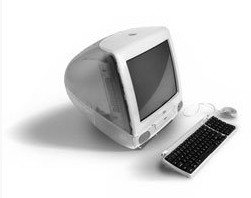
THE iMAC
Hello (Again)
Back to the Future
The first great design triumph to come from the
Jobs-Ive collaboration was the iMac, a desktop
computer aimed at the home consumer market that was
introduced in May 1998. Jobs had certain
specifications. It should be an all-in-one product, with
keyboard and monitor and computer ready to use right
out of the box. It should have a distinctive design that
made a brand statement. And it should sell for $1,200
or so. (Apple had no computer selling for less than
$2,000 at the time.) “He told us to go back to the roots of
the original 1984 Macintosh, an all-in-one consumer
appliance,” recalled Schiller. “That meant design and
engineering had to work together.”
The initial plan was to build a “network computer,”
Steve Jobs by Walter Isaacson
458
a concept championed by Oracle’s Larry Ellison, which
was an inexpensive terminal without a hard drive that
would mainly be used to connect to the Internet and
other networks. But Apple’s chief financial officer Fred
Anderson led the push to make the product more robust
by adding a disk drive so it could become a full-fledged
desktop computer for the home. Jobs eventually
agreed.
Jon Rubinstein, who was in charge of hardware,
adapted the microprocessor and guts of the PowerMac
G3, Apple’s high-end professional computer, for use in
the proposed new machine. It would have a hard drive
and a tray for compact disks, but in a rather bold move,
Jobs and Rubinstein decided not to include the usual
floppy disk drive. Jobs quoted the hockey star Wayne
Gretzky’s maxim, “Skate where the puck’s going, not
where it’s been.” He was a bit ahead of his time, but
eventually most computers eliminated floppy disks.
Ive and his top deputy, Danny Coster, began to
sketch out futuristic designs. Jobs brusquely rejected
the dozen foam models they initially produced, but Ive
knew how to guide him gently. Ive agreed that none of
them was quite right, but he pointed out one that had
promise. It was curved, playful looking, and did not
seem like an unmovable slab rooted to the table. “It has
a sense that it’s just arrived on your desktop or it’s just
about to hop off and go somewhere,” he told Jobs.
By the next showing Ive had refined the playful
model. This time Jobs, with his binary view of the world,
raved that he loved it. He took the foam prototype and
began carrying it around the headquarters with him,
showing it in confidence to trusted lieutenants and
board members. In its ads Apple was celebrating the
glories of being able to think different, yet until now
nothing had been proposed that was much different
from existing computers. Finally, Jobs had something
Steve Jobs by Walter Isaacson
459
new.
The plastic casing that Ive and Coster proposed
was sea-green blue, later named bondi blue after the
color of the water at a beach in Australia, and it was
translucent so that you could see through to the inside
of the machine. “We were trying to convey a sense of
the computer being changeable based on your needs,
to be like a chameleon,” said Ive. “That’s why we liked
the translucency. You could have color but it felt so
unstatic. And it came across as cheeky.”
Both metaphorically and in reality, the
translucency connected the inner engineering of the
computer to the outer design. Jobs had always insisted
that the rows of chips on the circuit boards look neat,
even though they would never be seen. Now they
would be seen. The casing would make visible the care
that had gone into making all components of the
computer and fitting them together. The playful design
would convey simplicity while also revealing the depths
that true simplicity entails.
Even the simplicity of the plastic shell itself
involved great complexity. Ive and his team worked with
Apple’s Korean manufacturers to perfect the process of
making the cases, and they even went to a jelly bean
factory to study how to make translucent colors look
enticing. The cost of each case was more than $60 per
unit, three times that of a regular computer case. Other
companies would probably have demanded
presentations and studies to show whether the
translucent case would increase sales enough to justify
the extra cost. Jobs asked for no such analysis.
Topping off the design was the handle nestled into
the iMac. It was more playful and semiotic than it was
functional. This was a desktop computer; not many
people were really going to carry it around. But as Ive
later explained:
Steve Jobs by Walter Isaacson
460
Back then, people weren’t comfortable with
technology. If you’re scared of something, then you
won’t touch it. I could see my mum being scared to
touch it. So I thought, if there’s this handle on it, it makes
a relationship possible. It’s approachable. It’s intuitive. It
gives you permission to touch. It gives a sense of its
deference to you. Unfortunately, manufacturing a
recessed handle costs a lot of money. At the old Apple, I
would have lost the argument. What was really great
about Steve is that he saw it and said, “That’s cool!” I
didn’t explain all the thinking, but he intuitively got it. He
just knew that it was part of the iMac’s friendliness and
playfulness.
Jobs had to fend off the objections of the
manufacturing engineers, supported by Rubinstein,
who tended to raise practical cost considerations when
faced with Ive’s aesthetic desires and various design
whims. “When we took it to the engineers,” Jobs said,
“they came up with thirty-eight reasons they couldn’t do
it. And I said, ‘No, no, we’re doing this.’ And they said,
‘Well, why?’ And I said, ‘Because I’m the CEO, and I
think it can be done.’ And so they kind of grudgingly did
it.”
Jobs asked Lee Clow and Ken Segall and others
from the TBWAad team to fly up to see what he had in
the works. He brought them into the guarded design
studio and dramatically unveiled Ive’s translucent
teardrop-shaped design, which looked like something
from
The Jetsons
, the animated TV show set in the
future. For a moment they were taken aback. “We were
pretty shocked, but we couldn’t be frank,” Segall
recalled. “We were really thinking, ‘Jesus, do they know
what they are doing?’ It was so radical.” Jobs asked
them to suggest names. Segall came back with five
options, one of them “iMac.” Jobs didn’t like any of them
at first, so Segall came up with another list a week later,
Steve Jobs by Walter Isaacson
461
but he said that the agency still preferred “iMac.” Jobs
replied, “I don’t hate it this week, but I still don’t like it.”
He tried silk-screening it on some of the prototypes, and
the name grew on him. And thus it became the iMac.
As the deadline for completing the iMac drew
near, Jobs’s legendary temper reappeared in force,
especially when he was confronting manufacturing
issues. At one product review meeting, he learned that
the process was going slowly. “He did one of his
displays of awesome fury, and the fury was absolutely
pure,” recalled Ive. He went around the table assailing
everyone, starting with Rubinstein. “You know we’re
trying to save the company here,” he shouted, “and you
guys are screwing it up!”
Like the original Macintosh team, the iMac crew
staggered to completion just in time for the big
announcement. But not before Jobs had one last
explosion. When it came time to rehearse for the launch
presentation, Rubinstein cobbled together two working
prototypes. Jobs had not seen the final product before,
and when he looked at it onstage he saw a button on
the front, under the display. He pushed it and the CD
tray opened. “What the fuck is this?!?” he asked, though
not as politely. “None of us said anything,” Schiller
recalled, “because he obviously knew what a CD tray
was.” So Jobs continued to rail. It was supposed to
have a clean CD slot, he insisted, referring to the
elegant slot drives that were already to be found in
upscale cars. “Steve, this is exactly the drive I showed
you when we talked about the components,” Rubinstein
explained. “No, there was never a tray, just a slot,” Jobs
insisted. Rubinstein didn’t back down. Jobs’s fury didn’t
abate. “I almost started crying, because it was too late to
do anything about it,” Jobs later recalled.
They suspended the rehearsal, and for a while it
seemed as if Jobs might cancel the entire product
Steve Jobs by Walter Isaacson
462
launch. “Ruby looked at me as if to say, ‘Am I crazy?’”
Schiller recalled. “It was my first product launch with
Steve and the first time I saw his mind-set of ‘If it’s not
right we’re not launching it.’” Finally, they agreed to
replace the tray with a slot drive for the next version of
the iMac. “I’m only going to go ahead with the launch if
you promise we’re going to go to slot mode as soon as
possible,” Jobs said tearfully.
There was also a problem with the video he
planned to show. In it, Jony Ive is shown describing his
design thinking and asking, “What computer would the
Jetsons have had? It was like, the future yesterday.” At
that moment there was a two-second snippet from the
cartoon show, showing Jane Jetson looking at a video
screen, followed by another two-second clip of the
Jetsons giggling by a Christmas tree. At a rehearsal a
production assistant told Jobs they would have to
remove the clips because Hanna-Barbera had not
given permission to use them. “Keep it in,” Jobs barked
at him. The assistant explained that there were rules
against that. “I don’t care,” Jobs said. “We’re using it.”
The clip stayed in.
Lee Clow was preparing a series of colorful
magazine ads, and when he sent Jobs the page proofs
he got an outraged phone call in response. The blue in
the ad, Jobs insisted, was different from that of the iMac.
“You guys don’t know what you’re doing!” Jobs
shouted. “I’m going to get someone else to do the ads,
because this is fucked up.” Clow argued back.
Compare them, he said. Jobs, who was not in the office,
insisted he was right and continued to shout. Eventually
Clow got him to sit down with the original photographs.
“I finally proved to him that the blue was the blue was
the blue.” Years later, on a Steve Jobs discussion board
on the website Gawker, the following tale appeared
from someone who had worked at the Whole Foods
Steve Jobs by Walter Isaacson
463
store in Palo Alto a few blocks from Jobs’s home: “I was
shagging carts one afternoon when I saw this silver
Mercedes parked in a handicapped spot. Steve Jobs
was inside screaming at his car phone. This was right
before the first iMac was unveiled and I’m pretty sure I
could make out, ‘Not. Fucking. Blue. Enough!!!’”
As always, Jobs was compulsive in preparing for
the dramatic unveiling. Having stopped one rehearsal
because he was angry about the CD drive tray, he
stretched out the other rehearsals to make sure the
show would be stellar. He repeatedly went over the
climactic moment when he would walk across the stage
and proclaim, “Say hello to the new iMac.” He wanted
the lighting to be perfect so that the translucence of the
new machine would be vivid. But after a few run-
throughs he was still unsatisfied, an echo of his
obsession with stage lighting that Sculley had
witnessed at the rehearsals for the original 1984
Macintosh launch. He ordered the lights to be brighter
and come on earlier, but that still didn’t please him. So
he jogged down the auditorium aisle and slouched into
a center seat, draping his legs over the seat in front.
“Let’s keep doing it till we get it right, okay?” he said.
They made another attempt. “No, no,” Jobs complained.
“This isn’t working at all.” The next time, the lights were
bright enough, but they came on too late. “I’m getting
tired of asking about this,” Jobs growled. Finally, the
iMac shone just right. “Oh! Right there! That’s great!”
Jobs yelled.
A year earlier Jobs had ousted Mike Markkula, his
early mentor and partner, from the board. But he was so
proud of what he had wrought with the new iMac, and
so sentimental about its connection to the original
Macintosh, that he invited Markkula to Cupertino for a
private preview. Markkula was impressed. His only
objection was to the new mouse that Ive had designed.
Steve Jobs by Walter Isaacson
464
It looked like a hockey puck, Markkula said, and people
would hate it. Jobs disagreed, but Markkula was right.
Otherwise the machine had turned out to be, as had its
predecessor, insanely great.
The Launch, May 6, 1998
With the launch of the original Macintosh in 1984,
Jobs had created a new kind of theater: the product
debut as an epochal event, climaxed by a let-there-be-
light moment in which the skies part, a light shines
down, the angels sing, and a chorus of the chosen
faithful sings “Hallelujah.” For the grand unveiling of the
product that he hoped would save Apple and again
transform personal computing, Jobs symbolically chose
the Flint Auditorium of De Anza Community College in
Cupertino, the same venue he had used in 1984. He
would be pulling out all the stops in order to dispel
doubts, rally the troops, enlist support in the developers’
community, and jump-start the marketing of the new
machine. But he was also doing it because he enjoyed
playing impresario. Putting on a great show piqued his
passions in the same way as putting out a great
product.
Displaying his sentimental side, he began with a
graceful shout-out to three people he had invited to be
up front in the audience. He had become estranged
from all of them, but now he wanted them rejoined. “I
started the company with Steve Wozniak in my parents’
garage, and Steve is here today,” he said, pointing him
out and prompting applause. “We were joined by Mike
Markkula and soon after that our first president, Mike
Scott,” he continued. “Both of those folks are in the
audience today. And none of us would be here without
these three guys.” His eyes misted for a moment as the
applause again built. Also in the audience were Andy
Hertzfeld and most of the original Mac team. Jobs gave
them a smile. He believed he was about to do them
Steve Jobs by Walter Isaacson
465
proud.
After showing the grid of Apple’s new product
strategy and going through some slides about the new
computer’s performance, he was ready to unveil his
new baby. “This is what computers look like today,” he
said as a picture of a beige set of boxy components and
monitor was projected on the big screen behind him.
“And I’d like to take the privilege of showing you what
they are going to look like from today on.” He pulled the
cloth from the table at center stage to reveal the new
iMac, which gleamed and sparkled as the lights came
up on cue. He pressed the mouse, and as at the launch
of the original Macintosh, the screen flashed with fast-
paced images of all the wondrous things the computer
could do. At the end, the word “hello” appeared in the
same playful script that had adorned the 1984
Macintosh, this time with the word “again” below it in
parentheses:
Hello (again).
There was thunderous
applause. Jobs stood back and proudly gazed at his
new Macintosh. “It looks like it’s from another planet,”
he said, as the audience laughed. “A good planet. A
planet with better designers.”
Once again Jobs had produced an iconic new
product, this one a harbinger of a new millennium. It
fulfilled the promise of “Think Different.” Instead of beige
boxes and monitors with a welter of cables and a bulky
setup manual, here was a friendly and spunky
appliance, smooth to the touch and as pleasing to the
eye as a robin’s egg. You could grab its cute little
handle and lift it out of the elegant white box and plug it
right into a wall socket. People who had been afraid of
computers now wanted one, and they wanted to put it in
a room where others could admire and perhaps covet it.
“A piece of hardware that blends sci-fi shimmer with the
kitsch whimsy of a cocktail umbrella,” Steven Levy
wrote in
Newsweek
, “it is not only the coolest-looking
Steve Jobs by Walter Isaacson
466
computer introduced in years, but a chest-thumping
statement that Silicon Valley’s original dream company
is no longer somnambulant.”
Forbes
called it “an
industry-altering success,” and John Sculley later came
out of exile to gush, “He has implemented the same
simple strategy that made Apple so successful 15 years
ago: make hit products and promote them with terrific
marketing.”
Carping was heard from only one familiar corner.
As the iMac garnered kudos, Bill Gates assured a
gathering of financial analysts visiting Microsoft that this
would be a passing fad. “The one thing Apple’s
providing now is leadership in colors,” Gates said as he
pointed to a Windows-based PC that he jokingly had
painted red. “It won’t take long for us to catch up with
that, I don’t think.” Jobs was furious, and he told a
reporter that Gates, the man he had publicly decried for
being completely devoid of taste, was clueless about
what made the iMac so much more appealing than
other computers. “The thing that our competitors are
missing is that they think it’s about fashion, and they
think it’s about surface appearance,” he said. “They say,
We’ll slap a little color on this piece of junk computer,
and we’ll have one, too.”
The iMac went on sale in August 1998 for $1,299.
It sold 278,000 units in its first six weeks, and would sell
800,000 by the end of the year, making it the fastest-
selling computer in Apple history. Most notably, 32% of
the sales went to people who were buying a computer
for the first time, and another 12% to people who had
been using Windows machines.
Ive soon came up with four new juicy-looking
colors, in addition to bondi blue, for the iMacs. Offering
the same computer in five colors would of course create
huge challenges for manufacturing, inventory, and
distribution. At most companies, including even the old
Steve Jobs by Walter Isaacson
467
Apple, there would have been studies and meetings to
look at the costs and benefits. But when Jobs looked at
the new colors, he got totally psyched and summoned
other executives over to the design studio. “We’re going
to do all sorts of colors!” he told them excitedly. When
they left, Ive looked at his team in amazement. “In most
places that decision would have taken months,” Ive
recalled. “Steve did it in a half hour.”
There was one other important refinement that
Jobs wanted for the iMac: getting rid of that detested CD
tray. “I’d seen a slot-load drive on a very high-end Sony
stereo,” he said, “so I went to the drive manufacturers
and got them to do a slot-load drive for us for the
version of the iMac we did nine months later.”
Rubinstein tried to argue him out of the change. He
predicted that new drives would come along that could
burn music onto CDs rather than merely play them, and
they would be available in tray form before they were
made to work in slots. “If you go to slots, you will always
be behind on the technology,” Rubinstein argued.
“I don’t care, that’s what I want,” Jobs snapped
back. They were having lunch at a sushi bar in San
Francisco, and Jobs insisted that they continue the
conversation over a walk. “I want you to do the slot-load
drive for me as a personal favor,” Jobs asked.
Rubinstein agreed, of course, but he turned out to be
right. Panasonic came out with a CD drive that could rip
and burn music, and it was available first for computers
that had old-fashioned tray loaders. The effects of this
would ripple over the next few years: It would cause
Apple to be slow in catering to users who wanted to rip
and burn their own music, but that would then force
Apple to be imaginative and bold in finding a way to
leapfrog over its competitors when Jobs finally realized
that he had to get into the music market.
Steve Jobs by Walter Isaacson
468
Steve Jobs by Walter Isaacson
469
CHAPTER TWENTY-EIGHT
Steve Jobs by Walter Isaacson
470
CEO
Still Crazy after All These Years
Tim Cook and Jobs, 2007
Tim Cook
When Steve Jobs returned to Apple and produced
the “Think Different” ads and the iMac in his first year, it
confirmed what most people already knew: that he
could be creative and a visionary. He had shown that
during his first round at Apple. What was less clear was
whether he could run a company. He had definitely
not
shown that during his first round.
Jobs threw himself into the task with a detail-
oriented realism that astonished those who were used
to his fantasy that the rules of this universe need not
apply to him. “He became a manager, which is different
from being an executive or visionary, and that
pleasantly surprised me,” recalled Ed Woolard, the
board chair who lured him back.
His management mantra was “Focus.” He
eliminated excess product lines and cut extraneous
features in the new operating system software that
Apple was developing. He let go of his control-freak
desire to manufacture products in his own factories and
instead outsourced the making of everything from the
circuit boards to the finished computers. And he
enforced on Apple’s suppliers a rigorous discipline.
When he took over, Apple had more than two months’
worth of inventory sitting in warehouses, more than any
other tech company. Like eggs and milk, computers
have a short shelf life, so this amounted to at least a
Steve Jobs by Walter Isaacson
471
$500 million hit to profits. By early 1998 he had halved
that to a month.
Jobs’s successes came at a cost, since velvety
diplomacy was still not part of his repertoire. When he
decided that a division of Airborne Express wasn’t
delivering spare parts quickly enough, he ordered an
Apple manager to break the contract. When the
manager protested that doing so could lead to a
lawsuit, Jobs replied, “Just tell them if they fuck with us,
they’ll never get another fucking dime from this
company, ever.” The manager quit, there was a lawsuit,
and it took a year to resolve. “My stock options would be
worth $10 million had I stayed,” the manager said, “but I
knew I couldn’t have stood it—and he’d have fired me
anyway.” The new distributor was ordered to cut
inventory 75%, and did. “Under Steve Jobs, there’s zero
tolerance for not performing,” its CEO said. At another
point, when VLSI Technology was having trouble
delivering enough chips on time, Jobs stormed into a
meeting and started shouting that they were “fucking
dickless assholes.” The company ended up getting the
chips to Apple on time, and its executives made jackets
that boasted on the back, “Team FDA.”
After three months of working under Jobs, Apple’s
head of operations decided he could not bear the
pressure, and he quit. For almost a year Jobs ran
operations himself, because all the prospects he
interviewed “seemed like they were old-wave
manufacturing people,” he recalled. He wanted
someone who could build just-in-time factories and
supply chains, as Michael Dell had done. Then, in
1998, he met Tim Cook, a courtly thirty-seven-year-old
procurement and supply chain manager at Compaq
Computers, who not only would become his operations
manager but would grow into an indispensable
backstage partner in running Apple. As Jobs recalled:
Steve Jobs by Walter Isaacson
472
Tim Cook came out of procurement, which is just
the right background for what we needed. I realized that
he and I saw things exactly the same way. I had visited
a lot of just-in-time factories in Japan, and I’d built one
for the Mac and at NeXT. I knew what I wanted, and I
met Tim, and he wanted the same thing. So we started
to work together, and before long I trusted him to know
exactly what to do. He had the same vision I did, and
we could interact at a high strategic level, and I could
just forget about a lot of things unless he came and
pinged me.
Cook, the son of a shipyard worker, was raised in
Robertsdale, Alabama, a small town between Mobile
and Pensacola a half hour from the Gulf Coast. He
majored in industrial engineering at Auburn, got a
business degree at Duke, and for the next twelve years
worked for IBM in the Research Triangle of North
Carolina. When Jobs interviewed him, he had recently
taken a job at Compaq. He had always been a very
logical engineer, and Compaq then seemed a more
sensible career option, but he was snared by Jobs’s
aura. “Five minutes into my initial interview with Steve, I
wanted to throw caution and logic to the wind and join
Apple,” he later said. “My intuition told me that joining
Apple would be a once-in-a-lifetime opportunity to work
for a creative genius.” And so he did. “Engineers are
taught to make a decision analytically, but there are
times when relying on gut or intuition is most
indispensable.”
At Apple his role became implementing Jobs’s
intuition, which he accomplished with a quiet diligence.
Never married, he threw himself into his work. He was
up most days at 4:30 sending emails, then spent an
hour at the gym, and was at his desk shortly after 6. He
scheduled Sunday evening conference calls to prepare
for each week ahead. In a company that was led by a
Steve Jobs by Walter Isaacson
473
CEO prone to tantrums and withering blasts, Cook
commanded situations with a calm demeanor, a
soothing Alabama accent, and silent stares. “Though
he’s capable of mirth, Cook’s default facial expression
is a frown, and his humor is of the dry variety,” Adam
Lashinsky wrote in
Fortune.
“In meetings he’s known for
long, uncomfortable pauses, when all you hear is the
sound of his tearing the wrapper off the energy bars he
constantly eats.”
At a meeting early in his tenure, Cook was told of a
problem with one of Apple’s Chinese suppliers. “This is
really bad,” he said. “Someone should be in China
driving this.” Thirty minutes later he looked at an
operations executive sitting at the table and
unemotionally asked, “Why are you still here?” The
executive stood up, drove directly to the San Francisco
airport, and bought a ticket to China. He became one of
Cook’s top deputies.
Cook reduced the number of Apple’s key suppliers
from a hundred to twenty-four, forced them to cut better
deals to keep the business, convinced many to locate
next to Apple’s plants, and closed ten of the company’s
nineteen warehouses. By reducing the places where
inventory could pile up, he reduced inventory. Jobs had
cut inventory from two months’ worth of product down to
one by early 1998. By September of that year, Cook
had gotten it down to six days. By the following
September, it was down to an amazing two days’ worth.
In addition, he cut the production process for making an
Apple computer from four months to two. All of this not
only saved money, it also allowed each new computer
to have the very latest components available.
Mock Turtlenecks and Teamwork
On a trip to Japan in the early 1980s, Jobs asked
Sony’s chairman, Akio Morita, why everyone in his
company’s factories wore uniforms. “He looked very
Steve Jobs by Walter Isaacson
474
ashamed and told me that after the war, no one had any
clothes, and companies like Sony had to give their
workers something to wear each day,” Jobs recalled.
Over the years the uniforms developed their own
signature style, especially at companies such as Sony,
and it became a way of bonding workers to the
company. “I decided that I wanted that type of bonding
for Apple,” Jobs recalled.
Sony, with its appreciation for style, had gotten the
famous designer Issey Miyake to create one of its
uniforms. It was a jacket made of ripstop nylon with
sleeves that could unzip to make it a vest. “So I called
Issey and asked him to design a vest for Apple,” Jobs
recalled. “I came back with some samples and told
everyone it would be great if we would all wear these
vests. Oh man, did I get booed off the stage. Everybody
hated the idea.”
In the process, however, he became friends with
Miyake and would visit him regularly. He also came to
like the idea of having a uniform for himself, because of
both its daily convenience (the rationale he claimed)
and its ability to convey a signature style. “So I asked
Issey to make me some of his black turtlenecks that I
liked, and he made me like a hundred of them.” Jobs
noticed my surprise when he told this story, so he
gestured to them stacked up in the closet. “That’s what I
wear,” he said. “I have enough to last for the rest of my
life.”
Despite his autocratic nature—he never
worshipped at the altar of consensus—Jobs worked
hard to foster a culture of collaboration at Apple. Many
companies pride themselves on having few meetings.
Jobs had many: an executive staff session every
Monday, a marketing strategy session all Wednesday
afternoon, and endless product review sessions. Still
allergic to PowerPoints and formal presentations, he
Steve Jobs by Walter Isaacson
475
insisted that the people around the table hash out
issues from various vantages and the perspectives of
different departments.
Because he believed that Apple’s great advantage
was its integration of the whole widget—from design to
hardware to software to content—he wanted all
departments at the company to work together in
parallel. The phrases he used were “deep
collaboration” and “concurrent engineering.” Instead of
a development process in which a product would be
passed sequentially from engineering to design to
manufacturing to marketing and distribution, these
various departments collaborated simultaneously. “Our
method was to develop integrated products, and that
meant our process had to be integrated and
collaborative,” Jobs said.
This approach also applied to key hires. He would
have candidates meet the top leaders—Cook,
Tevanian, Schiller, Rubinstein, Ive—rather than just the
managers of the department where they wanted to
work. “Then we all get together without the person and
talk about whether they’ll fit in,” Jobs said. His goal was
to be vigilant against “the bozo explosion” that leads to
a company’s being larded with second-rate talent:
For most things in life, the range between best and
average is 30% or so. The best airplane flight, the best
meal, they may be 30% better than your average one.
What I saw with Woz was somebody who was fifty times
better than the average engineer. He could have
meetings in his head. The Mac team was an attempt to
build a whole team like that, A players. People said they
wouldn’t get along, they’d hate working with each other.
But I realized that A players like to work with A players,
they just didn’t like working with C players. At Pixar, it
was a whole company of A players. When I got back to
Apple, that’s what I decided to try to do. You need to
Steve Jobs by Walter Isaacson
476
have a collaborative hiring process. When we hire
someone, even if they’re going to be in marketing, I will
have them talk to the design folks and the engineers.
My role model was J. Robert Oppenheimer. I read
about the type of people he sought for the atom bomb
project. I wasn’t nearly as good as he was, but that’s
what I aspired to do.
The process could be intimidating, but Jobs had
an eye for talent. When they were looking for people to
design the graphical interface for Apple’s new
operating system, Jobs got an email from a young man
and invited him in. The applicant was nervous, and the
meeting did not go well. Later that day Jobs bumped
into him, dejected, sitting in the lobby. The guy asked if
he could just show him one of his ideas, so Jobs looked
over his shoulder and saw a little demo, using Adobe
Director, of a way to fit more icons in the dock at the
bottom of a screen. When the guy moved the cursor
over the icons crammed into the dock, the cursor
mimicked a magnifying glass and made each icon
balloon bigger. “I said, ‘My God,’ and hired him on the
spot,” Jobs recalled. The feature became a lovable part
of Mac OSX, and the designer went on to design such
things as inertial scrolling for multi-touch screens (the
delightful feature that makes the screen keep gliding for
a moment after you’ve finished swiping).
Jobs’s experiences at NeXT had matured him, but
they had not mellowed him much. He still had no
license plate on his Mercedes, and he still parked in the
handicapped spaces next to the front door, sometimes
straddling two slots. It became a running gag.
Employees made signs saying, “Park Different,” and
someone painted over the handicapped wheelchair
symbol with a Mercedes logo.
People were allowed, even encouraged, to
challenge him, and sometimes he would respect them
Steve Jobs by Walter Isaacson
477
for it. But you had to be prepared for him to attack you,
even bite your head off, as he processed your ideas.
“You never win an argument with him at the time, but
sometimes you eventually win,” said James Vincent, the
creative young adman who worked with Lee Clow. “You
propose something and he declares, ‘That’s a stupid
idea,’ and later he comes back and says, ‘Here’s what
we’re going to do.’ And you want to say, ‘That’s what I
told you two weeks ago and you said that’s a stupid
idea.’ But you can’t do that. Instead you say, ‘That’s a
great idea, let’s do that.’”
People also had to put up with Jobs’s occasional
irrational or incorrect assertions. To both family and
colleagues, he was apt to declare, with great conviction,
some scientific or historical fact that had scant
relationship to reality. “There can be something he
knows absolutely nothing about, and because of his
crazy style and utter conviction, he can convince people
that he knows what he’s talking about,” said Ive, who
described the trait as weirdly endearing. Yet with his
eye for detail, Jobs sometimes correctly pounced on
tiny things others had missed. Lee Clow recalled
showing Jobs a cut of a commercial, making some
minor changes he requested, and then being assaulted
with a tirade about how the ad had been completely
destroyed. “He discovered we had cut two extra frames,
something so fleeting it was nearly impossible to
notice,” said Clow. “But he wanted to be sure that an
image hit at the exact moment as a beat of the music,
and he was totally right.”
From iCEO to CEO
Ed Woolard, his mentor on the Apple board,
pressed Jobs for more than two years to drop the
interim
in front of his CEO title. Not only was Jobs
refusing to commit himself, but he was baffling
everyone by taking only $1 a year in pay and no stock
Steve Jobs by Walter Isaacson
478
options. “I make 50 cents for showing up,” he liked to
joke, “and the other 50 cents is based on performance.”
Since his return in July 1997, Apple stock had gone
from just under $14 to just over $102 at the peak of the
Internet bubble at the beginning of 2000. Woolard had
begged him to take at least a modest stock grant back
in 1997, but Jobs had declined, saying, “I don’t want the
people I work with at Apple to think I am coming back to
get rich.” Had he accepted that modest grant, it would
have been worth $400 million. Instead he made $2.50
during that period.
The main reason he clung to his
interim
designation was a sense of uncertainty about Apple’s
future. But as 2000 approached, it was clear that Apple
had rebounded, and it was because of him. He took a
long walk with Laurene and discussed what to most
people by now seemed a formality but to him was still a
big deal. If he dropped the
interim
designation, Apple
could be the base for all the things he envisioned,
including the possibility of getting Apple into products
beyond computers. He decided to do so.
Woolard was thrilled, and he suggested that the
board was willing to give him a massive stock grant.
“Let me be straight with you,” Jobs replied. “What I’d
rather have is an airplane. We just had a third kid. I
don’t like flying commercial. I like to take my family to
Hawaii. When I go east, I’d like to have pilots I know.”
He was never the type of person who could display
grace and patience in a commercial airplane or
terminal, even before the days of the TSA. Board
member Larry Ellison, whose plane Jobs sometimes
used (Apple paid $102,000 to Ellison in 1999 for Jobs’s
use of it), had no qualms. “Given what he’s
accomplished, we should give him five airplanes!”
Ellison argued. He later said, “It was the perfect thank-
you gift for Steve, who had saved Apple and gotten
Steve Jobs by Walter Isaacson
479
nothing in return.”
So Woolard happily granted Jobs’s wish, with a
Gulfstream V, and also offered him fourteen million
stock options. Jobs gave an unexpected response. He
wanted more: twenty million options. Woolard was
baffled and upset. The board had authority from the
stockholders to give out only fourteen million. “You said
you didn’t want any, and we gave you a plane, which
you did want,” Woolard said.
“I hadn’t been insisting on options before,” Jobs
replied, “but you suggested it could be up to 5% of the
company in options, and that’s what I now want.” It was
an awkward tiff in what should have been a celebratory
period. In the end, a complex solution was worked out
that granted him ten million shares in January 2000 that
were valued at the current price but timed to vest as if
granted in 1997, plus another grant due in 2001.
Making matters worse, the stock fell with the burst of the
Internet bubble. Jobs never exercised the options, and
at the end of 2001 he asked that they be replaced by a
new grant with a lower strike price. The wrestling over
options would come back to haunt the company.
Even if he didn’t profit from the options, at least he
got to enjoy the airplane. Not surprisingly he fretted
over how the interior would be designed. It took him
more than a year. He used Ellison’s plane as a starting
point and hired his designer. Pretty soon he was driving
her crazy. For example, Ellison’s had a door between
cabins with an open button and a close button. Jobs
insisted that his have a single button that toggled. He
didn’t like the polished stainless steel of the buttons, so
he had them replaced with brushed metal ones. But in
the end he got the plane he wanted, and he loved it. “I
look at his airplane and mine, and everything he
changed was better,” said Ellison.
At the January 2000 Macworld in San Francisco,
Steve Jobs by Walter Isaacson
480
Jobs rolled out the new Macintosh operating system,
OSX, which used some of the software that Apple had
bought from NeXT three years earlier. It was fitting, and
not entirely coincidental, that he was willing to
incorporate himself back at Apple at the same moment
as the NeXT OS was incorporated into Apple’s. Avie
Tevanian had taken the UNIX-related Mach kernel of
the NeXT operating system and turned it into the Mac
OS kernel, known as Darwin. It offered protected
memory, advanced networking, and preemptive
multitasking. It was precisely what the Macintosh
needed, and it would be the foundation of the Mac OS
henceforth. Some critics, including Bill Gates, noted that
Apple ended up not adopting the entire NeXT operating
system. There’s some truth to that, because Apple
decided not to leap into a completely new system but
instead to evolve the existing one. Application software
written for the old Macintosh system was generally
compatible with or easy to port to the new one, and a
Mac user who upgraded would notice a lot of new
features but not a whole new interface.
The fans at Macworld received the news with
enthusiasm, of course, and they especially cheered
when Jobs showed off the dock and how the icons in it
could be magnified by passing the cursor over them.
But the biggest applause came for the announcement
he reserved for his “Oh, and one more thing” coda. He
spoke about his duties at both Pixar and Apple, and
said that he had become comfortable that the situation
could work. “So I am pleased to announce today that
I’m going to drop the interim title,” he said with a big
smile. The crowd jumped to its feet, screaming as if the
Beatles had reunited. Jobs bit his lip, adjusted his wire
rims, and put on a graceful show of humility. “You guys
are making me feel funny now. I get to come to work
every day and work with the most talented people on
Steve Jobs by Walter Isaacson
481
the planet, at Apple and Pixar. But these jobs are team
sports. I accept your thanks on behalf of everybody at
Apple.”
Steve Jobs by Walter Isaacson
482
CHAPTER TWENTY-NINE
Steve Jobs by Walter Isaacson
483
APPLE STORES
Genius Bars and Siena Sandstone
New York’s Fifth Avenue store
The Customer Experience
Jobs hated to cede control of anything, especially
when it might affect the customer experience. But he
faced a problem. There was one part of the process he
didn’t control: the experience of buying an Apple
product in a store.
The days of the Byte Shop were over. Industry
sales were shifting from local computer specialty shops
to megachains and big box stores, where most clerks
had neither the knowledge nor the incentive to explain
the distinctive nature of Apple products. “All that the
Steve Jobs by Walter Isaacson
484
salesman cared about was a $50 spiff,” Jobs said.
Other computers were pretty generic, but Apple’s had
innovative features and a higher price tag. He didn’t
want an iMac to sit on a shelf between a Dell and a
Compaq while an uninformed clerk recited the specs of
each. “Unless we could find ways to get our message to
customers at the store, we were screwed.”
In great secrecy, Jobs began in late 1999 to
interview executives who might be able to develop a
string of Apple retail stores. One of the candidates had
a passion for design and the boyish enthusiasm of a
natural-born retailer: Ron Johnson, the vice president
for merchandising at Target, who was responsible for
launching distinctive-looking products, such as a
teakettle designed by Michael Graves. “Steve is very
easy to talk to,” said Johnson in recalling their first
meeting. “All of a sudden there’s a torn pair of jeans
and turtleneck, and he’s off and running about why he
needed great stores. If Apple is going to succeed, he
told me, we’re going to win on innovation. And you can’t
win on innovation unless you have a way to
communicate to customers.”
When Johnson came back in January 2000 to be
interviewed again, Jobs suggested that they take a
walk. They went to the sprawling 140-store Stanford
Shopping Mall at 8:30 a.m. The stores weren’t open yet,
so they walked up and down the entire mall repeatedly
and discussed how it was organized, what role the big
department stores played relative to the other stores,
and why certain specialty shops were successful.
They were still walking and talking when the
stores opened at 10, and they went into Eddie Bauer. It
had an entrance off the mall and another off the parking
lot. Jobs decided that Apple stores should have only
one entrance, which would make it easier to control the
experience. And the Eddie Bauer store, they agreed,
Steve Jobs by Walter Isaacson
485
was too long and narrow. It was important that
customers intuitively grasp the layout of a store as soon
as they entered.
There were no tech stores in the mall, and
Johnson explained why: The conventional wisdom was
that a consumer, when making a major and infrequent
purchase such as a computer, would be willing to drive
to a less convenient location, where the rent would be
cheaper. Jobs disagreed. Apple stores should be in
malls and on Main Streets—in areas with a lot of foot
traffic, no matter how expensive. “We may not be able to
get them to drive ten miles to check out our products,
but we can get them to walk ten feet,” he said. The
Windows users, in particular, had to be ambushed: “If
they’re passing by, they will drop in out of curiosity, if we
make it inviting enough, and once we get a chance to
show them what we have, we will win.”
Johnson said that the size of a store signaled the
importance of the brand. “Is Apple as big of a brand as
the Gap?” he asked. Jobs said it was much bigger.
Johnson replied that its stores should therefore be
bigger. “Otherwise you won’t be relevant.” Jobs
described Mike Markkula’s maxim that a good company
must “impute”—it must convey its values and
importance in everything it does, from packaging to
marketing. Johnson loved it. It definitely applied to a
company’s stores. “The store will become the most
powerful physical expression of the brand,” he
predicted. He said that when he was young he had
gone to the wood-paneled, art-filled mansion-like store
that Ralph Lauren had created at Seventy-second and
Madison in Manhattan. “Whenever I buy a polo shirt, I
think of that mansion, which was a physical expression
of Ralph’s ideals,” Johnson said. “Mickey Drexler did
that with the Gap. You couldn’t think of a Gap product
without thinking of the great Gap store with the clean
Steve Jobs by Walter Isaacson
486
space and wood floors and white walls and folded
merchandise.”
When they finished, they drove to Apple and sat in
a conference room playing with the company’s
products. There weren’t many, not enough to fill the
shelves of a conventional store, but that was an
advantage. The type of store they would build, they
decided, would benefit from having few products. It
would be minimalist and airy and offer a lot of places for
people to try out things. “Most people don’t know Apple
products,” Johnson said. “They think of Apple as a cult.
You want to move from a cult to something cool, and
having an awesome store where people can try things
will help that.” The stores would impute the ethos of
Apple products: playful, easy, creative, and on the
bright side of the line between hip and intimidating.
The Prototype
When Jobs finally presented the idea, the board
was not thrilled. Gateway Computers was going down
in flames after opening suburban stores, and Jobs’s
argument that his would do better because they would
be in more expensive locations was not, on its face,
reassuring. “Think different” and “Here’s to the crazy
ones” made for good advertising slogans, but the board
was hesitant to make them guidelines for corporate
strategy. “I’m scratching my head and thinking this is
crazy,” recalled Art Levinson, the CEO of Genentech
who joined the Apple board in 2000. “We are a small
company, a marginal player. I said that I’m not sure I
can support something like this.” Ed Woolard was also
dubious. “Gateway has tried this and failed, while Dell
is selling direct to consumers without stores and
succeeding,” he argued. Jobs was not appreciative of
too much pushback from the board. The last time that
happened, he had replaced most of the members. This
time, for personal reasons as well as being tired of
Steve Jobs by Walter Isaacson
487
playing tug-of-war with Jobs, Woolard decided to step
down. But before he did, the board approved a trial run
of four Apple stores.
Jobs did have one supporter on the board. In 1999
he had recruited the Bronx-born retailing prince Millard
“Mickey” Drexler, who as CEO of Gap had transformed
a sleepy chain into an icon of American casual culture.
He was one of the few people in the world who were as
successful and savvy as Jobs on matters of design,
image, and consumer yearnings. In addition, he had
insisted on end-to-end control: Gap stores sold only
Gap products, and Gap products were sold almost
exclusively in Gap stores. “I left the department store
business because I couldn’t stand not controlling my
own product, from how it’s manufactured to how it’s
sold,” Drexler said. “Steve is just that way, which is why
I think he recruited me.”
Drexler gave Jobs a piece of advice: Secretly build
a prototype of the store near the Apple campus, furnish
it completely, and then hang out there until you feel
comfortable with it. So Johnson and Jobs rented a
vacant warehouse in Cupertino. Every Tuesday for six
months, they convened an all-morning brainstorming
session there, refining their retailing philosophy as they
walked the space. It was the store equivalent of Ive’s
design studio, a haven where Jobs, with his visual
approach, could come up with innovations by touching
and seeing the options as they evolved. “I loved to
wander over there on my own, just checking it out,”
Jobs recalled.
Sometimes he made Drexler, Larry Ellison, and
other trusted friends come look. “On too many
weekends, when he wasn’t making me watch new
scenes from
Toy Story
, he made me go to the
warehouse and look at the mockups for the store,”
Ellison said. “He was obsessed by every detail of the
Steve Jobs by Walter Isaacson
488
aesthetic and the service experience. It got to the point
where I said, ‘Steve I’m not coming to see you if you’re
going to make me go to the store again.’”
Ellison’s company, Oracle, was developing
software for the handheld checkout system, which
avoided having a cash register counter. On each visit
Jobs prodded Ellison to figure out ways to streamline
the process by eliminating some unnecessary step,
such as handing over the credit card or printing a
receipt. “If you look at the stores and the products, you
will see Steve’s obsession with beauty as simplicity—
this Bauhaus aesthetic and wonderful minimalism,
which goes all the way to the checkout process in the
stores,” said Ellison. “It means the absolute minimum
number of steps. Steve gave us the exact, explicit
recipe for how he wanted the checkout to work.”
When Drexler came to see the prototype, he had
some criticisms: “I thought the space was too chopped
up and not clean enough. There were too many
distracting architectural features and colors.” He
emphasized that a customer should be able to walk into
a retail space and, with one sweep of the eye,
understand the flow. Jobs agreed that simplicity and
lack of distractions were keys to a great store, as they
were to a product. “After that, he nailed it,” said Drexler.
“The vision he had was complete control of the entire
experience of his product, from how it was designed
and made to how it was sold.”
In October 2000, near what he thought was the
end of the process, Johnson woke up in the middle of a
night before one of the Tuesday meetings with a painful
thought: They had gotten something fundamentally
wrong. They were organizing the store around each of
Apple’s main product lines, with areas for the
PowerMac, iMac, iBook, and PowerBook. But Jobs had
begun developing a new concept: the computer as a
Steve Jobs by Walter Isaacson
489
hub for all your digital activity. In other words, your
computer might handle video and pictures from your
cameras, and perhaps someday your music player and
songs, or your books and magazines. Johnson’s
predawn brainstorm was that the stores should
organize displays not just around the company’s four
lines of computers, but also around things people might
want to do. “For example, I thought there should be a
movie bay where we’d have various Macs and
PowerBooks running iMovie and showing how you can
import from your video camera and edit.”
Johnson arrived at Jobs’s office early that Tuesday
and told him about his sudden insight that they needed
to reconfigure the stores. He had heard tales of his
boss’s intemperate tongue, but he had not yet felt its
lash—until now. Jobs erupted. “Do you know what a big
change this is?” he yelled. “I’ve worked my ass off on
this store for six months, and now you want to change
everything!” Jobs suddenly got quiet. “I’m tired. I don’t
know if I can design another store from scratch.”
Johnson was speechless, and Jobs made sure he
remained so. On the ride to the prototype store, where
people had gathered for the Tuesday meeting, he told
Johnson not to say a word, either to him or to the other
members of the team. So the seven-minute drive
proceeded in silence. When they arrived, Jobs had
finished processing the information. “I knew Ron was
right,” he recalled. So to Johnson’s surprise, Jobs
opened the meeting by saying, “Ron thinks we’ve got it
all wrong. He thinks it should be organized not around
products but instead around what people do.” There
was a pause, then Jobs continued. “And you know, he’s
right.” He said they would redo the layout, even though
it would likely delay the planned January rollout by
three or four months. “We’ve only got one chance to get
it right.”
Steve Jobs by Walter Isaacson
490
Jobs liked to tell the story—and he did so to his
team that day—about how everything that he had done
correctly had required a moment when he hit the rewind
button. In each case he had to rework something that
he discovered was not perfect. He talked about doing it
on
Toy Story
, when the character of Woody had evolved
into being a jerk, and on a couple of occasions with the
original Macintosh. “If something isn’t right, you can’t
just ignore it and say you’ll fix it later,” he said. “That’s
what other companies do.”
When the revised prototype was finally completed
in January 2001, Jobs allowed the board to see it for
the first time. He explained the theories behind the
design by sketching on a whiteboard; then he loaded
board members into a van for the two-mile trip. When
they saw what Jobs and Johnson had built, they
unanimously approved going ahead. It would, the
board agreed, take the relationship between retailing
and brand image to a new level. It would also ensure
that consumers did not see Apple computers as merely
a commodity product like Dell or Compaq.
Most outside experts disagreed. “Maybe it’s time
Steve Jobs stopped thinking quite so differently,”
Business Week
wrote in a story headlined “Sorry Steve,
Here’s Why Apple Stores Won’t Work.” Apple’s former
chief financial officer, Joseph Graziano, was quoted as
saying, “Apple’s problem is it still believes the way to
grow is serving caviar in a world that seems pretty
content with cheese and crackers.” And the retail
consultant David Goldstein declared, “I give them two
years before they’re turning out the lights on a very
painful and expensive mistake.”
Wood, Stone, Steel, Glass
On May 19, 2001, the first Apple store opened in
Tyson’s Corner, Virginia, with gleaming white counters,
bleached wood floors, and a huge “Think Different”
Steve Jobs by Walter Isaacson
491
poster of John and Yoko in bed. The skeptics were
wrong. Gateway stores had been averaging 250 visitors
a week. By 2004 Apple stores were averaging 5,400
per week. That year the stores had $1.2 billion in
revenue, setting a record in the retail industry for
reaching the billion-dollar milestone. Sales in each
store were tabulated every four minutes by Ellison’s
software, giving instant information on how to integrate
manufacturing, supply, and sales channels.
As the stores flourished, Jobs stayed involved in
every aspect. Lee Clow recalled, “In one of our
marketing meetings just as the stores were opening,
Steve made us spend a half hour deciding what hue of
gray the restroom signs should be.” The architectural
firm of Bohlin Cywinski Jackson designed the signature
stores, but Jobs made all of the major decisions.
Jobs particularly focused on the staircases, which
echoed the one he had built at NeXT. When he visited a
store as it was being constructed, he invariably
suggested changes to the staircase. His name is listed
as the lead inventor on two patent applications on the
staircases, one for the see-through look that features
all-glass treads and glass supports melded together
with titanium, the other for the engineering system that
uses a monolithic unit of glass containing multiple glass
sheets laminated together for supporting loads.
In 1985, as he was being ousted from his first tour
at Apple, he had visited Italy and been impressed by
the gray stone of Florence’s sidewalks. In 2002, when
he came to the conclusion that the light wood floors in
the stores were beginning to look somewhat pedestrian
—a concern that it’s hard to imagine bedeviling
someone like Microsoft CEO Steve Ballmer—Jobs
wanted to use that stone instead. Some of his
colleagues pushed to replicate the color and texture
using concrete, which would have been ten times
Steve Jobs by Walter Isaacson
492
cheaper, but Jobs insisted that it had to be authentic.
The gray-blue Pietra Serena sandstone, which has a
fine-grained texture, comes from a family-owned quarry,
Il Casone, in Firenzuola outside of Florence. “We select
only 3% of what comes out of the mountain, because it
has to have the right shading and veining and purity,”
said Johnson. “Steve felt very strongly that we had to
get the color right and it had to be a material with high
integrity.” So designers in Florence picked out just the
right quarried stone, oversaw cutting it into the proper
tiles, and made sure each tile was marked with a sticker
to ensure that it was laid out next to its companion tiles.
“Knowing that it’s the same stone that Florence uses for
its sidewalks assures you that it can stand the test of
time,” said Johnson.
Another notable feature of the stores was the
Genius Bar. Johnson came up with the idea on a two-
day retreat with his team. He had asked them all to
describe the best service they’d ever enjoyed. Almost
everyone mentioned some nice experience at a Four
Seasons or Ritz-Carlton hotel. So Johnson sent his first
five store managers through the Ritz-Carlton training
program and came up with the idea of replicating
something between a concierge desk and a bar. “What
if we staffed the bar with the smartest Mac people,” he
said to Jobs. “We could call it the Genius Bar.”
Jobs called the idea crazy. He even objected to
the name. “You can’t call them geniuses,” he said.
“They’re geeks. They don’t have the people skills to
deliver on something called the genius bar.” Johnson
thought he had lost, but the next day he ran into Apple’s
general counsel, who said, “By the way, Steve just told
me to trademark the name ‘genius bar.’”
Many of Jobs’s passions came together for
Manhattan’s Fifth Avenue store, which opened in 2006:
a cube, a signature staircase, glass, and making a
Steve Jobs by Walter Isaacson
493
maximum statement through minimalism. “It was really
Steve’s store,” said Johnson. Open 24/7, it vindicated
the strategy of finding signature high-traffic locations by
attracting fifty thousand visitors a week during its first
year. (Remember Gateway’s draw: 250 visitors a week.)
“This store grosses more per square foot than any store
in the world,” Jobs proudly noted in 2010. “It also
grosses more in total—absolute dollars, not just per
square foot—than any store in New York. That includes
Saks and Bloomingdale’s.”
Jobs was able to drum up excitement for store
openings with the same flair he used for product
releases. People began to travel to store openings and
spend the night outside so they could be among the first
in. “My then 14-year-old son suggested my first
overnighter at Palo Alto, and the experience turned into
an interesting social event,” wrote Gary Allen, who
started a website that caters to Apple store fans. “He
and I have done several overnighters, including five in
other countries, and have met so many great people.”
In July 2011, a decade after the first ones opened,
there were 326 Apple stores. The biggest was in
London’s Covent Garden, the tallest in Tokyo’s Ginza.
The average annual revenue per store was $34 million,
and the total net sales in fiscal 2010 were $9.8 billion.
But the stores did even more. They directly accounted
for only 15% of Apple’s revenue, but by creating buzz
and brand awareness they indirectly helped boost
everything the company did.
Even as he was fighting the effects of cancer in
2011, Jobs spent time envisioning future store projects,
such as the one he wanted to build in New York City’s
Grand Central Terminal. One afternoon he showed me
a picture of the Fifth Avenue store and pointed to the
eighteen pieces of glass on each side. “This was state
of the art in glass technology at the time,” he said. “We
Steve Jobs by Walter Isaacson
494
had to build our own autoclaves to make the glass.”
Then he pulled out a drawing in which the eighteen
panes were replaced by four huge panes. That is what
he wanted to do next, he said. Once again, it was a
challenge at the intersection of aesthetics and
technology. “If we wanted to do it with our current
technology, we would have to make the cube a foot
shorter,” he said. “And I didn’t want to do that. So we
have to build some new autoclaves in China.”
Ron Johnson was not thrilled by the idea. He
thought the eighteen panes actually looked better than
four panes would. “The proportions we have today work
magically with the colonnade of the GM Building,” he
said. “It glitters like a jewel box. I think if we get the
glass too transparent, it will almost go away to a fault.”
He debated the point with Jobs, but to no avail. “When
technology enables something new, he wants to take
advantage of that,” said Johnson. “Plus, for Steve, less
is always more, simpler is always better. Therefore, if
you can build a glass box with fewer elements, it’s
better, it’s simpler, and it’s at the forefront of technology.
That’s where Steve likes to be, in both his products and
his stores.”
Steve Jobs by Walter Isaacson
495
CHAPTER THIRTY
Steve Jobs by Walter Isaacson
496
THE DIGITAL HUB
From iTunes to the iPod
The original iPod, 2001
Connecting the Dots
Once a year Jobs took his most valuable
employees on a retreat, which he called “The Top 100.”
They were picked based on a simple guideline: the
people you would bring if you could take only a
hundred people with you on a lifeboat to your next
company. At the end of each retreat, Jobs would stand
in front of a whiteboard (he loved whiteboards because
they gave him complete control of a situation and they
engendered focus) and ask, “What are the ten things
we should be doing next?” People would fight to get
their suggestions on the list. Jobs would write them
down, and then cross off the ones he decreed dumb.
After much jockeying, the group would come up with a
list of ten. Then Jobs would slash the bottom seven and
announce, “We can only do three.”
By 2001 Apple had revived its personal computer
offerings. It was now time to think different. A set of new
possibilities topped the what-next list on his whiteboard
that year.
At the time, a pall had descended on the digital
realm. The dot-com bubble had burst, and the NASDAQ
had fallen more than 50% from its peak. Only three tech
companies had ads during the January 2001 Super
Bowl, compared to seventeen the year before. But the
sense of deflation went deeper. For the twenty-five
years since Jobs and Wozniak had founded Apple, the
Steve Jobs by Walter Isaacson
497
personal computer had been the centerpiece of the
digital revolution. Now experts were predicting that its
central role was ending. It had “matured into something
boring,” wrote the
Wall Street Journal
’s Walt Mossberg.
Jeff Weitzen, the CEO of Gateway, proclaimed, “We’re
clearly migrating away from the PC as the centerpiece.”
It was at that moment that Jobs launched a new
grand strategy that would transform Apple—and with it
the entire technology industry. The personal computer,
instead of edging toward the sidelines, would become a
“digital hub” that coordinated a variety of devices, from
music players to video recorders to cameras. You’d link
and sync all these devices with your computer, and it
would manage your music, pictures, video, text, and all
aspects of what Jobs dubbed your “digital lifestyle.”
Apple would no longer be just a computer company—
indeed it would drop that word from its name—but the
Macintosh would be reinvigorated by becoming the hub
for an astounding array of new gadgets, including the
iPod and iPhone and iPad.
When he was turning thirty, Jobs had used a
metaphor about record albums. He was musing about
why folks over thirty develop rigid thought patterns and
tend to be less innovative. “People get stuck in those
patterns, just like grooves in a record, and they never
get out of them,” he said. At age forty-five, Jobs was
now about to get out of his groove.
FireWire
Jobs’s vision that your computer could become
your digital hub went back to a technology called
FireWire, which Apple developed in the early 1990s. It
was a high-speed serial port that moved digital files
such as video from one device to another. Japanese
camcorder makers adopted it, and Jobs decided to
include it on the updated versions of the iMac that came
out in October 1999. He began to see that FireWire
Steve Jobs by Walter Isaacson
498
could be part of a system that moved video from
cameras onto a computer, where it could be edited and
distributed.
To make this work, the iMac needed to have great
video editing software. So Jobs went to his old friends
at Adobe, the digital graphics company, and asked
them to make a new Mac version of Adobe Premiere,
which was popular on Windows computers. Adobe’s
executives stunned Jobs by flatly turning him down. The
Macintosh, they said, had too few users to make it
worthwhile. Jobs was furious and felt betrayed. “I put
Adobe on the map, and they screwed me,” he later
claimed. Adobe made matters even worse when it also
didn’t write its other popular programs, such as
Photoshop, for the Mac OSX, even though the
Macintosh was popular among designers and other
creative people who used those applications.
Jobs never forgave Adobe, and a decade later he
got into a public war with the company by not permitting
Adobe Flash to run on the iPad. He took away a
valuable lesson that reinforced his desire for end-to-
end control of all key elements of a system: “My primary
insight when we were screwed by Adobe in 1999 was
that we shouldn’t get into any business where we didn’t
control both the hardware and the software, otherwise
we’d get our head handed to us.”
So starting in 1999 Apple began to produce
application software for the Mac, with a focus on people
at the intersection of art and technology. These
included Final Cut Pro, for editing digital video; iMovie,
which was a simpler consumer version; iDVD, for
burning video or music onto a disc; iPhoto, to compete
with Adobe Photoshop; GarageBand, for creating and
mixing music; iTunes, for managing your songs; and the
iTunes Store, for buying songs.
The idea of the digital hub quickly came into focus.
Steve Jobs by Walter Isaacson
499
“I first understood this with the camcorder,” Jobs said.
“Using iMovie makes your camcorder ten times more
valuable.” Instead of having hundreds of hours of raw
footage you would never really sit through, you could
edit it on your computer, make elegant dissolves, add
music, and roll credits, listing yourself as executive
producer. It allowed people to be creative, to express
themselves, to make something emotional. “That’s
when it hit me that the personal computer was going to
morph into something else.”
Jobs had another insight: If the computer served
as the hub, it would allow the portable devices to
become simpler. A lot of the functions that the devices
tried to do, such as editing the video or pictures, they
did poorly because they had small screens and could
not easily accommodate menus filled with lots of
functions. Computers could handle that more easily.
And one more thing . . . What Jobs also saw was
that this worked best when everything—the device,
computer, software, applications, FireWire—was all
tightly integrated. “I became even more of a believer in
providing end-to-end solutions,” he recalled.
The beauty of this realization was that there was
only one company that was well-positioned to provide
such an integrated approach. Microsoft wrote software,
Dell and Compaq made hardware, Sony produced a lot
of digital devices, Adobe developed a lot of
applications. But only Apple did all of these things.
“We’re the only company that owns the whole widget—
the hardware, the software and the operating system,”
he explained to
Time.
“We can take full responsibility for
the user experience. We can do things that the other
guys can’t do.”
Apple’s first integrated foray into the digital hub
strategy was video. With FireWire, you could get your
video onto your Mac, and with iMovie you could edit it
Steve Jobs by Walter Isaacson
500
into a masterpiece. Then what? You’d want to burn
some DVDs so you and your friends could watch it on a
TV. “So we spent a lot of time working with the drive
manufacturers to get a consumer drive that could burn a
DVD,” he said. “We were the first to ever ship that.” As
usual Jobs focused on making the product as simple as
possible for the user, and this was the key to its
success. Mike Evangelist, who worked at Apple on
software design, recalled demonstrating to Jobs an
early version of the interface. After looking at a bunch of
screenshots, Jobs jumped up, grabbed a marker, and
drew a simple rectangle on a whiteboard. “Here’s the
new application,” he said. “It’s got one window. You
drag your video into the window. Then you click the
button that says ‘Burn.’ That’s it. That’s what we’re
going to make.” Evangelist was dumbfounded, but it led
to the simplicity of what became iDVD. Jobs even
helped design the “Burn” button icon.
Jobs knew digital photography was also about to
explode, so Apple developed ways to make the
computer the hub of your photos. But for the first year at
least, he took his eye off one really big opportunity. HP
and a few others were producing a drive that burned
music CDs, but Jobs decreed that Apple should focus
on video rather than music. In addition, his angry
insistence that the iMac get rid of its tray disk drive and
use instead a more elegant slot drive meant that it could
not include the first CD burners, which were initially
made for the tray format. “We kind of missed the boat on
that,” he recalled. “So we needed to catch up real fast.”
The mark of an innovative company is not only that
it comes up with new ideas first, but also that it knows
how to leapfrog when it finds itself behind.
iTunes
It didn’t take Jobs long to realize that music was
going to be huge. By 2000 people were ripping music
Steve Jobs by Walter Isaacson
501
onto their computers from CDs, or downloading it from
file-sharing services such as Napster, and burning
playlists onto their own blank disks. That year the
number of blank CDs sold in the United States was 320
million. There were only 281 million people in the
country. That meant some people were
really
into
burning CDs, and Apple wasn’t catering to them. “I felt
like a dope,” he told
Fortune.
“I thought we had missed
it. We had to work hard to catch up.”
Jobs added a CD burner to the iMac, but that
wasn’t enough. His goal was to make it simple to
transfer music from a CD, manage it on your computer,
and then burn playlists. Other companies were already
making music-management applications, but they were
clunky and complex. One of Jobs’s talents was spotting
markets that were filled with second-rate products. He
looked at the music apps that were available—
including Real Jukebox, Windows Media Player, and
one that HP was including with its CD burner—and
came to a conclusion: “They were so complicated that
only a genius could figure out half of their features.”
That is when Bill Kincaid came in. A former Apple
software engineer, he was driving to a track in Willows,
California, to race his Formula Ford sports car while (a
bit incongruously) listening to National Public Radio.
He heard a report about a portable music player called
the Rio that played a digital song format called MP3. He
perked up when the reporter said something like, “Don’t
get excited, Mac users, because it won’t work with
Macs.” Kincaid said to himself, “Ha! I can fix that!”
To help him write a Rio manager for the Mac, he
called his friends Jeff Robbin and Dave Heller, also
former Apple software engineers. Their product, known
as SoundJam, offered Mac users an interface for the
Rio and software for managing the songs on their
computer. In July 2000, when Jobs was pushing his
Steve Jobs by Walter Isaacson
502
team to come up with music-management software,
Apple swooped in and bought SoundJam, bringing its
founders back into the Apple fold. (All three stayed with
the company, and Robbin continued to run the music
software development team for the next decade. Jobs
considered Robbin so valuable he once allowed a
Time
reporter to meet him only after extracting the
promise that the reporter would not print his last name.)
Jobs personally worked with them to transform
SoundJam into an Apple product. It was laden with all
sorts of features, and consequently a lot of complex
screens. Jobs pushed them to make it simpler and more
fun. Instead of an interface that made you specify
whether you were searching for an artist, song, or
album, Jobs insisted on a simple box where you could
type in anything you wanted. From iMovie the team
adopted the sleek brushed-metal look and also a name.
They dubbed it iTunes.
Jobs unveiled iTunes at the January 2001
Macworld as part of the digital hub strategy. It would be
free to all Mac users, he announced. “Join the music
revolution with iTunes, and make your music devices
ten times more valuable,” he concluded to great
applause. As his advertising slogan would later put it:
Rip. Mix. Burn.
That afternoon Jobs happened to be meeting with
John Markoff of the
New York Times.
The interview was
going badly, but at the end Jobs sat down at his Mac
and showed off iTunes. “It reminds me of my youth,” he
said as the psychedelic patterns danced on the screen.
That led him to reminisce about dropping acid. Taking
LSD was one of the two or three most important things
he’d done in his life, Jobs told Markoff. People who had
never taken acid would never fully understand him.
The iPod
The next step for the digital hub strategy was to
Steve Jobs by Walter Isaacson
503
make a portable music player. Jobs realized that Apple
had the opportunity to design such a device in tandem
with the iTunes software, allowing it to be simpler.
Complex tasks could be handled on the computer, easy
ones on the device. Thus was born the iPod, the device
that would begin the transformation of Apple from being
a computer maker into being the world’s most valuable
company.
Jobs had a special passion for the project
because he loved music. The music players that were
already on the market, he told his colleagues, “truly
sucked.” Phil Schiller, Jon Rubinstein, and the rest of
the team agreed. As they were building iTunes, they
spent time with the Rio and other players while merrily
trashing them. “We would sit around and say, ‘These
things really stink,’” Schiller recalled. “They held about
sixteen songs, and you couldn’t figure out how to use
them.”
Jobs began pushing for a portable music player in
the fall of 2000, but Rubinstein responded that the
necessary components were not available yet. He
asked Jobs to wait. After a few months Rubinstein was
able to score a suitable small LCD screen and
rechargeable lithium-polymer battery. The tougher
challenge was finding a disk drive that was small
enough but had ample memory to make a great music
player. Then, in February 2001, he took one of his
regular trips to Japan to visit Apple’s suppliers.
At the end of a routine meeting with Toshiba, the
engineers mentioned a new product they had in the lab
that would be ready by that June. It was a tiny, 1.8-inch
drive (the size of a silver dollar) that would hold five
gigabytes of storage (about a thousand songs), and
they were not sure what to do with it. When the Toshiba
engineers showed it to Rubinstein, he knew
immediately what it could be used for. A thousand
Steve Jobs by Walter Isaacson
504
songs in his pocket! Perfect. But he kept a poker face.
Jobs was also in Japan, giving the keynote speech at
the Tokyo Macworld conference. They met that night at
the Hotel Okura, where Jobs was staying. “I know how
to do it now,” Rubinstein told him. “All I need is a $10
million check.” Jobs immediately authorized it. So
Rubinstein started negotiating with Toshiba to have
exclusive rights to every one of the disks it could make,
and he began to look around for someone who could
lead the development team.
Tony Fadell was a brash entrepreneurial
programmer with a cyberpunk look and an engaging
smile who had started three companies while still at the
University of Michigan. He had gone to work at the
handheld device maker General Magic (where he met
Apple refugees Andy Hertzfeld and Bill Atkinson), and
then spent some awkward time at Philips Electronics,
where he bucked the staid culture with his short
bleached hair and rebellious style. He had come up
with some ideas for creating a better digital music
player, which he had shopped around unsuccessfully to
RealNetworks, Sony, and Philips. One day he was in
Colorado, skiing with an uncle, and his cell phone rang
while he was riding on the chairlift. It was Rubinstein,
who told him that Apple was looking for someone who
could work on a “small electronic device.” Fadell, not
lacking in confidence, boasted that he was a wizard at
making such devices. Rubinstein invited him to
Cupertino.
Fadell assumed that he was being hired to work
on a personal digital assistant, some successor to the
Newton. But when he met with Rubinstein, the topic
quickly turned to iTunes, which had been out for three
months. “We’ve been trying to hook up the existing MP3
players to iTunes and they’ve been horrible, absolutely
horrible,” Rubinstein told him. “We think we should
Steve Jobs by Walter Isaacson
505
make our own version.”
Fadell was thrilled. “I was passionate about music.
I was trying to do some of that at RealNetworks, and I
was pitching an MP3 player to Palm.” He agreed to
come aboard, at least as a consultant. After a few
weeks Rubinstein insisted that if he was to lead the
team, he had to become a full-time Apple employee.
But Fadell resisted; he liked his freedom. Rubinstein
was furious at what he considered Fadell’s whining.
“This is one of those life decisions,” he told Fadell.
“You’ll never regret it.”
He decided to force Fadell’s hand. He gathered a
roomful of the twenty or so people who had been
assigned to the project. When Fadell walked in,
Rubinstein told him, “Tony, we’re not doing this project
unless you sign on full-time. Are you in or out? You
have to decide right now.”
Fadell looked Rubinstein in the eye, then turned to
the audience and said, “Does this always happen at
Apple, that people are put under duress to sign an
offer?” He paused for a moment, said yes, and
grudgingly shook Rubinstein’s hand. “It left some very
unsettling feeling between Jon and me for many years,”
Fadell recalled. Rubinstein agreed: “I don’t think he
ever forgave me for that.”
Fadell and Rubinstein were fated to clash
because they both thought that they had fathered the
iPod. As Rubinstein saw it, he had been given the
mission by Jobs months earlier, found the Toshiba disk
drive, and figured out the screen, battery, and other key
elements. He had then brought in Fadell to put it
together. He and others who resented Fadell’s visibility
began to refer to him as “Tony Baloney.” But from
Fadell’s perspective, before he came to Apple he had
already come up with plans for a great MP3 player, and
he had been shopping it around to other companies
Steve Jobs by Walter Isaacson
506
before he had agreed to come to Apple. The issue of
who deserved the most credit for the iPod, or should get
the title Podfather, would be fought over the years in
interviews, articles, web pages, and even
Wikipedia
entries.
But for the next few months they were too busy to
bicker. Jobs wanted the iPod out by Christmas, and this
meant having it ready to unveil in October. They looked
around for other companies that were designing MP3
players that could serve as the foundation for Apple’s
work and settled on a small company named
PortalPlayer. Fadell told the team there, “This is the
project that’s going to remold Apple, and ten years from
now, it’s going to be a music business, not a computer
business.” He convinced them to sign an exclusive
deal, and his group began to modify PortalPlayer’s
deficiencies, such as its complex interfaces, short
battery life, and inability to make a playlist longer than
ten songs.
That’s It!
There are certain meetings that are memorable
both because they mark a historic moment and
because they illuminate the way a leader operates.
Such was the case with the gathering in Apple’s fourth-
floor conference room in April 2001, where Jobs
decided on the fundamentals of the iPod. There to hear
Fadell present his proposals to Jobs were Rubinstein,
Schiller, Ive, Jeff Robbin, and marketing director Stan
Ng. Fadell didn’t know Jobs, and he was
understandably intimidated. “When he walked into the
conference room, I sat up and thought, ‘Whoa, there’s
Steve!’ I was really on guard, because I’d heard how
brutal he could be.”
The meeting started with a presentation of the
potential market and what other companies were doing.
Jobs, as usual, had no patience. “He won’t pay
Steve Jobs by Walter Isaacson
507
attention to a slide deck for more than a minute,” Fadell
said. When a slide showed other possible players in the
market, he waved it away. “Don’t worry about Sony,” he
said. “We know what we’re doing, and they don’t.” After
that, they quit showing slides, and instead Jobs
peppered the group with questions. Fadell took away a
lesson: “Steve prefers to be in the moment, talking
things through. He once told me, ‘If you need slides, it
shows you don’t know what you’re talking about.’”
Instead Jobs liked to be shown physical objects
that he could feel, inspect, and fondle. So Fadell
brought three different models to the conference room;
Rubinstein had coached him on how to reveal them
sequentially so that his preferred choice would be the
pièce de résistance. They hid the mockup of that option
under a wooden bowl at the center of the table.
Fadell began his show-and-tell by taking the
various parts they were using out of a box and
spreading them on the table. There were the 1.8-inch
drive, LCD screen, boards, and batteries, all labeled
with their cost and weight. As he displayed them, they
discussed how the prices or sizes might come down
over the next year or so. Some of the pieces could be
put together, like Lego blocks, to show the options.
Then Fadell began unveiling his models, which
were made of Styrofoam with fishing leads inserted to
give them the proper weight. The first had a slot for a
removable memory card for music. Jobs dismissed it as
complicated. The second had dynamic RAM memory,
which was cheap but would lose all of the songs if the
battery ran out. Jobs was not pleased. Next Fadell put a
few of the pieces together to show what a device with
the 1.8-inch hard drive would be like. Jobs seemed
intrigued. The show climaxed with Fadell lifting the bowl
and revealing a fully assembled model of that
alternative. “I was hoping to be able to play more with
Steve Jobs by Walter Isaacson
508
the Lego parts, but Steve settled right on the hard-drive
option just the way we had modeled it,” Fadell recalled.
He was rather stunned by the process. “I was used to
being at Philips, where decisions like this would take
meeting after meeting, with a lot of PowerPoint
presentations and going back for more study.”
Next it was Phil Schiller’s turn. “Can I bring out my
idea now?” he asked. He left the room and returned
with a handful of iPod models, all of which had the
same device on the front: the soon-to-be-famous
trackwheel. “I had been thinking of how you go through
a playlist,” he recalled. “You can’t press a button
hundreds of times. Wouldn’t it be great if you could
have a wheel?” By turning the wheel with your thumb,
you could scroll through songs. The longer you kept
turning, the faster the scrolling got, so you could zip
through hundreds easily. Jobs shouted, “That’s it!” He
got Fadell and the engineers working on it.
Once the project was launched, Jobs immersed
himself in it daily. His main demand was “Simplify!” He
would go over each screen of the user interface and
apply a rigid test: If he wanted a song or a function, he
should be able to get there in three clicks. And the click
should be intuitive. If he couldn’t figure out how to
navigate to something, or if it took more than three
clicks, he would be brutal. “There would be times when
we’d rack our brains on a user interface problem, and
think we’d considered every option, and he would go,
‘Did you think of this?’” said Fadell. “And then we’d all
go, ‘Holy shit.’ He’d redefine the problem or approach,
and our little problem would go away.”
Every night Jobs would be on the phone with
ideas. Fadell and the others would call each other up,
discuss Jobs’s latest suggestion, and conspire on how
to nudge him to where they wanted him to go, which
worked about half the time. “We would have this
Steve Jobs by Walter Isaacson
509
swirling thing of Steve’s latest idea, and we would all try
to stay ahead of it,” said Fadell. “Every day there was
something like that, whether it was a switch here, or a
button color, or a pricing strategy issue. With his style,
you needed to work with your peers, watch each other’s
back.”
One key insight Jobs had was that as many
functions as possible should be performed using
iTunes on your computer rather than on the iPod. As he
later recalled:
In order to make the iPod really easy to use—and
this took a lot of arguing on my part—we needed to limit
what the device itself would do. Instead we put that
functionality in iTunes on the computer. For example,
we made it so you couldn’t make playlists using the
device. You made playlists on iTunes, and then you
synced with the device. That was controversial. But
what made the Rio and other devices so brain-dead
was that they were complicated. They had to do things
like make playlists, because they weren’t integrated
with the jukebox software on your computer. So by
owning the iTunes software and the iPod device, that
allowed us to make the computer and the device work
together, and it allowed us to put the complexity in the
right place.
The most Zen of all simplicities was Jobs’s decree,
which astonished his colleagues, that the iPod would
not have an on-off switch. It became true of most Apple
devices. There was no need for one. Apple’s devices
would go dormant if they were not being used, and they
would wake up when you touched any key. But there
was no need for a switch that would go “Click—you’re
off. Good-bye.”
Suddenly everything had fallen into place: a drive
that would hold a thousand songs; an interface and
scroll wheel that would let you navigate a thousand
Steve Jobs by Walter Isaacson
510
songs; a FireWire connection that could sync a
thousand songs in under ten minutes; and a battery that
would last through a thousand songs. “We suddenly
were looking at one another and saying, ‘This is going
to be so cool,’” Jobs recalled. “We knew how cool it
was, because we knew how badly we each wanted one
personally. And the concept became so beautifully
simple: a thousand songs in your pocket.” One of the
copywriters suggested they call it a “Pod.” Jobs was the
one who, borrowing from the iMac and iTunes names,
modified that to iPod.
The Whiteness of the Whale
Jony Ive had been playing with the foam model of
the iPod and trying to conceive what the finished
product should look like when an idea occurred to him
on a morning drive from his San Francisco home to
Cupertino. Its face should be pure white, he told his
colleague in the car, and it should connect seamlessly
to a polished stainless steel back. “Most small
consumer products have this disposable feel to them,”
said Ive. “There is no cultural gravity to them. The thing
I’m proudest of about the iPod is that there is something
about it that makes it feel significant, not disposable.”
The white would be not just white, but
pure
white.
“Not only the device, but the headphones and the wires
and even the power block,” he recalled. “
Pure
white.”
Others kept arguing that the headphones, of course,
should be black, like all headphones. “But Steve got it
immediately, and embraced white,” said Ive. “There
would be a purity to it.” The sinuous flow of the white
earbud wires helped make the iPod an icon. As Ive
described it:
There was something very significant and
nondisposable about it, yet there was also something
very quiet and very restrained. It wasn’t wagging its tail
in your face. It was restrained, but it was also crazy, with
Steve Jobs by Walter Isaacson
511
those flowing headphones. That’s why I like white.
White isn’t just a neutral color. It is so pure and quiet.
Bold and conspicuous and yet so inconspicuous as
well.
Lee Clow’s advertising team at TBWAwanted to
celebrate the iconic nature of the iPod and its whiteness
rather than create more traditional product-introduction
ads that showed off the device’s features. James
Vincent, a lanky young Brit who had played in a band
and worked as a DJ, had recently joined the agency,
and he was a natural to help focus Apple’s advertising
on hip millennial-generation music lovers rather than
rebel baby boomers. With the help of the art director
Susan Alinsangan, they created a series of billboards
and posters for the iPod, and they spread the options
on Jobs’s conference room table for his inspection.
At the far right end they placed the most traditional
options, which featured straightforward photos of the
iPod on a white background. At the far left end they
placed the most graphic and iconic treatments, which
showed just a silhouette of someone dancing while
listening to an iPod, its white earphone wires waving
with the music. “It understood your emotional and
intensely personal relationship with the music,” Vincent
said. He suggested to Duncan Milner, the creative
director, that they all stand firmly at the far left end, to
see if they could get Jobs to gravitate there. When he
walked in, he went immediately to the right, looking at
the stark product pictures. “This looks great,” he said.
“Let’s talk about these.” Vincent, Milner, and Clow did
not budge from the other end. Finally, Jobs looked up,
glanced at the iconic treatments, and said, “Oh, I guess
you like this stuff.” He shook his head. “It doesn’t show
the product. It doesn’t say what it is.” Vincent proposed
that they use the iconic images but add the tagline,
“1,000 songs in your pocket.” That would say it all. Jobs
Steve Jobs by Walter Isaacson
512
glanced back toward the right end of the table, then
finally agreed. Not surprisingly he was soon claiming
that it was his idea to push for the more iconic ads.
“There were some skeptics around who asked, ‘How’s
this going to actually sell an iPod?’” Jobs recalled.
“That’s when it came in handy to be the CEO, so I could
push the idea through.”
Jobs realized that there was yet another
advantage to the fact that Apple had an integrated
system of computer, software, and device. It meant that
sales of the iPod would drive sales of the iMac. That, in
turn, meant that he could take money that Apple was
spending on iMac advertising and shift it to spending on
iPod ads—getting a double bang for the buck. A triple
bang, actually, because the ads would lend luster and
youthfulness to the whole Apple brand. He recalled:
I had this crazy idea that we could sell just as
many Macs by advertising the iPod. In addition, the
iPod would position Apple as evoking innovation and
youth. So I moved $75 million of advertising money to
the iPod, even though the category didn’t justify one
hundredth of that. That meant that we completely
dominated the market for music players. We outspent
everybody by a factor of about a hundred.
The television ads showed the iconic silhouettes
dancing to songs picked by Jobs, Clow, and Vincent.
“Finding the music became our main fun at our weekly
marketing meetings,” said Clow. “We’d play some edgy
cut, Steve would say, ‘I hate that,’ and James would
have to talk him into it.” The ads helped popularize
many new bands, most notably the Black Eyed Peas;
the ad with “Hey Mama” is the classic of the silhouettes
genre. When a new ad was about to go into production,
Jobs would often have second thoughts, call up
Vincent, and insist that he cancel it. “It sounds a bit
poppy” or “It sounds a bit trivial,” he would say. “Let’s
Steve Jobs by Walter Isaacson
513
call it off.” James would get flustered and try to talk him
around. “Hold on, it’s going to be great,” he would
argue. Invariably Jobs would relent, the ad would be
made, and he would love it.
Jobs unveiled the iPod on October 23, 2001, at
one of his signature product launch events. “Hint: It’s
not a Mac,” the invitation teased. When it came time to
reveal the product, after he described its technical
capabilities, Jobs did not do his usual trick of walking
over to a table and pulling off a velvet cloth. Instead he
said, “I happen to have one right here in my pocket.” He
reached into his jeans and pulled out the gleaming
white device. “This amazing little device holds a
thousand songs, and it goes right in my pocket.” He
slipped it back in and ambled offstage to applause.
Initially there was some skepticism among tech
geeks, especially about the $399 price. In the
blogosphere, the joke was that iPod stood for “idiots
price our devices.” However, consumers soon made it a
hit. More than that, the iPod became the essence of
everything Apple was destined to be: poetry connected
to engineering, arts and creativity intersecting with
technology, design that’s bold and simple. It had an
ease of use that came from being an integrated end-to-
end system, from computer to FireWire to device to
software to content management. When you took an
iPod out of the box, it was so beautiful that it seemed to
glow, and it made all other music players look as if they
had been designed and manufactured in Uzbekistan.
Not since the original Mac had a clarity of product
vision so propelled a company into the future. “If
anybody was ever wondering why Apple is on the
earth, I would hold up this as a good example,” Jobs
told
Newsweek
’s Steve Levy at the time. Wozniak, who
had long been skeptical of integrated systems, began to
revise his philosophy. “Wow, it makes sense that Apple
Steve Jobs by Walter Isaacson
514
was the one to come up with it,” Wozniak enthused after
the iPod came out. “After all, Apple’s whole history is
making both the hardware and the software, with the
result that the two work better together.”
The day that Levy got his press preview of the
iPod, he happened to be meeting Bill Gates at a dinner,
and he showed it to him. “Have you seen this yet?” Levy
asked. Levy noted, “Gates went into a zone that recalls
those science fiction films where a space alien,
confronted with a novel object, creates some sort of
force tunnel between him and the object, allowing him
to suck directly into his brain all possible information
about it.” Gates played with the scroll wheel and
pushed every button combination, while his eyes stared
fixedly at the screen. “It looks like a great product,” he
finally said. Then he paused and looked puzzled. “It’s
only for Macintosh?” he asked.
Steve Jobs by Walter Isaacson
515
CHAPTER THIRTY-ONE
Steve Jobs by Walter Isaacson
516
THE iTUNES STORE
I’m the Pied Piper
Warner Music
At the beginning of 2002 Apple faced a challenge.
The seamless connection between your iPod, iTunes
software, and computer made it easy to manage the
music you already owned. But to get new music, you
had to venture out of this cozy environment and go buy
a CD or download the songs online. The latter
endeavor usually meant foraying into the murky
domains of file-sharing and piracy services. So Jobs
wanted to offer iPod users a way to download songs
that was simple, safe, and legal.
The music industry also faced a challenge. It was
being plagued by a bestiary of piracy services—
Napster, Grokster, Gnutella, Kazaa—that enabled
people to get songs for free. Partly as a result, legal
sales of CDs were down 9% in 2002.
The executives at the music companies were
desperately scrambling, with the elegance of second-
graders playing soccer, to agree on a common
standard for copy-protecting digital music. Paul Vidich
of Warner Music and his corporate colleague Bill
Raduchel of AOL Time Warner were working with Sony
in that effort, and they hoped to get Apple to be part of
their consortium. So a group of them flew to Cupertino
in January 2002 to see Jobs.
It was not an easy meeting. Vidich had a cold and
was losing his voice, so his deputy, Kevin Gage, began
the presentation. Jobs, sitting at the head of the
conference table, fidgeted and looked annoyed. After
four slides, he waved his hand and broke in. “You have
your heads up your asses,” he pointed out. Everyone
Steve Jobs by Walter Isaacson
517
turned to Vidich, who struggled to get his voice working.
“You’re right,” he said after a long pause. “We don’t
know what to do. You need to help us figure it out.” Jobs
later recalled being slightly taken aback, and he agreed
that Apple would work with the Warner-Sony effort.
If the music companies had been able to agree on
a standardized encoding method for protecting music
files, then multiple online stores could have proliferated.
That would have made it hard for Jobs to create an
iTunes Store that allowed Apple to control how online
sales were handled. Sony, however, handed Jobs that
opportunity when it decided, after the January 2002
Cupertino meeting, to pull out of the talks because it
favored its own proprietary format, from which it would
get royalties.
“You know Steve, he has his own agenda,” Sony’s
CEO Nobuyuki Idei explained to
Red Herring
editor
Tony Perkins. “Although he is a genius, he doesn’t
share everything with you. This is a difficult person to
work with if you are a big company. . . . It is a
nightmare.” Howard Stringer, then head of Sony North
America, added about Jobs: “Trying to get together
would frankly be a waste of time.”
Instead Sony joined with Universal to create a
subscription service called Pressplay. Meanwhile, AOL
Time Warner, Bertelsmann, and EMI teamed up with
RealNetworks to create MusicNet. Neither would
license its songs to the rival service, so each offered
only about half the music available. Both were
subscription services that allowed customers to stream
songs but not keep them, so you lost access to them if
your subscription lapsed. They had complicated
restrictions and clunky interfaces. Indeed they would
earn the dubious distinction of becoming number nine
on
PC World
’s list of “the 25 worst tech products of all
time.” The magazine declared, “The services’
Steve Jobs by Walter Isaacson
518
stunningly brain-dead features showed that the record
companies still didn’t get it.”
At this point Jobs could have decided simply to
indulge piracy. Free music meant more valuable iPods.
Yet because he
really
liked music, and the artists who
made it, he was opposed to what he saw as the theft of
creative products. As he later told me:
From the earliest days at Apple, I realized that we
thrived when we created intellectual property. If people
copied or stole our software, we’d be out of business. If
it weren’t protected, there’d be no incentive for us to
make new software or product designs. If protection of
intellectual property begins to disappear, creative
companies will disappear or never get started. But
there’s a simpler reason: It’s wrong to steal. It hurts
other people. And it hurts your own character.
He knew, however, that the best way to stop piracy
—in fact the only way—was to offer an alternative that
was more attractive than the brain-dead services that
music companies were concocting. “We believe that
80% of the people stealing stuff don’t want to be, there’s
just no legal alternative,” he told Andy Langer of
Esquire.
“So we said, ‘Let’s create a legal alternative to
this.’ Everybody wins. Music companies win. The artists
win. Apple wins. And the user wins, because he gets a
better service and doesn’t have to be a thief.”
So Jobs set out to create an “iTunes Store” and to
persuade the five top record companies to allow digital
versions of their songs to be sold there. “I’ve never
spent so much of my time trying to convince people to
do the right thing for themselves,” he recalled. Because
the companies were worried about the pricing model
and unbundling of albums, Jobs pitched that his new
service would be only on the Macintosh, a mere 5% of
the market. They could try the idea with little risk. “We
used our small market share to our advantage by
Steve Jobs by Walter Isaacson
519
arguing that if the store turned out to be destructive it
wouldn’t destroy the entire universe,” he recalled.
Jobs’s proposal was to sell digital songs for 99
cents—a simple and impulsive purchase. The record
companies would get 70 cents of that. Jobs insisted that
this would be more appealing than the monthly
subscription model preferred by the music companies.
He believed that people had an emotional connection
to the songs they loved. They wanted to
own
“Sympathy
for the Devil” and “Shelter from the Storm,” not just rent
them. As he told Jeff Goodell of
Rolling Stone
at the
time, “I think you could make available the Second
Coming in a subscription model and it might not be
successful.”
Jobs also insisted that the iTunes Store would sell
individual songs, not just entire albums. That ended up
being the biggest cause of conflict with the record
companies, which made money by putting out albums
that had two or three great songs and a dozen or so
fillers; to get the song they wanted, consumers had to
buy the whole album. Some musicians objected on
artistic grounds to Jobs’s plan to disaggregate albums.
“There’s a flow to a good album,” said Trent Reznor of
Nine Inch Nails. “The songs support each other. That’s
the way I like to make music.” But the objections were
moot. “Piracy and online downloads had already
deconstructed the album,” recalled Jobs. “You couldn’t
compete with piracy unless you sold the songs
individually.”
At the heart of the problem was a chasm between
the people who loved technology and those who loved
artistry. Jobs loved both, as he had demonstrated at
Pixar and Apple, and he was thus positioned to bridge
the gap. He later explained:
When I went to Pixar, I became aware of a great
divide. Tech companies don’t understand creativity.
Steve Jobs by Walter Isaacson
520
They don’t appreciate
intuitive
thinking, like the ability of
an A&R guy at a music label to listen to a hundred
artists and have a feel for which five might be
successful. And they think that creative people just sit
around on couches all day and are undisciplined,
because they’ve not seen how driven and disciplined
the creative folks at places like Pixar are. On the other
hand, music companies are completely clueless about
technology. They think they can just go out and hire a
few tech folks. But that would be like Apple trying to hire
people to produce music. We’d get second-rate A&R
people, just like the music companies ended up with
second-rate tech people. I’m one of the few people who
understands how producing technology requires
intuition and creativity, and how producing something
artistic takes real discipline.
Jobs had a long relationship with Barry Schuler,
the CEO of the AOL unit of Time Warner, and began to
pick his brain about how to get the music labels into the
proposed iTunes Store. “Piracy is flipping everyone’s
circuit breakers,” Schuler told him. “You should use the
argument that because you have an integrated end-to-
end service, from iPods to the store, you can best
protect how the music is used.”
One day in March 2002, Schuler got a call from
Jobs and decided to conference-in Vidich. Jobs asked
Vidich if he would come to Cupertino and bring the
head of Warner Music, Roger Ames. This time Jobs was
charming. Ames was a sardonic, fun, and clever Brit, a
type (such as James Vincent and Jony Ive) that Jobs
tended to like. So the Good Steve was on display. At
one point early in the meeting, Jobs even played the
unusual role of diplomat. Ames and Eddy Cue, who ran
iTunes for Apple, got into an argument over why radio
in England was not as vibrant as in the United States,
and Jobs stepped in, saying, “We know about tech, but
Steve Jobs by Walter Isaacson
521
we don’t know as much about music, so let’s not argue.”
Ames had just lost a boardroom battle to have his
corporation’s AOL division improve its own fledgling
music download service. “When I did a digital download
using AOL, I could never find the song on my shitty
computer,” he recalled. So when Jobs demonstrated a
prototype of the iTunes Store, Ames was impressed.
“Yes, yes, that’s exactly what we’ve been waiting for,”
he said. He agreed that Warner Music would sign up,
and he offered to help enlist other music companies.
Jobs flew east to show the service to other Time
Warner execs. “He sat in front of a Mac like a kid with a
toy,” Vidich recalled. “Unlike any other CEO, he was
totally engaged with the product.” Ames and Jobs
began to hammer out the details of the iTunes Store,
including the number of times a track could be put on
different devices and how the copy-protection system
would work. They soon were in agreement and set out
to corral other music labels.
Herding Cats
The key player to enlist was Doug Morris, head of
the Universal Music Group. His domain included must-
have artists such as U2, Eminem, and Mariah Carey, as
well as powerful labels such as Motown and
Interscope-Geffen-A&M. Morris was eager to talk. More
than any other mogul, he was upset about piracy and
fed up with the caliber of the technology people at the
music companies. “It was like the Wild West,” Morris
recalled. “No one was selling digital music, and it was
awash with piracy. Everything we tried at the record
companies was a failure. The difference in skill sets
between the music folks and technologists is just huge.”
As Ames walked with Jobs to Morris’s office on
Broadway he briefed Jobs on what to say. It worked.
What impressed Morris was that Jobs tied everything
together in a way that made things easy for the
Steve Jobs by Walter Isaacson
522
consumer and also safe for the record companies.
“Steve did something brilliant,” said Morris. “He
proposed this complete system: the iTunes Store, the
music-management software, the iPod itself. It was so
smooth. He had the whole package.”
Morris was convinced that Jobs had the technical
vision that was lacking at the music companies. “Of
course we have to rely on Steve Jobs to do this,” he told
his own tech vice president, “because we don’t have
anyone at Universal who knows anything about
technology.” That did not make Universal’s
technologists eager to work with Jobs, and Morris had
to keep ordering them to surrender their objections and
make a deal quickly. They were able to add a few more
restrictions to FairPlay, the Apple system of digital rights
management, so that a purchased song could not be
spread to too many devices. But in general, they went
along with the concept of the iTunes Store that Jobs
had worked out with Ames and his Warner colleagues.
Morris was so smitten with Jobs that he called
Jimmy Iovine, the fast-talking and brash chief of
Interscope-Geffen-A&M. Iovine and Morris were best
friends who had spoken every day for the past thirty
years. “When I met Steve, I thought he was our savior,
so I immediately brought Jimmy in to get his
impression,” Morris recalled.
Jobs could be extraordinarily charming when he
wanted to be, and he turned it on when Iovine flew out
to Cupertino for a demo. “See how simple it is?” he
asked Iovine. “Your tech folks are never going to do
this. There’s no one at the music companies who can
make it simple enough.”
Iovine called Morris right away. “This guy is
unique!” he said. “You’re right. He’s got a turnkey
solution.” They complained about how they had spent
two years working with Sony, and it hadn’t gone
Steve Jobs by Walter Isaacson
523
anywhere. “Sony’s never going to figure things out,” he
told Morris. They agreed to quit dealing with Sony and
join with Apple instead. “How Sony missed this is
completely mind-boggling to me, a historic fuckup,”
Iovine said. “Steve would fire people if the divisions
didn’t work together, but Sony’s divisions were at war
with one another.”
Indeed Sony provided a clear counterexample to
Apple. It had a consumer electronics division that made
sleek products and a music division with beloved artists
(including Bob Dylan). But because each division tried
to protect its own interests, the company as a whole
never got its act together to produce an end-to-end
service.
Andy Lack, the new head of Sony music, had the
unenviable task of negotiating with Jobs about whether
Sony would sell its music in the iTunes Store. The
irrepressible and savvy Lack had just come from a
distinguished career in television journalism—a
producer at CBS News and president of NBC—and he
knew how to size people up and keep his sense of
humor. He realized that, for Sony, selling its songs in
the iTunes Store was both insane and necessary—
which seemed to be the case with a lot of decisions in
the music business. Apple would make out like a
bandit, not just from its cut on song sales, but from
driving the sale of iPods. Lack believed that since the
music companies would be responsible for the success
of the iPod, they should get a royalty from each device
sold.
Jobs would agree with Lack in many of their
conversations and claim that he wanted to be a true
partner with the music companies. “Steve, you’ve got
me if you just give me
something
for every sale of your
device,” Lack told him in his booming voice. “It’s a
beautiful device. But our music is helping to sell it.
Steve Jobs by Walter Isaacson
524
That’s what true partnership means to me.”
“I’m with you,” Jobs replied on more than one
occasion. But then he would go to Doug Morris and
Roger Ames to lament, in a conspiratorial fashion, that
Lack just didn’t get it, that he was clueless about the
music business, that he wasn’t as smart as Morris and
Ames. “In classic Steve fashion, he would agree to
something, but it would never happen,” said Lack. “He
would set you up and then pull it off the table. He’s
pathological, which can be useful in negotiations. And
he’s a genius.”
Lack knew that he could not win his case unless
he got support from others in the industry. But Jobs
used flattery and the lure of Apple’s marketing clout to
keep the other record labels in line. “If the industry had
stood together, we could have gotten a license fee,
giving us the dual revenue stream we desperately
needed,” Lack said. “We were the ones making the
iPod sell, so it would have been equitable.” That, of
course, was one of the beauties of Jobs’s end-to-end
strategy: Sales of songs on iTunes would drive iPod
sales, which would drive Macintosh sales. What made it
all the more infuriating to Lack was that Sony could
have done the same, but it never could get its hardware
and software and content divisions to row in unison.
Jobs tried hard to seduce Lack. During one visit to
New York, he invited Lack to his penthouse at the Four
Seasons hotel. Jobs had already ordered a breakfast
spread—oatmeal and berries for them both—and was
“beyond solicitous,” Lack recalled. “But Jack Welch
taught me not to fall in love. Morris and Ames could be
seduced. They would say, ‘You don’t get it, you’re
supposed to fall in love,’ and they did. So I ended up
isolated in the industry.”
Even after Sony agreed to sell its music in the
iTunes Store, the relationship remained contentious.
Steve Jobs by Walter Isaacson
525
Each new round of renewals or changes would bring a
showdown. “With Andy, it was mostly about his big
ego,” Jobs claimed. “He never really understood the
music business, and he could never really deliver. I
thought he was sometimes a dick.” When I told him
what Jobs said, Lack responded, “I fought for Sony and
the music industry, so I can see why he thought I was a
dick.”
Corralling the record labels to go along with the
iTunes plan was not enough, however. Many of their
artists had carve-outs in their contracts that allowed
them personally to control the digital distribution of their
music or prevent their songs from being unbundled
from their albums and sold singly. So Jobs set about
cajoling various top musicians, which he found fun but
also a lot harder than he expected.
Before the launch of iTunes, Jobs met with almost
two dozen major artists, including Bono, Mick Jagger,
and Sheryl Crow. “He would call me at home,
relentless, at ten at night, to say he still needed to get to
Led Zeppelin or Madonna,” Ames recalled. “He was
determined, and nobody else could have convinced
some of these artists.”
Perhaps the oddest meeting was when Dr. Dre
came to visit Jobs at Apple headquarters. Jobs loved
the Beatles and Dylan, but he admitted that the appeal
of rap eluded him. Now Jobs needed Eminem and
other rappers to agree to be sold in the iTunes Store, so
he huddled with Dr. Dre, who was Eminem’s mentor.
After Jobs showed him the seamless way the iTunes
Store would work with the iPod, Dr. Dre proclaimed,
“Man, somebody finally got it right.”
On the other end of the musical taste spectrum
was the trumpeter Wynton Marsalis. He was on a West
Coast fund-raising tour for Jazz at Lincoln Center and
was meeting with Jobs’s wife, Laurene. Jobs insisted
Steve Jobs by Walter Isaacson
526
that he come over to the house in Palo Alto, and he
proceeded to show off iTunes. “What do you want to
search for?” he asked Marsalis. Beethoven, the
trumpeter replied. “Watch what it can do!” Jobs kept
insisting when Marsalis’s attention would wander. “See
how the interface works.” Marsalis later recalled, “I don’t
care much about computers, and kept telling him so, but
he goes on for two hours. He was a man possessed.
After a while, I started looking at him and not the
computer, because I was so fascinated with his
passion.”
Jobs unveiled the iTunes Store on April 28, 2003,
at San Francisco’s Moscone Center. With hair now
closely cropped and receding, and a studied unshaven
look, Jobs paced the stage and described how Napster
“demonstrated that the Internet was made for music
delivery.” Its offspring, such as Kazaa, he said, offered
songs for free. How do you compete with that? To
answer that question, he began by describing the
downsides of using these free services. The downloads
were unreliable and the quality was often bad. “A lot of
these songs are encoded by seven-year-olds, and they
don’t do a great job.” In addition, there were no
previews or album art. Then he added, “Worst of all it’s
stealing. It’s best not to mess with karma.”
Why had these piracy sites proliferated, then?
Because, Jobs said, there was no alternative. The
subscription services, such as Pressplay and MusicNet,
“treat you like a criminal,” he said, showing a slide of an
inmate in striped prison garb. Then a slide of Bob Dylan
came on the screen. “People want to own the music
they love.”
After a lot of negotiating with the record
companies, he said, “they were willing to do something
with us to change the world.” The iTunes Store would
start with 200,000 tracks, and it would grow each day.
Steve Jobs by Walter Isaacson
527
By using the store, he said, you can own your songs,
burn them on CDs, be assured of the download quality,
get a preview of a song before you download it, and
use it with your iMovies and iDVDs to “make the
soundtrack of your life.” The price? Just 99 cents, he
said, less than a third of what a Starbucks latte cost.
Why was it worth it? Because to get the right song from
Kazaa took about fifteen minutes, rather than a minute.
By spending an hour of your time to save about four
dollars, he calculated, “you’re working for under the
minimum wage!” And one more thing . . . “With iTunes,
it’s not stealing anymore. It’s good karma.”
Clapping the loudest for that line were the heads
of the record labels in the front row, including Doug
Morris sitting next to Jimmy Iovine, in his usual baseball
cap, and the whole crowd from Warner Music. Eddy
Cue, who was in charge of the store, predicted that
Apple would sell a million songs in six months. Instead
the iTunes Store sold a million songs in six
days.
“This
will go down in history as a turning point for the music
industry,” Jobs declared.
Microsoft
“We were smoked.”
That was the blunt email sent to four colleagues by
Jim Allchin, the Microsoft executive in charge of
Windows development, at 5 p.m. the day he saw the
iTunes Store. It had only one other line: “How did they
get the music companies to go along?”
Later that evening a reply came from David Cole,
who was running Microsoft’s online business group.
“When Apple brings this to Windows (I assume they
won’t make the mistake of not bringing it to Windows),
we will really be smoked.” He said that the Windows
team needed “to bring this kind of solution to market,”
adding, “That will require focus and goal alignment
around an
end-to-end service
which delivers direct user
Steve Jobs by Walter Isaacson
528
value, something we don’t have today.” Even though
Microsoft had its own Internet service (MSN), it was not
used to providing end-to-end service the way Apple
was.
Bill Gates himself weighed in at 10:46 that night.
His subject line, “Apple’s Jobs again,” indicated his
frustration. “Steve Jobs’s ability to focus in on a few
things that count, get people who get user interface
right, and market things as revolutionary are amazing
things,” he said. He too expressed surprise that Jobs
had been able to convince the music companies to go
along with his store. “This is very strange to me. The
music companies’ own operations offer a service that is
truly unfriendly to the user. Somehow they decide to
give Apple the ability to do something pretty good.”
Gates also found it strange that no one else had
created a service that allowed people to buy songs
rather than subscribe on a monthly basis. “I am not
saying this strangeness means we messed up—at least
if we did, so did Real and Pressplay and MusicNet and
basically everyone else,” he wrote. “Now that Jobs has
done it we need to move fast to get something where
the user interface and Rights are as good. . . . I think we
need some plan to prove that, even though Jobs has us
a bit flat footed again, we can move quick and both
match and do stuff better.” It was an astonishing private
admission: Microsoft had again been caught flat-footed,
and it would again try to catch up by copying Apple. But
like Sony, Microsoft could never make it happen, even
after Jobs showed the way.
Instead Apple continued to smoke Microsoft in the
way that Cole had predicted: It ported the iTunes
software and store to Windows. But that took some
internal agonizing. First, Jobs and his team had to
decide whether they wanted the iPod to work with
Windows computers. Jobs was initially opposed. “By
Steve Jobs by Walter Isaacson
529
keeping the iPod for Mac only, it was driving the sales
of Macs even more than we expected,” he recalled. But
lined up against him were all four of his top executives:
Schiller, Rubinstein, Robbin, and Fadell. It was an
argument about what the future of Apple should be. “We
felt we should be in the music player business, not just
in the Mac business,” said Schiller.
Jobs always wanted Apple to create its own
unified utopia, a magical walled garden where
hardware and software and peripheral devices worked
well together to create a great experience, and where
the success of one product drove sales of all the
companions. Now he was facing pressure to have his
hottest new product work with Windows machines, and
it went against his nature. “It was a really big argument
for months,” Jobs recalled, “me against everyone else.”
At one point he declared that Windows users would get
to use iPods “over my dead body.” But still his team kept
pushing. “This
needs
to get to the PC,” said Fadell.
Finally Jobs declared, “Until you can prove to me
that it will make business sense, I’m not going to do it.”
That was actually his way of backing down. If you put
aside emotion and dogma, it was easy to prove that it
made business sense to allow Windows users to buy
iPods. Experts were called in, sales scenarios
developed, and everyone concluded this would bring in
more profits. “We developed a spreadsheet,” said
Schiller. “Under all scenarios, there was no amount of
cannibalization of Mac sales that would outweigh the
sales of iPods.” Jobs was sometimes willing to
surrender, despite his reputation, but he never won any
awards for gracious concession speeches. “Screw it,”
he said at one meeting where they showed him the
analysis. “I’m sick of listening to you assholes. Go do
whatever the hell you want.”
That left another question: When Apple allowed
Steve Jobs by Walter Isaacson
530
the iPod to be compatible with Windows machines,
should it also create a version of iTunes to serve as the
music-management software for those Windows users?
As usual, Jobs believed the hardware and software
should go together: The user experience depended on
the iPod working in complete sync (so to speak) with
iTunes software on the computer. Schiller was
opposed. “I thought that was crazy, since we don’t make
Windows software,” Schiller recalled. “But Steve kept
arguing, ‘If we’re going to do it, we should do it right.’”
Schiller prevailed at first. Apple decided to allow
the iPod to work with Windows by using software from
MusicMatch, an outside company. But the software was
so clunky that it proved Jobs’s point, and Apple
embarked on a fast-track effort to produce iTunes for
Windows. Jobs recalled:
To make the iPod work on PCs, we initially
partnered with another company that had a jukebox,
gave them the secret sauce to connect to the iPod, and
they did a crappy job. That was the worst of all worlds,
because this other company was controlling a big piece
of the user experience. So we lived with this crappy
outside jukebox for about six months, and then we
finally got iTunes written for Windows. In the end, you
just don’t want someone else to control a big part of the
user experience. People may disagree with me, but I
am pretty consistent about that.
Porting iTunes to Windows meant going back to all
of the music companies—which had made deals to be
in iTunes based on the assurance that it would be for
only the small universe of Macintosh users—and
negotiate again. Sony was especially resistant. Andy
Lack thought it another example of Jobs changing the
terms after a deal was done. It was. But by then the
other labels were happy about how the iTunes Store
was working and went along, so Sony was forced to
Steve Jobs by Walter Isaacson
531
capitulate.
Jobs announced the launch of iTunes for Windows
in October 2003. “Here’s a feature that people thought
we’d never add until this happened,” he said, waving
his hand at the giant screen behind him. “Hell froze
over,” proclaimed the slide. The show included iChat
appearances and videos from Mick Jagger, Dr. Dre,
and Bono. “It’s a very cool thing for musicians and
music,” Bono said of the iPod and iTunes. “That’s why
I’m here to kiss the corporate ass. I don’t kiss
everybody’s.”
Jobs was never prone to understatement. To the
cheers of the crowd, he declared, “iTunes for Windows
is probably the best Windows app ever written.”
Microsoft was not grateful. “They’re pursuing the
same strategy that they pursued in the PC business,
controlling both the hardware and software,” Bill Gates
told
Business Week.
“We’ve always done things a little
bit differently than Apple in terms of giving people
choice.” It was not until three years later, in November
2006, that Microsoft was finally able to release its own
answer to the iPod. It was called the Zune, and it looked
like an iPod, though a bit clunkier. Two years later it had
achieved a market share of less than 5%. Jobs was
brutal about the cause of the Zune’s uninspired design
and market weakness:
The older I get, the more I see how much
motivations matter. The Zune was crappy because the
people at Microsoft don’t really love music or art the
way we do. We won because we personally love music.
We made the iPod for ourselves, and when you’re
doing something for yourself, or your best friend or
family, you’re not going to cheese out. If you don’t love
something, you’re not going to go the extra mile, work
the extra weekend, challenge the status quo as much.
Mr. Tambourine Man
Steve Jobs by Walter Isaacson
532
Andy Lack’s first annual meeting at Sony was in
April 2003, the same week that Apple launched the
iTunes Store. He had been made head of the music
division four months earlier, and had spent much of that
time negotiating with Jobs. In fact he arrived in Tokyo
directly from Cupertino, carrying the latest version of the
iPod and a description of the iTunes Store. In front of
the two hundred managers gathered, he pulled the
iPod out of his pocket. “Here it is,” he said as CEO
Nobuyuki Idei and Sony’s North America head Howard
Stringer looked on. “Here’s the Walkman killer. There’s
no mystery meat. The reason you bought a music
company is so that you could be the one to make a
device like this. You can do better.”
But Sony couldn’t. It had pioneered portable music
with the Walkman, it had a great record company, and it
had a long history of making beautiful consumer
devices. It had all of the assets to compete with Jobs’s
strategy of integration of hardware, software, devices,
and content sales. Why did it fail? Partly because it was
a company, like AOL Time Warner, that was organized
into divisions (that word itself was ominous) with their
own bottom lines; the goal of achieving synergy in such
companies by prodding the divisions to work together
was usually elusive.
Jobs did not organize Apple into semiautonomous
divisions; he closely controlled all of his teams and
pushed them to work as one cohesive and flexible
company, with one profit-and-loss bottom line. “We
don’t have ‘divisions’ with their own P&L,” said Tim
Cook. “We run one P&L for the company.”
In addition, like many companies, Sony worried
about cannibalization. If it built a music player and
service that made it easy for people to share digital
songs, that might hurt sales of its record division. One of
Jobs’s business rules was to never be afraid of
Steve Jobs by Walter Isaacson
533
cannibalizing yourself. “If you don’t cannibalize
yourself, someone else will,” he said. So even though
an iPhone might cannibalize sales of an iPod, or an
iPad might cannibalize sales of a laptop, that did not
deter him.
That July, Sony appointed a veteran of the music
industry, Jay Samit, to create its own iTunes-like
service, called Sony Connect, which would sell songs
online and allow them to play on Sony’s portable music
devices. “The move was immediately understood as a
way to unite the sometimes conflicting electronics and
content divisions,” the
New York Times
reported. “That
internal battle was seen by many as the reason Sony,
the inventor of the Walkman and the biggest player in
the portable audio market, was being trounced by
Apple.” Sony Connect launched in May 2004. It lasted
just over three years before Sony shut it down.
Microsoft was willing to license its Windows Media
software and digital rights format to other companies,
just as it had licensed out its operating system in the
1980s. Jobs, on the other hand, would not license out
Apple’s FairPlay to other device makers; it worked only
on an iPod. Nor would he allow other online stores to
sell songs for use on iPods. A variety of experts said
this would eventually cause Apple to lose market share,
as it did in the computer wars of the 1980s. “If Apple
continues to rely on a proprietary architecture,” the
Harvard Business School professor Clayton
Christensen told
Wired
, “the iPod will likely become a
niche product.” (Other than in this case, Christensen
was one of the world’s most insightful business
analysts, and Jobs was deeply influenced by his book
The Innovator’s Dilemma.
) Bill Gates made the same
argument. “There’s nothing unique about music,” he
said. “This story has played out on the PC.”
Rob Glaser, the founder of RealNetworks, tried to
Steve Jobs by Walter Isaacson
534
circumvent Apple’s restrictions in July 2004 with a
service called Harmony. He had attempted to convince
Jobs to license Apple’s FairPlay format to Harmony, but
when that didn’t happen, Glaser just reverse-
engineered it and used it with the songs that Harmony
sold. Glaser’s strategy was that the songs sold by
Harmony would play on any device, including an iPod
or a Zune or a Rio, and he launched a marketing
campaign with the slogan “Freedom of Choice.” Jobs
was furious and issued a release saying that Apple was
“stunned that RealNetworks has adopted the tactics
and ethics of a hacker to break into the iPod.”
RealNetworks responded by launching an Internet
petition that demanded “Hey Apple! Don’t break my
iPod.” Jobs kept quiet for a few months, but in October
he released a new version of the iPod software that
caused songs bought through Harmony to become
inoperable. “Steve is a one-of-a-kind guy,” Glaser said.
“You know that about him when you do business with
him.”
In the meantime Jobs and his team—Rubinstein,
Fadell, Robbin, Ive—were able to keep coming up with
new versions of the iPod that extended Apple’s lead.
The first major revision, announced in January 2004,
was the iPod Mini. Far smaller than the original iPod—
just the size of a business card—it had less capacity
and was about the same price. At one point Jobs
decided to kill it, not seeing why anyone would want to
pay the same for less. “He doesn’t do sports, so he
didn’t relate to how it would be great on a run or in the
gym,” said Fadell. In fact the Mini was what truly
launched the iPod to market dominance, by eliminating
the competition from smaller flash-drive players. In the
eighteen months after it was introduced, Apple’s market
share in the portable music player market shot from
31% to 74%.
Steve Jobs by Walter Isaacson
535
The iPod Shuffle, introduced in January 2005, was
even more revolutionary. Jobs learned that the shuffle
feature on the iPod, which played songs in random
order, had become very popular. People liked to be
surprised, and they were also too lazy to keep setting
up and revising their playlists. Some users even
became obsessed with figuring out whether the song
selection was truly random, and if so, why their iPod
kept coming back to, say, the Neville Brothers. That
feature led to the iPod Shuffle. As Rubinstein and
Fadell were working on creating a flash player that was
small and inexpensive, they kept doing things like
making the screen tinier. At one point Jobs came in with
a crazy suggestion: Get rid of the screen altogether.
“What?!?” Fadell responded. “Just get rid of it,” Jobs
insisted. Fadell asked how users would navigate the
songs. Jobs’s insight was that you wouldn’t need to
navigate; the songs would play randomly. After all, they
were songs you had chosen. All that was needed was a
button to skip over a song if you weren’t in the mood for
it. “Embrace uncertainty,” the ads read.
As competitors stumbled and Apple continued to
innovate, music became a larger part of Apple’s
business. In January 2007 iPod sales were half of
Apple’s revenues. The device also added luster to the
Apple brand. But an even bigger success was the
iTunes Store. Having sold one million songs in the first
six days after it was introduced in April 2003, the store
went on to sell seventy million songs in its first year. In
February 2006 the store sold its one billionth song
when Alex Ostrovsky, sixteen, of West Bloomfield,
Michigan, bought Coldplay’s “Speed of Sound” and got
a congratulatory call from Jobs, bestowing upon him ten
iPods, an iMac, and a $10,000 music gift certificate.
The success of the iTunes Store also had a more
subtle benefit. By 2011 an important new business had
Steve Jobs by Walter Isaacson
536
emerged: being the service that people trusted with
their online identity and payment information. Along
with Amazon, Visa, PayPal, American Express, and a
few other services, Apple had built up databases of
people who trusted them with their email address and
credit card information to facilitate safe and easy
shopping. This allowed Apple to sell, for example, a
magazine subscription through its online store; when
that happened, Apple, not the magazine publisher,
would have a direct relationship with the subscriber. As
the iTunes Store sold videos, apps, and subscriptions, it
built up a database of 225 million active users by June
2011, which positioned Apple for the next age of digital
commerce.
Steve Jobs by Walter Isaacson
537
CHAPTER THIRTY-TWO
Steve Jobs by Walter Isaacson
538
MUSIC MAN
The Sound Track of His Life
Jimmy Iovine, Bono, Jobs, and The Edge, 2004
On His iPod
As the iPod phenomenon grew, it spawned a
question that was asked of presidential candidates, B-
list celebrities, first dates, the queen of England, and
just about anyone else with white earbuds: “What’s on
your iPod?” The parlor game took off when Elisabeth
Bumiller wrote a piece in the
New York Times
in early
2005 dissecting the answer that President George W.
Bush gave when she asked him that question. “Bush’s
iPod is heavy on traditional country singers,” she
reported. “He has selections by Van Morrison, whose
‘Brown Eyed Girl’ is a Bush favorite, and by John
Fogerty, most predictably ‘Centerfield.’” She got a
Rolling Stone
editor, Joe Levy, to analyze the selection,
and he commented, “One thing that’s interesting is that
the president likes artists who don’t like him.”
“Simply handing over your iPod to a friend, your
blind date, or the total stranger sitting next to you on the
plane opens you up like a book,” Steven Levy wrote in
The Perfect Thing
. “All somebody needs to do is scroll
through your library on that click wheel, and, musically
speaking, you’re naked. It’s not just what you like—it’s
who you are.
” So one day, when we were sitting in his
living room listening to music, I asked Jobs to let me
see his. As we sat there, he flicked through his favorite
songs.
Not surprisingly, there were all six volumes of
Steve Jobs by Walter Isaacson
539
Dylan’s bootleg series, including the tracks Jobs had
first started worshipping when he and Wozniak were
able to score them on reel-to-reel tapes years before
the series was officially released. In addition, there
were fifteen other Dylan albums, starting with his first,
Bob Dylan
(1962), but going only up to
Oh Mercy
(1989). Jobs had spent a lot of time arguing with Andy
Hertzfeld and others that Dylan’s subsequent albums,
indeed any of his albums after
Blood on the Tracks
(1975), were not as powerful as his early performances.
The one exception he made was Dylan’s track “Things
Have Changed” from the 2000 movie
Wonder Boys.
Notably his iPod did not include
Empire Burlesque
(1985), the album that Hertzfeld had brought him the
weekend he was ousted from Apple.
The other great trove on his iPod was the Beatles.
He included songs from seven of their albums:
A Hard
Day’s Night, Abbey Road, Help!, Let It Be, Magical
Mystery Tour, Meet the Beatles!
and
Sgt. Pepper’s
Lonely Hearts Club Band
. The solo albums missed the
cut. The Rolling Stones clocked in next, with six albums:
Emotional Rescue, Flashpoint, Jump Back, Some Girls,
Sticky Fingers
, and
Tattoo You
. In the case of the Dylan
and the Beatles albums, most were included in their
entirety. But true to his belief that albums can and
should be disaggregated, those of the Stones and most
other artists on his iPod included only three or four cuts.
His onetime girlfriend Joan Baez was amply
represented by selections from four albums, including
two different versions of “Love Is Just a Four-Letter
Word.”
His iPod selections were those of a kid from the
seventies with his heart in the sixties. There were
Aretha, B. B. King, Buddy Holly, Buffalo Springfield, Don
McLean, Donovan, the Doors, Janis Joplin, Jefferson
Airplane, Jimi Hendrix, Johnny Cash, John
Steve Jobs by Walter Isaacson
540
Mellencamp, Simon and Garfunkel, and even The
Monkees (“I’m a Believer”) and Sam the Sham (“Wooly
Bully”). Only about a quarter of the songs were from
more contemporary artists, such as 10,000 Maniacs,
Alicia Keys, Black Eyed Peas, Coldplay, Dido, Green
Day, John Mayer (a friend of both his and Apple), Moby
(likewise), U2, Seal, and Talking Heads. As for classical
music, there were a few recordings of Bach, including
the Brandenburg Concertos, and three albums by Yo-
Yo Ma.
Jobs told Sheryl Crow in May 2003 that he was
downloading some Eminem tracks, admitting, “He’s
starting to grow on me.” James Vincent subsequently
took him to an Eminem concert. Even so, the rapper
missed making it onto Jobs’s iPod. As Jobs said to
Vincent after the concert, “I don’t know . . .” He later told
me, “I respect Eminem as an artist, but I just don’t want
to listen to his music, and I can’t relate to his values the
way I can to Dylan’s.”
His favorites did not change over the years. When
the iPad 2 came out in March 2011, he transferred his
favorite music to it. One afternoon we sat in his living
room as he scrolled through the songs on his new iPad
and, with a mellow nostalgia, tapped on ones he
wanted to hear.
We went through the usual Dylan and Beatles
favorites, then he became more reflective and tapped
on a Gregorian chant, “Spiritus Domini,” performed by
Benedictine monks. For a minute or so he zoned out,
almost in a trance. “That’s really beautiful,” he
murmured. He followed with Bach’s Second
Brandenburg Concerto and a fugue from
The Well-
Tempered Clavier
. Bach, he declared, was his favorite
classical composer. He was particularly fond of
listening to the contrasts between the two versions of
the “Goldberg Variations” that Glenn Gould recorded,
Steve Jobs by Walter Isaacson
541
the first in 1955 as a twenty-two-year-old little-known
pianist and the second in 1981, a year before he died.
“They’re like night and day,” Jobs said after playing
them sequentially one afternoon. “The first is an
exuberant, young, brilliant piece, played so fast it’s a
revelation. The later one is so much more spare and
stark. You sense a very deep soul who’s been through
a lot in life. It’s deeper and wiser.” Jobs was on his third
medical leave that afternoon when he played both
versions, and I asked which he liked better. “Gould liked
the later version much better,” he said. “I used to like the
earlier, exuberant one. But now I can see where he was
coming from.”
He then jumped from the sublime to the sixties:
Donovan’s “Catch the Wind.” When he noticed me look
askance, he protested, “Donovan did some really good
stuff, really.” He punched up “Mellow Yellow,” and then
admitted that perhaps it was not the best example. “It
sounded better when we were young.”
I asked what music from our childhood actually
held up well these days. He scrolled down the list on
his iPad and called up the Grateful Dead’s 1969 song
“Uncle John’s Band.” He nodded along with the lyrics:
“When life looks like Easy Street, there is danger at your
door.” For a moment we were back at that tumultuous
time when the mellowness of the sixties was ending in
discord. “Whoa, oh, what I want to know is, are you
kind?”
Then he turned to Joni Mitchell. “She had a kid
she put up for adoption,” he said. “This song is about
her little girl.” He tapped on “Little Green,” and we
listened to the mournful melody and lyrics that describe
the feelings of a mother who gives up a child. “So you
sign all the papers in the family name / You’re sad and
you’re sorry, but you’re not ashamed.” I asked whether
he still often thought about being put up for adoption.
Steve Jobs by Walter Isaacson
542
“No, not much,” he said. “Not too often.”
These days, he said, he thought more about
getting older than about his birth. That led him to play
Joni Mitchell’s greatest song, “Both Sides Now,” with its
lyrics about being older and wiser: “I’ve looked at life
from both sides now, / From win and lose, and still
somehow, / It’s life’s illusions I recall, / I really don’t
know life at all.” As Glenn Gould had done with Bach’s
“Goldberg Variations,” Mitchell had recorded “Both
Sides Now” many years apart, first in 1969 and then in
an excruciatingly haunting slow version in 2000. He
played the latter. “It’s interesting how people age,” he
noted.
Some people, he added, don’t age well even
when they are young. I asked who he had in mind.
“John Mayer is one of the best guitar players who’s ever
lived, and I’m just afraid he’s blowing it big time,” Jobs
replied. Jobs liked Mayer and occasionally had him
over for dinner in Palo Alto. When he was twenty-seven,
Mayer appeared at the January 2004 Macworld, where
Jobs introduced GarageBand, and he became a fixture
at the event most years. Jobs punched up Mayer’s hit
“Gravity.” The lyrics are about a guy filled with love who
inexplicably dreams of ways to throw it away: “Gravity is
working against me, / And gravity wants to bring me
down.” Jobs shook his head and commented, “I think
he’s a really good kid underneath, but he’s just been
out of control.”
At the end of the listening session, I asked him a
well-worn question: the Beatles or the Stones? “If the
vault was on fire and I could grab only one set of master
tapes, I would grab the Beatles,” he answered. “The
hard one would be between the Beatles and Dylan.
Somebody else could have replicated the Stones. No
one could have been Dylan or the Beatles.” As he was
ruminating about how fortunate we were to have all of
Steve Jobs by Walter Isaacson
543
them when we were growing up, his son, then eighteen,
came in the room. “Reed doesn’t understand,” Jobs
lamented. Or perhaps he did. He was wearing a Joan
Baez T-shirt, with the words “Forever Young” on it.
Bob Dylan
The only time Jobs can ever recall being tongue-
tied was in the presence of Bob Dylan. He was playing
near Palo Alto in October 2004, and Jobs was
recovering from his first cancer surgery. Dylan was not
a gregarious man, not a Bono or a Bowie. He was
never Jobs’s friend, nor did he care to be. He did,
however, invite Jobs to visit him at his hotel before the
concert. Jobs recalled:
We sat on the patio outside his room and talked for
two hours. I was really nervous, because he was one of
my heroes. And I was also afraid that he wouldn’t be
really smart anymore, that he’d be a caricature of
himself, like happens to a lot of people. But I was
delighted. He was as sharp as a tack. He was
everything I’d hoped. He was really open and honest.
He was just telling me about his life and about writing
his songs. He said, “They just came through me, it
wasn’t like I was having to compose them. That doesn’t
happen anymore, I just can’t write them that way
anymore.” Then he paused and said to me with his
raspy voice and little smile, “But I still can sing them.”
The next time Dylan played nearby, he invited
Jobs to drop by his tricked-up tour bus just before the
concert. When Dylan asked what his favorite song was,
Jobs said “One Too Many Mornings.” So Dylan sang it
that night. After the concert, as Jobs was walking out the
back, the tour bus came by and screeched to a stop.
The door flipped open. “So, did you hear my song I
sang for you?” Dylan rasped. Then he drove off. When
Jobs tells the tale, he does a pretty good impression of
Dylan’s voice. “He’s one of my all-time heroes,” Jobs
Steve Jobs by Walter Isaacson
544
recalled. “My love for him has grown over the years, it’s
ripened. I can’t figure out how he did it when he was so
young.”
A few months after seeing him in concert, Jobs
came up with a grandiose plan. The iTunes Store
should offer a digital “boxed set” of every Dylan song
every recorded, more than seven hundred in all, for
$199. Jobs would be the curator of Dylan for the digital
age. But Andy Lack of Sony, which was Dylan’s label,
was in no mood to make a deal without some serious
concessions regarding iTunes. In addition, Lack felt the
price was too low and would cheapen Dylan. “Bob is a
national treasure,” said Lack, “and Steve wanted him on
iTunes at a price that commoditized him.” It got to the
heart of the problems that Lack and other record
executives were having with Jobs: He was getting to set
the price points, not them. So Lack said no.
“Okay, then I will call Dylan directly,” Jobs said. But
it was not the type of thing that Dylan ever dealt with, so
it fell to his agent, Jeff Rosen, to sort things out.
“It’s a really bad idea,” Lack told Rosen, showing
him the numbers. “Bob is Steve’s hero. He’ll sweeten
the deal.” Lack had both a professional and a personal
desire to fend Jobs off, even to yank his chain a bit. So
he made an offer to Rosen. “I will write you a check for a
million dollars tomorrow if you hold off for the time
being.” As Lack later explained, it was an advance
against future royalties, “one of those accounting things
record companies do.” Rosen called back forty-five
minutes later and accepted. “Andy worked things out
with us and asked us not to do it, which we didn’t,” he
recalled. “I think Andy gave us some sort of an advance
to hold off doing it.”
By 2006, however, Lack had stepped aside as the
CEO of what was by then Sony BMG, and Jobs
reopened negotiations. He sent Dylan an iPod with all
Steve Jobs by Walter Isaacson
545
of his songs on it, and he showed Rosen the type of
marketing campaign that Apple could mount. In August
he announced a grand deal. It allowed Apple to sell the
$199 digital boxed set of all the songs Dylan ever
recorded, plus the exclusive right to offer Dylan’s new
album,
Modern Times,
for pre-release orders. “Bob
Dylan is one of the most respected poets and musicians
of our time, and he is a personal hero of mine,” Jobs
said at the announcement. The 773-track set included
forty-two rarities, such as a 1961 tape of “Wade in the
Water” made in a Minnesota hotel, a 1962 version of
“Handsome Molly” from a live concert at the Gaslight
Café in Greenwich Village, the truly awesome rendition
of “Mr. Tambourine Man” from the 1964 Newport Folk
Festival (Jobs’s favorite), and an acoustic version of
“Outlaw Blues” from 1965.
As part of the deal, Dylan appeared in a television
ad for the iPod, featuring his new album,
Modern Times
.
This was one of the most astonishing cases of flipping
the script since Tom Sawyer persuaded his friends to
whitewash the fence. In the past, getting celebrities to
do an ad required paying them a lot of money. But by
2006 the tables were turned. Major artists
wanted
to
appear in iPod ads; the exposure would guarantee
success. James Vincent had predicted this a few years
earlier, when Jobs said he had contacts with many
musicians and could pay them to appear in ads. “No,
things are going to soon change,” Vincent replied.
“Apple is a different kind of brand, and it’s cooler than
the brand of most artists. We should talk about the
opportunity we offer the bands, not pay them.”
Lee Clow recalled that there was actually some
resistance among the younger staffers at Apple and the
ad agency to using Dylan. “They wondered whether he
was still cool enough,” Clow said. Jobs would hear
none of that. He was thrilled to have Dylan.
Steve Jobs by Walter Isaacson
546
Jobs became obsessed by every detail of the
Dylan commercial. Rosen flew to Cupertino so that they
could go through the album and pick the song they
wanted to use, which ended up being “Someday Baby.”
Jobs approved a test video that Clow made using a
stand-in for Dylan, which was then shot in Nashville
with Dylan himself. But when it came back, Jobs hated
it. It wasn’t distinctive enough. He wanted a new style.
So Clow hired another director, and Rosen was able to
convince Dylan to retape the entire commercial. This
time it was done with a gently backlit cowboy-hatted
Dylan sitting on a stool, strumming and singing, while a
hip woman in a newsboy cap dances with her iPod.
Jobs loved it.
The ad showed the halo effect of the iPod’s
marketing: It helped Dylan win a younger audience, just
as the iPod had done for Apple computers. Because of
the ad, Dylan’s album was number one on the
Billboard
chart its first week, topping hot-selling albums by
Christina Aguilera and Outkast. It was the first time
Dylan had reached the top spot since
Desire
in 1976,
thirty years earlier.
Ad Age
headlined Apple’s role in
propelling Dylan. “The iTunes spot wasn’t just a run-of-
the-mill celebrity-endorsement deal in which a big
brand signs a big check to tap into the equity of a big
star,” it reported. “This one flipped the formula, with the
all-powerful Apple brand giving Mr. Dylan access to
younger demographics and helping propel his sales to
places they hadn’t been since the Ford administration.”
The Beatles
Among Jobs’s prized CDs was a bootleg that
contained a dozen or so taped sessions of the Beatles
revising “Strawberry Fields Forever.” It became the
musical score to his philosophy of how to perfect a
product. Andy Hertzfeld had found the CD and made a
copy of it for Jobs in 1986, though Jobs sometimes told
Steve Jobs by Walter Isaacson
547
folks that it had come from Yoko Ono. Sitting in the
living room of his Palo Alto home one day, Jobs
rummaged around in some glass-enclosed bookcases
to find it, then put it on while describing what it had
taught him:
It’s a complex song, and it’s fascinating to watch
the creative process as they went back and forth and
finally created it over a few months. Lennon was always
my favorite Beatle. [He laughs as Lennon stops during
the first take and makes the band go back and revise a
chord.] Did you hear that little detour they took? It didn’t
work, so they went back and started from where they
were. It’s so raw in this version. It actually makes them
sound like mere mortals. You could actually imagine
other people doing this, up to this version. Maybe not
writing and conceiving it, but certainly playing it. Yet
they just didn’t stop. They were such perfectionists they
kept it going and going. This made a big impression on
me when I was in my thirties. You could just tell how
much they worked at this.
They did a bundle of work between each of these
recordings. They kept sending it back to make it closer
to perfect. [As he listens to the third take, he points out
how the instrumentation has gotten more complex.] The
way we build stuff at Apple is often this way. Even the
number of models we’d make of a new notebook or
iPod. We would start off with a version and then begin
refining and refining, doing detailed models of the
design, or the buttons, or how a function operates. It’s a
lot of work, but in the end it just gets better, and soon it’s
like, “Wow, how did they do that?!? Where are the
screws?”
It was thus understandable that Jobs was driven to
distraction by the fact that the Beatles were not on
iTunes.
His struggle with Apple Corps, the Beatles’
Steve Jobs by Walter Isaacson
548
business holding company, stretched more than three
decades, causing too many journalists to use the
phrase “long and winding road” in stories about the
relationship. It began in 1978, when Apple Computers,
soon after its launch, was sued by Apple Corps for
trademark infringement, based on the fact that the
Beatles’ former recording label was called Apple. The
suit was settled three years later, when Apple
Computers paid Apple Corps $80,000. The settlement
had what seemed back then an innocuous stipulation:
The Beatles would not produce any computer
equipment and Apple would not market any music
products.
The Beatles kept their end of the bargain; none of
them ever produced any computers. But Apple ended
up wandering into the music business. It got sued again
in 1991, when the Mac incorporated the ability to play
musical files, then again in 2003, when the iTunes
Store was launched. The legal issues were finally
resolved in 2007, when Apple made a deal to pay
Apple Corps $500 million for all worldwide rights to the
name, and then licensed back to the Beatles the right to
use Apple Corps for their record and business holdings.
Alas, this did not resolve the issue of getting the
Beatles onto iTunes. For that to happen, the Beatles
and EMI Music, which held the rights to most of their
songs, had to negotiate their own differences over how
to handle the digital rights. “The Beatles all want to be
on iTunes,” Jobs later recalled, “but they and EMI are
like an old married couple. They hate each other but
can’t get divorced. The fact that my favorite band was
the last holdout from iTunes was something I very much
hoped I would live to resolve.” As it turned out, he
would.
Bono
Bono, the lead singer of U2, deeply appreciated
Steve Jobs by Walter Isaacson
549
Apple’s marketing muscle. He was confident that his
Dublin-based band was still the best in the world, but in
2004 it was trying, after almost thirty years together, to
reinvigorate its image. It had produced an exciting new
album with a song that the band’s lead guitarist, The
Edge, declared to be “the mother of all rock tunes.”
Bono knew he needed to find a way to get it some
traction, so he placed a call to Jobs.
“I wanted something specific from Apple,” Bono
recalled. “We had a song called ‘Vertigo’ that featured
an aggressive guitar riff that I knew would be
contagious, but only if people were exposed to it many,
many times.” He was worried that the era of promoting a
song through airplay on the radio was over. So Bono
visited Jobs at home in Palo Alto, walked around the
garden, and made an unusual pitch. Over the years U2
had spurned offers as high as $23 million to be in
commercials. Now he wanted Jobs to use the band in
an iPod commercial for free—or at least as part of a
mutually beneficial package. “They had never done a
commercial before,” Jobs later recalled. “But they were
getting ripped off by free downloading, they liked what
we were doing with iTunes, and they thought we could
promote them to a younger audience.”
Any other CEO would have jumped into a mosh pit
to have U2 in an ad, but Jobs pushed back a bit. Apple
didn’t feature recognizable people in the iPod ads, just
silhouettes. (The Dylan ad had not yet been made.)
“You have silhouettes of fans,” Bono replied, “so
couldn’t the next phase be silhouettes of artists?” Jobs
said it sounded like an idea worth exploring. Bono left a
copy of the unreleased album,
How to Dismantle an
Atomic Bomb
, for Jobs to hear. “He was the only person
outside the band who had it,” Bono said.
A round of meetings ensued. Jobs flew down to
talk to Jimmy Iovine, whose Interscope records
Steve Jobs by Walter Isaacson
550
distributed U2, at his house in the Holmby Hills section
of Los Angeles. The Edge was there, along with U2’s
manager, Paul McGuinness. Another meeting took
place in Jobs’s kitchen, with McGuinness writing down
the deal points in the back of his diary. U2 would
appear in the commercial, and Apple would vigorously
promote the album in multiple venues, ranging from
billboards to the iTunes homepage. The band would
get no direct fee, but it would get royalties from the sale
of a special U2 edition of the iPod. Bono believed, like
Lack, that the musicians should get a royalty on each
iPod sold, and this was his small attempt to assert the
principle in a limited way for his band. “Bono and I
asked Steve to make us a black one,” Iovine recalled.
“We weren’t just doing a commercial sponsorship, we
were making a co-branding deal.”
“We wanted our own iPod, something distinct from
the regular white ones,” Bono recalled. “We wanted
black, but Steve said, ‘We’ve tried other colors than
white, and they don’t work.’” A few days later Jobs
relented and accepted the idea, tentatively.
The commercial interspersed high-voltage shots of
the band in partial silhouette with the usual silhouette of
a dancing woman listening to an iPod. But even as it
was being shot in London, the agreement with Apple
was unraveling. Jobs began having second thoughts
about the idea of a special black iPod, and the royalty
rates were not fully pinned down. He called James
Vincent, at Apple’s ad agency, and told him to call
London and put things on hold. “I don’t think it’s going
to happen,” Jobs said. “They don’t realize how much
value we are giving them, it’s going south. Let’s think of
some other ad to do.” Vincent, a lifelong U2 fan, knew
how big the ad would be, both for the band and Apple,
and begged for the chance to call Bono to try to get
things on track. Jobs gave him Bono’s mobile number,
Steve Jobs by Walter Isaacson
551
and he reached the singer in his kitchen in Dublin.
Bono was also having a few second thoughts. “I
don’t think this is going to work,” he told Vincent. “The
band is reluctant.” Vincent asked what the problem was.
“When we were teenagers in Dublin, we said we would
never do naff stuff,” Bono replied. Vincent, despite
being British and familiar with rock slang, said he didn’t
know what that meant. “Doing rubbishy things for
money,” Bono explained. “We are all about our fans.
We feel like we’d be letting them down if we went in an
ad. It doesn’t feel right. I’m sorry we wasted your time.”
Vincent asked what more Apple could do to make
it work. “We are giving you the most important thing we
have to give, and that’s our music,” said Bono. “And
what are you giving us back? Advertising, and our fans
will think it’s for you. We need something more.” Vincent
replied that the offer of the special U2 edition of the
iPod and the royalty arrangement was a huge deal.
“That’s the most prized thing we have to give,” he told
Bono.
The singer said he was ready to try to put the deal
back together, so Vincent immediately called Jony Ive,
another big U2 fan (he had first seen them in concert in
Newcastle in 1983), and described the situation. Then
he called Jobs and suggested he send Ive to Dublin to
show what the black iPod would look like. Jobs agreed.
Vincent called Bono back, and asked if he knew Jony
Ive, unaware that they had met before and admired
each other. “Know Jony Ive?” Bono laughed. “I love that
guy. I drink his bathwater.”
“That’s a bit strong,” Vincent replied, “but how
about letting him come visit and show how cool your
iPod would be?”
“I’m going to pick him up myself in my Maserati,”
Bono answered. “He’s going to stay at my house, I’m
going to take him out, and I will get him really drunk.”
Steve Jobs by Walter Isaacson
552
The next day, as Ive headed toward Dublin,
Vincent had to fend off Jobs, who was still having
second thoughts. “I don’t know if we’re doing the right
thing,” he said. “We don’t want to do this for anyone
else.” He was worried about setting the precedent of
artists getting a royalty from each iPod sold. Vincent
assured him that the U2 deal would be special.
“Jony arrived in Dublin and I put him up at my
guest house, a serene place over a railway track with a
view of the sea,” Bono recalled. “He shows me this
beautiful black iPod with a deep red click wheel, and I
say okay, we’ll do it.” They went to a local pub, hashed
out some of the details, and then called Jobs in
Cupertino to see if he would agree. Jobs haggled for a
while over each detail of the finances, and over the
design, before he finally embraced the deal. That
impressed Bono. “It’s actually amazing that a CEO
cares that much about detail,” he said. When it was
resolved, Ive and Bono settled into some serious
drinking. Both are comfortable in pubs. After a few pints,
they decided to call Vincent back in California. He was
not home, so Bono left a message on his answering
machine, which Vincent made sure never to erase. “I’m
sitting here in bubbling Dublin with your friend Jony,” it
said. “We’re both a bit drunk, and we’re happy with this
wonderful iPod and I can’t even believe it exists and I’m
holding it in my hand. Thank you!”
Jobs rented a theater in San Jose for the unveiling
of the TV commercial and special iPod. Bono and The
Edge joined him onstage. The album sold 840,000
copies in its first week and debuted at number one on
the
Billboard
chart. Bono told the press afterward that
he had done the commercial without charge because
“U2 will get as much value out of the commercial as
Apple will.” Jimmy Iovine added that it would allow the
band to “reach a younger audience.”
Steve Jobs by Walter Isaacson
553
What was remarkable was that associating with a
computer and electronics company was the best way
for a rock band to seem hip and appeal to young
people. Bono later explained that not all corporate
sponsorships were deals with the devil. “Let’s have a
look,” he told Greg Kot, the
Chicago Tribune
music
critic. “The ‘devil’ here is a bunch of creative minds,
more creative than a lot of people in rock bands. The
lead singer is Steve Jobs. These men have helped
design the most beautiful art object in music culture
since the electric guitar. That’s the iPod. The job of art is
to chase ugliness away.”
Bono got Jobs to do another deal with him in
2006, this one for his Product Red campaign that raised
money and awareness to fight AIDS in Africa. Jobs was
never much interested in philanthropy, but he agreed to
do a special red iPod as part of Bono’s campaign. It
was not a wholehearted commitment. He balked, for
example, at using the campaign’s signature treatment
of putting the name of the company in parentheses with
the word “red” in superscript after it, as in (APPLE)
RED
.
“I don’t want Apple in parentheses,” Jobs insisted. Bono
replied, “But Steve, that’s how we show unity for our
cause.” The conversation got heated—to the F-you
stage—before they agreed to sleep on it. Finally Jobs
compromised, sort of. Bono could do what he wanted in
his ads, but Jobs would never put Apple in parentheses
on any of his products or in any of his stores. The iPod
was labeled (PRODUCT)
RED
, not (APPLE)
RED
.
“Steve can be sparky,” Bono recalled, “but those
moments have made us closer friends, because there
are not many people in your life where you can have
those robust discussions. He’s very opinionated. After
our shows, I talk to him and he’s always got an opinion.”
Jobs and his family occasionally visited Bono and his
Steve Jobs by Walter Isaacson
554
wife and four kids at their home near Nice on the
French Riviera. On one vacation, in 2008, Jobs
chartered a boat and moored it near Bono’s home.
They ate meals together, and Bono played tapes of the
songs U2 was preparing for what became the
No Line
on the Horizon
album. But despite the friendship, Jobs
was still a tough negotiator. They tried to make a deal
for another ad and special release of the song “Get On
Your Boots,” but they could not come to terms. When
Bono hurt his back in 2010 and had to cancel a tour,
Powell sent him a gift basket with a DVD of the comedy
duo Flight of the Conchords, the book
Mozart’s Brain
and the Fighter Pilot
, honey from her beehives, and
pain cream. Jobs wrote a note and attached it to the last
item, saying, “Pain Cream—I love this stuff.”
Yo-Yo Ma
There was one classical musician Jobs revered
both as a person and as a performer: Yo-Yo Ma, the
versatile virtuoso who is as sweet and profound as the
tones he creates on his cello. They had met in 1981,
when Jobs was at the Aspen Design Conference and
Ma was at the Aspen Music Festival. Jobs tended to be
deeply moved by artists who displayed purity, and he
became a fan. He invited Ma to play at his wedding, but
he was out of the country on tour. He came by the Jobs
house a few years later, sat in the living room, pulled
out his 1733 Stradivarius cello, and played Bach. “This
is what I would have played for your wedding,” he told
them. Jobs teared up and told him, “You playing is the
best argument I’ve ever heard for the existence of God,
because I don’t really believe a human alone can do
this.” On a subsequent visit Ma allowed Jobs’s daughter
Erin to hold the cello while they sat around the kitchen.
By that time Jobs had been struck by cancer, and he
made Ma promise to play at his funeral.
Steve Jobs by Walter Isaacson
555
Steve Jobs by Walter Isaacson
556
CHAPTER THIRTY-THREE
Steve Jobs by Walter Isaacson
557
PIXAR’S FRIENDS
. . . and Foes
A Bug’s Life
When Apple developed the iMac, Jobs drove with
Jony Ive to show it to the folks at Pixar. He felt that the
machine had the spunky personality that would appeal
to the creators of Buzz Lightyear and Woody, and he
loved the fact that Ive and John Lasseter shared the
talent to connect art with technology in a playful way.
Pixar was a haven where Jobs could escape the
intensity in Cupertino. At Apple, the managers were
often excitable and exhausted, Jobs tended to be
volatile, and people felt nervous about where they
stood with him. At Pixar, the storytellers and illustrators
seemed more serene and behaved more gently, both
with each other and even with Jobs. In other words, the
tone at each place was set at the top, by Jobs at Apple,
but by Lasseter at Pixar.
Jobs reveled in the earnest playfulness of
moviemaking and got passionate about the algorithms
that enabled such magic as allowing computer-
generated raindrops to refract sunbeams or blades of
grass to wave in the wind. But he was able to restrain
himself from trying to control the creative process. It was
at Pixar that he learned to let other creative people
flourish and take the lead. Largely it was because he
loved Lasseter, a gentle artist who, like Ive, brought out
the best in Jobs.
Jobs’s main role at Pixar was deal making, in
which his natural intensity was an asset. Soon after the
release of
Toy Story
, he clashed with Jeffrey
Katzenberg, who had left Disney in the summer of 1994
and joined with Steven Spielberg and David Geffen to
Steve Jobs by Walter Isaacson
558
start DreamWorks SKG. Jobs believed that his Pixar
team had told Katzenberg, while he was still at Disney,
about its proposed second movie,
A Bug’s Life
, and that
he had then stolen the idea of an animated insect
movie when he decided to produce
Antz
at
DreamWorks. “When Jeffrey was still running Disney
animation, we pitched him on
A Bug’s Life
,” Jobs said.
“In sixty years of animation history, nobody had thought
of doing an animated movie about insects, until
Lasseter. It was one of his brilliant creative sparks. And
Jeffrey left and went to DreamWorks and all of a sudden
had this idea for an animated movie about—Oh!—
insects. And he pretended he’d never heard the pitch.
He lied. He lied through his teeth.”
Actually, not. The real story is a bit more
interesting. Katzenberg never heard the
Bug’s Life
pitch
while at Disney. But after he left for DreamWorks, he
stayed in touch with Lasseter, occasionally pinging him
with one of his typical “Hey buddy, how you doing just
checking in” quick phone calls. So when Lasseter
happened to be at the Technicolor facility on the
Universal lot, where DreamWorks was also located, he
called Katzenberg and dropped by with a couple of
colleagues. When Katzenberg asked what they were
doing next, Lasseter told him. “We described to him
A
Bug’s Life
, with an ant as the main character, and told
him the whole story of him organizing the other ants
and enlisting a group of circus performer insects to fight
off the grasshoppers,” Lasseter recalled. “I should have
been wary. Jeffrey kept asking questions about when it
would be released.”
Lasseter began to get worried when, in early
1996, he heard rumors that DreamWorks might be
making its own computer-animated movie about ants.
He called Katzenberg and asked him point-blank.
Katzenberg hemmed, hawed, and asked where
Steve Jobs by Walter Isaacson
559
Lasseter had heard that. Lasseter asked again, and
Katzenberg admitted it was true. “How could you?”
yelled Lasseter, who very rarely raised his voice.
“We had the idea long ago,” said Katzenberg, who
explained that it had been pitched to him by a
development director at DreamWorks.
“I don’t believe you,” Lasseter replied.
Katzenberg conceded that he had sped up
Antz
as
a way to counter his former colleagues at Disney.
DreamWorks’ first major picture was to be
Prince of
Egypt
, which was scheduled to be released for
Thanksgiving 1998, and he was appalled when he
heard that Disney was planning to release Pixar’s
A
Bug’s Life
that same weekend. So he had rushed
Antz
into production to force Disney to change the release
date of
A Bug’s Life
.
“Fuck you,” replied Lasseter, who did not normally
use such language. He didn’t speak to Katzenberg for
another thirteen years.
Jobs was furious, and he was far more practiced
than Lasseter at giving vent to his emotions. He called
Katzenberg and started yelling. Katzenberg made an
offer: He would delay production of
Antz
if Jobs and
Disney would move
A Bug’s Life
so that it didn’t
compete with
Prince of Egypt
. “It was a blatant extortion
attempt, and I didn’t go for it,” Jobs recalled. He told
Katzenberg there was nothing he could do to make
Disney change the release date.
“Of course you can,” Katzenberg replied. “You can
move mountains. You taught me how!” He said that
when Pixar was almost bankrupt, he had come to its
rescue by giving it the deal to do
Toy Story
. “I was the
one guy there for you back then, and now you’re
allowing them to use you to screw me.” He suggested
that if Jobs wanted to, he could simply slow down
production on
A Bug’s Life
without telling Disney. If he
Steve Jobs by Walter Isaacson
560
did, Katzenberg said, he would put
Antz
on hold. “Don’t
even go there,” Jobs replied.
Katzenberg had a valid gripe. It was clear that
Eisner and Disney were using the Pixar movie to get
back at him for leaving Disney and starting a rival
animation studio. “
Prince of Egypt
was the first thing we
were making, and they scheduled something for our
announced release date just to be hostile,” he said. “My
view was like that of the Lion King, that if you stick your
hand in my cage and paw me, watch out.”
No one backed down, and the rival ant movies
provoked a press frenzy. Disney tried to keep Jobs
quiet, on the theory that playing up the rivalry would
serve to help
Antz
, but he was a man not easily
muzzled. “The bad guys rarely win,” he told the
Los
Angeles Times
. In response, DreamWorks’ savvy
marketing maven, Terry Press, suggested, “Steve Jobs
should take a pill.”
Antz
was released at the beginning of October
1998. It was not a bad movie. Woody Allen voiced the
part of a neurotic ant living in a conformist society who
yearns to express his individualism. “This is the kind of
Woody Allen comedy Woody Allen no longer makes,”
Time
wrote. It grossed a respectable $91 million
domestically and $172 million worldwide.
A Bug’s Life
came out six weeks later, as planned.
It had a more epic plot, which reversed Aesop’s tale of
“The Ant and the Grasshopper,” plus a greater technical
virtuosity, which allowed such startling details as the
view of grass from a bug’s vantage point.
Time
was
much more effusive about it. “Its design work is so
stellar—a wide-screen Eden of leaves and labyrinths
populated by dozens of ugly, buggy, cuddly cutups—
that it makes the DreamWorks film seem, by
comparison, like radio,” wrote Richard Corliss. It did
twice as well as
Antz
at the box office, grossing $163
Steve Jobs by Walter Isaacson
561
million domestically and $363 million worldwide. (It also
beat
Prince of Egypt
.)
A few years later Katzenberg ran into Jobs and
tried to smooth things over. He insisted that he had
never heard the pitch for
A Bug’s Life
while at Disney; if
he had, his settlement with Disney would have given
him a share of the profits, so it’s not something he
would lie about. Jobs laughed, and accepted as much.
“I asked you to move your release date, and you
wouldn’t, so you can’t be mad at me for protecting my
child,” Katzenberg told him. He recalled that Jobs “got
really calm and Zen-like” and said he understood. But
Jobs later said that he never really forgave Katzenberg:
Our film toasted his at the box office. Did that feel
good? No, it still felt awful, because people started
saying how everyone in Hollywood was doing insect
movies. He took the brilliant originality away from John,
and that can never be replaced. That’s unconscionable,
so I’ve never trusted him, even after he tried to make
amends. He came up to me after he was successful
with
Shrek
and said, “I’m a changed man, I’m finally at
peace with myself,” and all this crap. And it was like,
give me a break, Jeffrey.
For his part, Katzenberg was much more gracious.
He considered Jobs one of the “true geniuses in the
world,” and he learned to respect him despite their
volatile dealings.
More important than beating
Antz
was showing
that Pixar was not a one-hit wonder.
A Bug’s Life
grossed as much as
Toy Story
had, proving that the first
success was not a fluke. “There’s a classic thing in
business, which is the second-product syndrome,” Jobs
later said. It comes from not understanding what made
your first product so successful. “I lived through that at
Apple. My feeling was, if we got through our second
film, we’d make it.”
Steve Jobs by Walter Isaacson
562
Steve’s Own Movie
Toy Story 2
, which came out in November 1999,
was even bigger, with a $485 million gross worldwide.
Given that Pixar’s success was now assured, it was
time to start building a showcase headquarters. Jobs
and the Pixar facilities team found an abandoned Del
Monte fruit cannery in Emeryville, an industrial
neighborhood between Berkeley and Oakland, just
across the Bay Bridge from San Francisco. They tore it
down, and Jobs commissioned Peter Bohlin, the
architect of the Apple stores, to design a new building
for the sixteen-acre plot.
Jobs obsessed over every aspect of the new
building, from the overall concept to the tiniest detail
regarding materials and construction. “Steve had this
firm belief that the right kind of building can do great
things for a culture,” said Pixar’s president Ed Catmull.
Jobs controlled the creation of the building as if he were
a director sweating each scene of a film. “The Pixar
building was Steve’s own movie,” Lasseter said.
Lasseter had originally wanted a traditional
Hollywood studio, with separate buildings for various
projects and bungalows for development teams. But the
Disney folks said they didn’t like their new campus
because the teams felt isolated, and Jobs agreed. In
fact he decided they should go to the other extreme:
one huge building around a central atrium designed to
encourage random encounters.
Despite being a denizen of the digital world, or
maybe because he knew all too well its isolating
potential, Jobs was a strong believer in face-to-face
meetings. “There’s a temptation in our networked age to
think that ideas can be developed by email and iChat,”
he said. “That’s crazy. Creativity comes from
spontaneous meetings, from random discussions. You
run into someone, you ask what they’re doing, you say
Steve Jobs by Walter Isaacson
563
‘Wow,’ and soon you’re cooking up all sorts of ideas.”
So he had the Pixar building designed to promote
encounters and unplanned collaborations. “If a building
doesn’t encourage that, you’ll lose a lot of innovation
and the magic that’s sparked by serendipity,” he said.
“So we designed the building to make people get out of
their offices and mingle in the central atrium with people
they might not otherwise see.” The front doors and main
stairs and corridors all led to the atrium, the café and
the mailboxes were there, the conference rooms had
windows that looked out onto it, and the six-hundred-
seat theater and two smaller screening rooms all spilled
into it. “Steve’s theory worked from day one,” Lasseter
recalled. “I kept running into people I hadn’t seen for
months. I’ve never seen a building that promoted
collaboration and creativity as well as this one.”
Jobs even went so far as to decree that there be
only two huge bathrooms in the building, one for each
gender, connected to the atrium. “He felt that very, very
strongly,” recalled Pam Kerwin, Pixar’s general
manager. “Some of us felt that was going too far. One
pregnant woman said she shouldn’t be forced to walk
for ten minutes just to go to the bathroom, and that led
to a big fight.” It was one of the few times that Lasseter
disagreed with Jobs. They reached a compromise:
there would be two sets of bathrooms on either side of
the atrium on both of the two floors.
Because the building’s steel beams were going to
be visible, Jobs pored over samples from
manufacturers across the country to see which had the
best color and texture. He chose a mill in Arkansas, told
it to blast the steel to a pure color, and made sure the
truckers used caution not to nick any of it. He also
insisted that all the beams be bolted together, not
welded. “We sandblasted the steel and clear-coated it,
so you can actually see what it’s like,” he recalled.
Steve Jobs by Walter Isaacson
564
“When the steelworkers were putting up the beams,
they would bring their families on the weekend to show
them.”
The wackiest piece of serendipity was “The Love
Lounge.” One of the animators found a small door on
the back wall when he moved into his office. It opened
to a low corridor that you could crawl through to a room
clad in sheet metal that provided access to the air-
conditioning valves. He and his colleagues
commandeered the secret room, festooned it with
Christmas lights and lava lamps, and furnished it with
benches upholstered in animal prints, tasseled pillows,
a fold-up cocktail table, liquor bottles, bar equipment,
and napkins that read “The Love Lounge.” A video
camera installed in the corridor allowed occupants to
monitor who might be approaching.
Lasseter and Jobs brought important visitors there
and had them sign the wall. The signatures include
Michael Eisner, Roy Disney, Tim Allen, and Randy
Newman. Jobs loved it, but since he wasn’t a drinker he
sometimes referred to it as the Meditation Room. It
reminded him, he said, of the one that he and Daniel
Kottke had at Reed, but without the acid.
The Divorce
In testimony before a Senate committee in
February 2002, Michael Eisner blasted the ads that
Jobs had created for Apple’s iTunes. “There are
computer companies that have full-page ads and
billboards that say: Rip, mix, burn,” he declared. “In
other words, they can create a theft and distribute it to
all their friends if they buy this particular computer.”
This was not a smart comment. It misunderstood
the meaning of “rip” and assumed it involved ripping
someone off, rather than importing files from a CD to a
computer. More significantly, it truly pissed off Jobs, as
Eisner should have known. That too was not smart.
Steve Jobs by Walter Isaacson
565
Pixar had recently released the fourth movie in its
Disney deal,
Monsters, Inc.
, which turned out to be the
most successful of them all, with $525 million in
worldwide gross. Disney’s Pixar deal was again coming
up for renewal, and Eisner had not made it easier by
publicly poking a stick at his partner’s eye. Jobs was so
incredulous he called a Disney executive to vent: “Do
you know what Michael just did to me?”
Eisner and Jobs came from different backgrounds
and opposite coasts, but they were similar in being
strong-willed and without much inclination to find
compromises. They both had a passion for making
good products, which often meant micromanaging
details and not sugarcoating their criticisms. Watching
Eisner take repeated rides on the Wildlife Express train
through Disney World’s Animal Kingdom and coming
up with smart ways to improve the customer experience
was like watching Jobs play with the interface of an
iPod and find ways it could be simplified. Watching
them manage people was a less edifying experience.
Both were better at pushing people than being
pushed, which led to an unpleasant atmosphere when
they started trying to do it to each other. In a
disagreement, they tended to assert that the other party
was lying. In addition, neither Eisner nor Jobs seemed
to believe that he could learn anything from the other;
nor would it have occurred to either even to fake a bit of
deference by pretending to have anything to learn. Jobs
put the onus on Eisner:
The worst thing, to my mind, was that Pixar had
successfully reinvented Disney’s business, turning out
great films one after the other while Disney turned out
flop after flop. You would think the CEO of Disney would
be curious how Pixar was doing that. But during the
twenty-year relationship, he visited Pixar for a total of
about two and a half hours, only to give little
Steve Jobs by Walter Isaacson
566
congratulatory speeches. He was never curious. I was
amazed. Curiosity is very important.
That was overly harsh. Eisner had been up to
Pixar a bit more than that, including visits when Jobs
wasn’t with him. But it was true that he showed little
curiosity about the artistry or technology at the studio.
Jobs likewise didn’t spend much time trying to learn
from Disney’s management.
The open sniping between Jobs and Eisner began
in the summer of 2002. Jobs had always admired the
creative spirit of the great Walt Disney, especially
because he had nurtured a company to last for
generations. He viewed Walt’s nephew Roy as an
embodiment of this historic legacy and spirit. Roy was
still on the Disney board, despite his own growing
estrangement from Eisner, and Jobs let him know that
he would not renew the Pixar-Disney deal as long as
Eisner was still the CEO.
Roy Disney and Stanley Gold, his close associate
on the Disney board, began warning other directors
about the Pixar problem. That prompted Eisner to send
the board an intemperate email in late August 2002. He
was confident that Pixar would eventually renew its
deal, he said, partly because Disney had rights to the
Pixar movies and characters that had been made thus
far. Plus, he said, Disney would be in a better
negotiating position in a year, after Pixar finished
Finding Nemo
. “Yesterday we saw for the second time
the new Pixar movie,
Finding Nemo
, that comes out
next May,” he wrote. “This will be a reality check for
those guys. It’s okay, but nowhere near as good as their
previous films. Of course they think it is great.” There
were two major problems with this email: It leaked to the
Los Angeles Times
, provoking Jobs to go ballistic, and
Eisner’s assessment of the movie was wrong, very
wrong.
Steve Jobs by Walter Isaacson
567
Finding Nemo
became Pixar’s (and Disney’s)
biggest hit thus far. It easily beat out
The Lion King
to
become, for the time being, the most successful
animated movie in history. It grossed $340 million
domestically and $868 million worldwide. Until 2010 it
was also the most popular DVD of all time, with forty
million copies sold, and spawned some of the most
popular rides at Disney theme parks. In addition, it was
a richly textured, subtle, and deeply beautiful artistic
achievement that won the Oscar for best animated
feature. “I liked the film because it was about taking
risks and learning to let those you love take risks,” Jobs
said. Its success added $183 million to Pixar’s cash
reserves, giving it a hefty war chest of $521 million for
the final showdown with Disney.
Shortly after
Finding Nemo
was finished, Jobs
made Eisner an offer that was so one-sided it was
clearly meant to be rejected. Instead of a fifty-fifty split
on revenues, as in the existing deal, Jobs proposed a
new arrangement in which Pixar would own outright the
films it made and the characters in them, and it would
merely pay Disney a 7.5% fee to distribute the movies.
Plus, the last two films under the existing deal—
The
Incredibles
and
Cars
were the ones in the works—
would shift to the new distribution deal.
Eisner, however, held one powerful trump card.
Even if Pixar didn’t renew, Disney had the right to make
sequels of
Toy Story
and the other movies that Pixar
had made, and it owned all the characters, from Woody
to Nemo, just as it owned Mickey Mouse and Donald
Duck. Eisner was already planning—or threatening—to
have Disney’s own animation studio do a
Toy Story 3
,
which Pixar had declined to do. “When you see what
that company did putting out
Cinderella II
, you shudder
at what would have happened,” Jobs said.
Eisner was able to force Roy Disney off the board
Steve Jobs by Walter Isaacson
568
in November 2003, but that didn’t end the turmoil.
Disney released a scathing open letter. “The company
has lost its focus, its creative energy, and its heritage,”
he wrote. His litany of Eisner’s alleged failings included
not building a constructive relationship with Pixar. By
this point Jobs had decided that he no longer wanted to
work with Eisner. So in January 2004 he publicly
announced that he was cutting off negotiations with
Disney.
Jobs was usually disciplined in not making public
the strong opinions that he shared with friends around
his Palo Alto kitchen table. But this time he did not hold
back. In a conference call with reporters, he said that
while Pixar was producing hits, Disney animation was
making “embarrassing duds.” He scoffed at Eisner’s
notion that Disney made any creative contribution to the
Pixar films: “The truth is there has been little creative
collaboration with Disney for years. You can compare
the creative quality of our films with the creative quality
of Disney’s last three films and judge each company’s
creative ability yourselves.” In addition to building a
better creative team, Jobs had pulled off the remarkable
feat of building a brand that was now as big a draw for
moviegoers as Disney’s. “We think the Pixar brand is
now the most powerful and trusted brand in animation.”
When Jobs called to give him a heads-up, Roy Disney
replied, “When the wicked witch is dead, we’ll be
together again.”
John Lasseter was aghast at the prospect of
breaking up with Disney. “I was worried about my
children, what they would do with the characters we’d
created,” he recalled. “It was like a dagger to my heart.”
When he told his top staff in the Pixar conference room,
he started crying, and he did so again when he
addressed the eight hundred or so Pixar employees
gathered in the studio’s atrium. “It’s like you have these
Steve Jobs by Walter Isaacson
569
dear children and you have to give them up to be
adopted by convicted child molesters.” Jobs came to
the atrium stage next and tried to calm things down. He
explained why it might be necessary to break with
Disney, and he assured them that Pixar as an institution
had to keep looking forward to be successful. “He has
the absolute ability to make you believe,” said Oren
Jacob, a longtime technologist at the studio. “Suddenly,
we all had the confidence that, whatever happened,
Pixar would flourish.”
Bob Iger, Disney’s chief operating officer, had to
step in and do damage control. He was as sensible and
solid as those around him were volatile. His
background was in television; he had been president of
the ABC Network, which was acquired in 1996 by
Disney. His reputation was as a corporate suit, and he
excelled at deft management, but he also had a sharp
eye for talent, a good-humored ability to understand
people, and a quiet flair that he was secure enough to
keep muted. Unlike Eisner and Jobs, he had a
disciplined calm, which helped him deal with large
egos. “Steve did some grandstanding by announcing
that he was ending talks with us,” Iger later recalled.
“We went into crisis mode, and I developed some
talking points to settle things down.”
Eisner had presided over ten great years at
Disney, when Frank Wells served as his president.
Wells freed Eisner from many management duties so
he could make his suggestions, usually valuable and
often brilliant, on ways to improve each movie project,
theme park ride, television pilot, and countless other
products. But after Wells was killed in a helicopter crash
in 1994, Eisner never found the right manager.
Katzenberg had demanded Wells’s job, which is why
Eisner ousted him. Michael Ovitz became president in
1995; it was not a pretty sight, and he was gone in less
Steve Jobs by Walter Isaacson
570
than two years. Jobs later offered his assessment:
For his first ten years as CEO, Eisner did a really
good job. For the last ten years, he really did a bad job.
And the change came when Frank Wells died. Eisner is
a really good creative guy. He gives really good notes.
So when Frank was running operations, Eisner could
be like a bumblebee going from project to project trying
to make them better. But when Eisner had to run things,
he was a terrible manager. Nobody liked working for
him. They felt they had no authority. He had this
strategic planning group that was like the Gestapo, in
that you couldn’t spend any money, not even a dime,
without them approving it. Even though I broke with him,
I had to respect his achievements in the first ten years.
And there was a part of him I actually liked. He’s a fun
guy to be around at times—smart, witty. But he had a
dark side to him. His ego got the better of him. Eisner
was reasonable and fair to me at first, but eventually,
over the course of dealing with him for a decade, I came
to see a dark side to him.
Eisner’s biggest problem in 2004 was that he did
not fully fathom how messed up his animation division
was. Its two most recent movies,
Treasure Planet
and
Brother Bear
, did no honor to the Disney legacy, or to its
balance sheets. Hit animation movies were the
lifeblood of the company; they spawned theme park
rides, toys, and television shows.
Toy Story
had led to a
movie sequel, a
Disney on Ice
show, a
Toy Story
Musical
performed on Disney cruise ships, a direct-to-
video film featuring Buzz Lightyear, a computer
storybook, two video games, a dozen action toys that
sold twenty-five million units, a clothing line, and nine
different attractions at Disney theme parks. This was not
the case for
Treasure Planet.
“Michael didn’t understand that Disney’s problems
in animation were as acute as they were,” Iger later
Steve Jobs by Walter Isaacson
571
explained. “That manifested itself in the way he dealt
with Pixar. He never felt he needed Pixar as much as
he really did.” In addition, Eisner loved to negotiate and
hated to compromise, which was not always the best
combination when dealing with Jobs, who was the
same way. “Every negotiation needs to be resolved by
compromises,” Iger said. “Neither one of them is a
master of compromise.”
The impasse was ended on a Saturday night in
March 2005, when Iger got a phone call from former
senator George Mitchell and other Disney board
members. They told him that, starting in a few months,
he would replace Eisner as Disney’s CEO. When Iger
got up the next morning, he called his daughters and
then Steve Jobs and John Lasseter. He said, very
simply and clearly, that he valued Pixar and wanted to
make a deal. Jobs was thrilled. He liked Iger and even
marveled at a small connection they had: his former
girlfriend Jennifer Egan and Iger’s wife, Willow Bay, had
been roommates at Penn.
That summer, before Iger officially took over, he
and Jobs got to have a trial run at making a deal. Apple
was coming out with an iPod that would play video as
well as music. It needed television shows to sell, and
Jobs did not want to be too public in negotiating for
them because, as usual, he wanted the product to be
secret until he unveiled it onstage. Iger, who had
multiple iPods and used them throughout the day, from
his 5 a.m. workouts to late at night, had already been
envisioning what it could do for television shows. So he
immediately offered ABC’s most popular shows,
Desperate Housewives
and
Lost
. “We negotiated that
deal in a week, and it was complicated,” Iger said. “It
was important because Steve got to see how I worked,
and because it showed everyone that Disney could in
fact work with Steve.”
Steve Jobs by Walter Isaacson
572
For the announcement of the video iPod, Jobs
rented a theater in San Jose, and he invited Iger to be
his surprise guest onstage. “I had never been to one of
his announcements, so I had no idea what a big deal it
was,” Iger recalled. “It was a real breakthrough for our
relationship. He saw I was pro-technology and willing to
take risks.” Jobs did his usual virtuoso performance,
running through all the features of the new iPod, how it
was “one of the best things we’ve ever done,” and how
the iTunes Store would now be selling music videos
and short films. Then, as was his habit, he ended with
“And yes, there is one more thing:” The iPod would be
selling TV shows. There was huge applause. He
mentioned that the two most popular shows were on
ABC. “And who owns ABC? Disney! I know these guys,”
he exulted.
When Iger then came onstage, he looked as
relaxed and as comfortable as Jobs. “One of the things
that Steve and I are incredibly excited about is the
intersection between great content and great
technology,” he said. “It’s great to be here to announce
an extension of our relation with Apple,” he added.
Then, after the proper pause, he said, “Not with Pixar,
but with Apple.”
But it was clear from their warm embrace that a
new Pixar-Disney deal was once again possible. “It
signaled my way of operating, which was ‘Make love
not war,’” Iger recalled. “We had been at war with Roy
Disney, Comcast, Apple, and Pixar. I wanted to fix all
that, Pixar most of all.”
Iger had just come back from opening the new
Disneyland in Hong Kong, with Eisner at his side in his
last big act as CEO. The ceremonies included the usual
Disney parade down Main Street. Iger realized that the
only characters in the parade that had been created in
the past decade were Pixar’s. “A lightbulb went off,” he
Steve Jobs by Walter Isaacson
573
recalled. “I’m standing next to Michael, but I kept it
completely to myself, because it was such an indictment
of his stewardship of animation during that period. After
ten years of
The Lion King, Beauty and the Beast,
and
Aladdin
, there were then ten years of nothing.”
Iger went back to Burbank and had some financial
analysis done. He discovered that they had actually lost
money on animation in the past decade and had
produced little that helped ancillary products. At his first
meeting as the new CEO, he presented the analysis to
the board, whose members expressed some anger that
they had never been told this. “As animation goes, so
goes our company,” he told the board. “A hit animated
film is a big wave, and the ripples go down to every part
of our business—from characters in a parade, to music,
to parks, to video games, TV, Internet, consumer
products. If I don’t have wave makers, the company is
not going to succeed.” He presented them with some
choices. They could stick with the current animation
management, which he didn’t think would work. They
could get rid of management and find someone else,
but he said he didn’t know who that would be. Or they
could buy Pixar. “The problem is, I don’t know if it’s for
sale, and if it is, it’s going to be a huge amount of
money,” he said. The board authorized him to explore a
deal.
Iger went about it in an unusual way. When he first
talked to Jobs, he admitted the revelation that had
occurred to him in Hong Kong and how it convinced
him that Disney badly needed Pixar. “That’s why I just
loved Bob Iger,” recalled Jobs. “He just blurted it out.
Now that’s the dumbest thing you can do as you enter a
negotiation, at least according to the traditional rule
book. He just put his cards out on the table and said,
‘We’re screwed.’ I immediately liked the guy, because
that’s how I worked too. Let’s just immediately put all
Steve Jobs by Walter Isaacson
574
the cards on the table and see where they fall.” (In fact
that was not usually Jobs’s mode of operation. He often
began negotiations by proclaiming that the other
company’s products or services sucked.)
Jobs and Iger took a lot of walks—around the
Apple campus, in Palo Alto, at the Allen and Co. retreat
in Sun Valley. At first they came up with a plan for a new
distribution deal: Pixar would get back all the rights to
the movies and characters it had already produced in
return for Disney’s getting an equity stake in Pixar, and
it would pay Disney a simple fee to distribute its future
movies. But Iger worried that such a deal would simply
set Pixar up as a competitor to Disney, which would be
bad even if Disney had an equity stake in it. So he
began to hint that maybe they should actually do
something bigger. “I want you to know that I am really
thinking out of the box on this,” he said. Jobs seemed to
encourage the advances. “It wasn’t too long before it
was clear to both of us that this discussion might lead to
an acquisition discussion,” Jobs recalled.
But first Jobs needed the blessing of John
Lasseter and Ed Catmull, so he asked them to come
over to his house. He got right to the point. “We need to
get to know Bob Iger,” he told them. “We may want to
throw in with him and to help him remake Disney. He’s
a great guy.” They were skeptical at first. “He could tell
we were pretty shocked,” Lasseter recalled.
“If you guys don’t want to do it, that’s fine, but I
want you to get to know Iger before you decide,” Jobs
continued. “I was feeling the same as you, but I’ve really
grown to like the guy.” He explained how easy it had
been to make the deal to put ABC shows on the iPod,
and added, “It’s night and day different from Eisner’s
Disney. He’s straightforward, and there’s no drama with
him.” Lasseter remembers that he and Catmull just sat
there with their mouths slightly open.
Steve Jobs by Walter Isaacson
575
Iger went to work. He flew from Los Angeles to
Lasseter’s house for dinner, and stayed up well past
midnight talking. He also took Catmull out to dinner,
and then he visited Pixar Studios, alone, with no
entourage and without Jobs. “I went out and met all the
directors one on one, and they each pitched me their
movie,” he said. Lasseter was proud of how much his
team impressed Iger, which of course made him warm
up to Iger. “I never had more pride in Pixar than that
day,” he said. “All the teams and pitches were amazing,
and Bob was blown away.”
Indeed after seeing what was coming up over the
next few years—
Cars, Ratatouille, WALL-E
—Iger told
his chief financial officer at Disney, “Oh my God, they’ve
got great stuff. We’ve got to get this deal done. It’s the
future of the company.” He admitted that he had no faith
in the movies that Disney animation had in the works.
The deal they proposed was that Disney would
purchase Pixar for $7.4 billion in stock. Jobs would thus
become Disney’s largest shareholder, with
approximately 7% of the company’s stock compared to
1.7% owned by Eisner and 1% by Roy Disney. Disney
Animation would be put under Pixar, with Lasseter and
Catmull running the combined unit. Pixar would retain
its independent identity, its studio and headquarters
would remain in Emeryville, and it would even keep its
own email addresses.
Iger asked Jobs to bring Lasseter and Catmull to a
secret meeting of the Disney board in Century City, Los
Angeles, on a Sunday morning. The goal was to make
them feel comfortable with what would be a radical and
expensive deal. As they prepared to take the elevator
from the parking garage, Lasseter said to Jobs, “If I start
getting too excited or go on too long, just touch my leg.”
Jobs ended up having to do it once, but otherwise
Lasseter made the perfect sales pitch. “I talked about
Steve Jobs by Walter Isaacson
576
how we make films, what our philosophies are, the
honesty we have with each other, and how we nurture
the creative talent,” he recalled. The board asked a lot
of questions, and Jobs let Lasseter answer most. But
Jobs did talk about how exciting it was to connect art
with technology. “That’s what our culture is all about,
just like at Apple,” he said.
Before the Disney board got a chance to approve
the merger, however, Michael Eisner arose from the
departed to try to derail it. He called Iger and said it was
far too expensive. “You can fix animation yourself,”
Eisner told him. “How?” asked Iger. “I know you can,”
said Eisner. Iger got a bit annoyed. “Michael, how come
you say I can fix it, when you couldn’t fix it yourself?” he
asked.
Eisner said he wanted to come to a board
meeting, even though he was no longer a member or
an officer, and speak against the acquisition. Iger
resisted, but Eisner called Warren Buffett, a big
shareholder, and George Mitchell, who was the lead
director. The former senator convinced Iger to let Eisner
have his say. “I told the board that they didn’t need to
buy Pixar because they already owned 85% of the
movies Pixar had already made,” Eisner recounted. He
was referring to the fact that for the movies already
made, Disney was getting that percentage of the gross,
plus it had the rights to make all the sequels and exploit
the characters. “I made a presentation that said, here’s
the 15% of Pixar that Disney does not already own. So
that’s what you’re getting. The rest is a bet on future
Pixar films.” Eisner admitted that Pixar had been
enjoying a good run, but he said it could not continue. “I
showed the history of producers and directors who had
X number of hits in a row and then failed. It happened to
Spielberg, Walt Disney, all of them.” To make the deal
worth it, he calculated, each new Pixar movie would
Steve Jobs by Walter Isaacson
577
have to gross $1.3 billion. “It drove Steve crazy that I
knew that,” Eisner later said.
After he left the room, Iger refuted his argument
point by point. “Let me tell you what was wrong with that
presentation,” he began. When the board had finished
hearing them both, it approved the deal Iger proposed.
Iger flew up to Emeryville to meet Jobs and jointly
announce the deal to the Pixar workers. But before they
did, Jobs sat down alone with Lasseter and Catmull. “If
either of you have doubts,” he said, “I will just tell them
no thanks and blow off this deal.” He wasn’t totally
sincere. It would have been almost impossible to do so
at that point. But it was a welcome gesture. “I’m good,”
said Lasseter. “Let’s do it.” Catmull agreed. They all
hugged, and Jobs wept.
Everyone then gathered in the atrium. “Disney is
buying Pixar,” Jobs announced. There were a few tears,
but as he explained the deal, the staffers began to
realize that in some ways it was a reverse acquisition.
Catmull would be the head of Disney animation,
Lasseter its chief creative officer. By the end they were
cheering. Iger had been standing on the side, and Jobs
invited him to center stage. As he talked about the
special culture of Pixar and how badly Disney needed
to nurture it and learn from it, the crowd broke into
applause.
“My goal has always been not only to make great
products, but to build great companies,” Jobs later said.
“Walt Disney did that. And the way we did the merger,
we kept Pixar as a great company and helped Disney
remain one as well.”
Steve Jobs by Walter Isaacson
578
CHAPTER THIRTY-FOUR
Steve Jobs by Walter Isaacson
579
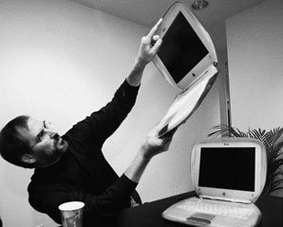
TWENTY-FIRST-CENTURY MACS
Setting Apple Apart
With the iBook, 1999
Clams, Ice Cubes, and Sunflowers
Ever since the introduction of the iMac in 1998,
Jobs and Jony Ive had made beguiling design a
signature of Apple’s computers. There was a consumer
laptop that looked like a tangerine clam, and a
professional desktop computer that suggested a Zen
ice cube. Like bell-bottoms that turn up in the back of a
closet, some of these models looked better at the time
than they do in retrospect, and they show a love of
design that was, on occasion, a bit too exuberant. But
Steve Jobs by Walter Isaacson
580
they set Apple apart and provided the publicity bursts it
needed to survive in a Windows world.
The Power Mac G4 Cube, released in 2000, was
so alluring that one ended up on display in New York’s
Museum of Modern Art. An eight-inch perfect cube the
size of a Kleenex box, it was the pure expression of
Jobs’s aesthetic. The sophistication came from
minimalism. No buttons marred the surface. There was
no CD tray, just a subtle slot. And as with the original
Macintosh, there was no fan. Pure Zen. “When you see
something that’s so thoughtful on the outside you say,
‘Oh, wow, it must be really thoughtful on the inside,’” he
told
Newsweek
. “We make progress by eliminating
things, by removing the superfluous.”
The G4 Cube was almost ostentatious in its lack of
ostentation, and it was powerful. But it was not a
success. It had been designed as a high-end desktop,
but Jobs wanted to turn it, as he did almost every
product, into something that could be mass-marketed to
consumers. The Cube ended up not serving either
market well. Workaday professionals weren’t seeking a
jewel-like sculpture for their desks, and mass-market
consumers were not eager to spend twice what they’d
pay for a plain vanilla desktop. Jobs predicted that
Apple would sell 200,000 Cubes per quarter. In its first
quarter it sold half that. The next quarter it sold fewer
than thirty thousand units. Jobs later admitted that he
had overdesigned and overpriced the Cube, just as he
had the NeXT computer. But gradually he was learning
his lesson. In building devices like the iPod, he would
control costs and make the trade-offs necessary to get
them launched on time and on budget.
Partly because of the poor sales of the Cube,
Apple produced disappointing revenue numbers in
September 2000. That was just when the tech bubble
was deflating and Apple’s education market was
Steve Jobs by Walter Isaacson
581
declining. The company’s stock price, which had been
above $60, fell 50% in one day, and by early December
it was below $15.
None of this deterred Jobs from continuing to push
for distinctive, even distracting, new design. When flat-
screen displays became commercially viable, he
decided it was time to replace the iMac, the translucent
consumer desktop computer that looked as if it were
from a
Jetsons
cartoon. Ive came up with a model that
was somewhat conventional, with the guts of the
computer attached to the back of the flat screen. Jobs
didn’t like it. As he often did, both at Pixar and at Apple,
he slammed on the brakes to rethink things. There was
something about the design that lacked purity, he felt.
“Why have this flat display if you’re going to glom all this
stuff on its back?” he asked Ive. “We should let each
element be true to itself.”
Jobs went home early that day to mull over the
problem, then called Ive to come by. They wandered
into the garden, which Jobs’s wife had planted with a
profusion of sunflowers. “Every year I do something wild
with the garden, and that time it involved masses of
sunflowers, with a sunflower house for the kids,” she
recalled. “Jony and Steve were riffing on their design
problem, then Jony asked, ‘What if the screen was
separated from the base like a sunflower?’ He got
excited and started sketching.” Ive liked his designs to
suggest a narrative, and he realized that a sunflower
shape would convey that the flat screen was so fluid
and responsive that it could reach for the sun.
In Ive’s new design, the Mac’s screen was
attached to a movable chrome neck, so that it looked
not only like a sunflower but also like a cheeky Luxo
lamp. Indeed it evoked the playful personality of Luxo
Jr. in the first short film that John Lasseter had made at
Pixar. Apple took out many patents for the design, most
Steve Jobs by Walter Isaacson
582
crediting Ive, but on one of them, for “a computer system
having a movable assembly attached to a flat panel
display,” Jobs listed himself as the primary inventor.
In hindsight, some of Apple’s Macintosh designs
may seem a bit too cute. But other computer makers
were at the other extreme. It was an industry that you’d
expect to be innovative, but instead it was dominated by
cheaply designed generic boxes. After a few ill-
conceived stabs at painting on blue colors and trying
new shapes, companies such as Dell, Compaq, and HP
commoditized computers by outsourcing manufacturing
and competing on price. With its spunky designs and its
pathbreaking applications like iTunes and iMovie,
Apple was about the only place innovating.
Intel Inside
Apple’s innovations were more than skin-deep.
Since 1994 it had been using a microprocessor, called
the PowerPC, that was made by a partnership of IBM
and Motorola. For a few years it was faster than Intel’s
chips, an advantage that Apple touted in humorous
commercials. By the time of Jobs’s return, however,
Motorola had fallen behind in producing new versions
of the chip. This provoked a fight between Jobs and
Motorola’s CEO Chris Galvin. When Jobs decided to
stop licensing the Macintosh operating system to clone
makers, right after his return to Apple in 1997, he
suggested to Galvin that he might consider making an
exception for Motorola’s clone, the StarMax Mac, but
only if Motorola sped up development of new PowerPC
chips for laptops. The call got heated. Jobs offered his
opinion that Motorola chips sucked. Galvin, who also
had a temper, pushed back. Jobs hung up on him. The
Motorola StarMax was canceled, and Jobs secretly
began planning to move Apple off the Motorola-IBM
PowerPC chip and to adopt, instead, Intel’s. This would
not be a simple task. It was akin to writing a new
Steve Jobs by Walter Isaacson
583
operating system.
Jobs did not cede any real power to his board, but
he did use its meetings to kick around ideas and think
through strategies in confidence, while he stood at a
whiteboard and led freewheeling discussions. For
eighteen months the directors discussed whether to
move to an Intel architecture. “We debated it, we asked
a lot of questions, and finally we all decided it needed
to be done,” board member Art Levinson recalled.
Paul Otellini, who was then president and later
became CEO of Intel, began huddling with Jobs. They
had gotten to know each other when Jobs was
struggling to keep NeXT alive and, as Otellini later put
it, “his arrogance had been temporarily tempered.”
Otellini has a calm and wry take on people, and he was
amused rather than put off when he discovered, upon
dealing with Jobs at Apple in the early 2000s, “that his
juices were going again, and he wasn’t nearly as
humble anymore.” Intel had deals with other computer
makers, and Jobs wanted a better price than they had.
“We had to find creative ways to bridge the numbers,”
said Otellini. Most of the negotiating was done, as Jobs
preferred, on long walks, sometimes on the trails up to
the radio telescope known as the Dish above the
Stanford campus. Jobs would start the walk by telling a
story and explaining how he saw the history of
computers evolving. By the end he would be haggling
over price.
“Intel had a reputation for being a tough partner,
coming out of the days when it was run by Andy Grove
and Craig Barrett,” Otellini said. “I wanted to show that
Intel was a company you could work with.” So a crack
team from Intel worked with Apple, and they were able
to beat the conversion deadline by six months. Jobs
invited Otellini to Apple’s Top 100 management retreat,
where he donned one of the famous Intel lab coats that
Steve Jobs by Walter Isaacson
584
looked like a bunny suit and gave Jobs a big hug. At the
public announcement in 2005, the usually reserved
Otellini repeated the act. “Apple and Intel, together at
last,” flashed on the big screen.
Bill Gates was amazed. Designing crazy-colored
cases did not impress him, but a secret program to
switch the CPU in a computer, completed seamlessly
and on time, was a feat he truly admired. “If you’d said,
‘Okay, we’re going to change our microprocessor chip,
and we’re not going to lose a beat,’ that sounds
impossible,” he told me years later, when I asked him
about Jobs’s accomplishments. “They basically did
that.”
Options
Among Jobs’s quirks was his attitude toward
money. When he returned to Apple in 1997, he
portrayed himself as a person working for $1 a year,
doing it for the benefit of the company rather than
himself. Nevertheless he embraced the idea of option
megagrants—granting huge bundles of options to buy
Apple stock at a preset price—that were not subject to
the usual good compensation practices of board
committee reviews and performance criteria.
When he dropped the “interim” in his title and
officially became CEO, he was offered (in addition to
the airplane) a megagrant by Ed Woolard and the
board at the beginning of 2000; defying the image he
cultivated of not being interested in money, he had
stunned Woolard by asking for even more options than
the board had proposed. But soon after he got them, it
turned out that it was for naught. Apple stock cratered in
September 2000—due to disappointing sales of the
Cube plus the bursting of the Internet bubble—which
made the options worthless.
Making matters worse was a June 2001 cover
story in
Fortune
about overcompensated CEOs, “The
Steve Jobs by Walter Isaacson
585
Great CEO Pay Heist.” A mug of Jobs, smiling smugly,
filled the cover. Even though his options were
underwater at the time, the technical method of valuing
them when granted (known as a Black-Scholes
valuation) set their worth at $872 million.
Fortune
proclaimed it “by far” the largest compensation package
ever granted a CEO. It was the worst of all worlds: Jobs
had almost no money that he could put in his pocket for
his four years of hard and successful turnaround work
at Apple, yet he had become the poster child of greedy
CEOs, making him look hypocritical and undermining
his self-image. He wrote a scathing letter to the editor,
declaring that his options actually “are worth zero” and
offering to sell them to
Fortune
for half of the supposed
$872 million the magazine had reported.
In the meantime Jobs wanted the board to give
him another big grant of options, since his old ones
seemed worthless. He insisted, both to the board and
probably to himself, that it was more about getting
proper recognition than getting rich. “It wasn’t so much
about the money,” he later said in a deposition in an
SEC lawsuit over the options. “Everybody likes to be
recognized by his peers. . . . I felt that the board wasn’t
really doing the same with me.” He felt that the board
should have come to him offering a new grant, without
his having to suggest it. “I thought I was doing a pretty
good job. It would have made me feel better at the
time.”
His handpicked board in fact doted on him. So
they decided to give him another huge grant in August
2001, when the stock price was just under $18. The
problem was that he worried about his image,
especially after the
Fortune
article. He did not want to
accept the new grant unless the board canceled his old
options at the same time. But to do so would have
adverse accounting implications, because it would be
Steve Jobs by Walter Isaacson
586
effectively repricing the old options. That would require
taking a charge against current earnings. The only way
to avoid this “variable accounting” problem was to
cancel his old options at least six months after his new
options were granted. In addition, Jobs started haggling
with the board over how quickly the new options would
vest.
It was not until mid-December 2001 that Jobs
finally agreed to take the new options and, braving the
optics, wait six months before his old ones were
canceled. But by then the stock price (adjusting for a
split) had gone up $3, to about $21. If the strike price of
the new options was set at that new level, each would
have thus been $3 less valuable. So Apple’s legal
counsel, Nancy Heinen, looked over the recent stock
prices and helped to choose an October date, when the
stock was $18.30. She also approved a set of minutes
that purported to show that the board had approved the
grant on that date. The backdating was potentially worth
$20 million to Jobs.
Once again Jobs would end up suffering bad
publicity without making a penny. Apple’s stock price
kept dropping, and by March 2003 even the new
options were so low that Jobs traded in all of them for
an outright grant of $75 million worth of shares, which
amounted to about $8.3 million for each year he had
worked since coming back in 1997 through the end of
the vesting in 2006.
None of this would have mattered much if the
Wall
Street Journal
had not run a powerful series in 2006
about backdated stock options. Apple wasn’t
mentioned, but its board appointed a committee of three
members—Al Gore, Eric Schmidt of Google, and Jerry
York, formerly of IBM and Chrysler—to investigate its
own practices. “We decided at the outset that if Steve
was at fault we would let the chips fall where they may,”
Steve Jobs by Walter Isaacson
587
Gore recalled. The committee uncovered some
irregularities with Jobs’s grants and those of other top
officers, and it immediately turned the findings over to
the SEC. Jobs was aware of the backdating, the report
said, but he ended up not benefiting financially. (A
board committee at Disney also found that similar
backdating had occurred at Pixar when Jobs was in
charge.)
The laws governing such backdating practices
were murky, especially since no one at Apple ended up
benefiting from the dubiously dated grants. The SEC
took eight months to do its own investigation, and in
April 2007 it announced that it would not bring action
against Apple “based in part on its swift, extensive, and
extraordinary cooperation in the Commission’s
investigation [and its] prompt self-reporting.” Although
the SEC found that Jobs had been aware of the
backdating, it cleared him of any misconduct because
he “was unaware of the accounting implications.”
The SEC did file complaints against Apple’s
former chief financial officer Fred Anderson, who was
on the board, and general counsel Nancy Heinen.
Anderson, a retired Air Force captain with a square jaw
and deep integrity, had been a wise and calming
influence at Apple, where he was known for his ability
to control Jobs’s tantrums. He was cited by the SEC
only for “negligence” regarding the paperwork for one
set of the grants (not the ones that went to Jobs), and
the SEC allowed him to continue to serve on corporate
boards. Nevertheless he ended up resigning from the
Apple board.
Anderson thought he had been made a
scapegoat. When he settled with the SEC, his lawyer
issued a statement that cast some of the blame on Jobs.
It said that Anderson had “cautioned Mr. Jobs that the
executive team grant would have to be priced on the
Steve Jobs by Walter Isaacson
588
date of the actual board agreement or there could be an
accounting charge,” and that Jobs replied “that the
board had given its prior approval.”
Heinen, who initially fought the charges against
her, ended up settling and paying a $2.2 million fine,
without admitting or denying any wrongdoing. Likewise
the company itself settled a shareholders’ lawsuit by
agreeing to pay $14 million in damages.
“Rarely have so many avoidable problems been
created by one man’s obsession with his own image,”
Joe Nocera wrote in the
New York Times
. “Then again,
this is Steve Jobs we’re talking about.” Contemptuous
of rules and regulations, he created a climate that made
it hard for someone like Heinen to buck his wishes. At
times, great creativity occurred. But people around him
could pay a price. On compensation issues in
particular, the difficulty of defying his whims drove some
good people to make some bad mistakes.
The compensation issue in some ways echoed
Jobs’s parking quirk. He refused such trappings as
having a “Reserved for CEO” spot, but he assumed for
himself the right to park in the handicapped spaces. He
wanted to be seen (both by himself and by others) as
someone willing to work for $1 a year, but he also
wanted to have huge stock grants bestowed upon him.
Jangling inside him were the contradictions of a
counterculture rebel turned business entrepreneur,
someone who wanted to believe that he had turned on
and tuned in without having sold out and cashed in.
Steve Jobs by Walter Isaacson
589
CHAPTER THIRTY-FIVE
Steve Jobs by Walter Isaacson
590
ROUND ONE
Memento Mori
Cancer
Jobs would later speculate that his cancer was
caused by the grueling year that he spent, starting in
1997, running both Apple and Pixar. As he drove back
and forth, he had developed kidney stones and other
ailments, and he would come home so exhausted that
he could barely speak. “That’s probably when this
cancer started growing, because my immune system
was pretty weak at that time,” he said.
There is no evidence that exhaustion or a weak
immune system causes cancer. However, his kidney
problems did indirectly lead to the detection of his
cancer. In October 2003 he happened to run into the
urologist who had treated him, and she asked him to
get a CAT scan of his kidneys and ureter. It had been
five years since his last scan. The new scan revealed
nothing wrong with his kidneys, but it did show a
shadow on his pancreas, so she asked him to schedule
a pancreatic study. He didn’t. As usual, he was good at
willfully ignoring inputs that he did not want to process.
But she persisted. “Steve, this is really important,” she
said a few days later. “You need to do this.”
Her tone of voice was urgent enough that he
complied. He went in early one morning, and after
studying the scan, the doctors met with him to deliver
the bad news that it was a tumor. One of them even
suggested that he should make sure his affairs were in
order, a polite way of saying that he might have only
months to live. That evening they performed a biopsy by
sticking an endoscope down his throat and into his
Steve Jobs by Walter Isaacson
591
intestines so they could put a needle into his pancreas
and get a few cells from the tumor. Powell remembers
her husband’s doctors tearing up with joy. It turned out
to be an islet cell or pancreatic neuroendocrine tumor,
which is rare but slower growing and thus more likely to
be treated successfully. He was lucky that it was
detected so early—as the by-product of a routine kidney
screening—and thus could be surgically removed
before it had definitely spread.
One of his first calls was to Larry Brilliant, whom he
first met at the ashram in India. “Do you still believe in
God?” Jobs asked him. Brilliant said that he did, and
they discussed the many paths to God that had been
taught by the Hindu guru Neem Karoli Baba. Then
Brilliant asked Jobs what was wrong. “I have cancer,”
Jobs replied.
Art Levinson, who was on Apple’s board, was
chairing the board meeting of his own company,
Genentech, when his cell phone rang and Jobs’s name
appeared on the screen. As soon as there was a break,
Levinson called him back and heard the news of the
tumor. He had a background in cancer biology, and his
firm made cancer treatment drugs, so he became an
advisor. So did Andy Grove of Intel, who had fought and
beaten prostate cancer. Jobs called him that Sunday,
and he drove right over to Jobs’s house and stayed for
two hours.
To the horror of his friends and wife, Jobs decided
not to have surgery to remove the tumor, which was the
only accepted medical approach. “I really didn’t want
them to open up my body, so I tried to see if a few other
things would work,” he told me years later with a hint of
regret. Specifically, he kept to a strict vegan diet, with
large quantities of fresh carrot and fruit juices. To that
regimen he added acupuncture, a variety of herbal
remedies, and occasionally a few other treatments he
Steve Jobs by Walter Isaacson
592
found on the Internet or by consulting people around
the country, including a psychic. For a while he was
under the sway of a doctor who operated a natural
healing clinic in southern California that stressed the
use of organic herbs, juice fasts, frequent bowel
cleansings, hydrotherapy, and the expression of all
negative feelings.
“The big thing was that he really was not ready to
open his body,” Powell recalled. “It’s hard to push
someone to do that.” She did try, however. “The body
exists to serve the spirit,” she argued. His friends
repeatedly urged him to have surgery and
chemotherapy. “Steve talked to me when he was trying
to cure himself by eating horseshit and horseshit roots,
and I told him he was crazy,” Grove recalled. Levinson
said that he “pleaded every day” with Jobs and found it
“enormously frustrating that I just couldn’t connect with
him.” The fights almost ruined their friendship. “That’s
not how cancer works,” Levinson insisted when Jobs
discussed his diet treatments. “You cannot solve this
without surgery and blasting it with toxic chemicals.”
Even the diet doctor Dean Ornish, a pioneer in
alternative and nutritional methods of treating diseases,
took a long walk with Jobs and insisted that sometimes
traditional methods were the right option. “You really
need surgery,” Ornish told him.
Jobs’s obstinacy lasted for nine months after his
October 2003 diagnosis. Part of it was the product of the
dark side of his reality distortion field. “I think Steve has
such a strong desire for the world to be a certain way
that he wills it to be that way,” Levinson speculated.
“Sometimes it doesn’t work. Reality is unforgiving.” The
flip side of his wondrous ability to focus was his
fearsome willingness to filter out things he did not wish
to deal with. This led to many of his great
breakthroughs, but it could also backfire. “He has that
Steve Jobs by Walter Isaacson
593
ability to ignore stuff he doesn’t want to confront,”
Powell explained. “It’s just the way he’s wired.” Whether
it involved personal topics relating to his family and
marriage, or professional issues relating to engineering
or business challenges, or health and cancer issues,
Jobs sometimes simply didn’t engage.
In the past he had been rewarded for what his wife
called his “magical thinking”—his assumption that he
could will things to be as he wanted. But cancer does
not work that way. Powell enlisted everyone close to
him, including his sister Mona Simpson, to try to bring
him around. In July 2004 a CAT scan showed that the
tumor had grown and possibly spread. It forced him to
face reality.
Jobs underwent surgery on Saturday, July 31,
2004, at Stanford University Medical Center. He did not
have a full “Whipple procedure,” which removes a large
part of the stomach and intestine as well as the
pancreas. The doctors considered it, but decided
instead on a less radical approach, a modified Whipple
that removed only part of the pancreas.
Jobs sent employees an email the next day, using
his PowerBook hooked up to an AirPort Express in his
hospital room, announcing his surgery. He assured
them that the type of pancreatic cancer he had
“represents about 1% of the total cases of pancreatic
cancer diagnosed each year, and can be cured by
surgical removal if diagnosed in time (mine was).” He
said he would not require chemotherapy or radiation
treatment, and he planned to return to work in
September. “While I’m out, I’ve asked Tim Cook to be
responsible for Apple’s day to day operations, so we
shouldn’t miss a beat. I’m sure I’ll be calling some of
you way too much in August, and I look forward to
seeing you in September.”
One side effect of the operation would become a
Steve Jobs by Walter Isaacson
594
problem for Jobs because of his obsessive diets and
the weird routines of purging and fasting that he had
practiced since he was a teenager. Because the
pancreas provides the enzymes that allow the stomach
to digest food and absorb nutrients, removing part of the
organ makes it hard to get enough protein. Patients are
advised to make sure that they eat frequent meals and
maintain a nutritious diet, with a wide variety of meat
and fish proteins as well as full-fat milk products. Jobs
had never done this, and he never would.
He stayed in the hospital for two weeks and then
struggled to regain his strength. “I remember coming
back and sitting in that rocking chair,” he told me,
pointing to one in his living room. “I didn’t have the
energy to walk. It took me a week before I could walk
around the block. I pushed myself to walk to the
gardens a few blocks away, then further, and within six
months I had my energy almost back.”
Unfortunately the cancer had spread. During the
operation the doctors found three liver metastases. Had
they operated nine months earlier, they might have
caught it before it spread, though they would never
know for sure. Jobs began chemotherapy treatments,
which further complicated his eating challenges.
The Stanford Commencement
Jobs kept his continuing battle with the cancer
secret—he told everyone that he had been “cured”—
just as he had kept quiet about his diagnosis in October
2003. Such secrecy was not surprising; it was part of his
nature. What was more surprising was his decision to
speak very personally and publicly about his cancer
diagnosis. Although he rarely gave speeches other
than his staged product demonstrations, he accepted
Stanford’s invitation to give its June 2005
commencement address. He was in a reflective mood
after his health scare and turning fifty.
Steve Jobs by Walter Isaacson
595
For help with the speech, he called the brilliant
scriptwriter Aaron Sorkin (
A Few Good Men, The West
Wing
). Jobs sent him some thoughts. “That was in
February, and I heard nothing, so I ping him again in
April, and he says, ‘Oh, yeah,’ and I send him a few
more thoughts,” Jobs recounted. “I finally get him on the
phone, and he keeps saying ‘Yeah,’ but finally it’s the
beginning of June, and he never sent me anything.”
Jobs got panicky. He had always written his own
presentations, but he had never done a
commencement address. One night he sat down and
wrote the speech himself, with no help other than
bouncing ideas off his wife. As a result, it turned out to
be a very intimate and simple talk, with the unadorned
and personal feel of a perfect Steve Jobs product.
Alex Haley once said that the best way to begin a
speech is “Let me tell you a story.” Nobody is eager for
a lecture, but everybody loves a story. And that was the
approach Jobs chose. “Today, I want to tell you three
stories from my life,” he began. “That’s it. No big deal.
Just three stories.”
The first was about dropping out of Reed College.
“I could stop taking the required classes that didn’t
interest me, and begin dropping in on the ones that
looked far more interesting.” The second was about
how getting fired from Apple turned out to be good for
him. “The heaviness of being successful was replaced
by the lightness of being a beginner again, less sure
about everything.” The students were unusually
attentive, despite a plane circling overhead with a
banner that exhorted “recycle all e-waste,” and it was
his third tale that enthralled them. It was about being
diagnosed with cancer and the awareness it brought:
Remembering that I’ll be dead soon is the most
important tool I’ve ever encountered to help me make
the big choices in life. Because almost everything—all
Steve Jobs by Walter Isaacson
596
external expectations, all pride, all fear of
embarrassment or failure—these things just fall away in
the face of death, leaving only what is truly important.
Remembering that you are going to die is the best way I
know to avoid the trap of thinking you have something
to lose. You are already naked. There is no reason not
to follow your heart.
The artful minimalism of the speech gave it
simplicity, purity, and charm. Search where you will,
from anthologies to YouTube, and you won’t find a
better commencement address. Others may have been
more important, such as George Marshall’s at Harvard
in 1947 announcing a plan to rebuild Europe, but none
has had more grace.
A Lion at Fifty
For his thirtieth and fortieth birthdays, Jobs had
celebrated with the stars of Silicon Valley and other
assorted celebrities. But when he turned fifty in 2005,
after coming back from his cancer surgery, the surprise
party that his wife arranged featured mainly his closest
friends and professional colleagues. It was at the
comfortable San Francisco home of some friends, and
the great chef Alice Waters prepared salmon from
Scotland along with couscous and a variety of garden-
raised vegetables. “It was beautifully warm and
intimate, with everyone and the kids all able to sit in one
room,” Waters recalled. The entertainment was comedy
improvisation done by the cast of
Whose Line Is It
Anyway?
Jobs’s close friend Mike Slade was there,
along with colleagues from Apple and Pixar, including
Lasseter, Cook, Schiller, Clow, Rubinstein, and
Tevanian.
Cook had done a good job running the company
during Jobs’s absence. He kept Apple’s temperamental
actors performing well, and he avoided stepping into
the limelight. Jobs liked strong personalities, up to a
Steve Jobs by Walter Isaacson
597
point, but he had never truly empowered a deputy or
shared the stage. It was hard to be his understudy. You
were damned if you shone, and damned if you didn’t.
Cook had managed to navigate those shoals. He was
calm and decisive when in command, but he didn’t
seek any notice or acclaim for himself. “Some people
resent the fact that Steve gets credit for everything, but
I’ve never given a rat’s ass about that,” said Cook.
“Frankly speaking, I’d prefer my name never be in the
paper.”
When Jobs returned from his medical leave, Cook
resumed his role as the person who kept the moving
parts at Apple tightly meshed and remained unfazed by
Jobs’s tantrums. “What I learned about Steve was that
people mistook some of his comments as ranting or
negativism, but it was really just the way he showed
passion. So that’s how I processed it, and I never took
issues personally.” In many ways he was Jobs’s mirror
image: unflappable, steady in his moods, and (as the
thesaurus in the NeXT would have noted) saturnine
rather than mercurial. “I’m a good negotiator, but he’s
probably better than me because he’s a cool customer,”
Jobs later said. After adding a bit more praise, he
quietly added a reservation, one that was serious but
rarely spoken: “But Tim’s not a product person, per se.”
In the fall of 2005, after returning from his medical
leave, Jobs tapped Cook to become Apple’s chief
operating officer. They were flying together to Japan.
Jobs didn’t really
ask
Cook; he simply turned to him and
said, “I’ve decided to make you COO.”
Around that time, Jobs’s old friends Jon
Rubinstein and Avie Tevanian, the hardware and
software lieutenants who had been recruited during the
1997 restoration, decided to leave. In Tevanian’s case,
he had made a lot of money and was ready to quit
working. “Avie is a brilliant guy and a nice guy, much
Steve Jobs by Walter Isaacson
598
more grounded than Ruby and doesn’t carry the big
ego,” said Jobs. “It was a huge loss for us when Avie
left. He’s a one-of-a-kind person—a genius.”
Rubinstein’s case was a little more contentious.
He was upset by Cook’s ascendency and frazzled after
working for nine years under Jobs. Their shouting
matches became more frequent. There was also a
substantive issue: Rubinstein was repeatedly clashing
with Jony Ive, who used to work for him and now
reported directly to Jobs. Ive was always pushing the
envelope with designs that dazzled but were difficult to
engineer. It was Rubinstein’s job to get the hardware
built in a practical way, so he often balked. He was by
nature cautious. “In the end, Ruby’s from HP,” said
Jobs. “And he never delved deep, he wasn’t
aggressive.”
There was, for example, the case of the screws
that held the handles on the Power Mac G4. Ive
decided that they should have a certain polish and
shape. But Rubinstein thought that would be
“astronomically” costly and delay the project for weeks,
so he vetoed the idea. His job was to deliver products,
which meant making trade-offs. Ive viewed that
approach as inimical to innovation, so he would go both
above him to Jobs and also around him to the midlevel
engineers. “Ruby would say, ‘You can’t do this, it will
delay,’ and I would say, ‘I think we can,’” Ive recalled.
“And I would know, because I had worked behind his
back with the product teams.” In this and other cases,
Jobs came down on Ive’s side.
At times Ive and Rubinstein got into arguments
that almost led to blows. Finally Ive told Jobs, “It’s him or
me.” Jobs chose Ive. By that point Rubinstein was ready
to leave. He and his wife had bought property in
Mexico, and he wanted time off to build a home there.
He eventually went to work for Palm, which was trying
Steve Jobs by Walter Isaacson
599
to match Apple’s iPhone. Jobs was so furious that Palm
was hiring some of his former employees that he
complained to Bono, who was a cofounder of a private
equity group, led by the former Apple CFO Fred
Anderson, that had bought a controlling stake in Palm.
Bono sent Jobs a note back saying, “You should chill
out about this. This is like the Beatles ringing up
because Herman and the Hermits have taken one of
their road crew.” Jobs later admitted that he had
overreacted. “The fact that they completely failed salves
that wound,” he said.
Jobs was able to build a new management team
that was less contentious and a bit more subdued. Its
main players, in addition to Cook and Ive, were Scott
Forstall running iPhone software, Phil Schiller in charge
of marketing, Bob Mansfield doing Mac hardware, Eddy
Cue handling Internet services, and Peter
Oppenheimer as the chief financial officer. Even though
there was a surface sameness to his top team—all were
middle-aged white males—there was a range of styles.
Ive was emotional and expressive; Cook was as cool as
steel. They all knew they were expected to be
deferential to Jobs while also pushing back on his
ideas and being willing to argue—a tricky balance to
maintain, but each did it well. “I realized very early that if
you didn’t voice your opinion, he would mow you
down,” said Cook. “He takes contrary positions to create
more discussion, because it may lead to a better result.
So if you don’t feel comfortable disagreeing, then you’ll
never survive.”
The key venue for freewheeling discourse was the
Monday morning executive team gathering, which
started at 9 and went for three or four hours. The focus
was always on the future: What should each product do
next? What new things should be developed? Jobs
used the meeting to enforce a sense of shared mission
Steve Jobs by Walter Isaacson
600
at Apple. This served to centralize control, which made
the company seem as tightly integrated as a good
Apple product, and prevented the struggles between
divisions that plagued decentralized companies.
Jobs also used the meetings to enforce focus. At
Robert Friedland’s farm, his job had been to prune the
apple trees so that they would stay strong, and that
became a metaphor for his pruning at Apple. Instead of
encouraging each group to let product lines proliferate
based on marketing considerations, or permitting a
thousand ideas to bloom, Jobs insisted that Apple focus
on just two or three priorities at a time. “There is no one
better at turning off the noise that is going on around
him,” Cook said. “That allows him to focus on a few
things and say no to many things. Few people are really
good at that.”
In order to institutionalize the lessons that he and
his team were learning, Jobs started an in-house center
called Apple University. He hired Joel Podolny, who
was dean of the Yale School of Management, to
compile a series of case studies analyzing important
decisions the company had made, including the switch
to the Intel microprocessor and the decision to open the
Apple Stores. Top executives spent time teaching the
cases to new employees, so that the Apple style of
decision making would be embedded in the culture.
In ancient Rome, when a victorious general
paraded through the streets, legend has it that he was
sometimes trailed by a servant whose job it was to
repeat to him, “Memento mori”: Remember you will die.
A reminder of mortality would help the hero keep things
in perspective, instill some humility. Jobs’s memento
mori had been delivered by his doctors, but it did not
instill humility. Instead he roared back after his recovery
with even more passion. The illness reminded him that
he had nothing to lose, so he should forge ahead full
Steve Jobs by Walter Isaacson
601
speed. “He came back on a mission,” said Cook. “Even
though he was now running a large company, he kept
making bold moves that I don’t think anybody else
would have done.”
For a while there was some evidence, or at least
hope, that he had tempered his personal style, that
facing cancer and turning fifty had caused him to be a
bit less brutish when he was upset. “Right after he came
back from his operation, he didn’t do the humiliation bit
as much,” Tevanian recalled. “If he was displeased, he
might scream and get hopping mad and use expletives,
but he wouldn’t do it in a way that would totally destroy
the person he was talking to. It was just his way to get
the person to do a better job.” Tevanian reflected for a
moment as he said this, then added a caveat: “Unless
he thought someone was really bad and had to go,
which happened every once in a while.”
Eventually, however, the rough edges returned.
Because most of his colleagues were used to it by then
and had learned to cope, what upset them most was
when his ire turned on strangers. “Once we went to a
Whole Foods market to get a smoothie,” Ive recalled.
“And this older woman was making it, and he really got
on her about how she was doing it. Then later, he
sympathized. ‘She’s an older woman and doesn’t want
to be doing this job.’ He didn’t connect the two. He was
being a purist in both cases.”
On a trip to London with Jobs, Ive had the
thankless task of choosing the hotel. He picked the
Hempel, a tranquil five-star boutique hotel with a
sophisticated minimalism that he thought Jobs would
love. But as soon as they checked in, he braced
himself, and sure enough his phone rang a minute
later. “I hate my room,” Jobs declared. “It’s a piece of
shit, let’s go.” So Ive gathered his luggage and went to
the front desk, where Jobs bluntly told the shocked clerk
Steve Jobs by Walter Isaacson
602
what he thought. Ive realized that most people, himself
among them, tend not to be direct when they feel
something is shoddy because they want to be liked,
“which is actually a vain trait.” That was an overly kind
explanation. In any case, it was not a trait Jobs had.
Because Ive was so instinctively nice, he puzzled
over why Jobs, whom he deeply liked, behaved as he
did. One evening, in a San Francisco bar, he leaned
forward with an earnest intensity and tried to analyze it:
He’s a very, very sensitive guy. That’s one of the
things that makes his antisocial behavior, his rudeness,
so unconscionable. I can understand why people who
are thick-skinned and unfeeling can be rude, but not
sensitive people. I once asked him why he gets so mad
about stuff. He said, “But I don’t stay mad.” He has this
very childish ability to get really worked up about
something, and it doesn’t stay with him at all. But there
are other times, I think honestly, when he’s very
frustrated, and his way to achieve catharsis is to hurt
somebody. And I think he feels he has a liberty and a
license to do that. The normal rules of social
engagement, he feels, don’t apply to him. Because of
how very sensitive he is, he knows exactly how to
efficiently and effectively hurt someone. And he does do
that.
Every now and then a wise colleague would pull
Jobs aside to try to get him to settle down. Lee Clow
was a master. “Steve, can I talk to you?” he would
quietly say when Jobs had belittled someone publicly.
He would go into Jobs’s office and explain how hard
everyone was working. “When you humiliate them, it’s
more debilitating than stimulating,” he said in one such
session. Jobs would apologize and say he understood.
But then he would lapse again. “It’s simply who I am,”
he would say.
One thing that did mellow was his attitude toward
Steve Jobs by Walter Isaacson
603
Bill Gates. Microsoft had kept its end of the bargain it
made in 1997, when it agreed to continue developing
great software for the Macintosh. Also, it was becoming
less relevant as a competitor, having failed thus far to
replicate Apple’s digital hub strategy. Gates and Jobs
had very different approaches to products and
innovation, but their rivalry had produced in each a
surprising self-awareness.
For their All Things Digital conference in May
2007, the
Wall Street Journal
columnists Walt Mossberg
and Kara Swisher worked to get them together for a
joint interview. Mossberg first invited Jobs, who didn’t
go to many such conferences, and was surprised when
he said he would do it if Gates would. On hearing that,
Gates accepted as well.
Mossberg wanted the evening joint appearance to
be a cordial discussion, not a debate, but that seemed
less likely when Jobs unleashed a swipe at Microsoft
during a solo interview earlier that day. Asked about the
fact that Apple’s iTunes software for Windows
computers was extremely popular, Jobs joked, “It’s like
giving a glass of ice water to somebody in hell.”
So when it was time for Gates and Jobs to meet in
the green room before their joint session that evening,
Mossberg was worried. Gates got there first, with his
aide Larry Cohen, who had briefed him about Jobs’s
remark earlier that day. When Jobs ambled in a few
minutes later, he grabbed a bottle of water from the ice
bucket and sat down. After a moment or two of silence,
Gates said, “So I guess I’m the representative from hell.”
He wasn’t smiling. Jobs paused, gave him one of his
impish grins, and handed him the ice water. Gates
relaxed, and the tension dissipated.
The result was a fascinating duet, in which each
wunderkind of the digital age spoke warily, and then
warmly, about the other. Most memorably they gave
Steve Jobs by Walter Isaacson
604
candid answers when the technology strategist Lise
Buyer, who was in the audience, asked what each had
learned from observing the other. “Well, I’d give a lot to
have Steve’s taste,” Gates answered. There was a bit of
nervous laughter; Jobs had famously said, ten years
earlier, that his problem with Microsoft was that it had
absolutely no taste. But Gates insisted he was serious.
Jobs was a “natural in terms of intuitive taste.” He
recalled how he and Jobs used to sit together reviewing
the software that Microsoft was making for the
Macintosh. “I’d see Steve make the decision based on a
sense of people and product that, you know, is hard for
me to explain. The way he does things is just different
and I think it’s magical. And in that case, wow.”
Jobs stared at the floor. Later he told me that he
was blown away by how honest and gracious Gates
had just been. Jobs was equally honest, though not
quite as gracious, when his turn came. He described
the great divide between the Apple theology of building
end-to-end integrated products and Microsoft’s
openness to licensing its software to competing
hardware makers. In the music market, the integrated
approach, as manifested in his iTunes-iPod package,
was proving to be the better, he noted, but Microsoft’s
decoupled approach was faring better in the personal
computer market. One question he raised in an offhand
way was: Which approach might work better for mobile
phones?
Then he went on to make an insightful point: This
difference in design philosophy, he said, led him and
Apple to be less good at collaborating with other
companies. “Because Woz and I started the company
based on doing the whole banana, we weren’t so good
at partnering with people,” he said. “And I think if Apple
could have had a little more of that in its DNA, it would
have served it extremely well.”
Steve Jobs by Walter Isaacson
605
Steve Jobs by Walter Isaacson
606
CHAPTER THIRTY-SIX
Steve Jobs by Walter Isaacson
607
THE iPHONE
Three Revolutionary Products in One
An iPod That Makes Calls
By 2005 iPod sales were skyrocketing. An
astonishing twenty million were sold that year,
quadruple the number of the year before. The product
was becoming more important to the company’s bottom
line, accounting for 45% of the revenue that year, and it
was also burnishing the hipness of the company’s
image in a way that drove sales of Macs.
That is why Jobs was worried. “He was always
obsessing about what could mess us up,” board
member Art Levinson recalled. The conclusion he had
come to: “The device that can eat our lunch is the cell
phone.” As he explained to the board, the digital
camera market was being decimated now that phones
were equipped with cameras. The same could happen
to the iPod, if phone manufacturers started to build
music players into them. “Everyone carries a phone, so
that could render the iPod unnecessary.”
His first strategy was to do something that he had
admitted in front of Bill Gates was not in his DNA: to
partner with another company. He began talking to Ed
Zander, the new CEO of Motorola, about making a
companion to Motorola’s popular RAZR, which was a
cell phone and digital camera, that would have an iPod
built in. Thus was born the ROKR. It ended up having
neither the enticing minimalism of an iPod nor the
convenient slimness of a RAZR. Ugly, difficult to load,
and with an arbitrary hundred-song limit, it had all the
hallmarks of a product that had been negotiated by a
committee, which was counter to the way Jobs liked to
work. Instead of hardware, software, and content all
Steve Jobs by Walter Isaacson
608
being controlled by one company, they were cobbled
together by Motorola, Apple, and the wireless carrier
Cingular. “You call this the phone of the future?”
Wired
scoffed on its November 2005 cover.
Jobs was furious. “I’m sick of dealing with these
stupid companies like Motorola,” he told Tony Fadell
and others at one of the iPod product review meetings.
“Let’s do it ourselves.” He had noticed something odd
about the cell phones on the market: They all stank, just
like portable music players used to. “We would sit
around talking about how much we hated our phones,”
he recalled. “They were way too complicated. They had
features nobody could figure out, including the address
book. It was just Byzantine.” George Riley, an outside
lawyer for Apple, remembers sitting at meetings to go
over legal issues, and Jobs would get bored, grab
Riley’s mobile phone, and start pointing out all the ways
it was “brain-dead.” So Jobs and his team became
excited about the prospect of building a phone that they
would want to use. “That’s the best motivator of all,”
Jobs later said.
Another motivator was the potential market. More
than 825 million mobile phones were sold in 2005, to
everyone from grammar schoolers to grandmothers.
Since most were junky, there was room for a premium
and hip product, just as there had been in the portable
music-player market. At first he gave the project to the
Apple group that was making the AirPort wireless base
station, on the theory that it was a wireless product. But
he soon realized that it was basically a consumer
device, like the iPod, so he reassigned it to Fadell and
his teammates.
Their initial approach was to modify the iPod. They
tried to use the trackwheel as a way for a user to scroll
through phone options and, without a keyboard, try to
enter numbers. It was not a natural fit. “We were having
Steve Jobs by Walter Isaacson
609
a lot of problems using the wheel, especially in getting it
to dial phone numbers,” Fadell recalled. “It was
cumbersome.” It was fine for scrolling through an
address book, but horrible at inputting anything. The
team kept trying to convince themselves that users
would mainly be calling people who were already in
their address book, but they knew that it wouldn’t really
work.
At that time there was a second project under way
at Apple: a secret effort to build a tablet computer. In
2005 these narratives intersected, and the ideas for the
tablet flowed into the planning for the phone. In other
words, the idea for the iPad actually came before, and
helped to shape, the birth of the iPhone.
Multi-touch
One of the engineers developing a tablet PC at
Microsoft was married to a friend of Laurene and Steve
Jobs, and for his fiftieth birthday he wanted to have a
dinner party that included them along with Bill and
Melinda Gates. Jobs went, a bit reluctantly. “Steve was
actually quite friendly to me at the dinner,” Gates
recalled, but he “wasn’t particularly friendly” to the
birthday guy.
Gates was annoyed that the guy kept revealing
information about the tablet PC he had developed for
Microsoft. “He’s our employee and he’s revealing our
intellectual property,” Gates recounted. Jobs was also
annoyed, and it had just the consequence that Gates
feared. As Jobs recalled:
This guy badgered me about how Microsoft was
going to completely change the world with this tablet
PC software and eliminate all notebook computers, and
Apple ought to license his Microsoft software. But he
was doing the device all wrong. It had a stylus. As soon
as you have a stylus, you’re dead. This dinner was like
the tenth time he talked to me about it, and I was so sick
Steve Jobs by Walter Isaacson
610
of it that I came home and said, “Fuck this, let’s show
him what a tablet can really be.”
Jobs went into the office the next day, gathered his
team, and said, “I want to make a tablet, and it can’t
have a keyboard or a stylus.” Users would be able to
type by touching the screen with their fingers. That
meant the screen needed to have a feature that
became known as multi-touch, the ability to process
multiple inputs at the same time. “So could you guys
come up with a multi-touch, touch-sensitive display for
me?” he asked. It took them about six months, but they
came up with a crude but workable prototype.
Jony Ive had a different memory of how multi-
touch was developed. He said his design team had
already been working on a multi-touch input that was
developed for the trackpads of Apple’s MacBook Pro,
and they were experimenting with ways to transfer that
capability to a computer screen. They used a projector
to show on a wall what it would look like. “This is going
to change everything,” Ive told his team. But he was
careful not to show it to Jobs right away, especially
since his people were working on it in their spare time
and he didn’t want to quash their enthusiasm. “Because
Steve is so quick to give an opinion, I don’t show him
stuff in front of other people,” Ive recalled. “He might
say, ‘This is shit,’ and snuff the idea. I feel that ideas are
very fragile, so you have to be tender when they are in
development. I realized that if he pissed on this, it would
be so sad, because I knew it was so important.”
Ive set up the demonstration in his conference
room and showed it to Jobs privately, knowing that he
was less likely to make a snap judgment if there was no
audience. Fortunately he loved it. “This is the future,” he
exulted.
It was in fact such a good idea that Jobs realized
that it could solve the problem they were having
Steve Jobs by Walter Isaacson
611
creating an interface for the proposed cell phone. That
project was far more important, so he put the tablet
development on hold while the multi-touch interface
was adopted for a phone-size screen. “If it worked on a
phone,” he recalled, “I knew we could go back and use
it on a tablet.”
Jobs called Fadell, Rubinstein, and Schiller to a
secret meeting in the design studio conference room,
where Ive gave a demonstration of multi-touch. “Wow!”
said Fadell. Everyone liked it, but they were not sure
that they would be able to make it work on a mobile
phone. They decided to proceed on two paths: P1 was
the code name for the phone being developed using an
iPod trackwheel, and P2 was the new alternative using
a multi-touch screen.
A small company in Delaware called FingerWorks
was already making a line of multi-touch trackpads.
Founded by two academics at the University of
Delaware, John Elias and Wayne Westerman,
FingerWorks had developed some tablets with multi-
touch sensing capabilities and taken out patents on
ways to translate various finger gestures, such as
pinches and swipes, into useful functions. In early 2005
Apple quietly acquired the company, all of its patents,
and the services of its two founders. FingerWorks quit
selling its products to others, and it began filing its new
patents in Apple’s name.
After six months of work on the trackwheel P1 and
the multi-touch P2 phone options, Jobs called his inner
circle into his conference room to make a decision.
Fadell had been trying hard to develop the trackwheel
model, but he admitted they had not cracked the
problem of figuring out a simple way to dial calls. The
multi-touch approach was riskier, because they were
unsure whether they could execute the engineering, but
it was also more exciting and promising. “We all know
Steve Jobs by Walter Isaacson
612
this is the one we want to do,” said Jobs, pointing to the
touchscreen. “So let’s make it work.” It was what he
liked to call a bet-the-company moment, high risk and
high reward if it succeeded.
A couple of members of the team argued for
having a keyboard as well, given the popularity of the
BlackBerry, but Jobs vetoed the idea. A physical
keyboard would take away space from the screen, and
it would not be as flexible and adaptable as a
touchscreen keyboard. “A hardware keyboard seems
like an easy solution, but it’s constraining,” he said.
“Think of all the innovations we’d be able to adapt if we
did the keyboard onscreen with software. Let’s bet on it,
and then we’ll find a way to make it work.” The result
was a device that displays a numerical pad when you
want to dial a phone number, a typewriter keyboard
when you want to write, and whatever buttons you
might need for each particular activity. And then they all
disappear when you’re watching a video. By having
software replace hardware, the interface became fluid
and flexible.
Jobs spent part of every day for six months helping
to refine the display. “It was the most complex fun I’ve
ever had,” he recalled. “It was like being the one
evolving the variations on ‘Sgt. Pepper.’” A lot of
features that seem simple now were the result of
creative brainstorms. For example, the team worried
about how to prevent the device from playing music or
making a call accidentally when it was jangling in your
pocket. Jobs was congenitally averse to having on-off
switches, which he deemed “inelegant.” The solution
was “Swipe to Open,” the simple and fun on-screen
slider that activated the device when it had gone
dormant. Another breakthrough was the sensor that
figured out when you put the phone to your ear, so that
your lobes didn’t accidentally activate some function.
Steve Jobs by Walter Isaacson
613
And of course the icons came in his favorite shape, the
primitive he made Bill Atkinson design into the software
of the first Macintosh: rounded rectangles. In session
after session, with Jobs immersed in every detail, the
team members figured out ways to simplify what other
phones made complicated. They added a big bar to
guide you in putting calls on hold or making conference
calls, found easy ways to navigate through email, and
created icons you could scroll through horizontally to
get to different apps—all of which were easier because
they could be used visually on the screen rather than by
using a keyboard built into the hardware.
Gorilla Glass
Jobs became infatuated with different materials
the way he did with certain foods. When he went back
to Apple in 1997 and started work on the iMac, he had
embraced what could be done with translucent and
colored plastic. The next phase was metal. He and Ive
replaced the curvy plastic PowerBook G3 with the sleek
titanium PowerBook G4, which they redesigned two
years later in aluminum, as if just to demonstrate how
much they liked different metals. Then they did an iMac
and an iPod Nano in anodized aluminum, which meant
that the metal had been put in an acid bath and
electrified so that its surface oxidized. Jobs was told it
could not be done in the quantities they needed, so he
had a factory built in China to handle it. Ive went there,
during the SARS epidemic, to oversee the process. “I
stayed for three months in a dormitory to work on the
process,” he recalled. “Ruby and others said it would be
impossible, but I wanted to do it because Steve and I
felt that the anodized aluminum had a real integrity to
it.”
Next was glass. “After we did metal, I looked at
Jony and said that we had to master glass,” said Jobs.
For the Apple stores, they had created huge
Steve Jobs by Walter Isaacson
614
windowpanes and glass stairs. For the iPhone, the
original plan was for it to have a plastic screen, like the
iPod. But Jobs decided it would feel much more elegant
and substantive if the screens were glass. So he set
about finding a glass that would be strong and resistant
to scratches.
The natural place to look was Asia, where the
glass for the stores was being made. But Jobs’s friend
John Seeley Brown, who was on the board of Corning
Glass in Upstate New York, told him that he should talk
to that company’s young and dynamic CEO, Wendell
Weeks. So he dialed the main Corning switchboard
number and asked to be put through to Weeks. He got
an assistant, who offered to pass along the message.
“No, I’m Steve Jobs,” he replied. “Put me through.” The
assistant refused. Jobs called Brown and complained
that he had been subjected to “typical East Coast
bullshit.” When Weeks heard that, he called the main
Apple switchboard and asked to speak to Jobs. He was
told to put his request in writing and send it in by fax.
When Jobs was told what happened, he took a liking to
Weeks and invited him to Cupertino.
Jobs described the type of glass Apple wanted for
the iPhone, and Weeks told him that Corning had
developed a chemical exchange process in the 1960s
that led to what they dubbed “gorilla glass.” It was
incredibly strong, but it had never found a market, so
Corning quit making it. Jobs said he doubted it was
good enough, and he started explaining to Weeks how
glass was made. This amused Weeks, who of course
knew more than Jobs about that topic. “Can you shut
up,” Weeks interjected, “and let me teach you some
science?” Jobs was taken aback and fell silent. Weeks
went to the whiteboard and gave a tutorial on the
chemistry, which involved an ion-exchange process
that produced a compression layer on the surface of the
Steve Jobs by Walter Isaacson
615
glass. This turned Jobs around, and he said he wanted
as much gorilla glass as Corning could make within six
months. “We don’t have the capacity,” Weeks replied.
“None of our plants make the glass now.”
“Don’t be afraid,” Jobs replied. This stunned
Weeks, who was good-humored and confident but not
used to Jobs’s reality distortion field. He tried to explain
that a false sense of confidence would not overcome
engineering challenges, but that was a premise that
Jobs had repeatedly shown he didn’t accept. He stared
at Weeks unblinking. “Yes, you can do it,” he said. “Get
your mind around it. You can do it.”
As Weeks retold this story, he shook his head in
astonishment. “We did it in under six months,” he said.
“We produced a glass that had never been made.”
Corning’s facility in Harrisburg, Kentucky, which had
been making LCD displays, was converted almost
overnight to make gorilla glass full-time. “We put our
best scientists and engineers on it, and we just made it
work.” In his airy office, Weeks has just one framed
memento on display. It’s a message Jobs sent the day
the iPhone came out: “We couldn’t have done it without
you.”
The Design
On many of his major projects, such as the first
Toy
Story
and the Apple store, Jobs pressed “pause” as
they neared completion and decided to make major
revisions. That happened with the design of the iPhone
as well. The initial design had the glass screen set into
an aluminum case. One Monday morning Jobs went
over to see Ive. “I didn’t sleep last night,” he said,
“because I realized that I just don’t love it.” It was the
most important product he had made since the first
Macintosh, and it just didn’t look right to him. Ive, to his
dismay, instantly realized that Jobs was right. “I
remember feeling absolutely embarrassed that he had
Steve Jobs by Walter Isaacson
616
to make the observation.”
The problem was that the iPhone should have
been all about the display, but in their current design
the case competed with the display instead of getting
out of the way. The whole device felt too masculine,
task-driven, efficient. “Guys, you’ve killed yourselves
over this design for the last nine months, but we’re
going to change it,” Jobs told Ive’s team. “We’re all
going to have to work nights and weekends, and if you
want we can hand out some guns so you can kill us
now.” Instead of balking, the team agreed. “It was one of
my proudest moments at Apple,” Jobs recalled.
The new design ended up with just a thin stainless
steel bezel that allowed the gorilla glass display to go
right to the edge. Every part of the device seemed to
defer to the screen. The new look was austere, yet also
friendly. You could fondle it. It meant they had to redo
the circuit boards, antenna, and processor placement
inside, but Jobs ordered the change. “Other companies
may have shipped,” said Fadell, “but we pressed the
reset button and started over.”
One aspect of the design, which reflected not only
Jobs’s perfectionism but also his desire to control, was
that the device was tightly sealed. The case could not
be opened, even to change the battery. As with the
original Macintosh in 1984, Jobs did not want people
fiddling inside. In fact when Apple discovered in 2011
that third-party repair shops were opening up the
iPhone 4, it replaced the tiny screws with a tamper-
resistant Pentalobe screw that was impossible to open
with a commercially available screwdriver. By not
having a replaceable battery, it was possible to make
the iPhone much thinner. For Jobs, thinner was always
better. “He’s always believed that thin is beautiful,” said
Tim Cook. “You can see that in all of the work. We have
the thinnest notebook, the thinnest smartphone, and we
Steve Jobs by Walter Isaacson
617
made the iPad thin and then even thinner.”
The Launch
When it came time to launch the iPhone, Jobs
decided, as usual, to grant a magazine a special sneak
preview. He called John Huey, the editor in chief of
Time Inc., and began with his typical superlative: “This
is the best thing we’ve ever done.” He wanted to give
Time
the exclusive, “but there’s nobody smart enough
at
Time
to write it, so I’m going to give it to someone
else.” Huey introduced him to Lev Grossman, a savvy
technology writer (and novelist) at
Time
. In his piece
Grossman correctly noted that the iPhone did not really
invent many new features, it just made these features a
lot more usable. “But that’s important. When our tools
don’t work, we tend to blame ourselves, for being too
stupid or not reading the manual or having too-fat
fingers. . . . When our tools are broken, we feel broken.
And when somebody fixes one, we feel a tiny bit more
whole.”
For the unveiling at the January 2007 Macworld in
San Francisco, Jobs invited back Andy Hertzfeld, Bill
Atkinson, Steve Wozniak, and the 1984 Macintosh
team, as he had done when he launched the iMac. In a
career of dazzling product presentations, this may have
been his best. “Every once in a while a revolutionary
product comes along that changes everything,” he
began. He referred to two earlier examples: the original
Macintosh, which “changed the whole computer
industry,” and the first iPod, which “changed the entire
music industry.” Then he carefully built up to the product
he was about to launch: “Today, we’re introducing three
revolutionary products of this class. The first one is a
widescreen iPod with touch controls. The second is a
revolutionary mobile phone. And the third is a
breakthrough Internet communications device.” He
repeated the list for emphasis, then asked, “Are you
Steve Jobs by Walter Isaacson
618
getting it? These are not three separate devices, this is
one device, and we are calling it iPhone.”
When the iPhone went on sale five months later, at
the end of June 2007, Jobs and his wife walked to the
Apple store in Palo Alto to take in the excitement. Since
he often did that on the day new products went on sale,
there were some fans hanging out in anticipation, and
they greeted him as they would have Moses if he had
walked in to buy the Bible. Among the faithful were
Hertzfeld and Atkinson. “Bill stayed in line all night,”
Hertzfeld said. Jobs waved his arms and started
laughing. “I sent him one,” he said. Hertzfeld replied,
“He needs six.”
The iPhone was immediately dubbed “the Jesus
Phone” by bloggers. But Apple’s competitors
emphasized that, at $500, it cost too much to be
successful. “It’s the most expensive phone in the world,”
Microsoft’s Steve Ballmer said in a CNBC interview.
“And it doesn’t appeal to business customers because it
doesn’t have a keyboard.” Once again Microsoft had
underestimated Jobs’s product. By the end of 2010,
Apple had sold ninety million iPhones, and it reaped
more than half of the total profits generated in the global
cell phone market.
“Steve understands desire,” said Alan Kay, the
Xerox PARC pioneer who had envisioned a
“Dynabook” tablet computer forty years earlier. Kay was
good at making prophetic assessments, so Jobs asked
him what he thought of the iPhone. “Make the screen
five inches by eight inches, and you’ll rule the world,”
Kay said. He did not know that the design of the iPhone
had started with, and would someday lead to, ideas for
a tablet computer that would fulfill—indeed exceed—his
vision for the Dynabook.
Steve Jobs by Walter Isaacson
619
CHAPTER THIRTY-SEVEN
Steve Jobs by Walter Isaacson
620
ROUND TWO
The Cancer Recurs
The Battles of 2008
By the beginning of 2008 it was clear to Jobs and
his doctors that his cancer was spreading. When they
had taken out his pancreatic tumors in 2004, he had the
cancer genome partially sequenced. That helped his
doctors determine which pathways were broken, and
they were treating him with targeted therapies that they
thought were most likely to work.
He was also being treated for pain, usually with
morphine-based analgesics. One day in February 2008
when Powell’s close friend Kathryn Smith was staying
with them in Palo Alto, she and Jobs took a walk. “He
told me that when he feels really bad, he just
concentrates on the pain, goes into the pain, and that
seems to dissipate it,” she recalled. That wasn’t exactly
true, however. When Jobs was in pain, he let everyone
around him know it.
There was another health issue that became
increasingly problematic, one that medical researchers
didn’t focus on as rigorously as they did cancer or pain.
He was having eating problems and losing weight.
Partly this was because he had lost much of his
pancreas, which produces the enzymes needed to
digest protein and other nutrients. It was also because
both the cancer and the morphine reduced his appetite.
And then there was the psychological component,
which the doctors barely knew how to address: Since
his early teens, he had indulged his weird obsession
with extremely restrictive diets and fasts.
Even after he married and had children, he
retained his dubious eating habits. He would spend
Steve Jobs by Walter Isaacson
621
weeks eating the same thing—carrot salad with lemon,
or just apples—and then suddenly spurn that food and
declare that he had stopped eating it. He would go on
fasts, just as he did as a teenager, and he became
sanctimonious as he lectured others at the table on the
virtues of whatever eating regimen he was following.
Powell had been a vegan when they were first married,
but after her husband’s operation she began to diversify
their family meals with fish and other proteins. Their
son, Reed, who had been a vegetarian, became a
“hearty omnivore.” They knew it was important for his
father to get diverse sources of protein.
The family hired a gentle and versatile cook, Bryar
Brown, who once worked for Alice Waters at Chez
Panisse. He came each afternoon and made a panoply
of healthy offerings for dinner, which used the herbs
and vegetables that Powell grew in their garden. When
Jobs expressed any whim—carrot salad, pasta with
basil, lemongrass soup—Brown would quietly and
patiently find a way to make it. Jobs had always been
an extremely opinionated eater, with a tendency to
instantly judge any food as either fantastic or terrible.
He could taste two avocados that most mortals would
find indistinguishable, and declare that one was the
best avocado ever grown and the other inedible.
Beginning in early 2008 Jobs’s eating disorders
got worse. On some nights he would stare at the floor
and ignore all of the dishes set out on the long kitchen
table. When others were halfway through their meal, he
would abruptly get up and leave, saying nothing. It was
stressful for his family. They watched him lose forty
pounds during the spring of 2008.
His health problems became public again in
March 2008, when
Fortune
published a piece called
“The Trouble with Steve Jobs.” It revealed that he had
tried to treat his cancer with diets for nine months and
Steve Jobs by Walter Isaacson
622
also investigated his involvement in the backdating of
Apple stock options. As the story was being prepared,
Jobs invited—summoned—
Fortune
’s managing editor
Andy Serwer to Cupertino to pressure him to spike it.
He leaned into Serwer’s face and asked, “So, you’ve
uncovered the fact that I’m an asshole. Why is that
news?” Jobs made the same rather self-aware
argument when he called Serwer’s boss at Time Inc.,
John Huey, from a satellite phone he brought to
Hawaii’s Kona Village. He offered to convene a panel
of fellow CEOs and be part of a discussion about what
health issues are proper to disclose, but only if
Fortune
killed its piece. The magazine didn’t.
When Jobs introduced the iPhone 3G in June
2008, he was so thin that it overshadowed the product
announcement. In
Esquire
Tom Junod described the
“withered” figure onstage as being “gaunt as a pirate,
dressed in what had heretofore been the vestments of
his invulnerability.” Apple released a statement saying,
untruthfully, that his weight loss was the result of “a
common bug.” The following month, as questions
persisted, the company released another statement
saying that Jobs’s health was “a private matter.”
Joe Nocera of the
New York Times
wrote a column
denouncing the handling of Jobs’s health issues.
“Apple simply can’t be trusted to tell the truth about its
chief executive,” he wrote in late July. “Under Mr. Jobs,
Apple has created a culture of secrecy that has served it
well in many ways—the speculation over which
products Apple will unveil at the annual Macworld
conference has been one of the company’s best
marketing tools. But that same culture poisons its
corporate governance.” As he was writing the column
and getting the standard “a private matter” comment
from all at Apple, he got an unexpected call from Jobs
himself. “This is Steve Jobs,” he began. “You think I’m
Steve Jobs by Walter Isaacson
623
an arrogant asshole who thinks he’s above the law, and
I think you’re a slime bucket who gets most of his facts
wrong.” After that rather arresting opening, Jobs offered
up some information about his health, but only if Nocera
would keep it off the record. Nocera honored the
request, but he was able to report that, while Jobs’s
health problems amounted to more than a common
bug, “they weren’t life-threatening and he doesn’t have
a recurrence of cancer.” Jobs had given Nocera more
information than he was willing to give his own board
and shareholders, but it was not the full truth.
Partly due to concern about Jobs’s weight loss,
Apple’s stock price drifted from $188 at the beginning of
June 2008 down to $156 at the end of July. Matters
were not helped in late August when
Bloomberg News
mistakenly released its prepackaged obituary of Jobs,
which ended up on Gawker. Jobs was able to roll out
Mark Twain’s famous quip a few days later at his
annual music event. “Reports of my death are greatly
exaggerated,” he said, as he launched a line of new
iPods. But his gaunt appearance was not reassuring.
By early October the stock price had sunk to $97.
That month Doug Morris of Universal Music was
scheduled to meet with Jobs at Apple. Instead Jobs
invited him to his house. Morris was surprised to see
him so ill and in pain. Morris was about to be honored
at a gala in Los Angeles for City of Hope, which raised
money to fight cancer, and he wanted Jobs to be there.
Charitable events were something Jobs avoided, but he
decided to do it, both for Morris and for the cause. At the
event, held in a big tent on Santa Monica beach, Morris
told the two thousand guests that Jobs was giving the
music industry a new lease on life. The performances—
by Stevie Nicks, Lionel Richie, Erykah Badu, and Akon
—went on past midnight, and Jobs had severe chills.
Jimmy Iovine gave him a hooded sweatshirt to wear,
Steve Jobs by Walter Isaacson
624
and he kept the hood over his head all evening. “He
was so sick, so cold, so thin,” Morris recalled.
Fortune
’s veteran technology writer Brent
Schlender was leaving the magazine that December,
and his swan song was to be a joint interview with Jobs,
Bill Gates, Andy Grove, and Michael Dell. It had been
hard to organize, and just a few days before it was to
happen, Jobs called to back out. “If they ask why, just
tell them I’m an asshole,” he said. Gates was annoyed,
then discovered what the health situation was. “Of
course, he had a very, very good reason,” said Gates.
“He just didn’t want to say.” That became more
apparent when Apple announced on December 16 that
Jobs was canceling his scheduled appearance at the
January Macworld, the forum he had used for big
product launches for the past eleven years.
The blogosphere erupted with speculation about
his health, much of which had the odious smell of truth.
Jobs was furious and felt violated. He was also
annoyed that Apple wasn’t being more active in
pushing back. So on January 5, 2009, he wrote and
released a misleading open letter. He claimed that he
was skipping Macworld because he wanted to spend
more time with his family. “As many of you know, I have
been losing weight throughout 2008,” he added. “My
doctors think they have found the cause—a hormone
imbalance that has been robbing me of the proteins my
body needs to be healthy. Sophisticated blood tests
have confirmed this diagnosis. The remedy for this
nutritional problem is relatively simple.”
There was a kernel of truth to this, albeit a small
one. One of the hormones created by the pancreas is
glucagon, which is the flip side of insulin. Glucagon
causes your liver to release blood sugar. Jobs’s tumor
had metastasized into his liver and was wreaking
havoc. In effect, his body was devouring itself, so his
Steve Jobs by Walter Isaacson
625
doctors gave him drugs to try to lower the glucagon
level. He did have a hormone imbalance, but it was
because his cancer had spread into his liver. He was in
personal denial about this, and he also wanted to be in
public denial. Unfortunately that was legally
problematic, because he ran a publicly traded
company. But Jobs was furious about the way the
blogosphere was treating him, and he wanted to strike
back.
He was very sick at this point, despite his upbeat
statement, and also in excruciating pain. He had
undertaken another round of cancer drug therapy, and
it had grueling side effects. His skin started drying out
and cracking. In his quest for alternative approaches,
he flew to Basel, Switzerland, to try an experimental
hormone-delivered radiotherapy. He also underwent an
experimental treatment developed in Rotterdam known
as peptide receptor radionuclide therapy.
After a week filled with increasingly insistent legal
advice, Jobs finally agreed to go on medical leave. He
made the announcement on January 14, 2009, in
another open letter to the Apple staff. At first he blamed
the decision on the prying of bloggers and the press.
“Unfortunately, the curiosity over my personal health
continues to be a distraction not only for me and my
family, but everyone else at Apple,” he said. But then he
admitted that the remedy for his “hormone imbalance”
was not as simple as he had claimed. “During the past
week I have learned that my health-related issues are
more complex than I originally thought.” Tim Cook
would again take over daily operations, but Jobs said
that he would remain CEO, continue to be involved in
major decisions, and be back by June.
Jobs had been consulting with Bill Campbell and
Art Levinson, who were juggling the dual roles of being
his personal health advisors and also the co-lead
Steve Jobs by Walter Isaacson
626
directors of the company. But the rest of the board had
not been as fully informed, and the shareholders had
initially been misinformed. That raised some legal
issues, and the SEC opened an investigation into
whether the company had withheld “material
information” from shareholders. It would constitute
security fraud, a felony, if the company had allowed the
dissemination of false information or withheld true
information that was relevant to the company’s financial
prospects. Because Jobs and his magic were so closely
identified with Apple’s comeback, his health seemed to
meet this standard. But it was a murky area of the law;
the privacy rights of the CEO had to be weighed. This
balance was particularly difficult in the case of Jobs,
who both valued his privacy and embodied his
company more than most CEOs. He did not make the
task easier. He became very emotional, both ranting
and crying at times, when railing against anyone who
suggested that he should be less secretive.
Campbell treasured his friendship with Jobs, and
he didn’t want to have any fiduciary duty to violate his
privacy, so he offered to step down as a director. “The
privacy side is so important to me,” he later said. “He’s
been my friend for about a million years.” The lawyers
eventually determined that Campbell didn’t need to
resign from the board but that he should step aside as
co-lead director. He was replaced in that role by Andrea
Jung of Avon. The SEC investigation ended up going
nowhere, and the board circled the wagons to protect
Jobs from calls that he release more information. “The
press wanted us to blurt out more personal details,”
recalled Al Gore. “It was really up to Steve to go beyond
what the law requires, but he was adamant that he
didn’t want his privacy invaded. His wishes should be
respected.” When I asked Gore whether the board
should have been more forthcoming at the beginning of
Steve Jobs by Walter Isaacson
627
2009, when Jobs’s health issues were far worse than
shareholders were led to believe, he replied, “We hired
outside counsel to do a review of what the law required
and what the best practices were, and we handled it all
by the book. I sound defensive, but the criticism really
pissed me off.”
One board member disagreed. Jerry York, the
former CFO at Chrysler and IBM, did not say anything
publicly, but he confided to a reporter at the
Wall Street
Journal
, off the record, that he was “disgusted” when he
learned that the company had concealed Jobs’s health
problems in late 2008. “Frankly, I wish I had resigned
then.” When York died in 2010, the
Journal
put his
comments on the record. York had also provided off-
the-record information to
Fortune
, which the magazine
used when Jobs went on his third health leave, in 2011.
Some at Apple didn’t believe the quotes attributed
to York were accurate, since he had not officially raised
objections at the time. But Bill Campbell knew that the
reports rang true; York had complained to him in early
2009. “Jerry had a little more white wine than he should
have late at night, and he would call at two or three in
the morning and say, ‘What the fuck, I’m not buying that
shit about his health, we’ve got to make sure.’ And then
I’d call him the next morning and he’d say, ‘Oh fine, no
problem.’ So on some of those evenings, I’m sure he
got raggy and talked to reporters.”
Memphis
The head of Jobs’s oncology team was Stanford
University’s George Fisher, a leading researcher on
gastrointestinal and colorectal cancers. He had been
warning Jobs for months that he might have to consider
a liver transplant, but that was the type of information
that Jobs resisted processing. Powell was glad that
Fisher kept raising the possibility, because she knew it
would take repeated proddings to get her husband to
Steve Jobs by Walter Isaacson
628
consider the idea.
He finally became convinced in January 2009, just
after he claimed his “hormonal imbalance” could be
treated easily. But there was a problem. He was put on
the wait list for a liver transplant in California, but it
became clear he would never get one there in time. The
number of available donors with his blood type was
small. Also, the metrics used by the United Network for
Organ Sharing, which establishes policies in the United
States, favored those suffering from cirrhosis and
hepatitis over cancer patients.
There is no legal way for a patient, even one as
wealthy as Jobs, to jump the queue, and he didn’t.
Recipients are chosen based on their MELD score
(Model for End-Stage Liver Disease), which uses lab
tests of hormone levels to determine how urgently a
transplant is needed, and on the length of time they
have been waiting. Every donation is closely audited,
data are available on public websites
(optn.transplant.hrsa.gov/), and you can monitor your
status on the wait list at any time.
Powell became the troller of the organ-donation
websites, checking in every night to see how many
were on the wait lists, what their MELD scores were,
and how long they had been on. “You can do the math,
which I did, and it would have been way past June
before he got a liver in California, and the doctors felt
that his liver would give out in about April,” she recalled.
So she started asking questions and discovered that it
was permissible to be on the list in two different states
at the same time, which is something that about 3% of
potential recipients do. Such multiple listing is not
discouraged by policy, even though critics say it favors
the rich, but it is difficult. There were two major
requirements: The potential recipient had to be able to
get to the chosen hospital within eight hours, which
Steve Jobs by Walter Isaacson
629
Jobs could do thanks to his plane, and the doctors from
that hospital had to evaluate the patient in person
before adding him or her to the list.
George Riley, the San Francisco lawyer who often
served as Apple’s outside counsel, was a caring
Tennessee gentleman, and he had become close to
Jobs. His parents had both been doctors at Methodist
University Hospital in Memphis, he was born there, and
he was a friend of James Eason, who ran the transplant
institute there. Eason’s unit was one of the best and
busiest in the nation; in 2008 he and his team did 121
liver transplants. He had no problem allowing people
from elsewhere to multiple-list in Memphis. “It’s not
gaming the system,” he said. “It’s people choosing
where they want their health care. Some people would
leave Tennessee to go to California or somewhere else
to seek treatment. Now we have people coming from
California to Tennessee.” Riley arranged for Eason to
fly to Palo Alto and conduct the required evaluation
there.
By late February 2009 Jobs had secured a place
on the Tennessee list (as well as the one in California),
and the nervous waiting began. He was declining
rapidly by the first week in March, and the waiting time
was projected to be twenty-one days. “It was dreadful,”
Powell recalled. “It didn’t look like we would make it in
time.” Every day became more excruciating. He moved
up to third on the list by mid-March, then second, and
finally first. But then days went by. The awful reality was
that upcoming events like St. Patrick’s Day and March
Madness (Memphis was in the 2009 tournament and
was a regional site) offered a greater likelihood of
getting a donor because the drinking causes a spike in
car accidents.
Indeed, on the weekend of March 21, 2009, a
young man in his midtwenties was killed in a car crash,
Steve Jobs by Walter Isaacson
630
and his organs were made available. Jobs and his wife
flew to Memphis, where they landed just before 4 a.m.
and were met by Eason. A car was waiting on the
tarmac, and everything was staged so that the admitting
paperwork was done as they rushed to the hospital.
The transplant was a success, but not reassuring.
When the doctors took out his liver, they found spots on
the peritoneum, the thin membrane that surrounds
internal organs. In addition, there were tumors
throughout the liver, which meant it was likely that the
cancer had migrated elsewhere as well. It had
apparently mutated and grown quickly. They took
samples and did more genetic mapping.
A few days later they needed to perform another
procedure. Jobs insisted against all advice they not
pump out his stomach, and when they sedated him, he
aspirated some of the contents into his lungs and
developed pneumonia. At that point they thought he
might die. As he described it later:
I almost died because in this routine procedure
they blew it. Laurene was there and they flew my
children in, because they did not think I would make it
through the night. Reed was looking at colleges with
one of Laurene’s brothers. We had a private plane pick
him up near Dartmouth and tell them what was going
on. A plane also picked up the girls. They thought it
might be the last chance they had to see me conscious.
But I made it.
Powell took charge of overseeing the treatment,
staying in the hospital room all day and watching each
of the monitors vigilantly. “Laurene was a beautiful tiger
protecting him,” recalled Jony Ive, who came as soon
as Jobs could receive visitors. Her mother and three
brothers came down at various times to keep her
company. Jobs’s sister Mona Simpson also hovered
protectively. She and George Riley were the only
Steve Jobs by Walter Isaacson
631
people Jobs would allow to fill in for Powell at his
bedside. “Laurene’s family helped us take care of the
kids—her mom and brothers were great,” Jobs later
said. “I was very fragile and not cooperative. But an
experience like that binds you together in a deep way.”
Powell came every day at 7 a.m. and gathered the
relevant data, which she put on a spreadsheet. “It was
very complicated because there were a lot of different
things going on,” she recalled. When James Eason and
his team of doctors arrived at 9 a.m., she would have a
meeting with them to coordinate all aspects of Jobs’s
treatment. At 9 p.m., before she left, she would prepare
a report on how each of the vital signs and other
measurements were trending, along with a set of
questions she wanted answered the next day. “It
allowed me to engage my brain and stay focused,” she
recalled.
Eason did what no one at Stanford had fully done:
take charge of all aspects of the medical care. Since he
ran the facility, he could coordinate the transplant
recovery, cancer tests, pain treatments, nutrition,
rehabilitation, and nursing. He would even stop at the
convenience store to get the energy drinks Jobs liked.
Two of the nurses were from tiny towns in
Mississippi, and they became Jobs’s favorites. They
were solid family women and not intimidated by him.
Eason arranged for them to be assigned only to Jobs.
“To manage Steve, you have to be persistent,” recalled
Tim Cook. “Eason managed Steve and forced him to do
things that no one else could, things that were good for
him that may not have been pleasant.”
Despite all the coddling, Jobs at times almost went
crazy. He chafed at not being in control, and he
sometimes hallucinated or became angry. Even when
he was barely conscious, his strong personality came
through. At one point the pulmonologist tried to put a
Steve Jobs by Walter Isaacson
632
mask over his face when he was deeply sedated. Jobs
ripped it off and mumbled that he hated the design and
refused to wear it. Though barely able to speak, he
ordered them to bring five different options for the mask
and he would pick a design he liked. The doctors
looked at Powell, puzzled. She was finally able to
distract him so they could put on the mask. He also
hated the oxygen monitor they put on his finger. He told
them it was ugly and too complex. He suggested ways it
could be designed more simply. “He was very attuned
to every nuance of the environment and objects around
him, and that drained him,” Powell recalled.
One day, when he was still floating in and out of
consciousness, Powell’s close friend Kathryn Smith
came to visit. Her relationship with Jobs had not always
been the best, but Powell insisted that she come by the
bedside. He motioned her over, signaled for a pad and
pen, and wrote, “I want my iPhone.” Smith took it off the
dresser and brought it to him. Taking her hand, he
showed her the “swipe to open” function and made her
play with the menus.
Jobs’s relationship with Lisa Brennan-Jobs, his
daughter with Chrisann, had frayed. She had graduated
from Harvard, moved to New York City, and rarely
communicated with her father. But she flew down to
Memphis twice, and he appreciated it. “It meant a lot to
me that she would do that,” he recalled. Unfortunately
he didn’t tell her at the time. Many of the people around
Jobs found Lisa could be as demanding as her father,
but Powell welcomed her and tried to get her involved.
It was a relationship she wanted to restore.
As Jobs got better, much of his feisty personality
returned. He still had his bile ducts. “When he started to
recover, he passed quickly through the phase of
gratitude, and went right back into the mode of being
grumpy and in charge,” Kat Smith recalled. “We were all
Steve Jobs by Walter Isaacson
633
wondering if he was going to come out of this with a
kinder perspective, but he didn’t.”
He also remained a finicky eater, which was more
of a problem than ever. He would eat only fruit
smoothies, and he would demand that seven or eight of
them be lined up so he could find an option that might
satisfy him. He would touch the spoon to his mouth for a
tiny taste and pronounce, “That’s no good. That one’s
no good either.” Finally Eason pushed back. “You
know, this isn’t a matter of taste,” he lectured. “Stop
thinking of this as food. Start thinking of it as medicine.”
Jobs’s mood buoyed when he was able to have
visitors from Apple. Tim Cook came down regularly and
filled him in on the progress of new products. “You
could see him brighten every time the talk turned to
Apple,” Cook said. “It was like the light turned on.” He
loved the company deeply, and he seemed to live for
the prospect of returning. Details would energize him.
When Cook described a new model of the iPhone, Jobs
spent the next hour discussing not only what to call it—
they agreed on iPhone 3GS—but also the size and font
of the “GS,” including whether the letters should be
capitalized (yes) and italicized (no).
One day Riley arranged a surprise after-hours visit
to Sun Studio, the redbrick shrine where Elvis, Johnny
Cash, B.B. King, and many other rock-and-roll pioneers
recorded. They were given a private tour and a history
lecture by one of the young staffers, who sat with Jobs
on the cigarette-scarred bench that Jerry Lee Lewis
used. Jobs was arguably the most influential person in
the music industry at the time, but the kid didn’t
recognize him in his emaciated state. As they were
leaving, Jobs told Riley, “That kid was really smart. We
should hire him for iTunes.” So Riley called Eddy Cue,
who flew the boy out to California for an interview and
ended up hiring him to help build the early R&B and
Steve Jobs by Walter Isaacson
634
rock-and-roll sections of iTunes. When Riley went back
to see his friends at Sun Studio later, they said that it
proved, as their slogan said, that your dreams can still
come true at Sun Studio.
Return
At the end of May 2009 Jobs flew back from
Memphis on his jet with his wife and sister. They were
met at the San Jose airfield by Tim Cook and Jony Ive,
who came aboard as soon as the plane landed. “You
could see in his eyes his excitement at being back,”
Cook recalled. “He had fight in him and was raring to
go.” Powell pulled out a bottle of sparkling apple cider
and toasted her husband, and everyone embraced.
Ive was emotionally drained. He drove to Jobs’s
house from the airport and told him how hard it had
been to keep things going while he was away. He also
complained about the stories saying that Apple’s
innovation depended on Jobs and would disappear if
he didn’t return. “I’m really hurt,” Ive told him. He felt
“devastated,” he said, and underappreciated.
Jobs was likewise in a dark mental state after his
return to Palo Alto. He was coming to grips with the
thought that he might
not
be indispensable to the
company. Apple stock had fared well while he was
away, going from $82 when he announced his leave in
January 2009 to $140 when he returned at the end of
May. On one conference call with analysts shortly after
Jobs went on leave, Cook departed from his
unemotional style to give a rousing declaration of why
Apple would continue to soar even with Jobs absent:
We believe that we are on the face of the earth to
make great products, and that’s not changing. We are
constantly focusing on innovating. We believe in the
simple not the complex. We believe that we need to
own and control the primary technologies behind the
products that we make, and participate only in markets
Steve Jobs by Walter Isaacson
635
where we can make a significant contribution. We
believe in saying no to thousands of projects, so that we
can really focus on the few that are truly important and
meaningful to us. We believe in deep collaboration and
cross-pollination of our groups, which allow us to
innovate in a way that others cannot. And frankly, we
don’t settle for anything less than excellence in every
group in the company, and we have the self-honesty to
admit when we’re wrong and the courage to change.
And I think, regardless of who is in what job, those
values are so embedded in this company that Apple will
do extremely well.
It sounded like something Jobs would say (and
had said), but the press dubbed it “the Cook doctrine.”
Jobs was rankled and deeply depressed, especially
about the last line. He didn’t know whether to be proud
or hurt that it might be true. There was talk that he might
step aside and become chairman rather than CEO. That
made him all the more motivated to get out of his bed,
overcome the pain, and start taking his restorative long
walks again.
A board meeting was scheduled a few days after
he returned, and Jobs surprised everyone by making
an appearance. He ambled in and was able to stay for
most of the meeting. By early June he was holding daily
meetings at his house, and by the end of the month he
was back at work.
Would he now, after facing death, be more
mellow? His colleagues quickly got an answer. On his
first day back, he startled his top team by throwing a
series of tantrums. He ripped apart people he had not
seen for six months, tore up some marketing plans, and
chewed out a couple of people whose work he found
shoddy. But what was truly telling was the
pronouncement he made to a couple of friends late that
afternoon. “I had the greatest time being back today,” he
Steve Jobs by Walter Isaacson
636
said. “I can’t believe how creative I’m feeling, and how
the whole team is.” Tim Cook took it in stride. “I’ve never
seen Steve hold back from expressing his view or
passion,” he later said. “But that was good.”
Friends noted that Jobs had retained his
feistiness. During his recuperation he signed up for
Comcast’s high-definition cable service, and one day
he called Brian Roberts, who ran the company. “I
thought he was calling to say something nice about it,”
Roberts recalled. “Instead, he told me ‘It sucks.’” But
Andy Hertzfeld noticed that, beneath the gruffness, Jobs
had become more honest. “Before, if you asked Steve
for a favor, he might do the exact opposite,” Hertzfeld
said. “That was the perversity in his nature. Now he
actually tries to be helpful.”
His public return came on September 9, when he
took the stage at the company’s regular fall music
event. He got a standing ovation that lasted almost a
minute, then he opened on an unusually personal note
by mentioning that he was the recipient of a liver
donation. “I wouldn’t be here without such generosity,”
he said, “so I hope all of us can be as generous and
elect to become organ donors.” After a moment of
exultation—“I’m vertical, I’m back at Apple, and I’m
loving every day of it”—he unveiled the new line of iPod
Nanos, with video cameras, in nine different colors of
anodized aluminum.
By the beginning of 2010 he had recovered most
of his strength, and he threw himself back into work for
what would be one of his, and Apple’s, most productive
years. He had hit two consecutive home runs since
launching Apple’s digital hub strategy: the iPod and the
iPhone. Now he was going to swing for another.
Steve Jobs by Walter Isaacson
637
CHAPTER THIRTY-EIGHT
Steve Jobs by Walter Isaacson
638
THE iPAD
Into the Post-PC Era
You Say You Want a Revolution
Back in 2002, Jobs had been annoyed by the
Microsoft engineer who kept proselytizing about the
tablet computer software he had developed, which
allowed users to input information on the screen with a
stylus or pen. A few manufacturers released tablet PCs
that year using the software, but none made a dent in
the universe. Jobs had been eager to show how it
should be done right—no stylus!—but when he saw the
multi-touch technology that Apple was developing, he
had decided to use it first to make an iPhone.
In the meantime, the tablet idea was percolating
within the Macintosh hardware group. “We have no
plans to make a tablet,” Jobs declared in an interview
with Walt Mossberg in May 2003. “It turns out people
want keyboards. Tablets appeal to rich guys with plenty
of other PCs and devices already.” Like his statement
about having a “hormone imbalance,” that was
misleading; at most of his annual Top 100 retreats, the
tablet was among the future projects discussed. “We
showed the idea off at many of these retreats, because
Steve never lost his desire to do a tablet,” Phil Schiller
recalled.
The tablet project got a boost in 2007 when Jobs
was considering ideas for a low-cost netbook computer.
At an executive team brainstorming session one
Monday, Ive asked why it needed a keyboard hinged to
the screen; that was expensive and bulky. Put the
keyboard on the screen using a multi-touch interface,
Steve Jobs by Walter Isaacson
639
he suggested. Jobs agreed. So the resources were
directed to revving up the tablet project rather than
designing a netbook.
The process began with Jobs and Ive figuring out
the right screen size. They had twenty models made—
all rounded rectangles, of course—in slightly varying
sizes and aspect ratios. Ive laid them out on a table in
the design studio, and in the afternoon they would lift
the velvet cloth hiding them and play with them. “That’s
how we nailed what the screen size was,” Ive said.
As usual Jobs pushed for the purest possible
simplicity. That required determining what was the core
essence of the device. The answer: the display screen.
So the guiding principle was that everything they did
had to defer to the screen. “How do we get out of the
way so there aren’t a ton of features and buttons that
distract from the display?” Ive asked. At every step, Jobs
pushed to remove and simplify.
At one point Jobs looked at the model and was
slightly dissatisfied. It didn’t feel casual and friendly
enough, so that you would naturally scoop it up and
whisk it away. Ive put his finger, so to speak, on the
problem: They needed to signal that you could grab it
with one hand, on impulse. The bottom of the edge
needed to be slightly rounded, so that you’d feel
comfortable just scooping it up rather than lifting it
carefully. That meant engineering had to design the
necessary connection ports and buttons in a simple lip
that was thin enough to wash away gently underneath.
If you had been paying attention to patent filings,
you would have noticed the one numbered D504889
that Apple applied for in March 2004 and was issued
fourteen months later. Among the inventors listed were
Jobs and Ive. The application carried sketches of a
rectangular electronic tablet with rounded edges, which
looked just the way the iPad turned out, including one
Steve Jobs by Walter Isaacson
640
of a man holding it casually in his left hand while using
his right index finger to touch the screen.
Since the Macintosh computers were now using
Intel chips, Jobs initially planned to use in the iPad the
low-voltage Atom chip that Intel was developing. Paul
Otellini, Intel’s CEO, was pushing hard to work together
on a design, and Jobs’s inclination was to trust him. His
company was making the fastest processors in the
world. But Intel was used to making processors for
machines that plugged into a wall, not ones that had to
preserve battery life. So Tony Fadell argued strongly for
something based on the ARM architecture, which was
simpler and used less power. Apple had been an early
partner with ARM, and chips using its architecture were
in the original iPhone. Fadell gathered support from
other engineers and proved that it was possible to
confront Jobs and turn him around. “Wrong, wrong,
wrong!” Fadell shouted at one meeting when Jobs
insisted it was best to trust Intel to make a good mobile
chip. Fadell even put his Apple badge on the table,
threatening to resign.
Eventually Jobs relented. “I hear you,” he said. “I’m
not going to go against my best guys.” In fact he went to
the other extreme. Apple licensed the ARM architecture,
but it also bought a 150-person microprocessor design
firm in Palo Alto, called P.A. Semi, and had it create a
custom system-on-a-chip, called the A4, which was
based on the ARM architecture and manufactured in
South Korea by Samsung. As Jobs recalled:
At the high-performance end, Intel is the best.
They build the fastest chip, if you don’t care about
power and cost. But they build just the processor on
one chip, so it takes a lot of other parts. Our A4 has the
processor and the graphics, mobile operating system,
Steve Jobs by Walter Isaacson
641
and memory control all in the chip. We tried to help
Intel, but they don’t listen much. We’ve been telling
them for years that their graphics suck. Every quarter
we schedule a meeting with me and our top three guys
and Paul Otellini. At the beginning, we were doing
wonderful things together. They wanted this big joint
project to do chips for future iPhones. There were two
reasons we didn’t go with them. One was that they are
just really slow. They’re like a steamship, not very
flexible. We’re used to going pretty fast. Second is that
we just didn’t want to teach them everything, which they
could go and sell to our competitors.
According to Otellini, it would have made sense for
the iPad to use Intel chips. The problem, he said, was
that Apple and Intel couldn’t agree on price. Also, they
disagreed on who would control the design. It was
another example of Jobs’s desire, indeed compulsion,
to control every aspect of a product, from the silicon to
the flesh.
The Launch, January 2010
The usual excitement that Jobs was able to gin up
for a product launch paled in comparison to the frenzy
that built for the iPad unveiling on January 27, 2010, in
San Francisco. The
Economist
put him on its cover
robed, haloed, and holding what was dubbed “the
Jesus Tablet.” The
Wall Street Journal
struck a similarly
exalted note: “The last time there was this much
excitement about a tablet, it had some commandments
written on it.”
As if to underscore the historic nature of the
launch, Jobs invited back many of the old-timers from
his early Apple days. More poignantly, James Eason,
who had performed his liver transplant the year before,
and Jeffrey Norton, who had operated on his pancreas
in 2004, were in the audience, sitting with his wife, his
son, and Mona Simpson.
Steve Jobs by Walter Isaacson
642
Jobs did his usual masterly job of putting a new
device into context, as he had done for the iPhone three
years earlier. This time he put up a screen that showed
an iPhone and a laptop with a question mark in
between. “The question is, is there room for something
in the middle?” he asked. That “something” would have
to be good at web browsing, email, photos, video,
music, games, and ebooks. He drove a stake through
the heart of the netbook concept. “Netbooks aren’t
better at anything!” he said. The invited guests and
employees cheered. “But we have something that is.
We call it the iPad.”
To underscore the casual nature of the iPad, Jobs
ambled over to a comfortable leather chair and side
table (actually, given his taste, it was a Le Corbusier
chair and an Eero Saarinen table) and scooped one up.
“It’s so much more intimate than a laptop,” he enthused.
He proceeded to surf to the
New York Times
website,
send an email to Scott Forstall and Phil Schiller (“Wow,
we really are announcing the iPad”), flip through a
photo album, use a calendar, zoom in on the Eiffel
Tower on Google Maps, watch some video clips (
Star
Trek
and Pixar’s
Up
), show off the iBook shelf, and play
a song (Bob Dylan’s “Like a Rolling Stone,” which he
had played at the iPhone launch). “Isn’t that awesome?”
he asked.
With his final slide, Jobs emphasized one of the
themes of his life, which was embodied by the iPad: a
sign showing the corner of Technology Street and
Liberal Arts Street. “The reason Apple can create
products like the iPad is that we’ve always tried to be at
the intersection of technology and liberal arts,” he
concluded. The iPad was the digital reincarnation of the
Whole Earth Catalog
, the place where creativity met
tools for living.
For once, the initial reaction was not a Hallelujah
Steve Jobs by Walter Isaacson
643
Chorus. The iPad was not yet available (it would go on
sale in April), and some who watched Jobs’s demo
were not quite sure what it was. An iPhone on steroids?
“I haven’t been this let down since Snooki hooked up
with The Situation,” wrote
Newsweek
’s Daniel Lyons
(who moonlighted as “The Fake Steve Jobs” in an
online parody). Gizmodo ran a contributor’s piece
headlined “Eight Things That Suck about the iPad” (no
multitasking, no cameras, no Flash . . . ). Even the name
came in for ridicule in the blogosphere, with snarky
comments about feminine hygiene products and maxi
pads. The hashtag “#iTampon” was the number-three
trending topic on Twitter that day.
There was also the requisite dismissal from Bill
Gates. “I still think that some mixture of voice, the pen
and a real keyboard—in other words a netbook—will be
the mainstream,” he told Brent Schlender. “So, it’s not
like I sit there and feel the same way I did with the
iPhone where I say, ‘Oh my God, Microsoft didn’t aim
high enough.’ It’s a nice reader, but there’s nothing on
the iPad I look at and say, ‘Oh, I wish Microsoft had
done it.’” He continued to insist that the Microsoft
approach of using a stylus for input would prevail. “I’ve
been predicting a tablet with a stylus for many years,”
he told me. “I will eventually turn out to be right or be
dead.”
The night after his announcement, Jobs was
annoyed and depressed. As we gathered in his kitchen
for dinner, he paced around the table calling up emails
and web pages on his iPhone.
I got about eight hundred email messages in the
last twenty-four hours. Most of them are complaining.
There’s no USB cord! There’s no this, no that. Some of
them are like, “Fuck you, how can you do that?” I don’t
usually write people back, but I replied, “Your parents
would be so proud of how you turned out.” And some
Steve Jobs by Walter Isaacson
644
don’t like the iPad name, and on and on. I kind of got
depressed today. It knocks you back a bit.
He did get one congratulatory call that day that he
appreciated, from President Obama’s chief of staff,
Rahm Emanuel. But he noted at dinner that the
president had not called him since taking office.
The public carping subsided when the iPad went
on sale in April and people got their hands on it. Both
Time
and
Newsweek
put it on the cover. “The tough
thing about writing about Apple products is that they
come with a lot of hype wrapped around them,” Lev
Grossman wrote in
Time.
“The other tough thing about
writing about Apple products is that sometimes the hype
is true.” His main reservation, a substantive one, was
“that while it’s a lovely device for consuming content, it
doesn’t do much to facilitate its creation.” Computers,
especially the Macintosh, had become tools that
allowed people to make music, videos, websites, and
blogs, which could be posted for the world to see. “The
iPad shifts the emphasis from creating content to merely
absorbing and manipulating it. It mutes you, turns you
back into a passive consumer of other people’s
masterpieces.” It was a criticism Jobs took to heart. He
set about making sure that the next version of the iPad
would emphasize ways to facilitate artistic creation by
the user.
Newsweek
’s cover line was “What’s So Great
about the iPad? Everything.” Daniel Lyons, who had
zapped it with his “Snooki” comment at the launch,
revised his opinion. “My first thought, as I watched Jobs
run through his demo, was that it seemed like no big
deal,” he wrote. “It’s a bigger version of the iPod Touch,
right? Then I got a chance to use an iPad, and it hit me:
I want one.” Lyons, like others, realized that this was
Jobs’s pet project, and it embodied all that he stood for.
“He has an uncanny ability to cook up gadgets that we
Steve Jobs by Walter Isaacson
645
didn’t know we needed, but then suddenly can’t live
without,” he wrote. “A closed system may be the only
way to deliver the kind of techno-Zen experience that
Apple has become known for.”
Most of the debate over the iPad centered on the
issue of whether its closed end-to-end integration was
brilliant or doomed. Google was starting to play a role
similar to the one Microsoft had played in the 1980s,
offering a mobile platform, Android, that was open and
could be used by all hardware makers.
Fortune
staged
a debate on this issue in its pages. “There’s no excuse
to be closed,” wrote Michael Copeland. But his
colleague Jon Fortt rebutted, “Closed systems get a bad
rap, but they work beautifully and users benefit.
Probably no one in tech has proved this more
convincingly than Steve Jobs. By bundling hardware,
software, and services, and controlling them tightly,
Apple is consistently able to get the jump on its rivals
and roll out polished products.” They agreed that the
iPad would be the clearest test of this question since
the original Macintosh. “Apple has taken its control-
freak rep to a whole new level with the A4 chip that
powers the thing,” wrote Fortt. “Cupertino now has
absolute say over the silicon, device, operating system,
App Store, and payment system.”
Jobs went to the Apple store in Palo Alto shortly
before noon on April 5, the day the iPad went on sale.
Daniel Kottke—his acid-dropping soul mate from Reed
and the early days at Apple, who no longer harbored a
grudge for not getting founders’ stock options—made a
point of being there. “It had been fifteen years, and I
wanted to see him again,” Kottke recounted. “I grabbed
him and told him I was going to use the iPad for my
song lyrics. He was in a great mood and we had a nice
chat after all these years.” Powell and their youngest
child, Eve, watched from a corner of the store.
Steve Jobs by Walter Isaacson
646
Wozniak, who had once been a proponent of
making hardware and software as open as possible,
continued to revise that opinion. As he often did, he
stayed up all night with the enthusiasts waiting in line
for the store to open. This time he was at San Jose’s
Valley Fair Mall, riding a Segway. A reporter asked him
about the closed nature of Apple’s ecosystem. “Apple
gets you into their playpen and keeps you there, but
there are some advantages to that,” he replied. “I like
open systems, but I’m a hacker. But most people want
things that are easy to use. Steve’s genius is that he
knows how to make things simple, and that sometimes
requires controlling everything.”
The question “What’s on your iPad?” replaced
“What’s on your iPod?” Even President Obama’s
staffers, who embraced the iPad as a mark of their tech
hipness, played the game. Economic Advisor Larry
Summers had the Bloomberg financial information app,
Scrabble, and
The Federalist Papers.
Chief of Staff
Rahm Emanuel had a slew of newspapers,
Communications Advisor Bill Burton had
Vanity Fair
and one entire season of the television series
Lost,
and
Political Director David Axelrod had Major League
Baseball and NPR.
Jobs was stirred by a story, which he forwarded to
me, by Michael Noer on
Forbes.com.
Noer was reading
a science fiction novel on his iPad while staying at a
dairy farm in a rural area north of Bogotá, Colombia,
when a poor six-year-old boy who cleaned the stables
came up to him. Curious, Noer handed him the device.
With no instruction, and never having seen a computer
before, the boy started using it intuitively. He began
swiping the screen, launching apps, playing a pinball
game. “Steve Jobs has designed a powerful computer
that an illiterate six-year-old can use without
instruction,” Noer wrote. “If that isn’t magical, I don’t
Steve Jobs by Walter Isaacson
647
know what is.”
In less than a month Apple sold one million iPads.
That was twice as fast as it took the iPhone to reach that
mark. By March 2011, nine months after its release,
fifteen million had been sold. By some measures it
became the most successful consumer product launch
in history.
Advertising
Jobs was not happy with the original ads for the
iPad. As usual, he threw himself into the marketing,
working with James Vincent and Duncan Milner at the
ad agency (now called TBWA/Media Arts Lab), with Lee
Clow advising from a semiretired perch. The
commercial they first produced was a gentle scene of a
guy in faded jeans and sweatshirt reclining in a chair,
looking at email, a photo album, the
New York Times
,
books, and video on an iPad propped on his lap. There
were no words, just the background beat of “There
Goes My Love” by the Blue Van. “After he approved it,
Steve decided he hated it,” Vincent recalled. “He
thought it looked like a Pottery Barn commercial.” Jobs
later told me:
It had been easy to explain what the iPod was—a
thousand songs in your pocket—which allowed us to
move quickly to the iconic silhouette ads. But it was
hard to explain what an iPad was. We didn’t want to
show it as a computer, and yet we didn’t want to make it
so soft that it looked like a cute TV. The first set of ads
showed we didn’t know what we were doing. They had
a cashmere and Hush Puppies feel to them.
James Vincent had not taken a break in months.
So when the iPad finally went on sale and the ads
started airing, he drove with his family to the Coachella
Music Festival in Palm Springs, which featured some of
his favorite bands, including Muse, Faith No More, and
Devo. Soon after he arrived, Jobs called. “Your
Steve Jobs by Walter Isaacson
648
commercials suck,” he said. “The iPad is revolutionizing
the world, and we need something big. You’ve given
me small shit.”
“Well, what do you want?” Vincent shot back.
“You’ve not been able to tell me what you want.”
“I don’t know,” Jobs said. “You have to bring me
something new. Nothing you’ve shown me is even
close.”
Vincent argued back and suddenly Jobs went
ballistic. “He just started screaming at me,” Vincent
recalled. Vincent could be volatile himself, and the
volleys escalated.
When Vincent shouted, “You’ve got to tell me what
you want,” Jobs shot back, “You’ve got to show me
some stuff, and I’ll know it when I see it.”
“Oh, great, let me write that on my brief for my
creative people: I’ll know it when I see it.”
Vincent got so frustrated that he slammed his fist
into the wall of the house he was renting and put a
large dent in it. When he finally went outside to his
family, sitting by the pool, they looked at him nervously.
“Are you okay?” his wife finally asked.
It took Vincent and his team two weeks to come up
with an array of new options, and he asked to present
them at Jobs’s house rather than the office, hoping that
it would be a more relaxed environment. Laying
storyboards on the coffee table, he and Milner offered
twelve approaches. One was inspirational and stirring.
Another tried humor, with Michael Cera, the comic
actor, wandering through a fake house making funny
comments about the way people could use iPads.
Others featured the iPad with celebrities, or set starkly
on a white background, or starring in a little sitcom, or in
a straightforward product demonstration.
After mulling over the options, Jobs realized what
he wanted. Not humor, nor a celebrity, nor a demo. “It’s
Steve Jobs by Walter Isaacson
649
got to make a statement,” he said. “It needs to be a
manifesto. This is big.” He had announced that the iPad
would change the world, and he wanted a campaign
that reinforced that declaration. Other companies would
come out with copycat tablets in a year or so, he said,
and he wanted people to remember that the iPad was
the real thing. “We need ads that stand up and declare
what we have done.”
He abruptly got out of his chair, looking a bit weak
but smiling. “I’ve got to go have a massage now,” he
said. “Get to work.”
So Vincent and Milner, along with the copywriter
Eric Grunbaum, began crafting what they dubbed “The
Manifesto.” It would be fast-paced, with vibrant pictures
and a thumping beat, and it would proclaim that the
iPad was revolutionary. The music they chose was
Karen O’s pounding refrain from the Yeah Yeah
Yeahs’” Gold Lion.” As the iPad was shown doing
magical things, a strong voice declared, “iPad is thin.
iPad is beautiful. . . . It’s crazy powerful. It’s magical. . . .
It’s video, photos. More books than you could read in a
lifetime. It’s already a revolution, and it’s only just
begun.”
Once the Manifesto ads had run their course, the
team again tried something softer, shot as day-in-the-
life documentaries by the young filmmaker Jessica
Sanders. Jobs liked them—for a little while. Then he
turned against them for the same reason he had
reacted against the original Pottery Barn–style ads.
“Dammit,” he shouted, “they look like a Visa
commercial, typical ad agency stuff.”
He had been asking for ads that were different and
new, but eventually he realized he did not want to stray
from what he considered the Apple voice. For him, that
voice had a distinctive set of qualities: simple,
declarative, clean. “We went down that lifestyle path,
Steve Jobs by Walter Isaacson
650
and it seemed to be growing on Steve, and suddenly he
said, ‘I hate that stuff, it’s not Apple,’” recalled Lee Clow.
“He told us to get back to the Apple voice. It’s a very
simple, honest voice.” And so they went back to a clean
white background, with just a close-up showing off all
the things that “iPad is . . .” and could do.
Apps
The iPad commercials were not about the device,
but about what you could do with it. Indeed its success
came not just from the beauty of the hardware but from
the applications, known as apps, that allowed you to
indulge in all sorts of delightful activities. There were
thousands—and soon hundreds of thousands—of apps
that you could download for free or for a few dollars.
You could sling angry birds with the swipe of your
finger, track your stocks, watch movies, read books and
magazines, catch up on the news, play games, and
waste glorious amounts of time. Once again the
integration of the hardware, software, and store made it
easy. But the apps also allowed the platform to be sort
of open, in a very controlled way, to outside developers
who wanted to create software and content for it—open,
that is, like a carefully curated and gated community
garden.
The apps phenomenon began with the iPhone.
When it first came out in early 2007, there were no apps
you could buy from outside developers, and Jobs
initially resisted allowing them. He didn’t want outsiders
to create applications for the iPhone that could mess it
up, infect it with viruses, or pollute its integrity.
Board member Art Levinson was among those
pushing to allow iPhone apps. “I called him a half
dozen times to lobby for the potential of the apps,” he
recalled. If Apple didn’t allow them, indeed encourage
them, another smartphone maker would, giving itself a
competitive advantage. Apple’s marketing chief Phil
Steve Jobs by Walter Isaacson
651
Schiller agreed. “I couldn’t imagine that we would
create something as powerful as the iPhone and not
empower developers to make lots of apps,” he recalled.
“I knew customers would love them.” From the outside,
the venture capitalist John Doerr argued that permitting
apps would spawn a profusion of new entrepreneurs
who would create new services.
Jobs at first quashed the discussion, partly
because he felt his team did not have the bandwidth to
figure out all of the complexities that would be involved
in policing third-party app developers. He wanted focus.
“So he didn’t want to talk about it,” said Schiller. But as
soon as the iPhone was launched, he was willing to
hear the debate. “Every time the conversation
happened, Steve seemed a little more open,” said
Levinson. There were freewheeling discussions at four
board meetings.
Jobs soon figured out that there was a way to have
the best of both worlds. He would permit outsiders to
write apps, but they would have to meet strict standards,
be tested and approved by Apple, and be sold only
through the iTunes Store. It was a way to reap the
advantage of empowering thousands of software
developers while retaining enough control to protect the
integrity of the iPhone and the simplicity of the customer
experience. “It was an absolutely magical solution that
hit the sweet spot,” said Levinson. “It gave us the
benefits of openness while retaining end-to-end
control.”
The App Store for the iPhone opened on iTunes in
July 2008; the billionth download came nine months
later. By the time the iPad went on sale in April 2010,
there were 185,000 available iPhone apps. Most could
also be used on the iPad, although they didn’t take
advantage of the bigger screen size. But in less than
five months, developers had written twenty-five
Steve Jobs by Walter Isaacson
652
thousand new apps that were specifically configured for
the iPad. By July 2011 there were 500,000 apps for
both devices, and there had been more than fifteen
billion downloads of them.
The App Store created a new industry overnight. In
dorm rooms and garages and at major media
companies, entrepreneurs invented new apps. John
Doerr’s venture capital firm created an iFund of $200
million to offer equity financing for the best ideas.
Magazines and newspapers that had been giving away
their content for free saw one last chance to put the
genie of that dubious business model back into the
bottle. Innovative publishers created new magazines,
books, and learning materials just for the iPad. For
example, the high-end publishing house Callaway,
which had produced books ranging from Madonna’s
Sex
to
Miss Spider’s Tea Party
, decided to “burn the
boats” and give up print altogether to focus on
publishing books as interactive apps. By June 2011
Apple had paid out $2.5 billion to app developers.
The iPad and other app-based digital devices
heralded a fundamental shift in the digital world. Back
in the 1980s, going online usually meant dialing into a
service like AOL, CompuServe, or Prodigy that charged
fees for access to a carefully curated walled garden
filled with content plus some exit gates that allowed
braver users access to the Internet at large. The second
phase, beginning in the early 1990s, was the advent of
browsers that allowed everyone to freely surf the
Internet using the hypertext transfer protocols of the
World Wide Web, which linked billions of sites. Search
engines arose so that people could easily find the
websites they wanted. The release of the iPad
portended a new model. Apps resembled the walled
gardens of old. The creators could charge fees and
offer more functions to the users who downloaded
Steve Jobs by Walter Isaacson
653
them. But the rise of apps also meant that the openness
and linked nature of the web were sacrificed. Apps
were not as easily linked or searchable. Because the
iPad allowed the use of both apps and web browsing, it
was not at war with the web model. But it did offer an
alternative, for both the consumers and the creators of
content.
Publishing and Journalism
With the iPod, Jobs had transformed the music
business. With the iPad and its App Store, he began to
transform all media, from publishing to journalism to
television and movies.
Books were an obvious target, since Amazon’s
Kindle had shown there was an appetite for electronic
books. So Apple created an iBooks Store, which sold
electronic books the way the iTunes Store sold songs.
There was, however, a slight difference in the business
model. For the iTunes Store, Jobs had insisted that all
songs be sold at one inexpensive price, initially 99
cents. Amazon’s Jeff Bezos had tried to take a similar
approach with ebooks, insisting on selling them for at
most $9.99. Jobs came in and offered publishers what
he had refused to offer record companies: They could
set any price they wanted for their wares in the iBooks
Store, and Apple would take 30%. Initially that meant
prices were higher than on Amazon. Why would people
pay Apple more? “That won’t be the case,” Jobs
answered, when Walt Mossberg asked him that
question at the iPad launch event. “The price will be the
same.” He was right.
The day after the iPad launch, Jobs described to
me his thinking on books:
Amazon screwed it up. It paid the wholesale price
for some books, but started selling them below cost at
$9.99. The publishers hated that—they thought it would
trash their ability to sell hardcover books at $28. So
Steve Jobs by Walter Isaacson
654
before Apple even got on the scene, some booksellers
were starting to withhold books from Amazon. So we
told the publishers, “We’ll go to the agency model,
where you set the price, and we get our 30%, and yes,
the customer pays a little more, but that’s what you want
anyway.” But we also asked for a guarantee that if
anybody else is selling the books cheaper than we are,
then we can sell them at the lower price too. So they
went to Amazon and said, “You’re going to sign an
agency contract or we’re not going to give you the
books.”
Jobs acknowledged that he was trying to have it
both ways when it came to music and books. He had
refused to offer the music companies the agency model
and allow them to set their own prices. Why? Because
he didn’t have to. But with books he did. “We were not
the first people in the books business,” he said. “Given
the situation that existed, what was best for us was to do
this akido move and end up with the agency model.
And we pulled it off.”
Right after the iPad launch event, Jobs traveled to
New York in February 2010 to meet with executives in
the journalism business. In two days he saw Rupert
Murdoch, his son James, and the management of their
Wall Street Journal
; Arthur Sulzberger Jr. and the top
executives at the
New York Times
; and executives at
Time, Fortune
, and other Time Inc. magazines. “I would
love to help quality journalism,” he later said. “We can’t
depend on bloggers for our news. We need real
reporting and editorial oversight more than ever. So I’d
love to find a way to help people create digital products
where they actually can make money.” Since he had
gotten people to pay for music, he hoped he could do
the same for journalism.
Publishers, however, turned out to be leery of his
lifeline. It meant that they would have to give 30% of
Steve Jobs by Walter Isaacson
655
their revenue to Apple, but that wasn’t the biggest
problem. More important, the publishers feared that,
under his system, they would no longer have a direct
relationship with their subscribers; they wouldn’t have
their email address and credit card number so they
could bill them, communicate with them, and market
new products to them. Instead Apple would own the
customers, bill them, and have their information in its
own database. And because of its privacy policy, Apple
would not share this information unless a customer
gave explicit permission to do so.
Jobs was particularly interested in striking a deal
with the
New York Times
, which he felt was a great
newspaper in danger of declining because it had not
figured out how to charge for digital content. “One of my
personal projects this year, I’ve decided, is to try to help
—whether they want it or not—the
Times
,” he told me
early in 2010. “I think it’s important to the country for
them to figure it out.”
During his New York trip, he went to dinner with
fifty top
Times
executives in the cellar private dining
room at Pranna, an Asian restaurant. (He ordered a
mango smoothie and a plain vegan pasta, neither of
which was on the menu.) There he showed off the iPad
and explained how important it was to find a modest
price point for digital content that consumers would
accept. He drew a chart of possible prices and volume.
How many readers would they have if the
Times
were
free? They already knew the answer to that extreme on
the chart, because they were giving it away for free on
the web already and had about twenty million regular
visitors. And if they made it really expensive? They had
data on that too; they charged print subscribers more
than $300 a year and had about a million of them. “You
should go after the midpoint, which is about ten million
digital subscribers,” he told them. “And that means your
Steve Jobs by Walter Isaacson
656
digital subs should be very cheap and simple, one click
and $5 a month at most.”
When one of the
Times
circulation executives
insisted that the paper needed the email and credit card
information for all of its subscribers, even if they
subscribed through the App Store, Jobs said that Apple
would not give it out. That angered the executive. It was
unthinkable, he said, for the
Times
not to have that
information. “Well, you can ask them for it, but if they
won’t voluntarily give it to you, don’t blame me,” Jobs
said. “If you don’t like it, don’t use us. I’m not the one
who got you in this jam. You’re the ones who’ve spent
the past five years giving away your paper online and
not collecting anyone’s credit card information.”
Jobs also met privately with Arthur Sulzberger Jr.
“He’s a nice guy, and he’s really proud of his new
building, as he should be,” Jobs said later. “I talked to
him about what I thought he ought to do, but then
nothing happened.” It took a year, but in April 2011 the
Times
started charging for its digital edition and selling
some subscriptions through Apple, abiding by the
policies that Jobs established. It did, however, decide to
charge approximately four times the $5 monthly charge
that Jobs had suggested.
At the Time-Life Building,
Time
’s editor Rick
Stengel played host. Jobs liked Stengel, who had
assigned a talented team led by Josh Quittner to make
a robust iPad version of the magazine each week. But
he was upset to see Andy Serwer of
Fortune
there.
Tearing up, he told Serwer how angry he still was about
Fortune
’s story two years earlier revealing details of his
health and the stock options problems. “You kicked me
when I was down,” he said.
The bigger problem at Time Inc. was the same as
the one at the
Times
: The magazine company did not
want Apple to own its subscribers and prevent it from
Steve Jobs by Walter Isaacson
657
having a direct billing relationship. Time Inc. wanted to
create apps that would direct readers to its own website
in order to buy a subscription. Apple refused. When
Time
and other magazines submitted apps that did this,
they were denied the right to be in the App Store.
Jobs tried to negotiate personally with the CEO of
Time Warner, Jeff Bewkes, a savvy pragmatist with a
no-bullshit charm to him. They had dealt with each
other a few years earlier over video rights for the iPod
Touch; even though Jobs had not been able to
convince him to do a deal involving HBO’s exclusive
rights to show movies soon after their release, he
admired Bewkes’s straight and decisive style. For his
part, Bewkes respected Jobs’s ability to be both a
strategic thinker and a master of the tiniest details.
“Steve can go readily from the overarching principals
into the details,” he said.
When Jobs called Bewkes about making a deal for
Time Inc. magazines on the iPad, he started off by
warning that the print business “sucks,” that “nobody
really wants your magazines,” and that Apple was
offering a great opportunity to sell digital subscriptions,
but “your guys don’t get it.” Bewkes didn’t agree with
any of those premises. He said he was happy for Apple
to sell digital subscriptions for Time Inc. Apple’s 30%
take was not the problem. “I’m telling you right now, if
you sell a sub for us, you can have 30%,” Bewkes told
him.
“Well, that’s more progress than I’ve made with
anybody,” Jobs replied.
“I have only one question,” Bewkes continued. “If
you sell a subscription to my magazine, and I give you
the 30%, who has the subscription—you or me?”
“I can’t give away all the subscriber info because
of Apple’s privacy policy,” Jobs replied.
“Well, then, we have to figure something else out,
Steve Jobs by Walter Isaacson
658
because I don’t want my whole subscription base to
become subscribers of yours, for you to then aggregate
at the Apple store,” said Bewkes. “And the next thing
you’ll do, once you have a monopoly, is come back and
tell me that my magazine shouldn’t be $4 a copy but
instead should be $1. If someone subscribes to our
magazine, we need to know who it is, we need to be
able to create online communities of those people, and
we need the right to pitch them directly about
renewing.”
Jobs had an easier time with Rupert Murdoch,
whose News Corp. owned the
Wall Street Journal, New
York Post
, newspapers around the world, Fox Studios,
and the Fox News Channel. When Jobs met with
Murdoch and his team, they also pressed the case that
they should share ownership of the subscribers that
came in through the App Store. But when Jobs refused,
something interesting happened. Murdoch is not known
as a pushover, but he knew that he did not have the
leverage on this issue, so he accepted Jobs’s terms.
“We would prefer to own the subscribers, and we
pushed for that,” recalled Murdoch. “But Steve wouldn’t
do a deal on those terms, so I said, ‘Okay, let’s get on
with it.’ We didn’t see any reason to mess around. He
wasn’t going to bend—and I wouldn’t have bent if I
were in his position—so I just said yes.”
Murdoch even launched a digital-only daily
newspaper,
The Daily
, tailored specifically for the iPad.
It would be sold in the App Store, on the terms dictated
by Jobs, at 99 cents a week. Murdoch himself took a
team to Cupertino to show the proposed design. Not
surprisingly, Jobs hated it. “Would you allow our
designers to help?” he asked. Murdoch accepted. “The
Apple designers had a crack at it,” Murdoch recalled,
“and our folks went back and had another crack, and
ten days later we went back and showed them both,
Steve Jobs by Walter Isaacson
659
and he actually liked our team’s version better. It
stunned us.”
The Daily
, which was neither tabloidy nor serious,
but instead a rather midmarket product like
USA Today
,
was not very successful. But it did help create an odd-
couple bonding between Jobs and Murdoch. When
Murdoch asked him to speak at his June 2010 News
Corp. annual management retreat, Jobs made an
exception to his rule of never doing such appearances.
James Murdoch led him in an after-dinner interview that
lasted almost two hours. “He was very blunt and critical
of what newspapers were doing in technology,”
Murdoch recalled. “He told us we were going to find it
hard to get things right, because you’re in New York,
and anyone who’s any good at tech works in Silicon
Valley.” This did not go down very well with the
president of the Wall Street Journal Digital Network,
Gordon McLeod, who pushed back a bit. At the end,
McLeod came up to Jobs and said, “Thanks, it was a
wonderful evening, but you probably just cost me my
job.” Murdoch chuckled a bit when he described the
scene to me. “It ended up being true,” he said. McLeod
was out within three months.
In return for speaking at the retreat, Jobs got
Murdoch to hear him out on Fox News, which he
believed was destructive, harmful to the nation, and a
blot on Murdoch’s reputation. “You’re blowing it with
Fox News,” Jobs told him over dinner. “The axis today is
not liberal and conservative, the axis is constructive-
destructive, and you’ve cast your lot with the destructive
people. Fox has become an incredibly destructive force
in our society. You can be better, and this is going to be
your legacy if you’re not careful.” Jobs said he thought
Murdoch did not really like how far Fox had gone.
“Rupert’s a builder, not a tearer-downer,” he said. “I’ve
had some meetings with James, and I think he agrees
Steve Jobs by Walter Isaacson
660
with me. I can just tell.”
Murdoch later said he was used to people like
Jobs complaining about Fox. “He’s got sort of a left-
wing view on this,” he said. Jobs asked him to have his
folks make a reel of a week of Sean Hannity and Glenn
Beck shows—he thought that they were more
destructive than Bill O’Reilly—and Murdoch agreed to
do so. Jobs later told me that he was going to ask Jon
Stewart’s team to put together a similar reel for Murdoch
to watch. “I’d be happy to see it,” Murdoch said, “but he
hasn’t sent it to me.”
Murdoch and Jobs hit it off well enough that
Murdoch went to his Palo Alto house for dinner twice
more during the next year. Jobs joked that he had to
hide the dinner knives on such occasions, because he
was afraid that his liberal wife was going to eviscerate
Murdoch when he walked in. For his part, Murdoch was
reported to have uttered a great line about the organic
vegan dishes typically served: “Eating dinner at Steve’s
is a great experience, as long as you get out before the
local restaurants close.” Alas, when I asked Murdoch if
he had ever said that, he didn’t recall it.
One visit came early in 2011. Murdoch was due to
pass through Palo Alto on February 24, and he texted
Jobs to tell him so. He didn’t know it was Jobs’s fifty-
sixth birthday, and Jobs didn’t mention it when he
texted back inviting him to dinner. “It was my way of
making sure Laurene didn’t veto the plan,” Jobs joked.
“It was my birthday, so she had to let me have Rupert
over.” Erin and Eve were there, and Reed jogged over
from Stanford near the end of the dinner. Jobs showed
off the designs for his planned boat, which Murdoch
thought looked beautiful on the inside but “a bit plain”
on the outside. “It certainly shows great optimism about
his health that he was talking so much about building
it,” Murdoch later said.
Steve Jobs by Walter Isaacson
661
At dinner they talked about the importance of
infusing an entrepreneurial and nimble culture into a
company. Sony failed to do that, Murdoch said. Jobs
agreed. “I used to believe that a really big company
couldn’t have a clear corporate culture,” Jobs said. “But
I now believe it can be done. Murdoch’s done it. I think
I’ve done it at Apple.”
Most of the dinner conversation was about
education. Murdoch had just hired Joel Klein, the
former chancellor of the New York City Department of
Education, to start a digital curriculum division. Murdoch
recalled that Jobs was somewhat dismissive of the idea
that technology could transform education. But Jobs
agreed with Murdoch that the paper textbook business
would be blown away by digital learning materials.
In fact Jobs had his sights set on textbooks as the
next business he wanted to transform. He believed it
was an $8 billion a year industry ripe for digital
destruction. He was also struck by the fact that many
schools, for security reasons, don’t have lockers, so
kids have to lug a heavy backpack around. “The iPad
would solve that,” he said. His idea was to hire great
textbook writers to create digital versions, and make
them a feature of the iPad. In addition, he held meetings
with the major publishers, such as Pearson Education,
about partnering with Apple. “The process by which
states certify textbooks is corrupt,” he said. “But if we
can make the textbooks free, and they come with the
iPad, then they don’t have to be certified. The crappy
economy at the state level will last for a decade, and we
can give them an opportunity to circumvent that whole
process and save money.”
Steve Jobs by Walter Isaacson
662
CHAPTER THIRTY-NINE
Steve Jobs by Walter Isaacson
663
NEW BATTLES
And Echoes of Old Ones
Google: Open versus Closed
A few days after he unveiled the iPad in January
2010, Jobs held a “town hall” meeting with employees
at Apple’s campus. Instead of exulting about their
transformative new product, however, he went into a
rant against Google for producing the rival Android
operating system. Jobs was furious that Google had
decided to compete with Apple in the phone business.
“We did not enter the search business,” he said. “They
entered the phone business. Make no mistake. They
want to kill the iPhone. We won’t let them.” A few
minutes later, after the meeting moved on to another
topic, Jobs returned to his tirade to attack Google’s
famous values slogan. “I want to go back to that other
question first and say one more thing. This ‘Don’t be
evil’ mantra, it’s bullshit.”
Jobs felt personally betrayed. Google’s CEO Eric
Schmidt had been on the Apple board during the
development of the iPhone and iPad, and Google’s
founders, Larry Page and Sergey Brin, had treated him
as a mentor. He felt ripped off. Android’s touchscreen
interface was adopting more and more of the features—
multi-touch, swiping, a grid of app icons—that Apple
had created.
Jobs had tried to dissuade Google from
developing Android. He had gone to Google’s
headquarters near Palo Alto in 2008 and gotten into a
shouting match with Page, Brin, and the head of the
Android development team, Andy Rubin. (Because
Schmidt was then on the Apple board, he recused
himself from discussions involving the iPhone.) “I said
Steve Jobs by Walter Isaacson
664
we would, if we had good relations, guarantee Google
access to the iPhone and guarantee it one or two icons
on the home screen,” he recalled. But he also
threatened that if Google continued to develop Android
and used any iPhone features, such as multi-touch, he
would sue. At first Google avoided copying certain
features, but in January 2010 HTC introduced an
Android phone that boasted multi-touch and many other
aspects of the iPhone’s look and feel. That was the
context for Jobs’s pronouncement that Google’s “Don’t
be evil” slogan was “bullshit.”
So Apple filed suit against HTC (and, by
extension, Android), alleging infringement of twenty of
its patents. Among them were patents covering various
multi-touch gestures, swipe to open, double-tap to
zoom, pinch and expand, and the sensors that
determined how a device was being held. As he sat in
his house in Palo Alto the week the lawsuit was filed, he
became angrier than I had ever seen him:
Our lawsuit is saying, “Google, you fucking ripped
off the iPhone, wholesale ripped us off.” Grand theft. I
will spend my last dying breath if I need to, and I will
spend every penny of Apple’s $40 billion in the bank, to
right this wrong. I’m going to destroy Android, because
it’s a stolen product. I’m willing to go to thermonuclear
war on this. They are scared to death, because they
know they are guilty. Outside of Search, Google’s
products—Android, Google Docs—are shit.
A few days after this rant, Jobs got a call from
Schmidt, who had resigned from the Apple board the
previous summer. He suggested they get together for
coffee, and they met at a café in a Palo Alto shopping
center. “We spent half the time talking about personal
matters, then half the time on his perception that Google
had stolen Apple’s user interface designs,” recalled
Schmidt. When it came to the latter subject, Jobs did
Steve Jobs by Walter Isaacson
665
most of the talking. Google had ripped him off, he said
in colorful language. “We’ve got you red-handed,” he
told Schmidt. “I’m not interested in settling. I don’t want
your money. If you offer me $5 billion, I won’t want it.
I’ve got plenty of money. I want you to stop using our
ideas in Android, that’s all I want.” They resolved
nothing.
Underlying the dispute was an even more
fundamental issue, one that had unnerving historical
resonance. Google presented Android as an “open”
platform; its open-source code was freely available for
multiple hardware makers to use on whatever phones
or tablets they built. Jobs, of course, had a dogmatic
belief that Apple should closely integrate its operating
systems with its hardware. In the 1980s Apple had not
licensed out its Macintosh operating system, and
Microsoft eventually gained dominant market share by
licensing its system to multiple hardware makers and, in
Jobs’s mind, ripping off Apple’s interface.
The comparison between what Microsoft wrought
in the 1980s and what Google was trying to do in 2010
was not exact, but it was close enough to be unsettling
—and infuriating. It exemplified the great debate of the
digital age: closed versus open, or as Jobs framed it,
integrated versus fragmented. Was it better, as Apple
believed and as Jobs’s own controlling perfectionism
almost compelled, to tie the hardware and software and
content handling into one tidy system that assured a
simple user experience? Or was it better to give users
and manufacturers more choice and free up avenues
for more innovation, by creating software systems that
could be modified and used on different devices?
“Steve has a particular way that he wants to run Apple,
and it’s the same as it was twenty years ago, which is
that Apple is a brilliant innovator of closed systems,”
Schmidt later told me. “They don’t want people to be on
Steve Jobs by Walter Isaacson
666
their platform without permission. The benefits of a
closed platform is control. But Google has a specific
belief that open is the better approach, because it leads
to more options and competition and consumer choice.”
So what did Bill Gates think as he watched Jobs,
with his closed strategy, go into battle against Google,
as he had done against Microsoft twenty-five years
earlier? “There are some benefits to being more closed,
in terms of how much you control the experience, and
certainly at times he’s had the benefit of that,” Gates told
me. But refusing to license the Apple iOS, he added,
gave competitors like Android the chance to gain
greater volume. In addition, he argued, competition
among a variety of devices and manufacturers leads to
greater consumer choice and more innovation. “These
companies are not all building pyramids next to Central
Park,” he said, poking fun at Apple’s Fifth Avenue store,
“but they are coming up with innovations based on
competing for consumers.” Most of the improvements in
PCs, Gates pointed out, came because consumers had
a lot of choices, and that would someday be the case in
the world of mobile devices. “Eventually, I think, open
will succeed, but that’s where I come from. In the long
run, the coherence thing, you can’t stay with that.”
Jobs believed in “the coherence thing.” His faith in
a controlled and closed environment remained
unwavering, even as Android gained market share.
“Google says we exert more control than they do, that
we are closed and they are open,” he railed when I told
him what Schmidt had said. “Well, look at the results—
Android’s a mess. It has different screen sizes and
versions, over a hundred permutations.” Even if
Google’s approach might eventually win in the
marketplace, Jobs found it repellent. “I like being
responsible for the whole user experience. We do it not
to make money. We do it because we want to make
Steve Jobs by Walter Isaacson
667
great products, not crap like Android.”
Flash, the App Store, and Control
Jobs’s insistence on end-to-end control was
manifested in other battles as well. At the town hall
meeting where he attacked Google, he also assailed
Adobe’s multimedia platform for websites, Flash, as a
“buggy” battery hog made by “lazy” people. The iPod
and iPhone, he said, would never run Flash. “Flash is a
spaghetti-ball piece of technology that has lousy
performance and really bad security problems,” he said
to me later that week.
He even banned apps that made use of a compiler
created by Adobe that translated Flash code so that it
would be compatible with Apple’s iOS. Jobs disdained
the use of compilers that allowed developers to write
their products once and have them ported to multiple
operating systems. “Allowing Flash to be ported across
platforms means things get dumbed down to the lowest
common denominator,” he said. “We spend lots of effort
to make our platform better, and the developer doesn’t
get any benefit if Adobe only works with functions that
every platform has. So we said that we want developers
to take advantage of our better features, so that their
apps work better on our platform than they work on
anybody else’s.” On that he was right. Losing the ability
to differentiate Apple’s platforms—allowing them to
become commoditized like HP and Dell machines—
would have meant death for the company.
There was, in addition, a more personal reason.
Apple had invested in Adobe in 1985, and together the
two companies had launched the desktop publishing
revolution. “I helped put Adobe on the map,” Jobs
claimed. In 1999, after he returned to Apple, he had
asked Adobe to start making its video editing software
and other products for the iMac and its new operating
system, but Adobe refused. It focused on making its
Steve Jobs by Walter Isaacson
668
products for Windows. Soon after, its founder, John
Warnock, retired. “The soul of Adobe disappeared
when Warnock left,” Jobs said. “He was the inventor,
the person I related to. It’s been a bunch of suits since
then, and the company has turned out crap.”
When Adobe evangelists and various Flash
supporters in the blogosphere attacked Jobs for being
too controlling, he decided to write and post an open
letter. Bill Campbell, his friend and board member,
came by his house to go over it. “Does it sound like I’m
just trying to stick it to Adobe?” he asked Campbell. “No,
it’s facts, just put it out there,” the coach said. Most of the
letter focused on the technical drawbacks of Flash. But
despite Campbell’s coaching, Jobs couldn’t resist
venting at the end about the problematic history
between the two companies. “Adobe was the last major
third party developer to fully adopt Mac OS X,” he noted.
Apple ended up lifting some of its restrictions on
cross-platform compilers later in the year, and Adobe
was able to come out with a Flash authoring tool that
took advantage of the key features of Apple’s iOS. It
was a bitter war, but one in which Jobs had the better
argument. In the end it pushed Adobe and other
developers of compilers to make better use of the
iPhone and iPad interface and its special features.
Jobs had a tougher time navigating the
controversies over Apple’s desire to keep tight control
over which apps could be downloaded onto the iPhone
and iPad. Guarding against apps that contained viruses
or violated the user’s privacy made sense; preventing
apps that took users to other websites to buy
subscriptions, rather than doing it through the iTunes
Store, at least had a business rationale. But Jobs and
his team went further: They decided to ban any app that
defamed people, might be politically explosive, or was
deemed by Apple’s censors to be pornographic.
Steve Jobs by Walter Isaacson
669
The problem of playing nanny became apparent
when Apple rejected an app featuring the animated
political cartoons of Mark Fiore, on the rationale that his
attacks on the Bush administration’s policy on torture
violated the restriction against defamation. Its decision
became public, and was subjected to ridicule, when
Fiore won the 2010 Pulitzer Prize for editorial
cartooning in April. Apple had to reverse itself, and Jobs
made a public apology. “We’re guilty of making
mistakes,” he said. “We’re doing the best we can, we’re
learning as fast as we can—but we thought this rule
made sense.”
It was more than a mistake. It raised the specter of
Apple’s controlling what apps we got to see and read,
at least if we wanted to use an iPad or iPhone. Jobs
seemed in danger of becoming the Orwellian Big
Brother he had gleefully destroyed in Apple’s “1984”
Macintosh ad. He took the issue seriously. One day he
called the
New York Times
columnist Tom Friedman to
discuss how to draw lines without looking like a censor.
He asked Friedman to head an advisory group to help
come up with guidelines, but the columnist’s publisher
said it would be a conflict of interest, and no such
committee was formed.
The pornography ban also caused problems. “We
believe we have a moral responsibility to keep porn off
the iPhone,” Jobs declared in an email to a customer.
“Folks who want porn can buy an Android.”
This prompted an email exchange with Ryan Tate,
the editor of the tech gossip site Valleywag. Sipping a
stinger cocktail one evening, Tate shot off an email to
Jobs decrying Apple’s heavy-handed control over
which apps passed muster. “If Dylan was 20 today, how
would he feel about your company?” Tate asked.
“Would he think the iPad had the faintest thing to do
with ‘revolution’? Revolutions are about freedom.”
Steve Jobs by Walter Isaacson
670
To Tate’s surprise, Jobs responded a few hours
later, after midnight. “Yep,” he said, “freedom from
programs that steal your private data. Freedom from
programs that trash your battery. Freedom from porn.
Yep, freedom. The times they are a changin’, and some
traditional PC folks feel like their world is slipping away.
It is.”
In his reply, Tate offered some thoughts on Flash
and other topics, then returned to the censorship issue.
“And you know what? I don’t want ‘freedom from porn.’
Porn is just fine! And I think my wife would agree.”
“You might care more about porn when you have
kids,” replied Jobs. “It’s not about freedom, it’s about
Apple trying to do the right thing for its users.” At the end
he added a zinger: “By the way, what have you done
that’s so great? Do you create anything, or just criticize
others’ work and belittle their motivations?”
Tate admitted to being impressed. “Rare is the
CEO who will spar one-on-one with customers and
bloggers like this,” he wrote. “Jobs deserves big credit
for breaking the mold of the typical American executive,
and not just because his company makes such hugely
superior products: Jobs not only built and then rebuilt
his company around some very strong opinions about
digital life, but he’s willing to defend them in public.
Vigorously. Bluntly. At two in the morning on a
weekend.” Many in the blogosphere agreed, and they
sent Jobs emails praising his feistiness. Jobs was
proud as well; he forwarded his exchange with Tate
and some of the kudos to me.
Still, there was something unnerving about
Apple’s decreeing that those who bought their products
shouldn’t look at controversial political cartoons or, for
that matter, porn. The humor site eSarcasm.com
launched a “Yes, Steve, I want porn” web campaign.
“We are dirty, sex-obsessed miscreants who need
Steve Jobs by Walter Isaacson
671
access to smut 24 hours a day,” the site declared.
“Either that, or we just enjoy the idea of an uncensored,
open society where a techno-dictator doesn’t decide
what we can and cannot see.”
At the time Jobs and Apple were engaged in a
battle with Valleywag’s affiliated website, Gizmodo,
which had gotten hold of a test version of the
unreleased iPhone 4 that a hapless Apple engineer
had left in a bar. When the police, responding to
Apple’s complaint, raided the house of the reporter, it
raised the question of whether control freakiness had
combined with arrogance.
Jon Stewart was a friend of Jobs and an Apple fan.
Jobs had visited him privately in February when he took
his trip to New York to meet with media executives. But
that didn’t stop Stewart from going after him on
The
Daily Show.
“It wasn’t supposed to be this way!
Microsoft was supposed to be the evil one!” Stewart
said, only half-jokingly. Behind him, the word
“appholes” appeared on the screen. “You guys were
the rebels, man, the underdogs. But now, are you
becoming The Man? Remember back in 1984, you had
those awesome ads about overthrowing Big Brother?
Look in the mirror, man!”
By late spring the issue was being discussed
among board members. “There is an arrogance,” Art
Levinson told me over lunch just after he had raised it at
a meeting. “It ties into Steve’s personality. He can react
viscerally and lay out his convictions in a forceful
manner.” Such arrogance was fine when Apple was the
feisty underdog. But now Apple was dominant in the
mobile market. “We need to make the transition to being
a big company and dealing with the hubris issue,” said
Levinson. Al Gore also talked about the problem at
board meetings. “The context for Apple is changing
dramatically,” he recounted. “It’s not hammer-thrower
Steve Jobs by Walter Isaacson
672
against Big Brother. Now Apple’s big, and people see it
as arrogant.” Jobs became defensive when the topic
was raised. “He’s still adjusting to it,” said Gore. “He’s
better at being the underdog than being a humble
giant.”
Jobs had little patience for such talk. The reason
Apple was being criticized, he told me then, was that
“companies like Google and Adobe are lying about us
and trying to tear us down.” What did he think of the
suggestion that Apple sometimes acted arrogantly? “I’m
not worried about that,” he said, “because we’re not
arrogant.”
Antennagate: Design versus Engineering
In many consumer product companies, there’s
tension between the designers, who want to make a
product look beautiful, and the engineers, who need to
make sure it fulfills its functional requirements. At Apple,
where Jobs pushed both design and engineering to the
edge, that tension was even greater.
When he and design director Jony Ive became
creative coconspirators back in 1997, they tended to
view the qualms expressed by engineers as evidence
of a can’t-do attitude that needed to be overcome. Their
faith that awesome design could force superhuman
feats of engineering was reinforced by the success of
the iMac and iPod. When engineers said something
couldn’t be done, Ive and Jobs pushed them to try, and
usually they succeeded. There were occasional small
problems. The iPod Nano, for example, was prone to
getting scratched because Ive believed that a clear
coating would lessen the purity of his design. But that
was not a crisis.
When it came to designing the iPhone, Ive’s
design desires bumped into a fundamental law of
physics that could not be changed even by a reality
distortion field. Metal is not a great material to put near
Steve Jobs by Walter Isaacson
673
an antenna. As Michael Faraday showed,
electromagnetic waves flow around the surface of
metal, not through it. So a metal enclosure around a
phone can create what is known as a Faraday cage,
diminishing the signals that get in or out. The original
iPhone started with a plastic band at the bottom, but Ive
thought that would wreck the design integrity and asked
that there be an aluminum rim all around. After that
ended up working out, Ive designed the iPhone 4 with a
steel rim. The steel would be the structural support, look
really sleek, and serve as part of the phone’s antenna.
There were significant challenges. In order to
serve as an antenna, the steel rim had to have a tiny
gap. But if a person covered that gap with a finger or
sweaty palm, there could be some signal loss. The
engineers suggested a clear coating over the metal to
help prevent this, but again Ive felt that this would
detract from the brushed-metal look. The issue was
presented to Jobs at various meetings, but he thought
the engineers were crying wolf. You can make this
work, he said. And so they did.
And it worked, almost perfectly. But not totally
perfectly. When the iPhone 4 was released in June
2010, it looked awesome, but a problem soon became
evident: If you held the phone a certain way, especially
using your left hand so your palm covered the tiny gap,
you could lose your connection. It occurred with
perhaps one in a hundred calls. Because Jobs insisted
on keeping his unreleased products secret (even the
phone that Gizmodo scored in a bar had a fake case
around it), the iPhone 4 did not go through the live
testing that most electronic devices get. So the flaw was
not caught before the massive rush to buy it began.
“The question is whether the twin policies of putting
design in front of engineering and having a policy of
supersecrecy surrounding unreleased products helped
Steve Jobs by Walter Isaacson
674
Apple,” Tony Fadell said later. “On the whole, yes, but
unchecked power is a bad thing, and that’s what
happened.”
Had it not been the Apple iPhone 4, a product that
had everyone transfixed, the issue of a few extra
dropped calls would not have made news. But it
became known as “Antennagate,” and it boiled to a
head in early July, when
Consumer Reports
did some
rigorous tests and said that it could not recommend the
iPhone 4 because of the antenna problem.
Jobs was in Kona Village, Hawaii, with his family
when the issue arose. At first he was defensive. Art
Levinson was in constant contact by phone, and Jobs
insisted that the problem stemmed from Google and
Motorola making mischief. “They want to shoot Apple
down,” he said.
Levinson urged a little humility. “Let’s try to figure
out if there’s something wrong,” he said. When he again
mentioned the perception that Apple was arrogant,
Jobs didn’t like it. It went against his black-white, right-
wrong way of viewing the world. Apple was a company
of principle, he felt. If others failed to see that, it was
their fault, not a reason for Apple to play humble.
Jobs’s second reaction was to be hurt. He took the
criticism personally and became emotionally
anguished. “At his core, he doesn’t do things that he
thinks are blatantly wrong, like some pure pragmatists
in our business,” Levinson said. “So if he feels he’s
right, he will just charge ahead rather than question
himself.” Levinson urged him not to get depressed. But
Jobs did. “Fuck this, it’s not worth it,” he told Levinson.
Finally Tim Cook was able to shake him out of his
lethargy. He quoted someone as saying that Apple was
becoming the new Microsoft, complacent and arrogant.
The next day Jobs changed his attitude. “Let’s get to the
bottom of this,” he said.
Steve Jobs by Walter Isaacson
675
When the data about dropped calls were
assembled from AT&T, Jobs realized there was a
problem, even if it was more minor than people were
making it seem. So he flew back from Hawaii. But
before he left, he made some phone calls. It was time to
gather a couple of trusted old hands, wise men who
had been with him during the original Macintosh days
thirty years earlier.
His first call was to Regis McKenna, the public
relations guru. “I’m coming back from Hawaii to deal
with this antenna thing, and I need to bounce some stuff
off of you,” Jobs told him. They agreed to meet at the
Cupertino boardroom at 1:30 the next afternoon. The
second call was to the adman Lee Clow. He had tried to
retire from the Apple account, but Jobs liked having him
around. His colleague James Vincent was summoned
as well.
Jobs also decided to bring his son Reed, then a
high school senior, back with him from Hawaii. “I’m
going to be in meetings 24/7 for probably two days and
I want you to be in every single one because you’ll
learn more in those two days than you would in two
years at business school,” he told him. “You’re going to
be in the room with the best people in the world making
really tough decisions and get to see how the sausage
is made.” Jobs got a little misty-eyed when he recalled
the experience. “I would go through that all again just
for that opportunity to have him see me at work,” he
said. “He got to see what his dad does.”
They were joined by Katie Cotton, the steady
public relations chief at Apple, and seven other top
executives. The meeting lasted all afternoon. “It was
one of the greatest meetings of my life,” Jobs later said.
He began by laying out all the data they had gathered.
“Here are the facts. So what should we do about it?”
McKenna was the most calm and straightforward.
Steve Jobs by Walter Isaacson
676
“Just lay out the truth, the data,” he said. “Don’t appear
arrogant, but appear firm and confident.” Others,
including Vincent, pushed Jobs to be more apologetic,
but McKenna said no. “Don’t go into the press
conference with your tail between your legs,” he
advised. “You should just say: ‘Phones aren’t perfect,
and we’re not perfect. We’re human and doing the best
we can, and here’s the data.’” That became the
strategy. When the topic turned to the perception of
arrogance, McKenna urged him not to worry too much.
“I don’t think it would work to try to make Steve look
humble,” McKenna explained later. “As Steve says
about himself, ‘What you see is what you get.’”
At the press event that Friday, held in Apple’s
auditorium, Jobs followed McKenna’s advice. He did
not grovel or apologize, yet he was able to defuse the
problem by showing that Apple understood it and would
try to make it right. Then he changed the framework of
the discussion, saying that all cell phones had some
problems. Later he told me that he had sounded a bit
“too annoyed” at the event, but in fact he was able to
strike a tone that was unemotional and straightforward.
He captured it in four short, declarative sentences:
“We’re not perfect. Phones are not perfect. We all know
that. But we want to make our users happy.”
If anyone was unhappy, he said, they could return
the phone (the return rate turned out to be 1.7%, less
than a third of the return rate for the iPhone 3GS or most
other phones) or get a free bumper case from Apple. He
went on to report data showing that other mobile
phones had similar problems. That was not totally true.
Apple’s antenna design made it slightly worse than
most other phones, including earlier versions of the
iPhone. But it was true that the media frenzy over the
iPhone 4’s dropped calls was overblown. “This is blown
so out of proportion that it’s incredible,” he said. Instead
Steve Jobs by Walter Isaacson
677
of being appalled that he didn’t grovel or order a recall,
most customers realized that he was right.
The wait list for the phone, which was already sold
out, went from two weeks to three. It remained the
company’s fastest-selling product ever. The media
debate shifted to the issue of whether Jobs was right to
assert that other smartphones had the same antenna
problems. Even if the answer was no, that was a better
story to face than one about whether the iPhone 4 was
a defective dud.
Some media observers were incredulous. “In a
bravura demonstration of stonewalling, righteousness,
and hurt sincerity, Steve Jobs successfully took to the
stage the other day to deny the problem, dismiss the
criticism, and spread the blame among other
smartphone makers,” Michael Wolff of newser.com
wrote. “This is a level of modern marketing, corporate
spin, and crisis management about which you can only
ask with stupefied incredulity and awe: How do they get
away with it? Or, more accurately, how does he get
away with it?” Wolff attributed it to Jobs’s mesmerizing
effect as “the last charismatic individual.” Other CEOs
would be offering abject apologies and swallowing
massive recalls, but Jobs didn’t have to. “The grim,
skeletal appearance, the absolutism, the ecclesiastical
bearing, the sense of his relationship with the sacred,
really works, and, in this instance, allows him the
privilege of magisterially deciding what is meaningful
and what is trivial.”
Scott Adams, the creator of the cartoon strip
Dilbert
, was also incredulous, but far more admiring. He
wrote a blog entry a few days later (which Jobs proudly
emailed around) that marveled at how Jobs’s “high
ground maneuver” was destined to be studied as a new
public relations standard. “Apple’s response to the
iPhone 4 problem didn’t follow the public relations
Steve Jobs by Walter Isaacson
678
playbook, because Jobs decided to rewrite the
playbook,” Adams wrote. “If you want to know what
genius looks like, study Jobs’ words.” By proclaiming up
front that phones are not perfect, Jobs changed the
context of the argument with an indisputable assertion.
“If Jobs had not changed the context from the iPhone 4
to all smartphones in general, I could make you a
hilarious comic strip about a product so poorly made
that it won’t work if it comes in contact with a human
hand. But as soon as the context is changed to ‘all
smartphones have problems,’ the humor opportunity is
gone. Nothing kills humor like a general and boring
truth.”
Here Comes the Sun
There were a few things that needed to be
resolved for the career of Steve Jobs to be complete.
Among them was an end to the Thirty Years’ War with
the band he loved, the Beatles. In 2007 Apple had
settled its trademark battle with Apple Corps, the
holding company of the Beatles, which had first sued
the fledgling computer company over use of the name
in 1978. But that still did not get the Beatles into the
iTunes Store. The band was the last major holdout,
primarily because it had not resolved with EMI music,
which owned most of its songs, how to handle the
digital rights.
By the summer of 2010 the Beatles and EMI had
sorted things out, and a four-person summit was held in
the boardroom in Cupertino. Jobs and his vice
president for the iTunes Store, Eddy Cue, played host to
Jeff Jones, who managed the Beatles’ interests, and
Roger Faxon, the chief of EMI music. Now that the
Beatles were ready to go digital, what could Apple offer
to make that milestone special? Jobs had been
anticipating this day for a long time. In fact he and his
advertising team, Lee Clow and James Vincent, had
Steve Jobs by Walter Isaacson
679
mocked up some ads and commercials three years
earlier when strategizing on how to lure the Beatles on
board.
“Steve and I thought about all the things that we
could possibly do,” Cue recalled. That included taking
over the front page of the iTunes Store, buying
billboards featuring the best photographs of the band,
and running a series of television ads in classic Apple
style. The topper was offering a $149 box set that
included all thirteen Beatles studio albums, the two-
volume “Past Masters” collection, and a nostalgia-
inducing video of the 1964 Washington Coliseum
concert.
Once they reached an agreement in principle,
Jobs personally helped choose the photographs for the
ads. Each commercial ended with a still black-and-
white shot of Paul McCartney and John Lennon, young
and smiling, in a recording studio looking down at a
piece of music. It evoked the old photographs of Jobs
and Wozniak looking at an Apple circuit board. “Getting
the Beatles on iTunes was the culmination of why we
got into the music business,” said Cue.
Steve Jobs by Walter Isaacson
680
CHAPTER FORTY
Steve Jobs by Walter Isaacson
681
TO INFINITY
The Cloud, the Spaceship, and Beyond
The iPad 2
Even before the iPad went on sale, Jobs was
thinking about what should be in the iPad 2. It needed
front and back cameras—everyone knew that was
coming—and he definitely wanted it to be thinner. But
there was a peripheral issue that he focused on that
most people hadn’t thought about: The cases that
people used covered the beautiful lines of the iPad and
detracted from the screen. They made fatter what
should be thinner. They put a pedestrian cloak on a
device that should be magical in all of its aspects.
Around that time he read an article about magnets,
cut it out, and handed it to Jony Ive. The magnets had a
cone of attraction that could be precisely focused.
Perhaps they could be used to align a detachable
cover. That way, it could snap onto the front of an iPad
but not have to engulf the entire device. One of the guys
in Ive’s group worked out how to make a detachable
cover that could connect with a magnetic hinge. When
you began to open it, the screen would pop to life like
the face of a tickled baby, and then the cover could fold
into a stand.
It was not high-tech; it was purely mechanical. But
it was enchanting. It also was another example of
Jobs’s desire for end-to-end integration: The cover and
the iPad had been designed together so that the
magnets and hinge all connected seamlessly. The iPad
2 would have many improvements, but this cheeky little
cover, which most other CEOs would never have
bothered with, was the one that would elicit the most
smiles.
Steve Jobs by Walter Isaacson
682
Because Jobs was on another medical leave, he
was not expected to be at the launch of the iPad 2,
scheduled for March 2, 2011, in San Francisco. But
when the invitations were sent out, he told me that I
should try to be there. It was the usual scene: top Apple
executives in the front row, Tim Cook eating energy
bars, and the sound system blaring the appropriate
Beatles songs, building up to “You Say You Want a
Revolution” and “Here Comes the Sun.” Reed Jobs
arrived at the last minute with two rather wide-eyed
freshman dorm mates.
“We’ve been working on this product for a while,
and I just didn’t want to miss today,” Jobs said as he
ambled onstage looking scarily gaunt but with a jaunty
smile. The crowd erupted in whoops, hollers, and a
standing ovation.
He began his demo of the iPad 2 by showing off
the new cover. “This time, the case and the product
were designed together,” he explained. Then he moved
on to address a criticism that had been rankling him
because it had some merit: The original iPad had been
better at consuming content than at creating it. So Apple
had adapted its two best creative applications for the
Macintosh, GarageBand and iMovie, and made
powerful versions available for the iPad. Jobs showed
how easy it was to compose and orchestrate a song, or
put music and special effects into your home videos,
and post or share such creations using the new iPad.
Once again he ended his presentation with the
slide showing the intersection of Liberal Arts Street and
Technology Street. And this time he gave one of the
clearest expressions of his credo, that true creativity
and simplicity come from integrating the whole widget—
hardware and software, and for that matter content and
covers and salesclerks—rather than allowing things to
be open and fragmented, as happened in the world of
Steve Jobs by Walter Isaacson
683
Windows PCs and was now happening with Android
devices:
It’s in Apple’s DNA that technology alone is not
enough. We believe that it’s technology married with
the humanities that yields us the result that makes our
heart sing. Nowhere is that more true than in these
post-PC devices. Folks are rushing into this tablet
market, and they’re looking at it as the next PC, in which
the hardware and the software are done by different
companies. Our experience, and every bone in our
body, says that is not the right approach. These are
post-PC devices that need to be even more intuitive
and easier to use than a PC, and where the software
and the hardware and the applications need to be
intertwined in an even more seamless way than they
are on a PC. We think we have the right architecture not
just in silicon, but in our organization, to build these
kinds of products.
It was an architecture that was bred not just into
the organization he had built, but into his own soul.
After the launch event, Jobs was energized. He
came to the Four Seasons hotel to join me, his wife, and
Reed, plus Reed’s two Stanford pals, for lunch. For a
change he was eating, though still with some pickiness.
He ordered fresh-squeezed juice, which he sent back
three times, declaring that each new offering was from a
bottle, and a pasta primavera, which he shoved away
as inedible after one taste. But then he ate half of my
crab Louie salad and ordered a full one for himself,
followed by a bowl of ice cream. The indulgent hotel
was even able to produce a glass of juice that finally
met his standards.
At his house the following day he was still on a
high. He was planning to fly to Kona Village the next
day, alone, and I asked to see what he had put on his
iPad 2 for the trip. There were three movies:
Chinatown
,
Steve Jobs by Walter Isaacson
684
The Bourne Ultimatum
, and
Toy Story 3
. More
revealingly, there was just one book that he had
downloaded:
The Autobiography of a Yogi
, the guide to
meditation and spirituality that he had first read as a
teenager, then reread in India, and had read once a
year ever since.
Midway through the morning he decided he
wanted to eat something. He was still too weak to drive,
so I drove him to a café in a shopping mall. It was
closed, but the owner was used to Jobs knocking on the
door at off-hours, and he happily let us in. “He’s taken
on a mission to try to fatten me up,” Jobs joked. His
doctors had pushed him to eat eggs as a source of
high-quality protein, and he ordered an omelet. “Living
with a disease like this, and all the pain, constantly
reminds you of your own mortality, and that can do
strange things to your brain if you’re not careful,” he
said. “You don’t make plans more than a year out, and
that’s bad. You need to force yourself to plan as if you
will live for many years.”
An example of this magical thinking was his plan
to build a luxurious yacht. Before his liver transplant, he
and his family used to rent a boat for vacations,
traveling to Mexico, the South Pacific, or the
Mediterranean. On many of these cruises, Jobs got
bored or began to hate the design of the boat, so they
would cut the trip short and fly to Kona Village. But
sometimes the cruise worked well. “The best vacation
I’ve ever been on was when we went down the coast of
Italy, then to Athens—which is a pit, but the Parthenon
is mind-blowing—and then to Ephesus in Turkey,
where they have these ancient public lavatories in
marble with a place in the middle for musicians to
serenade.” When they got to Istanbul, he hired a history
professor to give his family a tour. At the end they went
to a Turkish bath, where the professor’s lecture gave
Steve Jobs by Walter Isaacson
685
Jobs an insight about the globalization of youth:
I had a real revelation. We were all in robes, and
they made some Turkish coffee for us. The professor
explained how the coffee was made very different from
anywhere else, and I realized, “So fucking what?”
Which kids even in Turkey give a shit about Turkish
coffee? All day I had looked at young people in
Istanbul. They were all drinking what every other kid in
the world drinks, and they were wearing clothes that
look like they were bought at the Gap, and they are all
using cell phones. They were like kids everywhere else.
It hit me that, for young people, this whole world is the
same now. When we’re making products, there is no
such thing as a Turkish phone, or a music player that
young people in Turkey would want that’s different from
one young people elsewhere would want. We’re just
one world now.
After the joy of that cruise, Jobs had amused
himself by beginning to design, and then repeatedly
redesigning, a boat he said he wanted to build
someday. When he got sick again in 2009, he almost
canceled the project. “I didn’t think I would be alive
when it got done,” he recalled. “But that made me so
sad, and I decided that working on the design was fun
to do, and maybe I have a shot at being alive when it’s
done. If I stop work on the boat and then I make it alive
for another two years, I would be really pissed. So I’ve
kept going.”
After our omelets at the café, we went back to his
house and he showed me all of the models and
architectural drawings. As expected, the planned yacht
was sleek and minimalist. The teak decks were
perfectly flat and unblemished by any accoutrements.
As at an Apple store, the cabin windows were large
panes, almost floor to ceiling, and the main living area
was designed to have walls of glass that were forty feet
Steve Jobs by Walter Isaacson
686
long and ten feet high. He had gotten the chief engineer
of the Apple stores to design a special glass that was
able to provide structural support.
By then the boat was under construction by the
Dutch custom yacht builders Feadship, but Jobs was
still fiddling with the design. “I know that it’s possible I
will die and leave Laurene with a half-built boat,” he
said. “But I have to keep going on it. If I don’t, it’s an
admission that I’m about to die.”
He and Powell would be celebrating their
twentieth wedding anniversary a few days later, and he
admitted that at times he had not been as appreciative
of her as she deserved. “I’m very lucky, because you
just don’t know what you’re getting into when you get
married,” he said. “You have an intuitive feeling about
things. I couldn’t have done better, because not only is
Laurene smart and beautiful, she’s turned out to be a
really good person.” For a moment he teared up. He
talked about his other girlfriends, particularly Tina
Redse, but said he ended up in the right place. He also
reflected on how selfish and demanding he could be.
“Laurene had to deal with that, and also with me being
sick,” he said. “I know that living with me is not a bowl of
cherries.”
Among his selfish traits was that he tended not to
remember anniversaries or birthdays. But in this case,
he decided to plan a surprise. They had gotten married
at the Ahwahnee Hotel in Yosemite, and he decided to
take Powell back there on their anniversary. But when
Jobs called, the place was fully booked. So he had the
hotel approach the people who had reserved the suite
where he and Powell had stayed and ask if they would
relinquish it. “I offered to pay for another weekend,”
Jobs recalled, “and the man was very nice and said,
‘Twenty years, please take it, it’s yours.’”
He found the photographs of the wedding, taken
Steve Jobs by Walter Isaacson
687
by a friend, and had large prints made on thick paper
boards and placed in an elegant box. Scrolling through
his iPhone, he found the note that he had composed to
be included in the box and read it aloud:
We didn’t know much about each other twenty
years ago. We were guided by our intuition; you swept
me off my feet. It was snowing when we got married at
the Ahwahnee. Years passed, kids came, good times,
hard times, but never bad times. Our love and respect
has endured and grown. We’ve been through so much
together and here we are right back where we started
20 years ago—older, wiser—with wrinkles on our faces
and hearts. We now know many of life’s joys, sufferings,
secrets and wonders and we’re still here together. My
feet have never returned to the ground.
By the end of the recitation he was crying
uncontrollably. When he composed himself, he noted
that he had also made a set of the pictures for each of
his kids. “I thought they might like to see that I was
young once.”
iCloud
In 2001 Jobs had a vision: Your personal
computer would serve as a “digital hub” for a variety of
lifestyle devices, such as music players, video
recorders, phones, and tablets. This played to Apple’s
strength of creating end-to-end products that were
simple to use. The company was thus transformed from
a high-end niche computer company to the most
valuable technology company in the world.
By 2008 Jobs had developed a vision for the next
wave of the digital era. In the future, he believed, your
desktop computer would no longer serve as the hub for
your content. Instead the hub would move to “the
cloud.” In other words, your content would be stored on
remote servers managed by a company you trusted,
and it would be available for you to use on any device,
Steve Jobs by Walter Isaacson
688
anywhere. It would take him three years to get it right.
He began with a false step. In the summer of 2008
he launched a product called MobileMe, an expensive
($99 per year) subscription service that allowed you to
store your address book, documents, pictures, videos,
email, and calendar remotely in the cloud and to sync
them with any device. In theory, you could go to your
iPhone or any computer and access all aspects of your
digital life. There was, however, a big problem: The
service, to use Jobs’s terminology, sucked. It was
complex, devices didn’t sync well, and email and other
data got lost randomly in the ether. “Apple’s MobileMe
Is Far Too Flawed to Be Reliable,” was the headline on
Walt Mossberg’s review in the
Wall Street Journal.
Jobs was furious. He gathered the MobileMe team
in the auditorium on the Apple campus, stood onstage,
and asked, “Can anyone tell me what MobileMe is
supposed to do?” After the team members offered their
answers, Jobs shot back: “So why the fuck doesn’t it do
that?” Over the next half hour he continued to berate
them. “You’ve tarnished Apple’s reputation,” he said.
“You should hate each other for having let each other
down. Mossberg, our friend, is no longer writing good
things about us.” In front of the whole audience, he got
rid of the leader of the MobileMe team and replaced
him with Eddy Cue, who oversaw all Internet content at
Apple. As
Fortune
’s Adam Lashinsky reported in a
dissection of the Apple corporate culture,
“Accountability is strictly enforced.”
By 2010 it was clear that Google, Amazon,
Microsoft, and others were aiming to be the company
that could best store all of your content and data in the
cloud and sync it on your various devices. So Jobs
redoubled his efforts. As he explained it to me that fall:
We need to be the company that manages your
relationship with the cloud—streams your music and
Steve Jobs by Walter Isaacson
689
videos from the cloud, stores your pictures and
information, and maybe even your medical data. Apple
was the first to have the insight about your computer
becoming a digital hub. So we wrote all of these apps—
iPhoto, iMovie, iTunes—and tied in our devices, like the
iPod and iPhone and iPad, and it’s worked brilliantly.
But over the next few years, the hub is going to move
from your computer into the cloud. So it’s the same
digital hub strategy, but the hub’s in a different place. It
means you will always have access to your content and
you won’t have to sync.
It’s important that we make this transformation,
because of what Clayton Christensen calls “the
innovator’s dilemma,” where people who invent
something are usually the last ones to see past it, and
we certainly don’t want to be left behind. I’m going to
take MobileMe and make it free, and we’re going to
make syncing content simple. We are building a server
farm in North Carolina. We can provide all the syncing
you need, and that way we can lock in the customer.
Jobs discussed this vision at his Monday morning
meetings, and gradually it was refined to a new
strategy. “I sent emails to groups of people at 2 a.m. and
batted things around,” he recalled. “We think about this
a lot because it’s not a job, it’s our life.” Although some
board members, including Al Gore, questioned the idea
of making MobileMe free, they supported it. It would be
their strategy for attracting customers into Apple’s orbit
for the next decade.
The new service was named iCloud, and Jobs
unveiled it in his keynote address to Apple’s Worldwide
Developers Conference in June 2011. He was still on
medical leave and, for some days in May, had been
hospitalized with infections and pain. Some close
friends urged him not to make the presentation, which
would involve lots of preparation and rehearsals. But
Steve Jobs by Walter Isaacson
690
the prospect of ushering in another tectonic shift in the
digital age seemed to energize him.
When he came onstage at the San Francisco
Convention Center, he was wearing a VONROSEN
black cashmere sweater on top of his usual Issey
Miyake black turtleneck, and he had thermal underwear
beneath his blue jeans. But he looked more gaunt than
ever. The crowd gave him a prolonged standing ovation
—“That always helps, and I appreciate it,” he said—but
within minutes Apple’s stock dropped more than $4, to
$340. He was making a heroic effort, but he looked
weak.
He handed the stage over to Phil Schiller and
Scott Forstall to demo the new operating systems for
Macs and mobile devices, then came back on to show
off iCloud himself. “About ten years ago, we had one of
our most important insights,” he said. “The PC was
going to become the hub for your digital life. Your
videos, your photos, your music. But it has broken down
in the last few years. Why?” He riffed about how hard it
was to get all of your content synced to each of your
devices. If you have a song you’ve downloaded on your
iPad, a picture you’ve taken on your iPhone, and a
video you’ve stored on your computer, you can end up
feeling like an old-fashioned switchboard operator as
you plug USB cables into and out of things to get the
content shared. “Keeping these devices in sync is
driving us crazy,” he said to great laughter. “We have a
solution. It’s our next big insight. We are going to
demote the PC and the Mac to be just a device, and we
are going to move the digital hub into the cloud.”
Jobs was well aware that this “big insight” was in
fact not really new. Indeed he joked about Apple’s
previous attempt: “You may think, Why should I believe
them? They’re the ones who brought me MobileMe.”
The audience laughed nervously. “Let me just say it
Steve Jobs by Walter Isaacson
691
wasn’t our finest hour.” But as he demonstrated iCloud,
it was clear that it would be better. Mail, contacts, and
calendar entries synced instantly. So did apps, photos,
books, and documents. Most impressively, Jobs and
Eddy Cue had made deals with the music companies
(unlike the folks at Google and Amazon). Apple would
have eighteen
million
songs on its cloud servers. If you
had any of these on any of your devices or computers—
whether you had bought it legally or pirated it—Apple
would let you access a high-quality version of it on all of
your devices without having to go through the time and
effort to upload it to the cloud. “It all just works,” he said.
That simple concept—that everything would just
work seamlessly—was, as always, Apple’s competitive
advantage. Microsoft had been advertising “Cloud
Power” for more than a year, and three years earlier its
chief software architect, the legendary Ray Ozzie, had
issued a rallying cry to the company: “Our aspiration is
that individuals will only need to license their media
once, and use any of their . . . devices to access and
enjoy their media.” But Ozzie had quit Microsoft at the
end of 2010, and the company’s cloud computing push
was never manifested in consumer devices. Amazon
and Google both offered cloud services in 2011, but
neither company had the ability to integrate the
hardware and software and content of a variety of
devices. Apple controlled every link in the chain and
designed them all to work together: the devices,
computers, operating systems, and application
software, along with the sale and storage of the content.
Of course, it worked seamlessly only if you were
using an Apple device and stayed within Apple’s gated
garden. That produced another benefit for Apple:
customer stickiness. Once you began using iCloud, it
would be difficult to switch to a Kindle or Android
device. Your music and other content would not sync to
Steve Jobs by Walter Isaacson
692
them; in fact they might not even work. It was the
culmination of three decades spent eschewing open
systems. “We thought about whether we should do a
music client for Android,” Jobs told me over breakfast
the next morning. “We put iTunes on Windows in order
to sell more iPods. But I don’t see an advantage of
putting our music app on Android, except to make
Android users happy. And I don’t want to make Android
users happy.”
A New Campus
When Jobs was thirteen, he had looked up Bill
Hewlett in the phone book, called him to score a part he
needed for a frequency counter he was trying to build,
and ended up getting a summer job at the instruments
division of Hewlett-Packard. That same year HP bought
some land in Cupertino to expand its calculator
division. Wozniak went to work there, and it was on this
site that he designed the Apple I and Apple II during his
moonlighting hours.
When HP decided in 2010 to abandon its
Cupertino campus, which was just about a mile east of
Apple’s One Infinite Loop headquarters, Jobs quietly
arranged to buy it and the adjoining property. He
admired the way that Hewlett and Packard had built a
lasting company, and he prided himself on having done
the same at Apple. Now he wanted a showcase
headquarters, something that no West Coast
technology company had. He eventually accumulated
150 acres, much of which had been apricot orchards
when he was a boy, and threw himself into what would
become a legacy project that combined his passion for
design with his passion for creating an enduring
company. “I want to leave a signature campus that
expresses the values of the company for generations,”
he said.
He hired what he considered to be the best
Steve Jobs by Walter Isaacson
693
architectural firm in the world, that of Sir Norman Foster,
which had done smartly engineered buildings such as
the restored Reichstag in Berlin and 30 St. Mary Axe in
London. Not surprisingly, Jobs got so involved in the
planning, both the vision and the details, that it became
almost impossible to settle on a final design. This was
to be his lasting edifice, and he wanted to get it right.
Foster’s firm assigned fifty architects to the team, and
every three weeks throughout 2010 they showed Jobs
revised models and options. Over and over he would
come up with new concepts, sometimes entirely new
shapes, and make them restart and provide more
alternatives.
When he first showed me the models and plans in
his living room, the building was shaped like a huge
winding racetrack made of three joined semicircles
around a large central courtyard. The walls were floor-
to-ceiling glass, and the interior had rows of office pods
that allowed the sunlight to stream down the aisles. “It
permits serendipitous and fluid meeting spaces,” he
said, “and everybody gets to participate in the sunlight.”
The next time he showed me the plans, a month
later, we were in Apple’s large conference room across
from his office, where a model of the proposed building
covered the table. He had made a major change. The
pods would all be set back from the windows so that
long corridors would be bathed in sun. These would
also serve as the common spaces. There was a debate
with some of the architects, who wanted to allow the
windows to be opened. Jobs had never liked the idea of
people being able to open things. “That would just
allow people to screw things up,” he declared. On that,
as on other details, he prevailed.
When he got home that evening, Jobs showed off
the drawings at dinner, and Reed joked that the aerial
view reminded him of male genitalia. His father
Steve Jobs by Walter Isaacson
694
dismissed the comment as reflecting the mind-set of a
teenager. But the next day he mentioned the comment
to the architects. “Unfortunately, once I’ve told you that,
you’re never going to be able to erase that image from
your mind,” he said. By the next time I visited, the shape
had been changed to a simple circle.
The new design meant that there would not be a
straight piece of glass in the building. All would be
curved and seamlessly joined. Jobs had long been
fascinated with glass, and his experience demanding
huge custom panes for Apple’s retail stores made him
confident that it would be possible to make massive
curved pieces in quantity. The planned center courtyard
was eight hundred feet across (more than three typical
city blocks, or almost the length of three football fields),
and he showed it to me with overlays indicating how it
could surround St. Peter’s Square in Rome. One of his
lingering memories was of the orchards that had once
dominated the area, so he hired a senior arborist from
Stanford and decreed that 80% of the property would
be landscaped in a natural manner, with six thousand
trees. “I asked him to make sure to include a new set of
apricot orchards,” Jobs recalled. “You used to see them
everywhere, even on the corners, and they’re part of the
legacy of this valley.”
By June 2011 the plans for the four-story, three-
million-square-foot building, which would hold more
than twelve thousand employees, were ready to unveil.
He decided to do so in a quiet and unpublicized
appearance before the Cupertino City Council on the
day after he had announced iCloud at the Worldwide
Developers Conference.
Even though he had little energy, he had a full
schedule that day. Ron Johnson, who had developed
Apple’s stores and run them for more than a decade,
had decided to accept an offer to be the CEO of J.C.
Steve Jobs by Walter Isaacson
695
Penney, and he came by Jobs’s house in the morning
to discuss his departure. Then Jobs and I went into Palo
Alto to a small yogurt and oatmeal café called Fraiche,
where he talked animatedly about possible future Apple
products. Later that day he was driven to Santa Clara
for the quarterly meeting that Apple had with top Intel
executives, where they discussed the possibility of
using Intel chips in future mobile devices. That night U2
was playing at the Oakland Coliseum, and Jobs had
considered going. Instead he decided to use that
evening to show his plans to the Cupertino Council.
Arriving without an entourage or any fanfare, and
looking relaxed in the same black sweater he had worn
for his developers conference speech, he stood on a
podium with clicker in hand and spent twenty minutes
showing slides of the design to council members. When
a rendering of the sleek, futuristic, perfectly circular
building appeared on the screen, he paused and
smiled. “It’s like a spaceship has landed,” he said. A few
moments later he added, “I think we have a shot at
building the best office building in the world.”
The following Friday, Jobs sent an email to a
colleague from the distant past, Ann Bowers, the widow
of Intel’s cofounder Bob Noyce. She had been Apple’s
human resources director and den mother in the early
1980s, in charge of reprimanding Jobs after his
tantrums and tending to the wounds of his coworkers.
Jobs asked if she would come see him the next day.
Bowers happened to be in New York, but she came by
his house that Sunday when she returned. By then he
was sick again, in pain and without much energy, but
he was eager to show her the renderings of the new
headquarters. “You should be proud of Apple,” he said.
“You should be proud of what we built.”
Then he looked at her and asked, intently, a
question that almost floored her: “Tell me, what was I
Steve Jobs by Walter Isaacson
696
like when I was young?”
Bowers tried to give him an honest answer. “You
were very impetuous and very difficult,” she replied.
“But your vision was compelling. You told us, ‘The
journey is the reward.’ That turned out to be true.”
“Yes,” Jobs answered. “I did learn some things
along the way.” Then, a few minutes later, he repeated
it, as if to reassure Bowers and himself. “I did learn
some things. I really did.”
Steve Jobs by Walter Isaacson
697
CHAPTER FORTY-ONE
Steve Jobs by Walter Isaacson
698
ROUND THREE
The Twilight Struggle
Family Ties
Jobs had an aching desire to make it to his son’s
graduation from high school in June 2010. “When I was
diagnosed with cancer, I made my deal with God or
whatever, which was that I really wanted to see Reed
graduate, and that got me through 2009,” he said. As a
senior, Reed looked eerily like his father at eighteen,
with a knowing and slightly rebellious smile, intense
eyes, and a shock of dark hair. But from his mother he
had inherited a sweetness and painfully sensitive
empathy that his father lacked. He was demonstrably
affectionate and eager to please. Whenever his father
was sitting sullenly at the kitchen table and staring at
the floor, which happened often when he was ailing, the
only thing sure to cause his eyes to brighten was Reed
walking in.
Reed adored his father. Soon after I started
working on this book, he dropped in to where I was
staying and, as his father often did, suggested we take
a walk. He told me, with an intensely earnest look, that
his father was not a cold profit-seeking businessman
but was motivated by a love of what he did and a pride
in the products he was making.
After Jobs was diagnosed with cancer, Reed
began spending his summers working in a Stanford
oncology lab doing DNA sequencing to find genetic
markers for colon cancer. In one experiment, he traced
how mutations go through families. “One of the very few
silver linings about me getting sick is that Reed’s gotten
to spend a lot of time studying with some very good
doctors,” Jobs said. “His enthusiasm for it is exactly how
Steve Jobs by Walter Isaacson
699
I felt about computers when I was his age. I think the
biggest innovations of the twenty-first century will be the
intersection of biology and technology. A new era is
beginning, just like the digital one was when I was his
age.”
Reed used his cancer study as the basis for the
senior report he presented to his class at Crystal
Springs Uplands School. As he described how he used
centrifuges and dyes to sequence the DNA of tumors,
his father sat in the audience beaming, along with the
rest of his family. “I fantasize about Reed getting a
house here in Palo Alto with his family and riding his
bike to work as a doctor at Stanford,” Jobs said
afterward.
Reed had grown up fast in 2009, when it looked
as if his father was going to die. He took care of his
younger sisters while his parents were in Memphis, and
he developed a protective paternalism. But when his
father’s health stabilized in the spring of 2010, he
regained his playful, teasing personality. One day
during dinner he was discussing with his family where
to take his girlfriend for dinner. His father suggested Il
Fornaio, an elegant standard in Palo Alto, but Reed
said he had been unable to get reservations. “Do you
want me to try?” his father asked. Reed resisted; he
wanted to handle it himself. Erin, the somewhat shy
middle child, suggested that she could outfit a tepee in
their garden and she and Eve, the younger sister,
would serve them a romantic meal there. Reed stood
up and hugged her. He would take her up on that some
other time, he promised.
One Saturday Reed was one of the four
contestants on his school’s Quiz Kids team competing
on a local TV station. The family—minus Eve, who was
in a horse show—came to cheer him on. As the
television crew bumbled around getting ready, his
Steve Jobs by Walter Isaacson
700
father tried to keep his impatience in check and remain
inconspicuous among the parents sitting in the rows of
folding chairs. But he was clearly recognizable in his
trademark jeans and black turtleneck, and one woman
pulled up a chair right next to him and started to take his
picture. Without looking at her, he stood up and moved
to the other end of the row. When Reed came on the
set, his nameplate identified him as “Reed Powell.” The
host asked the students what they wanted to be when
they grew up. “A cancer researcher,” Reed answered.
Jobs drove his two-seat Mercedes SL55, taking
Reed, while his wife followed in her own car with Erin.
On the way home, she asked Erin why she thought her
father refused to have a license plate on his car. “To be
a rebel,” she answered. I later put the question to Jobs.
“Because people follow me sometimes, and if I have a
license plate, they can track down where I live,” he
replied. “But that’s kind of getting obsolete now with
Google Maps. So I guess, really, it’s just because I
don’t.”
During Reed’s graduation ceremony, his father
sent me an email from his iPhone that simply exulted,
“Today is one of my happiest days. Reed is graduating
from High School. Right now. And, against all odds, I
am here.” That night there was a party at their house
with close friends and family. Reed danced with every
member of his family, including his father. Later Jobs
took his son out to the barnlike storage shed to offer him
one of his two bicycles, which he wouldn’t be riding
again. Reed joked that the Italian one looked a bit too
gay, so Jobs told him to take the solid eight-speed next
to it. When Reed said he would be indebted, Jobs
answered, “You don’t need to be indebted, because
you have my DNA.” A few days later
Toy Story 3
opened. Jobs had nurtured this Pixar trilogy from the
beginning, and the final installment was about the
Steve Jobs by Walter Isaacson
701
emotions surrounding the departure of Andy for college.
“I wish I could always be with you,” Andy’s mother says.
“You always will be,” he replies.
Jobs’s relationship with his two younger daughters
was somewhat more distant. He paid less attention to
Erin, who was quiet, introspective, and seemed not to
know exactly how to handle him, especially when he
was emitting wounding barbs. She was a poised and
attractive young woman, with a personal sensitivity
more mature than her father’s. She thought that she
might want to be an architect, perhaps because of her
father’s interest in the field, and she had a good sense
of design. But when her father was showing Reed the
drawings for the new Apple campus, she sat on the
other side of the kitchen, and it seemed not to occur to
him to call her over as well. Her big hope that spring of
2010 was that her father would take her to the Oscars.
She loved the movies. Even more, she wanted to fly
with her father on his private plane and walk up the red
carpet with him. Powell was quite willing to forgo the trip
and tried to talk her husband into taking Erin. But he
dismissed the idea.
At one point as I was finishing this book, Powell
told me that Erin wanted to give me an interview. It’s not
something that I would have requested, since she was
then just turning sixteen, but I agreed. The point Erin
emphasized was that she understood why her father
was not always attentive, and she accepted that. “He
does his best to be both a father and the CEO of Apple,
and he juggles those pretty well,” she said. “Sometimes
I wish I had more of his attention, but I know the work
he’s doing is very important and I think it’s really cool,
so I’m fine. I don’t really need more attention.”
Jobs had promised to take each of his children on
a trip of their choice when they became teenagers.
Reed chose to go to Kyoto, knowing how much his
Steve Jobs by Walter Isaacson
702
father was entranced by the Zen calm of that beautiful
city. Not surprisingly, when Erin turned thirteen, in 2008,
she chose Kyoto as well. Her father’s illness caused
him to cancel the trip, so he promised to take her in
2010, when he was better. But that June he decided he
didn’t want to go. Erin was crestfallen but didn’t protest.
Instead her mother took her to France with family
friends, and they rescheduled the Kyoto trip for July.
Powell worried that her husband would again
cancel, so she was thrilled when the whole family took
off in early July for Kona Village, Hawaii, which was the
first leg of the trip. But in Hawaii Jobs developed a bad
toothache, which he ignored, as if he could will the
cavity away. The tooth collapsed and had to be fixed.
Then the iPhone 4 antenna crisis hit, and he decided to
rush back to Cupertino, taking Reed with him. Powell
and Erin stayed in Hawaii, hoping that Jobs would
return and continue with the plans to take them to
Kyoto.
To their relief, and mild surprise, Jobs actually did
return to Hawaii after his press conference to pick them
up and take them to Japan. “It’s a miracle,” Powell told a
friend. While Reed took care of Eve back in Palo Alto,
Erin and her parents stayed at the Tawaraya Ryokan,
an inn of sublime simplicity that Jobs loved. “It was
fantastic,” Erin recalled.
Twenty years earlier Jobs had taken Erin’s half-
sister, Lisa Brennan-Jobs, to Japan when she was
about the same age. Among her strongest memories
was sharing with him delightful meals and watching
him, usually such a picky eater, savor unagi sushi and
other delicacies. Seeing him take joy in eating made
Lisa feel relaxed with him for the first time. Erin recalled
a similar experience: “Dad knew where he wanted to go
to lunch every day. He told me he knew an incredible
soba shop, and he took me there, and it was so good
Steve Jobs by Walter Isaacson
703
that it’s been hard to ever eat soba again because
nothing comes close.” They also found a tiny
neighborhood sushi restaurant, and Jobs tagged it on
his iPhone as “best sushi I’ve ever had.” Erin agreed.
They also visited Kyoto’s famous Zen Buddhist
temples; the one Erin loved most was Saihō-ji, known
as the “moss temple” because of its Golden Pond
surrounded by gardens featuring more than a hundred
varieties of moss. “Erin was really really happy, which
was deeply gratifying and helped improve her
relationship with her father,” Powell recalled. “She
deserved that.”
Their younger daughter, Eve, was quite a different
story. She was spunky, self-assured, and in no way
intimidated by her father. Her passion was horseback
riding, and she became determined to make it to the
Olympics. When a coach told her how much work it
would require, she replied, “Tell me exactly what I need
to do. I will do it.” He did, and she began diligently
following the program.
Eve was an expert at the difficult task of pinning
her father down; she often called his assistant at work
directly to make sure something got put on his calendar.
She was also pretty good as a negotiator. One
weekend in 2010, when the family was planning a trip,
Erin wanted to delay the departure by half a day, but
she was afraid to ask her father. Eve, then twelve,
volunteered to take on the task, and at dinner she laid
out the case to her father as if she were a lawyer before
the Supreme Court. Jobs cut her off—“No, I don’t think I
want to”—but it was clear that he was more amused
than annoyed. Later that evening Eve sat down with her
mother and deconstructed the various ways that she
could have made her case better.
Jobs came to appreciate her spirit—and see a lot
of himself in her. “She’s a pistol and has the strongest
Steve Jobs by Walter Isaacson
704
will of any kid I’ve ever met,” he said. “It’s like payback.”
He had a deep understanding of her personality,
perhaps because it bore some resemblance to his. “Eve
is more sensitive than a lot of people think,” he
explained. “She’s so smart that she can roll over people
a bit, so that means she can alienate people, and she
finds herself alone. She’s in the process of learning
how to be who she is, but tempers it around the edges
so that she can have the friends that she needs.”
Jobs’s relationship with his wife was sometimes
complicated but always loyal. Savvy and
compassionate, Laurene Powell was a stabilizing
influence and an example of his ability to compensate
for some of his selfish impulses by surrounding himself
with strong-willed and sensible people. She weighed in
quietly on business issues, firmly on family concerns,
and fiercely on medical matters. Early in their marriage,
she cofounded and launched College Track, a national
after-school program that helps disadvantaged kids
graduate from high school and get into college. Since
then she had become a leading force in the education
reform movement. Jobs professed an admiration for his
wife’s work: “What she’s done with College Track really
impresses me.” But he tended to be generally
dismissive of philanthropic endeavors and never visited
her after-school centers.
In February 2010 Jobs celebrated his fifty-fifth
birthday with just his family. The kitchen was decorated
with streamers and balloons, and his kids gave him a
red-velvet toy crown, which he wore. Now that he had
recovered from a grueling year of health problems,
Powell hoped that he would become more attentive to
his family. But for the most part he resumed his focus on
his work. “I think it was hard on the family, especially the
girls,” she told me. “After two years of him being ill, he
finally gets a little better, and they expected he would
Steve Jobs by Walter Isaacson
705
focus a bit on them, but he didn’t.” She wanted to make
sure, she said, that both sides of his personality were
reflected in this book and put into context. “Like many
great men whose gifts are extraordinary, he’s not
extraordinary in every realm,” she said. “He doesn’t
have social graces, such as putting himself in other
people’s shoes, but he cares deeply about empowering
humankind, the advancement of humankind, and
putting the right tools in their hands.”
President Obama
On a trip to Washington in the early fall of 2010,
Powell had met with some of her friends at the White
House who told her that President Obama was going to
Silicon Valley that October. She suggested that he
might want to meet with her husband. Obama’s aides
liked the idea; it fit into his new emphasis on
competitiveness. In addition, John Doerr, the venture
capitalist who had become one of Jobs’s close friends,
had told a meeting of the President’s Economic
Recovery Advisory Board about Jobs’s views on why
the United States was losing its edge. He too suggested
that Obama should meet with Jobs. So a half hour was
put on the president’s schedule for a session at the
Westin San Francisco Airport.
There was one problem: When Powell told her
husband, he said he didn’t want to do it. He was
annoyed that she had arranged it behind his back. “I’m
not going to get slotted in for a token meeting so that he
can check off that he met with a CEO,” he told her. She
insisted that Obama was “really psyched to meet with
you.” Jobs replied that if that were the case, then
Obama should call and personally ask for the meeting.
The standoff went on for five days. She called in Reed,
who was at Stanford, to come home for dinner and try to
persuade his father. Jobs finally relented.
The meeting actually lasted forty-five minutes, and
Steve Jobs by Walter Isaacson
706
Jobs did not hold back. “You’re headed for a one-term
presidency,” Jobs told Obama at the outset. To prevent
that, he said, the administration needed to be a lot more
business-friendly. He described how easy it was to
build a factory in China, and said that it was almost
impossible to do so these days in America, largely
because of regulations and unnecessary costs.
Jobs also attacked America’s education system,
saying that it was hopelessly antiquated and crippled
by union work rules. Until the teachers’ unions were
broken, there was almost no hope for education reform.
Teachers should be treated as professionals, he said,
not as industrial assembly-line workers. Principals
should be able to hire and fire them based on how
good they were. Schools should be staying open until
at least 6 p.m. and be in session eleven months of the
year. It was absurd, he added, that American
classrooms were still based on teachers standing at a
board and using textbooks. All books, learning
materials, and assessments should be digital and
interactive, tailored to each student and providing
feedback in real time.
Jobs offered to put together a group of six or seven
CEOs who could really explain the innovation
challenges facing America, and the president accepted.
So Jobs made a list of people for a Washington meeting
to be held in December. Unfortunately, after Valerie
Jarrett and other presidential aides had added names,
the list had expanded to more than twenty, with GE’s
Jeffrey Immelt in the lead. Jobs sent Jarrett an email
saying it was a bloated list and he had no intention of
coming. In fact his health problems had flared anew by
then, so he would not have been able to go in any case,
as Doerr privately explained to the president.
In February 2011, Doerr began making plans to
host a small dinner for President Obama in Silicon
Steve Jobs by Walter Isaacson
707
Valley. He and Jobs, along with their wives, went to
dinner at Evvia, a Greek restaurant in Palo Alto, to draw
up a tight guest list. The dozen chosen tech titans
included Google’s Eric Schmidt, Yahoo’s Carol Bartz,
Facebook’s Mark Zuckerberg, Cisco’s John Chambers,
Oracle’s Larry Ellison, Genentech’s Art Levinson, and
Netflix’s Reed Hastings. Jobs’s attention to the details
of the dinner extended to the food. Doerr sent him the
proposed menu, and he responded that some of the
dishes proposed by the caterer—shrimp, cod, lentil
salad—were far too fancy “and not who you are, John.”
He particularly objected to the dessert that was
planned, a cream pie tricked out with chocolate truffles,
but the White House advance staff overruled him by
telling the caterer that the president liked cream pie.
Because Jobs had lost so much weight that he was
easily chilled, Doerr kept the house so warm that
Zuckerberg found himself sweating profusely.
Jobs, sitting next to the president, kicked off the
dinner by saying, “Regardless of our political
persuasions, I want you to know that we’re here to do
whatever you ask to help our country.” Despite that, the
dinner initially became a litany of suggestions of what
the president could do for the businesses there.
Chambers, for example, pushed a proposal for a
repatriation tax holiday that would allow major
corporations to avoid tax payments on overseas profits
if they brought them back to the United States for
investment during a certain period. The president was
annoyed, and so was Zuckerberg, who turned to
Valerie Jarrett, sitting to his right, and whispered, “We
should be talking about what’s important to the country.
Why is he just talking about what’s good for him?”
Doerr was able to refocus the discussion by
calling on everyone to suggest a list of action items.
When Jobs’s turn came, he stressed the need for more
Steve Jobs by Walter Isaacson
708
trained engineers and suggested that any foreign
students who earned an engineering degree in the
United States should be given a visa to stay in the
country. Obama said that could be done only in the
context of the “Dream Act,” which would allow illegal
aliens who arrived as minors and finished high school
to become legal residents—something that the
Republicans had blocked. Jobs found this an annoying
example of how politics can lead to paralysis. “The
president is very smart, but he kept explaining to us
reasons why things can’t get done,” he recalled. “It
infuriates me.”
Jobs went on to urge that a way be found to train
more American engineers. Apple had 700,000 factory
workers employed in China, he said, and that was
because it needed 30,000 engineers on-site to support
those workers. “You can’t find that many in America to
hire,” he said. These factory engineers did not have to
be PhDs or geniuses; they simply needed to have basic
engineering skills for manufacturing. Tech schools,
community colleges, or trade schools could train them.
“If you could educate these engineers,” he said, “we
could move more manufacturing plants here.” The
argument made a strong impression on the president.
Two or three times over the next month he told his
aides, “We’ve got to find ways to train those 30,000
manufacturing engineers that Jobs told us about.”
Jobs was pleased that Obama followed up, and
they talked by telephone a few times after the meeting.
He offered to help create Obama’s political ads for the
2012 campaign. (He had made the same offer in 2008,
but he’d become annoyed when Obama’s strategist
David Axelrod wasn’t totally deferential.) “I think political
advertising is terrible. I’d love to get Lee Clow out of
retirement, and we can come up with great commercials
for him,” Jobs told me a few weeks after the dinner.
Steve Jobs by Walter Isaacson
709
Jobs had been fighting pain all week, but the talk of
politics energized him. “Every once in a while, a real ad
pro gets involved, the way Hal Riney did with ‘It’s
morning in America’ for Reagan’s reelection in 1984.
So that’s what I’d like to do for Obama.”
Third Medical Leave, 2011
The cancer always sent signals as it reappeared.
Jobs had learned that. He would lose his appetite and
begin to feel pains throughout his body. His doctors
would do tests, detect nothing, and reassure him that he
still seemed clear. But he knew better. The cancer had
its signaling pathways, and a few months after he felt
the signs the doctors would discover that it was indeed
no longer in remission.
Another such downturn began in early November
2010. He was in pain, stopped eating, and had to be
fed intravenously by a nurse who came to the house.
The doctors found no sign of more tumors, and they
assumed that this was just another of his periodic
cycles of fighting infections and digestive maladies. He
had never been one to suffer pain stoically, so his
doctors and family had become somewhat inured to his
complaints.
He and his family went to Kona Village for
Thanksgiving, but his eating did not improve. The
dining there was in a communal room, and the other
guests pretended not to notice as Jobs, looking
emaciated, rocked and moaned at meals, not touching
his food. It was a testament to the resort and its guests
that his condition never leaked out. When he returned
to Palo Alto, Jobs became increasingly emotional and
morose. He thought he was going to die, he told his
kids, and he would get choked up about the possibility
that he would never celebrate any more of their
birthdays.
By Christmas he was down to 115 pounds, which
Steve Jobs by Walter Isaacson
710
was more than fifty pounds below his normal weight.
Mona Simpson came to Palo Alto for the holiday, along
with her ex-husband, the television comedy writer
Richard Appel, and their children. The mood picked up
a bit. The families played parlor games such as Novel,
in which participants try to fool each other by seeing
who can write the most convincing fake opening
sentence to a book, and things seemed to be looking
up for a while. He was even able to go out to dinner at a
restaurant with Powell a few days after Christmas. The
kids went off on a ski vacation for New Year’s, with
Powell and Mona Simpson taking turns staying at home
with Jobs in Palo Alto.
By the beginning of 2011, however, it was clear
that this was not merely one of his bad patches. His
doctors detected evidence of new tumors, and the
cancer-related signaling further exacerbated his loss of
appetite. They were struggling to determine how much
drug therapy his body, in its emaciated condition, would
be able to take. Every inch of his body felt like it had
been punched, he told friends, as he moaned and
sometimes doubled over in pain.
It was a vicious cycle. The first signs of cancer
caused pain. The morphine and other painkillers he
took suppressed his appetite. His pancreas had been
partly removed and his liver had been replaced, so his
digestive system was faulty and had trouble absorbing
protein. Losing weight made it harder to embark on
aggressive drug therapies. His emaciated condition
also made him more susceptible to infections, as did
the immunosuppressants he sometimes took to keep
his body from rejecting his liver transplant. The weight
loss reduced the lipid layers around his pain receptors,
causing him to suffer more. And he was prone to
extreme mood swings, marked by prolonged bouts of
anger and depression, which further suppressed his
Steve Jobs by Walter Isaacson
711
appetite.
Jobs’s eating problems were exacerbated over the
years by his psychological attitude toward food. When
he was young, he learned that he could induce
euphoria and ecstasy by fasting. So even though he
knew that he should eat—his doctors were begging him
to consume high-quality protein—lingering in the back
of his subconscious, he admitted, was his instinct for
fasting and for diets like Arnold Ehret’s fruit regimen that
he had embraced as a teenager. Powell kept telling him
that it was crazy, even pointing out that Ehret had died
at fifty-six when he stumbled and knocked his head,
and she would get angry when he came to the table
and just stared silently at his lap. “I wanted him to force
himself to eat,” she said, “and it was incredibly tense at
home.” Bryar Brown, their part-time cook, would still
come in the afternoon and make an array of healthy
dishes, but Jobs would touch his tongue to one or two
dishes and then dismiss them all as inedible. One
evening he announced, “I could probably eat a little
pumpkin pie,” and the even-tempered Brown created a
beautiful pie from scratch in an hour. Jobs ate only one
bite, but Brown was thrilled.
Powell talked to eating disorder specialists and
psychiatrists, but her husband tended to shun them. He
refused to take any medications, or be treated in any
way, for his depression. “When you have feelings,” he
said, “like sadness or anger about your cancer or your
plight, to mask them is to lead an artificial life.” In fact he
swung to the other extreme. He became morose,
tearful, and dramatic as he lamented to all around him
that he was about to die. The depression became part
of the vicious cycle by making him even less likely to
eat.
Pictures and videos of Jobs looking emaciated
began to appear online, and soon rumors were swirling
Steve Jobs by Walter Isaacson
712
about how sick he was. The problem, Powell realized,
was that the rumors were true, and they were not going
to go away. Jobs had agreed only reluctantly to go on
medical leave two years earlier, when his liver was
failing, and this time he also resisted the idea. It would
be like leaving his homeland, unsure that he would
ever return. When he finally bowed to the inevitable, in
January 2011, the board members were expecting it;
the telephone meeting in which he told them that he
wanted another leave took only three minutes. He had
often discussed with the board, in executive session,
his thoughts about who could take over if anything
happened to him, presenting both short-term and
longer-term combinations of options. But there was no
doubt that, in this current situation, Tim Cook would
again take charge of day-to-day operations.
The following Saturday afternoon, Jobs allowed
his wife to convene a meeting of his doctors. He
realized that he was facing the type of problem that he
never permitted at Apple. His treatment was fragmented
rather than integrated. Each of his myriad maladies was
being treated by different specialists—oncologists, pain
specialists, nutritionists, hepatologists, and
hematologists—but they were not being co-ordinated in
a cohesive approach, the way James Eason had done
in Memphis. “One of the big issues in the health care
industry is the lack of caseworkers or advocates that are
the quarterback of each team,” Powell said. This was
particularly true at Stanford, where nobody seemed in
charge of figuring out how nutrition was related to pain
care and to oncology. So Powell asked the various
Stanford specialists to come to their house for a
meeting that also included some outside doctors with a
more aggressive and integrated approach, such as
David Agus of USC. They agreed on a new regimen for
dealing with the pain and for coordinating the other
Steve Jobs by Walter Isaacson
713
treatments.
Thanks to some pioneering science, the team of
doctors had been able to keep Jobs one step ahead of
the cancer. He had become one of the first twenty
people in the world to have all of the genes of his
cancer tumor as well as of his normal DNA sequenced.
It was a process that, at the time, cost more than
$100,000.
The gene sequencing and analysis were done
collaboratively by teams at Stanford, Johns Hopkins,
and the Broad Institute of MIT and Harvard. By knowing
the unique genetic and molecular signature of Jobs’s
tumors, his doctors had been able to pick specific drugs
that directly targeted the defective molecular pathways
that caused his cancer cells to grow in an abnormal
manner. This approach, known as molecular targeted
therapy, was more effective than traditional
chemotherapy, which attacks the process of division of
all the body’s cells, cancerous or not. This targeted
therapy was not a silver bullet, but at times it seemed
close to one: It allowed his doctors to look at a large
number of drugs—common and uncommon, already
available or only in development—to see which three or
four might work best. Whenever his cancer mutated and
repaved around one of these drugs, the doctors had
another drug lined up to go next.
Although Powell was diligent in overseeing her
husband’s care, he was the one who made the final
decision on each new treatment regimen. A typical
example occurred in May 2011, when he held a
meeting with George Fisher and other doctors from
Stanford, the gene-sequencing analysts from the Broad
Institute, and his outside consultant David Agus. They
all gathered around a table at a suite in the Four
Seasons hotel in Palo Alto. Powell did not come, but
their son, Reed, did. For three hours there were
Steve Jobs by Walter Isaacson
714
presentations from the Stanford and Broad researchers
on the new information they had learned about the
genetic signatures of his cancer. Jobs was his usual
feisty self. At one point he stopped a Broad Institute
analyst who had made the mistake of using PowerPoint
slides. Jobs chided him and explained why Apple’s
Keynote presentation software was better; he even
offered to teach him how to use it. By the end of the
meeting, Jobs and his team had gone through all of the
molecular data, assessed the rationales for each of the
potential therapies, and come up with a list of tests to
help them better prioritize these.
One of his doctors told him that there was hope
that his cancer, and others like it, would soon be
considered a manageable chronic disease, which
could be kept at bay until the patient died of something
else. “I’m either going to be one of the first to be able to
outrun a cancer like this, or I’m going to be one of the
last to die from it,” Jobs told me right after one of the
meetings with his doctors. “Either among the first to
make it to shore, or the last to get dumped.”
Visitors
When his 2011 medical leave was announced, the
situation seemed so dire that Lisa Brennan-Jobs got
back in touch after more than a year and arranged to fly
from New York the following week. Her relationship with
her father had been built on layers of resentment. She
was understandably scarred by having been pretty
much abandoned by him for her first ten years. Making
matters worse, she had inherited some of his
prickliness and, he felt, some of her mother’s sense of
grievance. “I told her many times that I wished I’d been
a better dad when she was five, but now she should let
things go rather than be angry the rest of her life,” he
recalled just before Lisa arrived.
The visit went well. Jobs was beginning to feel a
Steve Jobs by Walter Isaacson
715
little better, and he was in a mood to mend fences and
express his affection for those around him. At age thirty-
two, Lisa was in a serious relationship for one of the first
times in her life. Her boyfriend was a struggling young
filmmaker from California, and Jobs went so far as to
suggest she move back to Palo Alto if they got married.
“Look, I don’t know how long I am for this world,” he told
her. “The doctors can’t really tell me. If you want to see
more of me, you’re going to have to move out here. Why
don’t you consider it?” Even though Lisa did not move
west, Jobs was pleased at how the reconciliation had
worked out. “I hadn’t been sure I wanted her to visit,
because I was sick and didn’t want other complications.
But I’m very glad she came. It helped settle a lot of
things in me.”
Jobs had another visit that month from someone
who wanted to repair fences. Google’s cofounder Larry
Page, who lived less than three blocks away, had just
announced plans to retake the reins of the company
from Eric Schmidt. He knew how to flatter Jobs: He
asked if he could come by and get tips on how to be a
good CEO. Jobs was still furious at Google. “My first
thought was, ‘Fuck you,’” he recounted. “But then I
thought about it and realized that everybody helped me
when I was young, from Bill Hewlett to the guy down the
block who worked for HP. So I called him back and said
sure.” Page came over, sat in Jobs’s living room, and
listened to his ideas on building great products and
durable companies. Jobs recalled:
We talked a lot about focus. And choosing people.
How to know who to trust, and how to build a team of
lieutenants he can count on. I described the blocking
and tackling he would have to do to keep the company
from getting flabby or being larded with B players. The
main thing I stressed was focus. Figure out what Google
wants to be when it grows up. It’s now all over the map.
Steve Jobs by Walter Isaacson
716
What are the five products you want to focus on? Get rid
of the rest, because they’re dragging you down. They’re
turning you into Microsoft. They’re causing you to turn
out products that are adequate but not great. I tried to
be as helpful as I could. I will continue to do that with
people like Mark Zuckerberg too. That’s how I’m going
to spend part of the time I have left. I can help the next
generation remember the lineage of great companies
here and how to continue the tradition. The Valley has
been very supportive of me. I should do my best to
repay.
The announcement of Jobs’s 2011 medical leave
prompted others to make a pilgrimage to the house in
Palo Alto. Bill Clinton, for example, came by and talked
about everything from the Middle East to American
politics. But the most poignant visit was from the other
tech prodigy born in 1955, the guy who, for more than
three decades, had been Jobs’s rival and partner in
defining the age of personal computers.
Bill Gates had never lost his fascination with Jobs.
In the spring of 2011 I was at a dinner with him in
Washington, where he had come to discuss his
foundation’s global health endeavors. He expressed
amazement at the success of the iPad and how Jobs,
even while sick, was focusing on ways to improve it.
“Here I am, merely saving the world from malaria and
that sort of thing, and Steve is still coming up with
amazing new products,” he said wistfully. “Maybe I
should have stayed in that game.” He smiled to make
sure that I knew he was joking, or at least half joking.
Through their mutual friend Mike Slade, Gates
made arrangements to visit Jobs in May. The day
before it was supposed to happen, Jobs’s assistant
called to say he wasn’t feeling well enough. But it was
rescheduled, and early one afternoon Gates drove to
Jobs’s house, walked through the back gate to the open
Steve Jobs by Walter Isaacson
717
kitchen door, and saw Eve studying at the table. “Is
Steve around?” he asked. Eve pointed him to the living
room.
They spent more than three hours together, just
the two of them, reminiscing. “We were like the old guys
in the industry looking back,” Jobs recalled. “He was
happier than I’ve ever seen him, and I kept thinking how
healthy he looked.” Gates was similarly struck by how
Jobs, though scarily gaunt, had more energy than he
expected. He was open about his health problems and,
at least that day, feeling optimistic. His sequential
regimens of targeted drug treatments, he told Gates,
were like “jumping from one lily pad to another,” trying
to stay a step ahead of the cancer.
Jobs asked some questions about education, and
Gates sketched out his vision of what schools in the
future would be like, with students watching lectures
and video lessons on their own while using the
classroom time for discussions and problem solving.
They agreed that computers had, so far, made
surprisingly little impact on schools—far less than on
other realms of society such as media and medicine
and law. For that to change, Gates said, computers and
mobile devices would have to focus on delivering more
personalized lessons and providing motivational
feedback.
They also talked a lot about the joys of family,
including how lucky they were to have good kids and
be married to the right women. “We laughed about how
fortunate it was that he met Laurene, and she’s kept him
semi-sane, and I met Melinda, and she’s kept me semi-
sane,” Gates recalled. “We also discussed how it’s
challenging to be one of our children, and how do we
mitigate that. It was pretty personal.” At one point Eve,
who in the past had been in horse shows with Gates’s
daughter Jennifer, wandered in from the kitchen, and
Steve Jobs by Walter Isaacson
718
Gates asked her what jumping routines she liked best.
As their hours together drew to a close, Gates
complimented Jobs on “the incredible stuff” he had
created and for being able to save Apple in the late
1990s from the bozos who were about to destroy it. He
even made an interesting concession. Throughout their
careers they had adhered to competing philosophies
on one of the most fundamental of all digital issues:
whether hardware and software should be tightly
integrated or more open. “I used to believe that the
open, horizontal model would prevail,” Gates told him.
“But you proved that the integrated, vertical model could
also be great.” Jobs responded with his own admission.
“Your model worked too,” he said.
They were both right. Each model had worked in
the realm of personal computers, where Macintosh
coexisted with a variety of Windows machines, and that
was likely to be true in the realm of mobile devices as
well. But after recounting their discussion, Gates added
a caveat: “The integrated approach works well when
Steve is at the helm. But it doesn’t mean it will win many
rounds in the future.” Jobs similarly felt compelled to
add a caveat about Gates after describing their
meeting: “Of course, his fragmented model worked, but
it didn’t make really great products. It produced crappy
products. That was the problem. The big problem. At
least over time.”
“That Day Has Come”
Jobs had many other ideas and projects that he
hoped to develop. He wanted to disrupt the textbook
industry and save the spines of spavined students
bearing backpacks by creating electronic texts and
curriculum material for the iPad. He was also working
with Bill Atkinson, his friend from the original Macintosh
team, on devising new digital technologies that worked
at the pixel level to allow people to take great
Steve Jobs by Walter Isaacson
719
photographs using their iPhones even in situations
without much light. And he very much wanted to do for
television sets what he had done for computers, music
players, and phones: make them simple and elegant.
“I’d like to create an integrated television set that is
completely easy to use,” he told me. “It would be
seamlessly synced with all of your devices and with
iCloud.” No longer would users have to fiddle with
complex remotes for DVD players and cable channels.
“It will have the simplest user interface you could
imagine. I finally cracked it.”
But by July 2011, his cancer had spread to his
bones and other parts of his body, and his doctors were
having trouble finding targeted drugs that could beat it
back. He was in pain, sleeping erratically, had little
energy, and stopped going to work. He and Powell had
reserved a sailboat for a family cruise scheduled for the
end of that month, but those plans were scuttled. He
was eating almost no solid food, and he spent most of
his days in his bedroom watching television.
In August, I got a message that he wanted me to
come visit. When I arrived at his house, at mid-morning
on a Saturday, he was still asleep, so I sat with his wife
and kids in the garden, filled with a profusion of yellow
roses and various types of daisies, until he sent word
that I should come in. I found him curled up on the bed,
wearing khaki shorts and a white turtleneck. His legs
were shockingly sticklike, but his smile was easy and
his mind quick. “We better hurry, because I have very
little energy,” he said.
He wanted to show me some of his personal
pictures and let me pick a few to use in the book.
Because he was too weak to get out of bed, he pointed
to various drawers in the room, and I carefully brought
him the photographs in each. As I sat on the side of the
bed, I held them up, one at a time, so he could see
Steve Jobs by Walter Isaacson
720
them. Some prompted stories; others merely elicited a
grunt or a smile. I had never seen a picture of his father,
Paul Jobs, and I was startled when I came across a
snapshot of a handsome hardscrabble 1950s dad
holding a toddler. “Yes, that’s him,” he said. “You can
use it.” He then pointed to a box near the window that
contained a picture of his father looking at him lovingly
at his wedding. “He was a great man,” Jobs said quietly.
I murmured something along the lines of “He would
have been proud of you.” Jobs corrected me: “He
was
proud of me.”
For a while, the pictures seemed to energize him.
We discussed what various people from his past,
ranging from Tina Redse to Mike Markkula to Bill Gates,
now thought of him. I recounted what Gates had said
after he described his last visit with Jobs, which was
that Apple had shown that the integrated approach
could work, but only “when Steve is at the helm.” Jobs
thought that was silly. “Anyone could make better
products that way, not just me,” he said. So I asked him
to name another company that made great products by
insisting on end-to-end integration. He thought for a
while, trying to come up with an example. “The car
companies,” he finally said, but then he added, “Or at
least they used to.”
When our discussion turned to the sorry state of
the economy and politics, he offered a few sharp
opinions about the lack of strong leadership around the
world. “I’m disappointed in Obama,” he said. “He’s
having trouble leading because he’s reluctant to offend
people or piss them off.” He caught what I was thinking
and assented with a little smile: “Yes, that’s not a
problem I ever had.”
After two hours, he grew quiet, so I got off the bed
and started to leave. “Wait,” he said, as he waved to me
to sit back down. It took a minute or two for him to regain
Steve Jobs by Walter Isaacson
721
enough energy to talk. “I had a lot of trepidation about
this project,” he finally said, referring to his decision to
cooperate with this book. “I was really worried.”
“Why did you do it?” I asked.
“I wanted my kids to know me,” he said. “I wasn’t
always there for them, and I wanted them to know why
and to understand what I did. Also, when I got sick, I
realized other people would write about me if I died,
and they wouldn’t know anything. They’d get it all
wrong. So I wanted to make sure someone heard what I
had to say.”
He had never, in two years, asked anything about
what I was putting in the book or what conclusions I had
drawn. But now he looked at me and said, “I know there
will be a lot in your book I won’t like.” It was more a
question than a statement, and when he stared at me
for a response, I nodded, smiled, and said I was sure
that would be true. “That’s good,” he said. “Then it won’t
seem like an in-house book. I won’t read it for a while,
because I don’t want to get mad. Maybe I will read it in a
year—if I’m still around.” By then, his eyes were closed
and his energy gone, so I quietly took my leave.
As his health deteriorated throughout the summer,
Jobs slowly began to face the inevitable: He would not
be returning to Apple as CEO. So it was time for him to
resign. He wrestled with the decision for weeks,
discussing it with his wife, Bill Campbell, Jony Ive, and
George Riley. “One of the things I wanted to do for
Apple was to set an example of how you do a transfer of
power right,” he told me. He joked about all the rough
transitions that had occurred at the company over the
past thirty-five years. “It’s always been a drama, like a
third-world country. Part of my goal has been to make
Apple the world’s best company, and having an orderly
transition is key to that.”
The best time and place to make the transition, he
Steve Jobs by Walter Isaacson
722
decided, was at the company’s regularly scheduled
August 24 board meeting. He was eager to do it in
person, rather than merely send in a letter or attend by
phone, so he had been pushing himself to eat and
regain strength. The day before the meeting, he
decided he could make it, but he needed the help of a
wheelchair. Arrangements were made to have him
driven to headquarters and wheeled to the boardroom
as secretly as possible.
He arrived just before 11 a.m., when the board
members were finishing committee reports and other
routine business. Most knew what was about to
happen. But instead of going right to the topic on
everyone’s mind, Tim Cook and Peter Oppenheimer,
the chief financial officer, went through the results for
the quarter and the projections for the year ahead. Then
Jobs said quietly that he had something personal to
say. Cook asked if he and the other top managers
should leave, and Jobs paused for more than thirty
seconds before he decided they should. Once the room
was cleared of all but the six outside directors, he
began to read aloud from a letter he had dictated and
revised over the previous weeks. “I have always said if
there ever came a day when I could no longer meet my
duties and expectations as Apple’s CEO, I would be the
first to let you know,” it began. “Unfortunately, that day
has come.”
The letter was simple, direct, and only eight
sentences long. In it he suggested that Cook replace
him, and he offered to serve as chairman of the board. “I
believe Apple’s brightest and most innovative days are
ahead of it. And I look forward to watching and
contributing to its success in a new role.”
There was a long silence. Al Gore was the first to
speak, and he listed Jobs’s accomplishments during his
tenure. Mickey Drexler added that watching Jobs
Steve Jobs by Walter Isaacson
723
transform Apple was “the most incredible thing I’ve ever
seen in business,” and Art Levinson praised Jobs’s
diligence in ensuring that there was a smooth transition.
Campbell said nothing, but there were tears in his eyes
as the formal resolutions transferring power were
passed.
Over lunch, Scott Forstall and Phil Schiller came in
to display mockups of some products that Apple had in
the pipeline. Jobs peppered them with questions and
thoughts, especially about what capacities the fourth-
generation cellular networks might have and what
features needed to be in future phones. At one point
Forstall showed off a voice recognition app. As he
feared, Jobs grabbed the phone in the middle of the
demo and proceeded to see if he could confuse it.
“What’s the weather in Palo Alto?” he asked. The app
answered. After a few more questions, Jobs challenged
it: “Are you a man or a woman?” Amazingly, the app
answered in its robotic voice, “They did not assign me a
gender.” For a moment the mood lightened.
When the talk turned to tablet computing, some
expressed a sense of triumph that HP had suddenly
given up the field, unable to compete with the iPad. But
Jobs turned somber and declared that it was actually a
sad moment. “Hewlett and Packard built a great
company, and they thought they had left it in good
hands,” he said. “But now it’s being dismembered and
destroyed. It’s tragic. I hope I’ve left a stronger legacy so
that will never happen at Apple.” As he prepared to
leave, the board members gathered around to give him
a hug.
After meeting with his executive team to explain
the news, Jobs rode home with George Riley. When
they arrived at the house, Powell was in the backyard
harvesting honey from her hives, with help from Eve.
They took off their screen helmets and brought the
Steve Jobs by Walter Isaacson
724
honey pot to the kitchen, where Reed and Erin had
gathered, so that they could all celebrate the graceful
transition. Jobs took a spoonful of the honey and
pronounced it wonderfully sweet.
That evening, he stressed to me that his hope was
to remain as active as his health allowed. “I’m going to
work on new products and marketing and the things
that I like,” he said. But when I asked how it really felt to
be relinquishing control of the company he had built,
his tone turned wistful, and he shifted into the past
tense. “I’ve had a very lucky career, a very lucky life,” he
replied. “I’ve done all that I can do.”
Steve Jobs by Walter Isaacson
725
CHAPTER FORTY-TWO
Steve Jobs by Walter Isaacson
726
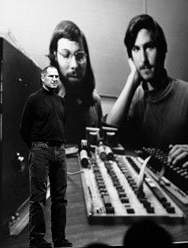
LEGACY
The Brightest Heaven of Invention
At the 2006 Macworld, in front of a slide of him and
Wozniak from thirty years earlier
FireWire
His personality was reflected in the products he
created. Just as the core of Apple’s philosophy, from the
original Macintosh in 1984 to the iPad a generation
later, was the end-to-end integration of hardware and
software, so too was it the case with Steve Jobs: His
passions, perfectionism, demons, desires, artistry,
devilry, and obsession for control were integrally
Steve Jobs by Walter Isaacson
727
connected to his approach to business and the
products that resulted.
The unified field theory that ties together Jobs’s
personality and products begins with his most salient
trait: his intensity. His silences could be as searing as
his rants; he had taught himself to stare without
blinking. Sometimes this intensity was charming, in a
geeky way, such as when he was explaining the
profundity of Bob Dylan’s music or why whatever
product he was unveiling at that moment was the most
amazing thing that Apple had ever made. At other times
it could be terrifying, such as when he was fulminating
about Google or Microsoft ripping off Apple.
This intensity encouraged a binary view of the
world. Colleagues referred to the hero/shithead
dichotomy. You were either one or the other, sometimes
on the same day. The same was true of products, ideas,
even food: Something was either “the best thing ever,”
or it was shitty, brain-dead, inedible. As a result, any
perceived flaw could set off a rant. The finish on a piece
of metal, the curve of the head of a screw, the shade of
blue on a box, the intuitiveness of a navigation screen
—he would declare them to “completely suck” until that
moment when he suddenly pronounced them
“absolutely perfect.” He thought of himself as an artist,
which he was, and he indulged in the temperament of
one.
His quest for perfection led to his compulsion for
Apple to have end-to-end control of every product that it
made. He got hives, or worse, when contemplating
great Apple software running on another company’s
crappy hardware, and he likewise was allergic to the
thought of unapproved apps or content polluting the
perfection of an Apple device. This ability to integrate
hardware and software and content into one unified
system enabled him to impose simplicity. The
Steve Jobs by Walter Isaacson
728
astronomer Johannes Kepler declared that “nature
loves simplicity and unity.” So did Steve Jobs.
This instinct for integrated systems put him
squarely on one side of the most fundamental divide in
the digital world: open versus closed. The hacker ethos
handed down from the Homebrew Computer Club
favored the open approach, in which there was little
centralized control and people were free to modify
hardware and software, share code, write to open
standards, shun proprietary systems, and have content
and apps that were compatible with a variety of devices
and operating systems. The young Wozniak was in that
camp: The Apple II he designed was easily opened and
sported plenty of slots and ports that people could jack
into as they pleased. With the Macintosh Jobs became
a founding father of the other camp. The Macintosh
would be like an appliance, with the hardware and
software tightly woven together and closed to
modifications. The hacker ethos would be sacrificed in
order to create a seamless and simple user experience.
This led Jobs to decree that the Macintosh
operating system would not be available for any other
company’s hardware. Microsoft pursued the opposite
strategy, allowing its Windows operating system to be
promiscuously licensed. That did not produce the most
elegant computers, but it did lead to Microsoft’s
dominating the world of operating systems. After
Apple’s market share shrank to less than 5%,
Microsoft’s approach was declared the winner in the
personal computer realm.
In the longer run, however, there proved to be
some advantages to Jobs’s model. Even with a small
market share, Apple was able to maintain a huge profit
margin while other computer makers were
commoditized. In 2010, for example, Apple had just 7%
of the revenue in the personal computer market, but it
Steve Jobs by Walter Isaacson
729
grabbed 35% of the operating profit.
More significantly, in the early 2000s Jobs’s
insistence on end-to-end integration gave Apple an
advantage in developing a digital hub strategy, which
allowed your desktop computer to link seamlessly with
a variety of portable devices. The iPod, for example,
was part of a closed and tightly integrated system. To
use it, you had to use Apple’s iTunes software and
download content from its iTunes Store. The result was
that the iPod, like the iPhone and iPad that followed,
was an elegant delight in contrast to the kludgy rival
products that did not offer a seamless end-to-end
experience.
The strategy worked. In May 2000 Apple’s market
value was one-twentieth that of Microsoft. In May 2010
Apple surpassed Microsoft as the world’s most valuable
technology company, and by September 2011 it was
worth 70% more than Microsoft. In the first quarter of
2011 the market for Windows PCs shrank by 1%, while
the market for Macs grew 28%.
By then the battle had begun anew in the world of
mobile devices. Google took the more open approach,
and it made its Android operating system available for
use by any maker of tablets or cell phones. By 2011 its
share of the mobile market matched Apple’s. The
drawback of Android’s openness was the fragmentation
that resulted. Various handset and tablet makers
modified Android into dozens of variants and flavors,
making it hard for apps to remain consistent or make full
use if its features. There were merits to both
approaches. Some people wanted the freedom to use
more open systems and have more choices of
hardware; others clearly preferred Apple’s tight
integration and control, which led to products that had
simpler interfaces, longer battery life, greater user-
friendliness, and easier handling of content.
Steve Jobs by Walter Isaacson
730
The downside of Jobs’s approach was that his
desire to delight the user led him to resist empowering
the user. Among the most thoughtful proponents of an
open environment is Jonathan Zittrain of Harvard. He
begins his book
The Future of the Internet—And How to
Stop It
with the scene of Jobs introducing the iPhone,
and he warns of the consequences of replacing
personal computers with “sterile appliances tethered to
a network of control.” Even more fervent is Cory
Doctorow, who wrote a manifesto called “Why I Won’t
Buy an iPad” for Boing Boing. “There’s a lot of
thoughtfulness and smarts that went into the design. But
there’s also a palpable contempt for the owner,” he
wrote. “Buying an iPad for your kids isn’t a means of
jump-starting the realization that the world is yours to
take apart and reassemble; it’s a way of telling your
offspring that even changing the batteries is something
you have to leave to the professionals.”
For Jobs, belief in an integrated approach was a
matter of righteousness. “We do these things not
because we are control freaks,” he explained. “We do
them because we want to make great products,
because we care about the user, and because we like
to take responsibility for the entire experience rather
than turn out the crap that other people make.” He also
believed he was doing people a service: “They’re busy
doing whatever they do best, and they want us to do
what we do best. Their lives are crowded; they have
other things to do than think about how to integrate their
computers and devices.”
This approach sometimes went against Apple’s
short-term business interests. But in a world filled with
junky devices, inscrutable error messages, and
annoying interfaces, it led to astonishing products
marked by beguiling user experiences. Using an Apple
product could be as sublime as walking in one of the
Steve Jobs by Walter Isaacson
731
Zen gardens of Kyoto that Jobs loved, and neither
experience was created by worshipping at the altar of
openness or by letting a thousand flowers bloom.
Sometimes it’s nice to be in the hands of a control freak.
Jobs’s intensity was also evident in his ability to
focus. He would set priorities, aim his laser attention on
them, and filter out distractions. If something engaged
him—the user interface for the original Macintosh, the
design of the iPod and iPhone, getting music
companies into the iTunes Store—he was relentless.
But if he did not want to deal with something—a legal
annoyance, a business issue, his cancer diagnosis, a
family tug—he would resolutely ignore it. That focus
allowed him to say no. He got Apple back on track by
cutting all except a few core products. He made devices
simpler by eliminating buttons, software simpler by
eliminating features, and interfaces simpler by
eliminating options.
He attributed his ability to focus and his love of
simplicity to his Zen training. It honed his appreciation
for intuition, showed him how to filter out anything that
was distracting or unnecessary, and nurtured in him an
aesthetic based on minimalism.
Unfortunately his Zen training never quite
produced in him a Zen-like calm or inner serenity, and
that too is part of his legacy. He was often tightly coiled
and impatient, traits he made no effort to hide. Most
people have a regulator between their mind and mouth
that modulates their brutish sentiments and spikiest
impulses. Not Jobs. He made a point of being brutally
honest. “My job is to say when something sucks rather
than sugarcoat it,” he said. This made him charismatic
and inspiring, yet also, to use the technical term, an
asshole at times.
Andy Hertzfeld once told me, “The one question I’d
truly love Steve to answer is, ‘Why are you sometimes
Steve Jobs by Walter Isaacson
732
so mean?’” Even his family members wondered
whether he simply lacked the filter that restrains people
from venting their wounding thoughts or willfully
bypassed it. Jobs claimed it was the former. “This is
who I am, and you can’t expect me to be someone I’m
not,” he replied when I asked him the question. But I
think he actually could have controlled himself, if he
had wanted. When he hurt people, it was not because
he was lacking in emotional awareness. Quite the
contrary: He could size people up, understand their
inner thoughts, and know how to relate to them, cajole
them, or hurt them at will.
The nasty edge to his personality was not
necessary. It hindered him more than it helped him. But
it did, at times, serve a purpose. Polite and velvety
leaders, who take care to avoid bruising others, are
generally not as effective at forcing change. Dozens of
the colleagues whom Jobs most abused ended their
litany of horror stories by saying that he got them to do
things they never dreamed possible. And he created a
corporation crammed with A players.
The saga of Steve Jobs is the Silicon Valley
creation myth writ large: launching a startup in his
parents’ garage and building it into the world’s most
valuable company. He didn’t invent many things
outright, but he was a master at putting together ideas,
art, and technology in ways that invented the future. He
designed the Mac after appreciating the power of
graphical interfaces in a way that Xerox was unable to
do, and he created the iPod after grasping the joy of
having a thousand songs in your pocket in a way that
Sony, which had all the assets and heritage, never
could accomplish. Some leaders push innovations by
being good at the big picture. Others do so by
mastering details. Jobs did both, relentlessly. As a
result he launched a series of products over three
Steve Jobs by Walter Isaacson
733
decades that transformed whole industries:
• The Apple II, which took Wozniak’s circuit board
and turned it into the first personal computer that was
not just for hobbyists.
• The Macintosh, which begat the home computer
revolution and popularized graphical user interfaces.
•
Toy Story
and other Pixar blockbusters, which
opened up the miracle of digital imagination.
• Apple stores, which reinvented the role of a store
in defining a brand.
• The iPod, which changed the way we consume
music.
• The iTunes Store, which saved the music
industry.
• The iPhone, which turned mobile phones into
music, photography, video, email, and web devices.
• The App Store, which spawned a new content-
creation industry.
• The iPad, which launched tablet computing and
offered a platform for digital newspapers, magazines,
books, and videos.
• iCloud, which demoted the computer from its
central role in managing our content and let all of our
devices sync seamlessly.
• And Apple itself, which Jobs considered his
greatest creation, a place where imagination was
nurtured, applied, and executed in ways so creative that
it became the most valuable company on earth.
Was he smart? No, not exceptionally. Instead, he
was a genius. His imaginative leaps were instinctive,
unexpected, and at times magical. He was, indeed, an
example of what the mathematician Mark Kac called a
magician genius, someone whose insights come out of
the blue and require intuition more than mere mental
processing power. Like a pathfinder, he could absorb
information, sniff the winds, and sense what lay ahead.
Steve Jobs by Walter Isaacson
734
Steve Jobs thus became the greatest business
executive of our era, the one most certain to be
remembered a century from now. History will place him
in the pantheon right next to Edison and Ford. More
than anyone else of his time, he made products that
were completely innovative, combining the power of
poetry and processors. With a ferocity that could make
working with him as unsettling as it was inspiring, he
also built the world’s most creative company. And he
was able to infuse into its DNA the design sensibilities,
perfectionism, and imagination that make it likely to be,
even decades from now, the company that thrives best
at the intersection of artistry and technology.
And One More Thing . . .
Biographers are supposed to have the last word.
But this is a biography of Steve Jobs. Even though he
did not impose his legendary desire for control on this
project, I suspect that I would not be conveying the right
feel for him—the way he asserted himself in any
situation—if I just shuffled him onto history’s stage
without letting him have some last words.
Over the course of our conversations, there were
many times when he reflected on what he hoped his
legacy would be. Here are those thoughts, in his own
words:
My passion has been to build an enduring
company where people were motivated to make great
products. Everything else was secondary. Sure, it was
great to make a profit, because that was what allowed
you to make great products. But the products, not the
profits, were the motivation. Sculley flipped these
priorities to where the goal was to make money. It’s a
subtle difference, but it ends up meaning everything:
the people you hire, who gets promoted, what you
discuss in meetings.
Some people say, “Give the customers what they
Steve Jobs by Walter Isaacson
735
want.” But that’s not my approach. Our job is to figure
out what they’re going to want before they do. I think
Henry Ford once said, “If I’d asked customers what they
wanted, they would have told me, ‘A faster horse!’”
People don’t know what they want until you show it to
them. That’s why I never rely on market research. Our
task is to read things that are not yet on the page.
Edwin Land of Polaroid talked about the
intersection of the humanities and science. I like that
intersection. There’s something magical about that
place. There are a lot of people innovating, and that’s
not the main distinction of my career. The reason Apple
resonates with people is that there’s a deep current of
humanity in our innovation. I think great artists and
great engineers are similar, in that they both have a
desire to express themselves. In fact some of the best
people working on the original Mac were poets and
musicians on the side. In the seventies computers
became a way for people to express their creativity.
Great artists like Leonardo da Vinci and Michelangelo
were also great at science. Michelangelo knew a lot
about how to quarry stone, not just how to be a sculptor.
People pay us to integrate things for them,
because they don’t have the time to think about this stuff
24/7. If you have an extreme passion for producing
great products, it pushes you to be integrated, to
connect your hardware and your software and content
management. You want to break new ground, so you
have to do it yourself. If you want to allow your products
to be open to other hardware or software, you have to
give up some of your vision.
At different times in the past, there were
companies that exemplified Silicon Valley. It was
Hewlett-Packard for a long time. Then, in the
semiconductor era, it was Fairchild and Intel. I think that
it was Apple for a while, and then that faded. And then
Steve Jobs by Walter Isaacson
736
today, I think it’s Apple and Google—and a little more
so Apple. I think Apple has stood the test of time. It’s
been around for a while, but it’s still at the cutting edge
of what’s going on.
It’s easy to throw stones at Microsoft. They’ve
clearly fallen from their dominance. They’ve become
mostly irrelevant. And yet I appreciate what they did and
how hard it was. They were very good at the business
side of things. They were never as ambitious product-
wise as they should have been. Bill likes to portray
himself as a man of the product, but he’s really not. He’s
a businessperson. Winning business was more
important than making great products. He ended up the
wealthiest guy around, and if that was his goal, then he
achieved it. But it’s never been my goal, and I wonder,
in the end, if it was his goal. I admire him for the
company he built—it’s impressive—and I enjoyed
working with him. He’s bright and actually has a good
sense of humor. But Microsoft never had the humanities
and liberal arts in its DNA. Even when they saw the
Mac, they couldn’t copy it well. They totally didn’t get it.
I have my own theory about why decline happens
at companies like IBM or Microsoft. The company does
a great job, innovates and becomes a monopoly or
close to it in some field, and then the quality of the
product becomes less important. The company starts
valuing the great salesmen, because they’re the ones
who can move the needle on revenues, not the product
engineers and designers. So the salespeople end up
running the company. John Akers at IBM was a smart,
eloquent, fantastic salesperson, but he didn’t know
anything about product. The same thing happened at
Xerox. When the sales guys run the company, the
product guys don’t matter so much, and a lot of them
just turn off. It happened at Apple when Sculley came
in, which was my fault, and it happened when Ballmer
Steve Jobs by Walter Isaacson
737
took over at Microsoft. Apple was lucky and it
rebounded, but I don’t think anything will change at
Microsoft as long as Ballmer is running it.
I hate it when people call themselves
“entrepreneurs” when what they’re really trying to do is
launch a startup and then sell or go public, so they can
cash in and move on. They’re unwilling to do the work it
takes to build a real company, which is the hardest work
in business. That’s how you really make a contribution
and add to the legacy of those who went before. You
build a company that will still stand for something a
generation or two from now. That’s what Walt Disney
did, and Hewlett and Packard, and the people who built
Intel. They created a company to last, not just to make
money. That’s what I want Apple to be.
I don’t think I run roughshod over people, but if
something sucks, I tell people to their face. It’s my job to
be honest. I know what I’m talking about, and I usually
turn out to be right. That’s the culture I tried to create.
We are brutally honest with each other, and anyone can
tell me they think I am full of shit and I can tell them the
same. And we’ve had some rip-roaring arguments,
where we are yelling at each other, and it’s some of the
best times I’ve ever had. I feel totally comfortable saying
“Ron, that store looks like shit” in front of everyone else.
Or I might say “God, we really fucked up the
engineering on this” in front of the person that’s
responsible. That’s the ante for being in the room:
You’ve got to be able to be super honest. Maybe there’s
a better way, a gentlemen’s club where we all wear ties
and speak in this Brahmin language and velvet code-
words, but I don’t know that way, because I am middle
class from California.
I was hard on people sometimes, probably harder
than I needed to be. I remember the time when Reed
was six years old, coming home, and I had just fired
Steve Jobs by Walter Isaacson
738
somebody that day, and I imagined what it was like for
that person to tell his family and his young son that he
had lost his job. It was hard. But somebody’s got to do it.
I figured that it was always my job to make sure that the
team was excellent, and if I didn’t do it, nobody was
going to do it.
You always have to keep pushing to innovate.
Dylan could have sung protest songs forever and
probably made a lot of money, but he didn’t. He had to
move on, and when he did, by going electric in 1965,
he alienated a lot of people. His 1966 Europe tour was
his greatest. He would come on and do a set of acoustic
guitar, and the audiences loved him. Then he brought
out what became The Band, and they would all do an
electric set, and the audience sometimes booed. There
was one point where he was about to sing “Like a
Rolling Stone” and someone from the audience yells
“Judas!” And Dylan then says, “Play it fucking loud!”
And they did. The Beatles were the same way. They
kept evolving, moving, refining their art. That’s what I’ve
always tried to do—keep moving. Otherwise, as Dylan
says, if you’re not busy being born, you’re busy dying.
What drove me? I think most creative people want
to express appreciation for being able to take
advantage of the work that’s been done by others
before us. I didn’t invent the language or mathematics I
use. I make little of my own food, none of my own
clothes. Everything I do depends on other members of
our species and the shoulders that we stand on. And a
lot of us want to contribute something back to our
species and to add something to the flow. It’s about
trying to express something in the only way that most of
us know how—because we can’t write Bob Dylan
songs or Tom Stoppard plays. We try to use the talents
we do have to express our deep feelings, to show our
appreciation of all the contributions that came before
Steve Jobs by Walter Isaacson
739
us, and to add something to that flow. That’s what has
driven me.
Coda
One sunny afternoon, when he wasn’t feeling well,
Jobs sat in the garden behind his house and reflected
on death. He talked about his experiences in India
almost four decades earlier, his study of Buddhism, and
his views on reincarnation and spiritual transcendence.
“I’m about fifty-fifty on believing in God,” he said. “For
most of my life, I’ve felt that there must be more to our
existence than meets the eye.”
He admitted that, as he faced death, he might be
overestimating the odds out of a desire to believe in an
afterlife. “I like to think that something survives after you
die,” he said. “It’s strange to think that you accumulate
all this experience, and maybe a little wisdom, and it
just goes away. So I really want to believe that
something survives, that maybe your consciousness
endures.”
He fell silent for a very long time. “But on the other
hand, perhaps it’s like an on-off switch,” he said. “
Click!
And you’re gone.”
Then he paused again and smiled slightly. “Maybe
that’s why I never liked to put on-off switches on Apple
devices.”
Steve Jobs by Walter Isaacson
740
ACKNOWLEDGMENTS
I’m deeply grateful to John and Ann Doerr,
Laurene Powell, Mona Simpson, and Ken Auletta, all of
whom helped get this project launched and provided
invaluable support along the way. Alice Mayhew, who
has been my editor at Simon & Schuster for thirty years,
and Jonathan Karp, the publisher, both were
extraordinarily diligent and attentive in shepherding this
book, as was Amanda Urban, my agent. Crary Pullen
was dogged in tracking down photos, and my assistant,
Pat Zindulka, calmly facilitated things. I also want to
thank my father, Irwin, and my daughter, Betsy, for
reading the book and offering advice. And as always, I
am most deeply indebted to my wife, Cathy, for her
editing, suggestions, wise counsel, and so very much
more.
Steve Jobs by Walter Isaacson
741
SOURCES
Interviews (conducted 2009–2011)
Al Alcorn, Roger Ames, Fred Anderson, Bill
Atkinson, Joan Baez, Marjorie Powell Barden, Jeff
Bewkes, Bono, Ann Bowers, Stewart Brand, Chrisann
Brennan, Larry Brilliant, John Seeley Brown, Tim
Brown, Nolan Bushnell, Greg Calhoun, Bill Campbell,
Berry Cash, Ed Catmull, Ray Cave, Lee Clow, Debi
Coleman, Tim Cook, Katie Cotton, Eddy Cue, Andrea
Cunningham, John Doerr, Millard Drexler, Jennifer
Egan, Al Eisenstat, Michael Eisner, Larry Ellison, Philip
Elmer-DeWitt, Gerard Errera, Tony Fadell, Jean-Louis
Gassée, Bill Gates, Adele Goldberg, Craig Good,
Austan Goolsbee, Al Gore, Andy Grove, Bill Hambrecht,
Michael Hawley, Andy Hertzfeld, Joanna Hoffman,
Elizabeth Holmes, Bruce Horn, John Huey, Jimmy
Iovine, Jony Ive, Oren Jacob, Erin Jobs, Reed Jobs,
Steve Jobs, Ron Johnson, Mitch Kapor, Susan Kare
(email), Jeffrey Katzenberg, Pam Kerwin, Kristina Kiehl,
Joel Klein, Daniel Kottke, Andy Lack, John Lasseter, Art
Levinson, Steven Levy, Dan’l Lewin, Maya Lin, Yo-Yo
Ma, Mike Markkula, John Markoff, Wynton Marsalis,
Regis McKenna, Mike Merin, Bob Metcalfe, Doug
Morris, Walt Mossberg, Rupert Murdoch, Mike Murray,
Nicholas Negroponte, Dean Ornish, Paul Otellini,
Norman Pearlstine, Laurene Powell, Josh Quittner, Tina
Redse, George Riley, Brian Roberts, Arthur Rock, Jeff
Rosen, Alain Rossmann, Jon Rubinstein, Phil Schiller,
Eric Schmidt, Barry Schuler, Mike Scott, John Sculley,
Andy Serwer, Mona Simpson, Mike Slade, Alvy Ray
Smith, Gina Smith, Kathryn Smith, Rick Stengel, Larry
Steve Jobs by Walter Isaacson
742
Tesler, Avie Tevanian, Guy “Bud” Tribble, Don
Valentine, Paul Vidich, James Vincent, Alice Waters,
Ron Wayne, Wendell Weeks, Ed Woolard, Stephen
Wozniak, Del Yocam, Jerry York.
Steve Jobs by Walter Isaacson
743
Bibliography
Amelio, Gil.
On the Firing Line.
HarperBusiness,
1998.
Berlin, Leslie.
The Man behind the Microchip.
Oxford, 2005.
Butcher, Lee.
The Accidental Millionaire.
Paragon
House, 1988.
Carlton, Jim.
Apple.
Random House, 1997.
Cringely, Robert X.
Accidental Empires.
Addison
Wesley, 1992.
Deutschman, Alan.
The Second Coming of Steve
Jobs.
Broadway Books, 2000.
Elliot, Jay, with William Simon.
The Steve Jobs
Way.
Vanguard, 2011.
Freiberger, Paul, and Michael Swaine.
Fire in the
Valley.
McGraw-Hill, 1984.
Garr, Doug.
Woz.
Avon, 1984.
Hertzfeld, Andy.
Revolution in the Valley.
O’Reilly,
2005. (See also his website, folklore.org.)
Hiltzik, Michael.
Dealers of Lightning.
HarperBusiness, 1999.
Jobs, Steve. Smithsonian oral history interview
with Daniel Morrow, April 20, 1995.
———. Stanford commencement address, June
12, 2005.
Kahney, Leander.
Inside Steve’s Brain.
Portfolio,
2008. (See also his website, cultofmac.com.)
Kawasaki, Guy.
The Macintosh Way.
Scott,
Foresman, 1989.
Knopper, Steve.
Appetite for Self-Destruction.
Free
Press, 2009.
Kot, Greg.
Ripped.
Scribner, 2009.
Kunkel, Paul.
AppleDesign.
Graphis Inc., 1997.
Levy, Steven.
Hackers.
Doubleday, 1984.
———.
Insanely Great.
Viking Penguin, 1994.
Steve Jobs by Walter Isaacson
744
———.
The Perfect Thing.
Simon & Schuster,
2006.
Linzmayer, Owen.
Apple Confidential 2.0.
No
Starch Press, 2004.
Malone, Michael.
Infinite Loop.
Doubleday, 1999.
Markoff, John.
What the Dormouse Said.
Viking
Penguin, 2005.
McNish, Jacquie.
The Big Score.
Doubleday
Canada, 1998.
Moritz, Michael.
Return to the Little Kingdom.
Overlook Press, 2009. Originally published, without
prologue and epilogue, as
The Little Kingdom
(Morrow,
1984).
Nocera, Joe.
Good Guys and Bad Guys.
Portfolio,
2008.
Paik, Karen.
To Infinity and Beyond!
Chronicle
Books, 2007.
Price, David.
The Pixar Touch.
Knopf, 2008.
Rose, Frank.
West of Eden.
Viking, 1989.
Sculley, John.
Odyssey.
Harper & Row, 1987.
Sheff, David. “Playboy Interview: Steve Jobs.”
Playboy
, February 1985.
Simpson, Mona.
Anywhere but Here.
Knopf, 1986.
———.
A Regular Guy.
Knopf, 1996.
Smith, Douglas, and Robert Alexander.
Fumbling
the Future.
Morrow, 1988.
Stross, Randall.
Steve Jobs and the NeXT Big
Thing.
Atheneum, 1993.
“Triumph of the Nerds,” PBS Television, hosted by
Robert X. Cringely, June 1996.
Wozniak, Steve, with Gina Smith.
iWoz.
Norton,
2006.
Young, Jeffrey.
Steve Jobs.
Scott, Foresman,
1988.
———, and William Simon.
iCon.
John Wiley,
2005.
Steve Jobs by Walter Isaacson
745
Steve Jobs by Walter Isaacson
746
NOTES
CHAPTER 1: CHILDHOOD
The Adoption:
Interviews with Steve Jobs, Laurene
Powell, Mona Simpson, Del Yocam, Greg Calhoun,
Chrisann Brennan, Andy Hertzfeld. Moritz, 44–45;
Young, 16–17; Jobs, Smithsonian oral history; Jobs,
Stanford commencement address; Andy Behrendt,
“Apple Computer Mogul’s Roots Tied to Green
Bay,” (Green Bay)
Press Gazette
, Dec. 4, 2005;
Georgina Dickinson, “Dad Waits for Jobs to iPhone,”
New York Post
and
The Sun
(London), Aug. 27, 2011;
Mohannad Al-Haj Ali, “Steve Jobs Has Roots in Syria,”
Al Hayat,
Jan. 16, 2011; Ulf Froitzheim, “Porträt Steve
Jobs,”
Unternehmen
, Nov. 26, 2007.
Silicon Valley:
Interviews with Steve Jobs,
Laurene Powell. Jobs, Smithsonian oral history; Moritz,
46; Berlin, 155–177; Malone, 21–22.
School:
Interview with Steve Jobs. Jobs,
Smithsonian oral history; Sculley, 166; Malone, 11, 28,
72; Young, 25, 34–35; Young and Simon, 18; Moritz,
48, 73–74. Jobs’s address was originally 11161 Crist
Drive, before the subdivsion was incorporated into the
town from the county. Some sources mention that Jobs
worked at both Haltek and another store with a similar
name, Halted. When asked, Jobs says he can
remember working only at Haltek.
CHAPTER 2: ODD COUPLE
Woz:
Interviews with Steve Wozniak, Steve Jobs.
Wozniak, 12–16, 22, 50–61, 86–91; Levy,
Hackers
,
245; Moritz, 62–64; Young, 28; Jobs, Macworld
Steve Jobs by Walter Isaacson
747
address, Jan. 17, 2007.
The Blue Box:
Interviews with Steve Jobs, Steve
Wozniak. Ron Rosenbaum, “Secrets of the Little Blue
Box,”
Esquire
, Oct. 1971. Wozniak answer, woz.org/
letters/general/03.html; Wozniak, 98–115. For slightly
varying accounts, see Markoff, 272; Moritz, 78–86;
Young, 42–45; Malone, 30–35.
CHAPTER 3: THE DROPOUT
Chrisann Brennan:
Interviews with Chrisann
Brennan, Steve Jobs, Steve Wozniak, Tim Brown.
Moritz, 75–77; Young, 41; Malone, 39.
Reed College:
Interviews with Steve Jobs, Daniel
Kottke, Elizabeth Holmes. Freiberger and Swaine, 208;
Moritz, 94–100; Young, 55; “The Updated Book of
Jobs,”
Time
, Jan. 3, 1983.
Robert Friedland:
Interviews with Steve Jobs,
Daniel Kottke, Elizabeth Holmes. In September 2010 I
met with Friedland in New York City to discuss his
background and relationship with Jobs, but he did not
want to be quoted on the record. McNish, 11–17;
Jennifer Wells, “Canada’s Next Billionaire,”
Maclean’s
,
June 3, 1996; Richard Read, “Financier’s Saga of Risk,”
Mines and Communities
magazine, Oct. 16, 2005;
Jennifer Hunter, “But What Would His Guru
Say?” (Toronto)
Globe and Mail
, Mar. 18, 1988; Moritz,
96, 109; Young, 56.
. . .
Drop Out:
Interviews with Steve Jobs, Steve
Wozniak; Jobs, Stanford commencement address;
Moritz, 97.
CHAPTER 4: ATARI AND INDIA
Atari:
Interviews with Steve Jobs, Al Alcorn, Nolan
Bushnell, Ron Wayne. Moritz, 103–104.
India:
Interviews with Daniel Kottke, Steve Jobs, Al
Alcorn, Larry Brilliant.
The Search:
Interviews with Steve Jobs, Daniel
Kottke, Elizabeth Holmes, Greg Calhoun. Young, 72;
Steve Jobs by Walter Isaacson
748
Young and Simon, 31–32; Moritz, 107.
Breakout:
Interviews with Nolan Bushnell, Al
Alcorn, Steve Wozniak, Ron Wayne, Andy Hertzfeld.
Wozniak, 144–149; Young, 88; Linzmayer, 4.
CHAPTER 5: THE APPLE I
Machines of Loving Grace:
Interviews with Steve
Jobs, Bono, Stewart Brand. Markoff, xii; Stewart Brand,
“We Owe It All to the Hippies,”
Time
, Mar. 1, 1995; Jobs,
Stanford commencement address; Fred Turner,
From
Counterculture to Cyberculture
(Chicago, 2006).
The Homebrew Computer Club:
Interviews with
Steve Jobs, Steve Wozniak. Wozniak, 152–172;
Freiberger and Swaine, 99; Linzmayer, 5; Moritz, 144;
Steve Wozniak, “Homebrew and How Apple Came to
Be,” www.atariarchives.org; Bill Gates, “Open Letter to
Hobbyists,” Feb. 3, 1976.
Apple Is Born:
Interviews with Steve Jobs, Steve
Wozniak, Mike Markkula, Ron Wayne. Steve Jobs,
address to the Aspen Design Conference, June 15,
1983, tape in Aspen Institute archives; Apple Computer
Partnership Agreement, County of Santa Clara, Apr. 1,
1976, and Amendment to Agreement, Apr. 12, 1976;
Bruce Newman, “Apple’s Lost Founder,”
San Jose
Mercury News
, June 2, 2010; Wozniak, 86, 176–177;
Moritz, 149–151; Freiberger and Swaine, 212–213;
Ashlee Vance, “A Haven for Spare Parts Lives on in
Silicon Valley,”
New York Times
, Feb. 4, 2009; Paul
Terrell interview, Aug. 1, 2008, mac-history.net.
Garage Band:
Interviews with Steve Wozniak,
Elizabeth Holmes, Daniel Kottke, Steve Jobs. Wozniak,
179–189; Moritz, 152–163; Young, 95–111; R. S.
Jones, “Comparing Apples and Oranges,”
Interface
,
July 1976.
CHAPTER 6: THE APPLE II
An Integrated Package:
Interviews with Steve
Jobs, Steve Wozniak, Al Alcorn, Ron Wayne. Wozniak,
Steve Jobs by Walter Isaacson
749
165, 190–195; Young, 126; Moritz, 169–170, 194–197;
Malone, v, 103.
Mike Markkula:
Interviews with Regis McKenna,
Don Valentine, Steve Jobs, Steve Wozniak, Mike
Markkula, Arthur Rock. Nolan Bushnell, keynote
address at the ScrewAttack Gaming Convention,
Dallas, July 5, 2009; Steve Jobs, talk at the International
Design Conference at Aspen, June 15, 1983; Mike
Markkula, “The Apple Marketing Philosophy” (courtesy
of Mike Markkula), Dec. 1979; Wozniak, 196–199. See
also Moritz, 182–183; Malone, 110–111.
Regis McKenna:
Interviews with Regis McKenna,
John Doerr, Steve Jobs. Ivan Raszl, “Interview with Rob
Janoff,” Creativebits.org, Aug. 3, 2009.
The First Launch Event:
Interviews with Steve
Wozniak, Steve Jobs. Wozniak, 201–206; Moritz, 199–
201; Young, 139.
Mike Scott:
Interviews with Mike Scott, Mike
Markkula, Steve Jobs, Steve Wozniak, Arthur Rock.
Young, 135; Freiberger and Swaine, 219, 222; Moritz,
213; Elliot, 4.
CHAPTER 7: CHRISANN AND LISA
Interviews with Chrisann Brennan, Steve Jobs,
Elizabeth Holmes, Greg Calhoun, Daniel Kottke, Arthur
Rock. Moritz, 285; “The Updated Book of Jobs,”
Time,
Jan. 3, 1983; “Striking It Rich,”
Time
, Feb. 15, 1982.
CHAPTER 8: XEROX AND LISA
A New Baby:
Interviews with Andrea Cunningham,
Andy Hertzfeld, Steve Jobs, Bill Atkinson. Wozniak, 226;
Levy,
Insanely Great
, 124; Young, 168–170; Bill
Atkinson, oral history, Computer History Museum,
Mountain View, CA; Jef Raskin, “Holes in the Histories,”
Interactions
, July 1994; Jef Raskin, “Hubris of a
Heavyweight,”
IEEE Spectrum
, July 1994; Jef Raskin,
oral history, April 13, 2000, Stanford Library Department
of Special Collections; Linzmayer, 74, 85–89.
Steve Jobs by Walter Isaacson
750
Xerox PARC:
Interviews with Steve Jobs, John
Seeley Brown, Adele Goldberg, Larry Tesler, Bill
Atkinson. Freiberger and Swaine, 239; Levy,
Insanely
Great
, 66–80; Hiltzik, 330–341; Linzmayer, 74–75;
Young, 170–172; Rose, 45–47;
Triumph of the Nerds
,
PBS, part 3.
“Great Artists Steal”:
Interviews with Steve Jobs,
Larry Tesler, Bill Atkinson. Levy,
Insanely Great
, 77, 87–
90;
Triumph of the Nerds
, PBS, part 3; Bruce Horn,
“Where It All Began” (1966), www.mackido.com; Hiltzik,
343, 367–370; Malcolm Gladwell, “Creation Myth,”
New
Yorker
, May 16, 2011; Young, 178–182.
CHAPTER 9: GOING PUBLIC
Options:
Interviews with Daniel Kottke, Steve Jobs,
Steve Wozniak, Andy Hertzfeld, Mike Markkula, Bill
Hambrecht. “Sale of Apple Stock Barred,”
Boston
Globe
, Dec. 11, 1980.
Baby You’re a Rich Man:
Interviews with Larry
Brilliant, Steve Jobs. Steve Ditlea, “An Apple on Every
Desk,”
Inc.
, Oct. 1, 1981; “Striking It Rich,”
Time
, Feb.
15, 1982; “The Seeds of Success,”
Time
, Feb. 15, 1982;
Moritz, 292–295; Sheff.
CHAPTER 10: THE MAC IS BORN
Jef Raskin’s Baby:
Interviews with Bill Atkinson,
Steve Jobs, Andy Hertzfeld, Mike Markkula. Jef Raskin,
“Recollections of the Macintosh Project,” “Holes in the
Histories,” “The Genesis and History of the Macintosh
Project,” “Reply to Jobs, and Personal Motivation,”
“Design Considerations for an Anthropophilic
Computer,” and “Computers by the Millions,” Raskin
papers, Stanford University Library; Jef Raskin, “A
Conversation,”
Ubiquity
, June 23, 2003; Levy,
Insanely
Great
, 107–121; Hertzfeld, 19; “Macintosh’s Other
Designers,”
Byte
, Aug. 1984; Young, 202, 208–214;
“Apple Launches a Mac Attack,”
Time
, Jan. 30, 1984;
Malone, 255–258.
Steve Jobs by Walter Isaacson
751
Texaco Towers:
Interviews with Andrea
Cunningham, Bruce Horn, Andy Hertzfeld, Mike Scott,
Mike Markkula. Hertzfeld, 19–20, 26–27; Wozniak,
241–242.
CHAPTER 11: THE REALITY DISTORTION FIELD
Interviews with Bill Atkinson, Steve Wozniak, Debi
Coleman, Andy Hertzfeld, Bruce Horn, Joanna
Hoffman, Al Eisenstat, Ann Bowers, Steve Jobs. Some
of these tales have variations. See Hertzfeld, 24, 68,
161.
CHAPTER 12: THE DESIGN
A Bauhaus Aesthetic:
Interviews with Dan’l Lewin,
Steve Jobs, Maya Lin, Debi Coleman. Steve Jobs in
conversation with Charles Hampden-Turner,
International Design Conference in Aspen, June 15,
1983. (The design conference audiotapes are stored at
the Aspen Institute. I want to thank Deborah Murphy for
finding them.)
Like a Porsche:
Interviews with Bill Atkinson, Alain
Rossmann, Mike Markkula, Steve Jobs. “The Macintosh
Design Team,”
Byte
, Feb. 1984; Hertzfeld, 29–31, 41,
46, 63, 68; Sculley, 157; Jerry Manock, “Invasion of
Texaco Towers,” Folklore.org; Kunkel, 26–30; Jobs,
Stanford commencement address; email from Susan
Kare; Susan Kare, “World Class Cities,” in Hertzfeld,
165; Laurence Zuckerman, “The Designer Who Made
the Mac Smile,”
New York Times
, Aug. 26, 1996; Susan
Kare interview, Sept. 8, 2000, Stanford University
Library, Special Collections; Levy,
Insanely Great
, 156;
Hartmut Esslinger,
A Fine Line
(Jossey-Bass, 2009), 7–
9; David Einstein, “Where Success Is by Design,”
San
Francisco Chronicle
, Oct. 6, 1995; Sheff.
CHAPTER 13: BUILDING THE MAC
Competition:
Interview with Steve Jobs. Levy,
Insanely Great
, 125; Sheff; Hertzfeld, 71–73;
Wall Street
Journal
advertisement, Aug. 24, 1981.
Steve Jobs by Walter Isaacson
752
End-to-end Control:
Interview with Berry Cash.
Kahney, 241; Dan Farber, “Steve Jobs, the iPhone and
Open Platforms,” ZDNet.com, Jan. 13, 2007; Tim Wu,
The Master Switch
(Knopf, 2010), 254–276; Mike
Murray, “Mac Memo” to Steve Jobs, May 19, 1982
(courtesy of Mike Murray).
Machines of the Year:
Interviews with Daniel
Kottke, Steve Jobs, Ray Cave. “The Computer Moves
In,”
Time
, Jan. 3, 1983; “The Updated Book of Jobs,”
Time
, Jan. 3, 1983; Moritz, 11; Young, 293; Rose, 9–11;
Peter McNulty, “Apple’s Bid to Stay in the Big Time,”
Fortune
, Feb. 7, 1983; “The Year of the Mouse,”
Time
,
Jan. 31, 1983.
Let’s Be Pirates!
Interviews with Ann Bowers, Andy
Hertzfeld, Bill Atkinson, Arthur Rock, Mike Markkula,
Steve Jobs, Debi Coleman; email from Susan Kare.
Hertzfeld, 76, 135–138, 158, 160, 166; Moritz, 21–28;
Young, 295–297, 301–303; Susan Kare interview, Sept.
8, 2000, Stanford University Library; Jeff Goodell, “The
Rise and Fall of Apple Computer,”
Rolling Stone
, Apr. 4,
1996; Rose, 59–69, 93.
CHAPTER 14: ENTER SCULLEY
The Courtship:
Interviews with John Sculley, Andy
Hertzfeld, Steve Jobs. Rose, 18, 74–75; Sculley, 58–90,
107; Elliot, 90–93; Mike Murray, “Special Mac Sneak”
memo to staff, Mar. 3, 1983 (courtesy of Mike Murray);
Hertzfeld, 149–150.
The Honeymoon:
Interviews with Steve Jobs, John
Sculley, Joanna Hoffman. Sculley, 127–130, 154–155,
168, 179; Hertzfeld, 195.
CHAPTER 15: THE LAUNCH
Real Artists Ship:
Interviews with Andy Hertzfeld,
Steve Jobs. Video of Apple sales conference, Oct.
1983; “Personal Computers: And the Winner Is . . . IBM,”
Business Week
, Oct. 3, 1983; Hertzfeld, 208–210;
Rose, 147–153; Levy,
Insanely Great
, 178–180; Young,
Steve Jobs by Walter Isaacson
753
327–328.
The “1984” Ad:
Interviews with Lee Clow, John
Sculley, Mike Markkula, Bill Campbell, Steve Jobs.
Steve Hayden interview,
Weekend Edition
, NPR, Feb.
1, 2004; Linzmayer, 109–114; Sculley, 176.
Publicity Blast:
Hertzfeld, 226–227; Michael
Rogers, “It’s the Apple of His Eye,”
Newsweek
, Jan. 30,
1984; Levy,
Insanely Great
, 17–27.
January 24, 1984:
Interviews with John Sculley,
Steve Jobs, Andy Hertzfeld. Video of Jan. 1984 Apple
shareholders meeting; Hertzfeld, 213–223; Sculley,
179–181; William Hawkins, “Jobs’ Revolutionary New
Computer,”
Popular Science
, Jan. 1989.
CHAPTER 16: GATES AND JOBS
The Macintosh Partnership:
Interviews with Bill
Gates, Steve Jobs, Bruce Horn. Hertzfeld, 52–54; Steve
Lohr, “Creating Jobs,”
New York Times
, Jan. 12, 1997;
Triumph of the Nerds
, PBS, part 3; Rusty Weston,
“Partners and Adversaries,”
MacWeek
, Mar. 14, 1989;
Walt Mossberg and Kara Swisher, interview with Bill
Gates and Steve Jobs,
All Things Digital
, May 31, 2007;
Young, 319–320; Carlton, 28; Brent Schlender, “How
Steve Jobs Linked Up with IBM,”
Fortune
, Oct. 9, 1989;
Steven Levy, “A Big Brother?”
Newsweek
, Aug. 18,
1997.
The Battle of the GUI:
Interviews with Bill Gates,
Steve Jobs. Hertzfeld, 191–193; Michael Schrage, “IBM
Compatibility Grows,”
Washington Post
, Nov. 29, 1983;
Triumph of the Nerds
, PBS, part 3.
CHAPTER 17: ICARUS
Flying High:
Interviews with Steve Jobs, Debi
Coleman, Bill Atkinson, Andy Hertzfeld, Alain
Rossmann, Joanna Hoffman, Jean-Louis Gassée,
Nicholas Negroponte, Arthur Rock, John Sculley. Sheff;
Hertzfeld, 206–207, 230; Sculley, 197–199; Young,
308–309; George Gendron and Bo Burlingham,
Steve Jobs by Walter Isaacson
754
“Entrepreneur of the Decade,”
Inc.
, Apr. 1, 1989.
Falling:
Interviews with Joanna Hoffman, John
Sculley, Lee Clow, Debi Coleman, Andrea
Cunningham, Steve Jobs. Sculley, 201, 212–215; Levy,
Insanely Great
, 186–192; Michael Rogers, “It’s the
Apple of His Eye,”
Newsweek
, Jan. 30, 1984; Rose,
207, 233; Felix Kessler, “Apple Pitch,”
Fortune
, Apr. 15,
1985; Linzmayer, 145.
Thirty Years Old:
Interviews with Mallory Walker,
Andy Hertzfeld, Debi Coleman, Elizabeth Holmes,
Steve Wozniak, Don Valentine. Sheff.
Exodus:
Interviews with Andy Hertzfeld, Steve
Wozniak, Bruce Horn. Hertzfeld, 253, 263–264; Young,
372–376; Wozniak, 265–266; Rose, 248–249; Bob
Davis, “Apple’s Head, Jobs, Denies Ex-Partner Use of
Design Firm,”
Wall Street Journal
, Mar. 22, 1985.
Showdown, Spring 1985:
Interviews with Steve
Jobs, Al Alcorn, John Sculley, Mike Murray. Elliot, 15;
Sculley, 205–206, 227, 238–244; Young, 367–379;
Rose, 238, 242, 254–255; Mike Murray, “Let’s Wake Up
and Die Right,” memo to undisclosed recipients, Mar. 7,
1985 (courtesy of Mike Murray).
Plotting a Coup:
Interviews with Steve Jobs, John
Sculley. Rose, 266–275; Sculley, ix–x, 245–246;
Young, 388–396; Elliot, 112.
Seven Days in May:
Interviews with Jean-Louis
Gassée, Steve Jobs, Bill Campbell, Al Eisenstat, John
Sculley, Mike Murray, Mike Markkula, Debi Coleman.
Bro Uttal, “Behind the Fall of Steve Jobs,”
Fortune
, Aug.
5, 1985; Sculley, 249–260; Rose, 275–290; Young,
396–404.
Like a Rolling Stone:
Interviews with Mike Murray,
Mike Markkula, Steve Jobs, John Sculley, Bob Metcalfe,
George Riley, Andy Hertzfeld, Tina Redse, Mike Merin,
Al Eisenstat, Arthur Rock. Tina Redse email to Steve
Jobs, July 20, 2010; “No Job for Jobs,” AP, July 26,
Steve Jobs by Walter Isaacson
755
1985; “Jobs Talks about His Rise and Fall,”
Newsweek
,
Sept. 30, 1985; Hertzfeld, 269–271; Young, 387, 403–
405; Young and Simon, 116; Rose, 288–292; Sculley,
242–245, 286–287; letter from Al Eisenstat to Arthur
Hartman, July 23, 1985 (courtesy of Al Eisenstat).
CHAPTER 18: NeXT
The Pirates Abandon Ship:
Interviews with Dan’l
Lewin, Steve Jobs, Bill Campbell, Arthur Rock, Mike
Markkula, John Sculley, Andrea Cunningham, Joanna
Hoffman. Patricia Bellew Gray and Michael Miller,
“Apple Chairman Jobs Resigns,”
Wall Street Journal
,
Sept. 18, 1985; Gerald Lubenow and Michael Rogers,
“Jobs Talks about His Rise and Fall,”
Newsweek
, Sept.
30, 1985; Bro Uttal, “The Adventures of Steve Jobs,”
Fortune
, Oct. 14, 1985; Susan Kerr, “Jobs Resigns,”
Computer Systems News,
Sept. 23, 1985; “Shaken to
the Very Core,”
Time
, Sept. 30, 1985; John Eckhouse,
“Apple Board Fuming at Steve Jobs,”
San Francisco
Chronicle
, Sept. 17, 1985; Hertzfeld, 132–133; Sculley,
313–317; Young, 415–416; Young and Simon, 127;
Rose, 307–319; Stross, 73; Deutschman, 36; Complaint
for Breaches of Fiduciary Obligations,
Apple Computer
v. Steven P. Jobs and Richard A. Page,
Superior Court
of California, Santa Clara County, Sept. 23, 1985;
Patricia Bellew Gray, “Jobs Asserts Apple Undermined
Efforts to Settle Dispute,”
Wall Street Journal
, Sept. 25,
1985.
To Be on Your Own:
Interviews with Arthur Rock,
Susan Kare, Steve Jobs, Al Eisenstat. “Logo for Jobs’
New Firm,”
San Francisco Chronicle
, June 19, 1986;
Phil Patton, “Steve Jobs: Out for Revenge,”
New York
Times
, Aug. 6, 1989; Paul Rand, NeXT Logo
presentation, 1985; Doug Evans and Allan Pottasch,
video interview with Steve Jobs on Paul Rand, 1993;
Steve Jobs to Al Eisenstat, Nov. 4, 1985; Eisenstat to
Jobs, Nov. 8, 1985; Agreement between Apple
Steve Jobs by Walter Isaacson
756
Computer Inc. and Steven P. Jobs, and Request for
Dismissal of Lawsuit without Prejudice, filed in the
Superior Court of California, Santa Clara County, Jan.
17, 1986; Deutschman, 47, 43; Stross, 76, 118–120,
245; Kunkel, 58–63; “Can He Do It Again?”
Business
Week
, Oct. 24, 1988; Joe Nocera, “The Second Coming
of Steve Jobs,”
Esquire
, Dec. 1986, reprinted in
Good
Guys and Bad Guys
(Portfolio, 2008), 49; Brenton
Schlender, “How Steve Jobs Linked Up with IBM,”
Fortune
, Oct. 9, 1989.
The Computer:
Interviews with Mitch Kapor,
Michael Hawley, Steve Jobs. Peter Denning and Karen
Frenkle, “A Conversation with Steve Jobs,”
Communications of the Association for Computer
Machinery
, Apr. 1, 1989; John Eckhouse, “Steve Jobs
Shows Off Ultra-Robotic Assembly Line,”
San Francisco
Chronicle
, June 13, 1989; Stross, 122–125;
Deutschman, 60–63; Young, 425; Katie Hafner, “Can
He Do It Again?”
Business Week
, Oct. 24, 1988;
The
Entrepreneurs
, PBS, Nov. 5, 1986, directed by John
Nathan.
Perot to the Rescue:
Stross, 102–112; “Perot and
Jobs,”
Newsweek
, Feb. 9, 1987; Andrew Pollack, “Can
Steve Jobs Do It Again?”
New York Times
, Nov. 8,
1987; Katie Hafner, “Can He Do It Again?”
Business
Week
, Oct. 24, 1988; Pat Steger, “A Gem of an Evening
with King Juan Carlos,”
San Francisco Chronicle
, Oct.
5, 1987; David Remnick, “How a Texas Playboy
Became a Billionaire,”
Washington Post
, May 20, 1987.
Gates and NeXT:
Interviews with Bill Gates, Adele
Goldberg, Steve Jobs. Brit Hume, “Steve Jobs Pulls
Ahead,”
Washington Post
, Oct. 31, 1988; Brent
Schlender, “How Steve Jobs Linked Up with IBM,”
Fortune
, Oct. 9, 1989; Stross, 14; Linzmayer, 209;
“William Gates Talks,”
Washington Post
, Dec. 30, 1990;
Katie Hafner, “Can He Do It Again?”
Business Week
,
Steve Jobs by Walter Isaacson
757
Oct. 24, 1988; John Thompson, “Gates, Jobs Swap
Barbs,”
Computer System News
, Nov. 27, 1989.
IBM:
Brent Schlender, “How Steve Jobs Linked Up
with IBM,”
Fortune
, Oct. 9, 1989; Phil Patton, “Out for
Revenge,”
New York Times
, Aug. 6, 1989; Stross, 140–
142; Deutschman, 133.
The Launch, October 1988:
Stross, 166–186; Wes
Smith, “Jobs Has Returned,”
Chicago Tribune
, Nov. 13,
1988; Andrew Pollack, “NeXT Produces a Gala,”
New
York Times
, Oct. 10, 1988; Brenton Schlender, “Next
Project,”
Wall Street Journal
, Oct. 13, 1988; Katie
Hafner, “Can He Do It Again?”
Business Week
, Oct. 24,
1988; Deutschman, 128; “Steve Jobs Comes Back,”
Newsweek
, Oct. 24, 1988; “The NeXT Generation,”
San
Jose Mercury News
, Oct. 10, 1988.
CHAPTER 19: PIXAR
Lucasfilm’s Computer Division:
Interviews with Ed
Catmull, Alvy Ray Smith, Steve Jobs, Pam Kerwin,
Michael Eisner. Price, 71–74, 89–101; Paik, 53–57,
226; Young and Simon, 169; Deutschman, 115.
Animation:
Interviews with John Lasseter, Steve
Jobs. Paik, 28–44; Price, 45–56.
Tin Toy:
Interviews with Pam Kerwin, Alvy Ray
Smith, John Lasseter, Ed Catmull, Steve Jobs, Jeffrey
Katzenberg, Michael Eisner, Andy Grove. Steve Jobs
email to Albert Yu, Sept. 23, 1995; Albert Yu to Steve
Jobs, Sept. 25, 1995; Steve Jobs to Andy Grove, Sept.
25, 1995; Andy Grove to Steve Jobs, Sept. 26, 1995;
Steve Jobs to Andy Grove, Oct. 1, 1995; Price, 104–
114; Young and Simon, 166.
CHAPTER 20: A REGULAR GUY
Joan Baez:
Interviews with Joan Baez, Steve Jobs,
Joanna Hoffman, Debi Coleman, Andy Hertzfeld. Joan
Baez,
And a Voice to Sing With
(Summit, 1989), 144,
380.
Finding Joanne and Mona:
Interviews with Steve
Steve Jobs by Walter Isaacson
758
Jobs, Mona Simpson.
The Lost Father:
Interviews with Steve Jobs,
Laurene Powell, Mona Simpson, Ken Auletta, Nick
Pileggi.
Lisa:
Interviews with Chrisann Brennan, Avie
Tevanian, Joanna Hoffman, Andy Hertzfeld. Lisa
Brennan-Jobs, “Confessions of a Lapsed Vegetarian,”
Southwest Review
, 2008; Young, 224; Deutschman, 76.
The Romantic:
Interviews with Jennifer Egan, Tina
Redse, Steve Jobs, Andy Hertzfeld, Joanna Hoffman.
Deutschman, 73, 138. Mona Simpson’s
A Regular Guy
is a novel loosely based on the relationship between
Jobs, Lisa and Chrisann Brennan, and Tina Redse,
who is the basis for the character named Olivia.
CHAPTER 21: FAMILY MAN
Laurene Powell:
Interviews with Laurene Powell,
Steve Jobs, Kathryn Smith, Avie Tevanian, Andy
Hertzfeld, Marjorie Powell Barden.
The Wedding, March 18, 1991:
Interviews with
Steve Jobs, Laurene Powell, Andy Hertzfeld, Joanna
Hoffman, Avie Tevanian, Mona Simpson. Simpson,
A
Regular Guy,
357.
A Family Home:
Interviews with Steve Jobs,
Laurene Powell, Andy Hertzfeld. David Weinstein,
“Taking Whimsy Seriously,”
San Francisco Chronicle
,
Sept. 13, 2003; Gary Wolfe, “Steve Jobs,”
Wired
, Feb.
1996; “Former Apple Designer Charged with Harassing
Steve Jobs,” AP, June 8, 1993.
Lisa Moves In:
Interviews with Steve Jobs,
Laurene Powell, Mona Simpson, Andy Hertzfeld. Lisa
Brennan-Jobs, “Driving Jane,”
Harvard Advocate
,
Spring 1999; Simpson,
A Regular Guy,
251; email from
Chrisann Brennan, Jan. 19, 2011; Bill Workman, “Palo
Alto High School’s Student Scoop,”
San Francisco
Chronicle
, Mar. 16, 1996; Lisa Brennan-Jobs,
“Waterloo,”
Massachusetts Review
, Spring 2006;
Steve Jobs by Walter Isaacson
759
Deutschman, 258; Chrisann Brennan website,
chrysanthemum.com; Steve Lohr, “Creating Jobs,”
New
York Times
, Jan. 12, 1997.
Children:
Interviews with Steve Jobs, Laurene
Powell.
CHAPTER 22: TOY STORY
Jeffrey Katzenberg:
Interviews with John Lasseter,
Ed Catmull, Jeffrey Katzenberg, Alvy Ray Smith, Steve
Jobs. Price, 84–85, 119–124; Paik, 71, 90; Robert
Murphy, “John Cooley Looks at Pixar’s Creative
Process,”
Silicon Prairie News
, Oct. 6, 2010.
Cut!
Interviews with Steve Jobs, Jeffrey
Katzenberg, Ed Catmull, Larry Ellison. Paik, 90;
Deutschman, 194–198; “Toy Story: The Inside Buzz,”
Entertainment Weekly
, Dec. 8, 1995.
To Infinity!
Interviews with Steve Jobs, Michael
Eisner. Janet Maslin, “There’s a New Toy in the House.
Uh-Oh,”
New York Times
, Nov. 22, 1995; “A
Conversation with Steve Jobs and John Lasseter,”
Charlie Rose
, PBS, Oct. 30, 1996; John Markoff, “Apple
Computer Co-Founder Strikes Gold,”
New York Times
,
Nov. 30, 1995.
CHAPTER 23: THE SECOND COMING
Things Fall Apart:
Interview with Jean-Louis
Gassée. Bart Ziegler, “Industry Has Next to No Patience
with Jobs’ NeXT,” AP, Aug. 19, 1990; Stross, 226–228;
Gary Wolf, “The Next Insanely Great Thing,”
Wired
, Feb.
1996; Anthony Perkins, “Jobs’ Story,”
Red Herring
, Jan.
1, 1996.
Apple Falling:
Interviews with Steve Jobs, John
Sculley, Larry Ellison. Sculley, 248, 273; Deutschman,
236; Steve Lohr, “Creating Jobs,”
New York Times
, Jan.
12, 1997; Amelio, 190 and preface to the hardback
edition; Young and Simon, 213–214; Linzmayer, 273–
279; Guy Kawasaki, “Steve Jobs to Return as Apple
CEO,”
Macworld
, Nov. 1, 1994.
Steve Jobs by Walter Isaacson
760
Slouching toward Cupertino:
Interviews with Jon
Rubinstein, Steve Jobs, Larry Ellison, Avie Tevanian,
Fred Anderson, Larry Tesler, Bill Gates, John Lasseter.
John Markoff, “Why Apple Sees Next as a Match Made
in Heaven,”
New York Times
, Dec. 23, 1996; Steve
Lohr, “Creating Jobs,”
New York Times
, Jan. 12, 1997;
Rajiv Chandrasekaran, “Steve Jobs Returning to
Apple,”
Washington Post
, Dec. 21, 1996; Louise Kehoe,
“Apple’s Prodigal Son Returns,”
Financial Times
, Dec.
23, 1996; Amelio, 189–201, 238; Carlton, 409;
Linzmayer, 277; Deutschman, 240.
CHAPTER 24: THE RESTORATION
Hovering Backstage:
Interviews with Steve Jobs,
Avie Tevanian, Jon Rubinstein, Ed Woolard, Larry
Ellison, Fred Anderson, email from Gina Smith. Sheff;
Brent Schlender, “Something’s Rotten in Cupertino,”
Fortune
, Mar. 3, 1997; Dan Gillmore, “Apple’s Prospects
Better Than Its CEO’s Speech,”
San Jose Mercury
News
, Jan. 13, 1997; Carlton, 414–416, 425; Malone,
531; Deutschman, 241–245; Amelio, 219, 238–247,
261; Linzmayer, 201; Kaitlin Quistgaard, “Apple Spins
Off Newton,”
Wired.com
, May 22, 1997; Louise Kehoe,
“Doubts Grow about Leadership at Apple,”
Financial
Times
, Feb. 25, 1997; Dan Gillmore, “Ellison Mulls
Apple Bid,”
San Jose Mercury News
, Mar. 27, 1997;
Lawrence Fischer, “Oracle Seeks Public Views on
Possible Bid for Apple,”
New York Times
, Mar. 28,
1997; Mike Barnicle, “Roadkill on the Info Highway,”
Boston Globe
, Aug. 5, 1997.
Exit, Pursued by a Bear:
Interviews with Ed
Woolard, Steve Jobs, Mike Markkula, Steve Wozniak,
Fred Anderson, Larry Ellison, Bill Campbell. Privately
printed family memoir by Ed Woolard (courtesy of
Woolard); Amelio, 247, 261, 267; Gary Wolf, “The World
According to Woz,”
Wired
, Sept. 1998; Peter Burrows
and Ronald Grover, “Steve Jobs’ Magic Kingdom,”
Steve Jobs by Walter Isaacson
761
Business Week
, Feb. 6, 2006; Peter Elkind, “The
Trouble with Steve Jobs,”
Fortune
, Mar. 5, 2008; Arthur
Levitt,
Take on the Street
(Pantheon, 2002), 204–206.
Macworld Boston, August 1997:
Steve Jobs,
Macworld Boston speech, Aug. 6, 1997.
The Microsoft Pact:
Interviews with Joel Klein, Bill
Gates, Steve Jobs. Cathy Booth, “Steve’s Job,”
Time
,
Aug. 18, 1997; Steven Levy, “A Big Brother?”
Newsweek
, Aug. 18, 1997. Jobs’s cell phone call with
Gates was reported by
Time
photographer Diana
Walker, who shot the picture of him crouching onstage
that appeared on the
Time
cover and in the photo
section of this book.
CHAPTER 25: THINK DIFFERENT
Here’s to the Crazy Ones:
Interviews with Steve
Jobs, Lee Clow, James Vincent, Norman Pearlstine.
Cathy Booth, “Steve’s Job,”
Time
, Aug. 18, 1997; John
Heilemann, “Steve Jobs in a Box,”
New York
, June 17,
2007.
iCEO:
Interviews with Steve Jobs, Fred Anderson.
Video of Sept. 1997 staff meeting (courtesy of Lee
Clow); “Jobs Hints That He May Want to Stay at Apple,”
New York Times
, Oct. 10, 1997; Jon Swartz, “No CEO in
Sight for Apple,”
San Francisco Chronicle
, Dec. 12,
1997; Carlton, 437.
Killing the Clones:
Interviews with Bill Gates, Steve
Jobs, Ed Woolard. Steve Wozniak, “How We Failed
Apple,”
Newsweek
, Feb. 19, 1996; Linzmayer, 245–
247, 255; Bill Gates, “Licensing of Mac Technology,” a
memo to John Sculley, June 25, 1985; Tom Abate,
“How Jobs Killed Mac Clone Makers,”
San Francisco
Chronicle
, Sept. 6, 1997.
Product Line Review:
Interviews with Phil Schiller,
Ed Woolard, Steve Jobs. Deutschman, 248; Steve Jobs,
speech at iMac launch event, May 6, 1998; video of
Sept. 1997 staff meeting.
Steve Jobs by Walter Isaacson
762
CHAPTER 26: DESIGN PRINCIPLES
Jony Ive:
Interviews with Jony Ive, Steve Jobs, Phil
Schiller. John Arlidge, “Father of Invention,”
Observer
(London), Dec. 21, 2003; Peter Burrows, “Who Is
Jonathan Ive?”
Business Week
, Sept. 25, 2006;
“Apple’s One-Dollar-a-Year Man,”
Fortune
, Jan. 24,
2000; Rob Walker, “The Guts of a New Machine,”
New
York Times
, Nov. 30, 2003; Leander Kahney, “Design
According to Ive,”
Wired.com
, June 25, 2003.
Inside the Studio:
Interview with Jony Ive. U.S.
Patent and Trademark Office, online database,
patft.uspto.gov; Leander Kahney, “Jobs Awarded Patent
for iPhone Packaging,”
Cult of Mac
, July 22, 2009;
Harry McCracken, “Patents of Steve Jobs,”
Technologizer.com
, May 28, 2009.
CHAPTER 27: THE iMAC
Back to the Future:
Interviews with Phil Schiller,
Avie Tevanian, Jon Rubinstein, Steve Jobs, Fred
Anderson, Mike Markkula, Jony Ive, Lee Clow. Thomas
Hormby, “Birth of the iMac,”
Mac Observer
, May 25,
2007; Peter Burrows, “Who Is Jonathan Ive?”
Business
Week
, Sept. 25, 2006; Lev Grossman, “How Apple
Does It,”
Time
, Oct. 16, 2005; Leander Kahney, “The
Man Who Named the iMac and Wrote Think Different,”
Cult of Mac
, Nov. 3, 2009; Levy,
The Perfect Thing
, 198;
gawker.com/comment/21123257/; “Steve’s Two Jobs,”
Time
, Oct. 18, 1999.
The Launch, May 6, 1998:
Interviews with Jony
Ive, Steve Jobs, Phil Schiller, Jon Rubinstein. Steven
Levy, “Hello Again,”
Newsweek
, May 18, 1998; Jon
Swartz, “Resurgence of an American Icon,”
Forbes
, Apr.
14, 2000; Levy,
The Perfect Thing
, 95.
CHAPTER 28: CEO
Tim Cook:
Interviews with Tim Cook, Steve Jobs,
Jon Rubinstein. Peter Burrows, “Yes, Steve, You Fixed
It. Congratulations. Now What?”
Business Week
, July
Steve Jobs by Walter Isaacson
763
31, 2000; Tim Cook, Auburn commencement address,
May 14, 2010; Adam Lashinsky, “The Genius behind
Steve,”
Fortune
, Nov. 10, 2008; Nick Wingfield, “Apple’s
No. 2 Has Low Profile,”
Wall Street Journal
, Oct. 16,
2006.
Mock Turtlenecks and Teamwork:
Interviews with
Steve Jobs, James Vincent, Jony Ive, Lee Clow, Avie
Tevanian, Jon Rubinstein. Lev Grossman, “How Apple
Does It,”
Time
, Oct. 16, 2005; Leander Kahney, “How
Apple Got Everything Right by Doing Everything
Wrong,”
Wired
, Mar. 18, 2008.
From iCEO to CEO:
Interviews with Ed Woolard,
Larry Ellison, Steve Jobs. Apple proxy statement, Mar.
12, 2001.
CHAPTER 29: APPLE STORES
The Customer Experience:
Interviews with Steve
Jobs, Ron Johnson. Jerry Useem, “America’s Best
Retailer,”
Fortune
, Mar. 19, 2007; Gary Allen, “Apple
Stores,” ifoAppleStore.com.
The Prototype:
Interviews with Art Levinson, Ed
Woolard, Millard “Mickey” Drexler, Larry Ellison, Ron
Johnson, Steve Jobs, Art Levinson. Cliff Edwards,
“Sorry, Steve . . . ,”
Business Week
, May 21, 2001.
Wood, Stone, Steel, Glass:
Interviews with Ron
Johnson, Steve Jobs. U.S. Patent Office, D478999, Aug.
26, 2003, US2004/0006939, Jan. 15, 2004; Gary Allen,
“About Me,” ifoapplestore.com.
CHAPTER 30: THE DIGITAL HUB
Connecting the Dots:
Interviews with Lee Clow,
Jony Ive, Steve Jobs. Sheff; Steve Jobs, Macworld
keynote address, Jan. 9, 2001.
FireWire:
Interviews with Steve Jobs, Phil Schiller,
Jon Rubinstein. Steve Jobs, Macworld keynote
address, Jan. 9, 2001; Joshua Quittner, “Apple’s New
Core,”
Time
, Jan. 14, 2002; Mike Evangelist, “Steve
Jobs, the Genuine Article,”
Writer’s Block Live
, Oct. 7,
Steve Jobs by Walter Isaacson
764
2005; Farhad Manjoo, “Invincible Apple,”
Fast
Company
, July 1, 2010; email from Phil Schiller.
iTunes:
Interviews with Steve Jobs, Phil Schiller,
Jon Rubinstein, Tony Fadell. Brent Schlender, “How Big
Can Apple Get,”
Fortune
, Feb. 21, 2005; Bill Kincaid,
“The True Story of SoundJam,” http://panic.com/extras/
audionstory/popup-sjstory.html; Levy,
The Perfect
Thing
, 49–60; Knopper, 167; Lev Grossman, “How
Apple Does It,”
Time
, Oct. 17, 2005; Markoff, xix.
The iPod:
Interviews with Steve Jobs, Phil Schiller,
Jon Rubinstein, Tony Fadell. Steve Jobs, iPod
announcement, Oct. 23, 2001; Toshiba press releases,
PR Newswire, May 10, 2000, and June 4, 2001; Tekla
Perry, “From Podfather to Palm’s Pilot,”
IEEE Spectrum
,
Sept. 2008; Leander Kahney, “Inside Look at Birth of
the iPod,”
Wired
, July 21, 2004; Tom Hormby and Dan
Knight, “History of the iPod,”
Low End Mac
, Oct. 14,
2005.
That’s It!
Interviews with Tony Fadell, Phil Schiller,
Jon Rubinstein, Jony Ive, Steve Jobs. Levy,
The Perfect
Thing
, 17, 59–60; Knopper, 169; Leander Kahney,
“Straight Dope on the IPod’s Birth,”
Wired
, Oct. 17,
2006.
The Whiteness of the Whale:
Interviews with
James Vincent, Lee Clow, Steve Jobs. Wozniak, 298;
Levy,
The Perfect Thing
, 73; Johnny Davis, “Ten Years
of the iPod,”
Guardian
, Mar. 18, 2011.
CHAPTER 31: THE iTUNES STORE
Warner Music:
Interviews with Paul Vidich, Steve
Jobs, Doug Morris, Barry Schuler, Roger Ames, Eddy
Cue. Paul Sloan, “What’s Next for Apple,”
Business 2.0
,
Apr. 1, 2005; Knopper, 157–161,170; Devin Leonard,
“Songs in the Key of Steve,”
Fortune
, May 12, 2003;
Tony Perkins, interview with Nobuyuki Idei and Sir
Howard Stringer, World Economic Forum, Davos, Jan.
25, 2003; Dan Tynan, “The 25 Worst Tech Products of
Steve Jobs by Walter Isaacson
765
All Time,”
PC World
, Mar. 26, 2006; Andy Langer, “The
God of Music,”
Esquire
, July 2003; Jeff Goodell, “Steve
Jobs,”
Rolling Stone
, Dec. 3, 2003.
Herding Cats:
Interviews with Doug Morris, Roger
Ames, Steve Jobs, Jimmy Iovine, Andy Lack, Eddy Cue,
Wynton Marsalis. Knopper, 172; Devin Leonard, “Songs
in the Key of Steve,”
Fortune
, May 12, 2003; Peter
Burrows, “Show Time!”
Business Week
, Feb. 2, 2004;
Pui-Wing Tam, Bruce Orwall, and Anna Wilde Mathews,
“Going Hollywood,”
Wall Street Journal
, Apr. 25, 2003;
Steve Jobs, keynote speech, Apr. 28, 2003; Andy
Langer, “The God of Music,”
Esquire
, July 2003; Steven
Levy, “Not the Same Old Song,”
Newsweek
, May 12,
2003.
Microsoft:
Interviews with Steve Jobs, Phil Schiller,
Tim Cook, Jon Rubinstein, Tony Fadell, Eddy Cue.
Emails from Jim Allchin, David Cole, Bill Gates, Apr. 30,
2003 (these emails later became part of an Iowa court
case and Steve Jobs sent me copies); Steve Jobs,
presentation, Oct. 16, 2003; Walt Mossberg interview
with Steve Jobs, All Things Digital conference, May 30,
2007; Bill Gates, “We’re Early on the Video Thing,”
Business Week
, Sept. 2, 2004.
Mr. Tambourine Man:
Interviews with Andy Lack,
Tim Cook, Steve Jobs, Tony Fadell, Jon Rubinstein.
Ken Belson, “Infighting Left Sony behind Apple in
Digital Music,”
New York Times
, Apr. 19, 2004; Frank
Rose, “Battle for the Soul of the MP3 Phone,”
Wired
,
Nov. 2005; Saul Hansel, “Gates vs. Jobs: The
Rematch,”
New York Times
, Nov. 14, 2004; John
Borland, “Can Glaser and Jobs Find Harmony?”
CNET
News
, Aug. 17, 2004; Levy,
The Perfect Thing
, 169.
CHAPTER 32: MUSIC MAN
On His iPod:
Interviews with Steve Jobs, James
Vincent. Elisabeth Bumiller, “President Bush’s iPod,”
New York Times
, Apr. 11, 2005; Levy,
The Perfect
Steve Jobs by Walter Isaacson
766
Thing
, 26–29; Devin Leonard, “Songs in the Key of
Steve,”
Fortune
, May 12, 2003.
Bob Dylan:
Interviews with Jeff Rosen, Andy Lack,
Eddy Cue, Steve Jobs, James Vincent, Lee Clow.
Matthew Creamer, “Bob Dylan Tops Music Chart Again
—and Apple’s a Big Reason Why,”
Ad Age
, Oct. 8,
2006.
The Beatles; Bono; Yo-Yo Ma:
Interviews with
Bono, John Eastman, Steve Jobs, Yo-Yo Ma, George
Riley.
CHAPTER 33: PIXAR’S FRIENDS
A Bug’s Life:
Interviews with Jeffrey Katzenberg,
John Lasseter, Steve Jobs. Price, 171–174; Paik, 116;
Peter Burrows, “Antz vs. Bugs” and “Steve Jobs: Movie
Mogul,”
Business Week
, Nov. 23, 1998; Amy Wallace,
“Ouch! That Stings,”
Los Angeles Times
, Sept. 21, 1998;
Kim Masters, “Battle of the Bugs,”
Time
, Sept. 28, 1998;
Richard Schickel, “Antz,”
Time
, Oct. 12, 1998; Richard
Corliss, “Bugs Funny,”
Time
, Nov. 30, 1998.
Steve’s Own Movie:
Interviews with John Lasseter,
Pam Kerwin, Ed Catmull, Steve Jobs. Paik, 168; Rick
Lyman, “A Digital Dream Factory in Silicon Valley,”
New
York Times
, June 11, 2001.
The Divorce:
Interviews with Mike Slade, Oren
Jacob, Michael Eisner, Bob Iger, Steve Jobs, John
Lasseter, Ed Catmull. James Stewart,
Disney War
(Simon & Schuster, 2005), 383; Price, 230–235; Benny
Evangelista, “Parting Slam by Pixar’s Jobs,”
San
Francisco Chronicle
, Feb. 5, 2004; John Markoff and
Laura Holson, “New iPod Will Play TV Shows,”
New
York Times
, Oct. 13, 2005.
CHAPTER 34: TWENTY-FIRST-CENTURY MACS
Clams, Ice Cubes, and Sunflowers:
Interviews with
Jon Rubinstein, Jony Ive, Laurene Powell, Steve Jobs,
Fred Anderson, George Riley. Steven Levy, “Thinking
inside the Box,”
Newsweek
, July 31, 2000; Brent
Steve Jobs by Walter Isaacson
767
Schlender, “Steve Jobs,”
Fortune
, May 14, 2001; Ian
Fried, “Apple Slices Revenue Forecast Again,”
CNET
News
, Dec. 6, 2000; Linzmayer, 301; U.S. Design
Patent D510577S, granted on Oct. 11, 2005.
Intel Inside:
Interviews with Paul Otellini, Bill
Gates, Art Levinson. Carlton, 436.
Options:
Interviews with Ed Woolard, George
Riley, Al Gore, Fred Anderson, Eric Schmidt. Geoff
Colvin, “The Great CEO Heist,”
Fortune
, June 25, 2001;
Joe Nocera, “Weighing Jobs’s Role in a Scandal,”
New
York Times
, Apr. 28, 2007; Deposition of Steven P.
Jobs, Mar. 18, 2008,
SEC v. Nancy Heinen
, U.S. District
Court, Northern District of California; William Barrett,
“Nobody Loves Me,”
Forbes
, May 11, 2009; Peter
Elkind, “The Trouble with Steve Jobs,”
Fortune
, Mar. 5,
2008.
CHAPTER 35: ROUND ONE
Cancer:
Interviews with Steve Jobs, Laurene
Powell, Art Levinson, Larry Brilliant, Dean Ornish, Bill
Campbell, Andy Grove, Andy Hertzfeld.
The Stanford Commencement:
Interviews with
Steve Jobs, Laurene Powell. Steve Jobs, Stanford
commencement address.
A Lion at Fifty:
Interviews with Mike Slade, Alice
Waters, Steve Jobs, Tim Cook, Avie Tevanian, Jony Ive,
Jon Rubinstein, Tony Fadell, George Riley, Bono, Walt
Mossberg, Steven Levy, Kara Swisher. Walt Mossberg
and Kara Swisher interviews with Steve Jobs and Bill
Gates, All Things Digital conference, May 30, 2007;
Steven Levy, “Finally, Vista Makes Its Debut,”
Newsweek
, Feb. 1, 2007.
CHAPTER 36: THE iPHONE
An iPod That Makes Calls:
Interviews with Art
Levinson, Steve Jobs, Tony Fadell, George Riley, Tim
Cook. Frank Rose, “Battle for the Soul of the MP3
Phone,”
Wired
, Nov. 2005.
Steve Jobs by Walter Isaacson
768
Multi-touch:
Interviews with Jony Ive, Steve Jobs,
Tony Fadell, Tim Cook.
Gorilla Glass:
Interviews with Wendell Weeks,
John Seeley Brown, Steve Jobs.
The Design:
Interviews with Jony Ive, Steve Jobs,
Tony Fadell. Fred Vogelstein, “The Untold Story,”
Wired
,
Jan. 9, 2008.
The Launch:
Interviews with John Huey, Nicholas
Negroponte. Lev Grossman, “Apple’s New Calling,”
Time
, Jan. 22, 2007; Steve Jobs, speech, Macworld,
Jan. 9, 2007; John Markoff, “Apple Introduces
Innovative Cellphone,”
New York Times
, Jan. 10, 2007;
John Heilemann, “Steve Jobs in a Box,”
New York
,
June 17, 2007; Janko Roettgers, “Alan Kay: With the
Tablet, Apple Will Rule the World,”
GigaOM
, Jan. 26,
2010.
CHAPTER 37: ROUND TWO
The Battles of 2008:
Interviews with Steve Jobs,
Kathryn Smith, Bill Campbell, Art Levinson, Al Gore,
John Huey, Andy Serwer, Laurene Powell, Doug
Morris, Jimmy Iovine. Peter Elkind, “The Trouble with
Steve Jobs,”
Fortune
, Mar. 5, 2008; Joe Nocera,
“Apple’s Culture of Secrecy,”
New York Times
, July 26,
2008; Steve Jobs, letter to the Apple community, Jan. 5
and Jan. 14, 2009; Doron Levin, “Steve Jobs Went to
Switzerland in Search of Cancer Treatment,”
Fortune.com
, Jan. 18, 2011; Yukari Kanea and Joann
Lublin, “On Apple’s Board, Fewer Independent Voices,”
Wall Street Journal
, Mar. 24, 2010; Micki Maynard
(Micheline Maynard), Twitter post, 2:45 p.m., Jan. 18,
2011; Ryan Chittum, “The Dead Source Who Keeps on
Giving,”
Columbia Journalism Review
, Jan. 18, 2011.
Memphis:
Interviews with Steve Jobs, Laurene
Powell, George Riley, Kristina Kiehl, Kathryn Smith.
John Lauerman and Connie Guglielmo, “Jobs Liver
Transplant,”
Bloomberg
, Aug. 21, 2009.
Steve Jobs by Walter Isaacson
769
Return:
Interviews with Steve Jobs, George Riley,
Tim Cook, Jony Ive, Brian Roberts, Andy Hertzfeld.
CHAPTER 38: THE iPAD
You Say You Want a Revolution:
Interviews with
Steve Jobs, Phil Schiller, Tim Cook, Jony Ive, Tony
Fadell, Paul Otellini. All Things Digital conference, May
30, 2003.
The Launch, January 2010:
Interviews with Steve
Jobs, Daniel Kottke. Brent Schlender, “Bill Gates Joins
the iPad Army of Critics,”
bnet.com
, Feb. 10, 2010;
Steve Jobs, keynote address in San Francisco, Jan. 27,
2010; Nick Summers, “Instant Apple iPad Reaction,”
Newsweek.com
, Jan. 27, 2010; Adam Frucci, “Eight
Things That Suck about the iPad” Gizmodo, Jan. 27,
2010; Lev Grossman, “Do We Need the iPad?”
Time
,
Apr. 1, 2010; Daniel Lyons, “Think Really Different,”
Newsweek
, Mar. 26, 2010; Techmate debate,
Fortune
,
Apr. 12, 2010; Eric Laningan, “Wozniak on the iPad”
TwiT TV, Apr. 5, 2010; Michael Shear, “At White House,
a New Question: What’s on Your iPad?”
Washington
Post
, June 7, 2010; Michael Noer, “The Stable Boy and
the iPad,”
Forbes.com
, Sept. 8, 2010.
Advertising:
Interviews with Steve Jobs, James
Vincent, Lee Clow.
Apps:
Interviews with Art Levinson, Phil Schiller,
Steve Jobs, John Doerr.
Publishing and Journalism:
Interviews with Steve
Jobs, Jeff Bewkes, Rick Stengel, Andy Serwer, Josh
Quittner, Rupert Murdoch. Ken Auletta, “Publish or
Perish,”
New Yorker
, Apr. 26, 2010; Ryan Tate, “The
Price of Crossing Steve Jobs,” Gawker, Sept. 30, 2010.
CHAPTER 39: NEW BATTLES
Google: Open versus Closed:
Interviews with
Steve Jobs, Bill Campbell, Eric Schmidt, John Doerr,
Tim Cook, Bill Gates. John Abell, “Google’s ‘Don’t Be
Evil’ Mantra Is ‘Bullshit,’”
Wired
, Jan. 30, 2010; Brad
Steve Jobs by Walter Isaacson
770
Stone and Miguel Helft, “A Battle for the Future Is
Getting Personal,”
New York Times
, March 14, 2010.
Flash, the App Store, and Control:
Interviews with
Steve Jobs, Bill Campbell, Tom Friedman, Art Levinson,
Al Gore. Leander Kahney, “What Made Apple Freeze
Out Adobe?”
Wired
, July 2010; Jean-Louis Gassée,
“The Adobe-Apple Flame War,”
Monday Note
, Apr. 11,
2010; Steve Jobs, “Thoughts on Flash,” Apple.com, Apr.
29, 2010; Walt Mossberg and Kara Swisher, Steve Jobs
interview, All Things Digital conference, June 1, 2010;
Robert X. Cringely (pseudonym), “Steve Jobs: Savior or
Tyrant?”
InfoWorld
, Apr. 21, 2010; Ryan Tate, “Steve
Jobs Offers World ‘Freedom from Porn,’” Valleywag,
May 15, 2010; JR Raphael, “I Want Porn,”
esarcasm.com, Apr. 20, 2010; Jon Stewart,
The Daily
Show
, Apr. 28, 2010.
Antennagate:
Design versus Engineering:
Interviews with Tony Fadell, Jony Ive, Steve Jobs, Art
Levinson, Tim Cook, Regis McKenna, Bill Campbell,
James Vincent. Mark Gikas, “Why Consumer Reports
Can’t Recommend the iPhone4,”
Consumer Reports
,
July 12, 2010; Michael Wolff, “Is There Anything That
Can Trip Up Steve Jobs?”
newser.com
and
vanityfair.com
, July 19, 2010; Scott Adams, “High
Ground Maneuver,” dilbert.com, July 19, 2010.
Here Comes the Sun:
Interviews with Steve Jobs,
Eddy Cue, James Vincent.
CHAPTER 40: TO INFINITY
The iPad 2:
Interviews with Larry Ellison, Steve
Jobs, Laurene Powell. Steve Jobs, speech, iPad 2
launch event, Mar. 2, 2011.
iCloud:
Interviews with Steve Jobs, Eddy Cue.
Steve Jobs, keynote address, Worldwide Developers
Conference, June 6, 2011; Walt Mossberg, “Apple’s
Mobile Me Is Far Too Flawed to Be Reliable,”
Wall
Street Journal
, July 23, 2008; Adam Lashinsky, “Inside
Steve Jobs by Walter Isaacson
771
Apple,”
Fortune
, May 23, 2011; Richard Waters, “Apple
Races to Keep Users Firmly Wrapped in Its Cloud,”
Financial Times
, June 9, 2011.
A New Campus:
Interviews with Steve Jobs, Steve
Wozniak, Ann Bowers. Steve Jobs, appearance before
the Cupertino City Council, June 7, 2011.
CHAPTER 41: ROUND THREE
Family Ties:
Interviews with Laurene Powell, Erin
Jobs, Steve Jobs, Kathryn Smith, Jennifer Egan. Email
from Steve Jobs, June 8, 2010, 4:55 p.m.; Tina Redse to
Steve Jobs, July 20, 2010, and Feb. 6, 2011.
President Obama:
Interviews with David Axelrod,
Steve Jobs, John Doerr, Laurene Powell, Valerie
Jarrett, Eric Schmidt, Austan Goolsbee.
Third Medical Leave, 2011:
Interviews with
Kathryn Smith, Steve Jobs, Larry Brilliant.
Visitors:
Interviews with Steve Jobs, Bill Gates,
Mike Slade.
CHAPTER 42: LEGACY
Jonathan Zittrain,
The Future of the Internet—And
How to Stop It
(Yale, 2008), 2; Cory Doctorow, “Why I
Won’t Buy an iPad,” Boing Boing, Apr. 2, 2010.
Steve Jobs by Walter Isaacson
772
INDEX
Page numbers in
italics
refer to illustrations.
Abby Road
(Beatles), 412
ABC, 219, 436, 438
Academy Awards, 244, 248
Adams, Ansel, 105, 277, 330
Adams, Scott, 523
Adobe, 241, 247, 381, 518
Apple and, 514–16
Adobe Director, 363
Adobe Flash, 380, 514–15, 517
Adobe Illustrator, 242
Adobe Photoshop, 380
Adobe Premiere, 380
Advertising Age,
165, 418
Advocate, The,
280, 282
A4 (microchip), 492–93, 496
Agnelli, Susanna, 126
Aguilera, Christina, 418
Agus, David, 550
Airborne Express, 359
Air Force, U.S., 23
AirPort (base station), 466
Akers, John, 219, 231, 569
Akon (performer), 479
Aladdin
(film), 439
Alcorn, Al, xiii, 42–43, 45, 52, 54, 67, 72, 74, 195
Ali, Muhammad, 307
Alinsangan, Susan, 391
Allchin, Jim, 403
Steve Jobs by Walter Isaacson
773
Allen, Gary, 376
Allen, Paul, 59, 61
Allen, Tim, 432
Allen, Woody, 429
All One Farm (commune), 39, 50, 53, 59, 63, 103
All Things Digital conference, 463
“All Watched Over by Machines of Loving
Grace” (Brautigan), 57
Alps Electronics Co., 146–47
Altair (personal computer), 59, 173
Alto (computer), 95
Amazon, 410, 531, 533
Kindle of, 503, 534
SJ on, 503–4
Amelio, Gil, xiii, 296–97, 327, 332, 335, 336, 341
Apple-NeXT deal and, 299–303
Macworld gaffe of, 307–8, 339
media and, 311–12
Newton crisis and, 309, 338
ouster of, 305–15, 324, 326
ship parable of, 310
SJ’s first meeting with, 297–98, 304, 316–17
American Express, 410
Ames, Roger, 398–99, 401, 402
Ames Research Center, 8–9
Anderson, Fred, 313, 316, 317, 332, 349, 459
backdated stock options controversy and, 450–51
Angelou, Maya, 330
“Annie” skunkworks project, 94, 109
Ansen, David, 290
“Antennagate,” 519–23
Antz
(film), 427–30
Anywhere but Here
(Simpson), 4, 254–55
AOL, 502
AOL Time Warner, 394–95, 398, 407
Apollo 13
(film), 290
Steve Jobs by Walter Isaacson
774
Appel, Richard,
250,
274, 548
Apple Computer Co., 54, 90, 132, 207, 239, 295,
306–7, 308, 317–22, 394–95, 409, 512
Adobe and, 514–16
Apple Corps lawsuits against, 419–20, 523–24
applications controlled by, 516–17
art-technology connection and, 526–27
badge controversy in, 83
Blue Box and creation of, 27–30
business plan of, 76–77
collaborative culture of, 362–63
Cook Doctrine and, 488
Cook’s role in, 360–61
design mantra of, 127
design philosophy of, 344–45
design studio of, 345–47
desktop concept and, 98–99
desktop publishing and, 295–96
incorporation of, 77–78
Intel chips adopted by, 446–48
IPO of, 102–4
logo of, xviii, 68–69, 79–80
Macintosh deal and, 324–25
Microsoft out-competed by, 562–63
motto of, 69
name of, 63
NeXT and, 213–15, 217–18, 221–22, 298–300,
305–6
original partnership of, 63–66, 73
origins of, 61–63
product review process of, 336–39
products of, 565–66
retreats of, 142–45, 147, 154–55, 175, 398–99
Sculley’s reorganization of, 205–7
showcase headquarters of, 534–35
SJ as interim CEO of, 332–33, 364–65, 367
Steve Jobs by Walter Isaacson
775
SJ ousted from, xvii–xviii, 202–6, 215–16, 217
SJ’s aesthetic and, 126–27
SJ-Scott dispute in, 83–84
SJ’s resignations from, 215–16, 217, 303–4, 557–
59, 563–64
SJ’s return to, 306–8, 317–21
stock options controversy and, 365–66, 448–51,
477
turnover of board of, 318–20
uniforms idea and, 361–62
Wozniak’s departure from, 192–93
Xerox “raided” by, 96–97, 98
Apple Corps, 419–20, 523–24
Apple Foundation, 263
Apple I computer,
56,
63, 66, 163
early competition to, 69–70
first sales order for, 66–68
Wozniak and, 60–61, 67–68, 534
Apple II computer, 91, 93, 94, 109, 114, 125, 137,
138, 154, 173, 189, 192, 200, 207, 565
brochures of, 79–80
capitalization of, 72, 75, 77
circuit board of, 74–75
Commodore company and, 72–73
launch of, 80–81
Markkula and, 80–81
packaging of, 73–74
PC sales and, 160
peripherals and, 74–75
power supply of, 84, 146
sales of, 84, 92, 160
SJ’s vision of, 71–72
Snow White ad for, 132–33
VisiCalc feature of, 84
warranty of, 84
Wozniak and, 80–81, 84–85, 92, 534, 562
Steve Jobs by Walter Isaacson
776
Apple III computer, 92–94, 154
failure of, 92–93, 160
AppleLabs, 196–98, 203, 204–6
“Apple Marketing Philosophy, The” (Markkula), 78
Apple products,
see individual product names
Apple Stores, 368–77,
368,
461, 470, 472, 566
checkout design of, 372
on Fifth Avenue, 376–77, 514
first opening of, 374
floors of, 375
Gap and, 370
genius bar in, 375–76
minimalist nature of, 370
product organization in, 372–74
prototypes of, 371–74
staircases of, 375
success of, 374, 376
Apple University, 461
Arab Spring, 258
Architectural Digest,
276
ARM architecture, 492–93
Arnold Worldwide, 328
Aspen Institute, xvii, 126
Associated Press, 293
AT&T, 27, 136, 521
Atari, 42–45, 52, 53, 57, 63, 72, 74, 81, 217
SJ hired by, 83–84
Atkinson, Bill, xiii, 93–94, 95, 96–97, 99, 101, 110,
111, 113,
117,
118, 122–23, 128–32, 134, 144, 179,
181, 207, 385, 470, 474, 555
Lisa Computer and, 99–101
overlapping windows concept of, 100, 323
QuickDraw program of, 169–70, 180
SJ’s worldview described by, 119–20
Atom (microchip), 492
Augmentation Research Center, 57
Steve Jobs by Walter Isaacson
777
Auletta, Ken, 256
Autobiography of a Yogi
(Yogananda), 35, 46–47,
527
Avon, 321, 481
Axelrod, David, 497, 547
Bach, Johann Sebastian, 413
Badu, Erykah, 479
Baez, Joan, 57, 153, 168, 261, 269, 412, 415
SJ’s romance with, 250–53
Ballmer, Steve, 375, 474, 569
Bank of America, 83
Barnes, Susan, 204, 212, 216
Barnicle, Mike, 312
Barrett, Craig, 448
Bartz, Carol, 545
BASIC (computer language), 59, 61, 66, 84, 94,
173, 174–75
Batman Forever
(film), 290
Bauhaus movement, 126, 265, 372
Baum, Allen, 26, 60, 67, 77
Bay, Willow, 438
Bayer, Herbert, 126, 127
Beatles, 402, 412–13, 415, 418–19, 570
in move to iTunes, 523–24
Beauty and the Beast
(film), 439
Beck, Glenn, 508
Be company, 297–301
Be Here Now
(Ram Dass), 34, 37, 52
Belleville, Bob, 99, 145–47, 190, 200, 204
Bellini, Mario, 126
Bell Labs, 9
Bell System Technical Manual,
27–28
Berg, Paul, 211–12
Berkeley Barb,
61
Bertelsmann, 395
Bertolucci, Bernardo, 126
Steve Jobs by Walter Isaacson
778
Betrayal
(Pinter), 204
Bewkes, Jeff, 506–7
Bezos, Jeff, 503
Big Mac (computer), 212, 214
Billboard,
418, 423
bitmapping concept, 95, 97, 111
BlackBerry, 469
Black Eyed Peas, 392, 413
Black-Scholes valuation, 449
Blade Runner
(film), 163
Blood on the Tracks
(Dylan), 52, 208, 412
Bloomberg News,
479, 497
Blue Box design, 27–30, 73
SJ-Wozniak partnership and, 29–30
Blue Van, 498
Bob Dylan
(Dylan), 412
Bohlin, Peter, 430
Bohlin Cywinski Jackson, 375
Bohr, Niels, 171
Boich, Mike, 177
Boing Boing, 563
Bono, 58, 180, 402, 406, 411, 424, 459–60
iPod deal and, 420–23
“Book of Macintosh, The” (Raskin), 109
Boston Globe,
312
“Both Sides Now” (song), 414
Bourke-White, Margaret, 330
Bourne Ultimatum, The
(film), 527
Bowers, Ann, 121, 537
Brand, Stewart, 58–59
Brandenburg Concertos (Bach), 413
Braun company, 132, 343
Brautigan, Richard, 57
Breaking Away
(film), 126
Breakout (game), 118
Brennan, Chrisann, xiii, 5, 31–32, 41, 49, 86, 103,
Steve Jobs by Walter Isaacson
779
104, 119, 257, 259, 265, 279, 280–81, 486
pregnancy of, 88–90
SJ’s relationship with, 86–91
Brennan-Jobs, Lisa, xiii, 90, 140, 256, 257, 270,
542
Mona Simpson and, 282
SJ’s relationship with, 259–61, 265, 266, 278–81,
315, 486, 542, 551–52
Brilliant, Larry, 47, 106, 453
Brin, Sergey, 511–12
Brother Bear
(film), 437
Brown, Bryar, 477, 549
Brown, John Seeley, 471
Brown, Tim, 32
“Brown Eyed Girl” (song), 411
Buffalo Springfield, 413
Buffett, Warren, 442
Bug’s Life, A
(film), 427–30
Bumiller, Elisabeth, 411–12
Burge, Frank, 79
Burroughs company, 20
Burton, Bill, 497
Bush, George H. W., 209
Bush, George W., 411, 516
Bushnell, Nolan, xiii, 42–44, 52–53, 54–55, 72, 75,
217
BusinessWeek,
141, 160, 166, 225, 236, 311, 320,
374, 406
Buyer, Lise, 463–64
Byron, George Gordon, Lord, 224
Byte Shop, 66–67, 68, 71, 368
Calder, Alexander, 151, 183
Calhoun, Greg, 5, 39, 51, 86–87, 88
California Motor Vehicle Department, 24
Callas, Maria, 330
Callaway (publisher), 502
Steve Jobs by Walter Isaacson
780
Campanile, The,
279
Campbell, Bill, xiii, 164, 202, 206, 212–15, 320–
21, 481, 482, 515, 557, 558
Cannavino, Jim, 232
Canon, 294
Cat computer of, 113
Capps, Steve, 144–45, 161
CAPS (Computer Animation Production System),
242, 284
Captain Crunch,
see
Draper, John
Carey Mariah, 399
Carlton, Jim, 307
Carroll, Lewis, 235
Cars
(film), 435, 441
Carter, Matt, 182–83
Cash, Berry, 138
Cash, Johnny, 413, 487
Casone, Il (quarry), 375
“Catch the Wind” (song), 414
Catmull, Ed, xiii, 238–39,
238,
240, 241, 243, 245–
48, 284–85, 287, 288, 430, 440–41, 442
Cave, Ray, 140–41
CBS News, 400
cell phones, 465–66
“Centerfield” (song), 411
Cera, Michael, 499
Chambers, John, 545–46
Chang, Gareth, 319
Chaplin, Charlie, 330
Chapman, Tracy, 280
Chariots of Fire
(film), 167, 169
Charlie Rose
(TV show), 290
Chart (app), 176
Chiat, Jay, 187–88, 262
Chiat/Day advertising agency, 162, 164, 225–26,
327
Steve Jobs by Walter Isaacson
781
Chicago Tribune,
233, 423
China, People’s Republic of, 200, 201, 546
Chinatown
(film), 527
Chino, Kobun, xiii, 49, 50, 86, 87, 262, 274
Christensen, Clayton, 408–9, 532
Christie’s, 69
Chrysler, 321, 482
Cinderella II
(film), 435
Cingular, 466
Cisco, 545
CIT, 6
City of Hope (charity), 479
Clinton, Bill, 39, 278, 323, 330, 553
Clinton, Hillary, 278
Clow, Lee, xiii, 162, 164, 187, 327, 364, 374, 391,
392, 417–18,
452,
458, 462–63, 498, 500, 521, 524,
547
iMac and, 351, 352–53
“Think Different” campaign and, 328–32
CNBC, 474
CNN, xvii
Coast Guard, U.S., 1–2, 6, 106
Coates, George, 233
Cocks, Jay, 139
Cohen, Larry, 463
Coldplay, 410, 413
Cole, David, 404
Coleman, Deborah “Debi,” xiii, 119, 122, 124, 145,
183–84, 187, 189, 202, 204–5, 252
College Track, 543
Colorado, University of, 24
Comcast, 439, 489
Commodore, 72–73, 135
PET computer of, 73
Compaq Computers, 232, 360, 369, 374, 381, 446
CompuServe, 502
Steve Jobs by Walter Isaacson
782
Computer Animation Production System (CAPS),
242, 284
computers, computing, 57–59
closed-open debate and, 513, 554, 561–62
desktop concept and, 95, 98–99
digital hub and evolution of, 379–81
first portable, 123
Consumer Reports,
520
Cook, Tim, xiii, 345–46, 358–59, 362, 408, 455,
460, 461, 473, 480–81, 485, 487, 489, 521, 526, 549,
557–58
“Doctrine” of, 488
role of, 360–61, 458–59
Copeland, Michael, 496
Copland operating system, 297
Corliss, Richard, 290, 429
Corning Glass, 471–72
Corzine, Jon, 270
Coster, Danny, 349
Cotton, Katie, 521
Couch, John, 95, 99, 101, 112, 116, 136, 141, 150
Cramer Electronics, 67
Crandall, Richard, 273
“Crazy” (song), 329
Cream Soda Computer, 25
Crimson, The,
280
Crittenden Middle School, 13
Crow, Cheryl, 402, 413
Crow, George,
117,
212
Cue, Eddy, xiii, 398, 403,
452,
460, 487, 524, 531,
533
Cuisinart food processor, 73, 129
Cult of the Mac
(Kahney), 138
Cunningham, Andrea “Andy,” xiii, 93, 114, 188,
215, 218
Cutting Through Spiritual Materialism
(Trungpa),
Steve Jobs by Walter Isaacson
783
35
Daily, The,
507
Daily Show, The
(TV show) 518
Dalai Lama, 332
“Dark Eyes” (song), 208
Darwin (operating system), 366
Dating Game
(TV show), 159
Dead Poets Society
(film), 329–30
Dean, James, 1, 6
De Anza Community College, 24, 32, 354
Defender (video game), 142
Defiant Ones
(film), 286
Dell, Inc., 232, 369, 371, 374, 381, 446, 515
Dell, Michael, 334, 360, 479
Desire
(Dylan), 418
desktop publishing industry, 131, 187, 515
Desperate Housewives
(TV show), 438
Devo, 498
Dido, 413
Diet for a Small Planet
(Lappé), 36
Digital Equipment PDP-8, 24
digital hub concept, 383, 463, 489, 530, 532–33,
562
computer evolution and, 379–81
iPod and, 384–85
Dilbert
(cartoon), 523
Disney, Roy, 242, 432, 434–36, 439, 441
Disney, Walt, 242–43, 248, 284, 434, 442, 443,
569
Disney Channel, 291
Disney Co., 248, 284, 321
ant movies rivalry and, 427–30
Pixar’s cobranding proposal and, 291–92
Pixar’s merger with, 432–43
Pixar’s
Toy Story
deal with, 284–88, 290–91
Toy Story
premieres and, 289–90
Steve Jobs by Walter Isaacson
784
Disneyland, 243, 439
Disney on Ice,
437
Disney Studios, 242–43
Disney World, 433
Doctorow, Cory, 563
Doerr, John, 275, 501–2, 544, 546
Dr. Dre, 402, 406
Donovan, 413, 414
Doonesbury
(comic strip), 309
Doors, 413
Draper, John (Captain Crunch), 27, 29
Dream Act, 546
DreamWorks SKG, 427–29
Drexler, Millard “Mickey,” 321, 370, 371–72, 558
Dreyfuss, Richard, 330–31
Dudman, Jack, 40
DuPont, 310, 318
Dylan, Bob, 25–26, 52, 153, 168, 189, 207–8, 212,
251, 330, 400, 402, 403, 412, 413, 421, 494, 561, 570
complete boxed set of, 416–18
SJ’s visit with, 415–16
Dynabook project, 95, 475
Eames, Charles and Ray, 127
Earhart, Amelia, 330
Eason, James, 483–85, 487, 493–94, 550
eBay, 321
ebooks, 503
Economist,
493
Eddie Bauer (store), 369
Edge, The, 411,
411,
420, 421, 423
Edison, Thomas A., 330, 566
education reform movement, 543–44
Egan, Jennifer, 261–63, 438
Egypt, 258
Ehret, Arnold, 36, 548
Eichler, Joseph, 7, 125
Steve Jobs by Walter Isaacson
785
Einstein, Albert, xvii, xviii, xix, 91, 119, 171, 330,
332
Eisenhower, Dwight D., 8
Eisenstat, Al, 122, 198, 201, 202–3, 209–10, 216,
221
Eisner, Michael, xiv, 242, 289–92, 428, 432–38,
441
Disney-Pixar merger opposed by, 442
ouster of, 426–27
Senate testimony of, 432–33
SJ’s feud with, 432–35
Electric Kool-Aid Acid Test, The
(Wolfe), 58
Electronic Data Systems, 227
Electronic Frontier Foundation, 280
Electronic News,
10
Elias, John, 469
Eliot, T. S., 98
Elliot, Jay, 83, 197, 200–201, 206
Ellison, Larry, xiv, 283, 289–90, 296, 299–300,
303, 306, 310, 311, 313, 320, 332, 333, 349, 365, 372,
374, 545
Emanuel, Rahm, 495, 497
EMI Music, 395, 420, 524
Eminem, 399, 402, 413
Emotional Rescue
(Rolling Stones), 412
Empire Burlesque
(Dylan), 207–8, 412
Engelbart, Doug, 57–58
ENIAC, 23
Entrepreneurs, The
(documentary), 227
Esalen, 57
eSarcasm (website), 517
Espinosa, Chris, 81, 104, 132, 135
Esquire,
27, 219, 396, 478
Esslinger, Hartmut, 132, 193, 221, 222, 241
est, 57
Estridge, Don, 149
Steve Jobs by Walter Isaacson
786
Evangelist, Mike, 381–82
Facebook, 275, 545
Fadell, Tony, xiv, 385–89, 405, 409–10, 466–69,
473, 492, 520
Fairchild Semiconductor, 9–10, 76, 79, 82, 568
FairPlay (management system), 399, 408
Faith No More, 498
Faraday, Michael, 519
Farber, Dan, 137
Fariña, Mimi, 250
Feadship, 529
Federal Bureau of Investigation (FBI), 241
Federalist Papers, The,
497
Felsenstein, Lee, 61, 70
Fernandez, Bill, 25, 104
Ferrentino, Rick, 12–13
Ferris, James, 128
Few Good Men, A
(film), 456
Feynman, Richard, 330
File (app), 176
FileServer (software), 200, 205
Final Cut Pro, 380
Financial Times,
304, 309
Finding Nemo
(film), 434
Fine Young Cannibals, 271
FingerWorks, 469
Fiore, Mark, 516
FireWire, 380–81, 390, 393
Fisher, George M. C., 333, 482, 550
Fitzgerald, Ella, 153, 189
Fitzgerald, F. Scott, 189
Flashpoint
(Rolling Stones), 412
flat-screen technology, 196
Flight of the Conchords, 424
Fogarty, Thomas, 268
Fogerty, John, 411
Steve Jobs by Walter Isaacson
787
Forbes,
306, 355
Forbes.com,
497
Ford, Henry, 566, 567
Ford Motors, 102
Forstall, Scott, xiv, 460, 494, 533, 558
Fortran (computer language), 24
Fortt, Jon, 496–97
Fortune,
77, 141, 187, 229, 236, 311, 343, 361,
382, 449, 477–78, 479, 482, 496, 504, 506, 531
48 Hours
(film), 286
Foster, Norman, 535
Fox News Channel, 507, 508
Fox Studios, 507
Fraker, Susan, 236
France, 185, 344
Franklin, Aretha, 413
Franklin, Benjamin, xvii, xix
Freed, James, 180
Free Speech Movement, 57, 61
French, Gordon, 59–60, 70
Friedland, Robert, xiv, 37–40, 42, 45, 46, 50–51,
86, 89, 106, 460
Friedman, Tom, 516
frogdesign, 133, 193–94, 218, 221–22
Frost, Robert, 329
Fuller, Buckminster, 58
Future of the Internet—and How to Stop It, The
(Zittrain), 563
Gabriel, Peter, 307
Gage, Kevin, 395
Galvin, Chris, 447
Gandhi, Mohandas, 119, 330, 332
Gap, 321, 370–71
GarageBand, 380, 415, 526
Garcia, Jerry, 106
Gassée, Jean-Louis, xiv, 185, 196, 200, 201, 205,
Steve Jobs by Walter Isaacson
788
207, 212, 294, 297–98, 299, 300–301
Gates, Bill, xiv, 10, 59, 61–62, 135, 159–60,
171,
227, 232, 245, 269, 277, 297, 306, 324, 366, 406–7,
409, 448, 465, 467, 479, 555
on Apple-Google dispute, 513–14
Apple-NeXT buyout reaction of, 302–3
background and personality of, 171–72
GUI debate and, 177–79
iMac criticized by, 355–56
iPad criticized by, 495
iTunes Store reaction of, 404
Gates, Bill (
cont.
)
Macworld conference and, 325–26
NeXT computer and, 229–30, 236–37
SJ contrasted with, 171–73
SJ on, 568
SJ’s business relationship with, 173–76
SJ’s personal relationship with, 172–73, 175,
463–64
SJ’s sickbed visit with, 553–54
at SJ’s 30th birthday party, 188–89
worldview of, 230
Gates, Jennifer, 554
Gates, Melinda, 467, 554
Gateway Computers, 371, 374, 376, 379
Gawker (website), 353, 479
Geffen, David, 292, 427
Genentech, 321, 371, 453, 545
General Magic, 385
General M.C. Meigs,
USS, 2
General Motors, 227
“Get On Your Boots” (song), 424
Getty, Ann, 228
Getty, Gordon, 228
Giacometti, Alberto, 151
Gibbons, Fred, 159
Steve Jobs by Walter Isaacson
789
Gillmore, Dan, 311
“Girl from Ipanema, The” (song), 189
Giugiaro, Giorgetto, 342
Gizmodo (website), 495, 518, 520
Glaser, Rob, 409
Glavin, Bill, 195
Gnutella, 394
Gold, Stanley, 434
Goldberg, Adele, 96–97, 229–30
“Goldberg Variations” (Bach), 413–14
Goldblum, Jeff, 307
“Gold Lion” (song), 500
Goldman Sachs, 270
Goldstein, David, 374
Goodell, Jeff, 397
Google, 47, 136, 275, 321, 496, 502, 518, 531,
533, 534, 545, 552, 561, 563, 568
Android system of, 496, 511–14, 516, 528, 534,
563
Gore, Al, 321, 450, 481, 518, 532, 558
“gorilla glass,” 471–72
Gould, Glenn, 413–14
Graham, Katharine, 165, 231
Graham, Martha, 330
Gran Trak 10 (game), 53
graphical user interface (GUI), 95, 97, 98
Macintosh-Microsoft conflict of, 177–79
Grateful Dead, 57, 280, 414
Graves, Michael, 369
“Gravity” (song), 415
Graziano, Joseph, 374
Green Day, 413
Gretzky, Wayne, 349
Grokster, 394
Gropius, Walter, 126
Grossman, Lev, 473, 495–96
Steve Jobs by Walter Isaacson
790
Grove, Andrew, 10, 246–47, 290, 294, 315, 448,
453, 454, 479
Grunbaum, Eric, 500
Hafner, Katie, 236
Haley, Alex, 456
Hallicrafters, 23
Hallmark, 289
Haltek Supply, 17–18, 67
Hambrecht, Bill, 104
Hambrecht & Quist, 104
Hamilton, Alexander, 171
Hancock, Ellen, 299–300, 308
“Handsome Molly” (song), 417
Hanks, Tom, 287, 290, 330
Hanna-Barbera, 352
Hannity, Sean, 508
Hard Day’s Night, A
(Beatles), 412
Haring, Keith, 180
Harmony (music service), 409
Harris, David, 251
Harris, Gabriel, 251
Hartman, Arthur, 210
Hasbro, 321
Hastings, Reed, 545
Hawley, Michael, 224
Hayden, Steve, 162
Hayes, Rutherford, 193
HBO, 506
Heathkits, 16, 23
Heinen, Nancy, 450–51
Heller, Andrew, 231
Heller, Dave, 383
Help!
(Beatles), 412
Hemingway, Ernest, 19
Hendrix, Jimi, 280, 413
Henry V
(Shakespeare), xxi
Steve Jobs by Walter Isaacson
791
Henson, Jim, 331
“Here Comes the Sun” (song), 526
Hertzfeld, Andy, xiv, 5, 103, 109, 115, 117–18,
117,
120, 141–42, 147, 152, 157, 165, 169, 170, 172,
174, 177, 178, 189, 194, 207–8, 260, 261, 265, 269,
272, 275, 277, 280, 281, 319, 354, 385, 412, 418, 474,
489, 564–65
Macintosh computer and, 113–14, 128–31, 136–
37, 161, 166–67, 190–91
Hewlett, Ben, 279
Hewlett, Bill, xix, 9, 17, 25, 534–35, 552, 569
Hewlett-Packard (HP), xix, 52, 64, 93, 296, 446,
459, 515, 534, 552, 558–59, 568
DeskJet printer of, 338
Explorers Club of, 16–17, 28
first product of, 9
9100A computer of, 17
SJ as employee of, 17
Hill, Imogene “Teddy,” 13
Hinduism, 48, 57
Hoefler, Don, 10
Hoffman, Joanna, xiv, 110,
117,
121–22, 134, 156,
184–87, 217–18, 226, 235, 252, 260, 263, 272, 275
Holly, Buddy, 413
Holmes, Elizabeth, xiv, 34–35, 38–39, 41, 49, 51–
52, 67, 68, 86, 88, 89, 189, 251
Holt, Rod, xiv, 74, 103, 146
Homebrew Computer Club, 60–62, 64, 70, 78,
163, 561
Horn, Bruce, 96, 114–15, 120, 174, 192
Hovey, Dean, 98
How to Dismantle an Atomic Bomb
(U2), 421
HTC, 512
Huey, John, 473, 478
IBM, 119, 136, 139, 149, 160, 169, 177, 294, 296,
321, 333, 334, 361, 446–47, 482, 568
Steve Jobs by Walter Isaacson
792
Macintosh’s rivalry with, 160
IBM (
cont.
)
NeXT and, 231–32
PC introduced by, 135
ThinkPad of, 342
iBook, 338, 373,
444,
494
iBooks Store, 503
iChat, 406, 431
iCloud, 530–34, 536, 555, 566
competition and, 533–34
MobileMe product and, 531–32, 533
SJ’s vision for, 531
unveiling of, 532–33
Idei, Nobuyuki, 395, 407
iDVD, 380, 382, 403
iFund, 502
Iger, Robert, xiv, 436–43
“I’m a Believer” (song), 413
iMac computer, 338,
340,
345, 346, 348–56, 369,
373, 390, 426, 444, 470, 474, 515, 519
casing of, 349–50
CD burner of, 382–83
CD tray debate and, 349, 351–52, 356–57, 382
concept of, 349
flat-screen technology and, 445–46
Gates’s criticism of, 355–56
handle of, 350–51
iPod and sales of, 391–92
Ive and, 350–52, 356
launch of, 354–55
microprocessor of, 349
mouse of, 353
name of, 351
prototype of, 349, 351–52
sales of, 356
specifications of, 348–49
Steve Jobs by Walter Isaacson
793
Immelt, Jeffrey, 545
iMouse, 373
iMovie, 380, 381, 383, 403, 446, 526, 532
IMSAI 8080 (computer), 69–70
Inc.,
106
Incredibles, The
(film), 435
India, 37, 104
SJ influenced by, 48–49
SJ’s sojourn in, 46–48, 570
inertial scrolling, 363
InfoWorld,
229
Innovator’s Dilemma, The
(Christensen), 409
Intel, 10, 76, 79, 121, 246, 294, 461, 493, 536–37,
568, 569
Apple and, 446–48
4004 chip of, 10
8080 chip of, 60, 66
in Macintosh computer, 492
Interface,
69
International Design Conference, 125–26
International Harvester, 2
International Style, 126
Internet, 300, 349, 402, 409, 545, 502
Internet Explorer, 325
Interscope-Geffen-A&M, 399, 421
Intuit, 320
Iovine, Jimmy, 399–400, 403, 411, 421, 423, 479
iPad, 78, 137, 339, 345, 346, 379, 408, 467, 511,
532, 555, 558, 562, 566
apps phenomenon and, 500–503
App Store and, 503, 505, 507
ARM architecture and, 492–93
case of, 491–92
criticism of, 494–96
display screen of, 491
Gates’s criticism of, 495
Steve Jobs by Walter Isaacson
794
Grossman on, 495–96
launch of, 165, 493–94
Manifesto ad campaign and, 498–500
publishing industry and, 504–6
sales of, 498
tablet project and, 490–91
textbook industry and, 509–10
iPad 2, 525–27
cover of, 525–26
launch of, 526
SJ’s, 527
iPhone, 78, 137, 339, 344–45, 379, 408, 459, 460,
492, 494, 511, 512, 514, 532, 555, 562, 563, 564, 566
antenna problem and, 519–23
apps phenomenon and, 501–2, 516
design of, 472–73
features of, 469–72
glass screen of, 470–72
initial application of, 466–67
iPod and, 466–67
Ive and, 519–23
launch of, 473–75
model 4 of, 518, 541
multi-touch technology and, 467–69
onscreen keyboard of, 469
partnership and, 465–66
P1 and P2 routes of, 468–69
price of, 474
prototype of, 468
tablet computer idea and, 467–68
3G model of, 478, 489
3GS model of, 487, 522
iPhoto, 380, 532
iPod, 7, 137, 345,
378,
384–90, 394, 396, 407,
408, 440, 464, 474, 503, 514, 516, 532, 534, 562, 564,
565, 566
Steve Jobs by Walter Isaacson
795
ad campaign for, 391–92
designing of, 387–88
development of, 384–85
digital hub concept and, 384–85
disc drive of, 384–85, 386
Fadell and, 385–89
Gates’s first view of, 393
Harmony service of, 409
headphones of, 390
iconic whiteness of, 390–91
iMac sales and, 391–92
iPhone and, 466–67
Ive and, 390–91
Mini, 409
Nano, 347, 470, 489, 519
new versions of, 409
power switch of, 389–90
price of, 392–93
sales of, 410, 469
shuffle feature of, 409–10
SJ’s selections on, 412–14
unveiling of, 392–93
user interface of, 388–89
U2 deal and, 420–22
video version of, 438–39
Windows and, 404–6
iPod Touch, 506
Italy, 185, 375
iTunes, 380, 385, 389–90, 394, 432, 446, 464,
502, 532, 534, 562
Beatles and, 419–20, 523–24
development of, 382–83
unveiling of, 383–84
Windows and, 404–6, 463
iTunes Store, 380, 407, 419, 438, 501, 503, 516,
524, 562, 564, 566
Steve Jobs by Walter Isaacson
796
creation of, 396–97
data base of, 410
Dylan boxed set offered by, 416–18
Gates’s reaction to, 404
initial idea for, 396–97
iPod sales and, 400–401
Microsoft’s reaction to, 403–4
music industry and, 398–402
sales of, 403
success of, 410
technology-art gap and, 397–98
unveiling of, 402–3
Ive, Jonathan “Sony,” xiv, 340–52, 362, 364, 372,
387, 398, 409, 426–27, 446, 460, 461–62, 470, 472,
485, 487–88, 491, 525, 554
background of, 341
design philosophy of, 342–43
iMac and, 350–52, 356
industrial designs of, 341–42
iPhone antenna problem and, 519–23
iPod and, 390–91
minimalist aesthetic of, 444–45
on multi-touch feature, 468
patents of, 346–47, 492
SJ’s collaboration with, 340–45, 347
SJ’s relationship with, 342–43
U2 deal and, 422–23
Jacob, Oren, 436
Jagger, Jade, 180
Jagger, Mick, 180, 402, 406
Jandali, Abdulfattah “John,” xiv, 3–4, 89, 253,
256–58
Jandali, Roscille, 257–58
Janoff, Rob, 80
Janov, Arthur, 50, 51
Jarrett, Valerie, 545–46
Steve Jobs by Walter Isaacson
797
Jasinski, Barbara, 91, 155, 250
J. C. Penney, 536
J. Crew, 321
Jefferson, Thomas, 171
Jefferson Airplane, 57, 280, 413
Jetsons, The
(TV show), 351–52, 445
Jobs, Clara Hagopian, xiv, 1, 5, 8, 9, 11–12, 50–
51, 68
background of, 2
death of, 253–54
SJ adopted by, 3
SJ’s money gift to, 106
Jobs, Erin, xiv, 280, 283, 425, 509, 539, 559
SJ’s relationship with, 540–42
Jobs, Eve, xiv, 283,
452,
497, 509, 539, 553, 554,
559
SJ’s relationship with, 542–43
Jobs, Patty, xiv, 5, 67, 255
Jobs, Paul Reinhold, xiv 5–6, 14, 15, 22, 50–51,
68, 125, 228, 253, 254, 274, 294, 556
background of, 1–2
career of, 6–9
in Macintosh factory tour, 183–84
SJ adopted by, xxxiv, 3
SJ’s money gift to, 106
SJ’s relationship with, 6, 8, 11–12, 18–19
Jobs, Reed Paul, xiv 258, 282–83, 315, 415, 477,
484, 509, 521, 526, 527, 536, 541, 542, 546, 550–51,
559, 569
SJ’s relationship with, 538–40
Jobs, Steven Paul,
21,
56,
108,
148,
293,
305,
340,
358,
490,
560
achievements of, xx–xxi, 565–66
adoption trauma and, 4–5, 12, 50–51
AppleLabs proposal and, 196–98, 203–6
Apple-NeXT lawsuits and, 217–18, 221–22
Steve Jobs by Walter Isaacson
798
assessment of, 565–67
attitude toward wealth of, 104–6, 448–49, 451
author’s sickbed visit with, 555–57
aversion to authority of, 12, 19, 83
bachelor’s party of, 273–74
birth mother found by, 253–55, 258
Blue Box partnership and, 29–30
business drive of, 54–55
calligraphy studied by, 40–41, 130
cancer of, xviii–xix, 266, 376, 415, 425, 452–56,
461, 476, 479–80, 482–84, 538–39, 547–51, 555
carbon microphone incident and, 10–11
as celebrity, 180–81
chairman role of, 207–9, 213, 225
charisma of, 31, 64, 112, 121, 172, 242, 245, 302,
564
childhood of, 5–12, 119
as college dropout, 40–41
commune living and, 38–39
controlling personality of, 74–75, 137–38, 182–83,
236, 245, 287, 288, 309, 315, 335–36, 365, 493
counterculture self-image of, 107, 162–63, 168,
331, 451
design aesthetic of, 80, 125–28, 239–40, 248
design passion of, 220–21
Steve Jobs by Walter Isaacson
799
diet of, 14, 31, 35–36, 41, 51, 68, 82–83, 260,
454–55, 476–77, 548–49
Eastern spirituality interest of, 34–35, 48–52
education of, 12–20
electronics passion of, 10–11, 15–17, 19–20
fame of, 106–7
fasting practice of, 36, 476, 548
final resignation letter of, 557–59
first car of, 18
first computer seen by, 8
first desktop computer seen by, 17
first experience with electronics, 6–7
first girlfriend of, 31
first work experience of, 17–18
40th birthday party of, 283
50th birthday party of, 457–58
hallucinogenic drugs used by, 31–32, 35
health issues of, 333–34, 452–53, 456, 476
hygiene of, 82–83
illegitimate child of, 88–90, 256
India sojourn of, 46–48, 570
intensity of, xviii, 38, 172, 223, 561, 564
legacy of, 306, 534–35, 567–70
liver transplant of, 482–84, 489
low pass filter of, 120–21
LSD used by, 10, 41, 384
management focus mantra of, 359
marijuana used by, 18–19, 32
marriage of, 272–74
in middle school, 13–14
mood swings of, 157, 195, 223, 548
music passion of, 19, 25–26
Narcissistic Personality Disorder ascribed to, 265–
66
offensive behavior of, 5, 32, 43, 56, 64, 91, 101,
118, 119, 121–23, 124, 142, 146, 157, 166, 178, 195–
Steve Jobs by Walter Isaacson
800
96, 198, 223, 225, 461–62, 489, 565
Palo Alto home of, 274–77, 278
patents of, 375
perfectionism of, 74, 183, 315, 513, 561, 566
philanthropy and, 105–6, 423–24, 543
as prankster, 12–13, 16, 26
in primal scream therapy, 50
product launches and, 165–67
reality distortion field of,
see
reality distortion field
religion and, 14–15
resignation letters of, 215–16, 217, 557–59
Russia visit of, 209–10
selections on iPod of, 412–14
sense of abandonment of, 4–5, 12, 50–51
social awkwardness of, 13–14
stare of, 38, 106, 172, 191, 193, 201, 203, 206,
303
stock options matter and, 364–66, 448–50, 477
30th birthday celebration of, 188–90
Time
profiles of, 106–7, 139–41
topography obsession of, 130–31
20th wedding anniversary of, 529–30
vegetarianism of, 35–36, 82, 96, 155, 185, 260,
312, 454
in White House visit, 192–93
whole-widget approach of, 137–38
worldview of, 119–20, 230, 315–16, 561
Wozniak’s remote device episode and, 193–94
yacht planned by, 528–29
Zen Buddhism interest of, 15, 34–36, 41, 48–50,
128, 262, 564, 570
Johnson, Ron, xiv 369–73, 377, 536
Jones, Carr, 275
Jones, Jeff, 524
Joplin, Janis, 57, 413
Joy, Bill, 236
Steve Jobs by Walter Isaacson
801
Juan Carlos I, King of Spain, 228
Jump Back
(Rolling Stones), 412
Jung, Andrea, 321, 481
Junod, Tom, 478
Justice Department, U.S., 323
Kac, Mark, 566
Kahney, Leander, 138
Kahng, Stephen “King,” 336
kanban
(manufacturing principle), 225
Kapor, Mitch, 159, 188–89, 224
Kare, Susan, 131–32, 144, 152, 221, 232–33
Karen O, 500
Katzenberg, Jeffrey, xiv 248, 284–87, 288, 292,
436
ants movies rivalry and, 427–30
Kawasaki, Guy, 298
Kay, Alan, 95, 238, 474–75
Kazaa, 394, 402
Keenan, Joe, 72
Kehoe, Louise, 304, 309
Kennedy, Bobby, 331
Kenyon, Larry, 123
Kepler, Johannes, 561
Kerwin, Pam, 241–42, 244–46, 431
Kesey, Ken, 57, 58
Keys, Alicia, 413
KGB, 209
Kincaid, Bill, 383
Kindle, 503, 534
King, B. B., 413, 487
King, Martin Luther, 330
King Lear
(Shakespeare), 19
Kissinger, Henry, xx, 28–29, 313
Kitchen, Steve, 196
Klein, Joel, 323, 509
Kodak, 333
Steve Jobs by Walter Isaacson
802
Komoto, Hidetoshi, 147
Kot, Greg, 423
Kottke, Daniel, xv, 38–39, 45, 49–50, 51,
56,
67–
68, 70, 86, 87, 89, 90, 140, 432, 497
Apple stock options issue and, 103
in India, 47
SJ’s friendship with, 34–36, 103
Kriegspiel (game), 35
Kumbh Mela (festival), 46
Lack, Andy, 400–401, 406, 407, 416–17, 421
Lady and the Lamp
(film), 243
Land, Edward, xix, 8, 207, 567
Lang, Don, 43
Lang, Larry, 10–11, 16–17
Langer, Andy, 396
Lappé, Frances Moore, 36
lasers, 15
Lashinsky, Adam, 361, 531
Lasseter, John, xv,
238,
239, 240, 244, 284–87,
289, 290, 291, 304, 438, 446,
452,
458
animated film by, 247–48
background of, 242–43
Disney-Pixar merger and, 440–43
Pixar headquarters and, 430–32
SJ’s admiration of, 426–27
“Toy Story” idea of, 285–86
Last Tycoon, The
(Fitzgerald), 189
Lauren, Ralph, 251, 370
League for Spiritual Discovery (LSD), 33
Leary, Timothy, 33, 57–58
Led Zeppelin, 402
“Lemmings” (advertisement), 187
Lennon, John, 51, 330, 331, 374, 524
Lennon, Sean, 180
Leonardo da Vinci, 80, 568
Let It Be
(Beatles), 412
Steve Jobs by Walter Isaacson
803
Levinson, Art, 321, 371, 447, 453, 454, 465, 481,
501–2, 518, 520–21, 558
Levitt, Arthur, 321
Levy, Joe, 412
Levy, Steven, 166, 355, 393, 412
Lewin, Dan’l, xv, 125, 214, 223, 231
NeXT and, 212–13, 224
Lewinsky, Monica, 278
Lewis, Jerry Lee, 487
Libya, 258
Life,
14–15
“Like a Rolling Stone” (song), 494, 570
Lin, Maya, 127
Lion King, The
(film), 434, 439
Lisa Computer, 110–12, 129, 130, 144, 145, 150–
51, 154, 181, 200
Atkinson and, 99–101
converted to Mac XLS, 186–87
failure of, 141, 160, 186
initial concept of, 93
launch of, 141
Macintosh’s rivalry with, 136–37
mouse of, 100–101
name of, 93
screen background of, 99–100
“Little Green” (song), 414
Little Mermaid, The
(film), 242
Lockheed Missiles and Space Division, 9
Loewy, Raymond, 127
Lohr, Steve, 282
Los Angeles Times,
429
Lost
(TV show), 438, 497
Lost Father, The
(Simpson), 258
Lost World, The: Jurassic Park
(film), 307
Lotus (software), 224
“Love Is Just a Four-Letter Word” (song), 412
Steve Jobs by Walter Isaacson
804
“Love Lounge, The,” 432
LSD, 19, 41, 57, 107
Lucas, George, 238–40, 243
Lucasfilm, 239–41, 243
Luxo Jr.
(film), 243–44, 446
Lyons, Daniel, 494–95, 496
Ma, Yo-Yo, 413, 424–25
MacBook, 347
MacBook Pro, 468
McCartney, Paul, 524
McCollum, John, 19–20, 21
Mac G4 Cube, 445, 448, 459
McGuinness, Paul, 421
Macintosh, xvii, 7, 41, 99, 207, 229, 230, 234, 239,
337, 348, 379, 396, 445, 463, 474, 513, 526, 554, 562,
563, 565, 569
Baez shown prototype of, 251
Bicycle proposed as name for, 115
bundling proposal and, 176
circuit board of, 133–34
clones of, 335–36, 447
design of, 127–28, 133–34
desktop metaphor and, 127
disk drive of, 145–47, 186, 200
engineer team of, 113–15
factory construction of, 182–84
fonts of, 130–31
Hertzfeld and, 113–14, 128–31, 161, 166–67,
190–91
hidden craftsmanship of, 133–34
icons of, 131
Intel chip in, 492
launch of, 160–61, 167–70, 353–54
licensing proposals and, 138–39
Lisa design team and, 181
Lisa’s rivalry with, 136–37
Steve Jobs by Walter Isaacson
805
media coverage of, 165–66
Microsoft and, 173–75, 177–79
name of, 109, 142
nickname of, 186
1984 ad campaign for,
159,
160–65, 169, 187,
226, 325, 331, 516
1985 ad campaign for, 187–88
OSX system of, 366–67, 380
packaging of, 134
price debate and, 157–58, 195
QuickDraw package of, 169–70
Raskin’s vision for, 109–10, 128
research team of, 109–10
Russia sales of, 209–10
sales of, 186, 195, 295
screen of, 129–30
SJ-Gates relationship and, 173–76
SJ-Raskin clashes and, 110–14
SJ’s end-to-end concept and, 137–39
SJ’s European tour and, 184–85
team departures and, 190–92
title bar of, 131–32
McIntosh Laboratory, 109
McKenna, Regis, xv, 79, 85, 91, 93, 141, 151, 155,
162, 165, 188, 202, 215, 521–22
McLean, Don, 413
McLeod, Gordon, 508
MacPaint, 180
Macromedia, 336
Macworld,
298
Macworld conferences, 307–8, 322–26, 329, 336,
339, 366–67, 385, 415, 478, 479–80, 560
Gates and, 325–26
SJ’s keynote speech at, 322–23, 325
Macy’s, 73, 164, 196
Madonna, 402, 502
Steve Jobs by Walter Isaacson
806
Maffei, Greg, 324–25
Magical Mystery Tour
(Beatles), 412
Maharaj-ji (Neem Karoli Baba), 37, 45, 46, 91, 543
Malone, Michael S., 14, 307
Manifesto (advertising campaign), 498–500
Manock, Jerry, 73–74,
117,
128–29
Mansfield, Bob, 460
marijuana, 18–19
Markkula, Mike, xv, 63, 82, 84, 101, 102, 105, 109,
113, 116, 131, 134, 147, 148–49, 168, 192, 204, 205,
208, 213, 215, 220, 298, 301, 310, 347, 351, 355
Apple joined by, 75–76
Apple left by, 319–20
Apple II and, 80–81
iMac preview and, 353
1984 ad reaction of, 164
SJ’s relationship with, 78
Markoff, John, 57, 291, 384
Marsalis, Wynton, 402
Marshall, George, 457
Martin, Steve, 290
Maslin, Janet, 290
Mayer, John, 413
Meet the Beatles!
(Beatles), 412
Mellencamp, John, 413
“Mellow Yellow” (song), 414
Merwin, Mike, 209
Michelangelo, 568
microprocessor, 10
Microsoft, 84, 136, 137, 158, 245, 289, 295, 296,
320, 334, 381, 463, 464, 467, 474, 495, 513, 518, 531,
533–34, 561, 562, 568, 569
federal lawsuit against, 323
goes public, 227
iTunes Store reaction of, 403–4
Macintosh and, 173–75, 177–79, 324–25
Steve Jobs by Walter Isaacson
807
MSN service of, 407
NeXT and, 229, 231–32, 236–37
Sand project of, 173
Microsoft DOS, 177
Microsoft Excel, 174–76, 230, 323, 324, 326
Microsoft Media Player, 383
Microsoft Multiplan, 173
Microsoft Office, 326
Microsoft Windows, 177–79, 230, 335, 515, 528,
534, 554
1.0, 323
2.0, 323
3.0, 296
95, 291
iPod and, 404–6
iTunes and, 404–6, 463
NT, 298
Microsoft Word, 160, 174, 176, 230, 324, 326
Microsoft Zune, 406–7, 409
Mies van der Rohe, Ludwig, 126
Milner, Duncan, 332, 391, 498–500
Minsky, Marvin, 185
Miss Spider’s Tea Party
(Madonna), 502
“Mr. Tambourine Man” (song), 417
Mitchell, George, 438, 442
Mitchell, Joni, 414
Mitterrand, Danielle, 184
Mitterrand, François, 184, 185
Miyake, Issey, 128, 256, 362, 532
MobileMe, 531–33
Moby-Dick
(Melville), 19
Modern Times
(Dylan), 417
Mok, Clement, 183
Monkees, 413
Monsters, Inc.
(film), 432–33
Moore, Fred, 59–60, 61
Steve Jobs by Walter Isaacson
808
Moore, Gordon, 9–10
Moore, Henry, 151
Moore’s Law, 10
Morgan Stanley, 104
Morita, Akio, 361
Moritz, Michael, 90, 106–7, 139, 140
Morris, Doug, 399–401, 403, 479
Morrison, Van, 411
Mossberg, Walt, 379, 463, 491, 503, 531
MOS Technologies, 60
“Mother” (song), 51
Mother of All Demos, 58
Motorola, 335, 446–47, 465–66
6800 microprocessor of, 60
6809 microprocessor of, 109–10
68000 microprocessor of, 110
Motorola Starmax, 447
Motown, 399
Mozart’s Brain and the Fighter Pilot
(Restak), 424
MP3 (music format), 383, 385–87
MTV, 166
Mucusless Diet Healing System
(Ehret), 36
Müller, Marcel, 38
Mumford, Lewis, 57
Murdoch, James, 504, 508
Murdoch, Rupert, 504, 507–9
Murray, Joyce, 206
Murray, Mike, xv, 139, 152, 195–96, 197, 200,
203–4, 206
Muse (band), 498
Museum of Modern Art (New York), 445
music industry, 394–95, 398, 399–400, 503
MusicMatch, 406
MusicNet, 395, 403, 404
Myth of the Machine, The
(Mumford), 57
Napster, 382, 394, 402
Steve Jobs by Walter Isaacson
809
Narcissistic Personality Disorder, 265–66
NASDAQ, 379
National Aeronautics and Space Administration
(NASA), 8–9
National Medal of Technology, 192–93
National Press Club, 228
National Security Agency, 241
National Semiconductor, 75, 79, 296, 297
NBC, 400
Negroponte, Nicholas, 185
Nepal, 106
netbook concept, 494
Netflix, 545
Netscape, 291
Neville Brothers, 410
Newman, Randy, 288, 432
News Corp., 507–8
newser.com, 523
Newsweek,
165–66, 218, 236, 290, 323, 355, 393,
445, 494, 495–96
Newton (Apple), 308–9, 338, 385
Newton, Isaac, 69
New York Post,
507
New York Times,
228, 233, 281, 290, 291, 384,
408, 411, 451, 478, 494, 498, 504–5, 516
NeXT, xviii, 166, 245, 246, 259, 268, 297, 363,
374, 445, 447, 458
Apple and, 213–15, 217–18, 221–22, 298–300,
305–6
Apple’s staff “raid” on, 213–15
bundled features of, 224–25, 234
circuit board of, 222, 233–34
design of, 222–23
electronic book of, 234–35
failure of, 293–94
finances of, 226–28
Steve Jobs by Walter Isaacson
810
Gates and, 229–30, 236–37
headquarters of, 223–24
IBM and, 231–32
idea behind, 211–12, 214
late release of, 234–36
launch of, 232–35
Lewin and, 212–13, 224
licensing issue and, 231–32
logo of, 219–21
matte finish of, 223
Microsoft and, 236–37
name of, 219
NextStep system of, 231–32, 294
operating system of, 366
optical disk of, 234–35
Perot and, 227–28
price of, 235
reaction to, 236
retreats of, 226
sales of, 237
unseen craftsmanship in, 223
Ng, Stan, 387
Nicks, Stevie, 479
Nietzsche, Friedrich, 119
Nine Inch Nails, 397
1984
(Orwell), 162
Nocera, Joe, 223, 451, 478
Noer, Michael, 497–98
No Line on the Horizon
(U2) 424
Norton, Jeffrey, 494
Novel (parlor game), 548
Noyce, Robert, 9–10, 121, 537
Obama, Barack, 495, 497, 555
SJ’s dinner for, 545–47
SJ’s meeting with, 544–45
Obama administration, 258
Steve Jobs by Walter Isaacson
811
Oh Mercy
(Dylan), 412
Omen, The
(film), 69
“One Too Many Mornings” (song), 416
Ono, Yoko, 180, 331, 374, 418
OpenMind (mental health network), 265
Oppenheimer, J. Robert, 363
Oppenheimer, Peter, 460, 557
Oracle, 283, 296, 349, 372, 545
Oregon Feeling Center, 50
O’Reilly, Bill, 508
Ornish, Dean, 454
Orwell, George, 160, 162, 169
Osborne, Adam, 123, 135
Ostrovsky, Alex, 410
Otellini, Paul, xv, 447–48, 492, 493
Otogawa, Kobun Chino,
see
Chino, Kobun
Outkast, 418
“Outlaw Blues” (song), 417
Ovitz, Michael, 436–37
Oxford Dictionary of Quotations,
225
Oxford University Press, 224
Oyama, Terry, 128–29
Ozzie, Ray, 533–34
Packard, David, xix, 9, 25, 306, 534–35, 569
Page, Larry, 275, 511–12, 552
Page, Rich, 136–37, 212, 214
Palm, 459
Palmisano, Sam, 333
Panasonic, 356–57
Pantone company, 83
Paris Review,
255
Parker, Maynard, 236
Parrish, Maxfield, 91
Pascal (computer language), 94
P.A. Semi, 492–93
Patton, George S., 2
Steve Jobs by Walter Isaacson
812
Patton
(film), 203–4, 206
Paulsen, David, 225
PayPal, 410
PBS, 227
PC World,
395–96
Pearlstine, Norman, 330
Pearson Education, 511
Peddle, Chuck, 72
Pei, I. M., 128, 180, 224
People’s Computer Company, 59
PepsiCo., 149–52
corporate headquarters of, 151–52
Perfect Thing, The
(Levy), 412
Perkins, Tony, 295, 395
Perot, Ross, 227–28, 231
Personal Computer Festival, 70, 71
Pfeifer, Herbert, 194
Philips Electronics, 385, 388
Picasso, Pablo, 330, 332
Pileggi, Nick, 256
Pininfarina, Sergio, 126
Pinter, Harold, 204
Pixar, xviii, 166, 242, 248, 304, 311, 314, 322, 363,
450
ant movies rivalry and, 427–30
CAPS system of, 242
digital animation business of, 242–44
Disney’s merger with, 432–43
Disney’s
Toy Story
deal with, 284–88, 290–91
financial losses of, 245–48
headquarters of, 430–32
IPO of, 291
mass market debate and, 241–42, 247
name of, 240
Reyes program of, 241
Showplace computer program of, 247
Steve Jobs by Walter Isaacson
813
SJ’s investment in, 248–49
Toy Story
premiere and, 289–90
Pixar Image Computer, 240–41, 242, 245
Plastic Ono Band, 51
Plato, 19
Playboy,
189
Plimpton, George, 255
Pocahontas
(film), 289
Podolny, Joel, 461
Polaroid, xix, 8, 207, 567
Pollack, Andrew, 233
Polo Shop, 251–52
Pong (video game), 43, 52–54
Popular Mechanics,
59
Popular Science,
170
PortalPlayer, 387
Portola Institute, 59
Powell, Laurene, xv, xviii, 267–83,
267,
302, 365,
402,
452,
467, 476, 482, 497, 541–42, 554, 559
background of, 269–70
children of, 282–83
College Track program and, 543
marriage of, 272–74
organic food company of, 274
Palo Alto home of, 274–77, 278
pregnancy of, 271–72
SJ assessed by, 543–44
SJ’s cancer ordeal and, 453–55, 483–86, 548–50,
555
SJ’s first meeting with, 268–69
SJ’s marriage proposal to, 270–72
20th wedding anniversary of, 529–30
PowerBook G3, 338, 373, 470
PowerBook G4, 470
Power Computing, 335–36
Power Macintosh G3, 338, 349, 373
Steve Jobs by Walter Isaacson
814
PowerPC (microprocessor), 446–47
President’s Economic Recovery Advisory Board,
544
Presley, Elvis, 487
Press, Tony, 429
Pressplay, 395, 403, 404
primal scream therapy, 50, 51, 57
Prince of Egypt
(film), 428–29
Processor Technology Corporation, 70
Prodigy, 502
Product Red campaign, 423–24
publishing industry, 504–6
QuickDraw, 169–70, 180
Quittner, Josh, 506
Radio Shack, 28, 139
Radius company, 335
Raduchel, Bill, 394
Ram Dass, Baba (Richard Alpert), 34, 37
Rams, Dieter, 127, 132, 343
Rand, Paul, 219–21, 222
Raskin, Jef, 94, 95–96, 108–13, 122, 140, 170
Macintosh computer and, 109–13, 128
ouster of, 113
SJ’s clash with, 110–13
Ratatouille
(film), 441
RAZR (cell phone), 465–66
Reagan, Ronald, 192–93, 231, 547
reality distortion field, 38, 52, 117–20, 140, 145,
161, 175–76, 179, 185, 186, 191, 226, 229, 235, 240,
454, 471–72
Wozniak on, 118–19
Real Jukebox, 383
RealNetworks, 385–86, 395
Red Herring,
295, 311, 395
Redse, Tina, 187, 207, 209, 268, 269, 272, 529,
555
Steve Jobs by Walter Isaacson
815
SJ’s relationship with, 263–66
Reed College, 33–36, 130, 432, 457
SJ drops out of, 40–41
Regular Guy, A
(Simpson), 255, 272, 281–82
Remnick, David, 228
RenderMan (computer language), 241–42
Revelation, Book of, 69
Reyes rendering program, 241
Reznor, Trent, 397
Rice, Garrett, 298–99
Richie, Lionel, 479
Riley, George, 208, 466, 483–84, 485, 487, 557,
559
Riney, Hal, 547
Rio (music player), 383, 384, 389, 409
“Road Not Taken, The” (Frost), 329
Robbin, Jeff, 383, 387, 405, 409
Roberts, Brian, 489
Roche, Gerry, 149
Rock, Arthur, xv, 78, 84, 90, 145, 182, 195, 198,
208, 215
Rock, Toni, 208
Rodin, Auguste, 151
ROKR, 466
Rolling Stone,
166, 397
Rolling Stones, 412, 415
Rolling Thunder Revue, 251
Rosen, Ben, 84, 143
Rosen, Jeff, 416–18
Rosenbaum, Ron, 27
Rossmann, Alain, 134, 184
Rotten Tomatoes, 290
Royal Society of the Arts, 341
Rubin, Andy, 512
Rubinstein, Jonathan “Ruby,” xv, 308–9, 342, 362,
405, 409, 410, 468, 470
Steve Jobs by Walter Isaacson
816
Apple left by, 458–59
iMac and, 349, 351–52, 356
iPod and, 384–87
Samit, Jay, 408
Samsung, 493
Sam the Sham, 413
Sanders, Jessica, 500
“Sand” project, 173
San Francisco Chronicle,
218, 333
San Francisco Zen Center, 49
San Jose Mercury,
42
San Jose Mercury News,
311
San Jose swap meet, 18
Sapper, Richard, 127, 342
Sgt. Pepper’s Lonely Heart Club Band
(Beatles),
412
Satoshi, Mizushima, 81
Schieble, Arthur, 2–3
Schieble, Joanne,
see
Simpson, Joanne Schieble
Jandali
Schiller, Phil, 336–37, 344, 348–49, 352, 362,
384, 387, 388, 405, 458, 460, 468, 491, 494, 501, 533,
558
Schlein, Philip, 164, 196, 198
Schlender, Brent, 311, 479, 495
Schmidt, Eric, 321, 450, 511, 512–14, 545, 552
Schneider, Peter, 287
Schuler, Barry, 398
Scott, Mike, xv, 82–84, 101, 113, 354
badge number controversy and, 83
ouster of, 115–16, 148
Scott, Ridley, 163, 165, 187
Scott, Tony, 187
Scrabble, 497
Sculley, John, xv,
148,
167, 170, 180, 187, 213,
214, 222, 227, 228, 238, 263, 299, 301, 302, 309, 319,
Steve Jobs by Walter Isaacson
817
320, 323, 338, 353, 355, 569
and decline of Apple company, 295–96
1984 ad and, 163–64
pricing debate and, 157–58
reorganization plan of, 205–7
SJ and ouster of, 200–204, 207
SJ’s clashes with, 194–99, 216–17
SJ’s courtship of, 150–54
at SJ’s 30th birthday party, 189
SJ’s working relationship with, 155–57, 168, 181–
82, 195, 199, 215
Sculley, Leezy, 155, 187, 203
Seal, 329
SEC (Securities and Exchange Commission), 313,
321, 481
backdated stock options issue and, 450–51
Secret Service, 278
“Secrets of the Little Blue Box” (Rosenbaum), 27
Segal, George, 140
Segall, Ken, 329, 351
semiconductors, 9–10
Senate, U.S., 432–33
Sequoia Capital, 75, 139
Serwer, Andy, 478, 506
Seva Foundation, 106
Sex
(Madonna), 502
Shakespeare, William, xxi, 19, 224, 234
“She Drives Me Crazy” (song), 271
Sheff, David, 189
“Shelter from the Storm” (song), 397
Shockley, William, 9
Showplace computer program, 247
Shrek
(film), 430
Shriver, Eunice, 330–31
SIGGRAPH, 243–44
“Silicon Valley USA,” 10
Steve Jobs by Walter Isaacson
818
Simon and Garfunkel, 413
Simpson, George, 253
Simpson, Joanne Schieble Jandali, xv, 2–4, 89
SJ’s finding of, 253–55, 258
Simpson, Mona, xv, xix, 4,
250,
254–58, 272, 273–
74, 281, 455, 485, 494, 547–48
Jandali and, 256–58
Lisa Brennan and, 282
SJ’s reconnection with, 255–56
Simpsons
(TV show), 274
Skoll Foundation, 47
Slade, Mike, 458, 553
Smalltalk (computer language), 95, 96–97
Smith, Alvy Ray, xv, 239–41, 243, 285
SJ’s clash with, 244–45
Smith, Burrell, xv, 109–10, 113–15,
117,
134,
136–37, 141–42, 165, 189, 191, 277
Smith, Gina, 310
Smith, Kathryn (Kat), 268–71, 476, 486
Smith, Wes, 233
Snow White
(film), 187, 290
Snow White project, 132–33
Solaris operating system, 298, 308
SOL-20 (computer), 70
“Someday Baby” (song), 417–18
Some Girls
(Rolling Stones), 412
Sonnenfeldt, Helmut, 313
Sonsini, Larry, 303
Sony, 125–26, 146–47, 361–62, 381, 385, 394–
95, 404, 406, 408, 565
music industry and, 394–95, 400–401
Trinitron products of, 132, 155
Sony Connect, 408
Sony Walkman, 407
Sorkin, Aaron, 456
SoundJam, 383
Steve Jobs by Walter Isaacson
819
Soviet Union, 8, 209
Spectra-Physics company, 15
Spielberg, Steven, 291, 427, 442
Spindler, Michael, 296, 335
“Spiritus Domini” (Gregorian chant), 413
Stalin, Joseph, 209
Stanford Linear Accelerator Center (SLAC), 28, 61
Stanford University, 9, 33, 57
SJ’s 2005 commencement address at, 456–57
Star Trek
(TV show), 117–18, 494
Star Trek
(video game), 44
Stengel, Rick, 506
Stewart, Jon, 508, 518
Sticky Fingers
(Rolling Stones), 412
Stone, Edward Durell, 151
Stoppard, Tom, 570
“Strange Things” (song), 288
“Strawberry Fields Forever” (song), 418–19
Stringer, Howard, 395, 407
StyleWriter, 338
Sulzberger, Arthur, Jr., 504–5
Summers, Larry, 497
Sun Microsystems, 236, 294, 296, 308, 333
Sunnyvale Electronics, 28
Suzuki, Shunryu, 35, 49
Swisher, Kara, 463
Sylvania, 24
“Sympathy for the Devil” (song), 397
Syria, 3, 258
tablet computers, 467, 490–91
“Talkin’ bout a Revolution” (song), 280
Talking Heads, 413
Tandy company, 135, 138
Tangerine (design company), 341
Tanimoto, Craig, 329
Target, 369
Steve Jobs by Walter Isaacson
820
Tate, Ryan, 516–17
Tattoo You
(Rolling Stones), 412
TBWA, 328, 351, 391
technology boom:
counterculture and, 57
hacker subculture and, 56–57
microprocessor and, 10
Moore’s Law and, 10
semiconductors and, 9–10
10,000 Maniacs, 413
Terman, Frederick, 9
Terravera company, 274
Terrell, Paul, 66–67, 68
Tesler, Larry, 96–97, 99, 114, 120, 136, 301
Tevanian, Avadis “Avie,” xv, 259, 268, 273–74,
300–301, 303, 308–9, 362, 366, 458–59, 461
textbook industry, 509–10, 555
“There Goes My Love” (song), 498
“Things Have Changed” (song), 412
“Think Different” advertising campaign, vii, xviii,
328–32, 358
Thomas, Brent, 162
Thomas, Dylan, 19
Through the Looking Glass
(Carroll), 235
Thurman, Mrs., 12
Thus Spoke Zarathustra
(Nietzsche), 119
Tiffany, Louis, 123
Time,
xvii, xviii, 90, 166, 218, 290, 323, 381, 383,
429, 473, 495, 504, 506
SJ profiled by, 106–7, 139–41
Time Inc., 330, 473, 478, 504, 506–7
Time-Life Pictures, 330
“Times They Are A-Changing, The” (Dylan), 168,
207
Time Warner, 506
Tin Toy
(film), 248
Steve Jobs by Walter Isaacson
821
Toshiba, 385, 386
touchscreens, 93
Toy Story
(film), 285–91, 305, 311, 372, 373–74,
427, 428, 430, 434, 437, 472, 565
basic idea for, 285–86
blockbuster success of, 290–91
budgeting of, 288
premieres of, 289–90
reviews of, 290
revision of, 287–88
SJ’s investment in, 287
television premiere of, 331
Toy Story 2
(film), 430
Toy Story 3
(film), 527, 540
Toy Story Musical,
437
Treasure Planet
(film), 437
Tribble, Bud, 117–18, 120, 123, 140, 212, 225
Trips Festival, 58
Trotsky, Leon, 209
“Trouble with Steve Jobs, The” (
Fortune
), 477–78
Trungpa, Chögyam, 35
Turing, Alan, xviii
TV Guide,
165
Twain, Mark, 479
Twiggy, 145
Twitter, 495
“Uncle John’s Band” (song), 414
United Network for Organ Sharing, 483
Universal Music Group, 395, 399, 479
UNIX operating system, 212, 297, 298
Up
(film), 494
UPS, 219
U2, 399, 413, 537
iPod deal and, 420–22
U-2 spy plane, 8
United Way, 104
Steve Jobs by Walter Isaacson
822
USA Today,
507
Valentine, Don, 75–76, 139, 189
Valleywag (website), 516–17, 518
Vanity Fair,
497
Varian Associates, 8, 9
Vatican, 28–29
“Vertigo” (song), 420
Vidich, Paul, 394–95, 398
Vietnam Veterans Memorial, 127
Vietnam War, 34
“View from the Top” lectures, 268
Vincent, James, xv, 332, 364, 391, 392, 398, 413,
417, 421–23, 498–500, 521–22, 524
Visa, 410
VisiCalc (finance program), 84
VLSI Technology, 359
“Wade in the Water” (song), 417
Wall-E
(film), 441
Wall Street Journal,
135, 187–88, 192, 193, 215,
226, 236, 307, 379, 450, 463, 482, 493, 504, 507, 531
Wall Street Journal Digital Network, 508
Walt Disney Company,
see
Disney Co.
Warhol, Andy, 180
Warner Music, 394, 398, 403
Warnock, John, 515
Warren, Jim, 80
Washington Post,
228, 230, 231
Waters, Alice, 458, 477
Watson, James, 330
Wavy Gravy, 106
Wayne, Ron, xvi, 44, 52, 54, 63–64, 68–69, 73,
79–80
Weeks, Wendell, 471–72
Weitzen, Jeff, 379
Welch, Jack, 401
Wells, Frank, 436–37
Steve Jobs by Walter Isaacson
823
Well-Tempered Clavier, The
(Bach), 413
Wenner, Jann, 166
West Coast Computer Faire, 80, 123, 189
Westerman, Wayne, 469
Westgate Shopping Center, 32
Westinghouse, 9, 219
West Wing, The
(TV show), 456
What the Dormouse Said
(Markoff), 57
“When the Night Comes Falling From the
Sky” (song), 207–8
Whitman, Meg, 321
Whole Earth Catalog,
57–59, 494
Whole Earth Truck Store, 58
Whose Line Is It Anyway?
(TV show), 458
“Why I Won’t Buy an iPad” (Doctorow), 563
Wigginton, Randy, 81–82, 92–93, 104, 161
Wikipedia,
386
Wilkes Bashford (store), 91
Williams, Robert, 329–30
Wired,
276, 295, 311–12, 317, 408, 466
Wolf, Gary, 295
Wolfe, Tom, 58
Wolff, Michael, 523
Wonder Boys
(film), 412
Woodside Design, 196
Woolard, Ed, 310, 313, 314, 318–20, 336, 338,
359, 371
options compensation issue and, 364–66, 448
“Wooly Bully” (song), 413
Wordsworth, William, 69
“Working for/with Steve Jobs” (Raskin), 112
Worldwide Developers Conference, 532–33, 536
Wozniak, Francis, 22
Wozniak, Jerry, 77
Wozniak, Stephen, xvi,
21,
29, 32, 33, 59, 62, 69,
79, 93, 94,
102,
110, 124, 132, 163, 168, 170, 217,
305,
Steve Jobs by Walter Isaacson
824
308, 317, 319, 334–35, 354, 363, 379, 393, 412, 464,
474, 524,
560,
565
in air crash, 115
Apple I design and, 61, 67–68, 534
Apple II design and, 72–75, 80–81, 84–85, 92,
534, 562
Apple left by, 192–93
Apple partnership and, 63–65
Apple’s IPO and, 103–4
background of, 21–22
Blue Box designed by, 27–30, 81
music passion of, 25–26
personal computer vision of, 60–61
Pong design and, 52–54
as prankster, 23–29
remote control device of, 193–94, 218, 221
SJ contrasted with, 21–22, 40, 64
on SJ’s distortion of reality, 118–19
SJ’s first meeting with, 25
SJ’s friendship with, 21–23
at SJ’s 30th birthday party, 189
in White House visit, 192–93
Wright, Frank Lloyd, 7, 330
Xerox, 95–96, 98, 119, 169, 195, 565, 566
Alto GUI of, 177
Star computer of, 99, 175–76
Xerox PARC, 94–96, 98–99, 100, 111, 114, 120,
177, 179, 474
Yahoo, 502, 545
Yeah Yeah Yeah (music group), 500
Yocam, Del, 4–5, 198, 202
Yogananda, Paramahansa, 35
York, Jerry, 321, 450, 482
“You Say You Want a Revolution” (song), 526
Zaltair hoax, 81, 189
Zander, Ed, 333, 465
Steve Jobs by Walter Isaacson
825
Zap,
53
ZDNet, 137
Zen Buddhism, 15, 34–35, 41, 57
Zen Mind, Beginner’s Mind
(Suzuki), 35, 49
Ziegler, Bart, 293
Zittrain, Jonathan, 563
Zuckerberg, Mark, 275, 545–46, 552
Steve Jobs by Walter Isaacson
826
ILLUSTRATION CREDITS
Numbers in roman type refer to illustrations in the
Photos section; numbers in
italics
refer to book pages.
Diana Walker—Contour by Getty Images: 1, 2, 3,
4, 5, 6, 7, 8, 9, 10, 11, 12, 13, 23,
endpapers
Courtesy of Steve Jobs: 14, 15, 17, 18, 19, 20, 21,
22,
facing p. 1
(top left and bottom right),
108, 250, 267,
293
Courtesy of Kathryn Smith: 16
DPA/Landov:
21
Courtesy of Daniel Kottke:
56
Mark Richards:
71, 348
Ted Thai/Polaris:
102
Norman Seeff:
117, 148
©Apple Inc. Used with permission. All rights
reserved. Apple
®
and the Apple logo are registered
trademarks of Apple Inc.:
159
George Lange/Contour by Getty Images:
171
Courtesy Pixar:
238
Kim Kulish:
305
John G. Mabanglo/AFP/Getty Images:
327
Michael O’Neill:
340
Monica M. Davey—EPA:
358
Jin Lee/Bloomberg via Getty Images:
368
Bob Pepping/Contra Costa Times/Zuma Press:
411
Bebeto Matthews—AP:
444
Courtesy of Mike Slade:
452
Kimberly White—Reuters:
490
Steve Jobs by Walter Isaacson
827
John G. Mabanglo/EPA:
560
Steve Jobs by Walter Isaacson
828
FOOTNOTES
1 Raskin died of pancreatic cancer in 2005, not
long after Jobs was diagnosed with the disease.
2 The firm changed its name from frogdesign to
frog design in 2000 and moved to San Francisco.
Esslinger picked the original name not merely because
frogs have the ability to metamorphose, but as a salute
to its roots in the (f)ederal (r)epublic (o)f (g)ermany. He
said that “the lowercase letters offered a nod to the
Bauhaus notion of a non-hierarchical language,
reinforcing the company’s ethos of democratic
partnership.”
Steve Jobs by Walter Isaacson
829
We hope you enjoyed reading this Simon &
Schuster eBook.
Sign up for our newsletter and receive special
offers, access to bonus content, and info on the latest
new releases and other great eBooks from Simon &
Schuster.
or visit us online to sign up at
eBookNews.SimonandSchuster.com
Steve Jobs by Walter Isaacson
830