
A
M
E
M
O
I
R
B
I
O
G
R
A
P
H
Y
Henry Louis Gates Jr.
Colored People
F R O
M
T H E
M I L L
T O
W N
T O
T H E
A R C
H I V E
A N
I N DE P E N DE N T
E DI TI ON
·
M M X X V
1 / 17
A
N
O
R
I
G
I
N
A
L
B
I
O
G
R
A
P
H
Y
Henry Louis Gates Jr.
Colored People
A
M E M O I R
B I O G R A P H Y
The life, work, and legacy of the scholar, memoirist, and
television historian who taught America to read its roots.
F I R S T
E D I T I O N
· 2 0 2 5
C O M PO S E D
F O R
PR I N T
A N D
PD F
PU B L I C AT I O N
PR E PA R E D
I N D E PE N D E N T L Y
F R O M
T H E
PU B L I C
R E C O R D
2 / 17
Contents
F R
O
N
T
M AT
T
E R
Preface — A Note on Method and Memory
4
C H A P
T
E R
S
1
The Valley and the Mill
5
2
The Education of Henry Louis Gates Jr.
6
3
The Signifyin(g) Scholar
7
4
A Public Intellectual in the Culture Wars
8
5
Roots on Television
9
6
The Summer of 2009
10
7
The Church, the Grapevine, and the Great Migrations
11
8
The Black Box of Memory
12
R
E F E R
E N
C E
Timeline — A Life in Dates
13
Major Achievements
14
Awards and Honors
15
Selected Bibliography
16
Colophon
17
H
E N
R Y
L OU
I S
G AT E S
J R
. ·
COL OR E D
P E OP L E
3
3 / 17
H
F R
O N
T
M
A T
T
E R
Preface — A Note on Method and Memory
A biography of Henry Louis Gates Jr. is, inescapably, a book about memory: his own, his
people's, and the nation's.
enry Louis Gates Jr. is one of the most consequential American intellectuals of the
past half century — a scholar who rebuilt a discipline, recovered lost books, and
taught millions of viewers to read the past in census pages and genomes. This biography
offers a concise, independent account of his life, organized around the memoir that made
his reputation:
Colored People
.
The title
Colored People
carries two weights. It names the 1994 memoir in which Gates recov-
ered his West Virginia childhood, and it preserves the older phrase that his family and
neighbors used for themselves — a phrase already passing out of use while he was a boy. To
write his biography under this title is to ask how a word becomes a wound, a badge, and fi-
nally a door into the past.
The book is composed entirely from the public record: his published works and inter-
views, the documentary films he wrote and hosted, and the extensive press coverage of his
scholarship, his controversies, and his public career. It is an independent undertaking,
prepared without the subject's participation or endorsement. Quotations are brief and con-
fined to the limits of fair comment and criticism.
Eight chapters trace the life in roughly chronological order, from Piedmont to Harvard
and from the culture wars to the genealogy boom. A timeline, a summary of major
achievements, a table of awards and honors, and a selected bibliography close the volume
for quick reference.
Where the record is contested — as in the disputed attribution of
The Bondwoman's Narrative
— the debate is noted rather than smoothed away. Gates has spent his career insisting that
memory is a form of evidence. This biography tries to honor that insistence on every page.
· · ·
H
E N
R Y
L OU
I S
G AT E S
J R
. ·
COL OR E D
P E OP L E
4
4 / 17
H
C
H
A
P
T
E R
O N
E
The Valley and the Mill
A thousand souls, one paper mill, and a boy born at the edge of the Alleghenies, inside the last
decade of a word the world was about to retire.
enry Louis Gates Jr. was born on September 16, 1950, in Keyser, West Virginia, and
grew up a few miles south in Piedmont, a town of scarcely more than a thousand
people wedged between the Potomac River and the Allegheny ridges. Pulp and paper were
the town's reason for being. The West Virginia Pulp and Paper Company — Westvaco — paid
nearly everyone's wages, and its mill, with its sulfurous sweetness, was simply the smell of
home. His father, Henry Louis Gates Sr., loaded paper at the mill. His mother, Pauline
Augusta Coleman Gates, kept house and, at times, cleaned the kitchens of white families in
town. By the standards of the valley they were respectable, churchgoing, and proud.
Piedmont was an anomaly in the segregated America of the 1950s — a border town where
Black and white children attended the same schools and families lived side by side on the
same streets. Proximity, however, did not mean equality. The mill's job ladder had a color,
and the town's social life followed unwritten rules that every Black child learned early: a
grammar of small courtesies and small humiliations, practiced daily, never discussed.
The center of Black Piedmont was the church — choir, deacons, homecoming Sundays —
and, after services, the porches and kitchens where the older generation traded the stories
that never reached the textbooks: who had married whom, who had been cheated, who had
crossed the mountains to the North and written back.
Television brought the larger world into that living room. The murder of Medgar Evers in
June 1963, the March on Washington in August, the bombing of the Sixteenth Street Baptist
Church in September: Gates watched them all with his family. He has said that his mother's
grief at Evers's death was his first political memory — the moment he understood that the
violence on the screen was not happening in some other country. It was happening in the
country that still called his people
colored
.
That word was the quiet subject of his childhood. In his household it was not an insult but a
claim of belonging, the old coin of the community's self-respect, already being replaced by
Negro
and then
Black
as he grew. When he came to write his memoir, he chose the word as
his title, deliberately: to hold it up to the light and ask what it had really meant, and what
had been lost when it fell away.
The mill town gave him a voice pitched somewhere between the pulpit and the seminar
room, an ear for the music in ordinary speech, and the stubborn conviction that his
people's story was worth writing down. He would spend the rest of his life proving it.
· · ·
H
E N
R Y
L OU
I S
G AT E S
J R
. ·
COL OR E D
P E OP L E
5
5 / 17
G
C
H
A
P
T
E R
T
W O
The Education of Henry Louis Gates Jr.
A community-college start, a year at the foot of Kilimanjaro, and a Cambridge doctorate: the
making of a scholar.
ates took the practical path first. After high school he began his higher education at
Potomac State College, the two-year branch of West Virginia University in nearby
Keyser — an unglamorous first step that kept him close to the valley. But his ambition was
larger than his surroundings, and Yale admitted him.
The Yale years changed his horizon twice. In his sophomore year he took a leave of ab-
sence to work at a hospital near Mount Kilimanjaro in Tanzania, where he learned Swahili
and, he has said, discovered that Africa was not the abstraction he had been taught. He re-
turned with a new sense of the world and a resolve to study the history of his own people.
In 1973 he graduated summa cum laude in history, with Phi Beta Kappa honors.
A Mellon Fellowship carried him to Clare College, Cambridge — the first awarded to an
African American — where he immersed himself in the literary theory then sweeping the
humanities and began to ask how those rigorous tools might illuminate the texts of the
Black tradition, from Phillis Wheatley's poems to the slave narratives. He completed his
doctorate in English literature in 1979.
Cambridge also gave him his most important friendship. There he met Kwame Anthony
Appiah, the Ghanaian-British philosopher who became his lifelong collaborator; together
they would revive the journal
Transition
, edit major reference works, and shape the institu-
tions of Black intellectual life on both sides of the Atlantic.
Returning to the United States, Gates joined the Yale faculty in 1979 — one of a handful of
Black scholars in the most prestigious English departments in America. He became a pro-
fessor at Cornell in 1985, a chaired professor at Duke in 1989, and in 1991 Harvard ap-
pointed him the W.E.B. Du Bois Professor of the Humanities, naming him director of its in-
stitute for Afro-American research, which he would grow into the Hutchins Center. He now
holds the Alphonse Fletcher University Professorship, among Harvard's highest academic
titles.
The valley boy had become, in less than two decades, one of the most prominent Black lit-
erary scholars of his generation — and he was just beginning.
· · ·
H
E N
R Y
L OU
I S
G AT E S
J R
. ·
COL OR E D
P E OP L E
6
6 / 17
G
C
H
A
P
T
E R
T
H
R
E E
The Signifyin(g) Scholar
He proved that Black texts could bear the full weight of literary theory — and then went looking
for the books the world had lost.
ates's first great scholarly act was archaeological. While researching early African
American literature, he came across scattered references to
Our Nig
, a novel pub-
lished in 1859 by a writer identified only as Mrs. H. E. Wilson. He located a copy, established
the authorship — a free Black woman named Harriet E. Wilson, living in New England —
and republished the book in 1983 with an introduction arguing that it was the first novel
published by an African American woman in the United States. The find shifted the known
story of Black American fiction.
His theoretical works followed.
Figures in Black
(1987) examined how race had been repre-
sented in Black writing from the eighteenth century to the twentieth. Then came
The
Signifying Monkey
(1988), his most influential book. Drawing on the African American folk
figure of the Signifying Monkey and the vernacular practice of signifying — the sly, double-
voiced wordplay of Black speech — Gates proposed that the Black literary tradition pos-
sessed its own indigenous theory of interpretation. The book won the Herskovits Prize and
the American Book Award and made him a figure of international renown.
As he theorized, he also built. With Appiah he revived the journal
Transition
in 1991, and
with Nellie Y. McKay he co-edited
The Norton Anthology of African American Literature
(1997), a
volume of more than two thousand pages that carried the tradition from Phillis Wheatley
to hip-hop and became the standard course text. For a generation of students, the anthol-
ogy was their first meeting with the writers Gates had spent his career restoring.
The most dramatic restoration came in 2001, when Gates learned that a manuscript titled
The Bondwoman's Narrative
was being offered at auction. He purchased it and argued that it
was an autobiographical novel written in the 1850s by Hannah Crafts, an enslaved woman
who had escaped from a North Carolina plantation. Published in 2002, it became an un-
likely bestseller. The attribution has since been questioned by scholars; Gates has acknowl-
edged the dispute while insisting that the text, whatever its exact origins, remains one of
the most remarkable discoveries in American literary history.
At Harvard he also became an institution-builder. As chair of the Department of African
and African American Studies and director of the Du Bois Institute, he recruited scholars,
raised endowments, and trained a generation of students. If the Black studies movement of
the 1960s won Black studies a place on campus, Gates is widely credited with making it a
discipline of the highest rigor.
· · ·
H
E N
R Y
L OU
I S
G AT E S
J R
. ·
COL OR E D
P E OP L E
7
7 / 17
T
C
H
A
P
T
E R
F O U
R
A Public Intellectual in the Culture Wars
In the battle over the canon, he had a simple argument: Black literature did not need protection
from difficulty — it demanded it.
he late 1980s and early 1990s were the years of the culture wars, when classrooms ev-
erywhere debated whose books belonged in the canon. Gates entered the fight from
an unusual position: a literary theorist zealous for the most demanding European theory,
and a scholar of Black literature who insisted both on rigor and on the centrality of Black
texts. The canon, he argued, was not a fixed object but a conversation — and Black writers
had been part of it for two centuries. He made the case in
Loose Canons
(1992) and in a
stream of essays published in places like
The New Yorker
.
In
The New Yorker
he produced some of his most widely read work: long-form portraits of
Black America at the end of the century.
Thirteen Ways of Looking at a Black Man
(1997) col-
lected essays on figures from the Nation of Islam to the generation of hip-hop and showed
his gift for writing about the famous and the forgotten with the same close attention.
In 1994 he published
Colored People: A Memoir
, the book that remains his best-known for
general readers. It is not a chronicle of oppression but a remembrance of a world — the
smells and sounds of Piedmont, the church suppers, the Motown records, the hairstyles,
the kitchen-table talk, the word
colored
as his family's own. The book caught the precise
moment when one vocabulary of Black identity was giving way to another, and it did so
with tenderness rather than bitterness. Some reviewers wished for more anger; Gates an-
swered that the truth of his childhood, as he had lived it, was a truth of love as well as of
limitation.
He also turned to the question of leadership. In
The Future of the Race
(1996), written with
Cornel West, he took up W. E. B. Du Bois's famous idea of the talented tenth and asked what
the Black professional class owed the broader community in an era of widening class divi-
sions within Black America.
By the mid-1990s he was among the most visible Black intellectuals in the country —
equally at home in academic journals and on television. His abiding claim, repeated in
many registers, was that race is real not because it is biology but because it is history: a
story people have told, with enormous consequences. He has called race a trope — a figure
of speech that organizes how we see difference. The man who theorized signifying was
himself a master of the public word.
· · ·
H
E N
R Y
L OU
I S
G AT E S
J R
. ·
COL OR E D
P E OP L E
8
8 / 17
G
C
H
A
P
T
E R
F I V E
Roots on Television
From the archive to the living room: how a Harvard professor made genealogy prime time.
ates made his first major television statement in 1999 with
Wonders of the African
World
, a PBS series in which he traveled the continent and its diaspora, asking what
African history looked like when told by Africans and their descendants. The series was
both celebrated and contested — scholars argued over some of its claims about ancient
African civilizations — but it established a template for his later career: Gates as pilgrim,
guide, and interlocutor, history rendered as journey.
The genealogical turn came next. In
African American Lives
(2006) he combined archival re-
search with DNA testing for a group of prominent African Americans, a format built on the
recognition that slavery had destroyed the paper trail most Americans use to find their
families.
Oprah's Roots
(2007),
Faces of America
(2010), and
Black in Latin America
(2011) fol-
lowed. Each series did something quietly radical: it treated the census page, the plantation
ledger, and the last will as emotional documents.
In 2012 he launched
Finding Your Roots
, the program that made him a household name. The
method is deceptively simple: researchers assemble a guest's family tree, a genealogist
walks the guest through the discoveries, and a DNA test answers or raises questions. By the
mid-2020s the series had aired well over a hundred episodes, with moments of raw revela-
tion — guests learning of ancestors they had never imagined, both enslaving and enslaved.
Gates also turned the lens on himself. His own DNA analysis found an ancestry predomi-
nantly Yoruba, reaching back to present-day Nigeria, combined with European lines;
archival research carried his American family into the colonial past. He has described the
experience as both an answer and a beginning: the names found in other people's ledgers,
the road back to West Africa.
The formula has had its stumbles. In 2015 the series briefly suspended production after it
emerged that an episode featuring the actor Ben Affleck had been edited, at the actor's urg-
ing, to remove an ancestor who had enslaved people. Gates called the decision an editorial
failure, announced new disclosure rules, and the show returned to the air. The incident,
uncomfortable as it was, demonstrated the ethical weight of the enterprise: telling other
people's family stories is not entertainment only.
· · ·
H
E N
R Y
L OU
I S
G AT E S
J R
. ·
COL OR E D
P E OP L E
9
9 / 17
O
C
H
A
P
T
E R
S
I X
The Summer of 2009
A jammed door, a neighbor's call, and an arrest that became the summer's national argument
about race.
n July 16, 2009, Gates returned to his home in Cambridge, Massachusetts, after a re-
search trip abroad. The front door was jammed, and he and his taxi driver forced it
open. A neighbor, seeing a man entering a house that had been empty, called police to re-
port a possible burglary in progress. Sergeant James Crowley of the Cambridge Police ar-
rived and found Gates already inside, near his own living room.
What followed has been told many times, with slight differences of memory. Gates showed
identification and explained that he lived there. The exchange grew heated. Gates accused
the officer of racism; Crowley arrested him on a charge of disorderly conduct. Gates was
handcuffed, taken to the station, booked, and photographed. The charges were dropped
within days.
The booking photograph detonated. A Harvard professor in a polo shirt — stern, disbeliev-
ing — became overnight the face of a question the country had spent a year pretending to
have resolved: could a Black man still be treated as a criminal in his own front hall?
President Obama, asked about the case, said the police had acted stupidly. The remark itself
became a story, and the White House, looking to cool the moment, did something unprece-
dented: it invited both men to Washington.
On July 30, 2009, Obama, Gates, and Crowley sat together in the Rose Garden, sharing beers,
speaking for some forty minutes. The photographs of the three men — president, profes-
sor, policeman — entered the language as the beer summit. None of the three called it a so-
lution; all called it a start.
Gates himself drew the larger lesson. He said in interviews and essays that the episode was
not principally about him: any Black man in America could read his own biography in that
booking photo. He conceded that he had lost his temper, but he refused the conclusion that
his anger had caused the arrest. The summer of 2009 became, in his telling, a parable about
the distance between the country's hopes and its habits — a parable he has retold ever since
with the patience of a man who knows that some lessons must be repeated to be learned.
· · ·
H
E N
R Y
L OU
I S
G AT E S
J R
. ·
COL OR E D
P E OP L E
1 0
10 / 17
A
C
H
A
P
T
E R
S
E V E N
The Church, the Grapevine, and the Great
Migrations
From the church of his childhood to the great migrations of the twentieth century — the late
work is a map of Black America's interior.
cross the 2010s and 2020s, Gates consolidated his place as television's historian of
Black America. In 2013 the W. E. B. Du Bois Institute was renamed the Hutchins
Center for African & African American Research, and under his direction it became one of
the world's leading homes for the study of Africa and its diaspora, hosting fellows, artists,
and archival projects.
His documentary ambitions widened.
Africa's Great Civilizations
(2017) surveyed the
continent's history from the dawn of humanity to the twentieth century.
Reconstruction:
America After the Civil War
(2019) returned to the brief, revolutionary decade after emancipa-
tion and the long terrorism that undid it; his companion book,
Stony the Road
(2019), exam-
ined how a propaganda campaign of caricature and terror dismantled the promise of
racial equality.
In February 2021, with the nation still emerging from a year of pandemic and protest, PBS
aired
The Black Church: This Is Our Story, This Is Our Song
. The series traced the Black church
from the invisible institutions of the enslaved to the civil rights movement and beyond; the
companion volume did the same in prose. It was, in effect, a return to the pews of his
Piedmont childhood — the choir, the deacons, the homecoming Sundays he had described
three decades earlier in
Colored People
.
Making Black America: Through the Grapevine
(2022) examined the parallel institutions Black
Americans built when the doors of white America shut: fraternities and sororities, histori-
cally Black colleges, clubs, newspapers, and the informal networks — the grapevine — that
carried news and resources around a segregated nation. Then, in January 2025,
Great
Migrations: A People on the Move
told the story of the twentieth century's greatest internal
American movement — the exodus of millions from the South to the cities of the North and
West — and the country those migrants remade.
Through it all, the scholarship continued:
Life Upon These Shores
(2011), a sweeping visual
history of Black America;
Who's Black and Why?
(2022), co-edited with Andrew S. Curran,
which published and annotated eighteenth-century academic contest essays on race — a
window into the invention of the very category Gates's career has been spent complicating.
The pattern is unmistakable: each project returns to the archive, the ancestor, and the insti-
tution, asking the same question from a new angle — how did Black America survive, and
how did it build?
· · ·
H
E N
R Y
L OU
I S
G AT E S
J R
. ·
COL OR E D
P E OP L E
1 1
11 / 17
C
C
H
A
P
T
E R
E I G
H
T
The Black Box of Memory
The measure of a life is what remains when the cameras leave: the books, the students, and the
names restored.
onsider the institutions first. Gates built or rebuilt the structures that will outlast
him: the Department of African and African American Studies at Harvard, raised into
one of the strongest in the world; the Hutchins Center, with its fellows and projects;
Transition
, the journal he revived with Appiah; and the Norton Anthology, which placed the
Black literary tradition at the center of American higher education. He trained hundreds of
students, some of whom now lead the field, and he has received more than sixty honorary
degrees from universities around the world.
Consider the intellectual legacy. Before Gates, the study of Black literature in the American
academy was often treated as sociology — documents of oppression rather than works of
art. He insisted, with extraordinary force, that Black texts demanded and rewarded the
same rigorous attention as any others, and that the vernacular culture of Black America
had produced its own theories of meaning. The signifying monkey argument — that Black
speech itself contains a philosophy of interpretation — has been absorbed so completely
that it is easy to forget how radical it once seemed.
Consider the public legacy. Through
Finding Your Roots
and its predecessors, Gates made
genealogy a national pastime. Millions of Americans, not only the celebrities on screen,
have taken DNA tests, searched census records, and found the names of ancestors who had
been systematically erased from the record. He did not invent this hunger, but he gave it a
grammar: a way of understanding that the archive belongs to everyone.
No legacy goes uncriticized. Scholars have questioned parts of his television history; de-
tractors on the left have found his temperament too consoling and his celebrity too com-
fortable; critics on the right have found him too insistent on race; and the DNA genealogy
boom has been faulted for overstating what genetics can tell us about identity. Gates has
answered these critics the way he answered the culture wars: not by retreating, but by do-
ing the work more carefully, and in public.
Then there is the memoir.
Colored People
endures because it preserved something almost
no one else thought to preserve: the ordinary texture of a Black American childhood at the
end of the
colored
era — a world of church suppers and AM radio, of mothers who worked in
other people's kitchens and fathers who worked the mill, and of a boy who believed,
against all evidence, that the story of his town and his people deserved to be written down.
That belief — that memory is a form of evidence and that history is a kind of love — is per-
haps his truest legacy. The names he recovered, the books he saved, the students he taught,
the viewers he moved: all of it is the work of a man who has spent sixty years insisting that
the ancestors be remembered.
· · ·
H
E N
R Y
L OU
I S
G AT E S
J R
. ·
COL OR E D
P E OP L E
1 2
12 / 17
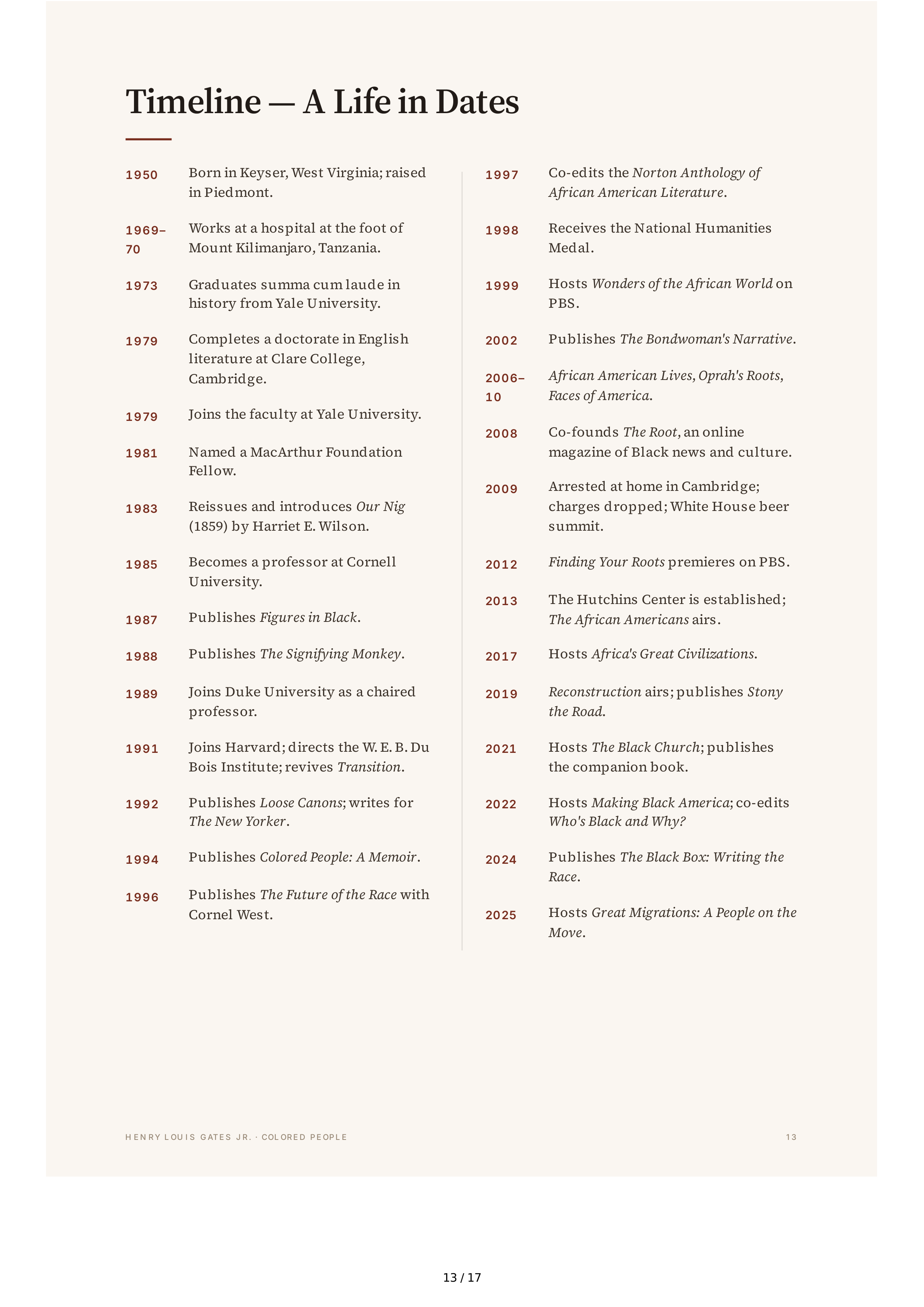
Timeline — A Life in Dates
1950
Born in Keyser, West Virginia; raised
in Piedmont.
1969–
70
Works at a hospital at the foot of
Mount Kilimanjaro, Tanzania.
1973
Graduates summa cum laude in
history from Yale University.
1979
Completes a doctorate in English
literature at Clare College,
Cambridge.
1979
Joins the faculty at Yale University.
1981
Named a MacArthur Foundation
Fellow.
1983
Reissues and introduces
Our Nig
(1859) by Harriet E. Wilson.
1985
Becomes a professor at Cornell
University.
1987
Publishes
Figures in Black
.
1988
Publishes
The Signifying Monkey
.
1989
Joins Duke University as a chaired
professor.
1991
Joins Harvard; directs the W. E. B. Du
Bois Institute; revives
Transition
.
1992
Publishes
Loose Canons
; writes for
The New Yorker
.
1994
Publishes
Colored People: A Memoir
.
1996
Publishes
The Future of the Race
with
Cornel West.
1997
Co-edits the
Norton Anthology of
African American Literature
.
1998
Receives the National Humanities
Medal.
1999
Hosts
Wonders of the African World
on
PBS.
2002
Publishes
The Bondwoman's Narrative
.
2006–
10
African American Lives
,
Oprah's Roots
,
Faces of America
.
2008
Co-founds
The Root
, an online
magazine of Black news and culture.
2009
Arrested at home in Cambridge;
charges dropped; White House beer
summit.
2012
Finding Your Roots
premieres on PBS.
2013
The Hutchins Center is established;
The African Americans
airs.
2017
Hosts
Africa's Great Civilizations
.
2019
Reconstruction
airs; publishes
Stony
the Road
.
2021
Hosts
The Black Church
; publishes
the companion book.
2022
Hosts
Making Black America
; co-edits
Who's Black and Why?
2024
Publishes
The Black Box: Writing the
Race
.
2025
Hosts
Great Migrations: A People on the
Move
.
H
E N
R Y
L OU
I S
G AT E S
J R
. ·
COL OR E D
P E OP L E
1 3
13 / 17
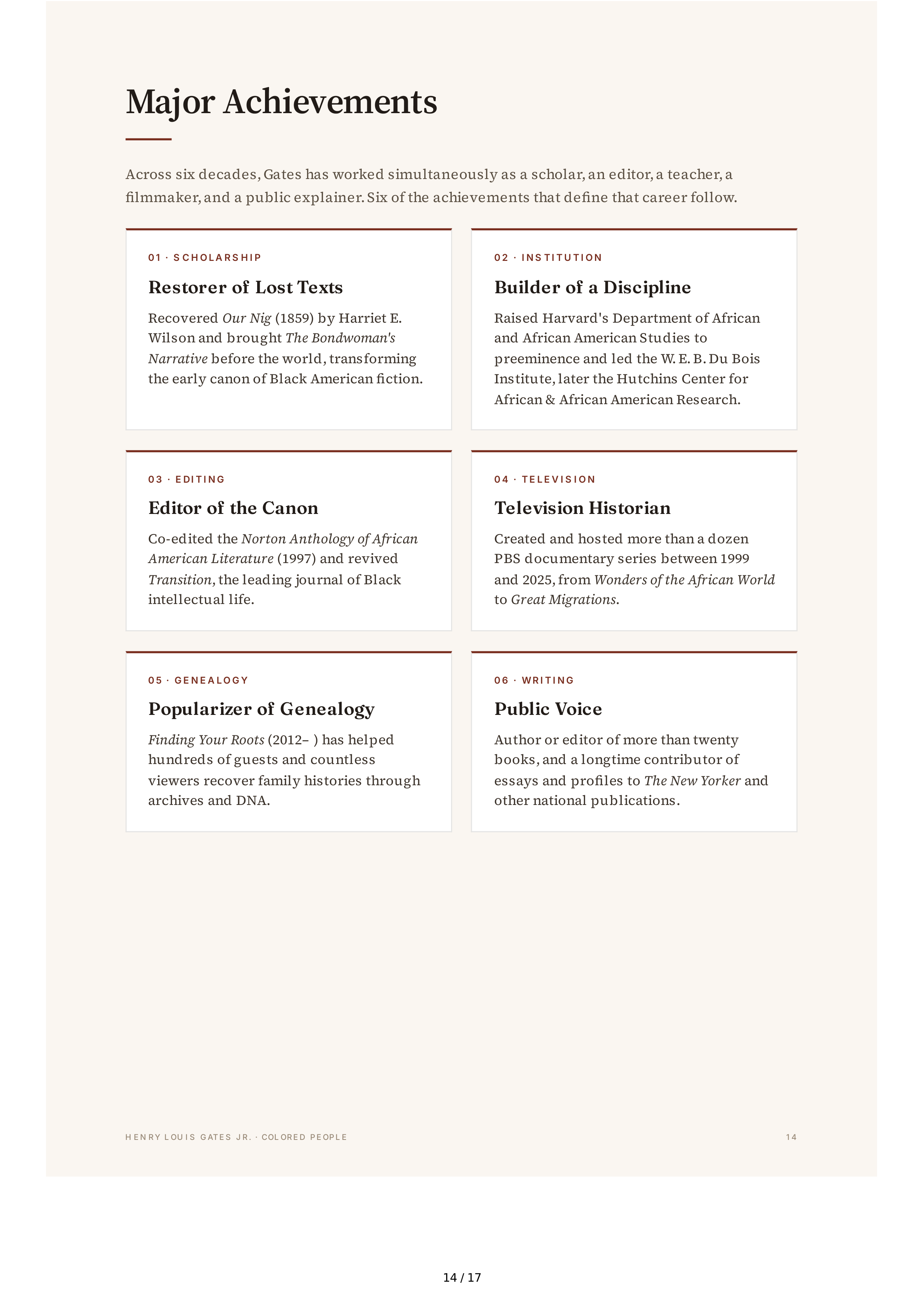
Major Achievements
Across six decades, Gates has worked simultaneously as a scholar, an editor, a teacher, a
filmmaker, and a public explainer. Six of the achievements that define that career follow.
0 1 ·
S C H O L A R S H I P
Restorer of Lost Texts
Recovered
Our Nig
(1859) by Harriet E.
Wilson and brought
The Bondwoman's
Narrative
before the world, transforming
the early canon of Black American fiction.
0 2 ·
I N S T I T U T I O N
Builder of a Discipline
Raised Harvard's Department of African
and African American Studies to
preeminence and led the W. E. B. Du Bois
Institute, later the Hutchins Center for
African & African American Research.
0 3 ·
E DI T I N G
Editor of the Canon
Co-edited the
Norton Anthology of African
American Literature
(1997) and revived
Transition
, the leading journal of Black
intellectual life.
0 4 ·
T E L E V I S I O N
Television Historian
Created and hosted more than a dozen
PBS documentary series between 1999
and 2025, from
Wonders of the African World
to
Great Migrations
.
0 5 ·
G E N E A L O G Y
Popularizer of Genealogy
Finding Your Roots
(2012– ) has helped
hundreds of guests and countless
viewers recover family histories through
archives and DNA.
0 6 ·
WR I T I N G
Public Voice
Author or editor of more than twenty
books, and a longtime contributor of
essays and profiles to
The New Yorker
and
other national publications.
H
E N
R Y
L OU
I S
G AT E S
J R
. ·
COL OR E D
P E OP L E
1 4
14 / 17
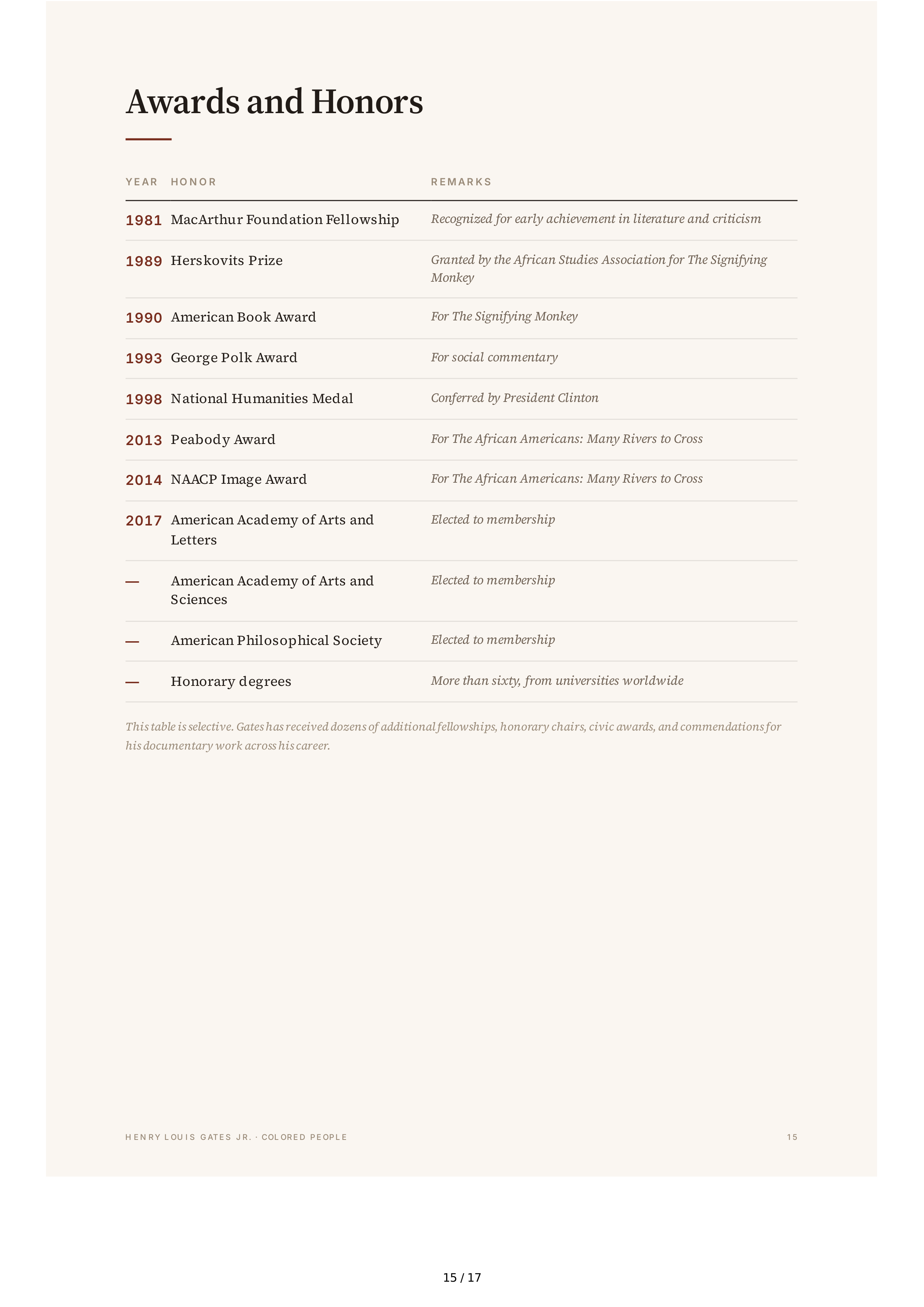
Awards and Honors
Y E AR
HO N O R
R E M AR K S
1981
MacArthur Foundation Fellowship
Recognized for early achievement in literature and criticism
1989
Herskovits Prize
Granted by the African Studies Association for The Signifying
Monkey
1990
American Book Award
For The Signifying Monkey
1993
George Polk Award
For social commentary
1998
National Humanities Medal
Conferred by President Clinton
2013
Peabody Award
For The African Americans: Many Rivers to Cross
2014
NAACP Image Award
For The African Americans: Many Rivers to Cross
2017
American Academy of Arts and
Letters
Elected to membership
—
American Academy of Arts and
Sciences
Elected to membership
—
American Philosophical Society
Elected to membership
—
Honorary degrees
More than sixty, from universities worldwide
This table is selective. Gates has received dozens of additional fellowships, honorary chairs, civic awards, and commendations for
his documentary work across his career.
H
E N
R Y
L OU
I S
G AT E S
J R
. ·
COL OR E D
P E OP L E
1 5
15 / 17
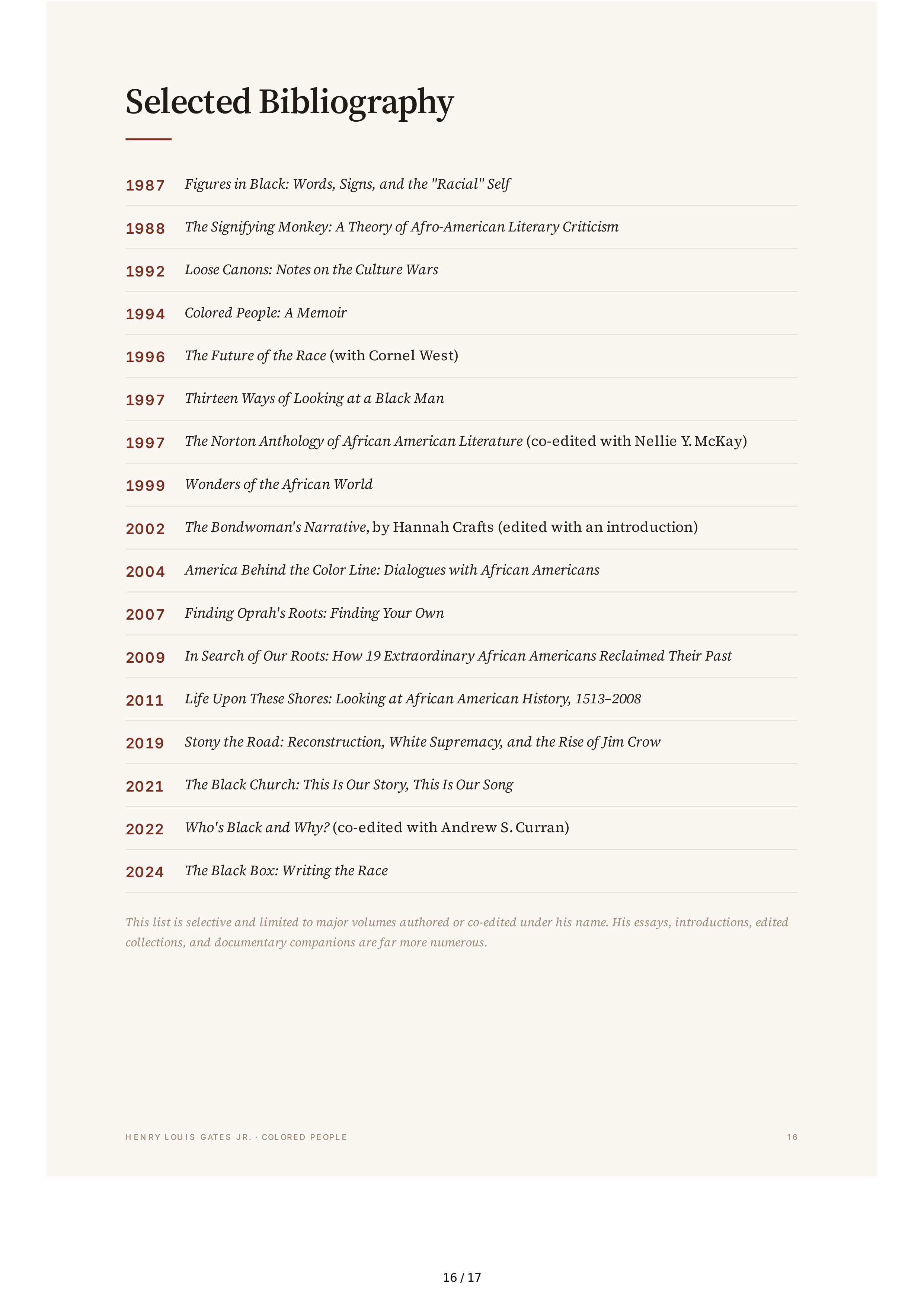
Selected Bibliography
1987
Figures in Black: Words, Signs, and the "Racial" Self
1988
The Signifying Monkey: A Theory of Afro-American Literary Criticism
1992
Loose Canons: Notes on the Culture Wars
1994
Colored People: A Memoir
1996
The Future of the Race
(with Cornel West)
1997
Thirteen Ways of Looking at a Black Man
1997
The Norton Anthology of African American Literature
(co-edited with Nellie Y. McKay)
1999
Wonders of the African World
2002
The Bondwoman's Narrative
, by Hannah Crafts (edited with an introduction)
2004
America Behind the Color Line: Dialogues with African Americans
2007
Finding Oprah's Roots: Finding Your Own
2009
In Search of Our Roots: How 19 Extraordinary African Americans Reclaimed Their Past
2011
Life Upon These Shores: Looking at African American History, 1513–2008
2019
Stony the Road: Reconstruction, White Supremacy, and the Rise of Jim Crow
2021
The Black Church: This Is Our Story, This Is Our Song
2022
Who's Black and Why?
(co-edited with Andrew S. Curran)
2024
The Black Box: Writing the Race
This list is selective and limited to major volumes authored or co-edited under his name. His essays, introductions, edited
collections, and documentary companions are far more numerous.
H
E N
R Y
L OU
I S
G AT E S
J R
. ·
COL OR E D
P E OP L E
1 6
16 / 17
Colophon
This independent biography was composed from the public record:
Mr. Gates's published books and essays, his documentary films for
PBS, his principal public interviews, and established biographical
references. It was written without the participation or endorsement of
its subject, and it reproduces no copyrighted work at length.
Quotations from published works are brief and are used for the
purposes of comment and criticism. Where the historical record is
uncertain or disputed, the text says so plainly rather than choosing a
convenient story.
Designed for print and PDF publication. The type is set in Fraunces
for display, Source Serif 4 for text, and Inter for labels and numerals.
The page is A4 with warm white paper and deep oxblood accents, in
the manner of a classic cloth-bound biography.
■
H
E N
R Y
L OU
I S
G AT E S
J R
. ·
COL OR E D
P E OP L E
1 7
17 / 17