9
C
H
A
P
T
E
R
T
W O
Yale and the Timber Empire
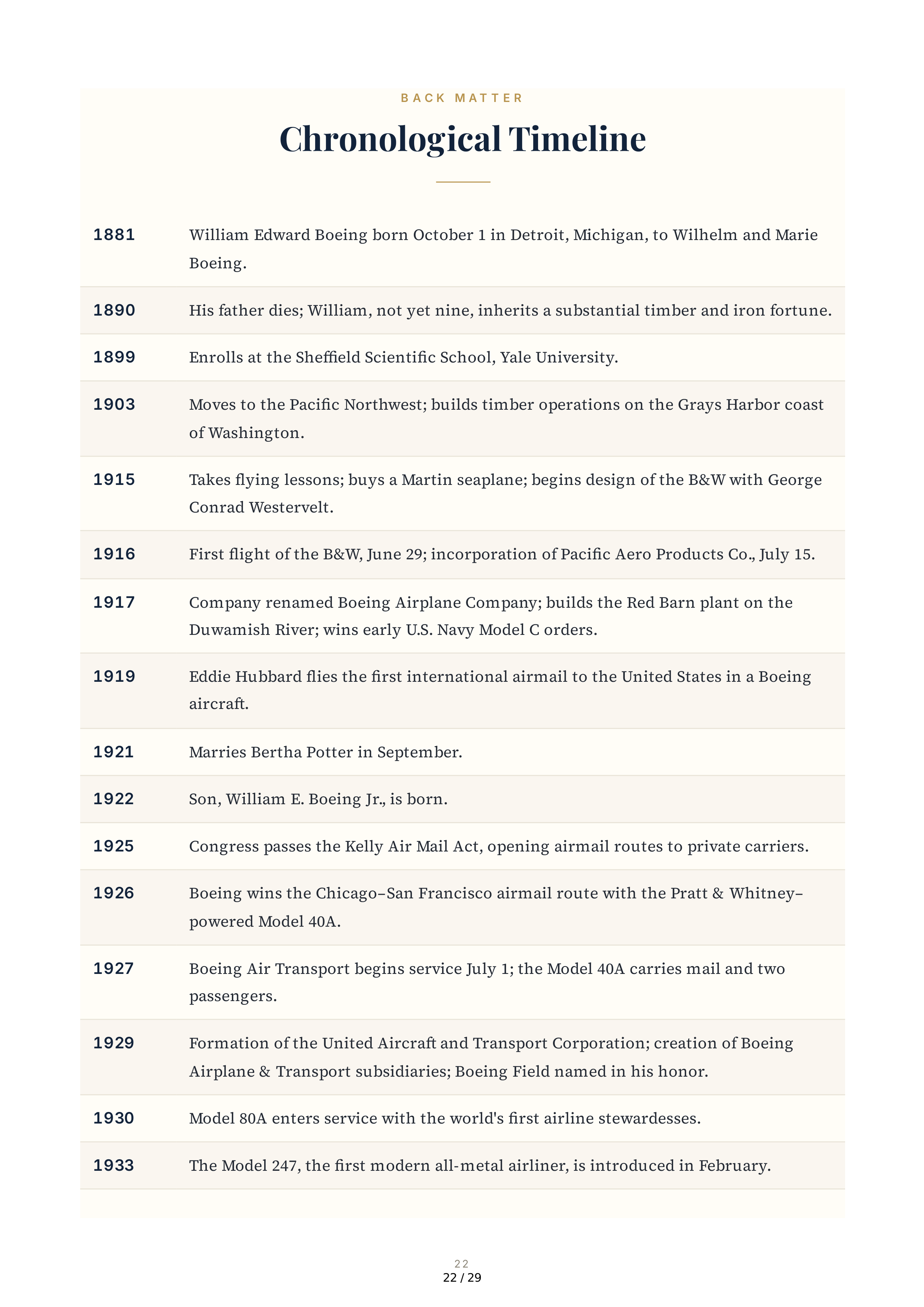
Yale in the years around the turn of the century was a factory for the American elite, and the
Sheffield Scientific School was its most practical wing — a place where the sons of steelmen and
railroad kings learned the mathematics of progress. Boeing studied engineering problems,
surveying, and the emerging science of industrial management. He left in 1902 without a
degree. The formalities of the classroom bored him; he wanted the real thing.
He found it, improbably, at the edge of the continent. Drawn by the timber boom of the Pacific
Northwest and the legend of the Klondike gold rush, Boeing traveled west to Washington State
and fell in love with the country at once: the deep green valleys, the sound of the sea, the
enormous softwoods that could float a man to fortune. He settled in the Grays Harbor region,
around the mills and muddy streets of Hoquiam, and began to build.
Within a few years he had assembled one of the region's largest timber operations. He bought
stumpage cheap, logged it clean, and shipped the boards to San Francisco and beyond. He
invested in river banks, railroads, and anything that touched the flow of wood to market. By
1910, still shy of thirty, he was a wealthy man in a frontier economy that paid handsomely to
those who moved fast and thought clearly.
His habits during these years tell us more about him than any portrait could. He rose before
dawn. He kept his own books. He walked his logging camps with the foremen, checking the bite
of an axe and the cut of a saw. He trusted engineers because he thought like one. He disliked
bluster and despised carelessness. A timber operation, like an airplane factory later, could not
tolerate a single loose joint.
In 1914, Boeing sold or consolidated much of his timber interest and moved his center of gravity
to Seattle, a fast-growing city of banks, universities, and — increasingly — airplanes. He was
thirty-three years old, financially independent, and married two years earlier to Bertha Potter,
who would become the steady anchor of his private life. With his fortune secured, he was, by
his own lights, at liberty.
But liberty, for William Boeing, proved to be an engine looking for a propeller. He had money,
time, and a mind that could not rest. Around him, the world was beginning to fly — and it was
only a matter of time before he noticed.
9 / 29