I
C
H
A
P
T
E R
E I
G
H
T
Later Works and Legacy
2 0 1 6 – 2 0 2 6
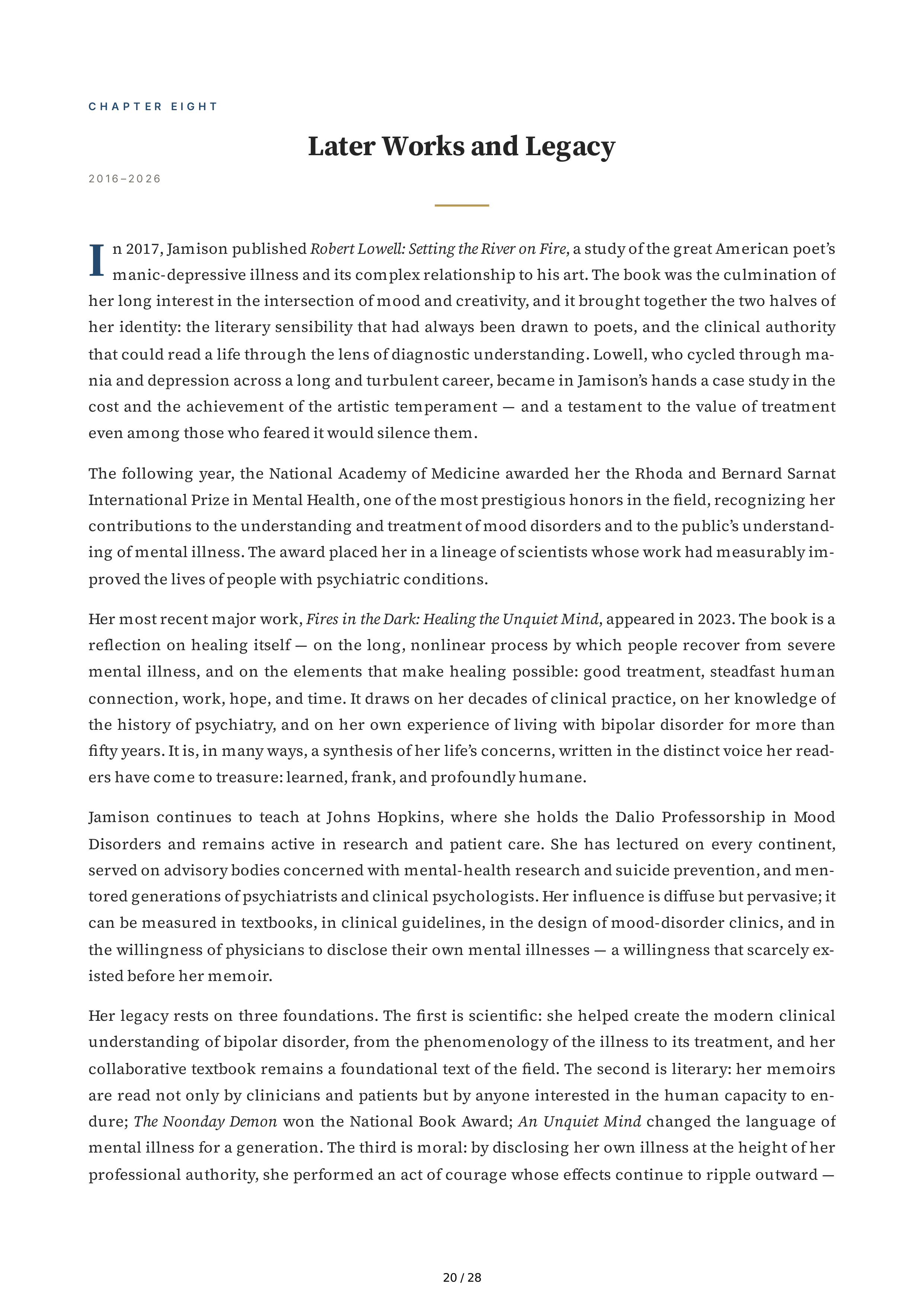
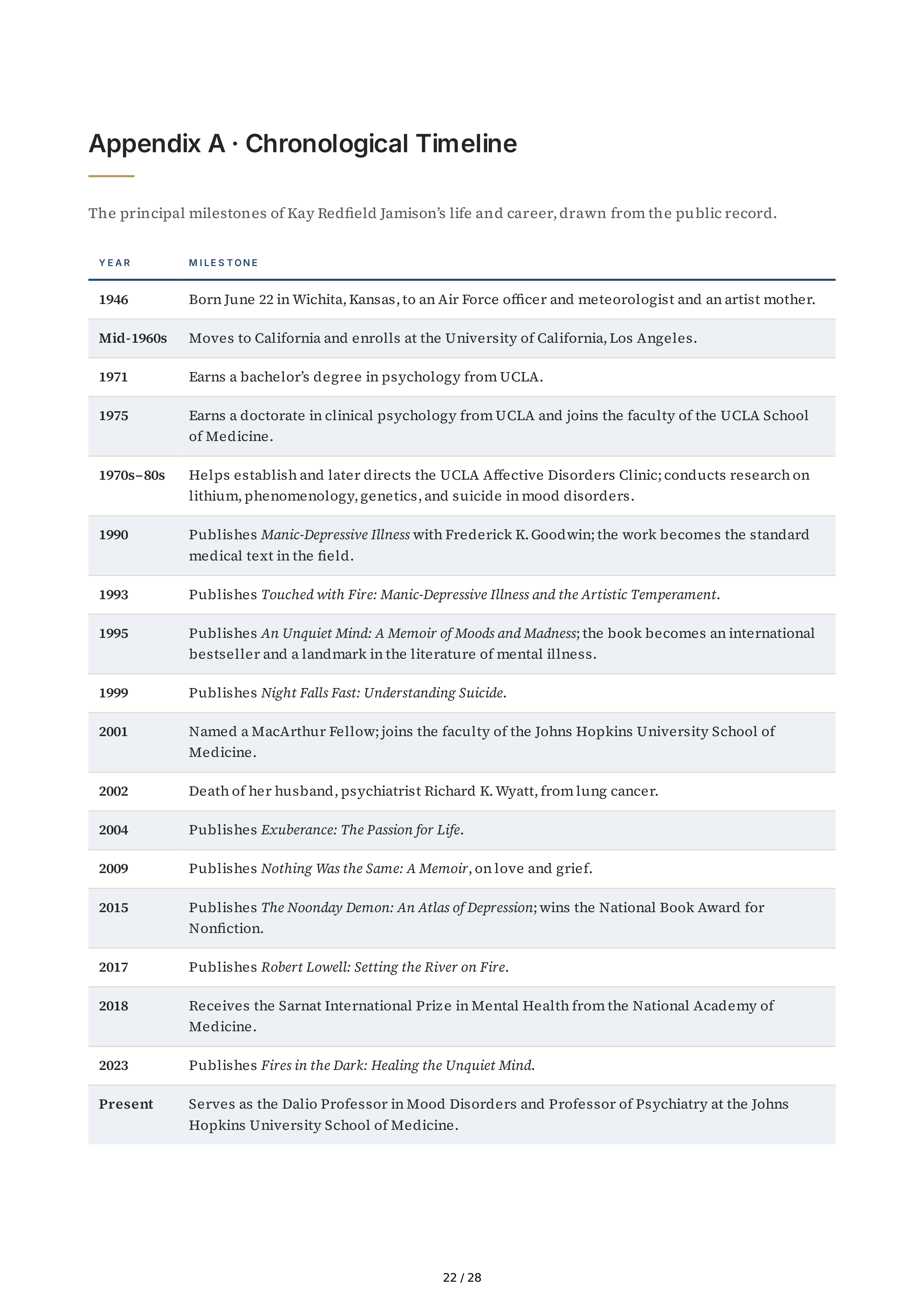
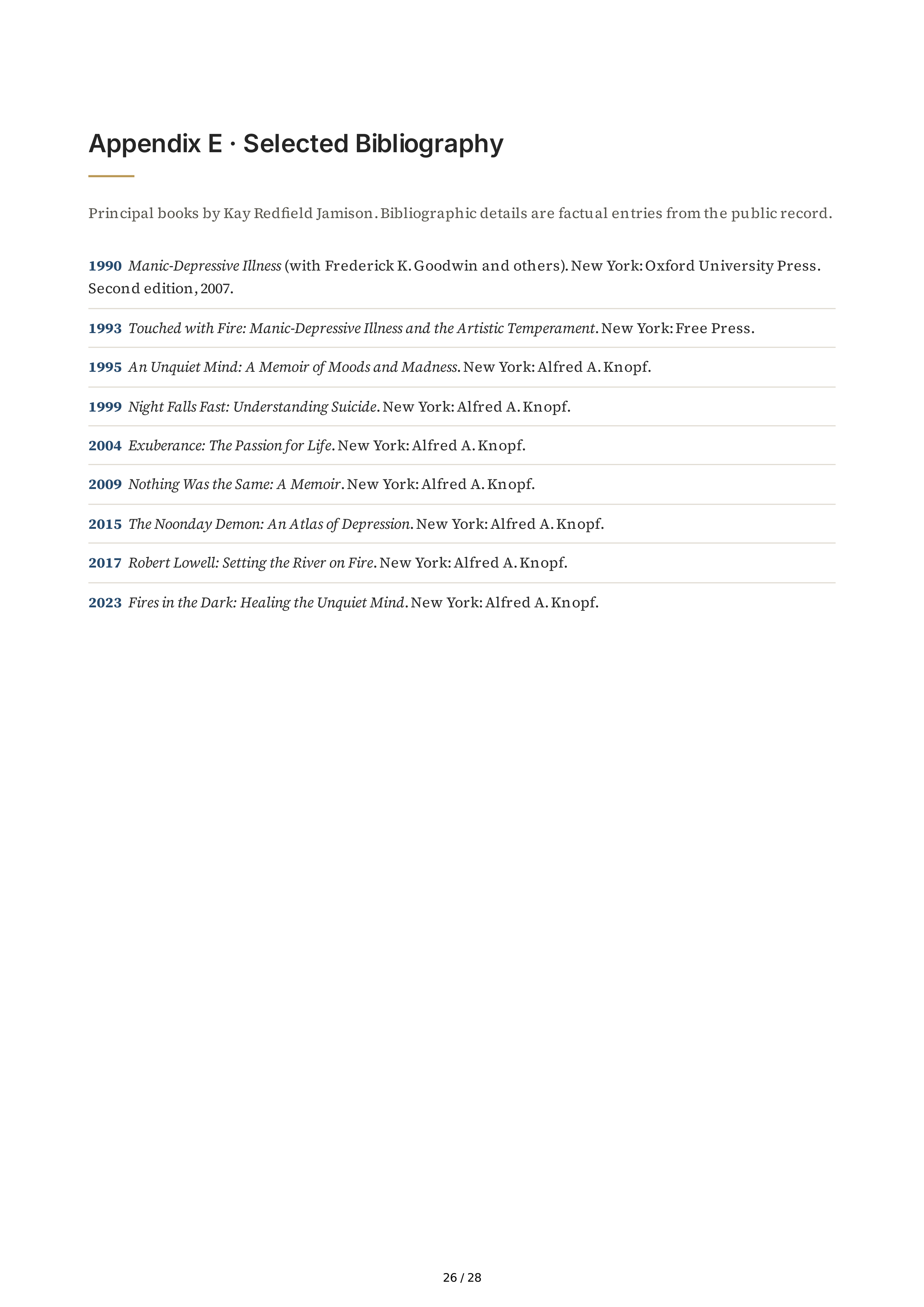
n 2017, Jamison published
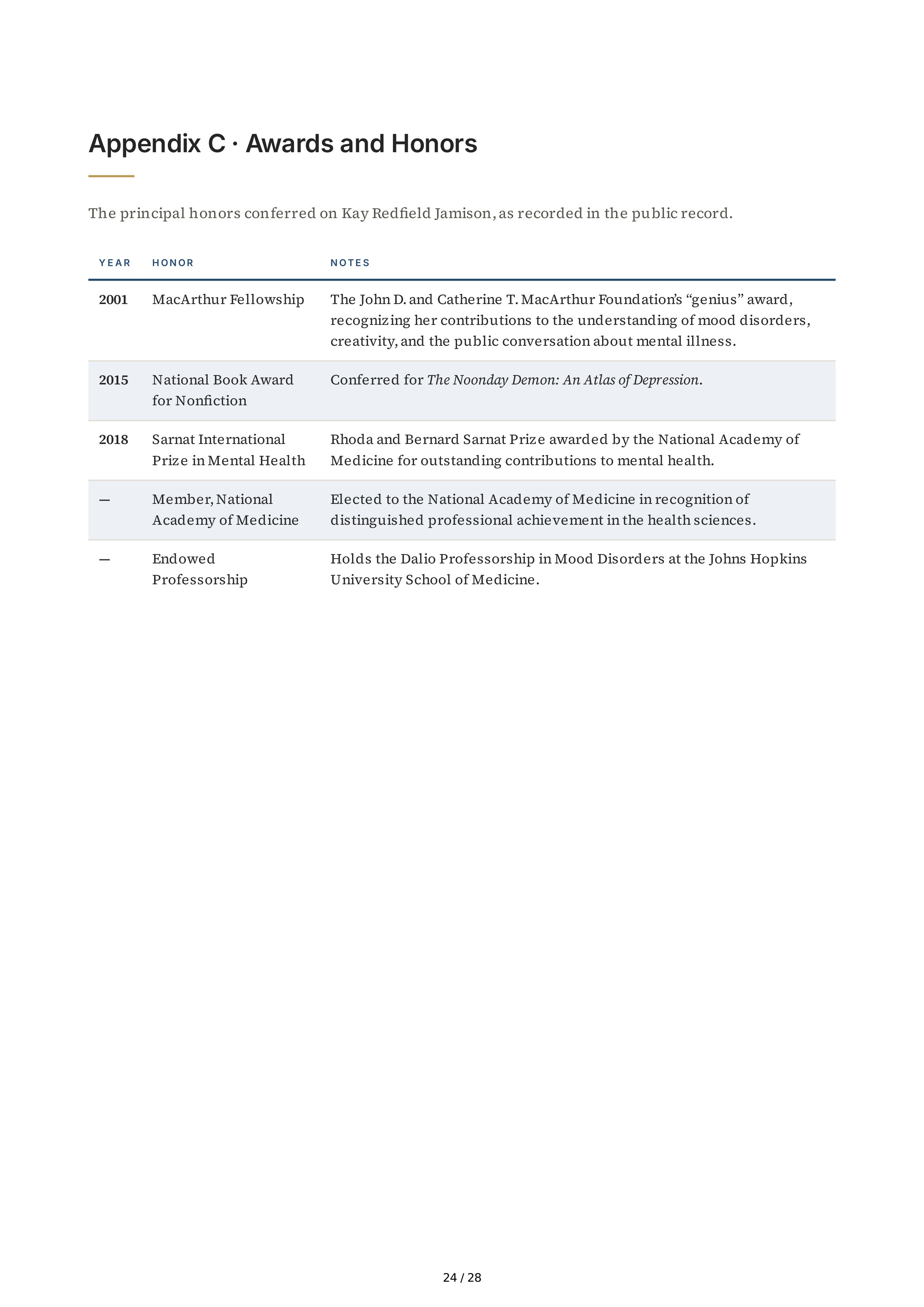
Robert Lowell: Setting the River on Fire
, a study of the great American poet’s
manic-depressive illness and its complex relationship to his art. The book was the culmination of
her long interest in the intersection of mood and creativity, and it brought together the two halves of
her identity: the literary sensibility that had always been drawn to poets, and the clinical authority
that could read a life through the lens of diagnostic understanding. Lowell, who cycled through ma-
nia and depression across a long and turbulent career, became in Jamison’s hands a case study in the
cost and the achievement of the artistic temperament — and a testament to the value of treatment
even among those who feared it would silence them.
The following year, the National Academy of Medicine awarded her the Rhoda and Bernard Sarnat
International Prize in Mental Health, one of the most prestigious honors in the field, recognizing her
contributions to the understanding and treatment of mood disorders and to the public’s understand-
ing of mental illness. The award placed her in a lineage of scientists whose work had measurably im-
proved the lives of people with psychiatric conditions.
Her most recent major work,
Fires in the Dark: Healing the Unquiet Mind
, appeared in 2023. The book is a
reflection on healing itself — on the long, nonlinear process by which people recover from severe
mental illness, and on the elements that make healing possible: good treatment, steadfast human
connection, work, hope, and time. It draws on her decades of clinical practice, on her knowledge of
the history of psychiatry, and on her own experience of living with bipolar disorder for more than
fifty years. It is, in many ways, a synthesis of her life’s concerns, written in the distinct voice her read-
ers have come to treasure: learned, frank, and profoundly humane.
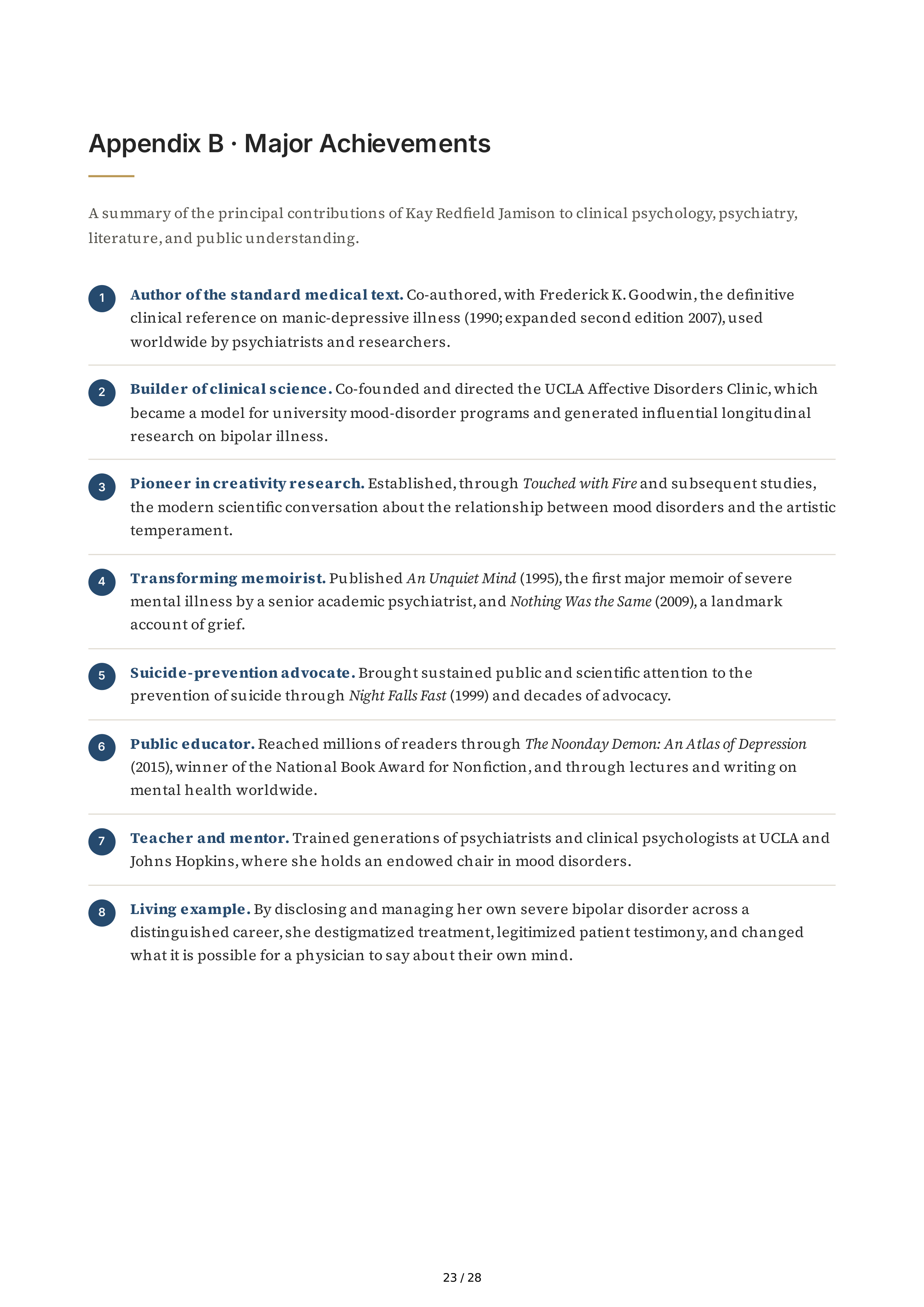
Jamison continues to teach at Johns Hopkins, where she holds the Dalio Professorship in Mood
Disorders and remains active in research and patient care. She has lectured on every continent,
served on advisory bodies concerned with mental-health research and suicide prevention, and men-
tored generations of psychiatrists and clinical psychologists. Her influence is diffuse but pervasive; it
can be measured in textbooks, in clinical guidelines, in the design of mood-disorder clinics, and in
the willingness of physicians to disclose their own mental illnesses — a willingness that scarcely ex-
isted before her memoir.
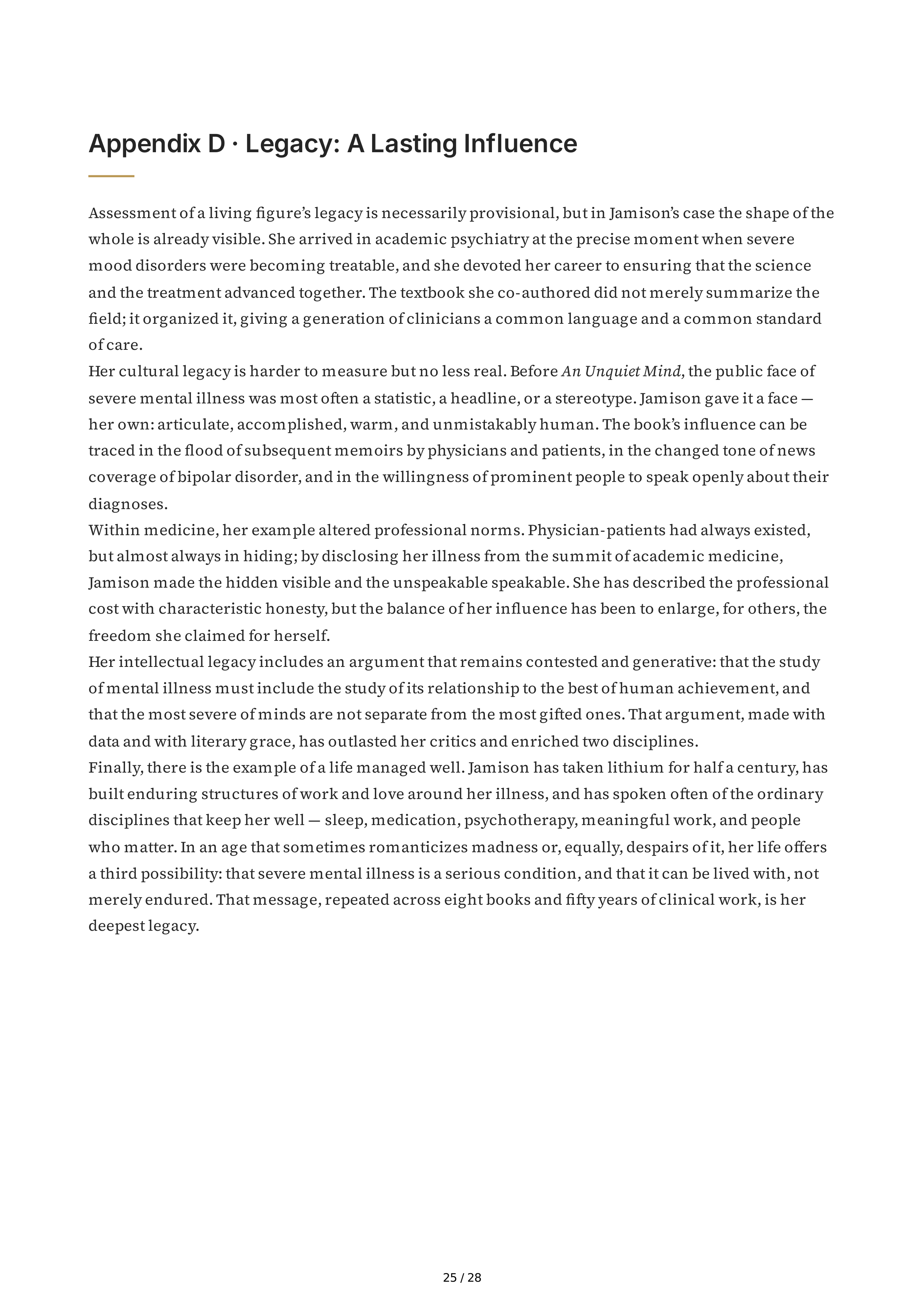
Her legacy rests on three foundations. The first is scientific: she helped create the modern clinical
understanding of bipolar disorder, from the phenomenology of the illness to its treatment, and her
collaborative textbook remains a foundational text of the field. The second is literary: her memoirs
are read not only by clinicians and patients but by anyone interested in the human capacity to en-
dure;
The Noonday Demon
won the National Book Award;
An Unquiet Mind
changed the language of
mental illness for a generation. The third is moral: by disclosing her own illness at the height of her
professional authority, she performed an act of courage whose effects continue to ripple outward —
20 / 28