11
I
C H A P
T E
R F
O
U
R
The
Modernist
Years
1922
–
1929
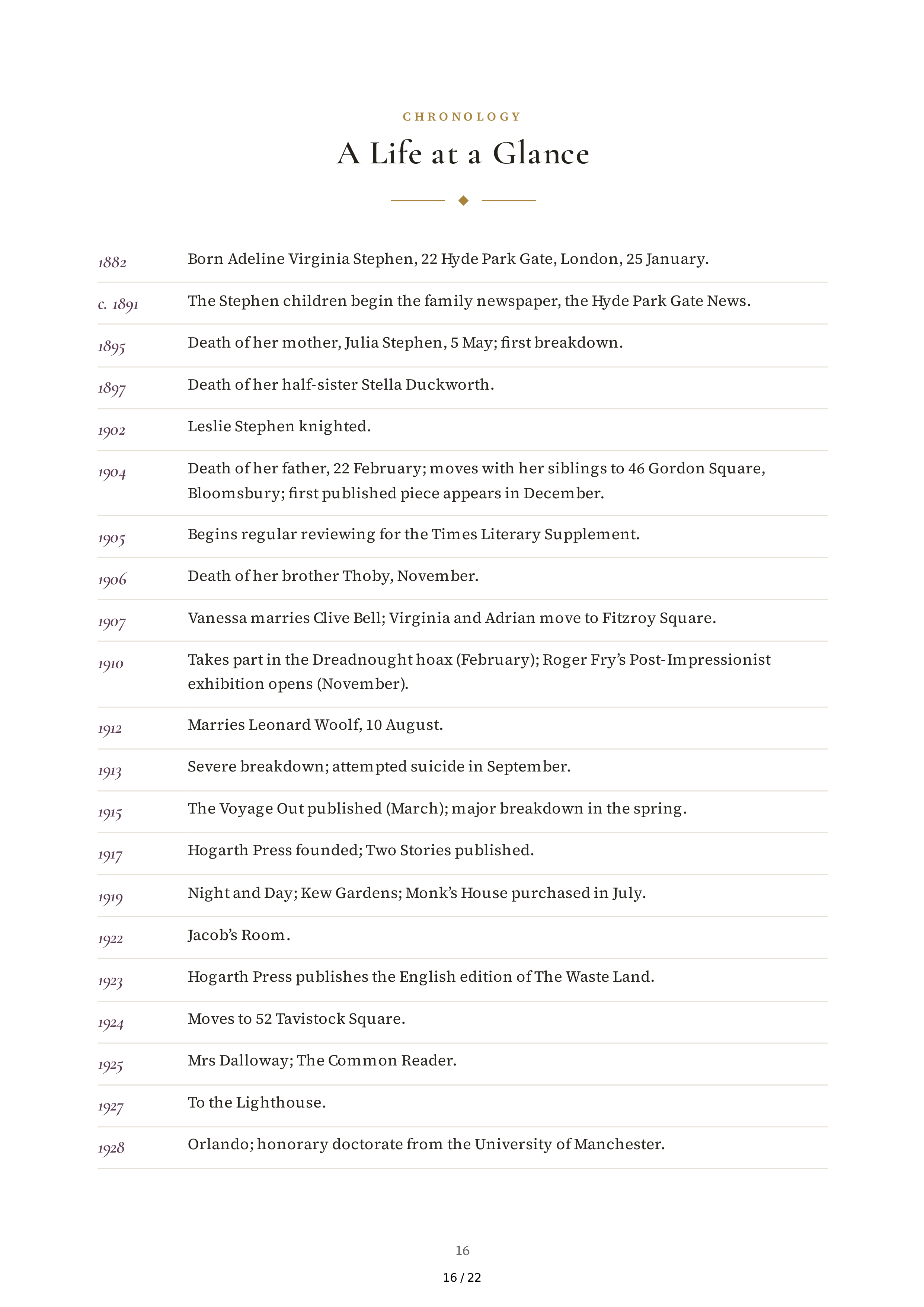
n March 1924 the Woolfs moved to 52 Tavistock Square, a large Georgian house in the mid-
dle of Bloomsbury, and the Hogarth Press came with them. The small press that had be-
gun by printing a handful of copies on a hand machine had grown into a genuine publisher. It
issued the first English edition of T. S. Eliot’s The Waste Land, printed Katherine Mansfield’s
Prelude, and, from 1924, brought out translations of Freud which the English public met with
astonishment. The press made the Woolfs independent; it also made them, in effect, the pub-
lishers of their own generation.
Mrs Dalloway, published in May 1925, is set on a single June day in post-war London.
Clarissa Dalloway walks through Westminster buying flowers for her party; a young man,
Septimus Smith, shell-shocked by the war, walks through the same city toward his death; the
two lines of the novel cross and separate. In its use of interior monologue and its compression
of time, the book was seen immediately as a landmark. Together with James Joyce and Marcel
Proust, Virginia Woolf had made the old novel obsolete.
The Common Reader was published in the same year: a collection of essays, from Chaucer
to Conrad, in which she invented an ideal reader — unprofessional, curious, alive — and made
criticism itself a form of literature. For the rest of her career she would return to this project,
the education of the common reader, as she conceived it.
To the Lighthouse appeared in May 1927. In it, the Ramsay family spends a summer at
their house on the Isle of Skye; Mrs Ramsay, a beautiful and elusive maternal presence, pre-
sides over dinners and children’s anxieties, while her philosopher husband demands impossi-
ble sympathy; the middle section, “Time Passes,” watches the empty house decay through a
decade of darkness; the final movement sends the surviving family, at last, to the lighthouse.
The novel was, unmistakably, a portrait of her own parents, and the act of writing it, Woolf
felt, had exorcised their ghosts. Critics and readers recognized a masterpiece; it remains, for
many, her greatest book.
In October 1928 she published Orlando, a mock-biography that begins in the court of
Elizabeth I and carries its hero — who changes sex and lives for three hundred years — into an
England of motorcars and newspapers. A love letter, in form, to her friend Vita Sackville-West,
Orlando was also a philosophical joke about identity, biography, and time. It became her most
commercially successful book.
11 / 22