

THE OXFORD
GUIDE TO
CAREERS
2027
OXFORD CAREERS
AND YOUR
YEAR AHEAD
DEVELOPING
YOUR CAREER
IDEAS
GAINING EXPERIENCE
AND DEVELOPING
SKILLS
APPLICATION
ESSENTIALS
SECTOR
BRIEFINGS

SECTOR
BRIEFINGS
Service
Analyst:
£45k
Account
Manager:
£60k
Implementation
Specialist:
£45k
Technical
Engineer:
£60k
Business
Analyst:
£60k
Software
Developer:
£60k



OXFORD CAREERS AND
YOUR YEAR AHEAD
DEVELOPING YOUR
CAREER IDEAS
GAINING EXPERIENCE
AND DEVELOPING SKILLS
APPLICATION
ESSENTIALS
SECTOR
BRIEFINGS
www.ox.ac.uk/careers
Welcome
3
'T
emporal chauvinism' is the unconscious bias that we
are all living at the pinnacle of civilisation, but this can
also mean that we think this is the worst of times. Partly, this
is fuelled by the fact that current uncertainties (around war,
climate, resources, energy and food) are not yet resolved and
that past uncertainties did eventually resolve themselves.
In the world of careers, applicants may feel that this is the
worst job market (it isn’t) and that AI is making it very hard
to stand out and secure a dream job (which may be partially
correct).
All that we read and hear from employers is that
demonstrating employability skills, or human skills, remains
the foundation for your career and for securing your first role
after (or during) Oxford.
To this end, our advice is to seek out any opportunities to
get work-related experience. This could be in the classroom
(such as, team projects, presentations and project reports),
in college (including JCR/MCR positions and telethons) or
through volunteering, working in student societies and, of
course, vacation work – of whatever form.
This Guide is for you, whether undergraduate or
postgraduate, artist or scientist; we will address three
questions:
•
Where do I start?
•
How do I gain more skills to improve my chances
(especially in this time of change)?
•
Where do I find work-related learning via jobs and
internships?
You’ll find answers to these questions, and many more, in
this Guide: from ‘How do I write a winning CV?’ to ‘What does
it take to be a solicitor?’ and from ‘How do I get experience
Welcome






OXFORD CAREERS AND
YOUR YEAR AHEAD
DEVELOPING YOUR
CAREER IDEAS
GAINING EXPERIENCE
AND DEVELOPING SKILLS
APPLICATION
ESSENTIALS
SECTOR
BRIEFINGS
www.ox.ac.uk/careers
Welcome
4
in the museum and heritage sector?’ to ‘How do I meet a
careers adviser for a 1:1 meeting?’. Above all, we address
how to use AI to your advantage.
This Guide is just one of the many free services you can
access from Careers, University of Oxford. Other services
include:
•
To get started:
•
Book a confidential 1:1 (there are almost 7,000 online
and in person every year).
•
Visit in-person careers fairs (there are at least eight
each year).
•
Meet some employers in person and online.
•
Arrange to have some information interviews with alumni.
•
Log onto or attend one of the many ‘Introduction to…’
talks we run.
•
To gain more skills:
•
Take part in the Client Consulting Challenge.
•
Get work experience through an Oxford-exclusive
summer or micro- internship.
•
Attend Insight into Academia/Consulting/Creative
Writing/Medicine/Pharma/Biotech/Policy/Publishing
programmes.
•
To find jobs and internships:
•
Log onto CareerConnect.
•
Sign up for automatic alerts about new jobs in your
industries of choice.
•
Connect with the Internship Office to explore our
Summer Internship Programme and Micro-Internship
Programme.
We look forward to meeting you in person or online at our
fairs and events.



From insights into employment sectors to practical skills
workshops and inspiring panel discussions, Careers has a
wide range of exciting careers events lined up each term
for Oxford University students, researchers, and alumni.
careers
careers
careers
term planner
term planner
term planner
careers
term planner
www.ox.ac.uk/careers/planner
Browse the term planner and sign up for
the events you would like to attend.
Contents
6
www.ox.ac.uk/careers
OXFORD CAREERS
AND YOUR YEAR
AHEAD
An overview of the recruitment year at
Oxford University and the range of support
available at Careers, University of Oxford.
Careers, University of Oxford and your
year ahead ................................................................. 10
What’s next? What’s first? ........................................ 12
Careers term by term ................................................ 13
DEVELOPING
YOUR CAREER
IDEAS
Careers information and advice for
everyone – including how to develop and
explore ideas for what to do next, from
further study to how to find graduate jobs.
Developing your career ideas ................................... 15
Ethical networking .................................................... 17
Building your occupational awareness ................... 19
Routes into graduate employment .......................... 21
Further study ............................................................. 24
Working outside your home country ....................... 25
The team
Content:
Careers, University of Oxford
Editor:
Leanne Carveth
Publishing assistant:
Tilly White
Design and layout:
Simon Minter, Nineteenpoint Ltd
Sales:
Stacey Phillington
Marketing:
Corina Lacurezeanu
Accounts:
Stacey Phillington
With thanks to:
All Careers, University of Oxford
staff and alumni contributors
Images:
Ian Wallman Photography, John Cairns
Photography, Oxford University Images, Elizabeth
Lettmann and past and present Oxford University
students. Alumni photographs are the subjects’
own. We also acknowledge Shutterstock, Unsplash
and AdobeStock for images.
Where to find us
56 Banbury Road, Oxford, OX2 6PA
Telephone: + 44 (0) 1865 27 46 46
Email:
hello@careers.ox.ac.uk
www.linkedin.com/company/oxford-careers
bsky.app/profile/oxfordcareers.bsky.social
www.instagram.com/oxfordcareers
www.youtube.com/user/OxfordCareers
www.facebook.com/internshipoffice
THE
OXFORD
GUIDE
TO
CAREERS
2027
OXFORD CAREERS AND
YOUR YEAR AHEAD
DEVELOPING YOUR
CAREER IDEAS
GAINING EXPERIENCE
AND DEVELOPING SKILLS
APPLICATION
ESSENTIALS
SECTOR
BRIEFINGS
Contents
7
www.ox.ac.uk/careers
GAINING EXPERIENCE
AND DEVELOPING
SKILLS
SECTOR
BRIEFINGS
Core employability skills: what they are
and ideas on how to develop them.
With real-world insights
and advice from Oxford
alumni.
Developing core skills ............................................... 29
Joining employability programmes ......................... 33
Seven ways to gain experience ................................ 36
Making the most of the Internship Office ............... 39
Academia and higher
education .............................. 68
Accountancy and
financial services .................. 74
Banking and financial
markets ................................. 80
Business ................................ 88
Charity and social
enterprise .............................. 96
Consultancy ........................ 102
Creative industries .............. 112
Culture and heritage ........... 120
Education ............................ 125
Energy, sustainability
and environment ................. 131
Engineering ......................... 136
Health and social care ........ 142
International policy
and development ................ 148
Law ...................................... 153
Marketing and
communications ................. 163
National policy and
government ......................... 169
Publishing ............................ 175
Science ................................ 181
Start-ups and
entrepreneurship ................. 189
Tech: IT, data, AI and
machine learning ................ 194
Other careers ...................... 202
APPLICATION
ESSENTIALS
Advice, guidance and tactics for being
your best at all stages of the application
process.
Successful applications ........................................... 42
Equality and diversity in the application process ... 43
CVs ............................................................................ 44
Cover letters .............................................................. 47
Application forms for employment ......................... 49
Applications for further study .................................. 50
How to reflect the same experience in a CV,
cover letter and application form ............................ 51
Recruitment assessments ....................................... 53
Assessment centres ................................................. 56
Confident interviews ................................................. 60
OXFORD CAREERS AND
YOUR YEAR AHEAD
DEVELOPING YOUR
CAREER IDEAS
GAINING EXPERIENCE
AND DEVELOPING SKILLS
APPLICATION
ESSENTIALS
SECTOR
BRIEFINGS
Advertisers' and contributors' index
8
www.ox.ac.uk/careers
ADVERTISERS'
INDEX
CONTRIBUTORS'
INDEX
C
areers, University of Oxford would like to
thank all supporters of this publication.
C
areers, University of Oxford would like
to thank all contributors for submitting
profiles and quotes.
180 Degrees Consulting –
student society .............................. 109
AlphaSights ..................................... 93
Capital One ................................... 108
Cisco ............................................. 200
d-fine ............................................ 110
Da Vinci Trading ............................ 200
Eden McCallum ............................. 110
EY-Parthenon ......................... 109, 110
FTI Consulting ............................... 111
GSA Capital ..................................... 85
Hudson River Trading .................... 199
IMC Trading .................................... 87
INSEAD ........................................... 73
Jacari ............................................ 130
Jane Street ..................................... 86
RBB Economics ............................. 111
Swire Group .................................... 93
The Oxford Guild .. 79, 85, 109, 161, 200
TPP ................................................... 2
3Keel
Eve Nelson .......................................................... 105
Acorn Bioenergy
Charlotte Whittlesea ........................................... 134
Aon
Bea Jones ............................................................. 77
Arcadis
Ikra Hussain ........................................................ 106
BBC Studios Distribution
Bella Shearer ....................................................... 157
BCG
Kate Adams ......................................................... 107
Brent Council
Jamie Slagel ........................................................ 172
Bristol Myers Squibb
Dr Lucy Donovan ................................................. 184
Cardiff University
Dr Tom Rhys Bishop ............................................. 72
Careers, University of Oxford
Dr Fiona Whitehouse .......................................... 115
Civil Service Fast Stream
Elspeth Tolan ...................................................... 173
DŌSOJIN
Ana Sousa Geros ................................................ 192
Doughty Street Chambers
Amanda Clift-Matthews ..................................... 158
EBRD
Mykhailo Kiktenko .............................................. 151
Francis Taylor Building
Emma Rowland ................................................... 159
OXFORD CAREERS AND
YOUR YEAR AHEAD
DEVELOPING YOUR
CAREER IDEAS
GAINING EXPERIENCE
AND DEVELOPING SKILLS
APPLICATION
ESSENTIALS
SECTOR
BRIEFINGS
Contributors' index
9
www.ox.ac.uk/careers
Giving What We Can
Zou Xinyi ................................................................ 99
Global Health Policy and Politics Consultant
Amanda Banda ................................................... 152
HarrisonParrott
Isabella Thorneycroft .......................................... 116
HSBC
Lucy Hamilton ....................................................... 83
Institute of Cancer Research
Sruthi Shakthivel ................................................. 185
Isla Health
Natasha Hibberd ................................................. 197
Jones Day
Robert Pieters ..................................................... 160
MathWorks
Dr Hannah Pullen ................................................ 198
Museum of Classical Archaeology
Will Evans ............................................................ 123
Nature
Dr Darren Burgess .............................................. 178
Ofwat
Holly Woodhead .................................................. 135
Ogilvy UK
Julia Manstead ................................................... 167
Onfido
Ruhul Amin .......................................................... 193
Optiver
Leon Galli .............................................................. 84
The Oxford Hub
Jessica Kaye ....................................................... 100
Oxford Health NHS Foundation Trust
Natasha Devaraj ................................................. 145
Penguin Press
Noosha Alai-South .............................................. 179
PricewaterhouseCoopers
Andrey Kluban ....................................................... 78
Procter & Gamble
Georgina Weetch ................................................ 166
Public Health Speciality Registrar
Joanna Mason .................................................... 146
Reckitt
Adam O'Connell .................................................. 186
Reddie & Grose LLP
Andy Attfield ........................................................ 187
RMI
Wini Rizkiningayu .................................................. 91
Swire Group
Tilly Morgan .......................................................... 92
Teach First
Jack Morrin ......................................................... 128
Trainee Secondary School
Science Teacher (PGCE)
Charlotte Rixon ................................................... 129
UK Atomic Energy Authority
Dr Maria Lorena Richiusa ................................... 139
University of Oxford
Dr Catherine Seed ................................................. 71
Dr Rachel Delman ............................................... 124
Vodafone
Dr Olayinka Oduwole .......................................... 140
OXFORD CAREERS AND
YOUR YEAR AHEAD
DEVELOPING YOUR
CAREER IDEAS
GAINING EXPERIENCE
AND DEVELOPING SKILLS
APPLICATION
ESSENTIALS
SECTOR
BRIEFINGS

Oxford Careers
and Your Year
Ahead
OXFORD CAREERS AND
YOUR YEAR AHEAD
DEVELOPING YOUR
CAREER IDEAS
GAINING EXPERIENCE
AND DEVELOPING SKILLS
APPLICATION
ESSENTIALS
SECTOR
BRIEFINGS

11
www.ox.ac.uk/careers
Oxford Careers and Your Year Ahead
Daily
Advice appointments:
Confidential and impartial one-to-one
meetings with a careers adviser held online, on the phone or
in person at Careers, University of Oxford. Book in advance
on CareerConnect.
Weekly
Newsletter:
The easiest way to keep up to date during term,
our newsletter hits your inbox each week with details of
upcoming events and opportunities.
Talks and workshops:
We frequently host talks on specific
career options and run skills workshops, many with invited
external speakers. Most are open to all students, with some
tailored to master’s students, DPhil
students or research staff.
Termly
The Client Consulting Challenge
(Trinity):
After training, participants will
work in a team to help solve a client
organisation's real business challenge.
Skills sessions:
Workshops and
presentations on a specific topic, such
as psychometric tests or interviews, led
by an employer or a careers adviser. All
advertised on CareerConnect.
Micro-internships:
Two- to five-day
voluntary, full-time work placements
with a host organisation.
Annually
Career fairs:
Meet employers and alumni
to learn about and explore some of
the options available. Starting early in
Michaelmas term, we run nine in person
fairs across the year.
Opportunities:
Nearly 6,000 vacancies
and internships are advertised every
year on CareerConnect.
The Summer Internship Programme
:
Hundreds of work experience
opportunities in many sectors and
countries exclusively for Oxford
students.
CareerConnect
www.ox.ac.uk/careers/what-we-
offer/careerconnect-platform
Accessed with your Oxford
Single Sign-on, CareerConnect is
the password-protected area of
the Careers, University of Oxford
website that provides dedicated
services enabling you to:
•
Book appointments.
•
Browse our calendar of events.
•
Book your place on workshops
and employer-led events.
•
Search our extensive
database of job vacancies
and internships.
•
Access additional resources
to which we subscribe on your
behalf, including practice tests.
…and much more!
OXFORD CAREERS AND
YOUR YEAR AHEAD
DEVELOPING YOUR
CAREER IDEAS
GAINING EXPERIENCE
AND DEVELOPING SKILLS
APPLICATION
ESSENTIALS
SECTOR
BRIEFINGS


12
Unsure what
I want to do
Focused exclusively on my degree
Exploring interests and developing skills
I have a clear
focus or goal
I have ideas but
I’m not sure what’s
right for me
Where and how
do I start
I am well organised
and clear about my
next steps
I have a clear focus
that I am working
towards
1
3
2
4
Career readiness grid
www.ox.ac.uk/careers
Oxford Careers and Your Year Ahead: What's next? What's first?
Plot your
progress!
M
ost students will explore career options, including
further study, alongside their studies. This guide
is for everyone considering what to do at the end of their
current course, and will help students who have a clear focus
to sharpen their career objectives and add polish to their
applications. It summarises our guidance and signposts
further resources to explore options, make decisions, and
work purposefully towards a successful future.
Make use of the Developing Career Ideas section of the
Careers, University of Oxford website to make those key first
steps in your career journey, regardless of what stage you
are at in your degree.
What’s next?
What’s first?
OXFORD CAREERS AND
YOUR YEAR AHEAD
DEVELOPING YOUR
CAREER IDEAS
GAINING EXPERIENCE
AND DEVELOPING SKILLS
APPLICATION
ESSENTIALS
SECTOR
BRIEFINGS

13
www.ox.ac.uk/careers
Oxford Careers and Your Year Ahead: Careers term by term
Careers term
by term
E
very year, hundreds of organisations visit Oxford
specifically to meet you – to start a conversation.
However, our academic terms are NOT created equally.
Michaelmas term is the time to talk to firms that interest you.
In fact, we run six of our annual career fairs in Michaelmas,
and this term will account for almost 75% of all the company
presentations and company visits coordinated by Careers,
University of Oxford in the whole year. At our career fairs and
company presentations you can meet:
•
Recent alumni working in areas you might be interested
in – people who were in your shoes not so long ago.
•
Recruiters who can tell you more about the firm, graduate
roles and training, and the recruitment process.
•
Senior managers and business leaders (many will also be
Oxford alumni) who can provide a wider perspective on
the organisation and graduate career trajectories.
Use the Events Calendar on CareerConnect to find company
presentations and to book places on relevant workshops and
skills sessions offered through Careers, University of Oxford.
Michaelmas term
Finalists and graduating master’s students who have made
good applications should expect January and February to
be busy with interviews. Continue to target new graduate
programmes and seek advertised positions – you may
also find attractive internships to apply for. Similarly, those
targeting further study should continue to make applications
to courses and funding bodies.
Hilary Term is also a key time to start seeking internship
and summer opportunities. The advice above about applying
for full-time positions all holds true here. Some firms that
Hilary term
OXFORD CAREERS AND
YOUR YEAR AHEAD
DEVELOPING YOUR
CAREER IDEAS
GAINING EXPERIENCE
AND DEVELOPING SKILLS
APPLICATION
ESSENTIALS
SECTOR
BRIEFINGS
14
www.ox.ac.uk/careers
Oxford Careers and Your Year Ahead: Careers term by term
Be sure to keep on track academically and invest enough
time to do yourself justice in finals or any exams that you
have.
The big graduate schemes form only a small proportion
of the graduate employment market and the number of
vacancies offered every month through CareerConnect
remains fairly constant through the year, so there are always
new opportunities. However, keep an eye open as some
graduate schemes re-open this term to fill any remaining
places. You can also apply to firms that have year-round
rolling recruitment.
Careers, University of Oxford continues to offer workshops
and careers advisers continue with confidential one-to-one
discussions during Trinity and the long vacation, on Skype,
telephone or virtual platforms such as Microsoft Teams.
Trinity term
Careers fairs
The following fairs will be run in person. See our website and CareerConnect for details.
•
Finance and Management Consultancy Fair:
Friday 9 October, Exam Schools
•
Oxford University Careers Fair (for all sectors):
Saturday 10 October, Exam Schools
•
Law Fair:
Saturday 10 October, Exam Schools
•
Science, Engineering and Technology Fair:
Saturday 24 October, Exam Schools
•
Careers in Computing Fair:
Thursday 29 October, Mathematical Institute
•
Jobs for Mathematicians Fair:
Tuesday 17 November, Mathematical Institute
Earlier this year, we ran the Careers Conference for Researchers in Hilary term and the Summer
Careers Fair in Trinity term. Dates for 2027 yet to be confirmed.
recruit graduates only open their summer internship places
to penultimate-year students, and these can lead to full-
time offers for interns that do well. But also look out for
other opportunities including our own Summer Internship
Programme, which offers all Oxford students exclusive
internship opportunities, many of them in sectors where
internships can be hard to find, or overseas.
Keep abreast of the skills sessions, workshops and
seminars offered at Careers, University of Oxford via the
Events Calendar on CareerConnect.
OXFORD CAREERS AND
YOUR YEAR AHEAD
DEVELOPING YOUR
CAREER IDEAS
GAINING EXPERIENCE
AND DEVELOPING SKILLS
APPLICATION
ESSENTIALS
SECTOR
BRIEFINGS

Developing
your career
ideas
OXFORD CAREERS AND
YOUR YEAR AHEAD
DEVELOPING YOUR
CAREER IDEAS
GAINING EXPERIENCE
AND DEVELOPING SKILLS
APPLICATION
ESSENTIALS
SECTOR
BRIEFINGS

With hundreds of possible directions,
many students find it hard to decide
what they want to do after graduating,
and may even find the process quite
daunting. This chapter can help you:
•
Make a start,
•
Identify careers that might appeal to
you, and
•
Choose between them.
What is your personal pattern?
Our Career Weaver tool helps you to
think about what you value most in your
working environment. It provides a rich
variety of short exercises to stimulate
and structure your thinking and helps you
to identify and describe:
•
What you love.
•
What you are good at.
•
Why you do what you choose to do.
Use your SSO to open your personal account at
www.careerweaver.ox.ac.uk
and begin to explore,
define and explain your most important drivers and
key values.
See our Generating Career Ideas webpage to learn
more about using Career Weaver and a variety of
additional tools and ideas you can use. You can also
check out the How to Make a Careers Decision page
for help thinking through options for your next career
move.
T
ake the time to understand what you enjoy most and
what helps you succeed. Combine these insights with
research into your preferred options to make decisions and
take action.
16
www.ox.ac.uk/careers
Developing your career ideas
OXFORD CAREERS AND
YOUR YEAR AHEAD
DEVELOPING YOUR
CAREER IDEAS
GAINING EXPERIENCE
AND DEVELOPING SKILLS
APPLICATION
ESSENTIALS
SECTOR
BRIEFINGS

17
www.ox.ac.uk/careers
Developing your career ideas: Ethical networking
Ethical
networking
W
e often hear the phrase ‘it’s not what you know,
it’s who you know’. This might make us a little
uncomfortable, but there are many ethical reasons to
network:
•
To become aware of opportunities and how to access
them.
•
To understand what really goes on inside organisations
so that you choose the right opportunities to apply for.
•
To uncover the language and terminology of the
organisation so that you can make your achievements
sound as relevant as possible and talk like an insider to
establish fit and enthusiasm.
Beyond the objectives of ethical networking, we need to
approach the subject with emotional intelligence as people
do not like being sold to or taken advantage of.
The key to effective networking is research. Always
prepare in advance. When you are going to meet someone,
look them up on LinkedIn so that you can talk their language.
You should also tailor your elevator pitch to the contacts you
are trying to make. An elevator pitch is three sentences:
1. Who am I? – tailor it to resonate with who they are
looking for.
2. What do I want? – tailor it to resonate with what they are
offering.
3. A question – to start a conversation, research it, make it
engaging and demonstrate the depth of knowledge you
already have.
Ask questions and don’t be afraid to admit what you don’t
know. People are generally willing to help, and those
conversations can shape your direction more than you
expect.
Sruthi Shakthivel, Clinical Trial Manager, Institute of Cancer
Research
OXFORD CAREERS AND
YOUR YEAR AHEAD
DEVELOPING YOUR
CAREER IDEAS
GAINING EXPERIENCE
AND DEVELOPING SKILLS
APPLICATION
ESSENTIALS
SECTOR
BRIEFINGS
18
www.ox.ac.uk/careers
Developing your career ideas: Ethical networking
Platforms for networking
•
LinkedIn:
The biggest professional social network,
with powerful search tools.
•
Social media:
Use the search facility to find people
who mention their employment or university in their
profile. Follow relevant people or organisations.
Post a message to your personal contacts letting
them know what you are most interested in and
asking for recommendations for people to contact.
•
Industry websites:
Many employer websites include
‘about us’ or ‘staff team’ pages where you can learn
more about who works there (sometimes there is
also an email address).
•
ResearchGate:
A social networking site for
scientists and researchers to share papers, ask and
answer questions, and find collaborators.
Who could I network with?
•
Oxford alumni:
•
Your tutors and your college alumni office may
be able to give tips on who to contact.
•
Use LinkedIn.
•
Contacts of people you know (ask friends, relatives,
tutors for introductions).
•
People you have worked with, or contacted on
behalf of a society or committee.
•
People you research online and then approach
speculatively.
•
Fellow students, in college and in your department,
will know people and have experience that might tie
in to your goals.
Networking is a skill, not a personality trait. This means
that you can learn and get better at it.
Mykhailo Kiktenko, Principal, Project Integrity at European Bank
for Reconstruction and Development
OXFORD CAREERS AND
YOUR YEAR AHEAD
DEVELOPING YOUR
CAREER IDEAS
GAINING EXPERIENCE
AND DEVELOPING SKILLS
APPLICATION
ESSENTIALS
SECTOR
BRIEFINGS

19
www.ox.ac.uk/careers
Developing your career ideas: Building your occupational awareness
Building your
occupational
awareness
I
t can sometimes be useful to look at what other Oxford
students have done after completing their degrees to get
a better understanding of the breadth of choices open to
you. To go beyond the outline provided here, use Careers,
University of Oxford's webpages on The Graduate Outcomes
Survey to see the early-career destinations for Oxford
graduates from 2022 to 2023.
Further study
Just under 20% of graduates choose further study and Careers,
University of Oxford provides support and advice on this.
Consider carefully what benefits you hope to gain from
undertaking another degree against the time and costs
required. Although further study is a prerequisite for some
careers, and highly desirable for others, for many careers
it’s unnecessary and may make no difference to either your
entry level or starting salary.
www.ox.ac.uk/careers/careers-guidance/further-study
Occupational sectors
Careers are often labelled according to their industry
sector, and the latter section of this Guide provides short
industry introductions and company listings covering over
21 major industry sectors that our leavers enter. There are
many more – nearly 50 – detailed briefings on our website,
covering all the sectors in this Guide and more.
You can always pivot. Your first role is a starting point, not a final destination.
Stay curious, seek out work that is meaningful to you, and continuously review
the goals you set for yourself.
Ikra Hussain, Management Consultant, Arcadis
OXFORD CAREERS AND
YOUR YEAR AHEAD
DEVELOPING YOUR
CAREER IDEAS
GAINING EXPERIENCE
AND DEVELOPING SKILLS
APPLICATION
ESSENTIALS
SECTOR
BRIEFINGS

20
www.ox.ac.uk/careers
Developing your career ideas: Building your occupational awareness
Functional roles
It’s important to consider which functional roles you might
be most interested in. For some people, the function
becomes their primary goal, so remember that the same
functional role can be found in many diverse industries:
charities need IT specialists, marketers and HR managers as
well as front-line volunteers, fundraisers and policy-makers.
Data analysts are needed as much in the advertising and
retail sectors as in academic research, policy, finance and
consultancy organisations.
Take time to think more broadly about where you might
find opportunities that you’d be interested in. If you don’t
limit yourself by exclusively targeting industries that
seem to have the “right label”, you may be surprised at the
possibilities you find – both as a first career destination or a
few years later.
Changes in direction
Whatever direction you start out in doesn’t tie you to that
industry or function for life. It’s quite natural for your ideas
to develop and change as you gain experience and find new
interests, or as new opportunities present themselves.
A change of career doesn’t mean wasted time: most
of your skills will be transferable to other careers. Some
graduates choose to gain specialist expertise through a
graduate scheme, such as general management, marketing
or accountancy, and use this as a stepping stone into an
industry where graduate opportunities can be harder to
find – such as in arts & heritage, charities, or the creative
industries.
OXFORD CAREERS AND
YOUR YEAR AHEAD
DEVELOPING YOUR
CAREER IDEAS
GAINING EXPERIENCE
AND DEVELOPING SKILLS
APPLICATION
ESSENTIALS
SECTOR
BRIEFINGS

21
www.ox.ac.uk/careers
Developing your career ideas: Routes into graduate employment
Routes into
graduate
employment
C
areers, University of Oxford offers impartial advice
on different approaches to finding graduate-level
employment. We can relate this to different industry sectors
and roles and will not steer you in any particular direction.
Within a sector, there are a typical set of recruitment
processes, but each organisation will manage its vacancies
and applications in its own way, so:
•
Understand both the industry pattern and the exceptions
for the roles you are targeting.
•
Be clear about timescales and deadlines from the
beginning.
•
Start your sector research with the 20+ short industry
briefings in this Guide.
•
Talking to companies and people doing the work which
you are interested in can be invaluable. While you can
network all year round, the first few weeks of Michaelmas
term see hundreds of companies visiting Oxford every
year for our career fairs and company-led events.
•
Follow employers’ websites and social media for the
latest news and job alerts.
•
Use national graduate career sites like Prospects,
TARGETjobs, and Milkround.
Graduate training programmes
Organisations that recruit a number of graduates every year
often have structured training schemes. These generally
last for one or two years and provide formal training and
development as part of a structured programme. Often
they also offer ‘rotations’ through a succession of roles in
different parts of the organisation. Graduates gain a range
of experience, specific skills, and a broad introduction to the
firm and its industry.
OXFORD CAREERS AND
YOUR YEAR AHEAD
DEVELOPING YOUR
CAREER IDEAS
GAINING EXPERIENCE
AND DEVELOPING SKILLS
APPLICATION
ESSENTIALS
SECTOR
BRIEFINGS
22
www.ox.ac.uk/careers
Developing your career ideas: Routes into graduate employment
Applications usually open during the summer (July
onwards) and often close during Michaelmas term (some
as early as October!) for start dates in July to September
following graduation. Check the relevant industry sector
briefings for more specific information.
In addition to attending our careers fairs, some employers
run separate company presentations in Oxford. Attend
employer events to learn more about their graduate scheme,
or use them to deepen your knowledge about that company
and meet people from the firm. You’ll find these listed in the
Events Calendar in CareerConnect.
Individual graduate roles
Many more graduates join organisations to fill a specific
position rather than as part of a graduate training
programme. All types of organisations offer these direct
entry roles, including employers with big graduate schemes.
Direct entry roles are advertised widely, generally one to
three months before a job starts. The best places to start
looking for vacancies include:
•
Individual organisations’ websites and, increasingly, their
social media feeds.
•
Careers, University of Oxford’s vacancy database on
CareerConnect.
•
National graduate career sites like Prospects,
TARGETjobs, and Milkround.
•
Industry professional bodies and specialist media
channels.
Unadvertised roles
A significant number of job vacancies are never advertised
or only advertised via social media. Employers often
recruit people they know, who are recommended to them,
or who approach them speculatively. In certain sectors,
such as media and advertising, networking is an essential
and expected part of the application process for both full-
time jobs and work experience. Networking can help you
understand the industry in which you are interested and
uncover possible opportunities. For more information see
our
advice on ethical networking
.
As you build your contacts and knowledge, you develop
the foundations to make well-researched speculative
applications that are properly tailored to the specific needs
of an employer.
OXFORD CAREERS AND
YOUR YEAR AHEAD
DEVELOPING YOUR
CAREER IDEAS
GAINING EXPERIENCE
AND DEVELOPING SKILLS
APPLICATION
ESSENTIALS
SECTOR
BRIEFINGS

23
www.ox.ac.uk/careers
Developing your career ideas: Routes into graduate employment
Recruitment agencies
Recruitment agencies help organisations recruit staff for
a fee (paid by the company) by providing their clients with
quicker access to pre-screened and qualified candidates.
Agencies often specialise in specific sectors, and if you have
relevant experience they can be an extremely effective way
of finding work. Research agencies in your field and select
one or two to build a relationship with.
If you are working with an agency, it is important to remain
actively involved in your own job search and continue to
check employers’ websites and other sources for vacancies.
Jobs from internships and work experience
Work experience and internships can be a great way to
secure a full-time offer. This is especially true for companies
offering internship programmes exclusively for penultimate-
year students: these are often used as a core recruitment
tool, where a successful internship may lead directly to a job
offer for the following year.
All companies – large and small – may offer work
experience or internships. In line with the advice for
finding full-time positions, use company websites, our
CareerConnect jobs board, and graduate recruitment sites.
Speculative applications can also be highly effective, and
sometimes firms will even create an opportunity when
approached directly. Read our advice online about making
speculative approaches.
Specific opportunities for Oxford students include the
Summer and Micro-Internship Programmes.
OXFORD CAREERS AND
YOUR YEAR AHEAD
DEVELOPING YOUR
CAREER IDEAS
GAINING EXPERIENCE
AND DEVELOPING SKILLS
APPLICATION
ESSENTIALS
SECTOR
BRIEFINGS

24
www.ox.ac.uk/careers
Developing your career ideas: Further study
T
aught masters’, research masters’ or doctoral degrees?
In the UK, Europe, North America or elsewhere?
Narrowing down your options can be tricky.
Consider your motivation
•
It might be to satisfy intellectual curiosity, to access a
specific career or to change direction. Think about what
you need to know to assess how effectively potential
courses can deliver your goals. Talk it over with a careers
adviser if you need to.
Talk to people
•
Recommendations from Oxford academics in your field.
•
People working in your sector of interest – find them on
LinkedIn.
•
Get in touch with prospective tutors and supervisors.
Do your research
•
Academic literature and conference proceedings to find
key research groups.
•
Destination statistics for each course.
•
University rankings.
•
Research Excellence Framework assessments of
research departments
www.ref.ac.uk
.
See the Further Study section of our website for useful
information on what to consider before making your
application, including funding advice.
Studying abroad
Higher education is an international marketplace. You might
be tempted by lower fees charged in certain countries, by the
opportunity to improve your language skills or by a centre
of academic excellence in your subject. Many universities
in Europe offer courses taught in English. Application
schedules vary, so research the differences carefully.
Further
study
OXFORD CAREERS AND
YOUR YEAR AHEAD
DEVELOPING YOUR
CAREER IDEAS
GAINING EXPERIENCE
AND DEVELOPING SKILLS
APPLICATION
ESSENTIALS
SECTOR
BRIEFINGS

25
www.ox.ac.uk/careers
Developing your career ideas: Working outside your home country
Working
outside your
home country
M
any Oxford graduates work internationally at some
point in their career. Short and long term opportunities
are widely available.
Long-term international opportunities
Multinational companies, multilateral organisations,
international development agencies and diplomatic services
may offer secondments or transfers to their international
offices after a period of time, or as part of graduate training.
Talk to organisations of interest to assess your chances of
gaining an international posting if you work for them.
OXFORD CAREERS AND
YOUR YEAR AHEAD
DEVELOPING YOUR
CAREER IDEAS
GAINING EXPERIENCE
AND DEVELOPING SKILLS
APPLICATION
ESSENTIALS
SECTOR
BRIEFINGS
26
www.ox.ac.uk/careers
Developing your career ideas: Working outside your home country
Short-term employment
If you are seeking short-term work in another country and
an opportunity to experience international environments,
Careers, University of Oxford’s
Summer Internship
Programme
provides opportunities across the globe.
Taking some time out to travel after graduating can often
be funded by working simultaneously. Depending on your
nationality, there are a number of visa schemes to help
you gain short-term employment outside your country of
citizenship. Check with the embassy of your destination to
find out more.
People who are fluent in English are in demand as
teachers all around the world, and Teaching English
as a Foreign Language (TEFL) is a popular option for
experiencing life in another culture. Read our online advice
about TEFL teaching for full details.
Employers at Oxford and beyond
Many multinational firms visit Oxford’s career fairs. If you are
interested in working for one of their global offices, ask their
UK representatives how you can apply to work for the firm in
a different country or your home country.
Visas
Careers, University of Oxford cannot advise on visas and the following information is intended
as a general guide. You will need to be aware of any required languages, qualifications and
documents, and investigate any work restrictions.
UK
The rules about staying in the UK to work after your studies are complex and subject to change.
Ensure you regularly check the gov.co.uk website to remain up to date.
Every term the University’s student visa and immigration advisers run a joint session with
Careers, University of Oxford which examines the current work visa options for international
students. Students are encouraged to direct their specific queries to the visa team (details below).
For more information:
•
www.ox.ac.uk/students/visa
•
www.gov.uk/browse/visas-immigration/work-visas
•
www.ukcisa.org.uk/Information--Advice
Outside the UK
Visa requirements vary significantly country by country. Individuals who are seeking to work outside
of their home country should check the relevant government visa pages for their chosen country.
OXFORD CAREERS AND
YOUR YEAR AHEAD
DEVELOPING YOUR
CAREER IDEAS
GAINING EXPERIENCE
AND DEVELOPING SKILLS
APPLICATION
ESSENTIALS
SECTOR
BRIEFINGS
27
www.ox.ac.uk/careers
Developing your career ideas: Working outside your home country
International networking
Alumni from Oxford live all over the world and are often
happy to give advice to current students. There are over
350,000 alumni worldwide, with 150 regional alumni groups
in over 90 countries. You can find the contact details for
each group on the
alumni regional group website
to reach
out for advice and build your network.
If you are an international student looking to work at
home, maintain links with your home country. For example,
keep in contact with friends at university there and join
your national student society at Oxford for networking
opportunities. Remember that the recruitment cycle and
processes may be different to those in the UK.
Online resources
•
Careers, University of Oxford's vacancy database on
CareerConnect frequently holds job postings placed by
international recruiters.
•
GoinGlobal – an external resource accessible via Careers,
University of Oxford's website with your Oxford Single
Sign On, featuring profiles of 42 countries, a directory
of employers, as well as international vacancies and
internships.
More information
•
www.ox.ac.uk/careers/what-we-offer/access-
goinglobal
•
www.gradlinkuk.com
•
eures.europa.eu/index_en
•
www.jobteaser.com/en
Check our Finding Jobs Outside the UK webpage
for more detailed guidance, including useful online
resources for international job hunting.
Living and working in Singapore and Fiji has been eye-opening, offering exposure to very different
cultures and ways of working. It has also highlighted just how connected the world has become,
making the idea of living abroad far less daunting than it might initially seem.
Tilly Morgan, Landside Service Manager, Swire Group
OXFORD CAREERS AND
YOUR YEAR AHEAD
DEVELOPING YOUR
CAREER IDEAS
GAINING EXPERIENCE
AND DEVELOPING SKILLS
APPLICATION
ESSENTIALS
SECTOR
BRIEFINGS
Gaining
experience and
developing skills
OXFORD CAREERS AND
YOUR YEAR AHEAD
DEVELOPING YOUR
CAREER IDEAS
GAINING EXPERIENCE
AND DEVELOPING SKILLS
APPLICATION
ESSENTIALS
SECTOR
BRIEFINGS


29
www.ox.ac.uk/careers
Gaining experience and developing skills: Developing core skills
Developing
core skills
1. Initiative
Recruiters want you to be able to demonstrate making things
happen and getting things done. Ideas to help you develop
this include:
•
Organising a fundraising event for a charity.
•
Helping to increase participation or membership for an
event or society.
•
Developing your own website, or building one for a
student society.
•
Starting your own society, social enterprise or small
business.
•
Volunteering as a student representative for your course.
2. Communication
Employers want to see that you have
good interpersonal skills, and can
communicate verbally and in writing –
to empathise and persuade. You can
display these skills by:
•
Persuading guest speakers to
attend a society event you are
helping to organise.
•
Securing corporate sponsorship
for a club or encouraging alumni
to donate as part of a college
fundraising campaign.
•
Work experience in a customer
service role.
•
Acting as secretary of a student
society or your Common Room.
•
Volunteering to help with outreach
and access events: assisting
at Oxford open days, or visiting
schools to encourage students to
apply to Oxford.
OXFORD CAREERS AND
YOUR YEAR AHEAD
DEVELOPING YOUR
CAREER IDEAS
GAINING EXPERIENCE
AND DEVELOPING SKILLS
APPLICATION
ESSENTIALS
SECTOR
BRIEFINGS

www.ox.ac.uk/careers
30
Gaining experience and developing skills: Developing core skills
3. Teamwork
Organisations want to know that you can work in a group to
achieve something tangible. There are many ways to develop
teamwork skills, including:
•
Joining a sports team. There are dozens of student-run
sports clubs, and many more for individual colleges. See
www.sport.ox.ac.uk
for inspiration.
•
Getting involved in other groups such as a choir,
orchestra, band or theatre production.
•
Joining The Client Consulting Challenge or other student-
led initiatives.
•
Campaigning to promote social causes eg: mental health
awareness, equality, access to education etc.
4. Creativity
Creativity is about being curious and innovative, finding new
ways of doing things and understanding and taking risks.
Consider:
•
Driving change by improving current systems and
services.
•
Creating a new scheme, event, service or programme.
•
Working in an artistic endeavour eg: lighting, set and
costume design as well as performing and directing.
OXFORD CAREERS AND
YOUR YEAR AHEAD
DEVELOPING YOUR
CAREER IDEAS
GAINING EXPERIENCE
AND DEVELOPING SKILLS
APPLICATION
ESSENTIALS
SECTOR
BRIEFINGS
www.ox.ac.uk/careers
31
Gaining experience and developing skills: Developing core skills
5. Planning
Employers will want to see evidence that you can organise
people and resources to achieve objectives and work to a
deadline. Outside managing your studies, ideas of how you
can develop this include:
•
Organising a ball, bop, conference or campaign.
•
Co-ordinating your Common Room’s annual elections.
•
Organising an away-day for a society, or an inter-
university match for a sports club.
•
Editing a student publication, such as a newspaper,
website or yearbook.
6. Leadership
Employers will want you to have the ability to motivate,
influence and organise others. Leadership involves having
a vision, enrolling others into your vision and delivering
tangible quantified results. You can develop this by:
•
Taking a position of responsibility in your Common Room
or with Oxford SU.
•
Producing or directing a play.
•
Volunteering with youth organisations, such as the Girl
Guides or Scouts.
•
Captaining a sports team, or running a student society.
7. Self-management
Recruiters will want evidence that you can manage your own
time, are flexible, resilient, and can improve yourself based
on feedback. You can demonstrate this by:
•
Taking part in extra-curricular activities in addition to your
degree. This will signal to employers that you can balance
various responsibilities and workloads.
•
‘Up-skilling’ yourself. Why not take a course at the Oxford
Language Centre, or a free course at IT services during
term?
•
Setting yourself personal goals that require training to
complete, such as running a half marathon.
•
Undertaking an extended research project as part of your
academic studies.
8. In-touch and agile
Academia is about specialisation, and many courses at
Oxford are quite traditional and/or theoretical. Being ‘in-
touch’ means being aware of the broader general context,
and being sensitive to new and emerging trends. Being agile
OXFORD CAREERS AND
YOUR YEAR AHEAD
DEVELOPING YOUR
CAREER IDEAS
GAINING EXPERIENCE
AND DEVELOPING SKILLS
APPLICATION
ESSENTIALS
SECTOR
BRIEFINGS

32
www.ox.ac.uk/careers
Gaining experience and developing skills: Developing core skills
means demonstrating responsiveness to these emerging
trends in a practical and productive way. You can:
•
Research the latest and potential future trends in your
sector of interest eg: how will AI influence the way we
work now and the future of work? How will sustainability
affect global travel and/or food security?
9. Computing & IT
Literacy in basic IT software is vital for almost every
sector and opportunity in the modern job market. Many
roles will require familiarity with particular programmes
or applications, so it is best to become comfortable with
some of the most popular software used in your sector(s) of
choice.
You could boost your IT ability by:
•
Enrolling in a free course and learning to do something
new: Oxford’s IT Services offer a wide range of free
courses during term.
And if you are already quite skilled, you could try:
•
Designing an app.
•
Making a website for a student society.
•
Volunteering to help out your college IT officer.
10. Commercial awareness
All organisations – including not-for-profits – will want you
to understand the key factors behind successful businesses.
You can develop commercial awareness by:
•
Organising an event that has to turn a profit, such as a
concert, ball or a college bop.
•
Joining The Client Consulting
Challenge to get an insight into how
businesses work.
•
Keeping up to date with the news;
regular reading of publications
related to your industry.
•
Negotiating with a local business
to give a discount to members of a
student society you belong to.
•
Joining relevant student societies.
Find more detailed guidance on how
to master each of these core skills
during your time at Oxford in the Build
Skills section of the Careers, University
of Oxford's website.
OXFORD CAREERS AND
YOUR YEAR AHEAD
DEVELOPING YOUR
CAREER IDEAS
GAINING EXPERIENCE
AND DEVELOPING SKILLS
APPLICATION
ESSENTIALS
SECTOR
BRIEFINGS

33
www.ox.ac.uk/careers
Gaining experience and developing skills: Joining employability programmes
Joining
employability
programmes
C
areers, University of Oxford runs several programmes
to help students develop and practise the key skills
outlined in
our article on core employability skills
.
Go Public!
Go Public! is a programme and pathway for University of Oxford students that brings together
events, opportunities, and resources to explore careers in the public sector. The programme
includes panel discussions with public sector professionals, guidance on graduate and direct-
entry routes, opportunities to apply for public sector Micro-Internships, and online resources.
Running across Michaelmas and Hilary terms, it helps students understand the breadth of public
service careers, build practical experience, and develop the knowledge and confidence to pursue
roles across the sector.
www.ox.ac.uk/careers/build-skills/go-public
I would highly recommend making the most of Careers,
University of Oxford… I benefitted greatly from things like
micro-internships and preparation opportunities for the
fast stream’s application process.
Elspeth Tolan, Civil Service Fast Streamer
Be open to exploring different career paths and actively
pursue opportunities to gain experience.
Kate Adams, Consultant, Boston Consulting Group
OXFORD CAREERS AND
YOUR YEAR AHEAD
DEVELOPING YOUR
CAREER IDEAS
GAINING EXPERIENCE
AND DEVELOPING SKILLS
APPLICATION
ESSENTIALS
SECTOR
BRIEFINGS

34
www.ox.ac.uk/careers
Gaining experience and developing skills: Joining employability programmes
Insight into Academia
This seminar series explores topics relevant to those considering higher education
roles in research, teaching and related areas. It's open to current matriculated
Oxford University students, alumni and early career research staff at the
University. These informal sessions are intended to provide an open and impartial
forum for you to learn more about the reality of becoming and being an academic,
how to position yourself for success, and practical guides to job search and the
application process in the UK and globally. All are led by careers advisers and we
often invite early career academics and others to join us to share deeper insights.
For more information see the website.
www.ox.ac.uk/careers/build-skills/insight-programmes/insight-into-academia
Insight into Consulting
This is a
pathway
on CareerConnect which collates consulting related career
and panel events, activities and resources that take place over the course of an
academic year. You can work at your own pace and in any order. For hands on
consulting experience you can apply to the
Client Consulting Challenge
in Trinity
term. Following two training sessions on key consulting concepts, participants
work in a team to help solve a client’s real business challenge. Each team will have
five days to work on a consulting brief and present back to their client.
www.ox.ac.uk/careers/build-skills/insight-programmes/insight-into-consulting-
and-strategy
Insight into Creative Writing
The Insight into Creative Writing programme is designed for aspiring writers
eager to explore the diverse career opportunities in the creative writing field.
Whether you aim to become an author, editor, scriptwriter, or content creator, this
programme offers invaluable insights and practical advice to help you navigate
your journey. Participants will benefit from the expertise of industry professionals
and academics, engaging in interactive sessions that cover everything from
the writing process to getting published. This programme is perfect for those
passionate about writing and looking to turn their creativity into a fulfilling career.
www.ox.ac.uk/careers/build-skills/insight-programmes/insight-into-creative-writing
Insight into Medicine
If you are thinking about a career in medicine then spending time shadowing a
doctor is extremely important, not only to help you decide whether a medical
Insight into… programmes
Careers, University of Oxford has also established a series
of ‘Insight into…’ programmes which aim to accelerate
students’ learning and provide direct experience of the
workplace and style of work in different sectors.
OXFORD CAREERS AND
YOUR YEAR AHEAD
DEVELOPING YOUR
CAREER IDEAS
GAINING EXPERIENCE
AND DEVELOPING SKILLS
APPLICATION
ESSENTIALS
SECTOR
BRIEFINGS
35
www.ox.ac.uk/careers
Gaining experience and developing skills: Joining employability programmes
career is right for you, but also to enhance your UCAS application to medical
school. If you have difficulty arranging your own work shadowing, this programme
enables current matriculated students at Oxford University (undergraduate or
postgraduate) to spend a day with a hospital consultant in Oxford.
www.ox.ac.uk/careers/build-skills/insight-programmes/insight-into-medicine
Insight into Pharma/Biotech
This programme is specifically for science students who are interested in working
in the pharma/biotech industry and includes online panel talks which focus
on different roles within this sector. Typically running each academic year, this
programme provides the chance to hear from scientists working in biotech research
who will talk about the differences between academic life and industrial research,
alongside those who have opted to use their science away from the bench but still
in the pharma/biotech industry. As part of the programme, we have also introduced
a panel talk with speakers who work in the medical communications industry.
www.ox.ac.uk/careers/build-skills/insight-programmes/insight-into-pharma-
biotech
Insight into Policy
Insight into Policy is a series of events held throughout the academic year,
designed to help undergraduate and postgraduate Oxford students explore
policy careers and understand the different roles and entry routes into the
field. Participants hear from professionals working in policy and take part in a
collaborative policy exercise to develop practical responses to real-world policy
issues.
www.ox.ac.uk/careers/build-skills/insight-programmes/insight-into-policy
Insight into Publishing
Insight into Publishing gives future publishing candidates the chance to hear from
professionals in the different departments of publishing companies as varied as
HarperCollins, Elsevier and Oxford University Press. Participants gain an insight
into the future of publishing and discover practical ways to make their job and
internship applications publishing-focused. It runs over three sessions and is open
to undergraduate and postgraduate students from all degree backgrounds.
www.ox.ac.uk/careers/build-skills/insight-programmes/insight-into-publishing
Next steps
•
www.ox.ac.uk/careers/build-skills/develop-your-
employability-skills
•
www.ox.ac.uk/careers/build-skills/insight-
programmes
OXFORD CAREERS AND
YOUR YEAR AHEAD
DEVELOPING YOUR
CAREER IDEAS
GAINING EXPERIENCE
AND DEVELOPING SKILLS
APPLICATION
ESSENTIALS
SECTOR
BRIEFINGS

36
www.ox.ac.uk/careers
Gaining experience and developing skills: Seven ways to gain experience
W
ork experience is an opportunity to explore your
options and learn new skills. Here are some of the
benefits:
•
A way to develop valuable skills and accomplish
something noteworthy.
•
A chance to try out possible career directions.
•
An opportunity to make contacts in fields that interest you.
•
A chance to earn money.
It also provides a valuable opportunity to develop an
awareness and understanding of yourself: what really interests
you, how you like to work, and what you find most fulfilling.
It also has a very important role in enhancing your
employability. In a study of major graduate employers
(
High Fliers
2022), half of the recruiters surveyed warned
that graduates with no work experience were unlikely to
be successful in applying for graduate-level jobs in their
organisations. This is because work
experience:
•
Enables you to enhance and apply
your skills.
•
Provides evidence of your skills and
achievements that you can highlight
in your applications and talk about
in interviews.
1. Do an internship
These might be advertised opportunities requiring an
application, or arranged with an organisation after contacting
them speculatively. They can take place at any time of year,
but most advertised opportunities take place in vacations,
particularly the summer.
Some organisations offer internships purely to provide
interested students with some first-hand experience and do
not expect to hire interns at the end of the period. Others
use internships as a core part of their recruitment process,
Seven ways to
gain experience
Hands-on experience, including
internships, volunteering, clubs
and side projects, is by far the best
teacher. It is great for both building
skills and for working out what you
want from a job and a company.
Natasha Hibberd, Product Manager,
Isla Health
OXFORD CAREERS AND
YOUR YEAR AHEAD
DEVELOPING YOUR
CAREER IDEAS
GAINING EXPERIENCE
AND DEVELOPING SKILLS
APPLICATION
ESSENTIALS
SECTOR
BRIEFINGS
37
www.ox.ac.uk/careers
Gaining experience and developing skills: Seven ways to gain experience
particularly major graduate recruiters, who often advertise
summer internships for penultimate year students in
Michaelmas term.
2. Volunteer
As a volunteer you can work on projects or tasks that still
use and develop your skills, but you potentially have the
added benefit of full flexibility and negotiable hours.
3. Insight days/open days
Some organisations advertise insight days, giving students
talks and tours at their place of work. These are often
offered to help students who are interested in the industry
make a more informed application, but are not offered in all
sectors. Many major graduate recruiters will run company
presentations and events in Oxford or virtually, where you
can learn about the organisation, their recruitment processes
and meet their staff.
4. Work shadowing
Shadowing is a short period of time spent observing in a
workplace. It can help you assess at first-hand whether a
possible career might suit you, yet you don’t have to have
the skills needed to actively participate in the work. For this
reason, formal shadowing programmes are often offered in
fields where further training is required in order to actively
participate, such as the health professions or teaching.
5. Spring weeks/spring insight programmes
In an increasing range of sectors, organisations with
larger graduate intakes now run one- or two-week insight
programmes targeted for first years (and for second years
on a four-year course). These discovery programmes often
happen around Easter and usually have their own application
process. In addition to offering participants industry
insights and the chance to meet recent graduate recruits,
they frequently include some skills development, advice
on applications and may lead directly to offers for summer
internships in your penultimate year of study. Some accept
applications in Michaelmas, so start looking early!
6. Vacation and seasonal work
Seasonal jobs can provide money, an insight into an industry
and demonstrate your adaptability and skills. They are
OXFORD CAREERS AND
YOUR YEAR AHEAD
DEVELOPING YOUR
CAREER IDEAS
GAINING EXPERIENCE
AND DEVELOPING SKILLS
APPLICATION
ESSENTIALS
SECTOR
BRIEFINGS
38
www.ox.ac.uk/careers
Gaining experience and developing skills: Seven ways to gain experience
often advertised in the few months preceding a vacation.
They might be found on local employment websites, the
organisation’s own website, through temping agencies, word-
of-mouth or by signs on organisation premises. You might
also be interested in organisations which offer seasonal
work abroad (such as Work Away or WWOOF), some of
which run on an accommodation-for-work (work exchange)
basis.
7. Personal projects
Depending on your goals, you might want to generate your
own experience. It could be:
•
Creating a piece of work to add to your artistic portfolio.
•
Starting an entrepreneurial or charitable endeavour.
•
Using your technological skills to code a new website/
app/game.
See if there are any local organisations that might be
interested in using your project to help their work, or giving
it publicity. Working with other organisations will give you
new contacts and might lead toward referrals as well as
increasing the scope for your project.
For more advice on finding different kinds of work
experience at university, see our Finding Work Experience
webpage.
How recruiters support equality and diversity
Recruiters are very keen to raise their profile with applicants from all backgrounds and to dispel
perceptions that may deter applications. The best way to assess whether their projected image is
‘reality or myth’ is to speak with current employees.
A useful starting point can be the ‘buddy and mentor’ groups or forums (such as, LGBTQ+ and
BAME forums), which many organisations now promote.
An increasing variety of organisations are also establishing internship programmes, insight
days, networking events and mentoring opportunities to encourage a greater diversity of
applications. Such opportunities will be focused on groups which an organisation feels are
under-represented in their employee profile, so check what is available in the industries that you
are most interested in. There may be opportunities that focus around gender, ethnicity, sexuality,
disability or for those from lower socio-economic
backgrounds.
You could also explore specialist organisations
that support candidates from under-represented
groups, such as Creative Access, SEO London or
Rare.
OXFORD CAREERS AND
YOUR YEAR AHEAD
DEVELOPING YOUR
CAREER IDEAS
GAINING EXPERIENCE
AND DEVELOPING SKILLS
APPLICATION
ESSENTIALS
SECTOR
BRIEFINGS


39
www.ox.ac.uk/careers
Gaining experience and developing skills: Making the most of the Internship Office
Making the
most of the
Internship Office
T
he Internship Office at Careers, University of Oxford
offers a range of unique schemes that provide Oxford
students with research and professional work experience
opportunities with organisations across the UK and around
the world.
The Summer Internship Programme
This programme offers hundreds of summer internship
opportunities in locations across the globe, all exclusively
available to current matriculated Oxford University students.
They’re offered in a wide variety of sectors, and often come
with funding support or travel scholarships. There are
opportunities suitable for students of all levels of experience
and of all years of study, from first-year undergraduates to
final-year DPhils. Internships can be in person or remote.
The Internship Office ensures that every placement
comes with some funding or assistance with travel or
accommodation. Internships are advertised from January
each year, with application deadlines from February
onwards.
OXFORD CAREERS AND
YOUR YEAR AHEAD
DEVELOPING YOUR
CAREER IDEAS
GAINING EXPERIENCE
AND DEVELOPING SKILLS
APPLICATION
ESSENTIALS
SECTOR
BRIEFINGS

40
www.ox.ac.uk/careers
Gaining experience and developing skills: Making the most of the Internship Office
Crankstart Internship
Programme
If you are a Crankstart Scholar,
additional funding is available
specifically for undertaking internships.
You can apply for this at any point during
your undergraduate studies. Internships
can be sourced through our regular
programmes, independently (directly
with an employer) or through our
exclusive Crankstart Internships. These
are advertised via a regular newsletter.
The Micro-Internship
Programme
The Micro-Internship Programme offers
voluntary, short-term learning and
development opportunities across the
UK and beyond. Placements last up to
five days, and take place in 9th or 10th week of each term.
The opportunities are open to all matriculated students.
Each placement offers the chance to gain useful insight
into a particular sector while tackling a challenging work
project to gain key employability skills. Micro-internships are
available in all sectors, from investment firms to consultancy,
tech start-ups to heritage sites. Placements can be in person
or remote.
The Crankstart Careers Mentoring Programme
The programme matches Crankstart Scholars with an
experienced professional in an industry/sector which the
student is personally interested in pursuing. Participating
can be a great way to gain different perspectives, insight into
certain sectors and develop key skills – among many other
things.
www.ox.ac.uk/careers/internships/crankstart/the-
crankstart-careers-mentoring-programme
More information
See the Our Internship Office section of our website:
www.ox.ac.uk/careers/internships
OXFORD CAREERS AND
YOUR YEAR AHEAD
DEVELOPING YOUR
CAREER IDEAS
GAINING EXPERIENCE
AND DEVELOPING SKILLS
APPLICATION
ESSENTIALS
SECTOR
BRIEFINGS

Application
essentials
Good advice on applications applies to every aspect of
the process, from preparing your CV and cover letters
through to interviewing and assessment centres.
And it is relevant for any application, whether it’s for
further study, a small charity, a graduate position or an
internship with a leading multinational.
OXFORD CAREERS AND
YOUR YEAR AHEAD
DEVELOPING YOUR
CAREER IDEAS
GAINING EXPERIENCE
AND DEVELOPING SKILLS
APPLICATION
ESSENTIALS
SECTOR
BRIEFINGS

42
www.ox.ac.uk/careers
Application essentials: Successful applications
Throughout the application process:
•
Demonstrate that you have the desire to do the job; the
right mix of skills; and potential to grow and learn.
•
Explain clearly why you want to join their organisation;
and how you fit both the role and the culture.
Before applying, analyse the advertisement or personal
specification to understand:
•
What the job entails.
•
Which skills are most important.
•
What excellence might look like.
Identify and evidence the required skills
Application forms often ask you to give examples of the
specific skills sought. Even where these are not clear, or
when making a speculative approach, you should try to
identify which core employability skills are likely to be most
important for the organisation.
The examples you use in written applications and
interviews can be drawn from a variety of activities, as
transferrable skills are developed in many situations –
through your studies, extra-curricular activities, and work
experience.
Remember that you need to make it clear to recruiters
how you meet the criteria of the post with concrete evidence.
Never expect recruiters to infer how you fit their criteria.
Instead, make it easy for them to find the evidence they are
looking for. Check out the
Writing Applications
section of our
website for more detailed guidance.
Successful
applications
Adopt a ‘no matter what, I'll figure it out and try again’
mentality. This will take you further than almost anything
else.
Mykhailo Kiktenko, Principal, Project Integrity at European Bank
for Reconstruction and Development
OXFORD CAREERS AND
YOUR YEAR AHEAD
DEVELOPING YOUR
CAREER IDEAS
GAINING EXPERIENCE
AND DEVELOPING SKILLS
APPLICATION
ESSENTIALS
SECTOR
BRIEFINGS


43
www.ox.ac.uk/careers
Application essentials: Equality and diversity in the application process
Equality and
diversity in the
application
process
M
any employers are proud to have robust diversity and
inclusion policy and practice – look for indicators
when researching organisations.
Applicants have protection in law. This will vary depending
on the country you wish to work in but the UK Equality Act
2010 protects you – at all stages – from discrimination
due to disability, age, gender, race, religion and beliefs, and
sexual orientation.
Ultimately, what matters is how you evidence your skills,
motivation and competencies throughout the application
process – you are your best advocate!
Depending on your situation, and to prevent putting
yourself at a ‘disadvantage’ to others, you may choose
to ‘disclose’, or be open about, your circumstances. The
recruiter can then put in place adjustments/support that
enable you to demonstrate your potential at each stage of
the application process (such as, extra time for online tests,
specific software for visually impaired applicants, visiting
the test centre before the day to familiarise yourself with the
layout and many more).
It is your personal decision whether
or not to tell a recruiter of your
circumstances. Try not to pre-judge
how recruiters might view you from
what you have read or heard in the
media and from others – instead, seek
advice and more information to help
YOU to make the right decision for
YOU.
OXFORD CAREERS AND
YOUR YEAR AHEAD
DEVELOPING YOUR
CAREER IDEAS
GAINING EXPERIENCE
AND DEVELOPING SKILLS
APPLICATION
ESSENTIALS
SECTOR
BRIEFINGS

44
www.ox.ac.uk/careers
Application essentials: CVs
There are four key characteristics of CVs that work well:
Relevance
•
Content is relevant to the position applied for – this is not a list of everything that you’ve done.
•
Content highlights your personal contribution.
Clarity
•
A well laid-out CV is inviting to read and easy to scan quickly.
•
Use simple language – avoid jargon, acronyms and technical details that may not be
understood or provide too much detail.
Evidence-based
•
Use numbers, percentages and values to quantify impact and give a sense of scale to actions.
•
Avoid unsupported assertions or opinions.
Brevity
•
Use bullet points to package information succinctly.
•
Avoid too much context, excessive detail or unfocused material that will dilute the impact of
your most relevant messages.
Getting ready to create your CV
•
Create your long list of all your experience, achievements
and key dates. Transferable skills are developed and
demonstrated in diverse situations, so include:
•
Educational achievements, prizes, awards.
•
Voluntary, paid and unpaid work experience.
•
Involvement in societies, sports and clubs.
•
Additional interests and skills (for example, languages;
IT skills; music).
For each application, identify the skills and competencies
required and update your CV accordingly. Check our CVs
webpage for more guidance on this.
CVs
OXFORD CAREERS AND
YOUR YEAR AHEAD
DEVELOPING YOUR
CAREER IDEAS
GAINING EXPERIENCE
AND DEVELOPING SKILLS
APPLICATION
ESSENTIALS
SECTOR
BRIEFINGS

45
www.ox.ac.uk/careers
Application essentials: CVs
Creative CVs
If you are applying for a ‘creative’ role, in advertising or
design for example, they may look favourably upon an
infographic or otherwise visually unusual CV.
Academic CVs
There is no upper limit on the number of pages expected in a
CV for an academic post. Information should still be relevant,
brief, evidence based and clearly presented. If applying for a
postdoc, fellowship, lectureship or research assistant post,
make sure your CV has:
•
Sections for professional memberships, publications, and
conference presentations/posters.
•
A focus on areas specific to academia, such as research
experience, teaching experience and any university/
college administration or committee work.
•
Details of successful bids for awards, grants and
collaborations.
•
Referee details – usually three – ideally academics who
both know you and are recognised in your field.
Final checks
•
Always check carefully for errors and typos – many
recruiters dismiss well qualified candidates if there is
even one typo in the CV, cover letter or application form!
•
Check for jargon and acronyms, and over-long bullets.
•
Is it the right length?
Next steps
•
www.ox.ac.uk/careers/careers-guidance/job-
search-and-applications/writing-applications/cvs
Applications outside the UK
Expectations and conventions for what is acceptable in a CV varies between
countries. If applying outside the UK, research country-specific current practice,
starting with:
•
Our advice on
Working in Different Countries
.
•
GoinGlobal country reports, free to use via
www.ox.ac.uk/careers/what-we-offer/access-goinglobal
OXFORD CAREERS AND
YOUR YEAR AHEAD
DEVELOPING YOUR
CAREER IDEAS
GAINING EXPERIENCE
AND DEVELOPING SKILLS
APPLICATION
ESSENTIALS
SECTOR
BRIEFINGS
46
www.ox.ac.uk/careers
Application essentials: CVs
Comments on Siân
Magellan’s CV
Overall
•
Looks easy to read.
•
Text and dates
aligned, no full-stops
and plenty of ‘white
space’ around text.
•
Consistent use of
headings, capitals,
and bold text provide
clear signposting.
•
No jargon or
acronyms that
may muddle
understanding.
•
Numbers,
percentages and
values add clarity
and give a sense of
scale.
Bullet points
Separate bullet points cover a single idea, skill or activity.
Note:
Siân has used Context, Action, Results (CAR) as a structure for her
Experience section.
•
Context:
Dates, organisation name and positions/role give sufficient
context.
•
Action:
Bullets start with active verbs/skills, aligning these to left margin
for ease of scanning.
•
Results:
Outcomes included to show how and where Siân added value.
EDUCATION
BA Hons English, Balliol College, University of Oxford
2020 – 2023
•
First year exam results: 2.1 (65 average)
•
Researched and delivered on time 12 3,000 word essays on new topics
in each 8-week term for discussion with peers and leading academics
St John’s School, Milton Keynes
2013 – 2020
A levels: French A*, English A*, Chemistry A, Geography A
GCSEs: 5 A*, 3 A, 1 B including A* in English and Maths
EXPERIENCE
WWOOF, Organic Farm in Haute Vienne, France, Volunteer (summer)
2022
•
Independently planned and organised 2 months’ work in France
•
Improved to near-fluent French, while learning food production chain process
•
Developed good working relationships with 22 colleagues from 12 countries
Oxford University, The Oxford Strategy Challenge (TOSCA), Team Leader (Online)
2021
•
Led a team of 5 students to develop a marketing strategy for a local start-up
•
Designed and executed electronic and phone surveys, engaging 250 participants
•
Presented recommendations to client; all implemented within 3 months and delivering
20% increase in sales within 6 months
EGM Analysis, Market Research Assistant (1 month internship)
2021
•
Produced 8 accurate data tables to summarise previous field activities
using SPSS
•
Presented daily key data summary to managers with a colleague
•
Developed knowledge and interest in marketing and consumer goods
Red Lion Hotel, Newport Pagnell, Waitress (part-time summer work)
2021
•
Provided professional, courteous dinner service in busy gastro-pub with 80 covers
•
Maintained positivity and good working relationships in high-pressure service environment
Milton Keynes Hospital, Data Entry Clerk (part-time holiday work)
2021
•
Developed administrative skills, and understanding of organisational processes
•
Ensured accurate classification of records and meticulous proof reading
•
Liaised with 6 hospital departments to compile datasets to tight deadlines
OTHER SKILLS AND INTERESTS
Languages:
English – native; French – near-fluent; German – conversational
IT:
Proficient in Excel and SPSS, WordPress, InDesign and MS Office
Music:
Lead clarinettist in Milton Keynes Youth Band; member of National Youth Orchestra
Marketing Officer for Balliol College wind ensemble. Promoted concerts and
managed ticket sales, increasing audience numbers by 30% in the first year
Sport:
Balliol College women's football team; training twice a week
Captain of St John’s School women’s football team (under 18s)
Travel:
Extensive travel throughout Europe, including organising work placement
in France
SIÂN MAGELLAN
Balliol College, Oxford, OX1 3BJ
M: 07685 314529
E: Siân.magellan@balliol.ox.ac.uk
OXFORD CAREERS AND
YOUR YEAR AHEAD
DEVELOPING YOUR
CAREER IDEAS
GAINING EXPERIENCE
AND DEVELOPING SKILLS
APPLICATION
ESSENTIALS
SECTOR
BRIEFINGS


www.ox.ac.uk/careers
47
Application essentials: Cover letters
Cover
letters
A
lways submit a cover letter if you have the chance.
Aim to be focused and engaging. Make a strong and
persuasive case built on your research and supported with
evidence linked to your CV.
The cover letter gives you scope to:
•
Showcase what interests and drives you and your
enthusiasm for an organisation and the role.
•
Align yourself with the organisation’s strengths, values
and culture.
•
Highlight your knowledge and strongest, most relevant
skills for the position.
Write in clear, concise English – take care not to drown
your reader with detail, and avoid jargon they may not
understand.
When you feel your cover letter is finished, put it down
overnight (or at least for a couple of hours) before reading it
through – aloud.
This also applies if you are writing a speculative letter
or application, perhaps asking an organisation if they can
offer you work experience. State clearly why you are writing
in your opening paragraph, and go on to outline two or
three areas where your core skills and
experiences best fit the organisation’s
needs. Close with an indication of what
you would like to happen next.
A cover letter should have an
introduction stating what you are
applying for and your current role, a
section on your motivation for applying
for the role and the evidence of how
you meet the criteria listed for the post.
See the various sample cover letters
on the Careers, University of Oxford
website to get an idea of formatting
and presentation.
OXFORD CAREERS AND
YOUR YEAR AHEAD
DEVELOPING YOUR
CAREER IDEAS
GAINING EXPERIENCE
AND DEVELOPING SKILLS
APPLICATION
ESSENTIALS
SECTOR
BRIEFINGS
48
www.ox.ac.uk/careers
Application essentials: Cover letters
Your address
your.email@provider.com
Their address
Date
Dear . . .
OPENING PARAGRAPH: Simply state what you are applying for and where you found out about it.
This tells the recruiter why they are reading the letter, and helps them know which promotional tools
work. Briefly introduce yourself: what you are studying, where, and which year you are in or when
you will finish.
Explain why you are interested in the position and/or the organisation. Differentiate yourself.
Genuine enthusiasm and specific knowledge of the organisation will set you apart from those
sending generic letters. Draw on your research to demonstrate understanding of the business and
the way they work that goes beyond the corporate website. Reflect what you learnt from speaking
with their staff: be specific about why you want to join the organisation or why the position is
particularly attractive for you: back this up with evidence from your past, or link this to your broader
career plans and aspirations.
Help the person reading your letter to understand how you meet ‘essential’ requirements for the
role. State explicitly how you match their criteria, supported by evidence from your CV. Focus on
your accomplishments and the most relevant transferable skills you have for the role. If you have
good evidence for any ‘desirable’ traits in the job description, include this too. Even if you think the
position is out of reach, you may convince the recruiter you are qualified enough and able to do the
job – particularly if you demonstrate strong motivation elsewhere.
Support your claims with examples from your CV. You may build a stronger, more credible case by
linking different experiences to highlight different aspects of competencies or development of a
skill. Consider these examples:
• having run [named event] at school, I further developed my organisational skills when raising [£££]
through a College fundraiser in my first year and, more recently, by leading [a major event] for the
[named Society] attended by [number] of people.
• the [role applied for] would allow me use my passion for helping others, which underpins both
my work as College Welfare Officer and the real sense of achievement I get from tutoring
disadvantaged children through Oxford’s Schools Plus programme.
CLOSING PARAGRAPH: Keep it simple and clear. Thank the employer for their interest in your
application and reiterate your desire to join the organisation. If known, refer to the next step: for
example, 'I look forward to interviewing with [Company name] in two weeks‘, or ‘discussing the
position with you soon’.
Yours faithfully, (if you started ‘Dear Sir or Madam’)
or
Yours sincerely, (if you addressed the letter to a specific person)
Signature
OXFORD CAREERS AND
YOUR YEAR AHEAD
DEVELOPING YOUR
CAREER IDEAS
GAINING EXPERIENCE
AND DEVELOPING SKILLS
APPLICATION
ESSENTIALS
SECTOR
BRIEFINGS


www.ox.ac.uk/careers
49
Application essentials: Application forms for employment
Application forms
for employment
Application forms usually include questions that prompt
similar content to a good cover letter and/or competency-
based interview questions. You are more likely to be
successful sending targeted applications, rather than a mass
of near-identical forms. This means for each application:
•
Always follow the instructions given.
•
Stick to the specified word count.
•
Research the role, organisation and sector before
completing the form, in order to
demonstrate your motivations and
suitability for the role.
•
Make sure you are answering each
question being asked (not the
question you would like to be asked).
•
Give relevant and specific evidence
to support your answers.
Draft your answers offline first, so you can:
•
Bring your answers and job description to review with a
career adviser at Careers, University of Oxford.
•
Check you are using concise sentences and active verbs,
and thoroughly check for typos.
•
Ensure you don’t lose your answers if the server ‘times
out’.
•
Create a bank of material to help you answer similar
questions asked by different organisations– but always
tailor responses.
•
Review your answers before your interview.
More information and examples
•
www.ox.ac.uk/careers/careers-guidance/job-
search-and-applications/writing-applications/
application-forms
OXFORD CAREERS AND
YOUR YEAR AHEAD
DEVELOPING YOUR
CAREER IDEAS
GAINING EXPERIENCE
AND DEVELOPING SKILLS
APPLICATION
ESSENTIALS
SECTOR
BRIEFINGS

50
www.ox.ac.uk/careers
Application essentials: Applications for further study
For most courses applications are made direct to each
university. In Europe and North America most further study
applications open during the autumn with deadlines between
Christmas and Easter, but some do close earlier so check
individual closing dates carefully. Some vocational courses
have a centralised application system, notably graduate entry
medicine, teacher training, and some law courses.
Details differ, but you are likely to need the following:
•
Application form.
•
Personal statement and/or research objective.
•
Transcripts of university exam results.
•
Two or three references.
•
CV.
•
Examples of written work.
•
Results of standardised tests (such
as, GRE for the USA).
•
Payment of a fee.
Personal statements may be required
as part of an application form, in place
of a cover letter, and is your chance to
explain your motivation for applying
and why you are a great candidate for
the course. The same principles apply
as if you were writing a cover letter. Make sure to read and
follow the guidance on what each application form is asking
for from a personal statement and tailor your response
accordingly.
Applications for
further study
More information
See our guidance on types of further study, choosing
a course, studying abroad, fees and funding at
www.ox.ac.uk/careers/careers-guidance/further-study
Getting rejected doesn’t make you
a less impressive person or mean
that your life is over. Even if in the
moment it feels like a complete
catastrophe, all you can really do
is pick yourself back up and keep
going.
Will Evans, Museum and Collections
Assistant, The Museum of Classical
Archaeology
OXFORD CAREERS AND
YOUR YEAR AHEAD
DEVELOPING YOUR
CAREER IDEAS
GAINING EXPERIENCE
AND DEVELOPING SKILLS
APPLICATION
ESSENTIALS
SECTOR
BRIEFINGS
51
How to reflect the
same experience in a
CV, cover letter and
application form
F
or any application, you should lead with your best, most
relevant experience for the role. It is likely, therefore, that
you will want to refer to some experiences more than once in
different elements of the process.
The paragraphs below illustrate how this might look for
Siân Magellan’s TOSCA leadership experience in her cover
letter, application form and CV.
1. Cover letter
While participating in The Oxford Strategy Challenge
(TOSCA), I developed my leadership skills by leading a
team of five students to design and implement a marketing
strategy to increase sales for our local start-up client. I
organised our meeting schedule, allocated roles to each
team member, coordinated with the client, implemented our
surveys and ensured that we delivered our recommendations
on time. As a result of my team’s recommendations, six
months later our client’s sales have increased by 20% and I
received excellent feedback both from the client and other
members of my team.
2. Employer Application Form (EAF)
Describe a time when you demonstrated leadership skills:
Last January I led a five-member team on The Oxford
Strategy Challenge (TOSCA), a programme run by Careers,
University of Oxford to build commercial awareness and
team skills. Within this timeframe, my goal as team leader
was to deliver a series of recommendations to our team’s
local start-up client to increase its sales. First I organised
www.ox.ac.uk/careers
Application essentials: How to reflect the same experience in a CV, letter and form
OXFORD CAREERS AND
YOUR YEAR AHEAD
DEVELOPING YOUR
CAREER IDEAS
GAINING EXPERIENCE
AND DEVELOPING SKILLS
APPLICATION
ESSENTIALS
SECTOR
BRIEFINGS

www.ox.ac.uk/careers
52
Application essentials: How to reflect the same experience in a CV, letter and form
a series of meetings when all or most of us could get
together to work on the project. Secondly I asked each team
member to share their skills and insights into how they could
contribute to developing an effective marketing strategy.
Thirdly, and based on the combined skillset of my team, I
allocated roles to each member, covering research, survey
design and implementation, budgeting and reporting. Having
established a way forward, we then agreed a timeframe
for each aspect of the project. As team leader, as well as
being responsible for survey implementation, I remained
the focal point of contact with our client, keeping them up
to date with all our project implementation, key findings and
asking for any clarifications when required. I also kept in
touch regularly with each team member in between our team
meetings so that I could deal with any unexpected delays
or findings and keep our project on track. We delivered our
recommendations on time to our client, who welcomed and
implemented them all. Six months later, the client’s sales
have increased by 20% and our suggestions are still being
followed.
3. CV
EXPERIENCE
Oxford University, The Oxford Strategy
2022
Challenge (TOSCA), Team Leader (Online)
•
Led a team of 5 students to develop a marketing
strategy for a local start-up
•
Designed and executed electronic and phone
surveys, engaging 250 participants
•
Presented recommendations to client; all
implemented within 3 months and delivering
20% increase in sales within 6 months
OXFORD CAREERS AND
YOUR YEAR AHEAD
DEVELOPING YOUR
CAREER IDEAS
GAINING EXPERIENCE
AND DEVELOPING SKILLS
APPLICATION
ESSENTIALS
SECTOR
BRIEFINGS

www.ox.ac.uk/careers
53
Application essentials: Recruitment assessments
Recruitment
assessments
P
sychometric and online assessments were widely
used even before COVID-19 greatly increased virtual
recruitment. Online tests may be used as an initial screening
stage or later in the process, and candidates may be retested
at assessment centres.
Recruiters use online assessments to screen large
numbers of candidates. See
Careers, University of Oxford's
advice
on preparation and how to access free practice
materials. To perform at your best in any assessment:
•
Practice first to be familiar with the test and styles of
questions so you can focus on finding correct answers
rather than wasting time trying to understand how to
answer the questions.
•
Read instructions carefully and always use any practice
questions offered by the recruiting company.
•
Choose a time and place where you can focus without
distraction.
In timed tests, work as quickly and accurately as possible.
Read questions and answer-choices carefully. With multiple-
choice questions, try to eliminate wrong answers quickly; for
example, by using estimates in a numerical test to discard
some options without working out every alternative. Keep
Equality and diversity: disclosure or being ‘open’
If you feel that you might be disadvantaged in the application and selection process (for
example, in online tests or video interviews), owing to a disability, health condition or dyslexia
and dyspraxia, then contact the recruiter beforehand to discuss if the process can be adapted
or ‘adjustments’ could be made for you, for
example, by giving you extra time in the timed
tests. Your experiences of adjustments that are
made for you at university are a good guideline
for what to ask for, or advise a recruiter to put
in place.
OXFORD CAREERS AND
YOUR YEAR AHEAD
DEVELOPING YOUR
CAREER IDEAS
GAINING EXPERIENCE
AND DEVELOPING SKILLS
APPLICATION
ESSENTIALS
SECTOR
BRIEFINGS
54
www.ox.ac.uk/careers
Application essentials: Recruitment assessments
Further study applications: tests and interviews
Admissions tests are rare in the UK for masters and PhD programmes.
However, some vocational programmes (for example, medicine) do
require test results, and there may be tests to demonstrate your language
capability.
In North America, standardised tests are an almost universal part of the
application process. You will most commonly come across the GRE, but
others exist and it is important that you check both which tests are required
for your chosen courses and the cut-off dates for taking these. Research
requirements early for any course you are considering.
In the UK, interviews are common but not ubiquitous. Not all masters
courses interview candidates, but most PhD programmes will. Vocational
courses like the PGCE nearly always involve an interview. If you are based
in a different country, you won’t usually be expected to travel for interview:
virtual online and telephone interviews are now widely used.
If you are interviewed, then expect a rigorous examination of your motives
for applying to the course, as well as questions exploring your academic
interests and knowledge. Be ready to talk about dissertations or other
pieces of work, and keep in mind that this is also your chance to determine
whether a course is right for you – particularly important for PhDs.
an eye on the clock and do not spend too long on any one
question – if you get stuck, move on rather than wasting
time.
Types of Assessments
Ability tests
assess candidates’ potential, not their knowledge.
They are timed. Practice helps with familiarisation.
Numerical reasoning
tests usually require only GCSE-level
maths and typically require candidates to extract information
from charts and graphs and calculate percentages and
ratios. If your mental maths or calculator technique are rusty,
start practising.
•
Study different types of charts and financial reports in
quality newspapers and the financial press.
•
Attend Careers, University of Oxford’s numeracy refresher
sessions, advertised via CareerConnect.
•
Brush up using maths revision games
(for example, BBC Bitesize:
www.bbc.co.uk/bitesize
)
Critical Thinking Assessments
(for example, Watson-
Glaser CTA), and some verbal reasoning tests, evaluate
your ability to extract the details and main points from a
OXFORD CAREERS AND
YOUR YEAR AHEAD
DEVELOPING YOUR
CAREER IDEAS
GAINING EXPERIENCE
AND DEVELOPING SKILLS
APPLICATION
ESSENTIALS
SECTOR
BRIEFINGS

55
www.ox.ac.uk/careers
Application essentials: Recruitment assessments
short piece of information, sometimes requiring you to
make logical inferences from the text. Effective practice can
improve scores by supporting familiarisation with question
types and with the range and subtleties of the distinctions
you need to make. Use the free practice resources on
Careers, University of Oxford's website linked above. You
should also read broadly outside of your academic discipline
(for example, technical and business journals) to become
comfortable with different written styles and language.
Situational Judgement Tests (SJTs)
use a multiple-choice
format and ask candidates to evaluate possible responses
to work-related scenarios, or to identify the best (and worst)
options. Scenarios frequently create a tension between
achieving an objective (the task), the resources needed, and/
or personal and interpersonal issues that may need resolving
first, or which conflict with the organisation’s stated values.
These tests require the candidate to make finely balanced
decisions.
In-tray/e-tray exercises
try to simulate the working
environment and can combine aspects of any of the above
(verbal; numerical; CTAs; and SJTs) in a time-pressured
environment.
Game-based assessments
use simple electronic games
that require no special skills (or preparation). They can be
engaging and fun, but remember they are still assessments!
Personality and Learning Style assessments
evaluate traits
and work style preferences. They are usually not timed, and
there are no right or wrong answers. Answer intuitively as
yourself.
OXFORD CAREERS AND
YOUR YEAR AHEAD
DEVELOPING YOUR
CAREER IDEAS
GAINING EXPERIENCE
AND DEVELOPING SKILLS
APPLICATION
ESSENTIALS
SECTOR
BRIEFINGS

56
www.ox.ac.uk/careers
Application essentials: Assessment centres
M
any employers believe that individual interviews can’t
tell them enough about candidates and prefer to
use a range of selection techniques incorporated into an
assessment centre.
What to expect
Assessment centres (ACs) tend to be a few hours to a
full-day in length and will consist of a range of selection
methods such as aptitude tests, personality questionnaires,
case studies, group discussions, spoken presentations, one-
to-one interviews, socialising (which is still observed!) and
meeting recent joiners.
In recent years, some companies have opted to use virtual
ACs. Going forward, we expect a mixture of virtual and
in person ACs and encourage students to check with the
recruiter how each AC will be held.
Applicants will usually be assessed against selection
criteria based on the company’s competency framework,
which defines the core abilities, skills and behaviours judged
to be necessary for the role. These competencies are likely
to include
key transferable employability skills
as well as
company-specific competencies and/or technical skills for
some roles.
Typically, competencies include areas such as:
•
Creativity, analytical skills and problem solving.
•
Effective communication skills and teamwork.
•
Business/commercial awareness.
•
Ability to influence/persuade.
•
Drive, initiative and flexibility.
A typical one-day assessment centre may consist of:
•
Introduction and company presentation.
•
Psychometric testing.
•
In-tray exercise.
•
A presentation.
•
Lunch/socialising informally.
Assessment
centres
OXFORD CAREERS AND
YOUR YEAR AHEAD
DEVELOPING YOUR
CAREER IDEAS
GAINING EXPERIENCE
AND DEVELOPING SKILLS
APPLICATION
ESSENTIALS
SECTOR
BRIEFINGS

www.ox.ac.uk/careers
57
Application essentials: Assessment centres
•
Group exercise, solving a work-related problem.
•
Interview(s): ranging from strengths-based to
competency-based.
The assessors will keep notes of how each candidate
performs. Try to stay focused and in the moment throughout
the day. Stay positive even if you feel you under-performed
in an exercise, as most skills will be assessed in more than
one exercise and assessors are evaluating your overall
performance.
Presentations and written reports
You may be asked to prepare some materials in advance
of the assessment centre or be given some time to prepare
on the day based on a case study. You will present to the
assessors, and possibly other candidates. When preparing
your presentation:
•
Make sure that you understand what
is required and the time you have
both to prepare and to present.
•
Consider your audience – this will
influence the content, level and tone
of your presentation.
•
Timing is important as you will be
stopped when your time is up.
Keep the structure simple:
1. Tell them who you are and what you
are going to tell them.
2. Tell them.
3. Summarise what you have told
them.
Because time will be short, it
is best to start with the key issue
and your main conclusion or key
recommendations. The rest of the presentation should
support this conclusion.
•
Structure your arguments and limit complexity – focus on
three to six main messages.
•
Support your ideas and themes with examples, statistics
and facts, and (brief) anecdotes – but keep it moving to
reach the end of your presentation.
Consider whether an interactive element would be
appropriate given the context – in a teaching or training type
role play, for example, this could be appropriate. Allow time
for questions at the end if this feels appropriate.
OXFORD CAREERS AND
YOUR YEAR AHEAD
DEVELOPING YOUR
CAREER IDEAS
GAINING EXPERIENCE
AND DEVELOPING SKILLS
APPLICATION
ESSENTIALS
SECTOR
BRIEFINGS

www.ox.ac.uk/careers
58
Application essentials: Assessment centres
Group exercises
The most important outcome for group exercises is for the
group to deliver successfully against the given brief. This
really is not about winning or losing!
Successful teams work together. They find and use the
best contributions from across the whole team and good
teamwork involves listening to, acknowledging, and following
through on the ideas of others: it’s about building on one
another’s strengths and contributions.
But yes, you are being assessed, and assessors can only
judge you on the contributions they see, so it is important
to get involved and make sure that your contribution is
heard. Even if your ideas are not taken up by the group there
are many alternative ways that you can gain recognition
– for example, by leading, facilitating, generating ideas,
encouraging, monitoring progress, re-capping/summarising,
questioning, or analysing.
•
Get a good grasp of any information you are given, but
don’t waste time on minute details.
•
Use the information given and help the group clarify
objectives and select decision-making criteria. Use these
to keep the discussion focused on shared priorities.
•
Be assertive and persuasive, but also diplomatic.
OXFORD CAREERS AND
YOUR YEAR AHEAD
DEVELOPING YOUR
CAREER IDEAS
GAINING EXPERIENCE
AND DEVELOPING SKILLS
APPLICATION
ESSENTIALS
SECTOR
BRIEFINGS
www.ox.ac.uk/careers
59
Application essentials: Assessment centres
•
Listen to what everyone else has to say, and try to get the
best contribution from each person.
•
Don’t assume that shy or quiet members have nothing to
contribute – ask for their thoughts.
•
Find the balance between taking your ideas forward and
helping the group to complete the task.
•
Keep an eye on the time and overall objective of the
exercise, and help ensure that the group keeps on track
and delivers against the brief.
•
Wear a watch so you can still keep track of time if there is
no clock in the room.
In-tray exercises
In-tray or ‘e-tray’ exercises are a test of your ability to deal
with a real work scenario. You may be given a simulated
inbox full of emails, reports and other correspondence – or it
may start nearly empty, but you can expect additional emails
to arrive during the exercise.
•
Employers are usually looking for you to prioritise your
workload, draft replies, delegate tasks and recommend
actions.
•
Keep focused – time is often short, so work quickly and
avoid getting too absorbed in any single aspect of this
task.
Take care to:
•
Read the instructions carefully and thoroughly.
•
Prioritise what is most important or urgent by scanning
the information.
•
Identify which items you need to complete during the
exercise (handling tasks that are both ‘urgent & important’
as a priority).
•
Select which items could be delegated/referred to someone
else and those that can be noted for completion ‘later’.
•
Highlight any resource constraints, conflicts between
tasks, or implications for the organisation.
•
If asked to draft a written response to any item, identify
the main points of your response quickly and expand
concisely on them.
Next steps
•
www.ox.ac.uk/careers/careers-guidance/job-
search-and-applications/assessment-centres
OXFORD CAREERS AND
YOUR YEAR AHEAD
DEVELOPING YOUR
CAREER IDEAS
GAINING EXPERIENCE
AND DEVELOPING SKILLS
APPLICATION
ESSENTIALS
SECTOR
BRIEFINGS

www.ox.ac.uk/careers
60
Application essentials: Confident interviews
I
f you have been invited to interview, you have convinced
the employer that you are suitable for the role on paper.
An interview is your opportunity to confirm this impression,
and demonstrate that you are what the hiring manager is
looking for.
How to prepare
Repeat the preparations detailed throughout this section,
but in more depth. Re-read the job description and candidate
specification, and ensure that you understand the job and
the competencies required. Be clear about the points you
absolutely want to make, and practise building them into
different answers.
As a starting point, prepare some answers to typical
questions, and practise answering them aloud. Articulating
your answers is harder than thinking them over in your
head, and saying them aloud will help you to sound more
convincing and fluent on the day.
•
Be clear on your motivations: why you want to work for
the organisation and do that specific job.
•
Be ready to show commercial awareness:
•
Consider how recent global events, current
affairs and the economy may affect the
organisation.
•
Think about how the organisation competes in its
market, and how it compares with its competitors.
•
Read a quality news source and be ready to offer an
informed opinion on business and current affairs.
•
Prepare some questions (note them down) to ask at the
interview.
Support at Careers, University of Oxford
•
Sessions for improving your interview skills are held each
term, and dates and times are advertised in our weekly
newsletter and on CareerConnect.
Confident
interviews
OXFORD CAREERS AND
YOUR YEAR AHEAD
DEVELOPING YOUR
CAREER IDEAS
GAINING EXPERIENCE
AND DEVELOPING SKILLS
APPLICATION
ESSENTIALS
SECTOR
BRIEFINGS
www.ox.ac.uk/careers
61
Application essentials: Confident interviews
•
You can use a short discussion appointment with a
careers adviser to discuss interview technique or tackle
some general interview questions.
On the day
•
Plan your route and aim to arrive 15–30 minutes early
to settle down and relax. Plan what you will do if there
is an unexpected delay. Always have the name and
telephone number/email of your main contact within the
organisation.
•
Consider what you are going to wear: be clean, neat and
tidy, and dress appropriately for the environment you
would be working in.
•
First impressions are important: be ready to say hello with
a confident handshake and steady eye contact.
•
Remember that you are on show from the minute you
arrive to the point that you leave.
Competency-based recruiting
Many companies still use competency
frameworks to identify and group related skills,
knowledge, attitudes and abilities that are
needed to be effective within their organisation
and the range of situations typical for a
particular role.
In interviews, competency-based questions
are common and tend to follow the structure:
“Can you tell me about a time when…?”
[insert competency here]
Using a simple framework to provide
structure to your answer helps you to:
•
Tell your story clearly and makes it easier
for an interviewer to follow that story.
•
Include all the most relevant and important
points.
Structure your responses with these
mnemonics:
For example, use the STAR outline to:
First:
Briefly describe the specific
SITUATION you were in.
Second:
Describe the TASK you needed to
accomplish. Give only enough detail for the
recruiter to appreciate your contribution.
Third:
Describe the ACTION(s) you took.
Keep the focus on what you did rather than the
efforts of the team, even for a group project.
Lastly:
Describe the RESULT. Based on
relevant measures of success, outline what
happened and what you accomplished.
When appropriate, probably within an
interview, you can extend this structure by
including ‘
E
’ for
EVALUATION
(STARE):
•
Highlight what
you learned from
the experience, or
what you would
change if you
went through
the process/
experience again.
•
Explain how this
experience might
be relevant in the
role applied for.
S
ituation
T
ask
A
ction
R
esult
C
ontext
A
ction
R
esult
OXFORD CAREERS AND
YOUR YEAR AHEAD
DEVELOPING YOUR
CAREER IDEAS
GAINING EXPERIENCE
AND DEVELOPING SKILLS
APPLICATION
ESSENTIALS
SECTOR
BRIEFINGS
62
www.ox.ac.uk/careers
Application essentials: Confident interviews
•
Be polite and friendly (but not over-familiar) to everyone
you meet – receptionists, secretaries… everyone.
Arrogance or rudeness will be noticed and will work
against you.
In the interview(s)
•
Don’t be afraid of silence:
•
Take time to think before answering.
•
Make sure you answer the question you have been
asked.
•
Structure your answer so it is easy to understand.
•
If you have finished – and the interviewer remains
silent – don’t keep talking to fill the gap.
•
Be positive in everything you say:
Virtual and phone interviews
Some employers have reverted back to in-person interviews post-pandemic, but some are
still using virtual interviews, particularly for first-round interviews. Prepare for phone or virtual
interviews as if for a face-to-face interview – don’t treat it any less formally.
If you’re asked to do a video (or pre- recorded) interview, you’ll be sent a video link and will
complete the interview via webcam. You’ll be asked a question, given a short time to prepare, and
then have to record your answer; you can usually pause between questions but not after the question
has been asked.
When preparing for the interview
•
Ensure that you have privacy for the interview away from noise and distractions. Ask friends or
family not to disturb you – put a sign on your door!
•
Ensure your phone/laptop is charged, check the signal/internet access, and/or that the virtual
platform the recruiter has invited you to use is working properly.
•
Have your CV or application form available as a prompt, as well as some paper and a pen for
making notes.
•
The main difference between telephone and in-person interviews is the lack of visual cues, but
your body language is still very important as it affects your confidence and performance.
•
Dress smartly, even for a telephone interview – as this will affect your overall attitude and
confidence.
•
Smile! By smiling, you will sound friendlier and more confident.
•
Use gestures as you would in a normal conversation; this will help you sound livelier. Vary your
pace and pitch to avoid sounding ‘flat’.
•
If there are any long silences after your answer and you are not sure whether to continue, you
can always ask, “Would you like me to expand further on that?”
•
You can stick post-it notes around your screen if there’s some information you really want to
remember during the interview – the recruiter can’t see them.
OXFORD CAREERS AND
YOUR YEAR AHEAD
DEVELOPING YOUR
CAREER IDEAS
GAINING EXPERIENCE
AND DEVELOPING SKILLS
APPLICATION
ESSENTIALS
SECTOR
BRIEFINGS

63
www.ox.ac.uk/careers
Application essentials: Confident interviews
Strengths-based recruiting
More and more graduate recruiters use this type of interview as they understand that employees
will perform best when using their individual strengths. They aim to get the best out of you by
focusing on your natural aptitude, what you enjoy doing and what engages you.
In this type of interview, interviewers may ask a wide range of questions to get a good feel of
your personal abilities and will be looking not only at what you say but also how you say it; to see
if your tone, body language and expression demonstrate a genuine motivation.
They may ask questions such as:
•
When are you at your best?
•
What are you most proud of?
•
What do you do well?
•
What do you love to do in your spare time?
•
How would a close friend describe you?
•
How do you feel when working on a disorganised project? What do you do in situations like this?
•
How do you ensure you maximise your time to achieve your goals and targets?
In order to prepare you will need to think about your achievements academically, professionally
and in an extra-curricular capacity. What have you done that you particularly enjoyed – why
did you enjoy it? Also, as with all interviews, think about the organisation and the role you are
interviewing for: does it allow you to use your strengths and natural talents?
Top tips for answers
Try to use examples from different experiences, such as your studies, work experience, extra-
curricular activities and volunteering.
•
Be as clear as possible – many of us tend to ramble when we’re nervous, so use specific
examples that provide evidence of your skills and contribution.
•
Feel free to use examples already mentioned on your written application: the interviewer will
not have memorised all of them. Be ready, however, to go into more detail.
•
Think about the structure of your answer to ensure you that get the relevant points across
clearly. For competency-based questions, use the STAR/CAR mnemonic.
•
A good interview is a dialogue, and you should take an active role in the conversation.
•
If you are not sure that you understand the question, ask for clarification. Similarly, if you are
wondering whether you have answered a question fully, you can ask the interviewer if they
would like more information.
OXFORD CAREERS AND
YOUR YEAR AHEAD
DEVELOPING YOUR
CAREER IDEAS
GAINING EXPERIENCE
AND DEVELOPING SKILLS
APPLICATION
ESSENTIALS
SECTOR
BRIEFINGS
www.ox.ac.uk/careers
64
Application essentials: Confident interviews
•
Don’t make negative comments about previous
employers or tutors.
•
If asked about something that went wrong, outline
what you learned from the experience and how you
would handle it differently next time.
•
Aim to keep answers reasonably short – if there is more
that you could add, perhaps ask the interviewer if they
would like more details or further examples.
•
Don’t let a friendly, informal interview style lull you into a
false sense of security: you are still being assessed.
•
Keep your answers professional, focused and relevant.
•
Be aware of body language and try to maintain eye
contact. This is particularly important in a panel interview,
where eye contact can help you to engage all the panel
members.
After the interview
As soon as possible after the interview, jot down notes of
what was discussed, what you felt went well, and what didn’t
go well. Consider how you could have responded differently
and what you could add to strengthen your answer(s).
This will help if you are asked similar questions in future –
including during a final-round interview – if the organisation
decides to drill deeper into areas that have already been
assessed.
Prepare for the most typical questions
Employers will want to understand what your interests are, what you enjoy doing, and how these
relate to the position, so some questions are quite common. They will want to understand what
motivates you and how much insight you have into yourself, their company and the role – so be
sure to prepare well and practise aloud for these FAQs.
•
Tell me about yourself.
•
What attracted you to this company?
•
Why do you want this position?
•
What will you bring to this role?
•
Tell me about a time when you led a team/completed a project/worked with someone you
found difficult to work with.
•
What would you do differently if faced with that (difficult) situation again?
•
What do you consider your greatest strength?
•
…your greatest weakness?
•
What has been your greatest achievement?
OXFORD CAREERS AND
YOUR YEAR AHEAD
DEVELOPING YOUR
CAREER IDEAS
GAINING EXPERIENCE
AND DEVELOPING SKILLS
APPLICATION
ESSENTIALS
SECTOR
BRIEFINGS

65
www.ox.ac.uk/careers
Application essentials: Confident interviews
Handling offers or rejections
If you’re offered a job and are still hoping to hear back from
other recruiters, look up the
advice on handling offers on
Careers, University of Oxford's website
. If you are still unsure,
discuss your situation with a careers adviser. If you are
not offered the job, do feel free to contact the recruiter for
feedback – it can be really helpful. Most importantly, learn
from the experience and try not to lose confidence.
Next steps
•
www.ox.ac.uk/careers/careers-guidance/job-
search-and-applications/interviewing/types-of-
interview
•
www.ox.ac.uk/careers/careers-guidance/job-
search-and-applications/interviewing/interview-
technique
•
www.ox.ac.uk/careers/careers-guidance/job-
search-and-applications/interviewing/make-a-good-
first-impression
•
www.ox.ac.uk/careers/careers-guidance/job-
search-and-applications/interviewing/legal-case-
study-interviews
•
www.ox.ac.uk/careers/careers-guidance/job-
search-and-applications/interviewing/consulting-
case-study-interviews
•
www.ox.ac.uk/careers/careers-guidance/job-
search-and-applications/interviewing/telephone-
and-video-interviews
•
www.ox.ac.uk/careers/careers-guidance/job-
search-and-applications/handling-job-offers-and-
rejections/handling-offers
•
www.ox.ac.uk/careers/careers-guidance/job-
search-and-applications/handling-job-offers-and-
rejections/handling-rejection
OXFORD CAREERS AND
YOUR YEAR AHEAD
DEVELOPING YOUR
CAREER IDEAS
GAINING EXPERIENCE
AND DEVELOPING SKILLS
APPLICATION
ESSENTIALS
SECTOR
BRIEFINGS
Sector briefings and alumni profiles
66
www.ox.ac.uk/careers
SECTOR
BRIEFINGS
AND ALUMNI
PROFILES
T
he overviews over the next 130+ pages give
you a summary of each sector followed
by revealing insights from Oxford alumni about
how they got into the sector, the skills they use
day to day and how they made their applications
stand out. This is an excellent place to start your
research.
Academia and higher education ............ 68
University of Oxford
Dr Catherine Seed ......................................................... 71
Cardiff University
Dr Tom Rhys Bishop ..................................................... 72
Accountancy and financial services ....... 74
Aon
Bea Jones ..................................................................... 77
PricewaterhouseCoopers
Andrey Kluban ............................................................... 78
Banking and financial markets .............. 80
HSBC
Lucy Hamilton ............................................................... 83
Optiver
Leon Galli ...................................................................... 84
Business ............................................... 88
RMI
Wini Rizkiningayu .......................................................... 91
Swire Group
Tilly Morgan .................................................................. 92
Charity and social enterprise ................. 96
Giving What We Can
Zou Xinyi ........................................................................ 99
The Oxford Hub
Jessica Kaye .............................................................. 100
Consultancy ........................................ 102
3Keel
Eve Nelson ................................................................. 105
Arcadis
Ikra Hussain ............................................................... 106
BCG
Kate Adams ................................................................ 107
Creative industries .............................. 112
Careers, University of Oxford
Dr Fiona Whitehouse ................................................. 115
HarrisonParrott
Isabella Thorneycroft ................................................. 116
Culture and heritage ............................ 120
OXFORD CAREERS AND
YOUR YEAR AHEAD
DEVELOPING YOUR
CAREER IDEAS
GAINING EXPERIENCE
AND DEVELOPING SKILLS
APPLICATION
ESSENTIALS
SECTOR
BRIEFINGS
Sector briefings and alumni profiles
67
www.ox.ac.uk/careers
Museum of Classical Archaeology
Will Evans ................................................................... 123
University of Oxford
Dr Rachel Delman ...................................................... 124
Education ............................................ 125
Teach First
Jack Morrin ................................................................ 128
Trainee Secondary School Science Teacher
(PGCE)
Charlotte Rixon .......................................................... 129
Energy, sustainability and
environment ........................................ 131
Acorn Bioenergy
Charlotte Whittlesea .................................................. 134
Ofwat
Holly Woodhead ......................................................... 135
Engineering ......................................... 136
UK Atomic Energy Authority
Dr Maria Lorena Richiusa .......................................... 139
Vodafone
Dr Olayinka Oduwole ................................................. 140
Health and social care ......................... 142
Oxford Health NHS Foundation Trust
Natasha Devaraj ........................................................ 145
Public Health Speciality Registrar
Joanna Mason ........................................................... 146
International policy and development ... 148
EBRD
Mykhailo Kiktenko ..................................................... 151
Global Health Policy and Politics Consultant
Amanda Banda .......................................................... 152
Law ..................................................... 153
BBC Studios Distribution
Bella Shearer .............................................................. 157
Doughty Street Chambers
Amanda Clift-Matthews ............................................ 158
Francis Taylor Building
Emma Rowland .......................................................... 159
Jones Day
Robert Pieters ............................................................ 160
Marketing and communications .......... 163
Procter & Gamble
Georgina Weetch ....................................................... 166
Ogilvy UK
Julia Manstead .......................................................... 167
National policy and government .......... 169
Brent Council
Jamie Slagel ............................................................... 172
Civil Service Fast Stream
Elspeth Tolan ............................................................. 173
Publishing ........................................... 175
Nature
Dr Darren Burgess ..................................................... 178
Penguin Press
Noosha Alai-South ..................................................... 179
Science ............................................... 181
Bristol Myers Squibb
Dr Lucy Donovan ........................................................ 184
Institute of Cancer Research
Sruthi Shakthivel ........................................................ 185
Reckitt
Adam O'Connell ......................................................... 186
Reddie & Grose LLP
Andy Attfield ............................................................... 187
Start-ups and entrepreneurship ........... 189
DŌSOJIN
Ana Sousa Geros ....................................................... 192
Onfido
Ruhul Amin ................................................................. 193
Tech: IT, data, AI and machine learning ... 194
Isla Health
Natasha Hibberd ........................................................ 197
MathWorks
Dr Hannah Pullen ....................................................... 198
Other careers ...................................... 202
OXFORD CAREERS AND
YOUR YEAR AHEAD
DEVELOPING YOUR
CAREER IDEAS
GAINING EXPERIENCE
AND DEVELOPING SKILLS
APPLICATION
ESSENTIALS
SECTOR
BRIEFINGS
A
cademia – a career in academic research and/or
teaching – can be a stimulating career option, with
the potential for significant autonomy and flexibility in
your working life. It is a challenging route that demands
commitment to your area of research and to producing the
publications, grant applications and projects expected by
university departments. Competition for roles often means
several years of insecurity through fixed-term contracts
before finding a permanent position.
It is near essential to have a
DPhil/PhD
in order to gain
a permanent academic position in the UK and many other
countries, though a small number of fixed-term research-
assistant or technician roles for master's graduates do exist.
Following a DPhil/PhD, next steps include a postdoctoral
research position or a fixed-term teaching contract; in some
subjects it may be possible to move directly into a junior
lectureship. Independent fellowships offer a grant to develop
your own research, so attract many applicants. Postdocs,
fellowships, assistant and technical roles may last from six
months to several years.
Early career academics often take on a variety of roles
as stepping stones to a permanent position, or towards a
‘portfolio career’ with academic work conducted alongside
one of several strands such as consultancy, editorial or
advisory work. Permanent lectureship roles combine
research and teaching with administration duties, such as
Academia
and higher
education
Working in the university sector offers a wide
variety of professional roles from academic
research and teaching to policy and HR.
www.ox.ac.uk/careers
Sector Briefings: Academia and higher education
68
OXFORD CAREERS AND
YOUR YEAR AHEAD
DEVELOPING YOUR
CAREER IDEAS
GAINING EXPERIENCE
AND DEVELOPING SKILLS
APPLICATION
ESSENTIALS
SECTOR
BRIEFINGS

organising seminars and committee work. There are very
few permanent teaching or research-only academic roles.
Professional support roles in universities typically offer
a stimulating range of activities, including opportunities
to develop policy and interact with academics engaged in
cutting-edge research. The range of specialisms extends
from HR, legal and finance roles through to research and
teaching support, libraries, catering, fundraising, publicity
and more. These roles often offer greater stability than an
academic pathway.
Getting in and entry points
For academic roles:
Postdoc positions are advertised year-
round (check research group websites, social media, and
academic jobs boards such as
www.jobs.ac.uk
). Fellowship
deadlines can be advertised up to one year before they
start (check research funders’ websites and follow their
newsletters and social media). Junior research fellowships –
most offered at Oxford and Cambridge – are highly
competitive, and are advertised year-round, with many open
between February and April. Lectureships are advertised
year-round for the UK (though often in line with the academic
cycle) and from September to December for North America.
Contacts made through networking during your DPhil/PhD
can share new positions as they become available and also
provide advice on your applications.
For professional support roles:
jobs appear throughout
the year, and are advertised on jobs boards such as
www.jobs.ac.uk
, as well as on university vacancies pages.
Many research-support positions (e.g. research assistant and
www.ox.ac.uk/careers
Sector Briefings: Academia and higher education
69
OXFORD CAREERS AND
YOUR YEAR AHEAD
DEVELOPING YOUR
CAREER IDEAS
GAINING EXPERIENCE
AND DEVELOPING SKILLS
APPLICATION
ESSENTIALS
SECTOR
BRIEFINGS
technician roles) can also be advertised on research group
webpages and social media. For roles such as admissions
and outreach, recent student experience is advantageous,
though opportunities to move into professional roles extend
from entry-level to the most senior positions.
Extra-curricular ideas
For an academic pathway:
•
Before doing a DPhil/PhD, gain experience by supporting
research in some way. Ask academics in your field how you
might assist on research projects they or others are running,
or get tutoring or teaching experience with any age group.
•
During a DPhil/PhD, get university teaching experience or
tutor on school-focused education programmes such as
The Brilliant Club
.
•
Start building a network around your area of interest.
Join relevant societies, and attend Careers, University of
Oxford talks on developing a professional network within
academia.
•
Get your work out there; submit articles for publication
and help with outreach events.
•
Speak at conferences, or support/lead the organisation of
one yourself.
•
Apply for internships with non-UK universities and/or
industry to gain international and practical experience, for
example, those offered by Careers, University of Oxford.
For professional support roles:
•
During your studies, get involved in extracurricular
activities in your department or college.
•
Search the professional, managerial and support roles
advertised on
www.jobs.ac.uk
to identify roles of
interest. Most professional-support functions are filled by
university graduates.
Next steps
•
www.ox.ac.uk/careers/careers-guidance/explore-
careers/sectors-and-occupations/academia-and-
higher-education
•
www.ox.ac.uk/careers/build-skills/insight-
programmes/insight-into-academia
•
www.ox.ac.uk/careers/who-we-support/researchers
www.ox.ac.uk/careers
Sector Briefings: Academia and higher education
70
OXFORD CAREERS AND
YOUR YEAR AHEAD
DEVELOPING YOUR
CAREER IDEAS
GAINING EXPERIENCE
AND DEVELOPING SKILLS
APPLICATION
ESSENTIALS
SECTOR
BRIEFINGS

What:
I am a researcher, training and development officer
in the MPLS (Mathematical, Physical and Life Sciences)
Division at the University of Oxford. This means that I support
professional development training for DPhils, researchers
and academics working in science-based departments,
helping the team to deliver more than 100 courses per year.
One day I am writing a new public engagement training
course, and the next I am supporting the expert trainers
we invite to deliver courses. I enjoy working with people
to build knowledge and skills, and I see our teams’ role as
contributing to a stronger and fairer research culture.
Career path:
I originally trained in biology and anthropology,
completing my doctorate in evolutionary biology. To support
my studies as a doctoral student while living in Australia,
I tutored in science communication and found a new
passion. I used my doctorate to help build those skills further
(e.g. organising a small science festival, entering writing
competitions). I wanted to continue this work when I returned
to the UK, but found limited opportunities, prompting a pivot
to a job in widening participation and access at Oxford;
working to make universities more representative of wider
society and reducing barriers to accessing higher education.
Working with a social mission was incredibly rewarding.
Building on transferable skills in stakeholder engagement,
digital communications and data analysis, I moved from
access into public engagement and communications, then to
my current role in researcher training.
Advice:
The advice I would give is to keep your peripheral
vision open as you navigate your career path. Embrace
opportunities that might not be directly related to your
current career goals but could develop your interests or
skills. I also encourage anyone to build the confidence to
share their aspirations and achievements with others. The
people around you want to help and connect you to ideas/
opportunities, and that is so much harder when they don’t
know what you are doing or what you want to do.
Alumni profile
Dr Catherine Seed
Position
Researcher Training and
Development Officer, University
of Oxford.
Background
PhD Evolutionary Biology,
University of Western
Australia, 2012–2016; MSc DIC
Reproductive and Developmental
Biology, Imperial College London,
2011–2012; BSc Hons Biology
and Anthropology, Durham
University, 2008–2011.
www.ox.ac.uk/careers
Sector Briefings: Academia and higher education
71
OXFORD CAREERS AND
YOUR YEAR AHEAD
DEVELOPING YOUR
CAREER IDEAS
GAINING EXPERIENCE
AND DEVELOPING SKILLS
APPLICATION
ESSENTIALS
SECTOR
BRIEFINGS

What:
I am an insect ecologist and physiologist working at the
interface of global change and biodiversity science. I use a novel
combination of field, laboratory, and computational tools to
understand the rules of biodiversity and to predict and manage
the global changes that will impact species, ecosystems, and
human well-being. My job as a lecturer is 40% research, 40%
teaching, and 20% university and scientific service.
Career path:
After a BA in biological sciences at Oxford
University and a MRes in entomology at Imperial College
London, I was awarded a NERC-funded PhD scholarship and
then undertook two independent research fellowships before
moving into my lecturing position. I'd add that my path is
slightly unusual in that I didn't undertake any traditional
postdoctoral positions following my PhD.
Pros:
My time is largely my own and I make my own
decisions as to what I work on and with whom, including
academic societies. I have the opportunity to travel a lot
for fieldwork and conferences and to meet exciting people
in science. I particularly enjoy generating new ideas with
colleagues, running pilot experiments, and translating this
work into grant proposals.
Cons:
The self-imposed pressure to perform and the external
expectations can sometimes be overwhelming. Further,
the path to a permanent position can be long, tiring and
demoralising. There are intense periods throughout the year
when teaching or making deadlines mean that you have
limited capacity to do your own research – long-term time
management is crucial!
Advice:
Firstly, network. Talk to people, send an email, build
links. Secondly, learn that rejection is the rule. Papers and
grants are usually rejected from the first place you send
them. Learning that this is not a comment on you personally,
but is just the way the system works, is key to building up
some resilience and energy to keep going.
Alumni profile
Dr Tom Rhys Bishop
Position
Lecturer, Cardiff University.
Background
Lecturer, Cardiff University,
2021–present; Leverhulme Trust
Early Career Fellow, University of
Liverpool, 2018–2021; Research
Fellow, University of Pretoria,
South Africa, 2016–2018;
PhD Environmental Science,
University of Liverpool, 2012–
2016; MRes Entomology, Imperial
College London 2011–2012;
BA (Hons) Biological Sciences,
University of Oxford, 2008–2011.
www.ox.ac.uk/careers
Sector Briefings: Academia and higher education
72
OXFORD CAREERS AND
YOUR YEAR AHEAD
DEVELOPING YOUR
CAREER IDEAS
GAINING EXPERIENCE
AND DEVELOPING SKILLS
APPLICATION
ESSENTIALS
SECTOR
BRIEFINGS










Careers conference for Oxford University
research staff
and
DPhil students
looking
to explore roles beyond academia and the
routes towards them.
Find out more:
Options and Pathways for Researchers
CAREERS BEYOND
ACADEMIA
Careers Beyond
Academia
www.ox.ac.uk/careers/researcher-conference
26-30
April 2027
Online &
in Oxford
Could a PhD in Management
be your next step?
Develop the ideas that shape business and society.
Five-year fully funded doctoral programme*
Study in Europe and Asia; exchange in the USA with The
Wharton School*
Close collaboration with world-leading faculty members
Graduates placed at leading business schools worldwide
inse.ad/why-insead-phd
inse.ad/phd
*Scan to leave us your email and to download our contact details; learn more about
our financing and Wharton PhD Exchange at https://inse.ad/phd.
The INSEAD PhD prepares the next generation of management
scholars through a fully funded, five-year doctoral programme.
Whether your background is in economics, engineering,
computer science, psychology, or the social sciences, we
welcome applicants with the foundations for rigorous research
and the curiosity to ask meaningful questions.
Discover if an academic research career is right for you.
Now recruiting for the Fall 2027 intake.
INSEAD PhD in Management
Developing the Next Generation of Management Scholars
INSEAD PhD in Management
Information is correct as at 08 August 2026.
WWW.OX.AC.UK/CAREERS/IIA
Insight into Academia is a seminar series for University of
Oxford students exploring academic careers in research,
teaching and related areas, with practical guidance on
career development, job searching and applications in
the UK and globally.
Insight into
Academia
OXFORD CAREERS AND
YOUR YEAR AHEAD
DEVELOPING YOUR
CAREER IDEAS
GAINING EXPERIENCE
AND DEVELOPING SKILLS
APPLICATION
ESSENTIALS
SECTOR
BRIEFINGS
I
n many areas, graduates can expect to study for a
professional qualification alongside their work, which
provides a firm foundation for a professional career.
Most employers will pay for the training and routinely
offer study leave to trainees. Accountancy training
normally takes three years, and actuarial training from
three to seven years.
Accountancy
Accountants work in varied roles across a broad range of
service areas, including advisory, assurance, corporate
finance, tax and risk. Accountants play a key role in decision-
making by providing accurate financial information and
analysis for management. Therefore, organisations look
for people with strong commercial awareness and good
interpersonal skills – not just ‘number-crunchers’! There
are opportunities in both commercial and public sector
organisations at firms of all sizes. The larger organisations,
including the ‘Big 4’ (Deloitte, EY, KPMG and PwC), have
Accountancy
and financial
services
The financial services sector includes some of the
largest graduate recruiters and offers positions
across a wide range of functional roles (such as,
legal, HR and technology roles) alongside financial
and advisory roles. A high degree of comfort
with numbers is important for finance-related
roles, as well as key employability skills such as
communication, team-working, problem-solving
and analytical skills.
www.ox.ac.uk/careers
Sector Briefings: Accountancy and financial services
74
OXFORD CAREERS AND
YOUR YEAR AHEAD
DEVELOPING YOUR
CAREER IDEAS
GAINING EXPERIENCE
AND DEVELOPING SKILLS
APPLICATION
ESSENTIALS
SECTOR
BRIEFINGS
broadened their focus to provide strategic advisory services,
and now also include large management consultancy
practices.
Chartered accountants provide professional advice to
fee-paying clients, small businesses, large organisations,
and individuals – in areas such as audit, financial reporting,
insolvency and restructuring.
Management accountants usually work in-house
(although they can be external), and their role is to advise
an organisation’s senior management about the financial
repercussions of business decisions and to monitor
corporate spending.
Actuarial work
Actuaries are risk management experts, applying
mathematical tools to assess the probability and risk of
future events. Actuarial assessments are used in various
industries, especially the pensions, insurance and investment
sectors. Most successful candidates will have a numerate
degree (such as, mathematics, statistics, economics),
but students from other disciplines can demonstrate their
numerical ability by passing an exam in either mathematics
(MT1) or statistics (CS1).
Insurance
Insurance is focused on protecting the value of an
individual’s or organisation’s assets, and has huge breadth,
including corporate insurance, personal insurance,
reinsurance, and life assurance.
Firms are similarly diverse. Employers are generally
open to graduates of all degree disciplines, although some
employers have a preference for numerate degrees.
Getting in and entry points
Meet firms at careers fairs in Michaelmas term and at
company presentations. Monitor your target firms’ websites
and attend virtual events where offered.
Accountancy:
The large accounting firms open graduate
recruitment during the summer in the year before graduation.
Positions in London fill quickly in Michaelmas term, so apply
early, whilst vacancies for regional offices may exist late into
the year. Firms with smaller annual recruitment targets will
typically open vacancies in Michaelmas term or recruit on
an on-going rolling basis. It can also be worth considering
www.ox.ac.uk/careers
Sector Briefings: Accountancy and financial services
75
OXFORD CAREERS AND
YOUR YEAR AHEAD
DEVELOPING YOUR
CAREER IDEAS
GAINING EXPERIENCE
AND DEVELOPING SKILLS
APPLICATION
ESSENTIALS
SECTOR
BRIEFINGS

a speculative approach to small firms even if no ‘graduate
programme’ is advertised.
Actuarial work and insurance:
Graduate programmes will
vary depending on the size of firm and areas of specialism.
Application deadlines also vary, so research and prepare
applications early.
Extra-curricular ideas
•
Demonstrate your interest in the sector by becoming
active in related student societies – e.g. the Guild;
Finance Society (OFS); Women in Business (OxWiB).
•
Show your financial acumen as treasurer for a society or
JCR/MCR.
•
Help run an event that makes a profit, from charity
fundraising to a college ball.
•
Apply to ‘insight days’ and ‘spring week’ programmes as a
first year (or a second year on a four-year degree).
•
Gain experience with Careers, University of Oxford's
Employability Programmes
.
Next steps
•
www.ox.ac.uk/careers/careers-guidance/explore-
careers/sectors-and-occupations/accountancy
•
www.ox.ac.uk/careers/careers-guidance/explore-
careers/sectors-and-occupations/actuarial-
profession
www.ox.ac.uk/careers
Sector Briefings: Accountancy and financial services
76
OXFORD CAREERS AND
YOUR YEAR AHEAD
DEVELOPING YOUR
CAREER IDEAS
GAINING EXPERIENCE
AND DEVELOPING SKILLS
APPLICATION
ESSENTIALS
SECTOR
BRIEFINGS

What:
Some of you may have heard the joke: “An actuary is
someone who found accounting too exciting”. Maybe I’m
just super boring, but I genuinely love my job and find the
work to be interesting and rewarding. Depending on which
industry you go into, the work will vary, but the overall gist is
that you are using statistics to predict future cashflows.
I work in reinsurance – essentially insurance for insurance
companies. I figure out expected losses for insurance
companies. I do this by using stochastic modelling to
simulate natural disasters and the insurer’s consequent
losses. Other times I use historic data to project current
losses to estimate the future impact of claims.
Why:
If you like maths, solving problems and talking to
people, then you should seriously consider being an actuary.
A large part of my job is communicating the maths, for
example, explaining to insurers and reinsurers why the price
of a reinsurance policy should be a specific amount.
Additionally, career progression is very structured due
to the professional qualifications. Exams will dominate the
start of your career. I find them challenging, partly because
of the content, but mostly because of the difficulty of
managing study alongside a full-time job. It requires a decent
amount of dedication, and you should definitely be aware of
and research this commitment before applying.
Advice:
•
Research the exams as they always get asked about in
interviews.
•
Do an internship or get some relevant experience to help
decide which industry you want to go into.
•
Talk to people in different actuarial roles – I spoke to
around 10 actuaries working in different sectors while
applying for grad schemes. Their insight into the work
they do helped me during interviews and when deciding
on my career path.
•
Get some experience using excel as actuaries use it
regularly. I enjoy using it far more than I expected!
Alumni profile
Bea Jones
Position
Reinsurance Actuary.
Background
BA Mathematics and Statistics,
Lincoln College, 2025.
www.ox.ac.uk/careers
Sector Briefings: Accountancy and financial services
77
OXFORD CAREERS AND
YOUR YEAR AHEAD
DEVELOPING YOUR
CAREER IDEAS
GAINING EXPERIENCE
AND DEVELOPING SKILLS
APPLICATION
ESSENTIALS
SECTOR
BRIEFINGS

What:
Since graduating in 2023, I have been working as an
associate in the audit division of PricewaterhouseCoopers
(PwC), one of the “big four” accounting firms, known for
its audit services. My role involves examining financial
statements to ensure they present a true and fair view of
the company’s records. The graduate scheme I joined also
includes fully-supported studying for the ACA qualification,
which is held by a quarter of FTSE 100 CEOs. Despite the
extensive studying, I have really enjoyed my experience at PwC
because of its people and the challenging work environment.
Why:
At the beginning of my MSc, I explored a variety of
career paths, feeling a need for a break from academia. I
found audit appealing due to its analytical and challenging
nature, and its ability to provide insights into how
companies operate across various sectors. Additionally,
as an international student, it was important to me that my
organisation accepts candidates needing a Skilled Worker
visa. Among the “big four” firms, PwC stood out for its
investment in technology and care for its people. A highlight
was their insight event held in the metaverse, compared to
other companies’ events on Google Meet.
Advice:
As an international student without prior internship
experience, I advise those interested in a career in audit or
finance to be proactive and prepare thoroughly for assessment
centres. Nothing is impossible. From conversations with
students from other universities, I can confidently say that
Oxford has one of the best careers services. Oxford offers
numerous internship opportunities during term breaks; for
example, I worked as a consultant in The Student Consultancy.
Careers, University of Oxford also provides access to
various test-preparation platforms, such as JobTestPrep,
which is invaluable for assessment preparation. Additionally,
you can send your CV to and practice interviews with careers
advisors regularly. I was fortunate to work with an advisor
who not only provided feedback but also built a strong
connection, supporting me throughout my job search journey.
Alumni profile
Andrey Kluban
Position
Audit Associate,
PricewaterhouseCoopers.
Background
MSc Sociology, Green Templeton
College, 2023.
www.ox.ac.uk/careers
Sector Briefings: Accountancy and financial services
78
OXFORD CAREERS AND
YOUR YEAR AHEAD
DEVELOPING YOUR
CAREER IDEAS
GAINING EXPERIENCE
AND DEVELOPING SKILLS
APPLICATION
ESSENTIALS
SECTOR
BRIEFINGS













Browse full-time and part-time jobs, work
experience, and internships on the vacancies
platform for University of Oxford students,
researchers, and alumni.
Explore opportunities on
oxford.targetconnect.net
Tuesday 17 November
16:00 - 18:00
Tuesday 17 November
16:00 - 18:00
Mathematical Institute
OX2 6GG
Mathematical Institute
OX2 6GG
JOBS
FOR
MATHEMATICIANS
FAIR
2026
www.ox.ac.uk/careers/fairs
The Oxford Guild Careers in Financial Services Arm
The multi-award-winning Oxford Guild is the
largest society in
Oxford, Europe and the world as of 2015 according to The Times,
Forbes, Milkround and BBC
. Our unrivalled track record speaks for
itself.
100% FREE TO JOIN, TENS OF THOUSANDS OF MEMBERS, 120+
EVENTS ANNUALLY, 60+ SPONSORS.
We worry about your career so you don’t have to!
BIGGEST SPEAKERS, EVENTS, BALLS, TRIPS & CONFERENCES.
We are widely recognised for being the
most established, dynamic,
active and professional society on campus
for students looking
to apply for internships/jobs and are renowned for our experience.
We have demonstrated consistent success in providing effective
recruitment and brand awareness opportunities and services for
organisations we work with.
We help a huge range of companies
from the Big 4 and Bulge Bracket Banks to top asset managers
like BlackRock, Fidelity and other leading Financial Services firms
and more, to increase the quality, diversity and quantity of their
applicants.
We are the founders of the CollegiumGlobalNetwork which has 40+
universities across the world involved.
With
world class speakers
(including major CEOs to Nobel Prize
Winners, world leaders, top actors, musicians etc. from
OpenAI’s
CEO Sam Altman
last year to Kanye West and Malala), and
initiatives
including our startup accelerator, investment fund, consultancy,
app and intranet platform
, become part of something special at
www.theoxfordguild.com!
www.theoxfordguild.com
OXFORD CAREERS AND
YOUR YEAR AHEAD
DEVELOPING YOUR
CAREER IDEAS
GAINING EXPERIENCE
AND DEVELOPING SKILLS
APPLICATION
ESSENTIALS
SECTOR
BRIEFINGS

T
he first questions to ask yourself are: "What type of work
do I want to do?" and "Where do I want to do it?" Here’s a
brief overview of some of the most popular types of firms in
the sector:
•
Investment banks
typically provide services to
organisations and high net-worth individuals who want
to borrow, lend and invest money. These are very popular
with graduates, as many offer internships and graduate
programmes across multiple divisions including mergers
and acquisitions, research, sales and trading, operations,
and technology.
Banking and
financial
markets
Opportunities in this sector are many and varied, so
if you want a career here you should be able to find
the role and firm that’s right for you.
www.ox.ac.uk/careers
Sector Briefings: Banking and financial markets
80
OXFORD CAREERS AND
YOUR YEAR AHEAD
DEVELOPING YOUR
CAREER IDEAS
GAINING EXPERIENCE
AND DEVELOPING SKILLS
APPLICATION
ESSENTIALS
SECTOR
BRIEFINGS

www.careers.ox.ac.uk
Sector briefings: Subsection Name
81
www.ox.ac.uk/careers
Sector Briefings: Banking and financial markets
81
•
Retail banks
provide financial services to members of
the public and smaller/mid-sized businesses such as
personal banking, loans, credit cards, etc. Some retail
banks are divisions of larger investment banks.
•
Asset management firms
manage investments, like
pension funds, on behalf of others including governments
and high net-worth individuals and corporations. They aim
to increase their client’s portfolio whilst mitigating risk.
•
Quantitative/proprietary trading firms
develop trading
strategies based on quantitative analysis using
automated trading models. They typically hire graduates
with master’s and/or PhDs in STEM subjects.
Getting in and entry points
This is a highly competitive sector so proper research and
preparation are key to securing the right job. In the UK, many
roles don’t require a finance related degree, however some
roles, for example at quantitative/proprietary trading firms,
may require a master’s degree or PhD in a STEM subject.
Read job descriptions carefully to find out what the
specific requirements are for each role. Overall, it’s important
to have a keen interest in, and understanding of, the wider
concepts within banking and financial markets. You also
need a high degree of analytical intelligence and the ability
to build and maintain good working relationships in what can
be a competitive and pressurised environment.
In order to secure a full-time graduate role, having
relevant experience is very important. Firms offer a range
of programmes for students to gain experience and learn
more about the sector. This can include insight days/weeks,
spring weeks and summer internships. Many firms use
their internships as a pipeline for their graduate jobs and
some firms only recruit graduates who have completed
an internship with them. It’s important to understand the
eligibility requirements and application deadlines for the
different firms, as application processes and deadlines can
vary greatly. They may be earlier than you think, with firms
reviewing applications on a rolling basis (reviewed as and
when people apply), so there could be a benefit to applying
early.
Even if you don’t secure an internship whilst you are
at university, all is not lost as some firms offer ‘off-cycle’
internships which you can complete after you have
graduated.
OXFORD CAREERS AND
YOUR YEAR AHEAD
DEVELOPING YOUR
CAREER IDEAS
GAINING EXPERIENCE
AND DEVELOPING SKILLS
APPLICATION
ESSENTIALS
SECTOR
BRIEFINGS

Extra-curricular ideas
•
Engage with employers at careers fairs, society events,
presentations and online webinars, especially in
Michaelmas term.
•
Join and actively participate in relevant student societies:
for example, the Oxford Alpha Fund, the Oxford Guild, and
the Oxford Finance Society.
•
Stay informed about financial news by reading relevant
newspapers and publications: for example, The Financial
Times and The Economist.
•
Apply to ‘insight days’ or ‘spring weeks’ programmes in
your first year (or second year of a four-year degree) to
gain awareness and understanding of what working in the
sector might be like.
Next steps
•
www.ox.ac.uk/careers/careers-guidance/explore-
careers/sectors-and-occupations/banking-and-
investment
•
www.ox.ac.uk/careers/careers-guidance/explore-
careers/sectors-and-occupations/quantitative-
finance
www.ox.ac.uk/careers
Sector Briefings: Banking and financial markets
82
OXFORD CAREERS AND
YOUR YEAR AHEAD
DEVELOPING YOUR
CAREER IDEAS
GAINING EXPERIENCE
AND DEVELOPING SKILLS
APPLICATION
ESSENTIALS
SECTOR
BRIEFINGS

www.careers.ox.ac.uk
Sector briefings: Subsection Name
83
www.ox.ac.uk/careers
Sector Briefings: Banking and financial markets
83
What:
I work within the FX Institutional Sales team at
HSBC, providing foreign exchange sales coverage to banks,
central banks, asset managers and hedge funds. My day-
to-day involves keeping clients updated with market colour
throughout the trading session, communicating with traders
to ensure client requests are priced quickly and accurately,
and being a key touchpoint for our clients.
Career path:
I felt stressed about my future as Chinese
studies didn't lead to an obvious career path. I thought I
needed a finance degree to go into banking, until I noticed
friends from non-finance backgrounds secure internships.
I explored the industry by joining OxWIB and the Finance
Society, using Careers, University of Oxford, securing a
wealth management internship and attending company
insight programmes. Markets offered a fast-paced, varied
atmosphere and a reasonable work-life balance. I landed an
off-cycle markets internship at HSBC followed by a graduate
scheme offer a few months later where I completed
residential training, sat my regulatory exams, and completed
three rotations across different teams. In March 2025, I
graduated from the scheme onto my chosen team, FX sales.
Advice:
The application process is time-consuming, and
each application is unique. My key take-aways from the
process are:
•
Internships proved more effective for me than direct
applications to grad schemes. Internships give you
the opportunity to make sure you enjoy the role before
committing.
•
Extracurriculars matter more than you think to
demonstrate that you've explored the industry.
•
Attend insight events and use the connections you build.
•
Use Careers, University of Oxford! They helped me perfect
a skeleton for my CV, write cover letters, and practice for
assessment exams.
Alumni profile
Lucy Hamilton
Position
FX Institutional Sales, HSBC.
Background
MSc Contemporary Chinese
Studies, St. Anne’s College, 2023.
OXFORD CAREERS AND
YOUR YEAR AHEAD
DEVELOPING YOUR
CAREER IDEAS
GAINING EXPERIENCE
AND DEVELOPING SKILLS
APPLICATION
ESSENTIALS
SECTOR
BRIEFINGS

What:
Optiver specialises in market-making across a broad
range of products. Rather than holding onto large positions
for long periods like a hedge fund might, we’re constantly
buying and selling throughout the day, focusing on small price
differences to accumulate gains without carrying significant
risks. As a trader, you might end up working on a variety of
desks, some of which rely heavily on quick decision-making,
while others focus on automated trading at scale. My day-
to-day involves a mix of improving the mathematical models
at the core of the desk and stepping in to make manual
trading decisions when we’re faced with sudden changes
in the market that the model won’t properly adjust for. It’s a
fast-paced environment where you are constantly solving
problems and seeing the impact of what you do in real time.
Why:
I didn’t start out wanting to be a trader and originally
thought I’d become a maths teacher. But after a friend
suggested that I should look into trading, I decided to apply
for an internship at Optiver. What stood out, even from
the interview process, was how different it was from the
traditional finance roles I had imagined. Instead of generic
‘tick-the-box’ questions, I was solving maths puzzles that
tested my problem-solving abilities. The experience showed
me that the company doesn’t fit the finance stereotype I
had in my head – it’s much more about critical thinking and
real-time decision-making. The collaborative environment
and constant learning opportunities I encountered during the
internship confirmed that this was the right place for me.
Advice:
The best advice I can give is to try it out. If you’re
considering trading but aren’t sure if it’s for you, an internship
is the best way to find out. You don’t need a finance
background – what matters is how you approach problems
and how eager you are to learn. The specific courses you take
really don’t matter. Start getting used to being outside your
comfort zone. Make sure to focus on understanding problems
deeply rather than just taking surface-level solutions as a
given – this mindset will serve you well in any challenging role.
Alumni profile
Leon Galli
Position
Trader, Optiver.
Background
MMath Mathematics, Lincoln
College, 2022.
www.ox.ac.uk/careers
Sector Briefings: Banking and financial markets
84
OXFORD CAREERS AND
YOUR YEAR AHEAD
DEVELOPING YOUR
CAREER IDEAS
GAINING EXPERIENCE
AND DEVELOPING SKILLS
APPLICATION
ESSENTIALS
SECTOR
BRIEFINGS





Micro-internships last
between two and five days
and take place either
remotely or in person.
Voluntary, short-term
learning and development
opportunities available in
the vacation periods.
Micro-Internship
Programme
www.ox.ac.uk/careers/internships
The Oxford Guild Careers in Banking and Investment Arm
The multi-award winning Oxford Guild Business Society, est. 1897
is the
largest society in Oxford, Europe and the world as of 2015
according to The Times, Forbes, Milkround and BBC
. Our unrivalled
track record speaks for itself.
100% FREE TO JOIN, TENS OF THOUSANDS OF MEMBERS, 120+
EVENTS ANNUALLY, 60+ SPONSORS.
We worry about your career so you don’t have to!
BIGGEST SPEAKERS, EVENTS, BALLS, SOCIALS, TRIPS &
CONFERENCES.
We are widely recognised for being the
most established, dynamic,
active and professional society on campus
for students looking
to apply for internships/jobs and are renowned for our experience.
We have demonstrated consistent success in providing effective
recruitment and brand awareness opportunities and services for
organisations we work with.
We help a huge range of companies
from JP Morgan and Citadel to BlackRock, Big 4 and more, to
increase the quality, diversity and quantity of their applicants.
We are the founders of the Collegium Global Network which has 40+
universities across the world involved so far including our Cambridge
Guild etc.
With
world class speakers
(including major CEOs to Nobel Prize
Winners, world leaders, top actors, musicians etc. from
OpenAI’s
CEO Sam Altman
last year to Kanye West and Malala), and
initiatives
including our startup accelerator, investment fund, consultancy,
app and intranet platform
, become part of something special at
www.theoxfordguild.com!
www.theoxfordguild.com
With offices in London, Zug, Sydney and New York, GSA combines a
world-class proprietary platform with innovative thinking to develop
and deploy systematic and process-driven investment strategies
across all asset classes, geographies, and timescales. We are a
collaboration of approximately 180 people. Over 60% of our staff work
in research or on developing technology necessary to enable and
monetise our research. We are an eclectic mix of mathematicians,
scientists, programmers, economists, and a great deal more.
At GSA we reward people based on merit and excellence, not
necessarily on experience. We avoid the bureaucracy of larger
organisations and keep our management structures flat. Decisions
are made efficiently; changes are implemented quickly. People who
work here enjoy a culture of trust, innovation, and scientific rigour. It
is a friendly, open place where people are motivated because they
enjoy what they are doing.
Opportunities available
: Quantitative Strategists, Software Engineers,
Algorithm Developers
Graduates Sought:
Students of ALL academic levels from STEM
disciplines
Vacation work:
Internships available for Undergraduate, Masters and
PhD students
Sponsorship:
We offer sponsorship for suitable prospects
Want a glimpse of our intern programme? Watch here: GSA Summer
Internship
Interested in applying? Apply here:
https://www.gsacapital.com/
join-us
https://www.gsacapital.com/join-us
OXFORD CAREERS AND
YOUR YEAR AHEAD
DEVELOPING YOUR
CAREER IDEAS
GAINING EXPERIENCE
AND DEVELOPING SKILLS
APPLICATION
ESSENTIALS
SECTOR
BRIEFINGS














S I N C E
1 9 8 9
START YOUR
CAREER
AT IMC
We're a global trading firm that keeps markets liquid, built on
our own research and technology. Start as a Graduate or Intern
and join a live desk from day one, working alongside the traders
and engineers who provide essential liquidity to markets.
AMSTERDAM
·
LONDON
·
ZUG
·
AARHUS
TRADING
Blend maths, market insight and
technology to price, quote and act at
exactly the right moment.
TECHNOLOGY
Build the ultra-low-latency systems
and ML platforms that decide
who wins.
RESEARCH
Cutting-edge models and agentic AI, already live in the market.
LEARN
FAST
Real projects, real ownership,
from day one, taught by
IMC's own experts.
BUILD
A
NETWORK
Your cohort doesn't end with
your traineeship. Build a
global network from day one.
ONE
GLOBAL
TEAM
35+ years, 10 global offices,
70 nationalities, all building
up 1 company.
APPLY NOW
careers.imc.com
M
any Oxford graduates enter this sector for a career
with prospects of early management responsibility,
good salaries and benefits and the possibility of working
globally. There has been a huge shift in the business sector
over the last few years, with a large proportion of companies
putting a greater focus on sustainability initiatives, social
and environmental impact and employee welfare. This is
sometimes referred to as ESG (environmental, social and
governance) matters and many organisations are focused
specifically on these topics.
Given the breadth of roles available, it makes sense to
consider the type of business you want to work in and the
sort of role that appeals to your strengths and interests. If
a deep commitment to ESG topics is of importance to you,
it’s worth looking at the structure of individual companies to
see if the organisation takes sustainability, environmental,
and social issues seriously by embedding them within
company values and strategic planning. Evidence that an
organisation is deeply committed to ESG can include there
being someone in a senior position within that company
who is charged with leading on strategy for ESG and/or if
the business is a certified B Corp (
The UK B Corporation
Movement
).
Roles within businesses can include management
activities such as:
•
Defining strategy and objectives, allocating resources,
meeting targets and taking responsibility for business
decisions.
•
Project work.
Business
From multinational companies to city councils,
business permeates all sectors. The range of
opportunities spans a variety of functions including
strategy, HR, IT, finance, marketing, logistics and
sales to name but a few.
www.ox.ac.uk/careers
Sector Briefings: Business
88
OXFORD CAREERS AND
YOUR YEAR AHEAD
DEVELOPING YOUR
CAREER IDEAS
GAINING EXPERIENCE
AND DEVELOPING SKILLS
APPLICATION
ESSENTIALS
SECTOR
BRIEFINGS

•
Human Resources - recruiting, supervising, motivating
and developing staff to ensure effective team working.
•
Controlling finances and managing budgets.
•
Managing marketing or supply chain strategies.
•
Client business development.
•
Problem solving and dealing with complaints.
•
Managing change.
Getting in and entry points
Organisations recruit in a variety of ways. Large corporations
may have extensive graduate programmes across a range
of functions and smaller organisations may only recruit 1-3
people per year. Companies with graduate programmes
sometimes offer the chance to try different 'rotations' within
different teams and/or functions in the business over the
course of typically two years. Recruitment timelines can vary
greatly, large graduate programmes may open applications
as early as August/September and smaller organisations
often recruit all year round – it’s important to check on their
individual websites to be sure.
Demonstrating motivation for the business you apply
to is essential, as is showing your ability to work with
people and build relationships. Wherever possible apply for
internships and if the organisation doesn’t offer internships,
find out if there are other opportunities to gain relevant
work experience such as volunteering, work-shadowing,
undertaking extra-curricular activities and contacting
organisations to create your own work experience
opportunities.
www.ox.ac.uk/careers
Sector Briefings: Business
89
OXFORD CAREERS AND
YOUR YEAR AHEAD
DEVELOPING YOUR
CAREER IDEAS
GAINING EXPERIENCE
AND DEVELOPING SKILLS
APPLICATION
ESSENTIALS
SECTOR
BRIEFINGS

Extra-curricular ideas
•
Run a 'mini-business' such as a theatrical production or
college ball.
•
Make use of EnSpire Oxford (
eship.ox.ac.uk
), the
entrepreneurial centre for Oxford students.
•
Join The Client Consulting Challenge for an insight
into the challenges faced by real businesses and for
the opportunity to help solve problems faced by local
companies.
•
Become a campus ambassador for a large company
(many employers advertise these via CareerConnect).
•
Sign up for other relevant student organisations such as
the Oxford Strategy Group and Oxford Women in Business.
Next steps
•
www.ox.ac.uk/careers/careers-guidance/explore-
careers/sectors-and-occupations/business-
management
•
www.ox.ac.uk/careers/careers-guidance/working-
for-yourself/entrepreneurship-and-social-enterprise
•
www.ox.ac.uk/careers/careers-guidance/explore-
careers/sectors-and-occupations/management-
consultancy
•
www.ox.ac.uk/careers/careers-guidance/explore-
careers/sectors-and-occupations/sustainability-
and-the-environment
•
www.ox.ac.uk/careers/careers-guidance/explore-
careers/sectors-and-occupations/careers-with-
social-impact
www.ox.ac.uk/careers
Sector Briefings: Business
90
OXFORD CAREERS AND
YOUR YEAR AHEAD
DEVELOPING YOUR
CAREER IDEAS
GAINING EXPERIENCE
AND DEVELOPING SKILLS
APPLICATION
ESSENTIALS
SECTOR
BRIEFINGS

www.ox.ac.uk/careers
Sector Briefings: Business
91
What:
As the Southeast Asia Regional Director at RMI, I
lead a remarkable team dedicated to crafting a sustainable
energy future. We blend cutting-edge techno-economy
analysis with hands-on experience to develop innovative
solutions for the clean energy transition. Positioned in a
region of emerging economies, we view energy not just as a
commodity but as a means to promote equitable livelihoods,
sustainability, and economic development. I am privileged
to be in the nexus of diverse stakeholders – government,
private, and third sectors – and their strategic initiatives: it
allows me to distil context-specific strategies, guiding my
team to deliver impactful results in supporting the region’s
decarbonization efforts.
Why:
Southeast Asia is home for me; a region brimming
with potential yet vulnerable to climate disasters. My
journey began in the fossil energy industry, and transitioning
to renewable energy mirrors the region's shift towards
sustainability. I often call my journey as ‘atoning my carbon
sins,’ but more importantly, it’s about contributing to my
home: supporting the region’s full potential and fostering
a sustainable, equitable economy. As an organization, RMI
aligns with my ethos of equitable clean energy. Leading the
relatively new Southeast Asia team at RMI also gives me the
unique opportunity to shape our initiatives meaningfully and
contribute to solutions that are specific, inclusive, and just.
Advice:
Firstly, network extensively. Join environmental and
climate-focused societies, like the Oxford Climate Society.
Building your community will provide you with insights and
opportunities, as well as an invaluable connection and support
system. Secondly, accept imperfection. Your journey will
involve continuous learning and adaptive leadership. Don’t
stress about perfection in your first job; diverse experiences
will enrich your perspective. Finally, remember that pursuing a
sustainable future is more than technical expertise; it’s about
the people at the heart of it. The path to ‘business with purpose’
can be challenging and nonlinear but immensely rewarding.
Alumni profile
Wini Rizkiningayu
Position
Regional Director, Southeast Asia
Energy Program, RMI.
Background
Emerging Climate Leaders
Fellowship, Yale University,
2025; MPP Public Policy, Exeter
College, 2022.
OXFORD CAREERS AND
YOUR YEAR AHEAD
DEVELOPING YOUR
CAREER IDEAS
GAINING EXPERIENCE
AND DEVELOPING SKILLS
APPLICATION
ESSENTIALS
SECTOR
BRIEFINGS

What:
I have been seconded to Swire Shipping for the past
four years, taking on roles across both Singapore and the
Pacific Islands. I spent the last two years based in Suva, Fiji
as assistant commercial manager for the Pacific Islands
region. I am now back at head office in Singapore as
landside service manager and am responsible for overseeing
the logistics across our business network. Each day is highly
varied with many new challenges. The breadth of exposure
across teams combined with the level of responsibility I have
been given has been significant at this stage of my career.
Why:
While I enjoyed my degree, I wasn’t passionate
about becoming an engineer and the traditional path into
London-based banking or consulting didn’t appeal. The
Swire Management Trainee scheme offered a compelling
alternative: exposure to diverse markets and a clear pathway
into senior leadership roles.
Now, I’m four years into the scheme and I have taken on
significant responsibilities and have navigated a range of
challenging roles. I have thrived in this environment which
is focused on developing future leaders and have had close
support from senior management to ensure that I grow in
but am also suited to every role. Therefore, my journey has
been on a fast-tracked and highly personalised route into
senior management, gifting me with an exceptional breadth
of experience. Living and working in Singapore and Fiji
has been eye-opening, offering exposure to very different
cultures and ways of working. It has also highlighted just
how connected the world has become, making the idea of
living abroad far less daunting than it might initially seem.
Advice:
While my journey may seem unorthodox, remember
that you have nothing to lose early in your career so
embrace all the opportunities that you’re given. Taking
the ‘scary’ option can often be best – I had another offer
at an incredible UK company, but it wasn’t the right fit for
me. Seize the chance to travel as meeting new people and
discussing different experiences is invaluable.
Alumni profile
Tilly Morgan
Position
Landside Service Manager, Swire
Group.
Background
MEng Engineering Science,
Brasenose College, 2022.
www.ox.ac.uk/careers
Sector Briefings: Business
92
OXFORD CAREERS AND
YOUR YEAR AHEAD
DEVELOPING YOUR
CAREER IDEAS
GAINING EXPERIENCE
AND DEVELOPING SKILLS
APPLICATION
ESSENTIALS
SECTOR
BRIEFINGS
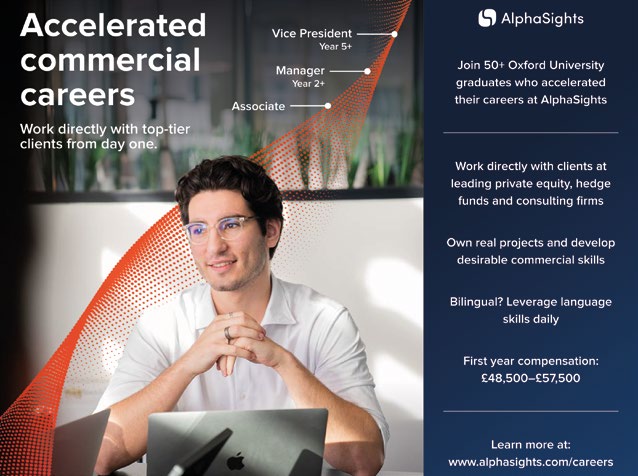









Apply Now and Join our Career Events!
In my first two years on the Swire Management Programme, I have had a
diverse range of insightful, hands-on experiences, learning about Cathay
Pacific and aviation. I've learned about various facets of the business world,
like enterprise digital strategy, dynamic revenue management, and
operational process-mapping. Through my projects across commercial and
operational functions, I have gained exposure to strategic decision-making
on critical projects across the business.
The Programme expects you to adapt and learn quickly to contribute to
these projects. Swire provides us with comprehensive training and a close-
knit network of mentors and peers; combined with varied real-world
experiences, you are well-equipped to meet these challenges and learn
from them.
Khusrau Islam, Oxford alumnus
(BA Classics, 2023)
SWIRE MANAGEMENT PROGRAMME 2027
Launch Your International Career, Become a Future Business Leader.
OXFORD CAREERS AND
YOUR YEAR AHEAD
DEVELOPING YOUR
CAREER IDEAS
GAINING EXPERIENCE
AND DEVELOPING SKILLS
APPLICATION
ESSENTIALS
SECTOR
BRIEFINGS







Micro-internships last
between two and five days
and take place either
remotely or in person.
Voluntary, short-term
learning and development
opportunities available in
the vacation periods.
Micro-Internship
Programme
www.ox.ac.uk/careers/internships
WWW.OX.AC.UK/CAREERS/IIC
Insight into Consulting brings together consulting events, activities
and resources that Oxford students can explore at their own pace.
In Trinity term, students can apply for the Client Consulting
Challenge to gain hands-on experience solving a real business
challenge as part of a team.
Start the pathway:
Insight into
Consulting
P
a
t
h
w
a
y
on CareerConnect
OXFORD CAREERS AND
YOUR YEAR AHEAD
DEVELOPING YOUR
CAREER IDEAS
GAINING EXPERIENCE
AND DEVELOPING SKILLS
APPLICATION
ESSENTIALS
SECTOR
BRIEFINGS









FINANCE
&
MANAGEMENT
CONSULTANCY
FAIR
2026
FINANCE
&
MANAGEMENT
CONSULTANCY
FAIR
2026
Friday 9 October
12:00 - 15:00
www.ox.ac.uk/careers/fairs
Examination Schools
OX1 4BG

C
harities do not seek to make profits, and are usually
funded through donations and grants. Social
enterprises are businesses which trade for a social/
environmental purpose, reinvesting profits to further this
purpose.
There is a huge range of causes served, and workplaces
range from small start-ups to big organisations with a
more corporate culture. Charities and social enterprises
have the same range of job roles as any organisation, such
as marketing, HR, PR, IT, project management, fieldwork,
finance, policy, and research. Charities often also have an
extensive fundraising or ‘development’
department.
Getting in and entry points
The following options offer different
ways into the charity and social
enterprise sector:
•
Internships – although paid
opportunities are advertised,
internships are often offered as
unpaid volunteering. If it is not
possible for you to volunteer,
ask whether there’s any way they
could make the opportunity more
accessible: fewer days or hours, or
working remotely to allow you to
accommodate other paid work.
www.ox.ac.uk/careers
Sector Briefings: Charity and social enterprise
96
Charity and
social enterprise
This sector offers: diverse roles; a chance to drive
change; and the opportunity to work on a cause
that matters to you.
OXFORD CAREERS AND
YOUR YEAR AHEAD
DEVELOPING YOUR
CAREER IDEAS
GAINING EXPERIENCE
AND DEVELOPING SKILLS
APPLICATION
ESSENTIALS
SECTOR
BRIEFINGS

www.ox.ac.uk/careers
Sector Briefings: Charity and social enterprise
97
•
Job opportunities generally will require some previous
experience, such as volunteering. Administrative, project
or case-work supporting roles can be a way into the
sector. Check organisations’ own websites and specialist
job sites such as Charity Job, Third Sector Jobs, Guardian
Jobs, Idealist, and Social Enterprise UK.
•
Contact organisations speculatively to find short-term
roles and entry-level work.
•
Graduate schemes are relatively rare, but examples still
include Wellcome Trust and Cancer Research UK.
•
Some people transfer into the charity sector having
gained skills and expertise in a private company first. This
is particularly true of roles like accountancy or legal work
where the charity or social enterprise might not have the
resources to train someone.
OXFORD CAREERS AND
YOUR YEAR AHEAD
DEVELOPING YOUR
CAREER IDEAS
GAINING EXPERIENCE
AND DEVELOPING SKILLS
APPLICATION
ESSENTIALS
SECTOR
BRIEFINGS
•
Further study – many roles are accessible without a
further degree but this may be important for some roles,
such as those in policy.
If you are considering further study as part of your
strategy, it is advisable to:
•
Understand which roles commonly require higher
qualifications by reviewing job descriptions and
advertisements.
•
Ask people working in your preferred area what
qualifications they have and which courses they
recommend for entry and progression (if any).
•
Investigate providers and specific courses, including the
background of tutors and destinations of recent graduates.
Extra-curricular ideas
Relevant experience is usually essential. Here are some
ideas to try while you are here at Oxford:
•
Explore volunteering opportunities through Oxford Hub,
which also offers grants and training
for those wishing to try out a social
enterprise idea, or find opportunities
using
Do It Volunteering
or
OCVA
.
•
Join a cause-related student
society: get involved in projects and
committee or leadership positions,
or establish a new society serving a
cause you care about.
•
Participate in The Client Consulting
Challenge: charities and social
enterprises are among the clients seeking student advice.
•
Look out for Oxford Micro-Internships which are often
based in social enterprises and charities.
•
Get involved with Oxford University Innovation social
enterprises.
•
Look for the Skoll World Forum activities and the fringe
events such as Oxjam.
Next steps
•
www.ox.ac.uk/careers/careers-guidance/explore-
careers/sectors-and-occupations/charities
•
www.ox.ac.uk/careers/careers-guidance/working-
for-yourself/entrepreneurship-and-social-enterprise
I wanted to put the skills and
knowledge I developed in my degree
into making life better for everyone.
Non-profit work is a great way to
learn more about the communities
that we live in and what we should
be doing to change things.
Jessica Kaye, University and Community
Partnerships Manager, The Oxford Hub
www.ox.ac.uk/careers
Sector Briefings: Charity and social enterprise
98
OXFORD CAREERS AND
YOUR YEAR AHEAD
DEVELOPING YOUR
CAREER IDEAS
GAINING EXPERIENCE
AND DEVELOPING SKILLS
APPLICATION
ESSENTIALS
SECTOR
BRIEFINGS

www.ox.ac.uk/careers
Sector Briefings: Charity and social enterprise
99
What:
After completing my MSc at Oxford, I transitioned into
the world of effective altruism (EA), a movement originated
by Oxford philosophers. I started at Effective Ventures,
rotating within their operations team, before moving to
Giving What We Can as an executive assistant to the CEO.
Why:
While I enjoyed my research project, I craved a more
practical application of my skills post-graduation. The EA
space offered challenging opportunities that aligned with my
desire to make a positive impact. In my current role, I find
satisfaction in implementing robust operations infrastructure
that supports impactful work.
My journey began with various operational projects
at Effective Ventures, including running hiring rounds,
assisting with budgets, and developing system automation.
Now I provide executive support and manage operations
projects, constantly learning and growing in this dynamic
environment.
Working in high-impact non-profits offers numerous
advantages, including the opportunity to contribute
to meaningful initiatives, collaborate with passionate
colleagues, and rapidly develop diverse skills in a generalist
role. The sector also often provides good compensation
and potential visa sponsorship for international students.
However, the work can be challenging and fast-paced,
requiring adaptability and quick learning.
Advice:
For those interested in a rewarding generalist
career path, I highly recommend considering operations
in high-impact non-profits. And really utilise Careers,
University of Oxford – the team’s support was invaluable
during my job hunt. Don’t be discouraged by rejections;
persist and apply for opportunities that seem daunting.
Leverage your academic skills, as research abilities and clear
communication are highly valued in most fields.
Alumni profile
Zou Xinyi
Position
Executive Assistant, Giving What
We Can.
Background
MSc Education (Digital and
Social Change), Kellogg College,
2022.
OXFORD CAREERS AND
YOUR YEAR AHEAD
DEVELOPING YOUR
CAREER IDEAS
GAINING EXPERIENCE
AND DEVELOPING SKILLS
APPLICATION
ESSENTIALS
SECTOR
BRIEFINGS

What:
In my role I help students to find volunteering
opportunities that work for them. This includes programmes
run by the Oxford Hub as well as a variety of charities across
the city.
This is the first ‘grown-up’ job I’ve ever had, and to be able
to work for an organisation making a difference in a city that
has given so much to me has been incredibly rewarding. I
am enjoying this learning experience and really believe in the
work my organisation is doing. I’ve really enjoyed being able
to keep strong ties with the University, having loved my time
there, and helping other students to get more involved in
their wider community has been amazing.
Why:
It was always my plan to work in the charity and non-
profit sector. I wanted to put the skills and knowledge I
developed in my degree into making life better for everyone.
Non-profit work is a great way to learn more about the
communities that we live in and what we should be doing
to change things. I was attracted to the idea of working at
a local charity because it has given me the opportunity to
see exactly how much impact volunteering can have. I am
so happy that I have taken the first step towards what will
hopefully be a long career of enacting positive change.
Advice:
Get involved – there are so many societies at Oxford
and joining them can enrich your time at university while
giving your CV a boost.
Volunteering is an incredible way to get involved with the
wider community. Oxford can seem like such a bubble and
spending time with like-minded people who also care about
their local area is a great way to get out of that bubble, meet
new people and gain some skills.
Don’t reject yourself – always go for what interests
you, even if you’re not sure if you will be successful in an
application. If you do get the rejection, then move on to the
next thing.
Alumni profile
Jessica Kaye
Position
University and Community
Partnerships Manager, The
Oxford Hub.
Background
BA History and Politics,
University College, 2023.
www.ox.ac.uk/careers
Sector Briefings: Charity and social enterprise
100
OXFORD CAREERS AND
YOUR YEAR AHEAD
DEVELOPING YOUR
CAREER IDEAS
GAINING EXPERIENCE
AND DEVELOPING SKILLS
APPLICATION
ESSENTIALS
SECTOR
BRIEFINGS











Summer
Internship
Programme
www.ox.ac.uk/careers/internships
The Summer Internship
Programme advertises
paid or
funded summer internships
,
exclusively available to Oxford
University students.
The
UK and international
internships available
through the programme
cover a wide variety of
sectors and are carried out
in person or remotely.
careers
careers
careers
term planner
term planner
term planner
careers
term planner
www.ox.ac.uk/careers/planner
Browse the term planner and sign up
for the events you would like to attend
in the coming months.
Browse full-time and part-time jobs, work
experience, and internships on the vacancies
platform for University of Oxford students,
researchers, and alumni.
Explore opportunities on
oxford.targetconnect.net
OXFORD CAREERS AND
YOUR YEAR AHEAD
DEVELOPING YOUR
CAREER IDEAS
GAINING EXPERIENCE
AND DEVELOPING SKILLS
APPLICATION
ESSENTIALS
SECTOR
BRIEFINGS
C
ritical skills include teamwork and collaboration along
with the ability to build relationships with stakeholders
and clients. Analytical and problem-solving skills, business
awareness, and the ability to deliver results are also
essential.
Consultants help client organisations improve their
performances by:
•
assessing the business case for new products or
expansions to new markets.
•
advising on scaling back, closing operations,
reorganisations and cost-cutting.
•
advising on all points in between, such as improving
systems and processes, and building better teams.
Graduates are expected to be active and productive in
projects from the start and can quickly gain experience
across a wide range of industries. However, new entrants
should also expect long hours, extensive travel, and lots of
time working on spreadsheet analyses and presentations.
Consulting firms range from large, multinational firms
working across many fields to niche consultancies that may
focus on a specific sector or specialist area (for example,
healthcare, education, media, financial services, IT, digital
transformation and people and performance). Broadly, firms
work in two ways:
1.
Strategy consultancy:
Understanding and finding
solutions to strategic problems faced by an organisation:
for example, understanding competitors; the market; and/
or future drivers of growth. Projects tend to be fairly short,
and roles often involve significant travel.
2.
Implementation consultancy:
Developing a strategic
idea or solution and making it a reality. Projects tend to
www.ox.ac.uk/careers
Sector Briefings: Consultancy
102
Consultancy
Consultancy offers variety, intellectual challenge
and the chance to work in high-performance teams
with a range of clients.
OXFORD CAREERS AND
YOUR YEAR AHEAD
DEVELOPING YOUR
CAREER IDEAS
GAINING EXPERIENCE
AND DEVELOPING SKILLS
APPLICATION
ESSENTIALS
SECTOR
BRIEFINGS
www.ox.ac.uk/careers
Sector Briefings: Consultancy
103
be longer than in strategy consultancy, and consultants
are often based at the client organisation. They ensure
that all elements of a business – people, technology
and processes – come together to deliver a successful
outcome.
Entry points
Competition can be fierce and the assessment process is
rigorous, typically including aptitude tests (online), several
rounds of interviews and/or an assessment centre, and
concluding with a partner interview. Once the process starts
it can move quickly, so prepare thoroughly in advance. Use
individual firms’ websites to understand their recruitment
processes and timelines to plan ahead.
For full-time positions, applications at most larger firms
open in August or September and close in October. Many
botique and niche firms may recruit all year round or on a
'rolling basis', reviewing candidates and filling positions as
applications are received.
Firms usually only allow one application a year, and this
means deciding whether to apply for their ‘management
consulting’ or ‘strategy consulting’ practice.
Internships are not offered universally (application
deadlines fall between November and January) but are
becoming more common. Commercial work experience in
any sector can help students acquire and display relevant
skills and enhance business awareness.
Case study interviews
are central to the process. ‘Cases’
challenge you to show you can think through business
problems like a consultant. Generally, you will need to do a
good job on every ‘case’ and an outstanding job on a couple
of them:
•
Read our guidance:
www.ox.ac.uk/careers/careers-
guidance/job-search-and-applications/interviewing/
consulting-case-study-interviews
•
Attend employer-led case study workshops, many of
which are advertised on the term planner.
•
Practise a lot, particularly talking through your ideas out
loud.
Extra-curricular ideas
•
Become active in a student society, such as CapitOx, the
Oxford Strategy Group, Oxford Women in Business or the
Oxford Guild.
OXFORD CAREERS AND
YOUR YEAR AHEAD
DEVELOPING YOUR
CAREER IDEAS
GAINING EXPERIENCE
AND DEVELOPING SKILLS
APPLICATION
ESSENTIALS
SECTOR
BRIEFINGS

•
Browse specific events and support offered by Careers,
University of Oxford around consulting, including
Insight
into Consulting
and the
Client Consulting Challenge
, a
team-based challenge where you can gain hands-on
experience with local organisations and build business
skills and commercial awareness.
•
Work as a consultant with societies: for example, Oxford
Strategy Group, Oxford Consulting Initiative, Oxford
Development Consultancy, Enactus or 180 Degrees.
•
Consider completing a Micro-internship, a 2–5-day
voluntary learning and development opportunity with a
range of organisations. Here you will have the opportunity
to observe and assist a notable project.
•
Get involved with activities that provide business insight,
teamwork and demonstrate impact. For example, leading
on sponsorship for a student society, or participating in
team sports or outdoor pursuits with different people,
managing a recruitment drive for a society, or improving
an event or activity within your college.
Next steps
•
www.ox.ac.uk/careers/careers-guidance/explore-
careers/sectors-and-occupations/management-
consultancy
www.ox.ac.uk/careers
Sector Briefings: Consultancy
104
OXFORD CAREERS AND
YOUR YEAR AHEAD
DEVELOPING YOUR
CAREER IDEAS
GAINING EXPERIENCE
AND DEVELOPING SKILLS
APPLICATION
ESSENTIALS
SECTOR
BRIEFINGS

www.ox.ac.uk/careers
Sector Briefings: Consultancy
105
Early career:
I started my career at University College
London in the sustainability department, helping to create
their five-year sustainability strategy. I wanted to pursue a
career within sustainability and the food sector, so I moved
to Iceland Foods to project manage the removal of plastic
packaging from their products. In 2020, I moved to 3Keel.
What:
3Keel is an evidence-led sustainability consultancy,
tackling risks and building resilience across supply chains,
food systems and landscapes. I work specifically on
commodity supply chains such as soy and coffee. I combine
research, data-evidenced analysis and insight for clients
considering complex environmental and ethical issues within
supply chains. I also devise strategy and policy to facilitate
change. I have delivered a wide range of projects including
two secondments to Waitrose as Interim Raw Materials
Manager and Interim Fisheries and Aquaculture Manager.
Why:
In my second year of university, I visited Mars for a day
of shadowing and met their cocoa sustainability lead – it
was a revelation that I could work in sustainability. I sought
relevant work experience and chose modules accordingly,
including research on biodiversity and sustainable fishing.
I find consulting to be varied and food sustainability to be
particularly fascinating. This is both from an environmentalist
perspective and as a foodie, always keen to learn more about
how and where ingredients are produced. I enjoy using skills
developed from my degree to implement impactful change in
line with evolving science and my values.
Advice:
Take every opportunity and be open minded - you
never know where a phone call, a day’s work shadowing,
volunteering, or networking might lead. If you are interested
in food sustainability, I recommend participating in the
programme IFSTAL (Interdisciplinary Food Systems
Teaching and Learning). The Women in Sustainability
Network is also great. Sustainability is incredibly broad and
does not have a predetermined path so follow your passions!
Alumni profile
Eve Nelson
Position
Principal Consultant, 3Keel.
Background
BA Biological Sciences, Keble
College, 2018.
OXFORD CAREERS AND
YOUR YEAR AHEAD
DEVELOPING YOUR
CAREER IDEAS
GAINING EXPERIENCE
AND DEVELOPING SKILLS
APPLICATION
ESSENTIALS
SECTOR
BRIEFINGS

What:
Arcadis is a global design and engineering consultancy
for natural and built assets. I sit in the business advisory
department working with other management consultants
on a range of projects. Our focus is on the infrastructure
sector, working with clients to deliver sustainable solutions
and improve quality of life. I have worked on projects across
multiple domains including transport, education, healthcare
and energy. The projects vary in length from short-term
sprints to year-long engagements.
Why:
After graduating, I joined a boutique consultancy called
Quadrant Strategies, advising big tech clients on branding
and reputation. The projects were politically relevant, and
I was most interested in the work surrounding online child
safety and sustainability. I realised I wanted to focus on
projects with a tangible social value and community impact
so I pursued infrastructure consulting where outcomes are
visible, meaningful and long-term. Now, I’ve broadened my
sector experience, strengthened my consulting skills and
built a supportive network. I am also taking a three-month
sabbatical to go to Southeast Asia, allowing me to rest, reset
and return to work energised for the next stage of my career.
Advice:
As there are so many consultancies out there, the
application process can feel overwhelming. Be intentional
about where you apply. Start by understanding what you’re
curious about, which problems you enjoy solving and the
industries you want to be exposed to.
Test cultural fit in interviews. Each firm has its own culture
and style of work. A supportive team, strong leadership and
values that align with yours will accelerate your growth.
Reach out to consultants at the firms you’re considering
and ask about their projects, teams and day-to-day. Utilise
Careers, University of Oxford and their internships to give
you experience and an understanding of the environment.
You can always pivot. Your first role is a starting point, not
a destination. Stay curious, seek out work that is meaningful
to you, and keep reviewing your goals.
Alumni profile
Ikra Hussain
Position
Management Consultant at
Arcadis.
Background
BA Geography, Mansfield
College, 2021.
www.ox.ac.uk/careers
Sector Briefings: Consultancy
106
OXFORD CAREERS AND
YOUR YEAR AHEAD
DEVELOPING YOUR
CAREER IDEAS
GAINING EXPERIENCE
AND DEVELOPING SKILLS
APPLICATION
ESSENTIALS
SECTOR
BRIEFINGS

www.ox.ac.uk/careers
Sector Briefings: Consultancy
107
What:
BCG is a leading global consulting firm serving clients
across a range of industries. Each project’s timeline typically
ranges from 6 weeks to 6 months. Since joining the London
office, I have had the opportunity to make the most of the
variety of work on offer. I have developed a market strategy
for a bank, delivered transformation plans for hospitals and
supported a post-merger integration for an energy company.
Why:
My time at Oxford was highly influential in determining
my early career path. I greatly enjoyed my degree, especially
the problem-solving aspects, but I realised that I wanted a
more generalist role. Seeking variety and the opportunity to
apply problem-solving skills led me to consulting.
My path into consulting began with a chance application
to a spring week program at a management consulting firm
during my first year at Oxford. I then completed an internship
at the same company. Ultimately, I joined my current
company a few months after graduating as I was drawn to
the challenge of working on shorter-term strategic projects
instead of longer-term implementations. I have certainly been
challenged to quickly adapt to unfamiliar problems and I have
worked with a wide range of other highly motivated people.
Advice:
Looking back, I have two main reflections:
Firstly, make the most of the opportunities on offer at
Oxford. Join sports teams and societies and don’t be afraid to
take on leadership roles. As well as enjoying the sport and the
camaraderie, being Trinity College Boat Club’s President and
Treasurer gave me experience in organising teams and time
management. These skills are valuable in any application.
Secondly, be open to exploring different career paths
and actively pursue opportunities to gain experience. Go to
events hosted by societies and companies and ask about
what the day to day looks like in that career. Apply to spring
weeks and internships to gain experience, even if you are not
sure whether you are interested in the industry. It is through
these interactions and experiences that you will get the best
sense of whether it is the right career path for you.
Alumni profile
Kate Adams
Position
Consultant, Boston Consulting
Group.
Background
MMath Mathematics, Trinity
College, 2022.
OXFORD CAREERS AND
YOUR YEAR AHEAD
DEVELOPING YOUR
CAREER IDEAS
GAINING EXPERIENCE
AND DEVELOPING SKILLS
APPLICATION
ESSENTIALS
SECTOR
BRIEFINGS
Find your next
opportunity at Capital One
Our Strategy Analyst teams are right at the heart of our
mission to change the world of finance for good.
As a graduate or intern you could be turning ideas into
reality, driving the business forward and helping our
customers succeed with credit.
START YOUR CAREER
IN STRATEGY
Work at a top 15
Great Place to Work
Grow your career with tailored training
Generous salary, bonus and personal benefits
Take on responsibility for key projects
SOME OF THE PERKS




The Oxford Guild Careers in Consultancy Arm
The multi-award-winning Oxford Guild is the
largest society in
Oxford, Europe and the world as of 2015 according to The Times,
Forbes, Milkround and BBC
. Our unrivalled track record speaks for
itself.
100% FREE TO JOIN, TENS OF THOUSANDS OF MEMBERS, 120+
EVENTS ANNUALLY, 60+ SPONSORS.
We worry about your career so you don’t have to!
BIGGEST SPEAKERS, EVENTS, BALLS, SOCIALS, TRIPS &
CONFERENCES.
We are widely recognised for being the
most established, dynamic,
active and professional society on campus
for students looking
to apply for internships/jobs and are renowned for our experience.
We have demonstrated consistent success in providing effective
recruitment and brand awareness opportunities and services for
organisations we work with.
We help a huge range of companies
from Accenture, MBB, Oliver Wyman, FTI, Big 4 and more, to
increase the quality, diversity and quantity of their applicants.
We are the founders of the CollegiumGlobalNetwork which has 40+
universities across the world involved so far including our Cambridge
Guild etc. and run many inter university initiatives.
With
world class speakers
(including major CEOs to Nobel Prize
Winners, world leaders, top actors, musicians etc. from
OpenAI’s
CEO Sam Altman
last year to Kanye West and Malala), and
initiatives
including our startup accelerator, investment fund, consultancy,
app and intranet platform
, become part of something special at
www.theoxfordguild.com!
www.theoxfordguild.com
180 Degrees Consulting Oxford is the University of Oxford’s largest
consulting society and the Oxford branch of the world’s largest
university-based consultancy for social impact organisations.
Each term, we work with charities, social enterprises and NGOs on
a range of projects, giving students the opportunity to work on real-
world challenges while creating social impact. Alongside projects,
we run training sessions, career events and socials, designed to help
students develop practical skills while meeting like-minded people.
Whether you’re looking to gain hands-on consulting experience
or work on meaningful projects, we’d love to welcome you to our
community.
Find out more on our website https://180dc.org/branches/oxford-
university, and follow us on Instagram @180dc.oxford to stay
updated on applications and events!
https://180dc.org/branches/oxford-university
OXFORD CAREERS AND
YOUR YEAR AHEAD
DEVELOPING YOUR
CAREER IDEAS
GAINING EXPERIENCE
AND DEVELOPING SKILLS
APPLICATION
ESSENTIALS
SECTOR
BRIEFINGS


Launch your consulting career with our
Analyst Programme, providing rich
learning opportunities, mentorship, and
a supportive environment whilst building
your core consulting toolkit. Visit our
website for more information and details
for applying for our 26/27 intake:
https://edenmccallum.com/-
join-us/our-analyst-programme/
Looking For A Career
Worth Making a Song
and Dance About?
About us:
EY-Parthenon is home to more than 25,000 professionals
globally. Our unique combination of transformative strategy,
transactions and corporate finance delivers real-world value –
solutions that work in practice, not just on paper. Benefiting from the
full spectrum of EY services, we’ve reimagined strategic consulting
to work in a world of increasing complexity. With deep functional and
sector expertise, paired with innovative AI-powered technology and
an investor mindset, we partner with CEOs, boards, private equity
and governments every step of the way – enabling you to shape your
future with confidence.
Our core capabilities span:
›
Strategy and execution: Helping clients define their future
direction and translate vision into actionable plans
›
Transactions and corporate finance: Supporting the entire deal
lifecycle - from M&A strategy, valuation and due diligence to
financing, execution and post-deal integration
Our industry focus includes:
Consumer and Health, Financial
Services, Government and Infrastructure, Industrials and
Energy, Private Equity, Technology, Media & Entertainment,
Telecommunications
Whether our clients are seeking growth, restructuring, or investment
opportunities, we provide clear, pragmatic guidance rooted in deep
sector knowledge and real-world experience. At EY-Parthenon, we
shape strategies that create lasting impact
Please visit our website to learn more about the opportunities
available to join EY-Parthenon ey.com/uk/earlycareers
ey.com/uk/earlycareers
Berlin, Dusseldorf, Frankfurt, Hamburg, London, Milan, Munich,
Stockholm, Utrecht, Vienna, Zurich
www.d-fine.com
Consulting Roles @ d-fine
What does d-fine offer you?
- Diversity: Work with clients on topics ranging from financial enginee-
ring and machine learning through to climate risk and healthcare
- International: Collaborate in project teams staffed across Europe
- Education: Acquire new skillsets to broaden your technical and
professional repertoire
Who is eligible to join?
Master’s or PhD-level graduates in STEM fields
How can I apply?
Please go to our Job Portal on our website www.d-fine.com
We are a European consultancy firm focussed on analytical
and quantitative topics and the development of sustainable
solutions to bring about positive change for our clients.
OXFORD CAREERS AND
YOUR YEAR AHEAD
DEVELOPING YOUR
CAREER IDEAS
GAINING EXPERIENCE
AND DEVELOPING SKILLS
APPLICATION
ESSENTIALS
SECTOR
BRIEFINGS


Graduate Opportunities
FTI Consulting is a world leader in business advisory and
consulting. With over 8,000 employees worldwide, we are
looking for bright motivated graduates from all backgrounds
and disciplines to contribute to our continued success
As a graduate in our Economic and Financial Consulting practice, you will have
the opportunity to:
—
Work with world-leading economists, accountants and financial experts
—
Work across a variety of industries and projects
—
Receive extensive in-house training and study for a professional
qualification
—
Transfer between international offices
fticonsulting.com/careers/what-we-do/economic-consulting
Career opportunities for
entry level economists
We’re passionate economists, committed to cases from
mergers and litigation to market investigations and
dominance abuse. We advise multinational companies on
the economics of high stakes competition law worldwide.
Our economists employ economic insights to real-
world issues, developing technical, consulting and
communication skills. Learning at RBB is constant.
We offer a meritocratic, supportive and sociable work
atmosphere.
We seek outstanding, motivated economists, usually
postgraduate level and interested in industrial
organisation. Preference for candidates who communicate
complex economic concepts in a clear concise style.
Join us! Work in a global
team on projects covering
all industry sectors and shape
your own path. Apply now:
rbbecon.com/careers
Global leaders in competition economics
Stimulating, challenging, rewarding
Our requirements
OXFORD CAREERS AND
YOUR YEAR AHEAD
DEVELOPING YOUR
CAREER IDEAS
GAINING EXPERIENCE
AND DEVELOPING SKILLS
APPLICATION
ESSENTIALS
SECTOR
BRIEFINGS
F
ashion – Roles within the fashion industry are extremely
varied and it is important to remember that there is more
to a career in the industry than fashion itself. Roles within
the industry include everything from buying, merchandising,
sourcing, finance, design and garment technology, retail
management, photography, event planning and lots more.
Gaming – The aim of this industry is to develop, publish,
and distribute video games and interactive experiences
across all digital platforms. Roles can be found within, but
not limited to, animation, audio, game design, production,
programming, and quality control.
Media and Journalism – Journalists, broadcasters and
directors form the public face of the sector, but there are many
other roles. Researcher roles are popular entry points for
Oxford graduates: these can involve fact checking content and
finding people to appear in programmes. The impact of digital
media is redefining both journalism and broadcast content,
and having an awareness of multimedia platforms and tools is
now crucial for graduates seeking to enter this sector.
Performing Arts – Roles within performing arts can be
either performance (musician, actor, dancer etc.) or non-
performance (set designer, sound technician, talent agent
etc.) based. Whichever route you decide, you can be sure to
use your creativity and technical ability. Most performance
roles will be on a freelance or fixed-term basis.
Creative
industries
Roles within the creative industries are extremely
varied and encompass many sub-sections. During
this briefing we will focus on the most popular
amongst our students; the Fashion Industry, Games
Industry, Media and Journalism, Performing Arts
and TV and Film.
www.ox.ac.uk/careers
Sector Briefings: Creative industries
112
OXFORD CAREERS AND
YOUR YEAR AHEAD
DEVELOPING YOUR
CAREER IDEAS
GAINING EXPERIENCE
AND DEVELOPING SKILLS
APPLICATION
ESSENTIALS
SECTOR
BRIEFINGS
TV and Film – The number of different types of jobs is
immense, spanning all parts of the production process from
commissioning, development, production, post-production
and through to distribution. Like the performing arts
industry, roles within TV and Film are increasingly becoming
'freelance' or fixed-term contract opportunities.
Remember, creativity can take many forms, so you might
also like to see information on working in Advertising or
Culture and Heritage – or any of the many other sectors
which employs creatives!
Further study
Further study may be needed for certain careers within
the industry that require technical ability before you can
undertake a particular role. Depending on the course,
completing further study might present you with the
opportunity to complete work experience as part of your
studies, for example, the NCTJ for journalism, or the NFTS for
people with some film and television experience. In addition,
completing a final performance as part of further study within
performing arts will expose you to leading talent agents
within the industry, though this itself is not a guarantee that
you will secure an agent. It is important to do research and
weigh the costs and benefits for individual situations: some
people recommend them as a way to gain contacts and
experience, but others do not consider them as necessary.
Getting in and entry points
Competition for positions can be high, so relevant experience
is vital. Most people need to start in an entry level position,
often as an intern or a ‘runner’, for example. To gain this initial
experience, think about advertised internships and short-term
seasonal jobs which can provide you with great experience.
In addition, both paid and unpaid roles such as work staffing
festivals and events; front-of-house or promotional work;
game testing, support for tours; and summer work with
children and young people can provide great experience.
Furthermore, it is important to establish and cultivate
professional contacts because those interested in this
sector will often need to find (or create) their own openings
by contacting individuals and organisations directly. See our
advice on networking and speculative approaches, and take
steps to develop and cultivate your contacts – some great
opportunities can arise this way.
www.ox.ac.uk/careers
Sector Briefings: Creative industries
113
OXFORD CAREERS AND
YOUR YEAR AHEAD
DEVELOPING YOUR
CAREER IDEAS
GAINING EXPERIENCE
AND DEVELOPING SKILLS
APPLICATION
ESSENTIALS
SECTOR
BRIEFINGS
For industry specific insights and roles see:
•
Gaming, TV and Film –
www.screenskills.com
.
•
Media and Journalism –
www.journoresources.org.uk
.
•
Fashion –
fashionunited.uk/career-centre
.
•
Performing Arts – See
www.thestage.co.uk
. For
performance-based roles, you can attend open auditions
that do not require an agent. Details can be found on the
Stage. Should you wish to work as a professional actor,
you will need an equity card (
www.equity.org.uk
).
For a regularly updated list of jobs and internships within
the creative industries see
creativeopportunities.arts.ac.uk
.
Extra-curricular ideas
Plan ahead to get an edge on the competition after
graduation by accumulating experience whilst at Oxford.
•
Join a relevant society, such as the Fashion Society, Film
Making Foundation, OUDS or TAFF.
•
Write a blog and/or produce video or comment pieces for
other websites/products on topics of interest.
•
Take every opportunity to contribute to all things creative
at university: student newspapers, Oxide Radio, perform
in showcases, open mic nights and productions.
•
For graduate careers in both journalism and fashion,
candidates will need to build a portfolio of samples
of your published writing/work, and a good record of
relevant work experience.
•
Shoot your own documentary, short-film (on your smart
phone), direct, produce, act, etc in a stage play.
•
Design aspects of a game.
Next steps
•
www.ox.ac.uk/careers/careers-guidance/explore-
careers/sectors-and-occupations/performing-arts
•
www.ox.ac.uk/careers/careers-guidance/explore-
careers/sectors-and-occupations/marketing-and-
communications-including-advertising-and-pr
•
www.ox.ac.uk/careers/careers-guidance/explore-
careers/sectors-and-occupations/games
•
www.ox.ac.uk/careers/careers-guidance/explore-
careers/sectors-and-occupations/music
•
www.ox.ac.uk/careers/careers-guidance/explore-
careers/sectors-and-occupations/tv-and-film
www.ox.ac.uk/careers
Sector Briefings: Creative industries
114
OXFORD CAREERS AND
YOUR YEAR AHEAD
DEVELOPING YOUR
CAREER IDEAS
GAINING EXPERIENCE
AND DEVELOPING SKILLS
APPLICATION
ESSENTIALS
SECTOR
BRIEFINGS

What:
I’m an artist, with a practice rooted in painting,
exploring memory, landscape, and our connection to place
and nature. Alongside exhibiting my work, I teach 15th
Century Venetian Painting in Venice on an annual basis.
I am also the head of the University of Oxford’s Internship
team, where I help facilitate meaningful work experiences for
current students.
Why:
Art has always been an anchor for me, helping
me to understand and express something felt but hard
to articulate. I studied BA Fine Art and Italian at Exeter
University, MSt History of Art at the University of Oxford,
and completed my doctorate on 15th Century Venetian Art
in London. I worked in other fields for a while, including high
tech, but painting kept drawing me back. In my thirties, I
found a career in higher education that turned out to be a
great fit.
Because I work a slightly reduced week (90%), I can
juggle the different task and demands of being an artist with
working with students. Being at Oxford helped me develop
the kind of curiosity and independence that both my roles
now demand, whether I’m working in the studio or setting up
internships in China.
Advice:
There isn’t one ‘right’ path, which can feel both
freeing and daunting. For a long time, I thought I had to pick
a single identity or direction (and I didn’t choose well at first).
Over time, I’ve come to value the richness of a portfolio
career, where different parts of your life can support and
shape each other.
If something keeps drawing you in, find ways to keep it in
your life. Don’t be afraid to let your interests shift or grow.
Keeping a creative practice alive alongside other work can
be both grounding and full of unexpected opportunities.
Alumni profile
Dr Fiona Whitehouse
Position
Head of the Internship Office,
Careers, University of Oxford.
Background
MSt History of Art, Worcester
College, 1997.
www.ox.ac.uk/careers
Sector Briefings: Creative industries
115
OXFORD CAREERS AND
YOUR YEAR AHEAD
DEVELOPING YOUR
CAREER IDEAS
GAINING EXPERIENCE
AND DEVELOPING SKILLS
APPLICATION
ESSENTIALS
SECTOR
BRIEFINGS

What:
As an artist coordinator within the classical music
industry, I am responsible for the day-to-day management
of the careers of several international soloists/conductors.
Once my managers (the ‘agents’) have booked a concert
into the diary, it’s over to me to negotiate the contract, plan
the travel and logistics, apply for visas, and manage the
finances. The fact that the role involves such a variety of
tasks means that I’ve developed a wide range of experience
which I feel confident could open doors to many other
careers.
How:
My original plan was to pursue a career as an
orchestral musician. After graduating from Oxford, I began
studying for a master’s in flute performance at the Royal
Academy of Music, London. After several months I decided
to step away from this path and explore what else was out
there. A number of job applications and one very useful
session with Careers, University of Oxford later, I landed my
job at HarrisonParrott.
Advice:
One of the biggest lessons I’ve learnt as a result
of my pivot from performance to business is that when
considering a career, it is just as important to consider the
day-to-day lifestyle it will afford you, not just the content
of what you’ll be doing: are you someone who thrives on
an irregular and more variegated schedule and having the
independence to curate your own diary, or do you prefer
the stability of a regular schedule and income, and a clean
separation between life and work? I am really glad that I have
had the opportunity to try them both – I think I would have
always wondered ‘what if’ I had only ever pursued one!
Alumni profile
Isabella Thorneycroft
Position
Artist Coordinator,
HarrisonParrott.
Background
BA Music, Hertford College,
2023.
www.ox.ac.uk/careers
Sector Briefings: Creative industries
116
OXFORD CAREERS AND
YOUR YEAR AHEAD
DEVELOPING YOUR
CAREER IDEAS
GAINING EXPERIENCE
AND DEVELOPING SKILLS
APPLICATION
ESSENTIALS
SECTOR
BRIEFINGS









OXFORD
UNIVERSITY
CAREERS
FAIR 2026
OXFORD
UNIVERSITY
CAREERS
FAIR
2026
Saturday 10 October
10:30 - 13:30
THE FAIR FOR
DIVERSE SECTORS
Examination Schools
OX1 4BG
www.ox.ac.uk/careers/fairs










Browse full-time and part-time jobs, work
experience, and internships on the vacancies
platform for University of Oxford students,
researchers, and alumni.
Explore opportunities on
oxford.targetconnect.net
Creative
Careers
Festival
Information sessions, expert
Q&As, and panel discussions
exploring career paths in the
creative industries.
www.ox.ac.uk/careers/creative-fest
Online and
in Oxford
8 February -
12 February 2027
Registrations open in Hilary term.
2027
Ready to take your
career international?
GoinGlobal provides location-specific careers and
lifestyle information to support international job
searches, career planning and relocation.
www.ox.ac.uk/careers/what-we-offer/access-goinglobal
Access GoinGlobal for free through Careers:
OXFORD CAREERS AND
YOUR YEAR AHEAD
DEVELOPING YOUR
CAREER IDEAS
GAINING EXPERIENCE
AND DEVELOPING SKILLS
APPLICATION
ESSENTIALS
SECTOR
BRIEFINGS



www.ox.ac.uk/careers/icw
Three-session programme for Oxford
University students that provides an
introduction to creative writing careers,
explores the writing process, and offers
tips on how to get published, as well as
inspiration from guest speakers.
Insight into
creative
writing
C
ulture & Heritage jobs can be found in a wide range
of organisations such as museums, galleries, auction
houses, academic institutions, historic sites and many more
specialist organisations.
Employers in this sector often rely on candidates to seek
them out, and there are very few graduate schemes.
•
The vast majority of roles are advertised as individual
opportunities – check organisations’ websites, as well as
sector-specific job sites.
•
A very small number of graduate schemes exist, however
they are very competitive and often only recruit a few
graduates per year.
•
Don’t just consider the big names. There are hundreds
of smaller organisations, which often attract less
competition. If you love the work of a particular
organisation, then sign up to their newsletter for up-to-
date information.
•
Think about your local organisations and research within
your region.
•
Consider gaining experience with organisations providing
specialist services to the culture and heritage world: for
example, art investment, specialist legal and insurance
firms, marketing and PR firms, specialist IT or training
companies, public sector bodies and charities.
•
It’s also sometimes possible to move into the sector
after gaining experience in another sector, e.g. law,
accountancy, business strategy – culture and heritage
organisations also need lawyers and accountants!
Culture and
heritage
The sector covers a huge range of roles including
artistic (e.g. design, performance) management
and administration, teaching, research and training.
www.ox.ac.uk/careers
Sector Briefings: Culture and heritage
120
OXFORD CAREERS AND
YOUR YEAR AHEAD
DEVELOPING YOUR
CAREER IDEAS
GAINING EXPERIENCE
AND DEVELOPING SKILLS
APPLICATION
ESSENTIALS
SECTOR
BRIEFINGS

See Careers, University of Oxford's briefing for more on
specific roles
, ideas on how to build experience, and links to
external resources.
Further study
You don’t need a PhD to work in the sector although it’s
a requirement for some research and curatorial roles.
Further study (including master’s courses) may help you to
develop subject expertise that can make you stand out in
a competitive market. It is important to research courses
thoroughly before signing up, so consider the following:
•
Browse job adverts to understand which roles commonly
require additional study and which qualifications are
sought.
•
Investigate career destinations of graduates, and tutors’
backgrounds, for courses you are considering.
•
Ask alumni and others working in your preferred field
which courses they took (if any) and/or which are the
most respected.
Getting in and entry points
Competition for positions can be high, so relevant experience
on your CV is vital. Consider:
•
Volunteering with local culture and heritage
organisations – seek out local museums (for example,
www.glam.ox.ac.uk
) and heritage organisations, such as
Oxford Preservation Trust.
www.ox.ac.uk/careers
Sector Briefings: Culture and heritage
121
OXFORD CAREERS AND
YOUR YEAR AHEAD
DEVELOPING YOUR
CAREER IDEAS
GAINING EXPERIENCE
AND DEVELOPING SKILLS
APPLICATION
ESSENTIALS
SECTOR
BRIEFINGS

•
Advertised internships and short-term seasonal jobs
offer great experience, paid or unpaid (for example, paid
work staffing festivals and events; front-of-house or
promotional work; support for tours; summer work with
children and young people).
•
Asking directly about jobs, internships or volunteering by
networking and speculative approaches to organisations,
even if there is nothing on their website.
•
Positions may not be advertised widely (or at all!) so
check websites and approach individual organisations
directly.
•
Create your own professional portfolio/blog to document
your creative work and interests.
Extra-curricular ideas
Take advantage of the rich cultural life of Oxford and the
University to try things out. For example:
•
Join community arts projects: for example, explore
www.oxonarts.info
•
Take part in the TORCH (The Oxford University Research
Centre in the Humanities)
Heritage Pathway Programme
.
•
Try arts production or marketing; run events as ‘entz’
officer for your college.
•
Submit articles for arts, culture and heritage sections of
student newspapers.
•
Start something new: for example, establish a
performance group; create a heritage-style ‘audio guide’
to your college; write a blog.
Next steps
•
www.ox.ac.uk/careers/careers-guidance/explore-
careers/sectors-and-occupations/culture-and-
heritage
www.ox.ac.uk/careers
Sector Briefings: Culture and heritage
122
OXFORD CAREERS AND
YOUR YEAR AHEAD
DEVELOPING YOUR
CAREER IDEAS
GAINING EXPERIENCE
AND DEVELOPING SKILLS
APPLICATION
ESSENTIALS
SECTOR
BRIEFINGS

What:
As a museum and collections assistant, my job is
really varied. I’m part of a small team, which means I get to
do all sorts. I manage the social media, write the newsletter
and make posters. I also help document and catalogue our
collection of plaster casts and sherds; clean the objects; and
monitor the creepy crawlies that wander in.
Why:
Working a position like mine in a small museum has
been a great way to build up my experience. Rather than
being limited to a single role, I’ve been able to try lots of
different tasks that might be done by completely different
people in a larger museum. As a result, I’ve been able to
figure out what I like and don’t like doing. This means that I
can plan the next stage of my career with a much better idea
of the roles that suit me.
The best part is that I get to spend my time surrounded
by things that I’m completely fascinated by. The novelty of
being up close and personal with a cast of an ancient statue
or handling a piece of pottery that’s over 2,000 years old
still hasn’t quite worn off. I also find that chatting to visitors
about something that I’m genuinely passionate about is
really rewarding - and only occasionally slightly frustrating.
Advice:
Finding a job in heritage was really tough. When
I graduated, I secured a six-month internship in heritage.
I convinced myself that it was my foot in the door, only to
find myself on a long job hunt afterwards. My big piece of
advice, beyond making sure that you learn as much about
the place that you’re applying to as possible and adjust your
application and CV accordingly, is to persevere. Getting
rejected doesn’t make you a less impressive person or mean
that your life is over. Even if in the moment it feels like a
complete catastrophe, all you can really do is pick yourself
back up and keep going.
When you do finally get an opportunity, make the most
of it. Do all the training you can and be sure to ask lots of
questions. It’s also important to step back and enjoy it;
museums are a cool place to work!
Alumni profile
Will Evans
Position
Museum & Collections Assistant
at The Museum of Classical
Archaeology, University of
Cambridge.
Background
MSt Classical Archaeology, St
Hugh’s, 2024.
www.ox.ac.uk/careers
Sector Briefings: Culture and heritage
123
OXFORD CAREERS AND
YOUR YEAR AHEAD
DEVELOPING YOUR
CAREER IDEAS
GAINING EXPERIENCE
AND DEVELOPING SKILLS
APPLICATION
ESSENTIALS
SECTOR
BRIEFINGS

What:
I am responsible for fostering and nurturing mutually
beneficial relationships between academic researchers and
external heritage organisations. I work with researchers
and professional services staff, and with the research and
curatorial teams within the various heritage organisations
we collaborate with to identify the most promising avenues
for sector-facing research. I am often in meetings with
Oxford and sector colleagues or supporting the design of
projects and funding applications. I also actively publish as
an academic historian of the late medieval and early Tudor
period.
Why:
I first came to Oxford in 2013 to pursue a doctorate in
history, following degrees at the universities of Nottingham
and Cambridge, and almost a year as a library assistant
at Cambridge University Library. Post-doctorate, I held
research fellowships at the universities of Edinburgh and
York. Despite having a traditional academic career path, I
was always interested in public-facing research, seeking out
public engagement and knowledge exchange opportunities
with heritage organisations, the media and local history
groups. My work at the intersection between academia and
heritage brought me back to Oxford in 2022, when I began
my current role.
Advice:
The heritage and academic sectors are notoriously
competitive, so you need to make yourself stand out. As
subject specialists, our academic expertise can often feel
niche, but we have a lot to offer, especially when we adopt
a flexible and creative approach. I spent much of my early
career moving around the country on fixed-term contracts,
which is not desirable or possible for everyone, but I was
proactive in using these opportunities to acquire skills,
training and knowledge in line with my career ambitions.
Short internships and placements can be a great way of
gaining insights into the sector you want to work in and can
serve as a springboard for developing knowledge, networks
and further opportunities.
Alumni profile
Dr Rachel Delman
Position
Heritage Partnerships
Coordinator, University of Oxford.
Background
DPhil History, University College,
2017.
www.ox.ac.uk/careers
Sector Briefings: Culture and heritage
124
OXFORD CAREERS AND
YOUR YEAR AHEAD
DEVELOPING YOUR
CAREER IDEAS
GAINING EXPERIENCE
AND DEVELOPING SKILLS
APPLICATION
ESSENTIALS
SECTOR
BRIEFINGS

T
eaching demands communication skills, energy and a
commitment to inspire students. It offers an opportunity
to make a difference, to use your subject and to advance
your career in a variety of directions.
Teachers can rapidly specialise into managerial, pastoral
or training roles in schools. Many also move into education
roles in other areas.
Getting in and entry points
Teacher training options divide into two main types:
School-led:
One- or two-year programmes based in
school, some salaried, others funded by loans and bursaries.
Examples are: Teach First, School
Direct, Researchers in Schools, some
School-Centred Initial Teacher Training
(SCITT), Premier Pathways, Engage
Education, and some independent
schools.
University-led:
Usually one-year
programmes based in university but
with extended periods in partnership
schools. For example, PGCE, PGDE,
SCITT. Funded via bursaries (level
varies with teaching subject) and
tuition fee loans.
Whichever route you choose to
follow, it is important to gain some
relevant experience prior to application.
Education
Education is one of the most popular sectors
for Oxford graduates. Diverse areas including
publishing, policy, administration, charities and
NGOs, psychology, arts and heritage, and academia
may be relevant if you’re interested in education.
Here we look at teaching.
www.ox.ac.uk/careers
Sector Briefings: Education
125
OXFORD CAREERS AND
YOUR YEAR AHEAD
DEVELOPING YOUR
CAREER IDEAS
GAINING EXPERIENCE
AND DEVELOPING SKILLS
APPLICATION
ESSENTIALS
SECTOR
BRIEFINGS

Applications for most UK teacher training courses are via the
Department for Education Apply portal; others take direct
applications.
There is no formal requirement for a teaching qualification
in the independent sector and some will employ new
graduates and offer on-the-job training. Others recruit recent
graduates through graduate assistant roles, particularly in
boarding schools. CareerConnect and the
Times Educational
Supplement
(TES) are good sources of vacancy listings for
independent schools.
Teaching English as a Foreign Language (TEFL) and
private tutoring are popular short-term occupations on
leaving Oxford, but can also be longer-term careers. A
degree from Oxford may be the only qualification needed
for some teaching jobs, but experience is always helpful for
applications, and a TEFL qualification may make it easier to
find work abroad.
There are a few graduate training programmes in
education policy and administration, some are run by
universities. For example, Imperial College has a long-
standing graduate management and finance scheme.
Education policy could form part of the Civil Service Fast
Stream or local government schemes such as the National
Graduate Development Programme. The TES and the
Guardian are key publications for opportunities in the
education sector.
www.ox.ac.uk/careers
Sector Briefings: Education
126
OXFORD CAREERS AND
YOUR YEAR AHEAD
DEVELOPING YOUR
CAREER IDEAS
GAINING EXPERIENCE
AND DEVELOPING SKILLS
APPLICATION
ESSENTIALS
SECTOR
BRIEFINGS

Extra-curricular ideas
•
Observe teachers at work in local schools. The
government-run School Experience Programme offers
time in schools. Alternatively, approach schools directly
to ask if you can observe lessons, or help in other ways.
•
Get international teaching experience in the summer
vacation through The Summer
Internship Programme.
•
Volunteer your time with local
children through organisations such
as Jacari, KEEN or Oxford Hub’s
Schools Plus programmes.
•
Develop pastoral skills by helping
with Oxford University Scout &
Guide Group, or volunteering with
Sexpression Oxford to promote
sexual health.
•
Offer mentoring for UNIQ Summer School participants,
volunteer with Oxford University Admissions or work with
Target Schools to promote access to university, or with
OxFizz to give interview practice, mentoring, or to run
summer camps.
Next steps
•
www.ox.ac.uk/careers/careers-guidance/explore-
careers/sectors-and-occupations/tefl
•
www.ox.ac.uk/careers/careers-guidance/explore-
careers/sectors-and-occupations/teaching-in-
schools
I wanted to make a difference.
Education is a major and necessary
mechanism in tackling societal
inequality. As a teacher, you can feel
the impact education can have on
inequality.
Jack Morrin, Trainee Maths Teacher,
Teach First Training Programme
www.ox.ac.uk/careers
Sector Briefings: Education
127
OXFORD CAREERS AND
YOUR YEAR AHEAD
DEVELOPING YOUR
CAREER IDEAS
GAINING EXPERIENCE
AND DEVELOPING SKILLS
APPLICATION
ESSENTIALS
SECTOR
BRIEFINGS

What:
I’m a trainee Maths teacher. When I graduated in
maths, I knew that I wanted to make a meaningful impact
on the world. That’s why I joined the Teach First training
programme. They share my commitment to ending
educational inequality. Unlike other routes, this scheme has
given me first-hand teaching experience in the classroom
from day one and I’ve loved it. I teach roughly 18 periods a
week, which are each 50 minutes long. Beyond delivering
lessons, my day to day involves planning lessons, preparing
teaching material, assessing work and constantly learning.
Why:
Hopefully this isn’t too cliché, but I wanted to make a
difference. Education is a major and necessary mechanism
in tackling societal inequality. As a teacher you can feel the
impact education can have on inequality. I passionately
believe that every child deserves a proper education.
In fact, every child deserves to dream of attending an
institution like Oxford. However, it is an unfortunate reality
that for so many, educational inequalities make that dream
almost or entirely impossible to realise. That’s why I’ve
become a teacher, and I’m excited to be part of the fight
to end educational inequality. Many of my students are
pupil premium (referring to the scheme in England that
provides additional government funding to disadvantaged
students in state-funded schools) or face other challenges.
It is incredibly rewarding to see that I am giving them the
education and opportunities that they deserve.
Advice:
Be ready for your first lessons to not go as well as
you’d like. Especially for the Teach First route, as much as
they try to prepare you it really is a difficult initiation into
teaching. The most important thing is to be ready and open
to receiving feedback from colleagues as this will help to
improve your practice. Also, know that you will get better,
and quickly!
Alumni profile
Jack Morrin
Position
Trainee Maths Teacher – Teach
First Training Programme.
Background
BA Philosophy, Politics and
Economics, New College, 2025.
www.ox.ac.uk/careers
Sector Briefings: Education
128
OXFORD CAREERS AND
YOUR YEAR AHEAD
DEVELOPING YOUR
CAREER IDEAS
GAINING EXPERIENCE
AND DEVELOPING SKILLS
APPLICATION
ESSENTIALS
SECTOR
BRIEFINGS

What:
Immediately after completing my physics degree
here at the University of Oxford, I started my PGCE. This
is a postgraduate certificate in education through which I
will gain the Qualified Teacher Status required to teach in
secondary schools.
Unlike some PGCE courses, the course involves three
days per week in a placement school and two days at the
university during the first term. The second term is spent
full-time in school, and the final term is spent in a different
placement school. For me, this meant I could fully integrate
into my first placement and make the most of my learning
there, then fine-tune my practice and explore new teaching
approaches.
Why:
I knew early on that a desk job was not for me.
Teaching was something I had always been interested
in, and throughout university I loved sharing my love for
physics. Seeing students become excited about and
successful in your subject makes every day worthwhile.
Every class and every student are different, so there is
always something new to be learned. There are so many
ways to progress in your career in education, whether that be
in pastoral work, curriculum leadership or SEND provision.
Advice:
My number one top tip would be to get some
teaching experience. This could be through volunteering,
tutoring or teaching assistant work. These experiences
will not only help you to develop useful skills but also help
you learn what it takes to work in a school. Some days are
challenging, and you can be working long hours, but it’s so
worthwhile once you are used to it.
When preparing for an interview, focus on the attributes
and experiences you can bring to teaching. Confidence in
knowing what you’re doing and why you’re doing it will go a
long way, both at the interview and in the classroom. Every
teacher has their own personality and style and staying true
to yours whilst remaining open for growth will make for a
much more enjoyable experience.
Alumni profile
Charlotte Rixon
Position
Trainee Secondary School
Science Teacher (PGCE).
Background
BA Physics, Lady Margaret Hall,
2024.
www.ox.ac.uk/careers
Sector Briefings: Education
129
OXFORD CAREERS AND
YOUR YEAR AHEAD
DEVELOPING YOUR
CAREER IDEAS
GAINING EXPERIENCE
AND DEVELOPING SKILLS
APPLICATION
ESSENTIALS
SECTOR
BRIEFINGS










Careers conference for Oxford University
research staff
and
DPhil students
looking
to explore roles beyond academia and the
routes towards them.
Find out more:
Options and Pathways for Researchers
CAREERS BEYOND
ACADEMIA
Careers Beyond
Academia
www.ox.ac.uk/careers/researcher-conference
26-30
April 2027
Online &
in Oxford
Summer
Internship
Programme
www.ox.ac.uk/careers/internships
The Summer Internship
Programme advertises
paid or
funded summer internships
,
exclusively available to Oxford
University students.
The
UK and international
internships available
through the programme
cover a wide variety of
sectors and are carried out
in person or remotely.
OXFORD CAREERS AND
YOUR YEAR AHEAD
DEVELOPING YOUR
CAREER IDEAS
GAINING EXPERIENCE
AND DEVELOPING SKILLS
APPLICATION
ESSENTIALS
SECTOR
BRIEFINGS
www.ox.ac.uk/careers
Sector Briefings: Energy, sustainability and environment
131
S
tudents consider a career in sustainability, energy or the
environment for a range of reasons. Many seek to make
a positive impact and work for organisations whose values
mirror their own.
Environmental-awareness is not limited to careers that
are traditionally considered ‘green’. Existing businesses
are changing – consider the development of electric cars,
or moves to increase sustainability in retail. Sustainability
is an issue for all sectors; a new breed of firms exploiting
the drive for business to operate in a more sustainable way
has emerged, but in-house opportunities also exist in large
established organisations. This diversity means that well-
defined career paths in sustainability can be hard to find.
Roles may have sustainability as the core focus, a main
responsibility or just a small aspect.
Getting in and entry points
The diverse nature of this sector is reflected in the wide
range of possible entry points. Graduate schemes offered
by large companies and multidisciplinary consultancies tend
to recruit students from any discipline, with closing dates
Energy,
sustainability
and environment
From global energy companies to specialist
technology firms, regulatory bodies to think tanks,
national power generation companies to micro-
generation schemes, conservation charities to
mining corporations, carbon consultancies to
commodities traders: the range of opportunities in
this sector is immense.
OXFORD CAREERS AND
YOUR YEAR AHEAD
DEVELOPING YOUR
CAREER IDEAS
GAINING EXPERIENCE
AND DEVELOPING SKILLS
APPLICATION
ESSENTIALS
SECTOR
BRIEFINGS

towards the end
of Michaelmas
term or early
in Hilary term.
Many also offer
internships to
students in their
penultimate year
at Oxford. Look
beyond the job
title to establish
if sustainability is
incorporated into
a role.
The renewable
energy and
environmental
industries are
dominated
by small or
medium-sized
organisations
with only
occasional
vacancies, and may require relevant expertise (perhaps
gained through a specific postgraduate qualification). It is
important, therefore, that you take a proactive approach.
Research firms that match your interests and connect with
alumni working in relevant roles to learn more and build your
network.
Build relevant experience to develop skills, showcase
motivation and increase your knowledge of the sector and
issues affecting it through student societies, volunteering,
attending talks and completing internships. The Micro-
Internship and Summer Internship Programmes often
offer opportunities relevant to this sector and are open to
students of all year groups.
Build specialist knowledge and practical experience
through your degree by selecting relevant modules, and
focus essays, assignments, and projects on topics of
interest. These can be communicated in applications.
Employers’ responses to questions about their approach
to environmental sustainability are available through
CareerConnect.
www.ox.ac.uk/careers
Sector Briefings: Energy, sustainability and environment
132
OXFORD CAREERS AND
YOUR YEAR AHEAD
DEVELOPING YOUR
CAREER IDEAS
GAINING EXPERIENCE
AND DEVELOPING SKILLS
APPLICATION
ESSENTIALS
SECTOR
BRIEFINGS

www.ox.ac.uk/careers
Sector Briefings: Energy, sustainability and environment
133
Extra-curricular ideas
•
Take an active role in relevant student organisations such
as the Nature Conservation Society, the Energy Society, or
Oxford SU’s Environment and Ethics campaign.
•
Stand for election for your college JCR committee, many
colleges have an environment and ethics rep.
•
Volunteer with charities such as the
Oxford Conservation Volunteers,
the British Trust for Conservation
Volunteers, or with sustainability
charities that work with Oxford Hub.
•
See relevant sectors of this Guide
for ideas to develop skills for
roles in engineering, finance and marketing. If you are
interested in a graduate scheme with a large energy
company, see the
Developing Core Skills
advice for ideas
on how to develop leadership and organisational skills for
project management.
Next steps
•
www.ox.ac.uk/careers/careers-guidance/explore-
careers/sectors-and-occupations/energy
•
www.ox.ac.uk/careers/careers-guidance/explore-
careers/sectors-and-occupations/sustainability-
and-the-environment
Sustainability is incredibly broad and
does not have a predetermined path
– follow what you are passionate
about.
Eve Nelson, Principal Consultant, 3Keel
OXFORD CAREERS AND
YOUR YEAR AHEAD
DEVELOPING YOUR
CAREER IDEAS
GAINING EXPERIENCE
AND DEVELOPING SKILLS
APPLICATION
ESSENTIALS
SECTOR
BRIEFINGS

www.ox.ac.uk/careers
Sector Briefings: Energy, sustainability and environment
134
What:
I work at Acorn Bioenergy, a London-based renewable
energy developer. We aspire to be the biggest anaerobic
digestion company in the UK, supplying biomethane, a green
gas for heating homes, and biogenic CO2 from agricultural
materials. I started in September 2022, just as the company
secured investment from an infrastructure development fund.
How:
I started to make applications only after my
dissertation was submitted in June 2022. I found myself
quite deflated by the overwhelming number of jobs
advertised and finding that larger firms filtered out my
application as my degree was not directly ‘sustainability
related’. This prompted me to try a different approach, where
I contacted smaller companies directly to advertise that my
degree did have a lot to offer. I had more success with this,
including securing my role at Acorn Bioenergy.
Early career:
My job was pacy from the start and I was
quickly chosen to coordinate and lead Acorn’s PR and
marketing strategy.
I’m now working on exciting commercial proposals and
researching the biogenic CO2 markets. Day to day, I initiate
discussions with large corporates about how Acorn’s nature
or technology-based carbon reductions contribute to their
decarbonisation whilst also modelling different biogenic
CO2 offtake scenarios. I find the voluntary carbon offset
opportunities the most exciting part of my role.
In my experience, small companies offer wide ranging
roles and opportunities and although there can be a lack of
structure, the level of responsibility and trust from an early
stage is something I really value.
Advice:
Illustrating you have a passion for sustainability and
showing confidence in your skillset are the most important
mindsets when applying to this field. I showcased my
master’s – which investigated the effect of microplastics
on human health – and completed an internship with a
sustainable development charity.
Alumni profile
Charlotte Whittlesea
Position
Renewable Energy Developer,
Acorn Bioenergy.
Background
MBiochem Biochemistry, Trinity
College, 2022.
OXFORD CAREERS AND
YOUR YEAR AHEAD
DEVELOPING YOUR
CAREER IDEAS
GAINING EXPERIENCE
AND DEVELOPING SKILLS
APPLICATION
ESSENTIALS
SECTOR
BRIEFINGS

What:
As a policy principal at the economic regulator Ofwat,
I largely lead projects focused on developing the business
market for the water industry and protecting customers.
I’ve worked on projects enhancing support to vulnerable
customers, supporting the rollout of smart water meters to
allow better detection of leaks and more accurate bills, and
facilitating innovative approaches to water efficiency. As
a policy professional, my work involves lots of researching
problems, developing solutions, and writing papers to convey
these ideas. I also work with water companies regularly, in
both industry groups and policy consultations.
Why:
Like many humanities students, I knew I had a
strength for writing critically, and I wanted a career which
played to that strength. I also had an interest in politics. I
secured a place on the Houses of Parliament Fast Stream
and worked in the House of Lords for 18 months. I liked
the policy development work, but other elements did not
suit my skillset and personality. In moving to a policy job at
Ofwat, my role now suits my skills and interests far better.
I also really enjoy working in an area which is high-profile
and dynamic – water is a massive area of public interest
and concern, and it’s a privilege to be part of the effort to
transform performance in the sector.
Advice:
When applying for public sector graduate jobs, I
felt there were few options beyond the Fast Stream – in
reality, there are lots of schemes if you go and look for
them. Particularly look out for schemes at regulators (Ofwat,
Ofgem, Ofcom, FCA, CMA, Bank of England, etc) and public
sector bodies beyond central government departments
(Forestry Commission, GCHQ, ONS).
Internships and micro-internships will help you to gain
a greater sense of the skills you’d like to use, and to tailor
applications appropriately to stand out in a competitive field.
Graduate schemes are a great way to develop skills quickly
and enable swift promotion, but don’t feel you need to stay
the entire course if it isn’t meeting your needs.
Alumni profile
Holly Woodhead
Position
Policy Principal, Ofwat.
Background
BA Theology and Religion,
Worcester College, 2021.
www.ox.ac.uk/careers
Sector Briefings: Energy, sustainability and environment
135
OXFORD CAREERS AND
YOUR YEAR AHEAD
DEVELOPING YOUR
CAREER IDEAS
GAINING EXPERIENCE
AND DEVELOPING SKILLS
APPLICATION
ESSENTIALS
SECTOR
BRIEFINGS
E
ngineering UK estimates that the engineering sector
contributes 26% of GDP to the UK economy which is
more than retail, wholesale, financial and insurance sectors
combined. 5.7 million people are employed in the sector
across over 600,000 engineering companies.
These companies are projected to have an increasing
demand for engineers, and there is currently a shortage of
qualified engineers graduating in the country.
The engineering sector includes a wide range of
organisations. This includes vast, multinational corporations
right down to small, independent engineering companies
and start-ups; for example, 58% of engineers are in SMEs
(small or medium-sized enterprises) with fewer than 250
employees. Some of the biggest recruiters of Oxford
engineers are Arup, Atkins, Mott MacDonald, Rolls-Royce,
BAE Systems and Jaguar Land Rover.
Getting in and entry points
For technical engineering roles, a degree in engineering (or
sometimes a related subject, such as physics, materials
science or mathematics) is usually required, and the average
graduate starting salary is around £30.5k. Non-engineering
roles in these firms tend to offer similar starting salaries
to their competitors in other corporate sectors. Roles are
offered year-round, but many of the larger graduate schemes
have deadlines closing each year around December/January.
Work experience is important, and it is worth bearing
in mind that the engineering science course at Oxford
Engineering
Engineering and skilled engineers make a
significant contribution to UK productivity as well
as working towards mitigating the grand global
challenges of climate change, food security,
clean water and energy, artificial intelligence and
robotics.
www.ox.ac.uk/careers
Sector Briefings: Engineering
136
OXFORD CAREERS AND
YOUR YEAR AHEAD
DEVELOPING YOUR
CAREER IDEAS
GAINING EXPERIENCE
AND DEVELOPING SKILLS
APPLICATION
ESSENTIALS
SECTOR
BRIEFINGS

is unusual in not having a built-in period of six or twelve
months spent in industry. However, larger firms (many of
which will attend the Science, Engineering & Technology Fair
in Michaelmas term) often offer internships that will fit into a
long vacation. Smaller organisations are often willing to offer
work experience or internships – check on CareerConnect or
contact particular firms speculatively to enquire. Internship
opportunities are usually advertised a little later than
graduate jobs, with deadlines tending to fall from December
to February.
Extra-curricular ideas
•
Join Oxford’s Engineering Society, Biomedical Engineering
Society or OxWEST (for women).
•
Join UKSEDS (UK Students for the Exploration and
Development of Space).
www.ox.ac.uk/careers
Sector Briefings: Engineering
137
OXFORD CAREERS AND
YOUR YEAR AHEAD
DEVELOPING YOUR
CAREER IDEAS
GAINING EXPERIENCE
AND DEVELOPING SKILLS
APPLICATION
ESSENTIALS
SECTOR
BRIEFINGS

•
Volunteer with Engineers Without Borders during
your vacations to build your skills and take part in
development projects. A branch has recently been started
at the University.
•
Take part in Oxford University
Racing, run by the Institution of
Mechanical Engineers, to find the
best race car. See
oxforduniracing.
com
•
Read, and write a guest post for,
Developing Engineers
, a blog written
by young engineers.
•
Share your passion for engineering
with schoolchildren to also
showcase your enthusiasm to future
employers. There are a number of
outreach programmes organised by professional bodies
and the UK government, such as STEMNET.
•
Join a professional engineering body as a young
member – or represent students on their board.
•
Enter the Institution of Civil Engineers’ Communications
Competition.
Next steps
•
www.ox.ac.uk/careers/careers-guidance/explore-
careers/sectors-and-occupations/engineering
•
www.engineeringuk.com/media/196594/
engineering-uk-report-2020.pdf
The technology landscape
is dynamic and requires the
development of new skills to
stay relevant. My advice is to
pick a job you enjoy so when it
becomes challenging, you can
find the strength to overcome the
challenges.
Dr Olayinka Oduwole, Product Architect,
Vodafone
www.ox.ac.uk/careers
Sector Briefings: Engineering
138
OXFORD CAREERS AND
YOUR YEAR AHEAD
DEVELOPING YOUR
CAREER IDEAS
GAINING EXPERIENCE
AND DEVELOPING SKILLS
APPLICATION
ESSENTIALS
SECTOR
BRIEFINGS

What:
My work supports the mission of delivering
commercial fusion power plants for electricity production.
Fusion energy has potential to be a safe, low-carbon and
sustainable part of the world’s future energy supply. I started
working at the UK Atomic Energy Authority (UKAEA) on the
Joint European Torus, the first experimental fusion machine,
then moved to the design of components for the EU-DEMO,
the European future commercial fusion power plant.
I am currently leading the design of plasma-facing
components for EU-DEMO, i.e. limiters, which are designed
to protect the machine from energy release during disruptive
events. As part of an international collaboration involving
UKAEA and the EUROfusion consortium, I work with a team
of experts supporting the design and assessment of limiters
under extreme loading conditions by means of both analyses
and experiments.
Why:
I have always wanted to become a nuclear engineer, as
I am passionate about the mechanisms leading to nuclear
energy release – both fusion and fission – which I believe
can provide the clean and renewable solution fulfilling our
needs of net-zero carbon emission, baseload, and energy
security. I am stimulated by new technical challenges, and
the international environment around fusion research, which
requires a global effort.
Working with different people gives me new ideas to drive
my research. I began this work before embarking on my
DPhil, and my professional knowledge helped me shape my
research project. I am excited to think that, maybe one day,
my skills could contribute towards steering national fusion
research programmes.
Advice:
Take the time to understand what you enjoy doing
most. This helps keep your curiosity and personal motivation
up. Research is not only discovering new things, but also
recognizing similarities across multiple fields and models:
it is a matter of adapting the equations.
Alumni profile
Dr Maria Lorena Richiusa
Position
Senior Researcher, UK Atomic
Energy Authority.
Background
DPhil Engineering Science,
St Catherine’s College, 2019.
www.ox.ac.uk/careers
Sector Briefings: Engineering
139
OXFORD CAREERS AND
YOUR YEAR AHEAD
DEVELOPING YOUR
CAREER IDEAS
GAINING EXPERIENCE
AND DEVELOPING SKILLS
APPLICATION
ESSENTIALS
SECTOR
BRIEFINGS

What:
I work within the mobile private network group at
Vodafone, a group responsible for designing a dedicated
private network which provides connectivity to enterprises.
When I initially joined the group, I worked specifically on the
integration of applications which ran over the top of the mobile
private network to provide enterprises with voice and other
safety applications that kept their workers safe whilst working
in hazardous conditions. My average week varies depending
on the nature of the project allocated to me, and could include
stakeholders’ management, customer and market onboarding,
product development, documentation etc.
Why:
I pursued a doctorate degree in engineering science
with a focus on solving real-world challenges and hopefully
translate the research into a solution with real impact
on people’s lives. The same goal is evident in my current
career choice today, which sees me contribute towards
the development of connectivity or solution products for
enterprises, with real-world challenges as key motivators for
my career choice.
A key difference between developing a research solution
and product development within my current role, is that there
is a short time span for the development of a solution for a
customer. Typically, in my current role, we aim for a minimum
viable product (MVP) whereas in research, you spend a long
time attempting to develop a ground-breaking solution. Another
key difference is that within my current role, there is a huge
emphasis on the customers first; in fact, you begin the product
design process with the customer in mind. In research, the
emphasis is usually on the research results and publications.
Advice:
My role is challenging and allows me to continually
develop new skills. I work on a wide range of projects
that constantly pushes my boundaries. Furthermore,
the technology landscape is dynamic and requires the
development of new skills to stay relevant. My advice is to
pick a job that you enjoy so that when it becomes challenging
you can find the strength to overcome the challenges.
Alumni profile
Dr Olayinka Oduwole
Position
Product Architect, Vodafone.
Background
DPhil Engineering Science,
Kellogg College, 2016.
www.ox.ac.uk/careers
Sector Briefings: Engineering
140
OXFORD CAREERS AND
YOUR YEAR AHEAD
DEVELOPING YOUR
CAREER IDEAS
GAINING EXPERIENCE
AND DEVELOPING SKILLS
APPLICATION
ESSENTIALS
SECTOR
BRIEFINGS









SCIENCE,
ENGINEERING
&
TECHNOLOGY
FAIR
2026
SCIENCE,
ENGINEERING
&
TECHNOLOGY
FAIR
2026
Saturday 24 October
10:30 - 13:30
Examination Schools
OX1 4BG
www.ox.ac.uk/careers/fairs
T
he actual array of jobs in the sector is vast, ranging
from doctors and NHS managers to social workers.
The allied health professions alone include a huge range
of roles such as art/music/drama therapists, dietitians,
physiotherapists, radiographers, and speech and language
therapists.
Getting in and entry points
A significant number of Oxford graduates each year study
medicine as a second degree. Four-year ‘fast track’ medical
degrees for graduates are offered at several UK universities,
with some funding available. Applications for these courses
are made through UCAS and close in October, and entry
requirements vary: some only accept applicants with a
degree in life sciences, some specify certain subjects at
A-level. Most use admission tests as part of the application
process. Alternatively, you could apply for a second, full
degree in medicine through UCAS. These have much more
limited funding and therefore tend to be less competitive.
Many of the allied health professions can be entered
by undertaking a two-year postgraduate qualification. Use
the course finder on the NHS Health Careers website to
check entry requirements and available funding. A science
degree is normally required, with some exceptions. An
alternative option for scientists is the NHS Scientist Training
Programme (STP). Workplace-based and salaried, the
Health and
social care
The UK health and social care sector employs over
3 million people, of whom over 1.7 million work for
the National Health Service, and the rest for public
sector employers (such as local authorities), the
private sector or for voluntary organisations.
www.ox.ac.uk/careers
Sector Briefings: Health and social care
142
OXFORD CAREERS AND
YOUR YEAR AHEAD
DEVELOPING YOUR
CAREER IDEAS
GAINING EXPERIENCE
AND DEVELOPING SKILLS
APPLICATION
ESSENTIALS
SECTOR
BRIEFINGS

scheme trains people to become specialists in various
disciplines from microbiology to medical physics. Closing
dates are normally early in Hilary term.
Social workers can qualify via either an undergraduate
degree or a postgraduate qualification. Frontline’s graduate
programme (
www.thefrontline.org.uk
) offers a new route into
children’s social work by providing a paid, work-based course
in which participants simultaneously complete a master’s in
social work. Likewise, Think Ahead (
www.wethinkahead.org
)
have launched a similar course in adult mental health social
work.
Students wishing to train as clinical/counselling
psychologists in the UK first need to obtain the Graduate
Basis for Chartered Membership (GBC) from the British
Psychology Society (BPS). This may be done either
through an undergraduate degree in psychology or through
a conversion course. Relevant work experience is then
required before embarking on a doctorate in clinical
psychology (currently funded by the NHS), or a doctorate
or qualification in counselling psychology (normally self-
funded).
The sector also has graduate management training
programmes, which are open to graduates of any degree
subject. The NHS programme allows specialism in general
www.ox.ac.uk/careers
Sector Briefings: Health and social care
143
OXFORD CAREERS AND
YOUR YEAR AHEAD
DEVELOPING YOUR
CAREER IDEAS
GAINING EXPERIENCE
AND DEVELOPING SKILLS
APPLICATION
ESSENTIALS
SECTOR
BRIEFINGS

management, HR management, finance management and
health informatics. Administrative roles are plentiful, and
may be found alongside clinical roles at
www.jobs.nhs.uk
, or
through many private sector websites.
Extra-curricular ideas
•
Volunteer with local charities and
community organisations to help
the vulnerable or disadvantaged.
Pastoral experience is useful for
all roles in the sector. You could
initially do voluntary work on a
hospital ward, through student-
run community groups, or through
Oxfordshire volunteering organisations.
•
Get involved in Oxford SU Mind Your Head campaign to
promote mental health awareness.
•
Become a Student Peer Supporter, a JCR Welfare Rep, or
volunteer for Nightline.
•
Arrange some work-shadowing in a hospital or health
centre if you are thinking about graduate entry medicine.
Next steps
•
www.ox.ac.uk/careers/careers-guidance/explore-
careers/sectors-and-occupations/medicine-as-a-
second-degree
•
www.ox.ac.uk/careers/careers-guidance/explore-
careers/sectors-and-occupations/psychology
•
www.ox.ac.uk/careers/careers-guidance/explore-
careers/sectors-and-occupations/public-health
•
www.ox.ac.uk/careers/careers-guidance/explore-
careers/sectors-and-occupations/social-care
My current role appealed to me
because it is both specialist and
generalist. The breadth of public
health medicine is enormous and
there is so much variety in the work
we do, but within that, specialist
knowledge is still demanded.
Joanna Mason, Public Health Speciality
Registrar
www.ox.ac.uk/careers
Sector Briefings: Health and social care
144
OXFORD CAREERS AND
YOUR YEAR AHEAD
DEVELOPING YOUR
CAREER IDEAS
GAINING EXPERIENCE
AND DEVELOPING SKILLS
APPLICATION
ESSENTIALS
SECTOR
BRIEFINGS

What:
I am a support time & recovery worker in one of the
Adult Mental Health Teams (AMHTs) working alongside
mental health professionals to provide support for working-
age adults in the community with severe and enduring
mental health problems. I provide recovery interventions
based on person-centred goals, such as improving
independent living skills, guided cognitive self-help strategies
and structured behavioural exercises like exposure response
prevention.
Why:
My long-term career aspiration is to become a clinical
psychologist. The field is very competitive due to limited
training spaces, so most aspiring psychologists work as
support workers or health care assistants before moving
onto more advanced roles like assistant psychologists and
research assistants. I have gained experience with many
different mental health conditions and have understood how
AMHTs function, giving me an idea of what client groups I
may want to work with in future.
Challenges:
The day-to-day of the job can be incredibly
tough. I frequently hear about the traumas and hardships
that people have gone through, and as a professional we
cannot remove these experiences. It’s also important to
accept that we cannot force people to make changes or
engage in treatment that could improve their quality of life,
so sometimes we are unable to change people’s lives in the
way we would hope.
Advice:
If you’re interested in working within mental health, it
can be useful to gain experience in social care first. Learning
disability charities (e.g. Mencap, KEEN), residential care
homes and mental health charities provide opportunities
to develop interpersonal skills, emotional resilience
and experience of working with neurodevelopmental
conditions, dementia and stroke rehabilitation. These are
vital transferable skills and can give you great examples to
discuss at interview when looking for mental health positions.
Alumni profile
Natasha Devaraj
Position
Support Time & Recovery Worker,
Oxford Health NHS Foundation
Trust.
Background
BA Experimental Psychology,
Lady Margaret Hall, 2023.
www.ox.ac.uk/careers
Sector Briefings: Health and social care
145
OXFORD CAREERS AND
YOUR YEAR AHEAD
DEVELOPING YOUR
CAREER IDEAS
GAINING EXPERIENCE
AND DEVELOPING SKILLS
APPLICATION
ESSENTIALS
SECTOR
BRIEFINGS

What:
I work as a public health speciality registrar on a five-
year specialist training programme to become a consultant
in public health medicine. Public health is an exceptionally
broad field. It focuses on improving population health and
reducing health inequalities.
During training, specialty registrars rotate through
health protection, healthcare public health, and health
improvement. Placements can be based in local authorities;
NHS organisations; the UK Health Security Agency; central
government departments; universities; voluntary-sector
organisations; and international settings.
Why:
I have always been interested in people and have
wanted my work to positively contribute to wellbeing. My
difficulty was narrowing down my options as I could see
many career paths that I would enjoy. I also have a complex
long-term health condition to consider.
I did a master's in public health which then helped me
secure a role at the Department of Health and Social Care
during the Covid pandemic. I gained hands-on experience
of disease outbreak, emergency response and health policy
development. I went on to operational and strategic roles in
the NHS before gaining a specialty registrar training post.
My current role is specialist and generalist. Public health
medicine is highly varied, but specialist knowledge is still
demanded. I enjoy connecting evidence, lived experiences
and different organisations to understand complex problems
and identify ways forward.
Top tips:
•
Public health is a friendly community, so contact specialty
registrars via LinkedIn or regional training programmes.
•
Don’t worry if you don’t have a set career path. Many
people experience unexpected life changes, have career
shifts or portfolio careers. Explore your options and
reflect on what suits your values and requirements. Don’t
be afraid to change course to find work that genuinely
resonates with you.
Alumni profile
Joanna Mason
Position
Public Health Speciality Registrar.
Background
Economics and Management,
Exeter College, 2012.
www.ox.ac.uk/careers
Sector Briefings: Health and social care
146
OXFORD CAREERS AND
YOUR YEAR AHEAD
DEVELOPING YOUR
CAREER IDEAS
GAINING EXPERIENCE
AND DEVELOPING SKILLS
APPLICATION
ESSENTIALS
SECTOR
BRIEFINGS






Free for University of Oxford
students and researchers,
GoinGlobal provides location-specific
careers and lifestyle information to
support international job searches,
career planning and relocation.
www.ox.ac.uk/careers/what-we-offer/access-goinglobal
Ready to take your career international?
Access GoinGlobal through Careers, University of Oxford:
WWW.OX.AC.UK/CAREERS/IPB
Insight into Pharma/Biotech is a series of talks for
University of Oxford students exploring careers across
the pharma and biotech industries, from research and
development to roles beyond the lab.
Insight into
PHARMA/BIOTECH
OXFORD CAREERS AND
YOUR YEAR AHEAD
DEVELOPING YOUR
CAREER IDEAS
GAINING EXPERIENCE
AND DEVELOPING SKILLS
APPLICATION
ESSENTIALS
SECTOR
BRIEFINGS

P
ractice areas are diverse and they encompass
governance, healthcare, education, gender, disaster
preparedness, infrastructure, economics, livelihoods, human
rights and other associated issues.
You could be working in a think tank that seeks to address
issues of global concern; in your country’s foreign service
to formulate and implement international policy; in the
civil service of a regional organisation such as the EU; as a
researcher in a political risk or international development
consultancy; or in an international organisation (IO) such
as the UN or World Bank. Alternatively, you could work for
a global charity
(see the
charity
sector briefing
for relevant
advice). As
this is a
popular sector,
competition for
employment can
be intense, but it
offers rewarding
careers for those
who persevere.
International
policy and
development
Working in this sector involves developing policy,
coupled with practical implementation that
empowers people across the globe to improve their
lives.
www.ox.ac.uk/careers
Sector Briefings: International policy and development
148
OXFORD CAREERS AND
YOUR YEAR AHEAD
DEVELOPING YOUR
CAREER IDEAS
GAINING EXPERIENCE
AND DEVELOPING SKILLS
APPLICATION
ESSENTIALS
SECTOR
BRIEFINGS

Getting in and
entry points
Entry straight
from an
undergraduate
degree can be
difficult, as most
organisations
value specific
expertise or
transferable
experience –
whether in the
private, public, or charitable sector. However, there are some
graduate schemes available, such as the UK Diplomatic &
Development Civil Service Fast Stream.
Direct recruitment into a permanent role is also possible
in NGOs and think tanks, but most require at least a master’s
qualification, and sometimes one or two years’ work
experience. The precise master’s course title doesn’t always
matter, but the course content/modules do. When making
applications it’s important to highlight the most relevant
modules taken and to illustrate that you have very good
knowledge of the subject, research techniques, technical
skills, geographical regions, and relevant languages.
Research-driven organisations and many think tanks may
require that you have undertaken further study to the level of
a doctorate, as well as having several years of professional
experience.
You can spend time at Oxford building up insights into
the sector and its range of organisations – both to increase
your chances of securing a job and to help you work out
which areas and employers are for you. Most think tanks
are open to students undertaking short internships with
them. These are not always paid, so you may need to try
to set up shorter traineeships that you can combine with
other paid work. The EU offers longer five-month paid
traineeships to recent graduates. Internship schemes with
larger international organisations are normally reserved
for postgraduate students. Masters’ or DPhil students may
also be able to find paid part-time consultancy work within
international development, or political risk consultancies and
think tanks – especially those students with sector-specific
knowledge, expertise, and language skills.
www.ox.ac.uk/careers
Sector Briefings: International policy and development
149
OXFORD CAREERS AND
YOUR YEAR AHEAD
DEVELOPING YOUR
CAREER IDEAS
GAINING EXPERIENCE
AND DEVELOPING SKILLS
APPLICATION
ESSENTIALS
SECTOR
BRIEFINGS

You can enhance your ‘insider’ knowledge of the sector
and hear of upcoming opportunities by following our
networking advice. Talk to speakers and employers at
careers events and seminars, and
network through LinkedIn, or college
development offices.
Extra-curricular ideas
Spend as much time as you can gaining
international experience and knowledge.
Spend a summer on Careers, University
of Oxford's Summer Internship
Programme working on a relevant
project, building your language skills,
and getting to know a region. Also:
•
Write relevant articles for student newspapers, journals or
blogs, to demonstrate that you can use research to inform
and influence opinion.
•
Take a course at the Oxford University Language Centre,
to develop or improve a second language.
•
Join university societies related to development.
Next steps
•
www.ox.ac.uk/careers/careers-guidance/explore-
careers/sectors-and-occupations/international-law
•
www.ox.ac.uk/careers/careers-guidance/explore-
careers/sectors-and-occupations/international-
organisations
•
www.ox.ac.uk/careers/careers-guidance/explore-
careers/sectors-and-occupations/international-
development
My advice: volunteer, be resourceful,
engage with sector professionals,
value lived experiences, stay
updated on developments,
recognise that universal solutions
don’t exist, and practise cultural
humility.
Amanda Banda, Independent Senior
Global Health Policy and Politics
Consultant
www.ox.ac.uk/careers
Sector Briefings: International policy and development
150
OXFORD CAREERS AND
YOUR YEAR AHEAD
DEVELOPING YOUR
CAREER IDEAS
GAINING EXPERIENCE
AND DEVELOPING SKILLS
APPLICATION
ESSENTIALS
SECTOR
BRIEFINGS

What:
The European Bank for Reconstruction and
Development (EBRD) invests across economies in transition.
When it’s operating in politically sensitive or sanctions-
adjacent environments, a poorly assessed transaction
can undermine the bank’s credibility and its ability to keep
doing the work that matters. I ensure that any integrity and
reputational risks are identified early.
Why:
Before Oxford, I spent seven years becoming familiar
with the intersection of law, governance, and technology. I
moved from the justice sector and digital policy reform in
Ukraine to sustainable development advisory work. Each role
deepened my understanding of how institutions function;
how policy is made under pressure; and how international
frameworks translate into national realities. The MPP
sharpened that foundation and helped me to think about
where to take it. After Oxford, I moved into development
finance and everything clicked into place.
Pros and cons:
Development finance moves faster
than most expect. The pace is real, the problems are
complex, and no two transactions are the same. The
intellectual variety keeps it interesting. However, the work
can be overwhelming as it involves dealing with difficult
participants and high-stakes calls. Getting it wrong has real
consequences. That's also what makes it worth it.
Advice:
Networking is a skill, not a personality trait so you
can learn and get better at it. Always follow up after meeting
someone and lead with what you can offer rather than what
you need. My favourite move is to ask who I should talk to –
a simple question that opens doors.
•
Find a mentor who is genuinely willing to invest in the
relationship and be equally willing to commit yourself.
•
Treat your CV as a living document. Reshape it for each
application to make your most relevant experience shine.
•
Adopt a ‘no matter what, I'll figure it out and try again’
mentality. This will take you further than anything else.
Alumni profile
Mykhailo Kiktenko
Position
Principal, Project Integrity
at European Bank for
Reconstruction and
Development.
Background
Master of Public Policy (MPP),
Lincoln College, 2024.
www.ox.ac.uk/careers
Sector Briefings: International policy and development
151
OXFORD CAREERS AND
YOUR YEAR AHEAD
DEVELOPING YOUR
CAREER IDEAS
GAINING EXPERIENCE
AND DEVELOPING SKILLS
APPLICATION
ESSENTIALS
SECTOR
BRIEFINGS

What:
I work across governments, multilateral institutions,
and civil society. I focus on where technical evidence meets
political will and lived experiences. This involves translating
what the evidence says into strategies that financial
institutions, ministries and global health platforms act on.
Why:
Whilst growing up in Malawi and studying in Zimbabwe
and South Africa, I witnessed health system failures impact
lives. Barriers to healthcare were not just clinical and access-
related, but also political and financial.
Career path:
It has not been linear, with a BA in history, an
Honours in international relations, a master's in political
studies and then in global healthcare leadership.
After graduating, I began in health workforce programming
and then moved to leading regional and global HIV, TB, and
health financing advocacy. I later shifted towards working on
supply, diagnostics, access to medicine, and global health
governance. This involved working on different infectious
diseases and health programmes, and increasing civil
society and community engagement.
Top skills:
Being strategic and able to negotiate; analyse
policy; synthesise evidence; apply systems thinking; and
maintain multi-stakeholder engagement. Know political
economics and have technical expertise in diseases.
Pros and cons:
A portfolio career gives you autonomy over
your time, allowing you to connect your work to meaningful
policy or funding decisions. I engage with diverse global,
regional and community-based organisations. This provides
insights into complex issues at varying levels. However, the
unclear growth trajectory and identity is challenging and I
rely on a network built by constant interactions.
Advice:
Volunteer, engage with sector professionals, value
lived experiences, stay updated, recognise that universal
solutions don’t exist, and practise cultural humility.
Alumni profile
Amanda Banda
Position
Independent Senior Global Health
Policy and Politics Consultant.
Background
MSc Global Healthcare
Leadership, Somerville College,
2025.
www.ox.ac.uk/careers
Sector Briefings: International policy and development
152
OXFORD CAREERS AND
YOUR YEAR AHEAD
DEVELOPING YOUR
CAREER IDEAS
GAINING EXPERIENCE
AND DEVELOPING SKILLS
APPLICATION
ESSENTIALS
SECTOR
BRIEFINGS
Solicitors
T
he majority (55%) of the UK's 171,761 practising
solicitors work in private practice law firms; these
vary enormously in size and specialisation. There tends
to be a division between firms that serve the needs of
commerce and those that deal with clients with personal
legal dilemmas. The remaining solicitors work outside
private practice partnerships in a whole variety of different
businesses and organisations.
Getting in and entry points
A new system for qualification as a solicitor began in
September 2021. The aim of this new system is to open
up access to the profession and reduce the costs of
qualification. In the new system you will need to:
•
Hold a degree (or equivalent) – law or non-law.
•
Pass two sets of centralised exams – the Solicitors
Qualifying Exam (SQE) 1 and 2.
•
Complete 24 months of qualifying work experience (QWE).
Employers, legal education providers and others are just
beginning to integrate these changes into their academic,
recruitment and training programmes. You are advised to
keep up-to-date with developments by visiting the Solicitors
Regulation Authority website and asking law firms for their
latest updates.
Law
Intellectual challenge, a constantly changing
environment and the opportunity to effect change
are just some of the characteristics of the roles
available within the UK legal sector. Opportunities
are many and varied; you could be supporting a
vulnerable child, advising a government minister or
managing a newsworthy commercial deal.
www.ox.ac.uk/careers
Sector Briefings: Law
153
OXFORD CAREERS AND
YOUR YEAR AHEAD
DEVELOPING YOUR
CAREER IDEAS
GAINING EXPERIENCE
AND DEVELOPING SKILLS
APPLICATION
ESSENTIALS
SECTOR
BRIEFINGS

Careful research into
whether this option is the
right career for you is vital.
Wherever your final destination,
you are likely to be investing
many hours and considerable
dedication to further study and additional qualifications after
leaving Oxford. Historically there have been approximately
5,500 training contracts available each year; roughly 90%
are offered by private practice law firms. The remaining
positions are to be found in the Government Legal
Department, local government, legal departments in industry
(known as ‘in-house’) and the Crown Prosecution Service.
This landscape may change with the increased flexibility on
QWE afforded by the new qualification route. Short periods
of paid work experience, known as vacation schemes, are
available at law firms during the Christmas, Easter and
Summer holidays, as well as opportunities to attend open
days. Increasingly, free to access online ‘internships’ are
being offered by law firms too. In many firms the formal
vacation scheme also forms a vital part of the recruitment
process for a training contract.
Barristers
There are approximately 17,800 barristers at the independent
(or self-employed) Bar, practising in 400 sets of chambers
across England and Wales. A further 3,116 work in an
employed capacity for numerous organisations, including the
Government Legal Department and the Crown Prosecution
Service, as well as in commerce and industry. Barristers
practise in a wide variety of legal areas such as family,
criminal, intellectual property and international border
disputes. There can be considerable differences in the nature
and lifestyle of a barrister’s work; some almost never appear
in court whilst others are in most days. Others may spend
the majority of their time drafting pleadings and opinions.
However, advocacy remains a vital skill for the barrister, and
it is one of the most distinctive elements of this role.
Getting in and entry points
The Bar Standards Board (BSB) have also completed a full
review of education and training. This has resulted in some
www.ox.ac.uk/careers
Sector Briefings: Law
154
OXFORD CAREERS AND
YOUR YEAR AHEAD
DEVELOPING YOUR
CAREER IDEAS
GAINING EXPERIENCE
AND DEVELOPING SKILLS
APPLICATION
ESSENTIALS
SECTOR
BRIEFINGS
changes to the qualification elements which are designed to
improve access, flexibility and affordability. There are three
components involved in qualification:
•
The academic component. You must have a degree and,
if this is not in law, you need to take a law conversion
course (such as the Graduate Diploma in Law), which
covers the seven foundations of legal knowledge.
•
The vocational component. This is to provide you with
the specialist knowledge required for practice at the
Bar. Previously known as the Bar Professional Training
Course (BPTC), there is now a greater choice of courses;
some are available at a lower cost than before.
•
Pupillage/work-based component. This is your period
of recognised training where you are supervised by
a qualified barrister. The majority of pupillages are
undertaken with chambers and are divided into two
parts (‘sixes’): the non-practising six months, during
which pupils shadow a supervisor, followed by six
months of practice when pupils undertake advocacy
and other legal services. After this final stage of
pupillage, a barrister can either apply for a permanent
position as a tenant within chambers, or seek a role at the
‘Employed Bar’ (such as the Crown Prosecution Service) or
elsewhere. At every stage of qualification, competition for
places is intense. Approximately one in five students who
apply for one of the Bar training courses will successfully
complete through to pupillage. Careful assessment
of your skills, motivations, and academic credentials,
combined with detailed research on the role will help you
to decide whether this is the right option for you. Many
chambers offer a few days of work shadowing in the form
of a mini-pupillage, which can be extremely valuable.
Other options in law
Many Oxford law students decide not to go on to take the
professional qualifications to become a solicitor or barrister,
but are still keen to utilise their degree and do so through
different sorts of legally related work. If, for example, you
are interested in compliance or corporate governance, the
role of company secretary might appeal. Secretaries are
responsible for ensuring that an organisation complies
with standard financial and legal practice, so must have a
www.ox.ac.uk/careers
Sector Briefings: Law
155
OXFORD CAREERS AND
YOUR YEAR AHEAD
DEVELOPING YOUR
CAREER IDEAS
GAINING EXPERIENCE
AND DEVELOPING SKILLS
APPLICATION
ESSENTIALS
SECTOR
BRIEFINGS
thorough understanding of the laws that affect their work.
If working with individuals or causes is more suited to you,
there are options working as campaigners, policy writers or
case workers within the third sector, NGOs and government
organisations working in areas such as immigration, housing,
and many other social welfare and human rights related
areas. Perhaps life in academia has caught your attention?
If it has, there will be options for you, with the addition of
further study, to work in teaching and research within higher
education or other legal education providers or research
institutes. These are just some of the possible options!
Extra-curricular ideas
•
Join relevant student societies, such as the Oxford Law
Society, the Bar Society or the Oxford Women In Law
Student Society.
•
Get involved with mooting competitions or join a debating
society.
•
Join the
Oxford Law Faculty’s careers mailing list
to hear
about events, mooting competitions and work experience.
Law and non-law students can sign up.
•
Volunteer for a not-for-profit organisation to help
individuals, such as Citizens Advice or Asylum Welcome.
•
If you are a law student, consider the Bonavero Institute
Student Fellowships to contribute to a variety of legal
organisations or engage with the Pro Bono Publico
programme.
•
Improve your commercial skills – get involved in one of
Careers, University of Oxford's employability programmes
such as The Client Consulting Challenge or apply for an
internship.
Next steps
•
www.ox.ac.uk/careers/careers-guidance/explore-
careers/sectors-and-occupations/barristers
•
www.ox.ac.uk/careers/careers-guidance/explore-
careers/sectors-and-occupations/solicitors
•
www.ox.ac.uk/careers/careers-guidance/explore-
careers/sectors-and-occupations/international-law
•
www.ox.ac.uk/careers/careers-guidance/explore-
careers/sectors-and-occupations/human-rights-
and-public-interest-law
www.ox.ac.uk/careers
Sector Briefings: Law
156
OXFORD CAREERS AND
YOUR YEAR AHEAD
DEVELOPING YOUR
CAREER IDEAS
GAINING EXPERIENCE
AND DEVELOPING SKILLS
APPLICATION
ESSENTIALS
SECTOR
BRIEFINGS

www.ox.ac.uk/careers
Sector Briefings: Law
157
What:
I work in the commercial part of the BBC, investing in
TV programmes and distributing them around the world. I
draft and advise on a range of commercial contracts for the
production and financing of scripted drama and comedy TV
programmes. I enjoy being part of getting the content made
that brings joy and entertainment to a lot of people.
Why:
At university I realised I wanted to practise law but
life at a big corporate firm was not for me. I did not set out
to work in-house: I came across a BBC training contract
opportunity while studying for the Legal Practice Course.
I thought it sounded different to anything else I had seen
advertised, so I went for it.
I have been at the BBC Group ever since. Multiple roles
within the BBC have provided me with the benefit of quite
a broad experience, such as attending court for injunction
applications, advising documentary makers in the editing
suite, and financing some famous titles.
Challenges:
In my job it is not enough just to be up to date
with all the latest legal developments. Key internal decision-
makers often seek input at an early stage of deal-making, so
I need to apply industry knowledge to provide commercially
(as well as legally) sound advice. The media industry and
media law change all the time so it can be a challenge to
keep up, but I think that is also what keeps it fresh and
interesting.
Advice:
Plenty of people move to in-house roles after
qualifying in private practice. Whether you are applying for in-
house training or making the jump shortly after qualification,
make sure you understand the industry the organisation is
operating in.
I found talking to lawyers at career fairs, subject matter
talks and networking events helpful when I was a student. Ask
lawyers what they do not like about their job as well as what
they like about it. This should give you a feel for the industry
or corporate culture and whether it is a good fit for you.
Alumni profile
Bella Shearer
Position
Senior Business Affairs Manager,
BBC Studios Distribution.
Background
BA Jurisprudence, Wadham
College, 2015.
OXFORD CAREERS AND
YOUR YEAR AHEAD
DEVELOPING YOUR
CAREER IDEAS
GAINING EXPERIENCE
AND DEVELOPING SKILLS
APPLICATION
ESSENTIALS
SECTOR
BRIEFINGS

www.ox.ac.uk/careers
Sector Briefings: Law
158
What:
I specialise in criminal appeals before the Court of
Appeal, Supreme Court and Judicial Committee of the Privy
Council. Many of my cases are homicide cases, where I
have a special interest in women and children convicted of
murder. Being an appellate lawyer allows me to have better
control over my time than if I were in and out of court every
day.
Why:
Over time you get to know what style of advocate you
are and what you most enjoy. This is not a field for someone
who is looking to make money. It is a job you do because
you believe in it and are dedicated to making the criminal
justice system better.
Challenges:
I found early life at the Bar quite challenging. I
was making decisions that affected people’s liberty when I
was only 23 years old. Long evenings working on the next
case and early starts travelling around the court circuit can
be the norm. But I found it, and still find it, an enormous
privilege to be able to meet people from all sectors of society
and assist them if I can.
Advice:
Competition for pupillage is intensely fierce.
During the initial pupillage sift, our chambers looks for
both academic excellence and candidates who have
demonstrated genuine interest in their chosen field through
part-time or voluntary work, such as working at a law centre
or legal charity.
Many chambers conduct blind interviews where each
candidate tackles the same set of problems and the
interviewer knows nothing of the candidate’s background. At
that stage, whether you are selected is about how agile you
are in your reasoning process and how well you answer the
questions. Maturity is often an advantage.
Do not be afraid of taking a year out to do some legally
related work. If you do not get pupillage first time around,
it will only add to your attractiveness as a candidate if you
spend the year usefully building up your experience.
Alumni profile
Amanda Clift-Matthews
Position
Barrister, Doughty Street
Chambers.
Background
MPhil Criminology, Wolfson
College, 2023.
OXFORD CAREERS AND
YOUR YEAR AHEAD
DEVELOPING YOUR
CAREER IDEAS
GAINING EXPERIENCE
AND DEVELOPING SKILLS
APPLICATION
ESSENTIALS
SECTOR
BRIEFINGS

www.ox.ac.uk/careers
Sector Briefings: Law
159
What:
I am a barrister at Francis Taylor Building, specialising
in environmental and planning law. My work spans a range
of matters, from advising the Government on domestic and
international environmental law obligations to representing
NGOs at public inquiries into issues like footpath statuses.
The life of a junior barrister varies enormously depending
on your area of practice. My day-to-day work can differ
significantly: drafting legal advice, preparing for hearings or
inquiries, or reviewing complex evidence.
Why:
After finishing my undergraduate degree, I was
uncertain whether to pursue a career at the Bar or remain in
academia, so I completed a Bachelor of Civil Law (BCL) and
an MPhil in law. This showed me that I was drawn to a more
practical career – one where I could see tangible outcomes.
How:
Becoming a barrister is not easy. In addition to a strong
academic record, there is an expectation of relevant work
experience and evidence of public speaking and advocacy
skills. I undertook internships at the legal charity JUSTICE
and at the European Court of Human Rights in Strasbourg,
giving me invaluable experience working closely with a judge
and gaining insight into judicial decision-making.
Paralegal work experience is underrated – it gives insight into
solicitors and what they look for when instructing barristers.
Top tips:
When applying for pupillage or mini-pupillages, it
is essential to think about ‘Why have you applied to us?’.
Having reviewed applications myself, I have seen many
outstanding candidates with excellent academic records
and impressive experience. However, with limited places
available, differentiation is the key. It is often very clear
which candidates have researched a set and reflected on
why it genuinely appeals to them.
You do not need to claim a lifelong passion for a practice
area. Attending careers fairs or chambers’ webinars are
valuable ways to speak to barristers, gain insight into their
work, and craft a more thoughtful and convincing application.
Alumni profile
Emma Rowland
Position
Barrister, Francis Taylor Building.
Background
Jurisprudence, Exeter College,
2021.
OXFORD CAREERS AND
YOUR YEAR AHEAD
DEVELOPING YOUR
CAREER IDEAS
GAINING EXPERIENCE
AND DEVELOPING SKILLS
APPLICATION
ESSENTIALS
SECTOR
BRIEFINGS

www.ox.ac.uk/careers
Sector Briefings: Law
160
What:
I am a trainee solicitor working at Jones Day, a global
corporate law firm.
As a trainee solicitor, which makes up the first two years
of your career at a law firm, you have the opportunity to
experience a broad range of different areas within the
firm, from litigation to M&A (Mergers and Acquisitions), to
specialist areas such as competition.
Career journey:
When I started at Oxford, I never expected
that I would become a lawyer. It was through meeting
other people who were interested in this career, particularly
other non-law students, that I decided to see if a career
in corporate law could be for me. While I attended events
with several law firms while at Oxford, the skills that could
be drawn on from non-legal experiences gained during
my studies also proved valuable, such as roles in student
societies, JCR committee, or non-legal work experience.
After graduating, I was able to take part in a vacation
scheme (a two-week internship) at Jones Day, which gives
you and the firm an opportunity to find out more about each
other. From this, I was fortunate enough to secure a training
contract which included sponsorship to attend law school
for two years, before starting at the office.
Top tips:
Getting a training contract at a major law firm
can often be a challenging process, so it is always worth
remembering that there is no single path to becoming a
trainee solicitor. Some people secure a training contract
whilst studying, whereas others gain experience in other
areas before entering corporate law; some people have law
degrees, whereas others (like me) studied something else
before converting – non-legal experience can be extremely
valuable to discuss during the application process. The
main piece of advice I would give to all applicants is to take
advantage of opportunities to meet people at different firms
whenever possible, this helps to find out first-hand about
their experiences as lawyers.
Alumni profile
Robert Pieters
Position
Trainee Solicitor, Jones Day.
Background
BA History and Politics, Keble
College, 2019.
OXFORD CAREERS AND
YOUR YEAR AHEAD
DEVELOPING YOUR
CAREER IDEAS
GAINING EXPERIENCE
AND DEVELOPING SKILLS
APPLICATION
ESSENTIALS
SECTOR
BRIEFINGS











Summer
Internship
Programme
www.ox.ac.uk/careers/internships
The Summer Internship
Programme advertises
paid or
funded summer internships
,
exclusively available to Oxford
University students.
The
UK and international
internships available
through the programme
cover a wide variety of
sectors and are carried out
in person or remotely.
The Oxford Guild Careers in Law Arm
The multi-award-winning Careers in Law Arm @ The Oxford Guild
is a part of the
largest society in Oxford, Europe and the world as
of 2015 according to The Times, Forbes, Milkround and BBC
. Our
unrivalled track record speaks for itself.
100% FREE TO JOIN, TENS OF THOUSANDS OF MEMBERS, 120+
EVENTS ANNUALLY, 60+ SPONSORS.
We worry about your career so you don’t have to!
BIGGEST SPEAKERS, EVENTS, BALLS, SOCIALS, TRIPS &
CONFERENCES.
We are widely recognised for being the
most established, dynamic,
active and professional society on campus
for students looking
to apply for internships/jobs and are renowned for our experience.
We have demonstrated consistent success in providing effective
recruitment and brand awareness opportunities and services for
organisations we work with.
We help a huge range of companies
from the Magic and Silver Circle to leading US firms, smaller
regional/local firms and more, to increase the quality, diversity and
quantity of their applicants.
We are the founders of the CollegiumGlobalNetwork which has 40+
universities globally involved.
With
world class speakers
(including major CEOs to Nobel Prize
Winners, world leaders, top actors, musicians etc. from
OpenAI’s
CEO Sam Altman
last year to Kanye West and Malala), and
initiatives
including our startup accelerator, investment fund, consultancy,
app and intranet platform
, become part of something special at
www.theoxfordguild.com!
www.theoxfordguild.com
Micro-internships last between two and
five days and can take place in person,
remotely or in a hybrid format.
Voluntary, short-term learning and
development opportunities available in
the vacation periods.
Micro-Internship
Programme
www.ox.ac.uk/careers/internships
OXFORD CAREERS AND
YOUR YEAR AHEAD
DEVELOPING YOUR
CAREER IDEAS
GAINING EXPERIENCE
AND DEVELOPING SKILLS
APPLICATION
ESSENTIALS
SECTOR
BRIEFINGS







LAW
FAIR
2026
Saturday 10 October
10:30 - 13:30
Examination Schools
OX1 4BG
www.ox.ac.uk/careers/fairs
Meet representatives from
barristers’ chambers,
solicitors' practices, law course
providers, and many others,
and explore opportunities in
the law sector.
T
his sector provides all the necessary functions to
support businesses to brand and market themselves
successfully; from understanding customer needs and
desires, establishing and maintaining a differentiated and
competitive brand, to effectively communicating with various
audiences about their mission, products and/or services.
Strong communication skills are essential, not only
because effective communication is fundamental to the
sector, but also due to its highly collaborative nature.
Professionals from diverse specialisms work together to
achieve business objectives. Organisational skills are also
required to manage the workload in this fast-paced sector.
Graduates from STEM subjects and those with strong
digital/IT skills are increasingly in demand due to the use of
data analytics to unlock insights in customer behaviour, and
the potential for application of AI (artificial intelligence) to
exploit the rapidly evolving digital landscape.
Types of jobs
The types of functions and roles that exist within the sector
are wide-ranging and interconnected, including:
•
Marketing:
involves developing and implementing
strategies that drive brand awareness and sales
by identifying and satisfying customer needs and
preferences. Key activities can support more strategic,
long-term work (e.g. conducting market analysis, new
product development or pricing strategies) or more
tactical, short-term work (e.g. developing a promotional
Marketing and
communications
A dynamic, fast-moving and growing sector
offering diverse roles across marketing and
communications functions, for graduates from all
degree disciplines.
www.ox.ac.uk/careers
Sector Briefings: Marketing and communications
163
OXFORD CAREERS AND
YOUR YEAR AHEAD
DEVELOPING YOUR
CAREER IDEAS
GAINING EXPERIENCE
AND DEVELOPING SKILLS
APPLICATION
ESSENTIALS
SECTOR
BRIEFINGS
www.ox.ac.uk/careers
Sector Briefings: Marketing and communications
164
campaign or event). Generalist marketers collaborate
closely with other marketing and communications
professionals – such as those listed below – to
implement their strategies.
•
Brand management:
branding work specifically focuses
on creating and maintaining a unique identity for a brand
and its products and/or services via a clear mission and
brand assets (such as naming and visual identity).
•
Research insight and analytics:
provides valuable
evidence of people’s behaviours, needs and preferences
to inform overarching brand and/or marketing strategies,
or specific product development or campaign work.
•
Advertising:
the creation of strategic campaigns that
appear across media to motivate people to buy products
and services, or to alter their attitudes.
•
Public Relations (PR) and Public Affairs:
involves
managing and enhancing reputations – of people,
organisations, products or services – by influencing key
audiences such as the public, media or policy makers.
Tools used to achieve this are wide-ranging from press
releases to promotional events.
Types of employers
•
Agencies
employ people in consultancy-style roles,
often in a more specialist area of marketing or
communications. Work is project based, advising
multiple clients on their brands. Agencies can be full-
service (spanning the full range of marketing and
communications functions) or specialise in a certain area
(e.g. digital marketing, insight, events, advertising etc).
•
In-house
roles are focused on activities relating to that
company and sector alone; be that technology, retail
and FMCG (fast-moving consumer goods), financial
services, healthcare and pharmaceutical, or charities. In-
house roles can vary from more specialist roles in larger
companies to more generalist roles in smaller companies.
•
Freelance individuals
have the opportunity to hold
temporary contracts with a variety of agencies or directly
with companies themselves.
Opportunities exist all over the UK, especially in-house
roles. The main cluster of agencies are in London, followed
by other cities such as Bristol, Manchester and Edinburgh.
Large agencies are often international in scope, some with
offices across the world.
OXFORD CAREERS AND
YOUR YEAR AHEAD
DEVELOPING YOUR
CAREER IDEAS
GAINING EXPERIENCE
AND DEVELOPING SKILLS
APPLICATION
ESSENTIALS
SECTOR
BRIEFINGS
Getting in and entry points
Agencies:
most small-medium sized agencies recruit into
specific roles as positions arise, with few offering specific
graduate schemes or internship programmes. Some of the
larger agencies offer more formal schemes (such as Ipsos,
Kantar, M+C Saatchi Group, FleishmanHillard). Applications
for these often open during the summer – deadlines can fall
early, some before the end of October.
In-house roles:
there are many prestigious graduate
programmes within larger companies (such as Unilever,
L’Oreal, Diageo) – deadlines often fall in November and
December. You can also gain experience as an in-house
marketing assistant, for example with a charity or technology
firm, as a foundation to build on.
Expect competition for advertised positions to be intense.
This is a highly networked sector. It is therefore very helpful
to be visible and known; work experience is important, and
speculative approaches for full-time roles, internships or
work experience are often welcomed as they demonstrate
interest, motivation and initiative.
As this sector thrives on creativity, think about making
your speculative approach a little different too. Not all
agencies want a traditional CV and creative alternatives
can sometimes be effective, such as an infographic or
videographic CV. A website or blog are good forums to
showcase skills, and it is important to use social media to
keep in touch with agencies’ latest work and to hear first
about new opportunities – but candidates are advised to
manage their own web-visibility carefully!
Extra-curricular ideas
•
Join the OxAdSoc or Oxford Media Society.
•
Get involved in the marketing of an event, fundraiser,
or any aspect of promotion of a student society and
enhance your use of social media.
•
The Client Consulting Challenge, run by Careers,
University of Oxford, offers first-hand practical
experience.
•
Stay abreast of the industry through key resources, such
as Marketing Week; Campaign Live, and The Institute of
Practitioners in Advertising (IPA) website.
•
Apply to be ‘brand ambassador’ for a recruiter looking to
raise their profile at Oxford.
www.ox.ac.uk/careers
Sector Briefings: Marketing and communications
165
OXFORD CAREERS AND
YOUR YEAR AHEAD
DEVELOPING YOUR
CAREER IDEAS
GAINING EXPERIENCE
AND DEVELOPING SKILLS
APPLICATION
ESSENTIALS
SECTOR
BRIEFINGS

What:
Procter and Gamble (P&G) owns global brands like
Oral B and Crest. P&G gives you responsibility from the
start and focuses on developing people through on-the-job
experience. Consequently, I’ve had the opportunity to work
across lots of different fields in my career (from fabric to pet
care) and have worked within various countries. We have a
‘promote from within’ ethos so most of our senior leaders
started as interns or graduates.
Why:
At A-Level I studied History, Maths and Geography and
I’ve always enjoyed using both sides of my brain. Marketing
offers you the opportunity to do that - you need to be able to
evaluate great advertising as well as understand business
performance.
Growing a brand requires strategic and analytical thinking;
working out why your brand is growing (or not) and how
to evolve it; emotional intelligence as you work in a multi-
functional team; and an eagerness to learn as the landscape
continually changes. It’s an exciting place to work because
standing still isn’t an option, so you’re constantly thinking on
your feet and finding new ways of doing things.
Under my organisation I have grown as a business leader
from day one. You’re given a household name brand such as
Gillette, Pampers or Fairy to grow with the support of a multi-
functional team around you.
Advice:
Use the opportunity whilst you are at university to
get involved in societies and clubs to learn and develop
leadership skills which you can use in applications. Focus
on driving a result and be clear on the contribution you
personally drove.
Be honest with yourself about your interests and skills.
I thought I ‘should’ go into finance, law or consultancy as
everyone around me seemed to be doing that, but I am glad
I was honest with myself. If you’ve studied a humanities
degree, it can be harder to take the leap to a career, as you
must focus on skills you’ve developed in your degree rather
than subject experience to lead you.
Alumni profile
Georgina Weetch
Position
UK Marketing Director, Procter &
Gamble.
Background
BA History, Pembroke College,
2009.
www.ox.ac.uk/careers
Sector Briefings: Marketing and communications
166
OXFORD CAREERS AND
YOUR YEAR AHEAD
DEVELOPING YOUR
CAREER IDEAS
GAINING EXPERIENCE
AND DEVELOPING SKILLS
APPLICATION
ESSENTIALS
SECTOR
BRIEFINGS

What:
I work as a strategist at a creative advertising agency.
I look at the intersection between what consumers want
or are interested in and how communications can be used
to solve a brand’s business problem. I also consider how
the brand is positioned in comparison to competitors and
how the brand fits into wider culture. That means stepping
outside my own bubble, reading a wide range of news
sources and, crucially, speaking to people (you can only get
so far with data). My job is to then collate these insights into
an inspiring brief for my creative colleagues to come up with
the adverts themselves.
Why:
The job involves a lot of problem-solving and, much
like my languages degree, I love the sheer variety – you often
work on multiple accounts, so you get to know different
clients and industries. Agency life is also fast-paced, and I
find working with creative, collaborative people incredibly
fulfilling.
Advice:
Be a consumer – look at adverts around you and
consider what the brand is trying to do. Who are they
targeting, what message are they trying to communicate
and why? Look up ads that won at Cannes Lions and make a
note of what inspires you.
Be curious: Follow topics and trends that interest different
sections of the population – whether that’s religion, sports
fandom, 'Love Island' or observing what’s happening on the
‘other’ side of the political spectrum.
Reach out: Look up internships and placements at
agencies like Ogilvy, Bartle Bogle Hegarty (BBH), and
adam&eveDDB and reach out to people on LinkedIn to ask if
they have time for a chat.
Alumni profile
Julia Manstead
Position
Strategist, Ogilvy UK.
Background
BA Modern Languages (German
Language and Literature), New
College, 2020.
www.ox.ac.uk/careers
Sector Briefings: Marketing and communications
167
OXFORD CAREERS AND
YOUR YEAR AHEAD
DEVELOPING YOUR
CAREER IDEAS
GAINING EXPERIENCE
AND DEVELOPING SKILLS
APPLICATION
ESSENTIALS
SECTOR
BRIEFINGS



SECTOR
BRIEFINGS
F
a
li
B
From insights into employment sectors to practical skills
workshops and inspiring panel discussions, Careers has a
wide range of exciting careers events lined up each term
for Oxford University students, researchers, and alumni.
careers
careers
careers
term planner
term planner
term planner
careers
term planner
www.ox.ac.uk/careers/planner
Browse the term planner and sign up for
the events you would like to attend.
A
career in this sector appeals to those interested in
making a social or legislative impact in their home
country – working for a political party or think tank or
becoming a civil servant at a local or national level.
There are currently almost half a million people in the UK
Civil Service, working in 250+ departments, services and
agencies. Local government is an even bigger employer in
the UK, with 1.2 million staff in over 350 local authorities.
Civil servants are officially apolitical, informing and
implementing policies of elected representatives. Graduates
may also work directly for elected representatives as
advisers, researchers and assistants, which can be an
effective route into a political career. You could even stand
for election as a councillor or MP.
Think tanks are more concerned with policy than politics,
but are sometimes aligned with a particular position on
the political spectrum. They seek to influence public policy
and debate through their research, the media, and via direct
contact with politicians and organisations. For more about
think tanks see the
International Policy and Development
section in this Guide.
National
policy and
government
Working in national policy and government offers
variety, new challenges, and opportunities to do
something that has a big impact on the public.
This page concentrates on the sector in the UK,
but much of the advice can be extended to careers
across the world.
www.ox.ac.uk/careers
Sector Briefings: National policy and government
169
OXFORD CAREERS AND
YOUR YEAR AHEAD
DEVELOPING YOUR
CAREER IDEAS
GAINING EXPERIENCE
AND DEVELOPING SKILLS
APPLICATION
ESSENTIALS
SECTOR
BRIEFINGS

Getting in and entry points
The Civil Service primarily recruits graduates through its
‘Fast Stream’ – in fact 17 ‘streams’ ranging from Policy,
Houses of Parliament, Science and Engineering, to Analytics,
or Project Management and the Government Economic
Service. The deadline for this falls in early Michaelmas term.
Fast Streamers usually gain experience in more than one
government department and in more than one part of the UK
and can have opportunities for secondment into the private
sector, charities, and other public sector organisations.
Some departments and agencies also run separate
direct recruitment schemes, including the Economic
Service, Government Legal Profession, HM Treasury, the
FCA, ONS, Security Services and GCHQ. Also look out for
graduate programmes offered by the Bank of England, the
Competition and Markets Authority (CMA), OfGEM and the
Defence Science and Technology Laboratory (Dstl).
Individual, graduate-level vacancies in departments will be
advertised on the Civil Service website as they arise. Other
routes in include temping and short-term project roles.
Internships are not generally offered, apart from the
Summer Internship Programme (deadline in October) and
Early Internship Programme. Some specialist programmes
also advertise internships from January to March. For
example, Government Economic Service, Communications,
and Operational Research.
www.ox.ac.uk/careers
Sector Briefings: National policy and government
170
OXFORD CAREERS AND
YOUR YEAR AHEAD
DEVELOPING YOUR
CAREER IDEAS
GAINING EXPERIENCE
AND DEVELOPING SKILLS
APPLICATION
ESSENTIALS
SECTOR
BRIEFINGS

In local
councils, the
Local Government
Association
runs a two-
year graduate
scheme: The
National Graduate
Development
Programme
(NGDP). This programme aims to provide local government
with high calibre managers, training graduates through a
series of placements within councils. Participants can gain
experience in policy and strategy, customer-facing roles, and
finance and operational positions. Since 2002, over 1,000
graduates have completed the programme, and many now
hold influential managerial and policy roles. Direct entry
positions can be found on council websites.
The website
www.w4MP.org
is the primary jobs board
for positions working with MPs, political parties and
campaigning organisations. There are also internships, and
speculative applications can work, but many are London-
based and may be unpaid.
Extra-curricular ideas
•
Stand for your JCR/MCR committee or the Oxford SU
executive – or get involved in Oxford SU’s campaigns.
•
Enter debate competitions in societies or the Oxford
Union to sharpen your communication skills.
•
Get involved with your local political party or student
society branches and politics-related student societies.
•
Join The Client Consulting Challenge: Oxford City Council
is a frequent client.
•
Get involved with student societies and volunteering
through OxHub.
Next steps
•
www.ox.ac.uk/careers/careers-guidance/explore-
careers/sectors-and-occupations/government-and-
public-services
•
www.ox.ac.uk/careers/careers-guidance/explore-
careers/sectors-and-occupations/think-tanks
www.ox.ac.uk/careers
Sector Briefings: National policy and government
171
OXFORD CAREERS AND
YOUR YEAR AHEAD
DEVELOPING YOUR
CAREER IDEAS
GAINING EXPERIENCE
AND DEVELOPING SKILLS
APPLICATION
ESSENTIALS
SECTOR
BRIEFINGS

Why:
I didn’t really think about local government until my
final year of uni. I’m very glad I did. At a dinner party in
2021, I turned to a friend of a friend and asked what she did.
She was on the local government graduate programme at
Oxfordshire County Council (OCC). It sounded fascinating. I
realised that was what I wanted to do too.
Skip forward 15 months and I’m leading OCC’s response
to the cost-of-living crisis. I greet a lady at reception.
No
, I
say,
the letter offering you £300 isn’t a scam. It’s very real
. I
would know. It had been my idea to offer £300 to over 4,000
households like hers who didn’t get any government Cost of
Living Payments. I’d negotiated with my colleagues, leading
on everything from fraud prevention to writing the letters.
When I broke the news that the funding was real the
lady broke down crying.
This is going to help us with our
weekly shop
. That’s a feeling you never forget. Since then,
thousands of residents have continued to receive over £8m
of the funding that I’d set up from scratch.
What:
I additionally launched seven other new cost-of-
living schemes and a local welfare service that provided
emergency funding. I have further developed Oxfordshire's
Health and Wellbeing Strategy; launched community mental
wellbeing grants; developed the council's circular economy
strategy and action plan; designed a local internship scheme;
and supported leaders to think about ‘devolution’.
Since then, I have spent just over 18 months at
Brent Council. I lead on policy and transformation for
homelessness, temporary accommodation and supported
accommodation. I love that I get to make policy a reality
by bringing strategy and delivery together. Just this week,
I’ve secured funding for community-based advocacy for
renters. The ability to personally make a real difference is
what makes local government so exciting. It’s especially
meaningful because I’m working in one of the worst affected
areas in England. For me, it’s all about using my skills to
drive meaningful, positive change on the big issues of today.
Alumni profile
Jamie Slagel
Position
Brent Council, previously on the
Impact (formerly NGDP) scheme.
Background
BA Philosophy and Linguistics,
Jesus College, 2021.
www.ox.ac.uk/careers
Sector Briefings: National policy and government
172
OXFORD CAREERS AND
YOUR YEAR AHEAD
DEVELOPING YOUR
CAREER IDEAS
GAINING EXPERIENCE
AND DEVELOPING SKILLS
APPLICATION
ESSENTIALS
SECTOR
BRIEFINGS

www.ox.ac.uk/careers
Sector Briefings: National policy and government
173
Alumni profile
Elspeth Tolan
Position
Civil Service Fast Stream.
Background
BA History, University College,
2024.
What:
I am in my second year on the Civil Service Fast Stream
Operational Delivery scheme. This encompasses the most
public facing parts of the organisation, including roles in job
centres and passport offices. I worked in the Department for
Education last year and this year I work in the Rural Payments
Agency within the Department for Food, Environment and
Rural Affairs. My role involves leading large teams and
delivering work of high public and ministerial priority.
Why:
I’d heard the stereotype of the Oxford historian to
fast streamer, but I didn’t seriously consider it until the near
inevitable career panic of Michaelmas in my final year.
I didn’t know what I wanted to do after graduation, but I
was drawn to the public sector and the idea that I could
contribute positively to society. The fast stream meant
completing at least three different postings across various
departments and I enjoyed the prospect of trying out
different roles. Geographical flexibility was also important to
me, and I loved that I could be based outside London.
The fast stream can be challenging, but I feel that my time
at Oxford prepared me well. This is especially the case for
learning and understanding new things quickly, and being
able to frequently form positive working relationships with
new people. At Oxford, both in college and as an ambassador
and site manager for UNIQ (an access program), I was
heavily involved in access and outreach work. I am
continuing this as the national co-lead for the Fast Stream
Social Mobility Network’s school outreach programme.
Top tips:
I would highly recommend making the most of
Careers, University of Oxford. As a Crankstart Scholar, I feel
like I interacted with them more than most and benefitted
greatly from things like micro-internships and preparation
opportunities for the fast stream’s application process.
More generally, I would encourage taking on responsibilities
in societies that you already attend and enjoy. These
experiences can prove very valuable in job applications and
allows you to engage more with university and college life.
OXFORD CAREERS AND
YOUR YEAR AHEAD
DEVELOPING YOUR
CAREER IDEAS
GAINING EXPERIENCE
AND DEVELOPING SKILLS
APPLICATION
ESSENTIALS
SECTOR
BRIEFINGS





www.ox.ac.uk/careers/icw
Go Public!
P
a
t
h
w
a
y
on CareerConnect
Explore events, employer panels, Micro-Internships,
and careers resources for University of Oxford
students throughout the year.
Build experience, discover opportunities and prepare
for a career in public service.
Gain insight into careers in the
public sector
.
WWW.OX.AC.UK/CAREERS/BUILD-SKILLS/GO-PUBLIC

T
he UK publishing industry employs 29,000 people
directly in the UK and is the largest exporter of books
in the world. It divides into three main fields, with academic
publishing being the biggest of the three:
•
Trade or consumer publishing:
fiction and non-fiction
books that are published through the book trade to a
general audience.
•
Academic publishing
makes scholarly research available
via texts and journals.
•
Education publishing
produces school textbooks and
English Language Teaching (ELT) materials.
There are a huge number of publishing companies in the
UK, with the three largest companies (Penguin Random
House, Hachette Livre, HarperCollins) taking around half
of total UK customers sales. Other large employers include
Macmillan, Pearson Education, Oxford University Press
(OUP), Bloomsbury, Simon & Schuster, and Wiley, with many
other smaller independent
publishers hiring too.
Generally, the
processes of publishing
are divided into
editorial, design and
production, sales and
marketing, distribution,
contracts and rights,
and finance. Specific job
functions range from
commissioning editor
to content editor and
Publishing
Do you have a creative mind, a proactive and
resourceful nature, good organisational skills and
a passion for creating content? If so, a career in
publishing may be an interesting option for you.
www.ox.ac.uk/careers
Sector Briefings: Publishing
175
OXFORD CAREERS AND
YOUR YEAR AHEAD
DEVELOPING YOUR
CAREER IDEAS
GAINING EXPERIENCE
AND DEVELOPING SKILLS
APPLICATION
ESSENTIALS
SECTOR
BRIEFINGS

marketing assistant to web developer as the rapid growth
of online and digital publishing drives change across the
industry.
There are also literary agencies that act as intermediaries
between trade publishers and writers. Normally working in
small firms, agents have exposure to the whole publishing
process: editing books with authors, convincing publishers
to buy them, and dealing with contracts and media enquiries.
Getting in and entry points
A few of the larger publishers run formal graduate schemes.
Most, however, recruit graduates for specific entry-level jobs
such as marketing or rights assistant, and the majority of
people in publishing start in administrative positions and
work their way upwards.
For any job, a demonstrated interest in the sector is
extremely important, and having relevant work experience
can be a real advantage. A few large players offer formal
internship schemes, but outside of these, you can make
speculative approaches to seek work experience at any
publisher.
www.ox.ac.uk/careers
Sector Briefings: Publishing
176
OXFORD CAREERS AND
YOUR YEAR AHEAD
DEVELOPING YOUR
CAREER IDEAS
GAINING EXPERIENCE
AND DEVELOPING SKILLS
APPLICATION
ESSENTIALS
SECTOR
BRIEFINGS
CareerConnect is a useful source of vacancies for jobs
and work experience in the sector. Key external job sites
include The Bookseller, Oxford Brookes’ list of publishing
jobs and internships (they run three publishing masters’
degrees), and the Independent Publishers Guild (IPG) job
board. Many companies, particularly smaller publishing
companies and literary agencies, do not formally advertise
vacancies, which means you need to get in touch
speculatively to enquire and follow their social media pages.
The Publishers Association website
www.publishers.org.
uk
provides lots of information on the industry, roles and
careers.
Extra-curricular ideas
•
Join the Society of Young Publishers (Oxford). Run by
professionals in the sector, it holds regular networking
nights and careers events.
•
Demonstrate interest by joining other related student
societies, such as the Oxford University Society of
Bibliophiles.
•
Gain experience by working for a student publication,
such as,
The Oxford Student
,
Cherwell
,
Isis
,
The Oxford
Scientist
,
The Oxford Blue
and so on. Many offer
experience in editorial and technical
roles.
•
Choose a topic you are interested
in and blog about it. Developing
a regular blog is a good way to
demonstrate relevant publishing
skills.
•
Offer to help in your department
or college, for example, to support the production of
conference materials and reports, internal documents or
promotional material.
•
Sign up for the Careers, University of Oxford's Insight into
Publishing programme
.
•
Working in a bookshop will give you useful insights into
the consumer market.
Next steps
•
www.ox.ac.uk/careers/careers-guidance/explore-
careers/sectors-and-occupations/publishing
Be open to roles across the industry
– there’ll be lots of jobs that you
didn’t even know existed that could
be perfect for you!
Noosha Alai-South, Assistant Editor,
Penguin Press
www.ox.ac.uk/careers
Sector Briefings: Publishing
177
OXFORD CAREERS AND
YOUR YEAR AHEAD
DEVELOPING YOUR
CAREER IDEAS
GAINING EXPERIENCE
AND DEVELOPING SKILLS
APPLICATION
ESSENTIALS
SECTOR
BRIEFINGS

What:
I am a senior editor at the science journal 'Nature',
where I am responsible for the articles we publish in
several fields including biotechnology, cancer genetics,
and genome editing. As editors, we liaise with scientists at
international conferences and lab visits, assess submitted
manuscripts, organise peer review, and ensure that studies
we publish meet our high standards of rigour, advance and
impact. Editorial roles involve a lot of multitasking of many
manuscripts, as well as diplomacy skills to sensitively deal
with scientists of many cultures and backgrounds, from
anxious early-career researchers who have never had a high-
profile paper, to the confident personalities of many senior
scientists who have extensive publication records.
Why:
After studying biochemistry at Oxford, I had a dramatic
change of scenery by taking up a PhD position studying cancer
genetics at New York’s Cold Spring Harbor Laboratory: I’d fully
recommend pursuing studies in international institutions, as
a way of broadening your personal horizons and building a
unique CV. After three years of research as a postdoctoral
scientist at the Breast Cancer Now research centre in London,
I decided I wanted to use my science skills in a much broader
way rather than focusing on individual research projects. The
main difference between editorial work and science research
is breadth: the key to editorial work is being interested in
everything and being able to handle manuscripts across a
broader range of topics than you were formally trained in.
Advice:
I’d recommend looking at what the emerging trends
are in any given field rather than just trying to follow the
same career path as people already in those roles. From
my own perspective, I wish I’d pursued more training in
computational biology and coding, as it has now become
mainstream across many fields I’m exposed to. Likewise,
for many roles beyond science, I think that candidates are
particularly appealing if they can bring modern skills, such as
aptitude in social media and an appreciation of how AI tools
can enhance their field.
Alumni profile
Dr Darren Burgess
Position
Senior Editor, Nature.
Background
MBiochem Biochemistry, Christ
Church, 2002.
www.ox.ac.uk/careers
Sector Briefings: Publishing
178
OXFORD CAREERS AND
YOUR YEAR AHEAD
DEVELOPING YOUR
CAREER IDEAS
GAINING EXPERIENCE
AND DEVELOPING SKILLS
APPLICATION
ESSENTIALS
SECTOR
BRIEFINGS

What:
I’m an assistant editor, helping two editors with their
lists, working across non-fiction and the Penguin Classics.
I handle administration (maintaining metadata, managing
diaries, drafting contract memos, etc), give feedback on
proposals, make first-round edits on manuscripts, write copy,
clear permissions, find potential endorsers and research
possible additions to the list.
Why:
During my year abroad I did an internship as a rights
assistant at a French publishing house, which got me
interested in publishing. After graduation I applied for lots of
roles across the industry, casting quite a wide net; after two
months I found a job as a contracts assistant at Hachette.
But I had always been interested in editorial and a month
into my contracts job I was invited to apply for an editorial
assistant role at Penguin Press. Throughout my applications
I had some great sessions with one of the Oxford careers
advisers who helped me with everything from CV writing to
interview prep.
Advice:
Read a lot of new releases and engage in publishing
as an industry: go to literary festivals, follow publishers,
bookshops and authors on social media, and read
The
Bookseller
to see what people are excited about in publishing
right now. When you start applying, make sure to do your
research well – why this specific publishing house? If you
manage to get an interview, go to a book shop and skim-
read some of their books to get a feel for the list (or listen to
the audiobooks which can often be a lot cheaper/free), and
make sure you prepare lots of questions to ask at the end.
Once you get a job, try to preserve your boundaries as much
as possible – beware of doing too much unpaid overtime.
In general, be ready for a lot of rejection as entry-level roles
in publishing can be super competitive, and be open to roles
across the industry – there’ll be lots of jobs that you didn’t
even know existed that could be perfect for you.
Alumni profile
Noosha Alai-South
Position
Assistant Editor, Penguin Press.
Background
BA Modern Languages (French
and Italian), Jesus College, 2021.
www.ox.ac.uk/careers
Sector Briefings: Publishing
179
OXFORD CAREERS AND
YOUR YEAR AHEAD
DEVELOPING YOUR
CAREER IDEAS
GAINING EXPERIENCE
AND DEVELOPING SKILLS
APPLICATION
ESSENTIALS
SECTOR
BRIEFINGS



www.ox.ac.uk/careers/iip
Insight into
Publishing
Three-part programme helping
Oxford students understand the
publishing industry and prepare for
applications through workshops
and insights from professionals
working in the sector.
S
cientists are likely to be involved in research,
development and analysis. Opportunities in industry
range from the research divisions of global companies to
niche technology firms. Other options include government-
or charity-funded research institutes, hospitals, and
university research.
Science and technology span diverse disciplines and so
too does the range of opportunities in the science sector.
Roles for hands-on scientists exist in manufacturing, energy,
medicine, pharmaceuticals and biotechnology, environment,
defence, aerospace, transport, electronics, space technology,
fast-moving consumer goods (FMCG), and many more
areas.
The sector also needs science literate graduates who
can use their knowledge in other ways: for example,
making scientific ideas a commercially viable reality, or
communicating research to investors or the general public.
You may primarily be driven by your subject interest, but
you should also consider the environment that would most
suit you. For example, working in a small startup technology
company is likely to give a very different experience from
joining a large graduate scheme with an established
employer.
Getting in and entry points
The first step for many scientists wanting to pursue a career
in science is a PhD (DPhil in Oxford). Do not be put off if a
Science
There are many opportunities in this sector,
including careers in research, creating new
technologies, developing or refining manufacturing
processes, or innovating medical solutions. So
make sure you quiz Oxford scientists about
the options while you’re here, as many have
connections outside academia.
www.ox.ac.uk/careers
Sector Briefings: Science
181
OXFORD CAREERS AND
YOUR YEAR AHEAD
DEVELOPING YOUR
CAREER IDEAS
GAINING EXPERIENCE
AND DEVELOPING SKILLS
APPLICATION
ESSENTIALS
SECTOR
BRIEFINGS

PhD is not for you at this stage; many organisations offer
science roles that do not require a PhD.
In general, only major companies have graduate schemes.
The earliest deadlines are in Michaelmas Term, but many
recruit on a rolling basis. Gaining employment with well-
known firms can be highly competitive (particularly in the
pharmaceutical sector) and relevant industry experience is
always useful.
Many large firms offer internships to penultimate year
students. More opportunities exist with smaller, less
well-known companies, which usually recruit for specific
vacancies – either directly or through specialist recruitment
agencies. Small scientific companies are often clustered
on science parks. Check their websites for vacancies,
register with relevant recruitment agencies, and also make
speculative applications for jobs and for getting work
experience.
The availability of work in government agencies and
independent research institutes varies according to subject.
DSTL (Defence Science and Technology Laboratory) runs
www.ox.ac.uk/careers
Sector Briefings: Science
182
OXFORD CAREERS AND
YOUR YEAR AHEAD
DEVELOPING YOUR
CAREER IDEAS
GAINING EXPERIENCE
AND DEVELOPING SKILLS
APPLICATION
ESSENTIALS
SECTOR
BRIEFINGS

a graduate
scheme across
most scientific
disciplines.
DESG (Defence
Engineering and
Science Group)
is focused mainly
on physical
scientists and
engineers.
Independently
funded research institutes – such as those operated by
Cancer Research UK and the Wellcome Trust – are more
common in life science disciplines. For some jobs it can be
an advantage to have a relevant PhD, and some roles will
require them.
Extra-curricular ideas
•
Join subject-based student
societies and others such as the
Scientific Society, OxWEST (for
women) or the Energy Society.
•
Volunteer to do outreach work, for
example, with your department,
Science Oxford or Oxford Hands-On
Science (OxHOS).
•
Seek a summer research assistant position at your
department or through your tutors’ contacts.
•
Write for
The Oxford Scientist
, Oxford’s science magazine.
•
Become a student member of a relevant professional
scientific society – many offer networking opportunities.
Next steps
•
www.ox.ac.uk/careers/careers-guidance/explore-
careers/sectors-and-occupations/pharmaceuticals-
and-biotechnology
•
www.ox.ac.uk/careers/careers-guidance/explore-
careers/sectors-and-occupations/science-rd
•
www.ox.ac.uk/careers/careers-guidance/explore-
careers/sectors-and-occupations/science-
alternatives
Don’t underestimate the skills
that you develop during academic
research. For example, project
management, critical thinking, data
interpretation and presentation are
highly valued outside academia.
Dr Lucy Donovan, Medical Science
Liaison, Bristol Myers Squibb UK &
Ireland
www.ox.ac.uk/careers
Sector Briefings: Science
183
OXFORD CAREERS AND
YOUR YEAR AHEAD
DEVELOPING YOUR
CAREER IDEAS
GAINING EXPERIENCE
AND DEVELOPING SKILLS
APPLICATION
ESSENTIALS
SECTOR
BRIEFINGS

What:
Bristol Myers Squibb (BMS) is a global
biopharmaceutical company committed to discovering,
developing, and delivering innovative medicines to patients
with serious diseases. I am a medical science liaison within
the cardiovascular medical affairs team, working closely
with clinicians and NHS teams across the UK to discuss
emerging scientific data, support medical education, and
contribute to the generation of new clinical evidence. I also
collaborate with internal teams to support patient centred
engagement and the successful delivery of clinical trials.
Why:
I found it difficult to decide whether to stay in
academia or move into industry. I wanted to remain closely
connected to medical innovation, but also wanted my work
to have an immediate and tangible impact on patient care.
I found the BMS Medical & Marketing Graduate
Programme through Careers’ newsletter and it appealed
immediately. Rotating through different functions helped
me develop new skills and understand how medicines move
from research into clinical use. My current role suits people
who enjoy explaining complex ideas clearly and seeing
scientific research translated into real-world patient care.
It also suits self-motivated, curious individuals who enjoy
working collaboratively whilst maintaining autonomy.
Advice:
•
Don’t underestimate the skills that you develop during
academic research: project management, critical thinking,
data analysis and presentation are highly valued outside
academia. Communicate these in applications.
•
Get involved in societies, committees, internships or
outreach activities. They help you build transferable skills
such as teamwork, leadership and decision-making.
•
Consider graduate programmes. They are an excellent
way to introduce you to different careers and industries.
•
Reach out to professionals to ask about their roles or for
advice. They are more willing to help than you might think!
Alumni profile
Dr Lucy Donovan
Position
Medical Science Liaison, Bristol
Myers Squibb UK & Ireland.
Background
DPhil Cardiovascular Science,
Keble College, 2023.
www.ox.ac.uk/careers
Sector Briefings: Science
184
OXFORD CAREERS AND
YOUR YEAR AHEAD
DEVELOPING YOUR
CAREER IDEAS
GAINING EXPERIENCE
AND DEVELOPING SKILLS
APPLICATION
ESSENTIALS
SECTOR
BRIEFINGS

www.ox.ac.uk/careers
Sector Briefings: Science
185
What:
I currently work as a clinical trial manager at the
Institute of Cancer Research in London. I am responsible
for the operational set-up, coordination and management
of oncology clinical trials across their full lifecycle. I work
closely with multidisciplinary teams, clinicians, regulatory
authorities and external collaborators to ensure trials are
delivered efficiently and in compliance with regulations.
Before this, I was a technician at the Oncology Clinical
Trials Office. Although it was a more lab-focused role, it gave
me valuable exposure to clinical research settings.
Why:
During my time at Oxford, I became increasingly
interested in how scientific discoveries move beyond the lab
into real-world patient care. Whilst I enjoyed my degree, the
traditional route of a PhD did not appeal to me.
In my first role, what made the biggest difference was
going beyond my job description. I made a conscious
effort to learn as much as possible by attending sessions
not directly related to my role, asking questions, reading
guidance documents and taking notes to build up my
understanding. I actively looked for opportunities to get
involved in different aspects of the work, whether that meant
taking on independent projects; acting as a technician
champion to support staff development; or completing the
Future Leaders Innovation Programme.
This curiosity and willingness to learn helped me
assemble a broader perspective. I transitioned into a trial
manager role relatively quickly. Even now, I learn every day
through networking, engaging with new regulations and
experiencing how trials are managed in practice.
Advice:
Be proactive about your learning, especially early
on. Your first role may not be exactly what you imagined,
but it can open doors if you make the most of it. Don’t limit
yourself to your job description, some of the most valuable
learning comes from exploring beyond it. Ask questions
and don’t be afraid to admit what you don’t know. These
conversations can shape you more than you expect.
Alumni profile
Sruthi Shakthivel
Position
Clinical Trial Manager at the
Institute of Cancer Research.
Background
MSc in Applied Cancer, St Cross
College, 2024.
OXFORD CAREERS AND
YOUR YEAR AHEAD
DEVELOPING YOUR
CAREER IDEAS
GAINING EXPERIENCE
AND DEVELOPING SKILLS
APPLICATION
ESSENTIALS
SECTOR
BRIEFINGS

What:
I develop ideas for brands across the Reckitt
portfolio, anywhere there is a need for polymer, surfactant,
and colloidal formulation expertise. This takes creativity
and flexibility, and my daily work varies to suit the project
needs: I may read scientific literature and patents to build
understanding of a new area, create and characterise
trial formulations in our research labs, or collaborate
with partners such as universities and private labs where
specialised experiments or more open-ended work
is needed. I work closely with our other research and
development specialists to deliver technically superior
solutions; our regulatory and safety teams to ensure
compliance; our legal and intellectual property teams to
secure ownership of our inventions; and our brand teams to
maintain alignment with business needs.
Why:
After the narrow focus of a PhD, it’s refreshing to
develop a range of personal expertise and work with such
interdisciplinary teams. Being quick to learn and able to
adapt is key, which suits me well. Scientific challenges
pop up every day, and I find the problem-solving required to
tackle these highly stimulating. I also enjoy keeping an eye
on the academic world, through university collaborations,
participating in conferences, and publishing our own work.
Finally, it’s rewarding to improve products that people use
every day; the results of our work are tangible, and it’s great
to work in an area of science which everyone can relate to.
Top tips:
•
Be open minded with your options after university.
Your first step won’t define you for the rest of your life.
A wide range of experiences develops flexibility and
adaptability – essential skills to succeed in the fast pace
of the world today.
•
If you want to pursue a PhD, consider Doctoral Training
Centres: these provide additional training and experiences
on top of your research itself, as well as exposure to a
network of academic and industry contacts.
Alumni profile
Adam O’Connell
Position
Polymer Scientist, Reckitt.
Background
MPhys Physics, St Hugh’s
College, 2017.
www.ox.ac.uk/careers
Sector Briefings: Science
186
OXFORD CAREERS AND
YOUR YEAR AHEAD
DEVELOPING YOUR
CAREER IDEAS
GAINING EXPERIENCE
AND DEVELOPING SKILLS
APPLICATION
ESSENTIALS
SECTOR
BRIEFINGS

www.ox.ac.uk/careers
Sector Briefings: Science
187
What:
In short, a patent attorney is a kind of ‘science lawyer’
bridging the gap between engineers, inventors and the legal
system by protecting their inventions. A patent attorney
needs to understand both the technology and the law to a
high degree. The scientific understanding required comes
from a degree: unfortunately, learning the legal side involves
a few more exams.
Patent attorneys come in two forms – private practice
and in-house, these are flexible throughout your career.
In-house is typically more strategic and focused on a few
technologies, whereas private practice is often more varied
in terms of clients and technology.
Being a patent attorney involves arguing often small
but important technical and legal points, so it helps to be
somewhat pedantic – if you find yourself frequently saying,
“
well, technically…
” in conversation, this job might be for you!
Why:
The patent profession attracted me for a number
of reasons, not least because it paid a lot better than a
PhD. Particularly as a private practice attorney, my role
requires me to argue technical details about a wide range of
technologies, often brand new to me, which keeps the job
engaging and variable.
Additionally, the profession is small, with only a few
thousand patent attorneys in the UK compared to over one
hundred thousand solicitors. Trainees courses and events
organised by the Chartered Institute for Patent Attorneys
provide great ways to meet people at other firms.
Advice:
If you have an interest in a career as a patent
attorney, many firms offer taster days or summer internships
which are a good way to gain an insight into the profession
before committing to more exams after uni. You can also
look for college or course alumni who have gone on to
become patent attorneys and get in contact via LinkedIn –
most would be happy to offer their advice.
Alumni profile
Andy Attfield
Position
Patent Attorney, Reddie & Grose
LLP.
Background
MPhys Physics, St Hilda’s
College, 2017.
OXFORD CAREERS AND
YOUR YEAR AHEAD
DEVELOPING YOUR
CAREER IDEAS
GAINING EXPERIENCE
AND DEVELOPING SKILLS
APPLICATION
ESSENTIALS
SECTOR
BRIEFINGS









SCIENCE,
ENGINEERING
&
TECHNOLOGY
FAIR
2026
SCIENCE,
ENGINEERING
&
TECHNOLOGY
FAIR
2026
Saturday 24 October
10:30 - 13:30
Examination Schools
OX1 4BG
www.ox.ac.uk/careers/fairs










E
ntrepreneurship offers a chance to build mindsets and
skillsets, turn ideas into reality, and to develop solutions
to problems you see in the world. Whether the dream is
to start something new, or to join an already established
company, it’s a dynamic path that requires innovation,
resourcefulness, and commercial awareness.
Working for yourself
As a self-employed person, you will have flexibility and
independence, make the decisions and drive the business.
In addition to creating and delivering your service or product,
you will need to consider business
development (sales), how you market
yourself and your business name,
website, brand equity, and competitive
edge to obtain customers.
But every business has many
‘moving parts’ alongside product
creation, marketing and sales. As a
business owner, you will need to also
consider how to finance the business;
where to find trusted advisers; how
to recruit and build your own team;
contract and manage people; and the
legal and regulatory requirements
relating to establishing the enterprise,
protecting any intellectual property (IP),
and financial reporting.
Start-ups and
entrepreneurship
Becoming an entrepreneur is a popular aspiration
for an increasing number of students, as is
founding or working for a start-up or spin-out.
www.ox.ac.uk/careers
Sector Briefings: Start-ups and entrepreneurship
189
OXFORD CAREERS AND
YOUR YEAR AHEAD
DEVELOPING YOUR
CAREER IDEAS
GAINING EXPERIENCE
AND DEVELOPING SKILLS
APPLICATION
ESSENTIALS
SECTOR
BRIEFINGS

Creating a 1-page
Lean Canvas
is a good starting point
and provides a foundation to develop your thinking further. It
provides a route to:
•
set out the problem you are trying to solve and your
solution;
•
identify your customers, your competition and your
advantage; and
•
consider your costs, your revenues and key metrics.
Support when making a start
There are many different types of business, such as a
traditional for-profit business, a social enterprise, or a non-
profit. It’s also possible to operate as a sole trader, or a
freelancer
, or to establish either a limited liability partnership
(LLP) or private limited company (PLC).
EnSpire Oxford
, the University of Oxford’s
Entrepreneurship Hub, can help you navigate the wider
Oxford entrepreneurship ecosystem. There are resources,
courses and opportunities to inspire and equip would-be
business creators, and programmes and competitions
to learn how to build and pitch your business plan, move
an idea to launch and grow in a supportive environment.
In addition to the external organisations listed below,
www.ox.ac.uk/careers
Sector Briefings: Start-ups and entrepreneurship
190
OXFORD CAREERS AND
YOUR YEAR AHEAD
DEVELOPING YOUR
CAREER IDEAS
GAINING EXPERIENCE
AND DEVELOPING SKILLS
APPLICATION
ESSENTIALS
SECTOR
BRIEFINGS

look for training, competitions and
opportunities for support led by
EnSpire Oxford, Careers, University
of Oxford, the Saïd Business School
(e.g.
E School
), and student societies
and the university’s
Innovation Startup
Incubator
and groups in the
Social
Shifters programme
.
The challenges and risks can be
daunting, and a high proportion of new
ventures fail in the first year (and half fail within five years).
This is why many first-time entrepreneurs only take the
plunge mid-career, having built knowledge, experience and a
network of contacts through their 20s and 30s.
Next steps
•
EnSpire Oxford:
www.eship.ox.ac.uk/home
Spin-outs and business support
•
Oxford University Innovation:
www.innovation.
ox.ac.uk
•
Begbroke Science Park:
www.begbroke.ox.ac.uk
•
Oxfordshire Social Entrepreneurs Partnership
(OSEP):
www.osep.org.uk
•
OxLEP Business:
www.enterpriseoxfordshire.com
I love working at a start-up because
the impact is tangible as the work
directly affects how patients move
through the healthcare system. Also,
in a small team you can see how
your decisions translate quickly into
real product changes.
Natasha Hibberd, Product Manager,
Isla Health
www.ox.ac.uk/careers
Sector Briefings: Start-ups and entrepreneurship
191
OXFORD CAREERS AND
YOUR YEAR AHEAD
DEVELOPING YOUR
CAREER IDEAS
GAINING EXPERIENCE
AND DEVELOPING SKILLS
APPLICATION
ESSENTIALS
SECTOR
BRIEFINGS

What:
I’ve always aimed to make a positive impact through
my career. Initially, I saw an academic career as the ideal
path, yet my perspective shifted during my final year of DPhil.
I decided to explore other opportunities and immerse myself
in different Oxford societies and events. This exploration
led to the founding of DŌSOJIN, a startup aimed at making
travel safer by leveraging AI and machine learning.
Why:
Driven by curiosity in innovation and social enterprising,
I joined both the Careers, University of Oxford's FLIP and
EnSpire’s All Innovate programmes. DŌSOJIN was born
“accidentally” during All Innovate. Initially, our group was
pursuing a biotech idea. However, after a night of worrying
about a friend’s safety on a distant date, the thought of AI-
powered technology that would ensure users’ safety – and
perception of safety – came to my mind. We fell in love with
the idea and its social impact, so we created a new business
plan and successfully pitched it in the All Innovate closing
event. We then secured a place in the OVB programme,
gaining invaluable mentorship, training, and networking
opportunities through their very thorough workshops.
Evolution:
We developed our business model in the first six
months while juggling research and personal affairs, which
was very intensive. We won some small awards – two £500
and two £1000 prizes – and ‘podiumed’ at EnSpire Oxford’s
Started in Oxford Demo Night. I completed my DPhil early in
2025 while continuing to build DŌSOJIN. We were fortunate
enough to be selected by Sterling Road for their in-house
training, which focuses on start-up launch development.
Advice:
I never thought this path was for me, but nothing
is impossible if you’re willing to understand it. It’s all
about dreaming and then persevering. Your commitment,
resilience, and creativity will make all the difference, every
step of the way. Plus, there’s an amazing community ready
to encourage and guide you.
Alumni profile
Ana Sousa Geros
Position
Co-founder, DŌSOJIN.
Background
DPhil Clinical Medicine, St Peter’s
College, 2025.
www.ox.ac.uk/careers
Sector Briefings: Start-ups and entrepreneurship
192
OXFORD CAREERS AND
YOUR YEAR AHEAD
DEVELOPING YOUR
CAREER IDEAS
GAINING EXPERIENCE
AND DEVELOPING SKILLS
APPLICATION
ESSENTIALS
SECTOR
BRIEFINGS

What:
I co-founded Onfido in 2012, alongside two fellow
Oxford graduates, with the aim of making identity the key
to access in a digital world. We saw an opportunity to use
machine learning to verify government-issued IDs and match
them to facial biometrics, enabling secure and inclusive
access to services like banking. Over the next decade, Onfido
grew from a small start-up into a global identity verification
platform, used by millions and trusted by some of the world’s
largest organisations.
Why:
I’ve always been motivated by solving problems and
building things. In my final year at Oxford, I worked on a
machine learning project to identify wildlife in images, which
sparked my interest in applying AI to real-world challenges.
My co-founder Husayn had seen how broken identity systems
could be – his parents struggled to open a bank account
after moving to the UK. When we began working together, we
realised we shared a frustration with how identity excluded
people and a belief that technology could help fix it.
Evolution:
The early days were intense. None of us had much
work experience, and suddenly we were running a company,
figuring things out as we went. We made plenty of mistakes,
and the product went through several pivots as we learned
what actually worked. Over time, we raised funding, expanded
internationally, and built out both the technology and the
company. That journey taught me a huge amount – not just
about start-ups, but about resilience, trust, and learning-by-
doing, leading to the company’s acquisition in 2024.
Advice:
You don’t need to have it all figured out. Some
of the best paths begin with spotting something broken
and wanting to fix it. Entrepreneurship can be a real path,
creative, challenging, and a fast way to learn. If you like
building and solving problems, it’s one of the most rewarding
routes. Follow the problems that interest you, start and it
might take you further than you expect.
Alumni profile
Ruhul Amin
Position
Co-founder, Onfido.
Background
MEng Engineering Science, 2010.
www.ox.ac.uk/careers
Sector Briefings: Start-ups and entrepreneurship
193
OXFORD CAREERS AND
YOUR YEAR AHEAD
DEVELOPING YOUR
CAREER IDEAS
GAINING EXPERIENCE
AND DEVELOPING SKILLS
APPLICATION
ESSENTIALS
SECTOR
BRIEFINGS

D
espite some high-profile stories of job cuts in big
tech, the demand for people with IT and data skills is
still robust. There are many opportunities open not only to
those with proven IT skills but also to anyone with the right
interests and potential.
Within the IT sector there is a huge range of jobs, roles and
job titles – from software engineering, to website production;
cloud computing and systems development to cyber security
specialists. The rapid expansion of AI, data analyst and data
science roles is adding to demand. The
sector also employs people across the
full variety of non-technical roles – for
example, sales and marketing, legal
services, HR, and finance.
Outside the IT industry, technical
roles exist across all industries
because computing, IT and data
underpin critical processes in nearly
all organisations. Some sectors
recruit particularly heavily into IT roles,
notably in advertising and marketing,
banking and financial services,
games development, consultancy,
manufacturing, science and pharma,
retail, and public sectors. In parallel, the
Tech: IT, data,
AI and machine
learning
Computing and IT jobs exist in all sectors and all
types of organisations – in fact, over a third of all UK
IT professionals work outside the sector.
www.ox.ac.uk/careers
Sector Briefings: Tech: IT, data, AI and machine learning
194
OXFORD CAREERS AND
YOUR YEAR AHEAD
DEVELOPING YOUR
CAREER IDEAS
GAINING EXPERIENCE
AND DEVELOPING SKILLS
APPLICATION
ESSENTIALS
SECTOR
BRIEFINGS

growth in tech start-ups is creating significant extra demand
for technically skilled graduates and, at Oxford, hiring is
increasing in rapidly expanding fields such as ‘data analytics’
and ‘FinTech’.
The volume of employment opportunities for IT
professionals remains high, and firms can struggle to fill
positions. As a result, people with proven programming and
analytical skills are highly sought after, and many companies
actively recruit people without technical skills who have
the potential to learn and develop quickly once in post.
Companies provide excellent training and support for new
graduates, from an initial intensive ‘bootcamp’ to on-the-
job development. Starting salaries, even for those without
technical skills, often exceed £30,000.
The IT consultancy industry is also growing fast. Some
major players operate globally, offering strategic advice,
systems development and implementation. New recruits
can expect high quality training before being embedded
with clients to work on projects. But tread carefully and
understand the contract! Some firms offer ‘free training’
linked to a contracted 2-year period as a consultant, but if
you leave earlier they can demand very large repayments (up
to £20,000) for the training.
Getting in and entry points
Companies visit Oxford throughout the autumn to run events
and attend our SET (Science, Engineering and Technology)
Fair, Careers in Computing, and Jobs for Mathematicians
www.ox.ac.uk/careers
Sector Briefings: Tech: IT, data, AI and machine learning
195
OXFORD CAREERS AND
YOUR YEAR AHEAD
DEVELOPING YOUR
CAREER IDEAS
GAINING EXPERIENCE
AND DEVELOPING SKILLS
APPLICATION
ESSENTIALS
SECTOR
BRIEFINGS

Fair. Deadlines tend to fall either side of
Christmas, running into late January/
February. However, jobs continue to
be advertised year-round to fill empty
seats.
Whilst computer science graduates
are in high demand, many opportunities
are open to anyone who demonstrates
potential and a keen interest in the
field. Having technical experience is
very useful, whether acquired through
your degree, self-taught or from your
extra-curricular experience, so
consider how you can provide
evidence of your interest and, if you
struggle with this, find opportunities
to get involved now to gain some
experience.
Extra-curricular ideas
•
Join societies and attend events:
try CompSoc, Oxford Women in
Computer Science (OxWoCS) and AI
Society.
•
Enter competitions or attend a
hackathon, including the annual Oxford Hackathon.
•
Oxford IT Learning Centre offers a range of
IT-related
courses and resources
.
•
Try free, open source self-directed learning at
www.codecademy.com
and similar sites. Popular
languages include C, C++, HTML, Java, NET, Python and
SQL.
•
Showcase your programming skills on open-source
platforms such as GitHub or take part in competitions run
by companies and via
Kaggle.com
.
•
Volunteer for an IT-related project/responsibility with your
JCR/society/club or local charity.
Next steps
•
www.ox.ac.uk/careers/careers-guidance/explore-
careers/sectors-and-occupations/tech-it-data-
machine-learning-and-ai
Lean into building a skillset across
different areas of your life that you
genuinely enjoy and feel passionate
about. If one of those areas is tech…
try ‘vibe coding’, watch tutorials,
read articles or use AI to teach
yourself and build your skills.
Natasha Hibberd, Product Manager,
Isla Health
www.ox.ac.uk/careers
Sector Briefings: Tech: IT, data, AI and machine learning
196
OXFORD CAREERS AND
YOUR YEAR AHEAD
DEVELOPING YOUR
CAREER IDEAS
GAINING EXPERIENCE
AND DEVELOPING SKILLS
APPLICATION
ESSENTIALS
SECTOR
BRIEFINGS

Role:
I'm a product manager at Isla Health, a healthtech
start-up that builds software to improve clinical workflows
and save the NHS time and money. I love working at a start-
up because the impact is tangible. It directly affects how
patients move through the healthcare system and your
decisions translate quickly into real product changes.
I am responsible for figuring out what product we should
build and why and then working with the rest of the team
to make it happen. In practice that means asking: what
problem are we solving and for whom; how does this solve
that problem; and does building this product actually drive
business revenue? I write product specifications; call clients
to understand their needs; prioritise what the engineering
team builds; review designs; dig into data; and analyse
competitor product offerings. All my days are highly varied.
Career path:
I don’t have a computer science or engineering
background. I studied biology and developed transferable
skills like structured problem-solving; research; data
analysis; and learning to work in ambiguity. I reached out to
start-ups on LinkedIn. This is how I got my role, originally as
an associate product manager.
Advice:
•
Work out what you're passionate about (maybe a
particular role, industry, company or skillset), or what you
value in a career, and pursue it. Don't worry if this takes
time or changes, that's completely normal.
•
‘Squiggly’ careers are the norm now. Don’t be scared to
pivot away from your degree into a non-traditional path
and build a skillset across different areas of your life that
you enjoy. If one of those areas is tech, try ‘vibe coding’,
watch tutorials, read articles, or use AI to teach yourself.
•
Hands-on experience, including internships, volunteering,
and clubs, is by far the best teacher for building skills and
working out what you want from a job and company. If it’s
hard to get experience, identify companies you care about
and reach out directly on LinkedIn. It worked for me!
Alumni profile
Natasha Hibberd
Position
Product Manager, Isla Health.
Background
MBiol Biology, St Catherine’s
College, 2024.
www.ox.ac.uk/careers
Sector Briefings: Tech: IT, data, AI and machine learning
197
OXFORD CAREERS AND
YOUR YEAR AHEAD
DEVELOPING YOUR
CAREER IDEAS
GAINING EXPERIENCE
AND DEVELOPING SKILLS
APPLICATION
ESSENTIALS
SECTOR
BRIEFINGS

What:
I am a senior software engineer working as part of
the team that develops the Parallel Computing Toolbox for
MATLAB, a programming and numeric computing platform.
Our goal is to help MATLAB users speed up their work by
running their code in parallel either on their machine, on a
cluster, or in the cloud.
My responsibilities are to work on new features, fix bugs,
improve the performance of existing features and provide
support when customers encounter issues with our toolbox.
Working on a new feature includes researching technologies,
gathering requirements, designing the feature, presenting
the design, writing the code, writing tests, and helping to
document the feature
Why:
•
Lots of opportunities to learn about new technologies and
programming languages.
•
I enjoy writing software at a professional level - everything
from the software architecture to the lines of code
themselves are reviewed by experts, everything is
source-controlled and tested properly. There is a team
behind every new feature, and nothing is ever purely your
responsibility.
•
Good work-life balance; I work 9–5:30pm.
Advice:
I definitely recommend doing internships – you
can’t really know what working in industry is like without
trying it out yourself! Making connections with people in the
company as an intern helped me get the job I have now.
If you enjoy coding, go above and beyond. Learn about
object-oriented coding and architecture patterns; think
about how you can apply these to write code that is robust
and applicable to multiple use cases. Think about how you
can write useful code that you can share with others. Learn
how to use source control (e.g. GitHub) to back up and share
your code. Proactively seek out projects within your research
and complete open-source work which you can refer to on
your CV.
Alumni profile
Dr Hannah Pullen
Position
Senior Software Engineer,
MathWorks.
Background
Postdoc Computational
Cancer Research, University of
Cambridge, 2020-2022; DPhil
Particle Physics, University of
Oxford, 2016-2020; MSci Physical
Natural Sciences, University of
Cambridge, 2012–2016.
www.ox.ac.uk/careers
Sector Briefings: Tech: IT, data, AI and machine learning
198
OXFORD CAREERS AND
YOUR YEAR AHEAD
DEVELOPING YOUR
CAREER IDEAS
GAINING EXPERIENCE
AND DEVELOPING SKILLS
APPLICATION
ESSENTIALS
SECTOR
BRIEFINGS





Student Opportunities
at Hudson River Trading
LEARN MORE
Build the
future of
trading.




Location:
Harpenden
About us:
We are an engineering team within Cisco that works with
global service providers and web hyperscalars, developing cutting
edge software that connects the world. The Internet depends on the
code we write. It’s challenging work that matters, and it’s also fun:
excelling at writing complex software is what we enjoy. Our team
is entirely composed of people who arrived as young, exceptional
graduates from top universities. The pathway is there to develop into
any of the roles in the team, from the directors and management line
to our industry-leading technical experts. It’s an ideal environment for
bright, creative people with an interest in software.
Graduates sought:
Computer Science knowledge and coding
experience are obviously valuable, but they aren’t essential if you can
show us that you are enthusiastic about a career in software and
have the right aptitude.
Graduate Salary:
Competitive. Including extensive compensation
plan: bonus, pension, 10 days to give to your preferred charity,
birthday day off on us, and much more.
Applications:
The application process is really simple. Just follow
the links at cs.co/ensoft to upload a CV. Interviews will be held in
autumn term via video, only requiring a couple of hours of your time.
https://blogs.cisco.com/wearecisco/joining-
ciscos-ensoft-team
The Oxford Guild Careers in Tech Arm
The multi-award-winning Oxford Guild is the
largest society in
Oxford, Europe and the world as of 2015 according to The Times,
Forbes, Milkround and BBC
. Our unrivalled track record speaks for
itself.
100% FREE TO JOIN, TENS OF THOUSANDS OF MEMBERS, 120+
EVENTS ANNUALLY, 60+ SPONSORS.
We worry about your career so you don’t have to!
BIGGEST SPEAKERS, EVENTS, BALLS, SOCIALS, TRIPS &
CONFERENCES.
We are widely recognised for being the
most established, dynamic,
active and professional society on campus
for students looking
to apply for internships/jobs and are renowned for our experience.
We have demonstrated consistent success in providing effective
recruitment and brand awareness opportunities and services for
organisations we work with.
We help a huge range of companies
from Amazon, Facebook and iwoca to startups, scaleups and more,
to increase the quality, diversity and quantity of their applicants
. We
also host regular workshops on technical skills, including ML
and SQL.
We are the founders of the famous Europe2SiliconValley Trip and
CollegiumGlobalNetwork which has 40+ universities involved.
With
world class speakers such as Sam Altman last year
, the CEO
of OpenAI (including major CEOs to Nobel Prize Winners, world
leaders, top actors, musicians), and initiatives including our startup
accelerator, investment fund, consultancy, app and intranet platform,
become part of something special at www.theoxfordguild.com!
www.theoxfordguild.com
OXFORD CAREERS AND
YOUR YEAR AHEAD
DEVELOPING YOUR
CAREER IDEAS
GAINING EXPERIENCE
AND DEVELOPING SKILLS
APPLICATION
ESSENTIALS
SECTOR
BRIEFINGS









CAREERS IN
COMPUTING
FAIR
2026
CAREERS IN
COMPUTING
FAIR
2026
Thursday 29 October
15:00 - 17:30
Mathematical Institute
OX2 6GG
www.ox.ac.uk/careers/fairs
Explore full time jobs,
internships, and graduate
opportunities with top
employers in the IT and
computing sector.
D
o not feel restricted by the range of graduate jobs that
normally get promoted, and think creatively about
what would best suit you. Jobs exist now that were not
around a decade ago; from YouTube content creator to
drone operator. Sometimes it can feel as though everyone
at Oxford ends up working in ‘the City’ but graduates go into
a whole range of job sectors such as acting; emergency
services; religion (particularly from Oxford’s Permanent
Private Halls); fine art conservation; managing clubs and
music venues; executive search; libraries; translation; and
many more.
Other options
If you are aiming for a route less travelled you may need to
think more widely and be more creative in how you source
information, find contacts, and build and develop your
network. If you are interested in a career that does not get
much exposure around Oxford, Careers, University of Oxford
is very happy to help: careers advisers will be happy to work
with you on a one-to-one basis to provide support and ideas
to help you move forwards.
Even within the core sectors covered on previous
pages there are unusual individual roles. For example, if
you are passionately interested in the world of online
gaming but do not fancy a technical or coding type role,
leading UK companies also employ historical researchers,
writers and storytellers, artists, technical support for
live motion capture, as well as the full range of business
managers such as sales and marketing, HR and finance
functions.
Other careers
Beyond the industry sectors listed on the previous
pages, there are many more opportunities – some
of them are quite niche, and some are in rapidly
expanding fields at the edge of current knowledge.
www.ox.ac.uk/careers
Sector Briefings: Other careers
202
OXFORD CAREERS AND
YOUR YEAR AHEAD
DEVELOPING YOUR
CAREER IDEAS
GAINING EXPERIENCE
AND DEVELOPING SKILLS
APPLICATION
ESSENTIALS
SECTOR
BRIEFINGS

Finding out more
•
There are a number of strategies you can follow to find
out more about any role or industry. In some ways, the
more niche your specific interests are the more focused
you can be. If you can find a good starting point –
especially a supportive contact or mentor – they might
help you to make a lot of progress quickly; for example, by
helping you to identify and contact leaders in your chosen
field.
•
There are some 400 different job profiles covered by
www.prospects.ac.uk
for roles as diverse as glass
blower/designer, toxicologist, youth worker, patent
attorney, hydrologist, animator and company secretary.
Each profile offers links to professional bodies, sources
for vacancies and suggested courses, and professional
development.
•
Identify the professional body or society for your field of
interest.
•
Their website is likely to include masses of useful
information, including industry news, company and
event listings, and job vacancies.
•
Professional bodies frequently also publish an industry
magazine (often with vacancies), and run industry
or sector awards which you can use to find leading
practitioners.
www.ox.ac.uk/careers
Sector Briefings: Other careers
203
OXFORD CAREERS AND
YOUR YEAR AHEAD
DEVELOPING YOUR
CAREER IDEAS
GAINING EXPERIENCE
AND DEVELOPING SKILLS
APPLICATION
ESSENTIALS
SECTOR
BRIEFINGS

•
Examine vacancies to understand the common
requirements such as key skills, qualifications and
experience sought, as well as industry norms and terms
(jargon).
•
Find websites for your niche, for example, working for an
MP:
www.w4mp.org
; Space Internships Network (SpIN)
via the Catapult Programme:
www.catapult.org.uk
.
•
Use social networks to the full – follow bloggers
and experts on X and ask to join specialist groups
on Facebook and LinkedIn to see who is part of the
conversation and who the opinion leaders are.
•
Make yourself visible online: start your own blog or
website; showcase your portfolio; make sure your
LinkedIn page reflects your goals and relevant experience;
comment in discussions, ask for advice and make
contacts.
•
Specialist recruitment agencies can be another route
to finding out information about particular sectors and
sourcing vacancies.
Next steps
•
www.ox.ac.uk/careers/careers-guidance/explore-
careers/sectors-and-occupations/other-sectors
•
www.ox.ac.uk/careers/careers-guidance/explore-
careers/sectors-and-occupations/libraries-and-
archives
•
www.ox.ac.uk/careers/careers-guidance/explore-
careers/sectors-and-occupations/business-
management
•
www.ox.ac.uk/careers/careers-guidance/explore-
careers/sectors-and-occupations/translating-and-
interpreting
•
www.ox.ac.uk/careers/careers-guidance/job-
search-and-applications/job-search-strategies/
networking
www.ox.ac.uk/careers
Sector Briefings: Other careers
204
OXFORD CAREERS AND
YOUR YEAR AHEAD
DEVELOPING YOUR
CAREER IDEAS
GAINING EXPERIENCE
AND DEVELOPING SKILLS
APPLICATION
ESSENTIALS
SECTOR
BRIEFINGS