
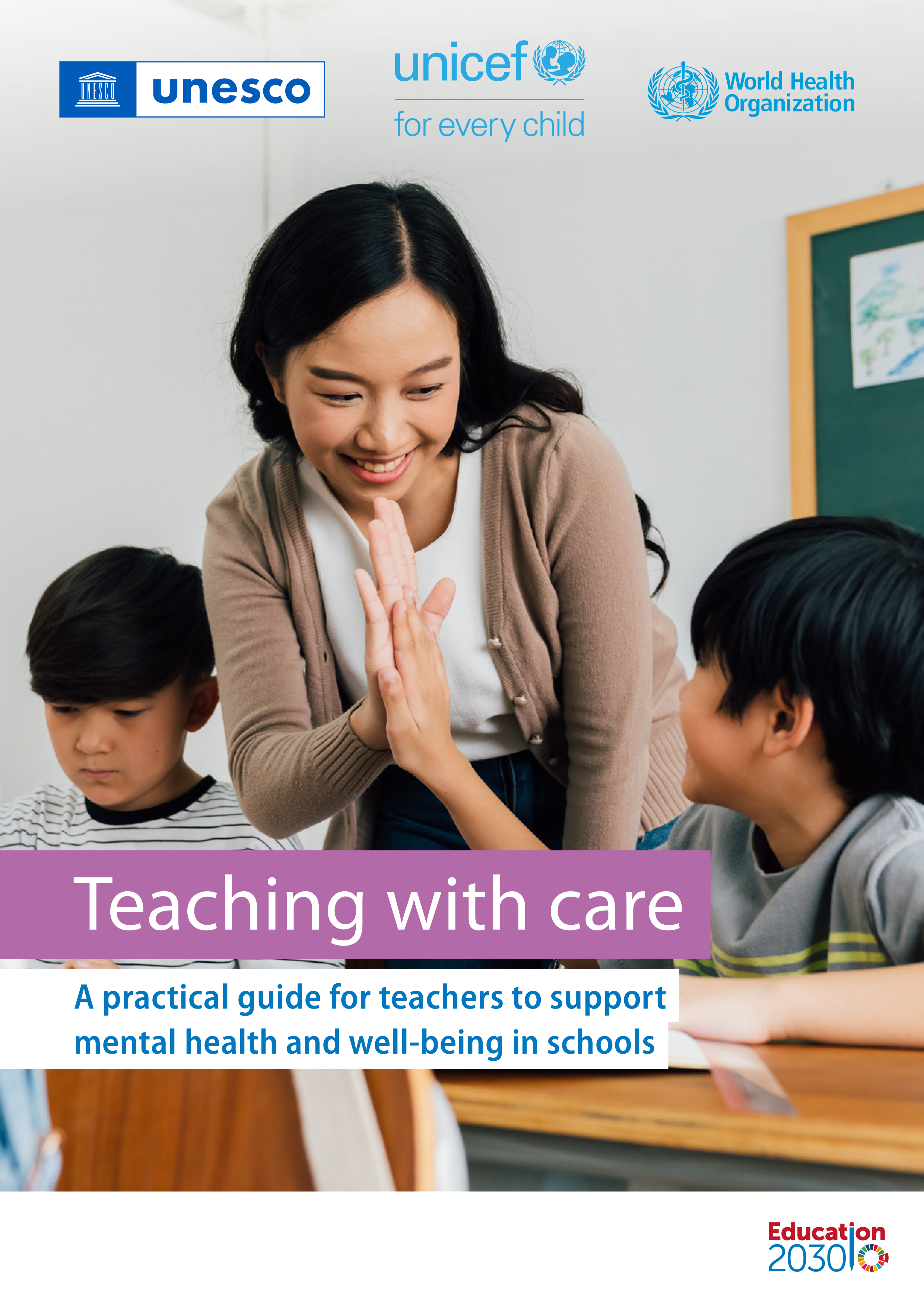

Teaching with care
A practical guide for teachers to support
mental health and well-being in schools


The Global Education 2030 Agenda
UNESCO, as the United Nations’ specialized agency for
education, is entrusted to lead and coordinate the
Education 2030 Agenda, which is part of a global
movement to eradicate poverty through 17 Sustainable
Development Goals by 2030. Education, essential to
achieve all of these goals, has its own dedicated Goal 4,
which aims to
“
ensure inclusive and equitable quality
education and promote lifelong learning opportunities
for all.
”
The Education 2030 Framework for Action
provides guidance for the implementation of this
ambitious goal and commitments.
UNESCO – a global leader in education
Education is UNESCO’s top priority because it is a
basic human right and the foundation for peace
and sustainable development. UNESCO is the
United Nations’ specialized agency for education,
providing global and regional leadership to drive
progress, strengthening the resilience and capacity
of national systems to serve all learners. UNESCO
also leads efforts to respond to contemporary
global challenges through transformative learning,
with special focus on gender equality and Africa
across all actions.
Published in 2026 by the United Nations Educational, Scientific and Cultural Organization (UNESCO)
7, place de Fontenoy, 75352 Paris 07 SP, France
United Nations Children’s Fund (UNICEF)
UNICEF House, 3 United Nations Plaza, New York, New York 10017, United States of America.
World Health Organization (WHO),
Avenue Appia 20, 1211 Geneva, Switzerland
© UNESCO, UNICEF, WHO 2026
UNESCO’s DOI https://doi.org/10.54675/QDVK2110
UNESCO’s ISBN 978-92-3-100899-3
WHO's ISBN 978-92-4-012491-2 (electronic version)
WHO's ISBN 978-92-4-012492-9 (print version)
This publication is available in Open Access under the Attribution-ShareAlike 3.0 IGO (CC-BY-SA 3.0 IGO) license
(
http://creativecommons.org/licenses/by-sa/3.0/igo/
). By using the content of this publication, the users accept to be bound
by the terms of use of the UNESCO Open Access Repository (
https://www.unesco.org/en/open-access/cc-sa
).
The present license applies exclusively to the text content of the publication. For use of any other material (i.e. images, illustrations,
charts) not clearly identified as belonging to UNESCO or as being in the public domain, prior permission shall be requested from
UNESCO (publication.copyright@unesco.org).
UNICEF and WHO photographs are copyrighted and are not to be reproduced in any medium without obtaining prior written
permission. Requests for permission to reproduce UNICEF photographs should be addressed to UNICEF, Division of Communication,
3 United Nations Plaza, New York 10017, USA (email: nyhqdoc.permit@unicef.org). Requests for permission to reproduce WHO
photographs should be addressed to:
https://www.who.int/about/policies/publishing/permissions
.
The designations employed and the presentation of material throughout this publication do not imply the expression of any opinion
whatsoever on the part of UNESCO, UNICEF and WHO concerning the legal status of any country, territory, city or area or of its
authorities, or concerning the delimitation of its frontiers or boundaries.
The ideas and opinions expressed in this publication are those of the authors; they are not necessarily those of UNESCO, UNICEF and
WHO and do not commit the Organizations.
The mention of specific companies or of certain manufacturers’ products does not imply that they are endorsed or recommended by
UNESCO, UNICEF and WHO. Errors and omissions excepted, the names of proprietary products are distinguished by initial capital letters.
All reasonable precautions have been taken by UNESCO, UNICEF and WHO to verify the information contained in this publication.
However, the published material is being distributed without warranty of any kind, either expressed or implied. The responsibility for
the interpretation and use of the material lies with the reader. In no event shall UNESCO, UNICEF and WHO be liable for damages arising
from its use.
This publication follows the institutional style and practice of UNESCO as lead publishing organization, and may be at variance with
those used by WHO and UNICEF.
Cover photo: Twinsterphoto/Shutterstock.com
Inside icons: © UNESCO/Weiwei Kang
Designed by UNESCO
S
H
O
R
T S
U
M
M
A
R
Y
“Since wars begin in the minds of men and
women it is in the minds of men and women
that the defences of peace must be constructed”
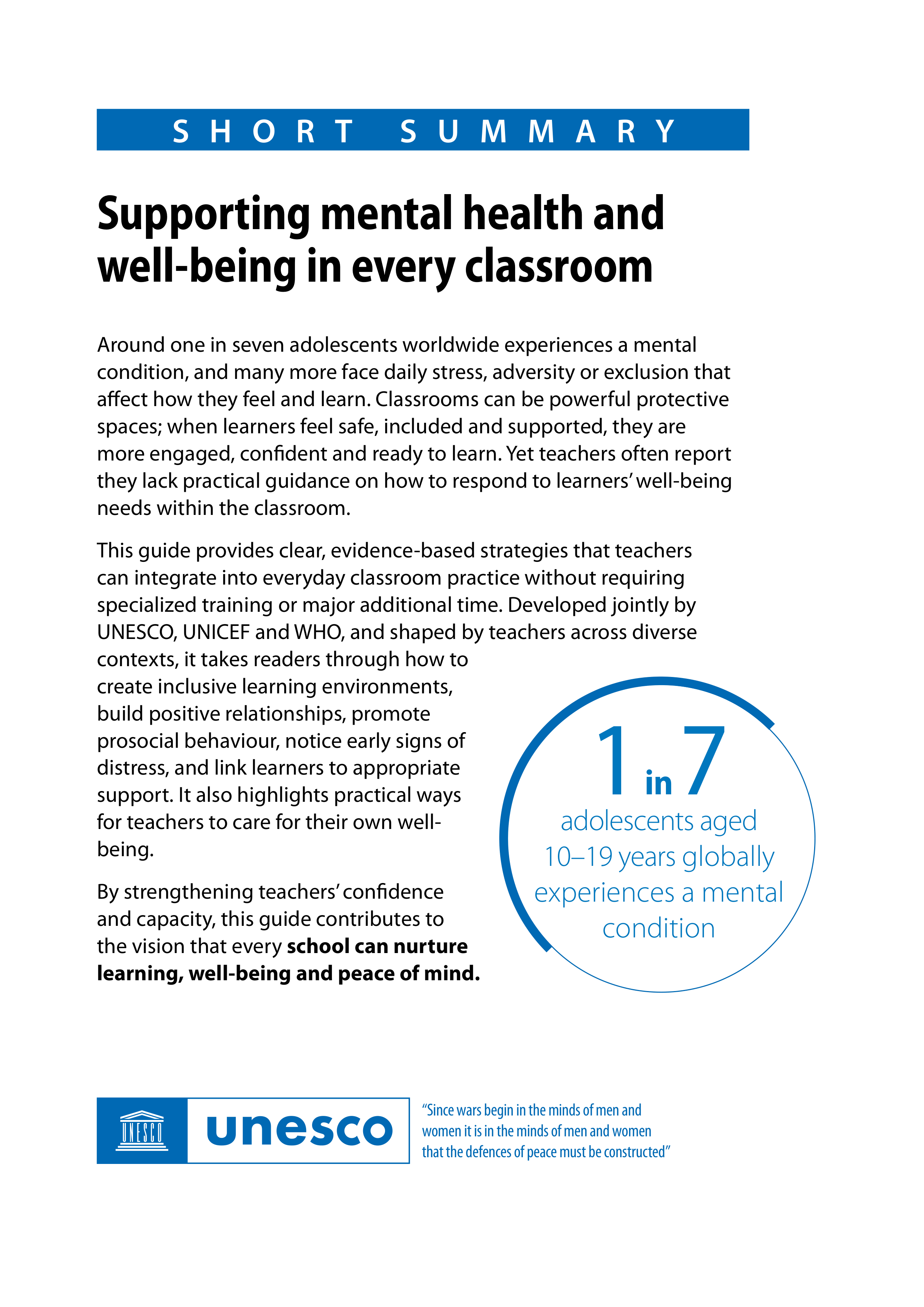
Around one in seven adolescents worldwide experiences a mental
condition, and many more face daily stress, adversity or exclusion that
affect how they feel and learn. Classrooms can be powerful protective
spaces; when learners feel safe, included and supported, they are
more engaged, confident and ready to learn. Yet teachers often report
they lack practical guidance on how to respond to learners’ well-being
needs within the classroom.
This guide provides clear, evidence-based strategies that teachers
can integrate into everyday classroom practice without requiring
specialized training or major additional time. Developed jointly by
UNESCO, UNICEF and WHO, and shaped by teachers across diverse
contexts, it takes readers through how to
create inclusive learning environments,
build positive relationships, promote
prosocial behaviour, notice early signs of
distress, and link learners to appropriate
support. It also highlights practical ways
for teachers to care for their own well-
being.
By strengthening teachers’ confidence
and capacity, this guide contributes to
the vision that every
school can nurture
learning, well-being and peace of mind.
Supporting mental health and
well-being in every classroom
1
in
7
adolescents aged
10–19 years globally
experiences a mental
condition

Teaching with care
A practical guide for teachers to support
mental health and well-being in schools
Foreword
Every learner has the right to quality education and to the highest attainable standards of health, including
mental health. Schools are where these rights come alive each day. When classrooms are safe, inclusive and
supportive, they can protect learners from the effects of adversity and enable them to participate more fully in
learning. Central to this is the work of teachers. Their daily interactions with learners and their commitment to
teaching with care create the foundations for well-being and academic progress.
Yet teachers across the world tell us that their responsibilities are increasing while time and resources remain
limited. They want to support learners who may be experiencing distress, but need clarity on what is feasible,
appropriate and within their professional domain.
This joint guide from UNESCO, UNICEF and WHO responds to that need. It provides practical and realistic
strategies that build on what teachers already do, helping them
to build inclusive and predictable learning
environments, cultivate positive relationships, support prosocial behaviour, recognize early signs of
concern, and connect learners with appropriate school and community-based support.
The guide also clarifies what is not expected of teachers; for example, they are not mental health specialists, and
it is not within their role to diagnose mental health conditions or provide treatment. Their unique contribution is
educational: cultivating environments where learners feel safe, respected and ready to learn; modelling empathy
and fairness; and helping learners build social and emotional skills that support lifelong mental health and well-
being. This is the essence of teaching with care – an approach rooted in dignity, rights and professional integrity.
Effective school-based support depends not only on teachers but also on the systems in which they are
embedded. Strengthening collaboration between education, health, child protection and social services is
essential to providing timely and appropriate support. This guide forms part of a wider set of practical resources
developed jointly by UNESCO, UNICEF and WHO to promote a whole-school approach to mental health and
psychosocial support.
We hope this guide equips teachers and school communities with the confidence, clarity and support they need
to ensure that every learner’s right to health and education is realized – and that every school becomes a place
where children and young people can truly thrive.
Qun Chen
Assistant Director-General
for Education
UNESCO
Pia Rebello Britto
Global Director,
Education Development
UNICEF
Jeremy Farrar
Assistant Director-General
Health Promotion, Disease
Prevention and Care
WHO

Acknowledgements
The development of this guidance was led by UNESCO, in close collaboration with UNICEF and WHO, and
informed by extensive contributions from teachers, experts and partners across regions.
Project conceptualization, coordination and management were carried out by Yongfeng Liu (Section of Health
and Education, UNESCO) with support from Munire Abulimiti (UNESCO Consultant), under the strategic direction
of Joanna Herat (Team Leader of Safe and Inclusive Learning Environments, UNESCO), Libing Wang (Chief of
the Section of Health and Education, UNESCO), and Christopher Castle (Director of the Division for Peace and
Sustainable Development, UNESCO).
Writing was undertaken by Rena Deitz, Jennifer Flemming, and Ashley Nemiro, consultants commissioned by
UNESCO Headquarters, Paris.
UNESCO, UNICEF and WHO express sincere appreciation to the members of the Technical Advisory Group,
who provided strategic guidance and structured technical review during the development of this publication:
Matthew Aaron Martin Thomas, Lorraine Purzycki and Leva Raudonyte (UNESCO Section of Teacher
Development); Janaina Hatsue Barrozo Hirata (UNESCO Section of Education in Emergencies); Lucas Halimani
(UNESCO IICBA); Chiara Servili and Sarah Skeen (WHO); Joanna Lai and Patricia Landinez (UNICEF); Saidi Nsamba
(Ministry of Education and Sports, Uganda); Caroline Clavel (UNESCO Section of Health and Education); and
Daniela Moreno Farfán (SDG4 Youth and Student Network).
We thank the following peer reviewers from UNESCO, UNICEF and WHO for their technical insight and
contributions (in alphabetical order): Jenelle Babb, Elsa Burzynski Soussan, Zazih El Kouarte, Fabio Friscia,
Wafaa Elsaway, Davina Gayle-Williams, Matias Irarrazavel, Sarita Jadav, Patricia Machawira, Kedar Marahatta,
Chido Rwafa Madzvamutse, Néllia Mutisse, Florencia Saffirio, Remmy Shawa, Sandisile Tshuma, Tigran Yepoyan,
Worapot Yodpet.
This guidance was shaped by teachers who generously shared their insights through focus group discussions
and written contributions. We thank: the teachers who participated in focus group discussions in Nigeria and
India; as well as the following individuals who provided written inputs: Patricia Bravo (Viet Nam), Antonia
Cadwell (Viet Nam), Arnaud Isern (Zimbabwe), Philip Massaro (Viet Nam), Alessia Rizzo (Germany) and Hannah
Stewart (Singapore). We also acknowledge the colleagues who helped coordinate these consultations: Sarita
Jadav (UNESCO New Delhi), Adeyemi Oladeji (UNESCO Abuja), Lorraine Purzycki (UNESCO Headquarters), and
Daniela Moreno Farfán (SDG 4 Youth and Student Network).
Affiliations are listed as at the time of contribution. In accordance with United Nations procedures, all
external reviewers completed and submitted WHO Declaration of Interest forms. These were reviewed by the
coordinating team, and no conflicts of interest were identified.
This work was generously supported by the Governments of Norway and Sweden.
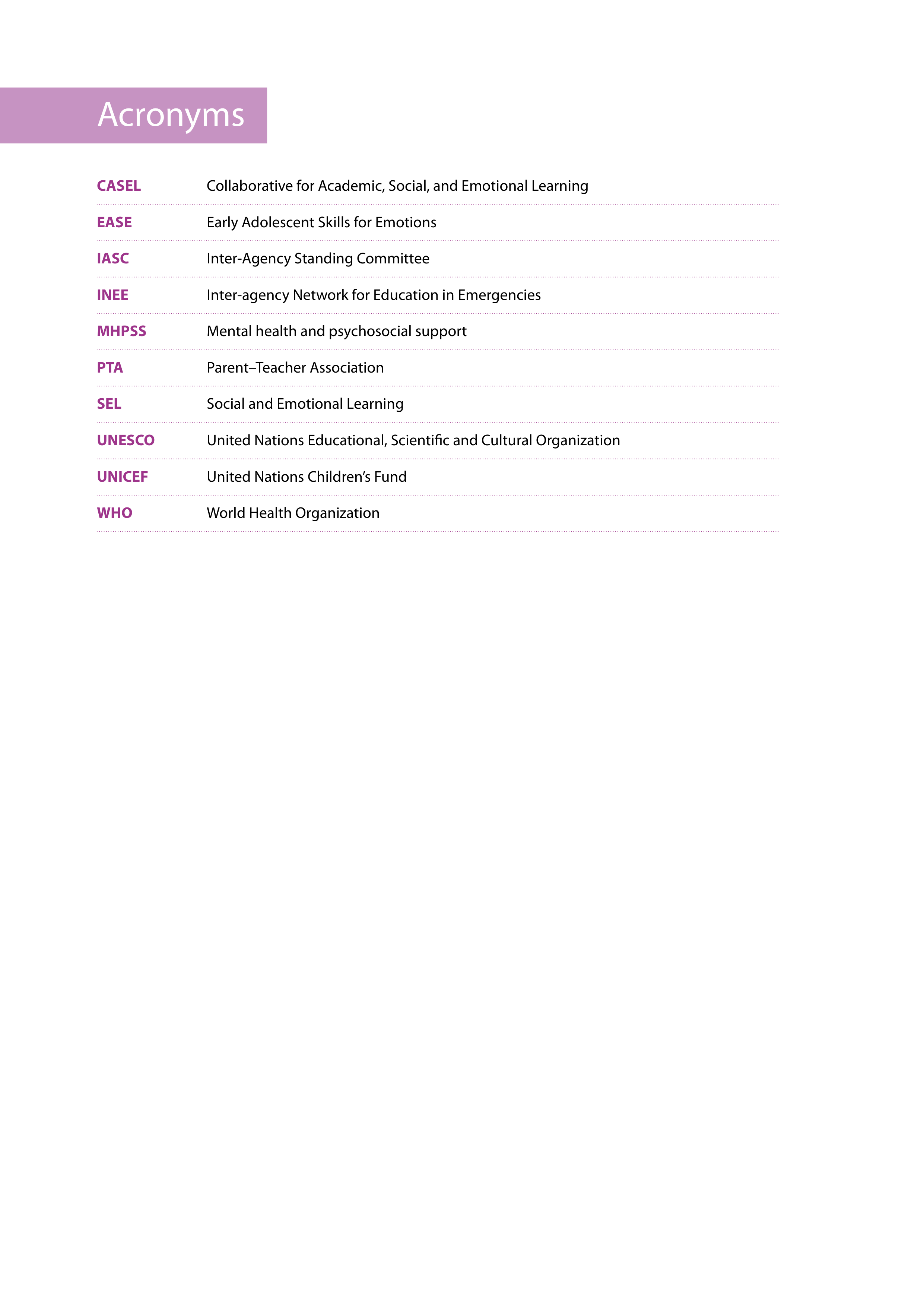
Acronyms
CASEL
Collaborative for Academic, Social, and Emotional Learning
EASE
Early Adolescent Skills for Emotions
IASC
Inter-Agency Standing Committee
INEE
Inter-agency Network for Education in Emergencies
MHPSS
Mental health and psychosocial support
PTA
Parent–Teacher Association
SEL
Social and Emotional Learning
UNESCO
United Nations Educational, Scientific and Cultural Organization
UNICEF
United Nations Children’s Fund
WHO
World Health Organization
9
Teaching with care –
A practical guide for teachers to support mental health and well-being in schools
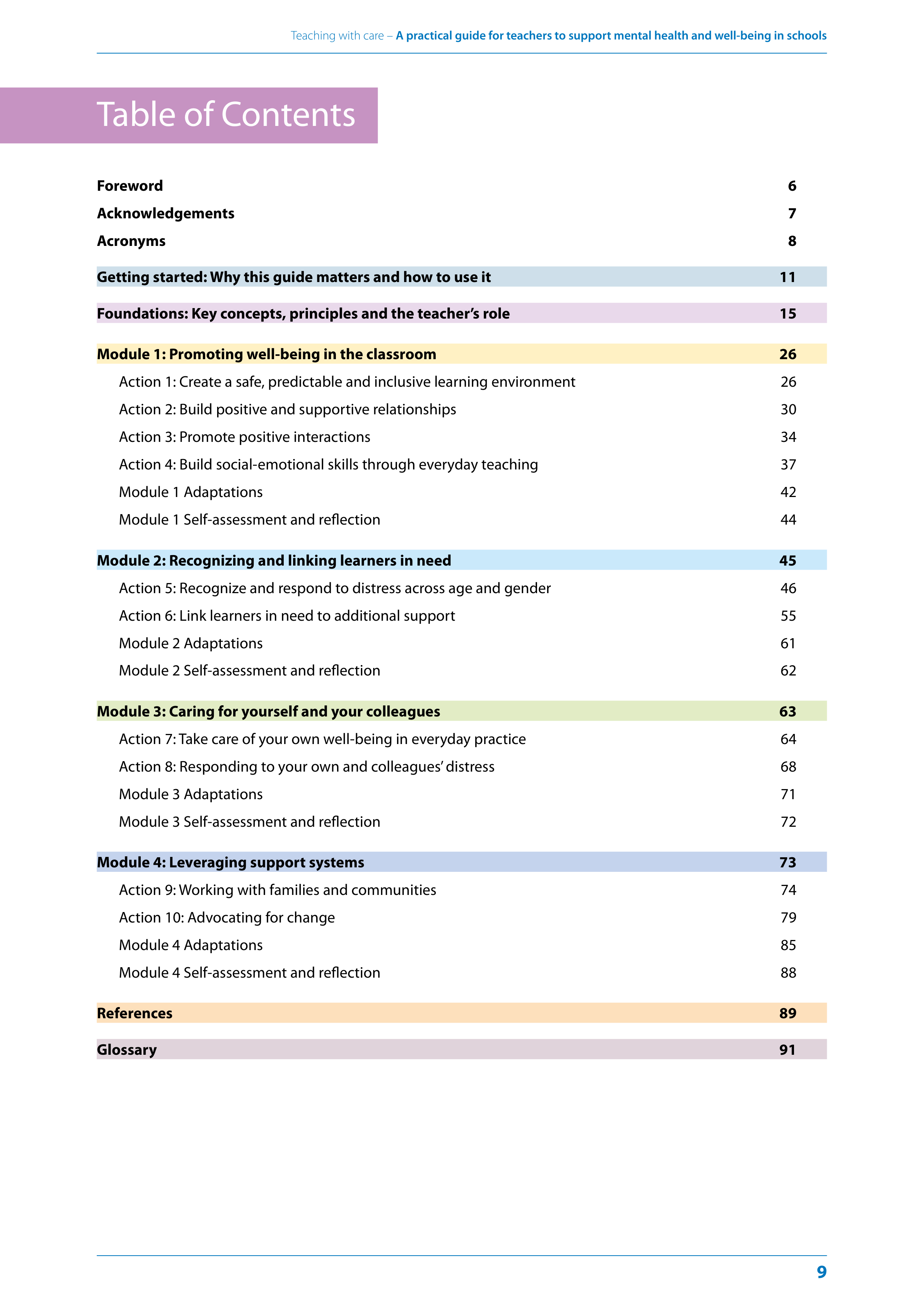
Table of Contents
Foreword
6
Acknowledgements
7
Acronyms
8
Getting started: Why this guide matters and how to use it
11
Foundations: Key concepts, principles and the teacher’s role
15
Module 1: Promoting well-being in the classroom
26
Action 1: Create a safe, predictable and inclusive learning environment
26
Action 2: Build positive and supportive relationships
30
Action 3: Promote positive interactions
34
Action 4: Build social-emotional skills through everyday teaching
37
Module 1 Adaptations
42
Module 1 Self-assessment and reflection
44
Module 2: Recognizing and linking learners in need
45
Action 5: Recognize and respond to distress across age and gender
46
Action 6: Link learners in need to additional support
55
Module 2 Adaptations
61
Module 2 Self-assessment and reflection
62
Module 3: Caring for yourself and your colleagues
63
Action 7: Take care of your own well-being in everyday practice
64
Action 8: Responding to your own and colleagues’ distress
68
Module 3 Adaptations
71
Module 3 Self-assessment and reflection
72
Module 4: Leveraging support systems
73
Action 9: Working with families and communities
74
Action 10: Advocating for change
79
Module 4 Adaptations
85
Module 4 Self-assessment and reflection
88
References
89
Glossary
91
10
Teaching with care
– A practical guide for teachers to support mental health and well-being in schools
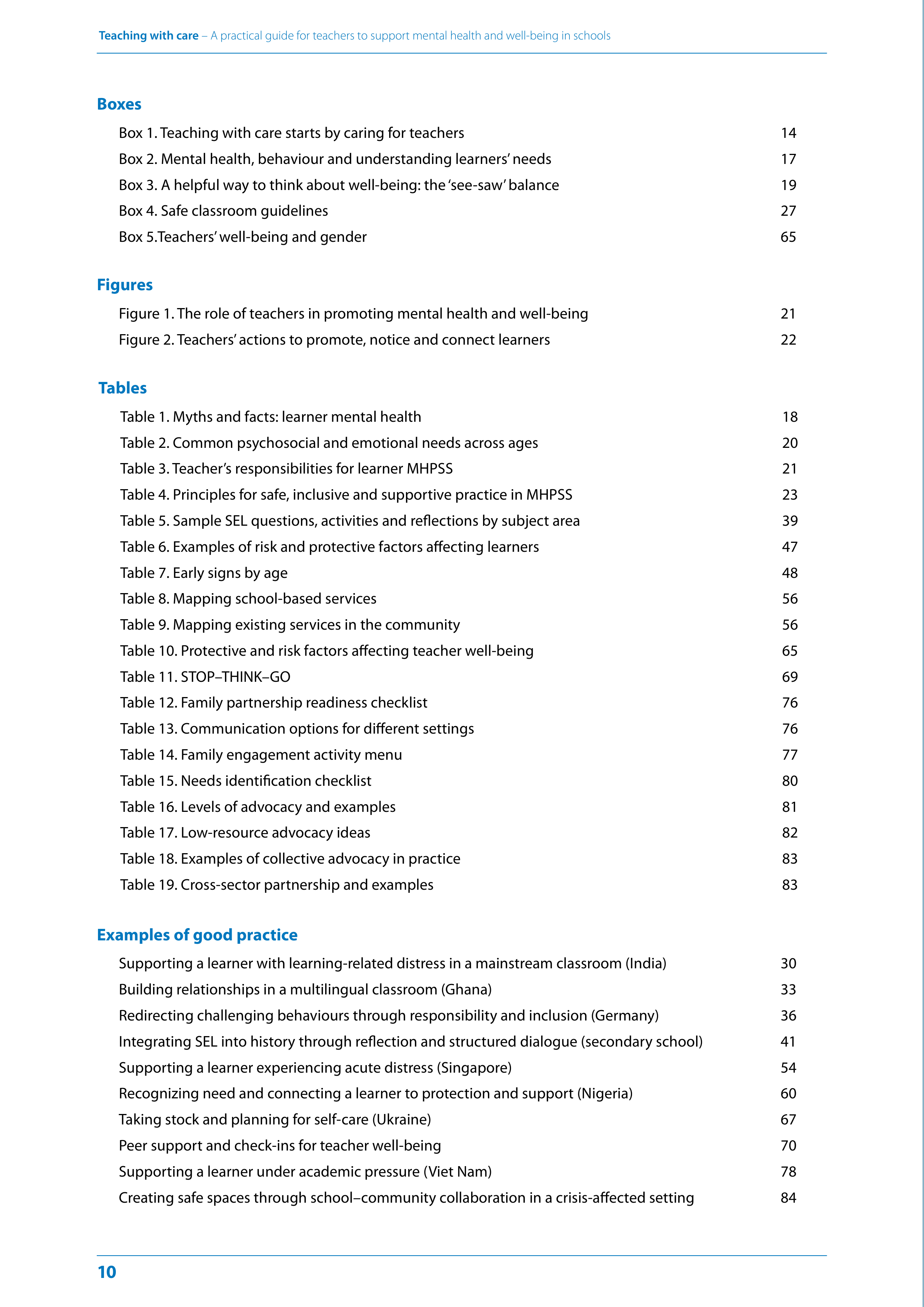
Tables
Table 1. Myths and facts: learner mental health
18
Table 2. Common psychosocial and emotional needs across ages
20
Table 3. Teacher’s responsibilities for learner MHPSS
21
Table 4. Principles for safe, inclusive and supportive practice in MHPSS
23
Table 5. Sample SEL questions, activities and reflections by subject area
39
Table 6. Examples of risk and protective factors affecting learners
47
Table 7. Early signs by age
48
Table 8. Mapping school-based services
56
Table 9. Mapping existing services in the community
56
Table 10. Protective and risk factors affecting teacher well-being
65
Table 11. STOP–THINK–GO
69
Table 12. Family partnership readiness checklist
76
Table 13. Communication options for different settings
76
Table 14. Family engagement activity menu
77
Table 15. Needs identification checklist
80
Table 16. Levels of advocacy and examples
81
Table 17. Low-resource advocacy ideas
82
Table 18. Examples of collective advocacy in practice
83
Table 19. Cross-sector partnership and examples
83
Boxes
Box 1. Teaching with care starts by caring for teachers
14
Box 2. Mental health, behaviour and understanding learners’ needs
17
Box 3. A helpful way to think about well-being: the ‘see-saw’ balance
19
Box 4. Safe classroom guidelines
27
Box 5.Teachers’ well-being and gender
65
Examples of good practice
Supporting a learner with learning-related distress in a mainstream classroom (India)
30
Building relationships in a multilingual classroom (Ghana)
33
Redirecting challenging behaviours through responsibility and inclusion (Germany)
36
Integrating SEL into history through reflection and structured dialogue (secondary school)
41
Supporting a learner experiencing acute distress (Singapore)
54
Recognizing need and connecting a learner to protection and support (Nigeria)
60
Taking stock and planning for self-care (Ukraine)
67
Peer support and check-ins for teacher well-being
70
Supporting a learner under academic pressure (Viet Nam)
78
Creating safe spaces through school–community collaboration in a crisis-affected setting
84
Figures
Figure 1. The role of teachers in promoting mental health and well-being
21
Figure 2. Teachers’ actions to promote, notice and connect learners
22

11
Teaching with care –
A practical guide for teachers to support mental health and well-being in schools
Getting started
Why this guide matters and how to use it
GETTING STARTED: WHY THIS GUIDE MATTERS AND HOW TO USE IT
Teaching with care
– A practical guide for teachers to support mental health and well-being in schools
12
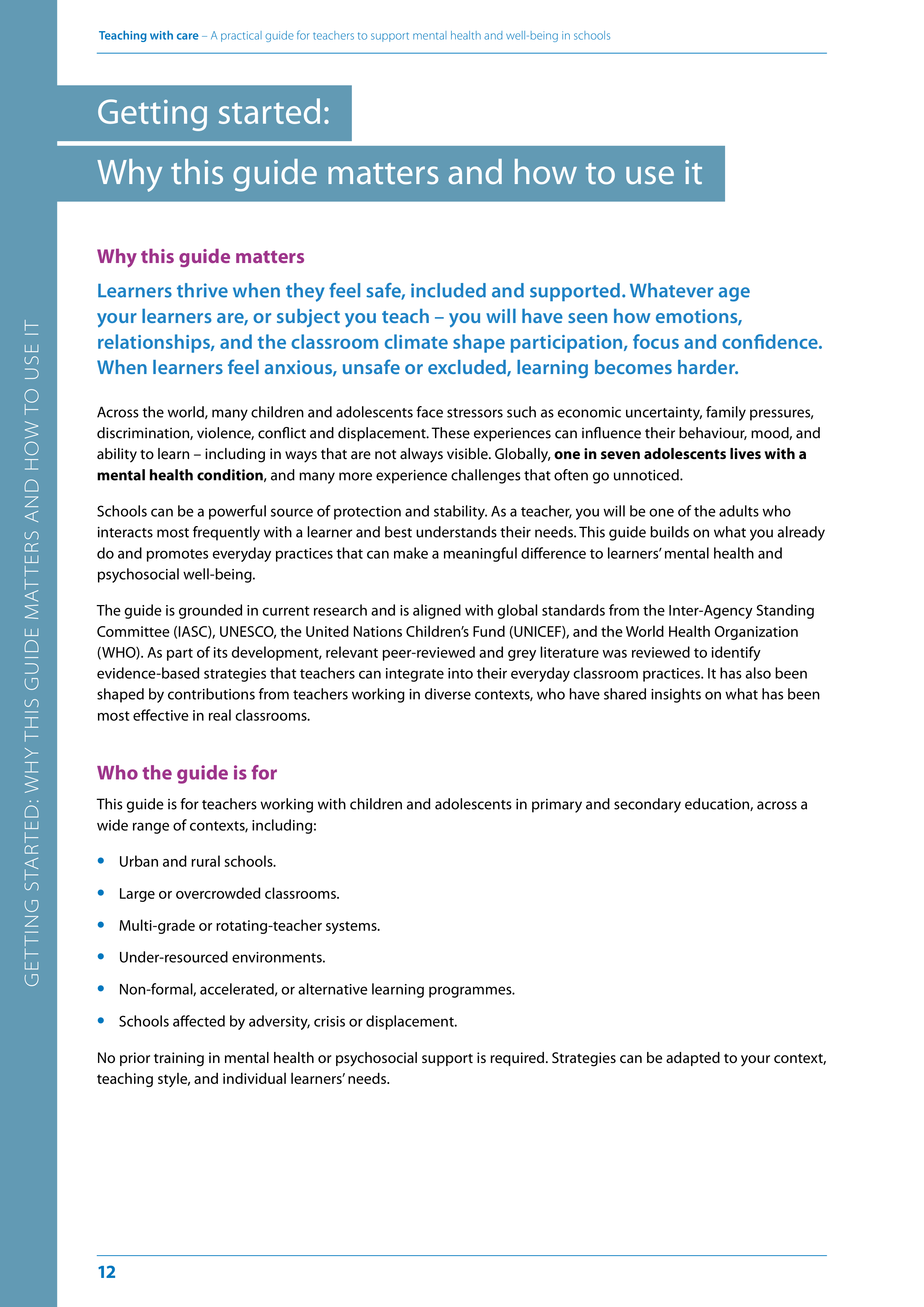
Getting started:
Why this guide matters and how to use it
Why this guide matters
Learners thrive when they feel safe, included and supported. Whatever age
your learners are, or subject you teach – you will have seen how emotions,
relationships, and the classroom climate shape participation, focus and confidence.
When learners feel anxious, unsafe or excluded, learning becomes harder.
Across the world, many children and adolescents face stressors such as economic uncertainty, family pressures,
discrimination, violence, conflict and displacement. These experiences can influence their behaviour, mood, and
ability to learn – including in ways that are not always visible. Globally,
one in seven adolescents lives with a
mental health condition
, and many more experience challenges that often go unnoticed.
Schools can be a powerful source of protection and stability. As a teacher, you will be one of the adults who
interacts most frequently with a learner and best understands their needs. This guide builds on what you already
do and promotes everyday practices that can make a meaningful difference to learners’ mental health and
psychosocial well-being.
The guide is grounded in current research and is aligned with global standards from the Inter-Agency Standing
Committee (IASC), UNESCO, the United Nations Children’s Fund (UNICEF), and the World Health Organization
(WHO). As part of its development, relevant peer-reviewed and grey literature was reviewed to identify
evidence-based strategies that teachers can integrate into their everyday classroom practices. It has also been
shaped by contributions from teachers working in diverse contexts, who have shared insights on what has been
most effective in real classrooms.
Who the guide is for
This guide is for teachers working with children and adolescents in primary and secondary education, across a
wide range of contexts, including:
•
Urban and rural schools.
•
Large or overcrowded classrooms.
•
Multi-grade or rotating-teacher systems.
•
Under-resourced environments.
•
Non-formal, accelerated, or alternative learning programmes.
•
Schools affected by adversity, crisis or displacement.
No prior training in mental health or psychosocial support is required. Strategies can be adapted to your context,
teaching style, and individual learners’ needs.
GETTING STARTED: WHY THIS GUIDE MATTERS AND HOW TO USE IT
13
Teaching with care –
A practical guide for teachers to support mental health and well-being in schools
What this guide does
not
do
This guide does not:
•
Train or expect teachers to diagnose mental health conditions.
•
Train or expect teachers to provide therapy or counselling.
•
Ask teachers to investigate sensitive issues.
•
Replace specialized or clinical care.
•
Shift responsibility for learner mental health and well-being away from school systems.
Teachers play an essential – but bounded – role. This guide clarifies what does and does not fall
within the scope of that role.
How to use this guide
You do not need to read this guide from cover to cover. It is designed to be used flexibly depending on what you
need at a given time.
The guide is organized into four practical modules, supported by a short Foundations section that explains key
concepts, the school-based mental health and psychosocial support (MHPSS) ecosystem, the teacher’s role, and
ethical principles for safe practice.
If you are looking for…
Go to
Module 1
Promoting well-being in
the classroom
•
Ways to strengthen your
classroom climate or routines
Go to
Module 2
Recognizing and linking
learners in need
•
How to respond when a learner
seems distressed or withdrawn
See
Module 3
Caring for yourself and
your colleagues
•
Support for managing your own
stress or supporting colleagues
Go to
Module 4
Leveraging support
systems
•
Guidance on working with families
or strengthening school-wide
approaches
Refer to the
Foundations
section
•
Clarity on concepts, roles
or boundaries
You can start anywhere, focus on one strategy at a time, and return to other sections as your needs change.
GETTING STARTED: WHY THIS GUIDE MATTERS AND HOW TO USE IT
Teaching with care
– A practical guide for teachers to support mental health and well-being in schools
14
BOX 1.
Teaching with care starts by caring for teachers
Teaching with care also means recognizing teachers’ own well-being, professional limits and need
for support. Teachers can support learners safely and sustainably only when they are first supported
themselves. For this reason, self-care and collegial support are treated in this guide as essential enabling
conditions, not optional extras. Readers who wish to begin by reflecting on their own well-being may go
directly to Module 3 before returning to the classroom-focused modules.
Ways you can use this guide
•
Get ideas quickly:
dip in when you need a routine, strategy or reminder.
•
Strengthen everyday practice:
try one or two strategies at a time and build gradually.
•
Learn with colleagues:
use the guide in informal peer discussions, learning circles or staff meetings.
•
Support professional development:
integrate content into pre-service or in-service training.
•
Reflect on your own practice:
use reflection questions to notice what is working and consider what you
might adjust.
A practical companion for supporting learners
You already contribute every day to learners’ safety, confidence and capacity to learn. This guide is a practical
companion to that work, bringing together evidence and teacher experience to help you create classrooms
where every learner feels valued, supported and able to thrive.
While this guide focuses specifically on what teachers can do in their daily practice, complementary resources
are being developed by UNESCO, UNICEF and WHO for school leadership and for school-based mental health
workers, recognizing that effective school MHPSS depends on coordinated action across classrooms, school-
wide systems, and access to appropriate care. Each resource is designed to stand alone, while together forming a
coherent school MHPSS ecosystem.
Foundations
Key concepts, principles and the teacher’s role
16
Teaching with care
– A practical guide for teachers to support mental health and well-being in schools
FOUNDATIONS: KEY CONCEPTS, PRINCIPLES AND THE TEACHER’S ROLE
16
Foundations:
Key concepts, principles and the teacher’s role
This section introduces the key ideas that support the strategies in this guide.
It defines the main concepts, clarifies the teacher’s role and boundaries, and
explains how teachers contribute to learners’ mental health and psychosocial
well-being within a wider school-based system.
The aim is not to turn teachers into specialists, but to offer a clear, practical
foundation so teachers can act confidently, safely and sustainably in their
everyday practice.
Key concepts and definitions for teachers
Terms such as
mental health
,
psychosocial well-being
, and
MHPSS
are used widely but often understood
differently across contexts. Below are
working definitions
tailored to school settings. A full set of formal
definitions is available in the Glossary.
Mental health
Mental health is part of overall health. It refers to a person’s emotional, psychological and social well-being –
how they think, feel, act and relate to others.
Learners’ mental health is not dependent solely on whether they have a diagnosed mental health condition.
Rather, mental health exists on a continuum. Learners experiencing positive mental health are generally able to
cope with challenges, learn effectively, manage their emotions, form relationships, and contribute to school and
community life.
At other points along the spectrum, learners may experience significant mental health difficulties that affect
their daily functioning. Such difficulties can occur even when protective factors are present and may require
support beyond what is available in the classroom.
Psychosocial well-being
Psychosocial well-being describes how learners experience their internal world (thoughts, feelings, emotions)
and their social world (relationships, interactions, sense of belonging).
Psychosocial well-being includes:
•
Emotional stability and the ability to self-regulate.
•
Positive peer and adult relationships.
•
Sense of identity, respect, and inclusion.
•
Safety and predictability at home and at school.
•
Opportunities for growth, participation and affirmation.
In this guide, the term ‘well-being’ is often used as a shorthand
that includes both mental health and psychosocial well-being.
17
Teaching with care –
A practical guide for teachers to support mental health and well-being in schools
FOUNDATIONS: KEY CONCEPTS, PRINCIPLES AND THE TEACHER’S ROLE
17
Mental health and psychosocial support (MHPSS)
Mental health and psychosocial support (MHPSS) in schools refers to the range of supports and approaches that
help learners maintain or improve their mental health and psychosocial well-being.
In education settings, this includes safe, inclusive and
predictable learning environments; positive relationships;
routines and structures; classroom strategies that build
social and emotional skills; early recognition of distress;
supportive responses; and referral pathways. Together,
these efforts aim to support learners to stay well,
connected, safe, competent and fulfilled.
These elements are often implemented through school-
based mental health programmes and policies that
promote well-being for all learners, provide early support
for those at risk, and ensure access to more specialized
care when needed. Teachers are not expected to provide
specialist treatment, but they play an essential role within
this broader system by integrating everyday classroom
practices and school approaches that support learners’
mental health and psychosocial well-being.
Social and emotional learning (SEL)
SEL refers to processes that help learners develop
the skills to understand and manage emotions, build
healthy relationships, solve problems, make responsible
decisions, and cope with challenges. Rather than being
approached in isolation, SEL can be woven naturally into
everyday teaching practices.
Why well-being matters for
teaching and learning
Well-being is foundational for teaching and learning.
When learners feel safe, calm, included, and supported,
they are better able to:
•
Concentrate and remember new information.
•
Participate and collaborate in class.
•
Manage emotions and behaviour.
•
Communicate their needs.
•
Persist with difficult tasks.
•
Develop confidence and motivation.
When learners experience stress, fear, exclusion, or
instability, learning is affected. They may show up as:
•
Difficulty concentrating.
•
Fatigue or low energy.
•
Irritability or withdrawal.
•
Reduced participation.
•
Behavioural challenges.
•
Declining academic performance.
Supporting well-being is an essential part of effective
teaching, rather than an optional or ‘extra’ task.
BOX 2.
Mental health, behaviour and
understanding learners’ needs
It is common to assume that a learner who is
aggressive or disruptive must have a 'mental
illness.' This is a misconception that can
increase stigma and lead to harmful responses.
Challenging behaviour should not be interpreted
as evidence of a mental health problem. Instead,
it may be a way for a learner to communicate
that something is going on in their life or that
they need support. It may reflect a range of
factors, including stress, peer conflict, exposure
to violence, discrimination, unmet learning
needs, neurodivergence, feeling unsafe, or major
life changes.
At the same time, some children and young
people experience mental health conditions
that may affect their emotions, behaviour or
participation. These are often described in broad
categories such as:
•
Emotional difficulties
, including anxiety or
depression, which may appear as withdrawal,
low energy, irritability, reduced participation,
changes in concentration, or physical
complaints such as headaches or stomach
aches.
•
Behavioural or attention-related difficulties
,
such as attention deficit hyperactivity disorder
(ADHD), which may involve persistent difficulty
with attention, impulse control, or activity
levels that are not typical for a learner’s age.
The presence of certain behaviours or symptoms
does not confirm a mental health condition.
Similar signs may reflect stress, trauma,
developmental differences, or temporary
challenges. Teachers are not expected to
diagnose conditions; rather, their role is to
notice changes, provide supportive responses,
and connect learners to additional support
when needed.
The focus in the classroom remains on ensuring
safety, dignity and inclusion for all learners. This
includes responding to behaviour with calm,
non-violent strategies; noticing changes over
time; and connecting learners to appropriate
support when concerns persist or risk is present.
18
Teaching with care
– A practical guide for teachers to support mental health and well-being in schools
FOUNDATIONS: KEY CONCEPTS, PRINCIPLES AND THE TEACHER’S ROLE
18
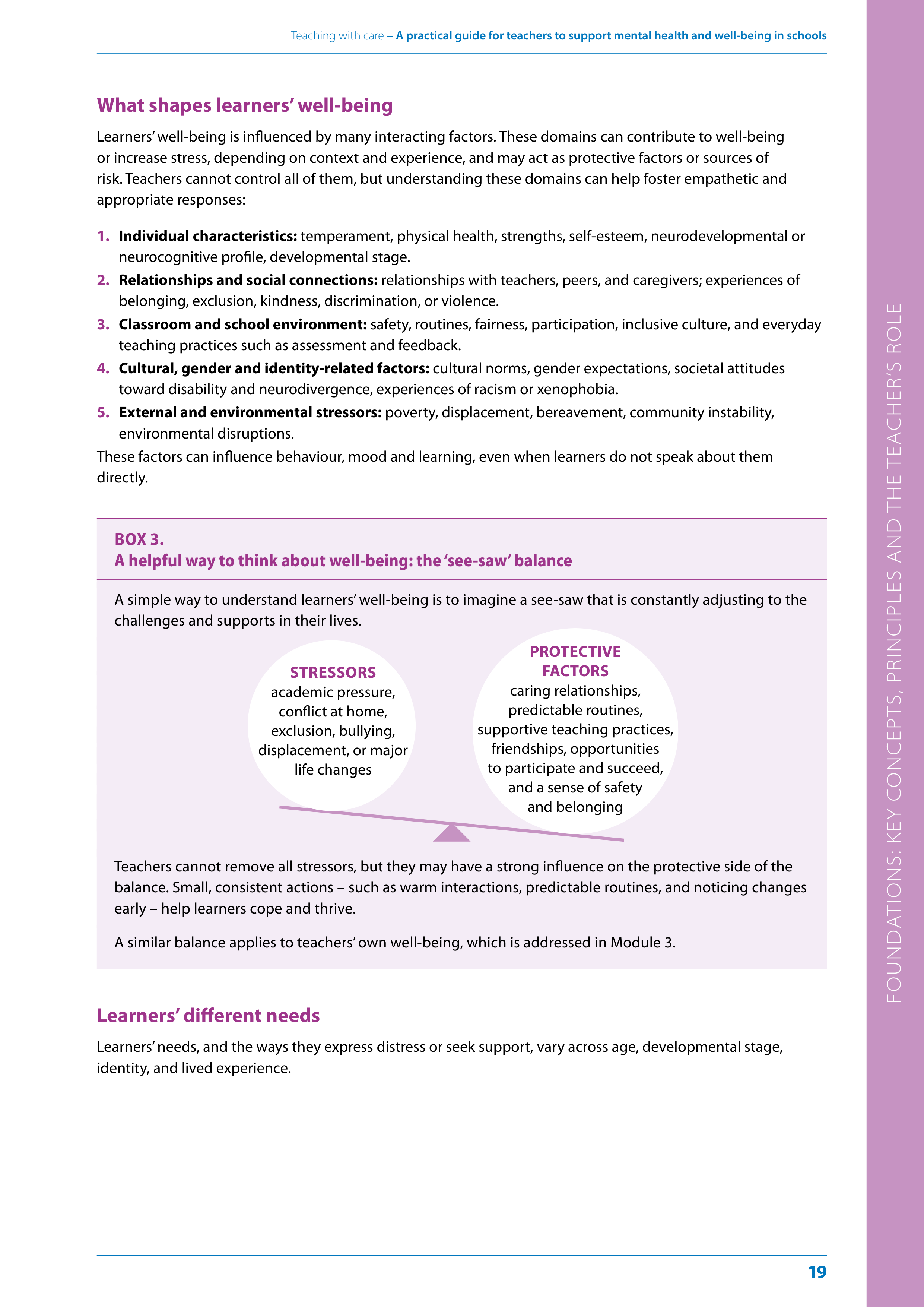
Common myths about learner well-being
Misunderstandings about mental health and psychosocial well-being can make it harder for teachers to support
learners or to seek support themselves. The myths and facts below reflect common misconceptions identified
in international research and are informed by guidance from IASC and Inter-agency Network for Education in
Emergencies (INEE), UNESCO, UNICEF and WHO.
Table 1. Myths and facts: learner mental health
Myth
Facts
Children are too young
to experience mental
health challenges
Children and adolescents can experience anxiety, grief, depression and
adversity. Distress often appears through behaviour or participation rather
than words, as their ability to express feelings is still developing.
Talking about emotional
problems makes
things worse
Age-appropriate, respectful conversations reduce stigma and risk. Asking if a
learner is okay does not cause harm. Silence increases risk.
1
Mental health is a private
family issue, not the school’s
Schools strongly influence learners’ emotions and social well-being, and early
signs of distress often appear in school settings. Schools can provide basic
support and connect learners with appropriate community-based support for
complex needs.
Only professionals
should deal with
mental health issues
Teachers are not expected to diagnose or provide therapy, but can promote
positive mental health through everyday supportive actions, notice when there
are challenges emerging and connect learners to support.
Struggling with distress
means a learner is weak
or misbehaving
Mental health challenges arise from biological, psychological and social factors.
Behavioural concerns often communicate unmet needs, especially when
learners don’t yet have words for their feelings.
Learners with good
grades or many friends
are doing fine
Mental health challenges are not always visible. High-achieving learners may
hide distress or feel pressure to appear ‘strong’.
Girls are emotional and
boys are disruptive
Any learners can experience mental health challenges, and gender norms often
shape how distress is expressed and recognized.
Mental health conditions
will go away with time
Some ups and downs are normal, but persistent distress should not be ignored.
Early support prevents longer-term challenges and reduces risk. Without
support, problems often worsen.
Neurodivergence means
a learner has a mental
health problem
Neurodivergence refers to natural differences in how people think, learn, and
process information. While some neurodivergent learners may also experience
mental health challenges, neurodivergence itself is not a mental health
disorder.
Source:
Adapted from UNICEF and WHO, 2021.
1
If a learner’s safety may be at risk, teachers should follow school safeguarding procedures and involve designated staff immediately. In
this guide, ‘designated staff’ and ‘focal point’ refer to the school-based role responsible for safeguarding or learner well-being, where
such a role exists. Teachers are not expected to manage safeguarding concerns alone. Where no designated focal point or counsellor is
available, teachers should follow school leadership or local safeguarding protocols, in line with national requirements.
19
Teaching with care –
A practical guide for teachers to support mental health and well-being in schools
FOUNDATIONS: KEY CONCEPTS, PRINCIPLES AND THE TEACHER’S ROLE
19
What shapes learners’ well-being
Learners’ well-being is influenced by many interacting factors. These domains can contribute to well-being
or increase stress, depending on context and experience, and may act as protective factors or sources of
risk. Teachers cannot control all of them, but understanding these domains can help foster empathetic and
appropriate responses:
1.
Individual characteristics:
temperament, physical health, strengths, self-esteem, neurodevelopmental or
neurocognitive profile, developmental stage.
2.
Relationships and social connections:
relationships with teachers, peers, and caregivers; experiences of
belonging, exclusion, kindness, discrimination, or violence.
3.
Classroom and school environment:
safety, routines, fairness, participation, inclusive culture, and everyday
teaching practices such as assessment and feedback.
4.
Cultural, gender and identity-related factors:
cultural norms, gender expectations, societal attitudes
toward disability and neurodivergence, experiences of racism or xenophobia.
5.
External and environmental stressors:
poverty, displacement, bereavement, community instability,
environmental disruptions.
These factors can influence behaviour, mood and learning, even when learners do not speak about them
directly.
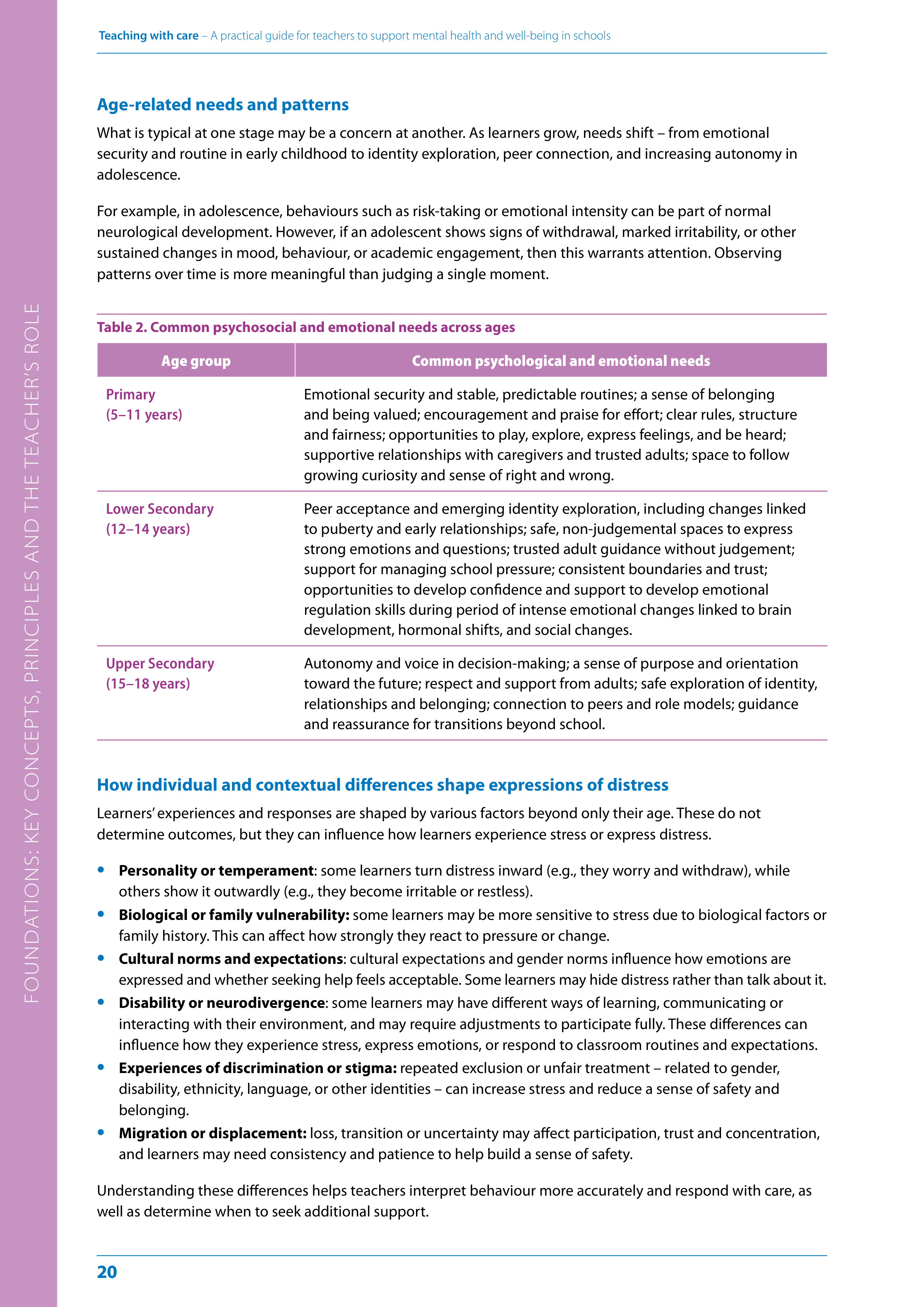
BOX 3.
A helpful way to think about well-being: the ‘see-saw’ balance
A simple way to understand learners’ well-being is to imagine a see-saw that is constantly adjusting to the
challenges and supports in their lives.
STRESSORS
academic pressure,
conflict at home,
exclusion, bullying,
displacement, or major
life changes
PROTECTIVE
FACTORS
caring relationships,
predictable routines,
supportive teaching practices,
friendships, opportunities
to participate and succeed,
and a sense of safety
and belonging
Teachers cannot remove all stressors, but they may have a strong influence on the protective side of the
balance. Small, consistent actions – such as warm interactions, predictable routines, and noticing changes
early – help learners cope and thrive.
A similar balance applies to teachers’ own well-being, which is addressed in Module 3.
Learners’ different needs
Learners’ needs, and the ways they express distress or seek support, vary across age, developmental stage,
identity, and lived experience.
20
Teaching with care
– A practical guide for teachers to support mental health and well-being in schools
FOUNDATIONS: KEY CONCEPTS, PRINCIPLES AND THE TEACHER’S ROLE
20
Age-related needs and patterns
What is typical at one stage may be a concern at another. As learners grow, needs shift – from emotional
security and routine in early childhood to identity exploration, peer connection, and increasing autonomy in
adolescence.
For example, in adolescence, behaviours such as risk-taking or emotional intensity can be part of normal
neurological development. However, if an adolescent shows signs of withdrawal, marked irritability, or other
sustained changes in mood, behaviour, or academic engagement, then this warrants attention. Observing
patterns over time is more meaningful than judging a single moment.
Table 2. Common psychosocial and emotional needs across ages
Age group
Common psychological and emotional needs
Primary
(5–11 years)
Emotional security and stable, predictable routines; a sense of belonging
and being valued; encouragement and praise for effort; clear rules, structure
and fairness; opportunities to play, explore, express feelings, and be heard;
supportive relationships with caregivers and trusted adults; space to follow
growing curiosity and sense of right and wrong.
Lower Secondary
(12–14 years)
Peer acceptance and emerging identity exploration, including changes linked
to puberty and early relationships; safe, non-judgemental spaces to express
strong emotions and questions; trusted adult guidance without judgement;
support for managing school pressure; consistent boundaries and trust;
opportunities to develop confidence and support to develop emotional
regulation skills during period of intense emotional changes linked to brain
development, hormonal shifts, and social changes.
Upper Secondary
(15–18 years)
Autonomy and voice in decision-making; a sense of purpose and orientation
toward the future; respect and support from adults; safe exploration of identity,
relationships and belonging; connection to peers and role models; guidance
and reassurance for transitions beyond school.
How individual and contextual differences shape expressions of distress
Learners’ experiences and responses are shaped by various factors beyond only their age. These do not
determine outcomes, but they can influence how learners experience stress or express distress.
•
Personality or temperament
: some learners turn distress inward (e.g., they worry and withdraw), while
others show it outwardly (e.g., they become irritable or restless).
•
Biological or family vulnerability:
some learners may be more sensitive to stress due to biological factors or
family history. This can affect how strongly they react to pressure or change.
•
Cultural norms and expectations
: cultural expectations and gender norms influence how emotions are
expressed and whether seeking help feels acceptable. Some learners may hide distress rather than talk about it.
•
Disability or neurodivergence
: some learners may have different ways of learning, communicating or
interacting with their environment, and may require adjustments to participate fully. These differences can
influence how they experience stress, express emotions, or respond to classroom routines and expectations.
•
Experiences of discrimination or stigma:
repeated exclusion or unfair treatment – related to gender,
disability, ethnicity, language, or other identities – can increase stress and reduce a sense of safety and
belonging.
•
Migration or displacement:
loss, transition or uncertainty may affect participation, trust and concentration,
and learners may need consistency and patience to help build a sense of safety.
Understanding these differences helps teachers interpret behaviour more accurately and respond with care, as
well as determine when to seek additional support.
21
Teaching with care –
A practical guide for teachers to support mental health and well-being in schools
FOUNDATIONS: KEY CONCEPTS, PRINCIPLES AND THE TEACHER’S ROLE
21
The school-based MHPSS ecosystem
Supporting learners’ mental health and psychosocial well-being is a shared responsibility. Teachers play a central
role, but they are not solely or exclusively responsible for learners’ well-being. The MHPSS ecosystem includes:
•
Learners:
experiences, emotions, strengths, challenges, cultural identity, and developmental needs.
•
The classroom:
teacher relationships, routines, predictability, inclusive practices, and daily interactions with
peers.
•
The school:
leadership, school mental health workers, peer supporters, environment, supportive policies,
referral pathways, safety protocols, and whole-school culture.
•
Families and communities:
caregivers, cultural norms, local support networks, community organizations,
and social protection systems.
•
Wider systems:
district, government services, education policies, child and adolescent health and mental
health policies and legal frameworks, child protection frameworks, health services and systems, and
emergency response systems.
Teachers play a key role in providing everyday support and coordinating with other members of the school support
system, but do not replace specialized services. When their classroom experiences and observations are shared
through established school structures and collaborative processes, they can inform school- and system-level
decisions that strengthen learning conditions and support learners’ mental health and psychosocial well-being.
Your bounded role as a teacher
Teachers play a vital role in MHPSS through three core responsibilities:
•
Promote well-being through safe, inclusive
classrooms and everyday teaching.
•
Notice changes in learners’ behaviour,
participation, or mood that may indicate distress.
•
Connect learners to appropriate support when
concerns arise.
Two enabling conditions support this work:
•
Self-care: protecting your own well-being.
•
System support: working with families, colleagues
and services.
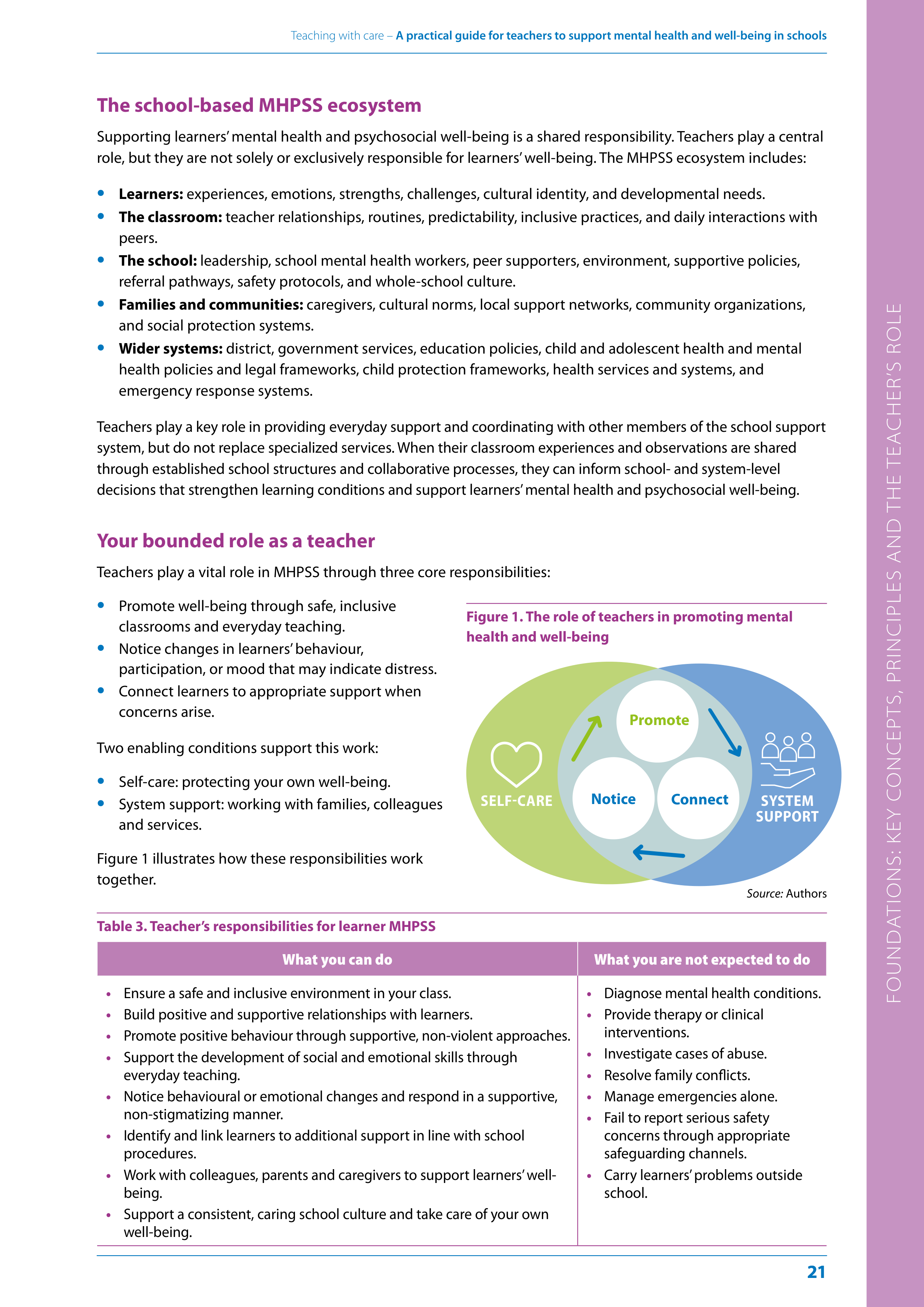
Figure 1 illustrates how these responsibilities work
together.
Table 3. Teacher’s responsibilities for learner MHPSS
What you can do
What you are not expected to do
•
Ensure a safe and inclusive environment in your class.
•
Build positive and supportive relationships with learners.
•
Promote positive behaviour through supportive, non-violent approaches.
•
Support the development of social and emotional skills through
everyday teaching.
•
Notice behavioural or emotional changes and respond in a supportive,
non-stigmatizing manner.
•
Identify and link learners to additional support in line with school
procedures.
•
Work with colleagues, parents and caregivers to support learners’ well-
being.
•
Support a consistent, caring school culture and take care of your own
well-being.
•
Diagnose mental health conditions.
•
Provide therapy or clinical
interventions.
•
Investigate cases of abuse.
•
Resolve family conflicts.
•
Manage emergencies alone.
•
Fail to report serious safety
concerns through appropriate
safeguarding channels.
•
Carry learners’ problems outside
school.
Figure 1. The role of teachers in promoting mental
health and well-being
Promote
Notice
Connect
SELF-CARE
SYSTEM
SUPPORT
Source:
Authors

22
Teaching with care
– A practical guide for teachers to support mental health and well-being in schools
FOUNDATIONS: KEY CONCEPTS, PRINCIPLES AND THE TEACHER’S ROLE
22
In this guide, the prevention of violence in schools, including bullying and cyberbullying, is treated as part of
building a safe and inclusive learning environment. Teachers can contribute to this through everyday practices
(norms, routines, supervision and respectful responses), while schools provide the wider policies, reporting
pathways and safeguarding procedures.
Clearly defined role boundaries protect both learners and teachers, such as by ensuring that specialized support
is provided by trained professionals.
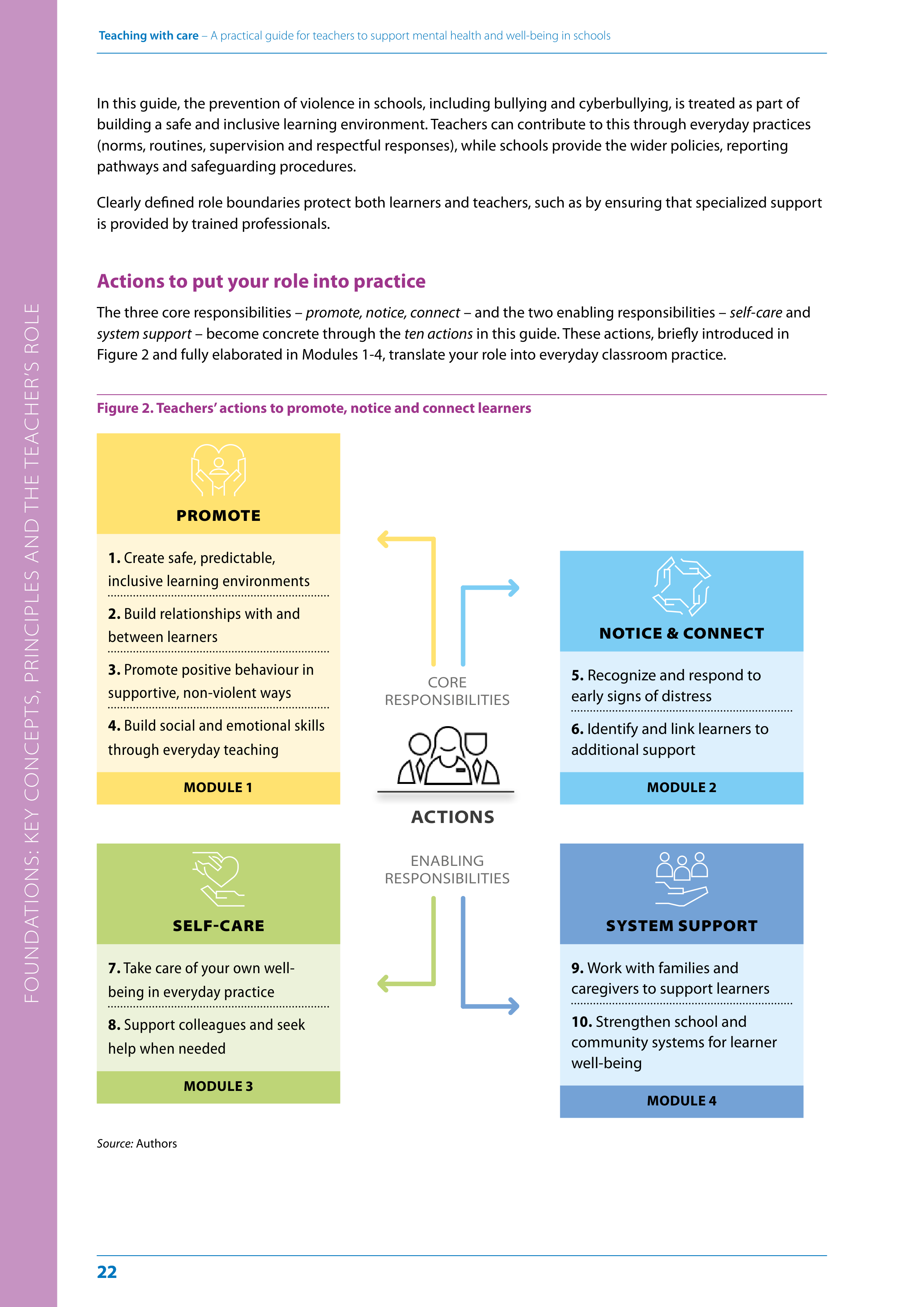
Actions to put your role into practice
The three core responsibilities –
promote, notice, connect
– and the two enabling responsibilities –
self-care
and
system support
– become concrete through the
ten actions
in this guide. These actions, briefly introduced in
Figure 2 and fully elaborated in Modules 1-4, translate your role into everyday classroom practice.
Figure 2. Teachers’ actions to promote, notice and connect learners
ACTIONS
PROMOTE
1.
Create safe, predictable,
inclusive learning environments
2.
Build relationships with and
between learners
3.
Promote positive behaviour in
supportive, non-violent ways
4.
Build social and emotional skills
through everyday teaching
MODULE 1
SELF-CARE
7.
Take care of your own well-
being in everyday practice
8.
Support colleagues and seek
help when needed
MODULE 3
NOTICE & CONNECT
5.
Recognize and respond to
early signs of distress
6.
Identify and link learners to
additional support
MODULE 2
SYSTEM SUPPORT
9.
Work with families and
caregivers to support learners
10.
Strengthen school and
community systems for learner
well-being
MODULE 4
CORE
RESPONSIBILITIES
ENABLING
RESPONSIBILITIES
Source:
Authors
23
Teaching with care –
A practical guide for teachers to support mental health and well-being in schools
FOUNDATIONS: KEY CONCEPTS, PRINCIPLES AND THE TEACHER’S ROLE
23
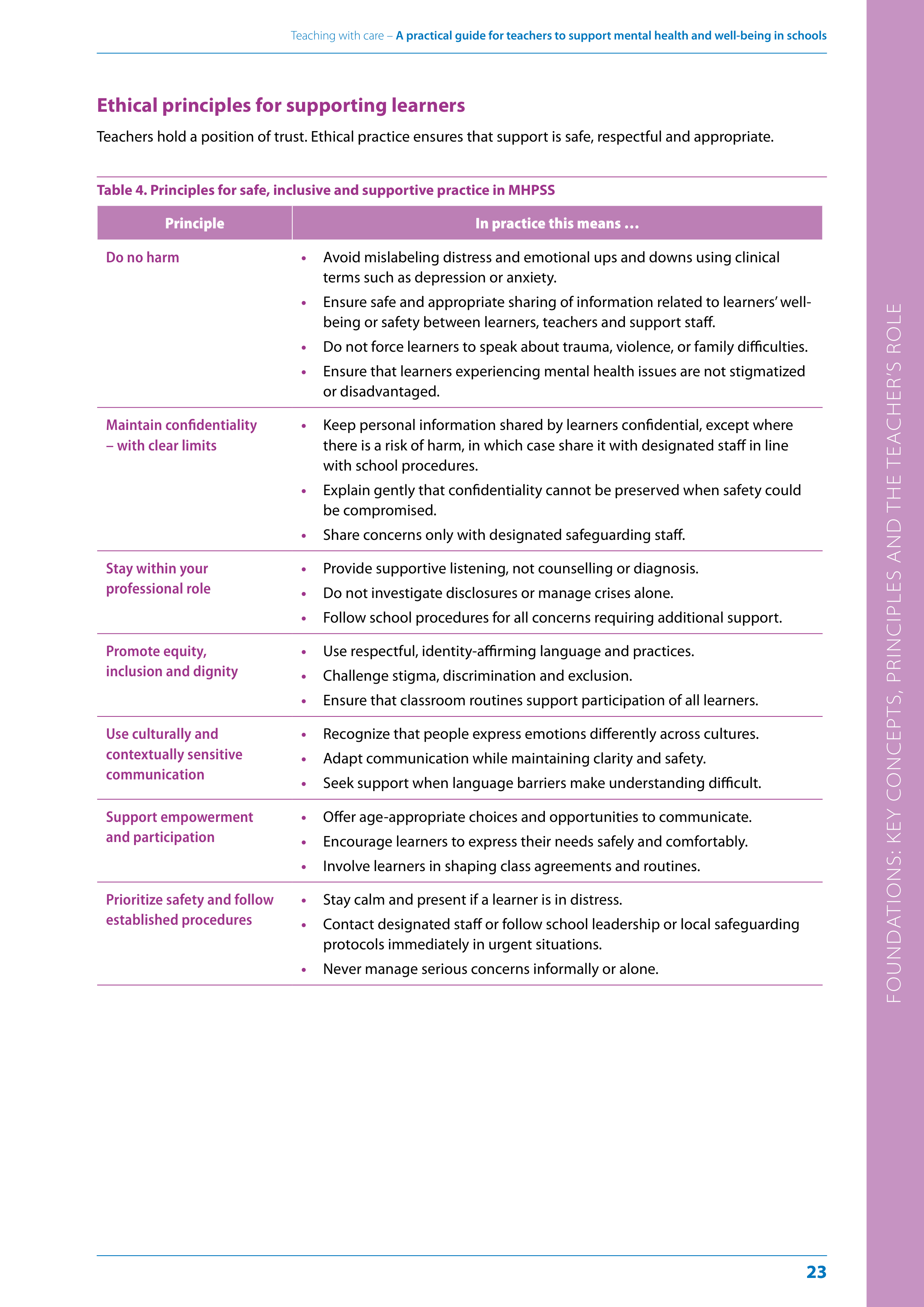
Ethical principles for supporting learners
Teachers hold a position of trust. Ethical practice ensures that support is safe, respectful and appropriate.
Table 4. Principles for safe, inclusive and supportive practice in MHPSS
Principle
In practice this means …
Do no harm
•
Avoid mislabeling distress and emotional ups and downs using clinical
terms such as depression or anxiety.
•
Ensure safe and appropriate sharing of information related to learners’ well-
being or safety between learners, teachers and support staff.
•
Do not force learners to speak about trauma, violence, or family difficulties.
•
Ensure that learners experiencing mental health issues are not stigmatized
or disadvantaged.
Maintain confidentiality
– with clear limits
•
Keep personal information shared by learners confidential, except where
there is a risk of harm, in which case share it with designated staff in line
with school procedures.
•
Explain gently that confidentiality cannot be preserved when safety could
be compromised.
•
Share concerns only with designated safeguarding staff.
Stay within your
professional role
•
Provide supportive listening, not counselling or diagnosis.
•
Do not investigate disclosures or manage crises alone.
•
Follow school procedures for all concerns requiring additional support.
Promote equity,
inclusion and dignity
•
Use respectful, identity-affirming language and practices.
•
Challenge stigma, discrimination and exclusion.
•
Ensure that classroom routines support participation of all learners.
Use culturally and
contextually sensitive
communication
•
Recognize that people express emotions differently across cultures.
•
Adapt communication while maintaining clarity and safety.
•
Seek support when language barriers make understanding difficult.
Support empowerment
and participation
•
Offer age-appropriate choices and opportunities to communicate.
•
Encourage learners to express their needs safely and comfortably.
•
Involve learners in shaping class agreements and routines.
Prioritize safety and follow
established procedures
•
Stay calm and present if a learner is in distress.
•
Contact designated staff or follow school leadership or local safeguarding
protocols immediately in urgent situations.
•
Never manage serious concerns informally or alone.
24
Teaching with care
– A practical guide for teachers to support mental health and well-being in schools
FOUNDATIONS: KEY CONCEPTS, PRINCIPLES AND THE TEACHER’S ROLE
24
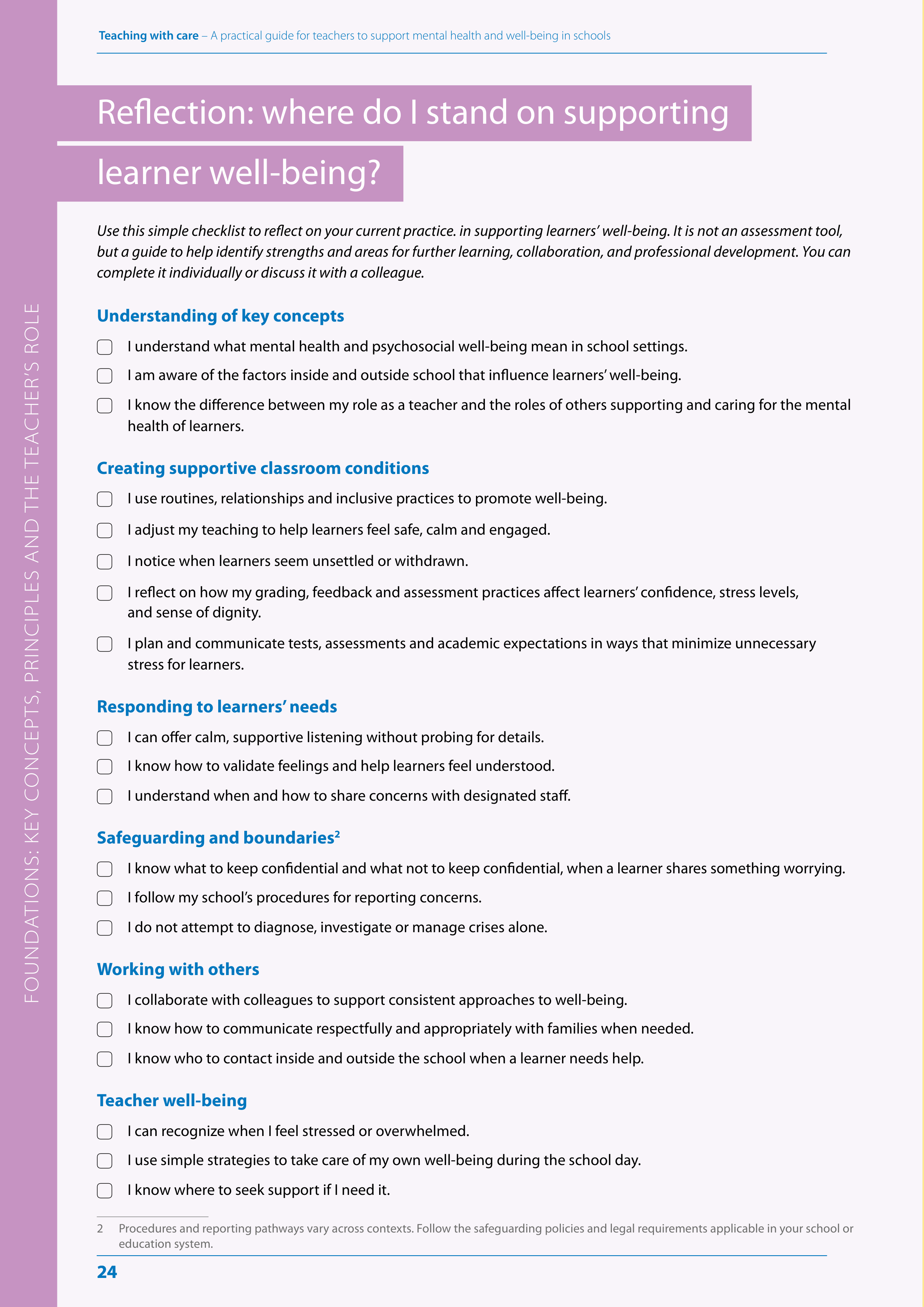
Reflection: where do I stand on supporting
learner well-being?
Use this simple checklist to reflect on your current practice. in supporting learners’ well-being. It is not an assessment tool,
but a guide to help identify strengths and areas for further learning, collaboration, and professional development. You can
complete it individually or discuss it with a colleague.
Understanding of key concepts
Â
I understand what mental health and psychosocial well-being mean in school settings.
Â
I am aware of the factors inside and outside school that influence learners’ well-being.
Â
I know the difference between my role as a teacher and the roles of others supporting and caring for the mental
health of learners.
Creating supportive classroom conditions
Â
I use routines, relationships and inclusive practices to promote well-being.
Â
I adjust my teaching to help learners feel safe, calm and engaged.
Â
I notice when learners seem unsettled or withdrawn.
Â
I reflect on how my grading, feedback and assessment practices affect learners’ confidence, stress levels,
and sense of dignity.
Â
I plan and communicate tests, assessments and academic expectations in ways that minimize unnecessary
stress for learners.
Responding to learners’ needs
Â
I can offer calm, supportive listening without probing for details.
Â
I know how to validate feelings and help learners feel understood.
Â
I understand when and how to share concerns with designated staff.
Safeguarding and boundaries
2
Â
I know what to keep confidential and what not to keep confidential, when a learner shares something worrying.
Â
I follow my school’s procedures for reporting concerns.
Â
I do not attempt to diagnose, investigate or manage crises alone.
Working with others
Â
I collaborate with colleagues to support consistent approaches to well-being.
Â
I know how to communicate respectfully and appropriately with families when needed.
Â
I know who to contact inside and outside the school when a learner needs help.
Teacher well-being
Â
I can recognize when I feel stressed or overwhelmed.
Â
I use simple strategies to take care of my own well-being during the school day.
Â
I know where to seek support if I need it.
2
Procedures and reporting pathways vary across contexts. Follow the safeguarding policies and legal requirements applicable in your school or
education system.
25
Teaching with care –
A practical guide for teachers to support mental health and well-being in schools
Module 1
Promoting well-being in the classroom
MODULE 1: PROMOTING WELL-BEING IN THE CLASSROOM
26
Teaching with care
– A practical guide for teachers to support mental health and well-being in schools
Module 1
Promoting well-being in the classroom
In this module, you will explore how to create a classroom where learners feel
safe,
included, respected and able to learn.
Promoting well-being is not an optional
‘extra’ on top of your teaching – it is part of effective teaching itself. The way you set
up the space, welcome learners, organize routines, respond to behaviour, and teach
social and emotional skills, all shape learners’ mental health and well-being.
This module focuses on four key actions that bring your ‘
Promote
’ role to life in everyday practice:
1.
Create a safe, predictable and inclusive classroom environment.
2.
Build trusting relationships with and between learners.
3.
Promote positive, prosocial behaviour.
4.
Build social and emotional skills through everyday teaching.
Each action is broken down into
practical strategies
with concrete steps, examples and reflection questions.
These strategies apply across primary and secondary education, but how they are enacted will vary by
developmental stage, subject and context.
•
In
primary settings
, this often involves establishing routines, emotional safety and foundational social skills.
•
In
secondary settings
, it often involves supporting learner autonomy, managing peer dynamics, responding
to academic pressure (including exams, grading and
feedback), and recognizing more complex emotional and
mental health experiences associated with adolescence.
Teachers are encouraged to adapt the strategies to fit their
learners, age groups, subjects and teaching context, while
retaining the core principles.
Action 1:
Create a safe, predictable and inclusive
learning environment
What this involves and why it matters
A safe, predictable and inclusive learning environment supports both well-being and learning. Learners are more
able to participate, concentrate and engage in new and challenging academic tasks when they feel respected,
protected from harm or humiliation, and confident about what to expect.
The classroom environment is shaped not only by physical space, but also by how routines, expectations,
assessment practices, challenging behaviours and mistakes are handled, as well as how bullying, harassment
or exclusion are prevented and addressed. In secondary settings in particular, academic pressure, grading and
feedback strongly influence whether learners experience the classroom as supportive or threatening.
This action focuses on practical steps teachers can take, within their everyday practice, to create learning
environments that promote safety, dignity and engagement for all learners.
You are not expected to do everything
at once. Start small by choosing one or
two strategies that feel most relevant
and feasible in your context.
MODULE 1: PROMOTING WELL-BEING IN THE CLASSROOM
27
Teaching with care –
A practical guide for teachers to support mental health and well-being in schools
T
Reflection moment
Think back to a learning environment in your own life where you felt safe, supported and able to learn.
•
How was the space arranged?
•
What expectations or routines helped you feel secure?
•
How did your teacher interact with you and your peers?
Consider how you might intentionally create similar conditions for your own learners today.
Strategy 1.1
Set up a safe and inclusive classroom space
The physical learning environment should
communicate safety, structure and care.
Where possible, this should be considered
before learners enter the classroom. Involving
learners later can also strengthen ownership
and belonging.
Each classroom and context presents different
constraints. Teachers should focus on what is
feasible within their role and use this guidance
to advocate for additional support where
needed.
In practice
,
the classroom should support
physical, sensory, cognitive and emotional
accessibility
, including for learners who may:
•
Have difficulty navigating crowded spaces.
•
Struggle to see or hear clearly.
•
Be sensitive to noise, light or visual clutter.
•
Find it hard to sustain attention or manage
stress.
Use the
safe classroom guidelines
(Box 3)
as a checklist to review your classroom
periodically and to support discussions with
school leadership or community partners
around what changes may be needed.
See
Module 4
for advocacy strategies.
BOX 4.
Safe classroom guidelines
Safety
•
Remove sharp objects, broken furniture, exposed
wires, or other hazards.
•
Ensure no weapons or dangerous materials are
accessible.
•
Store cleaning supplies and hazardous materials
securely.
•
Manage temperature and ventilation as well as
possible.
•
Reduce clutter and tripping hazards.
Accessibility
•
Ensure all learners can see, hear and move through
the space as comfortably as possible.
•
Present information in multiple formats where
possible (e.g., visual, tactile, etc.).
•
Consider light and noise levels, particularly for
learners with sensory sensitivity or neurodivergence.
Calm and predictability
•
Clearly display schedules, routines, or lesson
structures.
•
Designate a quiet or low-stimulus space (even a
chair or desk) where learners can briefly regulate
emotions with supervision.
•
Organize seating to support focus and interaction.
Belonging
•
Display learner work or shared class projects.
•
Involve learners in shaping aspects of the space.
•
Ensure materials reflect learners’ languages, cultures,
and identities in respectful, non-stereotyping ways.
MODULE 1: PROMOTING WELL-BEING IN THE CLASSROOM
28
Teaching with care
– A practical guide for teachers to support mental health and well-being in schools
T
Reflection moment
•
Does my classroom communicate safety and respect?
•
Are there simple changes that could reduce distraction or stress?
•
How might learners experience this space differently from me?
Strategy 1.2
Build predictable, inclusive routines
Routines
are simple, repeated practices that help learners feel oriented and secure. They reduce uncertainty,
support emotional regulation, and free up attention for learning – especially when life outside school is stressful.
In secondary classrooms, routines also include academic routines: how lessons begin, how work is submitted,
how feedback is given, and how assessment periods are managed.
Effective routines …
•
Strengthen connection, and do not just control behaviour.
•
Reflect learners’
cultures, languages, abilities, and realities
.
•
Are adapted to different ages and levels.
ROUTINES – a simple reflection tool
One way to check whether classroom routines are supporting learning and well-being is to consider
whether they are:
R
elatable:
adapted to learners’ age, subject and context.
O
bservable:
clear and visible, ensuring that expectations are understood.
U
pbuilding:
reinforce learners’ confidence and motivation, even in high-pressure settings.
T
imebound:
follow a predictable sequence or rhythm.
I
nclusive:
work for learners with different needs, backgrounds and abilities.
N
ecessary:
serve a clear learning or well-being purpose.
E
ngaging:
invite participation, relevance, and learner ownership – not performance.
S
imple:
easy to remember, repeat and sustain.
Putting routines into practice
•
Introduce
routines early in the school year and explain their purpose.
•
Co-create
routines with learners where possible, giving them simple choices (e.g., which song
or greeting to use).
•
Model
and practice routines together several times, then reinforce calmly and consistently.
•
Adapt
for age, ability and language – for younger learners, emphasize movement, song, and play;
for older learners, promote a sense of responsibility and participation.
MODULE 1: PROMOTING WELL-BEING IN THE CLASSROOM
29
Teaching with care –
A practical guide for teachers to support mental health and well-being in schools
Examples of routine moments
•
Starting a lesson:
brief task on the board; agenda review; one-minute settling activity.
•
Transitions:
clear signals; short reflection or exit slip.
•
Assessment periods:
advance notice; clear criteria; predictable feedback timelines.
•
Closing a lesson or day:
brief reflection on learning or effort.
Strategy 1.3
Use assessment and feedback practices that support learners’ well-being
Assessment, grading, examinations and feedback are integral to school life and can be a major source of stress,
particularly for adolescents. How expectations are communicated, mistakes addressed and results discussed
strongly shape the classroom climate.
Supportive assessment and feedback practices protect learners’ dignity while maintaining high expectations.
In practice, teachers can:
•
Give feedback in ways that are respectful and constructive
, focusing on learning, effort, and progress
rather than personal worth or ability.
•
Avoid practices that humiliate or shame learners
, such as public comparisons, sarcasm, or exposing results
without consent.
•
Treat mistakes as part of learning
, reinforcing that struggling academically does not mean failing as a
person.
•
Be especially attentive during exam and assessment periods
, recognizing that stress, anxiety, irritability,
or withdrawal may increase at these times.
•
Increase predictability around assessments
, by clearly explaining formats, timelines, expectations, and
marking criteria where possible.
•
Create space for questions and reassurance
, encouraging learners to seek clarification or support without
fear of judgement.
•
Notice patterns of distress linked to academic pressure
, and follow school procedures to seek additional
support when difficulties are persistent or escalating.
Supportive assessment and feedback practices can help reduce avoidable stress and reinforce fairness and trust.
When academic pressure is linked to significant or ongoing distress, connecting learners to appropriate support
is an important part of maintaining a safe learning environment.
T
Reflection for teachers
•
How are mistakes usually handled in my classroom?
•
Does my feedback help build confidence and recognize achievements?
•
How do learners typically respond during assessment periods?
•
Do I balance holding high expectations for learners with showing genuine care?
MODULE 1: PROMOTING WELL-BEING IN THE CLASSROOM
30
Teaching with care
– A practical guide for teachers to support mental health and well-being in schools
Example of good practice
Supporting a learner with learning-related distress in a mainstream classroom (India)
Context:
a Grade 5 learner (10–11 years old) with identified learning difficulties showed increasing
frustration, withdrawal, and reduced participation during classroom tasks. These challenges were affecting
both learning and emotional well-being.
Teacher response:
to support the learner’s engagement and mental health, the teacher adapted
classroom instructions by using simpler language, visual aids, and task breakdowns, and allowed
additional time when needed. Feedback focused on effort and progress, with consistent positive
reinforcement.
To strengthen the learner’s sense of belonging, the teacher paired him with empathetic peers during
group activities. She also used a simple feelings chart and brief daily check-ins to help the learner express
emotions and to notice patterns of distress without probing for personal details.
Recognizing the need for consistency beyond the classroom, the teacher maintained regular
communication with the learner’s caregivers, aligning expectations and celebrating small achievements
together. She also sought collegial support and professional learning to manage the emotional demands
of inclusive teaching and protect her own well-being.
Outcome:
over time, the learner became more engaged, confident, and socially connected, which was
reflected in their academic progress. This example illustrates how teachers can adapt classroom practices
to foster inclusivity, promote emotional sensitivity and encourage collaboration, as well as support
learners’ mental health and psychosocial well-being.
Source:
based on real classroom experiences shared during teacher focus group discussions convened by UNESCO in India in 2025.
Details have been anonymized and adapted in line with safeguarding best practice.
T
Where to learn more
•
IRC's ‘Healing Classrooms’ videos
•
IRC’s
Creating Healing Classrooms: A Multimedia Teacher Training Resource
(2017)
•
MHPSS Collaborative’s
‘Thriving Through Play’ training programme, Module 4.2: Creating a Predictable and
Playful Learning Environment
(more guidance on creating ‘calm corners’ and ‘daily classroom routines’)
•
Save the Children’s
Fun, Safe, Inclusive: A Half Day Module on Facilitation Skills
(2015)
•
U.S. Department of Education’s
Guiding Principles for Creating Safe, Inclusive, Supportive, and Fair School
Climates
(2023)
Action 2:
Build positive and supportive relationships
What this involves and why it matters
Supportive, respectful and trusting relationships are central to learner well-being and learning. When learners
feel seen, heard, and valued by their teachers and peers, they are more likely to attend, participate, and persist in
class activities and to be better equipped to cope with stress. For learners experiencing stigma, discrimination,
MODULE 1: PROMOTING WELL-BEING IN THE CLASSROOM
31
Teaching with care –
A practical guide for teachers to support mental health and well-being in schools
violence, displacement, or other adversity, a caring and consistent relationship with a teacher can be a powerful
protective factor.
Positive social relationships help learners feel safe, included, and connected. They strengthen identity, dignity
and self-worth; reduce bullying and exclusion; and create an environment where learners are more comfortable
expressing concerns, asking for help, and supporting each other. These relationships also reinforce social and
emotional learning skills such as empathy, cooperation and conflict resolution.
While supportive relationships are important at all ages, they look different across developmental stages. For
younger learners, they often centre on warmth, reassurance and visible care. For adolescents and young adults,
they are more strongly shaped by trust, fairness, consistency, and respect for autonomy. In secondary settings,
learners may not seek closeness, but they are highly sensitive to how teachers listen, respond, set boundaries
and use authority. Relationship-building at this stage is about creating an environment where learners feel
respected, taken seriously, and safe to seek support when needed.
Getting to know your learners – their strengths, interests, cultures and lived experiences – helps build these
connections. Integrating meaningful and age-appropriate stories, traditions, games, and examples into lessons
can make learning feel more relevant and joyful, while affirming learners’ identities and cultural backgrounds. In
resource-limited or high-stress contexts, this social climate may be one of the few stable, predictable and caring
spaces that a learner will experience.
Strategy 2.1
Get to know learners as individuals
Teachers should begin the school year with the intention of building respectful, professional relationships with
every learner in the class. In overcrowded classrooms, rotating-teacher systems, or secondary settings where
teachers see many learners only periodically, this can feel challenging. However, even small, consistent actions
can signal care, fairness and attentiveness.
In secondary settings, getting to know learners often means recognizing their growing need for autonomy,
privacy and trust, while remaining attentive to changes in engagement, behaviour or mood that may signal
distress. It also requires reflecting on one’s own assumptions and biases. Teachers should avoid projecting
personal beliefs or expectations onto learners and ensure they show equal interest, respect and fairness toward
all learners, regardless of gender, behaviour, background, ability or identity.
Greetings and names
Using learners’ names communicates recognition and respect at any age.
•
Practice:
internalize learner names from a class list before the school year begins, where possible.
•
Nametags:
in primary settings, temporary nametags may help. In secondary settings, seating plans or
attendance routines can serve the same purpose.
•
Greetings:
greet learners by name when they enter the classroom. Brief, respectful acknowledgment builds
connection without requiring personal disclosure.
Getting to know learners to build positive learner–teacher relationships
Getting to know learners at an early stage can help teachers to notice changes or concerns as they develop.
Opportunities to gain greater insight into learners can be brief, purposeful and integrated into academic
content.
MODULE 1: PROMOTING WELL-BEING IN THE CLASSROOM
32
Teaching with care
– A practical guide for teachers to support mental health and well-being in schools
Ways to get to know learners, adapted by age and context, include:
•
Informal conversations
: short, appropriate conversations during class transitions or independent work time.
•
Short games or prompts:
activities such as ‘two truths and a lie’ or ‘6-word introductions’, adapted to age
and subject (e.g., linked to literacy, language or social studies).
•
Creative or reflective expression:
learners write, draw or reflect on prompts such as ‘What helps you learn
best?’ ‘What motivates you?’ or ‘What do you find challenging at school?’ In secondary settings, this may take
the form of short written reflections, learning journals or anonymous feedback linked to coursework.
•
Structured academic check-ins:
brief check-ins linked to learning (e.g., ‘What part of this topic feels
hardest right now?’ or ‘What support would help you prepare for this assessment?’), which build trust while
respecting learners’ independence.
Many of these activities can also support peer relationships (see Strategy 2.2).
Demonstrate that you value what learners have shared with you by adapting your teaching where appropriate
– such as by using relevant examples, encouraging learner choice on certain topics, or incorporating group
work. In secondary settings, relationship-building is often expressed through consistent expectations, fair and
transparent feedback, structured academic check-ins, and a balance of challenge and support that respects
learners’ growing independence.
Strategy 2.2
Strengthen peer relationships and a sense of belonging
Positive peer relationships are essential for learners’ well-being, confidence and engagement. When learners feel
accepted by classmates, they are more likely to participate, take risks, regulate emotions, and seek support when
needed.
Exclusion is common – especially among learners perceived as ‘different’, including those with disabilities,
neurodivergence, language barriers, migration backgrounds, minority identities, or who are new to the school.
Teachers play a central role in shaping peer interactions so that every learner feels they belong.
What strengthening peer relationships looks like
A classroom that fosters positive peer relationships is one where:
•
Learners cooperate rather than compete.
•
No learner is isolated or mocked.
•
Group work is structured so that every learner has a meaningful role.
•
Diverse identities, cultures, languages and interests are respected.
•
Learners support each other, not just academically but socially.
•
Contribution, rather than popularity, drives peer status.
Teachers help build these conditions by modelling respectful interactions, rotating groupings, and using
structured activities that promote safe, positive peer relationships.
MODULE 1: PROMOTING WELL-BEING IN THE CLASSROOM
33
Teaching with care –
A practical guide for teachers to support mental health and well-being in schools
Connection-building activities
•
Classroom BINGO
(adapted for safety and inclusion):
learners use
non-sensitive
prompts (e.g., ‘can speak
more than one language’; ‘likes drawing’; ‘can name a local landmark’; ‘knows a proverb from their culture’)
to ask questions and find classmates who match each prompt.
Best for
first weeks of school, new or mixed
groups, and multilingual classes.
Safety note:
avoid attributes related to appearance, socio-economic status, ethnicity or anything that may
expose learners to stigma.
•
Buddy system:
pair learners for a defined period (a week, a month or a term) to support transitions,
collaboration or brief emotional check-ins.
Best for
new learners, shy learners, displaced or migrant learners,
and learners with disabilities or social anxiety.
•
Peer interviews:
learners interview each other using structured, safe, culturally appropriate questions tied to
curriculum areas (e.g., journalism, history, language).
•
Identity and culture sharing
(
voluntary):
invite learners to share stories, traditions or interests. Emphasize
that sharing is optional. Never single out individual learners by identity.
•
Cooperative challenges (‘conquer something together’):
small group tasks that require shared problem-
solving (e.g., designing a poster, solving a mystery, completing a project together).
•
Structured group roles:
rotate roles such as facilitator, timekeeper, recorder, illustrator and materials
manager to ensure equal participation.
•
Rotating group composition:
vary groupings to reduce isolation, soften social hierarchies, and encourage
interaction across backgrounds and abilities.
•
Community-building rituals:
short routines such as appreciation circles or guided peer feedback using
sentence starters.
Considerations
•
Ensure activities are accessible to learners with physical, sensory or cognitive disabilities.
•
Be attentive to group dynamics and conflict. Some learners may need more intentional support or structure.
•
Draw on existing guidance on effective group work where available.
Example of good practice
Building relationships in a multilingual classroom (Ghana)
Context:
in a Primary 4 class in an urban school in Accra, 35 learners (ages 9–11) spoke five different home
languages. Learners tended to interact mainly within their own language groups, and some children –
particularly those from minority backgrounds – were quiet and withdrawn during group work.
Teacher response:
the teacher focused on strengthening relationships with and between learners using
several simple strategies. She began greeting learners in their home languages each morning, learning
key phrases with support from families. During lessons, she intentionally mixed learners across language
groups for group activities and rotated these groupings regularly. She also introduced a ‘kindness coins’
system, where learners could recognize peers for helpful or inclusive behaviour.
Outcome:
over time, the teacher observed that learners became more willing to work with classmates
from different language groups. Group work became more cooperative, and learners began using words
from each other’s languages during play. Parents reported that children spoke more positively about
classmates at home.
Source:
based on real classroom experiences shared during a UNESCO-convened teacher consultation in 2025.
MODULE 1: PROMOTING WELL-BEING IN THE CLASSROOM
34
Teaching with care
– A practical guide for teachers to support mental health and well-being in schools
T
Where to learn more
•
IRC’s
Healing Classrooms videos
•
IRC’s
Creating Healing Classrooms: A Multimedia Teacher Training Resource
(2017)
•
Right to Play’s
Play Opportunities for Wellness and Education Resource (P.O.W.E.R.): games for
child development and learning
•
UNESCO’s
Herramientas de inclusión educativa para aulas diversas : reconstruir sin ladrillos
(2025)
Action 3:
Promote positive interactions
What this involves and why it matters
Learners’ behaviour is closely linked to how they feel, what they understand, and how well they are coping.
Challenging behaviour is often a sign of distress, confusion, feeling overwhelmed, or unmet needs – it is not
simply ‘misbehaviour.’ It may or may not co-occur alongside mental health difficulties. When responses rely on
shouting, humiliation or harsh punishment, learners’ stress increases, emotional safety is reduced, and learning
suffers.
Promoting positive interactions means helping learners develop the emotional awareness, self-control, and
responsibility needed to behave in ways that support their own well-being and the classroom community. This
approach moves away from punishment and toward guidance, learning and connection.
Positive interactions are supported by:
•
Setting clear, fair, age-appropriate expectations.
•
Explaining, modelling and practicing expected behaviours.
•
Highlighting and reinforcing positive interactions.
•
Using predictable, respectful, non-violent responses.
•
Addressing conflict through repair, not shame, for example by helping learners reflect on what happened,
understand the impact, and rebuild relationships.
Even in well-structured classrooms, learners will sometimes act in unpredictable or undesirable ways – especially
when experiencing stress, transition or adversity. These moments are opportunities to understand what a
learner is experiencing and, where appropriate, connect them to additional support (see Actions 5 and 6). When
responses to challenging behaviours rely on shouting, humiliation or corporal or harsh punishment, learners’
experience increased stress, emotional safety is reduced, and learning suffers.
A calm, consistent, supportive teacher response helps learners feel safe, take responsibility and learn better ways
to manage their emotions and behaviour. This strengthens the classroom climate, promotes mental health, and
reduces stress for both learners and teachers.
Strategy 3.1
Co-create clear classroom norms and expectations
Co-creating classroom norms (or a class agreement) helps build a sense of safety, belonging and shared
responsibility. When learners help define how the classroom should function – both in terms of how they treat
one another and how the shared space is used – they are more likely to feel respected, understood and invested
in upholding the norms.
MODULE 1: PROMOTING WELL-BEING IN THE CLASSROOM
35
Teaching with care –
A practical guide for teachers to support mental health and well-being in schools
The value of co-creation looks different across ages. For younger learners, clear and predictable agreements
support a sense of safety that enables learning, exploration and relationship-building. For older learners, co-
creation supports identity development, voice and a growing sense of autonomy and responsibility as they
prepare for life beyond the classroom.
This process also supports social and emotional skill-building, strengthens relationships, and fosters a more
predictable and inclusive environment.
Class agreements are most effective when created early in the school year and revisited as needed. The process
should ensure that all learners – including girls and boys, learners of different gender identities, and learners
from diverse backgrounds – can participate meaningfully.
A streamlined co-creation process
Rather than a fixed script, co-creation typically involves four key elements:
1.
Clarify the purpose:
explain why agreements matter and how they help everyone feel safe, respected and
able to learn.
2.
Generate ideas together:
invite learners (in small groups or as a whole class) to describe what respectful,
supportive behaviour looks like, sounds like and feels like. Be attentive to participation and power dynamics,
including gender norms or confidence differences.
3.
Agree on shared norms:
cluster ideas, prioritize 3–5 core norms, and phrase them positively and clearly, in
language appropriate to learners’ age and context.
4.
Use the agreement in daily practice:
display it visibly, refer to it during routines and challenges, revisit it
periodically, and use it as a tool for reflection and repair, rather than punishment.
In some contexts, classes may also agree on a short list of predictable, non-violent consequences linked to the
agreement. Where used, these should be age-appropriate and co-created with learners.
Strategy 3.2
Reinforce positive interactions and respond to challenges
Classroom agreements are effective only when they are actively reinforced. Even with clear agreements, learners
will occasionally act outside expectations. When this happens, teachers can respond in a calm, predictable and
respectful way that maintains safety and dignity for everyone, while ensuring that consequences align with the
agreed norms of the school or classroom.
Reinforcing positive interactions helps learners understand expectations, strengthens classroom culture, and
reduces the need for correction.
Reinforcing positive interactions
Positive reinforcement should be
simple, consistent, and culturally appropriate
. It can be:
•
Verbal acknowledgment:
naming the positive behaviour (e.g., ‘Thank you for waiting your turn’).
•
Non-verbal cues:
nodding, smiling, thumbs-up.
•
Peer recognition:
learners giving ‘stars,’ positive notes, or acknowledgements (where appropriate).
•
Group recognition:
a collective ‘star chart,’ classroom celebration of progress, or shared reflection on what
went well.
Whatever method you choose, ensure it aligns with your learners’ developmental level, strengths, needs
(including disability and gender considerations), and cultural norms.
MODULE 1: PROMOTING WELL-BEING IN THE CLASSROOM
36
Teaching with care
– A practical guide for teachers to support mental health and well-being in schools
Responding to challenging behaviours
When behaviour disrupts learning, keep the focus on what the learner did, not who the learner is. Stay calm,
respectful and predictable.
Before responding, pause and ask yourself:
1.
Is the expectation clear and developmentally appropriate?
2.
Did the learner understand it?
If the answer to any of these is
no
, adjust or clarify expectations and revisit the classroom agreement
with the group.
If the expectation was clear, use a graduated response:
1.
Redirect:
use minimal intervention, such as a reminder of the expectation, a non-verbal cue, or a clear,
positive instruction.
2.
Address privately:
if behaviour continues, speak briefly and privately with the learner. Clarify the impact of
the behaviour, explore possible reasons, and respond logically and proportionately.
3.
Apply agreed consequences:
if the behaviour persists, follow through calmly with the agreed consequence.
Consequences should never involve humiliation, physical punishment, or actions that compromise dignity
or safety.
When behaviour appears linked to ongoing distress or circumstances beyond the classroom, follow school
procedures to seek additional support (see Actions 5 and 6).
Repairing harm after an incident
After behaviour has been addressed, focus on
relationship repair
– especially when other learners have been
affected. This may involve:
•
Guided reflection on what happened and who was affected.
•
An apology and agreed repair action.
•
Structured dialogue or mediation, where appropriate and safe.
Repair helps rebuild trust, supports emotional learning, and reduces repeat conflict.
Example of good practice
Redirecting challenging behaviours through responsibility and inclusion (Germany)
Context:
in a Grade 5 classroom (ages 10–11) in Germany, a learner regularly avoided classwork and
disrupted lessons by wandering around the room and questioning instructions.
Teacher response:
the teacher paused, took a breath, and calmly repeated the instructions in simpler
terms, checking for understanding. When the behaviour continued, she approached the learner quietly
and spoke with her privately, asking what was going on. The learner shared that she felt the activity was
pointless and not age-appropriate.
Rather than using punishment, the teacher introduced a rotating classroom jobs system to give learners
meaningful responsibility. Roles included materials manager, tech helper, kindness ambassador, and
morning greeter. The class discussed how each role contributed to the classroom community and why
shared responsibility mattered.
Outcome:
the learner was assigned the role of morning greeter. She took pride in the responsibility,
became more engaged in class activities, and began supporting peers. The behaviour improved without
escalation, and the classroom climate became more cooperative.
Source:
based on real classroom experiences shared by a primary school teacher during a UNESCO-convened teacher consultation in 2025.
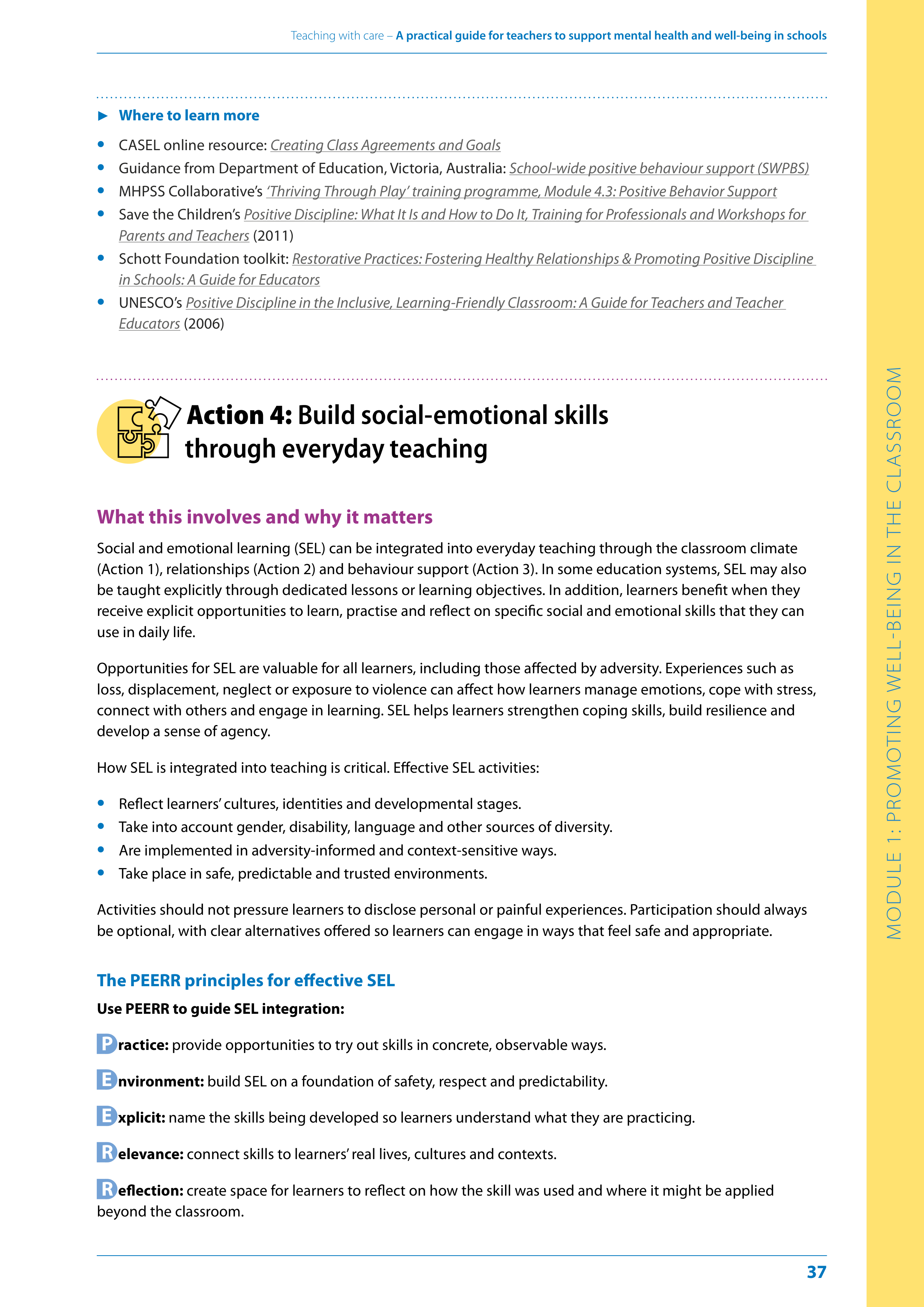
MODULE 1: PROMOTING WELL-BEING IN THE CLASSROOM
37
Teaching with care –
A practical guide for teachers to support mental health and well-being in schools
T
Where to learn more
•
CASEL online resource:
Creating Class Agreements and Goals
•
Guidance from Department of Education, Victoria, Australia:
School-wide positive behaviour support (SWPBS)
•
MHPSS Collaborative’s
‘Thriving Through Play’ training programme, Module 4.3: Positive Behavior Support
•
Save the Children’s
Positive Discipline: What It Is and How to Do It, Training for Professionals and Workshops for
Parents and Teachers
(2011)
•
Schott Foundation toolkit:
Restorative Practices: Fostering Healthy Relationships & Promoting Positive Discipline
in Schools: A Guide for Educators
•
UNESCO’s
Positive Discipline in the Inclusive, Learning-Friendly Classroom: A Guide for Teachers and Teacher
Educators
(2006)
Action 4:
Build social-emotional skills
through everyday teaching
What this involves and why it matters
Social and emotional learning (SEL) can be integrated into everyday teaching through the classroom climate
(Action 1), relationships (Action 2) and behaviour support (Action 3). In some education systems, SEL may also
be taught explicitly through dedicated lessons or learning objectives. In addition, learners benefit when they
receive explicit opportunities to learn, practise and reflect on specific social and emotional skills that they can
use in daily life.
Opportunities for SEL are valuable for all learners, including those affected by adversity. Experiences such as
loss, displacement, neglect or exposure to violence can affect how learners manage emotions, cope with stress,
connect with others and engage in learning. SEL helps learners strengthen coping skills, build resilience and
develop a sense of agency.
How SEL is integrated into teaching is critical. Effective SEL activities:
•
Reflect learners’ cultures, identities and developmental stages.
•
Take into account gender, disability, language and other sources of diversity.
•
Are implemented in adversity-informed and context-sensitive ways.
•
Take place in safe, predictable and trusted environments.
Activities should not pressure learners to disclose personal or painful experiences. Participation should always
be optional, with clear alternatives offered so learners can engage in ways that feel safe and appropriate.
The PEERR principles for effective SEL
Use PEERR to guide SEL integration:
P
ractice:
provide opportunities to try out skills in concrete, observable ways.
E
nvironment:
build SEL on a foundation of safety, respect and predictability.
E
xplicit:
name the skills being developed so learners understand what they are practicing.
R
elevance:
connect skills to learners’ real lives, cultures and contexts.
R
eflection:
create space for learners to reflect on how the skill was used and where it might be applied
beyond the classroom.
MODULE 1: PROMOTING WELL-BEING IN THE CLASSROOM
38
Teaching with care
– A practical guide for teachers to support mental health and well-being in schools
Strategy 4.1
Support emotion regulation skills
Understanding and managing emotions supports learning, relationships, and behaviour. Emotion regulation
helps learners:
•
Recognize and name emotions.
•
Manage strong emotions without becoming overwhelmed.
•
Interact with others more calmly and respectfully.
Emotional awareness can be woven into daily classroom routines using appropriate, culturally sensitive
language and inclusive supports. Across all approaches:
•
Offer options.
•
Validate a wide range of emotions.
•
Avoid labelling emotions as ‘good’ or ‘bad’.
•
Adapt strategies to learners’ developmental stage and context.
Everyday ways to support emotion regulation
Examples of how emotional language and regulation can be part of everyday classroom life include:
•
Emotional language:
normalize emotions (e.g., ‘Everyone has strong feelings sometimes’) and model
respectful ways to express them.
•
Visual aids:
use emotion charts, symbols or scales. Older learners may create or select representations that
feel relevant to them.
•
Brief check-ins:
invite short, optional emotion check-ins during transitions or at the start or end of lessons.
•
Body awareness:
help learners notice how emotions show up physically (e.g., tension or energy level)
without forcing detailed focus.
•
Validation:
reinforce that all emotions are acceptable; what matters is how learners respond.
•
Modelling:
name and model your own regulation strategies (‘I’m feeling overwhelmed, so I’ll pause and take
a breath’).
•
Choice of expression:
offer options such as writing, drawing, talking privately, or taking a short
regulated break.
Example of a simple regulation practice: calm breathing
Slow, intentional breathing can help some learners feel calmer and more focused. It can be used briefly during
transitions, before assessments, or after conflict.
Introduce it as an optional strategy, explaining that learners may participate in a way that feels safest for them
(e.g., eyes open, seated, hands in lap). Keep guidance brief and avoid requiring attention to body sensations if
learners are uncomfortable.
Afterwards, invite light reflection, such as:
•
‘Did you notice any change?’
•
‘When might this be useful?’
Encourage learners to choose from a menu of regulation strategies rather than relying on one technique.
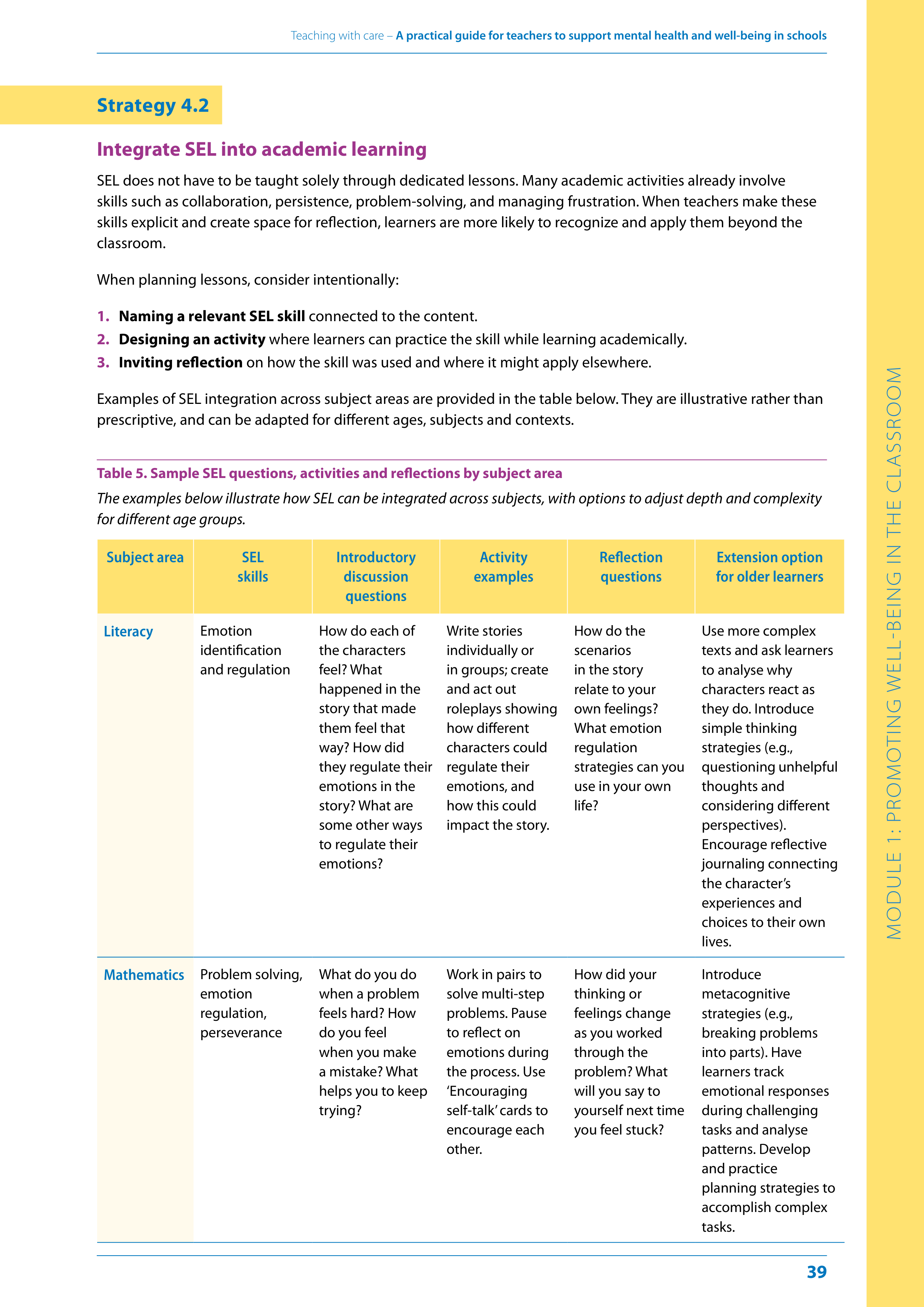
MODULE 1: PROMOTING WELL-BEING IN THE CLASSROOM
39
Teaching with care –
A practical guide for teachers to support mental health and well-being in schools
Strategy 4.2
Integrate SEL into academic learning
SEL does not have to be taught solely through dedicated lessons. Many academic activities already involve
skills such as collaboration, persistence, problem-solving, and managing frustration. When teachers make these
skills explicit and create space for reflection, learners are more likely to recognize and apply them beyond the
classroom.
When planning lessons, consider intentionally:
1.
Naming a relevant SEL skill
connected to the content.
2.
Designing an activity
where learners can practice the skill while learning academically.
3.
Inviting reflection
on how the skill was used and where it might apply elsewhere.
Examples of SEL integration across subject areas are provided in the table below. They are illustrative rather than
prescriptive, and can be adapted for different ages, subjects and contexts.
Table 5. Sample SEL questions, activities and reflections by subject area
The examples below illustrate how SEL can be integrated across subjects, with options to adjust depth and complexity
for different age groups.
Subject area
SEL
skills
Introductory
discussion
questions
Activity
examples
Reflection
questions
Extension option
for older learners
Literacy
Emotion
identification
and regulation
How do each of
the characters
feel? What
happened in the
story that made
them feel that
way? How did
they regulate their
emotions in the
story? What are
some other ways
to regulate their
emotions?
Write stories
individually or
in groups; create
and act out
roleplays showing
how different
characters could
regulate their
emotions, and
how this could
impact the story.
How do the
scenarios
in the story
relate to your
own feelings?
What emotion
regulation
strategies can you
use in your own
life?
Use more complex
texts and ask learners
to analyse why
characters react as
they do. Introduce
simple thinking
strategies (e.g.,
questioning unhelpful
thoughts and
considering different
perspectives).
Encourage reflective
journaling connecting
the character’s
experiences and
choices to their own
lives.
Mathematics
Problem solving,
emotion
regulation,
perseverance
What do you do
when a problem
feels hard? How
do you feel
when you make
a mistake? What
helps you to keep
trying?
Work in pairs to
solve multi-step
problems. Pause
to reflect on
emotions during
the process. Use
‘Encouraging
self-talk’ cards to
encourage each
other.
How did your
thinking or
feelings change
as you worked
through the
problem? What
will you say to
yourself next time
you feel stuck?
Introduce
metacognitive
strategies (e.g.,
breaking problems
into parts). Have
learners track
emotional responses
during challenging
tasks and analyse
patterns. Develop
and practice
planning strategies to
accomplish complex
tasks.
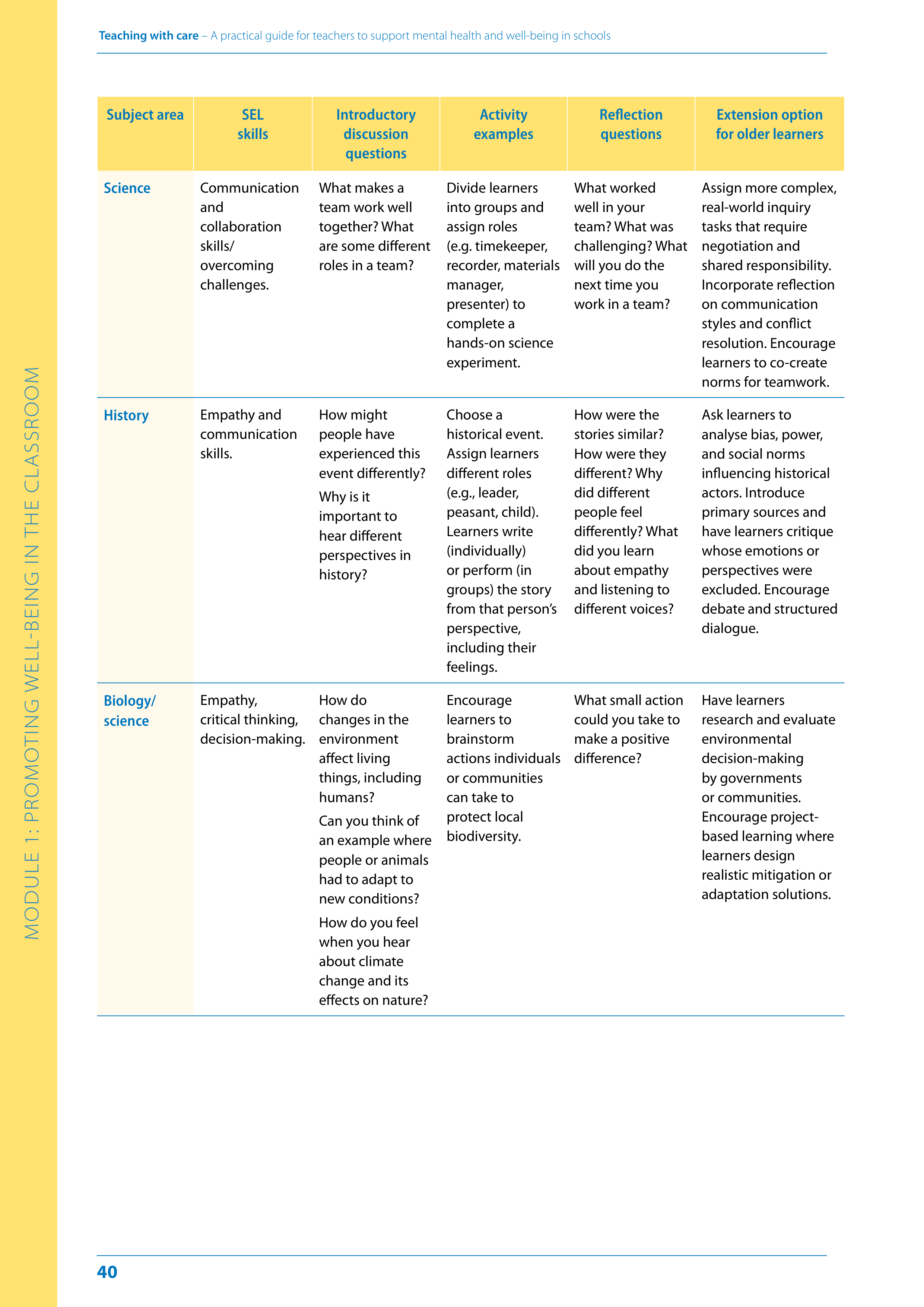
MODULE 1: PROMOTING WELL-BEING IN THE CLASSROOM
40
Teaching with care
– A practical guide for teachers to support mental health and well-being in schools
Subject area
SEL
skills
Introductory
discussion
questions
Activity
examples
Reflection
questions
Extension option
for older learners
Science
Communication
and
collaboration
skills/
overcoming
challenges.
What makes a
team work well
together? What
are some different
roles in a team?
Divide learners
into groups and
assign roles
(e.g. timekeeper,
recorder, materials
manager,
presenter) to
complete a
hands-on science
experiment.
What worked
well in your
team? What was
challenging? What
will you do the
next time you
work in a team?
Assign more complex,
real-world inquiry
tasks that require
negotiation and
shared responsibility.
Incorporate reflection
on communication
styles and conflict
resolution. Encourage
learners to co-create
norms for teamwork.
History
Empathy and
communication
skills.
How might
people have
experienced this
event differently?
Why is it
important to
hear different
perspectives in
history?
Choose a
historical event.
Assign learners
different roles
(e.g., leader,
peasant, child).
Learners write
(individually)
or perform (in
groups) the story
from that person’s
perspective,
including their
feelings.
How were the
stories similar?
How were they
different? Why
did different
people feel
differently? What
did you learn
about empathy
and listening to
different voices?
Ask learners to
analyse bias, power,
and social norms
influencing historical
actors. Introduce
primary sources and
have learners critique
whose emotions or
perspectives were
excluded. Encourage
debate and structured
dialogue.
Biology/
science
Empathy,
critical thinking,
decision-making.
How do
changes in the
environment
affect living
things, including
humans?
Can you think of
an example where
people or animals
had to adapt to
new conditions?
How do you feel
when you hear
about climate
change and its
effects on nature?
Encourage
learners to
brainstorm
actions individuals
or communities
can take to
protect local
biodiversity.
What small action
could you take to
make a positive
difference?
Have learners
research and evaluate
environmental
decision-making
by governments
or communities.
Encourage project-
based learning where
learners design
realistic mitigation or
adaptation solutions.
MODULE 1: PROMOTING WELL-BEING IN THE CLASSROOM
41
Teaching with care –
A practical guide for teachers to support mental health and well-being in schools
Example of good practice
Integrating SEL into history through reflection and structured dialogue (secondary school)
Context:
in a lower-secondary history class, the teacher noticed that learners were highly reactive to
disagreement, group work often became polarized, and some learners disengaged when dealing with
challenging topics.
Teacher response:
the teacher embedded short SEL routines into normal history instruction rather than
adding a separate ‘SEL lesson’. Learners used
private journals
to briefly reflect before class discussion
(e.g., ‘What is my first reaction?’ ‘What might influence my view?’). During lessons on historical choices and
consequences, learners analysed figures’ decisions and relationships using a simple
structured reflection
tool
(e.g., identifying feelings, perspectives, triggers, and better ways of responding), and then practiced
respectful disagreement using clear discussion norms.
Outcome:
over several weeks, learners showed improved self-control during debate, more respectful
peer-to-peer dialogue, and greater willingness to participate – especially those who previously stayed
silent. The teacher reported fewer conflicts during group tasks and more focus during sensitive topics.
Source:
based on established secondary-school practices documented by Facing History & Ourselves, the Yale Center for Emotional
Intelligence (RULER), and CASEL on integrating SEL into academic subjects.
T
Where to learn more
•
CASEL guidance:
Integration of SEL and academics instruction
•
INEE’s
Psychosocial Support through Education in Emergencies
(2019). Training module
•
IRC’s
Social–Emotion Learning Intervention: Games Bank
.
A Bank of Games to Reinforce SEL Competencies
(2022)
•
IRC’s
Social–Emotional Learning Intervention: Lesson Plan Bank
(2022)
•
LEGO Foundation’s
Coping with Changes: Social-Emotional Learning Through Play.
Online training course
•
Right to Play’s
Play Opportunities for Wellness and Education Resource (P.O.W.E.R.): games for child development
and learning
•
UNICEF’s
Health Adolescents Thrive - Facilitation Guide for working with 15- to 19-year-olds
•
UNICEF and WHO’s
Teacher’s Guide to the Comic Story of Magnificent Mei and Friends
•
World Bank’s
Step by Step – Toolkit Promoting Social and Emotional Learning (SEL) in Children and Teens
MODULE 1: PROMOTING WELL-BEING IN THE CLASSROOM
42
Teaching with care
– A practical guide for teachers to support mental health and well-being in schools
Module 1 Adaptations
The strategies in Module 1 can be adapted to different contexts, resources and
learner needs. The guiding principle across all settings is the same:
prioritize
safety, dignity, inclusion and predictability
, while working within what is realistic
for your classroom. These strategies can also support learners experiencing more
significant or ongoing distress. Where concerns are severe or persist, follow school
procedures and connect learners to appropriate support.
Low-resource settings
Supportive classroom practices and SEL do not require specialized materials.
•
Use
locally available, low-cost or repurposed
materials (e.g., reuse paper, use available natural materials
and objects).
•
When visual displays are not possible, rely on
verbal routines
, such as reciting the class agreement or
sharing examples of when learners upheld it.
•
Use
familiar local games
and make the social and emotional goal explicit before playing.
•
End activities with a
short reflection
:
ʱ
What was challenging?
ʱ
What helped you?
ʱ
How could you use this skill in real life?
The emphasis is on
consistency, participation and relationships
, not on materials.
Displacement or crisis-affected settings
Learners may be coping with loss, disruption or uncertainty, often in mixed groups with different experiences.
•
Provide
choices
for how to participate; never require learners to share personal stories.
•
Avoid making assumptions about any learner’s experiences.
•
Build classroom norms that
prevent marginalization
, especially in mixed groups.
•
Encourage
voluntary
sharing about culture, home or identity, emphasizing that learners always choose what
to share.
•
Observe how learners respond during activities; allow learners to pause or step aside if needed.
•
Refer to
Module 2
for guidance on recognizing distress and connecting learners to additional support.
Your role is to provide a
stable, respectful and predictable environment
. As a teacher, it is not your role to
explore or address the causes of adversity.
Online or remote learning
The classroom environment also exists in digital spaces.
•
Create a
central online hub
with key routines, expectations and shared materials.
•
Use digital alternatives for SEL activities (e.g., polls, breakout rooms, shared documents, simple drawing
tools).
•
Build in
small-group interaction
where feasible.
MODULE 1: PROMOTING WELL-BEING IN THE CLASSROOM
43
Teaching with care –
A practical guide for teachers to support mental health and well-being in schools
•
Hold brief one-to-one check-ins focused on participation and general well-being, within the boundaries of
educational – not counselling – roles.
•
Use only
school-approved digital platforms and tools
, and seek guidance from school leadership on safe
digital tools to ensure secure and inclusive learning spaces.
•
Encourage video participation when appropriate, but offer
safe alternatives
(e.g., audio-only and chat
responses).
•
Maintain
predictable routines
(e.g., opening greeting, consistent transitions, closing reflection).
Learners with disabilities
Learners with disabilities may face increased risk of exclusion or misunderstanding. Adapt teaching proactively
to ensure full participation.
Set an inclusive classroom tone from the start and reinforce it regularly.
•
Offer materials and activities in
multiple formats
(e.g., visual, audio, tactile, movement-based; simplified or
alternative text).
•
Ensure participation is
meaningful
rather than symbolic and adapt roles and tasks so all can contribute.
•
Promote supportive peer interactions without placing learners with disabilities in fixed roles.
•
Act early if exclusion or bullying is observed; refer to Module 2 when concerns arise.
Inclusivity and diversity
Learners bring diverse languages, cultures, identities and beliefs.
•
Invite learners to share aspects of their identity
voluntarily
, without pressure.
•
Celebrate diversity without reinforcing dominant norms or stereotypes.
•
Use clear, accessible language and, where possible, include multilingual support or familiar keywords from
learners’ home languages.
•
Pay attention to who participates; ensure quieter or marginalized learners benefit from equitable
opportunities.
•
Revisit classroom norms to ensure they do not inadvertently disadvantage any group.
•
Reflect on your own assumptions and take steps to avoid bias in everyday interactions.
Different age groups and grade levels
All strategies in Module 1 can be adapted across ages by adjusting how they are implemented.
Younger learners
•
Emphasize play, movement and concrete experiences.
•
Use short instructions, frequent modelling and visual cues.
•
Invite creative expression (e.g., drawing, story-acting, singing, simple role play).
Older learners and adolescents
•
Engage through reflection, discussion and creative media (e.g., journaling, digital stories, vlogs, scenario
analysis).
•
Encourage them to connect skills to their real lives, communities and online environments.
•
Involve them in co-designing norms or activities to promote autonomy and agency.
•
Watch for signs of discomfort or withdrawal; refer to Module 2 when needed.
Across all ages, the core principle remains consistent:
every learner has something to contribute; provide
options, protect safety and dignity, and adapt activities to what feels appropriate for your class.
MODULE 1: PROMOTING WELL-BEING IN THE CLASSROOM
44
Teaching with care
– A practical guide for teachers to support mental health and well-being in schools
Module 1 Self-assessment and reflection
Use this checklist to reflect on how you set up your classroom and engage with learners each day.
Tick items you already do, and star those you would like to strengthen or try.
Creating a safe, predictable and inclusive learning environment
Â
I organize the classroom to ensure safety, accessibility and easy movement for all learners.
Â
I maintain clear, predictable routines that help learners feel secure and ready to learn.
Â
I provide options so learners can participate in ways that feel comfortable and appropriate.
Building relationships with and between learners
Â
I greet learners with warmth and make regular, brief contact that shows care and respect.
Â
I find simple ways to learn about learners’ strengths, interests and needs.
Â
I intentionally create opportunities for positive peer interaction and inclusion.
Promoting positive interactions
Â
Classroom norms and expectations are clear, shared and revisited when needed.
Â
I reinforce positive interactions consistently and respond to challenges calmly and respectfully.
Â
After conflict or misunderstanding, I support repair and reconnection.
Building social-emotional skills
Â
I model healthy ways of managing emotions and stress.
Â
I help learners identify and express feelings without judgement.
Â
I integrate social and emotional skills into learning when possible and appropriate.
Â
I offer choices so learners can engage in SEL activities in ways that feel safe.
Reflection prompts
Consider what strategies you have and have not integrated into your everyday teaching to create a safe,
supportive and inclusive learning environment.
Reflect on the strategies you have implemented by asking yourself:
•
What went well? Why?
•
What did not go well? Why?
•
What will you do in the future to improve the safety and inclusivity of your class?
•
How have learners responded to these strategies?
Reflect on the barriers you face in implementing other strategies by considering:
•
How can you address those barriers?
•
What support, resources or training do you need to be able to implement them? Are there colleagues who
are implementing these practices that you can learn from?
•
How can you adapt the strategies to better fit your classroom?
45
Teaching with care –
A practical guide for teachers to support mental health and well-being in schools
Module 2
Recognizing and linking learners in need
46
Teaching with care
– A practical guide for teachers to support mental health and well-being in schools
MODULE 2: RECOGNIZING AND LINKING LEARNERS IN NEED
Module 2
Recognizing and linking learners in need
In this module, you will learn how to notice when a learner may be struggling,
respond in simple and supportive ways within the parameters of your role as
teacher, and connect learners to additional support when needed.
Teachers are not expected to diagnose mental health challenges or provide counselling. Instead, your
contribution focuses on:
•
Observing changes in behaviour, mood, social interaction, or learning that may signal difficulty.
•
Checking in with learners in calm, respectful, and age-appropriate ways.
•
Sharing concerns through appropriate school channels.
•
Helping link learners and families to available support within the school or community.
The module also emphasizes working with colleagues to map existing resources, so that referral pathways are
clear, safe and realistic in your context. Guidance is provided on protecting learners’ privacy as far as possible,
while recognizing the limits of confidentiality when safety concerns arise.
Throughout the module, attention is given to recognizing and responding to concerns in inclusive and gender-
responsive ways, and with sensitivity to learners’ diverse experiences, including age, disability, neurodivergence,
language background, displacement, or exposure to adversity.
Action 5:
Recognize and respond
to distress across age and gender
What this involves and why it matters
Many mental health and psychosocial challenges first emerge during school years. Because teachers see
learners every day, they are often the first adults to observe changes in behaviour, mood, participation or social
interaction. In some cases, teachers may be the only adults who notice these early signs – especially when
caregivers are unaware of what their child is experiencing or when circumstances limit their ability to respond.
When teachers can recognize these early changes, they are well placed to offer calm, compassionate support
within their role, validate what the learner is feeling and, when appropriate, share concerns with colleagues and
connect the learner to additional help available in the school or community.
T
Reflection moment
Think back to your own time as a learner. You may remember a teacher who noticed you were having a
difficult time and offered understanding or encouragement. You may also recall moments when support
would have helped, but no one realized you were struggling. These experiences highlight how meaningful it
can be when a teacher
notices, responds kindly and helps a learner feel seen
.
This action equips you with practical ways to do that with confidence and within the boundaries of your role.
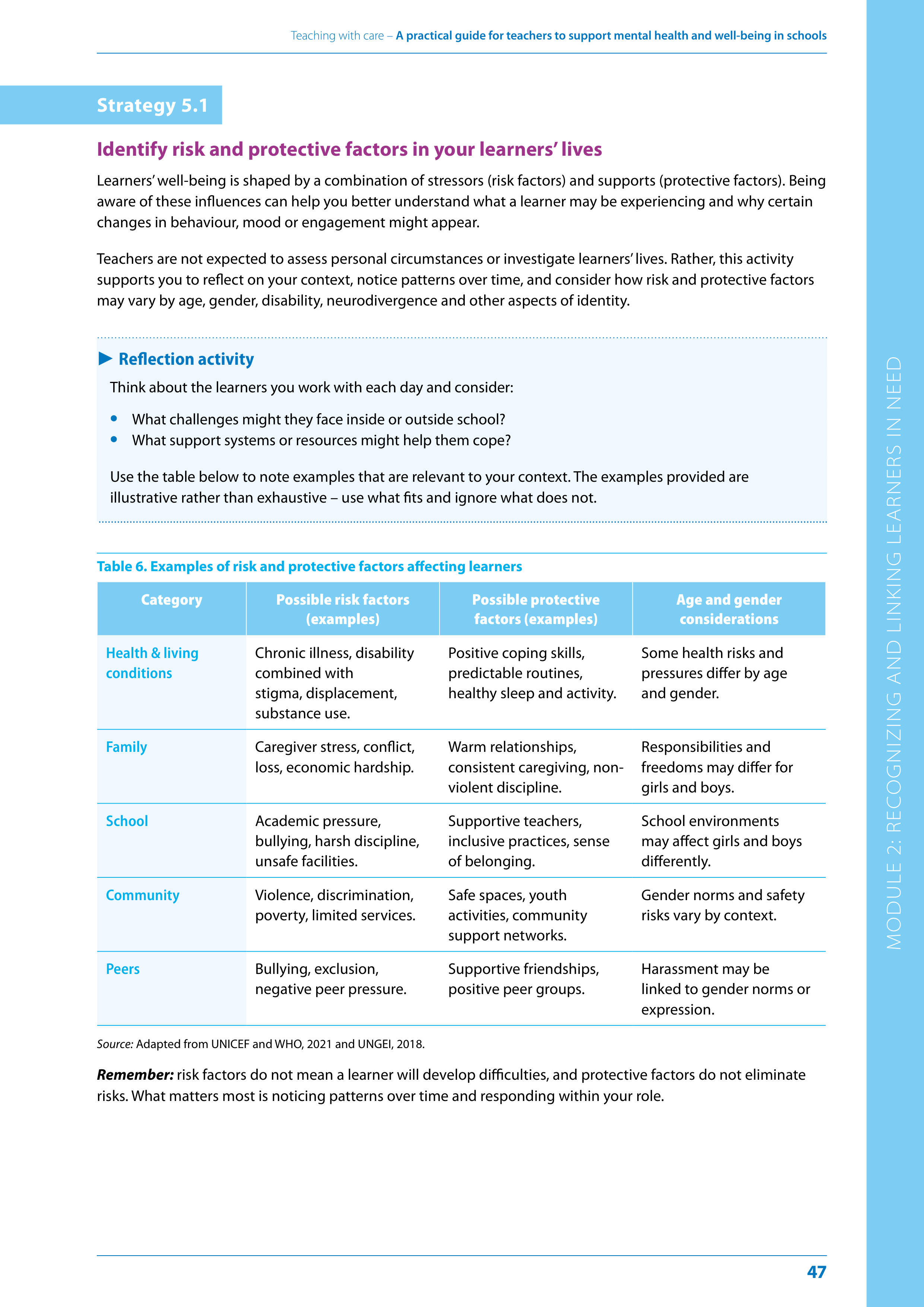
47
Teaching with care –
A practical guide for teachers to support mental health and well-being in schools
MODULE 2: RECOGNIZING AND LINKING LEARNERS IN NEED
Strategy 5.1
Identify risk and protective factors in your learners’ lives
Learners’ well-being is shaped by a combination of stressors (risk factors) and supports (protective factors). Being
aware of these influences can help you better understand what a learner may be experiencing and why certain
changes in behaviour, mood or engagement might appear.
Teachers are not expected to assess personal circumstances or investigate learners’ lives. Rather, this activity
supports you to reflect on your context, notice patterns over time, and consider how risk and protective factors
may vary by age, gender, disability, neurodivergence and other aspects of identity.
T
Reflection activity
Think about the learners you work with each day and consider:
•
What challenges might they face inside or outside school?
•
What support systems or resources might help them cope?
Use the table below to note examples that are relevant to your context. The examples provided are
illustrative rather than exhaustive – use what fits and ignore what does not.
Table 6. Examples of risk and protective factors affecting learners
Category
Possible risk factors
(examples)
Possible protective
factors (examples)
Age and gender
considerations
Health & living
conditions
Chronic illness, disability
combined with
stigma, displacement,
substance use.
Positive coping skills,
predictable routines,
healthy sleep and activity.
Some health risks and
pressures differ by age
and gender.
Family
Caregiver stress, conflict,
loss, economic hardship.
Warm relationships,
consistent caregiving, non-
violent discipline.
Responsibilities and
freedoms may differ for
girls and boys.
School
Academic pressure,
bullying, harsh discipline,
unsafe facilities.
Supportive teachers,
inclusive practices, sense
of belonging.
School environments
may affect girls and boys
differently.
Community
Violence, discrimination,
poverty, limited services.
Safe spaces, youth
activities, community
support networks.
Gender norms and safety
risks vary by context.
Peers
Bullying, exclusion,
negative peer pressure.
Supportive friendships,
positive peer groups.
Harassment may be
linked to gender norms or
expression.
Source:
Adapted from UNICEF and WHO, 2021 and UNGEI, 2018.
Remember:
risk factors do not mean a learner will develop difficulties, and protective factors do not eliminate
risks. What matters most is noticing patterns over time and responding within your role.
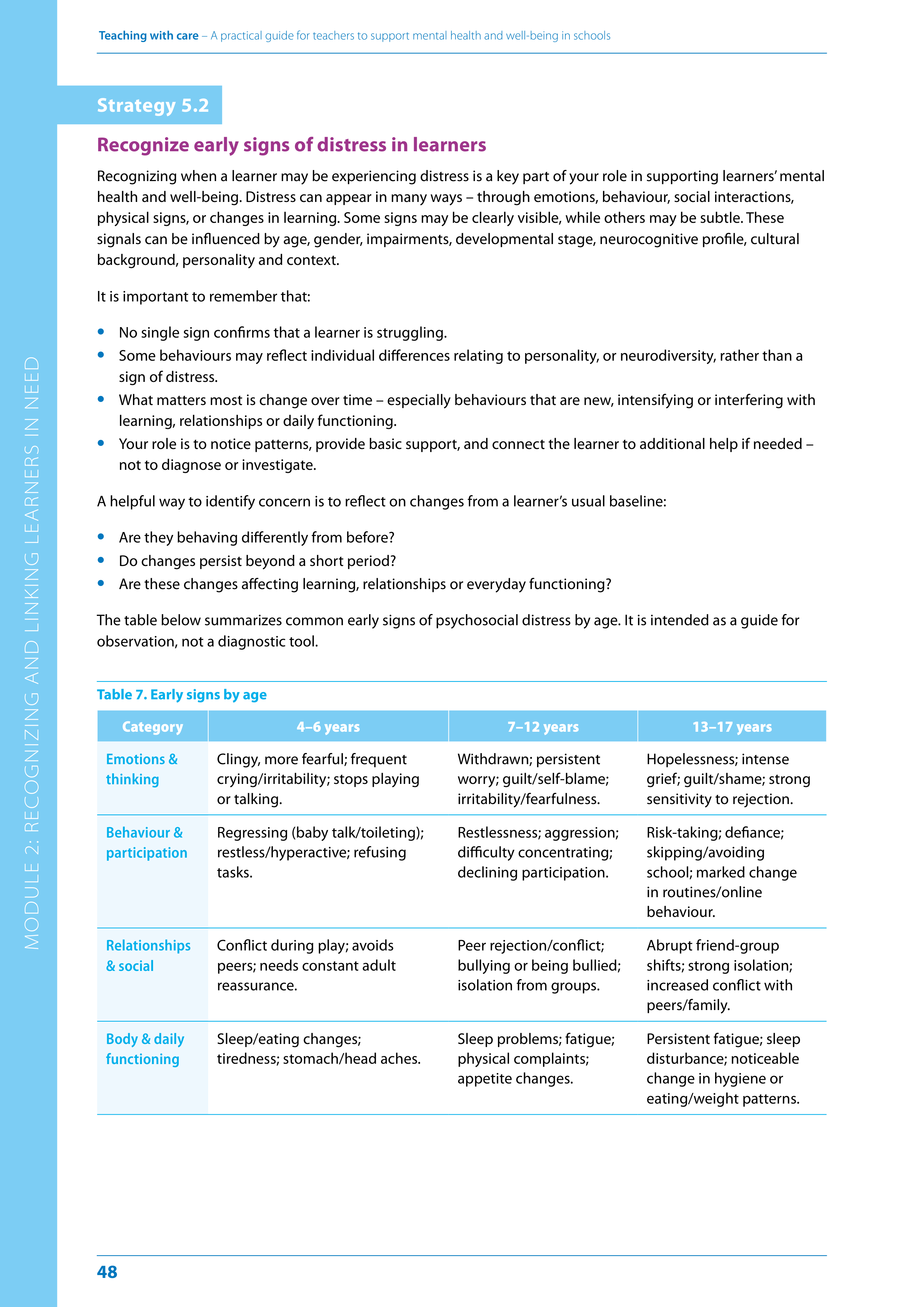
48
Teaching with care
– A practical guide for teachers to support mental health and well-being in schools
MODULE 2: RECOGNIZING AND LINKING LEARNERS IN NEED
Strategy 5.2
Recognize early signs of distress in learners
Recognizing when a learner may be experiencing distress is a key part of your role in supporting learners’ mental
health and well-being. Distress can appear in many ways – through emotions, behaviour, social interactions,
physical signs, or changes in learning. Some signs may be clearly visible, while others may be subtle. These
signals can be influenced by age, gender, impairments, developmental stage, neurocognitive profile, cultural
background, personality and context.
It is important to remember that:
•
No single sign confirms that a learner is struggling.
•
Some behaviours may reflect individual differences relating to personality, or neurodiversity, rather than a
sign of distress.
•
What matters most is change over time – especially behaviours that are new, intensifying or interfering with
learning, relationships or daily functioning.
•
Your role is to notice patterns, provide basic support, and connect the learner to additional help if needed –
not to diagnose or investigate.
A helpful way to identify concern is to reflect on changes from a learner’s usual baseline:
•
Are they behaving differently from before?
•
Do changes persist beyond a short period?
•
Are these changes affecting learning, relationships or everyday functioning?
The table below summarizes common early signs of psychosocial distress by age. It is intended as a guide for
observation, not a diagnostic tool.
Table 7. Early signs by age
Category
4–6 years
7–12 years
13–17 years
Emotions &
thinking
Clingy, more fearful; frequent
crying/irritability; stops playing
or talking.
Withdrawn; persistent
worry; guilt/self-blame;
irritability/fearfulness.
Hopelessness; intense
grief; guilt/shame; strong
sensitivity to rejection.
Behaviour &
participation
Regressing (baby talk/toileting);
restless/hyperactive; refusing
tasks.
Restlessness; aggression;
difficulty concentrating;
declining participation.
Risk-taking; defiance;
skipping/avoiding
school; marked change
in routines/online
behaviour.
Relationships
& social
Conflict during play; avoids
peers; needs constant adult
reassurance.
Peer rejection/conflict;
bullying or being bullied;
isolation from groups.
Abrupt friend-group
shifts; strong isolation;
increased conflict with
peers/family.
Body & daily
functioning
Sleep/eating changes;
tiredness; stomach/head aches.
Sleep problems; fatigue;
physical complaints;
appetite changes.
Persistent fatigue; sleep
disturbance; noticeable
change in hygiene or
eating/weight patterns.
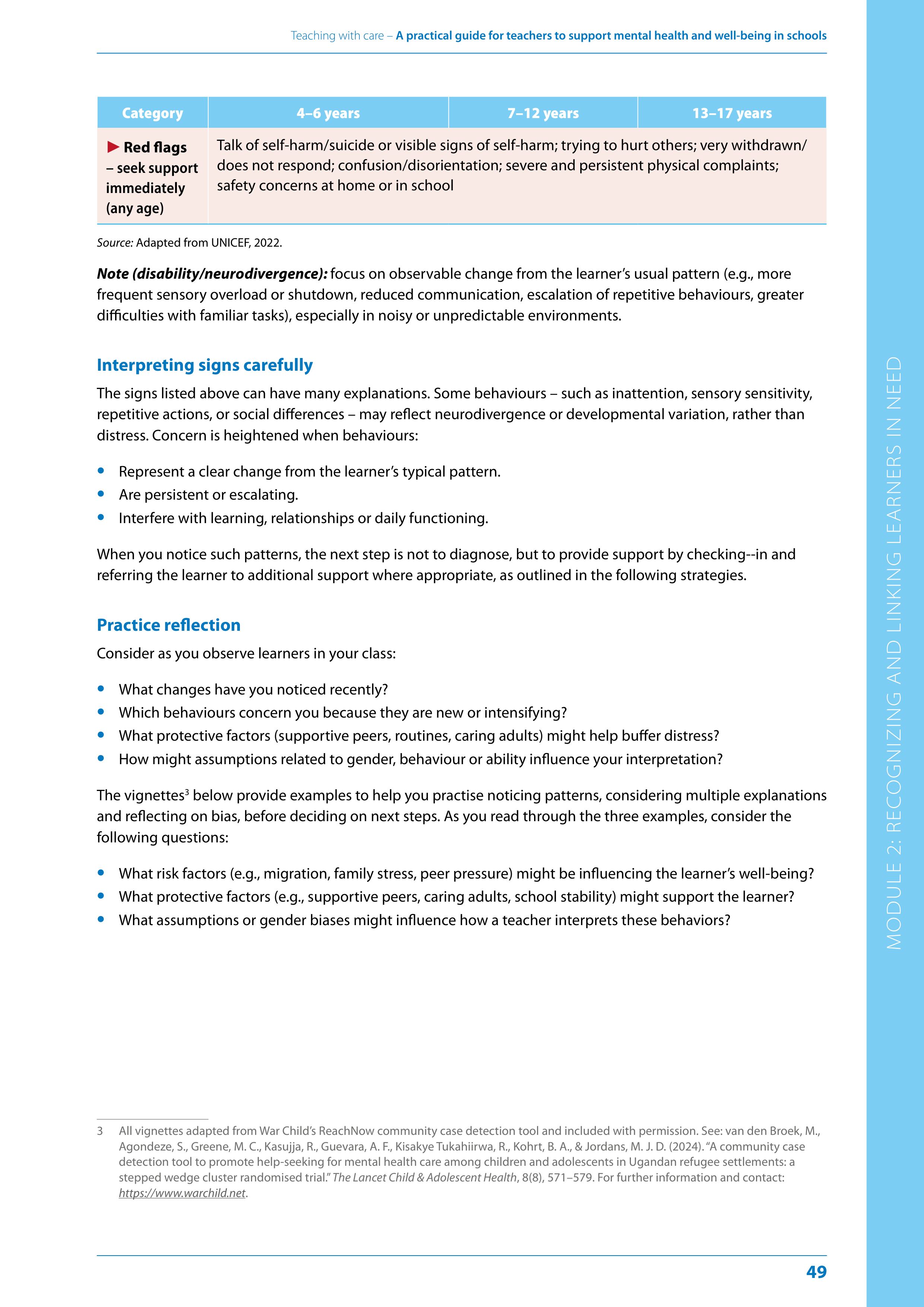
49
Teaching with care –
A practical guide for teachers to support mental health and well-being in schools
MODULE 2: RECOGNIZING AND LINKING LEARNERS IN NEED
Category
4–6 years
7–12 years
13–17 years
�
Red flags
– seek support
immediately
(any age)
Talk of self-harm/suicide or visible signs of self-harm; trying to hurt others; very withdrawn/
does not respond; confusion/disorientation; severe and persistent physical complaints;
safety concerns at home or in school
Source:
Adapted from UNICEF, 2022.
Note (disability/neurodivergence):
focus on observable change from the learner’s usual pattern (e.g., more
frequent sensory overload or shutdown, reduced communication, escalation of repetitive behaviours, greater
difficulties with familiar tasks), especially in noisy or unpredictable environments.
Interpreting signs carefully
The signs listed above can have many explanations. Some behaviours – such as inattention, sensory sensitivity,
repetitive actions, or social differences – may reflect neurodivergence or developmental variation, rather than
distress. Concern is heightened when behaviours:
•
Represent a clear change from the learner’s typical pattern.
•
Are persistent or escalating.
•
Interfere with learning, relationships or daily functioning.
When you notice such patterns, the next step is not to diagnose, but to provide support by checking--in and
referring the learner to additional support where appropriate, as outlined in the following strategies.
Practice reflection
Consider as you observe learners in your class:
•
What changes have you noticed recently?
•
Which behaviours concern you because they are new or intensifying?
•
What protective factors (supportive peers, routines, caring adults) might help buffer distress?
•
How might assumptions related to gender, behaviour or ability influence your interpretation?
The vignettes
3
below provide examples to help you practise noticing patterns, considering multiple explanations
and reflecting on bias, before deciding on next steps. As you read through the three examples, consider the
following questions:
•
What risk factors (e.g., migration, family stress, peer pressure) might be influencing the learner’s well-being?
•
What protective factors (e.g., supportive peers, caring adults, school stability) might support the learner?
•
What assumptions or gender biases might influence how a teacher interprets these behaviors?
3
All vignettes adapted from War Child’s ReachNow community case detection tool and included with permission. See: van den Broek, M.,
Agondeze, S., Greene, M. C., Kasujja, R., Guevara, A. F., Kisakye Tukahiirwa, R., Kohrt, B. A., & Jordans, M. J. D. (2024). “A community case
detection tool to promote help-seeking for mental health care among children and adolescents in Ugandan refugee settlements: a
stepped wedge cluster randomised trial.”
The Lancet Child & Adolescent Health
, 8(8), 571–579. For further information and contact:
https://www.warchild.net
.
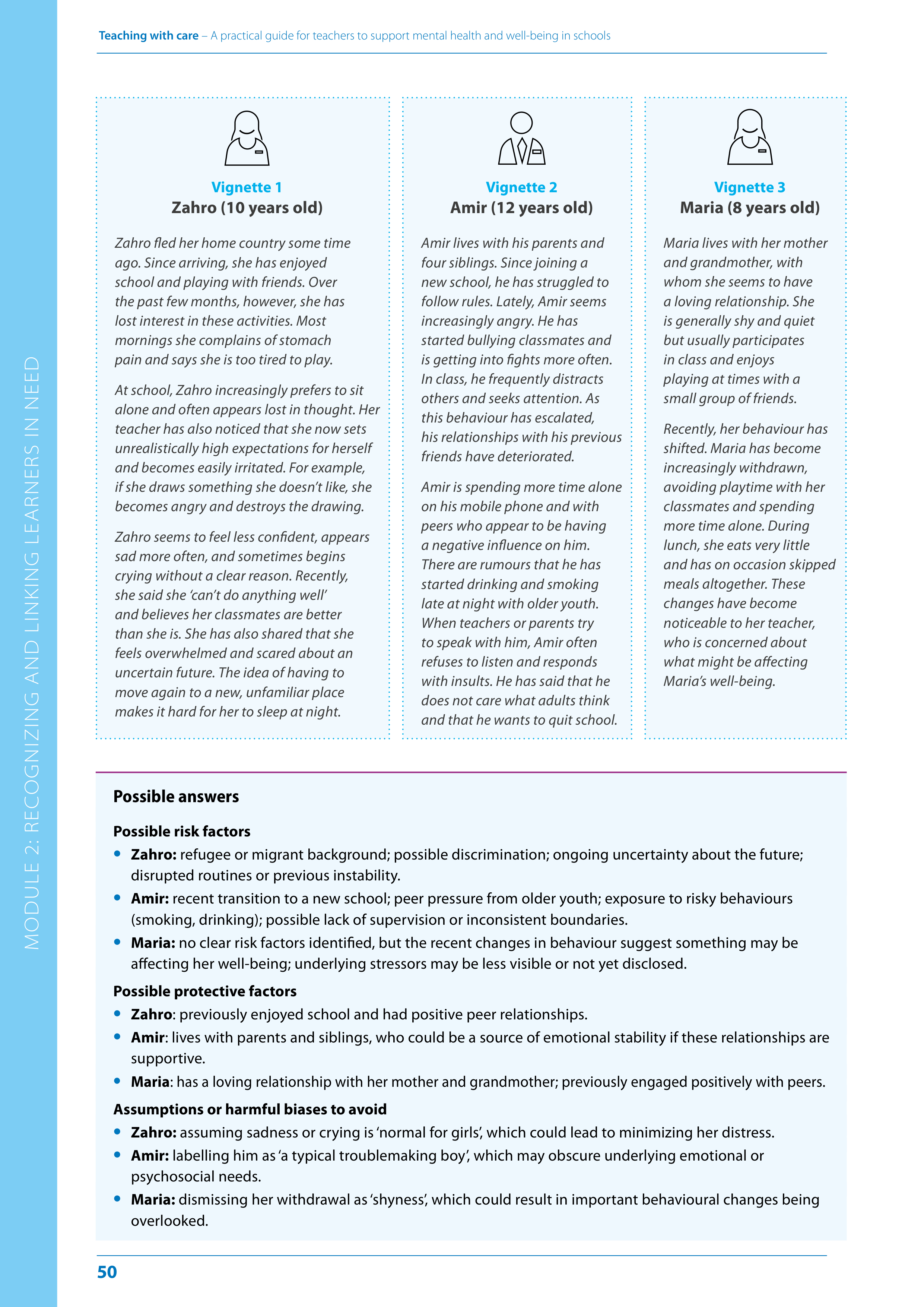
50
Teaching with care
– A practical guide for teachers to support mental health and well-being in schools
MODULE 2: RECOGNIZING AND LINKING LEARNERS IN NEED
Vignette 2
Amir (12 years old)
Amir lives with his parents and
four siblings. Since joining a
new school, he has struggled to
follow rules. Lately, Amir seems
increasingly angry. He has
started bullying classmates and
is getting into fights more often.
In class, he frequently distracts
others and seeks attention. As
this behaviour has escalated,
his relationships with his previous
friends have deteriorated.
Amir is spending more time alone
on his mobile phone and with
peers who appear to be having
a negative influence on him.
There are rumours that he has
started drinking and smoking
late at night with older youth.
When teachers or parents try
to speak with him, Amir often
refuses to listen and responds
with insults. He has said that he
does not care what adults think
and that he wants to quit school.
Vignette 1
Zahro (10 years old)
Zahro fled her home country some time
ago. Since arriving, she has enjoyed
school and playing with friends. Over
the past few months, however, she has
lost interest in these activities. Most
mornings she complains of stomach
pain and says she is too tired to play.
At school, Zahro increasingly prefers to sit
alone and often appears lost in thought. Her
teacher has also noticed that she now sets
unrealistically high expectations for herself
and becomes easily irritated. For example,
if she draws something she doesn’t like, she
becomes angry and destroys the drawing.
Zahro seems to feel less confident, appears
sad more often, and sometimes begins
crying without a clear reason. Recently,
she said she ‘can’t do anything well’
and believes her classmates are better
than she is. She has also shared that she
feels overwhelmed and scared about an
uncertain future. The idea of having to
move again to a new, unfamiliar place
makes it hard for her to sleep at night.
Vignette 3
Maria (8 years old)
Maria lives with her mother
and grandmother, with
whom she seems to have
a loving relationship. She
is generally shy and quiet
but usually participates
in class and enjoys
playing at times with a
small group of friends.
Recently, her behaviour has
shifted. Maria has become
increasingly withdrawn,
avoiding playtime with her
classmates and spending
more time alone. During
lunch, she eats very little
and has on occasion skipped
meals altogether. These
changes have become
noticeable to her teacher,
who is concerned about
what might be affecting
Maria’s well-being.
Possible answers
Possible risk factors
•
Zahro:
refugee or migrant background; possible discrimination; ongoing uncertainty about the future;
disrupted routines or previous instability.
•
Amir:
recent transition to a new school; peer pressure from older youth; exposure to risky behaviours
(smoking, drinking); possible lack of supervision or inconsistent boundaries.
•
Maria:
no clear risk factors identified, but the recent changes in behaviour suggest something may be
affecting her well-being; underlying stressors may be less visible or not yet disclosed.
Possible protective factors
•
Zahro
: previously enjoyed school and had positive peer relationships.
•
Amir
: lives with parents and siblings, who could be a source of emotional stability if these relationships are
supportive.
•
Maria
: has a loving relationship with her mother and grandmother; previously engaged positively with peers.
Assumptions or harmful biases to avoid
•
Zahro:
assuming sadness or crying is ‘normal for girls’, which could lead to minimizing her distress.
•
Amir:
labelling him as ‘a typical troublemaking boy’, which may obscure underlying emotional or
psychosocial needs.
•
Maria:
dismissing her withdrawal as ‘shyness’, which could result in important behavioural changes being
overlooked.
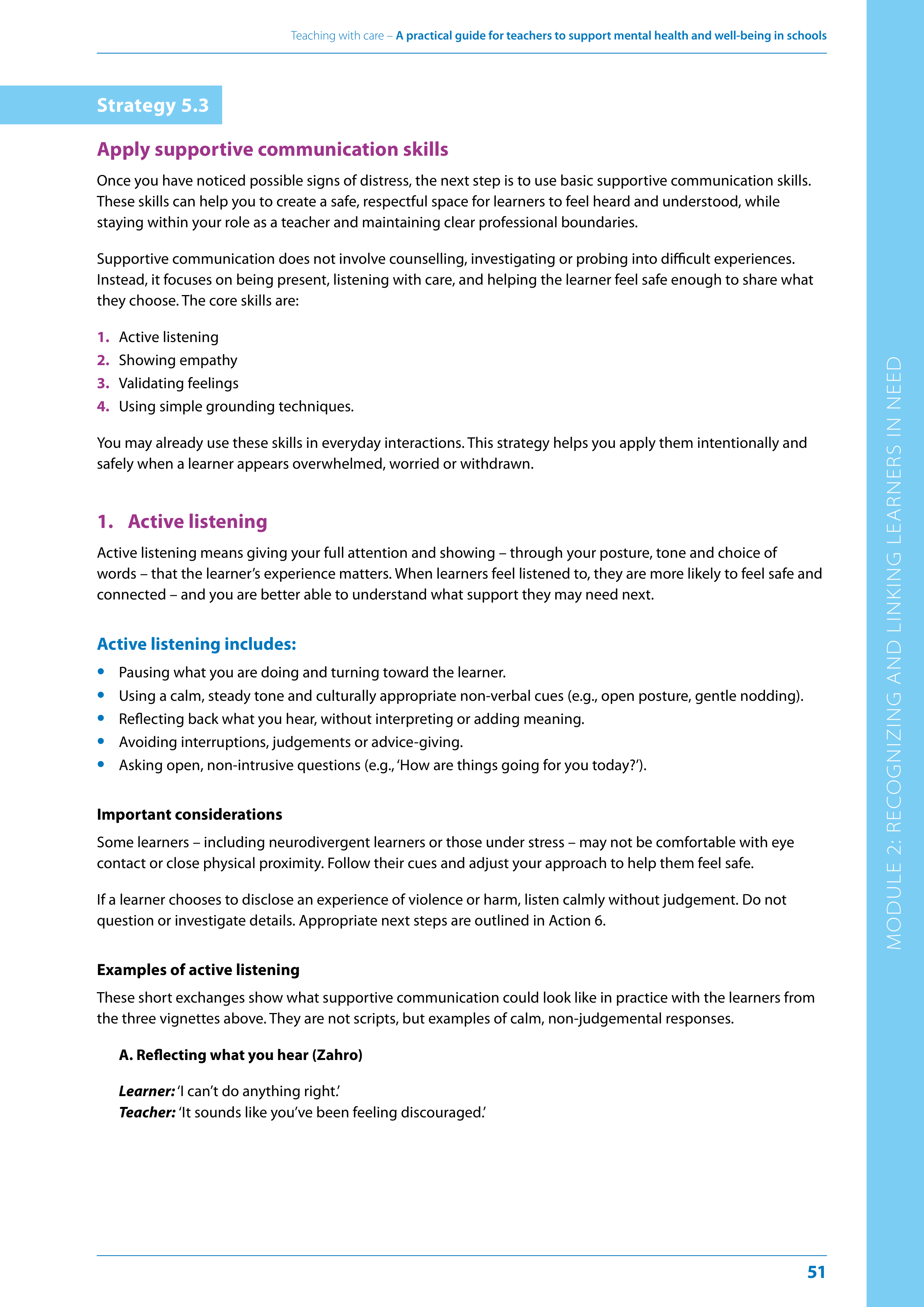
51
Teaching with care –
A practical guide for teachers to support mental health and well-being in schools
MODULE 2: RECOGNIZING AND LINKING LEARNERS IN NEED
Strategy 5.3
Apply supportive communication skills
Once you have noticed possible signs of distress, the next step is to use basic supportive communication skills.
These skills can help you to create a safe, respectful space for learners to feel heard and understood, while
staying within your role as a teacher and maintaining clear professional boundaries.
Supportive communication does not involve counselling, investigating or probing into difficult experiences.
Instead, it focuses on being present, listening with care, and helping the learner feel safe enough to share what
they choose. The core skills are:
1.
Active listening
2.
Showing empathy
3.
Validating feelings
4.
Using simple grounding techniques.
You may already use these skills in everyday interactions. This strategy helps you apply them intentionally and
safely when a learner appears overwhelmed, worried or withdrawn.
1.
Active listening
Active listening means giving your full attention and showing – through your posture, tone and choice of
words – that the learner’s experience matters. When learners feel listened to, they are more likely to feel safe and
connected – and you are better able to understand what support they may need next.
Active listening includes:
•
Pausing what you are doing and turning toward the learner.
•
Using a calm, steady tone and culturally appropriate non-verbal cues (e.g., open posture, gentle nodding).
•
Reflecting back what you hear, without interpreting or adding meaning.
•
Avoiding interruptions, judgements or advice-giving.
•
Asking open, non-intrusive questions (e.g., ‘How are things going for you today?’).
Important considerations
Some learners – including neurodivergent learners or those under stress – may not be comfortable with eye
contact or close physical proximity. Follow their cues and adjust your approach to help them feel safe.
If a learner chooses to disclose an experience of violence or harm, listen calmly without judgement. Do not
question or investigate details. Appropriate next steps are outlined in Action 6.
Examples of active listening
These short exchanges show what supportive communication could look like in practice with the learners from
the three vignettes above. They are not scripts, but examples of calm, non-judgemental responses.
A. Reflecting what you hear (Zahro)
Learner:
‘I can’t do anything right.’
Teacher:
‘It sounds like you’ve been feeling discouraged.’
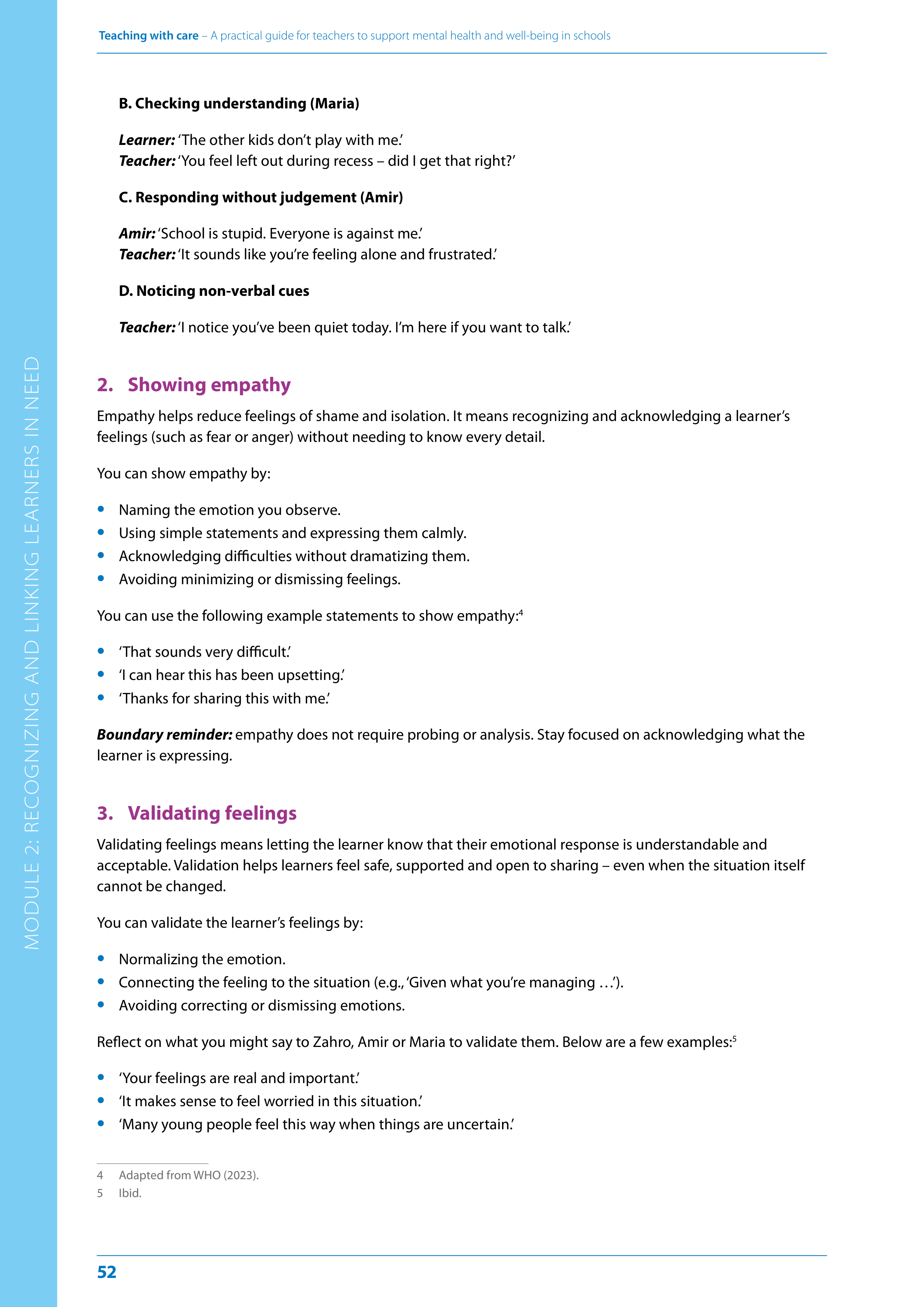
52
Teaching with care
– A practical guide for teachers to support mental health and well-being in schools
MODULE 2: RECOGNIZING AND LINKING LEARNERS IN NEED
B. Checking understanding (Maria)
Learner:
‘The other kids don’t play with me.’
Teacher:
‘You feel left out during recess – did I get that right?’
C. Responding without judgement (Amir)
Amir:
‘School is stupid. Everyone is against me.’
Teacher:
‘It sounds like you’re feeling alone and frustrated.’
D. Noticing non-verbal cues
Teacher:
‘I notice you’ve been quiet today. I’m here if you want to talk.’
2.
Showing empathy
Empathy helps reduce feelings of shame and isolation. It means recognizing and acknowledging a learner’s
feelings (such as fear or anger) without needing to know every detail.
You can show empathy by:
•
Naming the emotion you observe.
•
Using simple statements and expressing them calmly.
•
Acknowledging difficulties without dramatizing them.
•
Avoiding minimizing or dismissing feelings.
You can use the following example statements to show empathy:
4
•
‘That sounds very difficult.’
•
‘I can hear this has been upsetting.’
•
‘Thanks for sharing this with me.’
Boundary reminder:
empathy does not require probing or analysis. Stay focused on acknowledging what the
learner is expressing.
3.
Validating feelings
Validating feelings means letting the learner know that their emotional response is understandable and
acceptable. Validation helps learners feel safe, supported and open to sharing – even when the situation itself
cannot be changed.
You can validate the learner’s feelings by:
•
Normalizing the emotion.
•
Connecting the feeling to the situation (e.g., ‘Given what you’re managing …’).
•
Avoiding correcting or dismissing emotions.
Reflect on what you might say to Zahro, Amir or Maria to validate them. Below are a few examples:
5
•
‘Your feelings are real and important.’
•
‘It makes sense to feel worried in this situation.’
•
‘Many young people feel this way when things are uncertain.’
4
Adapted from WHO (2023).
5
Ibid.
53
Teaching with care –
A practical guide for teachers to support mental health and well-being in schools
MODULE 2: RECOGNIZING AND LINKING LEARNERS IN NEED
4.
Grounding techniques
Grounding techniques help learners regain a sense of calm and focus when they feel overwhelmed, anxious,
angry, fearful or distressed. These techniques gently bring attention back to the present moment.
Examples include:
•
Feet on the floor:
‘let’s place our feet flat on the ground for a moment.’
•
Using senses:
‘look around – what three things can you see?’
•
Object focus:
‘choose an object and describe its colour.’
•
Breathing:
‘let’s take one slow breath together.’
Boundary reminder:
If grounding increases distress or leads to a disclosure of harm, pause and follow
referral steps.
Supporting learners who disclose violence, harm or abuse
Violence and abuse include physical, emotional, and sexual harm; neglect or negligent treatment; exploitation;
and exposure to violence in their home or community.
When a learner discloses harm, the teacher’s role is to provide calm, non-judgemental support and ensure the
learner is connected to the appropriate safeguarding pathway.
What to do in the moment
•
Listen calmly and without judgement.
•
Believe what the learner shares. Avoid questioning accuracy or intent.
•
Acknowledge their feelings and courage in speaking up.
•
Use simple, supportive statements, such as: ‘Thank you for telling me’, ‘This is not your fault’ and ‘You did the
right thing by sharing this’.
•
Avoid probing or asking for details.
•
Explain next steps in simple, reassuring language, appropriate to the learner’s age. For example: ‘My job is to
help keep you safe, so I may need to speak with someone whose job it is to help.’
Safety and boundary reminders
•
Do not promise confidentiality – safety concerns may require sharing information.
•
Maintain a respectful physical distance.
•
Do not investigate, counsel or manage the situation alone.
•
If the conversation becomes overwhelming, pause and move toward referral.
Reporting and referral procedures
are detailed in Action 6.
Age-sensitive communication
With younger children:
•
Use clear simple language.
•
Follow their words and expressions.
•
When appropriate, gentle playfulness can help anxiety.
With older learners and adolescents:
•
Use their language and communication style.
•
Respect privacy and autonomy.
•
Avoid being patronizing (talking down to learners) - support their agency and trust.
54
Teaching with care
– A practical guide for teachers to support mental health and well-being in schools
MODULE 2: RECOGNIZING AND LINKING LEARNERS IN NEED
Example of good practice
Supporting a learner experiencing acute distress (Singapore)
Context:
during an outdoor school activity with secondary learners, one learner became visibly distressed
near a crowded and noisy area. The learner stood apart from the group, appeared frozen and was
breathing rapidly.
Teacher response:
the teacher approached calmly and ensured the learner had space by asking nearby
peers to step back. Using a steady voice, the teacher guided the learner through slow breathing, inviting
them to inhale and exhale together at a gentle pace.
Once the learner’s breathing began to slow, the teacher introduced a simple grounding exercise, asking
the learner to name:
•
Three things they could see.
•
Three things they could feel.
•
Three things they could hear.
When the learner indicated readiness, the teacher supported them to move to a quieter area away from
the activity, staying nearby while maintaining respectful physical distance.
Outcome:
the learner gradually regained enough calm to communicate how they were feeling and to ask
for what they needed next. Later, in a private and appropriate moment, the teacher and learner briefly
discussed recognizing early warning signs and identifying coping strategies that could help in similar
situations in the future.
Source:
based on a real classroom experience shared by a secondary school teacher during a UNESCO-convened teacher consultation
in 2025.
T
Where to learn more
•
UNGEI’s
A Whole School Approach to Prevent School-Related Gender-Based Violence: Minimum Standards and
Monitoring Framework (2019)
•
UNICEF and WHO’s
Teacher’s Guide to the Magnificent Mei and Friends Comic Series
(2023)
•
WHO’s
Early Adolescent Skills for Emotions (EASE) (2023). Intervention guide. See Chapter 3: Basic helping skills
and group management skills
55
Teaching with care –
A practical guide for teachers to support mental health and well-being in schools
MODULE 2: RECOGNIZING AND LINKING LEARNERS IN NEED
Action 6:
Link learners in need to additional support
What this involves and why it matters
When a learner shows signs of distress or shares something that suggests they may need more help, teachers
play two essential roles.
First, they provide immediate, compassionate support using basic supportive communication skills such
as active listening (giving full attention), empathy (understanding and acknowledging feelings), validation
(showing that reactions are understandable) and grounding (helping the learner to be calm and focus on the
present moment). These simple responses can help a learner feel seen, heard and safe in the moment.
Second, teachers help link the learner to additional support – within the school or, where available, in the
community – when the level of need goes beyond what can be safely addressed in the classroom.
Teachers are often the first adults to notice changes in a learner’s emotions, behaviour, relationships, or learning.
While teachers are not expected to diagnose, investigate or provide counselling, they are well placed to notice
concerns early, to respond with care, and to activate the appropriate safeguarding and support pathways.
Deciding when and how to link a learner to further support can feel challenging. Teachers may worry about
overreacting, causing harm or damaging trust. Having clear steps to follow – and understanding both the
role and limits of the teacher’s responsibility – helps ensure that concerns are handled safely, consistently and
respectfully.
This action will help you:
•
Recognize when a concern requires additional support.
•
Respond immediately with simple, compassionate supportive skills.
•
Understand the limits of your role as a teacher.
•
Uphold confidentiality while understanding its boundaries.
•
Communicate sensitively with learners and caregivers.
•
Follow your school’s safeguarding, reporting, and referral procedures.
•
Collaborate with designated focal points and available services.
By providing both immediate support and timely referral to further help, teachers play a vital role in ensuring
that learners do not face distress alone and that those who need specialized support can access it safely and as
early as possible.
Strategy 6.1
Map school and community resources for learners who need additional support
Linking learners to additional support is easier and safer when teachers know
what services exist, who
provides them,
and
how they are accessed
. Mapping resources – both within the school and in the community
– helps teachers respond confidently and consistently when classroom-based support is not enough.
This mapping should be done collaboratively, with school leadership, school mental health workers
safeguarding focal points, and where possible, community partners. Teachers should never independently verify
or approve external services; this responsibility rests with designated staff.
Support is not limited to formal mental health services. In many contexts – especially low-resource, rural, or
crisis-affected settings – sports, arts, peer groups, youth clubs, faith-based initiatives, and other community
activities can promote connection and belonging, which contribute to positive mental health.
56
Teaching with care
– A practical guide for teachers to support mental health and well-being in schools
MODULE 2: RECOGNIZING AND LINKING LEARNERS IN NEED
Mapping school-based resources
Work with colleagues and designated focal points to identify:
•
What services exist.
•
What each service provides.
•
Who it is for.
•
Who the focal point or contact person is.
•
How learners are referred.
•
Any practical considerations (e.g., availability, consent, confidentiality).
Table 8. Mapping school-based services
Service type
What is
provided
Who is this
service for
Focal point
How learners
are linked
Additional
information
School social
worker
One-to-one
psychosocial
support.
Learners aged
5–12.
Ms Amelia
Jordan.
Referral via
confidential
school
procedure.
Available on
Mondays, 9:00-
13:00.
Girls’ discussion
group
Group support
on safety
and peer
connection.
Girls aged
10–14.
Ms Lina Assa.
Referral with
learner assent
and caregiver
consent.
Takes place in
4-week cycles,
every Tuesday,
15:00–16:00.
Mapping community resources
Where possible, work with school leadership or safeguarding staff to identify trusted community services. These
may include health centres, helplines, youth programmes, or protection services – which may be identified
through local directories community organizations, or online searches.
It is essential that only designated staff, not individual teachers, should verify that services are safe, appropriate
and accessible.
Community-based services vary widely by context. The table below provides an example of how schools can
map trusted services that support learners’ well-being, protection and safety. Only designated staff should verify
services and manage referrals.
Table 9. Mapping existing services in the community
Service
type
What is
provided
Who is this
service for
Focal point
How are
learners
linked
Disability
accom
modations
Additional
information
Primary
health care
centre
Basic physical
and mental
health
screening;
referrals.
All age
groups.
Walk-in/
reception.
Teachers
inform
caregivers
about
available
services
and how to
access them.
Wheelchair
accessible;
sign
language
available
upon
request.
Open Mon,
Wed and Fri,
10:00–17:00.
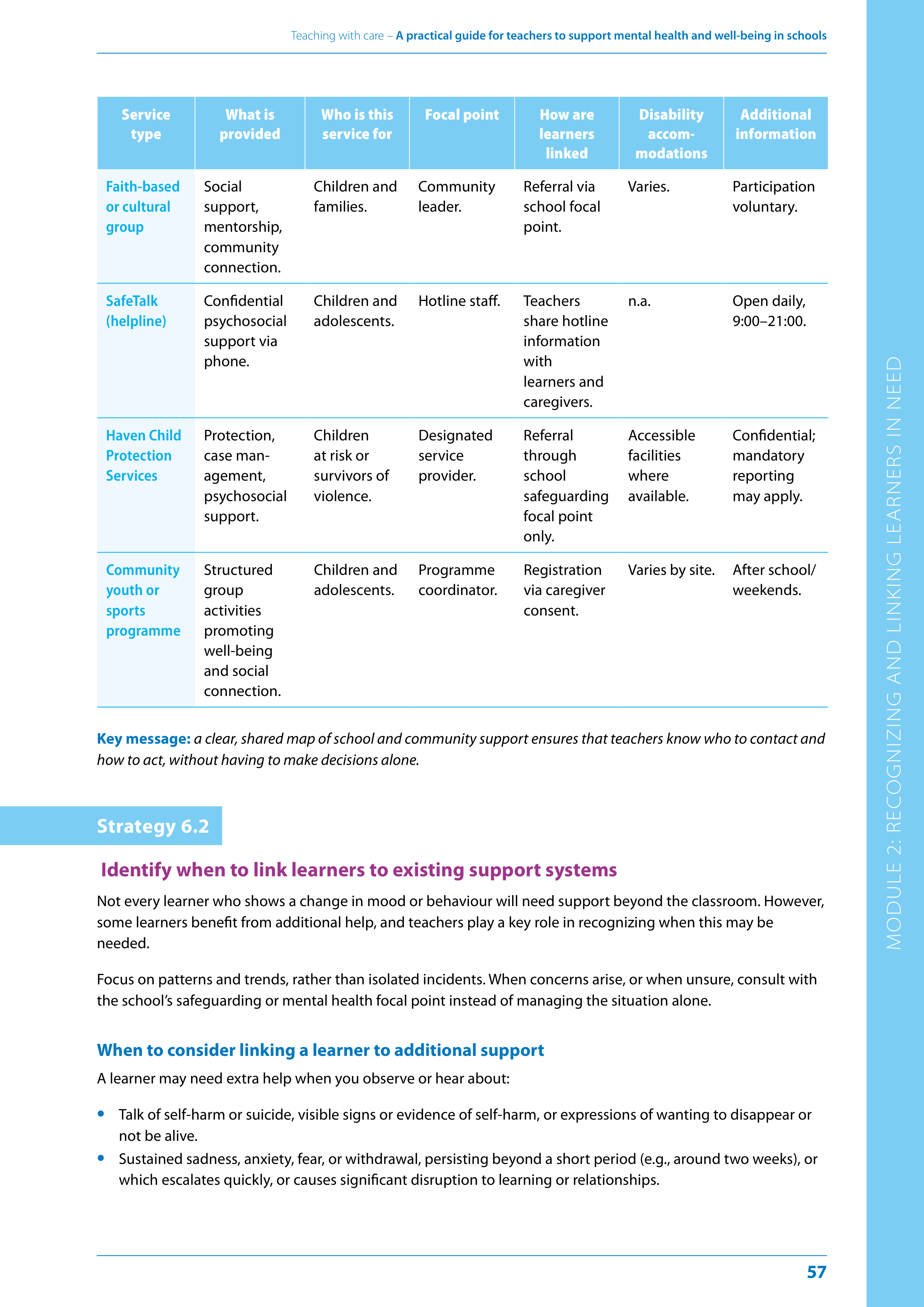
57
Teaching with care –
A practical guide for teachers to support mental health and well-being in schools
MODULE 2: RECOGNIZING AND LINKING LEARNERS IN NEED
Service
type
What is
provided
Who is this
service for
Focal point
How are
learners
linked
Disability
accom
modations
Additional
information
Faith-based
or cultural
group
Social
support,
mentorship,
community
connection.
Children and
families.
Community
leader.
Referral via
school focal
point.
Varies.
Participation
voluntary.
SafeTalk
(helpline)
Confidential
psychosocial
support via
phone.
Children and
adolescents.
Hotline staff.
Teachers
share hotline
information
with
learners and
caregivers.
n.a.
Open daily,
9:00–21:00.
Haven Child
Protection
Services
Protection,
case man-
agement,
psychosocial
support.
Children
at risk or
survivors of
violence.
Designated
service
provider.
Referral
through
school
safeguarding
focal point
only.
Accessible
facilities
where
available.
Confidential;
mandatory
reporting
may apply.
Community
youth or
sports
programme
Structured
group
activities
promoting
well-being
and social
connection.
Children and
adolescents.
Programme
coordinator.
Registration
via caregiver
consent.
Varies by site.
After school/
weekends.
Key message:
a clear, shared map of school and community support ensures that teachers know who to contact and
how to act, without having to make decisions alone.
Strategy 6.2
Identify when to link learners to existing support systems
Not every learner who shows a change in mood or behaviour will need support beyond the classroom. However,
some learners benefit from additional help, and teachers play a key role in recognizing when this may be
needed.
Focus on patterns and trends, rather than isolated incidents. When concerns arise, or when unsure, consult with
the school’s safeguarding or mental health focal point instead of managing the situation alone.
When to consider linking a learner to additional support
A learner may need extra help when you observe or hear about:
•
Talk of self-harm or suicide, visible signs or evidence of self-harm, or expressions of wanting to disappear or
not be alive.
•
Sustained sadness, anxiety, fear, or withdrawal, persisting beyond a short period (e.g., around two weeks), or
which escalates quickly, or causes significant disruption to learning or relationships.
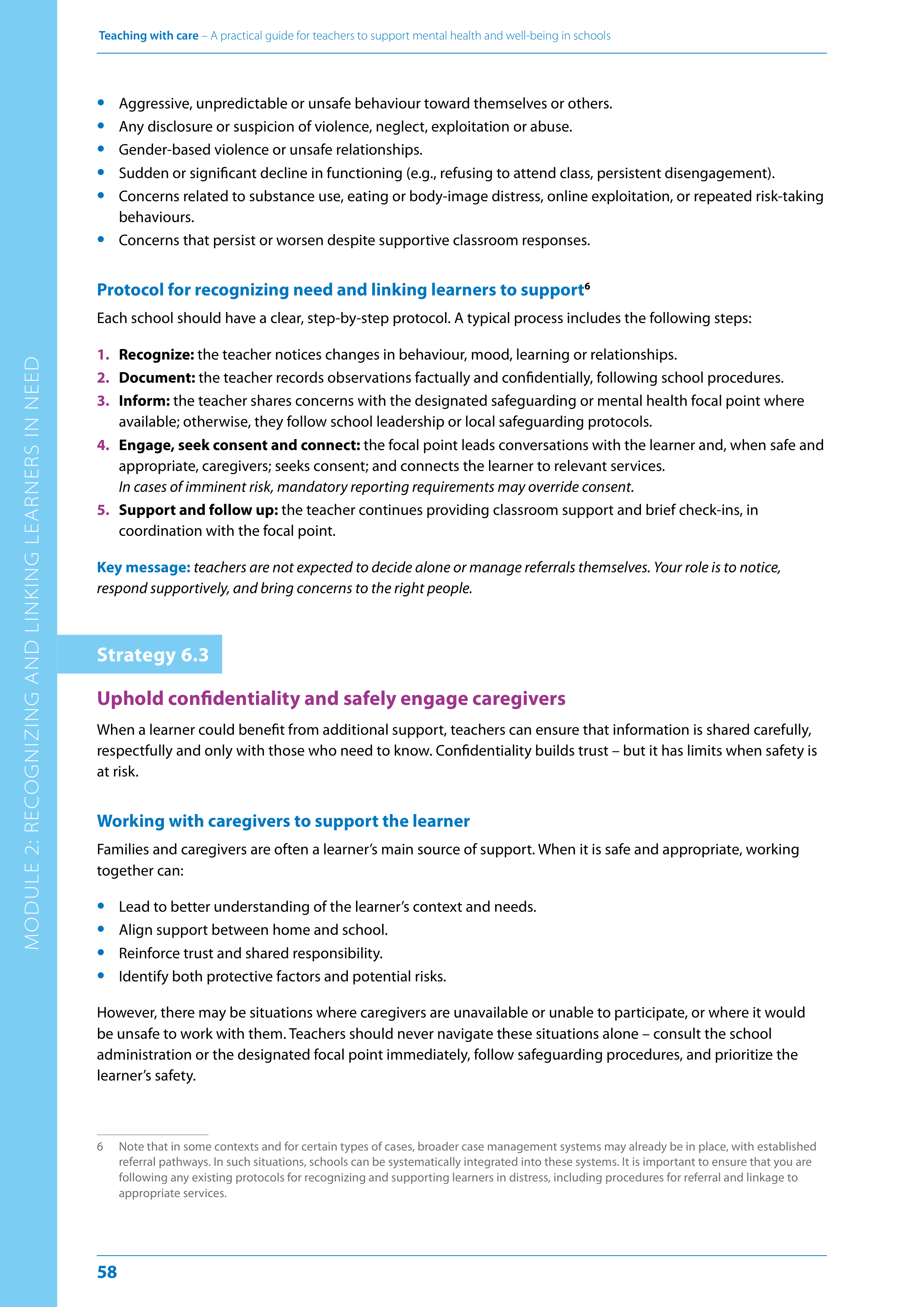
58
Teaching with care
– A practical guide for teachers to support mental health and well-being in schools
MODULE 2: RECOGNIZING AND LINKING LEARNERS IN NEED
•
Aggressive, unpredictable or unsafe behaviour toward themselves or others.
•
Any disclosure or suspicion of violence, neglect, exploitation or abuse.
•
Gender-based violence or unsafe relationships.
•
Sudden or significant decline in functioning (e.g., refusing to attend class, persistent disengagement).
•
Concerns related to substance use, eating or body-image distress, online exploitation, or repeated risk-taking
behaviours.
•
Concerns that persist or worsen despite supportive classroom responses.
Protocol for recognizing need and linking learners to support
6
Each school should have a clear, step-by-step protocol. A typical process includes the following steps:
1.
Recognize:
the teacher notices changes in behaviour, mood, learning or relationships.
2.
Document:
the teacher records observations factually and confidentially, following school procedures.
3.
Inform:
the teacher shares concerns with the designated safeguarding or mental health focal point where
available; otherwise, they follow school leadership or local safeguarding protocols.
4.
Engage, seek consent and connect:
the focal point leads conversations with the learner and, when safe and
appropriate, caregivers; seeks consent; and connects the learner to relevant services.
In cases of imminent risk, mandatory reporting requirements may override consent.
5.
Support and follow up:
the teacher continues providing classroom support and brief check-ins, in
coordination with the focal point.
Key message:
teachers are not expected to decide alone or manage referrals themselves. Your role is to notice,
respond supportively, and bring concerns to the right people.
Strategy 6.3
Uphold confidentiality and safely engage caregivers
When a learner could benefit from additional support, teachers can ensure that information is shared carefully,
respectfully and only with those who need to know. Confidentiality builds trust – but it has limits when safety is
at risk.
Working with caregivers to support the learner
Families and caregivers are often a learner’s main source of support. When it is safe and appropriate, working
together can:
•
Lead to better understanding of the learner’s context and needs.
•
Align support between home and school.
•
Reinforce trust and shared responsibility.
•
Identify both protective factors and potential risks.
However, there may be situations where caregivers are unavailable or unable to participate, or where it would
be unsafe to work with them. Teachers should never navigate these situations alone – consult the school
administration or the designated focal point immediately, follow safeguarding procedures, and prioritize the
learner’s safety.
6
Note that in some contexts and for certain types of cases, broader case management systems may already be in place, with established
referral pathways. In such situations, schools can be systematically integrated into these systems. It is important to ensure that you are
following any existing protocols for recognizing and supporting learners in distress, including procedures for referral and linkage to
appropriate services.
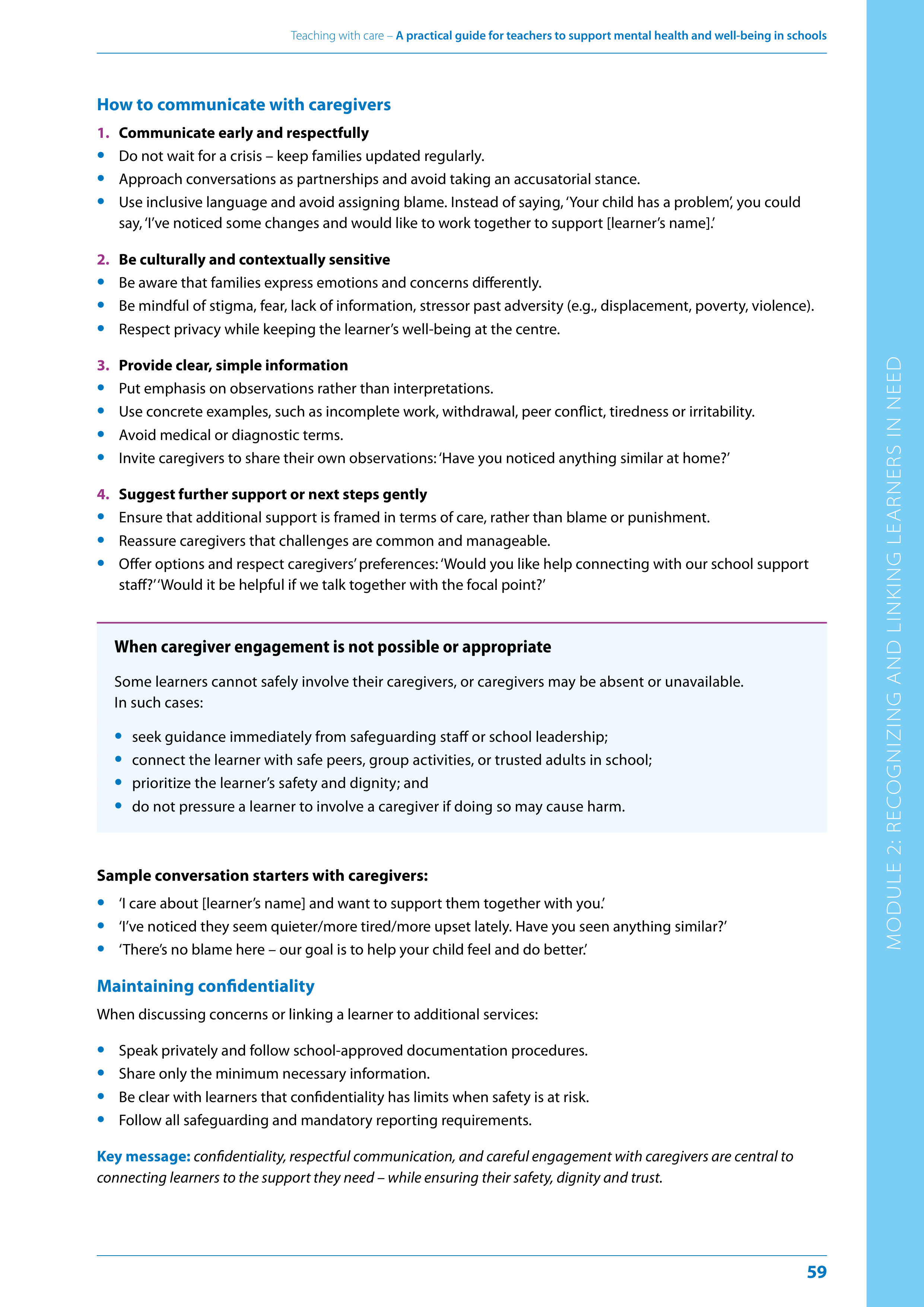
59
Teaching with care –
A practical guide for teachers to support mental health and well-being in schools
MODULE 2: RECOGNIZING AND LINKING LEARNERS IN NEED
How to communicate with caregivers
1.
Communicate early and respectfully
•
Do not wait for a crisis – keep families updated regularly.
•
Approach conversations as partnerships and avoid taking an accusatorial stance.
•
Use inclusive language and avoid assigning blame. Instead of saying, ‘Your child has a problem’, you could
say, ‘I’ve noticed some changes and would like to work together to support [learner’s name].’
2.
Be culturally and contextually sensitive
•
Be aware that families express emotions and concerns differently.
•
Be mindful of stigma, fear, lack of information, stressor past adversity (e.g., displacement, poverty, violence).
•
Respect privacy while keeping the learner’s well-being at the centre.
3.
Provide clear, simple information
•
Put emphasis on observations rather than interpretations.
•
Use concrete examples, such as incomplete work, withdrawal, peer conflict, tiredness or irritability.
•
Avoid medical or diagnostic terms.
•
Invite caregivers to share their own observations: ‘Have you noticed anything similar at home?’
4.
Suggest further support or next steps gently
•
Ensure that additional support is framed in terms of care, rather than blame or punishment.
•
Reassure caregivers that challenges are common and manageable.
•
Offer options and respect caregivers’ preferences: ‘Would you like help connecting with our school support
staff?’ ‘Would it be helpful if we talk together with the focal point?’
When caregiver engagement is not possible or appropriate
Some learners cannot safely involve their caregivers, or caregivers may be absent or unavailable.
In such cases:
•
seek guidance immediately from safeguarding staff or school leadership;
•
connect the learner with safe peers, group activities, or trusted adults in school;
•
prioritize the learner’s safety and dignity; and
•
do not pressure a learner to involve a caregiver if doing so may cause harm.
Sample conversation starters with caregivers:
•
‘I care about [learner’s name] and want to support them together with you.’
•
‘I’ve noticed they seem quieter/more tired/more upset lately. Have you seen anything similar?’
•
‘There’s no blame here – our goal is to help your child feel and do better.’
Maintaining confidentiality
When discussing concerns or linking a learner to additional services:
•
Speak privately and follow school-approved documentation procedures.
•
Share only the minimum necessary information.
•
Be clear with learners that confidentiality has limits when safety is at risk.
•
Follow all safeguarding and mandatory reporting requirements.
Key message:
confidentiality, respectful communication, and careful engagement with caregivers are central to
connecting learners to the support they need – while ensuring their safety, dignity and trust.
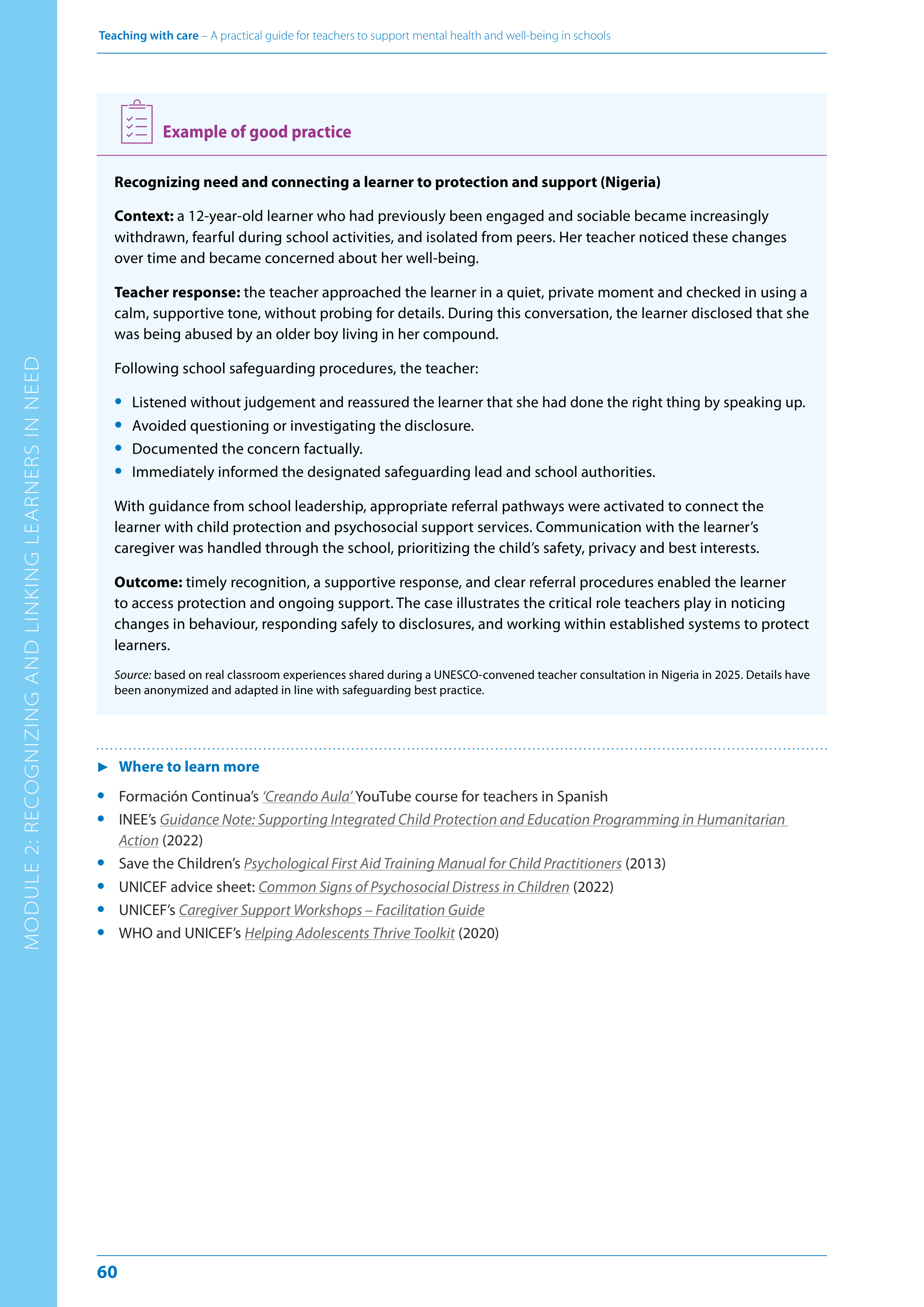
60
Teaching with care
– A practical guide for teachers to support mental health and well-being in schools
MODULE 2: RECOGNIZING AND LINKING LEARNERS IN NEED
Example of good practice
Recognizing need and connecting a learner to protection and support (Nigeria)
Context:
a 12-year-old learner who had previously been engaged and sociable became increasingly
withdrawn, fearful during school activities, and isolated from peers. Her teacher noticed these changes
over time and became concerned about her well-being.
Teacher response:
the teacher approached the learner in a quiet, private moment and checked in using a
calm, supportive tone, without probing for details. During this conversation, the learner disclosed that she
was being abused by an older boy living in her compound.
Following school safeguarding procedures, the teacher:
•
Listened without judgement and reassured the learner that she had done the right thing by speaking up.
•
Avoided questioning or investigating the disclosure.
•
Documented the concern factually.
•
Immediately informed the designated safeguarding lead and school authorities.
With guidance from school leadership, appropriate referral pathways were activated to connect the
learner with child protection and psychosocial support services. Communication with the learner’s
caregiver was handled through the school, prioritizing the child’s safety, privacy and best interests.
Outcome:
timely recognition, a supportive response, and clear referral procedures enabled the learner
to access protection and ongoing support. The case illustrates the critical role teachers play in noticing
changes in behaviour, responding safely to disclosures, and working within established systems to protect
learners.
Source:
based on real classroom experiences shared during a UNESCO-convened teacher consultation in Nigeria in 2025. Details have
been anonymized and adapted in line with safeguarding best practice.
T
Where to learn more
•
Formación Continua’s
‘Creando Aula’
YouTube course for teachers in Spanish
•
INEE’s
Guidance Note: Supporting Integrated Child Protection and Education Programming in Humanitarian
Action
(2022)
•
Save the Children’s
Psychological First Aid Training Manual for Child Practitioners
(2013)
•
UNICEF advice sheet:
Common Signs of Psychosocial Distress in Children
(2022)
•
UNICEF’s
Caregiver Support Workshops – Facilitation Guide
•
WHO and UNICEF’s
Helping Adolescents Thrive Toolkit
(2020)
61
Teaching with care –
A practical guide for teachers to support mental health and well-being in schools
MODULE 2: RECOGNIZING AND LINKING LEARNERS IN NEED
Module 2 Adaptations
Low-resource settings
In low-resource settings, access to formal mental health or protection services may be limited or unavailable.
While this can be challenging, it is still possible to provide meaningful support for learners. A teacher’s
consistent, caring presence is often one of the strongest protective factors a learner can have.
At the same time, teachers are not expected to act as mental health professionals or case managers. Focus
instead on understanding what support systems do exist – both formal and non-formal – within the school
and the wider community. These may include youth clubs, safe spaces run by community leaders, faith-based
activities, or informal peer-support groups. Speaking with caregivers, colleagues and school leadership can help
identify trusted local resources.
Linking learners to even small, informal, locally available support systems can strengthen their sense of safety
and connection. When concerns exceed what can be addressed in the classroom, follow school procedures and
consult designated focal points to determine safe next steps.
Displacement or crisis-affected settings
In displacement or crisis-affected contexts, learners may experience ongoing instability, loss or uncertainty.
Predictability, calm routines and clear expectations are especially important in these settings.
When appropriate, teachers can create
optional and non-intrusive opportunities
(e.g., offering a brief check-
in or a quiet chance to talk without pressure) for learners to express how their environment is affecting them.
Participation should always be voluntary. Avoid pressing learners to share personal experiences or details of
harm.
Focus classroom discussions on:
•
Normalizing a range of emotional responses.
•
Reinforcing safety and mutual respect.
•
Strengthening peer support and collective coping.
If learners show signs of distress that persist or intensify, follow the referral guidance in this module and consult
designated safeguarding or mental health focal points. For additional guidance on classroom-based approaches
in crisis settings, refer to Module 4.6 of Thriving Through Play (The MHPSS Collaborative, 2024).
Learners with disabilities or neurodivergence
Learners with disabilities or neurodivergence may face heightened risks of misunderstanding, exclusion, or stigma
that affect their well-being. They experience unmet mental health support needs more often than their peers.
Teachers can support these learners by:
•
Challenging stigma and misconceptions in the classroom and valuing diversities.
•
Ensuring reasonable accommodations and accessible communication.
•
Promoting meaningful participation in learning and peer activities.
•
Paying attention to changes from the learner’s usual patterns, rather than isolated behaviours.
Work closely with school leadership, specialist staff, and caregivers when available. When concerns arise, follow
established procedures to ensure learners receive appropriate support while respecting dignity, privacy and
autonomy.
62
Teaching with care
– A practical guide for teachers to support mental health and well-being in schools
MODULE 2: RECOGNIZING AND LINKING LEARNERS IN NEED
Module 2 Self-assessment and reflection
This module introduced practical ways to recognize learner distress, respond within your role, and connect
learners to additional support safely. Use the questions below for individual reflection or discuss them with
colleagues.
Recognizing and responding to distress
Â
What surprised you when comparing your own list of risk and protective factors with the examples
provided?
Â
Which protective factors are already present in your classroom or school, and how could you strengthen
them?
Â
Which risk factors are most common among your learners, and how do they influence participation,
behaviour, or learning?
Â
How confident do you feel in your capacity to recognize early signs of distress? What additional guidance,
training or support would help?
Â
When reading the vignettes, did you recognize similar situations among your learners?
Â
Which supportive communication skills (listening, empathy, validation, grounding) will you use more
intentionally in your daily practice?
Identifying and linking learners to additional support
Â
Who are the key colleagues or focal points you would consult if you were concerned about a learner?
Â
How can you strengthen communication and collaboration with caregivers, community leaders and local
organizations?
Â
What challenges do you anticipate in linking learners to support, and how could you address them?
Â
What challenges may arise when working with caregivers, and what strategies could help ensure safety,
trust and collaboration?
63
Teaching with care –
A practical guide for teachers to support mental health and well-being in schools
Module 3
Caring for yourself and your colleagues
64
Teaching with care
– A practical guide for teachers to support mental health and well-being in schools
MODULE 3: CARING FOR YOURSELF AND YOUR COLLEAGUES
Module 3
Caring for yourself and your colleagues
Teaching can be deeply meaningful – but it can also be emotionally demanding,
especially in settings where learners face adversity or stress. This module focuses
on practical, realistic ways to help you protect your own well-being, manage stress
and support colleagues when challenges arise.
The strategies in Modules 1 and 2 can strengthen classroom relationships and reduce daily pressures, but they
are not enough on their own. Teachers also need dedicated approaches to sustain their energy, set healthy
boundaries, and prevent exhaustion over time.
Caring for yourself is not a luxury, and it is not solely an individual responsibility. It is a necessary foundation
for supporting learners effectively and sustainably. In the same way, caring for colleagues helps build a school
culture where staff feel supported, connected and able to cope with difficult situations together.
This module introduces strategies you can use both individually and collectively – even in low-resource or crisis-
affected settings – to strengthen well-being across the teaching community.
Action 7:
Take care of your own well-being in everyday practice
What this involves and why it matters
Daily classroom pressures, combined with responsibilities beyond school, can accumulate and affect energy,
focus, decision-making, and emotional availability. Research consistently shows that teacher well-being and
social-emotional competence are closely linked to learners’ well-being, safety and learning outcomes.
Taking care of yourself is therefore not optional or individualistic. It is foundational to quality teaching and to
a functioning MHPSS ecosystem. When teachers feel supported, capable and balanced, they are better able to
build relationships, notice distress, respond constructively, and sustain their work over time.
This action offers practical strategies for everyday practice to support teacher well-being across four interrelated
areas:
•
Self-efficacy (confidence in your ability to cope and teach effectively).
•
Job satisfaction.
•
Social-emotional competence.
•
Reducing stress and burnout risks.
These strategies recognize that teacher well-being is shaped not only by individual habits, but also by working
conditions, relationships, cultural expectations and available support structures.
T
Reflection moment
•
Think of a time when personal or professional pressures felt overwhelming. How did this affect your focus,
patience or ability to respond to learners? Reflecting on these moments helps clarify why sustaining your
own well-being is essential – not only for yourself, but for your learners.
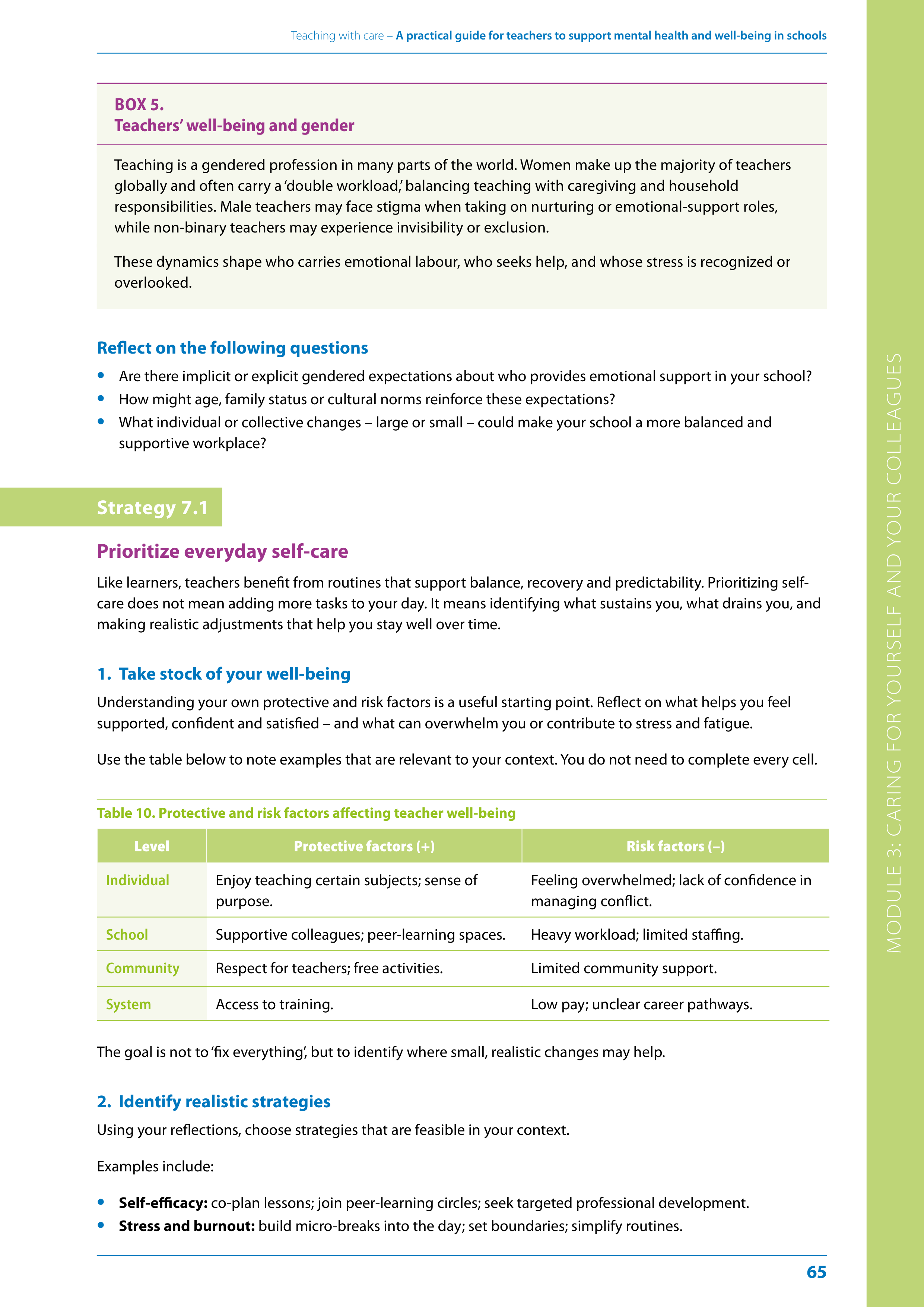
65
Teaching with care –
A practical guide for teachers to support mental health and well-being in schools
MODULE 3: CARING FOR YOURSELF AND YOUR COLLEAGUES
BOX 5.
Teachers’ well-being and gender
Teaching is a gendered profession in many parts of the world. Women make up the majority of teachers
globally and often carry a ‘double workload,’ balancing teaching with caregiving and household
responsibilities. Male teachers may face stigma when taking on nurturing or emotional-support roles,
while non-binary teachers may experience invisibility or exclusion.
These dynamics shape who carries emotional labour, who seeks help, and whose stress is recognized or
overlooked.
Reflect on the following questions
•
Are there implicit or explicit gendered expectations about who provides emotional support in your school?
•
How might age, family status or cultural norms reinforce these expectations?
•
What individual or collective changes – large or small – could make your school a more balanced and
supportive workplace?
Strategy 7.1
Prioritize everyday self-care
Like learners, teachers benefit from routines that support balance, recovery and predictability. Prioritizing self-
care does not mean adding more tasks to your day. It means identifying what sustains you, what drains you, and
making realistic adjustments that help you stay well over time.
1. Take stock of your well-being
Understanding your own protective and risk factors is a useful starting point. Reflect on what helps you feel
supported, confident and satisfied – and what can overwhelm you or contribute to stress and fatigue.
Use the table below to note examples that are relevant to your context. You do not need to complete every cell.
Table 10. Protective and risk factors affecting teacher well-being
Level
Protective factors (+)
Risk factors (–)
Individual
Enjoy teaching certain subjects; sense of
purpose.
Feeling overwhelmed; lack of confidence in
managing conflict.
School
Supportive colleagues; peer-learning spaces.
Heavy workload; limited staffing.
Community
Respect for teachers; free activities.
Limited community support.
System
Access to training.
Low pay; unclear career pathways.
The goal is not to ‘fix everything’, but to identify where small, realistic changes may help.
2. Identify realistic strategies
Using your reflections, choose strategies that are feasible in your context.
Examples include:
•
Self-efficacy:
co-plan lessons; join peer-learning circles; seek targeted professional development.
•
Stress and burnout:
build micro-breaks into the day; set boundaries; simplify routines.
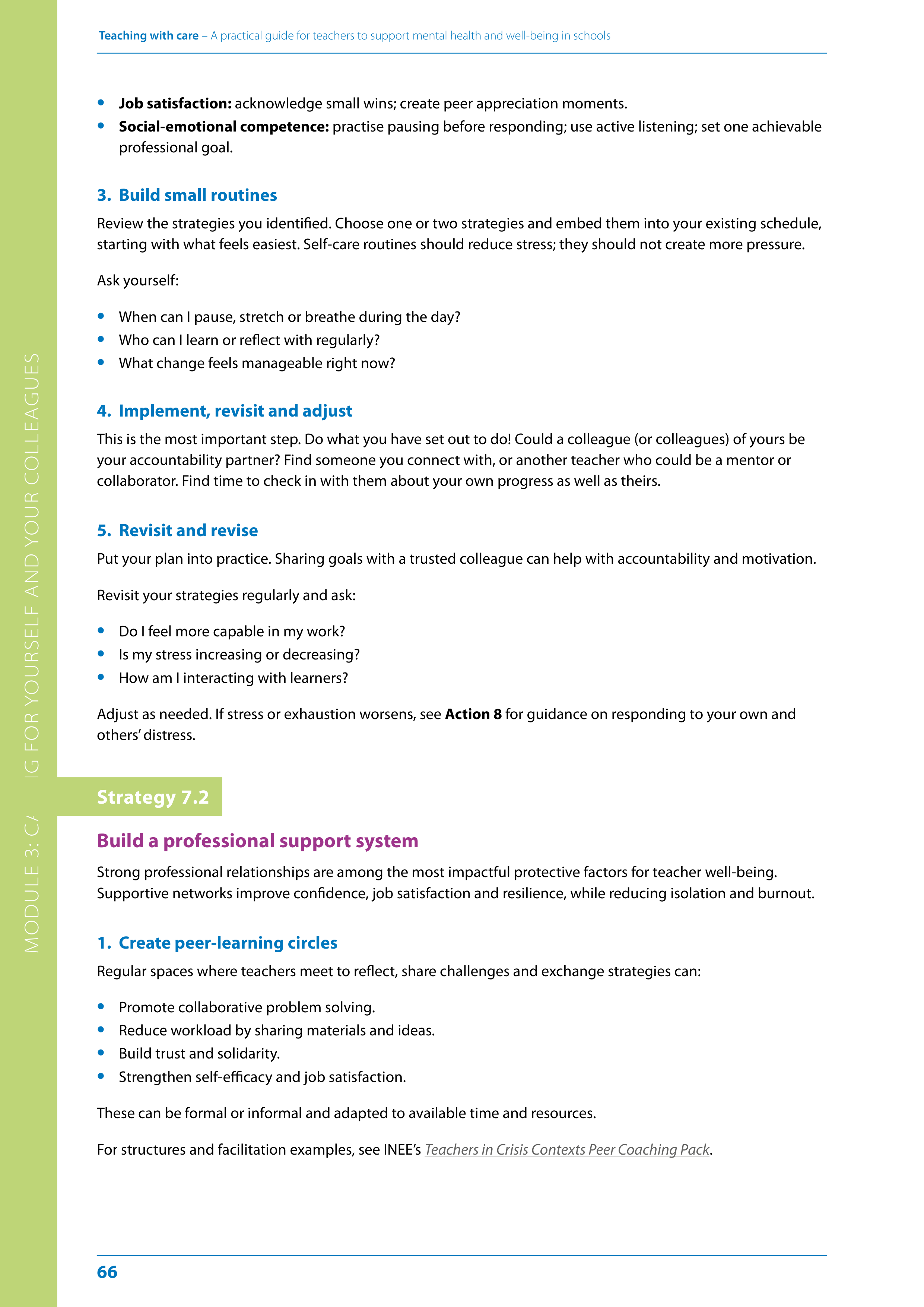
66
Teaching with care
– A practical guide for teachers to support mental health and well-being in schools
MODULE 3: CARING FOR YOURSELF AND YOUR COLLEAGUES
•
Job satisfaction:
acknowledge small wins; create peer appreciation moments.
•
Social-emotional competence:
practise pausing before responding; use active listening; set one achievable
professional goal.
3. Build small routines
Review the strategies you identified. Choose one or two strategies and embed them into your existing schedule,
starting with what feels easiest. Self-care routines should reduce stress; they should not create more pressure.
Ask yourself:
•
When can I pause, stretch or breathe during the day?
•
Who can I learn or reflect with regularly?
•
What change feels manageable right now?
4. Implement, revisit and adjust
This is the most important step. Do what you have set out to do! Could a colleague (or colleagues) of yours be
your accountability partner? Find someone you connect with, or another teacher who could be a mentor or
collaborator. Find time to check in with them about your own progress as well as theirs.
5. Revisit and revise
Put your plan into practice. Sharing goals with a trusted colleague can help with accountability and motivation.
Revisit your strategies regularly and ask:
•
Do I feel more capable in my work?
•
Is my stress increasing or decreasing?
•
How am I interacting with learners?
Adjust as needed. If stress or exhaustion worsens, see
Action 8
for guidance on responding to your own and
others’ distress.
Strategy 7.2
Build a professional support system
Strong professional relationships are among the most impactful protective factors for teacher well-being.
Supportive networks improve confidence, job satisfaction and resilience, while reducing isolation and burnout.
1. Create peer-learning circles
Regular spaces where teachers meet to reflect, share challenges and exchange strategies can:
•
Promote collaborative problem solving.
•
Reduce workload by sharing materials and ideas.
•
Build trust and solidarity.
•
Strengthen self-efficacy and job satisfaction.
These can be formal or informal and adapted to available time and resources.
For structures and facilitation examples, see INEE’s
Teachers in Crisis Contexts Peer Coaching Pack
.
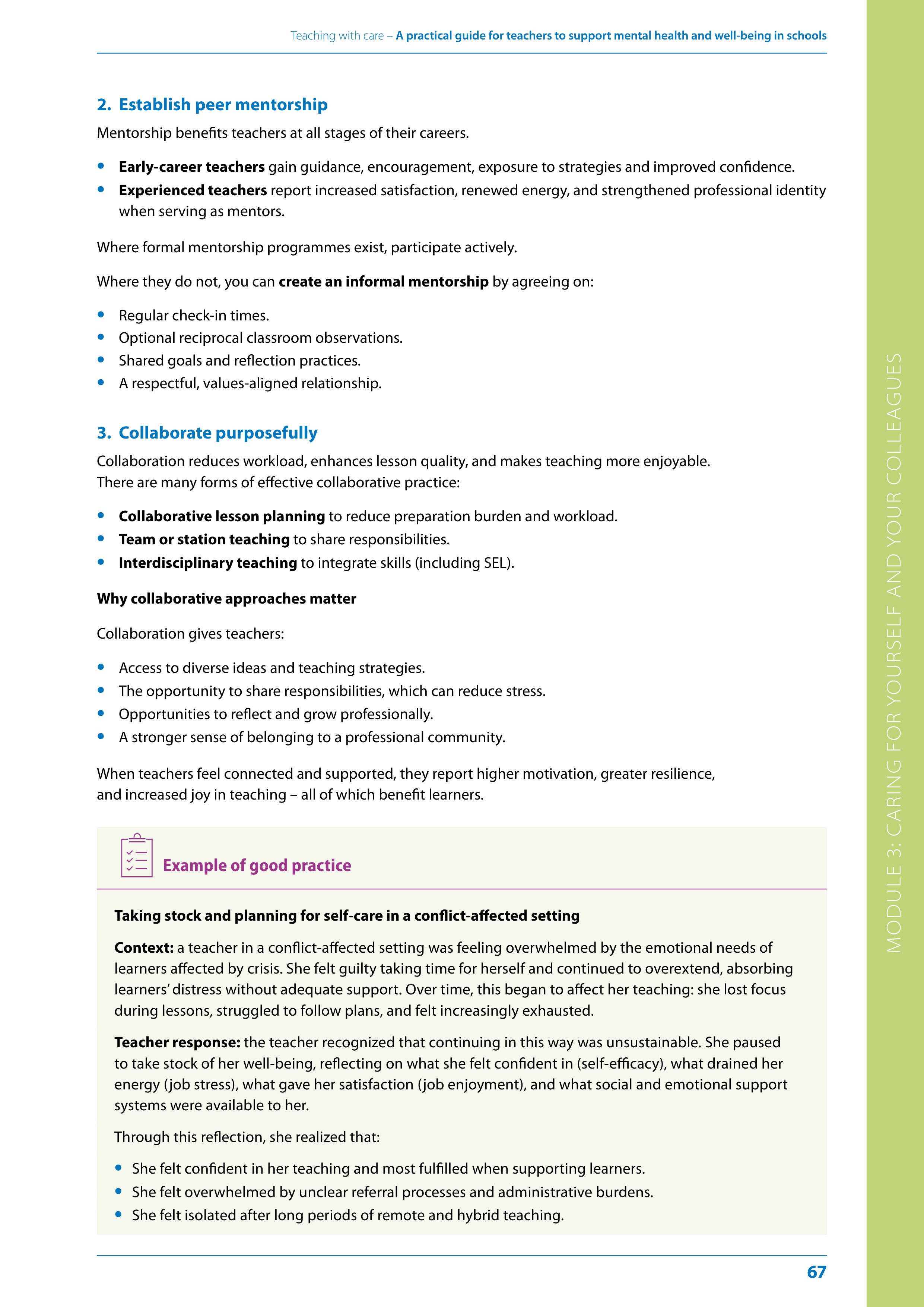
67
Teaching with care –
A practical guide for teachers to support mental health and well-being in schools
MODULE 3: CARING FOR YOURSELF AND YOUR COLLEAGUES
2. Establish peer mentorship
Mentorship benefits teachers at all stages of their careers.
•
Early-career teachers
gain guidance, encouragement, exposure to strategies and improved confidence.
•
Experienced teachers
report increased satisfaction, renewed energy, and strengthened professional identity
when serving as mentors.
Where formal mentorship programmes exist, participate actively.
Where they do not, you can
create an informal mentorship
by agreeing on:
•
Regular check-in times.
•
Optional reciprocal classroom observations.
•
Shared goals and reflection practices.
•
A respectful, values-aligned relationship.
3. Collaborate purposefully
Collaboration reduces workload, enhances lesson quality, and makes teaching more enjoyable.
There are many forms of effective collaborative practice:
•
Collaborative lesson planning
to reduce preparation burden and workload.
•
Team or station teaching
to share responsibilities.
•
Interdisciplinary teaching
to integrate skills (including SEL).
Why collaborative approaches matter
Collaboration gives teachers:
•
Access to diverse ideas and teaching strategies.
•
The opportunity to share responsibilities, which can reduce stress.
•
Opportunities to reflect and grow professionally.
•
A stronger sense of belonging to a professional community.
When teachers feel connected and supported, they report higher motivation, greater resilience,
and increased joy in teaching – all of which benefit learners.
Example of good practice
Taking stock and planning for self-care in a conflict-affected setting
Context:
a teacher in a conflict-affected setting was feeling overwhelmed by the emotional needs of
learners affected by crisis. She felt guilty taking time for herself and continued to overextend, absorbing
learners’ distress without adequate support. Over time, this began to affect her teaching: she lost focus
during lessons, struggled to follow plans, and felt increasingly exhausted.
Teacher response:
the teacher recognized that continuing in this way was unsustainable. She paused
to take stock of her well-being, reflecting on what she felt confident in (self-efficacy), what drained her
energy (job stress), what gave her satisfaction (job enjoyment), and what social and emotional support
systems were available to her.
Through this reflection, she realized that:
•
She felt confident in her teaching and most fulfilled when supporting learners.
•
She felt overwhelmed by unclear referral processes and administrative burdens.
•
She felt isolated after long periods of remote and hybrid teaching.
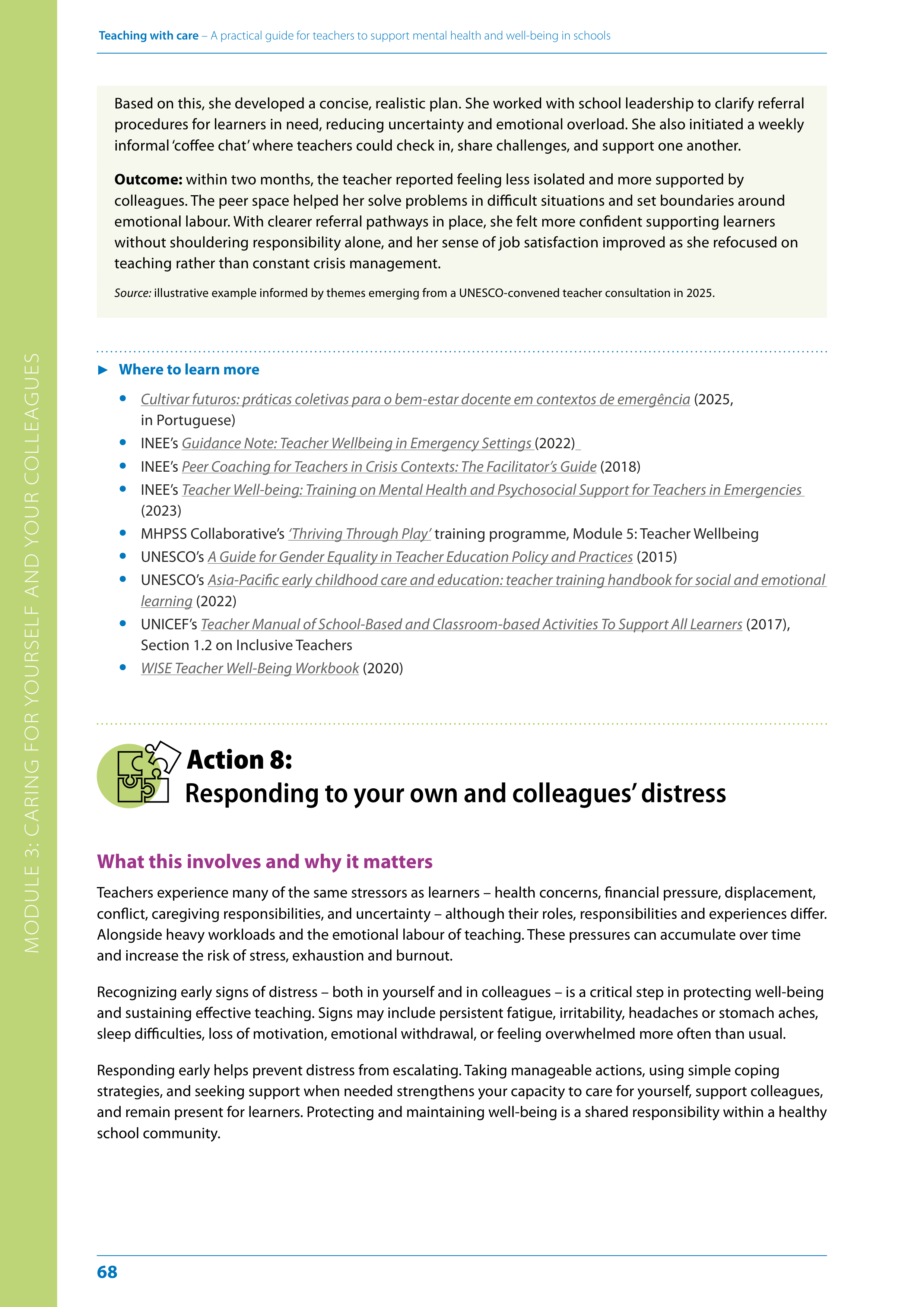
68
Teaching with care
– A practical guide for teachers to support mental health and well-being in schools
MODULE 3: CARING FOR YOURSELF AND YOUR COLLEAGUES
Based on this, she developed a concise, realistic plan. She worked with school leadership to clarify referral
procedures for learners in need, reducing uncertainty and emotional overload. She also initiated a weekly
informal ‘coffee chat’ where teachers could check in, share challenges, and support one another.
Outcome:
within two months, the teacher reported feeling less isolated and more supported by
colleagues. The peer space helped her solve problems in difficult situations and set boundaries around
emotional labour. With clearer referral pathways in place, she felt more confident supporting learners
without shouldering responsibility alone, and her sense of job satisfaction improved as she refocused on
teaching rather than constant crisis management.
Source:
illustrative example informed by themes emerging from a UNESCO-convened teacher consultation in 2025.
T
Where to learn more
•
Cultivar futuros: práticas coletivas para o bem-estar docente em contextos de emergência
(2025,
in Portuguese)
•
INEE’s
Guidance Note: Teacher Wellbeing in Emergency Settings
(2022)
•
INEE’s
Peer Coaching for Teachers in Crisis Contexts: The Facilitator’s Guide
(2018)
•
INEE’s
Teacher Well-being: Training on Mental Health and Psychosocial Support for Teachers in Emergencies
(2023)
•
MHPSS Collaborative’s
‘Thriving Through Play’
training programme, Module 5: Teacher Wellbeing
•
UNESCO’s
A Guide for Gender Equality in Teacher Education Policy and Practices
(2015)
•
UNESCO’s
Asia-Pacific early childhood care and education: teacher training handbook for social and emotional
learning
(2022)
•
UNICEF’s
Teacher Manual of School-Based and Classroom-based Activities To Support All Learners
(2017),
Section 1.2 on Inclusive Teachers
•
WISE Teacher Well-Being Workbook
(2020)
Action 8:
Responding to your own and colleagues’ distress
What this involves and why it matters
Teachers experience many of the same stressors as learners – health concerns, financial pressure, displacement,
conflict, caregiving responsibilities, and uncertainty – although their roles, responsibilities and experiences differ.
Alongside heavy workloads and the emotional labour of teaching. These pressures can accumulate over time
and increase the risk of stress, exhaustion and burnout.
Recognizing early signs of distress – both in yourself and in colleagues – is a critical step in protecting well-being
and sustaining effective teaching. Signs may include persistent fatigue, irritability, headaches or stomach aches,
sleep difficulties, loss of motivation, emotional withdrawal, or feeling overwhelmed more often than usual.
Responding early helps prevent distress from escalating. Taking manageable actions, using simple coping
strategies, and seeking support when needed strengthens your capacity to care for yourself, support colleagues,
and remain present for learners. Protecting and maintaining well-being is a shared responsibility within a healthy
school community.
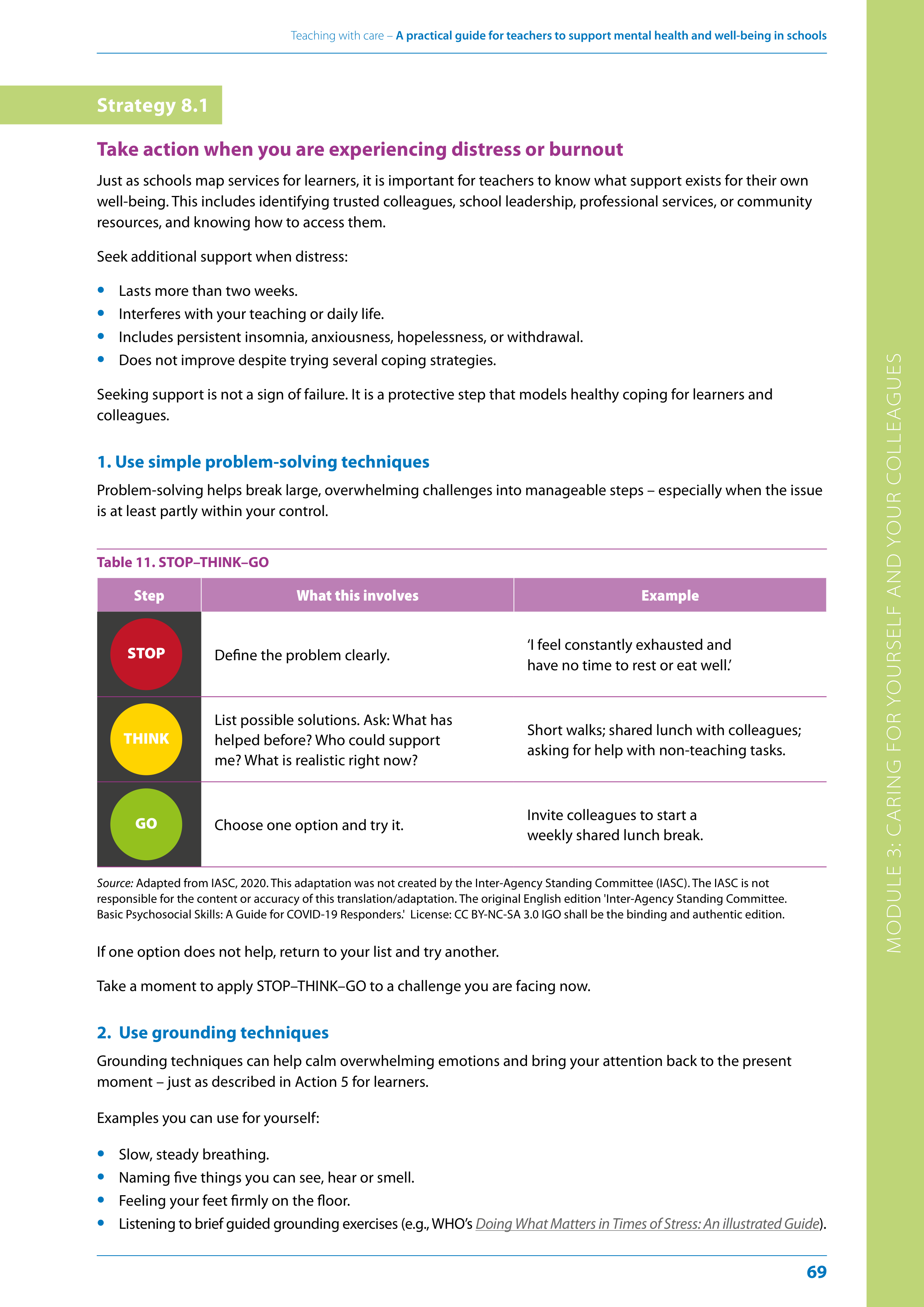
69
Teaching with care –
A practical guide for teachers to support mental health and well-being in schools
MODULE 3: CARING FOR YOURSELF AND YOUR COLLEAGUES
Strategy 8.1
Take action when you are experiencing distress or burnout
Just as schools map services for learners, it is important for teachers to know what support exists for their own
well-being. This includes identifying trusted colleagues, school leadership, professional services, or community
resources, and knowing how to access them.
Seek additional support when distress:
•
Lasts more than two weeks.
•
Interferes with your teaching or daily life.
•
Includes persistent insomnia, anxiousness, hopelessness, or withdrawal.
•
Does not improve despite trying several coping strategies.
Seeking support is not a sign of failure. It is a protective step that models healthy coping for learners and
colleagues.
1. Use simple problem-solving techniques
Problem-solving helps break large, overwhelming challenges into manageable steps – especially when the issue
is at least partly within your control.
Table 11. STOP–THINK–GO
Step
What this involves
Example
STOP
Define the problem clearly.
‘I feel constantly exhausted and
have no time to rest or eat well.’
THINK
List possible solutions. Ask: What has
helped before? Who could support
me? What is realistic right now?
Short walks; shared lunch with colleagues;
asking for help with non-teaching tasks.
GO
Choose one option and try it.
Invite colleagues to start a
weekly shared lunch break.
Source:
Adapted from IASC, 2020. This adaptation was not created by the Inter-Agency Standing Committee (IASC). The IASC is not
responsible for the content or accuracy of this translation/adaptation. The original English edition 'Inter-Agency Standing Committee.
Basic Psychosocial Skills: A Guide for COVID-19 Responders.' License: CC BY-NC-SA 3.0 IGO shall be the binding and authentic edition.
If one option does not help, return to your list and try another.
Take a moment to apply STOP–THINK–GO to a challenge you are facing now.
2. Use grounding techniques
Grounding techniques can help calm overwhelming emotions and bring your attention back to the present
moment – just as described in Action 5 for learners.
Examples you can use for yourself:
•
Slow, steady breathing.
•
Naming five things you can see, hear or smell.
•
Feeling your feet firmly on the floor.
•
Listening to brief guided grounding exercises (e.g., WHO’s
Doing What Matters in Times of Stress: An illustrated Guide
).
70
Teaching with care
– A practical guide for teachers to support mental health and well-being in schools
MODULE 3: CARING FOR YOURSELF AND YOUR COLLEAGUES
Strategy 8.2
Support colleagues who may be experiencing distress or burnout
The same supportive approaches you use for yourself – problem-solving, grounding, routine check-ins – can
help colleagues. You are not expected to offer counselling, but you
can
provide understanding, reduce isolation
and encourage early help-seeking.
Ways to build supportive peer relationships:
1.
Agree to check in regularly:
brief, consistent check-ins (weekly, after stressful periods, or before staff
meetings) help normalize sharing and support.
2.
Share signs of distress or burnout:
let colleagues know what stress looks like for you (e.g., irritability,
skipping breaks). Invite them to share their own signs so you can notice changes early.
3.
Use supportive techniques together:
try grounding or STOP–THINK–GO together during the school day.
Take short breaks together to reset.
4.
Share helpful resources:
exchange local service information or school support contacts.
5.
Encourage early action:
gently remind colleagues of strategies when you notice signs of distress.
Encourage them to reach out for additional support when needed.
Example of good practice
Peer support and check-ins for teacher well-being
Context:
teachers in Singapore and Nigeria described growing emotional and professional demands and
recognized the need for simple, intentional ways to support one another while continuing to care for
learners.
Teacher response:
colleagues introduced a voluntary ‘well-being buddy’ system. Once a week, pairs
met for ten minutes to share one challenge and one positive moment from the week. Conversations
were guided by active listening and non-judgement, with no expectation to give advice or solve
problems. Over time, this regular check-in built trust and made it easier for teachers to notice early signs
of stress. Colleagues began gently reminding one another to take breaks, rest and acknowledge small
achievements.
Outcome:
the practice strengthened collegial relationships and reduced feelings of isolation. Teachers
reported feeling more supported and emotionally resilient, as well as better able to manage stress. The
initiative reinforced a shared understanding that caring for one another helps sustain teachers’ well-being
and strengthens their capacity to support learners.
Source:
illustrative example based on real classroom and staff experiences shared by teachers in Singapore and Nigeria in UNESCO-
convened consultations conducted in 2025; details anonymized.
T
Where to learn more
•
IASC’s
Basic Psychosocial Skills: A Guide for COVID-19 Responders
(2020). See Module 4: Supporting people
who are experiencing stress
•
INEE online resource:
Promising Practices in Teacher Well-being, Management, and School Leadership
•
WHO’s
Doing What Matters in Times of Stress: An Illustrated Guide
(2020)
71
Teaching with care –
A practical guide for teachers to support mental health and well-being in schools
MODULE 3: CARING FOR YOURSELF AND YOUR COLLEAGUES
Module 3 Adaptations
Low-resource settings
As in Module 2, limited access to formal mental health or social services can make it harder for teachers to find
support. Even so, meaningful sources of care often exist outside formal systems. Look for:
•
Community-based, youth-led, or faith-based groups that offer safe spaces, structured activities, or emotional
support.
•
Peer strategies already used in your school or community, such as informal sharing groups, rotating lesson
planning, or collaborative supervision.
Understanding and connecting with all available support systems – formal or informal – can help create a
broader network around you and reduce isolation, especially during stressful periods.
Online or remote teaching
When teaching remotely, teachers may feel disconnected from both learners and colleagues. Signs of stress
among peers can also be harder to notice.
What can help:
•
Schedule regular online check-ins
with colleagues, team meetings, or informal conversations.
•
Build intentional breaks away from the screen
, even brief ones, to restore focus and prevent fatigue.
•
Create opportunities for in-person connection
when possible – short social interactions or shared
planning sessions can reduce isolation.
•
Adjust self-care routines
to online work, such as stretching, mindful breathing, or creating a designated
workspace.
Displacement or crisis-affected settings
Teaching in displacement or crisis-affected settings often means sharing many of the same stressors as learners –
disrupted routines, instability, limited resources, or concerns about safety.
You may experience:
•
Larger class sizes and scarce materials.
•
Frequent emotional demands from learners and families.
•
Emotional overload, exhaustion, or uncertainty around meeting competing needs.
Because these pressures can accumulate quickly, it becomes essential to:
•
Notice
early signs of distress and burnout
in yourself.
•
Use
everyday self-care routines
to stabilize your own well-being.
•
Stay connected with colleagues for
mutual support
.
•
Seek help early when signs persist or intensify.
Protecting your well-being in these environments is not optional – it is a necessary foundation for supporting
learners effectively.
72
Teaching with care
– A practical guide for teachers to support mental health and well-being in schools
MODULE 3: CARING FOR YOURSELF AND YOUR COLLEAGUES
Module 3 Self-assessment and reflection
You have explored practical ways to care for yourself, recognize early signs of distress, and support colleagues.
Use the questions below for individual reflection or group discussion with colleagues.
Taking care of your own well-being in everyday practice
Â
Which everyday self-care practices will you commit to, and how will they help protect your well-being?
Â
Sketch a
see-saw
: on one side, write the demands you face as a teacher; on the other side, write your
protective factors. Does your see-saw feel balanced, or does it tilt toward demands?
Â
What practices or tools could help you balance demands and protective factors?
Â
What steps will you take to build or strengthen a
professional support system
(e.g., peer-learning circles,
mentorship, collaborative planning)?
Responding to your own and colleagues’ distress
Â
What early signs indicate that you may be experiencing stress or burnout?
Â
Think of a recent moment where you experienced stress and consider:
ʱ
What changed in your behaviour or mood?
ʱ
What helped you recover? What else might have helped?
Â
How can you make your early signs and preferred support measures known to trusted colleagues or loved
ones (e.g., through shared check-ins or a brief list of ‘signs to watch for’)?
Â
What strategies will you use – individually or with colleagues – to support well-being during difficult
periods?
73
Teaching with care –
A practical guide for teachers to support mental health and well-being in schools
Module 4
Leveraging support systems
74
Teaching with care
– A practical guide for teachers to support mental health and well-being in schools
MODULE 4: LEVERAGING SUPPORT SYSTEMS
Module 4
Leveraging support systems
This module explores how teachers can extend their influence beyond
the classroom to strengthen learners’ mental health and psychosocial well-being.
It focuses on two interconnected areas:
Partnering with families and communities:
you will learn practical ways to build respectful, culturally
responsive relationships with caregivers and community members. These partnerships help reinforce learners’
safety, sense of belonging, and coping skills beyond the classroom. Strong collaboration also improves
communication, deepens understanding of learners’ contexts, and ensures that support is consistent across
school, family and community settings.
Advocating for supportive school and system environments:
you will explore how everyday teacher actions
– such as raising concerns, proposing solutions, joining school committees, or sharing evidence from practice
– can shape a more enabling environment for MHPSS. Advocacy at this level helps improve school routines,
resource allocation, staff well-being practices, and referral systems, ultimately creating conditions where
teachers and learners can thrive.
Together, these approaches help extend MHPSS beyond individual interactions into the broader systems that
sustain well-being for learners and teachers.
Action 9:
Working with families and communities
What this involves and why it matters:
Children’s well-being and learning are shaped not only by what happens in the classroom, but by the
relationships, routines, and support systems they experience at home and in the community. When teachers
build strong partnerships with families and communities:
•
Learners receive consistent support across their environments, reinforcing key skills and messages.
•
Families and caregivers feel valued, respected, and empowered to contribute to their children’s learning and
mental health.
•
Communities become invested in the success of the school, creating a broader network of care around
children.
Research consistently shows that close teacher–family–community collaboration improves learner attendance,
motivation, and achievement – and increases teachers’ sense of support and belonging. In crisis-affected or low-
resource contexts, these relationships are often essential for identifying and addressing risks affecting children’s
safety, protection, and psychosocial well-being.
75
Teaching with care –
A practical guide for teachers to support mental health and well-being in schools
MODULE 4: LEVERAGING SUPPORT SYSTEMS
In some contexts, concepts such as learner well-being or mental health may be new, unfamiliar, or understood
differently by families. Some caregivers may believe that strict punishment is necessary to address difficult
behaviour and may expect schools to take a corrective or disciplinary role. When schools adopt learner-centred
approaches – including positive and non-violent discipline – teachers may need to explain these approaches
clearly and consistently. Building shared understanding helps families see how supportive practices promote
both learning and responsible behaviour, and why these approaches are in the child’s best interests.
As you work with families and communities, keep the following in mind:
Families are diverse.
‘Family’ may include parents, grandparents, siblings, extended relatives, guardians, or
other caregivers.
•
Communities hold important knowledge and resources:
local leaders, health workers, youth groups,
NGOs, civil society, and faith-based institutions can offer insight, services, and social support.
•
Partnership is reciprocal:
effective collaboration is built on listening, shared decision-making, and respect
for the knowledge families bring about their children.
•
Culture matters:
local customs, communication styles, roles, and expectations influence how trust is built.
•
Collaboration makes your work easier:
strong partnerships create shared responsibility for children’s
learning and well-being.
•
Relationship-building takes time:
this can feel demanding for teachers with large classes or heavy
workloads. Remember: this work should not fall on you alone. Schools, principals, and staff should share
responsibility for engaging families and community partners.
T
Reflection moment
Think of a time when you interacted with a parent or caregiver. Did the conversation address not only
academic progress, but also the learner’s well-being, interests or experiences outside school?
•
What made the interaction respectful, supportive or productive?
•
Were there misunderstandings? How did you respond?
•
What did you learn from that experience?
Now consider:
what is one small step you could take to strengthen
trust and open communication with families – not only about grades or
behaviour, but about the child’s strengths, needs and overall well-being?
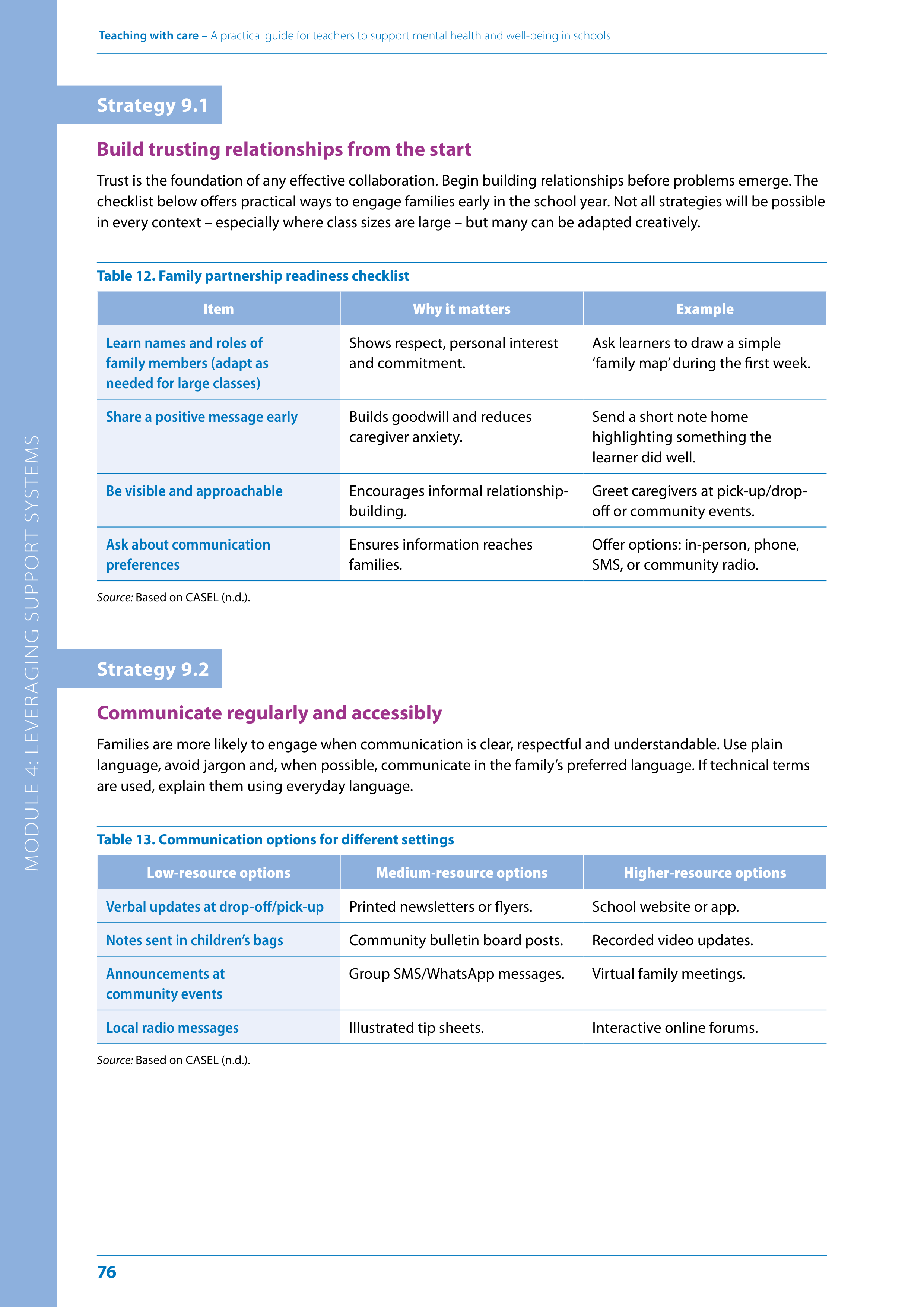
76
Teaching with care
– A practical guide for teachers to support mental health and well-being in schools
MODULE 4: LEVERAGING SUPPORT SYSTEMS
Strategy 9.1
Build trusting relationships from the start
Trust is the foundation of any effective collaboration. Begin building relationships before problems emerge. The
checklist below offers practical ways to engage families early in the school year. Not all strategies will be possible
in every context – especially where class sizes are large – but many can be adapted creatively.
Table 12. Family partnership readiness checklist
Item
Why it matters
Example
Learn names and roles of
family members (adapt as
needed for large classes)
Shows respect, personal interest
and commitment.
Ask learners to draw a simple
‘family map’ during the first week.
Share a positive message early
Builds goodwill and reduces
caregiver anxiety.
Send a short note home
highlighting something the
learner did well.
Be visible and approachable
Encourages informal relationship-
building.
Greet caregivers at pick-up/drop-
off or community events.
Ask about communication
preferences
Ensures information reaches
families.
Offer options: in-person, phone,
SMS, or community radio.
Source:
Based on CASEL (n.d.).
Strategy 9.2
Communicate regularly and accessibly
Families are more likely to engage when communication is clear, respectful and understandable. Use plain
language, avoid jargon and, when possible, communicate in the family’s preferred language. If technical terms
are used, explain them using everyday language.
Table 13. Communication options for different settings
Low-resource options
Medium-resource options
Higher-resource options
Verbal updates at drop-off/pick-up
Printed newsletters or flyers.
School website or app.
Notes sent in children’s bags
Community bulletin board posts.
Recorded video updates.
Announcements at
community events
Group SMS/WhatsApp messages.
Virtual family meetings.
Local radio messages
Illustrated tip sheets.
Interactive online forums.
Source:
Based on CASEL (n.d.).
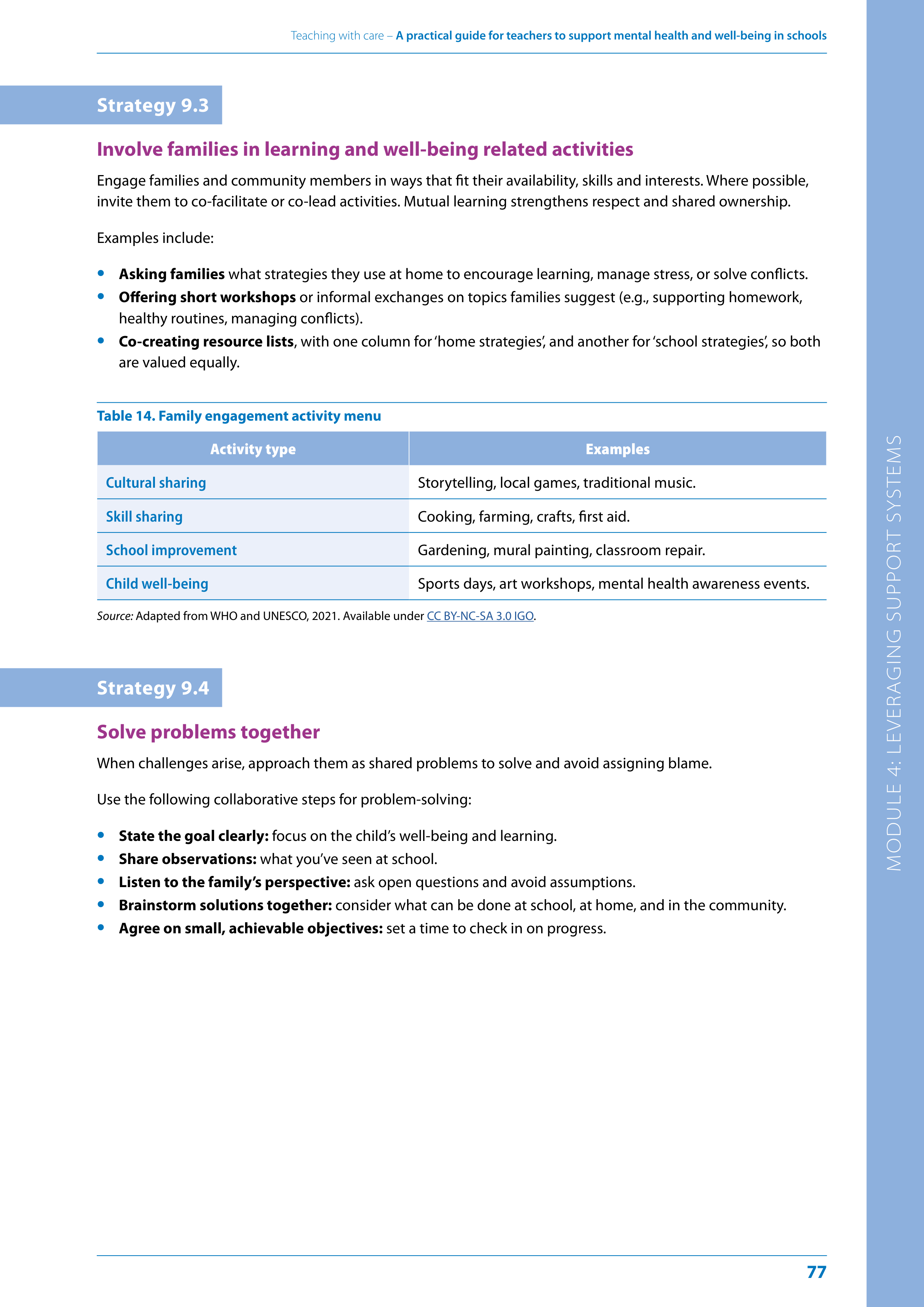
77
Teaching with care –
A practical guide for teachers to support mental health and well-being in schools
MODULE 4: LEVERAGING SUPPORT SYSTEMS
Strategy 9.3
Involve families in learning and well-being related activities
Engage families and community members in ways that fit their availability, skills and interests. Where possible,
invite them to co-facilitate or co-lead activities. Mutual learning strengthens respect and shared ownership.
Examples include:
•
Asking families
what strategies they use at home to encourage learning, manage stress, or solve conflicts.
•
Offering short workshops
or informal exchanges on topics families suggest (e.g., supporting homework,
healthy routines, managing conflicts).
•
Co-creating resource lists
, with one column for ‘home strategies’, and another for ‘school strategies’, so both
are valued equally.
Table 14. Family engagement activity menu
Activity type
Examples
Cultural sharing
Storytelling, local games, traditional music.
Skill sharing
Cooking, farming, crafts, first aid.
School improvement
Gardening, mural painting, classroom repair.
Child well-being
Sports days, art workshops, mental health awareness events.
Source:
Adapted from WHO and UNESCO, 2021. Available under
CC BY-NC-SA 3.0 IGO
.
Strategy 9.4
Solve problems together
When challenges arise, approach them as shared problems to solve and avoid assigning blame.
Use the following collaborative steps for problem-solving:
•
State the goal clearly:
focus on the child’s well-being and learning.
•
Share observations:
what you’ve seen at school.
•
Listen to the family’s perspective:
ask open questions and avoid assumptions.
•
Brainstorm solutions together:
consider what can be done at school, at home, and in the community.
•
Agree on small, achievable objectives:
set a time to check in on progress.
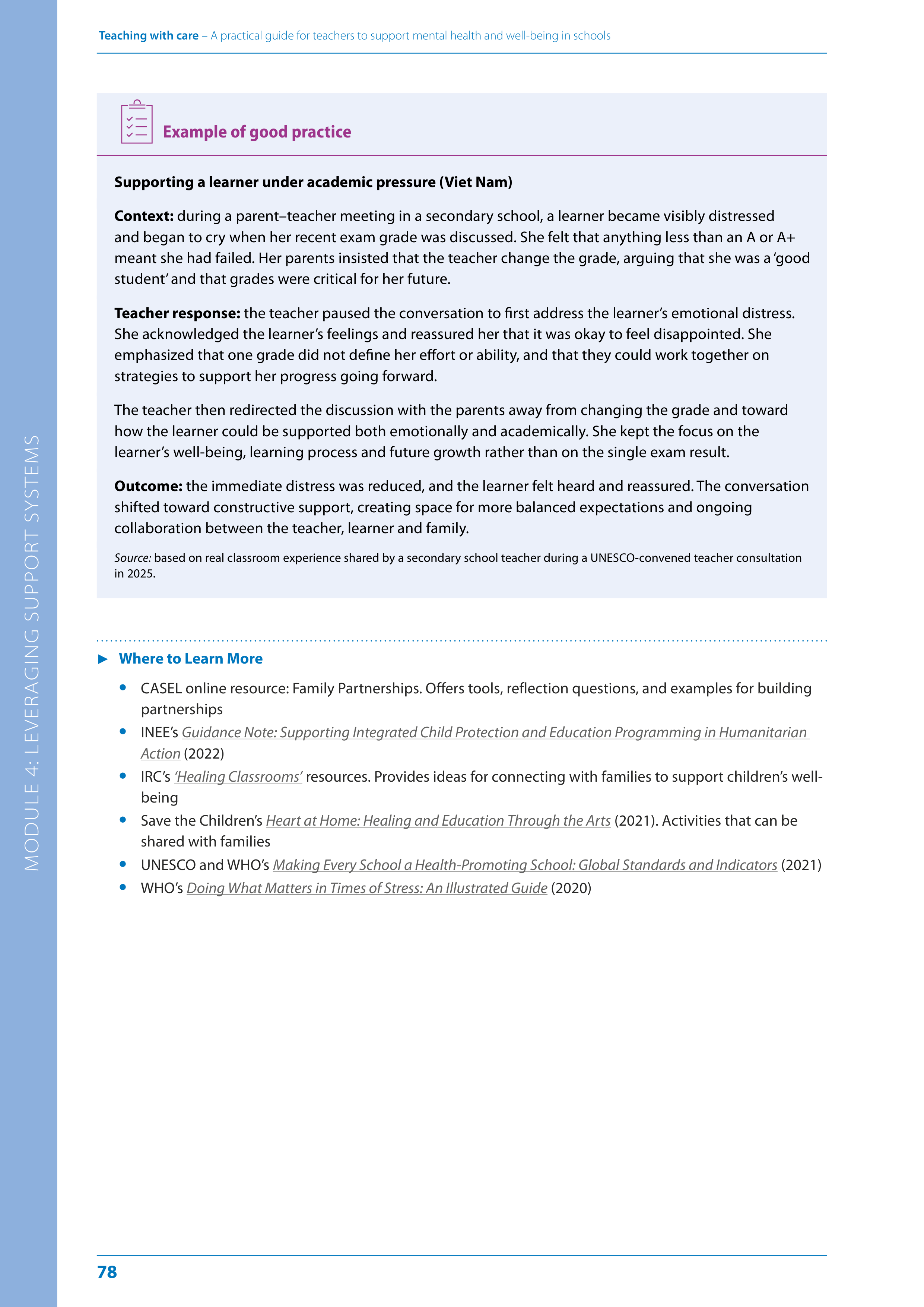
78
Teaching with care
– A practical guide for teachers to support mental health and well-being in schools
MODULE 4: LEVERAGING SUPPORT SYSTEMS
Example of good practice
Supporting a learner under academic pressure (Viet Nam)
Context:
during a parent–teacher meeting in a secondary school, a learner became visibly distressed
and began to cry when her recent exam grade was discussed. She felt that anything less than an A or A+
meant she had failed. Her parents insisted that the teacher change the grade, arguing that she was a ‘good
student’ and that grades were critical for her future.
Teacher response:
the teacher paused the conversation to first address the learner’s emotional distress.
She acknowledged the learner’s feelings and reassured her that it was okay to feel disappointed. She
emphasized that one grade did not define her effort or ability, and that they could work together on
strategies to support her progress going forward.
The teacher then redirected the discussion with the parents away from changing the grade and toward
how the learner could be supported both emotionally and academically. She kept the focus on the
learner’s well-being, learning process and future growth rather than on the single exam result.
Outcome:
the immediate distress was reduced, and the learner felt heard and reassured. The conversation
shifted toward constructive support, creating space for more balanced expectations and ongoing
collaboration between the teacher, learner and family.
Source:
based on real classroom experience shared by a secondary school teacher during a UNESCO-convened teacher consultation
in 2025.
T
Where to Learn More
•
CASEL online resource: Family Partnerships. Offers tools, reflection questions, and examples for building
partnerships
•
INEE’s
Guidance Note: Supporting Integrated Child Protection and Education Programming in Humanitarian
Action
(2022)
•
IRC’s
‘Healing Classrooms’
resources. Provides ideas for connecting with families to support children’s well-
being
•
Save the Children’s
Heart at Home: Healing and Education Through the Arts
(2021). Activities that can be
shared with families
•
UNESCO and WHO’s
Making Every School a Health-Promoting School: Global Standards and Indicators
(2021)
•
WHO’s
Doing What Matters in Times of Stress: An Illustrated Guide
(2020)
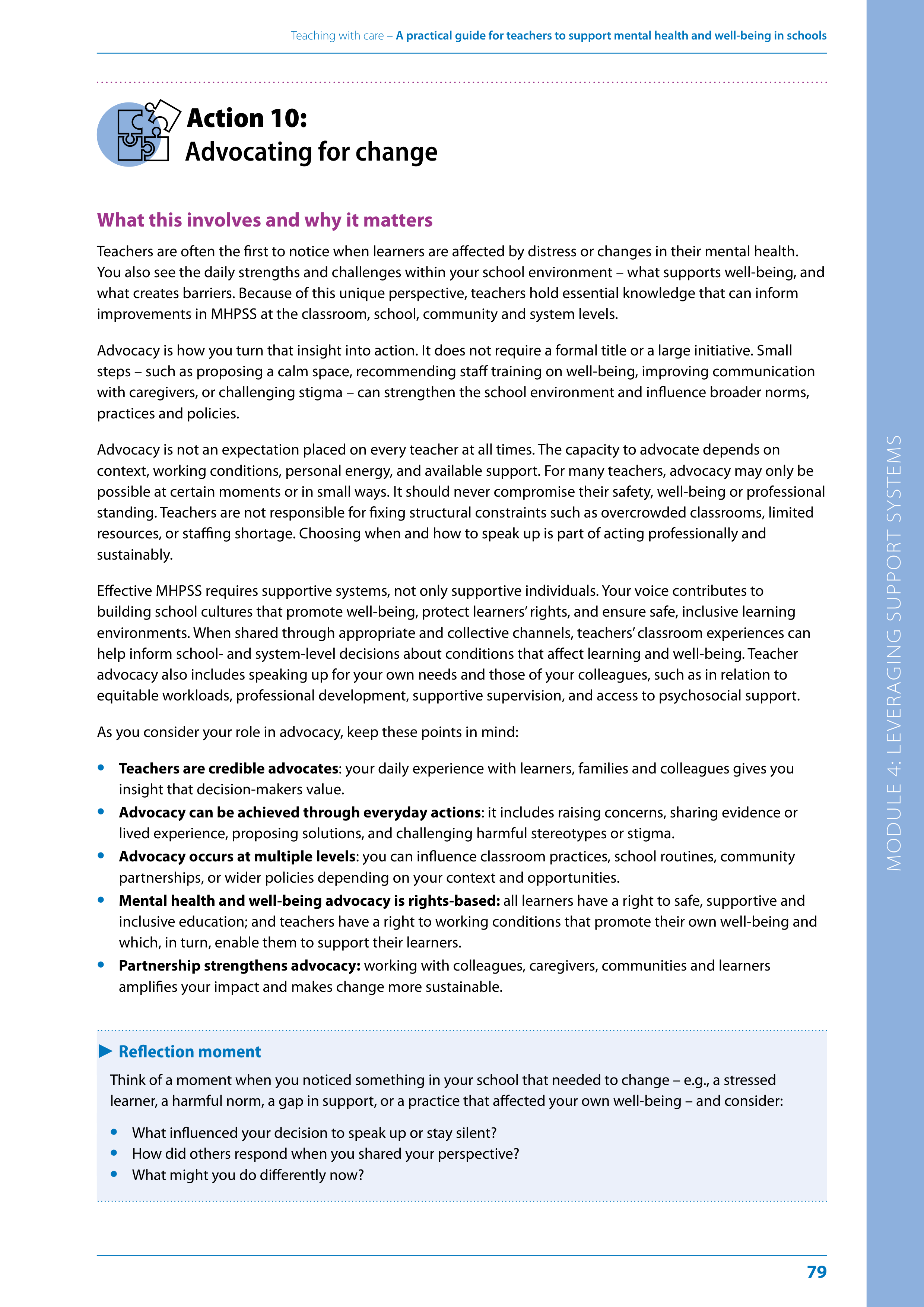
79
Teaching with care –
A practical guide for teachers to support mental health and well-being in schools
MODULE 4: LEVERAGING SUPPORT SYSTEMS
Action 10:
Advocating for change
What this involves and why it matters
Teachers are often the first to notice when learners are affected by distress or changes in their mental health.
You also see the daily strengths and challenges within your school environment – what supports well-being, and
what creates barriers. Because of this unique perspective, teachers hold essential knowledge that can inform
improvements in MHPSS at the classroom, school, community and system levels.
Advocacy is how you turn that insight into action. It does not require a formal title or a large initiative. Small
steps – such as proposing a calm space, recommending staff training on well-being, improving communication
with caregivers, or challenging stigma – can strengthen the school environment and influence broader norms,
practices and policies.
Advocacy is not an expectation placed on every teacher at all times. The capacity to advocate depends on
context, working conditions, personal energy, and available support. For many teachers, advocacy may only be
possible at certain moments or in small ways. It should never compromise their safety, well-being or professional
standing. Teachers are not responsible for fixing structural constraints such as overcrowded classrooms, limited
resources, or staffing shortage. Choosing when and how to speak up is part of acting professionally and
sustainably.
Effective MHPSS requires supportive systems, not only supportive individuals. Your voice contributes to
building school cultures that promote well-being, protect learners’ rights, and ensure safe, inclusive learning
environments. When shared through appropriate and collective channels, teachers’ classroom experiences can
help inform school- and system-level decisions about conditions that affect learning and well-being. Teacher
advocacy also includes speaking up for your own needs and those of your colleagues, such as in relation to
equitable workloads, professional development, supportive supervision, and access to psychosocial support.
As you consider your role in advocacy, keep these points in mind:
•
Teachers are credible advocates
: your daily experience with learners, families and colleagues gives you
insight that decision-makers value.
•
Advocacy can be achieved through everyday actions
: it includes raising concerns, sharing evidence or
lived experience, proposing solutions, and challenging harmful stereotypes or stigma.
•
Advocacy occurs at multiple levels
: you can influence classroom practices, school routines, community
partnerships, or wider policies depending on your context and opportunities.
•
Mental health and well-being advocacy is rights-based:
all learners have a right to safe, supportive and
inclusive education; and teachers have a right to working conditions that promote their own well-being and
which, in turn, enable them to support their learners.
•
Partnership strengthens advocacy:
working with colleagues, caregivers, communities and learners
amplifies your impact and makes change more sustainable.
T
Reflection moment
Think of a moment when you noticed something in your school that needed to change – e.g., a stressed
learner, a harmful norm, a gap in support, or a practice that affected your own well-being – and consider:
•
What influenced your decision to speak up or stay silent?
•
How did others respond when you shared your perspective?
•
What might you do differently now?
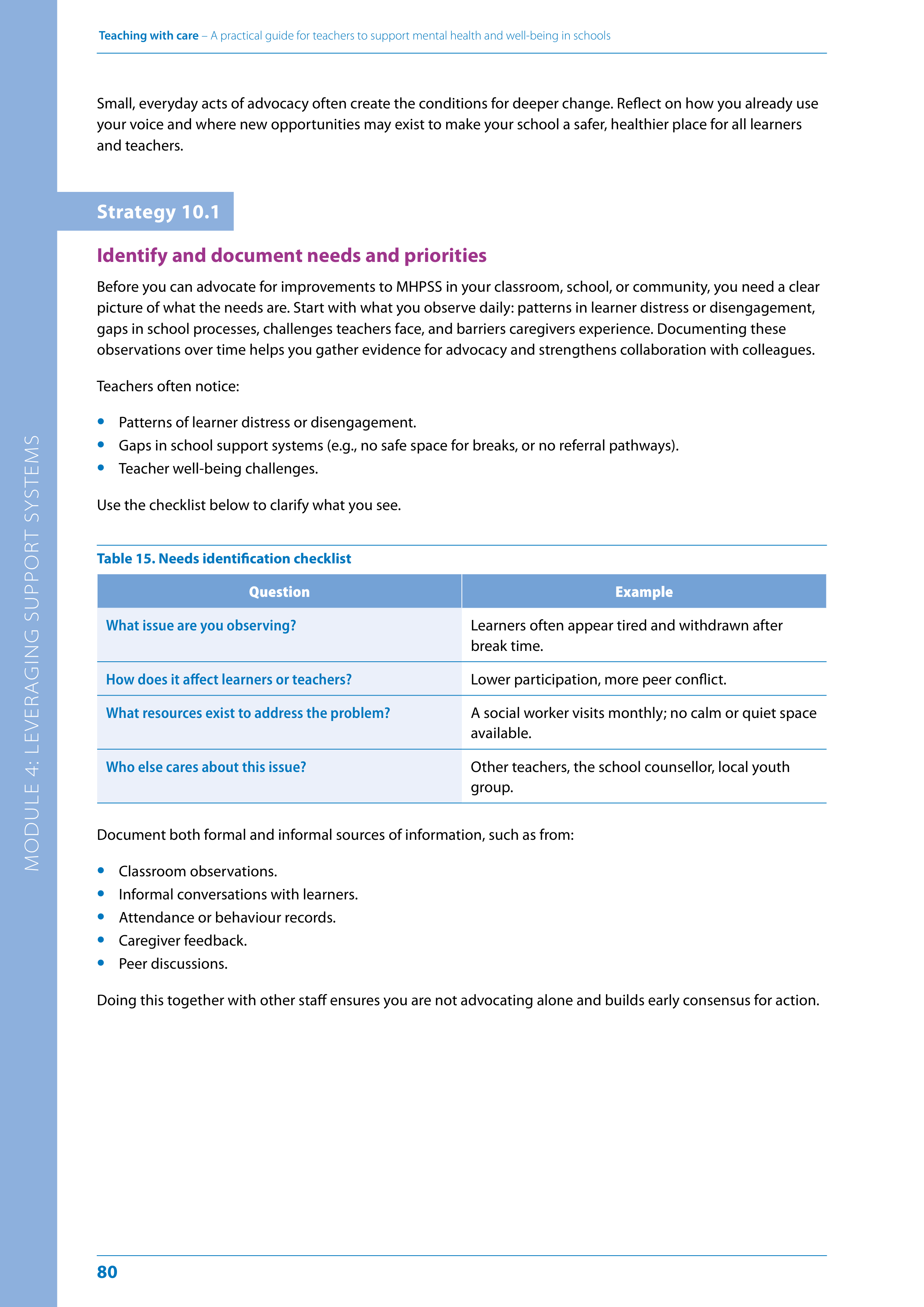
80
Teaching with care
– A practical guide for teachers to support mental health and well-being in schools
MODULE 4: LEVERAGING SUPPORT SYSTEMS
Small, everyday acts of advocacy often create the conditions for deeper change. Reflect on how you already use
your voice and where new opportunities may exist to make your school a safer, healthier place for all learners
and teachers.
Strategy 10.1
Identify and document needs and priorities
Before you can advocate for improvements to MHPSS in your classroom, school, or community, you need a clear
picture of what the needs are. Start with what you observe daily: patterns in learner distress or disengagement,
gaps in school processes, challenges teachers face, and barriers caregivers experience. Documenting these
observations over time helps you gather evidence for advocacy and strengthens collaboration with colleagues.
Teachers often notice:
•
Patterns of learner distress or disengagement.
•
Gaps in school support systems (e.g., no safe space for breaks, or no referral pathways).
•
Teacher well-being challenges.
Use the checklist below to clarify what you see.
Table 15. Needs identification checklist
Question
Example
What issue are you observing?
Learners often appear tired and withdrawn after
break time.
How does it affect learners or teachers?
Lower participation, more peer conflict.
What resources exist to address the problem?
A social worker visits monthly; no calm or quiet space
available.
Who else cares about this issue?
Other teachers, the school counsellor, local youth
group.
Document both formal and informal sources of information, such as from:
•
Classroom observations.
•
Informal conversations with learners.
•
Attendance or behaviour records.
•
Caregiver feedback.
•
Peer discussions.
Doing this together with other staff ensures you are not advocating alone and builds early consensus for action.
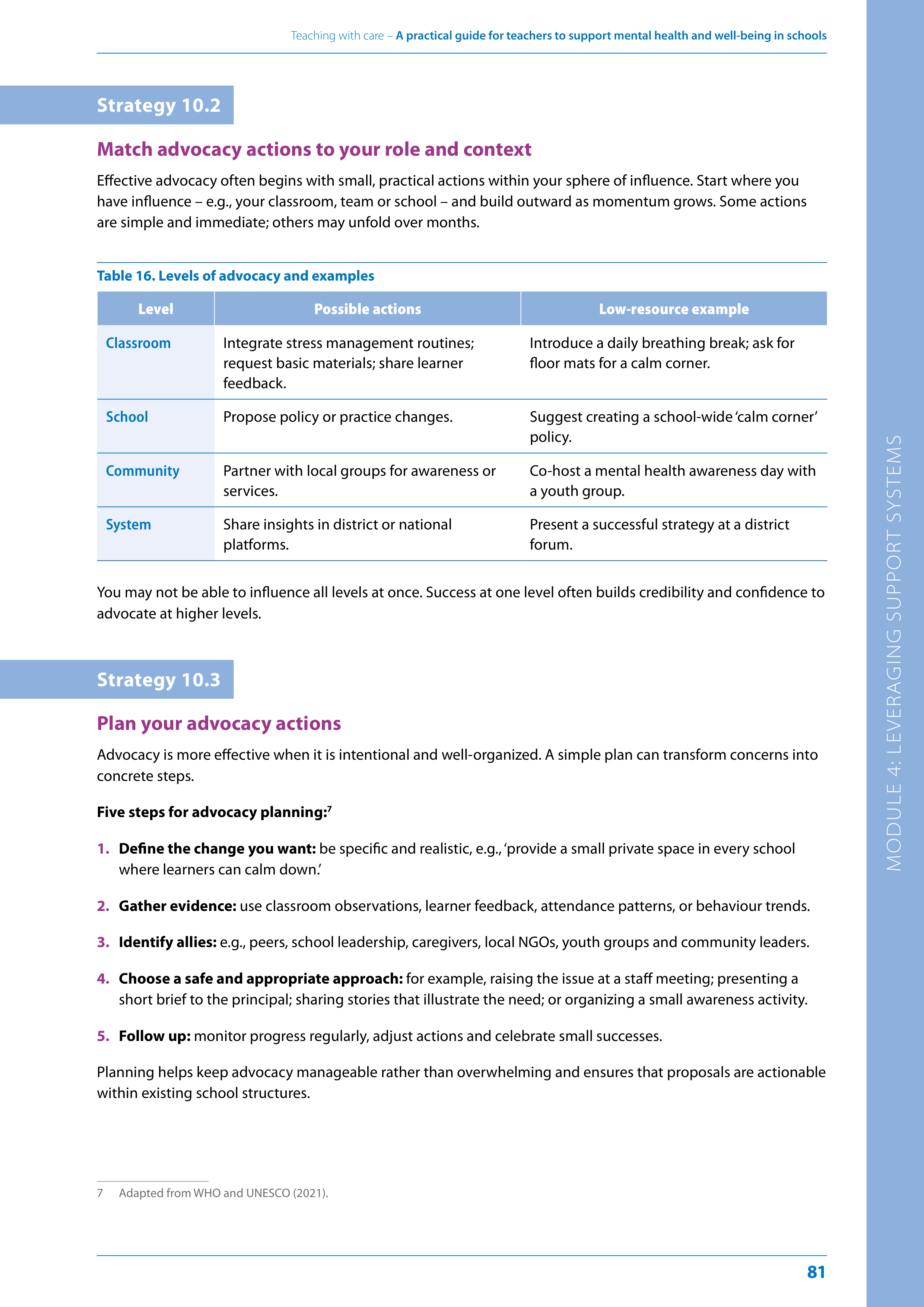
81
Teaching with care –
A practical guide for teachers to support mental health and well-being in schools
MODULE 4: LEVERAGING SUPPORT SYSTEMS
Strategy 10.2
Match advocacy actions to your role and context
Effective advocacy often begins with small, practical actions within your sphere of influence. Start where you
have influence – e.g., your classroom, team or school – and build outward as momentum grows. Some actions
are simple and immediate; others may unfold over months.
Table 16. Levels of advocacy and examples
Level
Possible actions
Low-resource example
Classroom
Integrate stress management routines;
request basic materials; share learner
feedback.
Introduce a daily breathing break; ask for
floor mats for a calm corner.
School
Propose policy or practice changes.
Suggest creating a school-wide ‘calm corner’
policy.
Community
Partner with local groups for awareness or
services.
Co-host a mental health awareness day with
a youth group.
System
Share insights in district or national
platforms.
Present a successful strategy at a district
forum.
You may not be able to influence all levels at once. Success at one level often builds credibility and confidence to
advocate at higher levels.
Strategy 10.3
Plan your advocacy actions
Advocacy is more effective when it is intentional and well-organized. A simple plan can transform concerns into
concrete steps.
Five steps for advocacy planning:
7
1.
Define the change you want:
be specific and realistic, e.g., ‘provide a small private space in every school
where learners can calm down.’
2.
Gather evidence:
use classroom observations, learner feedback, attendance patterns, or behaviour trends.
3.
Identify allies:
e.g., peers, school leadership, caregivers, local NGOs, youth groups and community leaders.
4.
Choose a safe and appropriate approach:
for example, raising the issue at a staff meeting; presenting a
short brief to the principal; sharing stories that illustrate the need; or organizing a small awareness activity.
5.
Follow up:
monitor progress regularly, adjust actions and celebrate small successes.
Planning helps keep advocacy manageable rather than overwhelming and ensures that proposals are actionable
within existing school structures.
7
Adapted from WHO and UNESCO (2021).
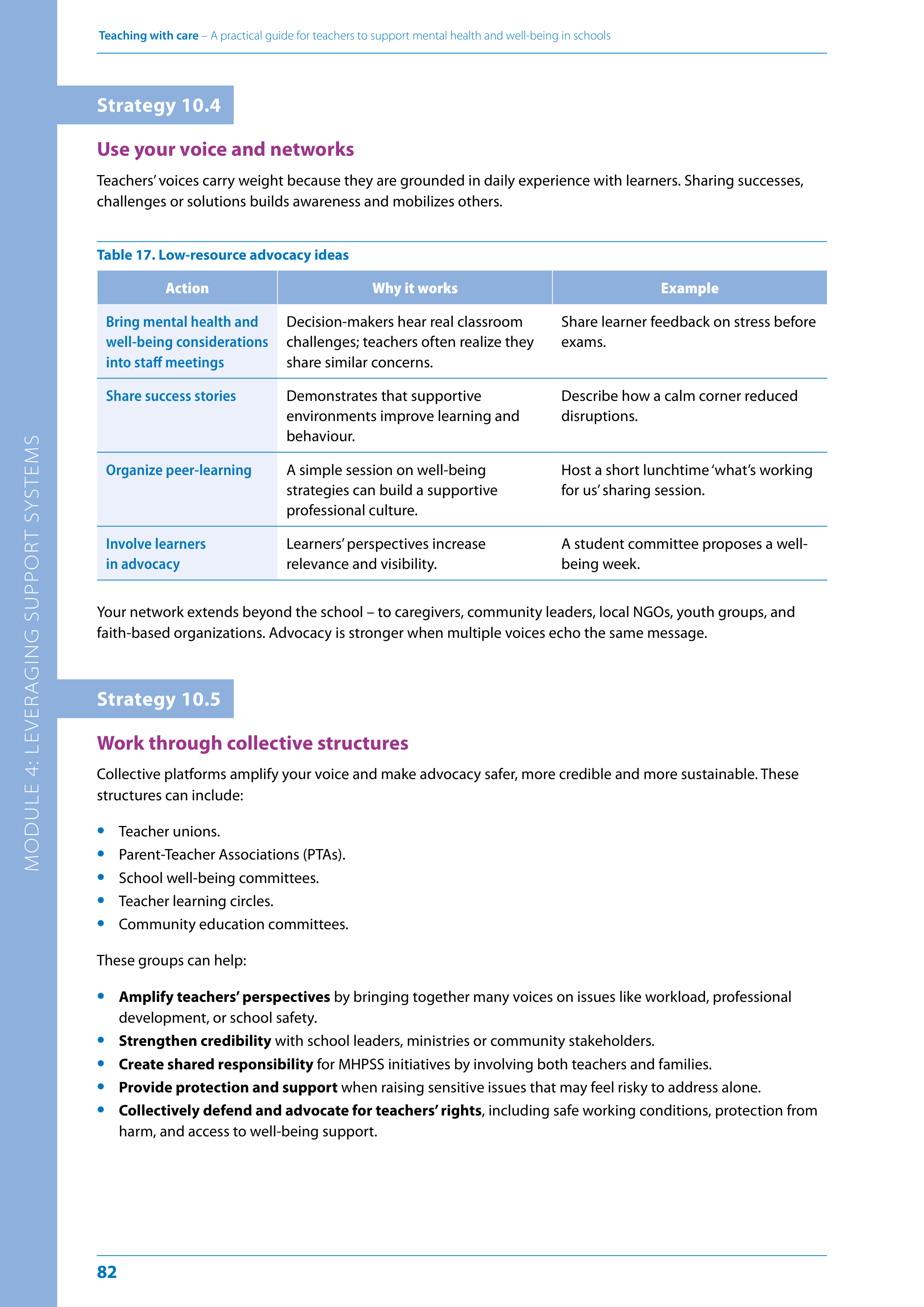
82
Teaching with care
– A practical guide for teachers to support mental health and well-being in schools
MODULE 4: LEVERAGING SUPPORT SYSTEMS
Strategy 10.4
Use your voice and networks
Teachers’ voices carry weight because they are grounded in daily experience with learners. Sharing successes,
challenges or solutions builds awareness and mobilizes others.
Table 17. Low-resource advocacy ideas
Action
Why it works
Example
Bring mental health and
well-being considerations
into staff meetings
Decision-makers hear real classroom
challenges; teachers often realize they
share similar concerns.
Share learner feedback on stress before
exams.
Share success stories
Demonstrates that supportive
environments improve learning and
behaviour.
Describe how a calm corner reduced
disruptions.
Organize peer-learning
A simple session on well-being
strategies can build a supportive
professional culture.
Host a short lunchtime ‘what’s working
for us’ sharing session.
Involve learners
in advocacy
Learners’ perspectives increase
relevance and visibility.
A student committee proposes a well-
being week.
Your network extends beyond the school – to caregivers, community leaders, local NGOs, youth groups, and
faith-based organizations. Advocacy is stronger when multiple voices echo the same message.
Strategy 10.5
Work through collective structures
Collective platforms amplify your voice and make advocacy safer, more credible and more sustainable. These
structures can include:
•
Teacher unions.
•
Parent-Teacher Associations (PTAs).
•
School well-being committees.
•
Teacher learning circles.
•
Community education committees.
These groups can help:
•
Amplify teachers’ perspectives
by bringing together many voices on issues like workload, professional
development, or school safety.
•
Strengthen credibility
with school leaders, ministries or community stakeholders.
•
Create shared responsibility
for MHPSS initiatives by involving both teachers and families.
•
Provide protection and support
when raising sensitive issues that may feel risky to address alone.
•
Collectively defend and advocate for teachers’ rights
, including safe working conditions, protection from
harm, and access to well-being support.
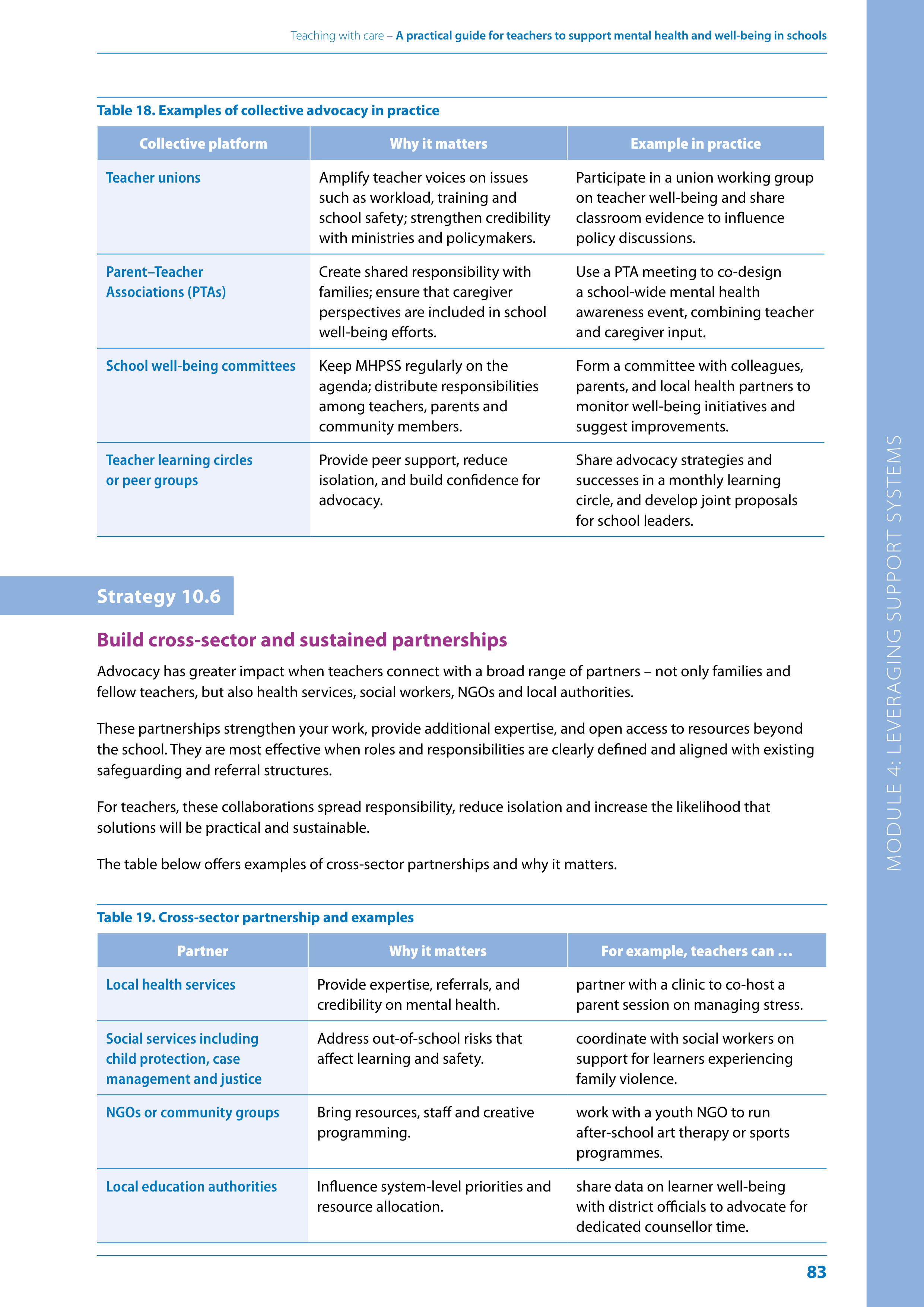
83
Teaching with care –
A practical guide for teachers to support mental health and well-being in schools
MODULE 4: LEVERAGING SUPPORT SYSTEMS
Table 18. Examples of collective advocacy in practice
Collective platform
Why it matters
Example in practice
Teacher unions
Amplify teacher voices on issues
such as workload, training and
school safety; strengthen credibility
with ministries and policymakers.
Participate in a union working group
on teacher well-being and share
classroom evidence to influence
policy discussions.
Parent–Teacher
Associations (PTAs)
Create shared responsibility with
families; ensure that caregiver
perspectives are included in school
well-being efforts.
Use a PTA meeting to co-design
a school-wide mental health
awareness event, combining teacher
and caregiver input.
School well-being committees
Keep MHPSS regularly on the
agenda; distribute responsibilities
among teachers, parents and
community members.
Form a committee with colleagues,
parents, and local health partners to
monitor well-being initiatives and
suggest improvements.
Teacher learning circles
or peer groups
Provide peer support, reduce
isolation, and build confidence for
advocacy.
Share advocacy strategies and
successes in a monthly learning
circle, and develop joint proposals
for school leaders.
Strategy 10.6
Build cross-sector and sustained partnerships
Advocacy has greater impact when teachers connect with a broad range of partners – not only families and
fellow teachers, but also health services, social workers, NGOs and local authorities.
These partnerships strengthen your work, provide additional expertise, and open access to resources beyond
the school. They are most effective when roles and responsibilities are clearly defined and aligned with existing
safeguarding and referral structures.
For teachers, these collaborations spread responsibility, reduce isolation and increase the likelihood that
solutions will be practical and sustainable.
The table below offers examples of cross-sector partnerships and why it matters.
Table 19. Cross-sector partnership and examples
Partner
Why it matters
For example, teachers can …
Local health services
Provide expertise, referrals, and
credibility on mental health.
partner with a clinic to co-host a
parent session on managing stress.
Social services including
child protection, case
management and justice
Address out-of-school risks that
affect learning and safety.
coordinate with social workers on
support for learners experiencing
family violence.
NGOs or community groups
Bring resources, staff and creative
programming.
work with a youth NGO to run
after-school art therapy or sports
programmes.
Local education authorities
Influence system-level priorities and
resource allocation.
share data on learner well-being
with district officials to advocate for
dedicated counsellor time.
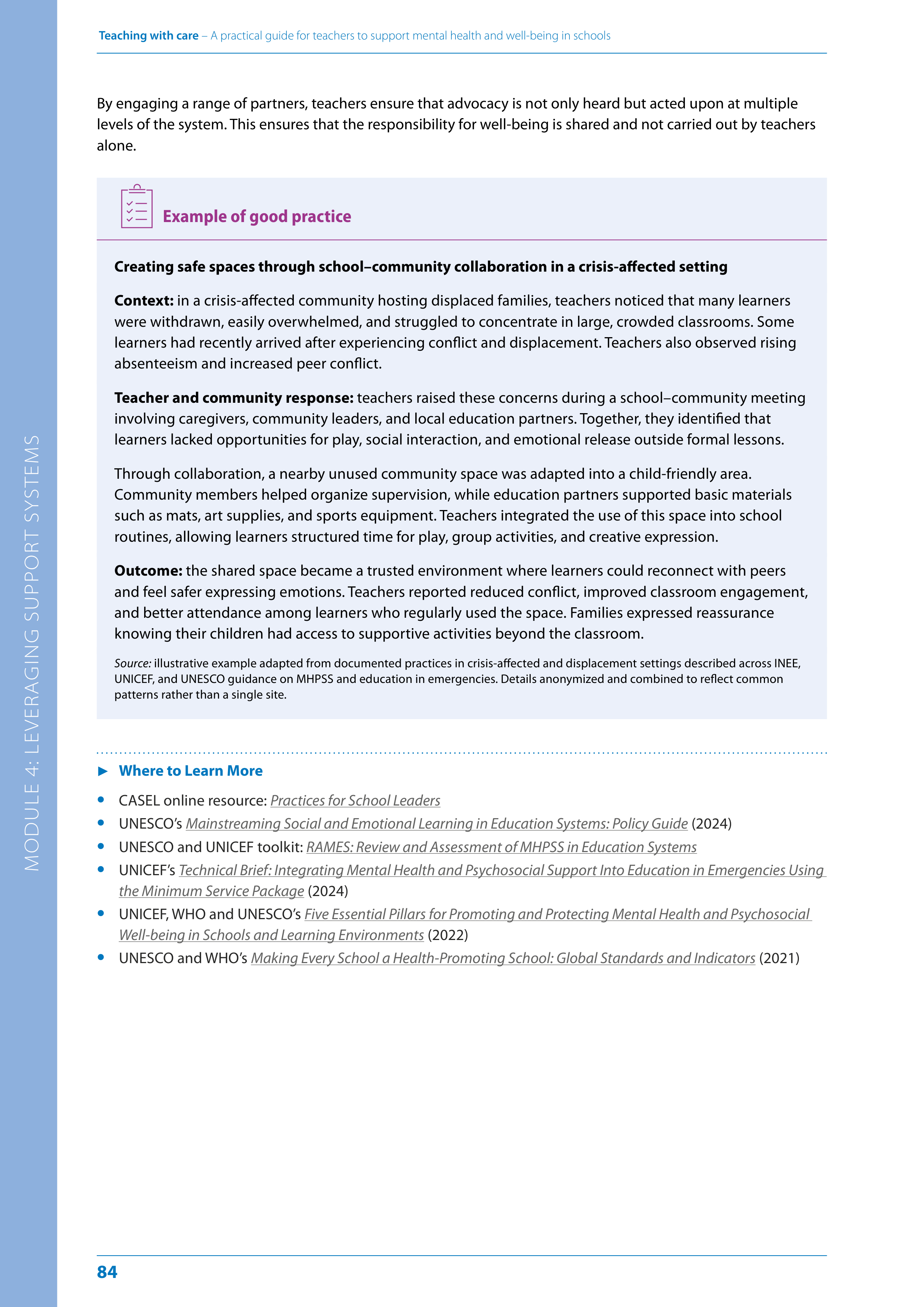
84
Teaching with care
– A practical guide for teachers to support mental health and well-being in schools
MODULE 4: LEVERAGING SUPPORT SYSTEMS
By engaging a range of partners, teachers ensure that advocacy is not only heard but acted upon at multiple
levels of the system. This ensures that the responsibility for well-being is shared and not carried out by teachers
alone.
Example of good practice
Creating safe spaces through school–community collaboration in a crisis-affected setting
Context:
in a crisis-affected community hosting displaced families, teachers noticed that many learners
were withdrawn, easily overwhelmed, and struggled to concentrate in large, crowded classrooms. Some
learners had recently arrived after experiencing conflict and displacement. Teachers also observed rising
absenteeism and increased peer conflict.
Teacher and community response:
teachers raised these concerns during a school–community meeting
involving caregivers, community leaders, and local education partners. Together, they identified that
learners lacked opportunities for play, social interaction, and emotional release outside formal lessons.
Through collaboration, a nearby unused community space was adapted into a child-friendly area.
Community members helped organize supervision, while education partners supported basic materials
such as mats, art supplies, and sports equipment. Teachers integrated the use of this space into school
routines, allowing learners structured time for play, group activities, and creative expression.
Outcome:
the shared space became a trusted environment where learners could reconnect with peers
and feel safer expressing emotions. Teachers reported reduced conflict, improved classroom engagement,
and better attendance among learners who regularly used the space. Families expressed reassurance
knowing their children had access to supportive activities beyond the classroom.
Source:
illustrative example adapted from documented practices in crisis-affected and displacement settings described across INEE,
UNICEF, and UNESCO guidance on MHPSS and education in emergencies. Details anonymized and combined to reflect common
patterns rather than a single site.
T
Where to Learn More
•
CASEL online resource:
Practices for School Leaders
•
UNESCO’s
Mainstreaming Social and Emotional Learning in Education Systems: Policy Guide
(2024)
•
UNESCO and UNICEF toolkit:
RAMES: Review and Assessment of MHPSS in Education Systems
•
UNICEF’s
Technical Brief: Integrating Mental Health and Psychosocial Support Into Education in Emergencies Using
the Minimum Service Package
(2024)
•
UNICEF, WHO and UNESCO’s
Five Essential Pillars for Promoting and Protecting Mental Health and Psychosocial
Well-being in Schools and Learning Environments
(2022)
•
UNESCO and WHO’s
Making Every School a Health-Promoting School: Global Standards and Indicators
(2021)
85
Teaching with care –
A practical guide for teachers to support mental health and well-being in schools
MODULE 4: LEVERAGING SUPPORT SYSTEMS
Module 4 Adaptations
Adapting family engagement and advocacy strategies to diverse contexts
The suggestions below can help you tailor the approaches in this module to your specific setting while
upholding core principles of safety, inclusion, cultural sensitivity, and shared responsibility for learner well-being.
Low-resource settings
In low-resource environments, strong partnerships can be built through relationships, routines, and community
assets, even when material or financial resources are limited. Prioritize approaches that rely on existing spaces,
local knowledge, and volunteer contributions.
Family partnership ideas
•
Create ‘story-sharing circles’ at the school gate to build rapport with caregivers.
•
Send brief handwritten notes highlighting ‘one good thing’ the learner did.
•
Organize shared ‘school care’ days where families join teachers to clean, garden or repair facilities.
Community partnership ideas
•
Display learner artwork and well-being messages on community notice boards.
•
Collaborate with faith or cultural leaders to co-host inclusive community events.
•
Share learners’ work through outdoor exhibitions in public spaces.
Everyday advocacy ideas
•
Raise small, actionable improvements during staff meetings.
•
Share learner feedback or well-being observations with school leadership.
•
Model effective well-being activities to inspire colleagues.
•
Invite community volunteers to lead no-cost creative or sports sessions.
•
Keep a simple log of improvements (e.g., reduced peer conflict, improved attendance) to support advocacy.
•
Engage local leaders in conversations about children’s well-being and school needs.
Displacement or crisis-affected settings
In displacement or crisis contexts, caregivers, teachers and learners may all face ongoing uncertainty, loss
or disruption. Adapt engagement and advocacy to prioritize safety, trust, flexibility and responsiveness to
urgent needs.
Family partnerships
•
Use sensitive, safety-focused communication that acknowledges distress, loss or instability.
•
Hold small-group discussions in safe, accessible locations.
•
Share clear information about available humanitarian, education and psychosocial services.
•
Check in regularly to understand evolving needs, constraints and concerns.
Community partnerships
•
Collaborate with humanitarian actors, community leaders and local organizations to coordinate support.
•
Co-create safe learning spaces with community members.
86
Teaching with care
– A practical guide for teachers to support mental health and well-being in schools
MODULE 4: LEVERAGING SUPPORT SYSTEMS
•
Invite respected cultural or faith leaders to share well-being and inclusion messages.
•
Engage displaced community members as volunteers to strengthen social cohesion.
Everyday advocacy
•
Advocate for psychosocial safety and learner well-being in emergency education planning.
•
Request teacher training on sensitive, safety-focused responses to distress.
•
Document urgent needs and share them with humanitarian partners.
•
Use community gatherings to raise awareness about learner well-being.
Online or remote learning settings
When teaching occurs remotely, physical distance can make engagement and early identification of concerns
more difficult. Use simple, accessible communication channels and prioritize connection, clarity and low-tech
solutions.
Family partnerships
•
Share weekly well-being tips that families can implement at home.
•
Schedule phone-based check-ins with caregivers to discuss learner progress and needs.
•
Provide printed take-home activities where digital access is limited.
•
Celebrate learner achievements through group text messages or announcements via community platforms.
Community partnerships
•
Partner with local radio stations to broadcast short learning and well-being segments.
•
Work with community centres to distribute printed materials or host phone-based support sessions.
•
Engage local volunteers to deliver learning packets or provide learning support.
•
Establish neighborhood ‘learning buddy’ systems.
Everyday advocacy
•
Communicate challenges and successes of remote learning to school leadership.
•
Propose simple strategies to improve access (e.g., community device-sharing).
•
Share stories of learners who thrive with home support.
•
Advocate for well-being check-ins as a standard part of remote learning programmes.
Learners with disabilities
Promoting inclusion requires planning for accessibility from the start, respecting diverse needs, and engaging
caregivers as partners in creating supportive environments.
Family partnerships
•
Discuss individual learning and communication needs with caregivers.
•
Share strategies for supporting emotional regulation at home and school.
•
Invite families to co-lead inclusion-focused sessions with teachers.
•
Celebrate achievements of learners with disabilities both privately and publicly.
87
Teaching with care –
A practical guide for teachers to support mental health and well-being in schools
MODULE 4: LEVERAGING SUPPORT SYSTEMS
Community partnerships
•
Collaborate with local disability organizations to access expertise and resources.
•
Engage community leaders to promote positive attitudes toward inclusion.
•
Organize events that highlight the strengths and talents of learners with disabilities.
•
Ensure community spaces used for school events are physically accessible.
Everyday advocacy
•
Highlight accessibility needs in school improvement planning.
•
Advocate for teacher training in inclusive practices.
•
Share stories demonstrating how accessible environments benefit all learners.
•
Recommend small, practical adaptations (e.g., seating adjustments, visual aids).
Inclusivity and diversity
Effective engagement and advocacy must reflect and respect cultural, linguistic, gender, religious, and identity
diversity. This includes ensuring that all families – particularly those who may be marginalized – have meaningful
opportunities to participate.
Family partnerships
•
Offer translation or interpretation services when possible.
•
Invite families to share cultural traditions, languages and skills.
•
Ensure engagement activities are welcoming for all – e.g., consider gender-sensitive spaces, culturally
appropriate refreshments and respectful seating arrangements.
Community partnerships
•
Collaborate with organizations representing diverse identity groups.
•
Co-host events celebrating cultural and linguistic diversity.
•
Use multilingual community media to share messages.
•
Develop inclusive public displays of learner work.
Everyday advocacy
•
Advocate for representation of diverse cultures, genders and identities in school curricula and events.
•
Promote anti-discrimination and gender-equitable policies.
•
Highlight examples of how diversity strengthens the school community.
•
Ensure well-being programmes and materials reflect learners’ diverse lived experiences.
88
Teaching with care
– A practical guide for teachers to support mental health and well-being in schools
MODULE 4: LEVERAGING SUPPORT SYSTEMS
Module 4 Self-assessment and reflection
Use this checklist to reflect on your current family–community engagement practices and your everyday
advocacy for improvements in your school.
Tick what you already do; mark with stars what you wish to try or strengthen.
Family relationships
Â
I make time to greet and talk with caregivers regularly, whether or not a learner is facing challenges.
Â
I share positive feedback early and often.
Â
I know how most families prefer to communicate.
Â
I invite families to contribute their skills, traditions or stories.
Â
I ask families about their ideas for supporting learner well-being.
Â
I adapt my communication style to respect cultural and linguistic norms.
Community interactions
Â
I know which local leaders and organizations can support learner well-being.
Â
I have participated in or helped organize a school–community event in the past year.
Â
I use local spaces (e.g., markets, faith centres and community boards) to share well-being messages.
Â
I invite community members to participate in or lead activities.
Â
I share school successes and challenges with the community to build shared ownership.
Â
I ensure engagement activities are inclusive and accessible to all.
Everyday advocacy
Â
I can clearly describe at least one change I would like to see in my school, related to promoting mental
health and well-being.
Â
I have shared well-being needs with decision-makers.
Â
I use evidence (e.g., observations, feedback and attendance data) to support advocacy points.
Â
I suggest low- or no-cost changes that improve well-being.
Â
I involve learners, families or colleagues in speaking up about shared concerns.
Â
I follow up after advocacy actions to track progress and celebrate successes.
Reflection prompt
Choose one unticked or starred item from each section.
Write down the first step you will take in the next month to move it forward.

References
90
Teaching with care
– A practical guide for teachers to support mental health and well-being in schools
REFERENCES
References
CASEL. n.d. Focus Area 3: Family Partnerships. Online resource. Collaborative for Academic, Social, and Emotional
Learning.
https://schoolguide.casel.org/focus-area-3/family-partnerships
IASC. 2020.
Basic Psychosocial Skills: A Guide for COVID-19 Responders.
Geneva, Inter-Agency Standing Committee.
https://interagencystandingcommittee.org/sites/default/files/migrated/2020-05/Basic Psychosocial Skills- A
Guide for COVID-19 Responders.pdf
The MHPSS Collaborative. 2024. Thriving through Play: A Mental Health and Psychosocial Support Classroom
Approach for Educators in Crisis-Affected Settings. Training programme.
https://resourcecentre.savethechildren.
net/document/thriving-through-play
UNGEI. 2018.
A Whole School Approach to Prevent School-Related Gender-based Violence: Minimum Standards
and Monitoring Framework
. New York, UN Girls’ Education Initiative.
https://www.ungei.org/sites/default/files/A-
whole-school-approach-to-prevent-school-related-gender-based-violence-Minimum-Standards-and-Monitoring-
Framework-2019-eng.pdf
UNICEF. 2022. Common signs of psychosocial distress in children. Advice sheet. New York, United Nations
Children’s Fund.
https://www.mhpss.net/toolkit/children-and-families-mhpss-resource-collection/resource/
common-signs-of-psychosocial-distress-in-children-cf
UNICEF and WHO. 2021.
Teacher’s Guide to the Magnificent Mei and Friends Comic Series.
New York, United Nations
Children’s Fund.
https://www.unicef.org/adolescentmentalhealthhub/documents/teachers-guide-magnificent-
mei-and-friends-comic-series
WHO. 2023.
Early Adolescent Skills for Emotions (EASE).
Intervention guide. Geneva, World Health Organization.
https://www.who.int/publications/i/item/978924008275
5
WHO and UNESCO. 2021.
Making Every School a Health-Promoting School: Global Standards and Indicators for
Health-Promoting Schools and Systems
. Geneva, World Health Organization.
https://www.who.int/publications/i/
item/9789240025073

Glossary
92
Teaching with care
– A practical guide for teachers to support mental health and well-being in schools
GLOSSARY
Glossary
Adversity
Difficult or stressful life circumstances – such as poverty, discrimination, instability,
displacement, violence or family stress – that influence how a learner feels,
behaves or learns. Adversity does not imply pathology; it reflects social and
environmental factors that may affect well-being.
Behaviour (prosocial/
challenging)
‘Prosocial behaviour’ refers to positive actions that benefit others or strengthen
the classroom community, such as cooperation, sharing and helping peers.
‘Challenging behaviour’ refers to actions that disrupt learning or cause harm
to self or others, often signaling stress, confusion, unmet needs or difficulty
regulating emotions.
Bullying
Unwanted and aggressive behaviour that involves a real or perceived power
imbalance, is repeated or likely to be repeated, and causes physical, psychological
or social harm. Bullying can occur in-person or online.
Burnout
Burnout is a state of emotional, mental and physical exhaustion caused by long-
term stress, especially when demands feel greater than the resources or support
available. It often shows up as feeling drained, overwhelmed, less motivated, or
less able to cope with everyday tasks.
Classroom agreement (or
norms)
A short, co-developed set of expectations for behaviour and interaction that helps
create a respectful, safe and predictable learning environment.
Classroom climate
The overall atmosphere of the classroom, shaped by relationships, routines,
fairness, inclusion and the emotional tone set by the teacher and learners.
Confidentiality
Teachers’ commitment to keep information private unless a learner’s safety is at
risk. When concerns arise, teachers must follow school safeguarding procedures
and share information with the designated staff member.
Coping strategies
Ways learners manage stress or difficult emotions. Strategies may be helpful
(e.g., breathing techniques, seeking support, taking breaks) or unhelpful (e.g.,
avoidance, aggression). Teachers model and impart helpful strategies.
Cyberbullying
Bullying that takes place through digital technologies such as messaging
applications, social media, gaming platforms or other online forums. It may
include threats, exclusion, harassment or sharing harmful content.
Distress (signs of distress)
Changes in a learner’s behaviour, mood, participation, relationships, energy or
appearance that may indicate they are overwhelmed, worried or struggling.
Designated focal point/
safeguarding lead
The person or role within a school responsible for coordinating safeguarding,
child protection, or learner well-being concerns, in line with school and national
procedures. Where no designated focal point or counsellor exists, teachers should
follow school leadership or local safeguarding protocols.
Early identification
Noticing signs that a learner may need additional support. Teachers do not
diagnose mental health conditions or investigate personal circumstances.
Emotional regulation
The ability to recognize, understand and manage one’s emotions. Skills include
pausing, breathing, expressing emotions safely and seeking help when needed.
Inclusion/inclusive education
Ensuring that all learners – regardless of disability, gender, identity, socio-
economic status, displacement, language or background – can participate
meaningfully and safely in learning.
93
Teaching with care –
A practical guide for teachers to support mental health and well-being in schools
GLOSSARY
Learning environment (safe,
predictable, inclusive)
The physical, social and emotional conditions in which learning takes place.
Includes routines, relationships, accessibility, fairness and the absence of violence
or discrimination.
Learner well-being
(psychosocial well-being)
A learner’s emotional, social and mental state, shaped by their relationships, sense
of safety, participation in class, and day-to-day experiences at school. It includes
learners’ ability to feel supported, to engage and participate, and to develop
a sense of belonging and satisfaction in their learning, while recognizing that
well-being can fluctuate over time. This contributes to learners’ overall well-being,
which is shaped by both school experiences and wider social, economic and
environmental conditions.
Mental health
A state of mental well-being enabling individuals to cope with the stresses of
life, learn and work productively, build relationships, and contribute to their
communities.
Mental health and
psychosocial support
(MHPSS)
Any activity that protects or promotes mental health and psychosocial well-
being and/or prevents or responds to distress – from fostering a safe classroom
environment to connecting a learner to a counsellor.
Neurodivergence/
neurodivergent learners
Learners whose brains process information differently – for example those with
ADHD, autism or dyslexia. Neurodivergence is a form of human diversity. Inclusive
classroom practices support different learning needs.
Notice (teacher role)
Observing changes in learners that may indicate a need for support, and
responding in calm, brief, supportive ways within teacher boundaries.
Predictable routines
Regular practices that help learners know what to expect and feel emotionally
safe. Routines reduce stress and support focus and stability.
Psychosocial well-being
How people think, feel, and relate to others, shaped by both individual factors
(e.g., coping skills) and environmental factors (e.g., relationships, routines,
safety). It includes the ability to feel supported, to manage everyday challenges,
to connect with others, and to participate meaningfully in daily life, while
recognizing that psychosocial well-being can change over time.
Safeguarding
Policies and procedures designed to protect learners from harm. Teachers are
required to report concerns about safety to the designated staff member.
Social and emotional learning
(SEL)
The process through which children and adults acquire and apply the knowledge,
skills, and attitudes to manage emotions, build positive relationships, and make
responsible decisions.
Stigma
Stigma refers to negative attitudes, labels, or judgements about individuals or
groups, often leading to exclusion or discrimination. In this guide, it may relate
to mental health, disability, identity, or other characteristics. Stigma can make
learners feel ashamed, misunderstood, or afraid to ask for help, and can prevent
teachers, families, and communities from talking openly about mental health.
Teacher learning circles
Small groups of teachers who meet regularly to reflect together, share ideas and
improve practice in a collaborative, supportive environment.
Violence (school-related
violence)
Any physical, psychological or sexual violence, bullying or harassment that occurs
in or around schools, including online.
Well-being
The overall state of being and functioning well in different aspects of life. It is
shaped by social relationships, access to basic needs and resources, and physical,
emotional, cognitive, and developmental factors. Well-being is influenced by both
individual experiences and wider social, economic, and environmental conditions.
Teachers are often the frontline adults closest to learners, and
their everyday interactions can profoundly shape how children
and young people feel, learn and thrive.
Teaching with Care is a practical guide that equips teachers
with clear, evidence-based strategies to support learners’
mental health and psychosocial well-being in the classroom.
It provides realistic guidance on how to create safe and
inclusive learning environments, build positive relationships,
promote social and emotional skills, recognize early signs of
distress and link learners to appropriate support.
Developed jointly by UNESCO, UNICEF and WHO, this guide
translates global evidence into practical actions that teachers
can apply in diverse contexts around the world.
Sustainable
Development
Goals
Teaching with care
A practical guide for teachers to support
mental health and well-being in schools
9
789231
008993