
2026-2027
OFFICIAL ELECTION MAIL GUIDE
Kit 600
February 2026
The Postal Service is pleased to present the 2026-2027 Official Election Mail Guide (Kit 600). The kit is a
comprehensive resource designed specifically for Election Officials that choose to utilize the U.S. Mail™ as a
secure, efficient, and effective part of their election systems.
The Postal Service has a long and proud history of supporting our country’s electoral system and we take
seriously our clear and defined role to process, transport, and deliver the nation’s Election Mail, including ballots.
We continually reassess our capabilities to improve the operational effectiveness of our service.
In preparation for the upcoming election season, the Postal Service made several enhancements to increase the
visibility of ballots traveling through the mail stream. These efforts included issuing a newly developed bilingual
green Tag 191,
Domestic and International Ballots
, implementing an official ballot checkbox, expanding the
Service Type IDentifier (STID) Tool for both Ballot Mail and Election Mail, and clarifying the use of the Official
Election Mail logo. You will learn more about these enhancements by reviewing the materials included in this kit.
For additional support, contact the Postal Service’s Mailpiece Design Analysts and local Managers, Customer
Relations using the forms found at
https://about.usps.com/what/government-services/election-mail/#contact
.
Please take advantage of these dedicated experts.
While not specific to Election Mail, the Postal Service has some further updates that may be relevant to our
customers who send or receive Election Mail. The Postal Service refined our service standards to align with
operational initiatives needed to improve operational efficiency and precision. We also formally defined the
postmark in our regulations, described how and where in the course of postal operations postmarks are applied,
clarified the scope of the information that postmarks convey, and advised customers to request a manual (local)
postmark at a retail location if they want to ensure that their mailpiece receives a postmark containing a date that
aligns with the date of mailing. This kit provides additional details on postmarking, but we emphasize that we
have not changed our procedures regarding how or to the extent in which we postmark mailpieces.
Our simple message to voters is to plan and mail early. Also, if a customer wants to ensure that their return Ballot
Mail envelope or any other mailpiece receives a postmark, and that the date on the postmark matches the day it
is mailed, the customer should bring their mailpiece to a retail location and request a manual postmark in person;
it will be applied free of charge upon acceptance of the mailpiece.
The Postal Service provides many common-sense mailing recommendations to help voters and election officials
use the mail successfully when policymakers choose to use the mail as part of their election systems. We
recommend that both voters and election officials follow any guidance provided by their state, consider the time
required for each leg of mail delivery, and keep in mind any applicable Postal Service mailing recommendations.
Sharing the Postal Service’s mailing recommendations with your voters can better help them decide which
method of participation in the electoral process is right for them.
475 L’E
nfant
P
laza
SW
W
ashington
DC 20260-3100
V
isit
us
@
usps
.
com
Page 2
475 L’E
nfant
P
laza
SW
W
ashington
DC 20260-3100
V
isit
us
@
usps
.
com
INDEX
Included in your 2026 - 2027 (Kit 600) are the following fact sheets and publications:
B
Ballot Mail Mailing Standards —
Includes many of the Postal
Service’s regulations about balloting materials. Page 23
E
Election Mail Checkboxes
—
Use the Election Mail
Checkboxes in the
PostalOne!
®
processing system to
ensure USPS
®
visibility of all Election Mail entered into the
mailstream. Page 25
Election Mail Key Recommendations —
Outline of the Postal
Service’s key recommendations that should be considered
to help ensure you have the tools you need to successfully
use the mail. Page 4
Election Mail Resources for Election Officials —
Overview of
the many resources available to election officials to effectively
use the mail. Page 6
*New*
Election Mail Security —
An overview for the election
community on how the U.S. Postal Inspection Service
secures Election Mail. Page 28
I
Informed Delivery —
Discover the benefits associated with
creating an Informed Delivery campaign in your electoral
jurisdiction. Page 21
Informed Visibility
®
Mail Tracking and Reporting —
Learn
about near-real-time mail tracking data service for letters
and flat pieces, bundles, handling units (trays, tubs, and
sacks), and containers. Page 13
N
Next Steps —
Ready to get started? Follow a few simple
steps for expert advice on how to create, handle, and send
Election Mail. Page 29
P
*New*
Postmarks and Postal Possession —
Defines
postmarks, identifies types of Postal Service markings that
qualify as postmarks, describes the circumstances under
which those markings are applied, and advises customers
of how to obtain evidence of the date on which the Postal
Service accepted possession of their mailings. Page 27
Publication 631,
Official Election Mail—Graphic Guidelines
and Logos
—
Learn proper usage of the Official Election
Mail logo for inclusion on mailpieces.
Publication 632,
State and Local Election Mail—User’s
Guide
—
Contains information that election officials must
consider before mailing Election Mail.
Q
Qualified Business Reply Mail with Intelligent Mail barcode
Accounting —
Description of the First-Class Mail
®
service
and a step-by-step guide to completing an application to
use the mailing solution. Page 17
R
Recommendations on Mailing Completed Ballots —
An
explanation of the Postal Service’s policy concerning the
postmarking of Ballot Mail envelopes returned by voters.
Page 26
S
Service Type IDentifiers for Ballot Mail —
Understand how
the three-digit code is improving the identification and
tracking of Ballot Mail. Page 10
Special Procedures: APO/FPO/DPO and Overseas Citizens
Absentee Ballots —
Tips to ensure Ballot Mail reaches
military personnel and citizens who are overseas. Page 19
Steps to Creating Your Intelligent Mail Barcode —
Learn how
to create your own serialized IMb to track Election Mail while
in the mailstream and more. Page 8
T
Tag 191,
Domestic and International Ballots
—
Information
and guidelines to help your Ballot Mail get higher visibility
upon entry. Page 15
Page 3
©2026 United States Postal Service
®
. All Rights Reserved.
The Eagle Logo is among the many trademarks of the U.S. Postal Service
®
.
Page 4
ELECTION MAIL KEY RECOMMENDATIONS
Fact Sheet for Election Mail
This fact sheet includes many of the Postal Service’s
recommendations for Election Mail. The following
recommendations will help increase the visibility of Election
Mail as it moves through the postal network and generally
improves processing and enhances customers’ experience.
MAILING RECOMMENDATIONS
When making decisions about mailing ballots (and other
time-sensitive Election Mail), election officials should first
consider their
state and local rules, requirements and
recommendations. Secondly, you should choose whether
or not you want to outsource printing and/or utilize mail
service providers. It is also important to consider print
and production times. Additionally, make sure to consider
mailing logistics such as mail induction point locations and
be sure to avoid commingling outbound Ballot Mail with
other mailpieces.
Along with any guidance from the state or locality
conducting elections, the Postal Service recommends
that election officials consider providing any applicable
Postal Service mailing recommendations in their voter
communications. Sharing the Postal Service’s mailing
recommendations will help ensure that individuals who wish
to use the mail to vote know how to do so successfully.
The Postal Service’s mailing recommendations for
voters include:
¢
In jurisdictions that require eligible voters to
request a ballot to receive one through the mail:
We recommend that domestic, non-military voters
request their ballot as early as their jurisdiction allows.
Note: Not all voters need to request a ballot to receive
one; check your local and state voting requirements.
¢
For domestic, non-military voters who choose
to use the mail to return their completed ballot:
The Postal Service recommends that they mail their
completed ballot before election day, and at least one
week before the deadline by which their completed
ballot must be received by their election office. Some
states may recommend allowing even more time for
mailing completed ballots.
¢
All voters
should keep in mind the time required
for each leg of mail delivery—to the voter and back
to the election office—when deciding how to participate
in an election.
MAIL CLASS
The Postal Service continues to recommend that election
officials use First-Class Mail® for outbound Ballot Mail
to voters. Using First-Class Mail allows for faster service
while providing high visibility as Ballot Mail moves through
the mailstream (when used with USPS® visibility tools,
like serialized Intelligent Mail® barcodes). Nevertheless,
the Postal Service has long engaged in several practices
to prioritize Ballot Mail that is entered as Marketing Mail,
regardless of the paid class, when capacity permits and
mailpieces are identifiable as Ballot Mail by the Official
Election Mail logo or other Postal Service visibility indicia.
The Postal Service will continue to process and deliver
expeditiously, as we have done in past elections, with
the result that Ballot Mail commonly receives delivery
timeframes equivalent to First-Class Mail even when
mailed as Marketing Mail.
MAILPIECE DESIGN REVIEW
The Postal Service strongly recommends that all
Election Mail envelopes, including previously approved
designs, be reviewed by a Mailpiece Design Analyst
(MDA) each year prior to mail printing. MDAs can provide
guidance on envelopes that meet the Postal Service’s
processing requirements, answer questions about
mailpiece design, give advice on evaluating mailpieces for
automation discounts, provide technical assistance on the
Postal Service’s envelope standards, and help construct
mailing plans.
For assistance from a MDA, submit a design review request
at
https://electionmail.usps.com/s/election-mail-review
or by calling 877-672-0007 (select option 3 for mailpiece
design). Hours of operation are Monday through Friday, 7
a.m. to 7 p.m. Central Time (closed federal holidays).
MAIL VISIBILITY
Election Mail visibility refers to the range of tools available
to provide increased insight and trackability for your
mailpiece within the postal network. In some cases, these
tools can allow election officials to track their mail through
the entire network.
Election officials should use all available tools to improve
the visibility of their Election Mail within the postal network.
(continued on back)
©2026 United States Postal Service
®
. All Rights Reserved.
The Eagle Logo is among the many trademarks of the U.S. Postal Service
®
.
Page 5
(Election Mail Key Recommendations continued)
The Postal Service strongly recommends the use of
green Tag 191, dedicated Service Type IDentifiers (STIDs),
and serialized Intelligent Mail barcodes for Ballot Mail. In
addition, the Official Election Mail logo and the Election
Mail Checkboxes should be used for all Election Mail,
including Ballot Mail.
Tag 191
–
The Postal Service recommends the use of green
Tag 191,
Domestic and International Ballots
, to
identify trays and sacks that contain Ballot Mail.
–
A modified version of the tag was created in 2025
that includes instructions on how to use the tag in
both English and Spanish.
–
Although use of the tag is optional, it provides greater
visibility to Ballot Mail at mail entry.
–
Election officials can order the tag by completing
PS Form 1910, Tag 191,
Domestic and International
Ballots
, Order Form (
http://about.usps.com/forms/
ps1910.pdf
).
Service Type IDentifier
–
The Postal Service strongly recommends the use
of customized Service Type IDentifiers (STIDs),
specifically for Ballot Mail to improve visibility within
the automation environment.
–
These STIDs have proven instrumental in identifying
and tracking Ballot Mail.
–
Be sure to use the latest STIDs for each election
cycle mailing.
–
For assistance selecting an appropriate Election Mail
or Ballot Mail STID for outbound mailings, consider
trying the STID Finder tool available on Postal Pro.
Uniquely Serialized Intelligent Mail Barcode
–
A uniquely serialized Intelligent Mail barcode, or IMb,
is a Postal Service barcode that provides the ability
to track the delivery and return of individual Ballot
Mail envelopes—increasing your visibility of this
important mail within the postal network.
–
Because of the central role a uniquely serialized IMb
plays in identification, tracking, sorting, and payment,
we strongly recommend the use of a uniquely
serialized IMb on Ballot Mail.
Official Election Mail Logo
–
When the Official Election Mail logo appears on a
qualifying mailpiece, voters recognize the mail as
important and distinct from partisan political mailings.
–
Additionally, the logo serves to identify official
Election Mail for Postal Service workers and
distinguishes it from the millions of other mailpieces
that are processed daily.
Election Mail Checkboxes
–
The Postal Service uses the Election Mail
Checkboxes in
PostalOne!
®
processing and our
Postage Statement forms to get increased visibility of
Ballot Mail and Election Mail in the mailstream.
–
On July 14, 2024, the Election Mail Checkbox was
separated into two distinct checkboxes: Election Mail –
Official Ballots and Election Mail – Non-Ballot Materials.
For more information on any of these visibility tools, please
review their fact sheets included in this kit.
QUICK LINKS
Business Customer Gateway:
https://gateway.usps.com
Election Mail Permit-Based Solutions:
https://postalpro.
usps.com/mailing/election-political-mail/permit-solutions
Election Mail Toolkit:
https://about.usps.com/election-
mail/election-mail-resources.htm
Full-Service Certified Mail Service Providers:
https://
postalpro.usps.com/certifiedmsps
Intelligent Mail Barcode Technical Resource Guide:
https://postalpro.usps.com/node/221
Postal Service Contact Forms:
https://about.usps.com/
what/government-services/election-mail/#contact
Publication 631,
Official Election Mail – Graphic
Guidelines and Logos
:
https://about.usps.com/
publications/pub631.pdf
Publication 632,
State and Local Election Mail - User
Guide
:
https://about.usps.com/publications/pub632.pdf
Service Standards Information: https://postalpro.usps.
com/operations/service-standards
Service Type IDentifiers (STIDs):
https://postalpro.usps.
com/mailing/service-type-identifiers
Tag 191 Order Form:
http://about.usps.com/forms/
ps1910.pdf
USPS Transit Time Map:
https://www.usps.com/
service-standards/
©2026 United States Postal Service
®
. All Rights Reserved.
The Eagle Logo is among the many trademarks of the U.S. Postal Service
®
.
Page 6
ELECTION MAIL RESOURCES FOR ELECTION OFFICIALS
Fact Sheet for Election Mail
The U.S. Postal Service
®
is proud to provide a secure, efficient, and
effective way for citizens to participate in elections when policymakers
decide to use mail as part of their election administration. Every
federal election cycle, we make efforts across the nation to inform
local and state election officials about mailing procedures, our
operational standards, and our recommended best practices for
using the mail. We provide training, tools, and resources, to help you
and your staff get started. We will even help you plan your mailings,
improve the quality and accuracy of your address files, and design
smart, cost-effective mailpieces. The information below introduces
you to the services and assistance we provide.
For more guidance on
Election Mail visit our election
officials’ mailing resources
site at https://about.usps.
com/what/government-
services/election-
mail/#election-officials
LEARNING
The Postal Service™ has developed resources to help
election officials learn how to prepare, induct, and track
mail sent to voters and returned to election officials. Postal
Service local Managers, Customer Relations (MCRs) are
also available to help you throughout the mailing process
and answer any questions. Connect with your local MCR
by submitting an inquiry at
https://electionmail.usps.
com/s/contact-local-mcr
.
PLANNING
Planning your mailing in advance will help ensure that it
goes out in a timely, efficient manner, which is vital during
election season. Our team of MCRs can help you:
¢
Determine the appropriate mail class.
¢
Choose the best postage payment options for outgoing
and return mailpieces.
¢
Identify any extra services that may be needed.
¢
Provide information on lead time for mailings to armed
forces personnel and overseas voters.
ADDRESSING
Address quality is critical to the timely and efficient delivery
of your mail. Your address lists should be up-to-date,
accurate, and complete. To assist you with this, the Postal
Service offers several products and services, including
software, to help you improve the accuracy of your
mailings. For information about address quality, go to:
https://postalpro.usps.com/address-quality
.
DESIGNING
Mailpiece Design Analysts (MDAs) can help you greatly
improve the effectiveness of your mailings and reduce
postage costs. Consulting with Postal Service MDAs will
help ensure you have a well-designed mailpiece that is
compatible with Postal Service guidelines and regulations.
Customers can receive assistance from a MDA by
submitting a design review request at
https://electionmail.
usps.com/s/election-mail-review
or by calling 877-672-
0007 (select option 3 for mailpiece design). Hours of
operation are Monday through Friday, 7 a.m. to 7 p.m.
Central Time (closed federal holidays).
IDENTIFYING
Display the Official Election Mail logo on your mailpiece to
indicate your mail is from a federal, state, or local election
official. When the Official Election Mail logo appears on a
mailpiece, voters recognize the mail as important and dis
tinct from partisan political mailings. Additionally, the logo
serves to identify Election Mail for Postal Service workers
and distinguishes it from the millions of other mailpieces
that are processed daily.
For more details on how to comply with the requirements
for its use, review Publication 631,
Official Election Mail —
Graphic Guidelines and Logos
,
https://about.usps.com/
publications/pub631.pdf
.
(continued on back)
©2026 United States Postal Service
®
. All Rights Reserved.
The Eagle Logo is among the many trademarks of the U.S. Postal Service
®
.
Page 7
(Election Mail Resources for Election Officials continued)
REPLYING
The Postal Service offers election officials the ability to
create a seamless mailing experience for voters by paying
for the postage on return Ballot Mail envelopes that are
sent back to the officials by the voters. Discuss your reply
mail needs with a Mailing Requirements Clerk. Contact the
Mailing and Shipping Solutions Center (MSSC) by emailing
MSSC@usps.gov
or calling 877-672-0007 (select option
2 for mailing requirements). Hours of operation are Mon
day through Friday, 7 a.m. to 7 p.m. Central Time (closed
federal holidays).
REPORTING
If an issue with your Election Mail arises, we want to know
about it. The Postal Service offers a direct line for Election
Officials to communicate with qualified postal profes
sionals who are best equipped to research and resolve
any concern. To report a problem, complete the form at
https://electionmail.usps.com/s/report-a-problem
.

©2026 United States Postal Service
®
. All Rights Reserved.
The Eagle Logo is among the many trademarks of the U.S. Postal Service
®
.
Page 8
STEPS TO CREATING YOUR INTELLIGENT
MAIL BARCODE
Fact Sheet for Election Mail
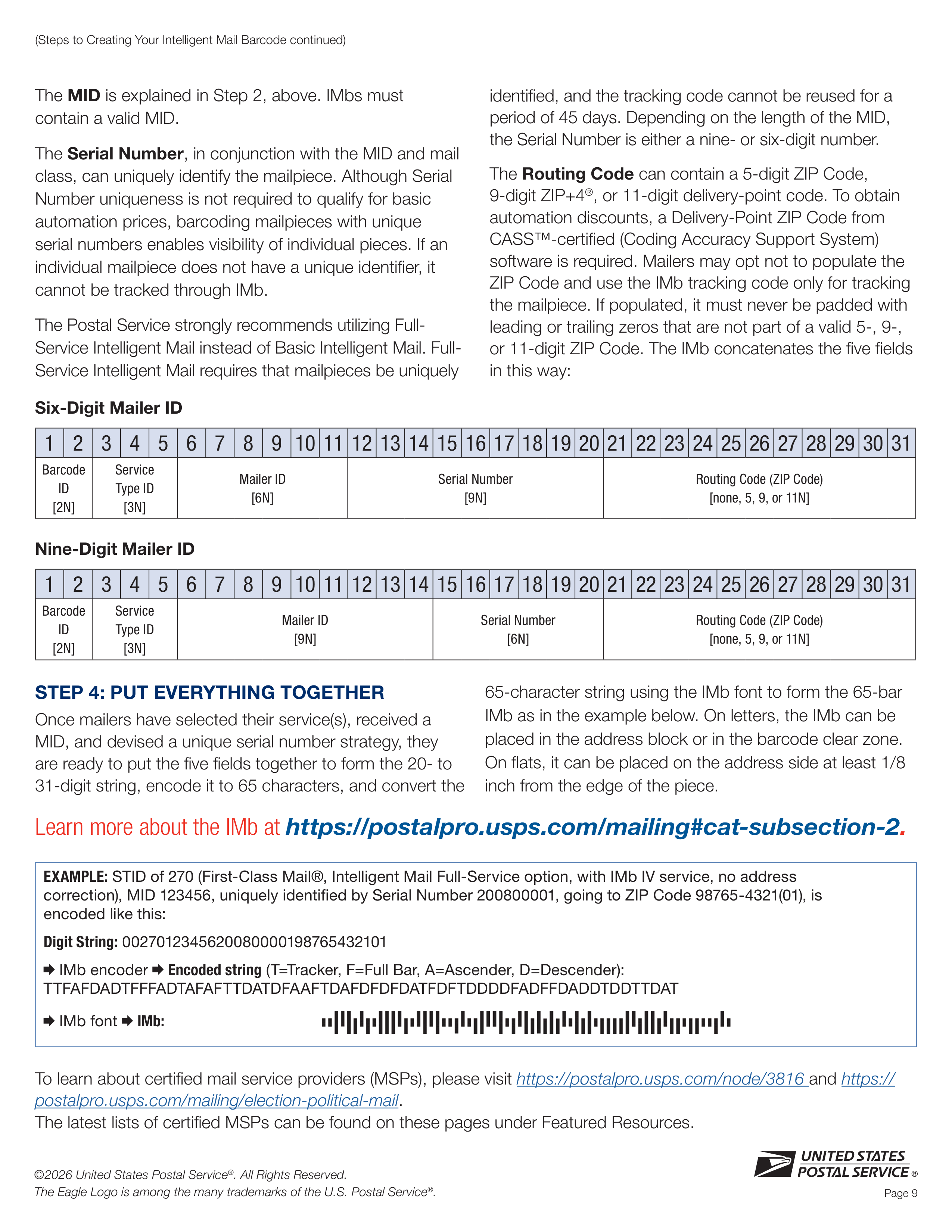
The serialized
Intelligent Mail
®
barcode (IMb
®
)
is a
65-bar Postal Service™ barcode used to sort and track
individual letters and flats. The barcode simplifies data by
consolidating information for multiple Postal Service
identifiers into one comprehensive location. Using a
serialized IMb also expands mailers’ ability to track
individual mailpieces and gain greater mailstream visibility.
Uniquely serialized IMbs facilitate the tracking of individual
Ballot Mail to and from individual voters. For example, a
single household may have multiple individual voters residing
at the same address. If the IMb on the Ballot Mail envelopes
to and from those individual voters have not been uniquely
serialized, they cannot be tracked as they move through
the mailstream. Election officials will need to maintain the
relationship of the serial number to the specific voter.
A uniquely serialized IMb can be applied to all automation
compatible letters and flats and is critical for using Informed
Visibility
®
Mail Tracking and Reporting (IV
®
-MTR) service.
The IV-MTR application provides information about when and
where the Postal Service sorts a mailpiece on mail-processing
equipment. A uniquely serialized IMb can also be used for
address correction services: Address Change Service (ACS
™
),
OneCode ACS
®
, and Intelligent Mail Full-Service ACS
™
.
PostalPro Resources
The
IV-MTR User Guide
can be found under the IV-MTR
User Guides and Training section at
https://postalpro.usps.
com/InformedVisibility
.
For guidance on address quality, please visit
https://
postalpro.usps.com/address-quality
.
Additional insights into the Intelligent Mail program can
be found at
https://postalpro.usps.com/mailing/intelligent-
mail-barcode
.
For more information about STIDs, go to
https://postalpro.
usps.com/mailing/service-type-identifiers
.
STEP 1: DOWNLOAD AND INSTALL THE
ENCODER AND FONT
An IMb consists of a 20-digit tracking code field [Barcode
Identifier, Service Type IDentifier (STID), Mailer ID (MID),
and Serial Number] and a Routing Code (ZIP Code
™
) field
of up to 11 digits. An encoder is required to convert the
numeric digits into a 65-character string representing the
bars of the IMb and a special font is required to convert
the 65 alpha-character string into the IMb bars. Users can
download the fonts and computer source code at
https://
postalpro.usps.com/mailing/encoder-software-and-fonts
.
Once the encoder and font are installed, verify the print
quality by producing samples, as instructed in the encoder
package.
The Intelligent Mail Barcode 4-State Specification
USPS-B-3200
and the
Intelligent Mail Barcode Technical
Resource Guide
on PostalPro provide extensive technical
information about IMbs and can be found at
https://
postalpro.usps.com/mailing/intelligent-mail-barcode
.
STEP 2: APPLY FOR A MAILER ID
A MID is required for the IMb tracking code. New MIDs are
assigned through centralized USPS
®
processes, generally
through the MID system on the Business Customer
Gateway at
https://gateway.usps.com/eAdmin/view/signin
.
STEP 3: POPULATE THE BARCODE FIELDS
The five IMb fields are the Barcode Identifier, the STID,
the MID, the Serial Number, and the Routing Code (ZIP
Code). Each field has its own unique set of standards,
explained below:
The
Barcode Identifier
field should be “00” (zero-zero),
with one exception: automation-price eligible flat mail
bearing a printed optional endorsement line (OEL). When
mailers prepare flat-size pieces using IMb tracking codes
to meet automation-price eligibility requirements, the
IMb tracking codes on any pieces bearing printed OELs
must contain the Barcode Identifier corresponding to
the printed OEL used. See the Barcode ID fact sheet on
PostalPro at
https://postalpro.usps.com/node/3528
to
determine the correct Barcode IDentifier.
The attributes that determine which
STID
should appear in
an IMb tracking code are the mail class, the ACS service
selected, and whether IV-MTR service is desired. See the
Service Type IDentifier for Ballot Mail fact sheet on page
10 of this kit or visit PostalPro at
https://postalpro.usps.
com/mailing/service-type-identifiers
for more information
about STIDS.
(continued on back)

©2026 United States Postal Service
®
. All Rights Reserved.
The Eagle Logo is among the many trademarks of the U.S. Postal Service
®
.
Page 9
(Steps to Creating Your Intelligent Mail Barcode continued)
The
MID
is explained in Step 2, above. IMbs must
contain a valid MID.
The
Serial Number
, in conjunction with the MID and mail
class, can uniquely identify the mailpiece. Although Serial
Number uniqueness is not required to qualify for basic
automation prices, barcoding mailpieces with unique
serial numbers enables visibility of individual pieces. If an
individual mailpiece does not have a unique identifier, it
cannot be tracked through IMb.
The Postal Service strongly recommends utilizing Full-
Service Intelligent Mail instead of Basic Intelligent Mail. Full-
Service Intelligent Mail requires that mailpieces be uniquely
identified, and the tracking code cannot be reused for a
period of 45 days. Depending on the length of the MID,
the Serial Number is either a nine- or six-digit number.
The
Routing Code
can contain a 5-digit ZIP Code,
9-digit ZIP+4
®
, or 11-digit delivery-point code. To obtain
automation discounts, a Delivery-Point ZIP Code from
CASS™-certified (Coding Accuracy Support System)
software is required. Mailers may opt not to populate the
ZIP Code and use the IMb tracking code only for tracking
the mailpiece. If populated, it must never be padded with
leading or trailing zeros that are not part of a valid 5-, 9-,
or 11-digit ZIP Code. The IMb concatenates the five fields
in this way:
Six-Digit Mailer ID
1
2
3
4
5
6
7
8
9
10
11
12
13
14
15
16
17
18
19
20
21
22
23
24
25
26
27
28
29
30
31
Barcode
ID
[2N]
Service
Type ID
[3N]
Mailer ID
[6N]
Serial Number
[9N]
Routing Code (ZIP Code)
[none, 5, 9, or 11N]
Nine-Digit Mailer ID
1
2
3
4
5
6
7
8
9
10
11
12
13
14
15
16
17
18
19
20
21
22
23
24
25
26
27
28
29
30
31
Barcode
ID
[2N]
Service
Type ID
[3N]
Mailer ID
[9N]
Serial Number
[6N]
Routing Code (ZIP Code)
[none, 5, 9, or 11N]
STEP 4: PUT EVERYTHING TOGETHER
Once mailers have selected their service(s), received a
MID, and devised a unique serial number strategy, they
are ready to put the five fields together to form the 20- to
31-digit string, encode it to 65 characters, and convert the
65-character string using the IMb font to form the 65‑bar
IMb as in the example below. On letters, the IMb can be
placed in the address block or in the barcode clear zone.
On flats, it can be placed on the address side at least 1/8
inch from the edge of the piece.
Learn more about the IMb at
https://postalpro.usps.com/mailing#cat-subsection-2
.
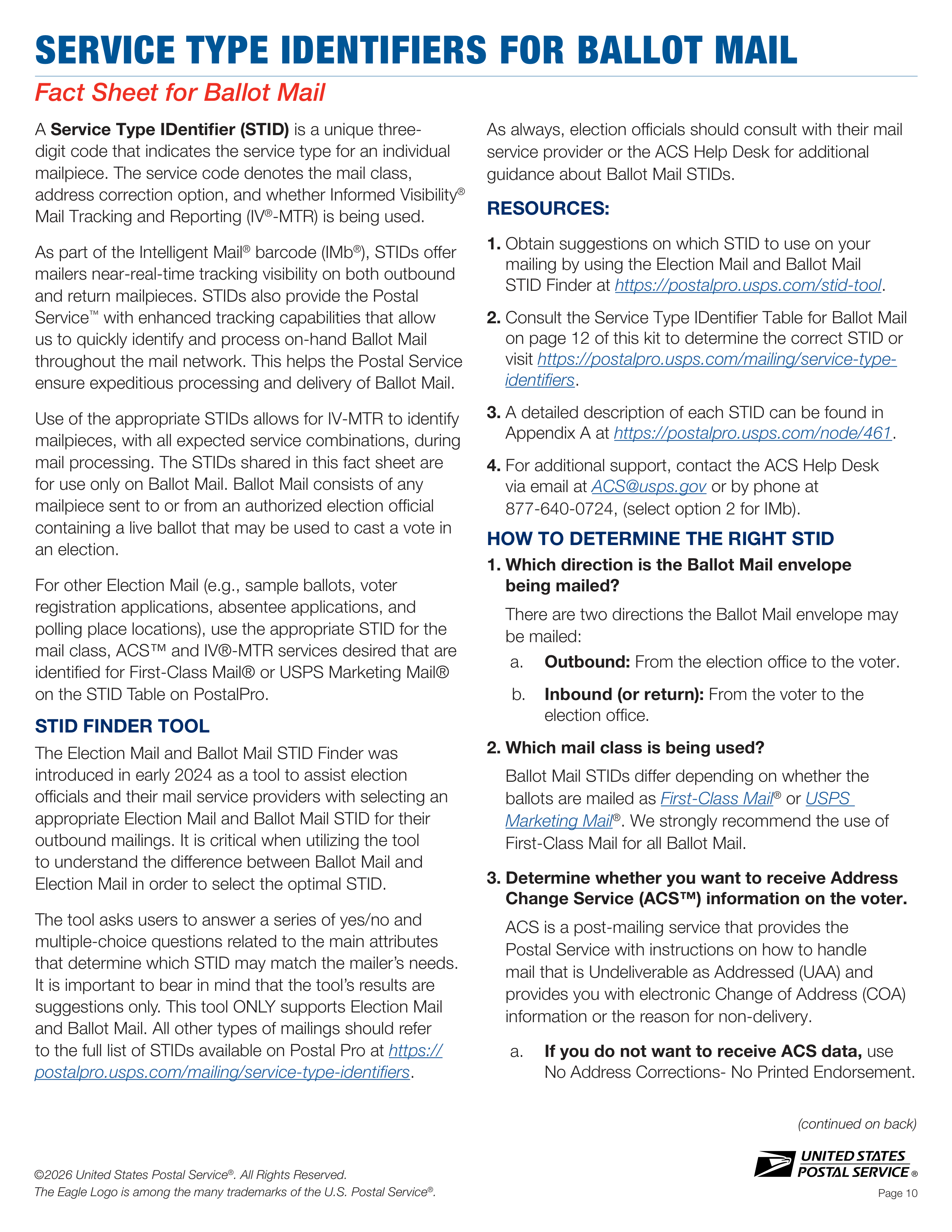
EXAMPLE:
STID of 270 (First-Class Mail®, Intelligent Mail Full-Service option, with IMb IV service, no address
correction), MID 123456, uniquely identified by Serial Number 200800001, going to ZIP Code 98765-4321(01), is
encoded like this:
Digit String:
0027012345620080000198765432101
IMb encoder
Encoded string
(T=Tracker, F=Full Bar, A=Ascender, D=Descender):
TTFAFDADTFFFADTAFAFTTDATDFAAFTDAFDFDFDATFDFTDDDDFADFFDADDTDDTTDAT
IMb font
IMb:
To learn about certified mail service providers (MSPs), please visit
https://postalpro.usps.com/node/3816
and
https://
postalpro.usps.com/mailing/election-political-mail
.
The latest lists of certified MSPs can be found on these pages under Featured Resources.
©2026 United States Postal Service
®
. All Rights Reserved.
The Eagle Logo is among the many trademarks of the U.S. Postal Service
®
.
Page 10
SERVICE TYPE IDENTIFIERS FOR BALLOT MAIL
Fact Sheet for Ballot Mail
A
Service Type IDentifier (STID)
is a unique three-
digit code that indicates the service type for an individual
mailpiece. The service code denotes the mail class,
address correction option, and whether Informed Visibility
®
Mail Tracking and Reporting (IV
®
-MTR) is being used.
As part of the Intelligent Mail
®
barcode (IMb
®
), STIDs offer
mailers near-real-time tracking visibility on both outbound
and return mailpieces. STIDs also provide the Postal
Service
™
with enhanced tracking capabilities that allow
us to quickly identify and process on-hand Ballot Mail
throughout the mail network. This helps the Postal Service
ensure expeditious processing and delivery of Ballot Mail.
Use of the appropriate STIDs allows for IV-MTR to identify
mailpieces, with all expected service combinations, during
mail processing. The STIDs shared in this fact sheet are
for use only on Ballot Mail. Ballot Mail consists of any
mailpiece sent to or from an authorized election official
containing a live ballot that may be used to cast a vote in
an election.
For other Election Mail (e.g., sample ballots, voter
registration applications, absentee applications, and
polling place locations), use the appropriate STID for the
mail class, ACS™ and IV®-MTR services desired that are
identified for First-Class Mail® or USPS Marketing Mail®
on the STID Table on PostalPro.
STID FINDER TOOL
The Election Mail and Ballot Mail STID Finder was
introduced in early 2024 as a tool to assist election
officials and their mail service providers with selecting an
appropriate Election Mail and Ballot Mail STID for their
outbound mailings. It is critical when utilizing the tool
to understand the difference between Ballot Mail and
Election Mail in order to select the optimal STID.
The tool asks users to answer a series of yes/no and
multiple-choice questions related to the main attributes
that determine which STID may match the mailer’s needs.
It is important to bear in mind that the tool’s results are
suggestions only. This tool ONLY supports Election Mail
and Ballot Mail. All other types of mailings should refer
to the full list of STIDs available on Postal Pro at
https://
postalpro.usps.com/mailing/service-type-identifiers
.
As always, election officials should consult with their mail
service provider or the ACS Help Desk for additional
guidance about Ballot Mail STIDs.
RESOURCES:
1.
Obtain suggestions on which STID to use on your
mailing by using the Election Mail and Ballot Mail
STID Finder at
https://postalpro.usps.com/stid-tool
.
2.
Consult the Service Type IDentifier Table for Ballot Mail
on page 12 of this kit to determine the correct STID or
visit
https://postalpro.usps.com/mailing/service-type-
identifiers
.
3.
A detailed description of each STID can be found in
Appendix A at
https://postalpro.usps.com/node/461
.
4.
For additional support, contact the ACS Help Desk
via email at
ACS@usps.gov
or by phone at
877-640-0724, (select option 2 for IMb).
HOW TO DETERMINE THE RIGHT STID
1. Which direction is the Ballot Mail envelope
being mailed?
There are two directions the Ballot Mail envelope may
be mailed:
a.
Outbound:
From the election office to the voter.
b.
Inbound (or return):
From the voter to the
election office.
2. Which mail class is being used?
Ballot Mail STIDs differ depending on whether the
ballots are mailed as
First-Class Mail
®
or
USPS
Marketing Mail
®
. We strongly recommend the use of
First-Class Mail for all Ballot Mail.
3. Determine whether you want to receive Address
Change Service (ACS™) information on the voter.
ACS is a post-mailing service that provides the
Postal Service with instructions on how to handle
mail that is Undeliverable as Addressed (UAA) and
provides you with electronic Change of Address (COA)
information or the reason for non-delivery.
a.
If you do not want to receive ACS data,
use
No Address Corrections- No Printed Endorsement.
(continued on back)
©2026 United States Postal Service
®
. All Rights Reserved.
The Eagle Logo is among the many trademarks of the U.S. Postal Service
®
.
Page 11
(Service Type IDentifiers for Ballot Mail continued)
b.
If you do want to receive ACS data,
decide how
you want to receive the data:
•
Manual Notice:
Physical address correction
notice PS Form 3547,
Notice to Mailer of
Correction in Address
, will be provided to you
with the voter’s correct address information.
•
Electronic Notice:
i.
OneCode ACS
®
allows you to receive
electronic or automated address corrections
through the use of the IMb when mailing
a ballot using First-Class Mail or USPS
Marketing Mail. More information can be
found on
https://postalpro.usps.com/mailing-
and-shipping-services/onecode-acs
.
ii.
Full-Service ACS
provides an additional
benefit for mail using the Intelligent Mail
barcode that qualifies for Full-Service
discount postage prices. Full-Service
discounts and the resulting Full-Service
ACS benefits are available at
https://postalpro.
usps.com/node/2788
.
iii.
Traditional ACS
allows you to receive
address corrections in an electronic format
when mailing a ballot in a letter or flat sized
envelope. In addition to the IMb, your
mailpieces will be identified with a postal-
supplied seven-character alpha identifier
known as the ACS participant code and an
optional keyline. A keyline is a unique code
that allows you to either incorporate existing
voter identifiers or create a new system that
assists in locating the voter in your database.
Additional information is available at
https://
postalpro.usps.com/address-quality-solutions/
traditional-acs
.
4. Do you want UAA Ballot Mail to be forwarded (if
possible), or returned to you?
a.
Forward
•
Address Service Requested Option 1:
Mail is
forwarded, if possible, or returned if forwarding
is not possible. A manual or electronic notice
with the voter’s new address information is
provided for forwarded pieces and the address
correction fee is charged. First-Class Mail is
forwarded or returned at no charge. USPS
Marketing Mail is charged an additional
weighted fee for mail that must be returned.
•
Address Service Requested Option 2:
Mail is forwarded, if possible, or returned if
forwarding is not possible. An electronic notice
is issued for either result. For First-Class Mail,
the piece will be returned to sender at no charge
with the reason for non-delivery attached; however,
a separate notice with the reason for non-delivery
will be provided for a fee. USPS Marketing Mail is
charged an additional weighted fee for mail that
must be returned.
b.
Return
•
Return Service Requested Option 2:
The mailpiece is returned to sender with the new
address or reason for non-delivery. First-Class Mail
is returned at no charge. USPS Marketing Mail is
returned at either the single-piece First-Class Mail
or Priority Mail price, depending on the weight of
the piece.
5. Do you meet the requirements to be a
Full-Service Mailer?
The qualifications to be a Full-Service Mailer can be found
on PostalPro at
https://postalpro.usps.com/certifications/
standard-full-service-certification-mailers
.
a.
If yes,
Full-Service with IV-MTR STIDs will match
your mailing goals.
b.
If no,
Basic / Non-Automation with IV-MTR STIDs
will match your mailing goals.
IMPORTANT NOTE:
Understand the postage and/or fees, if any, that will be
associated with the use of each STID.
If using USPS Marketing Mail, please be aware that, to
have the mailpiece forwarded or returned to sender, it
must contain the associated printed text ancillary service
endorsement. This incurs an additional cost.
©2026 United States Postal Service
®
. All Rights Reserved.
The Eagle Logo is among the many trademarks of the U.S. Postal Service
®
.
Page 12
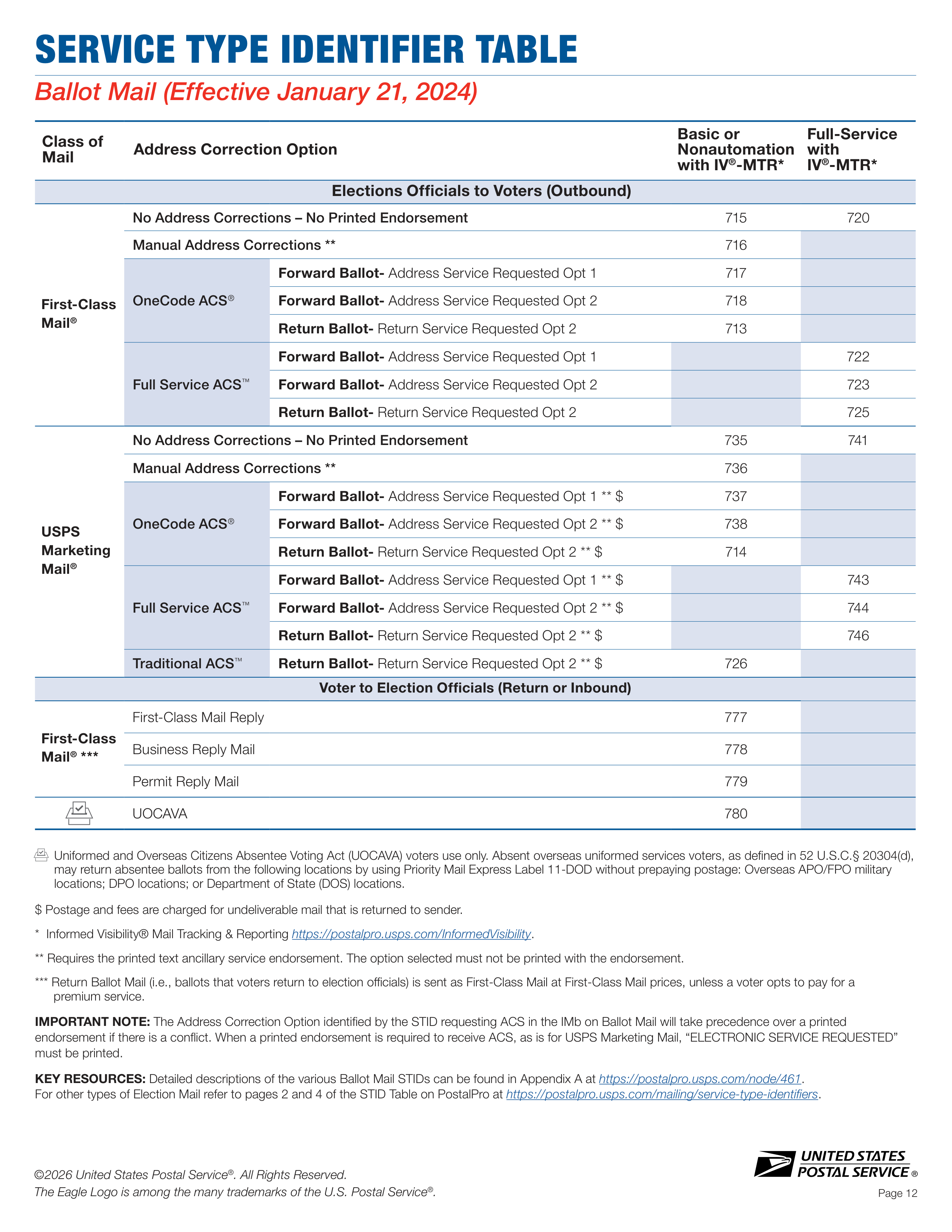
SERVICE TYPE IDENTIFIER TABLE
Ballot Mail (Effective January 21, 2024)
Class of
Mail
Address Correction Option
Basic or
Nonautomation
with IV
®
-MTR*
Full-Service
with
IV
®
-MTR*
Elections Officials to Voters (Outbound)
First-Class
Mail
®
No Address Corrections – No Printed Endorsement
715
720
Manual Address Corrections **
716
OneCode ACS
®
Forward Ballot-
Address Service Requested Opt 1
717
Forward Ballot-
Address Service Requested Opt 2
718
Return Ballot-
Return Service Requested Opt 2
713
Full Service ACS
™
Forward Ballot-
Address Service Requested Opt 1
722
Forward Ballot-
Address Service Requested Opt 2
723
Return Ballot-
Return Service Requested Opt 2
725
USPS
Marketing
Mail
®
No Address Corrections – No Printed Endorsement
735
741
Manual Address Corrections **
736
OneCode ACS
®
Forward Ballot-
Address Service Requested Opt 1 ** $
737
Forward Ballot-
Address Service Requested Opt 2 ** $
738
Return Ballot-
Return Service Requested Opt 2 ** $
714
Full Service ACS
™
Forward Ballot-
Address Service Requested Opt 1 ** $
743
Forward Ballot-
Address Service Requested Opt 2 ** $
744
Return Ballot-
Return Service Requested Opt 2 ** $
746
Traditional ACS
™
Return Ballot-
Return Service Requested Opt 2 ** $
726
Voter to Election Officials (Return or Inbound)
First-Class
Mail
®
***
First-Class Mail Reply
777
Business Reply Mail
778
Permit Reply Mail
779
UOCAVA
780
Uniformed and Overseas Citizens Absentee Voting Act (UOCAVA) voters use only. Absent overseas uniformed services voters, as defined in 52 U.S.C.§ 20304(d),
may return absentee ballots from the following locations by using Priority Mail Express Label 11-DOD without prepaying postage: Overseas APO/FPO military
locations; DPO locations; or Department of State (DOS) locations.
$ Postage and fees are charged for undeliverable mail that is returned to sender.
* Informed Visibility® Mail Tracking & Reporting
https://postalpro.usps.com/InformedVisibility
.
** Requires the printed text ancillary service endorsement. The option selected must not be printed with the endorsement.
*** Return Ballot Mail (i.e., ballots that voters return to election officials) is sent as First-Class Mail at First-Class Mail prices, unless a voter opts to pay for a
premium service.
IMPORTANT NOTE:
The Address Correction Option identified by the STID requesting ACS in the IMb on Ballot Mail will take precedence over a printed
endorsement if there is a conflict. When a printed endorsement is required to receive ACS, as is for USPS Marketing Mail, “ELECTRONIC SERVICE REQUESTED”
must be printed.
KEY RESOURCES:
Detailed descriptions of the various Ballot Mail STIDs can be found in Appendix A at
https://postalpro.usps.com/node/461
.
For other types of Election Mail refer to pages 2 and 4 of the STID Table on PostalPro at
https://postalpro.usps.com/mailing/service-type-identifiers
.
©2026 United States Postal Service
®
. All Rights Reserved.
The Eagle Logo is among the many trademarks of the U.S. Postal Service
®
.
Page 13
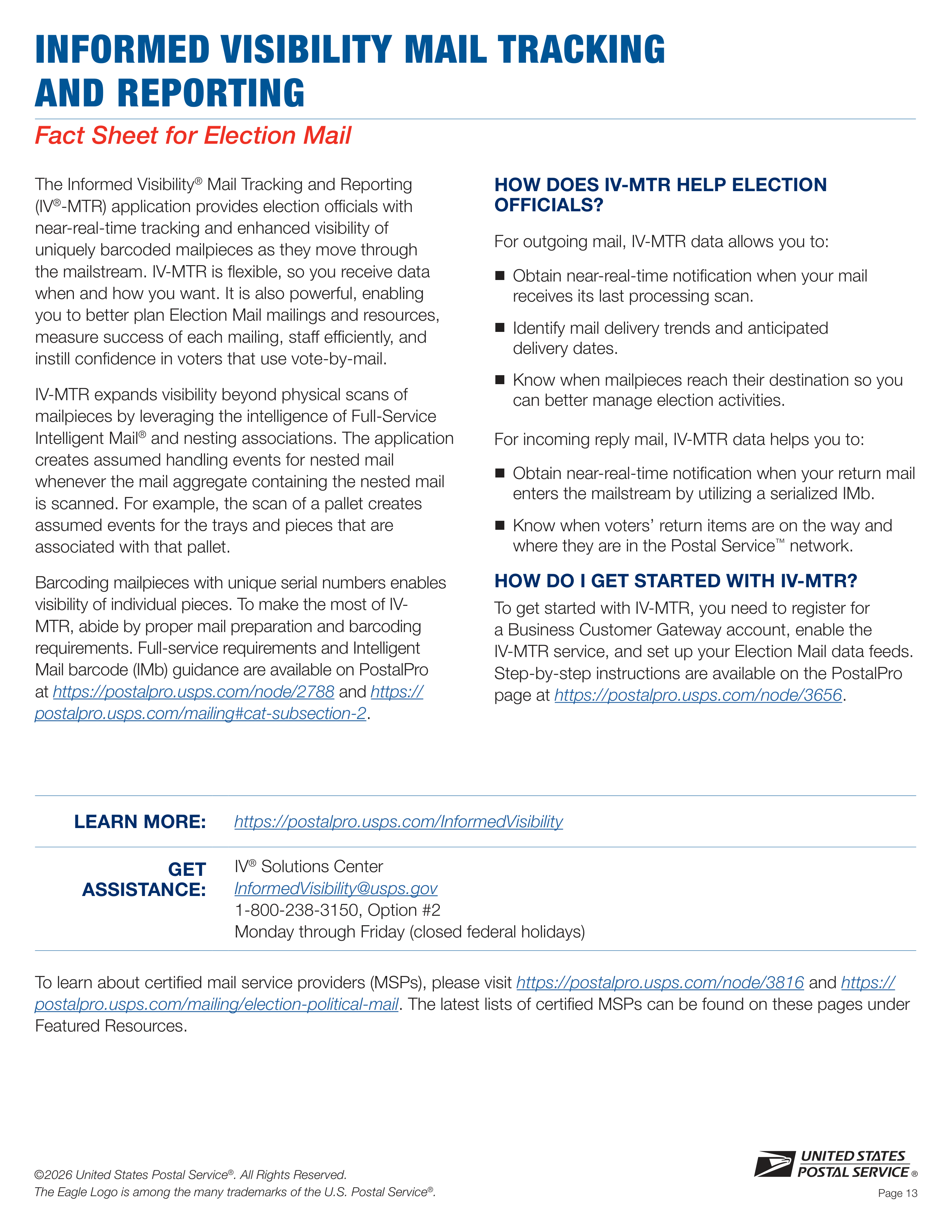
INFORMED VISIBILITY MAIL TRACKING
AND REPORTING
Fact Sheet for Election Mail
The Informed Visibility
®
Mail Tracking and Reporting
(IV
®
‑MTR) application provides election officials with
near-real-time tracking and enhanced visibility of
uniquely barcoded mailpieces as they move through
the mailstream. IV-MTR is flexible, so you receive data
when and how you want. It is also powerful, enabling
you to better plan Election Mail mailings and resources,
measure success of each mailing, staff efficiently, and
instill confidence in voters that use vote-by-mail.
IV-MTR expands visibility beyond physical scans of
mailpieces by leveraging the intelligence of Full-Service
Intelligent Mail
®
and nesting associations. The application
creates assumed handling events for nested mail
whenever the mail aggregate containing the nested mail
is scanned. For example, the scan of a pallet creates
assumed events for the trays and pieces that are
associated with that pallet.
Barcoding mailpieces with unique serial numbers enables
visibility of individual pieces. To make the most of IV-
MTR, abide by proper mail preparation and barcoding
requirements. Full-service requirements and Intelligent
Mail barcode (IMb) guidance are available on PostalPro
at
https://postalpro.usps.com/node/2788
and
https://
postalpro.usps.com/mailing#cat-subsection-2
.
HOW DOES IV-MTR HELP ELECTION
OFFICIALS?
For outgoing mail, IV-MTR data allows you to:
¢
Obtain near-real-time notification when your mail
receives its last processing scan.
¢
Identify mail delivery trends and anticipated
delivery dates.
¢
Know when mailpieces reach their destination so you
can better manage election activities.
For incoming reply mail, IV-MTR data helps you to:
¢
Obtain near-real-time notification when your return mail
enters the mailstream by utilizing a serialized IMb.
¢
Know when voters’ return items are on the way and
where they are in the Postal Service
™
network.
HOW DO I GET STARTED WITH IV-MTR?
To get started with IV-MTR, you need to register for
a Business Customer Gateway account, enable the
IV‑MTR service, and set up your Election Mail data feeds.
Step-by-step instructions are available on the PostalPro
page at
https://postalpro.usps.com/node/3656
.
LEARN MORE:
https://postalpro.usps.com/InformedVisibility
GET
ASSISTANCE:
IV
®
Solutions Center
InformedVisibility@usps.gov
1-800-238-3150, Option #2
Monday through Friday (closed federal holidays)
To learn about certified mail service providers (MSPs), please visit
https://postalpro.usps.com/node/3816
and
https://
postalpro.usps.com/mailing/election-political-mail
. The latest lists of certified MSPs can be found on these pages under
Featured Resources.

©2026 United States Postal Service
®
. All Rights Reserved.
The Eagle Logo is among the many trademarks of the U.S. Postal Service
®
.
Page 14
This page is intentionally left blank
©2026 United States Postal Service
®
. All Rights Reserved.
The Eagle Logo is among the many trademarks of the U.S. Postal Service
®
.
Page 15
TAG 191, DOMESTIC AND INTERNATIONAL BALLOTS
Fact Sheet for Ballot Mail
The Postal Service™ recommends the use of green
Tag 191,
Domestic and International Ballots
, to
identify trays and sacks that contain Ballot Mail. Although
use of the tag is optional, it provides greater visibility to
containers of Ballot Mail as they enter Postal Service
processing and distribution operations.
Tag 191 may only be used to identify Ballot Mail addressed
for domestic or international delivery. The tag cannot be
used to identify containers of other types of Election Mail
such as sample ballots, voter registration cards, absentee
voting applications and polling place notifications.
NEW THIS YEAR
An updated version of Tag 191 will be entered into
circulation this election year. The April 2025 dated tag
features the same text on both sides and has English and
Spanish translations, whereas the existing July 2007 dated
tag had different faces and was written only in English.
Both versions of the tag remain valid.
Please exhaust the existing tags on hand. Business Mail
Entry Units (BMEUs) will continue to accept and affix both
versions of the tag since they are reusable. Affix Tag 191
to the mail container as follows:
¢
Strapped Letter Trays:
Using a plastic twist tie, attach
Tag 191 to the strap at the end of the tray that bears
the tray label.
¢
Non-strapped Letter Trays:
For trays permitted to be
tendered without strapping, attach Tag 191 to the tray
with a rubber band that is double-looped through the
tray handhold at the end that bears the tray label.
¢
Sacks and Flat Trays with Flat-Size Mail:
Depending
on the type of sack, attach Tag 191 to either the strap
or label holder on the sack.
Tags are available at your local BMEU, which can be found
at
https://postalpro.usps.com/node/1623
or ordered
online at
https://about.usps.com/forms/ps1910.pdf
.
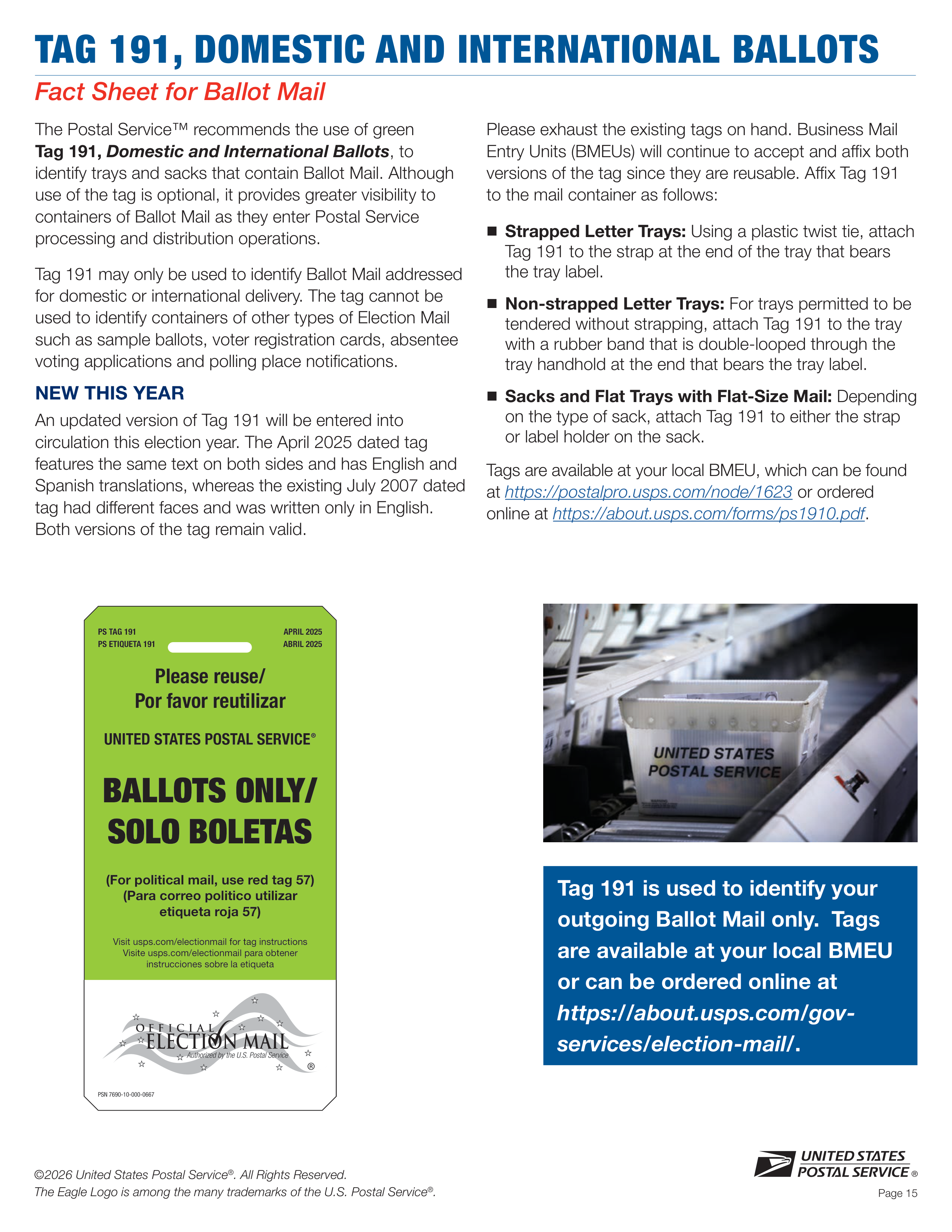
Tag 191 example
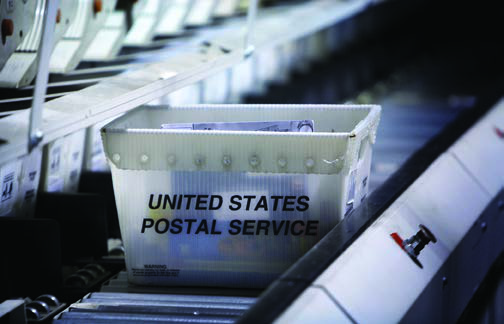
Tag 191 is used to identify your
outgoing Ballot Mail only. Tags
are available at your local BMEU
or can be ordered online at
https://about.usps.com/gov-
services/election-mail/
.

©2026 United States Postal Service
®
. All Rights Reserved.
The Eagle Logo is among the many trademarks of the U.S. Postal Service
®
.
Page 16
This page is intentionally left blank
©2026 United States Postal Service
®
. All Rights Reserved.
The Eagle Logo is among the many trademarks of the U.S. Postal Service
®
.
Page 17
QUALIFIED BUSINESS REPLY MAIL WITH INTELLIGENT
MAIL BARCODE ACCOUNTING
Fact Sheet for Election Mail
Qualified Business Reply Mail
™
(QBRM
™
) is a First-Class
Mail
®
service that enables you to pay the return postage
(including a per-piece fee) for Election Mail that is mailed to
your election office from voters. You can distribute QBRM
envelopes and have the mailpieces returned to you at any
Post Office™. QBRM utilizes the enhanced processing
capability of Intelligent Mail barcode Accounting (IMbA) to
reduce processing times.
The reply mail envelopes distributed must conform to
a specific format, including use of a unique ZIP+4
®
assigned by the Postal Service
™
. Proofs for QBRM must
be approved by a Postal Service Mailpiece Design Analyst
(MDA) and bear an Intelligent Mail
®
barcode (IMb
®
). QBRM
can be used only on automation-compatible cards and
letter-size mail weighing up to and including 3.5 ounces.
Once you are an approved QBRM mailer, you can
enhance your Election Mail processing capability with
Intelligent Mail barcode Accounting (IMbA
TM
). IMbA is an
automated solution for the counting, rating, invoicing, and
billing processes. Using the IMbA on the mailpiece, the
mail processing equipment counts destinations approved
and assigned to you. Then invoicing is sent daily, directly
to
PostalOne!
®
.
For more information on QBRM, see
Quick Service Guide
505
and
Mailing Standards of the United States Postal
Service,
Domestic Mail Manual (DMM
®
) 505.1.1 and 1.6
available on Postal Explorer at
https://pe.usps.com
.
HOW DOES IMbA ENHANCE THE MAILING
PROCESS?
¢
Processes like scanning, sorting, and rating are
automated to get your reply mail to you quicker, which
is great for large volumes of reply mail.
¢
After processing, invoices are automatically created and
uploaded to
PostalOne!
.
¢
The increase in speed creates a more consistent flow of
mail and makes more timely mail pickups possible.
¢
USPS makes constant updates to the IMbA system to
improve services and enhance reporting.
¢
IMbA is provided to QBRM customers at no extra cost.
¢
Mailers are eligible for annual account maintenance
and quarterly fee waivers, and a reduced per-piece fee.
Reference Notice 123 on Postal Explorer at
https://
pe.usps.gov/text/DMM300/Notice123.htm
for more
information.
¢
Using a unique IMb with ZIP+4 increases mailpiece
visibility and tracking.
¢
Prepaid postage facilitates easy voting for citizens.
HOW DO I GET STARTED WITH QBRM WITH
IMbA?
1.
Discuss your QBRM needs with a Mailing Requirements
Clerk. Contact the Mailing and Shipping Solutions Center
(MSSC) by emailing
MSSC@usps.gov
or calling 877-
672-0007 (select option 2 for mailing requirements).
Hours of operation are Monday through Friday, 7 a.m. to
7 p.m. Central Time (closed federal holidays).
2.
Complete Part A of PS Form 3615,
Mailing Permit
Application and Customer Profile
(
https://about.usps.
com/forms/ps3615.pdf
), to establish a QBRM permit.
Then fill out section 1 of PS Form 6805,
BRM/QBRM
Application for ZIP+4 Code Assignment/ Validation
and QBRM Approval
(
https://about.usps.com/forms/
ps6805.pdf
), to request a unique ZIP+4 for the QBRM
address for each price category (letters/postcard).
Both forms must be submitted via email to the MSSC –
Mailing Requirements Department at
MSSC@usps.gov
for processing.
3.
Set up a Mailer ID (MID) by visiting
https://gateway.
usps.com/eAdmin/view/signin
and creating a Business
Customer Gateway (BCG) account.
4.
Request a unique IMb from your MDA. This request
should be made only after your QBRM account
is created on the BCG, a unique ZIP+4 has been
assigned, and your MID is provided. Customers can
receive assistance from a MDA by submitting a design
review request at
https://electionmail.usps.com/s/
election-mail-review
or by calling 877-672-0007 (select
option 3 for mailpiece design). For more information
on creating an IMb for Election Mail, see the Steps to
Creating Your IMb Fact Sheet on page 8 of this kit.
(continued on back)
©2026 United States Postal Service
®
. All Rights Reserved.
The Eagle Logo is among the many trademarks of the U.S. Postal Service
®
.
Page 18
(QBRM with IMbA continued)
5.
Design a new QBRM return mail envelope with advice
from an MDA. Submit an electronic copy of the QBRM
proof in a PDF file with crop marks/borders at 100%
(no scaling) to an MDA for review and feedback prior
to printing. Physical samples should also be submitted
because they are required for reflectance, barcode
quality, print/contrast ratio, and QBRM approval. For
assistance from a MDA, submit a design review request
at
https://electionmail.usps.com/s/election-mail-review
or
call 877-672-0007 (select option 3 for mailpiece design).
Mailpiece designs must comply with the
following directives:
■
Publication 631 —
Official Election Mail — Graphic
Guidelines and Logos
.
■
Publication 632 —
State and Local Election Mail –
User’s Guide
.
■
Kit 600 —
2026-2027 Official Election Mail Guide.
■
DMM 201, 202, 204, 505, and 703.8.0.
6.
Return PS Form
6805, BRM/QBRM Application
for ZIP+4 Code Assignment/Validation and QBRM
Approval
(
https://about.usps.com/forms/ps6805.
pdf
), after completing parts 1-5 and with 10 physical
samples or paper mockups to ensure compliance with
Postal Service regulations and processing systems. The
application and 10 samples must be submitted to an
MDA for QBRM testing and approval. Customers can
receive assistance from a MDA by submitting a design
review request at
https://electionmail.usps.com/s/
election-mail-review
or by calling 877-672-0007 (select
option 3 for mailpiece design).
©2026 United States Postal Service
®
. All Rights Reserved.
The Eagle Logo is among the many trademarks of the U.S. Postal Service
®
.
Page 19
SPECIAL PROCEDURES: APO/FPO/DPO AND
OVERSEAS CITIZENS ABSENTEE BALLOTS
Fact Sheet for Election Mail
SEPTEMBER 1– NOVEMBER 30
The United States Postal Service
®
and the Military Postal Service
Agency have again joined forces to expedite delivery of federal Ballot
Mail to overseas military personnel. We recognize the important role
that mail plays in the election process and are committed to ensuring
that everyone who chooses to vote by mail experiences a smooth, well-
organized process — one that provides them with the highest level of
trust and confidence.
Program Summary:
¢
All military ballots mailed by election officials will be subject to special
handling procedures. Election officials should send Ballot Mail at least
45 days prior to the November 3, 2026, general elections.
¢
Local election officials are requested to segregate military absentee
Ballot Mail into bundles for the Chicago and Miami International
Service Centers (ISCs), which serve as gateways for the military. At
the ISCs, Ballot Mail receives special handling.
¢
Trays or containers of Ballot Mail destined for APO/FPO/DPO (Army
and Air Force Post Office/Fleet Post Office/Diplomatic Post Office)
addresses and overseas citizens may be identified using Tag 191,
Domestic and International Ballots,
and presented to the Post Office
™
.
¢
APO/FPO/DPO Ballot Mail will be sent from local Post Office
locations to the nearest Processing and Distribution Center for
further processing.
¢
Facing slips are used to presort loose Ballot Mail, based on bundle
size, that are destined to pass through the two ISC military gateways.
The facing slips are pictured on the right side of this fact sheet.
ELECTION OFFICIALS:
Separate military Ballot Mail by preparing
bundles for the two ISC military gateways: Chicago and Miami.
Directions for Marking the Bundles:
ISC Name
ISC State Abbreviation
ISC ZIP Code™ Range
Chicago
AE
090–099
Chicago
AP
962–966
Miami
AA
340
If fewer than five (5) pieces are in a separate bundle, a mixed bundle
may be prepared. This bundle must have the facing slip marked, “APO/
FPO/DPO MIXED – Absentee Ballots.”
Figures 1, 2, 3, and 4
APO/FPO/DPO and MIXED Facing Slips
Figures 1,
2, 3,
and 4 APO/FPO/DPO and MIXED Facing Slip
s
(continued on back)
©2026 United States Postal Service
®
. All Rights Reserved.
The Eagle Logo is among the many trademarks of the U.S. Postal Service
®
.
Page 20
(Special Procedures continued)
UNIFORMED AND OVERSEAS CITIZENS
ABSENTEE VOTING ACT (UOCAVA)
As mandated by law, election officials are expected to send
ballots to military personnel, their eligible family members,
and overseas citizens at least 45 days prior to a federal
election. The Postal Service
™
is committed to helping
election officials meet their obligations with proactive
planning and mailpiece preparation.
Get started by doing the following:
¢
Connect with your Postal Service local Manager,
Customer Relations by submitting an inquiry
at
https://electionmail.usps.com/s/contact-local-mcr
.
¢
Discuss the timeline and known deadlines.
¢
Review address files for military and overseas voters
and perform any necessary address maintenance.
¢
Consult Publication 632,
State and Local Election
Mail - User’s Guide,
or Postal Explorer for tips on how
to properly address internationally bound mailpieces at
https://pe.usps.com/text/imm/immc1_008.htm
.
¢
Determine if the mailpiece meets the postage exemption
criteria with postage paid as authorized by UOCAVA.
¢
Obtain and then affix Tag 191,
Domestic and
International Ballots
, to your outbound sacks and trays
of Ballot Mail. Tags can be ordered online at
https://
about.usps.com/forms/ps1910.pdf
.
For more information, please review
Mailing Standards of
the United States Postal Service,
Domestic Mail Manual
(DMM
®
) 703.8.2, Pub 632,
State and Local Election
Mail - User’s Guide
or visit the Federal Voting Assistance
Program at
https://www.fvap.gov/vao/overview
.
©2026 United States Postal Service
®
. All Rights Reserved.
The Eagle Logo is among the many trademarks of the U.S. Postal Service
®
.
Page 21
INFORMED DELIVERY
Fact Sheet for Election Mail
Informed Delivery
®
is a secure, free, and optional feature
that can help election officials connect with voters by
providing eligible residential, business, and P.O. Box
consumers with a digital preview of their household’s
incoming mail and the ability to manage their packages all
from one location.
Users can view grayscale images of the exterior (address
side) of automation-processed, letter-sized mailpieces via
a morning Daily Digest email, or at any time via the online
dashboard from their phone, computer, or the Informed
Delivery Mobile app. Nearly 75 million users are already
signed up with an average email open rate exceeding 60
percent. The Postal Service’s Informed Delivery feature
continues to deliver on its value proposition to election
officials by providing the opportunity to reach more voters,
target and increase interaction with users, encourage
responses to voter engagement campaigns, reach
customers digitally from their physical address, and gain
more returns on Election Mail campaigns.
Election Official Benefits
✔
Increased Interaction.
Generate multiple
impressions to increase awareness of Election Mail,
through synchronized physical and digital touchpoints.
✔
Faster Responses.
Use interactive content and clear
call-to-actions to help encourage voter response.
✔
Gain Insights.
Informed Delivery Interactive
Campaigns provide election officials with the ability to
gain insights from reporting.
Voter Benefits
✔
Convenience.
Preview incoming Election Mail via
email notifications, an online dashboard, or USPS
Mobile App.
✔
Visibility and Security.
Check what’s arriving and
have peace of mind that Election Mail will be delivered.
✔
Call-to-Action.
Easily respond to the election official’s
call-to-action by virtually interacting with them before
the mailpiece physically arrives.
GET STARTED WITH INFORMED DELIVERY
1.
Choose Your Submission Method.
An Informed
Delivery mailing campaign can be created in either
PostalOne!
®
, Mailer Campaigns Portal, or via Application
Programming Interface (API). Consider using
PostalOne!
or the API for your complex mailings, especially
mailings that have several different treatments.
2. Define Your Voter List.
Decide if one treatment will
work for all recipients or if you need to have segments
within the mailing for specific ZIP Codes
™
or counties.
The full 11-digit ZIP Code, consisting of a ZIP+4 and
delivery-point code, is required for recipients. If you
need to segment your mailing, segregate the groups
within your mailing list prior to printing or assigning the
Intelligent Mail® barcode (IMb
®
).
3. Determine Mailer ID (MID) and/or IMb Serial
Number Range.
Identify the MID used for the mailing.
Ensure your MID is valid and included in the IMb on the
physical mailpieces. Lastly, determine your serial number
ranges in the IMb. Your mail service provider (e.g., printer,
ad agency) will generally have this information.
4. Produce Your Creative Content.
Design the “ride-
along” image that will appear in your campaign.
Determine your target URL, as well as the call-to-action
(i.e., “Register to Vote”). The more compelling your call-
to-action is, the more likely a recipient is to respond.
Lastly, decide whether you will use the grayscale
image provided by the Postal Service
™
or use a color
representative image.
5. Select a Timeline.
You need to consider where
the mail is being entered for your Informed Delivery
mailing schedule.
6. Submit Campaign.
Submit your mailing using your
selected submission method from Step 1.
7. Analyze Results.
See how your mailing campaign
worked! Download your Post‑Campaign Reports
(Summary and Detailed level) directly from the Mailer
Campaign Portal or get a copy of your Post‑Campaign
Summary report via email by contacting us at
USPSInformedDeliveryCampaigns@usps.gov
.
Want more information? Visit
https://www.usps.com/
business/informed-delivery.htm
or contact your Postal
Service sales representative.

©2026 United States Postal Service
®
. All Rights Reserved.
The Eagle Logo is among the many trademarks of the U.S. Postal Service
®
.
Page 22
This page is intentionally left blank
©2026 United States Postal Service
®
. All Rights Reserved.
The Eagle Logo is among the many trademarks of the U.S. Postal Service
®
.
Page 23
BALLOT MAIL MAILING STANDARDS
Fact Sheet for Ballot Mail
Each election cycle presents new parameters for ballot
creation, causing return mailpieces to be different sizes and
weights. As a result, many voters do not know the correct
amount of postage required to return their ballots by mail.
Balloting materials provided to voters for any
election, whether disseminated in hardcopy or
electronically, must indicate in a prominent location
the proper amount of First-Class Mail® postage
that must be applied on return mailings, except
in certain circumstances for balloting materials
for military and overseas voters or where postage
is prepaid.
This information must be included in the
balloting materials (i.e., on the ballot, ballot instructions,
mailing instructions, or on the envelope) with the marking
“First‑Class Mail postage must be applied.” Alternatively,
the marking “Apply First-Class Mail postage here” may
be printed in the upper-right corner of the address side
of the envelope used by the voter to return the marked
ballot to election officials. The Postal Service
™
will also
accept approved variations of these indicia.
The marking requirements will not apply to balloting
materials that meet one of the following exceptions:
¢
The balloting materials fall under the special exemptions
for military and overseas voting.
¢
The ballot is returned under Business Reply Mail
®
(BRM) service.
¢
Return postage is guaranteed through a postage
due account.
¢
Postage on the Ballot Mail envelope is prepaid by
stamps, meter, or Permit Reply Mail.
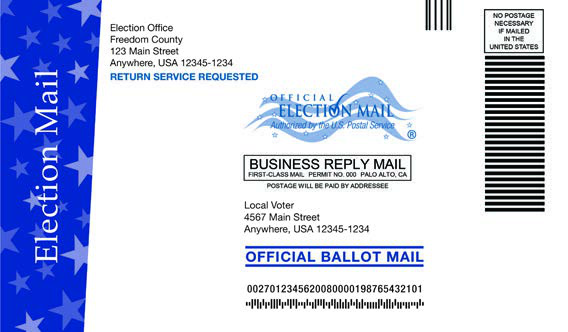
For some of these exceptions, such as BRM, return
postage and Permit Reply Mail, the mailpiece will bear the
indicia “NO POSTAGE NECESSARY IF MAILED IN THE
UNITED STATES” in the upper right-hand corner where
postage is typically applied.
Election officials should consult with Postal Service officials
to assist with mailpiece design and barcode placement
as well as to determine the proper amount of postage
required for mailing ballots to voters and the return
of marked ballots to election officials. Connect with a
Mailpiece Design Analyst by sending a request via the
customer portal at
https://electionmail.usps.com/s/
election-mail-review
or calling 877-672-0007 (select
option 3 for mailpiece design). For more information,
please see the
Mailing Standards of the United States
Postal Service,
Domestic Mail Manual (DMM
®
) 703.8.0
available on Postal Explorer at
https://pe.usps.gov/text/
dmm300/703.htm#ep1174014
.
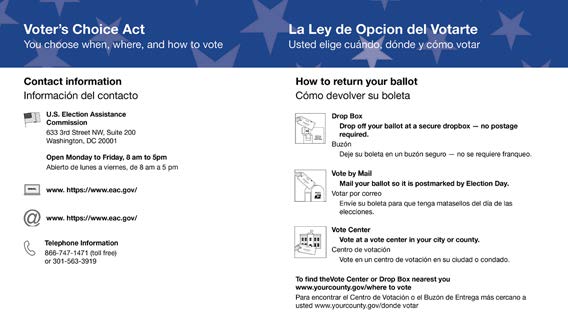
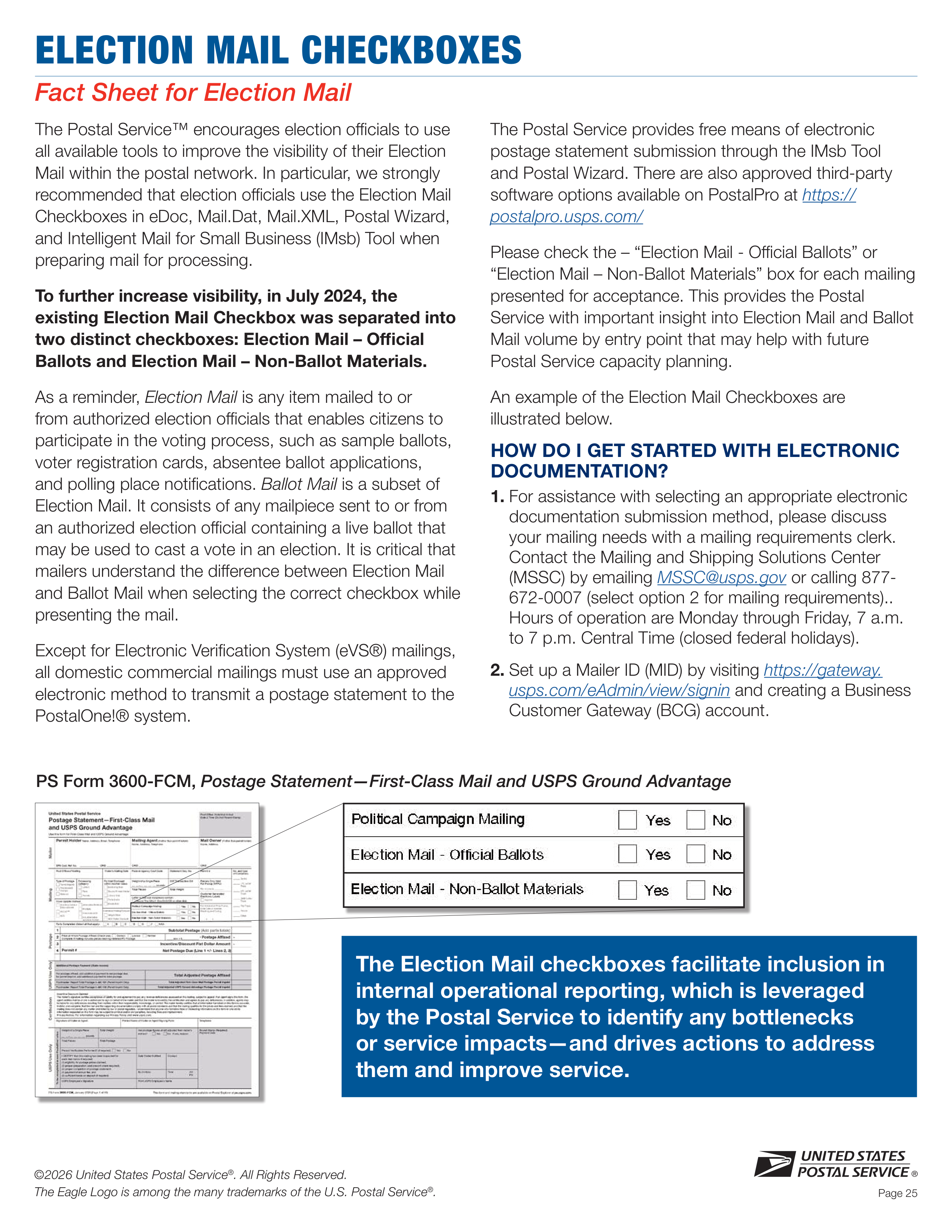
Ballot Mail Examples

©2026 United States Postal Service
®
. All Rights Reserved.
The Eagle Logo is among the many trademarks of the U.S. Postal Service
®
.
Page 24
This page is intentionally left blank
©2026 United States Postal Service
®
. All Rights Reserved.
The Eagle Logo is among the many trademarks of the U.S. Postal Service
®
.
Page 25
ELECTION MAIL CHECKBOXES
Fact Sheet for Election Mail
The Postal Service™ encourages election officials to use
all available tools to improve the visibility of their Election
Mail within the postal network. In particular, we strongly
recommended that election officials use the Election Mail
Checkboxes in eDoc, Mail.Dat, Mail.XML, Postal Wizard,
and Intelligent Mail for Small Business (IMsb) Tool when
preparing mail for processing.
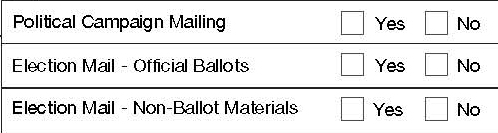
To further increase visibility, in July 2024, the
existing Election Mail Checkbox was separated into
two distinct checkboxes: Election Mail – Official
Ballots and Election Mail – Non-Ballot Materials.
As a reminder,
Election Mail
is any item mailed to or
from authorized election officials that enables citizens to
participate in the voting process, such as sample ballots,
voter registration cards, absentee ballot applications,
and polling place notifications.
Ballot Mail
is a subset of
Election Mail. It consists of any mailpiece sent to or from
an authorized election official containing a live ballot that
may be used to cast a vote in an election. It is critical that
mailers understand the difference between Election Mail
and Ballot Mail when selecting the correct checkbox while
presenting the mail.
Except for Electronic Verification System (eVS®) mailings,
all domestic commercial mailings must use an approved
electronic method to transmit a postage statement to the
PostalOne!® system.
The Postal Service provides free means of electronic
postage statement submission through the IMsb Tool
and Postal Wizard. There are also approved third-party
software options available on PostalPro at
https://
postalpro.usps.com/
Please check the – “Election Mail - Official Ballots” or
“Election Mail – Non-Ballot Materials” box for each mailing
presented for acceptance. This provides the Postal
Service with important insight into Election Mail and Ballot
Mail volume by entry point that may help with future
Postal Service capacity planning.
An example of the Election Mail Checkboxes are
illustrated below.
HOW DO I GET STARTED WITH ELECTRONIC
DOCUMENTATION?
1.
For assistance with selecting an appropriate electronic
documentation submission method, please discuss
your mailing needs with a mailing requirements clerk.
Contact the Mailing and Shipping Solutions Center
(MSSC) by emailing
MSSC@usps.gov
or calling 877-
672-0007 (select option 2 for mailing requirements)..
Hours of operation are Monday through Friday, 7 a.m.
to 7 p.m. Central Time (closed federal holidays).
2.
Set up a Mailer ID (MID) by visiting
https://gateway.
usps.com/eAdmin/view/signin
and creating a Business
Customer Gateway (BCG) account.
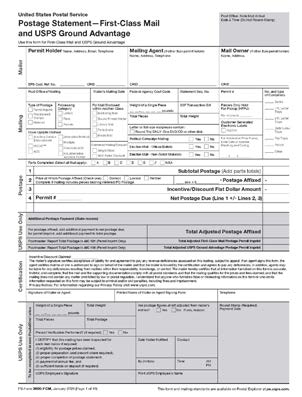
PS Form 3600-FCM,
Postage Statement—First-Class Mail and USPS Ground Advantage
The Election Mail checkboxes facilitate inclusion in
internal operational reporting, which is leveraged
by the Postal Service to identify any bottlenecks
or service impacts—and drives actions to address
them and improve service.
©2026 United States Postal Service
®
. All Rights Reserved.
The Eagle Logo is among the many trademarks of the U.S. Postal Service
®
.
Page 26
RECOMMENDATIONS ON MAILING
COMPLETED BALLOTS
Fact Sheet for Ballot Mail
Each state establishes by law the rules and requirements
for ballot submission, including ballot-submission deadlines
and the role, if any, that postmarks play in determining
whether a ballot was timely. Our general recommendation
to election officials is that, as a common-sense measure,
they
encourage domestic, nonmilitary voters to mail
their completed ballot before Election Day, and at
least one week prior to the deadline by which their
completed ballot must be received by the election
office
. In the normal course of operations, the Postal
Service does not postmark, or “cancel” every piece of
mail in the system. However, the Postal Service tries to
ensure that every return Ballot Mail envelope sent by voters
receives a postmark, whether the return envelope is mailed
with postage pre-paid by election officials or with a stamp
affixed by the voter.
Also, while our postmarking practices have not changed,
we have made adjustments to our transportation
operations that will result in some mailpieces not arriving
at our originating processing facilities on the same day
that they are mailed. Because postmarks are generally
applied at those processing facilities, this means that the
date on the postmarks applied at those facilities may not
necessarily match the date of mailing.
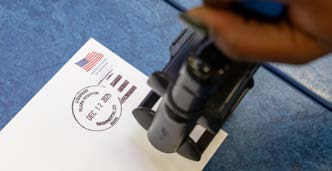
A voter can ensure that a postmark is applied to his
or her return Ballot Mail envelope, and that the date
on the postmark matches the date of mailing, by
visiting a Postal Service retail location and requesting
a manual (local) postmark at the retail counter
when dropping off the mailpiece for mailing. Manual
postmarks will be applied free of charge.
For more information on our postmarking practices,
review the fact sheet included on page 27 of this kit or
DMM 608.11.0: Postmarks and Postal Possession, on
Postal Explorer at
https://pe.usps.gov/text/dmm300/608.
htm#11.0
.
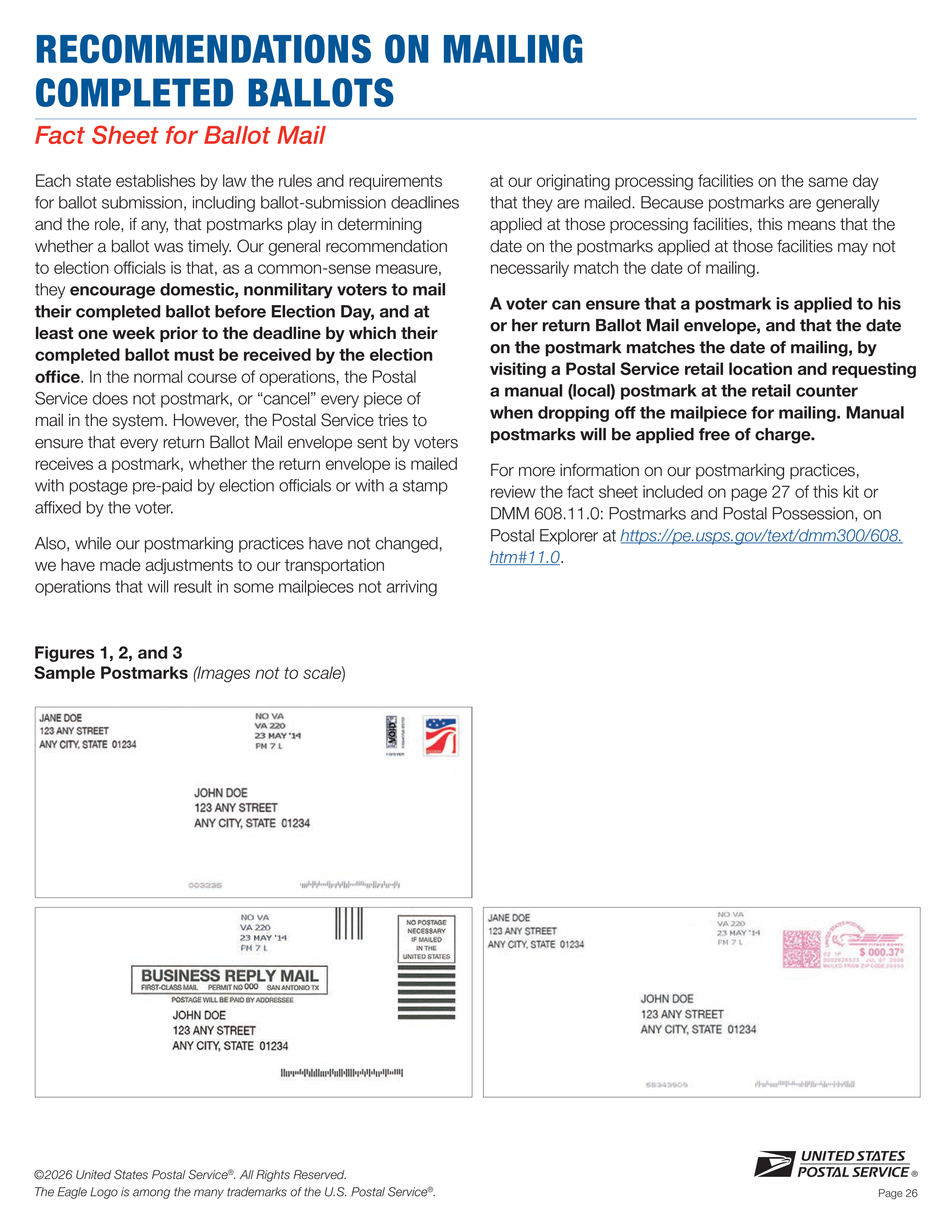
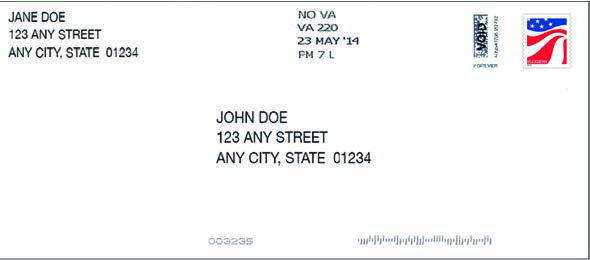
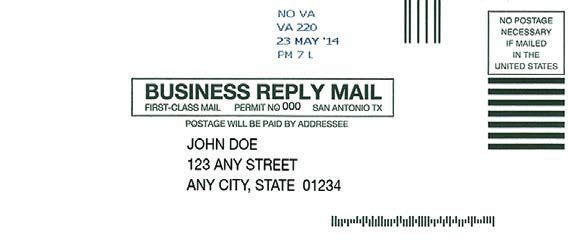
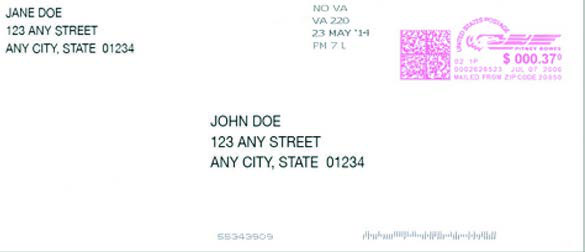
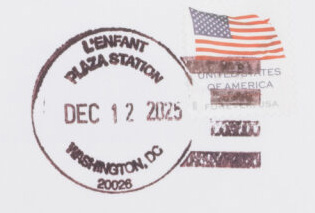
Figures 1, 2, and 3
Sample Postmarks
(Images not to scale
)
©2026 United States Postal Service
®
. All Rights Reserved.
The Eagle Logo is among the many trademarks of the U.S. Postal Service
®
.
Page 27
POSTMARKS AND POSTAL POSSESSION
Fact Sheet for Election Mail
The Postal Service has not changed and is not changing
our postmarking practices. Postmarks are generally
applied at our originating processing facilities and will
continue to be applied at those facilities in the same
manner and to the same extent as before. Postmarks
applied at those facilities will continue to contain the name
or location of the facility that applied the postmark and the
date on which the first automated processing operation
was performed on that mailpiece.
However, as the Postal Service continues to modernize
our transportation network and optimize our transportation
operations, it will become more common that some
mailpieces will not arrive at our originating processing
facilities on the same day that they were initially accepted
by the Postal Service. This means that the date on the
postmarks applied at our processing facilities will not
necessarily match the date on which the customer’s
mailpiece was collected by a letter carrier or dropped off
at a retail location.
To improve public awareness of what the postmark is and
the information it conveys, and in recognition of the fact
that our regulations did not formally define the postmark
or explain when and how it is applied, the Postal Service
updated the Domestic Mail Manual to
¢
Define what the postmark is,
¢
Identify the types of Postal Service markings that qualify
as postmarks,
¢
Describe the circumstances under which those
markings are applied,
¢
Clarify the scope of the information that those markings
do and do not convey, and
¢
Advise customers of how to obtain evidence of the date
on which the Postal Service accepted possession of
their mailings.
While none of this information is unique to Election Mail,
we understand that some jurisdictions refer to postmarks
in their election laws and rules, and that customers may
want guidance on how to ensure that their mailpiece
receives a postmark with a date that matches the date of
mailing.
THE KEY POINTS ARE AS FOLLOWS:
1.
A postmark is a marking applied by the Postal Service
to a mailpiece. If applied at a retail unit, the postmark
displays the name or location of the retail unit and the
date on which the mailpiece was accepted at the retail
unit. If applied at a processing facility, the postmark
displays the name or location of the processing
facility and the date of the first automated processing
operation performed on that mailpiece.
2.
The presence of a postmark confirms that the Postal
Service accepted custody of a mailpiece, and that the
mailpiece was in the possession of the Postal Service
on the identified date. However, the postmark date
does not necessarily indicate the first day that the
Postal Service had possession of the mailpiece, and the
absence of a postmark does not imply that the Postal
Service did not accept custody of a mailpiece.
3. If a customer wants to ensure that their Ballot
Mail (or other mailpiece) receives a postmark, and
that the date on the postmark aligns with the date
of mailing, the customer may take the mailpiece
to a Postal Service retail location and request a
manual (local) postmark at the retail counter when
tendering their mailpiece. The manual postmark
will be applied free of charge.
Our general recommendation remains unchanged: For
domestic, non-military voters who choose to use the
mail to return their completed ballot, the Postal Service
recommends, as a common-sense measure, that they mail
their completed ballot before Election Day, and at least one
week before it must be received by their election office.
For more information, please review
Mailing Standards of
the United States Postal Service
, Domestic Mail Manual
(DMM®) 608.11.0: Postmarks and Postal Possession, on
Postal Explorer at
https://pe.usps.gov/text/dmm300/608.
htm#11.0
.
Figure 4:
Sample Postmarks
(Images not to scale
)
©2026 United States Postal Service
®
. All Rights Reserved.
The Eagle Logo is among the many trademarks of the U.S. Postal Service
®
.
Page 28
ELECTION MAIL SECURITY
Fact Sheet for Election Mail
ELECTIONS AND U.S. POSTAL
INSPECTION SERVICE
The United States Postal Inspection Service® is the
federal law enforcement organization assigned to protect
the mail, including ballots mailed to and from voters
domestically and abroad. This important work is overseen
by postal inspectors, who are sworn federal agents,
specially chosen and trained to ensure that laws are
enforced, crimes are prevented, and the nation’s Election
Mail is securely delivered.
SECURITY OF VOTERS AND ELECTION MAIL
Postal inspectors respond to criminal and security
incidents involving Election Mail, including:
¢
Mail theft
¢
Identity theft
¢
Fraud
¢
Natural and man-made disasters
Additionally, postal inspectors respond to mail-
related incidents involving suspicious and threatening
communications along with dangerous items or
substances associated with mail.
SECURITY OF ELECTION OFFICIALS
Postal inspectors work with state and federal authorities to:
¢
Investigate threats to election officials sent by mail.
¢
Secure the postal network as a component of national
critical infrastructure.
¢
Provide information to election officials to help them
identify and mitigate suspicious mail and other security
risks involving the mail.
CONTACT THE U.S. POSTAL
INSPECTION SERVICE
To report suspicious mail and Election Mail-related security
or criminal incidents, call the 24-hour National Law
Enforcement Communications Center at 877-876-2455
(select option 4 for Election Mail issues) or visit
https://
www.uspis.gov/report
.
The U.S. Postal Inspection Service also coordinates with
the USPS Office of Inspector General when allegations of
Postal Service employee misconduct arise. Learn more
about their work at
https://www.uspsoig.gov
.
©2026 United States Postal Service
®
. All Rights Reserved.
The Eagle Logo is among the many trademarks of the U.S. Postal Service
®
.
Page 29
NEXT STEPS
Fact Sheet for Election Mail
1. Familiarize yourself with the content of Kit 600,
2026-2027 Official Election Mail Guide.
For your convenience, we have also made Kit 600
available at
https://about.usps.com/election-mail/
election-mail-resources.htm
.
2. Consult with your local Manager, Customer
Relations.
The local Managers, Customer Relations (MCRs) are
designated Postal Service
™
employees who will help
you coordinate with the Postal Service for best results.
MCRs are your primary points of contact and can
provide guidance on the mailing process and help
match postal services to your needs.
Connect with your local MCR by submitting an inquiry
at
https://electionmail.usps.com/s/contact-local-mcr
.
3. Work with a Mailpiece Design Analyst.
The Postal Service recommends that election officials
have all Ballot Mail envelope designs reviewed each year
by an Mailpiece Design Analyst (MDA) prior to printing,
even if the designs have been previously approved.
MDAs are experts on Postal Service mailpiece design
standards and can ensure that all mailings are compliant
with current Postal Service regulations as well as
postage and automation requirements.
To take advantage of this free service, submit a design
review request at
https://electionmail.usps.com/s/
election-mail-review
or call 877-672-0007 (select
option 3 for mailpiece design). Hours of operation
are Monday through Friday, 7 a.m. to 7 p.m. Central
Time (closed federal holidays). Also, mailpiece design
information is available online at
https://postalpro.usps.
com/mailing/mailpiece-design-analyst-mda-customer-
service-help-desk
.
4. Consider consulting with a certified Mail
Service Provider.
A Mail Service Provider (MSP) offers a variety of
solutions to mail owners seeking assistance with the
preparation and presentation of Full-Service presort
mailings. To learn about certified mail service providers
(MSPs), please visit
https://postalpro.usps.com/
node/3816
and
https://postalpro.usps.com/mailing/
election-political-mail
. The latest lists of certified
MSPs can be found on these pages under Featured
Resources.
There are many advantages of using an MSP to prepare
Election Mail. An MSP can:
■
Provide/manage your address list.
■
Print and/or presort your mailing.
■
Ensure your mailing receives the greatest
discounts available.
■
Manage mailing feedback, such as address
correction service data.
■
Monitor mail quality reports.
5. Contact a mailing requirements clerk.
Discuss your reply mail needs with a Mailing
Requirements Clerk. Contact the Mailing and Shipping
Solutions Center (MSSC) by emailing
MSSC@usps.
gov
or calling 877-672-0007 (select option 2 for mailing
requirements). Hours of operation are Monday through
Friday, 7 a.m. to 7 p.m. Central Time (closed federal
holidays).
February 2026
©
2026 United States Postal Service.
®
All Rights Reserved.
The Eagle Logo is among the many trademarks of the U.S. Postal Service.
®