



P
Postgraduate Offer
Conditions Guide
Entry in the academic year 2026/27
Education Services
Postgraduate Admissions Office



Postgraduate Offer Conditions Guide
Entry in 2026/27
Education Services
Postgraduate Admissions Office
P
Contents
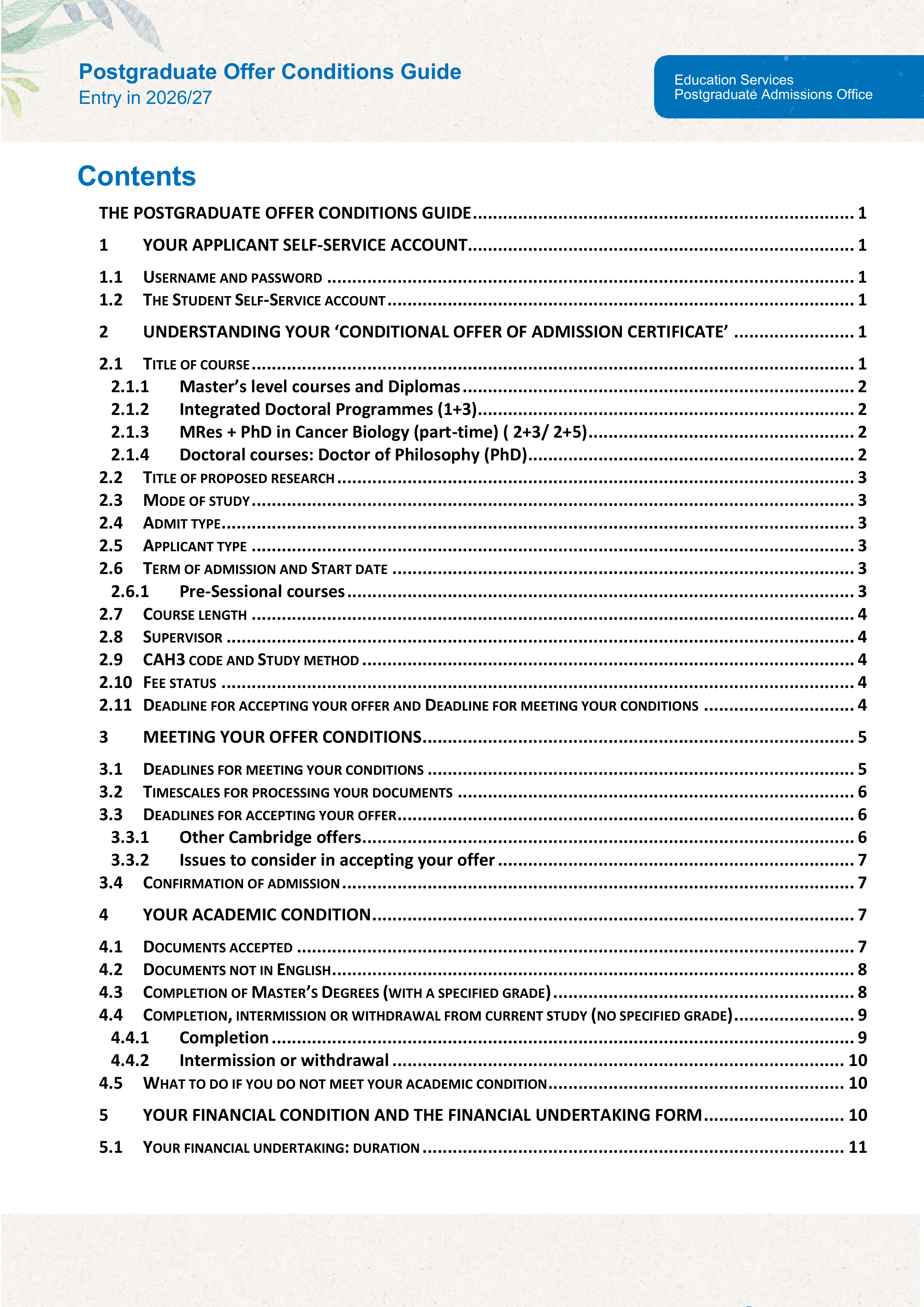
THE POSTGRADUATE OFFER CONDITIONS GUIDE ............................................................................ 1
1
YOUR APPLICANT SELF-SERVICE ACCOUNT............................................................................. 1
1.1
U
SERNAME AND PASSWORD
......................................................................................................... 1
1.2
T
HE
S
TUDENT
S
ELF
-S
ERVICE ACCOUNT
............................................................................................. 1
2
UNDERSTANDING YOUR ‘CONDITIONAL OFFER OF ADMISSION CERTIFICATE’ ........................ 1
2.1
T
ITLE OF COURSE
........................................................................................................................ 1
2.1.1
Master’s level courses and Diplomas .............................................................................. 2
2.1.2
Integrated Doctoral Programmes (1+3)........................................................................... 2
2.1.3
MRes + PhD in Cancer Biology (part-time) ( 2+3/ 2+5) ..................................................... 2
2.1.4
Doctoral courses: Doctor of Philosophy (PhD) ................................................................. 2
2.2
T
ITLE OF PROPOSED RESEARCH
....................................................................................................... 3
2.3
M
ODE OF STUDY
........................................................................................................................ 3
2.4
A
DMIT TYPE
.............................................................................................................................. 3
2.5
A
PPLICANT TYPE
........................................................................................................................ 3
2.6
T
ERM OF ADMISSION AND
S
TART DATE
............................................................................................ 3
2.6.1
Pre-Sessional courses ..................................................................................................... 3
2.7
C
OURSE LENGTH
........................................................................................................................ 4
2.8
S
UPERVISOR
............................................................................................................................. 4
2.9
CAH3
CODE AND
S
TUDY METHOD
.................................................................................................. 4
2.10 F
EE STATUS
.............................................................................................................................. 4
2.11 D
EADLINE FOR ACCEPTING YOUR OFFER AND
D
EADLINE FOR MEETING YOUR CONDITIONS
.............................. 4
3
MEETING YOUR OFFER CONDITIONS ...................................................................................... 5
3.1
D
EADLINES FOR MEETING YOUR CONDITIONS
..................................................................................... 5
3.2
T
IMESCALES FOR PROCESSING YOUR DOCUMENTS
............................................................................... 6
3.3
D
EADLINES FOR ACCEPTING YOUR OFFER
........................................................................................... 6
3.3.1
Other Cambridge offers .................................................................................................. 6
3.3.2
Issues to consider in accepting your offer ....................................................................... 7
3.4
C
ONFIRMATION OF ADMISSION
...................................................................................................... 7
4
YOUR ACADEMIC CONDITION ................................................................................................ 7
4.1
D
OCUMENTS ACCEPTED
............................................................................................................... 7
4.2
D
OCUMENTS NOT IN
E
NGLISH
........................................................................................................ 8
4.3
C
OMPLETION OF
M
ASTER
’
S
D
EGREES
(
WITH A SPECIFIED GRADE
) ............................................................ 8
4.4
C
OMPLETION
,
INTERMISSION OR WITHDRAWAL FROM CURRENT STUDY
(
NO SPECIFIED GRADE
) ........................ 9
4.4.1
Completion .................................................................................................................... 9
4.4.2
Intermission or withdrawal .......................................................................................... 10
4.5
W
HAT TO DO IF YOU DO NOT MEET YOUR ACADEMIC CONDITION
........................................................... 10
5
YOUR FINANCIAL CONDITION AND THE FINANCIAL UNDERTAKING FORM ............................ 10
5.1
Y
OUR FINANCIAL UNDERTAKING
:
DURATION
.................................................................................... 11



Postgraduate Offer Conditions Guide
Entry in 2026/27
Education Services
Postgraduate Admissions Office
P
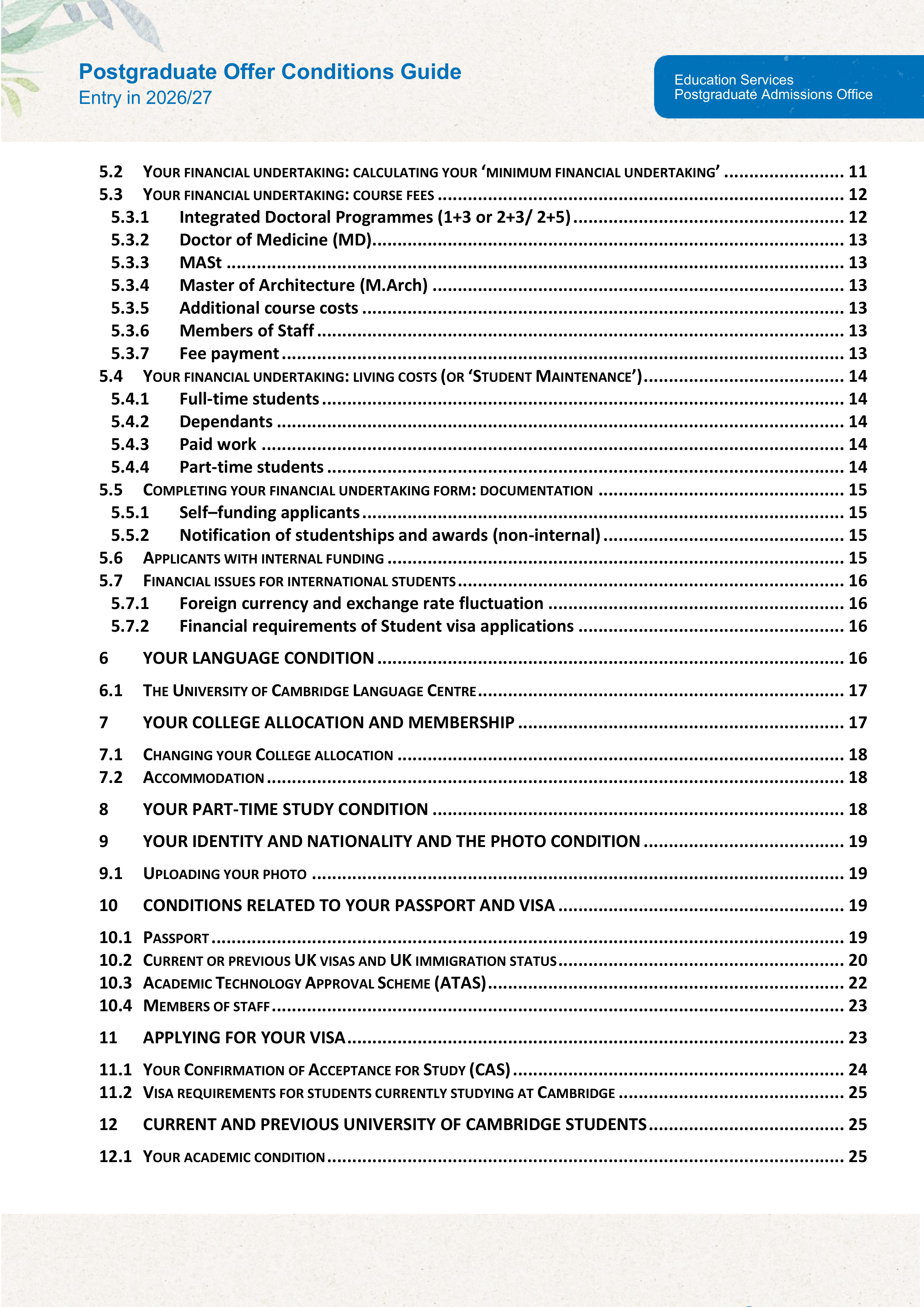
5.2
Y
OUR FINANCIAL UNDERTAKING
:
CALCULATING YOUR
‘
MINIMUM FINANCIAL UNDERTAKING
’ ........................ 11
5.3
Y
OUR FINANCIAL UNDERTAKING
:
COURSE FEES
................................................................................. 12
5.3.1
Integrated Doctoral Programmes (1+3 or 2+3/ 2+5) ...................................................... 12
5.3.2
Doctor of Medicine (MD).............................................................................................. 13
5.3.3
MASt ........................................................................................................................... 13
5.3.4
Master of Architecture (M.Arch) .................................................................................. 13
5.3.5
Additional course costs ................................................................................................ 13
5.3.6
Members of Staff ......................................................................................................... 13
5.3.7
Fee payment ................................................................................................................ 13
5.4
Y
OUR FINANCIAL UNDERTAKING
:
LIVING COSTS
(
OR
‘S
TUDENT
M
AINTENANCE
’) ........................................ 14
5.4.1
Full-time students ........................................................................................................ 14
5.4.2
Dependants ................................................................................................................. 14
5.4.3
Paid work .................................................................................................................... 14
5.4.4
Part-time students ....................................................................................................... 14
5.5
C
OMPLETING YOUR FINANCIAL UNDERTAKING FORM
:
DOCUMENTATION
................................................. 15
5.5.1
Self–funding applicants ................................................................................................ 15
5.5.2
Notification of studentships and awards (non-internal) ................................................ 15
5.6
A
PPLICANTS WITH INTERNAL FUNDING
........................................................................................... 15
5.7
F
INANCIAL ISSUES FOR INTERNATIONAL STUDENTS
............................................................................. 16
5.7.1
Foreign currency and exchange rate fluctuation ........................................................... 16
5.7.2
Financial requirements of Student visa applications ..................................................... 16
6
YOUR LANGUAGE CONDITION ............................................................................................. 16
6.1
T
HE
U
NIVERSITY OF
C
AMBRIDGE
L
ANGUAGE
C
ENTRE
......................................................................... 17
7
YOUR COLLEGE ALLOCATION AND MEMBERSHIP ................................................................. 17
7.1
C
HANGING YOUR
C
OLLEGE ALLOCATION
......................................................................................... 18
7.2
A
CCOMMODATION
................................................................................................................... 18
8
YOUR PART-TIME STUDY CONDITION .................................................................................. 18
9
YOUR IDENTITY AND NATIONALITY AND THE PHOTO CONDITION ........................................ 19
9.1
U
PLOADING YOUR PHOTO
.......................................................................................................... 19
10
CONDITIONS RELATED TO YOUR PASSPORT AND VISA ......................................................... 19
10.1 P
ASSPORT
.............................................................................................................................. 19
10.2 C
URRENT OR PREVIOUS
UK
VISAS AND
UK
IMMIGRATION STATUS
......................................................... 20
10.3 A
CADEMIC
T
ECHNOLOGY
A
PPROVAL
S
CHEME
(ATAS) ....................................................................... 22
10.4 M
EMBERS OF STAFF
.................................................................................................................. 23
11
APPLYING FOR YOUR VISA ................................................................................................... 23
11.1 Y
OUR
C
ONFIRMATION OF
A
CCEPTANCE FOR
S
TUDY
(CAS) .................................................................. 24
11.2 V
ISA REQUIREMENTS FOR STUDENTS CURRENTLY STUDYING AT
C
AMBRIDGE
............................................. 25
12
CURRENT AND PREVIOUS UNIVERSITY OF CAMBRIDGE STUDENTS ....................................... 25
12.1 Y
OUR ACADEMIC CONDITION
....................................................................................................... 25



Postgraduate Offer Conditions Guide
Entry in 2026/27
Education Services
Postgraduate Admissions Office
P
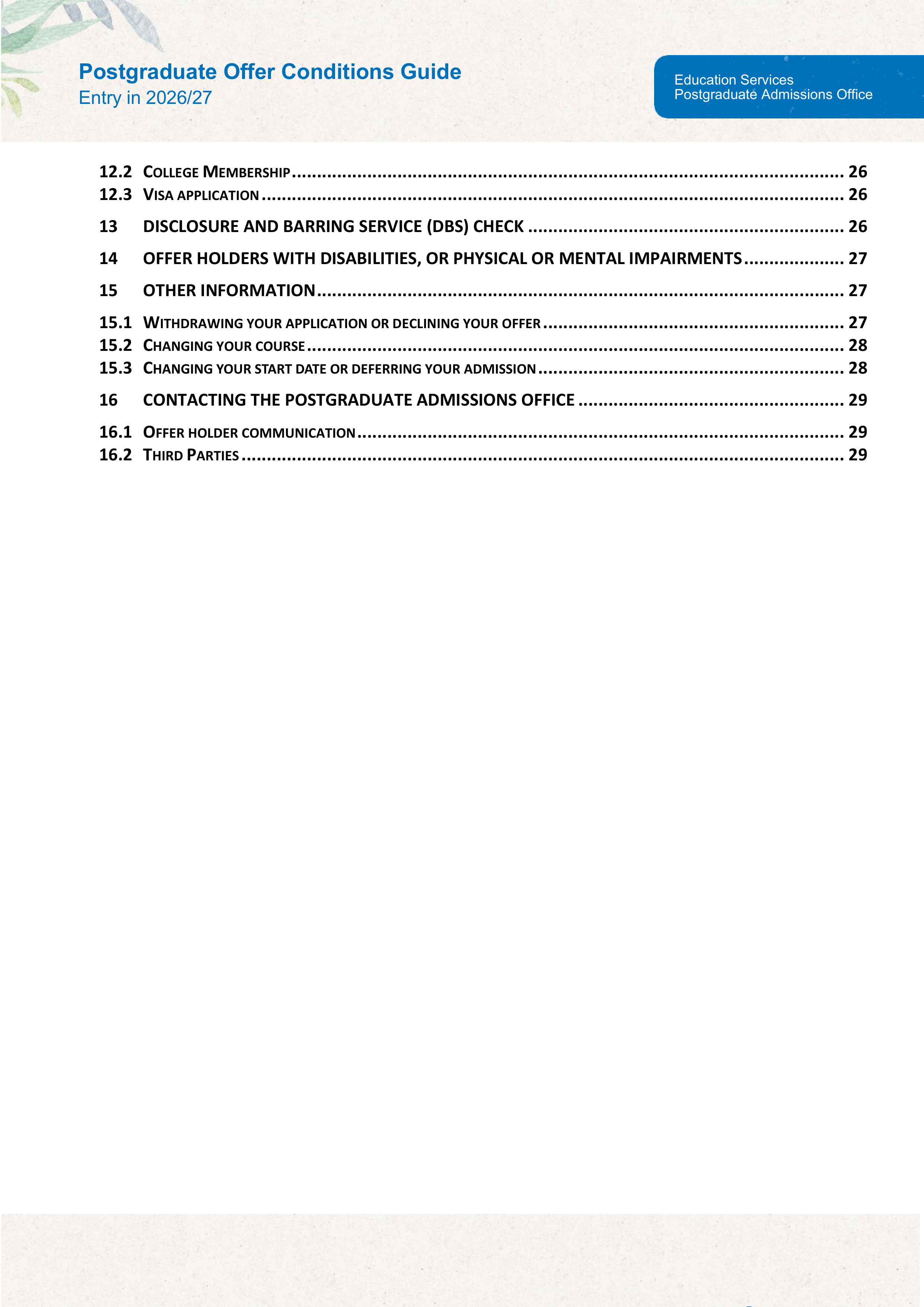
12.2 C
OLLEGE
M
EMBERSHIP
.............................................................................................................. 26
12.3 V
ISA APPLICATION
.................................................................................................................... 26
13
DISCLOSURE AND BARRING SERVICE (DBS) CHECK ............................................................... 26
14
OFFER HOLDERS WITH DISABILITIES, OR PHYSICAL OR MENTAL IMPAIRMENTS .................... 27
15
OTHER INFORMATION ......................................................................................................... 27
15.1 W
ITHDRAWING YOUR APPLICATION OR DECLINING YOUR OFFER
............................................................ 27
15.2 C
HANGING YOUR COURSE
........................................................................................................... 28
15.3 C
HANGING YOUR START DATE OR DEFERRING YOUR ADMISSION
............................................................. 28
16
CONTACTING THE POSTGRADUATE ADMISSIONS OFFICE ..................................................... 29
16.1 O
FFER HOLDER COMMUNICATION
................................................................................................. 29
16.2 T
HIRD
P
ARTIES
........................................................................................................................ 29



Postgraduate Offer Conditions Guide
Entry in 2026/27
Education Services
Postgraduate Admissions Office
Page 1
P
The Postgraduate Offer Conditions Guide
We very much hope that you will accept your offer and join us as a postgraduate student at Cambridge.
This guide helps you understand your offer and the conditions that you now need to meet for your
admission to be confirmed. You should read all sections that apply to you.
Your admission is subject to our postgraduate
Terms of Admission
. This guide is non-contractual and, in
the event of any conflict with the Terms of Admission, the Terms of Admission take precedence.
1
Your Applicant Self-Service account
You can view your offer and its conditions via your
Postgraduate Applicant Self-Service account
. This is
also where we will communicate with you about your offer, so check it regularly for messages.
You can use your Self-Service account for other things too, including updating contact details. For how
to use your account see the
Guide to using the postgraduate applicant Self-Service
.
1.1
Username and password
To log on, you will need the Applicant ID (USN) and password we emailed to you. If you lose your
password, click the ‘I have forgotten my password’ link on the log-in page. If you still have difficulty or
have lost your username, use our
Contact Form,
with ‘password reset’ as the topic.
1.2
The Student Self-Service account
If your admission is confirmed, you will move to a Student Self-Service account. You will get an email in
late August/early September about the student registration process that will give you limited access to
this account. Full access will be opened on the first day of term. Please contact
studentregistration@offices.admin.cam.ac.uk
if you have any questions.
2
Understanding your ‘conditional offer of admission certificate’
You will be told of your offer and its conditions by email. You can also view these via your Self-Service
account, where you can download and print or save your ‘conditional offer of admission certificate’. This
is the only document that constitutes a conditional offer of admission. No other correspondence (e.g.
from a College, department or supervisor) do so.
2.1
Title of course
The title of your course on your conditional offer certificate includes the
type of qualification
you are
being offered.



Postgraduate Offer Conditions Guide
Entry in 2026/27
Education Services
Postgraduate Admissions Office
Page 2
P
2.1.1
Master’s level courses and Diplomas
Master’s level courses are self-contained (with the exception of the Integrated Doctoral Programmes
described in 2.1.2 and 2.1.3). That is, if you want to progress to a PhD, you will need to make a new
application (see 12 for applying as a continuing Cambridge student).
2.1.2
Integrated Doctoral Programmes (1+3)
Some MRes and MPhil courses form the first year of an Integrated Doctoral Programme (1+3). This is
explicit in the course title.
On an integrated programme, you will not need to apply to continue to the PhD, but progression will
depend on achieving the required standard (as specified by your Department) in the initial Master’s
course.
If you require an ATAS certificate (see 10.3), you will need to obtain clearance during the admissions
process and again before beginning your PhD.
If you will complete your integrated programme at a partner institution, then the terms and conditions
of the new institution will apply for that part of the course and you should read those now.
If you plan to join an integrated programme note that:
•
College membership is offered for the full programme, subject to satisfactory completion of the
Master’s course and it is not possible to change College between the component courses;
•
you must have funding in place for a minimum of 4 years (see 5.3.1);
•
the maximum registration period for the full programme (including the Master’s course) is 5
years and you will need to submit your thesis in that time.
2.1.3
MRes + PhD in Cancer Biology (part-time) ( 2+3/ 2+5)
The MRes + PhD in Cancer Biology (part-time) (2+3/ 2+5) is an Integrated Doctoral Programme with a 2-
year part-time MRes followed by either a 3-year full-time PhD (2+3) or a 5-year part-time PhD (2+5). It
has the same format as a 1+3 programme, stated above. You must have funding in place for the full
length (5 years with a full-time PhD; 7 years with a part-time PhD), see 5.3.1, and the maximum
registration period for the programme is 6 years with a full-time PhD and 9 years with a part-time PhD.
Details of the structure and departmental expectations are in
the Course Directory entry
.
2.1.4
Doctoral courses: Doctor of Philosophy (PhD)
You will start with a probationary year (5 terms for part-time students) sometimes called a
Certificate of
Postgraduate Study (CPGS)
.
At the end of the probation, you will undertake an exercise to decide whether you can continue and for
which qualification. This involves an assessment of your suitability and the viability of your project. Your
Faculty or Department will provide details of its process. If you are successful, your doctoral registration
is normally backdated to the date when you began your probation.



Postgraduate Offer Conditions Guide
Entry in 2026/27
Education Services
Postgraduate Admissions Office
Page 3
P
The maximum registration period for the full-time PhD is 4 years (including the probation year) and you
need to submit your thesis in this time. See 5.3 for the duration of your fee liability and 11.1 for related
visa issues.
2.2
Title of proposed research
This is included for research degrees. You should inform your Department immediately of any proposed
change, which must be agreed. Changes after admission are only permitted with the agreement of your
supervisor.
2.3
Mode of study
This tells you whether your course is full-time or part-time. Further information on
part-time study
is on
our website and in sections 5.4.4 and 8 of this guide.
2.4
Admit type
If the Admit Type on your conditional offer is ‘in the First Instance’, you have been made a conditional
offer for a course that forms the first part of a longer programme, for example a CPGS as the
probationary year of a PhD (see 2.1.4), or a Master’s as the first part of an Integrated Doctoral
Programme (see 2.1.2 and 2.1.3). Otherwise, your offer is for a stand-alone course.
2.5
Applicant type
Where a student has previously been admitted to a postgraduate degree at Cambridge, this will show as
‘continuing student’ (See 12).
2.6
Term of admission and Start date
Cambridge has three terms in each academic year and your admission will be at the beginning of one of
these. The official first days of Term are:
•
Michaelmas: 1 October;
•
Lent: 5 January;
•
Easter: 10 or 17 April.
Check your offer certificate for the start date of your course. You should
not
attempt to start before
then. Your College will tell you when you need to arrive in Cambridge for induction.
2.6.1
Pre-Sessional courses
Some taught courses include a compulsory introductory (or ‘pre-sessional’) course, normally starting in
early or mid-September. This will be stated in your offer certificate and you will also be notified via your
Self-Service account. Contact your Department for more information, including to confirm whether the
pre-sessional is in person or online.
Your admission must be confirmed before you can start the pre-sessional course.



Postgraduate Offer Conditions Guide
Entry in 2026/27
Education Services
Postgraduate Admissions Office
Page 4
P
2.7
Course length
This is included for taught courses only. See 5.1 and 5.3 for the length of research degrees.
2.8
Supervisor(s)
For many research courses, your supervisor (or supervisors) will be agreed before you arrive and their
name(s) will be on your conditional offer. If not, do not worry – we will contact you via your Self-Service
account as soon as your principal supervisor is allocated. The role of a research student’s supervisory
team is covered in the
Code of Practice for Research Degrees
.
2.9
CAH3 code and Study method
If your offer includes an Academic Technology Approval Scheme (ATAS) condition, you need to apply for
an ATAS certificate (see 10.3). This information on the offer certificate supports your ATAS application:
•
your primary CAH3 code (the Common Aggregation Hierarchy (CAH) code identifies your subject
area);
•
your ‘Study method’ (identifying whether you are undertaking a taught or research course).
At Cambridge, courses are defined as taught or research depending on how they are examined, with
research courses examined by thesis and oral only. A course classified as taught may therefore include a
large research element, or even have the word ‘research’ in its title.
2.10
Fee status
We have assessed your
fee status
based on the UK Government Student Fees and Awards Regulations at
the time of making your offer and the information you provided in your application.
Independent guidance can be obtained from the
UK Council for International Student Affairs
, by calling
their Student Advice Line on +44 (0)20 7788 9214 or checking their
guidance on eligibility for Home fees.
Having done so, if you believe our assessment is wrong, you may
request a fee-status reassessment
.
There is no guarantee that a reassessment will change your fee status.
If your fee status is ‘Home Provisional’, you have been set a ‘Fee status condition’. To confirm your fee
status, you will need to upload a
Fee Status Assessment Questionnaire
under the ‘Fee status assessment
form’ category of your Self-Service account. Any supporting documents stated in the Questionnaire
need to be uploaded under the ‘Fee status assessment evidence’ category. You should also ensure you
have uploaded a copy of your passport, under the ‘Passport’ category, and proof of your immigration
status, under ‘Visa’ or ‘Share code’.
After you have submitted a reassessment request or a fee status assessment questionnaire, any change
to your fee status will be shown in your Self-Service account. You will only be contacted by email if we
reject a reassessment request. Do not contact us unless your fee status has not updated more than 20
working days after your submission; do this via our
Contact Form,
using ‘fee status’ as the topic.
2.11
Deadline for accepting your offer and Deadline for meeting your conditions
See 3.1 to 3.3 below.



Postgraduate Offer Conditions Guide
Entry in 2026/27
Education Services
Postgraduate Admissions Office
Page 5
P
3
Meeting your offer conditions
In order to meet your offer conditions, you need to upload supporting documents under the relevant
categories of your Self-Service account.
Do not email or post documents to the Postgraduate
Admissions Office
. Please do not email us to confirm uploading and note we are not able to
acknowledge receipt.
The Postgraduate Admissions Office (PAO) will assess the documents and if they are sufficient the
condition will be marked as complete.
If the documents are not sufficient, we will tell you what else you need to do. Such messages appear on
the
Conditions of your Offer
page, under the ‘Messages and warnings’ heading. Please check there
regularly, particularly after uploading documents.
You must not provide information that is false, misleading or materially incomplete.
If this is found to
be the case, your offer will be withdrawn or, if you have registered, your studies may be terminated.
If you are admitted, you should bring to Cambridge originals of the documents used to meet your
conditions (for example a copy of the transcript used to meet your academic condition). You must be
able to show these to the University or your College, if asked to do so. If not, you may be unable to
register or disciplinary action may be taken against you leading to withdrawal from your course.
3.1
Deadlines for meeting your conditions
The deadline for meeting your conditions is stated in your offer certificate and in the table below.
Term of admission:
Deadline:
Michaelmas (1 October)
31 July (two months before admission)
Lent (5 January)
30 November
Easter (10 or 17 April)
10 March
It is your responsibility to meet all conditions
before
the deadline or your offer will be withdrawn.
If you have submitted documents ahead of the deadline but these have not yet been processed by us,
you will not be withdrawn. There is no need to contact us in this case.
If you are unable to meet the academic condition by these deadlines, you may apply for an extension.
An extension can only be requested from 1 June in your planned year of entry. In general, you will only
be given an extension if you have met all other outstanding conditions. From 1 June onward, extensions
can be requested via our
contact form,
using ‘deadline extension’ as the topic.
If you need more time, you should consider applying to defer entry (see 15.3).
You should start
uploading documents to meet your conditions as soon as you receive your
conditional offer
.



Postgraduate Offer Conditions Guide
Entry in 2026/27
Education Services
Postgraduate Admissions Office
Page 6
P
Many Colleges do not offer accommodation until all conditions are met. It may be difficult to gain
College accommodation, if this is your choice, if documents are not submitted in time for us to complete
processing before 31 July.
International students requiring a Student visa should meet their conditions as soon as possible, so that
they can make their visa application in good time.
3.2
Timescales for processing your documents
We aim to assess all materials received within ten working days. However, around the 31 July deadline,
this may take longer. If documents have to be considered by your Department (e.g. to assess whether
you have met your academic condition) this may need additional time.
Your Self-Service account will be updated as soon as we have assessed submitted documents.
3.3
Deadlines for accepting your offer
You can accept your offer via your Self-Service account and can do this before meeting your other
conditions. You need to accept before we can confirm admission.
A deadline for acceptance is stated on your offer certificate. Note this is earlier than the deadline for
meeting all conditions set out in 3.1. If you do not accept your offer by this deadline, it will be
withdrawn.
We encourage you to accept your offer and to do so as soon as you are ready. You can accept the offer
even if you are still waiting for a decision about funding, including from one of the University’s
internal
funders
, such as Gates Cambridge, the Cambridge Trust, Cambridge administered UK Research Council
funding or a College. However, you should only accept if it is your firm intention to take-up your place
at Cambridge.
If it later becomes necessary for you to cancel your acceptance, for example because you do not secure
funding, you can do so by withdrawing your application at any time before your course begins (see
15.1). If you withdraw your application before registration you will not be liable for course fees (
for the
Master’s degree in Corporate Law there is a non-refundable reservation fee
).
3.3.1
Other Cambridge offers
When you accept an offer, you should withdraw from any other Cambridge offers or applications that
you have.
The only exception is if you are waiting to hear about a place or funding for a course which would be
your first choice. If this is the case, you can accept more than one offer. This prevents you being
withdrawn from your preferred course while you wait for a funding decision (see 3.3). However, you
must withdraw from other offers before your admission can be confirmed (see 3.4) and by the deadline
for meeting the other conditions of your offer (see 3.3).



Postgraduate Offer Conditions Guide
Entry in 2026/27
Education Services
Postgraduate Admissions Office
Page 7
P
3.3.2
Issues to consider in accepting your offer
By accepting your offer, you agree to the University of Cambridge Postgraduate
Terms of Admission
,
which you should read carefully in advance and keep. Issues covered by the Terms of Admission include:
•
intellectual property rights that may result from your studies, research or project(s);
•
compliance with UK Export Control law.
Once registered, you are bound by the Statutes and Ordinances of the University, in particular those
about
postgraduate degrees
, and have the responsibilities set out in the
Code of Practice for Research
Degrees
or the
Code of Practice for Master’s Students
, as appropriate
.
If you have any relevant, unspent criminal convictions
, these must be declared at the same time that
you accept your offer. We would also encourage you to let us know about any serious, outstanding
criminal charges. These will not affect your offer, but disclosure will allow us to talk to you about how
best to make sure you can focus on your trial and, if applicable, consider potential visa implications.
3.4
Confirmation of admission
When all your offer conditions show as complete, we will re-check that we have everything we need.
It
may be necessary to re-open a condition at this time.
If so, we will let you know.
Once we have completed the final check and are satisfied that all conditions are met, we will notify you
via email. Your Self-Service account will show an updated status of ‘Admission Confirmed’ and you can
download and print or save your ‘confirmation of admission certificate’.
This certificate is the only
document that constitutes confirmation of admission
.
Under no circumstances should you come to Cambridge to begin your course until your admission is
confirmed.
4
Your academic condition
4.1
How to submit your academic documents
How you can submit your academic documents varies according to your course and the location of your
previous institution. (For current Cambridge students, a separate system is in place, see 12.1.)
Your academic condition will state your options for submission from among those described below.
Option (C), Document Upload, may not be available in your case and you are therefore required to use
either a secure electronic system or Qualification Check. That is the position for all documents issued by
institutions in the USA and Canada. We reserve the right to require an offer holder to submit
documents via Qualification Check.
(A)
Secure electronic document service
If your institution uses a secure electronic document service (e.g. Parchment, Digitary or HEAR) you
should request that the relevant system shares a link with us via
bgstranscripts@admin.cam.ac.uk
.



Postgraduate Offer Conditions Guide
Entry in 2026/27
Education Services
Postgraduate Admissions Office
Page 8
P
(B)
Qualification Check
Qualification Check is the University’s academic document verification partner. It is a well-established,
GDPR-compliant company that specialises in the verification of academic and professional qualifications.
If you are using Qualification Check, you should check our
guidance
and register at the dedicated
Qualification Check-University of Cambridge portal,
https://cambridge.qualificationcheck.com/
, where
there are full instructions on how to submit your documents. Should you have any issues in using the
portal please contact
applicantsupport@qualificationcheck.com
. When Qualification Check is used,
there is a cost to you of £45 (if you previously received an application fee waiver, contact us using our
Contact Form
so that the Qualification Check fee can also be removed).
(c) Document upload
This can only be used where permitted by your condition and if your institution does not have a secure
system. You need to upload a colour scan or photo. If we are unable to validate the authenticity of the
documents, we may ask for further information or contact the awarding institution directly.
Whichever option you use, you should submit your original,
final
documents. Your transcript
must
show
all
of the following:
•
the
final
classification, average score and/or grade;
•
any modules or scores that are requested as part of the offer condition;
•
the date the degree was awarded or completed;
•
the formal title of the degree;
•
the name of the institution that awarded the degree;
•
for degrees from outside the UK, an explanation, in English, of the marking scheme used.
If any of this information is absent, you must
also
upload a degree certificate. If the documents are not
in English, you must
also
upload a translation (see 4.2).
4.2
Documents not in English
If your academic documents are not in English, you must obtain a translation into English from an official
translation service (such as the British Council). There may be a cost for this.
You must upload both the
translation and the original documents
together
. Do not write on academic documents yourself.
4.3
Completion of Master’s Degrees (with a specified grade)
If you are set a condition to achieve a particular grade in your Master’s degree (including a pass), the
instructions in 4.1 should be followed.
If you are not able to do this before the relevant deadline (see 3.1) and you have already completed a
degree that is at least equivalent to a UK Bachelor’s Honours degree upper second class, then your
Department may provisionally accept you based on the progress in your Master’s degree, if that degree
can be completed before the start of your Cambridge course. You should ask the Registrar of your
current university to provide you with a formal letter (signed, and on headed paper) stating:
•
your indicative result;



Postgraduate Offer Conditions Guide
Entry in 2026/27
Education Services
Postgraduate Admissions Office
Page 9
P
•
when you are expected to complete all formal coursework and examinations, and when you are
expected to submit your dissertation, if relevant (all of which must be before your proposed
Cambridge course starts);
•
when you will have no financial or any other obligations to that university.
This letter should be uploaded to your Self-Service account. Note that, after confirmation of your
admission, you may be asked to show that you achieved the grade set in your initial academic condition.
If you cannot do so, you may not be allowed to register or you may be withdrawn from your course.
If you are unable to meet your academic condition due to the timing of results, you may either apply to
defer your admission (see 15.3) or withdraw your application and re-apply in the next academic year.
4.4
Completion, intermission or withdrawal from current study (no specified grade)
Students registered for a Cambridge degree may not follow a degree level course at another institution
at the same time. If you are currently registered on such a course but have not been set a condition to
achieve a particular grade (including a pass), then any offer made by Cambridge is conditional upon you
completing, intermitting or withdrawing from it. (Rules on concurrent registration are in the
Terms of
Admission
. Some collaborative doctoral training programmes allow for registration elsewhere. This will
be set out in the
Course Directory
entry.)
4.4.1
Completion
If you are set a condition to complete your current degree, with no specified grade, the instructions in
4.1 should be followed.
If you will not complete your current course until after the offer conditions deadline, then you should
upload the following two documents after 1 June, for Michaelmas term starters (those starting in other
terms and facing the same issue should
let us know using our
Contact Form
):
•
a letter from your current university, dated no earlier than 1 June, confirming the date you are
expected to complete (which must be before the start of your new course) and the date you are
expected to receive your degree (this can be after the start of your new course);
•
a completed and signed ‘
completion of current course of study declaration
’.
If you are in this situation, have a current Student/Tier 4 visa and require a Student visa for your new
course, then the letter from your University must include the specific wording that you are
“highly likely
to complete your course successfully based on the assessment of your performance throughout the
course”
and give the expected date when the qualification will be awarded. This is in accordance with
UK Visas and Immigration (UKVI) guidance. Along with this letter you should upload a completed and
signed ‘
”highly likely” declaration form
’.
You must not commence your course at Cambridge if you have not completed your current course of
study. You may be required to provide original documents showing that your degree has been awarded
when you arrive in Cambridge. If you do not you may be unable to register or disciplinary action may be
taken against you leading to withdrawal from your course ; if applicable, your Student visa sponsorship
will be withdrawn.



Postgraduate Offer Conditions Guide
Entry in 2026/27
Education Services
Postgraduate Admissions Office
Page 10
P
4.4.2
Intermission or withdrawal
If you are set a condition to intermit or withdraw, you should upload a letter from your University
confirming that this has occurred.
If you are intermitting or withdrawing after the offer conditions deadline, you should upload a letter
from your University confirming the date of your expected withdrawal (which must be before the start
of your new course) or the start and end dates of your intermission which must cover the full length of
your Cambridge course). You will also need to complete and sign the ‘
intermission or withdrawal from
current course of study declaration
’.
See 11.1 for relevant information for Student/Tier 4 visa holders.
4.5
What to do if you do not meet your academic condition
If you do not achieve the grade required in your academic condition, upload a copy of your final
transcript and certificate (where available), with a statement explaining that you have not met the
condition. If relevant, state any mitigating circumstances, but note we expect you to make use of your
institution’s own exam appeal process and you should state if you have done this and, if not, why not.
Your Department will consider your results and decide whether or not to accept you. The outcome will
show in your Self-Service account. The same process applies to those currently studying at Cambridge.
5
Your financial condition and the Financial Undertaking Form
To meet your financial condition, you must upload a completed
Financial Undertaking Form
along with
any required documentation (see 5.5). Use the document type ‘Financial Undertaking Form’.
If you hold a full award from one of the University’s
internal funders
(including Gates Cambridge, the
Cambridge Trust, Cambridge administered UK Research Council funding or a College) you may be able to
upload an official notification of your award instead (see 5.6).
By uploading the form, you give an undertaking that you have sufficient funds to pay for your course
fees and your living costs throughout your study
. Given this undertaking, neither the University nor
your College commit to support you if you have financial difficulties as a student. Do not rely on gaining
funding once you have taken up your place.
The form helps you calculate an estimate of the amount needed, known as your ‘
minimum financial
undertaking
’. However, you should also read the notes in this guide about how costs can vary and
about inflation.
Do not sign the form if you have any doubt about whether you have sufficient funds for your fees and
living costs
. If you are waiting to hear the outcome of an external funding application, do not sign
unless you can pay your fees and living costs yourself.



Postgraduate Offer Conditions Guide
Entry in 2026/27
Education Services
Postgraduate Admissions Office
Page 11
P
If your circumstances change before you register, so that you no longer have sufficient funds, you
should
tell the University
immediately.
5.1
Your financial undertaking: duration
Enter the duration of your course into the Financial Undertaking Form. You can find this on your offer
certificate.
•
If it is less than a year, enter ‘1’. (This is because the ‘estimated total cost for the first year of
your course’ has already been reduced to take account of your shorter course duration.)
•
If it is shown as a range (e.g. ‘3-4’), enter the lower figure (‘3’).
The following table may be useful.
Type of Course
Duration for Financial
Undertaking
F/T
P/T
MPhil (up to 12 months duration); Postgraduate Diploma; Diploma;
Advanced Diploma; MASt; LLM; MCL,
Certificate of Postgraduate
Studies (CPGS)
only (that is, not leading to a PhD), MRes only
1 year or
less
2 years
MLitt; MSc; or MPhil (2 year)
2 years
PhD (probationary, CPGS as the probationary year to a PhD)
3 years
5 years
Integrated Doctoral Programme (1+3)
4 years
Integrated Doctoral Programme (2+3)
5 years
Many students taking a full-time PhD need longer than the 3 years stated on the Financial Undertaking
Form to complete their course, up to the maximum registration period of 4 years. For many funded
students, their funding will be limited to 3 or 3.5 years. Many students taking a part-time PhD need
longer than the 5 years stated on the Financial Undertaking Form, up to the maximum registration
period of 7 years. In all cases, applicants should plan for their financial support in any additional period.
You should not rely on financial support being available from either the University or your College in
these circumstances.
5.2
Your financial undertaking: calculating your ‘minimum financial undertaking’
If you are a prospective full-time student, enter the ‘estimated total costs for the first year of your
course’ into the Financial Undertaking Form. For this, use the ‘Total Liability’ figure found under
‘Estimated Financial Liability of Offer for Year 1 of the course’ in the ‘Tracking Your Finances’ section of
your self-service account. This combines your fees (UCF) and an estimate of your minimum living costs
(‘Student Maintenance’) for the first year of your course. Multiplying this by your course duration gives
your ‘minimum financial undertaking’.
If you are a prospective PhD student starting part way through the academic year, the ‘Total Liability’
figure provided for Year 1 will still cover a full twelve months, so multiplying this by your course duration
will continue to give a correct estimate for your ‘minimum financial undertaking’.



Postgraduate Offer Conditions Guide
Entry in 2026/27
Education Services
Postgraduate Admissions Office
Page 12
P
If you are a prospective part-time student, your ‘Total Liability’ (under ‘Estimated Financial Liability of
Offer for Year 1 of the course’ in the ‘Tracking Your Finances’ section of your self-service account)
includes only your first-year fees (UCF) and any additional course costs, but not an estimate of your
living costs. The ‘Total Liability’ figure should thus be entered into the Financial Undertaking Form as
your fees for the first year of your course. A separate estimate is entered for your living costs, see 5.4.4.
The form asks you to sum your fees and living costs for the whole of your course to give your ‘minimum
financial undertaking’.
5.3
Your financial undertaking: course fees
You need to pay a fee, the
University Composition Fee
(UCF), for the duration of your course (including
any terms spent working away from Cambridge). Non-payment of fees means suspension or withdrawal
from your course.
Your UCF for your first year is shown in the ‘Tracking Your Finances’ section of your Self-Service account,
and is a component of the ‘Total Liability’. Your UCF reflects the fee status shown on your conditional
offer certificate (see 2.10).
For most courses, the first year UCF will not change in future years. Exceptions are noted below, though
you should also check the
Course Directory
entry for your course.
All full-time PhD students are liable to pay the UCF for a minimum of 3 years (4 years for part-time
students). Students who remain registered beyond this (up to the maximum of 4 years for full-time
students and 7 years for part-time) are not normally charged the UCF during this period (but see 5.1 for
the importance of budgeting for living costs).
5.3.1
Integrated Doctoral Programmes (1+3 or 2+3/ 2+5)
If you have a conditional offer for an Integrated Doctoral Programme (1+3 or 2+3/ 2+5) then your UCF
may increase significantly from the Master’s UCF to the PhD UCF in your second year (or third year for a
2+3 or 2+5). It will stay at that rate for the rest of the course.
The current UCF for your PhD course
can
be found on our website; the UCF that will apply when you join your PhD course will be published during
your Master’s study.
For 1+3 and 2+3 and 2+5 courses, you should state a 4 or 5 or 7 year course duration, respectively, when
completing the Financial Undertaking Form. The fee element within your ‘Total Liability’ for year one
includes an estimated uplift for the higher PhD fees to come, so that in multiplying by the course
duration you get an accurate estimate of fees for the whole course.
For 2+3 courses, you should make an estimate of maintenance costs for the period of the two-year,
part-time MRes (see 5.2). When completing the Financial Undertaking Form, add this to the total of
multiplying your year one ‘Total Liability’ and course duration, to give an estimated ‘minimum financial
undertaking’ for the whole course.
By submitting a completed form, you are giving assurance that you or your funder can meet your
financial undertaking for the full duration of your integrated programme.



Postgraduate Offer Conditions Guide
Entry in 2026/27
Education Services
Postgraduate Admissions Office
Page 13
P
If you have been admitted to a 1+3 or 2+3 or 2+5 programme, you cannot re-apply for admission to the
PhD in order to be considered in the University funding competition in a later year.
5.3.2
Doctor of Medicine (MD)
The fee for the part-time
Doctor of Medicine
(MD) is set as a total covering the whole course and which
students can pay in two equal instalments over their first two years. The figure shown in ‘Tracking Your
Finances’ is half the total fee (i.e. one instalment). On the Financial Undertaking Form, you should enter
this amount as the fee for the first year of the course and multiply it by two to calculate fees for the
whole of the course.
5.3.3
MASt
All MASt courses are treated as undergraduate courses for fee purposes. Overseas students are
therefore charged
an undergraduate College fee
, which varies between Colleges, as well as the UCF. An
estimate, based on the maximum College fee charged, is included in the ‘Total Liability’ shown in your
Self-Service account.
5.3.4
Master of Architecture (M.Arch)
The
M.Arch
is a two year course and the second year UCF may vary. The increase in fees is not reflected
in the calculation of your ‘minimum financial undertaking’ and prospective students should make
provision for this possible increase.
5.3.5
Additional course costs
Some courses include compulsory additional charges to cover specific research-related costs. These will
be shown in the relevant entry in the
Course Directory
. They are also shown as a component of your
‘Total Liability’ under ‘Tracking Your Finances’ and so are included in your Financial Undertaking Form
entry.
In addition to any such compulsory costs, you may have other study or research-related costs, for
example for language training or conference attendance, and you should plan for these.
5.3.6
Members of Staff
If you are a current member of staff and plan to start a course at the University related to your
employment, you may be eligible for a
Bursary
to cover some of the fees for your course. Your financial
liability under ‘Tracking Your Finances’ will not be amended until you have completed a
Staff Bursary
Scheme Application Form
and this has been approved by your Department.
5.3.7
Fee payment
Your UCF is paid to your College
at or before your arrival. At the same time, your College may collect
other charges such as rent or a kitchen charge, and may ask you to pay for the whole of your first year.
Your College will contact you with further information on methods of payment and on charges. Please
contact them if you have any related questions.



Postgraduate Offer Conditions Guide
Entry in 2026/27
Education Services
Postgraduate Admissions Office
Page 14
P
5.4
Your financial undertaking: living costs (or ‘Student Maintenance’)
5.4.1
Full-time students
The ‘Student Maintenance’ figure in the ‘Tracking Your Finances’ section of your Self-Service account
gives an estimate of your annual living costs, and is the second component in your stated ‘Total
Liability’. If your course lasts less than twelve months, the estimate is for the period of your study. If
your course lasts more than a year, the estimate is for your first year only.
The estimate represents an average student’s expenditure on food, accommodation, personal items,
social activities, study and other costs. The
maintenance costs
webpage gives more information on how
we calculated this amount. Your actual expenditure may be higher, depending on your own lifestyle
and preferences.
Your living costs will rise with inflation. If your course lasts more than a year, you are not required to
apply an inflationary increase to the living cost element within your ‘Total Liability’ when you calculate
your ‘minimum financial undertaking’ for the whole course. You should, however, reckon for increases
in living costs in your own financial planning.
You will need to pay for your living costs as soon as you arrive in Cambridge, so it is important that you
have instant access to your funds.
5.4.2
Dependants
If you are bringing your family to Cambridge, their living costs will need to be paid for too. This is not
generally covered by scholarships and neither the University nor your College can support your family.
If you are bringing members or your family who are financially dependant on you, you will need to
complete a Financial Undertaking Form (see 5.5).
For full-time students, estimated living costs for your dependants are shown under ‘Tracking Your
Finances’, using the information about dependants you supplied at application. You must provide
accurate information about your dependants.
For children, these estimated costs do not cover childcare. The cost of childcare in Cambridge is
extremely high, as indicated by
fees for University nurseries
, and you should ensure you can meet your
childcare needs before submitting the Financial Undertaking Form.
Note that not all international students are eligible to bring family members to the UK on dependant
visas. Check eligibility on the
International Students website
.
5.4.3
Paid work
Full-time students are restricted in the amount of
paid work
they may undertake and should not expect
to cover living costs in this way.
5.4.4
Part-time students
As a part-time student you will still need to cover your living costs on a full-time basis.



Postgraduate Offer Conditions Guide
Entry in 2026/27
Education Services
Postgraduate Admissions Office
Page 15
P
We do not provide an estimate of living costs for prospective part-time students because these vary
widely between different home locations and circumstances. However, you should estimate your living
costs (and those of any dependants) as part of your own financial planning and you need to include this
estimate in the ‘Your minimum financial undertaking’ section of the Financial Undertaking Form.
Guidance on making an
estimate of living costs
is on our website.
The form requires you to enter your estimate as a single figure covering the duration of your course.
Where this duration is a range, you should base your estimate on the minimum period but be aware
that many students take longer to complete, up to seven years for a PhD, and you need a plan for your
financial support in that circumstance. Your living costs will rise with inflation and while we do not ask
you to include an inflationary increase in estimating your ‘minimum financial undertaking’, you should
reckon for increases in your own financial planning.
5.5
Completing your financial undertaking form: documentation
5.5.1
Self–funding applicants
If you are self-funding (or you have Cambridge internal funding but are also bringing dependants), the
only document you need to provide is a completed
Financial Undertaking Form
. You do not need to
upload bank statements. However, the University and your College retain the right to ask for evidence
that you can meet the ‘minimum financial undertaking’.
5.5.2
Notification of studentships and awards (non-internal)
If you have been given a studentship, sponsorship or other financial award by someone who is not a
University
internal funder
, you will need to upload your official award letter, signed by the funder,
alongside your Financial Undertaking Form. Your award letter must state:
•
the amount of funding provided (by year);
•
the start and end date;
•
any conditions;
•
the full details of the sponsor, or funding body.
If the letter from your sponsor is not in English, you must upload an official translation as well as the
original (see 4.2).
5.6
Applicants with internal funding
If you are an applicant for
full-time
study and hold an award from one of the University’s
internal
funders
that
fully funds
your fees and full-time maintenance (where ‘fully funds’ means matching or
exceeding the ‘Total Liability’ figure given in the ‘Tracking Your Finances’ section of your Self-Service
account) then an official notification of the award should be uploaded to your Self-Service account.
That will serve instead of completing a Financial Undertaking Form. Internal funders include
Gates
Cambridge
, the
Cambridge Trust
,
Cambridge
Colleges,
UK Research Councils
(where funding is awarded
by a University Department) and
Colleges
.
However, if you are an applicant for part-time study or if your award does not fully fund your fees and
living costs then you must still complete and sign a Financial Undertaking Form.



Postgraduate Offer Conditions Guide
Entry in 2026/27
Education Services
Postgraduate Admissions Office
Page 16
P
Since internal funding will not cover living costs for any financially dependant members of your family
who you are bringing to Cambridge, but these living costs are included in your ‘Total Liability’, any
applicant who is bringing dependants will need to complete a Financial Undertaking Form (see 5.5).
In general, internal funders will themselves upload the notification and your financial condition will
show as met. However, if this does not happen, you can upload the notification yourself.
You will receive notification of an internal award from the relevant funder. Please do not contact PAO
about this.
All fully funded opportunities at Cambridge are restricted to those applying to start a new course.
Deadlines to apply for funding are very early. Our postgraduate funding website provides
more
information on funding
and on
funding applications
.
5.7
Financial considerations for international students
5.7.1
Foreign currency and exchange rate fluctuation
If your funds are not in GBP (£), you should allow for fluctuations in currency exchange rates which
could affect your ability to pay fees and living expenses. You should consider converting any non-GBP (£)
funds into GBP (£) at the beginning of your course, to protect them against any subsequent drop in GBP
(£) value. The University or Colleges cannot compensate for loss due to currency fluctuations.
5.7.2
Additional costs
Students coming from overseas will have additional costs
associated with arrival
. This includes
visa
application fees
, if applicable.
5.7.3
Financial requirements of Student visa applications
If you need to apply for a Student visa to study in the UK, the financial evidence to support your visa
application needs to fulfil specific UK Student visa requirements. The Financial Undertaking Form cannot
be used for this purpose. Visit the
International student webpage
for further guidance and if you have
any related questions email the International Student Office at
international.students@admin.cam.ac.uk
.
6
Your language condition
Full information on
demonstrating English language competence
is on our website. Offer holders are
normally set a language condition. This may not be the case if your application shows that:
•
you are a national of a majority English-speaking country, as defined by UK Visas and
Immigration (UKVI), and have been educated in English; or,
•
you have a three-year qualification equivalent to at least a UK Bachelor’s Degree that was
completed in such a country, and with a graduation date no more than two years before the
start date of your proposed course at Cambridge.



Postgraduate Offer Conditions Guide
Entry in 2026/27
Education Services
Postgraduate Admissions Office
Page 17
P
If a language condition is set, we generally require that you successfully complete an accepted test to
the level specified for your course. Accepted tests are IELTS, Cambridge English C2 Proficiency, or TOEFL
iBT if taken on or before 21 January 2026 (see 6.1 for TOEFL iBT tests taken after that date). However,
you should read your language condition carefully, as in some cases we may offer other options.
Please make arrangements to take the test as soon as possible.
You should upload a print screen or scan of your test report, regardless of the scores achieved, and we
will verify the results online. Do not send us physical reports in the post.
For a test report to be acceptable it must show:
•
the scores for each element and overall score achieved (all elements must be passed at the
required level in one sitting, we do not accept part-scores from several different tests or the
TOEFL ‘MyBest’ result);
•
the date the test was taken (it must be
less than two years old
on the start date of your course);
•
for an IELTS test, the Test Report Form (TRF) number (e.g. 14GB000111COLW001A);
•
for a TOEFL test taken on or before 21 January 2026, the registration Number (e.g. 0000 0000
1111 1111) and your date of birth.
6.1
The University of Cambridge Language Centre
If you have taken an accepted English language test and uploaded your scores but these narrowly miss
your language condition, we may
recommend you for an assessment by the
University of Cambridge
Language Centre
, if this is available for your course. This will show in your Self-Service account under
your language offer condition. If you achieve and upload the scores specified for your course on a TOEFL
iBT test taken after 21 January 2026, we may also refer you for a Language Centre assessment. Do
not
contact the Language Centre or PAO for an assessment unless you are told to do so.
Note that an individual applicant can only be assessed by the Language Centre once per academic year.
If your Language Centre assessment is successful you may be accepted onto your course with a
recommendation that you complete the
Academic Development and Training for International Students
(ADTIS) programme
. There is a fee for this programme and, if you are recommended to attend, you will
be sent details including cost.
If you have met your language condition, you may still want to attend the ADTIS Programme to further
improve your English. Please contact the
Language Centre
about bookings and fees.
7
Your College allocation and membership
It is a condition of your offer that you must accept membership from
a College of the University
.
Please do
not
contact any of the Colleges yourself. If you receive a conditional offer from us, we will
organise an offer of College membership on your behalf. When this is ready, it will show on your Self-



Postgraduate Offer Conditions Guide
Entry in 2026/27
Education Services
Postgraduate Admissions Office
Page 18
P
Service account and the College will contact you. Please respond to them and provide the
documentation they require.
If you do not accept the offer of College membership made to you, your admission will not be
confirmed.
If you named a first and second College preference on your application, these will consider your
application, in order, as long as they have places available. If neither accept you, or if you did not state a
preference, you will be automatically allocated to another College. It is not possible to add or change
your College preferences once a conditional University offer has been made. If you are an existing
College member see 12.2. The Colleges produce a
College Guide for Postgraduate Students
.
Securing College membership does not mean that the University has confirmed your admission. You
must receive a confirmation of admission certificate before you begin your study at Cambridge.
7.1
Changing your College allocation
You cannot request a change of College unless another College has offered you a full or substantial
scholarship.
If you have a disability, other serious medical needs or specific family needs, then you should contact
the Postgraduate Tutor of the College that has accepted you to discuss options or adjustments.
7.2
Accommodation
College membership does not mean an offer of accommodation, and this cannot be guaranteed. Your
College will normally help you find accommodation, but many do not allocate College accommodation
until your admission is confirmed.
You may find that you have to find your own accommodation. The University’s
Accommodation Service
can help.
8
Your part-time study condition
All offer holders for part-time study need to upload a completed
Part-time attendance declaration form
under the category ‘Part-time form’.
If you need immigration permission to study in the UK, read the information on the
studying part-time
section of the International Students website. As stated there, immigration options are limited and
study arrangements need to meet specific requirements. You will be advised by the International
Student Office during the admissions process about which immigration route is applicable for you and
the restrictions attached to this.



Postgraduate Offer Conditions Guide
Entry in 2026/27
Education Services
Postgraduate Admissions Office
Page 19
P
9
Your identity and nationality and the photo condition
If you are a UK or Irish national, you must upload a clear, colour scan of your current passport (photo ID
page) or, if you do not have a passport, a valid, full UK or Irish driving licence which confirms your place
of birth as the UK or Ireland.
If you are not a UK or Irish national, you must upload a scan of your passport. See section 10 for
detailed requirements.
Do not send identity documents as an email attachment.
You will need to show proof of identity to your College when you arrive in Cambridge. This would
usually be your passport, with evidence of a UK immigration status where applicable. If you are a UK or
Irish national without a passport, you will need to show a valid, full UK or Irish driving licence which
confirms your place of birth as the UK or Ireland or a UK or Irish birth certificate.
9.1
Uploading your photo
You will be set a photo condition unless you are have previously been admitted to Cambridge via the
Postgraduate Admissions Office. To meet the condition, upload a good quality, passport-style digital
photo using the ‘photograph’ link in your Self Service (not the ‘uploading document’ link).
For help on
uploading your photo, see (3a) of the Self-Service guide
.
The photo must include only you – no hats, scarves, sunglasses or pets. It is important that the photo
uses no digital manipulation, for example through photo enhancement options on a phone, editing
software or AI.
Full guidance, with examples of acceptable and unacceptable photos
, is on our website.
10
Conditions related to your passport and visa
10.1
Passport
If you are not a UK or Irish national, you should upload a copy of the passport you will use to study in
the UK. If you have dual nationality, you should upload
both
passports and tell us which you will use for
your Student visa application, if applicable.
We will use this to verify whether you need a visa to study and, if relevant, to issue the Confirmation of
Acceptance for Studies (CAS) (see 11.1). The CAS includes your passport number, so it is vital that the
information you upload is from the passport you will use to apply for your visa and to travel to the UK.
All relevant pages should be uploaded so as to include:
•
the photo ID page;
•
passport number;
•
issue and expiry dates;
•
full name;



Postgraduate Offer Conditions Guide
Entry in 2026/27
Education Services
Postgraduate Admissions Office
Page 20
P
•
date of birth;
•
sex / gender.
It is not necessary for the passport validity to cover the duration of your studies, but it should at the
least be valid for any visa applications, your travel and the start of your course. If you intend to renew
your passport before coming to the UK, you should proceed with the renewal as early as possible and
wait until you have your new passport before uploading a copy.
For further visa information see section 11.
10.2
Current or previous UK visas and UK immigration status
If you are not a UK or Irish national, we will need to check if you currently hold a UK immigration status
and/or have previously held a Student/Tier 4 visa for studies in the UK. This is to confirm whether you
already have permission to study at Cambridge or if you will require/are eligible for visa sponsorship for
your course.
You will need to upload the following via your Self-Service account depending on your circumstances:
•
If you do not hold a valid UK visa or immigration status
and
have not previously studied in the UK
on a Student/Tier 4 visa, upload the
‘No Previous UK Study or Current UK Visa/Immigration
Status Declaration Form’
.
•
If you currently hold a valid UK visa or immigration status, upload a share code so we can check
this status online. We do not need to know if you hold a UK visitor visa. If your status does not
allow you to generate a share code (for example, if you will study on military orders), upload the
documentation you have.
•
If you currently hold a non-Student visa, including a Graduate visa, and previously studied in the
UK on a Student/Tier 4 visa, you will need to upload
both
a share code for your current
immigration status
and
evidence of your most recent study visa.
•
If you do not currently hold a valid UK visa but have previously been granted a Student/Tier 4
visa, upload evidence of the most recent study visa.
If, in relation to the last two points above, you need to provide evidence of an expired Student/Tier 4
visa, the visa cannot be checked with a share code, so provide a copy of either your Biometric Residence
Permit (BRP) or the decision letter/email you received from UKVI when that visa was granted to you. If
you held a BRP that expired on 31 December 2024 but your visa was granted for longer than that,
upload the decision letter/email instead of the BRP.
You can obtain a share code for a current visa (if applicable), from the government website:
www.gov.uk/view-prove-immigration-status
. The share code must begin with S, so ensure you choose
‘To prove my immigration status for anything else’ as the reason you need the code; we are unable to
verify your status using a right to work/right to rent code.



Postgraduate Offer Conditions Guide
Entry in 2026/27
Education Services
Postgraduate Admissions Office
Page 21
P
Applicants for the
Advanced Diploma
will need to upload
all
previous UK visas issued for study, not only
their current or most recent. This is to consider any time-limit restrictions on visa sponsorship which
apply to this level of course.



Postgraduate Offer Conditions Guide
Entry in 2026/27
Education Services
Postgraduate Admissions Office
Page 22
P
You must notify PAO if you:
•
obtain or intend to apply for an immigration status other than a Student visa; or
•
use a CAS from a different institution later in the admissions process including after your
admission has been confirmed.
Please note that a Graduate or High Potential Individual (HPI) visa will not allow you to study a degree
course at Cambridge admitted via the Postgraduate Admissions Office. It is not normally possible to
study full-time on a Skilled Worker visa at Cambridge, unless you are a member of staff at the
University, due to restrictions on paid work. Other visas may allow you to study at Cambridge but this
will be checked as part of the admissions process.
If you are unable to provide evidence of the relevant visas, please inform us via the online
contact form.
10.3
Academic Technology Approval Scheme (ATAS)
If you have applied for a course in a specified science or technology subject and will be studying in the
UK on any time-limited visa, you may need ATAS clearance.
Applicants with indefinite leave to remain are exempt from this requirement, as are nationals from the
EEA and Switzerland or the following countries: Australia, Canada, New Zealand, USA, Singapore, Japan,
South Korea.
In all other cases, obtaining an ATAS clearance certificate will be a condition of your admission.
Further
information, including which subjects require clearance
, is available on our website, along with a
guidance document about
how to apply for your ATAS
.
If you study on a time-limited visa and are a dual national of an exempt country and another country,
you will only be exempt from ATAS if you apply for your visa using the passport of the exempt
nationality. If you will be studying with a visa attached to a nationality that requires ATAS clearance,
you must notify PAO of this.
The UK Foreign, Commonwealth & Development Office (FCDO) manages ATAS. You must apply online to
the FCDO, using the information about your course provided in your offer certificate and the statement
provided in your Applicant Self-Service account under the ‘UK immigration/ ATAS’ section.
You must
not write this statement yourself and you must not request amendments unless the statement
contains errors or the FCDO asks for changes to be made
. If the statement is not available in the Self-
Service account, please contact your Department.
You should apply no more than 6 months before the start of your course but should make your
application as early as possible after that. The application is free. The FCDO indicates that applications
tale at least 30 working days to process. Use the CAH3 code on your offer certificate, even if your
course has multiple codes, as this is your primary CAH3 code for ATAS purposes.
Check the information you use to apply for your ATAS certificate carefully. If any is incorrect or differs
from the information we have provided, we will reject your certificate and you will have to apply again,
taking a further 30 working days.



Postgraduate Offer Conditions Guide
Entry in 2026/27
Education Services
Postgraduate Admissions Office
Page 23
P
You must apply as a ‘Student’, not a ‘Researcher’, even if you are doing a research degree. An exception
may be if you will also be a member of staff at the University, so please contact the International
Student Office at
international.students@admin.cam.ac.uk
if you are unsure about this.
Once you receive your ATAS certificate, upload it via your Self-Service account under the category ‘ATAS
certificate’.
If your course requires ATAS clearance, the ATAS certificate must also be provided as a mandatory
supporting document with your Student visa application.
10.4
Members of staff
If you are a member of staff and subject to immigration control, you may need specific advice regarding
ATAS and visa requirements. You should inform PAO, using our
Contact Form,
if you expect to be
employed by the University during your course.
11
Applying for your visa
If you do not hold UK or Irish citizenship, you may need to apply for a Student visa to study in the UK. If
this is required:
•
you will make your visa application after your admission is confirmed and you have been
issued a Confirmation of Acceptance for Studies (CAS);
•
you should aim to meet all your offer conditions as soon as possible, to give time for the visa
application process;
•
you must complete an in-person passport and visa check with your College after arrival and
before you start your studies.
It is your responsibility to check whether you require a Student visa, to make an application, and to
obtain the visa in time to start your course. You will need to provide supporting documents with your
visa application. What is needed varies depending on your nationality and course, and you should
ensure your documents meet the specific requirements. For guidance visit the
immigration section of
the International Students website
.
The International Student Office provides a visa advice service to help you apply for your Student visa.
They can be emailed at
international.students@admin.cam.ac.uk
(do not contact PAO for visa advice,
unless it relates specifically to your visa offer condition).
You should note that:
•
full-time degree study is not permitted on a Visitor visa or if you have entered the UK as a visitor;
•
full-time degree study is not permitted on a Graduate visa or High Potential Individual (HPI) visa,
even if your new Student visa application is pending;
•
you cannot begin a course at Cambridge using an existing Student/Tier 4 visa issued for a course
at another institution;



Postgraduate Offer Conditions Guide
Entry in 2026/27
Education Services
Postgraduate Admissions Office
Page 24
P
•
if you hold a Student/Tier 4 visa for another institution and you withdraw or intermit from that
course, you will need to obtain a new Student visa for study at Cambridge
while
overseas,
unless
you are intercalating from a medicine degree;
•
if you have applied for part-time study, you should read the
part-time study information on the
International Students website
.
If you plan to bring family to Cambridge and require a visa to study, it is important you check eligibility
and requirements for a
dependant visa
. Not all students can bring family members to the UK on
dependant visas.
All applicants provide full information about their higher education to date via the Applicant Portal. This
is particularly important for those who require a Student visa and have previously held a Student visa to
study in the UK. You should check the information you provided is accurate and, if you find an error or
omission, tell us using our
Contact Form
, attaching copies of any relevant documentation.
You should also read the following information:
•
Academic Progression requirements
, on the International Students website;
•
Responsibilities on a Student visa holder
;
•
Working during or after your studies
;
•
Finishing your studies
.
11.1
Your Confirmation of Acceptance for Study (CAS)
You will require a Confirmation of Acceptance for Studies (CAS) from the University to support your
Student visa application. You must enter the CAS reference number in the relevant section of your visa
application.
PAO will only prepare your CAS after you have met
all
your offer conditions, your admission has been
confirmed, and you have completed the Visa Information Request Form. A link to this form is included in
the email confirming your admission. It should not be completed before this stage. The information you
give through this this form, along with details you provide during the admissions process, is used to
confirm if you require a Student visa and ensure appropriate information is included in your CAS. This
form should only be completed if you are sure you will be taking up your place at Cambridge and, if
applicable, you are ready to apply for your Student visa.
The CAS statement will be emailed to you. The earliest you should expect to receive it is 3 - 4 months
before the course start date or within 5-7 days after your admission is confirmed, whichever is later.
You should consider the time needed for your visa application in making travel plans and note that
decisions can take longer than the advertised timeframes.
It is your responsibility to check all the details on your CAS are correct and up to date before making
your Student visa application. Contact PAO, via
casinfo@admin.cam.ac.uk
, if changes or updates need to
be made before you make your visa application. The University accepts no liability for problems caused
by incorrect information on the CAS.



Postgraduate Offer Conditions Guide
Entry in 2026/27
Education Services
Postgraduate Admissions Office
Page 25
P
For PhD students the course duration for CAS and visa purposes is 4 years. Where a combined CAS is
issued for an Integrated Doctoral programmes, the course duration for visa purposes is 5 years.
You are expected to join your course in Cambridge when it starts
. If this is not possible, for example
owing to a visa delay, there will be a latest start date stated in your CAS by which you must arrive in
Cambridge to start your studies. This date will vary depending on your course. If you are applying for a
Student visa from overseas, you must wait until the visa has been granted and is valid before travelling
to the UK to commence your studies. If you enter the UK prior to your Student visa being granted, or
before the visa’s validity date, you will do so as a Visitor and this status does not permit study.
11.2
Visa requirements for students currently studying at Cambridge
If you currently hold a Student/Tier 4 visa sponsored by the University of Cambridge and you are
continuing to a new course at Cambridge, when and where you can apply for your new Student visa will
depend on your current visa expiry date.
If there is a gap of more than 28 days between your current visa expiring and your new course start
date, UKVI requires you to make a new Student visa application from overseas, in your country of
nationality or where you hold a residence status other than as a visitor. You will need to apply for and
obtain the new visa prior to returning to the UK.
If there is gap of less than 28 days between your current visa expiring and your new course start date,
you will be able to make your new Student visa application in the UK, but you must apply no later than
either 6 weeks after the official start date of the new course or your current visa expiring, whichever is
earlier, as long as your admission has been confirmed before your current visa’s expiry date.
If you require ATAS clearance you must obtain this before you begin your new course. We cannot
confirm your admission unless you have a valid ATAS clearance certificate for the new course (see 10.3).
12
Current and previous University of Cambridge students
We cannot answer enquiries or process offers in person. Please do not come to our office; this will not
get you a quicker response but will hinder our ability to help all applicants.
12.1
Your academic condition
If you are currently studying a course at Cambridge, you do not need to upload your final transcript or
degree certificate. After the relevant Examiners or Degree Committee meeting, PAO is told your result
and will update your academic condition. The meeting may be held after the offer conditions deadline
and if so, this deadline will not apply to your academic condition.
If your results do not meet the academic condition set, your prospective Department will consider your
course marks and make a decision on your admission. This will be shown in your Self-Service account.



Postgraduate Offer Conditions Guide
Entry in 2026/27
Education Services
Postgraduate Admissions Office
Page 26
P
Students
cannot
follow two degree-level courses at Cambridge at the same time. In
very exceptional
circumstances
, we may allow a short period of concurrent registration to allow completion of a current
degree, where all substantive work on the latter is complete. You should talk to your Department about
this in the first instance. (For rules on concurrent registration, see the
Terms of Admission
.)
You
cannot
be examined for
a degree of the same type at Cambridge more than once
. For example, if
you have been examined for an MPhil by Advanced Study at Cambridge, you may not be examined for
an MPhil by Advanced Study at Cambridge again, even if this is in a different subject and whatever the
exam outcome the first time.
If you are applying for a degree course and have taken that degree type at Cambridge before, you
should discuss this with your Department, if you have not done so already, and you must tell PAO
immediately. Exceptionally, you may be admitted to the course but will be awarded only a ‘Certificate
of satisfactory completion’.
12.2
College Membership
If you are a member of a College and want it to consider you for continuing membership, you must have
selected this College as your College preference on your application form. If you did not, your papers
will not be sent automatically to this College for consideration.
If you select different Colleges as a preference, you should inform your current College as a courtesy. If
you are unsuccessful at your preferences, your application will be allocated automatically and will not
necessarily be sent to your existing College.
12.3
Visa application
See 11.2.
13
Disclosure and Barring Service (DBS) check
If you intend to conduct research or another activity as part of your course which involves regular
contact with children or vulnerable adults, you may need to obtain a check from the Disclosure and
Barring Service (and/ or its overseas equivalent). Your Department will determine whether a check is
needed and, if so, this will become a condition of your offer (all
Postgraduate Certificate in Education
(PGCE) students require a check). When you accept your offer, you will be contacted by the Student
Registry about completing the check. You will need to pay the DBS check fee (unless this is covered by
your Department) and engage with our third-party service provider. The check may take some time and
you should provide necessary information as soon as possible. The University’s
disclosure and barring
service webpage
gives more information on DBS checks, including fees.



Postgraduate Offer Conditions Guide
Entry in 2026/27
Education Services
Postgraduate Admissions Office
Page 27
P
14
Offer holders with Disabilities, or Physical or Mental impairments
If you are made an offer of admission and you have disclosed a disability then your details will be
forwarded to the
Accessibility and Disability Resource Centre
(ADRC) who will contact you to discuss
your particular requirements. The ADRC can also offer advice on adjustments to teaching, learning and
assessment, assistive technology, funding, access to Departments, and transport options. It is important
that you respond to the ADRC as early as possible.
If you feel you have a disability or other condition which is likely to require additional support during
your time at Cambridge, and have not yet disclosed it, please do so now by contacting the ADRC.
Disclosure will not affect your offer and we may not be able to accommodate your requirements if you
do not.
Under the Equality Act 2010, a disability is any physical or mental impairment which has a substantial
and long-term adverse effect on an individual’s ability to carry out normal day to day activities. As a
guide, the Higher Education Statistics Agency uses the following categories for disclosure:
blindness/partial sight; deafness/hearing impairment; wheelchair user/mobility difficulties; need
personal care support; mental health difficulties (including depression); unseen disability (such as
asthma, diabetes etc.); Autistic Spectrum Disorder/Asperger’s Syndrome; Specific Learning Difficulty
(such as dyslexia, dyspraxia). However, you are encouraged to disclose any condition for which you feel
you would like to find out what support is available.
For further advice, please contact the
Accessibility and Disability Resource Centre
. Tel: +44 (0)1223
332301
15
Other information
15.1
Withdrawing your application or declining your offer
You can withdraw your application via your Self-Service account. You may also decline your offer, again
via your Self-Service account. Be aware that these actions will withdraw your application immediately
and permanently. There is no guarantee that you will be offered a place if you re-apply. You will be
asked to complete a short withdrawal survey.
All relevant parts of the Collegiate University will be notified. However, if you have a funding offer from
one of the University’s internal funders, or if you applied to a specific internal funder (such as Gates
Cambridge, Harding, or a College fund) but are still waiting to hear back, please also let them know.
Contact details can be found on your award notification or the funder’s website.
If you wish to decline your offer before beginning your course but have had your admission confirmed,
and no longer have access to your Self-Service account, please contact the Postgraduate Admissions
Office and we will arrange the process.



Postgraduate Offer Conditions Guide
Entry in 2026/27
Education Services
Postgraduate Admissions Office
Page 28
P
15.2
Changing your course or mode of study
You are not normally allowed to change the course for which you have been made an offer before your
admission is confirmed. However, if you wish to be considered for a different course in the same
Department, you should contact them directly and they will advise on whether this is possible, making a
recommendation to PAO. If you wish to be considered for a course in a different Department, you
should submit a separate application.
If you are considering changing course and require a Student visa, you should get advice about the
change before making your visa application.
It is possible
to apply to change your course once you are a registered student
. However, if you will hold
a Student visa, many course changes are not allowed as your visa is granted for a specific course. Do not
assume you will be able to change course after arrival without first needing to obtain a new visa outside
the UK.
The same procedure should be used if you wish to change your mode of study, either before or after
starting your course.
Any changes in course or research will require a new ATAS certificate for relevant courses and
nationalities.
15.3
Changing your start date or deferring your admission
If your offer is for a research degree, you may be able to
request to start in another term
of the same
academic year
.
•
Requests need to be before our stated
deferral request deadlines
.
•
Deferral must be to another possible start date for your course, given in its
Course Directory
entry.
Before confirmation of your offer, you can apply to change your start date via your Self-Service account
under the ‘Defer Your Application’ section. You will need to indicate the term in which you would like to
start.
If your admission has been confirmed, you will need to contact us via our
contact form,
using ‘deferral’
as the topic.
Once a request is submitted, we will refer it to your Department or Faculty and your College, and you
will be able to follow its progress in your Self-Service account. If it is approved, you will need, where
relevant, to upload a letter from your funding body confirming their award is valid for the new start
date, and you may need to reapply for ATAS clearance. You will not normally have to resubmit other
documents. If you have received a CAS for your course and subsequently defer your entry, visa
sponsorship will be withdrawn, even if your visa has already been granted, and you will need to make a
new visa application for the deferred start date. A new CAS will be issued after the deferral process is
complete.



Postgraduate Offer Conditions Guide
Entry in 2026/27
Education Services
Postgraduate Admissions Office
Page 29
P
In general, you cannot defer your place
to another academic year
(running from October to
September). You will need to submit a new application and pay the application fee again.
You may be able to defer entry to the next academic year if you are prevented from taking up your place
for reasons of disability or maternity, or in one of our other specified circumstances. You should read
our
deferral guidance
and contact your department in the first instance.
16
Contacting the Postgraduate Admissions Office
Unless stated otherwise, the Postgraduate Admissions Office should be your first point of contact for
any issues relating to meeting your offer conditions.
For ways to contact us see our website,
Contact us | Postgraduate Study
.
We do
not
handle enquiries or resolve issues by phone or in person. If you try to contact us in these
ways, we will ask you to complete a written enquiry. This ensures we have the details we need and can
prioritise your issues alongside others. Phone or in person contact will not get you a quicker response
but will hinder our ability to help all applicants.
We operate an independent
postgraduate admissions appeals and complaints
process.
16.1
Offer holder communication
We will communicate updates on your offer and progress with your offer conditions through your Self-
Service account. Please do not contact us for a progress update.
16.2
Third Parties
We cannot discuss your application with a third party (including family members) unless you give us
written permission with the details of that person. Please upload such details via your Self-Service
account using the document type “Correspondence (Post-Offer ONLY)”.
Title:
Postgraduate Offer Conditions Guide: entry in the academic year 26/27
Approval History (including
dates):
v.1.0 PAC Summer 25
v.1.1 MC 06 Oct 25
v.1.2 MC 21 Oct 25
v.1.3 MC 27 Oct 25
Date of Implementation
22 Sept 2025
Date for Review:
Summer 2026
Related internal documents
Terms of Admission: entry in the academic year 2026/27
Conditional offer certificate 2026/27