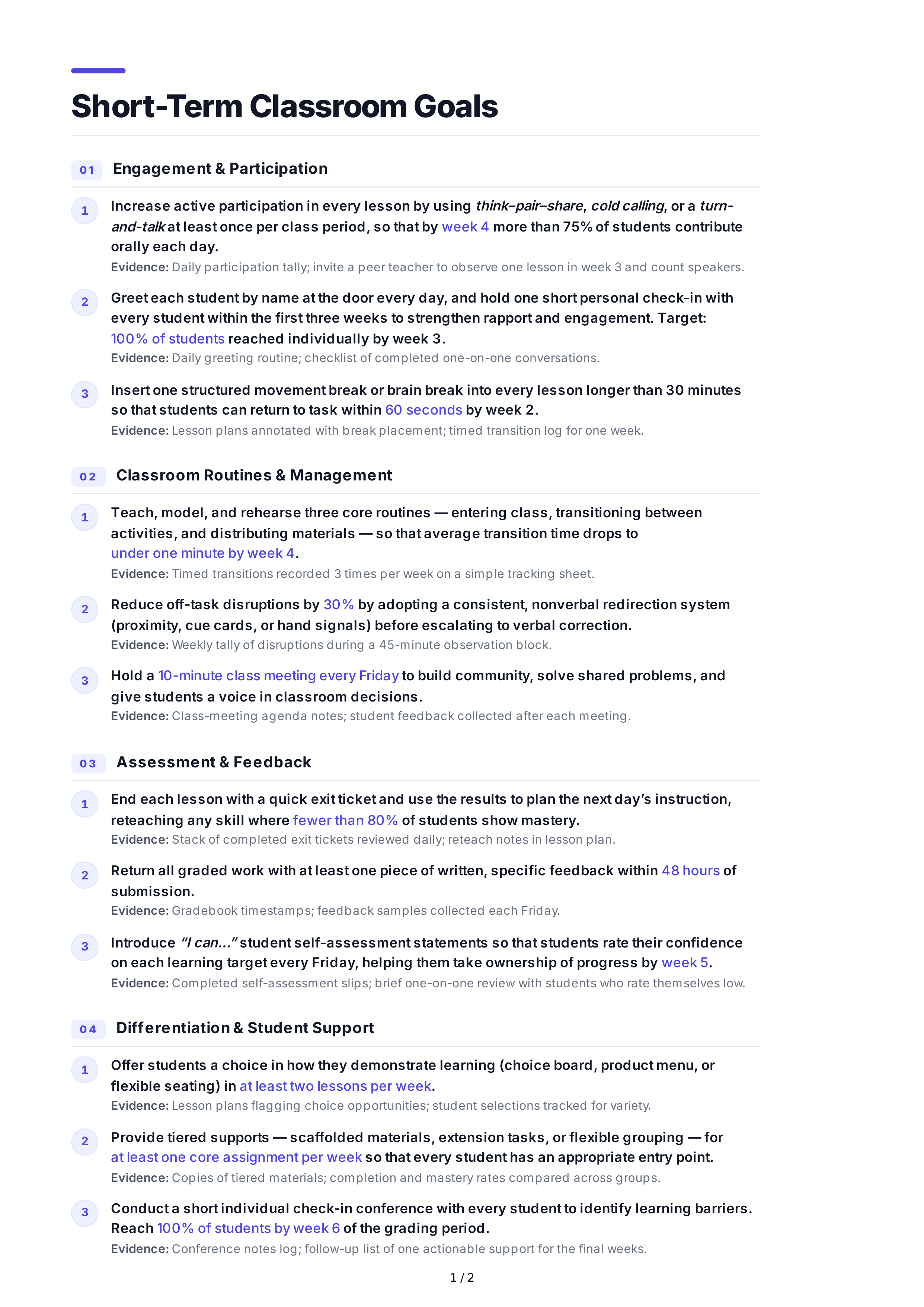
Short
-
Term
Classroom
Goals
0 1
Engagement
&
Participation
1
Increase
active
participation
in
every
lesson
by
using
think
–
pair
–
share
,
cold
calling
,
or
a
turn
-
and
-
talk
at
least
once
per
class
period
,
so
that
by
week
4
more
than
75%
of
students
contribute
orally
each
day
.
Evidence
:
Daily
participation
tally
;
invite
a
peer
teacher
to
observe
one
lesson
in
week
3
and
count
speakers
.
2
Greet
each
student
by
name
at
the
door
every
day
,
and
hold
one
short
personal
check
-
in
with
every
student
within
the
first
three
weeks
to
strengthen
rapport
and
engagement
.
Target
:
100%
of
students
reached
individually
by
week
3.
Evidence
:
Daily
greeting
routine
;
checklist
of
completed
one
-
on
-
one
conversations
.
3
Insert
one
structured
movement
break
or
brain
break
into
every
lesson
longer
than
30
minutes
so
that
students
can
return
to
task
within
60
seconds
by
week
2.
Evidence
:
Lesson
plans
annotated
with
break
placement
;
timed
transition
log
for
one
week
.
0 2
Classroom
Routines
&
Management
1
Teach
,
model
,
and
rehearse
three
core
routines
—
entering
class
,
transitioning
between
activities
,
and
distributing
materials
—
so
that
average
transition
time
drops
to
under
one
minute
by
week
4
.
Evidence
:
Timed
transitions
recorded
3
times
per
week
on
a
simple
tracking
sheet
.
2
Reduce
off
-
task
disruptions
by
30%
by
adopting
a
consistent
,
nonverbal
redirection
system
(
proximity
,
cue
cards
,
or
hand
signals
)
before
escalating
to
verbal
correction
.
Evidence
:
Weekly
tally
of
disruptions
during
a
45-
minute
observation
block
.
3
Hold
a
10-
minute
class
meeting
every
Friday
to
build
community
,
solve
shared
problems
,
and
give
students
a
voice
in
classroom
decisions
.
Evidence
:
Class
-
meeting
agenda
notes
;
student
feedback
collected
after
each
meeting
.
0 3
Assessment
&
Feedback
1
End
each
lesson
with
a
quick
exit
ticket
and
use
the
results
to
plan
the
next
day
’
s
instruction
,
reteaching
any
skill
where
fewer
than
80%
of
students
show
mastery
.
Evidence
:
Stack
of
completed
exit
tickets
reviewed
daily
;
reteach
notes
in
lesson
plan
.
2
Return
all
graded
work
with
at
least
one
piece
of
written
,
specific
feedback
within
48
hours
of
submission
.
Evidence
:
Gradebook
timestamps
;
feedback
samples
collected
each
Friday
.
3
Introduce
“
I
can
…”
student
self
-
assessment
statements
so
that
students
rate
their
confidence
on
each
learning
target
every
Friday
,
helping
them
take
ownership
of
progress
by
week
5
.
Evidence
:
Completed
self
-
assessment
slips
;
brief
one
-
on
-
one
review
with
students
who
rate
themselves
low
.
0 4
Differentiation
&
Student
Support
1
Offer
students
a
choice
in
how
they
demonstrate
learning
(
choice
board
,
product
menu
,
or
flexible
seating
)
in
at
least
two
lessons
per
week
.
Evidence
:
Lesson
plans
flagging
choice
opportunities
;
student
selections
tracked
for
variety
.
2
Provide
tiered
supports
—
scaffolded
materials
,
extension
tasks
,
or
flexible
grouping
—
for
at
least
one
core
assignment
per
week
so
that
every
student
has
an
appropriate
entry
point
.
Evidence
:
Copies
of
tiered
materials
;
completion
and
mastery
rates
compared
across
groups
.
3
Conduct
a
short
individual
check
-
in
conference
with
every
student
to
identify
learning
barriers
.
Reach
100%
of
students
by
week
6
of
the
grading
period
.
Evidence
:
Conference
notes
log
;
follow
-
up
list
of
one
actionable
support
for
the
final
weeks
.
1 / 2

Review
checkpoint
:
At
the
end
of
week
4,
review
your
evidence
for
all
12
goals
.
Keep
the
goals
that
are
working
,
adjust
the
ones
that
need
more
time
,
and
set
one
new
stretch
goal
for
the
final
two
weeks
of
the
grading
period
.
2 / 2