Short
‑
Term
Goals
for
Career
Development
A
practical
,
action
-
oriented
set
of
goals
designed
to
move
you
measurably
closer
to
your
next
level
—
without
burning
out
.
Each
goal
includes
the
reasoning
behind
it
,
the
steps
to
get
it
done
,
and
how
you
will
know
it
worked
.
1
The
Goals
at
a
Glance
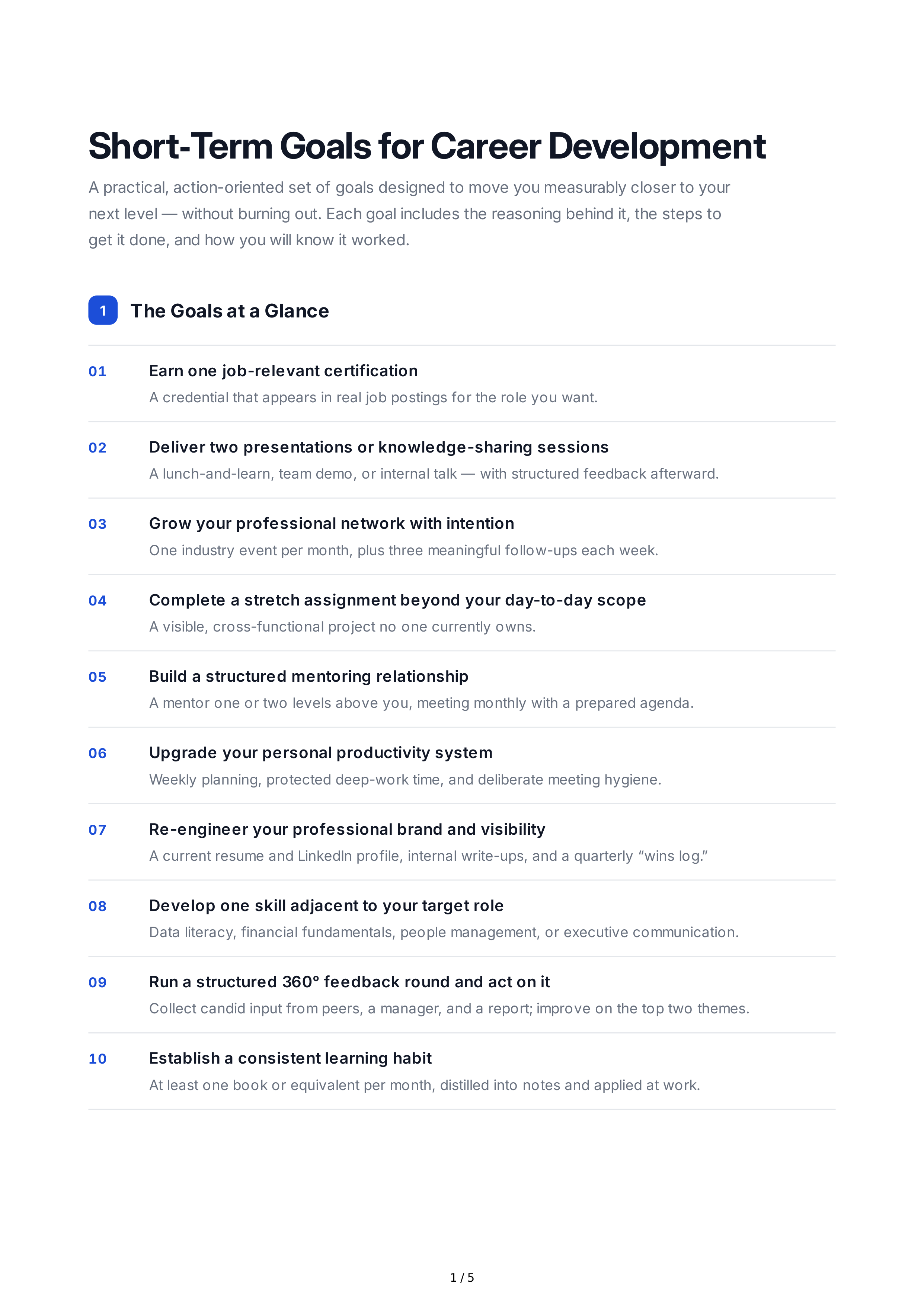
01
Earn
one
job
-
relevant
certification
A
credential
that
appears
in
real
job
postings
for
the
role
you
want
.
02
Deliver
two
presentations
or
knowledge
-
sharing
sessions
A
lunch
-
and
-
learn
,
team
demo
,
or
internal
talk
—
with
structured
feedback
afterward
.
03
Grow
your
professional
network
with
intention
One
industry
event
per
month
,
plus
three
meaningful
follow
-
ups
each
week
.
04
Complete
a
stretch
assignment
beyond
your
day
-
to
-
day
scope
A
visible
,
cross
-
functional
project
no
one
currently
owns
.
05
Build
a
structured
mentoring
relationship
A
mentor
one
or
two
levels
above
you
,
meeting
monthly
with
a
prepared
agenda
.
06
Upgrade
your
personal
productivity
system
Weekly
planning
,
protected
deep
-
work
time
,
and
deliberate
meeting
hygiene
.
07
Re
-
engineer
your
professional
brand
and
visibility
A
current
resume
and
LinkedIn
profile
,
internal
write
-
ups
,
and
a
quarterly
“
wins
log
.”
08
Develop
one
skill
adjacent
to
your
target
role
Data
literacy
,
financial
fundamentals
,
people
management
,
or
executive
communication
.
09
Run
a
structured
360°
feedback
round
and
act
on
it
Collect
candid
input
from
peers
,
a
manager
,
and
a
report
;
improve
on
the
top
two
themes
.
10
Establish
a
consistent
learning
habit
At
least
one
book
or
equivalent
per
month
,
distilled
into
notes
and
applied
at
work
.
1 / 5
2
What
Each
Goal
Involves
For
every
goal
:
the
logic
behind
it
,
concrete
actions
you
can
schedule
this
quarter
,
and
the
evidence
that
tells
you
it
worked
.
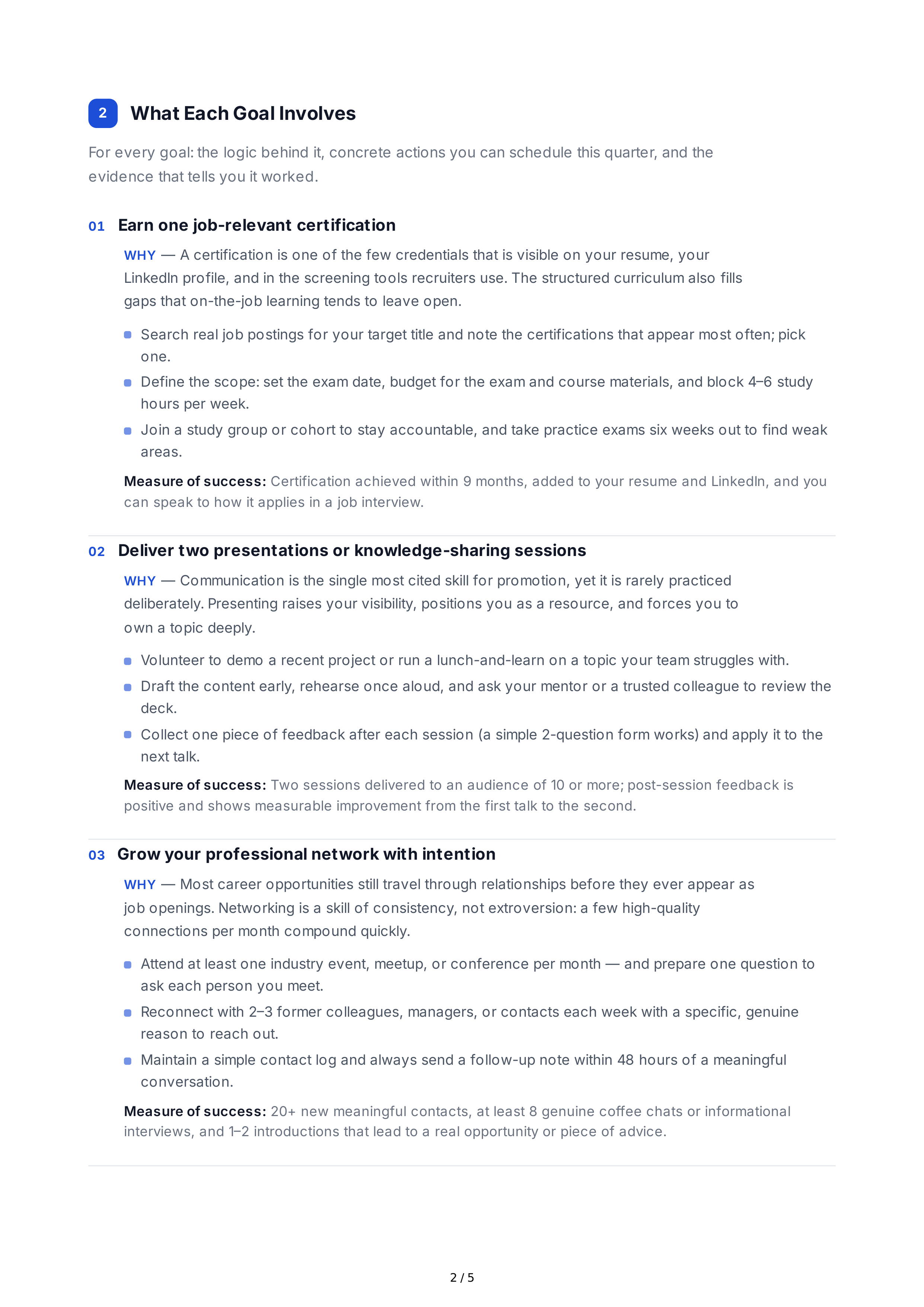
01
Earn
one
job
-
relevant
certification
WHY
—
A
certification
is
one
of
the
few
credentials
that
is
visible
on
your
resume
,
your
LinkedIn
profile
,
and
in
the
screening
tools
recruiters
use
.
The
structured
curriculum
also
fills
gaps
that
on
-
the
-
job
learning
tends
to
leave
open
.
Measure
of
success
:
Certification
achieved
within
9
months
,
added
to
your
resume
and
LinkedIn
,
and
you
can
speak
to
how
it
applies
in
a
job
interview
.
02
Deliver
two
presentations
or
knowledge
-
sharing
sessions
WHY
—
Communication
is
the
single
most
cited
skill
for
promotion
,
yet
it
is
rarely
practiced
deliberately
.
Presenting
raises
your
visibility
,
positions
you
as
a
resource
,
and
forces
you
to
own
a
topic
deeply
.
Measure
of
success
:
Two
sessions
delivered
to
an
audience
of
10
or
more
;
post
-
session
feedback
is
positive
and
shows
measurable
improvement
from
the
first
talk
to
the
second
.
03
Grow
your
professional
network
with
intention
WHY
—
Most
career
opportunities
still
travel
through
relationships
before
they
ever
appear
as
job
openings
.
Networking
is
a
skill
of
consistency
,
not
extroversion
:
a
few
high
-
quality
connections
per
month
compound
quickly
.
Measure
of
success
:
20+
new
meaningful
contacts
,
at
least
8
genuine
coffee
chats
or
informational
interviews
,
and
1–2
introductions
that
lead
to
a
real
opportunity
or
piece
of
advice
.
Search
real
job
postings
for
your
target
title
and
note
the
certifications
that
appear
most
often
;
pick
one
.
Define
the
scope
:
set
the
exam
date
,
budget
for
the
exam
and
course
materials
,
and
block
4–6
study
hours
per
week
.
Join
a
study
group
or
cohort
to
stay
accountable
,
and
take
practice
exams
six
weeks
out
to
find
weak
areas
.
Volunteer
to
demo
a
recent
project
or
run
a
lunch
-
and
-
learn
on
a
topic
your
team
struggles
with
.
Draft
the
content
early
,
rehearse
once
aloud
,
and
ask
your
mentor
or
a
trusted
colleague
to
review
the
deck
.
Collect
one
piece
of
feedback
after
each
session
(
a
simple
2-
question
form
works
)
and
apply
it
to
the
next
talk
.
Attend
at
least
one
industry
event
,
meetup
,
or
conference
per
month
—
and
prepare
one
question
to
ask
each
person
you
meet
.
Reconnect
with
2–3
former
colleagues
,
managers
,
or
contacts
each
week
with
a
specific
,
genuine
reason
to
reach
out
.
Maintain
a
simple
contact
log
and
always
send
a
follow
-
up
note
within
48
hours
of
a
meaningful
conversation
.
2 / 5
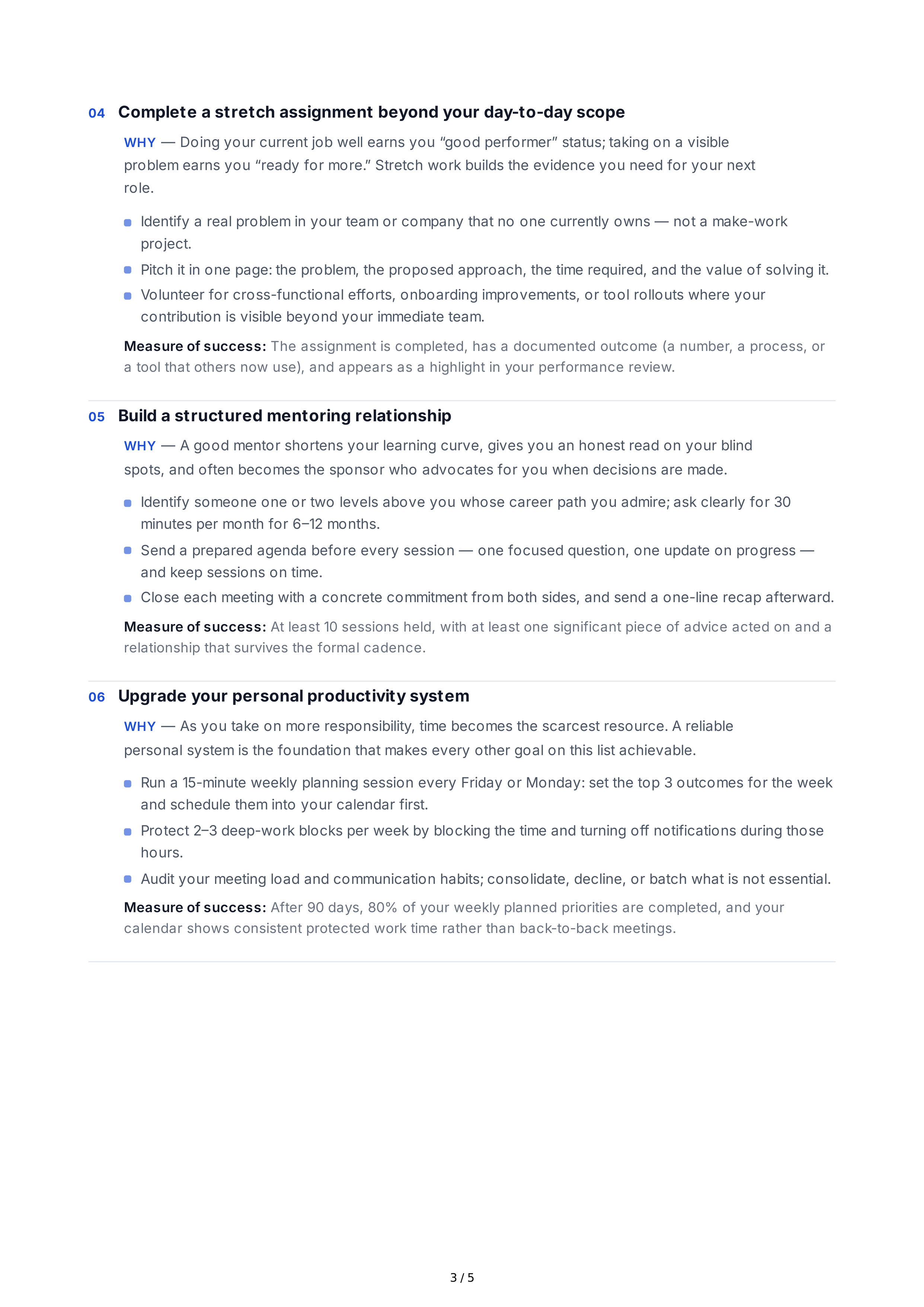
04
Complete
a
stretch
assignment
beyond
your
day
-
to
-
day
scope
WHY
—
Doing
your
current
job
well
earns
you
“
good
performer
”
status
;
taking
on
a
visible
problem
earns
you
“
ready
for
more
.”
Stretch
work
builds
the
evidence
you
need
for
your
next
role
.
Measure
of
success
:
The
assignment
is
completed
,
has
a
documented
outcome
(
a
number
,
a
process
,
or
a
tool
that
others
now
use
),
and
appears
as
a
highlight
in
your
performance
review
.
05
Build
a
structured
mentoring
relationship
WHY
—
A
good
mentor
shortens
your
learning
curve
,
gives
you
an
honest
read
on
your
blind
spots
,
and
often
becomes
the
sponsor
who
advocates
for
you
when
decisions
are
made
.
Measure
of
success
:
At
least
10
sessions
held
,
with
at
least
one
significant
piece
of
advice
acted
on
and
a
relationship
that
survives
the
formal
cadence
.
06
Upgrade
your
personal
productivity
system
WHY
—
As
you
take
on
more
responsibility
,
time
becomes
the
scarcest
resource
.
A
reliable
personal
system
is
the
foundation
that
makes
every
other
goal
on
this
list
achievable
.
Measure
of
success
:
After
90
days
, 80%
of
your
weekly
planned
priorities
are
completed
,
and
your
calendar
shows
consistent
protected
work
time
rather
than
back
-
to
-
back
meetings
.
Identify
a
real
problem
in
your
team
or
company
that
no
one
currently
owns
—
not
a
make
-
work
project
.
Pitch
it
in
one
page
:
the
problem
,
the
proposed
approach
,
the
time
required
,
and
the
value
of
solving
it
.
Volunteer
for
cross
-
functional
efforts
,
onboarding
improvements
,
or
tool
rollouts
where
your
contribution
is
visible
beyond
your
immediate
team
.
Identify
someone
one
or
two
levels
above
you
whose
career
path
you
admire
;
ask
clearly
for
30
minutes
per
month
for
6–12
months
.
Send
a
prepared
agenda
before
every
session
—
one
focused
question
,
one
update
on
progress
—
and
keep
sessions
on
time
.
Close
each
meeting
with
a
concrete
commitment
from
both
sides
,
and
send
a
one
-
line
recap
afterward
.
Run
a
15-
minute
weekly
planning
session
every
Friday
or
Monday
:
set
the
top
3
outcomes
for
the
week
and
schedule
them
into
your
calendar
first
.
Protect
2–3
deep
-
work
blocks
per
week
by
blocking
the
time
and
turning
off
notifications
during
those
hours
.
Audit
your
meeting
load
and
communication
habits
;
consolidate
,
decline
,
or
batch
what
is
not
essential
.
3 / 5
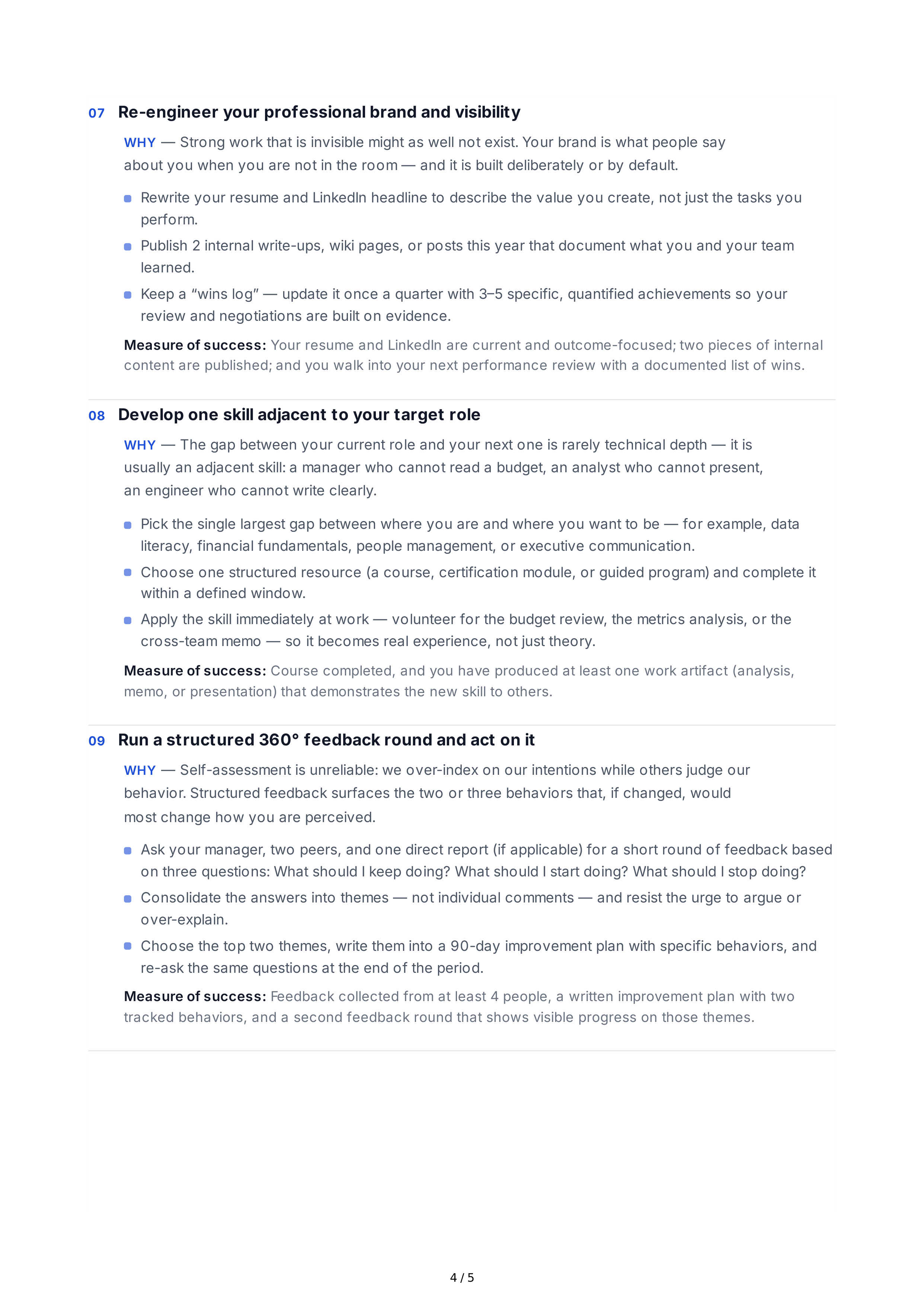
07
Re
-
engineer
your
professional
brand
and
visibility
WHY
—
Strong
work
that
is
invisible
might
as
well
not
exist
.
Your
brand
is
what
people
say
about
you
when
you
are
not
in
the
room
—
and
it
is
built
deliberately
or
by
default
.
Measure
of
success
:
Your
resume
and
LinkedIn
are
current
and
outcome
-
focused
;
two
pieces
of
internal
content
are
published
;
and
you
walk
into
your
next
performance
review
with
a
documented
list
of
wins
.
08
Develop
one
skill
adjacent
to
your
target
role
WHY
—
The
gap
between
your
current
role
and
your
next
one
is
rarely
technical
depth
—
it
is
usually
an
adjacent
skill
:
a
manager
who
cannot
read
a
budget
,
an
analyst
who
cannot
present
,
an
engineer
who
cannot
write
clearly
.
Measure
of
success
:
Course
completed
,
and
you
have
produced
at
least
one
work
artifact
(
analysis
,
memo
,
or
presentation
)
that
demonstrates
the
new
skill
to
others
.
09
Run
a
structured
360°
feedback
round
and
act
on
it
WHY
—
Self
-
assessment
is
unreliable
:
we
over
-
index
on
our
intentions
while
others
judge
our
behavior
.
Structured
feedback
surfaces
the
two
or
three
behaviors
that
,
if
changed
,
would
most
change
how
you
are
perceived
.
Measure
of
success
:
Feedback
collected
from
at
least
4
people
,
a
written
improvement
plan
with
two
tracked
behaviors
,
and
a
second
feedback
round
that
shows
visible
progress
on
those
themes
.
Rewrite
your
resume
and
LinkedIn
headline
to
describe
the
value
you
create
,
not
just
the
tasks
you
perform
.
Publish
2
internal
write
-
ups
,
wiki
pages
,
or
posts
this
year
that
document
what
you
and
your
team
learned
.
Keep
a
“
wins
log
” —
update
it
once
a
quarter
with
3–5
specific
,
quantified
achievements
so
your
review
and
negotiations
are
built
on
evidence
.
Pick
the
single
largest
gap
between
where
you
are
and
where
you
want
to
be
—
for
example
,
data
literacy
,
financial
fundamentals
,
people
management
,
or
executive
communication
.
Choose
one
structured
resource
(
a
course
,
certification
module
,
or
guided
program
)
and
complete
it
within
a
defined
window
.
Apply
the
skill
immediately
at
work
—
volunteer
for
the
budget
review
,
the
metrics
analysis
,
or
the
cross
-
team
memo
—
so
it
becomes
real
experience
,
not
just
theory
.
Ask
your
manager
,
two
peers
,
and
one
direct
report
(
if
applicable
)
for
a
short
round
of
feedback
based
on
three
questions
:
What
should
I
keep
doing
?
What
should
I
start
doing
?
What
should
I
stop
doing
?
Consolidate
the
answers
into
themes
—
not
individual
comments
—
and
resist
the
urge
to
argue
or
over
-
explain
.
Choose
the
top
two
themes
,
write
them
into
a
90-
day
improvement
plan
with
specific
behaviors
,
and
re
-
ask
the
same
questions
at
the
end
of
the
period
.
4 / 5
10
Establish
a
consistent
learning
habit
WHY
—
Career
growth
is
the
compounding
interest
of
daily
learning
.
Thirty
focused
minutes
a
week
—
invested
consistently
—
produces
more
durable
expertise
than
frantic
month
-
long
sprints
.
Measure
of
success
:
Twelve
months
and
twelve
books
(
or
equivalent
)
later
,
you
have
a
personal
library
of
notes
and
can
point
to
at
least
one
idea
you
implemented
at
work
this
quarter
.
A
final
reminder
:
short
-
term
goals
only
create
results
when
they
are
reviewed
.
Put
a
recurring
30-
minute
monthly
session
in
your
calendar
,
score
each
of
your
chosen
goals
honestly
,
and
adjust
—
the
plan
is
a
tool
,
not
a
report
card
.
Set
a
realistic
pace
:
one
book
per
month
,
or
the
equivalent
in
well
-
chosen
articles
,
case
studies
,
and
podcasts
.
Block
three
short
reading
sessions
in
your
calendar
each
week
;
consistency
matters
more
than
duration
.
Keep
a
running
note
of
ideas
worth
applying
,
and
deliberately
act
on
at
least
one
insight
from
your
reading
each
month
.
5 / 5