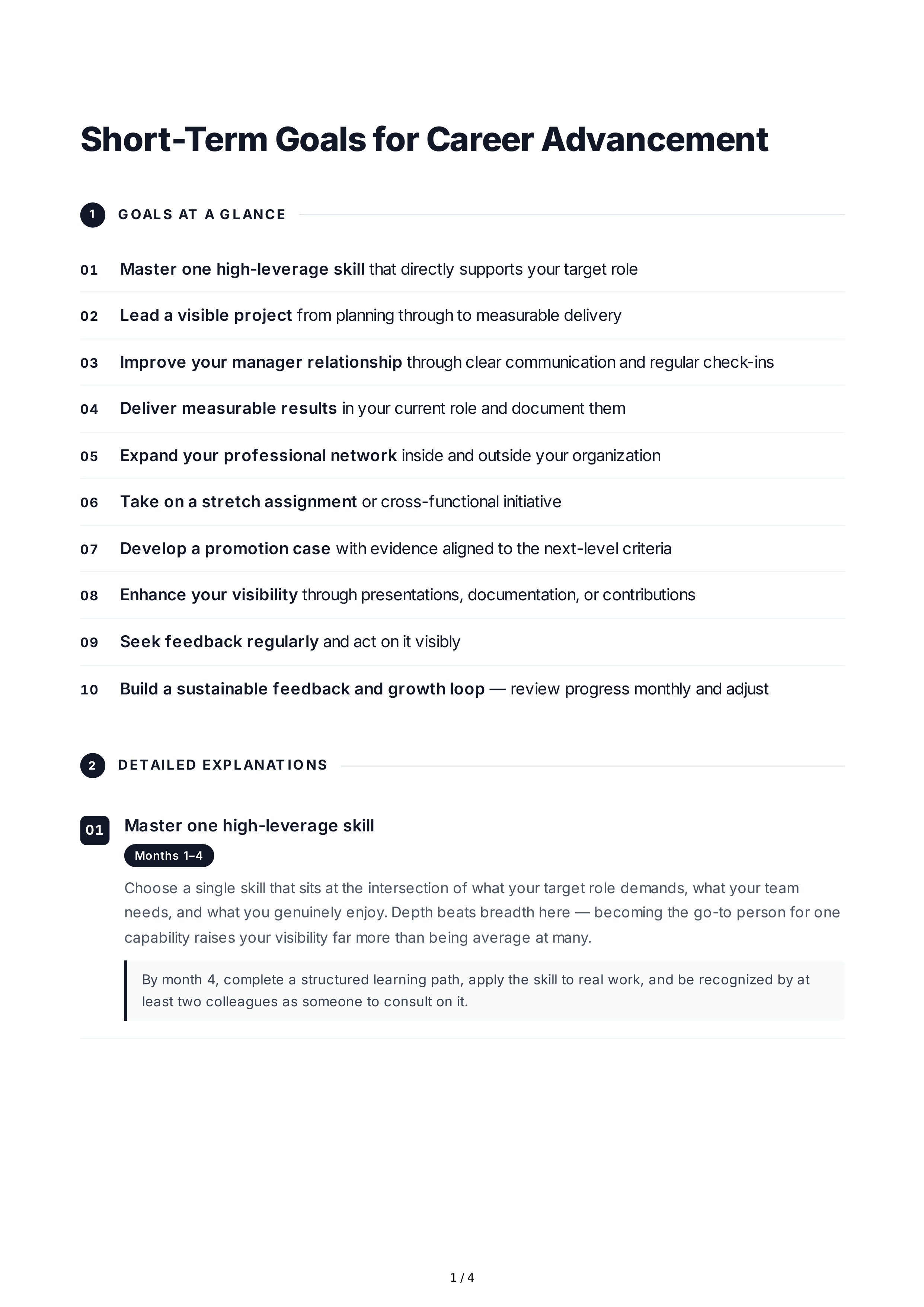
Short
-
Term
Goals
for
Career
Advancement
1
G OAL S
AT
A
G L ANCE
01
Master
one
high
-
leverage
skill
that
directly
supports
your
target
role
02
Lead
a
visible
project
from
planning
through
to
measurable
delivery
03
Improve
your
manager
relationship
through
clear
communication
and
regular
check
-
ins
04
Deliver
measurable
results
in
your
current
role
and
document
them
05
Expand
your
professional
network
inside
and
outside
your
organization
06
Take
on
a
stretch
assignment
or
cross
-
functional
initiative
07
Develop
a
promotion
case
with
evidence
aligned
to
the
next
-
level
criteria
08
Enhance
your
visibility
through
presentations
,
documentation
,
or
contributions
09
Seek
feedback
regularly
and
act
on
it
visibly
10
Build
a
sustainable
feedback
and
growth
loop
—
review
progress
monthly
and
adjust
2
DETAIL ED
EXPL ANAT IO NS
01
Master
one
high
-
leverage
skill
Months
1–4
Choose
a
single
skill
that
sits
at
the
intersection
of
what
your
target
role
demands
,
what
your
team
needs
,
and
what
you
genuinely
enjoy
.
Depth
beats
breadth
here
—
becoming
the
go
-
to
person
for
one
capability
raises
your
visibility
far
more
than
being
average
at
many
.
By
month
4,
complete
a
structured
learning
path
,
apply
the
skill
to
real
work
,
and
be
recognized
by
at
least
two
colleagues
as
someone
to
consult
on
it
.
1 / 4
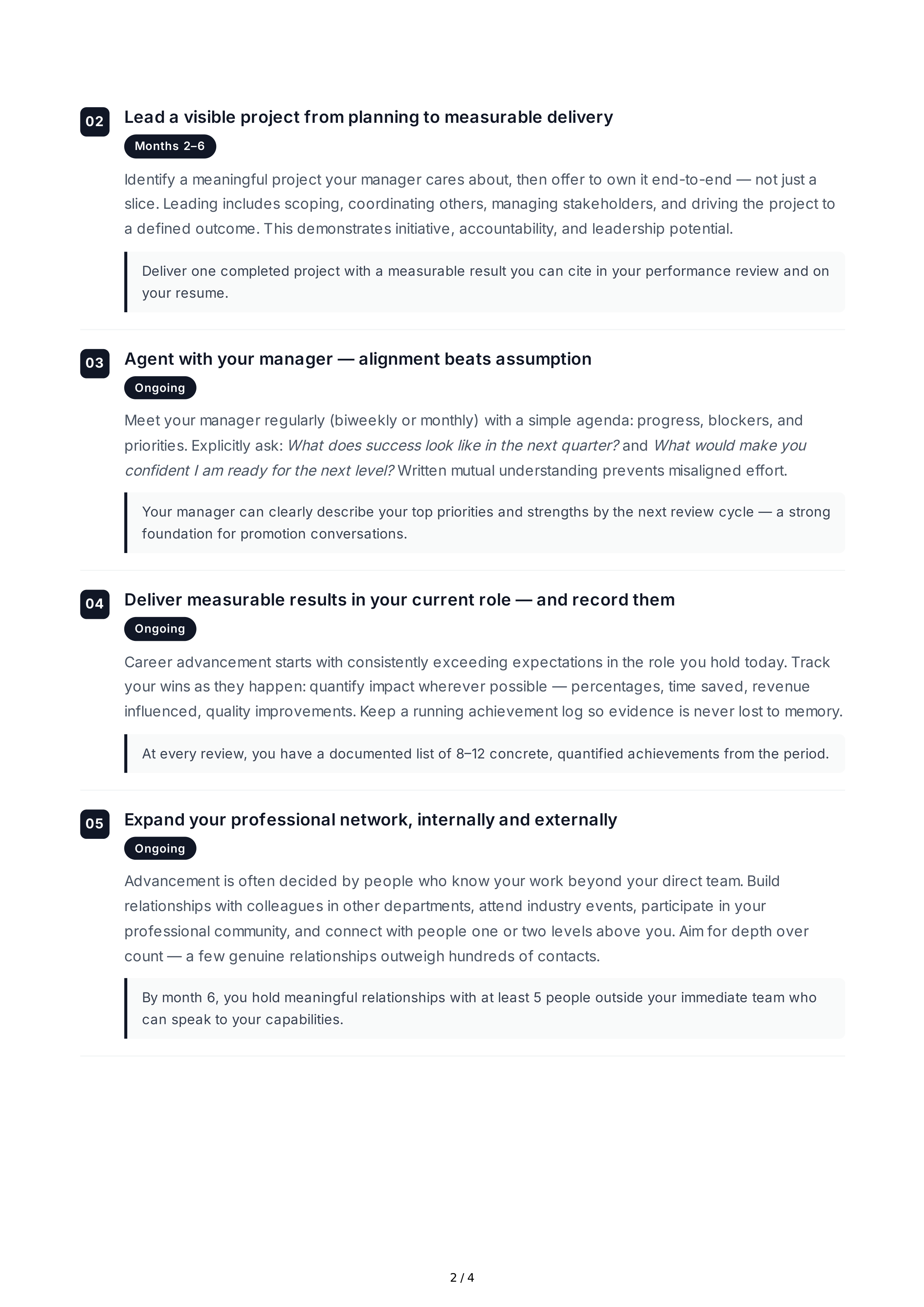
02
Lead
a
visible
project
from
planning
to
measurable
delivery
Months
2–6
Identify
a
meaningful
project
your
manager
cares
about
,
then
offer
to
own
it
end
-
to
-
end
—
not
just
a
slice
.
Leading
includes
scoping
,
coordinating
others
,
managing
stakeholders
,
and
driving
the
project
to
a
defined
outcome
.
This
demonstrates
initiative
,
accountability
,
and
leadership
potential
.
Deliver
one
completed
project
with
a
measurable
result
you
can
cite
in
your
performance
review
and
on
your
resume
.
03
Agent
with
your
manager
—
alignment
beats
assumption
Ongoing
Meet
your
manager
regularly
(
biweekly
or
monthly
)
with
a
simple
agenda
:
progress
,
blockers
,
and
priorities
.
Explicitly
ask
:
What
does
success
look
like
in
the
next
quarter
?
and
What
would
make
you
confident
I
am
ready
for
the
next
level
?
Written
mutual
understanding
prevents
misaligned
effort
.
Your
manager
can
clearly
describe
your
top
priorities
and
strengths
by
the
next
review
cycle
—
a
strong
foundation
for
promotion
conversations
.
04
Deliver
measurable
results
in
your
current
role
—
and
record
them
Ongoing
Career
advancement
starts
with
consistently
exceeding
expectations
in
the
role
you
hold
today
.
Track
your
wins
as
they
happen
:
quantify
impact
wherever
possible
—
percentages
,
time
saved
,
revenue
influenced
,
quality
improvements
.
Keep
a
running
achievement
log
so
evidence
is
never
lost
to
memory
.
At
every
review
,
you
have
a
documented
list
of
8–12
concrete
,
quantified
achievements
from
the
period
.
05
Expand
your
professional
network
,
internally
and
externally
Ongoing
Advancement
is
often
decided
by
people
who
know
your
work
beyond
your
direct
team
.
Build
relationships
with
colleagues
in
other
departments
,
attend
industry
events
,
participate
in
your
professional
community
,
and
connect
with
people
one
or
two
levels
above
you
.
Aim
for
depth
over
count
—
a
few
genuine
relationships
outweigh
hundreds
of
contacts
.
By
month
6,
you
hold
meaningful
relationships
with
at
least
5
people
outside
your
immediate
team
who
can
speak
to
your
capabilities
.
2 / 4
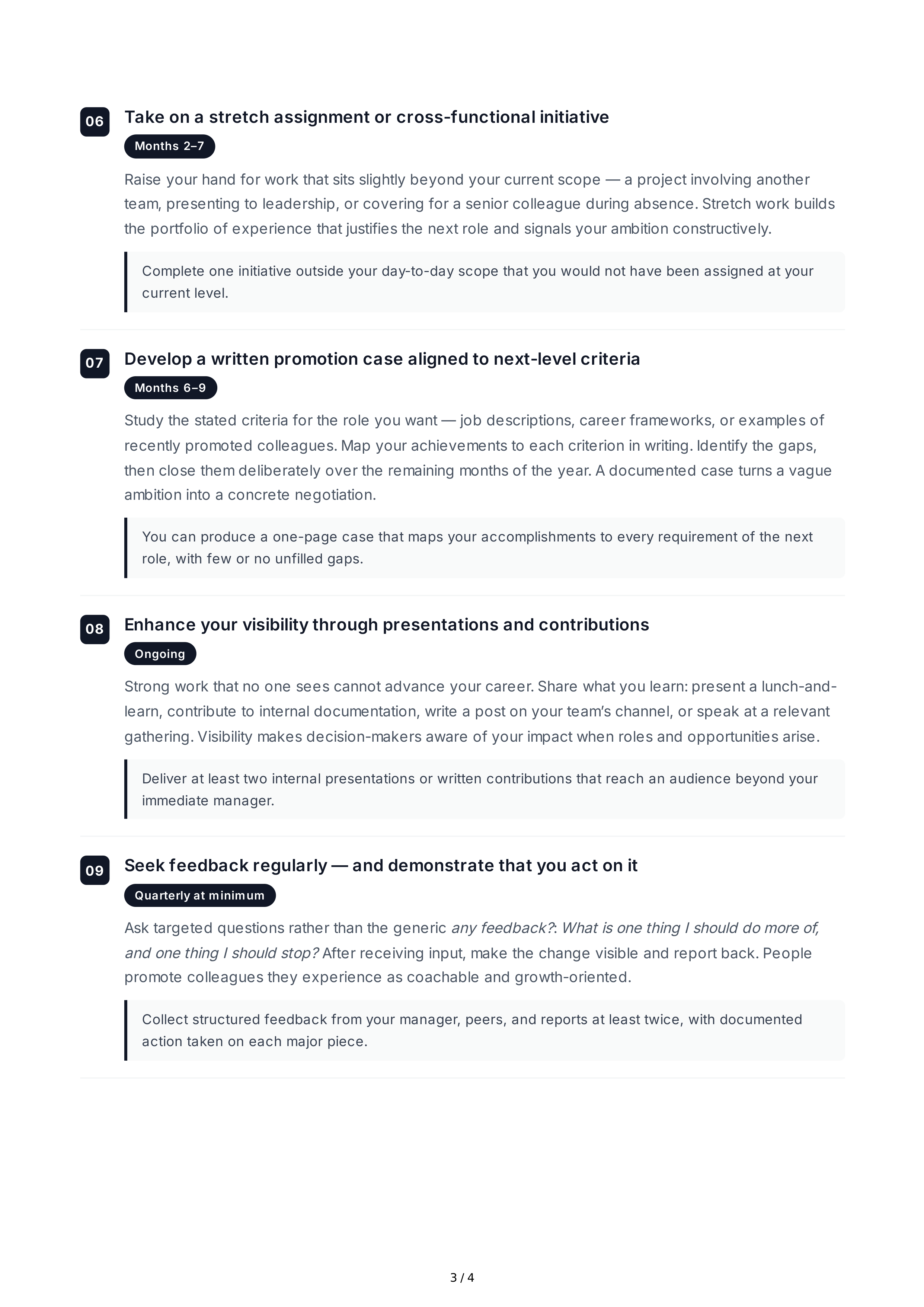
06
Take
on
a
stretch
assignment
or
cross
-
functional
initiative
Months
2–7
Raise
your
hand
for
work
that
sits
slightly
beyond
your
current
scope
—
a
project
involving
another
team
,
presenting
to
leadership
,
or
covering
for
a
senior
colleague
during
absence
.
Stretch
work
builds
the
portfolio
of
experience
that
justifies
the
next
role
and
signals
your
ambition
constructively
.
Complete
one
initiative
outside
your
day
-
to
-
day
scope
that
you
would
not
have
been
assigned
at
your
current
level
.
07
Develop
a
written
promotion
case
aligned
to
next
-
level
criteria
Months
6–9
Study
the
stated
criteria
for
the
role
you
want
—
job
descriptions
,
career
frameworks
,
or
examples
of
recently
promoted
colleagues
.
Map
your
achievements
to
each
criterion
in
writing
.
Identify
the
gaps
,
then
close
them
deliberately
over
the
remaining
months
of
the
year
.
A
documented
case
turns
a
vague
ambition
into
a
concrete
negotiation
.
You
can
produce
a
one
-
page
case
that
maps
your
accomplishments
to
every
requirement
of
the
next
role
,
with
few
or
no
unfilled
gaps
.
08
Enhance
your
visibility
through
presentations
and
contributions
Ongoing
Strong
work
that
no
one
sees
cannot
advance
your
career
.
Share
what
you
learn
:
present
a
lunch
-
and
-
learn
,
contribute
to
internal
documentation
,
write
a
post
on
your
team
’
s
channel
,
or
speak
at
a
relevant
gathering
.
Visibility
makes
decision
-
makers
aware
of
your
impact
when
roles
and
opportunities
arise
.
Deliver
at
least
two
internal
presentations
or
written
contributions
that
reach
an
audience
beyond
your
immediate
manager
.
09
Seek
feedback
regularly
—
and
demonstrate
that
you
act
on
it
Quarterly
at
minimum
Ask
targeted
questions
rather
than
the
generic
any
feedback
?:
What
is
one
thing
I
should
do
more
of
,
and
one
thing
I
should
stop
?
After
receiving
input
,
make
the
change
visible
and
report
back
.
People
promote
colleagues
they
experience
as
coachable
and
growth
-
oriented
.
Collect
structured
feedback
from
your
manager
,
peers
,
and
reports
at
least
twice
,
with
documented
action
taken
on
each
major
piece
.
3 / 4
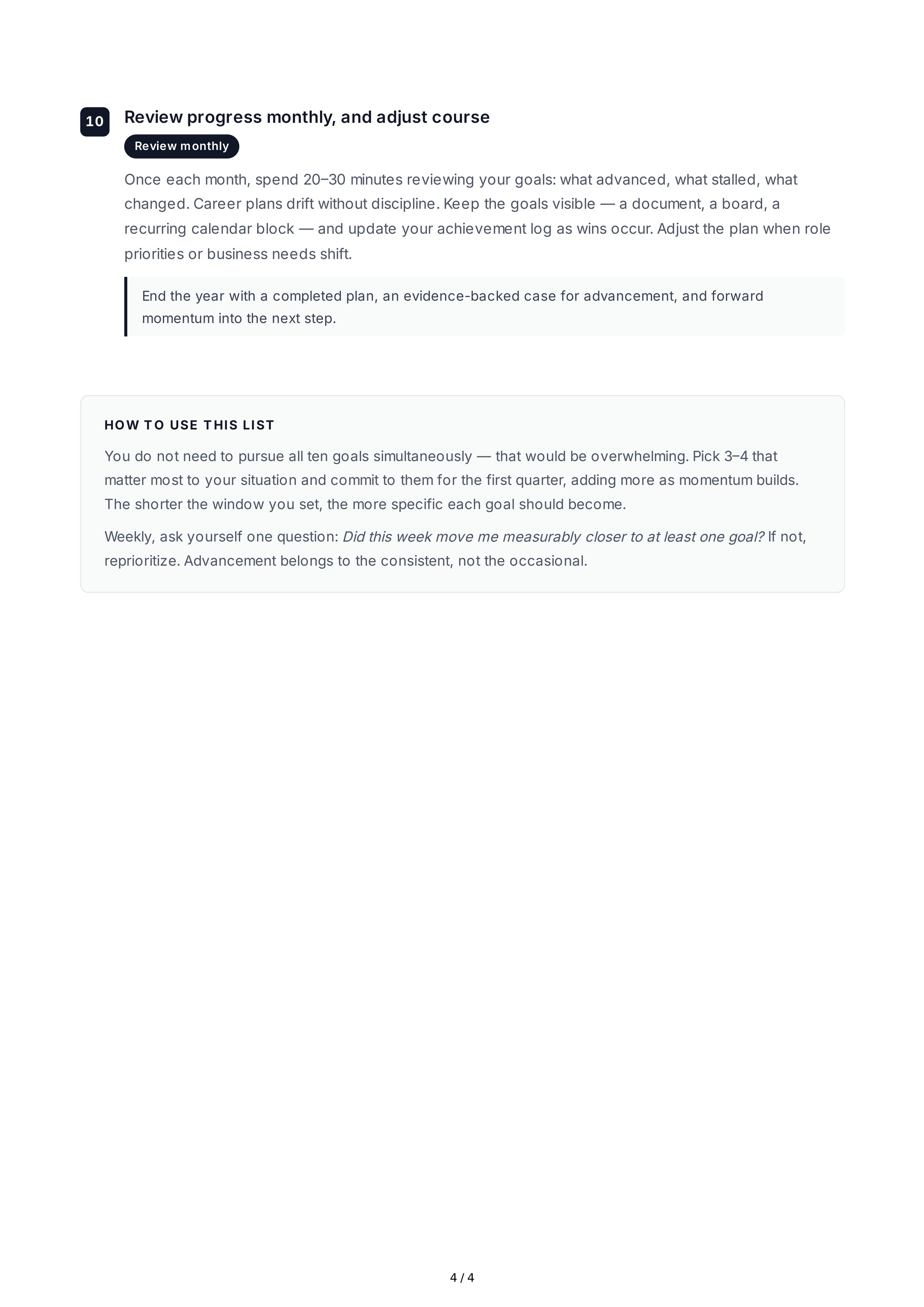
10
Review
progress
monthly
,
and
adjust
course
Review
monthly
Once
each
month
,
spend
20–30
minutes
reviewing
your
goals
:
what
advanced
,
what
stalled
,
what
changed
.
Career
plans
drift
without
discipline
.
Keep
the
goals
visible
—
a
document
,
a
board
,
a
recurring
calendar
block
—
and
update
your
achievement
log
as
wins
occur
.
Adjust
the
plan
when
role
priorities
or
business
needs
shift
.
End
the
year
with
a
completed
plan
,
an
evidence
-
backed
case
for
advancement
,
and
forward
momentum
into
the
next
step
.
HOW
T O
USE
T HIS
LIST
You
do
not
need
to
pursue
all
ten
goals
simultaneously
—
that
would
be
overwhelming
.
Pick
3–4
that
matter
most
to
your
situation
and
commit
to
them
for
the
first
quarter
,
adding
more
as
momentum
builds
.
The
shorter
the
window
you
set
,
the
more
specific
each
goal
should
become
.
Weekly
,
ask
yourself
one
question
:
Did
this
week
move
me
measurably
closer
to
at
least
one
goal
?
If
not
,
reprioritize
.
Advancement
belongs
to
the
consistent
,
not
the
occasional
.
4 / 4