Short
-
Term
Goals
for
Job
Seekers
A
successful
job
search
rarely
happens
by
accident
.
Setting
short
-
term
goals
breaks
an
overwhelming
process
into
clear
,
weekly
actions
—
so
you
can
measure
progress
,
stay
motivated
,
and
avoid
drifting
into
long
gaps
of
inactivity
.
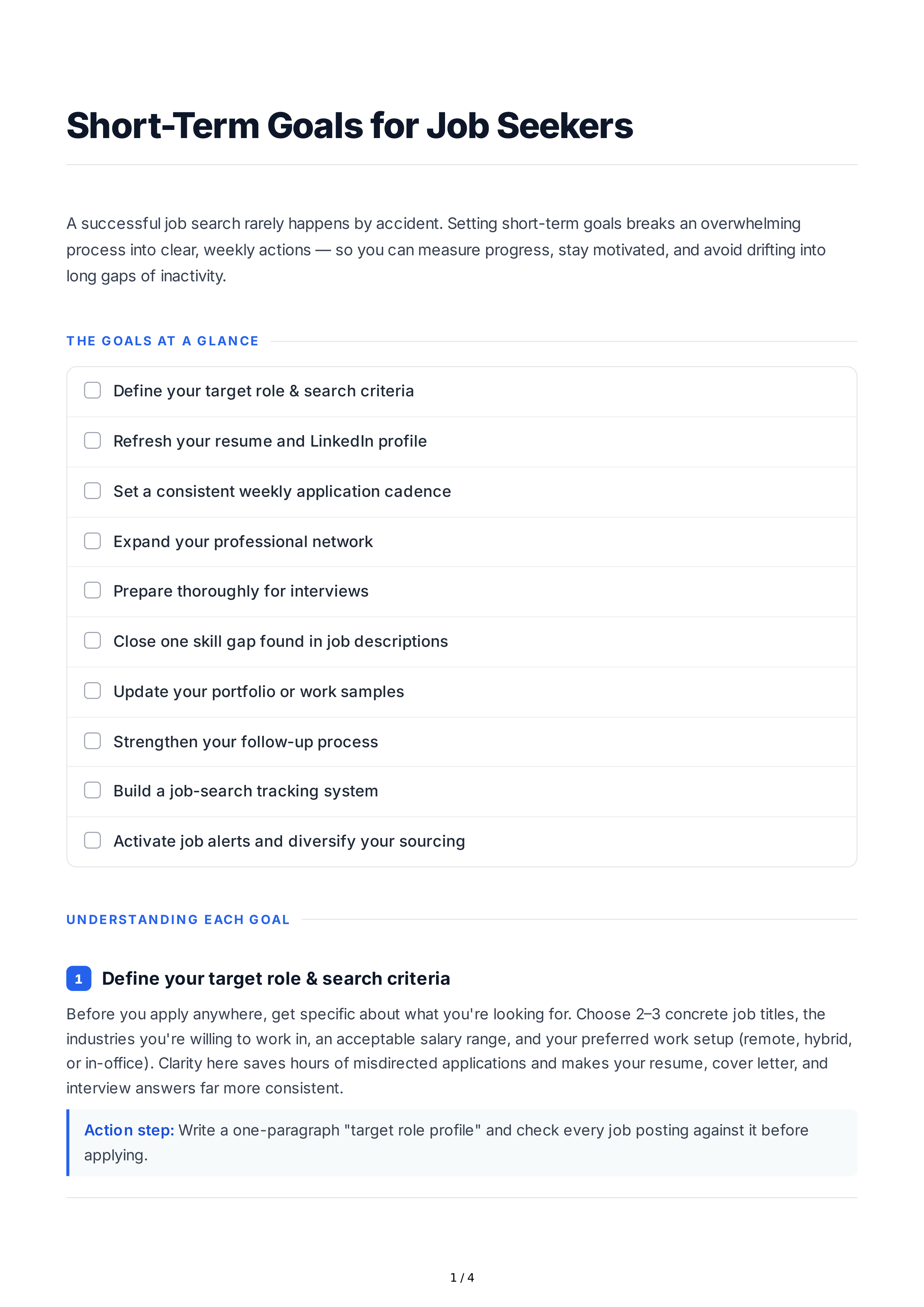
T HE
G OALS
AT
A
G LAN CE
Define
your
target
role
&
search
criteria
Refresh
your
resume
and
LinkedIn
profile
Set
a
consistent
weekly
application
cadence
Expand
your
professional
network
Prepare
thoroughly
for
interviews
Close
one
skill
gap
found
in
job
descriptions
Update
your
portfolio
or
work
samples
Strengthen
your
follow
-
up
process
Build
a
job
-
search
tracking
system
Activate
job
alerts
and
diversify
your
sourcing
UN DE RSTAN DI N G
E ACH
G OAL
Define
your
target
role
&
search
criteria
Before
you
apply
anywhere
,
get
specific
about
what
you
'
re
looking
for
.
Choose
2–3
concrete
job
titles
,
the
industries
you
'
re
willing
to
work
in
,
an
acceptable
salary
range
,
and
your
preferred
work
setup
(
remote
,
hybrid
,
or
in
-
office
).
Clarity
here
saves
hours
of
misdirected
applications
and
makes
your
resume
,
cover
letter
,
and
interview
answers
far
more
consistent
.
Action
step
:
Write
a
one
-
paragraph
"
target
role
profile
"
and
check
every
job
posting
against
it
before
applying
.
1
1 / 4
Refresh
your
resume
and
LinkedIn
profile
Recruiters
and
applicant
tracking
systems
scan
for
role
-
relevant
keywords
,
so
generic
resumes
get
filtered
out
.
Tailor
your
resume
to
each
position
by
mirroring
the
job
description
'
s
language
,
and
quantify
achievements
with
numbers
("
improved
X
by
20%")
rather
than
listing
duties
.
Your
LinkedIn
headline
,
About
section
,
and
experience
should
tell
the
same
story
.
Action
step
:
Keep
one
master
resume
updated
at
all
times
;
create
a
tailored
version
for
each
application
within
the
first
two
weeks
of
your
search
.
Set
a
consistent
weekly
application
cadence
Bursts
of
applying
for
two
days
followed
by
a
week
of
silence
is
the
most
common
job
-
search
trap
.
Consistency
beats
intensity
.
Commit
to
a
realistic
weekly
target
—
typically
5–10
thoughtfully
tailored
applications
—
and
protect
a
few
dedicated
hours
each
week
for
search
work
.
Action
step
:
Block
three
mornings
per
week
for
applications
,
and
treat
them
like
non
-
negotiable
meetings
.
Expand
your
professional
network
Many
roles
are
filled
through
referrals
before
they
'
re
ever
advertised
.
Schedule
informational
conversations
with
people
at
target
companies
,
reconnect
with
former
colleagues
,
and
engage
thoughtfully
with
industry
content
.
Each
conversation
is
a
chance
to
learn
what
hiring
managers
actually
need
and
to
become
a
name
they
remember
.
Action
step
:
Aim
for
2–3
informational
interviews
or
genuine
networking
conversations
per
week
—
quality
over
volume
.
Prepare
thoroughly
for
interviews
Interviewing
is
a
skill
,
and
it
improves
with
practice
.
Prepare
concise
stories
in
the
STAR
format
(
Situation
,
Task
,
Action
,
Result
)
drawn
from
your
real
experience
,
research
each
company
'
s
product
,
metrics
,
and
recent
news
,
and
rehearse
answers
aloud
.
The
goal
is
to
arrive
calm
,
structured
,
and
specific
—
not
scripted
.
Action
step
:
Run
1–2
mock
interviews
per
week
—
with
a
friend
,
a
mentor
,
or
even
a
recorded
self
-
practice
session
.
2
3
4
5
2 / 4
Close
one
skill
gap
found
in
job
descriptions
If
the
same
tool
or
skill
keeps
appearing
in
postings
you
'
re
otherwise
qualified
for
,
treat
that
as
a
signal
.
Choose
one
high
-
impact
gap
and
close
it
with
a
focused
online
course
,
certification
,
or
hands
-
on
project
that
you
can
realistically
complete
within
a
month
.
You
don
'
t
need
to
learn
everything
—
you
need
to
remove
the
most
common
objection
.
Action
step
:
Review
the
last
ten
job
descriptions
that
fit
you
;
list
the
top
three
repeated
skills
,
and
commit
to
learning
the
most
frequent
one
.
Update
your
portfolio
or
work
samples
For
design
,
writing
,
marketing
,
development
,
and
many
other
fields
,
proof
of
work
matters
more
than
a
list
of
duties
.
Curate
3–5
recent
,
relevant
samples
,
each
with
a
short
case
-
study
format
:
the
context
,
your
role
,
the
actions
you
took
,
and
the
measurable
outcome
.
Remove
outdated
or
weak
examples
—
a
sharp
,
focused
portfolio
beats
a
bloated
one
.
Action
step
:
Create
a
one
-
page
summary
template
for
each
sample
so
every
portfolio
piece
tells
a
complete
story
.
Strengthen
your
follow
-
up
process
Following
up
is
where
many
candidates
quietly
eliminate
themselves
.
A
short
,
polite
thank
-
you
email
within
24
hours
of
an
interview
keeps
you
top
-
of
-
mind
and
professional
.
If
you
haven
'
t
heard
back
within
a
week
or
two
,
a
single
courteous
check
-
in
is
appropriate
—
just
don
'
t
spam
recruiters
.
Action
step
:
Prepare
a
reusable
thank
-
you
email
template
now
,
and
personalize
one
or
two
lines
for
every
person
you
speak
with
.
Build
a
job
-
search
tracking
system
When
you
apply
to
dozens
of
roles
,
memory
isn
'
t
enough
.
Track
each
application
'
s
company
,
role
,
date
applied
,
contact
person
,
current
status
,
and
next
follow
-
up
date
in
a
simple
spreadsheet
.
A
reliable
tracker
prevents
missed
follow
-
ups
,
shows
you
which
channels
are
actually
working
,
and
gives
you
a
clear
picture
of
your
progress
every
week
.
Action
step
:
Set
up
your
tracker
in
the
first
week
and
review
it
every
Friday
—
adjust
your
strategy
based
on
what
the
data
shows
.
6
7
8
9
3 / 4

Activate
job
alerts
and
diversify
your
sourcing
Relying
on
a
single
job
board
limits
your
reach
.
Enable
daily
alerts
on
LinkedIn
Jobs
,
Indeed
,
and
specialized
industry
boards
,
and
check
the
career
pages
of
your
target
employers
directly
.
Many
openings
are
posted
first
on
company
sites
or
shared
through
recruiter
networks
before
appearing
on
aggregators
.
Action
step
:
Create
a
shortlist
of
15–20
target
companies
,
follow
them
on
LinkedIn
,
and
set
aside
15
minutes
each
morning
to
scan
new
postings
.
How
to
use
this
guide
:
You
don
'
t
need
to
do
everything
at
once
.
Pick
the
three
goals
that
address
your
biggest
current
weakness
,
turn
each
into
a
SMART
objective
(
Specific
,
Measurable
,
Achievable
,
Relevant
,
Time
-
bound
),
and
add
one
or
two
new
goals
every
month
as
the
earlier
ones
become
habits
.
10
4 / 4