Short
-
Term
Goals
for
New
Employees
Ten
practical
,
measurable
goals
to
guide
a
new
team
member
through
the
first
90
days
—
from
learning
the
team
to
delivering
meaningful
work
.
1.
The
Goals
—
At
a
Glance
01
Complete
your
practical
onboarding
.
Gain
access
to
core
systems
,
set
up
your
equipment
,
and
finish
HR
,
compliance
,
and
security
basics
within
your
first
week
.
02
Meet
your
manager
and
immediate
team
early
.
Have
your
first
one
-
on
-
one
with
your
manager
and
short
introductions
with
teammates
by
day
five
,
so
questions
have
a
natural
home
.
03
Learn
what
your
team
is
trying
to
achieve
.
Review
the
current
quarter
’
s
goals
,
roadmap
,
and
active
projects
;
ask
which
deliverables
matter
most
in
the
next
60
days
.
04
Understand
the
product
or
service
and
its
customers
.
Read
product
or
sales
documentation
,
review
recent
releases
,
and
observe
or
join
a
customer
conversation
where
possible
.
05
Shadow
a
full
process
from
start
to
finish
.
Follow
a
task
,
support
ticket
,
campaign
,
or
project
through
its
lifecycle
so
you
see
how
work
actually
moves
across
the
team
.
06
Clarify
expectations
,
decision
rights
,
and
success
measures
.
Confirm
your
primary
responsibilities
,
who
approves
what
,
and
the
specific
behaviors
or
outputs
that
define
a
strong
first
review
.
07
Learn
the
team
’
s
communication
rituals
and
tools
.
Understand
which
channels
,
documents
,
and
meetings
are
essential
;
mirror
how
teammates
share
updates
and
request
help
.
08
Take
ownership
of
one
small
,
well
-
scoped
deliverable
.
Complete
a
first
piece
of
work
that
depends
on
you
—
a
report
,
draft
,
process
improvement
,
or
small
task
—
and
invite
feedback
on
it
.
1 / 3
09
Build
your
internal
knowledge
base
.
Keep
a
running
list
of
names
,
acronyms
,
systems
,
and
documentation
locations
so
you
rely
less
on
memory
and
more
on
reliable
sources
.
10
Schedule
formal
check
-
ins
at
30, 60,
and
90
days
.
Request
structured
feedback
from
your
manager
and
teammates
,
then
revise
your
goals
based
on
what
you
learn
.
This
list
is
a
starting
point
.
Adjust
the
order
,
wording
,
and
dates
to
match
the
specific
role
,
team
,
and
company
culture
.
2.
Explanation
:
How
to
Work
Through
These
Goals
The
speed
of
each
phase
depends
on
the
role
,
the
seniority
of
the
employee
,
and
how
much
context
the
team
already
has
.
In
most
cases
,
a
simple
30–60–90
day
rhythm
keeps
expectations
clear
without
pressuring
people
to
produce
before
they
understand
the
work
.
First
30
days
—
Learn
and
orient
Weeks
one
to
four
are
not
about
proving
output
as
quickly
as
possible
;
they
are
about
building
a
reliable
mental
map
of
the
organisation
.
The
new
employee
should
focus
on
meeting
people
,
reading
the
current
goals
,
understanding
how
decisions
are
made
,
and
learning
how
work
is
prioritised
.
Managers
should
provide
names
,
documents
,
and
access
early
,
and
they
should
encourage
questions
.
A
new
person
who
already
shares
their
first
deliverable
in
week
one
is
often
still
learning
what
“
good
”
looks
like
—
and
that
leads
to
rework
later
.
Days
31
to
60 —
Contribute
with
support
Once
a
person
can
explain
the
team
’
s
goals
and
repeat
a
core
process
without
checking
notes
at
every
step
,
they
are
ready
to
contribute
more
steadily
.
This
is
the
right
period
for
the
full
ownership
of
a
small
,
meaningful
deliverable
—
not
a
test
project
,
but
real
work
that
someone
on
the
team
needs
.
At
this
stage
,
check
-
ins
can
shift
from
“
How
are
you
settling
in
?”
to
“
Here
is
what
I
tried
,
here
is
what
I
learned
,
and
here
is
where
I
need
input
.”
The
employee
should
also
start
proposing
small
improvements
rather
than
only
asking
how
things
work
.
2 / 3
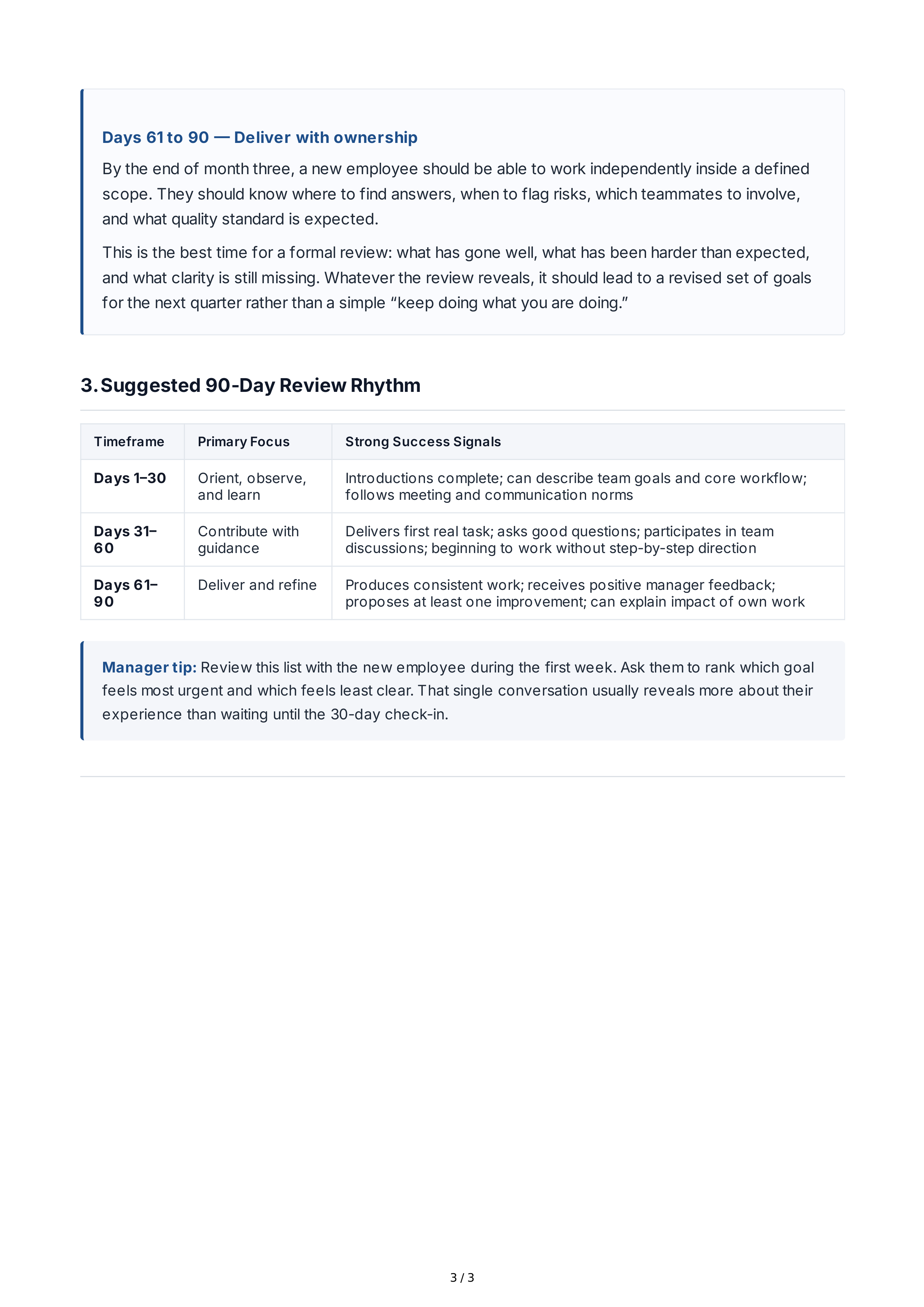
Days
61
to
90 —
Deliver
with
ownership
By
the
end
of
month
three
,
a
new
employee
should
be
able
to
work
independently
inside
a
defined
scope
.
They
should
know
where
to
find
answers
,
when
to
flag
risks
,
which
teammates
to
involve
,
and
what
quality
standard
is
expected
.
This
is
the
best
time
for
a
formal
review
:
what
has
gone
well
,
what
has
been
harder
than
expected
,
and
what
clarity
is
still
missing
.
Whatever
the
review
reveals
,
it
should
lead
to
a
revised
set
of
goals
for
the
next
quarter
rather
than
a
simple
“
keep
doing
what
you
are
doing
.”
3.
Suggested
90-
Day
Review
Rhythm
Timeframe
Primary
Focus
Strong
Success
Signals
Days
1–30
Orient
,
observe
,
and
learn
Introductions
complete
;
can
describe
team
goals
and
core
workflow
;
follows
meeting
and
communication
norms
Days
31–
60
Contribute
with
guidance
Delivers
first
real
task
;
asks
good
questions
;
participates
in
team
discussions
;
beginning
to
work
without
step
-
by
-
step
direction
Days
61–
90
Deliver
and
refine
Produces
consistent
work
;
receives
positive
manager
feedback
;
proposes
at
least
one
improvement
;
can
explain
impact
of
own
work
Manager
tip
:
Review
this
list
with
the
new
employee
during
the
first
week
.
Ask
them
to
rank
which
goal
feels
most
urgent
and
which
feels
least
clear
.
That
single
conversation
usually
reveals
more
about
their
experience
than
waiting
until
the
30-
day
check
-
in
.
3 / 3