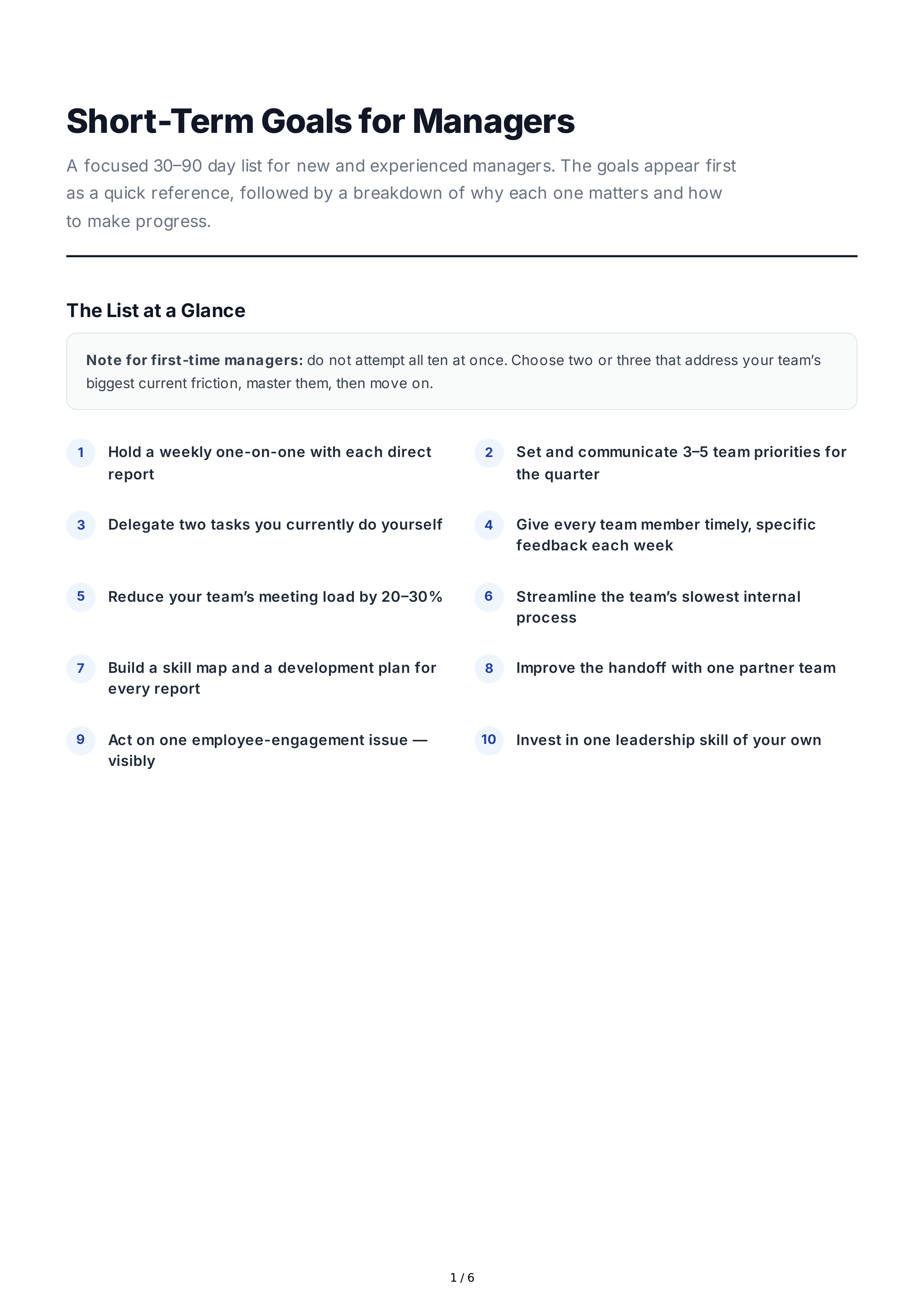
Short
-
Term
Goals
for
Managers
A
focused
30–90
day
list
for
new
and
experienced
managers
.
The
goals
appear
first
as
a
quick
reference
,
followed
by
a
breakdown
of
why
each
one
matters
and
how
to
make
progress
.
The
List
at
a
Glance
Note
for
first
-
time
managers
:
do
not
attempt
all
ten
at
once
.
Choose
two
or
three
that
address
your
team
’
s
biggest
current
friction
,
master
them
,
then
move
on
.
1
Hold
a
weekly
one
-
on
-
one
with
each
direct
report
2
Set
and
communicate
3–5
team
priorities
for
the
quarter
3
Delegate
two
tasks
you
currently
do
yourself
4
Give
every
team
member
timely
,
specific
feedback
each
week
5
Reduce
your
team
’
s
meeting
load
by
20–30%
6
Streamline
the
team
’
s
slowest
internal
process
7
Build
a
skill
map
and
a
development
plan
for
every
report
8
Improve
the
handoff
with
one
partner
team
9
Act
on
one
employee
-
engagement
issue
—
visibly
10
Invest
in
one
leadership
skill
of
your
own
1 / 6
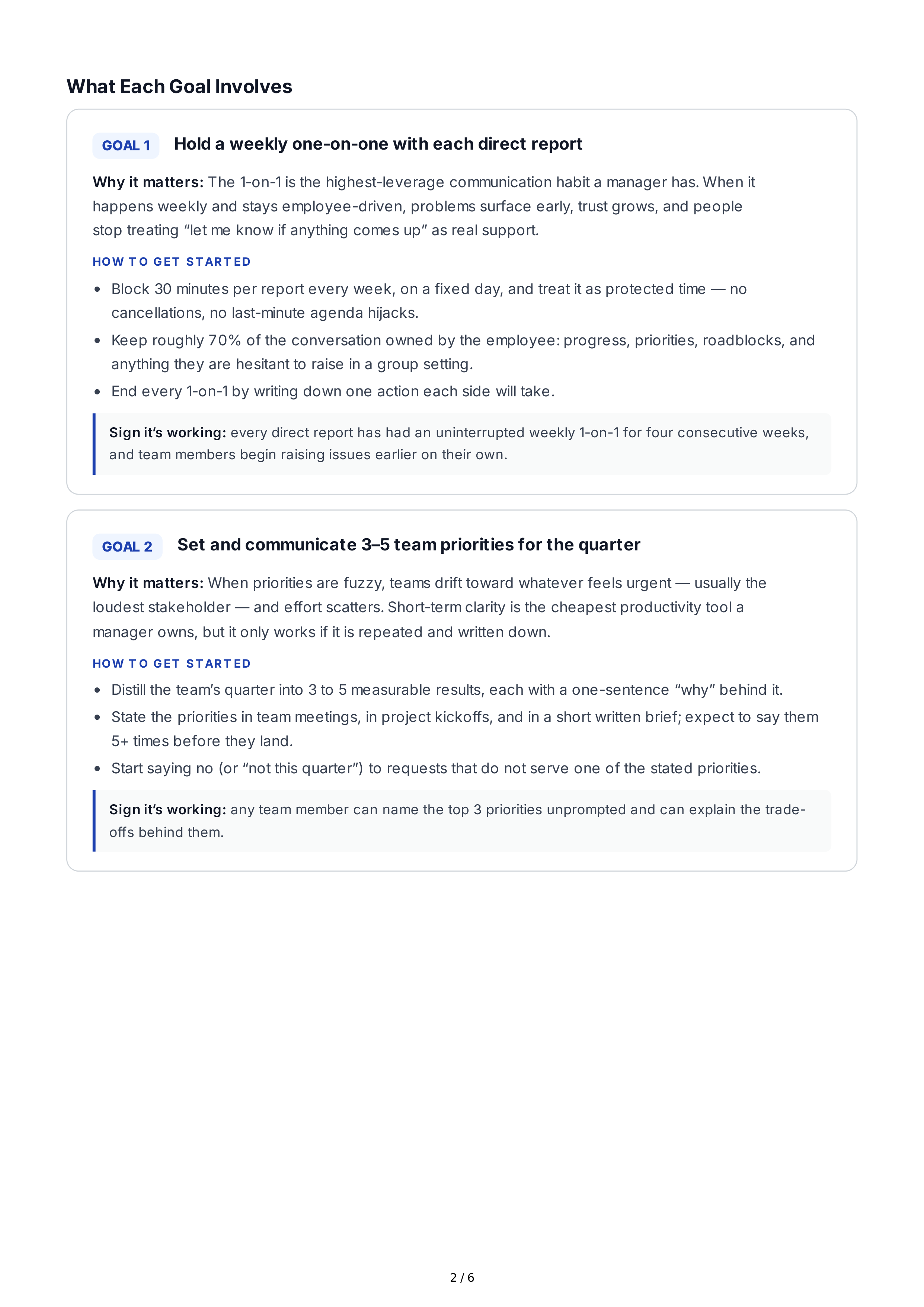
What
Each
Goal
Involves
GOAL
1
Hold
a
weekly
one
-
on
-
one
with
each
direct
report
Why
it
matters
:
The
1-
on
-1
is
the
highest
-
leverage
communication
habit
a
manager
has
.
When
it
happens
weekly
and
stays
employee
-
driven
,
problems
surface
early
,
trust
grows
,
and
people
stop
treating
“
let
me
know
if
anything
comes
up
”
as
real
support
.
HOW
T O
GET
S TAR T ED
Block
30
minutes
per
report
every
week
,
on
a
fixed
day
,
and
treat
it
as
protected
time
—
no
cancellations
,
no
last
-
minute
agenda
hijacks
.
Keep
roughly
70%
of
the
conversation
owned
by
the
employee
:
progress
,
priorities
,
roadblocks
,
and
anything
they
are
hesitant
to
raise
in
a
group
setting
.
End
every
1-
on
-1
by
writing
down
one
action
each
side
will
take
.
Sign
it
’
s
working
:
every
direct
report
has
had
an
uninterrupted
weekly
1-
on
-1
for
four
consecutive
weeks
,
and
team
members
begin
raising
issues
earlier
on
their
own
.
GOAL
2
Set
and
communicate
3–5
team
priorities
for
the
quarter
Why
it
matters
:
When
priorities
are
fuzzy
,
teams
drift
toward
whatever
feels
urgent
—
usually
the
loudest
stakeholder
—
and
effort
scatters
.
Short
-
term
clarity
is
the
cheapest
productivity
tool
a
manager
owns
,
but
it
only
works
if
it
is
repeated
and
written
down
.
HOW
T O
GET
S TAR T ED
Distill
the
team
’
s
quarter
into
3
to
5
measurable
results
,
each
with
a
one
-
sentence
“
why
”
behind
it
.
State
the
priorities
in
team
meetings
,
in
project
kickoffs
,
and
in
a
short
written
brief
;
expect
to
say
them
5+
times
before
they
land
.
Start
saying
no
(
or
“
not
this
quarter
”)
to
requests
that
do
not
serve
one
of
the
stated
priorities
.
Sign
it
’
s
working
:
any
team
member
can
name
the
top
3
priorities
unprompted
and
can
explain
the
trade
-
offs
behind
them
.
2 / 6
GOAL
3
Delegate
two
tasks
you
currently
do
yourself
Why
it
matters
:
Managers
who
keep
doing
the
team
’
s
work
become
the
bottleneck
—
and
accidentally
signal
a
lack
of
trust
.
Delegating
two
recurring
tasks
frees
your
time
for
leadership
work
and
creates
growth
opportunities
for
the
team
.
HOW
T O
GET
S TAR T ED
Pick
two
recurring
tasks
that
consume
more
than
two
hours
of
your
week
and
that
someone
else
is
capable
of
owning
with
support
.
Hand
over
full
context
,
not
just
instructions
:
the
purpose
,
the
standard
,
and
the
boundaries
of
the
person
’
s
authority
.
Agree
on
a
check
-
in
cadence
,
then
resist
the
urge
to
“
rescue
”
the
task
when
the
first
attempt
is
imperfect
.
Sign
it
’
s
working
:
both
tasks
run
without
your
involvement
for
two
straight
weeks
,
and
you
can
name
what
you
did
with
the
time
you
reclaimed
.
GOAL
4
Give
every
team
member
timely
,
specific
feedback
each
week
Why
it
matters
:
Feedback
loses
most
of
its
value
when
it
is
saved
for
annual
reviews
.
Regular
,
specific
,
behavior
-
based
feedback
is
what
actually
helps
people
improve
—
and
it
is
far
less
awkward
when
it
becomes
routine
.
HOW
T O
GET
S TAR T ED
Use
the
SBI
model
:
Situation
→
Behavior
→
Impact
(
e
.
g
., “
In
Tuesday
’
s
review
,
when
the
client
pushed
back
,
you
paused
before
answering
—
that
kept
the
room
calm
”).
Aim
for
at
least
one
specific
acknowledgment
and
one
constructive
note
per
person
per
week
.
Deliver
feedback
close
to
the
moment
,
in
private
for
constructive
points
,
and
in
public
for
recognition
when
appropriate
.
Sign
it
’
s
working
:
team
members
can
describe
exactly
how
they
are
doing
,
and
you
can
recall
the
last
piece
of
specific
feedback
you
gave
each
person
.
3 / 6
GOAL
5
Reduce
your
team
’
s
meeting
load
by
20–30%
Why
it
matters
:
Meeting
creep
is
one
of
the
most
common
silent
drains
on
delivery
.
Every
hour
inside
a
meeting
is
an
hour
removed
from
focused
work
—
and
most
recurring
meetings
contain
attendees
who
are
there
by
habit
,
not
by
need
.
HOW
T O
GET
S TAR T ED
Audit
every
recurring
meeting
on
the
team
calendar
;
cancel
or
consolidate
any
that
lacks
a
clear
output
and
an
owner
.
Shorten
standard
slots
to
25
or
50
minutes
,
and
cut
the
attendee
list
to
people
who
actively
contribute
or
decide
.
Move
one
recurring
status
update
to
an
async
channel
(
e
.
g
.,
a
written
thread
)
for
a
trial
of
four
weeks
.
Sign
it
’
s
working
:
scheduled
meeting
time
is
down
by
20–30%
with
no
drop
in
delivery
quality
,
and
nobody
is
asking
for
the
old
meetings
back
.
GOAL
6
Streamline
the
team
’
s
slowest
internal
process
Why
it
matters
:
Every
team
has
one
step
that
consistently
slows
everything
down
—
an
approval
loop
,
a
handoff
,
a
status
ritual
inherited
from
an
earlier
stage
.
Fixing
a
single
bottleneck
is
a
visible
win
that
builds
the
team
’
s
trust
in
your
execution
.
HOW
T O
GET
S TAR T ED
Ask
the
team
directly
: “
Where
does
work
most
often
stall
around
here
?”
Expect
approvals
,
tooling
,
or
unclear
ownership
to
come
up
.
Map
the
end
-
to
-
end
flow
of
that
process
on
one
page
with
the
people
who
live
it
every
day
.
Remove
one
approval
or
merge
two
handoffs
,
then
measure
the
cycle
time
before
and
after
.
Sign
it
’
s
working
:
there
is
a
measurable
reduction
in
turnaround
time
(
e
.
g
.,
from
four
days
to
one
)
that
the
team
can
point
to
as
a
real
change
.
GOAL
7
Build
a
skill
map
and
a
development
plan
for
every
report
Why
it
matters
:
You
cannot
develop
people
you
do
not
understand
.
A
simple
skill
map
reveals
where
the
team
is
strong
,
where
it
is
exposed
,
and
which
capabilities
each
person
genuinely
wants
to
grow
—
turning
vague
“
career
conversations
”
into
concrete
plans
.
HOW
T O
GET
S TAR T ED
Create
a
matrix
:
team
members
on
one
axis
,
the
6–10
skills
your
team
needs
on
the
other
;
rate
current
and
target
levels
together
.
For
each
person
,
identify
one
strength
to
use
more
and
one
gap
to
close
over
the
next
two
quarters
.
Hold
one
dedicated
development
conversation
per
person
and
record
the
outcome
in
their
plan
.
Sign
it
’
s
working
:
every
report
has
a
documented
skill
matrix
and
one
concrete
development
action
assigned
to
the
next
30–60
days
.
4 / 6
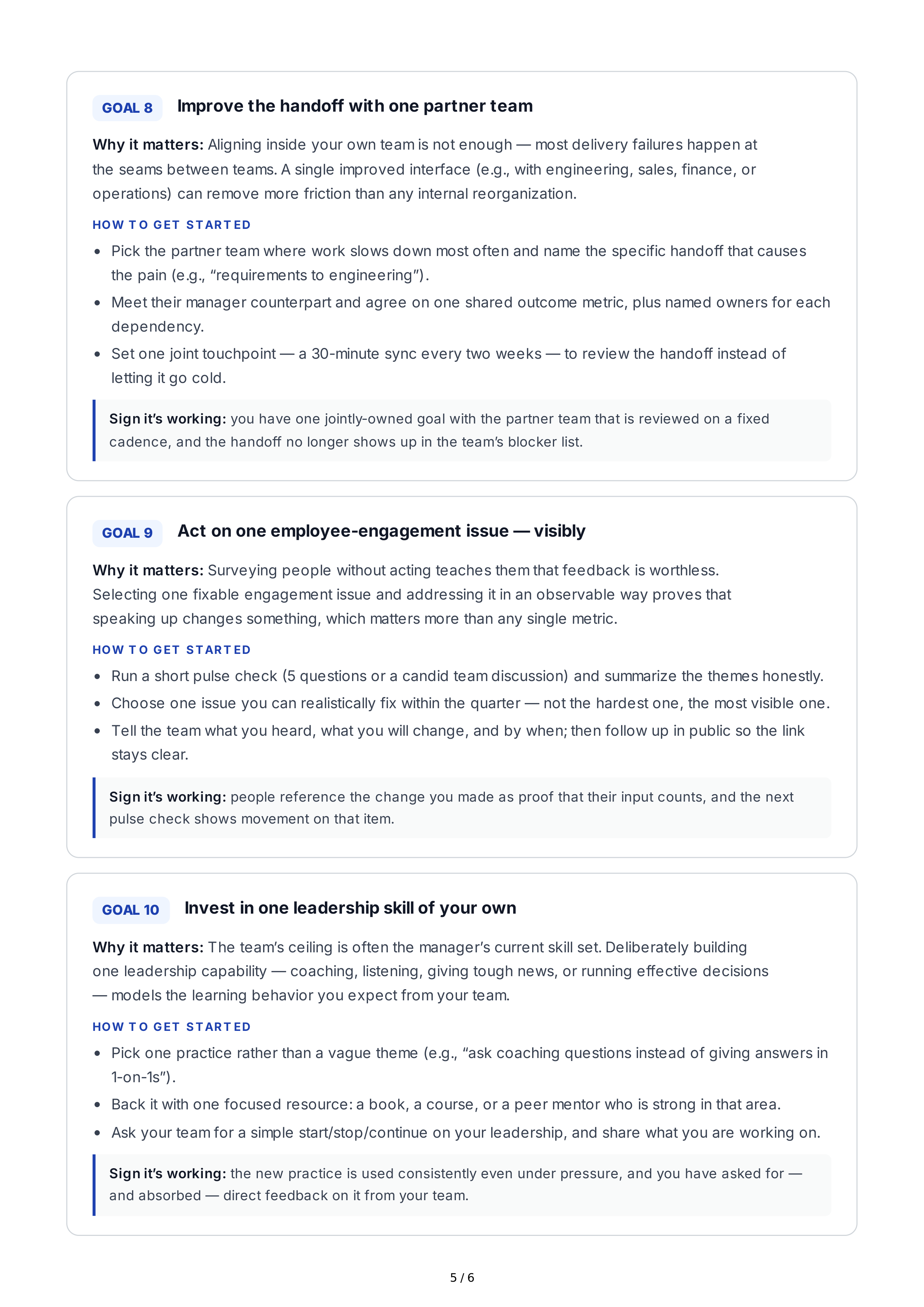
GOAL
8
Improve
the
handoff
with
one
partner
team
Why
it
matters
:
Aligning
inside
your
own
team
is
not
enough
—
most
delivery
failures
happen
at
the
seams
between
teams
.
A
single
improved
interface
(
e
.
g
.,
with
engineering
,
sales
,
finance
,
or
operations
)
can
remove
more
friction
than
any
internal
reorganization
.
HOW
T O
GET
S TAR T ED
Pick
the
partner
team
where
work
slows
down
most
often
and
name
the
specific
handoff
that
causes
the
pain
(
e
.
g
., “
requirements
to
engineering
”).
Meet
their
manager
counterpart
and
agree
on
one
shared
outcome
metric
,
plus
named
owners
for
each
dependency
.
Set
one
joint
touchpoint
—
a
30-
minute
sync
every
two
weeks
—
to
review
the
handoff
instead
of
letting
it
go
cold
.
Sign
it
’
s
working
:
you
have
one
jointly
-
owned
goal
with
the
partner
team
that
is
reviewed
on
a
fixed
cadence
,
and
the
handoff
no
longer
shows
up
in
the
team
’
s
blocker
list
.
GOAL
9
Act
on
one
employee
-
engagement
issue
—
visibly
Why
it
matters
:
Surveying
people
without
acting
teaches
them
that
feedback
is
worthless
.
Selecting
one
fixable
engagement
issue
and
addressing
it
in
an
observable
way
proves
that
speaking
up
changes
something
,
which
matters
more
than
any
single
metric
.
HOW
T O
GET
S TAR T ED
Run
a
short
pulse
check
(5
questions
or
a
candid
team
discussion
)
and
summarize
the
themes
honestly
.
Choose
one
issue
you
can
realistically
fix
within
the
quarter
—
not
the
hardest
one
,
the
most
visible
one
.
Tell
the
team
what
you
heard
,
what
you
will
change
,
and
by
when
;
then
follow
up
in
public
so
the
link
stays
clear
.
Sign
it
’
s
working
:
people
reference
the
change
you
made
as
proof
that
their
input
counts
,
and
the
next
pulse
check
shows
movement
on
that
item
.
GOAL
10
Invest
in
one
leadership
skill
of
your
own
Why
it
matters
:
The
team
’
s
ceiling
is
often
the
manager
’
s
current
skill
set
.
Deliberately
building
one
leadership
capability
—
coaching
,
listening
,
giving
tough
news
,
or
running
effective
decisions
—
models
the
learning
behavior
you
expect
from
your
team
.
HOW
T O
GET
S TAR T ED
Pick
one
practice
rather
than
a
vague
theme
(
e
.
g
., “
ask
coaching
questions
instead
of
giving
answers
in
1-
on
-1
s
”).
Back
it
with
one
focused
resource
:
a
book
,
a
course
,
or
a
peer
mentor
who
is
strong
in
that
area
.
Ask
your
team
for
a
simple
start
/
stop
/
continue
on
your
leadership
,
and
share
what
you
are
working
on
.
Sign
it
’
s
working
:
the
new
practice
is
used
consistently
even
under
pressure
,
and
you
have
asked
for
—
and
absorbed
—
direct
feedback
on
it
from
your
team
.
5 / 6
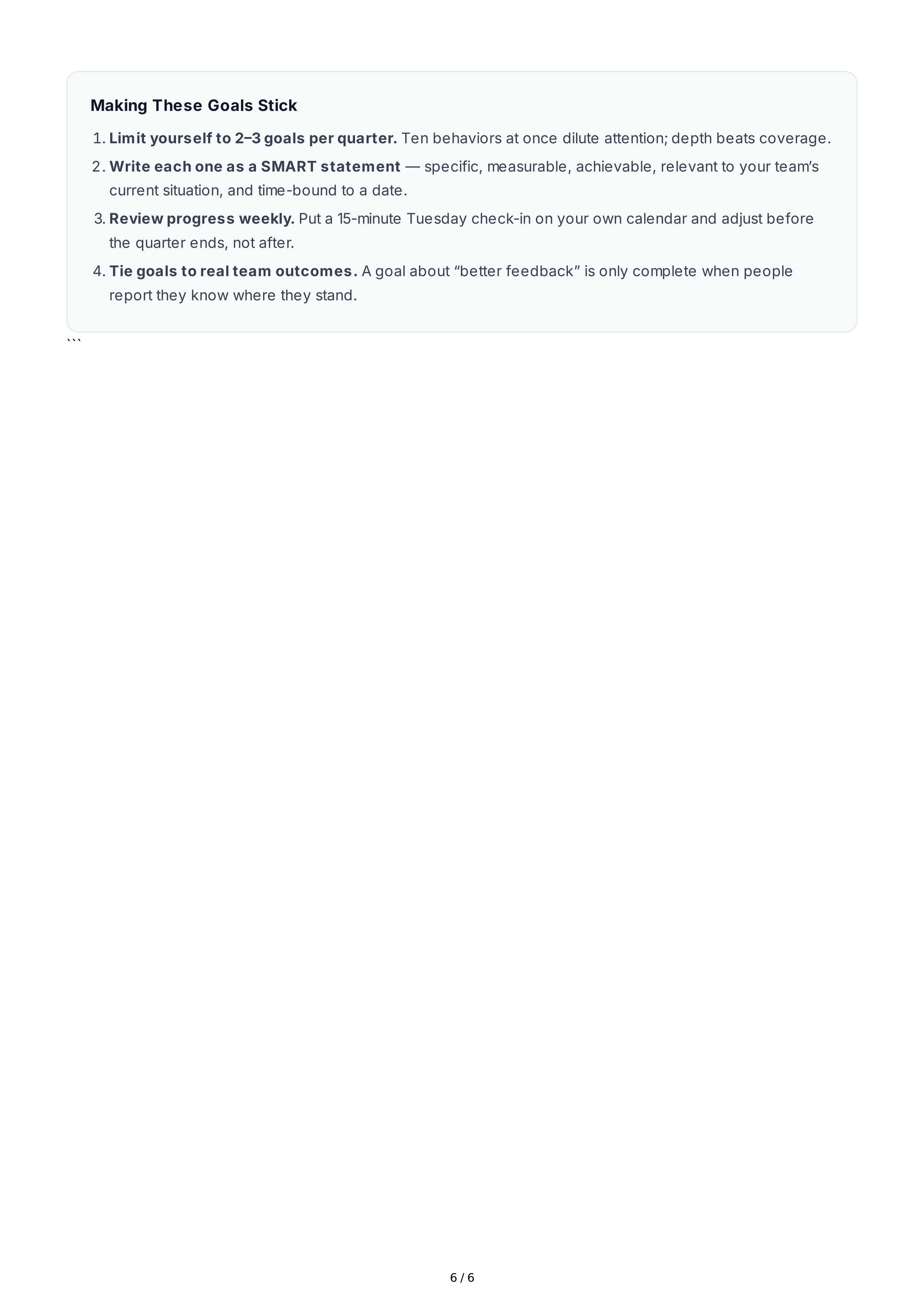
Making
These
Goals
Stick
1.
Limit
yourself
to
2–3
goals
per
quarter
.
Ten
behaviors
at
once
dilute
attention
;
depth
beats
coverage
.
2.
Write
each
one
as
a
SMART
statement
—
specific
,
measurable
,
achievable
,
relevant
to
your
team
’
s
current
situation
,
and
time
-
bound
to
a
date
.
3.
Review
progress
weekly
.
Put
a
15-
minute
Tuesday
check
-
in
on
your
own
calendar
and
adjust
before
the
quarter
ends
,
not
after
.
4.
Tie
goals
to
real
team
outcomes
.
A
goal
about
“
better
feedback
”
is
only
complete
when
people
report
they
know
where
they
stand
.
```
6 / 6