ACQUIRENT
B2B Outsourced Sales &
Lead Generation Growth Plan
B2B Sales Development | Lead Generation | Appointment Setting | Sales Training | CRM | Pipeline Growth
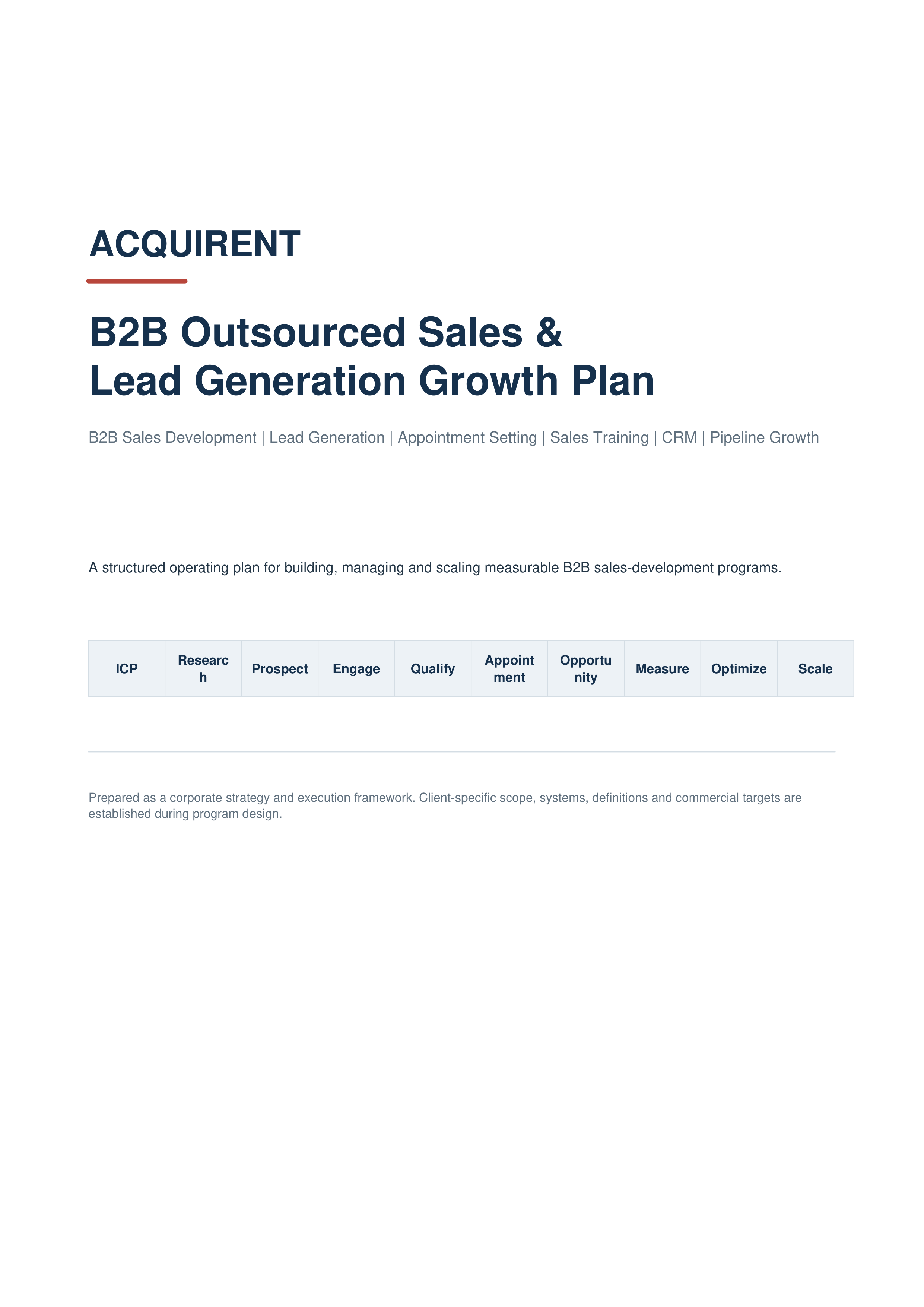
A structured operating plan for building, managing and scaling measurable B2B sales-development programs.
ICP
Researc
h
Prospect
Engage
Qualify
Appoint
ment
Opportu
nity
Measure
Optimize
Scale
Prepared as a corporate strategy and execution framework. Client-specific scope, systems, definitions and commercial targets are
established during program design.
ACQUIRENT | B2B OUTSOURCED SALES & LEAD GENERATION GROWTH PLAN
2
ACQUIRENT
01 | Sales Plan Overview
Operating premise: extend client sales capacity through a managed, measurable, repeatable sales-development program.
Acquirent’s outsourced model can supplement an existing sales organization or provide a structured outbound
capability where one is still developing. The program combines trained sales talent, defined prospecting workflows,
campaign management and CRM-based visibility to create a connected path from target-market definition to qualified
opportunity and client follow-up.
The work is designed around the client’s commercial context—not as a generic activity layer. The client and delivery
team align on the ideal customer profile (ICP), offer, buying roles, qualification criteria, territory or segment priorities,
and the receiving team’s opportunity process. The resulting program creates repeatable execution while preserving
client ownership of product strategy, commercial decisions and downstream sales conversion.
Program operating principles
• Build scalable B2B sales programs that can add capacity without requiring the client to build every role and process
internally.
• Generate qualified opportunities through researched outbound prospecting and relevant business conversations.
• Provide trained sales representatives and sales-management support within an agreed campaign model.
• Establish repeatable workflows, usable CRM records, stage definitions and reporting routines.
• Use activity and outcome evidence to identify campaign friction and guide optimization.
• Incorporate client feedback—especially on opportunity quality, messaging fit and follow-up outcomes—into execution.
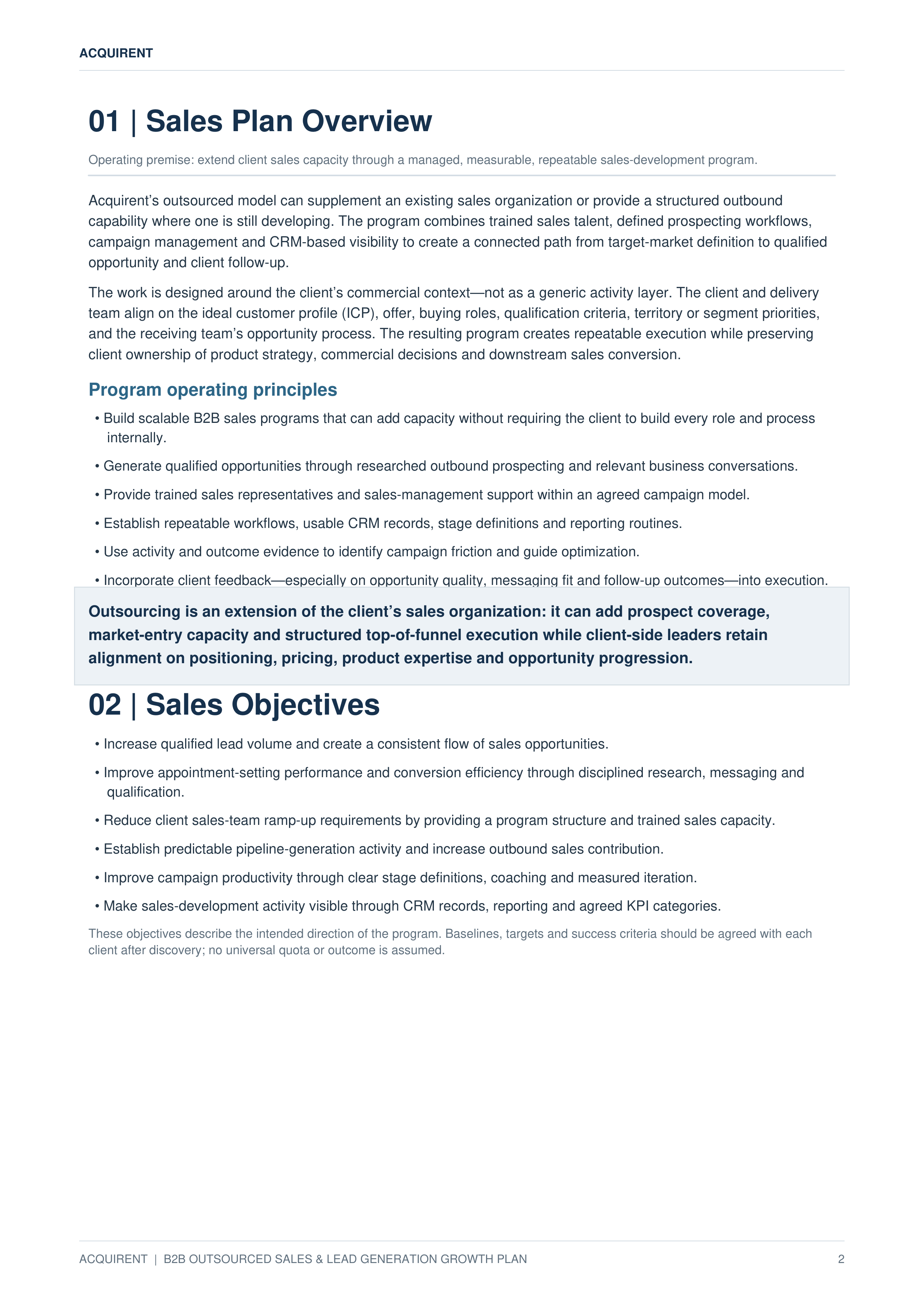
Outsourcing is an extension of the client’s sales organization: it can add prospect coverage,
market-entry capacity and structured top-of-funnel execution while client-side leaders retain
alignment on positioning, pricing, product expertise and opportunity progression.
02 | Sales Objectives
• Increase qualified lead volume and create a consistent flow of sales opportunities.
• Improve appointment-setting performance and conversion efficiency through disciplined research, messaging and
qualification.
• Reduce client sales-team ramp-up requirements by providing a program structure and trained sales capacity.
• Establish predictable pipeline-generation activity and increase outbound sales contribution.
• Improve campaign productivity through clear stage definitions, coaching and measured iteration.
• Make sales-development activity visible through CRM records, reporting and agreed KPI categories.
These objectives describe the intended direction of the program. Baselines, targets and success criteria should be agreed with each
client after discovery; no universal quota or outcome is assumed.
ACQUIRENT | B2B OUTSOURCED SALES & LEAD GENERATION GROWTH PLAN
3
ACQUIRENT
03 | Ideal Customer Profile
A practical ICP translates the client’s business model into an executable prospecting brief.
The strongest fit is generally a B2B organization with a defined offer and addressable market, a consultative or
multi-stakeholder buying process, and a business reason to add prospecting capacity. The program is especially
relevant where outbound motion is underdeveloped, expansion into new markets is planned, or leadership needs more
structured and measurable pipeline creation.
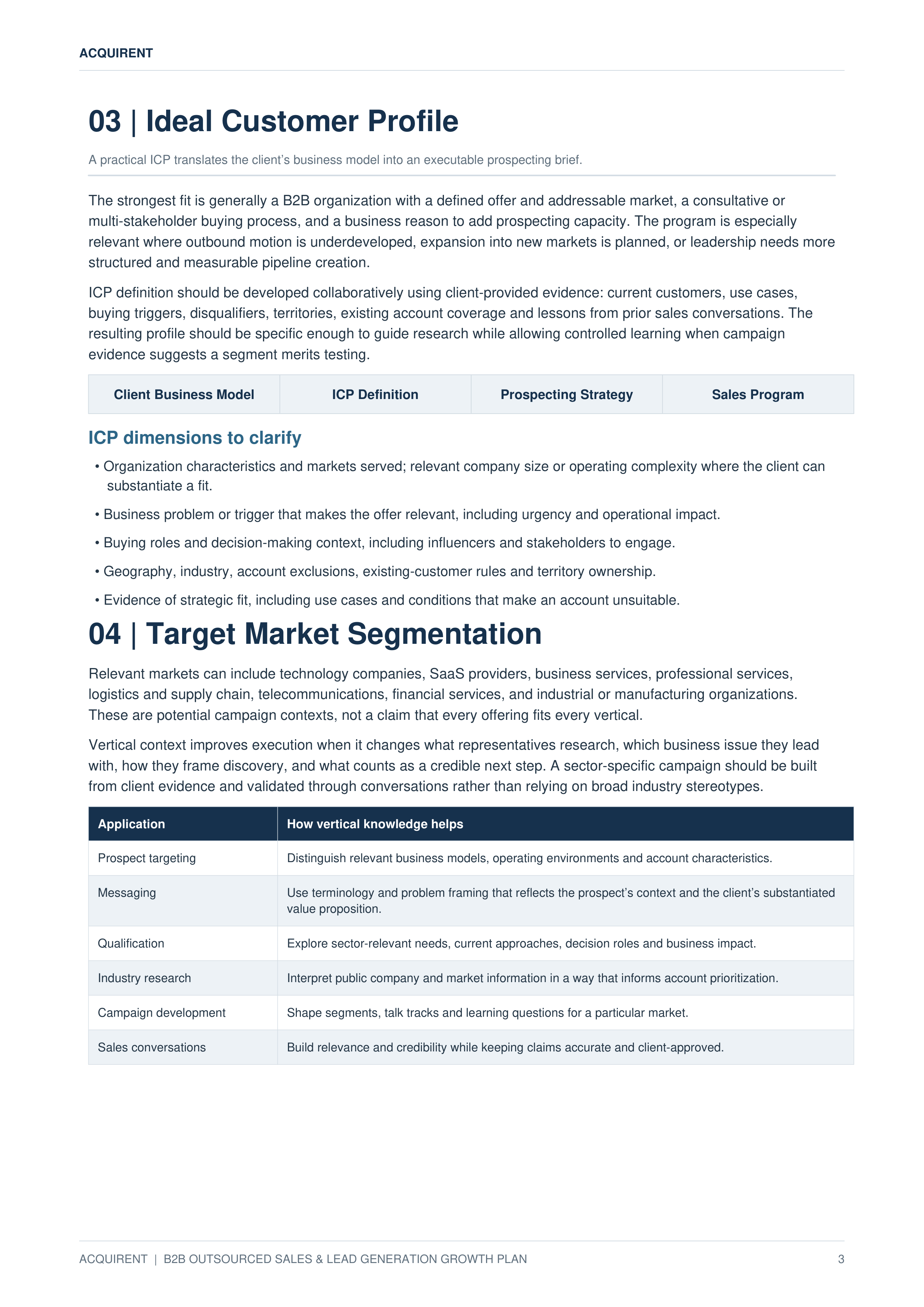
ICP definition should be developed collaboratively using client-provided evidence: current customers, use cases,
buying triggers, disqualifiers, territories, existing account coverage and lessons from prior sales conversations. The
resulting profile should be specific enough to guide research while allowing controlled learning when campaign
evidence suggests a segment merits testing.
Client Business Model
ICP Definition
Prospecting Strategy
Sales Program
ICP dimensions to clarify
• Organization characteristics and markets served; relevant company size or operating complexity where the client can
substantiate a fit.
• Business problem or trigger that makes the offer relevant, including urgency and operational impact.
• Buying roles and decision-making context, including influencers and stakeholders to engage.
• Geography, industry, account exclusions, existing-customer rules and territory ownership.
• Evidence of strategic fit, including use cases and conditions that make an account unsuitable.
04 | Target Market Segmentation
Relevant markets can include technology companies, SaaS providers, business services, professional services,
logistics and supply chain, telecommunications, financial services, and industrial or manufacturing organizations.
These are potential campaign contexts, not a claim that every offering fits every vertical.
Vertical context improves execution when it changes what representatives research, which business issue they lead
with, how they frame discovery, and what counts as a credible next step. A sector-specific campaign should be built
from client evidence and validated through conversations rather than relying on broad industry stereotypes.
Application
How vertical knowledge helps
Prospect targeting
Distinguish relevant business models, operating environments and account characteristics.
Messaging
Use terminology and problem framing that reflects the prospect’s context and the client’s substantiated
value proposition.
Qualification
Explore sector-relevant needs, current approaches, decision roles and business impact.
Industry research
Interpret public company and market information in a way that informs account prioritization.
Campaign development
Shape segments, talk tracks and learning questions for a particular market.
Sales conversations
Build relevance and credibility while keeping claims accurate and client-approved.
ACQUIRENT | B2B OUTSOURCED SALES & LEAD GENERATION GROWTH PLAN
4
ACQUIRENT
05 | Lead Generation Strategy
A disciplined lead-generation process connects research quality with the relevance and efficiency of outreach.
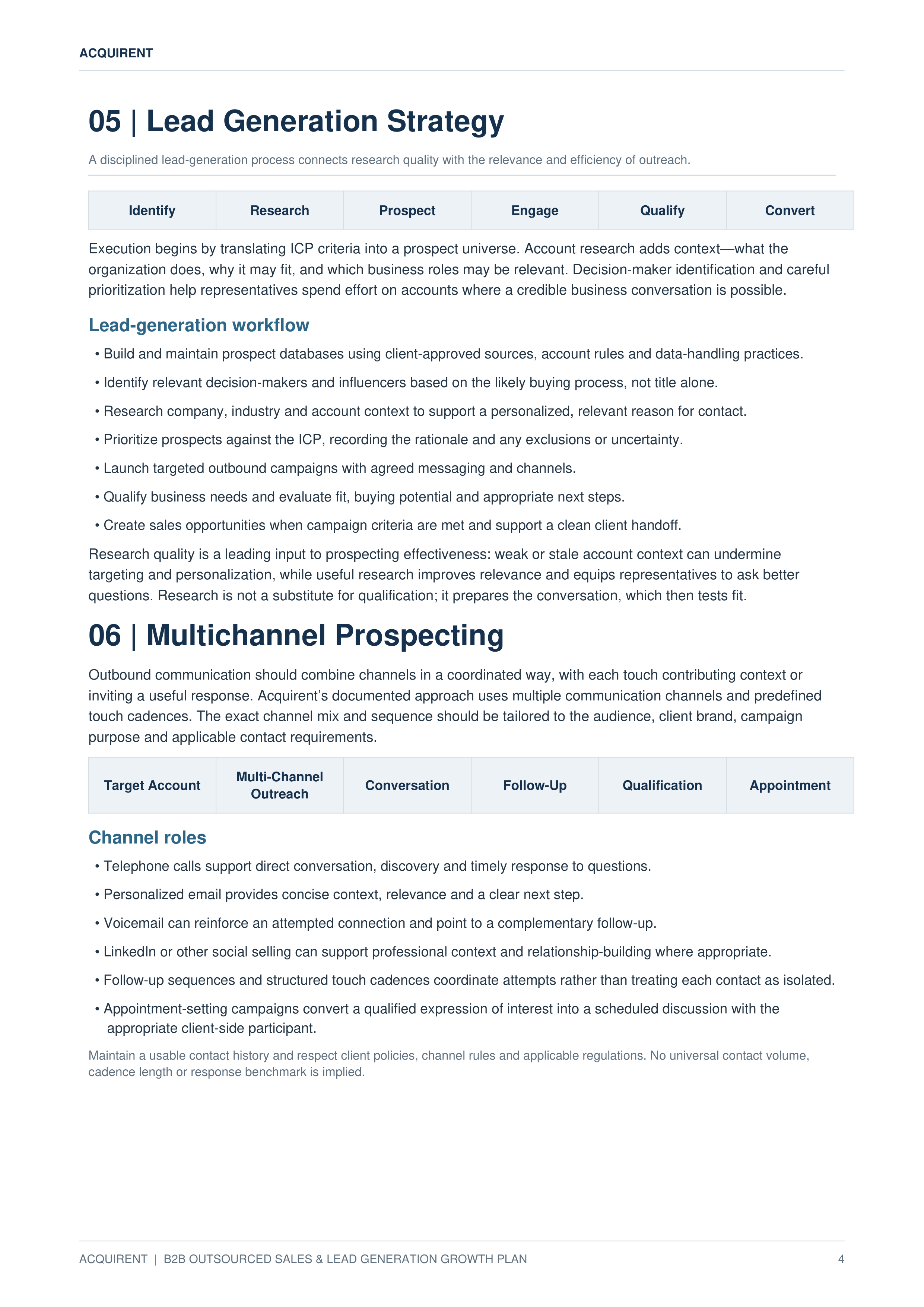
Identify
Research
Prospect
Engage
Qualify
Convert
Execution begins by translating ICP criteria into a prospect universe. Account research adds context—what the
organization does, why it may fit, and which business roles may be relevant. Decision-maker identification and careful
prioritization help representatives spend effort on accounts where a credible business conversation is possible.
Lead-generation workflow
• Build and maintain prospect databases using client-approved sources, account rules and data-handling practices.
• Identify relevant decision-makers and influencers based on the likely buying process, not title alone.
• Research company, industry and account context to support a personalized, relevant reason for contact.
• Prioritize prospects against the ICP, recording the rationale and any exclusions or uncertainty.
• Launch targeted outbound campaigns with agreed messaging and channels.
• Qualify business needs and evaluate fit, buying potential and appropriate next steps.
• Create sales opportunities when campaign criteria are met and support a clean client handoff.
Research quality is a leading input to prospecting effectiveness: weak or stale account context can undermine
targeting and personalization, while useful research improves relevance and equips representatives to ask better
questions. Research is not a substitute for qualification; it prepares the conversation, which then tests fit.
06 | Multichannel Prospecting
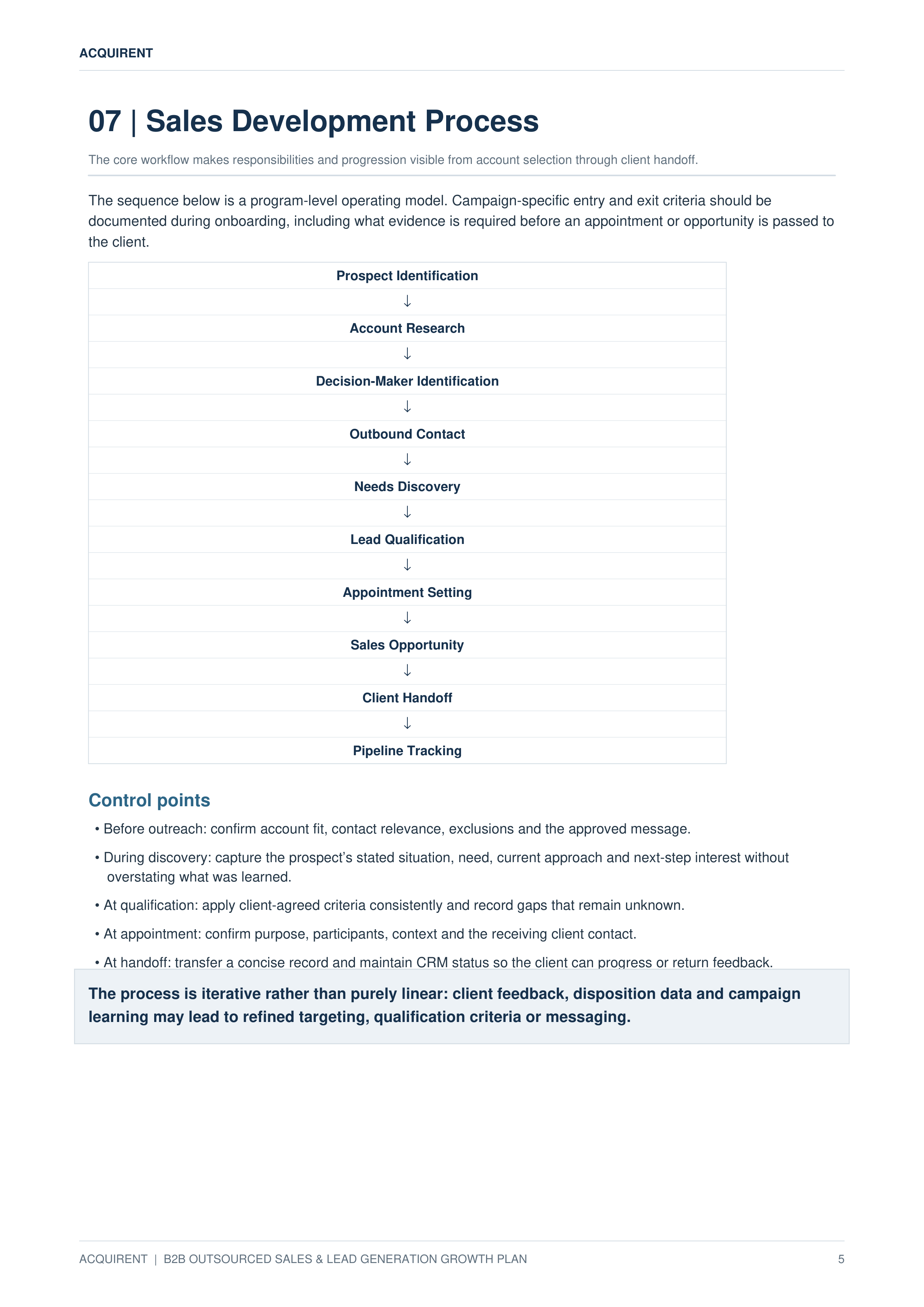
Outbound communication should combine channels in a coordinated way, with each touch contributing context or
inviting a useful response. Acquirent’s documented approach uses multiple communication channels and predefined
touch cadences. The exact channel mix and sequence should be tailored to the audience, client brand, campaign
purpose and applicable contact requirements.
Target Account
Multi-Channel
Outreach
Conversation
Follow-Up
Qualification
Appointment
Channel roles
• Telephone calls support direct conversation, discovery and timely response to questions.
• Personalized email provides concise context, relevance and a clear next step.
• Voicemail can reinforce an attempted connection and point to a complementary follow-up.
• LinkedIn or other social selling can support professional context and relationship-building where appropriate.
• Follow-up sequences and structured touch cadences coordinate attempts rather than treating each contact as isolated.
• Appointment-setting campaigns convert a qualified expression of interest into a scheduled discussion with the
appropriate client-side participant.
Maintain a usable contact history and respect client policies, channel rules and applicable regulations. No universal contact volume,
cadence length or response benchmark is implied.
ACQUIRENT | B2B OUTSOURCED SALES & LEAD GENERATION GROWTH PLAN
5
ACQUIRENT
07 | Sales Development Process
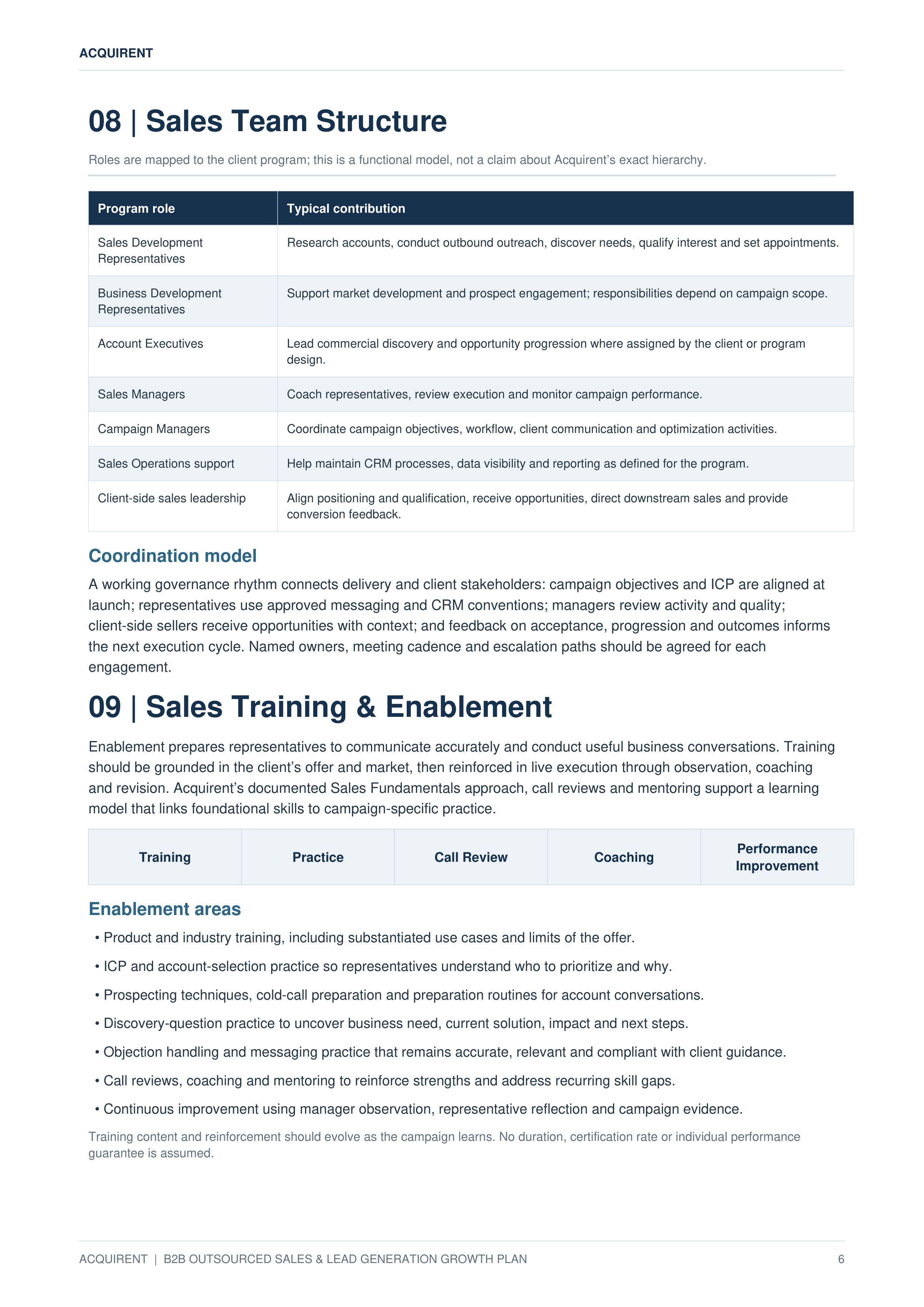
The core workflow makes responsibilities and progression visible from account selection through client handoff.
The sequence below is a program-level operating model. Campaign-specific entry and exit criteria should be
documented during onboarding, including what evidence is required before an appointment or opportunity is passed to
the client.
Prospect Identification
↓
Account Research
↓
Decision-Maker Identification
↓
Outbound Contact
↓
Needs Discovery
↓
Lead Qualification
↓
Appointment Setting
↓
Sales Opportunity
↓
Client Handoff
↓
Pipeline Tracking
Control points
• Before outreach: confirm account fit, contact relevance, exclusions and the approved message.
• During discovery: capture the prospect’s stated situation, need, current approach and next-step interest without
overstating what was learned.
• At qualification: apply client-agreed criteria consistently and record gaps that remain unknown.
• At appointment: confirm purpose, participants, context and the receiving client contact.
• At handoff: transfer a concise record and maintain CRM status so the client can progress or return feedback.
The process is iterative rather than purely linear: client feedback, disposition data and campaign
learning may lead to refined targeting, qualification criteria or messaging.
ACQUIRENT | B2B OUTSOURCED SALES & LEAD GENERATION GROWTH PLAN
6
ACQUIRENT
08 | Sales Team Structure
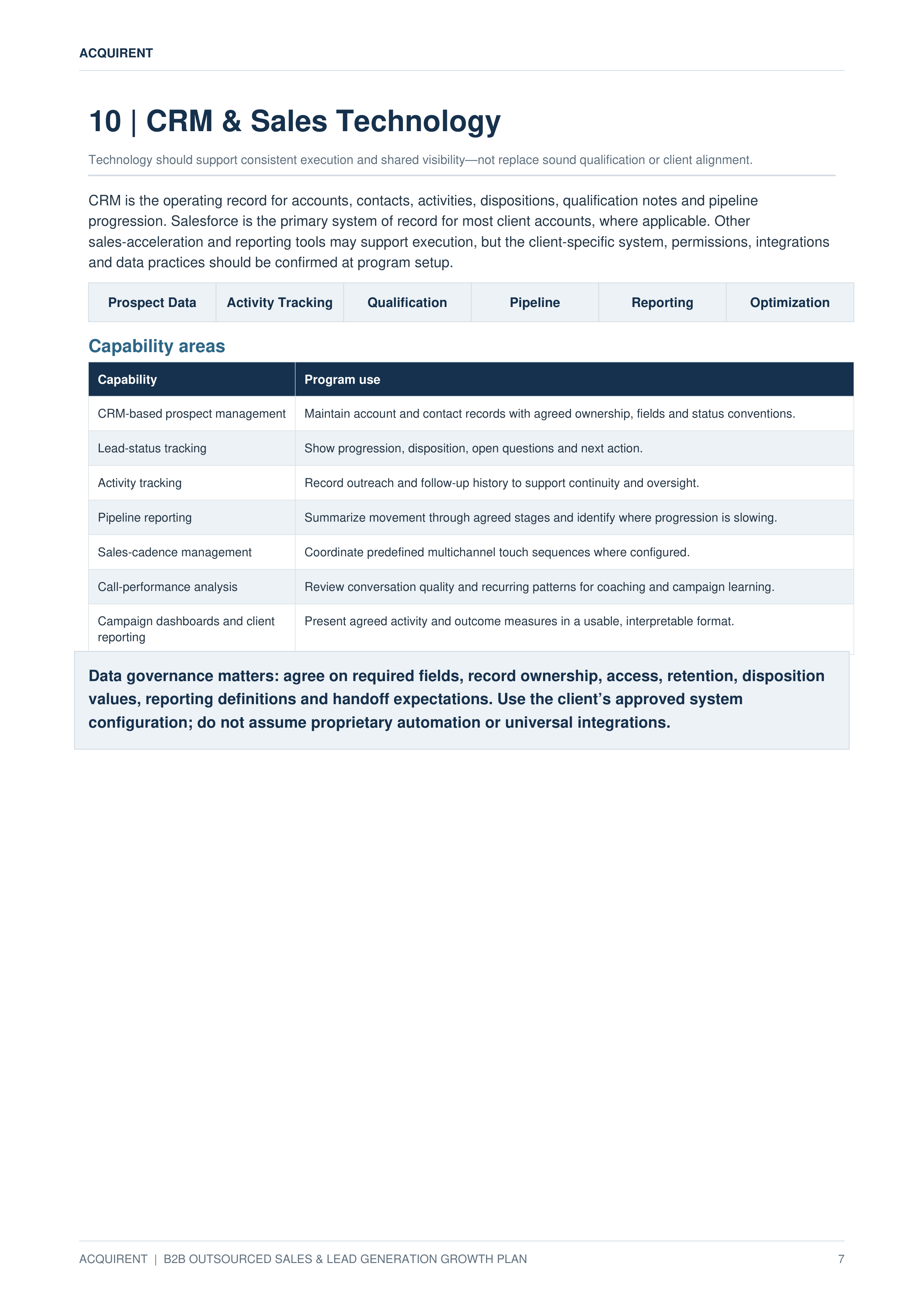
Roles are mapped to the client program; this is a functional model, not a claim about Acquirent’s exact hierarchy.
Program role
Typical contribution
Sales Development
Representatives
Research accounts, conduct outbound outreach, discover needs, qualify interest and set appointments.
Business Development
Representatives
Support market development and prospect engagement; responsibilities depend on campaign scope.
Account Executives
Lead commercial discovery and opportunity progression where assigned by the client or program
design.
Sales Managers
Coach representatives, review execution and monitor campaign performance.
Campaign Managers
Coordinate campaign objectives, workflow, client communication and optimization activities.
Sales Operations support
Help maintain CRM processes, data visibility and reporting as defined for the program.
Client-side sales leadership
Align positioning and qualification, receive opportunities, direct downstream sales and provide
conversion feedback.
Coordination model
A working governance rhythm connects delivery and client stakeholders: campaign objectives and ICP are aligned at
launch; representatives use approved messaging and CRM conventions; managers review activity and quality;
client-side sellers receive opportunities with context; and feedback on acceptance, progression and outcomes informs
the next execution cycle. Named owners, meeting cadence and escalation paths should be agreed for each
engagement.
09 | Sales Training & Enablement
Enablement prepares representatives to communicate accurately and conduct useful business conversations. Training
should be grounded in the client’s offer and market, then reinforced in live execution through observation, coaching
and revision. Acquirent’s documented Sales Fundamentals approach, call reviews and mentoring support a learning
model that links foundational skills to campaign-specific practice.
Training
Practice
Call Review
Coaching
Performance
Improvement
Enablement areas
• Product and industry training, including substantiated use cases and limits of the offer.
• ICP and account-selection practice so representatives understand who to prioritize and why.
• Prospecting techniques, cold-call preparation and preparation routines for account conversations.
• Discovery-question practice to uncover business need, current solution, impact and next steps.
• Objection handling and messaging practice that remains accurate, relevant and compliant with client guidance.
• Call reviews, coaching and mentoring to reinforce strengths and address recurring skill gaps.
• Continuous improvement using manager observation, representative reflection and campaign evidence.
Training content and reinforcement should evolve as the campaign learns. No duration, certification rate or individual performance
guarantee is assumed.
ACQUIRENT | B2B OUTSOURCED SALES & LEAD GENERATION GROWTH PLAN
7
ACQUIRENT
10 | CRM & Sales Technology
Technology should support consistent execution and shared visibility—not replace sound qualification or client alignment.
CRM is the operating record for accounts, contacts, activities, dispositions, qualification notes and pipeline
progression. Salesforce is the primary system of record for most client accounts, where applicable. Other
sales-acceleration and reporting tools may support execution, but the client-specific system, permissions, integrations
and data practices should be confirmed at program setup.
Prospect Data
Activity Tracking
Qualification
Pipeline
Reporting
Optimization
Capability areas
Capability
Program use
CRM-based prospect management
Maintain account and contact records with agreed ownership, fields and status conventions.
Lead-status tracking
Show progression, disposition, open questions and next action.
Activity tracking
Record outreach and follow-up history to support continuity and oversight.
Pipeline reporting
Summarize movement through agreed stages and identify where progression is slowing.
Sales-cadence management
Coordinate predefined multichannel touch sequences where configured.
Call-performance analysis
Review conversation quality and recurring patterns for coaching and campaign learning.
Campaign dashboards and client
reporting
Present agreed activity and outcome measures in a usable, interpretable format.
Data governance matters: agree on required fields, record ownership, access, retention, disposition
values, reporting definitions and handoff expectations. Use the client’s approved system
configuration; do not assume proprietary automation or universal integrations.
ACQUIRENT | B2B OUTSOURCED SALES & LEAD GENERATION GROWTH PLAN
8
ACQUIRENT
11 | Sales Qualification Framework
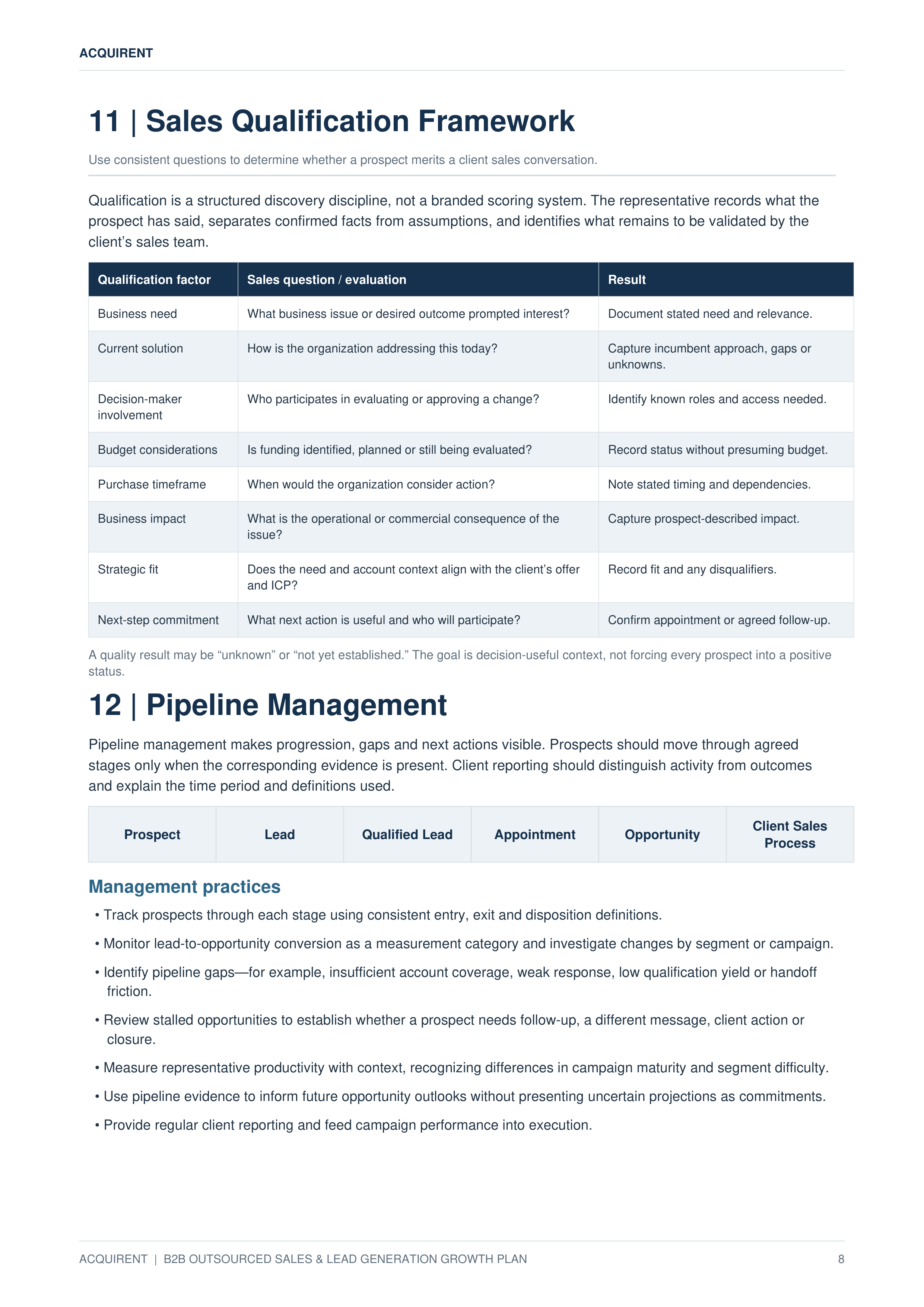
Use consistent questions to determine whether a prospect merits a client sales conversation.
Qualification is a structured discovery discipline, not a branded scoring system. The representative records what the
prospect has said, separates confirmed facts from assumptions, and identifies what remains to be validated by the
client’s sales team.
Qualification factor
Sales question / evaluation
Result
Business need
What business issue or desired outcome prompted interest?
Document stated need and relevance.
Current solution
How is the organization addressing this today?
Capture incumbent approach, gaps or
unknowns.
Decision-maker
involvement
Who participates in evaluating or approving a change?
Identify known roles and access needed.
Budget considerations
Is funding identified, planned or still being evaluated?
Record status without presuming budget.
Purchase timeframe
When would the organization consider action?
Note stated timing and dependencies.
Business impact
What is the operational or commercial consequence of the
issue?
Capture prospect-described impact.
Strategic fit
Does the need and account context align with the client’s offer
and ICP?
Record fit and any disqualifiers.
Next-step commitment
What next action is useful and who will participate?
Confirm appointment or agreed follow-up.
A quality result may be “unknown” or “not yet established.” The goal is decision-useful context, not forcing every prospect into a positive
status.
12 | Pipeline Management
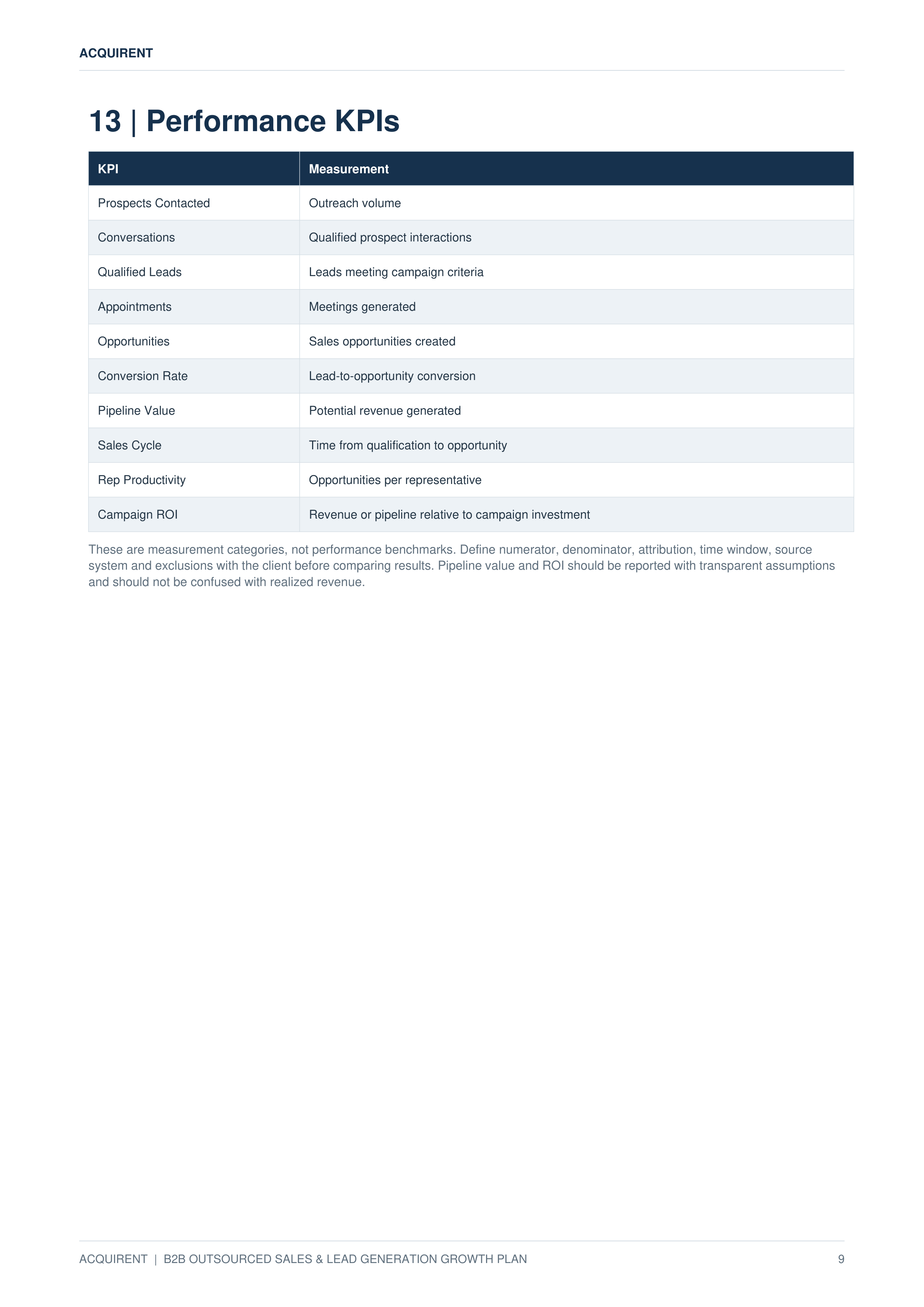
Pipeline management makes progression, gaps and next actions visible. Prospects should move through agreed
stages only when the corresponding evidence is present. Client reporting should distinguish activity from outcomes
and explain the time period and definitions used.
Prospect
Lead
Qualified Lead
Appointment
Opportunity
Client Sales
Process
Management practices
• Track prospects through each stage using consistent entry, exit and disposition definitions.
• Monitor lead-to-opportunity conversion as a measurement category and investigate changes by segment or campaign.
• Identify pipeline gaps—for example, insufficient account coverage, weak response, low qualification yield or handoff
friction.
• Review stalled opportunities to establish whether a prospect needs follow-up, a different message, client action or
closure.
• Measure representative productivity with context, recognizing differences in campaign maturity and segment difficulty.
• Use pipeline evidence to inform future opportunity outlooks without presenting uncertain projections as commitments.
• Provide regular client reporting and feed campaign performance into execution.
ACQUIRENT | B2B OUTSOURCED SALES & LEAD GENERATION GROWTH PLAN
9
ACQUIRENT
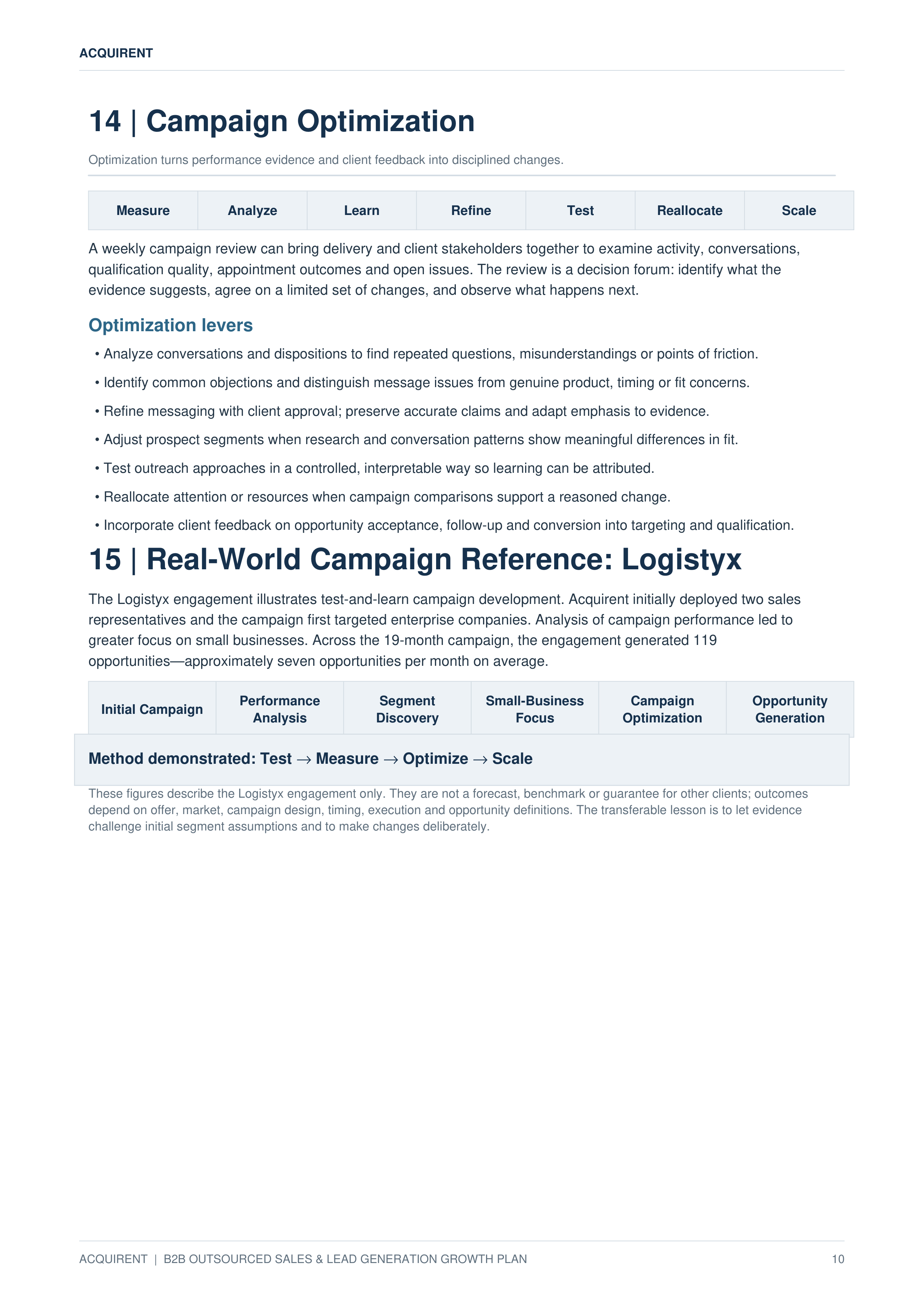
13 | Performance KPIs
KPI
Measurement
Prospects Contacted
Outreach volume
Conversations
Qualified prospect interactions
Qualified Leads
Leads meeting campaign criteria
Appointments
Meetings generated
Opportunities
Sales opportunities created
Conversion Rate
Lead-to-opportunity conversion
Pipeline Value
Potential revenue generated
Sales Cycle
Time from qualification to opportunity
Rep Productivity
Opportunities per representative
Campaign ROI
Revenue or pipeline relative to campaign investment
These are measurement categories, not performance benchmarks. Define numerator, denominator, attribution, time window, source
system and exclusions with the client before comparing results. Pipeline value and ROI should be reported with transparent assumptions
and should not be confused with realized revenue.
ACQUIRENT | B2B OUTSOURCED SALES & LEAD GENERATION GROWTH PLAN
10
ACQUIRENT
14 | Campaign Optimization
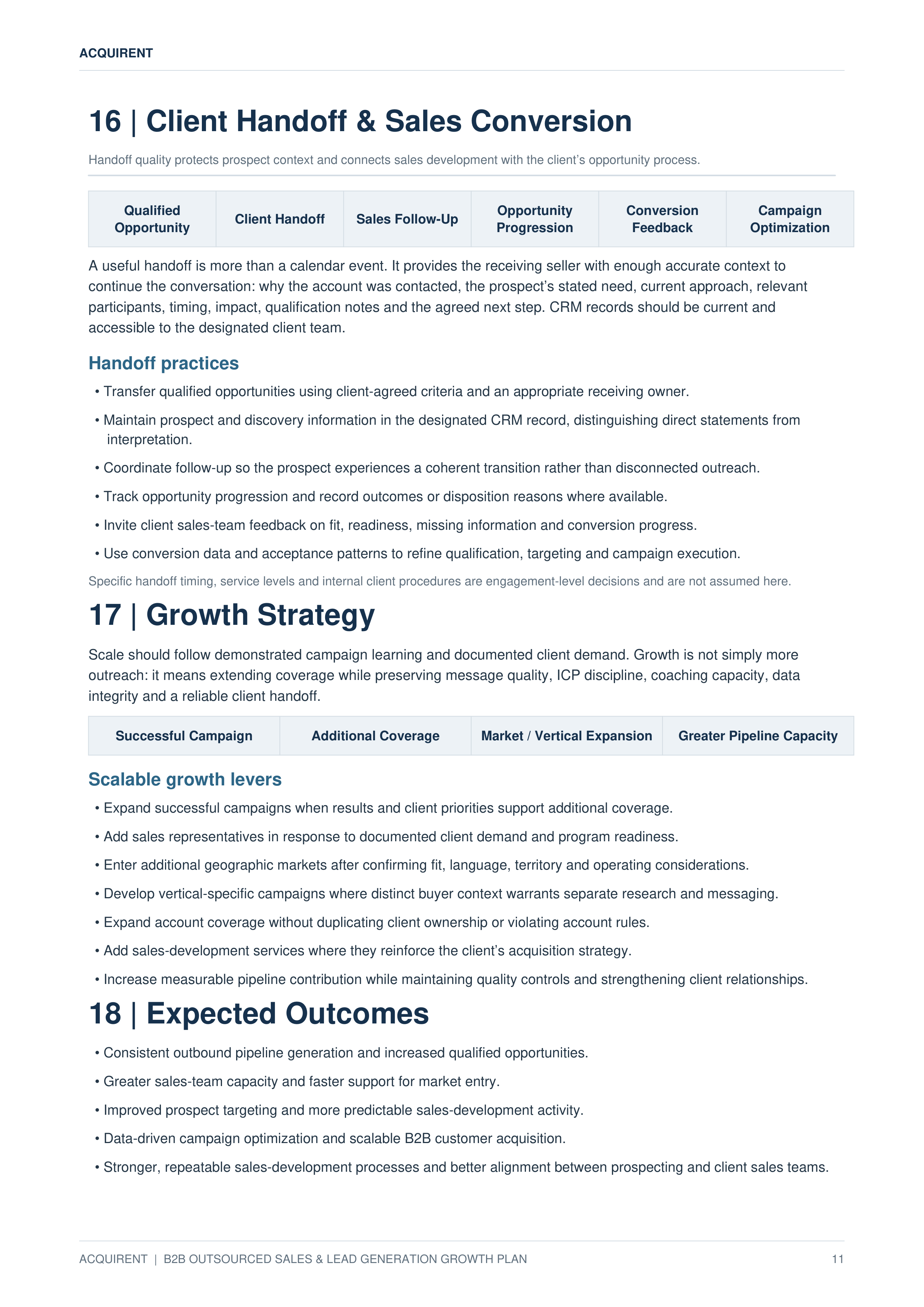
Optimization turns performance evidence and client feedback into disciplined changes.
Measure
Analyze
Learn
Refine
Test
Reallocate
Scale
A weekly campaign review can bring delivery and client stakeholders together to examine activity, conversations,
qualification quality, appointment outcomes and open issues. The review is a decision forum: identify what the
evidence suggests, agree on a limited set of changes, and observe what happens next.
Optimization levers
• Analyze conversations and dispositions to find repeated questions, misunderstandings or points of friction.
• Identify common objections and distinguish message issues from genuine product, timing or fit concerns.
• Refine messaging with client approval; preserve accurate claims and adapt emphasis to evidence.
• Adjust prospect segments when research and conversation patterns show meaningful differences in fit.
• Test outreach approaches in a controlled, interpretable way so learning can be attributed.
• Reallocate attention or resources when campaign comparisons support a reasoned change.
• Incorporate client feedback on opportunity acceptance, follow-up and conversion into targeting and qualification.
15 | Real-World Campaign Reference: Logistyx
The Logistyx engagement illustrates test-and-learn campaign development. Acquirent initially deployed two sales
representatives and the campaign first targeted enterprise companies. Analysis of campaign performance led to
greater focus on small businesses. Across the 19-month campaign, the engagement generated 119
opportunities—approximately seven opportunities per month on average.
Initial Campaign
Performance
Analysis
Segment
Discovery
Small-Business
Focus
Campaign
Optimization
Opportunity
Generation
Method demonstrated: Test
→
Measure
→
Optimize
→
Scale
These figures describe the Logistyx engagement only. They are not a forecast, benchmark or guarantee for other clients; outcomes
depend on offer, market, campaign design, timing, execution and opportunity definitions. The transferable lesson is to let evidence
challenge initial segment assumptions and to make changes deliberately.
ACQUIRENT | B2B OUTSOURCED SALES & LEAD GENERATION GROWTH PLAN
11
ACQUIRENT
16 | Client Handoff & Sales Conversion
Handoff quality protects prospect context and connects sales development with the client’s opportunity process.
Qualified
Opportunity
Client Handoff
Sales Follow-Up
Opportunity
Progression
Conversion
Feedback
Campaign
Optimization
A useful handoff is more than a calendar event. It provides the receiving seller with enough accurate context to
continue the conversation: why the account was contacted, the prospect’s stated need, current approach, relevant
participants, timing, impact, qualification notes and the agreed next step. CRM records should be current and
accessible to the designated client team.
Handoff practices
• Transfer qualified opportunities using client-agreed criteria and an appropriate receiving owner.
• Maintain prospect and discovery information in the designated CRM record, distinguishing direct statements from
interpretation.
• Coordinate follow-up so the prospect experiences a coherent transition rather than disconnected outreach.
• Track opportunity progression and record outcomes or disposition reasons where available.
• Invite client sales-team feedback on fit, readiness, missing information and conversion progress.
• Use conversion data and acceptance patterns to refine qualification, targeting and campaign execution.
Specific handoff timing, service levels and internal client procedures are engagement-level decisions and are not assumed here.
17 | Growth Strategy
Scale should follow demonstrated campaign learning and documented client demand. Growth is not simply more
outreach: it means extending coverage while preserving message quality, ICP discipline, coaching capacity, data
integrity and a reliable client handoff.
Successful Campaign
Additional Coverage
Market / Vertical Expansion
Greater Pipeline Capacity
Scalable growth levers
• Expand successful campaigns when results and client priorities support additional coverage.
• Add sales representatives in response to documented client demand and program readiness.
• Enter additional geographic markets after confirming fit, language, territory and operating considerations.
• Develop vertical-specific campaigns where distinct buyer context warrants separate research and messaging.
• Expand account coverage without duplicating client ownership or violating account rules.
• Add sales-development services where they reinforce the client’s acquisition strategy.
• Increase measurable pipeline contribution while maintaining quality controls and strengthening client relationships.
18 | Expected Outcomes
• Consistent outbound pipeline generation and increased qualified opportunities.
• Greater sales-team capacity and faster support for market entry.
• Improved prospect targeting and more predictable sales-development activity.
• Data-driven campaign optimization and scalable B2B customer acquisition.
• Stronger, repeatable sales-development processes and better alignment between prospecting and client sales teams.

ACQUIRENT | B2B OUTSOURCED SALES & LEAD GENERATION GROWTH PLAN
12
ACQUIRENT
These are strategic outcomes the operating model is intended to support—not guaranteed results. Realized impact should be evaluated
against client-defined baselines and business conditions.
ACQUIRENT | B2B OUTSOURCED SALES & LEAD GENERATION GROWTH PLAN
13
ACQUIRENT
19 | B2B Sales Growth Execution Framework
A single operating logic connects market definition to scalable customer growth.
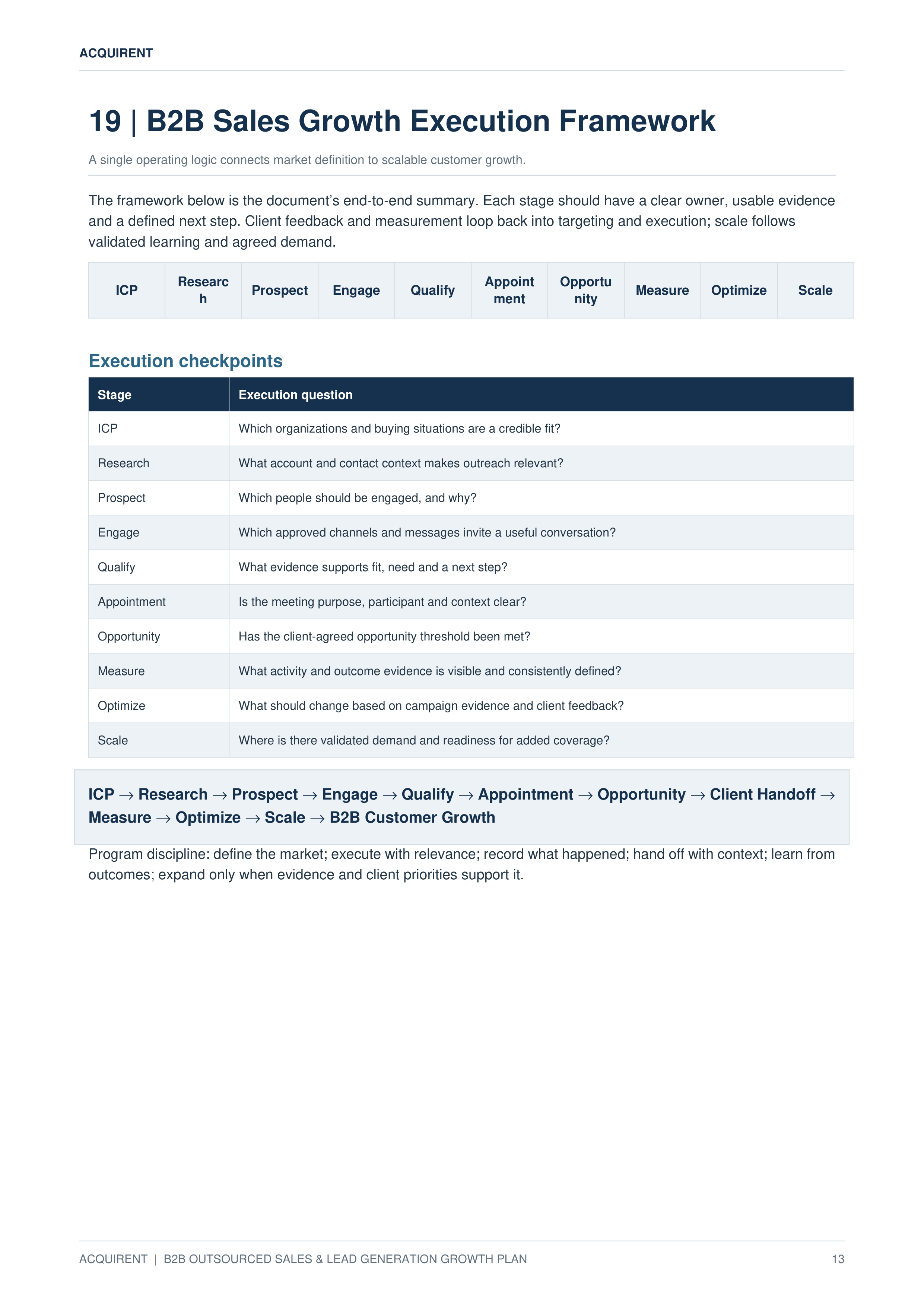
The framework below is the document’s end-to-end summary. Each stage should have a clear owner, usable evidence
and a defined next step. Client feedback and measurement loop back into targeting and execution; scale follows
validated learning and agreed demand.
ICP
Researc
h
Prospect
Engage
Qualify
Appoint
ment
Opportu
nity
Measure
Optimize
Scale
Execution checkpoints
Stage
Execution question
ICP
Which organizations and buying situations are a credible fit?
Research
What account and contact context makes outreach relevant?
Prospect
Which people should be engaged, and why?
Engage
Which approved channels and messages invite a useful conversation?
Qualify
What evidence supports fit, need and a next step?
Appointment
Is the meeting purpose, participant and context clear?
Opportunity
Has the client-agreed opportunity threshold been met?
Measure
What activity and outcome evidence is visible and consistently defined?
Optimize
What should change based on campaign evidence and client feedback?
Scale
Where is there validated demand and readiness for added coverage?
ICP
→
Research
→
Prospect
→
Engage
→
Qualify
→
Appointment
→
Opportunity
→
Client Handoff
→
Measure
→
Optimize
→
Scale
→
B2B Customer Growth
Program discipline: define the market; execute with relevance; record what happened; hand off with context; learn from
outcomes; expand only when evidence and client priorities support it.