
THE BOEING COMPANY
Boeing Stability First
Quality-Linked Turnaround
Sales Plan
Sales Plan
Commercial performance baseline: FY2024
THE BOEING COMPANY | SALES PLAN
Commercial performance baseline: FY2024
2
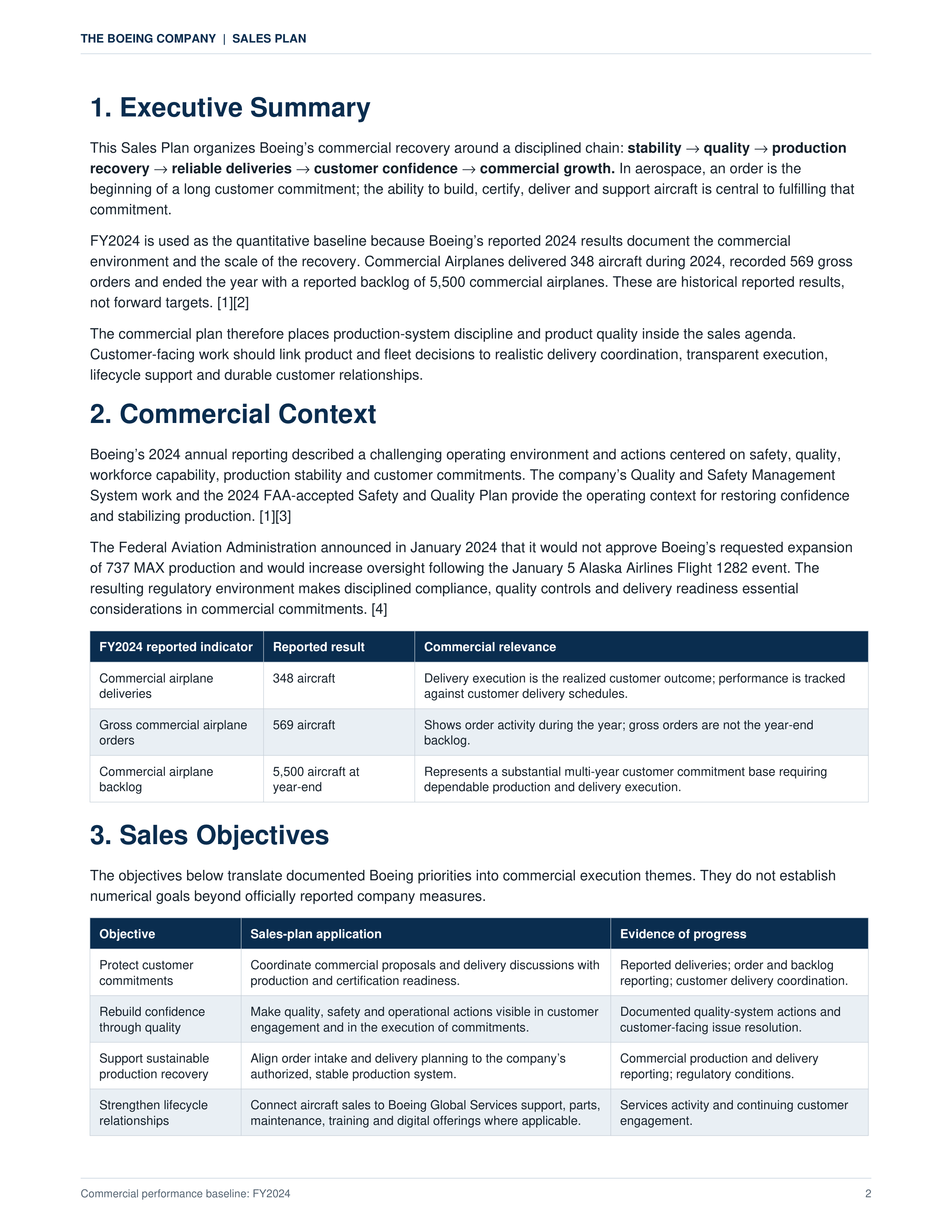
1. Executive Summary
This Sales Plan organizes Boeing’s commercial recovery around a disciplined chain:
stability
→
quality
→
production
recovery
→
reliable deliveries
→
customer confidence
→
commercial growth.
In aerospace, an order is the
beginning of a long customer commitment; the ability to build, certify, deliver and support aircraft is central to fulfilling that
commitment.
FY2024 is used as the quantitative baseline because Boeing’s reported 2024 results document the commercial
environment and the scale of the recovery. Commercial Airplanes delivered 348 aircraft during 2024, recorded 569 gross
orders and ended the year with a reported backlog of 5,500 commercial airplanes. These are historical reported results,
not forward targets. [1][2]
The commercial plan therefore places production-system discipline and product quality inside the sales agenda.
Customer-facing work should link product and fleet decisions to realistic delivery coordination, transparent execution,
lifecycle support and durable customer relationships.
2. Commercial Context
Boeing’s 2024 annual reporting described a challenging operating environment and actions centered on safety, quality,
workforce capability, production stability and customer commitments. The company’s Quality and Safety Management
System work and the 2024 FAA-accepted Safety and Quality Plan provide the operating context for restoring confidence
and stabilizing production. [1][3]
The Federal Aviation Administration announced in January 2024 that it would not approve Boeing’s requested expansion
of 737 MAX production and would increase oversight following the January 5 Alaska Airlines Flight 1282 event. The
resulting regulatory environment makes disciplined compliance, quality controls and delivery readiness essential
considerations in commercial commitments. [4]
FY2024 reported indicator
Reported result
Commercial relevance
Commercial airplane
deliveries
348 aircraft
Delivery execution is the realized customer outcome; performance is tracked
against customer delivery schedules.
Gross commercial airplane
orders
569 aircraft
Shows order activity during the year; gross orders are not the year-end
backlog.
Commercial airplane
backlog
5,500 aircraft at
year-end
Represents a substantial multi-year customer commitment base requiring
dependable production and delivery execution.
3. Sales Objectives
The objectives below translate documented Boeing priorities into commercial execution themes. They do not establish
numerical goals beyond officially reported company measures.
Objective
Sales-plan application
Evidence of progress
Protect customer
commitments
Coordinate commercial proposals and delivery discussions with
production and certification readiness.
Reported deliveries; order and backlog
reporting; customer delivery coordination.
Rebuild confidence
through quality
Make quality, safety and operational actions visible in customer
engagement and in the execution of commitments.
Documented quality-system actions and
customer-facing issue resolution.
Support sustainable
production recovery
Align order intake and delivery planning to the company’s
authorized, stable production system.
Commercial production and delivery
reporting; regulatory conditions.
Strengthen lifecycle
relationships
Connect aircraft sales to Boeing Global Services support, parts,
maintenance, training and digital offerings where applicable.
Services activity and continuing customer
engagement.
THE BOEING COMPANY | SALES PLAN
Commercial performance baseline: FY2024
3
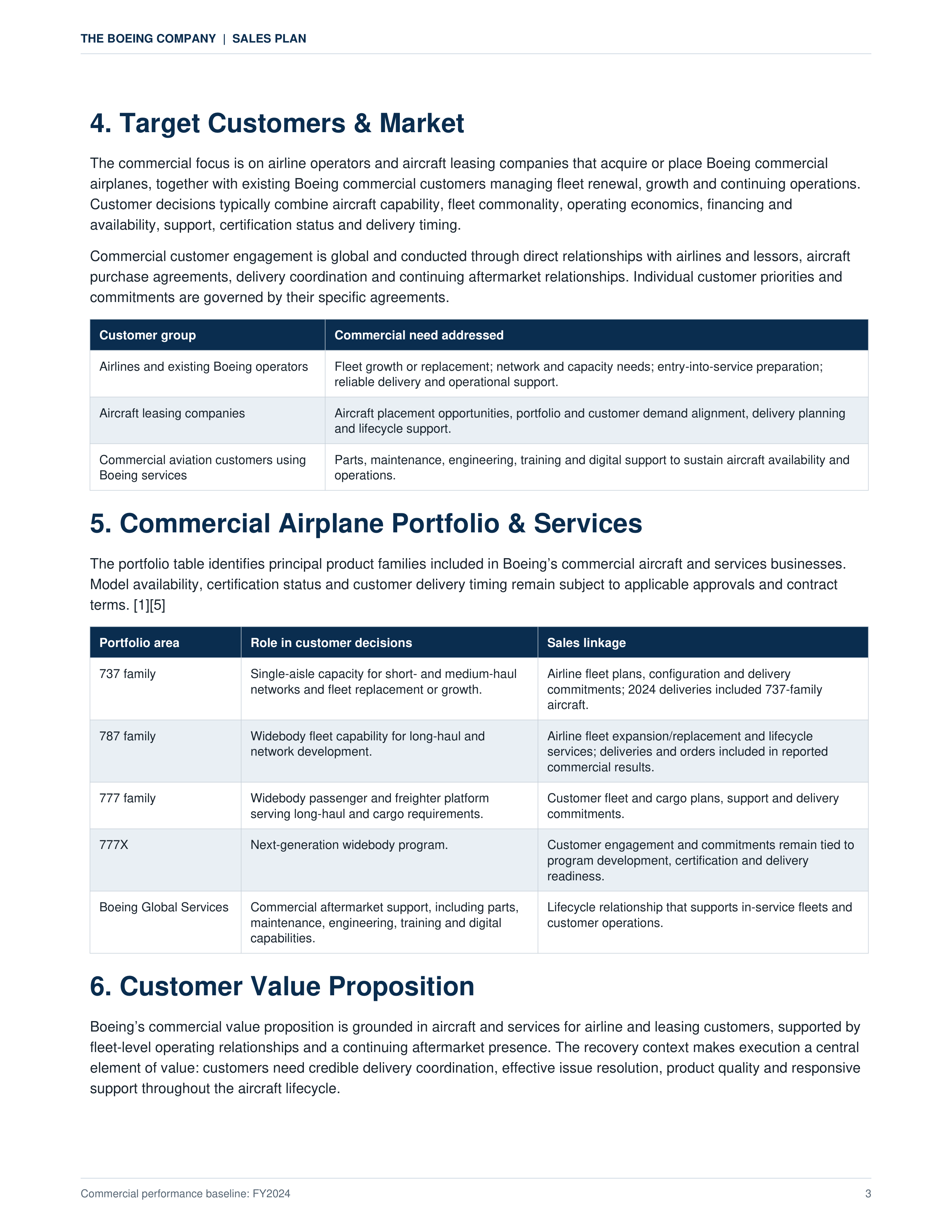
4. Target Customers & Market
The commercial focus is on airline operators and aircraft leasing companies that acquire or place Boeing commercial
airplanes, together with existing Boeing commercial customers managing fleet renewal, growth and continuing operations.
Customer decisions typically combine aircraft capability, fleet commonality, operating economics, financing and
availability, support, certification status and delivery timing.
Commercial customer engagement is global and conducted through direct relationships with airlines and lessors, aircraft
purchase agreements, delivery coordination and continuing aftermarket relationships. Individual customer priorities and
commitments are governed by their specific agreements.
Customer group
Commercial need addressed
Airlines and existing Boeing operators
Fleet growth or replacement; network and capacity needs; entry-into-service preparation;
reliable delivery and operational support.
Aircraft leasing companies
Aircraft placement opportunities, portfolio and customer demand alignment, delivery planning
and lifecycle support.
Commercial aviation customers using
Boeing services
Parts, maintenance, engineering, training and digital support to sustain aircraft availability and
operations.
5. Commercial Airplane Portfolio & Services
The portfolio table identifies principal product families included in Boeing’s commercial aircraft and services businesses.
Model availability, certification status and customer delivery timing remain subject to applicable approvals and contract
terms. [1][5]
Portfolio area
Role in customer decisions
Sales linkage
737 family
Single-aisle capacity for short- and medium-haul
networks and fleet replacement or growth.
Airline fleet plans, configuration and delivery
commitments; 2024 deliveries included 737-family
aircraft.
787 family
Widebody fleet capability for long-haul and
network development.
Airline fleet expansion/replacement and lifecycle
services; deliveries and orders included in reported
commercial results.
777 family
Widebody passenger and freighter platform
serving long-haul and cargo requirements.
Customer fleet and cargo plans, support and delivery
commitments.
777X
Next-generation widebody program.
Customer engagement and commitments remain tied to
program development, certification and delivery
readiness.
Boeing Global Services
Commercial aftermarket support, including parts,
maintenance, engineering, training and digital
capabilities.
Lifecycle relationship that supports in-service fleets and
customer operations.
6. Customer Value Proposition
Boeing’s commercial value proposition is grounded in aircraft and services for airline and leasing customers, supported by
fleet-level operating relationships and a continuing aftermarket presence. The recovery context makes execution a central
element of value: customers need credible delivery coordination, effective issue resolution, product quality and responsive
support throughout the aircraft lifecycle.
THE BOEING COMPANY | SALES PLAN
Commercial performance baseline: FY2024
4
Customer-facing proposals should distinguish confirmed contractual commitments from planning assumptions; align
delivery discussions with production and regulatory readiness; and connect new-aircraft decisions to available training,
parts, maintenance, engineering and digital support.
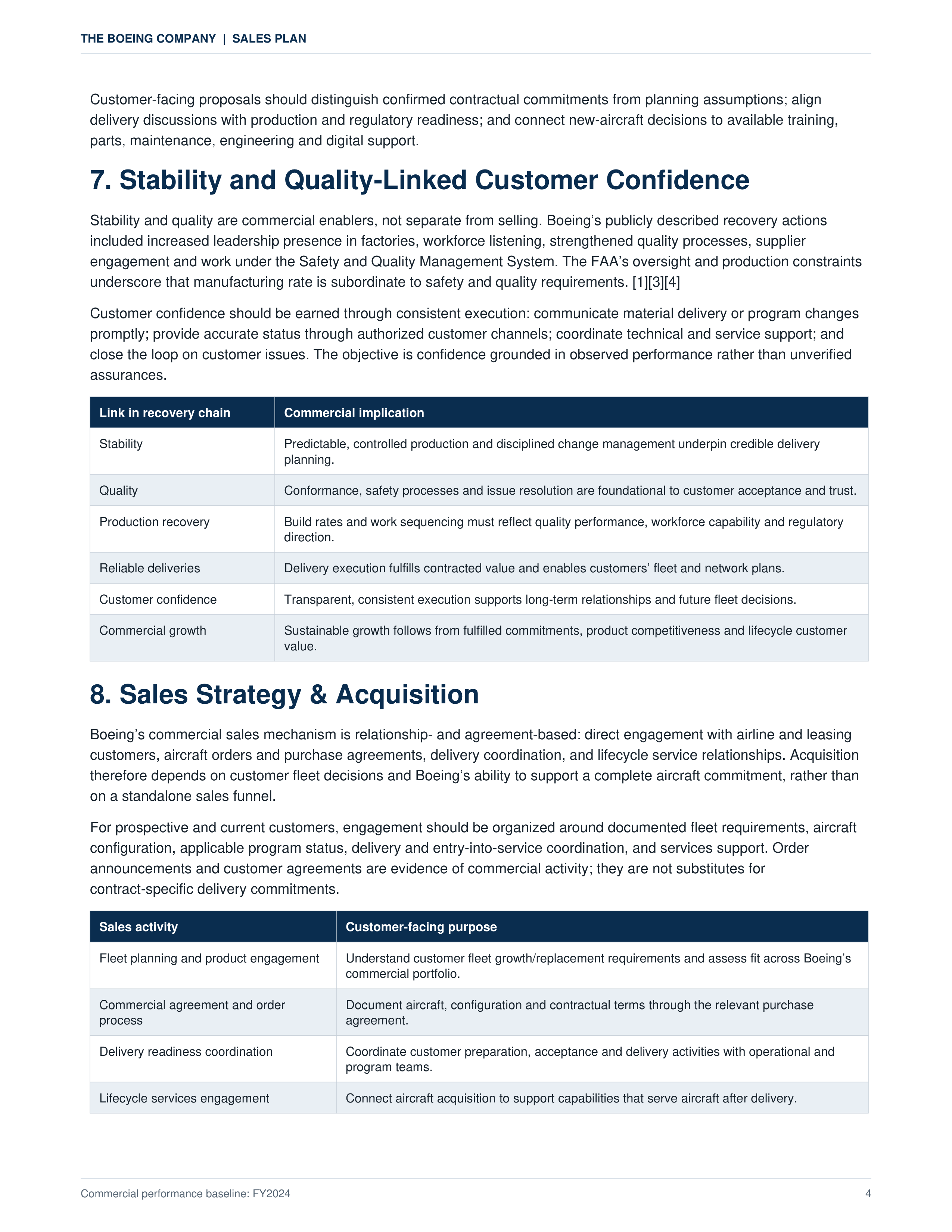
7. Stability and Quality-Linked Customer Confidence
Stability and quality are commercial enablers, not separate from selling. Boeing’s publicly described recovery actions
included increased leadership presence in factories, workforce listening, strengthened quality processes, supplier
engagement and work under the Safety and Quality Management System. The FAA’s oversight and production constraints
underscore that manufacturing rate is subordinate to safety and quality requirements. [1][3][4]
Customer confidence should be earned through consistent execution: communicate material delivery or program changes
promptly; provide accurate status through authorized customer channels; coordinate technical and service support; and
close the loop on customer issues. The objective is confidence grounded in observed performance rather than unverified
assurances.
Link in recovery chain
Commercial implication
Stability
Predictable, controlled production and disciplined change management underpin credible delivery
planning.
Quality
Conformance, safety processes and issue resolution are foundational to customer acceptance and trust.
Production recovery
Build rates and work sequencing must reflect quality performance, workforce capability and regulatory
direction.
Reliable deliveries
Delivery execution fulfills contracted value and enables customers’ fleet and network plans.
Customer confidence
Transparent, consistent execution supports long-term relationships and future fleet decisions.
Commercial growth
Sustainable growth follows from fulfilled commitments, product competitiveness and lifecycle customer
value.
8. Sales Strategy & Acquisition
Boeing’s commercial sales mechanism is relationship- and agreement-based: direct engagement with airline and leasing
customers, aircraft orders and purchase agreements, delivery coordination, and lifecycle service relationships. Acquisition
therefore depends on customer fleet decisions and Boeing’s ability to support a complete aircraft commitment, rather than
on a standalone sales funnel.
For prospective and current customers, engagement should be organized around documented fleet requirements, aircraft
configuration, applicable program status, delivery and entry-into-service coordination, and services support. Order
announcements and customer agreements are evidence of commercial activity; they are not substitutes for
contract-specific delivery commitments.
Sales activity
Customer-facing purpose
Fleet planning and product engagement
Understand customer fleet growth/replacement requirements and assess fit across Boeing’s
commercial portfolio.
Commercial agreement and order
process
Document aircraft, configuration and contractual terms through the relevant purchase
agreement.
Delivery readiness coordination
Coordinate customer preparation, acceptance and delivery activities with operational and
program teams.
Lifecycle services engagement
Connect aircraft acquisition to support capabilities that serve aircraft after delivery.
THE BOEING COMPANY | SALES PLAN
Commercial performance baseline: FY2024
5
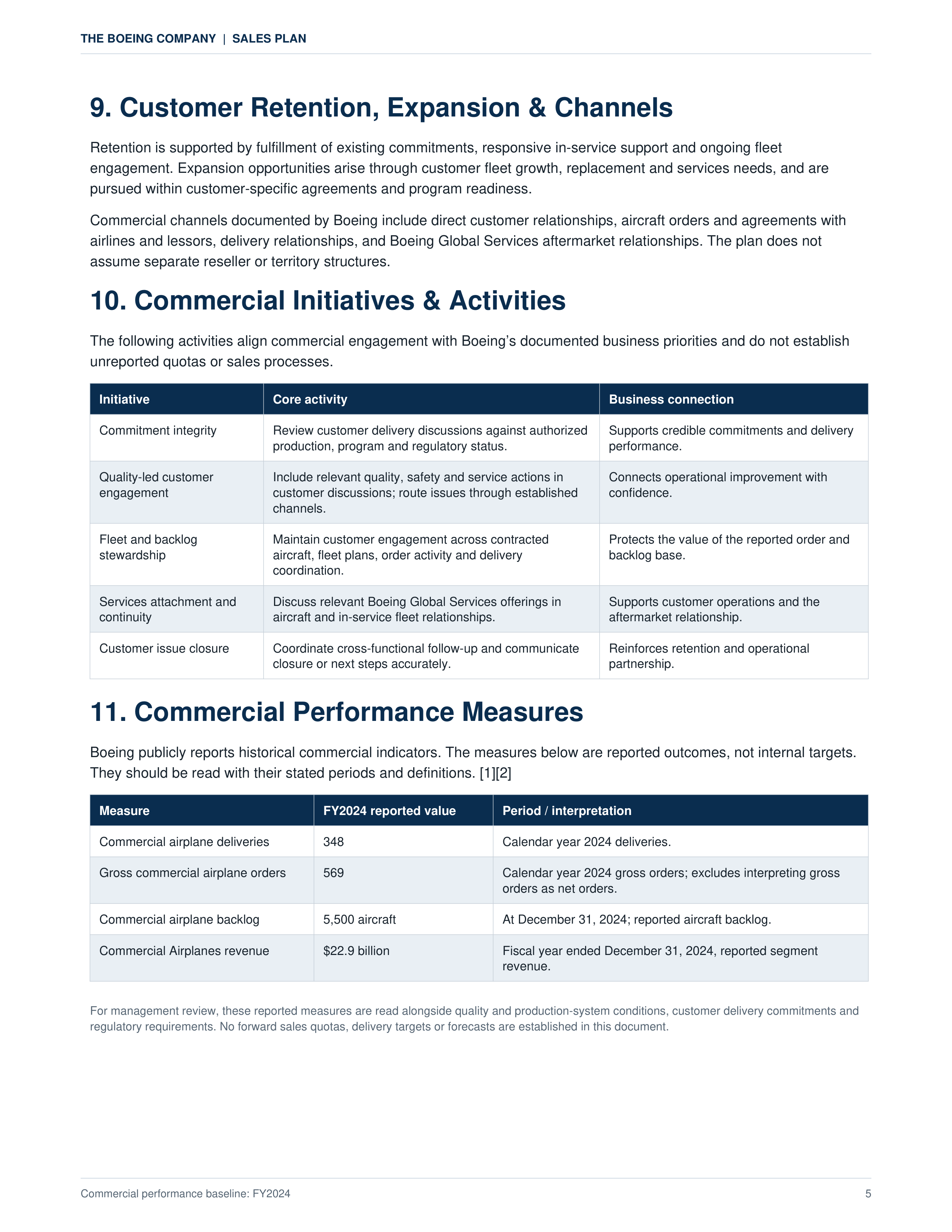
9. Customer Retention, Expansion & Channels
Retention is supported by fulfillment of existing commitments, responsive in-service support and ongoing fleet
engagement. Expansion opportunities arise through customer fleet growth, replacement and services needs, and are
pursued within customer-specific agreements and program readiness.
Commercial channels documented by Boeing include direct customer relationships, aircraft orders and agreements with
airlines and lessors, delivery relationships, and Boeing Global Services aftermarket relationships. The plan does not
assume separate reseller or territory structures.
10. Commercial Initiatives & Activities
The following activities align commercial engagement with Boeing’s documented business priorities and do not establish
unreported quotas or sales processes.
Initiative
Core activity
Business connection
Commitment integrity
Review customer delivery discussions against authorized
production, program and regulatory status.
Supports credible commitments and delivery
performance.
Quality-led customer
engagement
Include relevant quality, safety and service actions in
customer discussions; route issues through established
channels.
Connects operational improvement with
confidence.
Fleet and backlog
stewardship
Maintain customer engagement across contracted
aircraft, fleet plans, order activity and delivery
coordination.
Protects the value of the reported order and
backlog base.
Services attachment and
continuity
Discuss relevant Boeing Global Services offerings in
aircraft and in-service fleet relationships.
Supports customer operations and the
aftermarket relationship.
Customer issue closure
Coordinate cross-functional follow-up and communicate
closure or next steps accurately.
Reinforces retention and operational
partnership.
11. Commercial Performance Measures
Boeing publicly reports historical commercial indicators. The measures below are reported outcomes, not internal targets.
They should be read with their stated periods and definitions. [1][2]
Measure
FY2024 reported value
Period / interpretation
Commercial airplane deliveries
348
Calendar year 2024 deliveries.
Gross commercial airplane orders
569
Calendar year 2024 gross orders; excludes interpreting gross
orders as net orders.
Commercial airplane backlog
5,500 aircraft
At December 31, 2024; reported aircraft backlog.
Commercial Airplanes revenue
$22.9 billion
Fiscal year ended December 31, 2024, reported segment
revenue.
For management review, these reported measures are read alongside quality and production-system conditions, customer delivery commitments and
regulatory requirements. No forward sales quotas, delivery targets or forecasts are established in this document.
THE BOEING COMPANY | SALES PLAN
Commercial performance baseline: FY2024
6
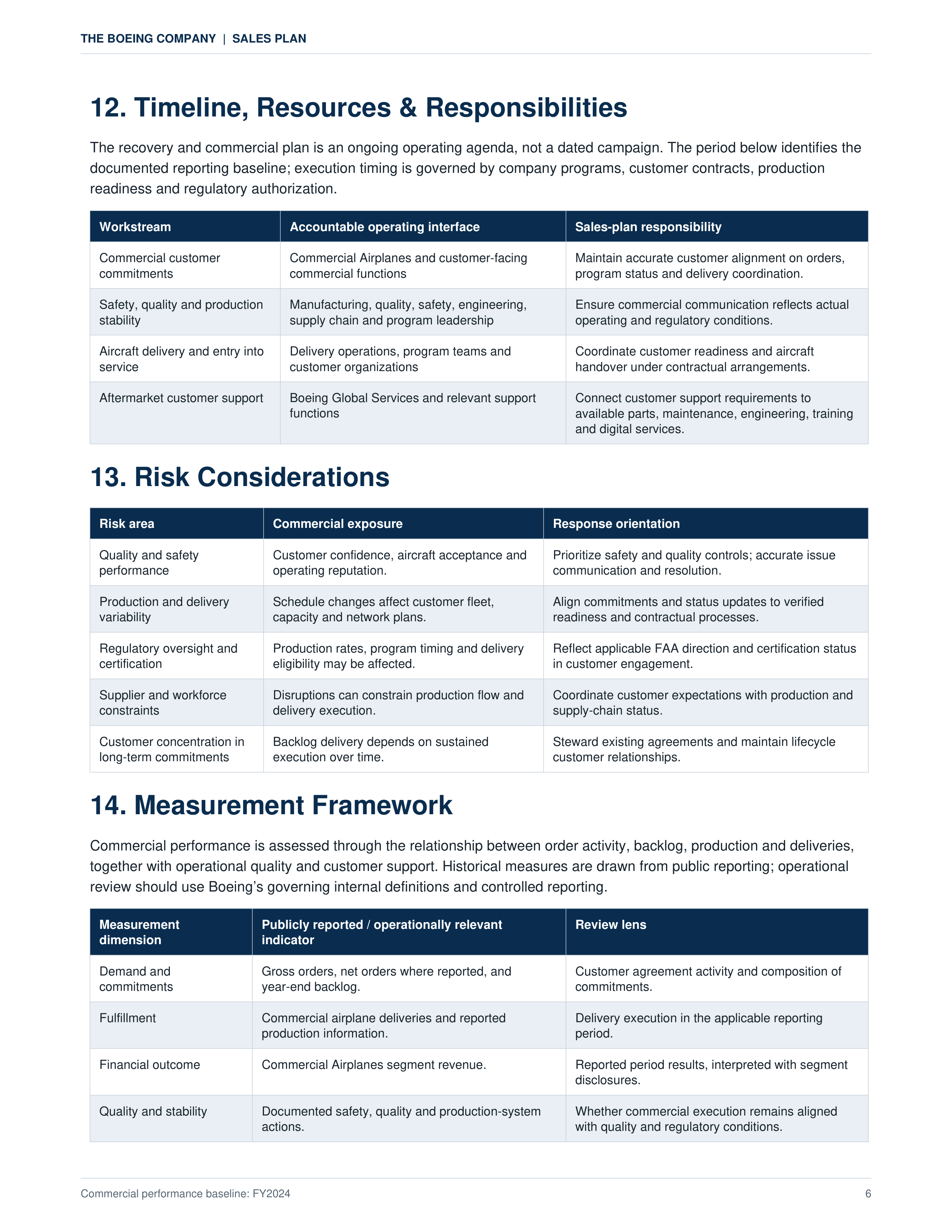
12. Timeline, Resources & Responsibilities
The recovery and commercial plan is an ongoing operating agenda, not a dated campaign. The period below identifies the
documented reporting baseline; execution timing is governed by company programs, customer contracts, production
readiness and regulatory authorization.
Workstream
Accountable operating interface
Sales-plan responsibility
Commercial customer
commitments
Commercial Airplanes and customer-facing
commercial functions
Maintain accurate customer alignment on orders,
program status and delivery coordination.
Safety, quality and production
stability
Manufacturing, quality, safety, engineering,
supply chain and program leadership
Ensure commercial communication reflects actual
operating and regulatory conditions.
Aircraft delivery and entry into
service
Delivery operations, program teams and
customer organizations
Coordinate customer readiness and aircraft
handover under contractual arrangements.
Aftermarket customer support
Boeing Global Services and relevant support
functions
Connect customer support requirements to
available parts, maintenance, engineering, training
and digital services.
13. Risk Considerations
Risk area
Commercial exposure
Response orientation
Quality and safety
performance
Customer confidence, aircraft acceptance and
operating reputation.
Prioritize safety and quality controls; accurate issue
communication and resolution.
Production and delivery
variability
Schedule changes affect customer fleet,
capacity and network plans.
Align commitments and status updates to verified
readiness and contractual processes.
Regulatory oversight and
certification
Production rates, program timing and delivery
eligibility may be affected.
Reflect applicable FAA direction and certification status
in customer engagement.
Supplier and workforce
constraints
Disruptions can constrain production flow and
delivery execution.
Coordinate customer expectations with production and
supply-chain status.
Customer concentration in
long-term commitments
Backlog delivery depends on sustained
execution over time.
Steward existing agreements and maintain lifecycle
customer relationships.
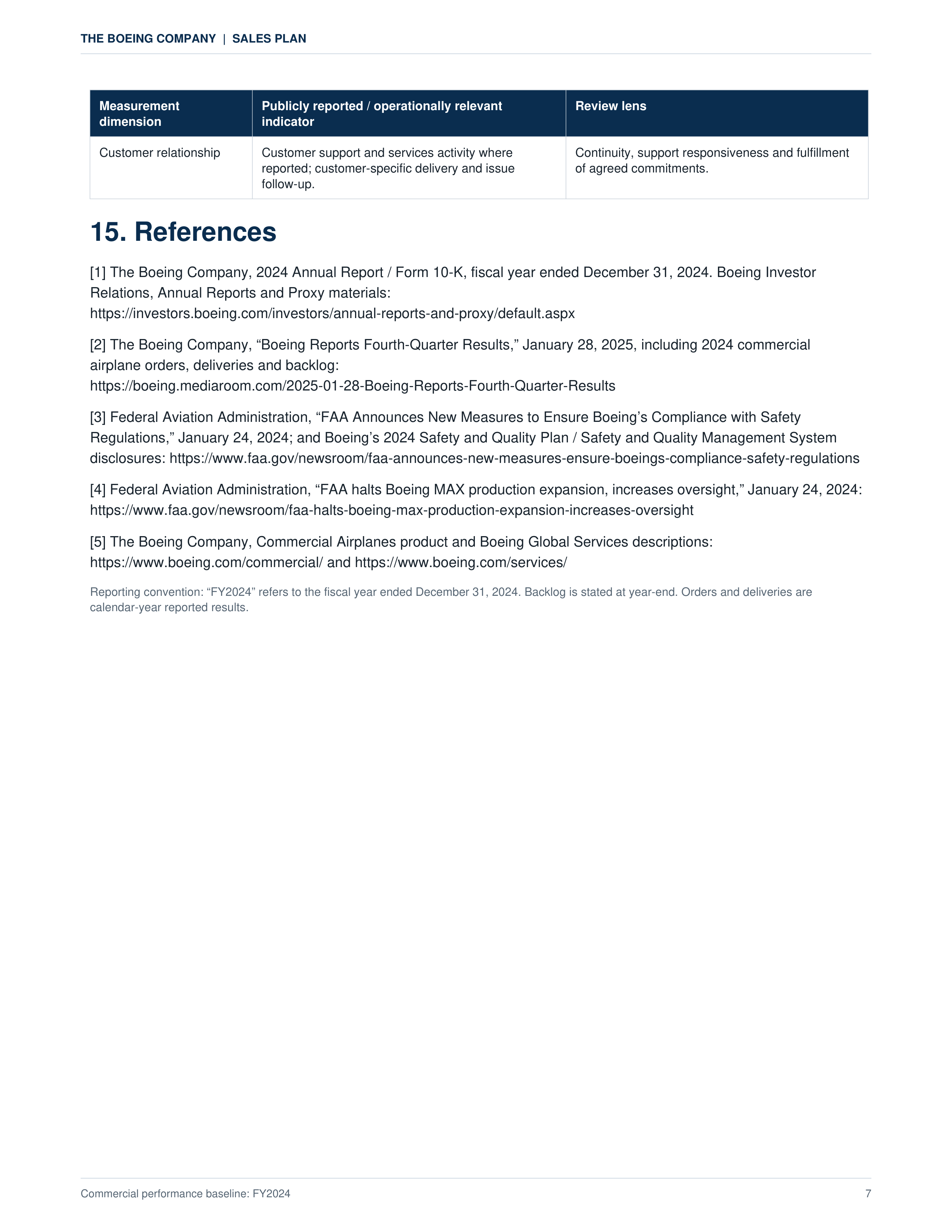
14. Measurement Framework
Commercial performance is assessed through the relationship between order activity, backlog, production and deliveries,
together with operational quality and customer support. Historical measures are drawn from public reporting; operational
review should use Boeing’s governing internal definitions and controlled reporting.
Measurement
dimension
Publicly reported / operationally relevant
indicator
Review lens
Demand and
commitments
Gross orders, net orders where reported, and
year-end backlog.
Customer agreement activity and composition of
commitments.
Fulfillment
Commercial airplane deliveries and reported
production information.
Delivery execution in the applicable reporting
period.
Financial outcome
Commercial Airplanes segment revenue.
Reported period results, interpreted with segment
disclosures.
Quality and stability
Documented safety, quality and production-system
actions.
Whether commercial execution remains aligned
with quality and regulatory conditions.
THE BOEING COMPANY | SALES PLAN
Commercial performance baseline: FY2024
7
Measurement
dimension
Publicly reported / operationally relevant
indicator
Review lens
Customer relationship
Customer support and services activity where
reported; customer-specific delivery and issue
follow-up.
Continuity, support responsiveness and fulfillment
of agreed commitments.
15. References
[1] The Boeing Company, 2024 Annual Report / Form 10-K, fiscal year ended December 31, 2024. Boeing Investor
Relations, Annual Reports and Proxy materials:
https://investors.boeing.com/investors/annual-reports-and-proxy/default.aspx
[2] The Boeing Company, “Boeing Reports Fourth-Quarter Results,” January 28, 2025, including 2024 commercial
airplane orders, deliveries and backlog:
https://boeing.mediaroom.com/2025-01-28-Boeing-Reports-Fourth-Quarter-Results
[3] Federal Aviation Administration, “FAA Announces New Measures to Ensure Boeing’s Compliance with Safety
Regulations,” January 24, 2024; and Boeing’s 2024 Safety and Quality Plan / Safety and Quality Management System
disclosures: https://www.faa.gov/newsroom/faa-announces-new-measures-ensure-boeings-compliance-safety-regulations
[4] Federal Aviation Administration, “FAA halts Boeing MAX production expansion, increases oversight,” January 24, 2024:
https://www.faa.gov/newsroom/faa-halts-boeing-max-production-expansion-increases-oversight
[5] The Boeing Company, Commercial Airplanes product and Boeing Global Services descriptions:
https://www.boeing.com/commercial/ and https://www.boeing.com/services/
Reporting convention: “FY2024” refers to the fiscal year ended December 31, 2024. Backlog is stated at year-end. Orders and deliveries are
calendar-year reported results.