
Honeywell Automation-to-Autonomy
Customer Growth Sales Plan
Sales Plan
PUBLIC-REFERENCE PLANNING BASIS
2024 business and strategy disclosures
Prepared from Honeywell public company disclosures and product information
HONEYWELL | CUSTOMER GROWTH SALES PLAN | 2024 PUBLIC-REFERENCE BASIS
2
Contents & Planning Basis
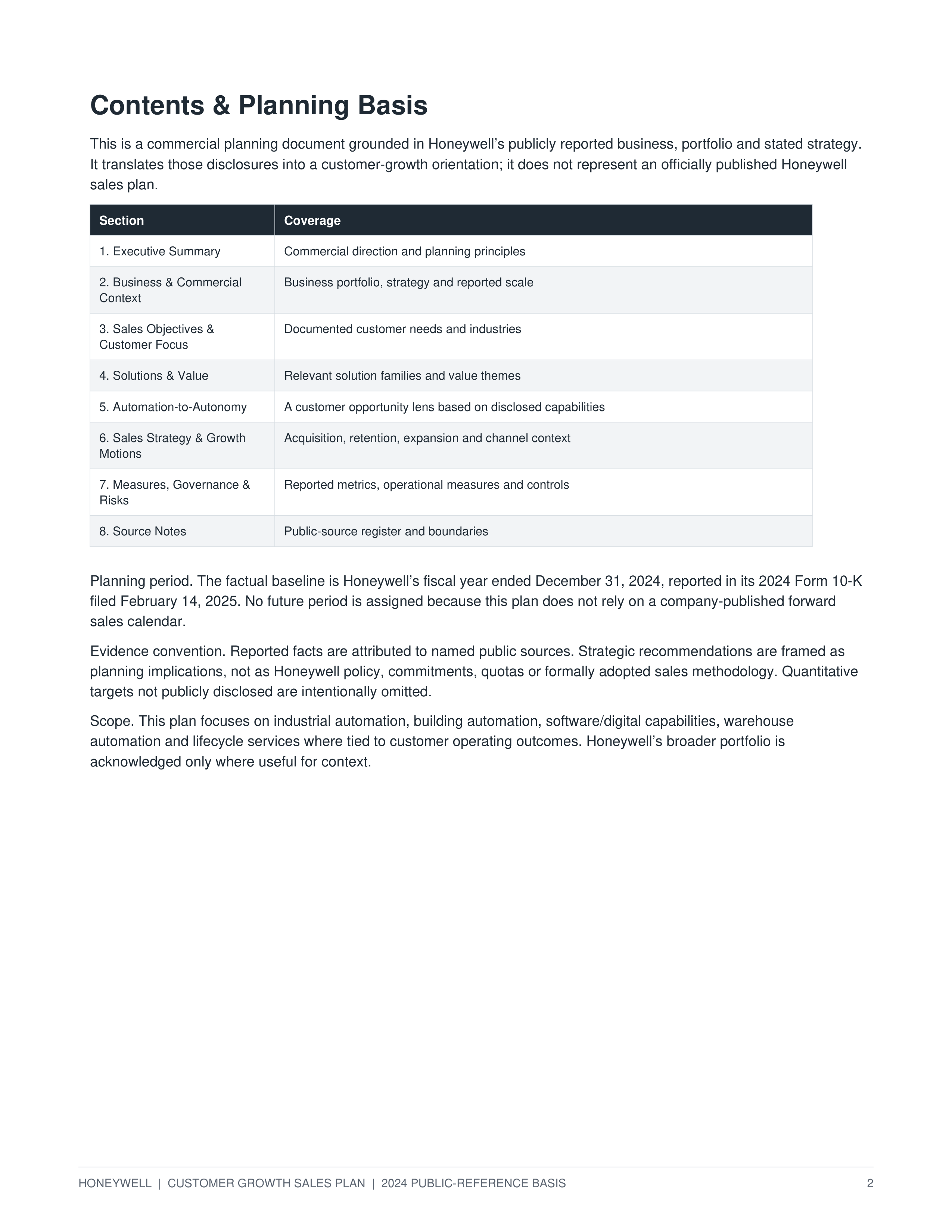
This is a commercial planning document grounded in Honeywell’s publicly reported business, portfolio and stated strategy.
It translates those disclosures into a customer-growth orientation; it does not represent an officially published Honeywell
sales plan.
Section
Coverage
1. Executive Summary
Commercial direction and planning principles
2. Business & Commercial
Context
Business portfolio, strategy and reported scale
3. Sales Objectives &
Customer Focus
Documented customer needs and industries
4. Solutions & Value
Relevant solution families and value themes
5. Automation-to-Autonomy
A customer opportunity lens based on disclosed capabilities
6. Sales Strategy & Growth
Motions
Acquisition, retention, expansion and channel context
7. Measures, Governance &
Risks
Reported metrics, operational measures and controls
8. Source Notes
Public-source register and boundaries
Planning period. The factual baseline is Honeywell’s fiscal year ended December 31, 2024, reported in its 2024 Form 10-K
filed February 14, 2025. No future period is assigned because this plan does not rely on a company-published forward
sales calendar.
Evidence convention. Reported facts are attributed to named public sources. Strategic recommendations are framed as
planning implications, not as Honeywell policy, commitments, quotas or formally adopted sales methodology. Quantitative
targets not publicly disclosed are intentionally omitted.
Scope. This plan focuses on industrial automation, building automation, software/digital capabilities, warehouse
automation and lifecycle services where tied to customer operating outcomes. Honeywell’s broader portfolio is
acknowledged only where useful for context.
HONEYWELL | CUSTOMER GROWTH SALES PLAN | 2024 PUBLIC-REFERENCE BASIS
3
1. Executive Summary
Honeywell describes a portfolio spanning Aerospace Technologies, Industrial Automation, Building Automation, and
Energy and Sustainability Solutions, and says its solutions blend physical products with software. In its 2024 Form 10-K,
Honeywell also described integrating Honeywell Connected Enterprise (HCE) into each strategic business group while
retaining centralized software-development expertise, with the stated intent of improving customer outcomes and
supporting sustained, accretive software growth. [1]
Customer-growth implication. Commercial engagement can connect installed automation and control systems with
software, digital operations, lifecycle services and modernization projects—when a customer’s operating need and
technical environment make that combination appropriate. The customer case should lead with a documented operational
challenge, not a presumed maturity stage or predetermined product bundle.
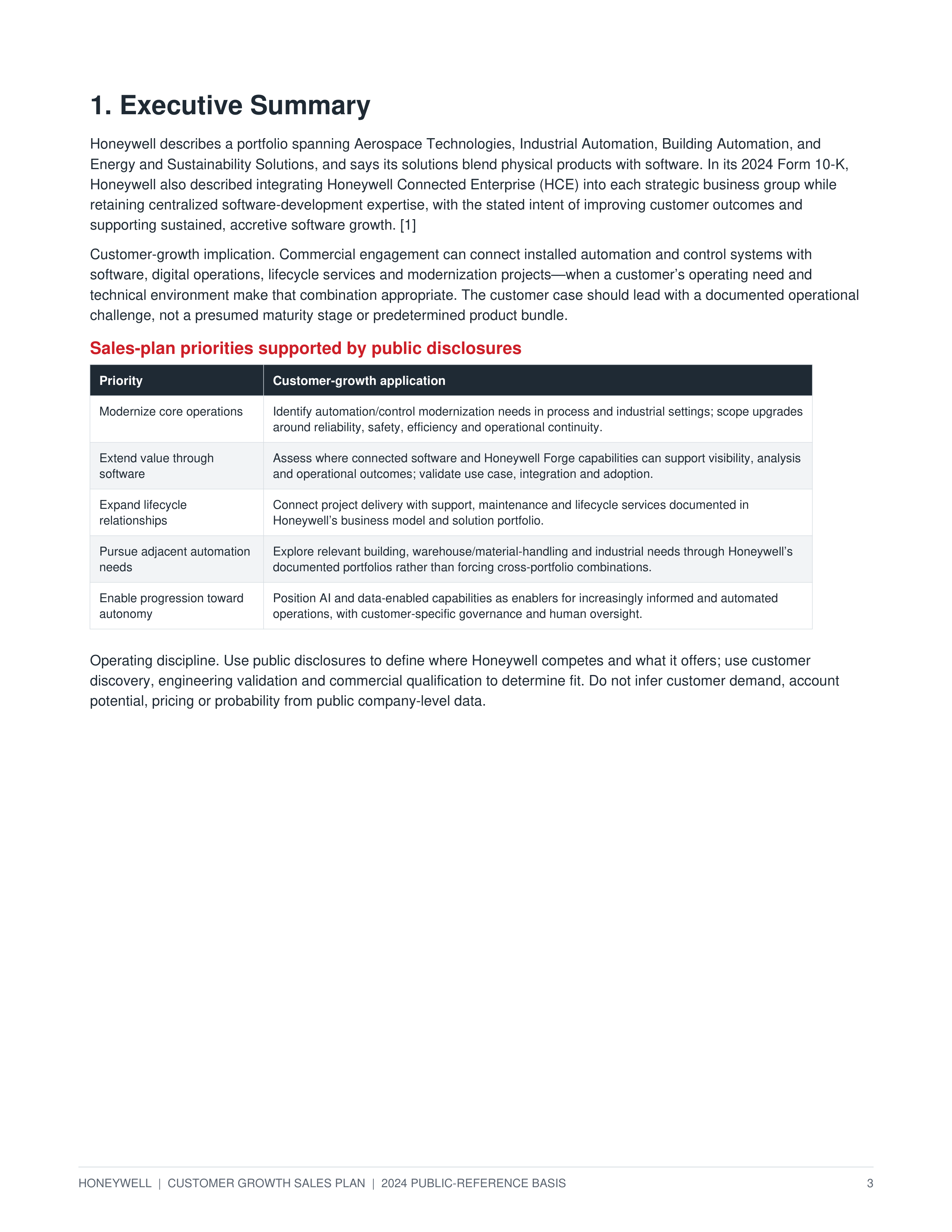
Sales-plan priorities supported by public disclosures
Priority
Customer-growth application
Modernize core operations
Identify automation/control modernization needs in process and industrial settings; scope upgrades
around reliability, safety, efficiency and operational continuity.
Extend value through
software
Assess where connected software and Honeywell Forge capabilities can support visibility, analysis
and operational outcomes; validate use case, integration and adoption.
Expand lifecycle
relationships
Connect project delivery with support, maintenance and lifecycle services documented in
Honeywell’s business model and solution portfolio.
Pursue adjacent automation
needs
Explore relevant building, warehouse/material-handling and industrial needs through Honeywell’s
documented portfolios rather than forcing cross-portfolio combinations.
Enable progression toward
autonomy
Position AI and data-enabled capabilities as enablers for increasingly informed and automated
operations, with customer-specific governance and human oversight.
Operating discipline. Use public disclosures to define where Honeywell competes and what it offers; use customer
discovery, engineering validation and commercial qualification to determine fit. Do not infer customer demand, account
potential, pricing or probability from public company-level data.
HONEYWELL | CUSTOMER GROWTH SALES PLAN | 2024 PUBLIC-REFERENCE BASIS
4
2. Business & Commercial Context
Honeywell’s 2024 filing presents software as a cross-business capability and describes HCE 3.0 as an evolution of its
software strategy, integrating HCE into strategic business groups. The filing also references Honeywell Forge as an IoT
platform. These statements support coordinated solution conversations across physical automation and software, while
preserving the need to verify product applicability and integration for each opportunity. [1]
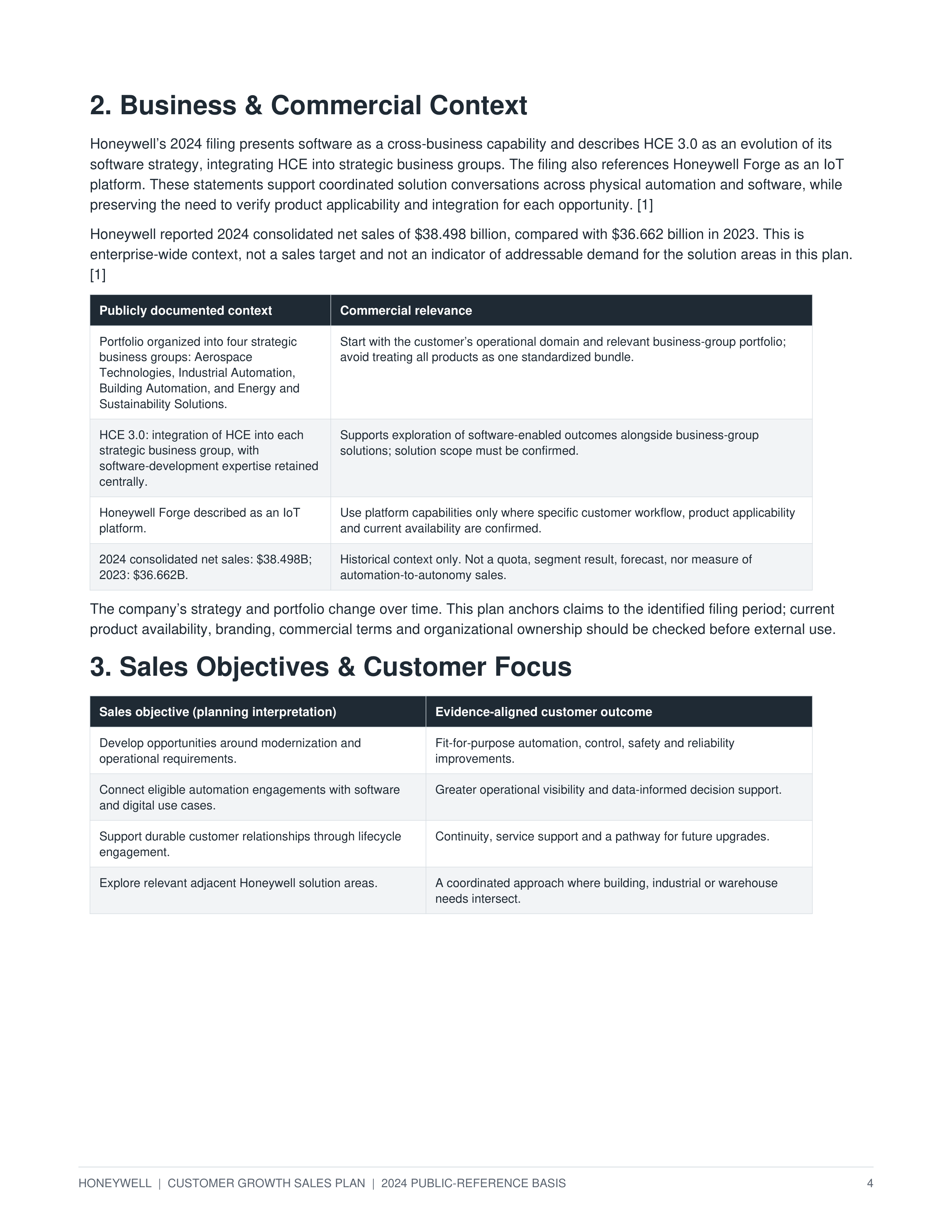
Honeywell reported 2024 consolidated net sales of $38.498 billion, compared with $36.662 billion in 2023. This is
enterprise-wide context, not a sales target and not an indicator of addressable demand for the solution areas in this plan.
[1]
Publicly documented context
Commercial relevance
Portfolio organized into four strategic
business groups: Aerospace
Technologies, Industrial Automation,
Building Automation, and Energy and
Sustainability Solutions.
Start with the customer’s operational domain and relevant business-group portfolio;
avoid treating all products as one standardized bundle.
HCE 3.0: integration of HCE into each
strategic business group, with
software-development expertise retained
centrally.
Supports exploration of software-enabled outcomes alongside business-group
solutions; solution scope must be confirmed.
Honeywell Forge described as an IoT
platform.
Use platform capabilities only where specific customer workflow, product applicability
and current availability are confirmed.
2024 consolidated net sales: $38.498B;
2023: $36.662B.
Historical context only. Not a quota, segment result, forecast, nor measure of
automation-to-autonomy sales.
The company’s strategy and portfolio change over time. This plan anchors claims to the identified filing period; current
product availability, branding, commercial terms and organizational ownership should be checked before external use.
3. Sales Objectives & Customer Focus
Sales objective (planning interpretation)
Evidence-aligned customer outcome
Develop opportunities around modernization and
operational requirements.
Fit-for-purpose automation, control, safety and reliability
improvements.
Connect eligible automation engagements with software
and digital use cases.
Greater operational visibility and data-informed decision support.
Support durable customer relationships through lifecycle
engagement.
Continuity, service support and a pathway for future upgrades.
Explore relevant adjacent Honeywell solution areas.
A coordinated approach where building, industrial or warehouse
needs intersect.
HONEYWELL | CUSTOMER GROWTH SALES PLAN | 2024 PUBLIC-REFERENCE BASIS
5
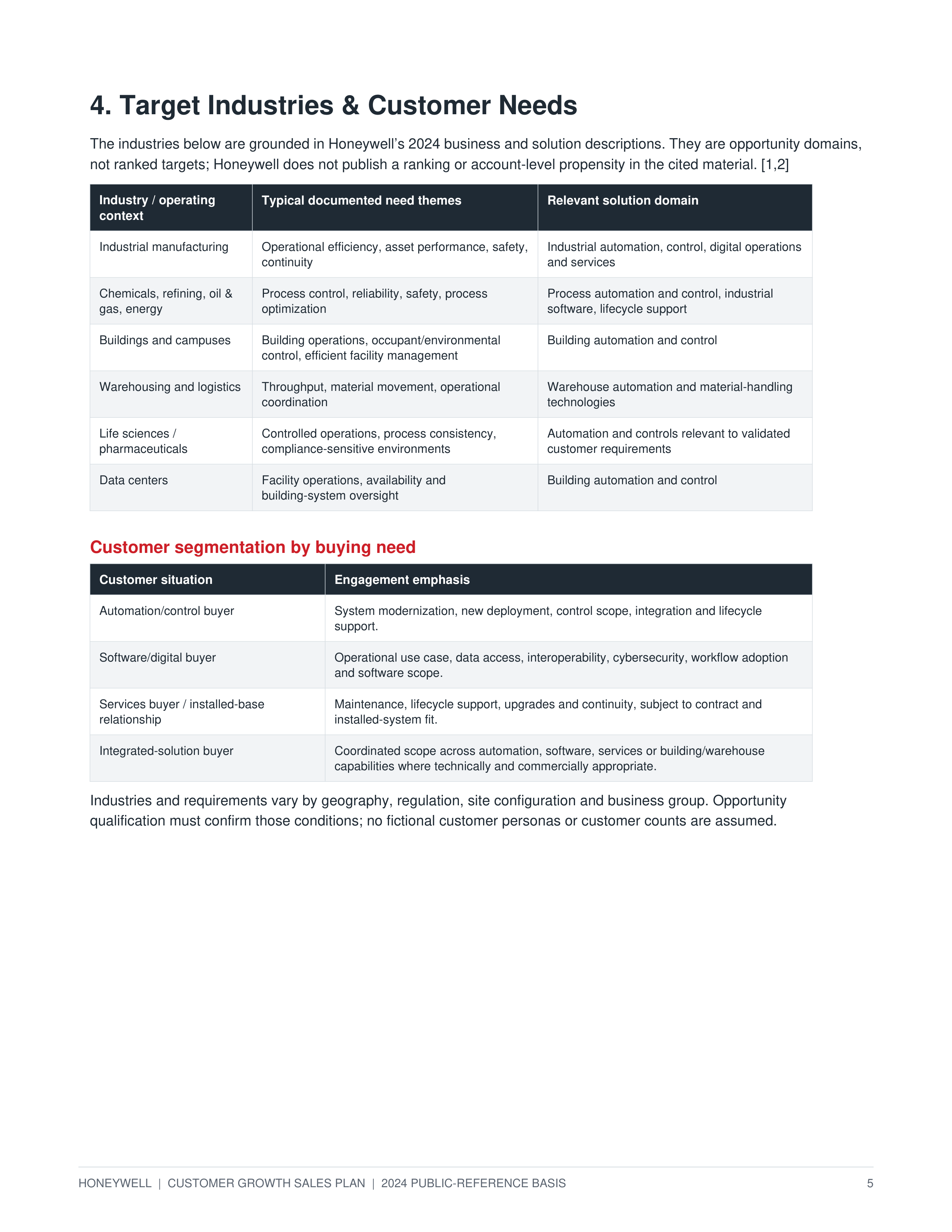
4. Target Industries & Customer Needs
The industries below are grounded in Honeywell’s 2024 business and solution descriptions. They are opportunity domains,
not ranked targets; Honeywell does not publish a ranking or account-level propensity in the cited material. [1,2]
Industry / operating
context
Typical documented need themes
Relevant solution domain
Industrial manufacturing
Operational efficiency, asset performance, safety,
continuity
Industrial automation, control, digital operations
and services
Chemicals, refining, oil &
gas, energy
Process control, reliability, safety, process
optimization
Process automation and control, industrial
software, lifecycle support
Buildings and campuses
Building operations, occupant/environmental
control, efficient facility management
Building automation and control
Warehousing and logistics
Throughput, material movement, operational
coordination
Warehouse automation and material-handling
technologies
Life sciences /
pharmaceuticals
Controlled operations, process consistency,
compliance-sensitive environments
Automation and controls relevant to validated
customer requirements
Data centers
Facility operations, availability and
building-system oversight
Building automation and control
Customer segmentation by buying need
Customer situation
Engagement emphasis
Automation/control buyer
System modernization, new deployment, control scope, integration and lifecycle
support.
Software/digital buyer
Operational use case, data access, interoperability, cybersecurity, workflow adoption
and software scope.
Services buyer / installed-base
relationship
Maintenance, lifecycle support, upgrades and continuity, subject to contract and
installed-system fit.
Integrated-solution buyer
Coordinated scope across automation, software, services or building/warehouse
capabilities where technically and commercially appropriate.
Industries and requirements vary by geography, regulation, site configuration and business group. Opportunity
qualification must confirm those conditions; no fictional customer personas or customer counts are assumed.
HONEYWELL | CUSTOMER GROWTH SALES PLAN | 2024 PUBLIC-REFERENCE BASIS
6
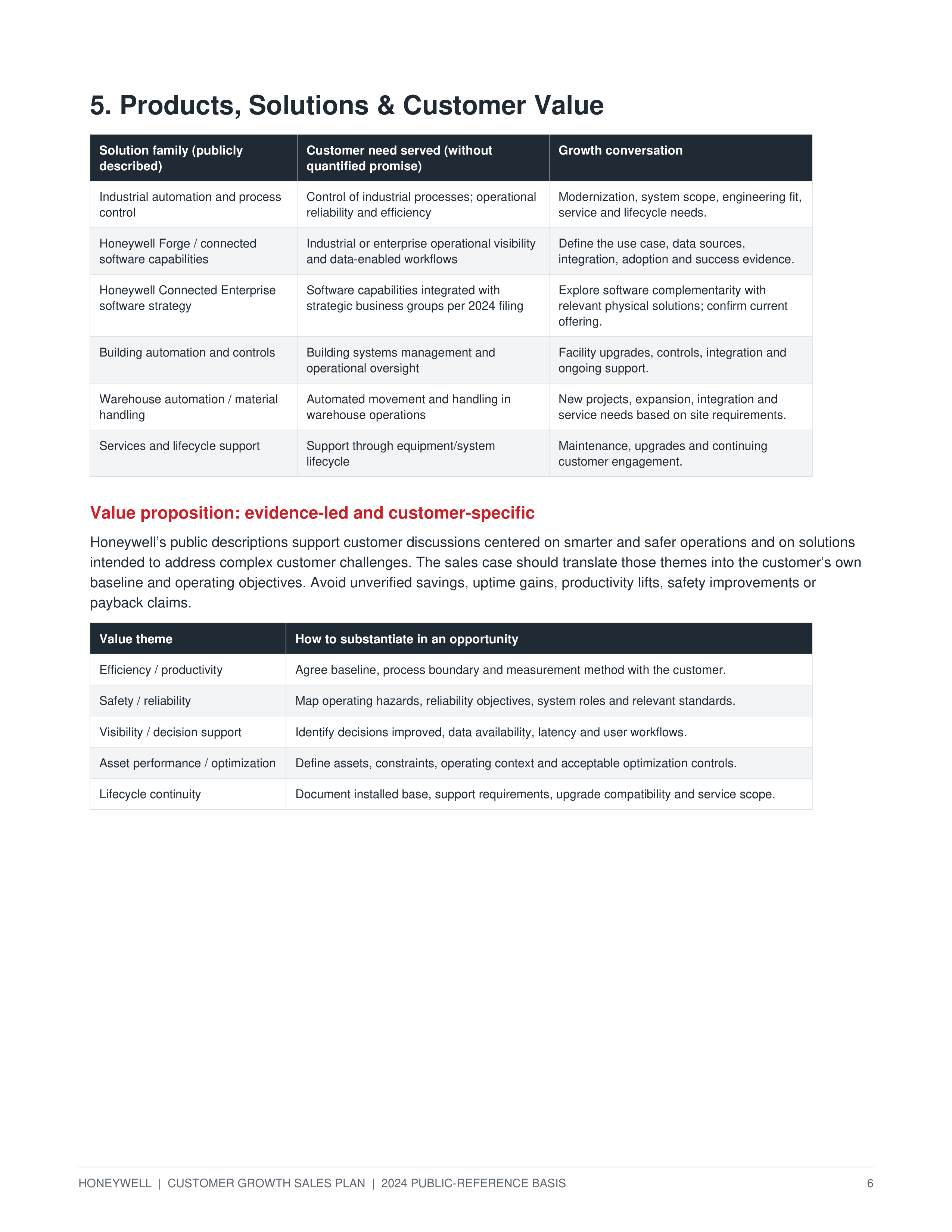
5. Products, Solutions & Customer Value
Solution family (publicly
described)
Customer need served (without
quantified promise)
Growth conversation
Industrial automation and process
control
Control of industrial processes; operational
reliability and efficiency
Modernization, system scope, engineering fit,
service and lifecycle needs.
Honeywell Forge / connected
software capabilities
Industrial or enterprise operational visibility
and data-enabled workflows
Define the use case, data sources,
integration, adoption and success evidence.
Honeywell Connected Enterprise
software strategy
Software capabilities integrated with
strategic business groups per 2024 filing
Explore software complementarity with
relevant physical solutions; confirm current
offering.
Building automation and controls
Building systems management and
operational oversight
Facility upgrades, controls, integration and
ongoing support.
Warehouse automation / material
handling
Automated movement and handling in
warehouse operations
New projects, expansion, integration and
service needs based on site requirements.
Services and lifecycle support
Support through equipment/system
lifecycle
Maintenance, upgrades and continuing
customer engagement.
Value proposition: evidence-led and customer-specific
Honeywell’s public descriptions support customer discussions centered on smarter and safer operations and on solutions
intended to address complex customer challenges. The sales case should translate those themes into the customer’s own
baseline and operating objectives. Avoid unverified savings, uptime gains, productivity lifts, safety improvements or
payback claims.
Value theme
How to substantiate in an opportunity
Efficiency / productivity
Agree baseline, process boundary and measurement method with the customer.
Safety / reliability
Map operating hazards, reliability objectives, system roles and relevant standards.
Visibility / decision support
Identify decisions improved, data availability, latency and user workflows.
Asset performance / optimization
Define assets, constraints, operating context and acceptable optimization controls.
Lifecycle continuity
Document installed base, support requirements, upgrade compatibility and service scope.
HONEYWELL | CUSTOMER GROWTH SALES PLAN | 2024 PUBLIC-REFERENCE BASIS
7
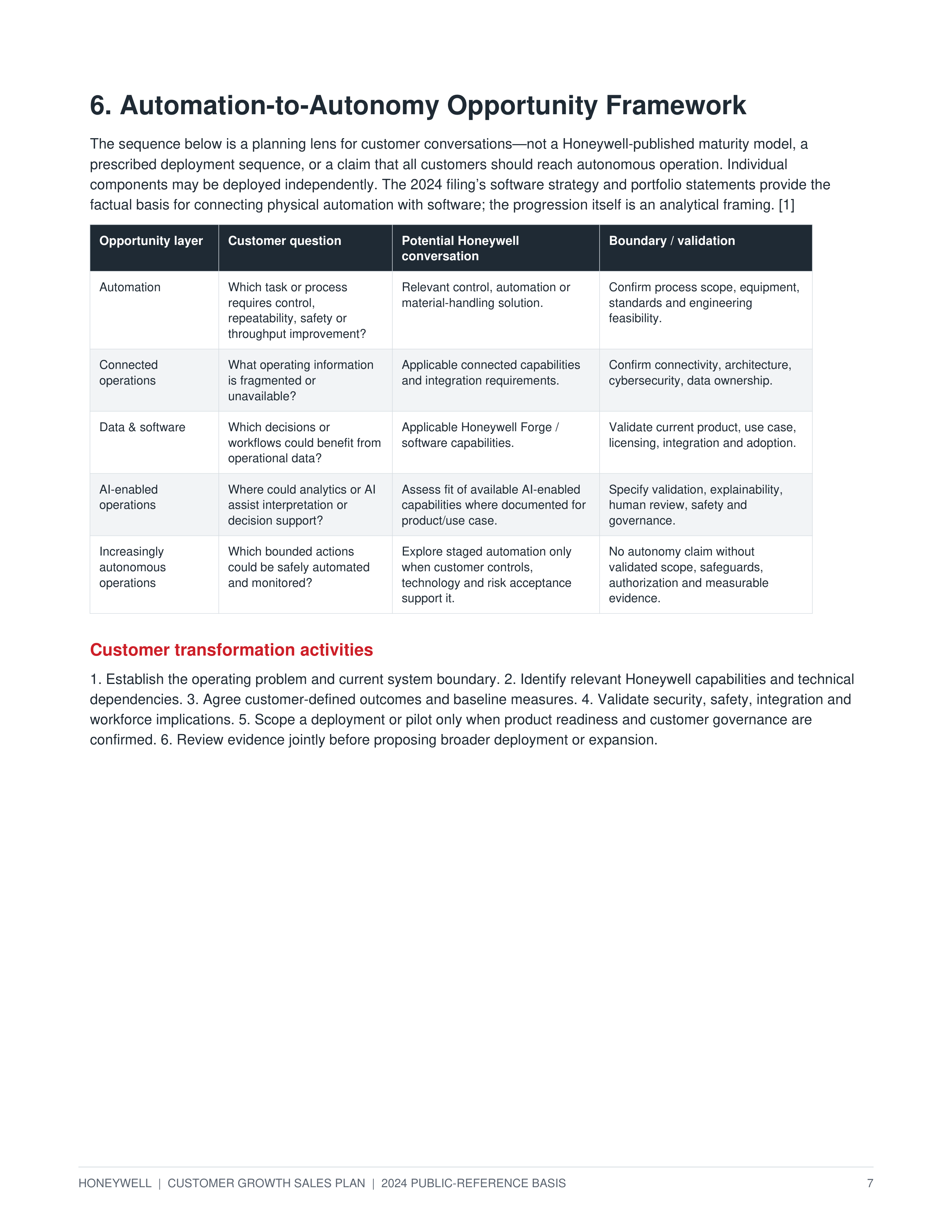
6. Automation-to-Autonomy Opportunity Framework
The sequence below is a planning lens for customer conversations—not a Honeywell-published maturity model, a
prescribed deployment sequence, or a claim that all customers should reach autonomous operation. Individual
components may be deployed independently. The 2024 filing’s software strategy and portfolio statements provide the
factual basis for connecting physical automation with software; the progression itself is an analytical framing. [1]
Opportunity layer
Customer question
Potential Honeywell
conversation
Boundary / validation
Automation
Which task or process
requires control,
repeatability, safety or
throughput improvement?
Relevant control, automation or
material-handling solution.
Confirm process scope, equipment,
standards and engineering
feasibility.
Connected
operations
What operating information
is fragmented or
unavailable?
Applicable connected capabilities
and integration requirements.
Confirm connectivity, architecture,
cybersecurity, data ownership.
Data & software
Which decisions or
workflows could benefit from
operational data?
Applicable Honeywell Forge /
software capabilities.
Validate current product, use case,
licensing, integration and adoption.
AI-enabled
operations
Where could analytics or AI
assist interpretation or
decision support?
Assess fit of available AI-enabled
capabilities where documented for
product/use case.
Specify validation, explainability,
human review, safety and
governance.
Increasingly
autonomous
operations
Which bounded actions
could be safely automated
and monitored?
Explore staged automation only
when customer controls,
technology and risk acceptance
support it.
No autonomy claim without
validated scope, safeguards,
authorization and measurable
evidence.
Customer transformation activities
1. Establish the operating problem and current system boundary. 2. Identify relevant Honeywell capabilities and technical
dependencies. 3. Agree customer-defined outcomes and baseline measures. 4. Validate security, safety, integration and
workforce implications. 5. Scope a deployment or pilot only when product readiness and customer governance are
confirmed. 6. Review evidence jointly before proposing broader deployment or expansion.
HONEYWELL | CUSTOMER GROWTH SALES PLAN | 2024 PUBLIC-REFERENCE BASIS
8
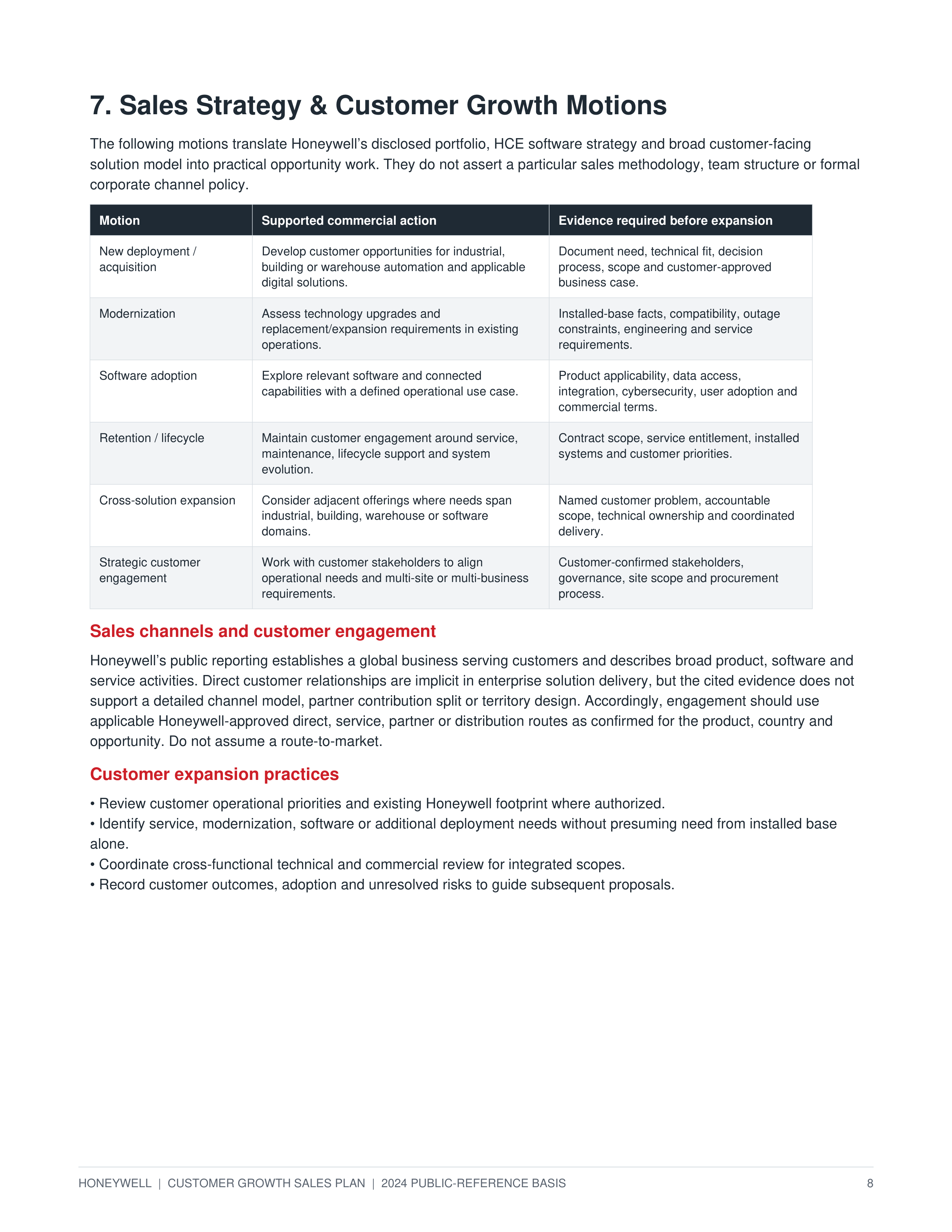
7. Sales Strategy & Customer Growth Motions
The following motions translate Honeywell’s disclosed portfolio, HCE software strategy and broad customer-facing
solution model into practical opportunity work. They do not assert a particular sales methodology, team structure or formal
corporate channel policy.
Motion
Supported commercial action
Evidence required before expansion
New deployment /
acquisition
Develop customer opportunities for industrial,
building or warehouse automation and applicable
digital solutions.
Document need, technical fit, decision
process, scope and customer-approved
business case.
Modernization
Assess technology upgrades and
replacement/expansion requirements in existing
operations.
Installed-base facts, compatibility, outage
constraints, engineering and service
requirements.
Software adoption
Explore relevant software and connected
capabilities with a defined operational use case.
Product applicability, data access,
integration, cybersecurity, user adoption and
commercial terms.
Retention / lifecycle
Maintain customer engagement around service,
maintenance, lifecycle support and system
evolution.
Contract scope, service entitlement, installed
systems and customer priorities.
Cross-solution expansion
Consider adjacent offerings where needs span
industrial, building, warehouse or software
domains.
Named customer problem, accountable
scope, technical ownership and coordinated
delivery.
Strategic customer
engagement
Work with customer stakeholders to align
operational needs and multi-site or multi-business
requirements.
Customer-confirmed stakeholders,
governance, site scope and procurement
process.
Sales channels and customer engagement
Honeywell’s public reporting establishes a global business serving customers and describes broad product, software and
service activities. Direct customer relationships are implicit in enterprise solution delivery, but the cited evidence does not
support a detailed channel model, partner contribution split or territory design. Accordingly, engagement should use
applicable Honeywell-approved direct, service, partner or distribution routes as confirmed for the product, country and
opportunity. Do not assume a route-to-market.
Customer expansion practices
• Review customer operational priorities and existing Honeywell footprint where authorized.
• Identify service, modernization, software or additional deployment needs without presuming need from installed base
alone.
• Coordinate cross-functional technical and commercial review for integrated scopes.
• Record customer outcomes, adoption and unresolved risks to guide subsequent proposals.
HONEYWELL | CUSTOMER GROWTH SALES PLAN | 2024 PUBLIC-REFERENCE BASIS
9
8. Measures, Timeline & Responsibilities
Sales targets and quotas
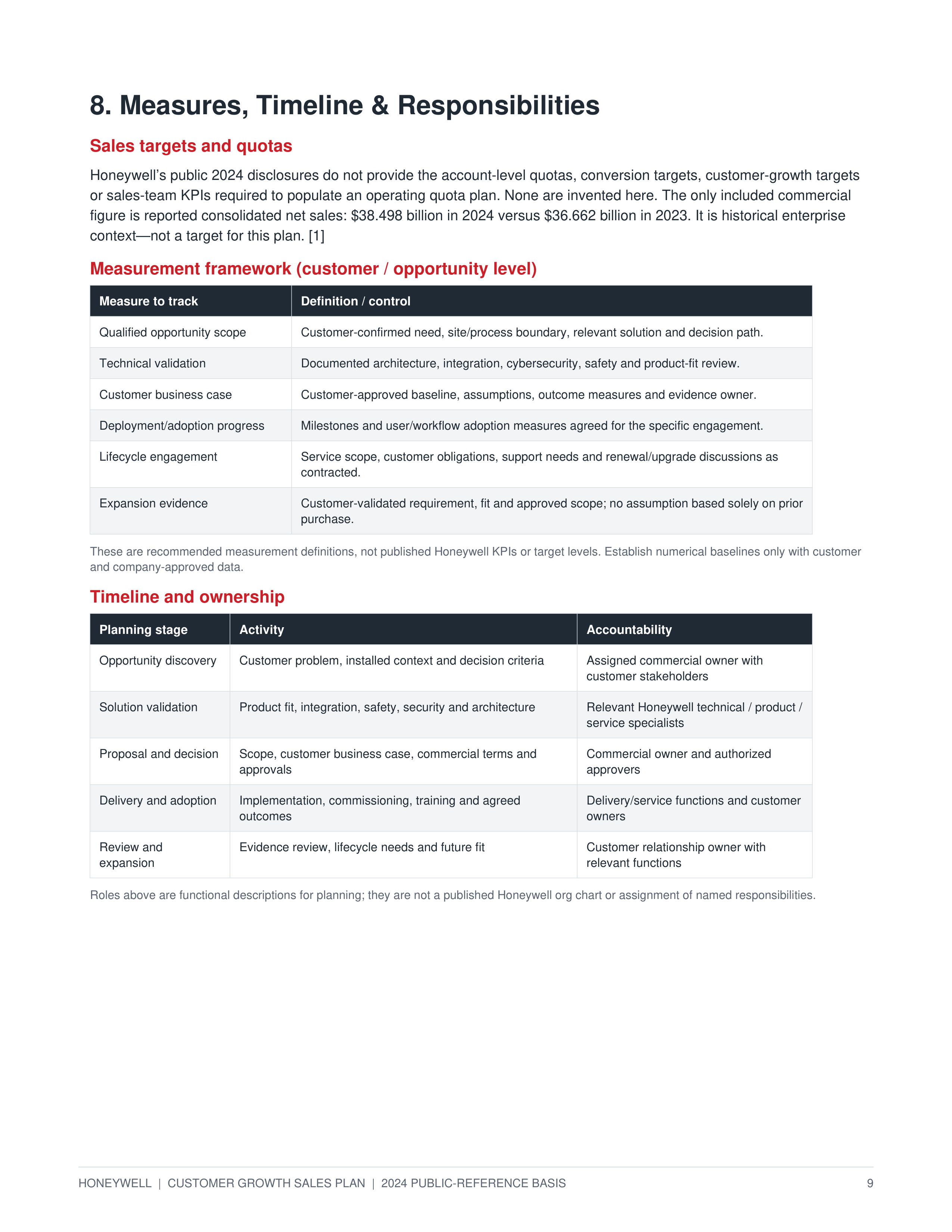
Honeywell’s public 2024 disclosures do not provide the account-level quotas, conversion targets, customer-growth targets
or sales-team KPIs required to populate an operating quota plan. None are invented here. The only included commercial
figure is reported consolidated net sales: $38.498 billion in 2024 versus $36.662 billion in 2023. It is historical enterprise
context—not a target for this plan. [1]
Measurement framework (customer / opportunity level)
Measure to track
Definition / control
Qualified opportunity scope
Customer-confirmed need, site/process boundary, relevant solution and decision path.
Technical validation
Documented architecture, integration, cybersecurity, safety and product-fit review.
Customer business case
Customer-approved baseline, assumptions, outcome measures and evidence owner.
Deployment/adoption progress
Milestones and user/workflow adoption measures agreed for the specific engagement.
Lifecycle engagement
Service scope, customer obligations, support needs and renewal/upgrade discussions as
contracted.
Expansion evidence
Customer-validated requirement, fit and approved scope; no assumption based solely on prior
purchase.
These are recommended measurement definitions, not published Honeywell KPIs or target levels. Establish numerical baselines only with customer
and company-approved data.
Timeline and ownership
Planning stage
Activity
Accountability
Opportunity discovery
Customer problem, installed context and decision criteria
Assigned commercial owner with
customer stakeholders
Solution validation
Product fit, integration, safety, security and architecture
Relevant Honeywell technical / product /
service specialists
Proposal and decision
Scope, customer business case, commercial terms and
approvals
Commercial owner and authorized
approvers
Delivery and adoption
Implementation, commissioning, training and agreed
outcomes
Delivery/service functions and customer
owners
Review and
expansion
Evidence review, lifecycle needs and future fit
Customer relationship owner with
relevant functions
Roles above are functional descriptions for planning; they are not a published Honeywell org chart or assignment of named responsibilities.
HONEYWELL | CUSTOMER GROWTH SALES PLAN | 2024 PUBLIC-REFERENCE BASIS
10
9. Risks, Controls & Source Notes
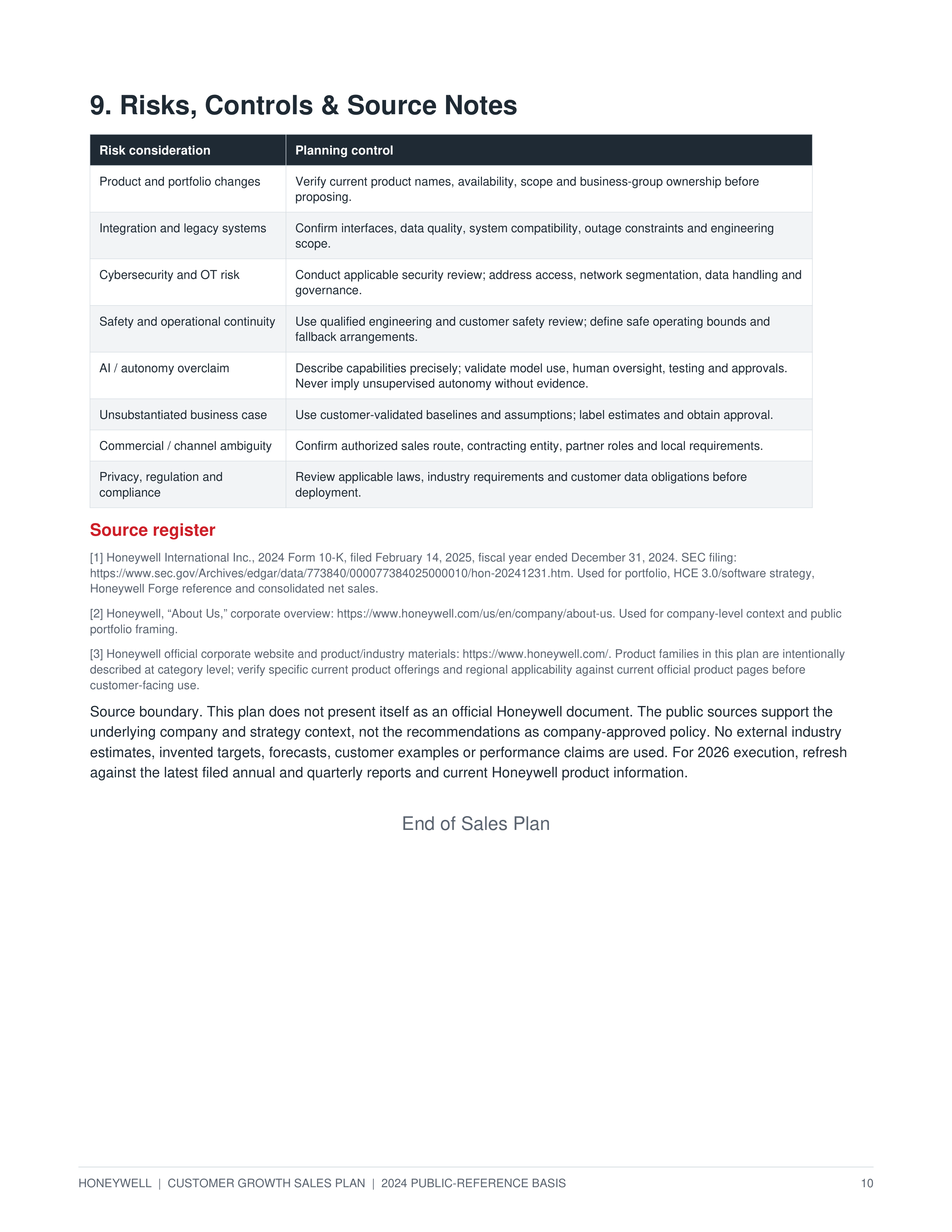
Risk consideration
Planning control
Product and portfolio changes
Verify current product names, availability, scope and business-group ownership before
proposing.
Integration and legacy systems
Confirm interfaces, data quality, system compatibility, outage constraints and engineering
scope.
Cybersecurity and OT risk
Conduct applicable security review; address access, network segmentation, data handling and
governance.
Safety and operational continuity
Use qualified engineering and customer safety review; define safe operating bounds and
fallback arrangements.
AI / autonomy overclaim
Describe capabilities precisely; validate model use, human oversight, testing and approvals.
Never imply unsupervised autonomy without evidence.
Unsubstantiated business case
Use customer-validated baselines and assumptions; label estimates and obtain approval.
Commercial / channel ambiguity
Confirm authorized sales route, contracting entity, partner roles and local requirements.
Privacy, regulation and
compliance
Review applicable laws, industry requirements and customer data obligations before
deployment.
Source register
[1] Honeywell International Inc., 2024 Form 10-K, filed February 14, 2025, fiscal year ended December 31, 2024. SEC filing:
https://www.sec.gov/Archives/edgar/data/773840/000077384025000010/hon-20241231.htm. Used for portfolio, HCE 3.0/software strategy,
Honeywell Forge reference and consolidated net sales.
[2] Honeywell, “About Us,” corporate overview: https://www.honeywell.com/us/en/company/about-us. Used for company-level context and public
portfolio framing.
[3] Honeywell official corporate website and product/industry materials: https://www.honeywell.com/. Product families in this plan are intentionally
described at category level; verify specific current product offerings and regional applicability against current official product pages before
customer-facing use.
Source boundary. This plan does not present itself as an official Honeywell document. The public sources support the
underlying company and strategy context, not the recommendations as company-approved policy. No external industry
estimates, invented targets, forecasts, customer examples or performance claims are used. For 2026 execution, refresh
against the latest filed annual and quarterly reports and current Honeywell product information.
End of Sales Plan