TJX | GLOBAL OFF-PRICE RETAIL & CUSTOMER GROWTH
STRATEGIC SALES PLAN • FY2027 | 1
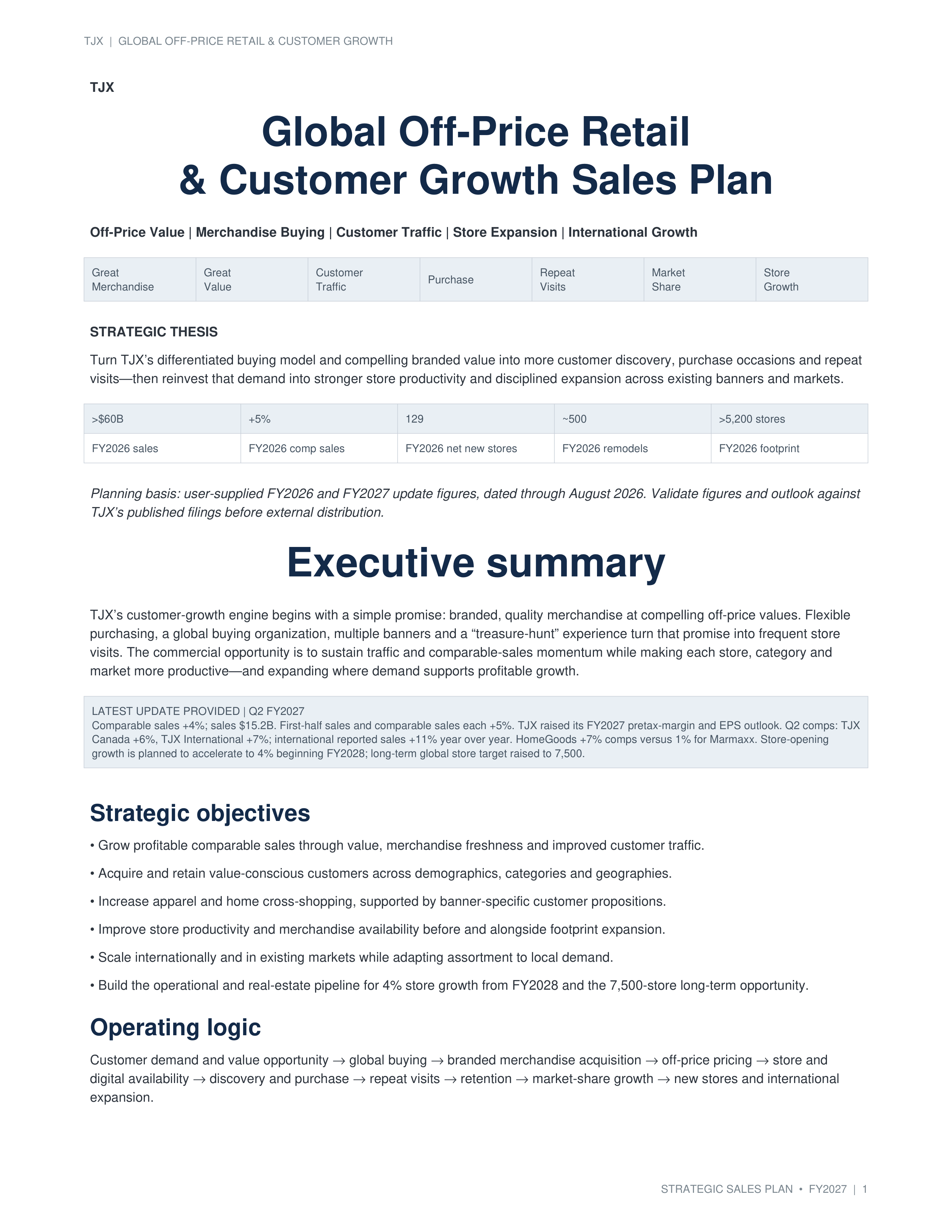
TJX
Global Off-Price Retail
& Customer Growth Sales Plan
Off-Price Value | Merchandise Buying | Customer Traffic | Store Expansion | International Growth
Great
Merchandise
Great
Value
Customer
Traffic
Purchase
Repeat
Visits
Market
Share
Store
Growth
STRATEGIC THESIS
Turn TJX’s differentiated buying model and compelling branded value into more customer discovery, purchase occasions and repeat
visits—then reinvest that demand into stronger store productivity and disciplined expansion across existing banners and markets.
>$60B
+5%
129
~500
>5,200 stores
FY2026 sales
FY2026 comp sales
FY2026 net new stores
FY2026 remodels
FY2026 footprint
Planning basis: user-supplied FY2026 and FY2027 update figures, dated through August 2026. Validate figures and outlook against
TJX’s published filings before external distribution.
Executive summary
TJX’s customer-growth engine begins with a simple promise: branded, quality merchandise at compelling off-price values. Flexible
purchasing, a global buying organization, multiple banners and a “treasure-hunt” experience turn that promise into frequent store
visits. The commercial opportunity is to sustain traffic and comparable-sales momentum while making each store, category and
market more productive—and expanding where demand supports profitable growth.
LATEST UPDATE PROVIDED | Q2 FY2027
Comparable sales +4%; sales $15.2B. First-half sales and comparable sales each +5%. TJX raised its FY2027 pretax-margin and EPS outlook. Q2 comps: TJX
Canada +6%, TJX International +7%; international reported sales +11% year over year. HomeGoods +7% comps versus 1% for Marmaxx. Store-opening
growth is planned to accelerate to 4% beginning FY2028; long-term global store target raised to 7,500.
Strategic objectives
• Grow profitable comparable sales through value, merchandise freshness and improved customer traffic.
• Acquire and retain value-conscious customers across demographics, categories and geographies.
• Increase apparel and home cross-shopping, supported by banner-specific customer propositions.
• Improve store productivity and merchandise availability before and alongside footprint expansion.
• Scale internationally and in existing markets while adapting assortment to local demand.
• Build the operational and real-estate pipeline for 4% store growth from FY2028 and the 7,500-store long-term opportunity.
Operating logic
Customer demand and value opportunity
→
global buying
→
branded merchandise acquisition
→
off-price pricing
→
store and
digital availability
→
discovery and purchase
→
repeat visits
→
retention
→
market-share growth
→
new stores and international
expansion.
TJX | GLOBAL OFF-PRICE RETAIL & CUSTOMER GROWTH
STRATEGIC SALES PLAN • FY2027 | 2
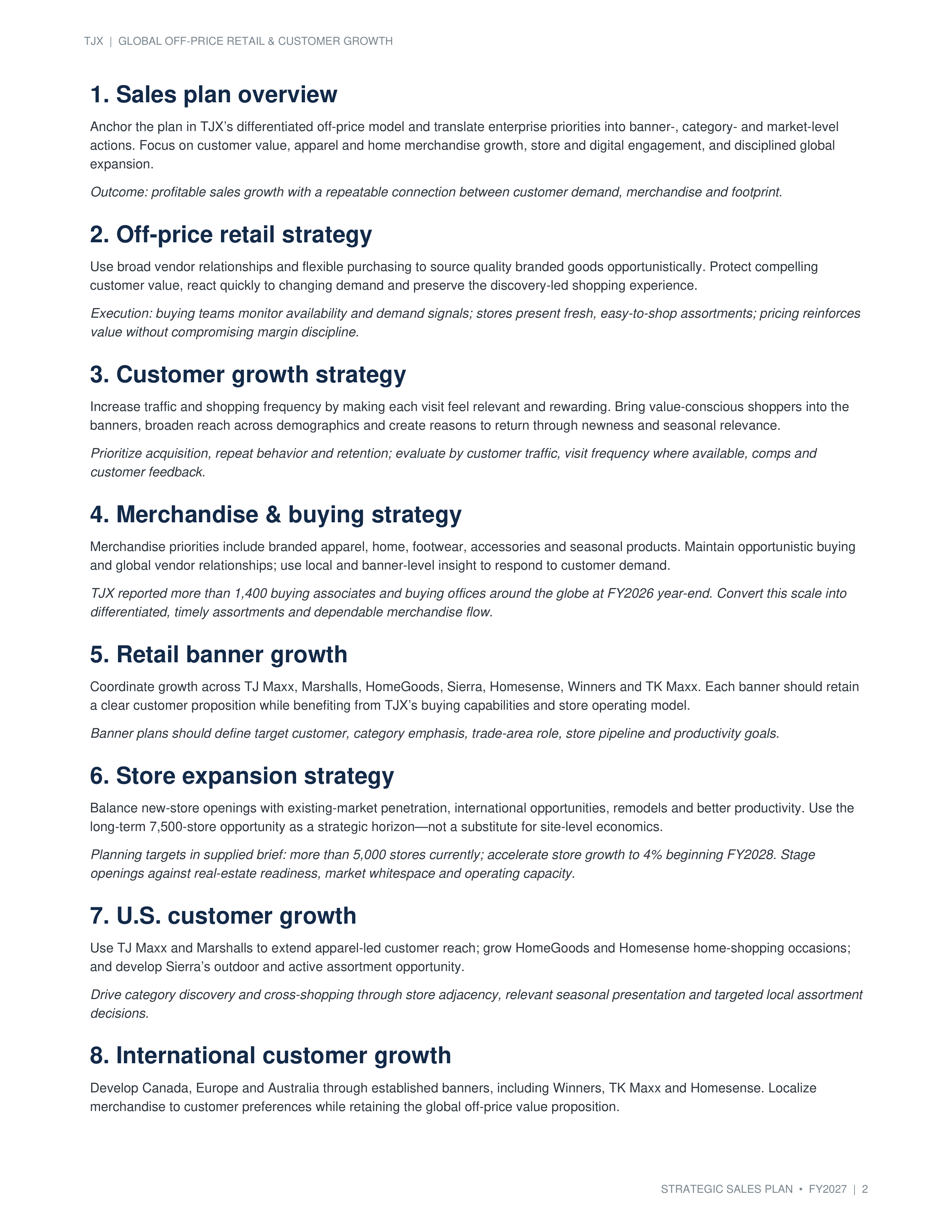
1. Sales plan overview
Anchor the plan in TJX’s differentiated off-price model and translate enterprise priorities into banner-, category- and market-level
actions. Focus on customer value, apparel and home merchandise growth, store and digital engagement, and disciplined global
expansion.
Outcome: profitable sales growth with a repeatable connection between customer demand, merchandise and footprint.
2. Off-price retail strategy
Use broad vendor relationships and flexible purchasing to source quality branded goods opportunistically. Protect compelling
customer value, react quickly to changing demand and preserve the discovery-led shopping experience.
Execution: buying teams monitor availability and demand signals; stores present fresh, easy-to-shop assortments; pricing reinforces
value without compromising margin discipline.
3. Customer growth strategy
Increase traffic and shopping frequency by making each visit feel relevant and rewarding. Bring value-conscious shoppers into the
banners, broaden reach across demographics and create reasons to return through newness and seasonal relevance.
Prioritize acquisition, repeat behavior and retention; evaluate by customer traffic, visit frequency where available, comps and
customer feedback.
4. Merchandise & buying strategy
Merchandise priorities include branded apparel, home, footwear, accessories and seasonal products. Maintain opportunistic buying
and global vendor relationships; use local and banner-level insight to respond to customer demand.
TJX reported more than 1,400 buying associates and buying offices around the globe at FY2026 year-end. Convert this scale into
differentiated, timely assortments and dependable merchandise flow.
5. Retail banner growth
Coordinate growth across TJ Maxx, Marshalls, HomeGoods, Sierra, Homesense, Winners and TK Maxx. Each banner should retain
a clear customer proposition while benefiting from TJX’s buying capabilities and store operating model.
Banner plans should define target customer, category emphasis, trade-area role, store pipeline and productivity goals.
6. Store expansion strategy
Balance new-store openings with existing-market penetration, international opportunities, remodels and better productivity. Use the
long-term 7,500-store opportunity as a strategic horizon—not a substitute for site-level economics.
Planning targets in supplied brief: more than 5,000 stores currently; accelerate store growth to 4% beginning FY2028. Stage
openings against real-estate readiness, market whitespace and operating capacity.
7. U.S. customer growth
Use TJ Maxx and Marshalls to extend apparel-led customer reach; grow HomeGoods and Homesense home-shopping occasions;
and develop Sierra’s outdoor and active assortment opportunity.
Drive category discovery and cross-shopping through store adjacency, relevant seasonal presentation and targeted local assortment
decisions.
8. International customer growth
Develop Canada, Europe and Australia through established banners, including Winners, TK Maxx and Homesense. Localize
merchandise to customer preferences while retaining the global off-price value proposition.
TJX | GLOBAL OFF-PRICE RETAIL & CUSTOMER GROWTH
STRATEGIC SALES PLAN • FY2027 | 3
Q2 FY2027 indicators supplied: comps +6% in TJX Canada and +7% in TJX International; international reported sales +11% year
over year. Use market-level results to prioritize investment.
9. Home category growth
Build customer acquisition and visit frequency through HomeGoods and Homesense, spanning décor, furniture and seasonal home
products. Encourage apparel-to-home and home-to-apparel cross-shopping.
HomeGoods delivered +7% Q2 FY2027 comps versus +1% for Marmaxx. Protect availability and freshness in bulky and seasonal
categories; use this momentum to test repeatable traffic drivers.
10. Apparel & fashion growth
Cover women’s, men’s and children’s apparel, footwear, accessories and seasonal fashion. Maintain a clear branded-value
proposition, varied choice and newness that rewards browsing.
Track category mix, sell-through, margin and availability alongside overall comps; adapt buying to observed local and seasonal
demand.
11. Digital & e-commerce strategy
Use TJMaxx.com, Marshalls.com, Sierra.com and TKMaxx.com to support product discovery and customer access. Connect digital
inspiration to store visits and keep online propositions aligned with each banner.
Test digital acquisition, product discovery and online-to-store engagement. Measure digital sales and assisted store outcomes
where instrumentation permits; do not assume all stores or banners have identical capabilities.
12. Customer traffic & shopping frequency
Make merchandise freshness and treasure-hunt discovery the central visit drivers. Align seasonal shopping moments and
promotional periods with inventory readiness and store execution.
Monitor traffic, conversion where available, repeat visits, seasonal sales and customer response; distinguish traffic-led growth from
average transaction and mix effects.
13. Market-share growth
Increase off-price penetration and expand presence in existing markets and additional trade areas. Grow apparel and home share
through differentiated value and convenient access.
TJX identifies driving profitable sales and increasing market share among business priorities. Link market expansion choices to
customer demand and sustainable store economics.
14. Store productivity strategy
Improve sales per store and per square foot by strengthening merchandise productivity, inventory productivity, remodel execution
and customer experience.
Use comparable cohorts to evaluate remodels and new-store ramp; identify capacity, assortment or execution constraints before
adding space.
15. Inventory & merchandise availability
Leverage flexible purchasing, vendor relationships and agile merchandise flow to maintain branded-product availability. Prepare
seasonal inventory early and respond rapidly to changing customer demand.
TJX stated in its latest FY2027 update that branded, quality merchandise availability remained strong and initiatives were in place to
drive fall and holiday sales and traffic. Coordinate buying, allocation and store readiness.
TJX | GLOBAL OFF-PRICE RETAIL & CUSTOMER GROWTH
STRATEGIC SALES PLAN • FY2027 | 4
16. Sales performance metrics
Use a balanced scorecard rather than a single growth measure. Review comparable sales, net sales, traffic, sales per store, sales
per square foot, merchandise margin, inventory turnover, new-store sales, digital sales, international sales and market share.
Pair outcomes with drivers: traffic, availability, freshness, conversion (where available), category performance, remodel/new-store
cohort performance and execution milestones.
17. FY2027 growth priorities
Sustain comparable-sales growth; increase traffic; improve merchandise availability; expand the footprint; grow HomeGoods and
international operations; increase market share; and prepare for 4% store growth from FY2028.
The supplied Q2 update reports first-half sales and comps both +5% and a raised full-year pretax-margin and EPS outlook. Maintain
profitable growth and operational readiness as co-equal priorities.
18. Customer growth execution flow
Connect each stage of the growth engine so customer insight informs buying and store decisions, and sales outcomes inform the
next cycle.
Demand & value opportunity
→
global merchandise buying
→
branded-quality acquisition
→
off-price pricing
→
store + digital
availability
→
discovery & purchase
→
repeat visits
→
retention
→
market-share growth
→
new stores & international expansion
→
global customer growth.
Execution framework
Translate the strategic narrative into an operating cadence that connects corporate priorities to banner plans, buying decisions,
stores and measurable customer outcomes.
Workstream
Core actions
Primary measures
Customer & traffic
Define target occasions; improve discovery,
freshness and repeat-visit reasons.
Comparable sales; traffic; repeat behavior where
available; customer feedback
Buying & availability
Use global vendor reach and flexible buying;
prioritize category and seasonal availability.
Availability; inventory turnover; merchandise
margin; category comps
Banner & category
Set distinct banner roles; develop apparel/home
cross-shopping and local relevance.
Banner/category comps; sales mix; market share
indicators
Store productivity
Improve store experience, remodel outcomes,
sales density and inventory productivity.
Sales per store; sales per sq. ft.; remodel and
cohort performance
Expansion & markets
Advance site pipeline, existing-market penetration
and international localization.
Openings; new-store ramp; store growth;
international sales
Digital connection
Enable digital discovery and customer pathways
into stores and e-commerce.
Digital sales; engagement; measurable
online-to-store outcomes
Recommended review cadence
• Weekly in-season: merchandise availability, traffic signals, seasonal execution and emerging customer demand.
• Monthly: banner and category performance, margin and inventory productivity, remodel/new-store ramp, digital contribution.
• Quarterly: market share, customer growth, international performance, store pipeline and risks to expansion readiness.
• Annual planning: reset customer and category priorities; allocate capital and store pipeline against profitable growth and long-term
footprint opportunity.
TJX | GLOBAL OFF-PRICE RETAIL & CUSTOMER GROWTH
STRATEGIC SALES PLAN • FY2027 | 5
Management guardrails
• Prioritize profitable growth: sales gains should be assessed alongside pretax margin, merchandise margin and inventory
productivity.
• Treat 4% store growth from FY2028 and 7,500 stores as management plans/opportunity, not guaranteed outcomes.
• Use comparable sales and new-store cohorts carefully; clarify currency, reported versus constant-currency basis and timing.
• Localize assortment and execution while preserving the recognizable TJX value and discovery proposition.
• Validate all financial and operating figures against current company disclosures before external use.
Source and planning note
This plan organizes and operationalizes the facts and strategic points in the user-provided brief. It is a planning document, not an
independent verification of TJX disclosures, guidance or market data. The brief cites an August 2026 FY2027 Q2 update and
FY2026 results. Confirm source wording, fiscal-period definitions and reported/constant-currency bases before publication or
investment use.