
UPS
Global Logistics &
Customer Growth Sales Plan
International | Healthcare | SMB | B2B | Supply Chain | Digital Logistics
COMMERCIAL STRATEGY
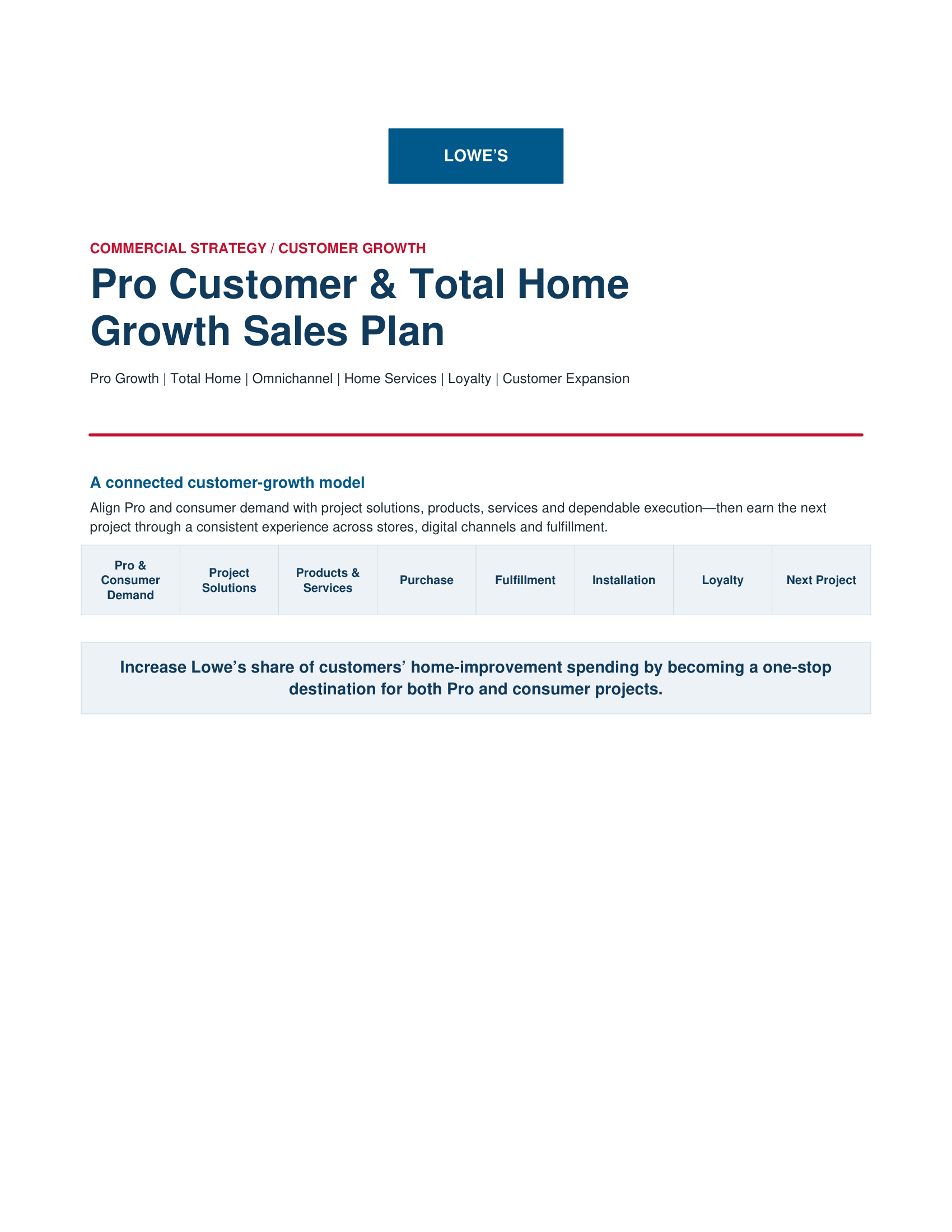
Expand customer relationships toward higher-value logistics solutions—connecting
customer demand to the breadth of the UPS network, service portfolio and digital
capabilities.
Global
Customer
Demand
Logistics
Solution
UPS
Network
Delivery &
Visibility
Cross-Sell
Customer
Retention
Global
Growth
A customer-led growth system spanning parcel, freight, international, healthcare and supply-chain needs.
UPS | GLOBAL LOGISTICS & CUSTOMER GROWTH SALES PLAN
2
1. Sales Plan Overview
Commercial direction
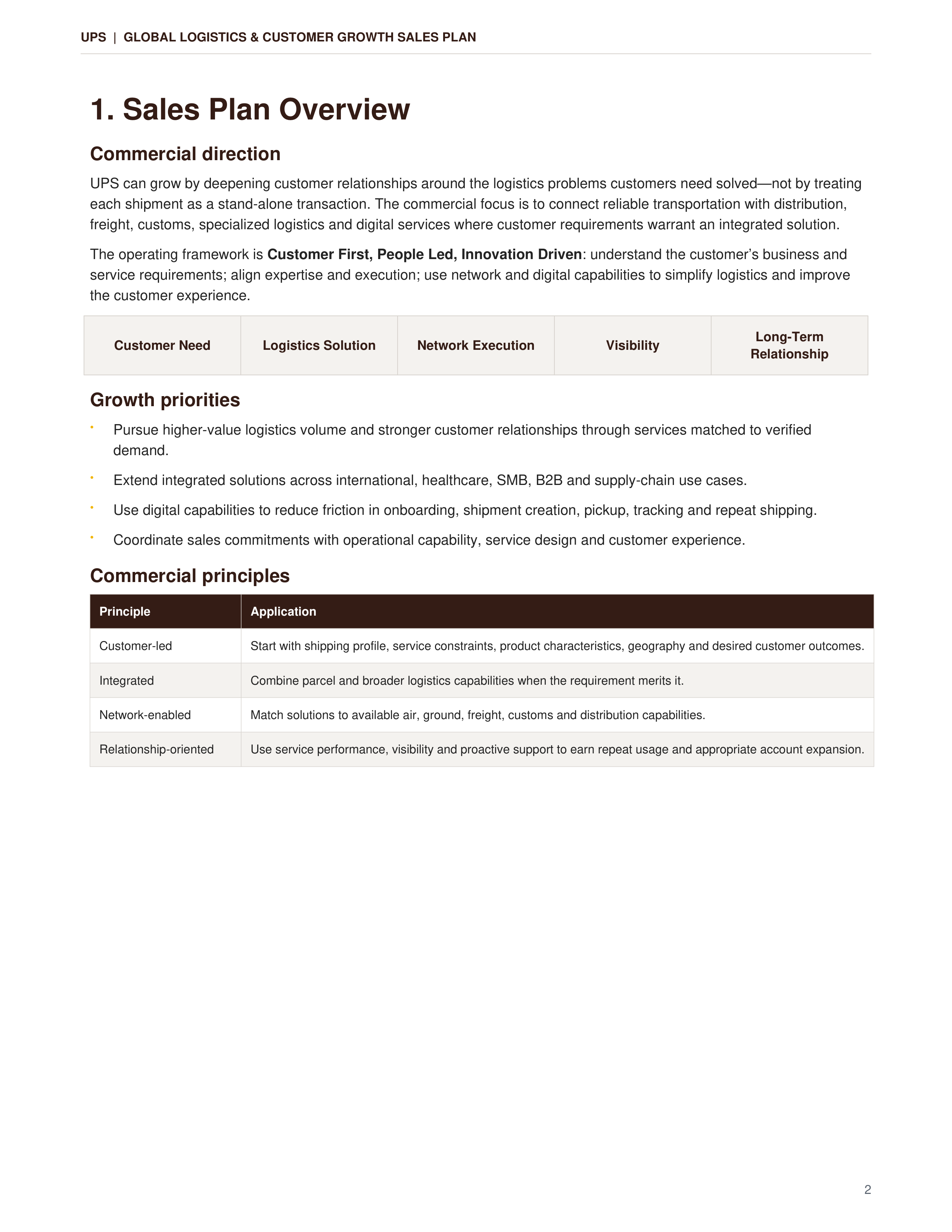
UPS can grow by deepening customer relationships around the logistics problems customers need solved—not by treating
each shipment as a stand-alone transaction. The commercial focus is to connect reliable transportation with distribution,
freight, customs, specialized logistics and digital services where customer requirements warrant an integrated solution.
The operating framework is
Customer First, People Led, Innovation Driven
: understand the customer’s business and
service requirements; align expertise and execution; use network and digital capabilities to simplify logistics and improve
the customer experience.
Customer Need
Logistics Solution
Network Execution
Visibility
Long-Term
Relationship
Growth priorities
•
Pursue higher-value logistics volume and stronger customer relationships through services matched to verified
demand.
•
Extend integrated solutions across international, healthcare, SMB, B2B and supply-chain use cases.
•
Use digital capabilities to reduce friction in onboarding, shipment creation, pickup, tracking and repeat shipping.
•
Coordinate sales commitments with operational capability, service design and customer experience.
Commercial principles
Principle
Application
Customer-led
Start with shipping profile, service constraints, product characteristics, geography and desired customer outcomes.
Integrated
Combine parcel and broader logistics capabilities when the requirement merits it.
Network-enabled
Match solutions to available air, ground, freight, customs and distribution capabilities.
Relationship-oriented
Use service performance, visibility and proactive support to earn repeat usage and appropriate account expansion.
UPS | GLOBAL LOGISTICS & CUSTOMER GROWTH SALES PLAN
3
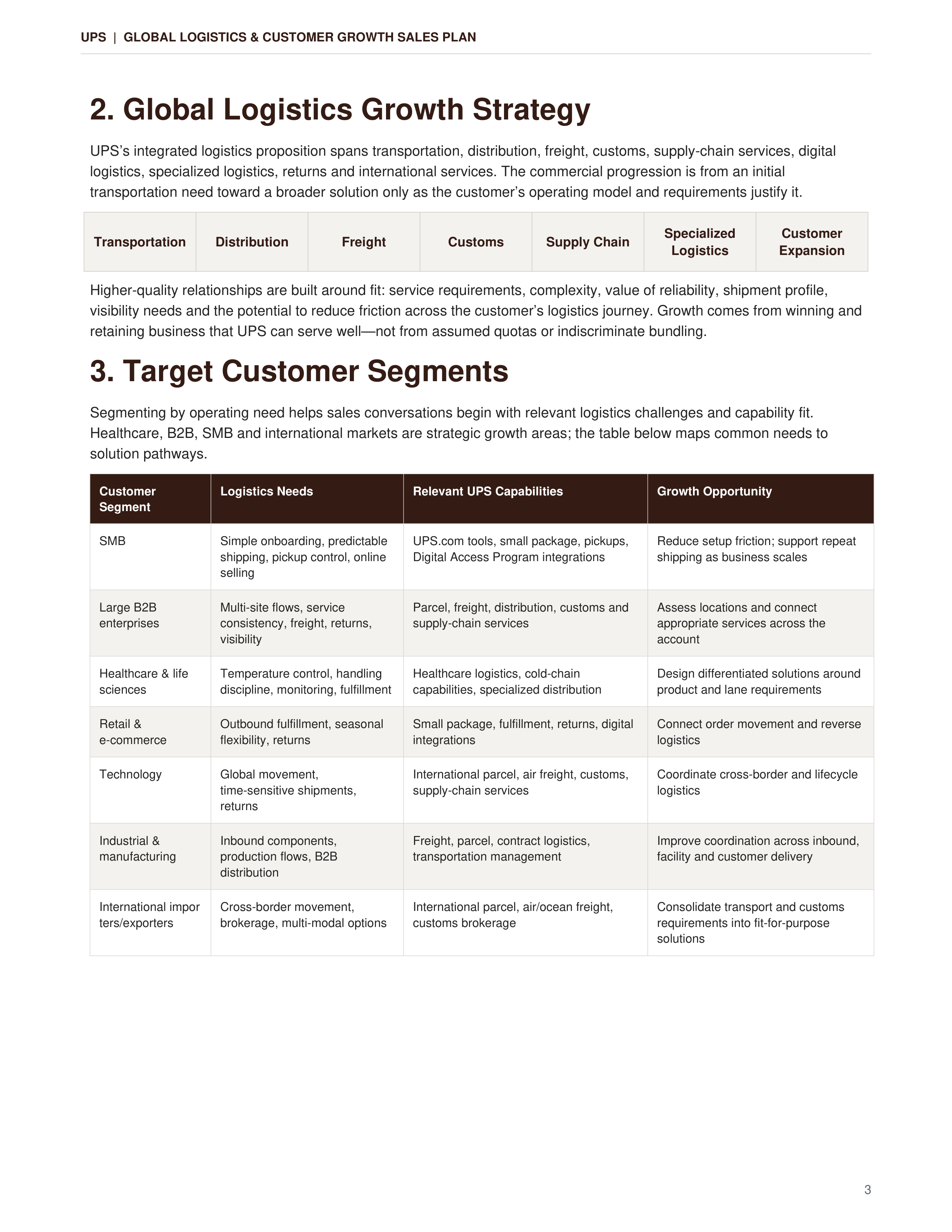
2. Global Logistics Growth Strategy
UPS’s integrated logistics proposition spans transportation, distribution, freight, customs, supply-chain services, digital
logistics, specialized logistics, returns and international services. The commercial progression is from an initial
transportation need toward a broader solution only as the customer’s operating model and requirements justify it.
Transportation
Distribution
Freight
Customs
Supply Chain
Specialized
Logistics
Customer
Expansion
Higher-quality relationships are built around fit: service requirements, complexity, value of reliability, shipment profile,
visibility needs and the potential to reduce friction across the customer’s logistics journey. Growth comes from winning and
retaining business that UPS can serve well—not from assumed quotas or indiscriminate bundling.
3. Target Customer Segments
Segmenting by operating need helps sales conversations begin with relevant logistics challenges and capability fit.
Healthcare, B2B, SMB and international markets are strategic growth areas; the table below maps common needs to
solution pathways.
Customer
Segment
Logistics Needs
Relevant UPS Capabilities
Growth Opportunity
SMB
Simple onboarding, predictable
shipping, pickup control, online
selling
UPS.com tools, small package, pickups,
Digital Access Program integrations
Reduce setup friction; support repeat
shipping as business scales
Large B2B
enterprises
Multi-site flows, service
consistency, freight, returns,
visibility
Parcel, freight, distribution, customs and
supply-chain services
Assess locations and connect
appropriate services across the
account
Healthcare & life
sciences
Temperature control, handling
discipline, monitoring, fulfillment
Healthcare logistics, cold-chain
capabilities, specialized distribution
Design differentiated solutions around
product and lane requirements
Retail &
e-commerce
Outbound fulfillment, seasonal
flexibility, returns
Small package, fulfillment, returns, digital
integrations
Connect order movement and reverse
logistics
Technology
Global movement,
time-sensitive shipments,
returns
International parcel, air freight, customs,
supply-chain services
Coordinate cross-border and lifecycle
logistics
Industrial &
manufacturing
Inbound components,
production flows, B2B
distribution
Freight, parcel, contract logistics,
transportation management
Improve coordination across inbound,
facility and customer delivery
International impor
ters/exporters
Cross-border movement,
brokerage, multi-modal options
International parcel, air/ocean freight,
customs brokerage
Consolidate transport and customs
requirements into fit-for-purpose
solutions
UPS | GLOBAL LOGISTICS & CUSTOMER GROWTH SALES PLAN
4
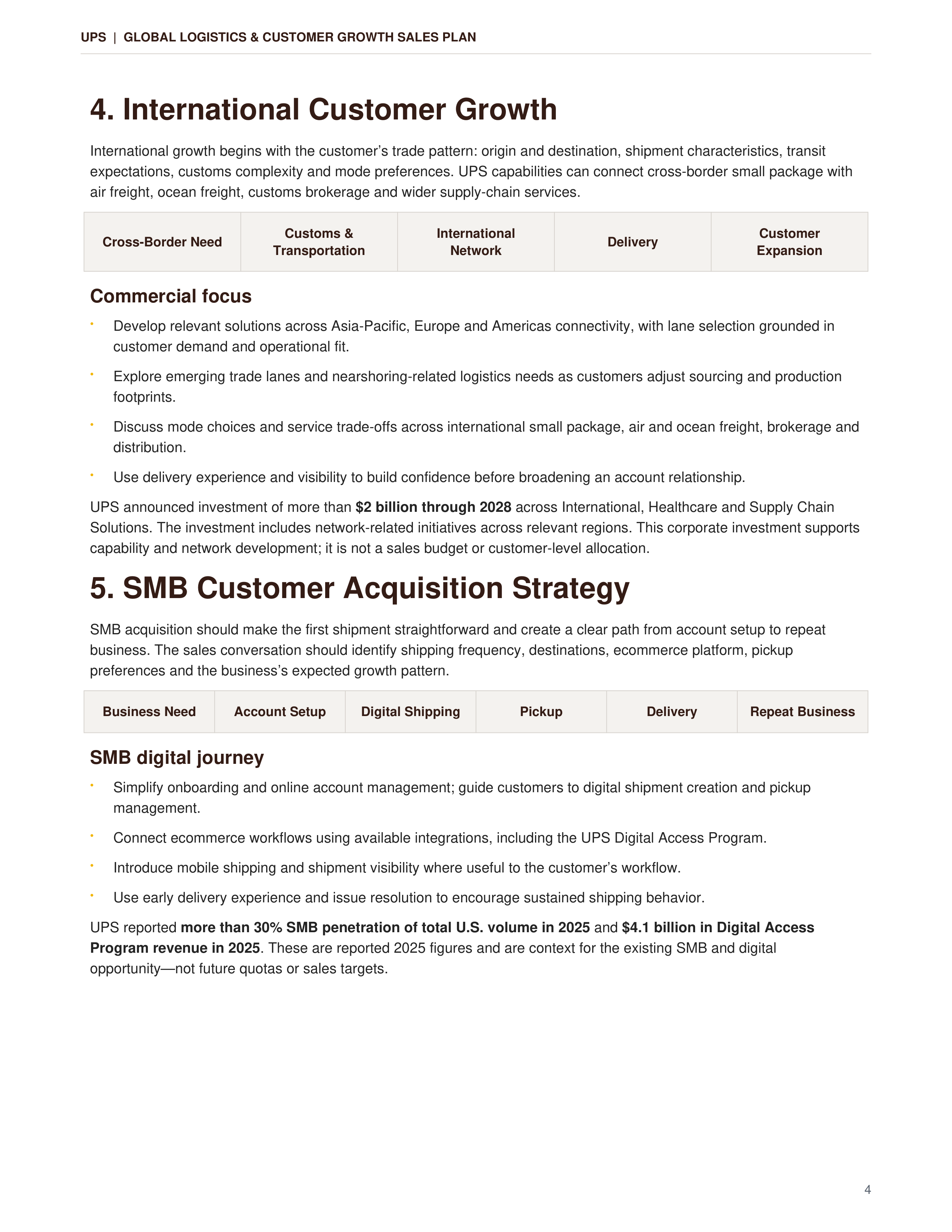
4. International Customer Growth
International growth begins with the customer’s trade pattern: origin and destination, shipment characteristics, transit
expectations, customs complexity and mode preferences. UPS capabilities can connect cross-border small package with
air freight, ocean freight, customs brokerage and wider supply-chain services.
Cross-Border Need
Customs &
Transportation
International
Network
Delivery
Customer
Expansion
Commercial focus
•
Develop relevant solutions across Asia-Pacific, Europe and Americas connectivity, with lane selection grounded in
customer demand and operational fit.
•
Explore emerging trade lanes and nearshoring-related logistics needs as customers adjust sourcing and production
footprints.
•
Discuss mode choices and service trade-offs across international small package, air and ocean freight, brokerage and
distribution.
•
Use delivery experience and visibility to build confidence before broadening an account relationship.
UPS announced investment of more than
$2 billion through 2028
across International, Healthcare and Supply Chain
Solutions. The investment includes network-related initiatives across relevant regions. This corporate investment supports
capability and network development; it is not a sales budget or customer-level allocation.
5. SMB Customer Acquisition Strategy
SMB acquisition should make the first shipment straightforward and create a clear path from account setup to repeat
business. The sales conversation should identify shipping frequency, destinations, ecommerce platform, pickup
preferences and the business’s expected growth pattern.
Business Need
Account Setup
Digital Shipping
Pickup
Delivery
Repeat Business
SMB digital journey
•
Simplify onboarding and online account management; guide customers to digital shipment creation and pickup
management.
•
Connect ecommerce workflows using available integrations, including the UPS Digital Access Program.
•
Introduce mobile shipping and shipment visibility where useful to the customer’s workflow.
•
Use early delivery experience and issue resolution to encourage sustained shipping behavior.
UPS reported
more than 30% SMB penetration of total U.S. volume in 2025
and
$4.1 billion in Digital Access
Program revenue in 2025
. These are reported 2025 figures and are context for the existing SMB and digital
opportunity—not future quotas or sales targets.
UPS | GLOBAL LOGISTICS & CUSTOMER GROWTH SALES PLAN
5
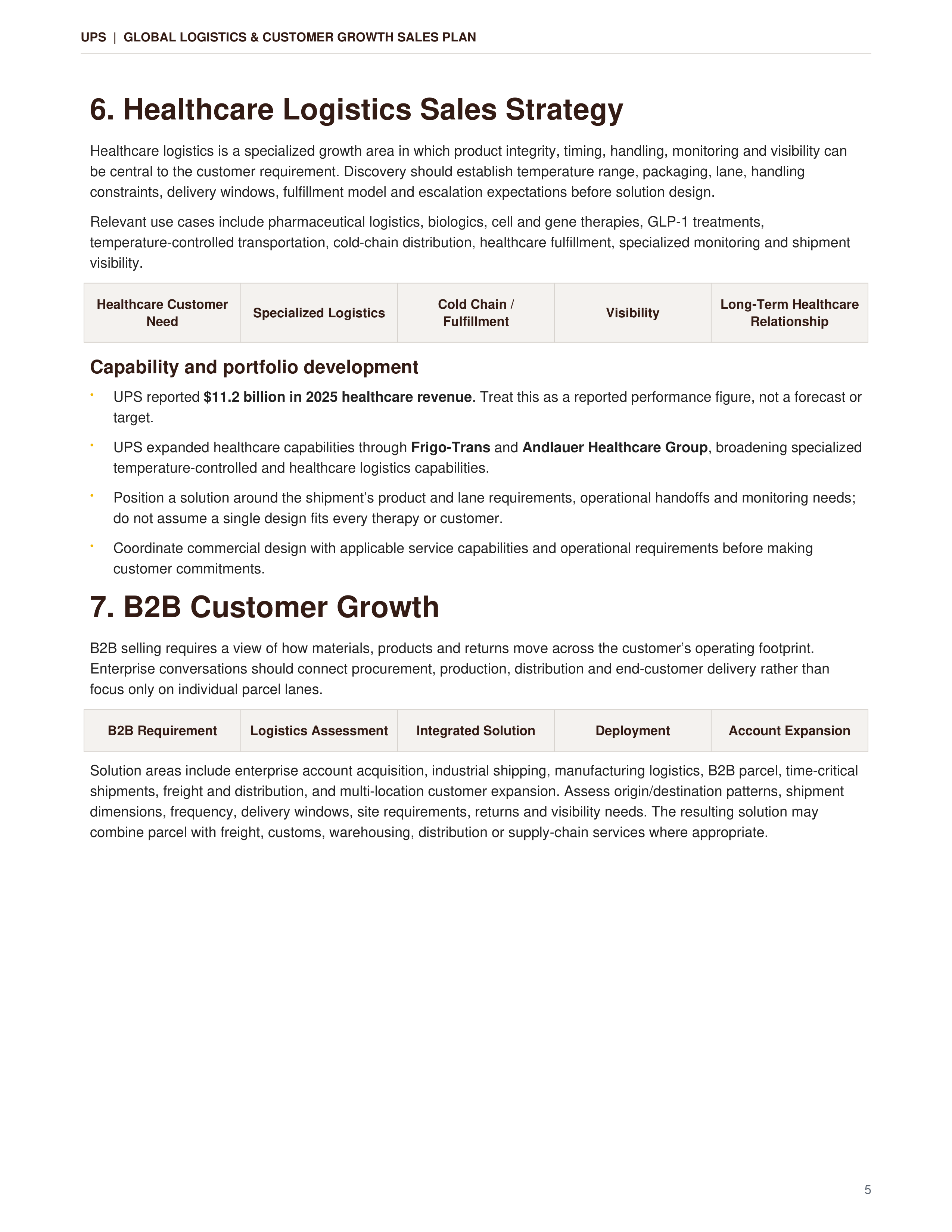
6. Healthcare Logistics Sales Strategy
Healthcare logistics is a specialized growth area in which product integrity, timing, handling, monitoring and visibility can
be central to the customer requirement. Discovery should establish temperature range, packaging, lane, handling
constraints, delivery windows, fulfillment model and escalation expectations before solution design.
Relevant use cases include pharmaceutical logistics, biologics, cell and gene therapies, GLP-1 treatments,
temperature-controlled transportation, cold-chain distribution, healthcare fulfillment, specialized monitoring and shipment
visibility.
Healthcare Customer
Need
Specialized Logistics
Cold Chain /
Fulfillment
Visibility
Long-Term Healthcare
Relationship
Capability and portfolio development
•
UPS reported
$11.2 billion in 2025 healthcare revenue
. Treat this as a reported performance figure, not a forecast or
target.
•
UPS expanded healthcare capabilities through
Frigo-Trans
and
Andlauer Healthcare Group
, broadening specialized
temperature-controlled and healthcare logistics capabilities.
•
Position a solution around the shipment’s product and lane requirements, operational handoffs and monitoring needs;
do not assume a single design fits every therapy or customer.
•
Coordinate commercial design with applicable service capabilities and operational requirements before making
customer commitments.
7. B2B Customer Growth
B2B selling requires a view of how materials, products and returns move across the customer’s operating footprint.
Enterprise conversations should connect procurement, production, distribution and end-customer delivery rather than
focus only on individual parcel lanes.
B2B Requirement
Logistics Assessment
Integrated Solution
Deployment
Account Expansion
Solution areas include enterprise account acquisition, industrial shipping, manufacturing logistics, B2B parcel, time-critical
shipments, freight and distribution, and multi-location customer expansion. Assess origin/destination patterns, shipment
dimensions, frequency, delivery windows, site requirements, returns and visibility needs. The resulting solution may
combine parcel with freight, customs, warehousing, distribution or supply-chain services where appropriate.
UPS | GLOBAL LOGISTICS & CUSTOMER GROWTH SALES PLAN
6
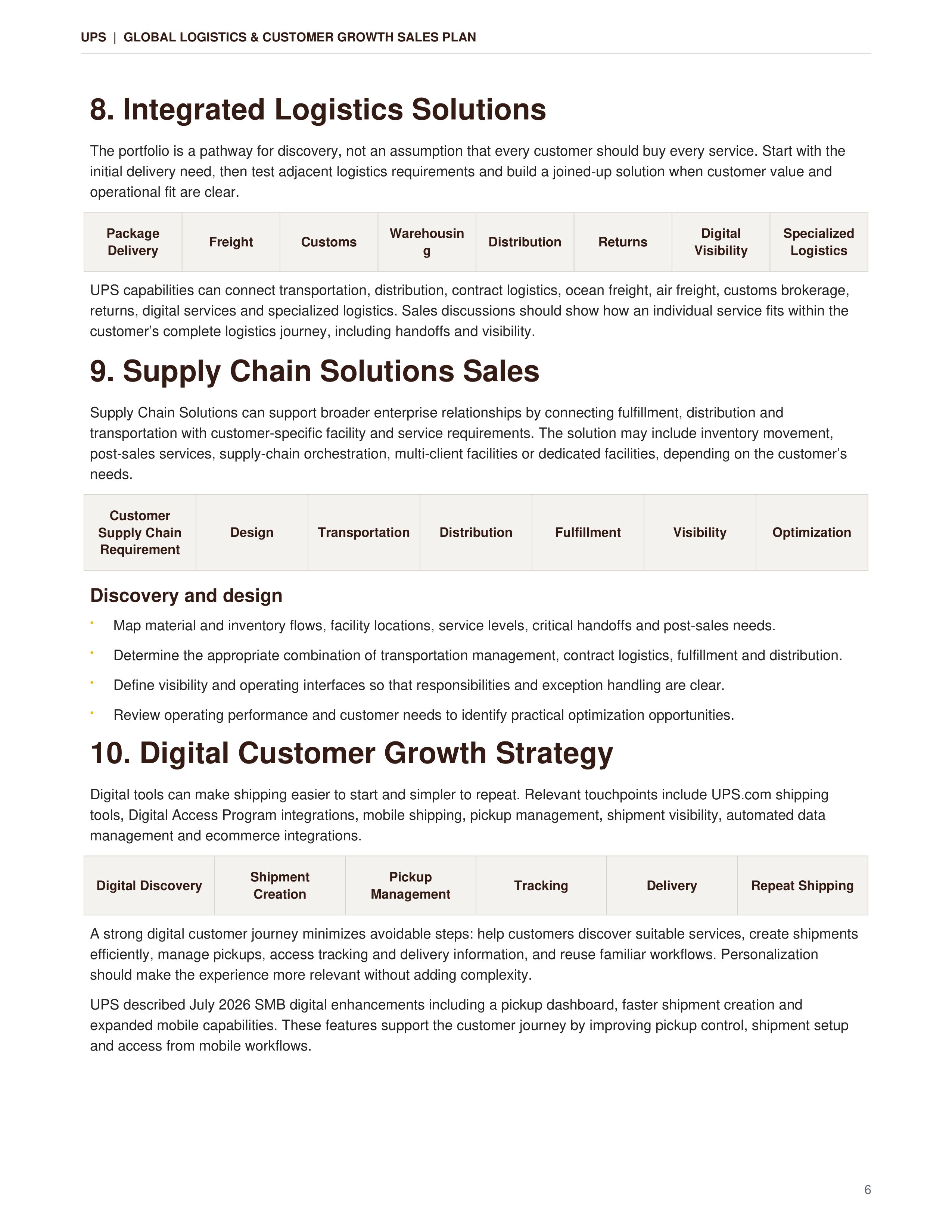
8. Integrated Logistics Solutions
The portfolio is a pathway for discovery, not an assumption that every customer should buy every service. Start with the
initial delivery need, then test adjacent logistics requirements and build a joined-up solution when customer value and
operational fit are clear.
Package
Delivery
Freight
Customs
Warehousin
g
Distribution
Returns
Digital
Visibility
Specialized
Logistics
UPS capabilities can connect transportation, distribution, contract logistics, ocean freight, air freight, customs brokerage,
returns, digital services and specialized logistics. Sales discussions should show how an individual service fits within the
customer’s complete logistics journey, including handoffs and visibility.
9. Supply Chain Solutions Sales
Supply Chain Solutions can support broader enterprise relationships by connecting fulfillment, distribution and
transportation with customer-specific facility and service requirements. The solution may include inventory movement,
post-sales services, supply-chain orchestration, multi-client facilities or dedicated facilities, depending on the customer’s
needs.
Customer
Supply Chain
Requirement
Design
Transportation
Distribution
Fulfillment
Visibility
Optimization
Discovery and design
•
Map material and inventory flows, facility locations, service levels, critical handoffs and post-sales needs.
•
Determine the appropriate combination of transportation management, contract logistics, fulfillment and distribution.
•
Define visibility and operating interfaces so that responsibilities and exception handling are clear.
•
Review operating performance and customer needs to identify practical optimization opportunities.
10. Digital Customer Growth Strategy
Digital tools can make shipping easier to start and simpler to repeat. Relevant touchpoints include UPS.com shipping
tools, Digital Access Program integrations, mobile shipping, pickup management, shipment visibility, automated data
management and ecommerce integrations.
Digital Discovery
Shipment
Creation
Pickup
Management
Tracking
Delivery
Repeat Shipping
A strong digital customer journey minimizes avoidable steps: help customers discover suitable services, create shipments
efficiently, manage pickups, access tracking and delivery information, and reuse familiar workflows. Personalization
should make the experience more relevant without adding complexity.
UPS described July 2026 SMB digital enhancements including a pickup dashboard, faster shipment creation and
expanded mobile capabilities. These features support the customer journey by improving pickup control, shipment setup
and access from mobile workflows.
UPS | GLOBAL LOGISTICS & CUSTOMER GROWTH SALES PLAN
7
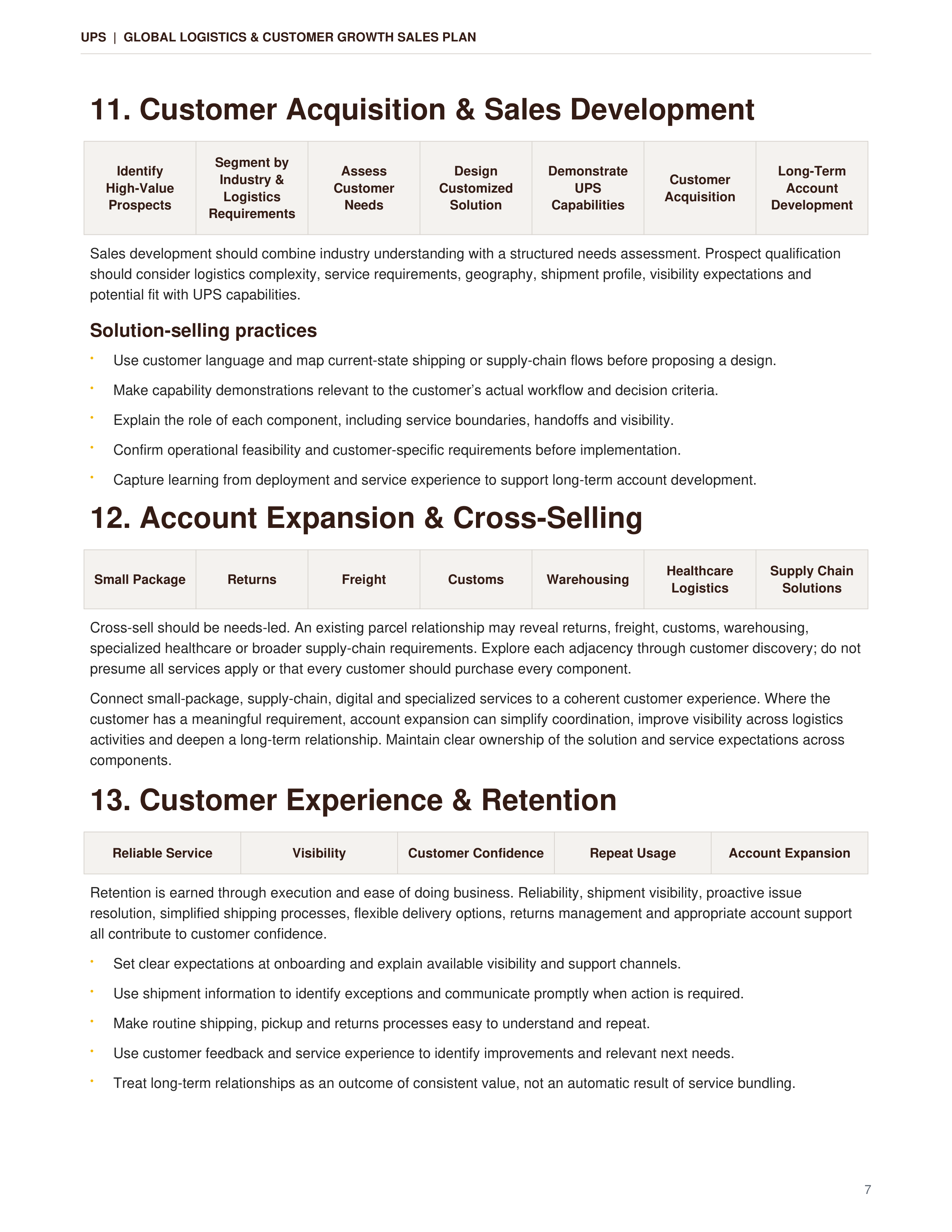
11. Customer Acquisition & Sales Development
Identify
High-Value
Prospects
Segment by
Industry &
Logistics
Requirements
Assess
Customer
Needs
Design
Customized
Solution
Demonstrate
UPS
Capabilities
Customer
Acquisition
Long-Term
Account
Development
Sales development should combine industry understanding with a structured needs assessment. Prospect qualification
should consider logistics complexity, service requirements, geography, shipment profile, visibility expectations and
potential fit with UPS capabilities.
Solution-selling practices
•
Use customer language and map current-state shipping or supply-chain flows before proposing a design.
•
Make capability demonstrations relevant to the customer’s actual workflow and decision criteria.
•
Explain the role of each component, including service boundaries, handoffs and visibility.
•
Confirm operational feasibility and customer-specific requirements before implementation.
•
Capture learning from deployment and service experience to support long-term account development.
12. Account Expansion & Cross-Selling
Small Package
Returns
Freight
Customs
Warehousing
Healthcare
Logistics
Supply Chain
Solutions
Cross-sell should be needs-led. An existing parcel relationship may reveal returns, freight, customs, warehousing,
specialized healthcare or broader supply-chain requirements. Explore each adjacency through customer discovery; do not
presume all services apply or that every customer should purchase every component.
Connect small-package, supply-chain, digital and specialized services to a coherent customer experience. Where the
customer has a meaningful requirement, account expansion can simplify coordination, improve visibility across logistics
activities and deepen a long-term relationship. Maintain clear ownership of the solution and service expectations across
components.
13. Customer Experience & Retention
Reliable Service
Visibility
Customer Confidence
Repeat Usage
Account Expansion
Retention is earned through execution and ease of doing business. Reliability, shipment visibility, proactive issue
resolution, simplified shipping processes, flexible delivery options, returns management and appropriate account support
all contribute to customer confidence.
•
Set clear expectations at onboarding and explain available visibility and support channels.
•
Use shipment information to identify exceptions and communicate promptly when action is required.
•
Make routine shipping, pickup and returns processes easy to understand and repeat.
•
Use customer feedback and service experience to identify improvements and relevant next needs.
•
Treat long-term relationships as an outcome of consistent value, not an automatic result of service bundling.
UPS | GLOBAL LOGISTICS & CUSTOMER GROWTH SALES PLAN
8
14. Network & Operational Sales Enablement
Network capabilities underpin the customer promise and should be translated into clear, supportable customer benefits.
Sales teams can explain how integrated air and ground transportation, automated facilities, regional hubs, network
optimization and package-level visibility support movement through the network.
Relevant enablement capabilities include automated facilities; an integrated air and ground network; RFID package
visibility; network optimization; regional hubs; international connectivity; and the operational expertise needed to support
specialized logistics. Describe the capability in relation to the customer’s lane, handling and visibility requirements rather
than as a generic feature list.
Commercial-to-operational alignment
Sales enablement practice
Customer impact
Validate the requirement
Align service design to shipment characteristics, lanes, timing and handling needs.
Confirm operational fit
Ensure network and specialized capabilities can support the proposed solution before commitment.
Make visibility actionable
Explain tracking and information flows and how exceptions are managed.
Coordinate handoffs
Clarify interfaces among parcel, freight, customs, distribution and specialized services.
Close the feedback loop
Use service experience to refine the solution and customer communication.
Commercial measures for disciplined growth
Review performance using established company reporting and customer outcomes: customer retention, service
experience, digital adoption, relevant solution attachment, international and healthcare growth, and progress in SMB and
B2B relationships. Measurement should use approved internal definitions and reporting; this plan introduces no new
quotas, revenue targets or market-share goals.
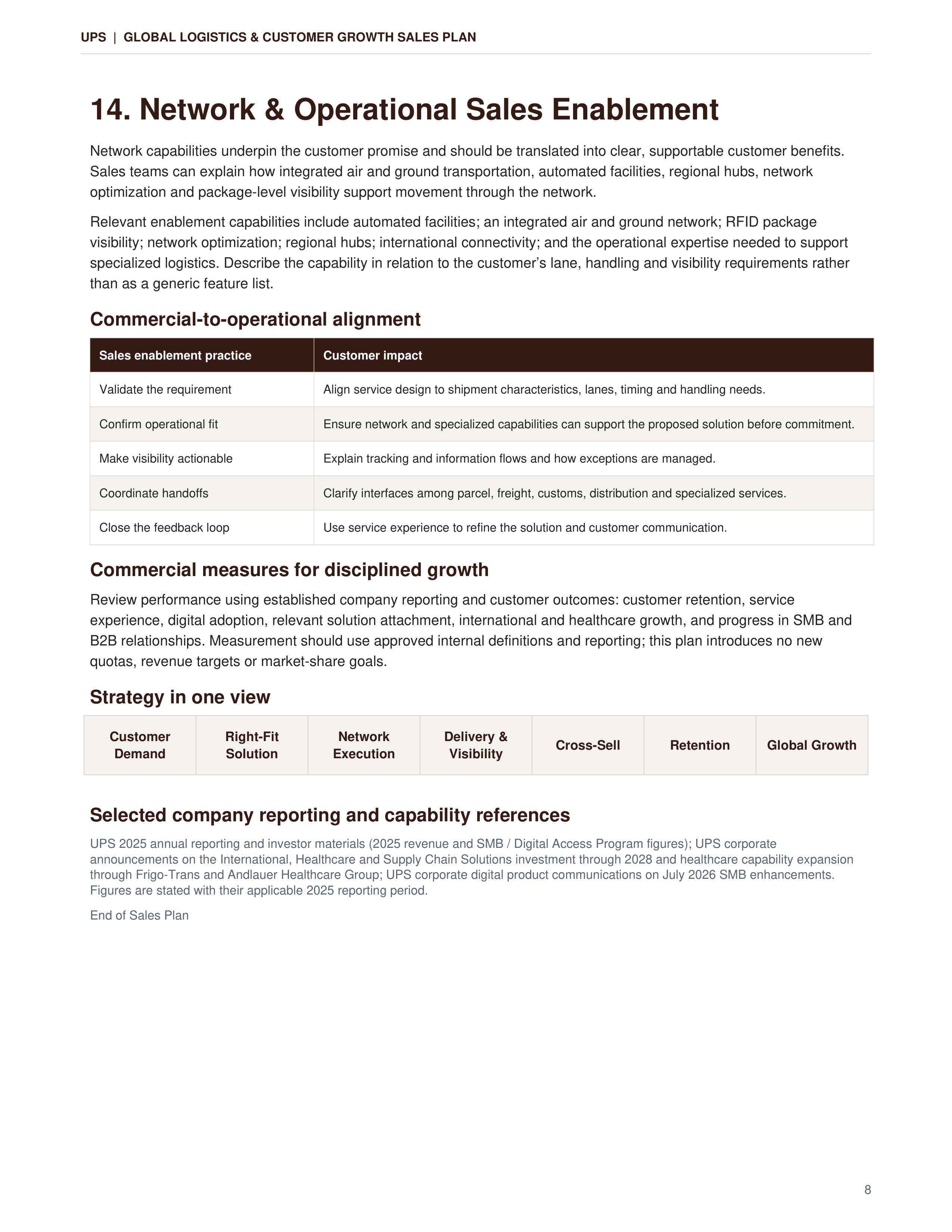
Strategy in one view
Customer
Demand
Right-Fit
Solution
Network
Execution
Delivery &
Visibility
Cross-Sell
Retention
Global Growth
Selected company reporting and capability references
UPS 2025 annual reporting and investor materials (2025 revenue and SMB / Digital Access Program figures); UPS corporate
announcements on the International, Healthcare and Supply Chain Solutions investment through 2028 and healthcare capability expansion
through Frigo-Trans and Andlauer Healthcare Group; UPS corporate digital product communications on July 2026 SMB enhancements.
Figures are stated with their applicable 2025 reporting period.
End of Sales Plan