TYSON FOODS
Branded Protein Portfolio
& Customer Growth Sales Plan
Chicken | Prepared Foods | Brands | Customer Partnerships | Innovation | Global Growth
Consumer Demand → Protein Innovation → Branded Products → Customer
Partnerships → Distribution → Consumer Purchase → Portfolio Growth
FY2026–FY2027
TYSON FOODS | BRANDED PROTEIN PORTFOLIO & CUSTOMER GROWTH
SALES PLAN • FY2026–FY2027
2
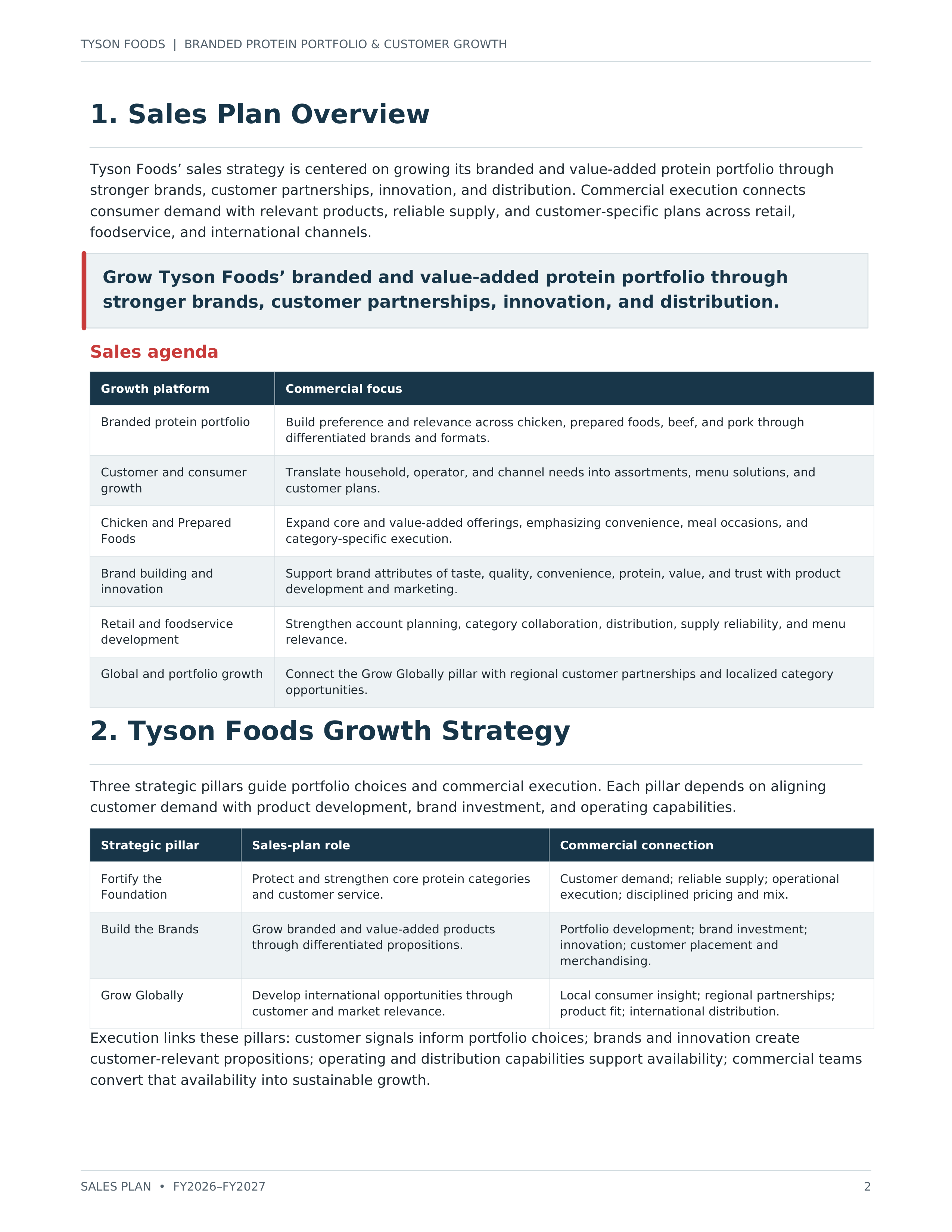
1. Sales Plan Overview
Tyson Foods’ sales strategy is centered on growing its branded and value-added protein portfolio through
stronger brands, customer partnerships, innovation, and distribution. Commercial execution connects
consumer demand with relevant products, reliable supply, and customer-specific plans across retail,
foodservice, and international channels.
Grow Tyson Foods’ branded and value-added protein portfolio through
stronger brands, customer partnerships, innovation, and distribution.
Sales agenda
Growth platform
Commercial focus
Branded protein portfolio
Build preference and relevance across chicken, prepared foods, beef, and pork through
differentiated brands and formats.
Customer and consumer
growth
Translate household, operator, and channel needs into assortments, menu solutions, and
customer plans.
Chicken and Prepared
Foods
Expand core and value-added offerings, emphasizing convenience, meal occasions, and
category-specific execution.
Brand building and
innovation
Support brand attributes of taste, quality, convenience, protein, value, and trust with product
development and marketing.
Retail and foodservice
development
Strengthen account planning, category collaboration, distribution, supply reliability, and menu
relevance.
Global and portfolio growth
Connect the Grow Globally pillar with regional customer partnerships and localized category
opportunities.
2. Tyson Foods Growth Strategy
Three strategic pillars guide portfolio choices and commercial execution. Each pillar depends on aligning
customer demand with product development, brand investment, and operating capabilities.
Strategic pillar
Sales-plan role
Commercial connection
Fortify the
Foundation
Protect and strengthen core protein categories
and customer service.
Customer demand; reliable supply; operational
execution; disciplined pricing and mix.
Build the Brands
Grow branded and value-added products
through differentiated propositions.
Portfolio development; brand investment;
innovation; customer placement and
merchandising.
Grow Globally
Develop international opportunities through
customer and market relevance.
Local consumer insight; regional partnerships;
product fit; international distribution.
Execution links these pillars: customer signals inform portfolio choices; brands and innovation create
customer-relevant propositions; operating and distribution capabilities support availability; commercial teams
convert that availability into sustainable growth.
TYSON FOODS | BRANDED PROTEIN PORTFOLIO & CUSTOMER GROWTH
SALES PLAN • FY2026–FY2027
3
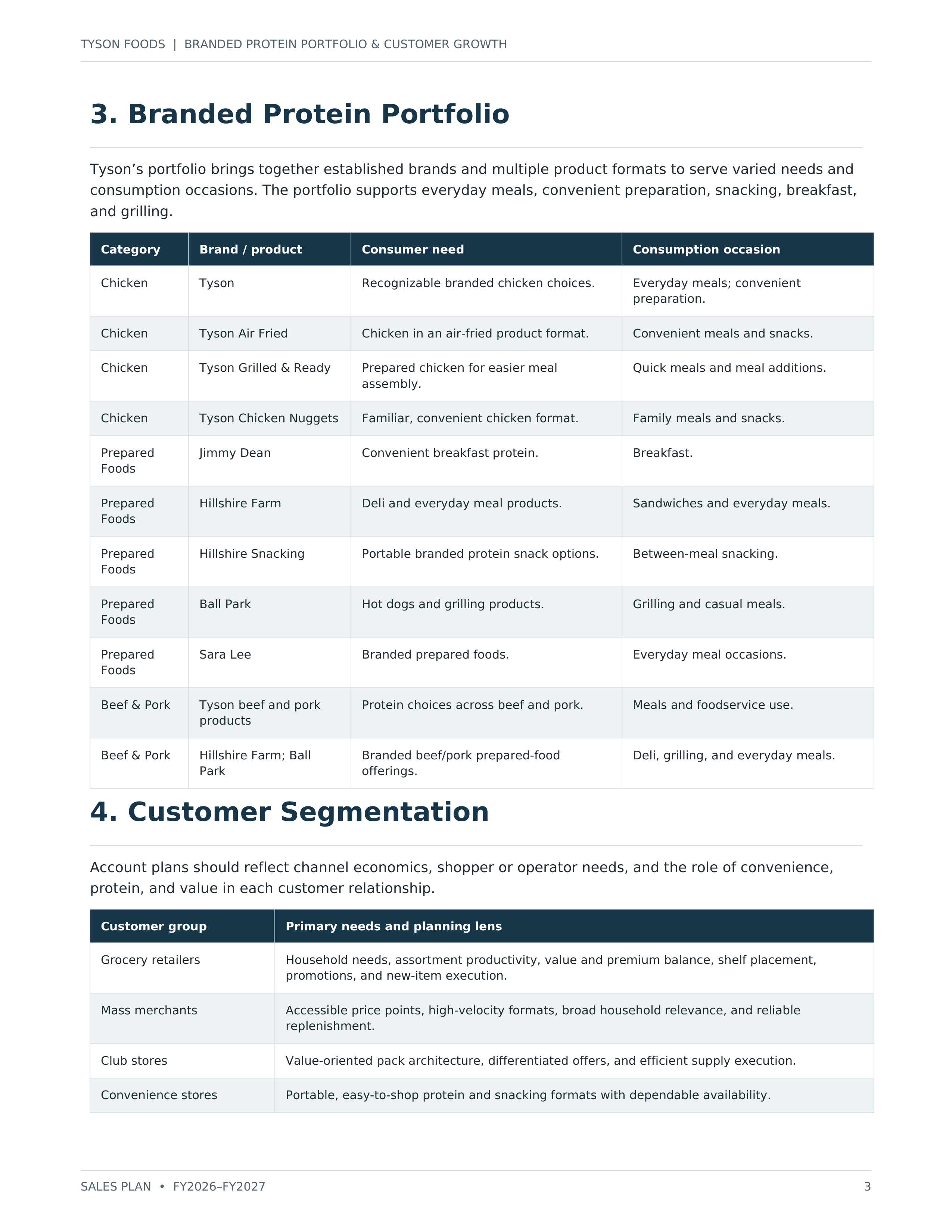
3. Branded Protein Portfolio
Tyson’s portfolio brings together established brands and multiple product formats to serve varied needs and
consumption occasions. The portfolio supports everyday meals, convenient preparation, snacking, breakfast,
and grilling.
Category
Brand / product
Consumer need
Consumption occasion
Chicken
Tyson
Recognizable branded chicken choices.
Everyday meals; convenient
preparation.
Chicken
Tyson Air Fried
Chicken in an air-fried product format.
Convenient meals and snacks.
Chicken
Tyson Grilled & Ready
Prepared chicken for easier meal
assembly.
Quick meals and meal additions.
Chicken
Tyson Chicken Nuggets
Familiar, convenient chicken format.
Family meals and snacks.
Prepared
Foods
Jimmy Dean
Convenient breakfast protein.
Breakfast.
Prepared
Foods
Hillshire Farm
Deli and everyday meal products.
Sandwiches and everyday meals.
Prepared
Foods
Hillshire Snacking
Portable branded protein snack options.
Between-meal snacking.
Prepared
Foods
Ball Park
Hot dogs and grilling products.
Grilling and casual meals.
Prepared
Foods
Sara Lee
Branded prepared foods.
Everyday meal occasions.
Beef & Pork
Tyson beef and pork
products
Protein choices across beef and pork.
Meals and foodservice use.
Beef & Pork
Hillshire Farm; Ball
Park
Branded beef/pork prepared-food
offerings.
Deli, grilling, and everyday meals.
4. Customer Segmentation
Account plans should reflect channel economics, shopper or operator needs, and the role of convenience,
protein, and value in each customer relationship.
Customer group
Primary needs and planning lens
Grocery retailers
Household needs, assortment productivity, value and premium balance, shelf placement,
promotions, and new-item execution.
Mass merchants
Accessible price points, high-velocity formats, broad household relevance, and reliable
replenishment.
Club stores
Value-oriented pack architecture, differentiated offers, and efficient supply execution.
Convenience stores
Portable, easy-to-shop protein and snacking formats with dependable availability.
TYSON FOODS | BRANDED PROTEIN PORTFOLIO & CUSTOMER GROWTH
SALES PLAN • FY2026–FY2027
4
Customer group
Primary needs and planning lens
Foodservice operators and
restaurants
Menu fit, consistent supply, portion specifications, cost management, and operational ease.
Institutional foodservice
Nutrition and menu requirements, portion control, preparation consistency, and dependable
service.
Distributors
Product availability, demand planning, order reliability, and support for downstream customers.
International customers
Regional consumer fit, localized products, customer collaboration, and appropriate distribution.
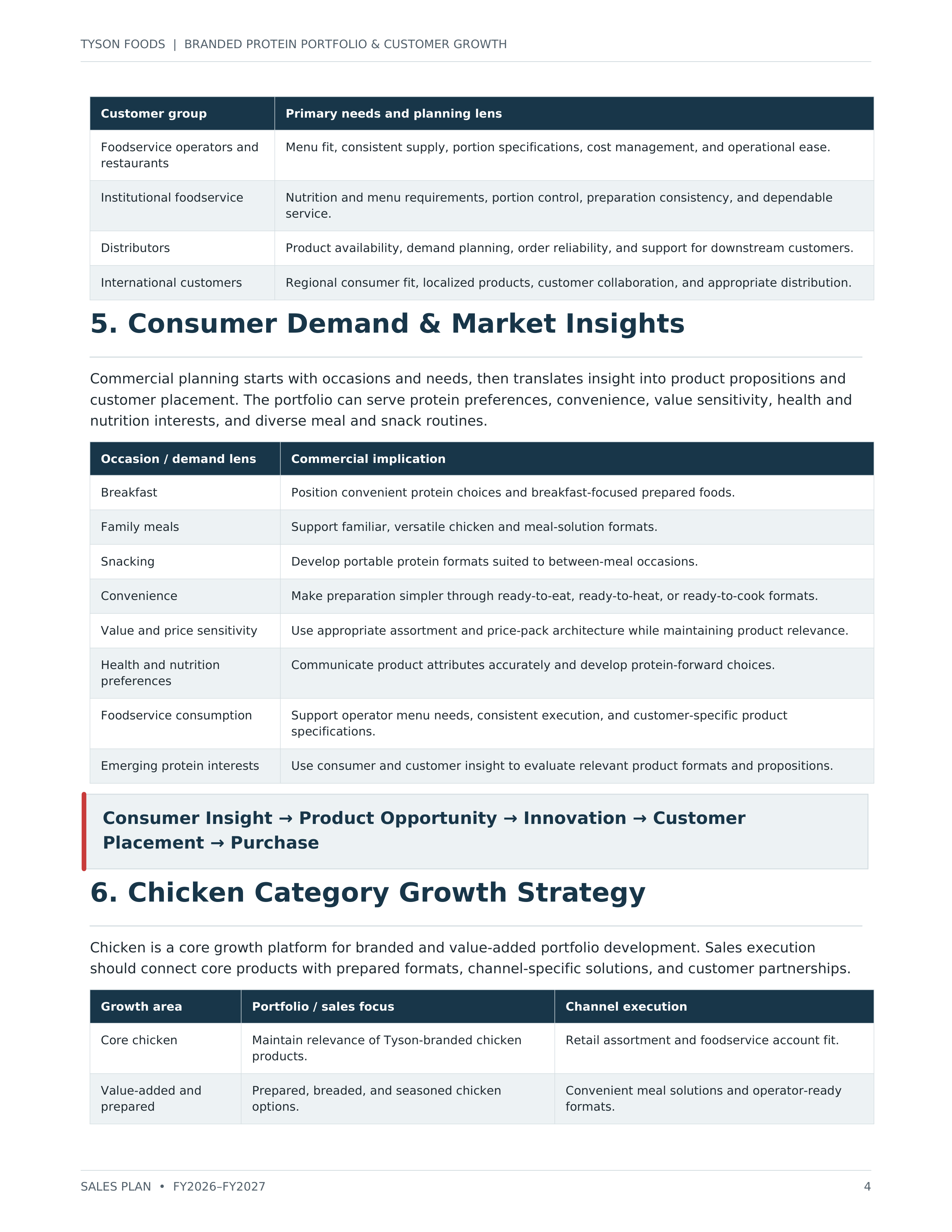
5. Consumer Demand & Market Insights
Commercial planning starts with occasions and needs, then translates insight into product propositions and
customer placement. The portfolio can serve protein preferences, convenience, value sensitivity, health and
nutrition interests, and diverse meal and snack routines.
Occasion / demand lens
Commercial implication
Breakfast
Position convenient protein choices and breakfast-focused prepared foods.
Family meals
Support familiar, versatile chicken and meal-solution formats.
Snacking
Develop portable protein formats suited to between-meal occasions.
Convenience
Make preparation simpler through ready-to-eat, ready-to-heat, or ready-to-cook formats.
Value and price sensitivity
Use appropriate assortment and price-pack architecture while maintaining product relevance.
Health and nutrition
preferences
Communicate product attributes accurately and develop protein-forward choices.
Foodservice consumption
Support operator menu needs, consistent execution, and customer-specific product
specifications.
Emerging protein interests
Use consumer and customer insight to evaluate relevant product formats and propositions.
Consumer Insight → Product Opportunity → Innovation → Customer
Placement → Purchase
6. Chicken Category Growth Strategy
Chicken is a core growth platform for branded and value-added portfolio development. Sales execution
should connect core products with prepared formats, channel-specific solutions, and customer partnerships.
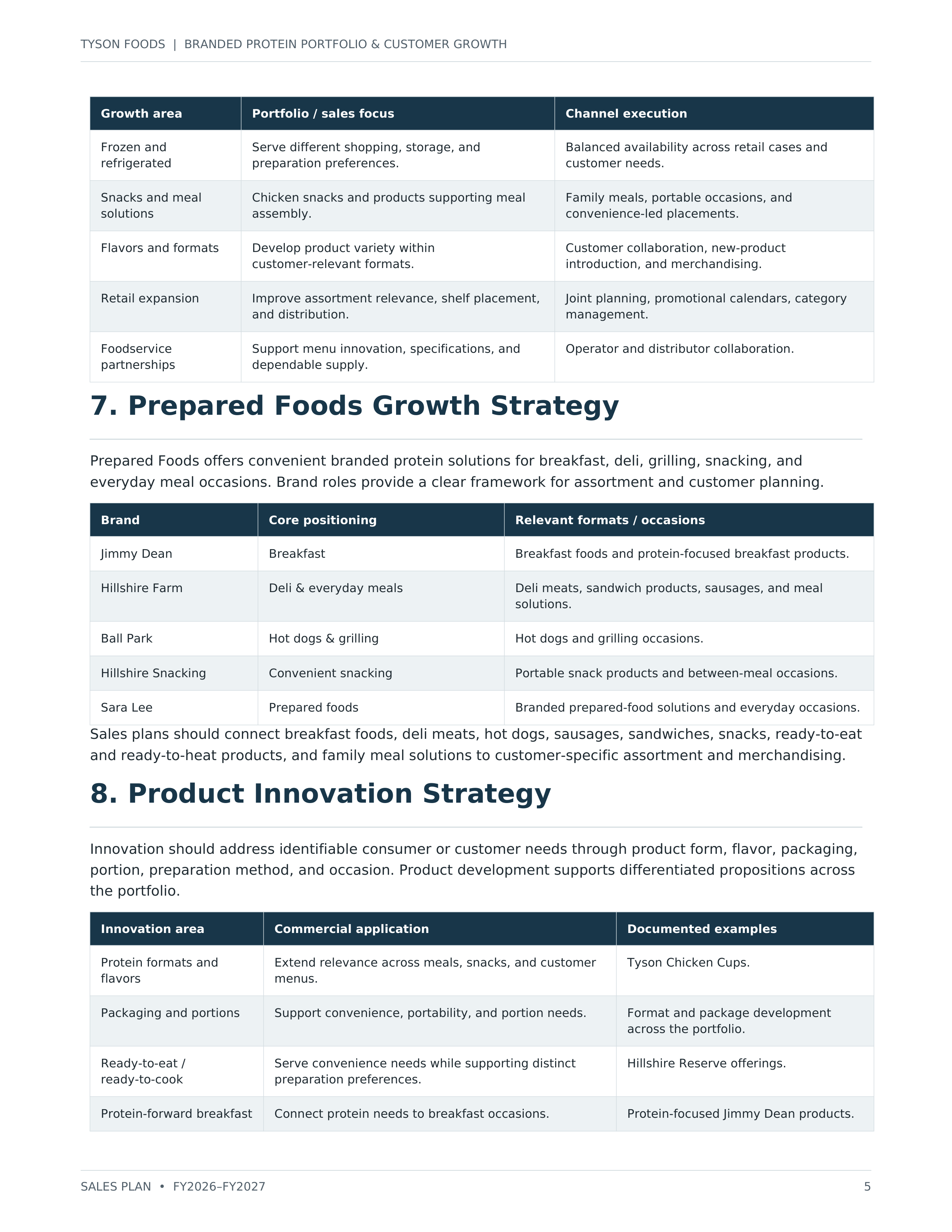
Growth area
Portfolio / sales focus
Channel execution
Core chicken
Maintain relevance of Tyson-branded chicken
products.
Retail assortment and foodservice account fit.
Value-added and
prepared
Prepared, breaded, and seasoned chicken
options.
Convenient meal solutions and operator-ready
formats.
TYSON FOODS | BRANDED PROTEIN PORTFOLIO & CUSTOMER GROWTH
SALES PLAN • FY2026–FY2027
5
Growth area
Portfolio / sales focus
Channel execution
Frozen and
refrigerated
Serve different shopping, storage, and
preparation preferences.
Balanced availability across retail cases and
customer needs.
Snacks and meal
solutions
Chicken snacks and products supporting meal
assembly.
Family meals, portable occasions, and
convenience-led placements.
Flavors and formats
Develop product variety within
customer-relevant formats.
Customer collaboration, new-product
introduction, and merchandising.
Retail expansion
Improve assortment relevance, shelf placement,
and distribution.
Joint planning, promotional calendars, category
management.
Foodservice
partnerships
Support menu innovation, specifications, and
dependable supply.
Operator and distributor collaboration.
7. Prepared Foods Growth Strategy
Prepared Foods offers convenient branded protein solutions for breakfast, deli, grilling, snacking, and
everyday meal occasions. Brand roles provide a clear framework for assortment and customer planning.
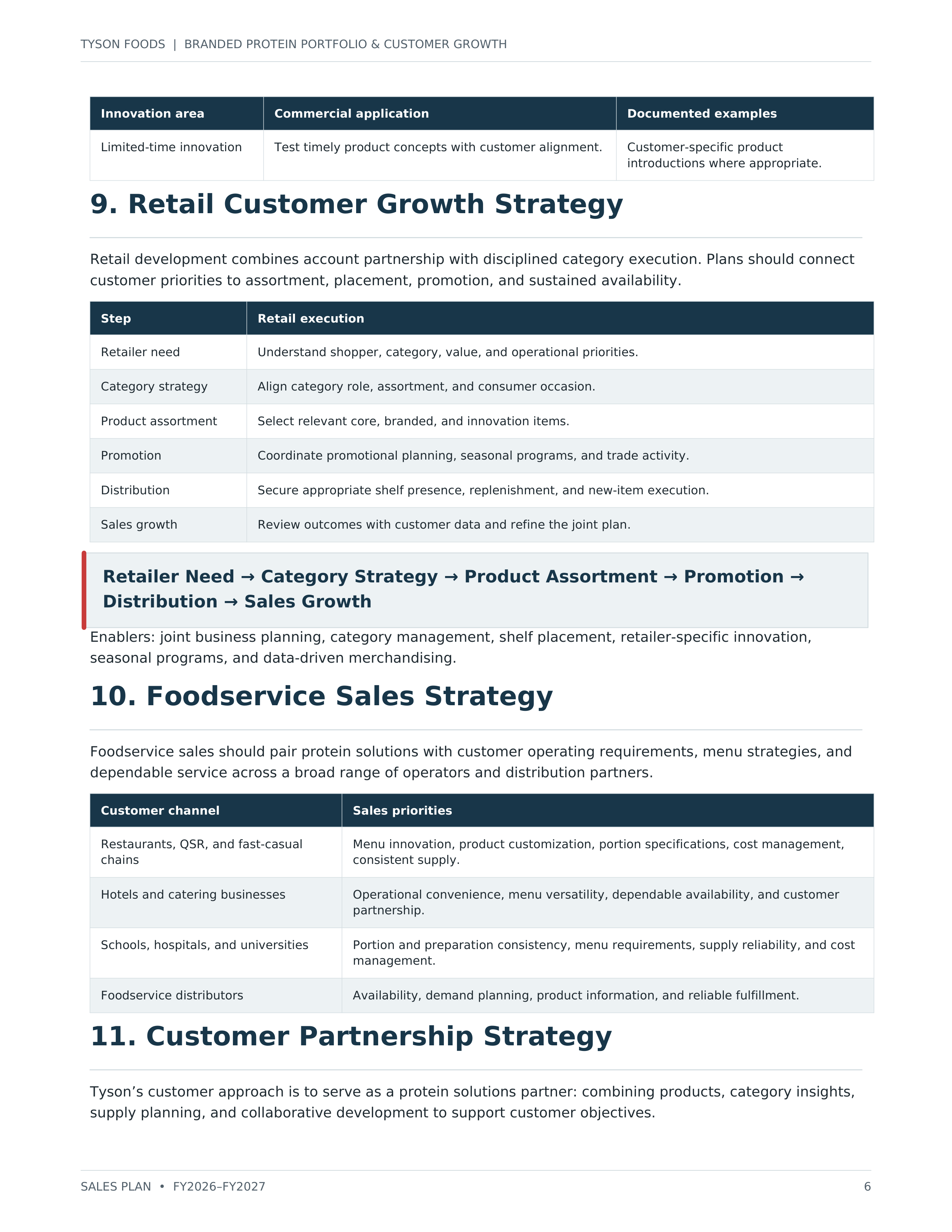
Brand
Core positioning
Relevant formats / occasions
Jimmy Dean
Breakfast
Breakfast foods and protein-focused breakfast products.
Hillshire Farm
Deli & everyday meals
Deli meats, sandwich products, sausages, and meal
solutions.
Ball Park
Hot dogs & grilling
Hot dogs and grilling occasions.
Hillshire Snacking
Convenient snacking
Portable snack products and between-meal occasions.
Sara Lee
Prepared foods
Branded prepared-food solutions and everyday occasions.
Sales plans should connect breakfast foods, deli meats, hot dogs, sausages, sandwiches, snacks, ready-to-eat
and ready-to-heat products, and family meal solutions to customer-specific assortment and merchandising.
8. Product Innovation Strategy
Innovation should address identifiable consumer or customer needs through product form, flavor, packaging,
portion, preparation method, and occasion. Product development supports differentiated propositions across
the portfolio.
Innovation area
Commercial application
Documented examples
Protein formats and
flavors
Extend relevance across meals, snacks, and customer
menus.
Tyson Chicken Cups.
Packaging and portions
Support convenience, portability, and portion needs.
Format and package development
across the portfolio.
Ready-to-eat /
ready-to-cook
Serve convenience needs while supporting distinct
preparation preferences.
Hillshire Reserve offerings.
Protein-forward breakfast
Connect protein needs to breakfast occasions.
Protein-focused Jimmy Dean products.
TYSON FOODS | BRANDED PROTEIN PORTFOLIO & CUSTOMER GROWTH
SALES PLAN • FY2026–FY2027
6
Innovation area
Commercial application
Documented examples
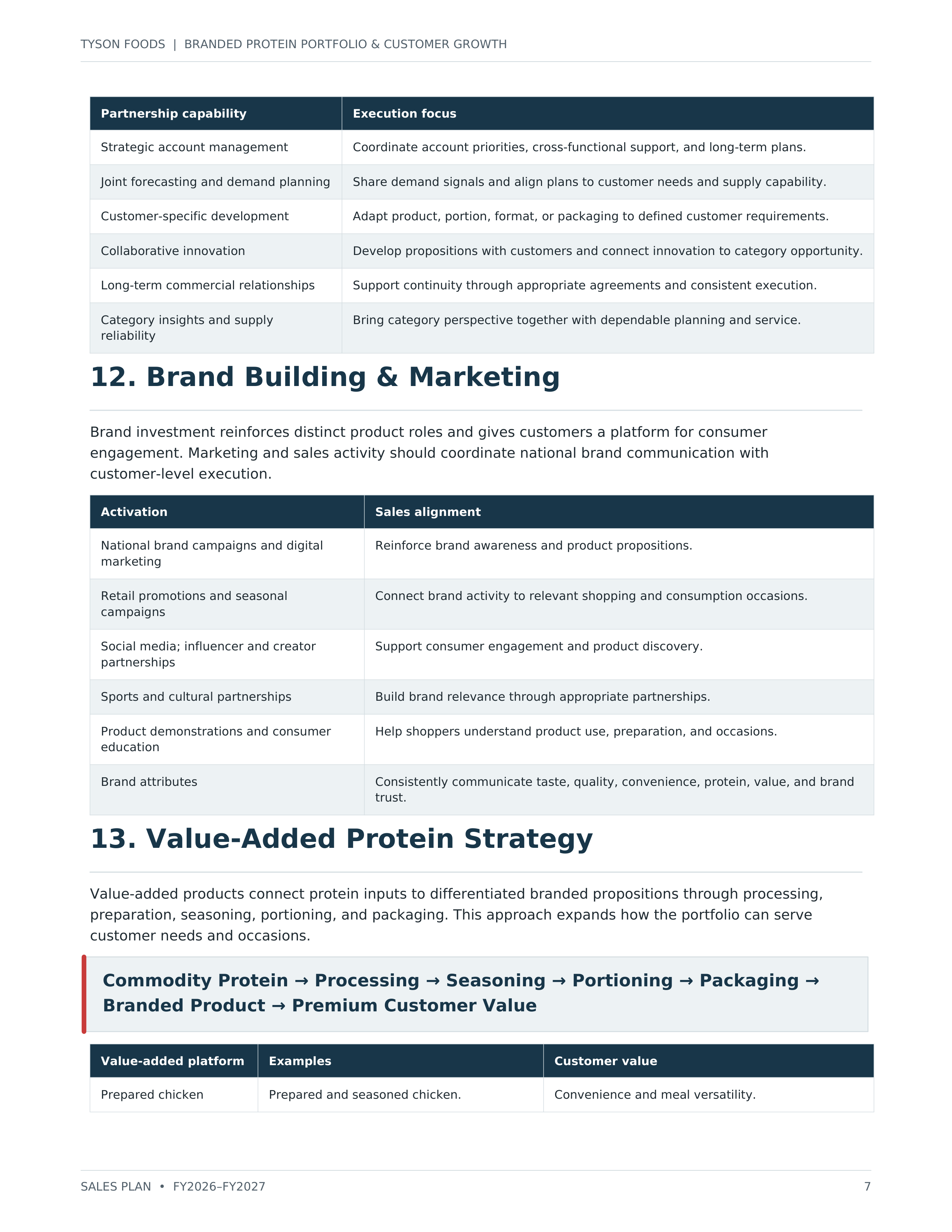
Limited-time innovation
Test timely product concepts with customer alignment.
Customer-specific product
introductions where appropriate.
9. Retail Customer Growth Strategy
Retail development combines account partnership with disciplined category execution. Plans should connect
customer priorities to assortment, placement, promotion, and sustained availability.
Step
Retail execution
Retailer need
Understand shopper, category, value, and operational priorities.
Category strategy
Align category role, assortment, and consumer occasion.
Product assortment
Select relevant core, branded, and innovation items.
Promotion
Coordinate promotional planning, seasonal programs, and trade activity.
Distribution
Secure appropriate shelf presence, replenishment, and new-item execution.
Sales growth
Review outcomes with customer data and refine the joint plan.
Retailer Need → Category Strategy → Product Assortment → Promotion →
Distribution → Sales Growth
Enablers: joint business planning, category management, shelf placement, retailer-specific innovation,
seasonal programs, and data-driven merchandising.
10. Foodservice Sales Strategy
Foodservice sales should pair protein solutions with customer operating requirements, menu strategies, and
dependable service across a broad range of operators and distribution partners.
Customer channel
Sales priorities
Restaurants, QSR, and fast-casual
chains
Menu innovation, product customization, portion specifications, cost management,
consistent supply.
Hotels and catering businesses
Operational convenience, menu versatility, dependable availability, and customer
partnership.
Schools, hospitals, and universities
Portion and preparation consistency, menu requirements, supply reliability, and cost
management.
Foodservice distributors
Availability, demand planning, product information, and reliable fulfillment.
11. Customer Partnership Strategy
Tyson’s customer approach is to serve as a protein solutions partner: combining products, category insights,
supply planning, and collaborative development to support customer objectives.
TYSON FOODS | BRANDED PROTEIN PORTFOLIO & CUSTOMER GROWTH
SALES PLAN • FY2026–FY2027
7
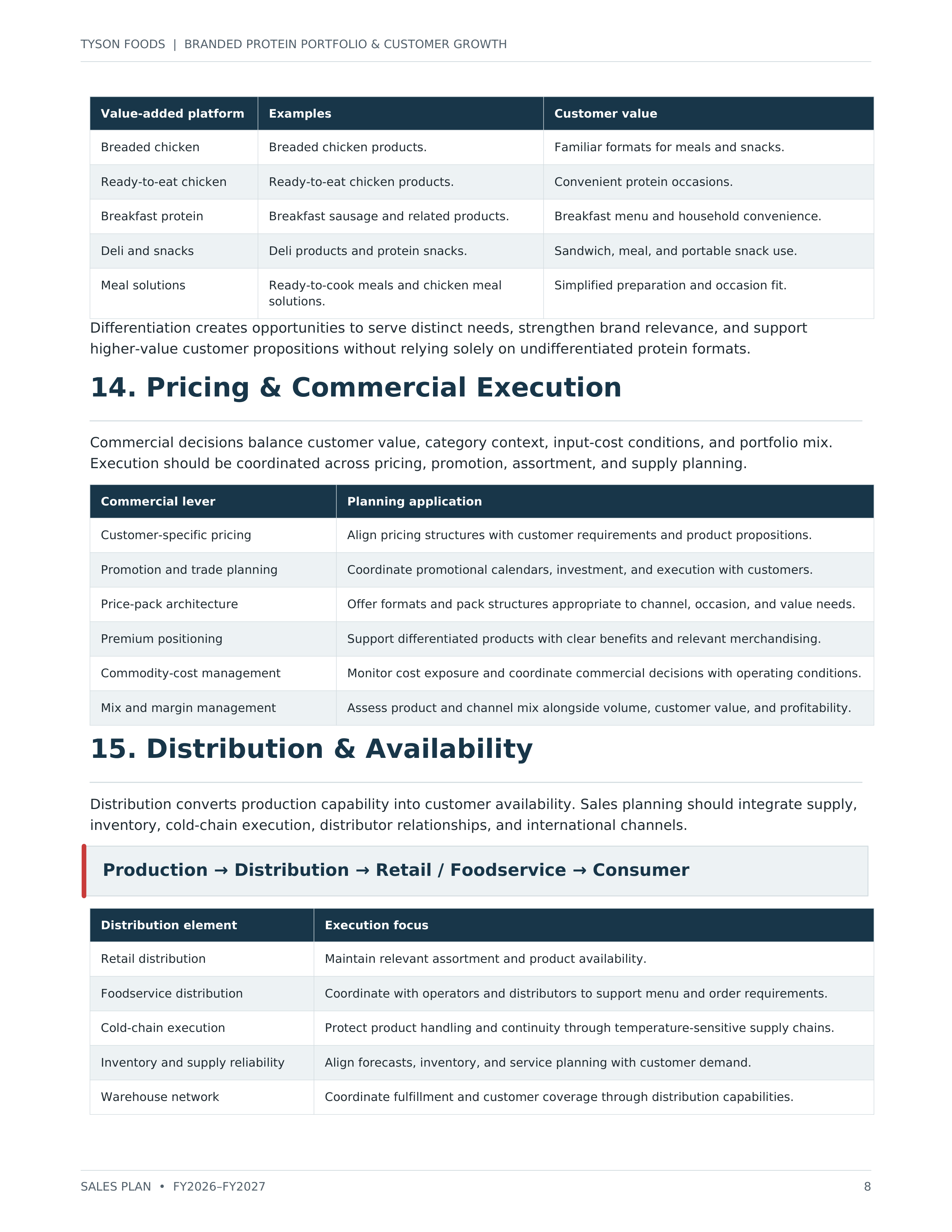
Partnership capability
Execution focus
Strategic account management
Coordinate account priorities, cross-functional support, and long-term plans.
Joint forecasting and demand planning
Share demand signals and align plans to customer needs and supply capability.
Customer-specific development
Adapt product, portion, format, or packaging to defined customer requirements.
Collaborative innovation
Develop propositions with customers and connect innovation to category opportunity.
Long-term commercial relationships
Support continuity through appropriate agreements and consistent execution.
Category insights and supply
reliability
Bring category perspective together with dependable planning and service.
12. Brand Building & Marketing
Brand investment reinforces distinct product roles and gives customers a platform for consumer
engagement. Marketing and sales activity should coordinate national brand communication with
customer-level execution.
Activation
Sales alignment
National brand campaigns and digital
marketing
Reinforce brand awareness and product propositions.
Retail promotions and seasonal
campaigns
Connect brand activity to relevant shopping and consumption occasions.
Social media; influencer and creator
partnerships
Support consumer engagement and product discovery.
Sports and cultural partnerships
Build brand relevance through appropriate partnerships.
Product demonstrations and consumer
education
Help shoppers understand product use, preparation, and occasions.
Brand attributes
Consistently communicate taste, quality, convenience, protein, value, and brand
trust.
13. Value-Added Protein Strategy
Value-added products connect protein inputs to differentiated branded propositions through processing,
preparation, seasoning, portioning, and packaging. This approach expands how the portfolio can serve
customer needs and occasions.
Commodity Protein → Processing → Seasoning → Portioning → Packaging →
Branded Product → Premium Customer Value
Value-added platform
Examples
Customer value
Prepared chicken
Prepared and seasoned chicken.
Convenience and meal versatility.
TYSON FOODS | BRANDED PROTEIN PORTFOLIO & CUSTOMER GROWTH
SALES PLAN • FY2026–FY2027
8
Value-added platform
Examples
Customer value
Breaded chicken
Breaded chicken products.
Familiar formats for meals and snacks.
Ready-to-eat chicken
Ready-to-eat chicken products.
Convenient protein occasions.
Breakfast protein
Breakfast sausage and related products.
Breakfast menu and household convenience.
Deli and snacks
Deli products and protein snacks.
Sandwich, meal, and portable snack use.
Meal solutions
Ready-to-cook meals and chicken meal
solutions.
Simplified preparation and occasion fit.
Differentiation creates opportunities to serve distinct needs, strengthen brand relevance, and support
higher-value customer propositions without relying solely on undifferentiated protein formats.
14. Pricing & Commercial Execution
Commercial decisions balance customer value, category context, input-cost conditions, and portfolio mix.
Execution should be coordinated across pricing, promotion, assortment, and supply planning.
Commercial lever
Planning application
Customer-specific pricing
Align pricing structures with customer requirements and product propositions.
Promotion and trade planning
Coordinate promotional calendars, investment, and execution with customers.
Price-pack architecture
Offer formats and pack structures appropriate to channel, occasion, and value needs.
Premium positioning
Support differentiated products with clear benefits and relevant merchandising.
Commodity-cost management
Monitor cost exposure and coordinate commercial decisions with operating conditions.
Mix and margin management
Assess product and channel mix alongside volume, customer value, and profitability.
15. Distribution & Availability
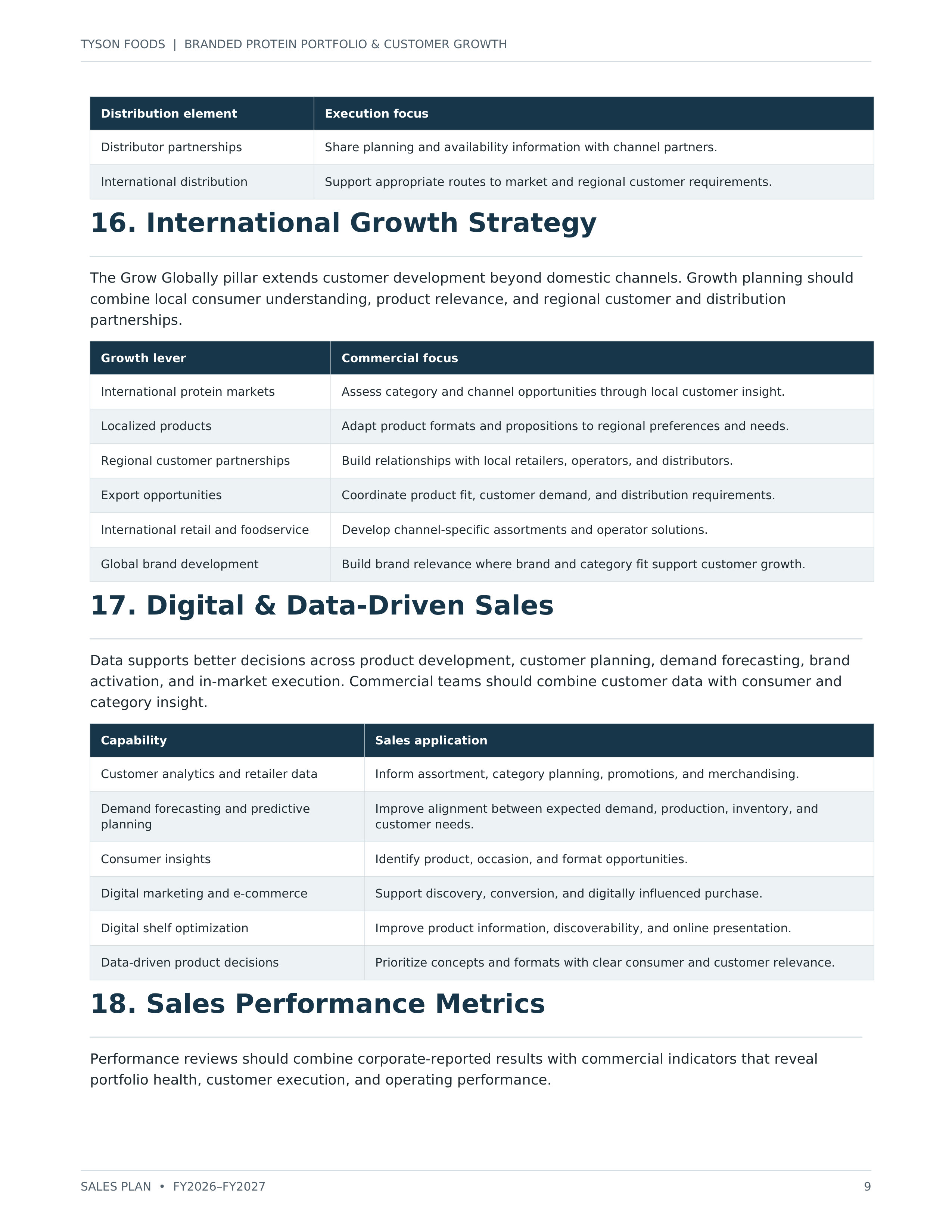
Distribution converts production capability into customer availability. Sales planning should integrate supply,
inventory, cold-chain execution, distributor relationships, and international channels.
Production → Distribution → Retail / Foodservice → Consumer
Distribution element
Execution focus
Retail distribution
Maintain relevant assortment and product availability.
Foodservice distribution
Coordinate with operators and distributors to support menu and order requirements.
Cold-chain execution
Protect product handling and continuity through temperature-sensitive supply chains.
Inventory and supply reliability
Align forecasts, inventory, and service planning with customer demand.
Warehouse network
Coordinate fulfillment and customer coverage through distribution capabilities.
TYSON FOODS | BRANDED PROTEIN PORTFOLIO & CUSTOMER GROWTH
SALES PLAN • FY2026–FY2027
9
Distribution element
Execution focus
Distributor partnerships
Share planning and availability information with channel partners.
International distribution
Support appropriate routes to market and regional customer requirements.
16. International Growth Strategy
The Grow Globally pillar extends customer development beyond domestic channels. Growth planning should
combine local consumer understanding, product relevance, and regional customer and distribution
partnerships.
Growth lever
Commercial focus
International protein markets
Assess category and channel opportunities through local customer insight.
Localized products
Adapt product formats and propositions to regional preferences and needs.
Regional customer partnerships
Build relationships with local retailers, operators, and distributors.
Export opportunities
Coordinate product fit, customer demand, and distribution requirements.
International retail and foodservice
Develop channel-specific assortments and operator solutions.
Global brand development
Build brand relevance where brand and category fit support customer growth.
17. Digital & Data-Driven Sales
Data supports better decisions across product development, customer planning, demand forecasting, brand
activation, and in-market execution. Commercial teams should combine customer data with consumer and
category insight.
Capability
Sales application
Customer analytics and retailer data
Inform assortment, category planning, promotions, and merchandising.
Demand forecasting and predictive
planning
Improve alignment between expected demand, production, inventory, and
customer needs.
Consumer insights
Identify product, occasion, and format opportunities.
Digital marketing and e-commerce
Support discovery, conversion, and digitally influenced purchase.
Digital shelf optimization
Improve product information, discoverability, and online presentation.
Data-driven product decisions
Prioritize concepts and formats with clear consumer and customer relevance.
18. Sales Performance Metrics
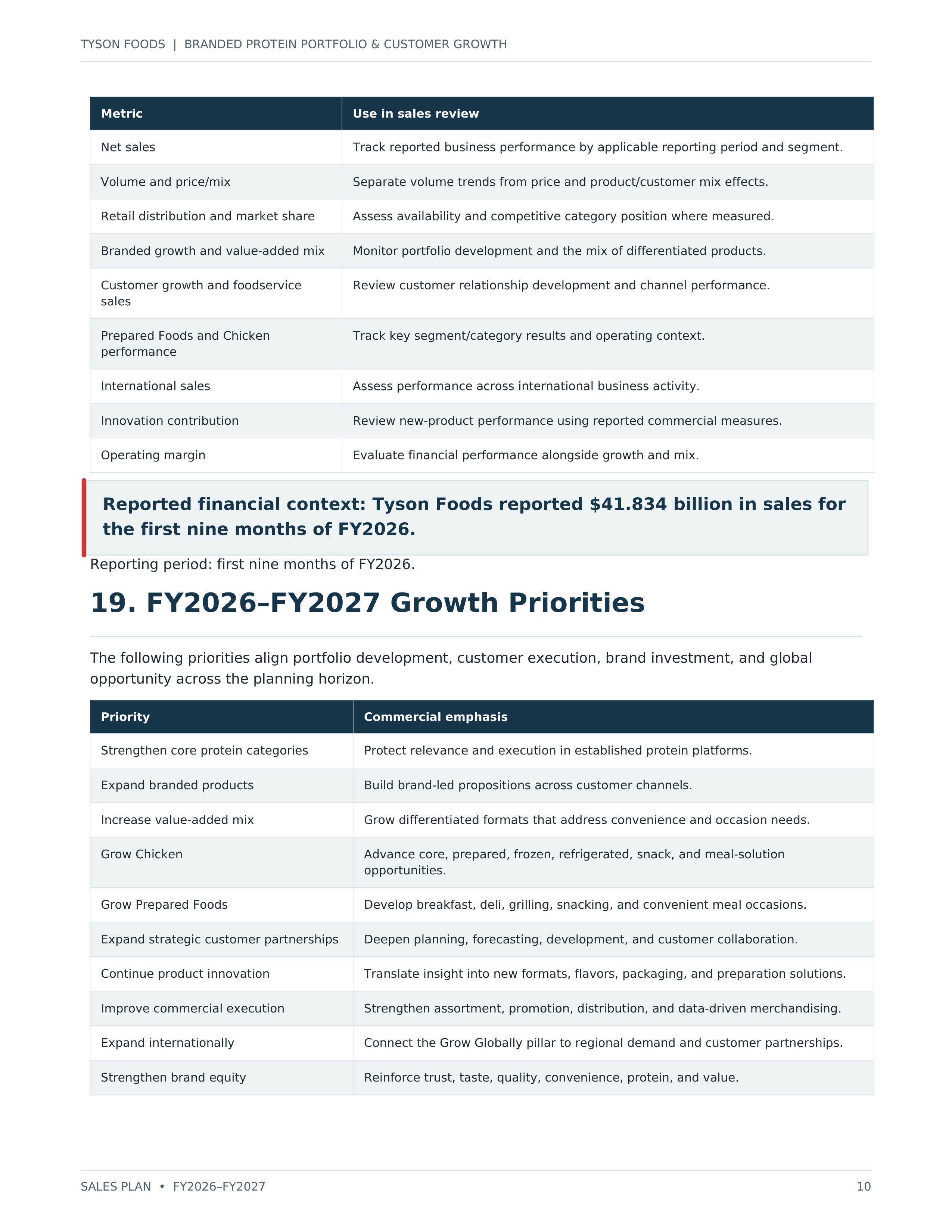
Performance reviews should combine corporate-reported results with commercial indicators that reveal
portfolio health, customer execution, and operating performance.
TYSON FOODS | BRANDED PROTEIN PORTFOLIO & CUSTOMER GROWTH
SALES PLAN • FY2026–FY2027
10
Metric
Use in sales review
Net sales
Track reported business performance by applicable reporting period and segment.
Volume and price/mix
Separate volume trends from price and product/customer mix effects.
Retail distribution and market share
Assess availability and competitive category position where measured.
Branded growth and value-added mix
Monitor portfolio development and the mix of differentiated products.
Customer growth and foodservice
sales
Review customer relationship development and channel performance.
Prepared Foods and Chicken
performance
Track key segment/category results and operating context.
International sales
Assess performance across international business activity.
Innovation contribution
Review new-product performance using reported commercial measures.
Operating margin
Evaluate financial performance alongside growth and mix.
Reported financial context: Tyson Foods reported $41.834 billion in sales for
the first nine months of FY2026.
Reporting period: first nine months of FY2026.
19. FY2026–FY2027 Growth Priorities
The following priorities align portfolio development, customer execution, brand investment, and global
opportunity across the planning horizon.
Priority
Commercial emphasis
Strengthen core protein categories
Protect relevance and execution in established protein platforms.
Expand branded products
Build brand-led propositions across customer channels.
Increase value-added mix
Grow differentiated formats that address convenience and occasion needs.
Grow Chicken
Advance core, prepared, frozen, refrigerated, snack, and meal-solution
opportunities.
Grow Prepared Foods
Develop breakfast, deli, grilling, snacking, and convenient meal occasions.
Expand strategic customer partnerships
Deepen planning, forecasting, development, and customer collaboration.
Continue product innovation
Translate insight into new formats, flavors, packaging, and preparation solutions.
Improve commercial execution
Strengthen assortment, promotion, distribution, and data-driven merchandising.
Expand internationally
Connect the Grow Globally pillar to regional demand and customer partnerships.
Strengthen brand equity
Reinforce trust, taste, quality, convenience, protein, and value.
TYSON FOODS | BRANDED PROTEIN PORTFOLIO & CUSTOMER GROWTH
SALES PLAN • FY2026–FY2027
11
20. Customer Growth Execution Flow
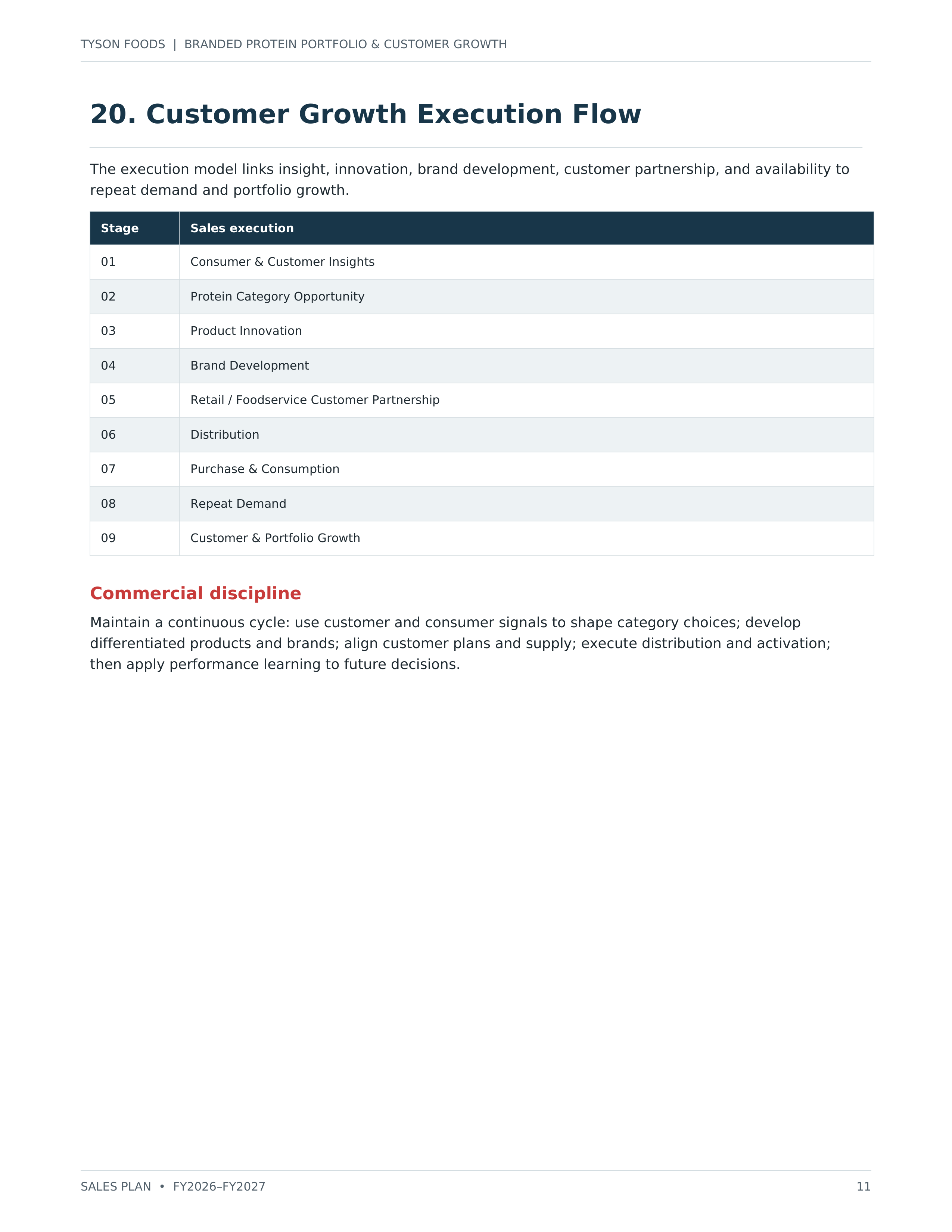
The execution model links insight, innovation, brand development, customer partnership, and availability to
repeat demand and portfolio growth.
Stage
Sales execution
01
Consumer & Customer Insights
02
Protein Category Opportunity
03
Product Innovation
04
Brand Development
05
Retail / Foodservice Customer Partnership
06
Distribution
07
Purchase & Consumption
08
Repeat Demand
09
Customer & Portfolio Growth
Commercial discipline
Maintain a continuous cycle: use customer and consumer signals to shape category choices; develop
differentiated products and brands; align customer plans and supply; execute distribution and activation;
then apply performance learning to future decisions.