January 2025
BLM/HQ
Bureau of Land Management (BLM)
Land Use Planning Program
Office of the Assistant Director, Resources and Planning (HQ-200)
1849 C Street, N.W.
Washington, D.C. 20240
Available at BLM’s Printed Materials and Distribution Section
Fax Number: 303-236-0845 or BLM_NCS_PMDS@blm.gov
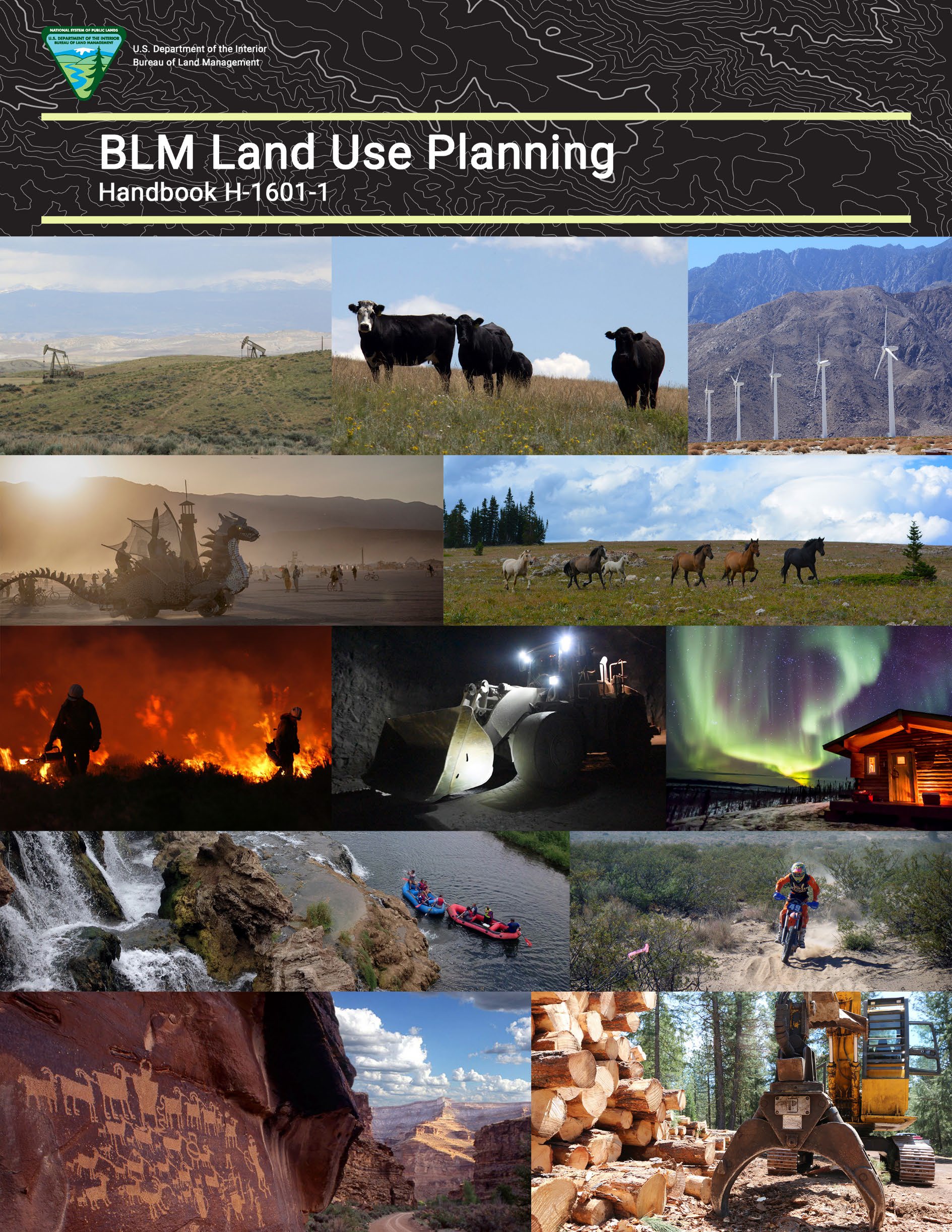
Cover photographs provide images reflecting the diversity of the BLM’s multiple use
management across all twelve BLM States (starting top left):
Oil and gas well in Wyoming. Photo credit: BLM Wyoming.
Cattle grazing at Rye Slough in Colorado. Photo credit: Kyle Sullivan.
Wind turbines in California. Photo credit: BLM California.
Dragon sculpture at Burning Man in Nevada. Photo credit: Bob Wick.
Wild horses in the Prior Mountains, Montana. Photo credit: Brad Purdy.
Arizona’s Aravaipa Veteran Fire Crew on the Sunset Fire. Photo credit: BLM Arizona.
Non-energy mineral mining at Doe Run Mine in Missouri. Photo credit: Chad Douglas.
Northern lights from Beaver Creek Wild and Scenic River in Alaska. Photo credit: Bob Wick.
Rafting on the South Fork of the Snake River in Idaho. Photo credit: Bob Wick.
Off-road motorbike racing near Socorro, New Mexico. Photo credit: BLM New Mexico.
The Great Hunt Panel along Nine Mile Canyon near Price, Utah. Photo credit: BLM Utah.
Rowell Creek timber sale in Oregon. Photo credit: Maria Thi Mai.
H-1601-1 – LAND USE PLANNING HANDBOOK (Public)
i
BLM HANDBOOK
Rel. 1-1836
Supersedes Rel. 1-1693
01/16/2025
TABLE OF CONTENTS
TABLE OF CONTENTS
.............................................................................................................. i
Handbook User’s Guide
.............................................................................................................. vi
Chapter 1 – Planning Basics
........................................................................................................ 1
General ............................................................................................................................................ 1
1.1
Purpose of the Land Use Planning Process......................................................................... 1
1.2
Difference between Land Use Planning and Implementation Decisions ............................ 3
1.2.1
Land Use Planning Decisions ...................................................................................... 3
1.2.2
Implementation Decisions ............................................................................................ 4
1.3
Planning Focused to Address Problems and Opportunities ................................................ 4
1.4
The Land Use Planning Cycle ............................................................................................ 6
1.4.1
Determining Whether a Plan Revision or Amendment is Appropriate ........................ 8
1.4.2
The Basic Process for Developing or Revising an RMP .............................................. 9
1.4.3
Coordinating Simultaneous BLM Planning Processes .............................................. 12
1.5
Relationship between Planning and NEPA....................................................................... 14
1.5.1
Incorporation by Reference and Tiering .................................................................... 15
1.6
Required Recordkeeping for Land Use Planning ............................................................. 16
Chapter 2 – External Engagement
............................................................................................ 17
General .......................................................................................................................................... 17
2.1
Public Involvement ........................................................................................................... 18
2.1.1
Opportunities for Public Involvement when Preparing an RMP ............................... 19
2.1.2
Public Involvement for Plan Amendments.................................................................. 24
2.1.3
Announcing Opportunities for Public Involvement .................................................... 24
2.1.3.1
RMP Mailing List .............................................................................................. 24
2.1.3.2
Federal Register Notices .................................................................................... 25
2.1.4
Timeframes for Public Comment and Protest Periods ............................................... 26
2.1.5
Recordkeeping Related to Public Involvement ........................................................... 26
2.2
Coordination with Other Federal Agencies, Indian Tribes, and State and Local
Governments ............................................................................................................................ 27
2.3
Cooperating Agency Involvement .................................................................................... 29
2.3.1
Inviting Agencies to be Cooperating Agencies ........................................................... 30
2.3.2
Opportunities for Cooperating Agency Involvement .................................................. 30
2.4
Consultation ...................................................................................................................... 31
2.5
Other Special Considerations ............................................................................................ 33
2.5.1
Federal Advisory Committee Act Guidance ............................................................... 33
2.5.2
Resource Advisory Councils ....................................................................................... 33
2.5.3
Cooperation to Identify Situations Where Action Can be Taken Based on Another
Agency’s Plan or a Land Use Analysis ............................................................................. 35
Chapter 3 – Land Use Plan Components
.................................................................................. 36
General .......................................................................................................................................... 36
3.1
Goals and Objectives ........................................................................................................ 37
3.1.1
Goals ........................................................................................................................... 37
3.1.2
Objectives ................................................................................................................... 37
H-1601-1 – LAND USE PLANNING HANDBOOK (Public)
ii
BLM HANDBOOK
Rel. 1-1836
Supersedes Rel. 1-1693
01/16/2025
3.1.2.1
Identifying Measurable Objectives .................................................................... 37
3.2
Designations ...................................................................................................................... 40
3.3
Allocations for Allowable Resource Use .......................................................................... 42
3.4
Management Direction...................................................................................................... 44
3.4.1
Flexibility vs. Predictability in Management Direction ............................................. 47
3.4.2
Accounting for Acquired and Discovered Lands ........................................................ 48
3.5
Describing Where Plan Components Apply ..................................................................... 48
3.6
Management Areas ........................................................................................................... 50
3.7
Integrating Management ................................................................................................... 52
Chapter 4 – RMP Evaluations
................................................................................................... 54
General .......................................................................................................................................... 54
4.1
Timeframe for Conducting RMP Evaluations .................................................................. 55
4.2
Process for Conducting RMP Evaluations ........................................................................ 55
4.2.1
Participants in RMP Evaluations ............................................................................... 57
4.2.2
Options for External Engagement to Inform RMP Evaluations ................................. 57
4.3
Determining If Decisions are Still Relevant and Effective ............................................... 58
4.3.1
Evaluating Whether Decisions are Achieving or Progressing Toward Objectives.... 59
4.3.2
Evaluating Whether New Information Substantially Alters the Scope of Resource
Uses ................................................................................................................................... 59
4.3.3
Evaluating Whether New Information Results in Effects Outside the Scope of the
Assumptions Used for the NEPA Analysis ........................................................................ 60
4.4
Documenting the RMP Evaluation’s Findings ................................................................. 61
Chapter 5 – BLM or State Director Planning Guidance
......................................................... 63
General .......................................................................................................................................... 63
5.1
Role of BLM or State Director Planning Guidance .......................................................... 64
5.2
Information Provided by BLM or State Director Planning Guidance .............................. 64
5.3
Identifying Planning and Decision Areas ......................................................................... 65
5.4
Purpose and Need for A Land Use Plan ........................................................................... 66
5.4.1
Statements of Purpose and Need for RMP Revisions ................................................. 67
5.4.2
Statement of Purpose and Need for a New RMP ........................................................ 70
5.4.3
Statement of Purpose and Need for an RMP Amendment .......................................... 71
Chapter 6 – Planning Criteria and Analysis of the Management Situation
.......................... 75
General .......................................................................................................................................... 75
6.1
Planning Criteria ............................................................................................................... 75
6.1.1
Identifying Issues and Framing Analysis.................................................................... 76
6.1.2
Outlining the Impacts Analysis Plan .......................................................................... 77
6.2
The Analysis of the Management Situation ...................................................................... 82
6.2.1
Gather Data and Information ..................................................................................... 83
6.2.1.1
Tailoring Data and Information to the Planning Effort ...................................... 84
6.2.1.2
Collecting New Data and Information ............................................................... 85
6.2.2
Formulating Reasonable Alternatives ........................................................................ 85
6.2.2.1
Action Alternatives ............................................................................................. 85
6.2.2.2
No Action Alternative in Land Use Planning .................................................... 87
6.2.2.3
Reference Analysis ............................................................................................. 88
6.2.2.4
Alternatives Considered but Eliminated from Detailed Analysis ...................... 89
H-1601-1 – LAND USE PLANNING HANDBOOK (Public)
iii
BLM HANDBOOK
Rel. 1-1836
Supersedes Rel. 1-1693
01/16/2025
6.3
Documenting the Planning Criteria and Analysis of the Management Situation ............. 89
6.3.1
Introduction ................................................................................................................ 90
6.3.2
Planning Area and Existing Management .................................................................. 90
6.3.3
Regulatory Framework ............................................................................................... 91
6.3.4
Purpose and Need ....................................................................................................... 92
6.3.5
Planning Criteria ........................................................................................................ 92
6.3.6
Planning Area Profile ................................................................................................. 92
6.3.6.1
Current Conditions ............................................................................................. 92
6.3.6.2
Trends ................................................................................................................. 93
6.3.6.3
Forecasts ............................................................................................................. 93
6.3.7
Preliminary Range of Alternatives ............................................................................. 94
Chapter 7 – Notice of Intent and Scoping
................................................................................. 95
General .......................................................................................................................................... 95
7.1
Public Review of Planning Criteria .................................................................................. 95
7.2
Scoping Notices ................................................................................................................ 96
7.3
Public Review of Scoping Comments .............................................................................. 97
7.3.1
Scoping Report ........................................................................................................... 98
7.3.1.1
Planning Effort ................................................................................................... 98
7.3.1.2
Summary of Public Involvement........................................................................ 98
7.3.1.3
Summary of Public Comment ............................................................................ 98
Chapter 8 – The Draft RMP/EIS
............................................................................................... 99
General .......................................................................................................................................... 99
8.1
Dear Reader Letter ............................................................................................................ 99
8.2
Summary ......................................................................................................................... 100
8.3
Chapter 1 – Introduction ................................................................................................. 100
8.3.1
Planning Area and Decision Area ............................................................................ 101
8.3.2
Purpose and Need ..................................................................................................... 101
8.3.3
Consistency with Local Land Use Plans .................................................................. 101
8.4
Chapter 2 – Alternatives ................................................................................................. 102
8.4.1
Alternatives ............................................................................................................... 102
8.4.2
Comparison of the Effects of the Alternatives .......................................................... 103
8.4.3
Preferred Alternative ................................................................................................ 103
8.4.4
Environmentally Preferable Alternative ................................................................... 104
8.4.5
Alternatives Considered but Not Analyzed in Detail ................................................ 105
8.5
Chapter 3 – Affected Environment ................................................................................. 105
8.6
Chapter 4 – Environmental Consequences ..................................................................... 105
8.6.1
Analytical Methods ................................................................................................... 105
8.6.2
Effects Analysis ......................................................................................................... 106
8.7
Chapter 5 – Consultation and Coordination.................................................................... 107
8.8
Appendices ...................................................................................................................... 108
8.9
Supplementing the Draft RMP/EIS ................................................................................ 108
Chapter 9 – Public Comment on the Draft RMP/EIS
........................................................... 109
General ........................................................................................................................................ 109
9.1
Notice of Availability of the Draft RMP/EIS ................................................................. 109
9.2
Public Comment on a Supplemental Draft RMP/EIS ..................................................... 110
H-1601-1 – LAND USE PLANNING HANDBOOK (Public)
iv
BLM HANDBOOK
Rel. 1-1836
Supersedes Rel. 1-1693
01/16/2025
9.3
Agency Review of the Draft RMP/EIS ........................................................................... 110
Chapter 10 – The Proposed RMP/Final EIS
.......................................................................... 111
General ........................................................................................................................................ 111
10.1
Developing the Proposed RMP Alternative .................................................................... 111
10.2
The Proposed RMP/Final EIS Document ....................................................................... 111
10.2.1
Dear Reader Letter ................................................................................................... 112
10.2.2
Affected Environment and Environmental Consequences ........................................ 112
10.2.3
RMP Monitoring Strategy ........................................................................................ 113
10.2.3.1
Identifying Which Management Direction to Monitor ..................................... 114
10.2.3.2
Identifying Monitoring Intervals and Standards ............................................... 115
10.2.3.3
Organization of the RMP Monitoring Strategy ................................................. 116
10.2.5
Responding to Comments ......................................................................................... 116
10.3
Full Text Final EIS vs Abbreviated Final EIS ................................................................ 117
Chapter 11 – Protest and Governor’s Consistency Review of the Proposed RMP
............ 118
General ........................................................................................................................................ 118
11.1
Providing Notice of the Proposed RMP.......................................................................... 118
11.2
Land Use Plan Protest ..................................................................................................... 119
11.2.1
Director’s Protest Process ....................................................................................... 119
11.2.2
Initial Evaluation of Protests .................................................................................... 120
11.2.3
Analysis of Valid Protests ......................................................................................... 121
11.2.4
Coordination with Forest Service for the Adoption of BLM’s Protest Process ....... 122
11.3
Governor’s Consistency Review ..................................................................................... 122
11.4
Notice of Significant Change .......................................................................................... 123
Chapter 12 – The Record of Decision and the Approved RMP
........................................... 125
General ........................................................................................................................................ 125
12.1
The Record of Decision .................................................................................................. 126
12.1.1
Introductory Material ............................................................................................... 126
12.1.2
Decision .................................................................................................................... 126
12.1.3
Alternatives ............................................................................................................... 126
12.1.3.1
Changes from the Proposed RMP ..................................................................... 126
12.1.3.2
Documenting Implementation-Level Decisions for Projects with RMP
Amendments ................................................................................................................... 127
12.1.4
Rationale for the Decision and Management ........................................................... 127
12.1.5
Application of the Plan to Existing Projects ............................................................ 127
12.1.5.1
Valid Existing Rights ........................................................................................ 128
12.1.6
Public Involvement ................................................................................................... 129
12.1.7
Signatures of Field Managers and State Directors .................................................. 129
12.1.7.1
Signatures for Project Decisions ....................................................................... 129
12.2
Approved RMP ............................................................................................................... 129
12.2.1
Planning and Decision Area ..................................................................................... 129
12.2.2
Plan Components ...................................................................................................... 129
12.2.3
Plan Maintenance, Monitoring, and Evaluation ...................................................... 130
12.2.4
Appendices ................................................................................................................ 130
12.3
Issuing the ROD .............................................................................................................. 131
12.4
Required Congressional Notification .............................................................................. 131
H-1601-1 – LAND USE PLANNING HANDBOOK (Public)
v
BLM HANDBOOK
Rel. 1-1836
Supersedes Rel. 1-1693
01/16/2025
Chapter 13 – After the Decision
.............................................................................................. 133
General ........................................................................................................................................ 133
13.1
Implementation ............................................................................................................... 133
13.1.1
Plan Conformance .................................................................................................... 133
13.1.1.1
Non-Conforming External Proposals ................................................................ 135
13.1.1.2
Bringing On-Going Management into Conformance with a Revised RMP ..... 135
13.1.2
Plan Maintenance ..................................................................................................... 135
13.1.3
Implementation During a Plan Revision or Amendment .......................................... 137
13.1.4
Relationship of RMP to Activity Plans ..................................................................... 138
13.2
Monitoring ...................................................................................................................... 138
13.2.1
Monitoring Documentation ...................................................................................... 139
Chapter 14 – Amending the RMP
........................................................................................... 140
General ........................................................................................................................................ 140
14.1
Determining the Scope of an Amendment ...................................................................... 141
14.1.1
Using Tiering to Narrow the Scope of Analysis for a Plan Amendment .................. 142
14.1.2
Focusing a Plan Amendment’s Analysis .................................................................. 142
14.1.3
Amendments to Consider Approval of Non-Conforming Project Proposals ............ 142
14.2
Planning Steps for RMP Amendments Supported by an EIS ......................................... 143
14.3
Planning Steps for RMP Amendments Supported by an EA .......................................... 144
14.4
Issuing a Decision to Approve an RMP Amendment ..................................................... 150
Glossary
..................................................................................................................................... 151
Acronyms
................................................................................................................................... 159
Appendix A – Adaptive Management
..................................................................................... A-1
General ........................................................................................................................................ A-1
A.1
Different Systems of Resource Management Practices .................................................. A-2
A.2
Adaptive Management .................................................................................................... A-3
A.2.1
Adaptive Management in an RMP ............................................................................. A-4
A.2.2
Identifying When a Plan Amendment is Necessary for RMP Modifications ............. A-5
A.2.3
NEPA Analysis of an Adaptive Management Approach ............................................ A-6
A.2.4
Constraints for Adaptive Management ...................................................................... A-6
H-1601-1 – LAND USE PLANNING HANDBOOK (Public)
vi
BLM HANDBOOK
Rel. 1-1836
Supersedes Rel. 1-1693
01/16/2025
Handbook User’s Guide
This handbook provides guidance to Bureau of Land Management (BLM) employees for
implementing the BLM’s land use planning requirements established by Sections 201 and 202 of
the Federal Land Policy and Management Act of 1976, as amended (FLPMA), and the
regulations in 43 Code of Federal Regulations (CFR) Part 1600.
1
Any interpretation of the
guidance contained in this handbook is subject to the requirements in FLPMA; 43 CFR 1600; the
National Environmental Policy Act (NEPA) of 1969, as amended; the Council on Environmental
Quality NEPA regulations at 40 CFR 1500; the Department of the Interior NEPA
implementation regulations at 43 CFR 46; and other applicable Federal laws and regulations.
This handbook is also consistent with the BLM Land Use Planning Manual (MS-1601).
The BLM, either at the Headquarters or state office level, may supplement the guidance in this
handbook to reflect current policy through additional guidance and instruction memoranda.
The BLM has revised this handbook to:
•
Ensure consistency with statutory changes and Department of the Interior and BLM
regulatory and policy changes since 2005;
•
Clarify the role of the land use planning process in the BLM’s management of the public
lands under the principles of multiple use and sustained yield;
•
Help staff manage the planning process more effectively, including by engaging partners
and the public;
•
Emphasize an approach to land use planning that focuses the management alternatives
evaluated during the planning process by considering trade-offs in resource management
to address problems and pursue opportunities in the planning area;
•
Emphasize coordination with state and local governments and Indian tribes during
planning and clarify consultation requirements with other Federal agencies and Indian
tribes; and
•
Provide guidance on monitoring implementation and evaluating the effectiveness of the
land use plan.
The BLM wrote this handbook following the Federal Plain Language Guidelines (2011) and
encourages the use of plain language when drafting land use planning documents. This
handbook was written to guide you in implementing the BLM’s land use planning regulations
and policies and to help you communicate with interdisciplinary teams, managers, cooperating
agencies, and the public. In this handbook, “we” refers to the BLM the agency as a whole and
“you” refers to BLM staff and contractors responsible for or involved in the land use planning
process.
We suggest readers of this handbook who may be looking for a high-level understanding of the
entire land use planning process and external engagement focus on
Chapter 1,
Planning Basics
and
Chapter 2,
External Engagement
.
Chapter 1,
Planning Basics
provides an understanding
of the purpose of land use planning and an overview of the overall planning cycle.
Chapter 2,
1
BLM-administered lands in the National Petroleum Reserve in Alaska are exempt from the requirements of
Section 202 of the FLPMA and, accordingly, are not subject to the guidance of this handbook.
H-1601-1 – LAND USE PLANNING HANDBOOK (Public)
vii
BLM HANDBOOK
Rel. 1-1836
Supersedes Rel. 1-1693
01/16/2025
External Engagement
provides an overview of our external engagement requirements with
Federal agencies, Indian tribes, state and local governments, and the public throughout the
planning process and includes guidance for engaging external partners to create efficiency in the
NEPA process supporting your planning effort.
Chapter 3,
Land Use Plan Components
describes plan components and provides guidance for
you to develop them during your planning effort. Understanding plan components will help you
make the best use of the process and steps described in the other chapters.
Chapter 4,
RMP Evaluations
through
Chapter 13,
After the Decision
present the steps of the
land use planning process in an order consistent with planning regulations, policies, and
guidance. The order of these chapters reflects best practices for coordinating planning steps with
the NEPA process supporting your planning effort. The chapters include recommendations how
to develop your NEPA and planning documents efficiently, through appropriate use of
incorporation by reference and tiering to inform your decision-making.
Chapter 14,
Amending the RMP
highlights key differences between the amendment process
and the process for developing or revising an RMP, including key differences for environmental
assessment-level amendments.
Appendix A,
Adaptive Management
defines adaptive management and provides guidance for
developing analysis that can support incorporating this approach in the decision for your RMP.
Throughout this handbook, we use the terms of “must,” “recommend,” and “may.” “Must”
refers to process or products the BLM is required to complete or produce as identified by law,
regulation, departmental guidance, or BLM policy; therefore, as BLM staff, you must complete
these processes and produce these products as specified in these laws, regulations, departmental
guidance, or BLM policy.
2
Policy requirements include land use planning policy previously
established through instruction memorandum and now included in this handbook, which is now
the permanent policy documentation. “Recommend” refers to guidance provided by this
handbook that you must follow unless you have a good rationale for not doing so. Where you
are free to decide how to follow the guidance described, this handbook uses the term “may.”
Direction provided in this handbook that does not use one of those terms (e.g., “be sure to” or “it
is important”) merely reflects best practices and is not a policy statement.
In addition to section 202 of FLPMA and the regulations implementing that section at 43 CFR
1600, some requirements related to land use planning can be found in other sections of FLPMA,
and other statutes and regulations. Further, policies and guidance for some BLM programs also
identify requirements and considerations during land use planning. The BLM compiled a BLM
Land Use Planning Program-Specific Requirements and Guidance Desk Guide to assist finding
this information for these programs. Contact the BLM Headquarters Division of Decision
Support, Planning, and NEPA for the location of the latest version of the Desk Guide.
2
All guidance in this handbook is based on law, regulation, and policy at the time of publication. Updated laws,
regulations, or policies may change specific requirements reflected in this document. Be sure to check the current
laws, regulations, and policies early in the process and prior to filing a notice of intent, as well as throughout the
planning process. The Office of the Solicitor is available to assist with this review.
H-1601-1 – LAND USE PLANNING HANDBOOK (Public)
1
BLM HANDBOOK
Rel. 1-1836
Supersedes Rel. 1-1693
01/16/2025
Chapter 1 – Planning Basics
General
1.1 Purpose of the Land Use Planning Process
1.2 Difference between Land Use Planning and Implementation Decisions
1.3 Planning Focused to Address Problems and Opportunities
1.4 The Land Use Planning Cycle
1.5 Relationship between Planning and NEPA
1.6 Required Recordkeeping for Land Use Planning
General
The Federal Land Policy and Management Act of 1976, as amended (FLPMA), requires the
Bureau of Land Management (BLM) to develop, maintain, and revise land use plans, which
provide frameworks for the BLM’s management of the public lands. Land use plans provide for
the use of public lands and inform the BLM’s on-the-ground actions and include both resource
management plans (RMP) and management framework plans.
When developing, revising, or amending land use plans, FLPMA (Section 202(c)) requires the
BLM to:
•
Use and observe the principles of multiple use and sustained yield;
•
Use a systematic interdisciplinary approach to integrate physical, biological, economic,
and other sciences;
•
Give priority to the designation and protection of areas of critical environmental concern;
•
Rely, to the extent available, on an inventory of public lands, their resources, and other
values;
•
Consider present and potential uses of public lands;
•
Consider the relative scarcity of the values involved and the availability of alternative
means and sites for realizing those values;
•
Weigh long-term benefits to the public against short-term benefits;
•
Provide for compliance with applicable Federal and state pollution control laws,
standards, and implementation plans;
•
To the extent consistent with the laws governing the administration of the public lands,
coordinate the land use inventory, planning, and management activities of or for such
lands with the land use planning and management programs of other Federal agencies,
Indian tribes, and State and local governments within which the lands are located;
•
Keep apprised of Tribal, state, and local land use plans to the extent practicable;
•
Be consistent with state and local plans to the maximum extent the BLM finds consistent
with Federal law and the purposes of FLPMA; and
•
Provide for meaningful involvement of state and local government officials, and Indian
tribes, including early public notice of proposed decisions which may have a significant
impact on non-Federal lands.
1.1
Purpose of the Land Use Planning Process
The BLM manages approximately 245 million surface acres, more surface land than any other
Federal agency, and approximately 700 million acres of onshore Federal mineral estate. The
BLM’s land use plans direct the agency’s management of these public lands and minerals.
H-1601-1 – LAND USE PLANNING HANDBOOK (Public)
2
BLM HANDBOOK
Rel. 1-1836
Supersedes Rel. 1-1693
01/16/2025
FLPMA requires that the BLM manage the public lands under principles of multiple use and
sustained yield unless the land has been dedicated to specific uses according to other provisions
of law (43 U.S.C. 1732(a)). Multiple use does not mean providing for every possible use on
every acre, nor does sustained yield mean providing for maximum yields. Managing the public
lands under multiple use and sustained yield principles often requires the BLM to evaluate and
make trade-offs among various land uses and affected resources. Land use planning is how the
BLM develops resource management decisions that respond to problems and opportunities and
articulate trade-offs among environmental, social, and economic values.
The following principles, which are detailed in later chapters, can help you identify issues and
gather the information necessary to consider the trade-offs relevant to your planning effort:
•
Engage other Federal agencies, Indian tribes, state and local governments, and
other stakeholders in a transparent process.
By doing so, you can address complex
resource concerns and understand the different values and priorities for the management
of BLM-administered lands. Refer to
Chapter 2,
External Engagement
for more
information on coordination, consultation, and cooperation with agencies and Indian
tribes, and public involvement throughout the planning process.
•
Assess ecological, cultural, scenic, social, and economic values.
Through the land use
planning process, the BLM evaluates how the different uses of public lands reflect
environmental, social, and economic values. The land use planning process considers
different management approaches to protecting resources while allowing for sustainable
resource use. Refer to section
1.3,
Planning Focused to Address Problems and
Opportunities
for a discussion about how evaluating environmental, social, and economic
values can promote sustainable outcomes and how focused alternatives represent various
trade-offs that elevate one or more of these values. Refer to section
6.2,
The Analysis of
the Management Situation
for information on how to identify and evaluate the current
and forecasted resource, environmental, social, and economic conditions within the
planning area.
•
Manage at appropriate scales considering space, time, and levels of organization for
the resources and uses in the planning area.
Land use planning considers resources
and their uses that are present at different scales in any given planning area. RMPs
recognize and account for variation by including decisions at different scales. Refer to
Chapter 3,
Land Use Plan Components
, section
5.3,
Identifying Planning and
Decision Areas
, and section
6.1.2,
Outlining the Impacts Analysis Plan
for more
information on identifying planning decisions and impacts analysis plans at appropriate
scales.
•
Integrate management to address interactions between different resources and
resource uses.
An integrated approach identifies the overlap between single resources
and develops integrated management objectives. Refer to
Chapter 3,
Land Use Plan
Components
for more information on developing common objectives and direction that
integrate multiple resources or uses.
H-1601-1 – LAND USE PLANNING HANDBOOK (Public)
3
BLM HANDBOOK
Rel. 1-1836
Supersedes Rel. 1-1693
01/16/2025
•
Manage for resilience by recognizing threats and vulnerabilities and develop a plan
that improves the capacity of systems to adapt to change.
Maintaining and bolstering
resilience, our capacity to respond to change, is vital to sustaining desired resource uses
and environmental, social, and economic systems in the long term. Refer to
Chapter 3,
Land Use Plan Components
for information about building plan components that allow
for flexibility and
Appendix A,
Adaptive Management
for more information about
incorporating resilience in planning decisions.
•
Use appropriate scientific rigor and high-quality information to inform the process
and analysis of complex natural resource issues.
Quality data is critical to accurate
analysis of issues. Quality data provides the baseline conditions, helps us identify trends
and scales for management, and links directly to monitoring and evaluation of our
planning decisions. Refer to section
6.1.2,
Outlining the Impacts Analysis Plan
and
Chapter 4,
RMP Evaluations
for more information on the role of quality data in
monitoring and evaluating the RMP.
•
Use adaptive management to address new information and changed circumstances
in the face of an incomplete understanding of resource relationships.
The land use
planning process acknowledges that there is often an incomplete understanding of
resource relationships, which may result in some uncertainty as to the ability of our
management to achieve the desired resource conditions and resource use levels in the
planning area. Resource, environmental, social, and economic conditions may change
throughout the implementation of an RMP due to a wide variety of factors outside of our
control. The BLM assesses the progress in achieving the objectives articulated in the
RMP through monitoring and evaluation. Refer to
Chapter 3,
Land Use Plan
Components
for more information on objectives,
Chapter 4,
RMP Evaluations
for more
information on monitoring and evaluation of the RMP, and
Appendix A,
Adaptive
Management
for more information about incorporating resilience in planning decisions.
1.2
Difference between Land Use Planning and Implementation Decisions
Land use planning decisions differ from implementation decisions. We recommend that you
avoid writing implementation decisions as part of the development of an RMP (BLM Land Use
Planning Manual (MS-1601.06(E)(2)). We recognize that there may be circumstances where
you may need to consider planning and implementation decisions in a single document, such as
project driven RMP amendments. In these circumstances, we recommend you clearly identify
any intent to consider planning and implementation decisions in the same process to the BLM
Headquarters Division of Decision Support, Planning, and NEPA early in the process and to the
public during early engagement and in your notice of intent (NOI).
1.2.1 Land Use Planning Decisions
An RMP identifies adopted plan components for the BLM’s management of public lands under
the principles of multiple use and sustained yield, unless otherwise provided by law. There are
five types of plan components the BLM includes in its land use plans: goals, objectives,
administrative designations, allocations for allowable resource uses, and management direction
(refer to
Chapter 3,
Land Use Plan Components
). The plan components are land use planning
decisions that set the sideboards to guide future implementation actions. Proposed land use
H-1601-1 – LAND USE PLANNING HANDBOOK (Public)
4
BLM HANDBOOK
Rel. 1-1836
Supersedes Rel. 1-1693
01/16/2025
planning decisions may be protested to the BLM Director consistent with protest procedures (43
CFR 1610.5-2) and are not appealable to the Interior Board of Land Appeals (refer to section
11.2,
Land Use Plan Protest
). A planning decision generally does not authorize on the ground
action without further BLM decision-making (refer to section
8.6.2,
Issue Analysis
).
An approved RMP may include management direction that is highly specific, such as identifying
particular specifications for livestock fencing that will be applied to future projects or
authorizations to facilitate wildlife movement. Including specific management direction in an
approved land use plan would make this direction a planning decision, ensuring its application in
every time and every location provided for in the approved plan, when the BLM makes future
implementation decisions. It would also mean that the BLM would need to amend or revise its
RMP to change that direction. The BLM must generally complete additional decision-making,
in compliance with NEPA and other applicable laws, to authorize on-the-ground activities. A
decision to include specific management direction is driven by the BLM’s need for consistency
and predictability weighed against a need for flexibility (refer to section
3.4.1,
Flexibility vs.
Predictability in Management Direction
).
1.2.2 Implementation Decisions
An implementation decision generally authorizes on-the-ground action or provides a stepped-
down programmatic framework governing implementation decisions in an area or a program of
work. Examples of implementation decisions include authorization of in-stream work to restore
habitat for an identified stream reach, a decision to issue an oil or gas lease to a specific
company, or approval to construct a campground. Implementation decisions can also include
establishing the specific way the BLM would manage a wild and scenic river in a comprehensive
river management plan or establishing the specific way the BLM would implement direction in a
in national monument management plan. The BLM must make implementation decisions in
conformance with the approved RMP. If the BLM determines that a proposed implementation
decision does not conform to an approved RMP, it must decline to approve the proposed
implementation decision, modify the proposed implementation decision so that it conforms to the
approved RMP, or pursue a change to the RMP that would allow for conformance (43 CFR
1610.5-3(a); refer to section
13.1.1,
Plan Conformance
). Except in situations where you are
considering an RMP amendment to consider a proposed non-conforming implementation
decision, we recommend you conduct your NEPA analysis to evaluate an implementation
decision separate from any NEPA analysis conducted to support the planning process. In
contrast to planning decisions, implementation decisions are generally subject to appeal to the
Interior Board of Land Appeals and, for some programs, may also be subject to internal review
(such as protest of a proposed decision) before being subject to appeal.
1.3
Planning Focused to Address Problems and Opportunities
The BLM must use and observe the principles of multiple use and sustained yield when
developing, revising, and amending land use plans (FLPMA, Section 202(c)(1)).
3
3
Some BLM-administered lands are subject to additional laws which prioritize a particular use for resources, such
as the Oregon and California Railroad and Coos Bay Wagon Road Grants Act in Oregon. In such instances,
Congress or the President (for example, when issuing a Presidential Proclamation establishing a national monument
under the Antiquities Act), provided specific direction for the management of these lands, such as sustained-yield
H-1601-1 – LAND USE PLANNING HANDBOOK (Public)
5
BLM HANDBOOK
Rel. 1-1836
Supersedes Rel. 1-1693
01/16/2025
Multiple use means:
•
The management of the public lands and their various resource values so that they are
used in the combination that will best meet the present and future needs of the American
people;
•
Making the most judicious use of the land for some or all of these resources or related
services over areas large enough to provide sufficient latitude for periodic adjustments in
use to conform to changing needs and conditions;
•
The use of some land for less than all of the resources;
•
A combination of balanced and diverse resource uses that takes into account the long-
term needs of future generations for renewable and non-renewable resources, including,
but not limited to, recreation, range, timber, minerals, watershed, wildlife and fish, and
natural scenic, scientific and historical values; and
•
Harmonious and coordinated management of the various resources without permanent
impairment of the productivity of the land and the quality of the environment with
consideration given to the relative values of the resources and not necessarily to the
combination of uses that will give the greatest economic return or the greatest unit output
(FLPMA Section 103(c); 43 CFR 1601.0-5(i)).
Sustained yield means the achievement and maintenance in perpetuity of a high-level of annual
or regular periodic output of the various renewable resources of the public lands consistent with
multiple use (FLPMA Section 103(h)).
The different resource values the BLM must manage under FLPMA’s multiple use and sustained
yield mandate may co-exist or even complement each other within an area. However, there are
also situations where the different resource values may be incompatible with one another. You
may need to prioritize different values in specific areas when exploring the trade-offs during the
planning process. Identifying potential trade-offs, problems, and opportunities in the planning
area and then framing them in your purpose and need statement can help direct the development
of management alternatives (refer to section
5.4,
Purpose and Need for Land Use Planning
).
The BLM identifies the preliminary purpose and need early in the planning process, then refines
it through pre-NOI internal and optional external outreach and through review of the planning
criteria during scoping. The BLM develops alternatives identifying different management
approaches that present various means of addressing conflicts and trade-offs between resource or
resource use, protections, and development. Another way to think about how your purpose and
need statement helps to focus development of the alternatives is to consider what management
direction would be useful to address problems or opportunities within the planning area (section
6.2.2,
Basis for Formulating Reasonable Alternatives
).
timber production. The BLM’s land use planning process can still inform and provide a framework for future
implementation decisions, such as by identifying a specific intensity of sustained-yield timber harvest. The BLM
should identify any other relevant governing laws in its planning process and articulate the relationship between
these laws and FLPMA in its approved RMPs.
H-1601-1 – LAND USE PLANNING HANDBOOK (Public)
6
BLM HANDBOOK
Rel. 1-1836
Supersedes Rel. 1-1693
01/16/2025
We can make the BLM’s land use planning process more efficient by focusing the scope of the
planning decisions and management opportunities just on the issues that are ripe for
consideration. Doing this will streamline the process by highlighting a handful of decisions that
need to be made, which may result in the ability to pursue a plan amendment rather than an RMP
revision.
We can make the associated NEPA analysis more efficient by focusing development of
alternatives around meaningful differences in objectives, designations, allocations, and
management direction possible to meet the purpose and need (which ultimately means focusing
the alternatives by addressing problems or opportunities within the planning area through
exploring trade-offs in resource management).
Referred to as “issue-based NEPA,” it focuses the effects analysis of those alternatives to areas
of potential significance or is related to how the alternatives respond to the purpose and need for
your planning effort. In this way, the NEPA analysis for the BLM’s land use planning process
can “concentrate on the issues that are truly relevant to the action in question, rather than
amassing needless detail” (40 CFR 1500.1(b)). Refer to
Chapter 6,
Planning Criteria and
Analysis of the Management Situation
for more information on identifying issues, framing
issues, focusing analysis, and framing alternatives.
1.4
The Land Use Planning Cycle
The BLM periodically assesses whether the initiation of a new planning process may be
appropriate to ensure that land use plans and implementation decisions remain consistent with
applicable laws, regulations, and policies. The planning process, which starts with the decision
to undertake a planning effort and ends with a signed decision approving an RMP or RMP
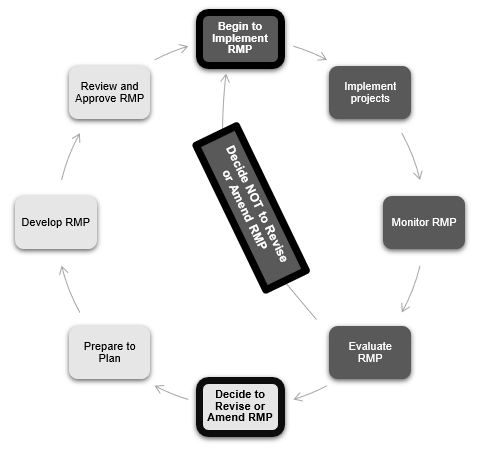
amendment by the state director, is a distinct part of the overall planning cycle (
Figure 1.1,
The
land use planning cycle
). The planning cycle is continuous and involves implementing the
approved RMP through project-specific implementation actions and projects and monitoring and
evaluating the RMP.
H-1601-1 – LAND USE PLANNING HANDBOOK (Public)
7
BLM HANDBOOK
Rel. 1-1836
Supersedes Rel. 1-1693
01/16/2025
Figure 1.1.
The land use planning process (light grey) within the overall land use planning
cycle. Black outlines note milestone points in the planning cycle.
Land use planning is the process by which the BLM makes decisions about the management of
resources and allocation of land uses on BLM-administered lands. After the BLM issues a
decision to approve an RMP, all future actions must be in conformance with the RMP (43 CFR
1610.5-3). Implementation also includes plan maintenance, monitoring, and evaluation.
Your RMP must establish intervals, as appropriate, to evaluate the RMP (43 CFR 1610.4-9). We
recommend completing an RMP evaluation every five years. RMP evaluations allow the BLM
to determine if implementation of the existing land use plan is achieving the RMP objectives.
RMP evaluations also consider how new information or changed circumstances affect
implementation of the RMP and the ability to achieve RMP objectives. During plan
implementation, reviewing the RMP monitoring information will help to determine whether
progress is being made towards achieving the plan’s objectives. You also evaluate plans to
determine whether new information or changed circumstances affect plan components and
warrant consideration for revision or amendment. When the BLM determines through an RMP
evaluation that designations, allocations, or management direction are not effective in achieving
the RMP’s objectives, or that the existing RMP no longer provides for the desired land
management approach due to new information or changed circumstances, then a state director
would decide whether to initiate a planning effort. If the RMP evaluation does not identify a
H-1601-1 – LAND USE PLANNING HANDBOOK (Public)
8
BLM HANDBOOK
Rel. 1-1836
Supersedes Rel. 1-1693
01/16/2025
need to update the RMP, then the state director would decide to not to revise or amend the plan,
and you would continue to implement and monitor the RMP as before. Refer to
Chapter 13,
After the Decision
for more information on implementing the RMP, including maintenance,
monitoring, and evaluation. Refer to section
1.4.1,
Determining Whether a Plan Revision or
Plan Amendment is Appropriate
for more information on determining the level of planning that
applies to your circumstances. After completing either a plan amendment or a revision, the state
director would approve the RMP (or amendment), and you would begin implementation and
monitoring.
The BLM also determines when there may be a need to initiate a planning effort when a
proposed implementation-level project is not in conformance with the existing RMP. When an
implementation-level project has been proposed, identify potential conflicts with existing
planning decisions, including land uses and siting constraints. For externally proposed projects,
this may occur during the initial pre-application meeting with the project proponent. This
provides the BLM and the proponent an opportunity early in the process to discuss the proposal
in general and determine if any conflicts with planning decisions exist. Where conflicts are
identified, coordination with interdisciplinary BLM staff and working with the proponent (if the
project is externally proposed) may help to identify options for resolving those conflicts,
including relocating or revising the proposed action so it would conform to your approved RMP,
or preparing a plan amendment (refer to section
13.1.1,
Plan Conformance
). By identifying
whether you intend to include a plan amendment with a proposed project early in the process,
you can integrate compliance with the requirements of both the planning and implementation-
level NEPA processes from the initiation of the proposal (refer to
Chapter 14,
Amending the
RMP
).
1.4.1 Determining Whether a Plan Revision or Amendment is Appropriate
The BLM may choose to prepare RMP amendments and revisions to update or change land use
planning decisions (BLM Land Use Planning Manual 1601.06B2):
•
In response to evaluations of consistency with current laws, regulations, and policies;
•
Upon determining that implementing a plan’s decisions is not achieving the desired
resource conditions;
•
When new science, data, or information indicates a need to change previous decisions;
•
Upon determining that current plans do not provide adequate management direction; or
•
When new proposals or actions not evaluated in previous land use plans are put forth.
The BLM monitors the implementation of projects and uses this data to identify whether any of
the above circumstances are occurring. The BLM considers the data through preparation of an
RMP evaluation to determine whether the accumulated concerns warrant RMP amendment or
revision. The BLM completes RMP evaluations on regular intervals to determine whether the
RMP is being implemented consistently through the decisions made. The BLM may also
complete RMP evaluations at any time to determine whether any new circumstances or
information warrant analysis or indicate a need to change any RMP decisions.
If the conclusions of your RMP evaluation identify that a change to the current RMP is
warranted and the state director determines that initiating a planning effort is a priority, you will
also need to identify whether to complete a plan revision or amendment to change the RMP.
H-1601-1 – LAND USE PLANNING HANDBOOK (Public)
9
BLM HANDBOOK
Rel. 1-1836
Supersedes Rel. 1-1693
01/16/2025
BLM land use planning regulations define a revision as when changed circumstances affect “the
entire plan or major portions of the plan,” (43 CFR 1610.5-6).
Planning efforts with a limited scope or focus that are not addressing the entire plan or major
portions thereof would be an amendment (refer to
Chapter 14,
Amending the RMP
)
.
Amendments may be narrow and address only one planning decision on a single acre, such as
changing a land tenure decision from retention to available for disposal to allow the sale of the
parcel to address an unintentional trespass. Amendments may also be broad and aim to update
multiple plan components across multiple planning areas, such as modifying decisions to provide
for big game habitat connectivity across a state landscape.
Determining initiation of an RMP revision or the appropriate scope of an RMP amendment is
dependent on the specifics of the information, changes, opportunities, and circumstances under
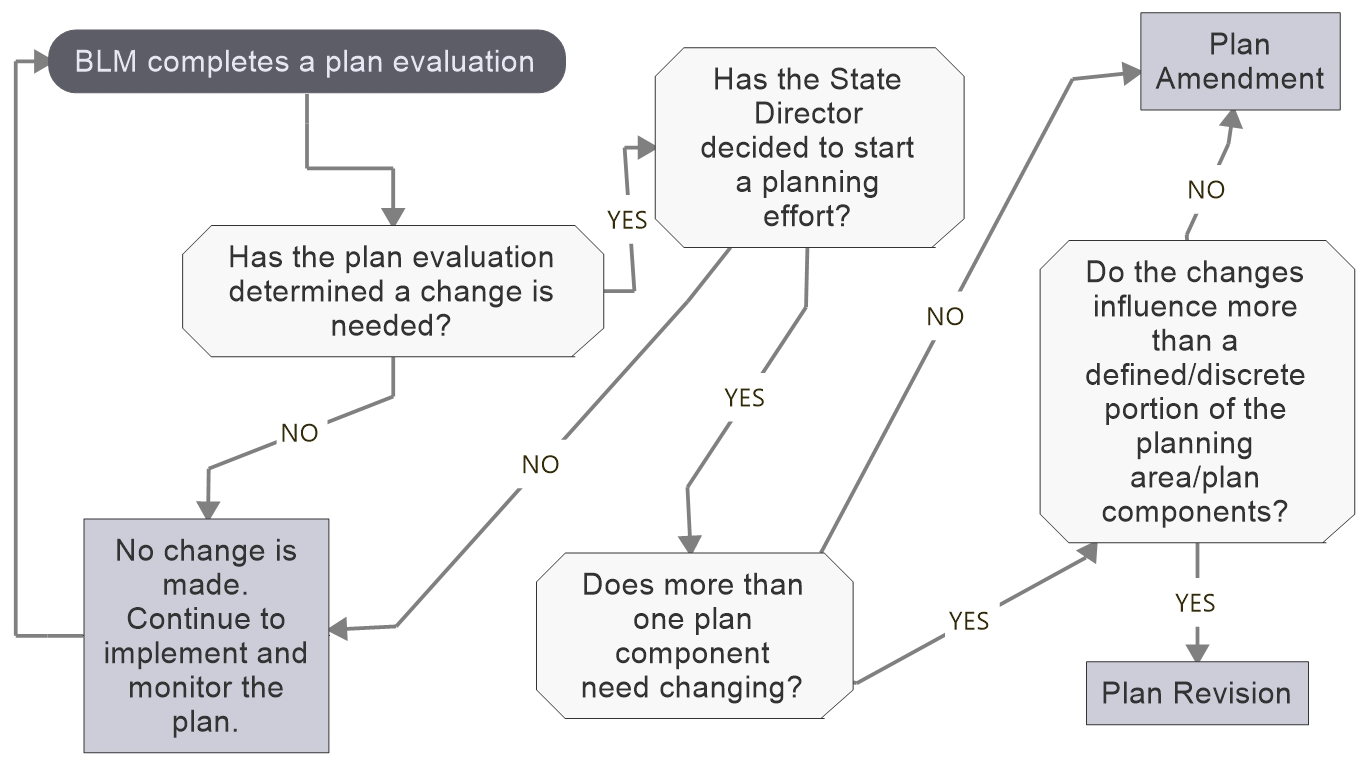
consideration. The basic approach is shown in
Figure 1.2,
Flowchart for determining if an
RMP revision or amendment is appropriate
.
Figure 1.2.
Basic flowchart for determining if an RMP revision or amendment is appropriate.
The existing RMP remains in effect during the amendment or revision process (43 CFR 1610.5-
3(a)). Refer to
Chapter 4,
RMP Evaluations
for more information on the process for
determining if changed circumstances may warrant initiation of an RMP amendment or revision
process.
1.4.2 The Basic Process for Developing or Revising an RMP
The decision to revise an RMP begins with the identification of a need to change BLM’s
management of public lands from the current RMP through an RMP evaluation. The BLM
develops a new RMP for BLM-administered lands not currently under an RMP, or when
H-1601-1 – LAND USE PLANNING HANDBOOK (Public)
10
BLM HANDBOOK
Rel. 1-1836
Supersedes Rel. 1-1693
01/16/2025
Congress or the President directs changes to the management priority for an area, such as
through a proclamation for a new national monument.
Once the BLM has decided to initiate a planning effort for a new RMP or RMP revision, the
BLM Director or state director may provide guidance for the development of the planning effort.
This planning guidance is the first tool for communicating agency objectives and priorities,
decision space, and information to the BLM staff working on the planning effort, and, when
provided, is the basis by which you will identify your preferred alternative in your draft
RMP/EIS (43 CFR 1610.4-7). Refer to
Chapter 5,
BLM or State Director Planning Guidance
for more information on the specific components to address through planning guidance.
Planning efforts supported by an EIS, whether for new plans, revisions, or amendments follow
the same procedures (43 CFR 1610.5-5(b)). Much of the guidance in this handbook refers to the
development or revision of an RMP but it is important to understand this guidance also applies to
RMP amendments supported by an EIS. Refer to section
14.3,
Planning Steps for RMP
Amendments Supported by an EA
for detailed information about RMP amendments supported
by an EA which do not have all the same requirements as planning efforts supported by an EIS.
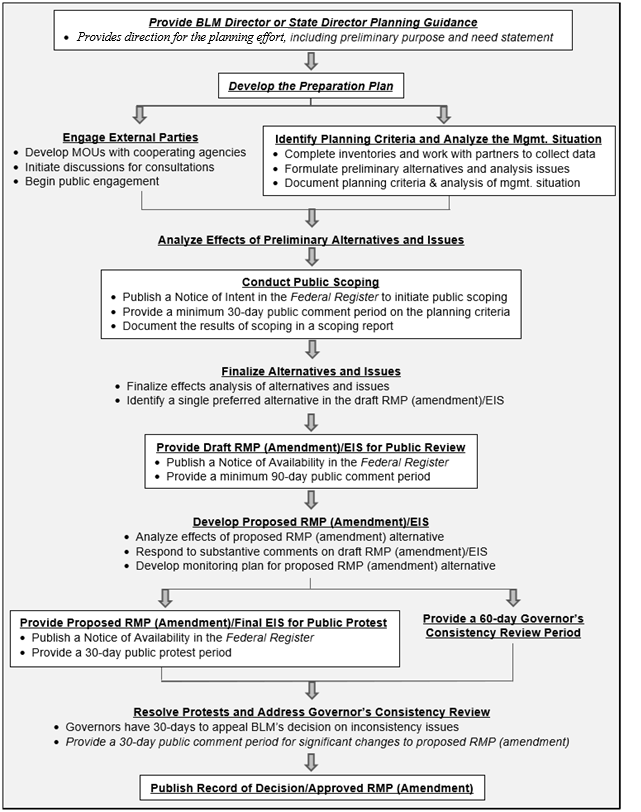
Figure 1.3,
Planning steps for new plans, revisions, and amendments supported by an EIS
provides a flowchart of the key milestones in the process.
H-1601-1 – LAND USE PLANNING HANDBOOK (Public)
11
BLM HANDBOOK
Rel. 1-1836
Supersedes Rel. 1-1693
01/16/2025
Figure 1.3.
Planning steps for new plans, revisions, and amendments supported by an EIS.
Boxes around steps indicate documents to prepare. Steps in italics are optional at the discretion
of the state director.
H-1601-1 – LAND USE PLANNING HANDBOOK (Public)
12
BLM HANDBOOK
Rel. 1-1836
Supersedes Rel. 1-1693
01/16/2025
The BLM also completes an analysis of the management situation and develops the planning
criteria during the early stages of the planning process. These steps focus on the synthesis of
BLM data and inventories maintained on a continuous basis to help refine the scope of the
planning effort, including identification of preliminary issues for NEPA analysis and
development of alternatives. Refer to
Chapter 6,
Planning Criteria and Analysis of the
Management Situation
for more information on the specific requirements for these steps.
The BLM will provide early and meaningful opportunities for Indian tribes, other federal
agencies, state and local governments, and the public to participate in the planning process. This
may include opportunities to provide information on existing and forecasted conditions of the
planning area; to suggest which of their policies, guidance, strategies, or plans would be
appropriate for consideration; and to identify relevant public views concerning management of
the planning area. Refer to
Chapter 2,
External Engagement
for more information on
governmental, Tribal, and public involvement during RMP development.
The BLM must publish an NOI to develop, revise, or amend a RMP in the
Federal Register
;
this
notice may also constitute the scoping notice under NEPA to begin public scoping for the RMP
(43 CFR 1610.2 (c)). Scoping allows an opportunity for governmental, Tribal, and public
feedback on issues, data and information identified for use in the analysis, and analytical
methodology itself through review of the planning criteria. It also provides an opportunity to
review the preliminary range of alternatives. Refer to
Chapter 7,
Notice of Intent and Scoping
for more information about these steps in the planning process.
Public review and the 90-day comment period of the draft RMP/EIS begins with the
Environmental Protection Agency’s publication of a notice of availability (NOA) in the
Federal
Register
. The BLM will respond to substantive comments and prepare the proposed RMP/final
EIS. The 30-day opportunity for the public to protest the proposed planning decisions is initiated
when the Environmental Protection Agency publishes notice of receipt of the final EIS/proposed
RMP in the
Federal Register
(43 CFR 1610.5-2(a)(1)). The governor of any state that falls
within the planning area also has 60 days from receipt of the proposed RMP to review for
consistency with officially approved or adopted state and local land use plans and policies. After
the BLM has resolved any protests or inconsistencies, a record of decision (ROD) can be issued
approving the RMP and then implementation can begin. Refer to
Chapter 8,
The Draft
RMP/EIS
through
Chapter 12,
The Record of Decision and the Approved RMP
for more
information on requirements for these steps, and to the BLM NEPA Handbook (H-1790-1) for
information on the e-filing process.
1.4.3 Coordinating Simultaneous BLM Planning Processes
The BLM sometimes engages in multiple planning efforts simultaneously within the same
planning area. For example, the BLM may be revising an RMP while also completing a project-
driven plan amendment in the same planning area or conducting a programmatic planning
initiative to amend multiple plans across several states, including your planning area –all at the
same time. Whenever the BLM conducts simultaneous planning efforts in the same planning
area, it is important to acknowledge all these planning efforts in each of the supporting NEPA
documents for the various planning processes. Be careful to avoid simultaneous planning efforts
that constrain the range of alternatives for one another. For example, you may have received a
H-1601-1 – LAND USE PLANNING HANDBOOK (Public)
13
BLM HANDBOOK
Rel. 1-1836
Supersedes Rel. 1-1693
01/16/2025
proposal to amend an existing RMP to allow for a wind development project, while you are
considering making that area a right-of way exclusion area in an RMP revision due to sensitive
species habitat.
Examples of simultaneous planning efforts include:
• A field office may be undergoing an RMP revision while also considering an amendment to
the current land use plan involving a proposed inter-state electrical transmission line.
• The BLM may be working on a plan amendment to change off-highway vehicle area
boundaries while also considering an amendment to allow for sale of a parcel not
specifically identified in the RMP as meeting the FLPMA section 203 sales criteria.
• The BLM may be amending RMPs at a national level to address management for critical
habitat while a field office within that planning area is also conducting a plan amendment in
response to a court ruling for grazing management.
Simultaneous planning efforts in the same location can present multiple challenges. Clearly
identifying the no action alternative can be a challenge if, for example, a national-level
amendment is occurring at the same time as a revision and the BLM is unsure which effort will
conclude first. It can also be challenging to identify the management to consider in the
cumulative effects analysis when simultaneous planning efforts are occurring. Ultimately, each
planning effort must identify and describe the relationship between simultaneous planning efforts
in the analysis for each effort in order to present the context and cumulative effects analysis
required for informed decision-making regarding each of the planning efforts (40 CFR
1502.15(a)). This information and description may change throughout the process of one
planning effort, as a simultaneous effort may conclude or be terminated, or a new one may begin.
It is important that simultaneous planning efforts are carefully coordinated to ensure up-to-date
information is communicated both ways and that there is consistent use of information and
analysis in each effort.
To help manage the challenges presented by simultaneous planning efforts, we recommend that
you outline some baseline information and approaches. Before starting a new planning effort
while another is already in progress, or before starting more than one planning effort, evaluate
the following questions:
•
Will the new planning effort have any decisions that may overlap with the decisions
under consideration in the ongoing planning effort? If so, how are the decisions related?
•
Would the purpose and need for the new planning effort conflict with the purpose and
need for the ongoing planning effort? If so, what is the conflict and what revisions to the
purpose and need for the supporting NEPA analysis are necessary to resolve any
conflicts?
•
What is the sequence for completing the planning efforts?
o
If there are overlapping decisions, which decision will be the BLM’s “final”
decision?
o
If the new planning effort would be completed prior to the ongoing planning effort,
would there be substantial changes to the no action alternative for the ongoing
planning effort?
•
How will the planning efforts be coordinated to ensure a consistent approach for the issue
analysis (including use of available data, assumptions, and methodology)?
H-1601-1 – LAND USE PLANNING HANDBOOK (Public)
14
BLM HANDBOOK
Rel. 1-1836
Supersedes Rel. 1-1693
01/16/2025
•
How will public involvement and consultation, coordination, and cooperation efforts be
coordinated between planning efforts?
•
Are there opportunities to combine multiple planning efforts through analysis in a single
NEPA analysis to reduce analysis or decision conflicts and streamline multiple planning
processes into one?
We recommend that you document the assessment of these questions in a contemporaneous
decision file. This documentation will inform the interdisciplinary team as they move through
the process and will present the conditions you originally reviewed for your reference as you
steer the planning process toward future decisions. Refer to the BLM NEPA Handbook (H-
1790-1) for more information on the purpose, content, and management of contemporaneous
decision files.
1.5
Relationship between Planning and NEPA
The FLPMA requires the BLM to develop land use plans. There are specific regulations (43
CFR Part 1600) that specify how the BLM conducts land use planning, how decisions are to be
made, and the opportunities for public involvement, protest, and governor’s consistency during
the planning process. Decisions on RMP development, revision, or amendment are subject to
NEPA compliance.
The BLM’s planning regulations provide that approval of an RMP is considered a major Federal
action significantly affecting the quality of the human environment. Environmental analysis of
the proposed planning decision must be accomplished as part of the planning process and,
wherever possible, the proposed plan and the related NEPA analysis shall be published as a
single document (43 CFR 1601.0-6). Under the BLM land use planning regulations, the BLM
must prepare an EIS for new RMPs and for RMP revisions (43 CFR 1601.0-6). The BLM must
prepare either an EIS or an environmental assessment (EA) for plan amendments, depending on
the scope of the planning effort and the anticipated impacts (43 CFR 1610.5-5(a); refer to BLM
NEPA Handbook (H-1790-1)).
Guidance for how the BLM complies with NEPA can be found in the BLM NEPA Handbook
(H-1790-1).
The land use planning process requires the integration of planning and NEPA steps. There are
certain land use planning steps and concepts that are not required or even mentioned by NEPA or
its implementing regulations. Likewise, the NEPA, as amended, and the Department of the
Interior and the Council on Environmental Quality implementing regulations for NEPA (43 CFR
46 and 40 CFR 1500, respectively) contain requirements that are not explicitly described in
FLPMA or BLM’s planning regulations (43 CFR 1600). For example, FLPMA requires
coordination with agencies during land use planning while the Council on Environmental Quality
NEPA regulations provide for cooperation between agencies. These are two complementary, but
different concepts and it is important to recognize the difference between them (refer to
Chapter
2,
External Engagement
). And while neither FLPMA nor the implementing regulations
establish page or time limits for land use planning, NEPA, as amended, and the Council on
Environmental Quality’s NEPA regulations establish both time and page limit requirements for
H-1601-1 – LAND USE PLANNING HANDBOOK (Public)
15
BLM HANDBOOK
Rel. 1-1836
Supersedes Rel. 1-1693
01/16/2025
EISs and EAs that apply to NEPA analysis prepared in support of RMPs and RMP amendments
(42 U.S.C. 4336a; 40 CFR 1501.10; 40 CFR 1502.7)).
Key elements of a planning process supported by an EIS that are required by BLM’s planning
regulations and not by NEPA include:
•
Required content for NOI (43 CFR 1610.2(c)(1)-(8));
•
Minimum advance notice of public meetings (43 CFR 1610.2(e));
•
Designated 90-day public comment period for a draft RMP/EIS (43 CFR 1610.2(e));
•
Required consultation and public hearing for plans involving potential for coal mining or
coal leasing (43 CFR 1610.2(j)-(k));
•
Coordination with other Federal agencies, Indian tribes, and state and local governments
(43 CFR 1610.3);
•
Planning criteria development (43 CFR 1610.4-2) and public review (43 CFR
1610.2(f)(2));
•
Analysis of the management situation development (43 CFR 1610.4-4);
•
Selection and identification of a preferred alternative in the draft RMP/EIS (43 CFR
1610.4-7);
•
Establishment of an RMP monitoring strategy and identification of evaluation intervals,
as appropriate (43 CFR 1610.4-9);
•
Governor’s consistency review and appeal (43 CFR 1610.3-2(e));
•
Protesting of planning decisions to the BLM Director (43 CFR 1610.5-2);
•
Public notice and comment on any significant change made to the proposed RMP in
response to any protests received (43 CFR 1610.2(f)(5)); and
•
Approval of the RMP by the state director (43 CFR 1610.5-1).
Most of these steps are also required for RMP amendments supported by an EA, except for
public comment on an EA; development of an analysis of the management situation; and
selection of a preferred alternative. Refer to section
14.3,
Planning Steps for RMP
Amendments Supported by an EA
for detailed information about RMP amendments supported
by an EA.
This handbook endeavors to highlight the NEPA compliance requirements applicable to each
part of the planning process outlined in the BLM’s planning regulations at 43 CFR 1600.
Regulations and policy for other programs have incorporated decisions and reviews into the land
use planning process that provide specific direction for planning and NEPA considerations. For
example, BLM policy for wild and scenic rivers requires the BLM to conduct wild and scenic
river suitability studies during the land use planning process and for the NEPA analysis
supporting the planning effort to address suitability factors through alternatives related to wild
and scenic river recommendations (refer to BLM Wild and Scenic Rivers Manual (MS-6400
4.1(B))).
1.5.1 Incorporation by Reference and Tiering
NEPA analysis completed during the planning process plays a critical role in streamlining the
BLM’s NEPA compliance for projects that implement the RMP by providing opportunities for
H-1601-1 – LAND USE PLANNING HANDBOOK (Public)
16
BLM HANDBOOK
Rel. 1-1836
Supersedes Rel. 1-1693
01/16/2025
incorporation of the plan-level NEPA analysis by reference and tiering to it. The Council on
Environmental Quality regulations direct that “Agencies shall incorporate material, such as
planning studies, analyses, or other relevant information, into environmental documents by
reference when the effect will be to cut down on bulk without impeding agency and public
review of the action” (40 CFR 1501.12). Refer to the BLM NEPA Handbook (H-1790-1) for
more information on how to incorporate by reference and tier to higher-level analysis during the
NEPA process.
When the BLM can tier to analysis of an issue or alternative evaluated in the plan’s EIS, the
BLM can save time and cost when considering whether to approve subsequent projects that
implement the plan. In tiering, your project-level EA or EIS may not need to reexamine
alternatives or issues already considered in the RMP’s EIS. For example, if a no grazing
alternative is analyzed in detail in your RMP, the BLM may be able to tier future project-level
allotment management NEPA analysis to the RMP EIS to eliminate a no grazing alternative from
detailed analysis in the project NEPA document. As such, it is valuable for an RMP EIS to
provide a comprehensive and data-based analysis of all issues of relevance to the resource
programs and resource uses for the planning area.
Tiering and incorporation by reference can benefit the NEPA analysis for the planning effort
itself. In some cases, completed national-level planning efforts may provide analysis and
decision-making applicable to your planning effort. Where appropriate, you may tier to the
analysis supporting these decisions in your planning effort and reduce alternatives or issues to
analyze in detail. Completed and ongoing national-level planning efforts may provide you with
opportunities for incorporating analysis by reference.
1.6
Required Recordkeeping for Land Use Planning
The BLM has multiple responsibilities to maintain and disclose Federal records including
general records management governed by 44 U.S.C. Chapters 29 and 31, the Freedom of
Information Act, and in preparation of administrative records for litigation. To comply with
these responsibilities during land use planning, including the parts of the planning cycle outside
of the planning process such as implementation, monitoring, evaluation, maintenance, the BLM
must prepare or maintain a contemporaneous decision file(s). Refer to the BLM NEPA
Handbook (H-1790-1) for more information on the purpose, content, and management of
contemporaneous decision files.
H-1601-1 – LAND USE PLANNING HANDBOOK (Public)
17
BLM HANDBOOK
Rel. 1-1836
Supersedes Rel. 1-1693
01/16/2025
Chapter 2 – External Engagement
General
2.1 Public Involvement
2.2 Coordination with Other Federal Agencies, Indian Tribes, and State and Local Governments
2.3 Cooperating Agency Involvement
2.4 Consultation
2.5 Other Special Considerations
General
This chapter provides an overview of the public involvement steps throughout the land use
planning process. You can find more specific information and details about external engagement
steps of the land use planning process and details on such things as the specifics of
Federal
Register
notices (refer to
Chapter 6,
Planning Criteria and Analysis of the Management
Situation
,
Chapter 7,
Notice of Intent and Scoping
,
Chapter 9,
Public Comment on the Draft
RMP/EIS
, and
Chapter 11,
Protest and Governor’s Consistency Review of the Proposed
RMP
).
Coordination, cooperation, consultation, and public involvement are all examples of external
engagement and are central to the BLM’s land use planning process. These processes
collectively emphasize methods for engagement and discourse, not specific outcomes, and do not
require that consensus be reached. These processes take time and require thoughtful preparation,
but if done right, foster relationships, build trust, and result in durable decision-making.
The BLM retains the responsibility and the authority to make decisions related to the
management of resources and resource uses on BLM-administered lands. Coordination,
cooperation, consultation, and public involvement in the planning process do not alter the
authority of the BLM to make planning decisions.
External engagement is a two-way process that requires both the BLM and the external party to
interact and listen to each other, with the aim of BLM developing RMPs that provide for the
management of public lands under the principles of multiple use and sustained yield. There are
many reasons we participate in coordination, cooperation, consultation, and public involvement
during land use planning.
•
Comply with FLPMA.
We must provide the opportunity for public involvement during
planning to comply with FLPMA (Section 202(a)).
•
Identify and Use Better Information.
We can make a more informed decision by
reaching out for relevant expertise, including scientific and technical expertise, and
knowledge of local resource conditions.
•
Ensure Inclusivity.
We can increase the likelihood that we know about issues that are
important, including traditionally disadvantaged, under-represented, or environmental
justice communities.
•
Prevent Conflict.
We can identify potential conflicts before they arise and consider
options head off or resolve any such conflicts.
•
Improve Consistency.
We can work to develop resource management consistent with
officially approved or adopted resource related plans of other Federal agencies, Indian
H-1601-1 – LAND USE PLANNING HANDBOOK (Public)
18
BLM HANDBOOK
Rel. 1-1836
Supersedes Rel. 1-1693
01/16/2025
tribes, and state and local governments to the maximum extent consistent with Federal
law and the purposes of FLPMA (43 CFR 1610.3-2).
•
Improve Fact-Finding.
We can promote a common understanding of the facts that
underlie the issues by agreeing on a methodology for producing technical information.
•
Increase Social Capital.
We can build trust between people who may work together on
other projects and increase public confidence in the BLM.
•
Streamline Implementation.
We can ease implementation of a plan by having
stakeholders who are vested in the planning decisions and are willing to develop
partnerships to increase our capacity for subsequent implementation actions.
•
Enhance Stewardship.
We can promote stewardship of public lands by encouraging the
public to assist in educating others about the plan to improve compliance.
•
Collect Socioeconomic Information.
We can evaluate the impacts of actions on people
if we understand how people value the public lands.
•
Avert Litigation.
We may reduce the chance of litigation by engaging the public early
and often, by solving problems as they arise, and by building relationships between
different groups.
•
Improve Efficiency.
We can highlight issues to focus the NEPA analysis.
•
Extend Resources.
We can leverage monetary and in-kind contributions to extend the
reach of project dollars and BLM resources.
•
Build Relationships of Trust.
We can continue to build trust in our communities by
leveraging existing relationships and programs. BLM’s 5 Community Engagement
Programs (Education, Interpretation, Partnerships, Volunteers, and Youth) work with
communities to engage people of all ages and backgrounds in meaningful and mutually
beneficial service on their public lands and can assist in coordination, cooperation,
consultation, and public involvement during BLM land use planning.
An RMP amendment supported by an EIS follows the same procedures required for an RMP
revision (43 CFR 1610.5-5(b)). While this chapter refers specifically to an RMP/EIS, the
guidance is also applicable to an RMP amendment/EIS. Refer to section
14.3,
Planning Steps
for RMP Amendments Supported by an EA
for additional guidance. In this chapter, the most
notable differences between an RMP/EIS and an RMP amendment supported by an EA is that
you are not required to invite cooperating agencies to participate in the planning process (43
CFR 1610.3-1(b)) or to make an EA available in draft for public review and comment. If you
choose to make your EA available in draft for public review and comment, the minimum
comment period is 30 days. The only
Federal Register
notice required for an RMP amendment
supported by an EA is the NOI.
2.1
Public Involvement
Public involvement means the opportunity for participation by the public in decision-making and
planning with respect to the public lands (FLPMA, Section 103(d)). The BLM must provide the
public with opportunities to become meaningfully involved during the planning process, and
specifically during the preparation and amendment of RMPs (43 CFR 1610.2(a)). Meaningful
public involvement includes timely, concerted, and thoughtful efforts to build relationships and
seek the ideas, opinions, and participation of all members of the public that may be affected by
planning decisions. Early public involvement helps the BLM identify interested and affected
parties in the local communities, including communities with environmental justice concerns.
H-1601-1 – LAND USE PLANNING HANDBOOK (Public)
19
BLM HANDBOOK
Rel. 1-1836
Supersedes Rel. 1-1693
01/16/2025
Refer to the BLM NEPA Handbook (H-1790-1) for further guidance on public involvement in
local communities and identifying communities with environmental justice concerns within your
planning area.
“The public” means affected or interested individuals, including: consumer organizations; public
land resource users; corporations and other business entities; environmental organizations and
other special interest groups; and officials of Federal, state, local, and Indian Tribal governments
(43 CFR 1601.0-5(k)). However, there is a unique role for Federal agencies, Indian tribes, and
state and local governments in the planning process (refer to section
2.2,
Coordination with
Other Federal Agencies, Indian Tribes, and State and Local Governments
).
Meaningful public involvement:
•
Provides for public input at specific points in the planning process and on the specific
issues where such input has a real potential to help shape the decision;
•
Seeks ideas, opinions, and participation from a diverse public including communities of
place; communities of interest; multiple generations; various cultural, social, and
economic backgrounds; and low income and minority, including tribal, populations
(environmental justice), and other underrepresented persons; and
•
Promotes transparent approaches that keep the public informed throughout a sometimes
complex planning processes.
Best practices for successful collaboration include:
• Reaching out as early as possible in the planning process;
• Thinking creatively and remembering there is no “one size fits all” approach; and
• Continually involving the public in the BLM’s planning cycle, including during
implementation.
In addition to opportunities for public involvement associated with individual planning efforts as
discussed below, the planning regulations require an opportunity for public comment on outyear
proposals of new efforts. Early in each fiscal year, the BLM Director must publish a planning
schedule advising the public of the status of each plan in process of preparation or to be started
during that fiscal year, and projected new planning starts for the three succeeding fiscal years.
The BLM Director must publish this notice in the
Federal Register
in the first quarter of each
fiscal year and must call for public comments on projected new planning efforts before planning
starts so comments can be considered in refining priorities (43 CFR 1610.2(b)).
2.1.1 Opportunities for Public Involvement when Preparing an RMP
The BLM’s planning regulations require the BLM to provide specific opportunities for public
involvement when preparing an RMP (43 CFR 1610.2).
Table 2.1,
Public involvement in the preparation of an RMP
explains the purpose and the type
of feedback that the BLM is soliciting at each public involvement step. As described in
Table
2.2,
Desired feedback from public during RMP process steps
public involvement activities
conducted by the BLM must be documented by a record or summary of the principal issues
discussed and comments made (43 CFR 1610.2(d)) and may be acknowledged through the
development and refinement of the draft RMP/EIS. Coordinate with your communications staff
H-1601-1 – LAND USE PLANNING HANDBOOK (Public)
20
BLM HANDBOOK
Rel. 1-1836
Supersedes Rel. 1-1693
01/16/2025
to determine how to conduct these public involvement steps and how to be clear with the public
about the type of public involvement you are offering.
Table 2.1.
Public involvement in preparation of an RMP.
1
Public Involvement
Step
Timeframe
(calendar
days)
Federal Register
Notice
2
General Purpose
Early Engagement (Pre-
NOI)
N/A
No requirements
Provide the public with
opportunities to provide data,
ideas, opinions, and for
participation of all populations
that may be affected. Develop
understanding of the overall
interests of the local
governmental and Tribal
representatives.
Scoping and Comments
on Planning Criteria
30 days
NOI (Newspaper
publication is also
required (43 CFR
1610.2(c))
3
Solicit feedback on
potential
issues and methodologies for
analyzing those issues in the
planning criteria, including any
significant changes to such
criteria.
Comments on draft
RMP/EIS
90 days
Environmental
Protection Agency NOA
Solicit feedback on range of
alternatives, including the
analysis of their effects, and the
preferred alternative.
Protest of proposed
RMP/final EIS
30 days
Environmental
Protection Agency NOA
Determine whether RMP
process followed established
procedures, considered relevant
information in reaching
proposed plan decisions, and
whether the proposed plan
decisions are consistent with
BLM policy, regulation, and
statute. Remedy inconsistencies
in the RMP with Federal laws,
regulations, or applicable policy.
When the governor
recommends changes
to a proposed RMP
which were not raised
during the public
involvement process
30 days
No requirements
Provide the public with an
opportunity to comment on the
governor’s recommendations.
5
When there is
significant change to the
proposed RMP after its
publication
30 days
No requirements
Provide the public with an
opportunity to comment on
significant changes.
6
H-1601-1 – LAND USE PLANNING HANDBOOK (Public)
21
BLM HANDBOOK
Rel. 1-1836
Supersedes Rel. 1-1693
01/16/2025
1
Be sure to review program-specific guidance for additional public involvement requirements during a planning
process. For example, if the plan involves potential for coal leasing, you must provide a public hearing before you
can approve the RMP to the approval of the plan if requested by any person having an interest which is, or may be,
adversely affected by implementation of the plan (43 CFR 1610.2(k)).
2
When a
Federal Register
notice is not required, determine other appropriate forms of notification. Also refer to
section
2.1.3.2,
Federal Register Notices
for information about the BLM
Federal Register
notice.
3
Refer to section
8.2,
Scoping Notices
for additional information on newspaper publication of the NOI.
4
You may also choose to solicit comments on the preliminary range of alternatives, description of the affected
environment, or purpose and need documented in the analysis of the management situation (refer to description of
additional opportunities for public feedback during scoping in
Table 2.2,
Desired feedback from public during
RMP process steps
). Some programs require BLM to solicit specific feedback during scoping. For example,
during scoping for new RMPs, RMP revisions, and RMP amendments for which areas of critical environmental
concern are within scope, the BLM must seek nominations for areas of environmental concern from the public, State
and local governments, Indian tribes, and other Federal agencies (43 CFR 1610.7-2(c)(3)). Consult program-
specific guidance in handbooks, manuals, or regulation for specific direction on program-specific feedback to solicit
during scoping.
5
Refer to section
11.3,
Governor’s Consistency Review
for additional information regarding public comment on
changes to the proposed RMP proposed by the governor.
6
Refer to section
11.4,
Notice of Significant Change
for additional information regarding public comment on
significant changes to the proposed RMP.
Table 2.2.
Desired feedback from public during RMP process steps.
Early Engagement (Pre-NOI)
Desired feedback from the public:
•
What is the public’s connection to the planning area?
•
How, and in what specific locations, does the public use the planning area?
•
What are the needs and values of the public regarding the planning area?
•
What are the environmental and social benefits derived by the public from the planning area?
•
Does the public have high quality data and information pertinent to the planning area?
•
Does indigenous knowledge information relevant to the planning area exist?
•
What are the potential areas of conflict between different resources and uses of the planning
area?
•
Do members of the public have ideas for alternatives for management of the planning area?
•
What resource related plans, programs, data, etc., do other Federal agencies, Indian Tribes,
and state and local governments have that would inform the planning process?
Minimum requirements for public involvement:
•
None.
Documentation of how public input was considered:
•
The BLM must document how it considered public input from public participation activities in
the contemporaneous decision file (43 CFR 1610.2(d)). We recommend that you summarize
the input you received during early engagement as part of your communication on the planning
criteria and describe how it influenced the development of issues, impacts analysis plan, and
preliminary alternatives.
Scoping: Planning Criteria
Desired feedback from the public:
•
Do the issues adequately capture the problems, opportunities, or potential significant effects
relevant to the planning area?
•
Are there any suggestions to improve the way the BLM intends to conduct the effects analysis?
•
Has the BLM relied on invalid or outdated data or procedures, incorrect assumptions, or
ineffective indicators of resource conditions?
•
Is there new information relevant to the planning area the BLM needs to consider?
•
Is there information related to reasonably foreseeable actions by other entities that are relevant
to effects that the BLM needs to consider?
Minimum requirements for public involvement:
H-1601-1 – LAND USE PLANNING HANDBOOK (Public)
22
BLM HANDBOOK
Rel. 1-1836
Supersedes Rel. 1-1693
01/16/2025
•
The BLM must provide an opportunity for the public to review the proposed planning criteria,
including any significant changes to such criteria (43 CFR 1610.2(f)(2)).
•
To develop, revise, or amend RMPs, BLM must publish a notice in the
Federal Register
and
appropriate local media, including newspapers of general circulation in the state and field office
area (43 CFR 1610.2(c)). The field manager may also decide if it is appropriate to publish a
notice in media in adjoining states.
•
The BLM must document the principal issues discussed and comments made in any public
participation activity and provide the documentation to the public, along with a list of attendees.
The BLM must provide 30 days for participants to clarify their views (43 CFR 1610.2(d)).
Additional opportunities for public feedback on the analysis of the management situation:
•
Does the preliminary purpose and need statement adequately capture the problems,
opportunities, and desired outcomes in the planning area?
•
Has the BLM developed an adequate range of preliminary alternatives to respond to the
purpose and need?
•
Is any rationale presented for the preliminary alternatives based on sound reasoning?
•
Does the analysis of the management situation accurately reflect the resource, environmental,
ecological, social, and economic conditions of the planning area or is there something else the
BLM needs to be considering?
Documentation of how public input was considered:
•
We recommend that you identify the information you received during the review of the planning
criteria in the scoping report and identify how you refined the purpose and need, preliminary
alternatives, issues and impacts analysis plan, and baseline information.
•
The draft RMP/EIS must include a summary of the information submitted during scoping and
must append or otherwise publish all comments (or summaries thereof) received during the
scoping process (40 CFR 1502.17). You may publish the scoping report as a stand-alone
document ahead of publication of your draft RMP/EIS and incorporate the document by
reference to fulfill this requirement. Alternatively, you can provide the scoping report as an
appendix to the draft RMP/EIS when it is released.
Review of the Draft RMP/EIS
Desired feedback from the public:
•
Has the BLM conducted a sufficient analysis of the issues to evaluate the differences between
the alternatives?
•
Is there new information available that is relevant to the analysis of the alternatives?
•
Does the BLM’s information contain inaccuracies based on facts, or on a reasonable
interpretation of facts?
•
Is the rationale for the preferred alternative based on sound reasoning?
•
Is there an adequate range of alternatives?
Minimum requirements for public involvement:
•
The BLM must provide an opportunity for a minimum 90-day public comment on the draft
RMP/EIS (43 CFR 1610.2(f)(3), 40 CFR 1503.1(a)).
Documentation of how public input was considered:
•
The BLM must respond to substantive public comments on the draft RMP/EIS in the proposed
RMP/final EIS (40 CFR 1503.4).
Protest of the Proposed RMP/Final EIS
Desired feedback from the public:
•
Is the proposed RMP inconsistent with law, regulation, or applicable policy?
•
Did the BLM follow established procedures and consider relevant information in reaching the
proposed decision?
•
Is there a new issue that became apparent after the close of the opportunity for public comment
on the draft RMP/EIS?
Minimum requirements for public involvement:
H-1601-1 – LAND USE PLANNING HANDBOOK (Public)
23
BLM HANDBOOK
Rel. 1-1836
Supersedes Rel. 1-1693
01/16/2025
•
Any member of the public who participated in the planning process for an RMP (or amendment)
and has an interest which may be adversely affected by the approval of a proposed RMP or
RMP amendment may file a written protest protesting such approval with the BLM Director
within 30 days of the date Environmental Protection Agency published the notice of receipt of
the final EIS or for within 30 days of the publication of the notice of its effective date for a
proposed amendment supported by an EA. A protest may raise only those issues which were
submitted for the record during the preparation of the RMP (43 CFR 1610.5-2(a)).
Documentation of how public input was considered:
•
The BLM Director
1
must render a written decision on protests. The BLM must notify the
protesting parties of the decision (43 CFR 1610.5-2(a)(3)).
Significant Changes after Publication of the Proposed RMP/Final EIS
Desired feedback from the public:
•
Are the significant changes consistent with the framework of the purpose and need for the
planning effort?
•
Has the BLM conducted a sufficient analysis of the issues for the significant changes?
•
Are the significant changes consistent with law, regulation, or policy?
•
Did the BLM consider relevant information in making the significant change?
Minimum requirements for public involvement:
•
The BLM must provide public notice and comment on any significant change made to the
proposed plan (43 CFR 1610.2(f)(5)).
Documentation of how public input was considered:
•
You may respond to comments during this comment period in the ROD.
New Recommendations by Governor after Publication of the Proposed RMP/Final EIS
Desired feedback from the public:
•
Do the Governor’s recommendations provide for a reasonable balance between the national
interest and the state’s interest?
Minimum requirements for public involvement:
•
During the governor’s consistency review, the governor of an involved state may identify
inconsistencies and recommend changes to the RMP within 60 days of the State Director
submitting the proposed RMP to the Governor. If the recommended changes have not been
raised previously in the planning process, the BLM must provide the public with an opportunity
to comment on the recommendations (43 CFR 1610.3-2(e)).
•
If the BLM accepts the governor’s recommendations, an additional comment period must be
provided that announces the significant changes (43 CFR 1610.3-2(e)).
Documentation of how public input was considered:
•
You may respond to comments during this comment period in the ROD.
Note:
The BLM must provide 15 days’ notice for activities where the public is invited to attend. Any notice requesting
written comments must provide at least 30 days for submission of those comments (43 CFR 1610.2(e)).
1
The Assistant Director for Resources and Planning has been delegated the authority to resolve protests.
In addition to the public involvement required by FLPMA, NEPA, and the BLM’s land use
planning regulations, public input may be solicited by the field manager at any time during the
planning process, on any item, and through any of a variety of strategies. When requesting this
type of public input, it is recommended that you:
•
Explain what input is most useful at a particular step in the planning process;
•
Describe how this input may be used in the planning process;
•
Identify the type of response, if any, the BLM will provide to the public; and
•
Identify future opportunities for involvement.
H-1601-1 – LAND USE PLANNING HANDBOOK (Public)
24
BLM HANDBOOK
Rel. 1-1836
Supersedes Rel. 1-1693
01/16/2025
2.1.2 Public Involvement for Plan Amendments
An RMP amendment supported by an EIS follows the same procedures required for an RMP
revision (43 CFR 1610.5-5(b)).
While not all the public involvement steps for the development or revision of an RMP are
required for RMP amendments supported by an EA, the field manager may provide these
opportunities for an RMP amendment process supported by an EA. Refer to section
14.3,
Planning Steps for RMP Amendments Supported by an EA
for detailed information on public
involvement for RMP amendments supported by an EA.
2.1.3 Announcing Opportunities for Public Involvement
At a minimum, all opportunities for public involvement are announced by:
•
Posting a notice on the BLM’s official national NEPA register, at all BLM offices within
the planning area, and at other public locations, as appropriate;
•
Notifying those individuals or groups on the RMP mailing list (refer to section
2.1.3.1,
RMP Mailing List
); and
•
Providing notification to those who have requested it on an individual action (40 CFR
1501.9(c)(5)(i)).
If you invite the public to attend an RMP process event (such as a meeting, open house, or field
tour), you must notify the public at least 15 days before the event (43 CFR 1610.2(e)). We
recommend that you hold any public meetings at least 15 days before the end of comment
period.
We recommend providing additional notifications using formats that are relevant and accessible
to those interested in or affected by a particular planning effort. For example, the BLM could
post an announcement at a local library, post office, or other frequently visited location; issue a
local, regional, or national press release; notify community leaders; or post an announcement
using various social media. The use of these additional formats would vary based on the location
and public interest in the planning effort.
2.1.3.1
RMP Mailing List
A list of individuals and groups known to be interested in or affected by an RMP must be
maintained by the field manager and those on the list must be notified of public participation
activities. Individuals or groups may ask to be placed on this list to ensure BLM notifies them of
opportunities for public involvement related to the preparation or amendment of an RMP (43
CFR 1610.2(d)).
We recommended you begin compiling a mailing list as soon as possible when beginning the
RMP process and maintain it through issuance of the ROD. Include anyone who has submitted a
comment (though this may not be feasible if you receive a large number of form letters; refer to
box below) or attended a meeting, in addition to individuals or groups that specifically ask to be
added to the mailing list. The BLM may notify individuals or groups on the public mailing list
through written or electronic correspondence.
H-1601-1 – LAND USE PLANNING HANDBOOK (Public)
25
BLM HANDBOOK
Rel. 1-1836
Supersedes Rel. 1-1693
01/16/2025
You may receive numerous comments through form letters. Attempt to identify the groups
responsible for form letters and include the group on the RMP mailing list. You are not required
to individually notify individuals submitting form letters unless they specifically requested to be
added to the mailing list. Be sure to notify the public how the BLM intends to handle form
letters and provide instructions about how to be added to the mailing list.
Be sure to ask your state office land use planning lead if there are groups that have made blanket
requests to be added to the mailing lists of all planning efforts in your state. For example,
implementation of the
2006 Federal Lands Hunting, Fishing and Shooting Sports Roundtable
Memorandum of Understanding
requires the BLM to notify sportsmen’s organizations when
land use plans or activity plans (including travel management plans) are developed, revised, or
amended.
You must notify the public of their privacy rights. BLM Headquarters periodically provides
updated guidance via instruction memoranda. Check with your state office land use planning or
communications staff for current guidance and include only the following (or updated) statement
in all information requesting public comment:
“
Before including your address, phone number, e-mail address, or other personal identifying
information in your comment, be advised that your entire comment –including your personal
identifying information –may be made publicly available at any time. While you can ask us in
your comment to withhold from public review your personal identifying information, we cannot
guarantee that we will be able to do so.
”
2.1.3.2
Federal Register Notices
At specific steps during the planning process, publication of a notice in the
Federal Register
is
required to initiate public involvement:
•
The BLM must publish a notice when the BLM starts to develop, revise, or amend a
resource management plan (43 CFR 1610.2(c)), whether supported by an EIS or an EA.
This notice may also constitute the notice of intent required by NEPA for planning efforts
supported by an EIS (40 CFR 1502.4(e)).
•
The BLM must provide at least 90 days for the public to comment on the draft RMP/EIS.
This public comment period officially starts with the Environmental Protection Agency’s
publication of a NOA for the document in the
Federal Register
(43 CFR 1610.2(e)). The
BLM also publishes a public notice to provide information not contained in the
Environmental Protection Agency’s NOA about the project, including the comment
period, contact information, and other supplemental information. This BLM published
public notice must appear in the
Federal Register
for actions with effects of national
concern (40 CFR 1501.9(c)(5)(ii)). Ideally, both public notices will publish on the same
date; however, if this does not happen, the 90-day comment period begins when the
Environmental Protection Agency’s NOA publishes.
•
Publication of the Environmental Protection Agency’s NOA for the BLM’s proposed
RMP/final EIS officially initiates the public protest period. The BLM publishes a public
notice as well, which contains information about the project, protest period and filing
instructions, contact information, and other supplemental information not contained in the
Environmental Protection Agency’s NOA. This BLM published public notice must
appear in the
Federal Register
for actions with effects of national concern (40 CFR
H-1601-1 – LAND USE PLANNING HANDBOOK (Public)
26
BLM HANDBOOK
Rel. 1-1836
Supersedes Rel. 1-1693
01/16/2025
1501.9(c)(5)(ii)). Individuals and entities have 30 days from the publication of
Environmental Protection Agency’s NOA of the document to file a protest with the BLM
Director (43 CFR 1610.5-2)).
•
The BLM must provide public notification of the availability of the approved RMP/ROD,
and that notification must include publication of a NOA in the
Federal Register
for
actions with effects of national concern (40 CFR 1501.9(c)(5)(ii), 40 CFR 1505.2).
2.1.4 Timeframes for Public Comment and Protest Periods
The BLM must provide at least 30 calendar days for the public to respond whenever requesting
written comments unless a longer period is required by law or regulation (43 CFR 1610.2(e)).
The BLM must provide at least 90 calendar days for the public to provide written comments on a
draft RMP (amendment)/EIS. This period begins when the Environmental Protection Agency
publishes an NOA for the draft EIS in the
Federal Register
(43 CFR 1610.2(e)). In computing
these dates, the day after publication is counted as the first day. When a date falls on a weekend
or holiday, the next Federal business day is used (1 CFR 18.17).
If a
Federal Register
notice is not required, then the period would begin when the BLM
announces the availability of the document on the BLM’s official national NEPA register,
including the opportunity for public comment on the BLM’s official national NEPA register, and
posts a notice at the BLM office where the plan is being prepared. For example, the BLM may
choose to offer an opportunity for public comment on an RMP amendment supported by an EA,
and that does not require a
Federal Register
notice.
If the BLM grants an extension to the comment period, consider how to notify the public of the
extension. Provide notice of an extended comment period in a manner that will best notify the
parties interested in your planning effort of the new comment timeframe. A
Federal Register
notice is not required to provide notice of an extended comment period. If you used a
Federal
Register
notice to announce the start of the comment period, you will need to decide if another
Federal Register
notice is necessary to reach interested parties that may not be reached by other
notification methods, or if methods such as notification on the BLM’s official national NEPA
register, press releases in local newspapers, or notices sent to mailing lists can reasonably notify
your interested and affected parties of the change. Refer to the BLM NEPA Handbook (H-1790-
1) for guidance on notifications related to extensions of comment periods.
2.1.5 Recordkeeping Related to Public Involvement
Public involvement activities conducted by the BLM must be documented by a record or
summary of the principal issues discussed and comments made. We recommend that you
include the date, type of meeting, list of attendees, and any decisions or agreements that were
made during the meeting in the record or summary and that you maintain these records as the
activities occur.
Table 2.1,
Public involvement in the preparation of an RMP
provides a high-
level overview of each public involvement step in the RMP process. A complete record of
public involvement, including persons attending public meetings, is necessary for the BLM to
confirm a person’s participation in the process to help the BLM determine whether a person has
standing to protest a proposed RMP. If you have not kept complete public participation records,
the BLM Director will be unable to dismiss any protests based on standing (refer to section
11.2.2,
Initial Evaluation of Protests
). The documentation together with a list of attendees must
H-1601-1 – LAND USE PLANNING HANDBOOK (Public)
27
BLM HANDBOOK
Rel. 1-1836
Supersedes Rel. 1-1693
01/16/2025
be available to the public and open for 30 days to any participant who wishes to clarify the views
they expressed (43 CFR 1610.2(d)). Refer to section
1.6,
Required Record Keeping for Land
Use Planning
for additional guidance on contemporaneous recordkeeping requirements.
2.2
Coordination with Other Federal Agencies, Indian Tribes, and State and Local
Governments
Section 202(c)(9) of FLPMA provides for coordination with other Federal agencies, Indian
tribes, and state and local governments (43 CFR 1610.3-1(a)). The FLPMA directs the BLM
during land use planning to the extent consistent with the laws governing the administration of
the public lands, to coordinate the land use inventory, planning, and management activities with
the land use planning and management programs of these entities within which the lands are
located. Although the BLM cannot delegate its decision-making authority, other Federal
agencies, Indian tribes, and state and local governments within the planning area can furnish
advice to the BLM with respect to the development and revision of land use plans.
The FLPMA and BLM planning regulations emphasize coordination with other Federal agencies,
Indian tribes, and state and local governments to ensure consistency with the officially approved
and adopted plans and policies of tribes, and state and local governments, to the extent consistent
with Federal law and the purpose of the Act. The NEPA provides for a cooperating agency
relationship between the BLM and other Federal agencies, Indian tribes, and state and local
governments throughout the NEPA process.
Refer to section
2.3,
Cooperating Agency Involvement
which further describes how the
cooperating agency relationship moves beyond coordination to engage other entities in a working
partnership as a cooperating agency.
We recommend you establish a clear coordination process with other Federal agencies, Indian
tribes, and state and local governments for your planning effort. Each party may jointly agree
upon roles and expectations for coordination, clarify processes for document reviews and how
data is maintained, and disclose of any potential conflicts for consistency in the planning
documents. In identifying the process for planning efforts, consider opportunities that foster:
•
Openness, transparency, and clear communication;
•
Early engagement, such as with the identification of potential issues;
•
Incorporation of institutional and indigenous knowledge of the people who live, work,
and recreate in the planning area;
•
A forum that benefits the objectives to be attained through coordination; and
•
Mutual understanding of responsibilities, requirements, and established plans.
The BLM’s Desk Guide to Cooperating Agency Relationships and Coordination with
Intergovernmental Partners provides valuable information on coordinating and cooperating with
other government entities and we recommend that you share it with your partners when initiating
a planning effort.
Table 2.3,
Comparison of cooperation and coordination with other
governmental entities
provides a comparison of cooperation as compared to coordination with
other Federal agencies, Indian tribes, and state and local governments.
H-1601-1 – LAND USE PLANNING HANDBOOK (Public)
28
BLM HANDBOOK
Rel. 1-1836
Supersedes Rel. 1-1693
01/16/2025
Table 2.3.
Comparison of cooperation and coordination with other governmental entities.
Who
BLM’s Obligations
Focus of Relationship during
Land Use Planning
Cooperating
agencies: Eligible
governmental
entities that have
jurisdiction by law
or special
expertise (40 CFR
1501.8(a))
Primary Authority:
NEPA (Section
102(2)(C), 107)
1) As appropriate, develop a memorandum of
understanding with other Federal agencies,
Indian tribes, and state and local governments
to ensure a common understanding of each
agency’s role in the planning process,
schedules, and staff commitments. Refer to
the BLM NEPA Handbook (H-1790-1) for
guidance on development and content of
cooperating agency memoranda of
understanding.
2) Collaborate with all cooperating agencies
concerning those issues relating to their
jurisdiction and special expertise, during the
following steps in the planning process:
preparation of the analysis of the management
situation; formulation of RMP alternatives;
estimation of effects of alternatives; preparation
of the draft RMP; and preparation of the
proposed RMP (43 CFR 1610.3-1).
Early collaboration with eligible
governmental entities that have
jurisdiction by law or special
expertise. The BLM often
engages cooperating agencies
during various planning steps
prior to soliciting input from the
public and routinely shares draft
documents. The BLM may also
invite staff from cooperating
agencies to participate as part
of the interdisciplinary team,
especially if the agency has
expertise that the BLM does
not.
Coordination:
Other Federal
agencies, Indian
tribes, and state
and local
governments
Primary Authority:
FLPMA
(Section
202(c)(9))
1) Keep apprised of non-BLM plans.
2) Consider those plans, policies, and
management programs that are germane in the
development of RMPs and RMP amendments.
3) Assist in resolving, to the extent practical,
inconsistencies between the RMP and non-
BLM plans.
4) Provide meaningful public involvement,
including early notice of proposed planning
decisions that may have a significant impact on
non-Federal lands.
Coordination with other
governmental entities so that
RMPs will be consistent with
officially approved or adopted
land use plans of other Federal
agencies, Indian tribes, and
state and local governments to
the maximum extent possible
consistent with the purposes of
FLPMA and other federal laws
and regulations applicable to
public lands, and the purposes,
policies and programs of such
laws and regulations (43 CFR
1610.3).
“Participating agency” and “participating Federal agency” are more inclusive terms that refer to
any agencies participating in an environmental review or authorization of an action (40 CFR
1508.1(cc) and (dd)). All designated cooperating agencies are participating agencies, but not all
participating agencies are cooperating agencies. A participating – but not cooperating – agency
will generally have less authority, special expertise, responsibility, and involvement than a
cooperating agency. Refer to the BLM NEPA Handbook (H-1790-1) for guidance on the
requirements associated with participating agency involvement.
The BLM must notify the public when it begins to develop, revise, or amend an RMP (43 CFR
1610.2(c)). At the same time, the BLM must also notify other governmental entities that have
either requested to be notified or the BLM has reason to believe would be interested in the
planning effort (43 CFR 1610.3-1(e)). The BLM must also provide other governmental entities
H-1601-1 – LAND USE PLANNING HANDBOOK (Public)
29
BLM HANDBOOK
Rel. 1-1836
Supersedes Rel. 1-1693
01/16/2025
early notice of decisions that may have a significant impact on non-Federal lands (43 CFR
1610.3-1(a)(4)).
To facilitate coordination, we recommend you seek input on the timing, scope, and coordination
of resource management planning; defining planning areas; and scheduling public involvement
activities. Unlike a cooperating agency relationship, a memorandum of understanding is not
required for this type of coordination; however, a field manager may seek a written agreement
with a governor or a county commissioner. Such an agreement may be especially helpful when
coordinating with multiple states, state agencies, or counties.
The BLM must, to the extent practical, keep apprised of the officially approved and adopted land
use plans of other governmental entities. However, the BLM “shall not be accountable for
ensuring consistency if they have not been notified, in writing, by State and local governments or
Indian tribes of an apparent inconsistency” (43 CFR 1610.3-2(c)).
If there are discrepancies between state and local government approved or adopted resource
related plans, the BLM will normally strive for consistency with those of the higher authority (43
CFR 1610.3-2(d)). For example, a county’s capital improvement plan might identify a parcel of
BLM-administered land for acquisition to build a fire station or a community center, but a state’s
capital improvement plan may reflect a policy against any acquisition or use of public lands. In
such instance, the BLM would strive for consistency with the state capital improvement plan, not
that of the county.
The state director must submit the proposed RMP (or proposed amendment) to the governor and
must identify any relevant known inconsistencies with state or local plans, policies, or programs
(43 CFR 1610.3-2(e)). Section
11.3,
Governor’s Consistency Review
provides detailed
information on how inconsistencies are identified and resolved prior to issuing an approved RMP
or amendment.
2.3
Cooperating Agency Involvement
The cooperating agency relationship as provided for under NEPA and incorporated into the BLM
planning regulations moves beyond coordination toward engaging these entities in a working
partnership. Skills and resources are shared to help the BLM develop RMPs and associated
environmental analyses that better reflect the policies, needs, and conditions of their jurisdictions
and citizens.
The purpose of cooperation with other governmental entities is to:
•
Gain early and consistent involvement of cooperating agency partners;
•
Incorporate local knowledge of economic, social, and environmental conditions, as well
as Federal, state, local, and Tribal land use requirements into the planning process;
•
Address intergovernmental issues;
•
Avoid duplication of effort; and
•
Make better, more informed decisions.
Some of the potential benefits of cooperation with other governmental entities could include
enhanced local credibility of an RMP and its associated NEPA analysis; cooperating agency
H-1601-1 – LAND USE PLANNING HANDBOOK (Public)
30
BLM HANDBOOK
Rel. 1-1836
Supersedes Rel. 1-1693
01/16/2025
support for management decisions; and relationships of trust and cooperation among government
entities.
2.3.1 Inviting Agencies to be Cooperating Agencies
A cooperating agency is any other federal agency, state, or local government or Indian tribe that
has jurisdiction by law or special expertise and has entered into an agreement with the BLM to
participate in the development of an EIS or EA as a cooperating agency under NEPA and in the
planning process (40 CFR 1508.1(g)).
Jurisdiction by law means an agency has “authority to approve, veto, or finance all or part of the
proposal” (40 CFR 1508.1(t)). Special expertise means an agency has “statutory responsibility,
agency mission, or related program experience” (40 CFR 1508.1(nn)). Tribes, cities, and
counties interested in a planning area may possess special expertise due to their understanding of
local land use plans, local social, economic, and political conditions, and indigenous knowledge.
Refer to the BLM NEPA Handbook (H-1790-1) for guidance on the requirements associated
with cooperating agency involvement.
2.3.2 Opportunities for Cooperating Agency Involvement
The cooperating agency relationship is founded on sharing information and expertise among a
diverse group of government entities with the aim of developing broadly acceptable solutions to
complex problems. Cooperating agencies may, by agreement with the BLM, help to do the
following (43 CFR 46.230):
•
Identify issues to be addressed;
•
Arrange for the collection and/or assembly of necessary resource, environmental, social,
economic, and institutional data;
•
Analyze data;
•
Develop alternatives;
•
Evaluate alternatives and estimate the effects of implementing each alternative; and
•
Carry out any other task necessary for the development of the environmental analysis and
documentation.
Engaging in a cooperating agency relationship during the planning process does not change the
BLM’s jurisdiction or authority or that of the other government entities. The BLM remains the
decisionmaker and is responsible for the environmental analysis that supports its decisions. In
addition to cooperating agency reviews, a cooperating agency may also submit comments during
public involvement opportunities and may submit a protest during the public protest process on a
proposed RMP or amendment.
An eligible entity can become a cooperating agency at any time during the planning process.
However, we encourage you to reach out to potential cooperators early in the process, ideally
prior to developing or updating the analysis of the management situation to encourage them to
submit input prior to the development of alternatives.
Refer to the BLM NEPA Handbook (H-1790-1) for guidance on working with cooperating
agencies.
H-1601-1 – LAND USE PLANNING HANDBOOK (Public)
31
BLM HANDBOOK
Rel. 1-1836
Supersedes Rel. 1-1693
01/16/2025
Participation as a cooperating agency does not replace BLM’s obligation to conduct required
consultation with other Federal agencies or Indian tribes. For example, participation by an
Indian tribe as a cooperating agency does not change BLM’s responsibility to conduct Tribal
consultation (refer to section
2.4,
Consultation
).
2.4
Consultation
Consultation is mutual, open, and direct two-way communication in good faith to secure
meaningful and timely participation in the decision-making process, as allowed by law. You
must complete any necessary consultations prior to issuing a decision for your land use plan.
Consult with the Office of the Solicitor if you are considering signing a decision before
completing necessary consultations.
A planning process generally includes consultation regarding three types of resources: Tribal,
historic properties, and Federally listed species.
4
Below is a general description of these three
types of consultation.
Tribal Consultation:
The BLM, on behalf of the Federal government, is required to initiate and
conduct government-to-government consultation with affected Indian tribes as sovereign nations.
When it becomes apparent that the nature and/or the location of an activity could affect Tribal
issues or concerns, the BLM manager is responsible for initiating appropriate consultation with
potentially affected Indian tribes, as soon as possible. The BLM’s Improving and Sustaining
BLM-Tribal Relations Handbook (H-1780-1) provides detailed guidance for this consultation as
part of the land use planning process.
We recommend that you formally initiate consultation with Indian tribes early in the planning
process, to allow for those conversations to inform development of alternatives, issues for
analysis, and the development of the proposed RMP. Indian tribes are also eligible to participate
as cooperating agencies in the planning process and such participation can facilitate
communication that is beneficial to the BLM’s separate requirements for Tribal and cultural
consultation.
Historic Properties Consultation:
The BLM consults with State Historic Preservation Officers,
tribes, and other appropriate consulting parties to manage historic properties consistent with
Section 106 of the National Historic Preservation Act and its implementing regulations at 36
CFR Part 800, the BLM National Programmatic Agreement executed under the authority of the
National Historic Preservation Act, other pertinent statutes and agreements, and the BLM 8100
manual series and 1780 manual and handbook.
We recommend designated line officers initiate formal consultation with Indian tribes, Tribal
Historic Preservation Officers and State Historic Preservation Officers as early as possible in
order to inform the process. Early engagement ensures you have the most current data,
conditions, trends, plans, guidance, and strategies relevant to the planning area to include in the
analysis of the management situation. Early engagement also identifies potential issues and
4
Per Department of the Interior policy on Consultation with Alaska Native Claims Settlement Act Corporations, the
BLM must also consult with Alaska Native Claims Settlement Act Native corporations in Alaska, where relevant
and appropriate.
H-1601-1 – LAND USE PLANNING HANDBOOK (Public)
32
BLM HANDBOOK
Rel. 1-1836
Supersedes Rel. 1-1693
01/16/2025
methodologies for analyzing those issues to include in the planning criteria. You must meet the
requirements of Section 106 of National Historic Preservation Act prior to issuing a decision on
your RMP (CEQ and ACHP,
NEPA and
NHPA: A Handbook for Integrating NEPA and Section
106
, March 2013). Consult with cultural program staff to determine what the Section 106
requirements are for your decision.
Federally Listed Species Consultation:
Section 7 of the Endangered Species Act generally
directs Federal agencies to aid in the conservation of listed species and requires consultation
between the BLM and the U.S. Fish and Wildlife Service and National Marine Fisheries Service
(also known as NOAA [National Oceanic and Atmospheric Administration] Fisheries), where
appropriate, to avoid jeopardizing the continued existence of threatened and endangered species
or adversely modifying or destroying designated critical habitat. The Magnuson-Stevens Fishery
Conservation and Management Act requires the BLM to consult with the National Marine
Fisheries Service for actions that may adversely affect designated essential fish habitat. The
BLM Special Status Species Management Manual (6840) provides program-specific policy
describing the responsibilities of BLM for Section 7 and the importance of early coordination.
We recommend early and frequent engagement with the U.S. Fish and Wildlife Service and
National Marine Fisheries Service, as appropriate, to help facilitate Endangered Species Act
consultation for your planning effort. Initiate informal consultation with the U.S. Fish and
Wildlife Service and National Marine Fisheries Service as you begin to collect information to
develop your analysis of the management situation and planning criteria. This early engagement
allows for: better understanding of how the BLM planning process and timelines will interact
with the Endangered Species Act consultation process and timelines; mutual consideration and
understanding of applicable science and analytical methods and tools used in species evaluations;
input on development of alternatives including development of objectives and management
direction to support the conservation and recovery of special status species; and the potential to
reconcile differences in determinations of effects. A demonstrable way to initiate engagement is
to enter into a consultation agreement with the U.S. Fish and Wildlife Service and National
Marine Fisheries Service, as appropriate, which helps provide timely coordination between the
land use planning process, the NEPA process, and the Endangered Species Act consultation
process. To minimize any conflicts between the BLM and the consulting agency, we
recommend you establish timelines and outline the nature and frequency of communication
about issues with the consulting agency early in the planning process.
As plan development progresses, if informal consultation indicates a potential for effects on
listed species or designated critical habitat, we recommend compiling the plan components in the
draft RMP/EIS that contribute towards the conservation and recovery of species and submitting
the information to the regulatory agencies as part of section 7(a)(1) procedures when you are
releasing the draft RMP/EIS for public review. Through continued coordination, the U.S. Fish
and Wildlife Service and/or National Marine Fisheries Service, as appropriate, may affirm the
conservation actions you have incorporated into your plan and can provide advice or technical
assistance on plan components that could best help contribute to the recovery of species to
consider in the development of the proposed RMP alternative. Since most proposed RMP
alternatives are similar to or developed from the preferred alternative in the draft RMP/EIS, we
H-1601-1 – LAND USE PLANNING HANDBOOK (Public)
33
BLM HANDBOOK
Rel. 1-1836
Supersedes Rel. 1-1693
01/16/2025
recommend you use the preferred alternative identified for your draft RMP/EIS in your section
7(a)(1) considerations to facilitate informal or formal section 7(a)(2) consultation.
When the BLM initiates formal consultation, finalizes a biological assessment, and submits it to
the U.S. Fish and Wildlife Service or National Marine Fisheries Service, as appropriate, this
starts a 135-day review. In the land use planning process, this review would occur when you
have sufficiently developed and analyzed the effects of your proposed RMP alternative. The
135-day period begins when the U.S. Fish and Wildlife Service and National Marine Fisheries
Service formally accepts the biological assessment the BLM submitted as complete.
Coordination of the planning, NEPA, and consultation processes may facilitate completing the
biological assessment concurrent with your NEPA analysis for the proposed RMP/final EIS and
allow the regulatory agencies to be prepared to provide formal acceptance of the biological
assessment soon thereafter. In such cases, it is possible that you could initiate section 7(a)(2)
consultation prior to the public release of your proposed RMP/final EIS to help keep your
planning effort to the determined schedule. After reviewing the biological assessment, the U.S.
Fish and Wildlife Service or National Marine Fisheries Service will issue a biological opinion
documenting the agency’s final findings. We recommend you complete Section 7(a)(2)
consultation before you issue your planning decision. Consult the BLM Special Status Species
Manual (MS 6840) or the Office of the Solicitor for additional information.
2.5
Other Special Considerations
Other authorities and processes that need to be considered during the planning process include
the Federal Advisory Committee Act and review by the Resource Advisory Councils.
2.5.1 Federal Advisory Committee Act Guidance
Congress passed the Federal Advisory Committee Act in 1972 to reduce special-interest-group
influence on decisionmakers and to foster equitable access to the decision-making process for the
public. The Federal Advisory Committee Act governs how the BLM can engage with certain
types of groups and you will need to understand these limitations when designing your public
involvement strategy. Additionally, there are specific requirements when a Federal Advisory
Committee Act group exists who will need to be involved the RMP process. Refer to the BLM
NEPA Handbook (H-1790-1) and the BLM’s
Federal Advisory Committee Act Guidebook
for an
overview of how to comply with the Federal Advisory Committee Act.
2.5.2 Resource Advisory Councils
Section 309 of FLPMA directs the Secretary of the Interior to establish advisory councils that
may furnish advice to the Secretary to represent citizens’ interests in land use planning and the
management of public lands in the area for which the advisory council is established. A resource
advisory council is a citizen-based group that is chartered under the Federal Advisory Committee
Act to provide advice and recommendations to the BLM. It is recommended that resource
advisory councils be kept informed of the BLMs planning processes.
Each resource advisory council consists of up to 15 members from diverse interests in local
communities, including tribes, state, and local government officials, academics, environmental
groups, industry, and other public land users. The resource advisory councils have been
successful in bringing diverse and often competing interests together to address issues of mutual
H-1601-1 – LAND USE PLANNING HANDBOOK (Public)
34
BLM HANDBOOK
Rel. 1-1836
Supersedes Rel. 1-1693
01/16/2025
concern and have demonstrated that consensus-driven recommendations can lead to solutions
that benefit natural resources and often have a high level of public support.
If a resource advisory council or other Federal Advisory Committee Act chartered advisory
council has been established in a planning area, the BLM must inform that council, seek its
views, and consider them throughout the planning process (43 CFR 1610.3-1(g)). We
recommend that you coordinate with the resource advisory council early in the planning process
to determine how best to address their meeting schedule and meeting notice requirements so that
you receive timely feedback during appropriate steps in the planning process. For example, they
may be willing to accommodate the BLM’s schedule by considering the exchange of information
where you are not seeking a formal agreement via email.
All resource advisory council meetings are open to the public and the news media. Schedule
meetings and prepare agendas in a manner that encourages public attendance and participation.
Anyone from the public may appear before the resource advisory council and give a statement
regarding matters on the meeting agenda (43 CFR 1784.4-3). All public statements given at a
resource advisory council meeting are comments to the resource advisory council, to inform their
recommendations to the BLM, rather than public comments to the BLM. Detailed records must
be kept for each resource advisory council meeting and all records and documents prepared by,
or submitted to the resource advisory council must be available for public inspection (43 CFR
1784.5-3). Check with your State Office Records Administrator regarding specific recording
keeping requirements for resource advisory council engagement.
Resource advisory council subgroups are sometimes formed during a planning process to study a
particular issue in more detail (43 CFR 1784.6-2). The resource advisory council subgroup
members are identified by the resource advisory council and the subgroup reports back to the
resource advisory council rather than giving recommendations directly to the BLM. The BLM
can help facilitate the resource advisory council subgroup by providing them information and
answering questions. It is important to note that the same requirements for meeting notices, open
meetings, and record keeping also apply to subgroup meetings (43 CFR 1784.4-2, 43 CFR
1784.4-3, and 43 CFR 1784.5-3). It is recommended as a best practice to clearly articulate in
writing the purpose of the subgroup and when the subgroup would no longer be needed.
For example, a resource advisory council covers five field offices and its members were from
different areas across the region. One of those field offices began an RMP revision process and a
subgroup of the resource advisory council was formed to provide local knowledge of how the
allocations of travel management areas (i.e., open, limited, or closed) in the alternatives interact
with the local transportation network. The subgroup was composed of local representatives from
diverse perspectives (43 CFR 1784.6-1(c)) who were able to study the allocations for travel
management areas in the action alternatives and provide recommendations to the resource
advisory council. The resource advisory council then provides feedback to the BLM on the
range of alternatives and planning criteria. The subgroup benefited the resource advisory council
by providing them with local knowledge. An additional benefit was that key representatives
from the local community worked with the BLM to understand the proposed alternatives in detail
and could help explain the planning process to other community members and reduce the spread
of misinformation.
H-1601-1 – LAND USE PLANNING HANDBOOK (Public)
35
BLM HANDBOOK
Rel. 1-1836
Supersedes Rel. 1-1693
01/16/2025
2.5.3 Cooperation to Identify Situations Where Action Can be Taken Based on Another
Agency’s Plan or a Land Use Analysis
Within a planning area, the BLM-administered surface lands and subsurface mineral estate
interests are often intermingled with non-Federal mineral estate, or with lands that are managed
by or under the jurisdiction of other Federal agencies, Indian tribes, or state and local
governments. The BLM’s land use planning regulations authorize the preparation of an RMP for
whatever public land interests exist in a given land area, including mixed ownership where the
public land estate is under non-Federal surface, or administration of the land is shared by the
BLM and another Federal agency (43 CFR 1610.5-7). While RMPs can identify lands the BLM
would like to acquire, if possible, and specify how such lands, if acquired, would be managed,
RMPs only govern public lands.
The BLM may rely on the NEPA analysis documents of other agencies when split or shared
estate conditions exist in any of the situations outlined below. Refer to the BLM NEPA
Handbook (H-1790-1) for more information on adopting the analysis in another agency’s EIS or
EA and the benefits of participating as a cooperating agency in the NEPA process supporting
development of the other agency’s plan.
1.
After evaluation and review, the BLM may adopt another agency’s plan for continued use as
an RMP if an agreement is reached between the BLM and the other agency to provide for
maintenance and amendment of the plan, as necessary, to comply with law and policy
applicable to the public lands (43 CFR 1610.5-7(b)).
Example: The BLM may share responsibility for managing a particular area with another
agency. There may be BLM inholdings within a State Wildlife Area. Rather than preparing
an RMP to address the inholdings within the State Wildlife Area, you could adopt the State’s
management plan for that area to use as the RMP. When adopting another agency’s plan as
the BLM’s RMP, you would need to consider if their plan was consistent with the BLM’s land
use planning regulations as well as the requirements of NEPA.
2.
A land use analysis may be relied on to consider a coal lease when there is no Federal
ownership interest in the surface and when coal resources are insufficient to justify plan
preparation costs. The land use analysis process, as authorized by the Federal Coal Leasing
Amendments Act, consists of:
a)
An environmental assessment or impact statement;
b)
Public involvement as required by 43 CFR 1610.2;
c)
The consultation and consistency determinations required by 43 CFR 1610.3;
d)
The protest procedure described by 43 CFR 1610.5-2; and
e)
A decision on the coal lease proposal (43 CFR 1610.5-7(c)).
H-1601-1 – LAND USE PLANNING HANDBOOK (Public)
36
BLM HANDBOOK
Rel. 1-1836
Supersedes Rel. 1-1693
01/16/2025
Chapter 3 – Land Use Plan Components
General
3.1 Goals and Objectives
3.2 Designations
3.3 Allocations for Allowable Resource Use
3.4 Management Direction
3.5 Describing Where Plan Components Apply
3.6 Management Areas
3.7 Integrating Management
General
The fundamental purpose of an RMP is to guide and control future implementation actions and
the development of subsequent, more detailed activity plans for resources and uses. The BLM’s
planning regulations (43 CFR 1601.0-5(n)) generally outline the following land use plan
components to help reach this purpose:
1.
Goals and objectives for resource conditions;
2.
Administrative designations;
3.
Allocations for allowable resource uses and related levels of production or use; and
4.
Management direction (which includes identification of support actions, program
constraints, and general management practices to achieve desired outcomes).
Plan components are tailored to the resources, uses, and issues in the planning area. While they
may be used to carry out laws, regulations, or policies, they do not merely repeat existing
requirements from those authorities. In combination, plan components support the principles of
multiple use and sustained yield. In this handbook, we use the term “resource” broadly to cover
a variety of public land resources, including but not limited to environmental, social, economic,
scenic, recreational, cultural, and historic.
Plan components in an RMP:
•
Acknowledge and do not exceed the BLM’s authority;
•
Have a clear intent and are written without ambiguity to aid in evaluating whether future
implementation actions are in conformance with the RMP;
•
Are internally consistent to avoid conflicting direction for a given geographic area; and
•
Are spatially explicit and identify whether they apply to the entire planning area, a
specific geographic area, or land with specific characteristics or conditions.
All future authorizations and implementation actions, and more detailed or specific planning,
must conform to the components in the approved plan (43 CFR 1610.5-3(a)). A plan component
may only be changed through an RMP amendment or revision, except to correct typographical or
mapping errors, or to reflect minor changes in data which may be accomplished through plan
maintenance (43 CFR 1610.5-4, 5-5, and 5-6). Refer to section
13.1.2,
Plan Maintenance
for
guidance on what constitutes plan maintenance and how to document it.
In addition to the plan components listed above, this chapter also describes how to address future
activity plans, monitoring and evaluation standards, and acquired lands management in RMPs.
H-1601-1 – LAND USE PLANNING HANDBOOK (Public)
37
BLM HANDBOOK
Rel. 1-1836
Supersedes Rel. 1-1693
01/16/2025
3.1
Goals and Objectives
Goals and objectives are the foundation of an RMP; together they provide direction on the
BLM’s desired outcomes for resource conditions and uses in the planning area. All other plan
components must support achievement of the goals and objectives. While the design of all
action alternatives must support the achievement of goals and objectives, as described below,
goals and objectives are distinctly different in the roles they serve in the planning process. RMP
goals describe outcomes that we are trying to reach through planning to address the problems or
opportunities. During land use planning goals do not vary by action alternative. Planning RMP
objectives are desired outcomes that meet the RMP goals, however during land use planning they
will generally vary across your range of action alternatives.
3.1.1 Goals
Planning goals are broad, generally qualitative statements of opportunities to meet desired
resource management conditions within your planning area. NEPA requires development of a
purpose and need for a proposed action. In the NEPA document for a planning effort, the BLM
identifies a “need” for the action as the underlying problem or opportunity to which the BLM is
responding with the planning action; a “purpose” is described as the outcome that we are trying
to reach through planning. In the planning context, the statement of purpose and need equates to
the goal(s) for the RMP and you are not required to write goals separately from your purpose and
need statement, though if you do the goal statements should be concise to avoid redundance and
must be consistent with and reflect your purpose and need.
Your purpose and need statement directs how the planning area (or a portion of the planning
area) will need to be managed to some extent under all action alternatives. Refer to section
5.4,
Purpose and Need for A Land Use Plan
for guidance on developing a purpose and need that
reflects the goals for your planning effort.
3.1.2 Objectives
Objectives are specific and measurable desired resource and resource use conditions within a
planning area. Objectives may vary across the alternatives as needed to reflect different ways to
achieve the purpose and need (which reflects your goals) for the RMP. Objectives provide a
framework for identifying designations, allocations, and management direction to achieve those
desired conditions under each alternative.
An objective is measurable to allow for evaluating progress toward achievement and may have
established time frames for achievement. We recommend objectives be expressed in terms of
outcomes rather than actions, so BLM can evaluate their achievement (refer to section
Chapter
4,
RMP Evaluations
).
3.1.2.1
Identifying Measurable Objectives
The BLM evaluates monitoring data to determine if progress is being made to achieve
objectives. Therefore, we recommend your objectives include measurable indicators that will
show how the implementation of actions in conformance with your management direction moves
you toward achievement of objectives. Identify objectives in a manner that clearly identifies the
information necessary to measure the objective and establish thresholds for which the BLM will
test against in RMP evaluations.
H-1601-1 – LAND USE PLANNING HANDBOOK (Public)
38
BLM HANDBOOK
Rel. 1-1836
Supersedes Rel. 1-1693
01/16/2025
Objectives do not have to be quantified to be measurable. An example of a measurable objective
is:
•
Maintain and restore access to stream channels for all life stages of fish species.
For this example, the desired condition is “accessible stream channels for all life stages of
aquatic fish species.” The measurable component is the amount (miles) of accessible stream
channel for aquatic fish species. When the BLM evaluates whether this objective is being
achieved, it will use inventory and monitoring data to identify the miles of accessible streams to
be able to evaluate whether there are the same number of miles of stream channel accessible to
fish species, or if it has increased or decreased, from the amount that existed at the time of the
RMP’s approval. In this way, this example objective has clearly identified the baseline (miles of
stream accessible for all life stages of fish species at the time of the RMP approval) and clearly
identifies the types of monitoring and inventory data that will be necessary (changes to miles of
accessible stream channel) to evaluate the RMP. This measurable objective also establishes the
impact indicator to use (miles of accessible stream) in the analysis supporting the RMP. Refer to
Chapter 13,
After the Decision
for more information on implementing and monitoring RMPs,
Chapter 4,
RMP Evaluations
for more information on evaluating RMPs, and section
6.1.2,
Outlining the Impacts Analysis Plan
for more information on identifying units of measure for
analysis.
When identifying a measurable objective, be mindful of how practical it is to monitor and
consider whether the same monitoring indicator could be used to evaluate multiple objectives.
Use established national monitoring indicators whenever possible. Examples of national
monitoring indicators include BLM terrestrial and aquatic core indicator data and interpreting
indicators of rangeland health assessments.
Other examples of measurable objectives include:
•
Maintain or increase the number of active special status raptor nests for each species
within the planning area.
•
Manage commercial timber sale areas as VRM Class IV areas. In VRM Class IV, major
modifications to the existing character of the landscape are allowed and the level of
change to the characteristic landscape can be high.
•
Limit air quality degradation from authorized activities on BLM-administered lands.
Within the scope of the BLM’s authority, minimize emissions that 1) cause or contribute
to violations of air quality standards, or 2) negatively impact air quality-related values,
such as acid deposition and visibility, with particular emphasis on Federal Class I areas
(for example, wilderness areas over 5,000 acres) and Class II areas (for example,
national monuments).
•
Maintain and enhance habitat for special status plant species so that there are at least
three populations of both the Willamette daisy and Bradshaw’s lomatium with at least
5,000 individuals in each population.
•
Manage sagebrush communities in the Dry Valley Watershed to achieve an average of 35
percent sagebrush canopy cover within 15 years to sustain sagebrush-obligate species.
H-1601-1 – LAND USE PLANNING HANDBOOK (Public)
39
BLM HANDBOOK
Rel. 1-1836
Supersedes Rel. 1-1693
01/16/2025
Because you must monitor plans to determine if progress is being made in reaching objectives,
we recommend that you use indicators that can be measured. Often when people hear the term
“measurable,” they think in terms of measuring a quantity (such as the length of a stream or the
number of caribou, for example). However, there are many ways to describe how a variable
could be measured or how numbers could be grouped by using scales of measurement. The four
scales of measurement are nominal, ordinal, interval, and ratio. An objective may reference
indicators that represent more than one of these four scales.
Congress has recognized the importance of public lands as a source of minerals, food, timber,
and fiber (FLPMA, section 102(a)(12)). However, it may be challenging to develop measurable
objectives for resource uses since the level of use may fluctuate throughout the implementation
of the plan based on any number of variables such as market conditions, technology, wildfire, or
drought. We recommend your objectives identify that the BLM would provide opportunities for
a resource use so long as it does not exceed acceptable levels of impacts to other resources.
Objectives for resource uses can address potential conflicts with resources, protections, and other
uses. Like objectives for resources, it would be appropriate for resource use objectives to vary
across your range of alternatives.
Examples of resource use objectives:
•
Maintain availability of mineral material sites needed for development and maintenance
of access roads for forest management, local communities, rights-of-way for energy
production and transmission, and other uses.
•
Manage wind energy to allow the authorization of the maximum extent practicable
without precluding other land uses.
•
Manage oil and gas authorizations to prevent exceedances of national, state, or local
ambient air quality standards.
•
Provide for livestock grazing while maintaining the health of public rangelands.
When you include limitations on uses of public lands, focus on addressing conflicts and trade-
offs between resource or resource use, protections, and development, or resolving disagreements
about the best way to use a resource or prevent an unwanted resource condition. For example,
under current technology, the BLM’s analysis may identify how many oil and gas wells could be
permitted without exceeding the National Ambient Air Quality Standards. However, what might
happen if the Environmental Protection Agency lowered one of the standards? The BLM may
have to reduce the number of wells that could be permitted to continue to meet the air quality
standard. Conversely, what might happen if technological improvements reduced the emissions
from oil and gas wells? The BLM might then be able to permit an increased number of oil and
gas wells and still meet the air quality standard. When our resource use objectives reflect
limitations needed to address conflicts and trade-offs between resource or resource use,
protections, and development, or resolve disagreements about the best way to use a resource or
address an unwanted resource condition, our RMPs are more durable, and we can respond to
changing circumstances while still achieving the desired conditions identified in our RMPs.
H-1601-1 – LAND USE PLANNING HANDBOOK (Public)
40
BLM HANDBOOK
Rel. 1-1836
Supersedes Rel. 1-1693
01/16/2025
3.2
Designations
Designations identify geographic areas of public land where management is directed toward one
or more priority resource values or uses (43 CFR 1601.0-5(n)(1)). They include two types:
1.
Administrative designations, identified in BLM or Department of the Interior program-
specific policies or regulations, are established through the BLM’s land use planning
process to achieve RMP objectives; and
2.
Presidential, Congressional, or Secretarial designations are those that can only be
established by the President, Congress, or the Secretary of the Interior pursuant to
specific legal authority.
The BLM develops administrative designations to prioritize specific resource values or uses
when making subsequent decisions affecting the designated area. The BLM is not compelled to
designate an area in an RMP but may be required by program-specific regulations or policy to
analyze potential designations across a range of alternatives as part of the planning process. The
BLM identifies administrative designations in alternatives when they support one or more
objectives of the alternative consistent with legal requirements, regulations, and policies for such
designation. It would also be appropriate to identify allocations (refer to section
3.3,
Allocations
for Allowable Resource Use
) that apply within the designations to describe uses that support or
are compatible with the administrative designation.
Administrative designations are limited to those that BLM may establish through the land use
planning process. Some, such as areas of critical environmental concern, can only be designated
as part of the planning process, while others, such as right-of-way corridors, may be designated
either in an RMP or during subsequent implementation-level planning. Consult program-specific
guidance in handbooks, manuals, or regulation for specific direction on establishing
administrative designations.
When the BLM makes designations through approval of an RMP, the BLM is making a
commitment to manage those lands for that prioritized use. Example administrative designations
include:
•
Area of critical environmental concern (designated pursuant to FLPMA) (43 CFR
1610.7-2)
•
Research natural area (43 CFR 8223.0-5)
•
Back country byway (BLM Handbook 8357)
•
Scenic byway (BLM Handbook 8357)
•
Special recreation management area (BLM Manual 8320.06(C)(3)(a))
•
Herd management area (BLM Manual 4700.06(C))
•
Watchable wildlife viewing areas and sites (Fish & Wildlife 2000, National Strategy Plan
(1992))
•
Right-of-way corridor (43 CFR 2802.11, BLM Manual 2802.1.B.4)
•
National scenic and historic trail corridor (16 U.S.C. 1246(a)(2), BLM Manual 6280.4)
H-1601-1 – LAND USE PLANNING HANDBOOK (Public)
41
BLM HANDBOOK
Rel. 1-1836
Supersedes Rel. 1-1693
01/16/2025
Be cautious in considering the creation of overlapping designations. The purpose of a
designation is to identify where the BLM has decided that management will be primarily focused
on the achievement of specific resource objectives.
Circumstances where overlapping designations might be appropriate include where doing so
would facilitate clear and transparent understanding of the BLM’s intentions for the management
of the specific public lands, or where such overlap would allow for prioritized management to
support the protection or conservation of resources. For example, the designation of a special
recreation management area within a national monument could provide for the protection of the
objects and values identified in the proclamation by ensuring recreation is prioritized and
managed in designated areas determined through the planning process to be appropriate, rather
than allowing degradation of the objects and values of the monument through dispersed and
unmanaged recreation.
Creation of overlapping designations can lead to confusion as to which resource objectives take
precedence and may result in conflicting allocations and management direction or confusion
during implementation. For example, the designation of a special recreation management area
could potentially conflict with management of an area of critical environmental concern if
intensive recreation were negatively impacting the relevant and important values that warrant
designation of the area of critical environmental concern. Review plan components relevant to
each designation under each alternative to ensure appropriate consistency in areas that overlap,
as the application and extent of overlap can vary among alternatives. The RMP analysis must
identify potential impacts related to overlapping designations.
Designations established by the President, Congress, or the Secretary of the Interior cannot be
established or changed through the BLM’s land use planning process. They include but are not
limited to:
•
California Desert National Conservation Lands
•
Connecting Trail (associated with a National Recreation, Scenic, or Historic Trail)*
•
Conservation Management Area
•
Cooperative Management and Protection Area
•
FLPMA Section 204 Withdrawal
•
FLPMA Section 603 Wilderness Study Area
•
Forest Reserve
•
National Conservation Area
•
National Scenic and Historic Trail
•
National Monument
•
National Recreation Area
•
National Scenic Area
•
National Historic Landmark
•
National Natural Landmark
•
National Recreation Trail, including National Water Trails*
•
Outstanding Natural Area
•
Side Trail (associated with a National Recreation, Scenic, or Historic Trail)*
•
Wilderness Area
H-1601-1 – LAND USE PLANNING HANDBOOK (Public)
42
BLM HANDBOOK
Rel. 1-1836
Supersedes Rel. 1-1693
01/16/2025
•
Wild and Scenic River*
* For the single asterisked items above, the BLM may include recommendations for designation in an RMP.
Where these kinds of designations occur within the planning area and are relevant to your
decision, identify them in the RMP. Develop objectives and management direction for the area,
when necessary, consistent with BLM policy for managing those specific types of designations
and with the overarching direction provided in the proclamation, legislation, or order through
which this kind of designation was established.
3.3
Allocations for Allowable Resource Use
Allocations are used to describe whether specific uses of the public lands (such as livestock
grazing or energy development) are allowed, restricted, or prohibited. Allocations are identified
and defined in program-specific policy so that all allocations are identified consistently across all
BLM RMPs; not all programs have established policy to identify allocations in RMPs.
Allocations are not administrative (BLM), Presidential, Congressional, or Secretarial
designations. For example, FLPMA Section 204 withdrawals are not an allocation made in the
land use plan (refer to discussion of Presidential, Congressional, and Secretarial designations in
section
3.2,
Designations
).
The BLM allocates allowable resource uses in an RMP and sets related levels of production or
use to be maintained (43 CFR 1601.0-5(n)(2)) on an area-wide basis. Specific use levels are
normally identified during implementation-level planning, such as through activity plans or
project-specific analysis. Allocations are used to describe where future management in a specific
geographic area differentiates from the geographic areas around it. When developing
allocations, consider whether any restrictions on allowed uses are necessary to achieve the
desired resource conditions described in the objective. The BLM identifies allocations on every
acre within the decision area consistent with the objectives for each alternative. As such,
allocations will overlap on a parcel across the entire planning area.
Table 3.1,
Examples of
types of allocations for allowable resource use
provides a list of some kinds of allocations.
Consult program-specific guidance for the current list of allocations that must be made that are
relevant to your land use plan and the criteria for evaluating which allocation is appropriate
.
H-1601-1 – LAND USE PLANNING HANDBOOK (Public)
43
BLM HANDBOOK
Rel. 1-1836
Supersedes Rel. 1-1693
01/16/2025
Table 3.1.
Examples of types of allocations for allowable resource use.
Resource Use
Allocation
Fire
●
Suitable to manage unplanned natural ignitions to achieve resource
benefits (when conditions are appropriate)
●
Not Suitable to manage unplanned natural ignitions to achieve
resource benefits
Timber Harvest
●
Available for sustained-yield timber harvest
●
Available for special forest products harvest
●
Unavailable
Livestock Grazing
●
Available for livestock grazing
●
Unavailable for livestock grazing
Off-Highway Vehicles
●
Area is open to all types of vehicles
●
Area is limited (e.g., to existing or designated trail, season of use, type
of trail)
●
Area is closed to off-highway vehicles
Fluid Minerals
●
Open to leasing – subject to standard lease terms and conditions
●
Open to leasing – subject to moderate constraints (timing limitations or
controlled surface use stipulations)
●
Open to leasing – subject to major constraints (no surface occupancy
stipulations)
●
Closed to leasing
Coal
●
Acceptable for further consideration for coal leasing – all mining
methods
●
Acceptable for further consideration for coal leasing – only certain
stipulated mining methods
●
Unsuitable for leasing
Mineral Materials
●
Open to mineral materials disposal
●
Closed to mineral materials disposal
Non-Energy Leasable
Minerals
●
Open to non-energy mineral leasing and development
●
Closed to non-energy mineral leasing and development
Visual Resource
Management
●
Identified for preservation of the existing natural character of the
landscape.
●
Identified for retention of the existing natural character of the
landscape.
●
Identified for partial retention of the existing natural character of the
landscape.
●
Identified that alteration of the existing natural character of the
landscape is allowable.
Program-specific statutes, regulations, or policies establish criteria for resource use allocations.
The BLM must use that criteria to determine the appropriate allocations across all BLM-
administered lands. For example, while an RMP can identify lands as generally available for
disposal under a variety of authorities, if the BLM intends to identify a tract as available for
disposal by sale under FLPMA 203 and allocate the tract as such in the RMP, the BLM must
describe in the RMP how the tract meets one or more of the criteria set forth in FLPMA 203
(a)(1)-(3). The BLM may identify additional criteria in the RMP that a tract must meet to be
identified for disposal under FLPMA 203 but must identify the specific tract and evaluate the
tract against these FLPMA-established criteria at a minimum.
For some resources or uses, it may be sufficient to identify an allocation without any additional
criteria. For example, an off-highway vehicle open area is an area where all types of vehicle use
are permitted at all times, anywhere in the area subject to the operating regulations and vehicle
H-1601-1 – LAND USE PLANNING HANDBOOK (Public)
44
BLM HANDBOOK
Rel. 1-1836
Supersedes Rel. 1-1693
01/16/2025
standards set forth in the regulations (43 CFR 8340.0-5(f)). Due to the nature of this allocation,
it would not be appropriate to include additional criteria that restrict use in this area.
In other circumstances, it would be necessary to identify additional specific criteria. For
example, for an off-highway vehicle limited allocation, the BLM would need to specify how use
would be limited within the area and the RMP may further define the allocation as limited to
type of vehicle, season of use, or type of trail. For a fluid minerals allocation of open to leasing
subject to moderate constraints, the BLM would need to specify the constraints and the criteria
required to consider exception, modification, and waiver associated with any oil and gas lease
stipulations. When you have identified additional criteria for an allocation, changes to those
criteria would result in a change in the terms, conditions, and decisions of the approved plan and
must be made the through a planning process (43 CFR 1610.5-5), such as an RMP amendment.
When the RMP identifies an area where a use would be allowed, such as an allotment available
for livestock grazing, the BLM would not be making a commitment to permit all such uses
within that area. Rather, the allocation of those allotments as available for livestock grazing
would be an indication that such use may be consistent in that area. When implementing the
RMP, the BLM would conduct a finer scale of NEPA analysis prior to making a decision to issue
a grazing permit or other authorization for an individual project or activity associated with
allowable resource uses. If the BLM identifies an area where a use would be excluded, such as a
right-of-way exclusion area, that future use or activity could not be authorized by the BLM
because such an authorization would not be in conformance with the land use plan covering the
project area. In this example, the BLM would need to complete an RMP amendment or revision
to change the existing allocation to allow a right-of-way in the area in order to authorize the
activity to ensure plan conformance.
3.4
Management Direction
Land use plans also identify management direction to achieve desired outcomes (objectives),
including program constraints, general management practices, and support actions (43 CFR
1601.0-5(n)(4), (5), and (6)). These are measures that will be applied to all subsequent relevant
implementation activities to achieve RMP objectives.
In writing management direction, we recommend you use language that clearly directs the future
actions to take, any rules for implementing that direction, and any standards necessary to achieve
the objectives. Consistent implementation of your management direction supports achievement
of RMP objectives. We recommend you avoid writing management direction that identifies
process requirements or what to think about before implementing this future direction, as this
kind of direction does not help the reader understand the effectiveness of those actions to
achieving the objectives. For example, management direction that says, “Consider allowing
some naturally ignited fires to burn under prescribed conditions” only gives direction of what to
think about, not whether to take an action. We also recommend you use language that provides
for consistency in implementation. In the example, the use of “some” does not help you know
how much is necessary to be working towards the achievement of the objective. Revising this
example management direction to state “Allow naturally ignited fires to burn when Industrial
Fire Precaution Levels are below 4 and ignitions are outside of the wildland urban interface”
would clearly tell you what action to take and the conditions that must be met to take it.
H-1601-1 – LAND USE PLANNING HANDBOOK (Public)
45
BLM HANDBOOK
Rel. 1-1836
Supersedes Rel. 1-1693
01/16/2025
Some examples of management direction that clearly describe the action that will be taken, rules
for implementing that action, and any standards necessary to achieve the objectives include:
•
Develop roads and trails to provide access for electric technologies such as e-bikes and
other power-driven mobility devices to provide opportunities for persons with disabilities
where feasible and compatible with other resource objectives.
•
Issue vending permits that complement visitor activity or contribute to resource
protection.
•
Use manual, mechanical, cultural, chemical, and biological treatments to manage
invasive species infestations.
Through plan monitoring, the BLM assesses whether implementation of project actions is being
done in accordance with the management direction in the RMP and is effective at achieving
RMP objectives. Refer to section
13.1.1,
Plan Conformance
and section
13.2,
Monitoring
for
further guidance on plan conformance and monitoring.
H-1601-1 – LAND USE PLANNING HANDBOOK (Public)
46
BLM HANDBOOK
Rel. 1-1836
Supersedes Rel. 1-1693
01/16/2025
Management Direction vs Best Management Practices
Management direction comprises land use planning decisions that must be applied to all
subsequent relevant implementation actions; any future implementation-level decision that does
not apply the relevant management direction would not conform to the land use plan (43 CFR
1610.5-3).
Best management practices are methods, measures, or practices that have been developed
through professional experience or research to minimize undesirable impacts to the
environment.
1
Best management practices may not be applicable to every subsequent
implementation action – their application would depend upon professional judgement, project-
specific conditions, technical feasibility, and resource availability. They also may be updated
over time due to improved understanding of ecosystem interactions or changes in technology.
Best management practices are not plan components; they are not subject to plan conformance
and can be updated without an RMP amendment. To avoid confusion with plan components, we
recommend that best management practices, if published in conjunction with an RMP, either be
listed as an appendix separate from plan components or published on the BLM’s official national
NEPA register as a separate stand-alone supporting document. Explain to the public that any
such list of best management practices is not intended to be all-inclusive, nor does it replace a
finer scale of project planning (which may require the use of different or additional best
management practices).
You have the discretion to identify best management practices concurrently with a land use
planning effort, during development of an activity plan, or during project-specific analysis. In
deciding whether to publish a list of best management practices in conjunction with your RMP,
consider staff capacity, workloads, and project schedules. While there may be advantages to
developing best management practices at the planning area-scale, you may determine that
limitations on staff capacity or time warrant waiting to do so as part of subsequent
implementation actions.
For a project-driven amendment, be sure to clearly identify which best management practices
would be required terms or conditions on the approved land use authorization or permit.
-------
1
Best management practices are defined differently by different programs and regulations (for example, the Clean
Water Act and the BLM’s
Surface Operating Standards and Guidelines for Oil and Gas Exploration and
Development
(or “Gold Book”)). Best management practices may also be incorporated as mitigation for adverse
effects under NEPA during project-specific review. In this handbook, we are referring to best management practices
in a general sense.
H-1601-1 – LAND USE PLANNING HANDBOOK (Public)
47
BLM HANDBOOK
Rel. 1-1836
Supersedes Rel. 1-1693
01/16/2025
3.4.1 Flexibility vs. Predictability in Management Direction
When identifying management direction, it is important to understand how broadly stated
management direction will influence your analysis and implementation differently from
management direction that is stated in a specific or focused way. Neither approach is wrong, and
it is important to understand the state director’s intentions and consider any guidelines for
developing statements of management direction that provide for flexibility or predictability in
implementation for a particular resource or resource use.
Specific and focused management direction increases predictability and certainty about the
effects of those actions and the intended accomplishments. Specific management direction can
be particularly helpful for identifying targeted outputs of annual or decadal amounts in your
RMP or thresholds for use. However, focused or specific management direction also limits
flexibility for subsequent implementation.
For example, management direction for timber harvest that requires the retention of 5-15 percent
of a stand’s pre-harvest basal area after regeneration harvesting within a specific management
area allows the BLM to predict with high certainty the amount of timber that can be removed
annually and decadaly from that management area. However, implementation of regeneration
harvest in this management area would not provide the flexibility to harvest timber and retain
trees outside of this percentage range without an RMP amendment.
In another example, you determine that an area has such sensitive resources that you establish
management direction requiring special recreation permits to be issued for all visitors to that
area, and you establish maximum thresholds for group sizes of 12 people and total daily
visitation of 20 people. This management direction would provide the sideboard for determining
what the effects to those sensitive resources would be based on visitor use thresholds and
through the special recreation permit’s outlined use instructions for those visitors. However, the
BLM would not be able to allow more than 20 total visitors to the site on any day without an
RMP amendment.
Management direction that is not highly focused provides greater flexibility during
implementation but may present a challenge when writing a detailed effects analysis. However,
it is not always necessary to have detailed certainty about effects analysis at the planning scale.
For example, management direction to manage livestock grazing in accordance with the
Standards for Rangeland Health and Guidelines for Livestock Grazing Management for Public
Lands
provides flexibility that allows implementation-level analysis and decisions regarding the
appropriate animal unit months, type of livestock, seasons of use, or other stipulations for a
particular allotment. In this example, the specifics of an allotment’s authorized stipulations are
not necessary to understanding the effects of the decisions of if the allotment is available or
unavailable and what the BLM is directing as a standard for allotment-specific management.
Broadly stated management direction can be particularly useful for management that is held to a
particular program standard like this, because the BLM will have the flexibility to adjust any
specific numbers associated with outcomes-focused allotment management to meet the standard
without having to complete an RMP amendment.
H-1601-1 – LAND USE PLANNING HANDBOOK (Public)
48
BLM HANDBOOK
Rel. 1-1836
Supersedes Rel. 1-1693
01/16/2025
Your RMP will likely have both broadly stated management direction and specific or focused
management direction, as some resources or programs require flexibility in implementation to
achieve objectives and some resources or programs require predictability to achieve the certainty
of specific outcomes.
3.4.2 Accounting for Acquired and Discovered Lands
The BLM acquires management responsibility for new parcels of land through purchase,
donation, exchange, and administrative transfers. The BLM also discovers lands through
cadastral survey that were not known at the time the RMP was approved. We recommend that
your land use plan describe and analyze how plan components would be applied to land acquired
or discovered within the planning area in the future. We recommend you include clear language
in the RMP describing how decisions will be applied to future acquired or discovered lands and
the process by which management for those lands will be determined and documented such as:
•
Manage newly acquired lands for the purpose for which they were acquired or in
a manner that is consistent with management objectives for adjacent BLM-
administered lands or other BLM-administered lands having similar resource
values.
•
Manage discovered lands in a manner that is consistent with management
objectives for adjacent BLM-administered lands or other BLM-administered
lands having similar resource values.
Management direction like the examples above would establish that acquired or discovered lands
surrounded by or adjacent to BLM-administered lands would have the applicable land use plan
decisions applied upon acquisition. This application would be achieved by plan maintenance
that documents the applicability of the previously approved plan decision to the newly acquired
parcel (43 CFR 1610.5-4) if there are no unresolved management issues associated with the
newly acquired or discovered lands. In some cases, statutory or regulatory provisions may
require the BLM to complete a plan amendment to provide management for newly acquired or
discovered lands. Documenting the process for managing future acquisitions or discovered lands
where you have discretion will allow you to clearly understand when you can apply RMP
decisions to these lands via plan maintenance, and when a plan amendment or revision may be
necessary.
3.5
Describing Where Plan Components Apply
Land use planning decisions can be defined either by a geographic boundary or a description of
the conditions or criteria under which they would apply.
Decisions tied to specific geographic boundaries are static. Changing where those decisions
apply requires a plan revision or amendment to determine how the decisions would change and
associated NEPA analysis to understand the effects of those changes.
For example, your RMP may identify that all lands presently designated as critical habitat for a
specific endangered species are to be closed to fluid mineral leasing. That decision would be
static to the designated critical habitat at the time your RMP is approved. If the U.S. Fish and
Wildlife Service were to later revise and expand its designation of the critical habitat boundary,
H-1601-1 – LAND USE PLANNING HANDBOOK (Public)
49
BLM HANDBOOK
Rel. 1-1836
Supersedes Rel. 1-1693
01/16/2025
an RMP revision or amendment would be required to consider also closing the revised and
expanded area to fluid mineral leasing or if the addition of more critical habitat changes
conditions that may allow the critical habitat to remain open to fluid mineral leasing with major
or moderate constraints.
A static geographic boundary can be appropriate when there are legal requirements attached to
the boundary, such as decisions bound to designated critical habitat for an endangered species.
A static geographic boundary may also be appropriate when there is no expectation of a
boundary to change when the BLM seeks to make decisions to support those specific geographic
areas. A static geographic boundary would also be appropriate when it is needed to provide for
certainty in where decisions would apply to provide for predictability in the availability of or
impacts to resources and resource uses (refer to section
3.4.1,
Flexibility vs. Predictability in
Management Direction
).
Be sure to review program-specific requirements for allocations, as some programs contain
requirements for specific geographic identification of allocations. For example, Section 203 in
FLPMA requires that each tract of land determined to meet the criteria to be eligible for sale
during the land use planning process is specifically identified using legal land or other type of
description in the RMP.
Decisions tied to criteria are dynamic. Where those decisions apply may change during
implementation of the approved RMP. Criteria-based descriptions are appropriate when there is
uncertainty about the geographic boundary or when resource occurrences are likely to change
during plan implementation and the BLM has determined that flexibility to respond to those
changes is of greater importance than providing predictable management. Uncertainty in the
geographic boundary may be caused by incomplete information or changes in on-the-ground
conditions, such as the natural movement of a river corridor. The location of a resource, such as
nesting habitat for a special status species, may change over time within a planning area due to
either additional survey information or changes in distribution due to changes in vegetation
composition. For criteria-based decisions, you may include a map in the RMP showing current
conditions, but the map itself is not the planning decision; the criteria describing the conditions
for the allocation is the planning decision.
Updating maps and geospatial data of an existing criteria-based decision to reflect areas based on
new inventory information can be accomplished through plan maintenance (refer to sections
12.2.1,
Planning and Decision Area
and
13.1.2,
Plan Maintenance
).
When using criteria-based decisions, we recommend your RMP specifically address how the
BLM would resolve potential future conflicts and thresholds of change that would result in
planning decisions applying beyond the scope of the analysis.
For example, the BLM may create a criteria-based decision governing designated critical habitat
for a threatened plant species as an exclusion area for future rights-of-way. During plan
implementation, new inventories may reveal a broader distribution of the plant than was known
when the RMP was approved, resulting in right-of-way exclusions throughout the broader
distribution. Or the U.S. Fish and Wildlife Service may update its designation of critical habitat
H-1601-1 – LAND USE PLANNING HANDBOOK (Public)
50
BLM HANDBOOK
Rel. 1-1836
Supersedes Rel. 1-1693
01/16/2025
to cover more than half of the decision area whereas at the time the RMP was approved it
covered less than a tenth, resulting in a substantively different management landscape for right-
of-way authorizations than assumed in the analysis to inform the decision in the RMP.
The analysis of the impacts supporting the criteria-based decision would need to provide
assumptions about these occurrences that the BLM can use when evaluating the RMP to
determine if changed conditions have moved beyond the scope of the impacts analyzed. The
RMP would also need to address how the BLM would resolve conflicting plan components if the
criteria-based decisions result in conflicts on-the-ground, such as if a threatened and endangered
plant was later found within a designated utility corridor identified in the RMP as the best route
for interstate pipelines or power lines.
3.6
Management Areas
If you have a suite of complementary objectives and management direction for a geographic
area, it may be helpful to assign a label as a management area to this suite to facilitate
communicating the management for that area. Management areas are not established by
regulation or policy. They are merely labels or descriptions for an area and not plan components.
All objectives, allocations for allowable resource uses, and management direction applicable to
any identified management areas are plan components. A management area is an optional tool
available for describing portions of your planning area where multiple resources are desired to be
managed for complementary objectives.
For example, management of aquatic species, systems, and habitats often requires establishing
objectives and management direction that involve multiple resources and resource uses including
fisheries, hydrology, recreation, vegetation, livestock grazing, access, and fuels. Labeling a
management area encompassing the suite of these resources and resource uses established for the
management of aquatic species, systems, and habitats can facilitate communication with the
public during analysis and simplify the understanding of what management direction applies
where during implementation.
Use of management areas to describe different portions of your planning area where you intend
to manage multiple resources for complementary objectives does not replace the need to identify
the appropriate allocations for allowable resource uses on every acre within the decision area
consistent with the objectives for each alternative (refer to section
3.3,
Allocations for Allowable
Resource Use
).
Use of management areas is also not a replacement for considering administrative designations
to support objectives for each alternative (refer to section
3.2,
Designations
). The tool of
management areas can help describe the interrelationship of plan components within the
planning area to support understanding of how the alternatives are constructed. For example,
you may elect to identify a management area for all Congressionally designated lands and lands
managed under the National Landscape Conservation System to clearly identify that these lands
all have a common objective of being managed consistent with the proclamation or legislation
establishing them and the protection of the values for which they were designated.
The use of management areas can be helpful for ensuring your alternatives are designed to have
H-1601-1 – LAND USE PLANNING HANDBOOK (Public)
51
BLM HANDBOOK
Rel. 1-1836
Supersedes Rel. 1-1693
01/16/2025
integrated management (refer to section
3.7,
Integrating Management
).
The example (
Figure 3.1
) shows how a management area can help organize multiple resources
with multiple objectives and management direction.
Riparian Management Area
The Riparian Management Area encompasses all BLM-administered lands within 200 feet of perennial
streams and fish bearing streams and 100 feet of intermittent, non-fish bearing streams; 100 feet
extending from the ordinary high water line from lakes, natural ponds, reservoirs, and wetlands; and 25
feet from constructed water impoundments. The following objectives and management direction
applies to BLM-administered lands within these described perimeters.
Objectives:
•
Contribute to the conservation and recovery of Endangered Species Act-listed fish species and
their habitats.
•
Provide for conservation of Bureau special status fish and other Bureau special status riparian-
associated species.
•
Maintain and restore natural channel dynamics, processes, and the proper functioning
condition of riparian areas, stream channels, and wetlands by providing shade, sediment
filtering, leaf litter and large wood sources, and stream bank and channel stability.
•
Maintain water quality and streamflows within the range of natural variability to protect aquatic
biodiversity and provide quality water for contact recreation and drinking water sources.
•
Meet state water quality criteria.
•
Maintain high water quality and contribute to the restoration of degraded water quality for
303(d)-listed streams.
Management Direction:
•
Cut or tip individual live trees directly into the stream channel, or cut and tip live trees and
move, for fish habitat restoration.
•
Implement instream and riparian restoration activities, such as gravel augmentation, aspen
restoration, or placement of boulders and large wood in streams, including trees lining from
adjacent riparian areas for all streams. Use manual or ground-based methods.
•
Remove or modify human-caused fish passage barriers to restore access to stream channels
for all life stages of aquatic species.
•
In new recreational developments, install sanitation systems that maintain water quality (e.g.,
sealed vault or similar).
•
Apply low or moderate-severity prescribed burns where needed to invigorate native deciduous
tree species. Moderate severity prescribed burns will be limited to no more than 20 percent of
Riparian Management Area lands within a subwatershed (HUC 12) each year.
•
Maintain vegetation, access, and plumbing for water impoundments and constructed ponds
associated with sources of water for fire management purposes for all types of firefighting
equipment (e.g., engines, aircraft, and tenders).
•
Maintain access to roads and facilities by removing hazards and obstructions, including logs,
from roads and facilities. Place any logs removed in streams for fish habitat restoration unless
removal of logs is necessary to maintain access to roads and facilities.
•
Apply vegetation treatments and prescribed burns as needed to reduce the potential for
uncharacteristic wildfires.
•
Manage livestock grazing at a level that meets Rangeland Health Standards (BLM 1997) and
allows for maintenance or development of an upward trend toward the proper functioning
condition of riparian and wetland plant communities. Implement practices such as installing
and maintaining livestock exclosures, managing season of use and intensity, developing off-
stream watering facilities, and other techniques to attain this condition.
Figure 3.1.
Example of how identifying a management area can help organize multiple resources
for with multiple objectives and management direction.
H-1601-1 – LAND USE PLANNING HANDBOOK (Public)
52
BLM HANDBOOK
Rel. 1-1836
Supersedes Rel. 1-1693
01/16/2025
3.7
Integrating Management
In the land use planning context, integrating management means that all the plan components
within an alternative are complementary and work together to provide management under the
principles of multiple use and sustained yield to meet the purpose and need for the RMP. During
plan development, make sure all your individual planning decisions are integrated with one
another so that you are designing management for complementary objectives and so that you do
not have conflicting decisions established within your planning area creating impossible
conditions for implementation.
There are many ways you can integrate management in the RMP, including:
•
Identify opportunities that reflect desired outcomes for the planning area and that
may incorporate several objectives involving different disciplines or programs.
For
example, identifying an opportunity of managing for a fire-resilient landscape may have
specific objectives that include multiple resources or uses such as vegetation management
(including invasive weeds), fire management, livestock grazing, and wildlife habitat.
•
Keep plan components internally consistent. Within an alternative, ensure that one
plan component does not conflict with another plan component.
You will want to
identify plan components that allow for compatible or commensurate management where
possible and appropriate. For example, you would not want to allocate an area as open
for oil and gas development and intend to manage it as a Visual Resource Management
Class II area.
•
Combine similar management direction for different programs into a
comprehensive plan component.
For example, when working independently, the
interdisciplinary team developed multiple management directions specifying controlled
surface use to minimize impacts from oil and gas development on riparian vegetation,
special status fish habitat, and water quality. A better, more integrated approach would
combine those multiple management directions into a single, comprehensive management
direction that would addresses the various resource concerns associated with
development adjacent to streams.
Developing integrated plan components is an iterative process that revolves around the
interdisciplinary team continually evaluating whether the proposed plan components within an
alternative complement each other or respond to the purpose and need. If the plan components
do not complement each other or do not respond to the purpose and need, then you need to revise
the plan components. If the plan components complement each other and respond to the purpose
and need, consider if there are opportunities to integrate similar management direction into a
single plan component addressing the suite of separately identified plan components.
Figure
3.2,
Flowchart example of the iterative process for developing plan components and
alternative development for integrating management
illustrates the iterative process for
developing integrated plan components.
We recommend you use geospatial tools and software to map the objectives, designations, and
allocations overlays to help evaluate whether the proposed plan components complement each
other (within an alternative). Management areas may be a useful tool to facilitate integration of
plan components, because management areas describe portions of your planning area to be
managed for complementary objectives (refer to section
3.6,
Management Areas
).
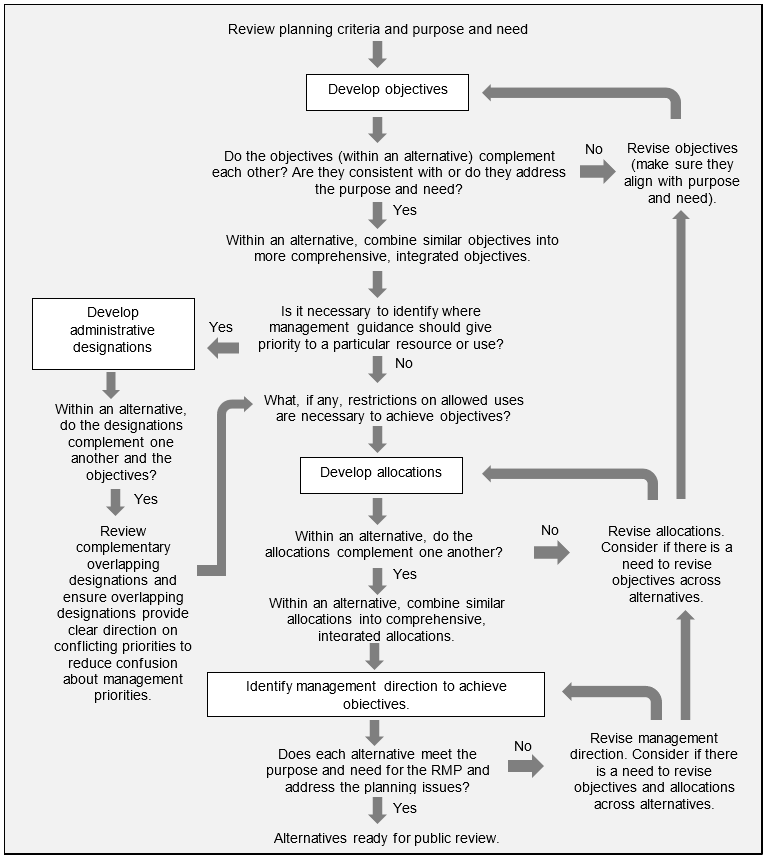
H-1601-1 – LAND USE PLANNING HANDBOOK (Public)
53
BLM HANDBOOK
Rel. 1-1836
Supersedes Rel. 1-1693
01/16/2025
Figure 3.2.
Flowchart example of the iterative process for developing plan components and
alternative development for integrating management to meet the purpose and need for the RMP.
H-1601-1 – LAND USE PLANNING HANDBOOK (Public)
54
BLM HANDBOOK
Rel. 1-1836
Supersedes Rel. 1-1693
01/16/2025
Chapter 4 – RMP Evaluations
General
4.1 Timeline for Conducting RMP Evaluations
4.2 Process for Conducting RMP Evaluations
4.3 Determining If Decisions are Still Relevant and Effective
4.4 Documenting the RMP Evaluation’s Findings
General
RMP evaluations are a cornerstone of the planning cycle. RMP evaluations are critical to the
planning process because they reveal whether existing decisions in your RMPs remain relevant
and applicable to current land conditions in a constantly changing environment. A state director
may find it appropriate to establish a new land use plan for an area, revise an existing land use
plan, or amend an existing land use plan. This begins with the identification through an RMP
evaluation of a need to change BLM’s management of public lands from the current RMP (43
CFR 1610.5-5 and 43 CFR 1610.5-6).
Evaluating an RMP is an internal process through which the BLM determines whether the
decisions of the approved RMP “are satisfactory, whether there has been significant change in
the related plans of other Federal agencies, Indian tribes, or state or local governments, or
whether there is new data of significance to the plan” (43 CFR 1610.4-9). The RMP evaluation a
communication between BLM staff and leadership conveying the status and trends within the
planning area and the relevance of planning decisions over time. The BLM may share the
findings of the evaluation with the public or others, or include others as part of the evaluation
process (refer to section
4.2.2,
Options for External Engagement to Inform RMP Evaluations
).
Evaluation is the process of reviewing the plan components, RMP monitoring results (refer to
section
10.2.3,
RMP Monitoring Strategy
) and completed effectiveness monitoring to determine
if plan decisions are still appropriate, and whether the plan is being implemented as expected and
having effects within the scope analyzed in the RMP EIS. In making these determinations, your
evaluation considers whether the allocations, designations, and management direction identified
in the current plan are achieving the plan objectives. Your evaluation also considers whether
new information may prompt a revision or amendment of the RMP to change any plan
components to alter the scope of resource uses. And the evaluation also identifies whether
implementation or new information may be resulting in effects that are outside the scope of the
NEPA analysis that supported approval of the RMP, and that initiation of a new planning effort
may be warranted.
When conducting scheduled RMP evaluations, the BLM must review the entirety of the planning
area and the full scope of land use plan decisions (including any subsequent amendments) since
RMP evaluation findings inform the need to initiate revisions or amendments of your RMP (43
CFR 1610.5-5 and 43 CFR 1610.5-6).
H-1601-1 – LAND USE PLANNING HANDBOOK (Public)
55
BLM HANDBOOK
Rel. 1-1836
Supersedes Rel. 1-1693
01/16/2025
The BLM’s implementation and effectiveness monitoring provide essential data for RMP
evaluations. The BLM identifies new resource needs or emerging issues through RMP
evaluations and identifies the means for addressing these needs and issues, including through
plan maintenance or the initiation of a plan revision or amendment process. As such, it is
important that you complete the implementation and effectiveness monitoring work that informs
the RMP evaluation across the entire planning area, and not just in the most troublesome or
litigated locations. Refer to section
13.2,
Monitoring
for more information about the
relationship of implementation and effectiveness monitoring to RMP evaluations.
4.1
Timeframe for Conducting RMP Evaluations
You must evaluate the RMP in accordance with the evaluation intervals identified in the RMP
(43 CFR 1610.4-9). We recommend you evaluate your RMP at least every five years. You may
conduct the first scheduled evaluation in the sixth year to have five complete years of data to
inform your first evaluation.
A land use plan undergoing an amendment is not a reason to fail to conduct a scheduled
evaluation. The BLM is responsible for evaluating the RMP decisions at the scheduled intervals.
When conducting scheduled evaluations on land use plans undergoing amendment, the state
director may find it appropriate to limit the scope of the evaluation to the decisions not under
consideration for the amendment.
The BLM may also conduct RMP evaluations at any time, regardless of the established
evaluation schedule. The BLM may choose to conduct targeted (focused) RMP evaluations
outside of the normally scheduled reviews to consider new information or changed
circumstances, or to evaluate trends appearing in RMP monitoring results. The state director has
the discretion to conduct an unscheduled RMP evaluation and set the scope and scale of the
unscheduled evaluation.
Congressional or Presidential action may necessitate establishment of an implementation-level
plan for a new area, such as to comply with the statutory requirement to complete a
comprehensive river management plan within three fiscal years after a new wild and scenic river
is designated. We recommend you conduct an RMP evaluation following such action to assess
whether an RMP amendment may be needed to support any implementation-level activity
planning, or to gather information to inform the purpose and need for an RMP amendment for
the area (refer to section
5.4,
Purpose and Need for Land Use Planning
).
4.2
Process for Conducting RMP Evaluations
RMP evaluation involves coordination between the state director and appropriate field offices to
initiate, conduct and document the evaluation, and requires state director review and approval of
the evaluation findings (
Figure 4.1,
RMP evaluation process
).



H-1601-1 – LAND USE PLANNING HANDBOOK (Public)
56
BLM HANDBOOK
Rel. 1-1836
Supersedes Rel. 1-1693
01/16/2025
Figure 4.1.
RMP evaluation process.
The state director is responsible for RMP evaluations. We recommend the state director identify
and communicate the initiation of the scheduled evaluation process to the BLM offices involved,
including identifying BLM managers and state office staff responsible for completing the work.
The state director must approve the initiation of any unscheduled RMP evaluations, such as those
responding to changed circumstances or identified trends in RMP monitoring data. We
recommend you coordinate with the appropriate state program leads when preparing a request
for an unscheduled RMP evaluation.
We recommend you identify any appropriate opportunities to group multiple planning areas
together to evaluate plans across boundaries. This may be particularly relevant to assist in
looking at issues that cross BLM-administrative boundaries to assess the effectiveness of BLM’s
management across a broader geographic area. In situations where multiple RMPs are evaluated
at the same time, we recommend you document RMP evaluations for each RMP and prepare a
summary report pertaining to all the RMPs evaluated. Refer to section
4.4,
Documenting the
RMP Evaluation’s Findings
for further guidance on the documentation of your RMP evaluation
findings.
Initiate RMP Evaluation
- Identify scope of evaluation
What questions need to be answered for this evaluation?
- Identify scale of evaluation
In what area do the evaluation questions need to be answered?
Does the evaluation area include more than one planning area?
- Identify interdisciplinary team
What staff are needed for the evaluation?
What are the roles and responsibilities of each staff, the field office, and state office?
Conduct RMP Evaluation
- Review planning documents for plan(s) under evaluation
Review relevant information from the planning criteria, analysis of the management
situation, proposed RMP/final EIS, ROD/RMP, or other reports such as socioeconomic or
recreation use reports generated during the planning process.
- Review monitoring data and any associated reports
Review relevant information from plan monitoring and monitoring conducted determining
the effectiveness of BLM’s implementation actions such as assessment, inventory, and
monitoring data results for terrestrial and aquatic core indicators.
- Review any additional appropriate documents or data
Review other relevant documents for the context of your RMP evaluation including BLM
activity plans or project-level NEPA documents. For unscheduled RMP evaluations
resulting from changed circumstances, review documents or information associated with
those changes. Review updated data, including geospatial data and program-specific
data.
- Document answers to evaluation questions and conclusions regarding need for decision changes
Provide a written record of the questions asked and the findings related to those
questions. Provide a record of the conclusions as to whether or not a change to decisions
is needed.
Approval of RMP Evaluation
- State director approves RMP evaluation findings.
H-1601-1 – LAND USE PLANNING HANDBOOK (Public)
57
BLM HANDBOOK
Rel. 1-1836
Supersedes Rel. 1-1693
01/16/2025
4.2.1 Participants in RMP Evaluations
Identification of BLM staff with responsibility for completing an RMP evaluation depends on
the scope and scale of your planning area and the scope and scale of your evaluation. In many
cases, BLM staff at multiple levels in the organization will hold some role or responsibility for
each RMP evaluation. For example, evaluations of RMPs that cross multiple BLM-
administrative boundaries may require coordination that is best facilitated by state office
program leads. By contrast working on the details and specifics of the evaluation may best be
completed by field office staff with specific knowledge of the planning area being evaluated.
For single-unit or focused RMP evaluations within one BLM office, that BLM field office may
be responsible for the work and the coordination. RMP evaluations targeted to a single change
across multiple BLM-administrative units, such as a Congressional direction for land
conveyances or a monument designation within a planning area may be the responsibility of the
state office. Because the specifics of the RMP evaluation will determine what staff should be
engaged, we recommend that the roles and responsibilities of staff be identified with the
initiation of scheduled evaluations or approval of unscheduled evaluations.
We recommend you conduct RMP evaluations using an interdisciplinary team. At a minimum,
include interdisciplinary team staff from the programs related to the focus of the RMP
evaluation. For scheduled evaluations, we recommend identifying staff representing programs
related to the monitoring questions and program reporting items identified in the RMP’s
monitoring strategy. You may need to expand the team to include support staff, such as
geospatial information systems specialists, to assist with data analysis and synthesis.
Depending on the scope of your RMP evaluation, you may also wish to invite BLM staff from
other offices or staff from other Federal agencies, Indian tribes, and state and local governments
where they can provide expertise to assist in contextualizing the results of the evaluations. For
example, it may be helpful to engage staff from a neighboring field office in your evaluation
where species habitats cross administrative boundaries and understanding the trends in both field
offices to provide context for evaluation of the species habitat as it may be affected by the
decisions in your RMP.
4.2.2 Options for External Engagement to Inform RMP Evaluations
RMP evaluations provide an opportunity to engage with external parties regarding BLM land
management. While external engagement is not required as part of the RMP evaluation process,
you may consider engaging with external parties as part of your RMP evaluation process for
multiple reasons. It may be helpful to engage:
•
Partner groups within the planning area that have been key collaborators with the BLM in
collecting data related to effectiveness monitoring to ensure the BLM understands what
the data means, and may also allow partners to have a better understanding of how the
data gets used more broadly in the BLM’s work;
•
Members of the public and environmental justice communities through workshops or
censusing to get locally specific data or independent research findings related to
socioeconomic conditions or trends for BLM to incorporate into the evaluation; or
•
Indian tribes or local governments to gain insights on management concerns or
opportunities for collaborative efficiencies presented by interconnected decisions with
BLM land management decisions.
H-1601-1 – LAND USE PLANNING HANDBOOK (Public)
58
BLM HANDBOOK
Rel. 1-1836
Supersedes Rel. 1-1693
01/16/2025
In addition to the information BLM can gain, external engagement around RMP evaluations can
facilitate meaningful conversations on land management issues and projects of importance to
external groups and support development of opportunities for collaboration and relationships.
The BLM’s Collaborative Action and Dispute Resolution program can assist in providing
professional facilitation for any external engagement you may choose to pursue.
4.3
Determining If Decisions are Still Relevant and Effective
RMP evaluations explore whether existing land use plans remain current in a constantly
changing environment. Specifically, the BLM’s land use plans are evaluated to determine if
decisions are relevant to current
issues and effective in achieving or making progress toward
achieving objectives. RMP evaluations provide state directors with the information to determine
whether to initiate planning to revise or amend the decisions. We recommend RMP evaluations
address:
•
Whether the plan is achieving or making progress toward achieving the desired
conditions described in the objectives;
•
Whether there is relevant new information that may substantially alter the scope of
resource uses; and
•
Whether there is relevant new information that indicates that implementation may be
resulting in effects that are outside of the scope of the NEPA analysis for the RMP and
warrant initiation of a new planning effort.
We recommend that you clearly identify at the beginning of the evaluation process specific
questions for each of these three areas that you will answer during the process. We recommend
you coordinate with the state office to ensure the questions clearly capture the scope of the state
director’s approval for the RMP evaluation and collect any necessary information to facilitate the
identification of trends across the planning area. Identify the questions you evaluate
commensurate to the type of RMP evaluation you are doing, having focused questions for
focused evaluations and comprehensive questions for larger-scale evaluations. The questions
you ask will help to determine whether to initiate new planning based on the circumstances in
your planning area.
Note that some questions may need to be asked more than once depending on the scope of the
evaluations and some of the initial answers. For example, the question below of “Has the BLM
been implementing the plan as written?” may result in mixed answers, where the answer when
looking at one area of the RMP or one program may be yes, but for another area or program it is
no. Using an interdisciplinary team to look at these questions will help make sure you look at
each of these questions from all perspectives.
We recommend your RMP evaluation clearly explain how you reached recommendations and
conclusions in your RMP evaluation. A plan evaluation informs whether to initiate a new
decision-making process and associated NEPA compliance, and the evaluation itself does not
involve any new decisions or new analysis.
H-1601-1 – LAND USE PLANNING HANDBOOK (Public)
59
BLM HANDBOOK
Rel. 1-1836
Supersedes Rel. 1-1693
01/16/2025
4.3.1 Evaluating Whether Decisions are Achieving or Progressing Toward Objectives
Identify questions to understand whether the BLM’s implementation of the RMP is being
effective in achieving the desired outcomes established through the objectives. To evaluate this,
consider the following questions in your RMP evaluations:
•
Does the implementation monitoring show the BLM has been implementing the plan as
written?
•
Does effectiveness monitoring show BLM actions implementing management direction
are achieving or progressing toward the achievement of the RMP’s objectives?
•
Are the allocations and designations effective in protecting resources or prioritizing uses
toward the achievement of the objectives in the plan?
In evaluating these questions, it is important to determine if inconsistent implementation of the
management direction or the actual management direction in the plan are the reason objectives
may not be achieved. When your evaluation identifies that management direction may be the
cause, new planning may be appropriate. When inconsistent implementation may be the cause,
planning may not be appropriate.
4.3.2 Evaluating Whether New Information Substantially Alters the Scope of Resource Uses
New issues may arise after approval of the RMP. Through the RMP evaluation, you would
assess any changes identifying unmet needs or new opportunities that may result in the need to
change plan components to address those changes, needs, or opportunities. To evaluate this,
consider the following questions in your RMP evaluations:
•
Have there been substantive changes to existing conditions within the planning area that
may now preclude the ability of the BLM to achieve the objectives in the plan?
•
Have there been substantive changes to non-BLM land management policies, programs,
or officially approved and adopted plans that may now preclude the ability of the BLM to
achieve the objectives in the plan?
•
Have monitoring or inventory shown that administrative designations, including areas of
critical environmental concern, made in the RMP may no longer be necessary or
appropriate, either because values or resources no longer exist within the designation
boundary or because demand within the planning area has changed and the designation is
no longer the prevailing use needed in the planning area?
•
Are there new legal, regulatory, or policy direction as a result of new statutes,
proclamations, or court orders not addressed in the plan?
If plan components are no longer relevant or appropriate, they may need to be replaced or
changed through a plan amendment or revision. Examples of situations where the BLM may
want to develop new plan components or amend existing components include:
Changes in policy. For example, an RMP approved in 2012 would have identified every acre of
the planning area as either a special recreation management area or extensive recreation
management area (as allocation decisions) consistent with policy guidance at that time. In
2014, the recreation program revised their policy in the BLM Planning for Recreation and
Visitor Services handbook (H-8320-1) and now instructs that special and extensive recreation
management areas are to be identified as distinct areas where BLM is managing for
recreation (as designation decisions). Consistent with the revised policy, it may be
H-1601-1 – LAND USE PLANNING HANDBOOK (Public)
60
BLM HANDBOOK
Rel. 1-1836
Supersedes Rel. 1-1693
01/16/2025
appropriate to change recreation management area decisions from allocations to designations
when revising that 2012 RMP.
Monitoring information demonstrating the inability to meet resource objectives. For example,
land health assessments may indicate that land health standards cannot be achieved under any
level or management of livestock use. It may be appropriate for the BLM to modify the
allocation identifying that allotment as being unavailable for livestock use.
Changes to designations within the planning area. For example, new designations of critical
habitat for Endangered Species Act species or changes to national monument or
Congressionally designated areas may change legal mandates related to management such
that the plan components for areas affected by these changes are no longer appropriate.
Changes to conditions within the planning area. For example, large-scale wildfires may change
conditions such that the plan components for areas affected by these changes are no longer
appropriate. New scientific research may also identify changes in understanding of the
effectiveness of management direction in the changed landscape in achieving the objectives.
In some cases, you may find that circumstances have changed, but there are no plan components
to change. For example, when developing your RMP you may have included in your NEPA
analysis an assumption that wildfire would result in the destruction of 5% of critical habitat for a
species in the first decade but at the first evaluation, you learn that 15% of critical habitat was
destroyed by wildfire in just the fourth year of implementation. Based on this information and
other information from your plan evaluation you may conclude not to initiate planning. While
your ability to tier to the RMP EIS in NEPA analysis for future actions may now be limited, we
recommend that you retain the information to assist you to understand the trends over time for
future planning.
4.3.3 Evaluating Whether New Information Results in Effects Outside the Scope of the
Assumptions Used for the NEPA Analysis
The RMP evaluation identifies whether implementation or a new understanding of information
may be resulting in or demonstrating effects that are outside the scope of the assumptions used
for the NEPA analysis. The answers to these questions provide the context for understanding if
changes to the approved RMP are needed. To answer these questions, the BLM will need to
review reports, data, monitoring results, or other information relevant to the scope and scale of
the RMP evaluation. Examples of information that may be helpful to review include core
terrestrial and aquatic indicator data summaries, rapid ecoregional assessments, area-wide
mineral reports or data, socioeconomic studies, reasonably foreseeable development scenarios, or
new research. To evaluate this, consider the following questions in your RMP evaluations:
•
Are there new data that identify the effects of implementation that are outside of the
scope of the NEPA analysis (either in the proposed RMP/final EIS or in the analysis of
subsequent amendments)?
•
Is there new analysis determining effects of implementation that are substantially
different from those projected in the NEPA analysis?
H-1601-1 – LAND USE PLANNING HANDBOOK (Public)
61
BLM HANDBOOK
Rel. 1-1836
Supersedes Rel. 1-1693
01/16/2025
Whether implementation resulting in effects outside the scope of the assumptions used for the
proposed RMP’s NEPA analysis would prompt revision or amendment depends on whether the
BLM can change implementation practices to realign with the scope of analysis. For example,
the BLM could identify that implementation is outside of the scope of the assumptions used for
the NEPA analysis because the BLM has not been implementing the full spectrum of plan
components. This could occur if the BLM has not been pursuing the development of new
recreation areas designated in the RMP and therefore the assumptions for the amount and type of
recreation opportunities that would be available over time are not being met. To resolve the
matter, the BLM may decide to prioritize developing new recreation sites identified in the RMP
to rebalance the implementation of plan components to move those effects back within the scope
of the RMP’s NEPA analysis assumptions. As another example, if through RMP evaluation you
identified that your monitoring results show implementation of oil and gas fields in exceedance
of the reasonably foreseeable development scenario in your proposed RMP/final EIS, your
ability to tier to the final EIS for consideration of effects analysis in subsequent oil and gas
proposals may be limited. However, this information may not prompt the BLM to initiate an
RMP amendment, depending on how the applicable plan components are specifically phrased.
4.4
Documenting the RMP Evaluation’s Findings
The BLM must document all RMP evaluations findings and conclusions. We recommend you
prepare documentation that clearly identifies findings regarding the effectiveness of the plan
evaluated and your recommendations and rationale for any recommended changes and how the
need for changes can be addressed, such as through plan maintenance, amendment, or revision.
Documenting the findings will provide a valuable reference for subsequent RMP evaluations
conducted for the same planning area to help the BLM better understand trends and issues that
only become visible by looking at information collected over the long term.
We recommend you document your evaluation findings in an evaluation report. Clearly identify
the area under evaluation and the scale and scope of the evaluation in the report to provide
context. Where appropriate, we recommend you document any methods used to evaluate
information. We recommend you document the results and findings of your evaluation in a
manner that clearly demonstrates the effectiveness of the plan in achieving the objectives, as well
as any effectiveness of specific management direction. This does not mean you must write up a
narrative for every single RMP designation, allocation, and management direction identified in
the current plan are achieving the plan objectives. Rather, narratives on groups of RMP plan
components can be summarized. Identify for each finding what the conclusion is regarding
implications for tiering, identified needs for plan maintenance, or whether the BLM determines
changes to the plan’s decision are needed to address the findings. We recommend you use
graphics including maps, charts, or graphs to help demonstrate the findings where appropriate.
Once the state director has approved the report findings and identified instructions for actions to
take resulting from the findings, you may find it helpful to make the findings available to the
public. We recommend you make the evaluation report publicly available through the BLM’s
official national NEPA register when you choose to share the results publicly. You may choose
to make the report available through other means to partners or other interested parties.
H-1601-1 – LAND USE PLANNING HANDBOOK (Public)
62
BLM HANDBOOK
Rel. 1-1836
Supersedes Rel. 1-1693
01/16/2025
The RMP evaluation findings will inform whether the state director initiates revisions or
amendments of RMPs, but the state director’s approval of a RMP evaluation finding does not,
itself, constitute approval to initiate a plan revision or amendment. For example, the findings of
the evaluation may identify that a revision is appropriate, but the state director may instruct that a
revision will not be initiated immediately due to commitments to other planning efforts or
capacity issues. They may also request additional information before they direct staff to initiate
the revision. The state director has discretion whether to initiate the process to revise or amend a
plan, as provided in this handbook in
Chapter 5,
BLM or State Director Planning Guidance
.
H-1601-1 – LAND USE PLANNING HANDBOOK (Public)
63
BLM HANDBOOK
Rel. 1-1836
Supersedes Rel. 1-1693
01/16/2025
Chapter 5 – BLM or State Director Planning Guidance
General
5.1 Role of BLM or State Director Planning Guidance
5.2 Information Provided by BLM or State Director Planning Guidance
5.3 Identifying Planning and Decision Areas
5.4 Purpose and Need for A Land Use Plan
General
At the outset of the pre-planning process, the BLM Director or state director may provide
planning guidance to help the field manager, interdisciplinary team, and other BLM staff
develop, revise, or amend a specific RMP (43 CFR 1610.1(a)). The BLM Director or state
director planning guidance is an internal BLM document that provides direction on the scope for
the planning effort by identifying the problems and opportunities that the plan will address
through alternative development and focused analysis. When this planning guidance is provided,
it is also the foundation upon which the state director must select the preferred alternative (43
CFR 1610.4-7).
We recommend the BLM Director or state director provide this guidance in writing to give the
field manager, interdisciplinary team, and other BLM staff a consistent message regarding the
planning effort. The planning guidance may be provided in writing through different means,
commonly in project initiation letters, memoranda, or as part of a larger planning strategy
document for the state.
The BLM Director or state director must reconsider the planning guidance any time during the
planning process that the guidance is found, through public involvement or other means, to be
inappropriate when applied to a specific planning area (43 CFR 1610.1(a)(3)). However,
reconsideration of the planning guidance does not require revising the original written guidance
and ‘reissuing’ the original documentation. You may provide written documentation of the
reconsideration in a manner most appropriate to the topic being reconsidered. For example, the
planning guidance will provide a preliminary purpose and need statement and any guidance to
the interdisciplinary team regarding information the state director needs to finalize the purpose
and need statement. As the interdisciplinary team collects the information, provides it to the
state director, and ultimately refines and revises the purpose and need statement, this will lead to
written reconsiderations in multiple forms, potentially including emails, meeting notes, and
documents with draft revisions of the text. We recommend any completed reconsiderations,
such as the revised version of the purpose and need, also be provided in writing to the field
managers and interdisciplinary team.
There is no requirement to make the initial BLM Director or state director planning guidance
document available to the public. The subject-matter content of the planning guidance is shared
with the public during the planning process in the form of interactive maps, presentations, and
displays at early engagement public meetings, circulation of the analysis of the management
situation and planning criteria, and publication of the NOI.
H-1601-1 – LAND USE PLANNING HANDBOOK (Public)
64
BLM HANDBOOK
Rel. 1-1836
Supersedes Rel. 1-1693
01/16/2025
5.1
Role of BLM or State Director Planning Guidance
While the BLM planning regulations do not require the BLM Director or state director to provide
this guidance, managers or policy makers may do so to govern the planning effort and provide
consistent and clear messaging. The planning guidance is the method by which the BLM
Director or state director communicates their requirements for a specific planning effort to the
field manager, interdisciplinary team members, and other BLM staff regarding national level
policy, analysis requirements, planning procedures, disciplines of interdisciplinary team
preparers, and any other RMP-specific information or instruction. This information may also
provide context and content to other steps in the planning process, such as the planning criteria.
When provided, the planning guidance also serves as the foundation upon which the state
director must select the preferred alternative (43 CFR 1610.4-7).
5.2
Information Provided by BLM or State Director Planning Guidance
By providing planning guidance at the outset of the planning process, the BLM Director or state
director informs the field manager and assigned BLM staff of the focus and framework for the
planning effort, including the scale of the planning area, and the scope of the planning effort
through the identification of a preliminary purpose and need.
We recommend guidance include the following:
•
National level policy which has been established through legislation, regulations,
Executive Orders, or other Presidential, secretarial, or BLM Director-approved
documents. This policy may include appropriately developed resource management
commitments, such as a right-of-way corridor crossing several field offices, which are not
required to be reexamined as part of the planning process (43 CFR 1610.1(a)(1)).
•
A preliminary planning boundary and any guidance to the interdisciplinary team
regarding information the state director needs to finalize the planning boundary. If the
preliminary boundary is different from that of the field office boundary, provide rationale
for why the boundary is deemed to be more appropriate (refer to section
5.3,
Identifying
Planning and Decision Areas
).
•
A preliminary purpose and need statement and any guidance to the interdisciplinary team
regarding information the state director needs to finalize the purpose and need statement
(refer to section
5.4,
Purpose and Need for Land Use Planning
).
•
Identification of any known preliminary alternative management approaches to resolve
any conflicts over resource uses the state director wants addressed through the planning
effort (refer to section
6.2.2,
Basis for Formulating Reasonable Alternatives
). This may
include identification of any regional policies or priorities based on BLM interagency
assessments, strategies, or resource management commitments that may drive
alternatives.
•
Direction for analysis requirements, planning procedures, or other written information
and instructions the state director wants the interdisciplinary team to consider or address
in the planning process (43 CFR 1610.1(a)(2)). If the planning effort is an RMP
amendment, provide direction as to whether an EA or EIS will be required to support the
planning effort.
•
Expectations and framework for necessary and appropriate coordination, public
involvement, and consultation. This includes direction on external engagement methods
H-1601-1 – LAND USE PLANNING HANDBOOK (Public)
65
BLM HANDBOOK
Rel. 1-1836
Supersedes Rel. 1-1693
01/16/2025
and opportunities both before and after publication of your NOI (refer to
Chapter 2,
External Engagement
).
•
Instruction for the hiring, contracting, or prioritization of staff assigned to the planning
effort as appropriate to the resources and resource uses involved, purpose and need for
the planning effort, and preliminary issues understood to have arisen from BLM data and
inventory.
Examples of BLM or state director planning guidance include:
•
Incorporate energy transport corridors (pipeline and power line utility corridors) that
were designated by the BLM to meet the requirements of Section 368 of the Energy
Policy Act of 2005.
•
Do not re-examine a right-of-way corridor that crosses several districts or field offices as
part of the planning process.
•
Use ecosystem-based management principles to create more integrated management
objectives to reduce the need to manage for a single resource or single species.
•
Clearly define the adaptive management approach for incorporation in the RMP.
•
Work closely with the State Department of Environmental Quality to integrate state
requirements of Water Quality Management Plans at the RMP level.
•
Develop a consultation agreement with the U.S. Fish and Wildlife Service that includes
an outline for early engagement to facilitate appropriate Endangered Species Act
consultation.
•
Designate areas that are available and have the capacity for planned, sustained-yield
timber harvest or special forest product harvest.
•
Provide a framework to facilitate subsequent effects analysis and reduce the scope of
project-level NEPA analysis (for example, including no livestock grazing or no leasing
alternatives).
•
Provide analysis to facilitate subsequent project-level NEPA analysis through tiering and
incorporation by reference.
•
Review existing special recreation management areas and extensive recreation
management areas and adjust boundaries, revise management direction, eliminate non-
essential recreation management area designations, and add additional potential
recreation sites and trails to the list of possible designation of recreation management
areas for future development.
•
Alternatives will not be constrained by anticipated budget levels. Comparison between
alternatives will be accomplished by comparison to current budget levels.
We recommend that the planning guidance provided by the BLM Director or state director be
specific to the issues, resources, and specifics of each planning effort.
5.3
Identifying Planning and Decision Areas
We recommend the state director identify the preliminary planning area and decision area as part
of the planning guidance. The planning area is the geographic area for the preparation or
amendment of the RMP that includes all lands regardless of jurisdiction. The decision area
includes only those BLM-administered lands within a planning area for which the BLM has
authority to make land use and management decisions. The BLM has jurisdiction over all BLM-
administered lands (surface and subsurface) and over the subsurface minerals in areas of split
H-1601-1 – LAND USE PLANNING HANDBOOK (Public)
66
BLM HANDBOOK
Rel. 1-1836
Supersedes Rel. 1-1693
01/16/2025
estate (areas where the BLM administers Federal subsurface minerals, but the surface is owned
or administered by someone other than the BLM).
We recommend the state director consider spatial scales and levels of organization when
delineating the appropriate planning area boundary for each planning effort. The BLM’s
planning regulations (43 CFR 1610.1(b)) state that a resource management plan “shall be
prepared and maintained on a resource or field office area basis, unless the state director
authorizes a more appropriate area.” The state director may authorize a planning area other than
a field office boundary for any reason that would facilitate preparation of the RMP, such as the
purpose and need for the RMP, issues requiring analysis, or resources and resource uses present.
For example, a state director may find it is more appropriate to refine a planning area boundary
to the scale of a national monument smaller than the field office because the purpose for
management in the area is directed by the proclamation and unique to that portion of the
landscape. Conversely, a state director may find it is more appropriate to combine multiple field
offices as one planning area to be able to more effectively evaluate and manage development of
solar energy across the landscape in the context of multiple uses of the public lands. State
directors may also collaboratively consider opportunities for regional planning efforts, such as
RMP amendments to address a resource use program or resources across state boundaries.
Certain Department officials other than BLM state directors, including the BLM Director, have
authority to make planning decisions with a multi-state or national scope.
When appropriate, we recommend the state director clearly document in the planning guidance
what information is outdated or where additional information is still needed to evaluate and
manage for the resources and resource uses present, and to finalize the planning area in the
analysis of the management situation report (refer to section
6.2.1.1,
Tailoring Data and
Information to the Planning Effort
).
5.4
Purpose and Need for A Land Use Plan
The purpose and need statement for a land use plan describes the problem or opportunity to
which the BLM is responding (need) and what the BLM hopes to accomplish through the
planning effort (purpose). A carefully crafted purpose and need statement communicates the
goals for the RMP (refer to section
3.1.1,
Goals
) and controls the scope of the analysis and
thereby increases efficiencies by eliminating unnecessary analysis and reducing delays in the
process (refer to BLM NEPA Handbook (H-1790-1)). The statement of purpose and need
dictates the range of reasonable alternatives (refer to section
6.2.2,
Basis for Formulating
Reasonable Alternatives
). Action alternatives are not reasonable if they do not respond to the
purpose and need for the RMP (refer to BLM NEPA Handbook (H-1790-1)). The purpose and
need for action also influence issues that must be analyzed in detail (refer to BLM NEPA
Handbook (H-1790-1)).
FLPMA requires the BLM to develop, maintain, and, when appropriate, revise land use plans
which provide by tracts or areas for the use of the public lands (Section 202(a)). We recommend
that your purpose and need statement clearly reflect how it is applying the principles of multiple
use and sustained yield and the policies for public land management described in FLPMA and
any other applicable laws or executive orders. However, in doing so your purpose and need
should not be as general as to “create a land use plan” or “to comply with FLPMA’s requirement
H-1601-1 – LAND USE PLANNING HANDBOOK (Public)
67
BLM HANDBOOK
Rel. 1-1836
Supersedes Rel. 1-1693
01/16/2025
to develop an RMP for BLM-administered lands.” We recommend the purpose and need
statement also reflects the specific balance of land and resource management for the planning
area. Think about what makes your specific planning effort unique from other planning efforts
and describe those problems and opportunities within your purpose and need statement. As
described below, we recommend that your purpose and need statement be informed by the
results of any previous monitoring and evaluation in the planning area; Federal laws and
regulations applicable to the public lands; and the purposes, policies, and programs
implementing such laws and regulations.
Normally, there will be multiple purposes and multiple needs for a planning effort. We
recommend that your purpose and need statement be concise, unambiguous, specific, and easily
understood by the public.
We recommend that the state director identify the preliminary purpose and need statement in
state director planning guidance. In addition to documenting the preliminary purpose and need,
we recommend that the state director also identify any specific information needed as part of the
analysis of the management situation to further refine the purpose and need for the analysis of
the management situation report (refer to section
6.2.1.1,
Tailoring Data and Information to the
Planning Effort
).
The statement of purpose and need for action will vary depending on whether you are preparing
an RMP revision or a plan amendment. For any planning effort, the purpose and need statement
helps to focus the range of alternatives. For an RMP amendment, the purpose and need
statement also articulates which topics are within the scope of the planning effort. Where BLM
has determined that only certain areas warrant updating or revision, a focused purpose and need
can limit the scope of decisions to be made in the plan amendment. If the purpose and need
statement is silent on a topic, then the BLM is communicating that there is no need to update
those plan components and they are outside of the scope of the amendment planning effort. For
an RMP revision, the BLM must provide for comprehensive management of the planning area
and thus there are no plan components that would be outside the scope of the planning effort. In
this scenario, if the purpose and need is silent on a topic, then the BLM is communicating that
the topic is not a topic that is driving the development of the range of alternatives for the
revision. We recommend you clarify these sideboards in your description of the decision to be
made in your NEPA analysis supporting the planning effort (refer to BLM NEPA Handbook (H-
1790-1)). Identifying the purpose and need statement is a NEPA requirement rather than a BLM
planning requirement (40 CFR 1502.13; 40 CFR 1501.5(c)(2)(i)). Refer to the BLM NEPA
Handbook (H-1790-1) for additional guidance on developing purpose and need statements.
5.4.1
Statements of Purpose and Need for RMP Revisions
For plan revisions, we recommend that your need statement reflect any challenges of
implementing your current RMP identified in your RMP evaluation (refer to section
Chapter 4,
RMP Evaluations
), including any changed circumstances relevant to the planning area that may
be prompting BLM initiation of the planning effort. Plan monitoring informs RMP evaluation
by tracking the trends and providing the factual basis to clearly identify the scope of the problem
you need to address through plan revision. We recommend clearly identifying how the RMP
H-1601-1 – LAND USE PLANNING HANDBOOK (Public)
68
BLM HANDBOOK
Rel. 1-1836
Supersedes Rel. 1-1693
01/16/2025
evaluation has identified the purpose and need for a plan revision (
Figure 5.1,
Example of
purpose and need statement for an RMP revision
).
H-1601-1 – LAND USE PLANNING HANDBOOK (Public)
69
BLM HANDBOOK
Rel. 1-1836
Supersedes Rel. 1-1693
01/16/2025
Need for the Action
The BLM-conducted plan evaluations concluded that “(a) plan revision is needed to address the changed
circumstances and new information that has led to a substantial, long-term departure from the timber management
outcomes predicted under the 1995 RMPs” (BLM 2012a, p. 12). These evaluations also concluded that plan
decisions for the fisheries and aquatics programs need to be modified or updated because of changed
circumstances and new information.
Moreover, the BLM needs to revise existing plans because of new scientific information and policies related to the
northern spotted owl. Since the 1995 RMPs were approved, there have been new demographic studies and other
analyses and research on the effects of land management on northern spotted owl habitat and the effects of
barred owls on northern spotted owls. In addition, there is a revised recovery plan and new designation of critical
habitat for the northern spotted owl.
Purposes of the Action
The purposes for this proposed action are to make land use plan decisions to guide the management of BLM-
administered lands. Specifically, it includes the purposes to:
Provide a Sustained-Yield of Timber
The O&C Act requires that the revested Oregon and California Railroad Grant lands and reconveyed Coos Bay
Wagon Road Grant lands (O&C lands) be managed “for permanent forest production, and the timber thereon shall
be sold, cut, and removed in conformity with the principal of sustained yield for the purpose of providing a
permanent source of timber supply, protecting watersheds, regulating stream flow, and contributing to the
economic stability of local communities and industries, and providing recreational facilities” (43 U.S.C. 1181a).
Provide Large, Contiguous Blocks of Late-Successional Forest
The purpose of the action includes contributing to the conservation and recovery of threatened and endangered
species within the planning area, including the northern spotted owl, marbled murrelet, and threatened and
endangered anadromous fish. Thomas
et al
. (1990, pp. 23–27) described that a conservation strategy for the
northern spotted owl requires large blocks of nesting, roosting, and foraging habitat (i.e., suitable habitat) that
support clusters of reproducing owls, distributed across a variety of ecological conditions and spaced so as to
facilitate owl movement between the blocks. Courtney
et al
. (2004, pp. 9-11, 9-15), in the status review for the
northern spotted owl, evaluated the conservation needs of the northern spotted owl and concluded that, based on
existing knowledge, large contiguous blocks of suitable habitat are still necessary for northern spotted owl
conservation. Culminating this confirmation of the scientific information on the conservation needs of the northern
spotted owl, the owl recovery plan recommends managing for large, contiguous blocks of late-successional forest
(FWS 2011, p. III-19).
Provide for Older and More Structurally Complex, Multilayered Conifer Forests
Thomas
et al
. (1990) described high-quality northern spotted owl habitat as older, multilayered, structurally-
complex forests characterized by large-diameter trees, high amounts of canopy cover, numerous large snags, and
lots of downed wood and debris. Courtney
et al
. (2004, pp. 5–18), in the status review for the northern spotted
owl, evaluated the existing scientific information on spotted owl habitat and confirmed that nesting, foraging, and
roosting habitat is associated with older, more structurally-complex multi-layered conifer forests in the Pacific
Northwest. The owl recovery plan recommends the maintenance of older and more structurally-complex multi-
layered conifer forests. The status review of the marbled murrelet prepared for the U.S. Fish and Wildlife Service
reviewed the existing scientific information and confirmed the importance of maintaining suitable nesting habitat to
the conservation and recovery of the marbled murrelet (McShane
et al
. 2004, pp. 4-61 – 4-63).
Provide Clean Water in Watersheds
The Clean Water Act (33 U.S.C. 1251
et seq
.) directs the restoration and maintenance of the chemical, physical,
and biological integrity of the nation’s waters. The policy declaration in FLPMA states that the BLM should
manage the public lands in a manner that protects many resources and their values, including the water resource
(43 U.S.C. 1701[a][8]). In addition, the Oregon and California Act includes reference to protecting watersheds and
regulating stream flows while managing for permanent forest production (43 U.S.C. 1181a). The status review of
threatened and endangered anadromous fish prepared by the National Marine Fisheries Service reviewed the
existing scientific information and confirmed the importance of maintaining existing habitat and restoring degraded
habitat to the conservation and recovery of threatened and endangered fish (Good
et al
. 2005).
Figure 5.1.
Example of purpose and need statement for an RMP revision.
H-1601-1 – LAND USE PLANNING HANDBOOK (Public)
70
BLM HANDBOOK
Rel. 1-1836
Supersedes Rel. 1-1693
01/16/2025
5.4.2
Statement of Purpose and Need for a New RMP
For BLM-administered lands for which the BLM has not yet developed an RMP, newly acquired
BLM-administered lands, or for BLM-administered lands with new management directed by
Congressional or Presidential action, such as after a change to a national monument boundary
made by a presidential proclamation, you may not have an RMP evaluation to assist you in
developing your purpose and need. However, your purpose and need would still not be to
“create a land use plan” in these circumstances nor “to comply with FLPMA’s requirement to
develop an RMP for BLM-administered lands.” We recommend your purpose and need be
specific to the planning area and be derived from data and information available in inventories or
geospatial databases about resources, conditions, trends, and uses.
For newly acquired BLM-administered lands or for BLM-administered lands with new
management direction, we recommend you rely on objectives or statements of intent provided by
documentation concerning the acquisition of the lands, or in statute or proclamations designating
the lands, or in other origination documentation to establish the purpose and need consistent with
the purposes for which the BLM is directed to manage those lands (
Figure 5.2,
Example
purpose and need statement for a new RMP
).
Purpose and Need for the Action
In determining the suite of plan decisions necessary to protect and restore the Monument for present and future
generations, this RMP responds to three important sources of overarching requirements and guidance:
•
Presidential Proclamation 8947 of March 25, 2013, which created the Monument and identified the
objects and values for protection and restoration.
•
Section 2002 of the Omnibus Public Land Management Act of 2009, which established the National
Landscape Conservation System, of which the Monument is a unit, “in order to conserve, protect, and
restore nationally significant landscapes.” This section also provides that the BLM manage these lands
“in a manner that protects the values for which the components of the system were designated.”
•
The FLPMA, which provides the basic underpinnings for the BLM’s management of public lands. Section
302 of FLPMA states that the BLM is to manage public lands under the principles of multiple use and
sustained yield “except that where a tract of such public land has been dedicated to specific uses
according to any other provisions of law it shall be managed in accordance with such law.” Therefore, as
a general rule, if a presidential proclamation that designates a Monument conflicts with FLPMA’s multiple
use mandate, the Monument designating language will apply.
The Federal Land Policy and Management Act (FLPMA) and Presidential Proclamation 8947 establish the need
for this action within the San Juan Island National Monument. The FLPMA requires the BLM to develop RMPs
that provide for the use of public lands. The proclamation specifies that the BLM ‘‘shall prepare and maintain a
management plan for the monument…” The BLM does not currently manage the Monument under an RMP.
The purpose of this RMP is to provide objectives and management direction to guide the BLM’s management of
the Monument. The purpose of the RMP includes protection and restoration of cultural and historic resources
identified in the proclamation, including traditional use areas of the Coast Salish people and archaeological
remains of their villages, camps, and processing sites throughout the Monument. Additionally, the purpose of the
RMP includes protecting and restoring historic resources associated with early Euro-American settlement found in
the Monument, such as lighthouses and associated structures. The purpose of the RMP regarding scientific and
ecological resources is to protect and restore the wide array of habitats described in the proclamation, including
forests, fire dependent grasslands, and wetlands, as well as bluffs, rocky balds, and shorelines. An additional
purpose of the RMP is to address recreation, education, and scientific uses consistent with the protection and
restoration of the objects and values described above.
The RMP will also safeguard Tribal treaty rights, and will, as provided for in the proclamation “in consultation with
Indian tribes, ensure the protection of religious and cultural sites in the monument and provide access to the sites
by members of Indian tribes for traditional cultural and customary uses, consistent with the American Indian
Religious Freedom Act (42 USC 1996) and Executive Order 13007 of May 24, 1996 (Indian Sacred Sites).”
Figure 5.2.
Example purpose and need statement for a new RMP.
H-1601-1 – LAND USE PLANNING HANDBOOK (Public)
71
BLM HANDBOOK
Rel. 1-1836
Supersedes Rel. 1-1693
01/16/2025
When developing a new RMP for planning areas with which the BLM has limited familiarity,
either because the BLM has been unable to inventory those lands or because the lands are new to
BLM management, you may have limited information at the initial stages of your planning effort
to identify a detailed purpose and need. In these cases, we recommend the state director clearly
document in the planning guidance what information the BLM plans collect in the pre-planning
stages to understand conditions in the planning area to formulate the purpose and need for the
RMP.
5.4.3 Statement of Purpose and Need for an RMP Amendment
A BLM state director authorizes the initiation of a plan amendment to change an RMP’s
objectives, designations, allocations, or management direction to:
•
Consider a proposal or action that does not conform to the plan; or
•
Respond to new information (for example, from monitoring or scientific studies) or
changed circumstances (for example new policy or changes to use on public lands).
Refer to section
1.4.1,
Determining Whether a Plan Revision or Amendment is Appropriate
for
further details on when the BLM initiates RMP amendments and how the scope of an
amendment differs from an RMP revision.
The BLM initiates NEPA analysis of potential RMP amendments to evaluate changing,
removing, or adding a plan component to the existing RMP based on changed circumstances in
resources, resource uses, or policy or to allow for the implementation of a non-conforming
project (refer to section
4.4.3,
RMP Amendment Purpose and Need
).
Regardless of the reasons for initiating the RMP amendment, your purpose and need will
communicate the goals for the planning area (refer to section
3.1.1,
Goals
). It may also be
helpful for your discussion of the decision to be made to identify the specific objectives,
designations, allocations, or management direction in the current RMP that you are proposing to
change. Identifying this in your purpose and need identifies for the interdisciplinary team and
for the public the scope and scale of the potential amendment, and those plan components that
are not within the scope of the RMP amendment under consideration. It is useful also to identify
the context for the change being considered for these same reasons. Together, these elements
allow your purpose and need to narrow the range of alternatives of the RMP amendment to
analyze in detail only those alternatives that address the specific problem or opportunity
presented. A broadly stated purpose and need that does not address specific circumstances may
open your RMP amendment to the analysis of alternatives that do not respond to the changed
circumstances or the non-conforming project proposal. For example, a broadly stated purpose
and need to update plan components related to oil and gas leasing, exploration, and development
to address a change to a reasonably foreseeable development scenario could include analysis of a
range of alternatives that may include closing additional BLM-administered lands to leasing.
However, increases in levels of development may not lead to the need to, or even prompt the
BLM to initiate changes to the areas that are currently open or closed to leasing in the existing
plan. A focused purpose and need would allow the range of alternatives analyzed in detail to be
kept to those relevant to the manager’s intent for pursuing the planning effort, such as
considering changes to lease stipulations (reflected in allocations) and management direction in
those areas open to leasing under the current RMP.
H-1601-1 – LAND USE PLANNING HANDBOOK (Public)
72
BLM HANDBOOK
Rel. 1-1836
Supersedes Rel. 1-1693
01/16/2025
Figure 5.3
provides an example of a purpose and need for an RMP amendment that includes
both the specific allocation needing to be changed and the context for the needed change. In this
example, any alternative proposed to amend the RMP to identify lands currently allocated as
available for exchange as, instead, allocated as suitable for retention would not meet the purpose
and need and would be dismissed from detailed consideration in the NEPA analysis.
Purpose and Need for the Action
The Resource Management Plan assigns all lands administered by the District to one of three land tenure zones.
Lands in Zone 1 are identified for retention and may not be transferred out of Federal ownership by exchange or
sale, while lands in Zone 2 may be considered for exchange, and those in Zone 3 may be considered for sale or
exchange. The regulations at 43 CFR 2711.1-1(a) require that no parcel of public land may be offered for sale
until it has been specifically identified in an approved land use plan (i.e., assigned to Land Tenure Zone 3).
The proposed Handcock exchange includes a 113.7-acre parcel in Douglas County that is currently assigned to
Land Tenure Zone 1. The tract must be reassigned to Land Tenure Zone 2 or 3 before it can be included in the
final exchange package. The BLM has been attempting to acquire the private lands offered to the United States in
the proposed Handcock exchange since the mid-1980s. Their acquisition would place approximately 2 miles of
Whittaker Creek, which provides habitat for anadromous fish including Coho and steelhead salmon, and
associated riparian reserve into public ownership. Acquisition of the Hancock parcels by the BLM would place
most of the primary stream bed in public ownership, which would increase the opportunities for additional stream
habitat enhancements and for additional recreation facilities complementing the adjacent Whittaker Creek
Recreation Site. Such habitat enhancement projects and recreational developments would be subject to further
environmental analysis before they could be implemented.
The two parcels of public land that are encumbered by longstanding unauthorized use situations, containing
approximately 4 acres, are currently assigned to Land Tenure Zone 2. Both parcels meet the criteria for disposal
disclosed in the Record of Decision and Resource Management Plan. However, they cannot be sold until they are
reassigned to Land Tenure Zone 3 by a plan amendment. One of these parcels is a survey hiatus (narrow strip of
parcels that were transferred out of public ownership years ago).
The parcel proposed for transfer to Lane County contains approximately 17 acres and is currently assigned to
Land Tenure Zone 2. The site has been used by the county under the authority of a Recreation and Public
Purposes Act lease since 1963 when a small rural landfill was established. The use was changed to a transfer site
in 1973. Current Bureau policy states that landfills and transfer site leases should not be renewed when they
expire and, if continued use of the site is needed, ownership of the land should be transferred to the lessee.
Although the site could be exchanged to Lane County under the current RMP, it cannot be sold until it is
reassigned to Land Tenure Zone 3 by plan amendment. Reassignment to Land Tenure Zone 3 would permit the
option of a proposal for either a direct sale or land exchange with Lane County.
Figure 5.3.
Example of purpose and need statement that includes both the specific allocation
needing to be changed and the context for the needed change.
Figure 5.4
provides an example of a purpose and need for an RMP amendment that addresses a
geographically broad area for a focused topic with the context for the needed change. In this
example, any alternative proposed to amend the RMP to analyze a different suite of decisions
would not meet the purpose and need and would be dismissed from detailed consideration in the
NEPA analysis.
H-1601-1 – LAND USE PLANNING HANDBOOK (Public)
73
BLM HANDBOOK
Rel. 1-1836
Supersedes Rel. 1-1693
01/16/2025
Purpose and Need for the Action
The purpose of this RMPA process is to evaluate alternative approaches for oil and gas planning decisions to
maintain, conserve, and protect big game corridors and other big game HPH on BLM-administered lands and
Federal mineral estate in Colorado. This draft RMPA/EIS establishes goals, objectives, and needs to address
conflicts or issues related to oil and gas development and big game HPH. Under the authority of Section 202 of
the Federal Land Policy and Management Act of 1976 (FLPMA), the BLM also seeks to evaluate consistency with
plans or policies and programs of other Federal agencies, Indian tribes, and State and local governments, to the
extent consistent with Federal laws, regulations, policies, and programs applicable to BLM-administered lands.
This RMPA process will consider current big game population and habitat data and evaluate planning alternatives’
consistency with the policies and programs of State agencies that manage big game populations and regulate oil
and gas operations in Colorado – Colorado Parks and Wildlife (CPW) and the Colorado Energy and Carbon
Management Commission (ECMC). CPW manages wildlife in Colorado, and the ECMC regulates oil and gas
development. Senate Bill 19-181 Oil and Gas Act gives the ECMC the authority to promulgate regulations that are
protective of human health, safety, welfare, the environment, and wildlife resources. The ECMC 1200 series rules
identify certain big game habitats where oil and gas operations are subject to specific ECMC requirements. CPW’s
consultation role within the ECMC requirements for HPH is intended to avoid, minimize, and mitigate impacts to
big game habitats.
Therefore, this action is needed to ensure the BLM fulfills its responsibilities under FLPMA by considering current
big game population and habitat data and evaluating management consistency with plans, policies, and programs
of other Federal agencies, Indian tribes, and State and local governments, to the extent consistent with Federal
laws, regulations, policies, and programs applicable to BLM-administered lands. This RMPA process also
complies with the terms of the settlement agreement in State of Colorado v. Bureau of Land Management (U.S.
District Court for Colorado, 1:21-cv-00129).
Colorado’s iconic big game species, including bighorn sheep, elk, mule deer, and pronghorn, are important to
natural systems, hunting and wildlife viewing enthusiasts, and local economies. Some big game species and local
populations, including elk and mule deer, have suffered declines in recent decades. Anthropogenic activities and
development infrastructure can alter wildlife habitat use and behavior where animals may be forced to relocate
from high quality habitat areas to lower quality areas, experience greater energy expenditures from frequent flight
responses and increased vigilance, or shift their behaviors (e.g., foraging, reproduction, etc.) to avoid time periods
of high human activity. Activities related to oil and gas development and operations may reduce the amount of
habitat available to wildlife, which can lead to changes in animal physiology, reproduction, survival, and population
trends. The BLM will consider alternative management approaches to minimize oil and gas disturbance to priority
big game habitat and improve conservation of elk, mule deer, pronghorn, and bighorn sheep priority habitat.
Figure 5.4.
Example of purpose and need statement for a geographically broad RMP amendment
for a focused suite of decisions.
The BLM encounters changed circumstances when there are changes to resource conditions,
resource uses, or policy changes. Changed circumstances do not always indicate the need for a
RMP amendment. When contemplating whether any changed conditions warrant amending your
RMP, it may be helpful to complete an unscheduled RMP evaluation to identify what the
changes may or may not mean for any of the plan components in your existing RMP (refer to
Chapter 4,
RMP Evaluations
). For example, you may initiate an RMP amendment to change
management direction because an RMP evaluation showed implementation of the approved
RMP is not achieving or moving toward the desired condition in the objective. The RMP
evaluation may have also identified the context or reason for the needed change, such as an
increase in use or rate of extraction, and identifying that context or reason in your statement of
purpose and need will allow you to eliminate alternatives from detailed analysis that do not meet
this identified reason for change or address the changing context. An unscheduled RMP
evaluation may also help identify whether a revision or an amendment is more appropriate.
H-1601-1 – LAND USE PLANNING HANDBOOK (Public)
74
BLM HANDBOOK
Rel. 1-1836
Supersedes Rel. 1-1693
01/16/2025
There may be situations where it is appropriate for the BLM to consider changing all plan
components for a particular resource or resource use through an RMP amendment to update the
decisions related to that resource or resource use. In these circumstances, make sure you clearly
identify the context of the change being considered to maintain the focus of the RMP
amendment. Resource or resource use updates through RMP amendments allows the BLM to
update these decisions without needing to reconsider a suite of decisions that are not ripe for
consideration at the time the RMP amendment is being pursued.
During the planning process for a plan amendment that the BLM initiated because of a change to
BLM or Department of the Interior written policy, we recommend you provide a reasoned
explanation in the purpose and need for the change in course. For example, if the amendment
rests on factual findings or conclusions that are inconsistent with those that supported the prior
policy, you would provide a reasoned explanation for distinguishing those prior facts and
circumstances.
The BLM often initiates RMP amendments in response to projects proposed by external
applicants. In such instances, we recommend you develop a statement of purpose and need for
your proposed approval of the project separate from the statement of purpose and need for your
planning action. This approach will ensure correct articulation of alternatives as relating to the
proposed project approval and as relating to the planning action. Refer to the BLM NEPA
Handbook (H-1790-1) for guidance on developing a purpose and need appropriate for externally
generated project actions.
For RMP amendments initiated to address non-conforming project proposals, we recommend
your statement of purpose and need for the planning action clearly and concisely identify the
conflict between the action proposed and the objectives, designations, allocations, or
management direction of the RMP you are proposing to amend.
H-1601-1 – LAND USE PLANNING HANDBOOK (Public)
75
BLM HANDBOOK
Rel. 1-1836
Supersedes Rel. 1-1693
01/16/2025
Chapter 6 – Planning Criteria and Analysis of the Management Situation
General
6.1. Planning Criteria
6.2 The Analysis of the Management Situation Process
6.3 Documenting Planning Criteria and the Analysis of the Management Situation
General
The planning criteria and analysis of the management situation each provide unique information
for the planning process. This handbook presents these two foundations for land use planning
sequentially consistent with the BLM’s planning regulations at 43 CFR 1600. However, we
recommend you develop the analysis of the management situation and planning criteria
concurrently. Information gathered for understanding the context of your planning area in the
analysis of the management situation may highlight an additional issue warranting analysis under
a planning criterion, and the analytical framework provided by the planning criteria will
influence the scope of the information you need in your analysis of the management situation.
Planning criteria must be developed for all planning efforts whether new RMPs, RMP revisions,
or RMP amendments. Public comment on planning criteria is also required for both RMP
amendments supported by an EIS or an EA (43 CFR 1610.2(e)(f)). We recommend that you
combine review of the planning criteria (43 CFR 1610.2(f)(2)) with scoping.
You must prepare an analysis of the management situation when conducting an RMP
amendment supported by an EIS (43 CFR 1610.5-5(b)), however it is not required for an RMP
amendment supported by an EA. While some sections of this chapter refer specifically to a draft
RMP/EIS, the guidance is also applicable to a draft RMP amendment/EIS. When preparing the
analysis of the management situation for an RMP amendment supported by an EIS, you have the
option to prepare new documentation of the planning area profile or to rely on some of the
existing discussions in the analysis of the management situation prepared for the approved RMP
if it is still current. Refer to section
14.2,
Planning Steps for RMP Amendments Supported by
an EIS
for additional guidance. We recommend that you document the planning criteria and
analysis of the management situation together in one report (refer to section
6.3,
Documenting
Planning Criteria and the Analysis of the Management Situation
).
6.1
Planning Criteria
The land use planning regulations state that the “estimation of effects shall be guided by the
planning criteria and procedures implementing the National Environmental Policy Act” (43 CFR
1610.4-6). As such, the planning criteria set out the framework for the impacts analysis plan that
will guide the NEPA analysis of your issues. By publishing the planning criteria to explain what
is framing the analysis, the BLM enhances the feedback that is received regarding the issues
needing analysis, which is essential to any planning effort and ensures:
•
The planning effort is tailored to the issues previously identified; and
•
The BLM avoids unnecessary data collection and analyses (43 CFR 1610.4-2(a)).
H-1601-1 – LAND USE PLANNING HANDBOOK (Public)
76
BLM HANDBOOK
Rel. 1-1836
Supersedes Rel. 1-1693
01/16/2025
6.1.1 Identifying Issues and Framing Analysis
An issue is a point or matter of discussion, debate, or dispute about the potential environmental
impacts of proposed management on a resource or resource use. When evaluating specific
project proposals during plan implementation, the BLM determines which issues will be
analyzed in detail based on whether the issue is related to how the alternatives respond to the
purpose and need or if the issue is important (refer to BLM NEPA Handbook (H-1790-1)). The
BLM avoids unnecessary data collection and analysis by identifying issues for each planning
effort. The BLM must comply with all NEPA requirements for effects analysis in the EIS or EA
supporting the planning effort. As in project-level NEPA analysis, the BLM must identify issues
for NEPA analysis in land use planning. Some of the issues considered for analysis may
additionally be driven by program-specific planning requirements established in law, regulation,
or policy. The land use planning process may also identify differences in decisions for resources
or programs between alternatives as part of exploring and analyzing the trade-offs to ensure an
informed decision. In setting forth objectives that represent trade-offs necessary to achieve the
purpose and need for action, and presenting analysis of the environmental consequences of
different ways of meeting the objectives (alternatives analysis), BLM RMPs and their supporting
NEPA analysis serve as comprehensive documents that include analysis of management
direction for all resources and resource uses relevant to the planning area.
The test for whether you will need to analyze an identified issue in detail in your planning
effort’s NEPA analysis is the same as for project-level NEPA: issues are analyzed in detail when
they are important to making an informed decision. Important issues include those that are
related to how the alternatives are responsive to the purpose and need in order to inform a choice
between alternatives or are associated with a significant (or potentially significant) effect (refer
to BLM NEPA Handbook (H-1790-1)). You may be required to consider some issues during
land use planning by program-specific law, regulation, or policy. However, requirement for
consideration
of these issues does not mean they must be
analyzed in detail
in your NEPA
analysis. For example, the BLM’s policy on wilderness characteristics (BLM’s Considering
Lands with Wilderness Characteristics in the BLM Land Use Planning Process Manual (6320))
requires the BLM to “consider wilderness characteristics of public lands when undertaking land
use planning.” This policy further requires the BLM to analyze the effects of “(1) plan
alternatives on lands with wilderness characteristics and (2) management of lands with
wilderness characteristics on other resources and resource uses.” However, the BLM conducts
these analyses
in detail
only when the management of lands with wilderness characteristics
relates to the purpose and need, or when managing lands with wilderness characteristics would
have significant effects on other resources and resource uses, or when other resources and
resource uses could have significant effects on lands with wilderness characteristics. You will
only analyze issues related to program-specific planning requirements in detail when the issues
are relevant to the purpose and need, associated with a significant effect, or associated with a
specific value or use for that program. The process of documenting your planning criteria and
analysis of the management situation in a report will help you begin to identify which issues you
need to analyze in detail in your EIS or EA and those that may not require detailed analysis.
You will analyze issues in detail that are relevant to the purpose and need you identified and
would help inform a choice between alternatives. For example, if your purpose and need is to
manage lands to provide for oil and gas leasing opportunities while protecting critical sage-
H-1601-1 – LAND USE PLANNING HANDBOOK (Public)
77
BLM HANDBOOK
Rel. 1-1836
Supersedes Rel. 1-1693
01/16/2025
grouse habitats, your alternatives would vary in how and where leasing opportunities were
provided just as they would vary in how and where sage-grouse habitat would be protected. Two
issues for analysis might include “What are the effects of the alternatives on the availability of
sage-grouse habitat and dispersal capability between populations?” and “How would various
lease stipulations affect the recovery of Federal minerals across the alternatives in oil and gas
plays?” The analysis of these issues would provide information about trade-offs and
effectiveness of the alternatives developed in meeting that purpose and need to inform a choice
between alternatives.
You will generally analyze issues in detail that are relevant to understanding significant, or
potentially significant, effects caused by selecting a plan alternative. For example, an issue
about potential impacts to every species of wildlife that may occur within a planning area would
be too broad if there is no potential that management actions could result in potentially
significant effects to all wildlife. Instead, the BLM would only analyze issues related to species
that could experience significant effects caused by relevant management under the planning
alternatives, such as effects caused by the plan on species’ habitat or lifecycle function. Focused
analysis (for a targeted planning effort, for example) may mean you need more than one issue for
a resource or program and have no issues for other resources or programs, depending on the
scope of your planning action and your planning area.
You may also need to consider issues in your planning effort’s NEPA analysis responsive to
program-specific NEPA requirements. For example, the Council on Environmental Quality’s
NEPA regulations requires the BLM to consider how proposed actions may affect communities
with environmental justice concerns (40 CFR 1501.3(d)(2)(vii); 40 CFR 1502.16(a)(13)). As
part of your early external engagement efforts and as part of public scoping, you would be able
to preliminarily determine if your planning area includes any communities with environmental
justice concerns, and whether the proposed action might affect those communities.
Understanding the avenues by which the BLM identifies issues may be helpful in confirming that
an issue requiring consideration has not been missed. You do not need to articulate in your
planning criteria, EIS, or EA why the issue is relevant for analysis (i.e., whether it will help
inform a choice between alternatives or evaluate potentially significant effects).
6.1.2 Outlining the Impacts Analysis Plan
The impacts analysis plan guides the effects analysis that forms the basis for decisions in the
RMP. Developing an impacts analysis plan that details how you will structure and complete
your analysis, including identifying any specific methodologies you might employ, ensures that
the analysis is objective, quantified, achievable, feasible, and based on high-quality information.
Identifying this analysis framework in your planning criteria enhances feedback during scoping
regarding the data and methods you are proposing to use for analysis.
We recommend all planning criteria outline the impacts analysis plan for each issue identified
using the following categories:
H-1601-1 – LAND USE PLANNING HANDBOOK (Public)
78
BLM HANDBOOK
Rel. 1-1836
Supersedes Rel. 1-1693
01/16/2025
1.
Present your analytical question.
Your issue statement for NEPA analysis is your analytical question. We recommend that you
avoid ‘yes’ or ‘no’ questions as your issue statements. Instead, we recommend that your issue
statements articulate the cause-and-effect relationship between the action proposed and the
resource, use, value, condition, or context. Refer to the BLM NEPA Handbook (H-1790-1) for
more information and guidance for developing issue statements.
Figure 6.1
provides examples
of analytical questions articulated as issue statements appropriate for planning efforts.
Fire and Fuels
•
How would the alternatives affect fire risk within close proximity to developed areas?
Hydrology
•
How would BLM road construction and road decommissioning under the alternatives affect
disturbance and sources of fine sediment that may be delivered to stream channels?
Invasive Plants
•
How would the alternatives affect the risk of invasive plant introduction and spread?
Lands and Realty
•
How would the alternatives affect land tenure in the planning area?
•
How would the alternatives affect the availability of BLM-administered lands for rights-of-way
in the planning area?
Energy and Mining
•
How would oil and gas leasing allocations affect the recovery of Federal fluid mineral
resources?
•
How would solid mineral allocations and fluid mineral allocations under the alternatives affect
the extraction of these Federal mineral resources where they co-exist?
Recreation and Visitor Services
•
How would the alternatives affect the types and levels of BLM-provided recreation
opportunities across the planning area?
•
How would the alternatives affect the types and levels of BLM-provided recreation supply and
demand across the planning area?
Socioeconomics
•
How would the alternatives contribute to economic stability in the planning area?
•
How would the alternatives impact environmental justice communities (disproportionately high
and adverse effects on minority, low-income, or Tribal populations of communities)?
•
What would be the cost to the BLM to implement the alternatives?
Special Status Species Plants
•
How would the alternatives affect special status species plant habitat?
Sustainable Energy
•
How would right-of-way avoidance and exclusion areas in the alternatives affect the potential
siting of wind energy projects and sustainable energy corridor designations?
Figure 6.1.
Examples of analytical questions (issue statements).
Analytical questions address the effects from each alternative on the resource use or program.
These issues help the state director understand what the environmental consequences of the
actions proposed are on a particular resource use or program including trade-offs. The more
specific the issue statement the more clearly the analytical question frames exploration of
H-1601-1 – LAND USE PLANNING HANDBOOK (Public)
79
BLM HANDBOOK
Rel. 1-1836
Supersedes Rel. 1-1693
01/16/2025
how the design of the planning decisions under each alternative would meet the purpose and
need or where there may be significant effects.
2.
Identify your geographic and temporal scope for analysis.
Issues may vary spatially (ecoregional, planning area, or smaller-specific scope) and
temporally (short term versus long term), which provides a comprehensive basis for
implementing resource management direction. It is important that you give careful
consideration to your geographic and temporal scope so that the analysis allows for clear and
complete analysis of the issue’s analytical question. Additionally, consider the ability of any
subsequent NEPA to tier to this analysis. The geographic and temporal scope of analysis will
vary by issue.
The appropriate geographic scope, or your analysis area, may extend beyond the planning
area, such as an issue involving effects on a big game migration corridor, or encompass a
small portion of the planning area, such as an issue involving an individual recreation site.
Additionally, you may need to conduct analysis of an issue at multiple scales to resolve
issues for a geographic area that differs from the planning area. Information presented at
multiple geographic scopes helps BLM to understand issues, analyze impacts, and tailor
decisions to specific needs and circumstances.
Temporal scopes for analysis are largely influenced by the relationship between the decisions
being considered in the planning effort and the timeframes in which those decisions would
direct the scope of work to achieve the desired outcomes in the RMP. Your analysis will
often need to consider issues with different temporal scopes in a single planning effort.
Certain natural processes and implementation of management direction may occur over a
relatively short period, whereas other natural processes and implementation of management
direction occur over very long periods. In cases where management objectives may not be
achieved for decades or more, it may be appropriate to identify interim benchmarks or rates
of progress, where possible. Setting the temporal scope of analysis for RMP actions is more
challenging than for implementation actions, because of the undefined duration of the RMP
and because effects are largely caused by the implementation actions. As such, consider
setting the temporal scope of the analysis based on the duration of analysis needed to identify
comparative differences among the alternatives. We recommend you do not set the temporal
scope as ‘the life of the RMP’ because forecasting the lifespan of an RMP is speculative.
3.
Identify all relevant assumptions that will influence your analysis, including those made
when information critical to the analysis is incomplete or unavailable (40 CFR 1502.21).
Your analysis will incorporate assumptions that reflect scientific understanding and the inter-
relationships among resources within natural systems in the planning area that are necessary
to conduct your analysis. Your assumptions identify cause-and-effect relationships between
plan components varying among the alternatives. Analytical assumptions are not a list of
true statements regarding a resource, and we recommend that you identify only those that are
relevant to the specific analysis of each issue. Analytical assumptions may include, for
example, averaging data for a resource condition that varies, applying data from one location
to a broader or different area, or forecasting future actions. Where possible, we recommend
your analytical assumptions identify thresholds or measures of acceptability or viability to
H-1601-1 – LAND USE PLANNING HANDBOOK (Public)
80
BLM HANDBOOK
Rel. 1-1836
Supersedes Rel. 1-1693
01/16/2025
display the limits of the assumptions relied upon. Cite all analytical assumptions identified
from research, studies, or other reference materials.
For example, relevant assumptions for an issue stated as “How would management of
designated recreation management areas affect the supply of recreation opportunities on
BLM-administered lands?” would potentially include:
•
The BLM assumes that the projected annual visitation rate increase in recreation use by
activity will remain constant over the next decade.
•
The BLM assumes that the projections for future annual visitation rate increase for
recreation visitor activity use will increase at the same rate for all decades beyond the
first decade.
•
The BLM assumes that the greater the amount of acres and miles available for a
recreation opportunity, the more likely it will be able to meet current and future demand
of a recreation opportunity.
•
The BLM assumes that a score of three or greater in the recreational needs assessment
that was completed for the 2019 Statewide Comprehensive Outdoor Recreation Plan and
utilizes a range of 1 to 5 for the level of need for state or county-level recreation
amenities, is an unmet recreation need for that county.
•
The BLM assumes that fewer trail miles available of a certain trail type, based on
estimated visitation rates would mean that it is less likely the BLM will meet the demand
rate for those types of trails, and a greater number of trail miles available per visitor per
trail type, would mean the BLM will more likely meet the demand.
•
The BLM assumes that the majority of visitors to day-use recreation sites will be within a
60-minute drive time, and day-use visitors prefer to only have to drive for 30-minute
(E.M. White, D.B. Gooding, and D.J. Stynes (2013)).
4.
Describe the methodology and techniques you will apply to complete the analysis (40 CFR
1506.6).
The models, quantitative, or data-based qualitative approaches you use to complete your
analysis may consist of procedures or models adopted from scientific papers, previous EISs,
or procedures developed by BLM specialists. It is not necessary to choose only one model
for your analysis if there are competing models, different models recommended by
cooperating agencies, or if it is otherwise difficult to choose between two. Relying on more
than one model can provide further validation to your analysis results or help you
demonstrate why different results may be possible from different ways to answer the same
question and what the different results might mean for land management decisions. For
example, a socioeconomic analysis valuing livestock grazing permits on a replacement basis
of the cost to buy a permit produces different information than a methodology that
considered valuing livestock grazing permits that measures market values and ranch
operations as a whole. Both methods may be valid for the analysis. Depending on the
specifics of your planning area and the issue, you may determine one of these provides the
information necessary to understand the relevant effects, or you may find both are necessary.
Consider how your selection of analytical methodology may facilitate tiering by
implementation-level NEPA analyses to the NEPA analysis for the RMP action.
H-1601-1 – LAND USE PLANNING HANDBOOK (Public)
81
BLM HANDBOOK
Rel. 1-1836
Supersedes Rel. 1-1693
01/16/2025
Models, quantitative, or data-based qualitative approaches each incorporate direction for the
steps for analysis or the process (i.e., the “how”) by which you will use data. Cite all
analytical methods and techniques identified from research, studies, or other reference
materials and, if possible, identify their limits as to accuracy or utility.
For example, methodologies and techniques to complete an analysis for an issue of “How
would alternatives affect fire risk and subsequent risk to firefighter and public safety within
the wildland urban interface?” would potentially include:
•
Describe changes to fire risk by alternative by summing the acres of land by flame length
categories and changes to suppression tactics necessary to provide firefighter safety
relative to the Fire Behavior Fire Characteristics Chart (Figure 1 in Andrews and
Rothermel 1982) or by fire type (surface, passive, crown fire, and conditional crown fire),
and increases in final fire size and cost.
•
Determine fire behavior metrics (flame length or fire type) associated with the Woodstock
dry and moist forest structural stages under 90th percentile eco-region weather
conditions.
•
Define eco-regions by dry, driest, and moist forests or major tree species, per the
potential vegetation type dry forest classification system. Within these analysis areas,
review historic 90th percentile weather based on energy release component values. Fire
weather inputs include temperature, relative humidity, wind speed, and fuel moisture.
•
Assign one of the 40 Standard Fire Behavior Fuel Models (Scott and Burgan 2005) using
the LANDFIRE (USDA/DOI 2013) editing process and treatment crosswalk, assuming
all hazardous surface fuels have been treated.
•
Run the Forest Vegetation Simulator fire and fuels extension with “year zero” Current
Vegetation Survey tree lists that represent all structural stages (10 divisions for both dry
and moist forests) to determine fire type and flame length.
•
Sum these onetime fire and fuels extension fire metrics associated with structural stages
according to the acres of structure stages for each alternative.
•
Use fire type or flame length to represent high and low hazard.
5.
Identify the unit(s) of measure your analysis will use.
Identify the unit(s) of measure you will use for the analysis of impacts to make comparisons
across the alternatives. Examples include gallons of water, acres of habitat, tons of sediment,
number of recreational visitors, and acres available for leasing. You may need multiple kinds
of units, or impact indicators, for a single issue. We recommend that you refer to
information stored geospatially for resources or in monitoring datasets, such as assessment,
inventory, monitoring data, to identify units of measure already in use to help you understand
the impact implications that can be evaluated at the various scales you may need for your
analysis. We recommend you identify your impact indicators consistent with those units of
measure that you used to describe your affected environment and that would support the
understanding of the difference in effects between and among the no action and action
alternatives directed towards the objectives identified.
6.
Identify the data and information that provide the facts and evidence needed for your
analysis.
H-1601-1 – LAND USE PLANNING HANDBOOK (Public)
82
BLM HANDBOOK
Rel. 1-1836
Supersedes Rel. 1-1693
01/16/2025
Provide specific and detailed explanations of the data needed for the issue as articulated in
the issue statement and how and why it will be used in the analysis. Identify only the data
relevant and necessary for the analysis of the issue and prepare the data for use in the
planning context.
We recommend that you use maps and geospatial data as much as possible when assessing
current conditions within the planning area to allow you to identify potential disputes,
controversies, or opportunities by comparing the overlap of various resources and uses across
the landscape. We recommend you coordinate data acquisition with outside entities when
issues extend beyond the planning area or are affected by private or other agency lands
during pre-scoping.
7.
Describe the analytical conclusion your analysis will be answering.
Analytical conclusions are the answers provided by the information and analysis. These are
based on the reasoning, deductions, inference, and arguments for the effects determinations
for the issues. For example, an analytical conclusion for an issue of “Would the alternatives
result in environmental justice impacts (disproportionate and adverse effects on communities
with environmental justice concerns)?” would potentially be:
•
A listing of geographies with environmental justice populations that the alternatives
would disproportionately and adversely affect, along with any measures that could avoid
or reduce these effects.
For issues informing the reader of the efficacy of the purpose and need, considerations of
analytical conclusions are how we appraise, assess, rank, rate, weigh, and evaluate the
performance of an alternative in meeting the purpose and need.
8.
Describe how you intend to display the data to support your analysis.
Describe how information, analysis, and conclusions will be displayed to effectively
communicate your analysis and any analytical conclusions. Visual methods are particularly
valuable for effective communication, and examples include tables, charts, maps, and
photographs. The aims of these display techniques, whether textual or visual, are to
combine, compose, organize, integrate, and give context for the synthesis of the data.
Effective data displays compare, contrast, make well-supported inferences, and provide
reasons for conclusions. Describe how and when you will display your information, analysis,
and conclusions.
6.2
The Analysis of the Management Situation
The analysis of the management situation helps to determine the ability of the planning area to
respond to identified problems and opportunities (43 CFR 1610.4-4). While preparing the
analysis of the management situation, you will analyze assessment, inventory, and monitoring
data, and other information available to understand trends and resiliency of resources within the
area to respond to identified purpose and need for your RMP relevant to the issues identified in
the planning criteria. The analysis of the management situation also provides the basis for
formulating reasonable alternatives, including the types of resources for development or
protection (43 CFR 1610.4-4).
H-1601-1 – LAND USE PLANNING HANDBOOK (Public)
83
BLM HANDBOOK
Rel. 1-1836
Supersedes Rel. 1-1693
01/16/2025
The analysis of the management situation may include, but is not limited to, the following factors
(43 CFR 1610.4-4(a)-(i)):
a)
The types of resource use and protection authorized by FLPMA and other relevant
legislation;
b)
Opportunities to meet goals and objectives defined in national and state director
guidance;
c)
Resource demand forecasts and analyses relevant to the resource area;
d)
The estimated sustained levels of the various goods, services, and uses that may be
attained under existing biological and physical conditions and under differing
management practices and degree of management intensity which are economically
viable under benefit cost or cost effectiveness standards prescribed in national or state
director guidance;
e)
Specific requirements and constraints to achieve consistency with policies, plans, and
programs of other Federal agencies, Indian tribes, and state and local government
agencies;
f)
Opportunities to resolve public issues and management concerns;
g)
Degree of local dependence on resources from public lands;
h)
The extent of coal lands which may be further considered; and
i)
Critical threshold levels which should be considered in the formulation of planned
alternatives.
The analysis of the management situation provides the foundation for the affected environment
of your EIS (refer to section
8.5,
Chapter 3 - Affected Environment
), which we recommend you
document in a report (refer to section
6.3,
Documenting the Planning Criteria and Analysis of
the Management Situation
). The analysis of the management situation report is not intended to
be an encyclopedic account of each resource, resource use, designation, and social and economic
condition. As such, it is not necessary to collect or analyze inventory data that does not relate to
issues identified in the planning criteria. Documenting the data associated with the issues
presented in the planning criteria allows for incorporation by reference in the draft RMP/EIS, as
well as future implementation-level NEPA documents.
6.2.1 Gather Data and Information
We recommend you provide opportunities for other Federal agencies, Indian tribes, , state and
local governments, and the public to provide data and information to which they may have
access (including indigenous knowledge), or suggest other laws, regulations, policies, guidance,
strategies, or plans for BLM’s consideration. When using externally provided data, we
recommend you discuss data selection and management standards with the organization
providing the data. Some collection of externally sourced data may require execution of a data
sharing agreement (refer to BLM’s Electronic Records Administration Handbook (1270-1)).
Ensure externally sourced data meets the BLM standards for high quality information.
To accomplish this, we recommend you notify other governmental entities and the public during
early engagement (refer to
Chapter 2,
External Engagement
) that the BLM is gathering
information for the analysis of the management situation through a “call for data” or other
similar outreach. Other government entities often have information pertinent to the planning
effort. For example, state or Federal fish and wildlife agencies will likely have the best
H-1601-1 – LAND USE PLANNING HANDBOOK (Public)
84
BLM HANDBOOK
Rel. 1-1836
Supersedes Rel. 1-1693
01/16/2025
information related to fish and wildlife populations, and local governments or recreation user
groups may have relevant information related to popular sites for recreational use. Identify any
areas where the BLM is requesting specific information from the public, such as for nominations
of areas of critical environmental concern. Make sure to notify potential contributors of any
requirements pertaining to data standards and any required formats for submission, including
metadata requirements. Additionally, we recommend that you conduct outreach to any partners
that are likely to have information related to your issues. For examples, a university may have
conducted vegetation community mapping of the planning area.
6.2.1.1
Tailoring Data and Information to the Planning Effort
The BLM manages complex resources across diverse landscapes so it is possible that you could
expend a tremendous amount of time and resources gathering an almost unlimited amount of
data and information. However, the purpose of the analysis of the management situation is not to
serve as a data repository for every fact applicable to a broad geographic area. Rather, it is to
identify data relevant to the preliminary purpose and need and preliminary alternatives in the
analysis of the management situation report, and the preliminary issues and impacts analysis plan
identified in the planning criteria. New information and inventory data will likely reveal
potentially significant issues and decisions with the greatest potential impact. The analysis of the
management situation also gathers the information necessary to refine and finalize your planning
and decision areas and purpose and need from the preliminary ones identified in the BLM
Director or state director planning guidance (refer to section
5.3,
Identifying Planning and
Decision Areas
and section
5.4,
Purpose and Need for Land Use Planning
). The BLM must
bring together inventory data and information in a manner that aids application in the planning
process, including subsequent monitoring efforts (43 CFR 1610.4-3).
Whenever possible, use existing information, so long as this information meets BLM standards
for quality information. Existing information may need to be translated into a new format for
use specific to your planning effort.
Places to look for existing data and information on resource, environmental, ecological, social,
and economic conditions include, but are not limited to:
•
RMP evaluations;
•
Monitoring data, including BLM assessment, inventory, and monitoring terrestrial and
aquatic indicator data;
•
BLM corporate or project geospatial data;
•
Government or non-governmental reports;
•
Regional or landscape assessments, such as the Rapid Ecoregional Assessments;
•
Scientific, socioeconomic, and engineering studies; and
•
Data provided by partners or the public.
Identify relevant national, regional, state, Tribal, or local laws, regulations, policies, guidance,
and strategies to consider in your planning area. These may include, but are not limited to:
•
Executive or Secretarial Orders;
•
Department of the Interior or BLM policy;
•
Interagency initiatives; and
•
Tribal, State, multi-state, or local resource plans.
H-1601-1 – LAND USE PLANNING HANDBOOK (Public)
85
BLM HANDBOOK
Rel. 1-1836
Supersedes Rel. 1-1693
01/16/2025
The BLM has identified these principles and practices to help BLM managers integrate science
into land management:
• Use high-quality information relevant to the problem or decision being addressed, relying on
peer-reviewed literature when it exists.
• Recognize the dynamic and interrelated nature of socioecological systems within which the
BLM operates.
• Acknowledge, describe, and document assumptions and uncertainties.
• Use quantitative data when they exist, and applicable data-based qualitative data, in
combination with internal and external professional scientific expertise.
• Use transparent and collaborative methods that consider diverse perspectives.
Additional information on the use of data and science can be found in Advancing Science in the
BLM: An Implementation Strategy and Principles and Practices of Integrating Science in Land
Management Guidelines.
6.2.1.2
Collecting New Data and Information
You may need to collect new information for the analysis of the management situation,
especially if current resource inventories are inadequate or out-of-date. Collect new data and
information for the analysis of the management situation if it is:
•
Required by law, regulation, or policy; or
•
Necessary to address one or more of the preliminary issues identified in the planning
criteria and the collection of such information is reasonable based on available budgets
and time constraints.
You may also need to collect new information to complete your effects analysis to satisfy
NEPA’s “hard look” requirement in support of the revised or amended RMP. Refer to the BLM
NEPA Handbook (H-1790-1) for information on the NEPA requirement for a “hard look.”
6.2.2 Formulating Reasonable Alternatives
The purpose and need for your planning effort establishes the basis for formulating reasonable
alternatives, consistent with applicable legal requirements and BLM Director or state director
planning guidance (refer to section
5.4,
Purpose and Need for Land Use Planning
). We
recommend you focus alternative development on conflicts and trade-offs between resource use,
protections, and development relevant to the purpose and need to display the opportunities for
different management approaches to inform decision-making. You will use the analysis of the
management situation to refine your preliminary purpose and need prior to scoping.
6.2.2.1 Action Alternatives
In developing your reasonable alternatives, identify options available to address:
•
The conflicts or opportunities and any resulting trade-offs between resource or resource
use, protections, and development that have a cause-and-effect relationship responsive to
the purpose and need; or
•
Disagreements about the best way to use a resource or opportunities to resolve an
unwanted resource condition.
H-1601-1 – LAND USE PLANNING HANDBOOK (Public)
86
BLM HANDBOOK
Rel. 1-1836
Supersedes Rel. 1-1693
01/16/2025
For resource uses and programs not addressed in your purpose and need, we recommend that you
articulate how the objectives, designations, allocations, and management direction for those
resources relate to the resource uses and programs that are addressed in the purpose and need.
That is, identify which other designations, allocations, or management direction for resources or
resource uses in the purpose and need would have a cause-and-effect relationship with those that
are not referenced in the purpose and need. For example, the BLM designates special recreation
management areas through the planning process. If addressing recreation is not part of the
purpose and need for your plan revision, it would not provide you with specific guidance for how
to vary the consideration for special recreation management area designations across alternatives.
However, the trade-offs included in alternatives in response to the purpose and need may dictate
the appropriate boundaries of a special recreation management area, affect the possible or
appropriate recreation management opportunities, or inform whether the special recreation
management area designation would conflict with other resources or resource uses.
In addition to the range of alternatives developed in response to your purpose and need,
depending on the facts in your planning area, you may need to incorporate specific alternatives
regarding resource or resource uses because of requirements in law, regulation, or BLM policy.
For example, BLM policy for wild and scenic rivers requires the BLM to prepare a “detailed
study report for all rivers congressionally authorized for study and for all other rivers identified
by the BLM as potential additions to the National System through its public planning process,”
(refer to BLM Wild and Scenic Rivers - Policy and Program Direction for Identification,
Evaluation, Planning, and Management Manual (6400)). The policy further requires that the
NEPA document for the land use planning process (for areas where such rivers are located) must
record the BLM’s evaluation of the suitability of a river for designation through alternatives “that
shall, at a minimum, include: (1) no action alternative (required), (2) national designation of all
eligible segments of the river, and (3) nonsuitable.” If your purpose and need does not contain
direction to specifically manage for wild and scenic rivers, your alternative development will not
be driven by this resource program, but you would still have to account for the range in the
alternatives as required by policy.
There may be circumstances where a resource use or program BLM manages does not have a
problem to address or opportunity to pursue or does not have a substantial cause-and-effect
relationship with resource uses or programs addressed by the purpose and need. In these
circumstances, BLM still identifies objectives and management direction, as well as designations
and allocations as appropriate, for clear understanding of how BLM will implement management
pursuant to that resource use or program under the RMP. You must not create an artificial or
arbitrary range of alternatives for the resource use or program that does not respond to the
management needs on the ground and you must make the scope of any decisions reached clear.
For example, the management BLM must apply in a Congressionally designated wilderness area
is prescribed by the statute that created it and the BLM may not propose alternatives varying the
boundary and may not consider allowing uses that are prohibited just for the sake of having a
range of alternatives related to wilderness decisions. Often RMP decisions related to wilderness
areas merely confirm the decisions expressed in the statute in the context of the BLM’s land use
planning decisions, and subsequent project or program decisions regarding day-to-day
management are supported by NEPA analysis focused on those implementation decisions.
H-1601-1 – LAND USE PLANNING HANDBOOK (Public)
87
BLM HANDBOOK
Rel. 1-1836
Supersedes Rel. 1-1693
01/16/2025
In land use planning, and absent any superseding statutory direction, the BLM must evaluate
management strategies for applying multiple use and sustained yield principles to a wide variety
of resources and resource uses that are not always compatible with one another. A focused
purpose and need statement allows the BLM to evaluate alternatives that reflect different options
and trade-offs in considering decisions (refer to section
5.4,
Purpose and Need for Land Use
Planning
). As described above, however, there are several resources or programs for which the
BLM may need to make decisions in the land use planning process that involve more than the
management problems and opportunities reflected in the statement of purpose and need. When
identifying the varying strategies for management across resources, ensure the strategies will
result in alternatives that are internally consistent in their approaches such that comparisons
among alternatives can be meaningful. For example, it would not make sense to have an
alternative that maximizes extractive uses at the same time it maximizes primitive, non-
motorized uses. Refer to section
3.8,
Integrating Management
for additional discussion on
developing internally consistent alternatives.
The BLM must document the examination of the reasonable range of alternatives (43 CFR
46.415(b)); 40 CFR 1502.14. An RMP provides a good example of when there may be a large
number of potentially reasonable alternatives. The NEPA does not require every conceivable
alternative to be analyzed, but instead identifies that you must analyze a reasonable range that
will foster informed decision making (42 USC 4332(c)(iii); 40 CFR 1502.14(a)). This range
needs to include meaningful considerations of trade-offs among management options in an RMP
and does not simply mean identifying a “maximum development” alternative, “maximum
protection” alternative, and the BLM’s preferred alternative which lands somewhere in the
middle. Meaningful consideration of trade-offs means the range explored presents differences to
be evaluated relevant to your purpose and need, and not differences based on arbitrary
quantitative variations, such as 0 percent, 50 percent, or 100 percent. Refer to the BLM NEPA
Handbook (H-1790-1) for additional guidance on requirements for a reasonable range of
alternatives.
6.2.2.1.1
Sub-Alternatives
A sub-alternative is a variation of an alternative that modifies a single or few individual
management approaches in an alternative to explore how these limited changes would alter
certain outcomes. In some cases, you may identify sub-alternatives that would be appropriate to
assist in understanding the effects of the alternatives or to assist in decision-making. This can be
particularly useful when you want to explore changing one program’s management approach in
an alternative while leaving the management approaches for other programs the same. Refer to
the BLM NEPA Handbook (H-1790-1) for further guidance.
6.2.2.2
No Action Alternative in Land Use Planning
A complete range of alternatives also includes a no action alternative. For land use planning, the
no action alternative means continuation of present level or systems of resource use and serves as
the baseline for comparing alternatives (43 CFR 1610-4.5; 40 CFR 1502.16(a)). For BLM-
administered lands with existing land use plan decisions, the no action alternative for your land
use plan revision or amendment is to continue to implement the existing land use plan as written,
including any previously approved amendments or changes resulting from court orders.
H-1601-1 – LAND USE PLANNING HANDBOOK (Public)
88
BLM HANDBOOK
Rel. 1-1836
Supersedes Rel. 1-1693
01/16/2025
The no action alternative for the development of a new RMP may be more difficult to define and
how it is framed will depend on the reasons you are writing a new RMP, the history and
management trends, and what is reasonably foreseeable regarding the BLM’s anticipated
management.
Presidential proclamations, court rulings, laws, and executive orders may also require
consideration of a no action alternative framed a certain way that may make BLM’s management
of the lands more complex. For example, for an area newly established as a national monument,
the no action alternative would be the decisions in the approved RMP as written, but analysis of
the no action alternative would have to recognize the requirement to manage consistent with the
proclamation. Taking this example further, if the approved RMP identified portions of the newly
designated national monument as open for fluid mineral leasing, but the proclamation explicitly
closed the entire national monument to this resource use, then the no action alternative would
still show that the areas are open (even though the proclamation would prevent BLM from
issuing new fluid mineral leases) and the action alternatives would change the decision to closed
consistent with the proclamation. And because the BLM’s implementation must be consistent
with the proclamation, one of the assumptions for analysis of the no action alternative would be
that no leasing for fluid minerals would occur in the area despite the decision under the no action
alternative showing the area as open for fluid mineral leasing.
Situations may arise where actual management does not reflect the decisions approved in the
existing RMP. For example, an area might be open to livestock grazing in the RMP but the
livestock grazing permit holder might not have put cattle in that area for the past 20-years. You
may address such situations in different ways. If the actual management meets your purpose and
need, you may choose to analyze it as one of the action alternatives. If the actual management
does not meet your purpose and need or if it does not warrant a separate action alternative, you
may choose to prepare a reference analysis to address the actual management. Finally, as you
must include a no action alternative which is to continue to implement the existing land use plan
decisions as written, you need not evaluate the actual management through the alternatives or in
a reference analysis (refer to section
6.3.6.1,
Current Conditions
on how the actual management
is addressed in the current conditions).
6.2.2.3
Reference Analysis
A reference analysis represents a management approach that would not be a reasonable
alternative but may provide context and a point of comparison to assist in the interpretation of
the effects of the reasonable alternatives. A reference analysis used in a planning effort may also
provide analysis to assist with meeting program-specific requirements for the evaluation of a
particular alternative. For example, to support the 2016 approved RMPs, the BLM conducted a
reference analysis in western Oregon where the BLM administers lands subject to the Oregon
and California Railroad and Coos Bay Wagon Road Grant Act that “removed” all lands from
sustained-yield timber harvest. Such an alternative would not be consistent with the basic policy
objectives for the management of the area and thus would not be a reasonable alternative (refer
to section
6.2.2.4,
Alternatives Considered but Eliminated from Detailed Analysis
). However,
modeling the condition of the forested landscape under a scenario where these BLM
administered lands were never again harvested provided a helpful reference analysis for
understanding the possibility of BLM administered lands to contribute to the recovery of the
H-1601-1 – LAND USE PLANNING HANDBOOK (Public)
89
BLM HANDBOOK
Rel. 1-1836
Supersedes Rel. 1-1693
01/16/2025
Endangered Species Act-listed northern spotted owl in the pacific northwest and how the
analyzed action alternatives compared to the modeled possibility. A reference analysis can be
particularly helpful when your planning effort seeks to resolve competing management concerns
and the contribution of BLM administered lands and management to the resolution of the
concerns are unclear. Including a reference analysis in your EIS supporting your RMP may also
provide you with information to incorporate by reference to support subsequent implementation-
level decision-making (refer to section
1.5.1,
Incorporation by Reference and Tiering
). Refer
to the BLM NEPA Handbook (H-1790-1) for further guidance.
6.2.2.4
Alternatives Considered but Eliminated from Detailed Analysis
During the development of alternatives, you may consider alternatives that you ultimately opt not
to analyze in detail. The reasons for eliminating an action alternative from detailed analysis are
the same six reasons that apply to all BLM NEPA (refer to BLM NEPA Handbook (H-1790-1)).
Because you are analyzing alternatives that would change the land use plan decisions, when
evaluating an alternative’s consistency with the basic policy objectives for the management of
the area, you will evaluate if the alternative is inconsistent with a law applicable to the BLM-
administered lands within the planning area rather than for conformance with the land use plan.
You must identify and briefly explain why you eliminated an action alternative from detailed
analysis (40 CFR 1502.14(a)). We recommend you identify which of these six criteria is the
reason you have eliminated the action alternative from detailed analysis in that explanation.
You may explain in the NEPA document for the planning effort that the BLM manages the
public lands under the FLPMA for multiple use and that FLPMA identifies certain principal or
major uses for the public lands; however, FLPMA’s multiple-use mandate does not, in itself,
provide an adequate basis for not analyzing in detail an alternative that eliminates a principal or
major use or an alternative that imposes no restrictions on such use. Multiple use does not
require that the BLM manage all lands in a planning area for a particular use. Nor does multiple
use mean that analyzing an alternative that eliminates a particular use or uses or imposes no
restrictions on a use or uses is automatically unreasonable. For example, the BLM could not
dismiss an alternative from detailed analysis that provided for unlimited motorized recreation to
meet demands identified in the planning area on the sole basis that the alternative was not
reasonable because it was not consistent with BLM’s multiple use mandate under FLPMA. The
BLM would need to identify at least one of the criteria listed in the BLM NEPA Handbook (H-
1790-1)to eliminate such an alternative from detailed analysis and explain in the NEPA
document why it was eliminated from detailed analysis.
6.3
Documenting the Planning Criteria and Analysis of the Management Situation
The planning criteria and analysis of the management situation each serve distinct roles in the
planning process, but the information collected for each of these steps is often intertwined and
connected. Completing these steps in the planning process is often iterative, with the context and
scope refined or defined in one influencing the context and scope of the other.
Because of this, we recommend that you document the planning criteria and analysis of the
management situation together in one report. The guidance for documenting the planning
H-1601-1 – LAND USE PLANNING HANDBOOK (Public)
90
BLM HANDBOOK
Rel. 1-1836
Supersedes Rel. 1-1693
01/16/2025
criteria and analysis of the management situation below assumes you will prepare such a unified
document. Because your effects analysis is guided by the planning criteria (43 CFR 1610.4-6),
planning criteria must be developed for all planning efforts whether new RMPs, RMP revisions,
or RMP amendments. Public comment on planning criteria is also required for both RMP
amendments supported by an EIS or an EA (43 CFR 1610.2(e)(f)).
There may be circumstances, such as RMP amendments, where development of specific parts of
the analysis of the management situation report would not be necessary (refer to section
14.2,
Planning Steps for RMP Amendments Supported by an EIS
), or RMP amendments supported
by an EA where you have the option to conduct an analysis of the management situation, but it is
not required (refer to section
14.3,
Planning Steps for Amendments Supported by an EA
). To
assist you in creating a stand-alone planning criteria report for an amendment that does not
include an analysis of the management situation, the discussion below clearly identifies which
elements are planning criteria (refer to section
6.3.5,
Planning Criteria
) and which belong in the
analysis of the management situation (remaining sections). The sections below also serve as an
annotated outline for creating this document in its variations.
As with the development of both the planning criteria and analysis of the management situation,
the documentation of these planning steps is not a documentation of an exhaustive list of
everything known about the planning area, but instead focuses on presenting only relevant
information as described in section
6.1,
Planning Criteria
and section
6.2,
The Analysis of the
Management Situation
. There may have been information that you collected, reviewed, or
evaluated during the process that ultimately does not have relevance to your planning effort.
You must include this information in your contemporaneous decision file, but do not include it in
the report.
6.3.1 Introduction
Describe in your introduction the purposes of each planning criterion and the analysis of the
management situation. We recommend your introduction clearly articulate that you have
combined two distinct elements of planning process into one document to facilitate public
comment on the planning criteria. If you have chosen to solicit comment on portions of the
analysis of the management situation, clearly identify those portions for which you are soliciting
comment, such as data and information or the preliminary range of alternatives, and distinguish
them from those you are not, such as the boundary of the planning and analysis areas.
Because the planning criteria and analysis of the management situation report is the first formal
presentation of the BLM’s thinking regarding developing, revising, or amending a particular
RMP, we recommend you provide some background information to help the reader understand
the basic context for your planning area and the planning effort. The inclusion of any
appropriate maps, a description of the overall planning process, and your proposed schedule will
provide some of this context.
6.3.2 Planning Area and Existing Management
Provide a description and map of both the planning area and the decision area finalized in your
analysis of the management situation and an explanation for why the planning area boundary was
selected.
H-1601-1 – LAND USE PLANNING HANDBOOK (Public)
91
BLM HANDBOOK
Rel. 1-1836
Supersedes Rel. 1-1693
01/16/2025
In order to provide the context for identification of the planning area, we recommend you include
some general information when it aids in understanding the purpose and need identified:
•
How much of the planning area is managed by the BLM (percentage or acreage);
•
How the BLM-administered lands are spatially related to other lands (for example, large
contiguous blocks of public land, checker-board with State lands, or patchwork of private
and public land);
•
Where areas of BLM-administered lands are inaccessible to the public due to other land
ownership or lack of legal access;
•
What portion of the planning area occurs within various states or counties;
•
Any split-estate lands (where the BLM administers either the surface or the mineral estate
but not both);
•
Predominant uses of public lands and adjacent areas;
•
Whether the planning area includes rural areas or an urban interface;
•
Dependence on BLM-administered lands for economic development, subsistence, or
cultural practices;
•
The relationship between the planning area and Tribal lands and communities; and
•
The presence of environmental justice communities.
List the existing BLM land use plans, including any amendments to those plans, that apply to the
planning area and identify those for which this planning effort will evaluate possible changes.
We recommend that you specify if the planning area boundary for this planning effort is the
same as any in existing BLM RMPs.
6.3.3 Regulatory Framework
Your analysis of the management situation documents any legal, regulatory, and policy
frameworks guiding the planning effort and how they may influence or establish thresholds that
will direct how the BLM can consider alternatives. When additional guidance for developing
alternatives has been provided by the state director through BLM Director or state director
planning guidance, we recommend you provide that information in the document to allow the
public to understand the context within which the BLM will consider alternatives for the
planning effort.
The BLM coordinates with other government entities to ensure that an RMP is consistent with
officially approved or adopted resource related plans of other Federal agencies, Indian tribes, and
state and local governments, to the extent those plans are consistent with the purposes, policies,
and programs of Federal laws and regulations applicable to public lands (43 USC 1712(c)(9); 43
CFR 1610.3-2(a)). List the non-BLM land use plans with which the BLM is directed to strive
for consistency within your planning effort. Discuss any inconsistencies that may have been
identified during early external engagement.
In addition, identify opportunities for consistency with other BLM land use plans. For example,
a neighboring BLM field office may have identified a utility corridor that runs to the boundary of
your planning area. You may want to consider extending that utility corridor into your planning
area.
H-1601-1 – LAND USE PLANNING HANDBOOK (Public)
92
BLM HANDBOOK
Rel. 1-1836
Supersedes Rel. 1-1693
01/16/2025
6.3.4 Purpose and Need
The analysis of the management situation includes the purpose and need for your planning effort,
as it provides the basis for formulating reasonable alternatives (43 CFR 1610.4-4; refer to section
6.2.2,
Formulating Reasonable Alternatives
). We recommend you explain the role of the
purpose and need statement in controlling the scope of analysis for your planning effort.
Document your purpose and need in a manner that is clear and concise.
6.3.5 Planning Criteria
In this section, we recommend you document your planning criteria. That is, document each
issue with the corresponding impacts analysis plan identified (refer to section
6.1.2,
Outlining
Impacts Analysis Plan
). This provides reviewers an opportunity to understand how the BLM is
proposing to conduct the analysis for each issue, and to provide specific feedback about possible
alternative methodologies, data sources, or resources. If you have a large planning area or
several issues within a single resource or program, we recommend that you present issues by the
resource or program first, thus facilitating review of multiple issues for the same resource or
program.
Developing and sharing your planning criteria with a high level of detail before conducting the
analysis enables the public to provide feedback of comparable detail that you can use to conduct
objective and rigorous analysis of the alternatives. We recommend you make the planning
criteria available for public review during the public scoping period (refer to section
7.1,
Public
Review of Planning Criteria
).
6.3.6 Planning Area Profile
The analysis of the management situation documents your planning area profile (as briefly and
concisely as possible) the current conditions, trends, and forecasts for resources, resource uses,
existing legislative, Presidential, or Secretarial designations, and social and economic conditions
relevant to the purpose and need and issues. Discuss any known resource thresholds, constraints,
or limitations.
6.3.6.1
Current Conditions
Describe current conditions for each issue for resource, resource use, designation, and social and
economic conditions (e.g., Tribal rights and interests, economic conditions, social conditions,
and public health and safety) to be included in the draft RMP/EIS using the units of measure or
impact indicators identified for that issue’s analysis in the planning criteria (refer to section
6.1.2,
Outlining the Impacts Analysis Plan
for guidance on identifying units of measure). By
describing your current conditions with these units of measure, you establish the baseline for
understanding the effects of the alternatives during analysis and for understanding trends towards
achieving the objectives during implementation of the approved RMP. Describe the relationship
between the resources or resource uses and any dominant ecological processes, disturbance
regimes, and stressors, such as drought, wildfire, invasive species, and climate change. Identify
key features that guide alternatives development. For example, certain soil types might be
important for special status species habitat, while others might be important for critical mineral
development. Key features will often help identify strategies for responding to the purpose and
need.
H-1601-1 – LAND USE PLANNING HANDBOOK (Public)
93
BLM HANDBOOK
Rel. 1-1836
Supersedes Rel. 1-1693
01/16/2025
Identify any known constraints or limitations regarding resources, resource uses, designations, or
social and economic conditions. For example, wildfire susceptibility in an area might lead you
to the reasonable conclusion that wildlife habitat would be affected by natural disturbance,
thereby exacerbating any other impacts associated with recreation or industrial development in
this area. Another example may be that while forecasted oil and gas development would require
additional pipeline infrastructure, existing pipeline corridors may be reaching capacity and
topography may limit where new corridors could be located on the landscape.
As you develop the description of the current conditions for the resources in your planning area,
remember your description of the current conditions should reflect the effects of actual
management and not necessarily accurate implementation of the approved land use plan
decisions. Your analysis of the no action alternative, however, would need to include analytical
assumptions reflecting accurate implementation of the approved land use plan decisions. For
example, if the approved land use plan decisions allocated an area as open to oil and gas
development but the BLM never received any applications for permit to drill for that area, your
description of the current conditions would reflect that no oil and gas development has occurred
in that area. But as in the analysis of the no action alternative, you would assume that oil and gas
development could occur in that area consistent with the reasonably foreseeable development
evaluated to support the approved land use plan.
6.3.6.2
Trends
Observations of the results of past events can reveal trends. For each issue, we recommend you
describe any patterns or changes in resource, resource use, designation, or social or economic
condition or use over time, based on available data.
Trends can reflect slow change over a relatively long period. For example, monitoring data for
grazing allotments within a watershed could indicate consistent improvement in rangeland health
over the last 15 years. Trends may also reflect relatively recent or rapid changes. For example,
changes in technology may have facilitated a relatively rapid change from single well pads to
multi-well pads with the number of wells per pad increasing each year.
6.3.6.3
Forecasts
As appropriate, describe any projected or forecasted resource, resource use, designation, or social
or economic conditions based on the continuation of current management or trends associated
with each issue. Models can provide a tool to help inform forecasts associated with the resources
addressed in the purpose and need and to help identify alternative approaches for addressing
potential future priorities. Use of models or forecasts is not necessary or appropriate for analysis
of all resources. We recommend that you consider models and forecasts when they are likely to
provide valuable information related to identifying trade-offs with management alternatives to
address the purpose and need.
Examples of projected or forecasted conditions might include interpretations of an air quality
model, a state economic and transition model, a species distribution model, or a reasonably
foreseeable development scenario. Forecasts are not speculative but are estimates based on high-
quality information. Identify any assumptions for these forecasts and the limits to their
application and any estimates of uncertainty.
H-1601-1 – LAND USE PLANNING HANDBOOK (Public)
94
BLM HANDBOOK
Rel. 1-1836
Supersedes Rel. 1-1693
01/16/2025
6.3.7 Preliminary Range of Alternatives
The analysis of the management situation report provides the first venue for the BLM to
communicate the range of preliminary alternatives, including any sub-alternatives, based on the
identified purpose and need (refer to section
6.2.2,
Formulating Reasonable Alternatives
). We
recommend you present the preliminary alternatives in a way that highlights how their different
management trade-offs respond to the purpose and need. The objectives, designations,
allocations, and management direction identify how the BLM could achieve the purpose and
need for the planning effort. Refer to
Chapter 3,
Land Use Plan Components
for more
information about each type of plan component.
In presenting your preliminary alternatives in the analysis of the management situation report, we
recommend you provide at least sufficient detail to convey the context of the broad management
concepts and major alternative plan components for each alternative. You may also provide a
more detailed description of your alternatives, including strategies developed for resources or
programs not addressed by the purpose and need or program-specific requirements for varying
your alternatives. Detailed descriptions of your preliminary alternatives may assist you by
providing information for you to later incorporate by reference in the draft RMP/EIS. We
recommend you also provide maps of the preliminary alternatives showing the geospatial
relationship of different management concepts and plan components in the planning area.
A complete range of preliminary alternatives also includes a no action alternative. Because the
no action alternative may not always be obvious or clear, we recommend you include the
description of your no action alternative for your planning effort in the analysis of the
management situation report. Refer to section
6.2.2.2,
No Action Alternative in Land Use
Planning
for information to understand how to identify your no action alternative.
It is possible that early external engagement or interdisciplinary discussions may have identified
some preliminary alternatives that you have screened and determined are not reasonable prior to
the documentation of alternatives in the analysis of the management situation. Identify any
alternatives considered but eliminated from detailed analysis and the BLM’s rationale for doing
so in the analysis of the management situation report to facilitate incorporation by reference in
the draft RMP/EIS. Refer to section
6.2.2.4,
Alternatives Considered but Eliminated from
Detailed Analysis
for more information on criteria for eliminating alternatives.
If you intend to provide a reference analysis as part of your planning effort (refer to
6.2.2.3,
Reference Analysis
), we recommend that you identify your intent to do so with the description
of your alternatives. Describe the reason you are doing a reference analysis with the description
of what the reference analysis would be.
H-1601-1 – LAND USE PLANNING HANDBOOK (Public)
95
BLM HANDBOOK
Rel. 1-1836
Supersedes Rel. 1-1693
01/16/2025
Chapter 7 – Notice of Intent and Scoping
General
7.1 Public Review of Planning Criteria
7.2 Scoping Notices
7.3 Public Review of Scoping Comments
General
Scoping is a NEPA requirement for EISs (40 CFR 1502.4) and, for land use planning, is required
to signify the start of the environmental analysis that will accompany development of the RMP
and notify the public of this start (43 CFR 1610.2(c)). We recommend you provide the notice for
initiating planning and the notice of intent to prepare an environmental impact statement in the
same NOI, for planning decisions supported by an EIS.
The purpose of scoping for the development, revision, or amendment of a plan is to allow the
public an opportunity to respond to BLM’s planning criteria prior to their approval for use in the
planning process (43 CFR 1610.4-2(c)). We recommend you publish the planning criteria and
analysis of the management situation reports in a single document. You may solicit public
comment on the analysis of the management situation, including requesting feedback on the
preliminary range of alternatives (refer to section
6.1,
Public Review of Planning Criteria
).
Refer to the BLM NEPA Handbook (H-1790-1) for additional information on scoping and public
engagement.
The scoping process and review of the planning criteria is the same for all planning efforts
whether new RMPs, RMP revisions, or RMP amendments. For an RMP amendment supported
by an EA, you may choose to prepare a scoping report or simply summarize the scoping
comments in the EA depending on the volume and complexity of comments you receive. While
a NOI is also required for an RMP amendment supported by an EA, the required content of the
notice is different from the content required for a planning effort supported by an EIS.
7.1
Public Review of Planning Criteria
Planning criteria must be made available for a minimum 30-day public review and comment
period prior to use (43 CFR 1610.4-2(c); 43 CFR 1610.2(e)). We recommend you make the
planning criteria available for public review during the public scoping period. Making the
planning criteria available at this time provides you with the opportunity to share your thinking
with the public and partners based on input provided by the state director from planning
guidance (refer to
Chapter 5,
BLM or State Director Planning Guidance
) and from results of
pre-scoping public participation, consultation discussions, and work done through the
cooperating agency process.
Provide the planning criteria for public review on the BLM’s official national NEPA register and
other methods appropriate to the interested public in your planning area. The planning criteria is
a primary tool for you to be transparent about the planning process, available options, and
strategies for management of BLM-administered lands that are being evaluated. Inviting public
H-1601-1 – LAND USE PLANNING HANDBOOK (Public)
96
BLM HANDBOOK
Rel. 1-1836
Supersedes Rel. 1-1693
01/16/2025
comment on the planning criteria helps the BLM to identify additional issues to analyze and help
improve the analytical methodology.
Some elements of the planning criteria will likely be refined or changed during the planning
process as other steps in the process are completed or if new information becomes available (43
CFR 1610.4-2(d)). For example, public scoping could identify a new issue for analysis that was
not included in the planning criteria that was released to the public. The BLM is not generally
required to re-release planning criteria that are amended during the planning process for public
review. However, if the BLM makes significant changes to the planning criteria, such as those
that would occur to a range of alternatives or multiple issues if the BLM substantively changed
the purpose and need for the planning effort, the BLM must provide the public with an
opportunity to review and comment on the significant changes prior to being approved for use
for the planning effort (43 CFR 1610.4-2(c)). We recommend you briefly discuss any other
changes made to the planning criteria in the scoping report (refer to section
7.3.1,
Scoping
Report
)
.
We recommend you include the planning criteria and the analysis of the management situation
report in one document and make the document available during public scoping (refer to section
6.3,
Documenting the Planning Criteria and Analysis of the Management Situation
and
section
7,
General
). While there is no formal comment period associated with the analysis of the
management situation report, the report contains valuable information that will help inform
comment on the planning criteria such as the planning area, decision area, and purpose and need.
The analysis of the management situation report will also help reviewers understand the range of
preliminary alternatives already being considered and to present additional alternatives in their
comments.
7.2
Scoping Notices
The BLM must announce that it is starting to develop, revise, or amend an RMP and initiate the
scoping period by publishing a NOI in the
Federal Register
(43 CFR 1610.2(c)). You must also
publish notice in appropriate local media, including newspapers of general circulation in the
planning area (43 CFR 1610.2(c)). In addition, we recommend you provide public notice by:
•
Posting a notice on the BLM’s official national NEPA register;
•
Posting a notice at all BLM offices within the planning area;
•
Notifying Federal agencies, Indian tribes, Alaska Native corporations, and state and local
governments that have requested to be notified or that the field manager has reason to
believe would be interested in the RMP; and
•
Notifying individuals or groups on the mailing list.
It may also be appropriate to issue a press release in local newspapers to announce scoping.
However, issuing a press release is not the same as publishing a notice in a newspaper. Since
newspapers have the discretion to decide whether to print a news release, you would need to
purchase a legal notice in the newspaper to ensure the notice to announce scoping would be
printed. We recommend that you work with your public affairs staff to determine which
newspapers are appropriate for publishing notices.
H-1601-1 – LAND USE PLANNING HANDBOOK (Public)
97
BLM HANDBOOK
Rel. 1-1836
Supersedes Rel. 1-1693
01/16/2025
The BLM planning regulations require that the NOI announcing planning and notice in local
media including newspapers of general circulation in the planning area, must include the
following:
•
Description of the proposed planning action;
•
Identification of the planning area for which the RMP is to be prepared;
•
The general types of issues anticipated;
•
The kind and extent of public involvement opportunities to be provided, as known at the
time;
•
The times, dates, and locations scheduled or anticipated for any public meetings,
hearings, conferences, or other gatherings, as known at the time;
•
The name, title, address, and telephone number of the BLM employee who may be
contacted for further information; and
•
The location and availability of documents relevant to the planning process (43 CFR
1610.2(c)).
We recommend you make it clear the BLM is requesting comment on the planning criteria and
that the information provided for the analysis of the management situation can assist the public
in formulating their comments.
In addition to the requirements outlined by the planning regulations, the NEPA regulations have
content requirements for all NOIs to prepare an EIS (40 CFR 1502(e)). Refer to the BLM NEPA
Handbook (H-1790-1) for those requirements and guidance on how to include the information in
your NOI for planning efforts supported by an EIS. In addition, programs may have specific
requirements for
Federal Register
notices. For example, BLM Manual Areas of Critical
Environmental Concern (1613) contains specific requirements for information regarding areas of
critical environmental concern that must be included in the NOI. Consult program-specific
guidance when developing the NOI.
Publication of an NOI in the
Federal Register
currently requires approval from the BLM
Director’s office and the Department of the Interior’s Executive Secretariat. Coordinate with
your State Office land use planning staff on the current requirements for requesting publication
of an NOI and associated timeframes.
7.3
Public Review of Scoping Comments
Unlike responding to substantive public comments on the draft RMP/EIS, the BLM does not
have to provide a written response directly to comments during scoping. However, the BLM
must document a record or summary of the principal issues discussed, comments made, and a list
of meeting attendees and make that information available to the public for 30 days to allow
participants to clarify their views (43 CFR 1610.2(d)). Additionally, NEPA requires that a draft
EIS include a summary of scoping information and append or otherwise publish all comments
(or summaries of comments) received during scoping (40 CFR 1502.17). We recommend you
summarize the principal issues discussed, comments made, and a list of meeting attendees in a
scoping report and make it available on the BLM’s official national NEPA register.
H-1601-1 – LAND USE PLANNING HANDBOOK (Public)
98
BLM HANDBOOK
Rel. 1-1836
Supersedes Rel. 1-1693
01/16/2025
7.3.1 Scoping Report
This section outlines the recommended format for presenting the scoping comments for public
review to meet the above requirements. You may publish this information as a stand-alone
scoping report ahead of publication of your draft RMP/EIS, or as an appendix to the draft
RMP/EIS when it is released.
7.3.1.1
Planning Effort
Provide a brief introduction to the planning effort, including the purpose and need for the plan.
Provide a map and general description of the planning and decision areas and refer the reader
back to the planning criteria and analysis of the management situation report for more
information on how those boundaries were chosen. If the purpose and need or planning or
decision area boundaries were modified based on input received during scoping, explain the
rationale for the changes.
7.3.1.2
Summary of Public Involvement
The scoping report describes the various notifications and outreach efforts (such as newsletters
or public meetings) that were used to solicit public involvement during the scoping period.
However, remember the scoping report is a concise summary. Include all of the original early
engagement comments, a copy of the NOI, other methods of public notification, and other
outreach materials in the decision file, but you do not need to include copies of these records as
part of the scoping report.
We recommend you summarize the level and type of public participation by describing how
many people attended various meetings and the number of comments received. Include a
statement that a list of public meeting attendees is available upon request. It is not necessary to
identify by name every person who submitted a comment, but it can be informative to list the
various groups or organizations that submitted comments.
We recommend the scoping report include a list of all the agencies that were invited to
participate as cooperating agencies and which agencies decided to participate as cooperating
agencies. Include any agencies that were not invited by the BLM but requested to participate as
cooperating agencies, and whether or not the state director agreed they had the requisite
jurisdiction by law or special expertise necessary to participate as a cooperating agency. Be sure
to describe any meetings held with the agencies.
Identify Indian tribes or Alaska Native Claims Settlement Act Corporations with rights or
interests in the planning area and describe what steps taken to initiate consultation.
7.3.1.3
Summary of Public Comment
The scoping report provides a summary of public comments on the planning criteria rather than
restating comments. When summarizing public comments, provide enough detail to avoid over-
generalization that obscures the concerns raised.
The BLM may change planning criteria in response to public comments (43 CFR 1610.4-2(d)).
If you make changes to any of those items due to public comment received during the scoping
period, we recommend you identify and explain the changes in the scoping report.
H-1601-1 – LAND USE PLANNING HANDBOOK (Public)
99
BLM HANDBOOK
Rel. 1-1836
Supersedes Rel. 1-1693
01/16/2025
Chapter 8 – The Draft RMP/EIS
General
8.1 Dear Reader Letter
8.2 Summary
8.3 Chapter 1 – Introduction
8.4 Chapter 2 – Alternatives
8.5 Chapter 3 – Affected Environment
8.6 Chapter 4 – Environmental Consequences
8.7 Chapter 5 – Consultation and Coordination
8.8 Appendices
8.9 Supplementing the Draft RMP/EIS
General
Approval of an RMP is considered a major Federal action significantly affecting the quality of
the human environment (43 CFR 1601.0-6), thus BLM must prepare an EIS for the development
or revision of an RMP. Whenever possible, the draft RMP must be published in a single
document with the EIS.
The BLM NEPA Handbook (H-1790-1) provides detailed guidance on how to prepare an EIS.
An EIS developed to evaluate a proposed land use plan (or amendment) is subject to the same
broad requirements as a project EIS. This section provides guidance on specific differences
between a draft EIS for a project and a draft RMP/EIS for a land use planning effort. The BLM
NEPA Handbook (H-1790-1) provides detailed guidance for meeting the page and time
requirements of NEPA, as amended. All EISs for planning efforts must comply with these
requirements.
An RMP amendment supported by an EIS follows the same procedures required for an RMP
revision (43 CFR 1610.5-5(b)). While this chapter refers specifically to a draft RMP/EIS, the
guidance is also applicable to a draft RMP amendment/EIS. The process for an RMP
amendment supported by an EA differs from this process in some ways. Refer to section
14.3,
Planning Steps for RMP Amendments Supported by an EA
for additional guidance. In this
chapter, the most notable difference between a draft RMP/EIS and an RMP amendment
supported by an EA is that you are not required to identify a preferred alternative or the
environmentally preferable alternative in an EA.
8.1
Dear Reader Letter
In addition to the cover (40 CFR 1502.11), you may use a dear reader letter (signed by the state
director) to inform the reader of details pertinent to their review of the draft RMP/EIS.
We recommend that the dear reader letter provides the following information:
•
Identification of planning area and decision area;
•
Location of the draft RMP/EIS and supporting information (online and locations with
hard copies);
•
Process to submit comments;
•
Type of feedback and comments most helpful to the BLM;
H-1601-1 – LAND USE PLANNING HANDBOOK (Public)
100
BLM HANDBOOK
Rel. 1-1836
Supersedes Rel. 1-1693
01/16/2025
•
The length of the comment period;
•
Privacy statement; and
•
Information for any planned public meetings.
8.2
Summary
All EISs must contain a summary that identifies “any disputed issues raised by agencies and the
public” and “any issues to be resolved” (40 CFR 1502.12). In the land use planning process
these are framed in the purpose and need and as issues. The summary must also address the
major conclusions of the analysis, key differences among alternatives, and identify the
environmentally preferable alternative (40 CFR 1502.12). Since you must also identify a
preferred alternative that best meets the director and state director guidance in the draft RMP/EIS
(43 CFR 1610.4-7), we recommend that this preferred alternative also be identified in the
summary.
We recommend that the summary include the following information:
•
Identification of the planning area;
•
Summary of the purpose and need for the RMP;
•
Summary of public involvement to date;
•
Explanation of how the alternatives present key differences in responding to the purpose
and need;
•
Major conclusions from the analysis of the issues regarding the difference between the
alternatives;
•
Identification of the environmentally preferrable alternative(s); and
•
Identification of the preferred alternative.
The summary provides a high-level overview of the draft RMP/EIS for BLM leadership and the
public. There is no need to repeat information from other sections of the draft RMP/EIS; rather
make sure you summarize pertinent details and refer the reader to the relevant sections. The
summary normally must not exceed 15 pages and should be written in plain language and use
visual aids and charts, as relevant (40 CFR 1502.12).
8.3
Chapter 1 – Introduction
We recommend that chapter 1 of the draft RMP/EIS include identification of the planning and
decision area, the purpose and need for the RMP, and identification of any known
inconsistencies between the draft RMP/EIS and known officially approved or adopted other
Federal, state, local, and Tribal resource related plans (43 CFR 1610.3-2). Chapter 1 would also
be developed consistent with guidance in the BLM NEPA Handbook (H-1790-1). The analysis
of the management situation will have already compiled information relevant to chapter 1
including the general location of the project, decisions to be made, and other general information
about the planning effort that provide context. If the analysis of the management situation report
is publicly available before the issuance of the draft, we recommend you incorporate that
information by reference. Doing so assists with meeting page limits required under NEPA (42
U.S.C. 4336a(g)).
H-1601-1 – LAND USE PLANNING HANDBOOK (Public)
101
BLM HANDBOOK
Rel. 1-1836
Supersedes Rel. 1-1693
01/16/2025
An RMP amendment supported by an EIS may be initiated in response to a specific project
proposal. If permits are necessary to implement such a proposal, be sure to identify them in the
draft RMP amendment/EIS (40 CFR 1502.24).
8.3.1 Planning Area and Decision Area
In the draft RMP/EIS, briefly explain the difference between a planning area and a decision area
to the public and identify them on a map. We recognize that some BLM-administered parcels
may be too small to display on a map in a printed document. Refer to section
5.3,
Identifying
Planning and Decision Areas
and the
Glossary
in this handbook for definitions of each. When
revising an existing land use plan, be sure to identify if there are any changes to the planning
area (i.e., compare the planning area of the current planning effort to the boundaries for the
plan(s) you are revising). You may incorporate by reference from the analysis of the
management situation report for a detailed description of the planning area.
If the RMP is part of a multi-jurisdictional plan, be sure to also identify:
1) Deciding officials for other agencies or governments;
2) Other authorities considered when preparing the document (such as the other agency or
government’s authority for land use planning); and
3) Other plans being replaced by this planning effort (for example, State, local, or other
Federal agency land use plans).
8.3.2 Purpose and Need
The state director develops a preliminary purpose and need statement for the RMP as part of
their planning guidance (refer to section
5.4,
Purpose and Need for Land Use Planning
), it may
be refined based on additional information collected during pre-planning and scoping. The draft
RMP/EIS must include the purpose and need statement.
8.3.3 Consistency with Local Land Use Plans
The analysis of the management situation provides context for the planning effort by identifying
1) relevant laws affecting the planning area, 2) relationship to BLM regulations, policies, and
plans, and 3) relationship to other Federal, state, and local government, and Tribal officially
approved and adopted resource related plans. It is not necessary to repeat this information in
detail again in chapter 1 of the draft RMP/EIS.
As previously discussed, the RMP must be “consistent with officially approved or adopted
resource-related plans, and the policies and procedures contained therein, of other Federal
agencies, Indian tribes, and state and local governments, so long as the guidance and resource
management plans also are consistent with the purposes, policies, and programs of Federal laws
and regulations applicable to public lands” (43 CFR 1610.3-2(a)). Thus, we recommend you
address any inconsistencies in the draft RMP/EIS and explain why consistency cannot be
achieved.
If there are no known inconsistencies with any known resource related plans, include such a
statement in the draft RMP/EIS. Refer to section
2.2
,
Coordination with Other Federal
Agencies, Indian tribes, and State and Local Governments
and section
11.3,
Governor’s
H-1601-1 – LAND USE PLANNING HANDBOOK (Public)
102
BLM HANDBOOK
Rel. 1-1836
Supersedes Rel. 1-1693
01/16/2025
Consistency Review
for more information about consistency with known officially approved or
adopted resource-related plans of other Federal, Tribal, state or local governments.
8.4
Chapter 2 – Alternatives
Chapter 2 of the draft RMP/EIS describes the alternatives you will analyze in detail, including
the no action alternative (existing land use plan), and any alternatives considered but eliminated
from further analysis. While the detailed issues analysis is found in chapter 4 of the draft
RMP/EIS (or chapter 3 when the affected environment and environmental consequences are
combined into one chapter), chapter 2 “should identify the reasonably foreseeable environmental
effects of the proposed action and the alternatives in comparative form” in order to “sharply
define the issues for the decision maker and the public and provide a clear basis for choice
among options” (refer to BLM NEPA Handbook (H-1790-1), 40 CFR 1502.14). The BLM’s
preferred alternative and the environmentally preferable alternative must also be identified as
part of chapter 2 (40 CFR 1502.14(d); 40 CFR 1502.14(e)).
8.4.1 Alternatives
Preliminary alternatives are identified in the analysis of the management situation report, which
we recommend you make available for public review with the release of the planning criteria for
public comment (refer to section
7.1,
Public Review of Planning Criteria
). The BLM may
revise the preliminary alternatives (and rationale for the alternatives) as planning proceeds if it
determines that public suggestions or other new information make such changes necessary. You
may provide a summary of the key features that are common to all alternatives and those that
differ among the alternatives responsive to the purpose and need in chapter 2, and provide the
detailed text of the objectives, and management direction developed for each alternative as an
appendix.
You may provide the detailed description of the plan components in table format in the appendix
to facilitate comparison of the alternatives. It may not be practical to describe some allocations,
such as oil and gas lease stipulations (and associated exception, modification, and waiver
criteria) in this format, so you may generally describe the allocations in the comparison table and
then provide the full text in an appendix.
Refer to section
6.2.2,
Basis for Formulating Reasonable Alternatives
for more information on
developing a reasonable range of alternatives.
We recommend that you avoid writing implementation decisions as part of the development or
revision of an RMP. However, there may be reasons why including implementation decisions
during a land use planning revision is necessary, such as to avoid segmentation of connected
actions under NEPA. In these circumstances, make sure to clearly identify the implementation-
level decisions in the draft RMP/EIS since in later stages of the planning process it will be
important to clearly identify which proposed decisions are subject to BLM’s land use planning
protest procedures (refer to section
11.2,
Land Use Plan Protest
) and which implementation
decisions are subject to program-specific administrative remedies. We recommend that
implementation decisions be referenced in the alternatives summary in chapter 2 and explained
in detail in an appendix.
H-1601-1 – LAND USE PLANNING HANDBOOK (Public)
103
BLM HANDBOOK
Rel. 1-1836
Supersedes Rel. 1-1693
01/16/2025
8.4.2 Comparison of the Effects of the Alternatives
Chapter 4 of the draft RMP/EIS provides detailed analysis of the issues. In chapter 2, you will
review and summarize the determinations of the issues analysis to provide a concise comparison
of the environmental impacts of choosing each alternative (40 CFR 1502.14). Focus the
summary comparison of the effects on the substantive differences between the alternatives,
including management trade-offs between how the alternatives respond to the purpose and need.
The comparison of the effects may be accomplished via a discussion in the text or in a table.
8.4.3 Preferred Alternative
You must identify a preferred alternative in the draft RMP/EIS. While NEPA regulations require
identification of the agency’s “preferred alternative or alternatives, if one or more exists” (40
CFR 1502.14(d)) in a draft EIS, the BLM generally identifies a single preferred alternative (43
CFR 1610.4-7) in a draft RMP/EIS (refer to
Chapter 5,
BLM or State Director Planning
Guidance
). The identification of one or more preferred alternatives remains the exclusive
responsibility of the BLM. We recommend you describe how the preferred alternative best
meets the BLM Director or state director planning guidance in your draft RMP/EIS.
The BLM’s land use planning regulations provide the BLM identify a preferred alternative that
best meets the BLM Director or state director planning guidance (43 CFR 1610.4-7). When no
BLM Director or state director guidance has been issued, identify the preferred alternative
consistent with NEPA guidance as the alternative the BLM believes would reasonably
accomplish the purpose and need for the proposed action while fulfilling its statutory mission
and responsibilities, giving consideration to economic, environmental, technical and other factors
(refer to BLM NEPA Handbook (H-1790-1)).
If a draft RMP/EIS is prepared jointly as part of a multi-jurisdictional plan, the lead agency is
responsible for identifying the preferred alternative (refer to the BLM NEPA Handbook (H-
1790-1) for more information about selecting a preferred alternative).
The identification of the preferred alternative does not constitute a commitment or decision in
principle. Nor does it mean that the BLM will necessarily present the preferred alternative as the
proposed RMP in the proposed RMP/final EIS. Instead, the BLM is simply identifying that the
preferred alternative provides the most useful starting point from which the BLM could construct
a proposed RMP based on the analysis in this draft RMP/EIS. We recommend that you identify
the reasons why you have selected the preferred alternative in the context of the components of
your purpose and need that the effects analysis demonstrates would be achieved. We also
recommend you identify where the preferred alternative does not provide the desired response to
the purpose and need and for which the BLM will specifically be looking to develop the
proposed RMP to better address. By providing these discussions, you help the public understand
where BLM may look to develop the proposed RMP. Refer to
Figure 8.1,
Example of the
preferred alternative’s responses to the purpose and need
to identify how this discussion can be
presented to help explain the context of what the preferred alternative best addresses and falls
short of related to the purpose and need of the RMP effort.
H-1601-1 – LAND USE PLANNING HANDBOOK (Public)
104
BLM HANDBOOK
Rel. 1-1836
Supersedes Rel. 1-1693
01/16/2025
Preferred Alternative
Consistent with the BLM planning regulations (43 CFR 1610.4-7) and as part of the BLM’s commitment to an open
and transparent planning process, the BLM is identifying Alternative B as its preferred alternative at the Draft
RMP/EIS stage. In identifying the BLM preferred alternative, the BLM evaluated how well each of the alternatives
in the Draft RMP/EIS would respond to the purpose and need for action and the guidance for the formulation of
alternatives, as well as the effects of each of the alternatives relevant to the issues identified for detailed analysis.
In this evaluation, the cooperating agencies provided feedback that the BLM considered in identifying the preferred
alternative.
The identification of the preferred alternative does not constitute a commitment or decision. Nor does it mean that
the BLM will necessarily present the same preferred alternative as the Proposed RMP in the Proposed RMP/Final
EIS. Instead, the BLM is simply identifying that Alternative B provides the most useful starting point from which to
construct a Proposed RMP based on the analysis in this Draft RMP/EIS.
The BLM has identified Alternative B as the preferred alternative because the effects analysis demonstrates that it
would—
•
Create a network of large blocks of northern spotted owl habitat across the landscape;
•
Provide active management with designated northern spotted owl critical habitat consistent with the recovery
plan for the northern spotted owl;
•
Increase marbled murrelet habitat over time;
•
Create habitat for species associated with complex early-successional habitat;
•
Speed the redevelopment of structurally-complex forest conditions after regeneration harvest;
•
Protect the river values associated with the six river segments that the BLM has identified as meeting the Wild
and Scenic River suitability requirements;
•
Provide more sustained-yield timber harvest than the current Allowable Sale Quantity declared in the 1995
RMPs; and
•
Provide more payments to counties from timber harvest on BLM-administered land than the counties would
receive at the current Allowable Sale Quantity declared in the 1995 RMPs.
However, Alternative B does not provide the best possible response to the purpose and need for action and the
guidance for the formulation of alternatives. Recognizing this, the BLM will seek to develop a Proposed RMP that
would also—
•
Reduce the risk of adverse effects to listed fish and water quality;
•
Increase protection of unique recreation settings and increase recreation use;
•
Increase protection of identified lands with wilderness characteristics; and
•
Minimize the spread of Sudden Oak Death.
In developing the Proposed RMP, the BLM may therefore make modifications to the design of Alternative B; make
modifications to the design of a different alternative analyzed in the Draft RMP/EIS; or develop a new alternative
from within the spectrum of alternatives considered in the Draft RMP/EIS. In developing the Proposed RMP, the
BLM will also consider public comments on the Draft RMP/EIS and feedback from cooperating agencies.
Figure 8.1.
Example of discussion of the preferred alternative’s responses to the purpose and
need.
8.4.4 Environmentally Preferable Alternative
You must present the environmentally preferable alternative or alternatives in your draft
RMP/EIS (40 CFR 1502.14(f)). Refer to the BLM NEPA Handbook (H-1790-1) for guidance on
identifying the environmentally preferable alternative(s) in your EIS. While the environmentally
preferable alternative(s) does have to be an alternative that is analyzed in detail, the
environmentally preferable alternative(s) does not need to be the BLM’s preferred alternative (43
CFR 1610.4-7; refer to section
8.4.3,
Preferred Alternative
).
H-1601-1 – LAND USE PLANNING HANDBOOK (Public)
105
BLM HANDBOOK
Rel. 1-1836
Supersedes Rel. 1-1693
01/16/2025
8.4.5 Alternatives Considered but Not Analyzed in Detail
You must describe alternatives eliminated from detailed study and briefly discuss the reasons for
their elimination (40 CFR 1502.14(a)). We recommend that you refer to the analysis of the
management situation report and incorporate by reference the discussion for any alternatives that
were eliminated earlier in the planning process.
8.5
Chapter 3 – Affected Environment
Information collected during the analysis of the management situation provides the foundation
for the description of the affected environment. The analysis of the management situation report
documents the affected environments for each issue, which may allow you to incorporate this
information by reference into chapter 3 of the draft RMP/EIS. Chapter 3 is not an exhaustive
discussion about all the resources or resource uses in your planning area; the description of the
affected environment must contain only the information necessary to understand and inform the
issue analysis (40 CFR 1502.15). Incorporate by reference information from the analysis of the
management situation as much as possible. Also include any new information relevant to your
issues that has become available since development of the analysis of the management situation.
For new issues identified through scoping or refined preliminary issues, determine whether the
analysis of the management situation report provides the context sufficient to describe the
affected environment relevant to the issue. In many cases, the information needed to describe
your affected environment for new and refined issues will have already been presented in the
analysis of the management situation report. A new issue may share the same pertinent existing
resource conditions and trends as an issue that had been previously identified. Refined issues
may only require a change to the methodology you will use to analyze the issue, and may not
change the context of the existing resource conditions and trends relevant to that analysis.
Incorporate by reference from the analysis of the management situation document any relevant
resource conditions and trends into your discussion of the affected environment. Only present
new information describing your affected environment when it has not been previously
disclosed, and when it is necessary to inform your effects analysis.
8.6
Chapter 4 – Environmental Consequences
Chapter 4 of the draft RMP/EIS explains the environmental consequences of each alternative
considered in detail, including the no action alternative. The issue analysis is guided by the
planning criteria and must estimate and display the physical, biological, economic, and social
effects of implementing each alternative considered in detail as it pertains to the relevant issues
(43 CFR 1610.4-6). You may combine chapters 3 and 4, so that the affected environment and
environmental consequences appear together. Doing this can help prevent restatement of details
about the affected environment when discussing consequences as might otherwise occur if the
chapters are separate.
8.6.1 Analytical Methods
The BLM must make the planning criteria available for public review and comment prior to
publication of the draft RMP/EIS (43 CFR 1610.4-2(c)), which will have the effect of displaying
the analytical methodologies for the preliminary issues identified. The BLM must identify
methodologies used for analysis of the issues in the EIS (40 CFR 1506.6). You may incorporate
H-1601-1 – LAND USE PLANNING HANDBOOK (Public)
106
BLM HANDBOOK
Rel. 1-1836
Supersedes Rel. 1-1693
01/16/2025
your analytical methodologies by reference into your draft RMP/EIS from your discussions in
the planning criteria report.
The BLM may change the methodologies included in the planning criteria as planning proceeds
if it determines that substantive comments from the public or other new information make such
changes necessary (43 CFR 1610.4-2(d)). We recommend that you describe any substantive
changes to the analytical methodology, including new analytical methods for refined preliminary
issues or new issues identified in scoping, in your draft RMP/EIS (or as an appendix to the draft
RMP/EIS (40 CFR 1506.6)).
The BLM NEPA Handbook (H-1790-1) recommends disclosing the analytical assumptions used
in the effects analysis. Assume that the BLM would have the funding available to implement the
RMP as described under each alternative and would take actions necessary to achieve the
objectives of those alternatives. For lands other than BLM-administered lands within the
analysis area, we recommend you assume that landowners would continue their current
management strategies, unless the BLM has specific information to the contrary.
8.6.2 Effects Analysis
The primary purposes of the effects analysis for an RMP are to:
1.
Disclose the potential effects of the management implications of the various plan
components in the alternatives in order and allow for an informed choice among the
alternatives; and
2.
Facilitate future implementation decisions by providing an effects analysis that may
allow for tiering to the analysis of issues and alternatives evaluated in detail at the
planning level.
The focus of effects analysis for land use planning is on the likely effects of the different
management strategies identified under the alternatives, if implemented, would affect resources
and resource uses in the planning area. In this way, you provide meaningful disclosure of
impacts anticipated from on-the-ground actions implementing the proposed plan decisions that
can be compared across the range of alternatives. The state director can then consider the trade-
offs at play under each alternative management strategy, the proposed decisions directly
influencing those trade-offs, and the effects of those proposed decisions on resource management
actions in the planning area.
Refer to the BLM NEPA Handbook (H-1790-1) for detailed guidance on how to conduct effects
analysis.
It is possible that the analysis area for the draft RMP/EIS may overlap with other ongoing
planning efforts. In this scenario, it may be more challenging to identify reasonably foreseeable
actions for the purposes of cumulative effects analysis since the BLM would be considering
multiple alternatives as part of that other planning effort. In these situations, we recommend that
you use the preferred alternative in the other planning document to inform your assumptions
about future actions and conditions. Refer to the BLM NEPA Handbook (H-1790-1) for
guidance on how to address reasonably foreseeable actions that are still too uncertain to
incorporate into the analysis (for example, other plans in early stages of development).
H-1601-1 – LAND USE PLANNING HANDBOOK (Public)
107
BLM HANDBOOK
Rel. 1-1836
Supersedes Rel. 1-1693
01/16/2025
8.7
Chapter 5 – Consultation and Coordination
The purpose of chapter 5 is to briefly summarize the BLM’s efforts to engage the public and
other government entities during development of the RMP; include detailed descriptions and
documentation in the decision file rather than the draft RMP/EIS.
We recommend that the draft RMP/EIS describe:
•
Public involvement;
•
Government-to-government consultation with tribes;
•
Coordination with other government entities;
•
Cooperating agency relationships; and
•
Compliance with section 106 of the National Historic Preservation Act and section 7 of
the Endangered Species Act.
You must include a list of individuals who prepared the draft RMP/EIS (40 CFR 1502.10(a)(7)).
Identify the interdisciplinary team (list of preparers), including their names and qualifications (40
CFR 1502.10(a)(7) and 40 CFR 1502.18).
At a minimum, previous public involvement opportunities would include the public review of the
planning criteria and scoping, and you may have also provided for public involvement prior to
developing the planning criteria and analysis of the management situation. Briefly describe the
BLM’s outreach strategy (for example, when and where public meetings were held and the level
of participation). Also identify any specific outreach methods the BLM used to engage
environmental justice communities (for example, you may have provided a translator at public
meetings). You must also summarize information, including alternatives and analyses, submitted
by commenters during the scoping process (40 CFR 1502.17(a)), which may be accomplished
through incorporation by reference of the published scoping report (refer to section
7.3.1,
Scoping Report
).
Identify which Indian tribes the BLM has consulted with and briefly describe the consultation
process to date (for example, meetings, letters, and review of documents).
Identify which government entities have contributed to the development of the draft RMP/EIS
and be sure to note whether or not they are cooperating agencies. Summarize the interaction
between the BLM and other government entities (for example, meetings, letters, and review of
documents).
Identify the context for any required consultations under the National Historic Preservation Act
or Endangered Species Act. If consultations are required, summarize the work the BLM has
completed associated with these consultation processes to date. For the National Historic
Preservation Act, identify any aspects of the RMP considered a Section 106 undertaking. For the
Endangered Species Act, identify any species included in consultation, any applicable
programmatic consultations or conservation agreements, and the status of any section 7(a)(1)
conservation reviews.
H-1601-1 – LAND USE PLANNING HANDBOOK (Public)
108
BLM HANDBOOK
Rel. 1-1836
Supersedes Rel. 1-1693
01/16/2025
8.8
Appendices
Appendices are for support of critical analyses in the draft RMP/EIS. An appendix is not a data
bank or library for total reference support, but contains major substantiating data, essential
relevant descriptions of environmental components, or other information necessary for complete
use of the draft RMP/EIS for analytical or decision-making purposes. You may keep other
supporting material in the decision file and make it available if requested, instead of including it
as an appendix.
If you have not published a scoping report that includes scoping comments or summaries of
scoping comments, you must include in the appendix to the draft RMP/EIS “all comments (or
summaries thereof where the response has been exceptionally voluminous) received during the
scoping process that identified information for the agency’s consideration” (40 CFR 1502.17(b),
40 CFR 1502.19(d)).
If you include more detailed descriptions of the alternatives as an appendix, explicitly reference
those appendices as part of the description of the alternatives in chapter 2. For example, if you
identify allocations for oil and gas leasing as part of the alternatives presented in chapter 2, you
would also reference that the exception, modification, and waiver criteria for any applicable
lease stipulations could be found in an appendix. Another example where it may be appropriate
to include details of the alternatives in an appendix includes legal land or other types of
descriptions for the specific tracts of land that have been identified through the planning process
as meeting the disposal criteria for sale under section 203 of FLPMA, as well as the rationale, or
a description of the specific section 203 disposal criteria, associated with each identified tract or
group of tracts.
Other common types of appendices that may be included in the draft RMP/EIS include
bibliographies, a glossary, and supplementary information to support the issues analysis.
Examples of supplementary information include technical support documents such as those
created for air quality or socioeconomics issues analysis. Only include supporting information as
an appendix if it is critical to understanding the impacts related to issues presented in the draft
RMP/EIS and has not been developed as a stand-alone report. You may provide stand-alone
technical reports supporting the effort online, such as wild and scenic river eligibility and
suitability reports, reasonable future development scenario reports, or recreation supply and
demand reports. All other supporting information would be included in the decision file and
made available to the public upon request.
Refer to section
3.4,
Management Direction
for discussion on whether to include best
management practices as an appendix in the draft RMP/EIS.
8.9
Supplementing the Draft RMP/EIS
There are several situations in which the BLM must supplement a draft RMP/EIS (40 CFR
1502.9(d)(1)). Whether supplementation is necessary can often be a difficult determination; such
a decision is made on a case-by-case basis, depending on the unique circumstances surrounding
the planning effort. Refer to the BLM NEPA Handbook (H-1790-1) for guidance on
determining whether a supplemental EIS is necessary.
H-1601-1 – LAND USE PLANNING HANDBOOK (Public)
109
BLM HANDBOOK
Rel. 1-1836
Supersedes Rel. 1-1693
01/16/2025
Chapter 9 – Public Comment on the Draft RMP/EIS
General
9.1 Notice of Availability
9.2 Public Comment on a Supplemental Draft RMP/EIS
9.3 Agency Review of the Draft RMP/EIS
General
After preparing the draft RMP/EIS, the BLM must make it available for public review and
comment. Refer to the BLM NEPA Handbook (H-1790-1) for guidance on the NEPA
requirements related to the distribution of the draft RMP/EIS. When announcing the availability
of your draft RMP/EIS for review, direct the public to submit their written comments through the
BLM’s official national NEPA register. After public comment, the BLM responds to substantive
comments in writing. The BLM must also determine what changes need to be made to the draft
RMP/EIS and whether a supplemental EIS is necessary prior to issuing the proposed RMP/final
EIS.
An RMP amendment supported by an EIS follows the same procedures required for an RMP
revision (43 CFR 1610.5-5(b)). While this chapter refers specifically to a draft RMP/EIS, the
guidance is also applicable to a draft RMP amendment/EIS. The process for an RMP
amendment supported by an EA differs from this process in some ways. Refer to section
14.3,
Planning Steps for RMP Amendments Supported by an EA
for additional guidance. In this
chapter, the most notable difference between a draft RMP/EIS and an RMP amendment
supported by an EA is that you are not required to provide an opportunity for review and
comment on the EA, though you must provide for some form of public involvement. If you
choose to do so, the minimum required public comment period is 30 days and there is no
requirement to file EAs with the Environmental Protection Agency to publish a notice in the
Federal Register.
9.1
Notice of Availability of the Draft RMP/EIS
The Environmental Protection Agency has a unique role in the NEPA process. It serves as the
official repository for all EISs prepared by Federal agencies and notifies and informs the public
of the availability of the EIS.
The Environmental Protection Agency publishes a notice of availability (NOA) in the
Federal
Register
that starts the 90-day public comment period for the draft RMP/EIS (43 CFR
1610.2(e)). The BLM is also required to provide public notice that includes additional detailed
information not contained in the Environmental Protection Agency’s notice about the draft
RMP/EIS, comment period, contact information, and other supplemental information. The BLM
must publish this additional public notice in the
Federal Register
for actions with effects of
national concern (40 CFR 1501.9(c)(5)(ii)). Ideally, the BLM and Environmental Protection
Agency notices are published on the same day; the BLM would not file an EIS with the
Environmental Protection Agency until receiving formal approval from the BLM Director
(through approval to publish the BLM’s notice). Refer to the BLM NEPA Handbook (H-1790-
1) for more information on filing an EIS with the Environmental Protection Agency.
H-1601-1 – LAND USE PLANNING HANDBOOK (Public)
110
BLM HANDBOOK
Rel. 1-1836
Supersedes Rel. 1-1693
01/16/2025
Prior to the Environmental Protection Agency’s publication of the NOA, the BLM must
distribute the draft RMP/EIS to other Federal agencies, Indian tribes, state and local
governments, and the public (40 CFR 1506.9(b)). Making the document available is generally
accomplished by posting the draft RMP/EIS on the BLM’s official national NEPA register and
notifying interested parties, through the BLM’s planning regulations have some additional
requirements (discussed below). Refer to section
2.1.3,
Announcing Opportunities for Public
Involvement
for more information about distribution lists and other means of notifying the
public of the opportunity to comment on the draft RMP/EIS.
The purpose of making the draft RMP/EIS available in advance of publishing the NOA is to
ensure that all reviewers are able to take advantage of the full length of the comment period. The
BLM will make copies available for public review at the state office, district office, and field
office (43 CFR 1610.2(g)). The field manager may also make copies (printed hard copies or
compact discs) available at other public locations, such as libraries or community centers. Upon
request, the BLM must make single copies (hard copies or portable digital copies, depending on
the circumstances) of the draft RMP/EIS available to the public during the review process (43
CFR 1610.2(g)).
Be aware that some programs have specific requirements for disclosure in a NOA for a draft
RMP/EIS. For example, when a draft RMP/EIS involves possible designation of one or more
potential areas of critical environmental concern, the BLM has specific requirements for
information that must be presented in the NOA. Refer to BLM’s Areas of Critical
Environmental Concern Manual (1613) for details on the specific requirements.
Refer to section
2.1.4,
Timeframes for Public Comment and Protest Periods
for more
information on extending comment periods.
9.2
Public Comment on a Supplemental Draft RMP/EIS
The BLM planning regulations do not establish a particular requirement for comment on
supplemental draft RMP/EISs, however a supplemental draft RMP/EIS must be prepared,
published, and filed consistent with the requirements established for EISs in the Council on
Environmental Quality’s regulations (40 CFR 1502.9(d)(3)). Refer to the BLM NEPA
Handbook (H-1790-1) for further guidance on providing for public comment on a supplemental
draft RMP/EIS.
9.3
Agency Review of the Draft RMP/EIS
The BLM must obtain comments from any Federal agency with jurisdiction by law or special
expertise related to any environmental impacts involved (40 CFR 1503.1(a)(1)). You will have
invited these Federal agencies to participate as a cooperating agency in your planning effort
(refer to section
2.3,
Cooperating Agency Involvement
). Refer to the BLM NEPA Handbook
(H-1790-1) for further guidance on obtaining comments on your EIS, commenting on other
Federal agencies’ EISs, and Environmental Protection Agency review of draft EISs.
H-1601-1 – LAND USE PLANNING HANDBOOK (Public)
111
BLM HANDBOOK
Rel. 1-1836
Supersedes Rel. 1-1693
01/16/2025
Chapter 10 – The Proposed RMP/Final EIS
General
10.1 Developing the Proposed RMP Alternative
10.2 The Proposed RMP/Final EIS Document
10.3 Full Text Final EIS vs Abbreviated Final EIS
General
Following public review of the draft RMP/EIS, the BLM prepares a proposed RMP/final EIS.
The proposed RMP/final EIS presents the proposed RMP management and analysis, and is
subject to a 30-day protest period and 60-day governor’s consistency review (refer to
Chapter
11,
Protest and Governor’s Consistency Review of the Proposed RMP
).
An RMP amendment supported by an EIS follows the same procedures required for an RMP
revision (43 CFR 1610.5-5(b)). While this chapter refers specifically to a proposed RMP/final
EIS, the guidance is also applicable to a proposed RMP amendment/final EIS. The process for
an RMP amendment supported by an EA differs from this process in some ways. Refer to
section
14.3
,
Planning Steps for RMP Amendments Supported by an EA
for additional
guidance. In this chapter, the most notable difference between a proposed RMP/final EIS and a
proposed RMP amendment supported by an EA is that you have different options for how to
document responses to public comments (if you provided such an opportunity on the draft RMP
amendment/EA). An RMP monitoring strategy is required for all RMP amendments.
10.1
Developing the Proposed RMP Alternative
The BLM must present and analyze a proposed RMP alternative in the proposed RMP/final EIS
(43 CFR 1601.0-6; 43 CFR 1610.4-8). In developing the proposed RMP alternative, the BLM
may:
•
Identify one of the alternatives as analyzed in detail in the draft RMP/EIS as the proposed
RMP alternative,
•
Make modifications to the design of any alternative analyzed in detail in the draft
RMP/EIS to identify as the proposed RMP alternative, or
•
Develop a new alternative as the proposed RMP alternative from within the spectrum of
the alternatives analyzed in detail in the draft RMP/EIS, including the no action
alternative.
The content of the proposed RMP alternative is the discretion of the state director. Your
proposed RMP alternative in the proposed RMP/final EIS can be different from the preferred
alternative identified in your draft RMP/EIS.
10.2
The Proposed RMP/Final EIS Document
The BLM NEPA Handbook (H-1790-1) provides detailed guidance on how to prepare an EIS.
An EIS developed to evaluate a proposed land use plan (or amendment) is subject to the same
broad requirements as a project EIS. This section provides additional guidance on specific
requirements for a proposed RMP/final EIS for a land use planning effort. The BLM NEPA
Handbook (H-1790-1) provides guidance on the page and time requirements of NEPA, as
amended. All EISs for RMPs must comply with these requirements.
H-1601-1 – LAND USE PLANNING HANDBOOK (Public)
112
BLM HANDBOOK
Rel. 1-1836
Supersedes Rel. 1-1693
01/16/2025
The proposed RMP/final EIS contains the detailed analysis of your proposed RMP alternative.
The proposed RMP/final EIS includes a description of the public comments received on the draft
RMP/EIS (either verbatim or as summaries) and the BLM’s response to those comments (40
CFR 1502.19(e), 40 CFR 1503.4(b)). It may include changes to correct errors identified through
public or internal review of the draft RMP/EIS and may modify the alternatives or analysis in the
draft RMP/EIS. You must also develop an RMP monitoring strategy for the proposed RMP
alternative (43 CFR 1610.4-9). When developing the proposed RMP/final EIS the BLM must
consider whether there are any substantial changes to the proposed action or significant new
information or circumstances that would require a supplement to the draft RMP/EIS (40 CFR
1502.9(d)); refer to section
8.9,
Supplementing the Draft RMP/EIS
).
10.2.1 Dear Reader Letter
The purpose of the dear reader letter in the proposed RMP/final EIS is to inform the reader of the
plan components subject to protest to the BLM Director. The dear reader letter is generally
signed by the state director.
The dear reader letter provides the public with the following information:
•
Identification of planning area and decision area;
•
General description of how the proposed RMP/final EIS differs from the draft RMP/EIS;
•
The major components of the proposed RMP;
•
Protest procedures for land use plan decisions; and
•
Explanation that administrative remedies would be available in the future for
implementation decisions.
You may attach a copy of the protest regulations (43 CFR 1610.5-2) to the dear reader letter.
Be sure to identify any implementation decisions so it is clear which elements are subject to
protest (43 CFR 1610.5-2). Developing implementation decisions as part of the land use
planning process and analyzing them concurrently does not change their administrative remedies
or the timing of those remedies.
10.2.2 Affected Environment and Environmental Consequences
You must include the analysis of your proposed RMP alternative in the proposed RMP/final EIS
(43 CFR 1601.0-6; 43 CFR 1610.4-8). Where there are changes to the analysis of any
alternatives analyzed in the draft RMP/EIS, we recommend you include the changed analysis in
the proposed RMP/final EIS. You may incorporate by reference affected environment
discussions from the draft RMP/EIS or the analysis of the management situation report. You
may incorporate by reference any unchanged analysis of the alternatives analyzed in the draft
RMP/EIS from that document. In determining when incorporation by reference may be
appropriate, or when it may be appropriate to restate information already presented in the draft
RMP/EIS, consider the ease of readability for the reader. Organize your proposed RMP/final
EIS document in a way that is consistent with the draft RMP/EIS document or otherwise easy for
readers to follow. For example, if you presented the analysis of your issues in the draft
RMP/EIS alphabetically, do the same for the proposed RMP/final EIS. Or, if you chose to split
the presentation of your affected environment and environmental effects into chapters 3 and 4 in
H-1601-1 – LAND USE PLANNING HANDBOOK (Public)
113
BLM HANDBOOK
Rel. 1-1836
Supersedes Rel. 1-1693
01/16/2025
the draft RMP/EIS, do not combine the discussion into one chapter for the proposed RMP/final
EIS.
10.2.3 RMP Monitoring Strategy
The BLM must develop a strategy for RMP monitoring with the proposed RMP, as appropriate,
that establishes the intervals and standards for monitoring the plan (43 CFR 1601.0-5(n)). You
must also establish RMP evaluation intervals in the proposed RMP (43 CFR 1610.4-9). We
recommend you evaluate your RMP at a minimum of every five years. Refer to
Chapter 4,
RMP Evaluations
for information on RMP evaluations, including how RMP monitoring informs
evaluations.
A RMP monitoring strategy is an implementation monitoring plan designed to collect a portion
of the data and information necessary for the BLM to be able to conduct RMP evaluations. RMP
monitoring provides information about whether the BLM is implementing the RMP as written to
inform an RMP evaluation. Keeping this purpose in mind will help you tailor the scope of
monitoring questions and program reporting items and eliminate redundancies with other
monitoring efforts, such as effectiveness monitoring. It will also reduce excessive or irrelevant
monitoring that could be costly or unnecessarily complex, and not provide you with the
information you need to do an RMP evaluation. You do not need to develop an RMP monitoring
strategy for all alternatives in your proposed RMP/final EIS; you only need to develop an RMP
monitoring strategy for your proposed RMP alternative (43 CFR 1610.4-9).
Implementation monitoring provides information to determine if the BLM is following the
management approach provided by the RMP’s plan components. This is different from
effectiveness monitoring, which evaluates the effectiveness of the RMP decisions to help us
determine if the actions taken to implement the RMP through projects are effective in achieving
the stated desired results for the project or resource. The BLM monitors effectiveness of projects
through project-specific or program-specific effectiveness monitoring requirements. The BLM
evaluates effectiveness of the RMP’s plan components on achieving the objectives through RMP
evaluations by evaluating data from implementation and effectiveness monitoring together. We
recommend that you explain the relationship of implementation and effectiveness monitoring,
and the relationship of those to future RMP evaluations in the introduction to your RMP
monitoring plan.
This section provides guidance for developing your monitoring strategy for your proposed RMP.
While RMP monitoring strategies are required (43 CFR 1601.0-5(n)), neither the monitoring
strategies nor the monitoring questions are RMP decisions. Refer to section
13.2,
Monitoring
for information about documenting RMP monitoring results or updating monitoring questions
over time.
We recommend you coordinate with your state office program leads in the development of RMP
monitoring strategies that cross BLM-administrative boundaries to help facilitate coordination.
You may also find it helpful to coordinate with the National Operations Center Division of
Resource Services to understand what effectiveness monitoring datasets are available to help the
RMP monitoring strategy consider statewide trends.
H-1601-1 – LAND USE PLANNING HANDBOOK (Public)
114
BLM HANDBOOK
Rel. 1-1836
Supersedes Rel. 1-1693
01/16/2025
10.2.3.1
Identifying Which Management Direction to Monitor
Your RMP monitoring strategy will include monitoring questions and program reporting items.
We recommend you identify monitoring questions for management direction that provide the
context to tie your monitoring questions back to the aspects of the objective that are measurable
or quantifiable or have a standard or threshold of acceptability, when possible. Additionally, to
promote efficient data collection, identify management direction where a single monitoring
question would tie to more than one objective. It is not necessary to create a monitoring question
for each management direction in your RMP. Instead, identify monitoring questions that provide
for the full spectrum of sampling necessary to inform you of the BLM’s implementation as
needed to inform your RMP evaluation.
We also recommend you identify monitoring questions that will allow you, as a part of the RMP
evaluation, to examine if implementation is contributing to trends associated with significant
adverse impacts identified for resources in your effects analysis. For example, if you identified
significant adverse impacts to environmental justice populations from the implementation of
specific plan components in your RMP, we recommend you identify a monitoring question
tracking the implementation of the plan components to facilitate evaluation of trends to
determine if actual impacts are likely to exceed what you predicted in the effects analysis in the
proposed RMP/final EIS.
Implementation of the RMP’s management direction would also be monitored by program
reporting items to help assess the level of management activity and examine if the BLM is
implementing actions consistent with the analytical assumptions in the proposed RMP/final EIS.
As with monitoring questions, it will not be necessary to create a program reporting item for
each management direction.
Figure 10.1
provides examples of both monitoring questions and program reporting items that
are quantifiable to assist in understanding trends during an RMP evaluation.
H-1601-1 – LAND USE PLANNING HANDBOOK (Public)
115
BLM HANDBOOK
Rel. 1-1836
Supersedes Rel. 1-1693
01/16/2025
Example monitoring questions include -
Cultural Resources Monitoring Question:
Were previously unknown sites discovered within project
areas after the commencement of ground-disturbing activities? If yes, how many?
Monitoring Requirement: Evaluate at least 20 percent of management activities per field office that
involve ground disturbance that have been completed within the past year.
Monitoring Interval: Annual.
Livestock Grazing Monitoring Question:
For streams with Endangered Species Act-listed or
anadromous fish species, have livestock been restricted from riparian areas during spawning,
incubation, and for 30 days following the emergence of juveniles from spawning beds?
Monitoring Requirement: Evaluate 20 percent of streams with Endangered Species Act-listed or
anadromous fish species within active livestock grazing allotments.
Monitoring Interval: Annual; change interval to once every 3 years if 3 consecutive years of
monitoring show 100 percent compliance.
Example program reporting items include -
Fire and Fuels Program Reporting Item:
Report the number of acres of fuels treatments by treatment
type and by land use allocation (i.e., under burning, broadcast burning, hand pile and burn, landing
pile and burn, machine pile and burn, slash and scatter, and mastication). Reporting would be
annual.
Rare Plants Program Reporting Item:
Report the acres of activities designed to maintain or restore
natural plant communities on BLM-administered lands. Reporting would be annual.
Recreation Program Reporting Item:
Report the number of service-oriented and outreach programs,
including interpretation and education provided to visitors. Reporting would be annual.
Figure 10.1.
Example monitoring questions and program reporting items for RMP monitoring
strategies.
10.2.3.2
Identifying Monitoring Intervals and Standards
The RMP must establish intervals to collect data related to resource conditions commensurate
with the sensitivity of the resource, including observable rates of change (43 CFR 1610.4-9).
Whenever possible, we recommend using standardized monitoring procedures, including core
indicators and methods, as described by BLM technical references or other publications to allow
for data compilation and comparisons across various geographic or temporal scopes. All
geospatial data must be collected consistent with national data standards to allow for national
synthesis of information across all BLM-administered lands.
We recommend that you develop RMP monitoring strategies that establish monitoring intervals
and standards using, when appropriate:
•
An appropriate method for sampling design and site selection;
•
National monitoring indicators (for example, distribution of nonnative or invasive plant
species, bank stability and cover, or soil characterization); and
•
Geospatial data standard requirements for collecting, storing, and displaying spatially
explicit data.
H-1601-1 – LAND USE PLANNING HANDBOOK (Public)
116
BLM HANDBOOK
Rel. 1-1836
Supersedes Rel. 1-1693
01/16/2025
Consider how to make your RMP monitoring strategy flexible and responsive to new
information or methods. For example, instead of identifying the specific version of a data
standard that may have existed at the time your RMP was approved, identify that your
monitoring will use the most current BLM-established data standards at the time of monitoring.
You may also include a statement in your RMP monitoring strategy that allows for changes to
the plan in the future. Example language is: “
The BLM will evaluate the monitoring questions at
each monitoring interval to ascertain if the questions, reporting, methods, sample size, or
intervals need to be changed. The BLM will make such changes to the RMP monitoring strategy
through plan maintenance
.”
10.2.3.3
Organization of the RMP Monitoring Strategy
We encourage you to structure your RMP monitoring strategy so that the relationship between
management direction, monitoring questions, and associated program reporting items are clear.
To make the best use of limited monitoring budgets and resources, we encourage you to
strategically consider the design of your RMP monitoring strategy and seek ways to promote
efficient data collection. For example, you may have more than one objective that can be
evaluated based on data collected to answer a single monitoring question.
10.2.5 Responding to Comments
You must evaluate comments on the draft RMP/EIS (43 CFR 1610.4-8), and must consider all
timely and substantive comments during the draft RMP/EIS review (40 CFR 1503.4). Refer to
the BLM NEPA Handbook (H-1790-1) for guidance on comment response requirements and
identification of substantive and non-substantive comments.
While the BLM is not obligated to respond to non-substantive comments, you may choose to do
so to improve the understanding of proposed plan components or issue analysis evaluated in your
EIS. In this situation, we recommend that you specify in the comment response that the
comments are non-substantive, but that the BLM elected to respond to help clarify the document.
It is not uncommon for the BLM to receive large numbers of comments on a draft RMP/EIS and
responding to comments can be a tremendous workload. It is critical that you have an organized
system for receiving and cataloging comments before the start of the comment period.
All comments (including form letters and non-substantive comments) must be included in the
decision file.
All substantive and timely comments on a draft RMP/EIS (or summaries thereof where the
response has been exceptionally voluminous) must be appended to the final EIS or otherwise
published (40 CFR 1503.4(b)). BLM responses to substantive comments must be included in the
final EIS (40 CFR 1503.4(a)). We recommend summarizing similar comments and providing a
single response. You also need to make sure that you can track how each individual comment
was addressed or if they were considered, so be sure that you can identify which comments were
used to create a summary comment. Though comments outside of a formal comment period do
not require a response, we recommend you document in the decision file how you addressed any
such comments. This is particularly important for untimely comments transmitted from agencies
H-1601-1 – LAND USE PLANNING HANDBOOK (Public)
117
BLM HANDBOOK
Rel. 1-1836
Supersedes Rel. 1-1693
01/16/2025
with jurisdiction by law or special expertise. It is important that you retain and track all
comments for the purpose of determining standing during the protest process.
When you receive comments from other Federal agencies, and particularly if the other agency is
an “expert” agency on a particular subject (such as the Fish and Wildlife Service on threatened
and endangered species), it is important that you document each and every thing that the BLM
did to address the other agency’s comments. If the BLM did not make changes in response to
the other agency’s comment, it is important to explain why in the response.
Organizations often ask members to submit comments by signing their names to a form letter.
Form letters are identical or nearly identical to each other. Be sure to read all form letters to
determine if the author has included any substantive original content in the form letter. If there is
no substantive original content, we recommend that you treat all form letter submissions as a
single comment for purposes of analysis and response.
We recommend that you add commenters to your mailing list so that you can inform them of the
availability of the proposed RMP/final EIS and the BLM’s response to their comments. For
some planning efforts, you may receive numerous comments through form letters. We
recommend that you attempt to identify which groups are responsible for the form letters and
make sure that the RMP mailing list includes that group. You are not required to individually
notify everyone who has submitted a form letter unless they have specifically requested to be
added to the mailing list (refer to section
2.1.3.1,
RMP Mailing List
). Additionally, you must
notify all parties who provided substantive comments on the draft RMP/EIS of the availability of
the proposed RMP/final EIS.
10.3
Full Text Final EIS vs Abbreviated Final EIS
The BLM NEPA Handbook (H-1790-1) provides guidance on preparing either a full text final
EIS or an abbreviated final EIS. In addition to the items required by NEPA regulations (40 CFR
1503.4(c)), be sure that you also include an RMP monitoring strategy as required by BLM’s land
use planning regulations (43 CFR 1610.4-9). Refer to section
10.2.3,
RMP Monitoring Strategy
for guidance on preparation of an RMP monitoring strategy in your proposed RMP/final EIS.
H-1601-1 – LAND USE PLANNING HANDBOOK (Public)
118
BLM HANDBOOK
Rel. 1-1836
Supersedes Rel. 1-1693
01/16/2025
Chapter 11 – Protest and Governor’s Consistency Review of the Proposed
RMP
General
11.1 Providing Notice of the Proposed RMP
11.2 Land Use Plan Protest
11.3 Governor’s Consistency Review
11.4 Notice of Significant Change
General
Publication of the proposed RMP (including proposed RMP amendments) initiates the final
opportunities for administrative review prior to the BLM adopting an approved RMP.
Except for the notification procedures described below in section
11.1,
Providing Notice of the
Proposed RMP
, the protest and governor’s consistency review processes are the same for all
planning efforts. While this chapter refers specifically to an RMP, the guidance is also
applicable to an RMP amendment, regardless of whether it was supported by an EIS or EA.
Refer to section
14.3,
Planning Steps for RMP Amendments Supported by an EA
for additional
details.
11.1
Providing Notice of the Proposed RMP
The BLM must file a proposed RMP/final EIS, including an RMP amendment supported by an
EIS, with the Environmental Protection Agency, which will then publish a notice of availability
(NOA) in the
Federal Register
. The publication of this NOA is similar to the NOA described for
the draft RMP/EIS in section
9.1,
Notice of Availability of the Draft RMP/EIS
, including that:
•
The BLM is only required to publish its own notice in the
Federal Register
for actions
with effects of national concern (40 CFR 1501.9(c)(5)(ii));
•
Publication of the Environmental Protection Agency’s NOA in the
Federal Register
“starts the clock” (this time for the 30-day protest period);
•
The BLM does not file a proposed RMP/final EIS with the Environmental Protection
Agency until the internal agency surnaming process for the BLM’s notice, if any, has
been completed;
•
The proposed RMP/final EIS must be available to the public when the Environmental
Protection Agency’s notice is published; and
•
Copies of the proposed RMP/final EIS must be available electronically, and available for
review either electronically or hard copy at the BLM office where the plan was prepared.
The BLM must notify the public about the protest filing procedures for the proposed RMP,
including notification that the public may submit a protest on the proposed RMP electronically
using the BLM’s official national NEPA register or provide a hard copy at the listed address.
The BLM does not have to file proposed RMP amendments supported by an EA with the
Environmental Protection Agency. For a proposed RMP amendment/EA, we recommend using
multiple methods to notify the public (such as publishing notices in local newspapers) that the
30-day protest period has started.
H-1601-1 – LAND USE PLANNING HANDBOOK (Public)
119
BLM HANDBOOK
Rel. 1-1836
Supersedes Rel. 1-1693
01/16/2025
When land use plan and implementation decisions are made at the same time (such as in a
project-level amendment), the BLM must distinguish between land use plan decisions and
implementation decisions in the proposed RMP. Proposed land use plan decisions are
protestable to the BLM Director while implementation decisions are not. After issuance of the
decision, an implementation decision is generally appealable to the Interior Board of Land
Appeals, depending on the particular action. The BLM must also clearly describe for the public
the administrative remedies for each type of decision. We recommend that you include the
above information, including clearly distinguishing the plan decisions from implementation
decisions, in the dear reader letter for the proposed RMP.
11.2
Land Use Plan Protest
Any member of the public who participated in the planning process and has an interest which is
or may be adversely affected by approval of the proposed RMP may protest its approval to the
BLM Director (43 CFR 1610.5-2(a)).
The purpose of a protest is to identify and remedy inconsistency with Federal law, regulations, or
BLM policy. A protest may raise only those issues submitted for the record during the planning
process (43 CFR 1610.5-2(a)).
Implementation-level decisions are not subject to protest under the BLM’s planning regulations,
even when implementation-level decisions and land use planning decisions are made in an RMP
amendment that was initiated by a project. We recommend you include the specific
administrative remedies available for each type of decision (i.e., planning or implementation-
level). This helps the public be aware of the remedy specific to their concern(s) and reduces the
potential for protests to be filed on decisions subject to other administrative remedies.
Most implementation-level decisions are subject to appeals to the Office of Hearings and
Appeals’ Interior Board of Land Appeals pursuant to 43 CFR, Part 4 Subpart E at the time the
BLM issues a decision. Additionally, certain implementation-level decisions include an
opportunity for administrative protest prior to approval and the appeal opportunity to the Interior
Board of Land Appeals. Refer to program-specific guidance on appeal and administrative
protest procedures.
11.2.1 Director’s Protest Process
All protests must be in writing (43 CFR 1610.5-2(a)(1)) and filed with the BLM Director, either
as a hard copy to the delivery address specified or electronically via the BLM’s official national
NEPA register. The BLM reviews the protests and determines whether the proposed decision is
consistent with federal laws, regulations, and BLM policy, and if the BLM considered relevant
information in reaching the proposed decision.
The BLM must render a written decision on all protests that sets forth the reasons for the
decision, and provides the protesting party with the written decision. The BLM must withhold
approval on any portion of an RMP or RMP amendment that is under protest until final action
has been completed on such protest (43 CFR 1610.5-1(b)). In most situations, this means that
the BLM would resolve all protests prior to issuing the decision. However, if there are valid
protest issues that require a substantial amount of time to resolve, the state office and BLM
H-1601-1 – LAND USE PLANNING HANDBOOK (Public)
120
BLM HANDBOOK
Rel. 1-1836
Supersedes Rel. 1-1693
01/16/2025
Headquarters would coordinate on a path forward. For example, the BLM may decide to select
the no action alternative for the part of the plan still under review, approving the RMP, and then
amending the RMP later once the remaining issues have been resolved.
The BLM’s protest decision is the final decision of the Department of the Interior (43 CFR
1610.5-2(b)), which means that there is no opportunity to appeal the protest decision or appeal
the final land use planning decisions to the Interior Board of Land Appeals. Any further
challenge to the BLM’s protest and planning decisions would be brought in federal court after
the decision is signed.
The BLM Director has delegated the authority to render decisions on protests to proposed plans
and amendments to the Assistant Director, Resources and Planning (MS-1203). Acting in
support, the BLM Headquarters Division of Decision Support, Planning, and NEPA is
responsible for the oversight and operational responsibilities for intake, review, resolution, and
responding to land use planning protests once a protest is filed and makes recommendations to
the Assistant Director for final resolution.
11.2.2 Initial Evaluation of Protests
The BLM Headquarters Division of Decision Support, Planning, and NEPA receives all protests
on behalf of the BLM Director. This Division tracks all incoming protests, creates and maintains
official contemporaneous decision files for all submitted protests, confirms that each protest is
filed by the deadline (43 CFR 1610.5-2(a)(1)), examines each protest to ensure content
requirements are complete in accordance with 43 CFR 1610.5-2(a)(2), and organizes a protest
team for protest resolution and coordination with the appropriate state, district, or field office.
First, the protest team determines which of the protests received are “valid,” meaning they meet
all of the requirements outlined in 43 CFR 1610.5-2(a). The protest team confirms that each
protest postmarked within 30 days of the Environmental Protection Agency’s NOA (or other
BLM notice, if protesting a proposed RMP amendment/EA):
•
Has “standing,” meaning that there is evidence that the protesting party participated in the
planning process for the proposed RMP that is being protested. Evidence must be found
in BLM records contained in the contemporaneous decision file record or must be
provided by the protesting party at the time the protest is filed (43 CFR 1610.5-2(a));
•
Includes only issues raised previously (by anyone) in the planning process (43 CFR
1610.5-2(a));
•
Identifies and concisely explains why the decision is believed to be wrong; and
•
Includes copies of all documents addressing the issue that was submitted during the
planning process by the protesting party or an indication of the date the issue was
discussed for the record (43 CFR 1610.5-2(a)(2)(iv)).
In determining whether a party has standing to protest, the BLM reviews the contemporaneous
decision file or evidence submitted by the protesting party to determine whether the protesting
party participated in the planning process in any of the following ways:
•
Sending written comments;
•
Making oral comments (at a hearing or a meeting in the office or field);
•
Attending a public meeting; and/or
H-1601-1 – LAND USE PLANNING HANDBOOK (Public)
121
BLM HANDBOOK
Rel. 1-1836
Supersedes Rel. 1-1693
01/16/2025
•
Calling the BLM field office.
Participation may take place at any time in the planning process, including in pre-NOI early
engagement. Individual members of an organization do not obtain standing solely because their
organization has participated in the planning process. To file a protest as an individual, the
individual must meet the requirements for standing by participating in the planning process.
Conversely, an organization does not obtain standing solely because one of its members has
standing. An officer or official representative of the organization must have participated in the
planning process on behalf of the organization for the organization to have standing. The BLM
may choose to address comments raised in a protest letter even if the party does not have
standing.
11.2.3 Analysis of Valid Protests
The BLM protest resolution team reviews each valid protest letter to identify valid protest issues
and comments. Valid protest issues are limited to allegations that a proposed RMP’s planning
(not implementation) decision would violate a Federal law, regulation, or BLM policy.
The BLM will dismiss protest letters that contain only comments—not valid protest issues—and
will send a response letter to the protesting party notifying them of the dismissal. Comments are:
concerns that have not been raised by anyone previously in the planning process; concerns that
are not germane to the planning process; or statements that merely reflect disagreement, express
opinions, or make demands or allegations without the support of a concise statement explaining
why the proposed planning decision is in error. Comments will not result in any changes to the
proposed RMP, nor will the protest team analyze them further as part of the protest resolution
process.
After the analysis of valid protest issues, the BLM may remand a protest issue to the state
director for resolution if:
•
Substantial aspects of the proposed RMP are based upon invalid or incomplete
information; or
•
The proposed RMP does not comply with Federal laws, regulations, or policy.
Protest issues that are remanded will be returned, in whole or in part, to the state director for
resolution which includes clarification, further planning or consideration, or change, in whole or
in part, of the proposed planning decision.
The protest team prepares a detailed analysis of the valid protest issues raised by the protesting
parties and compiles them into a BLM Director’s protest resolution report which is publicly
posted. The report includes a list of the protesting parties with valid protest issues, and the
BLM’s summary of and response to each valid protest issue. The protest team must make the
final report available to the public on the BLM Director’s protest resolution reports website
before the BLM approves an RMP.
While protest resolution is a BLM Headquarters responsibility, the protest team will consult with
the state, district, or field office associated with the planning effort for additional evaluation of
each protest, as needed.
H-1601-1 – LAND USE PLANNING HANDBOOK (Public)
122
BLM HANDBOOK
Rel. 1-1836
Supersedes Rel. 1-1693
01/16/2025
11.2.4 Coordination with Forest Service for the Adoption of BLM’s Protest Process
The Forest Service may request to adopt another agency’s administrative review process for
planning (36 CFR 219.59(a)). The Forest Service has used this authority for joint planning
efforts with the BLM to adopt the BLM’s land use planning protest procedures. Only the BLM’s
Assistant Director, Resources and Planning, acting on behalf of the BLM Director, has the
authority to allow the Forest Service to adopt the BLM’s protest procedures. We recommend
that the Forest Service contact the BLM Headquarters Division of Decision Support, Planning,
and NEPA, to request such approval – agreements cannot be made at the field office, district
office, or state office level. The Forest Service regulations require the NOI published for any
planning effort where this adoption has been approved to disclose that this agreement has been
made and the BLM’s protest procedures will be followed. It is important that coordination
occurs early in the process to determine if this authority is requested and approved. To
document any such agreement, BLM Headquarters, generally the BLM Assistant Director,
Resources and Planning, must enter into a memorandum of understanding with the Forest
Service.
11.3
Governor’s Consistency Review
RMPs must be consistent with officially approved or adopted resource-related plans of other
Federal agencies, Indian tribes, and state and local governments to the extent the BLM finds
those plans are also consistent with the purposes of FLPMA and other Federal laws and
regulations applicable to public lands (43 CFR 1610.3-2(a)). In the absence of officially
approved or adopted resource-related
plans
of other Federal agencies, Indian tribes, and state and
local governments, guidance and resource management plans must, to the maximum extent
practical, be consistent with officially approved and adopted resource related
policies and
programs
of other Federal agencies, Indian tribes, and state and local governments (43 CFR
1610.3-2(b); italics added for clarity).
Prior to the approval of an RMP, the state director must submit the proposed RMP to the
governor of the state(s) involved and must identify any relevant known inconsistencies with the
officially approved and adopted plans of state and local governments (43 CFR 1610.3-2(e)). We
recommend that you work with the governor’s office to determine the best way to coordinate this
review; they may, for example, have their own system for routing and handling the document.
The governor’s consistency review can occur simultaneously with the protest process and we
recommend you coordinate these reviews for efficiency. You may be able to save time in your
schedule by submitting the proposed RMP to the governor’s office to begin the consistency
review as soon as an administrative final copy is available. Providing an advance copy allows
you to start the clock on the 60-day consistency review in advance of the 30-day protest period.
We recommend that you coordinate with the governor’s office on this strategy early in the
planning process to facilitate the consistency review period.
The governor has 60 days from transmittal of the proposed RMP to submit, in writing to the
BLM state director, any inconsistencies with State or local plans, policies or programs and to
provide recommendations to resolve those inconsistencies. If the governor does not respond
within the 60-day period, the RMP is presumed to be consistent with state or local plans (43 CFR
1610.3-2(e)). Once the BLM has a response from the governor, the review periods ends. For
H-1601-1 – LAND USE PLANNING HANDBOOK (Public)
123
BLM HANDBOOK
Rel. 1-1836
Supersedes Rel. 1-1693
01/16/2025
this reason, it is worthwhile to engage early and often with the state government. You may be
able to negotiate an earlier response to the governor’s consistency review.
If the governor’s written response recommends changes in the proposed RMP that the BLM is
inclined to accept, the BLM must notify the public and allow an opportunity to provide written
comments on the governor’s recommendations when those proposed changes were not raised
during the public involvement process (43 CFR 1610.3-2(e)). A 30-day public comment
opportunity on the governor’s recommended changes must be provided (43 CFR 1610.3-2(e), 43
CFR 1610.2(e)). The feedback may help the BLM determine whether to accept the
recommendations and may coincide with the comment period for the notice of significant change
when the BLM accepts any such changes (refer to section
11.4,
Notice of Significant Change
below). If the governor recommends changes that were raised during the public involvement
process, such as the incorporation of a decision from an alternative analyzed in detail but that is
not included in the proposed RMP, a 30-day public comment opportunity is not required.
The state director must notify the governor if they do not accept the governor’s recommendations
(43 CFR 1610.3-2(e)). The governor may submit a written appeal to the BLM Director within
30 days of receiving the state director’s notification that their recommendations were not
accepted. If a governor appeals the state director’s decision, the BLM Director must consider the
governor’s appeal and accept the recommendations if they provide for a reasonable balance
between the national interest and the state’s interest. The BLM Director must notify the
governor in writing and publish in the
Federal Register
their determination and reasons to accept
or reject the governor’s recommendations (43 CFR 1610.3-2(e)).
The governor may waive the entire consistency review or the opportunity to appeal a state
director’s consistency response if they are satisfied with the proposed RMP or the state director’s
response. In these circumstances, we recommend you secure the governor’s decision to waive
the consistency review in writing for the decision file. This should be done within the 60-day
consistency review or 30-day consistency review appeal periods, prior to issuing the planning
decision. Early and frequent coordination with the state government may also eliminate the need
for an appeal period.
11.4
Notice of Significant Change
Protest resolution or the governor’s consistency review may result in the need to make a
significant change to the proposed RMP after its publication.
5
Before issuing a ROD, the BLM
must provide public notice and a 30-day comment period on any significant changes made to the
proposed plan (43 CFR 1610.5-1(b), 43 CFR 1610.2(f)(5), 43 CFR 1610.2(e)).
When a significant change resulting from protest resolution or the governor’s consistency review
to the proposed RMP is made, the BLM must evaluate whether a supplement to the EIS is
necessary. Generally, if you make a significant change to the proposed RMP resulting from
public protest or the governor’s consistency review you would also need to prepare a
5
A ‘significant’ change as discussed in the planning regulations at 43 CFR 1610.2(f)(5) and 43 CFR 1610.5-1(b) is
not the same as ‘significant’ as used to describe effects in the Council on Environmental Quality’s NEPA
regulations. A ‘significant’ change for planning purposes is synonymous with a ‘substantial’ change warranting
supplementation of an EIS under 40 CFR 1502.9(d) (refer to BLM NEPA Handbook (H-1790-1)).
H-1601-1 – LAND USE PLANNING HANDBOOK (Public)
124
BLM HANDBOOK
Rel. 1-1836
Supersedes Rel. 1-1693
01/16/2025
supplemental EIS. Refer to the BLM NEPA Handbook (H-1790-1) for instructions on
determining if supplementation is necessary and how to prepare and circulate a supplemental
EIS.
H-1601-1 – LAND USE PLANNING HANDBOOK (Public)
125
BLM HANDBOOK
Rel. 1-1836
Supersedes Rel. 1-1693
01/16/2025
Chapter 12 – The Record of Decision and the Approved RMP
General
12.1 The Record of Decision
12.2 Approved RMP
12.3 Issuing the ROD
12.4 Required Congressional Notification
General
The RMP is officially approved when the state director signs a record of decision (ROD)
adopting the RMP.
6
The state director must not issue the ROD any earlier than 30 days after the
Environmental Protection Agency publishes a NOA of the proposed RMP/final EIS in the
Federal Register
(43 CFR 1610.5-1(b)). We recommend publishing the ROD, which provides
the rationale for the decision, in the same document with the approved RMP (43 CFR 1610.5-1).
Before a ROD can be signed, the BLM must:
•
Resolve all protests (43 CFR 1610.5-1(b))
7
;
•
Complete the governor’s consistency review process (43 CFR 1610.3-2(e));
•
Provide notice and a 30-day opportunity for public comment on any significant changes
to the proposed RMP as a result of a protest or governor’s consistency review (43 CFR
1610.2(e); 43 CFR 1610.2(f)(5); 43 CFR 1610.3-2(e); 43 CFR 1610.5-1(b));
•
Comply with consultation requirements under the Endangered Species Act for any listed
species that may be affected by the RMP (
16 U.S.C. § 1531 et seq
.)
;
•
Comply with consultation requirements under the National Historic Preservation Act; and
•
Conduct consultation with tribes on the RMP.
The approved RMP is typically the proposed RMP as modified in response to protests, the
governor’s consistency reviews, and other final internal review processes. We recommend you
prepare a stand-alone approved RMP with all decisions rather than referring to the proposed
RMP/final EIS because this approach helps internal agency staff and partners understand the
approved plan and improves your long-term ability to implement the plan. It also helps clarify
the different roles served by an RMP and the supporting NEPA analysis in the EIS.
Similar to a new or revised RMP, an RMP amendment is officially approved when the state
director signs a ROD (for RMP amendments supported by an EIS) or decision record (for RMP
amendments supported by an EA) (43 CFR 1610.5-5 (a) and (b)). While this chapter refers
specifically to a ROD for an RMP, the guidance is also applicable to a RMP amendment,
regardless of whether it was supported by an EIS or EA, except that EAs are not required to
identify the environmentally preferred alternative. Refer to section
14.4,
Issuing a Decision to
Approve an RMP Amendment
for additional details on decisions to amend an RMP.
6
Certain Department officials other than BLM state directors, including the BLM Director, have authority to make
planning decisions with a multi-state or national scope.
7
The state director shall approve the RMP pending final action on any protest that may be filed. However, the state
director may elect to approve portions of the RMP that did not receive any protest and withhold any portion of an
RMP or amendment being protested until final action has been completed on such protests (43 CFR 1610.5-1(b)).
H-1601-1 – LAND USE PLANNING HANDBOOK (Public)
126
BLM HANDBOOK
Rel. 1-1836
Supersedes Rel. 1-1693
01/16/2025
12.1
The Record of Decision
The ROD provides the rationale for the decision to approve the RMP. The ROD must state what
the decision is, identify the alternatives considered in reaching the decision, and identify the
environmentally preferable alternative (40 CFR 1505.2). The following structure may be helpful
in ensuring your ROD contains all the information required by regulations concisely and does
not simply repeat the proposed RMP/final EIS. Refer to the BLM NEPA Handbook (H-1790-1)
as well for recommended information to include in your ROD.
12.1.1 Introductory Material
Introductory material may be provided on a cover sheet or at the top of the first page. This
includes the document title, identification of the lead office and any other field offices included
in the planning area, and a list of cooperating agencies.
12.1.2 Decision
You must include a concise description of the approved decision (40 CFR 1505.2(a)), which for
land use planning is the selection the management alternative as the approved RMP (refer to
section
12.1.3.1,
Changes from the Proposed RMP
).
An example of decision language for an RMP is:
“The decision is hereby made to approve the
attached plan as the resource management plan (Plan) for [insert title]. This Approved Plan
was prepared under the regulations implementing the Federal Land Policy and Management Act
of 1976 (43 CFR 1600). An environmental impact statement was prepared for this Approved
Plan in compliance with the National Environmental Policy Act of 1969. The Approved Plan is
the Proposed RMP alternative as set forth in the [insert title] Proposed Resource Management
Plan and Final Environmental Impact Statement published [insert date]. Specific management
decisions for public lands under the jurisdiction of the [insert field office(s)] include: [insert].”
12.1.3 Alternatives
The ROD must identify all alternatives that were analyzed in detail. The ROD must also identify
the environmentally preferable alternative or alternatives (40 CFR 1505.2(b)), which does not
have to be the same alternative(s) identified as the environmentally preferable alternative(s) in
the draft or final EIS. Refer to the BLM NEPA Handbook (H-1790-1) for guidance on
identifying the environmentally preferable alternative(s) in your ROD. While the
environmentally preferable alternative(s) does have to be an alternative that was analyzed in
detail, the BLM is not required to select the environmentally preferable alternative(s) as the
approved RMP.
12.1.3.1
Changes from the Proposed RMP
In preparing the approved RMP, it may be necessary to include minor modifications and
clarifications to improve understanding and implementation of the RMP. You may need to
modify the proposed RMP in order to resolve protests or to address inconsistencies identified by
the governor. Describe the changes if the approved RMP differs in any way from the proposed
RMP/final EIS.
The BLM must provide public notice and a 30-day comment period on any significant change
made to the proposed RMP prior to approving the RMP (43 CFR 1610.2(e) and (f)(5); refer to
H-1601-1 – LAND USE PLANNING HANDBOOK (Public)
127
BLM HANDBOOK
Rel. 1-1836
Supersedes Rel. 1-1693
01/16/2025
section
11.4,
Notice of Significant Change
). Include in your decision file all written comments
and document how the BLM considered these comments. You may choose to summarize or
respond to those comments in the ROD.
12.1.3.2
Documenting Implementation-Level Decisions for Projects with RMP
Amendments
When implementation-level decisions and land use planning decisions are made at the same time
for projects with RMP amendments, you must specifically identify those implementation-level
decisions and the appropriate program-specific administrative remedies in the ROD. You may
alternatively choose to prepare a separate ROD for implementation-level decisions. If you
choose to prepare separate RODs, we recommend issuing the RODs for the approved RMP
amendment and implementation-level decisions at the same time. If you choose to issue them at
different times, be aware that you may only sign the ROD for the implementation-level decisions
prior to the ROD for the approved RMP amendment if those implementation-level decisions are
also in conformance with the current RMP.
The Council on Environmental Quality NEPA regulations require that a ROD state whether all
practicable mitigation measures have been adopted, and if not, why not (40 CFR 1505.2(c)).
Because RMP decisions do not authorize the implementation of actions on the ground, RMPs do
not contain any mitigation measures warranting discussion in the ROD. Refer to the BLM
NEPA Handbook (H-1790-1) for guidance on what to include in your ROD if you are doing a
project driven RMP amendment and you have mitigation measures associated with the project
implementation decisions.
12.1.4 Rationale for the Decision and Management
Provide the rationale for the decision. Your discussion of your approved RMP must include
environmental, economic, and technical considerations and agency statutory missions which
were balanced in making the decision and state how those considerations entered into the
decision (40 CFR 1505.2(b)). Because you will have described the relevant essential
considerations of national policy and technical considerations in forming your purpose and need,
we recommend you discuss the reasons for making the decision and how it meets your purpose
and need.
Some programs also require you to include specific information in the ROD when making
certain decisions. For example, the BLM must provide a justification and rationale in the ROD
for a decision to designate or not designate area(s) of critical environmental concern (43 CFR
1610.7-2 (j)(2)). Refer to program-specific guidance for additional required information in your
decision.
12.1.5 Application of the Plan to Existing Projects
After a plan is approved, and if otherwise authorized by law, regulation, contract, permit,
cooperative agreement of occupancy and use, the BLM must take appropriate measures, subject
to valid existing rights, to make operations and activities under existing permits, contracts,
cooperative agreements, or other instruments for occupancy and use, conform to the approved
RMP within a reasonable period of time (43 CFR 1610.5-3(b)). Refer to
Chapter 13,
After the
Decision
for more information regarding plan conformance.
H-1601-1 – LAND USE PLANNING HANDBOOK (Public)
128
BLM HANDBOOK
Rel. 1-1836
Supersedes Rel. 1-1693
01/16/2025
Revision of an RMP necessarily involves a transition from the application of the old RMP to the
application of the new RMP. The pre-planning and analysis of BLM future projects sometimes
requires several years of monitoring or field inventory investment before the BLM can begin to
design a project, initiate the NEPA process, and reach a decision. We recommend the ROD
identify an appropriate timeframe allowing for a transition from the old RMP to the new RMP
and include a discussion of how the NEPA analysis has accounted for the continuation of
transitional projects in the effects analysis. We recommend you identify the minimum timeframe
necessary to avoid disruption of the management of the BLM-administered lands and that allows
the BLM to rely on work already begun on the planning and analysis of projects. We
recommend that you clarify any differences between actions for which the BLM has already
signed a decision, but for which the action is not yet completed, and actions for which the BLM
has not yet signed a decision, but for which the preparation or the NEPA process has begun.
We recommend the ROD addresses the application of the approved RMP to:
•
Projects that may need to be modified to conform to the RMP prior to approving
renewals or extensions of existing authorizations (such as renewals of right-of-way
grants, review and processing of grazing permits, and extension requests for expiring
applications for permit to drill);
•
Projects for which project-specific decisions have been signed prior to the effective date
of the ROD but which have not yet been implemented; and
•
Projects for which project-specific decisions have not yet been signed, but for which the
BLM has reached any of the following milestones in the NEPA process prior to the
effective date of the ROD:
o
Public notification that the BLM will be preparing a NEPA document;
o
Initiation of external scoping;
o
Completion of a determination of NEPA adequacy worksheet; or
o
Completion of documentation of a categorical exclusion.
Any list of transition projects that are not complete but may proceed when the planning decision
is approved will be small. Note that you will need to account for the continuation of these
projects in the NEPA analysis for your RMP. Consult with the Division of Decision Support,
Planning, and NEPA early in your planning process when you are considering identifying a
transition period in your ROD.
12.1.5.1
Valid Existing Rights
Other Federal, state, or local government agencies, tribes, private individuals, or companies may
hold valid existing rights within the decision area. Valid existing rights may pertain to mining
claims, mineral or energy leases, timber sale contracts, leases, easements, permits, rights-of-way,
and water rights.
The decisions in the approved RMP do not alter or extinguish valid existing rights on BLM-
administered lands. Authorization for implementing an action that would affect these valid
existing rights may be subject to approval by the holders of valid existing rights and the BLM
may have varying amounts of discretion depending on the authorization. While the BLM may
have authority to implement conditions for approval of actions implemented consistent with the
approved RMP, any conditions would have to be consistent with the valid existing rights already
H-1601-1 – LAND USE PLANNING HANDBOOK (Public)
129
BLM HANDBOOK
Rel. 1-1836
Supersedes Rel. 1-1693
01/16/2025
granted or otherwise obtained. If authorizations come up for review and can be modified by the
BLM, the BLM will bring these authorizations into conformance with the approved RMP.
12.1.6 Public Involvement
Summarize public involvement for the key steps of the planning process, beginning with early
public engagement before developing the planning criteria and concluding with protest of the
proposed RMP. Briefly describe the main protest issues and whether they were denied or
granted; also reference where the public can find the BLM’s protest responses.
12.1.7 Signatures of Field Managers and State Directors
If the field manager or district manager recommends approval of the RMP to the state director,
whose decision it is to adopt the approved RMP, be sure that the signature page includes the
name, date, and title of both the field manager (or district manager) that recommends approval
and the state director that approves the planning decision.
Example of recommending language for the field manager or district manager:
“Having
considered a full range of alternatives, associated impacts, and public and agency input, I
recommend the adoption and implementation of the Approved RMP for the [insert name]
Planning Area.”
Example of approval language for the state director:
“In consideration of the foregoing, I adopt
the Approved RMP for the [insert name] Planning Area.”
12.1.7.1
Signatures for Project Decisions
Field managers typically have delegated authority to approve project actions. For project driven
RMP amendments where the planning and project decisions are combined in a single ROD, we
recommend your ROD contain separate signature lines that clearly identify the manager that will
be authorizing the project decision (typically the field manager) and the manager that will be
authorizing the planning decision (typically the state director). If you have included
implementation-level decisions in your ROD, we recommend you clearly identify whether the
state director or the field manager is signing to authorize those actions.
12.2
Approved RMP
The approved RMP and associated appendixes provide the detailed documentation of the
decision approved in the ROD.
12.2.1 Planning and Decision Area
Provide a brief description and map of both the planning and decision areas. Where BLM-
administered parcels may be too small to display on a map in a printed document, you may
utilize online geospatial technology to provide more detailed maps of the planning and decision
areas, including which decisions apply where.
12.2.2 Plan Components
We recommend the approved RMP display the plan components in a similar manner as the
proposed RMP/final EIS. However, look for opportunities to simplify implementation by
removing segments of labels that no longer apply, such as those that may have helped earlier in
H-1601-1 – LAND USE PLANNING HANDBOOK (Public)
130
BLM HANDBOOK
Rel. 1-1836
Supersedes Rel. 1-1693
01/16/2025
the planning process to distinguish between management alternatives. We recommend that you
make any remaining labels sequential in the approved RMP.
Be sure to explain how plan components relate to BLM-administered lands and resources,
including those that may apply to surface or mineral estate managed by the BLM. Because of
the nature of designations, all designations would be spatially static with defined boundaries that
can be mapped. Allocations, objectives, and management direction may not always be spatially
static. Clearly identify allocations, objectives, and management direction that are spatially static,
mapped, and not subject to change based on field survey, from those that are spatially dynamic,
and apply to on-the-ground features or conditions and for which the map in the approved RMP
provides a visual representation.
For example, management objectives and management direction associated with the protection
of streams may only apply within a certain distance of streams on-the-ground. Any stream
locations would be updated after field surveys identify specific streams and the path of their
channels, and the applicable management objectives and management direction would apply to
the distances specified in the RMP from located streams, which may not match the visual
representation on the maps in the approved RMP.
We recommend the approved RMP describe how these updates would occur, when plan
maintenance may be appropriate, and when changes must be made through an RMP amendment
or revision.
We recommend you use maps to depict the spatial extent of objectives, designations, allocations,
and management direction, as appropriate.
12.2.3 Plan Maintenance, Monitoring, and Evaluation
Identify in your approved RMP any specific standards, measures, or RMP-specific guidance for
plan maintenance, monitoring, and evaluation. Refer to
Chapter 13,
After the Decision
for
guidance on plan maintenance and monitoring, and
Chapter 4,
RMP Evaluations
for guidance
on conducting evaluations of your approved RMP.
You will have developed the monitoring strategy for the proposed RMP and included that in
your proposed RMP/final EIS. Include the monitoring strategy for the approved RMP in your
approved RMP. Discuss how the RMP will be maintained, monitored, and evaluated throughout
the implementation of the plan. Summarize the intervals and standards for monitoring and
evaluation of the RMP (43 CFR 1610.4-9). If the monitoring strategy is lengthy, include it as an
appendix to the approved RMP. If you have developed interim decision points for adaptive
management, make sure to discuss those as well in the context of RMP monitoring and
evaluation (refer to
Appendix A,
Adaptive Management
for information on monitoring needed
in making adaptive management decisions).
12.2.4 Appendices
Only include appendices in the approved RMP that contain or are related to the plan components
or are required by policy to be included as appendices to an RMP. Do not include any
appendices that contain supplemental information or analysis that was used to support the issues
H-1601-1 – LAND USE PLANNING HANDBOOK (Public)
131
BLM HANDBOOK
Rel. 1-1836
Supersedes Rel. 1-1693
01/16/2025
analysis in the EIS (such as a technical support document developed for air quality analysis).
You also do not need to include appendices that simply repeat established BLM policy.
Examples of information that may be in appendices and is necessary to include in the approved
RMP, if applicable, include:
•
List of acronyms;
•
Glossary which defines technical terms in plain language;
•
RMP monitoring strategy;
•
Oil and gas lease stipulations (with associated exception, modification, and waiver
criteria); and
•
Legal land or other type of descriptions for BLM-administered lands that have been
identified as meeting the criteria to be available for disposal under section 203 of
FLPMA, and a description of how each tract meets one or more of the section 203
disposal criteria.
You may include maps either with the main text of the approved RMP or as an appendix.
12.3
Issuing the ROD
The BLM must make the ROD/approved RMP available for public review, including in hard
copy at relevant BLM offices and upon request, and online on the BLM’s official national NEPA
register (43 CFR 1610.2(g)). You must provide public notification of the availability of the
ROD, and that notification must include publication of a notice in the
Federal Register
for
actions with effects of national concern
(40 CFR 1501.9(c)(5)(ii)). You must make the ROD
publicly available in a timely manner (40 CFR 1505.2). You may use additional means to notify
the public that are appropriate for your planning area and interested local communities or groups,
such as news releases or notices to your RMP’s external mailing list.
Unlike the NOAs for the draft RMP/EIS and the proposed RMP/final EIS, the Environmental
Protection Agency does not file a NOA for a ROD/approved RMP in the
Federal Register
.
Project decisions and other implementation-level decisions may be subject to specific
notification requirements associated with initiation of protest or appeal periods. Consult
program-specific guidance for any additional requirements for the issuance of a ROD for a
project decision or implementation-level decision.
12.4
Required Congressional Notification
The FLPMA requires that any BLM management decision or action pursuant to a management
decision which totally eliminates one or more of the principal or major uses for two or more
years with respect to a tract of 100,000 acres or more, must be reported by the Secretary to
Congress (FLPMA 202(e)(2), 43 CFR 1610.6). The BLM provides this notification when such a
closure is included in the approved RMP/RMP amendment for 100,000
contiguous
acres or
more. Principal or major uses is limited to domestic livestock grazing, fish and wildlife
development and utilization, mineral exploration and production, rights-of-way, outdoor
recreation, and timber production (FLPMA, Section 103(l)). The report does not have to be
submitted prior to approval of an RMP which, if implemented, would result in such an
H-1601-1 – LAND USE PLANNING HANDBOOK (Public)
132
BLM HANDBOOK
Rel. 1-1836
Supersedes Rel. 1-1693
01/16/2025
elimination. However, the report must be submitted as the first action step in implementing that
portion of the RMP (43 CFR 1610.6).
Congress may also specify additional notification requirements of other types of closures on
public land. For example, the 2019 Dingell Act requires the Secretary of the Interior provide an
annual reporting of all public lands temporarily or permanently closed to recreational shooting,
hunting, or fishing except when the closure is less than 14 days and covered by a special use
permit. Coordinate with your state office land use planning staff and program leads to obtain the
latest guidance if any of the alternatives include closures on public land.
H-1601-1 – LAND USE PLANNING HANDBOOK (Public)
133
BLM HANDBOOK
Rel. 1-1836
Supersedes Rel. 1-1693
01/16/2025
Chapter 13 – After the Decision
General
13.1 Implementation
13.2 Monitoring
General
Plan implementation comprises three main elements: implementation through project-level work,
monitoring the plan, and evaluating the plan. Plan implementation involves reviewing individual
projects for conformance with the approved RMP (as modified by any subsequent plan
amendments) and keeping the decisions in the plan current through plan maintenance.
Monitoring provides information to determine whether the BLM is implementing the plan
consistent with decisions and direction (implementation monitoring), and whether the
implementation of the RMP is achieving the desired objectives (effectiveness monitoring). The
approved RMP must contain the intervals and standards for monitoring and evaluating the plan
(43 CFR 1610.4-9). The BLM must monitor and evaluate the RMP to determine whether:
•
The RMP objectives are being met; and
•
There is relevant new information or other sufficient cause to warrant consideration of
amendment or revision to the RMP (43 CFR 1610.4-9).
13.1
Implementation
When an RMP is approved, all of the RMP components are effective immediately. The
approved RMP provides the management framework for subsequent BLM implementation
actions or activities, identifying which actions are allowable, restricted, or precluded on BLM-
administered land within the decision area.
13.1.1 Plan Conformance
The BLM designs RMPs to “guide and control future management actions and the development
of subsequent, more detailed and limited scope plans for resources and uses,” (43 CFR 1601-2).
As such, plan implementation requires the BLM to review individual project proposals for
conformance with the approved RMP. Conformance means that a resource management action
shall be specifically provided for in the plan, or if not specifically mentioned, shall be clearly
consistent with the terms, conditions, and decisions of the approved RMP or amendment (43
CFR 1601.0-5(b)).
All BLM resource management authorizations and actions and subsequent more detailed or
specific planning must conform to the approved RMP (43 CFR 1610.5-3(a)). A proposal for an
action that has been clearly identified and provided for in the RMP would be considered to be in
conformance with the plan. We recommend you use geospatial data created during the land use
planning process to assist in identifying what management direction may apply to the project
area to help you determine if the proposed project is in conformance with your RMP.
Key considerations in making and documenting conformance determinations include the
following (
Figure 13.1,
Screening process for determining RMP conformance
):
•
Does the RMP specifically allow, conditionally allow, or specifically preclude the action?
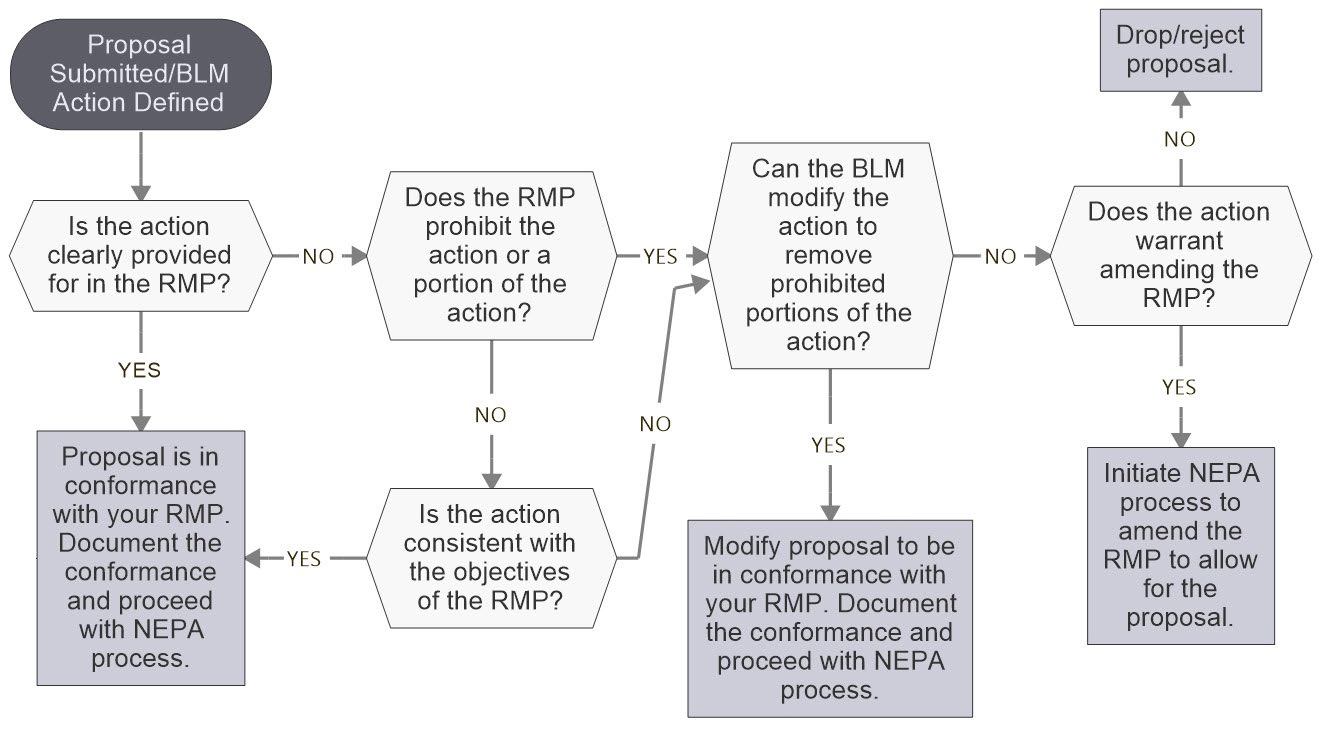
H-1601-1 – LAND USE PLANNING HANDBOOK (Public)
134
BLM HANDBOOK
Rel. 1-1836
Supersedes Rel. 1-1693
01/16/2025
•
If the RMP does not specifically mention the action, is the action consistent with the
RMP’s decisions including objectives, management direction, and land use allocations?
•
Would the RMP require a new decision, including changes to existing decisions, to
accommodate the action?
If the RMP is silent about an activity, review the plan components including the objectives. In
this evaluation, there are four possible conclusions:
•
The activity contributes to meeting plan objectives and is consistent with the other plan
components, and therefore is considered to be in conformance;
•
The proposal is not in conformance, but can be modified to be in conformance;
•
The proposal is not in conformance, but initiation of an amendment of the plan is
warranted to consider allowing the activity; or
•
The proposal is not in conformance and does not warrant further consideration through a
plan amendment.
If a proposal is not in conformance with the RMP’s plan components, the BLM can:
•
Deny the proposal without further review (the decision to deny is subject to appeal to the
Interior Board of Land Appeals);
•
Modify the proposal or condition the authorization to conform to the plan; or
•
Prepare an amendment if the proposal warrants further consideration (the analysis
required for the proposal and the amendment may occur simultaneously (43 CFR 1610.5-
5)).
Figure 13.1.
Screening process for determining RMP conformance.
H-1601-1 – LAND USE PLANNING HANDBOOK (Public)
135
BLM HANDBOOK
Rel. 1-1836
Supersedes Rel. 1-1693
01/16/2025
13.1.1.1
Non-Conforming External Proposals
For externally generated project proposals, working with the applicant before submission of an
application may result in submission of a project proposal that is in conformance with the RMP.
However, the BLM may also determine to initiate a planning process to amend a plan at the same
time the BLM initiates the NEPA process to review a project proposal. A concurrent project
review and land use planning process could result in an amendment to the RMP and an approved
project that conforms to the amended RMP.
Initiating a planning effort, including the initiation of an RMP amendment to allow for the
implementation of a project proposal not in conformance with the current RMP, is at the
discretion of the state director. If after review of the project proposal, the field manager
recommends not to pursue or continue a planning effort, we recommend the field manager
provide documentation of this to the state director. The state director may elect not to continue
or pursue a plan amendment. If the BLM will not be continuing the decision-making process on
the proposal, you may, as a courtesy, notify the public in the same manner that you used to
initiate the planning process.
13.1.1.2
Bringing Ongoing Management into Conformance with a Revised RMP
For actions for which the BLM has already signed a decision, but for which the action is a
permitted, ongoing action, the BLM would need to take appropriate measures, subject to valid
existing rights, to make operations and activities under existing permits conform to the new
approved RMP within a reasonable period. At a minimum, we recommend you consider
measures that would make existing operations and activities conform to the RMP prior to
approving renewals or extensions of existing authorizations such as renewals of right-of-way
grants, review and processing of grazing permits, and extension requests for expiring
applications for permit to drill. Any person adversely affected by a specific action being
proposed to implement some portion of an RMP may appeal such action pursuant to 43 CFR
4.410 at the time the action is proposed for implementation.
13.1.2 Plan Maintenance
The BLM must maintain RMPs and supporting components as necessary to reflect minor
changes in data (43 CFR 1610.5-4). Maintenance is limited to minor changes and cannot change
decisions made in the RMP through plan components but can clarify an approved planning
decision if the original wording is not clearly understood. Maintenance cannot change where or
how the BLM would apply approved RMP decisions or change the terms of RMP decisions.
“Such maintenance is limited to further refining or documenting a previously approved decision
incorporated in the plan. Maintenance shall not result in expansion in the scope of resource uses
or restrictions, or change the terms, conditions, and decisions of the approved plan,” (43 CFR
1610.5-4). For example, since the exception, modification, and waiver criteria for oil and gas
lease stipulations are part of the allocations made in the RMP, these criteria cannot be changed
through plan maintenance, and can only be changed through a land use plan revision or
amendment. Because plan maintenance cannot change any RMP decisions and can only correct
errors or data, plan maintenance is not subject to analysis under NEPA and does not require
formal public involvement or interagency coordination (43 CFR 1610.5-4).
H-1601-1 – LAND USE PLANNING HANDBOOK (Public)
136
BLM HANDBOOK
Rel. 1-1836
Supersedes Rel. 1-1693
01/16/2025
Examples of maintenance actions include:
•
Correcting minor data, typographical, mapping, geospatial data, or tabular data errors in
the planning records after an RMP or amendment has been completed.
•
Revising RMP monitoring strategy questions based on new science, information, or other
identified changes to better collect information necessary to RMP evaluation.
•
Refining and updating geospatial data and maps depicting planning area boundaries
based on a new cadastral survey.
If your ROD/approved RMP has clearly identified dynamic plan components that apply to on-
the-ground features or criteria (refer to section
3.5,
Describing Where Plan Components Apply
)
and for which the map in the ROD/approved RMP only provides visual representation (refer to
section
13.2.1,
Planning and Decision Area
), you may not need to complete plan maintenance
to update geospatial information that changes the visual representations based on field surveys
after each finding. For example, if your ROD/approved RMP established a management area
within a certain distance of a stream, you would not need to complete plan maintenance every
time you do field surveys and get accurate mappings of stream locations and channel routes. We
recommend that you update geospatial data used for management and analysis in real-time, but
you may wait to document the plan maintenance of these updates on a periodic basis.
Because plan maintenance is “limited to further refining or documenting a previously approved
decision incorporated in the plan” (43 CFR 1610.5-4), you must not use plan maintenance in a
manner that introduces new decisions, changes decisions, or changes the scope of the application
of decisions. For example, it would be inappropriate to use plan maintenance to clarify
management direction because a previously unforeseen and, therefore, unconsidered issue arises.
If your RMP identifies management direction to apply land use planning decisions on acquired
lands but makes no decisions for discovered lands, it would be inappropriate to use plan
maintenance to edit management direction about the disposition of acquired lands to assert those
decisions also apply to discovered lands when discovered lands were never originally considered
in the decision.
It is also inappropriate to use plan maintenance to update mapping of decisions when doing so
would expand the scope of resource uses or restrictions (43 CFR 1610.5-4) that was not
originally anticipated and analyzed during development of the RMP. For example, if your RMP
establishes management direction for a species within a specific (and static) geographic habitat
boundary, it is inappropriate to use plan maintenance to ‘update’ the mapping of the habitat
boundaries during implementation when doing so is more than a correction or minor refinement.
Since specific resource and resource use decisions (such as surface disturbance restrictions or use
exclusions) are tied to the identified habitat area boundaries, the updating and remapping of the
habitat boundaries would result in changes to the application of all corresponding planning
decisions on all correlated acres of public land. In contrast, your RMP may have anticipated
(and the associated EIS may have analyzed) habitat conditions likely to change over time and
may allow for the application of management to these newly identified areas by using dynamic
criteria-based descriptions. For example, the EIS supporting the RMP may have disclosed that
the BLM anticipated the exact location of raptor nests within a forest stand to change over time
and provided for the application of lease stipulations (such as no surface occupancy or timing
limitations) surrounding known active nests to be applied based on the latest survey data. Refer
H-1601-1 – LAND USE PLANNING HANDBOOK (Public)
137
BLM HANDBOOK
Rel. 1-1836
Supersedes Rel. 1-1693
01/16/2025
to section
3.5,
Describing Where Plan Components Apply
for additional information on static
versus dynamic (or criteria-based) decisions.
The BLM has the discretion to conduct plan maintenance and may consider budget, workload,
and other priorities. For example, minor changes, such as fixing a typo, may be updated on an
ongoing basis. For minor changes to data made through plan maintenance (such as corrections to
geospatial data), we recommend establishing regular intervals for updating data that make sense
based on the rate at which changes to the information are collected. Regardless of intervals, we
recommend all plan maintenance be completed prior to or in the early stages of evaluating plans
(refer to
Chapter 4,
RMP Evaluations
).
The BLM must document the maintenance completed for RMPs (43 CFR 1610.5-4). Clearly
document the change being made, reasons for the change, rationale for why the change meets the
criteria for maintenance, and appropriate manager approval of the change. In circumstances
where the maintenance crosses BLM field office or district office boundaries, the appropriate
manager to approve the change would be the manager with jurisdiction over the entire area,
generally the state director. Where the decision is exclusive to a single field office, the state
director may identify that the field manager has the authority to approve the plan maintenance
(43 CFR 1610.1(b)). You may make the documentation of the plan maintenance publicly
available on the BLM’s official national NEPA register so that the public is aware.
During the implementation of your RMP, questions may arise about the meaning of particular
plan components or their applicability to particular projects or actions. We recommend you
establish a coordinated process for providing and documenting consistent interpretation and
clarification of these components to support effective communication across BLM boundaries,
tracking of issues, and the development of comprehensive responses. Such interpretation and
clarification would not itself constitute plan maintenance.
13.1.3 Implementation During a Plan Revision or Amendment
An RMP revision or amendment is not effective until it is approved. Throughout the planning
process, management decisions in the existing RMP remain in effect and do not change. For
example, if the existing land use plan allocates lands open for a particular use, they remain open
for that use until changed through a completed amendment or revision process.
During the preparation or amendment of an RMP, the BLM may review all proposed
implementation actions through the decision-making process and associated NEPA process to
determine whether approval of a proposed action would harm resource values and limit the
management choices in the planning process. Even though the current land use plan may allow
an action, the BLM field manager has the discretion to defer or modify proposed
implementation-level actions and require appropriate conditions of approval, stipulations,
relocations, or redesigns to reduce the effect of the action on the values being considered through
the planning process. The modification to the action is subject to valid existing rights and
program-specific regulations. The BLM may in some instances temporarily defer an action in an
area where a different allocation is being considered in the preferred alternative of a draft RMP
or in the proposed RMP (or amendment). The discretion to review proposed implementation
actions and make decisions to modify or defer an action is specific to individual projects or
H-1601-1 – LAND USE PLANNING HANDBOOK (Public)
138
BLM HANDBOOK
Rel. 1-1836
Supersedes Rel. 1-1693
01/16/2025
activities. These decisions would be specific to individual projects or activities and would not
lead to an area-wide moratorium on certain activities during the planning process.
13.1.4 Relationship of RMP to Activity Plans
Activity plans are program or resource specific plans that identify specific management for a
distinct geographical area. Activity plans can provide a strategic approach specific to the area
that addresses potentially complex implementation needs to manage in conformance with the
approved RMP for that area. Examples of activity plans include allotment management plans,
recreation area management plans, wild and scenic river management plans, area of critical
environmental concern management plans, monument management plans, or herd area
management plans. Consult program-specific guidance to identify programs that may
recommend the development of an activity plan and any program-specific requirements for
activity plan documentation and analysis.
When the BLM prepares activity plans for a program or specific resource, we recommend that
you develop activity plans programmatically using the NEPA process to streamline subsequent
project implementation and management (refer to BLM NEPA Handbook (H-1790-1)). Any
activity plans developed must be in conformance with the approved RMP (43 CFR 1610.5-3(a)).
We recommend you tier to the EIS for your approved RMP. Refer to BLM NEPA Handbook
(H-1790-1) for detailed instructions and examples of tiering.
13.2
Monitoring
As you implement your RMP, you will also monitor the implementation. The monitoring
strategy you developed for the RMP will outline the monitoring questions, procedures, and
intervals for tracking how the plan is being implemented (refer to section
10.2.3,
RMP
Monitoring Strategy
). As part of implementing your RMP, you will also conduct effectiveness
monitoring that informs you on the outcomes achieved by what is implemented. Monitoring is
also required by some programs, such as the BLM’s Assessment, Inventory, and Monitoring
program, that provide information related to the conditions and the trends of BLM management
on public lands. The BLM uses the information from the RMP’s implementation monitoring,
project monitoring, and program monitoring during an RMP evaluation to understand how we
are implementing our RMP, the effectiveness of BLM’s actions in achieving desired outcomes,
trends on the landscape, and whether trends are from BLM management or other sources (refer
to
Chapter 4
, RMP Evaluations
).
The BLM’s monitoring data represents a significant investment for data collection, maintenance,
and storage. It is critical that data is regularly collected, documented, maintained, and stored in a
manner that is easily accessible and in accordance with established standards and processes
where applicable.
The BLM assesses the monitoring questions at each monitoring interval to ascertain if the
questions, reporting, methods, sample size, or intervals need to be changed. As the monitoring
questions are not RMP decisions, you can keep the RMP monitoring strategy current using plan
maintenance and we recommend you do so.
H-1601-1 – LAND USE PLANNING HANDBOOK (Public)
139
BLM HANDBOOK
Rel. 1-1836
Supersedes Rel. 1-1693
01/16/2025
13.2.1 Monitoring Documentation
Documenting the data from plan monitoring serves a critical role in being able to identify trends
and, ultimately, the effectiveness of the BLM’s implementation of an RMP consistent with the
identified measurable objectives when BLM conducts a RMP evaluation. You may document
the results of plan monitoring in any manner that facilitates scheduled RMP evaluations or that
allows you to more easily identify when an unscheduled RMP evaluation may be necessary.
Examples of ways the BLM may document the results of plan monitoring include spreadsheets,
databases, or a report. Document any monitoring data consistent with BLM-established data
standards under the current direction available at that time. We recommend that you use a single
format for all documentation of monitoring results to ensure the full scope of the monitoring
across all programs and resources are captured in one location. Doing so helps you identify
potential trends developing across multi-resource functions and ensures that the data and
information is consistently prepared and available to facilitate RMP evaluations.
We recommend that you document the results of plan monitoring annually. The annual
documentation of this monitoring information will help you when it comes time to evaluate the
RMP by providing a single location capturing the comprehensive monitoring results. Also,
annual monitoring reports can help you identify trends which may reveal a need to evaluate the
plan sooner than the interval established in the approved RMP.
There is no requirement to share the results of plan monitoring publicly. However, the BLM
may choose to make the documentation of monitoring results available to external groups
including cooperators, partners, other governments, or the public. Sharing the documentation of
monitoring results improves transparency and may help foster relationships with external groups.
The BLM’s plan monitoring results may also be helpful in identifying collaborative projects with
other landowners or partner groups. Monitoring results may also provide factual evidence to
support project-level NEPA analysis assumptions or conclusions. We recommend that you
present the monitoring results in a summary report or other consistent format that is easy to
review when you choose to share the results publicly and provide the report on the BLM’s
official national NEPA register.
Program staff at the local BLM unit, whether a field office or district office, are responsible for
conducting monitoring at the established intervals in the RMP.
H-1601-1 – LAND USE PLANNING HANDBOOK (Public)
140
BLM HANDBOOK
Rel. 1-1836
Supersedes Rel. 1-1693
01/16/2025
Chapter 14 – Amending the RMP
General
14.1 Determining the Scope of an Amendment
14.2 Planning Steps for RMP Amendments Supported by an EIS
14.3 Planning Steps for RMP Amendments Supported by an EA
14.4 Issuing Decisions to Approve an RMP Amendment
General
The decision of whether to initiate an RMP amendment is the discretion of the state director.
The BLM considers a plan amendment when there is “a need to modify management or
accommodate a project that may result in a change in the scope of resource uses or a change in
the terms, conditions, and decisions of the approved plan” (43 CFR 1610.5-5). The BLM
regulations do not further clarify the meaning of ‘terms,’ ‘conditions,’ or ‘decisions’ of the
approved plan. Guidance provided in this handbook clarifies that the terms, conditions, and
decisions of a plan are the goals, objectives, designations, allocations, and management direction
(collectively, plan components) described in this handbook (refer to
Chapter 3,
Land Use Plan
Components
).
An RMP revision must be used to change a plan if new information or changed circumstances
affect the entire plan or major portions of the plan (43 CFR 1610.5-6). In contrast, the BLM
prepares an amendment when the scope of the proposed changes to plan components is less than
the entire plan or major portions of the plan. An amendment may be appropriate when the
changes are limited by topic (such as proposing to change limited management direction
identified in an RMP for a single resource program whether in a focused geographic area or
across a large geographic area) or to change a large suite of plan components for a discrete area
(such as a change to most or all planning decisions within a newly designated national
monument to support a monument management plan). Use plan maintenance to keep the RMP
current by correcting typographical or geospatial data and mapping errors and to reflect minor
changes in mapping and geospatial data (43 CFR 1610.5-4). Refer to section
1.4.1,
Determining
Whether a Plan Revision or Amendment is Appropriate
for further guidance in determining
which you may need. Refer to section
13.1.2,
Plan Maintenance
for further guidance.
The RMP evaluation process identifies whether a plan amendment may be needed to consider:
•
Consistency with current laws, regulations, or policies (for example, if there are new or
revised policies);
•
Monitoring and evaluation findings which indicate that implementing a plan’s decisions
is not achieving the desired resource conditions;
•
New science, data, or information that indicates a need to change previous decisions; or
•
A change in circumstances which results in a determination that the current plan does not
provide adequate management direction.
Regardless of the RMP evaluation’s findings, the decision to initiate the process to amend a plan
is at the discretion of the state director (refer to
Chapter 4
, RMP Evaluations
). A state director
also retains discretion as to whether to initiate a plan amendment in response to a proposed
action that would not be in conformance with the RMP.
H-1601-1 – LAND USE PLANNING HANDBOOK (Public)
141
BLM HANDBOOK
Rel. 1-1836
Supersedes Rel. 1-1693
01/16/2025
Plan amendments are most often initiated to:
•
Consider a proposal or action that does not conform to the RMP;
•
Implement new or revised policy, such as an approved conservation agreement between
the BLM and the U.S. Fish and Wildlife Service;
•
Respond to new, intensified, or changed uses on public land; or
•
Consider new information from resource assessments, monitoring, or scientific studies; or
respond to court orders for a specific location or specific program.
Plans needing amendment may be grouped geographically or by the type of decision in the same
amendment process – that is, the BLM can amend the same or related plan components in more
than one land use plan through a combined analysis and decision-making process. The BLM
may also amend the plan components under BLM’s management for plans adopted from another
agency (refer to section
2.5.3,
Cooperation to Identify Situations Where Action Can be Taken
Based on Another Agency’s Plan or a Land Use Analysis
for guidance on adopting another
agency’s plan).
The BLM must prepare an EA or an EIS for a plan amendment (43 CFR 1610.5-5). If the BLM
is considering the amendment in response to a specific proposal, it would be appropriate to
conduct the effects analysis required for the project proposal and the proposed amendment
simultaneously to address closely related actions in the same NEPA document (refer to BLM
NEPA Handbook (H-1790-1)). If the BLM amends several RMPs simultaneously, a single EIS
or EA may be prepared to address all amendments.
14.1
Determining the Scope of an Amendment
An amendment modifies the existing approved RMP by either adding, modifying, or deleting
specific plan components in the approved RMP. In determining the scope of an amendment,
identify the specific decisions in the approved RMP you are proposing to change.
Since amendments are more focused or narrower in scope than revisions, it is important to
communicate to the public what is, and what is not, going to be considered in the amendment.
Your purpose and need statement determines the scope of an amendment, including the range of
alternatives (refer to BLM NEPA Handbook (H-1790-1)).
Tailor the purpose and need for the amendment to the scope of the appropriate change identified
through the RMP evaluation, project review, or from a specific project proposal. In determining
the scope of the amendment, make sure that you consider “ripple effects” and be mindful of the
potential need to change multiple plan components to avoid creating internal conflicts in
management direction in the RMP once it is amended.
Refer to section
5.4.3,
RMP Amendment Purpose and Need
for more information on developing
a preliminary purpose and need statement for an RMP amendment. Since the purpose and need
statement is critical to defining the scope of an amendment, we recommend that you solicit
review of the statement from your state office land use planning staff prior to initiating scoping
for an amendment.
H-1601-1 – LAND USE PLANNING HANDBOOK (Public)
142
BLM HANDBOOK
Rel. 1-1836
Supersedes Rel. 1-1693
01/16/2025
Some of the BLM’s program-specific guidance in various handbooks or manuals may provide
direction on an appropriate “default” range of alternatives for specific resources. While you may
consider this information in developing your alternatives, alternatives considered in detail in an
amendment need to respond to the purpose and need statement for the particular planning effort.
We recommend that the state director neither limit the alternatives by not considering multiple
ways to address the purpose and need nor broaden the alternatives unnecessarily by considering
alternatives that do not address the purpose and need identified.
14.1.1 Using Tiering to Narrow the Scope of Analysis for a Plan Amendment
Tiering is a NEPA tool that can be used to allow “subsequent tiered environmental analysis to
avoid duplication and focus on issues, effects, or alternatives not fully addressed in a
programmatic environmental document, environmental impact statement, or environmental
assessment prepared at an earlier phase or stage” (40 CFR 1501.11(b)). Consider whether the
amendment’s associated NEPA analysis (either EA or EIS) can tier to the RMP’s EIS. In a
tiered document, you would not need to reexamine alternatives analyzed in a broader document.
Tiering the analysis for an RMP amendment to the analysis in the approved RMP’s proposed
RMP/final EIS is especially appropriate for situations in which you need to modify some of the
plan components but you want to keep the amendment focused on specific issues. For example,
the approved RMP may have a planning designation such as a special recreation management
area or a wild horse herd management area. The results of monitoring data and changes in
circumstances (such as increased recreation use or drought) may prompt a need to reconsider the
allocations within these BLM administrative designations. By tiering the amendment’s NEPA
analysis to the approved RMP’s final EIS, you could focus the alternatives for the amendment
only on the management of the administrative designation (that is, the allocations within the
designation) and not have to include alternatives that consider whether the BLM retains the
designation itself. Refer to BLM NEPA Handbook (H-1790-1) for detailed information on how
to tier NEPA documents.
14.1.2 Focusing a Plan Amendment’s Analysis
For plan amendments, the BLM must analyze issues for those resources or resource uses for
which the amendment is evaluating a change from the approved RMP’s plan components. Plan
amendments are narrow in scope and may not change the management decisions for all the
resources and resource uses within the planning area. For an RMP amendment, you identify
issues relevant to the scope of the amendment and proposed changes to the current plan
components. Like the issues analyzed under NEPA for your approved RMP, the issues analyzed
regarding your RMP amendment must be focused within each resource or program on only those
details that are needed to understand how the alternatives respond to the purpose and need or
analyze for significant effects. We recommend the issues in the EIS or EA analyzing your
proposed RMP amendment mirror those from the approved RMP’s proposed RMP/final EIS to
allow for clarity and context in comparing the proposed amendment to the approved RMP
decisions wherever possible.
14.1.3 Amendments to Consider Approval of Non-Conforming Project Proposals
An RMP amendment initiated to consider the approval of a project proposal that was not in
conformance with the approved RMP would follow the same processes as other RMP
H-1601-1 – LAND USE PLANNING HANDBOOK (Public)
143
BLM HANDBOOK
Rel. 1-1836
Supersedes Rel. 1-1693
01/16/2025
amendments supported by either an EIS or EA, depending on the significance of impacts. Refer
to section
13.1.1.1,
Non-Conforming External Proposals
for discussion on whether to initiate a
plan amendment to consider a non-conforming project proposal.
Additional considerations for project-driven amendments include:
•
Present context of the applicant’s purpose and need appropriately. Refer to the BLM
NEPA Handbook (H-1790-1) for guidance on developing a purpose and need appropriate
for externally generated project actions.
•
Identify the purpose and need for the implementation decisions and the purpose and need
for the RMP amendment. Refer to
section
5.4.3,
RMP Amendment Purpose and Need
.
•
Identify which aspects of the proposed action are implementation decisions and which
aspects are land use plan decisions, since they are subject to different administrative
remedies.
•
Analyze the issues relevant for both the proposed implementation decisions and the
proposed planning decisions. Refer to section
8.6.2,
Issue Analysis
.
•
Identify any required Federal permits, licenses, or other authorizations that must be
obtained for the proposed project (40 CFR 1502.24) or any required state or local
permits.
14.2
Planning Steps for RMP Amendments Supported by an EIS
An RMP amendment supported by an EIS follows the same procedures required for an RMP
revision but consideration is limited to that portion of the RMP being considered for amendment
(43 CFR 1610.5-5(b)). For example, you must develop a monitoring strategy with the proposed
RMP amendment/final EIS (43 CFR 1601.0-5(n)(8)), but the content of any new or revised
monitoring questions and program reporting items identified would be limited to the decisions
being considered in the proposed RMP amendment. Refer to
Figure 1.3,
Planning steps for
new plans, revisions, and amendments supported by an EIS
in section
1.4.2,
The Basic
Planning Process for Developing or Revising an RMP
for an overview of the process for an
RMP amendment supported by an EIS and
Chapter 5,
BLM or State Director Planning
Guidance
, through
Chapter 12,
The Record of Decision and the Approved RMP
for the
guidance of the specific steps for the planning process.
You must prepare an analysis of the management situation when conducting an RMP
amendment supported by an EIS (43 CFR 1610.5-5(b)). For these planning efforts, you have the
option to prepare new documentation of the planning area profile or to rely on some of the
existing discussions in the analysis of the management situation prepared for the approved RMP
if it is still current. For example, if the information in the planning area profile in the approved
RMP is out-of-date, does not provide the proper context for the new planning effort, or if the
new amendment is in response to an application for a type of land use not considered in the
approved RMP, you will need to prepare a new planning area profile for those sections with new
information. The original planning area profile can be incorporated by reference for sections
where information has not changed. Refer to section
6.3.6,
Planning Area Profile
for guidance
on documenting a planning area profile for your analysis of the management situation. However,
it would not be appropriate to rely on the approved RMP’s analysis of the management situation
for all parts of the analysis of the management situation. You will need to provide the new
H-1601-1 – LAND USE PLANNING HANDBOOK (Public)
144
BLM HANDBOOK
Rel. 1-1836
Supersedes Rel. 1-1693
01/16/2025
information for the RMP amendment’s purpose and need and preliminary range of alternatives
for the plan amendment.
As when developing a new RMP or an RMP revision, we recommend you document the analysis
of the management situation in a report combined with the planning criteria report and provide it
for review with the planning criteria during public scoping. The new analysis of the
management situation report needs to be tailored to both the geographic area affected by the
amendment and the scope of the amendment defined by the purpose and need.
When determining whether to prepare a new planning area profile for your RMP amendment, we
recommend that you consider whether the information prepared for the analysis of the
management situation for the approved RMP is still relevant and appropriate such that it could be
incorporated by reference. We recommend that you clearly identify whether you will need to
prepare a new planning area profile early in the process.
14.3
Planning Steps for RMP Amendments Supported by an EA
The BLM may prepare an environmental assessment (EA) and finding of no significant impact
(FONSI) for an RMP amendment that would not have significant effects (refer to BLM NEPA
Handbook (H-1790-1)). Even for RMP amendments supported by an EA, the BLM must
provide for public involvement (43 CFR 1610.2); interagency coordination; Tribal, cultural, and
biological consultation, as appropriate; consistency review (43 CFR 1610.3); and protest (43
CFR 1610.6-2) (43 CFR 1610.5-5). The field manager has the discretion to include optional
public involvement planning steps (
Table 14.1,
Summary of planning steps for RMP
amendments supported by an EA
and
Figure 14.1,
Planning steps for RMP amendments
supported by an EA
). We recommend that you clearly communicate with the public and other
Federal agencies, Indian tribes, and state and local governments about what, if any, optional
planning steps or public involvement are to be included in as part of the planning process for a
particular RMP amendment supported by an EA.
As with planning processes supported by an EIS, during an RMP amendment process supported
by an EA, the BLM will still make land use planning decisions of objectives and management
direction, and possibly also address allocations and designations. The purpose of the process for
making planning decisions does not change under an RMP amendment supported by an EA.
Similarly, the planning process supported by an EA would also develop a monitoring strategy
with the proposed RMP amendment (43 CFR 1601.0-5(n)), and, as with RMP amendments
supported by EISs, the content of any new or revised monitoring questions and program
reporting items identified would be limited to the decisions being considered in the proposed
RMP amendment.
The BLM NEPA Handbook (H-1790-1) provides detailed guidance on how to prepare an EA,
including supplementation of an EA if necessary. An EA developed to evaluate a proposed land
use plan amendment is subject to the same broad requirements as a project EA. This section
provides guidance on specific differences between an EA for a project and an EA for a land use
plan amendment. The BLM NEPA Handbook (H-1790-1) provides detailed guidance for
meeting the page and time requirements of NEPA, as amended. All EAs for BLM RMP
amendments must comply with these requirements.
H-1601-1 – LAND USE PLANNING HANDBOOK (Public)
145
BLM HANDBOOK
Rel. 1-1836
Supersedes Rel. 1-1693
01/16/2025
Table 14.1.
Summary of planning steps for RMP amendments supported by an EA. Grey
highlighted rows identify optional steps in the planning process for RMP amendments supported
by an EA.
Step in the Planning
Process
Summary of Process for RMP Amendments Supported by an EA
Invitations to Cooperating
Agencies
You are not required to invite cooperating agencies to participate in the planning
process for an RMP amendment supported by an EA (43 CFR 1610.3-1(b)).
However, the field manager has the discretion to invite cooperating agencies. In
determining whether to invite cooperating agencies, we recommend the field
manager consider how the agencies may contribute to the planning effort by:
•
Identifying issues to be addressed;
•
Arranging for the collection and/or assembly of necessary resource,
environmental, social, economic, and institutional data;
•
Analyzing data;
•
Developing alternatives;
•
Evaluating alternatives and estimating the effects of implementing each
alternative; and
•
Carrying out any other task necessary for the development of the
environmental analysis and documentation (43 CFR 46.230).
Refer to
section 2.3,
Cooperating Agency Involvement
for further guidance.
Analysis of the Management
Situation
An analysis of the management situation is not required for an RMP amendment
supported by an EA. However, you may document an analysis of the management
situation tailored to the scope of the purpose and need and issues of the
amendment. Refer to section
6.2,
Analysis of the Management Situation
for
further guidance.
Planning Criteria and Public
Scoping
The BLM must publish an NOI in the
Federal Register
to initiate a plan amendment
and provide a 30-day scoping period which invites the public to help identify issues
(43 CFR 1610.2(c), 43 CFR 1610.2(f)(1)). Refer to
Chapter 8,
Notice of Intent
and Scoping
for further guidance.
We recommend that you combine review of the planning criteria (43 CFR
1610.2(f)(2)) with scoping. If you choose not to combine the review of the planning
criteria with the 30-day scoping period, you must provide a separate 30-day
comment period on the planning criteria prior to being approved by the field
manager for use for the planning effort (43 CFR 1610.4-2(c)). In other words, you
must release the planning criteria to the public for a 30-day comment period before
releasing the RMP amendment/EA. You may do so before or after the NOI if you
do not issue it concurrently. Publication of a
Federal Register
notice is not
required to notify the public of the availability of the planning criteria for comment if
it is not combined with scoping. Refer to
Chapter 7,
Planning Criteria and
Analysis of the Management Situation
for further guidance.
Selection of a Preferred
Alternative
The selection of a preferred alternative is not required for RMP amendments
supported by an EA. However, the field manager has the discretion to identify a
preferred alternative for RMP amendments supported by an EA. In determining
whether to identify a preferred alternative, we recommend the field manager
consider whether the identification of a preferred alternative would improve public
understanding when there are several alternatives or when the preferred
alternative is not the same as the BLM’s proposed action or the non-Federal
entity’s proposal. Refer to section
9.4.3,
Preferred Alternative
for further
guidance.
Public Review and
Comment on a Draft RMP
Amendment
There is no regulatory requirement to provide an opportunity for public comment on
RMP amendments supported by an EA; the field manager has the discretion to
publish a draft RMP and solicit public comment on an RMP amendment supported
by an EA. There may be situations where there is no public interest in a minor
plan amendment and a formal public comment period would not be necessary. In
determining whether to provide a public review for comment on your RMP
amendment, we recommend the field manager consider the following:
•
The level of public interest in the proposed amendment;
•
The scope and complexity of the proposed amendment; and
•
The extent that the amendment will modify the existing RMP or affect
subsequent activity plans.
H-1601-1 – LAND USE PLANNING HANDBOOK (Public)
146
BLM HANDBOOK
Rel. 1-1836
Supersedes Rel. 1-1693
01/16/2025
Step in the Planning
Process
Summary of Process for RMP Amendments Supported by an EA
If the field manager decides to provide a public review and comment period, the
BLM must offer a minimum 30-day comment period (43 CFR 1610.2(e)). You may
provide notification of this public review and comment period through the BLM’s
official national NEPA register, mailing lists, press releases, or other appropriate
means for the community of interest. An Environmental Protection Agency notice
in the
Federal Register
is not required.
The BLM NEPA Handbook (H-1790-1) provides direction for responding to
substantive public comments.
Refer to
Chapter 9,
The Draft RMP/EIS
for guidance on content of the draft RMP
amendment.
Public Protest of the
Proposed RMP Amendment
The BLM must provide the proposed RMP amendment/EA for public protest and
resolve protests prior to signing a decision (43 CFR 1610.5-1(b)). Since there are
no requirements for a
Federal Register
notice for publication of a proposed RMP
amendment/EA, the BLM’s notice of the anticipated effective date of the plan
amendment initiates the public protest period for your plan amendment (43 CFR
1610.5-2(a)(1)). In other words, you must release the proposed RMP amendment
to the public and provide a general statement that identifies the effective date. For
example, the effective date may simply be identified as “the effective date will be
the day the decision is signed after issues raised through public protest and the
Governor’s consistency review are resolved.” We recommend you provide this
notice in the dear reader letter accompanying the EA and proposed RMP
amendment. Also clearly identify the dates for your protest period, including the
date that the protest period will end.
In some circumstances, the BLM must circulate an unsigned FONSI for public
review (refer to BLM NEPA Handbook (H-1790-1)). We recommend you circulate
the unsigned FONSI with the proposed RMP amendment/EA during the protest
period. If you choose to prepare a draft RMP amendment/EA for public review,
you may circulate an unsigned FONSI with draft RMP amendment/EA instead.
Provide notice of the availability of the proposed RMP amendment for public
protest through the BLM’s official national NEPA register. You may also provide
notice through other appropriate means for the community of interest such as
mailing lists or press releases. Protests must be filed within 30 days of the date of
the BLM’s notification of the effective date of the plan amendment (43 CFR 1610.5-
2(a)(1)). Refer to
Chapter 11,
Protest and Governor’s Consistency Review of
the Proposed RMP
for further guidance.
Refer to
Chapter 10,
The Proposed RMP/Final EIS
for guidance on required
content of the proposed RMP amendment, including the monitoring strategy (refer
to
section 10.2.3,
RMP Monitoring Strategy
).
Governor’s Consistency
Review
The state director must submit the proposed amendment to the governor and
identify any known inconsistencies with state or local plans, policies, or programs.
The governor has 60-days to respond (43 CFR 1610.3-2(e)). We recommend that
you initiate your governor’s consistency review on RMP amendments supported by
an EA at the same time as your protest period for your proposed RMP
amendment, EA, and unsigned FONSI. Refer to section
11.3,
Governor’s
Consistency Review
for further guidance.
Comment on Significant
Changes Resulting from
Protest
If, after publication of the proposed RMP amendment, the BLM intends to select an
alternative that is encompassed by the range of alternatives in the EA, but is
substantially different from the proposed RMP amendment, the BLM must notify
the public and provide opportunity for comment on any significant change made to
the proposed RMP amendment as a result of action on a protest (43 CFR
1610.2(f)(5)). Refer to section
11.4,
Notice of Significant Change
for further
guidance.
FONSI
To sign a decision record, you must be able to prepare a FONSI for all RMP
amendments supported by an EA (40 CFR 1508.1(q)). Refer to the BLM NEPA
Handbook (H-1790-1) for information on requirements, including required public
reviews, of FONSIs.
H-1601-1 – LAND USE PLANNING HANDBOOK (Public)
147
BLM HANDBOOK
Rel. 1-1836
Supersedes Rel. 1-1693
01/16/2025
Step in the Planning
Process
Summary of Process for RMP Amendments Supported by an EA
After making any changes to the FONSI based on public protest and the
governor’s consistency review, the state director would sign the FONSI, if
appropriate. If you cannot reach a finding that your RMP amendment would have
no significant impacts, you must prepare an EIS to complete the amendment. Post
all signed FONSIs on the BLM’s official national NEPA register. While the signed
FONSI cannot be combined as part of the decision record, you may publish it
separately or attach it to the decision record.
Decision Record and
Approved RMP Amendment
Post all planning decisions and associated documents on the BLM’s official
national NEPA register. Posting of the decision record and approved RMP
amendment constitutes the BLM’s requirement to notify the public of the RMP
amendment’s approval. You may also provide notification through mailing lists,
press releases, or other appropriate means for the community of interest.
Refer to
Chapter 12,
Record of Decision and the Approved RMP
for guidance
on required content of the approved RMP amendment.
Table 14.2.
Required public involvement in preparation of an RMP amendment supported by an
EA.
Public Involvement Step
Timeframe
(calendar days)
Notification
General Purpose
Scoping and Comments
on Planning Criteria
30 days
NOI (Newspaper
publication is also
required (43 CFR
1610.2(c))
1
Solicit feedback on
potential issues
and methodologies for analyzing
those issues in the planning criteria,
including any significant changes to
such criteria.
Protest of proposed RMP
amendment/EA
30 days
Provide notice of the
availability of the
documents for public
protest through the BLM’s
official national NEPA
register. You may also
provide notice through
other appropriate means
for the community of
interest such as mailing
lists or press releases.
Protests must be filed
within 30 days of the date
of the BLM’s notification of
the effective date of the
plan amendment (43 CFR
1610.5-2(a)(1)).
Determine whether the planning
process followed established
procedures, considered relevant
information in reaching proposed
planning decisions, and whether the
proposed plan amendment
decisions are consistent with BLM
policy, regulation, and statute.
Remedy inconsistencies in the RMP
amendment with Federal laws,
regulations, or BLM policy.
When the Governor
recommends changes to a
proposed RMP
amendment which were
not raised during the
public involvement
process and the BLM is
inclined to accept the new
recommendation and/or
there is significant change
to a proposed RMP
30 days
A 30-day public comment
opportunity on the
governor’s recommended
changes must be provided
(43 CFR 1610.3-2(e)) if
those recommended
changes were not raised
during the public
involvement process. In
addition, before issuing a
Decision Record, the BLM
Identify and remedy any
inconsistencies in the changes to
the RMP with Federal laws,
regulations, or BLM policy.
H-1601-1 – LAND USE PLANNING HANDBOOK (Public)
148
BLM HANDBOOK
Rel. 1-1836
Supersedes Rel. 1-1693
01/16/2025
Public Involvement Step
Timeframe
(calendar days)
Notification
General Purpose
amendment/EA after its
publication
must provide public notice
and a 30-day comment
period on any significant
changes (if applicable)
made to the proposed
plan (43 CFR 1610.5-1(b),
43 CFR 1610.2(f)(5), 43
CFR 1610.2(e)). Refer to
Chapter 12.4 for
additional information.
1
Refer to section
7.2,
Scoping Notices
for additional information on newspaper publication of the NOI.
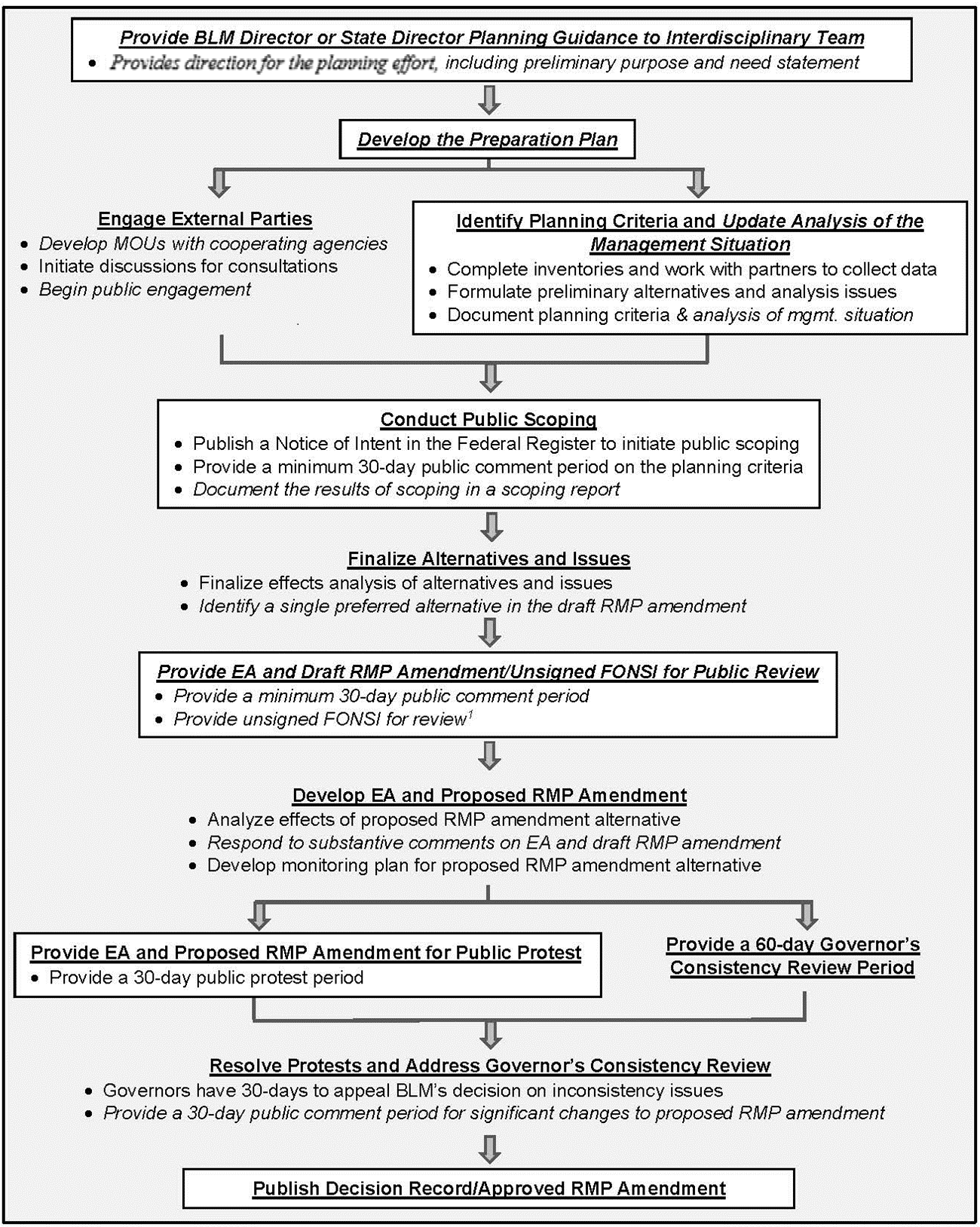
H-1601-1 – LAND USE PLANNING HANDBOOK (Public)
149
BLM HANDBOOK
Rel. 1-1836
Supersedes Rel. 1-1693
01/16/2025
Figure 14.1.
Planning steps for RMP amendments supported by an EA. Boxes around steps
indicate planning documents to prepare as part of the step. Steps in italics may be required in
some cases.
1
30-day public review of unsigned FONSIs is required in some circumstances. You may provide this review concurrent with the
protest period. Refer to BLM NEPA Handbook (H-1790-1).
H-1601-1 – LAND USE PLANNING HANDBOOK (Public)
150
BLM HANDBOOK
Rel. 1-1836
Supersedes Rel. 1-1693
01/16/2025
14.4
Issuing a Decision to Approve an RMP Amendment
Regardless of whether the amendment is evaluated by an EIS or an EA, follow the guidance for
RMPs in
Chapter 12,
The Record of Decision and the Approved RMP
regarding the process
steps that must be completed prior to issuing a decision. As with the development or revision of
an RMP, the RMP amendment is officially approved when the state director signs a ROD (for
RMP amendments supported by an EIS) or decision record (for RMP amendments supported by
an EA) (43 CFR 1610.5-5 (a) and (b)).
Since the amendment is modifying the approved RMP, it is important that you clearly identify
exactly how the decision(s) in the RMP will change. We recommend that you explicitly identify
the new decision(s) by highlighting in some way the new language, modified language (what text
in the RMP is being changed) and replaced language (what text in the RMP is being deleted).
Be clear as to whether the changes apply to all resources and uses in the approved RMP or only
to specific resources or uses (for example an amendment may only change management related
to oil and gas development or only apply to habitat for a listed species).
We recommend you also clearly identify any implementation decisions that may be associated
with the decision to approve the amendment (for example, approval of a non-conforming project
proposal that was the reason for amending the approved RMP). Explain that when project level
NEPA is combined with an RMP amendment, only the proposed plan amendment is subject to
protest; the implementation decision supported by the project level NEPA is generally subject to
appeal or may be subject to protest before appeal, depending on the specific decision or
authorization.
If an RMP amendment resulted in relatively minor changes to the approved RMP (for example,
the changing of a land tenure class to disposal to allow for the sale of a single parcel to a private
landowner to resolve an unintentional trespass), you can include the approved RMP amendment
as a section within the decision document. However, if the amendment resulted in more
complicated changes to the RMP (for example, a combination of additions, modifications, and
removal of multiple plan components), we recommend that you develop a stand-alone approved
RMP amendment. In this situation, the decision document, which provides the rationale for the
decision, would be attached to the approved RMP amendment.
H-1601-1 – LAND USE PLANNING HANDBOOK (Public)
151
BLM HANDBOOK
Rel. 1-1836
Supersedes Rel. 1-1693
01/16/2025
Glossary
activity plan
– a program or area specific detailed implementation-level plan that usually
describes multiple projects and the specific management direction that will be applied to meet
specific land use plan objectives. Examples of activity plans include habitat management plans,
recreation area management plans, wild and scenic river management plans, monument
management plans, area of critical environmental concern management plans, herd management
plans, and allotment management plans.
adaptive management
– a system of management practices based on clearly identified
outcomes and monitoring to determine whether management actions are meeting desired
outcomes; and, if not, facilitating management changes that will best ensure that outcomes are
met or re-evaluated (43 CFR 46.30).
analysis area
– includes all lands, regardless of jurisdiction, for which the BLM synthesizes,
analyzes, and interprets data and information that relates to planning for BLM-administered
lands.
allocation for allowable resource use
– the identification in an RMP of the activities and
foreseeable development that are allowed, restricted, or excluded for all or part of the planning
area based on desired future conditions.
affected environment
– the existing conditions and reasonably foreseeable trends and planned
actions of issue-related elements of the human environment being analyzed. The description of
the affected environment provides the basis for succinctly identifying and interpreting potential
impacts.
alternatives
– other options to the proposed action by which the BLM can meet its purpose and
need. The BLM is directed by NEPA to “study, develop, and describe appropriate alternatives to
recommend courses of action in any proposal which involves unresolved conflicts concerning
alternative uses of available resources…” (NEPA Section 102(2)(H)).
amendment
– the process for considering or making changes in the terms, conditions, or
decisions of approved RMPs. Amendments usually only involve one or two plan decisions, or
involve only a portion of the planning area.
area of critical environmental concern
– an area within the public lands where special
management attention is required to protect and prevent irreparable damage to important historic,
cultural, or scenic values, fish and wildlife resources, or other natural systems or processes, or to
protect life and safety from natural hazards (43 CFR 1601.0-5(a)). The BLM designates areas of
critical environmental concern as part of the planning process.
best management practices
– a suite of techniques that may guide, or be applied to, actions to
aid in achieving the proposed action. Lists of common best management practices are often
developed in conjunction with RMPs, but they are not considered plan decisions and they may be
updated or modified without a plan amendment or plan maintenance.
H-1601-1 – LAND USE PLANNING HANDBOOK (Public)
152
BLM HANDBOOK
Rel. 1-1836
Supersedes Rel. 1-1693
01/16/2025
collaboration
– a cooperative process in which affected parties, often with diverse interests,
work together to seek solutions with broad support for managing public lands and associated
uses.
conformance
– a resource management action is specifically provided for in an RMP or, if not
specifically mentioned, shall be clearly consistent with the terms, conditions, and decisions of the
approved plan (43 CFR 1601.0-5(b)). The BLM evaluates whether implementation actions
conform to approved RMPs.
consistency
– means that the proposed RMP does not conflict with officially approved and
adopted resource-related plans, programs, and policies of Indian tribes, other federal agencies,
and state and local governments, to the extent practical, while maintaining consistency with
federal law, regulation, and policy (43 CFR 1601.0-5(c); 43 CFR 1610.3-2(b)-(c)).
cooperating agency
– any Federal, State, Tribal, or local agency that has jurisdiction by law or
special expertise with respect to any environmental impact involved in proposal that has been
designated by the lead agency (40 CFR 1508.1(g); 43 CFR 1601.0-5(d)). Cooperating agencies
must enter into a written agreement with the BLM establishing cooperating agency status in the
planning and NEPA processes, and participate in the various steps of the BLM’s planning
process as feasible given the constraints of their resources and expertise (43 CFR 1601.0-5(e)).
cumulative effect
– effects on the environment that result from the incremental effects of the
action when added to the effects of other past, present, and reasonably foreseeable actions
regardless of what agency (Federal or non-Federal) or person undertakes such other actions.
Cumulative effects can result from actions with individually minor but collectively significant
effects taking place over a period of time (40 CFR 1508.1(i)(3)).
decision area
– decision area includes only those BLM-administered lands within a planning
area for which the BLM has authority to make land use management decisions. The BLM has
jurisdiction over all BLM-administered lands (surface and subsurface) and over the subsurface
minerals in areas of split estate (areas where the BLM administers Federal subsurface minerals,
but the surface is owned by someone other than the BLM).
decision file
– the contemporaneous record of BLM’s decision-making process that compiles the
official records available to the decisionmaker in the process of reaching a decision. Also known
as project file or case file. In response to administrative appeal or litigation, the decision file will
be the source of the administrative record.
decisionmaker
– the BLM official who has been delegated authority to approve an action and is
responsible for issuing a decision to implement a proposed action. For the approval of RMPs,
this is the state director (43 CFR 1610.5-1; 43 CFR 1610.5-5 (a) and (b)). Synonyms include
authorized official, authorized officer, deciding official, responsible official, and responsible
manager.
H-1601-1 – LAND USE PLANNING HANDBOOK (Public)
153
BLM HANDBOOK
Rel. 1-1836
Supersedes Rel. 1-1693
01/16/2025
decision record (DR)
– the BLM document associated with an action analyzed in an EA that
describes the action to be taken when the analysis supports a finding of no significant impact.
designations
– geographic areas of public land where management is directed toward one or
more priority resource values or uses (43 CFR 1601.0-5(n)(1)). Designations include both
administrative (identified in BLM or Department of the Interior program-specific policies or
regulations, are established through the BLM’s land use planning process to achieve RMP
objectives) and designations that can only be established by the President, Congress, or the
Secretary of the Interior pursuant to specific legal authority.
desired outcomes
– a type of plan component expressed as an objective.
direct effect
– effects which are caused by the action and occur at the same time and place (40
CFR 1508.1(i)(1)).
environmental assessment
– means a concise public document, for which a Federal agency is
responsible, for an action that is not likely to have a significant effect or for which the
significance of the effects is unknown, that is used to support an agency’s determination of
whether to prepare an environmental impact statement or a finding of no significant impact (40
CFR 1508.1(j)).
environmental impact statement
– means a detailed written statement as required by section
102(2)(C) of NEPA (40 CFR 1508.1(l)).
externally generated proposal
– a proposal that has been developed by an individual or group
external to the BLM.
Federal Register
– the official daily publication for rules, proposed rules, and notices of Federal
agencies and organizations, as well as executive orders and other presidential documents. The
Federal Register
is published by the Office of the
Federal Register
, National Archives Records
Administration.
goal
– a broad, generally qualitative statement of desired outcomes to achieve in all action
alternatives to address the problems or opportunities identified. Under NEPA, the problems and
opportunities and the outcomes to achieve are what must be described in your purpose and need
and by writing a purpose and need specific to your planning effort, you have also described your
goals.
high-quality information
– includes reliable data and resources, models, and Indigenous
Knowledge (40 CFR 1506.6(b)).
implementation action
– an action that implements land use plan decisions.
implementation decisions
– decisions that authorize on the ground action to implement the
RMP. These decisions are generally appealable to the Interior Board of Land Appeals under 43
CFR Part 4.
H-1601-1 – LAND USE PLANNING HANDBOOK (Public)
154
BLM HANDBOOK
Rel. 1-1836
Supersedes Rel. 1-1693
01/16/2025
incorporation by reference
– citation and summarization in a NEPA document of material from
another reasonably available document that covers similar actions, issues, effects, or resources
(40 CFR 1501.12).
indirect effect
– effects that are caused by the action and are later in time or farther removed in
distance, but are still reasonably foreseeable (40 CFR 1508.1 (i)(2)).
issue
– a point or matter of discussion, debate, or dispute about the potential environmental
effects of an action.
jurisdiction by law
– another governmental entity (Federal, State, Tribal, or local agency) has
authority to approve, veto, or finance all or part of a proposal (40 CFR 1508.1(t)).
land use plan
– a set of decisions that establish management direction for land within an
administrative area, as prescribed under the planning provisions of FLPMA of 1976, as amended
(P.L. 94-579, 90 Stat. 2743); a document containing an assimilation of planning decisions
developed through the planning process outlined in 43 CFR Part 1600, regardless of the scale at
which the decisions were developed. The term includes both resource management plans and
management framework plans.
land use planning
– a process that guides BLM resource management decisions in a manner that
allows the BLM to respond to issues and to consider trade-offs among environmental, social, and
economic values.
landscape
– an area of land with interacting elements, ecosystems, or human systems that are
relevant in an analysis or management context.
local government
– any political subdivision of the State and any general purpose unit of local
government with resource planning, resource management, zoning, or land use regulation
authority (43 CFR 1601.0-5(h)).
management area
– a tool available for describing portions of your planning area where
multiple resources are desired to be managed for a comprehensive objective or suite of
objectives; it is not a plan component.
management direction
– parameters in an RMP that direct the BLM to implement actions to
achieve the objectives set for resources and resource uses on BLM-administered lands.
management framework plan
– the name of BLM land use plans prior to the establishment of
the planning regulations (43 CFR 1600) in 1983; precursor to resource management plans. Refer
to also “land use plan.”
may
– as used in this handbook, you are free to decide whether to follow the guidance described.
H-1601-1 – LAND USE PLANNING HANDBOOK (Public)
155
BLM HANDBOOK
Rel. 1-1836
Supersedes Rel. 1-1693
01/16/2025
multi-jurisdictional planning
– collaborative planning in which the purpose is to address issues
that cross jurisdictional boundaries for an area in which there is a mix of land ownerships, such
as a single national monument where the BLM and another Federal agency are both charged with
the management.
multiple use
– management of the public lands and their various resource values so that they are
utilized in the combination that will best meet the present and future needs of the American
people; making the most judicious use of the lands for some or all of these resources or related
services over areas large enough to provide sufficient latitude for periodic adjustments in use to
conform to changing needs and conditions; the use of some lands for less than all of the
resources; a combination of balanced and diverse resource uses that takes into account the long
term needs of future generations for renewable and non-renewable resources, including, but not
limited to, recreation, range, timber, minerals, watershed, wildlife and fish, and natural scenic,
scientific, cultural and historical values; and harmonious and coordinated management of the
various resources without permanent impairment of the productivity of the lands and the quality
of the environment with consideration being given to the relative values of the resources and not
necessarily to the combination of uses that will give the greatest economic return or the greatest
unit output (FLPMA Section 103(c); 43 CFR 1601.0-5(i)).
must
– as used in this handbook, you are required to follow the guidance described.
notice of availability (NOA)
– the
Federal Register
notice that an EIS (draft or final) or record
of decision is available. Publication of an NOA for filing of an EIS by the Environmental
Protection Agency formally begins the public comment period (draft; 43 CFR 1610.2(e)) or
public protest period (final; 43 CFR 1610.5-2(a)(1)). The BLM would also publish NOAs in the
Federal Register
for actions with effects of national concern (40 CFR 1501.9(c)(5)(ii)).
notice of intent (NOI)
– the
Federal Register
notice that announces that a planning effort
supported by an EIS, or RMP amendment supported by an EA, will be prepared. Publication of
this notice formally starts the scoping process (43 CFR 1610.2(c), 40 CFR 1508.1(aa)).
objective
– a concise statement of desired resource conditions and uses within the planning area,
or a portion of the planning area. Objectives are most helpful when they can be quantified and
measured and, where possible, have established timeframes for achievement.
plan components
– the goals, objectives, designations, allocations, and management direction
that define the management approach in an RMP. Plan components described in this handbook
are the terms, conditions, and decisions of an RMP (43 CFR 1610.5-5).
plan maintenance
– the process of maintaining an RMP to further refine, document, or clarify a
previously approved planning decision or to reflect minor changes in data, consistent with 43
CFR 1610.5-4. Plan maintenance does not expand the scope of resource uses or restrictions or
change the terms, conditions, and planning decisions of the approved RMP.
H-1601-1 – LAND USE PLANNING HANDBOOK (Public)
156
BLM HANDBOOK
Rel. 1-1836
Supersedes Rel. 1-1693
01/16/2025
plan monitoring
– the process of tracking the implementation of planning decisions and
collecting and assessing data/information necessary to use in RMP evaluations for understanding
the effectiveness of planning decisions.
planning area
– the geographic area within which the BLM will make decisions during the
planning process. A planning area boundary includes all lands regardless of jurisdiction;
however, the BLM does not make decisions for non-BLM-administered lands in the planning
area (refer to decision area).
planning criteria
– guide development, revision, or amendment of the RMP to ensure it is
tailored to the issues previously identified and that the BLM avoids unnecessary data collection
and analysis (43 CFR 1610.4-2(a)). Planning criteria provide the framework for the estimation
of effects (43 CFR 1610.4-6).
planning decisions
– decisions regarding the management approach for BLM-administered
lands that are reached using the planning process in 43 CFR 1600. Proposed planning decisions
are protestable to the BLM Director and are not appealable to the Interior Board of Lands
Appeals.
planning guidance
– written communication or instruction that identifies national level policy,
analysis requirements, and guidance for appropriate governmental coordination to help the field
manager and interdisciplinary team know how to prepare a specific RMP (43 CFR 1601.0-5(g)).
Synonyms include BLM Director guidance and state director guidance.
preferred alternative
– the alternative the BLM has identified best meets the BLM Director or
state director planning guidance when such guidance is provided (43 CFR 1610.4-7). When no
guidance is provided, the preferred alternative is the alternative the BLM believes would
reasonably accomplish the purpose and need for the proposed action while fulfilling its statutory
mission and responsibilities, giving consideration to economic, environmental, technical and
other factors.
proposed action
– a proposal for the BLM to authorize, recommend, or implement an action to
address a clear purpose and need. A proposed action may originate internally or externally.
protest
– an opportunity for a qualified party to seek an administrative review of a proposed
planning decision in accordance with planning regulations at 43 CFR 1610.5-2. A protest may
be filed with the Director of the BLM for review of a proposed RMP or RMP amendment.
public involvement
– the process by which the BLM provides opportunities for meaningful
participation in the land use planning process.
recommend
– as used in this handbook, unless you have a good rationale for not doing so, you
must follow the guidance described.
record of decision (ROD)
– the decision document associated with an action analyzed in an EIS
(40 CFR 1505.2).
H-1601-1 – LAND USE PLANNING HANDBOOK (Public)
157
BLM HANDBOOK
Rel. 1-1836
Supersedes Rel. 1-1693
01/16/2025
resource
– a broad term covering a variety of public land resources, including but not limited to
environmental, social, economic, scenic, recreational, cultural, and historic.
resource advisory council
– a council established by the Secretary of the Interior to provide
advice or recommendations to BLM management. In some states, provincial advisory councils
are functional equivalents of resource advisory councils.
resource management plan (RMP)
– refer to “land use plan.”
resource use
– development, extraction, or utilization of a resource, such as livestock grazing,
mineral production, or timber production.
revision
– the process of completely rewriting an RMP due to changes in the planning area
affecting major portions of the existing RMP or the entire RMP.
RMP evaluation
– the process of reviewing the RMP and the periodic plan monitoring to
determine whether the planning decisions are still appropriate to the planning area and whether
the plan is being implemented as intended.
scope
– consists of the range and breadth of actions, alternatives, and effects to be considered in
an environmental impact statement or environmental assessment (40 CFR 1508.1(kk)).
scoping (internal and external)
– the process by which the BLM solicits internal and external
input on the issues and effects that will be addressed, as well as the degree to which those issues
and effects will be analyzed in the NEPA document. Scoping is one form of public involvement
in the NEPA process. Scoping occurs early in the NEPA process and generally extends through
the development of alternatives (the public comment periods for EIS review are not scoping).
Internal scoping is simply the use of BLM staff to decide what needs to be analyzed in a NEPA
document. External scoping, also known as formal scoping, involves notification and
opportunities for feedback from other agencies, organizations, and the public.
significance
– refer to “significant impact or effect.”
significant impact or effect
– means adverse effects that an agency has identified as significant
based on the criteria in 40 CFR 1501.3(d).
special expertise
– another governmental (Federal, State, Tribal, or local) agency who has
statutory responsibility, agency mission, or related program experience relevant to all or part of a
proposal (40 CFR 1508.1(nn)).
sustained yield
– the achievement and maintenance in perpetuity of a high-level annual or
regular periodic output of the various renewable resources of the public lands consistent with
multiple use (FLPMA Section 103(h)).
tiering
– the process by which an environmental document may rely on an existing and broader
or more general environmental document, allowing the tiered NEPA document to narrow the
H-1601-1 – LAND USE PLANNING HANDBOOK (Public)
158
BLM HANDBOOK
Rel. 1-1836
Supersedes Rel. 1-1693
01/16/2025
range of alternatives and concentrate solely on the issues not already addressed (40 CFR
1508.1(oo)).
Tribe (or Indian Tribe)
– means a Tribal Nation that is defined as an American Indian or
Alaska Native Tribe, band, nation, pueblo, village, or community that the Secretary of the
Interior acknowledges as a Federally recognized Tribe pursuant to the Federally Recognized
Indian Tribe List Act of 1994, 25 U.S.C. 5130, and 512 DM 4.
we
– as used in this handbook, refers to the BLM as a whole.
you
– as used in this handbook, refers to BLM staff and contractors involved in or responsible
for the land use planning process.
H-1601-1 – LAND USE PLANNING HANDBOOK (Public)
159
BLM HANDBOOK
Rel. 1-1836
Supersedes Rel. 1-1693
01/16/2025
Acronyms
BLM
– Bureau of Land Management
CFR
– code of federal regulations
EA
– environmental assessment
EIS
– environmental impact statement
FLPMA
– Federal Land Policy and Management Act
FONSI
– finding of no significant impact
NEPA
– National Environmental Policy Act
NOA
– notice of availability
NOI
– notice of intent
RMP
– resource management plan
ROD
– record of decision
H-1601-1 – LAND USE PLANNING HANDBOOK (Public)
A-1
BLM HANDBOOK
Rel. 1-1836
Supersedes Rel. 1-1693
01/16/2025
Appendix A – Adaptive Management
General
A.1 Different Systems of Resource Management Practices
A.2 Adaptive Management
General
The Department of the Interior’s
Adaptive Management Technical Guide
has developed the
following operational definition (which was adopted from the National Research Council and
included in the Departmental Manual on Adaptive Management 522 DM 1):
“Adaptive management [is a decision process that] promotes flexible decision making
that can be adjusted in the face of uncertainties as outcomes from management actions
and other events become better understood. Careful monitoring of these outcomes both
advances scientific understanding and helps adjust policies or operations as part of an
iterative learning process. Adaptive management also recognizes the importance of
natural variability in contributing to ecological resilience and productivity. It is not a
‘trial and error’ process, but rather emphasizes learning while doing. Adaptive
management does not represent an end in itself, but rather a means to more effective
decisions and enhanced benefits. Its true measure is in how well it helps meet
environmental, social, and economic goals, increases scientific knowledge, and reduces
tensions among stakeholders.”
The Department’s NEPA regulations define adaptive management as “a system of management
practices based on clearly identified outcomes and monitoring to determine whether management
actions are meeting desired outcomes; and, if not, facilitating management changes that will best
ensure that outcomes are met or re-evaluated. Adaptive management recognizes that knowledge
about natural resource systems is sometimes uncertain” (43 CFR 46.30).
There are often differing ideas about exactly how those “systems of management practices” must
be structured to be considered adaptive management. For some people, an adaptive management
approach would simply involve modifying current management practices if monitoring reveals
that desired resource conditions are not being achieved. This type of uninformed “trial and
error” approach is not adaptive management. An adaptive management approach involves
predictions about possible outcomes, and pre-determining responses based on monitoring
regarding what outcomes occur. An adaptive management approach can be characterized as
“predict-mitigate-implement-monitor-adapt” (
CEQ,
Modernizing NEPA Implementation: The
NEPA Task Force Report to the Council on Environmental Quality
, September 2003).
Adaptive management is a management approach you may develop at the land use plan level.
As described in this appendix, developing adaptive management at the land use planning level,
with appropriate analytic support, allows you to adapt planning decisions without having to make
these pre-identified and analyzed changes through an RMP amendment. Developing adaptive
management for project-level actions allows you to adapt to allow for adjustments in future
management practices in response to more specific resource information. Refer to the BLM
NEPA Handbook (H-1790-1) for further guidance on designing and applying adaptive
management.
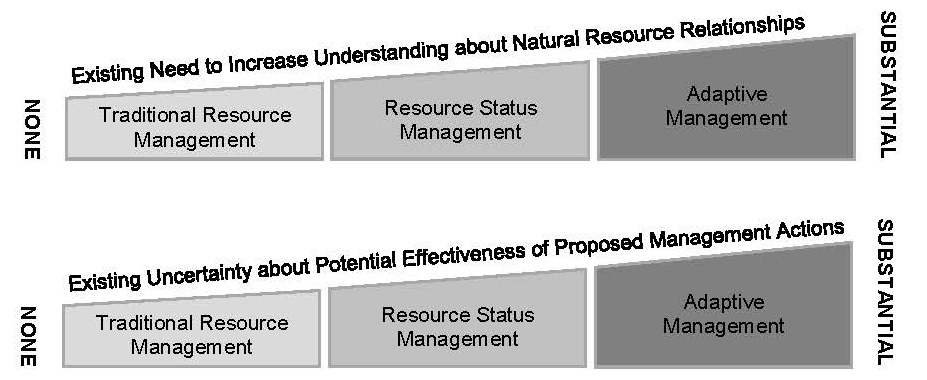
H-1601-1 – LAND USE PLANNING HANDBOOK (Public)
A-2
BLM HANDBOOK
Rel. 1-1836
Supersedes Rel. 1-1693
01/16/2025
A.1
Different Systems of Resource Management Practices
There are several different approaches to managing natural resources which can be distinguished
by their relative emphasis on measurable objectives, monitoring, learning, and the degree to
which resource relationships are understood.
Figure B.1,
Spectrum of resource management
systems, showing appropriateness in different situations
illustrates how traditional resource
management, resource status management, and adaptive management compare to each other
along a spectrum of uncertainty about resource relationships and a focus on learning. An RMP
may employ all three of these approaches for various topics.
Figure B.1.
Spectrum of resource management systems, showing appropriateness in different
situations.
In
traditional resource management
, resource relationships are well understood. Management
is based on prior experience and professional judgment and monitoring focuses on whether plan
components are implemented as outlined in the RMP (implementation monitoring).
In
resource status management
, monitoring data is collected to identify resource status or
condition in relation to specific, measurable objectives (effectiveness monitoring). Resource
status management acknowledges that there may be specific aspects of resource relationships
that are not well understood, or that conditions might change and render management ineffective.
However, the focus is on monitoring and assessing resource status rather than understanding
ecological processes.
In
adaptive management
, uncertainty about ecosystem processes and the effectiveness of various
management actions to achieve resource objectives is clearly acknowledged. While adaptive
management includes both implementation and effectiveness monitoring, it also includes
monitoring of other system attributes needed to improve our understanding of ecosystem
processes (validation monitoring). Use adaptive management where resource relationships are
not well understood and there are multiple, competing hypotheses about how different
management direction will affect resources or ecosystems.
H-1601-1 – LAND USE PLANNING HANDBOOK (Public)
A-3
BLM HANDBOOK
Rel. 1-1836
Supersedes Rel. 1-1693
01/16/2025
The Departmental Manual on Adaptive Management (522 DM 1) provides guidance that an
adaptive management approach should be used when “action is warranted despite uncertainty.”
Such uncertainty could be “due to environmental variability, including changes in climate, or
other factors, such as habitat fragmentation, changing biological diversity, or the consequences
of invasive species.”
Our approach to adaptive management in the land use planning process is to acknowledge that
the level of uncertainty in natural resource systems varies and our limited monitoring resources
must be used strategically. For most RMPs, the various plan components in an RMP would
reflect both traditional resource management and resource status management. All RMPs must
identify plan components which include not only specific plan components intervals and
standards for monitoring and evaluating the RMP. If an RMP evaluation reveals that
management direction in the RMP is not effective in achieving objectives, then the BLM could
modify one or more plan components through an amendment.
In contrast, adaptive management would focus on high priority management issues where there
is a high level of uncertainty and a need to learn about resource relationships to develop and
refine effective management practices. Adaptive management allows the BLM to specifically
and transparently acknowledge the potential need to modify allocations and management
direction in an RMP if evaluation of monitoring data reveals that current management direction
is ineffective in meeting objectives. The key difference is that with adaptive management, the
proposed modification to the allocations and management direction would have already been
specifically identified in the RMP and analyzed in the associated NEPA document to understand
their environmental consequences, which allows for modification of allocations and management
direction without the need to prepare an RMP amendment.
While adaptive management may help managers improve resilience of our public lands, due to
finite resources, Bureaus and Offices should prioritize when to use adaptive management to
ensure that the greatest benefit is achieved (Departmental Manual on Adaptive Management, 522
DM 1).
A.2
Adaptive Management
Using adaptive management to modify allocations and management direction is appropriate
when:
•
There is agreement on a specific, measurable objective;
•
There is a high level of uncertainty about how effective allocations and management
direction will be in achieving objectives;
•
Design and selection of allocations and management direction is confounded by a lack of
understanding of resource relationships or ecosystem process;
•
Resource relationships can be represented as models; and
•
The public and cooperating agencies can be actively engaged throughout the process.
The Department of the Interior’s Adaptive Management Technical Guide stresses that objectives
must be specific, measurable, achievable, results-oriented, and time-fixed.
H-1601-1 – LAND USE PLANNING HANDBOOK (Public)
A-4
BLM HANDBOOK
Rel. 1-1836
Supersedes Rel. 1-1693
01/16/2025
Models identify the linkages between key resource attributes (such habitat characteristics) which
are the focus of management and the targets of monitoring to the ecosystem processes which are
thought to be directly influenced by management (such as reproduction and mortality).
A.2.1 Adaptive Management in an RMP
While adaptive management may not be included as a part of every RMP, there are situations
where there may be a high level of uncertainty about allocations and management direction and a
genuine need to increase our understanding about resource relationships to develop and refine
our management strategies.
Including adaptive management in the RMP can:
•
Facilitate tiering since the effects of potential changes to the RMP due to adaptive
management would be described in the RMP’s final EIS and therefore any subsequent
plan amendment could be evaluated as an EA rather than an EIS;
•
Ensure that the monitoring strategy is developed in a way to help inform future decisions
regarding modifications to allocations or management direction;
•
Increase public trust in the BLM’s planning process by being transparent as to where
there is uncertainty and a possibility that allocations or management direction may need
to change in the future;
•
Encourage careful consideration of how future modification of allocations or
management direction may be constrained by leasing or other authorizations approved
during initial plan implementation; and
•
Provide public feedback to help inform the BLM’s decisions.
Key distinctions in establishing adaptive management elements in an RMP include:
•
Evaluation standards must be identified so that there are clear decision points (e.g.,
thresholds or triggers) based on monitoring data and the status of resource conditions in
relation to the objectives and predicted possible outcomes.
•
The adaptive management approach outlined in the RMP (and analyzed in the supporting
NEPA document) identifies how allocations and management direction would be
modified at specific decision points (to minimize the need to prepare a plan amendment).
•
Public and cooperating agency involvement in adaptive management extends beyond the
identification of objectives and alternatives and invites them to commit resources for
monitoring and assessment. The public and cooperating agencies would also participate
in determining if decisions need to be modified based on monitoring data. (In
comparison, in resource status management, it is likely that the BLM would use an
internal process to review and assess monitoring data).
•
RMP evaluations are used not only to evaluate progress in meeting objectives based on
resource status but also to 1) increase understanding of resource dynamics by comparing
predictions against survey data and 2) enhance and develop models of resource dynamics.
We recommend that you follow the Department of the Interior’s Adaptive Management
Technical Guide when initiating an adaptive management approach as part of an RMP. The
stakeholder involvement described in the Adaptive Management Technical Guide would
complement, rather than replace, the public involvement required by the BLM’s land use
planning regulations.
H-1601-1 – LAND USE PLANNING HANDBOOK (Public)
A-5
BLM HANDBOOK
Rel. 1-1836
Supersedes Rel. 1-1693
01/16/2025
We recommend that you make the adaptive management process (including predicted possible
outcomes, identified monitoring, evaluation, and decision points) available for public review as
part of the preliminary alternatives in the planning criteria. We recommend the adaptive
management elements be included as an appendix to the draft RMP/EIS and referenced under the
appropriate plan components (i.e., the relevant objective and the allocations or management
direction designed to help achieve that objective) in the alternatives described in chapter 2 of the
draft RMP/EIS.
A.2.2 Identifying When a Plan Amendment is Necessary for RMP Modifications
A change in the scope of resource uses or a change in the terms, conditions and decisions of an
approved plan must be made through a plan amendment or revision (43 CFR 1610.5-2). Because
plan components are a term, condition or decision in the approved plan, changes must be made
through a planning process. In incorporating adaptive management in an RMP, you will need to
be very clear as to what modifications are included as part of the RMP’s plan components and
what modifications would require a plan amendment.
For example, suppose there were a special status wildlife species that was sensitive to activity
associated with oil and gas development but there was uncertainty as to whether it was critical to
avoid activity year-round or only during the breeding season. The RMP would describe the
desired outcome as a specific, measurable objective (for this example, a target of 90 percent of
suitable habitat remains occupied). Because you have data that shows that the animals are
avoiding otherwise suitable habitat due to development activity, you could include a timing
limitation stipulation (allocation) that prohibits activity during specified timeframes. The
adaptive management element in the RMP would specify that a timing limitation would restrict
development activities during the spring breeding season so long as the monitoring revealed the
objective was being met, and if it is not met, specify a monitoring threshold or trigger that would
change the allocation in a pre-defined manner. For example, if after implementation of the
spring timing limitation, monitoring indicated that less than 80 percent of suitable habitat was
occupied, then the timing limitation could be expanded to include not only the spring breeding
season but also a winter period (due to concerns about energy expenditures caused by avoiding
development). The key is that the RMP identifies monitoring thresholds (related to the
objective) that trigger specific and pre-defined changes in management. A plan amendment
would not be required since these specific and pre-defined changes in management are already
built into (and analyzed as part of) the RMP’s plan component (in this case the timing limitation
stipulation (allocation)).
If after implementation of the expanded timing limitation, monitoring indicated that less than 70
percent of suitable habitat was occupied, then the RMP may specify that the BLM would
evaluate further changes in management through an amendment process. In this example, it may
mean that a timing limitation is ineffective, and the BLM needs to consider other allocations and
changes in management, and that these are evaluated in the supporting NEPA analysis at the
outset.
Do not assume an adaptive management strategy can only apply more restrictive management if
a monitoring trigger is met. If appropriate, your RMP could also provide for removing
restrictions if monitoring indicated you were not only meeting but exceeding the objective (for
H-1601-1 – LAND USE PLANNING HANDBOOK (Public)
A-6
BLM HANDBOOK
Rel. 1-1836
Supersedes Rel. 1-1693
01/16/2025
example, range expansion or re-occupation of historic habitat). Again, the key is that the RMP
identifies (and the RMP EIS analyzes) both the monitoring threshold and the pre-defined change
in management.
While these scenarios are not specific to land use planning, the appendix of the Department of
the Interior’s Adaptive Management Technical Guide
provides an overview of examples where
adaptive management has been used in natural resource management.
A.2.3 NEPA Analysis of an Adaptive Management Approach
The Department’s NEPA regulations (43 CFR 46.145) require integrating adaptive management
and NEPA compliance, and the Office of Environmental Policy and Compliance provides
guidance on complying with NEPA when evaluating an adaptive management approach through
Environmental Statement Memorandum 13-11. The RMP/EIS must disclose not only the effects
of the proposed allocations and management direction but also the anticipated effect of any
adjustments that may be made to them.
Specifically, an RMP that incorporates an adaptive management approach must describe, and the
supporting EIS must analyze:
•
The proposed adaptive management approach;
•
Identification of uncertainties to be addressed through management and monitoring;
•
One or more specific questions that can be answered in the course of managing and
identifying monitoring protocols for those questions;
•
How the adaptive management approach is reflected in the alternatives being considered;
•
The environmental effects of the proposed adaptive management approach and each of
the alternatives;
•
The monitoring protocol (including a reasonable mechanism to assure that monitoring
will occur);
•
The desired outcome (specific, measurable objectives);
•
The performance measures that will determine whether the desired outcome is being
achieved or whether a mid-course corrective action is needed;
•
The factors for determining whether additional decision-making with NEPA review will
be needed in the future;
•
The decision points requiring adaptive management or remedial action and the specific
management options that may be used;
•
Clear timeframes for long-term objectives and short-term evaluations;
•
A description of the adaptive management oversight team composition and process, with
provisions for conflict resolution; and
•
Provisions for data management, documentation, and reporting.
Refer to the BLM NEPA Handbook (H-1790-1) for more information on NEPA analysis of
adaptive management elements of a proposed action.
A.2.4 Constraints for Adaptive Management
Refer to the Department of the Interior’s Adaptive Management Technical Guide for additional
guidance on regulatory constraints that may be applicable when engaging in adaptive
H-1601-1 – LAND USE PLANNING HANDBOOK (Public)
A-7
BLM HANDBOOK
Rel. 1-1836
Supersedes Rel. 1-1693
01/16/2025
management. For example, constraints to stakeholder involvement (Federal Advisory Councils
Act), funding authorities (Antideficiency Act), data quality (Information Quality Act), and public
access to information (Freedom of Information Act).
Make sure that you involve the U.S. Fish and Wildlife Service or National Marine Fisheries
Service early in the process if you are considering incorporating adaptive management in a
proposed action that may affect listed species or critical habitat.