

Revenue:
Real estate
Handbook
US GAAP
August 2026
______
kpmg.com/us/en/frv
© 2026 KPMG LLP, a Delaware limited liability partnership, and its subsidiaries are part of the KPMG global organization of independent member
firms affiliated with KPMG International Limited, a private English company limited by guarantee. All rights reserved.
Contents
Foreword ............................................................................................................... 1
Acknowledgments ................................................................................................ 2
About this publication ........................................................................................... 3
Executive summary .............................................................................................. 4
A. Scope ............................................................................................................. 7
B. Step 1: Identify the contract ......................................................................... 25
C. Step 2: Identify the performance obligations ............................................... 29
D. Step 3: Determine the transaction price ...................................................... 39
E. Step 4: Allocate the transaction price .......................................................... 50
F. Step 5: Recognize revenue .......................................................................... 56
G. Other matters ............................................................................................... 89
Index of changes .............................................................................................. 102
KPMG Financial Reporting View ....................................................................... 103
Revenue: Real estate
1
Foreword
© 2026 KPMG LLP, a Delaware limited liability partnership, and its subsidiaries are part of the KPMG global organization of independent member
firms affiliated with KPMG International Limited, a private English company limited by guarantee. All rights reserved.
Keeping pace with change
The ongoing application of the revenue and other income standards continues
to present challenges as real estate companies react to the business practices
and economic environment in recent years.
Although the challenges to real estate companies have varied widely depending
on the nature of their businesses and how they interact with their customers
and buyers, most have experienced changes in a number of their estimates and
their processes and considerations for evaluating their buyers’ credit and
nonperformance risk.
KPMG Handbook,
Revenue recognition
, illustrates how the revenue standard
applies to common transactions, provides examples about common scenarios
and explains our thinking on the questions that continue to arise.
This publication provides supplemental technical guidance on key issues for real
estate companies, including their interaction with the leases standard. We
address some of the common questions about the effects of the standards on
sales of real estate and other non-lease revenue, and we hope it will advance
the dialogue on these and other issues.
We will continue to provide the latest thinking that affects real estate
companies.
Mike Breen
and
Valarie Mosier
Department of Professional Practice, KPMG LLP
Revenue: Real estate
2
Acknowledgments
© 2026 KPMG LLP, a Delaware limited liability partnership, and its subsidiaries are part of the KPMG global organization of independent member
firms affiliated with KPMG International Limited, a private English company limited by guarantee. All rights reserved.
Acknowledgments
This Handbook has been produced by the Department of Professional Practice
(DPP) of KPMG LLP in the United States.
We would like to acknowledge the efforts of the main contributors to this
edition:
Mike Breen
Clare McIntyre
Valarie Mosier
We would also like to acknowledge the current and former members of DPP
who contributed significantly to this Handbook: Kimber Bascom, Richard
Binderup, Nick Burgmeier, Ryan Campbell, Sam Hall, Brandon Kano, Lori Kozen,
Kevin Manson, Bob Mosier, Scott Muir, Angie Storm and Kirby Vilker.
Revenue: Real estate
3
About this publication
© 2026 KPMG LLP, a Delaware limited liability partnership, and its subsidiaries are part of the KPMG global organization of independent member
firms affiliated with KPMG International Limited, a private English company limited by guarantee. All rights reserved.
About this publication
Purpose
The purpose of this publication is to assist you in understanding the
requirements of Topic 606, Revenue from Contracts with Customers, and
Subtopic 610-20, Other Income
—
Gains and Losses from the Derecognition of
Nonfinancial Assets, as they apply to real estate transactions.
This publication is intended for use by preparers and other interested parties
with a working knowledge of real estate sales guidance, and an understanding
of the revenue recognition and other income models.
Organization of the text
The publication is in Q&A format and is organized into chapters that largely
reflect the steps in the revenue recognition model. Our commentary refers to
the
FASB Accounting Standards Codification
®
, when excerpts are not included,
where applicable. For example, 606-10-25-1 is paragraph 25-1 of Subtopic
606-10. We include examples to explain key concepts, and we explain the
changes from legacy US GAAP.
Terminology
Unless otherwise indicated explicitly or by comparison, we use the terms
‘customer’ and ‘buyer’ interchangeably to refer to the purchaser in a transaction
involving the sale of real estate. This is because the guidance in this publication
addresses both the requirements of Topic 606 on revenue recognition from
sales to customers, and the requirements of Subtopic 610-20 on recognition of
gains and losses from the derecognition of nonfinancial assets in transactions
with parties other than customers.
We use the terms ‘gain’ and ‘gain or loss’ interchangeably to refer to the
income statement effect from derecognition of nonfinancial assets in the scope
of Subtopic 610-20 as the transaction may result in either and is reported in
other income.
August 2026 edition
This edition of our publication removes legacy guidance to reflect the adoption
of Topic 606, Subtopic 610-20 and Topic 842. Items that have been significantly
updated or revised are identified throughout the publication with #.
The
Index of changes
lists all of the significant changes made in this edition to
assist you in locating updated content.
Revenue: Real estate
4
Executive summary
© 2026 KPMG LLP, a Delaware limited liability partnership, and its subsidiaries are part of the KPMG global organization of independent member
firms affiliated with KPMG International Limited, a private English company limited by guarantee. All rights reserved.
Executive summary
Scope
The guidance applies to all
contracts with customers
unless the customer contract
is specifically in the scope of
other guidance – e.g. Topic
460 (guarantees).
Topic 606 applies to contracts to deliver goods or
services to a customer. A ‘customer’ is a party that
has contracted with an entity to obtain goods or
services that are an output of the entity’s ordinary
activities in exchange for consideration.
Topic 606 is applied to part of a contract when only
some elements are in the scope of other guidance.
Read more:
chapter A
Step 1: Identify the contract
Contracts can be written,
oral or implied by an entity’s
customary business
practices, but must be
enforceable by law.
This may require legal
analysis on a jurisdictional
level to determine when a
contract exists and the terms
of that contract’s
enforceability.
A contract with a customer is accounted for under
the revenue model when the contract is legally
enforceable, and all of the following criteria are met:
•
the contract has commercial substance;
•
rights to goods or services can be identified;
•
payment terms can be identified;
•
the consideration the entity expects to be
entitled to is probable of collection; and
•
the contract is approved and the parties are
committed to their obligations.
If the criteria are not met, any consideration
received from the customer is generally recognized
as a deposit (liability).
Read more:
chapter B
Step 2: Identify the performance obligations
Performance obligations do
not have to be legally
enforceable; they exist if the
customer has a reasonable
expectation that the good or
service will be provided.
Performance obligations are the unit of account
under Topic 606 and generally represent the distinct
goods or services that are promised to the
customer.
Promises to the customer are separated into
performance obligations and are accounted for
separately if they are both (1) capable of being
distinct and (2) distinct in the context of the
contract.
A promise can be implied by
customary business
practices, policies or
statements.
If the distinct goods or services are substantially the
same and have the same pattern of transfer to the
customer over time, they are combined into a
single performance obligation (a ‘series’).
Read more:
chapter C
Revenue: Real estate
5
Executive summary
© 2026 KPMG LLP, a Delaware limited liability partnership, and its subsidiaries are part of the KPMG global organization of independent member
firms affiliated with KPMG International Limited, a private English company limited by guarantee. All rights reserved.
Step 3: Determine the transaction price
Estimating variable
consideration is a significant
judgment for many entities.
When determining the
transaction price, an entity
uses the legally enforceable
contract term. It does not
take into consideration the
possibility of a contract
being cancelled, renewed or
modified.
The transaction price is the amount of consideration
to which an entity expects to be entitled in
exchange for transferring goods or services to a
customer, excluding amounts collected on behalf of
third parties – e.g. some sales taxes. This
consideration can include fixed and variable
amounts.
The transaction price determination also considers:
•
Variable consideration
, which is estimated at
contract inception and is updated at each
reporting date for any changes in
circumstances. The amount of estimated
variable consideration included in the
transaction price is the amount for which it is
probable that a significant reversal in the
amount of cumulative revenue recognized will
not occur when the uncertainty is resolved.
•
Noncash consideration
received from a
customer, which is measured at fair value at
contract inception.
•
Consideration payable to a customer
, which
represents a reduction of the transaction price
unless it is a payment for distinct goods or
services the entity receives from the customer.
•
Significant financing component
, which may
exist in a contract when payment is received
significantly before or after the transfer of
goods or services. This could result in an
adjustment to the transaction price to impute
interest income/expense.
Read more:
chapter D
Step 4: Allocate the transaction price
A contractually stated price
or list price is not presumed
to be the stand-alone selling
price of that good or service.
The transaction price is allocated at contract
inception to each performance obligation to depict
the amount of consideration to which an entity
expects to be entitled in exchange for transferring
the promised goods or services to the customer.
An entity generally allocates the transaction price to
each performance obligation in proportion to its
stand-alone selling price. However, when specified
criteria are met, a discount or variable consideration
is allocated to one or more, but not all, performance
obligations.
The stand-alone selling price is the price at which
an entity would sell a promised good or service
separately to a customer. Observable stand-alone
prices are used when they are available. If not
available, an entity is required to estimate the price
Revenue: Real estate
6
Executive summary
© 2026 KPMG LLP, a Delaware limited liability partnership, and its subsidiaries are part of the KPMG global organization of independent member
firms affiliated with KPMG International Limited, a private English company limited by guarantee. All rights reserved.
using other techniques that maximize the use of
observable inputs – even if the entity never sells
the promised good or service separately.
Read more:
chapter E
Step 5: Recognize revenue
An entity first determines
whether a performance
obligation meets the criteria
to recognize revenue over
time.
If none of the over-time
criteria are met, revenue for
the performance obligation
is recognized at the point in
time that the customer
obtains control of the goods
or services.
An entity recognizes revenue when it satisfies its
obligation by transferring control of the good or
service to the customer.
A performance obligation is satisfied over time if
one of the following criteria are met:
•
the customer simultaneously receives and
consumes the benefits as the entity performs;
•
the entity’s performance creates or enhances
an asset that the customer controls as the
asset is created or enhanced; or
•
the entity’s performance does not create an
asset with an alternative use to the entity, and
the entity has an enforceable right to payment
for performance completed to date.
If control transfers
over time
, an entity selects a
method to measure progress that is consistent with
the objective of depicting its performance.
Control is the ability to direct
the use of, and obtain
substantially all of the
remaining benefits from, the
goods or services – or
prevent others from doing
so.
If control transfers at a
point in time
, the following
are some indicators that an entity considers to
determine when the customer obtained control.
The customer has:
•
a present obligation to pay;
•
physical possession;
•
legal title;
•
the risks and rewards of ownership; and
•
accepted the asset.
Read more:
chapter F
Revenue: Real estate
7
A. Scope
© 2026 KPMG LLP, a Delaware limited liability partnership, and its subsidiaries are part of the KPMG global organization of independent member
firms affiliated with KPMG International Limited, a private English company limited by guarantee. All rights reserved.
A. Scope
Detailed contents
Item significantly updated in this edition: #
Question A10
How do you determine whether real estate sales are in the
scope of Topic 606 or Subtopic 610-20?
Question A20
What else is in the scope of Subtopic 610-20?#
Question A21
Does Subtopic 610-20 apply to the transfer of an option to
purchase real estate?
Question A25
What guidance should a seller apply when it sells a
noncontrolling interest in an entity that is not a subsidiary (e.g. equity
method investee)?
Question A26
Are sales of undivided interests to noncustomers in the scope of
Subtopic 610-20? What if the buyer is a customer?
Question A30
How does an entity apply the revenue (or other income)
recognition guidance when it sells property improvements (or integral
equipment) and leases the underlying land to a customer?#
Question A40
How do guarantees affect the accounting for an accompanying
sale of real estate?
Question A50
How do support obligations affect the accounting for an
accompanying sale of real estate?
Example A50.1
Property sale with support obligation
Question A60
Under Topic 606, what is the unit of account for sales of
condominium units within a condominium project (or similar structure)?
Question A70
Is a property or asset manager’s carried interest (or promote) in
the scope of Topic 606?#
Revenue: Real estate
8
A. Scope
© 2026 KPMG LLP, a Delaware limited liability partnership, and its subsidiaries are part of the KPMG global organization of independent member
firms affiliated with KPMG International Limited, a private English company limited by guarantee. All rights reserved.
Question A10
How do you determine whether real
estate sales are in the scope of Topic 606 or Subtopic
610-20?
Interpretive response:
Determining which guidance applies depends on
whether the buyer is a customer. If the buyer is a customer, the seller accounts
for the sale under Topic 606 and recognizes revenue and cost of sales. The
Master Glossary to the Codification defines a customer as “a party that has
contracted with an entity to obtain goods or services that are an output of the
entity’s ordinary activities in exchange for consideration.”
[Master Glossary,
360-10-40-3A]
A real estate developer predominantly in the business of selling retail land or
residential units would be an example of an entity that likely is selling real
estate as an output of its ordinary activities.
In contrast, a real estate investment trust (REIT) that primarily leases real estate
generally would not sell real estate as an output of its ordinary activities. While
some REITs often sell properties as part of their overall investment strategy,
they identify the output of their normal activities as the service they provide to
their tenants. This conclusion is consistent with how a REIT’s operations are
characterized for US federal income tax purposes.
While a REIT’s income generally is tax-free (assuming it meets qualification
criteria), gains on dispositions of property held primarily for sale to customers in
the ordinary course of business are considered “prohibited transactions” and
are subject to 100% tax. To preserve the maximum tax advantage to the REIT
and its investors, a REIT generally does not sell property to customers in its
ordinary course of business.
Accounting for sales to customers – Topic 606
A seller accounts for customer sales under Topic 606 and recognizes revenue
and cost of sales in its income statement. The seller follows this accounting
regardless of whether it sells its direct interest in the real estate or its
controlling ownership interest in an entity that holds the real estate.
When a contract exists and the seller transfers control of the property, the
seller derecognizes the real estate and recognizes the transaction price as
revenue.
If a contract does not exist, the seller recognizes the cash received as a deposit
liability, continues to report the real estate in its financial statements,
depreciates it (if not held for sale), and evaluates it for impairment as necessary.
[360-10-35, 360-10-40-3C, 45-9 – 45-10]
This reporting continues until a contract does exist and control of the property
transfers, or until the seller meets one of these conditions:
•
the seller has no remaining obligations to transfer goods or services to the
customer and all, or substantially all, of the promised consideration has
been received and is nonrefundable;
•
the contract has been terminated and the consideration received is
nonrefundable; or
Revenue: Real estate
9
A. Scope
© 2026 KPMG LLP, a Delaware limited liability partnership, and its subsidiaries are part of the KPMG global organization of independent member
firms affiliated with KPMG International Limited, a private English company limited by guarantee. All rights reserved.
•
the seller has transferred control of the goods or services to which the
consideration that has been received relates, has stopped transferring
goods and services to the customer (if applicable) and has no obligation
under the contract to transfer additional goods or services, and the
consideration received from the buyer is nonrefundable.
[606-10-25-7 – 25-8]
Accounting for sales to noncustomers – Subtopic 610-20
If the seller determines that the buyer is not a customer, it generally accounts
for the sale under Subtopic 610-20 because a real estate asset is a nonfinancial
asset and typically is not a business.
1
The seller recognizes a gain or loss in the
income statement for noncustomer sales.
If the seller is transferring a group of assets or a controlling financial interest in a
subsidiary, other considerations apply. If substantially all of the fair value of the
assets of the group or subsidiary is concentrated in nonfinancial assets (e.g. real
estate and intangibles) and the group or subsidiary is not a business, the seller
applies Subtopic 610-20 to the sale of each distinct asset within the group or
subsidiary. This includes assets in the group or subsidiary that would be
financial assets if they were sold separately. These financial assets within the
group or subsidiary are referred to as ‘in-substance nonfinancial assets’. See
Question A20
.
[610-20-15-4, 360-10-40-3A]
To address real estate sales to noncustomers, Subtopic 610-20 incorporates
Topic 606’s principles that address sales to customers. Specifically, a seller of a
nonfinancial (or an in-substance nonfinancial) asset to a noncustomer applies
Topic 606’s guidance to determine:
•
whether a contract exists;
[610-20-25-5, 606-10-25-1 – 25-8]
•
how to separate and measure one or more parts of a contract that are
within the scope of other Topics;
[610-20-15-9, 606-10-15-4]
•
the number of distinct assets in the disposal group;
[610-20-25-6, 606-10-25-19 –
25-22]
•
the transaction price, including estimating variable consideration,
constraining that consideration, and evaluating whether there is a significant
financing component, noncash consideration and consideration payable to
the customer;
[610-20-32-3, 606-10-32-2 – 32-27, 32-42 – 32-45]
•
how to allocate the consideration in the contract to distinct assets in the
disposal group; and
[610-20-32-6, 606-10-32-28 – 32-41]
•
when an entity satisfies a performance obligation by transferring control of
an asset.
[610-20-25-6, 606-10-25-30]
Under Subtopic 610-20, when a contract exists and the seller has transferred
control of the property (which includes concluding that it no longer has a
controlling financial interest under Topic 810 (consolidation) if the asset is
owned by a separate legal entity – see
Question F90
), the seller derecognizes
the real estate and recognizes a gain or loss equal to the difference between
the amount of consideration transferred and the carrying amount of the asset.
The amount of consideration that is included in the calculation of the gain or
1
For more information on the definition of a business, see KPMG Handbook,
Business
combinations
.
Revenue: Real estate
10
A. Scope
© 2026 KPMG LLP, a Delaware limited liability partnership, and its subsidiaries are part of the KPMG global organization of independent member
firms affiliated with KPMG International Limited, a private English company limited by guarantee. All rights reserved.
loss includes both the transaction price determined under Topic 606 and the
carrying amount of liabilities assumed or relieved by the buyer.
[610-20-32-2]
If the seller is transferring a group of assets or a controlling financial interest in a
subsidiary, the sale of each distinct asset within the group or subsidiary is
accounted for as a separate unit of account under Subtopic 610-20 as previously
discussed. The seller may need to allocate the consideration to each distinct
asset – e.g. if the seller does not transfer control of all of the distinct assets at
the same time.
[610-20-25-6, 32-2]
Similar to Topic 606, if a contract does not exist, the seller recognizes the cash
received as a deposit liability, continues to report the real estate in its financial
statements, depreciates it (if not held for sale), and evaluates it for impairment
as necessary.
[360-10-35, 360-10-40-3C, 45-9 – 45-10]
This reporting continues until a contract does exist and control of the property
transfers, or until the seller meets one of the conditions in paragraph
606-10-25-7. At that time, the property and related deposit liability are
derecognized and the gain or loss is recognized.
[606-10-25-1 – 25-8]
Question A20
What else is in the scope of Subtopic
610-20?#
Interpretive response:
As discussed in
Question A10
, the guidance on
derecognition of nonfinancial assets to noncustomers in Subtopic 610-20
applies to sales to noncustomers of nonfinancial assets and in-substance
nonfinancial assets. It also applies to other transfers of these assets including
sales of ownership interests in certain subsidiaries that are not businesses (see
discussion on
partial sales
below) and other changes in circumstances that
result in loss of control over the nonfinancial (or in-substance nonfinancial)
assets – e.g. because of the expiration or termination of a contractual
agreement, a dilution event, a government action or default of a subsidiary’s
nonrecourse debt (see
Question F50
). An entity also could lose control over
nonfinancial assets and in-substance nonfinancial assets by contributing those
assets to a joint venture or another noncontrolled investee (see discussion on
partial sales below).
[610-20-05-2]
What is a ‘nonfinancial asset’?
Nonfinancial assets include land, buildings, intangible assets and materials and
supplies. A nonfinancial asset does not meet the definition of either a business
or a financial asset (e.g. cash, receivables, equity method investment).
Nonfinancial assets may be either recognized or unrecognized (e.g. a zero
carrying amount).
[610-20-15-2]
Nonfinancial assets may also include properties with real estate components,
like land plus property improvements and integral equipment – i.e. those
properties that have been identified as in-substance real estate historically.
However, just because a property was in-substance real estate under legacy
US GAAP does not mean that a sale of that property is in the scope of
Subtopic 610-20. The current guidance requires an entity to apply Topic 810 to
sales of all businesses, regardless of whether they were in-substance real
Revenue: Real estate
11
A. Scope
© 2026 KPMG LLP, a Delaware limited liability partnership, and its subsidiaries are part of the KPMG global organization of independent member
firms affiliated with KPMG International Limited, a private English company limited by guarantee. All rights reserved.
estate under legacy US GAAP. The FASB retained the legacy guidance on
identifying in-substance real estate only to identify the scope of
(a) sale-leaseback transactions that remained subject to the guidance in
Subtopic 360-20 until the new leases standard was adopted
2
and (b) the non-
revenue-related guidance specific to timeshare transactions within the scope of
Topic 978 (time-sharing activities). The definition is no longer relevant for
identifying what guidance to apply to derecognition transactions other than sale-
leasebacks.
[610-20-15-4, 360-20-15-2, 978-10-15-7 – 15-12]
What is an ‘in-substance nonfinancial asset’?
As previously mentioned, in-substance nonfinancial assets are financial assets
that are being sold either as part of a group or within a subsidiary that is not a
business and for which substantially all of the fair value of the assets of that
group or subsidiary is concentrated in nonfinancial assets – e.g. real estate and
intangibles. When determining the fair value of the assets of the group or
subsidiary, a seller should include recognized and unrecognized assets, but
exclude cash and cash equivalents. The seller should also exclude liabilities that
are assumed or relieved by the buyer.
[610-20-15-7]
The FASB decided to use the term
substantially all
because it is commonly
used throughout US GAAP. However, it did not specify a quantitative threshold
for what substantially all means when applying the scope of Subtopic 610-20. In
other US GAAP, substantially all generally is interpreted to mean approximately
90% or greater; however, for evaluating the scope of Subtopic 610-20, we
believe that substantially all is not necessarily meant to be a bright-line
quantitative threshold. When there is uncertainty about whether the
‘substantially all’ threshold is met (e.g. because the ratio is close to the
quantitative threshold or the valuation of assets is based on unobservable (Level
3) fair value measurement inputs subject to significant measurement
uncertainty), we believe qualitative factors may also be considered. The
purpose of a qualitative assessment is to evaluate whether the substance of
the transaction is a transfer of nonfinancial assets. We believe relevant factors
to consider include but are not limited to whether the financial assets in the
transaction:
•
are simply a product of the property’s operations – e.g. rent receivables. If
so, it may be appropriate to conclude that substantially all of the fair value
of the assets is concentrated in nonfinancial assets even if their fair value is
at or slightly below 90% of the fair value of the set.
•
lack commercial substance. If so, a quantitative assessment that includes
those assets would not be appropriate. For example, if the seller arbitrarily
included financial assets in the transaction that otherwise would not have
been part of the set to avoid applying Subtopic 610-20, those financial
assets would be excluded from the quantitative analysis. These situations
can be highly judgmental and based on facts and circumstances.
When substantially all of the fair value of the group’s or subsidiary’s assets is
concentrated in nonfinancial assets and the group or subsidiary is not a
2
Sale-leaseback transactions remain subject to Subtopic 360-20 only until a company
adopts ASU 2016-02, Leases (Topic 842). Topic 842 supersedes Subtopic 360-20 and
provides a single accounting model for sale-leaseback transactions that applies
regardless of the nature of the asset transferred.
Revenue: Real estate
12
A. Scope
© 2026 KPMG LLP, a Delaware limited liability partnership, and its subsidiaries are part of the KPMG global organization of independent member
firms affiliated with KPMG International Limited, a private English company limited by guarantee. All rights reserved.
business, a seller applies Subtopic 610-20 to the sale of each distinct asset
within the group or subsidiary. This includes assets in the group or subsidiary
that would be financial assets if they were sold separately.
[610-20-15-5]
In some cases, substantially all of the fair value of a group’s assets is not
concentrated in nonfinancial assets, but the group includes a subsidiary in
which substantially all of the fair value of the subsidiary’s assets is concentrated
in nonfinancial assets. For example, Entity A has two consolidated subsidiaries
(Sub A and Sub B) and has entered into a contract with Entity D to transfer
100% of the ownership in these two subsidiaries that are not businesses. Sub
A’s only asset is a parcel of land (i.e. a nonfinancial asset). Sub B’s only asset is
an equity method investment (i.e. a financial asset). The fair values of Sub A and
Sub B are equal and therefore half of the total value of the assets being sold
relates to a nonfinancial asset and the other half relates to a financial asset (and
therefore, the equity method investment held by Sub B is not an in-substance
nonfinancial asset). In that case, the seller applies Subtopic 610-20 to the sale
of the distinct asset within Sub A and applies the relevant US GAAP to the sale
of Sub B. See Case C of Example 1 in paragraphs 610-20-55-9 – 55-10. Also,
see the flowchart below that describes the scope of Subtopic 610-20.
[610-20-15-6]
Section 17.2.40 of KPMG Handbook,
Revenue recognition,
provides additional
discussion, questions, and examples about how to identify in-substance
nonfinancial assets.
What about partial sales?
Partial sales of real estate can occur in several ways.
Transaction 1.
A seller and a third-party investor form a venture. The seller
contributes real estate to the newly formed venture and the third-party investor
contributes cash, property or services. The seller retains a controlling financial
interest in the venture post
‑
sale and no interest in the third party.
Transaction 2.
Assume the same facts as Transaction 1 except the seller
retains only a noncontrolling interest in the venture post
‑
sale. The venture may
be a joint venture.
Transaction 3.
A seller contributes real estate to a newly formed, wholly
owned venture. Sometime later, it sells a partial ownership interest in the
venture to a third-party investor for cash, property or services. The
consideration may come directly from the investor to the seller or may be
contributed by the investor to the venture. The seller retains a controlling
financial interest in the venture post
‑
sale and no interest in the third party.
Transaction 4.
Assume the same facts as Transaction 3 except the seller
retains only a noncontrolling interest in the venture post
‑
sale. The venture may
be a joint venture.
Transaction 5.
A seller transfers real estate to an existing equity method
investee in exchange for cash or noncash consideration.
All of these transactions are in the scope of Subtopic 610-20 but the seller has
different considerations relative to derecognition and measurement depending
on whether it retains a controlling or noncontrolling interest. See
Question F90
.
[610-20-15-3, 323-10-35-7(c), 970-323-30-3]
Revenue: Real estate
13
A. Scope
© 2026 KPMG LLP, a Delaware limited liability partnership, and its subsidiaries are part of the KPMG global organization of independent member
firms affiliated with KPMG International Limited, a private English company limited by guarantee. All rights reserved.
What isn’t in scope?
As previously mentioned, if an asset or a group of assets meets the definition
of a business, the seller applies Topic 810 to the derecognition transaction.
Subtopic 610
‑
20 also does not apply to:
•
sales to customers;
•
services provided to noncustomers (see Question 17.2.60 of KPMG
Handbook,
Revenue recognition
);
•
sales of nonprofit activities;
•
transfers of financial assets, including transfers of investments – e.g. those
accounted for under the equity method, see
Question A25
;
•
transfers of subsidiaries in which substantially all of the fair value of the
assets is
not
concentrated in nonfinancial assets;
•
exchanges of nonfinancial assets for a controlling financial interest in a
business (business combinations);
•
exchanges between entities in the same line of business to facilitate sales
to customers;
•
nonreciprocal transfers;
•
sale-leaseback transactions (see discussion that follows);
•
lease contracts;
•
contributions made that are within the scope of Subtopic 720-25 (other
expenses – contributions made) or Subtopic 958-605 (not-for-profit entities
– revenue recognition);
•
transfers of investments in ventures accounted for using proportionate
consolidation as described in paragraph 810-10-45-14;
•
transfers between entities under common control;
•
conveyances of oil and gas mineral rights; and
•
exchanges of airline take-off and landing slots.
[610-20-15-4]
How does a seller determine what guidance applies when transferring a
nonfinancial asset?
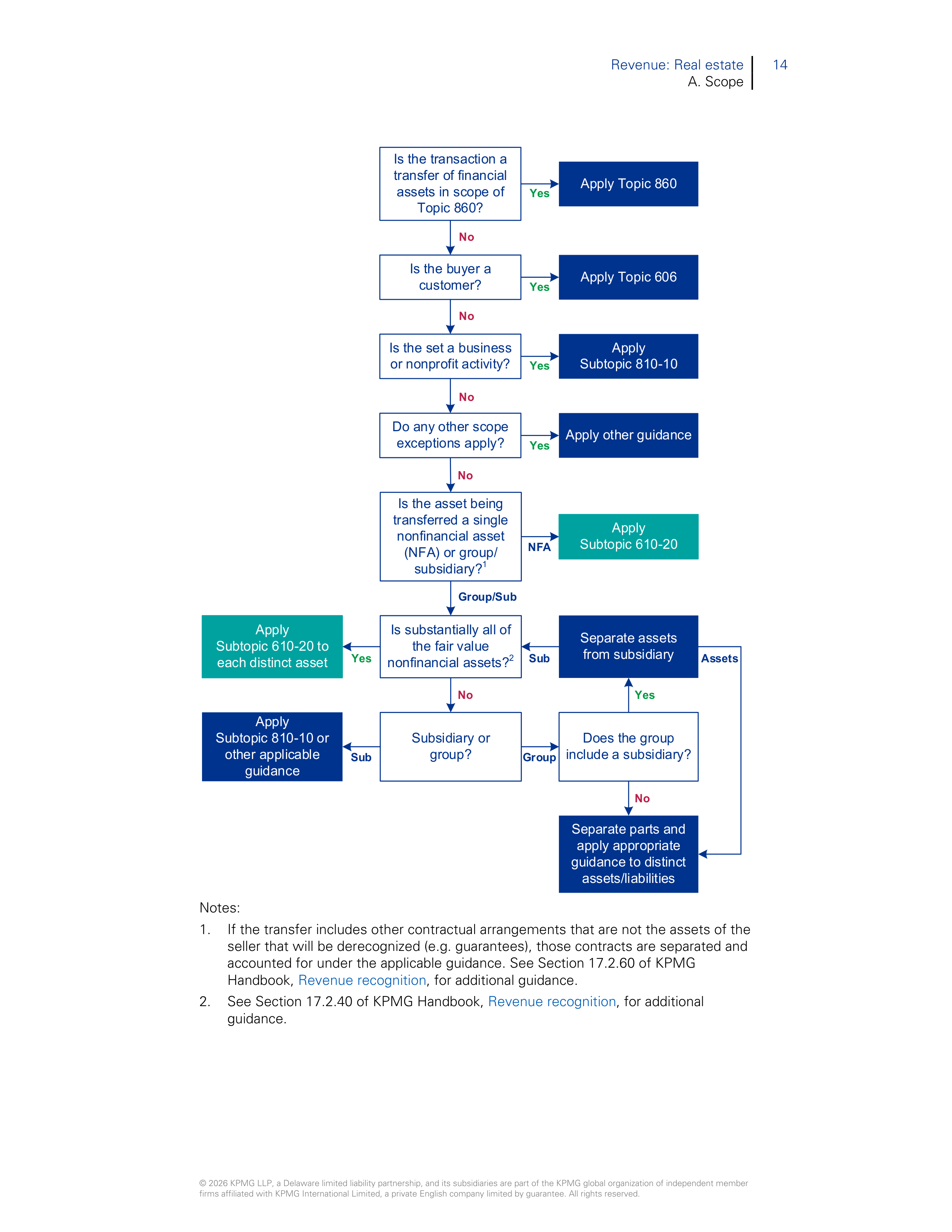
The following decision tree summarizes the sequence of analysis required to
evaluate which guidance applies for a transaction that entirely, or partially,
involves a nonfinancial asset.
This decision tree may be more useful in more complicated transactions (mix of
financial and nonfinancial assets).
Revenue: Real estate
14
A. Scope
© 2026 KPMG LLP, a Delaware limited liability partnership, and its subsidiaries are part of the KPMG global organization of independent member
firms affiliated with KPMG International Limited, a private English company limited by guarantee. All rights reserved.
No
Apply Topic 860
Is the transaction a
transfer of financial
assets in scope of
Topic 860?
Yes
Apply Topic 606
Is the buyer a
customer?
Yes
Apply
Subtopic 810-10
Is the set a business
or nonprofit activity?
Yes
Apply other guidance
Do any other scope
exceptions apply?
Yes
No
No
Yes
Apply
Subtopic 610-20
Is the asset being
transferred a single
nonfinancial asset
(NFA) or group/
subsidiary?
1
Separate assets
from subsidiary
Apply
Subtopic 610-20 to
each distinct asset
Is substantially all of
the fair value
nonfinancial assets?
2
Yes
Separate parts and
apply appropriate
guidance to distinct
assets/liabilities
Apply
Subtopic 810-10 or
other applicable
guidance
Subsidiary or
group?
Does the group
include a subsidiary?
No
NFA
Group
Sub
Sub
Assets
Group/Sub
No
No
Notes:
1.
If the transfer includes other contractual arrangements that are not the assets of the
seller that will be derecognized (e.g. guarantees), those contracts are separated and
accounted for under the applicable guidance. See Section 17.2.60 of KPMG
Handbook,
Revenue recognition
, for additional guidance.
2.
See Section 17.2.40 of KPMG Handbook,
Revenue recognition
, for additional
guidance.
Revenue: Real estate
15
A. Scope
© 2026 KPMG LLP, a Delaware limited liability partnership, and its subsidiaries are part of the KPMG global organization of independent member
firms affiliated with KPMG International Limited, a private English company limited by guarantee. All rights reserved.
What guidance applies to a real estate sale-leaseback if Subtopic 610-20
does not?
Subtopic 610-20 does not apply to real estate sale-leaseback transactions; those
transactions are in the scope of Topic 842, which provides a single accounting
model for sale-leaseback transactions that applies regardless of the type of
asset transferred.
The seller-lessee
and the buyer-lessor
in a sale-leaseback transaction consider
the guidance in Topic 606 (and the other specific sale/purchase requirements in
Subtopic 842-40) to assess whether a sale/purchase of the asset has occurred.
The company then applies the lease guidance in Topic 842 when accounting for
the leaseback (or the failed sale-leaseback guidance in Subtopic 842-40 if a
sale/purchase has not occurred).
For more information on Topic 842 and sale-leaseback accounting, see chapter
9 of KPMG Handbook,
Leases
.
Question A21
Does Subtopic 610-20 apply to the
transfer of an option to purchase real estate?
Background:
A transferor applies Subtopic 610-20 when it derecognizes
nonfinancial assets. Nonfinancial assets include intangible assets, land,
buildings, or materials and supplies.
[610-20-15-2]
A transferor applies Topic 860 (transfers and servicing) when it derecognizes
financial assets and analogizes to Topic 860 when it derecognizes derivative
assets that are not financial assets – e.g. derivatives that require physical
delivery of a nonfinancial asset that is readily convertible to cash (and therefore
meets the net settlement criterion).
[860-10-15-3 – 15-5, 815-10-40-1 – 40-3, 15-119 – 15-
139]
The Master Glossary to the Codification defines a financial asset as cash,
evidence of an ownership interest in an entity, or a contract that conveys to one
entity a right to do either of the following:
[Master Glossary]
•
receive cash or another financial instrument from a second entity; or
•
exchange other financial instruments on potentially favorable terms with
the second entity.
Topic 815 (derivatives and hedging) defines a derivative instrument as a
financial instrument or other contract with all three of the following
characteristics.
[815-10-15-83]
•
It has (1) one or more underlyings and (2) one or more notional amounts or
payment provisions or both.
•
It requires no initial net investment or an initial net investment that is
smaller than would be required for other types of contracts that would be
expected to have a similar response to changes in market factors.
•
Its terms require or permit net settlement, it can readily be settled net by a
means outside the contract, or it provides for delivery of an asset that puts
the recipient in a position not substantially different from net settlement.
Revenue: Real estate
16
A. Scope
© 2026 KPMG LLP, a Delaware limited liability partnership, and its subsidiaries are part of the KPMG global organization of independent member
firms affiliated with KPMG International Limited, a private English company limited by guarantee. All rights reserved.
However, Topic 815 excludes from its scope a contract that meets the
definition of a derivative if it is:
[815-10-15-59]
•
not exchange-traded;
•
the underlying on which the settlement is based is the price or value of a
nonfinancial asset of one of the parties to the contract; and
•
the nonfinancial asset is not readily convertible to cash.
Interpretive response:
Generally, yes. A transferor applies Subtopic 610-20
when derecognizing an option to purchase real estate unless the option is a
financial asset or a derivative within the scope of Topic 815.
We believe a real estate option is rarely a financial asset, because it generally
does not give the holder the right to receive cash or a financial instrument.
We also believe a real estate option is rarely a derivative within the scope of
Topic 815, because generally:
•
it does not meet the definition of a derivative because it requires physical
delivery of real estate; or
•
it meets the exclusion from derivative accounting for contracts that meet
the definition of a derivative but are not traded on an exchange.
If a transferor transfers (sells or assigns) an option to purchase real estate or
other asset to a buyer and then leases that asset back from the buyer, the
transfer and leaseback may be considered to be a sale-leaseback transaction
that should be accounted for based on the guidance in Subtopic 842-40. Refer
to the sale-leaseback discussion in Question A20 and Chapter 9 of KPMG
Handbook,
Leases
, including Question 9.1.15 on determining when the transfer
of an option and leaseback of the asset subject to the option is within the scope
of 842-40.
Question A25
What guidance should a seller apply
when it sells a noncontrolling interest in an entity that is
not a subsidiary (e.g. equity method investee)?
Interpretive response:
As discussed in
Question A20
, Subtopic 610-20 does
not apply to transfers of financial assets, including transfers of investments –
e.g. those accounted for under the equity method. The scope of Topic 860
applies to the sale of those investments regardless of whether (a) the buyer is a
customer or a noncustomer, and (b) the underlying assets are predominantly
real estate or other nonfinancial assets.
[610-20-15-4(e)]
However, if an entity sells its 100% ownership in a subsidiary that is not a
business to a noncustomer and the fair value of the assets within that
subsidiary is concentrated in nonfinancial assets, then the seller applies
Subtopic 610-20 to the sale of each of the assets within the subsidiary. This
includes any financial assets (like equity method investments) because those
financial assets are in-substance nonfinancial assets. See
Question A20
.
[610-20-15-7]
Revenue: Real estate
17
A. Scope
© 2026 KPMG LLP, a Delaware limited liability partnership, and its subsidiaries are part of the KPMG global organization of independent member
firms affiliated with KPMG International Limited, a private English company limited by guarantee. All rights reserved.
Question A26
Are sales of undivided interests to
noncustomers in the scope of Subtopic 610-20? What if
the buyer is a customer?
Interpretive response:
It depends. While Subtopic 610-20 does not address
whether transfers of undivided interests are within its scope, we believe sellers
should apply it to transfers when the undivided interest being sold is accounted
for as a nonfinancial asset. Likewise, we believe sellers should apply Subtopic
610-20 to transfers of undivided interests in nonfinancial assets that were
wholly owned before the sale.
Some entities account for undivided interests in legal entities under the equity
method, but use gross financial statement presentation, often referred to as
proportionate consolidation. Subtopic 610-20 excludes sales of both equity
method investments and undivided interests in ventures when proportionate
consolidation is used. These investors should apply Topic 860 to derecognition
events. See
Question A25
.
[610-20-15-4]
Undivided interests in unincorporated legal entities
Subtopic 323-30 generally requires an investor with an interest in a partnership
or unincorporated joint venture (also referred to as
undivided interests in
ventures
) to account for it under the equity method if the investor has
significant influence over the investee. The SEC staff’s position is that these
investors should apply the equity method unless their interests are so minor
that they have virtually no influence. General partners are presumed to have
interests that are more than minor. In practice, limited partners generally are
presumed to have interests that are more than minor when their equity
interests are more than 3 to 5%.
[323-30-15-2 – 15-3, 25-1, 323-30-S99-1, 970-323-25-2, 25-
6]
There are narrow exceptions to the guidance in Subtopic 323-30. Subtopics
910-810, 930-810 and 932-810 each provide an exception for interests in
investees in the construction or extractive industries when the investor also is
in those industries. For those investments, the investor applies the recognition
and measurement guidance for equity method investments as described in
Topic 323 (equity method and joint ventures). However, the investor is
permitted to apply gross, or proportionate, presentation in the financial
statements versus the one-line presentation required by Topic 323.
[910-810-45-1,
930-810-45-1, 932-810-45-1, 810-10-45-14]
As discussed above, Subtopic 610-20 excludes sales of equity method
investments and investments in ventures accounted for using proportionate
consolidation. We believe that investors with undivided interests in ventures,
including those investors that present the assets and liabilities underlying the
venture on a gross basis, should apply Topic 860 for derecognition. While some
investors have the option for gross presentation versus one-line
presentation
,
all must apply the recognition and measurement guidance for equity method
investments.
Revenue: Real estate
18
A. Scope
© 2026 KPMG LLP, a Delaware limited liability partnership, and its subsidiaries are part of the KPMG global organization of independent member
firms affiliated with KPMG International Limited, a private English company limited by guarantee. All rights reserved.
Undivided interests in nonfinancial assets – non-real property
Undivided interests
3
in specific assets or liabilities generally are outside the
scope of Topic 323 because they represent direct proportional ownership of
individual assets or liabilities versus ownership in an entity holding the assets or
liabilities. Investors with undivided interests in specific assets that are not real
property generally separately account for their share of those assets. Investors
with undivided interests in real property must meet certain criteria to separately
account for their share of the assets (see below).
We believe that investors with undivided interests in nonfinancial assets that
separately account for their proportionate ownership should apply Subtopic 610-
20 for derecognition. We do not believe these proportionate ownership
interests are outside the scope of Subtopic 610-20 because they are not
accounted for under paragraph 810-10-45-14. See
Question A20
.
Likewise, we believe sellers should apply Subtopic 610-20 to transfers of
undivided interests in nonfinancial assets that were wholly owned before the
sale. When a seller transfers an undivided interest and retains an undivided
interest that is accounted for as a nonfinancial asset, we believe the asset being
sold – i.e. the unit of account to which Subtopic 610-20 is applied – is the
proportionate ownership interest in the asset. We do not believe the retained
proportionate ownership interest in the asset (which continues to be accounted
for as a nonfinancial asset) represents consideration received for the sale. Thus,
the retained proportionate ownership interest in the asset would not be
remeasured to fair value.
Undivided interests in real property
Subtopic 970-323 requires an investor with an undivided interest in real property
to account for its interest under the equity method if the real property is subject
to joint control. Investors have joint control when decisions about the financing,
development, sale and operations of the real estate require the approval of two
or more of the investors.
[970-323-25-12]
If the investors do not have joint control, they may separately account for their
share of the assets, liabilities, revenue and expenses if the following additional
conditions are met:
•
each investor is entitled to only its pro rata share of income;
•
each investor is responsible to pay only its pro rata share of expenses; and
•
each investor is severally liable only for indebtedness it incurs in connection
with its interest in the property.
[970-810-45-1]
We believe that investors with undivided interests in real property that
separately account for their proportionate ownership of those assets should
apply Subtopic 610-20 for derecognition of those undivided interests. We do not
believe these proportionate ownership interests are outside the scope of
Subtopic 610-20 because they are not accounted for under paragraph 810-10-
45-14.
3
An undivided interest is defined in Subtopic 970-810 as an ownership arrangement in
which two or more parties jointly own property, and title is held individually to the extent
of each party’s interest.
Revenue: Real estate
19
A. Scope
© 2026 KPMG LLP, a Delaware limited liability partnership, and its subsidiaries are part of the KPMG global organization of independent member
firms affiliated with KPMG International Limited, a private English company limited by guarantee. All rights reserved.
Likewise, we believe sellers should apply Subtopic 610-20 to transfers of
undivided interests in real property that was wholly owned before the sale;
however, we believe the application of Subtopic 610-20 depends on the seller’s
characterization of the retained interest in the asset after the sale.
When a seller transfers an undivided interest and retains an undivided interest
that is accounted for as a nonfinancial asset, we believe the asset being sold –
i.e. the unit of account to which Subtopic 610-20 is applied – is the
proportionate ownership interest in the asset. We do not believe the retained
proportionate ownership interest in the asset (which continues to be accounted
for as real property) represents consideration received for the sale. Thus, the
retained proportionate ownership interest in the real property would not be
remeasured to fair value. This is consistent with the FASB’s statement that it is
not appropriate to remeasure a retained interest when the asset does not
change its character from a nonfinancial asset to a financial asset.
[ASU 2017-05.BC64]
When a seller transfers an undivided interest and retains an undivided interest
that is accounted for as an equity method investment, we believe the asset
being sold – i.e. the unit of account to which Subtopic 610-20 is applied – is the
entire asset. We believe the equity method investment represents noncash
consideration received for the sale. Thus, the equity method investment would
be initially measured at fair value just as retained equity method investments
are in partial sale transactions. See additional discussion in
Question F90
.
While proportionate accounting for the undivided interest in real property may
be applied when the above conditions are met, the investor may alternatively
elect to apply the equity method. If the investor elects to account for its interest
under the equity method, we believe it should apply Topic 860 for
derecognition. See
Question A25
.
Sales to customers
Sales of undivided interests to customers are in the scope of Topic 606 unless
the undivided interest is in-substance a financial asset. Sales of financial assets
are accounted for under Topic 860 regardless of whether the buyer is a
customer. In the real estate industry, we believe many sales of undivided
interests to customers (e.g. time-sharing interests) should be accounted for
under Topic 606. See
Question C10
.
Question A30
How does an entity apply the revenue (or
other income) recognition guidance when it sells
property improvements (or integral equipment) and
leases the underlying land to a customer?#
Interpretive response:
When a contract contains elements covered by
different accounting Topics, the entity applies the guidance in those other
Topics about how to separate and/or initially measure those elements.
However, if the other guidance does not specify how to separate and/or initially
measure one or more parts of the contract, then the entity applies Topic 606’s
separation and/or measurement guidance.
[606-10-15-4, 610-20-15-9]
Revenue: Real estate
20
A. Scope
© 2026 KPMG LLP, a Delaware limited liability partnership, and its subsidiaries are part of the KPMG global organization of independent member
firms affiliated with KPMG International Limited, a private English company limited by guarantee. All rights reserved.
Separation and allocation of contract components
Topic 842 (leases) includes guidance on separating lease and non-lease
components. A lessor must separate a single contract into each separate lease
and non-lease component and allocate the consideration in the contract using
the transaction price allocation guidance in Topic 606, which is based on relative
stand-alone selling prices. Although Topic 842 provides lessors a practical
expedient not to separate lease and non-lease components if specific criteria
are met (see
Question G20
for additional information), we believe a sale of
property improvements with an accompanying lease of the underlying land
generally would not qualify for that expedient. Therefore, the contract
consideration usually is allocated to the components on a relative stand-alone
selling price basis.
[606-10-32-28 – 32-41, 842-10-15-28 – 15-32, 15-38 – 15-42]
Recognition of the sale component
Revenue or gain is recognized on the sale of the property improvements (or
integral equipment) when control transfers to the customer (based on the
requirements in Topic 606 or Subtopic 610-20). Subtopic 610 20 requires
gain/loss presentation for noncustomer transactions while Topic 606 requires
revenue and cost of sales presentation for customer transactions.
[606-10-25-23 –
25-30, 610-20-25-6]
Accounting for the land lease
The lease of the underlying land is accounted for under Topic 842. A land lease
is generally classified by the lessor as an operating lease unless the lessee
effectively obtains control of the underlying asset or, even without control, the
lease payments and any third-party residual value guarantee represent
substantially all of the asset’s fair value and are probable of collection. For more
information on Topic 842 and lessor accounting, see KPMG Handbook,
Leases
.
Question A40
How do guarantees affect the accounting
for an accompanying sale of real estate?
Interpretive response:
When a contract with a customer or noncustomer
contains elements addressed by different Topics, if the other Topics specify
how to separate and/or initially measure one or more parts of the contract, then
an entity first applies those separation and/or initial measurement requirements.
[606-10-15-2, 15-4, 610-20-15-9, 55-2 – 55-5]
The seller first determines whether Topic 460 (guarantees), Topic 815
(derivatives and hedging) or another Topic applies to the guarantee. If the
guarantee is within the scope of Topic 460 or Topic 815 (see KPMG Handbook,
Derivatives and hedging
), the seller/guarantor initially recognizes and measures
it at fair value using the initial measurement guidance in the applicable Topic.
The seller then allocates the remainder of the consideration to the sale of the
property.
[606-10-15-2, 610-20-15-9]
Revenue: Real estate
21
A. Scope
© 2026 KPMG LLP, a Delaware limited liability partnership, and its subsidiaries are part of the KPMG global organization of independent member
firms affiliated with KPMG International Limited, a private English company limited by guarantee. All rights reserved.
The following guarantee contracts are within the scope of Topic 460.
a.
Contracts that contingently require a guarantor to make payments to a
guaranteed party based on changes in an underlying that is related to an
asset, a liability, or an equity security of the guaranteed party.
b.
Contracts that contingently require a guarantor to make payments to a
guaranteed party based on another entity’s failure to perform under an
obligating agreement (performance guarantees).
c.
Indemnification agreements (contracts) that contingently require a
guarantor to make payments to an indemnified party (guaranteed party)
based on changes in an underlying that is related to an asset, a liability, or
an equity security of the indemnified party.
d.
Indirect guarantees of the indebtedness of others, even though the
payment to the guaranteed party may not be based on changes in an
underlying that is related to an asset, a liability, or an equity security of the
guaranteed party.
[460-10-15-4]
Topic 460’s implementation guidance states that a market value guarantee on a
nonfinancial asset owned by the guaranteed party is an example of the type of
contract described in (a) above. We believe a seller’s guarantee of a buyer’s
investment (or a return on its investment), similar to a market value guarantees,
generally falls within the scope of Topic 460 and is separated from the sale
transaction and initially measured at fair value. The seller allocates the
remainder of the contract consideration to the sale of the real estate, which is
subject to Topic 606’s guidance on determining the transaction price.
[460-10-15-
4(a), 55-2(b)]
Because the seller accounts for it separately, the guarantee does not affect the
seller’s ability to recognize revenue or gain when it transfers control of the real
estate to the buyer. Guarantee-like arrangements not within the scope of
Topic 460 or other accounting guidance are combined with the sale transaction
that is accounted for under Topic 606 or Subtopic 610-20. These guarantee-like
provisions may affect the:
•
amount of revenue, gain or loss recognized on the sale (because the
provision may result in the transaction price being variable); or
•
timing of derecognition if the provision is significant enough to conclude
that control of the property has not transferred.
See
Question F10
for discussion about control transfer.
For example, an entity may guarantee its own performance. Consider a
seller/developer that sells land with an accompanying construction contract and
concludes it is a single performance obligation (see
Question C20
). The
seller/developer may provide a service-related guarantee that requires it to pay a
penalty if not fulfilled. Because the seller/developer is guaranteeing its own
performance, that provision is not in the scope of Topic 460. Instead, it gives
rise to variable consideration.
Refer to Question 2.3.10 of KPMG Handbook,
Revenue recognition
, for
additional guidance on guarantees of an entity’s own future performance. See
also
Question F60
in this publication for discussion of put options, which, like
Revenue: Real estate
22
A. Scope
© 2026 KPMG LLP, a Delaware limited liability partnership, and its subsidiaries are part of the KPMG global organization of independent member
firms affiliated with KPMG International Limited, a private English company limited by guarantee. All rights reserved.
some guarantee provisions, may result in a seller retaining control despite
relinquishing physical possession of the property.
Question A50
How do support obligations affect the
accounting for an accompanying sale of real estate?
Interpretive response:
If the seller’s obligation to support the operations of the
property (e.g. the seller agrees to support the operations up to a break-even
level of cash flows for a period of time) is within the scope of Topic 460, the
seller separates the support obligation and initially recognizes and measures it
at fair value under Topic 460’s initial measurement guidance. The seller
allocates the remainder of the contract consideration to the sale of the real
estate.
[460-10-30-2]
In our experience, support obligations generally have the characteristics of
guarantees that are within the scope of Topic 460, because they are analogous
to guarantees of the collection of scheduled contractual cash flows from
financial assets or business revenue.
[460-10-15-4(a), 55-2(d) – 55-2(e)]
Therefore, we believe most support obligations should be separated from the
sale transaction and initially measured at the fair value of the guarantee. When
the seller accounts for a support obligation separately, the obligation does not
affect the seller’s ability to recognize revenue or gain when the seller transfers
control of the real estate to the buyer.
Guarantee
‑
like arrangements not within the scope of Topic 460 or other Topics
remain combined with the sale transaction and may affect the:
•
amount of revenue, gain or loss recognized on the sale (because the
provision may result in the transaction price being variable); or
•
timing of derecognition if the provision is significant enough to conclude
that control of the property has not transferred.
See
Question F10
for discussion about control transfer and
Question F60
for
discussion about put options, which is another situation in which a seller may
retain control despite relinquishing physical possession of the property.
Example A50.1
Property sale with support obligation
Description of the arrangement
ABC Corp. sells a newly constructed property with a cost of $1,200,000 to DEF
Corp. for $2,000,000 in cash. ABC guarantees the cash flows of the property
will be sufficient to meet all the property’s operating needs for the first three
years after the sale date. The fair value of the guarantee at the sale date is
$30,000 and there is no other variable consideration.
Evaluation
Because the support obligation is a guarantee within the scope of Topic 460, it
is initially separated from the real estate sale and measured at fair value.
Revenue: Real estate
23
A. Scope
© 2026 KPMG LLP, a Delaware limited liability partnership, and its subsidiaries are part of the KPMG global organization of independent member
firms affiliated with KPMG International Limited, a private English company limited by guarantee. All rights reserved.
ABC allocates $30,000 of the $2,000,000 contract consideration to the
guarantee, and allocates $1,970,000 to the sale of the property, which is the
transaction price.
ABC recognizes a profit of $770,000 ($1,970,000 less $1,200,000 cost) when it
transfers control of the property. The guarantee continues to be accounted for
separately under Topic 460 and does not affect the profit recognized on the
sale. ABC recognizes subsequent changes in the guarantee’s carrying amount
outside of revenue (or gain on sale if the buyer is not a customer).
Question A60
Under Topic 606, what is the unit of
account for sales of condominium units within a
condominium project (or similar structure)?
Interpretive response:
Topic 606 generally specifies the unit of account is an
individual contract with a customer and includes implementation guidance that
illustrates individual contracts with customers to construct individual units in a
multi
‑
unit residential complex are accounted for separately.
[606-10-55-180]
However, there is a practical expedient that allows an entity to apply the
guidance to a portfolio of contracts (or performance obligations) with similar
characteristics, but only if the entity reasonably expects the effect on the
financial statements to not differ materially from applying the guidance to the
individual contracts.
[606-10-10-4]
We believe it may be difficult for an entity to demonstrate a reasonable
expectation that the effect of using a project or portfolio approach is materially
the same as using an individual contract approach because the:
•
control of the individual units likely will transfer at different points in time
(see
Question F40
about the pattern of control transfer in unit sales); and
•
transaction prices and fulfillment costs of individual units within a project
likely will be different.
Question A70
Is a property or asset manager’s carried
interest (or promote) in the scope of Topic 606?#
Interpretive response:
It depends.
Managers are compensated in different ways for providing asset management
services including a base management fee, an incentive-based fee or an
incentive-based capital allocation in the form of a carried interest in a
partnership or similar structure. Incentives are earned based on the
performance of the assets under management.
Because carried interest arrangements are generally in-form equity, the IASB
and FASB’s Joint Transition Resource Group for Revenue Recognition
discussed whether such arrangements are either in the scope of Topic 606 or
accounted for as an ownership interest in the investee entity at its April 2016
meeting. FASB members present at the meeting indicated that the FASB
discussed performance fees in asset management contracts when developing
Revenue: Real estate
24
A. Scope
© 2026 KPMG LLP, a Delaware limited liability partnership, and its subsidiaries are part of the KPMG global organization of independent member
firms affiliated with KPMG International Limited, a private English company limited by guarantee. All rights reserved.
Topic 606. All FASB members present at the meeting expressed the view that
performance fees in the form of carried interest arrangements were intended to
be in the scope of Topic 606.
[TRG 04-16.50]
The SEC Observer at the meeting indicated that the SEC staff would accept an
application of Topic 606 for these arrangements. However, he also noted that
applying an ownership model to these arrangements, rather than Topic 606,
may be acceptable based on the specific facts and circumstances. If an entity
were to apply an ownership model, the SEC staff would expect the full
application of the ownership model, including an analysis of the consolidation
guidance in Topic 810, the equity method of accounting under Topic 323 or
other relevant guidance. We understand that the SEC staff would not object to
the view that the carried interest would be evaluated as a
performance fee
rather than an interest in the fund itself when making an assessment of
whether it is a variable interest under Topic 810.
The SEC Observer did not elaborate on the nature of the facts and
circumstances that in the SEC staff’s view would require application of Topic
606 to these arrangements. We are not aware of any examples in which the
SEC staff believe applying an ownership model would be unacceptable when
the performance fee is in the form of equity (i.e. carried interest).
Based on our understanding of the SEC staff’s views, we believe both private
and public companies may account for performance-based fees in the form of a
capital allocation under one of the following models (as an accounting policy
election to be consistently applied):
•
the revenue recognition guidance in Topic 606; or
•
an equity ownership model using the guidance in Topic 323, Topic 810 or
other relevant guidance.
Based on our current understanding of the views of the FASB and SEC staffs, if
an entity applies Topic 606 to these arrangements, we believe it will generally
be difficult to support a conclusion that it is preferable to change to an
ownership model. Future standard-setting or regulatory developments may
cause our view to change.
If an entity applies an ownership model (e.g. Topic 323), the presentation and
disclosure of the equity income from these arrangements would also be
separate from revenue from arrangements accounted for under Topic 606. See
KPMG Handbook,
Equity method of accounting
, for further information on the
application of Topic 323 to these arrangements.
Revenue: Real estate
25
B. Step 1: Identify the contract
© 2026 KPMG LLP, a Delaware limited liability partnership, and its subsidiaries are part of the KPMG global organization of independent member
firms affiliated with KPMG International Limited, a private English company limited by guarantee. All rights reserved.
B.
Step 1: Identify the
contract
Detailed contents
Question B10
What consideration should a seller give to the buyer’s initial and
continuing investments when evaluating if a contract exists?
Revenue: Real estate
26
B. Step 1: Identify the contract
© 2026 KPMG LLP, a Delaware limited liability partnership, and its subsidiaries are part of the KPMG global organization of independent member
firms affiliated with KPMG International Limited, a private English company limited by guarantee. All rights reserved.
Question B10
What consideration should a seller give to
the buyer’s initial and continuing investments when
evaluating if a contract exists?
Interpretive response:
Subtopic 610-20 requires an entity to apply the
guidance in Topic 606 to determine if the agreement meets the contract
existence criteria. These criteria establish the enforceable rights and obligations
of a contract and include the following (all must be met):
a.
parties have approved the contract and are committed to performing their
respective obligations;
b.
entity can identify each party’s rights regarding the goods or services to be
transferred;
c.
entity can identify the payment terms for the goods or services to be
transferred;
d.
contract has commercial substance; and
e.
it is probable that the entity will collect substantially all of the consideration
to which it will be entitled.
Refer to sections 3.2 and 3.3 of KPMG Handbook,
Revenue recognition
, for
further guidance on determining whether a contract exists and applying the
collectibility criterion, respectively.
[610-20-25-5, 606-10-25-1 – 25-8]
Unlike legacy guidance for real estate sales, neither Topic 606 nor Subtopic 610-
20 require that the buyer provide specific levels of initial or continuing
investment to demonstrate that the contract existence criteria are met.
The objective of evaluating the buyer’s ability and intention to pay is to assess
whether there is a substantive transaction between the seller and the buyer.
This assessment is partially forward looking, which requires the seller to use
judgment and consider all facts and circumstances, including the seller’s
customary business practices and its knowledge of the buyer.
Seller’s considerations when evaluating whether collectibility is probable
Payment terms that
suggest a significant
uncertainty about the
buyer’s intention and
ability to fulfill its
obligations
Do the payment terms reflect inherent uncertainty about
the buyer’s intention to fulfill its obligations?
•
Small down payment relative to the overall contracted
price.
•
Nonrecourse, seller-provided financing.
•
Customer-provided collateral or guarantees that are
illiquid or have highly variable or unobservable fair
value.
•
Continuing periodic payments that extend beyond:
—
a customary financing period for similar
transactions; and
—
the property’s estimated useful life.
•
No periodic payments required.
•
Guarantees provided by lower-rated counterparties.
Importance of the
property to the
buyer’s operations
•
Does the buyer’s business model and reasons for
entering into the transaction raise doubt about its
intention to follow through with its obligations?
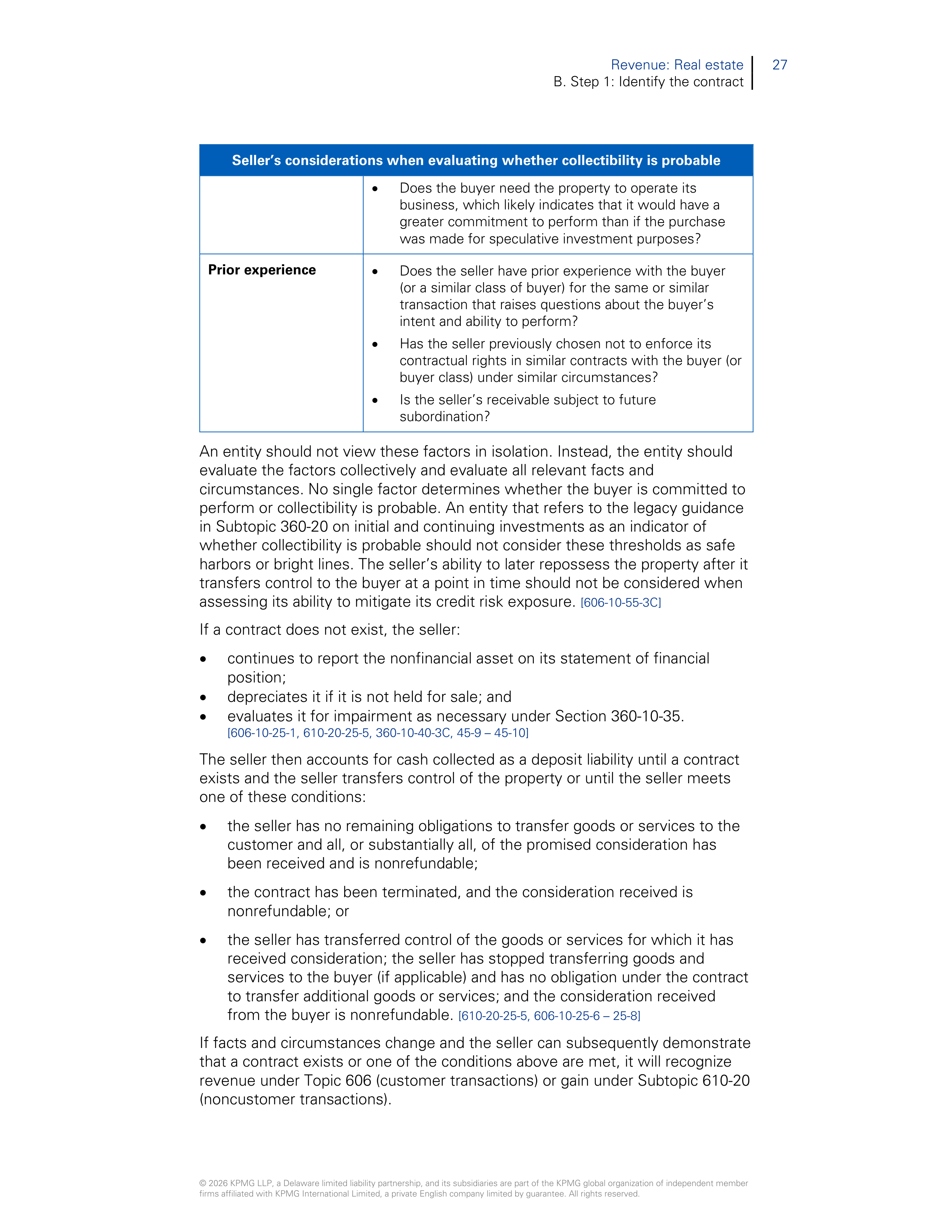
Revenue: Real estate
27
B. Step 1: Identify the contract
© 2026 KPMG LLP, a Delaware limited liability partnership, and its subsidiaries are part of the KPMG global organization of independent member
firms affiliated with KPMG International Limited, a private English company limited by guarantee. All rights reserved.
Seller’s considerations when evaluating whether collectibility is probable
•
Does the buyer need the property to operate its
business, which likely indicates that it would have a
greater commitment to perform than if the purchase
was made for speculative investment purposes?
Prior experience
•
Does the seller have prior experience with the buyer
(or a similar class of buyer) for the same or similar
transaction that raises questions about the buyer’s
intent and ability to perform?
•
Has the seller previously chosen not to enforce its
contractual rights in similar contracts with the buyer (or
buyer class) under similar circumstances?
•
Is the seller’s receivable subject to future
subordination?
An entity should not view these factors in isolation. Instead, the entity should
evaluate the factors collectively and evaluate all relevant facts and
circumstances. No single factor determines whether the buyer is committed to
perform or collectibility is probable. An entity that refers to the legacy guidance
in Subtopic 360-20 on initial and continuing investments as an indicator of
whether collectibility is probable should not consider these thresholds as safe
harbors or bright lines. The seller’s ability to later repossess the property after it
transfers control to the buyer at a point in time should not be considered when
assessing its ability to mitigate its credit risk exposure.
[606-10-55-3C]
If a contract does not exist, the seller:
•
continues to report the nonfinancial asset on its statement of financial
position;
•
depreciates it if it is not held for sale; and
•
evaluates it for impairment as necessary under Section 360-10-35.
[606-10-25-1, 610-20-25-5, 360-10-40-3C, 45-9 – 45-10]
The seller then accounts for cash collected as a deposit liability until a contract
exists and the seller transfers control of the property or until the seller meets
one of these conditions:
•
the seller has no remaining obligations to transfer goods or services to the
customer and all, or substantially all, of the promised consideration has
been received and is nonrefundable;
•
the contract has been terminated, and the consideration received is
nonrefundable; or
•
the seller has transferred control of the goods or services for which it has
received consideration; the seller has stopped transferring goods and
services to the buyer (if applicable) and has no obligation under the contract
to transfer additional goods or services; and the consideration received
from the buyer is nonrefundable.
[610-20-25-5, 606-10-25-6 – 25-8]
If facts and circumstances change and the seller can subsequently demonstrate
that a contract exists or one of the conditions above are met, it will recognize
revenue under Topic 606 (customer transactions) or gain under Subtopic 610-20
(noncustomer transactions).
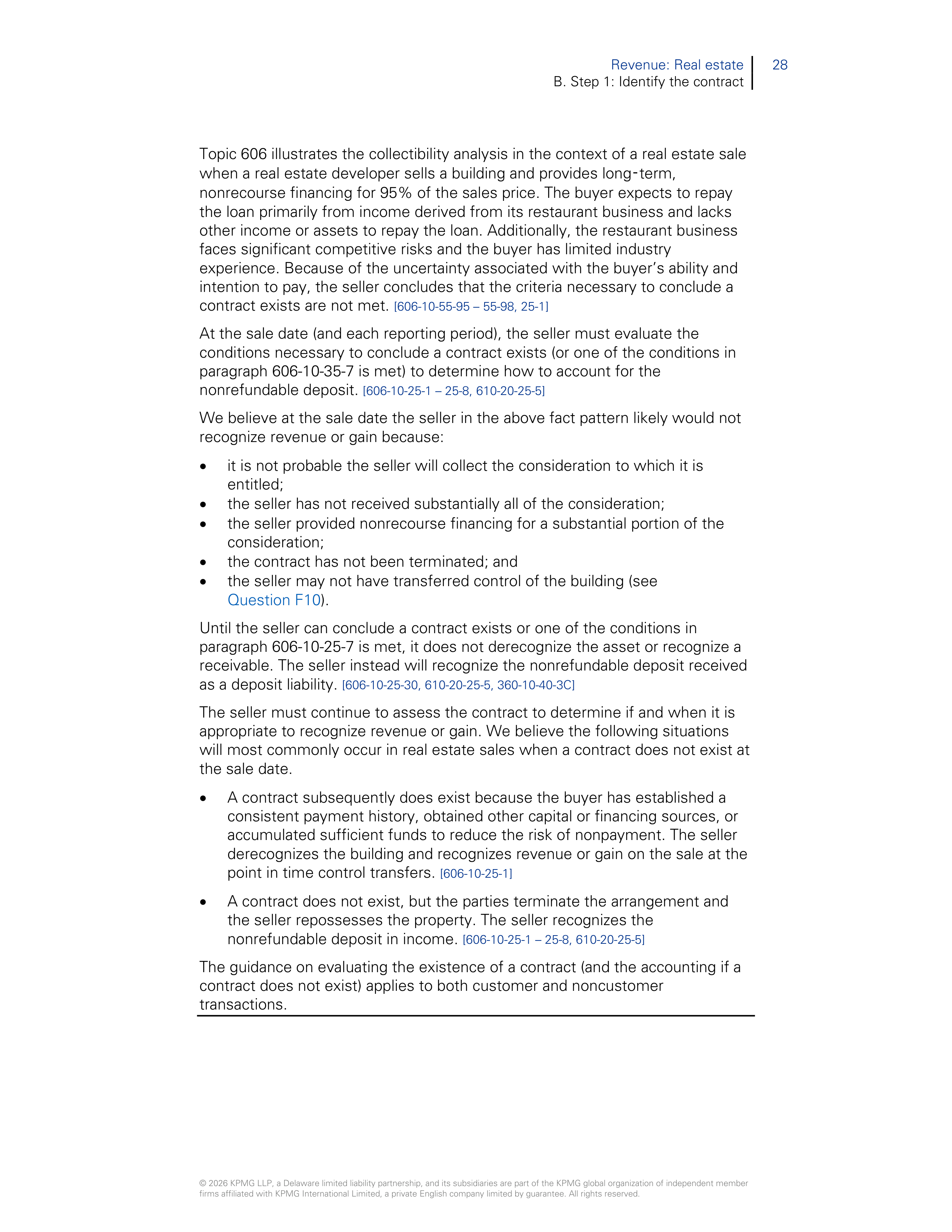
Revenue: Real estate
28
B. Step 1: Identify the contract
© 2026 KPMG LLP, a Delaware limited liability partnership, and its subsidiaries are part of the KPMG global organization of independent member
firms affiliated with KPMG International Limited, a private English company limited by guarantee. All rights reserved.
Topic 606 illustrates the collectibility analysis in the context of a real estate sale
when a real estate developer sells a building and provides long
‑
term,
nonrecourse financing for 95% of the sales price. The buyer expects to repay
the loan primarily from income derived from its restaurant business and lacks
other income or assets to repay the loan. Additionally, the restaurant business
faces significant competitive risks and the buyer has limited industry
experience. Because of the uncertainty associated with the buyer’s ability and
intention to pay, the seller concludes that the criteria necessary to conclude a
contract exists are not met.
[606-10-55-95 – 55-98, 25-1]
At the sale date (and each reporting period), the seller must evaluate the
conditions necessary to conclude a contract exists (or one of the conditions in
paragraph 606-10-35-7 is met) to determine how to account for the
nonrefundable deposit.
[606-10-25-1 – 25-8, 610-20-25-5]
We believe at the sale date the seller in the above fact pattern likely would not
recognize revenue or gain because:
•
it is not probable the seller will collect the consideration to which it is
entitled;
•
the seller has not received substantially all of the consideration;
•
the seller provided nonrecourse financing for a substantial portion of the
consideration;
•
the contract has not been terminated; and
•
the seller may not have transferred control of the building (see
Question F10
).
Until the seller can conclude a contract exists or one of the conditions in
paragraph 606-10-25-7 is met, it does not derecognize the asset or recognize a
receivable. The seller instead will recognize the nonrefundable deposit received
as a deposit liability.
[606-10-25-30, 610-20-25-5, 360-10-40-3C]
The seller must continue to assess the contract to determine if and when it is
appropriate to recognize revenue or gain. We believe the following situations
will most commonly occur in real estate sales when a contract does not exist at
the sale date.
•
A contract subsequently does exist because the buyer has established a
consistent payment history, obtained other capital or financing sources, or
accumulated sufficient funds to reduce the risk of nonpayment. The seller
derecognizes the building and recognizes revenue or gain on the sale at the
point in time control transfers.
[606-10-25-1]
•
A contract does not exist, but the parties terminate the arrangement and
the seller repossesses the property. The seller recognizes the
nonrefundable deposit in income.
[606-10-25-1 – 25-8, 610-20-25-5]
The guidance on evaluating the existence of a contract (and the accounting if a
contract does not exist) applies to both customer and noncustomer
transactions.
Revenue: Real estate
29
C. Step 2: Identify the performance obligations
© 2026 KPMG LLP, a Delaware limited liability partnership, and its subsidiaries are part of the KPMG global organization of independent member
firms affiliated with KPMG International Limited, a private English company limited by guarantee. All rights reserved.
C.
Step 2: Identify the
performance obligations
Detailed contents
Question C10
Is the sale of an undivided interest in the common areas where
the seller/developer may build future amenities considered a separate
performance obligation from the sale of a condominium unit or
residential lot when the undivided interest is transferred to the
customer in the sales transaction? Does the answer change if the
seller/developer does not transfer the undivided interest but will
transfer future amenities to a third party?
Question C15
What is the unit of account for noncustomer real estate sales
when the disposal group includes more than one asset?
Question C20
Does the sale of land and the agreement to construct property
improvements comprise multiple performance obligations? Is the
analysis different if the buyer is not a customer?
Question C30
How should an entity analyze the number of performance
obligations in a typical property management services contract?
Revenue: Real estate
30
C. Step 2: Identify the performance obligations
© 2026 KPMG LLP, a Delaware limited liability partnership, and its subsidiaries are part of the KPMG global organization of independent member
firms affiliated with KPMG International Limited, a private English company limited by guarantee. All rights reserved.
Question C10
Is the sale of an undivided interest in the
common areas where the seller/developer may build
future amenities considered a separate performance
obligation from the sale of a condominium unit or
residential lot when the undivided interest is transferred
to the customer in the sales transaction? Does the
answer change if the seller/developer does not transfer
the undivided interest but will transfer future amenities
to a third party?
Interpretive response:
Transferring future amenities to the customer
A seller accounts for a good or service as a performance obligation if the good
or service promised to the customer is distinct from other goods or services
promised in the contract. A good or service is distinct if:
a.
the customer can benefit from the good or service either on its own or with
other resources that are readily available to the customer (i.e. the good or
service is capable of being distinct); and
b.
the entity’s promise to transfer the good or service to the customer is
separately identifiable from other promises in the contract (i.e. distinct in
the context of the contract).
[606-10-25-19]
Capable of being distinct
A good or service meets criterion (a), capable of being distinct, if it could be
“used, consumed, sold for an amount that is greater than scrap value, or
otherwise held in a way that generates economic benefits.” The fact that the
entity regularly sells a good or service separately indicates that a customer
could benefit from the good or service on its own or with other readily available
resources.
[606-10-25-20]
Distinct in the context of the contract
The seller’s objective when assessing whether a promise is distinct in the
context of the contract (criterion (b)) is to determine whether the nature of its
overall promise is to transfer each of the goods or services, or whether the
promise is to transfer a combined item to which each of the promised goods or
services are inputs.
[606-10-25-21]
These factors indicate a good or service is not distinct in the context of the
contract:
•
the entity provides a significant service of integrating the goods or services
with other goods or services promised in the contract;
•
one or more of the goods or services significantly modifies or customizes,
or is significantly modified or customized by, one or more of the other
goods or services promised in the contract; or
Revenue: Real estate
31
C. Step 2: Identify the performance obligations
© 2026 KPMG LLP, a Delaware limited liability partnership, and its subsidiaries are part of the KPMG global organization of independent member
firms affiliated with KPMG International Limited, a private English company limited by guarantee. All rights reserved.
•
the goods or services are highly interdependent or highly interrelated – i.e.
each one is significantly affected by the other goods or services.
The undivided interest in the common areas, regardless of whether the
amenities have been completed, generally:
•
cannot generate independent economic benefits to the buyer (the
undivided interest is not practically separable from the fee interest in the
unit or lot); and
•
is integral to the buyer’s purchase of the unit or lot – i.e. the buyer is unable
to purchase (or not purchase) the undivided interest in the common areas
without the condominium unit or lot.
Therefore, we believe the sale of the unit or lot and the accompanying transfer
to the customer of the undivided interest in the common areas would be a
single performance obligation.
We believe this conclusion is consistent with the FASB’s guidance stating that
a developer may need to include construction of common areas in its measure
of progress toward completely satisfying its performance obligation to construct
an individual unit within a multi
‑
unit residential complex.
[606-10-55-180]
We also believe this conclusion is consistent with the cost guidance in
Subtopic 970-340 that requires developers to allocate to the benefitted land
parcels the common costs of the amenity. This guidance was not amended by
Topic 606 or Topic 340 (other assets).
Accounting for amenity costs – amenity transferred to the customer
The FASB’s industry guidance in Subtopic 970-340 on accounting for amenity
costs applies because the future amenity is being sold or transferred in
connection with the sale of individual units by transferring the undivided interest
to the customer. In this situation, the developer should allocate the costs that
exceed the anticipated proceeds as common costs to the land parcels that
benefitted from the development, or probably will benefit, because the amenity
is clearly associated with the sale of the project. The common costs include the
developer’s expected future operating costs until the amenity is assumed by
the buyers of the units. Before the amenity is substantially complete and
available for use, operating income (loss) is included as a reduction of (or
addition to) common costs. See additional discussion in
Question F40
about the
timing of revenue recognition for sales of condominium units (and other similar
structures).
[970-340-25-9 – 25-11]
Transferring future amenities to a third party
When the seller/developer transfers future amenities to a third party (e.g. a
homeowner’s association (HOA), municipality or community development
district) instead of transferring them to the customer through an undivided
interest, it analyzes the transfers differently. Based on discussions with the
FASB staff, we believe those third parties generally are not extensions of the
customer because they are unrelated to the customer and the customer does
not control the amenities before or after the transfer.
While an individual homeowner often has an obligation to pay fees to third-party
transferees such as HOA dues or municipal taxes and may have some rights to
Revenue: Real estate
32
C. Step 2: Identify the performance obligations
© 2026 KPMG LLP, a Delaware limited liability partnership, and its subsidiaries are part of the KPMG global organization of independent member
firms affiliated with KPMG International Limited, a private English company limited by guarantee. All rights reserved.
participate in their operation, such as becoming a board member, appealing fee
or tax assessments, or obtaining and reviewing governing documents or
financial data, the individual generally does not have an equity interest or the
ability to control the third party or the amenity either before or after the transfer.
In this situation, the promise associated with the future amenity would not be
considered part of the customer’s contract to purchase the property because
the amenities will be transferred to an unrelated party. Therefore, delivery of
the amenity would not be considered a performance obligation in the contract
with the customer.
Accounting for amenity costs – amenity transferred to a third party
We believe the guidance on accounting for amenity costs that will be sold
separately from the unit applies to these situations because the developer is
selling or transferring the future amenity separately to the third party. The
amount of capitalizable costs (incurred before the amenity is substantially
complete and available for use) that exceeds the estimated fair value at the date
of substantial physical completion should be allocated as common costs to the
land parcels that benefitted and to those for which development is probable.
Capitalizable costs are reduced by operating income (or are increased by
operating losses) generated by the amenity before it is substantially complete
and available for use. Operating income (or loss) generated by the amenity after
it is substantially complete and available for use is included in operating results.
A later sale of the amenity at an amount different from the estimated fair value
at substantial completion, less any accumulated depreciation, results in a gain
or loss in net income in the period in which the sale occurs.
[970-340-25-9(b) – 25-11]
In the scenario described, the third party typically pays little or no consideration
on transfer of the amenity. Therefore, we believe that the developer would treat
as common costs all the costs associated with the amenity that are not
expected to be recovered on transfer to the HOA or municipality.
Question C15
What is the unit of account for
noncustomer real estate sales when the disposal group
includes more than one asset?
Interpretive response:
As discussed in
Questions A10
and
A20
, when a seller
transacts with a noncustomer, and substantially all of the fair value of a group’s
or subsidiary’s assets is concentrated in nonfinancial assets and the group or
subsidiary is not a business, the seller applies Subtopic 610-20 to the sale of
each distinct asset within the group or subsidiary. This includes assets in the
entity or group that would be financial assets if they were sold separately but
are in-substance nonfinancial assets (as a result of being included in a group or
subsidiary in which substantially all the fair value is concentrated in nonfinancial
assets).
[610-20-15-5 – 15-6]
Each distinct nonfinancial asset (or in-substance nonfinancial asset) is a
separate unit of account that needs to be analyzed to determine whether
derecognition is appropriate and, if so, the amount of the related gain or loss.
Subtopic 610-20 requires the seller to identify each distinct nonfinancial asset
Revenue: Real estate
33
C. Step 2: Identify the performance obligations
© 2026 KPMG LLP, a Delaware limited liability partnership, and its subsidiaries are part of the KPMG global organization of independent member
firms affiliated with KPMG International Limited, a private English company limited by guarantee. All rights reserved.
using the criteria in Step 2 of the revenue recognition model in Topic 606.
[610-
20-25-6 – 32-2]
A seller identifies each distinct nonfinancial asset (or in-substance nonfinancial
asset) as a separate unit of account even when multiple nonfinancial assets are
transferred together in a legal entity. However, the FASB observed that in many
cases, control of nonfinancial assets in a subsidiary will transfer at the same
time and practically a seller may not need to separately identify the distinct
assets when a group or subsidiary has multiple nonfinancial assets and in-
substance nonfinancial assets (if any). Nevertheless, a seller should carefully
evaluate the arrangement to ensure there are no provisions indicating that
assets in a single group or subsidiary will transfer at different times.
[ASU 2017-
05.BC42]
Also, there may be situations in which the seller retains control of specific
assets within the group – e.g. by having a repurchase option on a single asset in
the group. In those situations, the seller will need to allocate consideration to
each distinct nonfinancial and in-substance nonfinancial asset to compute the
gain on those assets for which control has transferred. See
Question F60
.
[610-
20-25-6]
Refer to Question 17.3.40 of KPMG Handbook,
Revenue recognition,
for
additional discussion about the unit of account under Subtopic 610-20 and
Question F91
for discussion about how the transaction price is allocated when
the transaction contains multiple distinct nonfinancial assets.
Question C20
Does the sale of land and the agreement
to construct property improvements comprise multiple
performance obligations? Is the analysis different if the
buyer is not a customer?
Interpretive response:
Contracts with customers
It depends. As discussed in
Question C10
, a seller accounts for a good or
service as a performance obligation only if the good or service promised to the
customer is distinct (i.e. capable of being distinct and distinct in the context of
the contract) from other goods or services in the contract.
[606-10-25-19]
Capable of being distinct
When evaluating whether the transfer of the land and the construction contract
are capable of being distinct, the seller/developer considers whether the land
alone could be used, consumed, sold for an amount that is greater than scrap
value or otherwise held in a way that generates economic benefit. For example,
could the land alone be sold, developed by another party or leased to others?
The seller/developer also considers whether the property improvements that
are the output of the construction contract could independently generate
economic benefits. For example, could the property improvements be sold
independently (perhaps if a buyer leased the underlying land) or leased?
Revenue: Real estate
34
C. Step 2: Identify the performance obligations
© 2026 KPMG LLP, a Delaware limited liability partnership, and its subsidiaries are part of the KPMG global organization of independent member
firms affiliated with KPMG International Limited, a private English company limited by guarantee. All rights reserved.
The seller/developer also considers whether it (or a similar party) regularly sells
land or construction services separately.
[606-10-25-20]
We believe a seller/developer often may conclude that the sale of the land and
construction service contract are capable of being distinct, but it needs to
consider all the facts and circumstances. See
Question C10
about how a
seller/developer may evaluate this criterion in a property sale with an
accompanying undivided interest in common areas where future amenities may
be built.
Distinct in the context of the contract
When the seller/developer evaluates whether the sale of the land and the
construction contract are distinct in the context of the contract, its objective is
to determine whether the nature of its overall promise is to transfer each of the
goods or services, or whether the promise is to transfer a combined item to
which the promised goods or services are inputs.
Factors that indicate a good or service is
not
distinct in the context of the
contract, include, but are not limited to:
•
Indicator a –
the entity provides a significant service of integrating the
goods or services with other goods or services promised in the contract;
•
Indicator b –
one or more of the goods or services significantly modifies or
customizes, or is significantly modified or customized by, one or more of
the other goods or services promised in the contract; or
•
Indicator c –
the goods or services are highly interdependent or highly
interrelated (i.e. each one is significantly affected by the other goods or
services).
Indicator a
While land appears to be an input to delivering a property improvement, the
land with the property improvements may not be the combined output
specified in the contract. The land transfer and property improvement
construction may be separate promises in the contract.
For example, these contract terms may suggest the promises are separate:
•
the stated contract consideration (not necessarily the transaction price) for
the land sale may be independent of the construction service consideration;
•
the timing for delivery of each promise may be different because the title to
the land transfers to the buyer before construction begins; or
•
the dispute resolution or default provisions associated with the land sale,
the construction contract, or both, do not affect the terms of the other
promise.
Indicator b
Whether property improvements significantly modify or customize the land may
depend, in part, on the nature of the improvement and the characteristics of the
land. For example, certain land parcels may be expected to have largely the
same value with or without the property improvements – e.g. one in a unique
Revenue: Real estate
35
C. Step 2: Identify the performance obligations
© 2026 KPMG LLP, a Delaware limited liability partnership, and its subsidiaries are part of the KPMG global organization of independent member
firms affiliated with KPMG International Limited, a private English company limited by guarantee. All rights reserved.
location and/or zoned for a particular use. Other land parcels may not require
significant site preparation (demolition, clearing, grading or excavation) so the
construction of the improvements may not significantly modify or customize the
land.
Indicator c
This indicator focuses on whether the promises affect each other to such an
extent that delivery/satisfaction of one without the other, and vice versa, would
significantly affect the value or utility of the delivered/satisfied promise.
The FASB’s guidance provides one example of highly interrelated promises
when an entity grants a customer an antivirus software license along with
when-and-if-available updates. The updates occur frequently and are critical to
the continued utility of the software because without them the customer’s
ability to benefit from the software would decline significantly. These promises
are not distinct in the context of the contract because the license and its
updates are inputs to a combined output of antivirus protection.
The updates significantly modify the functionality of the software to ensure that
it protects the customer from new viruses and are integral to maintaining the
software’s utility. The license and the updates fulfill a single promise to the
customer, which is to provide protection from computer viruses. We believe
that the FASB intended this example to illustrate a very narrow fact pattern that
is specific to certain software
license arrangements.
[606-10-55-140D – 55-140F]
The FASB provided another example of an entity contracting with a customer to
sell a piece of equipment with installation services that are not complex and are
capable of being performed by alternative service providers. In this scenario, the
promises are distinct in the context of the contract for the following reasons.
•
The entity is not providing a significant integration service. Instead, the
entity has promised to deliver the equipment and install it. The entity would
be able to fulfill its promise to transfer the equipment separately from its
promise to install it. The entity has not promised to combine the equipment
and the installation services in a way that would transform them into a
combined output.
•
The installation services will not significantly customize or modify the
equipment.
•
Although the customer can benefit from the installation services only after
it has obtained control of the equipment, the installation services do not
significantly affect the equipment because the entity would be able to fulfill
its promise to transfer the equipment independently from its promise to
provide installation services. Because the equipment and the installation
services do not significantly affect each other, they are not highly
interdependent or highly interrelated.
[606-10-55-150A – 55-150D]
Even if the customer is contractually required to use the entity’s installation
services, the promises are still distinct because the contractual requirement
does not change the characteristics of the goods or services, nor does it change
the entity’s promises to the customer.
[606-10-55-150E – 55-150F]
When applying this guidance to land sales with accompanying development
contracts, we believe sellers/developers often will conclude that the land and
Revenue: Real estate
36
C. Step 2: Identify the performance obligations
© 2026 KPMG LLP, a Delaware limited liability partnership, and its subsidiaries are part of the KPMG global organization of independent member
firms affiliated with KPMG International Limited, a private English company limited by guarantee. All rights reserved.
construction services are not highly interdependent or highly interrelated
because generally a customer could benefit independently from the land and
construction services.
For example, a customer could purchase the land and hire another party to
perform the construction services and conversely could purchase, lease or
redeploy other land on which the developer could construct the improvements.
While the contract allows the customer to benefit from the construction
services only after it has obtained control of the land, generally the
seller/developer can fulfill its promise to transfer the land independently of its
promise to perform the construction services.
However, there may be situations in which the land sale and the development
contract are highly interdependent or interrelated. This could occur when the
entire project is so complex or specialized that the value of the combined
output (i.e. the completed property) relies primarily on the seller/developer’s
proprietary knowledge, skill or position in the market. In these unusual
situations, the parties to the contract also likely would conclude that indicator (a)
is met because the seller/developer performs a significant service of integrating
the land sale and the construction services to deliver a transformed combined
output for which the buyer has contracted.
A contractual requirement to use the same seller/developer for the land sale
and construction services does not affect the conclusion about whether the
promises are distinct.
[606-10-55-150E – 55-150F]
Careful consideration of the total contract and all relevant facts and
circumstances about the delivery of goods or services to the customer are
critical when evaluating whether promises are distinct in the context of the
contract.
Contracts with noncustomers
Subtopic 610-20 refers to Topic 606’s guidance on separating performance
obligations only in the context of the seller identifying the distinct nonfinancial
and in-substance nonfinancial assets to which it will allocate the contract
consideration. However, it also says that if a contract to sell a nonfinancial (or in-
substance nonfinancial) asset includes other promises (e.g. services or
guarantees in the scope of Topic 460) that do not relate to assets of the seller
to be derecognized, those arrangements are separated and accounted for under
other Topics.
[610-20-15-9 – 15-10, 25-6]
We believe that if a seller/developer routinely sells land as an output of its
ordinary activities, the land sale and construction services likely are both within
the scope of Topic 606 on customer transactions. Those sellers would assess
the number of performance obligations as discussed above.
If the seller/developer routinely provides construction services as an output of
its normal activities but does not routinely sell land as part of those activities, it
would apply Subtopic 610-20 to the land sale and Topic 606 to the construction
services if those two promises are distinct. We believe the seller generally
would allocate the total transaction price between these two units of account
using relative stand-alone selling prices. See additional discussion in
Question E10
.
[610-20-15-9 – 15-10, 25-6, 32-2 – 32-6, 606-10-15-4, 32-29]
Revenue: Real estate
37
C. Step 2: Identify the performance obligations
© 2026 KPMG LLP, a Delaware limited liability partnership, and its subsidiaries are part of the KPMG global organization of independent member
firms affiliated with KPMG International Limited, a private English company limited by guarantee. All rights reserved.
If the land and construction services are not distinct, the evaluation would be
based on whether their combined output (the land sale and services) is an
output of the seller/developer’s normal activities.
See additional discussion in
Question F30
about the timing of revenue
recognition for land sales with accompanying construction contracts.
Question C30
How should an entity analyze the number
of performance obligations in a typical property
management services contract?
Interpretive response:
The manager first must identify the promises to the
customer and evaluate whether each promise is distinct (see the response to
Question C20
for the distinct criteria). When evaluating whether the multiple
promises are distinct the manager will generally focus on determining whether
the nature of the property management services is to provide a single,
integrated service offering, and therefore the individual activities that comprise
property management are not distinct in the context of the contract.
While each activity conducted by a manager may be capable of being distinct,
the activities may not be separately identifiable when the manager provides a
significant service of integrating the activities such that they become essentially
fulfillment activities or inputs to provide the management service.
A key consideration in this determination is whether the activities the manager
will perform to fulfill the performance obligation are indeterminate (e.g. even if
the type of activities are generally understood, the quantity and mix of activities
that will need to be performed to fulfill the obligation are unknown), or are
known upfront – e.g. the manager will do X, Y and Z activity once weekly for
three years. A manager with a promise to provide indeterminate activities is
likely to conclude that it is providing a single, integrated service offering to the
customer – i.e. it is conducting all of the activities to perform a single promise
of an outsourced service for the customer.
If the property management services are not a single integrated service
offering, the manager should analyze each specified activity to determine if it is
distinct from the other activities to conclude on the number of performance
obligations.
If the property management services are a single integrated service offering,
the manager may still need to determine whether the integrated service is a
‘series’. For example, could a three
‑
year property management services
contract be subdivided into distinct time periods like three annual periods or
36 monthly periods? This may be important for purposes of allocating variable
consideration (see
Question E10
) or subsequent modifications.
A performance obligation is a series when it comprises distinct goods or
services that are substantially the same and have the same pattern of transfer.
When the integrated service can be subdivided into smaller time increments
during which the manager’s promises are substantially the same in each time
increment, the performance obligation may be a series if each time increment is
distinct.
Revenue: Real estate
38
C. Step 2: Identify the performance obligations
© 2026 KPMG LLP, a Delaware limited liability partnership, and its subsidiaries are part of the KPMG global organization of independent member
firms affiliated with KPMG International Limited, a private English company limited by guarantee. All rights reserved.
After subdividing the service period into time increments, the manager must
evaluate whether those identified increments are distinct from each other. If so,
the manager considers the services a series of distinct services that are
accounted for as a single performance obligation (i.e. series guidance in
Topic 606). If the time increments are not distinct, the property management
services are still a single performance obligation but not a series. See
Question E10
for additional discussion.
[606-10-25-14 – 25-15, 25-19 – 25-21]
The FASB illustrates this guidance in an example where property management
services are accounted for as a single performance obligation under the series
guidance.
[606-10-55-157B – 55-157E, Ex 12A]
The example reaches this conclusion because:
•
each day’s property management services are substantially the same
because the manager provides the same overall service each day, even if
the underlying tasks or activities vary – e.g. cleaning services, leasing or
reservation services, property maintenance;
•
each day of property management services is satisfied over time because
the customer simultaneously receives and consumes the benefits provided
by the manager as it performs (see the discussion of the over-time criteria
in
Question F20
); and
•
the same method is used to measure progress toward complete
satisfaction of the performance obligation because each day’s obligation to
provide property management services typically is measured using a time-
based approach.
[606-10-25-15, 25-27]
For more information see the following Questions:
•
D30
– determining the transaction price when the property management
services contract accompanies a property sale;
•
E10
– allocating the transaction price when the property management
services contract accompanies a property sale; and
•
F130
– recognizing revenue for variable consideration in a property
management services contract.
Revenue: Real estate
39
D. Step 3: Determine the transaction price
© 2026 KPMG LLP, a Delaware limited liability partnership, and its subsidiaries are part of the KPMG global organization of independent member
firms affiliated with KPMG International Limited, a private English company limited by guarantee. All rights reserved.
D. Step 3: Determine the
transaction price
Detailed contents
Question D10
How does a seller’s right to participate in a property’s future
profits affect the determination of the transaction price for the sale of
that property?
Example D10.1
Sale of property with future profits interest
Question D15
Are incentive fees (e.g. in property or asset management
agreements) that are subject to variability due to market prices or
volatility always constrained to zero?
Example D15.1
Applying the constraint to an asset management
contract when there is market volatility
Question D20
Is a change in estimate relative to the measure of progress
toward satisfaction of the performance obligation on a construction
contract subject to the revenue recognition constraint?
Question D30
What discount rate does an entity use when determining the
time value of money to include in the transaction price for a property
management service contract that is prepaid as part of an all cash
operating property sale?
Example D30.1
Sale of property with prepaid property management
services
Question D40
When a seller receives nonmonetary consideration in a property
sale, does it apply the guidance for nonmonetary transactions or the
guidance on noncash consideration?
Question D45
Does a seller in a real estate sale recognize as noncash
consideration the receipt of a real estate option that is outside the
scope of Topic 815?
Question D50
How does a seller consider liabilities assumed by the buyer in a
sale of real estate to a noncustomer?
Revenue: Real estate
40
D. Step 3: Determine the transaction price
© 2026 KPMG LLP, a Delaware limited liability partnership, and its subsidiaries are part of the KPMG global organization of independent member
firms affiliated with KPMG International Limited, a private English company limited by guarantee. All rights reserved.
Question D10
How does a seller’s right to participate in
a property’s future profits affect the determination of the
transaction price for the sale of that property?
Interpretive response:
The seller generally treats its right to future profits as
variable consideration and estimates it upfront to determine the transaction
price (the amount of consideration to which it expects to be entitled). The seller
would not estimate its right to future profits upfront as part of the transaction
price for the property sale if:
[606-10-32-40, 55-18]
•
it must allocate the future profits entirely to another performance obligation,
or to distinct goods or services within a series of distinct goods or services
that are accounted for as a single performance obligation; or
•
the contract also contains another performance obligation satisfied over
time and the entity recognizes the future profits as revenue for that
performance obligation in the amount to which the entity has a right to
invoice as a practical expedient.
Variable consideration included in the transaction price is subject to a constraint
and is regularly reassessed until the uncertainty is resolved. A seller may only
include its estimate of its share of future profits in the transaction price to the
extent that it is probable that a significant reversal in the amount of cumulative
revenue recognized will not occur when the uncertainty is subsequently
resolved.
[606-10-32-11 – 32-14]
The guidance on the constraint requires a seller to consider both the likelihood
and the magnitude of a potential revenue reversal and includes the following
factors that could increase the likelihood or the magnitude of a revenue
reversal.
[606-10-32-12]
•
The amount of consideration is highly susceptible to factors outside the
seller’s influence. Those factors may include market volatility, the judgment
or actions of third parties, weather conditions, and a high risk of
obsolescence of the promised good or service.
•
The seller does not expect resolution to the uncertainty about the amount
of consideration for a long period of time.
•
The seller’s experience or other evidence with similar contracts is limited,
or that experience or other evidence has limited predictive value.
•
The entity has a practice of either offering a broad range of price
concessions or changing the payment terms and conditions of similar
contracts in similar circumstances.
•
The contract has a large number and broad range of possible consideration
amounts.
The seller must estimate the transaction price in light of the specific facts and
circumstances of the arrangement and cannot default to a conclusion that the
variable consideration is fully constrained until the uncertainty is resolved. The
seller will update the estimated transaction price each reporting period to reflect
the current circumstances at each reporting date.
Revenue: Real estate
41
D. Step 3: Determine the transaction price
© 2026 KPMG LLP, a Delaware limited liability partnership, and its subsidiaries are part of the KPMG global organization of independent member
firms affiliated with KPMG International Limited, a private English company limited by guarantee. All rights reserved.
The guidance on determining the transaction price applies to both customer and
noncustomer transactions.
Example D10.1
Sale of property with future profits
interest
Description of the arrangement
ABC Corp. sells a newly constructed retail property with a cost of $1,200,000 to
DEF Corp. for $2,000,000 in cash and a right to receive 5% of future operating
profits from the property over a 10-year earn-out period. ABC has no ongoing
performance obligations related to the operations of the property.
Because the in-place leases have fixed payments for the first two years of the
earn-out period, ABC concludes it is probable that it will receive a payout of
$50,000 in total variable consideration for years one and two. It bases its belief
on the contractual, fixed lease payments in those years and its experience with
similar properties and tenants.
However, ABC is less certain about its expected payouts in years 3 through 10
because the lease payments that the property buyer will receive shift from fixed
payments to contingent payments based on the lessees’ underlying third-party
sales. While ABC is not guaranteed a minimum payout in years 3-10 and there
is more uncertainty than the payouts expected in years one and two, it
nevertheless can estimate its expected payout based on its experience with
similar properties and tenants.
ABC estimates it will be entitled to at least $250,000 in earn-out payments in
years 3-10 and concludes it is probable that a significant reversal of the variable
consideration when compared to cumulative revenue of $2,300,000 will not
occur. The transaction price amount is the contractual selling price of
$2,000,000 plus $300,000 of the variable consideration for the 10-year earn-out
period. ABC does not believe it has a basis to reasonably estimate any
additional earn-out amounts because of its level of uncertainty about receipts in
excess of $300,000.
Evaluation
Gain of $1,100,000 ($2,000,000 contractual selling price + $300,000
4
in variable
consideration – $1,200,000 cost) is recognized when control of the property
transfers. The $300,000 of variable consideration is included in the transaction
price because it is probable a significant reversal compared to the cumulative
revenue recognized of $2,300,000 will not occur.
ABC continually assesses the variable consideration, considering the constraint,
and revises its estimates accordingly.
4
The effect of the time value of money is not analyzed when consideration is variable and
its timing varies based on the occurrence or nonoccurrence of a future event that is not
substantially within the control of the customer or entity.
[606-10-32-17(b)]
Revenue: Real estate
42
D. Step 3: Determine the transaction price
© 2026 KPMG LLP, a Delaware limited liability partnership, and its subsidiaries are part of the KPMG global organization of independent member
firms affiliated with KPMG International Limited, a private English company limited by guarantee. All rights reserved.
Question D15
Are incentive fees (e.g. in property or
asset management agreements) that are subject to
variability due to market prices or volatility always
constrained to zero?
Interpretive response:
No. As discussed in
Question D10
, a contract with
variable consideration based on market prices or subject to volatility does not
necessarily mean the transaction price should be fully constrained. In certain
circumstances, it may be appropriate to include variable amounts in the
transaction price even if the realization of the variable consideration continues
to be subject to market prices or volatility.
Although consideration being highly susceptible to factors outside an entity’s
influence is a factor that suggests an increased likelihood or magnitude of a
revenue reversal, that factor is not determinative in concluding whether variable
consideration could be recognized.
[606-10-32-12]
Therefore, depending on an entity’s evaluation of these factors, circumstances
may exist in which an entity concludes that it is able to recognize some amount
of revenue even when fees vary due to factors outside its control. An entity
would need appropriate evidence to support that its estimate of the transaction
price reflects the application of the constraint.
Example D15.1
Applying the constraint to an asset
management contract when there is market volatility
5
Asset Manager enters into a two-year contract to provide asset management
services to Fund, a non-registered investment partnership. Fund’s objective is
to invest in real estate properties. In addition to a fixed management fee, Asset
Manager earns a performance-based incentive fee equal to 20% of Fund’s
return in excess of an established hurdle rate over the contract period.
Asset Manager determines that the contract includes a single performance
obligation (series of distinct services) that is satisfied over time and identifies
that the performance fee is variable consideration. Before including the
estimates of the performance fee in the transaction price, Asset Manager
considers whether the constraint applies to the performance fee.
Contract inception
At contract inception, Asset Manager determines that the cumulative amount of
consideration is constrained because the promised consideration for the
performance fee is highly susceptible to factors outside its own influence.
Subsequent reassessment
At each subsequent reporting date, Asset Manager concludes the full amount
of the performance fee is constrained, and therefore excluded from the
transaction price. This is because:
5
This example is adapted from Example 25 in Topic 606.
Revenue: Real estate
43
D. Step 3: Determine the transaction price
© 2026 KPMG LLP, a Delaware limited liability partnership, and its subsidiaries are part of the KPMG global organization of independent member
firms affiliated with KPMG International Limited, a private English company limited by guarantee. All rights reserved.
•
the performance fee has a high variability of possible consideration
amounts, and the magnitude of any downward adjustment could be
significant;
•
although Asset Manager has experience with similar contracts, that
experience is not predictive of the outcome of the current contract; this is
because the amount of consideration is highly susceptible to volatility in the
market (based on the nature of the assets under management); and
•
there are a large number of possible outcomes.
This determination is made each reporting date and could change toward the
end of the contract period.
Assume that with three months left, Fund has achieved an annualized rate of
return significantly in excess of the hurdle rate and, as such, Asset Manager
liquidates the remainder of the investments and invests the cash into a money
market fund for the remainder of the contract term. Based on the annualized
rate of return achieved to date compared to the hurdle rate, Asset Manager
concludes that a subsequent significant reversal in relation to cumulative
revenue recognized is not probable for the entire incentive fee given the risk of
not achieving the rate of return has been mitigated by investing the Fund’s
assets in low-risk money market funds.
At that point, Asset Manager would include at least some of the estimated
variable consideration in the transaction price.
Question D20
Is a change in estimate relative to the
measure of progress toward satisfaction of the
performance obligation on a construction contract
subject to the revenue recognition constraint?
Interpretive response:
The objective of the constraint on variable consideration
is to recognize revenue only to the extent it is probable the cumulative amount
of revenue recognized is not subject to a risk of significant revenue reversal
due
to variability in the transaction price
. While a construction contractor may
experience revenue reversals when it changes its estimate of progress toward
complete satisfaction of a performance obligation, these reversals do not
represent changes in the ultimate consideration to which the developer is
entitled.
[606-10-32-11 – 32-14]
The risk associated with a change in timing of total revenue is not evaluated
under the constraint. However, significant changes in timing may:
•
call into question the contractor’s ability to reasonably estimate its
progress;
•
result in a reassessment of whether performance bonuses or penalties in
the contract may occur, which would affect the transaction price; and
•
suggest that the contractor should evaluate the need to recognize a
provision for anticipated losses on the contract.
[606-10-25-36 – 25-37, 605-35-25-
45 – 25-49]
Revenue: Real estate
44
D. Step 3: Determine the transaction price
© 2026 KPMG LLP, a Delaware limited liability partnership, and its subsidiaries are part of the KPMG global organization of independent member
firms affiliated with KPMG International Limited, a private English company limited by guarantee. All rights reserved.
Question D30
What discount rate does an entity use
when determining the time value of money to include in
the transaction price for a property management service
contract that is prepaid as part of an all cash operating
property sale?
Interpretive response:
This question assumes that the property sale and the
property management service contract
6
are two performance obligations or
units of account.
7
The objective when adjusting the promised amount of consideration for a
significant financing component is for an entity to recognize revenue at an
amount that reflects the price the customer would have paid if it had paid cash
for the promised goods or services when or as control transfers. Therefore, a
seller determines the discount rate by identifying the rate that would discount
the stand-alone selling price (and related timing) of the property management
services to the allocated transaction price.
[606-10-32-15, 32-20]
The discount rate should be the rate that would exist in a separate financing
transaction between the buyer and the seller at contract inception that reflects
the credit characteristics of the party receiving financing in the contract, and
collateral or security provided by the buyer or the seller, if any, including assets
transferred in the contract.
The seller adjusts the transaction price to reflect the time value of money only if
the financing component is significant to the
contract
, not necessarily
significant to one or more of the separate performance obligations. In this case,
the seller would evaluate the significance of the financing component
associated with the prepayment of the property management services relative
to the transaction price of the contract (i.e. the transaction price for the sale of
the property and property management services combined).
A contract does not have a significant financing component even if the timing of
payments and the transfer of control of the goods or services differs
significantly if one of these factors exist:
•
the customer makes an advance payment, and the timing of the transfer of
goods or services is at the customer’s discretion;
•
a substantial amount of the consideration is contingent on a future event
outside the parties’ control; or
•
the difference between the promised consideration and the cash
‑
selling
price arises for reasons other than financing.
[606-10-32-17]
6
The property management services are determined to be a single performance obligation
because the entity is providing a series of distinct services that are substantially the
same with the same pattern of transfer. See additional discussion in
Question C30
.
[606-10-25-14(b)]
7
If selling land and providing property management services are both an output of the
entity’s ordinary activities, the entity evaluates whether it has one or more performance
obligations under Topic 606. If not, the seller may have two units of account – e.g. it
applies Subtopic 610-20 to the sale of the land to a noncustomer and Topic 606 to the
property management services provided to a customer. See
Question C20
.
Revenue: Real estate
45
D. Step 3: Determine the transaction price
© 2026 KPMG LLP, a Delaware limited liability partnership, and its subsidiaries are part of the KPMG global organization of independent member
firms affiliated with KPMG International Limited, a private English company limited by guarantee. All rights reserved.
As a practical expedient, a seller does not need to account for a financing
component when the period is expected to be one year or less between when
the seller transfers a good or service and when the customer pays for the good
or service.
[606-10-32-18]
The guidance on determining the transaction price applies to both customer and
noncustomer transactions.
Example D30.1
Sale of property with prepaid property
management services
Description of the arrangement
ABC Corp. sells an office building with a carrying amount of $1,500,000 and
agrees to manage the office building for three years. ABC routinely provides
property management services as an output of its normal activities but does not
typically sell property.
The buyer pays $2,000,000 in cash at the date of sale for the office building and
the management services. ABC identifies two units of account ((1) sale of office
building to a noncustomer and (2) property management services provided to a
customer) and allocates $1,714,286 of the transaction price to the sale of the
office building and $285,714 to the future property management services (see
Example E10.1
for illustration).
ABC makes these allocations based on the stand-alone selling prices of
$1,800,000 for the office building and $300,000, or $100,000 per year, for the
property management services. ABC determines that the financing component
is significant to the contract, and that the property management services will be
delivered evenly over the three-year service period.
Evaluation
Because ABC has determined that the financing component is significant to the
contract, it establishes an initial contract liability of $285,714 and accrues
interest expense each period on that liability. ABC calculates the interest rate by
determining what rate discounts the cash selling price of the property
management services ($300,000 or $100,000 per year for 3 years of monthly
payments) to the promised consideration (i.e. $285,714).
The interest rate implicit in the contract is 3.19%, which ABC concludes is
reasonable relative to what its borrowing rate would be in a separate financing
transaction. This rate (and the resulting interest expense amounts below)
assume monthly payments on the contract liability equal to $8,333.33
($300,000 over 36 months) to reflect the property management services being
delivered evenly over time.
One way to account for this would be as follows.
Revenue: Real estate
46
D. Step 3: Determine the transaction price
© 2026 KPMG LLP, a Delaware limited liability partnership, and its subsidiaries are part of the KPMG global organization of independent member
firms affiliated with KPMG International Limited, a private English company limited by guarantee. All rights reserved.
At inception
Debit
Credit
Cash
285,714
1
Contract liability
285,714
To reflect cash received that is allocated to
property management services.
Cash
1,714,286
1
Property and equipment
1,500,000
Gain
214,286
To record gain on sale of office building.
Note:
1.
$285,714 + $1,714,286 = $2,000,000 cash consideration received from buyer.
Year 1
Debit
Credit
Interest expense
7,783
Contract liability
7,783
To accrue aggregate annual interest expense
(based on hypothetical monthly payments) on
contract liability.
Contract liability
100,000
Revenue
100,000
To recognize Year 1 property management
service revenue.
Year 2
Debit
Credit
Interest expense
4,794
Contract liability
4,794
To accrue aggregate annual interest expense
(based on hypothetical monthly payments) on
contract liability.
Contract liability
100,000
Revenue
100,000
To recognize Year 2 property management
service revenue.
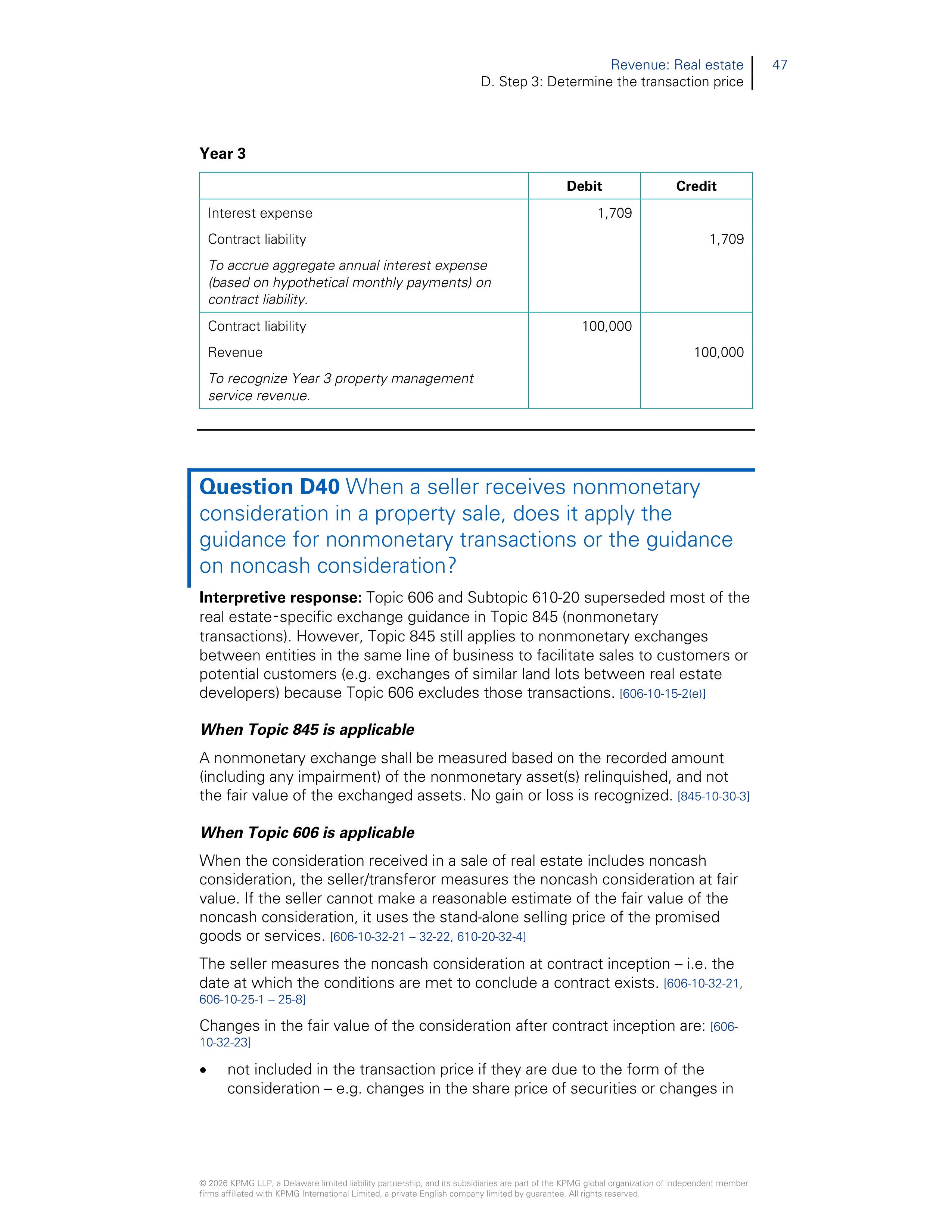
Revenue: Real estate
47
D. Step 3: Determine the transaction price
© 2026 KPMG LLP, a Delaware limited liability partnership, and its subsidiaries are part of the KPMG global organization of independent member
firms affiliated with KPMG International Limited, a private English company limited by guarantee. All rights reserved.
Year 3
Debit
Credit
Interest expense
1,709
Contract liability
1,709
To accrue aggregate annual interest expense
(based on hypothetical monthly payments) on
contract liability.
Contract liability
100,000
Revenue
100,000
To recognize Year 3 property management
service revenue.
Question D40
When a seller receives nonmonetary
consideration in a property sale, does it apply the
guidance for nonmonetary transactions or the guidance
on noncash consideration?
Interpretive response:
Topic 606 and Subtopic 610-20 superseded most of the
real estate
‑
specific exchange guidance in Topic 845 (nonmonetary
transactions). However, Topic 845 still applies to nonmonetary exchanges
between entities in the same line of business to facilitate sales to customers or
potential customers (e.g. exchanges of similar land lots between real estate
developers) because Topic 606 excludes those transactions.
[606-10-15-2(e)]
When Topic 845 is applicable
A nonmonetary exchange shall be measured based on the recorded amount
(including any impairment) of the nonmonetary asset(s) relinquished, and not
the fair value of the exchanged assets. No gain or loss is recognized.
[845-10-30-3]
When Topic 606 is applicable
When the consideration received in a sale of real estate includes noncash
consideration, the seller/transferor measures the noncash consideration at fair
value. If the seller cannot make a reasonable estimate of the fair value of the
noncash consideration, it uses the stand-alone selling price of the promised
goods or services.
[606-10-32-21 – 32-22, 610-20-32-4]
The seller measures the noncash consideration at contract inception – i.e. the
date at which the conditions are met to conclude a contract exists.
[606-10-32-21,
606-10-25-1 – 25-8]
Changes in the fair value of the consideration after contract inception are:
[606-
10-32-23]
•
not included in the transaction price if they are due to the form of the
consideration – e.g. changes in the share price of securities or changes in
Revenue: Real estate
48
D. Step 3: Determine the transaction price
© 2026 KPMG LLP, a Delaware limited liability partnership, and its subsidiaries are part of the KPMG global organization of independent member
firms affiliated with KPMG International Limited, a private English company limited by guarantee. All rights reserved.
the fair value of nonfinancial assets which the entity is entitled to receive
from a customer; or
•
variable consideration if they are caused by something other than the form
of the consideration – e.g. the exercise price of a share option changes
because of the entity’s performance.
If the changes in the fair value of the consideration are due to both the form of
the consideration and some reason other than the form of the consideration,
then the seller applies the variable consideration guidance only to the variability
resulting from reasons other than the form of the consideration.
This guidance applies to all transactions in the scope of Subtopic 610-20, which
includes traditional partial sale transactions, contributions to form real estate
joint ventures (assuming the seller retains only a noncontrolling interest), and
transfers of nonfinancial assets to an existing equity method investee. Noncash
consideration also includes receipt of a new or incremental noncontrolling
interest in the entity that owns the asset post-sale. Because the seller
measures the noncash consideration received in the form of a retained
noncontrolling interest at fair value in these transactions, it will recognize 100%
gain when control of the nonfinancial (or in-substance nonfinancial) asset
transfers to the noncontrolled buyer.
[610-20-05-2, 32-2 – 32-4]
For information about control transfer when a noncontrolling interest is retained
or received, see
Question F90
. Refer to Question 17.2.40 of KPMG Handbook,
Revenue recognition,
for additional discussion about transfers of nonfinancial
assets for nonmonetary consideration and Question 17.3.80 of the Handbook
for discussion about the receipt of a noncontrolling interest in a counterparty as
noncash consideration.
Question D45
Does a seller in a real estate sale
recognize as noncash consideration the receipt of a real
estate option that is outside the scope of Topic 815?
Interpretive response:
Yes. As discussed in
Question D40
, when the
consideration received in a sale of real estate includes noncash consideration,
the seller/transferor generally measures the noncash consideration at fair value.
We believe this guidance applies when a seller receives an option to purchase
real estate that is not subject to the sale, regardless of whether the option is a
derivative within the scope of Topic 815. The seller will then apply the
subsequent measurement guidance in Topic 815 only if the option is within its
scope.
[606-10-32-21 – 32-22, 610-20-32-4]
A seller applies the guidance on noncash consideration when it concludes that it
has a contract with the buyer. However, if the seller receives an option to
repurchase the property subject to the sale, the option generally prevents
control transfer to the buyer. For information about the effects of repurchase
rights on sale accounting, see
Question F70
.
Revenue: Real estate
49
D. Step 3: Determine the transaction price
© 2026 KPMG LLP, a Delaware limited liability partnership, and its subsidiaries are part of the KPMG global organization of independent member
firms affiliated with KPMG International Limited, a private English company limited by guarantee. All rights reserved.
Question D50
How does a seller consider liabilities
assumed by the buyer in a sale of real estate to a
noncustomer?
Interpretive response:
Under Subtopic 610-20, when a contract exists and the
seller transfers control of the property, the seller derecognizes the real estate
and recognizes a gain or loss equal to the difference between the amount of
consideration received and the carrying amount of the real estate. The amount
of consideration that is included in the calculation of the gain or loss includes
both the
transaction price
and the carrying amount of liabilities assumed or
relieved by the buyer.
[606-10-32-3, 610-20-32-2 – 32-5]
If control of the real estate transfers before the liability is extinguished under
Topic 405 (liabilities) and therefore the liability cannot be derecognized at the
same time as the real estate, the seller applies the guidance on constraining
estimates of variable consideration to determine the carrying amount of the
liability to include in the gain or loss calculation. For example, if the debt was
issued at a premium and that premium is expected to decline through
amortization between the time control of the asset transfers and the time the
debt is extinguished, the seller should estimate the carrying amount of the debt
as of the date it is expected to be extinguished for purposes of determining the
gain or loss on the sale of the real estate. The seller then recognizes this
amount as a contract asset, which represents the consideration it has not yet
received in exchange for transferring the assets.
[610-20-32-5, 45-3, 405-20-40-1, 606-
10-32-11]
If control of the real estate transfers after the liability is extinguished (and
therefore the real estate cannot be derecognized at the same time as the
liability), the seller derecognizes the liability and recognizes the amount as a
contract liability, which represents the consideration received before
transferring control of the asset.
[610-20-45-3]
Refer to Question 17.3.60 of KPMG Handbook,
Revenue recognition
, for
discussion on what to consider when determining the transaction price
(including when changes in the transaction price occur after contract inception)
and how the amount of consideration is used to calculate the gain or loss. Refer
to Question 17.3.70 of the Handbook for discussion about how the amount of
liability assumed or relieved by the counterparty is included in the consideration
received.
Revenue: Real estate
50
E. Step 4: Allocate the transaction price
© 2026 KPMG LLP, a Delaware limited liability partnership, and its subsidiaries are part of the KPMG global organization of independent member
firms affiliated with KPMG International Limited, a private English company limited by guarantee. All rights reserved.
E.
Step 4: Allocate the
transaction price
Detailed contents
Question E10
How does the seller allocate the transaction price in a contract
that transfers control of a property and also requires the seller to
provide ongoing property management services to a customer? What if
the buyer is not a customer?
Example E10.1
Sale of property with ongoing property management
services
Revenue: Real estate
51
E. Step 4: Allocate the transaction price
© 2026 KPMG LLP, a Delaware limited liability partnership, and its subsidiaries are part of the KPMG global organization of independent member
firms affiliated with KPMG International Limited, a private English company limited by guarantee. All rights reserved.
Question E10
How does the seller allocate the
transaction price in a contract that transfers control of a
property and also requires the seller to provide ongoing
property management services to a customer? What if
the buyer is not a customer?
Interpretive response:
Sale of property to a customer
When the sale of the property and the property management services
8
are
separate performance obligations, the seller generally allocates the transaction
price based on relative stand
‑
alone selling prices – i.e. the price at which an
entity would sell a promised good or service separately to a customer.
However, in some cases the seller attributes variable consideration and
discounts to some, but not all, performance obligations or distinct goods and
services within a series of distinct goods or services that comprise a single
performance obligation under paragraph 606-10-25-14(b).
[606-10-25-15, 32-36 –
32-40]
The seller should first consider the guidance on allocating variable
consideration. If the contract includes consideration that is variable, the seller
will need to determine if the variable consideration should be allocated to one or
both performance obligations. The seller must allocate variable consideration
(and subsequent changes to that amount) entirely to a single performance
obligation (or to distinct goods or services within a series of distinct goods or
services that are accounted for as a single performance obligation) if the:
•
terms of the variable payment relate specifically to the entity’s efforts to
satisfy the performance obligation or the distinct good or service within the
series, and
•
allocation of the variable amount entirely to the performance obligation or
the distinct good or service within the series is consistent with the
objective to allocate the transaction price in an amount that depicts the
consideration that the entity expects to be entitled to in exchange for the
promised goods or services after considering the contract’s performance
obligations and payment terms.
[606-10-32-28, 32-40]
It is common for stand-alone property management service contracts to include
a base fee and a variable fee that may depend on the property’s operations, the
manager’s cost to provide certain services, or both. A real estate sale with an
accompanying property management services contract also may include
variable consideration. The seller/property manager needs to consider the
guidance on allocating variable consideration when concluding whether it
should allocate the variable component entirely to the property management
services or to both the property management services and the property sale.
[606-10-32-40]
8
See
Question C30
on accounting for a series of distinct, daily property management
services as a single performance obligation.
Revenue: Real estate
52
E. Step 4: Allocate the transaction price
© 2026 KPMG LLP, a Delaware limited liability partnership, and its subsidiaries are part of the KPMG global organization of independent member
firms affiliated with KPMG International Limited, a private English company limited by guarantee. All rights reserved.
If the seller allocates the variable consideration entirely to the property
management services, it will need to determine if those services constitute a
series of distinct time increments of property management services. If the
seller concludes the property management services are a series of distinct time
increments of services (i.e. a series of daily, weekly, monthly management
services), it must further allocate the variable consideration to the distinct
service periods within the single series performance obligation if the:
•
variable consideration earned for a given distinct service period relates
specifically to the seller’s services for that period (or an outcome from
those services), and
•
allocation of that amount specifically to the distinct service period is
consistent with the allocation objective.
[606-10-32-28, 32-40]
The seller follows these steps to determine whether to allocate variable
consideration to distinct service periods within the single performance
obligation.
•
First, the seller must determine whether the nature of the property
management services is to provide a single, integrated service offering for a
defined period of time, or to perform a specified set of activities during the
period. Important to this determination is whether the activities the seller
will perform to fulfill the performance obligation are indeterminate (e.g.
even if the type of activities is generally understood, the quantity and mix of
activities that will need to be performed to fulfill the obligation are
unknown), or are known upfront (e.g. the seller will do X, Y and Z once each
week for three years). If the activities are indeterminate then the
performance obligation generally consists of distinct service periods.
•
Second, the seller must determine whether the nature of the promise is
substantially the same in each time increment. For example, could a
three
‑
year property management services contract be subdivided into time
periods like three annual periods or 36 monthly periods?
•
Third, the seller must determine whether the time increments of service
are distinct from each other. If they are not distinct, then the series
guidance cannot apply to the property management services performance
obligation.
•
Finally, if there is a series of distinct service periods within the single
property management services performance obligation, the seller must
determine whether the fees relate specifically to the seller’s efforts to
transfer the distinct services (or an outcome from those services) and
allocating the variable fees earned during each distinct service period only
to that service period is consistent with the allocation objective.
[606-10-25-19
– 25-21, 32-40]
If the seller must allocate the variable consideration entirely to the property
management services performance obligation,
and
that performance obligation
is a series of distinct service periods to which the variable consideration earned
each period can be allocated, the seller may not need to estimate the total
variable fees that will be earned during the contract to account for the
performance obligation. The variable fees earned each period will be allocated
to, and recognized in, each period.
Revenue: Real estate
53
E. Step 4: Allocate the transaction price
© 2026 KPMG LLP, a Delaware limited liability partnership, and its subsidiaries are part of the KPMG global organization of independent member
firms affiliated with KPMG International Limited, a private English company limited by guarantee. All rights reserved.
If the seller (a) cannot allocate the variable consideration entirely to the property
management services performance obligation, (b) the obligation is not a series
of distinct service periods or (c) the variable consideration earned each distinct
service period within a series cannot be allocated to that distinct service period,
the seller generally will need to estimate the total transaction price associated
with that performance obligation (including the variable consideration) to which
the seller expects to be entitled for performing the property management
services over the full performance obligation service period subject to the
constraint. The constraint limits the seller to only including estimates of variable
consideration in the transaction price to the extent that it is probable that a
significant reversal in the cumulative revenue recognized will not occur when
the uncertainty associated with the variable consideration is subsequently
resolved. See additional discussion about the constraint in
Questions D10
and
D15
.
[606-10-32-11 – 32-14]
The seller will recognize the transaction price (which may include fixed and
variable consideration) allocated to the property management services over
time based on an appropriate measure of progress as the performance
obligation is satisfied. For additional discussion about recognizing property
management service revenue, see
Questions D15
and
F130
.
If the sale and accompanying property management services contract also
include a future profits interest (see
Question D10
), the seller would perform a
similar analysis because of the variable consideration and existence of more
than one performance obligation.
After the seller allocates variable consideration, it will need to determine if any
discount should be allocated entirely to one of the performance obligations or
allocated proportionately. The discount is the difference between the
transaction price and the sum of the stand-alone selling prices. The guidance on
the allocation of variable consideration discussed above differs from the
guidance on the allocation of a discount to some, but not all, performance
obligations or to distinct goods or services within a series of distinct goods or
services that are accounted for as a single performance obligation. An entity
should allocate a discount entirely to one or more, but not all, of the
performance obligations if all of the following conditions exist:
•
the entity regularly sells each distinct good or service (or each bundle of
distinct goods or services) in the contract on a stand-alone basis;
•
the entity also regularly sells on a stand-alone basis a bundle (or bundles) of
some of those distinct goods or services at a discount to the stand-alone
selling prices of the goods or services in each bundle; and
•
the discount attributable to each bundle of goods or services described is
substantially the same as the discount in the contract, and an analysis of
the goods or services in each bundle provides observable evidence of the
performance obligation to which the discount in the contract belongs.
[606-10-32-37]
In our experience, most real estate companies do not offer a wide range of
bundled goods or services. Therefore, in most cases, these conditions will not
exist, and the seller will allocate the discount to all performance obligations in
the contract on a relative stand-alone selling price basis. See
Example E10.1
.
Revenue: Real estate
54
E. Step 4: Allocate the transaction price
© 2026 KPMG LLP, a Delaware limited liability partnership, and its subsidiaries are part of the KPMG global organization of independent member
firms affiliated with KPMG International Limited, a private English company limited by guarantee. All rights reserved.
Sale of property to a noncustomer
As discussed in
Questions D30
and
C20
, if selling property and providing
property management services are both an output of the seller’s ordinary
activities, the seller evaluates whether it has one or more performance
obligations under Topic 606. If it has more than one performance obligation, the
seller allocates the transaction price as discussed above.
If the seller routinely provides property management services as an output of its
normal activities, but does not routinely sell property as part of those activities,
it would apply the guidance in Subtopic 610-20 to the property sale and Topic
606 to the property management services. We believe the seller generally
would allocate the total transaction price between the two units of account
using the same guidance described above for sales of property to customers.
After the seller allocates the total transaction price to the Subtopic 610-20
promise and the Topic 606 promise, it may need to further allocate those
individual transaction prices to multiple performance obligations (within the
Topic 606 promise) and multiple distinct assets (within the Subtopic 610-20
promise).
[610-20-15-9 – 15-10, 25-6, 32-2 – 32-6]
Example E10.1
Sale of property with ongoing property
management services
Description of the arrangement
ABC Corp. sells an office building with a carrying amount of $1,500,000 and
agrees to manage the office building for three years for total consideration of
$2,000,000 payable in cash upon closing of the sale.
ABC routinely provides property management services as an output of its
normal activities but does not typically sell property.
The estimated stand-alone selling price of the office building and the series of
management services are $1,800,000 and $300,000, or $100,000 per year,
respectively. Assume that the:
•
customer makes no ongoing payments for the services;
•
financing component is not significant to the contract;
9
and
•
criteria for allocating the overall discount entirely to one of the performance
obligations are not met.
[606-10-32-37]
Evaluation
The seller allocates the total transaction price of $2,000,000 to the two separate
units of account based on relative stand-alone selling prices.
Combined stand-alone selling price: $2,100,000
$1,800,000 (property stand-alone selling price) + $300,000 (property management
services stand-alone selling price at $100,000 each year for 3 years)
9
See
Example D30.1
for an illustration of the accounting if the financing component is
significant to the contract.
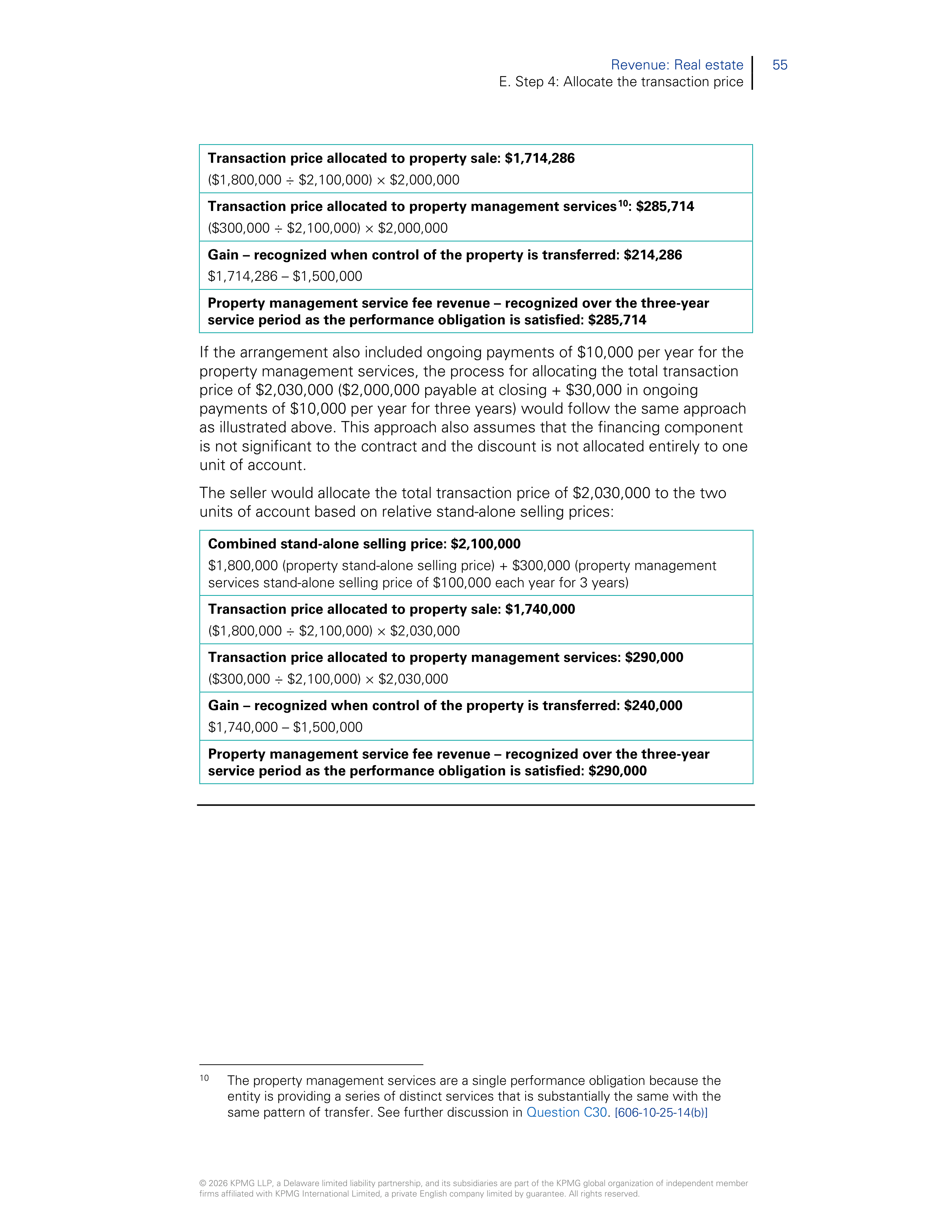
Revenue: Real estate
55
E. Step 4: Allocate the transaction price
© 2026 KPMG LLP, a Delaware limited liability partnership, and its subsidiaries are part of the KPMG global organization of independent member
firms affiliated with KPMG International Limited, a private English company limited by guarantee. All rights reserved.
Transaction price allocated to property sale: $1,714,286
($1,800,000 ÷ $2,100,000) × $2,000,000
Transaction price allocated to property management services
10
: $285,714
($300,000 ÷ $2,100,000) × $2,000,000
Gain – recognized when control of the property is transferred: $214,286
$1,714,286 – $1,500,000
Property management service fee revenue – recognized over the three-year
service period as the performance obligation is satisfied: $285,714
If the arrangement also included ongoing payments of $10,000 per year for the
property management services, the process for allocating the total transaction
price of $2,030,000 ($2,000,000 payable at closing + $30,000 in ongoing
payments of $10,000 per year for three years) would follow the same approach
as illustrated above. This approach also assumes that the financing component
is not significant to the contract and the discount is not allocated entirely to one
unit of account.
The seller would allocate the total transaction price of $2,030,000 to the two
units of account based on relative stand-alone selling prices:
Combined stand-alone selling price: $2,100,000
$1,800,000 (property stand-alone selling price) + $300,000 (property management
services stand-alone selling price of $100,000 each year for 3 years)
Transaction price allocated to property sale: $1,740,000
($1,800,000 ÷ $2,100,000) × $2,030,000
Transaction price allocated to property management services: $290,000
($300,000 ÷ $2,100,000) × $2,030,000
Gain – recognized when control of the property is transferred: $240,000
$1,740,000 – $1,500,000
Property management service fee revenue – recognized over the three-year
service period as the performance obligation is satisfied: $290,000
10
The property management services are a single performance obligation because the
entity is providing a series of distinct services that is substantially the same with the
same pattern of transfer. See further discussion in
Question C30
.
[606-10-25-14(b)]
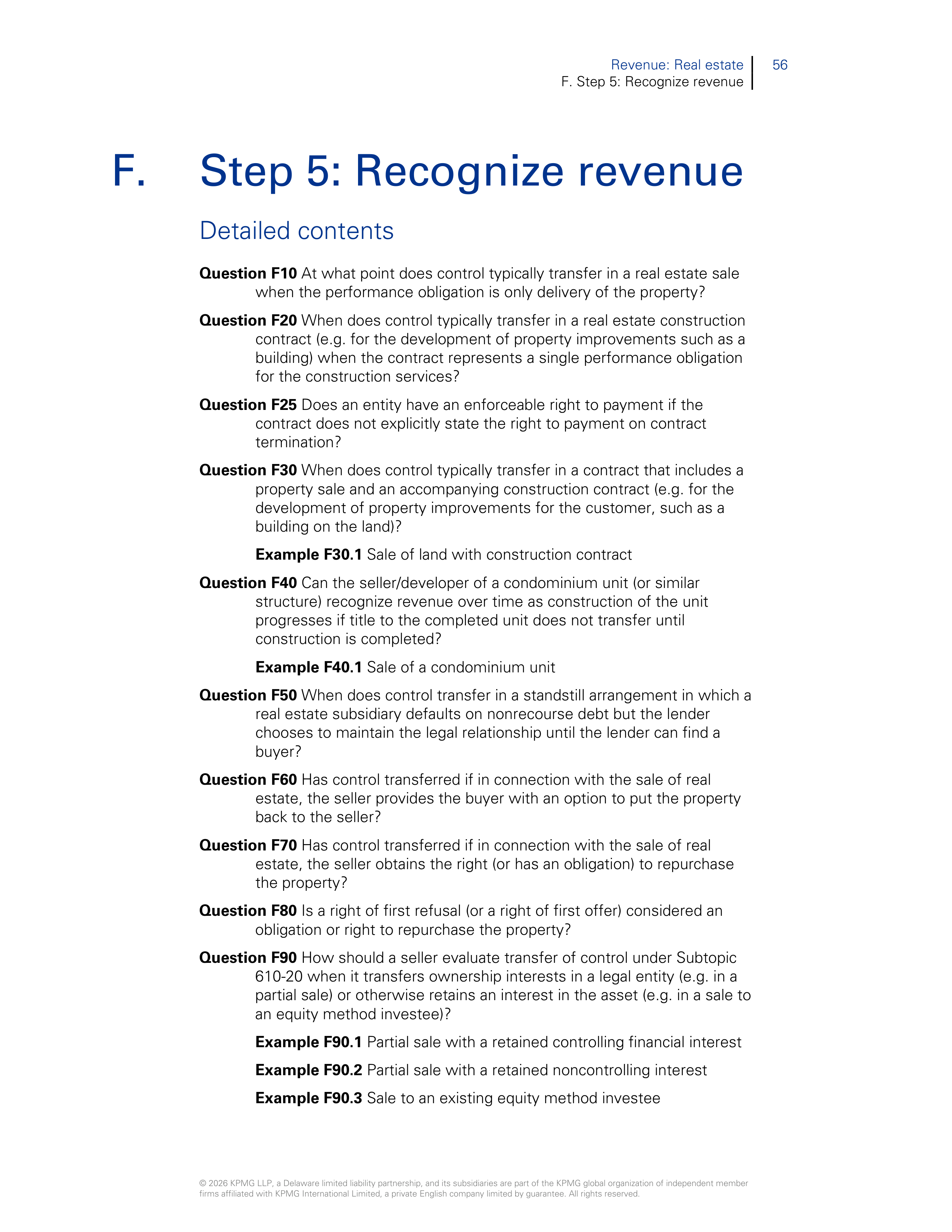
Revenue: Real estate
56
F. Step 5: Recognize revenue
© 2026 KPMG LLP, a Delaware limited liability partnership, and its subsidiaries are part of the KPMG global organization of independent member
firms affiliated with KPMG International Limited, a private English company limited by guarantee. All rights reserved.
F.
Step 5: Recognize revenue
Detailed contents
Question F10
At what point does control typically transfer in a real estate sale
when the performance obligation is only delivery of the property?
Question F20
When does control typically transfer in a real estate construction
contract (e.g. for the development of property improvements such as a
building) when the contract represents a single performance obligation
for the construction services?
Question F25
Does an entity have an enforceable right to payment if the
contract does not explicitly state the right to payment on contract
termination?
Question F30
When does control typically transfer in a contract that includes a
property sale and an accompanying construction contract (e.g. for the
development of property improvements for the customer, such as a
building on the land)?
Example F30.1
Sale of land with construction contract
Question F40
Can the seller/developer of a condominium unit (or similar
structure) recognize revenue over time as construction of the unit
progresses if title to the completed unit does not transfer until
construction is completed?
Example F40.1
Sale of a condominium unit
Question F50
When does control transfer in a standstill arrangement in which a
real estate subsidiary defaults on nonrecourse debt but the lender
chooses to maintain the legal relationship until the lender can find a
buyer?
Question F60
Has control transferred if in connection with the sale of real
estate, the seller provides the buyer with an option to put the property
back to the seller?
Question F70
Has control transferred if in connection with the sale of real
estate, the seller obtains the right (or has an obligation) to repurchase
the property?
Question F80
Is a right of first refusal (or a right of first offer) considered an
obligation or right to repurchase the property?
Question F90
How should a seller evaluate transfer of control under Subtopic
610-20 when it transfers ownership interests in a legal entity (e.g. in a
partial sale) or otherwise retains an interest in the asset (e.g. in a sale to
an equity method investee)?
Example F90.1
Partial sale with a retained controlling financial interest
Example F90.2
Partial sale with a retained noncontrolling interest
Example F90.3
Sale to an existing equity method investee
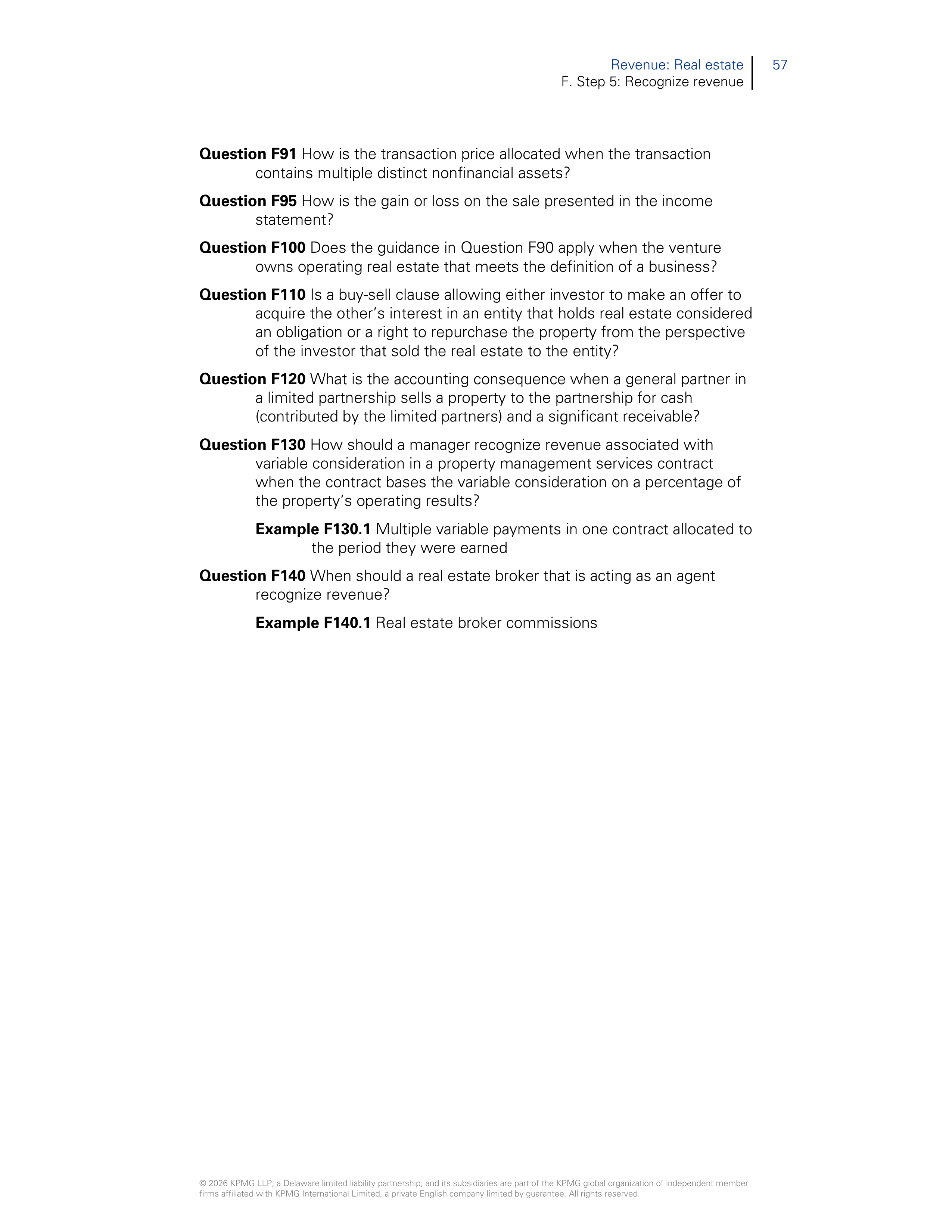
Revenue: Real estate
57
F. Step 5: Recognize revenue
© 2026 KPMG LLP, a Delaware limited liability partnership, and its subsidiaries are part of the KPMG global organization of independent member
firms affiliated with KPMG International Limited, a private English company limited by guarantee. All rights reserved.
Question F91
How is the transaction price allocated when the transaction
contains multiple distinct nonfinancial assets?
Question F95
How is the gain or loss on the sale presented in the income
statement?
Question F100
Does the guidance in Question F90 apply when the venture
owns operating real estate that meets the definition of a business?
Question F110
Is a buy-sell clause allowing either investor to make an offer to
acquire the other’s interest in an entity that holds real estate considered
an obligation or a right to repurchase the property from the perspective
of the investor that sold the real estate to the entity?
Question F120
What is the accounting consequence when a general partner in
a limited partnership sells a property to the partnership for cash
(contributed by the limited partners) and a significant receivable?
Question F130
How should a manager recognize revenue associated with
variable consideration in a property management services contract
when the contract bases the variable consideration on a percentage of
the property’s operating results?
Example F130.1
Multiple variable payments in one contract allocated to
the period they were earned
Question F140
When should a real estate broker that is acting as an agent
recognize revenue?
Example F140.1
Real estate broker commissions
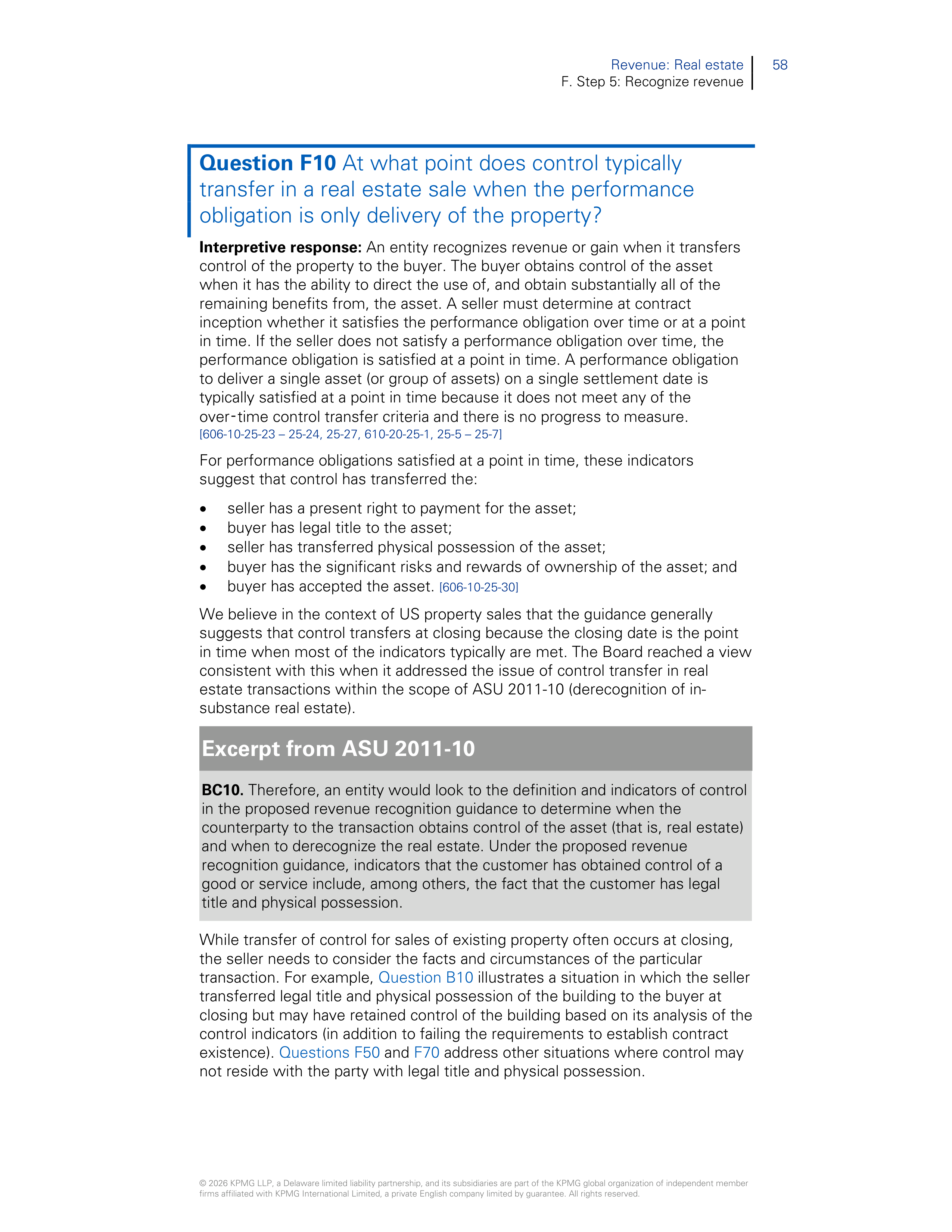
Revenue: Real estate
58
F. Step 5: Recognize revenue
© 2026 KPMG LLP, a Delaware limited liability partnership, and its subsidiaries are part of the KPMG global organization of independent member
firms affiliated with KPMG International Limited, a private English company limited by guarantee. All rights reserved.
Question F10
At what point does control typically
transfer in a real estate sale when the performance
obligation is only delivery of the property?
Interpretive response:
An entity recognizes revenue or gain when it transfers
control of the property to the buyer. The buyer obtains control of the asset
when it has the ability to direct the use of, and obtain substantially all of the
remaining benefits from, the asset. A seller must determine at contract
inception whether it satisfies the performance obligation over time or at a point
in time. If the seller does not satisfy a performance obligation over time, the
performance obligation is satisfied at a point in time. A performance obligation
to deliver a single asset (or group of assets) on a single settlement date is
typically satisfied at a point in time because it does not meet any of the
over
‑
time control transfer criteria and there is no progress to measure.
[606-10-25-23 – 25-24, 25-27, 610-20-25-1, 25-5 – 25-7]
For performance obligations satisfied at a point in time, these indicators
suggest that control has transferred the:
•
seller has a present right to payment for the asset;
•
buyer has legal title to the asset;
•
seller has transferred physical possession of the asset;
•
buyer has the significant risks and rewards of ownership of the asset; and
•
buyer has accepted the asset.
[606-10-25-30]
We believe in the context of US property sales that the guidance generally
suggests that control transfers at closing because the closing date is the point
in time when most of the indicators typically are met. The Board reached a view
consistent with this when it addressed the issue of control transfer in real
estate transactions within the scope of ASU 2011-10 (derecognition of in-
substance real estate).
Excerpt from ASU 2011-10
BC10.
Therefore, an entity would look to the definition and indicators of control
in the proposed revenue recognition guidance to determine when the
counterparty to the transaction obtains control of the asset (that is, real estate)
and when to derecognize the real estate. Under the proposed revenue
recognition guidance, indicators that the customer has obtained control of a
good or service include, among others, the fact that the customer has legal
title and physical possession.
While transfer of control for sales of existing property often occurs at closing,
the seller needs to consider the facts and circumstances of the particular
transaction. For example,
Question B10
illustrates a situation in which the seller
transferred legal title and physical possession of the building to the buyer at
closing but may have retained control of the building based on its analysis of the
control indicators (in addition to failing the requirements to establish contract
existence).
Questions F50
and
F70
address other situations where control may
not reside with the party with legal title and physical possession.
Revenue: Real estate
59
F. Step 5: Recognize revenue
© 2026 KPMG LLP, a Delaware limited liability partnership, and its subsidiaries are part of the KPMG global organization of independent member
firms affiliated with KPMG International Limited, a private English company limited by guarantee. All rights reserved.
The guidance on control transfer applies to both customer and noncustomer
transactions; however, additional considerations apply when nonfinancial and in-
substance nonfinancial assets are transferred within a legal entity. See
Question F90
.
Question F20
When does control typically transfer in a
real estate construction contract (e.g. for the
development of property improvements such as a
building) when the contract represents a single
performance obligation for the construction services?
Interpretive response:
An entity recognizes revenue when it satisfies a
performance obligation by transferring control of the good or service to the
customer. An entity considers an asset or service transferred when, or as, the
customer obtains control of the asset. An entity determines at contract
inception whether it satisfies the performance obligation over time or at a point
in time. If an entity does not satisfy a performance obligation over time, the
performance obligation is satisfied at a point in time.
[606-10-25-23 – 25-24]
An entity transfers control of a good or service over time if the transaction
meets at least one of the following criteria:
[606-10-25-27]
a. The customer simultaneously receives and consumes the benefits
provided by the entity’s performance as the entity performs;
This criterion primarily applies to traditional service contracts (e.g. property
management services) when the customer is benefitting on a periodic basis as
the entity performs (e.g. as the property is being managed) as opposed to
service contracts when an asset is being constructed or enhanced on the
customer’s behalf. When a customer’s asset is being constructed or enhanced,
further analysis is necessary under criterion (b) and criterion (c) if criterion (b) is
not met.
b. The entity’s performance creates or enhances an asset (e.g. work in
process) that the customer controls as the asset is created or
enhanced; or
We believe this criterion generally will be met in a real estate construction
contract when the customer owns the underlying land and takes control of the
property improvements as construction progresses. In that case, the customer
generally is able to direct the use of, and obtain substantially all of the remaining
benefits from, the improvements during construction.
The customer generally is able to use the property improvements to enhance
the value of other assets during the construction period. The ability to use the
property improvements includes selling the land the customer owns on which
the improvements are built; selling or exchanging the property, including the
partially completed improvements; and pledging the property with the partially
completed improvements to secure a loan.
Revenue: Real estate
60
F. Step 5: Recognize revenue
© 2026 KPMG LLP, a Delaware limited liability partnership, and its subsidiaries are part of the KPMG global organization of independent member
firms affiliated with KPMG International Limited, a private English company limited by guarantee. All rights reserved.
This analysis applies when the customer controls and holds legal title to the
land on which improvements are constructed. A similar analysis also may apply
if the customer leases the underlying land on a long-term basis and will own the
property improvements. A developer will not meet criterion (b) however, if it (as
opposed to the customer) controls the property and/or the improvements until
construction is complete. This may occur in constructing condominium units (or
similar structures). See
Question F40
for additional discussion.
c. The entity’s performance does not create an asset with an alternative
use to the entity, and the entity has an enforceable right to payment
for performance completed to date.
An entity only needs to meet one of the three criteria to conclude that a
performance obligation is satisfied over time. We believe this criterion may also
be met in a real estate construction contract if the customer owns the
underlying land and takes control of the property improvements as construction
progresses because the developer’s performance generally does not create an
asset with alternative use to the developer. Usually the customer controls the
property improvements being constructed and those improvements are affixed
to land controlled by the customer. Therefore, the developer likely is legally and
practically prohibited from directing the improvements for any other use.
[606-10-25-27 – 25-28]
However, to meet this criterion, the developer also must have an enforceable
right to payment for performance completed to date, which often is the case
when a contract includes payment provisions that protect the developer in the
event of a termination for convenience by the customer.
When a contract does not specify whether the entity has a right to payment on
contract termination, we believe an enforceable right to payment is presumed
not to exist. See
Question F25
for additional discussion.
If the entity meets at least one of the above criteria, revenue on the
construction services performance obligation is recognized over time as
satisfaction of the performance obligation progresses.
[606-10-25-27]
The guidance on control transfer applies to both customer and noncustomer
transactions.
Question F25
Does an entity have an enforceable right
to payment if the contract does not explicitly state the
right to payment on contract termination?
Interpretive response:
Generally, no. We believe that when a contract's
written terms do not specify the entity's right to payment upon contract
termination, an enforceable right to payment is presumed not to exist. This is
consistent with the FASB staff views discussed at the June 26, 2018 Private
Company Council meeting
.
[PCC Memo June 26, 2018]
We believe this presumption (that an enforceable right to payment does not
exist) also applies to non-cancellable contracts when there are no written terms
to specify the entity’s right to payment if the customer breaches the contract.
Revenue: Real estate
61
F. Step 5: Recognize revenue
© 2026 KPMG LLP, a Delaware limited liability partnership, and its subsidiaries are part of the KPMG global organization of independent member
firms affiliated with KPMG International Limited, a private English company limited by guarantee. All rights reserved.
However, if the entity asserts that it has an enforceable right to payment for
performance completed to date in these circumstances, to overcome this
presumption, we would expect it to take the following steps.
•
Support its assertion (that it has an enforceable right to payment) based on
legislation, administrative practice or legal precedent that confers upon the
entity a right to payment for performance completed to date
.
This analysis
should demonstrate that an enforceable right to payment exists in the
relevant jurisdiction.
[606-10-55-14(a)]
•
Assess whether relevant legal precedent indicates that similar rights to
payment for performance completed to date in similar contracts have no
binding legal effect.
[606-10-55-14(b)]
The fact that the entity may have a basis for making a claim against the
counterparty in a court of law would not on its own be sufficient to support that
an enforceable right to payment exists as discussed in Question 7.3.80 in
KPMG Handbook
,
Revenue recognition
.
Question F30
When does control typically transfer in a
contract that includes a property sale and an
accompanying construction contract (e.g. for the
development of property improvements for the
customer, such as a building on the land)?
Interpretive response:
As discussed in
Question C20
, a seller/developer first
needs to determine whether the contract contains one or more performance
obligations or units of account.
In the more common scenario when the property sale and the construction
services are two performance obligations or units of account, the
seller/developer usually allocates the transaction price to those two
performance obligations or units of account based on relative stand-alone
selling prices (see
Question E10
). The seller/developer evaluates each
performance obligation or unit of account to determine whether it recognizes
revenue or gain over time or at a point in time. As discussed in
Question F10
,
control of property often transfers at a point in time, and as discussed in
Question F20
, construction services (as a stand-alone performance obligation or
unit of account) are often, but not always, satisfied over time.
In the less common scenario when the property sale and the construction
contract comprise a single performance obligation or unit of account, the entity
will need to analyze whether the single performance obligation or unit of
account is satisfied:
•
at a point in time – upon delivery of the completed property, including
improvements; or
•
over time – as title to the land transfers and construction progresses on the
improvements affixed to the buyer-owned land.
If title to the land transfers to the buyer before construction begins, and the
buyer owns the improvements during construction, we believe the analysis of
Revenue: Real estate
62
F. Step 5: Recognize revenue
© 2026 KPMG LLP, a Delaware limited liability partnership, and its subsidiaries are part of the KPMG global organization of independent member
firms affiliated with KPMG International Limited, a private English company limited by guarantee. All rights reserved.
the over-time criteria relative to the single combined performance obligation
may be similar to the analysis in
Question F20
. This analysis shows that the
seller/developer will often recognize revenue over time because the
seller/developer
’
s performance creates or enhances an asset that the buyer
controls as the asset is created or enhanced.
[606-10-25-27(b)]
When there is just one performance obligation or unit of account for both the
land sale and the construction services, however, the total revenue recognized
over time represents the total transaction price (including the contract
consideration for both elements). Progress toward satisfaction of that single
performance obligation is measured relative to both elements (see
Example F30.1
).
When there is a single performance obligation or unit of account and the buyer
does not hold title to the land or have legal ownership of the improvements
affixed to the land as construction progresses (e.g. in some contracts to
construct condominium units or similar structures), it may be difficult to
conclude the performance obligation is satisfied over time. See additional
discussion in
Question F40
.
Example F30.1
Sale of land with construction contract
Description of the arrangement
ABC Corp. sells land with a carrying amount of $400,000 to DEF Corp. for
$1,000,000. Additionally, ABC agrees to build a fitness center for an additional
$500,000 (estimated cost of $400,000).
ABC routinely provides construction services as an output of its normal
activities but does not typically sell land.
Assume the sale of the land and the construction of the fitness center comprise
two separate units of account (see additional discussion in
Question C20
) and
DEF obtains the title to the land at closing before construction of the fitness
center begins. ABC allocates $950,000 (of the total $1,500,000 transaction
price) to the sale of the land and $550,000 to the construction contract, based
on their relative stand-alone selling prices.
Evaluation
Because the sale of the land and construction of the fitness center comprise
two separate units of account, ABC will need to determine when, or over what
period, it satisfies each unit of account. ABC concludes that control of the land
transfers when DEF takes legal and physical possession of the land. The
construction services are satisfied over time because ABC is creating and
enhancing an asset (the fitness center) that DEF controls as it is created.
For the land sale, ABC recognizes a $550,000 gain (allocated transaction price of
$950,000 less the $400,000 carrying amount) at closing.
For the construction services, ABC uses an input method (cost-to-cost) to
recognize revenue based on its periodic efforts relative to the total expected
effort to completely satisfy the performance obligation.
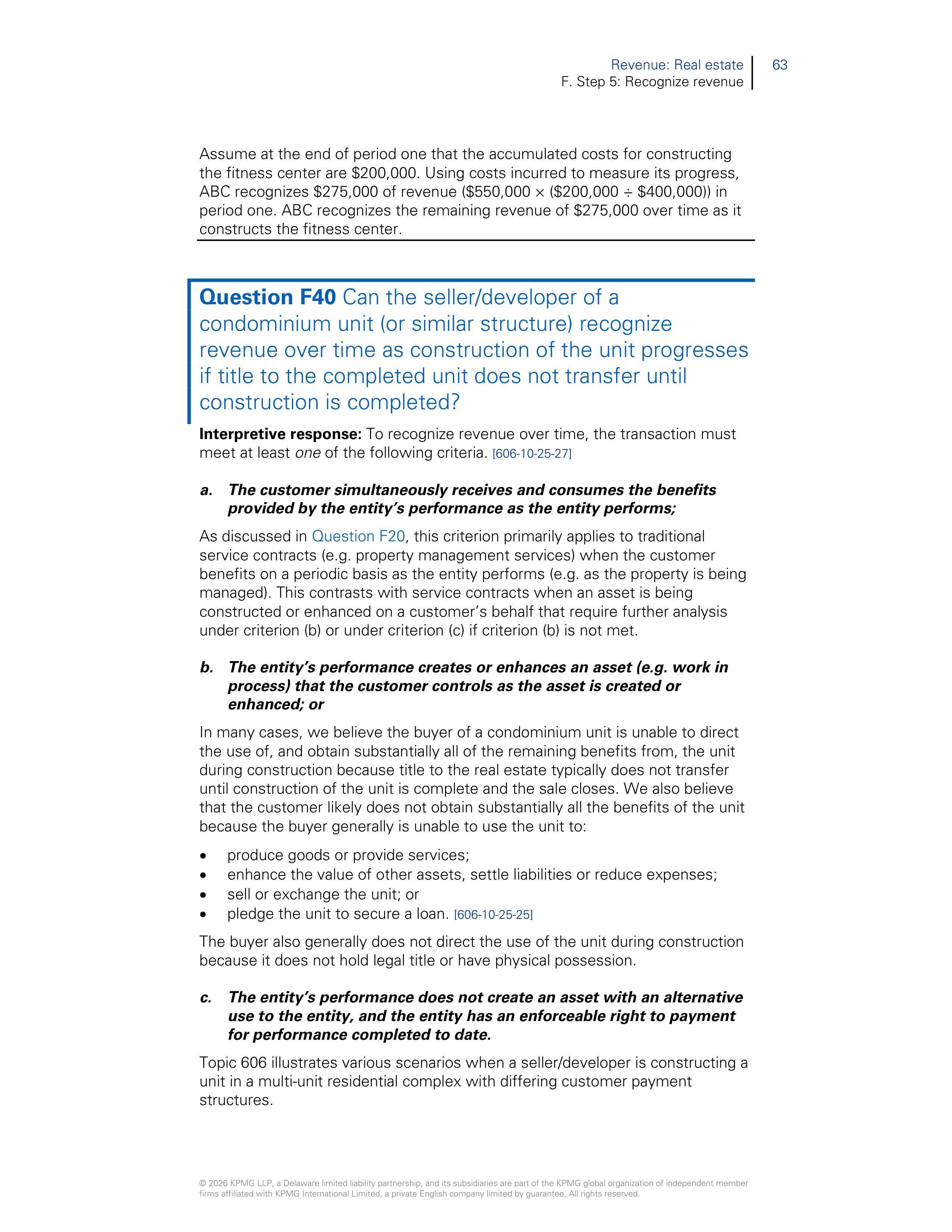
Revenue: Real estate
63
F. Step 5: Recognize revenue
© 2026 KPMG LLP, a Delaware limited liability partnership, and its subsidiaries are part of the KPMG global organization of independent member
firms affiliated with KPMG International Limited, a private English company limited by guarantee. All rights reserved.
Assume at the end of period one that the accumulated costs for constructing
the fitness center are $200,000. Using costs incurred to measure its progress,
ABC recognizes $275,000 of revenue ($550,000 × ($200,000 ÷ $400,000)) in
period one. ABC recognizes the remaining revenue of $275,000 over time as it
constructs the fitness center.
Question F40
Can the seller/developer of a
condominium unit (or similar structure) recognize
revenue over time as construction of the unit progresses
if title to the completed unit does not transfer until
construction is completed?
Interpretive response:
To recognize revenue over time, the transaction must
meet at least
one
of the following criteria.
[606-10-25-27]
a. The customer simultaneously receives and consumes the benefits
provided by the entity’s performance as the entity performs;
As discussed in
Question F20
, this criterion primarily applies to traditional
service contracts (e.g. property management services) when the customer
benefits on a periodic basis as the entity performs (e.g. as the property is being
managed). This contrasts with service contracts when an asset is being
constructed or enhanced on a customer’s behalf that require further analysis
under criterion (b) or under criterion (c) if criterion (b) is not met.
b. The entity’s performance creates or enhances an asset (e.g. work in
process) that the customer controls as the asset is created or
enhanced; or
In many cases, we believe the buyer of a condominium unit is unable to direct
the use of, and obtain substantially all of the remaining benefits from, the unit
during construction because title to the real estate typically does not transfer
until construction of the unit is complete and the sale closes. We also believe
that the customer likely does not obtain substantially all the benefits of the unit
because the buyer generally is unable to use the unit to:
•
produce goods or provide services;
•
enhance the value of other assets, settle liabilities or reduce expenses;
•
sell or exchange the unit; or
•
pledge the unit to secure a loan.
[606-10-25-25]
The buyer also generally does not direct the use of the unit during construction
because it does not hold legal title or have physical possession.
c. The entity’s performance does not create an asset with an alternative
use to the entity, and the entity has an enforceable right to payment
for performance completed to date.
Topic 606 illustrates various scenarios when a seller/developer is constructing a
unit in a multi-unit residential complex with differing customer payment
structures.
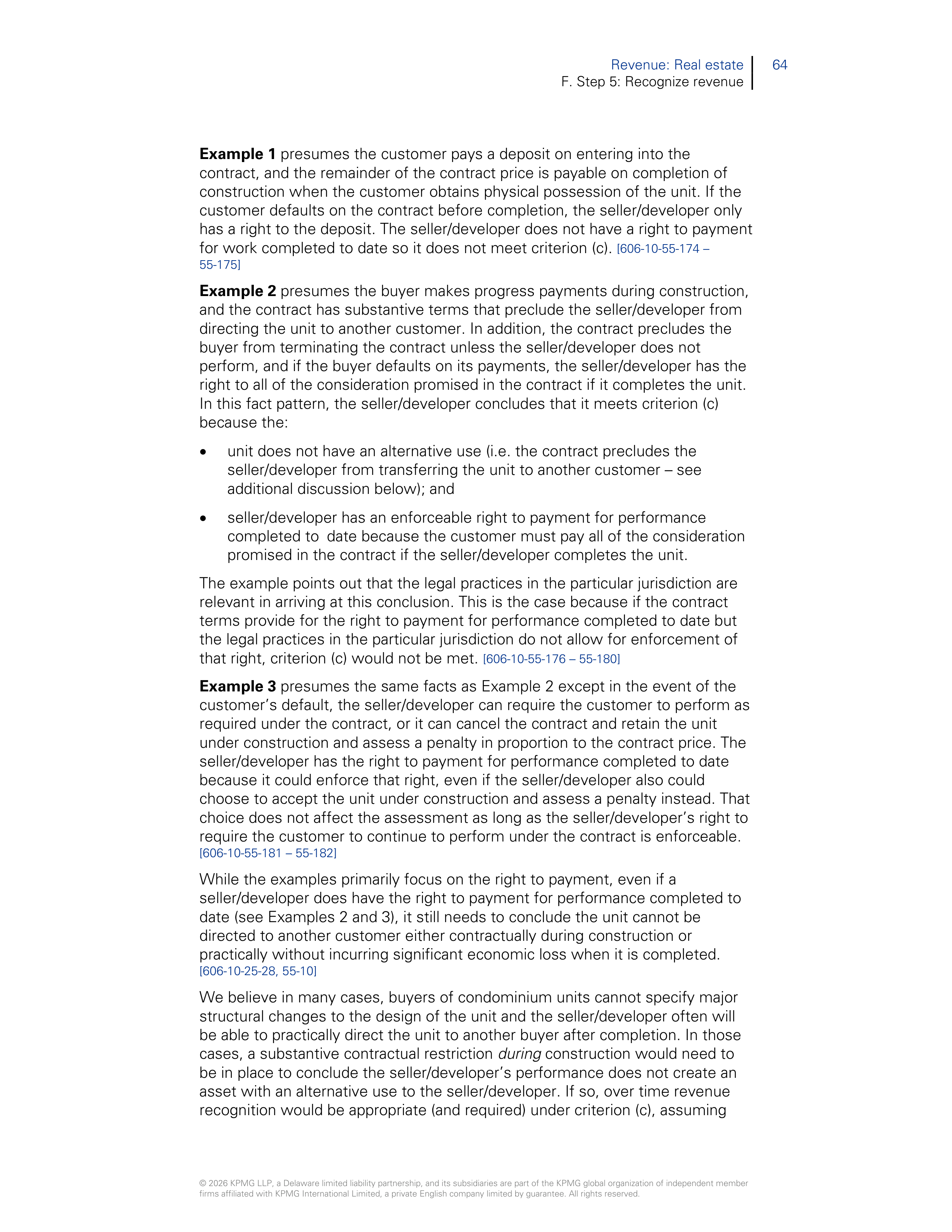
Revenue: Real estate
64
F. Step 5: Recognize revenue
© 2026 KPMG LLP, a Delaware limited liability partnership, and its subsidiaries are part of the KPMG global organization of independent member
firms affiliated with KPMG International Limited, a private English company limited by guarantee. All rights reserved.
Example 1
presumes the customer pays a deposit on entering into the
contract, and the remainder of the contract price is payable on completion of
construction when the customer obtains physical possession of the unit. If the
customer defaults on the contract before completion, the seller/developer only
has a right to the deposit. The seller/developer does not have a right to payment
for work completed to date so it does not meet criterion (c).
[606-10-55-174 –
55-175]
Example 2
presumes the buyer makes progress payments during construction,
and the contract has substantive terms that preclude the seller/developer from
directing the unit to another customer. In addition, the contract precludes the
buyer from terminating the contract unless the seller/developer does not
perform, and if the buyer defaults on its payments, the seller/developer has the
right to all of the consideration promised in the contract if it completes the unit.
In this fact pattern, the seller/developer concludes that it meets criterion (c)
because the:
•
unit does not have an alternative use (i.e. the contract precludes the
seller/developer from transferring the unit to another customer – see
additional discussion below); and
•
seller/developer has an enforceable right to payment for performance
completed to
date because the customer must pay all of the consideration
promised in the contract if the seller/developer completes the unit.
The example points out that the legal practices in the particular jurisdiction are
relevant in arriving at this conclusion. This is the case because if the contract
terms provide for the right to payment for performance completed to date but
the legal practices in the particular jurisdiction do not allow for enforcement of
that right, criterion (c) would not be met.
[606-10-55-176 – 55-180]
Example 3
presumes the same facts as Example 2 except in the event of the
customer’s default, the seller/developer can require the customer to perform as
required under the contract, or it can cancel the contract and retain the unit
under construction and assess a penalty in proportion to the contract price. The
seller/developer has the right to payment for performance completed to date
because it could enforce that right, even if the seller/developer also could
choose to accept the unit under construction and assess a penalty instead. That
choice does not affect the assessment as long as the seller/developer’s right to
require the customer to continue to perform under the contract is enforceable.
[606-10-55-181 – 55-182]
While the examples primarily focus on the right to payment, even if a
seller/developer does have the right to payment for performance completed to
date (see Examples 2 and 3), it still needs to conclude the unit cannot be
directed to another customer either contractually during construction or
practically without incurring significant economic loss when it is completed.
[606-10-25-28, 55-10]
We believe in many cases, buyers of condominium units cannot specify major
structural changes to the design of the unit and the seller/developer often will
be able to practically direct the unit to another buyer after completion. In those
cases, a substantive contractual restriction
during
construction would need to
be in place to conclude the seller/developer’s performance does not create an
asset with an alternative use to the seller/developer. If so, over time revenue
recognition would be appropriate (and required) under criterion (c), assuming
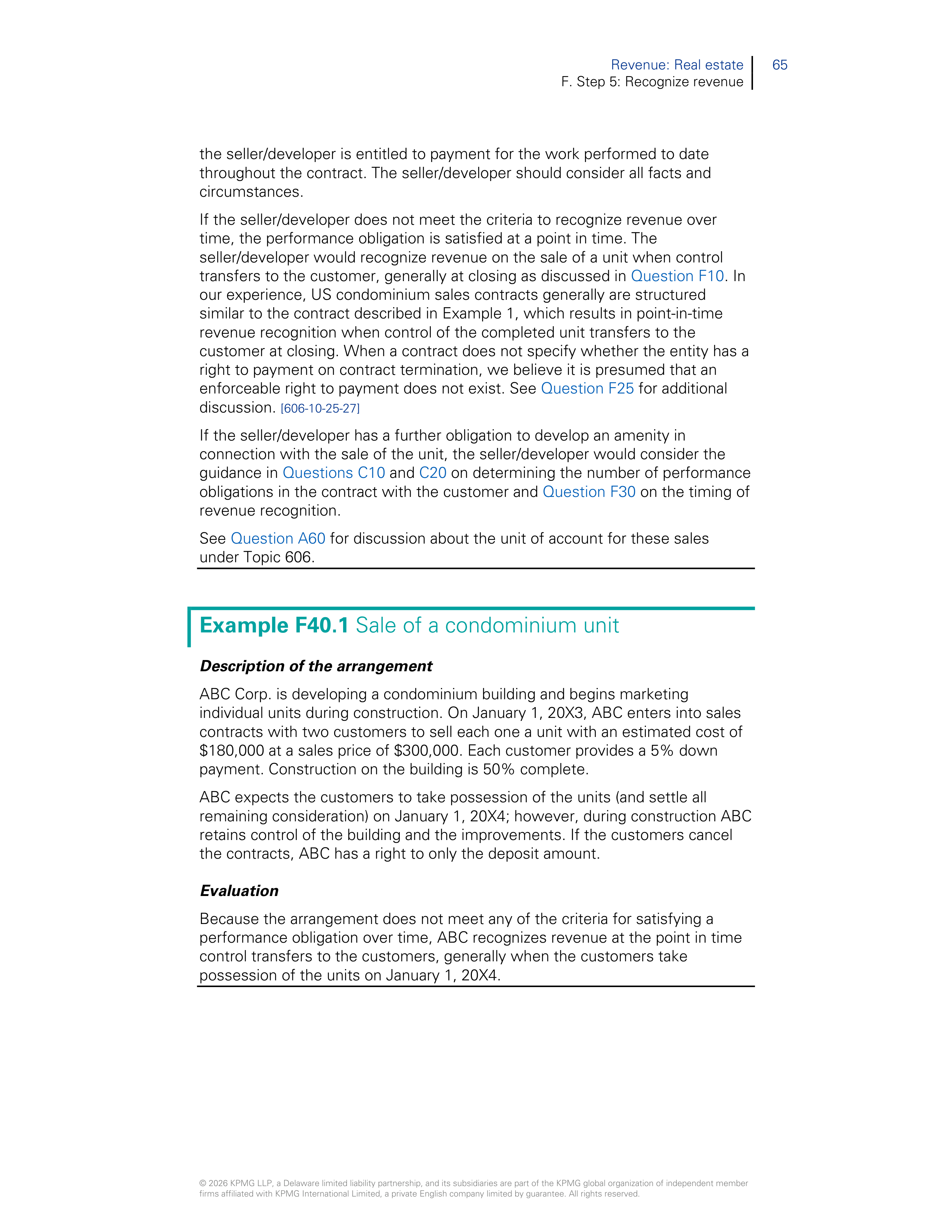
Revenue: Real estate
65
F. Step 5: Recognize revenue
© 2026 KPMG LLP, a Delaware limited liability partnership, and its subsidiaries are part of the KPMG global organization of independent member
firms affiliated with KPMG International Limited, a private English company limited by guarantee. All rights reserved.
the seller/developer is entitled to payment for the work performed to date
throughout the contract. The seller/developer should consider all facts and
circumstances.
If the seller/developer does not meet the criteria to recognize revenue over
time, the performance obligation is satisfied at a point in time. The
seller/developer would recognize revenue on the sale of a unit when control
transfers to the customer, generally at closing as discussed in
Question F10
. In
our experience, US condominium sales contracts generally are structured
similar to the contract described in Example 1, which results in point-in-time
revenue recognition when control of the completed unit transfers to the
customer at closing. When a contract does not specify whether the entity has a
right to payment on contract termination, we believe it is presumed that an
enforceable right to payment does not exist. See
Question F25
for additional
discussion.
[606-10-25-27]
If the seller/developer has a further obligation to develop an amenity in
connection with the sale of the unit, the seller/developer would consider the
guidance in
Questions C10
and
C20
on determining the number of performance
obligations in the contract with the customer and
Question F30
on the timing of
revenue recognition.
See
Question A60
for discussion about the unit of account for these sales
under Topic 606.
Example F40.1
Sale of a condominium unit
Description of the arrangement
ABC Corp. is developing a condominium building and begins marketing
individual units during construction. On January 1, 20X3, ABC enters into sales
contracts with two customers to sell each one a unit with an estimated cost of
$180,000 at a sales price of $300,000. Each customer provides a 5% down
payment. Construction on the building is 50% complete.
ABC expects the customers to take possession of the units (and settle all
remaining consideration) on January 1, 20X4; however, during construction ABC
retains control of the building and the improvements. If the customers cancel
the contracts, ABC has a right to only the deposit amount.
Evaluation
Because the arrangement does not meet any of the criteria for satisfying a
performance obligation over time, ABC recognizes revenue at the point in time
control transfers to the customers, generally when the customers take
possession of the units on January 1, 20X4.
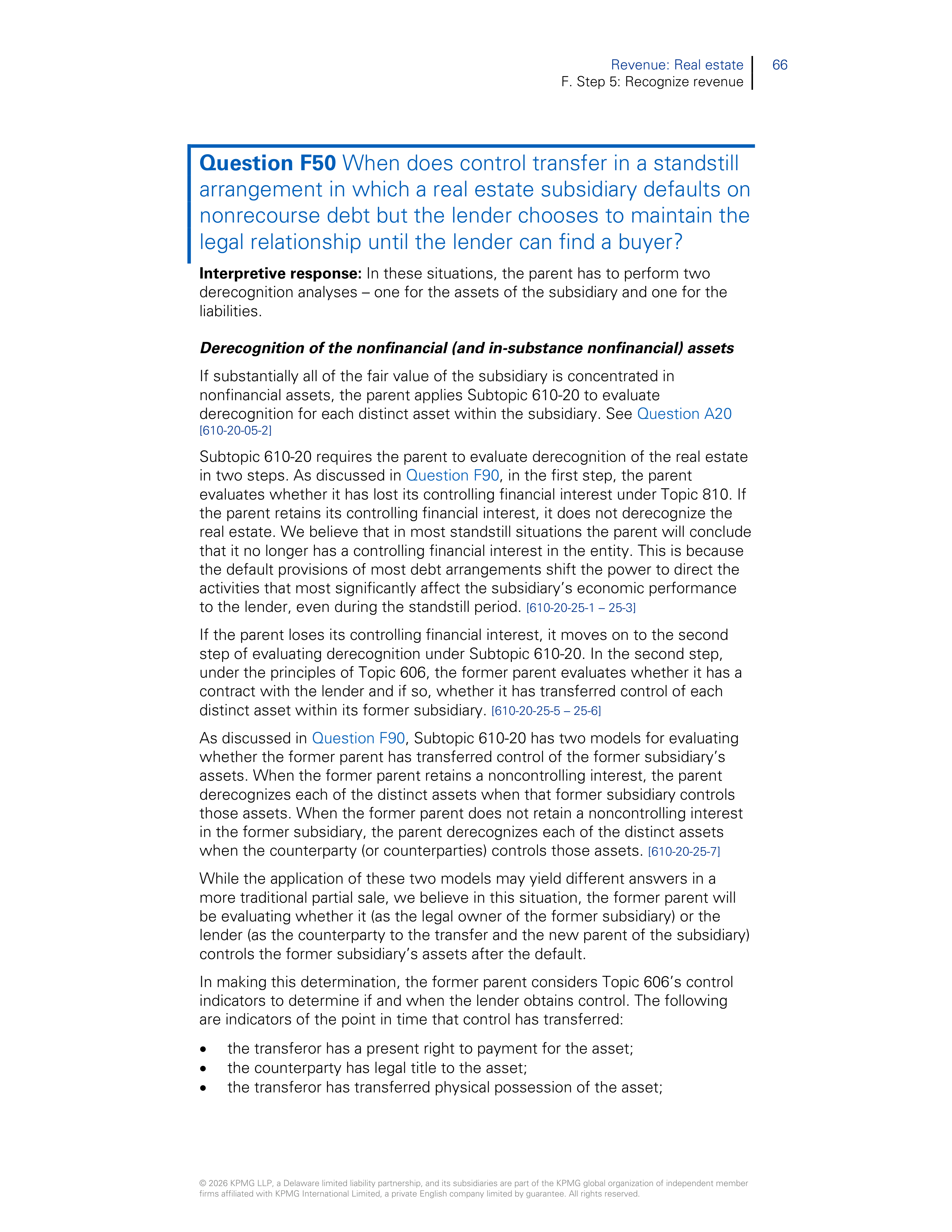
Revenue: Real estate
66
F. Step 5: Recognize revenue
© 2026 KPMG LLP, a Delaware limited liability partnership, and its subsidiaries are part of the KPMG global organization of independent member
firms affiliated with KPMG International Limited, a private English company limited by guarantee. All rights reserved.
Question F50
When does control transfer in a standstill
arrangement in which a real estate subsidiary defaults on
nonrecourse debt but the lender chooses to maintain the
legal relationship until the lender can find a buyer?
Interpretive response:
In these situations, the parent has to perform two
derecognition analyses – one for the assets of the subsidiary and one for the
liabilities.
Derecognition of the nonfinancial (and in-substance nonfinancial) assets
If substantially all of the fair value of the subsidiary is concentrated in
nonfinancial assets, the parent applies Subtopic 610-20 to evaluate
derecognition for each distinct asset within the subsidiary. See
Question A20
[610-20-05-2]
Subtopic 610-20 requires the parent to evaluate derecognition of the real estate
in two steps. As discussed in
Question F90
, in the first step, the parent
evaluates whether it has lost its controlling financial interest under Topic 810. If
the parent retains its controlling financial interest, it does not derecognize the
real estate. We believe that in most standstill situations the parent will conclude
that it no longer has a controlling financial interest in the entity. This is because
the default provisions of most debt arrangements shift the power to direct the
activities that most significantly affect the subsidiary’s economic performance
to the lender, even during the standstill period.
[610-20-25-1 – 25-3]
If the parent loses its controlling financial interest, it moves on to the second
step of evaluating derecognition under Subtopic 610-20. In the second step,
under the principles of Topic 606, the former parent evaluates whether it has a
contract with the lender and if so, whether it has transferred control of each
distinct asset within its former subsidiary.
[610-20-25-5 – 25-6]
As discussed in
Question F90
, Subtopic 610-20 has two models for evaluating
whether the former parent has transferred control of the former subsidiary’s
assets. When the former parent retains a noncontrolling interest, the parent
derecognizes each of the distinct assets when that former subsidiary controls
those assets. When the former parent does not retain a noncontrolling interest
in the former subsidiary, the parent derecognizes each of the distinct assets
when the counterparty (or counterparties) controls those assets.
[610-20-25-7]
While the application of these two models may yield different answers in a
more traditional partial sale, we believe in this situation, the former parent will
be evaluating whether it (as the legal owner of the former subsidiary) or the
lender (as the counterparty to the transfer and the new parent of the subsidiary)
controls the former subsidiary’s assets after the default.
In making this determination, the former parent considers Topic 606’s control
indicators to determine if and when the lender obtains control. The following
are indicators of the point in time that control has transferred:
•
the transferor has a present right to payment for the asset;
•
the counterparty has legal title to the asset;
•
the transferor has transferred physical possession of the asset;
Revenue: Real estate
67
F. Step 5: Recognize revenue
© 2026 KPMG LLP, a Delaware limited liability partnership, and its subsidiaries are part of the KPMG global organization of independent member
firms affiliated with KPMG International Limited, a private English company limited by guarantee. All rights reserved.
•
the counterparty has the significant risks and rewards of ownership of the
asset; and
•
the counterparty has accepted the asset.
[606-10-25-30, 610-20-25-6]
While the transfer of legal title and physical possession often are key indicators
of control in the context of real estate sale transactions (see
Question F10
), we
believe further analysis is necessary. In standstill arrangements, we believe the
fact that the counterparty has the significant risks and rewards of ownership of
the asset may be the most significant indicator of whether control has
transferred.
For example, the guidance states that physical possession may not coincide
with control of an asset in some repurchase or consignment arrangements
when the customer has physical possession but the seller has control, and in
some bill-and-hold transactions when the seller has physical possession but the
customer controls. For a counterparty to have obtained control of a product (or
asset) in a bill-and-hold arrangement, the transaction must meet all of the
following criteria:
a.
the reason for the bill-and-hold arrangement must be substantive – e.g. the
counterparty has requested the arrangement;
b.
the product must be identified separately as belonging to the counterparty;
c.
the product currently must be ready for physical transfer to the
counterparty; and
d.
the transferor cannot have the ability to use the product or to direct it to
another counterparty.
[606-10-55-83, 25-30(c)]
We believe that in many standstill arrangements, the transfer will meet all of
these criteria, which leads to the conclusion that the lender would have control
even though the former parent maintains physical possession through its
ownership interest in the subsidiary. In consideration of criterion (d), while the
former parent continues to operate the property through the subsidiary during
the standstill period (and therefore
uses
it), the lender may have the right to
receive as debt service payments substantially all of the cash flows arising from
the property’s operations.
In addition, the former parent generally does not have the ability to sell the
property (or its interest in the subsidiary) to another party, benefit from changes
in the fair value of the property, or otherwise have the power to direct the
activities that most significantly affect the property’s economic performance
(based on the guidance in Subtopic 810-10).
We believe the control analysis during the standstill period also is similar to the
analysis performed when there is a repurchase option in place. This guidance
indicates that the holder of an option to acquire the asset (the lender in this
case) may presently control the asset even though the other party has physical
possession.
[606-10-55-66 – 55-71]
When the parent concludes it no longer has a controlling financial interest in the
subsidiary and it no longer controls the assets within the former subsidiary, it
derecognizes the assets and recognizes as a gain or loss equal to the difference
between the amount of consideration it is entitled to receive and the carrying
amount of the real estate. In this case, the consideration likely is limited to the
carrying amount of the liabilities that the lender has promised to (or must)
Revenue: Real estate
68
F. Step 5: Recognize revenue
© 2026 KPMG LLP, a Delaware limited liability partnership, and its subsidiaries are part of the KPMG global organization of independent member
firms affiliated with KPMG International Limited, a private English company limited by guarantee. All rights reserved.
assume or relieve (after applying the constraint under Topic 606) when the
standstill arrangement terminates. See
Questions A20
and
D50
.
[610-20-32-2, 32-5]
Derecognition of the liabilities
Generally in standstill agreements, control of the real estate transfers before
the liabilities are extinguished under Topic 405. In these situations, the seller
recognizes the carrying amount of the liabilities (after applying the constraint as
discussed above and in
Question D50
) as a contract asset. The contract asset
represents the consideration that the former parent has not yet received in
exchange for transferring the assets.
[405-20-40-1, 606-10-32-11, 610-20-32-5, 45-3]
Question 17.4.20 of KPMG Handbook,
Revenue recognition
, provides additional
discussion about recognizing contract assets and liabilities in a Subtopic 610-20
transaction.
Question F60
Has control transferred if in connection
with the sale of real estate, the seller provides the buyer
with an option to put the property back to the seller?
Interpretive response:
Topic 606 provides guidance on accounting for a
seller’s obligation to repurchase a property at the buyer’s request (a put option).
The accounting for these transactions generally depends on the relationships
between the repurchase price, the original selling price and the market value of
the property. This guidance applies equally to transactions with noncustomers
in the scope of Subtopic 610-20.
[606-10-55-72 – 55-78, 610-20-25-6]
Put option
(a customer’s right to require the seller to repurchase the asset)
Repurchase price equal
to or greater than
original selling price?
Repurchase price
greater than expected
market value of asset?
Financing
arrangement
Customer has
significant economic
incentive to exercise the
put option?
Sale with a right
of return
Lease
1
Yes
Yes
No
No
No
Yes
Revenue: Real estate
69
F. Step 5: Recognize revenue
© 2026 KPMG LLP, a Delaware limited liability partnership, and its subsidiaries are part of the KPMG global organization of independent member
firms affiliated with KPMG International Limited, a private English company limited by guarantee. All rights reserved.
Note:
1.
If the contract is part of a sale-leaseback transaction it is accounted for as a
financing arrangement.
To determine whether the buyer has a significant economic incentive to
exercise its put right, the seller considers the facts and circumstances including
the relationship of the repurchase price to the expected market value of the
property at the date of the repurchase (including consideration of the time value
of money) and the amount of time until the right expires. If the repurchase price
is expected to significantly exceed the market value of the property, this may
indicate the buyer has a significant economic incentive to exercise the put
option and require the seller to reacquire the property.
If the seller accounts for the contract as a financing arrangement, it continues to
recognize the property and also recognizes a financial liability initially equal to
the consideration received from the buyer. The seller recognizes amounts paid
to the buyer above that amount as interest expense. If the option lapses
unexercised, the seller derecognizes the property and the liability and
recognizes revenue or gain.
[606-10-55-70 – 55-71, 610-20-25-6]
Question F70
Has control transferred if in connection
with the sale of real estate, the seller obtains the right
(or has an obligation) to repurchase the property?
Interpretive response:
Topic 606 provides guidance on accounting for a
seller’s right to repurchase a property (a call option) and a seller’s obligation to
repurchase a property (a forward). A seller’s right under a call option (or
obligation under a forward agreement) to repurchase the property precludes
transfer of control to the buyer because the buyer is limited in its ability to direct
the use of, and obtain substantially all of the remaining benefits from, the
property even though it may have physical possession of the property. Whether
the contract is accounted for as a lease or a financing depends on the
relationship between the repurchase price and the original selling price. This
guidance applies equally to transactions with noncustomers in the scope of
Subtopic 610-20. See section 7.5.60 of KPMG Handbook,
Revenue recognition
,
which provides additional guidance on accounting for forward and call options
under Topic 606.
[606-10-55-68 – 55-71, 610-20-25-6]
Revenue: Real estate
70
F. Step 5: Recognize revenue
© 2026 KPMG LLP, a Delaware limited liability partnership, and its subsidiaries are part of the KPMG global organization of independent member
firms affiliated with KPMG International Limited, a private English company limited by guarantee. All rights reserved.
The customer does not obtain control of the asset
Forward
(a seller’s obligation to
repurchase the asset)
Call option
(a seller’s right to repurchase
the asset)
Asset repurchased for less than original
selling price?
Lease arrangement
1
Financing arrangement
Yes
No
Note:
1.
If the contract is part of a sale-leaseback transaction, it is accounted for as a
financing arrangement.
While an option to repurchase the property at fair value arguably allows the
buyer to obtain substantially all of the remaining benefits from the property, it
limits the buyer’s ability to direct the use of the asset. We believe sales subject
to a seller’s call option that is exercisable at fair value are accounted for as a
leasing or financing arrangement depending on the expectation of the
property’s fair value over the option period relative to the original selling price.
We expect these transactions generally to be accounted for as financing
arrangements.
This guidance applies to both conditional and unconditional rights and does not
permit or require an assessment of the probability that a conditional right will
become unconditional. However, we believe if the condition that makes the
right exercisable is controlled by the buyer, then a seller generally considers
whether the buyer has the economic incentive to trigger the seller’s right to
repurchase (similar to the analysis on evaluating buyer put options). An example
of when the buyer controls whether the seller can exercise the repurchase right
is an anti-speculation clause in which the seller has the right to repurchase the
property only if the buyer fails to comply with certain provisions of the sales
contract.
[606-10-55-72 – 55-78]
As discussed in
Question F60
, if the buyer has an economic incentive not to
comply with the contract that triggers the seller’s right to repurchase the asset,
or there is greater than a remote likelihood the buyer will not comply for other
reasons (notwithstanding its ability to comply with the contract), the contract is
accounted for as a lease or a financing arrangement. That accounting depends
on the relationship between the repurchase price and the original selling price.
If the buyer does not have a significant economic incentive to trigger the
seller’s right to repurchase the asset, and it is remote that the buyer would
trigger the seller’s repurchase right for other reasons, the seller follows the
guidance on sales with a right of return that prevents recognition of revenue or
gain only if the seller expects the buyer to return the property.
[606-10-55-22 – 55-
29]
Revenue: Real estate
71
F. Step 5: Recognize revenue
© 2026 KPMG LLP, a Delaware limited liability partnership, and its subsidiaries are part of the KPMG global organization of independent member
firms affiliated with KPMG International Limited, a private English company limited by guarantee. All rights reserved.
In contrast, when the seller controls the right, we believe that generally the
contingency should be ignored and the entity should account for the contract as
a lease or financing arrangement because that right is no different than an
unconditional right. However, if the option is not substantive, the entity should
ignore the provision.
If neither the buyer nor the seller entirely controls the condition, the seller
would consider the effect of the condition on the buyer’s ability to control the
asset. Remote contingencies such as a natural disaster generally do not
preclude the buyer from obtaining control. However, a contingency that is more
than remote may restrict the buyer’s ability to direct the use of, and obtain
substantially all of the remaining benefits from, the asset for substantially all of
its estimated useful life.
The following examples illustrate this point.
•
When the buyer is obligated to stand ready to return the property for a
period of time and cannot use up or consume the entire property until after
the right lapses, the contract should be accounted for as a lease or a
financing. This would also be true if the right restricted the buyer’s ability to
benefit from reselling the property because the property could only be sold
subject to the repurchase right. If the right expires, the seller would
derecognize any liability and recognize revenue.
[ASU 2014-09.BC424]
•
When the condition is more than remote, but the right does not restrict the
buyer’s ability to direct the use or obtain substantially all the benefits of the
asset, the conditional right may more appropriately be accounted for as a
right of return.
Question F80
Is a right of first refusal (or a right of first
offer) considered an obligation or right to repurchase the
property?
Interpretive response:
We do not believe a right of first refusal based on a
bona fide offer by a third party constitutes an obligation or right to repurchase
the property. Even if a seller of real estate includes a right of first refusal on the
real estate as a condition of the sale, the buyer of that real estate still has the
ability to direct the use of, and obtain substantially all of the remaining benefits
from, the property because:
•
the buyer unilaterally controls the decision about whether and when to sell
the asset; and
•
if the buyer does decide to sell the asset, it will realize the asset’s
remaining benefits even if the original seller exercises its right because the
original seller must match the amount offered by the third party.
We believe a similar conclusion applies to a right of first offer that allows the
original seller to make an offer to the buyer before the buyer solicits or receives
offers from third parties to resell the property. However, the buyer must be able
to act in its best interest and must not be economically or contractually
Revenue: Real estate
72
F. Step 5: Recognize revenue
© 2026 KPMG LLP, a Delaware limited liability partnership, and its subsidiaries are part of the KPMG global organization of independent member
firms affiliated with KPMG International Limited, a private English company limited by guarantee. All rights reserved.
compelled to accept the offer, nor can the original seller be economically
compelled to make an offer.
The guidance applies to both customer and noncustomer transactions.
Question F90
How should a seller evaluate transfer of
control under Subtopic 610-20 when it transfers
ownership interests in a legal entity (e.g. in a partial sale)
or otherwise retains an interest in the asset (e.g. in a
sale to an equity method investee)?
Interpretive response:
Transfer of control
As discussed in
Question A20
, Subtopic 610-20 applies when a parent
derecognizes a subsidiary if substantially all of the fair value of that subsidiary is
concentrated in nonfinancial assets. As discussed in
Question F50
, that
guidance requires the parent to evaluate derecognition of the underlying assets
in two steps.
Step one
In the first step, the parent evaluates whether it has lost its controlling financial
interest under Topic 810. If the parent retains its controlling financial interest, it
does not derecognize the assets. Rather, it accounts for the sale of the
noncontrolling interests under Topic 810’s guidance covering decreases in
ownership. That guidance requires the parent to recognize the transaction in
equity.
[610-20-25-1 – 25-3, 810-10-45-21A – 45-24]
Step two
If the parent loses its controlling financial interest, it moves on to the second
step of evaluating derecognition under Subtopic 610-20. In the second step,
using the principles of Topic 606, the former parent evaluates whether it has a
contract with the buyer and, if so, whether it has transferred control of each
distinct asset within its former subsidiary.
[610-20-25-5 – 25-6]
Subtopic 610-20 has two models for evaluating whether the former parent has
transferred control of the former subsidiary’s assets.
[610-20-25-7]
Former parent retains a noncontrolling interest
When the former parent retains a noncontrolling interest in the former
subsidiary (i.e. the legal entity that holds the real estate), the parent
derecognizes each of the distinct assets when that former subsidiary controls
those assets. The former subsidiary controls those assets when it can direct
the use of, and obtain substantially all of the benefits from, each distinct asset.
Because in most cases the subsidiary owns and controls the assets before the
former parent sells the ownership interest in the subsidiary to a third party, we
believe most partial ownership sales will result in gain recognition when the
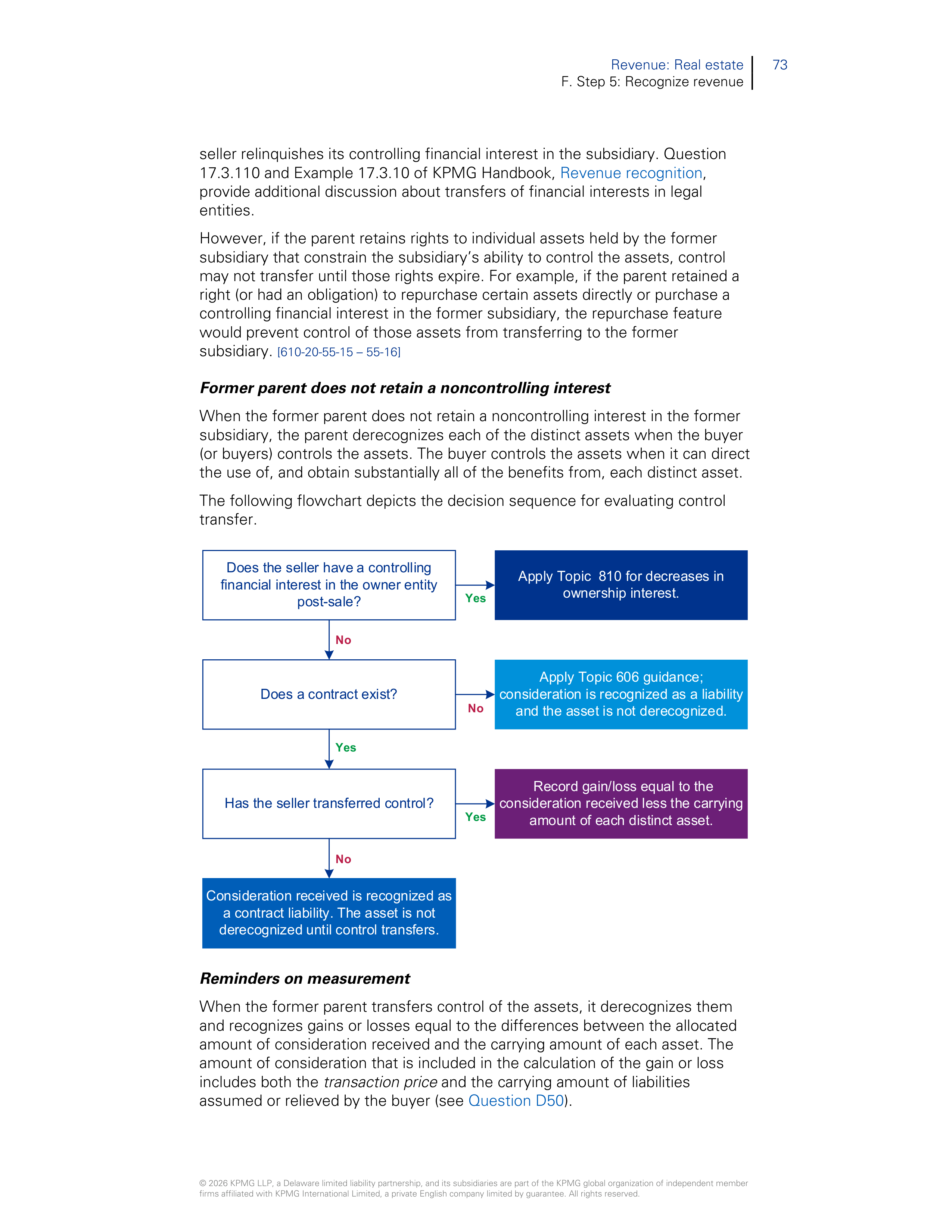
Revenue: Real estate
73
F. Step 5: Recognize revenue
© 2026 KPMG LLP, a Delaware limited liability partnership, and its subsidiaries are part of the KPMG global organization of independent member
firms affiliated with KPMG International Limited, a private English company limited by guarantee. All rights reserved.
seller relinquishes its controlling financial interest in the subsidiary. Question
17.3.110 and Example 17.3.10 of KPMG Handbook,
Revenue recognition
,
provide additional discussion about transfers of financial interests in legal
entities.
However, if the parent retains rights to individual assets held by the former
subsidiary that constrain the subsidiary’s ability to control the assets, control
may not transfer until those rights expire. For example, if the parent retained a
right (or had an obligation) to repurchase certain assets directly or purchase a
controlling financial interest in the former subsidiary, the repurchase feature
would prevent control of those assets from transferring to the former
subsidiary.
[610-20-55-15 – 55-16]
Former parent does not retain a noncontrolling interest
When the former parent does not retain a noncontrolling interest in the former
subsidiary, the parent derecognizes each of the distinct assets when the buyer
(or buyers) controls the assets. The buyer controls the assets when it can direct
the use of, and obtain substantially all of the benefits from, each distinct asset.
The following flowchart depicts the decision sequence for evaluating control
transfer.
Does the seller have a controlling
financial interest in the owner entity
post-sale?
Yes
Does a contract exist?
No
Has the seller transferred control?
Yes
Yes
Apply Topic 810 for decreases in
ownership interest.
Apply Topic 606 guidance;
consideration is recognized as a liability
and the asset is not derecognized.
Record gain/loss equal to the
consideration received less the carrying
amount of each distinct asset.
Consideration received is recognized as
a contract liability. The asset is not
derecognized until control transfers.
No
No
Reminders on measurement
When the former parent transfers control of the assets, it derecognizes them
and recognizes gains or losses equal to the differences between the allocated
amount of consideration received and the carrying amount of each asset. The
amount of consideration that is included in the calculation of the gain or loss
includes both the
transaction price
and the carrying amount of liabilities
assumed or relieved by the buyer (see
Question D50
).
Revenue: Real estate
74
F. Step 5: Recognize revenue
© 2026 KPMG LLP, a Delaware limited liability partnership, and its subsidiaries are part of the KPMG global organization of independent member
firms affiliated with KPMG International Limited, a private English company limited by guarantee. All rights reserved.
As discussed in
Question D40
, the transaction price includes the fair value of
noncash consideration the former parent receives in the form of a
noncontrolling interest. By including the fair value of the noncontrolling interest
in the transaction price, the former parent will recognize a 100% gain on these
transactions when control of the nonfinancial (or in-substance nonfinancial)
assets transfer to the counterparty.
Consider how the guidance is applied in the following transactions.
Transaction 1:
A seller and a third-party investor form a venture. The seller
contributes real estate to the newly formed venture and the third party investor
contributes cash, property or services. The seller retains a controlling financial
interest in the venture post-sale and no interest in the third party. Under
Subtopic 610-20, because the seller retains a controlling financial interest in the
venture, it applies the guidance in Topic 810 on decreases in ownership. The
seller will not recognize a gain in income.
Transaction 2:
Assume the same facts as Transaction 1 except the seller
retains only a noncontrolling interest in the venture post
‑
sale. The venture may
be a joint venture. Under Subtopic 610-20, because the seller relinquishes its
controlling financial interest in the venture and the former subsidiary controls
the underlying assets, the seller measures its noncontrolling interest at fair
value and recognizes a 100% gain in income from the derecognition of the
underlying assets.
Transaction 3:
A seller contributes real estate to a newly formed, wholly
owned venture. Sometime later, it sells a partial ownership interest in the
venture to a third-party investor for cash, property or services. The
consideration may come directly from the investor to the seller or may be
contributed by the investor to the venture. The seller retains a controlling
financial interest in the venture post
‑
sale and no interest in the third party.
Under Subtopic 610-20, because the seller retains a controlling financial interest
in the venture, it applies the guidance in Topic 810 on decreases in ownership.
The seller will not recognize a gain in income.
Transaction 4:
Assume the same facts as Transaction 3 except the seller has
only a noncontrolling interest in the venture post
‑
sale. The venture may be a
joint venture. Under Subtopic 610-20, because the seller relinquishes its
controlling financial interest in the venture and the former subsidiary controls
the underlying assets, the seller measures its noncontrolling interest at fair
value and recognizes a 100% gain in income from the derecognition of the
underlying assets (see Example 17.3.50 of KPMG Handbook,
Revenue
recognition
).
Transaction 5:
A seller transfers real estate to an existing equity method
investee for consideration. Under Subtopic 610-20, because the seller has only
a noncontrolling interest in the investee and the investee controls the
underlying assets, the seller measures a 100% gain in income from the
derecognition of the real estate. If the transaction results in an increase in the
seller’s share of the investee’s net assets, that amount is recognized at fair
value.
Under the current guidance, the accounting is not affected by the form of the
consideration received. The seller does not need to receive cash in the transfer
to derecognize the assets and recognize a gain or loss. The seller can receive
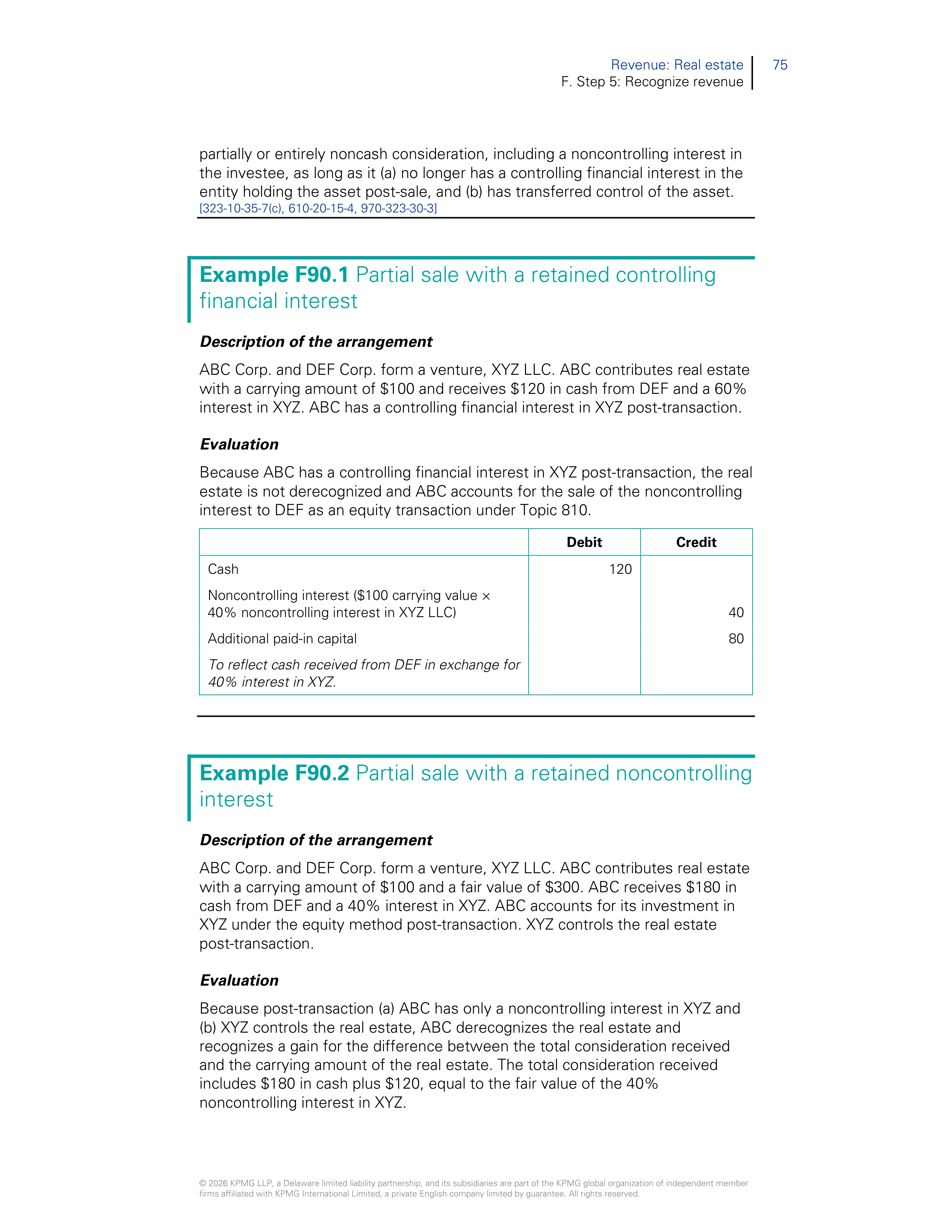
Revenue: Real estate
75
F. Step 5: Recognize revenue
© 2026 KPMG LLP, a Delaware limited liability partnership, and its subsidiaries are part of the KPMG global organization of independent member
firms affiliated with KPMG International Limited, a private English company limited by guarantee. All rights reserved.
partially or entirely noncash consideration, including a noncontrolling interest in
the investee, as long as it (a) no longer has a controlling financial interest in the
entity holding the asset post-sale, and (b) has transferred control of the asset.
[323-10-35-7(c), 610-20-15-4, 970-323-30-3]
Example F90.1
Partial sale with a retained controlling
financial interest
Description of the arrangement
ABC Corp. and DEF Corp. form a venture, XYZ LLC. ABC contributes real estate
with a carrying amount of $100 and receives $120 in cash from DEF and a 60%
interest in XYZ. ABC has a controlling financial interest in XYZ post-transaction.
Evaluation
Because ABC has a controlling financial interest in XYZ post-transaction, the real
estate is not derecognized and ABC accounts for the sale of the noncontrolling
interest to DEF as an equity transaction under Topic 810.
Debit
Credit
Cash
120
Noncontrolling interest ($100 carrying value ×
40% noncontrolling interest in XYZ LLC)
40
Additional paid-in capital
80
To reflect cash received from DEF in exchange for
40% interest in XYZ.
Example F90.2
Partial sale with a retained noncontrolling
interest
Description of the arrangement
ABC Corp. and DEF Corp. form a venture, XYZ LLC. ABC contributes real estate
with a carrying amount of $100 and a fair value of $300. ABC receives $180 in
cash from DEF and a 40% interest in XYZ. ABC accounts for its investment in
XYZ under the equity method post-transaction. XYZ controls the real estate
post-transaction.
Evaluation
Because post-transaction (a) ABC has only a noncontrolling interest in XYZ and
(b) XYZ controls the real estate, ABC derecognizes the real estate and
recognizes a gain for the difference between the total consideration received
and the carrying amount of the real estate. The total consideration received
includes $180 in cash plus $120, equal to the fair value of the 40%
noncontrolling interest in XYZ.
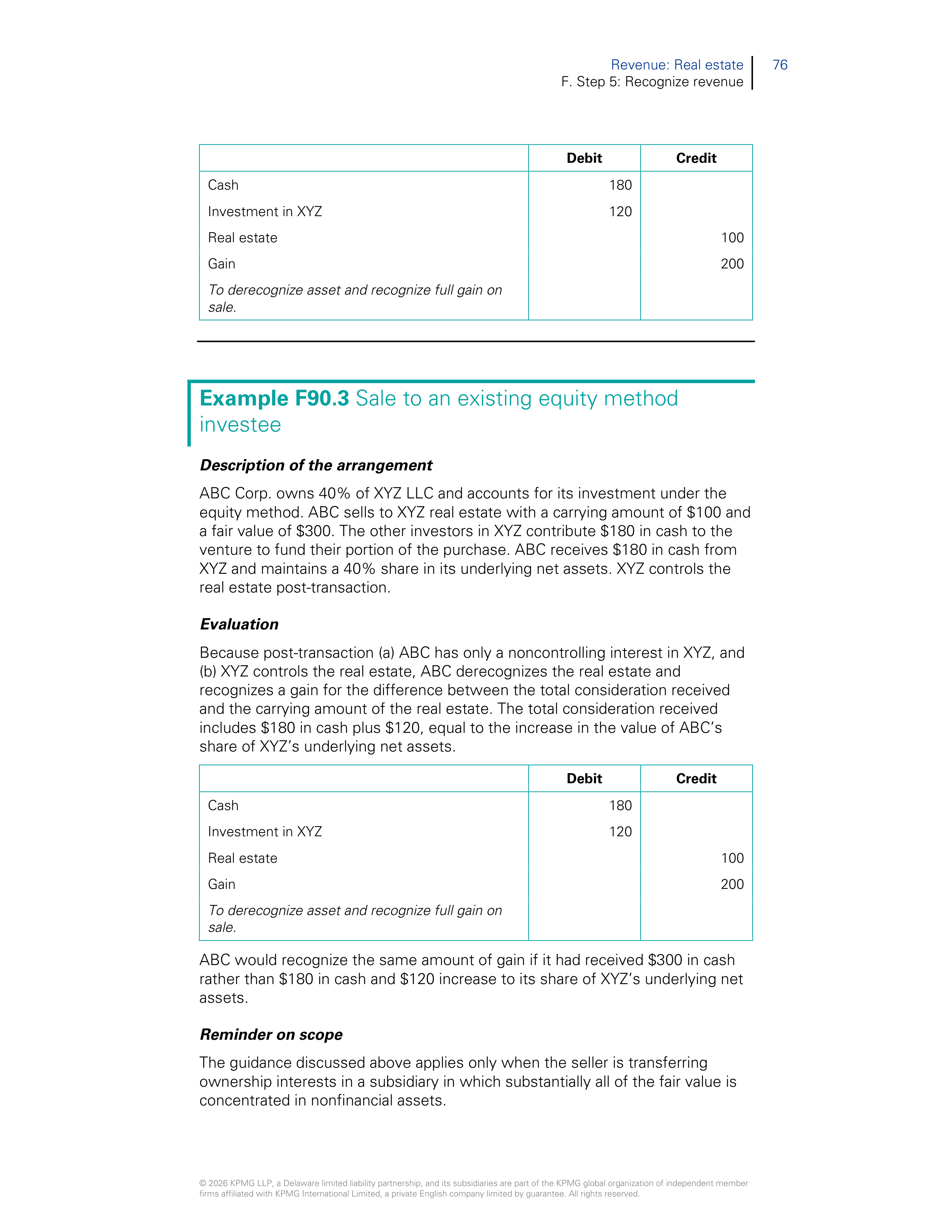
Revenue: Real estate
76
F. Step 5: Recognize revenue
© 2026 KPMG LLP, a Delaware limited liability partnership, and its subsidiaries are part of the KPMG global organization of independent member
firms affiliated with KPMG International Limited, a private English company limited by guarantee. All rights reserved.
Debit
Credit
Cash
180
Investment in XYZ
120
Real estate
100
Gain
200
To derecognize asset and recognize full gain on
sale.
Example F90.3
Sale to an existing equity method
investee
Description of the arrangement
ABC Corp. owns 40% of XYZ LLC and accounts for its investment under the
equity method. ABC sells to XYZ real estate with a carrying amount of $100 and
a fair value of $300. The other investors in XYZ contribute $180 in cash to the
venture to fund their portion of the purchase. ABC receives $180 in cash from
XYZ and maintains a 40% share in its underlying net assets. XYZ controls the
real estate post-transaction.
Evaluation
Because post-transaction (a) ABC has only a noncontrolling interest in XYZ, and
(b) XYZ controls the real estate, ABC derecognizes the real estate and
recognizes a gain for the difference between the total consideration received
and the carrying amount of the real estate. The total consideration received
includes $180 in cash plus $120, equal to the increase in the value of ABC’s
share of XYZ’s underlying net assets.
Debit
Credit
Cash
180
Investment in XYZ
120
Real estate
100
Gain
200
To derecognize asset and recognize full gain on
sale.
ABC would recognize the same amount of gain if it had received $300 in cash
rather than $180 in cash and $120 increase to its share of XYZ’s underlying net
assets.
Reminder on scope
The guidance discussed above applies only when the seller is transferring
ownership interests in a subsidiary in which substantially all of the fair value is
concentrated in nonfinancial assets.
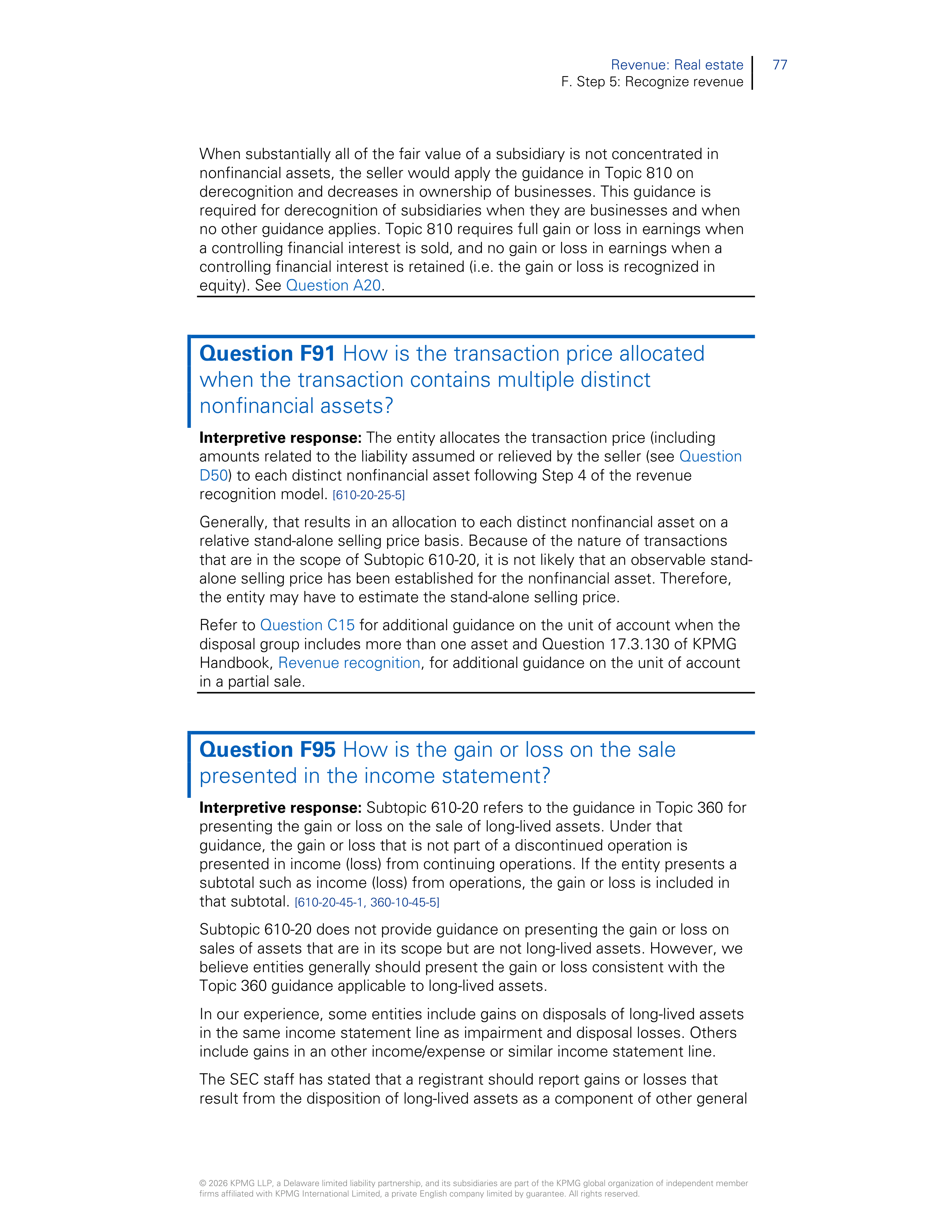
Revenue: Real estate
77
F. Step 5: Recognize revenue
© 2026 KPMG LLP, a Delaware limited liability partnership, and its subsidiaries are part of the KPMG global organization of independent member
firms affiliated with KPMG International Limited, a private English company limited by guarantee. All rights reserved.
When substantially all of the fair value of a subsidiary is not concentrated in
nonfinancial assets, the seller would apply the guidance in Topic 810 on
derecognition and decreases in ownership of businesses. This guidance is
required for derecognition of subsidiaries when they are businesses and when
no other guidance applies. Topic 810 requires full gain or loss in earnings when
a controlling financial interest is sold, and no gain or loss in earnings when a
controlling financial interest is retained (i.e. the gain or loss is recognized in
equity). See
Question A20
.
Question F91
How is the transaction price allocated
when the transaction contains multiple distinct
nonfinancial assets?
Interpretive response:
The entity allocates the transaction price (including
amounts related to the liability assumed or relieved by the seller (see
Question
D50
) to each distinct nonfinancial asset following Step 4 of the revenue
recognition model.
[610-20-25-5]
Generally, that results in an allocation to each distinct nonfinancial asset on a
relative stand-alone selling price basis. Because of the nature of transactions
that are in the scope of Subtopic 610-20, it is not likely that an observable stand-
alone selling price has been established for the nonfinancial asset. Therefore,
the entity may have to estimate the stand-alone selling price.
Refer to
Question C15
for additional guidance on the unit of account when the
disposal group includes more than one asset and Question 17.3.130 of KPMG
Handbook,
Revenue recognition
, for additional guidance on the unit of account
in a partial sale.
Question F95
How is the gain or loss on the sale
presented in the income statement?
Interpretive response:
Subtopic 610-20 refers to the guidance in Topic 360 for
presenting the gain or loss on the sale of long-lived assets. Under that
guidance, the gain or loss that is not part of a discontinued operation is
presented in income (loss) from continuing operations. If the entity presents a
subtotal such as income (loss) from operations, the gain or loss is included in
that subtotal.
[610-20-45-1, 360-10-45-5]
Subtopic 610-20 does not provide guidance on presenting the gain or loss on
sales of assets that are in its scope but are not long-lived assets. However, we
believe entities generally should present the gain or loss consistent with the
Topic 360 guidance applicable to long-lived assets.
In our experience, some entities include gains on disposals of long-lived assets
in the same income statement line as impairment and disposal losses. Others
include gains in an other income/expense or similar income statement line.
The SEC staff has stated that a registrant should report gains or losses that
result from the disposition of long-lived assets as a component of other general
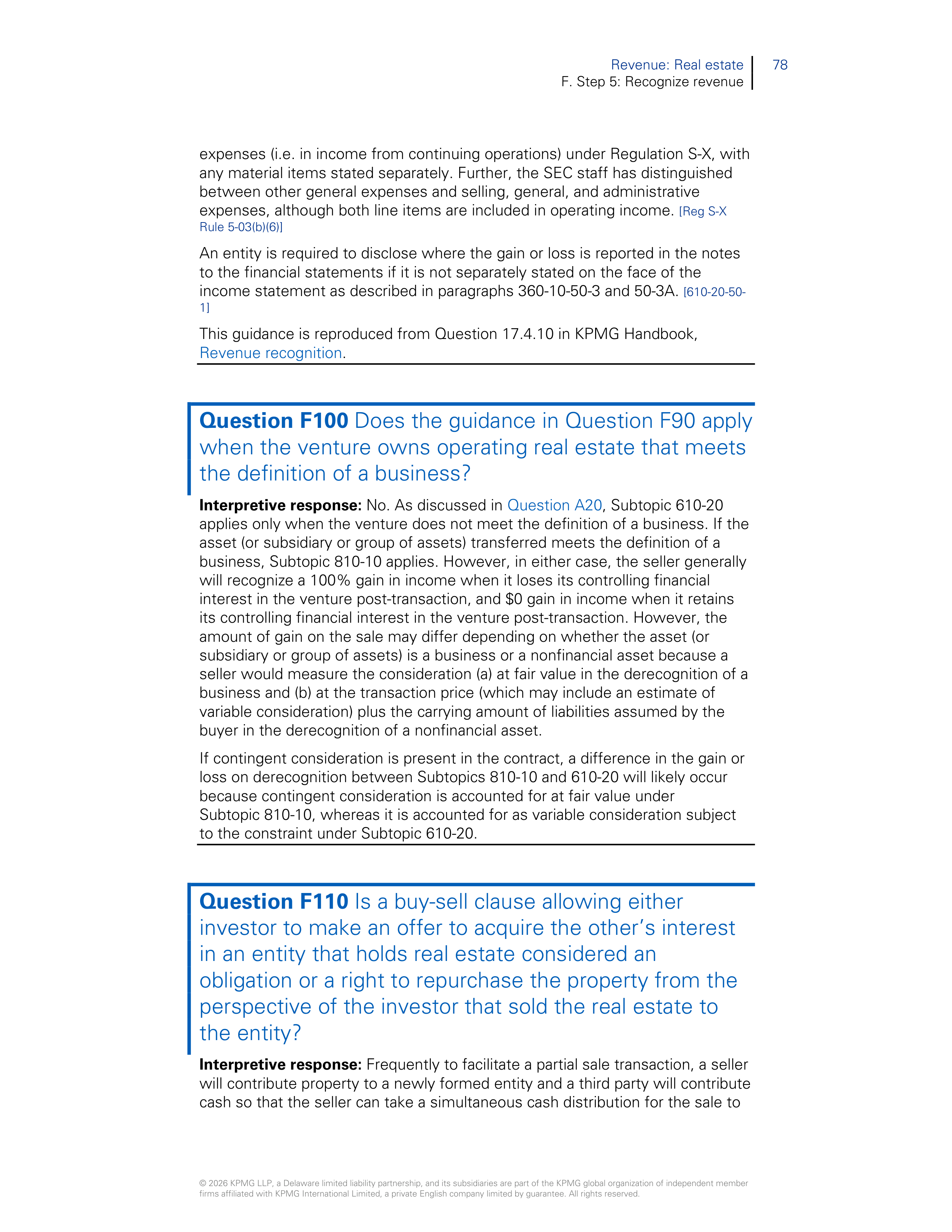
Revenue: Real estate
78
F. Step 5: Recognize revenue
© 2026 KPMG LLP, a Delaware limited liability partnership, and its subsidiaries are part of the KPMG global organization of independent member
firms affiliated with KPMG International Limited, a private English company limited by guarantee. All rights reserved.
expenses (i.e. in income from continuing operations) under Regulation S-X, with
any material items stated separately. Further, the SEC staff has distinguished
between other general expenses and selling, general, and administrative
expenses, although both line items are included in operating income.
[Reg S-X
Rule 5-03(b)(6)]
An entity is required to disclose where the gain or loss is reported in the notes
to the financial statements if it is not separately stated on the face of the
income statement as described in paragraphs 360-10-50-3 and 50-3A.
[610-20-50-
1]
This guidance is reproduced from Question 17.4.10 in KPMG Handbook,
Revenue recognition
.
Question F100
Does the guidance in Question F90 apply
when the venture owns operating real estate that meets
the definition of a business?
Interpretive response:
No. As discussed in
Question A20
, Subtopic 610-20
applies only when the venture does not meet the definition of a business. If the
asset (or subsidiary or group of assets) transferred meets the definition of a
business, Subtopic 810-10 applies. However, in either case, the seller generally
will recognize a 100% gain in income when it loses its controlling financial
interest in the venture post-transaction, and $0 gain in income when it retains
its controlling financial interest in the venture post-transaction. However, the
amount of gain on the sale may differ depending on whether the asset (or
subsidiary or group of assets) is a business or a nonfinancial asset because a
seller would measure the consideration (a) at fair value in the derecognition of a
business and (b) at the transaction price (which may include an estimate of
variable consideration) plus the carrying amount of liabilities assumed by the
buyer in the derecognition of a nonfinancial asset.
If contingent consideration is present in the contract, a difference in the gain or
loss on derecognition between Subtopics 810-10 and 610-20 will likely occur
because contingent consideration is accounted for at fair value under
Subtopic 810-10, whereas it is accounted for as variable consideration subject
to the constraint under Subtopic 610-20.
Question F110
Is a buy-sell clause allowing either
investor to make an offer to acquire the other’s interest
in an entity that holds real estate considered an
obligation or a right to repurchase the property from the
perspective of the investor that sold the real estate to
the entity?
Interpretive response:
Frequently to facilitate a partial sale transaction, a seller
will contribute property to a newly formed entity and a third party will contribute
cash so that the seller can take a simultaneous cash distribution for the sale to
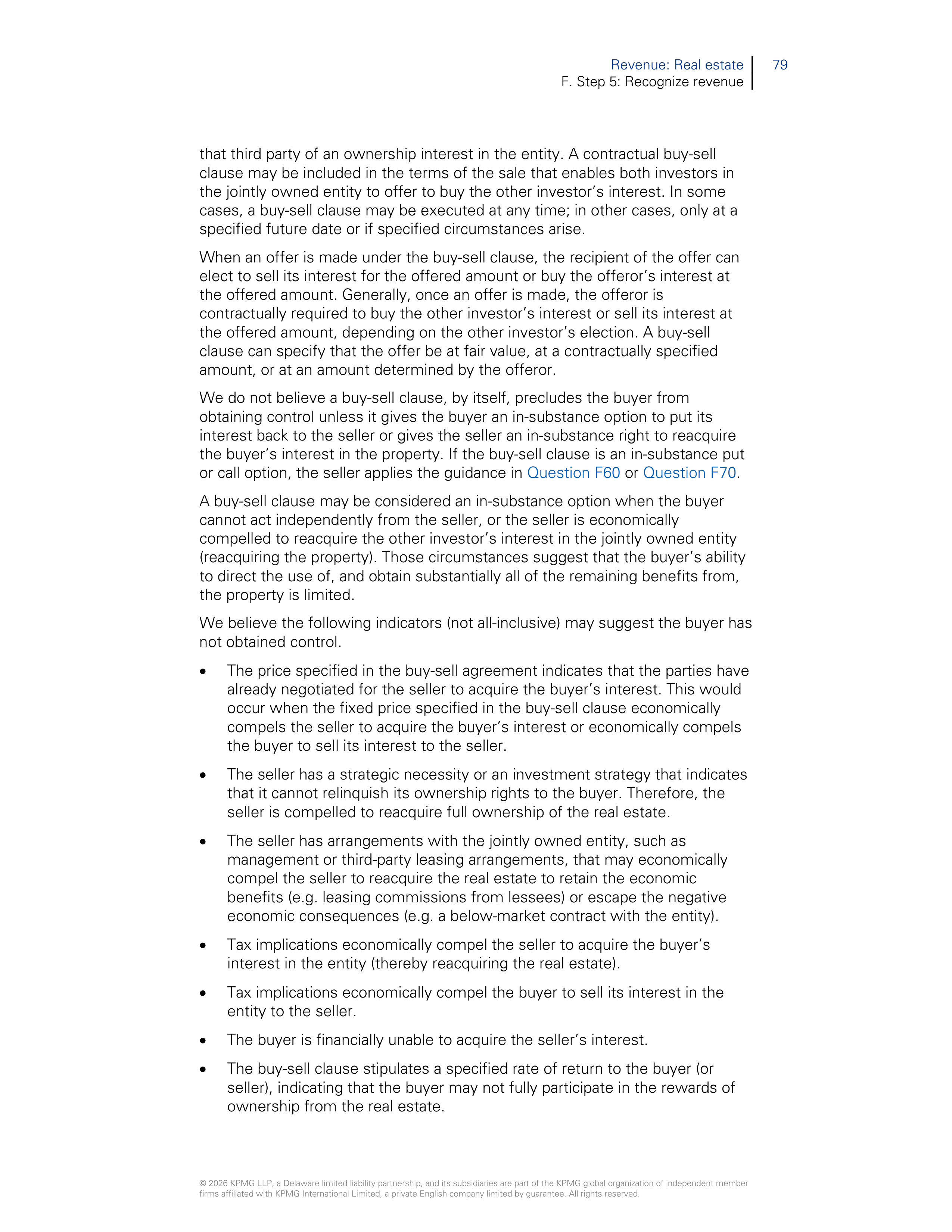
Revenue: Real estate
79
F. Step 5: Recognize revenue
© 2026 KPMG LLP, a Delaware limited liability partnership, and its subsidiaries are part of the KPMG global organization of independent member
firms affiliated with KPMG International Limited, a private English company limited by guarantee. All rights reserved.
that third party of an ownership interest in the entity. A contractual buy-sell
clause may be included in the terms of the sale that enables both investors in
the jointly owned entity to offer to buy the other investor’s interest. In some
cases, a buy-sell clause may be executed at any time; in other cases, only at a
specified future date or if specified circumstances arise.
When an offer is made under the buy-sell clause, the recipient of the offer can
elect to sell its interest for the offered amount or buy the offeror’s interest at
the offered amount. Generally, once an offer is made, the offeror is
contractually required to buy the other investor’s interest or sell its interest at
the offered amount, depending on the other investor’s election. A buy-sell
clause can specify that the offer be at fair value, at a contractually specified
amount, or at an amount determined by the offeror.
We do not believe a buy-sell clause, by itself, precludes the buyer from
obtaining control unless it gives the buyer an in-substance option to put its
interest back to the seller or gives the seller an in-substance right to reacquire
the buyer’s interest in the property. If the buy-sell clause is an in-substance put
or call option, the seller applies the guidance in
Question F60
or
Question F70
.
A buy-sell clause may be considered an in-substance option when the buyer
cannot act independently from the seller, or the seller is economically
compelled to reacquire the other investor’s interest in the jointly owned entity
(reacquiring the property). Those circumstances suggest that the buyer’s ability
to direct the use of, and obtain substantially all of the remaining benefits from,
the property is limited.
We believe the following indicators (not all-inclusive) may suggest the buyer has
not obtained control.
•
The price specified in the buy-sell agreement indicates that the parties have
already negotiated for the seller to acquire the buyer’s interest. This would
occur when the fixed price specified in the buy-sell clause economically
compels the seller to acquire the buyer’s interest or economically compels
the buyer to sell its interest to the seller.
•
The seller has a strategic necessity or an investment strategy that indicates
that it cannot relinquish its ownership rights to the buyer. Therefore, the
seller is compelled to reacquire full ownership of the real estate.
•
The seller has arrangements with the jointly owned entity, such as
management or third-party leasing arrangements, that may economically
compel the seller to reacquire the real estate to retain the economic
benefits (e.g. leasing commissions from lessees) or escape the negative
economic consequences (e.g. a below-market contract with the entity).
•
Tax implications economically compel the seller to acquire the buyer’s
interest in the entity (thereby reacquiring the real estate).
•
Tax implications economically compel the buyer to sell its interest in the
entity to the seller.
•
The buyer is financially unable to acquire the seller’s interest.
•
The buy-sell clause stipulates a specified rate of return to the buyer (or
seller), indicating that the buyer may not fully participate in the rewards of
ownership from the real estate.
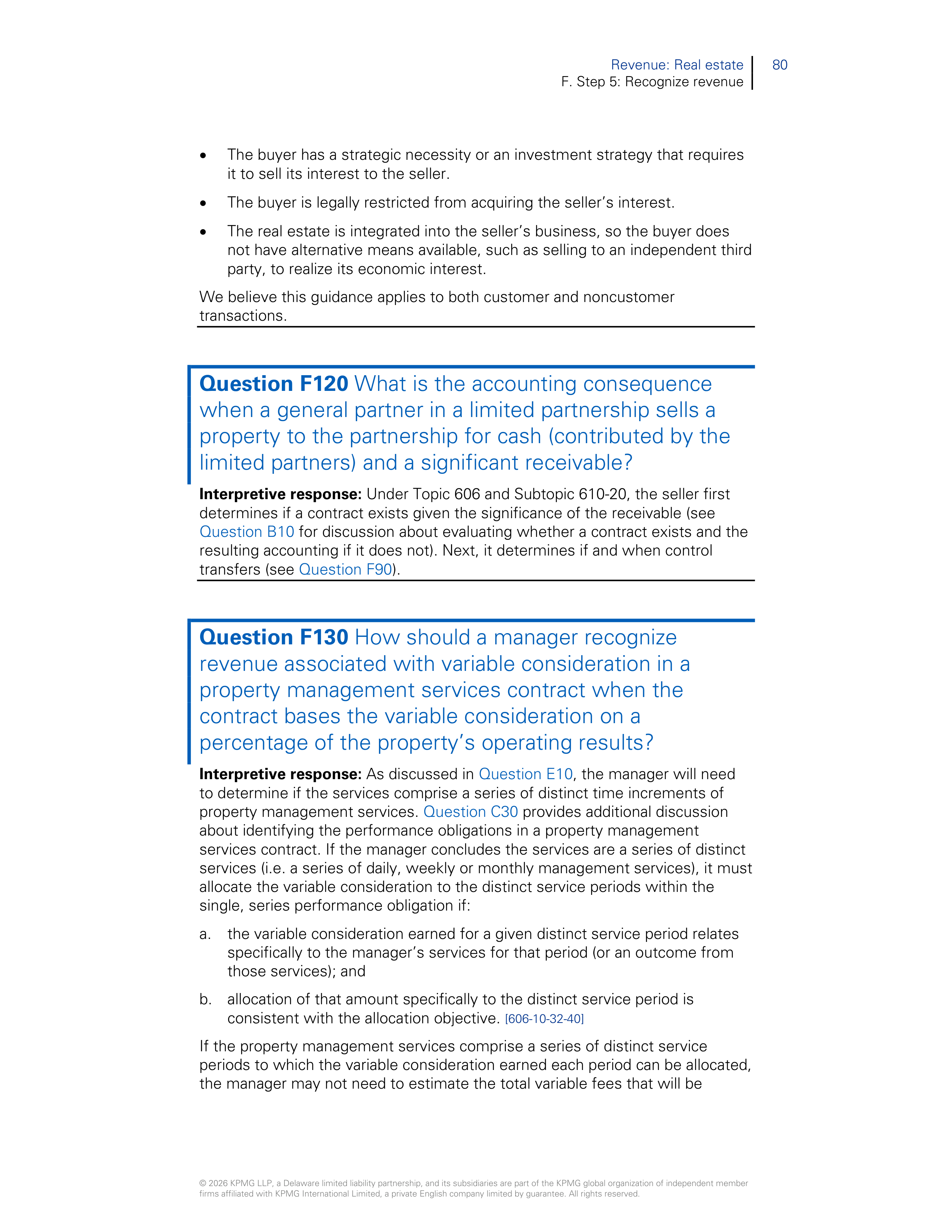
Revenue: Real estate
80
F. Step 5: Recognize revenue
© 2026 KPMG LLP, a Delaware limited liability partnership, and its subsidiaries are part of the KPMG global organization of independent member
firms affiliated with KPMG International Limited, a private English company limited by guarantee. All rights reserved.
•
The buyer has a strategic necessity or an investment strategy that requires
it to sell its interest to the seller.
•
The buyer is legally restricted from acquiring the seller’s interest.
•
The real estate is integrated into the seller’s business, so the buyer does
not have alternative means available, such as selling to an independent third
party, to realize its economic interest.
We believe this guidance applies to both customer and noncustomer
transactions.
Question F120
What is the accounting consequence
when a general partner in a limited partnership sells a
property to the partnership for cash (contributed by the
limited partners) and a significant receivable?
Interpretive response:
Under Topic 606 and Subtopic 610-20, the seller first
determines if a contract exists given the significance of the receivable (see
Question B10
for discussion about evaluating whether a contract exists and the
resulting accounting if it does not). Next, it determines if and when control
transfers (see
Question F90
).
Question F130
How should a manager recognize
revenue associated with variable consideration in a
property management services contract when the
contract bases the variable consideration on a
percentage of the property’s operating results?
Interpretive response:
As discussed in
Question E10
, the manager will need
to determine if the services comprise a series of distinct time increments of
property management services.
Question C30
provides additional discussion
about identifying the performance obligations in a property management
services contract. If the manager concludes the services are a series of distinct
services (i.e. a series of daily, weekly or monthly management services), it must
allocate the variable consideration to the distinct service periods within the
single, series performance obligation if:
a.
the variable consideration earned for a given distinct service period relates
specifically to the manager’s services for that period (or an outcome from
those services); and
b.
allocation of that amount specifically to the distinct service period is
consistent with the allocation objective.
[606-10-32-40]
If the property management services comprise a series of distinct service
periods to which the variable consideration earned each period can be allocated,
the manager may not need to estimate the total variable fees that will be
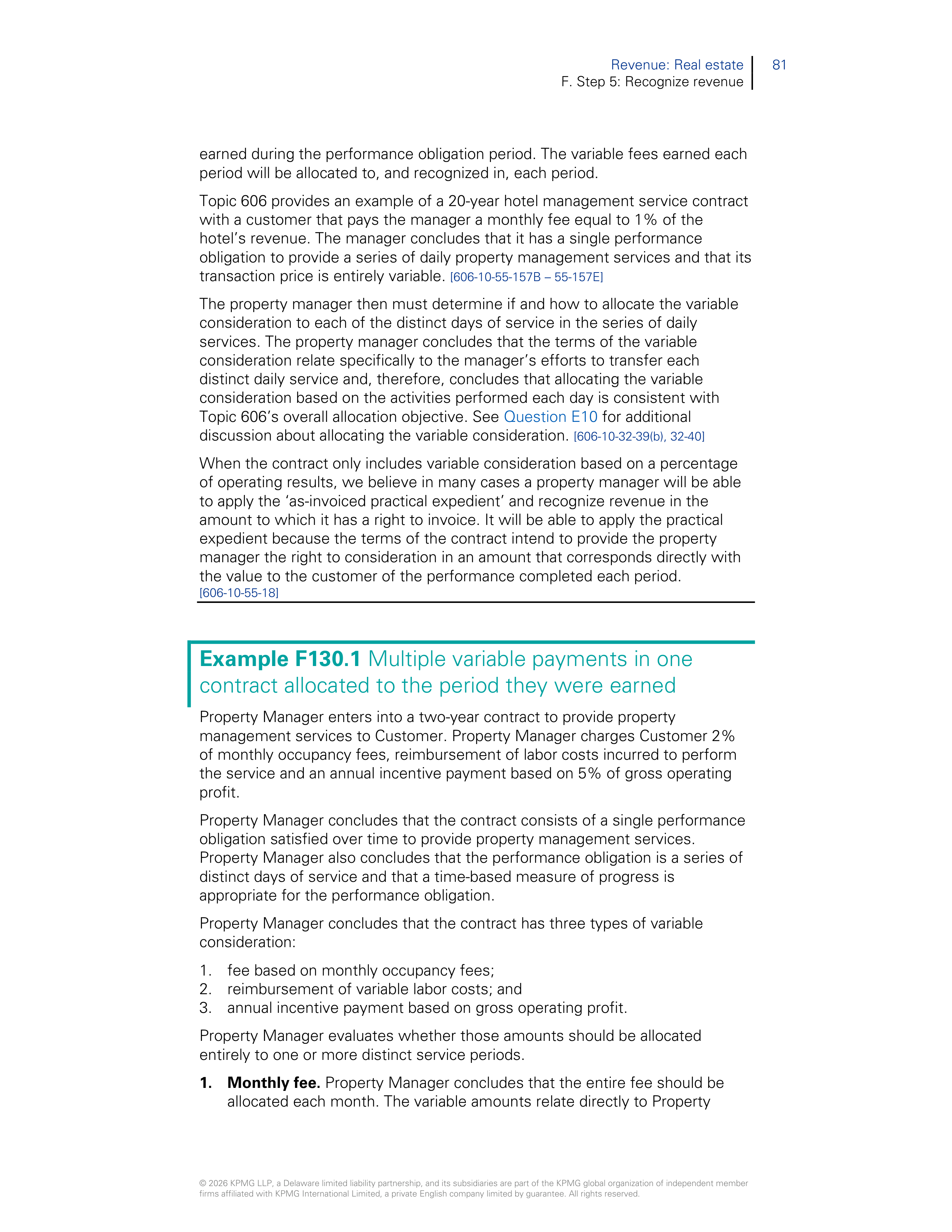
Revenue: Real estate
81
F. Step 5: Recognize revenue
© 2026 KPMG LLP, a Delaware limited liability partnership, and its subsidiaries are part of the KPMG global organization of independent member
firms affiliated with KPMG International Limited, a private English company limited by guarantee. All rights reserved.
earned during the performance obligation period. The variable fees earned each
period will be allocated to, and recognized in, each period.
Topic 606 provides an example of a 20-year hotel management service contract
with a customer that pays the manager a monthly fee equal to 1% of the
hotel’s revenue. The manager concludes that it has a single performance
obligation to provide a series of daily property management services and that its
transaction price is entirely variable.
[606-10-55-157B – 55-157E]
The property manager then must determine if and how to allocate the variable
consideration to each of the distinct days of service in the series of daily
services. The property manager concludes that the terms of the variable
consideration relate specifically to the manager’s efforts to transfer each
distinct daily service and, therefore, concludes that allocating the variable
consideration based on the activities performed each day is consistent with
Topic 606’s overall allocation objective. See
Question E10
for additional
discussion about allocating the variable consideration.
[606-10-32-39(b), 32-40]
When the contract only includes variable consideration based on a percentage
of operating results, we believe in many cases a property manager will be able
to apply the ‘as-invoiced practical expedient’ and recognize revenue in the
amount to which it has a right to invoice. It will be able to apply the practical
expedient because the terms of the contract intend to provide the property
manager the right to consideration in an amount that corresponds directly with
the value to the customer of the performance completed each period.
[606-10-55-18]
Example F130.1
Multiple variable payments in one
contract allocated to the period they were earned
Property Manager enters into a two-year contract to provide property
management services to Customer. Property Manager charges Customer 2%
of monthly occupancy fees, reimbursement of labor costs incurred to perform
the service and an annual incentive payment based on 5% of gross operating
profit.
Property Manager concludes that the contract consists of a single performance
obligation satisfied over time to provide property management services.
Property Manager also concludes that the performance obligation is a series of
distinct days of service and that a time-based measure of progress is
appropriate for the performance obligation.
Property Manager concludes that the contract has three types of variable
consideration:
1. fee based on monthly occupancy fees;
2. reimbursement of variable labor costs; and
3. annual incentive payment based on gross operating profit.
Property Manager evaluates whether those amounts should be allocated
entirely to one or more distinct service periods.
1.
Monthly fee.
Property Manager concludes that the entire fee should be
allocated each month. The variable amounts relate directly to Property
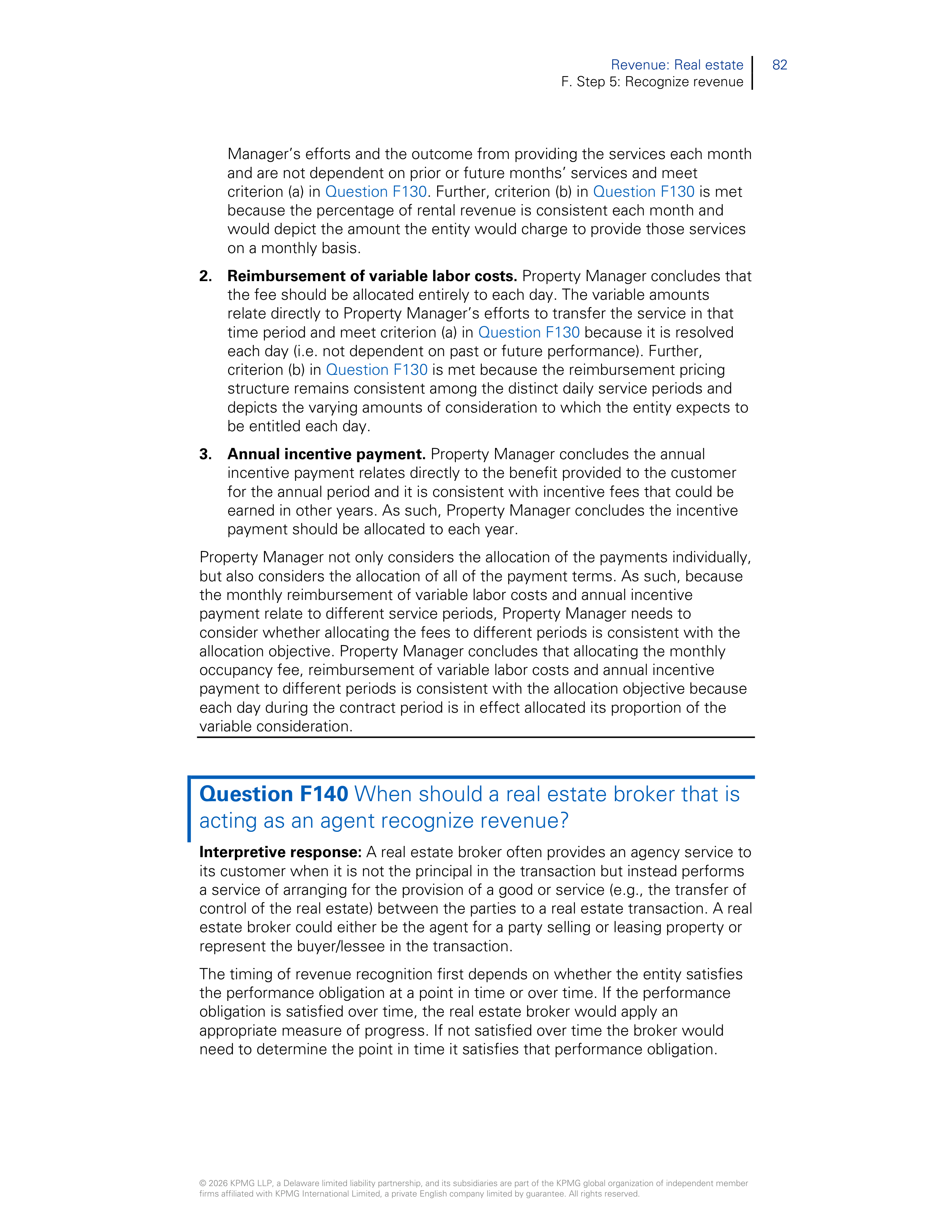
Revenue: Real estate
82
F. Step 5: Recognize revenue
© 2026 KPMG LLP, a Delaware limited liability partnership, and its subsidiaries are part of the KPMG global organization of independent member
firms affiliated with KPMG International Limited, a private English company limited by guarantee. All rights reserved.
Manager’s efforts and the outcome from providing the services each month
and are not dependent on prior or future months’ services and meet
criterion (a) in
Question F130
. Further, criterion (b) in
Question F130
is met
because the percentage of rental revenue is consistent each month and
would depict the amount the entity would charge to provide those services
on a monthly basis.
2.
Reimbursement of variable labor costs.
Property Manager concludes that
the fee should be allocated entirely to each day. The variable amounts
relate directly to Property Manager’s efforts to transfer the service in that
time period and meet criterion (a) in
Question F130
because it is resolved
each day (i.e. not dependent on past or future performance). Further,
criterion (b) in
Question F130
is met because the reimbursement pricing
structure remains consistent among the distinct daily service periods and
depicts the varying amounts of consideration to which the entity expects to
be entitled each day.
3.
Annual incentive payment.
Property Manager concludes the annual
incentive payment relates directly to the benefit provided to the customer
for the annual period and it is consistent with incentive fees that could be
earned in other years. As such, Property Manager concludes the incentive
payment should be allocated to each year.
Property Manager not only considers the allocation of the payments individually,
but also considers the allocation of all of the payment terms. As such, because
the monthly reimbursement of variable labor costs and annual incentive
payment relate to different service periods, Property Manager needs to
consider whether allocating the fees to different periods is consistent with the
allocation objective. Property Manager concludes that allocating the monthly
occupancy fee, reimbursement of variable labor costs and annual incentive
payment to different periods is consistent with the allocation objective because
each day during the contract period is in effect allocated its proportion of the
variable consideration.
Question F140
When should a real estate broker that is
acting as an agent recognize revenue?
Interpretive response:
A real estate broker often provides an agency service to
its customer when it is not the principal in the transaction but instead performs
a service of arranging for the provision of a good or service (e.g., the transfer of
control of the real estate) between the parties to a real estate transaction. A real
estate broker could either be the agent for a party selling or leasing property or
represent the buyer/lessee in the transaction.
The timing of revenue recognition first depends on whether the entity satisfies
the performance obligation at a point in time or over time. If the performance
obligation is satisfied over time, the real estate broker would apply an
appropriate measure of progress. If not satisfied over time the broker would
need to determine the point in time it satisfies that performance obligation.
Revenue: Real estate
83
F. Step 5: Recognize revenue
© 2026 KPMG LLP, a Delaware limited liability partnership, and its subsidiaries are part of the KPMG global organization of independent member
firms affiliated with KPMG International Limited, a private English company limited by guarantee. All rights reserved.
When a similar activity is bundled with other property management services,
the entity will first need to consider whether the service is distinct from the
other activities. See
Question C30
for additional discussion.
Over time vs point in time
A real estate broker acting as a sales agent for a customer that receives a
commission when the deal closes generally satisfies its performance obligation
at a point in time. This is because the activities performed by the broker before
sale typically do not transfer a good or service to a customer. If the customer
receives any benefit from the entity’s activities before the sale, that benefit
generally is limited unless the sale is completed. These services typically do not
meet the over-time criteria because:
•
the customer does not simultaneously receive and consume benefits as the
broker performs;
•
the broker is not creating or enhancing an asset the customer controls; and
•
the broker does not have an enforceable right to payment for performance
to date.
[606-10-25-27]
However, there may be arrangements that provide benefits to the customer
over time before a sale is completed. For example, this may arise when a
broker that enters into a written sale agent agreement receives a significant
nonrefundable upfront fee at the time of listing and a relatively small
commission fee when a sale is completed. The large nonrefundable upfront fee
generally indicates that the broker is providing the customer with a listing or
marketing service and the customer is benefiting from that service over time.
Moreover, that transaction likely meets the over-time criteria if the upfront fee
compensates the entity at cost plus a reasonable margin for its performance to
date and its performance does not create an asset with alternative use to the
entity (see
Question F40
for further discussion of the over-time criteria).
Satisfaction of a point-in-time performance obligation
When a broker satisfies its point-in-time agency performance obligation can vary
based on the facts and circumstances. For example, a broker may satisfy its
performance obligation when the principal and the end customer have each
committed to the contract or when the specified good is delivered or specified
service provided. In an agency relationship, the timing of when the principal
transfers control of the specified good or service to the end customer may
differ from the timing of when the agent satisfies its performance obligation.
There are multiple factors that can affect the point in time that an agent’s
performance obligation to arrange for the provision of a specified good or
service is satisfied. The following are important factors that we believe
influence this determination.
Who is the agent’s customer?
Agency relationships typically involve the agent
entering into contractual agreements with different counterparties. An agent’s
customer for its agency service may be the principal in the contract, the
customer purchasing the specified good or service, or both.
Determining its customer(s) is key to the agent establishing the nature of its
agency service – i.e. the nature of its promise to that (those) customer(s) and
when the related performance obligation is satisfied. For example, the nature of
Revenue: Real estate
84
F. Step 5: Recognize revenue
© 2026 KPMG LLP, a Delaware limited liability partnership, and its subsidiaries are part of the KPMG global organization of independent member
firms affiliated with KPMG International Limited, a private English company limited by guarantee. All rights reserved.
an agent’s promise may be different depending on which party in the real
estate transaction the agent is representing.
What is the nature of the agent’s promise to its customer(s)?
Topic 606
establishes that an agent ‘arranges for provision of the specified good or
service’ by the principal. However, it does not provide further guidance about
what that promise entails. The agent’s promise to its customer may involve
more than ‘connecting’ the two parties. For example, the agent may:
•
provide a value-add service, such as consulting, after the specified good is
delivered or specified service is provided; and/or
•
continue to perform a customer service function after the parties have
entered into their contract(s) – e.g. interfacing with the end customer about
coordinating closing documents and procedures or the move-in between
the end customer and the principal.
The first example likely represents a performance obligation (for which the
entity is a principal) separate from the agency service, and therefore would not
affect the timing of satisfaction of the agency service. However, judgment may
be involved in deciding whether a customer service function is a separate
performance obligation – i.e. separate from the agency service – or an integral
part of
the agent’s promise to provide the agency service and whether the
entity has completed its agency service.
If the entity is an agent for a specified good or service and also a principal for
another performance obligation in the contract, the entity will need to allocate
the consideration between the two performance obligations.
Determining the nature of the entity’s promise to provide the agency service is
critical to determining when that performance obligation is satisfied. How this
affects the timing of agency revenue recognition is illustrated in
Example F140.1
.
In some cases, the point at which the broker has a right to payment may be
informative, although not determinative, when evaluating the nature of the
broker’s promise. For example, when a broker has a right to payment without
further performance it may indicate that the nature of the promise corresponds
to the activity that triggers the payment. However, a broker will need to
distinguish between payment terms that represent variable commission and
payment terms that correspond to the entity’s performance. See trailing
commissions below for further discussion.
When does the principal transfer control of the specified goods or service
to the end customer?
The principal’s transfer of control of the specified good
or service to the end customer may indicate the agent’s performance obligation
is satisfied.
For example, an agent may continue to perform an important customer service
function, interfacing with the principal on the end customer’s behalf about
matters such as timing of close or coordination of the move-in, before control of
the specified good or service transfers to the end customer. However, after
control transfers (or begins to transfer in the case of a specified service
satisfied over time), that availability may no longer be an integral part of its
promise to arrange for the provision of the specified good or service – even if
the agent remains available to the end customer as a matter of customer
Revenue: Real estate
85
F. Step 5: Recognize revenue
© 2026 KPMG LLP, a Delaware limited liability partnership, and its subsidiaries are part of the KPMG global organization of independent member
firms affiliated with KPMG International Limited, a private English company limited by guarantee. All rights reserved.
relationship – because the end customer may have access to information or to
the service provider that it did not have previously. For example, the customer
may now have direct access to the landlord.
Trailing commissions
Trailing commissions often occur when a real estate broker satisfies its agency
performance obligation and receives subsequent payments from the principal
entity based on factors outside of the broker’s control – e.g. each time the
tenant renews a lease or in some cases when the lease term commences.
When the broker has no further obligations to the principal entity or the end
customer after the point in time the initial agency performance obligation is
satisfied, it determines the amount of trailing commissions to recognize as
revenue when the initial performance obligation is satisfied by applying the
guidance on variable consideration. If the entity performs other tasks that occur
after the initial sale, judgment will be required to determine whether those
activities represent performance obligations and therefore may affect the
allocation of the trailing commissions and the timing of revenue recognition.
[606-10-32-11]
A real estate broker estimates trailing commissions at contract inception and
includes them in the transaction price, subject to the variable consideration
constraint (see
Question D10
). A real estate broker with a significant amount of
history selling a particular product or service will likely recognize a portion of
revenue related to anticipated trailing commissions at the point in time the
performance obligation is satisfied. When there is a lack of history or the trailing
commissions are based on other significant uncertainties (e.g. market volatility),
the application of the variable consideration constraint guidance may be
challenging. However, in many circumstances we would expect a real estate
broker to be able to estimate at least some portion of the trailing commissions
at the time the performance obligation is satisfied.
A real estate broker reassesses its estimate of anticipated trailing commissions
at each reporting date, and records revenue for those anticipated trailing
commissions when it becomes probable that a significant reversal in cumulative
revenue recognized related to those trailing commissions (or a portion thereof)
will not occur.
Example F140.1
Real estate broker commissions
ABC real estate broker provides various brokerage services to assist customers
in leasing or selling real estate. ABC receives a commission for services based
on different commission structures.
Scenario 1: 100% commission upon lease execution
ABC enters into a contract to represent Landlord to lease space. ABC earns
100% of its commission on execution of the lease. The commission is due and
nonrefundable regardless of whether the tenant ultimately takes possession of
the space. ABC does not have any substantive performance requirements and
does not perform any substantive services for Landlord or a prospective tenant
Revenue: Real estate
86
F. Step 5: Recognize revenue
© 2026 KPMG LLP, a Delaware limited liability partnership, and its subsidiaries are part of the KPMG global organization of independent member
firms affiliated with KPMG International Limited, a private English company limited by guarantee. All rights reserved.
after lease execution. After lease execution, Landlord handles the relationship
with the tenant.
ABC determines that the contract includes a single agency performance
obligation related to brokering a lease between Landlord and a prospective
tenant.
Over time vs point in time
ABC evaluates whether the agency performance obligation is satisfied over
time or at a point in time and evaluates the over-time criteria as follows.
•
Landlord does not consume and receive benefit from the services as ABC
performs because those activities do not transfer a good or service to
Landlord and the benefit of the activities generally is limited unless the
lease is executed. Further, another entity would have to substantially re-
perform the activities to find a prospective tenant.
•
ABC does not create or enhance an asset that the building owner controls
while the asset is created or enhanced.
•
ABC does not have an enforceable right to payment for performance
completed to date. ABC will only earn the commission upon successfully
brokering an executed lease between the building owner and prospective
tenant.
Because none of the criteria for over-time revenue recognition are met, ABC
concludes the revenue from the leasing commission should be recognized at a
point in time.
Satisfaction of point-in-time agency performance obligation
ABC evaluates when it satisfies the point-in-time agency performance obligation
and considers the factors in
Question F140
.
•
Who is ABC’s customer?
Landlord is ABC’s customer as it is the party that
ABC entered into the contract with and agreed to represent.
•
What is the nature of the ABC’s promise to its customer?
The nature of
ABC’s promise to Landlord is to execute a lease agreement. This is
evidenced by the fact that ABC has a right to consideration upon lease
execution and does not perform any substantive services for Landlord or
tenant after the lease is executed.
•
When does the principal transfer control of the specified goods or
service to the end customer?
The specified lease service transfers to the
tenant when the lease term commences.
Based on the above, ABC concludes that the nature of its promise to Landlord
(its customer) is to provide an executed lease and that is the point in time at
which ABC’s services are complete. As a result, ABC recognizes revenue at
lease execution.
While the specified lease service does not transfer from Landlord to tenant (the
end customer) until lease commencement, ABC is not required to perform and
does not perform any substantive services between lease execution and lease
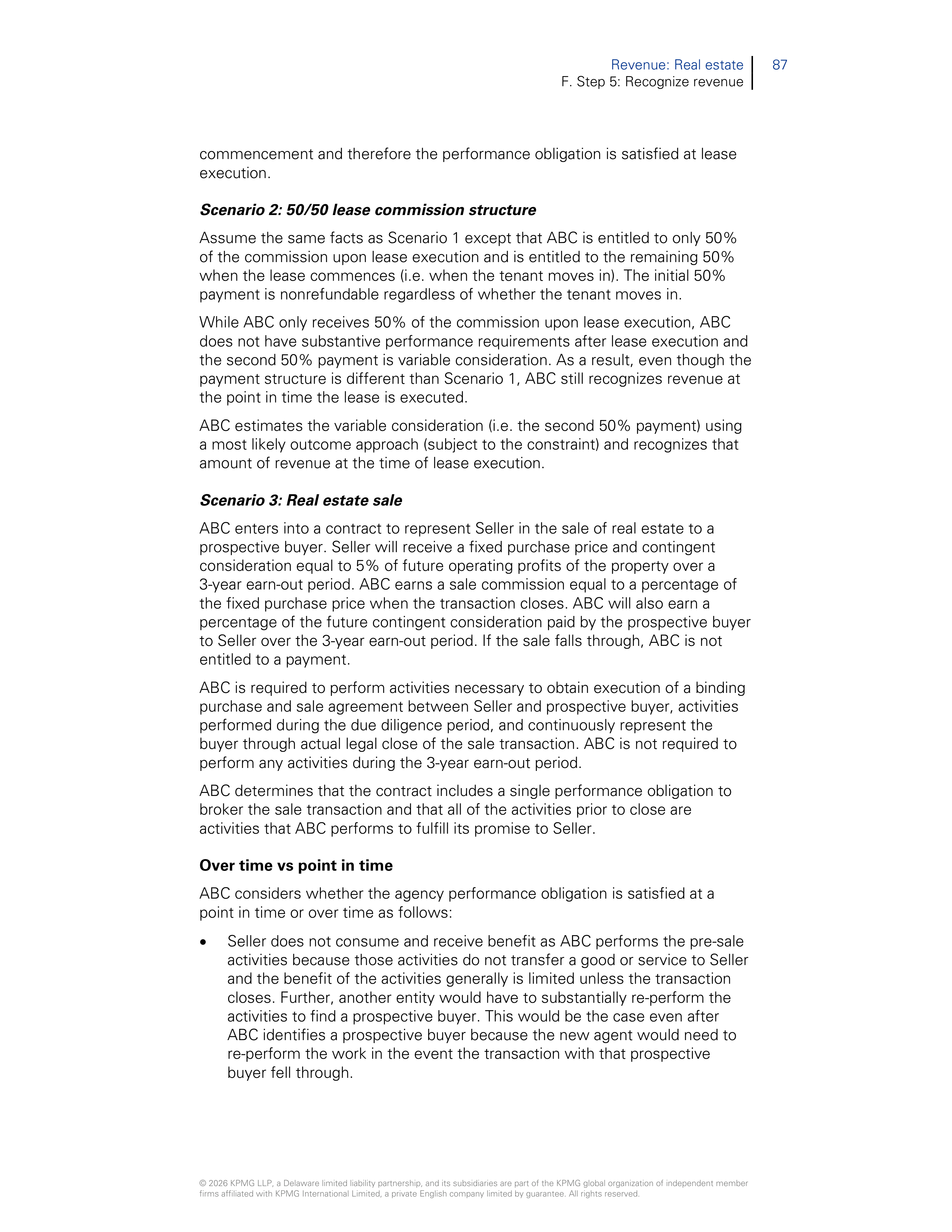
Revenue: Real estate
87
F. Step 5: Recognize revenue
© 2026 KPMG LLP, a Delaware limited liability partnership, and its subsidiaries are part of the KPMG global organization of independent member
firms affiliated with KPMG International Limited, a private English company limited by guarantee. All rights reserved.
commencement and therefore the performance obligation is satisfied at lease
execution.
Scenario 2: 50/50 lease commission structure
Assume the same facts as Scenario 1 except that ABC is entitled to only 50%
of the commission upon lease execution and is entitled to the remaining 50%
when the lease commences (i.e. when the tenant moves in). The initial 50%
payment is nonrefundable regardless of whether the tenant moves in.
While ABC only receives 50% of the commission upon lease execution, ABC
does not have substantive performance requirements after lease execution and
the second 50% payment is variable consideration. As a result, even though the
payment structure is different than Scenario 1, ABC still recognizes revenue at
the point in time the lease is executed.
ABC estimates the variable consideration (i.e. the second 50% payment) using
a most likely outcome approach (subject to the constraint) and recognizes that
amount of revenue at the time of lease execution.
Scenario 3: Real estate sale
ABC enters into a contract to represent Seller in the sale of real estate to a
prospective buyer. Seller will receive a fixed purchase price and contingent
consideration equal to 5% of future operating profits of the property over a
3-year earn-out period. ABC earns a sale commission equal to a percentage of
the fixed purchase price when the transaction closes. ABC will also earn a
percentage of the future contingent consideration paid by the prospective buyer
to Seller over the 3-year earn-out period. If the sale falls through, ABC is not
entitled to a payment.
ABC is required to perform activities necessary to obtain execution of a binding
purchase and sale agreement between Seller and prospective buyer, activities
performed during the due diligence period, and continuously represent the
buyer through actual legal close of the sale transaction. ABC is not required to
perform any activities during the 3-year earn-out period.
ABC determines that the contract includes a single performance obligation to
broker the sale transaction and that all of the activities prior to close are
activities that ABC performs to fulfill its promise to Seller.
Over time vs point in time
ABC considers whether the agency performance obligation is satisfied at a
point in time or over time as follows:
•
Seller does not consume and receive benefit as ABC performs the pre-sale
activities because those activities do not transfer a good or service to Seller
and the benefit of the activities generally is limited unless the transaction
closes. Further, another entity would have to substantially re-perform the
activities to find a prospective buyer. This would be the case even after
ABC identifies a prospective buyer because the new agent would need to
re-perform the work in the event the transaction with that prospective
buyer fell through.
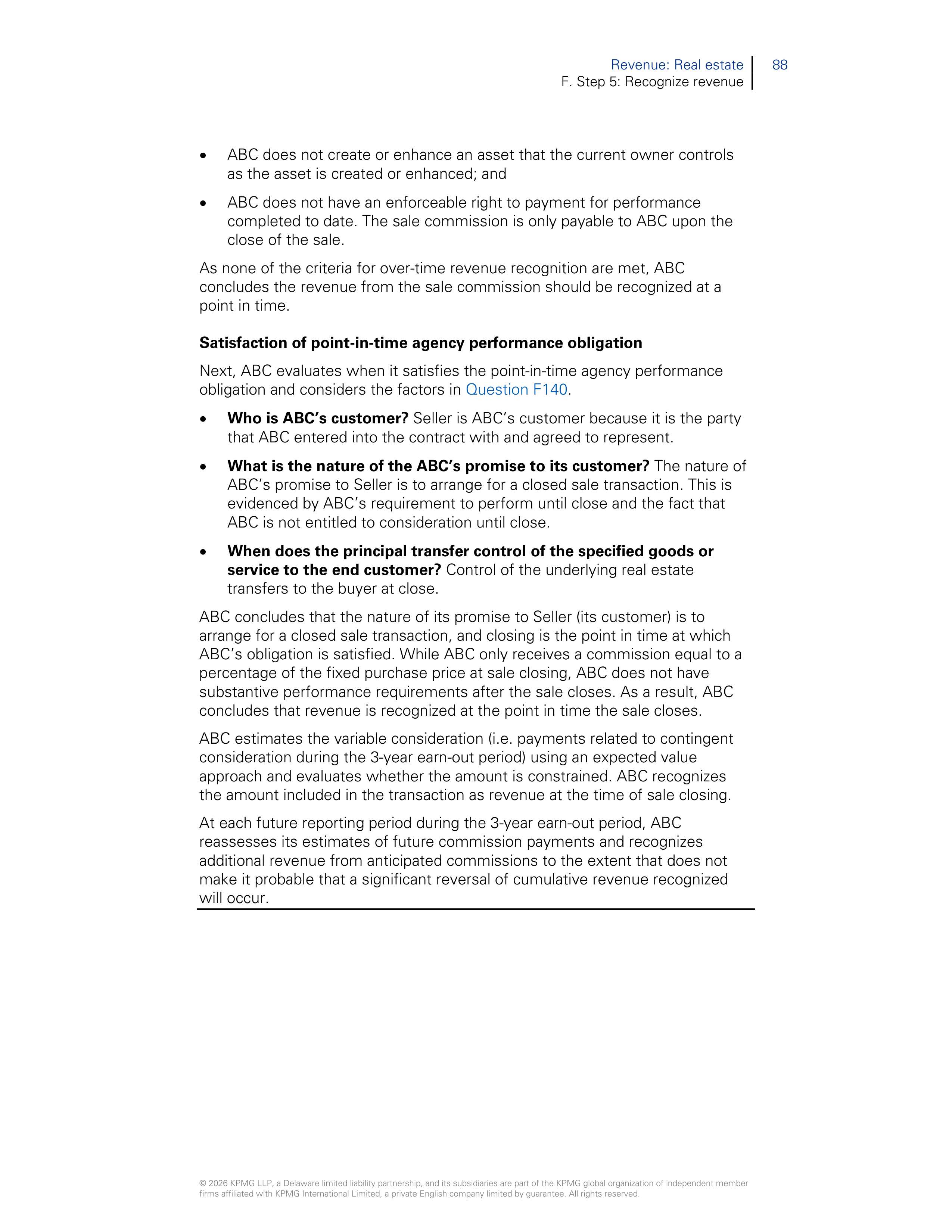
Revenue: Real estate
88
F. Step 5: Recognize revenue
© 2026 KPMG LLP, a Delaware limited liability partnership, and its subsidiaries are part of the KPMG global organization of independent member
firms affiliated with KPMG International Limited, a private English company limited by guarantee. All rights reserved.
•
ABC does not create or enhance an asset that the current owner controls
as the asset is created or enhanced; and
•
ABC does not have an enforceable right to payment for performance
completed to date. The sale commission is only payable to ABC upon the
close of the sale.
As none of the criteria for over-time revenue recognition are met, ABC
concludes the revenue from the sale commission should be recognized at a
point in time.
Satisfaction of point-in-time agency performance obligation
Next, ABC evaluates when it satisfies the point-in-time agency performance
obligation and considers the factors in
Question F140
.
•
Who is ABC’s customer?
Seller is ABC’s customer because it is the party
that ABC entered into the contract with and agreed to represent.
•
What is the nature of the ABC’s promise to its customer?
The nature of
ABC’s promise to Seller is to arrange for a closed sale transaction. This is
evidenced by ABC’s requirement to perform until close and the fact that
ABC is not entitled to consideration until close.
•
When does the principal transfer control of the specified goods or
service to the end customer?
Control of the underlying real estate
transfers to the buyer at close.
ABC concludes that the nature of its promise to Seller (its customer) is to
arrange for a closed sale transaction, and closing is the point in time at which
ABC’s obligation is satisfied. While ABC only receives a commission equal to a
percentage of the fixed purchase price at sale closing, ABC does not have
substantive performance requirements after the sale closes. As a result, ABC
concludes that revenue is recognized at the point in time the sale closes.
ABC estimates the variable consideration (i.e. payments related to contingent
consideration during the 3-year earn-out period) using an expected value
approach and evaluates whether the amount is constrained. ABC recognizes
the amount included in the transaction as revenue at the time of sale closing.
At each future reporting period during the 3-year earn-out period, ABC
reassesses its estimates of future commission payments and recognizes
additional revenue from anticipated commissions to the extent that does not
make it probable that a significant reversal of cumulative revenue recognized
will occur.
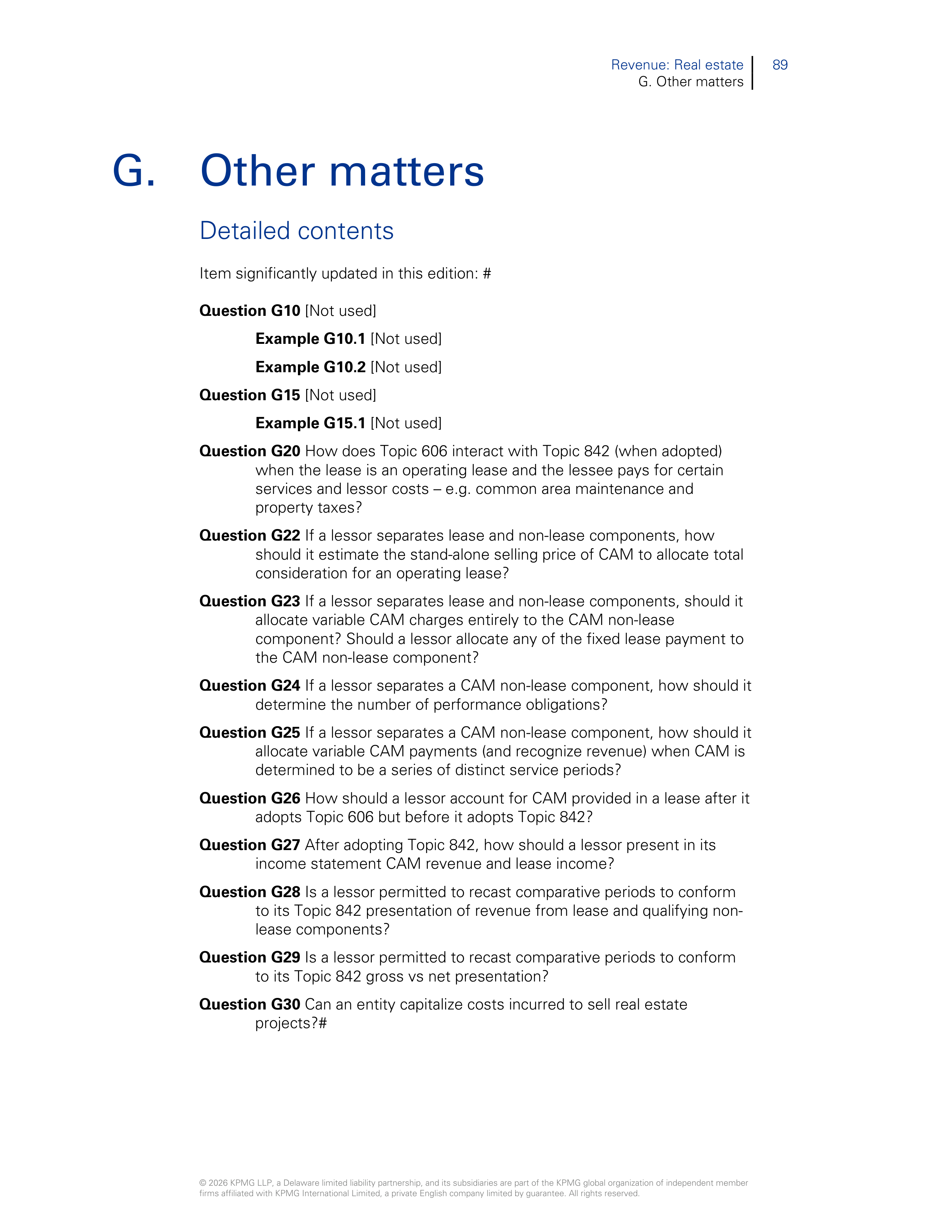
Revenue: Real estate
89
G. Other matters
© 2026 KPMG LLP, a Delaware limited liability partnership, and its subsidiaries are part of the KPMG global organization of independent member
firms affiliated with KPMG International Limited, a private English company limited by guarantee. All rights reserved.
G. Other matters
Detailed contents
Item significantly updated in this edition: #
Question G10
[Not used]
Example G10.1
[Not used]
Example G10.2
[Not used]
Question G15
[Not used]
Example G15.1
[Not used]
Question G20
How does Topic 606 interact with Topic 842 (when adopted)
when the lease is an operating lease and the lessee pays for certain
services and lessor costs – e.g. common area maintenance and
property taxes?
Question G22
If a lessor separates lease and non-lease components, how
should it estimate the stand-alone selling price of CAM to allocate total
consideration for an operating lease?
Question G23
If a lessor separates lease and non-lease components, should it
allocate variable CAM charges entirely to the CAM non-lease
component? Should a lessor allocate any of the fixed lease payment to
the CAM non-lease component?
Question G24
If a lessor separates a CAM non-lease component, how should it
determine the number of performance obligations?
Question G25
If a lessor separates a CAM non-lease component, how should it
allocate variable CAM payments (and recognize revenue) when CAM is
determined to be a series of distinct service periods?
Question G26
How should a lessor account for CAM provided in a lease after it
adopts Topic 606 but before it adopts Topic 842?
Question G27
After adopting Topic 842, how should a lessor present in its
income statement CAM revenue and lease income?
Question G28
Is a lessor permitted to recast comparative periods to conform
to its Topic 842 presentation of revenue from lease and qualifying non-
lease components?
Question G29
Is a lessor permitted to recast comparative periods to conform
to its Topic 842 gross vs net presentation?
Question G30
Can an entity capitalize costs incurred to sell real estate
projects?#
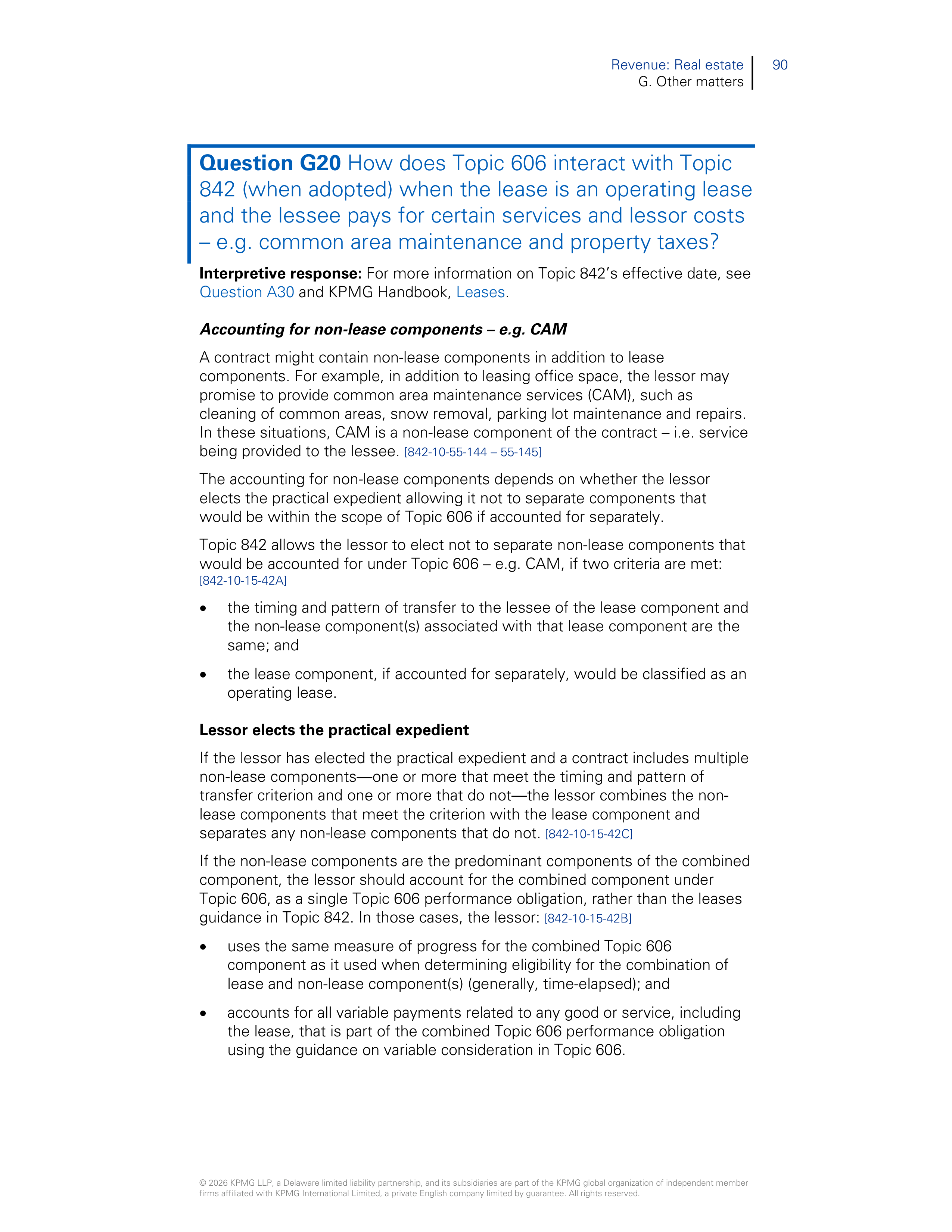
Revenue: Real estate
90
G. Other matters
© 2026 KPMG LLP, a Delaware limited liability partnership, and its subsidiaries are part of the KPMG global organization of independent member
firms affiliated with KPMG International Limited, a private English company limited by guarantee. All rights reserved.
Question G20
How does Topic 606 interact with Topic
842 (when adopted) when the lease is an operating lease
and the lessee pays for certain services and lessor costs
– e.g. common area maintenance and property taxes?
Interpretive response:
For more information on Topic 842’s effective date, see
Question A30
and KPMG Handbook,
Leases
.
Accounting for non-lease components – e.g. CAM
A contract might contain non-lease components in addition to lease
components. For example, in addition to leasing office space, the lessor may
promise to provide common area maintenance services (CAM), such as
cleaning of common areas, snow removal, parking lot maintenance and repairs.
In these situations, CAM is a non-lease component of the contract – i.e. service
being provided to the lessee.
[842-10-55-144 – 55-145]
The accounting for non-lease components depends on whether the lessor
elects the practical expedient allowing it not to separate components that
would be within the scope of Topic 606 if accounted for separately.
Topic 842 allows the lessor to elect not to separate non-lease components that
would be accounted for under Topic 606 – e.g. CAM, if two criteria are met:
[842-10-15-42A]
•
the timing and pattern of transfer to the lessee of the lease component and
the non-lease component(s) associated with that lease component are the
same; and
•
the lease component, if accounted for separately, would be classified as an
operating lease.
Lessor elects the practical expedient
If the lessor has elected the practical expedient and a contract includes multiple
non-lease components—one or more that meet the timing and pattern of
transfer criterion and one or more that do not—the lessor combines the non-
lease components that meet the criterion with the lease component and
separates any non-lease components that do not.
[842-10-15-42C]
If the non-lease components are the predominant components of the combined
component, the lessor should account for the combined component under
Topic 606, as a single Topic 606 performance obligation, rather than the leases
guidance in Topic 842. In those cases, the lessor:
[842-10-15-42B]
•
uses the same measure of progress for the combined Topic 606
component as it used when determining eligibility for the combination of
lease and non-lease component(s) (generally, time-elapsed); and
•
accounts for all variable payments related to any good or service, including
the lease, that is part of the combined Topic 606 performance obligation
using the guidance on variable consideration in Topic 606.
Revenue: Real estate
91
G. Other matters
© 2026 KPMG LLP, a Delaware limited liability partnership, and its subsidiaries are part of the KPMG global organization of independent member
firms affiliated with KPMG International Limited, a private English company limited by guarantee. All rights reserved.
Otherwise, the combined component is accounted for under Topic 842 as an
operating lease. This includes circumstances when the lease component and
non-lease component(s) are equally significant to the contract.
[842-10-15-42B]
In many cases, determining whether to account for the combined component
as a lease or as a single non-lease component in the scope of Topic 606 will be
simple. For example, in most real estate lease scenarios that include CAM, it
will be clear that the lease is the predominant element of the combined
component. This is because the lessee would clearly be expected to ascribe
more value to its right to use the real estate than to the CAM services.
A lessor elects the practical expedient by class of underlying asset.
[842-10-15-
42A]
Lessor does not elect the practical expedient or the lease and non-lease
component(s) do not qualify for combination
If the lessor does not elect the practical expedient or the lease and non-lease
component(s) do not meet the required criteria for combination, the lessor
should separate the lease and the non-lease components (e.g. the office space
lease and relevant non-lease component) and allocate the consideration in the
contract using the requirements in Topic 606 for allocating the transaction price
(i.e. generally on a relative stand-alone selling price basis).
[842-10-15-31, 606-10-32-
28 - 32-41, 842-10-15-28 – 32, 15-38 – 15-42]
The allocated revenue associated with the non-lease component(s) will be
recognized under Topic 606 and the allocated lease income associated with the
lease component(s) will be recognized under Topic 842. See
Question G22
for
additional discussion.
[606-10-32-28 – 32-29, 842-10-15-38 – 15-42]
Accounting for elements that are not ‘components’ – e.g. property taxes
or insurance paid to or on behalf of the lessor
Not every element of a contract that contains a lease is necessarily a
‘component’ (lease or non-lease). While it may be intuitive to assume that any
activity or cost that is not a lease component or payment that is not an explicit
‘lease payment’ must be a non-lease component, this is not how Topic 842
works. Instead, some elements of a contract – i.e. some activities and/or
payments – are not components because they do not transfer a good or service
to the lessee.
[842-10-15-30]
Examples of elements of a lease contract that do not transfer a good or service
to the lessee include a lessee’s reimbursement or payment of the lessor’s
property taxes and insurance. The lessee does not receive a good or service
from having to reimburse the lessor, or directly pay, the lessor’s property taxes
to the relevant taxing authority. Similarly, the lessee does not receive a good or
service from reimbursing the lessor’s insurance premium on the real estate
asset or paying for insurance in its own name on an asset that primarily benefits
the lessor (see section 4.2 of KPMG Handbook,
Leases
).
[842-10-15-30]
The accounting for property taxes and insurance paid for by the lessee will be
based on who (the lessee or the lessor) pays the relevant third party (e.g. the
taxing authority or the insurance provider) for the cost.
•
If the lessee pays the third party directly – e.g. remits payment of the tax
directly to the taxing authority or pays the insurance premium to the insurer
Revenue: Real estate
92
G. Other matters
© 2026 KPMG LLP, a Delaware limited liability partnership, and its subsidiaries are part of the KPMG global organization of independent member
firms affiliated with KPMG International Limited, a private English company limited by guarantee. All rights reserved.
– the lessor will recognize the cost and the lessee’s payment net in the
income statement. Neither the lessor’s costs nor the lessee’s payments
will be reflected on the lessor’s income statement. This reporting applies
regardless of whether the lessor was primarily obligated to, or primarily
benefitted from, the cost, and regardless of whether the lessor knows, can
readily determine or can reliably estimate the amount of the cost paid by
the lessee.
•
If the lessor pays the third party, and therefore recovers the cost through
payments it receives from the lessee (whether fixed or variable), the lessor
will recognize the cost and the lessee’s payments gross in the income
statement (see the discussion that follows).
Lessor applies the practical expedient
If the lessor applies the practical expedient and accounts for the lease and CAM
as one operating lease component, the lessee’s payments to reimburse the
lessor for property taxes or insurance are accounted for as:
•
fixed ‘lease payments’, if the reimbursement is structured as a fixed
adjustment to the base lease payment (i.e. a gross lease); or
•
variable lease payments, if the reimbursement varies based on the lessor’s
costs (i.e. a net lease).
Lessor does not elect the practical expedient or the lease and non-lease
component(s) do not qualify for combination
If the lessor does not (or cannot) apply the practical expedient and the contract
includes a lease component and non-lease component (e.g. CAM), the lessee’s
payments to reimburse the lessor for real estate taxes and insurance are
allocated to the lease and non-lease components based on the transaction price
allocation guidance in Topic 606.
[842-30-25-11(b), 842,10,15-40, 842-10-55-141 – 55-142]
If the lessor structures the reimbursement through a fixed adjustment to the
base lease payment (i.e. a gross lease), it would consider the adjustment part of
the total consideration in the contract, similar to any other fixed lease
payments. The lessor then allocates the total consideration in the contract to
the lease component(s) and the non-lease component(s) and generally
recognizes the amount allocated to the lease component(s) over the lease
term(s) on a straight-line basis, while recognizing the amount allocated to the
non-lease component(s) as those performance obligations are satisfied under
Topic 606. This would apply even if the lessor itemized that portion of the fixed
payment in the contract for reimbursement of taxes and insurance.
[842-10-15-40,
842-10-55-143, 842-30-25-11]
If the reimbursement to the lessor varies based on the lessor’s costs (i.e. a net
lease), those variable payments generally will be partially attributed to the
non-lease component(s) in a similar manner – i.e. based on the transaction price
allocation guidance in Topic 606.
However, we believe a lessor must consider whether allocating (or not
allocating) these amounts to a non-lease component (e.g. CAM) will result in
allocations to the lease and non-lease components that no longer meet the
Topic 606 allocation objective. For example, we believe it would be
inappropriate for a lessor to allocate a portion of the property tax and insurance
Revenue: Real estate
93
G. Other matters
© 2026 KPMG LLP, a Delaware limited liability partnership, and its subsidiaries are part of the KPMG global organization of independent member
firms affiliated with KPMG International Limited, a private English company limited by guarantee. All rights reserved.
charges to CAM services if that allocation would result in reporting CAM
income significantly greater than its stand-alone selling price.
[606-10-32-28]
It may instead be the case that the lessee’s reimbursements of lessor property
tax and/or insurance costs should be allocated entirely to the lease
component(s) based on the variable consideration allocation guidance in Topic
606.
[606-10-32-40]
Question G22
If a lessor separates lease and non-lease
components, how should it estimate the stand-alone
selling price of CAM to allocate total consideration for an
operating lease?
Interpretive response:
Often CAM is the only non-lease component in a lease
contract. While a lessor charges for CAM using a variety of mechanisms (e.g.
maintenance cost reimbursement, incremental fixed payment, incremental but
part of a single lease payment), the principle for determining the stand-alone
selling price when the lessor is separating lease and non-lease components is
the same. (See
Question G20
for additional discussion about the practical
expedient.) The lessor should apply the guidance in Topic 606 to estimate the
price at which it would provide CAM separately.
While no entity may provide exactly the same services separately, we believe a
lessor generally will be able to identify market data to support using an adjusted
market assessment approach or an expected cost plus a margin approach. We
generally do not believe it would be appropriate to use the residual approach to
estimate the stand-alone selling price for CAM.
Additionally, we do not believe it would be appropriate for a lessor to use only
the amount of actual costs billed to a lessee on a cost pass-through basis as the
stand-alone selling price for CAM. If a vendor were to provide those services
separately from a lease, the price it would charge a customer would include
some amount of profit margin because a profit-oriented business would not
perform services for no profit.
However, if the lessor bills to the lessee an administrative fee in addition to the
actual costs incurred to provide CAM, the total billings may approximate the
stand-alone selling price of CAM if the administrative fee added to the actual
costs approximates the profit margin that the lessor would have charged had
those services been provided separately. In that case, a lessor may be able to
allocate those cost plus administrative fee billings entirely to CAM if that would
result in an allocation to the lease and CAM that represents the relationship
between the stand-alone selling prices of those two components. The lessor
would not allocate those billings to both the lease and CAM. The lessor should
consider all the relevant facts and circumstances in these situations.
[606-10-32-
28, 32-34, 32-40]
Revenue: Real estate
94
G. Other matters
© 2026 KPMG LLP, a Delaware limited liability partnership, and its subsidiaries are part of the KPMG global organization of independent member
firms affiliated with KPMG International Limited, a private English company limited by guarantee. All rights reserved.
Question G23
If a lessor separates lease and non-lease
components, should it allocate variable CAM charges
entirely to the CAM non-lease component? Should a
lessor allocate any of the fixed lease payment to the
CAM non-lease component?
Interpretive response:
It depends. Because lease contracts that include
variable payments for CAM
11
services generally specify that those payments
relate to the maintenance services, those payments would be included in the
consideration in the contract. A lessor that separates lease and non-lease
components allocates those payments entirely to the CAM non-lease
component if this would result in an allocation to the lease and CAM that would
be consistent with the allocation objective of Topic 606. (See
Question G20
for
additional discussion about the practical expedient.)
While allocating only the variable CAM charges to the non-lease component
may not meet the allocation objective, allocating a portion of the fixed lease
payment to the non-lease component when combined with the variable
payments, may meet the allocation objective of Topic 606. The allocation
objective would not be met when allocating only the variable CAM charges
because those amounts are simply a pass-through of the lessor’s costs. They
do not include a profit margin and thus will not approximate stand-alone selling
price as discussed in
Question G22
. Once the lessor allocates an amount to the
CAM non-lease component, it may need to further allocate that amount to each
distinct service period within a single CAM performance obligation as discussed
in
Question G24
.
[606-10-32-28 – 32-29, 32-39 – 32-40]
We believe there may be a number of acceptable methods for allocating the
consideration in the contract (and changes to that consideration) to the lease
and CAM components, particularly when there are variable payments. In
evaluating its allocation methodology, we believe a lessor should focus on
whether the resulting reported amounts allocated to each component meet
Topic 606’s allocation objective. That is, do the allocated amounts reasonably
depict the amount of consideration to which the entity expects to be entitled in
exchange for transferring each of the components (e.g. the lease and CAM).
For example, we believe it would be inappropriate for a lessor to allocate fixed
or variable amounts between components in such a way that reported results
for any of the individual components ultimately, after considering all the
payment terms of the contract, differs significantly from the relative stand-alone
selling price of that component. This means that a lessor must consider the
result of its allocation on each of the identified components; it is not acceptable
to conclude that an allocation is appropriate solely because it faithfully
represents the amount to which the lessor expects to be entitled for providing
one or some of the components of the contract.
[606-10-32-28 – 32-29, 32-39 – 32-40]
11
Lessors should be careful not to include reimbursements for real estate taxes and
insurance in the variable payments allocated entirely to CAM. Real estate taxes and
insurance reimbursements are not components in the contract and are not specifically
related to CAM.
Revenue: Real estate
95
G. Other matters
© 2026 KPMG LLP, a Delaware limited liability partnership, and its subsidiaries are part of the KPMG global organization of independent member
firms affiliated with KPMG International Limited, a private English company limited by guarantee. All rights reserved.
Question G24
If a lessor separates a CAM non-lease
component, how should it determine the number of
performance obligations?
Interpretive response:
The lessor should determine the number of
performance obligations after allocating contract consideration to CAM as a
non-lease component as discussed in
Question G23
. This assumes that the
lessor has not elected, or does not qualify for, the non-separation practical
expedient discussed in
Question G20
). The lessor will need to determine
whether CAM comprises one or multiple performance obligations using the
guidance on identifying performance obligations in Topic 606.
We believe the nature of CAM is such that it will frequently comprise only a
single performance obligation under Topic 606 and, therefore, will be a single
non-lease component when allocating the consideration in the contract under
Topic 842. In many lease arrangements, CAM is substantially similar to the
hotel management services in Example 12A in Topic 606 (see discussion in
Question C30
) and the IT outsourcing services example discussed by the
Revenue Recognition Transition Resource Group at its July 2015 meeting. That
is, in fulfilling its promise to provide CAM (i.e. to maintain the common areas of
the multi-tenant property), the lessor performs a variety of underlying activities
to fulfill that promise, and those activities vary in terms of timing and quantity.
For example, at lease commencement, it is not known how much snow the
lessor will have to clear from the parking lot during the winter, the extent of
landscaping that will be required during the spring and summer months, when
or how often minor repairs will be needed or when unexpected janitorial needs
will arise. Regardless, the lessor commits to undertaking those activities as
needed to fulfill its overall promise to the lessee.
[606-10-55-157B – 55-157E]
The preceding paragraph notwithstanding, the characterization of an activity as
part of CAM does not necessarily mean it should not be a separate non-lease
component. The lessor will need to evaluate each activity that is promised in
the contract as part of CAM and potentially separately account for those that
provide a different or incremental benefit to the lessee beyond maintaining the
common areas of the property.
For example, the lessor will frequently provide the utilities needed by the lessee
(e.g. heating, water, electricity). In some cases, the provision of utilities is
characterized as part of, or will be billed together with, CAM. Despite its
characterization in the contract or how it is billed, the provision of utilities to the
lessee would generally be a separate non-lease component because the
provision of utilities to the lessee’s retail or office space is not an underlying
activity to maintaining the common areas of the property.
While CAM, appropriately defined, will typically be a single, integrated
performance obligation, entities may need to further consider whether that
single, integrated performance obligation comprises a series of distinct CAM
service periods (e.g. 36 distinct months of CAM). This conclusion may be
important if all or a portion of the payments to which the lessor will be entitled
for providing CAM are variable. If so, the lessor may, if the specified Topic 606
criteria are met, be required to allocate the variable payments to the distinct
CAM service periods to which each variable payment relates – e.g. allocate the
Revenue: Real estate
96
G. Other matters
© 2026 KPMG LLP, a Delaware limited liability partnership, and its subsidiaries are part of the KPMG global organization of independent member
firms affiliated with KPMG International Limited, a private English company limited by guarantee. All rights reserved.
variable CAM billing for Month 1 of the 36-month lease entirely to CAM
services provided in Month 1 – rather than to the 36-month CAM performance
obligation as a whole. Allocation to each distinct service period, rather than to
the entire performance obligation, may affect the lessor’s pattern of revenue
recognition.
[606-10-32-40]
Question G25
If a lessor separates a CAM non-lease
component, how should it allocate variable CAM
payments (and recognize revenue) when CAM is
determined to be a series of distinct service periods?
Interpretive response:
Any portion of the fixed payments in the contract that is
allocated to CAM relates to its performance obligation as a whole and is
recognized using a single measure of progress toward complete satisfaction of
the performance obligation under Topic 606. This assumes that the lessor is not
applying the non-separation practical expedient discussed in
Question G20
.
Meanwhile, a lessor will allocate variable payments that relate specifically to a
distinct service period to that distinct period if that allocation meets Topic 606’s
allocation objective. For example, CAM billings that relate to the lessor’s CAM
activities performed in Month 1 of a 36-month CAM service period generally will
be allocated entirely to Month 1. This is similar to the way a property manager
would allocate management fees (see additional discussion in
Questions E10
and
F130
).
Making this determination may frequently revolve around whether the lessor
concludes that the total amount of revenue allocated to each distinct service
period reasonably reflects the value of CAM services provided to the customer
for that period. For example, a lessor may conclude this is the case if the
amount(s) that will be allocated to each service period varies in reasonable
proportion to the extent of the activities the lessor undertakes.
If the variable payments for CAM are not allocable to the distinct service
periods within the larger performance obligation, those payments are estimated
subject to the Topic 606 variable consideration constraint and allocated to the
performance obligation as a whole consistent with the portion of the fixed
payments allocated to CAM. Together those payments are recognized using a
single measure of progress toward complete satisfaction of the performance
obligation under Topic 606.
Revenue: Real estate
97
G. Other matters
© 2026 KPMG LLP, a Delaware limited liability partnership, and its subsidiaries are part of the KPMG global organization of independent member
firms affiliated with KPMG International Limited, a private English company limited by guarantee. All rights reserved.
Question G26
How should a lessor account for CAM
provided in a lease after it adopts Topic 606 but before it
adopts Topic 842?
Interpretive response:
Accounting for existing leases before the adoption of Topic 842
Topic 606 is a ‘residual standard’ in that it requires the application of other
Topics
first
if those other Topics specify how to account for one or more parts
of the contract. Topic 606 only applies to the parts of the contract that other
Topics do not address. CAM expenditures are defined as ‘executory costs’, and
accounted for as part of the lease, under Topic 840. Therefore, CAM is not
governed by Topic 606 until an entity adopts Topic 842. That being said, after
the adoption of Topic 606, we would not object to an entity either:
[606-10-15-4]
•
analogizing to the guidance in Topic 606 to determine the measure of
progress to apply when recognizing CAM revenue; or
•
separately presenting CAM revenues as non-lease or service revenue.
If a lessor decides to separately present CAM revenue as non-lease revenue, it
is acceptable to allocate revenue between the lease and CAM using either: (1)
the requirements in Topic 840 or (2) the transaction price allocation guidance in
Topic 606. That separate presentation (if elected) should be reflected in the
comparative periods presented, even if the lessor elects to use the effective
date transition method to adopt Topic 842.
Topic 840 specifies that CAM is within its scope based on the following.
•
It defines maintenance as an executory cost.
•
It states that “if an arrangement contains a lease and related
executory
costs
[emphasis added], as well as other non-lease elements, the
classification, recognition, measurement, and disclosure requirements of
this Topic shall be applied by both the purchaser and the supplier to the
lease element of the arrangement.”
•
It characterizes related executory costs as part of ‘those for the lease’.
[840-10-25-1(d), 15-17, 15-19(a)]
Accounting for existing leases after the adoption of Topic 842
Assuming that lease classification is the same before and after adoption of
Topic 842, the lessor will not reevaluate the identification of and allocation to
lease and non-lease components. This applies unless the lease is modified on
or after the effective date and that modification is not accounted for as a
separate contract. The lessor will continue to account for CAM provided as part
of the lease contract as it did before the effective date of Topic 842 (see above).
Accounting for leases that commence on or after the adoption of Topic
842
For all leases that commence on or after the adoption of Topic 842, the lessor
will identify CAM as a non-lease component and account for it under Topic 606
if it does not elect the practical expedient discussed in
Question G20
.
Revenue: Real estate
98
G. Other matters
© 2026 KPMG LLP, a Delaware limited liability partnership, and its subsidiaries are part of the KPMG global organization of independent member
firms affiliated with KPMG International Limited, a private English company limited by guarantee. All rights reserved.
Question G27
After adopting Topic 842, how should a
lessor present in its income statement CAM revenue
and lease income?
Interpretive response:
If a lessor applies the practical expedient not to
separate lease and non-lease components (see
Question G20
), we believe that
all
the income from the lease (including payments contractually identified as
CAM, but accounted for as lease payments when the lessor applies the
practical expedient) should be classified in the income statement in a single line
item.
If a lessor is not applying the non-separation practical expedient, we believe a
lessor may either:
•
separate the lease income from CAM revenue; or
•
present lease income and CAM revenue within the same line item in the
income statement because Topics 606 and 842 do not require an entity to
separately present income streams within their scopes.
However, SEC registrants are prohibited from combining revenue from services
with income from rentals when either one is more than 10% of total sales and
gross revenues.
[Reg S-X Rule 5-03(b)]
Lessors that are not applying the non-separation practical expedient are
reminded that Topics 606 and 842 require specific disclosures relative to
transactions within their scopes. This means that CAM revenue and lease
income generally will need to be presented separately in the notes to the
financial statements even if they are not presented separately in the income
statement.
[606-10-50-4, 842-10-15-31]
Question G28
Is a lessor permitted to recast
comparative periods to conform to its Topic 842
presentation of revenue from lease and qualifying non-
lease components?
Interpretive response:
The specific lease and non-lease components for which
it would be acceptable for a lessor to recast its comparative period income
statement presentation differ if the lessor is an SEC registrant.
Non-SEC registrants
Topic 842 does not apply to the comparative periods presented when using the
effective date method. Therefore, Topic 250 should be considered.
We do not believe a change in income statement aggregation or disaggregation
is a change in accounting principle under Topic 250 (see Question 3.5.10 of
KPMG Handbook,
Accounting changes and error corrections
) if both the
previous and the new aggregations are acceptable under the applicable US
GAAP – i.e. Topic 840 in this instance. And because Topic 840 does not specify
separate or combined income statement presentation for the revenue items
Revenue: Real estate
99
G. Other matters
© 2026 KPMG LLP, a Delaware limited liability partnership, and its subsidiaries are part of the KPMG global organization of independent member
firms affiliated with KPMG International Limited, a private English company limited by guarantee. All rights reserved.
discussed in the background, we believe either was acceptable under Topic
840.
If a lessor changes its income statement aggregation for the comparative
periods, the notes to the financial statements should disclose the change. We
do not believe a preferability assessment under Topic 250 is required.
SEC registrants
We believe our response for non-SEC registrants also applies to SEC registrants
if, and only if, the item presented separately from lease revenue was an
executory cost element (e.g. maintenance, including CAM), rather than a non-
lease element (i.e. goods or a substantial service), under Topic 840.
However, because of the guidance in SEC Regulation S-X applicable to SEC
registrants, we do not believe income statement presentation of lease and non-
lease goods or substantial service revenues on a combined basis was an
acceptable accounting alternative for those lessors. Therefore, a lessor is not
permitted to change its comparative period income statements to combine
revenues from leases and non-lease goods or substantial services.
We do not believe lessee payments of executory costs were required to be
presented separately from lease revenue under Regulation S-X because Topic
840 characterizes those payments as part of ‘those for the lease’. Chapter 13A
of KPMG Handbook,
Leases
, provides additional discussion for lessors using
the effective date transition method.
Question G29
Is a lessor permitted to recast
comparative periods to conform to its Topic 842 gross vs
net presentation?
Background:
As discussed in
Question G20
, some lessors may be required to
change their presentation of lessor costs (e.g. property taxes) and lessee
payments thereof on adoption of Topic 842 from how they presented those
items historically under Topic 840. This may create noticeable differences
between a lessor’s adoption year and comparative period financial statements.
Topic 840 and SEC guidance
Topic 840 does not prescribe gross or net presentation for lessor costs such as
property taxes or insurance or lessee payments thereof, and there is no
relevant SEC guidance.
Interpretive response:
It depends. While Topic 842 would generally not permit
recasting the comparative periods, Topic 250 may provide an avenue to do so.
Topic 842 does not permit recasting the comparative periods because, under
the effective date method, Topic 842 does not apply before the effective date –
i.e. it does not apply to the comparative periods presented. Recasting the
comparative periods to, for example, separately present previously netted
income statement amounts would, in effect, be selectively applying the
comparative period method to adopt the amendments in ASU 2018-20, while
using the effective date method to adopt the remainder of Topic 842.
[842-10-65-
1(c)]
Revenue: Real estate
100
G. Other matters
© 2026 KPMG LLP, a Delaware limited liability partnership, and its subsidiaries are part of the KPMG global organization of independent member
firms affiliated with KPMG International Limited, a private English company limited by guarantee. All rights reserved.
Although Topic 842 does not apply to the comparative periods presented when
using the effective date transition method, Topic 250 may be considered. A
change in gross versus net income statement presentation is a change in
accounting principle under Topic 250 (see section 3.3 of KPMG Handbook,
Accounting changes and error corrections
). And because Topic 840 does not
prescribe gross or net income statement presentation for lessor costs and
lessee payments thereof, a lessor may be able to justify a change to its
comparative periods’ gross versus net income statement presentation to
conform to its post-effective date presentation as preferable. An entity’s facts
and circumstances will affect whether or not such a change is preferable, and
whether a preferability determination is required for the change.
[250-10-45-2 – 45-
8]
Chapter 13A of KPMG Handbook,
Leases
, provides additional discussion for
lessors using the effective date transition method.
Question G30
Can an entity capitalize costs incurred to
sell real estate projects?#
Interpretive response:
Costs incurred to sell real estate projects are generally
evaluated for capitalization using the Subtopic 340-40 guidance on the
incremental cost of obtaining a contract and costs to fulfill a contract.
[340 40 25 1
– 25 8]
An incremental cost of obtaining a sales contract is a cost that would not have
otherwise been incurred if the contract were not obtained. An entity
capitalizes
12
those costs under Subtopic 340-40 if it expects to recover them.
Costs that an entity would have incurred regardless of whether it obtained a
sales contract are recognized under Subtopic 340-40 as an expense when
incurred unless those costs are capitalizable under other guidance or explicitly
chargeable to the customer regardless of whether a contract was obtained.
In many cases, the seller would have incurred indirect costs of obtaining a sales
contract such as model units and their furnishings, sales facilities, legal fees for
preparation of prospectuses and semi-permanent signs, regardless of whether
the seller obtained a contract. The seller generally does not attribute these
costs to a specific contract. As a result, the seller generally would expense
these costs as incurred, unless they are within the scope of another topic – e.g.
model units and sales facilities may be property, plant or equipment that are
accounted for under Topic 360.
If the costs incurred to
fulfill
a sales contract are in the scope of other guidance,
then the entity accounts for them using the other guidance (e.g. Topic 360).
Otherwise, an entity recognizes an asset only if the costs:
12
As a practical expedient, an entity may recognize the incremental cost of obtaining a
contract as an expense when incurred if the amortization period of the asset that would
have otherwise been recorded is one year or less.
Revenue: Real estate
101
G. Other matters
© 2026 KPMG LLP, a Delaware limited liability partnership, and its subsidiaries are part of the KPMG global organization of independent member
firms affiliated with KPMG International Limited, a private English company limited by guarantee. All rights reserved.
•
relate directly to an existing contract or specific anticipated contract;
•
generate or enhance resources of the entity that will be used to satisfy
performance obligations in the future; and
•
are expected to be recovered.
[340-40-25-5]
The costs associated with model units and their furnishings, rental facilities,
semi permanent signs, grand openings and unused rental brochures are
capitalized if they relate to, and their recovery is reasonably expected from,
future rental operations. Costs that do not meet the criteria for capitalization,
such as rental overhead, are expensed as incurred.
[970 340 25 16 – 25 17]
Initial direct costs associated with leasing activities are accounted for under
Topic 842. That guidance defines initial direct costs as incremental costs of a
lease that the lessor would not have incurred if it had not obtained the lease
(e.g. commissions, payments made to an existing tenant to incentivize that
tenant to terminate its lease).
[842 10 20 Glossary]
The guidance excludes from the definition of initial direct costs those costs that
the lessor would have incurred regardless of whether it obtained the lease.
These exclusions include the costs to negotiate or arrange a lease, such as
fixed employee salaries, general overhead, advertising, tax and legal advice, and
evaluating a prospective lessee’s financial condition. For more information on
Topic 842 and initial direct costs, see section 5.5 of Handbook,
Leases
.
[842 10 30
9 – 30 10]
Revenue: Real estate
102
Index of changes
© 2026 KPMG LLP, a Delaware limited liability partnership, and its subsidiaries are part of the KPMG global organization of independent member
firms affiliated with KPMG International Limited, a private English company limited by guarantee. All rights reserved.
Index of changes
This index lists the significant additions and changes made in this edition to
assist you in locating recently added or updated content. The following symbol
is used throughout this Handbook to indicate the revisions made in this edition
for sections, Questions, Examples and other items:
#
significant updates or revisions to the item
A.
Scope
Questions
Question A20
What else is in the scope of Subtopic 610-20?#
Question A30
How does an entity apply the revenue (or other income)
recognition guidance when it sells property improvements (or
integral equipment) and leases the underlying land to a
customer?#
Question A70
Is a property or asset manager’s carried interest (or
promote) in the scope of Topic 606?#
G.
Other matters
Question
Question G30
Can an entity capitalize costs incurred to sell real estate
projects?#






Revenue: Real estate
103
KPMG Financial Reporting View
© 2026 KPMG LLP, a Delaware limited liability partnership, and its subsidiaries are part of the KPMG global organization of independent member
firms affiliated with KPMG International Limited, a private English company limited by guarantee. All rights reserved.
KPMG Financial Reporting View
Delivering guidance and insights, KPMG Financial Reporting View is ready to
inform your decision making. Stay up to date with us.
Defining Issues
Our collection of newsletters with
insights and news about financial
reporting and regulatory
developments, including Quarterly
Outlook and FRV Weekly.
Handbooks and Hot Topics
Our discussion and analysis of
accounting topics – from short Hot
Topics that deal with a topical issue,
to our in-depth guides covering a
broad area of accounting.
CPE opportunities
Register for live discussions of topical
accounting and financial reporting
issues. CPE-eligible replays also
available.
Financial Reporting Podcasts
Tune in to hear KPMG professionals
discuss major accounting and
financial reporting developments.
Visit
Financial Reporting View
and
sign up
for news and insights
Revenue: Real estate
104
KPMG Financial Reporting View
© 2026 KPMG LLP, a Delaware limited liability partnership, and its subsidiaries are part of the KPMG global organization of independent member
firms affiliated with KPMG International Limited, a private English company limited by guarantee. All rights reserved.
Access our US Handbooks
As part of
Financial Reporting View
, our library of in-depth guidance can be
accessed
here
, including the following Handbooks.
Accounting changes and error
corrections
Accounting for economic
disruption
Asset acquisitions
Bankruptcies
Business combinations
Business combinations
(SEC reporting)
California climate laws
Climate risk in the financial
statements
Consolidation
Contingencies, commitments and
guarantees
Credit impairment
Crypto assets
Debt and equity financing
Derivatives and hedging
Discontinued operations and held-
for-sale disposal groups
Earnings per share
Employee benefits
Equity method of accounting
Fair value measurement
Financial statement presentation
Foreign currency
GHG emissions reporting
Going concern
IFRS® compared to US GAAP
Impairment of nonfinancial assets
Income taxes
Internal control over financial
reporting
Inventory
Investment companies
Investments
Leases
Long-duration contracts
Non-GAAP financial measures
Research and development
Revenue recognition
Revenue: Real estate
Revenue: Software and SaaS
Segment reporting
Service concession arrangements
Share-based payment
Software and website costs
Statement of cash flows
Tax credits
Transfers and servicing of
financial assets



The information contained herein is of a general nature and is not intended to address the circumstances of any particular individual
or entity. Although we endeavor to provide accurate and timely information, there can be no guarantee that such information is
accurate as of the date it is received or that it will continue to be accurate in the future. No one should act upon such information
without appropriate professional advice after a thorough examination of the particular situation.
© 2026 KPMG LLP, a Delaware limited liability partnership, and its subsidiaries are part of the KPMG global organization of
independent member firms affiliated with KPMG International Limited, a private English company limited by guarantee. All rights
reserved. The KPMG name and logo are trademarks used under license by the independent member firms of the KPMG global
organization.
The
FASB Accounting Standards Codification
®
and other FASB content are copyrighted by the Financial Accounting Foundation,
Norwalk, Connecticut, and are used with permission.
Learn about us:
kpmg.com