Code of Business Conduct
1
Code of
Business Conduct
Live Our Credo, know our Code
Code of Business Conduct
2



Code of Business Conduct
Our conduct,
Our Credo, our future
A letter from Joaquin Duato
Healthcare is changing at a dramatic pace. Powered by science and
technology, healthcare will advance more in this decade than it has in
the last century. This speed presents Johnson & Johnson with an
opportunity—along with a responsibility to navigate these changes in
an ethical, compliant manner.
As a leading global company, we are keeping pace with technological
advances by ensuring our workforce and those individuals and companies
conducting business on our behalf are equipped to make the right
decisions and take the right actions. Our Code of Business Conduct
provides the foundation for our policies, procedures and guidelines by
holding ourselves and our business practices to the highest standards.
Our Code also outlines our responsibility to treat people fairly, provide
a healthy work environment and act with the highest integrity.
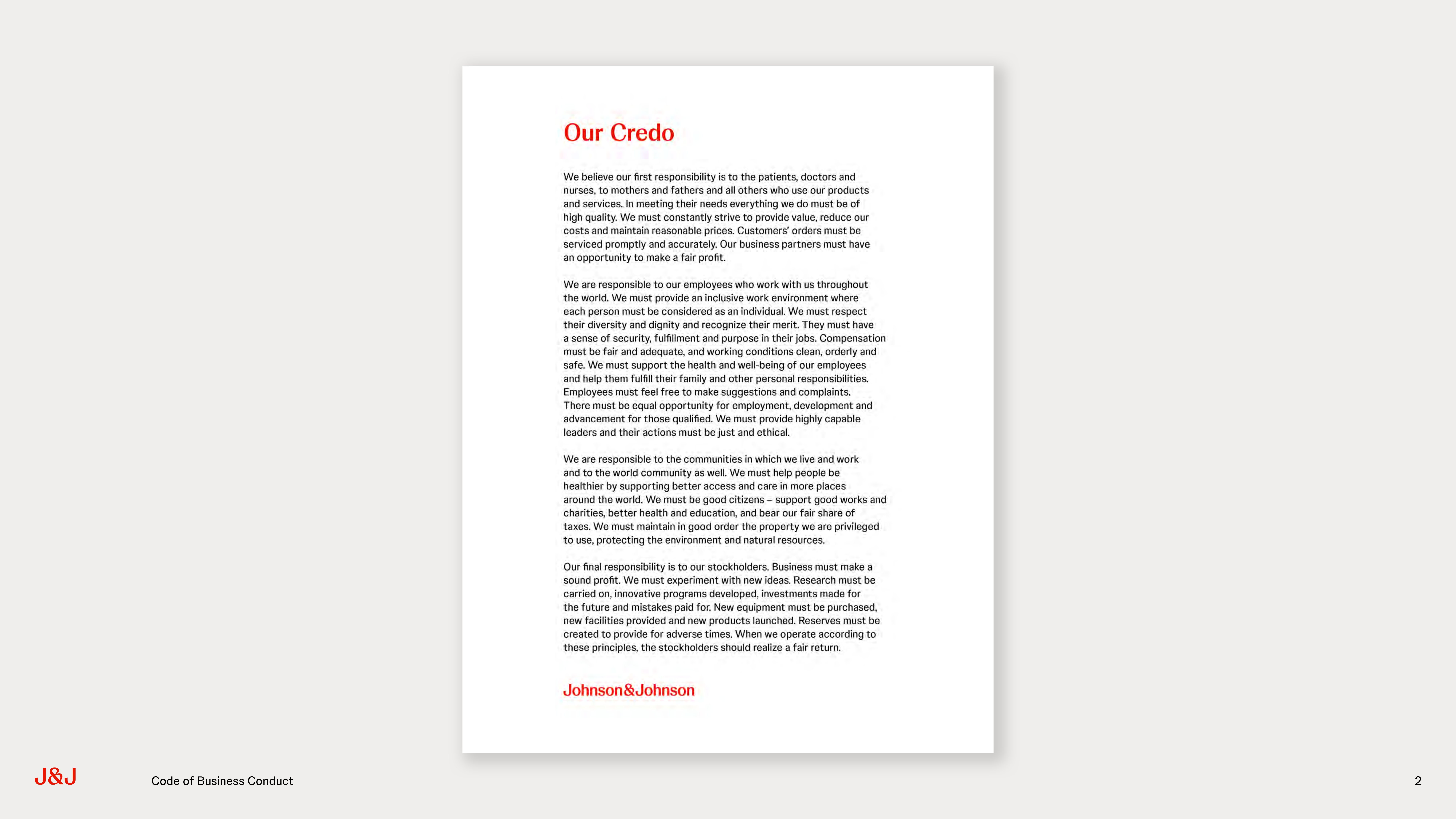
All of this is grounded in Our Credo, a set of values that for more than
80 years has inspired our employees every day to put the needs and
well-being of the people we serve first.
Together, Our Credo and our Code of Business
Conduct are critical in enabling Johnson & Johnson
to fulfill our mission of improving health for humanity.
I’m proud to lead a global company that strives to serve as a model for
ethical businesses. Our continued success depends on all employees
around the world, at all levels, in all the markets in which we operate,
doing the right thing for the patients we serve. This is why all employees
have a responsibility to read, acknowledge and comply with our Code
of Business Conduct.
This unwavering commitment to ethical and compliant leadership
behaviors is how Johnson & Johnson will transform the future of
healthcare for our patients and partners for many years to come.
Joaquin Duato
Chairman of the Board and Chief Executive Officer
3
Table of
contents
Code of Business Conduct
4
What is the Johnson & Johnson Code of Business Conduct?
06
Why do we have a Code, and why must we follow it?
06
Who must follow the Code?
06
Where can I go for advice and guidance on our Code?
07
Every employee’s responsibility
08
Every manager’s responsibility
08
Every employee’s duty
10
Development, approval, manufacture, sales and marketing of
pharmaceuticals and medical technologies and services
10
Anti-corruption and anti-bribery laws
11
Antitrust and competition laws
11
Global trade compliance: anti-boycott and trade sanctions laws
11
Human rights
12
“Third country” payments
12
Political activity
12
Public procurement
13
Fair purchasing
13
Sustainability and environmental laws and regulations
13
Animal welfare
13
Privacy
13
Engaging our workforce
15
Non-discrimination and preventing harassment and bullying
15
Safe and healthy work environment
15
Use of social media and mobile messaging applications
16
Accuracy of Company records and public reports
18
Use of Company assets
19
Intellectual property and confidential business information
19
Use of Generative Artificial Intelligence
20
Compliance with securities laws and insider trading
21
Respect for trade secrets and confidential information
21
When does “conflict of interest” occur?
23
Gifts, entertainment, hospitality, travel and other items of value
24
Personal investments, transactions and outside business interests
25
Family members and close personal relationships
25
Outside board memberships
26
Introduction
How we conduct our business
Fair treatment of employees
Financial integrity and
protecting our assets
Conflicts of interest

Code of Business Conduct
5
Introduction
6
Introduction
What is the Johnson & Johnson
Code of Business Conduct?
The values and principles spelled out in Our Credo serve as our compass;
the Johnson & Johnson Code of Business Conduct (“Code”) is the road
map that helps us stay on course with these values.
The Code sets basic requirements for business conduct and serves as
a foundation for our Company policies, procedures and guidelines, all of
which provide additional guidance on expected behaviors.
Why do we have a Code, and why
must we follow it?
To continue to operate and maintain our reputation as a company that
puts the needs of the people we serve around the world first, we must
each learn, understand and comply with our Code.
Complying with our Code is about creating an open and honest
environment where we can achieve our best work legally and with
integrity. And, we can be proud of how we overcome our challenges
and achieve our successes.
Code of Business Conduct
Whenever we become aware of a violation of the Code, Company policy
or the law, we will act to address the problem and prevent future
occurrences. Depending on the circumstances, corrective and preventive
steps might include training, counseling, enhanced controls and
disciplinary actions up to and including termination of employment.
You have a responsibility to speak up when you are in a situation or are
aware of a situation that you believe may violate or lead to a violation of
the Code, Company policy or the law.
Our
Escalation Procedure
requires each employee to report a potentially
serious violation of our policies, laws or other matter of concern directly
to the Johnson & Johnson Chief Audit Executive, either verbally or in
writing, including by e-mail via
chiefauditexecutive@its.jnj.com
.
Who must follow the Code?
All employees of the Johnson & Johnson Family of Companies are
required to understand and comply with the Code of Business Conduct,
Company policies and laws that govern our activities. Together with Our
Credo and other Company policies, the Code helps us make the right
decisions and take the right actions, regardless of where we work or the
type of work we do.
We believe that every employee is a leader, regardless of job
responsibilities, title or function. By following our Code, each of us
serves as a role model for our peers, business partners, customers and
others who see us in action every day.
People managers have additional responsibilities to serve as a positive
role model in every respect and to help employees review, understand
and apply the Code.
Individuals and companies conducting business on our behalf must
also follow our Code of Business Conduct, in addition to other
relevant Company policies. Applicable provisions of this Code should
be included in the contracts of third-party suppliers, manufacturers,
contractors, vendors and distributors doing business on behalf of the
Johnson & Johnson Family of Companies.
How to make the right decision
When faced with a difficult decision about business conduct,
ask these questions:
If the answer to any of these questions is “YES,” see the next page
for where you can go for advice and guidance.
Is the conduct a violation of the Johnson & Johnson
Code of Business Conduct, Company policy or the law?
Is the conduct in conflict with Our Credo responsibilities?
Will the conduct appear unethical to stakeholders outside
of our Company?
Could the conduct harm my reputation or the reputation
of Johnson & Johnson?
Introduction

Code of Business Conduct
Where can I go for advice and
guidance on our Code?
We have processes, guidance and procedures in place to help you
follow this Code, Company policy and the law.
Take advantage of the breadth of capabilities, resources and expertise
that exist globally within Johnson & Johnson, including the following:
→
Managers and senior leadership
in your organization are available
to answer questions and are generally familiar with the Company
guidelines that apply to the business activities in your organization.
→
Human Resources/Global Services
can explain and answer
questions about employment policies, benefits and workplace issues.
→
The Global Legal Organization
can help explain and interpret the
Code and can provide guidance about how to conduct business on
behalf of Johnson & Johnson in compliance with the law.
→
Privacy
can provide information and advice on the privacy and
protection of personal information of our stakeholders.
→
Health Care Compliance
can offer advice and guidance on our
interactions with healthcare professionals, healthcare entities,
government officials, government purchasing entities and
third-party intermediaries.
→
Quality & Compliance/Medical Safety/Environmental Health & Safety
can explain and answer questions regarding the quality, safety, efficacy
and regulatory compliance of our products and supply chain processes,
including environmental, health and safety.
→
Global Security/Information Security & Risk Management
protect
the employees, assets, computing systems and records of the
Johnson & Johnson Family of Companies worldwide. Contact local
security if there is an immediate danger or threat in the workplace.
→
Our Credo Integrity Line
(
ourcredointegrityline.com
) is available 24
hours a day, 7 days a week. It is independent, secure and confidential.
It provides a channel for anyone (including employees, business
partners, customers, consumers and others) to report potential
violations of our Code of Business Conduct, other company policies
or applicable laws and regulations in our countries of operation.
→
Johnson & Johnson Escalation Procedure
sets out the
escalation procedure that requires each employee to report
a potentially serious violation of our policies, laws or other
matter of concern directly to the Johnson & Johnson Chief
Audit Executive, either verbally or in writing, including by
e-mail via
chiefauditexecutive@its.jnj.com
.
7
Introduction

Code of Business Conduct
Every employee’s responsibility
To fulfill Our Credo responsibilities as well as maintain and enhance our
culture and reputation, we rely on our employees to uphold the Code.
If you think there is a violation of the Code, or if you think an activity or
behavior could lead to a violation, it is your responsibility to speak up.
Speaking up—by asking questions and
reporting concerns, you are doing the right
thing and helping our Company stop or
prevent misconduct.
Whether you report anonymously or give your name, you should provide
as many details as possible so the issue can be addressed thoroughly
and promptly. In addition, you have a responsibility to cooperate in
an investigation.
Our Company does not tolerate retaliation against anyone who raises
a concern under this Code or assists with an investigation.
We do not retaliate.
Any employee who engages in such retaliation will face disciplinary
action, which could include termination of employment.
Every manager’s responsibility
As a people manager, you have a special and important responsibility
to set an example and act in a manner consistent with our Code. By
setting the right tone and conduct, managers inspire all employees to
meet our standards.
Here are important guidelines you should follow:
→
Act as a role model, demonstrating ethical behavior in the
performance of your duties.
→
Make objective business-related decisions.
→
Review the Code at least once a year with your employees.
→
Help employees understand the Code and Company policies, and
direct them to resources to help them live the Code every day.
→
Ensure employees are aware of, and properly trained on, the
relevant laws, regulations and Company policies that govern the
business activities in which they engage on the Company’s behalf.
→
Create an environment that fosters and enables ethical behavior,
where employees are comfortable speaking up without fear
of retaliation.
→
Take seriously any concern raised by an employee that compromises
the Code and determine if the issue should be escalated. If so,
or if you are uncertain,
escalate the matter
as soon as possible.
→
Take corrective or preventive action when someone violates
the Code.
→
Fully support any investigation.
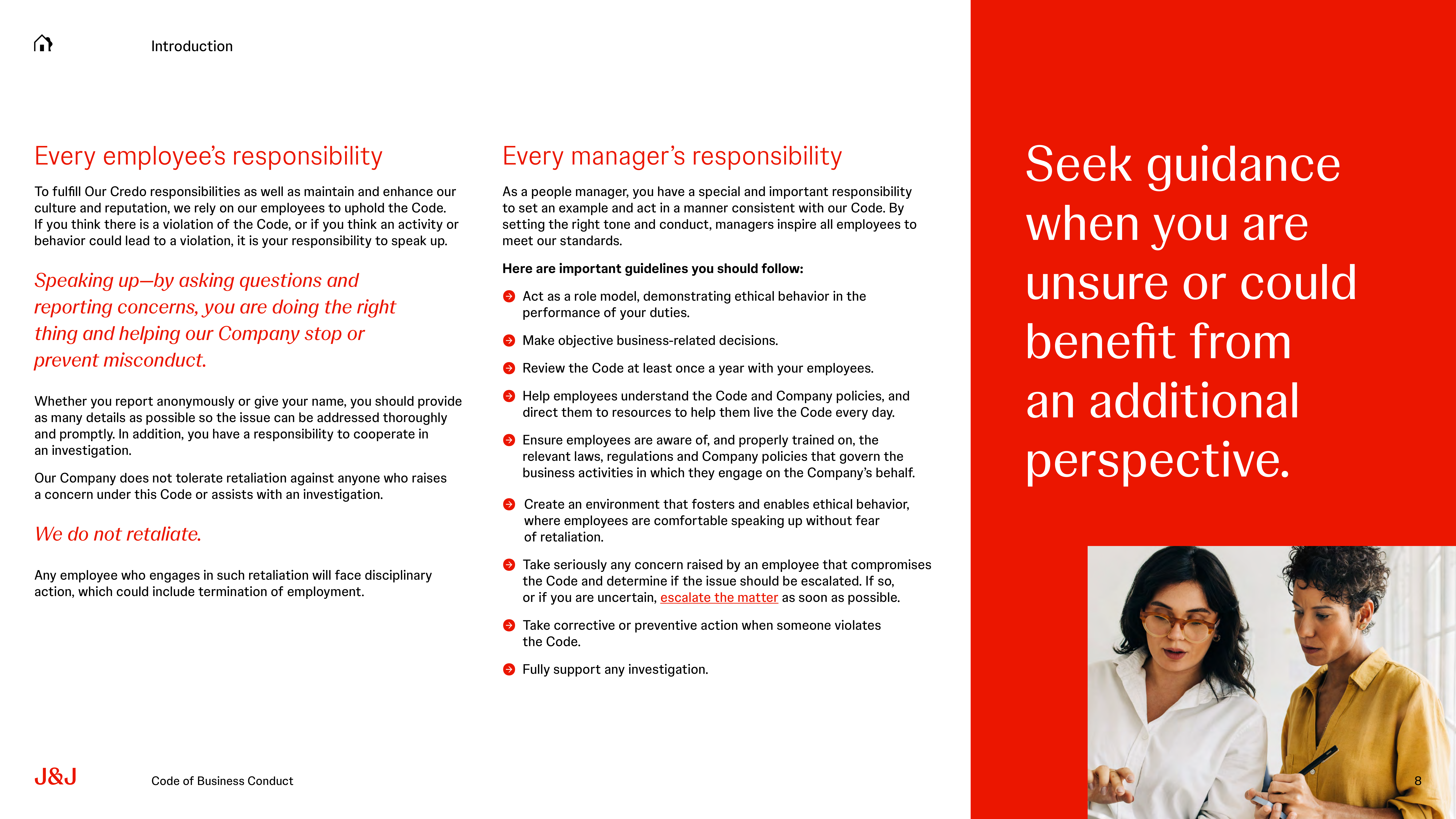
Seek guidance
when you are
unsure or could
benefit from
an additional
perspective.
8
Introduction
How we conduct
our business
Code of Business Conduct
9
“We believe our first responsibility is to
the patients, doctors and nurses, to
mothers and fathers and all others who
use our products and services.”

Code of Business Conduct
We aspire to the highest standards and level of integrity for each
of these business activities by:
→
Complying with the laws, standards and regulations that apply
to our products and processes (such as quality regulations and
standards);
→
Upholding ethical, scientific and clinical standards, and complying
with all laws and regulations in all research and development
activities worldwide;
→
Ensuring the safety of patients and volunteers who take part in
clinical trials, protecting their confidentiality and complying with
privacy and data protection laws;
→
Complying with the laws and regulations that cover gaining marketing
authorization to sell our products, and interacting with regulators and
other government officials;
→
Adhering to the applicable manufacturing, packaging, distribution and
export law, applicable trade sanctions laws and regulations and other
specific regulations for our industry, as well as adhering to laws and
regulations in the countries where we do business;
→
Keeping pace with the changing environment in which our
employees find themselves, offering needed guidance to
support Our Credo values;
→
Following all laws and regulations regarding the promotion,
marketing and sales of our products, including ensuring that what
we say is truthful, not misleading and is consistent with regulatory
approvals for our products;
→
Complying with the laws relating to product quality and safety,
consistently and proactively monitoring the safety, quality and
performance of our products, and complying with all requirements
for reporting adverse events and product quality complaints.
Every employee’s duty
Every employee is responsible for being familiar with and following the
relevant laws, regulations and Company policies and procedures that
govern the business activities in which the employee engages.
Development, approval, manufacture,
sales and marketing of pharmaceuticals
and medical technologies and services
Our Credo states that in meeting the needs of patients, doctors, nurses,
mothers, fathers and all others who use our products and services,
everything we do must be of high quality. This commitment extends to
everything we do to bring our products and services to the people who
use them.
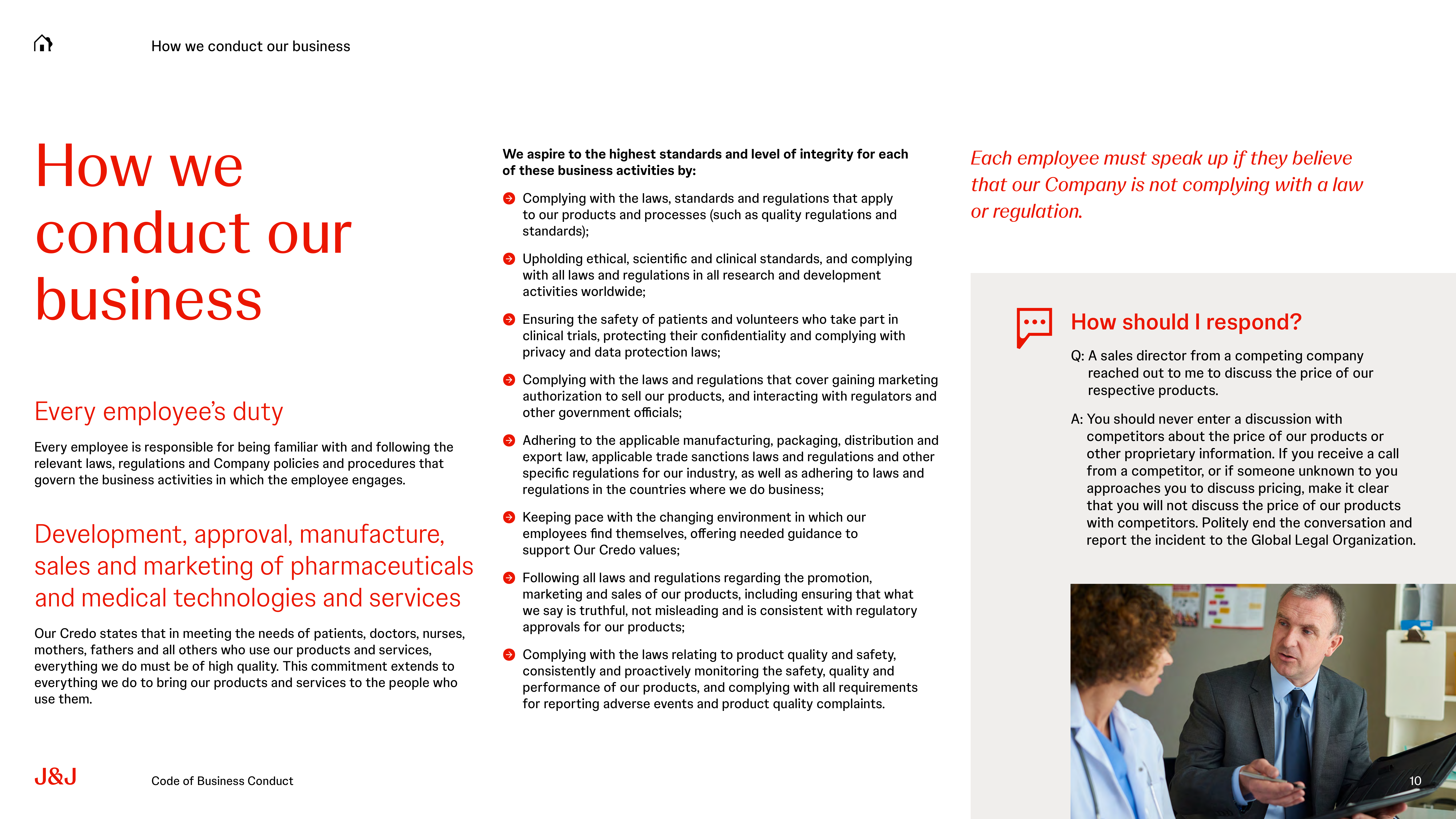
How should I respond?
Q: A sales director from a competing company
reached out to me to discuss the price of our
respective products.
A: You should never enter a discussion with
competitors about the price of our products or
other proprietary information. If you receive a call
from a competitor, or if someone unknown to you
approaches you to discuss pricing, make it clear
that you will not discuss the price of our products
with competitors. Politely end the conversation and
report the incident to the Global Legal Organization.
How we
conduct our
business
Each employee must speak up if they believe
that our Company is not complying with a law
or regulation.
10
How we conduct our business

11
For questions on healthcare compliance, contact the Health Care
Compliance Organization. Additional information may also be
found on our
ESG Policies & Positions
site, including our
Position
on Anti-Corruption
and
Position on Ethics and Compliance
.
Antitrust and competition laws
Antitrust and competition laws promote fair competition and protect
consumers from unfair business practices. These laws frequently address
illegal agreements between companies, such as price fixing. These laws
also forbid unilateral business practices that restrict competition, such
as predatory pricing.
We comply fully with all applicable antitrust and competition laws.
We are responsible for dealing fairly with customers, suppliers, competitors
and other third parties. We must enter into lawful agreements with
competitors and not engage in business practices that may abuse our
market position. For questions on antitrust and competition laws, contact
the Global Legal Organization.
Global trade compliance: anti-boycott
and trade sanctions laws
As a global provider of healthcare products and services, we work
with suppliers across markets and have an obligation to comply
with applicable local, regional and international trade laws, rules and
regulations, including trade sanctions, and import and export restrictions
imposed by governments globally. Given the dynamic and complex
geopolitical landscape and evolving trade restrictions being implemented
by governments globally, it is critical that we meet our global trade
obligations. As the external environment evolves, so will our ways of
working. For questions regarding cross-border transactions, please
contact Global Trade Compliance, Health Care Compliance or the Global
Legal Organization.
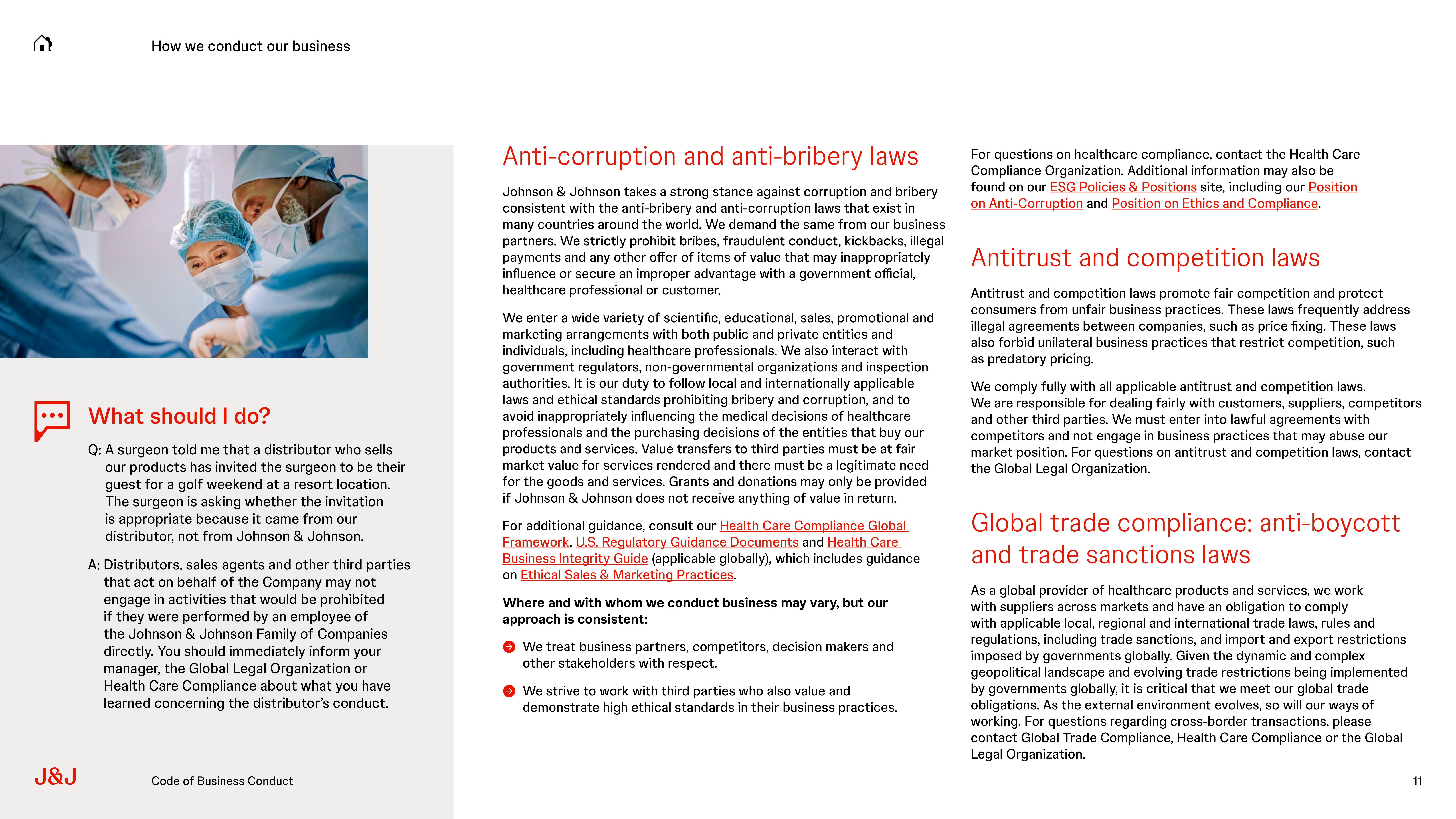
What should I do?
Q: A surgeon told me that a distributor who sells
our products has invited the surgeon to be their
guest for a golf weekend at a resort location.
The surgeon is asking whether the invitation
is appropriate because it came from our
distributor, not from Johnson & Johnson.
A: Distributors, sales agents and other third parties
that act on behalf of the Company may not
engage in activities that would be prohibited
if they were performed by an employee of
the Johnson & Johnson Family of Companies
directly. You should immediately inform your
manager, the Global Legal Organization or
Health Care Compliance about what you have
learned concerning the distributor’s conduct.
Code of Business Conduct
Anti-corruption and anti-bribery laws
Johnson & Johnson takes a strong stance against corruption and bribery
consistent with the anti-bribery and anti-corruption laws that exist in
many countries around the world. We demand the same from our business
partners. We strictly prohibit bribes, fraudulent conduct, kickbacks, illegal
payments and any other offer of items of value that may inappropriately
influence or secure an improper advantage with a government official,
healthcare professional or customer.
We enter a wide variety of scientific, educational, sales, promotional and
marketing arrangements with both public and private entities and
individuals, including healthcare professionals. We also interact with
government regulators, non-governmental organizations and inspection
authorities. It is our duty to follow local and internationally applicable
laws and ethical standards prohibiting bribery and corruption, and to
avoid inappropriately influencing the medical decisions of healthcare
professionals and the purchasing decisions of the entities that buy our
products and services. Value transfers to third parties must be at fair
market value for services rendered and there must be a legitimate need
for the goods and services. Grants and donations may only be provided
if Johnson & Johnson does not receive anything of value in return.
For additional guidance, consult our
Health Care Compliance Global
Framework
,
U.S. Regulatory Guidance Documents
and
Health Care
Business Integrity Guide
(applicable globally), which includes guidance
on
Ethical Sales & Marketing Practices
.
Where and with whom we conduct business may vary, but our
approach is consistent:
→
We treat business partners, competitors, decision makers and
other stakeholders with respect.
→
We strive to work with third parties who also value and
demonstrate high ethical standards in their business practices.
How we conduct our business

Human rights
Guided by Our Credo values, we strive to respect and promote human
rights across our operations, through our business relationships and in
our communities—from the people who develop, manufacture and
distribute our products to the doctors, nurses and patients we serve.
Our approach is informed by internationally recognized human rights
standards, including the United Nations Guiding Principles of Business
and Human Rights, and outlined in Johnson & Johnson’s
Position on
Human Rights
. All employees should be aware of the Position and comply
with the relevant guidance and policies cited therein.
“Third country” payments
No payments of any kind should be made to a third party in any country
other than the country where the sales were made or services were
provided, or in which the distributor, sales agent or service provider has
a substantial place of business. For questions regarding “third country”
payments, contact the Finance or Global Legal Organization.
Political activity
Johnson & Johnson is committed to corporate citizenship and
community involvement. Our political advocacy and political contributions
are made in accordance with laws of the jurisdictions where we engage
in these activities.
We respect the right of employees to engage in political activity to
support political groups, government officials or candidates. Any such
activity, including serving as a public official, must be voluntary and
performed in the employee’s own time, at the employee’s own expense
and not conflict with the individual’s responsibilities to the Company. It
must be clear that the employee is acting independently and not as a
representative of the Company.
Political activities by the Company, including political contributions and
political advocacy as well as other advocacy to government officials, are
regulated under the laws of the many countries where Johnson & Johnson
does business. As such, interactions (all political and lobbying activities as
well as meetings) with government officials, political and other advocacy
by employees toward government officials as well as political contributions
by Company leaders in some countries, must be coordinated and aligned
with
Worldwide Government Affairs & Policy
.
12
What if?
Q: A friend of mine is running for political office.
Can I help her out with the campaign?
A: Yes, your volunteer support is your personal
decision. However, in no instance may you
use Johnson & Johnson resources—including
Company time, phones, emails, supplies, the
Company name or your Company title—to
advance the campaign.
Code of Business Conduct
How we conduct our business
Code of Business Conduct
Public procurement
Public authorities are critical customers for the Johnson & Johnson
Family of Companies. In many countries, public bodies, such as
government-run hospitals, are subject to local laws governing how they
procure products and services. As a supplier of products, we are also
required to comply with these laws. There must be neither inappropriate
attempts to influence nor improper transfers of value to governments or
government officials.
Employees who are involved in tender processes, or who offer to provide
our products and services under a contractual agreement to a public
authority, must understand and follow the rules of public procurement.
These rules can be complex but are critically important to our business.
The Global Legal Organization can provide guidance on these rules.
Fair purchasing
Our Company purchases many goods and services necessary to
support our work. When making these and other purchases, we must
act impartially toward vendors, suppliers and other service providers.
Employees are required to follow the
Company’s procurement
and
purchasing policies.
See the Conflicts of Interest section of the Code for further guidance
on accepting gifts and entertainment from, and having personal
relationships with, vendors, suppliers and service providers.
Sustainability and environmental
laws and regulations
Our Credo states, “We must maintain in good order the property we
are privileged to use, protecting the environment and natural resources.”
Guided by Our Credo, we continually strive to improve the environmental
footprint of our operations, our products and our value chain while also
managing environmental risks. Employees are required to adhere to
Company-wide standards and policies, and to be familiar and
comply
with environmental laws and regulations
that relate to their specific
work, facilities and the products we put on the market.
We are responsible to the communities in which
we live and work and to the world community
as well.
Animal welfare
It is our ethical and regulatory responsibility to ensure the ethical
and humane treatment of animals involved in biomedical research
to advance patient safety and well-being. Johnson & Johnson has
a decades-long commitment to the 3R principles related to the
replacement, reduction or refinement of animal-based research. We
advocate the use of nonanimal alternatives whenever possible and
when a nonanimal alternative is not feasible, our standards for animal
care and selection of in vivo scientific models are intended to meet or
exceed all applicable regulations.
Privacy
In the course of conducting business, we collect and store personal
information about employees, business partners, patients, healthcare
professionals, consumers, caregivers and others, including data such
as contact information, birth dates and financial, medical and other
information. When we collect and process personal information, we do
so in compliance with applicable laws and the
Company’s privacy and
data protection policies
.
Personal information should be collected only for legitimate business
purposes, shared only with those who are permitted access, protected
in accordance with security policies and retained only for as long as
necessary. We also must ensure that third parties with access to personal
information are contractually obligated to protect it in accordance with
applicable data security standards.
Did you know?
The Global Legal Organization is available to
conduct training and provide advice to help
our businesses and employees understand and
comply with laws and regulations in the countries
in which we do business.
You can find comprehensive policies on key
topics covered throughout the Code at the
Johnson & Johnson Law Center.
13
How we conduct our business
Code of Business Conduct
14
Fair treatment of
employees
“We are responsible to our employees
who work with us throughout the world.”

Engaging our workforce
At Johnson & Johnson, we believe in the power of people and value our
global and inclusive culture, rooted in the ethical behaviors, respect and
integrity inherent in Our Credo. When we act with the highest integrity
we live Our Credo values, and show we truly care for the people we
serve and respect the people with whom we work. An engaged, high-
performing, and healthy workforce will better understand and address
the challenges and needs faced by our patients, customers, healthcare
professionals and communities.
Non-discrimination and preventing
harassment and bullying
Employees must be treated fairly and be respected for our contributions.
Our Company provides equal opportunities for employment. We provide
reasonable accommodation to individuals with disabilities as well as
individuals with needs related to their religious observance or practice.
We base employment decisions on merit, and consider qualifications,
skills and achievements. We do not tolerate discrimination based on non-
work related personal characteristics such as age, gender, race, ethnic
background, sexual orientation, gender identity, national origin or religious
beliefs or based on union membership or union activity. We also do not
tolerate
harassment or bullying of any kind
.
These provisions apply to interactions with employees, customers,
contractors, suppliers and applicants for employment, and any other
interactions where employees represent the Johnson & Johnson Family
of Companies.
Safe and healthy work environment
At Johnson & Johnson, we are committed to providing a safe and healthy
workplace for all employees, contractors and visitors working within, or
visiting, our facilities and premises.
All employees and visitors are responsible for prioritizing health and
safety. They should:
→
Promptly report unsafe conditions, accidents or incidents to
supervisors and hosts.
→
Comply with Company policies, standards and procedures relating
to workplace health and safety, or any local workplace health and
safety laws and regulations, if they require higher care.
What should I do?
Q: My team is behind schedule on finishing
a project and our operating company is
depending on us to meet the deadline. We’ve
found ways to achieve the goal by skipping a
couple of safety procedures. If we are careful,
is it okay to speed up the process to meet the
business deliverable?
A: Safety procedures are in place to keep you safe
and to protect the integrity of our products
and the health of those who use them. Skipping
safety procedures is not allowed. Meet with
your manager to develop a plan that gets the
work done safely and compliantly.
15
Fair treatment
of employees
Code of Business Conduct
Child labor
,
human trafficking
and illegal, abusive or forced labor have
no place in our operations or in the operations of our suppliers or other
third-party vendors of the Johnson & Johnson Family of Companies. In
addition to requiring compliance with local laws and regulations, Johnson
& Johnson has
policies
that prohibit the use of forced or compulsory labor
in the manufacture of our products and product components. Third-party
vendors are required to follow our
Responsibility Standards for Suppliers
which include guidance on ethics, labor, employment and respect for human
rights as well as on the health, safety and well-being of their employees.
Fair treatment of employees

Code of Business Conduct
16
Use of social media and mobile
messaging applications
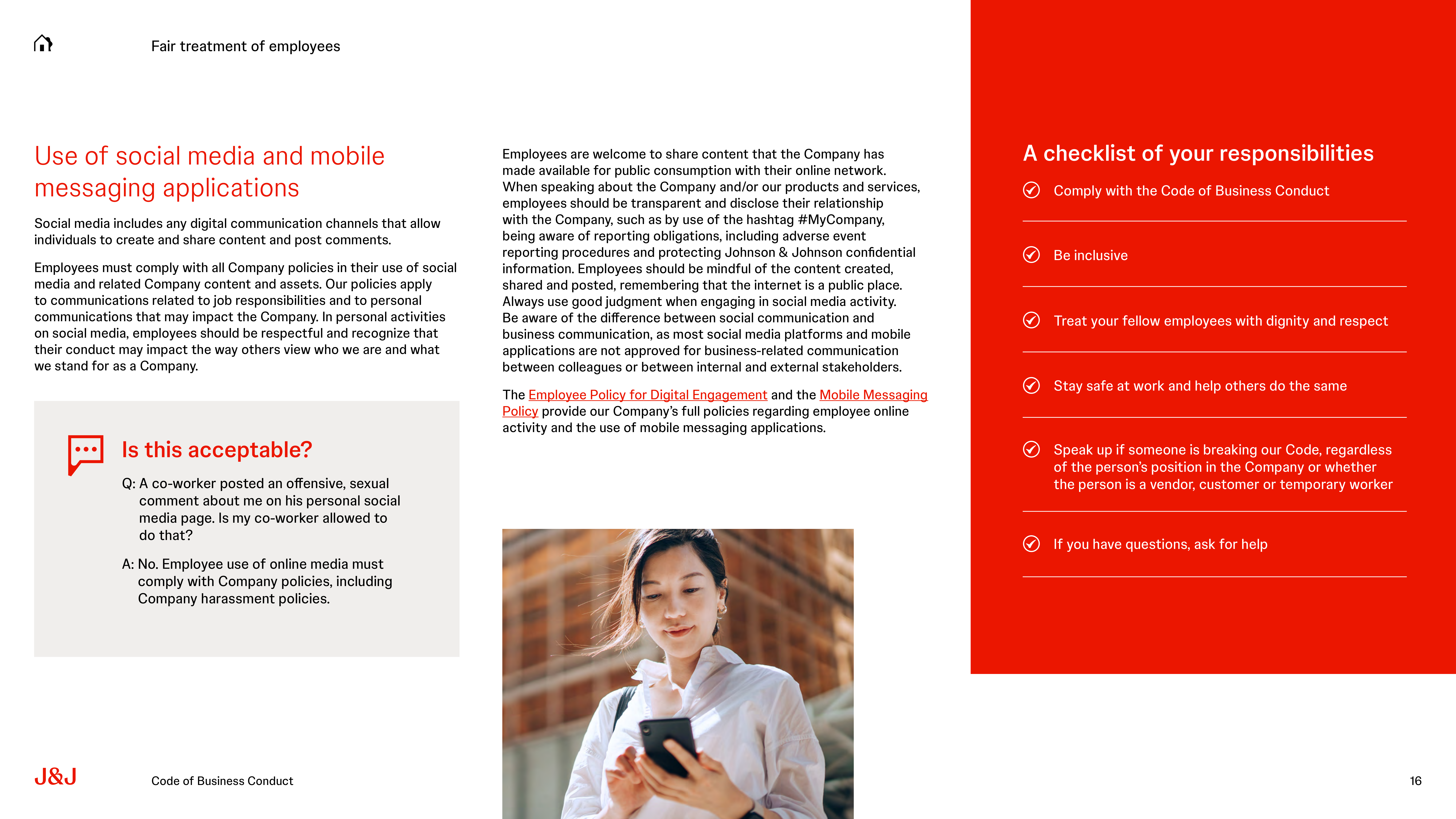
Social media includes any digital communication channels that allow
individuals to create and share content and post comments.
Employees must comply with all Company policies in their use of social
media and related Company content and assets. Our policies apply
to communications related to job responsibilities and to personal
communications that may impact the Company. In personal activities
on social media, employees should be respectful and recognize that
their conduct may impact the way others view who we are and what
we stand for as a Company.
A checklist of your responsibilities
Comply with the Code of Business Conduct
Be inclusive
Speak up if someone is breaking our Code, regardless
of the person’s position in the Company or whether
the person is a vendor, customer or temporary worker
Treat your fellow employees with dignity and respect
Stay safe at work and help others do the same
If you have questions, ask for help
Employees are welcome to share content that the Company has
made available for public consumption with their online network.
When speaking about the Company and/or our products and services,
employees should be transparent and disclose their relationship
with the Company, such as by use of the hashtag #MyCompany,
being aware of reporting obligations, including adverse event
reporting procedures and protecting Johnson & Johnson confidential
information. Employees should be mindful of the content created,
shared and posted, remembering that the internet is a public place.
Always use good judgment when engaging in social media activity.
Be aware of the difference between social communication and
business communication, as most social media platforms and mobile
applications are not approved for business-related communication
between colleagues or between internal and external stakeholders.
The
Employee Policy for Digital Engagement
and the
Mobile Messaging
Policy
provide our Company’s full policies regarding employee online
activity and the use of mobile messaging applications.
Is this acceptable?
Q: A co-worker posted an offensive, sexual
comment about me on his personal social
media page. Is my co-worker allowed to
do that?
A: No. Employee use of online media must
comply with Company policies, including
Company harassment policies.
Fair treatment of employees
Code of Business Conduct
17
Financial integrity
and protecting
our assets
“Our final responsibility is to
our stockholders.”

Code of Business Conduct
Accuracy of Company records
and public reports
Johnson & Johnson is a publicly traded company that conducts
business in many countries. In all our dealings, we must keep accurate
books and records that maintain the integrity of the Company’s
financial reporting, support internal decision-making and strengthen
our reputation with stakeholders.
Laws require us to be honest and accurate in our financial records so
that they appropriately reflect our business transactions. In addition,
we are required to develop and maintain an adequate system of
internal accounting controls. Many people rely on us to report financial
information truthfully, completely and in a timely fashion; among them
are government regulatory agencies, ratings agencies, and institutional
and individual investors.
Inaccurate financial reporting could undermine shareholder confidence,
impact our reputation and subject the Company to fines and penalties.
Below are examples of how we build financial integrity into our
work processes:
→
We sell and purchase products and services based on quality, price
and service—never on the basis of giving or receiving payments,
gifts, entertainment or favors, or based on other relationships with
the supplier.
→
We record sales and expenses during the appropriate accounting
period in accordance with generally accepted accounting principles.
→
We prohibit the use of Company funds, assets or information for
any illegal purpose, including the purchase of privileges or special
benefits through bribes, illegal political contributions or other illicit
payments. We disclose and record all funds and assets of the
Company in the appropriate reporting period.
→
We keep accurate Company books and records and do not
make false or artificial entries for any reason.
Here are a few rules to keep in mind:
→
Always follow the
Company’s procurement and purchasing policies
.
If you are not sure what the policies are, ask your manager.
→
Be sure to have all payments or usage of Company funds reviewed
and approved, as required, by the appropriate manager. When
submitting business expenses, follow our Company’s
Travel &
Entertainment
and
Health Care Compliance and Business
Integrity
policies.
→
Clearly and accurately describe all requests for payments and
provide supporting documentation; use the proceeds only for the
requested and approved purpose.
Financial
integrity and
protecting
our assets
Is this acceptable?
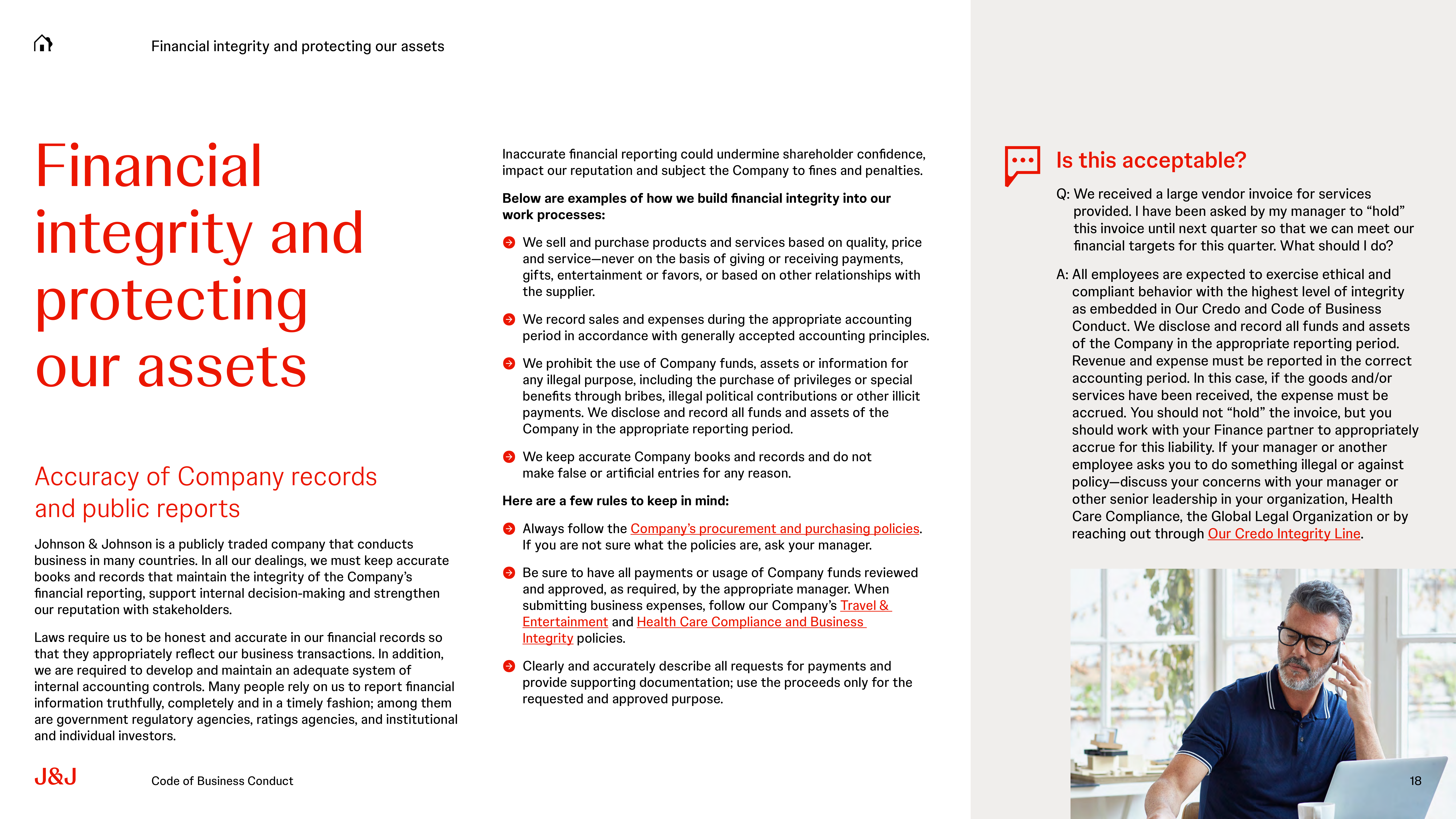
Q: We received a large vendor invoice for services
provided. I have been asked by my manager to “hold”
this invoice until next quarter so that we can meet our
financial targets for this quarter. What should I do?
A: All employees are expected to exercise ethical and
compliant behavior with the highest level of integrity
as embedded in Our Credo and Code of Business
Conduct. We disclose and record all funds and assets
of the Company in the appropriate reporting period.
Revenue and expense must be reported in the correct
accounting period. In this case, if the goods and/or
services have been received, the expense must be
accrued. You should not “hold” the invoice, but you
should work with your Finance partner to appropriately
accrue for this liability. If your manager or another
employee asks you to do something illegal or against
policy—discuss your concerns with your manager or
other senior leadership in your organization, Health
Care Compliance, the Global Legal Organization or by
reaching out through
Our Credo Integrity Line
.
18
Financial integrity and protecting our assets
Use of Company assets
We rely on Company assets to support our work every day.
Computers, mobile devices, information technology hardware and
software, vehicles, facilities, machinery, raw materials, inventory,
intellectual property, supplies, data and other assets are placed in our
care and should be used only for lawful, appropriate reasons. We also
must take appropriate steps to protect these assets. When working
with Company information or technology tools (such as laptops,
email, apps, databases, etc.), employees should only download and
use J&J approved software and applications on Company assets,
create complex passwords that cannot be easily guessed and should
never share passwords. Company information should not be stored on
unapproved internet or cloud services or on non-approved devices that
may not be protected and may be accessed by unauthorized people.
Intellectual property and
confidential business information
The intellectual property and confidential information of the Company
are irreplaceable assets. We must secure and protect the use of these
valuable assets.
Intellectual property includes copyrights, patents, trademarks,
product and package designs, brand names and logos, research and
development, inventions and trade secrets.
At all times, we should take precautions to protect the intellectual
property and confidential business information of the Company. We
should avoid talking about or sharing such information in public places
like elevators, airports and restaurants. Additionally, confidential
business information should be stored on authorized or managed
devices and only sent outside the Company in a secure manner using
approved tools and only to authorized business partners.
Any suspected theft of intellectual property or unauthorized disclosure
of, or access to, our Company information should be immediately
reported to your manager or to J&J Information Security & Risk
Management, Global Security or the Global Legal Organization.
Examples of confidential
business information
What should I do?
Q: I am taking a vacation where I want to completely
disconnect. Is it okay if I leave my laptop with my
administrative assistant to handle any approvals
in the various Company systems on my behalf?
I trust this person completely, so I don’t mind
sharing my password.
A: No. Employees should never give their personal
password to anyone. Some systems allow you to
delegate certain actions to others; other systems
escalate issues to your manager in case of absence.
If you bypass these controls, you are undermining
the security of our systems, avoiding your own
responsibilities and putting your assistant in a
position of also violating Company policy.
19
Code of Business Conduct
Detailed sales information
Business performance targets
New product information
Pending personnel announcements
Acquisition and divestiture information
Manufacturing processes and equipment designs
Personal data of employees, patients, customers and
individuals with whom we interact
Clinical trial data, health records and other sensitive
personal information
Research priorities and stage-gate results
Product strategies
Financial integrity and protecting our assets

Code of Business Conduct
Use of Generative Artificial Intelligence
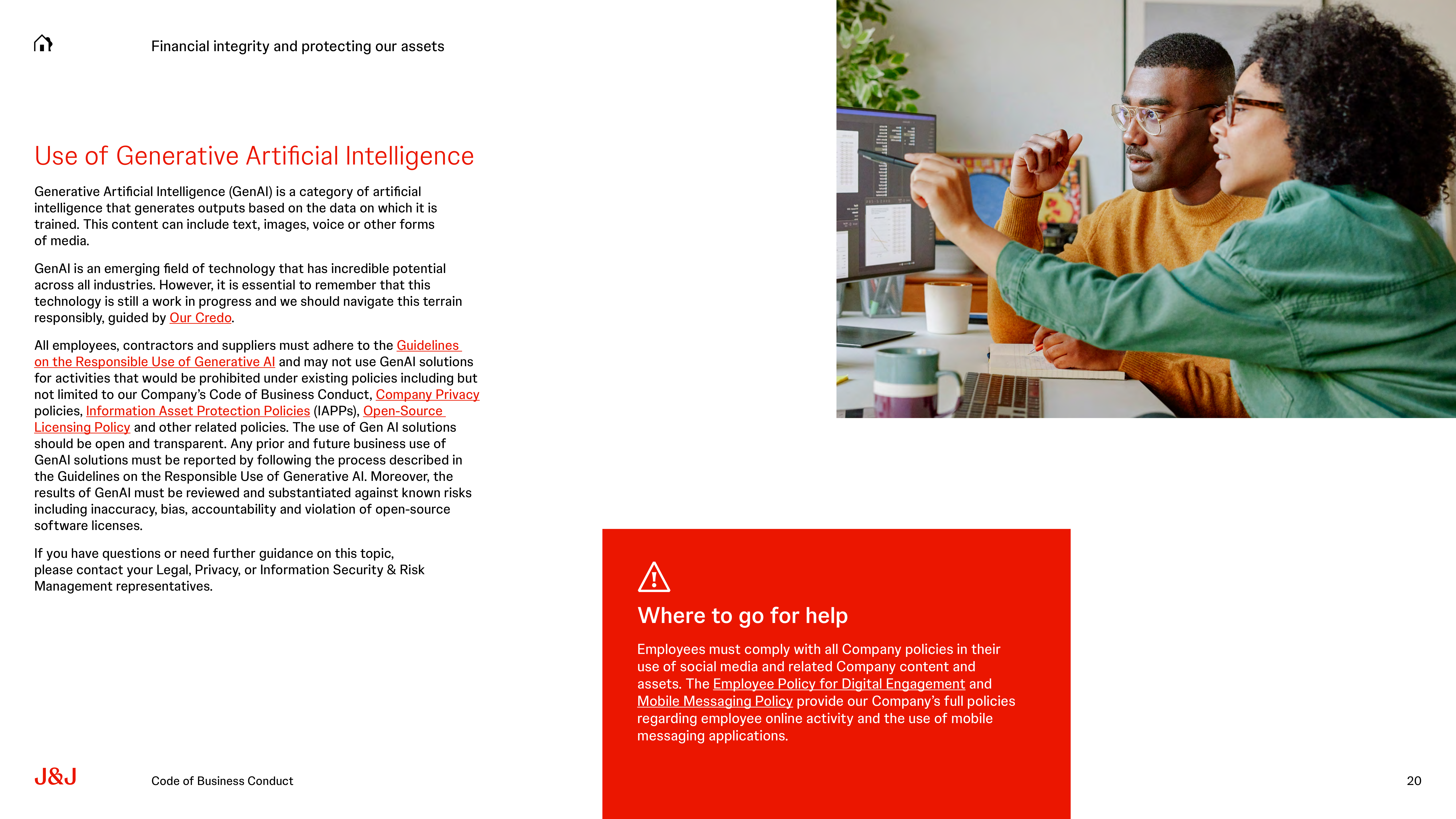
Generative Artificial Intelligence (GenAI) is a category of artificial
intelligence that generates outputs based on the data on which it is
trained. This content can include text, images, voice or other forms
of media.
GenAI is an emerging field of technology that has incredible potential
across all industries. However, it is essential to remember that this
technology is still a work in progress and we should navigate this terrain
responsibly, guided by
Our Credo
.
All employees, contractors and suppliers must adhere to the
Guidelines
on the Responsible Use of Generative AI
and may not use GenAI solutions
for activities that would be prohibited under existing policies including but
not limited to our Company’s Code of Business Conduct,
Company Privacy
policies,
Information Asset Protection Policies
(IAPPs),
Open-Source
Licensing Policy
and other related policies. The use of Gen AI solutions
should be open and transparent. Any prior and future business use of
GenAI solutions must be reported by following the process described in
the Guidelines on the Responsible Use of Generative AI. Moreover, the
results of GenAI must be reviewed and substantiated against known risks
including inaccuracy, bias, accountability and violation of open-source
software licenses.
If you have questions or need further guidance on this topic,
please contact your Legal, Privacy, or Information Security & Risk
Management representatives.
20
Where to go for help
Employees must comply with all Company policies in their
use of social media and related Company content and
assets. The Employee Policy for Digital Engagement and
Mobile Messaging Policy provide our Company’s full policies
regarding employee online activity and the use of mobile
messaging applications.
Financial integrity and protecting our assets
21
Respect for trade secrets and
confidential information
We respect the trade secrets and confidential information of
other companies and individuals. We collect information about
our competitors from the public domain and we do not permit the
inappropriate collection of their proprietary information.
To gather information about a competitor, we seek out public sources,
such as the media, trade literature, the internet, court papers, regulatory
filings or other public documents. We avoid discussions of sensitive
and confidential information with employees of our competitors in
all circumstances, including at professional association or industry
meetings. We are truthful in our statements to others in the industry,
and never misrepresent who we are or where we work to learn
about competitors.
Compliance with securities laws and
insider trading
By law, we are required to publicly disclose certain important
information about our Company, such as sales, earnings, significant
acquisitions/divestitures, regulatory matters and other material events.
When we publicly disclose this information, it is our responsibility to do
so in complete, accurate, timely and understandable ways.
Employees may find out important information about the Company
before it is released to the public; however, it is every employee’s
responsibility to keep material non-public information confidential.
If employees have important information that has not been disclosed
to the public, they are not allowed to:
→
Buy or sell Johnson & Johnson stock or “put” or “call” options
on Johnson & Johnson stock;
→
Make transfers or adjustments to other investment vehicles,
including retirement funds;
→
Disclose material non-public information to family, friends
or any other person outside the Company;
→
Recommend to family, friends or others that they buy or
sell Johnson & Johnson stock or “put” or “call” options on
Johnson & Johnson stock.
Complying with securities laws extends beyond our Company.
Employees may not buy or sell securities of any other company using
important material non-public information they have learned while
performing their duties or through other means.
Code of Business Conduct
What should I do?
Q: I have an urgent need for cash and want to sell
my Company stock. But I’m nervous about doing
that now because I’m aware of a big event
happening within our Company next month that
is not public information.
A: For questions on securities laws and insider
trading, or if you are uncertain on whether you
possess material non-public information, contact
AskCorporateSecretary@its.jnj.com
.
A checklist of our responsibilities
Protect our Company assets, including physical assets
such as computers, phones, mobile devices, machines,
vehicles, documents and intellectual assets, like ideas
and inventions
Comply with data protection and privacy requirements,
and do not use unauthorized apps or other channels to
communicate proprietary information
Immediately report any concerns about illegal or
unauthorized activity
Never accept or offer a bribe or inappropriate gift
Be honest and accurate when reporting expenses,
sales and other financial information
Financial integrity and protecting our assets
Code of Business Conduct
22
Conflicts of interest
“We are responsible to the communities
in which we live and work and to the
world community as well.”
When does “conflict of interest” occur?
A conflict of interest is a situation in which a person or organization has
conflicting interests, financial or otherwise, and serving one interest could
have an adverse impact on those other interests or responsibilities.
A personal conflict of interest occurs when a personal relationship or
activity could influence the judgment and ability to perform your job in
an objective way and fulfill all duties to an employer. Even the appearance
or perception of a conflict of interest can place our Company at risk. As
employees, we should never allow divided loyalties or personal gain or
benefit to prevent us from doing what is in the best interest of our
Company and the patients and consumers we serve.
An organizational conflict of interest can occur when entities within the
Johnson & Johnson Family of Companies have conflicting relationships
with entities such as governments, payor groups, healthcare providers
or individuals within these entities or engage in activity that creates a
preference or bias in favor of the Company. For example, a conflict or
perceived conflict may occur when our companies are collaborating on
the development of products and supporting healthcare systems and
their infrastructure or treatment guidelines, while also seeking to sell
products or services to those entities. An organizational conflict of
interest might also occur when a Company is in possession of sensitive
government information and uses that information to prepare a more
preferred tender.
It’s not always clear whether an activity creates a conflict of interest.
However, it is the responsibility of every employee to disclose a potential
conflict, either personal or organizational. For this reason, employees are
expected to discuss any potential personal conflicts—or questions about
how best to handle a situation where a conflict might exist—with their
manager or someone from Human Resources, Health Care Compliance
or the Global Legal Organization. If a conflict or potential conflict exists,
the discussion with your manager should be reported and documented in
WORKDAY. This will help protect the employee and Johnson & Johnson if
the situation ever comes into question. Organizational conflicts should be
discussed with Health Care Compliance or the Global Legal Organization.
Code of Business Conduct
23
Is this a conflict?
Q: Given the reputation of Johnson & Johnson in my
country, my commercial team has been asked to
consult on the development of local treatment
guidelines. Is it acceptable for us to proceed?
A: This is an organizational conflict. You should consult
with the Global Legal Organization and Worldwide
Government Affairs & Policy for guidance on how
best to ensure that any support of local health policy
initiatives is conducted using appropriate safeguards,
complies with local laws, and avoids the perception
that the policies are biased toward our products.
Think it through
If you answered “yes” to any of the above questions, discuss
the situation with your manager and report your conflict of
interest through WORKDAY.
Will this activity or relationship influence, or appear to
influence, my ability to make sound and unbiased business
decisions or otherwise interfere with my ability to do
my job?
Will I personally gain something or will a family member
benefit from my involvement in this activity based on my
status as an employee of the Johnson & Johnson Family
of Companies?
Will I be using Company assets for personal gain?
Will my participation cause me to put my interests
ahead of what’s best for the Company?
Will public disclosure of the activity damage the
reputation of Johnson & Johnson?
Conflicts
of interest
Conflicts of interest
Code of Business Conduct
24
Gifts, entertainment, hospitality, travel
and other items of value
Suppliers, vendors and others who do business with us are vital to our
Company’s success. To keep our relationships with them honest and
objective, we avoid conflicts of interest.
Conflicts of interest can occur when an employee solicits or accepts gifts,
payments, loans, services or any form of compensation from suppliers,
customers, competitors or others seeking to do business with our
Company. Employees should only accept gifts, entertainment, hospitality,
travel or other items of value from suppliers, vendors or other contractors
where they are modest, are not cash or cash equivalents, and do not
influence business decisions.
Our
Health Care Compliance
policies provide specific guidance on
offering gifts, entertainment, hospitality and similar benefits to healthcare
professionals and government officials.
What is allowed?
As a global company, we operate in many diverse environments where
certain activities are an expression of politeness or a reflection of societal
and/or cultural practices. We respect cultural norms to the extent possible
under the local laws and regulations by which we are governed, but those
activities cannot violate this Code. There may be times when we must
modify our response in a culturally sensitive and thoughtful way, especially
if healthcare professionals or government officials are involved.
Customary activities include modest forms of hospitality, such as lunches
or dinners and occasional gifts of minimal value, which do not influence
clinical or business decisions. Although it is difficult to define “customary”
or “modest,” the best approach is to exercise good judgment. If you are
offered anything that is more than nominal in value, you must consult with
your manager. You should avoid activities that are excessive or become
a regular occurrence. For example, if the action will cause a disinterested
third party to think the gift or service affected your judgment, then it is
excessive and should be refused.
Here are some of the things to consider if a vendor offers a gift:
→
Is the gift “modest” or “customary”?
→
Is the gift more than nominal in value?
→
Does the vendor regularly give gifts?
→
Would the gift potentially impact or influence business objectivity?
Employees are allowed to obtain personal loans from financial institutions
that do business with the Company as long as the loans are made based on
current rates and conditions. The same rule applies when employees buy
products or services from our vendors. Transactions should be based on
the same terms offered to any member of the public, except as described
in various employee benefit programs.
Remember—not reporting a potential conflict of
interest is a violation of our Code. When in doubt,
you should seek guidance from your manager.
Is this a conflict?
A supplier sent me a gift basket filled with sweets. Can I accept it?
→
You can accept small gifts of modest value. However, if the gift is such
that a third party might think the gift can influence or interfere with
your decision-making, use common sense in whether you accept it, and
talk to your manager.
Our team is negotiating medicine coverage and reimbursement with
a government’s health system and learned that our research and
development (R&D) organization is a top contender for a large
government grant to advance an innovative research and development
program. Am I allowed to mention this grant in my negotiation,
reinforcing that our Company has many ties to the government and
our strong relationship?
→
No. You should keep the medicine coverage and reimbursement
negotiation separate from what the R&D organization is pursuing.
You may, however, be required to disclose the various relationships
in your offer along with steps taken to mitigate any potential
organizational conflict of interest. Conflicts of interest can have
significant negative impact on the reputation and effectiveness of
Johnson & Johnson and on our products and services.
Can I invite a customer to spend a week at my vacation home?
→
It is generally inappropriate to offer something of more than modest
value to a customer, distributor or vendor. However, if you have a close
personal relationship with that person, this may be acceptable under
certain conditions. Discuss the situation with your manager. You should
document the outcome of the discussion with your manager in writing
if the decision is made that your offer is permissible and you decide
to proceed.
One of my friends from university has a market research company.
He gave me a very interesting presentation for a project for
Johnson & Johnson at a very low price. Is it permissible for me to
give him the business?
→
Even if the spend is not high, we need to ensure that the final decision
is based on objective criteria. You should disclose your relationship and
the circumstance to your manager. If the Company decides to proceed,
you should document the outcome of the discussion with your manager
in writing, including via email, outlining the steps taken to mitigate any
potential conflict.
Conflicts of interest

25
Personal investments, transactions
and outside business interests
We know financial health is important to our employees and their
families. At times, employees may want to make business investments
or take on an additional job to help build financial security. However,
employees must take care to avoid any potential conflicts of interest,
including avoiding activities that influence, or appear to influence, their
ability to make sound and unbiased business decisions, use Company
assets, including time, for personal benefit or the benefit of another
party, or otherwise interfere with their ability to do their job.
Areas to avoid
Code of Business Conduct
Family members and close
personal relationships
Relationships with family members and close personal friends can
influence our decisions. It is important to be careful about Company
business decisions that involve close personal relationships.
To prevent conflicts of interest, employees should:
→
Avoid supervising or taking part in the hiring or promotion of
a family member.
→
Avoid holding a position with access to or influence over
performance appraisals, salary information or other confidential
information related to a family member.
These situations should also be avoided in connection with another
employee or a prospective employee with whom one has a close
personal relationship outside the Company.
If any of these situations occur, an employee must inform their manager
of the relationship. The manager will assess the situation, consult with
management as needed, and may elect to transfer one of the employees
to another available position where no conflict exists.
A close personal relationship is a relationship
with a family member or another person you are
close to which could impair your objectivity when
making business decisions.
Is this a conflict?
My family has an ownership interest in a growing distribution company.
I’d like to authorize the use of this distributor for a Johnson & Johnson
business because I can get us a very good deal. If I tell my manager
about my family’s interest in the business, it is allowable to hire the
distribution company?
→
It is allowable to introduce the distributor to our business. You
must fully disclose your family’s and your own relationships to the
distributor and then excuse yourself from the decision-making process
and management of the project. The final decision should be made
independently by a senior leader in the business without your
involvement, and you should not seek to influence the outcome of
the decision in any way.
My brother-in-law would be a perfect fit for a new marketing job
opening. Can I go ahead and hire him without an interview or
bid process?
→
No. You can refer him, but he must go through the normal application
process. In addition, you must excuse yourself from the decision-
making process and you should not seek to influence the outcome
of the decision in any way.
The use of Company assets—physical or intellectual—
for personal gain
The purchase or sale of another company’s securities using
non-public information that you obtained through your job
Providing service to a competitor, supplier, proposed
supplier or customer as an employee, director, officer,
partner, agent or consultant
Activities that influence or attempt to influence any
business transaction between the Company and another
entity in which an employee has a direct or indirect financial
interest or acts as a director, officer, employee, partner,
agent or consultant
Conflicts of interest

26
Outside board memberships
Serving on outside boards can present conflicts of interest and should
be disclosed and discussed with your manager. Before accepting
memberships on any board, it is important to understand your legal
responsibilities and avoid affiliations that carry the potential for
distraction and conflicts of interest. Our
outside board memberships
policy provides additional guidance.
Code of Business Conduct
Know the 3 “D’s”
Disclose
Disclosure is key. If you face a gray area and are not sure if an
activity presents a conflict of interest, talk to your manager,
supervisor or anyone outlined in the “
Where to go for advice
and guidance on our Code
” section about your concerns.
Discuss
Decide
Where can I go for advice and
guidance on our Code?
Although our Code provides examples of conflicts of interest, it is impossible
to define every situation. If you have a conflict of interest or aren’t sure
whether you have a conflict, you are required to provide details of the
conflict to your manager and/or his or her manager, or to your Human
Resources or Global Legal Organization business partner. Go to the conflict
of interest section in WORKDAY to declare any potential conflict of interest.
Conflicts of interest
Code of Business Conduct
27
Code of
Business Conduct
Live Our Credo, know our Code
This is the current version of the Johnson & Johnson Code
of Business Conduct, updated in 2024, and it supersedes all
previous versions.
© Johnson & Johnson Services, Inc. 2024